Norada Real Estate Investments

  • Home
  • Markets
  • Properties
  • Membership
  • Podcast
  • Learn
  • About
  • Contact

Archives for February 2025

Will Trump Lower Mortgage Interest Rates in 2025?

February 18, 2025 by Marco Santarelli

Will Trump Lower Mortgage Interest Rates in 2025?

The question on many potential homebuyers' minds is: will Trump lower mortgage interest rates? The short answer is, it's highly unlikely that a second Trump presidency would lead to a significant, sustained drop in mortgage rates. While some of his policies might have a minor, temporary impact, the bigger picture involves complex economic forces that are largely outside any president's direct control. Let's dive into what's really at play and why I'm leaning towards a more cautious outlook.

Will Trump Lower Mortgage Interest Rates?

Okay, so, mortgage rates aren't just some number plucked out of thin air. They're influenced by a bunch of factors, the most important being the 10-year Treasury yield. Think of the Treasury yield as the temperature gauge of the bond market. When investors are feeling good about the economy and low inflation, the demand for these safe-haven bonds drops, yields go up and, unfortunately, mortgage rates follow suit. It's like a seesaw, and this is where things get interesting with Trump's proposed economic moves.

Understanding the Connection: Treasury Yields, Spreads, and Mortgage Rates

It’s important to understand that the correlation between the Treasury yield and mortgage rates is not a one-to-one ratio. There is also a ‘spread’ between the two, which is essentially the lender’s profit and also a measure of the perceived risk involved. The table below demonstrates how these figures have fluctuated over recent years:

Year Avg 30-Yr Mortgage Rate 10-Yr Treasury Yield Spread
2020 3.11% 0.89% 2.22%
2021 2.96% 1.45% 1.51%
2022 5.34% 2.95% 2.39%
2023 6.81% 4.25% 2.56%
2024 7.12% 4.50% 2.62%

Source: Freddie Mac, Federal Reserve.

As you can see, even when treasury yields were low, the spread remained significant. This is crucial as it implies that simply bringing down treasury yields may not significantly reduce mortgage rates. Economic uncertainty is likely to increase that spread.
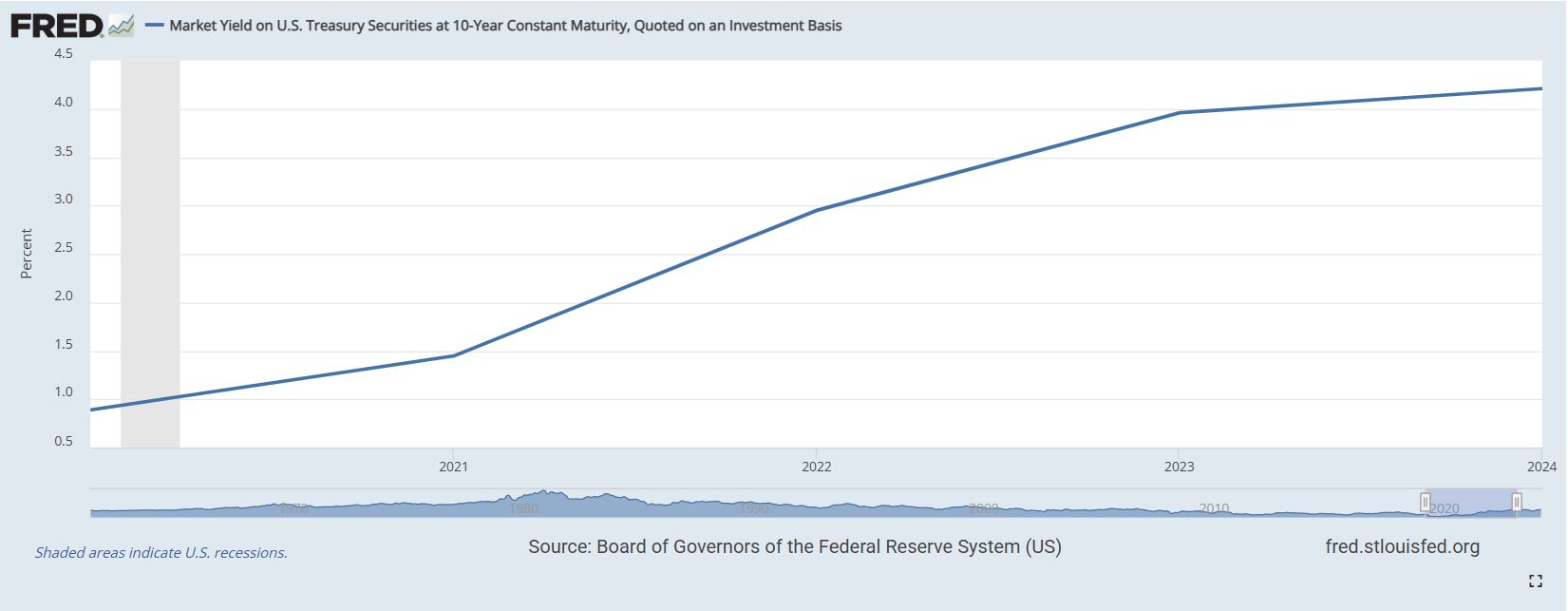
Market Yield on U.S. Treasury Securities at 10-Year
Source: Federal Reserve Bank of St. Louis

Trump's Policies: A Mixed Bag for Mortgage Interest Rates

Now, let's unpack Trump's policy proposals and see how they might affect this delicate balance:

1. The Tariff Tightrope: Inflation's Potential Comeback

Trump’s known for his stance on trade, with talk of a 10% universal tariff on all imports and even higher tariffs—over 60%–on Chinese goods. Now, on the face of it, this might sound like it will help American businesses, and it could. But it also brings a whole host of inflationary concerns. The Peterson Institute, a well respected think tank, projects that a 10% tariff on all imports could increase consumer prices by about 1.3%. That's not nothing. It means your everyday goods could get more expensive, and that's where the Federal Reserve gets involved.

Policy Inflation Risk Mortgage Rate Impact
10% universal tariff +1.3% CPI +0.5–1.0%
25% tariff on Canadian lumber +5–10% homebuilding costs Neutralizes deregulation benefits
60% tariff on Chinese goods Supply chain disruptions +0.3–0.7% (long-term)

If inflation goes up, the Fed is likely going to keep interest rates higher for longer to try and cool the economy down, which translates to higher mortgage rates. This is a very important point to grasp: tariffs can often be counterproductive to lower interest rates. Also, the 25% tariff on Canadian lumber is concerning, as it could increase the cost of homebuilding material, and any attempts to cut regulations would be easily negated.

2. Tax Cuts: A Double-Edged Sword

Next up, tax cuts. Trump's plan to reduce corporate taxes from 21% to 15% and extend existing individual tax cuts is aimed at boosting economic activity. However, the Penn Wharton Budget Model projects this could add a staggering $5.3 trillion to the national deficit by 2033. How does that affect mortgage rates? Well, to cover these deficits, the government will have to issue more Treasury bonds. This is like adding more supply of something – more supply usually means less demand, thus yields might rise, and as you know, when yields rise, mortgage rates tend to climb as well. This is basic supply/demand economics.

3. Deregulation: A Possible Silver Lining?

Here’s where Trump's policies could be beneficial for homebuyers. He's looking at cutting regulations that add costs to home building. We're talking about things like environmental reviews, zoning laws, and labor rules. The National Association of Home Builders (NAHB) estimates that these regulations account for about 24.3% of single-family home costs. Less regulation could mean less expensive homes. The key is to see if federal deregulation can cut through the red tape of state and local level bureaucracy. The unfortunate thing is, these deregulation benefits are easily offset by the tariffs, as seen above.

The Federal Reserve's Balancing Act on Mortgage Interest Rates

The Fed plays a crucial role in all this. They're supposed to be apolitical, but they're not working in a vacuum. Trump has openly criticized Fed Chair Powell for not cutting rates faster. However, the Fed’s primary job is to keep inflation in check. As of June 2024, inflation sits stubbornly above the Fed’s target at 3.3% and, the Fed is most likely going to continue to hold the line, as a result, if inflation remains sticky. Here's a quick look at different expert forecasts of where the Fed funds rate is headed in 2024 and how that impacts mortgage rates in 2025.

Source 2024 Fed Rate Forecast 2025 Mortgage Rate Forecast
CME FedWatch 4.75–5.00% 6.4–6.8%
Goldman Sachs 4.25–4.50% 6.0–6.3%
Moody’s Analytics 3.75–4.00% 5.8–6.1%

It's clear, based on various expert predictions, that nobody is expecting a dramatic fall in rates. The Fed is unlikely to dramatically lower the Federal funds rate, unless inflation is brought down, and as I mentioned previously, Trump’s policies, such as universal tariffs, could exacerbate the inflationary conditions.

The Housing Affordability Crisis: It's Not Just About Interest Rates

Now, interest rates are a big factor, but they're not the only piece of the puzzle. Home prices have surged by 47% since 2020, while wages have only grown by 18%. Let that sink in for a second. This has dramatically reduced housing affordability. According to the National Association of Realtors, monthly payments for a median-priced home now take up 41% of a typical person's income, compared to 29% pre-pandemic. That's a huge jump!

Metric 2020 2024
Median Home Price $295,000 $412,000
Avg 30-Yr Mortgage Rate 3.11% 7.12%
Monthly Payment (20% Down) $1,007 $2,201
Median Household Income $68,703 $81,059
Payment-to-Income Ratio 29% 41%

Source: NAR, U.S. Census Bureau

Simply lowering interest rates is a Band-Aid solution. It doesn’t solve the larger problem of housing affordability, nor does it address the root causes of inflation or the need for increased housing stock.

Global Forces: Beyond Our Shores

The U.S. economy isn't an island, so global factors come into play. China and Japan hold over $1.7 trillion in U.S. debt. If they were to start reducing their Treasury holdings, that could send yields soaring. Plus, geopolitical risks, like the conflict in Ukraine, can drive up demand for U.S. treasuries, thus lowering the yields and the rates. But the effect is temporary and uncertain. Central bank policies in other countries matter too. If the European Central Bank (ECB) and the Bank of Japan (BOJ) cut rates, the dollar may get stronger, and could attract foreign investors to U.S. bonds, lowering the rates, yet again. These effects, although positive, are unlikely to lead to a dramatic drop in mortgage rates.

Expert Predictions: Not Much Optimism

Experts in the industry don't seem too optimistic about rates going down significantly anytime soon. Here’s a look at some projections for 2025-2026:

Institution 2025 Forecast 2026 Forecast Key Assumptions
National Association of Realtors 6.3% 6.0% Fed cuts, mild recession
Mortgage Bankers Association 5.9% 5.5% Soft landing, inflation cools
Fannie Mae 6.6% 6.4% Sticky inflation, slow growth
Redfin 7.0% 6.8% Tariffs implemented, deficits rise

As you can see, there isn't a single major institution projecting a return to the sub 4% days. Most economists are predicting a range between 5.5% to 7%, depending on various factors. Redfin is, admittedly, the most pessimistic in their prediction due to Trump’s proposed tariffs.

Recommended Read:

Post-Inauguration Mortgage Rates Outlook: Will They Rise or Fall?

Mortgage Rates Rise Past 7% in January: Highest in 7 Months

Mortgage Rates Rise to the Highest Level Since July Last Year

Navigating the Market: What You Should Do as a Homebuyer

So, what do you do with this information if you're thinking of buying a home? Here's some strategic advice:

  • Don't Bank on Big Rate Drops: Don't wait for some magical sub-4% rate. It's just not realistic unless we hit a significant recession, and that’s not something any of us wants.
  • Consider Refinancing Later: If rates do drop below 6%, it might be a smart move to refinance your existing mortgage. On a $300k mortgage, this could save you around $200 per month if you are starting at 7%.
  • Explore Adjustable Rate Mortgages (ARMs): A 5/1 ARM might offer a lower initial rate. The average rate right now, for an ARM, is around 6.02% compared to 7.12% for a 30-year fixed. Be cautious, though, because the rate can change after the fixed period ends.
  • Look into FHA Loans: FHA loans have a lower down payment requirement of just 3.5% compared to the typical 20% for conventional loans, and they might help with your affordability.
  • Consider Less Expensive Markets: Look for cities where the median prices are much lower. In the Midwest, like Cleveland, the average home goes for around $235,000.

The Bottom Line: A Structural Problem

In conclusion, Will Trump lower mortgage interest rates? No, not likely in a substantial and sustainable way. While Trump's deregulation plans could provide a modest boost to the housing supply, the structural issues facing the market are too large to overcome. We're dealing with aging populations, international trade tensions, and a massive national debt. These are long-term issues, and rates will most likely remain elevated for the foreseeable future. Unless there is a severe recession (that I do not wish for) don't expect a dramatic shift in rates.

Mark Zandi of Moody’s is correct to caution that the 2020s will be remembered as the decade of the “housing squeeze”. Buyers will need to adjust their expectations and make the best of what's available. It’s a long-term game.

Work with Norada in 2025, Your Trusted Source for

Real Estate Investments in the United States

With mortgage rates fluctuating, investing in turnkey real estate

can help you secure consistent returns.

Expand your portfolio confidently, even in a shifting interest rate environment.

Speak with our expert investment counselors (No Obligation):

(800) 611-3060

Get Started Now

Recommended Read:

  • Mortgage Rates Forecast for the Next 3 Years: 2025 to 2027
  • 30-Year Mortgage Rate Forecast for the Next 5 Years
  • 15-Year Mortgage Rate Forecast for the Next 5 Years
  • Why Are Mortgage Rates Going Up in 2025: Will Rates Drop?
  • Why Are Mortgage Rates So High and Predictions for 2025
  • NAR Predicts 6% Mortgage Rates in 2025 Will Boost Housing Market
  • Mortgage Rates Predictions for 2025: Expert Forecast
  • Will Mortgage Rates Ever Be 3% Again: Future Outlook
  • Mortgage Rates Predictions for Next 2 Years
  • Mortgage Rate Predictions for Next 5 Years
  • Mortgage Rate Predictions for 2025: Expert Forecast
  • Mortgage Rate Predictions: Why 2% and 3% Rates are Out of Reach
  • How Lower Mortgage Rates Can Save You Thousands?
  • How to Get a Low Mortgage Interest Rate?
  • Will Mortgage Rates Ever Be 4% Again?
Filed Under: Economy, Financing, Mortgage Tagged With: Interest Rate, mortgage, Mortgage Rate Trends, mortgage rates, Mortgage Rates Predictions, Mortgage Rates Today

‘Emergency Price Relief’ on Housing: What Does Trump’s Order Mean?

February 18, 2025 by Marco Santarelli

'Emergency Price Relief' on Housing: What Does Trump's Order Mean?

“Trump Orders ‘Emergency Price Relief’ on Housing!” and you're probably wondering what that actually means. Let's cut through the political buzz and get to the heart of it. In short, President Trump has directed his administration to find ways to lower housing costs and increase the supply of homes. It's a move clearly aimed at tackling the affordability crisis, but the details, well, they're a bit hazy. This article dives deep into what this order entails, what it might mean, and what it definitely doesn't include.

I'm going to be honest, I've seen a lot of these kinds of announcements over the years, and while the intention sounds promising, the actual impact often falls short. But let's not be cynical just yet. We need to understand what's on the table, and where the real challenges lie.

‘Emergency Price Relief' on Housing: What Does Trump's Order Mean?

The Executive Order: A Cry for Affordability

Just hours into his second term, President Trump issued a memo directing all executive departments and agencies to take action aimed at lowering housing costs and boosting the housing supply. The memo states that hardworking families are overwhelmed by the cost of living, and that many Americans are unable to buy homes due to historically high prices. These aren't just empty words; we all feel this squeeze on our wallets.

The crux of the problem, according to the memo, is partly due to regulatory requirements that add a significant chunk to the cost of building a new home. Specifically, it claims that these regulations account for around 25% of the cost. Now, I’ve seen similar claims before, and frankly, figuring out exactly what constitutes “regulatory cost” can be a rabbit hole. But the general sentiment, that overly complex building processes add costs, definitely rings true.

The order mandates that executive branch leaders report their progress every 30 days, which implies a sense of urgency. However, the order is notably light on specifics. This leaves a lot of room for interpretation and, quite frankly, skepticism.

Here's a quick breakdown of what the order seeks to address:

  • Lower housing costs.
  • Expand the housing supply.
  • Reduce other household expenses.
  • Boost employment.

The Devil is in the Details… Or Lack Thereof

Okay, so we have this order, but what does it actually mean? Well, that's where things get interesting, or should I say, vague.

The memo mentions a “recent analysis” suggesting that regulations account for a substantial portion of new home costs. This refers to a 2021 study conducted by the National Association of Home Builders (NAHB). This study found that regulations add roughly 23.8% to the price of a new single-family home, with approximately 10.4% being from regulations imposed during development and 13.2% during the construction phase.

These are not small numbers, and, I agree that we need to do better when it comes to efficiency.

But here's the kicker: most of these regulations aren't federal. They are imposed at the state and local levels. This is where the real challenge lies. The federal government has limited power over those regulations.

Here's where it gets tricky:

  • Federal Incentives, Not Mandates: The federal government can't just wave a magic wand and tell states and cities to change their rules. They can offer incentives – think grants or funding – to encourage streamlining, but they can't force the issue.
  • State and Local Control: Building codes, zoning laws, and permitting processes are primarily decided by local authorities. This means that change will be a long and complicated process.
  • Environmental Concerns: We can't just build everywhere. Environmental impact studies and concerns are legitimate and necessary. Ignoring them for the sake of construction would be shortsighted.

So, while the intention of cutting red tape is admirable, the execution will likely be difficult. There are powerful stakeholders who have vested interest in keeping rules the way they are, and often for very good reasons.

Opening Federal Land: A Possible Solution?

President Trump has also repeatedly mentioned the idea of opening up federal land for large-scale housing construction. The idea is that these would be ultralow tax and ultralow regulation zones, aiming to make building less expensive.

This idea, while intriguing, has both promise and limitations:

Potential Benefits:

  • Increased Supply: It would definitely add to the number of houses that could be built, which, in theory, would help with demand.
  • Lower Land Costs: Opening up existing government lands can reduce upfront costs for developers.

Challenges:

  • Location, Location, Location: The problem is that much of the federal land is located in the Western US, far from major population centers. It’s not much help if the houses are built in places where people do not want to live or work.
  • Infrastructure Needs: Even if we find land, these newly developed areas need roads, schools, hospitals, etc. The cost of these will add to housing costs.
  • Environmental Concerns: Opening up any land for development would need environmental studies which also take time and money.

What the Order Doesn’t Address: Direct Assistance to Buyers

Notably absent from this order is any mention of direct assistance for homebuyers. This is in stark contrast to some other proposals, such as those that included tax credits or down payment assistance.

Why? Well, most economists (including me) agree that throwing money at buyers would just inflate prices. With supply constrained, more people bidding with more cash means the prices will just keep going up.

The focus on boosting the housing supply is, in my view, the right approach in the long run. It won't be a quick fix, but it's the more effective way to make homes affordable for all in the long term.

The Reality Check: My Take on the Situation

Let’s get real here. This executive order is more a statement of intent than a concrete plan. It highlights the problems – and that’s a start. But without specific actions and a willingness to tackle the complex web of regulations and local politics, it’s difficult to see how it will drastically change anything.

I’m not saying it’s hopeless. The fact that housing is a top priority on the president's agenda is important. But the road to affordable housing is long and complicated. It requires a multi-pronged approach, one that includes:

  • Cutting regulatory red tape at all levels of government, with a focus on incentives for state and local reform.
  • Opening up land thoughtfully, balancing the need for housing with environmental concerns and infrastructure.
  • Promoting innovative building techniques that reduce costs without sacrificing quality or safety.
  • Investing in workforce development to attract more people to the construction industry.
  • Acknowledge the power of the supply and demand curves and act accordingly. We have to understand that the only way to create a fair market is to increase supply.

We also need to be realistic about timelines. These things take time and effort. We aren't going to see drastic changes overnight.

The Bottom Line

Trump’s order for “emergency price relief” is more of a starting gun than a sprint. It acknowledges the pressing need for more affordable housing, but the actual impact will depend heavily on the specific actions taken in the coming weeks, months, and years.

We need to hold our leaders accountable, and continue to push for real, meaningful solutions. Housing is a fundamental need, and it should be accessible to all.

Build a Stronger Future with Norada in 2025

As bold economic plans shape the nation, invest in high-quality, ready-to-rent properties for reliable returns.

Whether the focus is on growth or stability, real estate remains a cornerstone of financial security.

Speak with our expert investment counselors (No Obligation):

(800) 611-3060

Get Started Now

Read More:

  • Trump's Inaugural Speech: Bold Plans on Border, Economy, and More
  • What Happens to Kamala Harris' Proposal of $25,000 Homebuyer Assistance Now?
  • Housing Market Predictions for 2025 if “Trump” Wins Election
  • 10 Housing Market Predictions Under Trump for the Next 4 Years
  • Will Donald Trump's Victory Reshape the Housing Market in 2025?
  • Trump vs Harris: Housing Market Predictions Post-Election

Filed Under: Housing Market, Mortgage, Real Estate Market Tagged With: Affordable Housing, Donald Trump, Emergency Price Relief, housing, Housing Market, Rent Control

Manchester, NH is Currently America’s Hottest Housing Market

February 17, 2025 by Marco Santarelli

Manchester, NH is Currently America's Hottest Housing Market

Yes, you read that right! Manchester, New Hampshire, has claimed the top spot as the hottest housing market in the United States, according to the latest Realtor.com® report. This isn't just a flash in the pan; it's a testament to the city's unique appeal and the enduring qualities that are drawing homebuyers in droves. I've been watching the trends in New England real estate for years, and this surge in Manchester is something special.

Manchester, NH, is No. 1 Among America's Hottest Housing Markets

What's Making Manchester So Hot?

So, what exactly is making Manchester so attractive to buyers? It's a perfect storm of factors:

  • Low Taxes: New Hampshire is known for its no income tax and no sales tax policy, which is a huge draw.
  • Affordable Living (Relatively Speaking): While the median list price in Manchester was $579,000 in January, it still offers a competitive price point when compared to nearby metropolitan hubs like Boston.
  • Strategic Location: A 55-mile drive will get you to Boston, meaning residents can access big city amenities without paying big city prices.
  • Strong Economy: Manchester boasts a thriving local economy with opportunities in various sectors.
  • Quality of Life: The area offers good schools, a strong sense of community, and plenty of options for outdoor recreation, from hiking and skiing to lakes and parks.
  • Fast Sales: Homes in Manchester are selling very quickly, indicating high demand. The median time on the market was just 46 days, much faster than the national average of 73 days.
  • High Buyer Interest: Listings in Manchester are getting a lot of attention online, suggesting a strong level of interest from potential buyers.

The Numbers Don't Lie: A Deeper Dive into the Data

Let's break down some of the key data points that highlight Manchester's hot market status:

  • Median List Price: $579,000 in January (a nearly 4% increase from the previous month). While this is a significant price, it's important to consider the overall value proposition that Manchester offers.
  • Days on Market: 46 days, significantly lower than the national median. This indicates a fast-paced market where buyers need to be ready to act quickly.
  • Listing Views: Listings are getting close to four times the average views compared to the rest of the country. This is a clear indicator of high buyer interest.
  • Poverty Level: New Hampshire had the lowest poverty level in the U.S. in 2023, at 7.2%, according to the U.S. Census Bureau. This speaks to the state's overall economic health and stability.

Recommended Read:

10 Best Places to Live in New Hampshire

New Hampshire Housing Market Trends and Forecast 2025

New Hampshire Home Prices Hit Record-Breaking $500,000

Northeast and Midwest Still Dominate

It's interesting to note that the Northeast and Midwest continue to dominate the list of hottest housing markets. This trend has been going on for quite some time and can be attributed to several factors, including:

  • Relatively Affordable Housing: Compared to coastal markets like California, housing in the Northeast and Midwest can be more affordable, especially when considering the size and quality of homes.
  • Strong Local Economies: Many cities in these regions have diversified economies with opportunities in various sectors, attracting both employers and employees.
  • Quality of Life: These regions often offer a good balance of urban amenities and access to nature, making them appealing to a wide range of homebuyers.

The Inventory Challenge: Why Demand Remains High

While the national inventory of homes for sale is improving, Manchester faces a unique challenge:

  • Low Inventory: The area is experiencing high demand with limited availability, which is driving up prices and creating a competitive market.
  • Limited Recovery: The ongoing demand has prevented inventory from recovering to pre-pandemic levels.

The Impact of Rising Interest Rates

Even with rising interest rates, the demand for homes in Manchester remains strong. While affordability is a concern for many buyers, the city's unique advantages continue to attract those who are looking for a place to call home. As Realtor.com® senior economic research analyst Hannah Jones stated, “Housing affordability continues to be a challenge for home shoppers as home prices and mortgage rates refuse to budge significantly.”

Other Cities Making Waves

Manchester isn't the only city experiencing a surge in demand. Other markets that are performing well include:

  • Hartford, CT: Ranked number two, boasting a high number of listing views.
  • Concord, NH: Another New Hampshire city making the list, indicating a broader trend in the state.
  • Rochester, NY: Showing increased popularity.
  • Boston, MA: Demonstrating resilience despite its high price point.
  • Bloomington, IL: Entering the top 20 for the first time.

Why I Think Manchester's Hot Streak Will Continue

I believe Manchester's popularity will endure for several reasons:

  • The Tax Advantage is a Game-Changer: The lack of income and sales tax in New Hampshire will always be a significant draw, especially for those looking to maximize their earnings.
  • Location, Location, Location: Its proximity to Boston provides access to a major metropolitan area without the steep price tag.
  • A Growing Sense of Community: Manchester has a unique charm and a strong sense of community that appeals to many buyers.
  • The Outdoor Lifestyle: New Hampshire offers endless opportunities for outdoor recreation, attracting those who value an active lifestyle.
  • Continued Economic Growth: The city's diverse economy and growing job market will continue to attract new residents.

Of course, no market is immune to fluctuations, and it's important to stay informed and consult with real estate professionals for the latest information. But based on the current trends and the underlying strengths of the city, I'm confident that Manchester will remain a highly desirable place to live for years to come.

What This Means for Buyers and Sellers

For Buyers:

  • Be Prepared to Act Fast: In a market like Manchester, you need to be ready to make a decision quickly. Have your financing in place and be prepared to put in a competitive offer.
  • Work with a Local Expert: A real estate agent who knows the Manchester market inside and out can be invaluable.
  • Don't Be Afraid to Negotiate: While the market is hot, it's still important to negotiate and try to get the best possible price.
  • Consider New Construction: With new construction offering potential incentives, this could be a viable option.

For Sellers:

  • Price Your Home Strategically: Work with your agent to determine the right price for your home.
  • Prepare Your Home for Sale: Make sure your home is clean, well-maintained, and staged to appeal to buyers.
  • Be Ready for Multiple Offers: In a hot market, it's not uncommon to receive multiple offers.
  • Consider All Offers Carefully: Don't just focus on the highest price. Consider the terms and conditions of each offer as well.

Conclusion

Manchester, NH, is No. 1 among America's Hottest Housing Markets for a reason. Its low taxes, strategic location, strong economy, and high quality of life make it an attractive destination for homebuyers from all over the country. While the market is competitive, the rewards of living in this vibrant city are well worth the effort. As someone who has been involved in real estate for a long time, I'm excited to see what the future holds for Manchester.

Work with Norada in 2025, Your Trusted Source for

Real Estate Investment in the Country

Discover high-quality, ready-to-rent properties designed to deliver consistent returns.

Contact us today to expand your real estate portfolio with confidence.

Contact our investment counselors (No Obligation):

(800) 611-3060

Get Started Now

Recommended Read:

  • Top 20 Hottest Housing Markets Predicted for 2025
  • Top 10 Hottest Housing Markets Where Home Prices Are Soaring
  • 5 Hottest Real Estate Markets for Buyers & Investors in 2025
  • Hottest Real Estate Markets in Maine: Top Locations
  • The Hottest Housing Markets in Seattle Area
  • Top 10 Hottest Real Estate Markets in the World
  • Hottest Housing Markets Predicted for 2024
  • 68 Housing Markets Where Prices Have Doubled the Fastest

Filed Under: Growth Markets, Housing Market Tagged With: 2025 Forecast, Hottest Housing Markets, Housing Market, Manchester, New Hampshire, real estate, Top Housing Markets

Is Buffalo the Hottest Housing Market for 2025?

February 17, 2025 by Marco Santarelli

Is Buffalo the Hottest Housing Market for 2025?

Okay, maybe I shouldn't start that way, but let's be real, the hype around the Buffalo housing market is hard to ignore! And to cut right to the chase: Zillow has named Buffalo the hottest housing market for 2025. But what does that really mean for you, whether you're a current Buffalonian, dreaming of a move, or just curious about real estate trends? Let's dive in and break it down.

I remember when people wrote Buffalo off, and now look at it! Let's explore what makes Buffalo so hot, why the heat might stick around, and what this all means for buyers and sellers.

Buffalo Housing Market: Is the Queen City Still the Hottest Ticket in 2025?

Honestly, the first time I heard Buffalo was predicted to be the hottest market, I raised an eyebrow. But then it started making sense. Here's a breakdown of the key factors driving the demand:

  • Booming Job Market: The driving force behind the hype is Buffalo's growing economy. Two new jobs are being created for every new home built! That's a huge imbalance and indicates a lot of potential.
  • Influx of Young Professionals and Families: All those new jobs are attracting young professionals and families, eager to plant roots in a city with a lower cost of living than many other major metropolitan areas.
  • Limited Housing Supply: This is the classic economic squeeze. Demand is up, but the number of homes available isn't keeping pace. Construction hasn't been able to keep up with job creation, tightening the market considerably.
  • Mortgage Rate Lock-In: This is a nationwide issue, but it's exacerbating the problem in Buffalo. People who locked in super-low mortgage rates before the recent hikes are hesitant to sell, further restricting the existing home supply.

To put it simply, Buffalo's got the perfect storm: Lots of people wanting to buy, not enough houses to go around.

The Numbers Don't Lie: Buffalo Housing Market Trends

Okay, so we know the “why.” Let's look at the “what.” Here's what the data tells us about the current state and predicted trajectory of the Buffalo housing market:

  • Price Appreciation: Home values in Buffalo jumped by an impressive 6% in 2024.
  • Continued Growth: Zillow projects another 3% increase in home values throughout 2025.
  • Regional Trend: Buffalo isn't alone. Other Northeastern and Midwestern cities, like Indianapolis, Providence, Hartford, and Philadelphia, are also experiencing upward pressure on prices, with projected increases of 3% to 4%.
  • National Headwinds: While Buffalo's market is strong, it's important to acknowledge the national context. High mortgage rates (averaging around 6.91% for a 30-year fixed rate, as of recently) are still a significant factor affecting affordability.
  • New Construction Lag: The construction industry is struggling to keep pace with the demand, as Zillow’s chief economist Skylar Olsen pointed out.

This table summarizes the trends nicely:

Trend Description Impact on Buffalo
Price Appreciation Increasing home values Positive
Projected Growth Continued rise in home values Positive
Regional Demand Increased housing demand in the Northeast & Midwest Positive
High Mortgage Rates Elevated interest rates for home buyers Negative
Construction Lag Insufficient new construction to meet rising demand Negative

What Does “Hottest Market” Really Mean for Buyers?

If you're looking to buy a home in Buffalo right now, brace yourself. Here's what you can expect:

  • Increased Competition: Expect to face bidding wars, especially on desirable properties in popular neighborhoods.
  • Faster Sales: Homes are likely to sell quickly, so you need to be prepared to act fast. Have your financing in order, and be ready to make a strong offer.
  • Potentially Higher Prices: With increased demand and limited supply, prices are likely to be driven up. Be prepared to pay a premium.
  • Importance of Local Expertise: A knowledgeable and experienced real estate agent who understands the nuances of the Buffalo market is essential. They can help you navigate the competition and find the right home for your needs.

Tips for Buyers in a Hot Market:

  • Get Pre-Approved: Knowing exactly how much you can afford is crucial.
  • Be Ready to Move Quickly: Have all your documents ready and be prepared to make an offer as soon as you find a property you like.
  • Consider Alternatives: Be open to different neighborhoods or types of properties. You might find a hidden gem in an unexpected location.
  • Don't Overextend Yourself: It's tempting to stretch your budget in a competitive market, but don't overcommit.

I always tell people to focus on their long-term financial health. Don't let FOMO (fear of missing out) drive you to make a decision you'll regret later.

And What About Sellers? Is Now Really the Time to Sell?

If you're a homeowner in Buffalo, congratulations! You're sitting pretty. Here's what the hot market means for you:

  • High Demand: Your home is likely to attract a lot of interest, potentially leading to multiple offers.
  • Faster Sales: You can expect to sell your home quickly, often within days or weeks.
  • Higher Prices: You have a good chance of getting top dollar for your property.
  • Opportunity to Upgrade: If you're planning to move to a larger home or a different neighborhood, now might be the perfect time to take advantage of the market conditions.

Tips for Sellers in a Hot Market:

  • Price it Right: Work with your real estate agent to determine the optimal listing price. Don't overprice your home, even in a hot market. A well-priced home will generate more interest and potentially lead to a bidding war.
  • Prepare Your Home: Make sure your home is clean, decluttered, and well-maintained. First impressions matter.
  • Consider Staging: Staging can help potential buyers visualize themselves living in your home.
  • Be Prepared for Multiple Offers: Have a strategy in place for evaluating and responding to multiple offers.
  • Don't Get Greedy: While it's tempting to hold out for the highest possible price, be realistic and fair. A good offer is a good offer.

Is the Buffalo Housing Market Bubble About to Burst?

This is the million-dollar question, isn't it? No one has a crystal ball, but here's my take: I don't think we're looking at a bubble about to burst, for several reasons:

  • Solid Economic Fundamentals: Unlike the housing bubble of the late 2000s, the current demand in Buffalo is driven by real economic growth and job creation. It is not only the real estate market that is thriving.
  • Sustainable Growth: The projected 3% increase in home values for 2025 is more moderate than the rapid price appreciation we saw in some areas during the peak of the pandemic.
  • Regional Strengths: Buffalo's affordability compared to other major cities and its growing appeal to young professionals and families suggest long-term viability.

Factors That Could Affect the Market:

  • Interest Rate Fluctuations: Significant changes in mortgage rates could impact affordability and slow down the market.
  • Economic Slowdown: A broader economic downturn could lead to job losses and decreased demand for housing.
  • Increased Housing Supply: If new construction ramps up significantly, it could help ease the supply shortage and moderate price growth.

However, based on current trends and projections, I believe the Buffalo housing market will remain relatively strong in the near future. While the rate of appreciation may slow down, I don't anticipate a significant crash.

Beyond Buffalo: Where Else is the Market Hot (and Where is it Cooling)?

It's always good to have a sense of the bigger picture, right? As the data mentions, other Northeastern and Midwestern cities are also experiencing strong housing markets. Here's a quick look:

  • Hot Markets:
    • Indianapolis, Indiana: Booming tech sector and affordable living.
    • Providence, Rhode Island: Rich history, vibrant arts scene, and proximity to Boston.
    • Hartford, Connecticut: Insurance hub with a lower cost of living than other major cities in the Northeast.
    • Philadelphia, Pennsylvania: Diverse economy, historical significance, and relatively affordable housing.
  • Cooling Markets:
    • New Orleans, Louisiana: Facing economic challenges and population decline.
    • San Francisco, California: High cost of living and tech industry fluctuations.
    • San Jose, California: Similar challenges to San Francisco, driven by the tech industry.
    • Austin, Texas: Overvalued in recent years and now undergoing a correction.

This difference between markets highlights an important point: real estate is local. National trends can provide context, but ultimately, what matters is what's happening on the ground in your specific market.

The Future of the Buffalo Housing Market: My Prediction

If I were to make a bold prediction, I would say that the Buffalo housing market is unlikely to maintain its “hottest market” title indefinitely. The factors driving demand are strong, but eventually, either the supply will catch up, or external economic factors will start to balance things out.

However, I expect Buffalo to remain a desirable housing market for the foreseeable future. Its affordability, growing economy, and unique cultural scene will continue to attract new residents. I think the market will continue to be great for both sides.

My advice? If you're considering buying or selling in Buffalo, do your research, work with a trusted professional, and make informed decisions that align with your long-term goals. The Buffalo housing market may be hot, but with a cool head and a strategic approach, you can navigate it successfully.

The Buffalo Housing Market Forecast suggests continued, albeit moderate, growth. While a market crash seems unlikely, a correction is always possible. Whether you're a buyer, seller, or investor, it's important to stay informed and make decisions based on your own individual circumstances. Good luck!

Work with Norada in 2025, Your Trusted Source for

Real Estate Investment in the Country

Discover high-quality, ready-to-rent properties designed to deliver consistent returns.

Contact us today to expand your real estate portfolio with confidence.

Contact our investment counselors (No Obligation):

(800) 611-3060

Get Started Now 

Read More:

  • Buffalo Housing Market Prices and Forecast 2025-2026
  • 10 Cities Where Home Prices Are Rising Fast: Buffalo Tops List!
  • Best Places to Live in New York (2025)
  • NYC Housing Market: Prices, Trends, Forecast 2025-2026
  • Rochester Housing Market: Prices and Forecast 2025-2026
  • Top 10 Housing Markets for 2025: Zillow's Predictions

Filed Under: Growth Markets, Housing Market, Real Estate Market

What is Warren Buffet’s Take on Real Estate Investment?

February 17, 2025 by Marco Santarelli

What is Warren Buffet's Take on Real Estate Investment

Warren Buffett, the renowned investor and CEO of Berkshire Hathaway, has a reputation for his sage investment advice and long-term investment strategy. When it comes to real estate investment, Buffett's approach is no different. He advocates for a patient, value-oriented strategy that focuses on long-term gains rather than quick profits.

Buffett's Philosophy on Real Estate Investment

Buffett's philosophy on real estate investment can be distilled into several key points:

  1. Long-Term Investments: Buffett believes in the power of long-term investments. He is known for saying, “Nobody buys a farm based on whether they think it's going to rain next year … they buy it because they think it's a good investment over 10 or 20 years.” This principle applies to real estate as well. The idea is to invest in properties that will provide value for many years to come.
  2. Understanding and Patience: Learning from his early experience in stock investment, Buffett realized the importance of understanding your investments and having the patience to see them grow over time. This lesson is crucial in real estate, where the market can fluctuate, but the long-term trend is generally upward.
  3. Safe Investments: In line with his risk-averse nature, Buffett advises investors to “only buy something that you'd be perfectly happy to hold if the market shut down for 10 years.” This means investing in properties that are likely to remain in demand and retain their value even during economic downturns.
  4. Starting Small: For those new to real estate investment, Buffett suggests starting with a single property, learning the market's intricacies, and then scaling up slowly. This approach helps mitigate risk and allows investors to adapt to the market's changes.
  5. Intrinsic Value: Buffett's recommendation is anchored in the intrinsic value of real estate. Unlike stocks, real estate is a tangible asset, less susceptible to market volatility. It generally appreciates over time, and during inflation, the value of money diminishes, but the value of real estate typically rises.
  6. Expertise and Management: Buffett emphasizes the need to understand the finances and financing of real estate but also recognizes the importance of acknowledging one's limitations. He advocates for employing expert property managers to handle the day-to-day management, allowing investors to focus on the asset's future productivity.

Application of Buffett's Principles

Buffett's real estate investment lessons reflect his overall investment strategy: focus on the long term, understand what you're investing in, ensure safety, start small, and recognize the intrinsic value. By applying these principles, investors can approach real estate with a mindset similar to one of the world's most successful investors.

For those interested in delving deeper into Buffett's investment philosophy and how it applies to real estate, his annual shareholder letters often provide valuable insights and are worth reading. Additionally, there are resources available that compile real estate investing lessons drawn from Buffett's approach.

Bottom Line: Warren Buffett's take on the best real estate investment is to treat it like any other asset class: with careful consideration, a focus on long-term value, and an understanding of the underlying economics. By following these principles, investors can make informed decisions that align with their financial goals and risk tolerance.

Work with Norada in 2025, Your Trusted Source for

Turnkey Real Estate Investing

Discover high-quality, ready-to-rent properties designed to deliver consistent returns.

Contact us today to expand your real estate portfolio with confidence.

Contact our investment counselors (No Obligation):

(800) 611-3060

Get Started Now 

Read More:

  • Housing Predictions 2025 by Warren Buffett's Berkshire Hathaway
  • 4 Real Estate Investment Tips You Can Learn from Warren Buffet
  • Housing Market Forecast 2025 by JP Morgan Research

Filed Under: Financing, Housing Market, Real Estate Investing Tagged With: Housing Market, Real Estate Investing, Warren Buffet

Should You Invest in the Portland Housing Market in 2025?

February 17, 2025 by Marco Santarelli

Should You Invest In The Portland Housing Market?

So, you're wondering if investing in the Portland housing market is a smart move right now? The short answer is: it depends. Portland offers a unique blend of culture, economy, and natural beauty, making it perennially appealing. However, the current market is complex, demanding a careful, informed approach. While the average home value sits around $522,596 as of early 2025, the question is whether the opportunities outweigh the risks. Let's dive deep and see if Portland is right for your investment goals.

Should You Invest in the Portland Real Estate Market?

I've been watching the Portland market closely for years. I've seen the booms, the dips, and the shifts in priorities among buyers and renters. I want to provide you with the inside scoop to help you make a decision. Let's get started!

The Current State of Play in Portland Real Estate

Let's break down exactly what's happening on the ground in Portland's housing scene:

  1. Home Prices and Trends: A Slow and Steady Climb?
    • As of January 2025, the average home value in Portland is around $522,596, according to Zillow. That's a 1.2% increase from last year.
    • The median home price is closer to $485,000, a 3.2% jump year-over-year (Source: Redfin).
    • Here's the important thing: While prices are still rising, the rate of increase has slowed down. That's a good sign that things are becoming more sustainable. Those wild spikes from a few years back aren't as common.
    • The average home is selling in around 56 days, according to Redfin, suggesting a competitive market, but also showing that the market has started cooling off.
  2. Supply and Demand: The Inventory Squeeze
    • A persistent issue: There simply aren't enough homes for everyone who wants one. That's particularly true in desirable neighborhoods.
    • The Portland Metropolitan Area has a shortage of available homes. (Source: The Luxury Playbook). This leads to bidding wars. I've seen properties go for tens of thousands above asking price in the right locations.
    • New construction is trying to keep up, but it is not enough to meet buyer demand.
    • Portland State University has a population growth of 1.4% annually. This keeps the pressure on prices, making it attractive for landlords and flippers.
  3. The Rental Market: Still a Good Place to Be a Landlord?
    • Portland's rental market looks promising. Rents are expected to keep rising.
    • Some are predicting rental increases around 8% year-over-year by late 2025. (Source: Chase).
    • Multifamily properties and single-family rentals are both potentially profitable, particularly with the number of professionals and students moving to the city.
    • Affordability is a significant concern for many residents. This drives up the demand for rental units, because people need a place to live.

Emerging Trends Shaping Portland Real Estate

The future of real estate isn't set in stone. These are the trends I'm watching closely:

  1. Economic Factors: Portland's Engines of Growth
    • Portland's economy is diversified, which is a strength.
    • The city has a strong tech industry and growing healthcare and renewable energy sectors.
    • Companies like Intel and Nike are significant employers, bringing people to the area.
    • More jobs equals more demand for housing.
    • The Oregon Employment Department releases key figures. Keep an eye on employment data to understand the market.
  2. Gentrification: A Double-Edged Sword
    • Gentrification is changing Portland's neighborhoods.
    • Areas like the Alberta Arts District and Northeast Portland have undergone big transformations.
    • As neighborhoods improve, property values go up.
    • Gentrification also can displace long-term residents, which is a serious concern.
    • If you're investing, consider neighborhoods in transition. Understand the risks and potential benefits.
  3. Sustainability: Building Green for the Future
    • Sustainability is increasingly important to Portlanders.
    • There's a demand for eco-friendly homes with sustainable materials and energy efficiency.
    • People are more conscious of climate change. Many want to live in homes that are energy efficient.
    • Consider investing in properties with green technology or in areas that promote sustainability. These properties are likely to be more desirable in the long run.

Key Investment Considerations

Okay, so you like what you're hearing about Portland. What do you need to think about before you write a check?

  1. Short-Term vs. Long-Term: What's Your Strategy?
    • Are you looking to flip houses quickly, or do you want to hold onto properties for the long haul?
    • Short-term investments can capitalize on current demand. I think Portland is still a market that will support this.
    • Long-term investments benefit from appreciation and rental income.
    • I'd say, long-term investments offer more stability right now. Ride out the market fluctuations.
  2. Interest Rates and Financing: Crunching the Numbers
    • Interest rates have a big impact on your investment. You need to understand how they are affected by your mortgage.
    • With rates potentially rising, know your financing options and the impact on payments.
    • Fixed-rate mortgages can be a good idea when rates are expected to rise.
    • Consider alternative financing, like partnerships or commercial loans.
  3. Local Market Research: Getting Your Boots on the Ground
    • This is critical. Don't just rely on online data.
    • Talk to local real estate agents. They know the neighborhoods and the trends.
    • Attend open houses. Get a feel for what's on the market.
    • Use analytics platforms. Dig into the data.
    • Understand zoning laws and tenant protections. Complying with local rules is essential.

My Personal Take: Portland is a Market to Watch

Here's my honest opinion: Portland is a market with long-term potential. The city's strong economy, desirable lifestyle, and commitment to sustainability make it an attractive place to live and invest.

However, it's not a risk-free investment. You need to do your homework, understand the trends, and be prepared for potential market fluctuations. I personally like Portland's long-term outlook because of its high quality of life and strong job market. These will provide long term benefits.

If you are looking for a quick flip, you may consider areas outside of Portland because of the housing costs.

Ultimately, whether or not you should invest in the Portland real estate market depends on your individual circumstances, risk tolerance, and investment goals.

Partnering with a local real estate professional that you trust is a great way to improve your investment strategy.

Work with Norada in 2025, Your Trusted Source for

Turnkey Real Estate Investing

Discover high-quality, ready-to-rent properties designed to deliver consistent returns.

Contact us today to expand your real estate portfolio with confidence.

Contact our investment counselors (No Obligation):

(800) 611-3060

Get Started Now

Read More:

  • Portland Housing Market Prices and Forecast 2025-2026
  • Housing Market Predictions for Next 5 Years (2024-2028)
  • Real Estate Forecast for the Next 5 Years: Future Predictions?
  • Mortgage Rate Predictions for Next 5 Years
  • Mortgage Rate Predictions for the Next 2 Years
  • Mortgage Rate Predictions for Next 3 Years: Double Digit Rise

Filed Under: Housing Market, Real Estate Investing, Real Estate Investments Tagged With: Portland, Real Estate Investing, Real Estate Investment

Portland Housing Market Prices and Forecast 2025-2026

February 17, 2025 by Marco Santarelli

Portland Housing Market

The Portland housing market in early 2025 is showing signs of stabilization with rising inventory and slightly increasing prices, but closed sales are down compared to the previous month, suggesting a complex and evolving situation. Let's dive deep and unpack all the factors influencing the market right now, so you can make informed decisions.

Portland Housing Market Trends: What's Happening Right Now?

Home Sales

Let's start with the basics: home sales. Looking at the data by PMAR from January 2025, we see a mixed picture.

  • Closed Sales: The number of homes actually sold in January 2025 was 1,213.
    • This is down 20.9% compared to December 2024.
    • But this is up 8.3% compared to January 2024.
  • Pending Sales: The number of homes that are under contract but haven't closed yet was 1,719.
    • This is up 29.6% compared to December 2024.
    • And this is up 15.2% compared to January 2024.

What does this tell us? Well, the drop in closed sales from December could be a seasonal thing. January is often a slower month for real estate. But the increase in pending sales is a good sign! It means that buyers are still out there and making offers.

Home Prices

Now, onto the big question: what's happening with home prices in Portland? This is what everyone wants to know, right?

  • Average Sale Price: In January 2025, the average sale price in the Portland metro area was $600,300.
    • This is up 3.8% compared to December 2024.
    • And this is up 6.3% compared to January 2024.
  • Median Sale Price: The median sale price was $537,000.
    • This is up 2.3% compared to December 2024.
    • And this is up 6.3% compared to January 2024.

Are Home Prices Dropping?

So, are home prices dropping in Portland? Based on the January 2025 data, the answer is no, not really. While there might be some individual neighborhoods or specific properties where prices are softening, the overall trend shows prices are still increasing, both compared to the previous month and the previous year.

Comparison with Current National Median Price

How does Portland stack up against the rest of the country? Well, let's compare our median sale price of $537,000 to the national median price of $407,500 (as of December 2024).

That means homes in Portland are still significantly more expensive than the national average. This could be due to a number of factors, including Portland's desirability, limited housing supply, and strong job market.

Housing Supply

  • Inventory in Months: As of January 2025, the inventory of homes for sale was 3.7 months.
    • This is up 1.0 month compared to December 2024.
    • And this is up 0.5 months compared to January 2024.
  • New Listings: The number of new homes coming onto the market was 2,205.
    • This is up 106.5% compared to December 2024.
    • And this is up 13.6% compared to January 2024.
  • Active Listings: The total number of homes actively for sale was 4,438.
    • This is up 5.2% compared to December 2024.
    • And this is up 25.5% compared to January 2024.

What Does “Months of Inventory” Mean?

When you hear about “months of inventory,” it's a way of measuring how long it would take to sell all the homes currently on the market if no new homes were listed. A lower number means it's a seller's market because there aren't enough homes to meet demand. A higher number means it's a buyer's market because there are more homes available than buyers.

Is It a Buyer's or Seller's Housing Market?

So, is Portland a buyer's or seller's market right now? With 3.7 months of inventory, we're still leaning towards a seller's market, but it's becoming more balanced. A balanced market is typically around 5-6 months of inventory.

The increase in new listings and active listings is definitely good news for buyers. It means they have more choices and potentially more negotiating power.

Market Trends

To sum up the market trends, here's a little table:

Indicator January 2025 Value Change from Dec 2024 Change from Jan 2024
Inventory (Months) 3.7 +1.0 Month +0.5 Month
New Listings 2,205 +106.5% +13.6%
Active Listings 4,438 +5.2% +25.5%
Avg. Sale Price $600,300 +3.8% +6.3%
Median Sale Price $537,000 +2.3% +6.3%
Pending Sales 1,719 +29.6% +15.2%
Closed Sales 1,213 -20.9% +8.3%
Total Market Time (Days) 88 +14 +20

Impact of High Mortgage Rates

Of course, we can't talk about the real estate market without mentioning mortgage rates. As of February 2025, mortgage rates are hovering around 7%. This is significantly higher than the rates we saw just a few years ago.

High mortgage rates have a big impact on affordability. They make it more expensive to borrow money to buy a home, which can price some buyers out of the market.

How Do High Rates Affect the Market?

  • Reduced Buyer Demand: Higher rates mean fewer people can afford to buy, which reduces demand.
  • Slower Price Growth: With less demand, price increases may slow down or even stall.
  • Increased Inventory: As demand cools, homes may stay on the market longer, leading to an increase in inventory.

My Thoughts and Predictions

So, what's my take on all of this? I think the Portland housing market is in a period of transition. The days of rapid price increases are likely behind us, at least for now. We're seeing a shift towards a more balanced market, which is good news for buyers.

I expect that prices will continue to rise, but at a slower pace. The increase in inventory should give buyers more options and more negotiating power.

Mortgage rates will continue to be a major factor in the market. If rates stay high, it will continue to put downward pressure on demand. If rates start to fall, we could see a resurgence in buyer activity.

Portland Housing Market Forecast: What's Coming Up in 2025 and Beyond?

If you're eyeing the Portland housing market, whether as a potential buyer, seller, or just a curious observer, you're probably asking: “What's going to happen next?” Well, based on current data and forecasts, we can expect to see slight decreases over the next year, but nothing like a crash. Specifically, Zillow's forecast indicates a -0.8% change in home values between January 2025 and January 2026. Let’s dive into the details.

Before we jump into the forecasts, let's ground ourselves in the current state of the Portland real estate scene. As of now, the average home value in the Portland-Vancouver-Hillsboro area is around $542,011. This reflects a 1.8% increase over the past year.

  • Average Home Value: $542,011
  • Year-over-Year Change: +1.8%

One thing I've noticed over the years is that the Portland market tends to have its own rhythm. It's influenced by factors like the tech industry, the city's unique culture, and, of course, the overall economic climate.

Homes in the Portland area are going to pending status in around 34 days.

Portland Home Price Market Forecast: A Closer Look

Alright, let's get to the nitty-gritty. Zillow provides some specific forecasts for the Portland metro area, and I want to break them down for you.

Here's a simplified view of Zillow's projections:

Time Period Predicted Change
Feb 2025 0.1%
April 2025 0.1%
Jan 2025 – Jan 2026 (1 Year) -0.8%

What Does This Mean?

  • Short-Term Stability (Early 2025): The forecast for February and April 2025 suggests very slight increases (0.1%) in home values. This essentially indicates a period of relative stability.
  • Slight Correction (Over the Next Year): The more significant forecast is the -0.8% change expected between January 2025 and January 2026. This suggests a slight cooling off of the market over the next year.

My Take: A slight correction like this isn't necessarily a bad thing. In fact, it can be a sign of a market finding a more sustainable level after periods of rapid growth. From my experience, these minor adjustments can create opportunities for buyers who have been priced out during hotter markets.

Portland Housing Market Forecast Compared to Other Oregon Cities

To get a better sense of the Portland housing market forecast, it's helpful to see how it stacks up against other areas in Oregon. Here's a comparison based on Zillow's data:

Region 2/28/2025 4/30/2025 1/31/2026
Bend -0.1% 0.2% 1.6%
Salem 0.2% 0.4% 0.2%
Eugene 0.1% 0% 0.1%
Medford 0% -0.2% -1.3%
Albany 0.2% 0.6% 1.3%
Roseburg 0.3% 0.8% 1.5%
Corvallis 0.2% 0.5% 0.7%
Portland 0.1% 0.1% -0.8%

Key Takeaways:

  • Mixed Bag: The Oregon housing market is not a monolith. Some cities, like Bend, Roseburg, and Albany, are projected to see growth over the next year, while others, like Medford, are expected to decline more than Portland.
  • Portland's Relative Stability: Compared to some other areas, Portland's projected -0.8% decline suggests a more moderate adjustment.
  • Bend: An Outlier? Bend's forecast stands out with a projected 1.6% increase. This could be due to factors like its growing popularity as a destination for outdoor enthusiasts and remote workers.

Will Home Prices Drop in Portland? Will the Market Crash?

This is the question on everyone's mind. Based on the Portland housing market forecast, I don't anticipate a major crash. A drop is very likely, but it will be modest. All of the data, indicates a slight correction, not a collapse.

  • Why Not a Crash?
    • Strong Fundamentals: Portland still has a relatively strong economy and a desirable quality of life. These factors tend to support housing values.
    • Limited Inventory: While inventory has been increasing, it's still not at levels that would trigger a massive price decline.
    • Demographic Trends: Oregon continues to attract new residents, which creates ongoing demand for housing.

What About a Portland Housing Market Forecast for 2026?

Predicting the market that far out is always a bit of a gamble. So, to get a reasonable idea, I will be relying on current market data for my Portland housing market forecast. However, here are some factors I'll be keeping an eye on that could influence the real estate market:

  • Interest Rates: Mortgage rates have a huge impact on affordability. If they stay elevated, it could continue to put downward pressure on prices. But if they fall, it could spur more activity.
  • Inflation: Persistently high inflation could erode consumer confidence and impact housing demand.
  • Job Growth: Continued job growth in the Portland area would be a positive sign for the housing market.
  • New Construction: The pace of new construction will influence the supply of homes available.

Read More:

  • Oregon Housing Market: Prices, Trends, Forecast 2025
  • Should You Invest In The Portland Housing Market?
  • Luxury Homes: Portland is Now America’s Hottest Luxury Market
  • Housing Market Predictions 2030: 12 States Expected to Skyrocket

Filed Under: Growth Markets, Housing Market Tagged With: Portland Housing Market, Portland Real Estate Market

Bend OR Housing Market Prices and Forecast 2025-2026

February 17, 2025 by Marco Santarelli

Bend OR Housing Market

Are you thinking about buying or selling a home in Bend, Oregon? Understanding the current Bend housing market trends is crucial for making informed decisions. In short, the Bend housing market is somewhat competitive, with homes selling around the $675,000 mark. While prices are down slightly compared to last year, the market dynamics are shifting, so let’s dive into the details.

Navigating the Current Bend Housing Market Trends:

Home Sales

Let's start with the number of homes changing hands. In January 2025, there were 122 homes sold in Bend. This represents a significant increase of 20.8% compared to the 101 homes sold during the same period last year. This uptick in sales suggests renewed activity in the market, potentially driven by factors like stabilizing interest rates or increased buyer confidence.

Home Prices

Now, let’s talk about the figures that everyone keeps an eye on: home prices. The median sale price of a home in Bend during January 2025 was $675,000. While this is a decrease of 2.8% compared to last year, it's important to put this in perspective.

Are Home Prices Dropping?

Yes, there's been a slight dip year-over-year. However, I wouldn't jump to the conclusion that prices are collapsing. A 2.8% decrease isn’t a massive drop. It could indicate a slight correction after a period of rapid growth.

Comparison with Current National Median Price

How does Bend compare nationally? Well, the national median home price in December 2024 was $407,500, with a year-over-year increase of 6%. This means that, while Bend has seen a small price decrease, the national market is still experiencing growth. Moreover, Bend's median home price remains significantly higher than the national average, reflecting its desirability and unique appeal. This difference likely reflects the higher demand and limited supply in Bend, as well as the area's desirability as a place to live.

Housing Supply

The number of homes available for sale is a critical factor influencing market dynamics. Unfortunately, the data doesn't explicitly state the current housing supply in Bend. However, we can infer from other metrics. The fact that homes are selling in around 66 days suggests that there isn't an overwhelming glut of inventory. If there were a massive oversupply, homes would likely sit on the market for much longer.

Is It a Buyer's or Seller's Housing Market?

Determining whether it’s a buyer’s or seller’s market requires a balanced view. The data paints a picture of a somewhat competitive market.

  • Homes are selling in approximately 59 days.
  • The average homes sell for about 1% below list price.
  • Sale-to-List Price is at 99.1%, which is +0.2 pt year-over-year
  • Homes Sold Above List Price is 12.3%, which is -6.5 pt year-over-year
  • Homes with Price Drops is 28.5%, which is +10.8 pt year-over-year

This means that the average homes sell for about 1% below list price and go pending in around 59 days.

Homes sell in around 66 days on average compared to 47 days last year. This is a strong indicator that it leans towards being a balanced market, maybe tilting slightly towards buyers. Sellers might need to be more realistic with their pricing expectations, while buyers have a bit more room to negotiate.

Market Trends

Several trends are shaping the Bend housing market:

  • Migration Patterns: Bend continues to attract people from other areas, particularly Portland, Seattle, and San Francisco. This influx of new residents keeps demand relatively high.
  • Outbound Migration: Some residents are leaving Bend, with Newport, Phoenix, and Tucson being popular destinations. This outflow could be due to factors like cost of living or lifestyle preferences.
  • Sale-to-List Price Ratio: The sale-to-list price ratio is at 99.1%. This means that, on average, homes are selling for slightly below their listed price.

Impact of High Mortgage Rates

Mortgage rates play a HUGE role in housing affordability. As of February 2025, mortgage rates are hovering around 7%. This is significantly higher than the rates we saw a few years ago, which impacts affordability and can cool down buyer demand. Here's how:

  • Reduced Affordability: Higher rates mean higher monthly payments. This limits the number of people who can qualify for a mortgage and reduces the amount they can borrow.
  • Slower Sales: When mortgages are more expensive, buyers become more cautious. They might take longer to make a decision or opt to wait for rates to come down.
  • Price Adjustments: High rates can put downward pressure on home prices. Sellers might need to lower their asking prices to attract buyers in a high-rate environment.

Additional Factors to Consider

Beyond the headline numbers, here are a few other things to keep in mind:

  • Neighborhood Variations: The Bend housing market isn't monolithic. Different neighborhoods will have their own unique dynamics. For example, areas closer to downtown or with better schools might be more competitive.
  • Property Type: Condos, townhouses, and single-family homes can experience different market trends.
  • Seasonal Fluctuations: Real estate markets often have seasonal patterns. Spring and summer tend to be the busiest times for buying and selling.

Bend, OR Housing Market: Key Data Points (January 2025)

Metric Value Year-over-Year Change
Median Sale Price $675,000 -2.8%
Number of Homes Sold 122 +20.8%
Median Days on Market 66 +19
Sale-to-List Price 99.1% +0.2 pt
Homes Sold Above List Price 12.3% -6.5 pt
Homes with Price Drops 28.5% +10.8 pt

My Take on the Bend Housing Market

Based on the data and my own observations, I believe the Bend housing market is in a period of transition. The rapid price growth of the past few years has slowed, and the market is becoming more balanced. While prices are down slightly, demand remains relatively strong, supported by migration patterns and Bend's overall desirability. High mortgage rates are definitely a factor, but they haven't completely derailed the market.

Bend Housing Market Forecast: What's Next for Central Oregon Real Estate?

If you're wondering about the Bend housing market forecast, especially whether prices will rise, fall, or stay the same, here's the bottom line: According to the latest projections, the Bend, Oregon housing market is expected to see moderate growth over the next year. While there might be some slight dips in the short term, forecasts suggest an overall positive trend for home values in the area.

Let's dive deeper into what the data and other factors are telling us about the future of real estate in Bend. As someone who has been observing the Bend real estate scene for a while now, I'm happy to share my insights.

What the Numbers Say: A Detailed Look at the Forecast

Zillow, a well-known name in real estate data, provides some valuable insights into where the Bend housing market might be heading. Here's a breakdown of their latest Bend housing market predictions:

Region Feb 2025 Forecast Change Apr 2025 Forecast Change Jan 2026 Forecast Change (Year-over-Year)
Bend, OR -0.1% 0.2% 1.6%

Breaking Down the Numbers:

  • Near-Term Fluctuations: The forecast for February 2025 indicates a slight dip of -0.1%. This could be due to seasonal factors or short-term market adjustments.
  • Spring Bounce? By April 2025, the forecast turns positive, with a projected increase of 0.2%. This aligns with the typical spring buying season, where demand often picks up.
  • Looking Ahead to 2026: The most significant figure is the 1.6% increase projected for the year leading up to January 2026. This suggests that while there might be some ups and downs along the way, the overall trend for Bend home values is expected to be upward.

How Does Bend Stack Up Against Other Oregon Markets?

To get a better sense of the Bend real estate forecast, let's compare it to other cities in Oregon:

Region Feb 2025 Forecast Change Apr 2025 Forecast Change Jan 2026 Forecast Change (Year-over-Year)
Bend, OR -0.1% 0.2% 1.6%
Portland, OR 0.1% 0.1% -0.8%
Salem, OR 0.2% 0.4% 0.2%
Eugene, OR 0.1% 0.0% 0.1%
Medford, OR 0.0% -0.2% -1.3%
Albany, OR 0.2% 0.6% 1.3%
Roseburg, OR 0.3% 0.8% 1.5%
Corvallis, OR 0.2% 0.5% 0.7%

Key Takeaways:

  • Bend's Growth Potential: Bend's projected 1.6% growth is among the highest in the state, suggesting a relatively strong housing market compared to other areas.
  • Portland's Challenges: Portland is facing a slight decline (-0.8%), which could be attributed to various factors like increased inventory or changing migration patterns.
  • Mixed Bag Across the State: Other cities like Salem, Eugene, and Corvallis are expected to see modest growth, while Medford is facing a more significant downturn.

Will Home Prices Drop in Bend? Could a Crash Happen?

This is the question on everyone's mind! While the Bend housing forecast suggests overall growth, the possibility of price drops or a market crash is always a concern. Here's my take:

  • No Crash Imminent: Based on the data and my understanding of the Bend market, I don't foresee a major crash. The projected growth, even if modest, indicates stability rather than a sharp decline.
  • Price Corrections Possible: However, it's important to remember that real estate markets are cyclical. We might see some price corrections or periods of slower growth, especially if interest rates rise or the economy weakens. The dip in Feb 2025 is probably an example of that
  • Long-Term Factors: Bend's desirability as a place to live, with its outdoor recreation, strong job market, and high quality of life, continues to support housing demand. This acts as a buffer against significant price drops.

Possible Forecast for 2026 and Beyond

While it's difficult to predict the future with certainty, here's my educated guess for the Bend real estate market forecast beyond 2025:

  • Continued Growth: I expect Bend to continue experiencing moderate growth in home values over the next few years. This will be driven by ongoing demand and limited inventory.
  • Slower Pace: However, the pace of growth might be slower than what we saw during the peak of the pandemic boom. A more balanced market is likely, with more inventory and less intense bidding wars.
  • Factors to Watch: Keep an eye on interest rates, the local economy, and migration patterns. These factors will play a significant role in shaping the future of the Bend housing market.

Should You Invest in the Bend Real Estate Market?

So, is now a good time to invest in Bend real estate? Here are my thoughts:

  • Long-Term Potential: If you're looking for a long-term investment, Bend offers excellent potential. The city's strong economy, desirable lifestyle, and projected growth make it an attractive option.
  • Consider Your Goals: Think about your investment goals and risk tolerance. Real estate is a long-term game, and it's important to be prepared for potential market fluctuations.
  • Work with a Professional: If you're serious about investing, I highly recommend working with a local real estate agent who understands the Bend market. They can provide valuable insights and help you find the right property for your needs.

In conclusion, the Bend housing market forecast points to continued growth, albeit at a moderate pace. While there might be some short-term fluctuations, the overall outlook for Bend real estate remains positive. As always, it's important to do your research, consider your individual circumstances, and make informed decisions.

Read More:

  • Oregon Housing Market: Prices, Trends, Forecast 2025
  • Portland Housing Market: Trends and Forecast
  • Housing Market Predictions 2030: 12 States Expected to Skyrocket

Filed Under: Growth Markets, Housing Market, Real Estate, Real Estate Investing, Real Estate Market

Buffalo Housing Market Prices and Forecast 2025-2026

February 17, 2025 by Marco Santarelli

Buffalo Housing Market

Is Buffalo, New York, really the hottest housing market in the country? According to a recent report from Zillow, the answer is yes, at least for the projected year of 2025. The Buffalo housing market trends are showing significant price increases due to high demand and low supply. This trend is driven by a growing economy attracting young families and professionals, coupled with a construction industry struggling to keep pace. So, if you're thinking of buying or selling in Buffalo, you need to understand what's happening.

Buffalo Housing Market Trends: What's Driving the Heat?

Why Buffalo? The Perfect Storm

As someone who follows the real estate market closely, I've been keeping an eye on Buffalo. It's not exactly the first place that jumps to mind when you think of booming real estate, but several factors have aligned to create this hot market:

  • Job Growth: Buffalo's economy is thriving, with two new jobs being created for every new home built. This is a HUGE indicator of growth and a magnet for people seeking opportunities. This really surprised me because the opposite is the norm in most of the markets.
  • Affordability (Relatively): Compared to other major metropolitan areas, Buffalo has historically been more affordable. While prices are rising, it's still an attractive option for those priced out of other markets.
  • Northeast Appeal: Buffalo's location in the Northeast makes it desirable for people who want to stay in the region but are looking for a more budget-friendly alternative to cities like Boston or New York.
  • Limited Housing Supply: Like many areas, Buffalo is facing a shortage of available homes. This limited supply is further driving up prices.

The influx of people combined with the scarcity of houses is causing this situation. And I think we will witness that for sometime.

Digging Deeper: What the Numbers Say

Let's look at some specific figures and projections:

  • Home Value Increase: Zillow projects home values in Buffalo will climb another 3% in 2025, following a 6% jump in 2024. This shows a significant upward trend.
  • Regional Trends: Buffalo isn't alone. Other Northeastern and Midwestern cities like Indianapolis, Providence, Hartford, and Philadelphia are also experiencing price increases (though not quite to the same degree).
  • Mortgage Rates: High mortgage rates are definitely a factor nationally. Freddie Mac reported the average 30-year fixed rate at 6.91% recently. While this can cool down some markets, it seems Buffalo's demand is strong enough to withstand the pressure.

Here's a quick breakdown in table form:

Factor Buffalo National Context
Job Growth 2 jobs created per home built Varies significantly by region
Price Projection +3% in 2025 (following +6% in 2024) Varies significantly by region
Mortgage Rates Impacted, but demand remains high Average 30-year fixed rate around 6.91%
Housing Supply Limited, contributing to price increases Varies significantly by region

The Construction Conundrum: Why Can't Buffalo Build Fast Enough?

The fact that Buffalo's construction industry is struggling to keep up with demand is a critical point. There are several reasons why this might be happening:

  • Labor Shortages: The construction industry nationwide has been facing labor shortages. This can slow down projects and increase costs.
  • Supply Chain Issues: Disruptions to supply chains can make it difficult to get the materials needed to build homes.
  • Zoning and Regulations: Local zoning laws and regulations can sometimes make it difficult or expensive to build new housing.
  • Investment: Getting the required investment and approvals from the town for construction is also important.

Skylar Olsen, Zillow's chief economist, rightly points out that in areas like Buffalo, “construction has really struggled to keep pace.” This is a major contributor to the current market conditions.

My Take: Is Buffalo's Boom Sustainable?

As a market observer, I always ask myself if a trend is sustainable. In Buffalo's case, here are my thoughts:

  • Job Growth is Key: The continued strength of Buffalo's economy will be the biggest factor. If job growth slows down, the housing market could cool off as well.
  • Housing Supply Needs to Catch Up: If the construction industry can start building more homes, that will help alleviate some of the pressure on prices.
  • Interest Rates Matter: While Buffalo's market seems resistant, continued high interest rates could eventually have a dampening effect.

Personally, I think Buffalo has a good chance of sustaining its growth for the next few years. It has a lot going for it – a revitalized economy, a relatively affordable cost of living, and a desirable location. But, like any market, it's important to keep a close eye on the trends and be prepared to adapt.

The Future of the Buffalo Housing Market

Predicting the future is always a tricky game, but based on the current trends and expert opinions, here's my outlook for the Buffalo housing market:

  • Continued Growth in the Short Term: I expect prices to continue to rise in the near future, driven by strong demand and limited supply.
  • Moderation in the Long Term: Over the longer term, I think the market will likely moderate as the construction industry catches up with demand and interest rates potentially stabilize.
  • A Good Investment for the Right Buyer: For those looking to buy in Buffalo, it could still be a good long-term investment, especially if you plan to live in the area for several years.
  • A Great Opportunity for Sellers: Sellers will continue to have the upper hand in the near term, with high demand and rising prices creating a favorable selling environment.

Buffalo Housing Market Forecast: What's Coming Up in 2024-2026?

Let's dive into the Buffalo housing market forecast. Based on the latest data, home values in Buffalo are expected to appreciate moderately over the next year. While a dramatic crash isn't anticipated, understanding the trends is crucial for making informed decisions. I've been keeping a close eye on the local real estate scene for years. So let's explore what the experts predict and what it means for you.

Buffalo Home Price Forecast: A Closer Look

Zillow offers a frequently updated Buffalo housing market forecast, which is what we will be closely looking into. Here's what their January 2025 report suggests for the coming months (Note: since real estate data is always changing, these are predictions based on data available at that time):

  • Short-Term (February 2025): Zillow predicted a 0.3% increase in Buffalo home values by the end of February 2025.
  • Mid-Term (April 2025): The forecast anticipates a further 0.9% increase by the end of April 2025.
  • Long-Term (January 2025 – January 2026): Over the next year, Zillow projects a 2.4% increase in Buffalo home values.

How Does Buffalo's Housing Market Stack Up Against the Rest of New York?

It's always helpful to see how Buffalo's housing market compares to other cities in New York State. Here's a comparison of Zillow's forecasts for several metropolitan areas:

Region Feb 2025 Forecast Apr 2025 Forecast Jan 2026 Forecast
Buffalo 0.3% 0.9% 2.4%
New York City 0.1% 0.3% -0.2%
Rochester 0.4% 1.7% 4.4%
Albany 0.3% 0.7% 1.1%
Syracuse 0.5% 1.8% 4.5%
Utica 0.5% 1.2% 2.7%
Binghamton 0.3% 1.1% 2.6%
Kingston 0.2% 1.3% 4.7%
Jamestown 0.4% 1.1% 3.3%

As you can see, the Buffalo housing market forecast is generally positive, with a steady growth projection. Cities like Syracuse, Rochester and Kingston anticipate stronger growth.

Will Home Prices Drop or Crash in Buffalo?

Based on the currently available information, a significant drop or crash in Buffalo's housing market seems unlikely. The forecast indicates continued, albeit moderate, appreciation. Factors like low inventory and consistent demand continue to support home values in our region.

However, it's crucial to remember that forecasts aren't guarantees. Changes in interest rates, economic conditions, or even local job growth can impact the market.

What About a Buffalo Housing Market Forecast for 2026 and Beyond?

Predicting the market beyond a year is always tricky. Several factors could influence the Buffalo real estate market in 2026 and beyond:

  • Interest Rates: This is a big one. If rates stay high, affordability will remain a challenge, potentially slowing down price growth. If rates start to come down, we could see a resurgence in buyer demand.
  • Economic Growth: Buffalo's economy has been showing signs of improvement, with new businesses and job opportunities emerging. Continued economic growth would support a healthy housing market.
  • Inventory Levels: The number of homes available for sale will play a crucial role. If inventory remains low, prices will likely continue to rise. If more homes come onto the market, buyers will have more choices, potentially moderating price increases.
  • Demographic Trends: Buffalo's population is relatively stable, but shifts in age and household composition could impact housing demand. For example, an influx of young professionals or retirees could drive up demand for certain types of housing.

My educated guess? I expect the Buffalo housing market to continue to appreciate gradually in 2026, but at a rate that's likely lower than what we've seen in recent years. I'd estimate somewhere in the 1-3% range, but again, that's just my informed opinion.

Should You Invest in the Buffalo Real Estate Market?

Whether or not to invest in Buffalo real estate depends on your individual circumstances and investment goals. However, here are some factors to consider:

Pros:

  • Relatively Affordable: Compared to other major metropolitan areas, Buffalo offers relatively affordable housing.
  • Stable Market: As mentioned earlier, Buffalo's market is less volatile than some other areas.
  • Rental Income Potential: There's a strong rental market in Buffalo, particularly near universities and in popular neighborhoods.
  • Growing Economy: Buffalo's economy is showing signs of improvement, which could lead to further appreciation in home values.
  • Great Quality of Life: Buffalo offers a good quality of life, with affordable living, a vibrant arts and culture scene, and plenty of outdoor activities.

Cons:

  • Slower Appreciation: While the market is stable, appreciation may be slower compared to some other areas.
  • Property Taxes: Property taxes in New York State can be relatively high.
  • Winter Weather: Let's face it, Buffalo winters can be harsh. This may be a deterrent for some buyers or renters.

My advice? If you're looking for a long-term investment with relatively stable returns, Buffalo could be a good option. Do your research, work with a trusted real estate agent, and consider your own risk tolerance before making any decisions.

Final Thoughts

The Buffalo Housing Market Forecast suggests continued, albeit moderate, growth. While a market crash seems unlikely, a correction is always possible. Whether you're a buyer, seller, or investor, it's important to stay informed and make decisions based on your own individual circumstances. Good luck!

Read More:

  • 10 Cities Where Home Prices Are Rising Fast: Buffalo Tops List!
  • Best Places to Live in New York (2025)
  • NYC Housing Market: Prices, Trends, Forecast 2025-2026
  • Rochester Housing Market: Prices and Forecast 2025-2026
  • Top 10 Housing Markets for 2025: Zillow's Predictions

Filed Under: Growth Markets, Housing Market, Real Estate Investing, Real Estate Market

Columbia SC Housing Market Prices and Forecast 2025-2026

February 17, 2025 by Marco Santarelli

Columbia SC Housing Market Prices and Forecast 2025-2026

Navigating the real estate market can feel like trying to predict the weather. But don't worry, I'm here to break down what's happening right now in the Columbia, South Carolina housing market. Currently, the Columbia housing market is somewhat competitive. Homes in Columbia receive 2 offers on average and sell in around 47 days. The median sale price of a home in Columbia was $271K last month, up 10.6% since last year. The median sale price per square foot in Columbia is $148, up 4.2% since last year. Let's take a closer look at the factors influencing these housing market trends and what it means for both buyers and sellers.

Understanding the Current Columbia Housing Market Trends

Home Sales in Columbia

When we look at home sales in Columbia, we're seeing a picture of consistent activity. According to Redfin, the total homes sold in the recent month were 128. This number gives us a feel for how many transactions are actually closing. It's not just about listings; it's about completed sales.

Home Prices in Columbia

Home prices are always a hot topic. In Columbia, the median sale price currently sits at $271,000. That's a significant 10.6% increase since last year. The median sale price per square foot is $148, reflecting a 4.2% year-over-year increase. This means you're paying more per square foot than you were a year ago.

Are Home Prices Dropping in Columbia?

The burning question: are home prices dropping? Right now, the data suggests no. Instead, home prices in Columbia are still climbing, as we saw above. While the rate of increase might fluctuate, the current trend is upward. Keep in mind, I would expect there to be some seasonal cooling around the holidays and winter months.

Comparison with Current National Median Price

It's helpful to put Columbia's home prices into context. The national median price as of December 2024 was $407,500, Year-over-Year Change +6%. Columbia's median sale price of $271,000 is significantly lower than the national average. To be specific, Columbia's median sale price is 35% lower than the national average. This means you're potentially getting more house for your money in Columbia compared to many other parts of the country.

Here's a simple table to illustrate the comparison:

Metric Columbia, SC National Average (December 2024)
Median Sale Price $271,000 $407,500
Year-over-Year Change +10.6% +6%

Housing Supply in Columbia

The housing supply plays a huge role in dictating the market's direction. I would say that right now, Columbia isn't drowning in available homes, but it isn't bone dry either. New listings do come onto the market frequently and the number of total homes sold is pretty impressive. That said, if there are a lot of houses and not enough buyers, prices tend to drop. If there are few houses and many buyers, prices usually go up.

Is It a Buyer's or Seller's Housing Market?

So, is it a buyer's or seller's market in Columbia? Right now, it leans towards a somewhat competitive market. Homes sell in around 47 days, which isn't lightning-fast, but it's also not an eternity. The average homes sell for about 3% below list price. Overall, Columbia is considered to be 11% lower than the national average. Some homes do get multiple offers, so you need to be prepared to act decisively if you find a place you love.

Market Trends

Beyond the numbers, several market trends are shaping Columbia's real estate scene.

  • Migration Patterns: Interestingly, a good chunk of homebuyers (32%) are looking to move out of Columbia, while a larger 68% want to stay within the metropolitan area. People are moving to Columbia mostly from New York, Washington DC and Charlotte. On the flip side, people are leaving Columbia for Myrtle Beach, Greenville, and Knoxville. Migration patterns always affect the housing demand.
  • Under List Price: The average homes sell for about 3% below list price. If you plan to bid on any properties, you will have a better understanding of the market trends and what to offer the homeowner.
  • Schools: The Columbia, SC area has great schools that are always rated highly for their programs and educational standards.
  • Climate Change: Columbia does have some environmental factors that can cause concern. These include a moderate risk of wildfires, severe risk of wind, and a severe risk of heat.

Impact of High Mortgage Rates

Let's talk about the elephant in the room: mortgage rates. With rates currently hovering around 7% (as of February 2025), they're definitely impacting affordability. Higher rates mean higher monthly payments, which can deter some buyers or reduce their purchasing power.

As a Realtor, I've seen firsthand how rising rates can cool down demand. People might postpone their home search or opt for smaller, less expensive properties. However, it's important to remember that rates are just one piece of the puzzle. A strong job market, population growth, and overall economic conditions also play crucial roles.

My Personal Thoughts and Expertise

Having been involved in the real estate industry for quite some time, I can tell you that Columbia's housing market has its own unique flavor. It's not just a microcosm of national trends; it's influenced by local factors like the presence of the University of South Carolina, the growing healthcare sector, and the city's overall affordability compared to other metropolitan areas.

I've noticed that certain neighborhoods, like Five Points and Central Rosewood, tend to be consistently popular due to their proximity to amenities and their charming character. On the other hand, areas further from the city center, like Wildewood and Centennial at Lake Carolina, offer more space and newer construction, which appeals to families.

If you're thinking of buying or selling in Columbia, I always recommend working with a knowledgeable local agent. They can provide you with up-to-the-minute data, insights into specific neighborhoods, and guidance on navigating the complexities of the transaction.

Columbia Housing Market Forecast: What's Ahead in 2025-2026?

You're probably wondering what the future holds for the local real estate market. Here's the short answer: the Columbia housing market forecast suggests a steady, modest growth in home values over the next year. Zillow predicts a 2.5% increase in home values from January 2025 to January 2026 for the Columbia, SC metro area. Let's dive into the details and see what this means for you.

Breaking Down the Columbia Housing Market Forecast

Zillow provides us with a few different timelines to consider. Here's a quick rundown, using their latest data from January 31, 2025:

  • Near-Term (February 2025): A projected increase of 0.5%. This suggests a steady, albeit modest, upward trend in the very short term.
  • Mid-Range (April 2025): An increase of 1.1% is expected. This indicates that the market is likely to pick up momentum as we move further into the spring buying season.
  • One-Year Outlook (January 2025 – January 2026): As mentioned earlier, a 2.5% increase is predicted. This paints a picture of overall growth and appreciation in Columbia home values over the next year.

It's important to remember that forecasts are just that – forecasts. Unexpected economic shifts, changes in interest rates, or a sudden influx of new construction could all impact these numbers. However, the general sentiment seems to be optimistic.

Columbia Compared to Other South Carolina Markets

So, how does Columbia stack up against other cities in South Carolina? Here's a comparison of the projected one-year home value changes:

Region Projected Growth (Jan 2025 – Jan 2026)
Columbia, SC 2.5%
Greenville, SC 2.2%
Charleston, SC 2.6%
Myrtle Beach, SC 1.2%
Spartanburg, SC 3%
Hilton Head Island, SC 3.2%
Florence, SC 0.1%

As you can see, Columbia is in the middle of the pack. While Spartanburg and Hilton Head Island are predicted to see stronger growth, Columbia is still expected to outpace Myrtle Beach and Florence. This tells me that Columbia continues to be a stable and desirable market within the state.

Will Home Prices Drop in Columbia? What About a Crash?

Based on the available forecasts, a major drop or crash in Columbia's housing market seems unlikely in the immediate future. The projections point towards continued, albeit moderate, appreciation. This doesn't mean there won't be fluctuations. We might see periods of slower growth or even slight dips. However, a significant collapse isn't currently on the horizon.

A Possible Forecast for 2026

Predicting beyond a year is always tricky, but if I were to venture a guess, I'd say the Columbia housing market will likely continue to see moderate growth in 2026, albeit at a rate dependent on various factors. Consistent demand, driven by job growth and Columbia's attractive quality of life, will likely continue to support home values. Interest rate changes and the overall health of the national economy will play a significant role.

Ultimately, the Columbia housing market forecast suggests a stable and growing market. As a potential buyer or seller, stay informed, do your research, and consult with local real estate professionals to make the best decision for your individual circumstances.

Should You Invest in the Columbia Real Estate Market?

Investing in real estate is a significant decision that requires a thorough understanding of the local market. Columbia, South Carolina, presents various factors that make it an attractive option for investors. Let's delve into these factors in detail.

Population Growth and Trends

  • Columbia has been experiencing consistent population growth over the years. The city's appeal is drawing in new residents, contributing to a growing demand for housing.
  • Population trends indicate that the city's growth is likely to continue, creating a stable and expanding tenant base for real estate investors.

Economy and Jobs

  • Columbia boasts a diverse and thriving economy with the presence of industries like healthcare, education, and government. This economic diversity contributes to job stability and growth.
  • The city's low unemployment rate suggests a strong job market, which is crucial for attracting residents and renters. This economic stability is favorable for real estate investors.

Livability and Other Factors

  • Columbia offers a high quality of life with a blend of cultural amenities, outdoor recreation, and a vibrant downtown scene, making it a desirable place to live.
  • The city's well-developed infrastructure, including schools, healthcare facilities, and entertainment options, enhances its appeal for residents and renters.

Rental Property Market Size and Growth for Investors

  • Columbia's rental property market is substantial and has shown growth. The influx of new residents and a thriving job market contribute to a strong and consistent demand for rental properties.
  • The city's diverse economy and educational institutions attract students and young professionals, further boosting the demand for rental housing. This trend is advantageous for investors looking for reliable rental income.

Other Factors Related to Real Estate Investing

  • South Carolina offers tax incentives and favorable regulations for real estate investors, making Columbia an attractive location for investment properties.
  • The city's real estate market has demonstrated stability and steady appreciation in property values over time, providing potential for long-term capital growth.
  • Proximity to major cities like Atlanta and Charlotte enhances Columbia's accessibility and connectivity, making it a strategic location for real estate investments.
Read More:

  • Best Places to Live in South Carolina for Families
  • South Carolina Housing Market: Trends & Forecast
  • 10 Best Places To Retire In South Carolina
  • Greenville Housing Market: Prices, Trends, Forecast
  • Charleston Housing Market: Prices and Forecast 2025-2026

Filed Under: Growth Markets, Housing Market, Real Estate, Real Estate Market

  • « Previous Page
  • 1
  • …
  • 5
  • 6
  • 7
  • 8
  • 9
  • …
  • 14
  • Next Page »

Real Estate

  • Birmingham
  • Cape Coral
  • Charlotte
  • Chicago

Quick Links

  • Markets
  • Membership
  • Notes
  • Contact Us

Blog Posts

  • Today’s Mortgage Rates, Dec 9: 30-Year FRM Drops Slightly in Anticipation of Fed Rate Cut
    December 9, 2025Marco Santarelli
  • Best Florida Real Estate Investment Hotspots for 2026
    December 9, 2025Marco Santarelli
  • Florida Housing Market: Home Price Forecast for 2026
    December 9, 2025Marco Santarelli

Contact

Norada Real Estate Investments 30251 Golden Lantern, Suite E-261 Laguna Niguel, CA 92677

(949) 218-6668
(800) 611-3060
BBB
  • Terms of Use
  • |
  • Privacy Policy
  • |
  • Testimonials
  • |
  • Suggestions?
  • |
  • Home

Copyright 2018 Norada Real Estate Investments

Loading...