Norada Real Estate Investments

  • Home
  • Markets
  • Properties
  • Membership
  • Podcast
  • Learn
  • About
  • Contact

Today’s Mortgage Rates, Nov 27: 30-Year FRM Drops to 6%, Making Loans More Affordable

November 27, 2025 by Marco Santarelli

Today’s Mortgage Rates, Nov 30: 30-Year Fixed Rate Poised to Break Into the 5% Range

If you've been keeping an eye on mortgage rates, you'll be happy to know that as of November 27, they've dipped to their lowest levels since October 2024. This is genuinely welcome news for anyone looking to buy a home or for homeowners considering a refinance. According to Zillow's latest figures, the average 30-year fixed mortgage rate is now sitting at a cool 6.00%. This is a noticeable drop from just a year ago, when that same rate was closer to 6.81%. Personally, I see this as a significant moment, offering a real chance to secure more affordable financing.

It's not just the 30-year fixed that's seen some love; the 15-year fixed mortgage rate has also eased, now at 5.50%. Compared to last year's average of 6.10%, this is a substantial improvement. This steady movement downwards signals a more borrower-friendly environment as we head towards the end of the year. For anyone on the fence about buying a new home or looking to refinance their current mortgage, these rates represent one of the most competitive situations we've seen in over a year. It could mean unlocking significant long-term savings on your homeownership journey.

Today's Mortgage Rates, Nov 27: 30-Year FRM Drops to 6%, Making Loans More Affordable

Understanding Today's Mortgage Rate Snapshot

When we talk about mortgage rates, it's helpful to see the actual numbers. Here's a breakdown of the national averages, according to Zillow, for both purchase and refinance loans. Remember, these are averages, and your actual rate might be a little different based on your credit score, loan type, and other factors.

Purchase Mortgage Rates (National Averages)

Loan Type Interest Rate
30-year fixed 6.00%
20-year fixed 5.86%
15-year fixed 5.50%
5/1 ARM 6.11%
7/1 ARM 6.15%
30-year VA 5.44%
15-year VA 5.10%
5/1 VA 5.11%

Refinance Mortgage Rates (National Averages)

Loan Type Interest Rate
30-year fixed 6.14%
20-year fixed 6.05%
15-year fixed 5.60%
5/1 ARM 6.55%
7/1 ARM 6.72%
30-year VA 5.57%
15-year VA 5.18%
5/1 VA 5.04%

It’s always good to see the numbers laid out like this, isn't it? It helps to put things into perspective and see exactly where we stand.

Why Are Rates Moving Down? A Look at the Drivers

So, what's behind this pleasant dip in mortgage rates? A big player is the Federal Reserve. There’s a lot of buzz about the Fed potentially cutting its key interest rate in December, and this anticipation has been a significant driver in pushing mortgage rates downward. We saw this pattern play out earlier in September and October too, where expectations of Fed action preceded falling mortgage rates.

From my perspective, this shows how closely tied mortgage rates are to broader economic forecasts. When it looks like the cost of borrowing money might go down for the central bank, it signals to the market that lenders might be able to offer loans at lower rates too.

The Refinancing Opportunity: Is Now the Time?

For homeowners who might have locked in their mortgages at higher rates, say around 7% or even higher, these current numbers present a real refinancing opportunity. I often talk to people who are hesitant to refinance, thinking it’s too much hassle. But when you look at the potential savings over the life of a 30-year loan by dropping even a percentage point or two, the effort can really pay off. It’s worth crunching the numbers to see if lowering your monthly payment and saving on interest is achievable for you.

Impact of Lower Rates on Buyer Affordability

For those looking to buy, lower mortgage rates translate directly into better affordability. This means that for the same monthly payment, a buyer can potentially qualify for a larger loan amount, or they can simply enjoy a lower monthly cost for the same home price.

Let's say you have a budget for a $2,000 monthly mortgage payment.

  • At 7.00% on a 30-year fixed loan, that payment can cover a loan of approximately $300,000.
  • If rates drop to 6.00%, that same $2,000 payment can now cover a loan of roughly $335,000.

That's an extra $35,000 in purchasing power, just from a 1% decrease in the interest rate! This can make the difference between being able to afford a home in your desired area or having to look further out.

ARM vs. Fixed-Rate Options in Today’s Market

When considering a mortgage, one of the first big decisions is choosing between a fixed-rate and an adjustable-rate mortgage (ARM).

  • Fixed-Rate Mortgages: These offer stability. Your interest rate and monthly principal and interest payment stay the same for the entire life of the loan (e.g., 15 or 30 years). I generally recommend fixed-rate mortgages for most buyers because they provide peace of mind and predictable budgeting.
  • Adjustable-Rate Mortgages (ARMs): These loans typically have a lower interest rate for an initial period (like 5 or 7 years), after which the rate adjusts periodically based on market conditions. The 5/1 ARM at 6.11% and 7/1 ARM at 6.15% are currently very close to, or even slightly higher than, some fixed-rate options. Historically, ARMs were attractive because their initial rates were significantly lower than fixed rates. However, with current fixed rates being so competitive, the benefit of an ARM today is less pronounced unless you plan to sell or refinance before the adjustment period. You need to be comfortable with the risk of your payment increasing later on.

Given today's rate environment, I'm leaning towards recommending fixed-rate mortgages for most people. The difference between the 30-year fixed and the ARM rates isn't as dramatic as it used to be, making the security of a fixed rate very appealing.

VA Loan Rates and Benefits for Borrowers

For our nation's veterans and active-duty military members, VA loans continue to offer some of the most attractive rates available. As you can see from the tables, the 30-year VA loan at 5.44% and the 15-year VA loan at 5.10% are significantly lower than their conventional counterparts.

What's more, VA loans often come with fantastic benefits, such as:

  • No down payment required for most eligible borrowers.
  • No private mortgage insurance (PMI), which is a significant monthly saving compared to conventional loans with less than 20% down.
  • Competitive interest rates, as highlighted by the data.

If you’re a veteran or active military personnel, exploring VA loan options is absolutely a must. I’ve seen firsthand how these loans can make homeownership more accessible and affordable for those who have served.

A Look Back and Ahead: Historical Context and Outlook

While today's rates are a welcome relief, it’s important to remember the historical context. We experienced an unprecedented period of extremely low rates during the pandemic, with 30-year fixed mortgages dipping into the 2% range. Experts widely agree that a return to those 2% to 3% rates is highly unlikely in the foreseeable future. The current ~6% range is a more normalized, albeit still favorable, environment compared to the highs we saw in the past year.

Looking ahead, economists are cautiously optimistic about the housing market gaining momentum. With rates hovering near what could be 2025’s low points, and the possibility of further drops in early 2026, we might see more activity. However, some homeowners who are sitting on very low rates from years ago are understandably hesitant to move and give up those favorable terms, leading to a bit of a “wait-and-see” approach in some parts of the market.

From my vantage point, this is a great time for serious buyers to engage. Waiting for rates to drop back to pandemic-era lows is a gamble that's unlikely to pay off. Securing a competitive rate now, especially if you plan to stay in your home for many years, can be a smart financial move.

Final Thoughts

The mortgage market can feel complex, but understanding where rates are today, why they're moving, and what options are best for you is key. As of November 27, the trend is moving in a positive direction for borrowers. Whether you’re eyeing your first home or looking to improve your current mortgage situation, now is a prime time to explore your options and potentially lock in some significant savings. It's always wise to speak with a trusted mortgage professional to get personalized advice.

Invest Smartly in Turnkey Rental Properties

With rates dipping to their lowest levels, investors are locking in financing to maximize cash flow and long-term returns.

Norada Real Estate helps you seize this rare opportunity with turnkey rental properties in strong markets—so you can build passive income while borrowing costs remain historically low.

🔥 HOT NEW LISTINGS JUST ADDED! 🔥

Talk to a Norada investment counselor today (No Obligation):

(800) 611-3060

Get Started Now

Also Read:

  • Mortgage Rates Predictions Backed by 7 Leading Experts: 2025–2026
  • Mortgage Rate Predictions for the Next 3 Years: 2026, 2027, 2028
  • 30-Year Fixed Mortgage Rate Forecast for the Next 5 Years
  • 15-Year Fixed Mortgage Rate Predictions for Next 5 Years: 2025-2029
  • Will Mortgage Rates Ever Be 3% Again in the Future?
  • Mortgage Rates Predictions for Next 2 Years
  • Mortgage Rate Predictions for Next 5 Years
  • Mortgage Rate Predictions: Why 2% and 3% Rates are Out of Reach
  • How Lower Mortgage Rates Can Save You Thousands?
  • How to Get a Low Mortgage Interest Rate?
  • Will Mortgage Rates Ever Be 4% Again?
Filed Under: Financing, Mortgage Tagged With: Interest Rate, mortgage, Mortgage Rate Trends, mortgage rates, Mortgage Rates Today

Mortgage Rates Fall Ahead of Thanksgiving, Offering Buyers Rare Holiday Relief

November 27, 2025 by Marco Santarelli

Mortgage Rates Fall Ahead of Thanksgiving, Offering Buyers Rare Holiday Relief

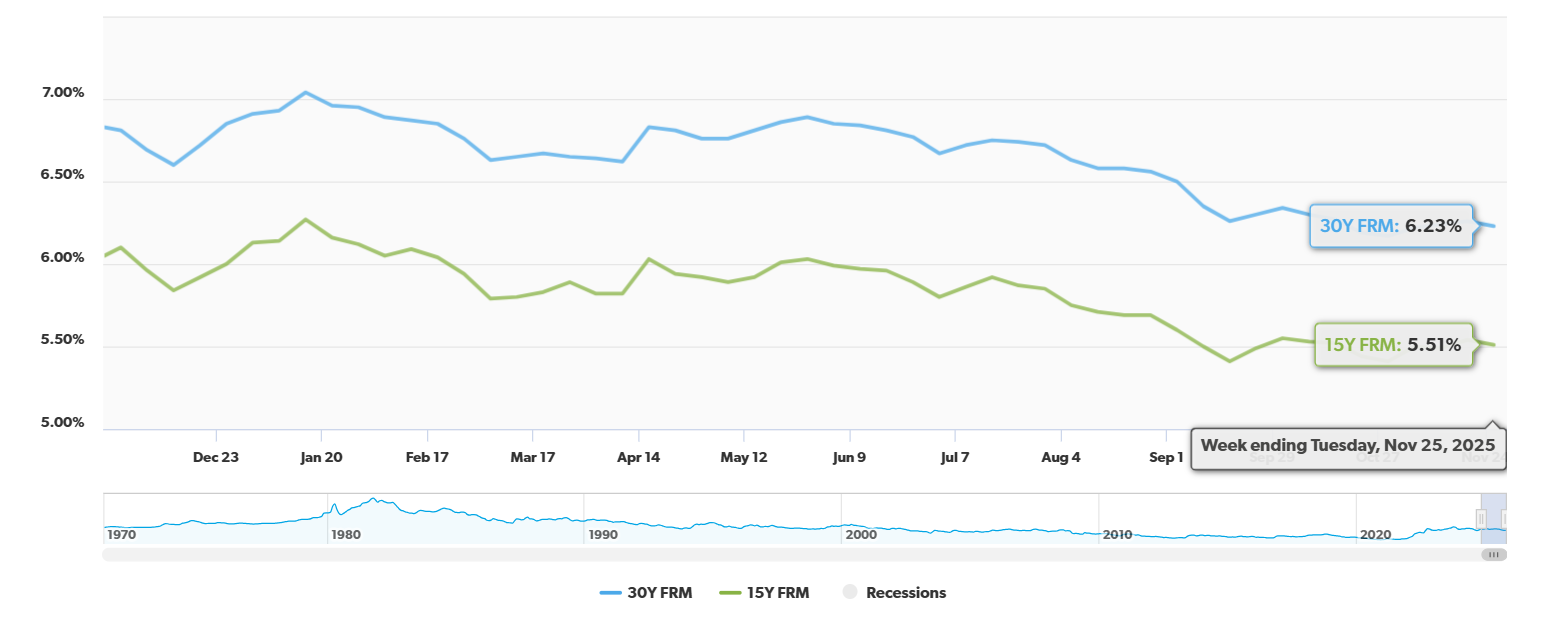
The good news is out: mortgage rates have dropped just before Thanksgiving, offering a much-needed glimmer of hope for those looking to buy a home or refinance. This is a welcome shift, and as of November 26, 2025, the average 30-year fixed-rate mortgage (FRM) is sitting at 6.23%, according to Freddie Mac's latest Primary Mortgage Market Survey®.

I’ve been following the housing market closely for years, and seeing these numbers ease before such a major holiday feels significant. It's not just a small dip; compared to this time last year, when the 30-year FRM was averaging a much higher 6.81%, this is a noticeable improvement. It suggests that the housing market, while complex, is responding to economic shifts in ways that can benefit hopeful homeowners.

Mortgage Rates Fall Ahead of Thanksgiving, Offering Buyers Rare Holiday Relief

What Does This Mean for You?

Let's break down these numbers and what they could mean for your wallet and your homeownership dreams. When mortgage rates go down, your monthly payments can become more affordable, and you might be able to afford a slightly more expensive home or save a considerable amount of money over the life of your loan.

Here's a look at how the rates have changed, according to Freddie Mac:

Mortgage Type Current Average (11/26/2025) 1-Week Change 1-Year Change
30-Year FRM 6.23% -0.03% -0.58%
15-Year FRM 5.51% -0.03% -0.59%

Seeing both the 30-year and 15-year fixed-rate mortgages decrease is a positive signal across the board. For many, the 30-year fixed rate is the go-to choice for its predictable monthly payment and the ability to spread out payments over a longer period. The 15-year fixed rate, while leading to higher monthly payments, often offers a lower overall interest cost and allows homeowners to build equity faster.

mortgage rates decrease heading into the thanksgiving holiday
Source: Freddie Mac

The Expert Take: Why the Drop?

As Freddie Mac's Chief Economist, Sam Khater, pointed out, this decrease comes as a pleasant surprise heading into the Thanksgiving week. He noted that pending home sales are at their highest level since last November, indicating that buyer activity is showing resilience. This is a crucial piece of insight – even with economic uncertainties, people are still actively looking to buy homes.

So, what's behind these rates heading in the right direction? I’ve been thinking a lot about the interplay of economic factors, and here are a few key reasons I believe are driving this trend:

  • Federal Reserve's Interest Rate Moves: The Federal Reserve plays a huge role in setting the tone for interest rates. There's been anticipation, and in some cases, action, regarding rate cuts from the Fed. When the Fed signals or enacts rate cuts, it often leads directly to lower mortgage rates. The market is currently factoring in a potential rate cut in December, which would naturally push mortgage rates down. I've seen this pattern play out before – anticipated Fed actions can move markets even before they officially happen.
  • Cooling Inflation and Economy: As the economy starts to cool down and inflation eases its grip, there’s less pressure on the Fed to keep interest rates high. Think of it like this: when prices everywhere are soaring, the Fed raises rates to slow things down. When those prices start to stabilize or even decrease, they have more room to ease up on rates. Signs of a softening job market, while potentially concerning for some, can also contribute to lower borrowing costs.
  • Investor Behavior: Mortgage rates aren't set in a vacuum; they are closely tied to the performance of things like the 10-year Treasury yield. When investors feel confident that interest rates will continue to fall, they tend to buy more bonds. This increased demand for bonds pushes their prices up and their yields down, which, in turn, often leads to lower mortgage rates for consumers.

Navigating the Nuances: What Could Slow This Down?

While it's fantastic to see rates dropping, it's important to remember that the economy is a dynamic beast. Several factors could prevent these rates from falling much further or might cause them to fluctuate:

  • Stubborn Inflation: If inflation proves to be more persistent than anticipated, the Federal Reserve might be hesitant to make significant rate cuts. They are primarily focused on getting inflation back to their target. If inflation doesn't cooperate, it could put a ceiling on how low mortgage rates can go.
  • Fed's Cautionary Stance: The Fed is walking a tightrope, balancing economic growth with inflation control. Any unexpected upward movement in inflation or a strong economic indicator could make them pause or even reverse course on rate cuts, causing volatility in mortgage rates.
  • Increased Buyer Demand: This might sound counterintuitive, but as mortgage rates fall, more people are likely to enter the housing market. This surge in demand can sometimes lead to increased competition and a rise in home prices. While lower rates are great, if home prices shoot up significantly, it could partially offset the savings.

Looking Ahead: Expert Predictions for 2026

So, what does the future hold? It seems the general consensus among experts is that mortgage rates are likely to trend downwards through late 2025 and into 2026. However, the key word here is gradually. Most forecasts suggest rates will likely settle in the low-to-mid 6% range rather than plummeting dramatically.

Here’s what some major organizations are projecting for the average 30-year fixed rate in 2026:

Organization 2026 Forecast (Average 30-Yr FRM)
Fannie Mae 5.9%
Mortgage Bankers Association (MBA) 6.4%
National Association of Realtors (NAR) Around 6%

As you can see, there's a range of predictions, but a common theme is a move towards slightly lower rates. Fannie Mae is the most optimistic, projecting a dip below 6%, while the MBA sees rates holding relatively steady. The NAR’s forecast lands somewhere in the middle, painting a picture of continued moderation.

From my perspective, these predictions highlight the inherent uncertainty. While many expect a downward trend, unexpected economic events can always shift the outlook. The most important thing for potential buyers and homeowners is to stay informed and work with trusted advisors to navigate these potential changes.

How the Rate Drop Could Translate to Savings

Let's put this into perspective with a simple example. Imagine you're looking to buy a $300,000 home.

  • At 6.81% (Last Year): Your estimated monthly payment (principal and interest) would be approximately $1,975.
  • At 6.23% (Current Rate): Your estimated monthly payment (principal and interest) would be approximately $1,844.

That's a difference of $131 per month, or about $1,572 per year in savings on just this one loan. Over the 30-year life of the mortgage, this could amount to tens of thousands of dollars saved. This is why even small drops in mortgage rates can have a significant impact on affordability and your overall financial well-being.

Final Thoughts

This pre-Thanksgiving drop in mortgage rates is more than just a statistic; it's a sign of the market responding to economic signals and potentially offering a more accessible entry point for many into homeownership. While challenges remain, and volatility is always a possibility, this is a moment for optimism. If you've been on the fence about buying or refinancing, now might be a good time to explore your options.

Mortgage Rates Fall Just in Time for Thanksgiving

Rates dipping before the holiday are giving homebuyers and investors a rare seasonal advantage—lower monthly payments and stronger affordability heading into year-end.

Norada Real Estate helps you seize this opportunity with turnkey rental properties in high-demand markets—so you can lock in financing and passive income while rates remain favorable.

🔥 HOT HOLIDAY LISTINGS JUST ADDED! 🔥

Talk to a Norada investment counselor today (No Obligation):

(800) 611-3060

Get Started Now

Also Read:

  • Mortgage Rates Predictions Backed by 7 Leading Experts: 2025–2026
  • Mortgage Rate Predictions for the Next 3 Years: 2026, 2027, 2028
  • 30-Year Fixed Mortgage Rate Forecast for the Next 5 Years
  • 15-Year Fixed Mortgage Rate Predictions for Next 5 Years: 2025-2029
  • Will Mortgage Rates Ever Be 3% Again in the Future?
  • Mortgage Rates Predictions for Next 2 Years
  • Mortgage Rate Predictions for Next 5 Years
  • Mortgage Rate Predictions: Why 2% and 3% Rates are Out of Reach
  • How Lower Mortgage Rates Can Save You Thousands?
  • How to Get a Low Mortgage Interest Rate?
  • Will Mortgage Rates Ever Be 4% Again?

Filed Under: Financing, Mortgage Tagged With: Interest Rate, mortgage, Mortgage Rate Trends, mortgage rates, Mortgage Rates Today

Buyer Hope Rises as 30-Year Fixed Mortgage Rate Drops to Lowest Since October 2024

November 27, 2025 by Marco Santarelli

blog/buyer-hope-rises-as-30-year-fixed-mortgage-rate-drops-to-lowest-since-october-2024/

If you've been dreaming of homeownership or looking to refinance, the news on November 27 is genuinely exciting. The average 30-year fixed mortgage rate has just hit its lowest point since October 2024, now sitting comfortably at 6.00% according to Zillow. This is a significant development, offering a much-needed boost of hope for buyers who have been navigating a challenging market. Compared to a year ago, when the same rate averaged 6.81%, this drop provides a tangible improvement in affordability.

Buyer Hope Rises as 30-Year Fixed Mortgage Rate Drops to Lowest Since October 2024

These numbers are more than just statistics; they represent real opportunities for people. This dip to 6.00% isn't just a minor fluctuation; it's a signal that borrowing costs are becoming more manageable, potentially unlocking doors for many who felt priced out. For those considering refinancing, this offers a chance to reduce their monthly payments and save money over the long term.

Let's break down the current mortgage rates to give you a clearer picture. These are national averages from Zillow as of November 27, and they apply to both new purchases and refinances.

Purchase Mortgage Rates (National Averages)

Loan Type Interest Rate
30-year fixed 6.00%
20-year fixed 5.86%
15-year fixed 5.50%
5/1 ARM 6.11%
7/1 ARM 6.15%
30-year VA 5.44%
15-year VA 5.10%
5/1 VA 5.11%

Why the Drop? The Forces Shaping Mortgage Rates

So, what's driving these favorable movements? A lot of it comes down to the Federal Reserve's actions and expectations. We've seen earlier rate cuts, and the market is now anticipating another potential cut in December. When news like this circulates, it often encourages bond traders to invest more in bonds, which, in turn, tends to push mortgage rates down. It’s a bit like a ripple effect spreading through the financial system.

Beyond Fed policy, slowing inflation and a cooling economy are also playing significant roles. As the overall cost of living eases and the economy isn't running at full throttle, there's less pressure for interest rates to remain high. Signs that the job market might be softening can also contribute to this downward pressure on rates. From my experience, when the economic “heat” starts to dissipate, lenders have more room to offer better deals on loans.

The Road Ahead: Expert Predictions for 2026

While the current dip is great news, it’s natural to wonder what’s next. Experts generally agree that mortgage rates are likely to trend downwards in late 2025 and into 2026. However, the consensus isn't for a dramatic freefall. Most forecasts suggest rates will likely settle in the low-to-mid-6% range, rather than plummeting all the way back to historic pandemic lows.

Here’s a glimpse at what some major housing and economic players are predicting for 2026:

  • Fannie Mae anticipates the average 30-year fixed rate to reach 5.9% by the end of 2026.
  • The Mortgage Bankers Association (MBA) predicts a more stable 6.4% for the 30-year fixed rate throughout 2026.
  • The National Association of Realtors (NAR) forecasts the average 30-year rate to be around 6% in 2026.

These projections highlight a general expectation of rates remaining somewhat elevated compared to a few years ago but moving in a more favorable direction for borrowers.

Factors That Could Shift the Trend

It’s also important to acknowledge that the future isn't set in stone. Several factors could influence whether rates continue to fall, level out, or even tick back up:

  • Stubborn Inflation: If inflation proves more persistent than expected, the Federal Reserve might hold off on rate cuts, keeping mortgage rates from falling further.
  • Fed Caution: The Fed’s primary focus is controlling inflation. Any unexpected economic shifts or persistent inflation could lead to increased caution, causing market volatility and potentially impacting mortgage rates.
  • Increased Home Demand: As interest rates become more attractive, we often see a surge in buyer interest. If demand significantly outpaces supply, it could lead to upward pressure on home prices, somewhat offsetting the savings from lower mortgage rates.

This delicate balance between economic indicators, Fed policy, and market demand means we need to stay attuned to how things unfold.

ARM vs. Fixed-Rate: Making the Right Choice Today

The decision between a fixed-rate mortgage and an adjustable-rate mortgage (ARM) is crucial. With the 30-year fixed rate now at 6.00%, it offers incredible stability. Your principal and interest payment won't change for the life of the loan, making budgeting straightforward. Personally, I often find this predictability invaluable for homeowners.

ARMs, like the 5/1 ARM at 6.11% and 7/1 ARM at 6.15%, offer a lower initial rate for a set period before adjusting. However, in today's environment, the difference between ARM rates and fixed rates isn't as substantial as it historically has been. This makes the security of a fixed rate much more appealing for many. Unless you have a very specific plan to sell or refinance before the ARM adjusts, the stability of a fixed rate is usually the safer bet right now.

VA Loan Opportunities for Heroes

For our service members and veterans, VA loans continue to offer some of the best rates on the market. The 30-year VA loan at 5.44% and 15-year VA loan at 5.10% are considerably lower than conventional options. Plus, remember the added perks: often no down payment required and no private mortgage insurance (PMI). If you're eligible, it's almost always worth looking into a VA loan first – the savings can be substantial.

Making the Most of Today's Market

The current trend towards lower mortgage rates, particularly for the 30-year fixed, is a welcome development. It signifies a potential turning point, offering increased affordability and refinancing opportunities. While the dream of 2-3% rates might be a distant memory, the low-to-mid-6% range is a much more manageable and achievable environment for many aspiring and current homeowners.

As we look towards late 2025 and 2026, the outlook suggests rates will likely stay in this more accessible range, though with the possibility of further slight decreases. Staying informed and working with a qualified mortgage professional will be key to navigating this market and securing the best possible terms for your homeownership goals.

30-Year Fixed Mortgage Hits Lowest Point in Over a Year

With rates dipping to their lowest level in more than 12 months, investors are locking in financing to maximize cash flow and long-term returns.

Norada Real Estate helps you seize this rare opportunity with turnkey rental properties in strong markets—so you can build passive income while borrowing costs remain historically low.

🔥 HOT NEW LISTINGS JUST ADDED! 🔥

Talk to a Norada investment counselor today (No Obligation):

(800) 611-3060

Get Started Now

Also Read:

  • Mortgage Rates Predictions Backed by 7 Leading Experts: 2025–2026
  • Mortgage Rate Predictions for the Next 3 Years: 2026, 2027, 2028
  • 30-Year Fixed Mortgage Rate Forecast for the Next 5 Years
  • 15-Year Fixed Mortgage Rate Predictions for Next 5 Years: 2025-2029
  • Will Mortgage Rates Ever Be 3% Again in the Future?
  • Mortgage Rates Predictions for Next 2 Years
  • Mortgage Rate Predictions for Next 5 Years
  • Mortgage Rate Predictions: Why 2% and 3% Rates are Out of Reach
  • How Lower Mortgage Rates Can Save You Thousands?
  • How to Get a Low Mortgage Interest Rate?
  • Will Mortgage Rates Ever Be 4% Again?

Filed Under: Financing, Mortgage Tagged With: Interest Rate, mortgage, Mortgage Rate Trends, mortgage rates, Mortgage Rates Today

Mortgage Rates Today, Nov 27: 30-Year Refinance Rate Climbs by 9 Basis Points

November 27, 2025 by Marco Santarelli

Mortgage Rates Today, Dec 6: 30-Year Fixed Refinance Rate Jumps by 18 Basis Points

If you've been thinking about refinancing your mortgage, the numbers for November 27, 2025, show a slight upward tick for the most popular type of home loan. The national average for a 30-year fixed refinance rate has moved up to 6.81%, a jump of 9 basis points from yesterday's average of 6.72%, according to data released by Zillow. This means that if you were looking to refinance into a 30-year loan today, the cost of borrowing would be a bit higher than yesterday.

Mortgage Rates Today, Nov. 27: 30-Year Refinance Rate Climbs by 9 Basis Points

What That 9 Basis Point Increase Really Means for Your Wallet

Let's break down what a 9 basis point (or 0.09%) increase actually translates to for your monthly payment on a 30-year mortgage. Imagine you're looking to refinance a $300,000 loan.

  • At 6.72%: Your estimated principal and interest payment would be around $1,939 per month.
  • At 6.81%: That payment bumps up to approximately $1,961 per month.

That's a difference of about $22 each month. While $22 might not sound like a lot on its own, over the life of a 30-year loan, it adds up to a significant amount of extra interest paid. This is precisely why keeping a close eye on these rate movements is so crucial if refinancing is on your radar. It's these seemingly minor shifts that can have a real impact on your long-term financial well-being.

Looking at the Broader Refinance Picture

Beyond the headline-grabbing 30-year fixed rate, other loan types saw different movements on November 27, 2025.

  • The 15-year fixed refinance rate actually saw a slight dip, moving down 4 basis points from 5.71% to 5.67%. This could be an attractive option for those looking to pay off their home faster and potentially save on interest over a shorter term.
  • On the other hand, the 5-year adjustable-rate mortgage (ARM) refinance rate experienced a more significant jump, climbing 21 basis points from 7.32% to 7.53%. ARMs typically start with a lower rate than fixed-rate mortgages, but this increase suggests that even these introductory rates are becoming more expensive.

Here's a quick summary:

Mortgage Type Rate on Nov. 27, 2025 Change from Previous Day Change from Previous Week
30-Year Fixed Refinance 6.81% +9 basis points +3 basis points
15-Year Fixed Refinance 5.67% -4 basis points -1 basis point
5-Year ARM Refinance 7.53% +21 basis points +15 basis points

Data Source: Zillow

This mixed movement highlights that the mortgage market isn't moving in lockstep. For anyone considering refinancing, it's essential to look at the specific loan product that best fits their financial situation and goals.

Why the Upward Climb? Understanding Interest Rate Fluctuations

As someone who's followed the housing market for a while, I've learned that mortgage rates don't exist in a vacuum. They are deeply connected to the broader economic environment. When we see rates like the 30-year fixed refinance rate inching up, it's often a reflection of several factors:

  • Inflationary Pressures: If inflation is showing signs of picking up, central banks might signal or enact policies to cool the economy down, which can lead to higher interest rates.
  • Economic Growth: Strong economic growth can also put upward pressure on rates as demand for borrowing increases.
  • Federal Reserve Policy: While the Fed doesn't directly set mortgage rates, its actions and pronouncements about interest rates and economic policy significantly influence them. When the Fed signals a more hawkish stance (meaning they're focused on controlling inflation, often through rate hikes), mortgage rates tend to follow.
  • Bond Market Dynamics: Mortgage-backed securities, which are closely tied to long-term interest rates, are traded on the bond market. Investor sentiment and demand for these securities play a huge role. If investors demand higher yields on these bonds, mortgage rates go up.

It's a complex interplay, and what we see on a given day is often a reaction to recent economic data or news. The 9 basis point increase on November 27th is likely a response to some of these underlying economic signals.

Key Factors to Consider When You Refinance

The decision to refinance isn't just about the current rate. It's a strategic financial move, and there are several personal factors that come into play. Based on my experience, here are the critical considerations:

  • Credit Score: This is arguably one of the most significant influencers of your refinance rate. A higher credit score (typically 740 and above) signals to lenders that you're a lower risk, and you'll likely qualify for the best available rates. If your credit score has improved since you last took out your mortgage, refinancing could be very beneficial. Conversely, if your score has dipped, you might not see the savings you expect.
  • Loan-to-Value (LTV) Ratio: This ratio compares the amount you owe on your mortgage to the current appraised value of your home. Lenders generally prefer a lower LTV, meaning you have more equity in your home. A lower LTV often leads to better refinance rates and terms.
  • Your Financial Goals: What do you want to achieve by refinancing?
    • Lower Monthly Payment: If your primary goal is to reduce your monthly outflow, a lower interest rate regardless of loan term is key.
    • Shorter Loan Term: If you want to pay off your mortgage faster and build equity quicker, a 15-year mortgage or refinancing to a shorter term on your existing loan might be the target.
    • Cash Out: Do you need access to funds for home improvements, debt consolidation, or other significant expenses? A cash-out refinance allows you to borrow more than you currently owe and receive the difference in cash.
  • Closing Costs: Refinancing isn't free. There are closing costs involved, similar to when you first bought your home. These can include appraisal fees, title insurance, origination fees, and more. You need to calculate your “break-even point” – how long it will take for the monthly savings from your new loan to offset these upfront costs. If you plan to sell your home before you reach this point, refinancing might not be worthwhile.

The Role of Credit Scores in Refinancing

I can't stress this enough: your credit score is your golden ticket to good refinance rates. Think of it as your financial report card. Lenders use it to gauge your reliability in repaying borrowed money.

  • Excellent Credit (740+): You'll likely qualify for the lowest advertised rates.
  • Good Credit (670-739): You'll still get competitive rates, but perhaps not the absolute rock-bottom ones.
  • Fair Credit (580-669): Refinancing might be challenging, and if approved, rates will be significantly higher.
  • Poor Credit (Below 580): Refinancing is generally not an option, and focusing on improving your credit score should be the priority.

If you're unsure about your credit score, get a copy of your credit report from the major credit bureaus (Equifax, Experian, TransUnion) and review it for any errors.

Benefits of Refinancing, Especially for First-Time Homeowners

For those who purchased their homes relatively recently, especially first-time buyers who may have taken out a mortgage at a higher rate during a period of rising interest rates, refinancing offers a significant opportunity.

  • Lowering Monthly Payments: This is the most immediate and tangible benefit. Lower payments free up cash flow for other savings goals, investments, or simply more breathing room in the budget.
  • Reducing Total Interest Paid: By securing a lower rate, you can shave tens of thousands of dollars off the total interest you'll pay over the life of the loan.
  • Converting to a Fixed Rate: If your initial mortgage was an ARM and rates have risen, but you anticipate they might fall in the future, refinancing into a fixed-rate mortgage can provide payment stability and protection against further rate hikes.
  • Accessing Equity via Cash-Out: This can be a powerful tool for homeowners who need funds for home improvements that increase their home's value, consolidating high-interest debt, or funding education.

Recommended Read:

30-Year Fixed Refinance Rate Trends – November 26, 2025

Best Time to Refinance Your Mortgage: Expert Insights

Should You Refinance Your Mortgage Now or Wait Until 2026? 

Understanding Adjustable-Rate Mortgage (ARM) Refinances

ARMs are a bit of a gamble, and the recent spike in the 5-year ARM refinance rate to 7.53% is a reminder of that. Here's how they generally work:

  • Initial Fixed Period: An ARM usually has an initial period (e.g., 5, 7, or 10 years) where the interest rate is fixed and often lower than a traditional fixed-rate mortgage.
  • Adjustment Period: After the fixed period ends, the interest rate adjusts periodically (usually annually) based on a benchmark index plus a margin.
  • Rate Caps: ARMs have caps that limit how much the interest rate can increase at each adjustment and over the life of the loan.

Refinancing an ARM can be a smart move if:

  1. Your fixed period is ending soon, and you want to lock in a predictable payment before the rate starts adjusting upwards.
  2. Current fixed rates are lower than what your ARM will likely be after its first rate adjustment.
  3. You don't plan to stay in the home for the entire duration of the loan's potential adjustment period, and you want to benefit from the initial lower rate without facing future uncertainty.

The 21 basis point increase in the 5-year ARM rate on November 27th suggests that lenders are pricing in higher future borrowing costs, making it potentially less attractive for those seeking long-term stability without careful consideration.

My Take on Today's Rates

From where I stand, the slight rise in the 30-year fixed refinance rate on November 27th, while noticeable, doesn't signal a dramatic shift that would invalidate refinancing for everyone. It does, however, underscore the importance of acting decisively when you find a rate that works for your financial goals and when the numbers clearly show a benefit after accounting for closing costs.

If you've been contemplating a refinance, I'd encourage you to:

  • Get personalized quotes: Rates fluctuate daily and are highly personal. What Zillow reports is an average; your specific rate will depend on your credit, LTV, and other factors.
  • Do the math: Calculate your break-even point diligently.
  • Consider your long-term plans: How long do you anticipate staying in your home? This heavily influences whether a fixed or adjustable rate makes more sense.

The mortgage market is a dynamic beast, and staying informed is key. While today's numbers show a slight increase, it's just one data point in your overall financial journey.

“Invest Smart — Build Long-Term Wealth Through Real Estate”

Norada's team can guide you through current market dynamics and help you position your investments wisely—whether you're looking to reduce rates, pull out equity, or expand your portfolio.

Work with us to identify proven, cash-flowing markets and diversify your portfolio while borrowing costs remain favorable.

HOT NEW TURNKEY DEALS JUST LISTED!

Speak with a seasoned Norada investment counselor today (No Obligation):

(800) 611-3060

Get Started Now

Recommended Read:

  • When You Refinance a Mortgage Do the 30 Years Start Over?
  • Should You Refinance as Mortgage Rates Reach Lowest Level in Over a Year?
  • NAR Predicts 6% Mortgage Rates in 2025 Will Boost Housing Market
  • Mortgage Rates Predictions for 2025: Expert Forecast
  • Half of Recent Home Buyers Got Mortgage Rates Below 5%
  • Mortgage Rates Need to Drop by 2% Before Buying Spree Begins
  • Will Mortgage Rates Ever Be 3% Again: Future Outlook
  • Mortgage Rates Predictions for Next 2 Years
  • Mortgage Rate Predictions for Next 5 Years
  • Mortgage Rate Predictions for 2025: Expert Forecast

Filed Under: Financing, Mortgage Tagged With: mortgage, mortgage rates, Mortgage Refinance Rates

Today’s Mortgage Rates, November 26: 30-Year Fixed Rate Goes Down to 6.04%

November 26, 2025 by Marco Santarelli

Today’s Mortgage Rates, Nov 30: 30-Year Fixed Rate Poised to Break Into the 5% Range

The big news today, November 26th, is that today's mortgage rates are hovering so close to the 6% mark for a 30-year fixed loan that it feels like we're holding our breath. According to Zillow, the average rate has dipped to 6.04%, its lowest point this year. This is significant because breaking below that 6% barrier could really shake things up, encouraging more people to buy homes or refinance their existing mortgages.

For a while now, mortgage rates have been a bit of a rollercoaster, and seeing them consistently above 6.5% through much of 2025 had many potential buyers on the sidelines. But this recent downward trend, especially the noticeable drop in the 15-year fixed rate to 5.47%, is a welcome sign.

It suggests that the market is becoming more favorable, and opportunities are popping up for both those looking to purchase their first home and for homeowners wanting to lower their monthly payments. This subtle shift feels like a turning point we've been anticipating.

Today's Mortgage Rates, November 26: 30-Year Fixed Rate Goes Down to 6.04%

Understanding the Numbers: Today's Mortgage Rates Snapshot

To give you a clear picture, here's what the average mortgage rates look like today for those looking to buy a home, based on Zillow's data. Remember, these are national averages and can vary based on your specific situation, credit score, and lender.

Loan Type Average Rate
30-Year Fixed 6.04%
20-Year Fixed 5.84%
15-Year Fixed 5.47%
5/1 ARM 6.16%
7/1 ARM 6.12%
30-Year VA 5.36%
15-Year VA 4.96%
5/1 VA 4.91%

Why the Sub-6% Mark Matters So Much

Think of mortgage rates like the price tag on one of the biggest purchases most people will ever make – a home. When that price tag comes down, even by a little, it makes the whole prospect much more appealing. For years, we've seen rates fluctuate, and for a long stretch, they felt stubbornly high. A dip to 6.04% on the 30-year fixed is not just a number; it's a psychological threshold.

When rates are hovering just above 6%, people tend to wait and see if they'll go lower. But once they officially dip below 6%, it often triggers a “now or never” feeling. This is because a lower rate can significantly reduce your monthly payment over the life of the loan. For folks considering buying, that translates to a more affordable monthly housing cost, potentially allowing them to qualify for a larger loan or simply save money each month. For those looking to refinance, it's an opportunity to either lower their monthly payment, shorten their loan term, or even cash out some equity. My experience tells me that when a rate like this appears, the phones start ringing for lenders, and open houses see more foot traffic.

The 15-Year Fixed: A Smart Choice for Many

While the 30-year fixed gets a lot of attention, I always tell people to consider the 15-year fixed option. Today, it's looking particularly attractive with an average rate of 5.47%. While the monthly payments on a 15-year loan are typically higher than on a 30-year loan, you pay significantly less interest over the life of the loan and own your home free and clear much sooner.

  • Faster Equity Building: You build equity in your home at a much quicker pace.
  • Substantial Interest Savings: The total interest paid can be tens or even hundreds of thousands of dollars less.
  • Financial Freedom: Being mortgage-free sooner provides immense financial flexibility for retirement or other life goals.

This lower rate on the 15-year, coupled with the inherent savings, makes it a powerful option for anyone who can comfortably manage the higher monthly payments. It’s a path to owning your home outright in half the time, which is a pretty compelling carrot to dangle.

VA Loans: Exceptional Value for Eligible Veterans

One of the consistently bright spots in the mortgage market are VA loans, designed for eligible veterans and active-duty military personnel. The rates for VA loans today are notably lower than conventional loans, showcasing the continued value they offer.

  • 30-Year VA: 5.36%
  • 15-Year VA: 4.96%
  • 5/1 VA: 4.91%

These rates, particularly the 30-year at 5.36%, are well below the conventional 30-year fixed rate. This program is a testament to our nation's commitment to its service members, providing them with more affordable access to homeownership. If you're a veteran or active-duty military member, exploring a VA loan is almost always a must-do.


Related Topics:

Mortgage Rates Trends as of November 25, 2025

Mortgage Rates Predictions for the Next 12 Months: Nov 2025 to Nov 2026

Mortgage Rates Predictions for Next 90 Days: October to December 2025

Refinance Rates: Opportunities and Considerations

Now, let's talk about refinancing. The mortgage market data shows a slight difference between rates for purchasing a home and rates for refinancing. For instance, the 30-year fixed refinance rate is at 6.18%, compared to the 6.04% for purchases. This isn't unusual; lenders often price these differently.

So, what does this mean for homeowners considering a refinance?

  • The Gap is Small: The difference of 0.14% for a 30-year fixed is not massive. If you're looking to lower your monthly payment or tap into equity, now might still be a good time.
  • Assess Your Goals: Are you looking to simply lower your payment and keep the same loan term? Or do you want to shorten your loan term and pay less interest overall (which might mean a similar or slightly higher payment if you go from a 30-year to a 15-year)? Understanding your goal is key.
  • Don't Wait Too Long: While rates might drop further, they could also go up. If you see a rate that meets your financial objectives and provides tangible savings, it's worth acting on. Waiting for the absolute lowest possible rate can sometimes mean missing out on a good opportunity altogether. I've seen clients who waited too long and saw rates climb back up, regretting not refinancing when they had the chance.

Here are the refinance rates, also from Zillow:

Loan Type Average Rate
30-Year Fixed 6.18%
20-Year Fixed 6.11%
15-Year Fixed 5.66%
5/1 ARM 6.47%
7/1 ARM 6.64%
30-Year VA 5.49%
15-Year VA 5.15%
5/1 VA 5.02%

What's Driving These Rate Movements?

Several factors are influencing these mortgage rate dips. For a while, there's been a lot of buzz about the Federal Reserve potentially cutting its benchmark interest rate. While not a done deal for December, the anticipation alone is enough to nudge mortgage rates downward because investors often react to these signals. When investors expect rates to fall, they tend to buy more long-term bonds, which can drive down yields—and mortgage rates tend to follow bond yields.

On the housing front, despite ongoing concerns about high home prices, government loan programs like FHA, VA, and USDA are seeing consistent application volumes. These programs offer more flexible qualification requirements and often lower down payment options, making them incredibly appealing to a wider range of buyers, especially those who might be priced out of conventional markets.

Looking back, it's important to remember where we've come from. While today's rates are a welcome relief compared to earlier in 2025 or even the peak of 2023 and 2024, they are still higher than the historic lows we saw during the pandemic. This disconnect is a big reason why so many homeowners are feeling “golden handcuffed”—they have a fantastic, low-interest rate on their current mortgage and are hesitant to move and take on a new, higher rate. This has, in turn, impacted the inventory of homes for sale.

The Bottom Line

Today, November 26th, the mortgage market is offering a glimmer of hope for many looking to buy or refinance. With the 30-year fixed rate teetering on the edge of 6%, a significant psychological and practical barrier could soon fall. The 15-year fixed is particularly appealing for its long-term savings, and VA loans continue to provide excellent value for those eligible. While external economic factors are at play, the current trend is generally moving in a direction that makes homeownership and refinancing more accessible. My advice? If you've been waiting, now is a good time to start seriously evaluating your options and talking to a lender.

Beat Inflation & Retire Early with Turnkey Rentals

Turnkey real estate offers powerful tax benefits, monthly cash flow, and long-term equity growth—ideal for early retirement planning.

Norada Real Estate helps you invest in inflation-resistant markets with strong rental demand and built-in tax advantages like depreciation and 1031 exchanges.

🔥 HOT NEW LISTINGS JUST ADDED! 🔥

Talk to a Norada investment counselor today (No Obligation):

(800) 611-3060

Get Started Now

Also Read:

  • Mortgage Rates Predictions Backed by 7 Leading Experts: 2025–2026
  • Mortgage Rate Predictions for the Next 3 Years: 2026, 2027, 2028
  • 30-Year Fixed Mortgage Rate Forecast for the Next 5 Years
  • 15-Year Fixed Mortgage Rate Predictions for Next 5 Years: 2025-2029
  • Will Mortgage Rates Ever Be 3% Again in the Future?
  • Mortgage Rates Predictions for Next 2 Years
  • Mortgage Rate Predictions for Next 5 Years
  • Mortgage Rate Predictions: Why 2% and 3% Rates are Out of Reach
  • How Lower Mortgage Rates Can Save You Thousands?
  • How to Get a Low Mortgage Interest Rate?
  • Will Mortgage Rates Ever Be 4% Again?

Filed Under: Financing, Mortgage Tagged With: Interest Rate, mortgage, Mortgage Rate Trends, mortgage rates, Mortgage Rates Today

30-Year Mortgage Rate Hits Lowest Level of the Year — Here’s What’s Behind the Drop

November 26, 2025 by Marco Santarelli

Buyer Hope Rises as 30-Year Fixed Mortgage Rate Dips to Lowest Since October

The 30-year fixed mortgage rate has just hit a significant milestone, reaching a yearly low of 6.06% according to Zillow. This isn't just a minor blip; this rate matches the lowest point we've seen all of 2025, last occurring in late October. For prospective homeowners, this dip represents a truly golden opportunity to lock in a steady, predictable payment on what is typically the largest purchase of their lives.

30-Year Mortgage Rate Hits Lowest Level of the Year — Here’s What’s Behind the Drop

Hitting a yearly low on the most popular loan type, the 30-year fixed, is a substantial piece of news. It signals a more favorable borrowing environment for consumers and potentially opens doors for buyers who may have been on the fence due to higher rates earlier in the year. If you're looking to buy a home and want predictable monthly payments for the next three decades, this is absolutely an opportunity to explore seriously.

Understanding Today's Mortgage Rates: A Closer Look

It's always best to see the whole picture, so let's break down the national average mortgage rates as of November 25, 2025, based on the latest Zillow data:

Loan Term Rate
30-year fixed 6.06%
20-year fixed 6.06%
15-year fixed 5.53%
5/1 ARM 6.16%
7/1 ARM 6.02%
30-year VA 5.55%
15-year VA 5.28%
5/1 VA 5.09%

Keep in mind, these are national averages. Your specific rate will depend on factors like your credit score, down payment amount, and chosen lender.

The Significance of the 30-Year Fixed Rate’s Yearly Low

Why is the 30-year fixed mortgage rate hitting 6.06% so important? Well, let’s look back. For much of 2025, we saw these rates consistently above 6.5%, and at times even a bit higher. For a significant loan amount, that difference – even just half a percentage point – can translate to thousands upon thousands of dollars in interest paid over 30 years.

This current rate is a welcome reprieve. It means more people who were priced out earlier in the year might now find a home purchase more affordable. For those who can afford it, locking in at 6.06% means peace of mind knowing their principal and interest payment won't change, no matter what happens in the broader economy or with interest rate trends. In my experience, predictability in mortgage payments is invaluable for long-term financial planning.

Navigating Fixed-Term Choices Beyond the 30-Year

While the 30-year fixed is the star today, let's not forget other fixed-rate options available:

  • 20-Year Fixed: It's quite interesting that the 20-year fixed rate is also sitting at 6.06% today. Usually, you'd expect a rate reduction for choosing a shorter term. In this specific instance, you get the benefit of paying off your mortgage a decade sooner without an increased interest rate, which is a fantastic scenario if you can manage the higher monthly payments.
  • 15-Year Fixed: For those seeking the lowest interest rate and the fastest path to homeownership, the 15-year fixed rate is even lower, at 5.53%. This loan term comes with higher monthly payments but saves you a substantial amount on interest over the life of the loan. It’s a powerful tool for aggressive debt reduction and building equity rapidly.

Who is each loan term best for?
The 15-year fixed is ideal for financially solid individuals or families who want to be mortgage-free sooner and can comfortably handle the larger payments. The 20-year fixed, at today's rates, offers a compelling balance – a faster payoff than the 30-year without necessarily a huge jump in monthly cost compared to a 15-year. And of course, the 30-year fixed at this 6.06% low is perfect for those who prioritize lower monthly payments, offering maximum affordability and flexibility in household budgeting.

Adjustable-Rate Mortgages (ARMs): Weighing the Risks

ARMs often boast lower initial rates, but it's crucial to understand they come with potential future rate increases.

  • 5/1 ARM: Today's rate is 6.16%. This means your rate is fixed for five years, then adjusts annually.
  • 7/1 ARM: The rate here is 6.02%, offering a seven-year initial fixed period before annual adjustments commence.

When you compare these to the 30-year fixed rate of 6.06%, the attractiveness of ARMs diminishes significantly for many buyers. Paying 6.16% for a 5/1 ARM when a 30-year fixed is available at 6.06% means you’re potentially paying more and taking on future rate risk for little to no immediate savings. ARMs are best considered if you have a clear exit strategy, like selling the home or refinancing before the fixed period ends, and you're comfortable with the unpredictable nature of future payments.

VA Loan Advantage: A Gratitude for Service

For our nation's veterans and eligible military families, VA loans continue to provide an exceptional advantage. These government-backed loans consistently offer lower interest rates and often come with benefits like no down payment requirement.

Let's look at the VA loan rates today:

  • 30-year VA: 5.55%
  • 15-year VA: 5.28%
  • 5/1 VA: 5.09%

The 30-year VA loan rate at 5.55% is remarkably lower than the conventional 30-year fixed rate of 6.06%. That's a substantial saving for those who have served. If you're eligible, exploring VA loan options should be a top priority.

Refinancing: What the Rates Mean for Current Homeowners

For those who already own a home, today's rates present a key question: Is it time to refinance?

Here are the national average refinance rates for November 25, 2025:

Loan Term Rate
30-year fixed 6.20%
20-year fixed 6.05%
15-year fixed 5.64%
5/1 ARM 6.35%
7/1 ARM 6.80%
30-year VA 5.64%
15-year VA 5.30%
5/1 VA 5.20%

You'll notice that refinance rates are generally a touch higher than purchase rates. For example, the 30-year fixed refinance rate is 6.20% versus the purchase rate of 6.06%. This is typically due to how lenders assess risk and manage their portfolios.

However, the key is the difference between your current mortgage rate and these new rates. If you have an older mortgage with a rate significantly higher than 6.20%, refinancing into a 30-year fixed could still offer considerable monthly savings and reduce the total interest paid over the life of your loan. The 15-year fixed refinance rate at 5.64% is also a strong option for homeowners looking to pay down their mortgage faster and save on interest.

Factors Shaping Mortgage Rate Trends

Mortgage rates don't move in a vacuum. They are influenced by a delicate interplay of economic signals. Here’s what’s currently important:

  • Economic Data Releases: This week's economic reports (inflation, retail sales, consumer sentiment) are critical. Weak numbers suggesting the economy is slowing down tend to push mortgage rates down, as investors seek safer havens like bonds. Stronger data can have the opposite effect.
  • Federal Reserve's Stance: The Federal Reserve's monetary policy is always a major driver. Their next scheduled announcement is on December 10, 2025. The market is split on whether they will lower interest rates again or hold steady. Any shift in their policy or forward guidance can significantly impact borrowing costs.
  • Market Sentiment: Beyond the hard numbers, general investor confidence plays a role. Economic uncertainty often leads money to flow into bonds, pushing yields (and thus mortgage rates) down. Confidence can lead to money flowing out of bonds, increasing rates.

What's Next for Mortgage Rates?

From my perspective, this yearly low in the 30-year fixed rate is a welcome sign. I anticipate we'll see continued modest easing through the end of November. However, I don't foresee a drastic drop.

The real watershed moment will likely be in early December. The Fed's decision and how the market interprets the economic data around that time will be paramount.

For now, buyers should recognize that 6.06% on a 30-year fixed mortgage is an excellent rate and a significant opportunity. My advice remains consistent: no matter the rate, always get pre-approved, understand your creditworthiness, and shop around with multiple lenders. This current dip, however, makes that advice even more potent. It's a prime chance to secure a fantastic rate and make your homeownership dreams a reality.

Beat Inflation & Retire Early with Turnkey Rentals

Turnkey real estate offers powerful tax benefits, monthly cash flow, and long-term equity growth—ideal for early retirement planning.

Norada Real Estate helps you invest in inflation-resistant markets with strong rental demand and built-in tax advantages like depreciation and 1031 exchanges.

🔥 HOT NEW LISTINGS JUST ADDED! 🔥

Talk to a Norada investment counselor today (No Obligation):

(800) 611-3060

Get Started Now

Also Read:

  • Mortgage Rates Predictions Backed by 7 Leading Experts: 2025–2026
  • Mortgage Rate Predictions for the Next 3 Years: 2026, 2027, 2028
  • 30-Year Fixed Mortgage Rate Forecast for the Next 5 Years
  • 15-Year Fixed Mortgage Rate Predictions for Next 5 Years: 2025-2029
  • Will Mortgage Rates Ever Be 3% Again in the Future?
  • Mortgage Rates Predictions for Next 2 Years
  • Mortgage Rate Predictions for Next 5 Years
  • Mortgage Rate Predictions: Why 2% and 3% Rates are Out of Reach
  • How Lower Mortgage Rates Can Save You Thousands?
  • How to Get a Low Mortgage Interest Rate?
  • Will Mortgage Rates Ever Be 4% Again?

Filed Under: Financing, Mortgage Tagged With: Interest Rate, mortgage, Mortgage Rate Trends, mortgage rates, Mortgage Rates Today

Mortgage Rates Today, Nov 26: 30-Year Refinance Rate Drops But ARMs Climb

November 26, 2025 by Marco Santarelli

Mortgage Rates Today, Dec 6: 30-Year Fixed Refinance Rate Jumps by 18 Basis Points

Mortgage rates today, Nov 26, show a promising dip for those considering a 30-year refinance, with the average rate dropping by 6 basis points. This change brings the national average for a 30-year fixed refinance to 6.72%, a move that could make a real difference for many homeowners looking to save on their monthly payments. Based on the latest data from Zillow, this recent adjustment is a welcome piece of news, especially when we consider the broader economic forces at play.

Mortgage Rates Today, Nov 26: 30-Year Refinance Rate Drops But ARMs Climb

Decoding the Day's Mortgage Rate Movements

Let's break down what's happening with refinance rates today, November 26, 2025. The market is a dynamic place, and different loan types are reacting in their own ways. Understanding these nuances is key to making an informed decision about your mortgage.

1. The 30-Year Fixed Refinance Rate: A Welcome Dip

Today's headline stat is the decrease in the 30-year fixed refinance rate. According to Zillow, this rate has moved from 6.66% to 6.72%. While it might seem like a small adjustment, a 6 basis point drop today, when compared to last week's average of 6.78%, paints a picture of a broader trend downwards. This signifies that, despite any minor daily fluctuations, the cost of refinancing a 30-year mortgage is becoming more favorable.

For many homeowners, the 30-year fixed-rate mortgage is the go-to option. Its popularity stems from the predictable monthly payments and the long repayment period, which makes managing household budgets easier. A 6 basis point reduction might translate into saving tens or even hundreds of dollars over the life of the loan, depending on the loan amount. It suggests that now could be a good time to explore refinancing if you've been on the fence.

2. The 15-Year Fixed Refinance Rate: A Steady Decline

The news isn't just for longer-term borrowers. The 15-year fixed refinance rate has also seen a slight decrease, moving from 5.68% to 5.65%. This is a reduction of 3 basis points. While smaller than the move in the 30-year rate, it’s another positive sign for borrowers.

Shorter-term loans like the 15-year mortgage typically come with lower interest rates than their 30-year counterparts. This is because lenders perceive less risk over a shorter period. Borrowers who opt for a 15-year term usually do so because they want to pay off their mortgage faster and build equity more quickly. The lower rate on top of the shorter term can lead to significant savings in interest paid over time. If your goal is aggressive debt reduction, watching the 15-year rate is just as important.

3. The 5-Year ARM Rate: A Sharp Increase

Not all refinance rates are moving in the same direction, though. The 5-year Adjustable-Rate Mortgage (ARM) refinance rate has experienced a noticeable surge, climbing 22 basis points from 7.31% to 7.53%. This is a substantial jump and highlights the inherent risks associated with ARMs, especially in a fluctuating economic environment.

ARMs start with a fixed interest rate for an initial period (in this case, five years), after which the rate adjusts periodically based on market conditions. While they can offer a lower initial rate compared to fixed-rate mortgages, the potential for significant increases later can be a major concern. This recent spike in the 5-year ARM rate serves as a strong reminder for borrowers to carefully consider their risk tolerance and future financial stability before committing to this type of loan. In times of economic uncertainty, fixed-rate mortgages often provide a more secure path.

Recommended Read:

30-Year Fixed Refinance Rate Trends – November 25, 2025

Best Time to Refinance Your Mortgage: Expert Insights

Should You Refinance Your Mortgage Now or Wait Until 2026? 

What This Means for You

These mixed movements across different loan types—a slight drop in the 30-year, a small decrease in the 15-year, and a significant rise in the 5-year ARM—reflect the complex reality of today's financial markets. Several factors influence these rates, including inflation expectations, the Federal Reserve's monetary policy, and the overall health of the economy.

For Homeowners Considering Refinancing:

We're seeing a trend that could benefit homeowners looking for stability and long-term savings. The decrease in the 30-year rate, in particular, makes it an attractive option for those who want to lower their monthly payments without drastically changing their repayment timeline.

  • Evaluate Your Current Mortgage: How does your current rate compare to these new refinance rates? Even a small improvement can add up.
  • Consider Your Financial Goals: Are you focused on reducing monthly payments, paying off your home faster, or taking cash out? Your goals will dictate which type of loan is best for you.
  • Assess Your Risk Tolerance: If you're thinking about an ARM, understand the potential for future rate increases. The current rise in the 5-year ARM rate is a clear indicator of this risk.
  • Shop Around: It’s always wise to get quotes from multiple lenders to ensure you’re securing the best possible rate and terms. Each lender might have slightly different pricing.

My Two Cents:

From my perspective, the current environment is one where caution and strategic thinking are rewarded. The downward movement in the 30-year fixed refinance rate is a positive signal, suggesting that opportunities to lock in lower borrowing costs are present. However, the sharp uptick in ARM rates underscores the importance of prioritizing stability if your financial future is less certain or if you prefer predictable expenses.

I always advise people to look beyond just the advertised rate. Consider the closing costs, any fees associated with the refinance, and how long you plan to stay in the home. These elements can significantly affect the true cost of refinancing and whether it makes financial sense for your specific situation. The numbers from Zillow provide a valuable snapshot, but personalized analysis is crucial.

It's essential to remember that these are national averages. Actual rates offered to you will depend on your credit score, loan-to-value ratio, the type of loan you choose, and the specific lender.

As of November 26, 2025, the mortgage market presents a mixed bag of opportunities and warnings. The 6 basis point drop in the 30-year fixed refinance rate is encouraging for many homeowners looking to trim their monthly obligations or secure a lower overall interest cost. Meanwhile, the 15-year fixed rate's modest decrease offers good news for those aiming for quicker equity building.

However, the significant rise in the 5-year ARM rate serves as a stark reminder of the volatility inherent in adjustable loans, urging a more conservative approach for many. Navigating these changes requires careful consideration of personal financial goals and risk appetite.

“Invest Smart — Build Long-Term Wealth Through Real Estate”

Norada's team can guide you through current market dynamics and help you position your investments wisely—whether you're looking to reduce rates, pull out equity, or expand your portfolio.

Work with us to identify proven, cash-flowing markets and diversify your portfolio while borrowing costs remain favorable.

HOT NEW TURNKEY DEALS JUST LISTED!

Speak with a seasoned Norada investment counselor today (No Obligation):

(800) 611-3060

Get Started Now

Recommended Read:

  • When You Refinance a Mortgage Do the 30 Years Start Over?
  • Should You Refinance as Mortgage Rates Reach Lowest Level in Over a Year?
  • NAR Predicts 6% Mortgage Rates in 2025 Will Boost Housing Market
  • Mortgage Rates Predictions for 2025: Expert Forecast
  • Half of Recent Home Buyers Got Mortgage Rates Below 5%
  • Mortgage Rates Need to Drop by 2% Before Buying Spree Begins
  • Will Mortgage Rates Ever Be 3% Again: Future Outlook
  • Mortgage Rates Predictions for Next 2 Years
  • Mortgage Rate Predictions for Next 5 Years
  • Mortgage Rate Predictions for 2025: Expert Forecast

Filed Under: Financing, Mortgage Tagged With: mortgage, mortgage rates, Mortgage Refinance Rates

Today’s Mortgage Rates, November 25: 30-Year FRM Drops to Lowest Level of 2025

November 25, 2025 by Marco Santarelli

Today’s Mortgage Rates, Nov 30: 30-Year Fixed Rate Poised to Break Into the 5% Range

The standout news for today's mortgage rates is that the average 30-year fixed mortgage rate has dipped to 6.06%, hitting a yearly low according to Zillow. This rate hasn't been this low all year, with the last time being in late October. For many, this could be the perfect moment to lock in a favorable rate before the year wraps up, potentially saving you a significant amount over the life of your loan.

It’s not daily that you see the 30-year fixed mortgage rate drop to such a compelling level, especially this late in the year. It’s a genuine opportunity, and one that many buyers have been waiting for. While we can't predict the future with 100% certainty, a rate around 6.06% for a 30-year fixed loan presents a strong case for moving forward with a purchase or refinancing.

Today's Mortgage Rates, November 25: 30-Year FRM Drops to Lowest Level of 2025

Breaking Down Today's Mortgage Rates

It's always helpful to see the numbers laid out clearly. Here’s a look at the national average mortgage rates as of November 25, 2025, based on data from Zillow:

Loan Term Rate
30-year fixed 6.06%
20-year fixed 6.06%
15-year fixed 5.53%
5/1 ARM 6.16%
7/1 ARM 6.02%
30-year VA 5.55%
15-year VA 5.28%
5/1 VA 5.09%

Please remember, these are national averages. Your actual rate might be a bit different based on your credit score, down payment, and lender.

Why the 30-Year Fixed Rate Hitting a Yearly Low Matters

The fact that the 30-year fixed mortgage rate has returned to its yearly low of 6.06% is a big deal. Earlier in 2025, we saw these rates consistently hovering above 6.5% and even creeping higher at times. For a significant loan amount, that difference of even half a percent can add up to tens of thousands of dollars over 30 years.

When someone asks me if it's a good time to buy, I often look at these benchmark rates. A 30-year fixed loan offers stability and predictable monthly payments, making budgeting much easier. For first-time homebuyers, this stability is gold. It means you can plan your finances with a good degree of certainty for decades to come. Seeing this rate at its lowest point means more purchasing power for buyers, or a chance to get a better deal than they might have expected just a few months ago.

Exploring Your Fixed-Term Options

While the 30-year fixed is the most popular for a reason, it’s not the only game in town. Let's look at the other fixed-term options:

  • 20-Year Fixed: Interestingly, the 20-year fixed rate is also currently at 6.06%, the same as the 30-year fixed. This is a bit unusual. Typically, a shorter loan term would have a slightly lower rate. In this scenario, you get the benefit of paying off your mortgage 10 years sooner without a rate penalty! This could be an excellent option for those who can comfortably afford the higher monthly payments. You'd pay significantly less interest over time.
  • 15-Year Fixed: The 15-year fixed rate is lower still, at 5.53%. This is the traditional route for getting the absolute lowest interest rate and paying off your home much faster. However, the monthly payments will be considerably higher than a 30-year loan. This option is best for borrowers who have strong financial footing and want to be mortgage-free sooner, or those who plan to build substantial equity quickly.

Who benefits most?
Generally, a 15-year fixed is great for those who want to save the most on interest and can manage the higher monthly payments. The 20-year fixed offers a good middle ground, allowing you to pay it off faster than a 30-year but with potentially more manageable payments than a 15-year. The 30-year fixed, especially at this 6.06% rate, is ideal for those prioritizing lower monthly payments for budgeting flexibility or for maximizing their purchasing power to afford a slightly more expensive home.

Adjustable-Rate Mortgages (ARMs): A Different Kind of Calculation

Adjustable-rate mortgages, or ARMs, can be attractive because they often start with a lower interest rate. However, they come with a trade-off: that rate can change over time.

  • 5/1 ARM: Today, the average 5/1 ARM rate is 6.16%. This means the initial rate is fixed for the first five years, and then it can adjust annually.
  • 7/1 ARM: The 7/1 ARM rate is at 6.02%. This offers a longer initial fixed period of seven years before annual adjustments begin.

In the current environment, with the 30-year fixed rate at a yearly low, ARMs might not be as compelling for everyone. When the initial rate on an ARM is barely lower than, or even higher than, a long-term fixed rate (like the 5/1 ARM at 6.16% versus the 30-year fixed at 6.06%), it’s a sign to be extra cautious. You’re essentially taking on the risk of future rate increases for little to no upfront savings. ARMs can make sense if you plan to sell the home or refinance before the fixed period ends and believe interest rates will remain stable or fall. However, it’s a gamble.

The VA Loan Advantage for Our Heroes

As always, VA loans continue to be a fantastic benefit for eligible veterans, active-duty military personnel, and surviving spouses. These loans, backed by the U.S. Department of Veterans Affairs, consistently offer some of the most competitive rates.

Here’s how they stack up today:

  • 30-year VA: 5.55%
  • 15-year VA: 5.28%
  • 5/1 VA: 5.09%

Look at that! The 30-year VA loan rate at 5.55% is significantly lower than the conventional 30-year fixed rate of 6.06%. That’s a difference of over half a percent! And the shorter-term VA loans are even more attractive. If you're eligible for a VA loan, it's almost always worth exploring, as it can lead to substantial savings and often comes with no down payment requirement and no private mortgage insurance.

Refinance Market Snapshot: Is It Time to Refi?

Refinancing is another area where mortgage rates play a huge role. People refinance for various reasons, most commonly to lower their monthly payments, reduce their interest rate, or cash out equity for other needs.

Here are the current refinance rates from Zillow:

Loan Term Rate
30-year fixed 6.20%
20-year fixed 6.05%
15-year fixed 5.64%
5/1 ARM 6.35%
7/1 ARM 6.80%
30-year VA 5.64%
15-year VA 5.30%
5/1 VA 5.20%

Comparing Purchase vs. Refinance Rates:

Notice that, for the most part, refinance rates are slightly higher than purchase rates. For example, the 30-year fixed refinance rate is 6.20%, compared to the 30-year fixed purchase rate of 6.06%. This is quite common. Lenders may price refinances differently than new purchases, sometimes factoring in the existing relationship or perceived risk.

What does this mean for homeowners?
Even with slightly higher refinance rates, a difference of a percentage point or more between your current mortgage rate and the available refinance rate can still make it worthwhile. If you have a rate significantly higher than 6.20% on your current 30-year mortgage, exploring a refinance could still lead to savings. The 15-year fixed refinance rate at 5.64% is also quite competitive, especially when compared to rates we saw even a year or two ago.


Related Topics:

Mortgage Rates Trends as of November 24, 2025

Mortgage Rate Predictions for the Next 30 Days: Nov 10 to Dec 10, 2025

Mortgage Rates Predictions for the Next 12 Months: Nov 2025 to Nov 2026

Mortgage Rates Predictions for Next 90 Days: October to December 2025

What’s Influencing Today's Rates?

Mortgage rates are like a sensitive chameleon, changing colors based on a variety of economic factors. Here’s what I’m keeping an eye on:

  • Economic Reports: This week's economic news, including reports on inflation, retail sales, and consumer confidence, will be crucial. If these numbers come in weaker than expected, showing a slowdown in the economy, it typically pushes mortgage rates down. Lenders see less economic activity as a signal to make borrowing cheaper. Conversely, strong economic data can lead to higher rates.
  • Federal Reserve Policy: The Federal Reserve holds a lot of sway. Their next major announcement is scheduled for December 10, 2025. The market is divided on whether they will cut interest rates again or keep them steady. Any change in the Fed’s overnight lending rate can ripple through to mortgage rates. I, for one, am watching very closely to see if they signal a more dovish (rate-cutting) or hawkish (rate-holding/raising) stance.
  • Market Sentiment: Beyond the hard data, there’s overall market mood. If investors feel uncertain about the economy, they often move their money into safer assets like government bonds, which can indirectly lower mortgage rates. If confidence is high, money flows out, and rates can rise.

Looking Ahead: What to Expect

Right now, the market seems to be in a holding pattern of sorts, with rates at a yearly low but not plummeting. My take is that we're likely to see continued modest easing through the rest of November. However, don't expect a dramatic freefall.

The real inflection point, the moment that could truly shift things, will likely come in early December. This will be heavily dependent on the Federal Reserve’s decision and how financial markets interpret the incoming economic data leading up to and immediately following that announcement.

For now, while these 6.06% rates for a 30-year fixed mortgage are fantastic, it’s always wise to have your finances in order. Getting pre-approved, understanding your credit score, and comparing offers from multiple lenders are still the best steps you can take, regardless of where rates ultimately land. This dip is a gift, so take advantage of it wisely!

Beat Inflation & Retire Early with Turnkey Rentals

Turnkey real estate offers powerful tax benefits, monthly cash flow, and long-term equity growth—ideal for early retirement planning.

Norada Real Estate helps you invest in inflation-resistant markets with strong rental demand and built-in tax advantages like depreciation and 1031 exchanges.

🔥 HOT NEW LISTINGS JUST ADDED! 🔥

Talk to a Norada investment counselor today (No Obligation):

(800) 611-3060

Get Started Now

Also Read:

  • Mortgage Rates Predictions Backed by 7 Leading Experts: 2025–2026
  • Mortgage Rate Predictions for the Next 3 Years: 2026, 2027, 2028
  • 30-Year Fixed Mortgage Rate Forecast for the Next 5 Years
  • 15-Year Fixed Mortgage Rate Predictions for Next 5 Years: 2025-2029
  • Will Mortgage Rates Ever Be 3% Again in the Future?
  • Mortgage Rates Predictions for Next 2 Years
  • Mortgage Rate Predictions for Next 5 Years
  • Mortgage Rate Predictions: Why 2% and 3% Rates are Out of Reach
  • How Lower Mortgage Rates Can Save You Thousands?
  • How to Get a Low Mortgage Interest Rate?
  • Will Mortgage Rates Ever Be 4% Again?

Filed Under: Financing, Mortgage Tagged With: Interest Rate, mortgage, Mortgage Rate Trends, mortgage rates, Mortgage Rates Today

Mortgage Rates Today, Nov 25: 30-Year Refinance Rate Drops by 16 Basis Points

November 25, 2025 by Marco Santarelli

Mortgage Rates Today, Dec 6: 30-Year Fixed Refinance Rate Jumps by 18 Basis Points

Thinking about refinancing your mortgage? Good news! Today, November 25, the average rate for a 30-year fixed refinance has dipped to 6.62%, a welcome drop of 16 basis points from the previous week. This means if you've been watching for a better deal to adjust your home loan, now might be a prime time to explore your options.

This recent dip, while not a seismic event, signals a positive trend for many homeowners looking to lower their monthly payments or shorten their loan term. It’s a subtle but important step in a market that's been a bit of a rollercoaster lately.

Mortgage Rates Today, Nov 25: 30-Year Refinance Rate Drops by 16 Basis Points

The Big Picture: What’s Happening with Refinance Rates?

Let's break down what these numbers, as reported by Zillow, tell us. The headline grabber is, of course, the 30-year fixed refinance rate falling from last week's average of 6.78% down to 6.62%. That's a tangible decrease that can add up over the life of a loan.

But it's not just the 30-year loans seeing movement.

  • 15-Year Fixed Refinance: This shorter-term option also saw a slight improvement, dropping 5 basis points from 5.71% to 5.66%.
  • 5-Year Adjustable-Rate Mortgage (ARM): In contrast, the 5-year ARM refinance rate is holding steady at 7.14%. This highlights the different dynamics at play in the mortgage market.

Diving Deeper into the 30-Year Fixed Drop

The 30-year fixed-rate mortgage is the workhorse of home financing for a reason. It offers stability and predictable monthly payments, making budgeting easier. A drop of 16 basis points might not sound huge on paper, but let's consider what it means.

For a borrower looking to refinance a $300,000 loan, that 0.16% difference can translate to saving over $50 per month. Over the course of 30 years, that’s substantial cash back in your pocket – enough for a nice vacation or to boost your savings. This particular rate drop is a good sign for those who prefer the security of a fixed payment for the long haul. It suggests that the market is becoming slightly more accommodating for borrowers looking to secure long-term, affordable financing.

The Appeal of the 15-Year Fixed

While the 30-year loan is popular for its monthly payment affordability, the 15-year fixed mortgage has always been a favorite among those who want to pay off their homes faster and save a significant amount on interest. The recent dip in its rate to 5.66% makes it even more attractive.

Why do shorter-term loans generally have lower rates? It comes down to risk for the lender. With a 15-year loan, the lender gets their money back much sooner, reducing the risk of economic changes or borrower default impacting their investment over a longer period. For borrowers, this means a higher monthly payment than a 30-year loan, but a drastically lower interest rate and the satisfaction of being mortgage-free much earlier. If you have the financial flexibility to handle a higher monthly payment, refinancing into a 15-year loan right now could be a very smart financial move.

Understanding the Steady 5-Year ARM

The fact that the 5-year ARM rate remains at 7.14% while fixed rates are inching down is telling. Adjustable-rate mortgages, or ARMs, typically start with a lower interest rate than fixed-rate mortgages. They offer a period of fixed payments (in this case, five years) before the rate begins to adjust based on market conditions.

In the current environment, lenders might be hesitant to lower ARM rates significantly because they anticipate potential future rate increases. For borrowers, an ARM can be a good option if you plan to sell your home or refinance again before the fixed period ends. However, it comes with the risk that your payments could increase after those introductory five years. Given that fixed rates are moving in a favorable direction, it makes the stability of the 30-year and 15-year options more appealing for many homeowners right now.

What’s Driving These Rate Movements?

Mortgage rates aren't just pulled out of thin air. They're influenced by a complex interplay of economic factors and lender decisions. Here’s what I’m keeping my eye on:

  • Economic Signals: This week, we’re seeing important economic reports released, including inflation, retail sales, and consumer confidence data. Generally, if these reports signal a slowing economy (for instance, weaker retail sales or lower consumer confidence), it can push mortgage rates down. This is because a weaker economy often leads the Federal Reserve to consider stimulus measures, which can include lowering interest rates. Conversely, strong economic data can cause rates to tick up.
  • Federal Reserve's Stance: The Federal Reserve plays a crucial role. Their next policy announcement is coming up on December 10th. Markets are split on whether they’ll cut rates again or hold steady. If the Fed signals a more dovish approach (meaning they're leaning towards easing monetary policy and potentially lowering rates), this can have a ripple effect, often leading to lower mortgage rates.
  • Market Sentiment: Beyond the hard data, there’s also a “mood” in the market. When investors are feeling cautious about the economy, they tend to favor safer investments, which can drive down the yields on bonds that mortgage rates are tied to. This, in turn, can lower mortgage rates.

My Take: A Time for Optimism, But Stay Informed

From my perspective, these recent rate drops are a breath of fresh air. We’ve spent a considerable amount of time with higher rates, and seeing them ease, even modestly, is encouraging. Zillow’s data showing the 30-year fixed refinance rate at its current level suggests we are approaching some of the lowest points we’ve seen in over a year.

Analysts, myself included, are generally expecting continued modest easing through the rest of November. However, it’s important to manage expectations. We’re not likely to see a dramatic plunge in rates overnight. The real inflection point, where we might see more significant movement, is likely to come in early December. This will largely depend on how the Federal Reserve acts and how the market interprets the upcoming economic data in the context of their decisions.

Recommended Read:

30-Year Fixed Refinance Rate Trends – November 24, 2025

Best Time to Refinance Your Mortgage: Expert Insights

Should You Refinance Your Mortgage Now or Wait Until 2026? 

What does this mean for you as a homeowner?

  • Now is the time to shop around: Don't wait for rates to drop even further if you’re happy with the current offers. Get quotes from multiple lenders to see who can offer you the best deal.
  • Understand your goals: Are you looking to lower your monthly payment? Pay off your loan faster? Access cash from your home's equity? Knowing your priorities will help you choose the right refinance product.
  • Don't ignore closing costs: While a lower interest rate is great, factor in the closing costs associated with refinancing. Make sure the savings over time outweigh these initial expenses.
  • Consider the long game: Think about how long you plan to stay in your home and how long you intend to have a mortgage. This will influence whether a fixed or adjustable-rate mortgage is right for you.

A Snapshot of Current Refinance Rates (as of Nov 25, 2025)

Here’s a quick summary to keep things clear:

Loan Type Average Rate (Nov 25) Change from Previous Day Change from Previous Week
30-Year Fixed Refinance 6.62% -0.06% ( -6 bps) -0.16% ( -16 bps)
15-Year Fixed Refinance 5.66% -0.05% ( -5 bps) –
5-Year ARM Refinance 7.14% Stable Stable

This table shows the movement and stability we're seeing in the refinance market. The 30-year fixed rate is clearly leading the way in terms of improvement.

The Bottom Line

The mortgage market is always evolving, and today's news brings a positive shift for homeowners considering refinancing. The 30-year fixed refinance rate dropping by 16 basis points is a significant indicator that the market is offering more attractive terms. While the future holds some uncertainty, especially around the Fed's upcoming decisions, the current trend suggests it's a good time to explore your refinancing options and potentially lock in a lower rate for your home loan. Keep an eye on those economic reports and the Fed's announcements – they'll be key in shaping what mortgage rates look like in the coming weeks.

“Invest Smart — Build Long-Term Wealth Through Real Estate”

Norada's team can guide you through current market dynamics and help you position your investments wisely—whether you're looking to reduce rates, pull out equity, or expand your portfolio.

Work with us to identify proven, cash-flowing markets and diversify your portfolio while borrowing costs remain favorable.

HOT NEW TURNKEY DEALS JUST LISTED!

Speak with a seasoned Norada investment counselor today (No Obligation):

(800) 611-3060

Get Started Now

Recommended Read:

  • When You Refinance a Mortgage Do the 30 Years Start Over?
  • Should You Refinance as Mortgage Rates Reach Lowest Level in Over a Year?
  • NAR Predicts 6% Mortgage Rates in 2025 Will Boost Housing Market
  • Mortgage Rates Predictions for 2025: Expert Forecast
  • Half of Recent Home Buyers Got Mortgage Rates Below 5%
  • Mortgage Rates Need to Drop by 2% Before Buying Spree Begins
  • Will Mortgage Rates Ever Be 3% Again: Future Outlook
  • Mortgage Rates Predictions for Next 2 Years
  • Mortgage Rate Predictions for Next 5 Years
  • Mortgage Rate Predictions for 2025: Expert Forecast

Filed Under: Financing, Mortgage Tagged With: mortgage, mortgage rates, Mortgage Refinance Rates

Today’s Mortgage Rates, November 24: 30-Year FRM Drops to 6.11%, Rates Are Largely Stable

November 24, 2025 by Marco Santarelli

Today’s Mortgage Rates, Nov 30: 30-Year Fixed Rate Poised to Break Into the 5% Range

As of November 24, 2025, today's mortgage rates are showing a remarkable degree of stability, hovering around the 6.11% mark for a 30-year fixed loan, according to Zillow. This isn't a thrilling development, I know, but for many looking to buy a home or refinance, this predictability can actually be a good thing. We're not seeing wild swings, which means you can feel more confident in making a decision without the nagging fear that rates will dramatically shift overnight.

It feels like just yesterday we were talking about rates being considerably higher, and then the anticipation of Fed cuts brought them down. Now, it seems we've settled into a holding pattern. It's like the market is taking a deep breath, waiting to see what happens next before making any big moves. This steady environment allows us to really dig into the numbers and make informed choices.

Today's Mortgage Rates, November 24: 30-Year FRM Drops to 6.11%, Rates Are Largely Stable

What Are the Numbers for Today?

It’s always helpful to see the exact figures, so here's a breakdown of the current mortgage rates, as reported by Zillow for November 24, 2025:

Loan Type Interest Rate (%)
30-year fixed 6.11
20-year fixed 5.94
15-year fixed 5.62
5/1 ARM 6.17
7/1 ARM 6.08
30-year VA 5.58
15-year VA 5.33
5/1 VA 5.32

Now, if you're thinking about refinancing your current home loan, the rates can look a little different. Often, refinance rates are slightly higher than purchase rates because lenders see them as a bit more of a risk. Here's what Zillow is showing for mortgage refinance rates today:

Loan Type Interest Rate (%)
30-year fixed 6.28
20-year fixed 6.19
15-year fixed 5.73
5/1 ARM 6.40
7/1 ARM 6.43
30-year VA 5.64
15-year VA 5.30
5/1 VA 5.35

Fixed Rate vs. Adjustable Rate: Which Makes Sense Now?

This is a question I get asked all the time, and honestly, there’s no single right answer. It really depends on your personal situation and your outlook on the economy.

  • Fixed-Rate Mortgages: These are the heroes of predictability. Your interest rate stays the same for the entire life of the loan, meaning your monthly principal and interest payment never changes. With today’s rates sitting in the low 6% range for a 30-year fixed, it offers a lot of comfort. If you plan to stay in your home for a long time and prefer a budget that’s easy to manage, a fixed rate is usually the way to go.
  • Adjustable-Rate Mortgages (ARMs): ARMs typically start with a lower introductory interest rate for a set period (like 5 or 7 years) before adjusting based on market conditions. The 5/1 ARM at 6.17% and the 7/1 ARM at 6.08% are currently offering rates that are competitive with, or even slightly lower than, some of the fixed options. This can be a smart move if:
    • You plan to sell your home or refinance before the introductory period ends.
    • You're comfortable with the possibility of your payments increasing after the fixed period.
    • You believe interest rates might go down in the future, allowing you to refinance into a better fixed rate later.

My personal take? Right now, with rates as stable as they are, locking in a 30-year fixed rate at 6.11% feels like a very solid decision for most homeowners looking for long-term peace of mind. If you were thinking of an ARM, the spread between the ARM fixed period and the 30-year fixed isn't as dramatic as it sometimes can be.

Refinance Rates vs. Purchase Rates: What's the Story?

You might have noticed that refinance rates are generally a little higher than purchase rates. Why? It’s a bit of a nuanced issue for lenders. When you're buying a new home, the lender is financing a new asset. When you refinance, they're essentially taking on an existing debt. There can be more perceived risk, hence the slightly higher rates. Also, the economic factors that influence these rates can sometimes have a slightly different impact on purchase versus refinance markets. Lenders are constantly evaluating the current market value and risk associated with each scenario.

The VA Loan Advantage

For eligible veterans and active-duty military personnel, the VA loan continues to be a fantastic option. As you can see, the VA loan rates are consistently lower than conventional loan rates.

  • 30-year VA fixed: 5.58% (compared to 6.11% for conventional)
  • 15-year VA fixed: 5.33% (compared to 5.62% for conventional)

This significant difference can translate into tens of thousands of dollars saved over the life of the loan. If you qualify for a VA loan, it’s almost always worth exploring.

Will Mortgage Rates Go Down This Month (or Soon)?

This is the million-dollar question, isn't it? Based on the chatter I'm hearing and the data available, a significant drop in mortgage rates this month looks unlikely.

A Bankrate poll for the week of November 20-26, 2025, showed that the majority of experts (58%) expected rates to stay pretty flat. The remaining experts were split, with some predicting a slight increase and others a decrease.

The general consensus is that rates will likely stay in the low-to-mid 6% range through November. Any significant improvement would probably need to be triggered by further cooling in the labor market or other strong signs of economic slowdown.


Related Topics:

Mortgage Rates Trends as of November 23, 2025

Mortgage Rate Predictions for the Next 30 Days: Nov 10 to Dec 10, 2025

Mortgage Rates Predictions for the Next 12 Months: Nov 2025 to Nov 2026

Mortgage Rates Predictions for Next 90 Days: October to December 2025

What's Influencing These November Rates?

Several forces are at play, creating this current environment of rate stability:

  • The Federal Reserve's Actions (and Inactions): The Fed has been actively managing interest rates. They've already made a couple of quarter-point cuts to their benchmark rate in 2025. However, recent comments from Fed Chair Jerome Powell have suggested that further cuts aren't a foregone conclusion. This has created some upward pressure on mortgage rates, as lenders aren't entirely confident about future rate drops. The Fed's ongoing reduction of its balance sheet also tends to contribute to higher borrowing costs.
  • Economic Data Delays and Uncertainty: You might recall that a government shutdown caused some key economic data, like the crucial jobs report, to be delayed. This creates uncertainty for policymakers and investors. If future economic data consistently shows a cooling labor market, it could give the Fed more room to cut rates, potentially bringing mortgage rates down. Conversely, if inflation remains stubbornly high or the job market stays strong, it could pressure rates to stay put or even tick up.
  • Investor Sentiment and the 10-Year Treasury: The yield on the 10-year Treasury bond is a big benchmark for mortgage rates. Right now, it's been nudged up slightly due to market jitters and that lingering inflation. With inflation still hovering around 3%, it keeps yields, and therefore mortgage rates, at these slightly elevated levels. It’s a delicate balancing act for investors and the market.

My Take: Patience and Plan

From my perspective, this period of stability is a good time to be strategic. If you've been on the fence about buying or refinancing, the predictable rates allow you to shop around more effectively and negotiate better terms with lenders. Don't just take the first offer; get quotes from multiple sources.

Consider your long-term financial goals. If you’re buying your forever home, locking in a 30-year fixed rate in the low 6% range feels like a sound and safe move. If you’re more of a short-term player or a real estate investor, an ARM might still make sense, but weigh that potential for lower initial payments against the risk of future increases.

The housing market is always dynamic, and while today’s mortgage rates aren't making headlines for dramatic moves, they are offering a clear path for many to achieve their homeownership dreams. Let's keep an eye on that economic data – that’s where the real clues will be for what happens next.

Beat Inflation & Retire Early with Turnkey Rentals

Turnkey real estate offers powerful tax benefits, monthly cash flow, and long-term equity growth—ideal for early retirement planning.

Norada Real Estate helps you invest in inflation-resistant markets with strong rental demand and built-in tax advantages like depreciation and 1031 exchanges.

🔥 HOT NEW LISTINGS JUST ADDED! 🔥

Talk to a Norada investment counselor today (No Obligation):

(800) 611-3060

Get Started Now

Also Read:

  • Mortgage Rates Predictions Backed by 7 Leading Experts: 2025–2026
  • Mortgage Rate Predictions for the Next 3 Years: 2026, 2027, 2028
  • 30-Year Fixed Mortgage Rate Forecast for the Next 5 Years
  • 15-Year Fixed Mortgage Rate Predictions for Next 5 Years: 2025-2029
  • Will Mortgage Rates Ever Be 3% Again in the Future?
  • Mortgage Rates Predictions for Next 2 Years
  • Mortgage Rate Predictions for Next 5 Years
  • Mortgage Rate Predictions: Why 2% and 3% Rates are Out of Reach
  • How Lower Mortgage Rates Can Save You Thousands?
  • How to Get a Low Mortgage Interest Rate?
  • Will Mortgage Rates Ever Be 4% Again?

Filed Under: Financing, Mortgage Tagged With: Interest Rate, mortgage, Mortgage Rate Trends, mortgage rates, Mortgage Rates Today

  • « Previous Page
  • 1
  • 2
  • 3
  • 4
  • 5
  • 6
  • …
  • 85
  • Next Page »

Real Estate

  • Birmingham
  • Cape Coral
  • Charlotte
  • Chicago

Quick Links

  • Markets
  • Membership
  • Notes
  • Contact Us

Blog Posts

  • Today’s Mortgage Rates, December 6: 30-Year Fixed Rate Rises to 6.10%
    December 6, 2025Marco Santarelli
  • Housing Market Predictions for 2026: Affordability, Prices, and Demand
    December 6, 2025Marco Santarelli
  • 30-Year Fixed Mortgage Rate Drops Sharply by 50 Basis Points
    December 6, 2025Marco Santarelli

Contact

Norada Real Estate Investments 30251 Golden Lantern, Suite E-261 Laguna Niguel, CA 92677

(949) 218-6668
(800) 611-3060
BBB
  • Terms of Use
  • |
  • Privacy Policy
  • |
  • Testimonials
  • |
  • Suggestions?
  • |
  • Home

Copyright 2018 Norada Real Estate Investments

Loading...