Norada Real Estate Investments

  • Home
  • Markets
  • Properties
  • Membership
  • Podcast
  • Learn
  • About
  • Contact

Housing Supply Booms as Listings Surge to Highest Level Since 2019

May 10, 2025 by Marco Santarelli

Housing Supply Booms as Listings Surge to Highest Level Since 2019

Have you ever felt like finding the right home was like searching for a needle in a haystack? Well, if you've been keeping an eye on the housing market, you might have noticed a significant shift. Finally, after what feels like ages, the number of homes up for grabs has surged dramatically. In fact, May 2025 marked a notable milestone, with the housing supply skyrocketing to a 6-year high. This increase in inventory offers a glimmer of hope for potential homebuyers who have been patiently waiting on the sidelines.

Housing Supply Booms as Listings Surge to Highest Level Since 2019

According to the latest weekly data from Realtor.com, the total number of homes listed for sale across the U.S. jumped by a substantial 31.1% compared to this time last year. This pushed the total inventory above the one-million mark for the first time since late 2019 – a truly significant jump. This marks the 78th consecutive week of year-over-year increases in active listings, signaling a clear trend of more homes becoming available.

Now, I know what you might be thinking: “More houses, great! Does that mean it's finally easier to buy one?” While the increase in housing supply is definitely a positive development, the full picture is a bit more nuanced. While sellers seem eager to put their properties on the market, many potential buyers are still hesitant to jump in.

A Welcome Increase, But Demand Remains Soft

The surge in housing supply is undoubtedly good news for those who have been frustrated by the limited options available in recent years. After a long period of tight inventory, especially in regions like the Midwest and Northeast, this influx of new listings provides more choices and could potentially ease some of the competitive pressure we've been seeing.

We're seeing a rebound in new listings, reaching their highest point since mid-2022, with a 9.3% year-over-year increase. This suggests that homeowners who might have been holding back are now feeling more confident about putting their properties on the market. As one expert pointed out, this momentum from earlier in the year points towards a more active market as we move into the warmer months.

However, despite this encouraging increase in available homes, buyer demand hasn't kept pace. Many would-be homeowners are still grappling with affordability challenges. Factors like economic uncertainty and low consumer confidence are making people think twice before making such a significant financial commitment.

Affordability Concerns Loom Large

The reality is that even with more homes on the market, the dream of homeownership remains out of reach for many due to persistent affordability issues. Interest rates, while they haven't seen further increases recently, are still at levels that make monthly mortgage payments quite substantial. Combine this with the general cost of living and economic anxieties, and it's understandable why some buyers are proceeding with caution.

Interestingly, despite the cooling demand, the national median list price has seen a slight increase of 0.9% compared to last year. While modest, this is the highest annual price growth in over a year. This indicates that while there are more homes available, prices haven't yet significantly softened in many areas, largely due to the fact that overall inventory is still below pre-pandemic levels in many parts of the country.

Sellers Are Starting to Adjust

Recognizing the hesitancy among buyers, some sellers are starting to take a more pragmatic approach. We're seeing an uptick in the share of homes with price reductions, up 0.6 percentage points from last year. This suggests that sellers are becoming more willing to lower their expectations to attract buyers in this evolving market. For buyers who are in a position to make a move, this could present some opportunities to find a home at a more negotiable price.

The Pace of the Market is Slowing Down

Another key indicator of the shifting market dynamics is the amount of time homes are staying on the market. The typical for-sale home spent four days longer waiting for a buyer compared to the same week last year. This is a continuation of a trend we've been observing, indicating that the frenzied pace of the pandemic-era housing market is definitely behind us.

From a buyer's perspective, this slowdown can actually be a positive thing. It provides more time to consider different options, conduct thorough inspections, and make more informed decisions without feeling rushed by intense competition. While the market is still moving slightly faster than before the pandemic, it's a significant step back from the breakneck speed we saw just a couple of years ago.

Looking Ahead: A Balancing Act

The current state of the housing market feels like a balancing act. We have a growing housing supply, which is a welcome change, but buyer demand remains somewhat subdued due to affordability concerns. Sellers are starting to adjust their strategies, and the pace of the market is moderating.

What does this mean for the future? Well, I believe we're entering a phase where the market is becoming more balanced. Buyers might find more options and potentially more negotiating power, while sellers will need to be realistic about pricing and be prepared for homes to take a little longer to sell.

The Federal Reserve's recent decision to keep interest rates steady, while expected, underscores the ongoing economic uncertainties. The warning about potential risks of higher unemployment and inflation adds another layer of complexity to the housing market outlook. We'll need to keep a close eye on upcoming economic data to see how these factors influence buyer confidence and market activity.

For anyone looking to buy a home, now might be a good time to start actively exploring the market. With more inventory available, you have a better chance of finding a property that meets your needs. Just be sure to carefully consider your financial situation and be prepared to negotiate.

For sellers, it's crucial to price your home competitively and work with a real estate professional who understands the current market dynamics. Being open to negotiation and ensuring your property is well-presented will be key to attracting serious buyers.

Ultimately, the increase in housing supply is a significant development that could pave the way for a more accessible housing market. While challenges remain, this shift offers a sense of optimism for those who have been waiting for the right opportunity to buy their dream home.

Work with Norada, Your Trusted Source for

Real Estate Investment in the Top U.S. Markets

Discover high-quality, ready-to-rent properties designed to deliver consistent returns.

Contact us today to expand your real estate portfolio with confidence.

Contact our investment counselors (No Obligation):

(800) 611-3060

Get Started Now 

Also Read:

  • Housing Market Crisis: Why Homeownership Dreams Are Fading
  • 22 Housing Markets Poised for Boom Over the Next 12 Months
  • Housing Market Predictions 2026: Will it Crash or Boom?
  • 12 Housing Markets Set for Double-Digit Price Decline by Early 2026
  • Housing Prices Are Set to Rise by 4.1% by the End of 2025
  • Housing Market Predictions for the Next 4 Years: 2025 to 2029
  • Real Estate Forecast: Will Home Prices Bottom Out in 2025?
  • Housing Markets With the Biggest Decline in Home Prices Since 2024
  • Why Real Estate Can Thrive During Tariffs Led Economic Uncertainty
  • 5 Hottest Real Estate Markets for Buyers & Investors in 2025
  • Will Real Estate Rebound in 2025: Top Predictions by Experts
  • Will the Housing Market Crash Due to Looming Recession in 2025?
  • 4 States Facing the Major Housing Market Crash or Correction

Filed Under: Housing Market, Real Estate Market Tagged With: home prices, Housing Market, Housing Price Forecast, Housing Prices, real estate, Real Estate Market

Top 10 Cities Where Home Prices Are Declining the Most

May 10, 2025 by Marco Santarelli

Top 10 Cities Where Home Prices Are Declining the Most

Ever get the feeling that owning a home is becoming a dream further and further out of reach? For years, it felt like house prices were just going up, up, up, especially after the pandemic hit. But hold on a second, the winds might be shifting. Right now, a noticeable number of cities across the US are seeing a dip in their housing prices. Specifically, if you're on the hunt for a potential bargain, keep an eye on the Sun Belt.

This analysis of recent data pinpoints 10 cities where house prices are declining the most, offering a potential silver lining for buyers in a challenging market.

For a long time, the story was about bidding wars and houses flying off the market in days. But the latest numbers paint a different picture. It seems the combination of more homes becoming available, higher mortgage rates making borrowing more expensive, and a general cooling off in buyer demand is finally starting to have an impact. This is leading sellers in certain areas to lower their asking prices to attract buyers, creating an interesting turn of events in what has been a fiercely competitive housing scene.

The Cooling Trend: 10 US Cities Where House Prices Are Declining the Most

Why This Shift Matters

Honestly, this change in the housing market is a big deal for a lot of people. For those who've been patiently waiting on the sidelines, especially younger folks trying to buy their first home, this could be the break they've been hoping for. A drop in prices might finally make homeownership a real possibility.

However, it's a different story for sellers and developers. This cooling trend could mean things are going to get tougher for them. It might take longer to sell a house, and they might not get the prices they were expecting just a year or two ago. Some experts are even suggesting that this could be the start of a longer period of slower activity in the housing market.

Where Are Prices Dropping the Fastest?

Looking at the data, it's pretty clear that the Sun Belt is where a lot of the action is happening when it comes to price reductions. In fact, nine out of the ten cities on the list are located in this sunny region, with Florida having more than half of them.

Realtor.com's data from April shows that nearly a third of the homes listed in North Port and Tampa, Florida, had their prices cut. Following closely behind were Cape Coral and Jacksonville, also in Florida, with over 28% and 27.5% of listings seeing price reductions, respectively. Interestingly, Denver, Colorado, is the only city outside of the Sun Belt to make it into the top ten.

What's driving this trend in these cities? Well, it's largely due to a significant increase in the number of homes available for sale compared to last year. The jump in inventory ranges from almost 28% in Palm Bay, Florida, all the way up to a whopping 65% in Denver.

Let's take a closer look at each of these ten cities:

1. Phoenix, Arizona: Leading the pack, a significant 31% of home listings in Phoenix have seen price reductions. There are currently around 19,981 properties on the market, which is a 33% increase compared to last year. The median list price here is around $525,000, and homes typically stay on the market for about 52 days.

2. North Port, Florida: Coming in second, 30% of listings in North Port have had their prices reduced. With 11,234 homes available (a 32% year-over-year increase), the median asking price is about $490,500, and homes are staying on the market for an average of 70 days.

3. Tampa, Florida: In Tampa, 29% of the listed homes have seen price cuts. There are currently 19,310 homes for sale, marking a 32% rise in inventory. The median price is around $410,000, and homes spend an average of 58 days on the market.

4. Cape Coral, Florida: Cape Coral shows a similar trend, with about 28% of homes having their prices lowered. The number of listings has jumped by 41% to 14,580, and the median price is approximately $435,000. Homes in this area are taking longer to sell, averaging around 81 days on the market.

5. Jacksonville, Florida: In Jacksonville, 28% of homes have seen price reductions. The city's inventory has increased by 35%, reaching 9,676 listings, with a median list price of about $399,995 and an average of 57 days on the market.

6. Denver, Colorado: Bucking the Sun Belt trend, Denver reports that 27% of its listings have price reductions, amidst a sharp 65% surge in inventory, now totaling 10,345 listings. The median home price is around $599,450, and properties are selling relatively quickly, spending an average of just 36 days on the market – the fastest among the top 10.

7. Palm Bay, Florida: In Palm Bay, 27% of listings have price cuts. Inventory has risen by 28% to 4,562 properties, with a median list price of around $389,825. Homes here average 61 days on the market.

8. Deltona, Florida: Deltona has also seen about 27% of its homes marked down in price. Listings have climbed to 6,892, up by 31%, with a median asking price of around $394,450 and an average market time of 70 days.

9. Austin, Texas: Twenty-six percent of Austin's 11,073 listings have been reduced in price. Inventory is up by 25%, and the median list price is around $525,000. Homes here sell slightly faster than most on the list, averaging 44 days on the market.

10. Charleston, South Carolina: Rounding out the top 10, Charleston reports that 26% of its listings have price drops. Inventory has surged by 42% to 3,542 homes; the median price is around $525,000. Homes typically sell in about 41 days.

What Experts Are Saying

It's not just the numbers that tell the story; the experts are also weighing in. Hannah Jones, a senior economic research analyst at Realtor.com, points out that as more homes become available and take longer to sell, sellers are more likely to reduce their prices to grab buyers' attention. She believes this puts buyers in a strong negotiating position, with sellers likely to be flexible on both price and terms.

As reported by Newsweek, Nick Gerli, CEO of the app Reventure, has been quite vocal on social media about the housing market in Florida. He suggests that the state is already in a housing downturn, with prices dropping across the board. He believes this trend will likely continue for years due to an oversupply of homes coupled with a significant lack of affordability.

Gerli has also highlighted that while some areas like New York are still seeing price increases, Florida has already experienced a 2.4% drop in house prices over the past year. Reventure estimates further price declines of around 5% in Florida in the coming year.

Looking at Arizona, Gerli notes that home prices are down by 6.9% from their peak in June 2022. He predicts that the market correction in Arizona is “going to accelerate over the next 12 months” due to a large amount of inventory causing sellers to feel pressured.

What Could Happen Next?

Based on these trends and expert opinions, it seems likely that we'll continue to see price adjustments in these and potentially other markets. For buyers in these areas, this could present some real opportunities to find a home at a more reasonable price. However, it's crucial to remember that the housing market is complex, and local conditions can vary significantly.

For sellers, it might be a time to adjust expectations and be prepared for longer selling times and potential negotiations. The rapid price increases we saw in recent years might not return anytime soon in these specific markets.

As someone who's been watching the housing market closely, I think this shift is a much-needed breather after a period of intense competition. While it might present challenges for some, it could open doors for many who have been waiting for a chance to become homeowners. It's a reminder that the housing market is cyclical, and what goes up can indeed come down. Keeping a close eye on these trends will be crucial for both buyers and sellers navigating the market in the months ahead.

Work with Norada, Your Trusted Source for

Real Estate Investment in the Top U.S. Markets

Discover high-quality, ready-to-rent properties designed to deliver consistent returns.

Contact us today to expand your real estate portfolio with confidence.

Contact our investment counselors (No Obligation):

(800) 611-3060

Get Started Now 

Also Read:

  • 22 Housing Markets Poised for Boom Over the Next 12 Months
  • Housing Market Predictions 2026: Will it Crash or Boom?
  • 12 Housing Markets Set for Double-Digit Price Decline by Early 2026
  • Housing Market Crisis: Why Homeownership Dreams Are Fading
  • Housing Prices Are Set to Rise by 4.1% by the End of 2025
  • Housing Market Predictions for the Next 4 Years: 2025 to 2029
  • Real Estate Forecast: Will Home Prices Bottom Out in 2025?
  • Housing Markets With the Biggest Decline in Home Prices Since 2024
  • Why Real Estate Can Thrive During Tariffs Led Economic Uncertainty
  • 5 Hottest Real Estate Markets for Buyers & Investors in 2025
  • Will Real Estate Rebound in 2025: Top Predictions by Experts
  • Will the Housing Market Crash Due to Looming Recession in 2025?
  • 4 States Facing the Major Housing Market Crash or Correction

Filed Under: Housing Market, Real Estate Market Tagged With: home prices, Housing Market, Housing Price Forecast, Housing Prices, real estate, Real Estate Market

Housing Market Crisis: Why Homeownership Dreams Are Fading

May 9, 2025 by Marco Santarelli

Housing Market Crisis: Why Homeownership Dreams Are Fading

Ever feel like the dream of owning your own place is slipping further away, like trying to grab smoke? You're not alone. Right now, a big cloud of doubt hangs over the housing market, and it's making a lot of folks think twice about taking the plunge into homeownership. In fact, the prevailing housing market perceptions – the way people see what's happening with house prices, interest rates, and the overall economy – are significantly dampening homebuying intentions. Fewer people than in recent years believe they'll be able to buy a home anytime soon, and a big reason for this is that they simply feel priced out.

Housing Market Crisis: Why Homeownership Dreams Are Fading

It's like this: imagine you're saving up for your favorite toy, but every time you get a little closer to your goal, the price suddenly jumps even higher. That's how many people feel about buying a house these days. My own take is that this isn't just about the numbers; it's about a fundamental shift in how people view the possibility of building their future in a home they own.

According to a recent Gallup poll, less than a third of people who don't currently own a home expect to buy one in the next five years. Think about that for a second. That's a pretty significant drop from past surveys. Back between 2013 and 2018, a much larger percentage of renters – over 40% – thought they'd be homeowners within that timeframe. Now, that number has shrunk considerably.

The Affordability Squeeze: A Tightening Grip

What's the main culprit behind this shift? It boils down to one big, unavoidable factor: affordability. The cost of buying a home, plain and simple, has become a major hurdle for a huge chunk of the population. The Gallup survey highlights that a whopping 68% of renters say they can't afford to buy a home or don't have enough for a down payment. When the same question was asked back in 2013, only 45% cited this as the main reason for renting. That's a massive jump, showing how significantly the affordability challenge has intensified over the past decade.

It's not just the price of the house itself. It's the whole package: saving for a down payment, dealing with higher interest rates on mortgages, and even the general uncertainty about the economy. It feels like the goalposts keep moving further away. For many, renting isn't a lifestyle choice; it's the only viable option when homeownership feels like a distant dream. Only a small fraction of renters – around 11% – say they rent because it's more convenient. The vast majority are renting out of necessity, tied to economic realities like the high cost of owning, bad credit, high property taxes, or even job situations.

A Market Under a Cloud: Persistent Pessimism

Adding to the affordability woes is the generally negative view people have of the current housing market perceptions. For a while now, most Americans have felt that it's a bad time to buy a house. While the level of pessimism has eased slightly compared to the really low points of 2023 and 2024, it's still significantly worse than the generally positive sentiment we saw before 2022.

Think back to the early 2000s; a large majority of people thought it was a good time to buy. Even after the housing crash in 2008, the optimism, while shaken, remained above 50% until fairly recently. The sharp drop in positive sentiment coincided with rising inflation and record-high home values. It's like the air has gone out of the balloon for many prospective buyers.

Interestingly, political leanings seem to play a role in how people view the market. Republicans have become more optimistic about buying a home, likely linked to broader positive feelings about the economy when their party is in power. However, Democrats and independents remain largely cautious. This difference in perspective highlights how intertwined our views on the economy and the housing market can be with our broader beliefs.

Slowing Price Growth: A Silver Lining or a False Dawn?

One might think that if fewer people want to buy, house prices would be dropping significantly. While we have seen some cooling off from the peak prices of 2022, a majority of people still expect home prices in their local areas to increase over the next year. Although this expectation of rising prices has come down from last year, it still suggests that many don't see a significant drop in prices that would suddenly make homes more affordable.

This expectation of continued price growth, even if slower, can further discourage potential buyers. It creates a sense that waiting might not actually lead to better deals down the road. This is a crucial element of the current housing market perceptions that contributes to the dampened homebuying intentions.

Regionally, there are some interesting differences. People living in the East are more likely to expect home prices to rise compared to those in the South and West, where expectations of price increases have seen the biggest declines. This regional variation likely reflects the different market dynamics playing out across the country.

The Unintended Consequence: A Widening Gap

The implications of these housing market perceptions and the resulting decline in homebuying intentions are significant. While home values might have come down a bit from their peak, they are still considerably higher than they were just a decade ago. Coupled with higher mortgage rates, this creates a situation where homeownership feels increasingly out of reach for many.

It's a bit of a Catch-22. People see the market as unfavorable, they anticipate prices will mostly stay high or even rise, and as a result, fewer people are planning to buy. This could potentially lead to a more stagnant market in the long run.

Despite this pessimism, it's interesting to note that Americans still view real estate as one of the best long-term investments. This suggests that the desire for homeownership is still there, but the perceived barriers to entry are simply too high for many. The challenge, as I see it, lies in bridging this gap – in making the dream of owning a home a realistic possibility for a larger portion of the population. This will require addressing the core issues of affordability, potentially through a combination of policy changes, economic adjustments, and innovative housing solutions.

In Conclusion: Navigating Uncertain Waters

The current housing market perceptions are undeniably casting a shadow over homebuying intentions. The feeling of being priced out, coupled with a general skepticism about market conditions and an expectation of continued (albeit slower) price growth, is creating a significant barrier for many aspiring homeowners. While the long-term appeal of real estate as an investment remains strong, the immediate reality is that the path to homeownership feels increasingly difficult to navigate. It's a situation that demands attention and thoughtful solutions to ensure that the dream of owning a home doesn't become an unattainable luxury for a significant portion of our society.

Work with Norada, Your Trusted Source for

Real Estate Investment in the Top U.S. Markets

Discover high-quality, ready-to-rent properties designed to deliver consistent returns.

Contact us today to expand your real estate portfolio with confidence.

Contact our investment counselors (No Obligation):

(800) 611-3060

Get Started Now 

Also Read:

  • 22 Housing Markets Poised for Boom Over the Next 12 Months
  • Housing Market Predictions 2026: Will it Crash or Boom?
  • 12 Housing Markets Set for Double-Digit Price Decline by Early 2026
  • Housing Prices Are Set to Rise by 4.1% by the End of 2025
  • Housing Market Predictions for the Next 4 Years: 2025 to 2029
  • Real Estate Forecast: Will Home Prices Bottom Out in 2025?
  • Housing Markets With the Biggest Decline in Home Prices Since 2024
  • Why Real Estate Can Thrive During Tariffs Led Economic Uncertainty
  • 5 Hottest Real Estate Markets for Buyers & Investors in 2025
  • Will Real Estate Rebound in 2025: Top Predictions by Experts
  • Will the Housing Market Crash Due to Looming Recession in 2025?
  • 4 States Facing the Major Housing Market Crash or Correction

Filed Under: Housing Market, Real Estate Market Tagged With: home prices, Housing Market, Housing Price Forecast, Housing Prices, real estate, Real Estate Market

Housing Prices Are Set to Rise by 4.1% by the End of 2025

May 2, 2025 by Marco Santarelli

Housing Prices Are Set to Increase by 4.1% in 2025: Fannie Mae

According to the latest projections from Fannie Mae, it looks like housing prices are set to increase by 4.1% in 2025. This might sound like just a number, but it has real implications for all of us. Let's dive into what this means and the factors driving this prediction.

Housing Prices Are Set to Rise by 4.1% by the End of 2025

What's Driving This Predicted Rise in Home Prices?

Now, you might be asking, “Why 4.1%? Where does that number come from?” It's not just pulled out of thin air. Fannie Mae‘s Economic and Strategic Research (ESR) Group puts together detailed forecasts based on a whole host of economic indicators and housing market trends. They've recently updated their outlook, and several key factors contribute to their prediction that housing prices are set to increase by 4.1% in 2025.

One of the main things they look at is the overall health of the economy. Their current forecast suggests a modest economic growth of 0.5% for the full year 2025 and a more robust 1.9% for 2026. While 0.5% isn't exactly booming, it still indicates some level of economic activity, which can support housing demand. As the economy gradually improves, more people might feel confident enough to make big purchases like a home.

Another crucial piece of the puzzle is the balance between the number of homes available (supply) and the number of people looking to buy (demand). For quite some time now, we've been seeing a situation where there aren't enough homes on the market to meet the demand from potential buyers. This limited supply naturally puts upward pressure on prices. While there's an expectation of approximately 964,000 new single-family homes being constructed this year, it might not be enough to fully satisfy the existing demand.

The Role of Interest Rates

Mortgage rates play a significant role in the housing market. When interest rates are high, borrowing money to buy a home becomes more expensive, which can cool down demand and potentially slow down price increases. Conversely, lower rates can make home buying more accessible. Fannie Mae currently forecasts that mortgage rates will end 2025 at 6.2 percent and 2026 at 6.0 percent, which is slightly lower than their previous predictions. While these rates aren't as low as we've seen in the past, a gradual decrease could provide some support to buyer affordability and contribute to the projected price increase.

Home Sales and Construction Outlook

Interestingly, while they predict a price increase, Fannie Mae has slightly revised their outlook for home sales in 2025 downwards, to 4.86 million units from 4.95 million. This adjustment suggests that while demand might still be there, factors like affordability (even with slightly lower mortgage rates) could still present challenges for some buyers. The fact that they saw higher-than-expected sales in the first quarter somewhat offset their downward revision for the rest of the year. This tells me that the market is still quite dynamic and can be influenced by short-term fluctuations.

Why This Matters to You

So, what does this 4.1% increase in home prices are set to increase by 4.1% in 2025 really mean for you?

  • For Potential Homebuyers: If you're planning to buy a home in the near future, this forecast suggests that waiting might mean paying more. Saving up a larger down payment and getting your finances in order sooner rather than later could be beneficial. It also highlights the importance of working with a knowledgeable real estate agent who can help you navigate the market.
  • For Current Homeowners: If you already own a home, this projected price increase could mean an increase in your home's equity. This can be good news if you're thinking about selling in the future or leveraging your equity for other financial goals. However, it's also important to remember that real estate is local, and price changes can vary significantly depending on your specific area.
  • For the Overall Economy: The housing market is a significant part of the overall economy. Increases in home prices can contribute to wealth creation for homeowners but can also create affordability challenges for those trying to enter the market. It's a delicate balance that policymakers and economists closely watch.

My Take on the Housing Market Forecast

Having followed the housing market for a while, I think Fannie Mae‘s forecast of a 4.1% increase in home prices are set to increase by 4.1% in 2025 is a reasonable one, given the current economic conditions and the persistent supply-demand imbalance. While the slight downward revision in home sales suggests some caution, the projected decrease in mortgage rates could provide some offsetting support.

However, it's crucial to remember that forecasts are just that – predictions based on the best available data at a specific point in time. Unexpected economic shifts, changes in government policies, or even regional factors could influence the actual outcome. For instance, if the economy weakens more than anticipated, or if interest rates don't decline as predicted, the rate of home price appreciation could be lower. Conversely, if we see a sudden surge in demand or a more significant constriction in supply, prices could rise even faster.

In my opinion, while a nationwide average increase of 4.1% is projected, the experience will likely vary quite a bit from one housing market to another. Areas with strong job growth and limited housing inventory are likely to see more significant price increases, while other areas might experience slower growth or even price stabilization.

What Should You Do Next?

If you're actively involved in the housing market, whether as a buyer, seller, or homeowner, it's essential to stay informed. Here are a few things I recommend:

  • Talk to a Real Estate Professional: A local real estate agent can provide valuable insights into your specific market and help you understand the current trends.
  • Monitor Economic Indicators: Keep an eye on reports related to economic growth, employment, and inflation, as these can indirectly impact the housing market.
  • Assess Your Personal Financial Situation: Understand your affordability and make informed decisions based on your individual circumstances.
  • Don't Panic: Real estate is a long-term investment. Avoid making rash decisions based solely on short-term forecasts.

Looking Ahead

The housing market is constantly evolving, and while Fannie Mae‘s prediction that home prices are set to increase by 4.1% in 2025 provides a useful outlook, it's just one piece of the puzzle. By staying informed and understanding the underlying factors, you can make more confident decisions about your housing future.

Work with Norada, Your Trusted Source for

Real Estate Investment in the Top U.S. Markets

Discover high-quality, ready-to-rent properties designed to deliver consistent returns.

Contact us today to expand your real estate portfolio with confidence.

Contact our investment counselors (No Obligation):

(800) 611-3060

Get Started Now 

Also Read:

  • Housing Market Predictions for the Next 4 Years: 2025 to 2029
  • 12 Housing Markets Set for Double-Digit Price Decline by Early 2026
  • Real Estate Forecast: Will Home Prices Bottom Out in 2025?
  • Housing Markets With the Biggest Decline in Home Prices Since 2024
  • Why Real Estate Can Thrive During Tariffs Led Economic Uncertainty
  • Rise of AI-Powered Hyperlocal Real Estate Marketing in 2025
  • Real Estate Forecast Next 5 Years: Top 5 Predictions for Future
  • 5 Hottest Real Estate Markets for Buyers & Investors in 2025
  • Will Real Estate Rebound in 2025: Top Predictions by Experts
  • Recession in Real Estate: Smart Ways to Profit in a Down Market
  • Will There Be a Real Estate Recession in 2025: A Forecast
  • Will the Housing Market Crash Due to Looming Recession in 2025?
  • 4 States Facing the Major Housing Market Crash or Correction

  • New Tariffs Could Trigger Housing Market Slowdown in 2025
  • Real Estate Forecast Next 10 Years: Will Prices Skyrocket?

Filed Under: Housing Market, Real Estate Market Tagged With: home prices, Housing Market, Housing Price Forecast, Housing Prices, real estate, Real Estate Market

Is the Florida Housing Market on the Verge of Collapse or a Crash?

April 28, 2025 by Marco Santarelli

Is the Florida Housing Market on the Verge of Collapse or a Crash?

Is the dream of Florida living fading? The short answer, and what you need to know right away, is: yes, the Florida housing market is indeed on the brink. After years of explosive growth and soaring prices, the Sunshine State is facing a complex mix of affordability crises, a shaky insurance market, and infrastructure strains that are making many wonder if paradise is becoming unaffordable, unsustainable, and even uninsurable. The allure of low taxes and warm weather that once drew millions is now being tested by a harsh reality: the Florida dream might be slipping out of reach for many.

Is the Florida Housing Market on the Verge of Collapse or a Crash?

For years, I've watched Florida blossom, transforming from a sleepy retirement haven into a bustling hub attracting people from all walks of life. Snowbirds escaping winter's chill, families seeking opportunity, and younger professionals priced out of other markets – Florida seemed to have it all.

Between 2021 and 2023, nearly 2.76 million people flocked here, turning Florida into the third most populous state in the nation. It was a boomtown, pure and simple. But recently, the vibe has shifted. The sunny optimism has been tempered by a growing unease, a feeling that the rapid growth is starting to crack under its own weight.

The whispers are getting louder. Are home prices too high? Is insurance cripplingly expensive? Are the roads and schools becoming overwhelmed? And are the very hurricanes that define Florida now posing an existential threat to its housing market?

These aren't just casual concerns anymore; they're the questions echoing across kitchen tables and community forums throughout the state. And honestly, based on what I’m seeing, they're not just whispers – they're warning signs blinking red.

Has Paradise Lost its Price Point?

Florida's rise has been nothing short of meteoric. Think back just a few decades. It was the place you went to escape high taxes and the crazy costs of states up north. It was the land of sunshine, beaches, and relatively affordable living. That image fueled a massive influx of people, and it worked incredibly well for a long time. But somewhere along the way, the script flipped.

As Cotality Chief Economist Selma Hepp aptly points out, “The last 25 years have seen home prices, homeowners’ insurance, and property taxes surge in Florida.” She’s not wrong. It’s a triple whammy that’s hitting Floridians hard.

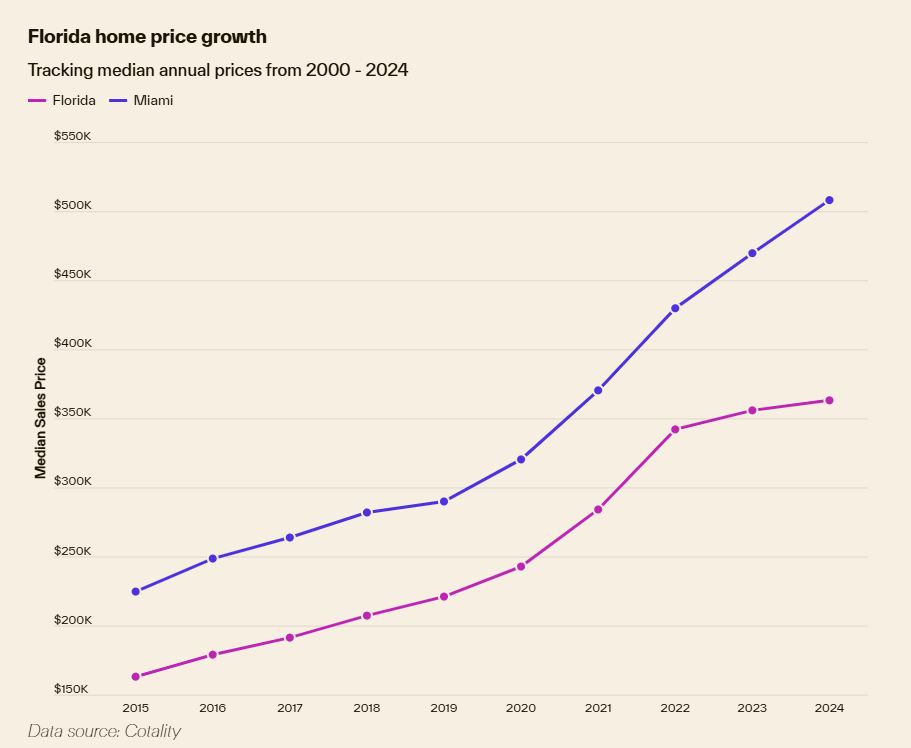
It's not just the raw numbers; it's the speed at which things have changed. Looking back at the data, it's almost dizzying. Florida home prices have not just crept up; they've galloped ahead, outpacing the national average. And Miami? Miami is in a league of its own, with home prices a staggering 60% above the Florida average. Let that sink in for a moment. Sixty percent! It’s like we’re talking about two different states entirely.

Metric Florida Median Home Price (Oct 2024) Miami Median Listing Price (Oct 2024)
Median Home Price $393,500 $629,575
Difference from State Avg – +60%

And it's not just buying; renting is becoming just as painful. In Miami, the median rent for a single-family home hit nearly $3,000 in August 2024. Combine that with general inflation and the fact that housing is still scarce, and you have a perfect storm for affordability issues. Nearly a third of Floridians are renters, and they are feeling this squeeze intensely.

Florida home price growth
Source: Cotality

The Migration Magnet – But For How Long?

Despite the rising costs, people are still coming. In 2023, nearly a million people moved to Florida. Why? Well, the low-tax, pro-growth policies are still a powerful draw. Florida, especially under the recent political climate, has become a magnet for businesses and individuals seeking a different economic and political environment. Miami, in particular, has transformed into a “Magic City” – flush with tech investments, billionaires, and global icons like Lionel Messi and Jeff Bezos. Miami-Dade County alone accounted for over 15% of the state's GDP in 2022. That's serious economic power.

But here’s the rub: this influx of wealth is a double-edged sword. These newcomers bring innovation and jobs, but they also bring deeper pockets, further distorting the housing market. Baby boomers with retirement savings and high-income earners from other states are competing for the same homes as younger, middle-income Floridians. The result? Affordability is becoming a distant memory for many.

Consider this: between 2018 and 2022, Florida’s housing market was on fire. Sales volume exceeded even the peak of the 2005 housing boom. Demand was insatiable, pushing prices to levels that are now simply out of reach for many long-term residents. It’s a classic case of too much demand chasing too little supply, amplified by the allure of the Florida lifestyle.

Miami's Magic – Fading Fast for Locals?

Miami is the poster child for this boom and bust cycle. It's become an economic engine for the state, no doubt. But living in Miami now requires serious cash. Basic goods are 20% more expensive than they were in early 2020, and housing costs have skyrocketed by 29%. Meanwhile, wages in Miami haven't kept pace, increasing by only 21% during the same period. This math just doesn’t add up for many people.

There’s a growing divide in Miami. Newcomers are often high-income earners, making 59% more on average than the city's median income. They can absorb these higher prices. But for long-term residents, the squeeze is unbearable. They are getting priced out of the very city they helped build. Pete Carroll from Cotality puts it perfectly: “The influx of high-income residents to Miami… has fueled economic growth, real estate development, and infrastructure investments, but it has also driven up housing costs and deepened income gaps, making it harder for long-time residents to afford living in the city.”

This is driving a secondary migration within Florida itself. Between 2019 and 2023, over 500,000 people moved within Florida to cheaper markets like Tampa, Jacksonville, and Orlando. People are desperately searching for affordability, even if it means staying in the same state.

City 2019-2020 Growth 2020-2021 Growth 2021-2022 Growth 2022-2023 Growth
Jacksonville 51,175 28,760 34,588 36,911
Orlando 72,218 18,469 64,057 54,916
Tampa -12,292 42,246 61,267 51,622

However, even these “cheaper” cities are feeling the pressure. Prices in Tampa and Jacksonville have jumped by 50% or more in just the last five years. Orlando, despite its huge employment base driven by Disney, has seen prices rise by 50% between 2020 and 2024. The search for affordable havens within Florida is becoming a game of whack-a-mole; as soon as one area becomes attractive, prices skyrocket, pushing affordability further out of reach.

The Construction Conundrum and Infrastructure Inadequacy

New construction was once seen as the solution to Florida's housing woes. Build more homes, and prices will stabilize, right? Unfortunately, it's not that simple anymore. Permitting activity actually fell in both 2022 and 2023. Why? A cocktail of factors: labor shortages, rising material costs, and regulatory delays are all conspiring to slow down construction. Tariffs on imported materials are just adding fuel to the fire, making developers hesitant to start new projects.

This lack of new construction is exacerbating the price problem. It’s basic economics: limited supply and high demand will always lead to higher prices. And it’s not just homes that are lagging; Florida’s infrastructure is also struggling to keep pace. Every year, Florida adds the population equivalent of a city the size of Tampa. But the roads, schools, and utilities are not expanding at the same rate.

Think about your daily commute. Roads are more congested than ever. Commute times in Florida have increased by over 11% in the last decade, despite massive investments in road expansions. In Miami and Orlando, traffic congestion costs commuters an extra $1,000 per driver every year – just to sit in traffic!

Schools are also showing their age. The average school building in Florida is now 31 years old. Funding for renovations is scarce, leading to a rise in private school enrollment, which further drains resources from the public system. Families are faced with a tough choice: accept aging public schools or pay extra for private education, further straining already tight budgets.

And let’s not forget water. Drinking water infrastructure is aging and inadequate. Unlike traffic jams and crowded schools, failing water systems pose a direct threat to public health. The cost of upgrading these systems is enormous, and cities are struggling to balance these critical needs with other budget demands.

These infrastructure strains aren't evenly distributed across the state, but with Tampa, Orlando, and Jacksonville all booming, the pressure is mounting. Overburdened infrastructure is not just an inconvenience; it's a quality of life issue, and it's becoming a major deterrent for people considering Florida as a long-term home.

Hurricane Hazard and Insurance Havoc

And then there's the elephant in the room – hurricanes. Florida is hurricane alley. And with climate change intensifying these storms, they are becoming a more frequent and severe threat. Hurricane Milton's near miss in Tampa in 2024 was a stark reminder of just how vulnerable even the less-storm-prone west coast of Florida is.

As Selma Hepp explains, “While Florida’s metros have topped the list of hottest appreciating housing markets in recent years, the increasing costs of persistent natural disasters and consequent pressure on insurance expenses and rebuilding costs are starting to weigh on home prices in west Florida.” She points to Cape Coral as an example, where home prices actually declined last year due to these issues.

Hurricane damage is devastating, and the financial fallout is immense. Many homeowners are underinsured, especially lower-income families. Policies often don’t cover the full replacement value of a home, or extras like pools and fences. And if you have to evacuate, flood insurance often doesn't cover additional living expenses. This can push families into foreclosure, leaving neighborhoods vulnerable to wealthier buyers looking for bargain properties – albeit risky ones.

The insurance market in Florida is in crisis. Premiums have skyrocketed – up 60% on average between 2019 and 2023. It’s not just homeowners feeling the pain; insurance companies are also under immense pressure. The frequency and severity of storms have led to a surge in claims, just as material and labor costs for repairs have also soared post-pandemic.

Florida has seen 18 billion-dollar hurricane disasters since the start of this decade. And the future looks even riskier. Cotality analysis shows that Monroe County in the Florida Keys will be the fourth-riskiest place to live in the US for natural disasters in the next 30 years, primarily due to hurricane risk. Miami and Naples are among the top cities with the most homes facing a “triple threat” – flood, wind, and hurricane risk combined.

This escalating risk is causing insurance companies to flee. Farmers Insurance, Bankers Insurance, and Lexington Insurance (AIG subsidiary) have all pulled back or withdrawn from Florida in recent years. AAA is also non-renewing some policies. They cite the rising costs of reinsurance, increased claims due to inflation, and excessive litigation as reasons for their retreat.

Where does this leave homeowners? Many are forced to rely on state and federal programs like the National Flood Insurance Program (NFIP). But even these programs are facing questions about their long-term sustainability given the rising costs of disasters. Florida alone received over $15 billion in FEMA aid between 2017 and 2019, and over $1 billion for recent hurricanes.

Building Codes: A Partial Shield, Not a Silver Bullet

While there's no magic wand to fix the insurance crisis, stronger building codes are helping. Florida has some of the best building codes in the country, and they have undoubtedly saved homes and billions of dollars. However, these codes aren't retroactive. Millions of older homes remain vulnerable. Retrofitting older homes to meet modern codes is expensive, further adding to the cost burden in an already pricey market.

Jay Thies from Cotality highlights the balancing act: “Building codes require a balancing act between costs and resilience… In some cases… the extra costs are unquestionably worth it… In other cases, ambiguity exists between the high costs and measurable benefits. In these instances, favoring affordable construction can be a beneficial choice to keep housing accessible to a wider range of buyers.”

The question becomes: Do we prioritize affordability today, potentially at the cost of future resilience? It’s a tough choice, but mitigating future hurricane losses is critical to stabilizing the insurance market and the long-term viability of Florida living.

The Great Florida Migration – Coming Undone?

Is Florida losing its shine? It’s no longer just the place people are flocking to; it’s starting to become a place people are looking to leave. While Florida still sees more arrivals than departures, the balance is shifting. Mortgage applications from both inside and outside the state are declining. More Floridians are applying for loans to buy homes outside of Florida, particularly in neighboring states.

Cotality analysis reveals that 48% of mortgage applications from outbound Floridians are for properties in Georgia, North Carolina, South Carolina, Tennessee, and Texas. These states offer relative affordability and less exposure to natural hazards compared to Florida.

State Share of FL Residents Applying for Loans
Georgia 15%
North Carolina 10%
Texas 8%
Tennessee 8%
South Carolina 7%

As Selma Hepp notes, “Florida’s rapid price appreciation combined with soaring home insurance prices and the threat of hurricanes has led people to start looking at other nearby states… they are seeking the ingredients that made Florida so prosperous in the first place.”

These neighboring states are starting to see the influx. Housing prices in most of them are already outpacing the national average. Texas, after a pandemic-era boom, is recalibrating, but it and the other southern states are attracting major businesses and job growth, further fueling their housing markets.

Miami's cautionary tale should be a wake-up call. If Florida doesn't address affordability, infrastructure, and insurance, the trickle of outbound movers could become a flood. The state risks following California's path – a slow-boil exodus driven by unsustainable costs and quality of life issues.

California saw 6.5 million people leave in the decade leading up to 2023. Insurance premiums there rose by almost 90%, and housing prices skyrocketed. The median home price in California jumped from $380,501 in the mid-2000s to $621,501 by 2023. Natural disasters and soaring insurance costs pushed many over the edge.

Florida is showing similar trends. People are already moving to more affordable parts of Florida, like Port St. Lucie, Palm Bay, Jacksonville, and Orlando, seeking refuge from Miami's insane prices. But even these areas are becoming less affordable by the day.

Is There Still Time to Turn the Tide?

Florida's story isn't over yet. But the state is at a critical juncture. State lawmakers and businesses need to take these warning signs seriously. They need to find solutions to the affordability crisis, address the insurance market meltdown, and invest in infrastructure to support sustainable growth. Time is running out. People seeking a better quality of life, affordable homes, and reliable insurance can’t wait years for solutions.

The question isn't just whether Florida's housing market is on the brink, but whether the Florida dream itself is on the brink. Can the Sunshine State adapt and address these challenges, or will it become a cautionary tale of boom and bust, of paradise lost to its own success? The answer to that question will determine Florida’s future, and frankly, the future looks uncertain right now.

Work with Norada, Your Trusted Source for

Real Estate Investment in “Florida Markets”

Discover high-quality, ready-to-rent properties designed to deliver consistent returns.

Contact us today to expand your real estate portfolio with confidence.

Contact our investment counselors (No Obligation):

(800) 611-3060

Get Started Now 

Read More:

  • 3 Florida Cities at High Risk of a Housing Market Crash or Decline
  • 4 States Facing the Major Housing Market Crash or Correction
  • Florida Housing Market: Record Supply Expected to Favor Buyers in 2025
  • Florida Housing Market Forecast for Next 2 Years: 2025-2026
  • Florida Real Estate Market Saw a Post-Hurricane Rebound Last Month
  • Florida Housing Market: Predictions for Next 5 Years (2025-2030)
  • Hottest Florida Housing Markets in 2025: Miami and Orlando
  • Florida Real Estate: 9 Housing Markets Predicted to Rise in 2025
  • Housing Markets at Risk: California, New Jersey, Illinois, Florida
  • 3 Florida Housing Markets Are Again on the Brink of a Crash
  • Florida Housing Market Predictions 2025: Insights Across All Cities
  • Florida Housing Market Trends: Rent Growth Falls Behind Nation
  • When Will the Housing Market Crash in Florida?
  • South Florida Housing Market: Will it Crash?
  • South Florida Housing Market: A Crossroads for Homebuyers

Filed Under: Housing Market, Real Estate Market Tagged With: Housing Market, Housing Market 2025, housing market crash, Housing Market Forecast, housing market predictions, Housing Market Trends, Real Estate Market

Housing Market Predictions for 2025 by Bank of America

April 27, 2025 by Marco Santarelli

Housing Market Predictions for 2025 by Bank of America

The housing market predictions for 2025 by Bank of America suggest that home prices are expected to increase by a modest 2%. That's a significant slowdown from the craziness we've seen in recent years. This is mainly due to an increase in the number of homes for sale and the fact that mortgage rates are still pretty high. If you're thinking about buying or selling, this is definitely something you need to know.

I've been keeping a close eye on the housing market for a while now, and this prediction from Bank of America feels like a breath of fresh air after all the volatility. It's not a crash, but it's also not the runaway price increases we've gotten used to. Let's dive into what this really means for you.

Housing Market Predictions for 2025 by Bank of America: What to Expect

Key Takeaways

  • Home Price Growth: Expected to be only 2% in 2025.
  • Inventory Levels: Gradual increase is likely to slow down price appreciation.
  • Mortgage Rates: Average estimated at 6.5%, slightly lower than 2024’s 6.8%.
  • Regional Variance: Some markets, like Austin and Tampa, may see declines in home prices.
  • Market Dynamics: Many homeowners are “locked in” with low mortgage rates, limiting new inventory.

Understanding the Shift in the Housing Market

As we get closer to 2025, the housing market is entering a new phase. We're not seeing the same kind of wild demand, and things are starting to balance out a bit. According to a report in Fast Company, Bank of America predicts that home price growth is slowing down. That's because the number of homes available for sale is gradually increasing.

Jeana Curro, who is the head of Mortgage-Backed Securities research at Bank of America, told ResiClub that prices are still going up mainly because there still aren't a ton of houses for sale. But, she did mention that inventories are slowly growing, which is why price increases are slowing down too.

  • Inventory Matters: The number of houses available for sale is super important. When there are more houses on the market, buyers have more choices, and sellers can't just ask for sky-high prices. It creates a more balanced market where prices don't keep going up so fast.

The Role of Mortgage Rates

Mortgage rates are a big deal for anyone buying a house. Bank of America predicts an average rate of 6.5% for 2025. While that's a little lower than the 6.8% we saw in 2024, it's still high compared to what we were used to a few years back.

  • Impact of High Rates: These higher rates mean that borrowing money for a mortgage is more expensive. This can discourage some buyers, which can lead to slower price growth.

Many homeowners are kind of “stuck” in their homes because they have these amazing sub-3% mortgages from the last couple of years. They don't want to sell and lose those low payments. So, this keeps the number of homes for sale down, which keeps prices from falling as much as they might otherwise.

Regional Variability in Home Prices

Now, here's where it gets interesting: not all markets are created equal. Bank of America's research points out that some areas, like Austin, Texas, and Tampa, Florida, are actually seeing declines in home prices.

  • Austin and Tampa: For instance, Austin has seen a 3.5% drop in prices year-over-year and has fallen 21% from its peak. Tampa is experiencing similar drops.
  • Why the Difference? The reason? It seems there are more houses for sale in these areas because of new construction, more affordable rental options, and some homeowners who are looking to sell due to rising taxes and insurance costs.

What we're seeing is that local factors can have a much bigger impact than what's happening nationally.

Illustrative Example of Mortgage Calculations

Okay, let's break this down even more with a real-world example. Let's say you're looking to buy a house for $300,000 in 2025. With a projected interest rate of 6.5%, how much would your monthly payments be?

Here's a breakdown:

  • Loan Amount: $300,000
  • Interest Rate: 6.5% per year
  • Loan Term: 30 years

Using this formula for calculating fixed-rate mortgage payments:

$$ M = P \frac{r(1+r)^n}{(1+r)^n – 1} $$

Where:

  • M = monthly payment
  • P = loan amount ($300,000)
  • r = monthly interest rate (annual rate / 12 = 0.065 / 12)
  • n = number of payments (30 years * 12 months = 360)

Plugging in those numbers, you get a monthly payment of around $1,896. So even though interest rates have slightly dropped compared to 2024, the monthly expenses are still fairly high. This can impact a buyer’s ability to invest in other areas.

Potential Challenges Ahead

Even though the housing market isn't predicted to crash, there are still some challenges we need to be aware of:

  • High Mortgage Rates: Even if they drop a bit, they're still pretty high. This means less people will be able to afford a home, and it'll also impact those looking to upgrade or relocate.
  • Limited Inventory: While inventory is increasing, it's still not enough to bring prices down dramatically in most areas. It will take a while for supply to meet the demand.
  • Regional Disparities: Some places will be more affordable than others. The place where you decide to live could significantly impact your long-term expenses.

It seems clear that as 2025 approaches, the key will be being informed. Keeping up with local job markets, demographics, and infrastructure developments will matter a lot.

My Take on All This

As someone who's been following the housing market for a while, the Bank of America predictions are right in line with what I'm seeing. The market is finally taking a breather, and that's probably a good thing for everyone. We're heading towards a more balanced market, which is a good sign for both buyers and sellers in the long run.

I've always believed that the most important thing is to be well-informed. If you're looking to buy or sell a house, do your research, talk to experts, and don't jump to conclusions based on the hype. In a market like this, having all the information is the key to making the best decisions for yourself.

In Conclusion

The housing market predictions for 2025 by Bank of America paints a picture of modest growth rather than a boom or bust. We're talking about a 2% increase in home prices. That's significant. The high mortgage rates and increased inventories will create a complex situation that'll require a lot of navigating. If you want to succeed in the real estate market, stay updated on market trends, inventories, and economic changes.

Partner with Norada in 2025, Your Trusted Source for Turnkey Investment Properties

Discover high-quality, ready-to-rent properties designed to deliver consistent returns. Contact us today to expand your real estate portfolio with confidence.

Reach out to our investment counselors:

(949) 218-6668 | (800) 611-3060

Contact Us Today


Recommended Read:

  • Housing Market Forecast 2025: Affordability Crisis Will Continue
  • Lower Mortgage Rates Will Reignite the Housing Demand in 2025
  • NAR Predicts 6% Mortgage Rates in 2025 Will Boost Housing Market
  • Housing Market Forecast for the Next 2 Years: 2024-2026
  • Housing Market Predictions for the Next 4 Years: 2025 to 2028
  • Housing Market Predictions for Next Year: Prices to Rise by 4.4%
  • Housing Market Predictions for 2025 and 2026 by NAR Chief
  • Real Estate Forecast Next 5 Years: Top 5 Predictions for Future
  • 2008 Forecaster Warns: Housing Market 2024 Needs This to Survive
  • Real Estate Forecast Next 10 Years: Will Prices Skyrocket?

Filed Under: Housing Market, Mortgage, Real Estate Market Tagged With: Housing Market, Housing Market 2025, Housing Market Forecast, housing market predictions, Housing Market Trends, Real Estate Market

Housing Market Cools Off as Home Sales Tumble in March 2025

April 24, 2025 by Marco Santarelli

Housing Market Cools Off as Home Sales Tumble in March 2025

Is the dream of owning a home slipping further away? Unfortunately, the latest data suggests it might be. The housing market remained sluggish in March 2025, with existing-home sales experiencing a significant drop, the biggest monthly drop since November 2022.

According to the National Association of REALTORS® (NAR), sales fell nearly 6% as buyers hesitated amidst economic uncertainty and job market jitters. This slowdown paints a complex picture of affordability challenges, shifting buyer behavior, and the ever-present impact of mortgage rates. Let's dive into the numbers and explore what's really going on.

Housing Market Cools Off as Home Sales Tumble in March 2025

What the Numbers Tell Us: A Deeper Dive

Here's a breakdown of the key statistics from the NAR report, and what they mean for you:

  • Existing-Home Sales: Sales dropped 5.9% in March to a seasonally adjusted annual rate of 4.02 million. That's a six-month low, showing a clear pullback from potential homebuyers. Year-over-year, sales were down 2.4%.
  • Median Home Price: The median existing-home sales price increased 2.7% year-over-year to $403,700. While this marks the 21st consecutive month of year-over-year price increases, it's important to note this is also an all-time high for the month of March.
  • Inventory: The inventory of unsold homes jumped 8.1% from February to 1.33 million units at the end of March. This represents a 4.0-month supply at the current sales pace.

Breaking Down the Impact: Affordability, Inventory, and Regional Differences

The numbers alone don't tell the whole story. We need to understand what's driving these trends and how they impact different people and regions.

The Affordability Squeeze:

The main culprit behind the sales slowdown? Affordability. As NAR Chief Economist Lawrence Yun pointed out, “Home buying and selling remained sluggish in March due to the affordability challenges associated with high mortgage rates.” Even though mortgage rates are slightly lower than a year ago, they're still significantly higher than what we saw in the early 2020s. This makes it harder for potential buyers, especially first-time homebuyers, to qualify for a mortgage and afford the monthly payments. High home prices coupled with these rates create a double whammy.

Inventory's Two Sides:

The increase in inventory is a bit of a double-edged sword. On one hand, more homes on the market mean buyers have more choices and potentially more negotiating power. On the other hand, a rising inventory coupled with falling sales can signal a weakening market. This can lead to further buyer hesitation, as people worry about buying a home that might depreciate in value.

Regional Variations:

The NAR report also highlights significant regional differences:

  • Northeast: Sales declined 2.0% from February but remained unchanged from March 2024. The median price was $468,000, up 7.7% year-over-year.
  • Midwest: Sales waned 5.0% in March, down 3.1% from the previous year. The median price was $302,100, up 3.5% from March 2024.
  • South: Sales contracted 5.7% from February, down 4.2% from a year ago. The median price was $360,400, up 0.6% from last year.
  • West: Sales plunged 9.4% in March, up 1.3% from a year ago. The median price was $621,200, up 2.6% from March 2024.

These regional variations highlight that the housing market is not a monolith. Factors like local economies, job growth, and population shifts play a significant role in shaping housing trends in different areas.

Digging Deeper: Cash Sales, First-Time Buyers, and Time on Market

Beyond the headline numbers, here are a few other key trends to consider:

  • Cash Sales: Cash sales accounted for 26% of transactions in March, down from 32% in February. This suggests that investors and second-home buyers may be pulling back slightly, likely due to the same affordability concerns impacting other buyers.
  • First-Time Buyers: First-time buyers made up 32% of sales in March, up from 31% in February. While this is a slight increase, it's still relatively low compared to historical averages. This highlights the ongoing challenges first-time buyers face in entering the market.
  • Days on Market: Properties typically remained on the market for 36 days in March, down from 42 days in February but up from 33 days in March 2024. This suggests that while demand is still present, it's not as strong as it was a year ago.

Table: Key Housing Market Indicators – March 2025

Indicator March 2025 February 2025 March 2024 Change (Year-over-Year)
Existing-Home Sales (Annual Rate) 4.02 Million 4.27 Million 4.12 Million -2.4%
Median Home Price $403,700 N/A $392,900 +2.7%
Inventory 1.33 Million 1.23 Million 1.11 Million +19.8%
Months' Supply 4.0 3.5 3.2 +0.8 Months
First-Time Buyers Share 32% 31% 32% Unchanged
Cash Sales Share 26% 32% 28% -2%

The Bigger Picture: Economic Uncertainty and Future Outlook

While the housing market data is important, it's crucial to consider the broader economic context. Concerns about inflation, potential job losses, and the overall direction of the economy are all weighing on buyer confidence.

Looking ahead, several factors could influence the housing market in the coming months:

  • Mortgage Rate Fluctuations: Any significant changes in mortgage rates could have a major impact on buyer demand.
  • Economic Growth: Stronger economic growth and job creation could boost consumer confidence and encourage more people to enter the market.
  • Housing Supply: Continued increases in housing supply could help to moderate price growth and improve affordability.

My Take: A Balanced Approach is Key

As someone who's followed the housing market for years, I believe it's important to avoid knee-jerk reactions. The current slowdown is a natural response to the rapid price appreciation we saw in recent years. While the market may remain sluggish in the short term, I don't expect a major crash.

For buyers, it's a good time to be patient, do your research, and shop around for the best mortgage rates. For sellers, it's important to be realistic about pricing and prepare your home for sale to attract potential buyers.

Ultimately, the housing market is a long-term investment. While there may be ups and downs along the way, owning a home remains a key part of the American dream for many.

Work with Norada, Your Trusted Source for

Real Estate Investment in the Top U.S. Markets

Discover high-quality, ready-to-rent properties designed to deliver consistent returns.

Contact us today to expand your real estate portfolio with confidence.

Contact our investment counselors (No Obligation):

(800) 611-3060

Get Started Now 

Also Read:

  • 12 Housing Markets Set for Double-Digit Price Decline by Early 2026
  • Housing Market Predictions for 2025 by Real Estate Agents
  • Real Estate Forecast: Will Home Prices Bottom Out in 2025?
  • Housing Markets With the Biggest Decline in Home Prices Since 2024
  • Why Real Estate Can Thrive During Tariffs Led Economic Uncertainty
  • Rise of AI-Powered Hyperlocal Real Estate Marketing in 2025
  • Real Estate Forecast Next 5 Years: Top 5 Predictions for Future
  • 5 Hottest Real Estate Markets for Buyers & Investors in 2025
  • Will Real Estate Rebound in 2025: Top Predictions by Experts
  • Recession in Real Estate: Smart Ways to Profit in a Down Market
  • Will There Be a Real Estate Recession in 2025: A Forecast
  • Will the Housing Market Crash Due to Looming Recession in 2025?
  • 4 States Facing the Major Housing Market Crash or Correction

  • New Tariffs Could Trigger Housing Market Slowdown in 2025
  • Real Estate Forecast Next 10 Years: Will Prices Skyrocket?

Filed Under: Housing Market, Real Estate Market Tagged With: Home Price Drop, home prices, Housing Market, real estate, Real Estate Market

Is the Housing Bubble Bursting: Home Prices Rise Just 0.2%

April 24, 2025 by Marco Santarelli

Is the Housing Bubble Bursting: Home Prices Rise Just 0.2%

Are you feeling the pinch when looking at homes these days? Well, here's the lowdown: U.S. home prices saw a slight increase of just 0.2% in March, marking the slowest climb we've witnessed since December 2022, according to Redfin. While prices are still up 4.6% compared to last year, this slowdown could signal some much-needed breathing room for potential homebuyers. Let's dive into what's driving this shift and what it means for you.

Is the Housing Bubble Bursting: Home Prices Rise Just 0.2%

Why the Slowdown in Home Price Growth?

As someone who's been following the real estate market for years, I can tell you that the forces at play are complex. This isn't a simple case of prices suddenly dropping; it's more like a gentle easing of pressure. Several factors are contributing to this trend:

  • Cooling Demand: The initial frenzy of the pandemic-era housing market has faded. Potential buyers are becoming more cautious due to overall economic uncertainty, particularly fear of a broader slowdown. This is a natural reaction when headlines are filled with talks of recessions and job market jitters.
  • Rising Inventory: There are simply more homes available for sale. This increased supply is giving buyers more options and reducing the sense of urgency that drove prices sky-high over the past few years. More homes on the market translate to less competition and, theoretically, lower prices.
  • Mortgage Rate Volatility: While mortgage rates have stabilized somewhat, they are still significantly higher than they were a few years ago. This makes homeownership less affordable for many, leading to a decrease in demand.
  • Economic Uncertainty: As Redfin's Senior Economist Sheharyar Bokhari rightly points out, “New tariffs are adding to the economic uncertainty and prices may slow even further in coming months.” Trade policies and other global economic factors can have a ripple effect on the housing market.

A Look at the Numbers: The Redfin Home Price Index (RHPI)

Redfin's Home Price Index (RHPI) is a key indicator of housing market trends, and its latest findings paint a clear picture. Here's what you need to know:

  • The RHPI uses a “repeat-sales pricing method,” meaning it tracks the price changes of the same homes over time. This provides a more accurate measure of price appreciation than simply looking at average home prices, which can be skewed by the types of homes being sold in a given period.
  • The index is seasonally adjusted to account for the typical fluctuations in home prices throughout the year. This allows for a more accurate comparison of month-over-month and year-over-year changes.
  • Prior to the current slowdown, the RHPI only recorded month-over-month price declines in mid-2022 when mortgage rates were rapidly climbing.

Regional Differences: Where are Prices Falling (and Rising)?

While the national average shows a slight increase, the real estate market is incredibly local. Some areas are seeing price declines, while others are still experiencing robust growth. According to Redfin, in March 2025:

  • 20 of the 50 most populous U.S. metro areas recorded a drop in home prices month over month. This underscores that the national trend isn't universally experienced.
  • The biggest declines were in Columbus, OH (-0.7%), Denver (-0.6%), and San Jose, CA (-0.6%). These markets might present opportunities for buyers seeking more affordable options.
  • Prices increased the most in San Francisco (2.7% month over month), Nassau County, NY (2.6%), and Milwaukee (1.7%). These areas continue to see strong demand, likely driven by factors like job growth, quality of life, and limited housing supply.

To illustrate, here's a table summarizing the top gainers and losers in home prices for March 2025:

Metro Area Month-over-Month Price Change
Top Gainers
San Francisco 2.7%
Nassau County, NY 2.6%
Milwaukee 1.7%
Top Losers
Columbus, OH -0.7%
Denver -0.6%
San Jose, CA -0.6%

What Does This Mean for Buyers?

If you're a prospective homebuyer, this slowdown could be good news. Here's why:

  • More Negotiation Power: With homes taking longer to sell, you have more leverage to negotiate a lower price or better terms. Don't be afraid to make an offer that's below the asking price, especially in areas where prices are declining.
  • More Time to Decide: The urgency to buy has subsided, giving you more time to shop around, do your research, and find the right home for your needs.
  • Less Competition: Fewer buyers competing for the same properties means less pressure to make quick decisions or overpay for a home.
  • Potential for Future Gains: If you buy now, you could potentially benefit from future price appreciation when the market eventually rebounds.

What Does This Mean for Sellers?

If you're a homeowner looking to sell, you'll need to adjust your expectations and strategies:

  • Price Competitively: Don't overprice your home, as buyers are more price-sensitive than they were a year or two ago. Work with your real estate agent to determine a fair market value based on recent comparable sales.
  • Be Patient: Homes are taking longer to sell, so be prepared to wait a little longer to find the right buyer.
  • Consider Making Improvements: Investing in minor repairs or upgrades can make your home more attractive to buyers and help it stand out from the competition.
  • Highlight the Positives: Focus on the unique features and benefits of your home and neighborhood.

My Take: A Balanced Perspective

In my opinion, this market shift is a welcome sign of stabilization. The rapid price increases of the past few years were unsustainable and created affordability challenges for many. A more balanced market, where buyers have more options and sellers have to price competitively, is ultimately healthier for the long term.

However, it's important to remember that the real estate market is dynamic and can change quickly. Factors like interest rate movements, economic growth, and population shifts can all influence home prices. So stay informed, work with a trusted real estate professional, and make decisions that are right for your individual circumstances.

The Future: What to Expect?

Predicting the future of the housing market is always a challenge, but here are a few things I'm watching closely:

  • Interest Rates: The direction of interest rates will have a significant impact on affordability and demand.
  • Economic Growth: A strong economy typically leads to higher home prices, while a weak economy can put downward pressure on prices.
  • Inventory Levels: The balance between supply and demand will continue to be a key factor in determining price trends.
  • Government Policies: Changes in tax laws, housing regulations, or mortgage lending standards can also affect the market.

In Summary

The fact that home prices ticked up 0.2% in March, the slowest pace since 2022, indicates a shift towards a more balanced market. While this may be welcome news for buyers, sellers will need to adjust their strategies to compete in the current environment. By staying informed and working with experienced professionals, both buyers and sellers can navigate the market successfully.

Work with Norada, Your Trusted Source for

Real Estate Investment in the Top U.S. Markets

Discover high-quality, ready-to-rent properties designed to deliver consistent returns.

Contact us today to expand your real estate portfolio with confidence.

Contact our investment counselors (No Obligation):

(800) 611-3060

Get Started Now 

Also Read:

  • 5 Housing Markets Most Vulnerable to a Price Crash: CoreLogic Report
  • Housing Markets Predicted to Crash by Double Digits by Q1 2026
  • Real Estate Forecast: Will Home Prices Bottom Out in 2025?
  • Housing Markets With the Biggest Decline in Home Prices Since 2024
  • Why Real Estate Can Thrive During Tariffs Led Economic Uncertainty
  • Rise of AI-Powered Hyperlocal Real Estate Marketing in 2025
  • Real Estate Forecast Next 5 Years: Top 5 Predictions for Future
  • 5 Hottest Real Estate Markets for Buyers & Investors in 2025
  • Will Real Estate Rebound in 2025: Top Predictions by Experts
  • Recession in Real Estate: Smart Ways to Profit in a Down Market
  • Will There Be a Real Estate Recession in 2025: A Forecast
  • Will the Housing Market Crash Due to Looming Recession in 2025?
  • 4 States Facing the Major Housing Market Crash or Correction

  • New Tariffs Could Trigger Housing Market Slowdown in 2025
  • Real Estate Forecast Next 10 Years: Will Prices Skyrocket?

Filed Under: Housing Market, Real Estate Market Tagged With: Home Price Drop, home prices, Housing Market, real estate, Real Estate Market

Housing Market Forecast for Spring 2025 for Buyers and Sellers

April 24, 2025 by Marco Santarelli

Housing Market Forecast for Spring 2025 for Buyers and Sellers

If you're trying to figure out what's going to happen with the housing market in Spring 2025, here's the quick answer: expect a mixed bag. Buyers will likely have more choices and a bit more power to negotiate, especially in some areas. But they'll also face high prices and high monthly mortgage costs. Sellers in certain markets might have a tougher time finding buyers, while those in hotter regions could still see multiple offers. It's a strange time, not quite a buyer's market, and not quite a seller's market – think of it as a “meh” market. Let's dive into what's driving this, and what it means for you.

Housing Market Forecast for Spring 2025 for Buyers and Sellers

A Market in Limbo: The Spring 2025 Housing Story

The spring homebuying season is usually a time of increased activity, with more homes hitting the market and more buyers eager to pounce. But Spring 2025 feels different. It's like everyone's waiting for something to happen. This situation isn't uniform; some parts of the country are seeing very different conditions.

I think this hesitation stems from a few key factors:

  • High Mortgage Rates: These have been stubbornly high, hovering around the 7% mark for a 30-year fixed loan. That's a big jump from the rock-bottom rates we saw during the pandemic.
  • Stubbornly High Prices: While we haven't seen massive price drops everywhere, prices aren't exactly skyrocketing either. They're just… there.
  • Sellers Holding On: Many homeowners are locked into those super-low mortgage rates from a few years back. They're reluctant to sell because they don't want to give up that sweet deal. Why would they?

This combination has created a situation where potential buyers are feeling priced out, and potential sellers are happy to stay put.

Understanding the Regional Differences

Here’s the thing to keep in mind: the housing market isn't the same everywhere. What's happening in one part of the country might be totally different from what's happening in another.

Redfin's data breaks it down pretty well:

  • The South: In many Southern markets, there's been a surge in new construction and investor activity. This means more homes on the market, leading to increased competition among sellers and more negotiating power for buyers. In places like Houston, sellers need to be extra careful about pricing their homes competitively.
  • The Midwest: The story in the Midwest is different. In cities like Chicago, demand is still outpacing supply, and bidding wars are relatively common, especially for homes that are well-priced and move-in-ready.

What Buyers Can Expect in Spring 2025

If you're a buyer looking to get into the market in Spring 2025, here's what you should keep in mind:

  • More Options (Maybe): Especially in Southern cities, you're likely to see more homes available. This increased inventory could give you more leverage when negotiating.
  • Motivated Sellers: With homes sitting on the market longer, some sellers are becoming more willing to offer price reductions, credits, or help with closing costs. Don't be afraid to ask!
  • Affordability Challenges: High mortgage rates and prices are still a major hurdle. You'll need to carefully consider your budget and what you can realistically afford each month.

What Sellers Can Expect in Spring 2025

If you're thinking of selling your home in Spring 2025, here's what you need to know:

  • Buyers Are Picky: Buyers are taking their time and waiting for the right deal. Overpriced or outdated homes are likely to sit on the market for longer.
  • Pricing is Key: Especially in slower markets, pricing your home competitively is crucial. Be prepared to negotiate.
  • Some Markets Are Still Hot: In the Midwest and Northeast, well-priced homes are still selling quickly, especially those with desirable features.

Here's a quick summary table:

Expectation Buyers Sellers
Inventory More options (in some areas) More competition (in some areas)
Negotiation More negotiating power Must be willing to negotiate
Affordability Major challenge Dependent on market
Pricing Shop around for deals Price competitively; be realistic

My Personal Thoughts and Advice

Based on what I'm seeing, the housing market in Spring 2025 is going to require a lot of patience and careful planning. Here's my advice, whether you're buying or selling:

  • For Buyers: Don't rush into anything. Take your time to find a home that truly meets your needs and fits your budget. Get pre-approved for a mortgage so you know exactly what you can afford. Consider markets where you might have more negotiating power.
  • For Sellers: Be realistic about pricing. Look at comparable sales in your area and price your home competitively. Be prepared to negotiate with buyers. Consider making some upgrades or repairs to make your home more appealing.

The Importance of Local Expertise

Remember that the housing market is highly localized. What's happening nationally or even regionally might not be what's happening in your specific neighborhood. That's why it's so important to work with a local real estate agent who knows your area inside and out. They can provide valuable insights and guidance to help you make the best decisions.

The housing market is always subject to change, and there's always some level of uncertainty. But by staying informed, doing your research, and working with qualified professionals, you can navigate the Spring 2025 market with confidence.

Final Thoughts

Spring 2025's housing market presents a mixed bag of opportunities and challenges for both buyers and sellers. High mortgage rates continue to loom large, affecting affordability and overall market dynamics. Regional variations are significant, with the South experiencing increased inventory and negotiating power for buyers, while the Midwest remains competitive with bidding wars.

Success in this market hinges on realistic pricing, careful budgeting, and expert local knowledge. Buyers should focus on finding homes that genuinely meet their needs and budgets, while sellers need to price competitively and be prepared to negotiate. With patience, diligent research, and professional guidance, you can navigate this complex market with confidence.

Work with Norada, Your Trusted Source for

Real Estate Investment in the Top U.S. Markets

Discover high-quality, ready-to-rent properties designed to deliver consistent returns.

Contact us today to expand your real estate portfolio with confidence.

Contact our investment counselors (No Obligation):

(800) 611-3060

Get Started Now 

Also Read:

  • 12 Housing Markets Set for Double-Digit Price Decline by Early 2026
  • Housing Market Predictions for 2025 by Real Estate Agents
  • Real Estate Forecast: Will Home Prices Bottom Out in 2025?
  • Housing Markets With the Biggest Decline in Home Prices Since 2024
  • Why Real Estate Can Thrive During Tariffs Led Economic Uncertainty
  • Rise of AI-Powered Hyperlocal Real Estate Marketing in 2025
  • Real Estate Forecast Next 5 Years: Top 5 Predictions for Future
  • 5 Hottest Real Estate Markets for Buyers & Investors in 2025
  • Will Real Estate Rebound in 2025: Top Predictions by Experts
  • Recession in Real Estate: Smart Ways to Profit in a Down Market
  • Will There Be a Real Estate Recession in 2025: A Forecast
  • Will the Housing Market Crash Due to Looming Recession in 2025?
  • 4 States Facing the Major Housing Market Crash or Correction
  • New Tariffs Could Trigger Housing Market Slowdown in 2025
  • Real Estate Forecast Next 10 Years: Will Prices Skyrocket?

Filed Under: Housing Market, Real Estate Market Tagged With: Home Price Drop, home prices, Housing Market, real estate, Real Estate Market

Housing Market Crash Alert? Zillow Turns Negative on Home Prices

April 23, 2025 by Marco Santarelli

Housing Market Crash Alert? Zillow Turns Negative on Home Prices

Is the housing market about to take a tumble? According to Zillow's latest forecast, the answer is a resounding yes. Zillow now predicts that U.S. home prices will fall by 1.7% between March 2025 and March 2026. It is a dramatic shift that signals the company is growing increasingly bearish on the housing market's near future.

Housing Market Crash Alert? Zillow Turns Negative on Home Prices

Let's be honest, it's not every day that a major player like Zillow makes such a stark prediction. For months, they've been gradually revising their outlook, and this latest drop is significant. To put it in perspective, here's a look at how Zillow's 12-month forecast for national home prices has changed recently:

  • January: +2.9%
  • February: +1.1%
  • March: +0.8%
  • Now: -1.7%

I believe, the consistent downward trend paints a clear picture: Zillow sees trouble on the horizon. Why should we care? Because Zillow has access to a massive amount of housing data. Their models are closely watched by investors, real estate professionals, and anyone considering buying or selling a home. Their forecasts, while not infallible, carry weight.

The “Why” Behind the Worry: Affordability and the Sun Belt

So, what's driving Zillow's pessimism? According to their economists, two main factors are at play:

  • Strained Housing Affordability: This is the big one. The pandemic-era housing boom sent prices soaring by over 40%, and then mortgage rates doubled in 2022. This combination has made it incredibly difficult for many people to afford a home. The average person is either unable or unwilling to pay such huge premiums.
  • Weakening Sun Belt Markets: The Sun Belt has been a hotspot for housing growth in recent years, but Zillow believes that the party is ending. Softening and weakening markets in this region will drag down national home prices.

Digging Deeper: Affordability and Its Grip on the Market

Think about it: even with mortgage rates leveling off somewhat recently, they're still significantly higher than they were just a few years ago. This means higher monthly payments, even for the same priced house. The result? Potential buyers are staying on the sidelines, opting to rent for longer. This decrease in demand puts downward pressure on prices. I strongly believe, housing affordability is a very concerning problem right now.

Sun Belt's Sunset: Why the Boom is Cooling Down

The Sun Belt's rapid growth was fueled by factors like lower taxes, warmer weather, and more affordable housing (compared to coastal cities). However, as more people moved in, prices increased, and the appeal began to fade. Now, with more inventory coming onto the market, buyers have more choices, and prices are adjusting accordingly. Also, the insurance rates in some parts of the Sun Belt has gone sky high which has forced many people to move out, creating downward pressure.

Winners and Losers: Where Zillow Sees the Biggest Changes

Zillow's forecast isn't uniform across the country. They expect some markets to perform better than others.

  • Strongest Home Price Appreciation (March 2025 – March 2026):
    • Atlantic City, NJ: 2.4%
    • Kingston, NY: 1.9%
    • Rochester, NY: 1.8%
    • Knoxville, TN: 1.7%
    • Torrington, CT : 1.6%
    • Bangor, ME: 1.5%
    • Syracuse, NY: 1.4%
    • Vineland, NJ: 1.4%
    • Concord, NH: 1.3%
    • Norwich, CT: 1.2%
  • Weakest Home Price Appreciation (March 2025 – March 2026):
    • Houma, LA: -10.1%
    • Lake Charles, LA: -8.9%
    • New Orleans, LA: -7.6%
    • Lafayette, LA: -7.5%
    • Shreveport, LA: -7.0%
    • Alexandria, LA -7.0%
    • Beaumont, TX : -6.6%
    • Odessa, TX: -6.3%
    • Midland, TX: -5.7%
    • Monroe, LA: -5.5

Recommended Read:

Can China Crash the US Housing Market in 2025?

Warning of a Weak Housing Market: Are We Headed for Another Crisis?

Fannie Mae Lowers Housing Market Forecast and Projections for 2025

Housing Market Forecast 2025 by JP Morgan Research

Housing Predictions 2025 by Warren Buffett's Berkshire Hathaway

What Does This Mean for You? A Buyer's or Seller's Market?

If Zillow's forecast proves accurate, we could be heading toward a more buyer-friendly market. Here's how it might impact different groups:

  • Potential Homebuyers: This could be good news! You might have more negotiating power and be able to find a home at a more reasonable price. Be patient, do your research, and don't rush into anything.
  • Current Homeowners: Don't panic! A slight price drop doesn't necessarily mean you'll lose money. However, if you're planning to sell in the next year or two, it might be wise to adjust your expectations and be prepared to negotiate.
  • Real Estate Investors: This could be an opportunity to scoop up properties at lower prices, especially in markets that are expected to decline. However, do your due diligence and be aware of the risks.

My Take: Navigating the Uncertainty

I've been following the housing market for years, and one thing I've learned is that it's impossible to predict the future with certainty. Zillow's forecast is just one piece of the puzzle. It's important to consider other factors, such as interest rates, economic growth, and local market conditions.

However, Zillow's downward revision is a signal that the housing market is facing some serious headwinds. If you're thinking about buying or selling a home, now is the time to educate yourself, consult with a real estate professional, and make informed decisions.

Conclusion: Proceed with Caution

Zillow turns full-blown housing market bear – this is a headline that should grab your attention. While a market correction could create opportunities for some, it also carries risks. Stay informed, stay cautious, and remember that real estate is a long-term game. I would personally wait and see what happens with inflation.

Work with Norada, Your Trusted Source for Investment

In the Top U.S. Housing Markets

Discover high-quality, ready-to-rent properties designed to deliver consistent returns.

Contact us today to expand your real estate portfolio with confidence.

Contact our investment counselors (No Obligation):

(800) 611-3060

Get Started Now 

Also Read:

  • Majority of Americans Fear Housing Market Will Crash in 2025
  • Housing Market Price Forecast for 2025 and 2026 Increased by NAR
  • Will the Housing Market Crash Due to Looming Recession in 2025?
  • 4 States Facing the Major Housing Market Crash or Correction
  • 5 Cities Where Home Prices Are Predicted To Crash in 2025
  • New Tariffs Could Trigger Housing Market Slowdown in 2025
  • Housing Market Forecast 2025: Affordability Crisis Will Continue
  • Lower Mortgage Rates Will Reignite the Housing Demand in 2025
  • NAR Predicts 6% Mortgage Rates in 2025 Will Boost Housing Market
  • Housing Market Forecast for the Next 2 Years: 2024-2026
  • Housing Market Predictions for the Next 4 Years: 2025 to 2028
  • Housing Market Predictions for Next Year: Prices to Rise by 4.4%
  • Housing Market Predictions for 2025 and 2026 by NAR Chief
  • Real Estate Forecast Next 5 Years: Top 5 Predictions for Future
  • Real Estate Forecast Next 10 Years: Will Prices Skyrocket?

Filed Under: Housing Market, Real Estate Market Tagged With: home prices, Housing Market, Housing Market 2025, housing market crash, Housing Market Forecast, housing market predictions, Housing Market Trends, Real Estate Market

  • « Previous Page
  • 1
  • 2
  • 3
  • 4
  • 5
  • 6
  • …
  • 20
  • Next Page »

Real Estate

  • Birmingham
  • Cape Coral
  • Charlotte
  • Chicago

Quick Links

  • Markets
  • Membership
  • Notes
  • Contact Us

Blog Posts

  • Today’s Mortgage Rates, December 6: 30-Year Fixed Rate Rises to 6.10%
    December 6, 2025Marco Santarelli
  • Housing Market Predictions for 2026: Affordability, Prices, and Demand
    December 6, 2025Marco Santarelli
  • 30-Year Fixed Mortgage Rate Drops Sharply by 50 Basis Points
    December 6, 2025Marco Santarelli

Contact

Norada Real Estate Investments 30251 Golden Lantern, Suite E-261 Laguna Niguel, CA 92677

(949) 218-6668
(800) 611-3060
BBB
  • Terms of Use
  • |
  • Privacy Policy
  • |
  • Testimonials
  • |
  • Suggestions?
  • |
  • Home

Copyright 2018 Norada Real Estate Investments

Loading...