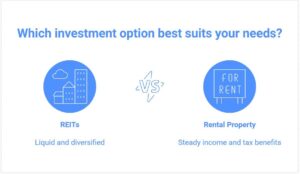
I’ve been investing in real estate for a long time, and if there’s one question I get asked more than any other, it’s this: Should I buy a physical rental property or is it smarter, easier, and just as profitable to stick to Real Estate Investment Trusts (REITs)? It’s a classic debate, pitting sweat equity against pure financial assets.
For most long-term investors, the ideal strategy isn't choosing between REITs and rental properties, but understanding that REITs offer essential liquidity and passive income while rentals offer superior control and tax benefits, making a combined approach the strongest defensive play.
The choice you make profoundly impacts your lifestyle, your tax bill, and your potential wealth trajectory. Let's dig into the details and figure out which option truly aligns with your personal investment goals, your tolerance for risk, and, frankly, your willingness to unclog a drain at 2 AM.
REITs vs. Rental Property: Which is Better for Long-Term Investors?
The Core Difference: Ownership vs. Partnership
When you invest in physical rental property, you are the boss. You bought the asset, you manage the repairs, you screen the tenants, and you collect the rent. This level of control is deeply satisfying for some and deeply burdensome for others.
When you buy a REIT (which is essentially a company that owns and often operates income-producing real estate), you are buying a share of that business. You become a passive partner.
This difference in involvement is the fundamental dividing line between the two options. I personally prefer being hands-off with my core retirement accounts, which is where REITs shine, but I prefer the higher level of control—and potential upside—that comes with direct ownership for my primary wealth-building ventures.
| Factor | REITs (Passive Investment) | Rental Properties (Active/Managed Investment) |
|---|---|---|
| Management Burden | Zero. Professional teams handle everything from tenant placement to roof replacement. | High, unless you hire a property manager (which cuts into your profit). |
| Time Commitment | Low. Buy it and forget it. | Significant (or costly). Maintenance calls, vacancy marketing, accounting. |
| Control | None. You trust the management team’s decisions. | Full control over renovations, tenant standards, and rent setting. |
Money Matters: Initial Costs and Liquidity
The barrier to entry is the first practical hurdle any investor faces, and this is where REITs win without question.
Initial Investment
To purchase one share of a listed REIT, you might spend $20 or $100. You can start investing today with the change in your pocket. This is incredibly accessible.
Contrast that with a rental property. You need a large down payment (usually 20–25%), closing costs, inspection fees, and a buffer for immediate repairs. We are talking tens of thousands of dollars, minimum. The initial hurdle for rentals is high, which means many future investors are stuck saving for years just to get started.
Liquidity and Exit Strategy
Liquidity is how quickly you can turn an asset back into cash.
- REITs: Highly liquid. Since public REITs trade on stock exchanges (like the NYSE), you can sell your shares instantly during market hours. Your cash is available in a matter of days. If you need sudden funds, this liquidity is priceless.
- Rental Property: Low liquidity. Selling a home involves months of preparation, listing, negotiation, inspections, and closing paperwork. If you need cash fast, you are often forced to take a discount or explore cumbersome financing like a HELOC.
My Takeaway: For younger investors or those building an emergency fund, starting with REITs makes sense because the immediate access to cash protects you from financial emergencies outside of real estate.
The Hidden Power: Leverage and Amplified Returns
Here’s where rental property investors gain a massive advantage that even the highest-performing REITs struggle to match for individual investors: leverage.
When you buy a REIT, you are typically using your own 100% cash investment.
When you buy a rental property, you use a mortgage. This means you are controlling a $300,000 asset by only putting down $60,000 (20% down payment). You are using Other People's Money (OPM) to maximize your potential returns.
This leverage doesn't just increase your potential profit; it amplifies your actual Return on Investment (ROI). For example, if your property value increases by 10% ($30,000 on a $300,000 home), you made a 50% cash return on your initial $60,000 investment. You captured the appreciation on the entire asset, not just the portion you paid for in cash.
While it is true that listed equity REITs have shown higher average net annual returns over a 25-year period (historically around 9.74%) compared to unleveraged private real estate (around 7.66%), these numbers can be misleading. A well-managed, leveraged rental property will often generate an actual cash-on-cash return far exceeding the 9.74% posted by the public market—provided you manage debt wisely.
Leverage cuts both ways, however. It also amplifies losses if the market turns sour or if interest rates are high when you buy. Still, for the long-term, disciplined investor, the strategic use of leverage in rental properties is arguably the single most important tool for building generational wealth.
Tax Talk: Where the Real Money is Made
Let’s be honest: in the world of investments, it’s not just about what you make; it’s about what you keep from the taxman. This is where rental properties hold an undeniable edge.
Rental Property Tax Advantages
As a landlord, you get to deduct significant operating expenses, which include:
- Mortgage Interest: Often the largest early deduction.
- Property Taxes, Insurance, Repairs, and Management Fees.
- Depreciation: This is the superstar. The IRS allows you to deduct a portion of the property's value (excluding land) every year for 27.5 years, acting as a “phantom loss.” You are allowed to report a taxable loss even while the property is generating positive cash flow. This shields cash flow from being taxed until you eventually sell.
Furthermore, direct ownership allows you to potentially use 1031 exchanges to defer capital gains taxes indefinitely when you sell one property and immediately buy another.
REIT Tax Disadvantages
REITs are legally required to distribute at least 90% of their taxable income to shareholders as dividends. While you benefit from high yields, these dividends are typically taxed as ordinary income, which means they are taxed at your highest marginal rate—often significantly higher than long-term capital gains rates.
Yes, there is an advantage known as the Qualified Business Income (QBI) deduction, which currently allows some REIT dividends to temporarily receive a 20% deduction through December 2025, but compared to the cash flow sheltering power of depreciation inherent in direct ownership, rentals maintain a superior tax profile.
Diversification and Volatility
Diversification is key to sleeping well at night.
A good REIT provides instant diversification across:
- Property Type: Residential, commercial, industrial, healthcare, data centers.
- Geography: Assets across states or even countries.
If you own a single rental house, you are entirely reliant on one local market. If that market experiences a local economic decline (say, a major employer shuts down), your entire investment is at risk. While you have low geographic diversification with a single rental, you generally experience less volatility because private real estate values move slower than the stock market.
My View: A Real-World Investment Strategy
For those asking which is better, I always respond with a compromise. I’ve found that the best long-term strategy for building durable wealth is a hybrid approach, using each asset class for its respective strength:
- Use REITs for Retirement and Passive Income: I allocate REIT funds within tax-advantaged accounts (like an IRA or 401(k)). Their reliable dividends provide income, and their high liquidity means I can rebalance the account easily without dealing with physical asset sales. They are truly hands-off.
- Use Rental Property for Wealth Creation and Tax Shelter: I use leveraged rental properties as my primary engine for significant capital growth. The ability to use leverage, depreciation, and 1031 exchanges creates an unparalleled financial opportunity that cannot be replicated by simply buying stocks. I am willing to hire a property manager to handle the day-to-day headaches because the tax and leverage advantages outweigh the management cost.
My personal experience tells me that while the convenience of REITs is unmatched, the control you gain from physical ownership—choosing your exact neighborhood, upgrading strategically, and maximizing tax deductions—allows you to squeeze more profit from the physical real estate asset than you can from pooling your capital with thousands of other investors in a trust.
Summary Comparison for Long-Term Investors
| Feature | Choose REITs If… | Choose Rental Properties If… |
|---|---|---|
| Capital | You have limited savings and need a low entry point. | You have significant capital available for a down payment (or can partner up). |
| Involvement | You demand a 100% passive, hands-off approach. | You prefer direct control and are willing to manage assets (or pay a manager). |
| Risk Profile | You need high liquidity and diversification across numerous sectors. | You want to maximize returns using mortgage leverage. |
| Financial Goal | You prioritize receiving consistent, easily accessible dividends. | You prioritize long-term appreciation, wealth preservation, and tax avoidance. |
For serious long-term investors, the choice ultimately comes down to activity level. If you are prepared to put in the work—or the expense of professional management—the superior tax benefits and the power of leverage make rental properties the engine of choice for maximized long-term wealth, even if historically, the raw average annual return percentage of listed public REITs has sometimes been slightly higher due to inherent market volatility. They both have a place at the table, but they serve different long-term objectives.
VS
Two contrasting investments: historic St. Louis charm with high cap rate vs modern Florida build with stability. Which fits YOUR investment strategy?
📈 Choose Your Winner & Contact Us Today!
Talk to a Norada investment counselor (No Obligation):
(800) 611-3060
Want Stronger Returns? Invest Where the Housing Market’s Growing
Turnkey rental properties in fast-growing housing markets offer a powerful way to generate passive income with minimal hassle.
Work with Norada Real Estate to find stable, cash-flowing markets beyond the bubble zones—so you can build wealth without the risks of ultra-competitive areas.
🔥 HOT NEW LISTINGS JUST ADDED! 🔥
Talk to a Norada investment counselor today (No Obligation):
(800) 611-3060
Also Read:
- Top Turnkey Real Estate Markets for 2026: The Investor’s Guide
- Top 10 Most Popular Housing Markets of 2025 for Homebuyers
- Will Real Estate Rebound in 2026: Top Predictions by Experts
- Housing Market Predictions for the Next 4 Years: 2026, 2027, 2028, 2029
- Housing Market Predictions for 2026 Show a Modest Price Rise of 1.2%
- Housing Market Predictions 2026 for Buyers, Sellers, and Renters
- 12 Housing Markets Set for Double-Digit Price Decline by Early 2026
- Real Estate Forecast: Will Home Prices Bottom Out in 2025?
- Housing Markets With the Biggest Decline in Home Prices Since 2024
- Why Real Estate Can Thrive During Tariffs Led Economic Uncertainty
- Rise of AI-Powered Hyperlocal Real Estate Marketing in 2025
- Real Estate Forecast Next 5 Years: Top 5 Predictions for Future
- 5 Hottest Real Estate Markets for Buyers & Investors in 2025