Norada Real Estate Investments

  • Home
  • Markets
  • Properties
  • Membership
  • Podcast
  • Learn
  • About
  • Contact

Proposed FY2026 HUD Budget Cuts Could Reduce Housing Assistance for Millions

December 21, 2025 by Marco Santarelli

Proposed FY2026 HUD Budget Cuts Could Reduce Housing Assistance for Millions

Get ready, because the numbers being tossed around for the Fiscal Year 2026 Department of Housing and Urban Development (HUD) budget are, frankly, eye-opening and a little bit scary. At a glance, we're talking about a proposed cut of around $33 billion, which is a massive 44% reduction from what we’re looking at for FY2025.

Proposed FY2026 HUD Budget Cuts Could Reduce Housing Assistance for Millions

This isn’t just trimming around the edges; it signals a potential fundamental shift in how the federal government helps people find and keep a safe place to live. For anyone who relies on or works within housing assistance programs, this is a conversation we absolutely need to have, and the initial proposals suggest a move away from our current federal “Housing First” model towards a system where states would have more control through block grants.

This isn't just about numbers on a ledger. It’s about real people, families struggling to make ends meet, seniors on fixed incomes, individuals with disabilities, and those battling homelessness. The proposed changes, if enacted as presented by some in Congress, could reshape the entire landscape of federal housing aid, and not necessarily for the better.

The Sharp End of the Stick: Rental Assistance

Perhaps the most significant and immediate impact will be felt in rental assistance programs. The proposals are looking to slash funding for these vital services by a staggering $26.7 billion. This isn't just about reducing the number of vouchers; it's about a complete overhaul. Major programs like Section 8 (the Housing Choice Voucher program), Public Housing, and assistance for the elderly (Section 202) and disabled (Section 811) could be bundled into something new: a State Rental Assistance Block Grant.

What does this mean in plain English? Well, if we look at estimates from the House version of the proposal, it could mean 181,900 fewer households getting the help they need to pay rent. The Senate’s version, while less severe, still projects 107,800 fewer households served. This is a huge number of people who could lose their housing altogether.

And it’s not just about the sheer number of people affected. The proposals suggest introducing a two-year cap on assistance for non-elderly, able-bodied adults. Right now, many people rely on this assistance long-term to stabilize their lives, find jobs, or get an education. Imagine having that lifeline cut off after just two years. It could force people back into unstable situations, making it even harder to get ahead.

For those already on waiting lists for housing assistance, this spells more bad news. With reduced funding, these lists are expected to get even longer, and it’s not out of the realm of possibility that many housing agencies could simply stop issuing new vouchers altogether. The dream of affordable housing, already a struggle for many, could become an even more distant reality.

Rethinking Homelessness Services: A Shift in Priorities?

The proposals also aim to restructure how we address homelessness. Programs like the Continuum of Care (CoC) and HOPWA (Housing Opportunities for Persons with AIDS) are being looked at to be combined into the Emergency Solutions Grants (ESG) program.

This is where things get particularly concerning for those in permanent supportive housing. The proposal includes a new cap, limiting spending on permanent housing to just 30%. Right now, programs are often spending much more on permanent housing solutions, typically averaging around 87-88%. This means a significant shift in resources, pushing more money towards shorter-term emergency shelters and transitional housing.

The warning from advocates is stark: this change could potentially force over 170,000 people currently living in permanent supportive housing back onto the streets or into crowded shelters. This feels like a step backward from a “Housing First” philosophy, which prioritizes getting people into stable housing as quickly as possible, recognizing that it’s the foundation from which they can address other challenges like employment, health, and recovery. Moving away from permanent housing solutions and towards temporary measures could create a revolving door for homelessness, rather than breaking the cycle.

Cutting the Foundations: Community Development Programs

Beyond direct rental and homelessness assistance, the proposed budget also targets essential community development programs for elimination. These aren't just abstract government programs; they are concrete tools that communities use to build and maintain affordable housing and revitalize neighborhoods.

  • HOME Investment Partnerships: This has been a crucial source of funding for building new affordable housing units and preserving existing ones. Its elimination would leave a significant gap for developers and non-profits working to create more affordable options.
  • Community Development Block Grants (CDBG): These grants are incredibly versatile and vital for local communities. They fund everything from fixing up public spaces and infrastructure to supporting local businesses and providing essential public services. Losing CDBG funding would mean towns and cities have less flexibility to address their unique needs, which often includes housing initiatives.
  • Self-Help Homeownership (SHOP) & Native Hawaiian Housing: The proposal aims to completely zero out funding for these programs, which help specific populations achieve homeownership through dedicated support and resources.

Losing these programs means losing the tools communities need to build a stronger, more affordable future. It’s like taking away the bricks and mortar that house development.

Protecting Rights and Ensuring Compliance: Fair Housing and Staffing

The proposals also cast a shadow over our nation's commitment to fair housing. Funding for initiatives designed to combat housing discrimination would be slashed by more than half. Specifically, the Fair Housing Initiatives Program (FHIP), which plays a critical role in handling about 75% of housing discrimination complaints, is slated for complete elimination.

This is deeply troubling. FHIP funds local organizations that actively investigate discrimination and conduct testing to uncover illegal housing practices. Without them, where will people go when they face discrimination? The budget also proposes zeroing out funding for the National Fair Housing Training Academy, which provides vital education for fair housing professionals. Furthermore, the Limited English Proficiency (LEP) Initiative, ensuring equal access for those with language barriers, is also marked for elimination.

This signals a potential shift in enforcement, moving away from proactive efforts to prevent discrimination towards a more reactive approach. The Office of Fair Housing and Equal Opportunity (FHEO) itself would see significant cuts, leading to a reduction in federal staff dedicated to enforcing civil rights laws. This could mean slower investigations and less accountability for those who violate fair housing laws.

On top of all this, the proposal includes a substantial 26% reduction in HUD staff. From around 8,600 full-time employees down to approximately 6,340. This would likely slow down everything from processing applications and distributing funds to carrying out necessary inspections, impacting the overall efficiency of critical housing programs.

The Path Forward: Negotiations and Uncertainty

It’s important to remember that these are proposed budgets. The final outcome will depend on intense negotiations between the House and the Senate. As of late 2025, the House version leans towards deeper cuts, while the Senate’s approach is more moderate, suggesting an increase to keep pace with inflation rather than the deep reductions proposed elsewhere. Congress will ultimately vote on these measures.

From my perspective, these proposed cuts represent a significant threat to the progress we’ve made in addressing housing insecurity and homelessness. They seem to prioritize austerity over the fundamental human need for safe and affordable housing. While fiscal responsibility is important, especially in these economic times, gutting programs that serve our most vulnerable populations feels short-sighted and potentially more costly in the long run, both in human suffering and in increased demand on other social services.

The shift towards state-run block grants could lead to a patchwork of support across the country, with some states potentially offering more robust assistance than others, creating new inequities. The potential reversal of gains in permanent supportive housing for the homeless is particularly alarming, representing a step away from proven solutions.

I truly hope that our lawmakers will consider the real-world consequences of these proposals and seek a more balanced approach that protects and strengthens our vital housing assistance programs. Affordable housing isn't a luxury; it's a foundation for individual well-being and community stability.

Want Stronger Returns? Invest Where the Housing Market’s Growing

Turnkey rental properties in fast-growing housing markets offer a powerful way to generate passive income with minimal hassle.

Work with Norada Real Estate to find stable, cash-flowing markets beyond the bubble zones—so you can build wealth without the risks of ultra-competitive areas.

🔥 HOT NEW LISTINGS JUST ADDED! 🔥

Talk to a Norada investment counselor today (No Obligation):

(800) 611-3060

Get Started Now

Also Read:

  • Housing Market Predictions 2026: No Crash, No Boom, Just Rebalancing
  • Will Real Estate Rebound in 2026: Top Predictions by Experts
  • Housing Market Predictions for the Next 4 Years: 2026, 2027, 2028, 2029
  • Housing Market Predictions for 2026 Show a Modest Price Rise of 1.2%
  • Housing Market Predictions 2026 for Buyers, Sellers, and Renters
  • 12 Housing Markets Set for Double-Digit Price Decline by Early 2026
  • Real Estate Forecast: Will Home Prices Bottom Out in 2025?
  • Housing Markets With the Biggest Decline in Home Prices Since 2024
  • Why Real Estate Can Thrive During Tariffs Led Economic Uncertainty
  • Rise of AI-Powered Hyperlocal Real Estate Marketing in 2025
  • Real Estate Forecast Next 5 Years: Top 5 Predictions for Future
  • 5 Hottest Real Estate Markets for Buyers & Investors in 2025
Filed Under: Housing Market, Real Estate Market Tagged With: Housing Assistance, Housing Market, HUD

Trump’s Section 8 Housing Cuts: Will Millions Face Homelessness?

August 26, 2025 by Marco Santarelli

Are you worried about losing your home? Many people are, especially those who rely on Section 8 housing. Trump's Section 8 Cuts proposed in his FY 2026 budget are causing serious concern. President Trump's proposal includes a 43% cut to HUD's rental assistance programs, and it introduces a two-year limit for able-bodied adults.

This is likely to impact over 4.4 million households, potentially increasing homelessness, and experts are worried. Let's dive into what these changes mean for you and your community.

The anxiety I'm seeing amongst families relying on rental assistance isn't just abstract fear; it represents the very real possibility of being pushed into the streets. We need to examine this proposal critically to understand its potential ramifications.

Trump’s Section 8 Housing Cuts: Will Millions Face Homelessness?

Why is Section 8 Housing in the News?

It's all thanks to Trump's FY 2026 budget proposal, which suggests big changes to the program officially known as the Housing Choice Voucher Program. This program helps low-income families, the elderly, and people with disabilities afford rent by subsidizing a portion of their rent payments.

It's a crucial safety net, preventing homelessness and providing stability. With Trump's proposal facing scrutiny, people are naturally searching for answers to know about its impacts, leading it to become a trending topic on news and social media platforms.

Proposed Changes: What's on the Table?

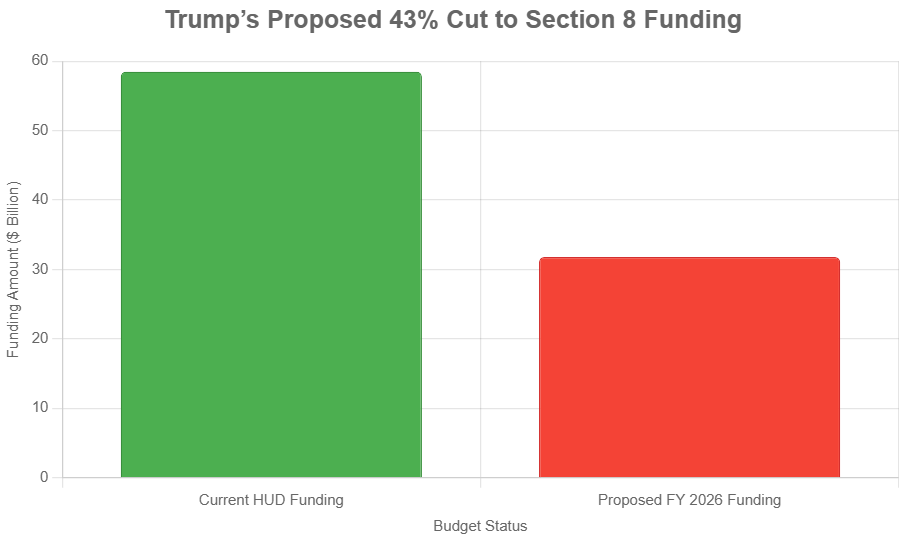
Chart showing Trump's proposed 43% cut to section 8 housing funding

Okay, so what exactly is being proposed? The core of the issue lies in the massive budget cuts outlined by Trump. Let’s break it down:

  • 43% Cut to HUD’s Rental Assistance: The budget proposes slashing funding from $58.5 billion to $31.8 billion. This affects not just Section 8, but also public housing, project-based assistance, and programs for retirees and individuals with disabilities. That's almost $27 billion in rental assistance alone going away.
  • Two-Year Limit for Able-Bodied Adults: This is a big one. If you are considered an “able-bodied” adult – meaning no disability preventing work – you will only receive assistance for two years. After that, it’s assumed you can be self-sufficient. Personally, I find this assumption incredibly problematic. The job market isn't always forgiving, and two years might not be enough to gain stable employment in today's economy.
  • State Rental Assistance Block Grant System: The proposal wants to hand over the reins to the states through something called the SRABG. The idea is for states to manage the aid based on their “unique needs”. While in theory, empowering states might sound good, I've seen firsthand discrepancies in how different states handle social programs. The end result could be inequalities in access to, and quality of, assistance, depending on what state you live in. I wonder what kind of accountability and oversight would exist under this system.

The following tables summarize the proposed changes and potential effects:

Aspect Details
Proposed Cut to HUD Funding 43%, reducing from $58.5 billion to $31.8 billion
Programs Affected Section 8, public housing, project-based assistance, programs for disabled
New Policy Two-year limit on aid for able-bodied adults
Funding Mechanism Shift to State Rental Assistance Block Grant (SRABG)
Current Beneficiaries Over 4.4 million households


Potential Impact Details
At Risk Nationwide Over 3.8 million people, including families, veterans, elderly, disabled
New York City Impact Could affect 300,000 Section 8 or public housing residents, potential evictions
Advocate Concerns States may not fill gaps, risk of increased homelessness

The Ripple Effect: Who Gets Hurt?

These changes aren’t just numbers; they’re about real people’s lives. It's important to step back and understand the real-world consequences of these policies. I would say millions of people are at risk.

  • Potentially Affecting Over 4.4 Million Households: This is a staggering number. That's nearly half the cities and towns across America at risk of losing the aid. A substantial cut in rental assistance on top of these households that rely on the aid translates to potential loss of housing for millions of people.
  • Increased Homelessness: The biggest fear is obviously increased homelessness. The National Low Income Housing Coalition warns that if these cuts go through, we could see a drastic rise in the number of people living on the streets.
  • High-Cost Areas Will Suffer More: In cities like New York, where housing costs are already sky-high, 300,000 residents could face eviction. This isn't just about individuals or families; it affects entire communities. A surge in homelessness could overload social services, strain local economies, and lead to increased crime.

Focusing on Veterans and the Disabled

It sounds nice in theory, but is it really beneficial? There’s a lot of debate about the 43% cuts to Section 8 to prioritize veterans, the disabled amongst others. The administration is keen on ensuring the welfare of veterans and disabled individuals. I won't lie, I do appreciate that.

  • National Center for Warrior Independence: An executive order established this center with the aim of housing 6,000 homeless veterans by 2028. The idea is to use Section 8 vouchers to support them. I think that's a great thing.
  • Prioritizing Deserving Cases: The argument is that Section 8 should be a “lifeline” for those who truly need it.

The Great Debate: Self-Sufficiency vs. Safety Net

This is where things get really heated. There’s a huge divide in opinions on this. It's not just about politics but also about different philosophies about how we should care for one another.

Those in favor of the cuts often say things like:

  • “Section 8 shouldn’t be a lifestyle, it should be a lifeline.”
  • “People need to get up, grind, and earn it.”

The opposing side is equally vocal:

  • “We would see homelessness escalate in a way that has been really unprecedented.”
  • “This is not fixing anything; this is making everything so much worse.”

My Two Cents

Well, I believe these proposed cuts are not only misguided but are downright harmful. While I agree that promoting self-sufficiency is important, abruptly cutting off assistance to vulnerable populations is not the answer.

Two years is simply not enough time for many people to get back on their feet. A more sensible approach would be to invest in job training programs and support services that help people transition to independence gradually. We must ensure their security.

Moreover, shifting the burden to the states is risky. States have varying resources and priorities. A federal safety net ensures a basic level of protection for everyone, regardless of where they live.

Let's keep a close eye on this situation. We all have a voice. Contact your representatives, support organizations that advocate for affordable housing, and most importantly, remain engaged.

“Invest in Turnkey Real Estate in 2025”

With proposed Section 8 housing cuts potentially putting millions at risk, stable rental markets with strong demand are more critical than ever.

Norada offers turnkey, professionally managed properties in high-demand areas—helping you support communities while building reliable income.

HOT NEW LISTINGS JUST ADDED!

Speak with a Norada investment counselor today (No Obligation):

(800) 611-3060

Get Started Now

Read More:

  • Top Reasons Behind the End of the Trump-Musk Alliance in 2025
  • What is Trump's Plan for Privatizing Fannie Mae and Freddie Mac?
  • Elon Musk's $10,000 Homes: A Game Changer for the Housing Market?
  • Elon Musk Calls for Major Reforms at the U.S. Federal Reserve
  • Can Elon Musk Revolutionize Affordable Housing for Americans?
  • Emergency Price Relief on Housing: What Does Trump's Order Mean?
  • Trump's Inaugural Speech: Bold Plans on Border, Economy, and More
  • What Happens to Kamala Harris' Proposal of $25,000 Homebuyer Assistance Now?
  • Housing Market Predictions for 2025 if “Trump” Wins Election
  • 10 Housing Market Predictions Under Trump for the Next 4 Years
  • Will Donald Trump's Victory Reshape the Housing Market in 2025?
  • Trump vs Harris: Housing Market Predictions Post-Election
  • 10 Housing Market Predictions Under Trump for the Next 4 Years
  • Will Donald Trump's Victory Reshape the Housing Market in 2025?

Filed Under: Housing Market Tagged With: Housing Choice Voucher Program, Housing Market, HUD, Section 8 Housing

FHA Likely To Be The Next Shoe To Drop

September 4, 2009 by Marco Santarelli

The FHA is a big reason that home prices haven't fallen even further. The FHA's aggressive lending programs have continued throughout the housing downturn, causing its market share of the mortgage industry to grow from 2% in 2005 to 23% today. The FHA is an even larger percentage of the new home mortgage industry – nearly 25% according to HUD.

The FHA insurance fund, however, is likely running dry. According to a report from mortgage finance experts, the FHA will not meet its minimum requirement as of its fiscal year-end, which is only 26 days from now. For months, we have been investigating this and reporting our findings to our clients.

While almost all of the experts believe that Congress would support the FHA if necessary (it's currently self-funded), we wonder if FHA officials will be under pressure to continue tightening their lending policies, which currently allow 96.5% mortgages to people with 600 FICO scores. Already, FHA has contracted its own standards to require a 10% down payment for those with credit scores below 500.

Claims against the insurance fund have climbed, with roughly 7% of all FHA-insured loans now delinquent.

Given the FHA's September 30 fiscal year-end, this financial reality will come to light about the same time that other market forces run out of steam:

  • Just as the $8,000 tax credit expires.
  • Just as more of the stalled REO currently held on banks' balance sheets will be coming to market.

The culmination of all these factors means housing could see another leg down by early next year. 

[Read more…]

Filed Under: Financing, Housing Market Tagged With: FHA, Financing, Housing Market, HUD, mortgage, mortgage finance, property finance

Real Estate

  • Birmingham
  • Cape Coral
  • Charlotte
  • Chicago

Quick Links

  • Markets
  • Membership
  • Notes
  • Contact Us

Blog Posts

  • Today’s Mortgage Rates, Feb 4: 30-Year Fixed Rate Holds Steady Around 5.98%
    February 4, 2026Marco Santarelli
  • Mortgage Rates Today, February 4: 30-Year Refinance Rate Drops by 2 Basis Points
    February 4, 2026Marco Santarelli
  • 5 Hottest Real Estate Markets for Buyers and Investors in 2026
    February 4, 2026Marco Santarelli

Contact

Norada Real Estate Investments 30251 Golden Lantern, Suite E-261 Laguna Niguel, CA 92677

(949) 218-6668
(800) 611-3060
BBB
  • Terms of Use
  • |
  • Privacy Policy
  • |
  • Testimonials
  • |
  • Suggestions?
  • |
  • Home

Copyright 2018 Norada Real Estate Investments

Loading...