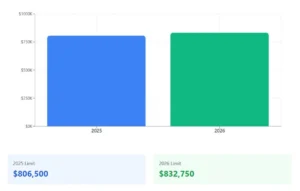
This is fantastic news for anyone dreaming of homeownership, or looking to upgrade their current digs. The Federal Housing Finance Agency (FHFA) has officially announced a significant increase to the 2026 conforming loan limit, pushing it to $832,750 for a single-family home. This bump means more potential buyers and existing homeowners can now access conventional loans, often with better interest rates and terms, making that dream home a more achievable reality.
2026 Conforming Loan Limit Hits $832,750 — Here’s What It Means for Buyers
For years, many of us in the real estate and mortgage world have watched as home prices climbed, often pushing desirable properties into the realm of “jumbo loans.” These jumbo loans, while a crucial part of the market, typically come with stricter qualification requirements and, more importantly, higher interest rates.
The conforming loan limit acts as a gatekeeper – loans below this amount can be purchased by Fannie Mae and Freddie Mac (the government-sponsored enterprises, or GSEs), leading to a more standardized and generally more affordable lending product. The FHFA's decision to raise this limit is a clear recognition of the ongoing realities of home values across much of the country and aims to bring more transactions back into the conforming loan space.
What Exactly Are Conforming Loan Limits, Anyway?
It’s crucial to understand what these limits mean for you. In simple terms, a conforming loan is a mortgage that meets the guidelines set by Fannie Mae and Freddie Mac. Because these two giants buy up so much of the mortgage market, their rules and limits have a huge impact. When a loan “conforms” to their standards, it’s generally easier for lenders to sell it on the secondary market, which in turn helps keep interest rates competitive.
Any loan that exceeds these conforming limits is considered a jumbo loan. And as I’ve seen firsthand throughout my career, jumbo loans can mean higher down payments, more rigorous credit checks, and a noticeably higher interest rate. So, this increase from the 2025 limit of $806,500 to $832,750 for 2026 is not just a number; it’s a real opportunity for more people to qualify for more affordable mortgage financing. It's a $26,250 difference that can open doors that might have previously been shut.
Beyond the Basics: Higher Limits in High-Cost Areas
Now, it’s important to acknowledge that not all parts of the country are the same when it comes to housing costs. The FHFA correctly recognizes this by setting even higher loan limits for designated high-cost areas. These are places where the median home value is significantly above the national average. While these high-cost areas only make up a small percentage of all U.S. counties (about 4.9%), they include many major metropolitan centers.
In these pricier locales, the conforming loan limit for a single-family home will jump to a maximum of $1,249,125. This is a significant figure and reflects the stratospheric home prices we see in places like parts of California, New York, or even Hawaii. Alaska, Hawaii, Guam, and the U.S. Virgin Islands also have special provisions that allow them to reach these maximum limits. This tiered approach ensures that the conforming loan limits remain relevant and beneficial across a wider range of economic conditions.
A Look at Different Property Types for 2026
It’s not just single-family homes that benefit. The higher conforming loan limits also apply to multi-unit properties, which is great news for investors or those looking to buy a duplex or triplex to live in while renting out other units. Here’s a quick breakdown of the 2026 limits for different property types:
| Property Type | Standard Limit | High-Cost Area Limit |
|---|---|---|
| 1-Unit (Single-Family) | $832,750 | $1,249,125 |
| 2-Unit (Duplex) | $1,066,250 | $1,599,375 |
| 3-Unit (Triplex) | $1,288,800 | $1,933,200 |
| 4-Unit (Four-Plex) | $1,601,750 | $2,402,625 |
Having higher conforming limits for multi-unit properties can make it easier to finance these kinds of investments with conventional mortgages, which usually offer better rates and more flexible terms than specialized investment property loans.
The Story of Home Prices: A Decade of Dramatic Change
To truly appreciate the 2026 increase, you have to look at the recent past. The housing market has been anything but predictable over the last few years. We went from incredibly low mortgage rates and bidding wars to sharply rising rates and a market that started to cool. The conforming loan limits have mirrored this wild ride.
Let’s look at how these limits have evolved:
| Year | 1-Unit Baseline | Increase ($) | Increase % |
|---|---|---|---|
| 2026 | $832,750 | $26,250 | 3.26% |
| 2025 | $806,500 | $39,950 | 5.21% |
| 2024 | $766,550 | $40,350 | 5.56% |
| 2023 | $726,200 | $61,000 | 9.16% |
| 2022 | $647,200 | $98,950 | 18.05% |
| 2021 | $548,250 | $37,850 | 7.41% |
| 2020 | $510,400 | — | — |
What really jumps out here is the 18.05% surge in 2022. That was a massive jump, and it was a direct reflection of the unprecedented housing price explosion we saw during the peak of the pandemic. Low interest rates, coupled with a severe shortage of homes for sale, created a perfect storm for rapid price appreciation.
Since that peak, the growth has naturally moderated. We saw a significant, but more reasonable, 9.16% increase in 2023. Then, in 2024 and 2025, the increases settled into a more typical range of around 5%. The 3.26% increase for 2026 signals a continued stabilization, indicating that while home prices are still rising, they are doing so at a much more sustainable pace. This moderation is actually a good sign for the long-term health of the housing market.
How Are These Numbers Determined? The FHFA’s Method
The FHFA doesn’t just pick these numbers out of thin air. They are legally required to adjust the conforming loan limits each year to keep pace with changes in average U.S. home prices. Their primary tool for this is the FHFA House Price Index (HPI). This index tracks how home prices are changing based on actual sales data.
The agency looks at the percentage change in average home values over a 12-month period, typically ending in the third quarter of the year. For the 2026 limits, they saw a 3.26% increase in home values between the third quarter of 2024 and the third quarter of 2025. This percentage directly translates into the increase we're seeing in the loan limits.
One really important aspect of this process is that the FHFA is prohibited from reducing conforming loan limits, even if home prices were to fall. This “one-way ratchet” mechanism provides a degree of stability and predictability for the mortgage market, which is something I always appreciate. It means that borrowers don't have to worry about their borrowing power suddenly shrinking year after year.
Where the High-Cost Areas Are Concentrated
As I mentioned, only about 160 out of 3,235 counties (roughly 4.9%) qualify for the higher conforming loan limits. This highlights how concentrated the really expensive housing markets are. Less than 2.4% of counties (77 of them) will see the absolute maximum limit of $1,249,125 for a single-family home. These are, unsurprisingly, areas with exceptionally high home values, like major hubs in California and the New York metropolitan area. The overwhelming majority of counties across the U.S. will utilize the standard baseline limit of $832,750.
What This Means for You and the Housing Market
The increased conforming loan limits for 2026 have some significant benefits:
- More Buyers Qualify for Conventional Loans: This is the most direct impact. Properties that were just above the 2025 conforming limit might now fall within the 2026 limit. This opens up conventional financing, which often comes with lower interest rates and more borrower-friendly terms than jumbo loans. The difference in interest rates can be substantial – sometimes a quarter to three-quarters of a percent or even more. Over 30 years, this translates to tens of thousands of dollars saved.
- Easier for Lenders: For mortgage lenders, the annual adjustments mean updating systems, training staff, and clearly communicating the new possibilities to potential borrowers. The FHFA’s announcement around Thanksgiving gives the industry a good five weeks to prepare for the January 1st effective date.
- Market Normalization: The moderating pace of the increase (3.26%) is a sign that the housing market is transitioning away from the extreme conditions of the pandemic. Sustained, moderate home price growth is generally healthier for the long-term stability of the market than double-digit annual jumps. It suggests we’re moving towards a more predictable environment.
- Support for Housing Supply: By allowing conforming loans to reach higher price points, especially in high-cost areas, the GSEs can continue to support the flow of credit into these markets. This is crucial for maintaining liquidity and ensuring that financing is available for a significant segment of the home-buying public.
From my perspective, this adjustment is a responsible move by the FHFA. It acknowledges the market realities without fueling speculative price increases. It’s about ensuring that conventional financing remains accessible and supportive of homeownership, even as values have shifted significantly.
Looking Ahead
The future of these conforming loan limits is directly tied to the future of U.S. home prices. If home appreciation continues at a more measured pace, similar to historical averages, we can expect annual limit increases to remain in a similar range. If, however, economic headwinds cause home prices to flatten or decline, the increases could be smaller, or in a very unlikely scenario, the limits might stay the same year-over-year.
Ultimately, the 2026 conforming loan limit of $832,750 is a positive development for many aspiring homeowners and those looking to move up. It’s a testament to the FHFA’s commitment to keeping these vital lending benchmarks aligned with the actual cost of housing in America. As always, staying informed about these limits and how they apply to your specific situation is key to making smart financial decisions in your real estate journey.
2026 Conforming Loan Limit Rises to $832,750
Higher loan limits mean buyers can access more financing under conforming guidelines—reducing the need for jumbo loans and expanding affordability in competitive markets.
Norada Real Estate helps investors leverage these expanded limits with turnkey rental properties designed for cash flow and long-term appreciation—so you can maximize financing power in 2026.
🔥 HOT NEW LISTINGS JUST ADDED! 🔥
Talk to a Norada investment counselor today (No Obligation):
(800) 611-3060
Recommended Read:
- How to Get the Best FHA Mortgage Rates in 2025?
- FHA Credit Score Requirements for Homeownership in 2025
- FHA Mortgage Rates by Credit Score: 620, 700, 580, 640
- What Credit Score Do You Need to Buy House With No Money Down?
- How Long Does It Take to Get a 700-800 Credit Score?
- How To Improve Your FICO Credit Score: A Guide
- Surefire Methods for Building Your Credit Score

