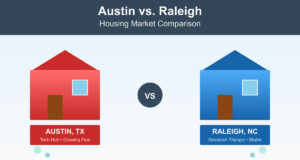
For years, investors chasing tech money have looked at two Sun Belt superstars: Austin, Texas, and Raleigh, North Carolina. Both cities have rocketed up the rankings for population growth, job creation, and overall “cool factor.” But if you’re putting your hard-earned capital into property, you need to know which city gives you the better investment.
Austin vs. Raleigh: Which Tech Hub Has the Stronger Housing Market for Investors?
We aren't looking for the better place to live—we are looking for the strongest financial returns. So, let’s answer the million-dollar question right upfront: Austin vs. Raleigh: Which Tech Hub Offers Stronger Real Estate Returns?
The short answer, based on current affordability and market maturity, is that Raleigh, NC, currently offers a more sustainable and less volatile path to long-term returns, while Austin, TX, remains the higher-risk, higher-reward play that requires far more precise timing.
I’ve been tracking the incredible shifts in these competitive markets for over a decade, and what I’ve seen recently suggests that the rules have changed. Austin’s massive run-up has created hurdles, while Raleigh’s measured, diversified growth keeps making it an investor darling. Let’s dive deep into the specific dynamics that make these two cities fundamentally different when it comes to stacking up profit.
The Tale of Two Texas Towns (and the Other One in NC)
When we look at both metros, we are analyzing two distinct styles of economic development. Austin is the flashy newcomer; Raleigh is the quiet anchor.
| Feature | Austin, TX (The Rocket) | Raleigh, NC (The Anchor) |
|---|---|---|
| Primary Growth Driver | Corporate relocations (Tesla, Samsung, Oracle), Venture Capital (VC) funding. | Research Triangle Park (RTP), Universities (UNC, Duke, NC State), Biotech/Pharma. |
| Market Maturity | Highly mature, high prices, rapidly compressed yields. | Maturing rapidly, but still maintains a significant affordability gap advantage over Austin. |
| Population Growth Rate | Explosive (Historically among the fastest in the US). | Very strong and steady. |
| State Tax Structure | No state income tax. High property taxes. | State income tax. Lower property taxes (generally). |
| Investment Profile | Appreciation heavy (Capital Gains). | Balanced (Appreciation + Cash Flow potential). |
The Beast Under the Bridge: The Austin Model
When I think about investing in Austin, I think about momentum. For a long time, Austin couldn't lose. The city became the premier destination for tech workers fleeing California, driving prices up at an absolutely staggering rate.
The Volatility Factor
In real estate, growth often comes with a bill, and for Austin, that bill is volatility. We saw median prices soar by 40% in a single year during the peak pandemic boom. This level of rapid appreciation is thrilling, but it dramatically increases the risk of market correction—which is exactly what we saw when interest rates climbed.
My personal analysis of Austin's growth trajectory is that it mirrors markets that rely heavily on a constant injection of VC money and “big fish” corporate moves. When the tech sector hiccups or national interest rates rise, the brakes slam harder here than almost anywhere else.
The Property Tax Headache
One major fundamental difference that impacts long-term investment returns in Austin is the property tax situation. Texas prides itself on having no state income tax, but they make up for it aggressively at the local level.
If you are a buy-and-hold investor aiming for cash flow, those constantly rising property valuations mean your tax burden rises annually, often eating away at your net operating income (NOI). In markets like Dallas or Houston, you have higher rent-to-value ratios to absorb this, but in prime Austin, yield compression is severe. Many investors are simply betting on massive appreciation, effectively turning their rental property into an asset where the income is just enough to cover the massive operating costs. That is a dangerous, appreciation-only strategy.
The Steady Hand: The Raleigh/Research Triangle Model
Now let’s look east to Raleigh, the anchor of the Research Triangle Park (RTP), which includes Durham and Chapel Hill. Raleigh is not a new contender, but it didn't get the same blinding media spotlight as Austin, and that’s a good thing for investors.
The Power of Diversification
The key to Raleigh’s resilience is its foundation. Where Austin relies heavily on IT and venture-backed startups, Raleigh’s economy is built upon three pillars:
- Academia: The triangle is anchored by three major research universities (UNC, Duke, NC State) that generate a constant, highly educated talent pipeline.
- Government: As the state capital, Raleigh has a stable base of state and federal jobs that act as a buffer during recessions.
- Biotech and Pharma: The RTP is one of the world's leading centers for life sciences. These companies—think major, stable employers like Pfizer and Merck—are less susceptible to the immediate cyclical downturns that plague the pure tech sector.
When the 2022 market slowdown hit, Raleigh felt the cooling effects, but its descent was far more gentle and controlled than Austin’s sharp drop. Why? Because the job market didn't panic. The pharmaceutical companies still needed scientists, and the universities still needed staff. This translates directly into more stable housing demand.
The Affordability Advantage for Investors
This is the big one. Even after years of growth, Raleigh remains significantly more affordable than Austin, particularly when you look at median home price versus median rent.
In my professional opinion, the stronger the rent-to-value ratio, the stronger the long-term investment.
While Austin’s median prices pushed into the mid-six figures long ago, Raleigh has maintained better entry points. This means:
- Lower initial capital outlay.
- Better potential for positive cash flow from day one (or at least much sooner).
- A wider tenant pool, as housing remains accessible to mid-level income earners, not just highly paid tech execs.
The Critical Factors: Where Investors Need to Look Beyond Price
To truly decide which market offers stronger returns, we have to look past the superficial trends and examine the regulatory and construction environment. This is where real expertise comes in.
1. The Inventory Battle (Permitting and Supply)
When a city has incredible demand, the smart response is to build, build, build. But Austin has had a massive supply problem, worsened by local permitting delays that made it difficult for housing supply to catch up with demand. Developers, driven by high prices, eventually rushed in.
Expert Insight: Austin has experienced a significant surge in multi-family and single-family permitting. While this is necessary, rapid, large-scale supply hitting the market during a slowdown leads to oversupply issues and potential pressure on rental rates. It’s a boom-and-bust cycle.
Raleigh, while also experiencing a construction boom, has maintained a more balanced development pace. This slower pace, while sometimes frustrating for renters, is beneficial for property owners because it prevents catastrophic supply gluts that kill rental price growth.
2. Taxation and Regulation: The State Matters
A common mistake new investors make is ignoring the regulatory differences between states.
| Factor | Texas (Austin) | North Carolina (Raleigh) | Impact on Returns |
|---|---|---|---|
| Income Tax | 0% State Income Tax | Progressive State Income Tax | TX sounds better, but NC's slightly higher state taxes often fund better infrastructure, lowering city operational costs. |
| Property Tax | High Rates (Often 2%+) | Moderate Rates (Generally below 1.2%) | NC wins here for cash flow investors. Lower annual operating expenses directly boost NOI. |
| Landlord/Tenant Law | Generally Landlord-friendly | Moderate, Moving toward balance | Both states are relatively fair, but local ordinances (like short-term rental rules) must be watched closely. |
My opinion is clear: for the long-term rental investor prioritizing cash flow stability, North Carolina’s lower property tax burden provides a foundational competitive advantage over Austin’s structure.
3. Demographic Flow and Wage Divergence
Both cities attract highly skilled workers, but Raleigh is becoming increasingly attractive to companies due to wage arbitrage. Tech companies realize they can hire excellent engineers in Raleigh for 15-20% less than they would pay in Austin (or 30-40% less than in Silicon Valley). This allows businesses to expand aggressively without crippling payroll costs, ensuring the job machine keeps churning out new residents needing housing. This constant, slightly less expensive talent flow creates a highly stable rental demand base.
The Rubber Meets the Road: A Cash Flow Comparison
To make this tangible, let’s run a simple side-by-side calculation focusing on the cost of ownership, assuming two similar properties purchased as rentals in desirable sub-markets of each metro area. This example highlights the massive impact of property taxes on your Net Operating Income (NOI).
We will focus purely on the property tax and price differences, which are the main differentiators in annual cash flow for buy-and-hold investors.
| Investment Metric | Austin, TX (Approximate) | Raleigh, NC (Approximate) | Key Result for Investors |
|---|---|---|---|
| Purchase Price | $550,000 | $425,000 | Raleigh requires $125k less capital. |
| Estimated Rent | $2,800 / month | $2,400 / month | Austin rent is higher, but so is the price. |
| Effective Property Tax Rate | 2.1% | 1.1% | This is the crucial difference. |
| Annual Property Tax Burden | $11,550 | $4,675 | The silent killer of cash flow in Austin. |
| Annual Tax Difference | N/A | Saves $6,875 | Raleigh investor pockets nearly $7k more annually before factoring in mortgage. |
| Monthly Tax Cost | $962.50 | $389.58 | The Raleigh tax is nearly $600/month less. |
Note: These figures are approximations used for comparative illustration and do not include mortgage, insurance, or maintenance costs.
What this calculation tells me, as an expert investor, is critical: Even though the Austin property rents for $400 more per month, the Raleigh investor’s annual property tax savings ($6,875) virtually wipes out that rental premium. The Raleigh property starts off with a vastly superior operational cost structure, making positive cash flow much easier to achieve and maintain, especially in the first few years.
The Rental Income Reality Check
The strongest returns are not just about sale price appreciation; they are about the total return—combining cash flow (rental income) and appreciation.
Austin's Compressed Yields
Due to the aggressive price increase, Austin’s cap rates (the ratio of Net Operating Income to property value) have plummeted. If you buy an expensive property but your rent barely covers the mortgage, insurance, and those heavy Texas property taxes, your yield is compressed, maybe even negative. You are effectively betting your entire return on the hope that someone will buy the property for even more money in five years.
Raleigh’s Cash Flow Potential
While Raleigh’s cap rates have also tightened, they are generally healthier than Austin’s, especially in secondary markets around RTP like Cary, Apex, or Durham. An investor in Raleigh has a much higher likelihood of achieving a small but reliable positive cash flow, providing a critical safety net against market dips.
I always advise investors to look for markets where you can be right two ways: through appreciation AND through cash flow. Raleigh provides a better opportunity to execute this dual strategy.
Investment Strategies for Each Market
Because these cities operate on different risk levels, your strategy needs to adapt:
Austin Strategy (High-Risk/High-Reward)
- Target: Highly specialized niche properties (e.g., luxury rentals near Tesla Giga Factory, short-term rentals near downtown).
- Focus: Capital preservation and appreciation, not immediate cash flow.
- Best Play: Land speculation and new development in rapidly expanding submarkets (e.g., Leander, Georgetown) before they fully mature. Requires deep pockets and high risk tolerance.
- Keywords to Track: Austin luxury housing supply, Central Texas commercial permitting, VC funding rounds.
Raleigh Strategy (Sustainable Growth)
- Target: Single-family homes in established commuter corridors (e.g., close to I-40 access points) or townhomes near university campuses.
- Focus: Balanced strategy—steady appreciation supplemented by reliable cash flow.
- Best Play: Buying properties that appeal to the stable, highly educated workforce employed by RTP. This is the ultimate defensive position for real estate investing.
- Keywords to Track: Raleigh-Durham biotech job growth, Wake County property tax rates, RTP employee headcount.
My Final Verdict on Returns
When comparing Austin vs. Raleigh: Which Tech Hub Offers Stronger Real Estate Returns, we must recognize that “stronger” doesn't just mean “highest peak.” It means the most consistent, resilient, and repeatable return profile.
Austin is like buying volatile tech stock; the gains can be huge, but the drops are sharp, and your entry point has to be perfect. Raleigh is like a blue-chip stock—steady, reliable, paying a decent dividend (cash flow) while slowly and surely increasing in value.
For the investor who values predictable cash flow, lower operating expenses, and resilient demand driven by diversified institutional anchors, Raleigh, NC, provides the stronger, more secure foundation for long-term real estate returns. Austin still has momentum, but its affordability crisis and tax structure mean the margin for error is razor-thin. Raleigh wins on fundamentals.

Download Your FREE Guide to Passive Real Estate Wealth
Real estate investing has created more millionaires than any other path—and this guide shows you how to start or scale with turnkey rental properties.
Inside, you’ll learn how to analyze cash flow and returns, choose the best markets, and secure income-generating deals—perfect for building long-term wealth with minimal hassle.
🔥 FREE DOWNLOAD AVAILABLE NOW! 🔥
Want Stronger Returns? Invest Where the Housing Market’s Growing
Turnkey rental properties in fast-growing housing markets offer a powerful way to generate passive income with minimal hassle.
Work with Norada Real Estate to find stable, cash-flowing markets beyond the bubble zones—so you can build wealth without the risks of ultra-competitive areas.
🔥 HOT NEW LISTINGS JUST ADDED! 🔥
Talk to a Norada investment counselor today (No Obligation):
(800) 611-3060
Recommended Read:
- Dallas vs. Houston: Which City Offers Better Returns for Real Estate Investors
- Single-Family vs. Townhome: Which is the Real Cash Flow Winner for Investors?
- 5 Hottest Florida and Texas Markets for Real Estate Investors in 2025
- Best Places to Invest in Real Estate: November 2024 Hotspots
- How to Secure Your Retirement With Cash-Flowing Rental Properties
- Best Places to Invest in Single-Family Rental Properties in 2025
- 5 Hottest Real Estate Markets for Buyers & Investors in 2025