Archive for June, 2009
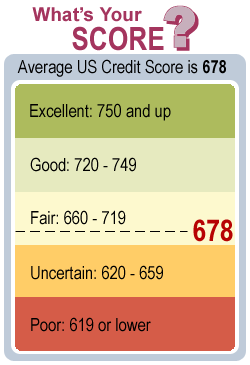
The Fair Isaac Company have announced that they will be releasing three new credit scores based on their new FICO 08 model.
1. The FICO Mortgage Score
The FICO Mortgage Industry Score is designed to help mortgage lenders improve credit decisions for both current and future homeowners. Introduced by FICO and Equifax, the score delivers significantly greater assessment of mortgage repayment risk — up to 25% or more for key population segments, compared to the base BEACON score. The score aids servicers in earlier identification of borrowers at risk, mitigating the incidence and high cost of foreclosure.
2. The FICO Auto Score
FICO have also introduced another industry-specific credit score for the auto industry. According to Tom Quinn, vice-president of scoring at FICO, the new scoring model "will identify 5 to 15 percent more potential delinquencies… For the overwhelming majority of consumers, the auto industry score will be relatively close to the [generalized] FICO score," says Quinn. "There is a percentage of the population that will be different. And that’s why lenders have opted to use the other [auto industry] score."
TransUnion has already made this score available immediately to lenders, while Experian and Equifax are planning to follow suit later in the summer.
3. The FICO Bankcard Score
The third scoring model is specifically for the credit card industry, officially named the FICO Bankcard Industry Option. This does the same kind of things are the Mortgage and Auto industry versions, by taking your credit file and first scoring it by the "broad-based" risk scorecard system, and then by one of two industry-specific overlay scorecards — one for files with derogatory information on any type of account, one for files without. This overlay adjusts the credit bureau scores up or down. The resulting score is scaled to match the same "good versus bad" odds as the broad-based risk scores.
These three options are generally greeted with positive comments from consumer experts. The tweaking of the current "classic" FICO score can only help lenders make more informed decisions when underwriting loans.

You’ve heard it all before: “YOU can become rich with real estate!” “Live the life you want with real estate!” “Come to my seminar on how to make money from real estate!”

It seems that when you’re interested in real estate investing, you find yourself inundated by large font titles with glaring colors promising you the sun, moon and stars if you take their seminar (a bargain at $2,999), or buy their inspirational CDs (a deal at $199), or purchase their motivational DVD and book combo (practically giving them away for only $99).
When the eager investor signs up, the “guru” delivers speeches and media that are long on fantasy and short on reality. Many of these people prey on greed, pure and simple. They capture the attention of wanna-be investors who want to believe that the path to riches is easy. In reality real estate investing is paved with long, hard work — at least in the beginning.
It’s certainly true that real estate investing can improve your finances and diversify your portfolio. It is also true that there are many people who are quietly building their wealth as a result of careful investing in real estate. The fact is, most of these people worked hard, gave up many luxuries and invested wisely instead of falling for claims of easy money.
What the “gurus” will do is emphasize the life you “could” have and gloss over the work real estate investing takes. They describe themselves with as many adjectives as possible instead of actually giving you verifiable information as to their competence. Often these gurus do not have first-hand knowledge of the different methods of investing. Therefore the challenges and problems common to investing are glossed over because they simply do not have the answers. They don’t make money from your success. They make money when you buy their product.
The epidemic of foreclosures is rising, according to newly released figures from RealtyTrac, despite a slight slowdown in activity during the month of May. Year over year foreclosures rose 18%.
Foreclosure filings, including default notices, scheduled auctions and bank repossessions were reported on 321,480 properties during the month, a decrease of 6% from April. The drop apparently developed as a result of moratoriums on foreclosures by the nation’s largest banks and mortgage companies.
“While defaults and scheduled foreclosure auctions were both down from the previous month, bank repossessions, or REOs were up 2% thanks largely to substantial increases in several states, including Michigan, Arizona, Washington, Nevada, Oregon and New York,” said James Saccacio, chief executive officer of RealtyTrac. “We expect REO activity to spike in the coming months as foreclosure delays and moratoriums implemented by various state laws come to an end.”
Ten states represent 77% of foreclosure filings, according to the report. Foreclosures are forecast to rise through the remainder of the year by Housing Predictor as a result of the financial crisis and the tight money supply. Nevada continued to document the nation’s highest foreclosure rate, with one in every 64 housing units receiving a foreclosure filing during the month.
Real estate is a rare investment vehicle. It provides people with a place to live while working as an investment. What’s more, this investment offers a very powerful wealth building combination of returns.
APPRECIATION: Over the past 80 years, real estate values have continually increased. There have, of course, been some periods where values decreased, but the overall trend has always gone up. Like anything else, the value of real estate is determined by supply and demand.
So what are the factors that keep real estate in such high demand over the years? One of the main reasons is that shelter is a basic human need. People need a place to live, work, and shop where they are protected from the weather. Additionally, real estate is an investment that benefits from inflation. In periods of high inflation, real estate values go up.
LEVERAGE: One of the biggest advantages of real estate as an investment over any other asset class such as stocks, mutual funds, commodities, and government financial instruments is leverage. Leverage allows you to purchase and control a large amount of real estate for a relatively small amount of money.
For example, you could easily purchase a $100,000 property with only a 20% ($20,000) down payment. In some cases you can buy property for as little as 10% or less of the purchase price giving you even more leverage. To illustrate the power of this, consider this example:
Let’s say you bought $20,000 worth of gold, stocks, or some other investment. Then over the course of the year your investment went up 10%. Your investment is now worth $22,000, and your total return on investment (ROI) is 10%. Not bad.
Now let’s take that same $20,000 and use it as a down payment on an income property and buy a $100,000 house. Once again, let’s say it goes up 10% for the year. Your property is now worth $120,000, and your $20,000 investment has now doubled due to the $20,000 increase in your properties value. You have now made a return on investment of 100%! (This increase does not even consider the equity build-up resulting from the decreasing mortgage principal, cash flow, or tax advantages!)
Foreclosures are up nationwide, and will continue to rise as prices continue to go down in many markets. For some, the problem is painful. Ask the guy down the block from you whose house is in foreclosure.


Some pundits think the rising foreclosures will bankrupt our economy, causing pain for people who lose their business or job as a ripple effect of all these foreclosures. Others think that the rise in foreclosures is a healthy adjustment to the end of a long real estate boom, and is nature’s way of taking care of a free-market economic cycle.
Who’s right? Time will tell, but it’s alarming to see politicians trying to fix this problem. Here are some of their solutions:
Give People Money
Tax the rich, give to the poor. The federal government now wants to fund programs to help people stay in their homes.
A new bill in the Senate proposes giving money to people who can’t pay their loans. We taxpayers are confused. If these people are in trouble because they never should have been given such a loan, why should taxpayer money be used to keep them in their homes that they could not otherwise afford?
Maybe someone in Washington has the answer to that question?

The syndication process is simply the aggregation of capital from a group of investors to acquire property.
Real estate syndications are seeing new popularity as real estate is increasingly viewed as a fourth asset class in addition to stocks, bonds and cash.
Real estate investment trust (REITs), many of which have dividend returns of 6 percent or more, are an attractive way to invest in real estate but their publicly traded shares are subject to a significant degree of price volatility that many investors seek to avoid. By contrast, shares in a private syndicate, typically a real estate limited partnership (RELP) or limited liability company (LLC), are not priced to market on a daily basis and in addition offer the possibility of higher returns than publicly managed REITs. Finally, private real estate syndications offer some tax savings unavailable when investing in a public company.
Advantages of Real Estate Syndication
While investing in a real estate syndicate has certain disadvantages as compared to direct ownership of real estate, syndicates do offer significant benefits. These include the following:


