
Norada Real Estate Investments

  • Home
  • Markets
  • Properties
  • Membership
  • Podcast
  • Learn
  • About
  • Contact

Archives for October 2023

New Housing Market Data Shows Buyers Are Backing Off

October 12, 2023 by Marco Santarelli

New Housing Market Data Shows Buyers Are Backing Off

New Housing Market Data Shows Buyers Are Backing Off

The housing market is experiencing a shift this fall, with new listings showing a slight increase. However, the elevated mortgage rates are causing many potential buyers to retreat. Let's delve into the details of this evolving housing market scenario.

Current Trends in the Housing Market

According to a new report by Redfin, new listings have increased by 2% since the beginning of September, offering a slightly larger inventory for potential buyers. Despite this uptick, the total number of homes for sale is down by 14% from the previous year, suggesting a persistent seller's market. The median sale price is showing a steady 3% year-over-year increase.

Advice for Home Sellers

For sellers, the current market presents an opportunity to take advantage of rising prices. Despite the low demand, the median sale price has experienced a 3% increase. However, due to the increasing number of homes with a price drop and the impact of high mortgage rates on buyers' budgets, setting a fair price is crucial. Redfin agents recommend pricing homes fairly to attract buyers.

Advice for Homebuyers

On the other hand, potential homebuyers are hesitating to enter the market as mortgage rates reach their highest point in more than two decades. The median monthly mortgage payment has climbed close to $3,000. Despite the challenges, there's hope for buyers to make a move, especially with the slight increase in new listings. Shopping around for mortgage rates and considering buying down a mortgage rate are viable strategies to navigate the current market.

Key Housing-Market Data – October 2023

Here's a comprehensive analysis of the key data points and what they indicate about the housing market for the week ending October 8, 2023.

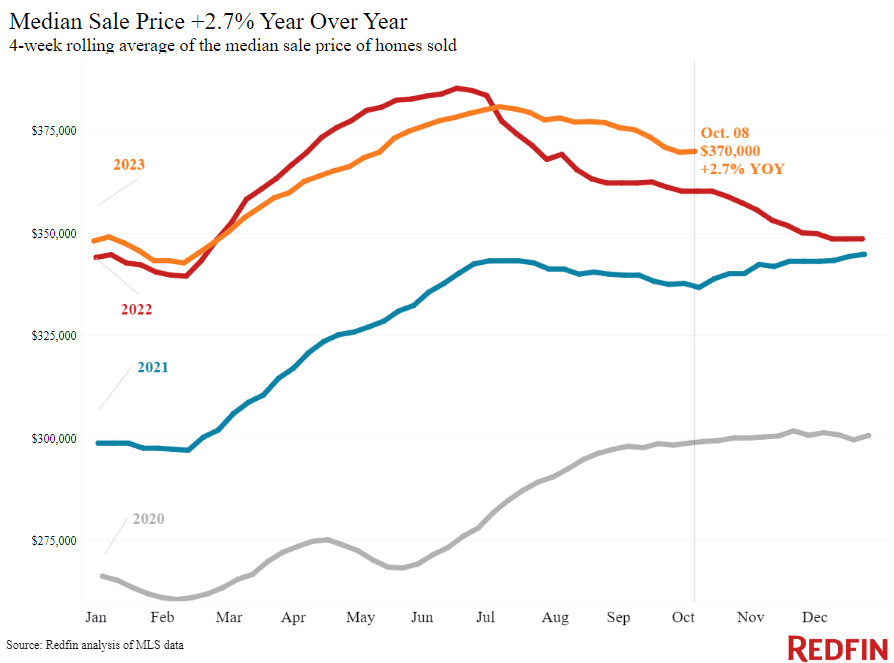
1. Median Sale Price: $370,000 (2.7% YoY increase)

The median sale price represents the middle point of all home sale prices. A 2.7% year-over-year increase in this value suggests a general upward trend in home prices, indicating demand and appreciation in property values.
Median Sale Price
Source: Redfin

2. Median Asking Price: $388,223 (5.2% increase, the biggest in a year)

The median asking price is the middle point of all homes listed for sale. A significant 5.2% increase in the median asking price, especially the highest in a year, signals a robust demand in the housing market, potentially indicating a seller's market.

3. Median Monthly Mortgage Payment: $2,736 at a 7.49% mortgage rate (10% increase)

The median monthly mortgage payment is influenced by both home prices and mortgage rates. A 10% increase indicates higher costs for homeowners, potentially impacting the purchasing power of prospective buyers and affecting overall market demand.

4. Pending Sales: 73,943 (-11.6%)

Pending sales represent the number of homes that have a signed contract but are yet to close. An 11.6% decrease in pending sales suggests a decline in immediate buyer interest, possibly due to factors like high mortgage rates or economic uncertainties.
Pending Sales
Source: Redfin

5. New Listings: 81,964 (-3.9%, smallest decline since July 2022)

The number of new listings entering the market is a vital indicator of market activity. A smaller decline of 3.9%, especially the smallest since July 2022, indicates a potential stabilization or improvement in the supply of homes for sale.

6. Active Listings: 827,406 (-14%, tied with the previous week for the smallest decline in four months)

Active listings represent the total number of unsold homes available in the market. A 14% decrease, even if it's the smallest decline in four months, still indicates a lower inventory of homes, contributing to a seller's market environment.

7. Months of Supply: 3.2 months (+0.2 pts.)

Months of supply is the estimate of how long it would take to sell the current inventory of homes at the current sales pace. An increase of 0.2 points to 3.2 months suggests a slight easing of the market, but it still remains within the range of a seller's market.

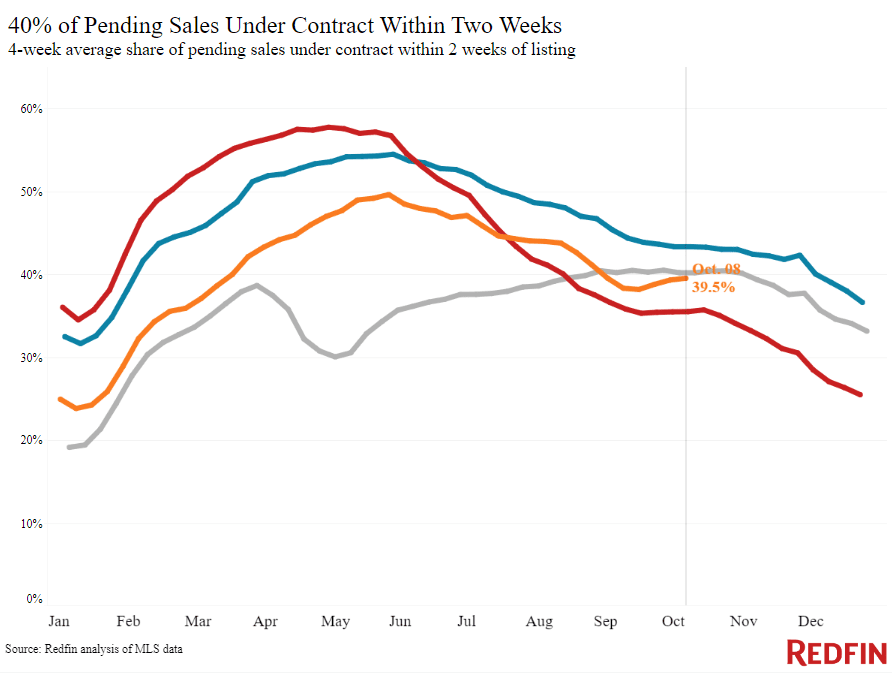
8. Share of Homes Off Market in Two Weeks: 39.5% (up from 36%)

This metric reflects the proportion of homes that are off the market within two weeks of being listed. A higher percentage (39.5%) suggests that a significant number of homes are being sold quickly, indicating a competitive market.

9. Median Days on Market: 32 (-2 days)

The median days on market represent the average time it takes for a property to be sold. A decrease of 2 days to 32 days indicates a relatively fast-paced market with homes selling quicker.

10. Share of Homes Sold Above List Price: 30.7% (up from 30%)

An increase in the percentage of homes sold above the list price (30.7%) suggests strong demand and competition among buyers, potentially resulting in bidding wars and higher selling prices.

11. Share of Homes with a Price Drop: 6.8% (+0.2 pts., highest level in a year)

A higher percentage of homes with a price drop (6.8%) and its increase indicates that some properties may be overpriced or the market is becoming more price-sensitive, encouraging sellers to adjust their prices to attract buyers.

12. Average Sale-to-List Price Ratio: 99.3% (+0.3 pts.)

The average sale-to-list price ratio measures the difference between the listed price and the actual sale price. An increase to 99.3% suggests that, on average, homes are selling very close to their listed prices, showing a strong seller's position in negotiations.

Overall, the housing market data portrays a dynamic scenario with sellers benefiting from rising prices and a seller's market environment, while buyers face challenges due to increased mortgage costs and stiff competition.

Additional Insights

Despite the challenges posed by the high mortgage rates, there are opportunities for both buyers and sellers in this evolving market:

Opportunities for Sellers

1. **Leveraging Rising Prices:** Sellers can take advantage of the continued rise in median sale prices, showcasing their properties at competitive rates.

2. **Strategic Pricing:** Sellers should carefully consider the pricing of their homes, aiming for a fair and attractive price to entice potential buyers.

3. **Prompt Sales:** Well-priced, move-in ready homes are still selling quickly in many parts of the country, indicating a demand for properties that meet buyers' expectations.

Opportunities for Buyers

1. **Choosing the Right Moment:** Despite the high mortgage rates, buyers can look for moments of reprieve to enter the market, keeping an eye on the small increase in new listings and slight decreases in daily average rates.

2. **Exploring Mortgage Options:** Buyers should shop around and explore different lenders to secure the best mortgage rates, ensuring they make an informed decision that aligns with their financial capabilities.
Filed Under: Housing Market, Trending News Tagged With: Housing Market News, Real Estate News

Challenges in Housing Market Will Impact Economy: Fed Needs to Respond

October 12, 2023 by Marco Santarelli

Challenges in Housing Market Will Impact Economy: Fed Needs to Respond

Challenges in Housing Market Will Impact Economy: Fed Needs to Respond

In the face of housing market challenges, urgent calls for the Fed to halt rate increases to stabilize the economy. The Housing Market Will Drag the Economy into a Hard Landing Unless the Fed Takes These ‘Simple Steps,' Trade Groups Warn.

Housing trade groups have urgently called on the Federal Reserve to cease immediate interest rate hikes, stressing the necessity of two critical “simple steps” to avert a looming hard landing that could thrust the economy into a recession.

Warning of Broader Risks

The National Association of Home Builders (NAHB), the Mortgage Bankers Association (MBA), and the National Association of Realtors (NAR) have sounded a warning that more rate hikes could significantly heighten the probability and impact of a recession, posing substantial risks to economic growth. This concern is exacerbated by the historic spread between 30-year mortgage rates and the 10-year Treasury yield, reflecting deep-seated uncertainty regarding the Federal Reserve's future direction.

Housing's Weight on the Economy

The housing industry is a significant pillar of the US economy, accounting for an estimated 16% of GDP. A sudden slowdown in new and existing home sales could potentially trigger a broader economic downturn if a sales rebound does not materialize swiftly. The housing market's health is intertwined with the nation's economic stability.

The Urgency of Two ‘Simple Steps'

To navigate this delicate situation, the trade groups implore the Federal Reserve to make two explicit statements:

  1. “The Fed does not contemplate further rate hikes;”
  2. “The Fed will not sell off any of its mortgage-backed securities holdings until and unless the housing finance market has stabilized and mortgage-to-Treasury spreads have normalized.”

The Fed's ongoing quantitative tightening, with a reduction of its balance sheet by about $1 trillion since March 2022, emphasizes the urgency of clarity in the Fed's actions and plans. These steps would provide much-needed certainty to the market about the Fed's rate path and its MBS portfolio plans, consequently reducing volatility for traders and investors.

A Call for Market Certainty and Stability

Implementing these two steps could not only enhance home builder sentiment but also stimulate a fresh supply of homes to the market. A surge in home supply would contribute to mitigating inflationary shelter costs, a significant driver of the recent increase in inflation. By doing so, the housing sector can avoid precipitating the hard landing that the Federal Reserve has been diligently striving to prevent.

The ball is now in the Federal Reserve's court to heed the warnings from housing industry trade groups. The fate of the housing market and its impact on the broader economy hinges on these ‘simple steps' and the resolve of the Fed to navigate this precarious situation with prudence and foresight.


Source: https://www.cnbc.com/2023/10/10/housing-industry-urges-powell-and-fed-to-stop-raising-interest-rates.html

Filed Under: Housing Market, Trending News Tagged With: Housing Market News

New Concerns Arise: Today’s Housing Market Looks Like a Bubble

October 12, 2023 by Marco Santarelli

New Concerns Arise: Today's Housing Market Looks Like a Bubble

New Concerns Arise: Today's Housing Market Looks Like a Bubble

The housing market, a critical component of the economy, has recently caught the attention of Sheila Bair, a key player who witnessed the subprime mortgage crisis of 2008. She expresses concern that the current housing market may be heading towards an unsustainable trajectory.

Bair draws attention to the drastic change in median home prices. In August 2019, the median home price for an existing home was just $278,200. However, by August 2023, this figure had surged to $407,100, signifying a substantial rise.

The rise in prices is being seen as a classic supply-demand imbalance, indicating a potential bubble in the housing market. This imbalance is attributed to years of rock-bottom mortgage rates, fueling speculative buying and driving prices to unsustainable levels.

Factors Contributing to a Potential Housing Bubble

A housing bubble can be the result of speculative buying, akin to the subprime mortgage crisis, where individuals with limited financial capacity were purchasing homes with minimal down payments, leading to a subsequent collapse when home prices dropped.

Additionally, irrational exuberance can also contribute to a bubble, wherein a surge in prices triggers a buying frenzy.

Expert Opinions and Market Insights

Sheila Bair emphasized the need for home prices to correct downward. However, she noted that the scarcity of available homes on the market might prolong the bubble.

Legendary investor Jeremy Grantham and Fannie Mae CEO Priscilla Almodovar also express concerns about a housing bubble, foreseeing a potential plunge in home prices due to the global real estate bubble and high mortgage rates.

Contrarily, some in the financial sector, like Goldman Sachs and CoreLogic, are optimistic, predicting a steady rise in home prices despite high mortgage rates.

Market Comparisons and Lessons from the Past

Comparisons with the mid-2000s housing bubble reveal key differences. Homeowners today generally have more equity in their homes, providing a buffer against price drops. Furthermore, stricter mortgage lending standards reduce speculative buying, contributing to market stability.

Lawrence Yun, Chief Economist at the National Association of Realtors, dismisses the possibility of a significant drop in home prices, citing a housing shortage. He underscores the need to induce more supply to mitigate the growing social inequity.

The current state of the housing market, marked by soaring prices and a significant shortage of available homes, raises concerns of a potential housing bubble.

Stakeholders, including experts and financial institutions, hold varying views regarding the trajectory of home prices. While some fear a plunge akin to the 2008 crisis, others remain optimistic about the market's stability.

The evolving dynamics of the housing market call for continued monitoring and proactive measures to ensure a sustainable and balanced real estate environment.


Source: https://edition.cnn.com/2023/10/11/economy/housing-market-bubble-sheila-bair/index.html

Filed Under: Housing Market, Trending News Tagged With: Housing Market News

Free Real Estate Comparative Market Analysis: A Guide to Analyze Markets

October 7, 2023 by Marco Santarelli

Free Real Estate Comparative Market Analysis

Free Real Estate Comparative Market Analysis

Are you considering investing in real estate and finding it challenging to determine the ideal starting point? The key to a successful real estate investment lies in selecting the most suitable real estate market. Robust real estate markets are distinguished by several factors, including high demand, low vacancy rates, and consistent appreciation.

Free Real Estate Comparative Market Analysis

Real Estate Comparative Market Analysis (CMA) is a comprehensive evaluation of a property's value in comparison to similar properties in the same area. It provides crucial insights to buyers, sellers, or investors about the property's market worth.

This analysis considers various factors like location, size, features, and recent sales of comparable properties. Obtaining a free CMA helps in making informed decisions in the real estate market without incurring any cost for this valuable assessment.

Utilizing free resources for CMA is essential, and several platforms offer these services without any cost:

  • Realtor.com: This platform provides CMA data to real estate professionals, aiding in accurate property valuation.
  • New Way Mortgage: Offers valuable information on the value of your home, aiding in understanding its market position.
  • Real Estate CMA Software: Utilize software like iSite Lite, Remine, FlashCMA, iCMALive, Immobilien CRM, and iSite Free, which provide free CMA tools, streamlining the analysis process.

Real estate agents and brokers heavily rely on CMAs to guide sellers in setting appropriate listing prices and to assist buyers in making competitive offers. The core of a CMA lies in utilizing “comps,” which are recently sold homes similar to the subject property. Here's how you can perform your own CMA:

  1. Research Comparable Properties: Investigate comparable properties on real estate listing sites, considering aspects like location, size, and features.
  2. Analyze the Neighborhood: Assess the neighborhood's desirability, amenities, and overall market trends.
  3. Evaluate the Subject Property: Understand the subject property's features, condition, and unique selling points.
  4. Select Similar Properties: Choose properties that closely resemble the subject property in terms of size, style, and features.
  5. Adjust for Differences: Factor in variations between the subject property and the chosen comparables, considering any upgrades or drawbacks.
  6. Calculate Sold Price per Square Foot: Determine the sold price per square foot for the selected comparables.
  7. Determine the Subject Home's Value: Based on the analysis, determine an estimated value for the subject home.

How to Analyze a Real Estate Market Before Investing?

A rental property is only valuable to you if a person is willing and able to use your property and pay you rent.  If you buy a house standing by itself in the middle of a desert, your prospects of finding a paying tenant are poor.  You want a hassle-free cash-flow property near lots of well-paid people.  Those people want to live near their jobs and the amenities they enjoy.

For a property to be suitable, it must be located in a market that passes the following litmus tests:

1) Large and Growing Population

Population centers have upward or downward momentum.  If a city is growing, it will likely continue to grow.  A city's losing population has a hard time stopping that trend.  As a population center starts to grow, the growth fuels itself.  More people attract more people and the rate of growth can be dramatic.

The current population is moving away from small towns and towards urban centers.  There is a highly educated, entrepreneurial segment of the population that is moving from urban centers to small towns and telecommuting, but in terms of the total number of people, the safer bet is that big cities will keep getting bigger.

You can find lots of information on population trends and housing trends at www.census.gov and www.ofheo.gov.

HINT: If a specific geographical area doesn’t have enough population to be studied by www.ofheo.gov, you might call that a clue and stay away.

2) Diverse Employment and Job Growth

People are attracted to an area primarily because of jobs.  Many people would prefer to live in the beautiful mountains than the suburbs, but there are very few jobs in the mountains.  If you look for job growth, you will find population growth and increased capacity to pay.  Where there is population growth you will have increased demand for housing.  Increased demand along with increased capacity to pay means higher rents and sales prices.  If you are an investor these are good things.

3) Low Cost of Living Compared to National Standards

In tough economic times, companies that do business on a national level will save money by relocating to low-cost, business-friendly areas of the United States (and abroad).  For example, many Americans are relocating to Texas because the cost of living is low, the quality of life is high, and that is where the jobs are headed.  Workers and employers are leaving California, New England, and other high-cost areas in the US and relocating to where it is more affordable.

Housing in many parts of Los Angeles costs about twelve times the annual wage of its occupants while in Dallas housing is only about three times its occupant's annual wage.  Americans are tired of being house poor and they long for a return of the day when a single income was enough to be middle class.  Today’s families are making housing choices primarily on proximity to their jobs and secondly on the overall affordability of the area.

Dallas Affordability Ratio
$243,100 median home value / $67,900 median household income = 3.5 times
Los Angeles Affordability Ratio
$635,000 median home value / $54,514 median household income = 11.6 times

4) Natural Resources / Cash Injected into the Baseline Economy

Every town needs something that draws outside cash into the community. Economist Richard Maybury calls the injection of cash into a community a “cone:” “Conventional wisdom says that when the government expands the money supply, the money descends on the economy in a uniform blanket. This doesn't seem right, the money is injected into specific locations causing hot spots or cones.” Excerpt from The Clipper Ship Strategy by economist Richard Maybury: www.RichardMaybury.com. Examples of cones: are recipients of federal stimulus packages, natural resources (oil wells), destination tourist attractions (Disneyland), and agricultural exports (Napa Valley). Cones draw money into the community.

Every city needs firefighters, nurses, librarians, waiters, and waitresses, but these support and service occupations exist to serve the local population; they do not import fresh cash into the local economy.  They service the cones but do not create them.  Without a natural resource or commodity to import cash into a local economy, the service and support jobs will quickly dry up.  Service and support jobs recycle money between themselves, but a large percentage of what these workers spend leaves the local economy in the form of food and clothing imports, taxes, traveling abroad, etc.

Without a regular injection of cash from the outside world, all the cash and jobs will eventually leave a local economy, leaving behind one of those desolate gas station towns clinging to the side of an interstate.  Get your investment dollars as close to the cone as possible.  An oil field worker is closer to the cone than an oil field worker’s barber.  The injection of money (cone) created by oil consumption will keep the oil worker employed, but when the general economy gets tight, the oil field worker’s spending may not be enough to keep the barber in business.

I like investing in lower-middle-class, blue-collar areas close to manufacturing and distribution centers.  Manufacturing and distribution centers are somewhat reliable cones.  The jobs and tenants they attract are fairly stable, semi-skilled, and well-paid.  The government has unlimited ability to inject money into specific locations, creating some of the largest cones.  However, government spending comes and goes at the whims of politicians.  If you are investing near a large government cone, make sure there are at least four additional cones (baseline industries importing money into a local economy) so when the government cone moves on you won’t be stuck in a decimated housing market.

I’m sure you can name quite a few single-cone towns where the sole employer is a military base, college, or steel mill and every other job exists to serve the population of that baseline employer. The housing values of those ‘one horse’ towns are tied entirely to the success of a single industry which is never a good environment for your real estate investments.

5) Healthy Ratio Between Rents and purchase Prices

Common sense dictates that there should be a small premium attached to home ownership compared to rent.  However, there are many high-priced real estate areas where it is drastically more expensive to own than to rent the same house.  Why buy when there is such a vast pricing disparity between renting and ownership?

When the homeownership premium is too high it encourages foreclosures; if your home is declining in value and it is much cheaper to rent than own, you will be more willing to walk away from your home.

The inverse of this statement is also true.  If it is cheaper to own than rent and home values are stable, you will do everything possible to keep paying your mortgage.  In most of Dallas, for example, it is the same cost or cheaper to own than to rent.  This substantially reduces the temptation and need for an owner to walk away thus further perpetuating a cycle of stable home values and rents.  Stable appreciation and positive cash flow over the long haul result in hassle-free investment performance compared to the roller coaster of price speculation that many ‘investors’ get caught up in.

In the most recent real estate boom and bust in California, Florida, Arizona, and Nevada many speculators ignored the fundamentals of cash flow and overpaid for properties relative to the cash flow those properties could produce.  There was a buying frenzy that drove prices up.  When the prices peaked, speculators ran to the exits and prices crashed.  Yes, you can make a lot of money in a short time, but you can also get creamed.  Slow and steady wins the race.

6) Access to Quality of Life Amenities (arts, entertainment, low crime, warmer climate)

People will move to a new area for a job, but they and their families will stay longer if there is a high quality of life: an arts scene, amenities, restaurants, good schools, a low crime rate, and nice weather.

The United States is experiencing a population migration away from the colder parts of the Northeast and Midwest into the warmer climates.  Not only are warmer climates more desirable to live in, but they often result in less expensive real estate maintenance.  Freezing temperatures are harder on real estate than hot summers.

7) Comparatively Low Cost of Government

When you pay more taxes you have less money to spend on other things.  Businesses are attracted to areas with a low cost of government.  In places where taxes are low, businesses are generally more prosperous.  Profitable businesses are good for real estate owners.

There are seven states with no state personal income tax: Alaska, Florida, Nevada, South Dakota, Texas, Washington, and Wyoming.  How can Texas, a state with no income tax, finish the year 2008 with a $11.7 billion SURPLUS when the national economy is in shambles and forty-four states finished the year with major deficits?  Texas has a history of conservative spending, balanced budgets, a reluctance to borrow money, and a very stable economy.

If a government is continually borrowing to fund its operations, the cost of that borrowing is passed on to the taxpayers in the form of higher taxes and/or lower services.  When you own real estate, your silent business partners will always be the taxing authorities of the federal, state, and local governments.  I prefer that business partners be as silent as possible.

Filed Under: Growth Markets, Housing Market, Real Estate Investing

Real Estate Loans for Investors: Types and Requirements

October 3, 2023 by Marco Santarelli

Real Estate Loans for Investors

Real Estate Loans for Investors

Real estate investment is a lucrative venture, but it requires substantial financial resources. Fortunately, real estate loans for investors offer a viable solution to finance these investments. In this article, we will explore the most common types of real estate loans for investors, their eligibility requirements, how to obtain them, and the factors to consider before selecting a loan. We will also provide insights into how investors can increase their chances of getting approved for a loan that best fits their needs.

Conventional Loans

Conventional loans are the most common type of real estate loan issued by banks and financial institutions. These loans are not backed by any government agency, and to qualify for a conventional loan, investors need good credit, a steady income, and a down payment of at least 20% of the property's value. Conventional loans offer lower interest rates than other types of loans, but they may be challenging to obtain due to the strict eligibility criteria. The loan amount is based on the property's appraised value, and lenders require a comprehensive financial analysis of the borrower.

Advantages:

  • Lower interest rates than other loan types
  • Lenders require a comprehensive financial analysis of the borrower, which provides investors with a clear understanding of their financial situation.

Disadvantages:

  • Strict eligibility criteria, such as good credit, steady income, and a minimum down payment of 20%
  • The loan amount is based on the property's appraised value, which may limit the amount of financing available to investors.

Hard Money Loans

Hard money loans are typically issued by private lenders and are secured by the property being purchased. These loans are often used for short-term financing or for borrowers with poor credit scores. Hard money loans come with higher interest rates and shorter repayment terms than other types of real estate investment loans. These loans are ideal for investors who need to purchase a property quickly and do not have time to go through the lengthy process of applying for a traditional loan. However, hard money loans may not be suitable for long-term investments due to their high-interest rates and short repayment terms.

Advantages:

  • Quick access to funds, making them suitable for investors who need to purchase a property quickly
  • Ideal for borrowers with poor credit scores who may not qualify for conventional loans

Disadvantages:

  • Higher interest rates and shorter repayment terms than other loan types
  • Not suitable for long-term investments due to high-interest rates and short repayment terms.

Private Money Loans

Private money loans are similar to hard money loans but are issued by individuals instead of institutions. Private money loans often have higher interest rates and shorter repayment terms than other types of loans. However, these loans may be more flexible and easier to obtain than traditional loans. Private money loans are ideal for investors who require quick access to funds and do not meet the eligibility criteria for conventional loans.

Advantages:

  • More flexible and easier to obtain than conventional loans
  • Ideal for investors who require quick access to funds and do not meet the eligibility criteria for traditional loans.

Disadvantages:

  • Higher interest rates and shorter repayment terms than other loan types
  • Not suitable for long-term investments due to high-interest rates and short repayment terms.

Commercial Loans

Commercial loans are specifically designed for commercial real estate properties and are typically issued by banks or other financial institutions. Commercial loans often have higher interest rates and more stringent requirements than other types of real estate investment loans. These loans are ideal for investors who require funds for purchasing or refinancing commercial properties such as retail spaces, office buildings, or warehouses. Commercial loans typically require extensive documentation and financial analysis, and the loan amount is based on the property's appraised value.

Advantages:

  • Specifically designed for commercial real estate properties
  • Ideal for investors who require funds for purchasing or refinancing commercial properties such as retail spaces, office buildings, or warehouses.

Disadvantages:

  • Higher interest rates and more stringent requirements than other loan types
  • Require extensive documentation and financial analysis, which may be time-consuming and challenging for some investors.

Portfolio Loans

Portfolio loans are a type of loan offered by lenders who keep the loans on their own balance sheet instead of selling them on the secondary market. These loans are often used by investors who own multiple properties and need flexible financing options. Portfolio loans may have variable interest rates and more flexible repayment terms than other types of loans. These loans are ideal for investors who need to refinance multiple properties or who require a line of credit to finance their investments.

Advantages:

  • Offer more flexible financing options than other loan types
  • Ideal for investors who own multiple properties and require a line of credit to finance their investments.

Disadvantages:

  • Variable interest rates, which may increase over time
  • May require a higher down payment or more extensive documentation than other loan types.

Home Equity Loans

A home equity loan is a type of loan in which the borrower uses the equity of their home as collateral. The loan amount is determined by the value of the property, and the value of the property is determined by an appraiser from the lending institution. Home equity loans are often used to finance major expenses such as home repairs, medical bills, or college education. They are usually fixed-rate loans, meaning the interest rate remains the same throughout the life of the loan. The borrower receives a lump sum of money and begins repaying the loan right away at a fixed interest rate.

A home equity loan can be a useful tool for investors to finance their investment property by tapping into the equity of their primary residence.  Homeowners can use home equity loans to purchase investment properties by borrowing against the equity in their homes. The loan amount is based on the difference between the home's current market value and the mortgage balance due, and borrowers need decent credit and proof of income to qualify.

However, most home equity loans require good to excellent credit history and reasonable loan-to-value and combined loan-to-value ratios. Home equity loans create a lien against the borrower's house and reduce actual home equity. It's important to weigh the risks before borrowing against your house and compare loan options from different lenders to find the best terms that fit your investment strategy.

Factors to Consider When Applying For a Loan

When applying for a real estate investment loan, several factors need to be considered. These include:

  1. Financial Resources: This refers to the amount of money you have available to invest and how much you can afford to pay back on a loan. Before applying for a loan, you need to evaluate your financial situation and determine how much money you have available for a down payment, how much you can afford in monthly payments, and what your long-term investment goals are.
  2. Eligibility Criteria: Each loan type has specific eligibility criteria that investors must meet. For example, if you're applying for a conventional loan, you need to have a minimum down payment of 20%, good credit, and a steady income. Other loan types may have different eligibility criteria, so it's important to research and understand the requirements before applying for a loan.
  3. Loan Terms: This refers to the specific terms of the loan, including the interest rate, fees, repayment terms, and penalties for late or missed payments. Before signing any loan documents, you need to carefully review these terms to make sure you understand what you're agreeing to. Some loans may have a fixed interest rate, while others may have a variable rate that changes over time. The repayment terms can also vary, with some loans requiring payments over a longer period of time and others requiring payments to be made more frequently.
  4. Professional Advice: Seeking professional advice from a financial advisor, mortgage broker, or real estate attorney can help you navigate the loan application process and select the loan that best fits your needs. These professionals can provide you with expert guidance on the loan options available to you and the associated risks. They can also help you understand the terms of the loan and ensure that you're getting the best possible deal.

More FAQs on Real Estate Loans for Investors

Real estate loans for investors are a viable option for financing real estate investments. Each loan type has its eligibility criteria, terms, and benefits, making it essential for investors to consider these factors before selecting a loan. Investors should evaluate their financial situation, and investment goals, and seek professional advice before applying for a loan. With the right loan and investment strategy, investors can make successful real estate investments and grow their portfolios over time. Here are some frequently asked questions by potential investors.

What Type of Loan is Best for Investment Property?

There are several types of loans that can be used for investment properties, and the best one for you depends on your specific investment goals and financial situation. Some common options include conventional bank loans, hard money loans, private money loans, and home equity loans.

Is It Easier to Get a Loan for an Investment Property?

Getting a loan for an investment property can be more difficult than getting a loan for a primary residence. This is because lenders consider investment properties to be riskier than primary residences, and they often require higher credit scores and larger down payments. However, there are several types of loans available for investment properties, including conventional bank loans, hard money loans, private money loans, and home equity loans, so it is still possible to secure financing for an investment property.

What is the Maximum Loan Amount for Investment Property?

The maximum loan amount for investment property varies based on factors such as the type of property, the loan program, the borrower's credit score, and the lender's underwriting guidelines. Typically, lenders may offer loan amounts ranging from $50,000 to several million dollars for investment properties.

What are the requirements to qualify for an investment property loan?

To qualify for an investment property loan, lenders typically require borrowers to have a good credit score, a stable income, and a down payment of at least 20% of the purchase price. The borrower may also need to demonstrate sufficient cash reserves and a history of successful real estate investments. Lenders may also evaluate the property's cash flow potential and consider the borrower's debt-to-income ratio and credit history.

What is the difference between a home equity loan and a HELOC for investment property?

A home equity loan and a home equity line of credit (HELOC) both allow homeowners to borrow money against the equity in their property. However, there are some key differences between the two when it comes to using them for investment properties.

A home equity loan is a lump sum loan that is secured by the equity in the property. It typically has a fixed interest rate, a fixed monthly payment, and a set repayment term. Homeowners may use the funds from a home equity loan to make a one-time investment in a rental property.

On the other hand, a HELOC is a revolving line of credit that allows homeowners to draw funds as needed up to a certain limit. It typically has a variable interest rate and a minimum monthly payment that varies based on the amount of credit used. Homeowners may use a HELOC to finance ongoing expenses related to their investment property, such as renovations, repairs, and property management fees.

Overall, the choice between a home equity loan and a HELOC for investment property depends on the individual's financial situation, investment goals, and the type of property they plan to invest in. It is important to carefully consider the terms and requirements of each option before making a decision.

Filed Under: Financing, Housing Market, Mortgage, Real Estate, Real Estate Investing Tagged With: Real Estate Investment Loans, Real Estate Loans, Real Estate Loans for Investors

  • « Previous Page
  • 1
  • 2

Real Estate

  • Birmingham
  • Cape Coral
  • Charlotte
  • Chicago

Quick Links

  • Markets
  • Membership
  • Notes
  • Contact Us

Blog Posts

  • Today’s Mortgage Rates, April 21: 30-Year Fixed at 6.05% as Bond Market Holds Steady
    April 21, 2026Marco Santarelli
  • 30-Year Fixed Mortgage Rate Drops Steeply to a Four-Week Low
    April 21, 2026Marco Santarelli
  • Houston Housing Market: Trends and Forecast 2026
    April 21, 2026Marco Santarelli

Contact

Norada Real Estate Investments 30251 Golden Lantern, Suite E-261 Laguna Niguel, CA 92677

(949) 218-6668
(800) 611-3060
BBB
  • Terms of Use
  • |
  • Privacy Policy
  • |
  • Testimonials
  • |
  • Suggestions?
  • |
  • Home

Copyright 2018 Norada Real Estate Investments

Loading...