Norada Real Estate Investments

  • Home
  • Markets
  • Properties
  • Membership
  • Podcast
  • Learn
  • About
  • Contact

Today’s Mortgage Rates – October 6, 2025: Loan Rates Go Down for Borrowers

October 6, 2025 by Marco Santarelli

Today's Mortgage Rates - October 6, 2025: Loan Rates Drop Modestly for Homebuyers

Today, on October 6, 2025, today's mortgage rates for homebuyers have modestly decreased, with the national average 30-year fixed mortgage rate dropping to 6.41%, down 8 basis points from last week’s 6.49%, according to Zillow's latest data. For those looking to refinance, the 30-year fixed refinance rates have slightly increased to 7.10% from 6.99%, showing a mix in market movements. The average 15-year fixed mortgage rate also saw a slight decrease to 5.61%, while adjustable-rate mortgages (ARMs) rates moved marginally upward. These figures portray a market with relatively stable but slightly varying mortgage costs, influenced by economic factors and federal monetary policies.

Today's Mortgage Rates – October 6, 2025: Loan Rates Go Down for Borrowers

Key Takeaways

  • 30-year fixed mortgage rate dropped to 6.41%, an 8 basis point decrease from last week.
  • Refinance 30-year fixed rates rose slightly to 7.10%.
  • 15-year fixed mortgage rates for purchase and refinance declined marginally to 5.61% and 5.91%, respectively.
  • Adjustable-rate mortgages (ARMs) generally increased modestly, with 5-year ARM rates moving up to 7.08% for purchase, and 7.46% for refinance.
  • The Federal Reserve’s recent interest rate cut has had a moderate impact on lowering Treasury yields, indirectly affecting mortgage rates.
  • Mortgage rate spreads over Treasury yields remain wide, keeping mortgage rates somewhat elevated despite lower benchmark yields.

Understanding Today's Mortgage Rates: An Overview

Mortgage rates define the cost of borrowing money to buy a home or refinance an existing home loan. These rates fluctuate daily due to a complex mix of economic conditions, government policy, and financial market factors. The key benchmark influencing fixed mortgage rates is the 10-year U.S. Treasury yield. When Treasury yields fall, mortgage rates typically follow, but not always in a one-to-one relationship.

As of October 6, 2025:

Loan Type Rate (%) One Week Change APR (%) APR One Week Change
30-Year Fixed (Purchase) 6.41 -0.08 6.90 -0.03
15-Year Fixed (Purchase) 5.61 -0.05 5.94 -0.03
20-Year Fixed 6.31 -0.04 6.81 +0.12
10-Year Fixed 5.84 0.00 6.23 0.00
5-Year ARM 7.08 +0.02 7.86 +0.15
7-Year ARM 7.66 +0.24 8.32 +0.53

Source: Zillow Mortgage Data, October 6, 2025

These rates reflect what borrowers with strong credit profiles can expect. Government-backed loans, such as FHA and VA loans, show varied rates—with VA loans providing some of the lowest fixed rates available, for example, a 30-year fixed VA loan at 5.88%.

Today's Refinance Rates: What Homeowners Should Know

The decision to refinance depends heavily on current mortgage rates compared to the original loan rate. Refinancing can lower monthly payments, shorten loan terms, or tap into home equity.

Recent refinance rates are showing a mixed picture:

Refinance Loan Type Rate (%) Weekly Change APR (%) APR Weekly Change
30-Year Fixed Refinance 7.10 +0.11 Data N/A Data N/A
15-Year Fixed Refinance 5.91 -0.05 Data N/A Data N/A
5-Year ARM Refinance 7.46 +0.05 Data N/A Data N/A

The increase in 30-year refinance rates to 7.10% could temper enthusiasm for refinancing among some homeowners. However, the slight drop in the 15-year refinance rate makes shorter-term refinancing potentially attractive for others.

Factors Driving Mortgage Rate Changes on October 6, 2025

1. The Federal Reserve's Interest Rate Cut

On September 17, 2025, the Federal Reserve cut its benchmark rate by 0.25%, moving the target range to 4.0%-4.25%. This was the first cut in 2025 after a pause. Though the Fed influences short-term interest rates directly, its policy impacts mortgage rates mainly through longer-term Treasury yields.

2. Treasury Yields and Mortgage Spreads

The 10-year Treasury yield fell to 4.12% as of October 1, 2025, helping to push down fixed mortgage rates. However, the spread—the difference between mortgage rates and Treasury yields—remains over 2 percentage points, wider than usual. This spread reflects lender risk premiums and market uncertainty, keeping mortgage rates somewhat elevated despite the drop in Treasury yields.

3. Inflation and Economic Growth

Inflation, measured by the core Personal Consumption Expenditures (PCE) price index, rose 2.9% year-over-year in August, above the Fed's 2% target. Meanwhile, GDP growth remained strong at 3.8% annualized in Q2 2025. This economic environment keeps mortgage lenders cautious and mortgage rates from falling too sharply.

How Mortgage Rates Have Shifted Over the Past Year

Mortgage rates this year have generally hovered in the mid-6% range for 30-year fixed loans. Earlier in the year, rates started higher but have seen a modest downward trend, particularly after the Federal Reserve's recent rate cut.

Month 30-Year Fixed Rate (%) 15-Year Fixed Rate (%)
October 2024 7.25 6.10
January 2025 6.95 5.95
June 2025 6.50 5.65
October 6, 2025 6.41 5.61

The gradual easing of rates reflects ongoing market adjustments, balancing inflation concerns and Federal Reserve monetary policy.

Mortgage Rate Forecasts: What Experts Are Saying

Several respected agencies have weighed in on mortgage rate outlooks:

  • National Association of Realtors® expects rates to average 6.4% in the latter half of 2025 and drop to about 6.1% in 2026, emphasizing that rates are a key factor in affordability and market demand.
  • Fannie Mae projects mortgage rates will be 6.4% at the end of 2025 and decrease further to about 5.9% in 2026, with refinance activity gaining traction as rates decline.
  • Mortgage Bankers Association anticipates elevated volatility, forecasting a 6.7% average 30-year rate by year-end 2025, easing to 6.5% in 2026, with ongoing fluctuations influencing refinance windows.

These forecasts suggest moderate relief for borrowers ahead but highlight that mortgage rates will likely stay above the cyclical lows seen earlier in the decade.

Comparing Loan Types: Conforming vs. Government Loans

Mortgage rates vary by loan type due to differences in risk, loan limits, and insurer backing.

Loan Program Rate (%) Weekly Change APR (%) Remarks
30-Year Fixed Conforming 6.41 -0.08 6.90 Most common loan type
30-Year Fixed FHA 7.63 +1.87 8.65 Higher rates due to mortgage insurance costs
30-Year Fixed VA 5.88 -0.14 6.00 Lowest rates for eligible veterans
15-Year Fixed FHA 5.31 +0.03 6.27 Shorter term can save interest
15-Year Fixed VA 5.84 +0.04 6.20 Lower than typical 15-year fixed

VA loans remain among the most affordable options, offering the lowest rates without mortgage insurance for qualifying borrowers. FHA loans tend to have higher rates reflecting their insurer risk and borrower profiles.


Related Topics:

Mortgage Rates Trends as of October 5, 2025

Mortgage Rates Predictions for the Next 12 Months: Oct 2025 to Oct 2026

Mortgage Rates Predictions for the Next 6 Months: October 2025 to March 2026

Mortgage Rates Predictions for Next 90 Days: October to December 2025

Implications for Buyers and Refinancers in October 2025

The small decrease in purchase mortgage rates to the low 6.4% range marks a slight easing from highs wrought by inflation and Fed rate hikes earlier. Though not dramatic, this trend can turn into meaningful savings on monthly payments over the life of a new home loan.

Refinancers face a more nuanced situation. The 30-year refinance rate rise to 7.10% might deter some homeowners from refinancing, but the drop in 15-year refinance rates to 5.91% could appeal to those aiming to reduce their loan term and build equity faster.

Example Calculation: Impact of Today's 30-Year Fixed Mortgage Rate

Suppose you are buying a home for $350,000 with a 20% down payment ($70,000), financing $280,000.

Interest Rate Monthly Principal & Interest Payment
6.49% (last week) $1,770
6.41% (today) $1,747
Difference $23 less per month

This small decline in the mortgage rate saves $23 monthly or about $276 yearly, which adds up especially in long-term budgeting.

The Federal Reserve's Role and Market Additional Factors

The Fed’s rate cuts provide some relief in borrowing costs but have not translated to large mortgage rate drops due to the persistent inflation above target and economic growth. Investors' demand for mortgage-backed securities relative to Treasury bonds influences how much lenders need to charge borrowers as a premium for risk.

The current elevated spread between mortgage rates and Treasury yields reflects market caution and uncertainty, acting as a barrier to more significant rate declines despite lower benchmark yields.

Summary: Over the years, mortgage rates have fluctuated widely—from historic lows near 3% in recent years to highs above 7%. The current mid-6% range indicates a higher cost of borrowing than the ultra-low rate period of early 2020s but still below historical highs of past decades. Borrowers should consider how today's rates compare to personal financial goals and market forecasts.

Capitalize Amid Rising Mortgage Rates

With mortgage rates expected to remain high in 2025, it’s more important than ever to focus on strategic real estate investments that offer stability and passive income.

Norada delivers turnkey rental properties in resilient markets—helping you build steady cash flow and protect your wealth from borrowing cost volatility.

HOT NEW LISTINGS JUST ADDED!

Speak with a seasoned Norada investment counselor today (No Obligation):

(800) 611‑3060

Get Started Now

Also Read:

  • Will Mortgage Rates Go Down in 2025: Morgan Stanley's Forecast
  • Mortgage Rate Predictions 2025 from 4 Leading Housing Experts
  • Mortgage Rate Predictions for the Next 3 Years: 2026, 2027, 2028
  • 30-Year Fixed Mortgage Rate Forecast for the Next 5 Years
  • 15-Year Fixed Mortgage Rate Predictions for Next 5 Years: 2025-2029
  • Will Mortgage Rates Ever Be 3% Again in the Future?
  • Mortgage Rates Predictions for Next 2 Years
  • Mortgage Rate Predictions for Next 5 Years
  • Mortgage Rate Predictions: Why 2% and 3% Rates are Out of Reach
  • How Lower Mortgage Rates Can Save You Thousands?
  • How to Get a Low Mortgage Interest Rate?
  • Will Mortgage Rates Ever Be 4% Again?
Filed Under: Financing, Mortgage Tagged With: Interest Rate, mortgage, Mortgage Rate Trends, mortgage rates, Mortgage Rates Today

Mortgage Rates Today: 5-Year Adjustable Rate Surges by 30 Basis Points

October 5, 2025 by Marco Santarelli

Today's 5-Year Adjustable Rate Mortgage Drops from 7.56% to 7.54% - June 28, 2025

It’s a bit of a shocker to see today's mortgage rates, especially the 5-year adjustable-rate (ARM) jumping by 30 basis points, pushing it to 7.31%. This is a pretty significant move, and it tells us that lenders are becoming more cautious, even as other rates like the 30-year fixed are actually ticking down to 6.37%. If you're eyeing a home purchase or thinking about refinancing, this sudden surge in ARM rates is something we definitely need to talk about.

Mortgage Rates Today: 5-Year Adjustable Rate Surges by 30 Basis Points

For a while now, we've been talking about how the Federal Reserve's moves are starting to trickle down into borrowing costs. And with the Fed making its first cut of 2025 back in September, there was an expectation that things would continue to ease for homebuyers. We saw the 30-year fixed rate dip to its current level, which is good news for those looking for long-term stability. However, the jump in the 5-year ARM is a stark reminder that the mortgage market isn't always a straight line down. It highlights a bit of crosscurrent in what lenders are offering and how they perceive risk right now.

I’ve been in this space long enough to know that when one type of mortgage rate moves like this, it’s usually a signal. It’s not just random noise. This recent adjustment in the 5-year ARM rate suggests that lenders are pricing in some uncertainty, and it’s worth digging into why.

What’s Happening with Mortgage Rates Right Now?

Let's break down what the latest numbers from Zillow are telling us:

  • 30-Year Fixed-Rate Mortgage: This is typically the go-to for most homebuyers. Good news here – it's down to 6.37%, a drop of 7 basis points from the previous day. It's also down a good chunk from last week, showing a downward trend.
  • 15-Year Fixed-Rate Mortgage: For those looking to pay off their home faster, this rate has ticked up slightly to 5.70%. Not a huge jump, but it’s a movement to watch.
  • 5-Year Adjustable-Rate Mortgage (ARM): This is where things get interesting and a little concerning. This rate has surged to 7.31%, a significant increase of 30 basis points from its previous 7.01%.

This isn't just a minor fluctuation. A 30 basis point jump on a 5-year ARM can mean a noticeable difference in your monthly payments, especially when you're dealing with rates already in the 7% range.

Understanding the Rise of the 5-Year ARM Surge

So, why is the 5-year ARM suddenly bouncing up like this? It’s a complex picture, but I think it comes down to a few key factors:

  1. Lender Risk Assessment: ARMs, especially those with a fixed period of just five years, have a different risk profile for lenders. After that initial five-year period, the rate can readjust based on market conditions. If lenders anticipate future interest rate hikes or higher volatility, they'll price that risk into the initial rate of the ARM. This surge suggests they're feeling a bit more uncertain about where rates might be in five years.
  2. The Fed’s Tightrope Walk (and its indirect impact): While the Fed did cut its benchmark rate in September 2025, the economic backdrop is still a bit tricky. Inflation is still above the 2% target, even though economic growth is strong. This means the Fed has to be careful. They’ve signaled a move towards easing, but they can’t be too aggressive. This caution from the central bank can lead to a bit of nervousness in the broader market, and lenders are quick to reflect that.
  3. Treasury Yields and the Mysterious “Spread”: The 10-year U.S. Treasury yield is a big influencer for fixed-rate mortgages. We've seen it trending downward, which is a good sign for 30-year fixed rates. However, there's this thing called the “spread” – the difference between the 10-year Treasury yield and the actual mortgage rate. This spread has been wider than usual. For ARMs, the connection to Treasury yields might be less direct, but overall market sentiment and lender profitability expectations play a huge role. If lenders are looking to make a certain profit and the cost of funds is fluctuating, they'll adjust rates across the board to compensate.

From my perspective, this ARM surge isn't necessarily a sign that fixed rates will skyrocket. Instead, it’s more about how different mortgage products are priced based on their unique risk characteristics and the lender's outlook on future market movements.

5/1 ARM vs. Fixed-Rate Mortgage: Who Wins Today?

This current situation really puts the differences between a 5/1 ARM and a traditional fixed-rate mortgage into sharp focus.

Feature 5-Year Adjustable Rate (5/1 ARM) 30-Year Fixed-Rate Mortgage
Initial Rate Starts lower, but has recently surged to 7.31% Slightly higher initially, currently at 6.37%
Rate Stability Offers a fixed rate for 5 years, then adjusts periodically Fixed for the entire 30-year term
Risk Higher risk of future rate increases after the fixed period Lower risk of future rate increases
Monthly Payment Predictable for 5 years, then can change significantly Predictable for the entire loan term
Best for Short-term homeowners, those expecting rates to fall Long-term homeowners, those seeking payment certainty
Current Trend Surging Decreasing

What we're seeing today is that the initial advantage of a 5-year ARM (a lower starting rate) might be completely eroded, or even reversed, if the starting rate is now higher than a 30-year fixed. This makes the decision-making process much tougher for borrowers.

How Interest Rate Caps Affect 5-Year ARM Loans

When you consider an ARM, it’s crucial to understand interest rate caps. These are designed to protect you from extreme rate hikes. Typically, an ARM will have:

  • Periodic Adjustment Cap: This limits how much your interest rate can increase or decrease each time it adjusts after the fixed period.
  • Lifetime Cap: This limits the maximum interest rate you'll ever pay over the life of the loan.

Even with these caps, a significant initial rate jump like the one we're seeing today means that if rates continue to climb, your payments could still become a burden once they start to adjust. It’s a bit like looking at a sports car – it might be fast and exciting, but you need to be sure you can handle the fuel costs and maintenance.

Is a 5-Year ARM Right for You Today?

Given the 30 basis point surge, I'm asking myself: who benefits from a 5-year ARM right now?

  • The Short-Term Homeowner: If you plan to sell your home or refinance before the initial five-year period is up, a 5-year ARM might still make sense if the starting rate was significantly lower. However, with today's numbers, that advantage is questionable. You'd need to crunch the numbers very carefully.
  • The Rate-Drop Speculator: This is someone who strongly believes interest rates will fall considerably in the next five years. They take on the risk of the ARM hoping to benefit from falling rates by refinancing into a fixed-rate loan at a much lower cost later. This strategy is always a gamble.
  • The “Get in Now” Buyer: In a very competitive market where inventory is low, some buyers might take whatever rate they can get just to secure a home. This is less about financial strategy and more about market necessity.

Honestly, with the current jump in the 5-year ARM to 7.31%, I'm steering most people towards the 6.37% 30-year fixed-rate mortgage. The certainty and stability of the fixed rate, especially when it's currently lower than the ARM, offer a much more predictable financial path for the majority of homeowners. The risk of future adjustments on the ARM, even with caps, seems less appealing when the fixed option is more affordable right now.

Recommended Read:

Fixed vs. Adjustable Rate Mortgage in 2025: Which is Best for You

The Federal Reserve’s Balancing Act and Your Mortgage

It’s important to remember the context provided by my colleagues regarding the Fed’s recent actions. The Fed cut rates because they believed the economy was strong enough to handle it, but inflation was still a concern. This creates a tricky situation where they can't just slash rates aggressively.

This cautious approach from the Fed indirectly influences mortgage rates. Even though the 10-year Treasury yield has fallen, the “spread” – that extra buffer lenders add – has remained wide. This wider spread is a key reason why mortgage rates haven't fallen as much as Treasury yields might suggest. Think of it like a discount offered at a store – the original price went down, but the discount itself isn't as generous as it used to be, so the final price isn't as low as you'd hope.

What This Means for You: My Take

As someone immersed in the housing and mortgage world, I tell my clients to look at this situation with a critical eye.

  • For Buyers: Don't get too excited by the falling 30-year fixed rate alone. Understand the total cost over time. If you were considering an ARM, you absolutely must re-evaluate. The numbers have shifted. Get personalized quotes and really compare what both fixed and adjustable options will cost you over the first five years and beyond.
  • For Refinancers: If you have a rate significantly higher than 6.37% and didn't consider refinancing before, now might be the time to look, especially at fixed options. If you have an ARM that’s about to adjust, brace yourself – your payment could go up.
  • For the Market: This volatility in ARMs suggests lenders are trying to navigate choppy waters. It’s a sign that the path to lower mortgage rates might not be smooth. We could see fluctuations, and borrowers need to be prepared.

Ultimately, today's mortgage rates are a snapshot. The surge in the 5-year ARM is a red flag, indicating that while some rates are moving down, not all borrowing costs are following the same path. It emphasizes the need for careful research and professional advice tailored to your specific financial situation and your timeline for staying in your home.

Capitalize on ARM Rates Before They Rise Even Higher

With fluctuating adjustable-rate mortgages (ARMs), savvy investors are exploring flexible financing options to maximize returns.

Norada offers a curated selection of ready-to-rent properties in top markets, helping you capitalize on current mortgage trends and build long-term wealth.

HOT NEW LISTINGS JUST ADDED!

Connect with an investment counselor today (No Obligation):

(800) 611-3060

Get Started Now

Also Read:

  • Will Mortgage Rates Go Down in 2025: Morgan Stanley's Forecast
  • Expect High Mortgage Rates Until 2026: Fannie Mae's 2-Year Forecast
  • Mortgage Rate Predictions 2025 from 4 Leading Housing Experts
  • Mortgage Rates Forecast for the Next 3 Years: 2025 to 2027
  • Will Mortgage Rates Ever Be 3% Again in the Future?
  • Mortgage Rates Predictions for Next 2 Years
  • Mortgage Rate Predictions for Next 5 Years
  • Mortgage Rate Predictions: Why 2% and 3% Rates are Out of Reach
  • How Lower Mortgage Rates Can Save You Thousands?
  • How to Get a Low Mortgage Interest Rate?
  • Will Mortgage Rates Ever Be 4% Again?

Filed Under: Financing, Mortgage Tagged With: Adjustable Rate Mortgage, Interest Rate, mortgage, Mortgage Rate Trends, mortgage rates

Today’s Mortgage Rates – October 5, 2025: 30-Year Fixed Rate Goes Down by 22 Basis Points

October 5, 2025 by Marco Santarelli

Today's Mortgage Rates - October 5, 2025: 30-Year FRM Drops Sharply by 22 Basis Points

As of October 5, 2025, the average 30-year fixed mortgage rate decreased to 6.37%, down 7 basis points from 6.44% the previous day and a notable 22 basis points lower than last week’s 6.59%, according to Zillow. This represents a welcome drop for home buyers looking to lock in more affordable financing. However, refinancing rates tell a different story: the national 30-year fixed refinance rate actually climbed to 7.13%, up 12 basis points from 7.01% last week, signaling mixed conditions in the mortgage market.

Today's Mortgage Rates – October 5, 2025: 30-Year Fixed Rate Goes Down by 22 Basis Points

Key Takeaways:

  • 30-year fixed mortgage rates dropped to 6.37% from 6.44% yesterday and 6.59% last week (Zillow).
  • 15-year fixed mortgage rates increased slightly to 5.70% from 5.66%.
  • 5-year ARM mortgage rates rose sharply to 7.31%.
  • 30-year fixed refinance rates increased to 7.13%, encouraging only select refinancing scenarios.
  • The Federal Reserve's recent interest rate cut and declining 10-year Treasury yields help explain these mixed moves.
  • Experts forecast a gradual easing of mortgage rates to possibly below 6% by 2026, though volatility remains a key challenge.

Today's Mortgage Rates by Loan Type (October 5, 2025)

Loan Type Rate 1 Week Change APR 1 Week APR Change
30-Year Fixed 6.37% ↓ 0.22% 6.79% ↓ 0.26%
20-Year Fixed 6.31% ↓ 0.05% 6.81% ↑ 0.17%
15-Year Fixed 5.70% ↑ 0.04% 6.00% ↓ 0.07%
10-Year Fixed 5.84% 0.00% 6.23% 0.00%
7-Year ARM 7.66% ↑ 0.39% 8.32% ↑ 0.59%
5-Year ARM 7.31% ↑ 0.30% 8.05% ↑ 0.25%

Government Loan Rates

Loan Type Rate 1 Week Change APR 1 Week APR Change
30-Year Fixed FHA 7.63% ↑ 1.82% 8.67% ↑ 1.85%
30-Year Fixed VA 6.02% ↓ 0.04% 6.19% ↓ 0.03%
15-Year Fixed FHA 5.31% ↓ 0.01% 6.27% ↓ 0.01%
15-Year Fixed VA 5.69% ↓ 0.17% 5.99% ↓ 0.13%

Current Refinance Rates (October 5, 2025)

Loan Type Rate 1 Week Change
30-Year Fixed 7.13% ↑ 0.12%
15-Year Fixed 5.87% ↓ 0.02%
5-Year ARM 7.44% ↑ 0.02%

Source: Zillow

What Do These Rate Movements Mean for Borrowers?

The drop in the 30-year fixed mortgage rate to 6.37% offers relief for buyers trying to enter the housing market or purchase a new property. Even small declines in mortgage rates can translate into hundreds of dollars saved per month on mortgage payments for typical loan amounts. For example:

  • A $300,000 loan at 6.59% (last week’s average) has a monthly principal and interest payment of about $1,912.03.
  • The same loan at today’s rate of 6.37% would reduce that monthly payment to approximately $1,895.06.
  • That’s a monthly savings of $16.97, which adds up to over $200 annually.

Conversely, the increase in refinancing rates to 7.13% suggests that refinancing is becoming more expensive, which may discourage many homeowners from pulling the trigger unless they have significantly higher previous rates or benefit from shorter refinance terms.

Factors Driving Today's Mortgage and Refinance Rates

The Federal Reserve’s Interest Rate Cut

On September 17, 2025, the Fed cut its benchmark interest rate by 0.25%, the first cut after months of a steady rate environment. This move aimed at reducing borrowing costs in response to persistent inflation still above the target of 2%, measured at 2.9% core PCE year-over-year. While the Fed's cut supports lower short-term interest rates, mortgage rates are set more directly by the 10-year U.S. Treasury yield.

Treasury Yields and Mortgage Rate Spread

The 10-year Treasury yield, a key mortgage rate benchmark, dipped to 4.12% recently. Normally, mortgage rates run about 1-2% higher due to added risk factors. However, market volatility has wide mortgage-Treasury spreads—currently over 2%—which keeps mortgage rates elevated even as Treasury yields fall.

The recent Fed cut and decreasing Treasury yields help explain the modest drop in mortgage rates. However, stubborn inflation and the wide spreads mean declines are gradual, and spikes in refinance rates show lender caution.

Experts’ Forecasts on Mortgage Rates for Late 2025 and Beyond

  • National Association of REALTORS® expects mortgage rates to average 6.4% in the second half of 2025 and fall to around 6.1% in 2026.
  • Fannie Mae forecasts the 30-year mortgage rate at 6.4% for the end of 2025, dropping to 5.9% in 2026.
  • Mortgage Bankers Association predicts a 30-year mortgage rate of about 6.7% by year-end 2025, decreasing to 6.5% by the end of 2026.
  • Realtor.com echoes slow easing of rates, with an expected dip to 6.4% by year-end.

These forecasts all hinge on the Federal Reserve’s ability to tame inflation without stalling economic growth, and on whether the mortgage rate spread narrows to more historical levels.

Mortgage Rate Calculations: An Example for Buyers

Let’s consider a hypothetical $350,000 loan, 30-year fixed rate.

Interest Rate Monthly Payment (P&I only)
6.59% $2,222.85
6.37% $2,165.14

At 6.37%, the buyer saves almost $57.71 per month, or roughly $693 annually. For many households, this reduction in monthly mortgage payments can make a significant difference in affordability and purchasing power.


Related Topics:

Mortgage Rates Trends as of October 4, 2025

Mortgage Rates Predictions Next 90 Days: August to October 2025

Mortgage Rates Predictions for the Next 60 Days

Why are Refinance Rates Different?

Refinance rates tend to reflect factors beyond current market rates because lenders consider the costs of refinancing, longer-term risk, and borrower credit profiles differently than new purchase loans. The increase to 7.13% for 30-year fixed refinance loans suggests lenders are cautious, possibly due to still volatile market conditions or increased loan servicing costs.

The Federal Reserve's Impact on Mortgage Rates: More Than Just a Number

The Fed does not directly set mortgage rates, but its monetary policy decisions influence overall interest rates. The rate cut in September 2025 signaled a shift toward easing borrowing costs. However, the mortgage market’s reaction is muted by:

  • Inflation remaining above target.
  • Treasury yield volatility.
  • Mortgage-Treasury spreads widening due to market risk premium.

This means while the Fed’s move is a positive sign for potential rate declines, mortgage rates remain “sticky” and could fluctuate based on economic data, inflation trends, and investor sentiment.

The Housing Market Context for Buyers and Sellers

  • Lower mortgage rates could boost buyer affordability, potentially increasing demand.
  • Sellers might respond to rate reductions by listing homes, easing inventory shortages slightly.
  • However, if buyer demand outpaces inventory gains, home prices may continue rising, keeping affordability stretched.

Summary Table: Mortgage vs. Refinance Rates October 5, 2025

Type Rate Today 1 Week Change Notes
30-Year Fixed Mortgage 6.37% ↓ 0.22% Lowest in weeks, buyer-friendly
15-Year Fixed Mortgage 5.70% ↑ 0.04% Slight uptick, still attractive for shorter terms
5-Year ARM Mortgage 7.31% ↑ 0.30% Rising, more costly adjustable loans
30-Year Fixed Refinance 7.13% ↑ 0.12% Increasing, refinance less appealing

Capitalize Amid Rising Mortgage Rates

With mortgage rates expected to remain high in 2025, it’s more important than ever to focus on strategic real estate investments that offer stability and passive income.

Norada delivers turnkey rental properties in resilient markets—helping you build steady cash flow and protect your wealth from borrowing cost volatility.

HOT NEW LISTINGS JUST ADDED!

Speak with a seasoned Norada investment counselor today (No Obligation):

(800) 611‑3060

Get Started Now

Also Read:

  • Will Mortgage Rates Go Down in 2025: Morgan Stanley's Forecast
  • Mortgage Rate Predictions 2025 from 4 Leading Housing Experts
  • Mortgage Rate Predictions for the Next 3 Years: 2026, 2027, 2028
  • 30-Year Fixed Mortgage Rate Forecast for the Next 5 Years
  • 15-Year Fixed Mortgage Rate Predictions for Next 5 Years: 2025-2029
  • Will Mortgage Rates Ever Be 3% Again in the Future?
  • Mortgage Rates Predictions for Next 2 Years
  • Mortgage Rate Predictions for Next 5 Years
  • Mortgage Rate Predictions: Why 2% and 3% Rates are Out of Reach
  • How Lower Mortgage Rates Can Save You Thousands?
  • How to Get a Low Mortgage Interest Rate?
  • Will Mortgage Rates Ever Be 4% Again?

Filed Under: Financing, Mortgage Tagged With: Interest Rate, mortgage, Mortgage Rate Trends, mortgage rates, Mortgage Rates Today

Today’s Mortgage Rates – October 4, 2025: 30-Year FRM Drops Significantly by 37 Basis Points

October 4, 2025 by Marco Santarelli

Today's Mortgage Rates - October 4, 2025: 30-Year FRM Drops Significantly by 37 Basis Points

On October 4, 2025, mortgage rates dropped notably, with the average 30-year fixed mortgage rate falling to 6.22%, down 37 basis points from last week’s 6.59%, according to Zillow. This marks a significant relief for new homebuyers seeking affordable financing. However, refinance rates have increased, with the 30-year fixed refinance rate climbing up to 7.13%, indicating that homeowners looking to refinance might face higher costs. This divergence presents an interesting dynamic in the mortgage market right now.

Today's Mortgage Rates – October 4, 2025: 30-Year FRM Drops Significantly by 37 Basis Points

Key Takeaways

  • 30-year fixed mortgage rate fell to 6.22%, down 0.37% from last week.
  • 15-year fixed mortgage rate dropped to 5.56%, a decrease of 9 basis points.
  • 5-year ARM mortgage rate holds steady at 7.10%.
  • Refinance rates increased: 30-year fixed refinance rate rose to 7.13%, up 15 basis points.
  • Federal Reserve's recent rate cut contributes to potential for gradual mortgage rate declines but refinance rates remain elevated.
  • Mortgage-Treasury spreads remain wide, limiting bigger drops in mortgage rates.
  • Forecasters expect mortgage rates to average around 6.4% through late 2025 with possible dips below 6% in 2026.

Current Mortgage Rates Snapshot – October 4, 2025

Loan Type Rate Week Change APR APR Change
30-Year Fixed 6.22% -0.37% 6.75% -0.31%
20-Year Fixed 6.34% -0.02% 6.46% -0.18%
15-Year Fixed 5.56% -0.09% 5.92% -0.15%
10-Year Fixed 5.84% 0.00% 6.23% 0.00%
7-Year ARM 7.27% -0.01% 7.44% -0.29%
5-Year ARM 7.10% -0.04% 7.72% -0.08%

Government-backed loans also show varied trends:

Loan Type Rate Week Change APR APR Change
30-Year Fixed FHA 7.63% +1.82% 8.68% +1.87%
30-Year Fixed VA 5.89% -0.18% 6.02% -0.20%
15-Year Fixed FHA 5.31% -0.01% 6.27% -0.01%
15-Year Fixed VA 5.69% -0.17% 6.05% -0.08%

Refinance Rates on October 4, 2025

While mortgage rates for home buyers showed encouraging declines, refinancing costs have climbed recently:

Loan Type Rate Week Change
30-Year Fixed Refinance 7.13% +0.15%
15-Year Fixed Refinance 6.10% +0.30%
5-Year ARM Refinance 7.41% +0.02%

This increase in refinance rates suggests that homeowners looking to lower their payments or shorten loan terms might face less favorable conditions compared to new homebuyers locking in fresh mortgages.

Understanding the Drop in Mortgage Rates Amid Rising Refinance Rates

The drop in standard mortgage rates to around 6.22% follows a notable cut by the Federal Reserve on September 17, 2025. The Fed lowered its benchmark interest rate for the first time in 2025, trimming it by 0.25% to a range of 4.0%–4.25%. This move was aimed at lowering borrowing costs to stimulate growth amid persistent inflation that still sits above the Fed’s 2% target.

Mortgage rates typically move in tandem with the 10-year U.S. Treasury yield, which dropped slightly to 4.12% by October 1, 2025. Since mortgage lenders price their loans partly off Treasury bonds, this drop helps reduce mortgage interest rates.

However, the spread between mortgage rates and Treasury yields has widened beyond the usual 1-2 percentage points, making mortgages more expensive than the Treasury yield alone would suggest. This spread represents risks lenders take, including loan defaults and market volatility, that haven't yet eased fully. Hence, the mortgage rate drop is somewhat moderated.

On the other hand, refinancing rates are higher because refinancing involves different risk profiles and the current market conditions have lenders pricing in risks more aggressively. The spread on refinance loans often reflects current economic uncertainty and changes in investor demand.

Mortgage Rate Forecasts: What Experts Say

Experts mostly agree that mortgage rates will stay somewhat elevated for the rest of 2025 but could ease gradually going into 2026.

  • The National Association of REALTORS® expects mortgage rates to average about 6.4% in the second half of 2025 and fall further to around 6.1% in 2026, which would ease affordability challenges somewhat.
  • Fannie Mae’s September 2025 forecast projects mortgage rates ending 2025 at 6.4%, easing to 5.9% in 2026. They also expect refinancing activity to increase as rates dip, with a greater share of mortgage originations being refinance loans in 2026 compared to 2025.
  • The Mortgage Bankers Association expects rates to decline slightly, forecasting 6.7% by the end of 2025 and dropping to 6.5% by the close of 2026 but also noted wide mortgage-Treasury spreads and volatility could keep borrowing costs elevated periodically.

Example Calculation of Monthly Payment Change

To see the impact of these rate changes, let's calculate the monthly principal and interest payment difference on a $300,000 loan amount at the old and new 30-year fixed mortgage rates.

Rate Monthly Principal & Interest Total Interest Paid Over 30 Years
6.59% (last week) $1,912.00 $388,512
6.22% (today) $1,835.00 $360,600

At 6.59%, the monthly payment is about $77 more per month compared to today's rate of 6.22%. Over 30 years, that difference adds up to about $27,912 saved in interest alone by locking in the lower rate.

Why Are Mortgage and Refinance Rates Moving in Opposite Directions?

This divergence signals different borrower profiles and market forces at play:

  • Purchasers locking in mortgage loans can benefit immediately from the Fed’s rate cut and treasury yield drop, leading to lower average mortgage rates now.
  • Refinancers, however, face market caution; lenders price in risk differently since refinancing often involves borrowers with varying credit quality or changed financial situations. Also, refinancing volume has increased somewhat in 2025 compared to 2024, but lenders remain cautious about further declines due to inflation concerns and economic uncertainty. This keeps refinance rates higher.


Related Topics:

Mortgage Rates Trends as of October 3, 2025

Mortgage Rates Predictions Next 90 Days: August to October 2025

Mortgage Rates Predictions for the Next 60 Days

What the Federal Reserve’s Rate Cut Means for Mortgage Markets

The Fed’s move to lower its benchmark rate is seen as an easing measure after a period of tightening monetary policy intended to curb inflation. While this helps lower borrowing costs indirectly, the full effect on mortgage rates depends heavily on investor sentiment and inflation trends.

  • The Fed’s preferred inflation measure, the core PCE price index, rose 2.9% year-over-year in August 2025, well above the ideal 2%, keeping inflation concerns alive.
  • Economic growth remains solid; real GDP grew at 3.8% annualized rate in Q2 2025.

Because of these mixed signals, mortgage rates aren’t dropping dramatically, as the Fed must balance supporting growth without letting inflation flare up.

Long-Term View: The Housing Market and Affordability

Lower mortgage rates improve affordability by reducing monthly payments and total interest costs. Yet, the sticky inflation and wide risk premiums prevent rates from returning to the historically low levels we saw earlier this decade. This means:

  • Buyers with strong credit might still find good opportunities to lock lower fixed rates compared to just weeks ago.
  • Sellers might see slightly more inventory as homeowners who were waiting for rates to drop start listing their homes.
  • Refinancing opportunities exist but come at a higher cost for many borrowers as refinance rates remain elevated.

Summary

Today's mortgage landscape on October 4, 2025, offers a mix of hope and caution. The big drop in 30-year fixed mortgage rates to 6.22% provides relief to homebuyers, signaling a better borrowing environment than recent weeks. In contrast, refinancing rates are rising, reflecting lenders' cautious stance amid inflation and market risk concerns.

The Federal Reserve's recent interest rate cut and falling Treasury yields contribute to these trends but with a widened spread preventing deeper declines in mortgage borrowing costs. Experts agree that mortgage rates will hover in the mid-6% range through 2025, possibly dipping below 6% by 2026, but with volatility likely to remain.

For borrowers, knowing these dynamics is crucial when shopping for a mortgage or refinancing. The current environment rewards quick action and careful rate comparison, with lower fixed rates available for new loans but more expensive refinancing options for some.

Capitalize Amid Rising Mortgage Rates

With mortgage rates expected to remain high in 2025, it’s more important than ever to focus on strategic real estate investments that offer stability and passive income.

Norada delivers turnkey rental properties in resilient markets—helping you build steady cash flow and protect your wealth from borrowing cost volatility.

HOT NEW LISTINGS JUST ADDED!

Speak with a seasoned Norada investment counselor today (No Obligation):

(800) 611‑3060

Get Started Now

Also Read:

  • Will Mortgage Rates Go Down in 2025: Morgan Stanley's Forecast
  • Mortgage Rate Predictions 2025 from 4 Leading Housing Experts
  • Mortgage Rate Predictions for the Next 3 Years: 2026, 2027, 2028
  • 30-Year Fixed Mortgage Rate Forecast for the Next 5 Years
  • 15-Year Fixed Mortgage Rate Predictions for Next 5 Years: 2025-2029
  • Will Mortgage Rates Ever Be 3% Again in the Future?
  • Mortgage Rates Predictions for Next 2 Years
  • Mortgage Rate Predictions for Next 5 Years
  • Mortgage Rate Predictions: Why 2% and 3% Rates are Out of Reach
  • How Lower Mortgage Rates Can Save You Thousands?
  • How to Get a Low Mortgage Interest Rate?
  • Will Mortgage Rates Ever Be 4% Again?
Filed Under: Financing, Mortgage Tagged With: Interest Rate, mortgage, Mortgage Rate Trends, mortgage rates, Mortgage Rates Today

Will Mortgage Rates Go Down in October 2025?

October 4, 2025 by Marco Santarelli

Will Mortgage Rates Go Down in October 2025?

The air in October is often filled with the crisp scent of changing leaves, but for many of us, it's also filled with the burning question: Will mortgage rates go down in October 2025? My honest take, based on everything I'm seeing and hearing from the financial experts, is that we might see some modest dips, but don't expect a dramatic plunge. Rates are currently hovering around 6.3%, a slight nudged-up figure from late September's three-year low of about 6.13%. This little bump is mostly due to recent jobs reports. While some experts are cautiously optimistic about a drop this month, others believe they'll stay pretty steady.

Will Mortgage Rates Go Down in October 2025? The Big Question for Homebuyers

It feels like we're in a holding pattern, with one eye on the economy and the other on what the Federal Reserve might do next. We're not talking about getting back to the incredibly low rates we saw a few years ago anytime soon. The general consensus for the rest of 2025 is a gradual downward trend, with most forecasts predicting rates to end the year somewhere between 5.7% and 6.4%. However, it's highly likely that rates will stay above the 6% mark for the majority of the year. It's a complex dance between inflation, economic growth, and the actions of very powerful financial institutions.

What's Happening with Rates Right Now?

Let's get down to brass tacks. As I'm writing this in early October 2025, the average 30-year fixed-rate mortgage is sitting around 6.3%. You'll see slight variations depending on where you look – Freddie Mac reported 6.34% for the week ending October 2nd, while NerdWallet noted 6.27% on October 3rd. This is just a little bit higher than the 6.13% we saw in late September, which was the lowest it had been in about three years. Why the slight increase? Well, recent economic news, like those jobs reports I mentioned, can cause these small shifts.

It’s not just the 30-year fixed rate that’s moving. Other popular loans are seeing similar things:

  • 15-year fixed-rate mortgages are around 5.55%.
  • Adjustable-rate mortgages, like the 5/1 ARM, are a bit higher, around 6.55%.

The good news is that these rates are still lower than the 52-week average of 6.71%. This means if you're looking to buy a home or refinance, things are more manageable now than they were during the peaks above 7% in previous years. However, for those who snagged a mortgage when rates were historically low (think 2020-2021), refinancing at these current levels might not make as much sense.

A Look Back: Riding the Mortgage Rate Rollercoaster

To understand where we might be going, it helps to look at where we've been. It feels like just yesterday, we were in a different world for mortgage rates. Back in 2020, during the wild ride of the COVID-19 pandemic, the Federal Reserve was doing everything it could to keep the economy afloat. This included slashing interest rates, and mortgage rates followed suit, hitting historic lows around 2.96%. This low-rate environment was a huge driver of the housing boom we saw, but it also played a part in the inflation that got a lot of us worried later on.

Fast forward to 2022, and the Federal Reserve had a new mission: tame inflation. They started hiking interest rates, and mortgage rates began their sharp ascent. By the end of 2023, rates had climbed all the way up to nearly 8%. That felt like a shock to the system after years of cheap money. Thankfully, since then, rates have been on a downward trend. By October 2025, we're seeing them settle back into the 6.3% range.

When you look at the broader picture, from 1971 all the way to now, mortgage rates have averaged around 7.7%. We saw a mind-boggling peak of 18.63% in 1981! So, while the 6-7% range we're in now might feel high compared to the pandemic lows, it’s actually not that out of the ordinary when you consider the long historical span. The rates we're experiencing now, after the huge fluctuations of the last few years, are perhaps a return to something more “normal” in the grand scheme of things.

Here’s a quick visual of how rates have danced over the decades:

Year Range Average 30-Year Fixed Rate (Approx.) Notes
1971-1980s 10-15% Period of high inflation and fluctuating rates
1990s 7-9% Rates began to stabilize and trend lower
2000-2019 4-6% A general downward trend with occasional bumps
2020-2021 2.5-3.5% Historic lows driven by pandemic stimulus
2022-2023 5.5-8% Rapid increase fueled by inflation fighting
Early Oct 2025 ~6.3% Current level, showing easing from recent peaks

What's Really Moving the Mortgage Rate Needle?

It's easy to just look at the numbers, but what actually causes mortgage rates to move up or down? It's a whole ecosystem of economic factors, and understanding them can give you a better sense of what might happen next.

  • The Federal Reserve's Moves: You hear a lot about the Federal Reserve (the “Fed”), and for good reason. Their main tool is the federal funds rate, which is like the baseline interest rate for banks. When the Fed raises or lowers this rate, it has a ripple effect. If the Fed starts cutting rates, it can eventually lead to lower mortgage rates. However, it’s not an instant switch. Often, the stock market and bond market anticipate these moves. So, if everyone expects the Fed to cut rates, mortgage rates might adjust before the Fed actually makes its move. A 0.25% cut by the Fed might only shave off about 0.10% to 0.15% from your mortgage rate.
  • Inflation and the Economy's Health: Inflation is a big driver. When prices are rising fast, the Fed tends to raise interest rates to cool things down. Right now, inflation has been cooling, which is helping mortgage rates trend downwards. But if inflation starts creeping up again, rates could hold steady or even rise. Other economic signs like how fast the country's economy is growing (GDP), how many people have jobs (unemployment), and how much people are spending all play a role. A really strong economy might push rates up, while a slower one could push them down.
  • The Bond Market: This might sound a bit technical, but mortgage rates are closely tied to the yields on certain U.S. Treasury bonds, especially the 10-year Treasury note. They also depend on the market for mortgage-backed securities (MBS). When demand for these bonds goes up, their prices rise, and their yields fall, which usually means lower mortgage rates. When yields rise, mortgage rates tend to follow. So, keeping an eye on the bond market can give you some clues.
  • The Housing Market Itself and Global News: Believe it or not, the demand for homes can also affect rates. If lots of people want to buy, it can keep rates from falling too much. And, of course, major global events – like political instability in other countries or unexpected economic crises – can create uncertainty and make rates jump around. Lenders also have their own factors, like how risky they perceive borrowers to be, which can influence the rates they offer you personally.

For October 2025, the pieces to watch are upcoming economic data. If the jobs report shows a slowdown or if inflation numbers come in lower than expected, that could give mortgage rates a reason to dip. If the economy stays surprisingly strong, rates might just stay put.

What are the Experts Saying for October and Beyond?

When I look at what the financial gurus are predicting, there's a general sense of cautious optimism for October itself. Many experts, like those surveyed by Bankrate, believe we'll see a slight decrease in rates this month. In fact, 55% of lenders polled expected rates to drop in the first week of October, with not a single one predicting a rise.

Looking further out, the broader picture for all of 2025 suggests a gradual slide in mortgage rates, rather than a dramatic freefall. It’s like watching a slow descent rather than a quick drop. Here’s what some major organizations are forecasting for the end of 2025:

Forecaster Projected 30-Year Fixed Rate (End of 2025) Key Reason/Assumption
Fannie Mae 6.4% Assumes continued moderation in economic growth
Mortgage Bankers Association (MBA) 5.8% Predicts rates staying over 6% for most of '25
National Association of Realtors (NAR) 6.0% Anticipates a slow, steady decline
Wells Fargo 5.9% Tied to expectations of an economic slowdown
Average of Projections ~5.95% A rough consensus based on all forecasts

These predictions are built on the idea that the economy will continue to grow moderately and that inflation will stay under control.

However, there's always a “but.” This is where the controversies and debates come in. Some economists feel the Fed should cut rates more aggressively right now to really boost the housing market. Others worry that cutting too soon could reignite that stubborn inflation we dealt with. Then you have those who look at the risk of a recession and think that might force the Fed to make deeper cuts, leading to faster rate drops.

It’s a juggling act. The future of mortgage rates in 2025 is a bit of a mixed bag, with predictions ranging from a low of 5.7% to a high of 6.4% by year-end.

How Will This Affect You?

So, what does all this mean for you if you're thinking about buying or selling a home, or even refinancing?

  • For Homebuyers: A small drop in rates can make a noticeable difference. Imagine a $400,000 loan. If the rate goes from 6.3% down to 6.0%, you could save around $100 per month on your mortgage payment. That adds up! More affordable monthly payments might encourage more people to jump into the market. This could lead to more competition, especially since the number of homes for sale is still pretty low in many areas. So, more buyers chasing fewer homes could potentially push prices up a bit, even with slightly lower rates.
  • For Home Sellers: If rates dip and more buyers can afford to purchase, that's generally good news for sellers. You might see more interest in your property. However, the overall affordability of homes – a mix of price and interest rates – will dictate the strength of the market.
  • For Refinancers: If you currently have a mortgage with a rate above 7%, current rates around 6.3% might offer a good opportunity to save money. But, if you were lucky enough to get a rate below 4% back in 2020 or 2021, you're probably best off waiting for rates to drop further before considering a refinance.


Related Topics:

Mortgage Rates Predictions for the Next 6 Months: October 2025 to March 2026

Mortgage Rates Predictions for the Next 12 Months: Oct 2025 to Oct 2026

Mortgage Rates Predictions for Next 90 Days: October to December 2025

My Personal Take: Advice for Navigating the Market

From where I stand, the key is to be prepared and flexible. Trying to perfectly time the market is a nearly impossible task. Here's what I'd suggest based on my experience:

  • Stay Informed and Be Ready to Act: Keep an eye on reliable sources for daily and weekly rate updates. If you see rates dip to a level that feels comfortable for your budget, be ready to lock it in. Don't wait for the absolute lowest possible rate, because it might never happen.
  • Improve Your Financial Standing: Before you even start looking for a mortgage, focus on what you can control.
    • Boost Your Credit Score: A higher credit score (aim for 740+) can unlock lower interest rates. Pay down credit card balances and ensure all payments are on time.
    • Reduce Debt: Lowering your debt-to-income ratio (DTI) is crucial. This means paying down loans and credit cards, and asking for raises or finding ways to increase income.
    • Consider Shorter Terms: While a 30-year mortgage is common, a 15-year mortgage often comes with a lower interest rate. If your budget allows, it can save you a ton of money over the life of the loan.
  • Shop Around, Really Shop Around: Don't just go with the first lender you talk to. Different lenders have different rates and fees. Getting quotes from at least three to five lenders can save you a significant amount, potentially 0.25% or more off your rate. That might not sound like much, but on a large loan, it's thousands of dollars over the years.
  • Explore All Mortgage Options: Don't rule out different types of loans just because you've heard of one. Adjustable-rate mortgages (ARMs) can offer a lower initial interest rate. If you plan to sell your home before the fixed-rate period ends, an ARM could be a smart money-saver.
  • Talk to Pros: A good mortgage broker or loan officer can be an incredible resource. They can explain your options, help you understand the current market, and find the best loan product for your specific situation. They’re the ones on the front lines, seeing the day-to-day shifts.

Ultimately, whether mortgage rates go down in October 2025 isn't a simple yes or no. It's a complex interplay of economic forces. My best advice is to focus on your personal financial health and be prepared to act when the conditions are right for you, rather than chasing the perfect market timing.

Capitalize Amid Rising Mortgage Rates

With mortgage rates expected to remain high, it’s more important than ever to focus on strategic real estate investments that offer stability and passive income.

Norada delivers turnkey rental properties in resilient markets—helping you build steady cash flow and protect your wealth from borrowing cost volatility.

HOT NEW LISTINGS JUST ADDED!

Speak with a seasoned Norada investment counselor today (No Obligation):

(800) 611‑3060

Get Started Now

Also Read:

  • Will Mortgage Rates Go Down in 2025: Morgan Stanley's Forecast
  • Mortgage Rate Predictions 2025 from 4 Leading Housing Experts
  • Mortgage Rate Predictions for the Next 3 Years: 2026, 2027, 2028
  • 30-Year Fixed Mortgage Rate Forecast for the Next 5 Years
  • 15-Year Fixed Mortgage Rate Predictions for Next 5 Years: 2025-2029
  • Will Mortgage Rates Ever Be 3% Again in the Future?
  • Mortgage Rates Predictions for Next 2 Years
  • Mortgage Rate Predictions for Next 5 Years
  • Mortgage Rate Predictions: Why 2% and 3% Rates are Out of Reach
  • How Lower Mortgage Rates Can Save You Thousands?
  • How to Get a Low Mortgage Interest Rate?
  • Will Mortgage Rates Ever Be 4% Again?
Filed Under: Financing, Mortgage Tagged With: Interest Rate, mortgage, Mortgage Rate Trends, mortgage rates, Mortgage Rates Today

Today’s Mortgage Rates – October 3, 2025: Rates Drop Across, Making Borrowing Cheaper

October 3, 2025 by Marco Santarelli

Today's Mortgage Rates - October 3, 2025: Rates Drop Across, Making Borrowing Cheaper

As of today, October 3, 2025, mortgage rates show a notable drop in average 30-year fixed mortgage rates to 6.44%, down from 6.59% the previous week, signaling a modest easing for homebuyers. However, refinance rates have increased, with the national average 30-year fixed refinance rate rising to 7.07% from 7.03%. These contrasting moves reflect the complex economic backdrop, including recent Federal Reserve interest rate cuts and persistent inflation. This post will explore the latest mortgage and refinance rates, explain their trends, and discuss what borrowers might expect going forward based on expert forecasts and market data from Zillow and other sources.

Today's Mortgage Rates – October 3, 2025: Rates Drop Across, Making Borrowing Cheaper

Key Takeaways

  • 30-year fixed mortgage rates dropped to 6.44% nationally, easing 15 basis points from last week, beneficial for new homebuyers.
  • Refinance 30-year fixed rates increased to 7.07%, up 4 basis points, making refinancing a bit more expensive than before.
  • 15-year fixed mortgage rates also fell to 5.59%, while 5-year ARM rates remain steady close to 7.00%.
  • The Federal Reserve cut its benchmark interest rate slightly in September 2025, indirectly influencing Treasury yields and mortgage rates.
  • Despite the Fed’s cut, mortgage rates remain elevated due to a wider-than-normal mortgage-Treasury spread.
  • Experts forecast mortgage rates to gradually decline toward 6.1% by the end of 2026 as inflation pressures ease.
  • Borrowers should watch inflation data, labor market trends, and spreads between Treasury yields and mortgage rates for the next rate moves.

Current National Mortgage Rate Summary

Zillow's latest data reveal a small but important decline in mortgage rates for new home purchase loans:

Loan Type Current Rate Weekly Change APR APR Weekly Change
30-Year Fixed 6.44% -0.15% 6.60% -0.45%
20-Year Fixed 6.34% -0.02% 6.46% -0.18%
15-Year Fixed 5.59% -0.06% 5.68% -0.39%
10-Year Fixed 5.84% 0.00% 6.23% 0.00%
5-Year ARM 7.00% 0.00% 7.66% -0.14%
7-Year ARM 7.27% -0.01% 7.44% -0.29%

The average 30-year fixed mortgage rate has dropped four basis points from Friday’s previous 6.48% to 6.44%, amounting to a 15 basis point decrease compared to last week’s 6.59%. This drop, though modest, helps improve monthly affordability for homebuyers locking in a long-term fixed rate.

Additionally, the 15-year fixed mortgage rate decreased from 5.65% to 5.59%, providing an attractive option for borrowers seeking faster loan payoff with lower interest expense.

Despite the decreases for purchase mortgage rates, adjustable-rate mortgages (ARMs) such as the 5-year and 7-year ARMs continue to hover around the 7.0% range, reflecting lender caution amid economic uncertainties.

Government-Backed Loan Rates

Government loans, such as FHA and VA loans, show more mixed movements:

Program Rate Change APR APR Change
30-Year FHA 7.25% +1.45% 8.29% +1.48%
30-Year VA 6.18% +0.12% 6.38% +0.17%
15-Year FHA 5.31% -0.01% 6.27% -0.01%
15-Year VA 5.84% -0.02% 6.20% +0.07%

FHA loans experienced a significant increase for 30-year fixed rates, jumping 1.45%, likely due to lender risk assessments and insurance premiums adjustments.

Current Refinance Rates – October 3, 2025

While purchase mortgage rates have eased, refinance rates have risen:

Program Rate Change APR APR Change
30-Year Fixed Refinance 7.07% +0.21% N/A N/A
15-Year Fixed Refinance 5.88% +0.17% N/A N/A
5-Year ARM Refinance 7.47% +0.27% N/A N/A

Rates for refinances have climbed slightly compared to last week.

A rise of 21 basis points in 30-year fixed refinance rates to 7.07% signals that refinancing enthusiasm may soften, especially for borrowers with newer or lower-rate loans. The 15-year fixed refinance rate also rose modestly to 5.88%, and ARM refinance rates increased similarly.

What These Rate Changes Mean for Borrowers

The decline in purchase mortgage rates suggests that new buyers who have been waiting might see better loan pricing now than even a week ago. However, the higher refinance rates mean homeowners considering a refinance need to calculate carefully whether the potential savings justify the costs.

The difference reflects the underlying bond market and lending environment—despite the Fed’s easing move, mortgage lenders face persistent risk and volatility, keeping refinance rates elevated for now. The spread between the 10-year Treasury yield (currently 4.12%) and mortgage rates remains wider than normal. Normally, mortgage rates sit about 1-2% above Treasury yields to cover risks, but in this market, the spread has stayed above 2%, meaning mortgage rates don’t drop as quickly when Treasury yields fall.

The Federal Reserve’s Influence and Economic Context

On September 17, 2025, the Federal Reserve cut its benchmark interest rate by 0.25%, from 4.25%-4.5% down to 4.0%-4.25%. This was the first cut after a long pause. The Fed aims to stimulate the economy and ease borrowing costs, but inflation remains stickily above target at 2.9% year-over-year based on the core PCE price index.

Economic growth, measured by real GDP, remains strong (3.8% annualized growth in Q2 2025), complicating the Fed’s balancing act.

Mortgage rates track bond yields, notably the 10-year Treasury yield, so this Fed move nudges those yields down—currently at about 4.12%. But the mortgage-Treasury spread has not normalized, which tempers the potential rate relief for borrowers.

Mortgage Rate and Refinance Rate Trends Table

Date 30-Year Fixed Mortgage Rate 30-Year Fixed Refinance Rate 10-Year Treasury Yield
September 26, 2025 6.59% 7.03% 4.16%
October 3, 2025 6.44% 7.07% 4.12%
Change -0.15% +0.04% -0.04%

Forecast: What Experts Predict for Mortgage Rates in Late 2025 and 2026

Several authoritative forecasts help us understand where mortgage rates might head next:

  • National Association of REALTORS® expects rates to average 6.4% in the second half of 2025 and fall to about 6.1% in 2026, potentially improving buyer affordability.
  • Fannie Mae forecasts a year-end 2025 mortgage rate around 6.4%, then dropping to 5.9% in 2026, with refinancing activity increasing alongside lower rates.
  • Mortgage Bankers Association predicts mortgage rates declining from 6.7% at the end of 2025 to 6.5% by the end of 2026, influenced by ongoing volatility in mortgage spreads.

These slightly differing projections share the view that rates are likely to drift lower, especially if inflation can be tamed and spreads normalize.

My Insights on Today’s Mortgage Rates

From my experience watching mortgage trends over many years, the subtle decline in purchase mortgage rates this week is a meaningful sign of easing borrowing costs, even if the decreases are smaller than many would hope. The bigger picture is that mortgage rates remain historically elevated compared to the pandemic-low levels of early 2020s but show encouraging signs of stabilization.

For homebuyers, a 0.15% drop can reduce monthly payments noticeably—potentially saving hundreds over a loan’s life—especially on a $300,000 loan. However, the increase in refinance rates means homeowners with recent mortgages should be cautious before refinancing, weighing the closing costs and the slight rate increases.

The incomplete pass-through of Treasury declines to mortgage rates reflects ongoing investor caution. A return to narrower mortgage-Treasury spreads would be a key game-changer in the months ahead.


Related Topics:

Mortgage Rates Trends as of October 2, 2025

Mortgage Rates Predictions Next 90 Days: August to October 2025

Mortgage Rates Predictions for the Next 60 Days

Example Calculation: Impact of Rate Change on Monthly Payments

Imagine a borrower takes a $350,000 mortgage loan:

  • At last week's rate (6.59%), monthly principal & interest payment = about $2,244
  • At today’s rate (6.44%), monthly payment = about $2,209

Monthly Savings: $35
Annual Savings: $420
Savings over 30 years: $12,600 (not accounting for principal paydown or other fees)

While seemingly small monthly, this adds up significantly over time, showing how even small rate drops assist affordability.

How Homebuyers and Refinancers Can Watch the Market

The key factors to monitor going forward include:

  • Inflation metrics such as upcoming PCE and CPI reports.
  • Labor market trends to gauge economic strength or cooling.
  • Mortgage-Treasury spread changes, which directly impact mortgage rate movement.
  • Federal Reserve meeting outcomes for potential future rate cuts or hikes.

For perspective, mortgage rates today comprise many moving parts — from Fed policy, bond yields, investor demand, to inflation worries. Borrowers aware of these dynamics will have an edge in navigating their loan decisions.

Capitalize Amid Rising Mortgage Rates

With mortgage rates expected to remain high in 2025, it’s more important than ever to focus on strategic real estate investments that offer stability and passive income.

Norada delivers turnkey rental properties in resilient markets—helping you build steady cash flow and protect your wealth from borrowing cost volatility.

HOT NEW LISTINGS JUST ADDED!

Speak with a seasoned Norada investment counselor today (No Obligation):

(800) 611‑3060

Get Started Now

Also Read:

  • Will Mortgage Rates Go Down in 2025: Morgan Stanley's Forecast
  • Mortgage Rate Predictions 2025 from 4 Leading Housing Experts
  • Mortgage Rate Predictions for the Next 3 Years: 2026, 2027, 2028
  • 30-Year Fixed Mortgage Rate Forecast for the Next 5 Years
  • 15-Year Fixed Mortgage Rate Predictions for Next 5 Years: 2025-2029
  • Will Mortgage Rates Ever Be 3% Again in the Future?
  • Mortgage Rates Predictions for Next 2 Years
  • Mortgage Rate Predictions for Next 5 Years
  • Mortgage Rate Predictions: Why 2% and 3% Rates are Out of Reach
  • How Lower Mortgage Rates Can Save You Thousands?
  • How to Get a Low Mortgage Interest Rate?
  • Will Mortgage Rates Ever Be 4% Again?

Filed Under: Financing, Mortgage Tagged With: Interest Rate, mortgage, Mortgage Rate Trends, mortgage rates, Mortgage Rates Today

Today’s Mortgage Rates – October 2, 2025: Rates Drop Slightly After Government Shutdown

October 2, 2025 by Marco Santarelli

Today's Mortgage Rates - October 2, 2025: Rates Drop Slightly After Government Shutdown

As of October 2, 2025, today's mortgage rates have shown a slight drop following the recent US government shutdown. Mortgage rates tend to loosely track the 10-year Treasury yield, which saw a decline on October 1st, 2025. During times of government shutdown and uncertainty, investors often move their money into safer assets like Treasury bonds, which can push Treasury yields lower and consequently affect mortgage rates.

Today's Mortgage Rates – October 2, 2025: Rates Drop Slightly After Government Shutdown

The national average 30-year fixed mortgage rate stands at 6.57%, down slightly by 2 basis points from the previous week’s 6.59%. Meanwhile, refinance rates for the same loan length are at 6.98%, a modest decrease from 7.03% the previous week. Shorter-term rates and adjustable-rate mortgages (ARMs) show small fluctuations this week, reflecting ongoing market uncertainty and inflation concerns.

The big picture: mortgage rates are still elevated but may gradually ease, influenced by the recent Federal Reserve rate cut, economic data, and Treasury yields. This means borrowing costs remain significant, but there could be opportunities for buyers and refinancers as the year progresses.

Key Takeaways

  • 30-year fixed mortgage rate is currently at 6.57%, slightly down from 6.59% last week.
  • 30-year fixed refinance rate is at 6.98%, showing a minor decline from 7.03%.
  • The 15-year fixed mortgage rate has dropped modestly to 5.64%.
  • Adjustable-rate mortgages like the 5-year ARM saw an uptick, now at 6.98%.
  • The Federal Reserve cut its benchmark rate recently, influencing Treasury yields and gradually easing mortgage borrowing costs.
  • Despite the easing trends, the spread between Treasury yields and mortgage rates remains wide, limiting the drop in mortgage rates.
  • Experts forecast rates to average around 6.4% in late 2025 and potentially dip near 6.1% in 2026.
  • Economic factors such as inflation at 2.9% (above target) and solid GDP growth (3.8% annualized) play a critical role in rate movements.

Current Mortgage Rates on October 2, 2025

To give a clearer picture, here’s a summary of the current mortgage rates by loan type, including their weekly change and APR (Annual Percentage Rate):

Loan Type Rate Weekly Change APR APR Weekly Change
30-Year Fixed 6.57% Down 0.02% 6.76% Down 0.29%
20-Year Fixed 6.43% Up 0.07% 6.94% Up 0.30%
15-Year Fixed 5.64% Down 0.12% 5.75% Down 0.32%
10-Year Fixed 5.84% No Change 6.23% No Change
7-Year ARM 7.28% No Change 7.72% Down 0.01%
5-Year ARM 6.98% Down 0.16% 7.25% Down 0.56%

Government-backed loan rates:

Loan Type Rate Weekly Change APR APR Weekly Change
30-Year Fixed FHA 5.66% Down 0.15% 6.67% Down 0.15%
30-Year Fixed VA 6.19% Up 0.12% 6.41% Up 0.19%
15-Year Fixed FHA 5.31% Down 0.01% 6.27% Down 0.01%
15-Year Fixed VA 5.86% No change 6.21% Up 0.09%

(Source: Zillow)

Current Refinance Rates: A Mixed Picture

Refinance rates tend to be slightly higher than purchase mortgage rates due to credit profiles and loan terms. Here's a snapshot of refinance rates as of October 2, 2025:

Loan Type Rate Weekly Change
30-Year Fixed 6.98% Down 0.05%
15-Year Fixed 5.84% Up 0.13%
5-Year ARM 7.35% Up 0.19%

While the 30-year fixed refinance rate has edged slightly lower (from 7.03% to 6.98%), the 15-year fixed and 5-year ARM refinance rates increased moderately. This behavior highlights lenders' cautiousness amid economic data and market volatility.

How Mortgage Rate Changes Affect Borrowers

Understanding what these rates mean in practical terms can help clarify their impact:

  • For a $300,000 loan on a 30-year fixed rate at 6.57%, the monthly principal and interest payment would be approximately $1,915.
  • If the rate drops to 6.50% (a slight reduction), that payment would decrease to around $1,896, saving about $19 per month or $228 annually.
  • Refinancing from an older rate of 7.5% to today’s 6.98% on a $300,000 loan would reduce monthly payments from about $2,096 to $1,995, a savings of roughly $101 per month.

Small rate shifts like these can add up over time but emphasize why watching even minor basis point changes is important for borrowers.

Factors Influencing Mortgage Rates Today

1. The Federal Reserve's Rate Cut in September 2025
On September 17, the Federal Reserve trimmed its benchmark interest rate to a range of 4.0% to 4.25%. This was the first rate cut after a long pause and signals a shift toward easing borrowing costs. The Fed remains cautious because:

  • Inflation, measured by the core PCE index, is at 2.9%, above the Fed's 2% target.
  • Economic growth remains solid at 3.8% annualized.

The Fed’s policy aims to strike a balance between cooling inflation and supporting growth.

2. Treasury Yields and Mortgage Rates
Mortgage rates generally follow the yield on the 10-year U.S. Treasury note, currently at 4.12% — slightly below its long-term average of 4.25%. Mortgages, however, trade at a spread of 1-2 percentage points above Treasury yields to compensate investors for higher risk, and lately, this spread has grown wider, keeping mortgage rates elevated.

3. Economic Indicators and Market Sentiment

  • Inflation staying above target keeps the Fed cautious with further rate cuts.
  • Strong GDP growth contrasts with a slightly cooling labor market.
  • Market volatility increases risk premiums, contributing to wider spreads.

Expert Forecasts for Mortgage Rates

Several leading organizations provide forecasts for the future movement of mortgage rates:

  • National Association of REALTORS® predicts average mortgage rates will be about 6.4% in late 2025, falling to approximately 6.1% in 2026. They highlight rates as a “magic bullet” influencing home affordability and market demand.
  • Fannie Mae forecasts year-end 2025 rates at 6.4%, dropping to 5.9% in 2026, projecting an increase in refinancing activity due to lower rates.
  • Mortgage Bankers Association anticipates rates could hover around 6.7% by the end of 2025, decreasing to 6.5% by the end of 2026 but warns of volatility and wider spreads affecting refinance volumes.

The Spread Between Treasury Yields and Mortgage Rates: Why It Matters

A key technical driver keeping mortgage rates relatively high despite falling Treasury yields is the persistent “spread” between these two. Historically, the spread was about 1 to 1.5 percentage points, but recently it has widened to over 2 points. This impacts the actual rate consumers pay because:

  • Investors demand higher yields on mortgage-backed securities for perceived risk.
  • Market uncertainty creates premiums that lenders pass on to borrowers.

If this spread narrows in the future, mortgage rates could decrease more sharply, improving affordability substantially.


Related Topics:

Mortgage Rates Trends as of October 1, 2025

Mortgage Rates Predictions Next 90 Days: August to October 2025

Mortgage Rates Predictions for the Next 60 Days

Impact on Homebuyers and Homeowners

  • Homebuyers face higher borrowing costs but can benefit from modest rate declines if they act at favorable times.
  • Homeowners contemplating refinancing have limited but improved opportunities if their current rates exceed 6.5%.
  • Sellers might see increased listings as current owners take advantage of slightly lowered rates to move.
  • The housing market might see more balanced supply-demand dynamics if falling mortgage rates encourage activity.

Summary Table: Mortgage vs. Refinance Rates (October 2, 2025)

Loan Program Mortgage Rate Change (Weekly) Refinance Rate Change (Weekly)
30-Year Fixed 6.57% -0.02% 6.98% -0.05%
15-Year Fixed 5.64% -0.12% 5.84% +0.13%
5-Year ARM 6.98% -0.16% 7.35% +0.19%

Mortgage rates as of October 2, 2025, are nuanced: though slightly lower than last week's figures, they remain higher than those seen just a few years ago. The interplay of Federal Reserve policy, inflation data, Treasury yields, and market risk premiums ensures that homeowners and buyers must stay informed of the subtle yet impactful fluctuations each week. The forecasts suggest a slow easing but no dramatic drops are imminent, meaning the cost of borrowing for the average American remains significant.

Capitalize Amid Rising Mortgage Rates

With mortgage rates expected to remain high in 2025, it’s more important than ever to focus on strategic real estate investments that offer stability and passive income.

Norada delivers turnkey rental properties in resilient markets—helping you build steady cash flow and protect your wealth from borrowing cost volatility.

HOT NEW LISTINGS JUST ADDED!

Speak with a seasoned Norada investment counselor today (No Obligation):

(800) 611‑3060

Get Started Now

Also Read:

  • Will Mortgage Rates Go Down in 2025: Morgan Stanley's Forecast
  • Mortgage Rate Predictions 2025 from 4 Leading Housing Experts
  • Mortgage Rate Predictions for the Next 3 Years: 2026, 2027, 2028
  • 30-Year Fixed Mortgage Rate Forecast for the Next 5 Years
  • 15-Year Fixed Mortgage Rate Predictions for Next 5 Years: 2025-2029
  • Will Mortgage Rates Ever Be 3% Again in the Future?
  • Mortgage Rates Predictions for Next 2 Years
  • Mortgage Rate Predictions for Next 5 Years
  • Mortgage Rate Predictions: Why 2% and 3% Rates are Out of Reach
  • How Lower Mortgage Rates Can Save You Thousands?
  • How to Get a Low Mortgage Interest Rate?
  • Will Mortgage Rates Ever Be 4% Again?
Filed Under: Financing, Mortgage Tagged With: Interest Rate, mortgage, Mortgage Rate Trends, mortgage rates, Mortgage Rates Today

Will Mortgage Rates Go Down After the US Government Shutdown?

October 2, 2025 by Marco Santarelli

Will Government Shutdown Affect Mortgage Rates: Drop or Rise Ahead?

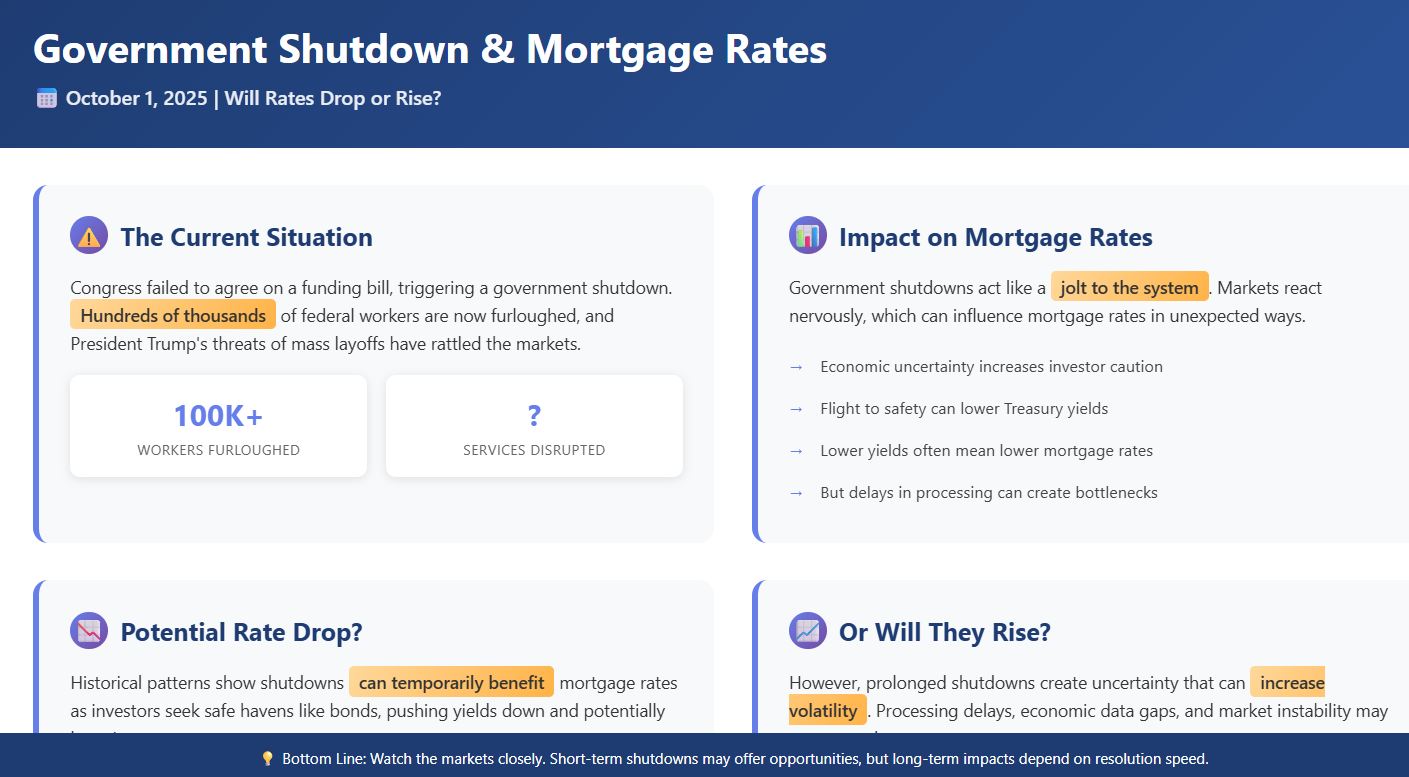
So, the U.S. government is shut down. What does that mean for your dream of buying a home or refinancing your current one? It's a question many are asking right now. The short answer, and it’s a bit of a mixed bag: government shutdowns can lead to a drop in mortgage rates, but they can also create frustrating delays in the homebuying process. This isn't some abstract economic theory; it's about how fear and uncertainty in Washington ripple down to affect real people's finances and biggest purchases.

Will Mortgage Rates Go Down After the US Government Shutdown?

As of October 1, 2025, we find ourselves in this situation because Congress couldn't agree on a funding bill. This impasse, coupled with President Trump’s bold threats of mass federal layoffs, has sent a nervous tremor through the markets. Hundreds of thousands of federal workers are now furloughed, and essential services are facing disruptions. For us on the ground, especially those of us looking at homes or thinking about our mortgages, understanding these shifts is crucial.

In my years following these economic tides, I’ve observed that these shutdowns often act like a jolt to the system. Sometimes, that jolt can be a small benefit for mortgage rates, and sometimes it's just a headache. Let's break down exactly why this happens and what it means for you.

Government Shutdown Affect Mortgage Rates

What Triggered the 2025 Shutdown and Why Should We Care?

Think of a government shutdown like a pause button being hit on non-essential government operations. It happens when the people in charge of spending the country's money – Congress and the President – can't agree on how much money to give to different departments for the upcoming year. This time around, the disagreements seem particularly tough, involving spending levels and even things like health insurance costs for federal employees.

What makes this shutdown different and potentially more concerning is President Trump's talk of preparing “reduction in force” (RIF) notices. This isn't just about a temporary “see you next week” furlough; it sounds like they're gearing up for permanent job cuts. We’re talking about potentially hundreds of thousands of federal workers being directly affected, and that doesn't even count the ripple effect on the private companies that do work for the government.

From an economic standpoint, these shutdowns aren't ideal. When parts of the government aren't operating, certain economic activities slow down. Experts estimate that every week the government is shut down, it can shave about 0.1% to 0.2% off our nation’s overall economic growth (our Gross Domestic Product, or GDP). Now, if it's a short shutdown, like a week or two, the economy usually bounces back pretty quickly. But longer ones, like the marathon shutdown that lasted over a month back in 2018-2019, can really start to weigh on everyone’s confidence and slow things down.

And here’s a weird twist for 2025: the shutdown means we won't be getting some key economic reports, like the all-important jobs report that usually comes out in early October. When the Federal Reserve – the folks who set interest rates – are trying to figure out how strong or weak the economy is, these reports are like their eyes and ears. Without them, they’re basically flying blind, which adds another layer of uncertainty to their decisions about interest rates.

A Look Back: How Have Shutdowns Hit Mortgage Rates Before?

This isn't the first time we’ve seen a government shutdown, and looking at history often gives us clues about what might happen. The interesting thing is that government shutdowns can actually lower mortgage rates, at least for a while.

Here’s how it usually works: When there's political or economic uncertainty, investors tend to get nervous. They want to put their money somewhere safe. A lot of times, they’ll rush to buy U.S. Treasury bonds, which are considered one of the safest investments out there. When more people buy bonds, the price of those bonds goes up, and their yield (which is like the return an investor gets) goes down.

Mortgage rates are closely tied to the yields on these Treasury bonds, especially the 10-year Treasury note. So, when bond yields drop, mortgage lenders often follow suit, lowering their rates. It’s a bit of a strange phenomenon: bad news in Washington can sometimes be good news for people looking to borrow money for a house.

Let’s look at some past examples:

Shutdown Period Duration Approximate 30-Year Fixed Rate Change Key Observations
October 2013 16 days Drop of about 0.20% Mortgage applications dipped due to processing worries, but bond yields fell significantly.
December 2018 – Jan 2019 35 days Initial drop of about 0.25% The longest shutdown. Saw a temporary dip in rates, but they started to stabilize as the shutdown dragged on. Home sales also took a hit.
Overall Average (Past) Varies Drop of ~0.125% to 0.25% Generally, bond yields would soften by about 0.60% during periods of shutdown-induced uncertainty.

We can visualize this (imagine a graph here): Typically, right when a shutdown begins, mortgage rates might dip a bit, shown by a downward tick. But if the shutdown drags on, the effect might lessen, and rates could steady out or even creep back up depending on other economic news.

It's not always a slam dunk for lower rates, though. Some experts point out that if there isn't other bad economic news to go along with the shutdown (like a really weak jobs report), the drop in rates might be smaller. And in 2025, with the jobs report delayed, the market might not get the signal it expects about economic weakness, potentially limiting how much rates can fall.

The “How-To”: Why Shutdowns Affect Rates and Processing

So, we know rates might drop. But what else happens? It’s a bit like a coin with two sides.

  • The Good Side (Potentially Lower Rates): As I mentioned, the uncertainty often drives investors to the safety of Treasury bonds. This push down on bond yields is a direct signal for mortgage lenders to adjust their pricing. This is likely why, as of today, October 1, 2025, we're already seeing 30-year fixed rates tick down to around 6.125%, according to reports from sources like NerdWallet. This can be a welcome relief for borrowers, especially in a market that’s been sensitive to rate fluctuations.
  • The Not-So-Good Side (Processing Headaches): This is where things get tricky for many hopeful homebuyers. Not all loans are created equal when the government is operating on a skeleton crew.
    • Government-Backed Loans: Loans like FHA, VA, and USDA loans are directly tied to government agencies. While FHA loans are seeing some continuity with emergency staffing, the VA (for veterans) and USDA (for rural development) are pausing new commitments. This means if you were counting on one of these loans, you might face significant delays.
    • Conventional Loans: These are loans from private banks and lenders, like those backed by Fannie Mae and Freddie Mac. They are generally less affected. However, they still sometimes need verifications from government agencies, like checking your tax records with the IRS or verifying your Social Security information. These small delays can add up.
    • Flood Insurance: This is a big one for people buying homes in flood-prone areas. During a shutdown, the National Flood Insurance Program (NFIP) stops issuing new policies. Since most mortgages require flood insurance in designated zones, this can bring a home sale to a complete halt. Reports suggest this can affect about 10–15% of mortgages in areas like Florida.
  • The Bigger Housing Picture: The housing market has already been dealing with its own set of challenges, like limited housing inventory. Adding a government shutdown and loan processing delays on top of that can further slow down sales. And if those mass layoffs President Trump is talking about actually happen? That means fewer people have verifiable income, which makes it harder to get approved for a mortgage. It’s a cascade of potential slowdowns.

My feeling is that while the headline might be about potentially lower rates, the operational disruptions are what people are really going to feel day-to-day. I’ve heard from people who work in the mortgage industry, and they’re already bracing for longer closing times and chasing down missing pieces of information. It adds stress when you're already dealing with one of the biggest financial decisions of your life.

What Does This All Mean for You? Advice and What Experts Are Saying

Let's cut through the noise and get to what you might want to do.

For Potential Homebuyers and Refinancers:

  • Lock it Down? If you’re seeing a drop in rates and you’re ready to move forward, consider locking in your rate. This protects you if rates were to unexpectedly rise again later.
  • Build in Extra Time: Be prepared for delays. While conventional loans might be less affected, government-backed loans and especially flood insurance issues can add weeks to your closing timeline. Talk to your lender about potential bottlenecks now.
  • Federal Employees: If you’re a federal worker, your income verification might be tricky. Document your furlough status carefully. While back pay is usually arranged after the fact, lenders need to see current, verifiable income.

For Those Concerned About the Economy:

  • Short Shutdowns are Usually Okay: Most analyses, like those from the Brookings Institution, suggest that brief shutdowns (under two weeks) have pretty minor impacts on the overall economy.
  • Longer Shutdowns = Bigger Risks: If this shutdown drags on, the economists are more worried. The GDP growth could be noticeably impacted, consumer spending might fall (especially if federal workers and contractors have less money to spend), and it makes the Fed's job of setting interest rates even harder without crucial data.
  • The Layoff Factor: The talk of mass layoffs is the wild card. It’s different from past situations and could have a more significant chilling effect on consumer confidence and spending than a simple furlough.

The Debate and Different Perspectives:

It’s important to remember that not everyone agrees on the impact. Some see shutdowns as fiscal responsibility in action, while others view them as harmful political stunts that hurt everyday workers. Economists at places like Al Jazeera often point out that historically, the market often shrugs off short-term shutdowns. However, the unique circumstances of 2025 – the layoff threats and the data blackout – mean we can't just assume history will repeat exactly.

In my opinion, the most important takeaway is to stay informed and be proactive. Don’t just assume the news headlines tell the whole story. Talk to your lender, understand the specific requirements for your loan type, and keep an eye on reliable financial news sources.


Related Topics on Current Mortgage Rates:

Mortgage Rates Predictions for the Next 6 Months: October 2025 to March 2026

Mortgage Rates Predictions for the Next 12 Months: Oct 2025 to Oct 2026

Mortgage Rates Predictions for Next 90 Days: October to December 2025

Looking Ahead: Potential Economic Ripples

To give you a clearer picture of what longer shutdowns could mean, here’s a general idea of the economic drag we might see, based on analyses from various economic think tanks:

Estimated Shutdown Duration How Much GDP Growth Could Slow Weekly Total Impact on Late 2025 Growth What This Might Mean for You
1 Week Around -0.1% Very Small Mortgage rates might dip slightly; minimal disruption for most.
2 to 4 Weeks Around -0.15% per week Noticeable Slowdown Processing delays become more common; slight dip in home sales.
More Than 4 Weeks Around -0.2% per week Significant Slowdown Layoffs could hit hard; consumer confidence drops; increased market jitters.

(This is a simplified representation, as actual economic effects depend on many factors.)

Imagine this visually: a series of bars, each getting taller as the shutdown gets longer, representing the negative impact on the economy. The longer the shutdown, the higher the bar, signifying greater economic pain.

The key is that while a short shutdown might offer a fleeting benefit of lower mortgage rates, a prolonged one poses significant risks to the broader economy, which can indirectly affect housing demand and affordability in the longer run.

Final Thoughts: Navigating the Uncertainty

So, will a government shutdown affect mortgage rates? Yes. Will they drop? Likely, at least in the short term, due to the “flight to safety” in the bond market. Will this be a smooth ride for everyone trying to buy a home? Probably not. The processing delays, especially for government-backed loans and flood insurance, are real and can cause significant frustration.

As someone who has followed these markets for a while, I've learned that political events often have unintended consequences. The hope is that Congress and the President can find a resolution quickly. Until then, my best advice is to be prepared, stay calm, and communicate closely with your lender. This shutdown might offer a temporary mortgage rate discount for some, but it also serves as a stark reminder of how interconnected our financial lives are with the decisions made in Washington.

Do You Want to Invest in Real Estate Without Any Stress?

Government shutdowns create uncertainty for markets—and mortgage rates can react quickly to the headlines. Whether rates dip or spike, having a clear investment plan matters.

Norada helps you navigate volatility by connecting you with turnkey, cash-flowing rental properties in resilient markets—so you can protect purchasing power and pursue steady income regardless of short-term rate moves.

🔥 HOT NEW LISTINGS JUST ADDED! 🔥

Talk to a Norada investment counselor today (No Obligation):

(800) 611-3060

Get Started Now

Also Read:

  • Will Mortgage Rates Go Down in 2025: Morgan Stanley's Forecast
  • Mortgage Rate Predictions 2025 from 4 Leading Housing Experts
  • Mortgage Rate Predictions for the Next 3 Years: 2026, 2027, 2028
  • 30-Year Fixed Mortgage Rate Forecast for the Next 5 Years
  • 15-Year Fixed Mortgage Rate Predictions for Next 5 Years: 2025-2029
  • Will Mortgage Rates Ever Be 3% Again in the Future?
  • Mortgage Rates Predictions for Next 2 Years
  • Mortgage Rate Predictions for Next 5 Years
  • Mortgage Rate Predictions: Why 2% and 3% Rates are Out of Reach
  • How Lower Mortgage Rates Can Save You Thousands?
  • How to Get a Low Mortgage Interest Rate?
  • Will Mortgage Rates Ever Be 4% Again?
Filed Under: Financing, Mortgage Tagged With: Interest Rate, mortgage, Mortgage Rate Trends, mortgage rates

Today’s Mortgage Rates – October 1, 2025: 30-Year FRM Goes Down by 6 Basis Points

October 1, 2025 by Marco Santarelli

Today's Mortgage Rates - October 1, 2025: 30-Year FRM Drops, 15-Year FRM Remains Stable

As of October 1, 2025, mortgage rates today reveal a slight decline in the average 30-year fixed mortgage rate, now at 6.53%, down from 6.56% the day before, and 6.59% from the previous week, signaling a very gradual easing in borrowing costs. Meanwhile, refinance rates for the same loan term have also dipped slightly to 7.02%, a modest decrease from 7.06%. The 15-year fixed mortgage rates remain steady at 5.69%, but refinance rates for 15-year loans actually climbed to 5.98%. These subtle shifts are important for homebuyers and refinancers weighing their options as economic influences shape the housing finance market.

Today's Mortgage Rates – October 1, 2025: 30-Year FRM Goes Down by 6 Basis Points

Key Takeaways

  • 30-year fixed mortgage rate dropped to 6.53% on October 1, 2025, a 6 basis point decrease from the prior week.
  • 30-year fixed refinance rate also decreased slightly to 7.02%.
  • 15-year fixed mortgage rates hold steady at 5.69%, but 15-year refinance rates increased to 5.98%.
  • Adjustable-rate mortgages (ARMs) show mixed trends, with the 5-year ARM refinance rate rising to 7.41%.
  • Fed’s recent rate cut in September 2025 and ongoing inflation concerns influence mortgage rate fluctuations.
  • Forecasts suggest a potential slow decline in rates into 2026, pending inflation trends and economic data.

Current Mortgage and Refinance Rate Overview

To give you the clearest picture, here is a detailed table from Zillow as of October 1, 2025, outlining the average mortgage and refinance rates for the most common loan types:

Loan Type Mortgage Rate Weekly Change APR APR Weekly Change Refinance Rate Refinance Weekly Change
30-Year Fixed 6.53% -0.06% 7.09% +0.04% 7.02% -0.04%
20-Year Fixed 6.43% +0.07% 6.94% +0.30% N/A N/A
15-Year Fixed 5.69% -0.07% 6.07% 0.00% 5.98% +0.19%
10-Year Fixed 5.84% 0.00% 6.23% 0.00% N/A N/A
7-Year ARM 7.28% 0.00% 7.72% -0.01% N/A N/A
5-Year ARM 7.05% -0.08% 7.85% +0.04% 7.41% +0.25%
30-Year Fixed FHA 5.71% -0.09% 6.72% -0.09% N/A N/A
30-Year Fixed VA 6.08% +0.02% 6.27% +0.05% N/A N/A
15-Year Fixed FHA 5.14% -0.18% 6.11% -0.18% N/A N/A
15-Year Fixed VA 5.81% -0.05% 6.14% +0.02% N/A N/A

(Source: Zillow, Legal Disclosures)

The 30-year fixed mortgage remains the most popular product due to its balance of long-term stability and manageable monthly payments, while ARMs attract borrowers expecting to move or refinance before the adjustable period kicks in.

What Do These Small Changes Mean?

The drop of 3 basis points (0.03%) in the 30-year fixed mortgage rate may look minimal but signals a tentative easing in what has been an uphill battle for home affordability. Refinancing rates dipping slightly means some existing homeowners might find it worthwhile to explore new loans to reduce their monthly payment burden or shorten their loan term.

On the other hand, the 15-year refinance rate climbing nearly 20 basis points indicates lenders could be pricing risk differently for shorter-term refinances, possibly due to economic uncertainty or the demand for these loans fluctuating.

Adjustable-rate mortgages' mixed movement, especially the 5-year ARM refinance rate rising 25 basis points, reflects market concerns about future interest rate volatility or borrower profile changes.

Rate Trends and the Federal Reserve’s Influence

The September 2025 Fed Rate Cut

On September 17, 2025, the Federal Reserve reduced its key benchmark rate by 0.25%, adjusting the target range to 4.0%-4.25%. This was their first cut after a pause, aiming to further stimulate borrowing as inflation remains persistent, with the core PCE price index ticking up 2.9% year-over-year, above the 2% goal.

Though mortgage rates don’t directly move with Fed rates, the Fed’s decisions influence the direction of the 10-year U.S. Treasury yield, which mortgage lenders use as a baseline. Currently, the 10-year Treasury yield sits at about 4.176%. Mortgage rates typically exceed Treasury yields by 1 to 2 percentage points due to additional investment risk and lender costs.

Why Mortgage Rates Remain Elevated Despite the Fed Cut

Even though Treasury yields lowered after the Fed’s action, the spread between Treasuries and mortgages has widened over 2 percentage points, which keeps mortgage rates from falling sharply. Factors like market volatility, inflation risks, and investor uncertainty keep this spread sticky.

The Forecast: What Experts Say About Mortgage Rates Moving Forward

Several respected organizations have laid out their predictions for mortgage rates in late 2025 and into 2026:

Organization Mortgage Rate Forecast (30-Year Fixed) Notes
National Association of REALTORS® 6.4% in H2 2025, dipping to 6.1% in 2026 Rates are a “magic bullet” affecting buyer affordability and demand
Realtor.com Easing to 6.4% by year-end 2025 rates similar to 2024 average
Fannie Mae 6.4% end of 2025, 5.9% for 2026 Refinances to rise from 26% to 35% of originations
Mortgage Bankers Association 6.7% end of 2025, 6.5% end of 2026 Elevated spread keeps refinancing opportunities limited

This consensus points to a gentle easing trend but not a dramatic drop, given inflation still runs above target and economic growth remains strong.

Practical Examples: How Rate Fluctuations Affect Borrowers

To illustrate, let's consider the monthly payment impact of the current 30-year fixed mortgage rate changes on a $300,000 loan:

Interest Rate Monthly Principal & Interest Payment Difference from 6.59% Rate
6.59% $1,917 Baseline
6.53% $1,904 – $13
7.02% (Refinance Rate) $2,003 + $86 (vs 6.59% mortgage)

While $13 less per month may seem small, it adds up to hundreds annually, helping those who can’t comfortably exceed their budget. However, refinancing at 7.02% can raise monthly costs compared to the current mortgage rate, which highlights the importance of timing and loan terms.


Related Topics:

Mortgage Rates Trends as of September 30, 2025

Mortgage Rates Predictions Next 90 Days: August to October 2025

Mortgage Rates Predictions for the Next 60 Days

The Role of Inflation and Economic Growth

The interplay between inflation stubbornness and strong GDP growth complicates expectations for mortgage rates. Inflation above the Fed’s 2% target encourages tighter monetary policy, which keeps yields and mortgage rates elevated. However, healthy economic growth supports demand for housing, which could pressure mortgage costs upward.

Adjustable-Rate Mortgages: A Closer Look

With a 5-year ARM mortgage rate at 7.05% for purchase and a refinance rate of 7.41%, borrowers contemplating ARMs should weigh the benefits of initial lower payments against the risk of rate adjustments after the fixed period.

Given the current economic signals, some borrowers may prefer the certainty of fixed rates, especially with inflation's uncertain path. However, for those confident in relocating or refinancing within a few years, ARMs might remain an option worth exploring.

Government-Backed Loans: FHA and VA Rate Insights

Government loans continue to offer slightly different pricing:

  • FHA 30-year fixed mortgage rate at 5.71% (down slightly)
  • VA 30-year fixed rate at 6.08% (up marginally)

These loans generally offer more accessible credit requirements, making the slightly lower or stable rates particularly valuable for eligible buyers.

Why Inventory and Buyer Demand Matter Today

The slight easing of mortgage rates could encourage some homeowners to list their properties, especially those stuck with higher-rate mortgages eager to move while offering attractive financing deals. However, limited housing inventory remains a challenge in many markets, which along with steady demand, continues to support home prices.

Capitalize Amid Rising Mortgage Rates

With mortgage rates expected to remain high in 2025, it’s more important than ever to focus on strategic real estate investments that offer stability and passive income.

Norada delivers turnkey rental properties in resilient markets—helping you build steady cash flow and protect your wealth from borrowing cost volatility.

HOT NEW LISTINGS JUST ADDED!

Speak with a seasoned Norada investment counselor today (No Obligation):

(800) 611‑3060

Get Started Now

Also Read:

  • Will Mortgage Rates Go Down in 2025: Morgan Stanley's Forecast
  • Mortgage Rate Predictions 2025 from 4 Leading Housing Experts
  • Mortgage Rate Predictions for the Next 3 Years: 2026, 2027, 2028
  • 30-Year Fixed Mortgage Rate Forecast for the Next 5 Years
  • 15-Year Fixed Mortgage Rate Predictions for Next 5 Years: 2025-2029
  • Will Mortgage Rates Ever Be 3% Again in the Future?
  • Mortgage Rates Predictions for Next 2 Years
  • Mortgage Rate Predictions for Next 5 Years
  • Mortgage Rate Predictions: Why 2% and 3% Rates are Out of Reach
  • How Lower Mortgage Rates Can Save You Thousands?
  • How to Get a Low Mortgage Interest Rate?
  • Will Mortgage Rates Ever Be 4% Again?

Filed Under: Financing, Mortgage Tagged With: Interest Rate, mortgage, Mortgage Rate Trends, mortgage rates, Mortgage Rates Today

Today’s Mortgage Rates September 30, 2025: 30-Year FRM Slightly Higher, Refinance Rates Jump

September 30, 2025 by Marco Santarelli

Today's Mortgage Rates September 30, 2025: 30-Year FRM Slightly Higher, Refinance Rates Jump

As of September 30, 2025, mortgage rates have slightly increased for 30-year fixed loans but show mixed trends across other loan types. The average 30-year fixed mortgage rate rose by 3 basis points to 6.62%, while the 15-year fixed rate marginally decreased by 1 basis point to 5.74%. Meanwhile, refinance rates, particularly the 30-year fixed refinance rate, have jumped significantly to 7.65%, an increase of 64 basis points from the previous week (Zillow, 2025). This nuanced shift in mortgage and refinance rates signifies ongoing market adjustments amid Federal Reserve interest rate changes and economic factors influencing lending costs.

Today's Mortgage Rates September 30, 2025: 30-Year FRM Slightly Higher, Refinance Rates Jump

Key Takeaways

  • 30-year fixed mortgage rate is 6.62%, up slightly by 3 basis points from last week.
  • 15-year fixed mortgage rate declined marginally to 5.74%.
  • 5-year ARM mortgage rate increased notably to 7.31%.
  • 30-year fixed refinance rate surged to 7.65%, up 64 basis points.
  • Federal Reserve’s recent rate cut indirectly influences mortgage rates but spreads remain wide, keeping mortgage rates elevated.
  • Mortgage rates expected to average around 6.4% in late 2025 and potentially decline in 2026 according to industry forecasts.

Understanding Mortgage Rates Today: Breakdown by Loan Type

Mortgage rates vary depending on the type and term of the loan. As of today, here is the situation for key loan categories based on data from Zillow:

Loan Type Current Rate Weekly Change APR APR Weekly Change
Conforming Loans
30-Year Fixed Rate 6.62% +0.03% 7.23% +0.18%
20-Year Fixed Rate 6.31% -0.05% 6.58% -0.06%
15-Year Fixed Rate 5.74% -0.01% 6.15% +0.08%
10-Year Fixed Rate 5.84% 0.00% 6.23% 0.00%
7-Year ARM 7.28% 0.00% 7.72% -0.01%
5-Year ARM 7.31% +0.17% 8.04% +0.24%
Loan Type Current Rate Weekly Change APR APR Weekly Change
Government Loans
30-Year Fixed FHA 5.71% -0.09% 6.72% -0.09%
30-Year Fixed VA 5.93% -0.13% 6.14% -0.07%
15-Year Fixed FHA 5.36% +0.04% 6.32% +0.04%
15-Year Fixed VA 5.58% -0.28% 5.93% -0.19%

Source: Zillow, September 30, 2025

Refinance Rate Changes as of September 30, 2025

Refinancing remains an important option for homeowners looking to lower monthly payments or alter loan terms. Current refinance rates show more pronounced increases, particularly for the 30-year fixed refinance loans:

Refinance Loan Type Current Rate Weekly Change
30-Year Fixed Refinance 7.65% +0.64%
15-Year Fixed Refinance 6.42% +0.56%
5-Year ARM Refinance 7.26% No Change

This sizable increase in refinance rates reflects market volatility and wider mortgage-Treasury spreads that have grown post Federal Reserve rate cut.

How Federal Reserve Rate Cuts Affect Mortgage Rates in 2025

On September 17, 2025, the Federal Reserve lowered its benchmark interest rate by 0.25%, from a 4.25%-4.5% range to 4%-4.25%. While this move aims to reduce borrowing costs, mortgage rates do not always fall immediately or proportionately. This is mainly because mortgage rates are tied indirectly to the 10-year U.S. Treasury yield and the prevailing “spread” between mortgage-backed securities and Treasuries.

  • The 10-year Treasury yield was around 4.176% on September 26, 2025.
  • Mortgage rates typically run 1 to 2 percentage points above this yield to cover risk.
  • Currently, this spread has widened beyond 2 points, which limits how much lower mortgage rates can fall despite the Fed's rate cut.

This explains why we've seen a modest rise in some mortgage rates and a sharp increase in refinance rates instead of sharp declines. The market is pricing in ongoing risks such as inflation pressures and economic uncertainty, which keeps mortgage costs high relative to general Treasury yields.

Mortgage Rate Trends and Forecasts

Several key organizations have provided forecasts on where rates might head next:

  • The National Association of REALTORS® expects mortgage rates to average 6.4% in the latter half of 2025 and possibly dip to 6.1% by 2026.
  • Fannie Mae forecasts a similar trend with 6.4% by the end of 2025 and a decline to 5.9% in 2026. They also predict refinance activity will rise from 26% in 2025 to 35% in 2026 due to predicted lower rates.
  • The Mortgage Bankers Association projects a 30-year mortgage rate of 6.7% by the end of 2025, falling slightly to 6.5% in 2026.

These outlooks suggest a cautious expectation of gradual rate reductions, supported by continued Federal Reserve policy easing and potential inflation easing, but tempered by ongoing market volatility.

Example Illustration: Mortgage Payment Calculation at Today's Rates

Suppose you are buying a home priced at $350,000 with a 20% down payment ($70,000), financing $280,000 with a 30-year fixed mortgage at today's rate of 6.62%.

  • Loan Amount: $280,000
  • Interest Rate: 6.62% annually
  • Term: 30 years (360 months)

The estimated monthly principal and interest payment would be approximately $1,794. So, the monthly mortgage payment would be about $1,794 excluding taxes and insurance.

If rates decrease to 6.1% as projected in 2026, the payment on the same loan would drop to around $1,698, saving nearly $100 monthly.

Impact on Homebuyers and Refinancers

The slight increase in 30-year fixed mortgage rates means that buyers today face slightly higher borrowing costs, which can affect affordability, especially in markets already tight on inventory. On the other hand, the Federal Reserve's rate easing signals some relief may be on the horizon.

Refinancers face a more complex picture. While current refinance rates have jumped substantially, those with higher existing rates above 6.5% still have potential to save by refinancing if rates stabilize or fall in coming months, as forecasted by industry experts.

Mortgage Rate Differences by Loan Type

A few interesting observations from today's data:

  • Government-backed loans (FHA, VA) continue to offer substantially lower rates compared to conforming loans, making them attractive options for eligible borrowers.
  • Adjustable-rate mortgages (ARMs) such as the 5-year ARM have seen a notable increase, now above 7%, which may deter some borrowers from choosing adjustable terms unless they plan to sell or refinance before adjustment periods.
  • Shorter-term fixed loans like 15-year rates remain significantly lower than 30-year rates, highlighting a trade-off between a faster path to homeownership and affordability.


Related Topics:

Mortgage Rates Trends as of September 29, 2025

Mortgage Rates Predictions Next 90 Days: August to October 2025

Mortgage Rates Predictions for the Next 60 Days

The Role of Inflation and Economic Growth

Inflation remains a key concern, with the core Personal Consumption Expenditures (PCE) price index holding at 2.9% year-over-year in August 2025 — above the Fed's 2% target. Meanwhile, real GDP growth was a robust 3.8% annualized in Q2 2025.

This combination means the Federal Reserve is balancing between encouraging economic growth and containing inflation. This delicate mix has caused volatility in mortgage rates, Treasury yields, and related financial markets.

Summary of Mortgage and Refinance Rates as of September 30, 2025

Category Rate Movement Notes
30-Year Fixed Mortgage 6.62% Up 3 bps Slight weekly increase
15-Year Fixed Mortgage 5.74% Down 1 bps Slight weekly decrease
5-Year ARM Mortgage 7.31% Up 16 bps Largest increase among mortgages
30-Year Fixed Refinance 7.65% Up 64 bps Significant jump weekly
15-Year Fixed Refinance 6.42% Up 56 bps Notable increase

The mortgage market today reflects a complex environment influenced by economic indicators, monetary policy, and market sentiment. While rate movements are sometimes subtle on a weekly basis, the trends give insight into lender pricing strategies and what borrowers might expect in the near term. The Federal Reserve's actions and inflation data will continue to shape mortgage dynamics through the end of 2025 and beyond.

Capitalize Amid Rising Mortgage Rates

With mortgage rates expected to remain high in 2025, it’s more important than ever to focus on strategic real estate investments that offer stability and passive income.

Norada delivers turnkey rental properties in resilient markets—helping you build steady cash flow and protect your wealth from borrowing cost volatility.

HOT NEW LISTINGS JUST ADDED!

Speak with a seasoned Norada investment counselor today (No Obligation):

(800) 611‑3060

Get Started Now

Also Read:

  • Will Mortgage Rates Go Down in 2025: Morgan Stanley's Forecast
  • Mortgage Rate Predictions 2025 from 4 Leading Housing Experts
  • Mortgage Rate Predictions for the Next 3 Years: 2026, 2027, 2028
  • 30-Year Fixed Mortgage Rate Forecast for the Next 5 Years
  • 15-Year Fixed Mortgage Rate Predictions for Next 5 Years: 2025-2029
  • Will Mortgage Rates Ever Be 3% Again in the Future?
  • Mortgage Rates Predictions for Next 2 Years
  • Mortgage Rate Predictions for Next 5 Years
  • Mortgage Rate Predictions: Why 2% and 3% Rates are Out of Reach
  • How Lower Mortgage Rates Can Save You Thousands?
  • How to Get a Low Mortgage Interest Rate?
  • Will Mortgage Rates Ever Be 4% Again?

Filed Under: Financing, Mortgage Tagged With: Interest Rate, mortgage, Mortgage Rate Trends, mortgage rates, Mortgage Rates Today

  • « Previous Page
  • 1
  • …
  • 14
  • 15
  • 16
  • 17
  • 18
  • …
  • 84
  • Next Page »

Real Estate

  • Birmingham
  • Cape Coral
  • Charlotte
  • Chicago

Quick Links

  • Markets
  • Membership
  • Notes
  • Contact Us

Blog Posts

  • Today’s Mortgage Rates, May 5: Inflation Pushes 30‑Year FRM to One‑Month High
    May 5, 2026Marco Santarelli
  • When Will Mortgage Rates Go Down to 4%?
    May 5, 2026Marco Santarelli
  • Mortgage Rates Today, May 5, 2026: 30-Year Refinance Rate Rises by 7 Basis Points
    May 5, 2026Marco Santarelli

Contact

Norada Real Estate Investments 30251 Golden Lantern, Suite E-261 Laguna Niguel, CA 92677

(949) 218-6668
(800) 611-3060
BBB
  • Terms of Use
  • |
  • Privacy Policy
  • |
  • Testimonials
  • |
  • Suggestions?
  • |
  • Home

Copyright 2018 Norada Real Estate Investments

Loading...