Norada Real Estate Investments

  • Home
  • Markets
  • Properties
  • Membership
  • Podcast
  • Learn
  • About
  • Contact

30-Year Fixed Mortgage Rate Drops to 6.03% Making it a Good Time for Buyers

December 21, 2025 by Marco Santarelli

30-Year Fixed Mortgage Rate Drops to 6.03% Making it a Good Time for Buyers

If you're dreaming of owning a home, or perhaps looking to refinance your current one, you'll want to pay attention to this: the 30-year fixed mortgage rate has dipped to a promising 6.03%. This isn't just a number; it's a signal that could make the idea of homeownership, or securing a better deal on your existing mortgage, much more achievable right now.

30-Year Fixed Mortgage Rate Drops to 6.03% Making it a Good Time for Buyers

As of December 21, 2025, according to Zillow's latest data, mortgage rates are not making huge jumps up or down, which actually creates a pretty stable environment for buyers and those looking to refinance. This general stability, especially with the key 30-year fixed rate settling at 6.03%, means that many folks who were on the fence might find this a really opportune time to act.

For months, we’ve been watching these rates. They’ve been influenced by a lot of things going on in the wider economy – like how the 10-year Treasury yield is doing, what people think inflation will do, and how strong our economy is overall. Even though the Federal Reserve recently made a move to cut its short-term rate, its message about a possible pause created some mixed signals for the mortgage market. But one thing is clear: rates are holding steady enough to be attractive.

Why the 6.03% 30-Year Fixed Mortgage Rate Matters for You

Think about it. When mortgage rates are higher, every dollar you borrow costs you more in interest over the life of your loan. A lower rate, like this 6.03% for a 30-year fixed mortgage, directly translates to more affordable monthly payments. This affordability can be the difference between being able to buy the home you want, or needing to settle for something less, or even putting off your buying plans altogether.

This current rate is a noticeable drop from what we saw in previous years. This improvement has already led to a 10% increase in purchase applications, as reported by Zillow. People are responding to this more favorable environment.

On the flip side, this lower rate environment has also created a bit of a housing market puzzle. Many homeowners who locked in really low rates (think under 4%) are understandably hesitant to sell. Why would they trade a super cheap mortgage for a new one at a higher rate? This reluctance is contributing to a shortage of homes for sale, which, in turn, is keeping home prices higher than some might expect. It’s a bit of a double-edged sword for the market, but for a buyer today, the lower rate is a definite plus.

Understanding Your Mortgage Options: A Quick Look

When you're thinking about a mortgage, you'll hear about different loan terms. The two big ones are the 30-year fixed and the 15-year fixed. I've helped countless people navigate these choices, and understanding the core differences is key to making the right decision for your financial life.

Here’s a simple breakdown:

Feature 30-Year Fixed 15-Year Fixed
Loan Term 30 years 15 years
Monthly Payment Lower (spread out over a longer time) Higher (shorter repayment window)
Interest Rate Typically a little higher Typically lower
Total Interest Much higher over the life of the loan Much lower over the life of the loan
Equity Build-Up Slower Faster
Affordability Easier for managing monthly cash flow, more budget-friendly Requires stronger income or strict budget discipline
Best For Buyers needing lower payments, more financial flexibility Buyers focused on long-term savings, quick debt payoff

Why a 30-Year Fixed Might Be Your Best Bet Right Now

From my experience, the 30-year fixed mortgage remains the most popular choice for a reason. At 6.03%, it offers incredible advantages:

  • Lower Monthly Payments: This is the big one. A lower monthly payment makes affording a home much more realistic, especially for first-time buyers or those who want to keep more cash on hand for other expenses or investments.
  • Financial Flexibility: Having that lower payment frees you up financially. You might have more room to save for retirement, pay down other debts, invest, or handle unexpected costs.
  • Accessibility: For many, the lower barrier to entry in terms of monthly cost makes homeownership attainable when higher payments just wouldn't work with their budget.

A Word on the 15-Year Fixed

Honestly, the 15-year fixed mortgage, currently at 5.42%, is a fantastic option if your financial situation allows. You'll pay significantly less in total interest over the life of the loan and build equity a lot faster. This is great if your goal is to be mortgage-free as soon as possible and you can comfortably manage the higher monthly payments. However, for a lot of people, the jump in monthly cost from a 30-year to a 15-year can be too much, even with the lower interest rate.

Navigating the Risks and Trade-Offs

It's always wise to look at both sides of the coin.

  • With a 30-Year Fixed: The main drawback is that you'll end up paying more in total interest over the 30 years. Also, because you're spreading your payments out, your home equity will build up at a slower pace.
  • With a 15-Year Fixed: The higher monthly payments, while good for savings long-term, can put a strain on your budget in the short term. This might limit your flexibility for other important financial goals or needs.

The Rate Environment and What Experts Are Saying

While the 30-year fixed mortgage rate at 6.03% is certainly encouraging, it's important to know that this stability isn't expected to last forever in the super-low 5% range. Most experts, including those at Zillow, anticipate that rates will likely stay above 6% for the foreseeable future. They’re predicting moderation around 6.25% to 6.50% as we move into early 2026.

This forecast suggests that while we might see small dips and rises, the extremely low rates of the past are unlikely to return soon. This makes the current moment a potentially significant window for buyers.

My Take: If You're Ready, Now Is a Great Time to Explore

As someone who's seen the housing market through various cycles, I can tell you that a 6.03% 30-year fixed mortgage rate is a compelling offer. It strikes a good balance between affordability and long-term stability.

Remember, these national averages are just that – averages. Your actual rate will depend on your credit score, the type of loan, the lender, and even your location. So, my strongest advice is always this: shop around. Talk to at least three different lenders. Compare their Good Faith Estimates. Don't just look at the advertised rate; look at the Annual Percentage Rate (APR), which includes fees, and understand all the terms.

If you've been waiting for the stars to align for homeownership, or for a more favorable refinancing option, the current mortgage rate environment is definitely worth your serious consideration. The market is offering a solid opportunity, and acting thoughtfully now could put you in a much better financial position for years to come.

🏡 Which Rental Property Would YOU Invest In?

Birmingham, AL
🏠 Property: 7th Ave S
🛏️ Beds/Baths: 3 Bed • 2 Bath • 1150 sqft
💰 Price: $155,000 | Rent: $1,210
📊 Cap Rate: 7.4% | NOI: $953
📅 Year Built: 1947
📐 Price/Sq Ft: $135
🏙️ Neighborhood: C+

VS

Saint Louis, MO
🏠 Property: Elbring Dr
🛏️ Beds/Baths: 3 Bed • 1 Bath • 864 sqft
💰 Price: $135,000 | Rent: $1,300
📊 Cap Rate: 9.1% | NOI: $1,022
📅 Year Built: 1959
📐 Price/Sq Ft: $157
🏙️ Neighborhood: B+

Two affordable rentals with solid returns: Birmingham’s steady performer vs St. Louis’s higher cap rate. Which fits YOUR investment strategy?

📈 Choose Your Winner & Contact Us Today!

Talk to a Norada investment counselor (No Obligation):

(800) 611-3060

Contact Us Now 

Invest in Fully Managed Rentals for Smarter Wealth Building

With mortgage rates dipping to their lowest levels in months, savvy investors are seizing the opportunity to lock in financing.

By securing favorable terms now, you can also maximize immediate cash flow while positioning yourself for stronger long‑term returns.

Norada Real Estate helps you seize this rare opportunity with turnkey rental properties in strong markets—so you can build passive income while borrowing costs remain historically low.

🔥 HOT NEW LISTINGS JUST ADDED! 🔥

Talk to a Norada investment counselor today (No Obligation):

(800) 611-3060

Get Started Now

Also Read:

  • Mortgage Rates Predictions Backed by 7 Leading Experts: 2025–2026
  • Mortgage Rate Predictions for the Next 3 Years: 2026, 2027, 2028
  • 30-Year Fixed Mortgage Rate Forecast for the Next 5 Years
  • 15-Year Fixed Mortgage Rate Predictions for Next 5 Years: 2025-2029
  • Will Mortgage Rates Ever Be 3% Again in the Future?
  • Mortgage Rates Predictions for Next 2 Years
  • Mortgage Rate Predictions for Next 5 Years
  • Mortgage Rate Predictions: Why 2% and 3% Rates are Out of Reach
  • How Lower Mortgage Rates Can Save You Thousands?
  • How to Get a Low Mortgage Interest Rate?
  • Will Mortgage Rates Ever Be 4% Again?

Filed Under: Financing, Mortgage Tagged With: Interest Rate, mortgage, Mortgage Rate Trends, mortgage rates, Mortgage Rates Today

Today’s Mortgage Rates, Dec 20: Steady Rates Signal Strong Buying and Refinance Demand

December 20, 2025 by Marco Santarelli

Today's Mortgage Rates, Jan 7: Stable Rates Continue for Buyers and Refinancers

As of December 20th, 2025, today's mortgage rates are holding steady, with the average 30-year fixed mortgage rate at 6.03% and the 15-year fixed rate at 5.42%, according to Zillow. While these figures provide a snapshot of the market, understanding what they truly mean for your homeownership journey requires digging a little deeper. It's not just about the numbers; it's about how those numbers can either open doors or create hurdles for you when buying or refinancing.

Today’s Mortgage Rates, Dec 20: Steady Rates Signal Strong Buying and Refinance Demand

Current Mortgage Rates 

Here's a clean look at the rates Zillow reported for today, December 20th, 2025. These are average figures, meaning your actual rate might be a bit different based on your credit score, loan amount, and other factors.

Loan Type Interest Rate
30‑year fixed 6.03%
20‑year fixed 5.95%
15‑year fixed 5.42%
5/1 ARM 6.03%
7/1 ARM 6.18%
30‑year VA 5.46%
15‑year VA 5.05%
5/1 VA 5.16%

Remember, these are national averages, so always shop around with different lenders.

Current Mortgage Refinance Rates

If you're a current homeowner thinking about refinancing, the rates are slightly different. Refinancing can be a smart move to lower your monthly payments or shorten your loan term, but it's crucial to compare these rates to your current loan and the purchase rates.

Loan Type Interest Rate
30‑year fixed 6.17%
20‑year fixed 5.99%
15‑year fixed 5.63%
5/1 ARM 6.44%
7/1 ARM 6.36%
30‑year VA 5.63%
15‑year VA 5.31%
5/1 VA 5.44%

What Does This Mean for You, the Borrower?

Seeing these numbers is one thing, but understanding their impact is another. Let’s break down what these rates tell us and what you should be thinking about:

  • Stability is the Name of the Game: The fact that major rates are hovering around the 6% mark means things are relatively predictable right now. This stability can be good for planning, whether you're buying your first home or looking to buy a bigger one. Gone are the days of the super low rates, but we're also not seeing wild spikes.
  • Refinancing: Still Worth a Look?: While refinance rates are a hair higher than purchase rates (which is pretty common), they aren't drastically out of reach. If you secured a loan a few years ago when rates were higher, a refinance today could still save you money, especially if you plan to stay in your home a good while.
  • The Power of Comparison: This is my golden rule for anyone looking for a mortgage. Don't just go with the first lender you talk to. Different lenders have different offers, fees, and ways of assessing risk. Spending a little time comparing quotes can easily save you thousands. I've seen firsthand how borrowers who shop around end up with significantly better deals.
  • Fixed vs. Adjustable: Your Personal Choice: The big decision is often between a fixed-rate loan and an adjustable-rate mortgage (ARM). Fixed rates give you peace of mind knowing your payment won't change, ever. ARMs can offer a lower rate at first, but that rate can go up later, making your payments unpredictable. Your choice depends heavily on your financial situation and how long you plan to keep the home.

A Deeper Dive into Loan Types

Let's get into the specifics of the most common loan types so you can see which might be your best fit.

30-Year Fixed Mortgage: The Steadfast Choice

  • Rate Stability: This is the big draw. Your interest rate is locked in for the entire 30 years you have to pay back the loan. No surprises!
  • Monthly Payments: Because you're spreading the repayment over a long time, your monthly payments will be lower than with shorter loan terms. This makes it easier for many people to afford a home.
  • Best For: If you like predictable monthly bills, plan to stay in your home for many years, and want to keep your housing costs consistent, this is likely your best bet.
  • Trade-Off: You'll typically pay more in total interest over the life of the loan compared to a shorter-term mortgage, simply because you're borrowing for so long.

15-Year Fixed Mortgage: The Faster Track

  • Rate Stability: Just like the 30-year, your rate is locked in, but for half the time.
  • Monthly Payments: Be prepared for higher monthly payments. You're paying back the same amount of money in half the time, so each payment needs to be larger.
  • Best For: If you're looking to build equity in your home faster and want to save a significant amount on interest over the life of the loan, this is a powerful option. It's great if you have a stable income and can comfortably manage the higher payments.
  • Trade-Off: The higher monthly payments mean less flexibility in your budget. You need to be sure you can handle those larger payments consistently.

5/1 ARM (Adjustable-Rate Mortgage): The Short-Term Strategy

  • Rate Stability: This loan is fixed for the first five years. After that, the interest rate can change every year, usually based on market conditions.
  • Monthly Payments: During those initial five years, your payments are typically lower than a comparable fixed-rate loan. This can be a nice perk.
  • Best For: This loan is best for people who know they won't be in the house for a full 30 years. If you're planning to sell, move, or refinance within, say, five to seven years, an ARM can help you save money initially.
  • Trade-Off: The big risk comes after the fixed period. If interest rates go up, your monthly payments will increase, and they could become quite a bit higher than you're used to. It's a gamble if you're not prepared for market ups and downs.

Quick Snapshot: Comparing Your Options

Here’s a quick way to visualize the main differences:

Loan Type Initial Rate Payment Size Long-Term Cost (Interest) Best For
30‑Year Fixed Moderate Lower Higher interest overall Long-term stability, predictable budget
15‑Year Fixed Lower Higher Much less interest Faster payoff, significant interest savings
5/1 ARM Lowest (initial) Lowest (initial) Can rise sharply Short-term owners or those planning to refinance

In simple terms:

  • 30-year fixed: Focuses on keeping your monthly costs down and providing a steady payment for decades.
  • 15-year fixed: Aims for quicker debt freedom and substantial savings on interest, but demands higher monthly payments.
  • 5/1 ARM: Offers the lowest initial payments, ideal if you're a short-term resident or have a clear refinance plan, but comes with the uncertainty of future rate hikes.

Payment Breakdown: A $300,000 Loan Example

To really drive home the difference, let’s look at how a $300,000 loan would play out with these different rates and terms.

Loan Type Interest Rate Term (Years) Monthly Payment Total Interest Paid
30‑Year Fixed 6.03% 30 $1,805.62 $349,623.34
15‑Year Fixed 5.42% 15 $2,449.17 $139,850.56
5/1 ARM (initial rate) 6.03% 30 $1,805.62 $349,623.34 (initial estimate)

Key Takeaways: What the Numbers Truly Reveal

  • Monthly Budget Priority: If keeping your monthly payment as low as possible is your main goal, the 30-year fixed is your safest bet. That $1,806 payment offers a lot of breathing room.
  • Long-Term Savings Champion: If you want to be mortgage-free sooner and save boatloads on interest, the 15-year fixed is the way to go. It costs you about $644 more per month than the 30-year, but you save a staggering over $209,000 in interest! That’s a huge sum that could be used for other investments or life goals.
  • Short-Term Strategy with a Twist: The 5/1 ARM starts with the same attractive payment as the 30-year fixed. However, the key difference is what happens after year five. If rates climb, your $1,806 payment could jump significantly. This is only a good strategy if you have a solid plan to exit the loan before rate adjustments become painful.

The Bottom Line for December 20th

Today, December 20th, 2025, offers a mortgage market that’s relatively stable around the 6% mark for fixed-rate loans. Whether you're looking to buy or refinance, these numbers are a solid foundation for making informed decisions. My advice remains the same: always compare offers from multiple lenders. Even a quarter-point difference can add up to tens of thousands of dollars over the life of your loan. Your home is a massive investment, and securing the best possible mortgage rate is a critical step in making that investment work for you.

🏡 Which Rental Property Would YOU Invest In?

Birmingham, AL
🏠 Property: 7th Ave S
🛏️ Beds/Baths: 3 Bed • 2 Bath • 1150 sqft
💰 Price: $155,000 | Rent: $1,210
📊 Cap Rate: 7.4% | NOI: $953
📅 Year Built: 1947
📐 Price/Sq Ft: $135
🏙️ Neighborhood: C+

VS

Saint Louis, MO
🏠 Property: Elbring Dr
🛏️ Beds/Baths: 3 Bed • 1 Bath • 864 sqft
💰 Price: $135,000 | Rent: $1,300
📊 Cap Rate: 9.1% | NOI: $1,022
📅 Year Built: 1959
📐 Price/Sq Ft: $157
🏙️ Neighborhood: B+

Two affordable rentals with solid returns: Birmingham’s steady performer vs St. Louis’s higher cap rate. Which fits YOUR investment strategy?

📈 Choose Your Winner & Contact Us Today!

Talk to a Norada investment counselor (No Obligation):

(800) 611-3060

Contact Us Now 

Invest in Fully Managed Rentals for Smarter Wealth Building

With mortgage rates dipping to their lowest levels in months, savvy investors are seizing the opportunity to lock in financing.

By securing favorable terms now, you can also maximize immediate cash flow while positioning yourself for stronger long‑term returns.

Norada Real Estate helps you seize this rare opportunity with turnkey rental properties in strong markets—so you can build passive income while borrowing costs remain historically low.

🔥 HOT NEW LISTINGS JUST ADDED! 🔥

Talk to a Norada investment counselor today (No Obligation):

(800) 611-3060

Get Started Now

Also Read:

  • Mortgage Rates Predictions Backed by 7 Leading Experts: 2025–2026
  • Mortgage Rate Predictions for the Next 3 Years: 2026, 2027, 2028
  • 30-Year Fixed Mortgage Rate Forecast for the Next 5 Years
  • 15-Year Fixed Mortgage Rate Predictions for Next 5 Years: 2025-2029
  • Will Mortgage Rates Ever Be 3% Again in the Future?
  • Mortgage Rates Predictions for Next 2 Years
  • Mortgage Rate Predictions for Next 5 Years
  • Mortgage Rate Predictions: Why 2% and 3% Rates are Out of Reach
  • How Lower Mortgage Rates Can Save You Thousands?
  • How to Get a Low Mortgage Interest Rate?
  • Will Mortgage Rates Ever Be 4% Again?
Filed Under: Financing, Mortgage Tagged With: Interest Rate, mortgage, Mortgage Rate Trends, mortgage rates, Mortgage Rates Today

Mortgage Rates Predictions for Next 90 Days: January 2026 to March 2026

December 20, 2025 by Marco Santarelli

Mortgage Rates Predictions for Next 90 Days: January 2026 to March 2026

Get ready, because the next 90 days are shaping up to be a period of relative stability for mortgage rates, with the average 30-year fixed rate likely to hover around 6.2%. While no one can predict the future with perfect accuracy, the smart money is on a gentle cooling rather than a dramatic drop. This means potential buyers and refinancers can expect a housing market that's a bit more predictable than the wild ride of the past few years, though significant savings below the 6% mark are unlikely in this initial window.

Mortgage Rates Predictions for Next 90 Days: January 2026 to March 2026

The buzz around the housing market in early 2026 is one of careful optimism. After a 2025 where the Federal Reserve began to ease up on interest rate hikes, we're entering the quarter from January to March 2026 with a slightly different vibe. Mortgage rates, which had been a source of big ups and downs, are expected to settle into a more stable groove. I've spent a lot of time digging into what the experts are saying, and I have some thoughts on what this means for you.

A Quick Look Back: How We Got Here

To truly understand where we're going, it helps to remember where we've been. Remember those unbelievably low mortgage rates, the ones that dipped below 3% back in 2020 and 2021? They made buying a home feel like a dream for many. But then, the Federal Reserve started hiking rates aggressively to fight off rising inflation, and by late 2023, we were seeing rates climb over 9%! It was tough for anyone trying to buy a house or refinance.

By the middle of 2025, rates had thankfully leveled off a bit, settling in the 6.5% to 7% range. But the big news was the Federal Reserve's decision to start cutting rates. By December 2025, we saw a noticeable dip, bringing the 30-year fixed mortgage rate down to about 6.21%. This dip is a direct result of inflation cooling down from its peak. While job growth has remained strong, the overall economic picture is pointing towards a calmer period.

One thing that's still a factor, though, is the “lock-in effect.” Many homeowners who secured those super-low pandemic-era rates are hesitant to sell and buy again at higher rates. This means the number of homes for sale is still a bit limited, which has kept home prices from falling drastically. As we step into 2026, don't expect rates to suddenly snap back to those record lows. The cost structure of things has shifted, and demand from the large millennial generation for homes is still robust.

Peeking at January to March 2026: The Rate Forecast

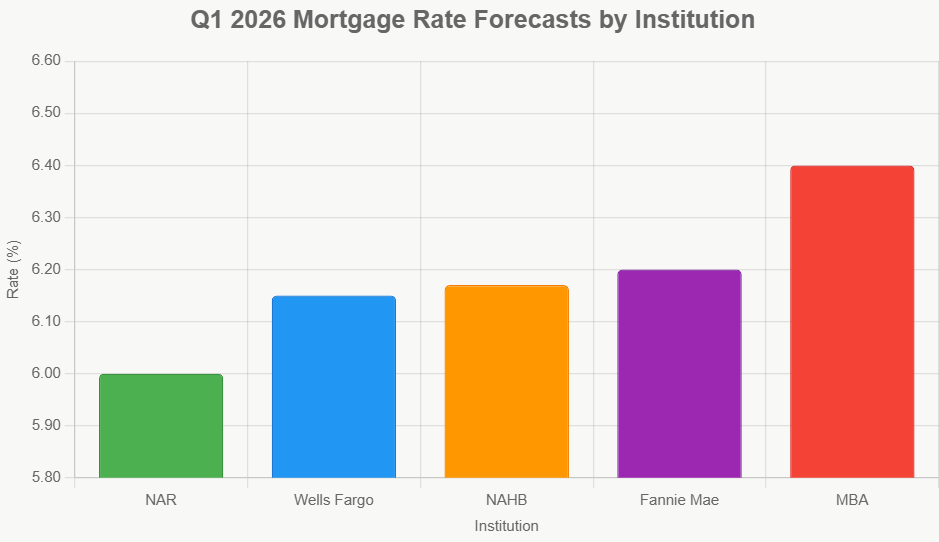
When I look at the predictions from various financial institutions, a clear theme emerges: the 30-year fixed mortgage rate should stay pretty steady, or even dip a tiny bit. Most sources are putting the average rate somewhere between 6.0% and 6.4%, with the sweet spot being around 6.2%.

Q1 2026 Mortgage Rate Forecasts by Institution

Here’s a breakdown of what some leading organizations are forecasting for the 30-year fixed mortgage rate in Q1 2026:

Institution Q1 2026 Forecast Key Rationale for Forecast Potential Impact on Borrowers
National Association of Realtors (NAR) 6.00% Assumes steady economic growth and additional Fed rate cuts will materialize. Most optimistic for buyers; potentially lower monthly payments.
Wells Fargo 6.15% Factors in persistent wage pressures that might keep inflation from falling too fast. Slight affordability buffer, but not a dramatic shift.
National Association of Home Builders (NAHB) 6.17% Considers construction material costs and improvements in housing supply chains. Balanced outlook, reflecting construction realities.
Fannie Mae 6.20% Projects gradual quarterly declines, ending 2026 at 5.9%. Suggests a foundational rate for early 2026.
Mortgage Bankers Association (MBA) 6.40% A more conservative view, anticipating higher Treasury yields and loan activity. Could mean slightly higher borrowing costs for some.
Consensus Average ~6.18% Weighted average of forecasts, indicating market expectations. A stable, slightly easing rate environment.

These estimates align with broader 2026 outlooks: Fannie Mae anticipates an annual average near 6.0%, while MBA holds at 6.4% for the full year. S&P Global Ratings offers an even more optimistic lens, forecasting a 2026 average of 5.77%, driven by robust non-agency mortgage-backed securities issuance. Redfin and other analysts peg the yearly average at 6.3%. For the specific window of January to March, the general consensus is that rates will hover in the mid-6% range.

For those considering adjustable-rate mortgages (ARMs), which typically start lower than fixed rates, we might see initial rates in the 5.5% to 5.7% range. These could be appealing for people who plan to move or refinance within a few years, but remember, they come with the risk of going up later. FHA and VA loans, often used by first-time buyers, tend to be a little lower than conventional mortgages, so they might fall into the 5.8% to 6.0% range during this period.

What's Driving These Rates? The Key Influencers

Mortgage rates aren't just plucked out of thin air. They're deeply connected to what's happening in the broader economy. Here's a look at the core forces we'll be watching in Q1 2026:

Influencer Expected Q1 2026 Scenario Potential Impact on Mortgage Rates Sensitivity Level
Federal Reserve Policy 2-3 more 25-bps cuts in the Fed Funds Rate, targeting 3.00%-3.25% by mid-year. Each cut can shave 0.10%-0.25% off mortgage rates. A steady pace of cuts will contribute to the predicted decline. High
Inflation (Core PCE) Projected to ease to 2.3%, down from 2.6% in Q4 2025. Lower inflation generally leads to lower bond yields and mortgage rates. Sticky services inflation is the key risk. High
Economic Growth (GDP) Expected to remain strong at 2.0%-2.5%. Robust growth can signal a healthy economy, potentially leading to higher yields if demand outpaces supply. However, if growth is driven by stable-as-expected expansion, it supports current rate trends. Medium
Unemployment Rate Forecasted to remain low, potentially ticking up slightly to 4.2%-4.3%. A slight tick up could encourage faster Fed rate cuts. A sharp rise would signal economic weakness, likely lowering rates as investors seek safer assets. Medium
10-Year Treasury Yield Anticipated to average 3.8%-4.0%. This is a direct benchmark. Higher yields mean higher mortgage rates, and vice-versa. Market sentiment and Treasury auctions are key. Very High
Housing Supply & Demand Housing starts projected at 1.4 million annually; inventory expected to rise 15% YoY. Increased supply can moderate price growth and potentially ease some demand-side pressure on rates. However, strong demographics will keep demand robust. Medium
Global Economic & Geopolitical Events Ongoing geopolitical tensions and energy price volatility within Europe. Unexpected global flare-ups can cause flight-to-safety in bond markets, pushing Treasury yields (and mortgage rates) down temporarily. Conversely, supply disruptions could increase costs. Medium

Key Influencer Breakdown:

  • Federal Reserve Actions: The Fed's intentions are usually telegraphed. Their December 2025 “dot plot” (a graphic showing individual members' predictions for future interest rates) suggested a path of gradual cuts throughout 2026. If they stick to this and inflation cooperates, we'll see mortgage rates follow suit. The FOMC meeting at the end of January 2026 will be a critical confirmation point.
  • Inflation Dynamics: While overall inflation is cooling, the rate at which it declines is crucial. If services inflation (like healthcare and rent increases) remains elevated, it could prevent rates from falling too quickly. We'll be watching the January Personal Consumption Expenditures (PCE) price index report very closely.
  • Employment and Growth Metrics: We're not on the verge of a recession, which is good news for stability. If job growth continues at a healthy pace (around 150k-180k per month), it supports consumer spending and signals a resilient economy. However, if unemployment were to jump unexpectedly, that would be a stronger signal for the Fed to accelerate rate cuts, potentially pulling mortgage rates down more significantly.
  • Global and Supply-Side Factors: The world can be unpredictable. Any major geopolitical event, particularly involving energy supplies, can cause a ripple effect. On the positive side, improvements in how we build and deliver homes can help ease price pressures.
  • Investor Sentiment and Bond Markets: The bond market is essentially a collective guess of future interest rates and economic conditions. If investors feel confident about the economy easing into a soft landing, they'll demand higher yields, pushing mortgage rates up. If they anticipate a slowdown or recession, they'll pour money into safer bonds, driving yields down.

What This Means for You and the Housing Market

These predicted mortgage rates in the first quarter of 2026 aren't just numbers; they have real-world effects:

  • For Buyers: If you've been on the fence, the 6.2% rate range might offer a slight improvement in affordability. For example, on a $400,000 loan, a drop of even 0.25% could save you $50-$100 a month. This can make a difference, especially for first-time homebuyers trying to get their foot in the door.
  • For Refinancers: If your current mortgage rate is above 6.5%, then the potential for lower rates in Q1 2026 could be a great opportunity for you. However, if you managed to lock in a rate below 5% in years past, you'll likely be happy to hold on to that.
  • Home Prices and Availability: With rates stabilizing and starting to decline slightly, we should see more people feeling comfortable enough to buy. This could help the number of homes for sale increase by around 15% year-over-year. We're also looking at home prices continuing to grow, but probably at a more modest pace of 3-4% nationally, a far cry from the double-digit jumps we saw in recent years.

Here’s a look at how some key housing market metrics are expected to perform, based on projections from industry leaders:

Housing Market Metric Q4 2025 Estimate Q1 2026 Projection Significance for Borrowers
Existing Home Sales 4.1 million 4.2 million Suggests continued buyer activity, with slightly more options likely appearing on the market.
New Home Starts (Annualized) 1.35 million 1.38 million Indicates builders are responding to demand, which can help increase overall housing inventory.
Median Home Price Growth ~3.5% YoY ~3.0% YoY Moderating price growth means homes become more accessible, especially when combined with rate stability.
Home Affordability Index ~92 ~95-97 An increase means a household with median income has more purchasing power relative to median home prices.

This snapshot suggests a housing market that's continuing to move, but at a more sustainable pace.

🏡 Which Rental Property Would YOU Invest In?

Saint Louis, MO
🏠 Property: Willmann Ct
🛏️ Beds/Baths: 3 Bed • 1 Bath • 1182 sqft
💰 Price: $145,000 | Rent: $1,450
📊 Cap Rate: 9.3% | NOI: $1,120
📅 Year Built: 1955
📐 Price/Sq Ft: $123
🏙️ Neighborhood: B-

VS

Port Charlotte, FL
🏠 Property: Dorion St
🛏️ Beds/Baths: 4 Bed • 4 Bath • 2086 sqft
💰 Price: $412,400 | Rent: $3,190
📊 Cap Rate: 6.2% | NOI: $2,124
📅 Year Built: 2023
📐 Price/Sq Ft: $198
🏙️ Neighborhood: A+

Two contrasting investments: St. Louis affordability with high cap rate vs Florida luxury with strong cash flow. Which fits YOUR strategy?

📈 Choose Your Winner & Contact Us Today!

Talk to a Norada investment counselor (No Obligation):

(800) 611-3060

Contact Us Now


Looking Beyond January-March 2026

While the first quarter is our focus, projections suggest that mortgage rates will likely continue their gradual descent throughout 2026. Fannie Mae, for example, anticipates rates ending the year closer to 5.9%. This ongoing trend could fuel even more activity in the housing market later in the year as affordability continues to improve. However, it's crucial to remember that fundamental issues, like the need for more housing and improvements to infrastructure, won't disappear overnight. This means we're unlikely to see rates plummet to 5% or below unless there's a significant economic shock, such as a deep recession.

So, think of January to March 2026 as a crucial transition period. It's a time to see how the economic shifts of late 2025 start to play out and set the stage for the rest of the year. Stay alert, keep an eye on those economic reports, and be ready to act when the time is right for you.

Want Stronger Returns? Invest Where the Housing Market’s Growing

Turnkey rental properties in fast-growing housing markets offer a powerful way to generate passive income with minimal hassle.

Work with Norada Real Estate to find stable, cash-flowing markets beyond the bubble zones—so you can build wealth without the risks of ultra-competitive areas.

🔥 HOT NEW LISTINGS JUST ADDED! 🔥

Talk to a Norada investment counselor today (No Obligation):

(800) 611-3060

Get Started Now

Also Read:

  • Mortgage Rate Predictions for 2026: Insights from Leading Forecasters
  • Will Mortgage Rates Go Down Below 6% in the Next 60 Days?
  • Who Benefits Most from Today's Lower Mortgage Rates?
  • Mortgage Rates Predictions Backed by 7 Leading Experts: 2025–2026
  • Mortgage Rate Predictions for the Next 3 Years: 2026, 2027, 2028
  • 30-Year Fixed Mortgage Rate Forecast for the Next 5 Years
  • 15-Year Fixed Mortgage Rate Predictions for Next 5 Years: 2025-2029
  • Will Mortgage Rates Ever Be 3% Again in the Future?
  • Mortgage Rates Predictions for Next 2 Years
  • Mortgage Rate Predictions for Next 5 Years
  • Mortgage Rate Predictions: Why 2% and 3% Rates are Out of Reach
  • How Lower Mortgage Rates Can Save You Thousands?
  • How to Get a Low Mortgage Interest Rate?
  • Will Mortgage Rates Ever Be 4% Again?
Filed Under: Financing, Mortgage Tagged With: Interest Rate, mortgage, Mortgage Rate Trends, mortgage rates, Mortgage Rates Today

Why Are Mortgage Rates Projected to Remain Above 6% in 2026?

December 19, 2025 by Marco Santarelli

Why Are Mortgage Rates Projected to Remain Above 6% in 2026?

If you're hoping to buy a home or refinance soon, you might be asking yourself: “Why are mortgage rates projected to remain above 6% in 2026?” The short answer is that a few key economic factors are keeping borrowing costs higher than many of us are used to, and it looks like this trend will stick around for a while.

It’s easy to get caught up in the headlines and think that rates will just magically drop, but the reality is more complex. From my perspective, having followed the housing market for years, I see a combination of lingering inflation, government spending, and the Federal Reserve's careful balancing act as the main drivers. Let me break down what this means for you.

Why Are Mortgage Rates Projected to Remain Above 6% in 2026?

The Lingering Shadow of Inflation

You know how when prices go up for everything from your groceries to your gas, it feels like your money just doesn't stretch as far? That's inflation. And even though it's cooled down a bit from its highest points, it's still higher than the Federal Reserve (the folks who manage our economy's money) wants it to be. Their target is a nice, stable 2%.

Why does this matter for mortgage rates? Well, when inflation is high, the money people pay back on their mortgages in the future will be worth less. Think of it like this: if you lend someone $100 today, and by the time they pay you back, that $100 can only buy half of what it used to, you're losing out. Lenders understand this, so to protect themselves from future inflation, they charge higher interest rates now. So, as long as there's a real risk of inflation sticking around, mortgage rates will likely stay higher to compensate.

The Federal Reserve's Balancing Act

The Federal Reserve doesn't directly set mortgage rates. Instead, they control a “benchmark” interest rate that influences all sorts of borrowing costs in the economy. When the Fed raises its rates, it becomes more expensive for banks to borrow money, and they pass that cost along to us in the form of higher interest rates on things like mortgages, car loans, and credit cards.

After several interest rate hikes to fight inflation, the Fed is now in a tricky spot. They've signaled that they plan to make only a couple of rate cuts in late 2025 and perhaps just one more in 2026. This cautious approach tells us they aren't rushing to lower borrowing costs significantly. They’re watching the economy very closely, and if they see signs that inflation might pick up again, they’ll hold off on cutting rates. This means borrowing will continue to be more expensive for a while.

The Bond Market's Steady Hand

Here's something that might surprise you: mortgage rates tend to follow what’s happening with something called the 10-year Treasury yield. This is basically the interest rate the government pays for borrowing money over 10 years.

Right now, the U.S. government is spending a lot of money, leading to bigger budget deficits. On top of that, people and businesses are still expecting inflation to be higher in the long run than it was before. Both of these factors tend to push up the 10-year Treasury yield. If that yield stays elevated, it’s going to keep mortgage rates anchored above that crucial 6% threshold. It’s like a constant tug on the mortgage market, keeping it from falling too far.

The Surprisingly Strong Job Market

It might sound counterintuitive, but a really strong job market can also contribute to higher interest rates. When lots of people have jobs and are earning money, they tend to spend more. This increased spending can, in turn, fuel inflation. The Fed, remembering the inflation battle they've been fighting, might be less inclined to cut interest rates if they see the job market remaining robust. A significant drop in mortgage rates would likely only happen if we saw a more serious slowdown in the economy, maybe even a recession, which nobody is really forecasting right now for 2026.

Putting it in Historical Context

It’s human nature to remember the good times, and those pandemic-era mortgage rates below 4% felt really good. But looking back, those were indeed an anomaly, largely due to emergency policies aimed at keeping the economy afloat during a global crisis.

Historically speaking, mortgage rates have been much higher. Since 1971, the average 30-year fixed mortgage rate has hovered around 7.8%. So, while rates in the low 6% range might feel high compared to the recent past, they are actually much more in line with historical norms. This is an important perspective to keep in mind.

Expert Forecasts and Projections for 2026

So, what are the folks who study this stuff predicting for 2026? Most housing experts and organizations are forecasting that the average 30-year fixed mortgage rate will likely sit between 5.90% and 6.4% throughout 2026. Some even think it might dip just below 6% by the very end of the year.

Here’s a quick look at some of their individual forecasts for the entire year:

Housing Authority 30-Year Mortgage Rate Forecast (Average 2026)
Mortgage Bankers Association (MBA) 6.4%
Redfin 6.3%
Realtor.com 6.3%
National Association of Realtors (NAR) 6.0%
Fannie Mae 6.0% (by end of year)

Forecasters also have differing views on how the year will play out quarter by quarter. Some expect rates to slowly drift lower, while others believe they'll stay pretty steady.

Quarterly Mortgage Rate Projections (30-Year Fixed):

Source Q1 2026 Q2 2026 Q3 2026 Q4 2026
Fannie Mae 6.2% 6.1% 6.0% 5.9%
Mortgage Bankers Association (MBA) 6.4% 6.4% 6.4% 6.4%
National Association of Realtors (NAR) 6.0% 6.0% 6.0% 6.0%
Wells Fargo 6.15% 6.15% 6.20% 6.20%

As you can see, there’s a general consensus: gradual improvement, but no drastic drop back to the sub-4% levels of the pandemic era.

🏡 Which Rental Property Would YOU Invest In?

Saint Louis, MO
🏠 Property: Lewis Place
🛏️ Beds/Baths: 5 Bed • 3 Bath • 3006 sqft
💰 Price: $275,000 | Rent: $2,500
📊 Cap Rate: 8.8% | NOI: $2,020
📅 Year Built: 1895
📐 Price/Sq Ft: $92
🏙️ Neighborhood: C+

VS

Port Charlotte, FL
🏠 Property: Aldridge Ave
🛏️ Beds/Baths: 3 Bed • 2 Bath • 1548 sqft
💰 Price: $339,900 | Rent: $2,195
📊 Cap Rate: 5.8% | NOI: $1,643
📅 Year Built: 2025
📐 Price/Sq Ft: $220
🏙️ Neighborhood: A+

Two very different opportunities: historic charm with high cash flow vs modern build with stability. Which fits YOUR investment strategy?

📈 Choose Your Winner & Contact Us Today!

Talk to a Norada investment counselor (No Obligation):

(800) 611-3060

Contact Us Now


Putting it All Together: Key Trends to Watch

So, what does this mean as we look ahead?

  • The “6% Floor”: Most major forecasters, like Zillow and Realtor.com, expect rates to hover just above 6% for most of 2026. Fannie Mae is one of the few prominent organizations predicting a dip to 5.9% by the end of the year.
  • Minimal Volatility: The year is being described by some economists as “The Great Housing Reset,” where rates stabilize rather than experience wild swings.
  • Federal Reserve Influence: While the Fed is expected to cut its benchmark rate only once in 2026, mortgage rates may not fall in tandem if inflation risks or government deficits keep bond yields elevated.
  • Modest Affordability Gains: Even if rates only drop slightly (e.g., from 6.6% in 2025 to 6.3% in 2026), the shift is expected to make homeownership more accessible. This small change could increase existing-home sales by about 1.7% to 14% as it lures “on-the-fence” buyers back to the market.
  • Refinancing Opportunities Emerge: If you locked in a mortgage rate above 6.5% between 2023 and 2025, a move to the low 6% range could finally make refinancing a smart option to lower your monthly payments.
  • Buyer-Seller Dynamics Remain Interesting: A big reason we aren't seeing prices crash is that many homeowners locked in incredibly low rates (below 4%) during the pandemic. They're “locked in” and don't want to move and lose that low rate, which means fewer homes are available for sale. This low inventory helps keep prices relatively stable, even with higher rates.

It's a mixed bag, really. While we might not see a return to the ultra-low rates of the pandemic anytime soon, the outlook for 2026 suggests a market that's becoming more predictable and, for some, potentially more accessible than it has been over the past couple of years. It’s about understanding these economic forces and making informed decisions based on the reality of the market.

From Cash to Cash Flow: Build Hassle‑Free Passive Income

Invest once, collect monthly — a simple way to turn your capital into steady, hassle‑free passive income.

Norada Real Estate helps you seize this rare opportunity with turnkey rental properties in strong markets—so you can build passive income while borrowing costs remain historically low.

🔥 HOT NEW Properties JUST ADDED! 🔥

Talk to a Norada investment counselor today (No Obligation):

(800) 611-3060

Get Started Now

Also Read:

  • Mortgage Rates Predictions for 2026: Insights from Leading Forecasters
  • Mortgage Rates Predictions Backed by 7 Leading Experts: 2025–2026
  • Mortgage Rate Predictions for the Next 3 Years: 2026, 2027, 2028
  • 30-Year Fixed Mortgage Rate Forecast for the Next 5 Years
  • 15-Year Fixed Mortgage Rate Predictions for Next 5 Years: 2025-2029
  • Will Mortgage Rates Ever Be 3% Again in the Future?
  • Mortgage Rates Predictions for Next 2 Years
  • Mortgage Rate Predictions for Next 5 Years
  • Mortgage Rate Predictions: Why 2% and 3% Rates are Out of Reach
  • How Lower Mortgage Rates Can Save You Thousands?
  • How to Get a Low Mortgage Interest Rate?
  • Will Mortgage Rates Ever Be 4% Again?

Filed Under: Financing, Mortgage Tagged With: Interest Rate, mortgage, Mortgage Rate Trends, mortgage rates, Mortgage Rates Today

Today’s Mortgage Rates, Dec 19: Stable Rates Spur 10% Rise in Purchase Demand

December 19, 2025 by Marco Santarelli

Today’s Mortgage Rates, Dec 19: Stable Rates Spur 10% Rise in Purchase Demand

Today's mortgage rates are showing a welcome bit of stability. The national average for a 30-year fixed-rate mortgage is currently sitting around 6.21%, a figure that's thankfully lower than it was a year ago. This stability is a breath of fresh air for folks looking to buy, and it's even helping drive more people to apply for new mortgages. It makes a big difference, doesn't it? When you're planning one of the biggest financial decisions of your life, having some predictability is golden.

Today’s Mortgage Rates, Dec 19: Stable Rates Spur 10% Rise in Purchase Demand

What Are Today's Mortgage Rates?

Let's dive a bit deeper into what these numbers actually mean. I always like to look at a few different sources to get the full picture, and Freddie Mac's survey is a go-to for national averages. They released their most recent data, and it paints a clear snapshot of where things stand.

According to Freddie Mac's Primary Mortgage Market Survey® for the week ending December 18, 2025:

  • 30-Year Fixed-Rate Mortgage: The average is 6.21%. This is a slight dip of -0.01% from the previous week but remains significantly lower than the -0.51% drop we saw over the last year. The 52-week average is 6.62%, showing that current rates are quite favorable compared to the past year. The 52-week range has been between 6.17% and 7.04%.
  • 15-Year Fixed-Rate Mortgage: This option comes in at 5.47%. It saw a larger weekly drop of -0.07% and is down -0.45% year-over-year. The monthly average is 5.49%, and the 52-week average is 5.8%. The 52-week range for the 15-year fixed has been from 5.41% to 6.27%.

These figures from Freddie Mac are incredibly important because they represent broad trends across the country. They give us a solid baseline to understand the overall market.

But it's also smart to look at more specific rate providers. Zillow offers a more granular look at current rates, which can be very helpful for shoppers. Here's a breakdown of what they're seeing as of today, December 19, 2025:

Loan Type Zillow Rate
30-Year Fixed 6.06%
20-Year Fixed 5.91%
15-Year Fixed 5.42%
5/1 ARM 6.02%
7/1 ARM 6.14%
30-Year VA 5.52%
15-Year VA 5.02%
5/1 VA 5.27%

It's important to remember that these are national averages, and your own rate could be different based on your specific situation.

Refinancing: Is It a Good Time?

Today's mortgage rates aren't just for new buyers; they're also a big deal for homeowners looking to refinance. Refinancing can allow you to lower your monthly payments, pay off your mortgage faster, or even tap into your home's equity.

Zillow also provides rates specifically for refinancing:

Loan Type Zillow Refinance Rate
30-Year Fixed 6.13%
20-Year Fixed 5.99%
15-Year Fixed 5.60%
5/1 ARM 6.44%
7/1 ARM 6.72%
30-Year VA 5.70%
15-Year VA 5.43%
5/1 VA 5.57%

Notice how the refinance rates are generally a bit higher than the purchase rates. This is common, as lenders sometimes see a slightly higher risk with refinances. However, the gap isn't massive, and if you've been a homeowner for a while and your credit has improved, you might still be able to find a great deal to lower your current payment.

Why Are Rates Stable, and What Does It Mean for You?

The fact that the average 30-year fixed-rate mortgage has stayed within a narrow 10-basis point range over the last two months, as pointed out by Sam Khater, Freddie Mac's chief economist, is a significant detail. This stability is a major reason why we're seeing purchase applications jump 10% higher than this time last year.

From my perspective, this stability isn't just about numbers; it's about buyer confidence. When rates aren't drastically fluctuating week-to-week, it allows potential buyers to plan their budgets more effectively. They can get pre-approved with a clearer idea of what their monthly payments will be without the fear of rates skyrocketing before they can close on a home.

The Bigger Picture: Inflation, the Fed, and Your Mortgage

It's crucial to understand what influences these mortgage rates. While the Federal Reserve's actions – like interest rate cuts – directly impact short-term borrowing costs, long-term mortgage rates are more closely linked to what's happening with the 10-year Treasury yield and broader expectations about inflation.

Think of it this way: when investors are confident that inflation will remain under control, they're willing to accept lower yields on long-term bonds, which in turn can help keep mortgage rates down. Conversely, if inflation fears rise, bond yields tend to go up, pushing mortgage rates higher.

Even though rates have fallen about half a percent from last year, we can't ignore other financial pressures. High home prices, combined with persistent inflation that still affects everyday costs, continue to be hurdles for many aspiring homeowners. It means that even with more favorable mortgage rates, the overall affordability of a home is still a significant consideration.

Looking Ahead: Expert Predictions for Mortgage Rates

What does the future hold for today's mortgage rates? This is the million-dollar question for anyone in the market. Experts' crystal balls often show slightly different images, but there's a general consensus that we won't see a dramatic drop in rates anytime soon.

Most forecasters believe that rates will likely remain above 6% for the foreseeable future. For instance, Fannie Mae anticipates rates to be around 5.9% by the end of 2026. This suggests that while we might see some modest fluctuations, a return to the ultra-low rates of a few years ago is not on the immediate horizon.

This outlook reinforces the idea that if you're looking to buy or refinance, now is a good time to lock in a rate that works for your financial plan, rather than waiting for a massive drop that might not materialize.

Your Best Bet: Shop Around!

My biggest piece of advice, built from years of observing the housing market, is this: never take the first rate you're offered. Lenders are individuals with their own pricing structures and risk appetites. What one lender offers you could be significantly different from another.

Here are a few ways to make sure you're getting the best possible deal on today's mortgage rates:

  • Compare Loan Offers: Reach out to multiple lenders – banks, credit unions, and mortgage brokers. Get writtenLoan Estimate forms from each.
  • Know Your Financials: Before you start shopping, get your credit score in good shape. A higher credit score can unlock lower interest rates. Also, have your finances organized – pay stubs, tax returns, bank statements – to make the application process smoother.
  • Understand Different Loan Types: Fixed-rate mortgages offer predictable payments, while Adjustable-Rate Mortgages (ARMs) might start with a lower rate but can change over time. VA loans and FHA loans often have unique advantages for specific borrowers.
  • Consider Lenders Fees: Beyond the interest rate, look at the fees associated with each loan. Sometimes a slightly higher rate with lower fees can be a better overall deal.

Invest in Fully Managed Rentals for Smarter Wealth Building

With mortgage rates dipping to their lowest levels in months, savvy investors are seizing the opportunity to lock in financing.

By securing favorable terms now, you can also maximize immediate cash flow while positioning yourself for stronger long‑term returns.

Norada Real Estate helps you seize this rare opportunity with turnkey rental properties in strong markets—so you can build passive income while borrowing costs remain historically low.

🔥 HOT NEW LISTINGS JUST ADDED! 🔥

Talk to a Norada investment counselor today (No Obligation):

(800) 611-3060

Get Started Now

Also Read:

  • Mortgage Rates Predictions Backed by 7 Leading Experts: 2025–2026
  • Mortgage Rate Predictions for the Next 3 Years: 2026, 2027, 2028
  • 30-Year Fixed Mortgage Rate Forecast for the Next 5 Years
  • 15-Year Fixed Mortgage Rate Predictions for Next 5 Years: 2025-2029
  • Will Mortgage Rates Ever Be 3% Again in the Future?
  • Mortgage Rates Predictions for Next 2 Years
  • Mortgage Rate Predictions for Next 5 Years
  • Mortgage Rate Predictions: Why 2% and 3% Rates are Out of Reach
  • How Lower Mortgage Rates Can Save You Thousands?
  • How to Get a Low Mortgage Interest Rate?
  • Will Mortgage Rates Ever Be 4% Again?

Filed Under: Financing, Mortgage Tagged With: Interest Rate, mortgage, Mortgage Rate Trends, mortgage rates, Mortgage Rates Today

Today’s Mortgage Rates Update: Rates Drop, Purchase Applications Surge by 10%

December 19, 2025 by Marco Santarelli

Today's Mortgage Rates, Jan 7: Stable Rates Continue for Buyers and Refinancers

Today's mortgage rates are telling a story of slightly lower borrowing costs, and people are definitely noticing. In fact, applications for home purchases have shot up by 10% compared to the same time last year, which tells me a lot of folks are feeling more confident about making that big move.

This isn't just a small blip; it's a trend that’s making a real difference for many families looking to plant roots. Let's dive into what these falling rates mean for you and why so many people are suddenly getting serious about buying.

Today's Mortgage Rates Update: Rates Fall, Purchase Applications Surge 10%

The Big Picture: Rates Are Treading Water, But Lower Than Last Year

For the past couple of months, the average 30-year fixed-rate mortgage has been staying pretty consistent, not moving up or down by much – usually within a tight range of about 0.10%. You might think, “That doesn't sound like much!” But trust me, even small changes in mortgage rates can add up to a lot of money over the life of a loan.

The real good news is when you look back a whole year. Right now, rates are a solid half a percent lower than they were at this time last year. This is a big deal! It means that the money you borrow to buy your home costs you less each month, and over 15 or 30 years, that saving is substantial. This is likely a major driver behind why we're seeing that 10% surge in purchase applications. People can afford more house, or they can afford the same house for less money each month.

Breaking Down the Numbers: What the Rates Say

Let's get specific about the numbers. According to the latest data from Freddie Mac, a well-respected source for mortgage market information, here’s what we’re looking at as of December 18, 2025:

  • 30-Year Fixed-Rate Mortgage: The average rate is currently 6.21%. This is a tiny drop from last week’s 6.22%, showing that stability we’ve been talking about. But compare it to a year ago, when the average was 6.72%, and you see that significant decrease of 0.51%.
  • 15-Year Fixed-Rate Mortgage: If you’re looking for a shorter loan term, the 15-year fixed-rate mortgage is averaging 5.47%. This is down from last week’s 5.54%. Again, looking back a year, it was higher at 5.92%, meaning today’s borrowers are saving about 0.45% on this popular loan option.

Comparing Rates: Your Savings Today vs. Last Year

To really understand the impact of these rate drops, let’s look at a concrete example. Imagine you're taking out a $300,000 mortgage.

Here’s a simple table to show you the difference in monthly payments between this year and last year:

Loan Type Rate This Year (Dec 2025) Monthly Principal & Interest (Approx.) Rate Last Year (Dec 2024) Monthly Principal & Interest (Approx.) Monthly Savings Total Savings Over 30 Years (Approx.)
30-Year Fixed 6.21% $1,846 6.72% $1,959 $113 $40,640
15-Year Fixed 5.47% $1,971 5.92% $2,061 $90 $32,320

(Note: These are approximate calculations for principal and interest only. Taxes, insurance, and fees are not included.)

See what I mean? On a $300,000 loan, simply by taking out a 30-year mortgage today at 6.21% instead of last year’s 6.72%, you could save over $113 per month. Over the entire 30-year life of the loan, that’s an impressive $40,000+ in savings. For the 15-year loan, the monthly savings might seem smaller, around $90, but it still adds up to over $32,000 saved in just 15 years. That’s serious money that can go towards renovations, savings, or whatever else you dream of!

The 30-Year vs. 15-Year Fixed Rate: What the Trends Show

Looking at the rates for both the 30-year and 15-year fixed mortgages gives us a good sense of what’s happening in the broader economy and what borrowers are prioritizing.

  • The 30-year fixed-rate mortgage is still the most popular choice for a reason. It offers the lowest monthly payment, making homeownership more accessible for a wider range of buyers, especially first-timers or those looking to keep their monthly expenses predictable. The current rate of 6.21% is attractive when compared to last year, and the stability of the payment is a huge selling point. This is likely why the 10% surge in purchase applications is being driven, in part, by people locking in lower long-term costs.
  • The 15-year fixed-rate mortgage comes with a lower interest rate (5.47% currently) and allows you to pay off your home much faster. The trade-off? Your monthly payments will be higher. However, for those who can afford it, the 15-year option is a fantastic way to build equity quicker and save significantly on interest over the loan's life. The fact that this rate is also down compared to last year makes it a more appealing option for a growing segment of buyers who are perhaps looking for long-term financial security and are willing to pay a bit more monthly now to achieve it.

The trend of both rates being down compared to last year suggests confidence is returning to the market, and lenders are incentivizing borrowers. The fact that the 30-year rate is still attractive means that affordability remains a key factor for many, while the lower 15-year rate opens doors for those looking to accelerate their mortgage payoff.

Why Are Purchase Applications Surging?

Beyond just the numbers, there are a few reasons why I believe we're seeing this 10% jump in people wanting to buy homes:

  1. Rate Relief: As we've shown, the lower mortgage rates compared to last year are making a tangible difference. What might have seemed out of reach before now feels more affordable. Buyers are realizing they can get more for their money or simply lower their monthly housing budget.
  2. Market Stabilization: After a period of uncertainty, the housing market seems to be finding its footing. Prices might still be high in many areas, but the rapid appreciation we saw a couple of years ago has slowed. This stability can make buyers feel more confident that they aren't buying at the absolute peak.
  3. Pent-Up Demand: Let's be honest, many people have been on the sidelines, waiting for the “perfect” moment. Rates dipping and stabilizing, combined with a slight easing of price pressures in some regions, could be the catalyst that encourages those who've been waiting to finally make their move.
  4. Seasonality (Potentially): While not the main driver, there's often a push to buy before the end of the year or in preparation for the spring market. This could be contributing to the current surge.

Is It the Right Time for You?

From my perspective, these current mortgage rates and the surge in purchasing activity create an opportune moment for qualified buyers. It’s not just about the numbers; it’s about the psychological shift. When rates are trending down and more people are actively buying, it signals a healthier, more balanced market.

However, buying a home is a deeply personal decision. I always advise people to consider their personal financial situation, job stability, and long-term goals.

Here are a few things to think about:

  • Your Budget: Get pre-approved for a mortgage so you know exactly what you can afford. Don't forget to factor in closing costs, moving expenses, and ongoing homeownership costs like property taxes, insurance, and maintenance.
  • Your Goals: Are you looking for a starter home, a larger family residence, or an investment property? Your goals will influence the type of loan and property you choose.
  • Future Rate Expectations: While rates are good now, they could fluctuate. If you plan to stay in your home long-term, today's rates might be attractive. If you anticipate rates dropping significantly in the near future, you might explore adjustable-rate mortgages (ARMs), though they come with their own risks.

The current market offers a compelling combination of slightly lower borrowing costs and increased buyer activity. This doesn't mean houses are suddenly cheap everywhere, but it does mean that affordability has improved for many, and taking action now could lead to significant financial benefits over time.

Invest in Turnkey Rentals for Smarter Wealth Building

With mortgage rates dipping to their lowest levels in months, savvy investors are seizing the opportunity to lock in financing. By securing favorable terms now, they’re maximizing immediate cash flow while positioning themselves for stronger long‑term returns.

Norada Real Estate helps you seize this rare opportunity with turnkey rental properties in strong markets—so you can build passive income while borrowing costs remain historically low.

🔥 HOT NEW LISTINGS JUST ADDED! 🔥

Talk to a Norada investment counselor today (No Obligation):

(800) 611-3060

Get Started Now

Also Read:

  • Mortgage Rates Predictions Backed by 7 Leading Experts: 2025–2026
  • Mortgage Rate Predictions for the Next 3 Years: 2026, 2027, 2028
  • 30-Year Fixed Mortgage Rate Forecast for the Next 5 Years
  • 15-Year Fixed Mortgage Rate Predictions for Next 5 Years: 2025-2029
  • Will Mortgage Rates Ever Be 3% Again in the Future?
  • Mortgage Rates Predictions for Next 2 Years
  • Mortgage Rate Predictions for Next 5 Years
  • Mortgage Rate Predictions: Why 2% and 3% Rates are Out of Reach
  • How Lower Mortgage Rates Can Save You Thousands?
  • How to Get a Low Mortgage Interest Rate?
  • Will Mortgage Rates Ever Be 4% Again?

Filed Under: Financing, Mortgage Tagged With: Interest Rate, mortgage, Mortgage Rate Trends, mortgage rates, Mortgage Rates Today

Today’s Mortgage Rates, December 18: Stability Returns as Rates Hold Steady Above 6%

December 18, 2025 by Marco Santarelli

Today's Mortgage Rates, Jan 7: Stable Rates Continue for Buyers and Refinancers

As of today, December 18, 2025, mortgage rates are showing a welcome degree of calm, holding their ground just above the 6% mark. This stability, a welcome change from the roller coaster ride some of us have experienced over the past few years, means that borrowers can plan more confidently. According to Zillow's latest figures, the average 30-year fixed mortgage rate currently stands at 6.05%, with the 15-year fixed rate following closely at 5.52%. This leveling off offers a clearer path for individuals and families looking to buy a home or refinance an existing one.

Today's Mortgage Rates, December 18: Stability Returns as Rates Hold Steady Above 6%

Understanding Today's National Averages for Mortgage Rates

It's always smart to get a general idea of where things stand nationally. Here’s a breakdown of the average mortgage rates for various loan types as of December 18, 2025, rounded to the nearest hundredth:

Loan Type Average Rate
30-year fixed 6.05%
20-year fixed 6.06%
15-year fixed 5.52%
5/1 ARM 6.31%
7/1 ARM 6.30%
30-year VA 5.61%
15-year VA 5.21%
5/1 VA 5.66%

Note: These are national averages reported by Zillow. Your specific rate may vary based on your credit score, down payment, loan term, and other factors.

Refinance Rates: Still a Viable Option, Though Slightly Higher

If you’re looking to refinance your current mortgage, the rates are running just a touch higher than those for new purchases. This is fairly common, as lenders often price refinance loans slightly differently. However, the difference isn't so significant that it removes refinancing from the table of possibilities for many homeowners.

Here's how refinance rates look today:

Loan Type Average Rate
30-year fixed 6.18%
20-year fixed 6.07%
15-year fixed 5.62%
5/1 ARM 6.41%
7/1 ARM 6.51%
30-year VA 5.71%
15-year VA 5.30%
5/1 VA 5.53%

From my perspective, even these slightly higher refinance rates can still offer substantial savings if your original mortgage was taken out when rates were considerably higher. It’s always worth getting a quote, even if you think it might not be beneficial. You might be surprised!

The 30-Year vs. 15-Year Fixed Debate: It's All About Your Goals

The choice between a 30-year and a 15-year fixed mortgage is a classic dilemma for homebuyers. It boils down to a trade-off between your monthly cash flow and the total amount of interest you pay over the life of the loan.

  • The 30-Year Fixed (6.05%): This is the go-to for many because it offers the lowest monthly payment. This flexibility allows you to potentially allocate more funds to other financial goals, like investing or saving for emergencies. However, because you’re stretching payments over a longer period, you’ll end up paying significantly more in interest over the 30 years.
  • The 15-Year Fixed (5.52%): With this option, you get a lower interest rate and you'll build equity in your home much faster. The big catch? Your monthly payments will be considerably higher. This is ideal if you have the financial capacity to comfortably manage these larger payments and want to be mortgage-free sooner. It's a faster path to financial freedom from your mortgage.

I often tell people to really look at their budget and their long-term vision. Are you prioritizing a lower monthly payment to keep more cash on hand, or are you focused on paying off your home as quickly as possible to save on interest? There's no single “right” answer; it's about what's right for you.

The Bigger Picture: What's Driving These Rates?

While we see the numbers every day, it’s important to understand what’s causing them to behave the way they do.

  • Near 2025 Lows: The average 30-year fixed mortgage rate of approximately 6.22% noted earlier in December 2025 is a significant indicator. It's comfortably below the year-to-date average of 6.62%. This trend offers a much-needed breathing room for the housing market, making homeownership more attainable.
  • The Federal Reserve's Role: The Federal Reserve has been actively managing its benchmark interest rate, making several cuts throughout 2025. Generally, when the Fed lowers its rates, it puts downward pressure on mortgage rates. However, the relationship isn't always direct. Mortgage rates can sometimes react with a lag, or even rise unexpectedly, despite a Fed cut, due to other market forces.
  • Beyond the Fed: Market Volatility: Mortgage rates aren't just a response to the Federal Reserve. They are heavily influenced by the 10-year Treasury yield, which is a key indicator of investor sentiment about the economy and inflation. Trends in inflation itself, and the overall health of the economy, play crucial roles. Think of it as a complex system where many factors are constantly interacting.
  • A Look Ahead (The Forecast): Most market watchers and experts are predicting that mortgage rates will likely stay in the low-to-mid 6% range for the foreseeable future. While this is a far cry from the rock-bottom rates we saw during the peak of the pandemic, it’s a more balanced and sustainable level for the market. We're not likely to see a return to those historically low pandemic-era rates anytime soon.

My Take: What This Means for You

From my years of following the housing market and talking with people making big financial decisions, this period of stability is a genuine opportunity. While the ultra-low rates of the pandemic are a memory, the current rates are still quite manageable for many.

My biggest piece of advice is always to shop around. Don't just accept the first quote you get. Reach out to at least three different lenders – banks, credit unions, and mortgage brokers. Compare their interest rates, but also look closely at the fees and terms. Sometimes a slightly higher rate with lower fees can be a better deal overall, and vice versa.

Understanding your personal financial situation is key. Your credit score, your debt-to-income ratio, and how much you plan to put down as a down payment will all heavily influence the rate you’re offered.

In essence, today, December 18, 2025, presents a grounded mortgage market. It’s not a time of panic, nor is it a rush to grab historically unprecedented low rates. It's a moment for thoughtful consideration, careful comparison, and strategic decision-making when it comes to one of the biggest financial commitments most of us will ever make.

Invest in Turnkey Rentals for Smarter Wealth Building

With mortgage rates dipping to their lowest levels in months, savvy investors are seizing the opportunity to lock in financing. By securing favorable terms now, they’re maximizing immediate cash flow while positioning themselves for stronger long‑term returns.

Norada Real Estate helps you seize this rare opportunity with turnkey rental properties in strong markets—so you can build passive income while borrowing costs remain historically low.

🔥 HOT NEW LISTINGS JUST ADDED! 🔥

Talk to a Norada investment counselor today (No Obligation):

(800) 611-3060

Get Started Now

Also Read:

  • Mortgage Rates Predictions Backed by 7 Leading Experts: 2025–2026
  • Mortgage Rate Predictions for the Next 3 Years: 2026, 2027, 2028
  • 30-Year Fixed Mortgage Rate Forecast for the Next 5 Years
  • 15-Year Fixed Mortgage Rate Predictions for Next 5 Years: 2025-2029
  • Will Mortgage Rates Ever Be 3% Again in the Future?
  • Mortgage Rates Predictions for Next 2 Years
  • Mortgage Rate Predictions for Next 5 Years
  • Mortgage Rate Predictions: Why 2% and 3% Rates are Out of Reach
  • How Lower Mortgage Rates Can Save You Thousands?
  • How to Get a Low Mortgage Interest Rate?
  • Will Mortgage Rates Ever Be 4% Again?

Filed Under: Financing, Mortgage Tagged With: Interest Rate, mortgage, Mortgage Rate Trends, mortgage rates, Mortgage Rates Today

Today’s Mortgage Rates, December 17: Rates Remain Steady, 30-Year FRM at 6.09%

December 17, 2025 by Marco Santarelli

Today's Mortgage Rates, Jan 7: Stable Rates Continue for Buyers and Refinancers

As of December 16, 2025, mortgage rates are holding remarkably steady, offering that precious predictability that so many borrowers have been craving. According to Zillow's latest data, the average rate for a 30-year fixed mortgage has nudged up just a single basis point to 6.09%, while the 15-year fixed option has actually dipped by six basis points to 5.52%. This period of relative quiet has been a genuine relief for both prospective buyers and homeowners considering a refinance.

Today's Mortgage Rates, December 17: Rates Remain Steady, 30-Year FRM at 6.09%

The Latest Mortgage Rates on December 16, 2025

Let's dive into the numbers straight from Zillow's national averages, rounded for clarity:

  • 30-Year Fixed: 6.09%
  • 20-Year Fixed: 6.01%
  • 15-Year Fixed: 5.52%
  • 5/1 ARM: 6.19%
  • 7/1 ARM: 6.44%
  • 30-Year VA: 5.73%
  • 15-Year VA: 5.24%
  • 5/1 VA: 5.68%

It's important to remember that these are national averages. Your personal rate will depend on a lot of factors, including which lender you choose, your credit score, the size of your down payment, and where you're buying your home.

What About Refinancing?

Refinancing rates are also showing a similar pattern of stability, though they generally sit a hair higher than their purchase counterparts. Here’s how they're looking:

  • 30-Year Fixed: 6.15%
  • 20-Year Fixed: 6.04%
  • 15-Year Fixed: 5.61%
  • 5/1 ARM: 6.48%
  • 7/1 ARM: 6.49%
  • 30-Year VA: 5.72%
  • 15-Year VA: 5.41%
  • 5/1 VA: 5.48%

While it’s common for refinance rates to be a little higher than purchase rates, the difference right now is quite small. This opens up a real opportunity for homeowners to look at whether refinancing makes sense for them. Could it lower your monthly payment? Could it help you pay off your home faster? These are questions worth exploring when the rates are this predictable.

What This Means for You

So, what does this stability translate to for those of us looking to buy or refinance?

  • Predictable Planning: The biggest win here is predictability. Knowing that rates aren't likely to suddenly spike gives you the confidence to move forward with your mortgage applications. You can put an offer on a house or start the refinance paperwork without the nagging fear of a last-minute rate hike.
  • A Window of Opportunity: For those on the fence about refinancing, this is a great time to really investigate. If you locked in a higher rate previously, even a small drop can lead to significant savings over the life of your loan. It’s a chance to potentially improve your financial situation.
  • Revisiting Your Loan Strategy: With the 15-year fixed rate showing a nice dip, it's worth reconsidering this option. While the monthly payments are higher than a 30-year loan, you build equity much faster and pay significantly less interest over time. If you're looking for a quicker path to owning your home outright and minimizing long-term costs, this could be a very attractive choice right now.

Digging Deeper: Why This Stability Matters

As an observer of the financial markets, I find this quiet period fascinating, especially considering the broader economic picture.

Market Movements and the Fed: You’ll often hear about the Federal Reserve cutting or raising its benchmark interest rate. While this definitely influences the economy, mortgage rates are primarily tied to the 10-year Treasury yield. This yield is a reflection of what investors expect for the economy's future, including inflation and job growth. So, even if the Fed makes moves, mortgage rates take their cues from a wider range of economic signals.

I remember earlier in the year when there was a lot of talk about potential rate cuts. While the Fed did make some adjustments, mortgage rates themselves have been a bit of a roller coaster, influenced by… well, everything! This current stability is likely a sign that the market has found a temporary equilibrium, perhaps waiting for clearer signals on inflation and overall economic health.

The Inflation Question: Inflation is a huge driver of interest rates. If prices are rising quickly, the Federal Reserve (and the market) tends to keep rates higher to cool things down. Conversely, if inflation is under control, there’s more room for rates to ease. Right now, it seems like inflation is behaving, allowing for these more predictable mortgage rates.

Housing Inventory: Still a Hurdle: Even with stable rates, I’m still seeing a significant challenge with housing inventory. There simply aren't enough homes for sale in many areas. This lack of supply, combined with continued demand (partially fueled by these steady rates), is keeping home prices stubbornly high. So, while the cost of borrowing is more predictable, the upfront cost of buying a home remains a significant barrier for many.

My Two Cents on Timing the Market: I’ve heard people delay buying or refinancing, hoping to catch the absolute lowest rate. Honestly, I think that’s a risky game. It’s incredibly difficult, if not impossible, to accurately predict the perfect moment. My advice? Focus on what you can control. Make sure your credit score is in top shape, save diligently for a larger down payment, and, crucially, shop around for the best mortgage offers. Comparing quotes from multiple lenders is one of the most effective ways to secure a better rate and reduce your overall borrowing costs.

The Bottom Line

As December 16, 2025, rolls around, the mortgage and refinance rate environment offers a welcome period of stability. This consistency is incredibly valuable for anyone looking to enter the housing market or make a change to their existing mortgage. It provides the breathing room needed to make thoughtful, informed decisions rather than reacting to sudden market shifts.

Remember, though, that these are national averages. Your specific situation, the lender you work with, and your financial profile will all influence the rate you’re offered. So, my strongest recommendation remains: do your homework, compare offers, and don't hesitate to negotiate. This stability gives you the foundation to do just that.

Invest in Turnkey Rentals for Smarter Wealth Building

With mortgage rates dipping to their lowest levels in months, savvy investors are seizing the opportunity to lock in financing. By securing favorable terms now, they’re maximizing immediate cash flow while positioning themselves for stronger long‑term returns.

Norada Real Estate helps you seize this rare opportunity with turnkey rental properties in strong markets—so you can build passive income while borrowing costs remain historically low.

🔥 HOT NEW LISTINGS JUST ADDED! 🔥

Talk to a Norada investment counselor today (No Obligation):

(800) 611-3060

Get Started Now

Also Read:

  • Mortgage Rates Predictions Backed by 7 Leading Experts: 2025–2026
  • Mortgage Rate Predictions for the Next 3 Years: 2026, 2027, 2028
  • 30-Year Fixed Mortgage Rate Forecast for the Next 5 Years
  • 15-Year Fixed Mortgage Rate Predictions for Next 5 Years: 2025-2029
  • Will Mortgage Rates Ever Be 3% Again in the Future?
  • Mortgage Rates Predictions for Next 2 Years
  • Mortgage Rate Predictions for Next 5 Years
  • Mortgage Rate Predictions: Why 2% and 3% Rates are Out of Reach
  • How Lower Mortgage Rates Can Save You Thousands?
  • How to Get a Low Mortgage Interest Rate?
  • Will Mortgage Rates Ever Be 4% Again?

Filed Under: Financing, Mortgage Tagged With: Interest Rate, mortgage, Mortgage Rate Trends, mortgage rates, Mortgage Rates Today

Today’s Mortgage Rates, December 16: Rates Remain Stable and Near Lows

December 16, 2025 by Marco Santarelli

Today's Mortgage Rates, Jan 7: Stable Rates Continue for Buyers and Refinancers

If you're looking to buy a home or refinance your existing mortgage today, December 16, 2025, you'll find that interest rates have remained remarkably consistent over the past couple of months. The average 30-year fixed mortgage rate is hovering around 6.08%, and the 15-year fixed rate is at 5.58%, according to Zillow. This stability, a welcome relief after the Federal Reserve's recent rate adjustments, provides a clear opportunity for serious homebuyers and homeowners to compare offers and secure a favorable deal.

Today's Mortgage Rates, December 16: 30-Year FRM Drops Marginally to 6.08%

It feels like just yesterday we were watching the Federal Reserve make a flurry of interest rate cuts, and you might expect that to send mortgage rates on a wild roller coaster ride. Yet, here we are on December 16th, and things are surprisingly calm. In my years of following the housing market, this kind of steadiness, especially after significant monetary policy shifts, usually means lenders have already factored in what they anticipate. The latest cut, which happened very recently, hasn't really shaken things up much, and that’s good news for anyone trying to navigate the mortgage market right now.

What the Numbers Tell Us Today

Let's break down exactly what Zillow is reporting for mortgage and refinance rates as of December 16, 2025. It’s always best to see where things stand, and this data gives us a clear picture:

Loan Type Current Rate for Purchases Current Rate for Refinances
30-Year Fixed 6.08% 6.12%
20-Year Fixed 5.98% 6.05%
15-Year Fixed 5.58% 5.57%
5/1 ARM 6.28% 6.26%
7/1 ARM 6.22% 6.41%
30-Year VA 5.63% 5.74%
15-Year VA 5.16% 5.39%
5/1 VA 5.45% 5.44%

(Note: These are national averages, rounded to two decimal places.)

Key Takeaways for Borrowers

Looking at this data, a few things jump out at me:

  • Little Change is Good Change: The fact that the 30-year fixed rate is at 6.08% and the 15-year fixed rate is at 5.58% means there's a predictable environment. This isn't a market where you feel pressured to jump in today before rates skyrocket tomorrow. You have time to do your homework.
  • Refinancing is Still Possible: While the rate for a 30-year fixed refinance (6.12%) is just a hair higher than for new purchases, it's still very close. If you bought or refinanced when rates were significantly higher, even a small reduction can make a big difference over the life of your loan.
  • VA Loans Remain a Top Choice for Vets: For our veterans and active-duty military members, the VA loan rates continue to offer a significant advantage. At 5.63% for a 30-year fixed and 5.16% for a 15-year fixed, these are some of the most competitive rates out there. It's always worth exploring a VA loan if you qualify.
  • ARMs Aren't a Bargain Right Now: Adjustable-rate mortgages (ARMs), like the 5/1 ARM at 6.28%, are actually priced a bit higher than the traditional fixed-rate loans. Historically, ARMs are cheaper upfront, but with fixed rates this stable, the upfront savings aren't there, and you take on the risk of future rate increases.

Why Are Rates So Stable Right Now?

It’s natural to wonder why, after the Fed lowered its benchmark rates three times in the past year or so, mortgage rates aren't dropping like rocks. My experience tells me this isn't as mysterious as it seems.

Firstly, mortgage rates don't directly follow the Federal Funds Rate. Instead, they tend to track longer-term bond yields, particularly the yield on the 10-year Treasury note. While the Fed's actions influence the overall economy and financial markets, the bond market is constantly weighing inflation expectations, economic growth prospects, and global events.

Secondly, lenders are smart. They don't wait for the Fed to make a move; they often price in the expectation of those moves well in advance. So, when the Federal Reserve finally cuts rates, many of those anticipated changes are already baked into the mortgage rates you see. What we’re witnessing is less of a reaction to the latest Fed cut and more of a settling into a new normal that reflects broader economic conditions.

What This Means for Your Homeownership Goals

For anyone thinking about buying a home or thinking about refinancing, this steady rate environment is a golden opportunity to be smart and deliberate.

  • For Homebuyers: This is your chance to really shop around. With rates holding steady, the difference between what one lender offers and another can be substantial. It's worth getting quotes from at least three to five different lenders, including big banks, credit unions, and online mortgage companies. A quarter-point difference on a 30-year mortgage can save you tens of thousands of dollars over the loan's term. Don't just look at the rate; also compare points (fees paid directly to the lender at closing in exchange for a reduced rate) and other closing costs.
  • For Refinancers: If you secured a mortgage in the last few years when rates were climbing, and your current rate is higher than 6.08%, it's definitely worth exploring a refinance. Even if you don't plan to stay in your home for the full 15 or 30 years, lowering your monthly payment can free up cash flow. Just be sure to calculate the break-even point – how long it will take for the savings from the lower payment to offset the costs of refinancing.

The Broader Economic Picture

We're seeing a bit of a tug-of-war in the economy. On one hand, the Fed has signaled more openness to rate cuts, which should theoretically lower borrowing costs. On the other hand, inflation, while cooling, hasn’t completely disappeared, and the economy is showing consistent, albeit not explosive, growth. This creates a bit of a ceiling on how low mortgage rates can realistically go in the short term.

Looking ahead, most experts I listen to, including those at Fannie Mae and the Mortgage Bankers Association, predict that the 30-year fixed rate will likely stay in the low to mid-6% range through most of 2025, possibly nudging up slightly before settling. A drop below 6% might be something to watch for in late 2026, but we're unlikely to see the ultra-low rates of the pandemic era anytime soon.

Affordability Challenges Remain

It’s crucial to acknowledge that even with rates below the historical 40-year average of 7.2%, affordability is still a major hurdle for many. Home prices, especially in desirable areas, have risen significantly. This means that for many families, the monthly payment, even with a “good” rate, is still a stretch.

Compounding this is the “golden handcuffs” effect. Millions of homeowners locked in super-low rates during the pandemic (think 2-3%). They have no real incentive to sell and buy a new home at a much higher rate, even if they want to move. This is a significant reason why housing inventory remains stubbornly low, which in turn keeps prices from falling dramatically.

My Two Cents as an Observer

From my perspective, the market is in a holding pattern. The Fed has done its easing, and now everyone is watching the economic data to see what comes next. The stability we're seeing in mortgage rates on December 16th is a testament to this balanced, albeit somewhat slow-moving, economic phase. It’s a market that rewards diligence and careful comparison shopping. Don't get lulled into thinking rates won't move at all, but for now, there's no panic needed. Focus on finding the best lender and the best loan product for your unique situation.

Invest in Turnkey Rentals for Smarter Wealth Building

With mortgage rates dipping to their lowest levels in months, savvy investors are seizing the opportunity to lock in financing. By securing favorable terms now, they’re maximizing immediate cash flow while positioning themselves for stronger long‑term returns.

Norada Real Estate helps you seize this rare opportunity with turnkey rental properties in strong markets—so you can build passive income while borrowing costs remain historically low.

🔥 HOT NEW LISTINGS JUST ADDED! 🔥

Talk to a Norada investment counselor today (No Obligation):

(800) 611-3060

Get Started Now

Also Read:

  • Mortgage Rates Predictions Backed by 7 Leading Experts: 2025–2026
  • Mortgage Rate Predictions for the Next 3 Years: 2026, 2027, 2028
  • 30-Year Fixed Mortgage Rate Forecast for the Next 5 Years
  • 15-Year Fixed Mortgage Rate Predictions for Next 5 Years: 2025-2029
  • Will Mortgage Rates Ever Be 3% Again in the Future?
  • Mortgage Rates Predictions for Next 2 Years
  • Mortgage Rate Predictions for Next 5 Years
  • Mortgage Rate Predictions: Why 2% and 3% Rates are Out of Reach
  • How Lower Mortgage Rates Can Save You Thousands?
  • How to Get a Low Mortgage Interest Rate?
  • Will Mortgage Rates Ever Be 4% Again?

Filed Under: Financing, Mortgage Tagged With: Interest Rate, mortgage, Mortgage Rate Trends, mortgage rates, Mortgage Rates Today

Today’s Mortgage Rates, December 16: 30-Year FRM Drops Marginally to 6.08%

December 16, 2025 by Marco Santarelli

Today's Mortgage Rates, Jan 7: Stable Rates Continue for Buyers and Refinancers

If you're looking to buy a home or refinance your existing mortgage today, December 16, 2025, you'll find that interest rates have remained remarkably consistent over the past couple of months. The average 30-year fixed mortgage rate is hovering around 6.08%, and the 15-year fixed rate is at 5.58%, according to Zillow. This stability, a welcome relief after the Federal Reserve's recent rate adjustments, provides a clear opportunity for serious homebuyers and homeowners to compare offers and secure a favorable deal.

Today's Mortgage Rates, December 16: 30-Year FRM Drops Marginally to 6.08%

It feels like just yesterday we were watching the Federal Reserve make a flurry of interest rate cuts, and you might expect that to send mortgage rates on a wild roller coaster ride. Yet, here we are on December 16th, and things are surprisingly calm. In my years of following the housing market, this kind of steadiness, especially after significant monetary policy shifts, usually means lenders have already factored in what they anticipate. The latest cut, which happened very recently, hasn't really shaken things up much, and that’s good news for anyone trying to navigate the mortgage market right now.

What the Numbers Tell Us Today

Let's break down exactly what Zillow is reporting for mortgage and refinance rates as of December 16, 2025. It’s always best to see where things stand, and this data gives us a clear picture:

Loan Type Current Rate for Purchases Current Rate for Refinances
30-Year Fixed 6.08% 6.12%
20-Year Fixed 5.98% 6.05%
15-Year Fixed 5.58% 5.57%
5/1 ARM 6.28% 6.26%
7/1 ARM 6.22% 6.41%
30-Year VA 5.63% 5.74%
15-Year VA 5.16% 5.39%
5/1 VA 5.45% 5.44%

(Note: These are national averages, rounded to two decimal places.)

Key Takeaways for Borrowers

Looking at this data, a few things jump out at me:

  • Little Change is Good Change: The fact that the 30-year fixed rate is at 6.08% and the 15-year fixed rate is at 5.58% means there's a predictable environment. This isn't a market where you feel pressured to jump in today before rates skyrocket tomorrow. You have time to do your homework.
  • Refinancing is Still Possible: While the rate for a 30-year fixed refinance (6.12%) is just a hair higher than for new purchases, it's still very close. If you bought or refinanced when rates were significantly higher, even a small reduction can make a big difference over the life of your loan.
  • VA Loans Remain a Top Choice for Vets: For our veterans and active-duty military members, the VA loan rates continue to offer a significant advantage. At 5.63% for a 30-year fixed and 5.16% for a 15-year fixed, these are some of the most competitive rates out there. It's always worth exploring a VA loan if you qualify.
  • ARMs Aren't a Bargain Right Now: Adjustable-rate mortgages (ARMs), like the 5/1 ARM at 6.28%, are actually priced a bit higher than the traditional fixed-rate loans. Historically, ARMs are cheaper upfront, but with fixed rates this stable, the upfront savings aren't there, and you take on the risk of future rate increases.

Why Are Rates So Stable Right Now?

It’s natural to wonder why, after the Fed lowered its benchmark rates three times in the past year or so, mortgage rates aren't dropping like rocks. My experience tells me this isn't as mysterious as it seems.

Firstly, mortgage rates don't directly follow the Federal Funds Rate. Instead, they tend to track longer-term bond yields, particularly the yield on the 10-year Treasury note. While the Fed's actions influence the overall economy and financial markets, the bond market is constantly weighing inflation expectations, economic growth prospects, and global events.

Secondly, lenders are smart. They don't wait for the Fed to make a move; they often price in the expectation of those moves well in advance. So, when the Federal Reserve finally cuts rates, many of those anticipated changes are already baked into the mortgage rates you see. What we’re witnessing is less of a reaction to the latest Fed cut and more of a settling into a new normal that reflects broader economic conditions.

What This Means for Your Homeownership Goals

For anyone thinking about buying a home or thinking about refinancing, this steady rate environment is a golden opportunity to be smart and deliberate.

  • For Homebuyers: This is your chance to really shop around. With rates holding steady, the difference between what one lender offers and another can be substantial. It's worth getting quotes from at least three to five different lenders, including big banks, credit unions, and online mortgage companies. A quarter-point difference on a 30-year mortgage can save you tens of thousands of dollars over the loan's term. Don't just look at the rate; also compare points (fees paid directly to the lender at closing in exchange for a reduced rate) and other closing costs.
  • For Refinancers: If you secured a mortgage in the last few years when rates were climbing, and your current rate is higher than 6.08%, it's definitely worth exploring a refinance. Even if you don't plan to stay in your home for the full 15 or 30 years, lowering your monthly payment can free up cash flow. Just be sure to calculate the break-even point – how long it will take for the savings from the lower payment to offset the costs of refinancing.

The Broader Economic Picture

We're seeing a bit of a tug-of-war in the economy. On one hand, the Fed has signaled more openness to rate cuts, which should theoretically lower borrowing costs. On the other hand, inflation, while cooling, hasn’t completely disappeared, and the economy is showing consistent, albeit not explosive, growth. This creates a bit of a ceiling on how low mortgage rates can realistically go in the short term.

Looking ahead, most experts I listen to, including those at Fannie Mae and the Mortgage Bankers Association, predict that the 30-year fixed rate will likely stay in the low to mid-6% range through most of 2025, possibly nudging up slightly before settling. A drop below 6% might be something to watch for in late 2026, but we're unlikely to see the ultra-low rates of the pandemic era anytime soon.

Affordability Challenges Remain

It’s crucial to acknowledge that even with rates below the historical 40-year average of 7.2%, affordability is still a major hurdle for many. Home prices, especially in desirable areas, have risen significantly. This means that for many families, the monthly payment, even with a “good” rate, is still a stretch.

Compounding this is the “golden handcuffs” effect. Millions of homeowners locked in super-low rates during the pandemic (think 2-3%). They have no real incentive to sell and buy a new home at a much higher rate, even if they want to move. This is a significant reason why housing inventory remains stubbornly low, which in turn keeps prices from falling dramatically.

My Two Cents as an Observer

From my perspective, the market is in a holding pattern. The Fed has done its easing, and now everyone is watching the economic data to see what comes next. The stability we're seeing in mortgage rates on December 16th is a testament to this balanced, albeit somewhat slow-moving, economic phase. It’s a market that rewards diligence and careful comparison shopping. Don't get lulled into thinking rates won't move at all, but for now, there's no panic needed. Focus on finding the best lender and the best loan product for your unique situation.

Invest in Turnkey Rentals for Smarter Wealth Building

With mortgage rates dipping to their lowest levels in months, savvy investors are seizing the opportunity to lock in financing. By securing favorable terms now, they’re maximizing immediate cash flow while positioning themselves for stronger long‑term returns.

Norada Real Estate helps you seize this rare opportunity with turnkey rental properties in strong markets—so you can build passive income while borrowing costs remain historically low.

🔥 HOT NEW LISTINGS JUST ADDED! 🔥

Talk to a Norada investment counselor today (No Obligation):

(800) 611-3060

Get Started Now

Also Read:

  • Mortgage Rates Predictions Backed by 7 Leading Experts: 2025–2026
  • Mortgage Rate Predictions for the Next 3 Years: 2026, 2027, 2028
  • 30-Year Fixed Mortgage Rate Forecast for the Next 5 Years
  • 15-Year Fixed Mortgage Rate Predictions for Next 5 Years: 2025-2029
  • Will Mortgage Rates Ever Be 3% Again in the Future?
  • Mortgage Rates Predictions for Next 2 Years
  • Mortgage Rate Predictions for Next 5 Years
  • Mortgage Rate Predictions: Why 2% and 3% Rates are Out of Reach
  • How Lower Mortgage Rates Can Save You Thousands?
  • How to Get a Low Mortgage Interest Rate?
  • Will Mortgage Rates Ever Be 4% Again?

Filed Under: Financing, Mortgage Tagged With: Interest Rate, mortgage, Mortgage Rate Trends, mortgage rates, Mortgage Rates Today

  • « Previous Page
  • 1
  • 2
  • 3
  • 4
  • 5
  • 6
  • …
  • 64
  • Next Page »

Real Estate

  • Birmingham
  • Cape Coral
  • Charlotte
  • Chicago

Quick Links

  • Markets
  • Membership
  • Notes
  • Contact Us

Blog Posts

  • Mortgage Rates Today, June 20, 2026: 30‑Year Refinance Rate Rises by 3 Basis Points
    June 20, 2026Marco Santarelli
  • Cape Coral Housing Market 2026: Where Investors Are Finding the Best Deals
    June 19, 2026Marco Santarelli
  • Florida Housing Market Maintains Growth Streak Heading Into Summer 2026
    June 19, 2026Marco Santarelli

Contact

Norada Real Estate Investments 30251 Golden Lantern, Suite E-261 Laguna Niguel, CA 92677

(949) 218-6668
(800) 611-3060
BBB
  • Terms of Use
  • |
  • Privacy Policy
  • |
  • Testimonials
  • |
  • Suggestions?
  • |
  • Home

Copyright 2018 Norada Real Estate Investments

Loading...