Norada Real Estate Investments

  • Home
  • Markets
  • Properties
  • Membership
  • Podcast
  • Learn
  • About
  • Contact

Will 50-Year Mortgages Become Available for Buyers in 2026?

January 17, 2026 by Marco Santarelli

Will 50-Year Mortgages Become Available for Buyers in 2026?

As of early 2026, there's no firm date for when you'll see 50-year mortgages widely available for homebuyers in the U.S. The idea has certainly sparked a lot of buzz, with discussions happening at high levels, but it’s still very much in the idea-and-policy-planning phase, not yet a standard offering from your local bank or mortgage company.

Will 50-Year Mortgages Become Available for Buyers in 2026?

It’s a concept that’s been on my mind a lot lately, especially seeing how many folks are struggling to afford a place to call their own. I’ve been in the mortgage world long enough to see trends come and go, and this one feels like it has some real potential, but also some significant hurdles to clear. Think about it – a 50-year mortgage could be a real game-changer for affordability, but we need to understand what that really means for the average homebuyer.

What's Happening with 50-Year Mortgages Right Now?

The conversation around 50-year mortgages picked up steam in late 2025. It's interesting because it seems to have originated as a proposal, and the Federal Housing Finance Agency (FHFA) has confirmed they are looking into it. They’ve even called it a potential “game-changer” for housing affordability, which certainly sets a hopeful tone.

However, and this is a big however, our current mortgage rules are pretty strict. The Dodd-Frank Act, which was put in place after the 2008 financial crisis, has rules about how long mortgages can be, and for standard loans, it's generally capped at 30 years under what's called the “Ability-to-Repay” rules. For 50-year loans to become a normal thing, those federal laws might need some tweaking. Plus, agencies like Fannie Mae and Freddie Mac, which buy a lot of mortgages from lenders to keep the housing market flowing, would need to figure out how to handle these longer loans. It’s not just a simple switch; it involves quite a bit of paperwork and rule changes.

You might hear about a few private lenders offering something that looks like a 50-year term, but these are usually very specific, niche products. They often have much harder requirements to qualify for, and they aren't what we call “conforming” loans – meaning they don't fit the standard mold that Fannie Mae and Freddie Mac deal with. So, for most people looking to buy their family home, these aren't quite the answer.

The Trade-Offs: What Would a 50-Year Mortgage Really Mean for You?

Let’s be honest, the idea of stretching your mortgage payments over 50 years sounds appealing because it could mean a lower monthly bill. And that's the biggest draw.

  • Lower Monthly Payments: Imagine a $400,000 to $500,000 loan. By extending the term from 30 years to 50 years, your monthly payment could drop by a noticeable amount, potentially in the range of $280 to $340. That could make the difference for a lot of families trying to get into a home. It’s like easing the immediate financial squeeze, which is something many people are desperate for.

But, and this is a crucial point of my expertise, you can’t get something for nothing in the world of finance. All that extra time to pay means you’ll be paying more interest over the life of the loan. We’re talking about potentially paying over $420,000 more in total interest compared to a 30-year loan on that same amount. That’s a significant chunk of change, and it’s important for homebuyers to weigh this deeply. It’s a classic trade-off: immediate affordability versus long-term cost.

  • Slower Equity Growth: When you have a shorter mortgage, your payments go more towards the principal (the actual amount you borrowed) earlier on. With a 50-year loan, a much larger portion of your early payments is just covering the interest. This means you’ll build up equity – the part of your home that you actually own – much, much slower. After the first 20 years on a 50-year loan, you might have only paid off about 11% of the principal. That’s a long time to wait before owning a significant stake in your home. This could impact your ability to refinance or sell in the future if you need to, without taking a loss.
  • Potentially Higher Interest Rates: To cover the increased risk they're taking by lending money out for such a long period, lenders might decide to charge a higher interest rate on 50-year mortgages. This would further increase the total cost of the loan. While they’re aiming for affordability, the interest rate is a key factor that could undermine some of that benefit.

So, Are There Any 50-Year Mortgages Available Now?

As of January 2026, the straightforward answer is no, not in any mainstream way for typical homebuyers in the U.S. While the idea generated excitement in late 2025, it’s still very much in the research and development stages. You won't find a major bank advertising 50-year mortgages as a standard product.

The reality is, the current system is built around 30-year terms. Most loans that fit the qualifications for being bought by Fannie Mae and Freddie Mac are capped at this duration due to federal rules like the Dodd-Frank Act. For 50-year loans to become widespread by banks, Fannie Mae and Freddie Mac would first need to adjust their guidelines to buy and guarantee these longer-term loans. The FHFA and the Department of Housing and Urban Development (HUD) are indeed looking into the proposal, as confirmed by officials who stated in late 2025 that “more research needs to be done” before anything can be implemented. This suggests it's a complex process, not an easy fix.

Are There Other Ways to Get Lower Monthly Payments Now?

Since a true, widely available 50-year mortgage isn't here yet, some lenders do offer alternatives for those seeking lower monthly payments. It’s good to know these options exist as we wait:

  • 40-Year Mortgages: Some private lenders do offer 40-year terms. These usually fall under Non-Qualified Mortgage (Non-QM) programs. They are more specialized and often come with stricter eligibility rules and higher interest rates compared to standard loans, but they can offer a bit of breathing room on the monthly payments.
  • Interest-Only Periods: Certain loans might offer an initial period where you only pay interest. This significantly lowers your monthly payment for the first few years. However, it's crucial to remember that you aren't building any equity during this time, and once the interest-only period ends, your payments will jump significantly to cover both principal and interest over the remaining term.
  • International Options: I've seen some lenders, like America Mortgages, that might offer 50-year programs, but these are often geared towards international investors or U.S. expats purchasing property. They aren’t typically designed for someone buying their primary residence within the U.S.

My Take on the Future of 50-Year Mortgages

From my perspective, the push for 50-year mortgages shows a real understanding of the affordability crisis facing many Americans. It's a creative approach to a tough problem. However, I believe its success hinges on how well the regulatory hurdles are overcome and if lenders can offer these loans without making the long-term cost truly prohibitive.

The key will be finding a balance. If 50-year mortgages can offer sustainable lower monthly payments without excessively higher interest rates or a drastically slowed equity build-up, they could be a valuable tool. But if they end up being too expensive over time or make it impossible for homeowners to build wealth, they may become just another interesting idea that didn't fully pan out for the average buyer. It's a complex puzzle, and I'll be watching closely to see how the pieces fit together.

🏡 Which Rental Property Would YOU Invest In?

Lebanon, TN
🏠 Property: Baltusrol Lane #852
🛏️ Beds/Baths: 4 Bed • 2.5 Bath • 2011 sqft
💰 Price: $369,990 | Rent: $2,400
📊 Cap Rate: 5.8% | NOI: $1,789
📅 Year Built: 2024
📐 Price/Sq Ft: $184
🏙️ Neighborhood: B

VS

San Antonio, TX
🏠 Property: Salz Way
🛏️ Beds/Baths: 3 Bed • 2 Bath • 2330 sqft
💰 Price: $384,999 | Rent: $2,375
📊 Cap Rate: 4.1% | NOI: $1,324
📅 Year Built: 2019
📐 Price/Sq Ft: $166
🏙️ Neighborhood: A

Tennessee’s balanced rental vs Texas’s larger home with lower cap rate. Which fits YOUR investment strategy?

We have much more inventory available than what you see on our website – Let us know about your requirement.

📈 Choose Your Winner & Contact Us Today!

Talk to a Norada investment counselor (No Obligation):

(800) 611-3060

Contact Us Now

Also Read:

  • Mortgage Rates Predictions Backed by 7 Leading Experts: 2025–2026
  • Mortgage Rate Predictions for the Next 3 Years: 2026, 2027, 2028
  • 30-Year Fixed Mortgage Rate Forecast for the Next 5 Years
  • 15-Year Fixed Mortgage Rate Predictions for Next 5 Years: 2025-2029
  • Will Mortgage Rates Ever Be 3% Again in the Future?
  • Mortgage Rates Predictions for Next 2 Years
  • Mortgage Rate Predictions for Next 5 Years
  • Mortgage Rate Predictions: Why 2% and 3% Rates are Out of Reach
  • How Lower Mortgage Rates Can Save You Thousands?
  • How to Get a Low Mortgage Interest Rate?
  • Will Mortgage Rates Ever Be 4% Again?

Filed Under: Financing, Mortgage Tagged With: 50-Year Mortgage, mortgage, mortgage rates

Is a 50-Year Mortgage Term a Risky Bet for Homebuyers?

January 7, 2026 by Marco Santarelli

Is a 50-Year Mortgage Term a Risky Bet for Homebuyers?

Thinking about a 50-year mortgage? While the idea of lower monthly payments might sound like a dream come true, especially in today's housing market, I've got to tell you, it's a path paved with potential pitfalls. In 2026, these ultra-long loans are still a hot topic, and while they offer a temporary breather on your bank statement, the long-term consequences can be pretty significant. Let's dive deep into why I approach these with a healthy dose of caution.

Is a 50-Year Mortgage Term a Risky Bet for Homebuyers?

The Staggering Cost of Time: Money You'll Never See Again

This is the big one, folks. When you stretch a mortgage out over 50 years instead of the more traditional 30, the interest you pay skyrockets. Think of it like this: every dollar you borrow costs you a little extra each month just to have it. The longer you keep that dollar, the more those little extras add up.

Let's crunch some numbers, and please remember these are just examples to show the difference. If you borrow $400,000 and the interest rate is 7%, over 30 years, you'll end up paying back around $958,000 total. That's a lot of money, right? But now, imagine that same loan, but at 7.5% for 50 years. Suddenly, you're looking at paying back a mind-boggling $1.54 million. That's almost $578,000 more just because you added 20 years to the loan term! That extra half a percent interest rate, which lenders often slap on for longer loans, truly bites. It's like paying for a whole second house in interest over the life of the loan. In my experience, homeowners who get locked into these ultra-long terms often don't realize the true cost until much later, when they're looking back and wishing they'd found another way.

Glaciers Move Faster: The Painfully Slow Climb to Ownership

Another huge concern is how painfully slow you build equity with a 50-year mortgage. Equity is the part of your home that you actually own. With most mortgages, especially in the early years, your monthly payment is mostly going towards interest, not the actual price of the house.

Imagine this: after 10 years of making payments on a 30-year mortgage, you've likely paid off around 18% of the principal (the original loan amount). That's pretty decent progress! Now, with a 50-year mortgage, after the same 10 years, you might have only chipped away at about 4% of the principal. That means you're still owing almost as much as you borrowed, even after a decade of payments. This slow growth makes it incredibly tough to build real wealth from your home.

The Underwater Trap: When Your House is Worth Less Than You Owe

Because the principal paid down so slowly, it’s incredibly easy to get into a situation where you owe more on your mortgage than your home is actually worth. This is what we call being “underwater,” or in a state of negative equity. If you bought a home with a 50-year mortgage and suddenly the housing market takes a dip, even a small one, you could find yourself owing $300,000 on a home that's now only worth $280,000. This makes it nearly impossible to sell your home without bringing a significant amount of cash to the table, or to refinance into a better loan.

From what I've seen, people who aren't building equity feel stuck. They can't move for a better job, can't downsize if their family situation changes, and often just feel trapped in their homes because of the financial entanglement.

Debt That Doesn't Quit: Your Retirement Might Get Complicated

This is a reality check that I think many people gloss over. The average age of a first-time homebuyer is creeping up. By 2025 and 2026, it’s projected to be around 40. If you take out a 50-year mortgage at that age, you could still be making payments when you’re 90! For most people, retirement means living on a fixed income, and having a massive mortgage payment hanging over your head in your golden years is a recipe for significant stress and financial strain. I've heard stories from older clients who deeply regret not having their mortgages paid off before they stopped working.

Stuck in Place: The Mobility Straitjacket

That slow equity growth we talked about? It directly impacts your ability to move. If you need to sell your house, and you haven't built up much equity, the money you get from the sale might not even be enough to cover the remaining mortgage balance, let alone any closing costs or moving expenses. This means you’d have to pull money from savings to pay off the loan, which defeats the purpose of buying a home for financial security. It’s a real catch-22.

Passing the Buck: Generational Debt Concerns

Some financial experts worry that 50-year mortgages could end up creating “generational debt.” Instead of a home being a stepping stone to building wealth that you can pass down or enjoy in your lifetime, it could become a financial burden that your heirs inherit if you can't pay it off. This is a far cry from the traditional idea of homeownership as a pathway to financial freedom.

A Niche Market with Few Safety Nets

It’s important to know that 50-year mortgages aren't exactly mainstream right now, especially in early 2026. They're often considered “non-qualified” mortgages. This means they usually don't have the same backing from government-sponsored entities like Fannie Mae or Freddie Mac, which typically stick to 30-year limits. This lack of federal backing can sometimes mean less consumer protection and more risk for both the borrower and the lender.

Fueling the Fire? The Inflation Question

There's also a concern among many economists that if 50-year mortgages become widely popular, the increased borrowing power they offer could actually push home prices even higher. This could worsen the very affordability crisis they're supposedly trying to solve. It’s like trying to put out a fire with gasoline – it might seem like a good idea at first, but it can make things much worse in the long run.

Beyond the 50-Year Horizon: Smarter Choices for Homeownership

So, if a 50-year mortgage isn't the best route, what are your options for making homeownership more affordable? Thankfully, there are many other roads to take that don't saddle you with such a long-term debt.

Low Down Payment Loans: Getting Your Foot in the Door

Several programs are designed to help people buy a home with less money upfront.

  • FHA Loans: These are great for folks who don't have a huge down payment saved. You can get in with as little as 3.5% down and they're more flexible with credit scores.
  • VA and USDA Loans: If you're a veteran or looking to buy in certain rural or suburban areas, these loans can be amazing. They often require zero down payment!
  • HomeReady & Home Possible: Backed by Fannie Mae and Freddie Mac, these programs let you put down as little as 3% and are aimed at those with good credit and moderate incomes.

Playing with Interest Rates: Smart Short-Term Savings

Sometimes, you just need a little relief in the beginning.

  • Adjustable-Rate Mortgages (ARMs): These usually have a lower interest rate for the first few years (often 5-10 years) compared to a fixed-rate mortgage. This can give you that monthly payment savings you might be seeking from a 50-year loan, but with a clear end in sight for the lower rate.
  • Temporary Buydowns: This is where a seller or builder helps lower your interest rate for the first 1 to 3 years. It’s a fantastic way to ease into your mortgage payments while you get settled in your new home.
  • Assumable Mortgages: This is a bit more niche, but if a seller has an existing mortgage with a really good interest rate, you might be able to “assume” it. This means you take over their loan terms, potentially saving you a ton on interest.

Down Payment Assistance and Grants: Free Money for Your Home

Don't forget about all the help out there! Many organizations offer grants and assistance to help with your upfront costs.

  • National Programs: Some funds like the National Homebuyers Fund (NHF) can provide grants that might not even need to be repaid.
  • State & Local Agencies: Your state or local housing authority (think CalHFA in California, for example) can offer incredible programs. Some might provide a chunk of money for your down payment in exchange for a small share of your home’s future value increase.
  • Lender Grants: Even big banks sometimes have grants for homebuyers in specific areas. It's always worth asking your lender!

Sharing the Ownership: Creative Ways to Buy

  • Shared Ownership: In some places, you can buy a portion of the home and rent the rest from a housing association. This lowers your initial purchase price significantly.
  • Rent-to-Own: This lets you rent a place with the option to buy it later. The price is often locked in, and a portion of your rent might go towards your down payment. It’s a great way to save up while living in the home you want to buy.

When I look at the mortgage market, I always try to think about the whole picture. A 50-year mortgage might seem like a quick fix for affordability, but the long-term costs and risks are just too high for most people. It’s always better to explore other options that build your financial health over time, rather than just kicking the can down a very, very long road.

🏡 Which Rental Property Would YOU Invest In?

Lebanon, TN
🏠 Property: Baltusrol Lane #852
🛏️ Beds/Baths: 4 Bed • 2.5 Bath • 2011 sqft
💰 Price: $369,990 | Rent: $2,400
📊 Cap Rate: 5.8% | NOI: $1,789
📅 Year Built: 2024
📐 Price/Sq Ft: $184
🏙️ Neighborhood: B

VS

San Antonio, TX
🏠 Property: Salz Way
🛏️ Beds/Baths: 3 Bed • 2 Bath • 2330 sqft
💰 Price: $384,999 | Rent: $2,375
📊 Cap Rate: 4.1% | NOI: $1,324
📅 Year Built: 2019
📐 Price/Sq Ft: $166
🏙️ Neighborhood: A

Tennessee’s balanced rental vs Texas’s larger home with lower cap rate. Which fits YOUR investment strategy?

We have much more inventory available than what you see on our website – Let us know about your requirement.

📈 Choose Your Winner & Contact Us Today!

Talk to a Norada investment counselor (No Obligation):

(800) 611-3060

Contact Us Now

Also Read:

  • Mortgage Rates Predictions Backed by 7 Leading Experts: 2025–2026
  • Mortgage Rate Predictions for the Next 3 Years: 2026, 2027, 2028
  • 30-Year Fixed Mortgage Rate Forecast for the Next 5 Years
  • 15-Year Fixed Mortgage Rate Predictions for Next 5 Years: 2025-2029
  • Will Mortgage Rates Ever Be 3% Again in the Future?
  • Mortgage Rates Predictions for Next 2 Years
  • Mortgage Rate Predictions for Next 5 Years
  • Mortgage Rate Predictions: Why 2% and 3% Rates are Out of Reach
  • How Lower Mortgage Rates Can Save You Thousands?
  • How to Get a Low Mortgage Interest Rate?
  • Will Mortgage Rates Ever Be 4% Again?
Filed Under: Financing, Mortgage Tagged With: 50-Year Mortgage, mortgage, mortgage rates

Pros and Cons of Trump’s 50 Year Mortgage Plan: Affordability vs Massive Increase in Interest

November 12, 2025 by Marco Santarelli

Pros and Cons of Trump's 50 Year Mortgage Plan: Affordability vs Massive Increase in Interest

Even if you're not in the market for a home right now, you've probably heard the buzz: President Trump is talking about a 50-year mortgage. Yep, you read that right, fifty years. It's a bold idea, aiming to jolt our housing market out of its funk and make buying a home feel a little less like an impossible dream, especially for young families and millennials. But is it a magic bullet for affordability, or a recipe for endless debt? I've been digging into this proposal, and let me tell you, it's a lot more complicated than a simple “yes” or “no.”

Pros and Cons of Trump's 50 Year Mortgage Plan: Affordability vs Massive Increase in Interest

The Big Idea: A Longer Road to Homeownership?

Back on November 8, 2025, the former President took to Truth Social with a proposal that immediately set tongues wagging. He pitched the concept of a 50-year, fixed-rate mortgage, likening it to the groundbreaking 30-year mortgage introduced by Franklin D. Roosevelt during the Great Depression. His goal? To combat the staggering rise in home prices, which have pushed the median home price nationwide well over $400,000. The core idea is that by spreading payments out over a much longer period, the monthly payment would become more manageable. Think of it like stretching out a big bill over many more months to make it easier on your wallet right now.

This isn't just a pipe dream. The proposal suggests it would likely be backed by the government, similar to FHA or VA loans. However, the details are still pretty fuzzy, and getting this off the ground would involve some serious legal and regulatory hurdles, particularly with the Dodd-Frank Act, which currently caps “qualified mortgages” at 30 years. It feels like Trump is trying to tap into a deep need for accessible housing, but the path from idea to reality is anything but smooth.

The Upside: Making Homeownership Seem Possible Again

Let's be real, the current housing market feels like a locked door for a lot of folks. Median home prices are sky-high, and interest rates, while they've cooled a bit from their peak, still mean big monthly payments. This is where the 50-year mortgage plan shines, at least in theory.

1. Easier on the Monthly Budget

This is the headline attraction. By stretching payments over 50 years (that's 600 months, folks!), the amount you pay each month for principal and interest could drop significantly compared to a 30-year equivalent. For a borrower looking at a $450,000 loan, we're talking about potential savings of around $300 per month. That might not sound like a fortune, but over a year, it adds up to nearly $4,000. For a young family trying to juggle childcare, student loans, and everyday expenses, that kind of breathing room could make the difference between renting forever and actually putting down roots. It could open the door for millions of Americans, especially those in their 30s and 40s, who have been priced out for years.

2. A Foot in the Door for Wealth Building

Homeownership has always been a cornerstone of building wealth in America. For many families, their home is their biggest asset. The 50-year mortgage, even with its drawbacks, could be the “foot in the door” that many need. It allows people to start building equity, even if it's slowly. The hope is that buyers could refinance into shorter-term loans down the line as their incomes increase, effectively shortening their mortgage term without the initial prohibitive monthly payments. It’s about getting people into the market so they can start benefiting from potential home appreciation.

3. A Potential Boost for the Economy

More people buying homes means more demand for construction, more jobs in building trades, and more spending on furniture, appliances, and home improvements. Proponents argue that this plan could act as a stimulus, driving economic growth. With the housing industry still recovering from various shocks, a fresh influx of buyers could be exactly what it needs to get back on solid footing. It’s a ripple effect that could extend beyond just the housing sector.

The Downside: The Long Game of Debt and Risk

While the immediate relief of a lower monthly payment is tempting, the extended timeline comes with some serious trade-offs that we can't ignore. This is where my own experience as someone who's navigated mortgages and financial planning really comes into play. I've seen firsthand how the total cost of a loan can balloon, and a 50-year term dramatically amplifies that.

1. The Astronomical Interest Bill

This is, by far, the biggest red flag. When you extend a loan term, you're giving the lender more time to collect interest. And with a 50-year mortgage, that extra time means a lot more interest paid. Let's look at that $450,000 loan again. If a 30-year mortgage at, say, 6.5% means paying around $550,000 in interest over its life, a 50-year loan—even at a slightly higher rate like 7.5% (which is a likely scenario due to the extended risk)—could mean paying well over a million dollars in interest. That’s nearly double the total interest paid on a 30-year loan. This isn't just a financial detail; for lower-income families, it could mean a lifetime of carrying significantly more debt, potentially widening the wealth gap we desperately need to close.

2. Equity Builds at a Snail's Pace

With a 50-year mortgage, your monthly payment is mostly going towards interest in the early years, just like any other mortgage. However, because the loan term is so long, you build equity—your ownership stake in the home—much, much slower. After 10 years on a 50-year loan, you might have significantly less equity built up compared to what you would have on a traditional 30-year or even a 15-year mortgage. This can be dangerous. If the housing market dips, and you have very little equity, you could find yourself “underwater”—owing more on your mortgage than your home is worth. This was a painful lesson learned by many in the 2008 housing crisis, and it's a risk that can't be overstated. Imagine being in your retirement years, still paying off a mortgage that you started decades ago.

3. Potential for Market Distortions

This plan, critics argue, doesn't address the root cause of high housing prices: a severe shortage of homes. If we just increase the number of people who can borrow more money without increasing the supply of houses, prices are likely to go up even further. This could negate some of the affordability benefits by making homes even more expensive in the long run. It's like trying to cool a room by blowing more warm air into it. Experts suggest that without significant policy changes that encourage building more homes, this plan could simply inflate prices, benefiting sellers and lenders more than buyers.

4. Regulatory and Implementation Headaches

As I mentioned, the Dodd-Frank Act is a major hurdle. Changing these regulations would require congressional approval, which is never a quick or easy process. There's also the question of who would offer these loans. Banks and mortgage lenders might be hesitant to take on loans that extend so far into the future, given the increased risks. Early reports suggest even within the White House, there were hesitations and surprise about the proposal's rollout.

A Look at the Numbers: What Does It Really Mean?

To help visualize the impact, let's crunch some numbers. Suppose you're buying a $500,000 home and need a mortgage. With a 20% down payment ($100,000), you're looking at a $400,000 loan. Note: The numbers below are illustrative based on the data provided and my own understanding of mortgage amortization, assuming slightly altered loan amounts and rates for clarity.

Illustrative Comparison: $400,000 Loan

Loan Term Estimated Interest Rate Monthly Payment (P&I) Total Interest Paid Over Life of Loan Equity After 10 Years (Approx.)
15-Year Fixed 6.0% ~$3,271 ~$90,000 ~$110,000
30-Year Fixed 6.5% ~$2,529 ~$510,000 ~$50,000
50-Year Fixed 7.5% ~$2,500* ~$1,100,000 ~$25,000

Note: The 50-year payment is shown as only slightly lower than the 30-year here to reflect the possibility of lower monthly savings due to a higher interest rate and the compounding of interest. Actual savings could vary.

Key Takeaways from the Table:

  • You can see the significant monthly savings between the 30-year and 50-year options.
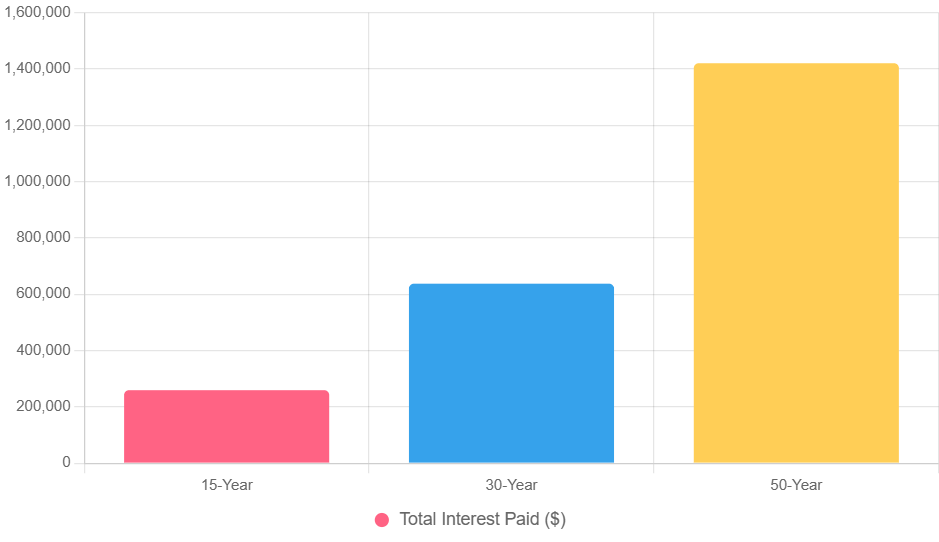
  • However, the total interest paid on the 50-year mortgage is shockingly high – more than double the 30-year.
  • Equity builds much slower on the 50-year loan. After 10 years, you've built a fraction of the equity compared to a 15-year or 30-year loan, making you more vulnerable if home prices fall.

This table really drives home the trade-off: immediate monthly affordability versus long-term cost and equity building.

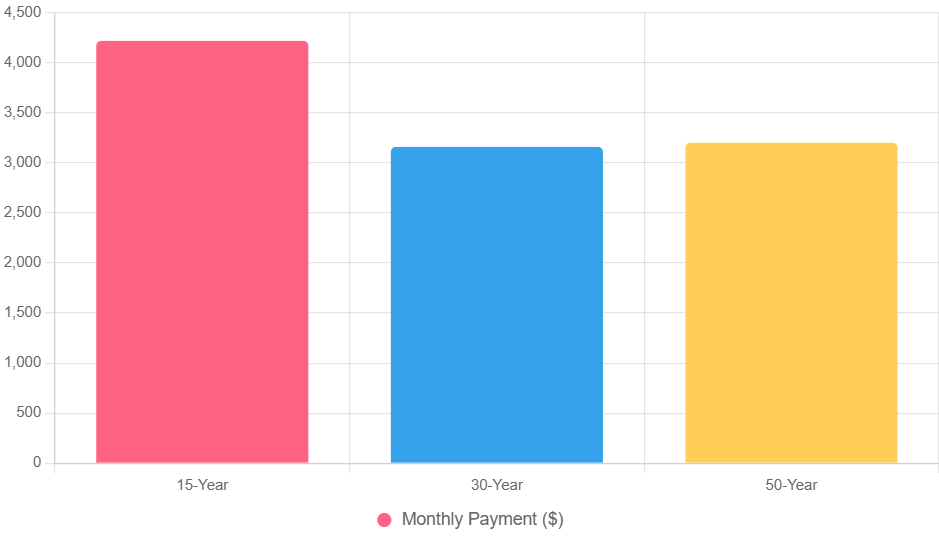
Chart 1: Monthly Payments by Loan Term

This bar chart shows how extending the term affects cash flow—note the 50-year option barely saves money if rates rise.

Monthly Payments by Loan Term on a 50-Year Mortgage

Chart 2: Total Lifetime Interest by Loan Term

A stark illustration of the “interest trap”—the 50-year loan more than doubles costs compared to shorter options.

Total Lifetime Interest by 50-Year Mortgage Loan Term

Expert Opinions and Real-World Implications

The reaction from financial experts has been, shall we say, mixed. Some laud it as a creative solution for a generation struggling to enter the housing market. Others sound the alarm, calling it fiscally irresponsible or a temporary band-aid on a much larger problem.

I tend to lean towards the cautionary view. As someone who believes in strong personal finance and long-term stability, extending debt for an additional 20 years, especially when it drastically increases the total cost and slows equity growth, feels like a risky proposition for many borrowers. It feels like it could be a short-term fix that creates long-term headaches.

The real difficulty lies in the details. How will these loans be underwritten? What kind of protections will be in place? Will they truly be “fixed” or will there be escalators down the line? These are questions that need solid answers before such a plan could gain widespread approval or implementation.

Looking Ahead: What's the Real Solution?

While the 50-year mortgage is an interesting concept designed to tackle a pressing issue, I believe the sustainable path to housing affordability lies in a multi-pronged approach.

  • Increase Housing Supply: This is paramount. We need policies that encourage the construction of more homes of all types, especially in areas where demand is highest. This means rethinking zoning laws, streamlining permitting processes, and incentivizing builders.
  • Support Targeted Assistance: Instead of a blanket extension of loan terms, perhaps more targeted programs that help with down payments, reduce interest rates for first-time buyers, or offer down payment assistance could achieve affordability without the massive long-term interest burden and equity risks.
  • Affordability Measures Focused on Entry: Programs that help first-time buyers get into homes with manageable, short-to-medium term adjustable rates (that can be converted later), or shared equity models, might offer a better balance.

President Trump's 50-year mortgage plan is an ambitious idea born out of a genuine need for housing solutions. It promises immediate relief but carries potentially enormous long-term financial consequences. For me, the extended timeline and the massive increase in total interest paid raise serious questions about whether it truly helps families build a secure financial future, or simply saddles them with debt for decades to come.

Smart Leverage or Long-Term Risk for Rental Investors?

Ultra-long mortgage terms can lower monthly payments and boost cash flow—but they also extend debt horizons and slow equity growth. For turnkey investors, the key is knowing when and how to use them strategically.

Norada Real Estate helps you evaluate financing options and match them to high-performing rental markets—so you can build wealth without overextending your timeline.

🔥 HOT NEW LISTINGS JUST ADDED! 🔥

Talk to a Norada investment counselor today (No Obligation):

(800) 611-3060

Get Started Now

Read More:

  • Is Trump's 50-Year Mortgage Plan a Game Changer or Debt Trap for Borrowers?
  • What Are Typical Credit Score Ranges for Mortgage Borrowers?
  • FHA Mortgage Rates by Credit Score: 620, 700, 580, 640
  • Does Wells Fargo Offer Home Loans with a 500 Credit Score?
  • First Time Home Buyer Loans with Bad Credit and Zero Down
  • Who Qualifies for Kamala Harris' $25,000 Homebuyer Program?
  • Biden Administration's Bold Move for Affordable Housing Plan
  • Biden's Student Debt Relief Plan: A Beacon of Hope for Borrowers
  • What Credit Score Do You Need to Buy House With No Money Down?
  • How Long Does It Take to Get a 700-800 Credit Score?
  • How To Improve Your FICO Credit Score: A Guide
  • FHA Credit Score Requirements for Homeownership
  • 10 Proven Methods to Elevate Your FICO Credit Score
  • Mortgages for Low Credit Scores: Your Complete Guide

Filed Under: Financing, Housing Market, Mortgage Tagged With: 50-Year Mortgage, home loan, Loan Term, mortgage

Real Estate

  • Birmingham
  • Cape Coral
  • Charlotte
  • Chicago

Quick Links

  • Markets
  • Membership
  • Notes
  • Contact Us

Blog Posts

  • Today’s Mortgage Rates, Feb 8: Rate Rise Slightly But Remain Near Long-Term Lows
    February 8, 2026Marco Santarelli
  • Does the 1% Rule Say It’s Time to Refinance Your Mortgage in 2026?
    February 8, 2026Marco Santarelli
  • 5 Hottest Real Estate Markets for Buyers and Investors in 2026
    February 8, 2026Marco Santarelli

Contact

Norada Real Estate Investments 30251 Golden Lantern, Suite E-261 Laguna Niguel, CA 92677

(949) 218-6668
(800) 611-3060
BBB
  • Terms of Use
  • |
  • Privacy Policy
  • |
  • Testimonials
  • |
  • Suggestions?
  • |
  • Home

Copyright 2018 Norada Real Estate Investments

Loading...