Norada Real Estate Investments

  • Home
  • Markets
  • Properties
  • Membership
  • Podcast
  • Learn
  • About
  • Contact

Is Trump’s 50-Year Mortgage Plan a Game Changer or Debt Trap for Borrowers?

November 12, 2025 by Marco Santarelli

Is a 50-Year Mortgage A Game Changer or Debt Trap for Homebuyers?

Imagine finally being able to afford a home, not in ten years, but maybe next year. That’s the tantalizing promise dangled before millions of Americans struggling to break into the housing market. President Trump's recent push for a 50-year fixed-rate mortgage has sent ripples through the financial world, sparking debates that pit the dream of affordable homeownership against the specter of lifelong debt.

While proponents hail it as a revolutionary “game changer,” critics warn it could become a “debt trap,” a financial quicksand that traps families for generations. My take? It's a high-stakes gamble, offering immediate relief at a steep potential long-term cost, and its success hinges less on the loan term itself and more on a solution to our nation's chronic housing shortage.

Is Trump's 50-Year Mortgage Plan a Game Changer or Debt Trap for Borrowers?

The U.S. housing market right now feels less like a gateway to the American Dream and more like a fortress. Prices have skyrocketed, and even with mortgage rates hovering around 6.25% (as of late 2025), it’s become a near-impossible hurdle for many. For context, the average age of a first-time homebuyer has crept up to a staggering 40 years old.

That spells trouble, not just for individuals but for the economy. We’re well past the generally accepted threshold where housing costs consume no more than 28–30% of a household's income; now, it’s closer to a burdensome 39%.

Compounding this, homeowners with those super-low interest rates from a few years back are essentially locked into their homes, afraid to sell and buy something else because their new monthly payments would be astronomical. This “lock-in effect” has choked off the supply of homes for sale, pushing prices even higher.

The Genesis of the 50-Year Idea: A Nod to the Past, A Push for the Future

This isn't just some wild, out-of-the-blue idea. The Trump administration, through Federal Housing Finance Agency (FHFA) Director Bill Pulte, has been actively exploring this 50-year mortgage option. Pulte himself stated on X (formerly Twitter) in November 2025, “Thanks to President Trump, we are indeed working on The 50 year Mortgage—a complete game changer.”

He's framed it as a direct response to the affordability crisis, aiming to help “young people” secure a home. It's an interesting echo of history. Back in the 1930s, during the Great Depression, President Franklin D. Roosevelt introduced the 30-year mortgage.

This innovation dramatically increased homeownership after decades where shorter loan terms made it incredibly difficult for average Americans to buy property. The idea behind the 50-year mortgage is to achieve a similar democratization of homeownership, but for today's economic realities.

It's also worth noting that this proposal is part of a broader push from the administration. There have been policy initiatives aimed at deregulation and tax credits for builders, trying to encourage more homes to be built. The thinking seems to be that if we can make mortgages more accessible, we also need to address the lack of supply.

The plan is reportedly to leverage government-sponsored enterprises like Fannie Mae and Freddie Mac to offer these longer-term loans. However, there's a wrinkle: the Dodd-Frank Act, a piece of legislation passed after the 2008 financial crisis, put a 30-year cap on what's considered a “qualified mortgage.”

To offer 50-year mortgages with full government backing, congressional action would likely be needed, which could introduce further complexities and potentially affect interest rates.

How a 50-Year Mortgage Works: Spreading the Pain (and the Payments)

At its heart, a 50-year mortgage simply stretches out the repayment period for your loan over an additional 20 years. This means your principal and interest payments are spread over a much longer timeframe. The primary benefit, and the one that gets all the attention, is the lower monthly payment.

Let's crunch some numbers, as I find that's the best way to really understand the impact. Imagine you're taking out a $400,000 loan, which is pretty common after putting down 20% on a $500,000 home (a realistic scenario in many U.S. markets). If you got a traditional 30-year mortgage at 6.25% interest, your principal and interest payment would be around $2,463 per month.

Now, consider that same $400,000 loan at 6.25% but stretched over 50 years. Your monthly payment drops significantly, to about $2,180. That’s a saving of roughly $283 each month. For a young family trying to make ends meet, that kind of monthly difference could be the deciding factor in whether they can afford to buy a home at all. It could mean the difference between affording basic necessities, childcare, or having a little breathing room in their budget.

However, this monthly relief comes at a steep price over the long run. While your monthly payments are lower, you're paying interest for an extra 20 years. This dramatically increases the total amount of interest you'll pay over the life of the loan.

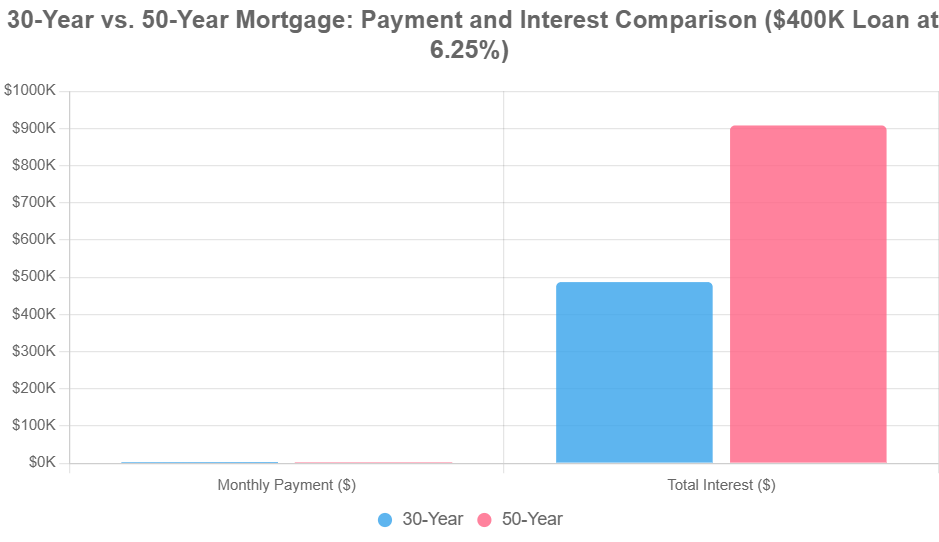
For our example, the total interest on the 30-year loan is about $487,000. On the 50-year loan, that number balloons to a staggering $908,000! That’s an increase of over $421,000 in interest paid. It essentially doubles the interest cost compared to a 30-year loan.

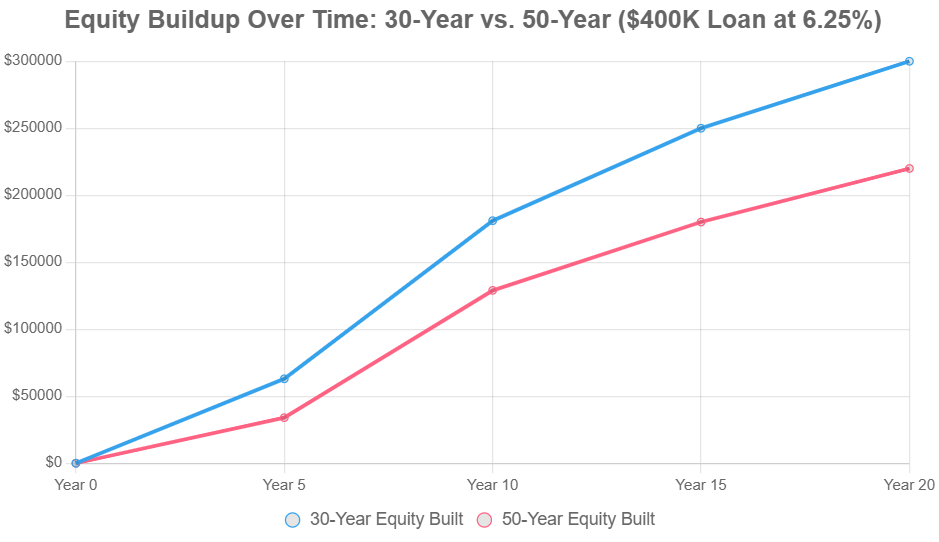
Another crucial aspect is how quickly you build equity. Equity is the portion of your home you actually own. With a 50-year mortgage, a much larger chunk of your early payments goes toward interest, meaning you build equity much more slowly.

In our example, it might take around 28 years to own 50% of your home with a 50-year loan, compared to about 18 years with a 30-year loan. This slower equity buildup can be risky, especially if home prices decline. You could end up owing more than your home is worth, a situation known as negative equity.

Here’s a table to visualize these key differences:

Metric 30-Year Mortgage 50-Year Mortgage Difference
Monthly P&I Payment $2,463 $2,180 -$283 (12% savings)
Total Interest Paid $487,000 $908,000 +$421,000 (86% more)
Time to 50% Equity ~18 years ~28 years +10 years
Estimated Rate Premium Baseline +0.5% to 1.5% Reflects lender risk

Please note: These are estimates based on standard amortization formulas and a hypothetical loan of $400,000 at 6.25% interest. Actual figures will vary based on loan terms, rates, and other fees.

The flexibility is often touted as a positive. You could, in theory, make extra payments to pay off the loan faster or sell the home. And if inflation continues to rise, the real cost of that fixed $2,180 payment could decrease over time, making it feel more manageable in future dollars. A home that gains value over time can help offset the extra interest paid, especially if you plan to sell within 10 to 15 years.

However, the risk of being underwater for longer is a serious concern. Studies suggest that longer mortgage terms can increase the risk of default by 150% to 200% if property values drop. And imagine being 80 years old and still making payments on your home – that's a possibility with a 50-year loan.

Additionally, lenders might charge a slightly higher interest rate on these longer loans to compensate for the increased risk they are taking on. Estimates suggest this premium could be between 0.5% and 1.5%, which would eat into those monthly savings and further increase the total interest paid.

To visualize the trade-offs, consider this bar chart comparing key financial outcomes for the $400,000 loan scenario:

30-year vs 50 year mortgage payment and interest comparison

This highlights the upfront win versus the long-haul cost. For deeper insight into equity progression, a line chart tracking principal paid over the first 20 years (assuming no prepayments) reveals the 50-year's sluggish start:

30-year vs 50 year mortgage equity build up over time

Pros and Cons: A Deep Dive into the Agreement's Terms

When I look at this proposal, it’s crucial to weigh the good against the potentially very bad.

The Upsides Are Clear:

  • Puts Homeownership Within Reach: This is the big draw. By slashing those monthly payments, millions more people could qualify for a mortgage and buy a home. It could significantly boost homeownership rates, especially for younger generations who have been severely priced out.
  • Flexibility for Life Transitions: A lower payment provides breathing room. It can be ideal for young families who anticipate their income will grow over time. They can make the minimum payment now and then use raises or bonuses to pay down the principal faster, or refinance to a shorter term later on.
  • Market Stimulation: By making it easier to buy, it could encourage more people to enter the market, which in turn could help alleviate the “lock-in effect” and bring more homes onto the market for others. It’s a way to inject some life into a sluggish housing sector.
  • Historical Parallel: As mentioned, the 30-year mortgage was a radical idea once. This could be another step in evolving how people finance their homes to adapt to economic conditions.

The Downsides Are Significant:

  • The Interest Trap: This is my biggest worry. Paying interest for 50 years means that by the time you finally own your home free and clear, you will have paid an astronomical amount more in interest than you would have with a 30-year loan. For some, the home might feel more like a perpetual rental with an enormous interest burden rather than a true asset.
  • Slower Equity Growth and Increased Default Risk: As the numbers showed, you build equity much slower. This leaves homeowners more vulnerable to market downturns. If property values fall, you could owe more than your home is worth, making it difficult to sell or refinance, and increasing the likelihood of default. The thought of people being in debt for their homes into their retirement years is concerning.
  • Fueling Housing Inflation: If we simply increase the number of people who can afford a mortgage without substantially increasing the number of homes available, basic economics tells us prices will likely go up. This proposal, without a strong supply-side component, could just end up making homes even more expensive for everyone in the long run.
  • Benefit to Lenders: Critics argue that banks and financial institutions stand to gain considerably from these longer loans by collecting more interest over time, potentially at taxpayer expense if government-backed entities like Fannie Mae and Freddie Mac end up holding more risky assets.

Who Wins and Who Loses? The Stakeholder Perspective

It's not a simple black-and-white situation; different groups will be impacted differently.

Stakeholder Likely Stance Rationale
Young Buyers Supportive (with caveats) Lower entry barrier; plan to refi/sell.
Economists Skeptical Ignores supply roots; systemic risks.
Banks/Lenders Enthusiastic Volume + interest revenue.
Conservatives Divided Populist appeal vs. “debt slavery” fears.
Builders Positive Demand surge aids projects.

Echoes of the Past and Glimpses of the Future

Comparing this to FDR's 30-year mortgage is a powerful analogy, but we must also remember the lessons of 2008. The subprime mortgage crisis, fueled by risky lending practices and complex financial products, taught us that simply extending credit doesn't automatically create widespread prosperity. It can also lead to instability.

Globally, countries like Canada and Australia have different mortgage norms. Canada, for instance, allows longer terms, which aids affordability but is also linked to high household debt levels. This suggests that longer loan terms alone aren't a magic bullet and can be part of a broader picture of household financial health.

What I foresee is that if a 50-year mortgage is implemented, it won't be a simple carbon copy of the 30-year model. It might be tweaked, perhaps capped at 40 years with additional safeguards. Its success will absolutely depend on whether it's paired with robust efforts to increase housing supply. Without that, it risks being a temporary fix that ultimately inflates prices and leaves buyers with more debt.

This proposal, like many bold policy ideas, sits at a crossroads. It could be a tool to unlock opportunities for a generation struggling to achieve a fundamental part of the American Dream. Or, it could be a carefully disguised trap, luring people into decades of debt they may not fully comprehend. It's a provocative idea, sure to keep us talking, debating, and hopefully, searching for the right solutions to our deeply entrenched housing affordability crisis. The real game changer won't just be the length of the mortgage, but whether we can build enough homes for everyone.

Smart Leverage or Long-Term Risk for Rental Investors?

Ultra-long mortgage terms can lower monthly payments and boost cash flow—but they also extend debt horizons and slow equity growth. For turnkey investors, the key is knowing when and how to use them strategically.

Norada Real Estate helps you evaluate financing options and match them to high-performing rental markets—so you can build wealth without overextending your timeline.

🔥 HOT NEW LISTINGS JUST ADDED! 🔥

Talk to a Norada investment counselor today (No Obligation):

(800) 611-3060

Get Started Now

Read More:

  • What Are Typical Credit Score Ranges for Mortgage Borrowers?
  • FHA Mortgage Rates by Credit Score: 620, 700, 580, 640
  • Does Wells Fargo Offer Home Loans with a 500 Credit Score?
  • First Time Home Buyer Loans with Bad Credit and Zero Down
  • Who Qualifies for Kamala Harris' $25,000 Homebuyer Program?
  • Biden Administration's Bold Move for Affordable Housing Plan
  • Biden's Student Debt Relief Plan: A Beacon of Hope for Borrowers
  • What Credit Score Do You Need to Buy House With No Money Down?
  • How Long Does It Take to Get a 700-800 Credit Score?
  • How To Improve Your FICO Credit Score: A Guide
  • FHA Credit Score Requirements for Homeownership
  • 10 Proven Methods to Elevate Your FICO Credit Score
  • Mortgages for Low Credit Scores: Your Complete Guide

Filed Under: Financing, Housing Market, Mortgage Tagged With: credit score, mortgage

What Are Typical Credit Score Ranges for Mortgage Borrowers?

November 9, 2025 by Marco Santarelli

What Are Typical Credit Score Ranges for Mortgage Borrowers?

Generally, for most conventional mortgages, a credit score of 620 or higher is considered the minimum to qualify, though scores of 700 or above offer you the best chance at competitive interest rates and terms. Understanding these typical credit score ranges for mortgage borrowers is a crucial first step in your homebuying journey, and can significantly impact how much you borrow, what you pay back over time, and even whether your loan gets approved at all. It's not just a number; it's a reflection of your financial habits, and lenders use it to gauge how risky it might be to lend you a large sum of money for your dream home.

What Are Typical Credit Score Ranges for Mortgage Borrowers?

Why Your Credit Score Matters for Mortgages

As someone who's been in the financial world for a while, I can tell you firsthand how vital a credit score is when it comes to mortgages. Think of it like this: when you apply for a loan to buy a house, you're asking a bank or lender to trust you with a massive amount of money. They need to be confident that you'll pay it back as promised. Your credit score is their primary tool for assessing that confidence.

The higher your score, the more it signals to lenders that you're a responsible borrower who pays bills on time and manages debt wisely. This translates into tangible benefits for you, like lower interest rates, which can save you tens of thousands of dollars over the life of your loan. Conversely, a lower score can mean higher interest rates, larger down payment requirements, or even denial of your loan application altogether. It’s a direct reflection of your financial health, and it plays a starring role in whether you can unlock the door to homeownership.

Understanding the Credit Score Spectrum for Homebuyers

Credit scores typically range from 300 to 850, and lenders break this down into several categories to assess risk:

  • Excellent Credit (740+): If your score falls into this range, you're practically a dream borrower in the eyes of lenders. You’ll likely qualify for the lowest interest rates and the most flexible loan terms. Lenders are eager to work with you because you represent the least risk.
  • Very Good Credit (670-739): This is a strong range to be in. You'll still get access to very competitive interest rates and favorable loan conditions. You’re showing lenders you have a solid track record of financial responsibility.
  • Good Credit (580-669): This is often considered the “average” range. While you can still qualify for a mortgage, the interest rates you're offered might be higher than those with excellent or very good credit. Some loan programs, like FHA loans, are specifically designed to help borrowers in this range.
  • Fair/Poor Credit (Below 580): Borrowers in this category face more challenges. Qualifying for a conventional mortgage can be difficult, and if you do qualify, you'll likely see significantly higher interest rates and potentially need a larger down payment or a co-signer. Government-backed loans (like FHA) are often the path to homeownership for those in this bracket.

Minimum Credit Score Requirements: It's Not One-Size-Fits-All

It’s important to remember that there isn't a single, universal credit score requirement for all mortgages. Different loan types have different thresholds, and even within those types, individual lenders might have their own overlays or stricter standards.

Conventional Mortgages

For mortgages that aren't backed by the government (these are called conventional loans), the general guideline is that you'll need a credit score of 620 or higher. However, this is just the minimum threshold.

  • Scores between 620-669: You might be approved, but expect higher interest rates and potentially a requirement for a larger down payment. You might also need to go through more rigorous underwriting.
  • Scores from 670 upwards: As your score increases, you'll start seeing better interest rates and more favorable loan terms. Reaching the 700+ mark is often where you'll find the most competitive offers. According to my experience, many lenders look at 740 and above as the ‘gold standard’ for the absolute best rates and terms.

FHA Loans

The Federal Housing Administration (FHA) insures loans made by private lenders. This makes them a great option for borrowers who might not have perfect credit.

  • Scores from 580-619: FHA loans often allow for a down payment as low as 3.5% for borrowers in this credit score range.
  • Scores below 580: If your score is below 580 but still above 500, you might still qualify for an FHA loan, but the down payment requirement will be higher, typically 10%.
  • Scores below 500: Unfortunately, most lenders will not offer FHA loans to borrowers with scores below 500.

FHA loans are fantastic for opening the door to homeownership for many, but it's worth noting that they come with mortgage insurance premiums (MIP), which are paid for the life of the loan if your down payment is less than 10%.

VA Loans

For eligible veterans, active-duty military personnel, and surviving spouses, VA loans offer incredible benefits. These loans are guaranteed by the U.S. Department of Veterans Affairs.

  • No Minimum Credit Score (Officially): The VA itself doesn't set a minimum credit score requirement. However, most lenders who offer VA loans do have their own overlays, often requiring a score of 620 or higher. Some lenders might go lower, but it's less common. The great thing about VA loans is that if you have a lower credit score but a strong overall financial profile (stable income, no recent major credit issues), you might still have a good chance.

USDA Loans

These loans are for eligible rural and suburban homebuyers. They are guaranteed by the U.S. Department of Agriculture.

  • No Official Minimum Credit Score: Similar to VA loans, the USDA doesn't set a hard minimum. However, lenders typically look for scores of 640 or higher for streamlined processing. For scores below 640, lenders will often perform a more thorough review of your financial history, similar to how they'd treat an FHA loan applicant.

Beyond the Score: What Else Lenders Consider

While your credit score is a huge piece of the puzzle, it's not the only thing lenders look at. In my experience, a well-rounded application can sometimes help compensate for a slightly lower score. They want to see a complete picture of your financial stability.

  • Debt-to-Income Ratio (DTI): This is a crucial metric. It compares how much you owe each month on debts (like car payments, student loans, credit cards) to your gross monthly income. A lower DTI shows you can comfortably handle mortgage payments. Lenders generally prefer a DTI of 43% or less, though some loan programs allow for higher.
  • Employment History and Income Stability: Lenders want to see a consistent and reliable income. They'll usually ask for at least two years of employment history and proof of your income through pay stubs and tax returns.
  • Down Payment: While some loans (like FHA and VA) allow for very low down payments, having a larger down payment can offset some risk for lenders, especially if your credit score is on the lower side. It shows you have skin in the game.
  • Assets and Reserves: Lenders like to see that you have some savings or assets left over after closing, which can help you cover unexpected expenses. This is often referred to as having “reserves.”

Strategies to Improve Your Credit Score for a Mortgage

If you're looking at your credit score and thinking, “I need to do better,” don't despair! There are actionable steps you can take to boost it. This is where patience and consistent effort really pay off.

  1. Pay Bills On Time, Every Time: Payment history makes up the largest portion of your credit score. Even one late payment can significantly ding your score. Set up automatic payments or reminders to ensure you never miss a due date.
  2. Reduce Credit Card Balances: Credit utilization – how much credit you're using compared to your total available credit – is the second-biggest score factor. Aim to keep your utilization below 30%, and ideally below 10%, on each card and overall.
  3. Don't Close Old Credit Accounts: Closing an old account can lower your average age of accounts and increase your credit utilization ratio, both of which can hurt your score.
  4. Check Your Credit Reports for Errors: You're entitled to a free credit report from each of the three major bureaus (Equifax, Experian, and TransUnion) annually. Review them carefully for any inaccuracies and dispute them immediately. Mistakes can happen and cost you a higher interest rate if not corrected.
  5. Avoid Opening New Credit Accounts Unnecessarily: While it might be tempting to open new cards for rewards or discounts, doing so before a mortgage application can result in hard inquiries that temporarily lower your score. Wait until after your mortgage is funded.
  6. Consider a Secured Credit Card or Credit-Builder Loan: If you have a very limited credit history, these tools can help you build positive credit over time. They require a deposit or collateral, which the lender then uses to report your payment activity.

My Personal Take: It's About More Than Just the Number

From where I stand, a credit score is certainly a fundamental piece of the mortgage puzzle, but it’s not the whole picture. I’ve seen borrowers with scores in the mid-600s, who were meticulous about their DTI, had a stable job history, and were putting down a substantial down payment, get approved for excellent loans. Conversely, sometimes a borrower with a score in the low 700s but a high DTI might face more scrutiny.

Therefore, my advice is this: know your score, understand where you stand with different loan types, but also focus on building a strong overall financial profile. Lenders want to see reliability and stability. They want to be reassured that you can handle the long-term commitment of a mortgage. So, while chasing that higher credit score is undeniably important, don't neglect the other crucial financial habits that make you a low-risk, desirable borrower.

Credit Scores Matter—Here’s How to Qualify for Better Mortgage Terms

Most mortgage lenders favor borrowers with scores above 700, but turnkey rental investors can still qualify with mid-600s—especially when leveraging strong income, low debt, and strategic financing.

Norada Real Estate helps you navigate credit score thresholds and financing options—so you can invest in cash-flowing properties without letting your credit score hold you back.

🔥 HOT NEW LISTINGS JUST ADDED! 🔥

Talk to a Norada investment counselor today (No Obligation):

(800) 611-3060

Get Started Now

Read More:

  • FHA Mortgage Rates by Credit Score: 620, 700, 580, 640
  • Does Wells Fargo Offer Home Loans with a 500 Credit Score?
  • First Time Home Buyer Loans with Bad Credit and Zero Down
  • Who Qualifies for Kamala Harris' $25,000 Homebuyer Program?
  • Biden Administration's Bold Move for Affordable Housing Plan
  • Biden's Student Debt Relief Plan: A Beacon of Hope for Borrowers
  • What Credit Score Do You Need to Buy House With No Money Down?
  • How Long Does It Take to Get a 700-800 Credit Score?
  • How To Improve Your FICO Credit Score: A Guide
  • FHA Credit Score Requirements for Homeownership
  • 10 Proven Methods to Elevate Your FICO Credit Score
  • Mortgages for Low Credit Scores: Your Complete Guide

Filed Under: Financing, Housing Market, Mortgage Tagged With: credit score, mortgage

How to Get the Best FHA Mortgage Rates in 2025?

August 31, 2025 by Marco Santarelli

How to Get the Best FHA Mortgage Rates in 2025?

Thinking about buying a home in 2025? Good news! You absolutely can get a great FHA mortgage rate. The key? Know the landscape, boost your financial profile, and shop around. While the average FHA mortgage rate is around 6.45% right now in September of 2025, there are many things you can do to potentially lower it and save thousands over the life of your loan.

At Norada Real Estate Investments, we guide clients through the complexities of real estate financing, including FHA loans, which offer accessible paths to homeownership for many buyers. This article explains exactly how to achieve it.

How to Get the Best FHA Mortgage Rates in 2025

Now, let's dive in. After all, getting a low rate can make a HUGE difference in your monthly payments and overall cost of homeownership!

Understanding FHA Loans

Before we jump into strategies, let’s make sure we are on the same page. FHA loans are backed by the Federal Housing Administration (FHA), and they are a great way to make homeownership more accessible. Why? Because they typically require lower down payments and are more forgiving when it comes to credit history compared to traditional loans.

Think of it this way: FHA loans are like a helping hand, especially if you're a first-time homebuyer or have had a few bumps in the road when it comes to credit. Just keep in mind FHA will expect you to pay mortgage insurance upfront, however.

Why FHA Loans are Popular:

  • Lower Down Payments: You can often get away with a down payment as low as 3.5% of the purchase price. That's a lot less than the 20% that conventional loans sometimes require.
  • More Flexible Credit Requirements: FHA loans are generally more accepting of lower credit scores. A score of 580 or higher is usually enough to get you in the door (though, as we'll see, higher is ALWAYS better for getting the best rates).
  • Helpful for First-Time Buyers: These loans are designed to make homeownership a reality for those who might not otherwise qualify.

The 2025 Mortgage Rate Scene: Where Are We Now?

Okay, let's talk reality. As of late August 2025, the average interest rate for a 30-year fixed FHA loan is hovering around 6.45%, and the APR (which includes fees) is around 6.51%. Now, here is what you need to know in order to be confident in getting approved:

  • Cooling Down a Bit: These rates are definitely down from the highs we saw earlier in the year (around 7% in January of 2025). This is partly because the labor market has been showing some signs of cooling off.
  • The Fed Factor: The Federal Reserve has kept its benchmark interest rate steady at 4.25%-4.5% since cutting it a few times in 2024. That has a direct impact on mortgage rates.
  • Compared to Conventional Loans: While FHA rates might be slightly lower than conventional rates, remember that FHA loans typically come with mortgage insurance premiums (MIP). So, it’s a good idea to compare the big picture—taking all costs into account.

Here’s a quick snapshot:

Loan Type Approximate Interest Rate (Late August 2025) APR
30-Year FHA 6.45% ~6.51%

My Personal Insight: I always encourage people not to just fixate on the “headline” interest rate. The APR gives you a much clearer picture of the true cost of the loan.

Cracking the Code: How to Score the Lowest FHA Rate

Alright, this is the part you’ve been waiting for! Getting that rock-bottom rate takes a little effort, but it's absolutely worth it. Here's my step-by-step guide:

  1. Boost Your Credit Score (Seriously!): This is HUGE! A better credit score unlocks better rates.
    • Aim for 720 or higher. This will put you in the “prime” borrower category.
    • How to do it: Pay your bills on time, every time. Reduce credit card balances. Dispute any errors on your credit report.
  2. Trim Your Debt-to-Income Ratio (DTI): Lenders want to see that you aren’t overextended.
    • DTI measures how much of your monthly income goes toward debt payments.
    • Ideally, keep it below 36%. If you're pushing 43% or higher, it's time to get serious about paying down some debt.
  3. Consider a Bigger Down Payment: Yeah, I know FHA loans are known for low down payments, but a larger down payment shows lenders you're serious and reduces their risk.
    • Even bumping your down payment just a little bit can make a difference.
  4. Shop Around (Don’t Skip This!): This is probably the MOST important step. Don't just go with the first lender you talk to. Get quotes from at least three different lenders.
  5. Look at the APR, not just the interest rate. Make sure to compare apples to apples. The APR reflects the total cost of the loan, including fees.
  6. Consider Buying Discount Points: This is where you pay upfront to lower your interest rate. Be aware that each point = 1% of the loan amount and usually lowers the rate by 0.25%. Do the math to see if it makes sense for your situation.
  7. Lock in Your Rate ASAP: Once you find a rate you're happy with, lock it in! This protects you if rates go up before you close on your loan.

Important Financial Ratios To Remember:

Term Definition Target
Credit score Measure of your creditworthiness Aim to have 720+
Debt-to-income ratio (DTI) Income spent on expenses Below 36%
Down Payment Part of the home-buying price you pay upfront Aim to deposit 10% or more

Don't Just Take My Word For It!

Tools like Bankrate’s and CFPB's rate comparison tools can help you easily compare rates from different lenders.

My Personal Tip: Be Polite and always keep them informed. Sometimes lenders will match or beat another offer to earn your business. Don't be afraid to negotiate!

FHA Loan Requirements: The Nitty-Gritty

So, what does it actually take to qualify for an FHA loan in 2025? Here's a breakdown:

Requirement Details
Credit Score Minimum 580 for 3.5% down payment; 500-579 requires 10% down.
Down Payment 3.5% minimum (can be gifted from family, employers, or assistance programs).
Debt-to-Income Ratio Ideally under 43%; some lenders may accept higher ratios with compensating factors like strong savings.
Employment Stable income with a consistent employment history (usually at least two years). Self-employed borrowers will need to provide tax returns to document their income.
Property Must be your primary residence. The property must meet HUD's minimum property standards (safety, sanitation, structural integrity), which means it will need to pass an FHA appraisal. Loan limits vary by county.
Mortgage Insurance Both an upfront mortgage insurance premium (MIP, currently 1.75% of the loan amount) and an annual MIP (0.45%-1.05% of the loan amount, depending on your loan-to-value and loan term). The annual MIP is usually paid monthly as part of your mortgage payment.

FHA Loans: Weighing the Pros and Cons

Like anything, FHA loans have their good points and bad points. It's important to understand both sides before you make a decision.

Pros:

  • Easier to Qualify: As we've discussed, FHA loans are generally more forgiving when it comes to credit and down payment requirements.
  • Assumable Loans: In some cases, another buyer can “assume” your FHA loan, which can be a HUGE advantage if interest rates rise in the future.
  • Great for First-Time Buyers: Designed to help people get their foot in the door of homeownership.

Cons:

  • Lifelong Mortgage Insurance. You will be paying mortgage insurance premiums for the life of the loan.
  • Higher Overall Costs: The combination of MIP and potentially higher interest rates can make FHA loans more expensive in the long run compared to conventional loans (especially if you have excellent credit and a large down payment).
  • Stricter Property Requirements: FHA appraisals can be more thorough and take longer than conventional appraisals.

What About Other Options? (Alternatives to FHA)

Don't get tunnel vision! FHA loans aren’t the only game in town. Depending on your situation, you might be better off with one of these alternatives:

  • Conventional Loans: If you have great credit and can put down a larger down payment, you might get a better deal with a conventional loan. Plus, you can avoid paying mortgage insurance once you build up enough equity in your home (usually when you owe less than 80% of the home's value).
  • VA Loans: If you're a veteran, active-duty military member, or eligible surviving spouse, a VA loan can be an amazing option. They often have no down payment requirements and lower interest rates and no long-term MIP.
  • USDA Loans: If you're buying a home in a rural area, a USDA loan might be worth looking into. They sometimes have no down payment requirements and are backed by the U.S. Department of Agriculture.

A Little History: FHA Rates Over Time

To put things in perspective, here’s a quick look at how FHA rates have trended recently:

Month/Year Average 30-Year FHA Rate (%)
Jan 2024 6.80
Jun 2024 6.90
Dec 2024 6.50
Jan 2025 7.04
Mar 2025 6.80
Aug 2025 6.45

You can see that rates have fluctuated and that the period in early 2025 rates were fairly high, but have since cooled down.

My 2025 FHA Mortgage Rate Forecast

Here’s my best guess (and it's just a guess!) on where FHA rates are headed by the end of 2025 here at Norada:

  • Base Case (Most Likely): I expect FHA rates to trend downward to somewhere in the 6.0%-6.3% range. This is partially because the Fed should stabilize rates.
  • Worst Case: If tariffs hurt inflation, rates could settle at 6.5%.

The Bottom Line: Knowledge is Power!

Getting the best FHA mortgage rates in 2025 is all about being prepared, doing your homework, and shopping around. Focus on improving your credit score and lowering your debt-to-income ratio. Don’t be afraid to negotiate with lenders!

By following the tips outlined in this article, you'll be well on your way to securing a lowrate.

Recommended Read:

  • FHA Credit Score Requirements for Homeownership in 2025
  • FHA Mortgage Rates by Credit Score: 620, 700, 580, 640
  • What Credit Score Do You Need to Buy House With No Money Down?
  • How Long Does It Take to Get a 700-800 Credit Score?
  • How To Improve Your FICO Credit Score: A Guide
  • Surefire Methods for Building Your Credit Score

Filed Under: Economy, Financing, Mortgage Tagged With: credit score, Credit Score Requirements, FHA Interest Rates, FHA Interest Rates by Credit Score

FHA Credit Score Requirements for Homeownership in 2025

March 17, 2025 by Marco Santarelli

FHA Credit Score Requirements: Your Pathway to Homeownership

Dreaming of owning your own home, but worried about your FHA credit score requirements? Don't let credit concerns hold you back! Securing a mortgage with a less-than-perfect credit history can feel like scaling a mountain, but it's definitely achievable, especially with an FHA loan. Let's unravel the mysteries surrounding FHA credit score requirements and light your path toward homeownership.

Navigating FHA Credit Score Requirements

What is an FHA Loan, and Why is it a Game-Changer?

Before we dive into the nitty-gritty of credit scores, let's clarify what makes FHA loans special. Backed by the Federal Housing Administration, these loans are designed to make homeownership accessible to a wider range of borrowers, including first-time buyers and those with less-than-perfect credit.

Here's the gist:

  • Lower Down Payment: Say goodbye to the daunting 20% down payment typically required for conventional loans! FHA loans can be secured with as little as 3.5% down. Imagine finally having enough saved for that dream home!
  • Flexible Credit Requirements: This is where FHA loans truly shine. They are more forgiving than conventional loans, welcoming borrowers with credit scores as low as 500 (more on this later!).
  • Competitive Interest Rates: Don't let the lower down payment fool you! FHA loans often come with competitive interest rates, making your monthly payments more manageable.

The Million-Dollar Question: What's the Minimum Credit Score for an FHA Loan?

Now, let's address the elephant in the room – the minimum FHA credit score requirements. Here's the breakdown:

  • 580 or Higher: This is the magic number for the lowest possible down payment of 3.5%.
  • 500-579: Don't despair if your score falls within this range! You're still eligible for an FHA loan, but be prepared for a slightly higher down payment of 10%.

Remember: These are just the minimum requirements. Lenders may have stricter standards and consider other factors beyond your credit score, such as:

  • Debt-to-Income Ratio (DTI): This measures your monthly debt payments against your gross monthly income. A lower DTI demonstrates good financial health.
  • Employment History: Lenders like to see stability. A consistent work history reassures them of your ability to repay the loan.
  • Cash Reserves: Having some savings leftover after closing costs and the down payment showcases financial responsibility and provides a safety net for unexpected expenses.

Decoding Your Credit Score: What Lenders Look For

Ever wondered how your credit score is calculated? It's like a financial report card that reflects your creditworthiness.

Here's a peek behind the curtain:

  • Payment History (35%): This is the most significant factor! Paying bills on time demonstrates financial responsibility.
  • Amounts Owed (30%): This refers to your credit utilization ratio – the amount of credit you're using compared to your total available credit. Keeping your balances low is key!
  • Length of Credit History (15%): A longer credit history generally signifies greater financial experience and responsibility.
  • Credit Mix (10%): Having a mix of credit accounts (e.g., credit cards, installment loans) demonstrates responsible credit management.
  • New Credit (10%): Opening too many accounts in a short period can negatively impact your score.

Boosting Your Score: Tips for FHA Loan Success

Is your credit score not quite where you'd like it to be? Don't worry, it's not set in stone!

Here are some proven strategies to improve your creditworthiness:

  • Check Your Credit Report: Order free copies of your credit report from all three bureaus (Equifax, Experian, and TransUnion) at AnnualCreditReport.com. Review them carefully for errors and dispute any inaccuracies immediately.
  • Pay Bills on Time: This is crucial! Set reminders, use autopay, or explore other methods to ensure timely payments.
  • **Reduce Debt: **Focus on paying down high-interest debt first, such as credit cards, to improve your credit utilization ratio.
  • Avoid Opening New Credit Accounts: Every new credit application can result in a hard inquiry, potentially lowering your score.
  • Become an Authorized User: If you have a trusted friend or family member with excellent credit, ask if they'd consider adding you as an authorized user to their account. This can give your score a positive boost!

Don't Let Credit Myths Hold You Back!

The world of credit scores is often shrouded in myths and misconceptions. Let's debunk some common ones:

Myth: I need perfect credit to qualify for a mortgage.

Fact: False! FHA loans are designed for borrowers with a range of credit histories, even those with scores as low as 500.

Myth: Checking my credit score will hurt it.

Fact: Not true! Checking your own credit score is considered a “soft inquiry” and does not impact your score.

Myth: Closing a credit card will improve my credit score.

Fact: It's actually the opposite! Closing a credit card can shorten your credit history and increase your credit utilization ratio, potentially harming your score.

Embrace the Journey to Homeownership!

While navigating FHA credit score requirements might seem daunting, remember that knowledge is power! By understanding the factors influencing your creditworthiness and taking proactive steps to improve your score, you can confidently pursue your homeownership dreams. Don't let credit concerns hold you back – unlock the door to your future with an FHA loan!

Recommended Read:

  • FHA Mortgage Rates by Credit Score: 620, 700, 580, 640
  • What Credit Score Do You Need to Buy House With No Money Down?
  • How Long Does It Take to Get a 700-800 Credit Score?
  • How To Improve Your FICO Credit Score: A Guide
  • Surefire Methods for Building Your Credit Score

Filed Under: Economy, Financing, Mortgage Tagged With: credit score, Credit Score Requirements, FHA Interest Rates, FHA Interest Rates by Credit Score

First Time Home Buyer Loans with Bad Credit and Zero Down

March 17, 2025 by Marco Santarelli

First Time Home Buyer Loans with Bad Credit and Zero Down

Imagine standing in your own home, feeling the excitement and pride of ownership wash over you. For many, this picture represents a significant milestone, symbolizing investment in both stability and the future. However, the journey toward homeownership can seem daunting, especially for those exploring first-time home buyer loans with bad credit and zero down.

If you find yourself in a challenging financial situation, you may believe that owning a home is an unreachable dream. But the reality is, there are options available that can help transform that dream into a tangible reality—even if your credit history isn’t perfect and your savings are minimal.

First Time Home Buyer Loans with Bad Credit and Zero Down

Key Takeaways

  • Zero Down Payment Options: Some programs exist that allow buyers to purchase a home with no down payment required.
  • Bad Credit Doesn’t Mean No Home: Many lenders cater to buyers with less than perfect credit scores.
  • Government-Backed Loans: Options like FHA, VA, and USDA loans can assist first-time buyers with lower credit scores.
  • Importance of Credit Repair: Improving your credit score can significantly expand your borrowing options and potential interest rates.
  • Pre-Approval is Crucial: Understanding your budget helps streamline your home search and secures competitive offers.

Navigating the path to homeownership can be achieved with the right knowledge, strategies, and support. In this comprehensive guide, we will explore various first-time home buyer loans with bad credit and zero down options. We will discuss government-backed programs, how lenders assess applications with bad credit, and what you can do to improve your chances of qualifying for a loan.

Understanding the Challenges of Bad Credit

Bad credit can generally be defined as having a credit score below 650, although different lenders may have varying thresholds. This situation can result from multiple factors, such as late payments, high debt-to-income ratios, or even prior bankruptcy or foreclosure. When seeking a mortgage, many lenders view bad credit as high risk, often leading to denials or unfavorable terms.

However, dismissing the possibility of homeownership just because of bad credit is a mistake. It’s essential to recognize that numerous financial institutions and programs cater specifically to buyers with imperfect credit histories. Understanding what constitutes bad credit and how it impacts lending decisions can significantly empower you to make informed choices on your journey to owning a home.

Zero Down Payment Home Buyer Programs

One of the compelling aspects of purchasing a home is the potential to do so without a large initial investment. Numerous programs exist that allow buyers to purchase homes with no down payment required, especially aimed at first-time home buyers. Here are a few noteworthy options:

  1. VA Loans: Available for veterans and active members of the military, VA loans are among the most advantageous home financing options. These loans enable eligible borrowers to purchase homes without a down payment and do not require private mortgage insurance (PMI). VA loans benefit not only from favorable terms but also from competitive interest rates, making them a robust choice for service members.
  2. USDA Loans: If you're considering purchasing in rural or suburban areas, USDA loans may be your gateway to affordable homeownership. These loans offer zero down payment financing to eligible low to moderate-income buyers who meet specific requirements. The USDA loan program aims to promote homeownership in less populated areas, making it a fitting choice for many.
  3. FHA Loans: Although FHA loans typically require a down payment (as low as 3.5%), they are generally available to borrowers with lower credit scores. FHA loans can help individuals with bad credit gain access to financing that might otherwise be unavailable through conventional means. It is important to note that the FHA insures loans, which allows lenders to offer more lenient terms, including those for buyers with poor credit.

How Do Lenders Evaluate Bad Credit?

When considering a mortgage application, lenders analyze a comprehensive view of your financial state, rather than simply focusing on your credit score. The components that contribute to a successful mortgage application include:

  • Debt-to-Income Ratio (DTI): This crucial measurement evaluates the proportion of your monthly income allocated to debt payments, including loans and proposed mortgage payments. A lower DTI indicates that you are less risky to lenders, thereby improving your chances of securing a loan.
  • Employment History: A stable employment record showcases reliability when applying for a mortgage. Most lenders prefer candidates who have maintained consistent employment for at least two years.
  • Down Payment: Providing a larger down payment can positively impact your application, even with bad credit. A bigger down payment reduces the lender’s risk and demonstrates your commitment and financial responsibility.
  • Credit Repair Efforts: Prior to applying for a mortgage, many buyers take proactive measures to enhance their credit scores. This may involve paying down debts, ensuring bills are paid on time, and disputing any inaccuracies on their credit reports.

The Importance of Pre-Approval

Before embarking on your house-hunting journey, securing a pre-approval for a mortgage is paramount. Pre-approval signifies that a lender has assessed your financial situation and is willing to provide a specified loan amount. The benefits of being pre-approved include:

  • Understanding Your Budget: Knowing you have a pre-approval helps clarify your budget, ensuring you do not fall in love with homes that are financially out of reach.
  • Competitive Offer: When sellers see that you have been pre-approved, it signifies that you are a serious buyer who is financially capable. This can make your offer more appealing compared to those of non-pre-approved buyers.
  • Streamlined Process: With financing already arranged, you can save considerable time during negotiations, allowing you to move quickly when you discover the perfect home.

Navigating the Home Loans Market with Bad Credit

Engaging with real estate agents who specialize in assisting first-time home buyers can greatly ease the process. These professionals often possess invaluable knowledge about local housing markets, properties suited to your needs, and neighborhoods that align with your budget.

Additionally, it’s important to be aware of local programs designed to help buyers facing challenges due to bad credit. Many states have initiatives aimed at first-time homebuyers, offering mortgage assistance, grants, and even educational programs to guide individuals through the purchasing process.

Potential Pitfalls to Consider

While the opportunities abound for homebuyers with bad credit, it's critical to remain aware of potential pitfalls associated with these financing options:

  • Higher Interest Rates: Individuals with bad credit may face higher interest rates, resulting in more significant monthly payments and inflated overall home costs.
  • Fewer Loan Choices: With a lower credit score, mortgage options can be more limited. This limitation may restrict your flexibility regarding loan terms and conditions.
  • Private Mortgage Insurance (PMI): Loans like FHA often require PMI, which can considerably raise your monthly expenses. It’s essential to factor this additional cost into your home-buying budget.

A Journey of Hope and Possibility

Finding first-time home buyer loans with bad credit and zero down might appear to be a daunting task filled with obstacles, yet with the right preparation and knowledge, it is absolutely achievable. Understanding the available options, working alongside reputable professionals, and being cognizant of your financial status are vital steps in navigating the buying process smoothly.

In a marketplace where many buyers remain hesitant due to the fear of bad credit, it’s crucial to recognize that several pathways exist for first-time buyers, especially those who may feel cornered by their financial history.

A journey toward homeownership extends beyond merely financial considerations; it encapsulates the aspiration to create a place called home—a unique endeavor that countless individuals yearn for.

In this landscape of possibilities, it is vital to remain optimistic and proactive. Equip yourself with knowledge, remain open to various funding options, and approach the experience with enthusiasm and preparedness. Soon enough, you could be enjoying the many rewards of homeownership that come from diligence and determination.

Frequently Asked Questions (FAQs)

1. Are there specific lenders that focus on first time home buyer loans with bad credit and zero down?

Yes, several lenders specialize in programs for first-time homebuyers with bad credit. It’s wise to research various lenders and inquire about their willingness to work with lower credit scores and recommend the best loan options tailored to your situation.

2. What credit score do I need to qualify for a zero down payment loan?

While specific requirements vary, most agencies and lenders prefer a minimum credit score of at least 580 to qualify for FHA loans with a low down payment. VA loans typically do not have a minimum credit score requirement, making them a strong option for veterans.

3. Can I still get a mortgage if I have collections on my credit report?

Yes, you can still qualify for a mortgage with collections on your credit report. However, lenders may consider the age of the collections and how recent they are when making their decision. Some lenders may require a certain period has passed since resolving collections or may ask for higher down payments.

4. How can I improve my chances of getting a loan with bad credit?

To improve your chances, try working on your credit score before applying. Ensure timely payments, reduce credit card balances, and dispute any inaccuracies on your credit report. Additionally, saving for a down payment—even a small one—can significantly enhance your application.

5. What documents do I need to apply for a first-time home buyer loan?

Typically, you’ll need several documents, including proof of income, tax returns for previous years, bank statements, and documentation verifying your identity. Specific requirements can vary by lender, so it’s beneficial to check with your chosen bank or mortgage company for their unique requirements.

Read More:

  • Who Qualifies for Kamala Harris' $25,000 Homebuyer Program?
  • Biden Administration's Bold Move for Affordable Housing Plan
  • Biden's Student Debt Relief Plan: A Beacon of Hope for Borrowers
  • FHA Mortgage Rates by Credit Score: 620, 700, 580, 640
  • What Credit Score Do You Need to Buy House With No Money Down?
  • How Long Does It Take to Get a 700-800 Credit Score?
  • How To Improve Your FICO Credit Score: A Guide
  • FHA Credit Score Requirements for Homeownership
  • 10 Proven Methods to Elevate Your FICO Credit Score
  • Mortgages for Low Credit Scores: Your Complete Guide

Filed Under: Financing, Mortgage Tagged With: credit score, FICO, First Time Home Buyer Loans with Bad Credit and Zero Down, mortgage

10 Proven Methods to Elevate Your FICO Credit Score in 2025

March 12, 2025 by Marco Santarelli

10 Proven Methods to Elevate Your FICO Credit Score in 2024

Imagine being denied a loan, a credit card, or even an apartment because of a low credit score. Sounds scary, right? A good credit score is your financial passport in today's world. It's the key to unlocking lower interest rates, accessing better financial products, and even securing certain jobs. Building a good credit score doesn't happen overnight, but with discipline and the right strategies, you can pave your way to financial freedom. In this post, we shall dive into some surefire methods to boost your creditworthiness!

Understanding the Significance of Your Credit Score

Credit scores can be the deciding factor for many major transactions. Lenders use credit scores to predict future behavior based on your past—if you have a low score because your cable bill is delinquent, then a lender won't think you're a good risk.

The credit score consumers are most familiar with is FICO, but there are a variety of credit scores, and each is customized to fit a specific transaction type. It's wise to know about what these credit reports are saying about you, and a reputable identity protection and credit monitoring service can keep you up-to-date.

Protecting your information, including social security number and financial accounts, is essential in safeguarding your future. An identity protection company will look after your sensitive data and keep it monitored under any possible threats.

If you have a low credit score or you're a credit newbie, you may think, “But if a lender won't extend credit to me, how can I pay build my credit score?” It seems like a vicious circle, but there is hope! The following tips can help you raise your credit score without falling victim to scams:

Before we jump into the how, let's understand the why. Your credit score is a numerical representation of your creditworthiness, typically ranging from 300 to 850. It tells lenders how likely you are to repay borrowed money responsibly. The higher the score, the better your creditworthiness, and the more likely you are to get favorable terms on loans and credit cards.

Here's a general breakdown of credit score ranges:

  • Exceptional: 800-850
  • Very Good: 740-799
  • Good: 670-739
  • Fair: 580-669
  • Poor: 300-579

Your credit score is calculated based on five key factors:

  1. Payment History (35%): The most crucial factor! Paying your bills on time, consistently, demonstrates responsible financial behavior.
  2. Credit Utilization (30%): This refers to the amount of credit you use compared to your total available credit. Keeping your credit utilization low, ideally below 30%, is crucial.
  3. Length of Credit History (15%): A longer credit history with a positive track record works in your favor.
  4. Credit Mix (10%): Having a mix of credit accounts, such as credit cards and installment loans, shows you can manage different types of credit.
  5. New Credit (10%): Applying for too much new credit in a short period can negatively impact your score.

10 Proven Methods to Elevate Your Credit Score

Now that you understand what's at stake, let's explore actionable strategies to improve your credit score:

1. Make All Payments on Time:

  • Why it Matters: This is the single most crucial factor influencing your score. Late payments, even by a few days, can significantly damage your creditworthiness.
  • How to Achieve It:
    • Set up automatic payments for recurring bills.
    • Use calendar reminders or budgeting apps to track due dates.
    • Contact creditors immediately if you anticipate a late payment to explore options.

2. Keep Credit Card Balances Low:

  • Why it Matters: High credit utilization suggests to lenders that you're relying heavily on credit, potentially increasing the risk of default.
  • How to Achieve It:
    • Aim for a credit utilization rate below 30%. Lower is always better.
    • Pay down existing balances strategically. Consider tackling the card with the highest interest rate first.
    • Avoid maxing out your credit cards.

3. Become an Authorized User:

  • Why it Matters: Adding yourself as an authorized user to a responsible family member's or friend's credit card can give your score a boost by inheriting their positive credit history.
  • How to Achieve It:
    • Approach someone with excellent credit whom you trust.
    • Ensure the card issuer reports authorized user activity to credit bureaus.

4. Limit New Credit Applications:

  • Why it Matters: Each hard inquiry on your credit report from a new credit application can slightly lower your score. Too many inquiries in a short period can signal financial instability.
  • How to Achieve It:
    • Only apply for credit when you truly need it.
    • Space out credit applications, especially for major loans like mortgages.

5. Maintain a Healthy Credit Mix:

  • Why it Matters: Demonstrating that you can manage different types of credit responsibly can strengthen your credit profile.
  • How to Achieve It:
    • Have a mix of revolving credit (credit cards) and installment loans (mortgages, auto loans).
    • Don't feel pressured to open accounts you don't need just for the sake of mix.

6. Dispute Errors on Your Credit Report:

  • Why it Matters: Errors on your credit report, such as incorrect payment history or accounts you don't recognize, can unfairly lower your score.
  • How to Achieve It:
    • Obtain your free credit reports annually from all three major bureaus: Equifax, Experian, and TransUnion.
    • Dispute any inaccuracies directly with the credit bureau and the creditor in writing.

7. Avoid Closing Old Credit Accounts:

  • Why it Matters: Closing old accounts, even if unused, can shorten your credit history and potentially increase your credit utilization ratio, both of which can lower your score.
  • How to Achieve It:
    • Keep old accounts open, especially if they have a positive history.
    • Consider making occasional small purchases on these accounts to keep them active.

8. Consider a Secured Credit Card:

  • Why it Matters: Secured credit cards are an excellent option for those with limited or no credit history. They require a security deposit that typically acts as your credit limit, minimizing risk for lenders.
  • How to Achieve It:
    • Research different secured credit card options and compare fees and terms.
    • Use the card responsibly and make payments on time to build positive credit history.

9. Explore Credit-Builder Loans:

  • Why it Matters: Credit-builder loans are specifically designed to help individuals establish or improve their credit. These loans typically involve a small loan amount that is held in a savings account until you repay it in full.
  • How to Achieve It:
    • Inquire with local credit unions or community banks about credit-builder loan options.
    • Make timely payments according to the loan terms to demonstrate responsible borrowing.

10. Be Patient and Consistent:

  • Why it Matters: Building good credit is a marathon, not a sprint. It requires patience and consistent effort over time.
  • How to Achieve It:
    • Track your progress regularly by checking your credit report and score.
    • Stay committed to responsible financial habits even after you achieve your desired score.

Additions Tips:

Keep Them Open

Sometimes people who have struggled to repay high credit card debts are tempted to close the accounts when they're been brought current. But that can actually hurt your credit score, because lenders will think you doubt your ability to manage the debt. The key is to make sure your debt-to-income ratio is in proportion. Keeping your balance to limit ratio low is key, suggests FICO.

Apply Within

When you apply for credit, an inquiry is made to the credit bureaus. Too many inquiries make you seem financially desperate, so be conservative. On the other hand, don't be a “credit ghost.” It's important to establish a history of taking out credit and repaying debts promptly, and you need at least three lines of credit to be tracked by the credit reporting agencies.

Negotiate Debts

Start with your credit card bills—repaying them gives you the most bang for the buck in terms of building credit. Calling your lenders and asking if they're willing to negotiate the amount of debt owed and the interest rate. If you can agree to a plan—great! Just make sure you find out how the terms will be reported. And if you can't make any headway, contact a reputable financial counseling service. Look for an agency that's accredited by the Better Business Bureau and the National Foundation for Credit Counseling.

The Power of Building Good Credit

A strong credit score isn't just about bragging rights. It unlocks a world of financial opportunities and benefits:

  • Lower Interest Rates on Loans: A good credit score qualifies you for lower interest rates on mortgages, auto loans, personal loans, and credit cards.
  • Access to Better Financial Products: Lenders often reserve their best products and rewards programs for individuals with good credit.
  • Increased Credit Limits: As you build positive credit history, lenders are more likely to extend higher credit limits, giving you greater financial flexibility.
  • Security Deposits: Landlords, utility companies, and even cell phone providers often use credit scores to determine security deposit amounts. A good score can save you money upfront.
  • Employment Opportunities: Some employers check credit reports as part of their hiring process, particularly for positions handling finances.

Building and maintaining a good credit score is an essential aspect of personal finance. By adopting the strategies outlined in this guide and making responsible financial decisions a habit, you can pave the path toward a brighter financial future. Remember, your credit score is a reflection of your financial behavior. Start building positive habits today, and reap the rewards of financial well-being for years to come.

Read More:

  • FHA Mortgage Rates by Credit Score: 620, 700, 580, 640
  • What Credit Score Do You Need to Buy House With No Money Down?
  • How Long Does It Take to Get a 700-800 Credit Score?
  • How To Improve Your FICO Credit Score: A Guide
  • FHA Credit Score Requirements for Homeownership

Filed Under: Financing, Mortgage Tagged With: credit repair, credit score, FICO

Mortgages for Low Credit Score: Your Complete Guide

March 12, 2025 by Marco Santarelli

Mortgages for Low Credit Scores: Your Complete Guide

Dreaming of owning a home but worried about your less-than-perfect credit score? Don't hit the panic button just yet! Getting a mortgage with a low credit score is entirely possible, although it might require a bit more legwork and strategizing. While a good credit score undoubtedly smooths the homebuying process, it’s not the be-all and end-all.

Think of it like this: your credit score is like a financial report card, giving lenders a glimpse into your creditworthiness. A lower score might raise some eyebrows, but it doesn't automatically disqualify you from the mortgage game.

This comprehensive guide is your roadmap to navigating the world of mortgages for low credit scores. We'll delve into understanding credit scores, exploring your loan options, and uncovering effective strategies to improve your chances of approval. Let’s turn that dream of homeownership into a reality!

Understanding Credit Scores and Their Impact on Mortgages

Before diving headfirst into mortgage options, let's demystify credit scores and understand how they affect your homebuying journey.

What Exactly is a Credit Score, and Why Does it Matter?

In simple terms, your credit score is a three-digit number that represents your creditworthiness, calculated based on your credit history. It tells lenders how responsibly you've managed your finances in the past, giving them an idea of the risk they take by lending to you.

Think of it as a trust score – the higher your score, the more confident lenders are in your ability to repay the loan. Several factors contribute to this magical number, including:

  • Payment History: Paying your bills on time is crucial, accounting for a significant portion of your score.
  • Amounts Owed: This refers to how much you owe on credit cards, loans, etc. Keeping your credit utilization low is vital.
  • Length of Credit History: A longer credit history generally reflects positively, showing lenders you can manage credit over time.
  • Credit Mix: Having a mix of credit types (credit cards, installment loans) can demonstrate responsible credit management.
  • New Credit: Opening too many new credit accounts in a short period can negatively impact your score.

Credit Score Ranges: Where Do You Stand?

Credit scores typically range from 300 to 850, categorized as follows:

Credit Score Range Category Mortgage Eligibility
760-850 Excellent Ideal Candidate
700-759 Good Generally Eligible
620-699 Fair May face stricter terms
580-619 Poor Challenging but possible
300-579 Very Poor Extremely Difficult

Don't despair if your score falls below the “good” range! While securing a conventional mortgage might be challenging, various loan options cater specifically to borrowers with low credit scores.

Mortgage Options for Low Credit Scores: Exploring Your Choices

Here comes the good news: even with a lower credit score, several mortgage options can pave your path to homeownership. Let's explore some popular choices:

1. FHA Loans: Backed by the Federal Housing Administration

FHA loans are government-backed loans designed to make homeownership accessible to a broader range of borrowers, including those with lower credit scores.

  • Minimum Credit Score: The minimum credit score requirement for an FHA loan can be as low as 500, although a score of 580 or higher generally qualifies you for more favorable terms.
  • Down Payment: One of the significant advantages of FHA loans is the low down payment requirement, which can be as low as 3.5% for borrowers with credit scores of 580 or above.
  • Mortgage Insurance: Keep in mind that FHA loans come with mortgage insurance premiums (MIP), protecting the lender in case of default. You'll pay an upfront MIP and an annual premium, usually rolled into your monthly mortgage payments.

2. VA Loans: A Benefit for Eligible Veterans and Service Members

VA loans offer incredible benefits for eligible veterans, active-duty military personnel, and surviving spouses, often requiring no down payment and featuring competitive interest rates.

  • Credit Score Requirements: While the VA doesn't set a minimum credit score requirement, most lenders look for a score of 620 or higher. However, some lenders may work with borrowers with lower scores.
  • No Down Payment: VA loans often come with the significant advantage of requiring no down payment, making homeownership more attainable.
  • Funding Fee: Instead of mortgage insurance, VA loans have a funding fee that can be paid upfront or rolled into the loan amount.

3. USDA Loans: Supporting Rural Development and Homeownership

USDA loans, offered by the U.S. Department of Agriculture, aim to make homeownership affordable in designated rural areas.

  • Credit Score Requirements: While USDA loans don't have a set minimum credit score, most lenders prefer borrowers with a score of 640 or higher.
  • No Down Payment: Similar to VA loans, USDA loans typically require no down payment, making them an attractive option for eligible borrowers.
  • Geographic Restrictions: It's important to note that USDA loans have specific geographic eligibility requirements. You can use the USDA's property eligibility tool to determine if a property qualifies.

4. Non-QM Loans: Expanding Options for Diverse Borrowers

Non-QM loans (Non-Qualified Mortgages) offer an alternative for borrowers who don't meet the strict criteria of conventional loans. These loans often have more flexible underwriting guidelines, allowing lenders to consider various factors beyond traditional credit scores.

  • Credit Score Flexibility: Non-QM loans can be a viable option for borrowers with lower credit scores, as lenders may consider alternative credit data or focus on factors like income and assets.
  • Variety of Loan Programs: Non-QM loans encompass a range of loan products, each with specific eligibility criteria and terms, so it's essential to shop around and compare options.
  • Higher Interest Rates: It's important to note that non-QM loans might come with higher interest rates compared to conventional loans due to the perceived higher risk by lenders.

Boosting Your Chances of Approval: Strategies for Success

Securing a mortgage with a low credit score requires strategic planning and effort. Here are some proven strategies to increase your likelihood of approval:

1. Know Your Credit Score and Understand Your Credit Report

Before approaching lenders, obtain your credit report from all three major credit bureaus (Equifax, Experian, and TransUnion). Review it carefully for any errors or inaccuracies that might be dragging down your score.

  • Dispute Inaccuracies: If you find any errors, dispute them immediately with the respective credit bureau. Correcting even small errors can positively impact your score.
  • Understand Your Credit History: Analyze your credit report to identify areas for improvement. This will give you a clearer picture of what factors might be affecting your score and allow you to focus your efforts on improving them.

2. Improve Your Credit Score: Take Action for a Brighter Future

While it takes time to improve your credit score significantly, even small improvements can make a difference.

  • Pay Your Bills on Time: Consistently paying your bills on time is crucial for building a positive payment history, a significant factor in your credit score calculation. Set up automatic payments or reminders to avoid late payments.
  • Reduce Credit Utilization: High credit utilization (the amount of credit you use compared to your total available credit) can negatively impact your score. Aim to keep your credit utilization below 30%.
  • Avoid Opening New Credit Accounts: Each time you apply for new credit, it results in a hard inquiry on your credit report, potentially lowering your score. Avoid opening unnecessary credit accounts, especially in the months leading up to your mortgage application.
  • Become an Authorized User: If a family member or trusted friend has a credit card with a good payment history, ask if they can add you as an authorized user. This can give your credit score a boost, especially if you're starting with limited credit history.

3. Save for a Larger Down Payment: Demonstrating Financial Stability

A larger down payment can be a game-changer when applying for a mortgage with a low credit score.

  • Reduces Lender Risk: A larger down payment signifies a lower loan-to-value ratio (LTV), reducing the lender's risk and increasing your chances of approval.
  • Lower Monthly Payments: A larger down payment translates to a smaller loan amount, resulting in lower monthly mortgage payments and potentially qualifying for better interest rates.
  • Explore Down Payment Assistance Programs: Research down payment assistance programs (DPAs) offered by various organizations and government agencies. DPAs can provide grants or low-interest loans to help cover down payment costs.

4. Seek Guidance from a Mortgage Professional: Your Expert Guide

Navigating the mortgage process, especially with a low credit score, can be complex. Consulting with an experienced mortgage professional can provide invaluable guidance.

  • Understanding Your Options: A mortgage broker or loan officer can assess your financial situation, credit history, and homebuying goals to recommend suitable loan programs.
  • Getting Pre-Approved: Getting pre-approved for a mortgage can strengthen your position as a borrower, showing sellers you're serious and giving you a clearer picture of what you can afford.
  • Negotiating on Your Behalf: Mortgage professionals can negotiate with lenders on your behalf, helping you secure the best possible loan terms and interest rates.

5. Build a Strong Application: Presenting Your Best Financial Self

When applying for a mortgage, presenting a well-organized and complete application package is essential.

  • Gather Necessary Documentation: Collect all required financial documents, including pay stubs, tax returns, bank statements, and credit reports, to ensure a smooth application process.
  • Maintain Consistent Employment: Lenders prefer borrowers with a stable employment history. Aim for at least two years of continuous employment in the same field or industry.
  • Be Transparent About Your Financial Situation: Be upfront and honest with your lender about any past credit challenges. Transparency can build trust and demonstrate your commitment to responsible homeownership.

Final Thoughts:

Remember, obtaining a mortgage with a low credit score is achievable with the right approach. By understanding your credit, exploring loan options, and implementing strategic improvements, you can increase your chances of securing a mortgage and stepping into your dream home. Patience, perseverance, and expert guidance are your allies on this exciting journey!

FAQs

1. Can I really get a mortgage with a low credit score?

Yes, it's definitely possible to get a mortgage even with a lower credit score. While it might be more challenging than with a high score, there are several loan options designed for borrowers with less-than-perfect credit. This guide explores these options and strategies for improving your chances of approval.

2. What are some of the best mortgage options for people with low credit scores?

FHA, VA, and USDA loans are great options for borrowers with lower credit scores, as they often have more lenient credit requirements. Additionally, non-QM loans offer flexibility for those who may not meet traditional loan criteria.

3. How much can I expect to pay for a mortgage with a lower credit score?

Interest rates for borrowers with low credit scores are typically higher compared to those with good credit. This is due to the higher perceived risk for lenders. However, you can still get a mortgage, and by improving your credit and exploring various loan options, you can potentially negotiate better terms and lower rates.

4. What if I have a history of late payments or credit card debt?

Don't despair! While a history of late payments and credit card debt can impact your credit score, it doesn't necessarily disqualify you from getting a mortgage. By taking steps to improve your credit, such as paying your bills on time and managing your debt responsibly, you can demonstrate your commitment to financial stability and improve your chances of approval.

5. Where can I find help navigating the mortgage process with a low credit score?

Consulting with a mortgage professional is highly recommended. A mortgage broker or loan officer can guide you through the entire process, explain your options, and help you secure the best possible terms for your individual situation. They can also assist you with pre-approval, which strengthens your position as a buyer and provides a clear understanding of your affordability.

Read More:

  • FHA Mortgage Rates by Credit Score: 620, 700, 580, 640
  • What Credit Score Do You Need to Buy House With No Money Down?
  • How Long Does It Take to Get a 700-800 Credit Score?
  • How To Improve Your FICO Credit Score: A Guide
  • FHA Credit Score Requirements for Homeownership
  • 10 Proven Methods to Elevate Your FICO Credit Score

Filed Under: Financing, Mortgage Tagged With: credit repair, credit score, FICO, mortgage

How To Improve Your FICO Credit Score: A Guide

March 12, 2025 by Marco Santarelli

How To Improve Your FICO Credit Score: A Guide

Improving your FICO® credit score is a gradual process that demands patience and diligent financial management. These scores are a crucial measure of your creditworthiness, playing a significant role in determining the terms of loans, mortgages, and credit cards you can secure. They are based on an analysis of your credit payment patterns over a period, giving more weight to recent financial behaviors compared to older ones.

FICO scores provide lenders with insights into your financial responsibility and reliability. Higher scores signify a lower credit risk and can result in favorable interest rates and better loan terms. However, achieving a desirable FICO score requires a consistent history of responsible borrowing and payments.

Tips to Improve Your FICO Credit Score:

Below are some general tips to follow that may increase your FICO credit score:

1. Monitor and Address Negative Factors:

  • Regularly check the negative factors listed with your FICO score to understand key areas for improvement.
  • Address these areas diligently to enhance your credit standing.

2. Smart Management of New Accounts:

  • Avoid opening unnecessary accounts: Opening new accounts for the sole purpose of improving your credit profile is not advisable.
  • Open new credit accounts responsibly when needed and maintain a positive payment history.

3. Maintain Low Balances on Revolving Credit:

  • Strive to keep balances low: High outstanding credit card debt can negatively impact your FICO score.
  • Manage revolving credit responsibly to maintain a favorable credit utilization ratio.

4. Prioritize Debt Repayment:

  • Focus on debt payoff: Instead of shifting debt between credit cards, work on paying down your total revolving debt.
  • Prioritize paying off debt to see a positive impact on your FICO score.

5. Timely Bill Payments:

  • Prompt bill payments: Make sure to pay all your bills on time to maintain a good credit record.
  • Avoid delinquencies and collections to prevent a major negative impact on your FICO score.

6. Optimize Credit Card Usage:

  • Responsible credit card management: Utilize your credit cards within the recommended credit limit to showcase responsible financial behavior.
  • Regular, timely payments on credit cards contribute positively to your FICO score.

7. Strategic Loan Rate Shopping:

  • Plan your loan rate shopping: If you're looking for a loan, do your rate comparisons within a focused timeframe to minimize negative impacts on your FICO score.

8. Strategic Account Management:

  • Avoid unnecessary account closures: Closing unused credit cards without a clear reason can potentially harm your FICO score.
  • Maintain a healthy credit mix and usage to demonstrate responsible financial behavior.

9. Seek Professional Guidance if Needed:

  • Consult a credit counselor: If you're facing financial difficulties, consider seeking assistance from a legitimate credit counseling service to improve your financial management.
  • Focus on managing your credit responsibly to enhance your FICO score over time.

10. Rebuild Credit History:

  • Establish new credit accounts: Responsibly open new accounts to rebuild your credit history and showcase positive financial behavior.
  • Ensure timely payments on these new accounts to demonstrate creditworthiness.

11. Maintain a Long-Term Focus:

  • Understand the impact of time: Past credit issues have less influence on your FICO score as they age, and recent good payment history matters more.
  • Consistent, on-time payments over an extended period will gradually improve your credit profile.

12. Practice Informed Loan Shopping:

  • Consolidate loan inquiries: When shopping for loans, do so within a concentrated period to minimize the impact on your FICO score.
  • Be aware of the purpose: Understand how FICO scores differentiate between loan searches to manage your applications wisely.

13. Maintain a Balanced Credit Mix:

  • Diversify your credit portfolio: Having a mix of credit types, including credit cards and installment loans, can positively influence your FICO score.
  • Showcase responsible credit management across various credit accounts.

14. Regular Credit Monitoring:

  • Monitor your credit report: Regularly check your credit report for any inaccuracies or discrepancies that may be affecting your FICO score.
  • Address errors promptly to ensure an accurate representation of your credit history.

Reasons to Improve Your FICO Credit Score:

Improving your FICO credit score is essential for several compelling reasons:

1. Better Interest Rates:

Having a higher FICO score allows you to qualify for lower interest rates on loans and credit cards. This results in substantial savings over the life of the loan or when carrying a credit card balance.

2. Easier Loan Approval:

A high FICO score increases your chances of getting approved for loans, including mortgages, auto loans, and personal loans. Lenders view a higher score as an indicator of lower risk.

3. Access to More Credit Options:

A good credit score broadens your access to a variety of credit products, providing more options to manage your finances effectively and choose credit that suits your needs.

4. Lower Insurance Premiums:

Insurance companies often use your FICO score to determine your insurance premiums. A higher score can lead to lower premiums, saving you money on insurance policies.

5. Enhanced Rental Opportunities:

Landlords may check your credit score when considering rental applications. A good FICO score improves your chances of securing a rental property and may even lead to better rental terms.

6. Employment Opportunities:

Some employers review credit scores as part of their hiring process, especially for roles involving financial responsibilities. A higher FICO score can positively impact job prospects.

7. Financial Security and Peace of Mind:

Maintaining a good credit score provides a sense of financial security and peace of mind, knowing that you have a strong credit foundation to support your future financial goals and endeavors.

Improving your FICO credit score is a proactive step toward financial well-being and stability, offering a wide array of benefits that can positively impact your financial life.

Read More:

  • What Credit Score Do You Need to Buy House With No Money Down?
  • Does Wells Fargo Offer Home Loans with a 500 Credit Score?
  • First Time Home Buyer Loans with Bad Credit and Zero Down
  • Who Qualifies for Kamala Harris' $25,000 Homebuyer Program?
  • Biden Administration's Bold Move for Affordable Housing Plan
  • Biden's Student Debt Relief Plan: A Beacon of Hope for Borrowers
  • FHA Mortgage Rates by Credit Score: 620, 700, 580, 640
  • How Long Does It Take to Get a 700-800 Credit Score?
  • How To Improve Your FICO Credit Score: A Guide
  • FHA Credit Score Requirements for Homeownership
  • 10 Proven Methods to Elevate Your FICO Credit Score
  • Mortgages for Low Credit Scores: Your Complete Guide

Filed Under: Financing Tagged With: credit repair, credit score, FICO score, Financing, mortgage

Does Wells Fargo Offer Home Loans with a 500 Credit Score?

March 12, 2025 by Marco Santarelli

Does Wells Fargo Offer Home Loans with a 500 Credit Score?

Finding a home loan can often feel like a daunting task, especially if your credit score is low. The big question for many prospective homebuyers is: Does Wells Fargo offer home loans for borrowers with a 500 credit score? Navigating the world of finance can be tricky, particularly when it intersects with the real estate market.

Many potential homeowners struggle with credit scores that fall below the conventional threshold of what lenders typically accept, leaving them wondering if they’ll ever have the opportunity to own a home. In this article, we'll delve into the specifics of what Wells Fargo—and the broader lending market—looks like for those with lower credit scores.

Key Takeaways

  • Wells Fargo Loans: Wells Fargo does provide options for lower credit scores.
  • Minimum Requirements: The minimum credit score for conventional loans typically starts around 620.
  • FHA Loans Insights: FHA loans may be available to those with credit scores as low as 500.
  • Other Factors: A lower credit score may necessitate a larger down payment.
  • Individual Assessment: Each application is assessed on its own merits, beyond just the credit score.

Understanding Credit Scores and Home Loans

Before diving into whether Wells Fargo offers home loans for borrowers with a 500 credit score, it's essential to understand what credit scores represent. Credit scores range from 300 to 850, with higher scores indicating a better credit history and lower risk for lenders. A score of 500 is considered “poor” and can significantly limit borrowing options. However, lower scores don't necessarily disqualify a borrower from obtaining a loan, especially if they are willing to navigate alternative financing avenues.

Wells Fargo’s Position on Borrowing with Low Scores

Wells Fargo, as one of the largest mortgage lenders in the U.S., has a well-established set of guidelines for assessing mortgage applications. However, they primarily adhere to conventional lending standards established by Fannie Mae and Freddie Mac. These standards typically suggest that applicants should have a minimum credit score of 620 to qualify for a conventional loan. Given this baseline, it may seem like those with a credit score of 500 would be out of options at Wells Fargo.

Exploring FHA Loans with Wells Fargo

For prospective homeowners working with a score around 500, an alternative route might be through Federal Housing Administration (FHA) loans. FHA loans are specifically designed to help lower-income and first-time homebuyers acquire financing even when their credit isn't stellar. Borrowers with credit scores as low as 500 can potentially qualify for an FHA loan at Wells Fargo, but this comes with specific stipulations.

Key Criteria for FHA Loans with Low Credit Scores

Borrowers considering FHA loans through Wells Fargo should be aware of several key criteria:

  • Down Payment Requirements: FHA loans typically require a minimum down payment of only 3.5% if the credit score is 580 or higher. However, for those with a credit score between 500 and 579, the down payment requirement increases to 10% of the purchase price. This higher initial payment can be a significant barrier for many.
  • Debt-to-Income Ratios: Besides credit scores, lenders also evaluate the borrower’s debt-to-income (DTI) ratio. FHA guidelines recommend a DTI ratio of 43% or less, but higher ratios may be considered if the borrower demonstrates compensating factors, such as significant savings or a higher down payment.
  • Mortgage Insurance: FHA loans require mortgage insurance premiums (MIPs), which protect the lender in case of default. This added cost is in place even for those with lower credit scores, adding to the overall price of borrowing.

The Importance of Individual Assessment

Every mortgage application is unique and assessed on its own merits. While credit scores are vital, lenders like Wells Fargo also consider other factors, including the borrower’s employment history, overall financial health, and the stability of income. This holistic review can sometimes offer avenues for approval even for those who initially seem to not qualify due to a low credit score.

What Happens When You Apply?

When someone with a 500 credit score applies for a home loan at Wells Fargo, the process begins with a full assessment of their financial situation. This includes a thorough review of credit history, current debts, income verification, and existing assets. Understanding that each financial situation is different, lenders may be more flexible in granting loan approvals based on other positive financial indicators.

While the road may be challenging, those who can demonstrate financial responsibility in other areas—such as having a stable job, a good income, or a significant amount saved for a down payment—might still stand a chance at securing a loan.

Conclusion on Loan Approvals at Wells Fargo

While the standard criteria for conventional home loans set a high bar for borrowers with lower credit scores, options like FHA loans exist to provide some opportunities. The willingness to facilitate homeownership among individuals with credit scores as low as 500 reflects a commitment to providing fair access to financing and reflects an understanding of the diverse financial situations many individuals face.

In summary, while Wells Fargo does offer home loans for borrowers with a 500 credit score, prospective borrowers should be prepared for potential challenges and be ready to present a robust overall financial profile.

Frequently Asked Questions (FAQs)

1. Can I get a home loan from Wells Fargo with a 500 credit score?

Yes, you can potentially qualify for FHA loans with a credit score of 500 at Wells Fargo, although you may need to meet specific criteria like a larger down payment.

2. What are the minimum credit score requirements for conventional loans at Wells Fargo?

The minimum credit score required for conventional loans typically starts around 620 at Wells Fargo.

3. What is the down payment requirement for FHA loans if I have a score of 500?

If you have a credit score between 500 and 579, the FHA loan down payment requirement increases to 10% of the purchase price.

4. Are there additional costs associated with FHA loans?

Yes, FHA loans require mortgage insurance premiums (MIPs), which can add to the overall cost of your financing.

5. Does Wells Fargo consider other factors besides credit scores for home loans?

Yes, Wells Fargo looks at various factors in addition to credit scores, such as your employment history, income stability, and overall financial situation.

6. How does my debt-to-income ratio impact my eligibility for a loan?

A lower debt-to-income (DTI) ratio generally improves your chances of approval. FHA guidelines typically prefer a DTI ratio of 43% or less.

Read More:

  • First Time Home Buyer Loans with Bad Credit and Zero Down
  • Who Qualifies for Kamala Harris' $25,000 Homebuyer Program?
  • Biden Administration's Bold Move for Affordable Housing Plan
  • Biden's Student Debt Relief Plan: A Beacon of Hope for Borrowers
  • FHA Mortgage Rates by Credit Score: 620, 700, 580, 640
  • What Credit Score Do You Need to Buy House With No Money Down?
  • How Long Does It Take to Get a 700-800 Credit Score?
  • How To Improve Your FICO Credit Score: A Guide
  • FHA Credit Score Requirements for Homeownership
  • 10 Proven Methods to Elevate Your FICO Credit Score
  • Mortgages for Low Credit Scores: Your Complete Guide

Filed Under: Financing, Mortgage Tagged With: credit score, FICO, First Time Home Buyer Loans with Bad Credit and Zero Down, mortgage, Wells fargo

What's in your FICO Credit Score

April 14, 2010 by Marco Santarelli

FICO Scores are calculated from a lot of different credit data in your credit report. This data can be grouped into five categories as outlined in the chart. The percentages in the chart reflect how important each of the categories are in determining your FICO score.

These percentages are based on the importance of the five categories for the general population. The importance of these categories may be somewhat different for particular groups. For example, people with new credit or those who have not been using credit for very long.

Payment History

  • Account payment information on specific types of accounts (credit cards, retail accounts, installment loans, finance company accounts, mortgage, etc.).
  • Presence of adverse public records (bankruptcy, judgments, suits, liens, wage attachments, etc.), collection items, and/or delinquency (past due items).
  • Severity of delinquency (how long past due).
  • Amount past due on delinquent accounts or collection items.
  • Time since (recency of) past due items (delinquency), adverse public records (if any), or collection items (if any).
  • Number of accounts paid as agreed.
  • Number of past due items on file.

[Read more…]

Filed Under: Financing, Real Estate Investing Tagged With: calculating credit score, calculating fico score, credit score, FICO score

Real Estate

  • Birmingham
  • Cape Coral
  • Charlotte
  • Chicago

Quick Links

  • Markets
  • Membership
  • Notes
  • Contact Us

Blog Posts

  • Today’s Mortgage Rates November 13: 30-Year FRM Holds at 6.13%, 15-Year FRM Drops to 5.59%
    November 13, 2025Marco Santarelli
  • Dallas vs. Houston: Which City Offers Better Returns for Real Estate Investors
    November 13, 2025Marco Santarelli
  • Mortgage Rates Predictions Next 12 Months: November 2025 to November 2026
    November 13, 2025Marco Santarelli

Contact

Norada Real Estate Investments 30251 Golden Lantern, Suite E-261 Laguna Niguel, CA 92677

(949) 218-6668
(800) 611-3060
BBB
  • Terms of Use
  • |
  • Privacy Policy
  • |
  • Testimonials
  • |
  • Suggestions?
  • |
  • Home

Copyright 2018 Norada Real Estate Investments

Loading...