Norada Real Estate Investments

  • Home
  • Markets
  • Properties
  • Membership
  • Podcast
  • Learn
  • About
  • Contact

Today’s Mortgage Rates – March 29, 2025: Rates See a Slight Dip

March 29, 2025 by Marco Santarelli

Today's Mortgage Rates - March 29, 2025: Rates See a Slight Dip

Good news for prospective homebuyers and those looking to refinance! As of today, March 29, 2025, mortgage rates have generally decreased compared to the beginning of the year. This dip offers a potential window for securing a more favorable interest rate on your home loan or refinance.

Today's Mortgage Rates – March 29, 2025: Rates See a Slight Dip

Key Takeaways:

  • Mortgage rates today have mostly decreased.
  • The 30-year fixed mortgage rate is currently at 6.59%, down three basis points.
  • The 15-year fixed rate has also dropped, now at 5.91%, a decrease of four basis points.
  • Refinance rates have also seen a similar downward trend.
  • Experts at Fannie Mae predict mortgage rates will likely continue to move lower through the rest of 2025 and into 2026.
  • While a good time to buy compared to the peak of the pandemic, the absolute best time depends on your individual circumstances.

According to the latest data from Zillow, the trend we've seen since the start of 2025 of slightly decreasing mortgage rates continues today. For those in the market to purchase a new home, this small reduction in rates can translate to modest savings over the life of the loan.

Similarly, homeowners who have been considering refinancing their existing mortgage might find today's refinance rates more appealing than what was available earlier in the year. It's worth noting, however, that while these are national averages, the specific rate you'll qualify for will depend on a variety of factors, including your credit score, down payment amount, and the type of loan you choose.

Current Mortgage Rates on March 29, 2025

Here’s a snapshot of the national average mortgage rates being offered today:

Loan Type Interest Rate
30-Year Fixed 6.59%
20-Year Fixed 6.41%
15-Year Fixed 5.91%
5/1 ARM 6.82%
7/1 ARM 7.13%
30-Year VA 6.09%
15-Year VA 5.67%
5/1 VA 6.22%

Keep in mind that these are just averages. The actual mortgage rate you receive could be higher or lower.

Today's Mortgage Refinance Rates

If you're thinking about refinancing your current home loan, here are the average mortgage refinance rates as of today:

Loan Type Interest Rate
30-Year Fixed 6.55%
20-Year Fixed 6.27%
15-Year Fixed 5.84%
5/1 ARM 6.54%
7/1 ARM 6.56%
30-Year VA 6.20%
15-Year VA 5.86%
5/1 VA 6.26%
30-Year FHA 6.18%
15-Year FHA 6.04%

Source: Zillow

Interestingly, while it's often the case that refinance rates are a bit higher than purchase rates, the data today shows some instances where they are very close or even slightly lower for certain loan products. This could present a favorable opportunity for homeowners looking to lower their monthly payments or shorten their loan term.

Understanding 30-Year Fixed Mortgage Rates

The 30-year fixed-rate mortgage remains a popular choice for many homebuyers, and for good reason. Its primary advantages lie in the predictability and relatively lower monthly payments compared to shorter-term loans. Because the interest rate stays the same over the entire 30-year period, homeowners can budget with confidence, knowing their principal and interest payment won't change. This longer repayment period spreads out the total cost of the loan, making monthly payments more manageable for some borrowers.

However, the trade-off for these benefits comes in the form of higher overall interest paid over the life of the loan. While the monthly payments are lower, you're paying interest for a longer duration, and typically at a slightly higher interest rate compared to a 15-year fixed mortgage. For example, consider a $300,000 loan. Over 30 years at an interest rate of 6.59%, the total interest paid will be significantly more than if the same loan had a 15-year term with a lower interest rate.

Exploring 15-Year Fixed Mortgage Rates

On the other end of the spectrum is the 15-year fixed-rate mortgage. The key advantages here are a lower interest rate compared to the 30-year fixed and a significantly shorter repayment period. This means you'll not only pay less interest in total but also own your home free and clear in half the time. The peace of mind that comes with a shorter mortgage term and the substantial interest savings are significant draws for many.

The main challenge with a 15-year fixed mortgage is the higher monthly payment. Because you're paying off the same loan amount in a shorter timeframe, each payment will be larger. This requires a higher level of monthly income and can impact your ability to handle other financial obligations. However, for those who can comfortably afford the higher payments, the long-term financial benefits are substantial.

Considering Adjustable-Rate Mortgages (ARMs)

Adjustable-rate mortgages, like the 5/1 ARM or 7/1 ARM, offer an initial fixed interest rate for a specific period (e.g., five or seven years), after which the rate adjusts periodically based on prevailing market conditions. The initial “teaser” rate is often lower than that of a comparable fixed-rate mortgage, which can result in lower monthly payments during the introductory period.

The potential downside of an ARM is the uncertainty of future interest rate adjustments. If interest rates rise after the fixed-rate period ends, your monthly payments could increase, potentially significantly. This unpredictability makes ARMs a riskier option for borrowers who plan to stay in their homes long-term or who have tight monthly budgets. However, ARMs can be attractive to those who expect to move or refinance before the adjustment period begins, allowing them to take advantage of the lower initial rate. It's crucial to fully understand the terms of an ARM, including how often the rate can adjust and the maximum possible interest rate.

Is Now the Right Time to Get a Mortgage for Your House?

The question of whether now is a good time to buy a house is a common one, and the answer is often personal and depends on individual circumstances. Compared to the rapid home price increases and sometimes higher mortgage rates seen during the peak of the COVID-19 pandemic, the current market offers a bit more stability. Home price appreciation has slowed, and as we've seen today, mortgage rates have come down slightly from the beginning of the year.

Recommended Read:

Mortgage Rates Trends as of March 28, 2025

Mortgage Rates Drop: Can You Finally Afford a $400,000 Home?

Expect High Mortgage Rates Until 2026: Fannie Mae's 2-Year Forecast

Will Mortgage Rates Rise Back Above 7% or Go Down in 2025?

Mortgage Interest Rates Forecast for Next 10 Years

Experts at Fannie Mae's Economic and Strategic Research (ESR) Group anticipate that mortgage rates will continue their downward trend, forecasting an average of 6.3% by the end of 2025 and 6.2% by the end of 2026 [Fannie Mae]. This suggests that waiting a bit longer could potentially result in even lower borrowing costs. However, as the saying goes, the best time to buy is often when you're financially ready and find the right home for your needs. Trying to perfectly time the market is a difficult task.

What Will Be Your Mortgage Payments Today Under Current Rates?

To give you a clearer picture of what today's mortgage rates might mean for your monthly payments, let's look at a few examples. These calculations are based on the current average 30-year fixed mortgage rate of 6.59% and do not include property taxes, homeowner's insurance, or any potential private mortgage insurance (PMI), which would add to your total monthly housing cost.

Monthly Payment on $150k Mortgage

Based on a $150,000 loan at a 6.59% interest rate with a 30-year term, your estimated monthly principal and interest payment would be approximately $953 per month.

Monthly Payment on $200k Mortgage

For a $200,000 mortgage at the same 6.59% interest rate over 30 years, your estimated monthly principal and interest payment would be around $1,270 per month.

Monthly Payment on $300k Mortgage

If you were to borrow $300,000 at a 6.59% interest rate with a 30-year repayment period, your estimated monthly principal and interest payment would be approximately $1,905 per month.

Monthly Payment on $400k Mortgage

A $400,000 mortgage at 6.59% fixed for 30 years would result in an estimated monthly principal and interest payment of about $2,540 per month.

Monthly Payment on $500k Mortgage

Finally, for a $500,000 loan at a 6.59% interest rate over a 30-year term, your estimated monthly principal and interest payment would be in the neighborhood of $3,176 per month.

These examples clearly illustrate how the loan amount directly impacts your monthly mortgage payment. It's crucial to consider your budget and long-term financial goals when determining how much you can comfortably afford to borrow. Remember to also factor in the additional costs associated with homeownership beyond just the principal and interest.

Work With Norada, Your Trusted Source for

Real Estate Investment in the U.S.

Investing in turnkey real estate can help you secure consistent returns with fluctuating mortgage rates.

Expand your portfolio confidently, even in a shifting interest rate environment.

Speak with our expert investment counselors (No Obligation):

(800) 611-3060

Get Started Now

Also Read:

  • Will Mortgage Rates Go Down in 2025: Morgan Stanley's Forecast
  • Mortgage Rate Predictions 2025 from 4 Leading Housing Experts
  • Mortgage Rates Forecast for the Next 3 Years: 2025 to 2027
  • 30-Year Mortgage Rate Forecast for the Next 5 Years
  • 15-Year Mortgage Rate Forecast for the Next 5 Years
  • Why Are Mortgage Rates Going Up in 2025: Will Rates Drop?
  • Why Are Mortgage Rates So High and Predictions for 2025
  • Will Mortgage Rates Ever Be 3% Again in the Future?
  • Mortgage Rates Predictions for Next 2 Years
  • Mortgage Rate Predictions for Next 5 Years
  • Mortgage Rate Predictions: Why 2% and 3% Rates are Out of Reach
  • How Lower Mortgage Rates Can Save You Thousands?
  • How to Get a Low Mortgage Interest Rate?
  • Will Mortgage Rates Ever Be 4% Again?
Filed Under: Financing, Mortgage Tagged With: Interest Rate, mortgage, Mortgage Rate Trends, mortgage rates, Mortgage Rates Predictions, Mortgage Rates Today

Today’s Mortgage Rates March 28, 2025: Rates Remain Fairly Steady

March 28, 2025 by Marco Santarelli

Today's Mortgage Rates March 28, 2025: Rates Remain Fairly Steady

As of today, March 28, 2025, mortgage rates across various loan types are holding fairly steady, reflecting a continuation of the trend seen throughout March. For those looking to buy a home or refinance their existing mortgage, understanding the current mortgage rates is crucial. While some minor fluctuations have occurred, the overall mortgage rate environment remains consistent.

Today's Mortgage Rates March 28, 2025: Rates Remain Fairly Steady

Key Takeaways:

  • Mortgage rates remain largely unchanged in late March 2025.
  • The average 30-year fixed mortgage rate is around 6.62%.
  • Refinance rates are also stable, with the 30-year fixed refinance rate averaging 6.63%.
  • Experts predict that significant drops in mortgage rates are unlikely in 2025.
  • Focus on controllable factors like debt reduction and down payment size to secure the best possible mortgage rate.

Current Mortgage Rates: A Closer Look

Based on the latest data, here's a snapshot of the national average mortgage rates you can expect as of today:

Loan Type Interest Rate
30-Year Fixed 6.62%
20-Year Fixed 6.38%
15-Year Fixed 5.95%
5/1 ARM 6.89%
7/1 ARM 7.05%
30-Year VA 6.16%
15-Year VA 5.75%
5/1 VA 6.25%

Source: Zillow Data

These figures represent national averages, and it's important to remember that the actual mortgage rate you'll receive can vary based on several factors. Your credit score, down payment amount, the type of property you're purchasing, and the specific lender you choose all play a role in determining your individual rate.

Understanding Today's Mortgage Refinance Rates

For homeowners considering a refinance, the current mortgage refinance rates are also stable. Here’s a look at the average refinance rates today:

Loan Type Interest Rate
30-Year Fixed 6.63%
20-Year Fixed 6.40%
15-Year Fixed 5.94%
5/1 ARM 6.73%
7/1 ARM 7.15%
30-Year VA 6.31%
15-Year VA 5.99%
5/1 VA 6.16%
30-Year FHA 6.18%
15-Year FHA 6.04%

Source: Zillow Data

As noted, mortgage refinance rates can sometimes be slightly higher than purchase rates, but this isn't always the case. If you're thinking about refinancing, it’s wise to compare these rates with your current mortgage rate and factor in any closing costs to determine if it makes financial sense for your situation.

The Mechanics of Mortgage Interest Rates

It's helpful to understand what a mortgage interest rate actually represents. Essentially, it's the cost you pay to borrow money for your home, expressed as a percentage of the loan amount. You have two main types of rates to choose from: fixed and adjustable.

A fixed-rate mortgage provides stability because your interest rate remains the same for the entire term of the loan. This means your principal and interest payments will also stay consistent, making budgeting easier. For instance, if you secure a 30-year fixed-rate mortgage at 6.62%, that rate will not change over the next three decades unless you decide to refinance.

On the other hand, an adjustable-rate mortgage (ARM) has an interest rate that is fixed for an initial period and then adjusts periodically based on market conditions. A 5/1 ARM, for example, would have a fixed rate for the first five years, after which the rate can change once per year for the remaining loan term. While ARMs can sometimes offer a lower initial interest rate, there's a degree of uncertainty as your payments could increase if interest rates rise. Currently, some ARM rates are even higher than fixed rates, so the traditional advantage of a lower initial rate might not always be present.

It’s also worth noting how your monthly mortgage payment is structured. In the early years of your loan, a larger portion of your payment goes toward covering the interest, while a smaller amount reduces the principal (the original loan amount). Over time, this ratio shifts, and you start paying more toward the principal and less toward the interest. However, your total principal and interest payment remains the same with a fixed-rate mortgage.

Choosing the Right Mortgage Term Length

The length of your mortgage term significantly impacts both your monthly payments and the total amount of interest you'll pay over the life of the loan. The two most common terms are 30-year and 15-year fixed-rate mortgages.

A 30-year fixed-rate mortgage is popular because it generally offers the lowest monthly payments. This can make homeownership more accessible and provide greater flexibility in your monthly budget. However, because you're spreading the repayment over a longer period, you'll end up paying considerably more in interest in the long run. The current average rate of 6.62% for a 30-year fixed mortgage reflects this long-term cost.

A 15-year fixed-rate mortgage comes with higher monthly payments because you're repaying the loan in half the time. However, the significant advantage is that you'll pay far less in total interest, and you'll own your home outright much sooner. These shorter-term mortgages also typically have slightly lower interest rates; the current average is around 5.95%. The trade-off is the ability to comfortably handle the larger monthly outlay.

Adjustable-rate mortgages might seem appealing if you anticipate moving before the initial fixed-rate period ends. Historically, they often started with lower interest rates than fixed-rate mortgages. However, as noted earlier, this isn't always the case today. Given that current 5/1 and 7/1 ARM rates are hovering around or even above 30-year fixed rates, carefully consider your options and compare rates across different term lengths and lenders before deciding on an ARM solely for a potentially lower initial rate.

Are Mortgage Rates Expected to Decrease?

The question on many potential homebuyers' and homeowners' minds is whether mortgage rates will be coming down soon. Looking at recent trends and expert forecasts, the consensus seems to be that significant decreases in mortgage rates in 2025 are unlikely.

According to Freddie Mac, mortgage rates have been relatively flat recently, with the average 30-year fixed rate even returning to its level from two weeks prior. Their January 2025 outlook suggests a prevailing sentiment that rates will likely remain higher for longer in 2025 compared to what many anticipated in the previous year. They believe this could lead to more buyers and sellers entering the market earlier in the year, not wanting to wait for potential rate drops that may not materialize.

Recommended Read:

Mortgage Rates Trends as of March 27, 2025

Mortgage Rates Drop: Can You Finally Afford a $400,000 Home?

Expect High Mortgage Rates Until 2026: Fannie Mae's 2-Year Forecast

Will Mortgage Rates Rise Back Above 7% or Go Down in 2025?

Mortgage Interest Rates Forecast for Next 10 Years

The Fannie Mae Economic and Strategic Research (ESR) Group's February 2025 commentary has even revised its outlook upwards, now expecting mortgage rates to end 2025 at 6.6% and 2026 at 6.5%. They acknowledge the possibility of both upward and downward movements due to factors like trade policies and economic data but maintain their expectation of rate volatility.

The National Association of REALTORS® provides a slightly more optimistic forecast, projecting an average mortgage rate of 6.4% for 2025 and 6.1% for 2026. However, even this forecast doesn't anticipate a dramatic decline.

Given these insights, it appears that while some modest decreases might occur, a sharp drop in mortgage rates in the near future is not the prevailing expectation. Therefore, if you're planning to buy a home, it might be more prudent to focus on what you can control, such as improving your financial profile and shopping around for the best lender, rather than waiting indefinitely for significantly lower rates.

What Would Be Your Monthly Mortgage Payments?

Monthly Payment on $150k Mortgage

Based on today's average 30-year fixed mortgage rate of 6.62%, the estimated monthly principal and interest payment on a $150,000 loan would be approximately $960. This calculation assumes no additional costs like property taxes or insurance are included.

Monthly Payment on $200k Mortgage

Using the same average 30-year fixed mortgage rate of 6.62%, the estimated monthly principal and interest payment for a $200,000 mortgage would be around $1,280. Again, this figure excludes other potential housing expenses.

Monthly Payment on $300k Mortgage

For a $300,000 mortgage at today's average 30-year fixed rate of 6.62%, the estimated monthly principal and interest payment would be approximately $1,920. Remember to factor in additional costs for a complete picture of your monthly housing expenses.

Monthly Payment on $400k Mortgage

At the current average 30-year fixed mortgage rate of 6.62%, a $400,000 mortgage would have an estimated monthly principal and interest payment of roughly $2,560. This calculation provides a general idea, and your actual payment could vary.

Monthly Payment on $500k Mortgage

With today's average 30-year fixed mortgage rate of 6.62%, the estimated monthly principal and interest payment on a $500,000 mortgage would be around $3,200. It's crucial to consult with a lender for personalized calculations that include all applicable costs.

Work With Norada, Your Trusted Source for

Real Estate Investments

With mortgage rates fluctuating, investing in turnkey real estate

can help you secure consistent returns.

Expand your portfolio confidently, even in a shifting interest rate environment.

Speak with our expert investment counselors (No Obligation):

(800) 611-3060

Get Started Now

Also Read:

  • Will Mortgage Rates Go Down in 2025: Morgan Stanley's Forecast
  • Mortgage Rate Predictions 2025 from 4 Leading Housing Experts
  • Mortgage Rates Forecast for the Next 3 Years: 2025 to 2027
  • 30-Year Mortgage Rate Forecast for the Next 5 Years
  • 15-Year Mortgage Rate Forecast for the Next 5 Years
  • Why Are Mortgage Rates Going Up in 2025: Will Rates Drop?
  • Why Are Mortgage Rates So High and Predictions for 2025
  • Will Mortgage Rates Ever Be 3% Again in the Future?
  • Mortgage Rates Predictions for Next 2 Years
  • Mortgage Rate Predictions for Next 5 Years
  • Mortgage Rate Predictions: Why 2% and 3% Rates are Out of Reach
  • How Lower Mortgage Rates Can Save You Thousands?
  • How to Get a Low Mortgage Interest Rate?
  • Will Mortgage Rates Ever Be 4% Again?
Filed Under: Financing, Mortgage Tagged With: Interest Rate, mortgage, Mortgage Rate Trends, mortgage rates, Mortgage Rates Predictions, Mortgage Rates Today

How to Get the Lowest Mortgage Interest Rate in 2025?

March 27, 2025 by Marco Santarelli

How to Get the Lowest Mortgage Interest Rate in 2025?

Are you dreaming of owning a home in 2025? One of the biggest hurdles is getting a great mortgage rate. The good news is, getting the lowest mortgage interest rate in 2025 is possible if you take the right steps. The best things you can do are boost your credit score, save up a bigger down payment, and shop around for the best deals.

As someone who has been around the real estate block a few times, both personally and professionally, I know how intimidating the mortgage process can be. I've seen firsthand how a little preparation can save you thousands, maybe even tens of thousands, of dollars over the life of your loan. So, let's break down exactly what you need to do to snag that low rate in 2025.

How to Get the Lowest Mortgage Interest Rate in 2025?

Understanding the 2025 Mortgage Rate Game

Before we dive into the how-to, let's understand what impacts mortgage rates. It's not just some random number lenders pull out of a hat. A bunch of things influence them, including:

  • The Economy: Things like inflation and how well the economy is doing play a big part.
  • The Federal Reserve: The Fed's decisions on interest rates trickle down to mortgage rates.
  • Your Credit Score: This is a big one! A higher score means you're less risky to lend to.
  • Your Down Payment: Putting more money down shows you're serious and reduces the lender's risk.
  • Your Debt-to-Income Ratio (DTI): How much of your income goes to debt payments? Lenders want to see a manageable number.

Right now, in March 2025, the average 30-year fixed mortgage rate is around 6.65% according to Freddie Mac. But don't let that number scare you! Your individual rate can be much lower (or, sadly, higher) depending on your situation.

Your Action Plan for a Rock-Bottom Rate

Okay, let's get down to business. Here's exactly what you need to do:

1. Become a Credit Score Superstar:

Your credit score is like your financial report card. A score of 760 or higher is the sweet spot to get the best mortgage rates.

  • Pay Bills On Time: Set reminders, automate payments – do whatever it takes! Late payments are credit score killers.
  • Reduce Credit Card Balances: Aim to keep your balances below 30% of your credit limit. The lower, the better.
  • Check Your Credit Report: Get a free copy of your credit report from AnnualCreditReport.com. Look for any errors and dispute them right away.

Table: Example Mortgage Rates Based on Credit Score (January 2025 Data)

Credit Score Range Estimated Interest Rate
760-850 7.242%
700-759 7.449%

Disclaimer: These rates are for example purposes only and will depend on the prevailing market conditions when you plan to apply.

2. Supercharge Your Down Payment Savings:

Putting down 20% or more has several advantages:

  • Avoid Private Mortgage Insurance (PMI): PMI protects the lender if you stop making payments. If you put down less than 20%, you'll likely have to pay it.
  • Lower Interest Rate: Lenders see you as less risky when you have more skin in the game.
  • Smaller Loan Amount: Less debt means less interest paid over the life of the loan.

Personal Thought: I know saving for a down payment can feel impossible, especially with rising rents and other expenses. But even small, consistent savings add up over time. Set a realistic savings goal and automate your contributions. You'll be surprised how quickly it grows!

3. Play the Loan Term Game:

You have two main options: 15-year or 30-year mortgages.

  • 15-Year Mortgage: Lower interest rate, higher monthly payments, build equity faster, pay off your loan in half the time!
  • 30-Year Mortgage: Higher interest rate, lower monthly payments, more flexibility in your budget.

As of March 2025, a 15-year fixed rate is around 5.89%, while a 30-year is around 6.65%, according to Freddie Mac. That difference adds up to big savings over the life of the loan.

Table: Comparing 15-Year vs. 30-Year Mortgage (Example)

Loan Feature 30-Year Mortgage 15-Year Mortgage
Loan Amount $300,000 $300,000
Interest Rate 6.65% 5.89%
Monthly Payment $1,926 $2,514
Total Interest Paid $393,360 $152,520

Important Consideration: Make sure you can comfortably afford the higher monthly payments of a 15-year mortgage before committing. Otherwise, you risk stretching your budget too thin.

4. Adjustable-Rate Mortgages (ARMs): Proceed with Caution:

ARMs typically start with a lower interest rate than fixed-rate mortgages. However, after a set period (usually 5, 7, or 10 years), the rate adjusts based on market conditions.

Current Market Anomaly: As of March 2025, something unusual is happening: 5/1 ARMs are averaging around 7.01%, which is actually higher than the 30-year fixed rate. This is not the typical scenario, so make sure you pay close attention!

  • If you plan to move or refinance before the rate adjusts, an ARM might be worth considering.
  • If you plan to stay in the home long-term, a fixed-rate mortgage is generally the safer bet.

5. Become a Mortgage Shopping Ninja:

Don't just settle for the first rate you're offered. Shop around and compare offers from at least three to five lenders.

  • Check Online Lenders: They often have competitive rates and streamlined processes.
  • Talk to Local Banks and Credit Unions: They may offer personalized service and special deals.
  • Consider a Mortgage Broker: They can shop around for you and find the best rates from multiple lenders.

Expert Tip: Focus on the Annual Percentage Rate (APR). The APR includes the interest rate plus other fees and costs, giving you a more accurate picture of the total cost of the loan.

6. Pay for Points (Maybe):

Discount points are fees you pay upfront to lower your interest rate. One point typically costs 1% of the loan amount and reduces the rate by 0.25%.

  • Calculate the Break-Even Point: How long will it take for you to recoup the cost of the points through lower monthly payments? If you plan to stay in the home long enough, paying for points can be a smart move.
  • Use an Online Mortgage Calculator: There are many free calculators online that can help you determine if paying for points is worthwhile.

7. Lock in Your Rate at the Right Time:

A rate lock secures your interest rate for a set period (usually 30 to 60 days) while your loan is being processed.

  • Monitor Market Trends: If rates are trending downward, you might want to wait to lock.
  • Consider a Float-Down Option: Some lenders offer float-down options, allowing you to get a lower rate if rates drop after you lock.

8. Keep Your Debt-to-Income Ratio (DTI) Low:

Lenders want to see that you can comfortably afford your mortgage payments. A DTI below 43% is generally preferred.

  • Pay Down Existing Debt: Focus on paying off high-interest debt like credit cards.
  • Increase Your Income (If Possible): A side hustle or a promotion at work can help lower your DTI.

9. Show Off Your Employment Stability:

Lenders like to see a stable employment history. Aim for at least two years of steady employment in the same field.

  • Self-Employed Borrowers: Be prepared to provide tax returns and other documentation to verify your income.

10. Explore Government-Backed Loans:

If you qualify, government-backed loans like FHA, VA, and USDA can offer competitive rates and terms.

  • FHA Loans: Lower credit score requirements and down payment options.
  • VA Loans: No down payment required for eligible veterans.
  • USDA Loans: No down payment required for eligible rural homebuyers.

Table: Government-Backed Loan Programs

Loan Program Eligibility Key Benefits
FHA Borrowers with lower credit scores and down payments Lower credit score requirements, smaller down payment options
VA Eligible veterans, active-duty military members, and surviving spouses No down payment, competitive interest rates, no private mortgage insurance
USDA Homebuyers in eligible rural areas No down payment, low interest rates


Recommended Read:

Mortgage Rates Drop: Can You Finally Afford a $400,000 Home?

Expect High Mortgage Rates Until 2026: Fannie Mae's 2-Year Forecast

Will Mortgage Rates Rise Back Above 7% or Go Down in 2025?

Mortgage Interest Rates Forecast for Next 10 Years

Beyond the Basics: Extra Tips for 2025

  • Consider Your Career: Certain professions (like doctors or teachers) may qualify for special mortgage programs.
  • Automatic Payments: Some lenders offer discounts for setting up automatic payments.
  • First-Time Homebuyer Programs: Check for state and local programs that offer down payment assistance or other benefits.
  • Don't Forget Closing Costs: Factor in closing costs when budgeting for your home purchase. These can include appraisal fees, title insurance, and taxes.

Staying Informed: Keep an eye on economic forecasts and mortgage rate predictions from reputable sources like Fannie Mae and Freddie Mac. This will help you time your home purchase and rate lock strategically.

Final Thoughts

Getting the lowest mortgage interest rate in 2025 takes effort and planning. But by following these strategies, you can significantly reduce your borrowing costs and achieve your dream of homeownership. Remember to focus on improving your credit score, saving a larger down payment, and shopping around for the best deal. Good luck!

Work With Norada, Your Trusted Source for

Real Estate Investments

With mortgage rates fluctuating, investing in turnkey real estate

can help you secure consistent returns.

Expand your portfolio confidently, even in a shifting interest rate environment.

Speak with our expert investment counselors (No Obligation):

(800) 611-3060

Get Started Now

Also Read:

  • Are Ultra-Low 2% and 3% Mortgage Rates Ever Coming Back?
  • Will Mortgage Rates Go Down in 2025: Morgan Stanley's Forecast
  • Mortgage Rate Predictions 2025 from 4 Leading Housing Experts
  • Mortgage Rates Forecast for the Next 3 Years: 2025 to 2027
  • 30-Year Mortgage Rate Forecast for the Next 5 Years
  • 15-Year Mortgage Rate Forecast for the Next 5 Years
  • Why Are Mortgage Rates Going Up in 2025: Will Rates Drop?
  • Why Are Mortgage Rates So High and Predictions for 2025
  • Will Mortgage Rates Ever Be 3% Again in the Future?
  • Mortgage Rates Predictions for Next 2 Years
  • Mortgage Rate Predictions for Next 5 Years
  • How Lower Mortgage Rates Can Save You Thousands?
  • How to Get a Low Mortgage Interest Rate?
  • Will Mortgage Rates Ever Be 4% Again?
Filed Under: Financing, Mortgage Tagged With: Interest Rate, mortgage, Mortgage Rate Trends, mortgage rates, Mortgage Rates Predictions, Mortgage Rates Today

Will Mortgage Rates Go Down in 2025: Morgan Stanley’s Forecast

March 27, 2025 by Marco Santarelli

Will Mortgage Rates Go Down in 2025: Morgan Stanley's Forecast

Are you dreaming of owning a home, but those mortgage rates are making you sweat? You're not alone. Everyone's wondering the same thing: Will mortgage rates go down in 2025? If you're looking for a straightforward answer right away, based on the latest insights from financial giant Morgan Stanley, then yes, there's a good chance mortgage rates could ease down in 2025.

However, don't expect a sudden plunge back to those ultra-low pandemic rates we saw a few years ago. It's more nuanced than that, and understanding the details is key to making smart home buying decisions. Let’s dive into what Morgan Stanley is predicting and what it really means for you and your homeownership dreams.

Will Mortgage Rates Go Down in 2025: Morgan Stanley's Forecast

The Wild Ride of Mortgage Rates: A Quick Recap

To really get where we're going, we need a quick look back at how we got here. Remember just a few years ago, during the peak of the pandemic? It felt like interest rates were practically giving money away! The Federal Reserve, or “the Fed” as they're commonly known, slashed interest rates to near zero to keep the economy afloat.

This sent 30-year mortgage rates tumbling to a historic low of around 2.65% in early 2021. It was a crazy time – everyone was refinancing, and the housing market went absolutely bonkers. If you blinked, houses were selling for way over asking price!

But, as you know, what goes down must come up. Inflation reared its ugly head, becoming a major economic headache. To combat rising prices, the Fed did a complete 180 and started aggressively raising interest rates.

Fast forward to October 2023, and we saw mortgage rates skyrocket to nearly 7.80%. Ouch! That's a massive jump, and it understandably threw a bucket of ice-cold water on the housing market. Suddenly, homes became significantly less affordable, and many would-be buyers were sidelined.

In 2024, we saw a bit of a breather. Inflation started to cool down, inching closer to the Fed’s target of 2%. The central bank even started to hint at potential rate cuts. While the Fed did reduce its benchmark rate by a full percentage point in 2024, those cuts didn't translate directly into a huge drop in mortgage rates.

Long-term yields, which influence mortgage rates, kept fluctuating. As we entered January 2025, the 30-year fixed mortgage rate was hovering just below 7%. Better than the peak, yes, but still a far cry from those sweet pre-pandemic days.

Morgan Stanley's Crystal Ball: What to Expect in 2025 and 2026

So, where do we go from here? This is where Morgan Stanley’s forecast comes into play. Their strategists, who spend their days analyzing economic trends and market movements, are predicting that mortgage rates could indeed go down in 2025. Their reasoning is tied to Treasury yields. Treasury yields are essentially the return you get on investments in US government debt, and they have a big influence on mortgage rates.

Morgan Stanley believes that these yields could fall, which, in turn, could pull mortgage rates down with them. They also anticipate a slight easing of home prices due to an increase in housing supply.

Now, it's important to manage expectations here. Morgan Stanley isn’t saying we’re going back to 3% mortgage rates anytime soon. The magnitude of the potential drop is still uncertain. Think of it as a gentle easing rather than a dramatic plunge.

Looking further ahead to 2026, Morgan Stanley suggests that a slowing in US economic growth (GDP growth) could further push Treasury yields lower. If the economy cools down, it often leads to lower interest rates across the board. This could mean mortgage rates might see further declines in 2026, potentially improving housing affordability even more.

Here's a quick summary of Morgan Stanley's forecast:

  • 2025: Mortgage rates could fall along with Treasury yields. Home prices may see a slight decrease due to increased housing supply.
  • 2026: Slower GDP growth could lead to further declines in Treasury yields and mortgage rates.

It's crucial to remember that these are forecasts, not guarantees. The economy is a complex beast, and many factors can influence interest rates. Geopolitical events, unexpected inflation spikes, and shifts in Fed policy can all throw a wrench into even the most well-thought-out predictions.

What Does a Rate Drop Really Mean for Your Wallet?

Let's talk real numbers. Even a small drop in mortgage rates can make a significant difference in your monthly payments and overall affordability. Morgan Stanley gives a great example:

Imagine a $1 million home.

  • At a 7% mortgage rate, your estimated monthly payment (principal and interest) would be around $5,322.
  • If the rate drops to 6.25%, that monthly payment comes down to approximately $4,925.

That’s a difference of roughly $397 per month! Over the life of a 30-year loan, that difference really adds up. It could be the difference between comfortably affording a home and feeling stretched too thin.

Here’s a simple table to illustrate the point further with varying home prices:

Home Price 7% Mortgage Rate (Approx. Monthly Payment) 6.25% Mortgage Rate (Approx. Monthly Payment) Monthly Savings
$500,000 $2,661 $2,463 $198
$750,000 $3,991 $3,694 $297
$1,000,000 $5,322 $4,925 $397
$1,500,000 $7,982 $7,388 $594

These are estimates and do not include property taxes, insurance, and other potential housing costs.

As you can see, even a 0.75% drop in mortgage rates can translate to hundreds of dollars in savings each month. For many families, that's a game-changer.

Recommended Read:

Mortgage Refinance Applications Skyrocket as Rates Hit New Lows

Mortgage Rates Drop: Can You Finally Afford a $400,000 Home?

Expect High Mortgage Rates Until 2026: Fannie Mae's 2-Year Forecast

Will Mortgage Rates Rise Back Above 7% or Go Down in 2025?

Mortgage Interest Rates Forecast for Next 10 Years

Home Prices: Will They Cool Down Too?

Mortgage rates are only one piece of the affordability puzzle. Home prices are the other big factor. And let's be honest, home prices have been on a tear for the past few years. Morgan Stanley points out that average home prices are up about 30% since early 2020! That million-dollar home in 2019 could easily be listed for $1.3 million today. It's tough out there for buyers.

One of the reasons home prices have stayed stubbornly high, even with higher mortgage rates, is something called the “lock-in effect”. Think about it: millions of homeowners locked in super-low mortgage rates during the pandemic. Why would they sell and give up that amazing rate to buy another home at today's higher rates? This has significantly reduced the number of existing homes on the market, keeping supply low and prices elevated.

However, Morgan Stanley believes we could see some easing of home prices. They anticipate an increase in housing starts (new home construction) and new home sales in the coming years. More new homes being built and sold, along with potentially more turnover in existing homes, should gradually increase housing inventory. Increased inventory often puts downward pressure on prices, which could offer some relief to buyers.

It's not going to be a crash, though. Morgan Stanley is predicting a slight decrease in home prices, not a massive plunge. Don't expect to see 2019 prices again anytime soon. But any moderation in price growth would certainly be welcome.

Is Now the Right Time to Jump into the Market?

This is the million-dollar question, isn’t it? “Is now the right time to buy a home?” Honestly, there’s no one-size-fits-all answer. As Morgan Stanley rightly says, it’s both an economic and a personal decision.

Economically, waiting for mortgage rates to potentially come down further in 2025 and 2026 makes sense for many. If you can hold off and rates do ease, you could save significantly on your monthly payments and increase your buying power. And if home prices moderate slightly, that’s even better.

However, life isn’t always about perfect timing. Maybe you're a young couple starting a family and need to be in a specific school district now. Maybe you're a retiree ready to buy that dream vacation home and enjoy it while you can. These personal factors can outweigh the economic considerations.

Many buyers today are also banking on the idea of refinancing down the road. The hope is that mortgage rates will eventually fall further, allowing them to refinance their current mortgage at a lower rate and reduce their monthly payments. This strategy can make it easier to stomach a slightly higher rate now, knowing you might be able to improve your situation later.

Here are some things to consider when deciding if now is the right time for you to buy:

  • Your Financial Situation: Are you financially ready to buy? Do you have a solid down payment, good credit, and comfortable debt-to-income ratio?
  • Your Needs vs. Wants: Do you need to buy now due to life circumstances, or can you afford to wait?
  • Long-Term Perspective: Are you planning to stay in the home for the long term? Real estate is generally a long-term investment.
  • Rate and Price Forecasts: Consider the expert forecasts (like Morgan Stanley's), but remember they are not guarantees.
  • Personal Comfort Level: Are you comfortable with current mortgage rates and home prices, even if they don't drop dramatically?

Personally, based on what I'm seeing, I think we're entering a period of more stability in the housing market, albeit at a higher plateau than we were used to pre-pandemic. The days of rock-bottom rates are likely behind us for now, but the extreme volatility we saw in the past few years might also be easing. If you find a home you love and it fits within your budget, and you’re in it for the long haul, then waiting for the absolute perfect moment might mean missing out.

Talk to the Experts

Navigating the housing market can be complex, especially with fluctuating mortgage rates and prices. This is where getting professional advice is crucial. Morgan Stanley suggests speaking with a financial advisor to understand your financing options and how current market conditions fit into your overall financial plan. They can help you evaluate different mortgage scenarios, assess your affordability, and make informed decisions tailored to your unique circumstances.

Don't go it alone! Reach out to a qualified financial advisor and mortgage professional. They can provide personalized guidance and help you navigate the path to homeownership with confidence.

In Conclusion:

Will mortgage rates go down in 2025? Morgan Stanley believes it's possible. They forecast a potential easing of rates alongside Treasury yields and a slight moderation in home prices due to increased housing supply. While a return to pre-pandemic affordability is unlikely, any decrease in mortgage rates would be a welcome relief for homebuyers. Ultimately, the decision to buy a home is a personal one, balancing economic factors with your individual needs and circumstances. Stay informed, do your research, and seek expert advice to make the best choices for your financial future.

Work With Norada, Your Trusted Source for

Real Estate Investments

With mortgage rates fluctuating, investing in turnkey real estate

can help you secure consistent returns.

Expand your portfolio confidently, even in a shifting interest rate environment.

Speak with our expert investment counselors (No Obligation):

(800) 611-3060

Get Started Now

Read More:

  • Mortgage Rate Predictions 2025 from 4 Leading Housing Experts
  • Mortgage Rates Forecast for the Next 3 Years: 2025 to 2027
  • 30-Year Mortgage Rate Forecast for the Next 5 Years
  • 15-Year Mortgage Rate Forecast for the Next 5 Years
  • Why Are Mortgage Rates Going Up in 2025: Will Rates Drop?
  • Why Are Mortgage Rates So High and Predictions for 2025
  • Will Mortgage Rates Ever Be 3% Again in the Future?
  • Mortgage Rates Predictions for Next 2 Years
  • Mortgage Rate Predictions for Next 5 Years
  • Mortgage Rate Predictions: Why 2% and 3% Rates are Out of Reach
  • How Lower Mortgage Rates Can Save You Thousands?
  • How to Get a Low Mortgage Interest Rate?
  • Will Mortgage Rates Ever Be 4% Again?
Filed Under: Financing, Mortgage Tagged With: Interest Rate, mortgage, Mortgage Rate Trends, mortgage rates, Mortgage Rates Predictions, Mortgage Rates Today, Refinance Rates

Mortgage Rates Drop to 2-Week Low for Week Ending March 27, 2025

March 27, 2025 by Marco Santarelli

Mortgage Rates Drop to 2-Week Low for Week Ending March 27, 2025

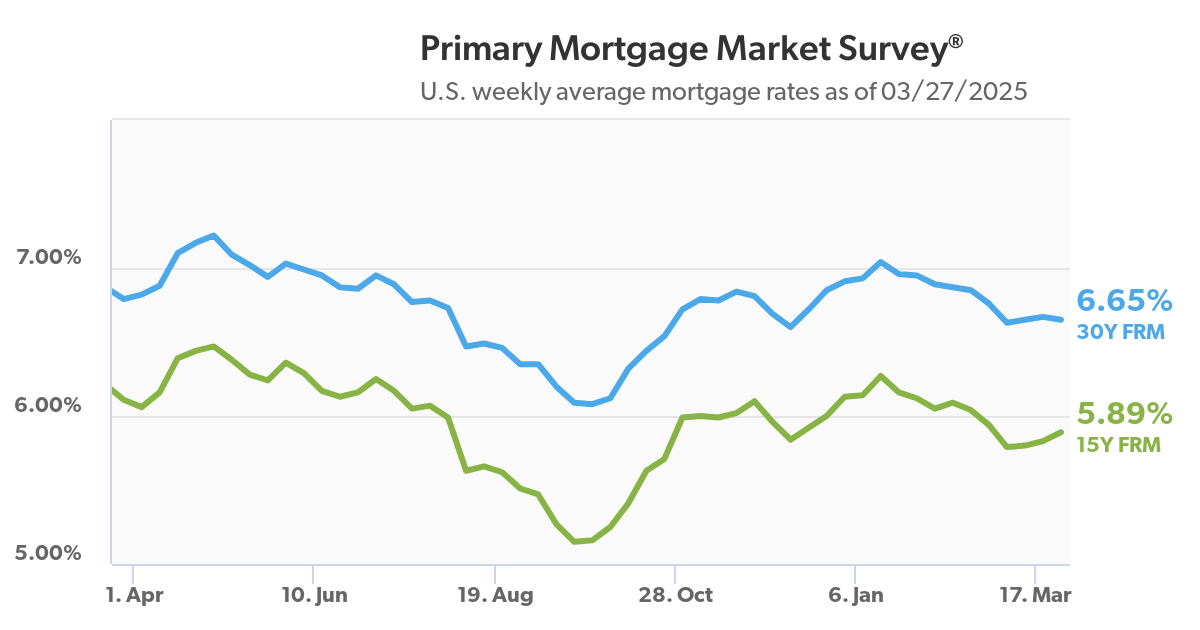
If you've been eyeing the housing market, there's a bit of good news: mortgage rates have dipped to a 2-week low. According to Freddie Mac, the average rate on a 30-year fixed home loan fell to 6.65% for the week ending March 27, 2025. While it's a small decrease from 6.67% the week before, it's a move in the right direction. But what does this mean for you, the potential homebuyer? Let’s break down what's happening, why, and what to expect in the coming months.

Mortgage Rates Drop to 2-Week Low for Week Ending March 27, 2025

Mortgage Rates Drop to 2-Week Low
Source: Freddie Mac

What's Driving This Downtick?

Several factors play into the fluctuating nature of mortgage rates. It's not just one thing, but rather a combination of economic indicators, market sentiment, and even political factors. In this case, the drop comes despite the stock market's upward momentum and a rise in the U.S. Treasury yield. It is quite surprising, but here's the breakdown as I see it.

  • Market Instability: The market is a very sensitive thing and investors are hesitant about putting money into debt markets. The 10-year Treasury yield, which is the interest rate the federal government pays to borrow money for a decade, also moved higher.
  • Uncertainty in Trade Policy: Trade policies have a big impact as tariffs stoke fears about inflation and a potential economic downturn.

Expert Insights

According to Realtor.com® Senior Economist Joel Berner, the mortgage rates have been fluctuating because the recovering stock market has been pulling investors out of the debt market. Also, the uncertainty surrounding trade policy contributes to it as it stokes fears about inflation.

Why This Matters to You

For potential homebuyers, even a slight dip in mortgage rates can make a difference. It could translate to:

  • Lower Monthly Payments: The most immediate impact is a reduction in your monthly mortgage payment. Over the life of a 30-year loan, even a small decrease can save you thousands of dollars.
  • Increased Purchasing Power: With lower rates, you might be able to afford a slightly more expensive home.
  • Renewed Hope: The psychological effect of seeing rates drop can be significant. It can encourage hesitant buyers to jump back into the market.

The Challenge Remains: Affordability

It's no secret that affordability is still a major hurdle for many Americans. As Berner points out, mortgage rates in the high-6% and low-7% range have slowed home sales compared to last year. He says that the first quarter of 2025 has presented more financial challenges to homebuyers than it has opportunities. People are facing growing prices across the country and increased mortgage rates.

Looking Ahead: What to Expect in the Spring Buying Season

Despite the current challenges, there's reason for optimism. Realtor.com economists are forecasting more home sales this year compared to 2024.

  • Spring Surge: The expectation is that this upswing will start in the coming months as the spring buying and selling season kicks into gear.
  • Increased Inventory: One of the biggest constraints on the market has been the lack of homes for sale. If more homeowners decide to list their properties, it could ease some of the pressure on prices and give buyers more options.

Understanding How Mortgage Rates Are Calculated

It's not just about the headlines; it's about understanding what drives these rates. Here’s a simplified breakdown:

  • 10-Year Treasury Bond Yield: This is the key benchmark. Mortgage rates tend to follow the 10-year Treasury yield, which reflects broader market trends like economic growth and inflation expectations.
  • Lender's Margin: Lenders add their own margin to cover operational costs, risks, and profit.
  • Your Financial Profile: This includes your credit score, loan amount, property type, down payment size, and loan term. Lenders assess your risk based on these factors.

Essentially, lenders are trying to determine how likely you are to repay the loan. The riskier you seem, the higher the rate you'll pay.

The Impact of Your Credit Score

Your credit score is a major factor in determining the mortgage rate you'll receive. A higher credit score typically translates to a lower interest rate. Here's a quick overview:

Credit Score Range Rating Impact on Mortgage Rates
700+ Excellent Lowest Rates
680-699 Good Competitive Rates
620-679 Fair Higher Rates
Below 620 Poor/Risky Highest Rates, Difficulty Getting Approved

It's worth noting that different types of loans have different minimum credit score requirements. For example, you might be able to get approved for a Federal Housing Administration (FHA) loan with a lower credit score compared to a conventional loan.

Mortgage Applications: A Mixed Bag

Recent data from the Mortgage Bankers Association (MBA) shows a mixed picture:

  • Overall Dip: Mortgage applications dipped by 2% from a week ago (data ending March 21, 2025).
  • Purchase Applications Up: However, purchase applications (involving the offer and agreement to buy a property) increased 1% from a week ago and 7% year-over-year.

This increase in purchase applications was driven by a surge in FHA loan applications, according to Joel Kan, MBA’s vice president and deputy chief economist.

Recommended Read:

Mortgage Rates Drop: Can You Finally Afford a $400,000 Home?

Expect High Mortgage Rates Until 2026: Fannie Mae's 2-Year Forecast

Will Mortgage Rates Rise Back Above 7% or Go Down in 2025?

Mortgage Interest Rates Forecast for Next 10 Years

Types of Mortgage Loans

When you're looking to secure a mortgage, you'll encounter different types of loans. Each has its own pros, cons, and eligibility requirements. Here's a quick rundown:

  • Conventional Loans: These are not insured or guaranteed by the government. They typically require a higher credit score and a larger down payment.
  • FHA Loans: Insured by the Federal Housing Administration, these loans are popular among first-time homebuyers and those with lower credit scores. They often have lower down payment requirements.
  • VA Loans: Guaranteed by the Department of Veterans Affairs, these loans are available to eligible veterans, active-duty military personnel, and surviving spouses. They often come with no down payment and competitive interest rates.
  • USDA Loans: These loans are offered by the U.S. Department of Agriculture and are designed to help people buy homes in rural areas. They often have no down payment requirements.

My Take: A Cautious Optimism

While the drop in mortgage rates is welcome news, I think it's important to remain cautiously optimistic. The housing market is complex, and many factors can influence rates. As I see it, we should be prepared for further fluctuations. However, if you're in a good financial position and have been waiting for the right moment, this small dip might be the nudge you need to start exploring your options.

Tips for Potential Homebuyers:

  • Check Your Credit Score: Before you even start looking at homes, get a copy of your credit report and make sure everything is accurate.
  • Get Pre-Approved: This will give you a clear idea of how much you can afford and make you a more attractive buyer to sellers.
  • Shop Around for the Best Rate: Don't settle for the first offer you receive. Talk to multiple lenders and compare rates and fees.
  • Be Patient: The housing market can be competitive, so don't get discouraged if you don't find the perfect home right away.

Ultimately, buying a home is a big decision, and it's important to do your research and make sure you're comfortable with the financial commitment. But with rates dipping, now might be a good time to start exploring your options.

Work With Norada, Your Trusted Source for

Real Estate Investments

With mortgage rates fluctuating, investing in turnkey real estate

can help you secure consistent returns.

Expand your portfolio confidently, even in a shifting interest rate environment.

Speak with our expert investment counselors (No Obligation):

(800) 611-3060

Get Started Now

Also Read:

  • Are Ultra-Low 2% and 3% Mortgage Rates Ever Coming Back?
  • Will Mortgage Rates Go Down in 2025: Morgan Stanley's Forecast
  • Mortgage Rate Predictions 2025 from 4 Leading Housing Experts
  • Mortgage Rates Forecast for the Next 3 Years: 2025 to 2027
  • 30-Year Mortgage Rate Forecast for the Next 5 Years
  • 15-Year Mortgage Rate Forecast for the Next 5 Years
  • Why Are Mortgage Rates Going Up in 2025: Will Rates Drop?
  • Why Are Mortgage Rates So High and Predictions for 2025
  • Will Mortgage Rates Ever Be 3% Again in the Future?
  • Mortgage Rates Predictions for Next 2 Years
  • Mortgage Rate Predictions for Next 5 Years
  • How Lower Mortgage Rates Can Save You Thousands?
  • How to Get a Low Mortgage Interest Rate?
  • Will Mortgage Rates Ever Be 4% Again?
Filed Under: Financing, Mortgage Tagged With: Interest Rate, mortgage, Mortgage Rate Trends, mortgage rates, Mortgage Rates Predictions, Mortgage Rates Today

Today’s Mortgage Rates March 27, 2025: Rates Show Minor Fluctuation

March 27, 2025 by Marco Santarelli

Today's Mortgage Rates March 27, 2025: Rates Show Minor Fluctuation

As of today, March 27, 2025, the landscape of mortgage rates shows minor fluctuations, with some rates nudging slightly upward while others saw a marginal decrease. According to the latest data from Zillow, the 30-year fixed mortgage rate has gently decreased by one basis point, settling at 6.60%, whereas the 15-year fixed rate experienced a minuscule increase of one basis point, reaching 5.98%.

For those considering refinancing, the rates present a similar picture, with the 30-year fixed refinance rate standing at 6.61% and the 15-year fixed refinance rate at 6.00%. These shifts, though small, are important for anyone looking to buy a home or refinance their existing mortgage.

Today's Mortgage Rates March 27, 2025: Rates Show Minor Fluctuation

Key Takeaways:

  • 30-Year Fixed Mortgage: Decreased slightly to 6.60%.
  • 15-Year Fixed Mortgage: Increased slightly to 5.98%.
  • Refinance Rates: Generally similar to purchase rates, with the 30-year fixed refinance at 6.61% and the 15-year fixed refinance at 6.00%.
  • VA Loans: Continue to offer potentially lower rates for eligible military-affiliated borrowers. The 30-year VA loan rate is at 6.14%.
  • FHA Loans: May provide lower rates than conventional loans, but typically involve mortgage insurance payments for the duration of the loan. The 30-year FHA refinance rate is 6.18%.
  • Adjustable-Rate Mortgages (ARMs): The 5/1 ARM is at 6.86% and the 7/1 ARM at 6.93% for purchase, offering an initial fixed period before rates adjust.

Current Mortgage Rates:

To provide a clearer snapshot of the current borrowing environment, here's a table summarizing today's average mortgage rates as reported by Zillow:

Loan Type Interest Rate
30-Year Fixed 6.60%
20-Year Fixed 6.35%
15-Year Fixed 5.98%
5/1 ARM 6.86%
7/1 ARM 6.93%
30-Year VA 6.14%
15-Year VA 5.73%
5/1 VA 6.24%

It's crucial to remember that these figures represent national averages and can vary based on individual borrower qualifications, the specific lender, and market conditions in your area.

Today's Mortgage Refinance Rates:

For homeowners considering a refinance, understanding the prevailing rates is equally important. Here’s a look at the average mortgage refinance rates today, according to Zillow:

Loan Type Interest Rate
30-Year Fixed 6.61%
20-Year Fixed 6.32%
15-Year Fixed 6.00%
5/1 ARM 6.67%
7/1 ARM 6.47%
30-Year VA 6.26%
15-Year VA 5.94%
5/1 VA 6.38%
30-Year FHA 6.18%
15-Year FHA 6.04%

Refinance rates can sometimes be higher than purchase mortgage rates, although this isn't always the case. Factors such as the perceived risk associated with an existing loan versus a new purchase can influence this difference.

Understanding How Mortgage Rates Function

At its core, a mortgage interest rate is the cost you pay for the privilege of borrowing money from a lender. This cost is expressed as a percentage of the loan amount and can be structured in two primary ways: fixed-rate and adjustable-rate.

A fixed-rate mortgage provides stability and predictability. Once you lock in your interest rate, it remains the same for the entire duration of your loan term. For instance, if you secure a 30-year mortgage with a 6% interest rate today, that 6% will be your interest rate for the next three decades, barring any refinancing or sale of the property. This stability can be particularly appealing in times of potential economic uncertainty or rising interest rates.

Conversely, an adjustable-rate mortgage (ARM) offers an initial period with a fixed interest rate, after which the rate adjusts periodically based on prevailing market conditions. A common example is a 5/1 ARM. With this type of loan, the interest rate remains fixed for the first five years (the “5” in 5/1), and then it adjusts once per year (the “1”) for the remaining term of the loan, typically 25 years for a 30-year mortgage. The direction and magnitude of these adjustments are tied to economic indicators and the state of the U.S. housing market. ARMs can be attractive for borrowers who expect to move or refinance before the adjustment period begins, or for those who anticipate interest rates will fall.

It's also worth noting how your monthly mortgage payment is allocated over time. In the initial years of a mortgage, a larger portion of your payment goes towards covering the interest, with the remainder reducing the principal, which is the original amount you borrowed. As you progress through the loan term, this ratio gradually shifts, and an increasing share of your payment contributes to the principal, while less goes towards interest.

Factors Influencing Today's Mortgage Rates

Numerous factors come into play when determining mortgage rates, some of which are within a borrower's control, while others are dictated by broader economic forces:

Controllable Factors:

  • Credit Score: Lenders generally offer more favorable interest rates to individuals with higher credit scores. A strong credit history signifies a lower risk of default.
  • Debt-to-Income (DTI) Ratio: Your DTI ratio, which compares your monthly debt payments to your gross monthly income, is another critical factor. A lower DTI suggests you have a better capacity to manage your mortgage payments.
  • Down Payment: A larger down payment reduces the loan amount and can also signal lower risk to the lender, potentially leading to a better interest rate.
  • Comparison Shopping: Actively comparing offers from various mortgage lenders, including banks, credit unions, and specialized mortgage companies, can help you secure the most competitive rate and terms.

Uncontrollable Factors:

  • Economic Conditions: The overall health of the economy plays a significant role in setting mortgage rates. For instance, during periods of economic slowdown or recession, the Federal Reserve might lower interest rates to encourage borrowing and stimulate economic activity, which typically leads to lower mortgage rates. Conversely, a strong economy can result in higher rates to curb potential inflation.
  • U.S. Housing Market: The dynamics of the housing market, including supply and demand, can also influence mortgage rates.
  • Federal Reserve Policies: Actions taken by the Federal Reserve, such as adjusting the federal funds rate, can indirectly impact mortgage rates.

Recommended Read:

Mortgage Rates Trends as of March 26, 2025

Mortgage Rates Drop: Can You Finally Afford a $400,000 Home?

Expect High Mortgage Rates Until 2026: Fannie Mae's 2-Year Forecast

Will Mortgage Rates Rise Back Above 7% or Go Down in 2025?

Mortgage Interest Rates Forecast for Next 10 Years

30-Year Fixed vs. 15-Year Fixed Mortgage Rates: A Closer Look

The 30-year fixed-rate mortgage and the 15-year fixed-rate mortgage are two of the most popular choices for homebuyers, each with distinct advantages and disadvantages.

The 30-year mortgage is favored by many due to its typically lower monthly payments. Spreading the loan amount over a longer period reduces the immediate financial burden on borrowers. However, this comes at the cost of a higher overall interest payment over the life of the loan, as interest accrues for a more extended period. Additionally, the interest rate on a 30-year mortgage is generally higher than that of a shorter-term loan.

On the other hand, a 15-year mortgage offers the benefit of a lower interest rate compared to a 30-year mortgage. Because the loan is repaid in half the time, the total amount of interest paid is significantly less. Moreover, you build equity in your home more rapidly with a 15-year mortgage. However, the trade-off is higher monthly payments, as you are paying off the same loan amount in a shorter timeframe.

The choice between a 30-year and a 15-year mortgage often depends on a borrower's financial situation and long-term goals. Those prioritizing lower monthly payments and greater financial flexibility in the short term might opt for a 30-year mortgage. Conversely, borrowers focused on saving on interest over the long term and building equity quickly, and who can comfortably afford the higher monthly payments, might find a 15-year mortgage more appealing.

Understanding Today's Mortgage Payments Under Current Rates

It's one thing to know the interest rate, but it's another to understand how that rate translates into your monthly mortgage payment. Let's break down estimated monthly payments for different loan amounts based on the current average 30-year fixed mortgage rate of 6.60%. Please note that these calculations are for principal and interest only and do not include property taxes, homeowners insurance, or other potential costs like private mortgage insurance (PMI) or HOA fees, which can significantly impact your total monthly housing expense.

Monthly Payment on $150k Mortgage

For a $150,000 mortgage at an interest rate of 6.60% over a 30-year term, the estimated monthly principal and interest payment would be approximately $962. This calculation demonstrates how even on a smaller loan amount, the interest rate plays a crucial role in determining your regular outgoing expense. Over the 30-year life of the loan, the total interest paid would be substantial, highlighting the long-term cost of borrowing.

Monthly Payment on $200k Mortgage

Increasing the loan amount to $200,000 at the same 6.60% interest rate over 30 years would result in an estimated monthly principal and interest payment of around $1,283. This $321 increase in the monthly payment compared to the $150,000 loan reflects the larger principal balance being financed. Similarly, the total interest paid over the loan's term would also be proportionally higher.

Monthly Payment on $300k Mortgage

A $300,000 mortgage at 6.60% for 30 years would carry an estimated monthly principal and interest payment of approximately $1,925. As the loan amount grows, the impact of the interest rate becomes more pronounced in the absolute dollar amount of the monthly payment and the total interest paid. This figure provides a clearer picture for individuals looking at homes in a mid-price range.

Monthly Payment on $400k Mortgage

For a $400,000 mortgage with a 6.60% interest rate and a 30-year repayment period, the estimated monthly principal and interest payment would be about $2,567. This significant monthly outlay underscores the financial commitment involved in purchasing a higher-priced home. Prospective buyers need to carefully consider their budget and ensure they can comfortably manage this level of expense, along with other homeownership costs.

Monthly Payment on $500k Mortgage

Financing a $500,000 home with a 30-year mortgage at 6.60% interest would lead to an estimated monthly principal and interest payment of roughly $3,209. This amount represents a substantial portion of most household budgets and highlights the importance of securing the best possible interest rate and carefully evaluating affordability before taking on such a significant financial obligation.

These examples clearly illustrate the direct relationship between the loan amount and the monthly mortgage payment at a given interest rate and loan term. When considering a mortgage, it's essential to look beyond just the interest rate and understand the full financial implications, including the total amount paid over the life of the loan. Utilizing a mortgage payment calculator, which can incorporate factors like property taxes and insurance, can provide an even more realistic estimate of your potential monthly housing costs.

Work With Norada, Your Trusted Source for

Real Estate Investments

With mortgage rates fluctuating, investing in turnkey real estate

can help you secure consistent returns.

Expand your portfolio confidently, even in a shifting interest rate environment.

Speak with our expert investment counselors (No Obligation):

(800) 611-3060

Get Started Now

Also Read:

  • Will Mortgage Rates Go Down in 2025: Morgan Stanley's Forecast
  • Mortgage Rate Predictions 2025 from 4 Leading Housing Experts
  • Mortgage Rates Forecast for the Next 3 Years: 2025 to 2027
  • 30-Year Mortgage Rate Forecast for the Next 5 Years
  • 15-Year Mortgage Rate Forecast for the Next 5 Years
  • Why Are Mortgage Rates Going Up in 2025: Will Rates Drop?
  • Why Are Mortgage Rates So High and Predictions for 2025
  • Will Mortgage Rates Ever Be 3% Again in the Future?
  • Mortgage Rates Predictions for Next 2 Years
  • Mortgage Rate Predictions for Next 5 Years
  • Mortgage Rate Predictions: Why 2% and 3% Rates are Out of Reach
  • How Lower Mortgage Rates Can Save You Thousands?
  • How to Get a Low Mortgage Interest Rate?
  • Will Mortgage Rates Ever Be 4% Again?

Filed Under: Financing, Mortgage Tagged With: Interest Rate, mortgage, Mortgage Rate Trends, mortgage rates, Mortgage Rates Predictions, Mortgage Rates Today

Mortgage Rates Stay Below 7% for Nine Consecutive Weeks in 2025

March 27, 2025 by Marco Santarelli

Mortgage Rates Stay Below 7% for Nine Consecutive Weeks in 2025

Thinking about buying a home or refinancing your current mortgage? Well, there's some good news! For nine weeks straight now, mortgage rates have stayed below 7%, and that’s a big deal for anyone watching the housing market. This sustained dip under the 7% mark means borrowing money to buy a home is becoming a little less expensive and a bit more predictable. Let's break down what this all means for you, whether you're dreaming of your first house or looking to make your current home payments more manageable.

Mortgage Rates Stay Below 7% for Nine Consecutive Weeks

Understanding the Current Mortgage Landscape

Before we jump into what this rate stability means, let's look at the numbers. Freddie Mac, who keeps a close eye on these things, tells us that as of March 20, 2025, the average rate for a 30-year fixed-rate mortgage is 6.67%. Now, that’s slightly up from the week before by just a tiny bit (0.02%), but it’s still holding comfortably below that 7% line we’ve been watching. For those looking at a 15-year fixed-rate mortgage, the average is 5.83%, again with a small bump up from the previous week (0.03%).

Here’s a quick snapshot of what the rates look like right now based on Freddie Mac's data:

Mortgage Type Current Rate Weekly Change Yearly Change 4-Week Avg 52-Week Avg 52-Week Range
30-Year Fixed-Rate Mortgage (FRM) 6.67% +0.02% -0.20% 6.68% 6.74% 6.08% – 7.22%
15-Year Fixed-Rate Mortgage (FRM) 5.83% +0.03% -0.38% 5.84% 5.96% 5.15% – 6.47%

Looking at this, what jumps out to me is the relative steadiness. We're not seeing wild swings up or down, which is reassuring in a market that's felt pretty bumpy lately. While there's been a tiny nudge upwards in the last week, the overall trend of staying under 7% for over two months is the real story here.

What’s Keeping Rates Relatively Stable?

You might be wondering, why are mortgage rates behaving this way? It’s not just luck; several factors are at play.

  1. Economic Headwinds: We're still navigating some tricky economic waters. While inflation has cooled down from its peak, it's still not quite where the Federal Reserve wants it to be. Economic data, like job reports and inflation numbers, heavily influence mortgage rates. If inflation seems to be under control, rates tend to stabilize or even decrease.
  2. Investor Confidence (or Lack Thereof): When there's a lot of uncertainty in the world – whether it's global events or economic jitters – investors often look for safer places to park their money. Government bonds are considered safe havens. When demand for bonds goes up, their yields (which influence mortgage rates) can go down, making mortgage rates more attractive.
  3. Housing Market Resilience: Despite all the talk about affordability challenges, people still want to buy homes. There’s a basic demand for housing, and this continued interest from buyers keeps the market active. Lenders are motivated to offer competitive rates to attract these buyers, which helps in maintaining some rate stability.

In my experience, it's often a mix of these factors working together. It's like a balancing act, and right now, things are in a bit of a pause.

What Does This Mean for You – The Homebuyer and Homeowner?

Okay, so mortgage rates have stayed below 7%. Great! But how does this actually impact you? Let's break it down.

For Aspiring Homebuyers

If you’re in the market to buy a home, these stable, sub-7% mortgage rates are like a green light. Here’s why:

  1. Improved Affordability: Let’s be real, buying a home is expensive. Even a small dip in interest rates can make a big difference in your monthly payment and how much house you can actually afford. While 6.67% isn't rock bottom historically, it’s definitely better than the higher rates we saw not too long ago. This can open up homeownership to more people, especially first-time buyers who are often really sensitive to rate changes.
  2. Boosted Purchasing Power: When rates are lower, your buying power increases. Essentially, you can borrow more money for the same monthly payment. This means you might be able to look at homes in a slightly higher price range, or perhaps afford some of those extra features you were hoping for – like a bigger yard or a nicer kitchen.
  3. Reduced Urgency (Slightly): When rates are jumping around a lot, there’s this feeling of “I need to buy now before rates go even higher!” But with this period of stability, you might feel a little less rushed and have more time to find the right home, not just any home. This is important because buying a house is a huge decision, and you don’t want to feel pressured into making a hasty choice.

From my point of view, this period offers a window of opportunity for buyers. It’s not a guarantee rates will stay this low forever, so if you’ve been on the fence, now might be a good time to seriously consider making a move.

Recommended Read:

Mortgage Rates Drop: Can You Finally Afford a $400,000 Home?

Expect High Mortgage Rates Until 2026: Fannie Mae's 2-Year Forecast

Mortgage Interest Rates Forecast for Next 10 Years

The Impact of Rate Changes

For Current Homeowners

Homeowners, don't think you're left out! These rates are relevant to you too, especially if you've been thinking about refinancing.

  1. Refinancing Potential: If you locked in a mortgage when rates were higher, refinancing at these lower rates could save you a significant amount of money over the life of your loan. Think about lower monthly payments, freeing up cash for other things, or paying off your mortgage faster.
  2. Tapping into Home Equity: Home values have been on the rise in many areas over the past few years. If your home has increased in value, you might have built up some equity. Lower rates can make accessing that equity through a cash-out refinance or a home equity line of credit (HELOC) more attractive, giving you funds for renovations, debt consolidation, or other financial goals.

As someone who’s seen homeowners benefit from refinancing, I always advise people to run the numbers. Even a small percentage point difference can add up to substantial savings over the years.

Looking Ahead: What’s Next for Mortgage Rates?

Crystal balls are always cloudy when it comes to predicting the future, especially with something as dynamic as mortgage rates. We need to keep an eye on a few key things:

  • Upcoming Economic Reports: Keep an eye on inflation data, job numbers, and GDP growth. These reports give clues about the overall health of the economy and how the Federal Reserve might react.
  • Federal Reserve Actions: The Fed’s decisions about interest rates are crucial. Watch for their meetings and announcements; they will heavily influence the direction of mortgage rates.
  • Geopolitical Events: Global events can create economic uncertainty, which, as we discussed, can impact investor behavior and bond yields, ultimately affecting mortgage rates.

The market is still in flux, and things can change quickly. While we’re enjoying this period of relative stability, it’s wise to stay informed and be prepared for potential shifts.

In Conclusion

The fact that mortgage rates have stayed below 7% for nine consecutive weeks is genuinely encouraging news for both homebuyers and homeowners. It provides a degree of stability and opportunity in a market that has been anything but predictable recently. For buyers, it makes homeownership a bit more accessible and boosts purchasing power.

For homeowners, it opens doors for potential refinancing and accessing home equity. While no one can say for sure what the future holds, right now, the housing market is offering a more favorable environment than we’ve seen in a while. My advice? If you’re considering buying or refinancing, take advantage of this window of opportunity – do your research, talk to a mortgage professional, and see if now is the right time for you to make your move.

Read More:

  • Will Mortgage Rates Go Down in 2025: Morgan Stanley's Forecast
  • Mortgage Rate Predictions 2025 from 4 Leading Housing Experts
  • Mortgage Rates Forecast for the Next 3 Years: 2025 to 2027
  • 30-Year Mortgage Rate Forecast for the Next 5 Years
  • 15-Year Mortgage Rate Forecast for the Next 5 Years
  • Why Are Mortgage Rates Going Up in 2025: Will Rates Drop?
  • Why Are Mortgage Rates So High and Predictions for 2025
  • Will Mortgage Rates Ever Be 3% Again in the Future?
  • Mortgage Rates Predictions for Next 2 Years
  • Mortgage Rate Predictions for Next 5 Years
  • Mortgage Rate Predictions: Why 2% and 3% Rates are Out of Reach
  • How Lower Mortgage Rates Can Save You Thousands?
  • How to Get a Low Mortgage Interest Rate?
  • Will Mortgage Rates Ever Be 4% Again?
Filed Under: Financing, Mortgage Tagged With: Interest Rate, mortgage, Mortgage Rate Trends, mortgage rates, Mortgage Rates Predictions, Mortgage Rates Today

Today’s Mortgage Rates March 26, 2025: Rates Show Minor Increase

March 26, 2025 by Marco Santarelli

Today's Mortgage Rates March 26, 2025: Rates Show Minor Increase

As of today, March 26, 2025, the mortgage rates across the nation are showing minor upward movement in some areas, while others remain stable. According to the latest data from Zillow, the average 30-year fixed mortgage rate has slightly increased to 6.61%. Similarly, refinance rates are also exhibiting similar trends. For those looking to buy or refinance, understanding these subtle shifts is key.

Today's Mortgage and Refinance Rates, March 26, 2025: Staying Steady

Key Takeaways:

  • The average 30-year fixed mortgage rate is currently at 6.61%, a slight increase.
  • The 15-year fixed mortgage rate remains unchanged at 5.97%.
  • Refinance rates for a 30-year fixed loan are averaging 6.62%.
  • Experts suggest that significant drops in mortgage interest rates are not expected in the near future.
  • Focusing on improving personal finances and comparing lenders remains crucial for securing the best possible rate.

Current Mortgage Rates: A Closer Look

Getting a handle on the current mortgage rate environment is the first step for anyone considering buying a home. These rates significantly impact your monthly payments and the total amount of interest you'll pay over the life of your loan. Let's break down the specifics based on the latest data.

According to Zillow's data, here's a snapshot of the national average mortgage rates as of March 26, 2025:

Loan Type Interest Rate
30-Year Fixed 6.61%
20-Year Fixed 6.38%
15-Year Fixed 5.97%
5/1 ARM 6.91%
7/1 ARM 6.95%
30-Year VA 6.14%
15-Year VA 5.69%
5/1 VA 6.18%

It's interesting to note that while the 30-year fixed rate has seen a small uptick of three basis points, the 15-year fixed rate has held its ground. This subtle divergence highlights the nuanced nature of the mortgage market where various factors influence different loan types. Adjustable-rate mortgages (ARMs), such as the 5/1 and 7/1 ARMs, currently show slightly higher average rates compared to even the 30-year fixed, a situation that doesn't always hold true and emphasizes the importance of consulting with lenders.

Today's Mortgage Refinance Rates: What You Need to Know

For homeowners looking to potentially lower their monthly payments or shorten their loan term, understanding today's mortgage refinance rates is just as important. Refinancing involves taking out a new loan to pay off your existing mortgage. The attractiveness of refinancing hinges on whether you can secure a new interest rate that is lower than your current one, or if your financial goals necessitate a change in loan terms.

Here are the average national mortgage refinance rates as of March 26, 2025, also based on Zillow's data:

Loan Type Interest Rate
30-Year Fixed 6.62%
20-Year Fixed 6.37%
15-Year Fixed 6.02%
5/1 ARM 6.70%
7/1 ARM 6.82%
30-Year VA 6.15%
15-Year VA 5.81%
5/1 VA 6.28%
30-Year FHA 6.12%
15-Year FHA 6.04%

As you can see, in some instances, the refinance rates are slightly higher than the rates for purchasing a new home, particularly for the 30-year fixed option. However, this isn't a universal rule, and other factors like your individual financial profile and the specifics of your existing loan play a significant role. Interestingly, the rates for FHA loans are also provided in the refinance data, offering options for homeowners with these types of mortgages.

Factors Influencing Today's Mortgage Rates

Several interconnected elements within the broader economic climate contribute to the levels we see in today's mortgage rates. While predicting future fluctuations with absolute certainty is impossible, understanding these drivers provides valuable context.

One of the primary influences is the Federal Reserve's monetary policy. The Fed doesn't directly set mortgage rates, but its actions, such as adjusting the federal funds rate and its involvement in the bond market, have a ripple effect. Changes in these areas can impact the yield on Treasury securities and mortgage-backed securities, which in turn affect the interest rates lenders offer to consumers.

Recommended Read:

Mortgage Rates Trends as of March 25, 2025

Mortgage Rates Drop: Can You Finally Afford a $400,000 Home?

Expect High Mortgage Rates Until 2026: Fannie Mae's 2-Year Forecast

Will Mortgage Rates Rise Back Above 7% or Go Down in 2025?

Mortgage Interest Rates Forecast for Next 10 Years

The overall health of the U.S. economy also plays a crucial role. Factors like inflation, employment rates, and economic growth can influence investor confidence and the demand for bonds, ultimately impacting mortgage rates. For instance, periods of high inflation often lead to higher interest rates as lenders seek to protect their returns.

Furthermore, the demand for housing and the supply of available homes can exert pressure on mortgage rates. A strong housing market with high demand might lead to slightly higher rates, while a slowdown could have the opposite effect.

It's also worth noting that global economic events and investor sentiment can introduce volatility and influence the direction of interest rates, including those for mortgages.

What Will Your Estimated Monthly Mortgage Payment Be Today?

Monthly Payment on $150k Mortgage

For a $150,000 mortgage with the current average 30-year fixed mortgage rate of 6.61%, your estimated monthly payment would be approximately $962. This calculation includes only the principal and interest. Factors like property taxes, homeowners insurance, and potentially private mortgage insurance (PMI) could add to this amount.

Monthly Payment on $200k Mortgage

Taking the same 30-year fixed mortgage rate of 6.61%, a $200,000 mortgage would result in an estimated monthly payment of around $1,283 for principal and interest. Again, remember that additional housing-related costs will increase the total monthly outlay.

Monthly Payment on $300k Mortgage

If you were to take out a $300,000 mortgage at today's average 30-year fixed rate of 6.61%, your estimated principal and interest payment would be in the neighborhood of $1,925 per month. This illustrates how the loan amount directly impacts your monthly financial obligations.

Monthly Payment on $400k Mortgage

For a $400,000 mortgage at the prevailing 30-year fixed rate of 6.61%, the estimated monthly payment for principal and interest would be approximately $2,567. This figure underscores the significant financial commitment involved in purchasing a home at this price point under the current rate environment.

Monthly Payment on $500k Mortgage

With a $500,000 mortgage and today's average 30-year fixed rate of 6.61%, you can expect a monthly payment of roughly $3,209 for principal and interest. This highlights the importance of carefully considering affordability and long-term financial planning when taking on a mortgage of this size.

It's crucial to understand that these payment estimations are based solely on the principal loan amount and the interest rate. When budgeting for a mortgage, you'll also need to factor in property taxes, homeowners insurance, and PMI if your down payment is less than 20% of the home's purchase price. These additional costs can substantially increase your total monthly housing payment. Using a comprehensive mortgage calculator, it can provide a more accurate estimate by including these variables.

Navigating the Current Mortgage Landscape

Given that significant drops in mortgage rates aren't anticipated in the immediate future, prospective homebuyers and those considering refinancing should focus on what they can control. Boosting your credit score can lead to more favorable interest rates. Lenders view borrowers with higher credit scores as lower risk, and this is often reflected in the terms they offer. Reducing your debt-to-income ratio (DTI) is another important step.

A lower DTI indicates that you have a manageable amount of debt compared to your income, making you a more attractive borrower. Saving for a larger down payment can also be beneficial, as it might help you avoid private mortgage insurance (PMI) and could potentially lead to a slightly lower interest rate.

Furthermore, it's essential to shop around and get pre-approved by several different lenders. Each lender might offer slightly different rates and fees, and comparing these offers can potentially save you a significant amount of money over the life of your loan. Applying for pre-approval also gives you a clearer picture of how much you can afford and strengthens your position when making an offer on a home.

The market for mortgage rates is dynamic, influenced by a complex interplay of economic factors. While we've seen a minor upward drift in some rates today, the overall picture suggests a period of relative stability. For individuals navigating this environment, a proactive approach focused on financial preparedness and diligent comparison shopping remains the most effective strategy for achieving their homeownership or refinancing goals.

Work With Norada, Your Trusted Source for

Real Estate Investments

With mortgage rates fluctuating, investing in turnkey real estate

can help you secure consistent returns.

Expand your portfolio confidently, even in a shifting interest rate environment.

Speak with our expert investment counselors (No Obligation):

(800) 611-3060

Get Started Now

Also Read:

  • Will Mortgage Rates Go Down in 2025: Morgan Stanley's Forecast
  • Mortgage Rate Predictions 2025 from 4 Leading Housing Experts
  • Mortgage Rates Forecast for the Next 3 Years: 2025 to 2027
  • 30-Year Mortgage Rate Forecast for the Next 5 Years
  • 15-Year Mortgage Rate Forecast for the Next 5 Years
  • Why Are Mortgage Rates Going Up in 2025: Will Rates Drop?
  • Why Are Mortgage Rates So High and Predictions for 2025
  • Will Mortgage Rates Ever Be 3% Again in the Future?
  • Mortgage Rates Predictions for Next 2 Years
  • Mortgage Rate Predictions for Next 5 Years
  • Mortgage Rate Predictions: Why 2% and 3% Rates are Out of Reach
  • How Lower Mortgage Rates Can Save You Thousands?
  • How to Get a Low Mortgage Interest Rate?
  • Will Mortgage Rates Ever Be 4% Again?
Filed Under: Financing, Mortgage Tagged With: Interest Rate, mortgage, Mortgage Rate Trends, mortgage rates, Mortgage Rates Predictions, Mortgage Rates Today

Today’s Mortgage Rates March 25, 2025: Rates Rise as Home-Buying Season Begins

March 25, 2025 by Marco Santarelli

Today's Mortgage Rates March 25, 2025: Rates Rise as Home-Buying Season Begins

Today's mortgage rates have experienced a slight uptick, a trend observed at the commencement of the spring home-buying season. According to the latest data, the average 30-year fixed mortgage rate stands at 6.58%, while the 15-year fixed mortgage rate is currently at 5.97%. It's crucial to understand the factors driving these shifts and what they mean for prospective homeowners and those considering refinancing.

Mortgage Rates Today, March 25, 2025: Rates See Slight Increase as Spring Home-Buying Season Arrives

Key Takeaways:

  • 30-Year Fixed Mortgage Rate: Increased to 6.58%. This benchmark rate is a popular choice for its stability and predictability, making it a crucial indicator for the housing market.
  • 15-Year Fixed Mortgage Rate: Increased to 5.97%. Offers a quicker path to homeownership and significant long-term interest savings, though with higher monthly payments.
  • Home-Buying Season: Spring traditionally brings increased activity to the housing market, with more homes listed and heightened competition among buyers.
  • Rate Outlook: The prevailing sentiment is that rates will likely remain elevated in the near future, with potential fluctuations influenced by economic performance and Federal Reserve actions.
  • Refinance Rates: Generally, refinance rates are observed to be higher than purchase rates.

Today's Mortgage Rates: A Detailed Look

Understanding the specific mortgage rates available today is crucial for informed decision-making. Here is a breakdown of current rates based on the latest information from Zillow:

Loan Type Rate
30-Year Fixed 6.58%
20-Year Fixed 6.36%
15-Year Fixed 5.97%
5/1 ARM 6.72%
7/1 ARM 6.76%
30-Year VA 6.10%
15-Year VA 5.63%
5/1 VA 5.13%

It's essential to recognize that these figures represent national averages. Your individual rate will depend on a range of personalized factors, including your credit score, down payment amount, debt-to-income ratio, and the specific terms offered by your lender.

Delving Deeper into Today's Mortgage Refinance Rates

For homeowners contemplating a refinance, examining current refinance rates is paramount. Here's a comprehensive overview of today's refinance rates, leveraging data from Zillow:

Loan Type Rate
30-Year Fixed 6.56%
20-Year Fixed 6.18%
15-Year Fixed 5.96%
5/1 ARM 6.75%
7/1 ARM 6.59%
30-Year VA 5.96%
15-Year VA 5.47%
5/1 VA 6.14%
30-Year FHA 6.09%
15-Year FHA 5.75%

The difference between purchase and refinance rates often stems from the perceived risk associated with refinancing. Lenders may view refinances as slightly riskier due to factors like the homeowner's existing debt and the potential for changes in their financial situation.

30-Year vs. 15-Year Fixed Mortgage Rates: A Comparative Analysis

The choice between a 30-year and 15-year fixed-rate mortgage represents a fundamental decision for homebuyers. A closer look reveals the critical differences:

  • Interest Rate Dynamics: 15-year mortgages are generally offered at lower interest rates compared to their 30-year counterparts. This reflects the reduced risk for the lender due to the shorter loan term.
  • Monthly Payment Considerations: The accelerated repayment schedule of a 15-year mortgage results in higher monthly payments. This requires a greater upfront commitment from the borrower.
  • Total Interest Savings: The most significant advantage of a 15-year mortgage lies in the substantial reduction in total interest paid over the life of the loan. This can translate into tens or even hundreds of thousands of dollars saved.

To illustrate the financial implications, consider a hypothetical $400,000 mortgage. At the current 30-year fixed rate of 6.58%, the monthly payment would approximate $2,549, with total interest paid reaching a staggering $517,767 over the loan's duration. Conversely, a 15-year mortgage at 5.97% would necessitate a higher monthly payment of approximately $3,369, but the total interest paid would be significantly lower, around $206,411.

While the appeal of lower long-term interest costs is undeniable, it is essential to assess your budget and financial capacity to comfortably manage the increased monthly payments associated with a 15-year mortgage.

Fixed-Rate vs. Adjustable-Rate Mortgages: Weighing the Options

The choice between a fixed-rate and an adjustable-rate mortgage (ARM) involves a trade-off between stability and potential short-term savings:

  • Fixed-Rate Mortgage Advantages: The hallmark of a fixed-rate mortgage is its predictability. The interest rate remains constant throughout the loan term, offering peace of mind and simplifying long-term financial planning.
  • Adjustable-Rate Mortgage (ARM) Nuances: An ARM features an initial fixed-rate period, followed by periodic adjustments based on a pre-determined index. While the initial rate might be lower, the potential for future rate increases introduces an element of uncertainty.

For example, a 7/1 ARM offers a fixed rate for the first seven years, after which the rate adjusts annually. While the initial lower rate can be attractive, it is crucial to understand the potential for future payment shock if interest rates rise. Notably, current market conditions show that ARM rates are starting higher than fixed rates, making them a less attractive deal than usual.

The decision hinges on your risk tolerance, your expectations for future interest rates, and your anticipated length of stay in the home.

When Will Mortgage Rates Finally Drop?

Predicting the trajectory of mortgage rates with certainty is an impossibility, as they are subject to a complex interplay of factors:

  • The Federal Reserve's Monetary Policy Stance
  • The Pace of Economic Growth
  • Inflationary Pressures
  • Geopolitical Events
  • Investor Sentiment

The Federal Reserve's recent decision to maintain its benchmark interest rate underscores the prevailing uncertainty surrounding the economic outlook. While projections suggest potential interest rate cuts later in 2025, the timing and magnitude of these adjustments remain uncertain.

Some analysts anticipate that mortgage rates may remain relatively stable in the near term due to ongoing economic uncertainty. Others suggest that a potential economic slowdown could exert downward pressure on mortgage rates as investors seek the safety of U.S. Treasury bonds.

Recommended Read:

Mortgage Rates Trends as of March 24, 2025

Mortgage Rates Drop: Can You Finally Afford a $400,000 Home?

Expect High Mortgage Rates Until 2026: Fannie Mae's 2-Year Forecast

Will Mortgage Rates Rise Back Above 7% or Go Down in 2025?

Mortgage Interest Rates Forecast for Next 10 Years

Calculating Your Mortgage Payments Today Under Current Rates

Understanding what your mortgage payments might be under today's rates is crucial for budgeting and planning. We'll look at estimated monthly payments for different mortgage amounts using the current average 30-year fixed mortgage rate of 6.58%.

Monthly payment on a $150k mortgage

For a $150,000 mortgage at 6.58%, your estimated monthly payment (principal and interest only) would be approximately $952. This is a baseline figure. Remember, you'll also need to factor in costs like property taxes, homeowner's insurance, and potentially private mortgage insurance (PMI) if your down payment is less than 20%. These additional expenses can significantly increase your total monthly housing costs.

Monthly payment on a $200k mortgage

Stepping up to a $200,000 mortgage at the same rate of 6.58%, your monthly payment would be around $1,270 (principal and interest). It's important to consider how this payment fits within your overall budget, leaving room for other essential expenses and savings.

Monthly payment on a $300k mortgage

A $300,000 mortgage at 6.58% would result in an estimated monthly payment of $1,905. As you can see, the jump from $200,000 to $300,000 adds a significant amount to your monthly housing costs.

Monthly payment on a $400k mortgage

Borrowing $400,000 at a 6.58% interest rate would mean a monthly payment of roughly $2,540. At this level, it's crucial to have a solid financial foundation and a clear understanding of your long-term financial goals.

Monthly payment on a $500k mortgage

Finally, a $500,000 mortgage at 6.58% would carry an estimated monthly payment of $3,175. Taking on a mortgage of this size requires careful consideration of your income, expenses, and potential financial risks.

Work With Norada, Your Trusted Source for

Real Estate Investments

With mortgage rates fluctuating, investing in turnkey real estate

can help you secure consistent returns.

Expand your portfolio confidently, even in a shifting interest rate environment.

Speak with our expert investment counselors (No Obligation):

(800) 611-3060

Get Started Now

Also Read:

  • Will Mortgage Rates Go Down in 2025: Morgan Stanley's Forecast
  • Mortgage Rate Predictions 2025 from 4 Leading Housing Experts
  • Mortgage Rates Forecast for the Next 3 Years: 2025 to 2027
  • 30-Year Mortgage Rate Forecast for the Next 5 Years
  • 15-Year Mortgage Rate Forecast for the Next 5 Years
  • Why Are Mortgage Rates Going Up in 2025: Will Rates Drop?
  • Why Are Mortgage Rates So High and Predictions for 2025
  • Will Mortgage Rates Ever Be 3% Again in the Future?
  • Mortgage Rates Predictions for Next 2 Years
  • Mortgage Rate Predictions for Next 5 Years
  • Mortgage Rate Predictions: Why 2% and 3% Rates are Out of Reach
  • How Lower Mortgage Rates Can Save You Thousands?
  • How to Get a Low Mortgage Interest Rate?
  • Will Mortgage Rates Ever Be 4% Again?
Filed Under: Financing, Mortgage Tagged With: Interest Rate, mortgage, Mortgage Rate Trends, mortgage rates, Mortgage Rates Predictions, Mortgage Rates Today

Today’s Mortgage Rates March 24, 2025: Rates Rise Mildly Again

March 24, 2025 by Marco Santarelli

Today's Mortgage Rates March 24, 2025: Rates Are on the Rise Again

If you're thinking about buying a home or refinancing, you're probably glued to today's mortgage rates. As of March 24, 2025, the news isn't fantastic: mortgage rates are indeed on the rise. The average 30-year fixed mortgage rate is currently sitting at 6.51%, while the 15-year fixed mortgage rate is at 5.89%. So, if you're looking for a definitive answer, yes, rates are up, and it's time to understand what that means for your wallet and your home-buying dreams.

Today's Mortgage Rates March 24, 2025: Rates Rise Mildly Again

Key Takeaways You Need to Know

Let's break down the essential facts:

  • Current 30-Year Fixed Mortgage Rate: 6.51%
  • Current 15-Year Fixed Mortgage Rate: 5.89%
  • Refinance Rates: Generally a bit higher than rates for new home purchases.
  • Market Outlook: Expect mortgage rates to hang around these levels for the near future. That's my gut feeling based on what I'm seeing.

Now, let's dive into the details.

A Closer Look: Current Mortgage and Refinance Rates

To give you a comprehensive picture, here's a breakdown of different mortgage types and refinance rates, based on the latest data from Zillow.

Current Mortgage Rates (March 24, 2025)

Mortgage Type Rate (%)
30-Year Fixed 6.51
20-Year Fixed 6.25
15-Year Fixed 5.89
5/1 Adjustable-Rate (ARM) 6.79
7/1 Adjustable-Rate (ARM) 6.92
30-Year VA 6.09
15-Year VA 5.57
5/1 VA 6.07
30-Year FHA 6.01
15-Year FHA 5.72

Current Refinance Rates (March 24, 2025)

Refinance Type Rate (%)
30-Year Fixed 6.53
20-Year Fixed 6.11
15-Year Fixed 5.88
5/1 ARM 7.01
7/1 ARM 7.40
30-Year VA 6.08
15-Year VA 5.90
5/1 VA 6.13
30-Year FHA 6.01
15-Year FHA 5.72

Notice anything interesting? Refinance rates are generally a touch higher than rates for purchasing a new home. This is pretty typical, but it's worth noting.

Understanding How These Rates Impact Your Monthly Payments

Okay, numbers are important, but what do they REALLY mean? Let's break down what these rates translate to in terms of monthly payments. This is where the rubber meets the road.

What's Your Monthly Payment on a $150,000 Mortgage?

If you're looking at a smaller mortgage of $150,000 with a 30-year fixed rate of 6.51%, your estimated monthly payment would be around $948. That includes principal and interest, before taxes and insurance.

Monthly Payment on a $200,000 Mortgage

Bump that up to $200,000, and at the same 6.51% for a 30-year fixed loan, you're looking at a monthly payment of roughly $1,265.

What's Your Monthly Payment on a $300,000 Mortgage?

For a $300,000 mortgage at 6.51%, the estimated monthly payment jumps to about $1,898. See how quickly that adds up?

Monthly Payment on a $400,000 Mortgage

Now let's go even bigger. If you needed to borrow $400,000, expect to pay approximately $2,531 per month at the current rate.

Monthly Payment on a $500,000 Mortgage

Finally, a $500,000 mortgage at 6.51% would mean a monthly payment of around $3,164.

Important Note: These are just estimates! Remember, these figures don't include property taxes, homeowner's insurance, or potentially Private Mortgage Insurance (PMI) if you put down less than 20%. Those can significantly increase your actual monthly costs. Always get a complete estimate from your lender.

Breaking Down Your Monthly Mortgage Payment: The PITI

Mortgage payments aren't just about the loan amount. There are usually four main parts that make up your monthly payment – sometimes abbreviated as PITI:

  • Principal: This is the actual amount you borrowed.
  • Interest: The lender charges you interest for borrowing the money.
  • Taxes: Property taxes, usually paid to your city and state.
  • Insurance: Your homeowner's insurance premium protects you against damage or loss.
  • PMI (Private Mortgage Insurance): If you don't put down 20%, you'll likely have to pay PMI.

What's Driving These Mortgage Rates? Understanding the Factors at Play

It's not random chance that mortgage rates are where they are. Several factors are constantly influencing them:

  1. The Overall Economy: This is the big one. A strong, stable economy usually means lower rates. Uncertainty or fears of inflation can push rates higher.
  2. The Federal Reserve (The Fed): The Fed sets the federal funds rate, which indirectly impacts mortgage rates. When the Fed raises rates, mortgage rates tend to follow.
  3. Demand for Home Loans: When more people want to buy houses, demand for mortgages goes up. This can lead to higher rates. Conversely, if demand is low, lenders may lower rates to attract borrowers.
  4. Your Credit Score and Financial Situation: Lenders look at your credit score, debt-to-income ratio, and overall financial health to assess risk. The better your credit, the lower the rate you'll likely get.

Recommended Read:

Mortgage Rates Trends as of March 23, 2025

Mortgage Rates Drop: Can You Finally Afford a $400,000 Home?

Expect High Mortgage Rates Until 2026: Fannie Mae's 2-Year Forecast

Will Mortgage Rates Rise Back Above 7% or Go Down in 2025?

Mortgage Interest Rates Forecast for Next 10 Years

Navigating the Mortgage Market: Tips for Success

Buying a house when rates are rising can feel daunting, but here are some tips to make the process smoother:

  • Get Pre-Approved: Before you even start seriously looking, get pre-approved for a mortgage. This tells you how much you can borrow and strengthens your offer when you find a home.
  • Shop Around for Rates: Don't just go with the first lender you find. Shop around and compare rates from different lenders.
  • Consider Different Loan Options: Think about whether a fixed-rate mortgage or an adjustable-rate mortgage (ARM) is right for you.
  • Be Aware of Closing Costs: Factor in closing costs, which can include appraisal fees, title insurance, and other expenses.

Recent Trends and What They Mean for You

I've been watching the mortgage market closely, and here's what I'm seeing. Even with some hopes for rate cuts earlier in the year following Federal Reserve meetings, the reality is that rates haven't dropped significantly.

For much of the year, the 30-year fixed mortgage rate has been flirting with 7%. The fact that we're now at 6.51% is a small improvement, but it's still a challenging environment for first-time homebuyers.

My advice? Don't wait for the “perfect” rate. Focus on finding a home you love and can comfortably afford, even with the current rates.

Conclusion: Stay Informed and Take Action

The mortgage market is always changing, but one thing remains constant: knowledge is power. Stay informed about current rates, understand the factors that influence them, and take proactive steps to navigate the market. Talk to a financial advisor, get pre-approved, and shop around for the best rates.

Buying a home is a big decision, but with the right information and a solid plan, you can make it happen.

Work With Norada, Your Trusted Source for

Real Estate Investments

With mortgage rates fluctuating, investing in turnkey real estate

can help you secure consistent returns.

Expand your portfolio confidently, even in a shifting interest rate environment.

Speak with our expert investment counselors (No Obligation):

(800) 611-3060

Get Started Now

Also Read:

  • Will Mortgage Rates Go Down in 2025: Morgan Stanley's Forecast
  • Mortgage Rate Predictions 2025 from 4 Leading Housing Experts
  • Mortgage Rates Forecast for the Next 3 Years: 2025 to 2027
  • 30-Year Mortgage Rate Forecast for the Next 5 Years
  • 15-Year Mortgage Rate Forecast for the Next 5 Years
  • Why Are Mortgage Rates Going Up in 2025: Will Rates Drop?
  • Why Are Mortgage Rates So High and Predictions for 2025
  • Will Mortgage Rates Ever Be 3% Again in the Future?
  • Mortgage Rates Predictions for Next 2 Years
  • Mortgage Rate Predictions for Next 5 Years
  • Mortgage Rate Predictions: Why 2% and 3% Rates are Out of Reach
  • How Lower Mortgage Rates Can Save You Thousands?
  • How to Get a Low Mortgage Interest Rate?
  • Will Mortgage Rates Ever Be 4% Again?

Filed Under: Financing, Mortgage Tagged With: Interest Rate, mortgage, Mortgage Rate Trends, mortgage rates, Mortgage Rates Predictions, Mortgage Rates Today

  • « Previous Page
  • 1
  • …
  • 52
  • 53
  • 54
  • 55
  • 56
  • …
  • 65
  • Next Page »

Real Estate

  • Birmingham
  • Cape Coral
  • Charlotte
  • Chicago

Quick Links

  • Markets
  • Membership
  • Notes
  • Contact Us

Blog Posts

  • Top Real Estate Investment Markets to Watch in 2026
    March 13, 2026Marco Santarelli
  • Best Midwest Real Estate Markets for Investors in 2026
    March 13, 2026Marco Santarelli
  • Best U.S. Markets for Turnkey Rentals Under $200K in 2026
    March 13, 2026Marco Santarelli

Contact

Norada Real Estate Investments 30251 Golden Lantern, Suite E-261 Laguna Niguel, CA 92677

(949) 218-6668
(800) 611-3060
BBB
  • Terms of Use
  • |
  • Privacy Policy
  • |
  • Testimonials
  • |
  • Suggestions?
  • |
  • Home

Copyright 2018 Norada Real Estate Investments

Loading...