Norada Real Estate Investments

  • Home
  • Markets
  • Properties
  • Membership
  • Podcast
  • Learn
  • About
  • Contact

Today’s Mortgage Rates March 18, 2025: Rates Fluctuate as Fed Meeting Looms

March 18, 2025 by Marco Santarelli

Today's Mortgage Rates March 18, 2025: Rates Fluctuate as Fed Meeting Looms

Today's mortgage rates, as of March 18, 2025, are showing some fluctuation, leaving potential homebuyers and those looking to refinance wondering about the best course of action. The latest data indicates a mixed bag, with some rates slightly down and others inching up, all ahead of the Federal Reserve meeting.

Today's Mortgage Rates March 18, 2025: Rates Fluctuate as Fed Meeting Looms

Key Takeaways:

  • 30-Year Fixed Rates: Slightly down to 6.57%.
  • 15-Year Fixed Rates: Slightly up to 6.01%.
  • Federal Reserve Meeting: Expected to influence rates in the near future.
  • Refinance Rates: Generally higher than purchase rates.
  • Economic Uncertainty: Continues to contribute to rate volatility.

Let's dive into the details.

Current Mortgage Rates

According to the latest data from Zillow, here's a snapshot of today's average mortgage rates across the nation:

Loan Type Interest Rate
30-Year Fixed 6.57%
20-Year Fixed 6.39%
15-Year Fixed 6.01%
5/1 ARM 6.64%
7/1 ARM 6.74%
30-Year VA 6.12%
15-Year VA 5.68%
5/1 VA 5.10%

It's interesting to see the small dips in the 30-year and 20-year fixed rates, while the 15-year rate experienced a slight increase. Adjustable-rate mortgages (ARMs) are also in the mix, offering different options for borrowers. Keep in mind that these rates are national averages, and what you actually qualify for can depend on factors like your credit score, down payment, and overall financial situation.

Mortgage Refinance Rates Today

If you're looking to refinance your current mortgage, here's what the refinance rates look like today, according to Zillow:

Loan Type Interest Rate
30-Year Fixed 6.65%
20-Year Fixed 6.38%
15-Year Fixed 6.12%
5/1 ARM 6.74%
7/1 ARM 6.79%
30-Year VA 6.28%
15-Year VA 6.07%
5/1 VA 6.10%
30-Year FHA 6.00%
15-Year FHA 5.75%

Notice that refinance rates are generally a bit higher than the rates for new home purchases. This is pretty typical. If you're considering a refinance, it's crucial to weigh the potential benefits, such as a lower interest rate or shorter loan term, against any associated costs.

The Fed Factor: How the Federal Reserve Impacts Mortgage Rates

Tomorrow's Federal Reserve meeting is on everyone's radar because the Fed's decisions can significantly influence mortgage rates. The Federal Reserve (also known as the Fed) is the central bank of the United States. One of the ways the Fed influences the economy is by setting the federal funds rate, which is the interest rate at which banks lend money to each other overnight.

While the federal funds rate doesn't directly determine mortgage rates, it does impact the broader interest rate environment. The Fed is not expected to cut the federal funds rate at this particular meeting. However, the commentary from Fed Chair Jerome Powell following the meeting could provide clues about the central bank's plans for the coming months.

30-Year vs. 15-Year Fixed Mortgage Rates

A common question is whether to go with a 30-year or 15-year fixed mortgage. The main difference is the loan term: 30 years versus 15 years. Typically, 15-year mortgage rates are lower than 30-year rates. While the shorter term saves you money on interest in the long run, your monthly payments will be higher since you're paying off the same amount of money in half the time.

For example, on a $400,000 mortgage at today's rates:

  • A 30-year mortgage at 6.57% would result in a monthly payment of around $2,547 (principal and interest). You'd pay about $516,817 in interest over the life of the loan.
  • A 15-year mortgage at 6.01% would have a monthly payment of roughly $3,378 (principal and interest). You'd pay approximately $207,966 in interest over the life of the loan.

That's a huge difference in the total interest paid!

Fixed-Rate vs. Adjustable-Rate Mortgages

With a fixed-rate mortgage, your interest rate stays the same for the entire loan term, giving you predictable monthly payments. Adjustable-rate mortgages (ARMs), on the other hand, have an interest rate that is fixed for a certain period, after which it can adjust based on market conditions. For example, a 5/1 ARM has a fixed rate for the first five years, then adjusts annually.

While ARMs may start with lower rates than fixed-rate mortgages, they come with the risk that your rate could increase later on. With current ARM rates starting higher than fixed rates, they aren't as attractive an option as they used to be.

Recommended Read:

Mortgage Rates Trends as of March 17, 2025

Mortgage Rates Drop: Can You Finally Afford a $400,000 Home?

Expect High Mortgage Rates Until 2026: Fannie Mae's 2-Year Forecast

Will Mortgage Rates Rise Back Above 7% or Go Down in 2025?

Mortgage Interest Rates Forecast for Next 10 Years

What Will Be Your Mortgage Payments Today Under Current Rates

Let's break down what your monthly mortgage payments might look like for different loan amounts at today's interest rates. I will use the prevailing 30-year fixed mortgage rate of 6.57% to give you a general idea. Remember, this calculation only includes principal and interest; property taxes, homeowner's insurance, and potential HOA fees will add to your total monthly payment.

Monthly Payment on a $150k Mortgage

For a $150,000 mortgage at a 6.57% interest rate, your estimated monthly payment would be approximately $954.50. This amount represents the portion of your payment that goes towards paying down the principal and covering the interest charges.

Monthly Payment on a $200k Mortgage

If you were to borrow $200,000 at a 6.57% interest rate, you can expect to pay around $1,272.66 per month. This figure is a good starting point for budgeting purposes, but don't forget about those extra costs I mentioned earlier!

Monthly Payment on a $300k Mortgage

Stepping up to a $300,000 mortgage at 6.57%, your estimated monthly payment jumps to $1,908.99. As you can see, even small increases in the loan amount can significantly impact your monthly expenses.

Monthly Payment on a $400k Mortgage

With a $400,000 mortgage at a 6.57% interest rate, your approximate monthly payment will be $2,545.32. At this level, it's even more important to carefully assess your financial situation and make sure you're comfortable with the commitment.

Monthly Payment on a $500k Mortgage

Finally, for a $500,000 mortgage at a 6.57% interest rate, you're looking at a monthly payment of roughly $3,181.65. This is a substantial amount, and it's essential to factor in all your other financial obligations before taking on such a large loan.

Remember, these are just estimates based on the principal and interest. I strongly recommend using a comprehensive mortgage calculator that includes taxes and insurance to get a more accurate picture of your potential monthly payments.

Looking Ahead: Will Mortgage Rates Drop in 2025?

Predicting the future of mortgage rates is always tricky. While most experts anticipate a gradual decline throughout 2025, dramatic drops are unlikely. Factors like the economy, inflation, and the Federal Reserve's actions will all play a role in determining where rates ultimately land. Experts believe that rates would need to drop closer to 5.5% to really stimulate the housing market. However, a weaker economy could offset the positive effects of lower rates.

In conclusion, today's mortgage rates are a mixed bag, with slight fluctuations in both purchase and refinance rates. The upcoming Federal Reserve meeting adds another layer of uncertainty. Keeping a close eye on economic news and consulting with a mortgage professional are always good ideas.

Work With Norada, Your Trusted Source for

Real Estate Investments

With mortgage rates fluctuating, investing in turnkey real estate

can help you secure consistent returns.

Expand your portfolio confidently, even in a shifting interest rate environment.

Speak with our expert investment counselors (No Obligation):

(800) 611-3060

Get Started Now

Read More:

  • Will Mortgage Rates Go Down in 2025: Morgan Stanley's Forecast
  • Mortgage Rate Predictions 2025 from 4 Leading Housing Experts
  • Mortgage Rates Forecast for the Next 3 Years: 2025 to 2027
  • 30-Year Mortgage Rate Forecast for the Next 5 Years
  • 15-Year Mortgage Rate Forecast for the Next 5 Years
  • Why Are Mortgage Rates Going Up in 2025: Will Rates Drop?
  • Why Are Mortgage Rates So High and Predictions for 2025
  • Will Mortgage Rates Ever Be 3% Again in the Future?
  • Mortgage Rates Predictions for Next 2 Years
  • Mortgage Rate Predictions for Next 5 Years
  • Mortgage Rate Predictions: Why 2% and 3% Rates are Out of Reach
  • How Lower Mortgage Rates Can Save You Thousands?
  • How to Get a Low Mortgage Interest Rate?
  • Will Mortgage Rates Ever Be 4% Again?
Filed Under: Financing, Mortgage Tagged With: Interest Rate, mortgage, Mortgage Rate Trends, mortgage rates, Mortgage Rates Predictions, Mortgage Rates Today

Today’s Mortgage Rates March 17, 2025: Rates Are Rising Again Slowly

March 17, 2025 by Marco Santarelli

Today's Mortgage Rates March 17, 2025: Rates Are Rising Again Slowly

Are you keeping an eye on mortgage rates today, March 17, 2025? If you're in the market to buy a home or thinking about refinancing, you're probably wondering what's happening with interest rates. Well, according to the latest data, mortgage rates are still on the higher side and have even seen a bit of an increase recently.

Today's Mortgage Rates March 17, 2025: Rates Are Rising Again Slowly

Key Takeaways:

  • 30-year fixed mortgage rates are averaging around 6.59%.
  • 15-year fixed mortgage rates are hovering near 5.93%.
  • Adjustable-rate mortgages (ARMs), specifically the 5/1 ARM, are averaging around 6.85%.
  • Refinance rates are also elevated, often slightly higher than purchase rates.
  • Experts predict mortgage rates will likely remain relatively high for the next few months, possibly into the rest of 2025.

Let's dive deeper into what these numbers mean for you, whether you're buying a new home or considering refinancing your current mortgage.

Current Mortgage Rates on March 17, 2025

If you're shopping for a mortgage right now, it's crucial to know where interest rates stand. As of today, March 17, 2025, data from Zillow shows that mortgage rates have been inching upwards. This isn't exactly welcome news for homebuyers, but understanding the current situation is the first step in making informed decisions.

Here's a snapshot of the average mortgage rates you can expect today:

Loan Type Interest Rate
30-Year Fixed 6.59%
20-Year Fixed 6.45%
15-Year Fixed 5.93%
5/1 ARM 6.85%
7/1 ARM 7.13%
30-Year VA 6.15%
15-Year VA 5.59%
5/1 VA 6.15%

Source: Zillow

It's worth noting that these are national averages. The rate you personally qualify for can vary based on factors like your credit score, down payment amount, the type of property you're buying, and even where you live. Think of these averages as a starting point to understand the general trend.

The Popular 30-Year Fixed-Rate Mortgage

The 30-year fixed-rate mortgage is still the most common choice for homebuyers, and for good reason. It offers a predictable monthly payment over a long period – 30 years, or 360 months. This predictability makes budgeting easier for many families. At today's average rate of 6.59%, it's definitely higher than what we've seen in recent years, but it's important to put it into perspective historically. While no one loves higher rates, they are still within a range that many people can work with.

The advantage of a 30-year mortgage is that it spreads your payments out, making each monthly payment lower compared to a shorter-term loan. However, this also means you'll pay significantly more interest over the life of the loan. Let's look at an example provided by Zillow: For a $300,000 mortgage at 6.59% with a 30-year term, your monthly payment for principal and interest alone would be around $1,914. Over 30 years, you'd end up paying a whopping $389,038 in interest – that's more than the original loan amount!

The Faster 15-Year Fixed-Rate Mortgage

If you're looking to pay off your mortgage faster and save on interest in the long run, a 15-year fixed-rate mortgage is an option to consider. The average rate for a 15-year fixed mortgage today is 5.93%, which is lower than the 30-year rate. This lower rate is one of the big draws of a 15-year mortgage. Plus, you’ll own your home outright in half the time!

However, the catch with a 15-year mortgage is that your monthly payments will be significantly higher. You're paying off the same amount of money in a shorter timeframe. Using the same $300,000 mortgage example, but with a 15-year term and a 5.93% rate, your monthly payment would jump to about $2,520. While your monthly outlay is higher, the interest you pay over the life of the loan is much less – around $153,643 in this case. That's a substantial savings compared to the 30-year loan.

Deciding between a 15-year and 30-year mortgage really comes down to your financial situation and priorities. Can you comfortably afford the higher monthly payments of a 15-year loan to save big on interest and own your home sooner? Or do you prefer the lower monthly payments of a 30-year loan, even though you'll pay more interest over time?

Adjustable-Rate Mortgages (ARMs)

Adjustable-rate mortgages, or ARMs, are another type of mortgage to be aware of. With an ARM, the interest rate is fixed for an initial period, and then it adjusts periodically based on market conditions. A 5/1 ARM, for instance, has a fixed rate for the first five years, and then the rate can change once a year after that.

Historically, ARMs have often started with lower interest rates than fixed-rate mortgages. The idea is that you could benefit from a lower rate in the beginning. This could be attractive if you plan to move or refinance before the fixed-rate period ends. However, the risk with an ARM is that interest rates could rise after the fixed period, leading to higher monthly payments down the road.

Interestingly, right now, we're seeing something a bit unusual. According to Zillow's data, the average 5/1 ARM rate is actually higher than both the 30-year and 15-year fixed rates, at 6.85%. This makes ARMs less appealing in the current market because you're not even getting that initial lower rate.

Refinance Rates Today: Is it a Good Time to Refinance?

Refinancing your mortgage means replacing your existing mortgage with a new one. People refinance for various reasons, such as to get a lower interest rate, shorten their loan term, or tap into their home equity.

Here are the average refinance rates as of today, March 17, 2025, according to Zillow:

Loan Type Interest Rate
30-Year Fixed 6.61%
20-Year Fixed 6.19%
15-Year Fixed 5.90%
5/1 ARM 7.18%
7/1 ARM 7.02%
30-Year VA 6.09%
15-Year VA 5.82%
5/1 VA 6.09%
30-Year FHA 6.00%
15-Year FHA 5.75%

You'll notice that refinance rates are generally a bit higher than purchase rates. This is often the case, although it's not a hard and fast rule.

With refinance rates being at these levels, many homeowners might be wondering if it's even worth refinancing. The answer really depends on your current situation and your goals. If you already have a very low interest rate locked in, refinancing now probably doesn't make sense unless you're trying to achieve a different goal, like switching from an ARM to a fixed-rate mortgage for more payment stability, or consolidating debt.

However, if your current mortgage rate is significantly higher than today's refinance rates, or if you want to shorten your loan term, refinancing could still be beneficial. You need to carefully calculate the costs of refinancing (like closing costs) and compare them to the potential savings over time to see if it makes financial sense for you. A good mortgage calculator can be really helpful in making this decision.

Why Are Mortgage Rates Still High in March 2025?

You might be wondering why mortgage rates are still elevated in March 2025. A lot of it boils down to the overall economic environment and the actions of the Federal Reserve, often called “the Fed.” The Federal Reserve is the central bank of the United States, and one of its main jobs is to manage inflation. Inflation is when prices for goods and services rise over time, reducing the purchasing power of your money.

To combat high inflation, the Federal Reserve has been raising the federal funds rate. This is the interest rate at which banks lend money to each other overnight. While the federal funds rate isn't directly mortgage rates, it influences them. When the federal funds rate goes up, it generally becomes more expensive for banks to borrow money, and these higher costs can get passed on to consumers in the form of higher mortgage rates.

The Federal Reserve is meeting this week, but it's “extremely unlikely” they will cut the federal funds rate at this meeting. In fact, predictions suggest they might not cut rates even at their next meeting in May. There's a possibility of a rate cut in June, but nothing is certain.

This means that, for the near future, we can expect mortgage rates to remain relatively high. Fannie Mae, a major player in the mortgage market, has even revised its forecast upwards. They now predict that the average 30-year fixed-rate mortgage will be around 6.8% throughout 2025 and will end the year at 6.6%. This suggests that significant drops in mortgage rates are not expected anytime soon.

There's also some economic uncertainty in the air that can affect interest rates. For example, talk of potential tariffs (taxes on imported goods) can create concerns about inflation. Higher tariffs could lead to increased prices for goods, which could then push interest rates higher as the Fed tries to keep inflation in check. Economic factors are complex and can shift quickly, so it's something to keep an eye on.

Recommended Read:

Mortgage Rates Trends as of March 16, 2025

Mortgage Rates Drop: Can You Finally Afford a $400,000 Home?

Expect High Mortgage Rates Until 2026: Fannie Mae's 2-Year Forecast

Will Mortgage Rates Rise Back Above 7% or Go Down in 2025?

Mortgage Interest Rates Forecast for Next 10 Years

Understanding Your Mortgage Payments at Today's Rates

Let's get down to brass tacks and look at what today's mortgage rates mean for your monthly payments. Knowing how much house you can realistically afford is crucial before you start seriously house hunting. While factors like property taxes and homeowners insurance will add to your total monthly housing cost, understanding the principal and interest payment is a great starting point.

We'll use the current average 30-year fixed mortgage rate of 6.59% for these examples. Remember, these are just estimates for principal and interest, and your actual payment will likely be higher when you include taxes, insurance, and potentially private mortgage insurance (PMI) if you put less than 20% down.

Monthly Payment on a $150,000 Mortgage

If you were to take out a $150,000 mortgage at today's average 30-year fixed rate of 6.59%, your estimated monthly payment for principal and interest would be approximately $957.

This means that each month, you'd be paying around $957 towards paying off your $150,000 loan, assuming a 30-year term and a 6.59% interest rate. Keep in mind, this is just an estimate, and your actual payment might vary slightly depending on the lender and any additional fees.

Monthly Payment on a $200,000 Mortgage

For a $200,000 mortgage at the same 6.59% interest rate and a 30-year term, your estimated monthly payment for principal and interest would be about $1,276.

As you borrow more, your monthly payment naturally increases. An extra $50,000 loan amount adds a noticeable amount to your monthly housing expenses.

Monthly Payment on a $300,000 Mortgage

Let's move up to a $300,000 mortgage. At a 6.59% interest rate over 30 years, your estimated monthly payment for principal and interest would be around $1,914. As you can see, for a $300,000 loan, you're looking at close to $2,000 per month just for the mortgage payment itself. This is why it's so important to carefully consider your budget and how much you can comfortably afford each month.

Monthly Payment on a $400,000 Mortgage

If you're considering a $400,000 mortgage, at a 6.59% interest rate and a 30-year term, your estimated monthly payment for principal and interest would be approximately $2,552.

At this loan amount, the monthly payment starts to become quite substantial for many households. It's crucial to factor in all your other monthly expenses and ensure that a mortgage payment of this size fits comfortably within your budget.

Monthly Payment on a $500,000 Mortgage

Finally, let's look at a $500,000 mortgage. With a 6.59% interest rate and a 30-year term, your estimated monthly payment for principal and interest would be around $3,190.

For a $500,000 loan, you're looking at a significant monthly housing expense. It's essential to have a solid financial plan and be confident in your ability to consistently make payments of this magnitude over the long term.

Remember, these are just examples to give you a general idea. You can use online mortgage calculators to get more personalized estimates. These calculators often allow you to include property taxes, homeowners insurance, and other costs to get a more complete picture of your potential monthly housing payment.

Factors That Influence Your Mortgage Rate

While we've been discussing average mortgage rates, it's important to understand that the rate you personally qualify for can be different. Lenders consider several factors when determining your mortgage rate, including:

  • Credit Score: A higher credit score generally means you're seen as a lower-risk borrower, and you'll likely qualify for a lower interest rate. Conversely, a lower credit score might result in a higher rate, or even difficulty getting approved for a mortgage.
  • Down Payment: The amount of your down payment also plays a role. A larger down payment (like 20% or more) reduces the lender's risk, and you might be rewarded with a better interest rate. Putting less than 20% down often means you'll have to pay for private mortgage insurance (PMI).
  • Loan Type and Term: As we've discussed, the type of mortgage (fixed-rate, ARM, VA, FHA, etc.) and the loan term (30-year, 15-year, etc.) directly impact the interest rate. Shorter-term loans and certain loan types often come with lower rates.
  • Debt-to-Income Ratio (DTI): Lenders will look at your DTI, which is the percentage of your monthly income that goes towards debt payments. A lower DTI suggests you have more room in your budget for a mortgage payment, which can be viewed favorably by lenders.
  • Overall Economic Conditions: As we've seen with the Federal Reserve and inflation, the broader economic environment has a significant impact on mortgage rates. Factors like inflation, economic growth, and government policies all play a role.

If you're looking to get the lowest possible mortgage rate, there are steps you can take. Working on improving your credit score, saving for a larger down payment, and paying down existing debts can all make you a more attractive borrower to lenders and potentially help you secure a better rate. It’s also always a good idea to shop around and compare offers from different lenders to ensure you're getting the best deal available for your situation.

Understanding today's mortgage rates is a key part of the home buying or refinancing process. While rates are currently elevated, being informed and prepared can help you navigate the market with confidence.

Work With Norada, Your Trusted Source for

Real Estate Investments

With mortgage rates fluctuating, investing in turnkey real estate

can help you secure consistent returns.

Expand your portfolio confidently, even in a shifting interest rate environment.

Speak with our expert investment counselors (No Obligation):

(800) 611-3060

Get Started Now

Read More:

  • Will Mortgage Rates Go Down in 2025: Morgan Stanley's Forecast
  • Mortgage Rate Predictions 2025 from 4 Leading Housing Experts
  • Mortgage Rates Forecast for the Next 3 Years: 2025 to 2027
  • 30-Year Mortgage Rate Forecast for the Next 5 Years
  • 15-Year Mortgage Rate Forecast for the Next 5 Years
  • Why Are Mortgage Rates Going Up in 2025: Will Rates Drop?
  • Why Are Mortgage Rates So High and Predictions for 2025
  • Will Mortgage Rates Ever Be 3% Again in the Future?
  • Mortgage Rates Predictions for Next 2 Years
  • Mortgage Rate Predictions for Next 5 Years
  • Mortgage Rate Predictions: Why 2% and 3% Rates are Out of Reach
  • How Lower Mortgage Rates Can Save You Thousands?
  • How to Get a Low Mortgage Interest Rate?
  • Will Mortgage Rates Ever Be 4% Again?

Filed Under: Financing, Mortgage Tagged With: Interest Rate, mortgage, Mortgage Rate Trends, mortgage rates, Mortgage Rates Predictions, Mortgage Rates Today

Today’s Mortgage Rates March 16, 2025: Rates Increase Slighty

March 16, 2025 by Marco Santarelli

Today's Mortgage Rates March 16, 2025: Rates Increase Slighty

Are you keeping an eye on mortgage rates today? For March 16, 2025, the news is that mortgage rates have seen a slight uptick. According to the latest data from Zillow, the average 30-year fixed mortgage rate has nudged up to 6.59%, an increase of 10 basis points. If you're considering refinancing, you'll see a similar trend with the 30-year fixed refinance rate averaging 6.61%. Let's dive deeper into what these rates mean for you, whether you're buying a new home or looking to refinance your current mortgage.

Mortgage Rates Today, March 16, 2025: Slight Increase in 30-Year Fixed Rate

Key Takeaways:

  • 30-Year Fixed Mortgage Rate: Averaging 6.59%, up by 10 basis points.
  • 15-Year Fixed Mortgage Rate: Averaging 5.93%, increased by 15 basis points.
  • Refinance Rates: Refinance rates are also elevated, with the 30-year fixed at 6.61%.
  • Shopping Around is Crucial: In this market, comparing lenders is more important than ever to find the best deal.
  • Rates Expected to Remain High: Experts suggest rates will likely stay at these levels for the next few months.

Current Mortgage Rate Trends

It's Sunday, March 16, 2025, and if you're in the market for a home, understanding today's mortgage rates is essential. Interest rates play a huge role in how much house you can afford and your monthly payments. We're seeing a bit of movement in the rates today compared to last week. Let’s break down the specifics for different types of mortgages.

According to the latest information from Zillow, here’s a snapshot of the current average mortgage rates across the nation. Remember, these are averages, and the rate you personally qualify for could be different based on your credit score, down payment, and other financial factors. Your location can also influence the rates you see. Areas with higher housing costs might see slightly higher average rates.

Breaking Down Today's Mortgage Rates

Loan Type Interest Rate
30-Year Fixed 6.59%
20-Year Fixed 6.45%
15-Year Fixed 5.93%
5/1 ARM 6.85%
7/1 ARM 7.13%
30-Year VA 6.15%
15-Year VA 5.59%
5/1 VA 6.15%

As you can see, the 30-year fixed-rate mortgage – the most common choice for homebuyers – is currently averaging 6.59%. The 15-year fixed-rate mortgage, which allows you to pay off your home faster and with less total interest, is at a lower average of 5.93%. If you're comfortable with rates that can adjust over time, you might consider an Adjustable-Rate Mortgage (ARM). For example, a 5/1 ARM is averaging 6.85%, and a 7/1 ARM is at 7.13%. It's worth noting that these ARM rates are currently higher than the 30-year fixed rate, which is an interesting situation. Typically, ARMs start with lower rates, but the market is a bit unusual right now.

For those who qualify for a VA loan, which is a fantastic benefit for veterans, active-duty military, and eligible surviving spouses, the rates are generally a bit lower. The 30-year VA is at 6.15%, and the 15-year VA is even lower at 5.59%.

Refinance Rates: What's the Picture Today?

Thinking about refinancing your mortgage? It's a big decision, and understanding today's refinance rates is key. Refinancing can be a smart move to lower your monthly payments, shorten your loan term, or even tap into your home equity. However, just like purchase mortgage rates, refinance rates fluctuate.

Let's look at the current average mortgage refinance rates, also based on Zillow data:

Current Mortgage Refinance Rates

Loan Type Interest Rate
30-Year Fixed 6.61%
20-Year Fixed 6.19%
15-Year Fixed 5.90%
5/1 ARM 7.18%
7/1 ARM 7.02%
30-Year VA 6.09%
15-Year VA 5.82%
5/1 VA 6.09%
30-Year FHA 6.00%
15-Year FHA 5.75%

In general, refinance rates tend to be slightly higher than purchase rates, and today is no exception for many loan types. For instance, the 30-year fixed refinance rate is at 6.61%, a tad higher than the 30-year purchase rate. However, the 15-year fixed refinance rate at 5.90% is actually slightly lower than the 15-year purchase rate. This isn't always the case, and it highlights the dynamic nature of the mortgage market.

If you're considering an FHA refinance, which is backed by the Federal Housing Administration and can be helpful for homeowners with lower credit scores, the rates are also worth noting. The 30-year FHA refinance rate is at 6.00%, and the 15-year FHA refinance rate is 5.75%.

Understanding the Impact of Loan Term: 30-Year vs. 15-Year Mortgages

One of the most important choices you'll make when getting a mortgage is the loan term, most commonly 30 years or 15 years. The term affects your monthly payment and the total amount of interest you'll pay over the life of the loan.

A 30-year mortgage is the more popular option because it offers lower monthly payments. Spreading your payments over 30 years (360 months) makes each payment smaller. This can be really helpful for managing your monthly budget.

On the other hand, a 15-year mortgage comes with a lower interest rate and you pay off your loan in half the time. This means you’ll build equity faster and save a ton of money on interest in the long run. However, your monthly payments will be higher because you're paying off the same loan amount in a shorter period.

Let's look at an example to see the difference. Imagine you're borrowing $300,000.

  • 30-Year Mortgage at 6.59%: Your estimated monthly payment for principal and interest would be around $1,914. Over 30 years, you'd end up paying approximately $389,038 in interest. That's a lot of interest on top of the original $300,000!
  • 15-Year Mortgage at 5.93%: Your estimated monthly payment would jump to about $2,520. While that's a significant increase each month, you'd only pay around $153,643 in interest over the 15 years. That's a savings of over $235,000 in interest compared to the 30-year loan!

The choice between a 30-year and 15-year mortgage really depends on your financial situation and goals. If lower monthly payments are your priority, a 30-year might be the way to go. If you can afford higher monthly payments and want to save big on interest and own your home sooner, a 15-year mortgage is a powerful option.

Recommended Read:

Mortgage Rates Trends as of March 15, 2025

Mortgage Rates Drop: Can You Finally Afford a $400,000 Home?

Mortgage Rates Forecast March 2025: Will Rates Finally Drop?

Expect High Mortgage Rates Until 2026: Fannie Mae's 2-Year Forecast

Will Mortgage Rates Rise Back Above 7% or Go Down in 2025?

Mortgage Interest Rates Forecast for Next 10 Years

Fixed-Rate vs. Adjustable-Rate Mortgages: Choosing Stability or Potential Savings (and Risk)

Another critical decision is whether to go with a fixed-rate mortgage or an adjustable-rate mortgage (ARM). These two types of mortgages work very differently.

With a fixed-rate mortgage, the interest rate stays the same for the entire life of the loan, typically 15 or 30 years. This provides predictability and stability. Your monthly payment for principal and interest will not change, regardless of what happens with interest rates in the wider economy. This makes budgeting easier and gives you peace of mind.

An adjustable-rate mortgage (ARM), on the other hand, has an interest rate that is fixed for an initial period, and then it adjusts periodically based on market conditions. For example, a 5/1 ARM has a fixed rate for the first five years, and then the rate can change once a year for the remaining 25 years. Similarly, a 7/1 ARM has a fixed rate for seven years, and then adjusts annually.

ARMs often start with lower interest rates than fixed-rate mortgages. This can make them attractive initially, as you'll have lower monthly payments in the early years of the loan. However, after the fixed-rate period ends, your interest rate could increase, potentially leading to higher monthly payments. There's also the chance that rates could go down, which would lower your payments, but there's always the risk of increases.

Recently, the situation has become a bit unusual. Sometimes, fixed rates have been starting lower than adjustable rates. This flips the typical scenario and is something to pay close attention to when you're shopping for a mortgage.

Choosing between a fixed-rate and adjustable-rate mortgage depends on your risk tolerance, how long you plan to stay in the home, and your expectations for future interest rates. If you value predictability and plan to stay in your home for the long haul, a fixed-rate mortgage is generally the safer bet. If you expect to move or refinance within a few years, or if you believe interest rates will fall, an ARM might be worth considering, but it comes with more uncertainty.

What Will Your Mortgage Payments Be Today Under Current Rates?

Let's get down to brass tacks and see what your monthly mortgage payments might look like today, based on these current rates. We'll calculate the estimated principal and interest payment for different loan amounts using the average 30-year fixed rate of 6.59%. Keep in mind, these are just estimates and don't include property taxes, homeowners insurance, or other potential costs like PMI (Private Mortgage Insurance) if your down payment is less than 20%.

Monthly Payment on a $150,000 Mortgage

If you were to take out a $150,000 mortgage at today's average 30-year fixed rate of 6.59%, your estimated monthly payment for principal and interest would be approximately $957. This is a manageable payment for many households and could be a realistic option in areas with more affordable housing prices.

Monthly Payment on a $200,000 Mortgage

Stepping up to a $200,000 mortgage at the same 6.59% rate, your estimated monthly payment would be around $1,276. This payment is starting to get a bit higher, but still within reach for many buyers, especially in areas with moderate home prices.

Monthly Payment on a $300,000 Mortgage

For a $300,000 mortgage at 6.59%, your estimated monthly payment jumps to approximately $1,914. This is a more substantial monthly commitment and is typical in many average-priced housing markets across the country.

Monthly Payment on a $400,000 Mortgage

If you're looking at a $400,000 mortgage, your estimated monthly payment at 6.59% would be roughly $2,552. At this payment level, affordability becomes a bigger consideration, and it's crucial to carefully assess your budget and income.

Monthly Payment on a $500,000 Mortgage

Finally, for a $500,000 mortgage at 6.59%, your estimated monthly payment would be around $3,190. This is a significant monthly housing expense and is more common in higher-cost housing markets. It’s important to remember that for a loan of this size, even small fluctuations in interest rates can make a big difference in your monthly payment and total interest paid over the loan term.

These payment examples are just for principal and interest. When you factor in property taxes, homeowners insurance, and potentially PMI, your total monthly housing payment will be even higher. It's always wise to use a comprehensive mortgage calculator that includes these additional costs to get a more accurate picture of your total monthly housing expenses.

Remember, getting pre-approved for a mortgage is a crucial step in the home-buying process. It not only tells you how much you can borrow but also gives you a clearer idea of your potential interest rate and monthly payments based on your specific financial situation. Shopping around with multiple lenders is especially important in a market like this to ensure you're getting the best possible deal.

Work With Norada, Your Trusted Source for

Real Estate Investments

With mortgage rates fluctuating, investing in turnkey real estate

can help you secure consistent returns.

Expand your portfolio confidently, even in a shifting interest rate environment.

Speak with our expert investment counselors (No Obligation):

(800) 611-3060

Get Started Now

Recommended Read:

  • Mortgage Rate Predictions 2025 from 4 Leading Housing Experts
  • Mortgage Rates Forecast for the Next 3 Years: 2025 to 2027
  • 30-Year Mortgage Rate Forecast for the Next 5 Years
  • 15-Year Mortgage Rate Forecast for the Next 5 Years
  • Why Are Mortgage Rates Going Up in 2025: Will Rates Drop?
  • Why Are Mortgage Rates So High and Predictions for 2025
  • Will Mortgage Rates Ever Be 3% Again in the Future?
  • Mortgage Rates Predictions for Next 2 Years
  • Mortgage Rate Predictions for Next 5 Years
  • Mortgage Rate Predictions: Why 2% and 3% Rates are Out of Reach
  • How Lower Mortgage Rates Can Save You Thousands?
  • How to Get a Low Mortgage Interest Rate?
  • Will Mortgage Rates Ever Be 4% Again?

Filed Under: Financing, Mortgage Tagged With: Interest Rate, mortgage, Mortgage Rate Trends, mortgage rates, Mortgage Rates Predictions, Mortgage Rates Today

Today’s Mortgage Rates March 15, 2025: Rates Edge Higher After Inflation Data

March 15, 2025 by Marco Santarelli

Today's Mortgage Rates March 15, 2025: Rates Edge Higher After Inflation Data

Mortgage rates are on the rise today, March 15, 2025. The average 30-year fixed mortgage rate has increased to 6.59%, while the 15-year fixed rate now sits at 5.93%, according to Zillow data. This increase follows the release of recent inflation reports, suggesting that the Federal Reserve may delay cutting interest rates.

Mortgage Rates Today, March 15, 2025: Rates Edge Higher After Inflation Data

Key Takeaways:

  • Mortgage rates are up today across the board.
  • The 30-year fixed rate is currently at 6.59%.
  • The 15-year fixed rate has climbed to 5.93%.
  • Recent inflation data is influencing the rate hike.
  • The Federal Reserve is less likely to cut rates soon.

Current Mortgage Rates on March 15, 2025

The latest figures indicate a general increase in mortgage rates. Let's break down the specifics, referencing data sourced from Zillow, as reported by Yahoo Finance:

Loan Type Interest Rate
30-year fixed 6.59%
20-year fixed 6.45%
15-year fixed 5.93%
5/1 ARM 6.85%
7/1 ARM 7.13%
30-year VA 6.15%
15-year VA 5.59%
5/1 VA 6.15%

It's important to remember that these are national averages. Your individual rate could be different, depending on factors like your credit score, down payment, and the location of the property.

Refinance Rates: What's the Picture Today?

If you're considering refinancing your mortgage, here's how the rates look as of today:

Loan Type Interest Rate
30-year fixed 6.61%
20-year fixed 6.19%
15-year fixed 5.90%
5/1 ARM 7.18%
7/1 ARM 7.02%
30-year VA 6.09%
15-year VA 5.82%
5/1 VA 6.09%
30-year FHA 6.00%
15-year FHA 5.75%

Generally, refinance rates can be slightly higher than purchase rates, but it's not always the case. It is important to consider your financial goals when considering a refinance.

Factors Influencing Today's Mortgage Rates

Several economic factors are driving today's mortgage rates. The most significant is the recent inflation data. The Consumer Price Index (CPI) and the Producer Price Index (PPI) both came out this week. While these reports showed that inflation slowed down in February, the decrease wasn't significant enough to push the Federal Reserve to cut the federal funds rate anytime soon.

The Federal Reserve (also known as “The Fed”) uses the federal funds rate to influence borrowing costs throughout the economy. When inflation is high, the Fed tends to keep the federal funds rate high in order to slow down the economy and control prices. When inflation is low, the Fed may lower the federal funds rate to encourage economic activity.

Many experts had hoped the Fed would start lowering rates as early as May 2025, but now June looks more likely.

Recommended Read:

Mortgage Rates Trends as of March 14, 2025

Mortgage Rates Drop: Can You Finally Afford a $400,000 Home?

Mortgage Rates Forecast March 2025: Will Rates Finally Drop?

Expect High Mortgage Rates Until 2026: Fannie Mae's 2-Year Forecast

Will Mortgage Rates Rise Back Above 7% or Go Down in 2025?

Mortgage Interest Rates Forecast for Next 10 Years

Understanding Different Mortgage Types

Choosing the right type of mortgage is crucial. Here's a quick rundown of some common options:

  • 30-Year Fixed-Rate Mortgage: This is a very common choice because it provides predictable monthly payments over a long period, making it easier to budget. The downside is that you'll pay more interest over the life of the loan, and the interest rate is usually higher than shorter-term loans.
  • 15-Year Fixed-Rate Mortgage: This option offers a lower interest rate and allows you to pay off your mortgage faster, saving you a ton on interest in the long run. However, your monthly payments will be higher compared to a 30-year mortgage.
  • Adjustable-Rate Mortgage (ARM): ARMs have an interest rate that's fixed for a certain period (like 5 or 7 years), then it adjusts periodically based on market conditions. They often start with lower introductory rates, but there's a risk that your rate could increase later on. This option can be good if you plan to move before the rate adjusts.

What Will Be Your Mortgage Payments Today Under Current Rates

Let's get down to specifics and see how these rates translate into monthly payments. Remember, these are estimates and don't include property taxes, homeowners insurance, or other fees, so they should be regarded as a principal and interest calculation only.

Monthly Payment on $150k Mortgage

If you were to take out a $150,000 mortgage at today's average 30-year fixed rate of 6.59%, your estimated monthly payment (principal and interest only) would be approximately $954.

Monthly Payment on $200k Mortgage

For a $200,000 mortgage at 6.59%, the estimated monthly payment (principal and interest only) would be around $1,272.

Monthly Payment on $300k Mortgage

A $300,000 mortgage at the same rate would result in an estimated monthly payment (principal and interest only) of roughly $1,908.

Monthly Payment on $400k Mortgage

Stepping up to a $400,000 mortgage means your estimated monthly payment (principal and interest only) at 6.59% would be approximately $2,544.

Monthly Payment on $500k Mortgage

Finally, a $500,000 mortgage at 6.59% would have an estimated monthly payment (principal and interest only) of around $3,180.

Remember to factor in additional costs such as property taxes, homeowner's insurance, and possible PMI (Private Mortgage Insurance) when calculating your true monthly housing expenses.

Work With Norada, Your Trusted Source for

Real Estate Investments

With mortgage rates fluctuating, investing in turnkey real estate

can help you secure consistent returns.

Expand your portfolio confidently, even in a shifting interest rate environment.

Speak with our expert investment counselors (No Obligation):

(800) 611-3060

Get Started Now

Recommended Read:

  • Mortgage Rate Predictions 2025 from 4 Leading Housing Experts
  • Mortgage Rates Forecast for the Next 3 Years: 2025 to 2027
  • 30-Year Mortgage Rate Forecast for the Next 5 Years
  • 15-Year Mortgage Rate Forecast for the Next 5 Years
  • Why Are Mortgage Rates Going Up in 2025: Will Rates Drop?
  • Why Are Mortgage Rates So High and Predictions for 2025
  • Will Mortgage Rates Ever Be 3% Again in the Future?
  • Mortgage Rates Predictions for Next 2 Years
  • Mortgage Rate Predictions for Next 5 Years
  • Mortgage Rate Predictions: Why 2% and 3% Rates are Out of Reach
  • How Lower Mortgage Rates Can Save You Thousands?
  • How to Get a Low Mortgage Interest Rate?
  • Will Mortgage Rates Ever Be 4% Again?

Filed Under: Financing, Mortgage Tagged With: Interest Rate, mortgage, Mortgage Rate Trends, mortgage rates, Mortgage Rates Predictions, Mortgage Rates Today

Today’s Mortgage Rates March 14, 2025: Rates Dip Below 52-Week Average

March 14, 2025 by Marco Santarelli

Today's Mortgage Rates March 14, 2025: Rates Dip Below 52-Week Average

As of March 14, 2025, the average rate for a 30-year fixed mortgage is around 6.49%. While rates have fluctuated, they are currently slightly below the 52-week average. It's been a bit of a rollercoaster ride watching mortgage rates lately. They dipped slightly, giving hope to potential homebuyers, but various economic factors are keeping them from plummeting. Let’s dive into the details.

Today's Mortgage Rates March 14, 2025: Rates Dip Below 52-Week Average

What Are the Current Mortgage Rates?

Alright, let's get straight to the numbers. Knowing the interest rates is essential, and here’s a snapshot from Zillow of what the market looks like right now:

Loan Type Interest Rate
30-Year Fixed 6.49%
20-Year Fixed 6.20%
15-Year Fixed 5.78%
5/1 ARM 6.66%
7/1 ARM 6.89%
30-Year VA 5.98%
15-Year VA 5.46%
5/1 VA 5.90%

Important Note: Remember that these are national averages, and your actual rate may vary based on your credit score, down payment, and other financial factors. It's always best to shop around and get quotes from multiple lenders.

What About Refinancing?

If you're already a homeowner, you might be wondering about refinance rates. Here's what the refinance market looks like on March 14, 2025:

Loan Type Interest Rate
30-Year Fixed 6.47%
20-Year Fixed 6.15%
15-Year Fixed 5.76%
5/1 ARM 7.06%
7/1 ARM 7.47%
30-Year VA 6.03%
15-Year VA 5.67%
5/1 VA 6.03%
30-Year FHA 6.00%
15-Year FHA 5.63%

Generally, refinance rates are sometimes a bit higher than purchase rates, but as you can see above that is not always the case. This can be attributed to various lender assessments and risk factors associated with refinancing existing loans. Before making the decision to refinance, it's best to assess your specific financial situation and future goals.

Should You Buy a House Now? My Take.

That's the million-dollar question, right? The simple answer is: it depends. We're in a tricky situation where rates aren't expected to drastically drop anytime soon. According to the CME FedWatch tool, there’s a very high probability (around 97%) that the Federal Reserve will hold steady on the federal funds rate at their next meeting. That means we likely won't see any major shifts in mortgage rates in the immediate future.

From my perspective, I wouldn't wait for a massive drop that might never come. If you find a house you love, and the numbers work for your budget, now could be a perfectly reasonable time to buy. Remember, real estate is a long-term investment.

Understanding How Mortgage Interest Rates Work

Mortgage interest rates are essentially the cost of borrowing money to buy a home, expressed as a percentage. You'll encounter two primary types of rates: fixed and adjustable.

Fixed-Rate Mortgages: These offer stability. The interest rate remains constant throughout the entire loan term. This predictability is great for budgeting, as your monthly principal and interest payment stays the same.

Adjustable-Rate Mortgages (ARMs): ARMs start with a fixed rate for a set period (e.g., 5 or 7 years). After that initial period, the rate adjusts periodically (usually annually) based on a benchmark index, such as the Prime Rate or the Secured Overnight Financing Rate (SOFR). While ARMs often start with lower rates, the uncertainty of future rate adjustments can be risky.

How do factors such as down payment and loan type impact monthly payment?

Your mortgage rate significantly influences your monthly payment. Other critical factors include your down payment, the type of loan you choose, and whether you are required to pay mortgage insurance.

Shorter Term vs Longer Term Mortgage: What's Right for You

Choosing the right mortgage term is an important step when financing a home. Let's take a look at some common mortgage terms.

30-Year Fixed-Rate Mortgage

A 30-year fixed-rate mortgage is a solid pick if you're after lower monthly payments and the reliability of a fixed rate. Keep in mind, though, that you'll likely face a higher interest rate than shorter-term options, and you'll end up paying more in interest over the life of the loan.

15-Year Fixed-Rate Mortgage

If you're eager to pay off your home quickly and save on interest, a 15-year fixed-rate mortgage could be your best bet. These mortgages typically come with lower interest rates, which means you'll save significantly on interest over the loan's duration. However, be prepared for higher monthly payments.

Adjustable-Rate Mortgages

An adjustable-rate mortgage (ARM) might be suitable if you plan to move or refinance before the initial fixed-rate period ends. ARMs often start with lower rates than fixed-rate mortgages, but the rate can change after the fixed period, so do your research and be aware of the risks.

Recommended Read:

Mortgage Rates Trends as of March 13, 2025

Mortgage Rates Drop: Can You Finally Afford a $400,000 Home?

Mortgage Rates Forecast March 2025: Will Rates Finally Drop?

Expect High Mortgage Rates Until 2026: Fannie Mae's 2-Year Forecast

Will Mortgage Rates Rise Back Above 7% or Go Down in 2025?

Mortgage Interest Rates Forecast for Next 10 Years

Factors Influencing Mortgage Rates: A Deeper Dive

Mortgage rates are not set in stone. They're influenced by a variety of economic factors:

  • The Federal Reserve: The Fed's monetary policy plays a huge role. Changes to the federal funds rate can indirectly impact mortgage rates.
  • Inflation: Higher inflation generally leads to higher interest rates. Lenders want to be compensated for the eroding effect of inflation on the value of their money.
  • Economic Growth: A strong economy typically leads to higher interest rates as demand for borrowing increases.
  • The Bond Market: Mortgage rates are closely tied to the 10-year Treasury yield. When bond yields rise, mortgage rates tend to follow.

The Trade War and Its Impact

The trade war has had a significant impact on mortgage rates in recent years. Tariffs and trade tensions can lead to inflation and economic uncertainty, which in turn affects bond yields and mortgage rates. It's something to keep an eye on as it continues to evolve.

Has There Been a Trade War? Yes, there has been a trade war that directly relates to Mortgage Rates. Prior to that, unemployment and inflation would dictate those rates. When inflation surged, mortgage rates climbed as high as 8% in late 2023.

The Role of Economic Data

Economic reports, such as CPI (Consumer Price Index) and jobs reports, can also influence mortgage rates. Strong economic data might push rates up, while weaker data could lead to lower rates.

Is Uncertainty Good for Mortgage Rates?

Uncertainty can sometimes be good for mortgage rates, as investors may seek safety in bonds, driving down yields. However, the uncertainty related to trade wars and other economic factors can have the opposite effect, leading to higher rates.

What's the Bottom Line?

Navigating the mortgage market can be tricky, but understanding the factors influencing rates can help you make informed decisions. As of March 14, 2025, mortgage rates are relatively stable, slightly below their 52-week average. Whether now is a good time to buy or refinance depends on your individual circumstances and financial goals. Always shop around, compare rates, and consult with a mortgage professional to find the best option for you.

I hope this gives you a clearer picture of today's mortgage rates and helps you make the best decision for your financial future.

Work With Norada, Your Trusted Source for

Real Estate Investments

With mortgage rates fluctuating, investing in turnkey real estate

can help you secure consistent returns.

Expand your portfolio confidently, even in a shifting interest rate environment.

Speak with our expert investment counselors (No Obligation):

(800) 611-3060

Get Started Now

Recommended Read:

  • Mortgage Rate Predictions 2025 from 4 Leading Housing Experts
  • Mortgage Rates Forecast for the Next 3 Years: 2025 to 2027
  • 30-Year Mortgage Rate Forecast for the Next 5 Years
  • 15-Year Mortgage Rate Forecast for the Next 5 Years
  • Why Are Mortgage Rates Going Up in 2025: Will Rates Drop?
  • Why Are Mortgage Rates So High and Predictions for 2025
  • Will Mortgage Rates Ever Be 3% Again in the Future?
  • Mortgage Rates Predictions for Next 2 Years
  • Mortgage Rate Predictions for Next 5 Years
  • Mortgage Rate Predictions: Why 2% and 3% Rates are Out of Reach
  • How Lower Mortgage Rates Can Save You Thousands?
  • How to Get a Low Mortgage Interest Rate?
  • Will Mortgage Rates Ever Be 4% Again?
Filed Under: Financing, Mortgage Tagged With: Interest Rate, mortgage, Mortgage Rate Trends, mortgage rates, Mortgage Rates Predictions, Mortgage Rates Today

Mortgage Rates Plunge to Near 3-month Low in March 2025: Lock in Now?

March 13, 2025 by Marco Santarelli

Mortgage Rates Plunge to Near 3-month Low in March 2025: Lock in Now?

As of March 2025, mortgage rates remain near a 3-month low, hovering around 6.65% for a 30-year fixed mortgage, according to Freddie Mac. For many potential homebuyers, this presents a significant opportunity, and the answer is leaning towards yes, it might be a good time to lock in a rate now. Given the current market conditions and economic factors, now could be an opportune time to secure a rate before they potentially rise again.

I've been watching the housing market closely for years, and I can tell you that timing is everything. It’s not an exact science, but understanding the trends can give you a real edge.

Mortgage Rates Remain Near 3-Month Low: Should You Lock in Now?

Mortgage rates are a bit like the weather – they change constantly! Several key ingredients go into the mix that determines where they land:

  • Inflation: When prices for goods and services rise (inflation), mortgage rates tend to follow suit. Lenders want to protect themselves against losing money, so they charge higher interest rates.
  • Employment: A strong job market often leads to higher consumer confidence and spending. This can also push inflation upwards, ultimately affecting mortgage rates.
  • Economic Stability: A stable economy usually results in more predictable mortgage rates. Uncertainty in the market can cause rates to fluctuate more wildly.

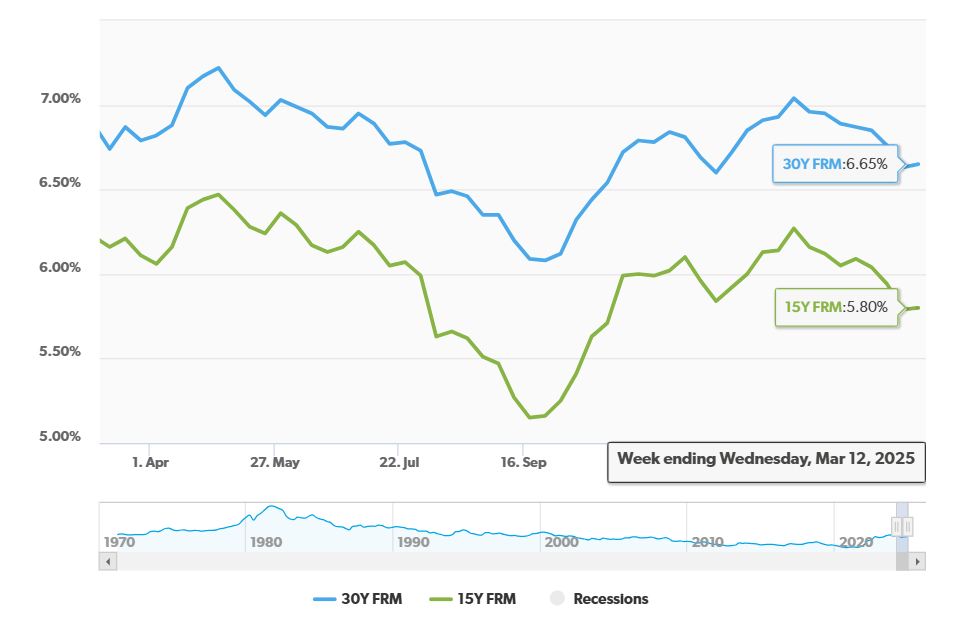
Freddie Mac's latest report shows the average rate for a 30-year fixed mortgage at 6.65%. While this is a slight increase from the previous week's 6.63%, it's still below the 6.74% we saw a year ago. It's pretty much flat. But what does this mean for you?

Freddie Mac's latest report shows the average rate for a 30-year fixed mortgage at 6.65%
Source: Freddie Mac

A Look Back: Where We've Been

To truly understand the current rates, it's important to take a quick trip down memory lane. 2024 was a tough year for the housing market. It was the slowest year since 1996! High rates and limited inventory made it difficult for buyers to find and afford homes. I remember talking to so many frustrated families who had to put their dreams on hold.

That's why this slight dip in rates feels so significant. Even a small decrease can make a big difference in your monthly payment and overall affordability.

Signs Pointing Towards a Buyer-Friendly Market

I'm seeing several shifts in the market that could be beneficial for those looking to buy:

  • More Homes to Choose From: Inventory levels are rising, which means you have more options than you did last year. The competition for homes isn’t as fierce.
  • Sellers are Lowering Prices: Sellers are starting to realize they can't ask for sky-high prices anymore. Price reductions are becoming more common, giving buyers more negotiating power.
  • Spring is Blooming: The spring homebuying season is upon us. This is traditionally the busiest time of year for real estate, with more homes hitting the market and more buyers actively searching.
Trend Impact on Buyers
Increased Inventory More choices, less competition
Price Reductions Potential to find homes at lower prices
Spring Buying Season Increased activity, more options available

Thinking Beyond the 30-Year Fixed: The 15-Year Fixed Mortgage

While the 30-year fixed mortgage gets most of the attention, let's not forget about the 15-year fixed option. The average rate for a 15-year fixed mortgage is currently around 5.8%, a slight increase from 5.79% last week but still lower than the 6.16% from a year ago.

I personally love the 15-year option for those who can afford the higher monthly payments. You'll pay off your mortgage in half the time and save a ton on interest over the life of the loan.

Is Now the Right Time For You to Lock In?

This is the million-dollar question, isn't it? The answer isn't the same for everyone. You need to consider your unique situation:

  • Are you Financially Ready?: Do you have a stable income and a good credit score? Can you comfortably afford the monthly payments at the current rate?
  • How Long Do You Plan to Stay?: If you plan to stay in the home for a long time, securing a lower rate now could save you a significant amount of money.
  • What are the Economic Winds Saying?: Keep an eye on economic indicators. If inflation is expected to rise, or if interest rates are forecasted to increase, locking in a rate now might be a smart move.

Recommended Read:

Mortgage Rates Drop: Can You Finally Afford a $400,000 Home?

Housing Demand Surges as Mortgage Rates Drop Significantly

Mortgage Rates Forecast March 2025: Will Rates Finally Drop?

Expect High Mortgage Rates Until 2026: Fannie Mae's 2-Year Forecast

Will Mortgage Rates Rise Back Above 7% or Go Down in 2025?

Mortgage Interest Rates Forecast for Next 10 Years

Navigating the Lock-In Decision: A Deeper Dive

Okay, so you're thinking about locking in a mortgage rate. Here's a more in-depth look at some of the factors you should consider:

  • Understanding Lock-In Agreements: Make sure you fully understand the terms of your lock-in agreement. How long is the rate locked for? What happens if the closing is delayed? Are there any fees involved?
  • The Float-Down Option: Some lenders offer a “float-down” option, which allows you to take advantage of a lower rate if rates happen to decrease during your lock-in period. This can be a great perk, but make sure you understand the terms and any associated costs.
  • Shop Around: Don't just settle for the first rate you're offered. Shop around and compare rates from multiple lenders. Even a small difference in the interest rate can save you thousands of dollars over the life of the loan. I have personally saved my clients thousands of dollars by just rate shopping.
  • Get Pre-Approved: Getting pre-approved for a mortgage will give you a better idea of how much you can afford and will also strengthen your offer when you find the right home.

A Word of Caution: Don't Try to Time the Market Perfectly

I've seen so many people try to time the market perfectly, and they almost always end up missing out on opportunities. Trying to predict the future is a fool's errand. Focus on what you can control: your finances, your credit score, and your research.

My Personal Take: Act Now, But Do Your Homework

In my opinion, with rates hovering near a three-month low and the housing market showing signs of shifting in favor of buyers, now is a good time to seriously consider locking in a mortgage rate.

However, don't rush into anything. Take your time, do your research, and consult with a qualified mortgage professional. This is a big decision, so make sure you're making the right one for you and your family.

  • Consult a Pro: Talking to a mortgage broker or financial advisor can provide personalized advice.
  • Review Your Credit: A better credit score can get you a better rate.
  • Calculate All Costs: Don’t forget to factor in closing costs, property taxes, and insurance.

In Conclusion: Seize the Opportunity

The housing market is a dynamic beast, and it can be difficult to predict what will happen next. But right now, the conditions seem favorable for buyers. Mortgage rates are relatively low, inventory is improving, and sellers are becoming more willing to negotiate. If you're ready to buy, now might be the time to take the plunge.

Remember to assess your finances, consider your long-term plans, and stay informed about market trends. By doing your homework and making a well-informed decision, you can seize this opportunity and achieve your dream of homeownership.

Work With Norada, Your Trusted Source for

Real Estate Investments

With mortgage rates fluctuating, investing in turnkey real estate

can help you secure consistent returns.

Expand your portfolio confidently, even in a shifting interest rate environment.

Speak with our expert investment counselors (No Obligation):

(800) 611-3060

Get Started Now

Recommended Read:

  • Mortgage Rate Predictions 2025 from 4 Leading Housing Experts
  • Mortgage Rates Forecast for the Next 3 Years: 2025 to 2027
  • 30-Year Mortgage Rate Forecast for the Next 5 Years
  • 15-Year Mortgage Rate Forecast for the Next 5 Years
  • Why Are Mortgage Rates Going Up in 2025: Will Rates Drop?
  • Why Are Mortgage Rates So High and Predictions for 2025
  • Will Mortgage Rates Ever Be 3% Again in the Future?
  • Mortgage Rates Predictions for Next 2 Years
  • Mortgage Rate Predictions for Next 5 Years
  • Mortgage Rate Predictions: Why 2% and 3% Rates are Out of Reach
  • How Lower Mortgage Rates Can Save You Thousands?
  • How to Get a Low Mortgage Interest Rate?
  • Will Mortgage Rates Ever Be 4% Again?
Filed Under: Financing, Mortgage Tagged With: Interest Rate, mortgage, Mortgage Rate Trends, mortgage rates, Mortgage Rates Predictions, Mortgage Rates Today

Housing Demand Surges as Mortgage Rates Drop Significantly

March 13, 2025 by Marco Santarelli

Housing Demand Surges as Mortgage Rates Drop Significantly

Housing demand is surging as mortgage rates have dropped significantly. The recent dip in mortgage rates, reaching levels not seen since mid-December, has sparked a noticeable increase in homebuyer activity. This increased demand hasn't yet translated into closed sales, but the data clearly shows that more people are actively looking at homes. I believe that if rates continue to fall steadily, and economic confidence increases, sales will inevitably follow.

Housing Demand Surges as Mortgage Rates Drop Significantly

A Sigh of Relief for Potential Homeowners?

Let's be honest, the last couple of years haven't been easy for anyone trying to buy a home. Rising interest rates pushed monthly mortgage payments to uncomfortable levels, effectively sidelining many potential buyers. It felt like the dream of homeownership was slipping further away for many.

Now, with mortgage rates beginning to soften, it's like a pressure valve has been released. People who were previously priced out of the market are starting to cautiously dip their toes back in.

Here's what the data is telling us:

  • Mortgage rates are down: According to Mortgage News Daily, the daily average 30-year fixed mortgage rate was at 6.82% on March 12, lower than the 6.87% rate a year prior. Freddie Mac data showed that the weekly average 30-year fixed mortgage rate for the week ending March 6 was 6.63%, the lowest since mid-December.
  • Mortgage applications are up: The Mortgage Bankers Association reported a 7% increase in mortgage-purchase applications for the week ending March 7. This is the highest level we've seen since early February.
  • Homebuyer interest is soaring: Google searches for “homes for sale” are up 10% year-over-year. Redfin's Homebuyer Demand Index, which measures home tours and other buying services, has hit its highest point since the beginning of the year, reflecting a 5% increase year-over-year.
  • Touring Activity on the rise: Touring activity is up by 32% from the start of the year.

Why the Disconnect Between Demand and Sales?

While the increased interest in buying is encouraging, it's important to note that this hasn't yet translated into a significant increase in actual home sales. Pending home sales were down 6.1% year-over-year during the four weeks ending March 9. This begs the question: why the disconnect?

I think there are a few factors at play here.

  • Economic Uncertainty: As Redfin's Economic Research Lead Chen Zhao pointed out, the decline in mortgage rates is partly due to concerns about the overall economic outlook. Issues like tariffs and a slightly weaker job market are making people hesitant to make major financial commitments. People are worried about job security and the possibility of a recession, and that fear outweighs the temptation of slightly lower mortgage payments.
  • Affordability Concerns: Even with lower mortgage rates, home prices are still relatively high in many markets. People are still carefully considering whether the lower monthly payments are enough to justify a home purchase. It's a matter of balancing the desire for homeownership with the realities of their personal budgets.
  • Waiting for the “Perfect” Moment: Some potential buyers may be waiting for rates to drop even further before jumping into the market. They might be hoping to snag an even better deal, but this strategy could backfire if prices start to rise due to increased demand. I believe it's a balancing act between timing the market and finding the right home that fits your needs and budget.

A Look at the Selling Side of the Equation

The good news for potential buyers is that new listings are also up. According to Redfin, for the four weeks ending March 9, new listings of homes for sale increased by 3.1% year-over-year. This is a positive sign that more homeowners are becoming confident enough to put their properties on the market.

As we head into the spring homebuying season, I anticipate that we'll continue to see an increase in listings. Homeowners will likely take notice of the increasing demand from buyers and decide that now is a good time to sell.

Key Housing Market Data: What's Really Happening?

To get a clearer picture of what's happening in the housing market, let's take a look at some key data points from Redfin for the four weeks ending March 9, 2025:

  • Median Sale Price: $381,975 (Up 3.2% year-over-year)
  • Median Asking Price: $421,225 (Up 6.1% year-over-year)
  • Median Monthly Mortgage Payment: $2,773 (at a 6.63% mortgage rate) (Up 5.2% year-over-year)
  • Pending Sales: 77,182 (Down 6.1% year-over-year)
  • New Listings: 88,739 (Up 3.1% year-over-year)
  • Active Listings: 925,690 (Up 9.3% year-over-year)
  • Months of Supply: 4.1 (Up 0.6 pts.)
  • Share of Homes Off Market in Two Weeks: 34.6% (Down from 39%)
  • Median Days on Market: 52 (Up 7 days)
  • Share of Homes Sold Above List Price: 22.9% (Down from 25%)
  • Average Sale-to-List Price Ratio: 98.3% (Down from 98.6%)

These numbers tell a mixed story. While prices are still rising, the rate of increase is slowing down. The increase in active listings is also a positive sign for buyers, as it gives them more options to choose from. However, the decrease in pending sales suggests that buyers are still hesitant to commit.

Here is the data in a table form for ease of understanding

Metric Value Year-over-Year Change
Median Sale Price $381,975 3.2%
Median Asking Price $421,225 6.1%
Median Monthly Mortgage Payment $2,773 5.2%
Pending Sales 77,182 -6.1%
New Listings 88,739 3.1%
Active Listings 925,690 9.3%
Months of Supply 4.1 +0.6 pts.
Share of Homes Off Market in 2 Weeks 34.6% Down from 39%
Median Days on Market 52 +7 days
Share of Homes Sold Above List Price 22.9% Down from 25%
Avg. Sale-to-List Price Ratio 98.3% Down from 98.6%

The Local Picture: Where are Prices Rising and Falling?

It's important to remember that the housing market is not a monolith. Conditions can vary significantly from one metro area to another.

Here's a look at some metro-level highlights:

  • Metros with Biggest Year-Over-Year Increases in Median Sale Price:
    • Milwaukee (15.7%)
    • Cleveland (13%)
    • Anaheim, CA (11.7%)
    • Nassau County, NY (11.5%)
    • San Jose, CA (10.3%)
  • Metros with Biggest Year-Over-Year Decreases in Median Sale Price:
    • Austin, TX (-3.9%)
    • Jacksonville, FL (-2.6%)
    • Tampa, FL (-2%)
    • Atlanta (-1%)
    • San Antonio (-0.8%)

This data shows that prices are still rising rapidly in some markets, particularly in the Midwest and on the West Coast. However, prices are actually declining in a few metro areas, primarily in the South.

Pending Sales:

  • Increased in Los Angeles, Anaheim, Columbus and Sacramento
  • Decreased in Fort Lauderdale, Warren, Houston, Atlanta and Detroit.

New Listings:

  • Increased in San Jose, Sacramento, Oakland, Phoenix and Los Angeles.
  • Decreased in Detroit, Warren, Austin, Fort Worth, and Milwaukee.

Recommended Read:

Mortgage Rates Drop: Can You Finally Afford a $400,000 Home?

Mortgage Rates Forecast March 2025: Will Rates Finally Drop?

Expect High Mortgage Rates Until 2026: Fannie Mae's 2-Year Forecast

Will Mortgage Rates Rise Back Above 7% or Go Down in 2025?

Mortgage Interest Rates Forecast for Next 10 Years

What Does This All Mean for You?

If you're a potential homebuyer, the current market conditions present both opportunities and challenges.

  • The Opportunity: Lower mortgage rates make homeownership more accessible and affordable. The increase in active listings gives you more options to choose from.
  • The Challenge: Economic uncertainty and affordability concerns may make you hesitant to commit. You'll need to carefully weigh your options and determine what you can realistically afford.

My advice is to do your research, get pre-approved for a mortgage, and work with a knowledgeable real estate agent who can guide you through the process. Don't be afraid to negotiate, and be prepared to walk away if you don't find the right home at the right price.

If you're a homeowner, the current market conditions may be a good time to sell. Demand is still relatively strong, and prices are still rising in many markets. However, it's important to be realistic about your expectations. Be prepared to negotiate, and don't overprice your home.

Looking Ahead: What's Next for the Housing Market?

Predicting the future is always difficult, but I think there are a few key factors that will shape the housing market in the coming months.

  • Mortgage Rates: The trajectory of mortgage rates will be crucial. If rates continue to decline, we can expect to see a further increase in homebuyer demand and, eventually, an increase in sales.
  • The Economy: The overall health of the economy will also play a significant role. If the economy remains strong, consumer confidence will increase, and more people will be willing to make major financial commitments. However, if the economy weakens, we could see a slowdown in the housing market.
  • Housing Supply: The level of housing supply will also be a key factor. If new construction continues to lag behind demand, prices will likely continue to rise. However, if we see a significant increase in new construction, prices could stabilize or even decline in some markets.

Overall, I expect the housing market to remain somewhat volatile in the coming months. There will be opportunities for both buyers and sellers, but it's important to be informed and prepared. Keep a close eye on the data, and work with experienced professionals who can help you navigate the market.

My Final Thoughts

The housing market is always evolving, and it's important to stay informed about the latest trends and data. While the recent surge in housing demand is encouraging, it's important to remember that the market is still facing some challenges. By understanding the factors that are shaping the market, you can make informed decisions about buying or selling a home.

Work With Norada, Your Trusted Source for

Real Estate Investments

With mortgage rates fluctuating, investing in turnkey real estate

can help you secure consistent returns.

Expand your portfolio confidently, even in a shifting interest rate environment.

Speak with our expert investment counselors (No Obligation):

(800) 611-3060

Get Started Now

Recommended Read:

  • Mortgage Rate Predictions 2025 from 4 Leading Housing Experts
  • Mortgage Rates Forecast for the Next 3 Years: 2025 to 2027
  • 30-Year Mortgage Rate Forecast for the Next 5 Years
  • 15-Year Mortgage Rate Forecast for the Next 5 Years
  • Why Are Mortgage Rates Going Up in 2025: Will Rates Drop?
  • Why Are Mortgage Rates So High and Predictions for 2025
  • Will Mortgage Rates Ever Be 3% Again in the Future?
  • Mortgage Rates Predictions for Next 2 Years
  • Mortgage Rate Predictions for Next 5 Years
  • Mortgage Rate Predictions: Why 2% and 3% Rates are Out of Reach
  • How Lower Mortgage Rates Can Save You Thousands?
  • How to Get a Low Mortgage Interest Rate?
  • Will Mortgage Rates Ever Be 4% Again?
Filed Under: Financing, Mortgage Tagged With: Interest Rate, mortgage, Mortgage Rate Trends, mortgage rates, Mortgage Rates Predictions, Mortgage Rates Today

Today’s Mortgage Rates March 13, 2025: Rates Rise in Response Inflation Data

March 13, 2025 by Marco Santarelli

Today's Mortgage Rates March 13, 2025: Rates Rise as Inflation Impacts Markets

As of today, March 13, 2025, mortgage rates have increased slightly in response to the latest inflation data, with the 30-year fixed mortgage rate now at 6.34% and the 15-year fixed rate at 5.65%. This uptick comes after weeks of declining rates, showing just how sensitive mortgage interest rates can be to shifts in economic conditions and consumer sentiment. Continuing economic improvements, as indicated by the latest Consumer Price Index (CPI) report, have contributed to the current trajectory of mortgage rates.

Today's Mortgage Rates March 13, 2025: Rates Rise in Response Inflation Data

Key Takeaways

  • Current Mortgage Rates: 30-year fixed at 6.34% and 15-year fixed at 5.65%.
  • Inflation Influence: Rates reacted to February's Consumer Price Index (CPI), which shows a year-over-year inflation increase of 2.8%.
  • Refinance Rates: Today's refinance rates are slightly higher than purchase rates.
  • Trends: The increase in rates reflects a recovering economy and rising consumer confidence, potentially impacting future home purchases and refinancing strategies.

Current Mortgage Rates

Understanding the variety of mortgage rates available today is crucial for both prospective home buyers and those considering refinancing their existing mortgage. Here's a detailed look at current averages from Zillow's data:

Type of Mortgage Interest Rate (%)
30-year fixed 6.34
20-year fixed 6.11
15-year fixed 5.65
5/1 ARM 6.38
7/1 ARM 6.79
30-year VA 5.86
15-year VA 5.28
5/1 VA 5.76

As reflected in the table, the rates have progressed over the last few months. Notably, the 30-year fixed mortgage is widely recognized for its stability and robustness in the fluctuating financial environment. Conversely, the 5/1 ARMs are marketed with initial lower rates but can increase after five years, making them a gamble for borrowers who value budget predictability.

Today's Mortgage Refinance Rates

Refinancing your mortgage can lead to lower monthly payments and other advantages. Knowing current rates is essential for making informed financial decisions. Below are today’s average refinance rates:

Refinance Type Interest Rate (%)
30-year fixed 6.43
20-year fixed 6.08
15-year fixed 5.70
5/1 ARM 6.89
7/1 ARM 7.05
30-year VA 5.91
15-year VA 5.49
30-year FHA 5.85
15-year FHA 5.58

It's essential to note that refinance rates can sometimes be higher than those for purchasing a new mortgage, depending on individual circumstances and lender policies.

Understanding Mortgage Payments Today

For anyone contemplating taking out a mortgage or refinancing, understanding how interest rates impact monthly payments is vital. Below, we break down what you might expect to pay on various mortgage amounts based on today’s interest rates.

Monthly Payment on a $150,000 Mortgage

For a $150,000 mortgage at a 30-year fixed rate of 6.34%, your monthly payment would be approximately $932.59. Over the life of the loan, you would pay about $115,530 in interest. This scenario shows how even a manageable loan amount can build up considerable interest, which emphasizes the importance of securing the best possible rates.

Monthly Payment on a $200,000 Mortgage

Taking on a $200,000 mortgage at a 30-year fixed rate of 6.34%, your monthly payment would come to about $1,243.45. In total, you could end up paying approximately $154,042 in interest over the full mortgage period.

Monthly Payment on a $300,000 Mortgage

If you need to borrow $300,000 at a 6.34% fixed rate, expect your monthly payment to be around $1,865.17. Over 30 years, this translates to about $231,063 in interest costs.

Monthly Payment on a $400,000 Mortgage

For a higher-end mortgage of $400,000 at 6.34%, your monthly payment would be about $2,486.89, resulting in around $308,084 paid in interest throughout the loan term, clearly showing the financial commitment required.

Monthly Payment on a $500,000 Mortgage

Finally, if you’re looking at a $500,000 mortgage at 6.34%, your potential monthly payment would be around $3,108.62. Calculate approximately $385,105 in interest over the life of the loan.

Recommended Read:

Mortgage Rates Trends as of March 12, 2025

Mortgage Rates Drop: Can You Finally Afford a $400,000 Home?

Mortgage Rates Forecast March 2025: Will Rates Finally Drop?

Expect High Mortgage Rates Until 2026: Fannie Mae's 2-Year Forecast

Will Mortgage Rates Rise Back Above 7% or Go Down in 2025?

Mortgage Interest Rates Forecast for Next 10 Years

How Mortgage Rates Work

Mortgage rates can seem intricate, but they simplify down to key principles. A mortgage interest rate represents the cost you incur for borrowing money from a lender, expressed as a percentage of the loan amount.

Types of Mortgage Rates

There are two main types of mortgage rates:

  1. Fixed-Rate Mortgages: These lock in your interest rate for the entirety of your loan period, making your monthly payments predictable and consistent.
  2. Adjustable-Rate Mortgages (ARMs): These start with lower rates than fixed-rate mortgages but will adjust to market conditions after a predetermined period.

While fixed-rate mortgages provide stability and protection against future rate increases, adjustable-rate mortgages can allow you to enjoy lower initial payments. However, the risk lies in potential rate increases, which can lead to higher payments after the introductory period ends.

The Amortization Cycle

When you first take out a mortgage, a substantial portion of your early payments go toward interest rather than paying down the principal. As time goes on, the balance shifts, and a larger portion of each payment goes toward reducing the principal. This illustrates how the amortization process works and emphasizes the costs involved.

Understanding Rate Determinants

Mortgage rates are significantly influenced by two categories of factors: those within your control and those that are not.

Factors You Can Control

  • Credit Score: Generally, higher credit scores lead to lower interest rates.
  • Debt-to-Income Ratio: Borrowers should keep their debt levels low to improve chances of securing better loan offers.
  • Lender Comparison: Shopping around and comparing offers from different lenders can help you find the best rates available.

Factors You Cannot Control

  • Economic Conditions: Rates typically rise when the economy is performing well since lenders anticipate more borrowing and spending. Conversely, if the economy is struggling, rates might fall.
  • Inflation Rates: The impact of inflation directly affects mortgage rates; as inflation rises, lenders increase rates to maintain profitability.

Current Economic Context

The recently released CPI data for February 2025 indicates that inflation has increased by 2.8% year-over-year, which is lower than the 3% increase recorded in January 2025. These statistics can lead to increased consumer confidence but also higher mortgage rates, as lenders react to economic trends.

Understanding these dynamics can empower potential homeowners to navigate their mortgage decisions more effectively and with clarity.

Mortgage Types Explained

30-Year vs. 15-Year Fixed Mortgages:

  • The 30-year mortgage is highly favored due to its lower monthly payment structure, making it more accessible for many people. However, this option usually comes with a higher interest rate, and borrowers end up paying far more interest over the long haul.
  • In contrast, a 15-year mortgage typically carries a lower rate and allows homeowners to build equity faster. While the monthly payments are higher, it can result in substantial interest savings over time.

Conclusion

As we see rising mortgage rates reflective of improving economic conditions, it's essential for potential homebuyers or those considering refinancing to be proactive in understanding their options as well as the current market trends. The interplay between interest rates and economic indicators like inflation can greatly influence your home buying strategy, making being informed a crucial element of any purchasing decision.

Work With Norada, Your Trusted Source for

Real Estate Investments

With mortgage rates fluctuating, investing in turnkey real estate

can help you secure consistent returns.

Expand your portfolio confidently, even in a shifting interest rate environment.

Speak with our expert investment counselors (No Obligation):

(800) 611-3060

Get Started Now

Recommended Read:

  • Mortgage Rate Predictions 2025 from 4 Leading Housing Experts
  • Mortgage Rates Forecast for the Next 3 Years: 2025 to 2027
  • 30-Year Mortgage Rate Forecast for the Next 5 Years
  • 15-Year Mortgage Rate Forecast for the Next 5 Years
  • Why Are Mortgage Rates Going Up in 2025: Will Rates Drop?
  • Why Are Mortgage Rates So High and Predictions for 2025
  • Will Mortgage Rates Ever Be 3% Again in the Future?
  • Mortgage Rates Predictions for Next 2 Years
  • Mortgage Rate Predictions for Next 5 Years
  • Mortgage Rate Predictions: Why 2% and 3% Rates are Out of Reach
  • How Lower Mortgage Rates Can Save You Thousands?
  • How to Get a Low Mortgage Interest Rate?
  • Will Mortgage Rates Ever Be 4% Again?

Filed Under: Financing, Mortgage Tagged With: Interest Rate, mortgage, Mortgage Rate Trends, mortgage rates, Mortgage Rates Predictions, Mortgage Rates Today

Today’s Mortgage Rates March 12, 2025: Rates Drop Amid Economic Uncertainty

March 12, 2025 by Marco Santarelli

Today's Mortgage Rates March 12, 2025: Rates Drop Amid Economic Uncertainty

As of March 12, 2025, mortgage and refinance rates show a small decrease, with the national average falling to 6.32% for 30-year fixed mortgages and 6.38% for refinancing. This trend comes amid economic concerns, as a struggling economy often influences interest rates. Understanding these dynamics can empower homebuyers and homeowners looking to refinance.

Today's Mortgage Rates March 12, 2025: Rates Drop Amid Economic Uncertainty

Key Takeaways

  • Current Average Rates:
    • 30-Year Fixed: 6.32%
    • 15-Year Fixed: 5.60%
    • 30-Year Refinance Rates: 6.38%
  • Market Trends: Rates are lower this week due to ongoing economic uncertainty.
  • Types of Mortgages:
    • Fixed-rate mortgages offer stable monthly payments.
    • Adjustable-rate mortgages (ARMs) introduce variable rates, which could lead to increased future payments.

Mortgage rates have been gradually falling in recent weeks, a combination of economic anxieties, including public worries about a potential recession. Historically, mortgage rates tend to drop when the economy is struggling, which can affect how lenders set their rates. If you are planning to buy a house or refinance an existing mortgage, understanding these rates and their implications is crucial.

Current Mortgage Rates on March 12, 2025

According to Zillow, here are today’s mortgage rates:

Loan Type Current Rate
30-Year Fixed 6.32%
20-Year Fixed 6.04%
15-Year Fixed 5.60%
5/1 ARM 6.30%
7/1 ARM 6.20%
30-Year VA 5.83%
15-Year VA 5.25%
5/1 VA 5.74%

Today's Mortgage Refinance Rates

Today's refinance mortgage rates show slight variations, with rates typically being higher than those for purchasing a new home. Here are the latest average refinance rates:

Refinance Type Current Rate
30-Year Fixed 6.38%
20-Year Fixed 5.98%
15-Year Fixed 5.65%
5/1 ARM 6.58%
7/1 ARM 6.56%
30-Year VA 5.77%
15-Year VA 5.37%
30-Year FHA 5.85%
15-Year FHA 5.37%

Understanding Mortgage Types and Their Implications

When considering a mortgage, it's essential to understand the different types available:

Fixed-Rate Mortgages

  • 30-Year Fixed Mortgage: Offers the lowest monthly payment but leads to more interest paid over the life of the loan.
  • 15-Year Fixed Mortgage: Higher monthly payments but lower total interest costs, with the loan paid off sooner.

Adjustable-Rate Mortgages (ARMs)

  • 5/1 ARM: A fixed rate for the first five years, after which it can adjust annually based on market conditions. The initial interest rate is often lower, making it attractive if buyers plan to sell before rates reset.
  • 7/1 ARM: Similar to the 5/1 ARM but with a seven-year fixed period. This is suitable for those looking for lower initial payments.

Both fixed and adjustable-rate mortgages have their pros and cons, depending on your financial situation and how long you plan to stay in your home.

Monthly Payment Calculations Under Current Rates

Understanding what your monthly mortgage payments would be at current rates is essential. Here’s how much you can expect to pay each month for various loan amounts with the current 30-year fixed mortgage rate of 6.32%.

Monthly Payment on a $150,000 Mortgage

At a 6.32% rate, your monthly payment would be approximately $935.56. This amount consists of the principal and interest, excluding additional costs such as insurance or property taxes.

Monthly Payment on a $200,000 Mortgage

If you take out a mortgage of $200,000, your expected monthly payment would hover around $1,247.41. It’s essential to remember that this payment can vary with changes in tax or insurance costs.

Monthly Payment on a $300,000 Mortgage

For a $300,000 mortgage, the monthly payment would average around $1,870.11, making it critical for buyers to assess their financial commitments and ability to make such payments.

Monthly Payment on a $400,000 Mortgage

If you're considering a $400,000 loan, your monthly payment would come to approximately $2,492.81. This notable figure highlights the importance of thorough financial planning and realistic budgeting.

Monthly Payment on a $500,000 Mortgage

Lastly, a $500,000 mortgage would require a monthly payment of about $3,115.51. This significant commitment underlines the necessity of understanding all variables involved in home buying.

Recommended Read:

Mortgage Rates Trends as of March 11, 2025

Mortgage Rates Drop: Can You Finally Afford a $400,000 Home?

Mortgage Rates Forecast March 2025: Will Rates Finally Drop?

Expect High Mortgage Rates Until 2026: Fannie Mae's 2-Year Forecast

Will Mortgage Rates Rise Back Above 7% or Go Down in 2025?

Mortgage Interest Rates Forecast for Next 10 Years

The Broader Economic Context

The decline in mortgage rates could be interpreted as a reflection of investor concern regarding an impending recession. Investors are worried that tariffs might hurt the economy, and President Trump acknowledged that his policies could lead to a recession. Should a recession occur, mortgage rates are expected to decline.

Secondly, there's concern about stagflation – a scenario of high inflation paired with slow economic growth. In this case, the direction of mortgage rates will hinge on the Federal Reserve's response. The Fed has consistently stated its commitment to reducing inflation to 2%. Therefore, a rise in inflation could prompt the Fed to raise interest rates, which would likely push mortgage rates higher.

Different factors, such as inflation rates, employment statistics, and changes in the Federal Reserve's policies, play crucial roles in shaping mortgage rates. When the economy is performing well, rates tend to rise in anticipation of future growth. Conversely, during times of uncertainty, rates generally decline as lenders adjust to potential risks.

Borrowers are cautioned to consider the economic indicators that can impact future rates. For instance, if inflation rises, the Federal Reserve's response might be to increase interest rates, which could lead to higher mortgage rates in the future. Keeping an eye on these trends can be beneficial for making informed decisions.

The Importance of Shopping Around for Rates

Not all lenders offer the same rates or terms, which underscores the importance of shopping around. A small difference in interest rates can translate into substantial savings over the life of a loan. It's advisable to compare not just interest rates, but also fees associated with obtaining a mortgage. Always ask lenders for a breakdown of costs and clarify any points of confusion.

Conclusion

Understanding current mortgage and refinance rates is crucial for anyone considering a home purchase or looking to refinance. The trends we're seeing today reflect broader economic concerns, and staying informed can help borrowers make educated financial decisions.

As we've outlined, today's mortgage rates provide opportunities for homebuyers, particularly in a declining rate environment, but they also necessitate careful consideration of personal financial circumstances and economic factors that may affect future scenarios.

Work With Norada, Your Trusted Source for

Real Estate Investments

With mortgage rates fluctuating, investing in turnkey real estate

can help you secure consistent returns.

Expand your portfolio confidently, even in a shifting interest rate environment.

Speak with our expert investment counselors (No Obligation):

(800) 611-3060

Get Started Now

Recommended Read:

  • Mortgage Rate Predictions 2025 from 4 Leading Housing Experts
  • Mortgage Rates Forecast for the Next 3 Years: 2025 to 2027
  • 30-Year Mortgage Rate Forecast for the Next 5 Years
  • 15-Year Mortgage Rate Forecast for the Next 5 Years
  • Why Are Mortgage Rates Going Up in 2025: Will Rates Drop?
  • Why Are Mortgage Rates So High and Predictions for 2025
  • Will Mortgage Rates Ever Be 3% Again in the Future?
  • Mortgage Rates Predictions for Next 2 Years
  • Mortgage Rate Predictions for Next 5 Years
  • Mortgage Rate Predictions: Why 2% and 3% Rates are Out of Reach
  • How Lower Mortgage Rates Can Save You Thousands?
  • How to Get a Low Mortgage Interest Rate?
  • Will Mortgage Rates Ever Be 4% Again?

Filed Under: Financing, Mortgage Tagged With: Interest Rate, mortgage, Mortgage Rate Trends, mortgage rates, Mortgage Rates Predictions, Mortgage Rates Today

Mortgage Rates Drop But Homebuyers Aren’t Buying the Optimism

March 11, 2025 by Marco Santarelli

Mortgage Rates Drop But Homebuyers Aren't Buying the Optimism

While recent weeks have seen a slight dip in mortgage rates, don't expect a surge of homebuyers just yet. Consumer confidence, as measured by Fannie Mae's Home Purchase Sentiment Index (HPSI), is actually down, suggesting that homebuyers aren't buying the optimism surrounding these lower rates due to persistent affordability concerns and broader economic uncertainties.

Have you ever felt like you're on a rollercoaster, constantly anticipating the next drop? That's how the housing market feels right now. We've been holding our breath for what seems like forever, waiting for things to stabilize. The headlines scream “Mortgage Rates are Down!”, but the ground-level reality is more nuanced. People aren't exactly rushing to sign on the dotted line, and here's why.

Mortgage Rates Drop But Homebuyers Aren't Buying the Optimism

Why the Disconnect? Understanding the Housing Sentiment

Fannie Mae's latest Home Purchase Sentiment Index (HPSI) paints a picture that goes beyond just the mortgage rate numbers. The index, which measures consumer attitudes about housing, dropped 1.8 points in February to 71.6. This decline represents the first year-over-year drop in nearly two years and is primarily driven by increasing pessimism about future mortgage rates.

Think of it this way: a slight drop in mortgage rates is like a single sunny day in a long, gloomy winter. It's nice, but it doesn't erase the memory of the cold.

Key factors contributing to this hesitance include:

  • Lingering High Rates: While down from their peak, rates hovering around the 7% mark are still significantly higher than what homebuyers have been accustomed to in recent years. For many, this makes homeownership feel financially out of reach.
  • Affordability Crisis: Even with slightly lower rates, home prices remain stubbornly high in many markets. This combination creates a significant affordability challenge, especially for first-time buyers.
  • Economic Uncertainty: Broader economic concerns, such as potential tariffs, federal job cuts, and stock market volatility, are making people cautious about making large financial commitments. As the famous saying goes, “When America sneezes, the world catches a cold”.
  • Job Security Anxiety: There's been a slight uptick in concern about job losses. The percentage of people worried about losing their jobs in the next year rose slightly from 22% to 23%.

Fannie Mae's Take: A Deeper Dive

Mark Palim, Fannie Mae's Senior Vice President and Chief Economist, sums it up well: “While some consumers may be slowly acclimating to the higher mortgage rate environment, the vast majority continue to believe it is a ‘bad time' to buy a home – with high home prices cited as the primary sticking point.”

He further adds that home sales activity is expected to remain relatively light because of ongoing lack of supply and overall unaffordability.

Breaking Down the Numbers: What the Survey Reveals

Let's get into the specifics of the Fannie Mae survey. These numbers tell a compelling story about where homebuyers' heads are at right now.

Here's a quick rundown:

  • Good Time to Buy? Only 24% of respondents think it's a good time to buy a home, a slight increase from 22% the previous month. However, the overall sentiment remains overwhelmingly negative.
  • Good Time to Sell? Sentiment about selling is also down, with the net share of those who think it's a good time to sell dropping to 25%. This indicates a reluctance from current homeowners to list their properties, further exacerbating the supply issue.
  • Home Price Expectations: While 41% still expect home prices to rise, a growing 23% anticipate a price drop. This suggests a growing belief that the market may be cooling off.
  • Mortgage Rate Expectations: A significant shift has occurred here. More consumers now expect mortgage rates to rise (33%) than to fall (30%) in the next 12 months. This is a major driver of the overall pessimism.
  • Income Concerns: While more people think their income will go up, the percentage of those concerned about income decreasing also increased from 9% to 11%.
  • Job Security: About 23% are concerned that they will lose their job.

Here's a table summarizing the key metrics:

Metric February Survey Previous Survey Change
Good Time to Buy 24% 22% +2%
Good Time to Sell 62% 63% -1%
Expect Home Prices to Rise 41% 43% -2%
Expect Mortgage Rates to Fall 30% 35% -5%
Concerned About Job Loss 23% 22% +1%

The Supply Conundrum: A Key Piece of the Puzzle

One of the biggest challenges facing the housing market is the persistent lack of supply. There simply aren't enough homes available to meet demand. This scarcity keeps prices elevated, even when mortgage rates fluctuate.

Why is supply so low?

  • Construction Lag: New home construction has been slow to recover since the 2008 financial crisis.
  • “Locked-In” Rates: Many current homeowners are hesitant to sell because they have locked in historically low mortgage rates. Moving would mean giving up those rates and facing a much higher monthly payment.
  • Demographic Shifts: The millennial generation is now entering its prime homebuying years, creating increased demand.

Recommended Read:

Mortgage Rates Drop: Can You Finally Afford a $400,000 Home?

Mortgage Rates Forecast March 2025: Will Rates Finally Drop?

Expect High Mortgage Rates Until 2026: Fannie Mae's 2-Year Forecast

Will Mortgage Rates Rise Back Above 7% or Go Down in 2025?

Mortgage Interest Rates Forecast for Next 10 Years

Personal Thoughts: Navigating the Current Market

As someone who's been following the housing market for a while, here are my personal observations:

  • Patience is Key: If you're a prospective buyer, don't feel pressured to jump into the market unless you're truly comfortable with the terms. Take your time, research your options, and be prepared to walk away if the deal isn't right.
  • Focus on Fundamentals: Pay attention to your own financial situation. Can you comfortably afford the monthly payments, property taxes, and insurance? Do you have a solid emergency fund? These factors are more important than trying to time the market perfectly.
  • Consider Alternatives: If homeownership feels out of reach right now, explore other options, such as renting or investing in other assets.
  • The long-term view matters: Focus on paying off your mortgage instead of only focusing on the lowest mortgage rates.
  • Don't Believe Everything You Hear: Don't let the headlines dictate your emotions or your decisions. Do your own research and consult with trusted advisors.

The Future: What to Expect

Predicting the future of the housing market is always a challenge, but here's what I anticipate based on current trends:

  • Continued Volatility: Expect mortgage rates to continue to fluctuate in response to economic data and Federal Reserve policy.
  • Gradual Cooling: I believe we'll see a gradual cooling of the market as affordability challenges persist and supply slowly improves.
  • Regional Differences: The housing market is highly localized. Conditions will vary significantly depending on the region, city, and even neighborhood.
  • Increased Negotiation: As the market cools, buyers will have more negotiating power. Don't be afraid to make offers below the asking price.

Conclusion

The dip in mortgage rates is a welcome sign, but it's not enough to overcome the underlying issues of affordability and economic uncertainty. Homebuyers are right to be cautious, and a wait-and-see approach may be the best strategy for many. If you want to buy a house, the time is always right, but only when you are ready and feel secure enough about your finances.

Work With Norada, Your Trusted Source for

Real Estate Investments

With mortgage rates fluctuating, investing in turnkey real estate

can help you secure consistent returns.

Expand your portfolio confidently, even in a shifting interest rate environment.

Speak with our expert investment counselors (No Obligation):

(800) 611-3060

Get Started Now

Recommended Read:

  • Mortgage Rate Predictions 2025 from 4 Leading Housing Experts
  • Mortgage Rates Forecast for the Next 3 Years: 2025 to 2027
  • 30-Year Mortgage Rate Forecast for the Next 5 Years
  • 15-Year Mortgage Rate Forecast for the Next 5 Years
  • Why Are Mortgage Rates Going Up in 2025: Will Rates Drop?
  • Why Are Mortgage Rates So High and Predictions for 2025
  • Will Mortgage Rates Ever Be 3% Again in the Future?
  • Mortgage Rates Predictions for Next 2 Years
  • Mortgage Rate Predictions for Next 5 Years
  • Mortgage Rate Predictions: Why 2% and 3% Rates are Out of Reach
  • How Lower Mortgage Rates Can Save You Thousands?
  • How to Get a Low Mortgage Interest Rate?
  • Will Mortgage Rates Ever Be 4% Again?

Filed Under: Financing, Mortgage Tagged With: Interest Rate, mortgage, Mortgage Rate Trends, mortgage rates, Mortgage Rates Predictions, Mortgage Rates Today

  • « Previous Page
  • 1
  • …
  • 54
  • 55
  • 56
  • 57
  • 58
  • …
  • 65
  • Next Page »

Real Estate

  • Birmingham
  • Cape Coral
  • Charlotte
  • Chicago

Quick Links

  • Markets
  • Membership
  • Notes
  • Contact Us

Blog Posts

  • Top Real Estate Investment Markets to Watch in 2026
    March 13, 2026Marco Santarelli
  • Best Midwest Real Estate Markets for Investors in 2026
    March 13, 2026Marco Santarelli
  • Best U.S. Markets for Turnkey Rentals Under $200K in 2026
    March 13, 2026Marco Santarelli

Contact

Norada Real Estate Investments 30251 Golden Lantern, Suite E-261 Laguna Niguel, CA 92677

(949) 218-6668
(800) 611-3060
BBB
  • Terms of Use
  • |
  • Privacy Policy
  • |
  • Testimonials
  • |
  • Suggestions?
  • |
  • Home

Copyright 2018 Norada Real Estate Investments

Loading...
