
Norada Real Estate Investments

  • Home
  • Markets
  • Properties
  • Membership
  • Podcast
  • Learn
  • About
  • Contact

Mortgage Rates Today, Jan 28: 30-Year Fixed Refinance Rate Rises by 24 Basis Points

January 28, 2026 by Marco Santarelli

Mortgage Rates Today, August 24, 2026: 30-Year Refinance Rate Drops by 2 Basis Points

If you're thinking about refinancing your mortgage, it's important to know that on January 28th, the national average 30-year fixed refinance rate jumped up to 6.88%. This means that for many homeowners, securing a new loan to replace an existing one became a bit more expensive compared to a week ago.

These movements, even seemingly small ones, can truly impact your long-term financial picture. It’s not just about the number you see on paper today; it’s about how that number echoes in your monthly budget for years to come. This rise, a notable 24 basis points from last week's 6.64% and a 31 basis point climb from earlier in the week, signals a shift worth paying close attention to.

Mortgage Rates Today, Jan 28: 30-Year Fixed Refinance Rate Rises by 24 Basis Points

What's Happening with Refinance Rates Right Now?

Based on data from Zillow, here's a snapshot of where things stand for refinance rates as of Wednesday, January 28, 2026:

Loan Type Current Rate Previous Rate (Approx.)
30-Year Fixed 6.88% 6.64%
15-Year Fixed 5.62% 5.61%
5-Year ARM 7.00% N/A (Initial Rate)

Why This Rate Hike Matters to You

When refinance rates go up, it directly translates to higher monthly payments for anyone looking to swap their current mortgage for a new one, hopefully with better terms. Even a difference of a quarter of a percent can add up significantly over the lifespan of a loan. It’s like making a small change in your grocery list that ends up costing you a noticeable amount more by the end of the month.

Let's break down what this means with a real-world example. Imagine you have a $250,000 loan and you’re considering a 30-year fixed mortgage:

  • At last week’s average of 6.64%: Your monthly principal and interest payment would have been around $1,600.
  • At today’s average of 6.88%: That same loan would now cost you roughly $1,640 per month.

That’s an increase of about $40 each month. While it might not sound like a fortune at first glance, over a year, that’s nearly $480 more out of your pocket. And if you do the math over the full 30 years? You could end up paying over $14,000 more in total interest. It really highlights how crucial it is to time your refinance decisions wisely.

Now, let’s look at the 15-year fixed option, a shorter-term commitment that many homeowners prefer for its faster payoff and, typically, lower rates.

  • At a previous rate of 5.61%: Your monthly payment on that $250,000 loan would be approximately $2,060.
  • At the current rate of 5.62%: The payment nudges up to about $2,062.

Here, the impact is almost negligible – just a couple of extra dollars a month. This confirms my observation that shorter-term loans tend to be more stable and less sensitive to minor rate fluctuations. If you can comfortably afford the higher monthly payments of a 15-year loan, it often proves to be a more predictable and less volatile choice.

The 5-year Adjustable-Rate Mortgage (ARM), which starts with a lower rate for the first five years, is currently sitting at 7.00%. While this initial fixed rate might seem competitive or even slightly higher than the 30-year in this specific instance, the real concern with ARMs is what happens after that initial period. Those rates can, and often do, rise significantly depending on the economic conditions at the time of adjustment. For me, this makes them a riskier bet when rates are already on an upward trend.

What We Can Learn from Today’s Rates

Here are some of the key things to take away from the current mortgage rate situation:

  • The jump in the 30-year fixed refinance rate means you’ll likely be paying more over the long haul if you choose to refinance now. This is a significant factor to consider for your overall financial planning.
  • The 15-year fixed rate is holding steady. If you’re looking for stability and can manage the higher monthly payments, this option remains a solid choice for refinancing.
  • The 5-year ARM doesn’t seem like the best deal right now. Its higher starting rate, coupled with the uncertainty of future increases, makes it less appealing compared to fixed-rate options, especially when rates are trending upwards.

Recent Trends in the Mortgage Market

It's fascinating to see how much activity there's been in the refinance market recently. The Mortgage Bankers Association reported that applications for refinancing have surged dramatically, being 183% higher than this time last year. On a week-to-week basis, we even saw a 20% jump in demand as rates briefly dipped. It signals that many homeowners are actively trying to capture lower rates when they can.

Interestingly, refinancing now makes up a substantial portion of all mortgage applications – about 62%. This is a big shift from previous years when high interest rates often meant homeowners felt “locked in” to their existing, lower-rate loans and didn't see much benefit in refinancing.

A large chunk of this new demand comes from homeowners who took out their mortgages more recently, particularly in late 2024 or early 2025, when rates were actually higher than they are today, often above 7%. This emphasizes that refinancing is often about improving upon a less-than-ideal existing loan.

The Bigger Picture: What’s Driving Rates?

The mortgage rate environment is always influenced by larger economic forces and policy decisions. Recently, we saw rates dip due to a directive from the Trump administration that encouraged Fannie Mae and Freddie Mac to purchase more mortgage bonds. This increased demand for these bonds, which in turn lowered their yields and, consequently, mortgage rates.

However, the market is also prone to volatility. While rates did hit a recent three-year low, they've already started to climb back up. This is partly due to economic uncertainty and how the market reacts to potential trade tensions. It’s a constant dance between stability and unpredictable global events.

Looking ahead to 2026, most major financial institutions, like Fannie Mae and Wells Fargo, anticipate that rates will likely stabilize. Their forecasts generally suggest rates will settle in the range of 6.0% to 6.4% for the remainder of the year. This gives us a hint of what to expect, but it's wise to remember that these are predictions and the market can always surprise us.

Smart Moves for Homeowners

When considering refinancing, it’s crucial to have a strategy. A common piece of advice, often called the “1% Rule,” suggests that refinancing is generally most beneficial if you can lower your current interest rate by at least one full percentage point. This helps ensure that the savings you achieve on your monthly payments will eventually make up for the closing costs associated with the refinance.

It’s also worth noting that borrowers with government-backed loans, like FHA and VA loans, have been particularly active in refinancing. I’ve seen a significant uptick in FHA refinance demand, with one recent jump of 24% as rates for those specific loans dipped toward 6.08%. This shows how customized rate environments can impact different borrower groups.

The Bottom Line for Today’s Rates

If you’re a homeowner contemplating refinancing, it’s essential to take a step back and assess whether locking in today’s rates truly aligns with your long-term financial goals. While the 30-year fixed refinance rate has increased from last week, it's important to remember that these rates are still in a much more favorable territory compared to historical peaks. For many homeowners who secured their mortgages at significantly higher interest rates in the past, refinancing today, even with the recent uptick, could still represent a smart financial move. My advice is always to run the numbers with your specific situation in mind and consult with a trusted mortgage professional.

🏡 2 Renovated Properties Available for Investors

Port Charlotte, FL
🏠 Property: Dorion St
🛏️ Beds/Baths: 4 Bed • 4 Bath • 2086 sqft
💰 Price: $412,400 | Rent: $3,190
📊 Cap Rate: 6.2% | NOI: $2,124
📅 Year Built: 2023
📐 Price/Sq Ft: $198
🏙️ Neighborhood: A+

and

Kansas City, MO
🏠 Property: E 110th Terrace
🛏️ Beds/Baths: 3 Bed • 2 Bath • 1002 sqft
💰 Price: $220,000 | Rent: $1,700
📊 Cap Rate: 6.9% | NOI: $1,273
📅 Year Built: 1957
📐 Price/Sq Ft: $220
🏙️ Neighborhood: A-

Florida’s modern build with strong cash flow vs Missouri’s affordable rental with higher cap rate. Which fits YOUR investment strategy?

We have much more inventory available than what you see on our website – Let us know about your requirement.

📈 Choose Your Winner & Contact Us Today!

Speak to Our Investment Counselor (No Obligation):

(800) 611-3060

View All Properties 

Invest Smart — Build Long-Term Wealth Through Turnkey Real Estate in 2026

Market forecasts suggest steady demand, making turnkey real estate one of the most reliable paths to passive income and wealth creation.

Norada Real Estate helps investors capitalize on these trends with turnkey rental properties designed for appreciation and consistent cash flow—so you can grow wealth securely while others wait for clarity in the market.

🔥 HOT 2026 INVESTMENT LISTINGS JUST ADDED! 🔥
Talk to a Norada investment counselor today (No Obligation):
(800) 611-3060

Get Started Now

Recommended Read:

  • 30-Year Fixed Refinance Rate Trends – January 27, 2026
  • Best Time to Refinance Your Mortgage: Expert Insights
  • Should You Refinance Your Mortgage Now or Wait Until 2026?
  • When You Refinance a Mortgage Do the 30 Years Start Over?
  • Should You Refinance as Mortgage Rates Reach Lowest Level in Over a Year?
  • Half of Recent Home Buyers Got Mortgage Rates Below 5%
  • Mortgage Rates Need to Drop by 2% Before Buying Spree Begins
  • Will Mortgage Rates Ever Be 3% Again: Future Outlook
  • Mortgage Rates Predictions for Next 2 Years
  • Mortgage Rate Predictions for Next 5 Years
Filed Under: Financing, Mortgage Tagged With: mortgage rates, Mortgage Rates Today, Refinance Rates

Mortgage Rates Today, Jan 27, 2026: 30-Year Fixed Refinance Rate Drops by 3 Basis Points

January 27, 2026 by Marco Santarelli

Mortgage Rates Today, August 24, 2026: 30-Year Refinance Rate Drops by 2 Basis Points

Good news for anyone thinking about their mortgage! Today, January 27, 2026, we're seeing a slight dip in a key mortgage rate. The average 30-year fixed refinance rate has dropped by 3 basis points, settling in at 6.61%, according to Zillow. This small yet significant move offers a reason for homeowners to pause and take another look at their refinancing options, especially those looking to shave a little off their monthly payments or their overall interest paid.

Mortgage Rates Today, Jan 27, 2026: 30-Year Fixed Refinance Rate Drops by 3 Basis Points

Current Mortgage Rate Snapshot

Here’s a quick look at where things stand today:

  • 30-Year Fixed Refinance Rate: 6.61% (This is down from 6.64% last week)
  • 15-Year Fixed Refinance Rate: 5.68% (This rate is holding steady)
  • 5-Year Adjustable-Rate Mortgage (ARM) Refinance Rate: 7.09% (Also stable for now)
Loan Type Today's Average Rate Change from Last Week
30-Year Fixed Refinance 6.61% -3 Basis Points
15-Year Fixed Refinance 5.68% Stable
5-Year ARM Refinance 7.09% Stable

What This Means for You as a Homeowner

So, what does this slight decrease in the 30-year fixed refinance rate really mean for you?

1. A Little Breathing Room for Refinancing
That 3-basis-point drop might not sound like much, but if you have a substantial loan balance, even this small bit can translate into noticeable savings over 30 years. Think of it like finding a few extra dollars in your pocket each month – it might not change your life, but it's certainly a welcome relief. If you've been delaying a refinance, hoping for rates to tick down just a hair, today might be the day to pull the trigger.

2. Stability in Shorter-Term Loans
The fact that the 15-year fixed refinance rate is holding firm at 5.68% is a good sign of stability. Shorter-term loans are popular because they help you build equity faster and pay less interest overall. This steady rate suggests lenders are confident in these shorter payoff periods, which is good news for borrowers who prefer a quicker path to being mortgage-free.

3. ARMs Stay Put, but with a Caveat
Adjustable-rate mortgages, like the 5-year ARM at 7.09%, are still sitting at higher percentages. While ARMs can sometimes offer a lower starting rate than fixed loans, the current environment shows a bit more caution. The higher average rate on ARMs in today's market likely reflects ongoing economic uncertainties and perhaps a cautious outlook from lenders about future rate movements.

Why Are Rates Moving Like This?

It's always interesting to me to see what's behind these day-to-day rate changes. Several factors are always at play:

  • The Federal Reserve's Watchful Eye: The Federal Reserve plays a huge role. Even though inflation has been cooling down compared to the past few years, the Fed is still carefully watching the economy. They're trying to find that sweet spot between keeping prices stable and making sure the economy continues to grow. Their decisions and any hints about future policy heavily influence mortgage rates.
  • The Bond Market's Tango: Mortgage rates are really closely connected to the yields on 10-year Treasury notes. When those bond yields go up, mortgage rates usually follow, and vice versa. So, what's happening in the broader bond market, even with things like government debt, can directly impact how much you'll pay for a mortgage.
  • How the Housing Market is Feeling: We're seeing fairly consistent demand for housing, but affordability is definitely a concern for many people. When rates are stable or slightly dip, it can help keep buyers interested, especially in areas where home prices aren't climbing as fast.

The Real Impact on Your Wallet

Let's get down to brass tacks. What does this actually mean for your monthly budget?

  • Monthly Payments: For a hypothetical $300,000 loan, a drop of 3 basis points might only save you a few dollars a month. It's not a life-altering amount on its own. However, remember, this is on top of any savings you might have already made by refinancing in the past or by choosing a longer loan term. Over many years, those small savings truly do add up.
  • Refinancing Decisions: If your current mortgage rate is significantly higher than today's 6.61% (say, you're at 7% or more), and you plan on staying in your home for the foreseeable future, this small dip might be the sign you've been waiting for to start the refinance process. It's always worth getting a quote to see if you can save money.
  • First-Time Homebuyers: For those just starting their homeownership journey, stable interest rates are crucial. Predictability in borrowing costs is a huge plus when you're trying to budget for a new home and all the expenses that come with it.

What’s Next on the Horizon?

Looking ahead, mortgage rates are expected to keep reacting to whatever economic news pops up. We’ll be watching inflation reports very closely, and anything the Fed announces will be a big deal. While today's drop is small, it does signal that opportunities for borrowers to potentially save money might be just around the corner. It’s a good time to stay informed and perhaps even talk to a mortgage professional to see what makes sense for your specific situation.

Key Things to Remember from Today

  • The 30-year fixed refinance rate saw a slight decrease, now at 6.61%.
  • The 15-year fixed refinance rate remains steady at 5.68%.
  • The 5-year ARM refinance rate is also holding at 7.09%.
  • Even small rate changes matter for long-term savings, so keeping an eye on these trends is always wise.

Summary:

January 27, 2026, brings a subtle but potentially beneficial shift for homeowners. That small dip in the 30-year fixed refinance rate is a gentle reminder that opportunities to improve your mortgage situation can arise. The stability in other loan types shows a consistent market. For anyone with a mortgage, the best approach is to stay informed about these changes, understand your own financial goals, and consider if today's rates align with your long-term plans for homeownership.

🏡 2 Renovated Properties Available for Investors

Port Charlotte, FL
🏠 Property: Dorion St
🛏️ Beds/Baths: 4 Bed • 4 Bath • 2086 sqft
💰 Price: $412,400 | Rent: $3,190
📊 Cap Rate: 6.2% | NOI: $2,124
📅 Year Built: 2023
📐 Price/Sq Ft: $198
🏙️ Neighborhood: A+

and

Kansas City, MO
🏠 Property: E 110th Terrace
🛏️ Beds/Baths: 3 Bed • 2 Bath • 1002 sqft
💰 Price: $220,000 | Rent: $1,700
📊 Cap Rate: 6.9% | NOI: $1,273
📅 Year Built: 1957
📐 Price/Sq Ft: $220
🏙️ Neighborhood: A-

Florida’s modern build with strong cash flow vs Missouri’s affordable rental with higher cap rate. Which fits YOUR investment strategy?

We have much more inventory available than what you see on our website – Let us know about your requirement.

📈 Choose Your Winner & Contact Us Today!

Speak to Our Investment Counselor (No Obligation):

(800) 611-3060

View All Properties 

Invest Smart — Build Long-Term Wealth Through Turnkey Real Estate in 2026

Market forecasts suggest steady demand, making turnkey real estate one of the most reliable paths to passive income and wealth creation.

Norada Real Estate helps investors capitalize on these trends with turnkey rental properties designed for appreciation and consistent cash flow—so you can grow wealth securely while others wait for clarity in the market.

🔥 HOT 2026 INVESTMENT LISTINGS JUST ADDED! 🔥
Talk to a Norada investment counselor today (No Obligation):
(800) 611-3060

Get Started Now

Recommended Read:

  • 30-Year Fixed Refinance Rate Trends – January 26, 2026
  • Best Time to Refinance Your Mortgage: Expert Insights
  • Should You Refinance Your Mortgage Now or Wait Until 2026?
  • When You Refinance a Mortgage Do the 30 Years Start Over?
  • Should You Refinance as Mortgage Rates Reach Lowest Level in Over a Year?
  • Half of Recent Home Buyers Got Mortgage Rates Below 5%
  • Mortgage Rates Need to Drop by 2% Before Buying Spree Begins
  • Will Mortgage Rates Ever Be 3% Again: Future Outlook
  • Mortgage Rates Predictions for Next 2 Years
  • Mortgage Rate Predictions for Next 5 Years

Filed Under: Financing, Mortgage Tagged With: mortgage rates, Mortgage Rates Today, Refinance Rates

Mortgage Rates Today, Jan 26, 2026: 30-Year Fixed Refinance Rate Rises by 31 Basis Points

January 26, 2026 by Marco Santarelli

Mortgage Rates Today, August 24, 2026: 30-Year Refinance Rate Drops by 2 Basis Points

As of January 26, 2026, the average rate for a 30-year fixed refinance has jumped by 31 basis points, landing at 6.88%, according to Zillow. This significant uptick is a reminder that the mortgage market can shift quickly, impacting how much you pay each month.

It's been a bit of a rollercoaster with mortgage rates lately and this jump means that if you were considering refinancing into a 30-year loan, your borrowing costs just got a bit higher. It's a good thing we have Zillow to track these changes so precisely.

Mortgage Rates Today, Jan 26, 2026: 30-Year Fixed Refinance Rate Rises by 31 Basis Points

Let's break down what's happening with the different types of refinance rates today:

  • 30-Year Fixed Refinance Rate: This is the big story. It's now at 6.88%, up from 6.57% yesterday. That's a pretty substantial move in just one day. Compared to the average rate from last week, it's also up, now sitting 24 basis points higher. This rate is what most homeowners lean on for its predictability.
  • 15-Year Fixed Refinance Rate: Here's a bit of good news amidst the climb. The 15-year fixed refinance rate actually dipped slightly, from 5.70% down to 5.62%. This is a decrease of 8 basis points. For those who want to pay off their mortgage faster, this subtle drop is a welcome sign.
  • 5-Year Adjustable-Rate Mortgage (ARM) Refinance Rate: This rate is holding steady at 6.92%. While ARMs can offer lower introductory rates, their stability often matters less when fixed rates are making bigger moves.

A Clearer Picture: Today's Refinance Rates At a Glance

Loan Type Current Rate (Jan 26, 2026) Daily Change (Basis Points) Weekly Change (Basis Points)
30-Year Fixed 6.88% +31 +24
15-Year Fixed 5.62% -8 Data not provided
5-Year ARM 6.92% 0 Data not provided

The Impact of the 30-Year Rise: What It Means for Your Wallet

When mortgage rates move, especially by a significant amount like 31 basis points, it translates directly into higher costs for borrowers. Let's look at a concrete example. Imagine you're refinancing a $300,000 loan with a 30-year fixed term.

  • If your rate was 6.57%, your monthly payment for principal and interest would be around $1,910.
  • Now, with the rate at 6.88%, that same monthly payment jumps to about $1,970.

That's a difference of $60 more each month. Over a year, that's $720 out of your pocket. And think about the long game: over the full 30 years of the loan, this increase could cost you an extra $21,600 in interest. This is why even seemingly small shifts in basis points are so important for your financial planning. For homeowners looking to tap into lower rates, a sudden jump like this can be a real disappointment and a nudge to act fast if they still want to lock in a rate before further changes.

Why Are Rates Moving Today? The Bigger Economic Picture

So, what's driving this sudden leap in the 30-year refinance rate? It's rarely just one thing. Several economic factors are likely at play, and understanding them helps us make better sense of the situation:

  • Federal Reserve's Influence: The Federal Reserve plays a huge role in setting the tone for interest rates. While they don't directly set mortgage rates, their decisions on the federal funds rate and their overall monetary policy send ripples through the entire financial system. Any hints or actions from the Fed can cause markets to react, and today's move is likely a reflection of that.
  • Inflationary Concerns: Even though we've made progress, inflation is still a concern for the economy. Lenders price in the risk of inflation when they offer loans. If they expect inflation to remain higher than anticipated, they'll generally demand higher interest rates to ensure their returns keep pace.
  • Housing Market Demand and Supply: The housing market itself is a dynamic force. In many areas, demand remains strong, even with higher prices. When there's a lot of competition for homes, or when many homeowners are looking to refinance, it can put upward pressure on mortgage rates. We've seen a surge in refinance applications recently, which means there's a lot of activity in the mortgage market.
  • Investor Sentiment: Mortgage-backed securities (MBS) are bought and sold by investors. Their demand for MBS influences the rates that lenders can offer. If investor confidence shifts, or if they demand higher yields, mortgage rates will follow suit.

It's crucial to remember that today's 6.88% rate for the 30-year fixed refinance, while higher than yesterday, is still significantly lower than the peaks we saw in late 2023, when rates were touching close to 8%. This historical context helps us appreciate that while we're seeing an increase now, the current rates are still more favorable than they were quite recently. This is a trend I've been watching: periods of rapid increase often follow periods of relative stability, and vice versa.

Refinance Activity: A Busy Start to 2026

It's interesting to look at how this rate environment plays out in terms of actual refinance demand. Based on recent data, it’s clear a lot of homeowners are actively looking to refinance:

  • Refinance applications have surged: For the week ending January 16, 2026, refinance applications shot up by an impressive 20%. This indicates a strong desire among homeowners to lower their monthly payments.
  • Year-over-year growth is huge: The Refinance Index is currently 183% higher than it was during the same week a year ago. That’s a massive jump, showing just how much more refinancing is happening now.
  • Refinancing dominates applications: Refinancing now makes up about 61.9% of all mortgage applications. This is up from 60.2% the previous week, showing its growing importance in the market.
  • Specific loan types are popular: Both Conventional and VA refinance applications have seen substantial increases, up 29% and 26% respectively.

This high level of refinance activity suggests many homeowners are taking advantage of rates that, despite yesterday's jump, are still better than what they might have locked in a couple of years ago.

What the Experts Say: Looking Ahead in 2026

While today’s news is a bit of a bump, the outlook for the rest of 2026 from forecasting experts suggests a period of relative stability, perhaps even a slight dip.

  • Fannie Mae: They predict that the 30-year fixed rate will hover around 6% for the majority of 2026 and even into 2027. This suggests that today's uptick might be a temporary blip rather than the start of a sustained upward trend.
  • Mortgage Bankers Association (MBA): Their projection is a bit higher, expecting an average of 6.4% for the 30-year fixed in 2026.
  • Morgan Stanley: They're forecasting a potential short-term dip to between 5.50% and 5.75% by mid-2026, followed by a possible rise again.

These projections offer some reassurance that drastic leaps in rates might not be the norm for the rest of the year, but it’s always wise to stay informed.

Key Takeaways From Today's Rate Report

To sum it all up, here are the most important points to remember from January 26, 2026:

  • The 30-year fixed refinance rate experienced a significant increase today, hitting 6.88%. This is up 31 basis points from yesterday and 24 basis points from last week’s average.
  • In contrast, the 15-year fixed refinance rate saw a slight decrease, now at 5.62%, offering a more attractive option for those who prefer a shorter loan term.
  • The 5-year ARM refinance rate remained stable at 6.92%.
  • It’s evident that even modest changes in rates can have a substantial impact on your monthly payments and the total interest you pay over the life of your loan. My advice? Always run the numbers to see how rate shifts affect your specific situation.
  • Despite today's rise, current rates are still noticeably lower than the peaks seen in late 2023. This context is vital for understanding where we stand in the broader market.

Summary on Today's Rates

Today, January 26, 2026, has brought more volatility to the mortgage market, with the cornerstone 30-year fixed refinance rate climbing notably. While the mixed performance of other loan types offers some options, the jump in the 30-year rate serves as a clear signal: staying vigilant and informed is more important than ever for homeowners, potential buyers, and anyone looking to refinance.

🏡 2 Renovated Properties Available for Investors

Port Charlotte, FL
🏠 Property: Dorion St
🛏️ Beds/Baths: 4 Bed • 4 Bath • 2086 sqft
💰 Price: $412,400 | Rent: $3,190
📊 Cap Rate: 6.2% | NOI: $2,124
📅 Year Built: 2023
📐 Price/Sq Ft: $198
🏙️ Neighborhood: A+

and

Kansas City, MO
🏠 Property: E 110th Terrace
🛏️ Beds/Baths: 3 Bed • 2 Bath • 1002 sqft
💰 Price: $220,000 | Rent: $1,700
📊 Cap Rate: 6.9% | NOI: $1,273
📅 Year Built: 1957
📐 Price/Sq Ft: $220
🏙️ Neighborhood: A-

Florida’s modern build with strong cash flow vs Missouri’s affordable rental with higher cap rate. Which fits YOUR investment strategy?

We have much more inventory available than what you see on our website – Let us know about your requirement.

📈 Choose Your Winner & Contact Us Today!

Speak to Our Investment Counselor (No Obligation):

(800) 611-3060

View All Properties 

Invest Smart — Build Long-Term Wealth Through Turnkey Real Estate in 2026

Market forecasts suggest steady demand, making turnkey real estate one of the most reliable paths to passive income and wealth creation.

Norada Real Estate helps investors capitalize on these trends with turnkey rental properties designed for appreciation and consistent cash flow—so you can grow wealth securely while others wait for clarity in the market.

🔥 HOT 2026 INVESTMENT LISTINGS JUST ADDED! 🔥
Talk to a Norada investment counselor today (No Obligation):
(800) 611-3060

Get Started Now

Recommended Read:

  • 30-Year Fixed Refinance Rate Trends – January 25, 2026
  • Best Time to Refinance Your Mortgage: Expert Insights
  • Should You Refinance Your Mortgage Now or Wait Until 2026?
  • When You Refinance a Mortgage Do the 30 Years Start Over?
  • Should You Refinance as Mortgage Rates Reach Lowest Level in Over a Year?
  • Half of Recent Home Buyers Got Mortgage Rates Below 5%
  • Mortgage Rates Need to Drop by 2% Before Buying Spree Begins
  • Will Mortgage Rates Ever Be 3% Again: Future Outlook
  • Mortgage Rates Predictions for Next 2 Years
  • Mortgage Rate Predictions for Next 5 Years

Filed Under: Financing, Mortgage Tagged With: mortgage rates, Mortgage Rates Today, Refinance Rates

Mortgage Rates Today, Jan 25: 30-Year Refinance Rate Rises by 18 Basis Points

January 25, 2026 by Marco Santarelli

Mortgage Rates Today, August 24, 2026: 30-Year Refinance Rate Drops by 2 Basis Points

The average rate for a 30-year fixed mortgage refinance crept up by 18 basis points to 6.70% today, January 25, 2026, as reported by Zillow. While this news might not be what homeowners hoping for a lower monthly payment want to hear, it's important to remember that this figure is still hovering around historical lows, offering a significant opportunity for many. The housing market is a dynamic beast, and these shifts, while seemingly small, can have real impacts on your wallet, so let's dive into what this means for you.

Today’s slight uptick in the most popular refinance option, the 30-year fixed, is a reminder that even when things seem stable, there are always forces at play pushing and pulling.

Mortgage Rates Today, Jan 25: 30-Year Refinance Rate Rises by 18 Basis Points

Let’s break down the numbers Zillow provided us for January 25, 2026:

Mortgage Type Current Rate Change from Last Week Trend Summary
30-Year Fixed Refi 6.70% Up 18 basis points Modest increase, but still near historic lows.
15-Year Fixed Refi 5.62% Unchanged Holding steady, attractive for fast payoff and long-term interest savings.
5-Year ARM Refi 7.25% Unchanged Higher than fixed rates, reflecting the inherent risk of variable payments.

The 30-year fixed mortgage is king for a reason: it offers predictability. A payment that stays the same for three decades offers peace of mind, and that’s invaluable for budgeting. Even that 18-basis-point bump translates into more money paid over time, especially if you’re looking to refinance a large loan amount.

On the flip side, the 15-year fixed mortgage is a warrior for those who want to be mortgage-free sooner. It comes with higher monthly payments but significantly slashes the total interest you’ll pay over the life of the loan. Its stability this week suggests a consistent demand from borrowers who prioritize financial freedom over immediate monthly cost reduction.

The 5-year Adjustable-Rate Mortgage (ARM), or variable rate mortgage, remains higher than its fixed-rate cousins. This makes sense logically – lenders charge more for taking on the risk that interest rates might climb sharply. While an ARM might seem appealing with a lower initial rate, the potential for payments to jump later on is a big gamble for most homeowners.

What a Little Higher Rate Really Means for Your Wallet

Let’s put that 18-basis-point increase into very real numbers. Imagine you’re looking to refinance a $300,000 loan.

  • If the rate was 6.52% (last week's average), your monthly principal and interest payment would be roughly $1,902.
  • Now, at 6.70%, that payment nudges up to about $1,940.

That’s an extra $38 per month. Now, $38 might not sound like much when you’re buying groceries, but over a year, that’s $456 more you’re paying just for interest. Stretch that out over the entire 30 years? That’s an extra $13,600 – all because of a small increase in the interest rate. It truly highlights why watching these numbers and acting decisively can be so important.

Why Rates Move

This slight rise isn't out of the blue. It's a reflection of what's happening in the bigger economic picture. Think of inflation – when prices for goods and services creep up, the value of money decreases. To combat this, the Federal Reserve (often called “the Fed”) might signal that borrowing money should become a bit more expensive. This influences the bond market, and mortgage rates tend to follow the signals from long-term bonds, particularly the 10-year Treasury yield.

It’s also worth noting how much our market has shifted even from just a year or two ago. We saw a massive jump in refinance demand recently, with some reports showing over 183% increase compared to the previous year. Why? Because many homeowners refinanced when rates were considerably higher, say above 7% back in late 2024 or early 2025. They’re now looking to take advantage of today’s still-favorable rates.

We also saw a dip in mortgage rates to a three-year low of about 6.18% just in mid-January. This was partly due to some positive news about bond buying. However, like a bouncy ball, rates have sprung back up. Lingering inflation worries and potential international trade issues have investors a bit jittery, and that often pushes interest rates higher.

And what about the Fed itself? They're expected to keep their own short-term rates steady at their upcoming meeting. This means mortgage rates right now are more influenced by the ups and downs of the global economy and the bond market than by direct action from the Fed.

What to Watch and What to Do

From where I stand, the consensus among housing economists is a pretty steady outlook for the rest of 2026. Don't expect huge drops, but rather a “slow drift.”

  • Fannie Mae and the Mortgage Bankers Association (MBA) are generally forecasting the 30-year fixed rate to stick around 6.4% for most of the year, possibly dipping closer to 5.9% by late 2026.
  • The persistent issue of inflation, and its impact on the 10-year Treasury yield, is the main reason we're unlikely to see rates dramatically fall below 6% anytime soon.

So, what's a homeowner to do with this information?

  • Don't Panic, but Don't Delay Indefinitely: That 18-basis-point increase is a nudge, not a shove off a cliff. Rates are still good. However, if you have a solid plan for refinancing and have seen a benefit, now is still a smart time to look into it.
  • Understand Your Goals: Are you looking to lower your monthly payment? Pay off your mortgage faster? Tap into your home equity? Your specific goals will dictate whether this rate environment is right for you.
  • Shop Around! This is crucial. Rates can vary significantly between lenders. Get quotes from multiple banks and mortgage brokers.
  • Consider Locking if You're Ready: If you’ve found a rate that works for you and you're ready to proceed, ask your lender about locking in that rate. This protects you from further increases while your loan is being processed.

Key Takeaways for You

To sum it up, here are the important points from today:

  • The most popular option, the 30-year fixed refinance rate, is now at 6.70% after an 18-basis-point jump.
  • The 15-year fixed rate remains stable at 5.62%.
  • The 5-year ARM rate is also holding steady at 7.25%.
  • Even small rate changes have a big impact on your total cost over time.
  • If you’re planning to refinance, doing your homework and considering locking in a rate sooner rather than later is a smart move.

Final Thoughts

The mortgage market is always a work in progress. Today’s slight increase in the 30-year fixed refinance rate serves as a gentle reminder to stay informed and act strategically. While the 15-year fixed and 5-year ARM rates are holding steady, the overall trend suggests that locking in a fixed rate while they remain near historically favorable levels is a wise decision for many. The key is to balance immediate needs with long-term financial health. Keep an eye on these numbers, understand what drives them, and make the choices that best serve your financial future.

🏡 2 Renovated Properties Available for Investors

Port Charlotte, FL
🏠 Property: Dorion St
🛏️ Beds/Baths: 4 Bed • 4 Bath • 2086 sqft
💰 Price: $412,400 | Rent: $3,190
📊 Cap Rate: 6.2% | NOI: $2,124
📅 Year Built: 2023
📐 Price/Sq Ft: $198
🏙️ Neighborhood: A+

and

Kansas City, MO
🏠 Property: E 110th Terrace
🛏️ Beds/Baths: 3 Bed • 2 Bath • 1002 sqft
💰 Price: $220,000 | Rent: $1,700
📊 Cap Rate: 6.9% | NOI: $1,273
📅 Year Built: 1957
📐 Price/Sq Ft: $220
🏙️ Neighborhood: A-

Florida’s modern build with strong cash flow vs Missouri’s affordable rental with higher cap rate. Which fits YOUR investment strategy?

We have much more inventory available than what you see on our website – Let us know about your requirement.

📈 Choose Your Winner & Contact Us Today!

Talk to a Norada investment counselor (No Obligation):

(800) 611-3060

View All Properties 

Invest Smart — Build Long-Term Wealth Through Turnkey Real Estate in 2026

Market forecasts suggest steady demand, making turnkey real estate one of the most reliable paths to passive income and wealth creation.

Norada Real Estate helps investors capitalize on these trends with turnkey rental properties designed for appreciation and consistent cash flow—so you can grow wealth securely while others wait for clarity in the market.

🔥 HOT 2026 INVESTMENT LISTINGS JUST ADDED! 🔥
Talk to a Norada investment counselor today (No Obligation):
(800) 611-3060

Get Started Now

Recommended Read:

  • 30-Year Fixed Refinance Rate Trends – January 22, 2026
  • Best Time to Refinance Your Mortgage: Expert Insights
  • Should You Refinance Your Mortgage Now or Wait Until 2026?
  • When You Refinance a Mortgage Do the 30 Years Start Over?
  • Should You Refinance as Mortgage Rates Reach Lowest Level in Over a Year?
  • Half of Recent Home Buyers Got Mortgage Rates Below 5%
  • Mortgage Rates Need to Drop by 2% Before Buying Spree Begins
  • Will Mortgage Rates Ever Be 3% Again: Future Outlook
  • Mortgage Rates Predictions for Next 2 Years
  • Mortgage Rate Predictions for Next 5 Years

Filed Under: Financing, Mortgage Tagged With: mortgage rates, Mortgage Rates Today, Refinance Rates

Mortgage Rates Today, Jan 24: 30-Year Refinance Rate Rises by 5 Basis Points

January 24, 2026 by Marco Santarelli

Mortgage Rates Today, August 24, 2026: 30-Year Refinance Rate Drops by 2 Basis Points

As of January 24, 2026, the national average for a 30-year fixed refinance rate has nudged up by 5 basis points, settling at 6.57%, according to Zillow. While this might seem like a tiny bump, it’s a signal that the mortgage market is still finding its footing, constantly reacting to economic news and what the Federal Reserve might do next. For many of us looking to refinance our homes, even a small change like this is worth paying attention to.

Mortgage Rates Today, Jan 24: 30-Year Refinance Rate Rises by 5 Basis Points

The Latest Numbers: What's Happening Today?

It's always good to have the latest stats at your fingertips. Here's a quick snapshot of where things stand, based on Zillow's data this week:

Mortgage Type Current Rate Change from Last Week Trend Snapshot
30-Year Fixed Refi 6.57% Up 5 basis points A slight uptick, but generally stable over the longer term.
15-Year Fixed Refi 5.59% Stable Holding steady, attractive for quicker payoff.
5-Year ARM Refi 7.03% Unchanged Remains higher than fixed rates, involves more risk.

Decoding the 30-Year Fixed Refinance Rate Increase

The 30-year fixed refinance is still king for a reason: it offers predictable monthly payments that don't change over the life of the loan. This latest move, a rise of 5 basis points from last week's average of 6.52% to 6.57%, is a gentle reminder that rates aren't entirely static.

Think about it this way: when you're refinancing a mortgage, especially a substantial one, even half a percentage point can translate into thousands of dollars over 30 years. While this 5-basis-point increase isn't cause for alarm, it highlights the importance of acting when the timing feels right for your financial situation. In my experience, homeowners who locked in rates significantly higher than this in the past couple of years are definitely feeling the pull to refinance, and these small movements are a big part of their decision-making process.

What About Other Refinance Options?

It's not just the 30-year that matters. Let's look at the other popular choices:

  • 15-Year Fixed Refinance: This option is still sitting at a comfortable 5.59% and has been stable. It's a fantastic choice for anyone who wants to pay off their mortgage faster and save a good chunk of money on interest. If you have the financial wiggle room for higher monthly payments, shortening your loan term is a smart move for long-term financial health.
  • 5-Year Adjustable-Rate Mortgage (ARM) Refinance: Currently at 7.03%, this rate is unchanged from last week. ARMs can look appealing because they often start with lower interest rates than fixed loans. However, that initial lower rate is for a set period, and then it can go up or down based on market conditions. With rates sitting above 7% for ARMs, the initial savings might not be as compelling when compared to the stability of fixed rates, especially if you're someone who prefers to have their monthly housing cost locked in.

Putting the Numbers into Real-World Terms

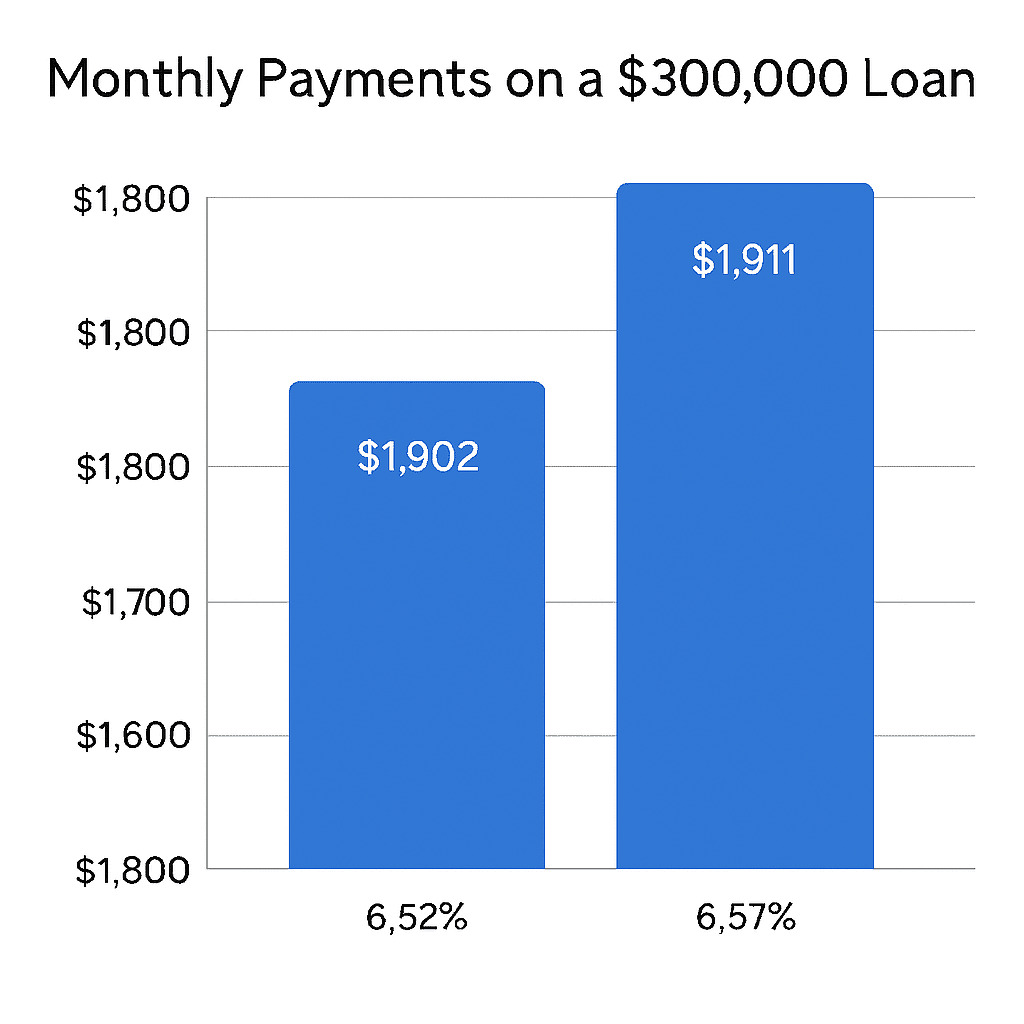
Seeing percentages is one thing, but understanding how they affect your wallet is another. Let's imagine you're looking to refinance a $300,000 loan with a 30-year fixed term.

  • If the rate were 6.52%, your principal and interest payment would be approximately $1,902 per month.
  • Now, with the rate at 6.57%, that payment climbs a bit to around $1,911.

A bar chart comparing monthly payments on a $300,000 loan over 30 years

That’s a difference of about $9 each month, or roughly $108 over the course of a year. Now, $9 doesn't sound like a lot, does it? But remember, this is a 30-year loan. Over the entire life of that loan, that seemingly small monthly increase adds up to over $3,200 more in interest paid. This is why even incremental changes in mortgage rates are worth considering closely.

Why These Seemingly Small Changes Carry Weight

As I’ve seen over my years working with homeowners, even minor shifts in mortgage rates can make a difference, particularly for those with larger loan amounts. When you're refinancing a significant sum, a quarter-point or half-point can translate into substantial savings or added costs. For anyone thinking about refinancing, it’s crucial to run the numbers. Don't just look at the immediate monthly payment change – consider the total interest you'll pay over the entire loan term.

The Big Picture: Refinance Demand is High!

Despite the slight increase in the 30-year rate, the desire to refinance is incredibly strong. The Mortgage Bankers Association (MBA) reported some eye-opening numbers for the week ending January 16, 2026:

  • Refinance applications jumped by a whopping 20% compared to the week before.
  • Even more dramatically, they were up 183% compared to the same week last year!

What's driving this surge? A lot of it comes down to homeowners who took out mortgages at higher rates, often above 7%, in 2023 and 2024. They are now eager to lower their monthly payments, and these current rates, even with the slight uptick, still offer an opportunity for significant savings for many. We're also seeing the average loan size for refinance applications increase, which tells me that borrowers with larger outstanding mortgages are particularly focused on these rate movements.

What Does This Mean for You?

So, what's the takeaway from all this?

  • Refinancing Decisions: If you're considering refinancing, weigh this small increase in the 30-year rate against the potential savings you could get, especially if you're looking at shorter loan terms like the 15-year fixed. Always compare offers from different lenders too!
  • Market Stability: Overall, the mortgage market seems to be in a pretty stable place right now. While economic news can always cause ripples, the different mortgage products are holding relatively steady. This means you have a bit more time to weigh your options without feeling pressured by wild rate swings.
  • Looking Ahead: Experts are generally predicting that rates will likely stay in a similar range for the near future. Significant changes would probably come only if we see big shifts in inflation or if the Federal Reserve makes a major policy announcement.

My Two Cents: Smart Moves in a Steady Market

While the 30-year fixed refinance rate has seen a modest climb, the overall mortgage environment remains calm. As you think about whether refinancing is the right move for you, consider your personal financial goals. Are you aiming to reduce your monthly bills? Do you want to own your home free and clear sooner? Or are you trying to manage financial risk better? Your answers to these questions will guide you to the best mortgage option, regardless of these small daily fluctuations.

🏡 2 Renovated Properties Available for Investors

Port Charlotte, FL
🏠 Property: Dorion St
🛏️ Beds/Baths: 4 Bed • 4 Bath • 2086 sqft
💰 Price: $412,400 | Rent: $3,190
📊 Cap Rate: 6.2% | NOI: $2,124
📅 Year Built: 2023
📐 Price/Sq Ft: $198
🏙️ Neighborhood: A+

and

Kansas City, MO
🏠 Property: E 110th Terrace
🛏️ Beds/Baths: 3 Bed • 2 Bath • 1002 sqft
💰 Price: $220,000 | Rent: $1,700
📊 Cap Rate: 6.9% | NOI: $1,273
📅 Year Built: 1957
📐 Price/Sq Ft: $220
🏙️ Neighborhood: A-

Florida’s modern build with strong cash flow vs Missouri’s affordable rental with higher cap rate. Which fits YOUR investment strategy?

We have much more inventory available than what you see on our website – Let us know about your requirement.

📈 Choose Your Winner & Contact Us Today!

Talk to a Norada investment counselor (No Obligation):

(800) 611-3060

View All Properties 

Invest Smart — Build Long-Term Wealth Through Turnkey Real Estate in 2026

Market forecasts suggest steady demand, making turnkey real estate one of the most reliable paths to passive income and wealth creation.

Norada Real Estate helps investors capitalize on these trends with turnkey rental properties designed for appreciation and consistent cash flow—so you can grow wealth securely while others wait for clarity in the market.

🔥 HOT 2026 INVESTMENT LISTINGS JUST ADDED! 🔥
Talk to a Norada investment counselor today (No Obligation):
(800) 611-3060

Get Started Now

Recommended Read:

  • 30-Year Fixed Refinance Rate Trends – January 22, 2026
  • Best Time to Refinance Your Mortgage: Expert Insights
  • Should You Refinance Your Mortgage Now or Wait Until 2026?
  • When You Refinance a Mortgage Do the 30 Years Start Over?
  • Should You Refinance as Mortgage Rates Reach Lowest Level in Over a Year?
  • Half of Recent Home Buyers Got Mortgage Rates Below 5%
  • Mortgage Rates Need to Drop by 2% Before Buying Spree Begins
  • Will Mortgage Rates Ever Be 3% Again: Future Outlook
  • Mortgage Rates Predictions for Next 2 Years
  • Mortgage Rate Predictions for Next 5 Years

Filed Under: Financing, Mortgage Tagged With: mortgage rates, Mortgage Rates Today, Refinance Rates

Mortgage Rates Today, Jan 23: 30-Year Refinance Rate Rises by 10 Basis Points

January 23, 2026 by Marco Santarelli

Mortgage Rates Today, August 24, 2026: 30-Year Refinance Rate Drops by 2 Basis Points

Alright, let's talk about where mortgage rates are at today, January 23rd. If you’re thinking about refinancing, you’ll want to know that the 30-year fixed refinance rate has nudged up by 10 basis points, now sitting at 6.62%, according to Zillow. While this might seem like a tiny blip, these kinds of movements can really make a difference for your wallet over time.

Mortgage Rates Today, Jan 23: 30-Year Refinance Rate Rises by 10 Basis Points

What’s Happening with Mortgage Rates Right Now?

Here's a quick rundown of the national refinance rates as of January 23, 2026:

Loan Type Rate Change from Last Week Daily Movement (Friday)
30-Year Fixed Refi 6.62% Up 0.10% (10 bps) Up 0.01% (6.61% to 6.62%)
15-Year Fixed Refi 5.67% Steady N/A
5-Year ARM Refi 7.28% Up 0.14% (14 bps) N/A

Source: Zillow

For folks looking to refinance, that 6.62% for a 30-year fixed rate is just a hair higher than last week’s 6.52%. It’s a small bump, but it’s worth understanding what it means for you.

Decoding the “Basis Point” Jargon

So, what exactly is a “basis point”? Think of it like this: one basis point is just a tiny fraction, 0.01%. When we say the rate went up by 10 basis points, that means it increased by 0.10%. It might not sound like much, but on a big loan like a mortgage, even a tenth of a percent can add up.

Let’s break it down with an example. Imagine you’re refinancing a $300,000 loan:

  • At the slightly lower rate of 6.52%, your monthly payment for principal and interest would be around $1,902.
  • Now, with the rate at 6.62%, that payment jumps to about $1,920.

That’s an extra $18 per month. Over the life of a 30-year loan, that adds up to a notable $6,480. It’s those figures that really hit home how crucial these rate changes can be when you’re planning your finances.

What This Means for Homeowners Thinking About Refinancing

The fact that the 30-year refinance rate has gone up a bit might make some people pause. If you were on the fence about refinancing, this slight increase could make that decision feel a little less urgent, or perhaps less appealing.

However, I’ve been watching the mortgage market for a while, and it's important to remember that current rates are still a far cry from the peak we saw not too long ago. Back in late 2023 and early 2024, the 30-year refinance rate was often hovering around 7.5%. Compared to those dizzying heights, 6.62% still looks pretty good.

Impact on Your Monthly Budget:
For many families, especially with the cost of everyday things going up, every dollar in the monthly budget counts. A small increase in your refinance rate can mean a slightly tighter squeeze, which might make you think twice about taking on a new loan right now.

Your Home Equity and Current Rate:
If you were lucky enough to lock in an incredibly low rate, say between 3% and 4%, during the pandemic boom years (2020-2021), refinancing now would probably not make sense for you. The current rates, even with this small uptick, are still significantly higher than what you’re already paying.

On the other hand, if your current mortgage has a rate that’s higher than, say, 7%, then even with today’s slightly higher refinance rates, you could still be looking at some decent savings by switching. It's all about comparing your current situation to what's available.

A Nod to Stability: The 15-Year Fixed Rate

It’s great to see that the 15-year fixed refinance rate has remained steady at 5.67%. This is often where you find a sweet spot for borrowers who want to pay off their mortgage faster.

While the monthly payments on a 15-year loan are usually higher than on a 30-year loan, the interest you save over the years can be enormous. If you can comfortably swing those larger payments, refinancing into a 15-year mortgage can save you tens of thousands of dollars in interest. It’s a trade-off between a higher monthly bill now and significant long-term savings.

A Closer Look at Adjustable Rate Mortgages (ARMs)

The 5-year Adjustable Rate Mortgage (ARM) refinance rate has seen a more noticeable jump, climbing to 7.28% – that’s up by 14 basis points. This is something to pay attention to.

ARMs are known for having lower starting interest rates. This lower initial rate can be attractive for borrowers who plan to move or refinance again before the fixed period ends. However, the risk is that after the initial fixed period (in this case, five years), the interest rate can change, going up or down with market conditions.

The recent rise in ARM rates suggests that lenders are anticipating some continued ups and downs in the market, or perhaps expecting borrowing costs to stay elevated for longer. If you’re considering an ARM, it’s crucial to really understand the potential for future rate increases and whether you can handle those higher payments if they happen.

Putting Mortgage Rates in the Bigger Picture

It's not just random numbers moving around; these mortgage rates are influenced by a lot of bigger economic forces.

  • The Federal Reserve: What the Fed does with interest rates has a ripple effect. Even though they’ve been slowing down the pace of rate hikes, inflation is still a concern, and that can keep long-term borrowing costs, like mortgages, a bit higher than we might like.
  • The Bond Market: Mortgage rates often move hand-in-hand with something called the 10-year Treasury yield. When that yield goes up, mortgage rates tend to follow, and vice versa. We’ve seen some back-and-forth action in this area early in 2026.
  • Home Demand: Even with rates a bit higher, the desire for housing in certain areas is still strong. This persistent demand keeps the refinancing market active, even if it’s not the frenzy we saw during the ultra-low rate period.

Your Refinancing Game Plan

So, what should you take away from all this as you consider your options?

  • 30-Year Fixed: At 6.62%, it’s a little pricier than last week, but still much more affordable than the peaks of recent years. It remains a popular choice for its predictable, lower monthly payments.
  • 15-Year Fixed: Holding steady at 5.67%, this is a fantastic option if you’re looking to build equity faster and save a bundle on interest over time, and can manage the higher monthly payments.
  • 5-Year ARM: Climbing to 7.28%, this signals that caution might be the best approach for now. Weigh the short-term savings against the potential for higher payments down the road.

Latest Buzz from the Mortgage World

  • Refinance Boom Continues: The Mortgage Bankers Association (MBA) reported a huge jump in refinance applications, up 183% compared to this time last year. This surge is largely due to people looking to take advantage of the drop from the 2025 rate highs.
  • Economic Ripples: Recent swings in the market have been linked to global events, like discussions at Davos and shifts in demand for U.S. Treasury bonds. There was even a brief dip in rates to a three-year low of 6.18% in mid-January, sparked by a surprise announcement from the Trump administration, before they settled back.
  • Fed's Cautious Pause: After cutting rates three times in late 2025, the Federal Reserve decided to hold off on further cuts in January 2026. The reason? Inflation is still being a bit stubborn.

What Experts Are Saying About 2026

Looking ahead, here’s what many financial experts are forecasting:

  • Rates Staying Put (Mostly): For the first few months of 2026, many economists expect rates to stay in a pretty tight range, likely between 6.25% and 6.50%.
  • Breaking the 6% Mark? Some analysts are optimistic that the 30-year fixed rate could finally dip below 6% later this year. If we see a recession or inflation continues its downward trend, some even predict rates could fall as low as 5.5%.

My take on strategy: If you can find a refinance option that lowers your current rate by at least half a percentage point to a full percentage point, it’s probably worth starting the process. However, if your current rate is below 5% – you're in a fantastic position, and holding tight might be the smartest move.

Final Thoughts on Refinancing Today

It’s understandable that a small increase in the 30-year refinance rate might make some homeowners hesitate. But from my perspective, the overall picture for mortgage rates is still relatively balanced, especially when you consider how high they were not that long ago.

My advice is always to sit down with your financial planner or a trusted mortgage professional and look at your specific situation. Consider your current mortgage terms, what your financial goals are, and how much risk you’re comfortable taking on.

If you’re someone paying a higher interest rate right now, refinancing could still unlock significant savings, even with these slight rate adjustments. For others, especially those with those super-low pandemic-era rates, patience might be the key. The market is always changing, and waiting for the right moment can sometimes be the most rewarding strategy.

🏡 2 Renovated Properties Available for Investors

Port Charlotte, FL
🏠 Property: Dorion St
🛏️ Beds/Baths: 4 Bed • 4 Bath • 2086 sqft
💰 Price: $412,400 | Rent: $3,190
📊 Cap Rate: 6.2% | NOI: $2,124
📅 Year Built: 2023
📐 Price/Sq Ft: $198
🏙️ Neighborhood: A+

and

Kansas City, MO
🏠 Property: E 110th Terrace
🛏️ Beds/Baths: 3 Bed • 2 Bath • 1002 sqft
💰 Price: $220,000 | Rent: $1,700
📊 Cap Rate: 6.9% | NOI: $1,273
📅 Year Built: 1957
📐 Price/Sq Ft: $220
🏙️ Neighborhood: A-

Florida’s modern build with strong cash flow vs Missouri’s affordable rental with higher cap rate. Which fits YOUR investment strategy?

We have much more inventory available than what you see on our website – Let us know about your requirement.

📈 Choose Your Winner & Contact Us Today!

Talk to a Norada investment counselor (No Obligation):

(800) 611-3060

View All Properties 

Invest Smart — Build Long-Term Wealth Through Turnkey Real Estate in 2026

Market forecasts suggest steady demand, making turnkey real estate one of the most reliable paths to passive income and wealth creation.

Norada Real Estate helps investors capitalize on these trends with turnkey rental properties designed for appreciation and consistent cash flow—so you can grow wealth securely while others wait for clarity in the market.

🔥 HOT 2026 INVESTMENT LISTINGS JUST ADDED! 🔥
Talk to a Norada investment counselor today (No Obligation):
(800) 611-3060

Get Started Now

Recommended Read:

  • 30-Year Fixed Refinance Rate Trends – January 21, 2026
  • Best Time to Refinance Your Mortgage: Expert Insights
  • Should You Refinance Your Mortgage Now or Wait Until 2026?
  • When You Refinance a Mortgage Do the 30 Years Start Over?
  • Should You Refinance as Mortgage Rates Reach Lowest Level in Over a Year?
  • Half of Recent Home Buyers Got Mortgage Rates Below 5%
  • Mortgage Rates Need to Drop by 2% Before Buying Spree Begins
  • Will Mortgage Rates Ever Be 3% Again: Future Outlook
  • Mortgage Rates Predictions for Next 2 Years
  • Mortgage Rate Predictions for Next 5 Years

Filed Under: Financing, Mortgage Tagged With: mortgage rates, Mortgage Rates Today, Refinance Rates

Mortgage Rates Today, Jan 22: 30-Year Refinance Rate Rises by 7 Basis Points

January 22, 2026 by Marco Santarelli

Mortgage Rates Today, August 24, 2026: 30-Year Refinance Rate Drops by 2 Basis Points

If you're thinking about refinancing your mortgage, now is the time to pay close attention. As of January 22, 2026, the national average for a 30-year fixed refinance rate has ticked up by 7 basis points compared to last week, now sitting at 6.59%. While this is a slight dip from yesterday's rate, the overall trend shows rates are beginning to climb again, making it crucial for borrowers to understand the current market and act strategically.

Mortgage Rates Today, Jan 22: 30-Year Refinance Rate Rises by 7 Basis Points

A Peek at Today's Refinance Rates (January 22, 2026)

Let's break down where things stand today, based on data from Zillow. It’s always helpful to see the numbers laid out clearly:

Loan Type Current Rate Change (Basis Points) Previous Rate (Jan 21) Weekly Average (Jan 15)
30-Year Fixed Refinance 6.59% -6 bps (daily) 6.65% 6.52%
15-Year Fixed Refinance 5.72% +4 bps 5.68% N/A
5-Year ARM Refinance 7.28% +3 bps 7.25% N/A

What These Numbers Really Mean for You

You might be wondering, “Why should I care about a few basis points here or there?” Well, in the world of mortgages, even small changes can add up to significant amounts of money over the life of your loan.

  • The Daily Scoop vs. The Weekly Story: You'll notice the 30-year fixed refinance rate actually dropped by 6 basis points from yesterday. That's great news for anyone looking to refinance right now! However, when we zoom out and look at the weekly average, we see it’s actually up by 7 basis points. This tells me that while there might be short-term fluctuations, the underlying trend for this popular loan type is showing a gentle upward pressure. It's like seeing the tide go out a little, but knowing it’s going to come back in higher.
  • The 15-Year Alternative: The 15-year fixed refinance rate has also edged up slightly, by 4 basis points, settling at 5.72%. Historically, 15-year loans come with lower interest rates than 30-year loans because you're paying off your mortgage faster. If you have the financial flexibility, this can be a fantastic way to save a lot of money on interest over time, even with these minor increases.
  • Adjustable-Rate Mortgages (ARMs) are Watching: Even the 5-year ARM has seen a slight bump, up 3 basis points to 7.28%. ARMs typically start with lower rates than fixed-rate mortgages, but they come with the risk that your rate will adjust upwards later. Watching these rates tick up is a reminder that the window for potentially lower payments on ARMs might also be narrowing.

Deeper Dive: Why Are Rates Moving?

It's natural to ask why these rates are shifting. In my experience, mortgage rates aren't just pulled out of thin air. They’re influenced by a lot of different economic factors.

  • Economic Signals: The Federal Reserve's monetary policy plays a huge role. When the economy is strong and inflation is a concern, the Fed might raise interest rates to cool things down. This, in turn, often pushes mortgage rates higher. Conversely, if the economy is sluggish, they might lower rates.
  • The Bond Market Buzz: Mortgage rates are also closely tied to the U.S. Treasury market, particularly the 10-year Treasury note. When investors feel confident about the economy, they might move their money into riskier assets like stocks, which can push bond prices down and yields (interest rates) up. On the flip side, during uncertain times, investors flock to the perceived safety of Treasury bonds, driving prices up and yields down.
  • Geopolitical Factors and Trade Winds: As mentioned in the provided data, things like geopolitical tensions and trade concerns can create market uncertainty. When there's news that shakes up global markets, it can cause a ripple effect that impacts interest rates, sometimes causing them to spike or dip unpredictably. It’s a constant tug-of-war between global events and our personal finances.

Refinance Demand: Are People Still Jumping In?

The data tells an interesting story about refinance activity. Despite the slight upward trend in weekly rates, there's been a significant surge in refinance applications.

  • A Big Jump: The week ending January 16th, 2026, saw refinance applications jump by a whopping 20% compared to the week before! That's a huge increase.
  • Year-Over-Year Boom: Not only that, but refinance activity is a staggering 183% higher than it was this time last year. This tells me that a lot of homeowners who took out mortgages when rates were higher (think above 7% in early 2025) are now seeing an opportunity to save money.
  • Refinance Takes the Lead: Refinance applications now make up around 61.9% of all mortgage activity. This dominance shows that homeowners are actively trying to take advantage of what they perceive as a favorable rate window, even with the recent upward pressure.

Expert Advice: Is It Time to Refinance for YOU?

As someone who follows the housing market closely, I always advise my readers to look beyond just the national averages.

  • The Savings Math: Experts often suggest that you should consider refinancing if the new rate is at least 0.5 to 0.75 percentage points lower than your current rate. Why? Because closing costs for a refinance can add up, and you want to make sure the long-term savings will outweigh those upfront expenses. Take the time to calculate your potential savings.
  • Shop Around, Smartly: Don't just accept the first offer you get! Lenders have different rates and fees. It’s crucial to compare current refinance rates from multiple lenders. You might be surprised to find an offer that’s even better than the national averages. This is where my own experience comes into play – I've seen people save thousands simply by diligently comparing options.
  • The 2026 Forecast: Looking ahead, many housing economists predict rates will likely stay in the lower 6% range for much of 2026. Some forecasts, like those from Morgan Stanley, even suggest a potential dip towards 5.5%–5.75% in mid-2026 before possibly climbing again. This implies that while today's rate might not be the absolute lowest we'll see this year, it's still a decent point to consider if you're looking to refinance.

The Bottom Line: Navigating Today's Mortgage Market

So, what’s the takeaway from today’s mortgage rate report? Mortgage rates are definitely in motion. While we saw a small dip in the 30-year refinance rate today, the bigger picture shows a weekly increase, indicating a trend towards slightly higher rates.

For homeowners and potential buyers, staying informed is your best strategy. If you're considering refinancing, today's slight daily dip might present a small window of opportunity, but the weekly trend suggests that acting sooner rather than later could be wise. Carefully weigh the potential savings against closing costs, and always, always shop around for the best deal.

🏡 2 Renovated Properties Available for Investors

Port Charlotte, FL
🏠 Property: Dorion St
🛏️ Beds/Baths: 4 Bed • 4 Bath • 2086 sqft
💰 Price: $412,400 | Rent: $3,190
📊 Cap Rate: 6.2% | NOI: $2,124
📅 Year Built: 2023
📐 Price/Sq Ft: $198
🏙️ Neighborhood: A+

and

Kansas City, MO
🏠 Property: E 110th Terrace
🛏️ Beds/Baths: 3 Bed • 2 Bath • 1002 sqft
💰 Price: $220,000 | Rent: $1,700
📊 Cap Rate: 6.9% | NOI: $1,273
📅 Year Built: 1957
📐 Price/Sq Ft: $220
🏙️ Neighborhood: A-

Florida’s modern build with strong cash flow vs Missouri’s affordable rental with higher cap rate. Which fits YOUR investment strategy?

We have much more inventory available than what you see on our website – Let us know about your requirement.

📈 Choose Your Winner & Contact Us Today!

Talk to a Norada investment counselor (No Obligation):

(800) 611-3060

View All Properties 

Invest Smart — Build Long-Term Wealth Through Turnkey Real Estate in 2026

Market forecasts suggest steady demand, making turnkey real estate one of the most reliable paths to passive income and wealth creation.

Norada Real Estate helps investors capitalize on these trends with turnkey rental properties designed for appreciation and consistent cash flow—so you can grow wealth securely while others wait for clarity in the market.

🔥 HOT 2026 INVESTMENT LISTINGS JUST ADDED! 🔥
Talk to a Norada investment counselor today (No Obligation):
(800) 611-3060

Get Started Now

Recommended Read:

  • 30-Year Fixed Refinance Rate Trends – January 21, 2026
  • Best Time to Refinance Your Mortgage: Expert Insights
  • Should You Refinance Your Mortgage Now or Wait Until 2026?
  • When You Refinance a Mortgage Do the 30 Years Start Over?
  • Should You Refinance as Mortgage Rates Reach Lowest Level in Over a Year?
  • Half of Recent Home Buyers Got Mortgage Rates Below 5%
  • Mortgage Rates Need to Drop by 2% Before Buying Spree Begins
  • Will Mortgage Rates Ever Be 3% Again: Future Outlook
  • Mortgage Rates Predictions for Next 2 Years
  • Mortgage Rate Predictions for Next 5 Years

Filed Under: Financing, Mortgage Tagged With: mortgage rates, Mortgage Rates Today, Refinance Rates

Mortgage Rates Today, Jan 21: 30-Year Refinance Rate Rises by 17 Basis Points

January 21, 2026 by Marco Santarelli

Mortgage Rates Today, August 24, 2026: 30-Year Refinance Rate Drops by 2 Basis Points

As of Wednesday, January 21, 2026, the national average 30-year fixed refinance rate has nudged up by 17 basis points from last week, now sitting at 6.69%. While this might seem like a small shift, it’s important for homeowners to understand what it means for their wallets and their refinancing decisions. I’ve been watching these numbers closely for years, and even small moves can signal bigger trends.

Now, the market is doing its usual dance, reacting to everything from government announcements to global events. This week, the 30-year fixed refinance rate held steady from Tuesday to Wednesday, which is good news for those who were thinking about refinancing and haven't pulled the trigger yet. However, when you look back at the past week, that 17 basis point increase tells a different story – one of cautious upward momentum.

Mortgage Rates Today, Jan 21: 30-Year Fixed Refinance Rate Rises by 17 Basis Points

Diving Deeper into Today's Rates

Let’s break down what’s happening with the different mortgage refinance options available right now.

The Popular 30-Year Fixed Refinance Rate

The 30-year fixed refinance rate is the go-to for many homeowners, and for good reason. It offers a predictable monthly payment over a long period, making budgeting easier. Today, this rate is at 6.69%. While it’s the same as yesterday, that increase of 17 basis points from last week’s average of 6.52% is what we need to pay attention to. This upward tick suggests that if you were waiting for rates to drop further, you might be missing out on some pretty good opportunities that were available just a few days ago.

The Faster Payoff: 15-Year Fixed Refinance Rate

For those who want to pay off their mortgage sooner and save big on interest over the life of the loan, the 15-year fixed refinance rate is still looking solid. It’s holding steady at 5.68%, both day-to-day and week-over-week. This rate is fantastic for principal reduction, though it does mean a higher monthly payment. The stability here is a good sign, offering certainty for borrowers who prefer a quicker path to being mortgage-free.

The Adjustable-Rate Option: 5-Year ARM

The 5-year Adjustable-Rate Mortgage (ARM) is currently less appealing. At 7.17%, it’s sitting higher than both fixed-rate options. Typically, ARMs start with lower rates than fixed mortgages, giving borrowers an initial break. But with the current numbers, that initial advantage seems to have vanished. Unless your financial situation is very specific and you plan to move or refinance again before the rate starts adjusting, a fixed-rate loan seems like the smarter choice right now.

A Snapshot: Rate Comparison

To make things even clearer, here’s a quick look at how the rates stack up:

Loan Type Last Week Avg. Current Avg. Change (Basis Points)
30-Year Fixed 6.52% 6.69% +17
15-Year Fixed 5.68% 5.68% 0
5-Year ARM 7.17% 7.17% 0

Looking at this table, it’s clear that the 30-year fixed rate is the one showing movement. The other two options are holding their ground, which provides a bit of stability in the market.

What This Means for Your Refinancing Plans

So, what does this all add up to for homeowners like you and me?

  • Higher Refinancing Costs: That 17 basis point rise in the 30-year fixed rate means your monthly payment will likely be a little higher than it would have been last week if you refinance today. It's not a huge leap, but it's enough to notice.
  • Short-Term Calm: The fact that rates didn’t move from Tuesday to Wednesday is a small comfort. It suggests lenders aren’t making drastic changes day by day, even with bigger market shifts happening. It gives you a small window to act.
  • Fixed is Still King: With the 5-year ARM higher than fixed rates, it just doesn't make much sense for most people to go with an ARM right now. The predictability and current cost of fixed-rate loans are much more attractive.

Peering into the Crystal Ball: The Outlook for 2026

Predicting mortgage rates is a bit like forecasting the weather – sometimes you get it right, and sometimes you’re caught in an unexpected storm. However, we can look at the trends and expert opinions to get a general idea.

The Federal Reserve's actions and the overall inflation situation will heavily influence where rates go next. Even though we saw a weekly increase, the day-to-day stability gives a hint of what might come.

Last week’s news about a surprise government policy to purchase mortgage-backed securities was a big deal. It drove rates down significantly, and many people, myself included, thought we might see that trend continue. But the market is quick to react. Geopolitical events and issues in overseas markets caused rates to jump back up sharply on Tuesday. This shows how interconnected everything is and how quickly things can change.

The Mortgage Bankers Association (MBA) reported a massive 128% jump in refinance activity compared to last year. This surge makes total sense. Lots of people refinanced when rates were at their lowest, but many others who bought homes more recently (say, in early 2025) might have rates above 7%. They're now looking to refinance to save a substantial amount of money.

For context, the average 30-year rate in January 2025 was around 7.04%. So, even at today’s 6.69%, homeowners who bought in the last year or so are still in a good position to save money.

As for the rest of 2026, the general consensus among housing economists is that rates will likely hover between 6.0% and 6.4%. Some forecasts, like Fannie Mae’s, predict a dip to 5.9% by the end of the year, while others, like Morgan Stanley, see potential for rates as low as 5.5%–5.75% by mid-year if Treasury yields continue to fall.

However, there's a phenomenon called the “lock-in effect”. Many people already have mortgages with rates below 5%. For them, refinancing makes no sense unless rates drop significantly lower. This means we probably won't see a massive nationwide refinancing boom unless there’s a much bigger rate drop.

My Take on Today's Rates

From my perspective, today’s rate environment offers a mixed bag. The upward movement in the 30-year fixed rate is a gentle nudge to homeowners who’ve been on the fence about refinancing. It’s not a crisis, but it’s a signal that waiting too long might mean paying more. The stability in the 15-year fixed and 5-year ARM rates means those options are still what they were yesterday.

If you’re thinking about refinancing, especially to lower your monthly payment or get rid of private mortgage insurance (PMI), it’s worth getting quotes now. Compare offers from different lenders. Understand all the fees involved in refinancing, not just the rate. Sometimes, a slightly higher rate with fewer fees can be a better deal.

The best action plan is always to understand your own financial goals. Are you looking for the lowest monthly payment possible, or do you want to be debt-free faster? Your answer will guide whether the 30-year or 15-year fixed is the better choice for your refinance.

🏡 2 Renovated Properties Available for Investors

Port Charlotte, FL
🏠 Property: Dorion St
🛏️ Beds/Baths: 4 Bed • 4 Bath • 2086 sqft
💰 Price: $412,400 | Rent: $3,190
📊 Cap Rate: 6.2% | NOI: $2,124
📅 Year Built: 2023
📐 Price/Sq Ft: $198
🏙️ Neighborhood: A+

and

Kansas City, MO
🏠 Property: E 110th Terrace
🛏️ Beds/Baths: 3 Bed • 2 Bath • 1002 sqft
💰 Price: $220,000 | Rent: $1,700
📊 Cap Rate: 6.9% | NOI: $1,273
📅 Year Built: 1957
📐 Price/Sq Ft: $220
🏙️ Neighborhood: A-

Florida’s modern build with strong cash flow vs Missouri’s affordable rental with higher cap rate. Which fits YOUR investment strategy?

We have much more inventory available than what you see on our website – Let us know about your requirement.

📈 Choose Your Winner & Contact Us Today!

Talk to a Norada investment counselor (No Obligation):

(800) 611-3060

View All Properties 

Invest Smart — Build Long-Term Wealth Through Turnkey Real Estate in 2026

Market forecasts suggest steady demand, making turnkey real estate one of the most reliable paths to passive income and wealth creation.

Norada Real Estate helps investors capitalize on these trends with turnkey rental properties designed for appreciation and consistent cash flow—so you can grow wealth securely while others wait for clarity in the market.

🔥 HOT 2026 INVESTMENT LISTINGS JUST ADDED! 🔥
Talk to a Norada investment counselor today (No Obligation):
(800) 611-3060

Get Started Now

Recommended Read:

  • 30-Year Fixed Refinance Rate Trends – January 20, 2026
  • Best Time to Refinance Your Mortgage: Expert Insights
  • Should You Refinance Your Mortgage Now or Wait Until 2026?
  • When You Refinance a Mortgage Do the 30 Years Start Over?
  • Should You Refinance as Mortgage Rates Reach Lowest Level in Over a Year?
  • Half of Recent Home Buyers Got Mortgage Rates Below 5%
  • Mortgage Rates Need to Drop by 2% Before Buying Spree Begins
  • Will Mortgage Rates Ever Be 3% Again: Future Outlook
  • Mortgage Rates Predictions for Next 2 Years
  • Mortgage Rate Predictions for Next 5 Years

Filed Under: Financing, Mortgage Tagged With: mortgage rates, Mortgage Rates Today, Refinance Rates

Mortgage Rates Today, Jan 20: 30-Year Fixed Refinance Rate Rises by 16 Basis Points

January 20, 2026 by Marco Santarelli

Mortgage Rates Today, August 24, 2026: 30-Year Refinance Rate Drops by 2 Basis Points

If you've been thinking about refinancing your mortgage, today, January 20, 2026, shows a slight uptick in the most popular long-term fixed rate. According to Zillow, the 30-year fixed refinance rate is holding steady at 6.68% from yesterday, but it's actually 16 basis points higher than it was a week ago, meaning borrowing money is a touch more expensive now than it was seven days prior. This nuanced movement in mortgage rates is crucial for anyone looking to lower their monthly payments or tap into their home equity.

Lenders are adjusting their offers based on a lot of factors, and it’s our job as homeowners to stay informed. Let's break down what's happening with mortgage refinance rates today, according to Zillow's latest data, and what it might mean for your wallet.

Mortgage Rates Today, Jan 20: 30-Year Fixed Refinance Rate Rises by 16 Basis Points

30-Year Fixed Refinance Rate: A Familiar Tune

The 30-year fixed refinance rate is the gold standard for many homeowners seeking stability. Today, it’s sitting at 6.68%. While that number didn't budge from yesterday, the fact that it's 16 basis points higher than last week (when it was 6.52%) is a key detail. Think of basis points like tiny steps – a 16-point rise might not seem huge, but it translates to a bit more interest paid over the life of your loan.

For many of us, the 30-year fixed option offers peace of mind. You know exactly what your principal and interest payment will be for the next three decades. This current rate, while stable today, is a reminder that the market can shift. It suggests that lenders have perhaps paused their rate cuts for the moment, but the environment still points towards slightly higher borrowing costs compared to earlier in the month. This is a crucial piece of information if you were holding out for rates to drop significantly.

15-Year Fixed Refinance Rate: The Quick Saver

If you're looking to pay off your mortgage faster and build equity quicker, the 15-year fixed refinance rate is often your best bet. Today, this rate is also holding steady at 5.66%. This is great news for those who prefer shorter terms and are already in a good position to handle slightly higher monthly payments for a shorter period.

While shorter loan terms typically come with lower interest rates, the gap between the 30-year and 15-year options right now isn't as wide as it sometimes is. This can be a trade-off to consider. Some homeowners might opt for the lower monthly payment of a 30-year loan even with a slightly higher rate, while others prioritize paying off their debt sooner.

5-Year ARM Refinance Rate: A Riskier Proposition Today

Where we're seeing a more significant shift is with the 5-year adjustable-rate mortgage (ARM) refinance rate. This rate has jumped by 20 basis points, moving from 7.13% to 7.33% just today. ARMs are known for offering lower introductory rates, making them attractive to borrowers who plan to sell or refinance before the first rate adjustment period kicks in.

However, this sharp increase is a clear signal. It highlights the inherent risk of ARMs. While you might get a lower rate initially, the potential for future increases is very real. The fact that this rate has gone up significantly in a single day, and now sits higher than the 30-year fixed rate, definitely makes it a less appealing option for many homeowners at this moment. It's a classic example of the trade-off between initial savings and long-term unpredictability.

A Snapshot of the Week: What's Changed?

To really get a grasp on the market, it's helpful to see how things have evolved over the past week, according to Zillow.

Loan Type Previous Week Avg. Current Avg. Change (Basis Points)
30-Year Fixed 6.52% 6.68% +16
15-Year Fixed 5.66% 5.66% 0
5-Year ARM 7.13% 7.33% +20

As you can see, the 30-year fixed and 5-year ARM have both seen increases in their average rates compared to last week, with the ARM showing the most pronounced upward movement. The 15-year fixed has remained remarkably consistent.

Day-to-Day Fluctuations: What's Happening Right Now?

Let's also look at the day-to-day changes to understand the immediate market temperature.

Loan Type Prior Day Avg. Current Avg. Change (Basis Points)
30-Year Fixed 6.68% 6.68% 0
15-Year Fixed 5.66% 5.66% 0
5-Year ARM 7.13% 7.33% +20

This table really highlights the story of the day: both fixed-rate options are holding their ground from yesterday, while the 5-year ARM has experienced that significant price hike.

Key Takeaways for Homeowners

So, what does all this mean for you?

  • The 30-year fixed refinance rate is stable today, but it's a bit more expensive than it was last week. This means if you were waiting for a perfect moment, it might be good to re-evaluate your comfort level with this week's rate.
  • The 15-year fixed rate is showing real consistency. If you prefer a shorter mortgage term, this rate has been a solid rock.
  • The 5-year ARM is the most volatile player right now, with a notable increase. This underscores the inherent risk in these types of loans, especially when rates are already on the rise.

Looking Ahead: What's Predicted for Early 2026?

Forecasting the future is tricky, but experts have some pretty solid ideas about where mortgage rates are headed. Analysts from Fannie Mae, NAR, and the Mortgage Bankers Association (MBA) are generally expecting the 30-year fixed rate to average somewhere between 5.9% and 6.4% in 2026. This optimism is largely based on anticipated rate cuts from the Federal Reserve and signs that the housing market will become more affordable.

  • Alternative Loans: For those who might not qualify for the absolute best rates, FHA and VA loans could offer even lower options, potentially in the 5.5% to 5.75% range. These are fantastic programs for specific groups of borrowers.
  • Savings Potential: Imagine refinancing a $300,000 loan if rates dip below 6%. You could be looking at saving roughly $1,080 per year. That's a pretty sweet deal!
  • Risks to Watch: Of course, it's not all smooth sailing. Things like stubborn inflation, unexpected shifts in the job market, and changes in government policy could all impact how far rates can actually drop.

Why the Market is Doing What It's Doing: Trending News and Drivers

It's fascinating to see what's actually moving these rates.

  • Refinance Demand is Skyrocketing: We've seen a 40% surge in weekly refinance applications recently, and demand is a whopping 128% higher than this time last year. This shows a lot of homeowners are actively seeking to refinance.
  • Government Intervention: A big factor recently was an announcement from President Trump directing Fannie Mae and Freddie Mac to buy $200 billion in mortgage bonds. The goal was to push rates down and make homeownership more accessible.
  • The Federal Reserve's Role: While the Fed has been cutting rates, they're expected to either pause or make only one more cut in 2026. This suggests rates might “hover” around the low 6% range for a good chunk of the year.
  • The “Lock-In” Effect: Many homeowners have mortgages with rates below 5%, which is why they're hesitant to refinance. Experts call this a “slow thaw” – while some are refinancing, a large majority are waiting for rates to drop even further before they make a move.

Refinance Opportunities in 2026: Who Benefits?

  • 2023-2024 Buyers: If you bought a home in 2023 or 2024 and locked in a rate of 7.25% or higher, refinancing now at rates closer to 6% could save you over $300 per month on a $400,000 loan. That's a significant chunk of change!
  • The Rise of HELOCs: For those who can't fully refinance without giving up a great existing rate, many are turning to Home Equity Lines of Credit (HELOCs) or home equity loans. This allows them to access cash for renovations or other needs without touching their primary mortgage.
  • Digital Innovation: The mortgage process is getting faster. Nearly 86% of applicants now prefer using online tools to speed things up and potentially lower closing costs.

The Bottom Line

As of January 20, 2026, the mortgage refinance rate picture is a bit mixed. We're seeing stability in the most popular fixed-rate options, but a noticeable jump in adjustable-rate mortgages. For homeowners like me, this means it’s crucial to weigh the comfort of a predictable fixed payment against the potential risks of an ARM. With rates still a bit higher than they were last week, careful planning and shopping around are more important than ever if you're thinking about refinancing.

🏡 2 Renovated Properties Available for Investors

Port Charlotte, FL
🏠 Property: Dorion St
🛏️ Beds/Baths: 4 Bed • 4 Bath • 2086 sqft
💰 Price: $412,400 | Rent: $3,190
📊 Cap Rate: 6.2% | NOI: $2,124
📅 Year Built: 2023
📐 Price/Sq Ft: $198
🏙️ Neighborhood: A+

and

Kansas City, MO
🏠 Property: E 110th Terrace
🛏️ Beds/Baths: 3 Bed • 2 Bath • 1002 sqft
💰 Price: $220,000 | Rent: $1,700
📊 Cap Rate: 6.9% | NOI: $1,273
📅 Year Built: 1957
📐 Price/Sq Ft: $220
🏙️ Neighborhood: A-

Florida’s modern build with strong cash flow vs Missouri’s affordable rental with higher cap rate. Which fits YOUR investment strategy?

We have much more inventory available than what you see on our website – Let us know about your requirement.

📈 Choose Your Winner & Contact Us Today!

Talk to a Norada investment counselor (No Obligation):

(800) 611-3060

View All Properties 

Invest Smart — Build Long-Term Wealth Through Turnkey Real Estate in 2026

Market forecasts suggest steady demand, making turnkey real estate one of the most reliable paths to passive income and wealth creation.

Norada Real Estate helps investors capitalize on these trends with turnkey rental properties designed for appreciation and consistent cash flow—so you can grow wealth securely while others wait for clarity in the market.

🔥 HOT 2026 INVESTMENT LISTINGS JUST ADDED! 🔥
Talk to a Norada investment counselor today (No Obligation):
(800) 611-3060

Get Started Now

Recommended Read:

  • 30-Year Fixed Refinance Rate Trends – January 19, 2026
  • Best Time to Refinance Your Mortgage: Expert Insights
  • Should You Refinance Your Mortgage Now or Wait Until 2026?
  • When You Refinance a Mortgage Do the 30 Years Start Over?
  • Should You Refinance as Mortgage Rates Reach Lowest Level in Over a Year?
  • Half of Recent Home Buyers Got Mortgage Rates Below 5%
  • Mortgage Rates Need to Drop by 2% Before Buying Spree Begins
  • Will Mortgage Rates Ever Be 3% Again: Future Outlook
  • Mortgage Rates Predictions for Next 2 Years
  • Mortgage Rate Predictions for Next 5 Years

Filed Under: Financing, Mortgage Tagged With: mortgage rates, Mortgage Rates Today, Refinance Rates

Mortgage Rates Today, Jan 19: 30-Year Refinance Rate Rises by 16 Basis Points

January 19, 2026 by Marco Santarelli

Mortgage Rates Today, August 24, 2026: 30-Year Refinance Rate Drops by 2 Basis Points

As of January 19th, the national average for a 30-year fixed refinance rate has nudged up to 6.68%, marking a 16 basis point increase compared to where we were last week. This means that for anyone eyeing a refinance, the costs have just become a little steeper.

We're seeing these shifts happen across the board, not just with the most popular 30-year loans. The 15-year fixed refinance rate has also seen a bump, climbing by 6 basis points to 5.68%. Even the 5-year adjustable-rate mortgage (ARM), which often starts lower, has climbed 5 basis points to 7.21%. This consistent upward movement tells a story about the current financial climate and what it means for your pocketbook.

Mortgage Rates Today, Jan 19: 30-Year Refinance Rate Rises by 16 Basis Points

What's Driving These Rate Increases?

It’s easy to feel surprised by these daily fluctuations, but they’re usually tied to bigger economic discussions. Think about inflation fears and what the Federal Reserve might do next. When the economy shows signs of heating up, or when there's uncertainty about interest rate policy, mortgage rates tend to rise. Lenders are essentially adjusting their pricing based on their outlook for the future.

From my perspective, this upward climb, especially the 16 basis point jump in the 30-year rate over the week, signals that the window of ultra-low rates might be closing a bit. While rates are still far from the highs we saw a couple of years ago, this trend is a reminder that the market never truly stands still.

A Closer Look at Today's Rates

Let's break down the numbers reported by Zillow for January 19th:

30-Year Fixed Refinance Rate:

  • Current Average: 6.68%
  • Previous Day: 6.61% (+7 basis points)
  • Previous Week: 6.52% (+16 basis points)

This is the one most people watch, and its rise is significant. For someone considering a $300,000 refinance, that 16 basis point increase over a week could mean paying hundreds of dollars more in interest over the life of the loan. It really emphasizes the importance of acting when you see a favorable rate, though timing the market perfectly is a rare feat.

15-Year Fixed Refinance Rate:

  • Current Average: 5.68%
  • Previous Day: 5.62% (+6 basis points)
  • Previous Week: 5.62% (+6 basis points)

The 15-year loan has always been attractive for those who want to pay off their homes faster and save on total interest. However, as this rate creeps up, the gap between it and the 30-year rate narrows. This might make the slightly higher monthly payment of a 15-year loan feel less compelling compared to the longer-term flexibility of a 30-year mortgage.

5-Year ARM Refinance Rate:

  • Current Average: 7.21%
  • Previous Day: 7.16% (+5 basis points)
  • Previous Week: 7.16% (+5 basis points)

Adjustable-rate mortgages, or ARMs, are often sought for their lower initial interest rates. However, the current average of 7.21% for a 5-year ARM means that even the introductory period for these loans is higher than the current 30-year fixed rate. This makes them a riskier bet for many homeowners, as you're always aware that your rate could go up once the fixed period ends.

Comparing Rates: Week-Over-Week

To really see the trend, let’s put it into a table. This gives us a clear picture of how things have changed from last week to today.

Loan Type Previous Week Avg. Current Avg. Change (Basis Points)
30-Year Fixed 6.52% 6.68% +16
15-Year Fixed 5.62% 5.68% +6
5-Year ARM 7.16% 7.21% +5

As you can see, the 30-year fixed rate is the clear leader in terms of week-over-week increases. It tells me that lenders are pricing in more risk or anticipating higher future interest rates, making the longer-term fixed option a bit less attractive than it was just seven days ago.

Day-to-Day Shifts

Here’s a look at how the rates changed just from yesterday to today:

Loan Type Prior Day Avg. Current Avg. Change (Basis Points)
30-Year Fixed 6.61% 6.68% +7
15-Year Fixed 5.62% 5.68% +6
5-Year ARM 7.16% 7.21% +5

Even though the week-over-week change for the 30-year fixed was 16 basis points, showing a sustained upward movement, the daily jump of 7 basis points still contributes to that overall trend. It suggests that market sentiment is holding steady on the idea that rates are likely to stay where they are or potentially climb further in the short term.

Why Are People Refinancing Now (Even with Rising Rates)?

It might sound counterintuitive to refinance when rates are going up, but the data shows a massive surge in demand, pushing refinance applications up by 40% last week alone. This is partly because rates did fall to the lowest levels in over three years at the beginning of 2026, creating a significant “refinance window” for many homeowners.

Think about it: a directive for federal agencies to buy about $200 billion in mortgage bonds pushed rates down earlier this year. Many homeowners who locked in rates above 7% in early 2025 saw this as a golden opportunity to refinance and significantly lower their monthly payments. Zillow's data shows that refinances now make up over 60% of all mortgage applications, a huge jump from previous weeks.

The Federal Reserve's Role

We can't talk about mortgage rates without mentioning the Federal Reserve. They made three interest rate cuts in late 2025, which helped bring down those mortgage rates we saw earlier. While another cut is anticipated later in 2026, most analysts don't expect it at the upcoming meeting this month. This cautious approach from the Fed influences lender confidence and, consequently, mortgage rates.

What's the Forecast for 2026?

Looking ahead, experts are forecasting relatively stable rates for the rest of 2026. The Mortgage Bankers Association (MBA) predicts that 30-year rates will hover around 6.4% for the year. Fannie Mae is a bit more optimistic, suggesting a gradual dip that could bring rates closer to 5.9% by the end of the year.

However, it’s important to manage expectations. We’re not likely to see those 3% rates from a few years back anytime soon unless there’s a major economic shock. This means that while there might be opportunities for some homeowners to still find a good deal, the era of deeply discounted mortgages is likely over for the foreseeable future.

The Bottom Line for You

As of January 19, 2026, the upward trend in refinance rates is clear. The 30-year fixed refinance rate is up 16 basis points week-over-week, making borrowing a bit more expensive.

My advice? If you’ve been considering refinancing to lower your monthly payment, consolidate debt, or tap into your home's equity, now is the time to act decisively. Don't wait too long, because rates can move quickly. It's crucial to shop around for the best loan terms and understand all the costs involved. Staying informed about these shifts is your best tool for making a smart financial move.

🏡 2 Renovated Properties Available for Investors

Port Charlotte, FL
🏠 Property: Dorion St
🛏️ Beds/Baths: 4 Bed • 4 Bath • 2086 sqft
💰 Price: $412,400 | Rent: $3,190
📊 Cap Rate: 6.2% | NOI: $2,124
📅 Year Built: 2023
📐 Price/Sq Ft: $198
🏙️ Neighborhood: A+

and

Kansas City, MO
🏠 Property: E 110th Terrace
🛏️ Beds/Baths: 3 Bed • 2 Bath • 1002 sqft
💰 Price: $220,000 | Rent: $1,700
📊 Cap Rate: 6.9% | NOI: $1,273
📅 Year Built: 1957
📐 Price/Sq Ft: $220
🏙️ Neighborhood: A-

Florida’s modern build with strong cash flow vs Missouri’s affordable rental with higher cap rate. Which fits YOUR investment strategy?

We have much more inventory available than what you see on our website – Let us know about your requirement.

📈 Choose Your Winner & Contact Us Today!

Talk to a Norada investment counselor (No Obligation):

(800) 611-3060

View All Properties 

Invest Smart — Build Long-Term Wealth Through Turnkey Real Estate in 2026

Market forecasts suggest steady demand, making turnkey real estate one of the most reliable paths to passive income and wealth creation.

Norada Real Estate helps investors capitalize on these trends with turnkey rental properties designed for appreciation and consistent cash flow—so you can grow wealth securely while others wait for clarity in the market.

🔥 HOT 2026 INVESTMENT LISTINGS JUST ADDED! 🔥
Talk to a Norada investment counselor today (No Obligation):
(800) 611-3060

Get Started Now

Recommended Read:

  • 30-Year Fixed Refinance Rate Trends – January 18, 2026
  • Best Time to Refinance Your Mortgage: Expert Insights
  • Should You Refinance Your Mortgage Now or Wait Until 2026?
  • When You Refinance a Mortgage Do the 30 Years Start Over?
  • Should You Refinance as Mortgage Rates Reach Lowest Level in Over a Year?
  • Half of Recent Home Buyers Got Mortgage Rates Below 5%
  • Mortgage Rates Need to Drop by 2% Before Buying Spree Begins
  • Will Mortgage Rates Ever Be 3% Again: Future Outlook
  • Mortgage Rates Predictions for Next 2 Years
  • Mortgage Rate Predictions for Next 5 Years

Filed Under: Financing, Mortgage Tagged With: mortgage rates, Mortgage Rates Today, Refinance Rates

  • « Previous Page
  • 1
  • …
  • 21
  • 22
  • 23
  • 24
  • 25
  • 26
  • Next Page »

Real Estate

  • Birmingham
  • Cape Coral
  • Charlotte
  • Chicago

Quick Links

  • Markets
  • Membership
  • Notes
  • Contact Us

Blog Posts

  • Today’s Mortgage Rates, August 24: 30-Year Rate Hits 6.750% Amid Persistent Inflation Concerns
    August 24, 2026Marco Santarelli
  • 30-Year Fixed Mortgage Rate Drops for the Second Consecutive Week
    August 24, 2026Marco Santarelli
  • Mortgage Rates Today, August 24, 2026: 30-Year Refinance Rate Drops by 2 Basis Points
    August 24, 2026Marco Santarelli

Contact

Norada Real Estate Investments 30251 Golden Lantern, Suite E-261 Laguna Niguel, CA 92677

(949) 218-6668
(800) 611-3060
BBB
  • Terms of Use
  • |
  • Privacy Policy
  • |
  • Testimonials
  • |
  • Suggestions?
  • |
  • Home

Copyright 2018 Norada Real Estate Investments

Loading...