Norada Real Estate Investments

  • Home
  • Markets
  • Properties
  • Membership
  • Podcast
  • Learn
  • About
  • Contact

How to Get a 4% Mortgage Rate in 2026?

July 2, 2026 by Marco Santarelli

How to Get a 4% Mortgage Rate in 2026?

Mortgage rates remain one of the biggest factors shaping home affordability in 2026. With mortgage rates in the mid-6% range in 2026, many buyers are wondering whether securing a 4% mortgage rate is still possible. While the average 30-year fixed rate is expected to stay above that level in most forecasts, certain strategies—such as mortgage buydowns, adjustable-rate loans, lender incentives, and strong borrower profiles—could still help some borrowers secure rates closer to 4%.

Understanding how these options work can make a significant difference for buyers trying to lower their monthly payments in today’s housing market. Here are several realistic ways borrowers may be able to secure a mortgage rate closer to 4% in 2026.

How to Get a 4% Interest Rate on a Mortgage in 2026

The Reality of 2026: Setting Expectations

Let's start with a dose of reality. Many of the smart folks who study these things, the housing economists, generally agree that those super low pandemic-era rates are probably behind us for a while. Why? Well, things like inflation sticking around longer than expected and robust Treasury yields mean that mortgage rates won't just magically drop back to 3% or even 4% overnight for everyone.

Based on what I've seen and the data out there for June 2026, here’s a quick snapshot of average mortgage rates:

Mortgage Type Average Rate (June 2026)
30-Year Fixed 6.47%
15-Year Fixed 5.81%
30-Year VA 5.75%
15-Year VA 5.28%
5/1 VA ARM 5.50%
USDA (Low Income) 5.15%

As you can see, the average 30-year fixed rate is quite a bit higher than 4%. So, if you're dreaming of a 4% rate, you're likely going to need to get creative. This isn't about wishing the market changes; it's about making smart moves within the market we have.

Strategies to Reach a Near 4% Mortgage Rate in 2026

Achieving a rate close to 4% will likely involve combining good financial habits with some specific mortgage strategies. Here are the main ways I typically guide people:

  • Government-Backed Loans: Your Best Head Start
    • USDA loans: If you're a low-income borrower looking in certain rural areas, USDA loans are often your best bet for a lower rate. I've seen these programs offer rates as low as 4.25% in early 2026. This is incredibly close to our 4% target! The catch? You have to meet the income limits and buy in an eligible area. It’s worth checking if you qualify.
    • VA loans: For our veterans and active-duty military personnel, VA loans are consistently one of the best deals around. They usually offer the lowest market rates, and depending on terms, some even touch the high 4% range. For instance, a 5/1 VA ARM was seen around 4.95%. If you're eligible, this is a program you absolutely must explore. My personal take is that the benefits of VA loans are hugely underrated for those who served.
  • Shorten the Loan Term: Less Time, Lower Rate
    This is one of the most straightforward ways to cut down your interest rate. Choosing a 15-year fixed-rate mortgage instead of a 30-year one almost always means a significantly lower interest rate. Why? Lenders see less risk over a shorter period. Looking at the data, a 15-year fixed loan in February 2026 averaged around 5.44%. While not 4%, it's a huge step down from the 30-year fixed rate and serves as an excellent starting point for further reductions using other methods. Of course, your monthly payments will be higher, so make sure your budget can handle it comfortably.
  • Adjustable-Rate Mortgages (ARMs): A Short-Term Play
    An ARM can offer a lower introductory interest rate compared to a fixed-rate mortgage. For example, a 5/1 ARM (where your rate is fixed for 5 years, then adjusts annually) can sometimes come in lower than a 30-year fixed. We saw a 5/1 VA ARM average at 4.95% in early 2026. My word of caution here is that ARMs come with risk. While the initial rate might be appealing, your rate could go up (or down) after the fixed period ends. This strategy usually makes sense if you plan to move or refinance before the rate adjusts.
  • Purchase Discount Points: Buying Down Your Rate
    This is where things can get really interesting, though it requires an upfront investment. You can literally “buy down” your interest rate by paying extra money at closing, which are called discount points. Typically, one point costs 1% of your total loan amount and often reduces your interest rate by about 0.25%. My experience has shown that this is a powerful tool, especially when rates are a bit higher than you'd like. We'll dive much deeper into this since it's a core strategy for getting closer to 4%.
  • Negotiate Seller Concessions: Let the Seller Help!
    In today's market, where things can be a bit slower for sellers, buyers often have more power to negotiate. Many buyers are successfully asking sellers to cover some costs at closing, including paying for temporary or permanent rate buydowns. Essentially, you're asking the seller to pay for some of those discount points on your behalf. This is a win-win: the seller gets their home sold, and you get a lower interest rate without shelling out all the cash yourself. This is a negotiation skill worth honing.

Key Qualifications for the Best Rates

No matter which strategy you pursue, lenders want to see that you're a low-risk borrower. This means having your financial ducks in a row. Based on my years in this field, here are the essential qualifications for securing the lowest rates, including those close to 4%:

  • Credit Score: A fantastic credit score is non-negotiable. Aim for a 760 or higher to unlock the absolute best pricing tiers from lenders. A lower score can literally cost you tens of thousands over the life of a loan.
  • Debt-to-Income (DTI): Lenders prefer to see that you're not overextending yourself. A DTI ratio of 25% or less is often preferred for the lowest interest offers. This ratio compares your total monthly debt payments to your gross monthly income.
  • Down Payment: While some loans allow as little as 3% down (or even 0% for VA loans), a larger down payment seriously reduces the lender's risk. Putting down 20% or more can often help you secure a lower rate, and it helps you avoid private mortgage insurance (PMI) on conventional loans, which is another big win.

Deep Dive: Using Discount Points to Chase 4% Mortgage Rate

Let’s zero in on purchasing discount points because this is where you can manually adjust your rate. Imagine you're looking at a 30-year fixed rate of 6.13%. How many points would it take to get to 4%?

How Discount Points Work:

  • Cost per Point: Each discount point typically costs 1% of your total loan amount. So, on a $400,000 loan, one point would cost you $4,000.
  • Rate Reduction: In the current market, one point generally reduces your interest rate by about 0.25%. This can vary slightly by lender, so always confirm.

The Calculation: From 6% to 4%

Let's use an example of wanting to go from an initial market rate of 6% down to a 4% rate. This aligns with a common scenario and the previous calculation provided.

  1. Determine Target Reduction: To go from 6% to 4%, you need a total reduction of 2.00 percentage points.
  2. Calculate Points Needed: If each point reduces the rate by 0.25%, then dividing 2.00% by 0.25% means you'd need to purchase 8 points.
  3. Calculate Total Cost: For a $400,000 loan, 8 points would cost $32,000 upfront (8% of $400,000).

Let's visualize this with a $400,000 loan, starting from a fictional 6% market rate (to match the example data):

Goal Rate Reduction Points Needed Total Upfront Cost ($400k Loan) New Rate (from 6%)
0.25% 1 $4,000 5.75%
1.00% 4 $16,000 5.00%
2.00% 8 $32,000 4.00%

Important Considerations for Discount Points:

  • Lender Limits: This is crucial. Many lenders limit the number of points you can buy, often capping it at 3 or 4 points. It might be physically impossible to buy 8 points from a single traditional lender. You might need to explore different lenders or combine strategies.
  • Breakeven Point: Paying $32,000 upfront is a significant investment. You need to figure out how long it will take for your monthly savings to outweigh that cost. This is called the “breakeven point.”
  • Seller-Paid Buydowns: As I mentioned, asking the seller to pay some of these points (or all of them, if you can negotiate it!) is a fantastic way to achieve a lower rate without depleting your own savings.

The Breakeven Analysis: Is it Worth It?

Let's use the provided example: a 6% rate lowered to 4% on a $400,000 loan by buying 8 points for $32,000.

  1. Determine Monthly Savings:
    • At 6%, your monthly Principal & Interest (P&I) payment is roughly $2,398.
    • At 4%, your monthly P&I payment is roughly $1,910.
    • This means you'd be saving $488 per month.
  2. Calculate Breakeven:
    • Divide the total upfront cost ($32,000) by the monthly savings ($488).
    • $32,000 / $488 = 65.57 months.

This means your breakeven point is approximately 5.5 years (66 months). After this time, every dollar you save in your monthly payment is pure profit.

Should You Do It? My Thoughts.

This is a very personal decision.

  • Stay Duration: If you plan to live in the home for significantly longer than 5.5 years, then yes, buying those points will very likely save you a lot of money in the long run. Over the full 30-year life of the loan, dropping from 6% to 4% could save you something like $144,000 in interest – far outweighing that $32,000 initial cost.
  • Opportunity Cost: Consider what else you could do with that $32,000. Could you invest it in the stock market or another venture where it might grow even faster than the savings you get from a lower interest rate? This is a valid financial consideration.
  • Refinance Risk: What if mortgage rates naturally drop to 4% (or lower) in 2027 or 2028? You might have been able to refinance for a much lower cost than the $32,000 you paid upfront. It’s hard to predict the future, but it’s a risk to acknowledge.

Bringing It All Together

Getting a 4% interest rate on a mortgage in 2026 isn't a given; it's a goal that requires planning, diligence, and often a willingness to invest upfront. You'll likely need to either qualify for a specialized government-backed loan, shorten your loan term significantly, or strategically use discount points, possibly with seller contributions. My advice is to get your credit in pristine shape, keep your debts low, and don't be afraid to ask your lender about all the options. Understanding the costs and benefits of each strategy is key. It's your money, your home, and your future – so make educated decisions that work best for you.

🏡 Two Rental Properties With Strong Cash Flow

Nashville, TN
🏠 Property: Winton Dr
🛏️ Beds/Baths: 3 Bed • 2.5 Bath • 1688 sqft
💰 Price: $360,000 | Rent: $2,100
📊 Cap Rate: 5.5% | NOI: $1,662
📅 Year Built: 2001
📐 Price/Sq Ft: $214
🏙️ Neighborhood: A

VS

Birmingham, AL
🏠 Property: Oak St
🛏️ Beds/Baths: 4 Bed • 2 Bath • 1533 sqft
💰 Price: $172,000 | Rent: $1,425
📊 Cap Rate: 7.9% | NOI: $1,137
📅 Year Built: 1956
📐 Price/Sq Ft: $113
🏙️ Neighborhood: B+

Nashville’s A‑rated rental with stability vs Birmingham’s affordable property with higher cap rate. Which fits YOUR investment strategy?

We have much more inventory available than what you see on our website – Let us know about your requirement.

📈 Choose Your Winner & Contact Us Today!

Speak to a Norada Investment Counselor (No Obligation):

(800) 611-3060

View All Properties

Build Passive Income & Wealth with Turnkey Rentals

Mortgage rates remain high in 2026, but rental properties continue to deliver strong cash flow and appreciation. Savvy investors know that turnkey real estate is the path to passive income and long‑term wealth.

Norada Real Estate helps you secure turnkey rental properties designed for immediate cash flow and appreciation—so you can invest smartly regardless of interest rate trends.

🔥 HOT INVESTMENT Properties JUST ADDED! 🔥
Request a Callback / Fill Out the Form Online

Contact Us

Also Read:

  • What Leading Housing Experts Predict for Mortgage Rates in 2026
  • Mortgage Rate Predictions for 2026: What Leading Forecasters Expect
  • Mortgage Rate Predictions for the Next 3 Years: 2026, 2027, 2028
  • 30-Year Fixed Mortgage Rate Forecast for the Next 5 Years
  • 15-Year Fixed Mortgage Rate Predictions for Next 5 Years: 2025-2029
  • Will Mortgage Rates Ever Be 3% Again in the Future?
  • Mortgage Rates Predictions for Next 2 Years
  • Mortgage Rate Predictions for Next 5 Years
  • Mortgage Rate Predictions: Why 2% and 3% Rates are Out of Reach
  • How Lower Mortgage Rates Can Save You Thousands?
  • How to Get a Low Mortgage Interest Rate?
  • Will Mortgage Rates Ever Be 4% Again?
Filed Under: Financing, Mortgage Tagged With: 30-Year Fixed Mortgage, mortgage, mortgage rates

30-Year Fixed Mortgage Rate Falls Steeply by 84 Basis Points

February 24, 2026 by Marco Santarelli

30-Year Fixed Mortgage Rate Falls Steeply by 84 Basis Points

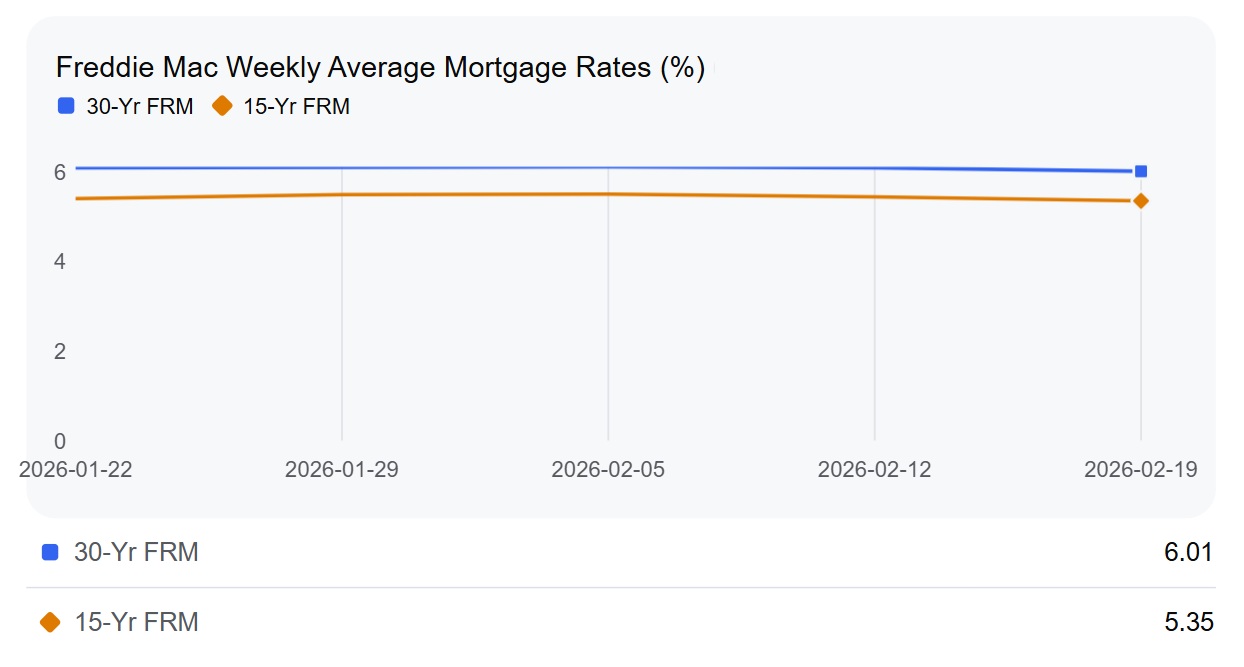
Mortgage rates are giving borrowers a rare break. The 30-year fixed has fallen 84 basis points from a year ago, bringing the average to 6.01% as of February 19, 2026 — one of the sharpest year-over-year improvements in recent months. For homeowners and buyers, that shift could mean meaningful savings on monthly payments.

Rates also edged lower again this week, slipping another eight basis points. With borrowing costs easing, both refinancers and prospective buyers may be seeing a new window of opportunity open.

30-Year Fixed Mortgage Rate Falls Steeply by 84 Basis Points

For years, rising rates have been a major hurdle for so many people. But now, with this steep decline, things are starting to feel more manageable. It's not just about buying a new home, either; it's a huge win for homeowners looking to refinance and shave thousands off their yearly payments. This move by Freddie Mac is definitely something to pay attention to.

Understanding the Drop: What's Behind This Big Shift?

A drop of 84 basis points isn't just a small tweak; it's a significant move. This means that for a typical borrower, their interest costs over the life of the loan could be thousands of dollars less. The average rate for a 30-year fixed mortgage is now 6.01%, down from 6.09% last week and a much more significant drop from the 6.85% seen a year ago.

Several factors have converged to create this more favorable environment. One of the biggest drivers has been the falling yield on 10-year Treasury bonds. Think of these bonds as a benchmark for interest rates across the economy, including mortgages. When their yields go down, mortgage rates often follow suit.

What's caused those Treasury yields to dip? Well, a cooler-than-expected inflation report in January certainly played a role. When inflation is under control, it signals to the Federal Reserve that it might not need to keep interest rates as high. On top of that, global uncertainties and geopolitical tensions have pushed investors into safer assets like bonds, which also helps drive down yields.

Freddie Mac Weekly Average Mortgage Rates (%)

A Closer Look at the Numbers: What This Means for You

To really grasp the impact of this change, let's break down the numbers from Freddie Mac's Primary Mortgage Market Survey®.

Mortgage Type Average Rate (02/19/2026) 1-Week Change 1-Year Change Monthly Average 52-Week Average 52-Week Range
30-Yr Fixed FRM 6.01% -0.08% -0.84% 6.08% 6.48% 6.01% – 6.89%
15-Yr Fixed FRM 5.35% -0.09% -0.69% 5.45% 5.68% 5.35% – 6.03%

As you can see, the 30-year fixed-rate mortgage (FRM) is down a significant 0.84% from a year ago. The 15-year fixed-rate mortgage has also seen a nice drop, now averaging 5.35%, down from 5.44% last week and 6.04% a year ago.

Beyond the Rate: The Ripple Effect on Homeowners

This isn't just about a lower number on paper. This lower rate environment is having a tangible impact. Freddie Mac reports that refinance application activity has more than doubled over the past year. This means a lot of people who secured mortgages when rates were higher are now taking advantage of the current situation to lower their monthly payments.

Imagine a homeowner with a $300,000 mortgage. A drop from 6.85% to 6.01% could save them hundreds of dollars each month. Over the 30-year life of the loan, that's tens of thousands of dollars in savings! This frees up money that can be used for other important things, whether it's saving for retirement, investing, or simply improving their quality of life.

For prospective homebuyers, this is a welcome change. It directly improves affordability. When mortgage rates decrease, the monthly payment for the same loan amount goes down. This can allow buyers to qualify for larger loans or afford homes they might have previously been priced out of.

The Spring Outlook: A “Thawed” Housing Market?

Economists are viewing this trend as a very positive sign for the upcoming spring homebuying season. Often, when rates are high, many homeowners with existing low-rate mortgages are reluctant to sell, fearing they'll have to buy a new home at a much higher interest rate. This phenomenon is sometimes called the “rate-lock” effect, and it can limit the supply of homes on the market.

With rates dipping below the 6% mark, we might see some of that inventory “thaw.” Homeowners who have been on the fence about selling might feel more comfortable putting their homes on the market, knowing that potential buyers have better financing options. This could lead to a more balanced market, which is good news for everyone involved.

Expert Insights: What's Next for Mortgage Rates?

While this current decline is fantastic news, it's important to have realistic expectations. Freddie Mac's Chief Economist, Sam Khater, has indicated that while rates have reached a three-year low they may not see dramatic further drops. His economic outlook for 2026 suggests rates are likely to stay within a narrow range, perhaps hovering around or just below the 6% mark for a good portion of the year.

Several factors are keeping a lid on further steep declines. The labor market remains surprisingly resilient, which can be a double-edged sword. A strong economy is good, but it also gives the Federal Reserve less incentive to aggressively cut interest rates to stimulate growth. The Fed's approach to rate cuts is still cautious, and they'll be watching economic data closely.

From my perspective, this means that while we've seen a significant positive shift, jumping on a refinance or a home purchase sooner rather than later might be a good idea if you find a rate that works for your financial goals. Waiting for rates to plummet further might not align with the economic forecasts.

Final Thoughts

Think back to this time last year. Mortgage rates were much higher, making affordability a challenge for buyers and homeowners alike. Fast forward to today, and the picture looks far brighter. The 84 basis point drop in the 30‑year fixed rate has opened the door to lower monthly payments, greater purchasing power, and real long‑term savings.

For first‑time buyers, this shift means opportunities that may have felt out of reach just a year ago. For homeowners, it’s a chance to refinance and cut costs significantly. The difference from last year is clear—today’s market is offering a far more favorable environment, and it’s the right time to take advantage.

🏡 Two Turnkey Rental Properties With Strong Investor Potential

Helena, AL
🏠 Property: Village Pkwy
🛏️ Beds/Baths: 3 Bed • 2.5 Bath • 1500 sqft
💰 Price: $300,000 | Rent: $1,950
📊 Cap Rate: 6.1% | NOI: $1,536
📅 Year Built: 2025
📐 Price/Sq Ft: $200
🏙️ Neighborhood: –

VS

Cibolo, TX
🏠 Property: Columbia Dr
🛏️ Beds/Baths: 3 Bed • 2 Bath • 1758 sqft
💰 Price: $245,000 | Rent: $1,795
📊 Cap Rate: 5.2% | NOI: $1,052
📅 Year Built: 2007
📐 Price/Sq Ft: $140
🏙️ Neighborhood: A

Alabama’s new build with solid cash flow vs Texas’s established A‑rated rental. Which fits YOUR investment strategy?

We have much more inventory available than what you see on our website – Let us know about your requirement.

📈 Choose Your Winner & Contact Us Today!

Speak to a Norada Investment Counselor (No Obligation):

(800) 611-3060

View All Properties

Build Passive Income & Wealth with Turnkey Rentals

Mortgage rates remain high in 2026, but rental properties continue to deliver strong cash flow and appreciation. Savvy investors know that turnkey real estate is the path to passive income and long‑term wealth.

Norada Real Estate helps you secure turnkey rental properties designed for immediate cash flow and appreciation—so you can invest smartly regardless of interest rate trends.

🔥 HOT INVESTMENT Properties JUST ADDED! 🔥
Request a Callback / Fill Out the Form Online

Contact Us

Also Read:

  • How to Get the Lowest 30-Year Fixed Mortgage Rate in 2026?
  • How to Get a 4% Interest Rate on a Mortgage in 2026?
  • What Leading Housing Experts Predict for Mortgage Rates in 2026
  • Mortgage Rate Predictions for 2026: What Leading Forecasters Expect
  • Mortgage Rate Predictions for the Next 3 Years: 2026, 2027, 2028
  • 30-Year Fixed Mortgage Rate Forecast for the Next 5 Years
  • 15-Year Fixed Mortgage Rate Predictions for Next 5 Years: 2025-2029
  • Will Mortgage Rates Ever Be 3% Again in the Future?
  • Mortgage Rates Predictions for Next 2 Years
  • Mortgage Rate Predictions for Next 5 Years
  • Mortgage Rate Predictions: Why 2% and 3% Rates are Out of Reach
  • How Lower Mortgage Rates Can Save You Thousands?
  • How to Get a Low Mortgage Interest Rate?
  • Will Mortgage Rates Ever Be 4% Again?

Filed Under: Financing, Mortgage Tagged With: 30-Year Fixed Mortgage, mortgage, mortgage rates

How to Get the Lowest 30-Year Fixed Mortgage Rate in 2026?

February 16, 2026 by Marco Santarelli

How to Get the Lowest 30-Year Fixed Mortgage Rate in 2026?

Securing the lowest 30-year fixed mortgage rate in 2026 isn’t about luck — it’s about preparation. While most borrowers will see rates hover near 6%, highly qualified buyers may be able to lock in something closer to the mid-5% range. The ultra-low rates of past years aren’t coming back anytime soon. But that doesn’t mean meaningful savings are out of reach. Even a small difference in your rate can translate into tens of thousands of dollars over the life of a loan.

The key is understanding what lenders are really looking for. Getting the lowest available rate goes beyond having a strong credit score — it requires presenting a complete financial profile that signals stability, low risk, and long-term reliability. Here’s what you need to know to position yourself for the most competitive 30-year fixed mortgage rates in 2026.

How to Get the Lowest 30-Year Fixed Mortgage Rate in 2026?

Factors That Will Help You Nail the Lowest Rate

Getting a mortgage rate below 6% in 2026 is definitely achievable if you tick all the right boxes. It goes beyond just having a decent credit score, although that's a huge part of it. Lenders assess several things to figure out how much of a risk you are, and the lower that risk, the better the rate they'll offer.

  • Your Credit Score is King: If you're aiming for the absolute lowest advertised rates, you'll likely need a credit score of 780 or higher. Think of it like climbing a ladder; each rung you move up can make a difference. Moving up just one credit band, say from a 620 to a 640, could potentially drop your rate by roughly 0.18% to 0.25%. That might not sound like much, but over 30 years, it adds up significantly.
  • The Power of Your Down Payment: Putting down a larger amount than the standard 20% (which helps you avoid private mortgage insurance, or PMI) can also signal to your lender that you're less of a risk. A down payment substantially larger than 20% can sometimes lead to additional rate discounts. It shows you're financially invested and have skin in the game.
  • Loan Term: Shorter Can Mean Cheaper: This is a big one, and it often surprises people. If you can swing it, switching from a 30-year fixed mortgage to a 15-year fixed mortgage can typically lower your interest rate by a good chunk, usually around 0.50% to 0.75%. Yes, your monthly payments will be higher because you're paying it off faster, but you'll save a ton on interest over the life of the loan.
  • “Buying Down” Your Rate with Discount Points: This is a strategy where you pay an upfront fee to lower your interest rate for the life of the loan. Typically, paying one discount point, which is 1% of the loan amount, can reduce your interest rate by about 0.25%. You'll need to do the math to see if the upfront cost is worth the long-term savings for your specific situation.
  • Your Debt-to-Income (DTI) Ratio Matters: Lenders like to see that you're not carrying too much debt relative to your income. While a DTI of 35% or less is generally preferred, the most competitive rates often go to borrowers with a DTI below 25%. This shows you have plenty of room in your budget for a mortgage payment.

The “Baseline Floor”: Why Rates Won't Plummet to 2.5%

Now, let's talk about the reality check. It's going to be incredibly difficult to see new 30-year fixed mortgage rates drop below 5.0% in 2026. There are fundamental economic reasons for this, often referred to as the “baseline floor.”

  • Economic “Stickiness”: Things like persistent inflation (even if it's around 2.7%), and the government needing to borrow money, tend to keep long-term bond yields higher than we've seen in the past. These yields are a major factor in mortgage rates.
  • The Fed's Cautious Stance: The Federal Reserve, which controls short-term interest rates, has been signaling a careful approach. They aren't planning on slashing rates drastically through 2026. This means we're not likely to return to the super-low, pandemic-era rates anytime soon.
  • Lender Risk and Profit: Lenders need to make a profit, and they do this by adding a “spread” to the yield on 10-year Treasury bonds. If those Treasury yields are expected to stay around 3.75%, lenders physically can't offer mortgages much lower than about 5.5% without actually losing money.

The “Holy Grail”: Assumable Mortgages in 2026

So, if getting below that 5.5% to 5.75% range for a new mortgage is tough, how can someone potentially get an even lower rate? This is where the “holy grail” of real estate comes in: an assumable mortgage.

An assumable mortgage is a special type of loan that allows a buyer to take over the seller's existing mortgage, including their original interest rate, the remaining balance, and all the loan's terms. This is huge because many sellers who bought homes in 2020 or 2021 have interest rates as low as 2.5% to 3.5%. Imagine taking over a loan with that kind of rate!

How it Works in Practice:

  1. The “Find”: You need to look for homes where the seller has a specific type of loan – typically an FHA, VA, or USDA loan. Standard “Conventional” loans are almost never assumable.
  2. The Qualification: Just because you found a house with an assumable mortgage doesn't mean you automatically get it. You still have to qualify with the original lender based on your credit, income, and DTI. You need to prove you can handle the payments.
  3. The “Gap” Challenge: This is the biggest practical hurdle. Let's say a house is worth $500,000, but the seller only owes $300,000 on their assumable mortgage. You have a $200,000 “gap.” You must be able to come up with that $200,000 difference, either with cash or by taking out a second mortgage (which will likely be at a higher, current market interest rate).

Monthly Payment Comparison: Seeing the Savings

To really drive home why even a small difference in interest rates matters, let's look at a hypothetical $400,000 mortgage (this is the amount after your down payment).

Feature 6.0% Interest Rate 5.5% Interest Rate Monthly Savings Total Interest (30 yrs)
Monthly (P&I) $2,398 $2,271 $127
Total Interest (30 yrs) $463,353 $417,605 $45,748

See that? An extra 0.5% might seem small, but it saves you $127 a month on your mortgage payment. Over 30 years, that's almost $46,000 in total interest savings! That's enough to buy a pretty nice car or cover a good chunk of college tuition.

Your Practical “Way Out” (Steps to Take)

If you're serious about trying to snag an assumable mortgage, here's how I'd recommend approaching it:

  1. Target Specific Listings: Your first move is to tell your real estate agent that you are specifically looking for homes with assumable mortgages. Ask them to search the Multiple Listing Service (MLS) for listings that mention “assumable,” “VA,” or “FHA” in the financing details.
  2. Negotiate the “Gap”: If you don't have all the cash needed for that equity gap (the difference between the sale price and the loan balance), you need to get creative. Sometimes, a seller might be open to “Seller Financing” for that portion. This means you'd pay the gap amount directly to the seller over a few years, often with an agreed-upon interest rate.
  3. Check for “Release of Liability”: If you're assuming a VA loan, it's crucial to make sure the seller gets a formal “release of liability” from the lender. This ensures they aren't on the hook if you happen to miss a payment down the line.
  4. Be Patient: I can't stress this enough: assuming a loan takes much longer than a standard home purchase. Expect an extra 30 to 60 days because the original lender has very little incentive to speed things up for a low-rate transfer.

The “Baseline” Reality Revisited

Just to reiterate, outside of finding an incredible assumable mortgage scenario, the absolute floor for a new 2026 mortgage is heavily influenced by the 10-Year Treasury Yield. Lenders will add their spread (typically around 1.7% to 2.0%) to cover their costs and make a profit. If those Treasury yields are hovering around 3.75%, it's just not physically possible for lenders to offer rates much lower than the 5.5% mark without losing money.

A Message for Your Real Estate Agent

If you're ready to go the assumable route, you need to be prepared. Sending your agent a well-crafted message can make all the difference. This shows you're serious and knowledgeable.

Hi [Agent's Name],

I’m very interested in finding homes with assumable mortgages, specifically FHA, VA, or USDA loans, as I’m aiming to secure a lower interest rate. Could you please search the MLS for listings in [Your Target Area] that mention “assumable” in the private remarks or financing fields?

Here’s the information I’d like to see:

  • 📉 Current interest rate and the remaining balance of the existing loan
  • 💡 An estimate of the equity gap (difference between the sale price and the loan balance)
  • 🤝 Whether the seller is open to seller financing for any part of that gap, or if you can identify recent listings with these loan types that may not have been explicitly advertised as assumable yet

Thank you for your help with this specialized search!

Practical Tools for Your Search

While your agent is your go-to on the MLS, you can also explore these resources to find potential assumable inventory:

  • Roam: This platform is built specifically to help you discover and buy homes with low-rate, assumable mortgages.
  • AssumeList: Similar to Roam, this site lets you search for homes with VA, FHA, and USDA assumable mortgages, including those not yet widely advertised.
  • Realtor.com Filter: You can use their search filters and try keywords like “assumable” or “assume” to narrow down standard listings, though results will vary.

Key “Watch-Outs” for 2026

Keep these things in mind as you navigate the mortgage market in 2026:

  • Processing Time: As mentioned, expect 60 to 120 days for an assumption, unlike the typical 30-day closing for a standard purchase. The original lenders are not in a hurry.
  • The Gap Solution: If the home has appreciated significantly, that gap needs to be covered. If cash is tight, a second mortgage is an option, but remember it will be at current, likely higher, rates.
  • Proof of Funds: Be ready to provide immediate proof of funds to sellers to show you can cover that often substantial equity gap.

While the era of sub-3% fixed rates for everyone seems to be behind us for now, a strategic approach and a keen eye for assumable mortgages can still lead to significant savings.

🏡 Two Turnkey Investment Opportunities With Strong Cash Flow

Bessemer, AL
🏠 Property: Blue Jay Cir
🛏️ Beds/Baths: 4 Bed • 2 Bath • 1610 sqft
💰 Price: $282,000 | Rent: $1,885
📊 Cap Rate: 6.4% | NOI: $1,500
📅 Year Built: 2023
📐 Price/Sq Ft: $176
🏙️ Neighborhood: A-

And

Lebanon, TN
🏠 Property: Baltusrol Lane #852
🛏️ Beds/Baths: 4 Bed • 2.5 Bath • 2011 sqft
💰 Price: $369,990 | Rent: $2,400
📊 Cap Rate: 5.8% | NOI: $1,789
📅 Year Built: 2024
📐 Price/Sq Ft: $184
🏙️ Neighborhood: B

Alabama’s newer A- rental vs Tennessee’s larger property with higher NOI. Which fits YOUR investment strategy?

We have much more inventory available than what you see on our website – Let us know about your requirement.

📈 Choose Your Winner & Contact Us Today!

Speak to a Norada Investment Counselor (No Obligation):

(800) 611-3060

View All Properties

Build Passive Income & Wealth with Turnkey Rentals

Mortgage rates remain high in 2026, but rental properties continue to deliver strong cash flow and appreciation. Savvy investors know that turnkey real estate is the path to passive income and long‑term wealth.

Norada Real Estate helps you secure turnkey rental properties designed for immediate cash flow and appreciation—so you can invest smartly regardless of interest rate trends.

🔥 HOT INVESTMENT Properties JUST ADDED! 🔥
Request a Callback / Fill Out the Form Online

Contact Us

Also Read:

  • How to Get a 4% Interest Rate on a Mortgage in 2026?
  • What Leading Housing Experts Predict for Mortgage Rates in 2026
  • Mortgage Rate Predictions for 2026: What Leading Forecasters Expect
  • Mortgage Rate Predictions for the Next 3 Years: 2026, 2027, 2028
  • 30-Year Fixed Mortgage Rate Forecast for the Next 5 Years
  • 15-Year Fixed Mortgage Rate Predictions for Next 5 Years: 2025-2029
  • Will Mortgage Rates Ever Be 3% Again in the Future?
  • Mortgage Rates Predictions for Next 2 Years
  • Mortgage Rate Predictions for Next 5 Years
  • Mortgage Rate Predictions: Why 2% and 3% Rates are Out of Reach
  • How Lower Mortgage Rates Can Save You Thousands?
  • How to Get a Low Mortgage Interest Rate?
  • Will Mortgage Rates Ever Be 4% Again?

Filed Under: Financing, Mortgage Tagged With: 30-Year Fixed Mortgage, mortgage, mortgage rates

30-Year Fixed Mortgage Rate Falls Steeply by 78 Basis Points

February 16, 2026 by Marco Santarelli

30-Year Fixed Mortgage Rate Falls Steeply by 78 Basis Points

If you've been dreaming of owning your own home, this is fantastic news you won't want to miss. The 30-year fixed mortgage rate has seen a dramatic drop of 78 basis points compared to this time last year, according to the latest figures released by Freddie Mac. This isn't just a small blip; it's a substantial decrease that translates into real savings for millions of potential homebuyers.

30-Year Fixed Mortgage Rate Falls Steeply by 78 Basis Points

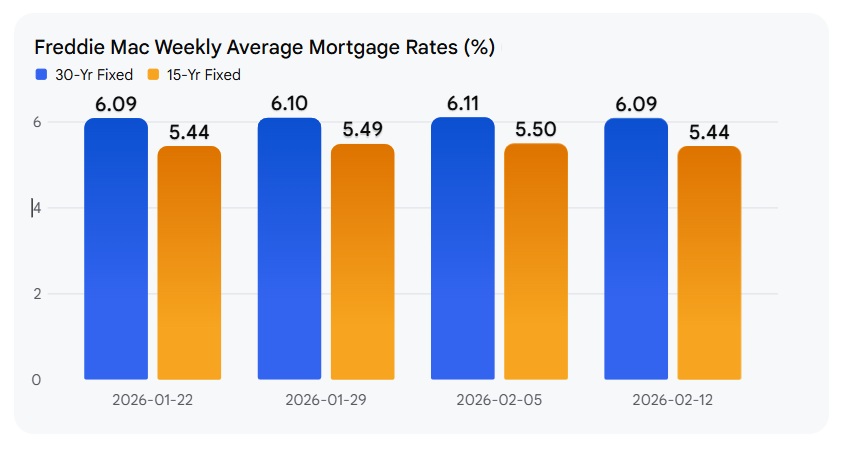
This latest report from Freddie Mac, released on February 12, 2026, shows the average 30-year fixed-rate mortgage (FRM) now sitting at 6.09%. While that's a tiny dip from last week's 6.11%, the real story is the significant drop from the 6.87% we saw a year ago. This substantial annual decline means a much more manageable monthly payment and a lower total cost of borrowing if you're looking to purchase a home this year.

What Does This Mean for You? Let's Break Down the Savings.

Freddie Mac Weekly Average Mortgage Rates (%)

It’s easy to get lost in the numbers, so let's put this into perspective. A basis point is simply one-hundredth of a percent. So, a drop of 78 basis points means your interest rate has gone down by 0.78%. When you're talking about mortgages, even small changes in interest rates can add up to thousands of dollars over the life of a loan.

Let's look at the numbers Freddie Mac provided in their Primary Mortgage Market Survey for the week ending February 12, 2026:

Mortgage Type Current Rate (02/12/2026) 1-Week Change 1-Year Change Monthly Average 52-Wk Average 52-Week Range
30-Year FRM 6.09% -0.02% -0.78% 6.1% 6.49% 6.06% – 6.89%
15-Year FRM 5.44% -0.06% -0.65% 5.47% 5.7% 5.38% – 6.04%

The Power of a Lower Rate: Real-World Impact

Imagine you're looking to buy a $300,000 home with a 30-year mortgage.

  • At last year's rate of 6.87%: Your estimated monthly principal and interest payment would be around $1,969.
  • At the current rate of 6.09%: Your estimated monthly principal and interest payment drops to about $1,822.

That's a difference of $147 per month! Over 30 years, that's a savings of over $52,900! That’s a significant amount of money that could go towards home improvements, savings, or simply enjoying life a little more.

Even the 15-year fixed-rate mortgage has seen a welcome decline, averaging 5.44%, down 0.65% from a year ago. This makes paying off your home faster even more appealing.

Why Are Rates Dropping So Significantly? It’s All About the Economy.

Freddie Mac's Chief Economist, Sam Khater, hit the nail on the head when he mentioned that housing affordability continues to measurably improve. This isn't a fluke; it’s a direct result of a strong economy and a robust labor market. When the economy is doing well, and people have jobs, lenders tend to feel more confident, which can lead to lower borrowing costs.

It's fascinating to see these rates holding near their lowest levels in three years. This is a sweet spot for anyone thinking about making a move. The market has been a bit unpredictable, and seeing this kind of sustained affordability improvement is a breath of fresh air.

What This Means for Buyers (and Sellers!)

For Prospective Homebuyers:

  • Increased Buying Power: With lower interest rates, your monthly payment goes further. This means you can potentially afford a slightly more expensive home than you could a year ago, or you can enjoy a lower monthly payment on the same priced home.
  • More Options: As affordability improves, more people can enter the market. This can lead to a healthier inventory of homes for sale, giving buyers more choices. Freddie Mac specifically noted that purchase application activity has driven higher than a year ago, which is a strong indicator of buyer interest.
  • Refinancing Opportunities: If you already own a home and have an existing mortgage with a higher interest rate, this could be a prime time to consider refinancing. Locking in a lower rate can significantly reduce your monthly expenses.
  • Reduced Stress: Let's be honest, buying a home is a big deal. Knowing you're securing a loan at a favorable rate can reduce some of that financial anxiety.

For Home Sellers:

  • More Motivated Buyers: With increased affordability and buyer interest, sellers can expect to see more qualified buyers actively looking.
  • Potentially Faster Sales: A strong buyer pool can lead to quicker sale times.
  • Competitive Market: While rates are low, they are still subject to market fluctuations. This current dip may not last forever, encouraging buyers to act sooner rather than later.

Beyond the Rate: Economic Factors at Play

It’s interesting to note how these rates are moving even with some market wobbles. Despite a strong jobs report that might typically cause some bond market volatility, mortgage rates have dipped. Freddie Mac pointed out that the 10-year Treasury yield, which mortgage rates typically follow, was down from the previous week. This shows that while the job market might be strong, other financial forces are also at play, pushing borrowing costs down.

My Takes from the Trenches

Having followed the housing market for years, I can tell you that these kinds of annual declines are significant. We haven't seen this sustained level of affordability improvement in quite some time. The three-year lows are a big deal, and it’s a testament to a period of economic stability that benefits consumers directly. It’s not just about the headline number; it's about the cumulative effect of these lower rates making the dream of homeownership more attainable for many families.

I believe this trend is encouraging for the broader housing market. When more people can afford to buy, it stimulates local economies, supports construction jobs, and builds wealth for individuals and families. It’s a win-win-win.

Looking Ahead

While this is fantastic news, it’s always wise to remember that mortgage rates are influenced by many factors and can change. My advice is always to talk to a trusted mortgage professional. They can help you understand your specific situation, explore your options, and guide you through the process of securing the best possible rate for your dream home. Don't let this opportunity pass you by! This is a significant moment for homebuyers, and capitalizing on these lower rates could make a world of difference to your financial future.

🏡 Two Turnkey Investment Opportunities With Strong Cash Flow

Bessemer, AL
🏠 Property: Blue Jay Cir
🛏️ Beds/Baths: 4 Bed • 2 Bath • 1610 sqft
💰 Price: $282,000 | Rent: $1,885
📊 Cap Rate: 6.4% | NOI: $1,500
📅 Year Built: 2023
📐 Price/Sq Ft: $176
🏙️ Neighborhood: A-

And

Lebanon, TN
🏠 Property: Baltusrol Lane #852
🛏️ Beds/Baths: 4 Bed • 2.5 Bath • 2011 sqft
💰 Price: $369,990 | Rent: $2,400
📊 Cap Rate: 5.8% | NOI: $1,789
📅 Year Built: 2024
📐 Price/Sq Ft: $184
🏙️ Neighborhood: B

Alabama’s newer A- rental vs Tennessee’s larger property with higher NOI. Which fits YOUR investment strategy?

We have much more inventory available than what you see on our website – Let us know about your requirement.

📈 Choose Your Winner & Contact Us Today!

Speak to a Norada Investment Counselor (No Obligation):

(800) 611-3060

View All Properties

Build Passive Income & Wealth with Turnkey Rentals

Mortgage rates remain high in 2026, but rental properties continue to deliver strong cash flow and appreciation. Savvy investors know that turnkey real estate is the path to passive income and long‑term wealth.

Norada Real Estate helps you secure turnkey rental properties designed for immediate cash flow and appreciation—so you can invest smartly regardless of interest rate trends.

🔥 HOT INVESTMENT Properties JUST ADDED! 🔥
Request a Callback / Fill Out the Form Online

Contact Us

Also Read:

  • What Leading Housing Experts Predict for Mortgage Rates in 2026
  • Mortgage Rate Predictions for 2026: What Leading Forecasters Expect
  • Mortgage Rate Predictions for the Next 3 Years: 2026, 2027, 2028
  • 30-Year Fixed Mortgage Rate Forecast for the Next 5 Years
  • 15-Year Fixed Mortgage Rate Predictions for Next 5 Years: 2025-2029
  • Will Mortgage Rates Ever Be 3% Again in the Future?
  • Mortgage Rates Predictions for Next 2 Years
  • Mortgage Rate Predictions for Next 5 Years
  • Mortgage Rate Predictions: Why 2% and 3% Rates are Out of Reach
  • How Lower Mortgage Rates Can Save You Thousands?
  • How to Get a Low Mortgage Interest Rate?
  • Will Mortgage Rates Ever Be 4% Again?
Filed Under: Financing, Mortgage Tagged With: 30-Year Fixed Mortgage, mortgage, mortgage rates

What’s the Outlook for Mortgage Rates Beyond 2026?

February 14, 2026 by Marco Santarelli

What's the Outlook for Mortgage Rates Beyond 2026?

If you're dreaming of buying a home or refinancing your current mortgage, the big question on your mind is likely: what will mortgage rates look like in the years to come? Based on what I'm seeing and hearing from experts, the outlook for mortgage rates beyond 2026 suggests we're settling into a new normal, likely in the 6.0% to 6.5% range, a far cry from the ultra-low rates of the past decade, and significant drops below 5% are highly improbable.

What's the Outlook for Mortgage Rates Beyond 2026?

It feels like just yesterday we were talking about 3% mortgage rates. For many of us who bought homes during that period, it was a golden opportunity. But as we look past 2026, those days seem to be firmly in the rearview mirror. The experts are largely in agreement that while rates might not be zooming upwards uncontrollably, they definitely aren't expected to plummet back to the historic lows we witnessed.

A Look Ahead: What the Experts Are Saying

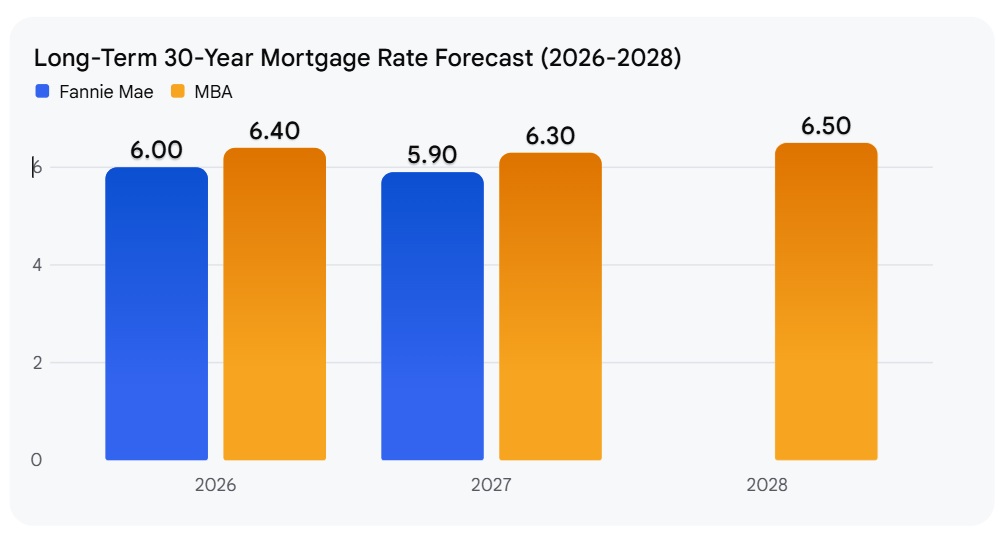
Long-Term 30-Year Mortgage Rate Forecast

When you're trying to predict the future, especially something as sensitive as interest rates, you turn to the folks who spend their days analyzing economic trends. And from what I gather, there's a general consensus brewing among the big players in the housing and finance world.

Here's a peek at what some leading institutions are forecasting for 2027 and 2028:

Source 2027 Projection 2028 Projection My Takeaway
Fannie Mae ~5.9% – 6.0% N/A These guys see rates hanging around 6%, figuring that people will still really want homes, keeping demand steady.
Mortgage Bankers Assoc. (MBA) 6.3% 6.5% The MBA is leaning towards a slight increase, pointing to ongoing government spending (fiscal deficits) as a factor that will keep borrowing costs higher, even if short-term rates ease.
Morningstar ~5.25% 5.00% They're a bit more optimistic, believing the Federal Reserve might eventually cut rates more aggressively, pulling mortgage rates down more than others predict.
NAHB 6.01% N/A The National Association of Home Builders anticipates a slow slide down towards 6% as inflation finally calms down completely.

As you can see, there are some differing opinions, but the overall picture isn't one of super-cheap borrowing. The idea of seeing sub-5% rates again in the next few years? Unless something pretty dramatic happens in the economy, it's looking like a long shot.

Why Are Rates Expected to Stay Elevated?

It's not just a hunch; there are some pretty solid economic reasons behind this outlook. Think of it like this: several big forces are at play, and they're all pushing mortgage rates in a similar direction.

  • The Government's Bill: This is a big one. You might hear about the Federal Reserve “cutting rates,” which sounds good for borrowers. But the U.S. government has a lot of debt, and plans to keep borrowing. When governments borrow a lot, it tends to push up the cost of borrowing for everyone, including those getting mortgages. The Mortgage Bankers Association specifically flags this, warning that persistent fiscal deficits will keep long-term borrowing costs higher.
  • The 10-Year Treasury Yield: This is your financial benchmark for mortgages. The 10-year Treasury note's yield is like the pace car for mortgage rates. Some economists are predicting that this key rate will stay above 4.1% for the foreseeable future, even through 2030. If that benchmark stays high, it's tough for mortgage rates to do anything but follow suit.
  • A “New Normal” for Interest Rates: For a long time, we got used to what seemed like incredibly low interest rates. But a lot of smart people in finance are now saying that the era of 3% or 4% mortgages was a bit of an anomaly, a historical blip. The economy is evolving, and the “natural” or “neutral” rate of interest seems to be shifting higher. What was low for us might have been abnormally low for the economy as a whole.
  • Housing Supply and Demand: This one is interesting. Right now, many homeowners are hesitant to sell because they have a low mortgage rate and don't want to buy a new home with a higher one. This is called the “lock-in effect.” As mortgage rates begin to stabilize, even if they're in that 6% range, it might encourage some of these homeowners to finally list their properties. This could mean more homes on the market, which would be great for buyers. However, the expectation is that this increased supply will help keep home prices steady rather than driving mortgage rates down significantly.

My Perspective on the Long Term

From where I stand, having watched the housing market for a while, this “new normal” for rates feels more like a recalibration than a catastrophe. The ultra-low rates of the past decade were fueled by unique circumstances, including major efforts to stimulate the economy after the 2008 financial crisis and then again during the pandemic.

Now, the Federal Reserve is working to tame inflation, and that inherently means keeping borrowing costs higher. We're also seeing a global economy grappling with different challenges, from government debt to geopolitical events, all of which can influence these rates.

So, what does this mean for you?

  • Don't Hold Your Breath for 3% Mortgages: If you're waiting for rates to drop back to the historic lows of the early 2020s, you might be waiting a very long time, possibly indefinitely.
  • Focus on Affordability: Instead of chasing the lowest possible rate today, focus on what you can comfortably afford for your monthly payment. This involves looking at your income, debts, and savings, and finding a home that fits your budget, even with rates in the 6% range.
  • Homeownership is Still Achievable: While the borrowing costs are higher than they were a few years ago, owning a home is still within reach for many. The increased availability of homes might even level the playing field for buyers looking for their piece of the American dream.
  • Consider Adjustable-Rate Mortgages (ARMs) Wisely: For some buyers, an ARM might be an option. They often come with a lower introductory rate than a fixed-rate mortgage. However, you need to be prepared for the possibility that your rate could go up when the introductory period ends. This is a more advanced strategy that requires careful consideration of your financial future and risk tolerance.

Ultimately, the mortgage rate outlook beyond 2026 points to a more stable, albeit higher, interest rate environment. For borrowers, this means adjusting expectations and focusing on long-term financial planning rather than hoping for a return to an era that is likely gone for good.

🏡 Two Turnkey Investment Opportunities With Strong Cash Flow

Bessemer, AL
🏠 Property: Blue Jay Cir
🛏️ Beds/Baths: 4 Bed • 2 Bath • 1610 sqft
💰 Price: $282,000 | Rent: $1,885
📊 Cap Rate: 6.4% | NOI: $1,500
📅 Year Built: 2023
📐 Price/Sq Ft: $176
🏙️ Neighborhood: A-

And

Lebanon, TN
🏠 Property: Baltusrol Lane #852
🛏️ Beds/Baths: 4 Bed • 2.5 Bath • 2011 sqft
💰 Price: $369,990 | Rent: $2,400
📊 Cap Rate: 5.8% | NOI: $1,789
📅 Year Built: 2024
📐 Price/Sq Ft: $184
🏙️ Neighborhood: B

Alabama’s newer A- rental vs Tennessee’s larger property with higher NOI. Which fits YOUR investment strategy?

We have much more inventory available than what you see on our website – Let us know about your requirement.

📈 Choose Your Winner & Contact Us Today!

Speak to a Norada Investment Counselor (No Obligation):

(800) 611-3060

View All Properties

Build Passive Income & Wealth with Turnkey Rentals

Mortgage rates remain high in 2026, but rental properties continue to deliver strong cash flow and appreciation. Savvy investors know that turnkey real estate is the path to passive income and long‑term wealth.

Norada Real Estate helps you secure turnkey rental properties designed for immediate cash flow and appreciation—so you can invest smartly regardless of interest rate trends.

🔥 HOT INVESTMENT Properties JUST ADDED! 🔥
Request a Callback / Fill Out the Form Online

Contact Us

Also Read:

  • What Leading Housing Experts Predict for Mortgage Rates in 2026
  • Mortgage Rate Predictions for 2026: What Leading Forecasters Expect
  • Mortgage Rate Predictions for the Next 3 Years: 2026, 2027, 2028
  • 30-Year Fixed Mortgage Rate Forecast for the Next 5 Years
  • 15-Year Fixed Mortgage Rate Predictions for Next 5 Years: 2025-2029
  • Will Mortgage Rates Ever Be 3% Again in the Future?
  • Mortgage Rates Predictions for Next 2 Years
  • Mortgage Rate Predictions for Next 5 Years
  • Mortgage Rate Predictions: Why 2% and 3% Rates are Out of Reach
  • How Lower Mortgage Rates Can Save You Thousands?
  • How to Get a Low Mortgage Interest Rate?
  • Will Mortgage Rates Ever Be 4% Again?

Filed Under: Financing, Mortgage Tagged With: 30-Year Fixed Mortgage, mortgage, mortgage rates

Texas Mortgage Rates Forecast for 2026: Will Rates Drop?

February 12, 2026 by Marco Santarelli

Texas Mortgage Rates Forecast for 2026: Will Rates Drop?

If you're a Texan thinking about buying a home or refinancing in 2026, you're probably wondering what's going to happen with mortgage rates. Let me cut straight to the chase: Texas mortgage rates in 2026 are expected to stay pretty steady, hovering close to the 6% mark, and it's unlikely we'll see a big drop back to the super-low rates we experienced during the pandemic. While rates have certainly calmed down from their recent peak, don't expect a sudden dive. Let's break down what 2026 might look like for Texas homebuyers and homeowners.

Texas Mortgage Rates Forecast for 2026: Will Rates Drop?

Understanding the 2026 Texas Mortgage Rate Picture

Think of mortgage rates as being influenced by a lot of different things, kind of like ingredients in a complex recipe. For 2026, the main ingredients suggest a stable, albeit slightly higher than we'd all ideally prefer, situation.

Here’s what the experts are saying for the end of 2026:

  • Fannie Mae: Predicts rates around 5.9%.
  • Mortgage Bankers Association (MBA): Gives a range of 6.1% to 6.4%.
  • National Association of Realtors (NAR): Points to 6.0%.
  • Wells Fargo: Estimates 6.1% to 6.25%.

And what are we seeing right now, as of mid-February 2026?

  • The average 30-year fixed mortgage rate in Texas is around 6.19%.
  • For a 15-year fixed-rate mortgage, it's hovering at about 5.61%.

The Texas Real Estate Research Center at Texas A&M aptly describes the current market as being “stuck in neutral.” It’s not a dramatic fall, but it’s also not a runaway climb. What's interesting is that even with these rates, buyer confidence is slowly picking up. This is partly because, in big cities like Dallas and Houston, more homes are becoming available. It feels like the market is starting to balance out a bit, which is good news for buyers who felt squeezed by low inventory.

What's Driving the Rates in Texas?

Several key factors are playing a role in shaping where mortgage rates are headed. It’s not just one big force; it’s a combination of government actions, the Federal Reserve’s decisions, and even the ups and downs of the bond market.

Government Intervention: A Helping Hand?

We've seen recent moves by the government, like orders for Fannie Mae and Freddie Mac to buy a significant amount of mortgage-backed securities. This is like the government pouring a bit of money into the system to keep things moving. It has put some downward pressure on rates. However, some financial thinkers are cautious, viewing this more as a temporary boost to liquidity rather than a permanent solution to lower rates.

The Federal Reserve's Balancing Act

The Federal Reserve, often called “the Fed,” has been playing a careful game. After pausing interest rate cuts in early 2026 to see how “sticky” inflation (which has been around 2.7%) responds, they're watching the economic data closely. Any future rate cuts are expected to be gradual and spaced out. They don't want to jump the gun and cause new problems, and I don’t blame them. The goal is a soft landing, not a crash.

Bond Market Volatility: The Real Driver

It might surprise some people, but mortgage rates often follow the 10-year Treasury yield more closely than they follow the Fed's direct actions. The 10-year Treasury yield has been sitting above 4%, which is a significant level. This persistent yield acts as a ceiling, limiting how much further mortgage rates can really slide down. Think of it as a natural brake on rapid rate decreases.

The Texas Housing Market: A Look Ahead

Even though rates aren't at historic lows, the Texas housing market is expected to remain resilient. We're looking at a slight increase in home prices for 2026, somewhere in the range of 1.3% to 2%. What’s fueling this? Simple economics: strong population growth. More people moving to Texas means more demand for homes, and that usually pushes prices up a bit.

However, it's not a one-size-fits-all picture across the state. Some areas, like Austin, have seen recent price drops, about 2.1% year-over-year. This suggests that, at least in some markets, we are moving towards a healthier, more balanced state where homes aren't being snatched up the second they hit the market. This is good for buyers who want more options and a little more breathing room.

Do Mortgage Rates Really Vary from State to State?

This is a question I get asked a lot. And the answer is yes, but generally, the differences aren't huge. You might see variations of 0.2% to 0.5% between states. While the big economic forces set the general direction for rates across the country, there are local factors that cause these minor shifts.

Why the Subtle Differences?

Lenders have to consider the cost of doing business and the specific risks tied to each state's economic and legal environment.

  • Foreclosure Laws: States with a judicial foreclosure process (where a court has to approve it) can mean longer and more expensive procedures for lenders. States like New York, Florida, and Illinois fall into this category. Naturally, lenders might factor this increased risk into their rates, sometimes leading to slightly higher ones for borrowers in those states.
  • Lender Competition: In bustling states with lots of real estate activity, like California, there are tons of lenders competing for business. This intense competition can sometimes drive rates down. Conversely, in more rural states with fewer lenders, you might find slightly higher average rates simply due to less competition.
  • Operating Costs: If a lender has to pay high rents for offices in major cities or offer higher salaries because the cost of living is high in that area, those costs can sometimes be passed on to borrowers through interest rates.
  • Loan Size Trends: States with extremely high home prices, like Hawaii or parts of Massachusetts, might have different rate structures because larger “jumbo” loans, while profitable, can be harder for lenders to sell on the secondary market.

A State-by-State Snapshot (February 2026)

Here’s a general look at how 30-year fixed rates were trending by region in February 2026:

Category Typical States Average Rate (Feb 2026)
Lower Rates California, North Carolina, New Jersey ~5.9% – 6.1%
Higher Rates Texas, Kansas, Hawaii, Alaska ~6.3% – 6.5%

Looking at it visually, this is roughly what you might have seen for a 30-year fixed mortgage:

  • New Jersey: Around 5.95%
  • California: Around 6.12%
  • National Average: Around 6.19%
  • Texas: Around 6.35%
  • Kansas: Around 6.44%
  • Hawaii: Around 6.57%

The Bottom Line for Texas Homebuyers

While it’s interesting to know that rates can differ slightly from state to state, here's my professional opinion: For most Texans, the state you live in will have a much smaller impact on your final mortgage rate than your own personal financial situation. Your credit score, down payment amount, and the type of loan you choose are the true power players.

My best advice? Shop around! Don't just go with the first lender you speak to. Compare offers from at least three different places. This includes big national banks, local credit unions, and even online-only lenders. You might be surprised at the difference even a small percentage point can make over the life of your loan. Staying informed and being proactive is the best way to navigate the Texas mortgage market in 2026.

🏡 Two Turnkey Investment Opportunities With Strong Cash Flow

Bessemer, AL
🏠 Property: Blue Jay Cir
🛏️ Beds/Baths: 4 Bed • 2 Bath • 1610 sqft
💰 Price: $282,000 | Rent: $1,885
📊 Cap Rate: 6.4% | NOI: $1,500
📅 Year Built: 2023
📐 Price/Sq Ft: $176
🏙️ Neighborhood: A-

And

Lebanon, TN
🏠 Property: Baltusrol Lane #852
🛏️ Beds/Baths: 4 Bed • 2.5 Bath • 2011 sqft
💰 Price: $369,990 | Rent: $2,400
📊 Cap Rate: 5.8% | NOI: $1,789
📅 Year Built: 2024
📐 Price/Sq Ft: $184
🏙️ Neighborhood: B

Alabama’s newer A- rental vs Tennessee’s larger property with higher NOI. Which fits YOUR investment strategy?

We have much more inventory available than what you see on our website – Let us know about your requirement.

📈 Choose Your Winner & Contact Us Today!

Speak to a Norada Investment Counselor (No Obligation):

(800) 611-3060

View All Properties

Build Passive Income & Wealth with Turnkey Rentals

Mortgage rates remain high in 2026, but rental properties continue to deliver strong cash flow and appreciation. Savvy investors know that turnkey real estate is the path to passive income and long‑term wealth.

Norada Real Estate helps you secure turnkey rental properties designed for immediate cash flow and appreciation—so you can invest smartly regardless of interest rate trends.

🔥 HOT INVESTMENT Properties JUST ADDED! 🔥
Request a Callback / Fill Out the Form Online

Contact Us

Also Read:

  • What Leading Housing Experts Predict for Mortgage Rates in 2026
  • Mortgage Rate Predictions for 2026: What Leading Forecasters Expect
  • Mortgage Rate Predictions for the Next 3 Years: 2026, 2027, 2028
  • 30-Year Fixed Mortgage Rate Forecast for the Next 5 Years
  • 15-Year Fixed Mortgage Rate Predictions for Next 5 Years: 2025-2029
  • Will Mortgage Rates Ever Be 3% Again in the Future?
  • Mortgage Rates Predictions for Next 2 Years
  • Mortgage Rate Predictions for Next 5 Years
  • Mortgage Rate Predictions: Why 2% and 3% Rates are Out of Reach
  • How Lower Mortgage Rates Can Save You Thousands?
  • How to Get a Low Mortgage Interest Rate?
  • Will Mortgage Rates Ever Be 4% Again?
Filed Under: Financing, Mortgage Tagged With: 30-Year Fixed Mortgage, mortgage, mortgage rates, Mortgage Rates Forecast, Texas Mortgage Rates

30-Year Fixed Mortgage Rate Climbs After Stronger-Than-Expected Jobs Report

February 12, 2026 by Marco Santarelli

30-Year Fixed Mortgage Rate Climbs After Stronger-Than-Expected Jobs Report

Well, it looks like our hopes for falling mortgage rates just took a little detour. The latest jobs report, which finally dropped yesterday, February 11, 2026, has caused the average 30-year mortgage rate to nudge upwards. While we're still near some of the lowest rates we've seen in about three years, this report has definitely put the brakes on any ideas of the Federal Reserve making big interest rate cuts anytime soon.

30-Year Fixed Mortgage Rate Climbs After Stronger-Than-Expected Jobs Report

What Exactly Happened with the Jobs Report?

You see, the U.S. Bureau of Labor Statistics (BLS) finally released their January jobs report. It was a bit delayed, a five-day pushback because of that recent government shutdown. When the numbers came out, they painted a picture of a labor market that's doing better than many economists expected, even though overall economic growth seemed to be slowing down for much of 2025.

Here's a quick rundown of the key figures:

  • Job Growth: The economy added 130,000 nonfarm jobs in January. This was a pleasant surprise, much higher than the 55,000 that some predictions had suggested.
  • Unemployment Rate: The number of people out of work dipped a little to 4.3%, down from 4.4% in December.
  • Big Revisions: Now, this is important. As part of their yearly check-up, the BLS also announced that they had massively revised their numbers for 2025. Turns out, the economy added 403,000 fewer jobs last year than they initially thought. That's a significant adjustment.

So, How Did This Affect Mortgage Rates?

This is where things get interesting for anyone thinking about buying a home or refinancing. When the jobs report came out, the bond market, which is a big driver of mortgage rates, reacted quickly.

  • Immediate Impact: You saw the 10-year Treasury yield, a key indicator for mortgage pricing, jump by about 7 basis points, hitting 4.20% right after the news. It settled back a bit, but the message was clear.
  • Mortgage Rate Tick Up: According to Mortgage News Daily, the average rate for a 30-year fixed mortgage moved from 6.11% to 6.14% following the report. Other sources, like Zillow, put the rate around 5.87% as of yesterday. While that might seem like a small difference, in the world of mortgages, even a quarter-point can mean a lot over the life of a loan.

Why the Fuss About a “Stronger Than Expected” Report?

You might be thinking, “Isn't a strong job market a good thing?” And yes, generally, it is. However, in the current economic climate, it creates a bit of a tug-of-war.

The Federal Reserve is closely watching the jobs market as they decide when to start lowering interest rates. Higher-than-expected job growth suggests the economy is still robust enough that the Fed might feel less pressure to cut rates aggressively. This is what traders are calling “pouring cold water” on expectations for swift rate cuts.

  • Fed Meeting Outlook: Before this report, many traders thought there was a good chance the Fed would cut rates at their March meeting (around an 80% probability). Now, that chance has dropped significantly, down to about 22%. This means we're likely to see mortgage rates hovering around the 6% mark for a while longer, rather than seeing them fall much faster.

The Big Picture: A Mixed Bag of Data

Now, here's where my own experience in this market comes in. It’s crucial to look beyond just one headline number. While the January jobs report was a positive surprise on its own, the massive downward revisions for 2025 are just as important, if not more so.

This suggests that the “hiring recession” that some analysts were talking about last year might have been more pronounced than we realized. It's like looking at a person who suddenly ran a sprint, but you know they've been walking slowly for a long time. The sprint is impressive, but it doesn't change the overall journey.

This contradictory data is why the market didn't completely panic and send rates soaring. The downward revisions for 2025 helped temper the reaction to the strong January number. It’s a reminder that the economy is complex, and you always need to consider the full story.

New Policy Moves and Their Potential Impact

On top of the jobs report, there's another significant factor at play: new policy directives. The Trump administration has instructed Fannie Mae and Freddie Mac to buy a substantial amount of mortgage-backed securities – about $200 billion worth.

What does this mean for you? The goal of this move is to lower mortgage rates. By increasing demand for these securities, it can indirectly help reduce the cost of borrowing for homebuyers. Projections suggest this could potentially shave off somewhere between 0.25% and 0.50% from mortgage rates over time.

This policy intervention is a direct attempt to nudge rates lower, acting as a counterweight to the upward pressure from the jobs report and shoring up the housing market. It adds another layer of complexity to predicting where rates will go, as market forces and government policy are now in direct conversation.

What This Means for Homebuyers and Sellers

For those of you in the market to buy a home, this news means you probably won't see those super-low rates you might have been dreaming of in the immediate future. It’s still a good environment, for sure, but it’s wise to adjust your expectations.

  • Patience Might Be Key: If you can afford to wait, you might benefit from the long-term effects of the new policy directive or a potential future shift in Fed policy.
  • Don't Overextend: With rates potentially hovering around 6%, it's more important than ever to stick to a budget you're comfortable with. Don't let the dream home tempt you into a payment that strains your finances.
  • Negotiation Power: Sellers might see a slight cooling of buyer urgency, which could open up opportunities for negotiation.

For sellers, this might mean fewer bidding wars than in a rapidly falling rate environment, but demand is still likely to be decent, especially if rates stabilize.

Looking Ahead

The economic picture is always evolving. The stronger-than-expected jobs report has certainly changed the short-term narrative, pushing back expectations for aggressive rate cuts and nudging mortgage rates slightly higher. However, the significant revisions to last year's data and the new government policy aimed at lowering rates remind us that it's a complex dance.

My take is that we're likely in for a period of rate stability around the current levels, with potential for gradual declines later on, depending on how the broader economy unfolds and how the Fed interprets all this data. It's a good time to stay informed, talk to your lender, and make decisions based on your personal financial situation, not just the headlines.

🏡 Two Turnkey Investment Opportunities With Strong Cash Flow

Bessemer, AL
🏠 Property: Blue Jay Cir
🛏️ Beds/Baths: 4 Bed • 2 Bath • 1610 sqft
💰 Price: $282,000 | Rent: $1,885
📊 Cap Rate: 6.4% | NOI: $1,500
📅 Year Built: 2023
📐 Price/Sq Ft: $176
🏙️ Neighborhood: A-

And

Lebanon, TN
🏠 Property: Baltusrol Lane #852
🛏️ Beds/Baths: 4 Bed • 2.5 Bath • 2011 sqft
💰 Price: $369,990 | Rent: $2,400
📊 Cap Rate: 5.8% | NOI: $1,789
📅 Year Built: 2024
📐 Price/Sq Ft: $184
🏙️ Neighborhood: B

Alabama’s newer A- rental vs Tennessee’s larger property with higher NOI. Which fits YOUR investment strategy?

We have much more inventory available than what you see on our website – Let us know about your requirement.

📈 Choose Your Winner & Contact Us Today!

Speak to a Norada Investment Counselor (No Obligation):

(800) 611-3060

View All Properties

Build Passive Income & Wealth with Turnkey Rentals

Mortgage rates remain high in 2026, but rental properties continue to deliver strong cash flow and appreciation. Savvy investors know that turnkey real estate is the path to passive income and long‑term wealth.

Norada Real Estate helps you secure turnkey rental properties designed for immediate cash flow and appreciation—so you can invest smartly regardless of interest rate trends.

🔥 HOT INVESTMENT Properties JUST ADDED! 🔥
Request a Callback / Fill Out the Form Online

Contact Us

Also Read:

  • What Leading Housing Experts Predict for Mortgage Rates in 2026
  • Mortgage Rate Predictions for 2026: What Leading Forecasters Expect
  • Mortgage Rate Predictions for the Next 3 Years: 2026, 2027, 2028
  • 30-Year Fixed Mortgage Rate Forecast for the Next 5 Years
  • 15-Year Fixed Mortgage Rate Predictions for Next 5 Years: 2025-2029
  • Will Mortgage Rates Ever Be 3% Again in the Future?
  • Mortgage Rates Predictions for Next 2 Years
  • Mortgage Rate Predictions for Next 5 Years
  • Mortgage Rate Predictions: Why 2% and 3% Rates are Out of Reach
  • How Lower Mortgage Rates Can Save You Thousands?
  • How to Get a Low Mortgage Interest Rate?
  • Will Mortgage Rates Ever Be 4% Again?

Filed Under: Financing, Mortgage Tagged With: 30-Year Fixed Mortgage, mortgage, mortgage rates

30-Year Fixed Mortgage Rate is Now 66 Basis Points Lower Than a Year Ago

February 12, 2026 by Marco Santarelli

30-Year Fixed Mortgage Rate is Now 66 Basis Points Lower Than a Year Ago

If you're looking to buy a home or refinance your mortgage, I have some good news that might just make you want to celebrate. As of February 10, 2026, the average 30-year fixed mortgage rate for home purchases has dropped to 5.91%. This is a notable improvement, sitting 66 basis points lower than the 6.57% rate we were seeing exactly one year ago. This shift means borrowing money for a home is considerably cheaper right now, opening doors for many potential buyers.

30-Year Fixed Mortgage Rate is Now 66 Basis Points Lower Than a Year Ago

This decline isn't just a small dip; it's a significant change that could dramatically impact how much house you can afford or how much you can save by refinancing. For years, we've been navigating a landscape of higher borrowing costs, and seeing rates fall below the crucial 6% threshold in early 2026 feels like a real turning point. In some areas, this translates to monthly payments being up to 8.4% lower than they were just twelve months ago, which can add up to thousands of dollars saved over the life of the loan.

30-Year Fixed Mortgage Rate Comparison (%)

What's Behind This Cheaper Borrowing?

It’s always fascinating to look beneath the surface and understand why these numbers change. From my perspective, this recent drop in mortgage rates is a confluence of several key economic factors, with the Federal Reserve playing a starring role.

The Fed's Role in Lowering Rates

The Federal Reserve has been actively trying to cool down the economy, and one of their main tools is adjusting the federal funds rate. They've made three rate cuts in late 2025, bringing the target range down to 3.50%–3.75%. When the Fed lowers its benchmark rate, it generally makes borrowing money cheaper across the board, and mortgage rates are certainly influenced by this. It signals a broader shift in monetary policy, aiming to stimulate economic activity without overheating it.

Inflation Finally Calming Down

Another huge piece of the puzzle is inflation. For a while there, it felt like prices were just going up and up, making everything more expensive. But recently, inflation has started to slow down, moving closer to the Fed's target of 2%. When lenders see that inflation is under control, they don't feel the need to charge as much for the risk of lending money. This cooling inflation is a big reason why those mortgage rates are able to come down.

Treasury Yields are Also Taking a Dip

Mortgage rates are closely tied to the yields on U.S. Treasury bonds, particularly the 10-year Treasury note. Just look at the numbers: a year ago, the 10-year yield was sitting at 4.46%. Now, by early February 2026, it's down to 4.25%. This trend indicates that investors are demanding less return for lending money to the government, which in turn allows mortgage lenders to offer lower rates to consumers.

A Slightly Softer Labor Market

It might sound strange, but a slightly weaker job market can actually be good news for mortgage rates. We saw a small uptick in the unemployment rate to 4.3% in late 2025. This signals that the economy isn't running at full blast, which can ease concerns about inflation getting out of control. When the economy cools a bit, it puts downward pressure on interest rates overall.

A Little Help from the Government

Beyond the typical economic forces, there was a specific government action in early 2026 that really helped push mortgage rates down. The federal government directed Fannie Mae and Freddie Mac, which are major players in the housing finance system, to purchase $200 billion in mortgage-backed securities. Think of these securities as bundles of mortgages that investors can buy. By stepping in to buy these, the government increased demand for mortgage debt. This helped to narrow the gap between what Treasury bonds pay and what mortgage loans cost, ultimately contributing to lower rates.

Market Dynamics: Buyers and Sellers

It's not just about the big economic picture, though. The actual supply and demand in the housing market itself plays a crucial role. I've noticed that as rates started to fall below that 6% mark, we saw a decrease in mortgage applications towards the end of 2025. This might seem counterintuitive, but when demand drops, lenders often become more competitive to attract borrowers. They lower their rates to make loans more appealing.

Furthermore, the dreaded “lock-in effect” – where homeowners with low existing mortgage rates are hesitant to sell and buy again at a higher rate – seems to be easing. As rates dipped below 6%, more homeowners might be listing their properties. This increased supply helps to stabilize the housing market and can also contribute to more competitive bidding, which is good news for buyers.

What’s the Outlook for the Rest of 2026?

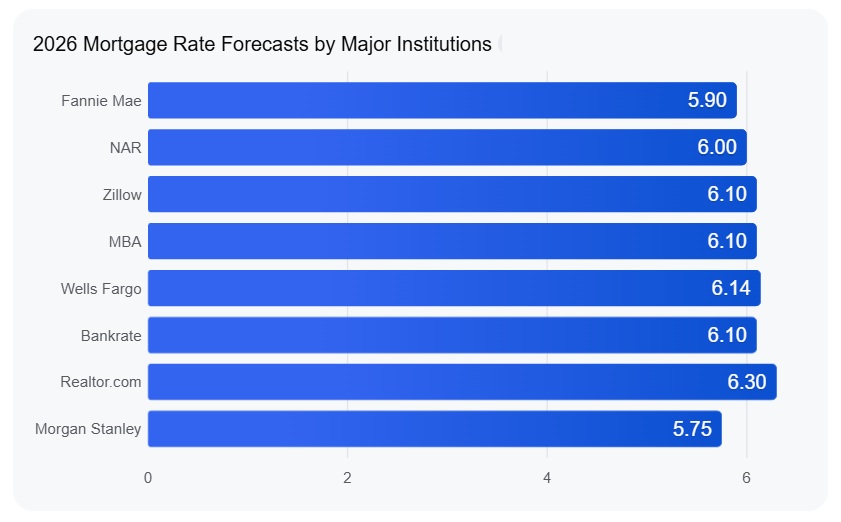
2026 Mortgage Rate Forecasts by Major Institutions

Looking ahead, the crystal ball for mortgage rates is always a bit cloudy, but here's what many experts are saying. The general consensus among major housing economists, as reported by Zillow, is that 30-year fixed mortgage rates will likely stay within a relatively tight range, hovering between 5.9% and 6.3% for the remainder of 2026.

While rates are currently just under 6%, it's important to remember that a return to the super-low rates we saw during the pandemic isn't expected. We might still see some ups and downs, or volatility, depending on how economic policies evolve.

Here’s a quick look at what some of the big names in housing economics are predicting:

  • Zillow: Predicts rates will likely stay above 6% for the entire year.
  • Fannie Mae: Forecasts a gradual easing of rates down to 5.9% by the last three months of 2026.
  • Morgan Stanley: Offers a more optimistic view, anticipating a dip to 5.50%–5.75% by the middle of the year, followed by a slight increase.
  • Mortgage Bankers Association (MBA): Expects rates to remain fairly steady, close to 6.1%, throughout the year.

Key Factors to Watch For the Rest of the Year:

  • The Fed's Next Moves: After their rate-cutting spree in 2025, the Federal Reserve seems to be adopting a more cautious stance. Many believe their cutting cycle might be winding down, suggesting rates could stabilize.
  • Economic Shocks: New trade policies, potential tax changes, or other government economic initiatives could cause ripples in the 10-year Treasury yield, which would directly impact mortgage rates.
  • Housing Supply: While lower rates are helping to unlock some previously “locked-in” homeowners, inventory still remains a challenge. If rates continue to stay below 6%, it could be enough to encourage more people to sell, potentially balancing out the market and prices.
  • Jobs Report: The ongoing health of the labor market is crucial. If unemployment starts to climb significantly, it could lead to a strong rally in bonds, pushing mortgage rates even lower. If the job market stays solid, rates are likely to stay “pinned” around the 6% level.

The Takeaway for You

So, what does all this mean for you? The bottom line is that the 30-year fixed mortgage rate has seen a substantial drop, now sitting at 5.91%, a significant 66 basis point decrease from February 2025. This favorable shift, fueled by Fed actions, easing inflation, lower Treasury yields, and even government support, creates a much more affordable borrowing environment. For anyone looking to buy a home or refinance an existing mortgage, early 2026 presents a really excellent opportunity to secure financing and explore the possibilities in the housing market. It feels like a much-needed breath of fresh air for aspiring homeowners!

🏡 Two Turnkey Investment Opportunities With Strong Cash Flow

Bessemer, AL
🏠 Property: Blue Jay Cir
🛏️ Beds/Baths: 4 Bed • 2 Bath • 1610 sqft
💰 Price: $282,000 | Rent: $1,885
📊 Cap Rate: 6.4% | NOI: $1,500
📅 Year Built: 2023
📐 Price/Sq Ft: $176
🏙️ Neighborhood: A-

And

Lebanon, TN
🏠 Property: Baltusrol Lane #852
🛏️ Beds/Baths: 4 Bed • 2.5 Bath • 2011 sqft
💰 Price: $369,990 | Rent: $2,400
📊 Cap Rate: 5.8% | NOI: $1,789
📅 Year Built: 2024
📐 Price/Sq Ft: $184
🏙️ Neighborhood: B

Alabama’s newer A- rental vs Tennessee’s larger property with higher NOI. Which fits YOUR investment strategy?

We have much more inventory available than what you see on our website – Let us know about your requirement.

📈 Choose Your Winner & Contact Us Today!

Speak to a Norada Investment Counselor (No Obligation):

(800) 611-3060

View All Properties

Build Passive Income & Wealth with Turnkey Rentals

Mortgage rates remain high in 2026, but rental properties continue to deliver strong cash flow and appreciation. Savvy investors know that turnkey real estate is the path to passive income and long‑term wealth.

Norada Real Estate helps you secure turnkey rental properties designed for immediate cash flow and appreciation—so you can invest smartly regardless of interest rate trends.

🔥 HOT INVESTMENT Properties JUST ADDED! 🔥
Request a Callback / Fill Out the Form Online

Contact Us

Also Read:

  • What Leading Housing Experts Predict for Mortgage Rates in 2026
  • Mortgage Rate Predictions for 2026: What Leading Forecasters Expect
  • Mortgage Rate Predictions for the Next 3 Years: 2026, 2027, 2028
  • 30-Year Fixed Mortgage Rate Forecast for the Next 5 Years
  • 15-Year Fixed Mortgage Rate Predictions for Next 5 Years: 2025-2029
  • Will Mortgage Rates Ever Be 3% Again in the Future?
  • Mortgage Rates Predictions for Next 2 Years
  • Mortgage Rate Predictions for Next 5 Years
  • Mortgage Rate Predictions: Why 2% and 3% Rates are Out of Reach
  • How Lower Mortgage Rates Can Save You Thousands?
  • How to Get a Low Mortgage Interest Rate?
  • Will Mortgage Rates Ever Be 4% Again?

Filed Under: Financing, Mortgage Tagged With: 30-Year Fixed Mortgage, mortgage, mortgage rates

Mortgage Rates Could Fall as Weak Jobs Report Looms Today

February 11, 2026 by Marco Santarelli

Mortgage Rates Could Fall as Weak Jobs Report Looms Today

The financial world is holding its breath this morning, and for good reason. Mortgage rates are poised to either dip or stay put today, February 11th, 2026, as we await the crucial January jobs report. Early signs from the economic scene are pointing towards a softer labor market, which typically translates to lower interest rates for your home loan. This is a big deal for anyone dreaming of buying a house or refinancing their current mortgage.

Mortgage Rates Could Fall as Weak Jobs Report Looms Today

For a while now, the average 30-year fixed mortgage rate has been playing a game of limbo, dancing between 6.11% and 6.18%. It’s been a period of relative calm, but this jobs report has the potential to shake things up… or at least confirm what we've been expecting.

The Big Question: What Will the Jobs Report Say?

Economists are bracing themselves for a rather uninspiring number when the Bureau of Labor Statistics (BLS) releases its findings later today. The consensus is that we'll see very little job growth for January, perhaps somewhere in the ballpark of 55,000 to 75,000 new jobs. Now, compared to stronger months, that’s a pretty modest figure.

When the jobs report comes in weak, it’s like a signal to the financial markets that the economy might not be as hot as we thought. This often leads to a drop in what are called Treasury yields. Think of Treasury yields as a benchmark for many interest rates, including mortgages. When they go down, mortgage rates usually follow suit. It’s a pretty reliable cause-and-effect, and it’s why lenders and borrowers alike will be glued to their screens today.

A Predictable Pattern, But With Twists

Having covered the mortgage market for a while, I've learned that while the direction of mortgage rates after a jobs report is often predictable, the exact movement can be a bit of a wild card. It's a bit like knowing it’s going to rain, but not being sure if it will be a drizzle or a downpour.

Generally, there's an inverse relationship at play:

  • Good economic news (like strong job growth) is often bad news for mortgage rates. It suggests the economy is chugging along nicely, maybe even overheating, which can prompt the Federal Reserve to consider raising interest rates to cool things down. Higher Fed rates typically mean higher mortgage rates.
  • Bad economic news (like weak job growth or rising unemployment) is usually good news for mortgage rates. It signals economic weakness, which can lead to the Fed cutting rates or investors seeking safer investments, both pushing mortgage rates lower.

However, it’s not always a straight line. Sometimes, the jobs report can be a mixed bag. You might see strong job creation, but maybe wage growth slows down, or the unemployment rate ticks up. These conflicting signals can create a “push-and-pull” effect, leaving mortgage rates in a sort of holding pattern.

What If the Report Isn't So Bad?

Even if today’s report shows a bit more resilience than expected, don't expect rates to skyrocket. Experts believe that even a moderately positive jobs report will likely keep mortgage rates in a “holding pattern” around the 6% mark. Why? Because inflation data hasn’t shown enough of a pickup to make the Federal Reserve think about raising rates. And right now, the Fed’s stance on interest rates is a huge driver of mortgage rate movement.

My Take: It’s All About the Fed and the Bonds

From my perspective, the jobs report is a key piece of the puzzle, but it's not the whole picture. The Federal Reserve's actions, or more importantly, its intended actions regarding interest rates, cast a long shadow over mortgage rates. We're also constantly watching the 10-year Treasury yield. This is where mortgage rates often find their closest ally. Lenders typically add a margin, usually around 1.5% to 2%, to the 10-year Treasury yield to determine your mortgage rate. So, if that yield dips, your mortgage rate likely will too.

Current Mortgage Rates (As of Today, February 11, 2026)

Here's a snapshot of what you might be seeing right now:

Loan Type Average Rate
30-Year Fixed 6.12% – 6.18%
15-Year Fixed 5.50% – 5.63%
30-Year FHA 5.94% – 6.13%

Please remember these are averages, and your individual rate will depend on your specific financial situation.

Beyond the Jobs Report: Other Rate Movers

It’s important to remember that the jobs report is just one of several factors influencing mortgage rates today. Here are a few other significant players:

  1. The Bond Market and 10-Year Treasury Yields: As I mentioned, this is a huge one. When the global economy feels shaky, investors often flock to U.S. Treasuries as a safe haven. This increased demand drives up bond prices and, in turn, lowers their yields. A lower 10-year Treasury yield usually means lower mortgage rates.
  2. Federal Reserve Policy and the Balance Sheet: While the Fed doesn't directly set mortgage rates, its decisions on interest rates and its balance sheet have a massive impact. The Fed ended its policy of shrinking its balance sheet in December 2025, which is a move that can inject liquidity into the market and potentially put downward pressure on rates. Plus, there was a directive for Fannie Mae and Freddie Mac to buy a significant amount of mortgage-backed securities ($200 billion!), which also boosts demand for mortgages, potentially lowering rates.
  3. Inflation and Economic Growth: High inflation is like a corrosive acid on the value of money. Lenders need to charge higher rates to compensate for the fact that the money they get back in the future will be worth less. Conversely, if the economy is growing too fast and consumer spending is through the roof, it can lead to inflation. To prevent this “overheating,” the Fed might hint at higher rates, which influences mortgage rates. On the flip side, fears of a recession usually push rates down as the Fed looks to stimulate the economy.
  4. Housing Market Supply and Demand: This one is more about the nuts and bolts of the mortgage industry. If a lender is swamped with people applying for mortgages, they might actually raise their rates to slow down the application queue. On the other hand, if there aren't many homes for sale, fewer people will be applying for mortgages, and lenders might lower rates to try and attract more business.
  5. Your Personal Financial Snapshot: This is crucial. While the market sets the stage, your own financial health determines your specific rate. Key factors include:
    • Your Credit Score: A score of 740 and above usually gets you the best deals. Below 620, and you might face higher costs or even a denial.
    • Loan-to-Value (LTV) Ratio: This is the amount of the loan compared to the value of the home. A bigger down payment (meaning a lower LTV) shows less risk to the lender, which can translate to a lower interest rate.
    • Type of Property: Buying a primary residence is typically less risky for a lender than an investment property or a vacation home, so you'll often see lower rates for those first two.

The Bottom Line

Today's jobs report is a significant event that could provide some clarity for the mortgage market. I’m expecting that the downward pressure from anticipated economic softness will likely keep mortgage rates stable or even nudge them slightly lower. However, always keep an eye on the broader economic picture and your own financial qualifications. Making an informed decision about when to lock in your rate, regardless of today's report, is paramount.

🏡 Two Turnkey Investment Opportunities With Strong Cash Flow

Bessemer, AL
🏠 Property: Blue Jay Cir
🛏️ Beds/Baths: 4 Bed • 2 Bath • 1610 sqft
💰 Price: $282,000 | Rent: $1,885
📊 Cap Rate: 6.4% | NOI: $1,500
📅 Year Built: 2023
📐 Price/Sq Ft: $176
🏙️ Neighborhood: A-

And

Lebanon, TN
🏠 Property: Baltusrol Lane #852
🛏️ Beds/Baths: 4 Bed • 2.5 Bath • 2011 sqft
💰 Price: $369,990 | Rent: $2,400
📊 Cap Rate: 5.8% | NOI: $1,789
📅 Year Built: 2024
📐 Price/Sq Ft: $184
🏙️ Neighborhood: B

Alabama’s newer A- rental vs Tennessee’s larger property with higher NOI. Which fits YOUR investment strategy?

We have much more inventory available than what you see on our website – Let us know about your requirement.

📈 Choose Your Winner & Contact Us Today!

Speak to a Norada Investment Counselor (No Obligation):

(800) 611-3060

View All Properties

Build Passive Income & Wealth with Turnkey Rentals

Mortgage rates remain high in 2026, but rental properties continue to deliver strong cash flow and appreciation. Savvy investors know that turnkey real estate is the path to passive income and long‑term wealth.

Norada Real Estate helps you secure turnkey rental properties designed for immediate cash flow and appreciation—so you can invest smartly regardless of interest rate trends.

🔥 HOT INVESTMENT Properties JUST ADDED! 🔥
Request a Callback / Fill Out the Form Online

Contact Us

Also Read:

  • What Leading Housing Experts Predict for Mortgage Rates in 2026
  • Mortgage Rate Predictions for 2026: What Leading Forecasters Expect
  • Mortgage Rate Predictions for the Next 3 Years: 2026, 2027, 2028
  • 30-Year Fixed Mortgage Rate Forecast for the Next 5 Years
  • 15-Year Fixed Mortgage Rate Predictions for Next 5 Years: 2025-2029
  • Will Mortgage Rates Ever Be 3% Again in the Future?
  • Mortgage Rates Predictions for Next 2 Years
  • Mortgage Rate Predictions for Next 5 Years
  • Mortgage Rate Predictions: Why 2% and 3% Rates are Out of Reach
  • How Lower Mortgage Rates Can Save You Thousands?
  • How to Get a Low Mortgage Interest Rate?
  • Will Mortgage Rates Ever Be 4% Again?

Filed Under: Financing, Mortgage Tagged With: 30-Year Fixed Mortgage, mortgage, mortgage rates

30-Year Fixed Mortgage Rate Drops Steeply by 78 Basis Points

February 10, 2026 by Marco Santarelli

30-Year Fixed Mortgage Rate Drops Steeply by 78 Basis Points

This is potentially fantastic news for anyone dreaming of homeownership. The 30-year fixed mortgage rate has experienced a significant drop of 78 basis points compared to this time last year, now hovering near an approachable 6%. This substantial decrease offers a much-needed boost in affordability for prospective buyers and could invigorate the housing market as we head into the busy spring season.

30-Year Fixed Mortgage Rate Drops Steeply by 78 Basis Points

As of Thursday, February 5, 2026, a major shift has occurred in the mortgage world. Freddie Mac, a prominent player in the housing finance industry, has reported a steep decline of 78 basis points in the average 30-year fixed mortgage rate when compared to the same period last year. This isn't just a small nudge; it's a substantial move that could rewrite the financial plans of countless Americans. This particular drop from an average of 6.89% last year to a new average of 6.11% this year is incredibly significant. It means that buying power has just received a considerable injection.

Understanding What a Basis Point Actually Means

Before we dive deeper, let's clarify what “78 basis points” translates to in real dollars. A basis point is simply one-hundredth of a percentage point. So, 78 basis points equal 0.78%. This might not sound like a massive number on its own, but when applied to the large sums involved in a mortgage, it can add up to thousands, even tens of thousands, of dollars saved over the life of a loan.

Imagine you're looking at a $300,000 mortgage.

  • At last year's rate of 6.89%, your monthly principal and interest payment would have been approximately $1,976.
  • At this year's new rate of 6.11%, that payment drops to about $1,821.

That's a difference of $155 per month, or $1,860 per year in savings! Over a 30-year period, this translates to nearly $46,800 in interest savings. That's a considerable chunk of change that could go towards renovations, investments, or simply building wealth.

30-Year Fixed Mortgage Rate Drops Steeply by 78 Basis Points

A Closer Look at the Numbers: The Latest Freddie Mac Data

Freddie Mac’s latest report, the Primary Mortgage Market Survey® (PMMS) for the week ending February 5, 2026, paints a clear picture.

Loan Type Current Rate (Feb 5, 2026) 1-Wk Change 1-Yr Change Monthly Avg. 52-Wk Avg. 52-Wk Range
30-Year Fixed 6.11% +0.01% -0.78% 6.09% 6.51% 6.06% – 6.89%
15-Year Fixed 5.50% +0.01% -0.55% 5.45% 5.71% 5.38% – 6.09%

As you can see, the 30-year fixed-rate mortgage (FRM) averaged 6.11%. This is a slight tick up from last week's 6.10%, but the year-over-year comparison is where the real story lies. The -0.78% change from last year is a powerful indicator of the current favorable environment for borrowers.

Even the 15-year fixed-rate mortgage has seen its own positive movement, dropping by 55 basis points year-over-year to an average of 5.50%. While the 30-year mortgage remains the most popular choice for its predictable payments and lower monthly costs, the 15-year option can save a significant amount in interest if you have the financial capacity for higher monthly payments.

Why Are Rates Dropping So Sharply?

It's natural to wonder what's driving such a significant drop. It's rarely just one factor, but rather a combination of economic forces.

The Influence of Monetary Policy

The Federal Reserve plays a crucial role in shaping interest rates. In a recent development, the Fed made the decision to pause interest rate cuts after lowering them three times towards the end of 2025. This pause offers a sense of stability. While the Fed isn't actively pushing rates lower right now, the impact of those previous cuts is still reverberating through the economy. Furthermore, the market anticipates that future policy decisions will likely lean towards keeping rates lower for a sustained period. This expectation itself can influence mortgage rates downwards.

Treasury Yields and the “Spread”

Mortgage rates are closely tied to the yields on U.S. Treasury bonds, particularly the 10-year Treasury note. This bond is often seen as a benchmark for long-term borrowing costs. While the 10-year Treasury yield has recently been hovering around 4.2%, something interesting is happening. The “spread” – the difference between Treasury yields and mortgage rates – has actually narrowed. This means that even though Treasury yields haven't plummeted, mortgage lenders are able to offer lower rates because the gap between what they pay for funds and what they charge borrowers has tightened. This is a bit technical, but it means less of a premium is being added to mortgage rates.

Looking Ahead: The Spring Home Sales Season

This sharp drop in rates is arriving at a critical time: the cusp of the spring home sales season. Freddie Mac's Chief Economist, Sam Khater, has pointed to a couple of key factors that make this a positive outlook:

  • Improving Affordability: Lower mortgage rates directly translate to lower monthly payments, making homes more affordable for a larger segment of the population. This can bring buyers back into the market who may have been priced out previously.
  • Increased Home Availability: Reports suggest that the supply of homes available for purchase is also on the rise. A greater selection of homes, combined with better affordability, creates a more balanced market that benefits both buyers and sellers. A balanced market is a healthy market.

Potential Challenges and What They Mean for You

While the news on mortgage rates is overwhelmingly positive, it's important to remain grounded.

Winter Storms Dampen Recent Demand

It’s worth noting that despite the favorable rate environment, recent mortgage applications have seen a dip. The week ending January 30, for instance, saw a nearly 9% decrease in new mortgage applications. Freddie Mac attributes this largely to the winter storms that swept across the U.S., which likely hindered homebuying activities. This is a temporary setback. As the weather improves and the spring season picks up, we can expect to see renewed interest and activity in the housing market.

The Fed's Next Move: A Watchful Eye

While the Fed has paused rate cuts, the future trajectory of interest rates will depend on economic indicators like inflation and employment. If the economy continues to perform well and inflation remains under control, we might see rates stay at these favorable levels or even dip further. However, any unexpected economic shifts could lead to adjustments.

Key Takeaways from My Perspective

I view this sharp decline in 30-year fixed mortgage rates as a significant opportunity. For years, affordability has been the elephant in the room for many aspiring homeowners. This 78-basis-point drop is closing that gap considerably.

If you've been patiently waiting for the right moment to buy, or if you’ve been considering refinancing your existing mortgage to secure a lower rate, now is the time to seriously explore your options. Get pre-approved, talk to lenders, and understand exactly how much you can save. Don't let this moment pass you by. The housing market is dynamic, and conditions like these don't always last.

🏡 Two Turnkey Investment Opportunities With Strong Cash Flow

Bessemer, AL
🏠 Property: Blue Jay Cir
🛏️ Beds/Baths: 4 Bed • 2 Bath • 1610 sqft
💰 Price: $282,000 | Rent: $1,885
📊 Cap Rate: 6.4% | NOI: $1,500
📅 Year Built: 2023
📐 Price/Sq Ft: $176
🏙️ Neighborhood: A-

And

Lebanon, TN
🏠 Property: Baltusrol Lane #852
🛏️ Beds/Baths: 4 Bed • 2.5 Bath • 2011 sqft
💰 Price: $369,990 | Rent: $2,400
📊 Cap Rate: 5.8% | NOI: $1,789
📅 Year Built: 2024
📐 Price/Sq Ft: $184
🏙️ Neighborhood: B

Alabama’s newer A- rental vs Tennessee’s larger property with higher NOI. Which fits YOUR investment strategy?

We have much more inventory available than what you see on our website – Let us know about your requirement.

📈 Choose Your Winner & Contact Us Today!

Speak to a Norada Investment Counselor (No Obligation):

(800) 611-3060

View All Properties

Build Passive Income & Wealth with Turnkey Rentals

Mortgage rates remain high in 2026, but rental properties continue to deliver strong cash flow and appreciation. Savvy investors know that turnkey real estate is the path to passive income and long‑term wealth.

Norada Real Estate helps you secure turnkey rental properties designed for immediate cash flow and appreciation—so you can invest smartly regardless of interest rate trends.

🔥 HOT INVESTMENT Properties JUST ADDED! 🔥
Request a Callback / Fill Out the Form Online

Contact Us

Also Read:

  • What Leading Housing Experts Predict for Mortgage Rates in 2026
  • Mortgage Rate Predictions for 2026: What Leading Forecasters Expect
  • Mortgage Rate Predictions for the Next 3 Years: 2026, 2027, 2028
  • 30-Year Fixed Mortgage Rate Forecast for the Next 5 Years
  • 15-Year Fixed Mortgage Rate Predictions for Next 5 Years: 2025-2029
  • Will Mortgage Rates Ever Be 3% Again in the Future?
  • Mortgage Rates Predictions for Next 2 Years
  • Mortgage Rate Predictions for Next 5 Years
  • Mortgage Rate Predictions: Why 2% and 3% Rates are Out of Reach
  • How Lower Mortgage Rates Can Save You Thousands?
  • How to Get a Low Mortgage Interest Rate?
  • Will Mortgage Rates Ever Be 4% Again?
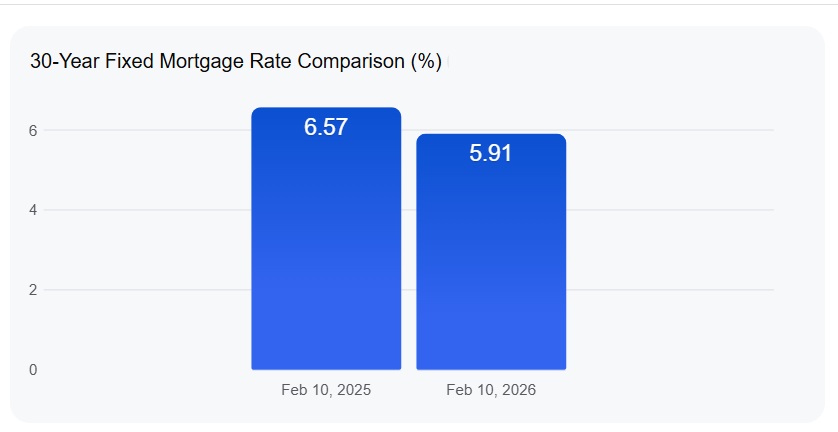
Filed Under: Financing, Mortgage Tagged With: 30-Year Fixed Mortgage, mortgage, mortgage rates

  • 1
  • 2
  • Next Page »

Real Estate

  • Birmingham
  • Cape Coral
  • Charlotte
  • Chicago

Quick Links

  • Markets
  • Membership
  • Notes
  • Contact Us

Blog Posts

  • Today’s Mortgage Rates, July 4: Stable But High Rates Demand Smart Buyer Strategies
    July 4, 2026Marco Santarelli
  • 20 Best Small Cities to Invest in Real Estate in 2026
    July 4, 2026Marco Santarelli
  • Best Cities in the West to Invest in Real Estate in 2026
    July 4, 2026Marco Santarelli

Contact

Norada Real Estate Investments 30251 Golden Lantern, Suite E-261 Laguna Niguel, CA 92677

(949) 218-6668
(800) 611-3060
BBB
  • Terms of Use
  • |
  • Privacy Policy
  • |
  • Testimonials
  • |
  • Suggestions?
  • |
  • Home

Copyright 2018 Norada Real Estate Investments

Loading...