Norada Real Estate Investments

  • Home
  • Markets
  • Properties
  • Membership
  • Podcast
  • Learn
  • About
  • Contact

Smart Ways to Secure a Lower Mortgage Rate in 2026

January 4, 2026 by Marco Santarelli

Smart Ways to Secure a Lower Mortgage Rate in 2026

Getting the best deal on your mortgage rate isn't just about good luck; it's about smart planning and proactive steps you start taking today. To get a lower mortgage rate in 2026, you absolutely must focus on building a strong financial foundation now and becoming a savvy shopper for the best loan terms, because lenders reward preparedness and smart comparison with significantly better rates.

I’ve had a front-row seat to the ever-shifting world of mortgages for years, and one thing remains consistently true: the power lies with the borrower who prepares. While no one has a crystal ball for interest rates, the factors that qualify you for the best rates are largely within your control. Think of it like training for a marathon: you don't just show up on race day. You train, you prepare, and you build strength. Getting a killer mortgage rate in 2026 demands the same dedication. Let's dig into the strategies that can put more money in your pocket over the life of your loan.

Smart Ways to Secure a Lower Mortgage Rate in 2026

Building Your Financial Fort Knox: The Credit Score Command Center

This is, without a doubt, your starting point. Your credit score is essentially your financial report card, and lenders rely on it heavily to gauge how risky you are to lend money to. A higher score tells them you're responsible and likely to pay back your loan.

From my experience, many homebuyers underestimate just how much impact those three little digits have. We’re talking about potentially hundreds of dollars saved each month, which adds up to tens of thousands over the life of a loan. My friends often ask me, “What's the magic number?” While there's no single perfect score, aiming for a FICO score of 760 to 780 or higher is your golden ticket for securing the best conventional mortgage rates out there. I've personally seen clients with scores in this range consistently get more favorable terms than those even a few points lower.

So, how do you get there?

  • Pay Your Bills on Time, Every Time: This is the most crucial factor. Even one late payment can ding your score. Set up automatic payments if you need to, or use reminders. Consistency is key.
  • Keep Your Credit Utilization Low: This fancy term just means don't max out your credit cards. Lenders like to see you using less than 30% of your available credit, but even lower – like under 10% – is even better. If you have a credit card with a $10,000 limit, try to keep your balance below $1,000.
  • Don't Open (Or Close) Too Many Accounts Too Quickly: A long credit history is a good credit history. Avoid opening a bunch of new accounts just before applying for a mortgage, as this can make you look risky. Similarly, closing old accounts can actually hurt your score by reducing your overall available credit and shortening your credit history.
  • Check Your Credit Report Regularly: Mistakes happen! Get your free credit report from AnnualCreditReport.com at least once a year. Dispute any errors you find – I've seen simple errors corrected that have jumped a score by 20 points almost overnight. This small step can make a huge difference.

The Power of the Down Payment: Show Them the Money

If your credit score is about trust, your down payment is about commitment. A larger down payment significantly reduces the lender's risk. Why? Because you have more “skin in the game.” If you had to walk away from the loan, the lender would lose less money because of the equity you already have in the home.

My personal belief is that, if possible, striving for a 20% down payment or more is one of the smartest financial moves you can make when buying a home. Not only does it often secure you a lower interest rate, but it also helps you avoid private mortgage insurance (PMI). PMI is an extra monthly fee added to your mortgage payment that protects the lender, not you, if you default. Avoiding PMI can save you hundreds of dollars each month, which is money you can use for other things, like home improvements or just building up your savings.

Think about it:

  • Less Risk for Lenders = Better Rates for You: It's that simple.
  • Avoid PMI: This is a huge win. That 20% mark is your magic number to sidestep this extra cost.
  • Lower Monthly Payments: A larger down payment means you're borrowing less money, which directly translates to a smaller monthly mortgage payment.

Even if 20% feels out of reach, every extra dollar you put down helps. Don't underestimate the power of going from, say, 5% to 10% down. It still makes a difference to lenders and to your borrowing costs.

The Debt-to-Income (DTI) Ratio: Your Financial Balancing Act

This is another huge one that lenders scrutinize. Your debt-to-income (DTI) ratio tells lenders how much of your monthly gross income goes towards paying off debts each month. It’s a snapshot of your financial health and your ability to take on new debt.

Lenders prefer to see a DTI of 36% or less, with the lowest rates often reserved for borrowers who can keep their DTI at 25% or less. I often tell clients this is like looking at your monthly budget from the lender's perspective. They want to see that you have plenty of room to comfortably make your mortgage payments.

How can you improve your DTI?

  • Pay Down Existing Debts: Focus on credit cards, car loans, student loans, or any other recurring monthly payments. Even paying off a small personal loan can make a difference. Prioritize high-interest debts first.
  • Increase Your Verifiable Income: This could mean picking up a side gig, getting a raise, or increasing hours at your current job. Just make sure it’s income you can prove with pay stubs and tax returns. Lenders want to see consistent income.
  • Avoid Taking on New Debt: This goes hand-in-hand with improving your DTI. Applying for new credit cards or financing a new car right before applying for a mortgage will inflate your DTI and could jeopardize your chances of getting the best rate.

The Savvy Shopper's Secret: Shop Around and Negotiate

Once you've polished up your financial profile, this is where you become the astute consumer. Mortgage rates can vary significantly between lenders, even on the same day. Think of it like comparing prices for a big-ticket item; you wouldn't just buy the first one you see, right? The same applies to one of the biggest purchases of your life.

My firm belief, backed by years of watching this market, is that you must obtain quotes from at least three to five lenders on the same day. Why the same day? Because rates can fluctuate daily, and comparing quotes from different days wouldn't give you an accurate picture. This allows for a true “apples-to-apples” comparison.

Once you have these competing offers, use them! Don't be shy about negotiating. If Lender A offers you 6.5% and Lender B offers 6.3%, go back to Lender A (or C, or D) and ask if they can beat or match Lender B's offer. You'd be surprised how often they'll adjust their rate or fees to earn your business. This isn't being pushy; it's being smart with your money.

Consider different types of lenders as well:

  • Big banks: Often have competitive rates but can be slower.
  • Credit unions: Known for personalized service and sometimes better rates if you're a member.
  • Online lenders: Can offer very competitive rates due to lower overhead but may lack personal touch.
  • Mortgage brokers: They work with multiple lenders to find you the best deal.

Strategic Loan Options: Tailoring Your Mortgage

Not all mortgages are created equal, and choosing the right structure can significantly impact your rate.

Consider a Shorter Loan Term

This is a strategy often overlooked but can lead to substantial savings. Mortgages with shorter terms, such as 15-year or 20-year fixed-rate loans, generally offer lower interest rates than a standard 30-year term. While your monthly payments will be higher because you're paying off the loan quicker, the total interest you pay over the life of the loan can be dramatically lower.

For example, a 15-year mortgage rate could be a full percentage point lower than a 30-year mortgage. If you can comfortably afford the higher monthly payment, this option is worth serious consideration. It's not for everyone, but if your budget allows, it's a powerful way to accelerate equity building and save a lot on interest.

Buy Discount Points

This strategy involves paying a bit extra upfront to reduce your interest rate for the entire life of the loan. You can prepay interest at closing in exchange for a permanently lower interest rate. Typically, one “point” costs 1% of the total loan amount and usually reduces the interest rate by about a quarter of a percentage point (0.25%).

For a $300,000 loan, one point would cost $3,000 at closing. In return, your interest rate might drop from, say, 6.5% to 6.25%. This is a math problem you need to solve based on how long you plan to stay in the home. If you plan to live in the house for many years, paying points can definitely save you money in the long run. If you think you might move in a few years, it might not be worth the upfront cost. I always advise doing the break-even calculation before going this route.

Explore Different Loan Types

Don't assume a conventional loan is your only option. Depending on your situation, government-backed loans can offer more favorable terms, especially if you have a lower down payment or specific circumstances.

  • FHA Loans: Great for first-time homebuyers or those with lower credit scores and smaller down payments (as low as 3.5%).
  • VA Loans: An incredible benefit for eligible veterans, active-duty service members, and some surviving spouses. These often require no down payment and have very competitive rates.
  • USDA Loans: Designed for low-to-moderate-income borrowers in eligible rural areas. These also often require no down payment.

It’s crucial to research these options because they might open doors to homeownership with terms you didn't think were possible, potentially including lower rates.

The Future-Proofing Strategy: Refinance Later

Getting a great rate in 2026 is the goal, but the housing market is always in motion. What if rates drop further down the road? If you buy a home now and mortgage rates drop significantly in the future, you may be able to refinance your loan to secure an even lower rate.

Think of refinancing as a chance to hit the reset button on your mortgage. This is a smart contingency plan. I've guided many clients through refinancing when market conditions shifted in their favor, allowing them to significantly reduce their monthly payments and total interest paid. Keep an eye on economic indicators and be prepared to act if a golden opportunity arises.

In Conclusion: Your Journey to a Lower Rate

Getting a lower mortgage rate in 2026 isn't just a wish; it's a plan you can execute. It requires discipline, research, and a willingness to negotiate. By focusing on boosting your credit score, maximizing your down payment, optimizing your DTI, shopping around fiercely, considering different loan types and terms, and keeping an eye on future refinance opportunities, you'll be well-positioned to unlock the best possible rate. Start today, and you'll thank yourself for years to come.

Unlock Cash Flow & Passive Income with Turnkey Rentals

Smart ways to secure a lower mortgage rate in 2026 aren’t just about saving on financing—they’re about maximizing returns. As rates fluctuate, investors who lock in favorable terms can amplify cash flow and long‑term wealth through rental property investing.

Norada Real Estate helps you take advantage of these opportunities with turnkey rental properties designed to deliver passive income and appreciation—positioning you to thrive even as mortgage markets shift.

🔥 HOT 2026 INVESTMENT LISTINGS JUST ADDED! 🔥
Talk to a Norada investment counselor today (No Obligation):
(800) 611-3060

Get Started Now

Also Read:

  • Mortgage Rates Predictions for 2026 Backed by Top Housing Experts
  • Mortgage Rate Predictions for the Next 5 Years: What’s Ahead 2026–2030
  • Mortgage Rate Predictions for the Next 3 Years: 2026, 2027, 2028
  • 30-Year Fixed Mortgage Rate Forecast for the Next 5 Years
  • 15-Year Fixed Mortgage Rate Predictions for Next 5 Years: 2025-2029
  • Will Mortgage Rates Ever Be 3% Again in the Future?
  • Mortgage Rates Predictions for Next 2 Years
  • Mortgage Rate Predictions for Next 5 Years
  • Mortgage Rate Predictions: Why 2% and 3% Rates are Out of Reach
  • How Lower Mortgage Rates Can Save You Thousands?
  • How to Get a Low Mortgage Interest Rate?
  • Will Mortgage Rates Ever Be 4% Again?
Filed Under: Financing, Mortgage Tagged With: credit score, home loan, mortgage, mortgage rates

Pros and Cons of Trump’s 50 Year Mortgage Plan: Affordability vs Massive Increase in Interest

November 12, 2025 by Marco Santarelli

Pros and Cons of Trump's 50 Year Mortgage Plan: Affordability vs Massive Increase in Interest

Even if you're not in the market for a home right now, you've probably heard the buzz: President Trump is talking about a 50-year mortgage. Yep, you read that right, fifty years. It's a bold idea, aiming to jolt our housing market out of its funk and make buying a home feel a little less like an impossible dream, especially for young families and millennials. But is it a magic bullet for affordability, or a recipe for endless debt? I've been digging into this proposal, and let me tell you, it's a lot more complicated than a simple “yes” or “no.”

Pros and Cons of Trump's 50 Year Mortgage Plan: Affordability vs Massive Increase in Interest

The Big Idea: A Longer Road to Homeownership?

Back on November 8, 2025, the former President took to Truth Social with a proposal that immediately set tongues wagging. He pitched the concept of a 50-year, fixed-rate mortgage, likening it to the groundbreaking 30-year mortgage introduced by Franklin D. Roosevelt during the Great Depression. His goal? To combat the staggering rise in home prices, which have pushed the median home price nationwide well over $400,000. The core idea is that by spreading payments out over a much longer period, the monthly payment would become more manageable. Think of it like stretching out a big bill over many more months to make it easier on your wallet right now.

This isn't just a pipe dream. The proposal suggests it would likely be backed by the government, similar to FHA or VA loans. However, the details are still pretty fuzzy, and getting this off the ground would involve some serious legal and regulatory hurdles, particularly with the Dodd-Frank Act, which currently caps “qualified mortgages” at 30 years. It feels like Trump is trying to tap into a deep need for accessible housing, but the path from idea to reality is anything but smooth.

The Upside: Making Homeownership Seem Possible Again

Let's be real, the current housing market feels like a locked door for a lot of folks. Median home prices are sky-high, and interest rates, while they've cooled a bit from their peak, still mean big monthly payments. This is where the 50-year mortgage plan shines, at least in theory.

1. Easier on the Monthly Budget

This is the headline attraction. By stretching payments over 50 years (that's 600 months, folks!), the amount you pay each month for principal and interest could drop significantly compared to a 30-year equivalent. For a borrower looking at a $450,000 loan, we're talking about potential savings of around $300 per month. That might not sound like a fortune, but over a year, it adds up to nearly $4,000. For a young family trying to juggle childcare, student loans, and everyday expenses, that kind of breathing room could make the difference between renting forever and actually putting down roots. It could open the door for millions of Americans, especially those in their 30s and 40s, who have been priced out for years.

2. A Foot in the Door for Wealth Building

Homeownership has always been a cornerstone of building wealth in America. For many families, their home is their biggest asset. The 50-year mortgage, even with its drawbacks, could be the “foot in the door” that many need. It allows people to start building equity, even if it's slowly. The hope is that buyers could refinance into shorter-term loans down the line as their incomes increase, effectively shortening their mortgage term without the initial prohibitive monthly payments. It’s about getting people into the market so they can start benefiting from potential home appreciation.

3. A Potential Boost for the Economy

More people buying homes means more demand for construction, more jobs in building trades, and more spending on furniture, appliances, and home improvements. Proponents argue that this plan could act as a stimulus, driving economic growth. With the housing industry still recovering from various shocks, a fresh influx of buyers could be exactly what it needs to get back on solid footing. It’s a ripple effect that could extend beyond just the housing sector.

The Downside: The Long Game of Debt and Risk

While the immediate relief of a lower monthly payment is tempting, the extended timeline comes with some serious trade-offs that we can't ignore. This is where my own experience as someone who's navigated mortgages and financial planning really comes into play. I've seen firsthand how the total cost of a loan can balloon, and a 50-year term dramatically amplifies that.

1. The Astronomical Interest Bill

This is, by far, the biggest red flag. When you extend a loan term, you're giving the lender more time to collect interest. And with a 50-year mortgage, that extra time means a lot more interest paid. Let's look at that $450,000 loan again. If a 30-year mortgage at, say, 6.5% means paying around $550,000 in interest over its life, a 50-year loan—even at a slightly higher rate like 7.5% (which is a likely scenario due to the extended risk)—could mean paying well over a million dollars in interest. That’s nearly double the total interest paid on a 30-year loan. This isn't just a financial detail; for lower-income families, it could mean a lifetime of carrying significantly more debt, potentially widening the wealth gap we desperately need to close.

2. Equity Builds at a Snail's Pace

With a 50-year mortgage, your monthly payment is mostly going towards interest in the early years, just like any other mortgage. However, because the loan term is so long, you build equity—your ownership stake in the home—much, much slower. After 10 years on a 50-year loan, you might have significantly less equity built up compared to what you would have on a traditional 30-year or even a 15-year mortgage. This can be dangerous. If the housing market dips, and you have very little equity, you could find yourself “underwater”—owing more on your mortgage than your home is worth. This was a painful lesson learned by many in the 2008 housing crisis, and it's a risk that can't be overstated. Imagine being in your retirement years, still paying off a mortgage that you started decades ago.

3. Potential for Market Distortions

This plan, critics argue, doesn't address the root cause of high housing prices: a severe shortage of homes. If we just increase the number of people who can borrow more money without increasing the supply of houses, prices are likely to go up even further. This could negate some of the affordability benefits by making homes even more expensive in the long run. It's like trying to cool a room by blowing more warm air into it. Experts suggest that without significant policy changes that encourage building more homes, this plan could simply inflate prices, benefiting sellers and lenders more than buyers.

4. Regulatory and Implementation Headaches

As I mentioned, the Dodd-Frank Act is a major hurdle. Changing these regulations would require congressional approval, which is never a quick or easy process. There's also the question of who would offer these loans. Banks and mortgage lenders might be hesitant to take on loans that extend so far into the future, given the increased risks. Early reports suggest even within the White House, there were hesitations and surprise about the proposal's rollout.

A Look at the Numbers: What Does It Really Mean?

To help visualize the impact, let's crunch some numbers. Suppose you're buying a $500,000 home and need a mortgage. With a 20% down payment ($100,000), you're looking at a $400,000 loan. Note: The numbers below are illustrative based on the data provided and my own understanding of mortgage amortization, assuming slightly altered loan amounts and rates for clarity.

Illustrative Comparison: $400,000 Loan

Loan Term Estimated Interest Rate Monthly Payment (P&I) Total Interest Paid Over Life of Loan Equity After 10 Years (Approx.)
15-Year Fixed 6.0% ~$3,271 ~$90,000 ~$110,000
30-Year Fixed 6.5% ~$2,529 ~$510,000 ~$50,000
50-Year Fixed 7.5% ~$2,500* ~$1,100,000 ~$25,000

Note: The 50-year payment is shown as only slightly lower than the 30-year here to reflect the possibility of lower monthly savings due to a higher interest rate and the compounding of interest. Actual savings could vary.

Key Takeaways from the Table:

  • You can see the significant monthly savings between the 30-year and 50-year options.
  • However, the total interest paid on the 50-year mortgage is shockingly high – more than double the 30-year.
  • Equity builds much slower on the 50-year loan. After 10 years, you've built a fraction of the equity compared to a 15-year or 30-year loan, making you more vulnerable if home prices fall.

This table really drives home the trade-off: immediate monthly affordability versus long-term cost and equity building.

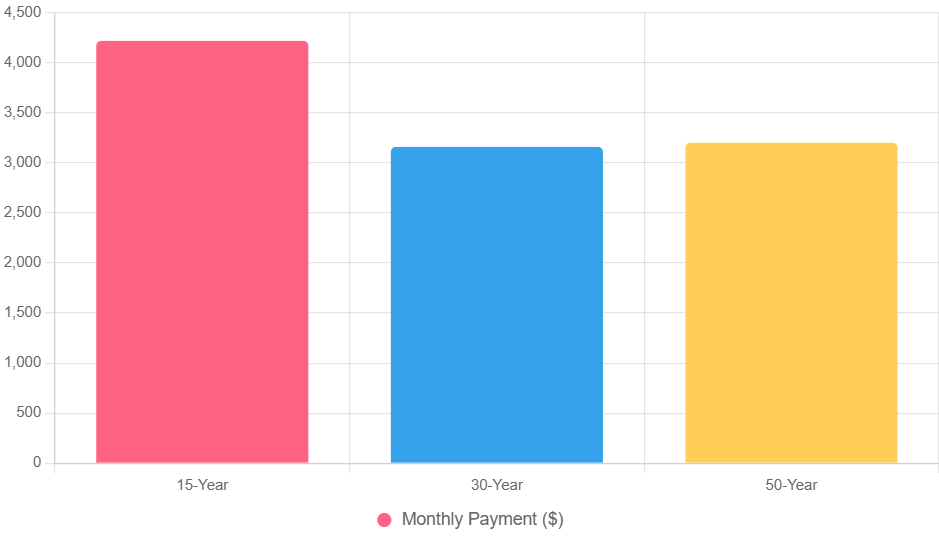
Chart 1: Monthly Payments by Loan Term

This bar chart shows how extending the term affects cash flow—note the 50-year option barely saves money if rates rise.

Monthly Payments by Loan Term on a 50-Year Mortgage

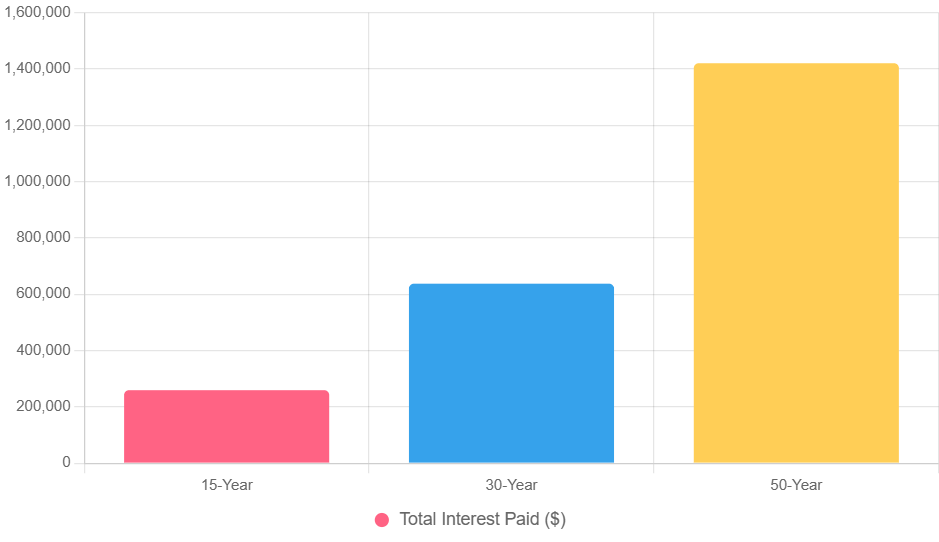
Chart 2: Total Lifetime Interest by Loan Term

A stark illustration of the “interest trap”—the 50-year loan more than doubles costs compared to shorter options.

Total Lifetime Interest by 50-Year Mortgage Loan Term

Expert Opinions and Real-World Implications

The reaction from financial experts has been, shall we say, mixed. Some laud it as a creative solution for a generation struggling to enter the housing market. Others sound the alarm, calling it fiscally irresponsible or a temporary band-aid on a much larger problem.

I tend to lean towards the cautionary view. As someone who believes in strong personal finance and long-term stability, extending debt for an additional 20 years, especially when it drastically increases the total cost and slows equity growth, feels like a risky proposition for many borrowers. It feels like it could be a short-term fix that creates long-term headaches.

The real difficulty lies in the details. How will these loans be underwritten? What kind of protections will be in place? Will they truly be “fixed” or will there be escalators down the line? These are questions that need solid answers before such a plan could gain widespread approval or implementation.

Looking Ahead: What's the Real Solution?

While the 50-year mortgage is an interesting concept designed to tackle a pressing issue, I believe the sustainable path to housing affordability lies in a multi-pronged approach.

  • Increase Housing Supply: This is paramount. We need policies that encourage the construction of more homes of all types, especially in areas where demand is highest. This means rethinking zoning laws, streamlining permitting processes, and incentivizing builders.
  • Support Targeted Assistance: Instead of a blanket extension of loan terms, perhaps more targeted programs that help with down payments, reduce interest rates for first-time buyers, or offer down payment assistance could achieve affordability without the massive long-term interest burden and equity risks.
  • Affordability Measures Focused on Entry: Programs that help first-time buyers get into homes with manageable, short-to-medium term adjustable rates (that can be converted later), or shared equity models, might offer a better balance.

President Trump's 50-year mortgage plan is an ambitious idea born out of a genuine need for housing solutions. It promises immediate relief but carries potentially enormous long-term financial consequences. For me, the extended timeline and the massive increase in total interest paid raise serious questions about whether it truly helps families build a secure financial future, or simply saddles them with debt for decades to come.

Smart Leverage or Long-Term Risk for Rental Investors?

Ultra-long mortgage terms can lower monthly payments and boost cash flow—but they also extend debt horizons and slow equity growth. For turnkey investors, the key is knowing when and how to use them strategically.

Norada Real Estate helps you evaluate financing options and match them to high-performing rental markets—so you can build wealth without overextending your timeline.

🔥 HOT NEW LISTINGS JUST ADDED! 🔥

Talk to a Norada investment counselor today (No Obligation):

(800) 611-3060

Get Started Now

Read More:

  • Is Trump's 50-Year Mortgage Plan a Game Changer or Debt Trap for Borrowers?
  • What Are Typical Credit Score Ranges for Mortgage Borrowers?
  • FHA Mortgage Rates by Credit Score: 620, 700, 580, 640
  • Does Wells Fargo Offer Home Loans with a 500 Credit Score?
  • First Time Home Buyer Loans with Bad Credit and Zero Down
  • Who Qualifies for Kamala Harris' $25,000 Homebuyer Program?
  • Biden Administration's Bold Move for Affordable Housing Plan
  • Biden's Student Debt Relief Plan: A Beacon of Hope for Borrowers
  • What Credit Score Do You Need to Buy House With No Money Down?
  • How Long Does It Take to Get a 700-800 Credit Score?
  • How To Improve Your FICO Credit Score: A Guide
  • FHA Credit Score Requirements for Homeownership
  • 10 Proven Methods to Elevate Your FICO Credit Score
  • Mortgages for Low Credit Scores: Your Complete Guide

Filed Under: Financing, Housing Market, Mortgage Tagged With: 50-Year Mortgage, home loan, Loan Term, mortgage

How Much Difference Does 1% Make on a Mortgage Payment?

January 2, 2025 by Marco Santarelli

How Much Difference Does 1% Make on a Mortgage Payment?

In the rollercoaster of homebuying, finding the perfect mortgage interest rate can feel like chasing a mythical unicorn. You're bombarded with numbers, percentages, and jargon that make your head spin. But what if we told you that a seemingly tiny 1% difference in mortgage interest rates could save you (or cost you) tens of thousands of dollars over the life of your loan? It's true!

That's the power of compounding interest – for better or worse. A recent study revealed that borrowers end up paying, on average, 30% more in interest on a mortgage with a 7% rate compared to a 6% rate. Let's unpack this and understand how even a fraction of a percentage point can significantly impact your financial future.

How Much Difference Does 1 Percent Make on a Mortgage Payment?

Before we dive into the nitty-gritty, let's clarify the two major ways a 1% interest rate difference affects your mortgage:

Short-Term: Monthly Payments

Imagine you're eyeing a beautiful $250,000 home with a 30-year fixed-rate mortgage. Here's how a 1% difference in interest rates plays out in your monthly payments:

  • 7% Interest Rate: Your monthly principal and interest payment would be around $1,663.
  • 6% Interest Rate: Your monthly principal and interest payment drops to about $1,499.

That's a difference of $164 each month! Think about what you could do with an extra $164 every month. That's almost two tanks of gas, a nice dinner out, or a significant contribution to your savings or investment goals.

Long-Term: Total Interest Paid

Now, let's shift gears and look at the bigger picture – the total interest you'll pay over the loan term. This is where the real impact of a 1% difference becomes strikingly clear.

Case Study: Meet Sarah and Mike, two fictional (but relatable) homebuyers, both purchasing a $250,000 home with a 30-year fixed-rate mortgage.

  • Sarah secures a mortgage at 7% interest. Over 30 years, she'll pay a whopping $349,665 in interest!
  • Mike, on the other hand, manages to snag a 6% interest rate. He'll pay $270,772 in interest over the life of his loan.

The difference? A staggering $78,893! That's a significant chunk of change – potentially a down payment on another property, a comfortable retirement fund, or a world-class education for your children.

Real-Life Scenarios: Putting 1% into Perspective

Let's bring this concept to life with some relatable scenarios:

Scenario 1: The First-Time Homebuyer

Emily, a recent graduate, is excited to buy her first condo for $200,000. She's been pre-approved for a mortgage at 7%, but with some diligent research and negotiation, she manages to secure a rate of 6%.

  • At 7%, Emily's monthly payment would be $1,330.
  • At 6%, her monthly payment drops to $1,199.

While a $131 monthly difference might not seem like much, it adds up to $47,160 over the life of the loan – money Emily can now put towards furnishing her new place, investing in her future, or simply enjoying life with less financial stress.

Scenario 2: The Refinancing Dilemma

John and Lisa have been paying their mortgage for five years. Their current loan has a 7% interest rate. They're considering refinancing to take advantage of today's lower rates.

Is it worth it to refinance for a 1% (or smaller) interest rate reduction?

Here's a simple rule of thumb: If the total cost of refinancing (closing costs, fees, etc.) is less than the amount you'll save in interest over the next few years, then refinancing is generally a smart move.

For example: If John and Lisa can refinance into a 6% mortgage and their closing costs are around $5,000, they'll likely recoup those costs within a few years through lower monthly payments and start enjoying substantial long-term savings.

Interactive Element: See the Difference For Yourself

Want to see how much of a difference 1% makes for your specific situation? Use our simple mortgage calculator below to experiment with different loan amounts, interest rates, and loan terms:

Mortgage Calculator


Monthly Payment:

Beyond the Numbers: Other Factors to Consider

While interest rates are crucial, don't forget to consider these factors when shopping for a mortgage:

    • Loan Term: Shorter loan terms mean higher monthly payments but less total interest paid.
  • Closing Costs: These upfront fees can vary significantly, so compare offers carefully.
  • Mortgage Points: You can potentially buy down your interest rate by paying points upfront.
  • Mortgage Insurance: If you make a down payment of less than 20%, you'll likely have to pay PMI, which adds to your monthly costs.

Remember: Finding the best mortgage isn't just about snagging the lowest interest rate – it's about securing the best overall deal that aligns with your financial situation and goals.

Conclusion: Every Percentage Point Counts

When it comes to mortgages, even a 1% difference in interest rates can have a dramatic impact on your financial well-being. Don't underestimate the power of a lower rate!

Here's your call to action:

  • Shop around and compare offers: Get quotes from multiple lenders to compare interest rates, fees, and terms.
  • Negotiate: Don't be afraid to negotiate with lenders for a better rate or lower closing costs.
  • Improve your credit score: A higher credit score often qualifies you for lower interest rates.

By being proactive and informed, you can save yourself thousands of dollars over the life of your mortgage and achieve your homeownership dreams with confidence!

Recommended Read:

  • How to Lower Your Mortgage Payment Without Refinancing?
  • How Lower Mortgage Rates Can Save You Thousands?
  • How to Get a Low Mortgage Interest Rate?
  • Will Mortgage Rates Ever Be 4% Again?
  • Will Mortgage Rates Ever Be 3% Again: Future Outlook
  • Mortgage Rates Predictions for Next 2 Years
  • Mortgage Rate Predictions for Next 5 Years
  • Mortgage Rate Predictions for 2025: Expert Forecast
  • Mortgage Rate Predictions: Why 2% and 3% Rates are Out of Reach

Filed Under: Financing, Housing Market, Mortgage Tagged With: home loan, Housing Market, mortgage, Refinance

Real Estate

  • Birmingham
  • Cape Coral
  • Charlotte
  • Chicago

Quick Links

  • Markets
  • Membership
  • Notes
  • Contact Us

Blog Posts

  • Today’s Mortgage Rates, January 5: Steady 6% Rates Offer Room for Smarter Savings
    January 5, 2026Tamseel Saqib
  • Why Real Estate is Your Best Hedge Against Inflation in 2026
    January 5, 2026Marco Santarelli
  • How to Make $1 Million in Real Estate Investment in 2026
    January 5, 2026Marco Santarelli

Contact

Norada Real Estate Investments 30251 Golden Lantern, Suite E-261 Laguna Niguel, CA 92677

(949) 218-6668
(800) 611-3060
BBB
  • Terms of Use
  • |
  • Privacy Policy
  • |
  • Testimonials
  • |
  • Suggestions?
  • |
  • Home

Copyright 2018 Norada Real Estate Investments

Loading...