Norada Real Estate Investments

  • Home
  • Markets
  • Properties
  • Membership
  • Podcast
  • Learn
  • About
  • Contact

Is the 30-Year Fixed Mortgage Rate Set to Break into the 5% Range?

January 19, 2026 by Marco Santarelli

Is the 30-Year Fixed Mortgage Rate Set to Break into the 5% Range?

While the idea of a 30-year fixed mortgage rate falling into the 5% range remains appealing, current data suggests it’s unlikely to happen in a sustained way during 2026. As of mid‑January, the average rate stands at 6.06%. Recent inflation readings and Federal Reserve commentary point to slower—but not decisive—disinflation. As a result, most forecasts now expect mortgage rates to ease only into the low-to-mid 6% range unless a sharper economic slowdown emerges.

Is the 30-Year Fixed Mortgage Rate Set to Break into the 5% Range?

You know, for years, the 30-year fixed mortgage rate has been the North Star for so many of us dreaming of owning a home. It’s that steady beacon that promises predictable payments and a path to putting down roots. As we wrap up 2025, with the average rate hovering around 6%, that question keeps popping up everywhere I go: “Are we going to see those rates finally dip below 5%?” It’s a question that could unlock a whole new world for buyers and sellers.

As someone who's been following housing and finance for a while, I can tell you this isn't a simple yes or no. There are a lot of moving parts, and what affects mortgage rates is far more complex than just liking the number 5. It’s about understanding the economy, what the big financial players are doing, and even what’s happening across the globe. So, let's dive deep and see if that 5% dream is a realistic hope or just a wish.

What's the Story Right Now? A Snapshot of 2025

As of January 15, 2026, U.S. weekly mortgage rate averages show the 30‑year fixed mortgage rate at approximately 6.06% (Freddie Mac). This is a bit of a welcome relief compared to earlier in the year, but it's still quite a bit higher than the rock-bottom rates we saw before 2022. Think of it like this: the price of something might have come down a little from its highest point, but it's still not as cheap as it used to be.

We've seen some ups and downs this year. Rates even touched close to 6.9% for a bit before coming back down as the Federal Reserve started to make some moves. It reminds us that this number can be pretty jumpy, reacting to the latest news and economic reports. For someone looking to buy a $400,000 house, that difference between 6.2% and, say, 5.5% can mean paying around $150 less each month for the principal and interest. That’s money that can go towards furniture, home improvements, or just everyday life.

Looking Back: The Rollercoaster Ride of Mortgage Rates
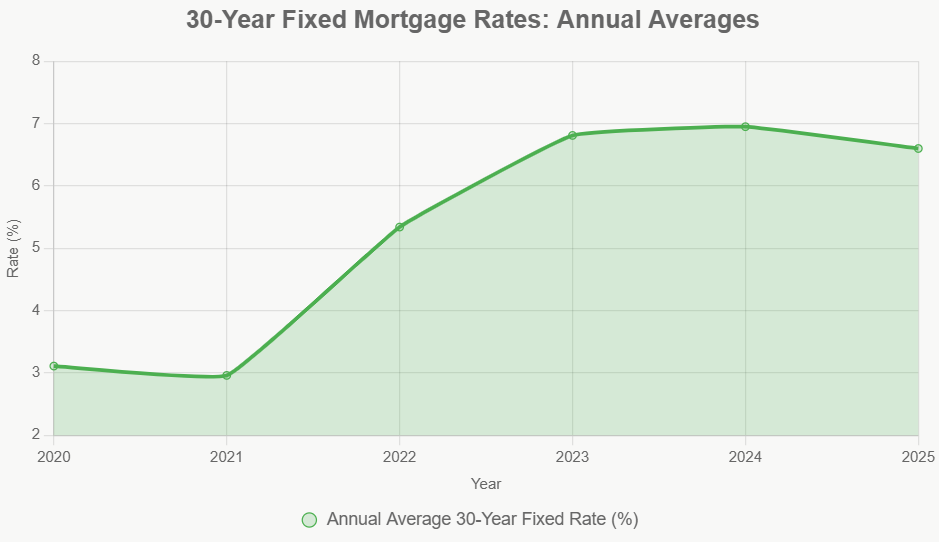
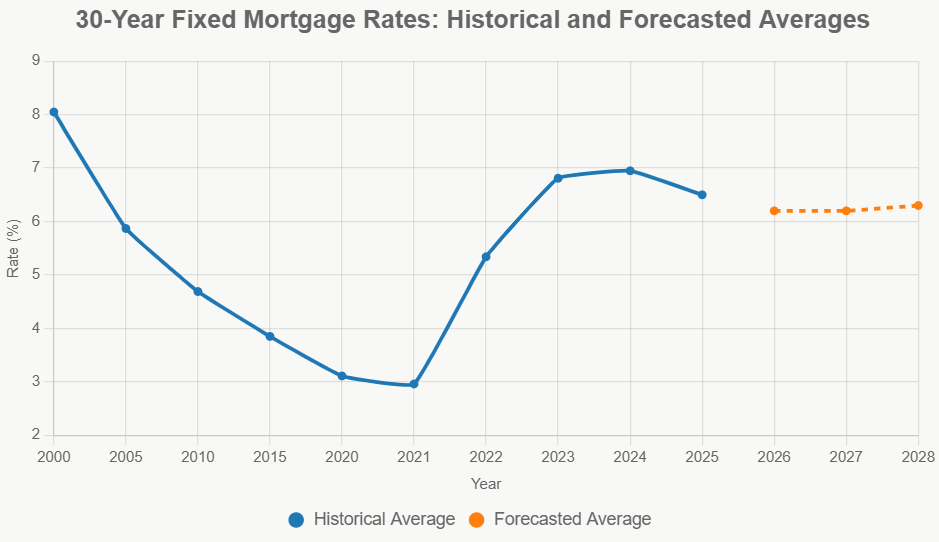
30-Year Fixed Mortgage Rates: Annual Averages

To figure out if 5% is on the cards, it helps to remember where we've been. The 30-year fixed mortgage rate has averaged around 7.71% since 1971, according to data compiled by Freddie Mac and others. We even saw rates soar above 18% back in the early 1980s when inflation was a major problem.

Then things changed. After the 2008 financial crisis, we entered a period of really low rates. But the real wild ride arguably started with the COVID-19 pandemic:

  • 2020: Stimulus money flowed like water, and mortgage rates dropped to a yearly average of 3.11%. This sent people scrambling to buy homes, and sales shot up by 16%.
  • 2021: This was the golden year for low rates, averaging 2.96%. Homeownership felt within reach for more people, but the lack of houses on the market led to bidding wars.
  • 2022: Inflation started biting hard. Rates climbed to an average of 5.34% for the year, hitting a peak of over 7% by October as the Federal Reserve started hiking its key interest rate to fight rising prices.
  • 2023: This year was tough, with an average rate of 6.81%. Many potential buyers were priced out, and home sales dropped by about 19%.
  • 2024: Rates sort of bounced around, ending up at an average of 6.95%. Some rate cuts late in the year gave a little glimmer of hope.
  • 2025: So far, rates have generally been in the mid-6% range, settling to an estimated annual average of 6.60% by year-end.

This history shows us that mortgage rates are super sensitive to what's happening in the economy. Dropping to 5% or below usually happens when the economy is pretty weak or when the Federal Reserve is making big efforts to boost things. Since the economy seems to be holding up fairly well, a dramatic drop might be capped.

What's Really Moving the Needle on Mortgage Rates?

It’s easy to think mortgage rates just magically appear, but they're actually tied to a bunch of bigger financial factors. The most important is the 10-year Treasury yield, which is basically what the government pays to borrow money for 10 years. Lenders then add a bit extra to that yield to cover their costs and make a profit, often around 1.8% to 2.3%.

Here are the main forces at play:

  • The Federal Reserve's Moves: The Fed controls a short-term interest rate called the federal funds rate. When they cut this rate, it tends to push longer-term rates, including mortgage rates, lower. In 2025, the Fed made about three cuts, totaling 0.75%, bringing their target rate down. This helped ease pressure on mortgages. However, even with these cuts, mortgage rates didn't drop as much as folks hoped because inflation was still a bit stubborn. If the Fed cuts rates two more times in 2026, and inflation keeps cooling, we could see mortgage rates drop by another 0.25% to 0.50%.
  • Inflation's Grip: As of late 2025, the core inflation rate (which measures price increases excluding food and energy) is around 2.7%. That's better than it was, but it's still higher than the Fed's target of 2%. If inflation continues to fall steadily, dipping below, say, 2.5%, that could help push mortgage rates closer to 5.5%. But if prices start creeping up again, maybe because of supply chain problems or rising wages, then those rate drops will stall.
  • The Economy's Health: Things like job growth and the overall growth of the economy (GDP) play a big role. When the economy is strong, with unemployment low (around 4.1% as of late 2025) and GDP growing at a decent clip (like 2.5% annualized), it tends to keep interest rates higher. Consumers spending money and people wanting to buy homes also add to this demand for borrowing, which can keep rates from falling too low.
  • What's Happening Globally: Big events happening worldwide can also affect things. For example, if there's a lot of fear or instability in the world, investors often move their money into safer investments like U.S. Treasury bonds, which can actually push their yields (and therefore mortgage rates) up. Also, in 2025, there were times when the market for mortgage-backed securities was a bit uncertain, causing lenders to widen the gap between their borrowing costs and the rates they offered to borrowers.

So, while the Fed cutting rates is a helpful nudge in the right direction, inflation's tendency to stick around is like a brake on how fast rates can fall. To really see rates dive below 5%, we'd probably need to see inflation come down consistently and the Fed feel confident enough to make more aggressive cuts.

What the Experts Are Saying About 2026
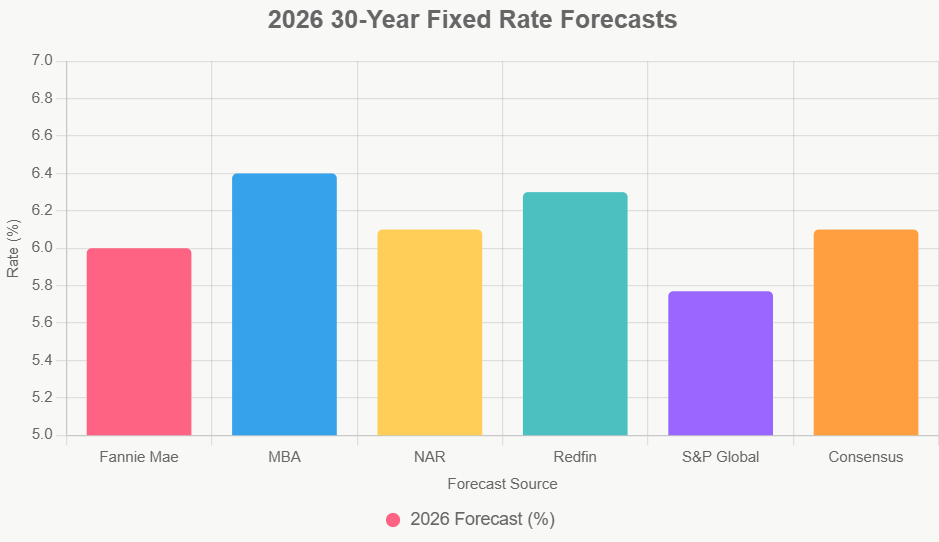
30-Year Fixed Rate Forecast for 2026

When I look at what the big financial institutions and real estate groups are predicting for 2026, there's a general feeling of some easing, but nobody is boldly shouting “5%!” here we come. The general consensus seems to be that rates will likely settle in the mid-6% range.

Here’s a quick rundown of some of those forecasts:

Source 2026 Average Rate Q4 2026 Projection Notes
Fannie Mae 6.0% 5.9% Predicts a steady drop each quarter, betting on Fed cuts.
Mortgage Bankers Assoc. (MBA) 6.4% 6.4% Expects rates to stay pretty much flat throughout the year.
National Assoc. of Realtors (NAR) 6.1% 6.0% Believes rates will hang out in the mid-6% range.
Redfin 6.3% N/A Suggests a slight easing compared to 2025.
S&P Global 5.77% N/A The most optimistic forecast, banking on significant Fed action.

Note: Some projections are based on specific scenarios and economic assumptions.

Fannie Mae has the most optimistic outlook, suggesting rates could end the year just shy of 5.9%. This scenario relies on the Fed making more cuts and inflation really cooperating. On the other hand, the MBA sees rates staying pretty much where they are. NAR and others are clustering in the low- to mid-6% zone. S&P Global's forecast of 5.77% is quite bullish and hinges on inflation cooling down faster than most expect.

Looking even further out, towards 2030, many forecasts suggest rates will hover in the 6.0% to 6.4% range, barring any major economic surprises. This suggests that the days of ultra-low rates might be behind us for a good while, at least without some significant economic upheaval.

If Rates Did Drop to 5%, What Would That Mean?

Now, let's imagine, just for a moment, that those rates did manage to dip into the 5% range. The impact would be pretty significant.

  • More Buyers Could Enter the Market: This is the big one. Affordability would jump dramatically. Using data from the National Association of Home Builders (NAHB), when rates are around 7.25%, only about 20% of households can afford the average new home. But if rates dropped to 6.25%, that number jumps to around 26% – a nice boost. If we got down to 5%, even more people would be able to afford starter homes or upgrade. Redfin estimates this could bring 5.5 million more potential buyers into the game.
  • Home Sales Could Get a Kickstart: With more buyers able to qualify for mortgages, we'd likely see a bump in overall home sales. We could be looking at a 10% to 15% increase in sales compared to what we're seeing now. The National Association of Realtors is already forecasting around 4 million existing-home sales in 2026, and a drop in rates could push that higher.
  • Prices Might Start Climbing Again: While lower rates make homes more affordable on a monthly basis, they can also lead to more demand. In areas where homes are already scarce, this increased competition could push prices up by 2% to 3% nationally, though some regions might see bigger jumps than others.
  • A Refinancing Frenzy: Homeowners who have higher-rate mortgages might rush to refinance, potentially freeing up tens of billions of dollars in household cash that could be spent elsewhere in the economy, giving GDP a little boost.

However, it's not all sunshine. If demand surges too quickly, it could put pressure on the limited supply of homes available. This could create bidding wars all over again and potentially push the Federal Reserve to rethink cutting rates further, or even raise them again if inflation starts to reheat.

My Take: Hope for Relief, But Keep Expectations in Check

From where I stand, looking at all the data and expert opinions, I feel there's good reason to expect some relief in mortgage rates during 2026. We’ll likely see those 30-year fixed rates move into the low- to mid-6% range. It’s not quite the 5% dream many are hoping for, but it’s still a step in the right direction and will make homeownership more attainable for a larger number of people.

Breaking into the 5% range is a much bigger ask. It would need inflation to cool off much faster and more consistently than it has been, and for the Federal Reserve to be very bold with their interest rate cuts. While it’s not entirely impossible, it seems like more of a long shot for 2026.

For anyone thinking about buying a home, my advice is to keep a close eye on the weekly mortgage rate reports from Freddie Mac and keep an eye on what’s happening with those Treasury yields. Think about your financial goals. If you see a rate that makes sense for you and locks in a payment you can comfortably afford, it might be worth considering. Waiting for 5% could mean missing out on a good opportunity if rates level off in the 6% range. In this market, being ready financially and making a strategic decision based on your own circumstances is key.

Invest Smartly in Turnkey Rental Properties

With rates dipping to their lowest levels, investors are locking in financing to maximize cash flow and long-term returns.

Norada Real Estate helps you seize this rare opportunity with turnkey rental properties in strong markets—so you can build passive income while borrowing costs remain historically low.

🔥 HOT NEW LISTINGS JUST ADDED! 🔥

Talk to a Norada investment counselor today (No Obligation):

(800) 611-3060

Get Started Now

Also Read:

  • Mortgage Rates Predictions Backed by 7 Leading Experts: 2025–2026
  • Mortgage Rate Predictions for the Next 3 Years: 2026, 2027, 2028
  • 30-Year Fixed Mortgage Rate Forecast for the Next 5 Years
  • 15-Year Fixed Mortgage Rate Predictions for Next 5 Years: 2025-2029
  • Will Mortgage Rates Ever Be 3% Again in the Future?
  • Mortgage Rates Predictions for Next 2 Years
  • Mortgage Rate Predictions for Next 5 Years
  • Mortgage Rate Predictions: Why 2% and 3% Rates are Out of Reach
  • How Lower Mortgage Rates Can Save You Thousands?
  • How to Get a Low Mortgage Interest Rate?
  • Will Mortgage Rates Ever Be 4% Again?

Filed Under: Financing, Mortgage Tagged With: Interest Rate, mortgage, Mortgage Rate Trends, mortgage rates

Mortgage Rates Reset 2026: End of Ultra-Low Rates, 6% Becomes New Normal

January 17, 2026 by Marco Santarelli

Mortgage Rates Reset 2026: End of Ultra-Low Rates, 6% Becomes New Normal

After years of historically low borrowing costs, the housing market is entering a new phase. Mortgage rates near 6%—once considered restrictive—are increasingly becoming the norm as inflation cools unevenly and policymakers resist a rapid return to aggressive rate cuts. The shift marks a clear break from the ultra-low-rate environment of 2020 and 2021, reshaping how buyers and homeowners think about affordability.

As the market enters 2026, economists and housing analysts are largely in agreement on one point: the era of sub-4% mortgage rates is effectively over. Instead, a range between roughly 5% and 6.5% is emerging as the baseline for the foreseeable future. As of now, the average 30-year fixed mortgage rate is hovering around 6.18%, underscoring a structural reset in borrowing costs that is forcing households to recalibrate expectations.

Mortgage Rates Reset 2026: End of Ultra-Low Rates, 6% Becomes New Normal

For years, fueled by an unprecedented global response to the pandemic, mortgage rates plunged to levels we'd frankly never seen before. I remember those days vividly, feeling like the housing market was on permanent “sale.” But those sub-3% rates of 2020 and 2021 were born out of crisis, a desperate attempt by the Federal Reserve to prop up a teetering economy. They were emergency measures, and expecting them to return without another seismic global event is, in my opinion, simply unrealistic. We're now in a different economic chapter, one that demands a more grounded perspective on interest rates.

Why the Party's Over: Unpacking the “Why” Behind Higher Rates

So, what exactly is keeping mortgage rates from dipping back into those dreamlike thirties? It's a blend of persistent economic forces that are unlikely to disappear overnight.

1. The Fed's Emergency Button is Off

You can't talk about mortgage rates without talking about the Federal Reserve. During the pandemic, they did everything they could to make borrowing cheap. They slashed the federal funds rate to basically zero and bought mountains of mortgage-backed securities. This flooded the market with money and drove rates down. But as I said, those were extreme times. Now, with the economy on firmer footing, that emergency toolkit is firmly shut. Those ultra-low rates were a historical anomaly, not a sustainable trend.

2. Inflation is Stubborn, and the Bond Market Knows It

This is a big one. Mortgage rates don't just magically appear; they're closely tied to something called the 10-year Treasury yield. Think of it as a bellwether for long-term borrowing costs. Even if the Fed fiddles with short-term rates, if investors expect inflation to stick around, they'll demand higher yields on those long-term bonds. And guess what? Inflation, while cooling from its peak, is still stubbornly above the Fed's 2% target. This “sticky” inflation means the Fed has to keep borrowing costs elevated to prevent prices from running wild again.

3. Uncle Sam's Big Pockets and a Resilient Economy

The government's spending habits also play a role. Our ever-growing federal deficit and national debt mean the government has to borrow more money. To entice investors to buy all that debt, they have to offer higher interest rates. It's simple supply and demand. On top of that, our economy has shown surprising resilience. The job market is still strong, and growth is steady. This signals to the Fed that they don't need to slash rates to goose the economy, allowing them to maintain their “higher-for-longer” stance.

The “New Normal”: What to Expect from 5-6% Mortgage Rates

So, what does this shift to a 5% to 6.5% mortgage rate environment mean for the housing market? From my perspective, it's not a doomsday scenario, but it is a move towards a more balanced and sustainable market.

Affordability: Better, But Still a Hurdle

Let's be honest, a 5% or 6% mortgage is still a significant chunk of change compared to the 2-3% rates some people got. However, it's a welcome improvement from the 7%+ peaks we saw in 2023 and early 2024. When you combine these somewhat lower rates with rising incomes, the monthly payment for a typical home becomes more manageable. In fact, for many, it's starting to fall back below that crucial 30% affordability threshold. This is a big deal for bringing more people back into the homeownership game.

Demand is Stirring Responsibly

This moderation in rates is expected to unlock a lot of pent-up buyer demand. Think about all those people who were priced out or waiting on the sidelines. A drop to around 6% could, according to some estimates, allow millions of qualified buyers to finally achieve homeownership. It’s not the frantic, bidding-war madness we saw before, but a more calculated return of serious buyers.

Price Growth: Cooling Off, Not Crashing

Don't expect home prices to plummet. The days of the extreme, double-digit annual appreciation seem to be behind us, thankfully. Instead, we're looking at more modest, historically normal price growth. Figures around 2-3% annually, as projected by sites like Realtor.com, are much more sustainable and allow incomes to catch up.

Inventory: A Gradual Welcome Mat

The number of homes available for sale is expected to tick up. This is good news for buyers, meaning more options and less of that frenzied competition. However, we're likely to remain below pre-pandemic levels. The “lock-in effect,” where homeowners with super-low rates are reluctant to sell and get a new, higher-rate mortgage, will continue to keep some inventory off the market.

Sales Volume: A Steady Upward Climb

Existing home sales hit some pretty low points in recent years. With some rate relief and a more balanced market, we're forecast to see a gradual increase in sales activity. Projections suggest the total number of homes sold could surpass 5 million in 2026 as more buyers find their comfort zone.

Here's a quick look at what the experts are saying about future mortgage rates:

Period Expected Rate Range
Late 2025 6.2% – 6.5%
Early 2026 6.0% – 6.4%
Late 2026 5.5% – 6.0%

Source: Various housing organizations and expert forecasts as of late 2025

My Take: Embracing the New Reality

From where I sit, this shift is a positive move towards a healthier housing market. The era of ultra-low rates was exciting, but it wasn't sustainable. A mortgage rate in the 5-6% range is still a significant borrowing cost, but it's a more realistic one for the current economic climate. It forces buyers to be more diligent in their search and sellers to be pragmatic about their pricing.

For buyers, this means revisiting your budget, understanding your true borrowing capacity at these rates, and being prepared for slightly longer closing times and more negotiation. For sellers, it means adjusting expectations and pricing your home competitively from the get-go. While the days of effortless multiple offers might be fewer, a well-priced home in a good location will still sell.

Ultimately, the “new normal” of 5-6% mortgage rates signifies a return to more traditional market dynamics. It's a market that rewards smart financial planning, patience, and a realistic understanding of the economic forces at play. It's time to ditch the rearview mirror and focus on navigating this evolved housing landscape with informed optimism.

Invest in Fully Managed Rentals for Smarter Wealth Building

With mortgage rates dipping to their lowest levels in months, savvy investors are seizing the opportunity to lock in financing.

By securing favorable terms now, you can also maximize immediate cash flow while positioning yourself for stronger long‑term returns.

Norada Real Estate helps you seize this rare opportunity with turnkey rental properties in strong markets—so you can build passive income while borrowing costs remain historically low.

🔥 HOT NEW LISTINGS JUST ADDED! 🔥

Talk to a Norada investment counselor today (No Obligation):

(800) 611-3060

Get Started Now

Also Read:

  • Mortgage Rates Predictions Backed by 7 Leading Experts: 2025–2026
  • Mortgage Rate Predictions for the Next 3 Years: 2026, 2027, 2028
  • 30-Year Fixed Mortgage Rate Forecast for the Next 5 Years
  • 15-Year Fixed Mortgage Rate Predictions for Next 5 Years: 2025-2029
  • Will Mortgage Rates Ever Be 3% Again in the Future?
  • Mortgage Rates Predictions for Next 2 Years
  • Mortgage Rate Predictions for Next 5 Years
  • Mortgage Rate Predictions: Why 2% and 3% Rates are Out of Reach
  • How Lower Mortgage Rates Can Save You Thousands?
  • How to Get a Low Mortgage Interest Rate?
  • Will Mortgage Rates Ever Be 4% Again?
Filed Under: Financing, Mortgage Tagged With: Interest Rate, mortgage, Mortgage Rate Trends, mortgage rates, Mortgage Rates Today

What Leading Housing Experts Predict for Mortgage Rates in 2026

January 11, 2026 by Marco Santarelli

What Leading Housing Experts Predict for Mortgage Rates in 2026

Mortgage rate predictions for 2026 by top housing experts largely point towards a period of stabilization, with the average 30-year fixed-rate mortgage hovering between 6.0% and 6.4%. While most anticipate a relatively flat year for rates, a slight dip might occur towards the end of 2026 as the Federal Reserve's efforts to manage the economy mature.

It’s a question on so many minds right now: what will happen with mortgage rates in the coming years, especially as we look ahead to 2026? As someone who’s been following the housing market for a while, I know how much these numbers impact people’s decisions, whether they’re buying their first home, looking to upgrade, or even just dreaming about owning. The good news is, the chatter among the pros suggests we're moving out of the wild swings we've seen and into a more predictable phase.

What Leading Housing Experts Predict for Mortgage Rates in 2026

What the Experts Are Saying: A Look at 2026 Mortgage Rates

After a period of significant ups and downs, the common thread among leading housing experts for 2026 is stability. The general consensus is that the dramatic rate hikes and cuts are likely behind us, and we're settling into a range that feels more like a “new normal” for borrowing.

Here’s a breakdown of what some major players in the housing finance world are predicting for the average 30-year fixed-rate mortgage in 2026:

  • Fannie Mae: They see a gentle downward trend, starting the year (Q1) around 6.2% and easing to about 5.9% by the close of 2026. This suggests a modest improvement as the year progresses.
  • National Association of Realtors (NAR): The NAR is a bit more optimistic, projecting an average rate of 6.0% for the entire year. This would be a noticeable drop from the higher rates we saw in earlier 2025.
  • Wells Fargo: Their crystal ball shows rates staying above the 6% mark. They foresee an annual average of around 6.18%, indicating a persistent high-interest environment.
  • Realtor.com: This platform expects a pretty flat trend, with an average rate of 6.3% throughout 2026. This is slightly lower than their reported full-year average for 2025.
  • Mortgage Bankers Association (MBA): They have the most conservative outlook, predicting rates to remain steady at 6.4% across all quarters of 2026. This forecast highlights a “new normal” where affordability might remain a challenge.
  • Freddie Mac: Current analyses put their 2026 outlook near 6.2%, though they've been less specific with detailed quarterly figures for the later half of the year.
  • Morgan Stanley: While they don't always release granular mortgage rate predictions for specific years, their broader economic forecasts generally align with a stabilization in the low-to-mid 6% range as the Federal Reserve aims for a more balanced economic stance.

Key Themes Shaping 2026 Mortgage Rates

When I look at these predictions, a few main ideas keep coming up:

  • The “Flat” Forecast: The overwhelming sentiment is that the wild ride of mortgage rate volatility is over. We're looking at a period where rates might not change dramatically, which, in my opinion, is actually a good thing for planning. It allows buyers and sellers to make more informed decisions without the constant worry of big swings.
  • The 6% Barrier: While some, like Fannie Mae and NAR, hint at dipping below 6% by year-end, the general feeling is that sub-6% rates will be more of an occasional guest than a permanent resident. For many, this means adjusting their expectations from the ultra-low rates of a few years ago.
  • Home Prices vs. Rates: Even with stable or slightly falling mortgage rates, it’s important to remember that home prices are still expected to creep up, likely by 1.3% to 4.0% nationally in 2026. This is a crucial point: waiting for significantly lower rates might mean facing higher purchase prices down the line.

Understanding the MBA's 6.4% Outlook: A Deeper Dive

The Mortgage Bankers Association's (MBA) prediction of a 6.4% average rate for 2026 is particularly interesting because it paints a picture of persistent affordability challenges. While this is an improvement from the over 7% rates seen in early 2025, it's still a good bit higher than the sub-4% rates that many enjoyed not too long ago.

Let's break down what a 6.4% rate could mean:

  • Continued Pressure on Budgets: Monthly mortgage payments will likely remain high for many buyers. This, combined with still-rising home prices, means that saving for a down payment and qualifying for a loan will continue to be a hurdle.
  • A “New Baseline” for Buyers: For those who have been on the sidelines waiting for a return to 3% or 4% rates, the MBA's forecast suggests a need to recalibrate. A range of 6% to 6.5% is increasingly seen as the new normal, and many buyers may decide it's time to enter the market rather than wait indefinitely.
  • A Modest Boost in Sales: Despite the affordability challenges, the MBA expects a modest increase in home sales. They anticipate single-family mortgage originations to rise to $2.2 trillion in 2026, up from $2.05 trillion in 2025. This suggests that while rates aren't rock-bottom, other factors like improved inventory and stable incomes will drive some activity.
  • Flat or Slightly Falling Home Prices: The MBA's forecast is linked to an expectation that national home prices will be largely stable or even see a slight dip by late 2026. This would offer some incremental relief on affordability, though it contrasts with more optimistic growth forecasts from other agencies.
  • Limited Opportunities for Refinancing: If rates hold steady or begin to edge up in 2027, the MBA predicts that refinancing activity will remain subdued. Not many homeowners will find themselves in a position where refinancing offers a significant financial advantage.
  • Market Predictability: The consistent 6.4% prediction signifies a period of market stability. This stability, in my view, is a big plus. It removes a layer of uncertainty that can make planning for a home purchase so stressful.

What Could Push Rates Lower Than Expected?

While the consensus is for stability, there are a few scenarios that could push mortgage rates below the predicted ranges. It all hinges on how certain economic indicators perform.

Here are the key factors that might lead to lower mortgage rates:

  • Inflation Hits the Target: The biggest driver for lower rates would be if inflation consistently cools down to the Federal Reserve's 2% target. If the Fed sees a sustained drop in inflation, they'll likely feel more comfortable making more significant interest rate cuts, which would then ease pressure on mortgage rates.
  • A Softer Job Market: If the U.S. labor market shows signs of significant weakening, like a sharp rise in unemployment (say, above 4.5%), that would signal a slowing economy. In response, the Fed might cut rates more aggressively to try and stimulate growth, leading to lower mortgage rates.
  • Economic Slowdown or Recession: Any major, unforeseen economic shock, like a significant drop in consumer spending or a financial crisis, could trigger a recession. In such “flight to safety” situations, investors tend to move their money into safer assets like U.S. Treasury bonds. This increased demand for bonds drives their yields down, and consequently, mortgage rates tend to follow.
  • Sharp Drop in Bond Yields: Mortgage rates are very closely tied to the yield on the 10-year U.S. Treasury note. For mortgage rates to genuinely fall below 6%, the 10-year Treasury yield would likely need to drop considerably from its projected 4% range. This often happens when there's global economic uncertainty or strong demand for these safe investments.
  • Narrowing Mortgage Spreads: The difference between the 10-year Treasury yield and the 30-year fixed mortgage rate (known as the “mortgage spread”) has been wider than usual lately. If this spread narrows and returns to its historical average, it could help lower mortgage rates even if Treasury yields don't change much.

Ultimately, navigating the mortgage market requires staying informed and understanding these different possibilities. While the experts lean towards a stable year for mortgage rates in 2026, keeping an eye on economic indicators will be key for anyone hoping for more favorable borrowing costs.

Generate Passive Income & Wealth with Turnkey Rentals

With forecasts from top industry experts, mortgage rates for 2026 remain a critical factor for buyers and investors. Whether rates stabilize, rise, or finally decline, the impact on affordability and cash flow is significant.

Norada Real Estate helps you navigate these shifts with turnkey rental properties designed to deliver consistent passive income and appreciation—so you can build long‑term wealth regardless of where mortgage rates move.

🔥 HOT 2026 INVESTMENT LISTINGS JUST ADDED! 🔥
Talk to a Norada investment counselor today (No Obligation):
(800) 611-3060
Get Started Now
Recommended Read:
  • Mortgage Rates Forecast for the Next 3 Years: 2025 to 2027
  • 30-Year Mortgage Rate Forecast for the Next 5 Years
  • 15-Year Mortgage Rate Forecast for the Next 5 Years
  • Why Are Mortgage Rates Going Up in 2025: Will Rates Drop?
  • Why Are Mortgage Rates So High and Predictions for 2025
  • Will Mortgage Rates Ever Be 3% Again in the Future?
  • Mortgage Rates Predictions for Next 2 Years
  • Mortgage Rate Predictions for Next 5 Years
  • Mortgage Rate Predictions: Why 2% and 3% Rates are Out of Reach
  • How Lower Mortgage Rates Can Save You Thousands?
  • How to Get a Low Mortgage Interest Rate?
  • Will Mortgage Rates Ever Be 4% Again?
Filed Under: Financing, Mortgage Tagged With: Interest Rate, mortgage, mortgage rates, Mortgage Rates Predictions

Experts Predict Little Chance of Mortgage Rates Dropping Below 6% in 2026

January 7, 2026 by Marco Santarelli

Experts Predict Little Chance of Mortgage Rates Dropping Below 6% in 2026

If so, you're probably wondering what's going to happen with mortgage rates. It's the million-dollar question, right? Well, I've been looking closely at the latest forecasts, especially the 30‑year mortgage rate predictions for 2026 by Zillow, Redfin, and Realtor.com. And here's the headline takeaway I'm getting: most experts think the average 30-year fixed mortgage rate will likely settle around 6.3% in 2026. It’s not a huge drop, but it might be just enough to make things a bit easier for buyers.

As we wrap up 2025, the housing market feels like it's finally catching its breath after a few wild years. Remember when rates shot up past 7%? Ouch. Thankfully, the Federal Reserve's moves this year have brought rates down into the mid-6% range. But that dream of getting back to those super-low rates we saw a few years ago? That still seems unlikely for now.

This 6.3% prediction from Zillow, Redfin, and Realtor.com suggests a gradual cooling off, more of a steady adjustment than a sudden boom or bust. I'll be sharing my own thoughts and insights based on what I'm seeing in the market data and hearing from these major real estate players.

Experts Predict Little Chance of Mortgage Rates Dropping Below 6% in 2026

What the Experts Are Saying About 2026 Mortgage Rates

It’s interesting how closely Zillow, Redfin, and Realtor.com seem to agree on the main point: rates are expected to ease slightly, but probably not dramatically drop below 6% for any extended period in 2026. Think of it as a gentle nudge towards better affordability rather than a wide-open door.

Here’s a quick look at their general outlook:

Platform Projected 2026 Average Rate Key Rate Range/Scenarios Impact on Payments (Estimated)
Zillow Around 6.3% (unlikely below 6%) Lingers in the low- to mid-6% range Modest improvement
Redfin 6.3% Mostly low-6% range, brief dips <6% Slight affordability boost
Realtor.com 6.3% Stays in the low-6% range ~1.3% payment reduction

What strikes me is this consistent forecast. It tells me that the underlying economic forces are pointing in a similar direction for all these groups. They're all looking at factors like inflation, the Federal Reserve's actions, and the overall health of the economy.

Historical and Projected 30-Year Fixed Mortgage Rates (2010-2026)

Zillow's team, who pay close attention to things like rent prices (a big part of inflation), are really emphasizing that inflation isn't going away completely. This is a major reason they don't see rates diving below 6%. They believe the bond market, which heavily influences mortgage rates, will keep rates somewhat anchored above that psychological threshold.

Redfin talks about a “Great Housing Reset,” and their prediction fits right into that. They see rates averaging 6.3%, maybe dipping slightly below 6% here and there, but not staying there. It suggests a market finding a more stable footing.

Realtor.com's forecast is right on the money at 6.3% too. They highlight that this could mean a noticeable drop in monthly payments—around 1.3% less for the typical homebuyer compared to 2025. That might not sound huge, but trust me, when you're talking about mortgage payments, every little bit helps!

Why Are Rates Predicted to Be Around 6.3%?

It's easy to just throw out a number, but why do these experts think this? Several big economic factors are at play. Based on my reading and experience, here are the main ones shaping the 2026 mortgage rate predictions:

  • The Federal Reserve's Balancing Act: The Fed has been raising interest rates to fight inflation. Now, they've started cutting them, which helps lower mortgage rates. But they're being cautious. They've signaled they'll likely cut rates more in 2025, maybe 50 to 75 basis points total. However, they don't want to cut too fast or too deep, especially if inflation starts ticking up again. By late 2025, they might reach a “neutral” rate – not actively trying to slow the economy down, but not stimulating it either. This neutrality means less downward pressure on mortgage rates.
  • Inflation Still Lingers: Even with rate cuts, inflation hasn't completely vanished. Costs for things like rent and housing services are still a bit stubborn. Since mortgage rates are closely tied to the yields on government bonds (like the 10-year Treasury), and those yields are sensitive to inflation fears, rates are likely to stay higher than they were a few years ago. Think of it like this: if investors think inflation will eat away at their returns, they'll demand higher interest rates on bonds, and that pushes mortgage rates up.
  • The Economy is Okay, But Not Amazing: We're seeing slowing economic growth and unemployment ticking up slightly (maybe around 4.5%). This is actually one reason the Fed can cut rates. But the job market is still pretty solid, with decent job creation each month. This resilience prevents a sharp economic downturn that might force rates much lower. It’s a Goldilocks scenario – not too hot, not too cold – which often leads to moderate rate environments.
  • Worries About Debt and Global Stability: The U.S. has a lot of government debt, and that can sometimes put upward pressure on interest rates. Plus, global issues – like trade tensions or conflicts – can create uncertainty. When the world feels shaky, investors often move money to safer assets, which can affect bond yields and, consequently, mortgage rates. These factors act as a brake, preventing rates from falling too drastically.
  • What's Happening in Housing Itself: Even though rates are higher, there still aren't enough homes for sale in many areas. This shortage keeps demand relatively strong, which can indirectly support mortgage rates by preventing a steep drop in home prices.

From my perspective, it’s this mix of factors – the Fed trying to be careful, inflation not totally gone, a steady economy, and some lingering global/debt concerns – that creates the consensus for rates hovering in that low-to-mid-6% range.

What Does This Mean for the Housing Market? A “Reset,” Not a “Boom”

So, what’s the practical impact of these 30‑year mortgage rate predictions? The word I keep hearing from these experts is “reset.” It suggests a market that's becoming more balanced, not one that's suddenly going to take off like a rocket.

Here’s what I expect we might see:

  • More Homes Selling: With rates slightly lower, some buyers who were priced out or waiting on the sidelines might jump back in. Zillow predicts around 4.26 million existing-home sales, Redfin is looking at about 4.2 million, and Realtor.com forecasts 4.13 million. This is a modest increase, maybe 1-4% higher than in 2025. It’s driven by the fact that buyers could potentially save tens of thousands of dollars over the life of their loan compared to earlier peaks.
  • Home Prices Stabilize: Forget huge price jumps. Experts are predicting price growth to slow down to about 1-2.2% nationally. Realtor.com sees prices going up maybe 2.2%, Redfin forecasts just 1%, and Zillow is around 1.2%. This is good news because it means incomes might start keeping pace with, or even slightly outpacing, home price increases for the first time in a while.
  • Refinancing Picks Up: Many homeowners refinanced when rates were at historic lows a few years back. Now, with rates expected to be in the mid-6% range, some of those folks might find a reason to refinance again if rates dip into the high 5% or very low 6% range. Redfin, for instance, sees refinancing activity jumping significantly. This could help homeowners lower their monthly payments.
  • A Better Balance for Buyers and Sellers: We might see a slight increase in the number of homes available for sale (maybe 15-20% more). This could ease the intense competition buyers have faced. However, I suspect a significant chunk of potential buyers, especially younger ones like millennials, might still struggle with affordability, even with slightly lower rates. Builders might continue offering incentives like mortgage rate buydowns to attract buyers.

I personally feel this gradual adjustment is healthier for the market long-term. It helps prevent another bubble and allows things to stabilize after the craziness of the pandemic and the subsequent rate hikes.

Not All Areas Are the Same: Regional Differences Matter

It’s crucial to remember that these national averages don't tell the whole story. My experience shows that real estate is always local.

  • Midwest vs. Sun Belt: You might find better affordability and more stable rates in Midwestern cities, where home prices are generally lower. Places like Indianapolis could see rates around 6.2% with payments dropping. On the flip side, popular Sun Belt areas like Phoenix might continue to see rates slightly higher, maybe closer to 6.5%, and still experience some price growth.
  • Value Opportunities: Zillow points out cities like Buffalo, NY, that might see home values increase despite higher rates, maybe by 3.5%. These are often places where prices haven’t skyrocketed as much. Conversely, areas like Austin, TX, might see prices soften slightly (-0.5%).
  • Coastal Hubs: Expect sticker shock to remain a challenge in major coastal cities where demand is high and prices are already expensive. Even with a 6.3% rate, monthly payments could easily be $3,000 or more.

Conclusion: A Steady Path Forward

Looking at the 30‑year mortgage rate predictions for 2026, I feel cautiously optimistic. The consensus points towards a gradual cooling, settling around 6.3%. This isn't the super-low rate environment of the past, but it’s a step towards better balance and affordability after a period of intense fluctuation.

This forecast suggests a housing market focused on sustainable growth rather than speculative frenzy. While unexpected economic events can always shake things up, 2026 appears poised to be a year of steady progress for those looking to make a move in real estate. It’s a good time to be informed, do your homework, and make strategic decisions based on the best data available.

From Cash to Cash Flow: Build Hassle‑Free Passive Income

Invest once, collect monthly — a simple way to turn your capital into steady, hassle‑free passive income.

Norada Real Estate helps you seize this rare opportunity with turnkey rental properties in strong markets—so you can build passive income while borrowing costs remain historically low.

🔥 HOT NEW Properties JUST ADDED! 🔥

Talk to a Norada investment counselor today (No Obligation):

(800) 611-3060

Get Started Now

Also Read:

  • Mortgage Rates Predictions for 2026: Insights from Leading Forecasters
  • Mortgage Rates Predictions Backed by 7 Leading Experts: 2025–2026
  • Mortgage Rate Predictions for the Next 3 Years: 2026, 2027, 2028
  • 30-Year Fixed Mortgage Rate Forecast for the Next 5 Years
  • 15-Year Fixed Mortgage Rate Predictions for Next 5 Years: 2025-2029
  • Will Mortgage Rates Ever Be 3% Again in the Future?
  • Mortgage Rates Predictions for Next 2 Years
  • Mortgage Rate Predictions for Next 5 Years
  • Mortgage Rate Predictions: Why 2% and 3% Rates are Out of Reach
  • How Lower Mortgage Rates Can Save You Thousands?
  • How to Get a Low Mortgage Interest Rate?
  • Will Mortgage Rates Ever Be 4% Again?

Filed Under: Financing, Mortgage Tagged With: Interest Rate, mortgage, Mortgage Rate Trends, mortgage rates, Mortgage Rates Today

Mortgage Rate Predictions for 2026: What Leading Forecasters Expect

January 7, 2026 by Marco Santarelli

Mortgage Rate Predictions for 2026: What Leading Forecasters Expect

The question on everyone’s mind, especially if you're dreaming of homeownership or looking to refinance: what will mortgage rates do by 2026? Based on current economic indicators and expert analysis, mortgage rates in 2026 are expected to see a modest decline, likely hovering between 5.9% and 6.5% for a 30-year fixed loan. While a significant drop below 6% isn't a certainty, this anticipated easing offers a glimmer of hope for a more accessible housing market.

Mortgage Rate Predictions for 2026: What Leading Forecasters Expect

As I look at the data and speak with folks who follow this stuff closely, it feels like we're moving from a period of significant upward pressure on rates to a more stable, slowly descending path. It’s not a freefall, mind you, but it’s definitely a move in the right direction after the highs we’ve seen. This isn't just about numbers; it's about how people can afford their homes, build equity, and participate in the American dream.

The Road Behind Us: From Pandemic Perks to Pricey Mortgages

To understand where we're headed, we have to look back at how we got here. Remember those unbelievably low mortgage rates around 2021? A 30-year fixed-rate mortgage averaged a stunning 3.15%. It was a golden age for home buyers and refinancers!

Then, as we all know, the economy started to heat up fast. Inflation, which had been pretty quiet, suddenly surged. To try and tame it, the Federal Reserve started raising interest rates pretty aggressively. This “interest rate hike” cycle meant mortgage rates shot up, hitting a peak near 7% in 2023. Ouch. For anyone trying to buy a house, that meant much higher monthly payments. It also created a “lock-in effect” where homeowners with super-low rates weren't selling their homes, leading to less inventory.

Now, as we stand in late 2025, rates have stabilized a bit, mostly hovering in the 6.2% to 6.7% range. This is still high compared to a few years ago, but it’s a welcome pause after the rapid increases.

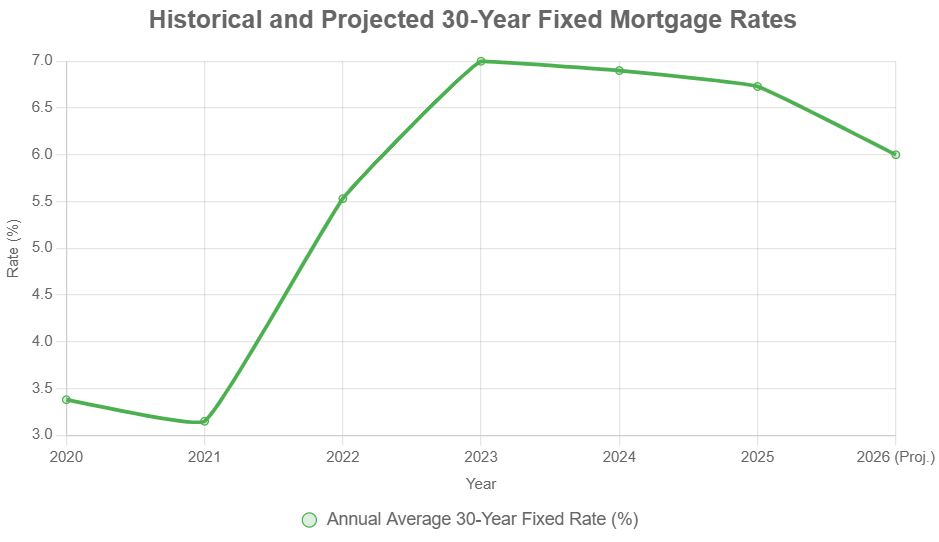
Here's a quick look at how rates have moved:

Year Average 30-Year Fixed Rate (%) Key Reason
2020 3.38 Pandemic stimulus, low inflation
2021 3.15 Continued Fed support, record-low yields
2022 5.53 Inflation starts to rise, Fed hikes begin
2023 7.00 Aggressive Fed action to curb inflation
2024 (Estimate) 6.90 Inflation slows, Fed begins cuts
2025 (Estimate) 6.73 More rate cuts, mortgage rates stabilize
2026 (Projection) ~5.9% – 6.5% Further easing, economic moderation

This table shows just how much rates can swing based on what the economy is doing.

chart showing mortgage rate predictions for 2026

What's Driving the 2026 Forecasts? It's All About Balance

The predictions for 2026 mortgage rates aren't pulled out of thin air. They're based on careful analysis of what drives these costs. Think of it like a delicate balancing act between a few key economic forces:

  • Fighting Inflation: The Federal Reserve's main goal has been to get inflation back down to their target of around 2%. If they succeed, and inflation stays down, it gives the Fed room to lower its own key interest rates. Lower short-term rates from the Fed generally lead to lower long-term rates, including mortgage rates.
  • The Economy's Health: Is the economy humming along nicely without overheating? Or is it slowing down too much, perhaps heading towards a recession? Forecasters are hoping for a “soft landing”—where the economy cools down just enough to curb inflation without crashing. If the economy weakens significantly, the Fed might cut rates more, pushing mortgage rates down faster. But if it stays surprisingly strong and inflation proves stubborn, rates might stay higher for longer.
  • Treasury Yields: Mortgage rates are closely tied to the yields on U.S. Treasury bonds, particularly the 10-year Treasury. When investors demand higher yields on these safe investments (meaning they can get more for their money), mortgage lenders also have to charge more. Factors like government spending, international demand for U.S. debt, and general economic sentiment all influence Treasury yields.
  • Job Market Stability: A strong job market usually means people have money to spend and borrow, which can sometimes fuel inflation. If job growth slows down considerably, it might signal a weaker economy, which again could lead to lower interest rates.

My take on this? From what I’ve seen, the Fed has made real progress on inflation. Core inflation (which strips out volatile food and energy prices) is still a bit sticky, but I'm optimistic it will continue its downward trend. This should give the Fed the confidence to continue cutting rates, which should translate to lower mortgage rates in 2026. However, I don't see us returning to the sub-4% rates of the early 2020s anytime soon. Those were truly extraordinary times.

What the Experts Are Saying: A Range of Views

You'll find a spectrum of opinions when you look at mortgage rate predictions for 2026. This isn't a bad thing; it actually highlights the uncertainties involved.

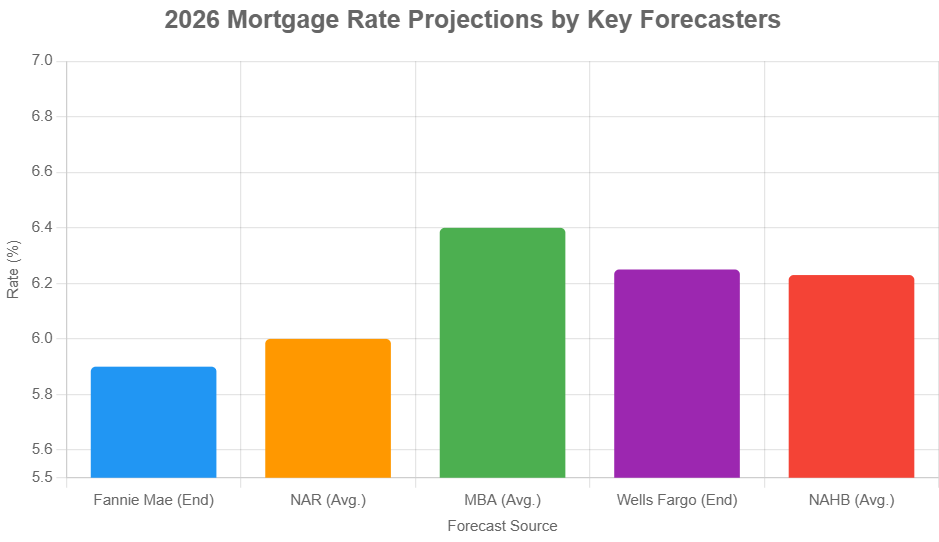
  • Fannie Mae, a big player in the mortgage market, expects rates to end 2026 around 5.9%. They're betting on the Fed making a couple more moves to lower rates.
  • The Mortgage Bankers Association (MBA), on the other hand, sees things as a bit more stable. They predict rates to be around 6.4% for the year. They seem to think things like wage growth might keep some pressure on yields.
  • The National Association of Realtors (NAR) has a slightly more optimistic outlook, anticipating an average rate around 6.0%. They believe better affordability will boost home sales.
  • Other institutions like Wells Fargo and the National Association of Home Builders (NAHB) are looking at rates in the 6.2% to 6.25% range. They often point to ongoing costs in building homes and labor market tightness as factors that could keep rates from falling too much.

Here's a visual of those different predictions:

Mortgage Rate Predictions for 2026

While the exact numbers vary, the general trend points towards lower rates than we have right now, but likely not dramatically lower.

How Will This Affect You? Breaking Down the Impact

So, what does a potential drop in mortgage rates mean for different people?

  • For Homebuyers: Even a half-percentage-point drop can make a big difference. On a $400,000 mortgage, a rate of 6.0% instead of 6.5% could save you roughly $120 per month and nearly $43,000 over the life of the loan. For first-time buyers struggling with affordability, this easing can be crucial. However, home prices are also expected to continue rising, albeit at a slower pace (around 1.3%–2.5%). So, while rates might improve, the overall cost of buying could still be a challenge.
  • For Refinancers: If you have a mortgage with a rate above 6.5% or 7%, a move down towards 6% could finally make refinancing worthwhile. Many homeowners have been stuck with their existing low-rate mortgages (the “lock-in effect”). A decrease could prompt a wave of refinancing, allowing people to lower their monthly payments by a couple of hundred dollars.
  • For Sellers: With potentially more buyers able to afford homes, the housing market could become more active. This could lead to quicker home sales and a modest increase in prices. However, more inventory might also mean less intense bidding wars compared to the frenzied market of a few years ago.
  • For the Economy: Increased home sales and refinancing activity generally give the economy a boost. More construction means more jobs, and people who can lower their monthly payments have more money to spend elsewhere.

Here's a simple table summarizing the potential benefits:

Group Benefit of ~0.5% Rate Drop Potential Hurdle
Homebuyers Lower monthly payments, improved affordability Still-rising home prices, down payment challenges
Refinancers Reduced mortgage payments, cash savings Need to qualify for new loan, appraisal values
Sellers Faster sales, potentially higher prices Increased competition, property taxes
Overall Economy Stimulus via construction and consumer spending Inflation risks, global economic shifts

The Wildcards: What Could Throw a Wrench in the Works?

No prediction is foolproof. There are always risks that could push mortgage rates in unexpected directions:

  • Stubborn Inflation: What if inflation doesn't cool down as expected? If it stays stubbornly above 2%, the Fed might have to hold off on rate cuts for longer, or even consider raising them again. This would likely keep mortgage rates higher than predicted, possibly edging back towards 6.8% or 7%.
  • Economic Shocks: A sudden recession, a major geopolitical event (like a new conflict impacting oil prices), or unexpected supply chain issues could send shockwaves through the economy. A severe downturn might force the Fed to cut rates aggressively, dropping mortgage rates significantly, perhaps to the 5.5% range. On the flip side, surprisingly strong economic growth could keep rates elevated.
  • Government Spending/Debt: High levels of government borrowing can sometimes put upward pressure on interest rates as the government competes for funds in the bond market.

Given these uncertainties, I always advise people to prepare for a range of possibilities. Don't bet your entire financial plan on rates dropping dramatically. Consider your own timeline and financial situation when making housing decisions.

My Own Thoughts: Patience and Preparedness

From my perspective, the 2026 mortgage rate predictions suggest a market that is gradually becoming more accessible. The days of 3% rates are likely behind us for the foreseeable future, but the peak of 7%+ seems to be receding. This middle ground, the mid-6% range, offers a more balanced environment.

For those looking to buy, my advice is to focus on what you can control:

  1. Improve your credit score: A higher score gets you better rates.
  2. Save for a solid down payment: This reduces your loan amount and can sometimes open up better loan options.
  3. Get pre-approved for a mortgage: This gives you a clear picture of what you can afford and shows sellers you're a serious buyer.
  4. Shop around for lenders: Don't just go with the first one you talk to. Rates and fees can vary.

For those looking to refinance, keep a close eye on rates. If we see a sustained drop of 0.5% or more from your current rate, it might be time to explore your options.

The housing market is a complex beast, influenced by so many factors. While we can analyze trends and listen to expert opinions, life often throws curveballs. The key is to stay informed, be prepared, and make decisions that align with your personal financial goals, not just chase the latest rate prediction.

In essence, 2026 looks set to be a year of cautious optimism for the housing market, driven by a slow and steady easing of mortgage rates. It won't be a return to the wild lows of the pandemic era, but it should be a welcome improvement for many aiming to achieve homeownership or financial flexibility through refinancing.

Want Stronger Returns? Invest Where the Housing Market’s Growing

Turnkey rental properties in fast-growing housing markets offer a powerful way to generate passive income with minimal hassle.

Work with Norada Real Estate to find stable, cash-flowing markets beyond the bubble zones—so you can build wealth without the risks of ultra-competitive areas.

🔥 HOT NEW LISTINGS JUST ADDED! 🔥

Talk to a Norada investment counselor today (No Obligation):

(800) 611-3060

Get Started Now

Also Read:

  • Will Mortgage Rates Go Down Below 6% in the Next 60 Days?
  • Who Benefits Most from Today's Lower Mortgage Rates?
  • Mortgage Rates Predictions Backed by 7 Leading Experts: 2025–2026
  • Mortgage Rate Predictions for the Next 3 Years: 2026, 2027, 2028
  • 30-Year Fixed Mortgage Rate Forecast for the Next 5 Years
  • 15-Year Fixed Mortgage Rate Predictions for Next 5 Years: 2025-2029
  • Will Mortgage Rates Ever Be 3% Again in the Future?
  • Mortgage Rates Predictions for Next 2 Years
  • Mortgage Rate Predictions for Next 5 Years
  • Mortgage Rate Predictions: Why 2% and 3% Rates are Out of Reach
  • How Lower Mortgage Rates Can Save You Thousands?
  • How to Get a Low Mortgage Interest Rate?
  • Will Mortgage Rates Ever Be 4% Again?
Filed Under: Financing, Mortgage Tagged With: Interest Rate, mortgage, Mortgage Rate Trends, mortgage rates, Mortgage Rates Today

Mortgage Rates Predictions for the Quarter Ending March 2026

January 5, 2026 by Marco Santarelli

Mortgage Rates Predictions for the First Quarter of 2026

If you’re waiting on the sidelines, hoping for a return to the “free money” mortgage rates of the early 2020s, I have to be blunt: that ship has sailed. However, the anxiety about rates spiraling toward 8% has cooled down significantly. For the first quarter of 2026, I forecast that the average 30-year fixed mortgage rate will settle into a relatively stable band between 6.0% and 6.4%, likely averaging around ***6.15%***.

This level reflects a cautious equilibrium in the economy—enough inflation stabilization to prevent spikes, but not enough weakening to force the Federal Reserve into the aggressive rate cuts everyone is hoping for.

The start of 2026 feels less like a crisis and more like a stubborn waiting game. We are entering a period where rates are elevated but predictable, which, frankly, is a welcome change for everyone who spent 2023 watching the market swing wildly week after week.

Mortgage Rates Predictions for the Quarter Ending March 2026

Where We Stand Right Now: A Tentative Breather

As we flipped the calendar into January 2026, the mortgage market offered a small gift: the 30-year fixed rate settled at 6.15%, according to the latest Freddie Mac data. This slight dip from December’s close (6.18%) might seem minor, but it matters. It confirms a stabilization trend that began toward the end of 2025.

What I observe is that the market tried hard to push rates higher in the latter half of 2025, but signs of cooling inflation and a softening job market prevented a major breakout. This 6.15% starting point means that the psychological barrier we have been dealing with—the high 6s and low 7s—is currently behind us.

The real question isn't whether rates will return to 3%; they won't. The real question for the first three months of 2026 is whether we can see sustained downward pressure that pushes the bulk of activity below 6.0%. In my expert opinion, while possible, it is not the most likely outcome for Q1.

The Rollercoaster Ride: Why History Matters So Much

To understand where we are going, we need to remember where we’ve been. I’ve watched this market swing dramatically over the past few years, and I can tell you these historical patterns offer invaluable clues.

  • 2020–2021: The era of rock-bottom rates. Thanks to the Federal Reserve trying to insulate the economy from the COVID-19 pandemic, we saw rates plummet below 3%. This created a massive wave of refinancing and allowed millions of people to buy homes they otherwise couldn't afford.
  • 2022–2023: The Inflation Shock. As the economy roared back and inflation soared, the Fed aggressively hiked its benchmark rate, pulling long-term mortgage rates with it. This was a brutal adjustment, leading to rates creeping toward 7% and housing sales freezing up.
  • 2025: Volatility stabilized, but rates stayed elevated, hovering near an annual average of about 6.60%.

The market needs stability now. And the fact that we ended 2025 around 6.15% tells me that the majority of the sharp corrections are behind us. But remember, the quick drop many experts hoped for in Q4 2025 didn't materialize entirely. Why? Because the underlying economic pressures (namely sticky services inflation and a still-robust labor market) didn't give the Fed the green light to cut aggressively. This reluctance dictates our forecast for early 2026.

The Core Mortgage Rate Forecast: Q1 2026 Numbers and Expert Consensus

When I look at the predictions coming from major players like Fannie Mae and the Mortgage Bankers Association (MBA), I see a narrow band of agreement that gives me confidence in the 6.0% to 6.4% range.

No one is calling for rates to plunge to 5% instantly, but almost no one is predicting a catastrophic return to 7% either.

Here is a summary of the consensus forecasts for the 30-year fixed rate during the first quarter of 2026:

Source Q1 2026 Forecast (30-Year Fixed)
National Association of Realtors (NAR) 6.00%
Wells Fargo 6.15%
National Association of Home Builders (NAHB) 6.17%
Fannie Mae 6.20%
Mortgage Bankers Association (MBA) 6.40%
Consensus Average 6.18%

The most interesting difference here is between the optimistic outlooks (like NAR's belief that cooling demand will yield 6.00%) and the more conservative stances, like the MBA holding steady at 6.4%. The MBA tends to be slightly more conservative because they closely track lending activity and understand the financial institution’s reluctance to lower rates too quickly until they see sustained economic data shifts.

My personal take aligns closely with the 6.15% midpoint. I feel that the market has largely priced in the expected economic weakening. A rate below 6.0% would require some surprise negative economic news—like a sudden spike in unemployment—which would be good news for borrowers, but bad news for the overall economy.

Digging Deeper: The Forces Driving Rates in Early 2026

Mortgage rates don’t just happen—they are a complex reflection of the bond market, specifically the 10-year Treasury yield, combined with what we call the “spread” (the risk premium lenders charge). Here are the primary drivers I am watching closely through Q1 2026:

1. The Federal Reserve’s Steady Hand

The largest influence remains the Fed. While the Fed doesn't directly set mortgage rates, they control the short-term Federal Funds Rate, which anchors the entire yield curve.

  • The Constraint: The market is only anticipating one 0.25% cut in 2026. If the Fed announces that they are delaying this cut until mid-year, or signal they might cut more, it sends massive signals to the bond market.
  • Expert Insight: Because inflation (particularly in housing and services) has proven so difficult to suppress completely, the Fed will likely remain deliberately cautious. Their priority is price stability, even if it means keeping borrowing costs “sticky high.” This conservative approach is the single biggest reason why we likely won't break 5.8% to the downside in Q1.

2. Sticky Inflation and Treasury Yields

The 10-year Treasury yield is the engine of the 30-year mortgage rate. Typically, the mortgage rate sits about 1.5% to 2.0% above the 10-year yield. If the 10-year yield is holding around 4.2%, it logically pushes mortgage rates into the 6.0% to 6.2% range.

The underlying concern here is inflation. If the Consumer Price Index (CPI) cools nicely toward the Fed's 2% target, the 10-year yield may drop below 4.0%. However, if inflation bounces back—perhaps due to rising energy costs or global instability—the yield will climb, pushing rates toward the 6.4% prediction from the MBA.

3. The Labor Market Dynamic

The health of the job market is our double-edged sword.

Factor Bullish for Lower Rates (Q1 Impact) Bearish for Higher Rates (Q1 Impact)
Fed Cuts One cut early in the year Delayed or none until mid-year
Inflation Cools to 2% target Stays above 2.5% on services
Treasury Yields Falls below 4% Rises on growth optimism
Labor Market Unemployment climbs above 4.5% Job gains exceed 200K/month

Right now, unemployment is holding around 4.2%. As long as the job market remains this strong, it signals economic resilience, which in turn reinforces the Fed’s patient stance. We need persistent signs of weakness—like unemployment hitting 4.5% or above—to truly convince the bond market that lower rates are necessary.

Buyer and Homeowner Strategy: Making the 6% Range Work

So, what does this predictable, yet elevated, rate environment mean for you?

For most prospective buyers, a 6.15% rate still presents an affordability challenge, especially combined with high home prices. On a $400,000 loan, a 6.15% rate means a principal and interest payment of roughly $2,437 per month. This is substantially higher than the payments seen just three years ago.

For Homebuyers:

  1. Lock Strategically: If you are buying in Q1, be prepared to lock in a rate in the 6.0% to 6.4% range. Don't gamble on a sudden drop below 6.0%. If you wait, the risk of rates climbing back toward 6.5% due to a strong jobs report is very real.
  2. Explore Options: If affordability is tight, look into options like the FHA or VA loans, which may offer a slight edge (potentially around ***5.75%***) due to government backing.
  3. Consider the ARM: If you are certain you will move or refinance within 5 to 7 years, an Adjustable-Rate Mortgage (ARM) might offer an appealing initial rate below the fixed rate, perhaps around 5.75%.

For Homeowners (Refinancers):

The Q1 2026 forecast doesn't suggest a boom in refinancing. Most people who bought or refinanced before 2022 already have rates well below 5%. The only borrowers who truly stand to benefit are those who purchased in late 2023 or mid-2024 when rates peaked above 7%. If rates dip below 5.9% later in 2026, we could see a small wave of refinancing activity, but Q1 is likely just too early for that.

Final Thoughts on the Q1 2026 Outlook

We are likely to see stability in the mortgage market through March 2026. The extreme uncertainty is gone, replaced by a moderate level of frustration over “stuck” rates.

My closing piece of advice is to stay grounded. While I believe the rate will average around 6.15%, market fluctuations mean we could easily see weekly averages touching 5.9% or 6.5%. Buyers need to focus less on timing the lowest rate and more on finding the right home at the right price with a payment you can comfortably afford—even at the top of the 6.4% projected range. The 6% zone is not perfect, but it is proving to be sustainable for the housing market.

Invest in Fully Managed Rentals for Smarter Wealth Building

With mortgage rates dipping to their lowest levels in months, savvy investors are seizing the opportunity to lock in financing.

By securing favorable terms now, you can also maximize immediate cash flow while positioning yourself for stronger long‑term returns.

Norada Real Estate helps you seize this rare opportunity with turnkey rental properties in strong markets—so you can build passive income while borrowing costs remain historically low.

🔥 HOT NEW LISTINGS JUST ADDED! 🔥

Talk to a Norada investment counselor today (No Obligation):

(800) 611-3060

Get Started Now

Also Read:

  • No Return to Cheap Mortgages in 2026: Rates Predicted to Stay Near 6%
  • Mortgage Rates Predictions for 2026 Backed by Top Housing Experts
  • Mortgage Rate Predictions for the Next 3 Years: 2026, 2027, 2028
  • 30-Year Fixed Mortgage Rate Forecast for the Next 5 Years
  • 15-Year Fixed Mortgage Rate Predictions for Next 5 Years: 2025-2029
  • Will Mortgage Rates Ever Be 3% Again in the Future?
  • Mortgage Rates Predictions for Next 2 Years
  • Mortgage Rate Predictions for Next 5 Years
  • Mortgage Rate Predictions: Why 2% and 3% Rates are Out of Reach
  • How Lower Mortgage Rates Can Save You Thousands?
  • How to Get a Low Mortgage Interest Rate?
  • Will Mortgage Rates Ever Be 4% Again?
Filed Under: Financing, Mortgage Tagged With: Interest Rate, mortgage, Mortgage Rate Trends, mortgage rates, Mortgage Rates Today

Why the 6.15% Mortgage Rate is a Green Light for 2026 Homebuyers

January 1, 2026 by Marco Santarelli

Why the 6.15% Mortgage Rate is a Green Light for 2026 Homebuyers

If you've been dreaming of owning a home and watching mortgage rates anxiously, I've got some fantastic news. A mortgage rate hovering around 6.15% is precisely the kind of signal many of us have been waiting for, marking it as a definite “green light” for anyone planning to buy a home in 2026. This rate isn't just a number; it represents a significant step towards a more affordable and stable housing market compared to the roller coaster we've experienced recently.

Why the 6.15% Mortgage Rate is a Green Light for 2026 Homebuyers

For a long time, it felt like getting a decent mortgage rate was like chasing a mirage. We’ve seen rates climb, then dip, then climb again, leaving potential buyers feeling stuck on the sidelines. But seeing the average 30-year fixed-rate mortgage drop to 6.15% as of December 31, 2025, reported by Freddie Mac, is genuinely encouraging. This is the lowest we've seen it in a while, and it’s a far cry from the 6.91% we were looking at just a year ago.

Decoding the Drop: What Does 6.15% Really Mean?

Let's break down why this specific rate is such a big deal. It’s not just about the number itself, but what it signifies for your wallet and your homeownership dreams.

  • A Breath of Fresh Air for Affordability: The most immediate impact of a 6.15% rate is that it translates to lower monthly payments. Imagine shaving off a good chunk of your monthly mortgage bill compared to when rates were higher. This improved affordability means you can either look at homes that were previously out of reach or have more breathing room in your budget each month. It makes the dream of homeownership feel so much more tangible.
  • A Look Back to Put Things in Perspective: While it’s true that the super-low rates of the pandemic (think 2-3%) are a distant memory, it’s important to remember that 6.15% is still quite favorable when you look at the long-term historical average. Freddie Mac data shows that since 1971, the average 30-year fixed-rate mortgage has been around 7.70%. So, while it might not be a steal from the pandemic era, it’s a solid rate in the grand scheme of things.
  • Calming the Housing Market Storm: When mortgage rates are high and volatile, it can create uncertainty. People with existing low-rate mortgages are hesitant to sell (the “lock-in effect”), which can also reduce the number of homes available. A more stable rate in the low-6% range can help to stabilize the housing market. This means more homes might become available, and the overall buying and selling process could feel less chaotic.

Expert Opinions Align: A Forecast Confirmed

It’s not just me saying this; many experts and institutions are forecasting similar conditions for 2026. Organizations like the National Association of Realtors and Fannie Mae have been predicting that mortgage rates would likely average somewhere between 6% and 6.4% in 2026. The 6.15% figure we're seeing fits right into that prediction, suggesting that the market is moving in the direction experts anticipated. This convergence of data and expert opinion adds a significant layer of confidence for potential buyers.

The Trend is Your Friend: A Declining Trajectory

The fact that 6.15% was the lowest rate in 2025 is a crucial detail. It indicates a downward trend throughout the latter half of the year. This trend, often influenced by factors like the Federal Reserve adjusting its policies and signs of a cooling and more stable economy, is exactly what buyers want to see. It offers a sense of predictability that makes financial planning much easier. For those who have been waiting for rates to stabilize, this is a clear sign that the time might be right to start seriously planning.

My Two Cents: Building on the Momentum

From my perspective, this is a genuinely exciting time for anyone looking to buy in 2026. I’ve seen firsthand how much a difference a few percentage points can make in a monthly payment over the life of a loan. This drop isn't just a number; it's a significant increase in purchasing power. If you've been priced out or had your plans put on hold due to high rates, this shift could be the catalyst you need. The market is signaling a move toward balance, and that's always a good thing for buyers.

Table of Rate Trends

To really see the change, let's look at the numbers reported by Freddie Mac in their Primary Mortgage Market Survey®:

Metric 30-Year Fixed Rate (as of 12/31/2025) 15-Year Fixed Rate (as of 12/31/2025)
Current Rate 6.15% 5.44%
1-Week Change -0.03% -0.06%
1-Year Change -0.76% -0.69%
Monthly Average 6.19% 5.49%
52-Week Average 6.59% 5.78%
52-Week Range (Low) 6.15% 5.41%
52-Week Range (High) 7.04% 6.27%

As you can see, the current 6.15% is not only down significantly from a year ago but also represents the lowest point seen in the past year. The 15-year fixed-rate also shows a similar positive trend, hovering at a very attractive 5.44%.

Making the Most of This Opportunity: Your Action Plan

So, how do you position yourself to take advantage of these favorable conditions? It’s time to be proactive.

1. Sharpen Your Credit Score:

Your credit score is your golden ticket to the best rates.

  • Aim High: A score of 740 or above is generally considered excellent and will usually qualify you for the most competitive rates.
  • Watch Your Credit Utilization: Keep your credit card balances as low as possible. Ideally, stay below 30% of your limit, but aiming for under 10% can make an even bigger difference.
  • Check for Errors: Get your free credit reports from AnnualCreditReport.com and dispute any mistakes you find.

2. Tame Your Debt-to-Income Ratio (DTI):

This ratio tells lenders how much of your income is already committed to debt.

  • The 28/36 Rule: Lenders often prefer your housing costs to be no more than 28% of your gross monthly income and your total debt (including the new mortgage) to be under 36%.
  • Avoid New Debt: Hold off on taking out new loans or opening new credit cards in the months leading up to your mortgage application.
  • Pay Down Debt: Focus on paying down high-interest credit card debt. This will directly improve your DTI and can lower your interest rate.

3. Boost Your Down Payment:

More cash upfront means less risk for the lender, often leading to a better rate.

  • The 20% Goal: Putting down 20% means you avoid Private Mortgage Insurance (PMI), which saves you money, and you’ll likely get a better interest rate.
  • Any Amount Helps: Even if you can't reach 20%, increasing your down payment from, say, 3% to 10% can still have a positive impact on your loan terms.

4. Be a Smart Shopper and Negotiator:

Don't just go with the first lender you talk to. Rates can vary significantly.

  • Compare, Compare, Compare: Get official Loan Estimates from at least three to five different lenders.
  • Consider Buying Points: If you plan to stay in your home for many years, you might consider paying an upfront fee to “buy down” your interest rate.
  • Lock It In: Once you find a rate you like, ask about locking it in for a set period (usually 30-60 days) to protect yourself from any potential rate increases before you close.

5. Explore Different Loan Types:

  • 15-Year Fixed Mortgage: If your budget allows, a 15-year fixed mortgage comes with a significantly lower interest rate than a 30-year loan. The trade-off is higher monthly payments, but you'll pay off your home much faster and save a lot on interest over time.
  • Government-Backed Loans: If your credit score isn't quite where you want it, explore options like FHA or VA loans. These government-backed programs can offer more accessible rates and terms for certain borrowers.

The Takeaway for 2026 Homebuyers

The current mortgage rates, particularly the 6.15% 30-year fixed average, are more than just a good number; they represent a real opportunity. It’s a signal that the housing market is moving towards a more balanced and accessible state. By understanding the data, listening to expert forecasts, and preparing yourself financially, you can confidently step into 2026 and make your homeownership dreams a reality. Don't let this green light pass you by!

Invest in Fully Managed Rentals for Smarter Wealth Building

With mortgage rates dipping to their lowest levels in months, savvy investors are seizing the opportunity to lock in financing.

By securing favorable terms now, you can also maximize immediate cash flow while positioning yourself for stronger long‑term returns.

Norada Real Estate helps you seize this rare opportunity with turnkey rental properties in strong markets—so you can build passive income while borrowing costs remain historically low.

🔥 HOT NEW LISTINGS JUST ADDED! 🔥

Talk to a Norada investment counselor today (No Obligation):

(800) 611-3060

Get Started Now

Also Read:

  • No Return to Cheap Mortgages in 2026: Rates Predicted to Stay Near 6%
  • Mortgage Rates Predictions for 2026 Backed by Top Housing Experts
  • Mortgage Rate Predictions for the Next 3 Years: 2026, 2027, 2028
  • 30-Year Fixed Mortgage Rate Forecast for the Next 5 Years
  • 15-Year Fixed Mortgage Rate Predictions for Next 5 Years: 2025-2029
  • Will Mortgage Rates Ever Be 3% Again in the Future?
  • Mortgage Rates Predictions for Next 2 Years
  • Mortgage Rate Predictions for Next 5 Years
  • Mortgage Rate Predictions: Why 2% and 3% Rates are Out of Reach
  • How Lower Mortgage Rates Can Save You Thousands?
  • How to Get a Low Mortgage Interest Rate?
  • Will Mortgage Rates Ever Be 4% Again?
Filed Under: Financing, Mortgage Tagged With: Interest Rate, mortgage, Mortgage Rate Trends, mortgage rates, Mortgage Rates Today

Today’s Mortgage Rates, Dec 31: 30-Year Fixed Rate Drops to 5.97% on New Year’s Eve

December 31, 2025 by Marco Santarelli

Today's Mortgage Rates, Jan 7: Stable Rates Continue for Buyers and Refinancers

As we wrap up 2025, the housing market is offering a rare gift: predictability. According to Zillow's final data for the year, mortgage rates have held remarkably steady since late October. On this New Year's Eve, the average 30-year fixed mortgage rate is sitting at 5.97%, and the popular 15-year fixed rate is at 5.42%.

For anyone who’s been watching the housing market over the past few years, this calm might feel almost surprising, but it’s actually a sign of a more settled economy and a chance for buyers and homeowners to make informed decisions without the constant worry of sudden shifts. Let's dive into what these numbers mean and how you can use them as we step into 2026.

Today’s Mortgage Rates, Dec 31: 30-Year Fixed Rate Drops to 5.97% on New Year's Eve

Why the Calm? Understanding the Rate Picture

It’s easy to get caught up in the daily numbers, but it's important to remember that mortgage rates don't just appear out of thin air. They are heavily influenced by big economic factors. Think of it like this: the Federal Reserve, which sets the main interest rates for the country, has been working hard to get inflation under control. For a while, they were raising rates pretty aggressively to fight off the rising prices we saw after the pandemic.

By mid-2024, it looked like inflation was finally starting to cool down, and many people hoped the Fed would start lowering rates. But the Fed played it smart, staying cautious to make sure inflation didn't just flare up again. Now, as 2025 ends, we've reached a pretty balanced spot. Inflation is close to the Fed's goal, the job market is still strong but showing small signs of slowing, and there are a few global uncertainties that keep everyone on their toes. All these things together have led to mortgage rates finding a stable home, not the super-low rates of a few years ago, but also not the stressful highs of late 2023. It’s a more normal, steady rate that we can plan around.

A Closer Look at Today’s Rates

Zillow's data from December 31, 2025, gives us a clear picture of the different loan options available:

Purchase Mortgage Rates

Here’s what you can generally expect if you're buying a home:

Loan Type Interest Rate
30-year fixed 5.97%
20-year fixed 5.95%
15-year fixed 5.42%
5/1 ARM 5.83%
7/1 ARM 5.97%
30-year VA 5.42%
15-year VA 4.99%
5/1 VA ARM 5.12%

Refinance Rates

If you're looking to refinance your current mortgage:

Loan Type Interest Rate
30-year fixed 6.09%
20-year fixed 6.03%
15-year fixed 5.57%
5/1 ARM 6.20%
7/1 ARM 6.52%
30-year VA 5.63%
15-year VA 5.28%
5/1 VA ARM 5.37%

What jumps out from these numbers?

  • VA Loans Shine: If you're a veteran or active service member, these rates are fantastic. The 15-year VA purchase rate of 4.99% is a real standout. This is because the government backs these loans, reducing the risk for lenders, which means lower rates for those who qualify.
  • Refi Rates Slightly Higher: It’s pretty common for refinance rates to be a bit higher than purchase rates. You can see that here, with rates generally about 0.10% to 0.20% higher for refinancing.
  • 15-Year Savings: The 15-year fixed is consistently lower than the 30-year, showing a difference of about 0.55%. This is a significant saving over the long run, and if you can handle the higher monthly payments, it's a great way to build equity faster and pay much less interest overall.
  • ARMs: Consider Carefully: Adjustable-Rate Mortgages (ARMs), like the 5/1 ARM at 5.83%, can look appealing because the initial rate is low. However, with inflation still a concern, these rates could go up after the initial period. They’re riskier now than they were a decade ago, so only consider them if you're sure you'll sell or refinance before the rate starts adjusting.

What These Rates Mean for YOU as a Buyer

For anyone looking to buy a home, these stable rates mean you can plan with more confidence.

If you're buying your main home and think you'll stay put for at least seven years, seriously look at a 15-year fixed mortgage. If you're eligible, a VA loan could be your absolute best bet. Yes, the monthly payments will be higher than a 30-year loan, but the total interest you pay over the life of the loan will be way less. For example, imagine a $400,000 loan at 5.42% for 15 years. You'd pay about $192,000 in interest. Now compare that to a 30-year loan at 5.97% for the same amount, which would cost you around $454,000 in interest! That's a massive difference.

If your budget is tight right now, the 30-year fixed is still a solid option. My personal advice? Even with a 30-year loan, try to make extra payments towards the principal whenever you can. Even an extra $100 or $200 a month can shave years off your loan and save you tens of thousands of dollars.

Regarding ARMs, I’d say proceed with caution. While the initial rate might be lower, things can change. Unless you are absolutely certain you’ll move or refinance before the rate starts adjusting, it’s safer to stick with a fixed-rate mortgage. And even if you plan to move, really think about whether you can comfortably afford the payments if rates go up.

Refinancing in 2025: Is It Still a Good Idea?

For those who already own a home, deciding whether to refinance is a bit more complicated in this environment. If you managed to lock in a rate below 4.5% during the pandemic years, refinancing now probably won't save you much money, especially since refinance rates are a little higher.

However, there are definitely still good reasons to consider it:

  • VA Borrowers: If you have an older VA loan with a rate above, say, 5.5%, checking out today's rates around 4.99% (15-year) or 5.42% (30-year) could be a smart move.
  • High-Interest ARMs: Are you currently in an ARM that’s about to reset to a higher rate? Refinancing into a fixed rate now could give you predictable payments and peace of mind.
  • Home Improvement or Debt Consolidation: If you need to do renovations or want to combine other debts, a cash-out refinance might still make financial sense, even if the rate savings aren't huge, as long as the overall benefit after closing costs is positive.

The key here is the break-even point. With rates unlikely to drop drastically in early 2026, you need to be sure you'll stay in your home long enough to make back the closing costs. Usually, this takes about 2 to 4 years.

Looking Ahead to 2026: What’s Next?

As we move into 2026, people are naturally wondering what will happen to mortgage rates. Economists have different opinions. Some think rates might tick down a bit if the Fed starts cutting its key interest rate later in the year. Others believe that bigger economic shifts, like changes in global trade and an aging population, might mean that interest rates will generally stay higher than they were before 2020.

What seems pretty clear, though, is that the days of those super-low mortgage rates are likely behind us. We’re in a new era of moderately high rates, and we should expect some fluctuations. This means borrowers really need to be smart, understand their finances, and plan ahead.

My Take: Patience, Planning, and a Healthy Perspective

The fact that rates have stayed put since October might not sound super exciting. But in a world where dramatic economic changes can happen quickly, this stability is actually a really positive thing. It gives us clarity. It lets us plan. And for many people dreaming of owning a home, it opens up a real opportunity—not a once-in-a-lifetime deal, but a workable path forward.

If you’re holding out for rates to drop all the way back to 3%, you might be waiting a very, very long time. But if you’re open to adjusting your strategy—like choosing a shorter loan term, taking advantage of VA benefits, locking in a rate before there's a chance of an increase, or simply accepting that today's rate is the best available option—then 2026 could absolutely be your year.

Remember, a home is more than just a financial investment. It's a place of comfort, security, and belonging. And sometimes, the best time to buy isn't when rates are at their absolute lowest, but when your life and your finances are ready.

Here's to a year of smart planning and hopeful homeownership as we enter 2026.

🏡 Which Rental Property Would YOU Invest In?

Cullman, AL
🏠 Property: Dryden St SE
🛏️ Beds/Baths: 3 Bed • 2 Bath • 1337 sqft
💰 Price: $229,900 | Rent: $1,595
📊 Cap Rate: 6.0% | NOI: $1,148
📅 Year Built: 2025
📐 Price/Sq Ft: $172
🏙️ Neighborhood: B+

VS

Lebanon, TN
🏠 Property: Baltusrol Lane #852
🛏️ Beds/Baths: 4 Bed • 2.5 Bath • 2011 sqft
💰 Price: $369,990 | Rent: $2,400
📊 Cap Rate: 5.8% | NOI: $1,789
📅 Year Built: 2024
📐 Price/Sq Ft: $184
🏙️ Neighborhood: B

Two solid options: Alabama’s affordable new build with steady returns vs Tennessee’s larger home with higher cash flow. Which fits YOUR investment strategy?

📈 Choose Your Winner & Contact Us Today!

Talk to a Norada investment counselor (No Obligation):

(800) 611-3060

Contact Us Now 

Invest in Fully Managed Rentals for Smarter Wealth Building

With mortgage rates dipping to their lowest levels in months, savvy investors are seizing the opportunity to lock in financing.

By securing favorable terms now, you can also maximize immediate cash flow while positioning yourself for stronger long‑term returns.

Norada Real Estate helps you seize this rare opportunity with turnkey rental properties in strong markets—so you can build passive income while borrowing costs remain historically low.

🔥 HOT NEW LISTINGS JUST ADDED! 🔥

Talk to a Norada investment counselor today (No Obligation):

(800) 611-3060

Get Started Now

Also Read:

  • Mortgage Rates Predictions Backed by 7 Leading Experts: 2025–2026
  • Mortgage Rate Predictions for the Next 3 Years: 2026, 2027, 2028
  • 30-Year Fixed Mortgage Rate Forecast for the Next 5 Years
  • 15-Year Fixed Mortgage Rate Predictions for Next 5 Years: 2025-2029
  • Will Mortgage Rates Ever Be 3% Again in the Future?
  • Mortgage Rates Predictions for Next 2 Years
  • Mortgage Rate Predictions for Next 5 Years
  • Mortgage Rate Predictions: Why 2% and 3% Rates are Out of Reach
  • How Lower Mortgage Rates Can Save You Thousands?
  • How to Get a Low Mortgage Interest Rate?
  • Will Mortgage Rates Ever Be 4% Again?

Filed Under: Financing, Mortgage Tagged With: Interest Rate, mortgage, Mortgage Rate Trends, mortgage rates, Mortgage Rates Today

No Return to Cheap Mortgages in 2026: Rates Predicted to Stay Near 6%

December 31, 2025 by Marco Santarelli

Mortgage Rates Reset 2026: End of Ultra-Low Rates, 6% Becomes New Normal

If you've been holding out for those sweet, pandemic-era mortgage rates in the 2% or 3% range, I'm going to have to be the bearer of slightly less cheerful news. Based on what the experts are saying, and my own read on the economic situation, it’s looking like mortgage rates are going to hover around the 6% mark through 2026. Forget a sudden dive back to rock-bottom; we're likely in for a period of relative stability, which, while not as exciting as a bargain hunt, does offer a silver lining for planning.

No Return to Cheap Mortgages in 2026: Rates Predicted to Stay Near 6%

It feels like just yesterday we were all marveling at sub-3% mortgage rates. That era, born out of desperate times during the COVID-19 pandemic, was a unique economic experiment designed to jolt a frozen economy back to life. Now, as we navigate a different set of challenges, those conditions simply aren't present. The days of emergency-level interest rates are, for all intents and purposes, behind us.

Why the Stalemate? It All Comes Down to Two Big Things: Inflation and Jobs.

This isn't just some random guess; there are solid economic reasons why mortgage rates are expected to hold steady. Think of it like a tug-of-war where two powerful forces are keeping things balanced, preventing any dramatic upward or downward swings.

The Inflation Monster We Can't Quite Tame

You've probably heard a lot about inflation in the news, and for good reason. It's the primary driver of mortgage rates. When inflation is high, the money you pay back in 15 or 30 years will be worth less than the money you borrowed today. To compensate for that erosion of value, lenders demand a higher interest rate. It’s simple risk management for them.

The Federal Reserve (often called “the Fed”) has a target for inflation, which is around 2%. Right now, and for the foreseeable future, inflation is stubbornly staying above that. Until we see consistent signs that inflation is firmly under control and heading back towards that 2% target, lenders will continue to factor that risk into their pricing, keeping mortgage rates elevated.

A Job Market That Just Won't Quit (In a Good and Bad Way)

On the flip side, we have a remarkably resilient labor market. Now, a strong job market sounds like pure good news, and for many, it is. People are working, businesses are hiring. However, a tight labor market can also put upward pressure on wages. When wages rise quickly, businesses often pass those costs onto consumers through higher prices, which fuels more inflation. It’s another part of that economic tug-of-war.

So, while a strong job market is great for individuals, it can indirectly contribute to keeping inflation (and therefore mortgage rates) higher than we'd ideally like. If the job market were to significantly weaken, that could put downward pressure on rates, but right now, that's not the dominant forecast.

What About the Fed's Role? It's Not Always a Direct Line.

Many people assume that when the Federal Reserve cuts its benchmark interest rate (the federal funds rate), mortgage rates immediately follow suit. While there's a connection, it’s not a direct one-to-one relationship.

Mortgage rates are more closely influenced by the yields on longer-term bonds, particularly the 10-year Treasury yield. These yields are more sensitive to market expectations about future inflation and economic growth. While the Fed's actions signal its outlook and influence investor behavior, they don't directly set mortgage rates.

Think of it this way: the Fed is setting the thermostat for the immediate room temperature, but mortgage rates are more like the heating system for the entire house, influenced by broader economic winds and how much fuel (inflation expectations) is expected to be needed. The Fed is expected to cut rates eventually, likely in response to a cooling economy or labor market, which would put some downward pressure on mortgage rates. However, as long as inflation concerns linger, those longer-term bond yields will likely keep mortgage rates from falling too dramatically.

The “Unusual Times” of the Pandemic: A Chapter Closed

I remember the financial discussions during the peak of the pandemic. The Federal Reserve unleashed an unprecedented wave of stimulus, including slashing interest rates to near zero. This was an emergency measure to prevent a full-blown economic collapse. The resulting mortgage rates in the 2.5% to 3.5% range were a direct consequence of those extraordinary circumstances.

Without a similar economic crisis on the horizon, and with the fundamental economic landscape having shifted, returning to those sub-3% rates is highly improbable. The economic “emergency brake” has been released, and we're back to a more typical, albeit still dynamic, economic environment.

What the Experts Are Saying: A Look at the Forecasts

To give you a clearer picture, I've gathered some of the most reputable forecasts. While there's always a bit of variation, they paint a consistent story:

Organization 2026 Forecast (30-Year Fixed Avg.) Notes
Fannie Mae ~5.9% (by year-end) Reflects a gradual cooling trend.
Mortgage Bankers Assoc. ~6.4% A slightly more conservative outlook.
Redfin ~6.3% Aligns with broader market consensus.
Realtor.com ~6.3% Consistent with other real estate portals.
Freddie Mac ~6.2% A respected source for mortgage stats.

As you can see, the consensus for 2026 hovers in the 5.9% to 6.4% range. This isn't a prediction for a sudden crash in rates; rather, it suggests a period of relative stability.

The Upside of Stability: Better Planning for Buyers

While the excitement of grabbing a historically low rate might be gone, this forecast for stability isn't necessarily bad news. For those looking to buy a home, knowing that rates are likely to remain in a predictable range makes budgeting and financial planning much easier. Instead of trying to time the market perfectly, which is notoriously difficult, you can focus on getting your finances in order based on a more concrete understanding of future borrowing costs.

This stability can also reduce market volatility. When rates jump around wildly, it can scare off potential buyers and sellers, leading to a sluggish market. A steadier rate environment can foster more confidence.

However, I have to add a dose of reality here: affordability remains a significant challenge. Even with rates around 6%, the combination of high home prices, rising property taxes, and increasing insurance costs means that buying a home today is still a substantial financial undertaking for many.

Why Do Forecasts Differ? It's Not an Exact Science!

You might wonder why all these smart people come up with slightly different numbers. Forecasting the future of the economy is inherently complex, and there are several reasons for these variations:

  • Different Economic Outlooks: Forecasters might have varying opinions on how quickly inflation will cool, how strong the job market will truly be, or the overall pace of economic growth. Some might be more optimistic, others more pessimistic.
  • Flavor of Their Math (Models): Each organization uses its own sophisticated financial models. These models weigh different economic factors – like the 10-year Treasury yield, mortgage-backed securities, and even global economic sentiment – with different levels of importance.
  • Black Swan Events: The economy is susceptible to unpredictable events – think geopolitical crises, unexpected natural disasters, or sudden policy shifts. These can throw even the best forecasts out the window.
  • Data Nuances: Sometimes, the difference comes down to the precise data sources used or the specific methodologies applied to that data.
  • Adding New Ingredients: Some newer forecasting models might even incorporate less traditional factors, like climate change impacts or long-term demographic trends, which older models don't consider.

My Take: Focus on What You Can Control

From my perspective, dwelling too much on trying to pinpoint the exact lowest rate is a losing game. The data suggests that rates around the 6% are here to stay for a while.

What I would advise anyone looking to buy a home is to focus on your personal financial readiness. This means:

  • Improving your credit score: A higher score can get you better terms, even within the 6% range.
  • Saving a larger down payment: This reduces the loan amount and can significantly lower your monthly payments.
  • Shopping around for lenders: Don't settle for the first offer. Compare rates and fees from multiple banks and mortgage brokers.
  • Understanding all the costs: Beyond the mortgage, factor in property taxes, insurance, potential HOA fees, and maintenance.

The market is likely to remain challenging but predictable in terms of rates for the next couple of years. Use that predictability to your advantage by building a solid financial foundation. Don't wait for rates to drop significantly; aim to be in the best possible position to buy when you're ready, regardless of whether the rate is 5.8% or 6.3%.

Invest in Fully Managed Rentals for Smarter Wealth Building

With mortgage rates dipping to their lowest levels in months, savvy investors are seizing the opportunity to lock in financing.

By securing favorable terms now, you can also maximize immediate cash flow while positioning yourself for stronger long‑term returns.

Norada Real Estate helps you seize this rare opportunity with turnkey rental properties in strong markets—so you can build passive income while borrowing costs remain historically low.

🔥 HOT NEW LISTINGS JUST ADDED! 🔥

Talk to a Norada investment counselor today (No Obligation):

(800) 611-3060

Get Started Now

Also Read:

  • Mortgage Rates Predictions Backed by 7 Leading Experts: 2025–2026
  • Mortgage Rate Predictions for the Next 3 Years: 2026, 2027, 2028
  • 30-Year Fixed Mortgage Rate Forecast for the Next 5 Years
  • 15-Year Fixed Mortgage Rate Predictions for Next 5 Years: 2025-2029
  • Will Mortgage Rates Ever Be 3% Again in the Future?
  • Mortgage Rates Predictions for Next 2 Years
  • Mortgage Rate Predictions for Next 5 Years
  • Mortgage Rate Predictions: Why 2% and 3% Rates are Out of Reach
  • How Lower Mortgage Rates Can Save You Thousands?
  • How to Get a Low Mortgage Interest Rate?
  • Will Mortgage Rates Ever Be 4% Again?
Filed Under: Financing, Mortgage Tagged With: Interest Rate, mortgage, Mortgage Rate Trends, mortgage rates, Mortgage Rates Today

Today’s Mortgage Rates, Dec 30: 30-Year Fixed Rate Drops Below 6% Again

December 30, 2025 by Marco Santarelli

Today's Mortgage Rates, Jan 7: Stable Rates Continue for Buyers and Refinancers

As December 30, 2025, draws to a close, I’ve got some genuinely exciting news for anyone thinking about buying a home or looking to save money on their existing mortgage: mortgage rates have officially dipped below the 6% mark. According to the latest data from Zillow, the average rate for a 30-year fixed mortgage is now sitting at a cool 5.99%. This is a big deal. After what felt like an eternity of rates being high, this drop below 6% marks a significant turning point, offering a renewed sense of possibility for homeownership and refinancing as we head into 2026.

But what does this really mean for you, and should you be making moves right now? Let’s dig into the details.

Today’s Mortgage Rates, Dec 30: Below 6% Again – What It Means for You

Where Do Mortgage Rates Stand Today?

Here’s a clear look at the numbers from Zillow for purchase mortgages on this December 30th:

Loan Type Interest Rate
30-year fixed 5.99%
20-year fixed 5.95%
15-year fixed 5.49%
5/1 ARM 6.10%
7/1 ARM 6.08%
30-year VA 5.56%
15-year VA 5.09%
5/1 VA 5.19%

For those looking to refinance an existing mortgage, the rates are a tiny bit higher, which is typical as lenders assess different risk factors for refinancing versus new purchases.

Loan Type Interest Rate
30-year fixed refinance 6.10%
20-year fixed refinance 5.92%
15-year fixed refinance 5.59%
5/1 ARM refinance 6.31%
7/1 ARM refinance 6.36%
30-year VA refinance 5.62%
15-year VA refinance 5.41%
5/1 VA refinance 5.47%

It's also worth noting that some lenders are already offering rates as low as 5.5% for a 30-year fixed loan to borrowers with excellent credit and solid financials. This just goes to show that while these averages are a great guide, your personal situation—your credit score, how much you put down, and your loan amount—can mean you get an even better rate.

Why Are Rates Dropping? The Story Behind the Numbers

This drop below 6% isn’t just a random event; it’s the result of several economic forces aligning nicely throughout 2025:

  • Inflation is Cooling Down: Remember how worried we were about prices going up so fast? Well, the latest news on inflation is much better, getting closer to the 2% target that the Federal Reserve likes to see. This gives the Fed more confidence.
  • The Fed is Shifting Gears: The Federal Reserve, which influences interest rates indirectly, held things steady for a good part of 2025 but has now hinted at possible rate cuts early in 2026. Mortgage rates tend to follow the yields on 10-year Treasury bonds, which have been dropping as investors anticipate these Fed actions.
  • Homebuyers are Catching a Break: For the last couple of years, high rates made buying tough. Plus, many homeowners locked in super low rates and didn't want to move. This has kept demand from getting too crazy, even as more homes become available.
  • Global Uncertainty is a Factor: Things happening in other countries, like slower growth and global tensions, often lead investors to put their money into safer places, like U.S. Treasury bonds. This demand for bonds pushes their yields down, which in turn helps push mortgage rates lower.

What This Means for You If You're Buying a Home

For anyone dreaming of homeownership, a rate below 6% is more than just a nice number—it makes a real difference in your monthly payment.

Imagine this: If you're taking out a $400,000 loan, going from a 6.5% rate down to 5.99% could save you over $130 every single month. Over 30 years, that adds up to more than $47,000! That’s a significant amount of money that can make buying a home achievable for people who were on the fence.

Plus, with home price increases slowing down nationwide (Zillow noted only about 2.1% growth nationally in the last quarter of 2025), we’re seeing a more balanced market. That means lower rates combined with more stable prices create one of the best environments for buyers we’ve seen since 2021.

My advice for buyers:

  • If you're thinking of buying, get pre-approved now, especially while rates are favorable.
  • Ask your lender about a “float-down” option on your rate lock. This means if rates drop even further before you close, you might be able to get the lower rate.
  • If you qualify, don't forget about VA or FHA loans. The 15-year VA rate at 5.09% is incredibly attractive.

Thinking About Refinancing? Here's What to Consider

For current homeowners, the situation is a bit more nuanced. While refinance rates are still slightly higher than purchase rates, that gap is closing.

If you have a mortgage from 2022, 2023, or early 2024 and your rate is 6.5% or higher, refinancing into today’s rates could save you a good chunk of money—as long as you plan to stay in your home long enough to make back the costs of refinancing (which are usually a few percent of the loan amount and take about 2–4 years to recoup).

However, if your current rate is already below 5.5%, refinancing probably isn’t worth it. The only exceptions might be if you’re looking to do a cash-out refinance to pay for home improvements or pay off debt, or if you’re switching from a variable-rate mortgage (ARM) to a fixed rate for peace of mind.

A special note for VA loan holders: If you have an older VA loan with a higher interest rate, now is a fantastic time to look into refinancing. The 15-year VA refinance rate at 5.41% could be a powerful way to pay off your home faster and save a lot on interest over the life of the loan.

Looking at the Bigger Picture: A Market Ready for Change

The fact that rates are dipping below 6% might just signal the end of the period of very high mortgage rates that we saw from 2022 to 2024. Some financial experts are now predicting that rates could continue to trend down toward 5.25%–5.5% by the middle of 2026, assuming the economy remains stable and inflation stays in check.

However, it’s important to remember that things can change. Economic news, job market shifts, or international events could still cause fluctuations. So, while this is a great trend, timing your decisions carefully is still important.

My Final Take: Be Smart, Not Hasty

These sub-6% rates are genuinely good news and should bring a smile to many faces—but they aren’t a reason to make a rushed decision without thinking it through.

  • For Buyers: This is your chance to shine. If you’ve been waiting, now is the time to really push forward with your home search. Just remember to stick to your budget. Don't feel pressured to overspend just because rates have improved.
  • For Homeowners: Run the numbers on refinancing. Even a small drop of 0.3% or 0.5% can be worth it if you’re extending your loan or wisely using cash from a refinance.
  • For Investors: Lower borrowing costs can definitely help the cash flow for rental properties. But with home prices still high in many popular areas, focus on the fundamentals: how much rent you can get, how often the property is rented, and the potential for long-term value increase.

As 2025 wraps up, the housing market is entering an exciting new chapter. It’s a chapter that’s less about panic and more about smart opportunities. Rates below 6% won’t magically fix everything, but they do bring back a much-needed sense of balance and hope. And in a market that's been hungry for both, that's something to be truly thankful for.

🏡 Which Rental Property Would YOU Invest In?

Cullman, AL
🏠 Property: Dryden St SE
🛏️ Beds/Baths: 3 Bed • 2 Bath • 1337 sqft
💰 Price: $229,900 | Rent: $1,595
📊 Cap Rate: 6.0% | NOI: $1,148
📅 Year Built: 2025
📐 Price/Sq Ft: $172
🏙️ Neighborhood: B+

VS

Lebanon, TN
🏠 Property: Baltusrol Lane #852
🛏️ Beds/Baths: 4 Bed • 2.5 Bath • 2011 sqft
💰 Price: $369,990 | Rent: $2,400
📊 Cap Rate: 5.8% | NOI: $1,789
📅 Year Built: 2024
📐 Price/Sq Ft: $184
🏙️ Neighborhood: B

Two solid options: Alabama’s affordable new build with steady returns vs Tennessee’s larger home with higher cash flow. Which fits YOUR investment strategy?

📈 Choose Your Winner & Contact Us Today!

Talk to a Norada investment counselor (No Obligation):

(800) 611-3060

Contact Us Now 

Invest in Fully Managed Rentals for Smarter Wealth Building

With mortgage rates dipping to their lowest levels in months, savvy investors are seizing the opportunity to lock in financing.

By securing favorable terms now, you can also maximize immediate cash flow while positioning yourself for stronger long‑term returns.

Norada Real Estate helps you seize this rare opportunity with turnkey rental properties in strong markets—so you can build passive income while borrowing costs remain historically low.

🔥 HOT NEW LISTINGS JUST ADDED! 🔥

Talk to a Norada investment counselor today (No Obligation):

(800) 611-3060

Get Started Now

Also Read:

  • Mortgage Rates Predictions Backed by 7 Leading Experts: 2025–2026
  • Mortgage Rate Predictions for the Next 3 Years: 2026, 2027, 2028
  • 30-Year Fixed Mortgage Rate Forecast for the Next 5 Years
  • 15-Year Fixed Mortgage Rate Predictions for Next 5 Years: 2025-2029
  • Will Mortgage Rates Ever Be 3% Again in the Future?
  • Mortgage Rates Predictions for Next 2 Years
  • Mortgage Rate Predictions for Next 5 Years
  • Mortgage Rate Predictions: Why 2% and 3% Rates are Out of Reach
  • How Lower Mortgage Rates Can Save You Thousands?
  • How to Get a Low Mortgage Interest Rate?
  • Will Mortgage Rates Ever Be 4% Again?
Filed Under: Financing, Mortgage Tagged With: Interest Rate, mortgage, Mortgage Rate Trends, mortgage rates, Mortgage Rates Today

  • 1
  • 2
  • 3
  • …
  • 84
  • Next Page »

Real Estate

  • Birmingham
  • Cape Coral
  • Charlotte
  • Chicago

Quick Links

  • Markets
  • Membership
  • Notes
  • Contact Us

Blog Posts

  • 30-Year Fixed Mortgage Rate Drops Steeply by 84 Basis Points
    February 19, 2026Marco Santarelli
  • 10 Housing Markets With the Biggest Jump in Pending Sales in January 2026
    February 19, 2026Marco Santarelli
  • Today’s Mortgage Rates, Feb 19: Rates Move Higher, 30-Year Fixed Rises by 11 Basis Points
    February 19, 2026Marco Santarelli

Contact

Norada Real Estate Investments 30251 Golden Lantern, Suite E-261 Laguna Niguel, CA 92677

(949) 218-6668
(800) 611-3060
BBB
  • Terms of Use
  • |
  • Privacy Policy
  • |
  • Testimonials
  • |
  • Suggestions?
  • |
  • Home

Copyright 2018 Norada Real Estate Investments

Loading...