Norada Real Estate Investments

  • Home
  • Markets
  • Properties
  • Membership
  • Podcast
  • Learn
  • About
  • Contact

Mortgage Rates Today: 5-Year ARM Rises by 3 basis points – August 5, 2025

August 5, 2025 by Marco Santarelli

Today's 5-Year Adjustable Rate Mortgage Drops from 7.56% to 7.54% - June 28, 2025

Alright, let's dive into the mortgage market. As of today, August 5, 2025, the national average 5-year Adjustable Rate Mortgage (ARM) has risen by 3 basis points, climbing from 7.11% to 7.14%. Now, before you panic or celebrate, let's unpack what this means for you and whether a 5-year ARM is even the right tool for your financial toolbox.

Imagine trying to decide what dessert to order. Do you go for the reliable chocolate cake (a fixed-rate mortgage) or the more adventurous crème brûlée (an ARM)? Both are tasty, but one might be a better fit depending on your mood and appetite. Mortgage rates are similar – it's all about finding the right “flavor” for your financial situation.

Mortgage Rates Today: 5-Year ARM Rises by 3 basis points – August 5, 2025

Understanding Today's Mortgage Rate Environment

First, let's take a look at where rates stand overall. Here's a snapshot of some key mortgage rates as of this morning:

  • 30-Year Fixed Rate: 6.66% (down 1 basis point from yesterday, down 16 basis points from last week)
  • 15-Year Fixed Rate: 5.73% (unchanged from yesterday, down 15 basis points from last week)
  • 5-Year ARM: 7.14% (up 3 basis points from yesterday, down 40 basis points from last week)

So, while the 5-year ARM did see a slight bump today, it's important to note that week-over-week, it's actually lower than it was. The 30-year fixed, the workhorse of the mortgage world, also dipped, and the 15-year hangs tight.

Why the ARM Increase? A Quick Look at the Bigger Picture

Interest rates, especially adjustable ones, rarely move in isolation. The slight increase in the 5-year ARM rate today likely reflects ongoing uncertainty in the broader economic environment as well as the Federal Reserve decisions which lead to rate changes. Let's refresh ourselves on the Federal Reserve's stance.

The Federal Reserve's Role in Mortgage Rates

The Federal Reserve (also known as The Fed) is like the conductor of the economic orchestra, and the federal funds rate is its baton. When the Fed raises rates, it generally becomes more expensive to borrow money, and mortgage rates tend to follow suit. Conversely, when the Fed lowers rates, borrowing becomes cheaper.

To quickly summarize the Fed’s activity:

  • 2021-2023: The Fed aggressively raised the federal funds rate to combat rising inflation. In turn, this drove mortgage rates up significantly.
  • Late 2024: We saw the effects taking place and in turn, the FED cut rates three times in late 2024 by one percentage point which in turn reduced the federal funds rate to 4.25%-4.5%.
  • 2025: After holding rates steady for five consecutive meetings in 2025, the Fed hasn’t made any change. Currently, economic headwinds are making the entire decision more difficult.

The Fed and 2025 Monetary Decisions

Here is what is expected regarding the Fed and monetary decisions:

Sept 16-17 Meeting Next critical juncture
December Meeting Likely the FED’s last opportunity
Long-term Outlook Ease gradually, rates settling near 2.25%-2.5% by 2027

The Fed has now held rates steady for five consecutive meetings in 2025 (through July 30), despite growing economic headwinds. The July 30 decision saw a 9-2 vote, with dissents from Governors Bowman and Waller advocating for immediate cuts to address slowing growth. So what does this mean for mortgage rates?

  • 30-year fixed rates have hovered near 6.8% through mid-2025, with modest declines expected later this year if cuts materialize.
  • The Fed’s projected two cuts in 2025 (per June “dot plot”) could eventually pull mortgage rates toward 6% by year-end, though timing remains uncertain.

Breaking Down the 5-Year ARM: How it Works

A 5-year ARM, in essence, is a hybrid mortgage. Here's how it rolls:

  1. The Fixed-Rate Period: For the first five years, your interest rate stays the same, just like a fixed-rate mortgage. This is the “honeymoon” period.
  2. The Adjustment Period: After those five years, your interest rate adjusts annually based on a specific index (like the Secured Overnight Financing Rate or SOFR, which has replaced the LIBOR) plus a margin. The margin is the lender's profit, and it stays fixed for the life of the loan.
  3. Rate Caps: ARMs typically have caps on how much the interest rate can adjust at each adjustment period and over the life of the loan. These caps protect you from runaway rate increases.

Is a 5-Year ARM Right for You? Key Considerations

Now, for the million-dollar question: should you consider a 5-year ARM? Honestly, it depends, and here's what I would think about if I were in your shoes:

  • How Long Will You Stay? This is the BIGGEST factor. If you plan to move or refinance within the next five years, a 5-year ARM could be a smart move. You'll likely benefit from a lower initial rate compared to a fixed-rate mortgage.
  • Risk Tolerance: Are you comfortable with the possibility of your interest rate increasing? If you're risk-averse, a fixed-rate mortgage may offer more peace of mind.
  • Financial Stability: Can you afford potential rate increases? It's crucial to factor in how much your monthly payments could rise if the interest rate adjusts upwards. Run the numbers and have a contingency plan.
  • The Future Interest Rate Outlook: While predicting interest rates is a fool’s errand, it's wise to consider the general economic climate and expectations for future rate movements. Are economists forecasting lower rates in the coming years? If so, an ARM might be more attractive.

The Benefits of an ARM:

  • An ARM loan could benefit you if you think interest rates will go down
  • An ARM is also advantageous to you if you believe you'll move before the term is up.
  • ARMs are also good because they have lower initial rates than fixed-rate mortgages.

The Downsides of an ARM:

  • If intereest rates are volatile, that can cause expenses to be unpredictable.
  • If the rates increase, that can cause you to struggle to pay it back.
  • More complicated terms mean you may have to spend more time learning about them.

Recommended Read:

5-Year Adjustable Rate Mortgage Update for August 4, 2025

Fixed vs. Adjustable Rate Mortgage in 2025: Which is Best for You

Understanding Those Numbers: A Deeper Dive Into the Data

Let's circle back to today's rates and compare them across different loan types:

PROGRAM RATE 1W CHANGE APR 1W CHANGE
30-Year Fixed Rate 6.66 % down0.16 % 7.11 % down0.17 %
20-Year Fixed Rate 6.41 % down0.05 % 6.80 % down0.13 %
15-Year Fixed Rate 5.73 % down0.15 % 6.02 % down0.15 %
10-Year Fixed Rate 5.48 % down0.26 % 5.84 % down0.28 %
7-year ARM 7.08 % down0.14 % 7.59 % down0.29 %
5-year ARM 7.14 % down0.40 % 7.74 % down0.17 %

A few takeaways from this table:

  • the 5 year ARM increased today, it is trending down for the week.
  • The 30-year fixed rate remains the most popular choice, offering stability and predictability. The rates decreased from 6.82% to 6.66%.
  • The 15-year fixed rate is at a quite attractive rate, but requires bigger monthly payments.
  • The 5 year ARM has the highest rate of all.

Things to Consider Before You Move Forward

Before you jump into any mortgage decision, I highly recommend talking to a qualified mortgage professional. They can assess your individual financial situation, answer your questions, and help you determine the best loan option for your needs.

Beyond interest rates, consider these factors:

  • Loan Fees and Closing Costs: Shop around and compare fees from different lenders.
  • Prepayment Penalties: Are there any penalties for paying off your mortgage early?
  • Long-Term Financial Goals: How does this mortgage fit into your overall financial plan?

Final Thoughts

Mortgage rates are a moving target, influenced by a complex interplay of economic factors. The slight increase in today’s 5-year ARM rate is a reminder of the dynamic nature of the market.

My personal take? Don't get too caught up in the daily fluctuations. Focus on your long-term financial goals and choose a mortgage that aligns with your comfort level and risk tolerance. Whether it's a fixed-rate, an ARM, or something else entirely, the right mortgage should help you achieve your homeownership dreams without causing unnecessary stress.

Remember to use your best judgement and happy house hunting!

Capitalize on ARM Rates Before They Rise Even Higher

With fluctuating adjustable-rate mortgages (ARMs), savvy investors are exploring flexible financing options to maximize returns.

Norada offers a curated selection of ready-to-rent properties in top markets, helping you capitalize on current mortgage trends and build long-term wealth.

HOT NEW LISTINGS JUST ADDED!

Connect with an investment counselor today (No Obligation):

(800) 611-3060

Get Started Now

Also Read:

  • Will Mortgage Rates Go Down in 2025: Morgan Stanley's Forecast
  • Expect High Mortgage Rates Until 2026: Fannie Mae's 2-Year Forecast
  • Mortgage Rate Predictions 2025 from 4 Leading Housing Experts
  • Mortgage Rates Forecast for the Next 3 Years: 2025 to 2027
  • Will Mortgage Rates Ever Be 3% Again in the Future?
  • Mortgage Rates Predictions for Next 2 Years
  • Mortgage Rate Predictions for Next 5 Years
  • Mortgage Rate Predictions: Why 2% and 3% Rates are Out of Reach
  • How Lower Mortgage Rates Can Save You Thousands?
  • How to Get a Low Mortgage Interest Rate?
  • Will Mortgage Rates Ever Be 4% Again?
Filed Under: Financing, Mortgage Tagged With: Adjustable Rate Mortgage, Interest Rate, mortgage, Mortgage Rate Trends, mortgage rates

Today’s Mortgage Rates – August 5, 2025: 30-FRM Drops by 15 Basis Points

August 5, 2025 by Marco Santarelli

Today's Mortgage Rates - Aug 5, 2025: Rates Go Down, 30-FRM Drops by 15 Basis Points

As of August 5, 2025, mortgage rates have dropped slightly for homebuyers but refinance rates have edged higher. The national average 30-year fixed mortgage rate stood at 6.67%, a decline of 15 basis points from last week’s 6.82%. On the other hand, the average 30-year fixed refinance rate rose to 7.12%, up 19 basis points from last week’s 6.93% (Zillow).

This mixed movement reflects current economic conditions and Federal Reserve policies, which we’ll explore in depth. Whether you're shopping for a new home or considering refinancing, understanding these rate changes can help you navigate your financing options better.

Today's Mortgage Rates – August 5, 2025: Rates Go Down, 30-FRM Drops by 15 Basis Points

Key Takeaways

  • 30-year fixed mortgage rates dropped to 6.67%, down 0.15% from last week.
  • 15-year fixed mortgage rates also fell slightly to 5.71%.
  • Adjustable-rate mortgage (ARM) rates are down modestly (e.g., 5-year ARM at 7.08%).
  • Refinance rates increased: 30-year fixed refinance at 7.12%, up 0.19%.
  • Federal Reserve's current pause in interest rate changes influences rate stability.
  • Economic factors such as inflation and growth slowdowns continue affecting mortgage markets.

Current Mortgage Rates Overview

Mortgage rates are a key factor in the affordability of buying a home. As of August 5, 2025, rates have shifted slightly but remain relatively high compared to historic lows seen a few years ago. Zillow data provides a clear snapshot of today's rates by loan type:

Loan Type Rate % 1W Change (bps) APR % 1W Change (bps)
30-Year Fixed 6.67 -16 7.12 -16
20-Year Fixed 6.41 -5 6.80 -13
15-Year Fixed 5.71 -17 6.02 -16
10-Year Fixed 5.48 -26 5.84 -28
7-Year ARM 7.08 -14 7.59 -29
5-Year ARM 7.08 -46 7.71 -21

Source: Zillow, August 5, 2025

Government-backed loans show small mixed movements with the FHA 30-year fixed rate slightly up while VA loans dipped marginally:

Government Loan Program Rate % 1W Change (bps) APR % 1W Change (bps)
30-Year Fixed FHA 7.25 +5 8.27 +4
30-Year Fixed VA 6.27 -2 6.49 -1
15-Year Fixed FHA 5.16 -36 6.12 -39
15-Year Fixed VA 5.78 -5 6.14 -4

Refinance Rates on August 5, 2025

For homeowners considering refinancing, the story is different. Refinance rates have climbed recently, offsetting the small dips we see in purchase mortgage rates. This rise adds complexity for those trying to reduce monthly payments or tap equity.

Refinance Loan Program Rate % 1W Change (bps)
30-Year Fixed 7.12 +19
15-Year Fixed 5.79 +6
5-Year ARM 7.89 +27

The 30-year fixed refinance rate increased by 19 basis points to 7.12%, while the 5-year ARM refinance rate jumped 27 basis points to 7.89%. In practical terms, this means refinancing now may not offer the lower-cost advantage that many borrowers hope for unless they have an exceptionally high existing mortgage rate.

Understanding the Numbers: What Does This Mean for You?

To put rates in perspective, let’s use an example calculation for a 30-year fixed loan of $300,000:

Scenario Rate Monthly Principal & Interest Payment
Current Rate (6.67%) 6.67% $1,933
Last Week's Rate (6.82%) 6.82% $1,951
Refinance Current Rate 7.12% $2,011

Monthly payments calculated using a basic mortgage calculator, excluding taxes and insurance.

The 15 basis points drop in purchase mortgage rates reduces your monthly payment by about $18, a modest but meaningful savings over the life of the loan. Conversely, the refinance cost is higher than even last week, costing roughly $60 more monthly compared to the current purchase rate.

Federal Reserve Influence on Mortgage and Refinance Rates

The Federal Reserve (Fed) plays a fundamental role in the direction of mortgage rates, though it does not set them directly. Instead, the Fed’s decisions on the federal funds rate impact bond markets and lending costs.

From 2021 through mid-2023, the Fed aggressively raised rates to curb inflation, pushing mortgage rates to levels unseen in 20 years. However, since late 2024, the Fed has paused rate hikes, even cutting rates three times to stimulate growth amid slowing GDP and climbing unemployment.

By mid-2025, the Fed held interest rates steady for five consecutive meetings despite economic headwinds. This pause has helped stabilize mortgage rates, though refinance rates have seen upward pressure probably due to bond market volatility and risk premiums.

Economic Factors Affecting Rates in 2025

Several economic issues are influencing mortgage and refinance rate trends:

  • Inflation: Core Personal Consumption Expenditures (PCE) inflation remains elevated (~2.7%), leading lenders to price in higher risk premiums.
  • Growth Slowdown: U.S. GDP growth slowed to around 1.2% annualized in the first half of 2025, signaling caution for long-term lending.
  • Unemployment: Slight increases to 4.5% unemployment indicate a softer labor market, which can dampen demand for housing loans.
  • Tariffs and Global Inflation Pressure: New tariffs are raising import prices, adding to inflation concerns and complicating Fed's policy.

The Fed's dot plot projection sees two interest rate cuts possible before year-end 2025, which could help lower mortgage rates toward 6.0%. However, timing and scale are uncertain, keeping rates elevated for now.

Mortgage Rate Projections and Market Expectations

Looking ahead, the Fed’s September 16-17 meeting is a critical potential turning point. Market odds stand at roughly 47% for a rate cut, reflecting uncertainty. December remains the final likely opportunity for rate reductions in 2025.

Long term, the Fed anticipates a gradual easing of interest rates, potentially reaching near 2.25%-2.5% by 2027. Such a path would bring mortgage rates down but not to the historic lows of the early 2020s.


Related Topics:

Mortgage Rates Trends as of August 4, 2025

Mortgage Rates Predictions for the Next 30 Days: July 22-August 22

Mortgage Rates Predictions for Next 90 Days: July-Sept 2025

Comparing Mortgage Rates Across Loan Terms

Different loan terms come with varying interest rates that fit different financial goals. Shorter terms typically offer lower rates but higher monthly payments.

Loan Term Rate % (Purchase) Rate % (Refinance) APR % (Purchase) Comments
30-Year Fixed 6.67 7.12 7.12 Most common, balances cost & payment
20-Year Fixed 6.41 N/A 6.80 Slightly lower rate, faster payoff
15-Year Fixed 5.71 5.79 6.02 Lower rate, higher payment, less interest
10-Year Fixed 5.48 N/A 5.84 Best for quick payoff, higher payments
5-Year ARM 7.08 7.89 7.71 Variable after initial period, riskier

These rates reflect the trade-offs borrowers face: longer terms mean lower monthly payments but more total interest paid over the life of the loan, while shorter terms offer savings through lower interest rates and less overall debt.

Why Refinancing Rates Are Rising While Purchase Rates Fall

The divergence between purchase mortgage rates and refinance rates often puzzles borrowers. The main reasons:

  • Credit Risk: Refinancing can be seen as higher risk by lenders, especially if borrowers have tapped equity or changed credit profiles.
  • Market Volatility: Bond markets, which closely influence mortgage rates, are more sensitive to economic uncertainty, affecting refinance rates more sharply.
  • Loan Costs: Refinances often involve additional fees, causing lenders to charge a premium in higher rates to cover those costs.

This trend suggests refinancing may be less beneficial unless you currently have a very high interest rate or expect rates to rise further.

Personal Thoughts and Market Insights

Having observed mortgage market cycles for over a decade, this current phase reminds me of periods of careful balance between inflation control and economic growth. While rate cuts are anticipated, waiting for them involves risks too—home prices could move, or personal financial situations can change.

The stability in purchase rates is somewhat reassuring for buyers hesitant about timing. On the other hand, rising refinance rates signal caution for those hoping to quickly lower payments or cash out equity.

Transparency and timing will be crucial. Borrowers should stay informed about Fed announcements and local market conditions. Mortgage decisions today need to consider both the current rate environment and potential short-term fluctuations.

Capitalize Amid Rising Mortgage Rates

With mortgage rates expected to remain high in 2025, it’s more important than ever to focus on strategic real estate investments that offer stability and passive income.

Norada delivers turnkey rental properties in resilient markets—helping you build steady cash flow and protect your wealth from borrowing cost volatility.

HOT NEW LISTINGS JUST ADDED!

Speak with a seasoned Norada investment counselor today (No Obligation):

(800) 611‑3060

Get Started Now

Also Read:

  • Will Mortgage Rates Go Down in 2025: Morgan Stanley's Forecast
  • Mortgage Rate Predictions 2025 from 4 Leading Housing Experts
  • Mortgage Rate Predictions for the Next 3 Years: 2026, 2027, 2028
  • 30-Year Fixed Mortgage Rate Forecast for the Next 5 Years
  • 15-Year Fixed Mortgage Rate Predictions for Next 5 Years: 2025-2029
  • Will Mortgage Rates Ever Be 3% Again in the Future?
  • Mortgage Rates Predictions for Next 2 Years
  • Mortgage Rate Predictions for Next 5 Years
  • Mortgage Rate Predictions: Why 2% and 3% Rates are Out of Reach
  • How Lower Mortgage Rates Can Save You Thousands?
  • How to Get a Low Mortgage Interest Rate?
  • Will Mortgage Rates Ever Be 4% Again?

Filed Under: Financing, Mortgage Tagged With: Interest Rate, mortgage, Mortgage Rate Trends, mortgage rates, Mortgage Rates Today

Mortgage Rates Today: 5-Year ARM Goes Down by 6 Basis Points – August 4, 2025

August 4, 2025 by Marco Santarelli

Today's 5-Year Adjustable Rate Mortgage Drops from 7.56% to 7.54% - June 28, 2025

If you're considering a mortgage, you'll want to know about this: On August 4, 2025, the national average 5-year Adjustable Rate Mortgage (ARM) rate decreased by 6 basis points, landing at 7.11%. This slight dip, from 7.17%, might have you wondering if an ARM is the right choice for you. Let's dig into what this means for potential homebuyers and those looking to refinance.

Mortgage Rates Today: 5-Year ARM Goes Down by 6 Basis Points – August 4, 2025

What's Behind the Mortgage Rate Movements?

Several factors play a role in determining mortgage rates. Let's take a look:

  • The Federal Reserve (The Fed): The Fed’s monetary policies are the primary drivers of mortgage rate trends.
  • Economic Growth: A strong economy typically leads to higher rates as demand for borrowing increases. Conversely, a slowing economy can push rates down.
  • Inflation: High inflation often forces the Federal Reserve to raise interest rates to cool down the economy, which can impact mortgage rates.
  • Global Events: International events, such as political instability or economic crises, can create uncertainty and impact mortgage rates.

The Big Picture: Where Rates Stand Today

Beyond the 5-year ARM, here's a snapshot of how other mortgage rates are trending as of August 4, 2025:

  • 30-Year Fixed Rate: 6.68% (down 1 basis point)
  • 15-Year Fixed Rate: 5.73% (down 3 basis points)

Here's a tabular comparison of current mortgage rates:

PROGRAM RATE 1W CHANGE APR 1W CHANGE
30-Year Fixed Rate 6.68% down 0.14% 7.13% down 0.15%
20-Year Fixed Rate 6.41% down 0.05% 6.89% down 0.04%
15-Year Fixed Rate 5.73% down 0.15% 6.02% down 0.15%
10-Year Fixed Rate 5.48% down 0.26% 5.84% down 0.28%
7-year ARM 6.88% down 0.35% 7.66% down 0.21%
5-year ARM 7.11% downt 0.43% 7.71% down 0.20%
3-year ARM — 0.00% — 0.00%

Source: Zillow

Digging Deeper: Adjustable Rate Mortgages (ARMs)

An ARM offers an initial period with a fixed interest rate, after which the rate adjusts periodically based on a benchmark index plus a margin. Let's dissect what this implies:

  • Initial Fixed Period: In the case of the 5-year ARM, you'll have a fixed interest rate for the first five years of the loan.
  • Adjustment Period: After the initial period, the interest rate will adjust, usually annually, based on a pre-determined index (like the SOFR) plus a margin determined by the lender.
  • Rate Caps: ARMs typically have rate caps that limit how much the interest rate can increase at each adjustment and over the life of the loan.

The Fed's Impact: A Year of Waiting and Watching

As we move through 2025, the Federal Reserve's decisions continue to heavily influence mortgage rates. The rate hike cycle ended in 2023, and the Fed even cut rates three times in late 2024, bringing the federal funds rate to 4.25%-4.5%. However, throughout 2025, the Fed has paused on further cuts, leading to uncertainty.

Even though the Fed has held rates steady to date, there is internal disagreement. Some members advocate for immediate cuts to stimulate slowing growth. The economic data paints a mixed picture with inflation remaining stubborn around 2.7% and GDP growth slowing to around 1.2% in the first half of 2025.

Recommended Read:

5-Year Adjustable Rate Mortgage Update for August 2, 2025

Fixed vs. Adjustable Rate Mortgage in 2025: Which is Best for You

Fixed-Rate vs. Adjustable-Rate: Which is Right for You?

Choosing between a fixed-rate mortgage and an ARM is a crucial decision. Here's a breakdown:

Fixed-Rate Mortgage:

  • Pros: Predictable monthly payments, stability during periods of rising interest rates.
  • Cons: Typically higher initial interest rates compared to ARMs, may miss out on potential savings if rates fall.

Adjustable-Rate Mortgage:

  • Pros: Lower initial interest rates, potential for lower overall costs if interest rates remain stable or fall.
  • Cons: Risk of rising monthly payments if interest rates increase, uncertainty about future housing costs.

Here is a table to help you choose:

Feature Fixed-Rate Mortgage Adjustable-Rate Mortgage (ARM)
Interest Rate Remains constant throughout the loan term Varies after the initial fixed period
Payment Amount Stays the same for the life of the loan Can fluctuate based on interest rate adjustments
Risk Lower risk, predictable expenses Higher risk, potential for rising costs
Best For Those seeking stability and long-term predictability Those comfortable with some risk and potential for savings

My Take: Weighing the Options

In my experience, the ideal choice depends on your individual circumstances and risk tolerance. Here is a handy guide:

  • If you plan to stay in your home for longer than five years and value predictability, a fixed-rate mortgage might be the better option.
  • If you anticipate moving within the next few years or believe interest rates will remain stable or decline, an ARM could save you money.

The Road Ahead: What to Watch For

Keep an eye on these key dates and events:

  • September 16-17 Meeting: The Federal Reserve will meet to discuss monetary policy and update economic projections.
  • December Meeting: This is likely the last opportunity for the Fed to cut rates in 2025 if they haven't already done so.

The Fed's anticipated gradual easing, with rates potentially settling near 2.25%-2.5% by 2027, offers a glimpse into the longer-term outlook.

Advice for Borrowers

  • Current Homebuyers: While rates remain elevated, the Fed's signals suggest that some relief may come in late 2025 or early 2026.
  • Refinancers: Those with rates above 7% should closely monitor the September and December Fed decisions for potential refinancing opportunities.

Final Thoughts

Navigating the mortgage market can be complex, but staying informed and understanding your options is essential. The 6 basis point decrease in the 5-year ARM rate is just one piece of the puzzle. By considering your personal circumstances, risk tolerance, and the broader economic outlook, you can make a well-informed decision that aligns with your financial goals.

Capitalize on ARM Rates Before They Rise Even Higher

With fluctuating adjustable-rate mortgages (ARMs), savvy investors are exploring flexible financing options to maximize returns.

Norada offers a curated selection of ready-to-rent properties in top markets, helping you capitalize on current mortgage trends and build long-term wealth.

HOT NEW LISTINGS JUST ADDED!

Connect with an investment counselor today (No Obligation):

(800) 611-3060

Get Started Now

Also Read:

  • Will Mortgage Rates Go Down in 2025: Morgan Stanley's Forecast
  • Expect High Mortgage Rates Until 2026: Fannie Mae's 2-Year Forecast
  • Mortgage Rate Predictions 2025 from 4 Leading Housing Experts
  • Mortgage Rates Forecast for the Next 3 Years: 2025 to 2027
  • Will Mortgage Rates Ever Be 3% Again in the Future?
  • Mortgage Rates Predictions for Next 2 Years
  • Mortgage Rate Predictions for Next 5 Years
  • Mortgage Rate Predictions: Why 2% and 3% Rates are Out of Reach
  • How Lower Mortgage Rates Can Save You Thousands?
  • How to Get a Low Mortgage Interest Rate?
  • Will Mortgage Rates Ever Be 4% Again?
Filed Under: Financing, Mortgage Tagged With: Adjustable Rate Mortgage, Interest Rate, mortgage, Mortgage Rate Trends, mortgage rates

Today’s Mortgage Rates – August 4, 2025: Rates Drop Nearly Across the Board

August 4, 2025 by Marco Santarelli

Today's Mortgage Rates August 4, 2025: Rates Are Down Nearly Across the Board

Mortgage rates today, August 4, 2025, have fallen slightly compared to last week, with the national average 30-year fixed mortgage rate dropping to 6.69%, down 13 basis points (0.13%) from 6.82%. Refinancing rates have similarly seen declines, with the 30-year fixed refinance rate dropping to 6.89%. Both mortgage and refinance rates show moderate decreases, offering potential saving opportunities for buyers and homeowners looking to refinance. These subtle rate drops come amid a Fed policy pause, signaling a market cautiously optimistic about easing borrowing costs later this year.

Today's Mortgage Rates August 4, 2025: Rates Go Down Nearly Across the Board

Key Takeaways

  • 30-year fixed mortgage rate dropped to 6.69%, down 0.13% from last week.
  • 15-year fixed mortgage rate declined to 5.74%.
  • 5-year ARM mortgage rate fell to 7.12%.
  • 30-year fixed refinance rate decreased to 6.89%.
  • Federal Reserve has held interest rates steady for five meetings, signaling a wait-and-see approach.
  • Possible Fed interest rate cuts later this year could push mortgage rates lower.
  • Economic data shows slower GDP growth and persistent inflation, influencing Fed decisions and mortgage rates.

Current Mortgage Rates Overview: August 4, 2025

Let's look in detail at the mortgage and refinance rates today as reported by Zillow. The data highlight drops in most loan types, with some variability in government-backed loans.

Mortgage Loan Type Rate (Aug 4) Change from Last Week APR APR Change
30-Year Fixed (Conforming) 6.69% -0.13% 7.20% -0.08%
20-Year Fixed (Conforming) 6.34% -0.12% 6.84% -0.09%
15-Year Fixed (Conforming) 5.73% -0.15% 6.07% -0.11%
10-Year Fixed (Conforming) 5.94% +0.19% 6.34% +0.22%
7-Year ARM (Adjustable) 6.88% -0.35% 7.66% -0.21%
5-Year ARM 7.07% -0.48% 7.77% -0.14%
30-Year Fixed FHA 7.46% +0.27% 8.50% +0.26%
30-Year Fixed VA 6.21% -0.08% 6.44% -0.06%
15-Year Fixed FHA 5.75% +0.23% 6.72% +0.20%
15-Year Fixed VA 5.76% -0.07% 6.13% -0.04%


Refinance Rates: Lower Across Most Product Types

Refinancing offers a chance for homeowners to reduce monthly payments or shorten loan terms. On August 4, 2025, refi rates broadly dropped, reflecting a slightly easier borrowing environment.

Refinance Loan Type Rate (Aug 4) Change from Last Week
30-Year Fixed Refinance 6.89% -0.06%
15-Year Fixed Refinance 5.66% -0.12%
5-Year ARM Refinance 7.52% -0.20%

What Factors Are Driving Mortgage Rate Changes Today?

Understanding why mortgage rates fluctuate helps borrowers and investors gauge the housing market and economy better. Here are the main drivers behind today's rates:

Federal Reserve Monetary Policy:

The Federal Reserve’s actions heavily influence long-term borrowing costs such as mortgages. After aggressive rate hikes from 2022 to mid-2023 to combat inflation, the Fed paused its hikes in 2025, holding the federal funds rate steady at 4.25%-4.5% for five meetings straight. The pause reflects economic uncertainty—slowed GDP growth (~1.2% annualized in H1 2025), rising unemployment (4.5%), and stubborn core inflation (~2.7% PCE).

During this pause, mortgage rates have slightly declined from their 20-year highs near 7%. The market expects possible Fed rate cuts in late 2025, which would likely push mortgage rates closer to 6% by year-end. However, Fed officials remain divided, with some dissenting votes advocating for immediate cuts to support the economy.

Bond Yields:

Mortgage rates are closely tied to the 10-year Treasury yield, which fluctuates based on investor expectations about inflation and Fed policy. Currently, the 10-year yield sits around 4.34%, reflecting investor caution amid mixed economic signals.

Comparing Fixed vs. Adjustable Mortgage Rates

Homebuyers often face the choice between fixed-rate and adjustable-rate mortgages (ARMs). Both have pros and cons depending on one's financial plans and market outlook.

  • Fixed-rate mortgages lock in a steady interest rate and monthly payments for the loan term, offering predictability. Today, the 30-year fixed rate averages 6.69%, slightly lower than last week.
  • Adjustable-rate mortgages (ARMs) start with lower initial rates but adjust over time based on market indices. The 5-year ARM rate fell to 7.07%, down nearly half a percentage point week over week, making ARMs potentially attractive for short-term borrowers expecting to refinance or sell within a few years.

Example Calculation: How the Rate Drop Impacts Monthly Payments

Consider a $300,000 loan amount on a 30-year fixed mortgage:

Rate Monthly Payment (Principal + Interest)
6.82% (Last Week) $1,942
6.69% (Today) $1,919

Difference: $23 less per month due to 0.13% rate drop

By refinancing or locking in a mortgage now instead of last week, a borrower could save roughly $276 annually just on principal and interest payments.

State of Government-Backed Loans

Government-backed FHA and VA loans often serve first-time homebuyers or those with lower credit scores by offering lower down payment requirements.

  • The 30-year FHA fixed rate increased slightly to 7.46%, while VA loan rates fell to 6.21%.
  • The mixed movement indicates varied demand and risk perception in these government-backed programs—FHA rates rising slightly might reflect higher insurance costs or credit considerations, whereas VA loans are a bit cheaper this week.


Related Topics:

Mortgage Rates Trends as of August 3, 2025

Mortgage Rates Predictions for the Next 30 Days: July 22-August 22

Mortgage Rates Predictions for Next 90 Days: July-Sept 2025

The Federal Reserve’s Role: Deep Dive into 2024-2025 Monetary Policy

The Fed's policy actions remain the prime force shaping mortgage markets:

  • From 2021-2023, the Fed's bond buying kept mortgage rates ultra-low.
  • From March 2022 to July 2023, aggressive rate hikes lifted rates sharply.
  • In late 2024, the Fed started cutting rates, lowering the federal funds rate by 1 percentage point across three cuts.
  • In 2025, the Fed paused rate moves for over five meetings despite mixed economic signals.
  • Market expectations for additional rate cuts later in 2025 could mean mortgage rates drop further, though timing and magnitude remain uncertain.

This Fed-induced uncertainty, combined with inflation still above target, explains the mild dips in mortgage rates—borrowers benefit from slight relief but face a cautious outlook.

Mortgage Rate Trends and the Economy: Insight from Experts

From my experience following mortgage markets, even small interest rate moves can have outsized impacts on affordability and housing demand. The current mortgage rate dip in early August 2025 is encouraging compared to last year’s highs exceeding 7%, yet the bar remains high relative to historic lows near 3%.

Homebuyers currently must weigh if locking in rates at 6.69% fits their budget and timeline, especially since the housing market adjusts slower than bond yields or Fed moves. For homeowners refinancing, saving 10-20 basis points could lower monthly payments enough to justify upfront refinancing fees.

The Fed’s hesitance to cut rates immediately despite economic weakness highlights a tricky balancing act—too quick a cut could spark inflation again, while waits risk deepening economic slowdowns. Borrowers should keep an eye on the Fed’s September 16-17 meeting, poised to provide new guidance.

Mortgage Rates Today Summary

Mortgage rates as of August 4, 2025, have generally dipped modestly across most loan types and refinancing rates. The 30-year fixed mortgage rate eased to 6.69%, reflecting near-term relief after months of high borrowing costs. Though still elevated compared to historic norms, the drop occurred alongside a Fed interest rate pause and markets betting on future cuts.

Both homebuyers and refinance candidates can watch for upcoming Fed signals and evolving economic data that may tip rates even lower by late 2025 or early 2026. Awareness of exact rates by loan types—including government loans and ARM offers—helps borrowers choose options aligned with their financial goals.

Capitalize Amid Rising Mortgage Rates

With mortgage rates expected to remain high in 2025, it’s more important than ever to focus on strategic real estate investments that offer stability and passive income.

Norada delivers turnkey rental properties in resilient markets—helping you build steady cash flow and protect your wealth from borrowing cost volatility.

HOT NEW LISTINGS JUST ADDED!

Speak with a seasoned Norada investment counselor today (No Obligation):

(800) 611‑3060

Get Started Now

Also Read:

  • Will Mortgage Rates Go Down in 2025: Morgan Stanley's Forecast
  • Mortgage Rate Predictions 2025 from 4 Leading Housing Experts
  • Mortgage Rate Predictions for the Next 3 Years: 2026, 2027, 2028
  • 30-Year Fixed Mortgage Rate Forecast for the Next 5 Years
  • 15-Year Fixed Mortgage Rate Predictions for Next 5 Years: 2025-2029
  • Will Mortgage Rates Ever Be 3% Again in the Future?
  • Mortgage Rates Predictions for Next 2 Years
  • Mortgage Rate Predictions for Next 5 Years
  • Mortgage Rate Predictions: Why 2% and 3% Rates are Out of Reach
  • How Lower Mortgage Rates Can Save You Thousands?
  • How to Get a Low Mortgage Interest Rate?
  • Will Mortgage Rates Ever Be 4% Again?

Filed Under: Financing, Mortgage Tagged With: Interest Rate, mortgage, Mortgage Rate Trends, mortgage rates, Mortgage Rates Today

Will Mortgage Rates Go Down Below 6% in 2025?

August 4, 2025 by Marco Santarelli

Will Mortgage Rates Go Down Below 6% in 2025?

Are you dreaming of buying a home or considering refinancing, but worried about those mortgage rates? You're probably wondering, will mortgage rates go down below 6% in 2025? Based on current trends and expert predictions, the short answer is probably not. While many of us are hoping for a significant drop, the consensus leans towards rates staying in the mid-6% range throughout the year. Let's dive into the reasons why and what it means for you.

Will Mortgage Rates Go Down Below 6% in 2025? An In-Depth Analysis

Understanding Today's Mortgage Rate Reality

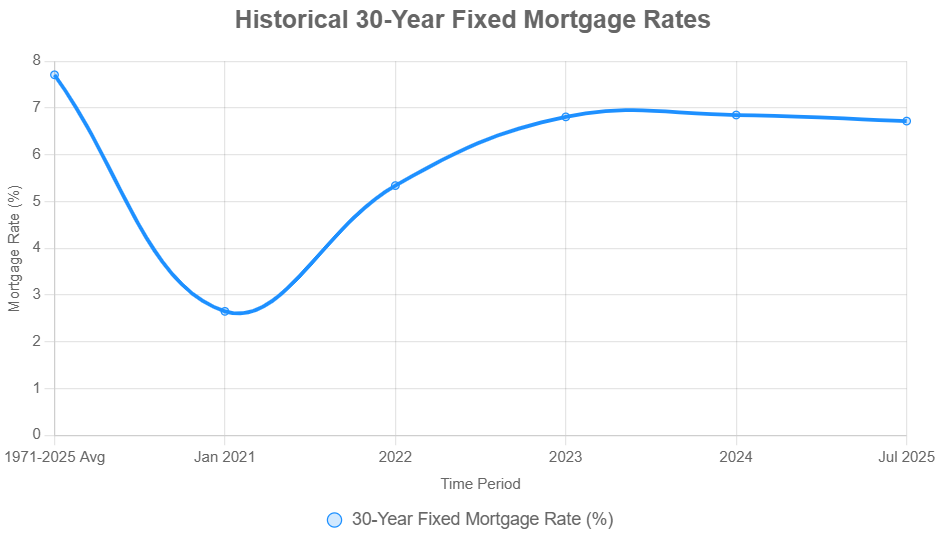
As of August 2025, the average 30-year fixed mortgage rate is hovering around 6.72%. That's according to sources like Bankrate and Freddie Mac. NerdWallet even reported slightly higher figures. Sure, this is way up from the ridiculously low rates we saw in 2021 (remember that 2.65%?), but it's still below the historical average of 7.71% since 1971. So, while it might feel high, it's important to keep things in perspective. Rates have been fluctuating within this 6-7% range all year.

Graph Showing Mortgage Rate Trends

What the Experts Are Saying: Forecasts for 2025 and Beyond

To get a better idea of where things are headed, I decided to check out what the experts are predicting. Here's a snapshot of some key forecasts:

  • National Association of Realtors (NAR): They're anticipating an average of 6.4% by the end of 2025 and a further dip to 6.1% in 2026. Their chief economist, Lawrence Yun, doesn't see rates going back to the 4% or 5% range anytime soon due to the national debt.
  • Realtor.com: They're also projecting a 6.4% rate by the end of 2025.
  • Fannie Mae: Their economic team predicts 6.5% for the end of 2025, with a decrease to 6.1% in 2026.
  • Mortgage Bankers Association (MBA): They're a bit more conservative, expecting rates to stay around 6.8% for a while before settling in the 6.4%-6.6% range and ending the year at 6.7%.
  • Morgan Stanley: They foresee rates potentially reaching 6.25% by 2026.

As you can see, the experts generally agree that mortgage rates aren't likely to plummet below 6% in 2025. Most forecasts hover in the mid-6% area.

Mortgage Rates Forecast 2025

Key Factors Driving Mortgage Rates

So, what's causing these rates to stay where they are? A few major factors are at play:

  • Federal Reserve Policy: This is a big one! The Fed's decisions about interest rates have a huge impact on mortgage rates. They raised rates aggressively to combat inflation.
  • Inflation: Even though inflation has cooled down a bit, it's still above the Fed's target of 2%. This makes it harder for them to cut rates significantly.
  • Economic Growth: A strong economy can actually push rates higher, as investors demand better returns on their investments.
  • Treasury Yields: Mortgage rates often follow the 10-year Treasury yield.
  • Global and Domestic Policies: Unexpected global events and policies can also create uncertainty and influence rates.

A Look Back: Mortgage Rate History

To really understand where we are, it's helpful to look back at mortgage rate history:

Time Period Average Rate
1971–2025 (Average) 7.71%
January 2021 2.65%
2022 5.34%
2023 6.81%
2024 6.85%
July 2025 6.72%

As you can see, we've had quite a ride! The super-low rates of the early 2020s were an anomaly. The current rates, while higher than recent years, aren't out of line with historical averages.

How Mortgage Rates Affect the Housing Market

Mortgage rates have a huge effect on the overall housing market:

  • Affordability: Higher rates mean bigger monthly payments, making it harder for people to afford homes. Even a small difference in rate can add up to hundreds of dollars per month.
  • Demand: When rates are high, fewer people are willing to buy.
  • Supply: Some homeowners are locked into low rates. They're hesitant to sell and give up those amazing rates.
  • Home Prices: Higher rates can put downward pressure on home prices.


Related Topics:

Mortgage Rates Predictions for the Next 3 Months: August to October 2025

Mortgage Rates Predictions for Next Year: Will Rates Go Down to 4%?

Mortgage Rates Predictions for the Next 30 Days: July 22-August 22

Mortgage Rate Predictions for the Next 3 Years: 2026, 2027, 2028

My Thoughts and Personal Experiences

I've been following the housing market closely for years, and I've seen firsthand how sensitive it is to changes in mortgage rates. When rates jumped in 2022 and 2023, it definitely cooled things down. I know many people who put their home-buying plans on hold.

In my opinion, the current market is a bit of a mixed bag. While rates are higher than we'd like, there are still opportunities for both buyers and sellers. The key is to be realistic about your budget and expectations. One of my family members had to postpone their plans a few years. But they are finally now able to afford a place after a few promotions and saving more money.

As for the future, I think we're unlikely to see a dramatic decline in rates anytime soon. The Fed is likely to be cautious about cutting rates too quickly. I would keep my expectations realistic.

In Conclusion: Planning for the Road Ahead

So, will mortgage rates go down below 6% in 2025? It's unlikely. The evidence points towards rates staying in the mid-6% range. It never hurts to be prepared and hope for the best. I believe it's more important to get ready for rates to stay elevated.

That being said, the housing market is adapting. There are still opportunities for those who are prepared. Do you homework. Seek professional advice. Make smart financial decisions.

Invest Smarter in a High-Rate Environment

With mortgage rates remaining elevated this year, it's more important than ever to focus on cash-flowing investment properties in strong rental markets.

Norada helps investors like you identify turnkey real estate deals that deliver predictable returns—even when borrowing costs are high.

HOT NEW LISTINGS JUST ADDED!

Connect with a Norada investment counselor today (No Obligation):

(800) 611-3060

Get Started Now 

Also Read:

  • Will Mortgage Rates Go Down to 3% in 2026?
  • Will Mortgage Rates Go Down in 2025: Morgan Stanley's Forecast
  • Mortgage Rate Predictions 2025 from 4 Leading Housing Experts
  • 30-Year Fixed Mortgage Rate Forecast for the Next 5 Years
  • 15-Year Fixed Mortgage Rate Predictions for Next 5 Years: 2025-2029
  • Will Mortgage Rates Ever Be 3% Again in the Future?
  • Mortgage Rates Predictions for Next 2 Years
  • Mortgage Rate Predictions for Next 5 Years
  • Mortgage Rate Predictions: Why 2% and 3% Rates are Out of Reach
  • How Lower Mortgage Rates Can Save You Thousands?
  • How to Get a Low Mortgage Interest Rate?
  • Will Mortgage Rates Ever Be 4% Again?
Filed Under: Financing, Mortgage Tagged With: Interest Rate, mortgage, Mortgage Rate Trends, mortgage rates, Mortgage Rates Predictions

Today’s Mortgage Rates August 3, 2025: Rates Dip Almost Across the Board

August 3, 2025 by Marco Santarelli

Today's Mortgage Rates August 3, 2025: Rates Dip Almost Across the Board

On August 3, 2025, mortgage rates today reveal a slight drop in the average 30-year fixed mortgage rate to 6.67%, down 19 basis points from last week’s 6.86%, according to Zillow’s latest data. Meanwhile, 15-year fixed mortgage rates edged up slightly to 5.77%, and 5-year adjustable-rate mortgage (ARM) rates nudged higher by 1 basis point to 7.18%.

Refinancing rates show a modest decline for 30-year fixed loans to 6.94%, but 15-year fixed refinance rates increased to 5.81%, and 5-year ARM refinance rates rose more noticeably to 7.84%. This nuanced pattern reflects ongoing economic uncertainties and Federal Reserve policy influences amid a complex housing and inflation environment.

Today's Mortgage Rates August 3, 2025: Rates Dip Almost Across the Board

Key Takeaways

  • 30-year fixed mortgage rate dropped to 6.67%, the lowest in a week, signaling a modest easing for homebuyers.
  • 15-year fixed mortgage rate rose slightly to 5.77%, showing uneven movement across loan terms.
  • 5-year ARM mortgage rates increased marginally to 7.18%.
  • 30-year fixed refinance rates decreased to 6.94%, but 15-year and 5-year ARM refinancing rates both increased.
  • Fed’s hold on interest rates continues amidst economic slowdowns; future cuts may reduce mortgage rates later in 2025.
  • Borrowers should watch out for Federal Reserve decisions in September and December, which could shape mortgage trends.

Overview of Today’s Mortgage and Refinance Rates

Here is an updated glance at current mortgage and refinance rates across major loan types on August 3, 2025:

Loan Type Current Rate (%) Weekly Change (bps) APR (%) Weekly APR Change (bps)
30-Year Fixed (Mortgage) 6.67 -0.19 7.18 -0.14
15-Year Fixed (Mortgage) 5.77 +0.02 6.11 -0.10
5-Year ARM (Mortgage) 7.18 +0.01 7.79 -0.24
30-Year Fixed (Refinance) 6.94 -0.01 – –
15-Year Fixed (Refinance) 5.81 +0.08 – –
5-Year ARM (Refinance) 7.84 +0.27 – –

(Compiled from Zillow’s August 3, 2025 Rate Report)

Conforming and Government Loan Rate Details

Breaking down conforming vs. government-backed mortgage loans reveals small but important variations:

Program Rate (%) Weekly Change (%) APR (%) Weekly APR Change (%)
30-Year Fixed Conforming 6.67 -0.18 7.18 -0.14
20-Year Fixed Conforming 6.34 -0.04 6.84 +0.06
15-Year Fixed Conforming 5.77 -0.13 6.11 -0.10
10-Year Fixed Conforming 5.94 +0.19 6.34 +0.22
7-Year ARM Conforming 6.88 +0.11 7.66 +0.01
5-Year ARM Conforming 7.18 -0.55 7.79 -0.24
30-Year Fixed FHA 7.25 -0.15 8.27 -0.17
30-Year Fixed VA 6.40 +0.08 6.72 +0.19
15-Year Fixed FHA 5.75 +0.24 6.72 +0.20
15-Year Fixed VA 5.75 -0.10 6.25 +0.06

Current Refinance Rates and Trends

Refinancing shows a mixed picture with a slight decline in the 30-year fixed refinance rate and increases for shorter-term and ARM refinances:

Refinance Program Rate (%) Weekly Change (bps)
30-Year Fixed Refinance 6.94 -0.01
15-Year Fixed Refinance 5.81 +0.08
5-Year ARM Refinance 7.84 +0.27

The data shows the 30-year fixed refinance rate dropped by 12 basis points from 7.06% last week, a small but positive shift for homeowners looking to reduce payments. However, the 15-year fixed and ARM refinance rates are trending upward, reflecting continued market volatility and risk premiums on adjustable loans.

Mortgage vs. Refinance Rate Trends: What’s Causing These Movements?

Mortgage rates and refinance rates often move together but can show divergences due to several reasons:

  • Risk Appetite and Loan Duration: Refinance borrowers tend to be more sensitive to short-term rate changes and credit factors, which can drive ARM refinancing costs higher if lenders perceive increased risk.
  • Market Demand: The demand for refinancing tends to drop when rates rise or remain high, pushing lenders to adjust pricing, especially on shorter-term products.
  • Federal Reserve Policies: The Fed’s actions influence long-term borrowing costs indirectly, as mortgage rates typically follow 10-year Treasury yields. Recent Fed rate pauses and hints of future cuts have contributed to these nuanced shifts.

Federal Reserve’s Influence on Mortgage Rates (2024-2025)

The Federal Reserve shapes mortgage rates mainly through its management of the federal funds rate and bond purchases. Here’s a detailed view of how Fed actions impacted mortgage rates from the pandemic through today:

  • Pandemic Recovery Period (2021-2022): The Fed’s bond-buying kept mortgage rates exceptionally low, boosting home buying.
  • Rate Hikes (2022-2023): To fight inflation, the Fed aggressively increased benchmark interest rates by 5.25 percentage points. Mortgage rates consequently surged to 20-year highs.
  • Late 2024 Pivot: The Fed started cutting rates three times, lowering the federal funds rate to a 4.25%-4.5% range, easing some pressure on mortgage rates.
  • 2025 Developments: Five consecutive hold meetings on interest rates reflect uncertainty; internal Fed dissent shows tension between supporting growth and controlling inflation.

Currently, mortgage rates hover near 6.8% for 30-year fixed loans, with forecasts suggesting possible declines toward 6% later in 2025 if the Fed continues cutting rates.

Economic Factors Behind Today's Mortgage Rate Movements

Understanding mortgage rate trends requires a deep dive into macroeconomic factors:

  • Inflation Persistence: Core Personal Consumption Expenditures (PCE) inflation remains stubbornly above target at around 2.7%. Rising tariffs and supply chain issues complicate inflation control.
  • Economic Growth Slows: U.S. GDP growth decelerated to about 1.2% annualized in the first half of 2025. Slower growth can reduce the Fed’s incentive to hike rates but also dampens borrowing demand.
  • Employment Trends: Unemployment creeping up toward 4.5% adds pressure on consumer confidence and housing activity.

These dynamics create a balancing act where lenders cautiously adjust mortgage rates in reaction to a complex mix of forward-looking economic data and policy signals.

Example Calculation: Impact of Rate Changes on Monthly Payments

To put today’s mortgage rates in perspective, here’s an example comparing monthly payments on a $300,000 home loan:

Loan Term & Rate Interest Rate Monthly Principal & Interest Payment
30-Year Fixed at 6.67% 6.67% $1,936
30-Year Fixed at 6.86% 6.86% $2,026
15-Year Fixed at 5.77% 5.77% $2,458

Calculation method: Monthly payment calculated using the standard mortgage formula for fixed-rate loans. The 19 basis point drop in the 30-year fixed rate from 6.86% to 6.67% saves roughly $90 per month or $1,080 annually on a $300,000 loan.

This demonstrates how even small rate fluctuations can significantly impact household budgets, emphasizing the importance of staying informed about mortgage rate changes.


Related Topics:

Mortgage Rates Trends as of August 2, 2025

Mortgage Rates Predictions for the Next 30 Days: July 22-August 22

Mortgage Rates Predictions for Next 90 Days: July-Sept 2025

What to Watch Next in Mortgage Rate Trends

Looking ahead, key Fed meetings on September 16-17 and in December 2025 are pivotal. Markets assign nearly a 50% chance of a rate cut in September, which could trigger mortgage rate declines. If those cuts materialize, borrowers may see 30-year fixed rates drop closer to or below 6% by year-end.

Conversely, persistent inflation or geopolitical shocks could push rates higher or cause volatility, especially in adjustable-rate mortgage products. Homebuyers and refinancers should keep a close eye on Treasury yields, mortgage bond prices, and Federal Reserve statements for the clearest signals.

Final Thoughts on Mortgage Rates Today – August 3, 2025

Mortgage rates today reveal a subtle easing for 30-year fixed loans alongside mixed signals for shorter-term loans and refinancing. While the average 30-year fixed rate dipped to 6.67%, refinancers face a slightly more challenging environment with some rate increases. The Federal Reserve’s cautious stance and ongoing economic challenges create a backdrop of uncertainty but also potential opportunity if rate cuts come later this year.

I consider this a signal that patience and timing remain crucial. Watching Fed moves and economic data closely will help borrowers and homeowners make smarter financial choices as mortgage conditions evolve.

Capitalize Amid Rising Mortgage Rates

With mortgage rates expected to remain high in 2025, it’s more important than ever to focus on strategic real estate investments that offer stability and passive income.

Norada delivers turnkey rental properties in resilient markets—helping you build steady cash flow and protect your wealth from borrowing cost volatility.

HOT NEW LISTINGS JUST ADDED!

Speak with a seasoned Norada investment counselor today (No Obligation):

(800) 611‑3060

Get Started Now

Also Read:

  • Will Mortgage Rates Go Down in 2025: Morgan Stanley's Forecast
  • Mortgage Rate Predictions 2025 from 4 Leading Housing Experts
  • Mortgage Rate Predictions for the Next 3 Years: 2026, 2027, 2028
  • 30-Year Fixed Mortgage Rate Forecast for the Next 5 Years
  • 15-Year Fixed Mortgage Rate Predictions for Next 5 Years: 2025-2029
  • Will Mortgage Rates Ever Be 3% Again in the Future?
  • Mortgage Rates Predictions for Next 2 Years
  • Mortgage Rate Predictions for Next 5 Years
  • Mortgage Rate Predictions: Why 2% and 3% Rates are Out of Reach
  • How Lower Mortgage Rates Can Save You Thousands?
  • How to Get a Low Mortgage Interest Rate?
  • Will Mortgage Rates Ever Be 4% Again?
Filed Under: Financing, Mortgage Tagged With: Interest Rate, mortgage, Mortgage Rate Trends, mortgage rates, Mortgage Rates Today

Today’s 5-Year Adjustable Rate Mortgage Goes Down by 14 Basis Points – August 2, 2025

August 2, 2025 by Marco Santarelli

Today's 5-Year Adjustable Rate Mortgage Drops from 7.56% to 7.54% - June 28, 2025

Are you keeping an eye on mortgage rates? If you're thinking about buying a home or refinancing, you should be! According to Zillow, the national average 5-year Adjustable Rate Mortgage (ARM) rate has decreased to 7.16%, a 14-basis-point drop from the previous rate of 7.30%. While this might seem small, every little bit helps when you're dealing with a mortgage. Let's dive deeper into what this means for you and the broader housing market.

Today's 5-Year Adjustable Rate Mortgage Goes Down 14 Basis Points From 7.30% to 7.16% – Aug 2, 2025

A Closer Look at Today's Mortgage Rate Changes

It's not just the 5-year ARM that's been moving. Here's a snapshot of how different mortgage types are performing as of today:

PROGRAM RATE 1W CHANGE APR 1W CHANGE
30-Year Fixed Rate 6.68% down 0.17% 7.13% down 0.19%
20-Year Fixed Rate 6.34% down 0.04% 6.84% up 0.06%
15-Year Fixed Rate 5.74% down 0.16% 6.03% down 0.18%
10-Year Fixed Rate 5.94% up 0.19% 6.34% up 0.22%
7-year ARM 6.88% up 0.11% 7.66% up 0.01%
5-year ARM 7.16% down 0.57% 7.72% down 0.30%
3-year ARM — 0.00% — 0.00%

Source: Zillow

As you can see, most fixed-rate mortgages have also seen a slight decrease this week, which is generally good news for potential homebuyers.

Why the Focus on ARMs? Understanding the Basics

An Adjustable Rate Mortgage (ARM) is a type of mortgage where the interest rate is not fixed for the entire loan term. Instead, it's fixed for an initial period (in this case, five years) and then adjusts periodically based on a benchmark interest rate.

  • The Initial Fixed Period: This is when you get a predictable interest rate and monthly payment.
  • The Adjustment Period: After the initial period, your interest rate can go up or down depending on market conditions.

The 5-year ARM is a popular choice for folks who don't plan on staying in their home for more than five years, or those who believe interest rates will go down in the future. They are betting that they will sell or refinance the home before the rate adjusts upward significantly.

The Fed's Role: The Puppet Master Behind the Curtain

Mortgage rates don't just appear out of thin air. They are heavily influenced by the Federal Reserve (the Fed), which is the central bank of the United States. The Fed uses monetary policy, like adjusting the federal funds rate (the rate at which banks lend money to each other overnight), to try to keep the economy stable.

Here's a quick recap of the Fed's recent actions:

  • 2021-2023: Rate Hikes to Fight Inflation: Remember those pandemic-era low interest rates? Well, to combat rising inflation, the Fed aggressively raised the federal funds rate by 5.25 percentage points, pushing mortgage rates up to 20-year highs.
  • Late 2024: A Glimmer of Hope (Rate Cuts): After a period of holding steady, the Fed cut rates three times at the end of 2024, reducing the federal funds rate by 1 percentage point.
  • 2025: A Year of Waiting: So far in 2025, the Fed has held rates steady, creating some uncertainty in the market.

As of July 30, 2025, there was even disagreement within the Fed, with some members pushing for immediate rate cuts due to a slowing economy.

Digging Deeper: The Economic Crosscurrents

The Fed's decisions are based on a complex mix of economic data. Here are some key factors influencing their choices:

  • Inflation: Core PCE (Personal Consumption Expenditures), a measure of inflation, is still above the Fed's target. This is making them hesitant to cut rates too quickly.
  • Economic Growth: GDP (Gross Domestic Product) growth has slowed down, and unemployment is creeping up. This is putting pressure on the Fed to lower rates to stimulate the economy.
  • Geopolitical Tensions: Increased tariffs and geopolitical uncertainty further complicate the economic outlook.

What Does This Mean for You? Practical Implications

So, how does all of this translate into your everyday life?

  • Current Homebuyers: If you're in the market to buy a home, be aware that rates are still relatively high. However, the Fed's signals suggest that some relief may be coming later in 2025 or early 2026.
  • Refinancers: If you have a mortgage rate above 7%, keep a close eye on the Fed's upcoming meetings in September and December. These meetings could provide clues about potential rate cuts.
  • Investors: The bond market still remains volatile in lieu of the decision. Also, the 10 year treasury yield will be sensitive to the Fed rhetoric.

Basically, for the people buying now, it could be good especially the ARMs, and for the refinancers, they need to monitor the trend.

Recommended Read:

5-Year Adjustable Rate Mortgage Update for July 14, 2025

Fixed vs. Adjustable Rate Mortgage in 2025: Which is Best for You

The Future: What to Expect

The Fed is expected to gradually ease monetary policy over the next few years. Their projections suggest that rates could settle near 2.25%-2.5% by 2027. But in this ever changing world, it is only projections and is subject to change due to unforeseen circumstances.

Here are some key dates to watch:

  • September 16-17 Meeting: The next critical juncture, with updated economic projections.
  • December Meeting: Likely the Fed's last realistic 2025 opportunity if September passes without action.

Why Choose a 5-Year ARM? Pros and Cons

Here's a quick breakdown of the advantages and disadvantages of a 5-year ARM:

Pros:

  • Lower Initial Interest Rate: You typically get a lower interest rate compared to a fixed-rate mortgage, which can save you money in the short term.
  • Flexibility: If you don't plan on staying in your home for more than five years, an ARM can be a good option.
  • Potential for Rate Decreases: If interest rates go down during the adjustment period, your mortgage payment could decrease.

Cons:

  • Rate Adjustments: After the initial fixed period, your interest rate can increase, leading to higher monthly payments.
  • Uncertainty: It's hard to predict where interest rates will be in the future, so you're taking a risk when you choose an ARM.
  • Complexity: ARMs can be more complicated than fixed-rate mortgages, so it's important to understand how they work.

My Take: A Cautious Optimism

While the decrease in the 5-year ARM rate is good news, it's essential to approach the situation with informed caution. The economy is still facing numerous challenges, and the Fed's actions are not always predictable.

If you're considering an ARM, do your research and understand the risks involved. Talk to a mortgage professional to get personalized advice based on your financial situation and goals.

Remember, buying a home is a big decision. Take your time, weigh your options, and make sure you're comfortable with your choice.

Capitalize on ARM Rates Before They Rise Even Higher

With fluctuating adjustable-rate mortgages (ARMs), savvy investors are exploring flexible financing options to maximize returns.

Norada offers a curated selection of ready-to-rent properties in top markets, helping you capitalize on current mortgage trends and build long-term wealth.

HOT NEW LISTINGS JUST ADDED!

Connect with an investment counselor today (No Obligation):

(800) 611-3060

Get Started Now

Also Read:

  • Will Mortgage Rates Go Down in 2025: Morgan Stanley's Forecast
  • Expect High Mortgage Rates Until 2026: Fannie Mae's 2-Year Forecast
  • Mortgage Rate Predictions 2025 from 4 Leading Housing Experts
  • Mortgage Rates Forecast for the Next 3 Years: 2025 to 2027
  • Will Mortgage Rates Ever Be 3% Again in the Future?
  • Mortgage Rates Predictions for Next 2 Years
  • Mortgage Rate Predictions for Next 5 Years
  • Mortgage Rate Predictions: Why 2% and 3% Rates are Out of Reach
  • How Lower Mortgage Rates Can Save You Thousands?
  • How to Get a Low Mortgage Interest Rate?
  • Will Mortgage Rates Ever Be 4% Again?

Filed Under: Financing, Mortgage Tagged With: Adjustable Rate Mortgage, Interest Rate, mortgage, Mortgage Rate Trends, mortgage rates

Today’s Mortgage Rates August 2, 2025: 30-Year FRM Plunges by 17 Basis Points

August 2, 2025 by Marco Santarelli

Mortgage Rates Today August 02, 2025: 30-Year FRM Plunges by 17 Basis Points

On August 2, 2025, the national average 30-year fixed mortgage rate fell slightly to 6.69%, down from 6.72% the previous day and significantly lower by 17 basis points from last week’s 6.86% average, according to Zillow’s latest data. This slight dip in mortgage rates can provide some relief for homebuyers and those looking to refinance, although overall rates remain historically elevated compared to pre-pandemic years. Both mortgage and refinance rates have shown small declines, with some variation depending on loan type and term length.

Today's Mortgage Rates August 2, 2025: 30-Year FRM Plunges by 17 Basis Points

Key Takeaways

  • 30-year fixed mortgage rate dropped to 6.69% on August 2, 2025, down 17 basis points from last week.
  • 15-year fixed mortgage rate also declined to 5.74%, a four basis-point decrease.
  • The 5-year ARM mortgage rate fell significantly by 15 basis points to 7.15%.
  • Refinancing rates for a 30-year fixed dropped to 6.94%, down 12 basis points from last week.
  • Rates remain influenced heavily by decisions and outlooks of the Federal Reserve's monetary policy.
  • Despite recent cuts in late 2024, the Fed's hold on rates in 2025 and economic uncertainty shape mortgage rate movement.
  • The Federal Reserve's upcoming meetings in September and December 2025 are key for potential further rate cuts.

Current Mortgage Rates Overview – August 2, 2025

Understanding mortgage rates means looking closely at variations in fixed versus adjustable-rate loans and how they compare to refinancing options. Below is a detailed table summarizing the current rates for popular loan types and terms on this date:

Loan Type Rate (%) Weekly Change APR (%) APR Weekly Change
30-Year Fixed 6.69 ↓ 0.17% 7.12 ↓ 0.20%
20-Year Fixed 6.34 ↓ 0.04% 6.84 ↑ 0.06%
15-Year Fixed 5.74 ↓ 0.16% 6.02 ↓ 0.18%
10-Year Fixed 5.94 ↑ 0.19% 6.34 ↑ 0.22%
7-Year ARM 6.88 ↑ 0.11% 7.66 ↑ 0.01%
5-Year ARM 7.15 ↓ 0.58% 7.72 ↓ 0.31%

For government-backed loans:

Loan Type Rate (%) Weekly Change APR (%) APR Weekly Change
30-Year Fixed FHA 7.25 ↓ 0.15% 8.27 ↓ 0.17%
30-Year Fixed VA 6.19 ↓ 0.12% 6.41 ↓ 0.11%
15-Year Fixed FHA 5.75 ↑ 0.24% 6.72 ↑ 0.20%
15-Year Fixed VA 5.80 ↓ 0.04% 6.17 ↓ 0.03%

Refinance Rates – A Slight Downturn

Alongside purchase mortgage rates, refinancing options have also seen modest shifts:

Refinance Type Rate (%) Weekly Change
30-Year Fixed Refinance 6.94 ↓ 0.02%
15-Year Fixed Refinance 5.79 ↑ 0.02%
5-Year ARM Refinance 7.58 ↓ 0.16%

Refinancing rates mirror purchase rates’ general trend of slight decreases, particularly in the 30-year fixed and 5-year ARM categories. The 15-year fixed refinance rates showed a marginal increase by 2 basis points.

What Influences Mortgage Rates Now? The Federal Reserve’s Impact

Mortgage rates are not set by lenders arbitrarily; rather, they track broader economic factors. The Federal Reserve’s monetary policy continues to be the main force shaping mortgage rates in 2024 and 2025.

  • Throughout 2021 and early 2022, the Fed maintained low rates with aggressive bond purchases to support pandemic recovery.
  • From March 2022 to July 2023, the Fed hiked federal funds rates by 5.25 percentage points, leading mortgage rates to soar to 20-year highs.
  • Late 2024 marked a pivot, where the Fed cut rates three times, slightly easing pressure on mortgage rates.
  • In 2025, the Fed has held rates stable for five meetings through July despite economic headwinds such as a slowing GDP (1.2% annualized growth in H1 2025), creeping inflation (core PCE about 2.7%), and slightly rising unemployment at 4.5%.

These mixed economic signals have kept mortgage rates elevated but with potential for modest relief if the Fed follows through on anticipated rate cuts later in 2025.

Projected Fed Moves and Mortgage Rate Expectations

Key dates for Fed decisions include:

  • September 16-17, 2025: Important meeting with new economic projections. Market odds for a rate cut hover around 47%.
  • December 2025: Potential last chance for a rate cut in 2025 if no action is taken in September.

If the Fed cuts rates as forecasted in their June dot plot, mortgage rates could edge down toward the 6% range by the end of 2025. However, this depends on inflation trends, economic growth, and external factors like tariffs and geopolitical events.

Example Calculation: Impact of Rate Drop on Monthly Payment

To visualize the significance of these rate changes, let's consider a $300,000 home loan:

Term Rate 8/02/2025 Monthly Principal & Interest Rate 1 Week Earlier Monthly Principal & Interest Monthly Change
30-Year Fixed 6.69% $1,939 6.86% $2,002 -$63
15-Year Fixed 5.74% $2,458 5.78% $2,474 -$16

Calculations based on standard amortization.

This shows that a decrease of 17 basis points in the 30-year fixed rate translates to approximately $63 less per month on a $300,000 loan. Even small differences in rates can affect affordability over the long term, especially for large loan balances.


Related Topics:

Mortgage Rates Trends as of August 01, 2025

Mortgage Rates Predictions for the Next 30 Days: July 22-August 22

Mortgage Rates Predictions for Next 90 Days: July-Sept 2025

How Current Mortgage Rates Compare Historically

The recent slight drop to 6.69% for 30-year fixed mortgages marks some easing from the mid-2025 peak near 6.86%, but rates are still well above 3%-4% seen in the years before the pandemic. For perspective:

  • 1990s and early 2000s: Rates often hovered around 7-8%.
  • 2008 financial crisis aftermath: Rates fell precipitously, reaching new lows.
  • 2020-2021 pandemic lows: Rates dropped dramatically to historic lows near 3%.
  • 2022-2023: Rapid increases pushed rates above 6.5%-7%.

Today’s mortgage environment is a balancing act between inflation control and economic growth stabilization, with rates reflecting a cautious optimism following Fed cuts but tempered by uncertainty.

Understanding Adjustable-Rate Mortgages (ARMs) and Their Current Trends

Among variable rate loans, the 5-year ARM rate saw a significant weekly decline of 0.58% to 7.15%, which is notable given ARM’s adjustment periods and sensitivity to interest rate forecasts.

ARMs can advantage homebuyers wanting initially lower rates versus fixed-rate mortgages but come with the risk of rate increases after the fixed period. Given today’s Fed hold and possible cuts, ARMs become attractive, especially for buyers planning to refinance or sell before the adjustment period.

Broader Economic Context Behind Today’s Rates

Mortgage trends over the past months reflect how competing economic pressures influence decisions:

  • Core inflation remains just above the Fed’s target, maintaining the pressure on interest rates.
  • GDP growth slowing to 1.2% indicates a cooling economy but not recession-level contraction.
  • Unemployment rising modestly to 4.5% suggests the labor market softening but still healthy.
  • New tariffs and geopolitical uncertainties complicate the outlook.

These factors create an environment of cautious optimism, encouraging lenders and borrowers to act carefully while anticipating future rate shifts.

Personal Thoughts on Mortgage Rate Movements in 2025

From my experience observing mortgage cycles, small dips such as the 17 basis point decline in 30-year fixed rates are encouraging but should be interpreted with caution. Rates have stabilized but remain high relative to recent years, limiting affordability for many.

For potential buyers and refinancers, these slight improvements signal that the market is sensitive to Fed policy but still grappling with inflation and economic growth uncertainties. The next few critical Fed meetings could set the tone for whether rates will ease meaningfully or remain elevated into 2026.

Capitalize Amid Rising Mortgage Rates

With mortgage rates expected to remain high in 2025, it’s more important than ever to focus on strategic real estate investments that offer stability and passive income.

Norada delivers turnkey rental properties in resilient markets—helping you build steady cash flow and protect your wealth from borrowing cost volatility.

HOT NEW LISTINGS JUST ADDED!

Speak with a seasoned Norada investment counselor today (No Obligation):

(800) 611‑3060

Get Started Now

Also Read:

  • Will Mortgage Rates Go Down in 2025: Morgan Stanley's Forecast
  • Mortgage Rate Predictions 2025 from 4 Leading Housing Experts
  • Mortgage Rate Predictions for the Next 3 Years: 2026, 2027, 2028
  • 30-Year Fixed Mortgage Rate Forecast for the Next 5 Years
  • 15-Year Fixed Mortgage Rate Predictions for Next 5 Years: 2025-2029
  • Will Mortgage Rates Ever Be 3% Again in the Future?
  • Mortgage Rates Predictions for Next 2 Years
  • Mortgage Rate Predictions for Next 5 Years
  • Mortgage Rate Predictions: Why 2% and 3% Rates are Out of Reach
  • How Lower Mortgage Rates Can Save You Thousands?
  • How to Get a Low Mortgage Interest Rate?
  • Will Mortgage Rates Ever Be 4% Again?
Filed Under: Financing, Mortgage Tagged With: Interest Rate, mortgage, Mortgage Rate Trends, mortgage rates, Mortgage Rates Today

Mortgage Rates Today: The States Offering Lowest Rates – August 1, 2025

August 1, 2025 by Marco Santarelli

U.S. States With Lowest Mortgage Rates Today – July 1, 2025

Are you dreaming of owning a home but getting bogged down by the complexities of mortgage rates? You're not alone! It can feel like deciphering a secret code, especially when those rates fluctuate like the weather. As of Thursady, the states boasting the cheapest 30-year new purchase mortgage rates are New Jersey, New York, California, North Carolina, Georgia, Maine, Texas, and Wisconsin, with averages hovering between 6.78% and 6.83%. Let’s dive into why these rates vary and what it means for you.

Mortgage Rates Today: The States Offering Lowest Rates

Why Do Mortgage Rates Differ by State?

It’s a fair question! Unlike, say, the price of a gallon of gas, mortgage rates aren't uniform across the country. Several factors contribute to these variations:

  • Lender Presence: Not all lenders operate in every state. The level of competition among lenders in a given state can influence mortgage rates. More competition often translates to better deals for borrowers.
  • Credit Score Averages: States with higher average credit scores might see slightly lower rates, as lenders perceive lower risk.
  • Average Loan Size: The typical loan amount requested in a state can also play a role. Larger loan sizes might sometimes come with slightly different rates.
  • State Regulations: Each state has its own set of regulations for the mortgage industry. These regulations can impact the cost of doing business for lenders, which can then be reflected in the rates they offer.
  • Risk Management: Lenders have different methods of risk management that can influence the rates they offer.

It is important to understand these factors before buying a home of your own and getting a mortgage.

States with the Lowest Rates:

According to Investopedia's report and Zillow's data, these states offer the most attractive 30-year new purchase mortgage rates:

State Rate (30-Year Fixed)
New Jersey 6.78%
New York 6.79%
California 6.80%
North Carolina 6.81%
Georgia 6.81%
Maine 6.82%
Texas 6.82%
Wisconsin 6.83%

States with the Highest Rates:

State Rate (30-Year Fixed)
West Virginia 6.92%
Alaska 6.93%
Hawaii 6.94%
Iowa 6.94%
Nebraska 6.95%
New Mexico 6.95%
Washington, D.C. 6.96%

National Mortgage Rate Trends: A Broader View

While knowing the state-specific rates is helpful, it's equally important to understand the overall mortgage rate climate. As of today, the national average for a 30-year fixed-rate mortgage is 6.86%. While this is lower than the one-year high of 7.15% we saw in May 2025, it's still higher than the 6.50% we saw in March of this year. Remember those sweet rates of 5.89% we experienced back in September 2024? Those feel like a distant memory, don’t they?

Here’s a quick snapshot of national average mortgage rates for different loan types:

  • 30-Year Fixed: 6.86%
  • FHA 30-Year Fixed: 7.55%
  • 15-Year Fixed: 5.89%
  • Jumbo 30-Year Fixed: 6.75%
  • 5/6 ARM: 7.35%

ARM – Adjustable Rate Mortgage

What’s Driving Mortgage Rate Changes?

If you are wondering about the factors that affect mortgage rates, here is a list:

  • The Bond Market: Keep an eye on the 10-year Treasury yield. It's a key indicator, as mortgage rates often track its movements.
  • The Federal Reserve (The Fed): The Fed plays a huge role through its monetary policy. Their actions, especially regarding bond buying and rates impact mortgage rates.
  • Lender Competition: The more lenders competing for your business, the better chance you have of getting a lower rate.

In 2021, the Fed's bond-buying kept rates down. But as they reduced these purchases and raised rates to fight inflation in 2022 and 2023, mortgage rates climbed.

The Federal Reserve's Game Plan: 2024-2025

The Fed's moves are crucial for understanding where mortgage rates are headed.

  • Pandemic Era: Low rates thanks to Fed bond purchases.
  • 2022-2023: Aggressive rate hikes (5.25 percentage points!) to tackle inflation.
  • Late 2024: The Fed started cutting rates (three times), reducing the federal funds rate by 1 percentage point to 4.25%-4.5%.
  • 2025: Holding Steady: Despite some internal disagreements, the Fed has been holding rates steady in 2025.

What's on the Horizon?

  • Inflation: It's still a concern, hovering around 2.7%.
  • Economic Growth: Things are slowing down, with GDP growth around 1.2%.
  • The Fed's Next Move: All eyes are on the September 16-17 meeting for clues.

The Fed's projections suggest a couple of rate cuts later in 2025. This could bring mortgage rates down closer to 6% by the end of the year but don’t hold me to that!

Read More:

States With the Lowest Mortgage Rates on July 31, 2025

Are Mortgage Rates Expected to Go Down Soon: A Realistic Outlook

What Does This Mean for You?

  • If You're Buying Now: It's a tough market, but relief might be on the way. Talk to various lenders and find out the best rates for yourself.
  • If You're Refinancing: Keep an eye on the Fed. If you are not in a rush, wait a while and then make a decision.
  • Pay Attention: Keep an eye on the Fed meeting and any new developments from them.

Finding Your Best Rate: It's All About Shopping Around

I can't stress this enough: Don't settle for the first rate you see! Even small differences can add up to big savings over the life of your loan.

  • Check with Multiple Lenders: Banks, credit unions, online lenders – get quotes from a variety of sources.
  • Understand the Fine Print: Watch out for points, fees, and other costs that can impact the overall cost of your loan.
  • Negotiate: Don't be afraid to haggle! Lenders want your business, so see if they can match or beat a competitor's offer.

Calculating Your Mortgage Payment: Know Before You Owe

Use a mortgage calculator to get a realistic sense of what your monthly payments will be. Plug in your estimated home price, down payment, and interest rate to see how it all adds up.

Here's a quick example:

  • Home Price: $440,000
  • Down Payment: $88,000 (20%)
  • Loan Term: 30 years
  • Interest Rate: 6.67%

Based on these numbers, your monthly payment would be around $2,649.04 (including principal, interest, property taxes, and homeowners insurance). You also need to factor in other expenses like home repairs, new furniture and landscaping etc.

What's My Take on All of This?

Look, mortgage rates are a moving target. It is not an easy ride and the conditions change every now and then. What's true today might not be true tomorrow. It's all about staying informed, doing your homework, and making smart decisions based on your individual circumstances. Don't get discouraged by the numbers! With a little research and a lot of patience, you can find a mortgage that fits your budget and makes your homeownership dreams a reality.

Invest in Real Estate in the Top U.S. Markets

Investing in turnkey real estate can help you secure consistent returns with fluctuating mortgage rates.

Expand your portfolio confidently, even in a shifting interest rate environment.

Speak with our expert investment counselors (No Obligation):

(800) 611-3060

Get Started Now

Also Read:

  • Will Mortgage Rates Go Down in 2025: Morgan Stanley's Forecast
  • Expect High Mortgage Rates Until 2026: Fannie Mae's 2-Year Forecast
  • Mortgage Rate Predictions 2025 from 4 Leading Housing Experts
  • Mortgage Rates Forecast for the Next 3 Years: 2025 to 2027
  • 30-Year Mortgage Rate Forecast for the Next 5 Years
  • 15-Year Mortgage Rate Forecast for the Next 5 Years
  • Why Are Mortgage Rates Going Up in 2025: Will Rates Drop?
  • Why Are Mortgage Rates So High and Predictions for 2025
  • Will Mortgage Rates Ever Be 3% Again in the Future?
  • Mortgage Rates Predictions for Next 2 Years
  • Mortgage Rate Predictions for Next 5 Years
  • Mortgage Rate Predictions: Why 2% and 3% Rates are Out of Reach
  • How Lower Mortgage Rates Can Save You Thousands?
  • How to Get a Low Mortgage Interest Rate?
  • Will Mortgage Rates Ever Be 4% Again?

Filed Under: Financing, Mortgage Tagged With: Interest Rate, mortgage, Mortgage Rate Trends, mortgage rates, Mortgage Rates Predictions, Mortgage Rates Today

Today’s Mortgage Rates August 01, 2025: Rates Rise Marginally Across the Board

August 1, 2025 by Marco Santarelli

Mortgage Rates Today August 1, 2025: Rates Rise Marginally Across the Board

As of August 1, 2025, mortgage rates and refinance rates have edged slightly higher across most loan types. The average 30-year fixed mortgage rate stands at 6.86%, up marginally from the previous week's 6.83%, and the 30-year fixed refinance rate increased to 7.07% from 7.04%. This rise reflects current economic conditions and the Federal Reserve's monetary policy stance, which has kept rates steady but signaled potential cuts later in the year.

Today's Mortgage Rates August 01, 2025: Rates Rise Marginally Across the Board

Key Takeaways

  • 30-year fixed mortgage rate for August 1, 2025: 6.86% (up 3 basis points from last week).
  • 15-year fixed mortgage rate increased slightly to 5.94%.
  • 5-year ARM mortgage rate rose to 7.68%, indicating variable rates also climbed.
  • 30-year fixed refinance rate reached 7.07%, up from 7.04%.
  • Federal Reserve has paused rate hikes after multiple increases, with possible cuts expected later in 2025.
  • Economic factors like inflation and GDP growth slowdown influence these rates.
  • Borrowers should watch upcoming Fed meetings in September and December for rate movement clues.

Current Mortgage Rates by Loan Type

The mortgage market shows subtle upward movement after weeks of relative stability. Here's a detailed breakdown of conforming and government loan mortgage rates as of August 1, 2025:

Loan Type Rate Change from Last Week APR APR Change from Last Week
Conforming Loans
30-Year Fixed 6.86% 0.00% 7.28% -0.04%
20-Year Fixed 6.50% +0.12% 6.95% +0.17%
15-Year Fixed 5.94% +0.04% 6.21% +0.01%
10-Year Fixed 5.94% +0.19% 6.34% +0.22%
7-Year ARM 7.49% +0.73% 8.04% +0.38%
5-Year ARM 7.68% -0.05% 7.93% -0.10%
3-Year ARM — 0.00% — 0.00%
Government Loans
30-Year Fixed FHA 7.41% 0.00% 8.45% 0.00%
30-Year Fixed VA 6.51% +0.19% 6.73% +0.21%
15-Year Fixed FHA 5.67% +0.16% 6.63% +0.12%
15-Year Fixed VA 6.05% +0.20% 6.42% +0.22%

Current Refinance Rates

Refinancing rates generally align with purchase mortgage rates but tend to be fractionally higher. Here’s an overview for August 1, 2025:

Loan Type Refinance Rate Change from Last Week APR APR Change
30-Year Fixed 7.07% +0.03% — —
15-Year Fixed 5.93% +0.01% — —
5-Year ARM 7.95% +0.02% — —

Understanding What Drives Mortgage Rates in 2025

The Federal Reserve's monetary policy remains the largest influence on mortgage rates today. Following a period of aggressive rate increases during 2022 and 2023 to combat inflation, the Fed paused hikes in early 2025. As of July 30, 2025, the benchmark federal funds rate is 4.25%-4.5%, held steady for five consecutive meetings. Internal split opinions among Fed officials led to some dissent, signaling uncertainty about economic growth and inflation pressures.

Key Economic Metrics Influencing Mortgage Rates:

  • Core Inflation (PCE): Still relatively stubborn at around 2.7%, keeping pressure on interest rates.
  • GDP Growth: Slower growth at roughly 1.2% annualized for the first half of 2025.
  • Unemployment Rate: Slight increase to about 4.5%, indicating some labor market softening.

With bond markets sensitive to Fed announcements and economic data, mortgage rates mirror these fluctuations closely. The 10-year Treasury yield—a good benchmark proxy—is hovering around 4.34%, influencing fixed mortgage rates.

How Borrowers Are Affected by the Current Rates

For homebuyers and those refinancing:

  • Buyers are faced with mortgage rates near 7% for a 30-year fixed loan, higher than the ultra-low rates seen during the pandemic years but comparable to the 20-year highs of 2023.
  • Refinancers with existing loans above 7% might consider waiting for the Fed's possible rate cuts expected later in 2025 to take advantage of lower rates.
  • The variable rate mortgages (ARMs), such as the 5-year ARM at 7.68%, may suit some borrowers expecting rates to drop or planning shorter home tenure.
  • Government-backed loans like FHA and VA offer slightly different rate profiles, with FHA 30-year fixed at 7.41% and VA 30-year fixed currently at 6.51%.

Example Calculation: Impact of Current 30-Year Fixed Mortgage Rate

Imagine a borrower takes a $300,000 mortgage with a 30-year fixed rate at today's average of 6.86%.

  • Principal and interest monthly payment:
    $$ P = \frac{r \times PV}{1 – (1 + r)^{-n}} $$where

    • $$r$$ = monthly interest rate = $$6.86\% / 12 = 0.00572$$
    • $$PV$$ = loan amount = $300,000
    • $$n$$ = total payments = 360 months

Calculating,

$$ P = \frac{0.00572 \times 300,000}{1-(1+0.00572)^{-360}} \approx 1,944.31 $$

The monthly payment for principal and interest is about $1,944.

If the rate was just 0.5% lower (6.36%), the payment would drop to approximately $1,880, saving about $64 monthly, illustrating how small rate changes significantly impact affordability.


Related Topics:

Mortgage Rates Trends as of July 31, 2025

Mortgage Rates Predictions for the Next 30 Days: July 22-August 22

Mortgage Rates Predictions for Next 90 Days: July-Sept 2025

The Federal Reserve's Upcoming Decisions Impacting Mortgage Rates

The Federal Reserve will reveal updated economic projections and likely discuss monetary policy direction in these key meetings:

  • September 16-17, 2025: Market expects nearly a 50-50 chance of the Fed cutting rates to stimulate growth.
  • December Meeting: The last likely opportunity for 2025 cuts, which could further reduce mortgage rates.

Should the Fed act on these cuts, mortgage rates may trend toward or below the 6% mark by the end of the year, providing relief for borrowers and refinancers alike.

Broader Market Context and Interest Rate Trends

While mortgage rates have climbed off pandemic lows, they remain historically moderate compared to the early 2000s. Years of Fed intervention, global economic disruptions, and inflation controlling measures have shaped the current rate environment.

Investors watch Treasury yields, inflation data, and labor market indicators closely, because these factors govern mortgage lending costs. Housing market activity often reacts to these shifts, influencing home prices, sales volume, and lending standards.

Summary Table of Key Mortgage and Refinance Rates Today

Program Rate (%) 1-Week Change APR (%) APR 1-Week Change
30-Year Fixed (Mortgage) 6.86 +0.03 7.28 -0.04
15-Year Fixed (Mortgage) 5.94 +0.04 6.21 +0.01
5-Year ARM (Mortgage) 7.68 +0.02 7.93 -0.10
30-Year Fixed (Refinance) 7.07 +0.03 — —
15-Year Fixed (Refinance) 5.93 +0.01 — —
5-Year ARM (Refinance) 7.95 +0.02 — —

This detailed overview of mortgage and refinance rates as of August 1, 2025, reflects a period of cautious stability with slight upward movements. Fed policy and economic signals hold the key to where rates head next, an essential consideration for buyers, refinancers, and real estate investors navigating today’s housing market.

Capitalize Amid Rising Mortgage Rates

With mortgage rates expected to remain high in 2025, it’s more important than ever to focus on strategic real estate investments that offer stability and passive income.

Norada delivers turnkey rental properties in resilient markets—helping you build steady cash flow and protect your wealth from borrowing cost volatility.

HOT NEW LISTINGS JUST ADDED!

Speak with a seasoned Norada investment counselor today (No Obligation):

(800) 611‑3060

Get Started Now

Also Read:

  • Will Mortgage Rates Go Down in 2025: Morgan Stanley's Forecast
  • Mortgage Rate Predictions 2025 from 4 Leading Housing Experts
  • Mortgage Rate Predictions for the Next 3 Years: 2026, 2027, 2028
  • 30-Year Fixed Mortgage Rate Forecast for the Next 5 Years
  • 15-Year Fixed Mortgage Rate Predictions for Next 5 Years: 2025-2029
  • Will Mortgage Rates Ever Be 3% Again in the Future?
  • Mortgage Rates Predictions for Next 2 Years
  • Mortgage Rate Predictions for Next 5 Years
  • Mortgage Rate Predictions: Why 2% and 3% Rates are Out of Reach
  • How Lower Mortgage Rates Can Save You Thousands?
  • How to Get a Low Mortgage Interest Rate?
  • Will Mortgage Rates Ever Be 4% Again?

Filed Under: Financing, Mortgage Tagged With: Interest Rate, mortgage, Mortgage Rate Trends, mortgage rates, Mortgage Rates Today

  • « Previous Page
  • 1
  • …
  • 26
  • 27
  • 28
  • 29
  • 30
  • …
  • 84
  • Next Page »

Real Estate

  • Birmingham
  • Cape Coral
  • Charlotte
  • Chicago

Quick Links

  • Markets
  • Membership
  • Notes
  • Contact Us

Blog Posts

  • Today’s Mortgage Rates, July 9: 15‑Year Fixed Rate and ARMs See Sharp Jumps
    July 9, 2026Marco Santarelli
  • 3 Main Forces Driving the Rise in Mortgage Rates in 2026
    July 9, 2026Marco Santarelli
  • Mortgage Rates Today, July 9, 2026: 30‑Year Refinance Rate Rises by 14 Basis Points
    July 9, 2026Marco Santarelli

Contact

Norada Real Estate Investments 30251 Golden Lantern, Suite E-261 Laguna Niguel, CA 92677

(949) 218-6668
(800) 611-3060
BBB
  • Terms of Use
  • |
  • Privacy Policy
  • |
  • Testimonials
  • |
  • Suggestions?
  • |
  • Home

Copyright 2018 Norada Real Estate Investments

Loading...