Norada Real Estate Investments

  • Home
  • Markets
  • Properties
  • Membership
  • Podcast
  • Learn
  • About
  • Contact

Los Angeles Housing Market: Trends and Forecast 2026

January 23, 2026 by Marco Santarelli

Los Angeles Housing Market: Prices, Trends, Forecast 2024-2025

Is the Los Angeles real estate market finally taking a breather, or is it still holding its breath? If you've been wondering about buying, selling, or just keeping an eye on property values in our vibrant city, you're not alone. The latest numbers for December 2025 tell us a compelling story: the Los Angeles housing market wrapped up the year with a slight cool-down in median home prices, but surprisingly robust home sales, hinting at a more inviting and stable market for 2026.

Los Angeles Housing Market Update: What's Shaking in SoCal?

The housing market in Los Angeles is always a hot topic, filled with unique challenges and opportunities. Unlike other parts of the country, our local dynamics are often influenced by a mix of high demand, limited space, and global economic currents. Let's dive into the specifics, using the recent insights from the California Association of Realtors® (C.A.R.), to understand what truly happened as 2025 came to a close.

Home Prices: A Closer Look at What You'll Pay

If you've felt like home prices in LA have been climbing relentlessly, December 2025 offered a slight pause. According to C.A.R.'s report, the median price for an existing single-family home in Los Angeles County in December 2025 was $890,910. This represents:

  • A month-over-month drop of 5.5% from November 2025's $942,610.
  • A year-over-year decrease of 2.4% from December 2024's $912,370.

Looking at the broader Los Angeles Metro Area, the median price was $807,540, showing a similar, though less steep, trend:

  • Down 1.9% from November 2025.
  • Down 1.0% from December 2024.

Now, why is this important? My immediate thought when I saw these figures was that while any dip might sound alarming, it’s actually a sign of the market adjusting. For potential buyers, this could mean less aggressive bidding wars and perhaps a moment to catch your breath. For sellers, it might signify that the peak frenzy has eased, requiring more strategic pricing.

C.A.R.'s Chief Economist, Jordan Levine, noted that “housing affordability showed some improvement in the fourth quarter.” From my perspective, this price adjustment, paired with lower interest rates (which we’ll get to), is precisely what many prospective Angelenos have been waiting for. It doesn't mean prices are crashing; it means they're finding a more sustainable level. We're stepping away from the almost unbelievable spikes we saw in recent years.

Home Sales: Buzzing or Stalling?

Despite the slight dip in prices, the number of homes changing hands in Los Angeles actually picked up speed. This is where December's report truly surprised many, especially considering it's typically a slower time of year.

For Los Angeles County, home sales saw:

  • A significant 20.2% jump in December from November 2025.
  • A modest 0.9% increase compared to December 2024.

And the Los Angeles Metro Area wasn't far behind, with sales up:

  • 15.0% month-over-month.
  • 2.2% year-over-year.

To me, these numbers highlight a crucial point: demand for living in LA is still very strong. Even with prices pulling back a little, people are still eager to make Los Angeles their home. This surge in sales, especially month-over-month, suggests that buyers who might have been sitting on the sidelines due to high interest rates or intense competition are now making their move. Tamara Suminski, C.A.R. President, put it well, saying, “As price growth eased toward the end of the year and mortgage rates fell to near-three-year lows, the stage is set for a more optimistic 2026.” I completely agree; this shows renewed buyer confidence.

Housing Supply: Are There More Homes on the Block?

The magic word in real estate often comes down to “inventory.” For Los Angeles, the housing supply paints a picture of stabilization rather than dramatic shifts.

Let's look at the Unsold Inventory Index, which tells us how long it would take to sell all currently available homes at the current sales pace:

  • Los Angeles County: 2.8 months in December 2025. This is down from 3.8 months in November 2025, but just slightly up from 2.7 months in December 2024.
  • Los Angeles Metro Area: 2.9 months in December 2025. This is down from 3.9 months in November 2025, and flat compared to 2.9 months in December 2024.

This tells me that while the overall statewide active listings still saw a year-over-year increase, the pace of that increase is slowing down. For us in Los Angeles, an inventory of around 2.8-2.9 months is still considered a pretty tight market, favoring sellers. However, coupled with the increase in sales, it suggests that homes aren't sitting around for too much longer.

The median number of days a single-family home took to sell in Los Angeles County was 33 days in December 2025, which is the same as November 2025 but up from 29 days in December 2024. For the Los Angeles Metro Area, it was 36 days, up from 33 days a year prior. Properties are taking a little longer to sell than a year ago, but not excessively so. This slight stretch is healthier, allowing buyers a bit more time to make a thoughtful decision rather than having to jump immediately.

Market Trends: What's Driving the Numbers?

So, what's really fueling these shifts? For me, a few key factors stand out:

  • Mortgage Rates: This is a big one. The 30-year fixed-mortgage interest rate averaged 6.19 percent in December, a noticeable drop from 6.72 percent in December 2024. Lower rates bring down monthly payments, opening the door for more qualified buyers. This shift in mortgage rates is a huge sigh of relief for many, and I’ve seen this personally reflected in the renewed energy from clients.
  • Seasonality: December is usually a slower month, so the jump in sales is particularly telling. It shows that even with holidays, motivated buyers were out there.
  • Affordability Gains: C.A.R.'s report directly mentions improved affordability in Q4. This isn't just about lower prices but also the combined effect of slightly more inventory and lower interest rates. While LA will always be a pricy market, any improvement helps.
  • Sales-Price-to-List-Price Ratio: Statewide, this ratio was 97.9 percent in December 2025. This means sellers are, on average, getting about 97.9% of their last asking price. This figure is slightly down from 98.7% in December 2024, implying that buyers have a bit more room to negotiate than before. In my conversations with agents, this is exactly what we're seeing on the ground in Los Angeles – fewer bidding wars and more consideration given to offers below asking.

My Takeaway: The Los Angeles market, specifically in December 2025, appears to be settling into a more balanced state. We're seeing less aggressive price growth, more buyers stepping in because of attractive rates, and a manageable level of inventory. This isn't the wild west of two years ago, nor is it a market in freefall. It feels like a mature market finding its rhythm.

Looking Ahead: What Does 2026 Hold?

Based on these trends and C.A.R.'s optimistic outlook, I believe Los Angeles is headed for a year with more stability and perhaps slightly more opportunity for buyers. While the glamour and appeal of LA won't ever truly make it a “buyers' market” in the traditional sense, the current climate suggests that carefully planned moves, whether selling or buying, could be more successful.

If you’re a buyer, paying close attention to interest rate fluctuations could give you an edge. If you’re considering selling, realistic pricing and a well-prepared home will be more important than ever. The key, as always in real estate, is to stay informed and work with someone who understands the nuances of our unique Los Angeles market.

Los Angeles Housing Market Forecast: Will Prices Rise or Fall?

You're probably wondering what's going to happen with prices. The Los Angeles housing market forecast suggests a slight decrease over the next year. While the national real estate market may pick up, Los Angeles specifically will likely see some downward pressure on home values. Let's dig into the details and see what factors are shaping the future of housing in LA.

Currently, the average home value in the Los Angeles-Long Beach-Anaheim area is $972,837. That's up about 1.1% from last year, which isn't a huge jump. Homes are going pending pretty quickly, in about 20 days. But, is this trend expected to continue?

According to Zillow's latest projections, here's what they see happening in the Los Angeles housing market over the next year:

Timeframe Predicted Home Value Change
July 2025 -0.4%
September 2025 -0.9%
June 2025 to June 2026 -1.3%

Basically, Zillow anticipates a gradual cooling off. While it's not a crash, they believe values will edge down a bit.

How Does L.A. Compare To Other California Markets?

Okay, Los Angeles might see a slight dip. But what about other parts of California? Here's a quick look at how the forecast compares to other major metro areas using the same forecast data:

Region Predicted Home Value Change (June 2025 – June 2026)
San Francisco, CA -6.1%
San Diego, CA -1.5%
Riverside, CA -0.9%
Sacramento, CA -3.7%
San Jose, CA -4.0%
Fresno, CA -1.2%
Bakersfield, CA -0.1%
Los Angeles, CA -1.3%

As you can see, Los Angeles' forecasted decline is less than some other California cities, but still a bit downward.

What About the National Picture?

While the Los Angeles housing market faces a slight correction, the national outlook, according to the National Association of Realtors (NAR), is more positive. Their Chief Economist, Lawrence Yun, thinks “brighter days may be on the horizon.” Here's what he's predicting:

  • Existing home sales are expected to rise by 6% in 2025 and 11% in 2026.
  • New home sales are projected to climb by 10% in 2025 and another 5% in 2026.
  • Median home prices are forecasted to continue increasing modestly, with a rise of 3% in 2025 and 4% in 2026.
  • Mortgage rates are anticipated to average 6.4% in the second half of 2025 and dip further to 6.1% in 2026.

He considers lower mortgage rates the “magic bullet” for boosting the market.

Will Home Prices Crash in Los Angeles?

Based on these forecasts, a crash seems unlikely. While there seems to be a real estate market slowdown and a price correction, a significant crash seems unlikely. The Los Angeles market is still competitive, and demand remains relatively strong. A slight dip in prices could even be a good thing, making homes more affordable for potential buyers.

Looking Ahead to 2026

Predicting beyond a year is always tricky, but if the NAR's predictions hold true, the Los Angeles housing market could see a slight recovery in 2026. With potentially lower mortgage rates and a growing national market, LA could mirror this trend, evening out back around where it is now. However, local economic conditions and housing supply will play a significant role. It's best to keep an eye on the data and consult with a real estate professional for the most up-to-date advice.

Should You Invest in the Los Angeles Real Estate Market in 2025?

Los Angeles has historically been a sought-after real estate market due to its desirable location, diverse economy, and strong demand for housing. Here are some key points to consider:

Market Stability

Los Angeles has a relatively stable real estate market with a history of consistent, long-term appreciation in property values. This stability is driven by factors such as the city's status as an economic hub, its thriving job market, and the limited supply of land for new construction. However, it's essential to note that like any market, there can be fluctuations, and past performance is not indicative of future results.

Property Appreciation

Over the long term, Los Angeles properties have typically appreciated in value. While there can be short-term fluctuations, investing with a long-term perspective can allow you to benefit from the city's overall property value growth.

Rental Income Potential

Los Angeles has a strong rental market, with a high demand for both single-family and multi-family rentals. This presents an opportunity for investors to generate rental income. However, rental income potential can vary depending on the neighborhood and property type.

Consideration for Property Type

Investors in Los Angeles can choose between single-family and multi-family properties. Single-family homes often provide more predictable rental income and potential for appreciation, while multi-family properties can offer multiple income streams but come with added management responsibilities.

The Housing Shortage Dilemma

Los Angeles is no stranger to the housing shortage dilemma. As its population continues to grow, driven by a robust job market and desirable lifestyle, the housing market struggles to keep pace. The consequences are multifold, affecting both renters and potential homeowners. High demand has led to escalating rental costs and home prices, making housing less affordable for many.

Investor's Paradise: The Demand-Supply Gap

For real estate investors, this gap between demand and supply represents a significant opportunity. The housing shortage has created a strong demand for rental properties, offering the potential for attractive rental income and return on investment. Here's why Los Angeles is an investor's paradise:

  • Rental Income: High demand for housing has driven up rental rates, providing investors with the prospect of steady rental income.
  • Property Appreciation: Despite the challenges, Los Angeles properties have shown a history of appreciating in value over the long term.
  • Population Growth: Los Angeles continues to attract new residents due to its economic opportunities and lifestyle. This demographic growth fuels the demand for housing.
  • Construction Gap: Construction in Los Angeles hasn't kept pace with population growth, intensifying the supply-demand imbalance.

Economic Diversity

Los Angeles is renowned for its economic diversity. The region's economy spans various sectors, including entertainment, technology, aerospace, healthcare, and tourism. The presence of major corporations, such as those in the entertainment and tech industries, has been a key driver of job creation and economic growth. The city's thriving tourism industry, centered around attractions like Hollywood and Disneyland, also plays a significant role in generating revenue and job opportunities.

Job Growth

Los Angeles has consistently experienced job growth, making it an attractive destination for job seekers. The city's diverse economic landscape provides opportunities in various fields. It is a hub for creative industries, with Hollywood serving as the epicenter of the global entertainment industry. Additionally, the tech sector has witnessed substantial growth in Silicon Beach, an area on the west side of Los Angeles, home to numerous tech startups and established companies.

The presence of educational institutions, including the University of California, Los Angeles (UCLA) and the California State University, Northridge, contributes to research, development, and a well-educated workforce. The healthcare sector, with renowned institutions like the Cedars-Sinai Medical Center, further drives job opportunities.

Population Growth

The Los Angeles Metropolitan Area's strong economy and job market have attracted a steady influx of residents. The population of the Los Angeles metro area is projected to be 12,598,000 in 2024, which is a 0.51% increase from 2023. However, the population of Los Angeles County is estimated to be 9,606,925 in 2024, which is a 0.58% decrease from the previous year.

The allure of the city's lifestyle, cultural diversity, and range of amenities has made it a magnet for people from various backgrounds. The region's population growth can be attributed to factors such as:

  • Job Opportunities: People move to Los Angeles in search of better job prospects and career growth.
  • Education: The presence of top-tier universities and educational institutions attracts students and faculty from around the world.
  • Cultural Attractions: The city's vibrant cultural scene, including theaters, museums, and art galleries, appeals to those seeking a rich cultural experience.
  • Quality of Life: Los Angeles offers a pleasant climate, beautiful landscapes, and recreational opportunities that enhance the quality of life.
  • Entertainment Industry: The allure of the entertainment industry draws aspiring actors, musicians, and filmmakers to Los Angeles.

As the population continues to grow, the demand for housing and services surges, creating a dynamic environment for real estate investors.

How to Invest in Real Estate in Los Angeles?

Investing in real estate in Los Angeles involves several steps:

1. Research the Market: Begin by thoroughly researching the Los Angeles real estate market. Analyze historical property values, rental trends, and the performance of different neighborhoods.

2. Financial Preparation: Ensure your financial situation is in order. This may include saving for a down payment, understanding your credit score, and securing financing.

3. Property Selection: Choose the type of property you want to invest in, whether it's a single-family home, multi-family building, or another type. Consider your investment goals and budget.

4. Location Matters: Location is critical in Los Angeles. Research neighborhoods and select areas with potential for growth and strong rental demand.

5. Property Management: Decide whether you'll manage the property yourself or hire a property management company. This choice may depend on the number of units and your experience.

6. Legal and Tax Considerations: Understand the legal and tax implications of real estate investing in Los Angeles. Consult with professionals if needed.

Single-Family Rental vs. Multi-Family Investment

When considering whether to invest in single-family or multi-family properties, it's essential to weigh the pros and cons of each:

Single-Family Rental:

  • Typically lower initial investment.
  • Easier property management.
  • Predictable rental income.

Multi-Family Investment:

  • Multiple income streams.
  • Potential for higher overall rental income.
  • More management responsibilities.

The choice between the two depends on your investment goals, budget, and willingness to manage the property. Both can be viable options in the Los Angeles market.

Maximizing Return on Investment

Investors looking to maximize their return on investment (ROI) in Los Angeles should consider the following strategies:

  • Location Selection: Carefully choose neighborhoods with strong rental demand and potential for property appreciation.
  • Property Type: Evaluate whether single-family or multi-family properties align with your investment goals and budget.
  • Property Management: Efficient property management can enhance ROI by reducing vacancies and maintenance costs.
  • Market Timing: Keep an eye on market trends and consider timing your investment to take advantage of favorable conditions.
  • Legal and Tax Considerations: Consult with legal and financial experts to ensure you're optimizing your investment from a legal and tax perspective.
Invest in Turnkey Real Estate That Pays

Turnkey real estate delivers immediate cash flow from day one and builds wealth for decades ahead.

Norada Real Estate helps you secure turnkey rental properties designed for consistent cash flow, appreciation, and long‑term wealth—so your investment pays today and continues to grow for years to come.

🔥 HOT INVESTMENT LISTINGS JUST ADDED! 🔥
Speak with an Investment Counselor Today (No Obligation):
(800) 611-3060
Or Request a Callback / Fill Out the Form Online

Contact Us

Recommended Read:

  • Los Angeles Housing Market Booms With Double-Digit Sales Growth
  • Los Angeles Housing Market Cools as Buyers Pullback in 2025
  • Top 5 Richest Cities in the Los Angeles County
  • Minimum Qualifying Income to Buy a House in Los Angeles is $219,200
  • Top 5 Richest Cities in the Los Angeles County
  • 20 Wealthy Neighborhoods in Los Angeles
  • Average Home Price in Los Angeles
  • Minimum Qualifying Income to Buy a House in Los Angeles is $219,200
Filed Under: Growth Markets, Housing Market, Real Estate Investing Tagged With: Housing Market, Los Angeles

10 Cheapest Neighborhoods in Los Angeles (2026)

January 10, 2026 by Marco Santarelli

10 Cheapest Neighborhoods in Los Angeles (2026)

Dreaming of living in the City of Angels but worried about your wallet? You're not alone! Los Angeles is famously glamorous and can feel notoriously expensive, with the citywide median home price sitting around a hefty $970,000 and average one-bedroom rents hovering near $2,700. However, I've dug into the numbers, and I can tell you definitively that finding an affordable spot in LA is absolutely possible.

The key is knowing where to look beyond the shiny brochures and famous zip codes. This guide dives deep into the 10 cheapest neighborhoods in Los Angeles, where you can snag a home for around $625,000 to $855,000 and rent a one-bedroom for roughly $1,100 to $2,200, offering a fantastic gateway into the LA lifestyle without breaking the bank.

As a longtime observer and frequent explorer of this sprawling metropolis, I've seen firsthand how much prices can swing from one block to the next. It often feels like a detective mission to uncover these hidden gems.

The data from sources like Zillow, Redfin, and Apartment List consistently points to certain pockets that offer a far better bang for your buck. These aren't just places with lower prices; they are vibrant communities with their own unique character, rich cultural tapestries, and surprisingly good access to everything LA has to offer.

We’re talking about areas that, even as the LA housing market saw a modest increase in median sale prices to over $1 million by late 2025, continued to offer accessible entry points. In fact, rents even saw a slight dip in late 2025, which is fantastic news for anyone looking for affordability.

What I find most compelling is that these affordable neighborhoods often hold the real heart of Los Angeles – the diverse communities, the incredible food, the burgeoning arts scenes, and the genuine neighborly spirit that sometimes gets lost in the glossier parts of town. Of course, no place is perfect. Sometimes, a lower price tag might mean a slightly longer commute or being mindful of safety statistics.

But that's precisely why I've broken down each neighborhood, giving you the inside scoop on what to expect, the good and the… well, the areas that might require a bit more thought. So, let’s get started on this exciting journey to find your affordable LA dream.

Understanding Affordability: It's More Than Just Rent

I always tell people that affordability in a city like Los Angeles is a balancing act. It's not just about the monthly rent or the mortgage payment. It’s about the whole package: how much your groceries cost, how much you spend on gas or public transit, your utility bills, and, importantly, the quality of life you get for your money.

In 2025, LA's overall cost of living was about 50% higher than the national average, with housing often eating up a huge chunk of people's budgets – sometimes 40-50%.

The neighborhoods we're looking at tend to score much better on affordability indexes. Why? Usually, it's a combination of factors: lower property taxes (around 0.8% of the home's value), more budget-friendly supermarkets, and readily available public transportation options that can cut down on car expenses.

Of course, you'll still be looking at utilities that might add up to $200 a month, and gas prices weren't exactly cheap either, hovering around $4.50 a gallon.

When you look at the demographics, these areas are incredibly diverse. Many have a significant Latino population, often making up 60-80% of residents, with median household incomes typically in the $50,000 to $70,000 range. This is a bit lower than LA's citywide median of around $75,000, which just goes to show how these neighborhoods offer a more accessible price point.

Now, about safety: it’s true that some urban areas can have higher crime rates than quieter suburbs, but many of these neighborhoods are experiencing positive trends thanks to community policing efforts and local initiatives. And commutes?

On average, expect to spend anywhere from 30 to 50 minutes getting to Downtown LA, either by car on the freeways or using the Metro system. Schools are generally rated around a 5-7 out of 10 on sites like GreatSchools, with a growing number of charter schools offering alternative options.

Looking ahead, the real estate market is always a bit of a guessing game, but even with mortgage rates around 6.3% in late 2025, experts were predicting modest price growth of 3-4% for 2026. This could mean these already undervalued spots might see some nice appreciation. For renters, rent stabilization policies, capping increases at 4% for older buildings, provide some much-needed predictability.

Here’s a quick snapshot comparing these neighborhoods to the city as a whole and the national average:

Comparative Affordability Table (2025 Data)

Metric Citywide Average These Neighborhoods Avg. National Avg.
Median Home Price $970,000 $725,000 $400,000
Avg 1BR Rent $2,700 $1,800 $1,450
Cost of Living Index 150 130-140 100
Median Income $75,000 $60,000 $68,000
Property Tax Rate 0.8% 0.8% 1.1%

10 Cheapest Neighborhoods in Los Angeles

rent price of 10 cheapest neighborhoods in los angeles

Let's dive into the specific areas that are making LA more accessible. I’ve tried to capture the essence of each place, giving you more than just numbers.

Quick Comparison Table of the 10 Cheapest Neighborhoods

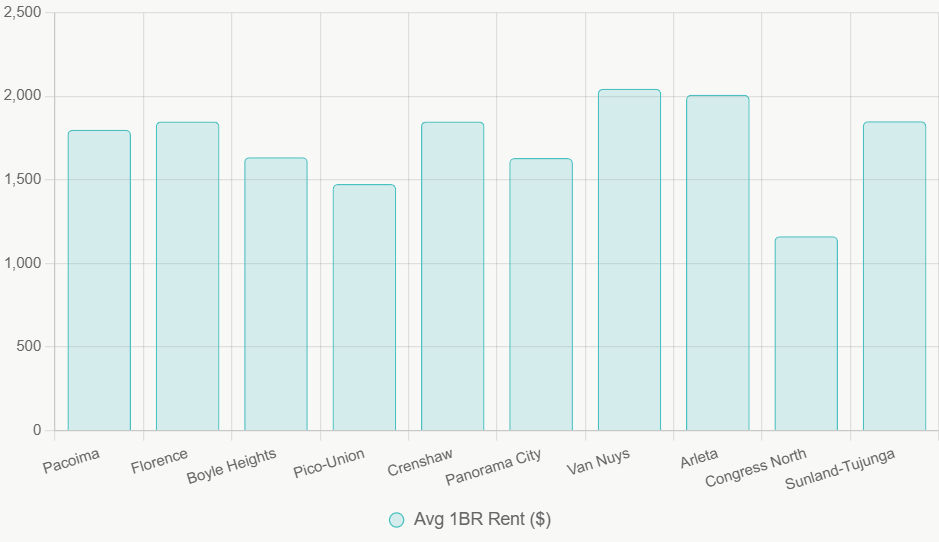
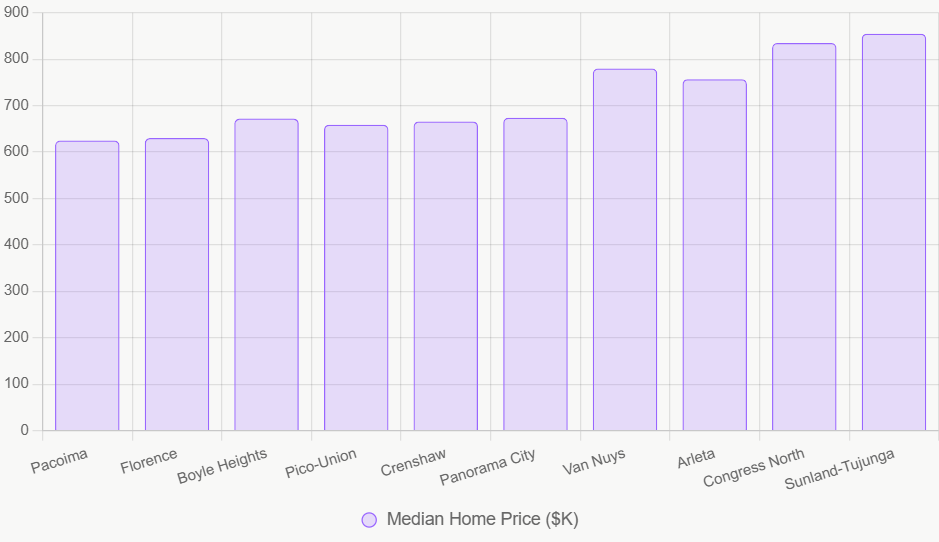
Neighborhood Avg 1BR Rent (2025) Median Home Price (2025) Key Appeal
Pacoima $1,800 $625,000 Family-focused, parks
Florence ~$1,850 $630,000 South LA culture, transit
Boyle Heights $1,636 ~$672,000 Murals, taquerias, arts
Pico-Union $1,475 $659,000 Historic, central access
Crenshaw $1,850 $666,000 African-American art hub
Panorama City $1,631 $674,000 Valley value, recreation
Van Nuys $2,045 $780,000 Transit hub, diverse food
Arleta $2,010 $757,000 Quiet residential, yards
Congress North $1,163 $835,000 Walkable, near Expo Line
Sunland-Tujunga $1,851 $855,000 Nature trails, suburban feel

1. Pacoima

Location: Northeast San Fernando Valley
Median Home Price: ~$625,000 (Reports show a decrease of about 12.6% year-over-year as of November 2025)
Average 1BR Rent: ~$1,800

Pacoima feels like a classic, family-oriented neighborhood with deep roots, especially within its predominantly Latino community (80% of residents). It’s the kind of place where neighbors know each other. If you're looking for space and a strong sense of community, this might be your spot.

  • Demographics: Median age is around 32, with household incomes averaging about $65,000.
  • Safety: While crime rates are a bit higher than the city average, community programs are actively working to improve things, with a focus on property crimes.
  • Amenities: You’ve got great local spots like Branford Park for sports and picnics, and local markets like Vallarta Supermarket for groceries. For outdoor adventures, Hansen Dam is a popular spot for hiking.
  • Commute: Getting to Downtown LA will take you about 45-60 minutes via the I-5 or 118 freeways. Public transit options are available through bus lines, but it's more car-dependent.
  • Schools: Pacoima Middle School gets a 6/10, and there are charter options like Discovery Charter Prep that score an 8/10.
  • My Take: Pacoima offers excellent value, especially for families. The community events, like the vibrant Dia de los Muertos festivals, are truly special. The main drawbacks are that you'll likely need a car, and air quality can be a concern due to nearby airports. I see potential here, with new retail developments suggesting good growth prospects for home values, maybe around 5% in 2026.

2. Florence

Location: South LA
Median Home Price: ~$630,000 (Reported a slight decrease of 3.1% year-over-year)
Average 1BR Rent: ~$1,850

Florence offers a raw, authentic LA experience. It’s a neighborhood with a strong community spirit and a gritty charm that many residents cherish. If you want to experience South LA's rich culture, this is a great starting point.

  • Demographics: Richly diverse with about 70% Latino and 20% Black residents. Median income is around $55,000, with the median age at 30.
  • Safety: Crime rates can be a concern, particularly violent crime. However, the LAPD has made efforts, reportedly reducing incidents by about 10% since 2024.
  • Amenities: You'll find local parks, various markets, and you're not far from landmarks like the Watts Towers. The casual dining scene is great, with plenty of soul food spots.
  • Commute: A quick 30-45 minute trip to Downtown LA is possible via the Metro A Line or the I-110 freeway.
  • Schools: Florence Avenue Elementary has a rating of 5/10.
  • My Take: Florence is all about culture and improving transit. It’s not the place for a bustling nightlife, and it’s definitely a dense urban environment. However, ongoing redevelopment projects could slowly nudge property values upward.

3. Boyle Heights

Location: East of Downtown LA
Median Home Price: ~$672,000 (This is an average, with Zillow at $629k and Redfin at $715k)
Average 1BR Rent: ~$1,636

Boyle Heights is a living museum of Mexican-American history and culture. Walking through its streets, you’ll see stunning murals, smell incredible food, and feel the pulse of a community that has shaped so much of LA's identity.

  • Demographics: Overwhelmingly Latino (about 85%), with a median income of $52,000 and a median age of 31.
  • Safety: Crime is moderate, often involving property theft. Interestingly, the vibrant community murals seem to act as a deterrent to vandalism.
  • Amenities: Mariachi Plaza is a cultural landmark, and you can’t miss the authentic taquerias like Guisados. The Gold Line is a convenient way to get around. It also boasts a walk score of 78.
  • Commute: Just a 20-30 minute hop to Downtown LA.
  • Schools: Roosevelt High School scores a 6/10.
  • My Take: Boyle Heights is a gem for its arts scene and family-friendly markets. The main challenges are traffic congestion and the pressures of gentrification. I believe its strong cultural identity will help it remain a stable and desirable place to live.

4. Pico-Union

Location: West of Downtown LA
Median Home Price: ~$659,000
Average 1BR Rent: ~$1,475

As one of LA's oldest neighborhoods, Pico-Union has a rich history and a strong Central American influence. It’s a vibrant, bustling area that offers a true urban living experience.

  • Demographics: Around 75% Latino, with a median income of $48,000 and a median age of 29.
  • Safety: Crime rates are on the higher side, but its central location means that policing is generally more present.
  • Amenities: You'll find fantastic pupuserias, historic churches, and plenty of discount stores. The Metro system is easily accessible here. Its walk score is a solid 80.
  • Commute: Downtown LA is incredibly close, just a 15-25 minute trip.
  • Schools: Berendo Middle School rates a 5/10.
  • My Take: Pico-Union has so much historic charm and is wonderfully walkable. The downsides are the scarcity of parking and the general density. However, its proximity to USC is starting to make it more attractive for potential value appreciation.

5. Crenshaw

Location: South LA
Median Home Price: ~$666,000
Average 1BR Rent: ~$1,850

Crenshaw is a cultural powerhouse, especially significant for its African-American heritage. It’s a historically rich area that’s also experiencing a modern renaissance, with a cool, laid-back vibe.

  • Demographics: A mix of 60% Black and 30% Latino residents, with a median income of $60,000 and a median age of 35.
  • Safety: Like many urban areas, property crime is an issue, but community hubs are actively working to improve safety.
  • Amenities: Leimert Park Village is a must-visit for art and music lovers. Don't miss out on legendary spots like Dulan's soul food. Commuting is easy via the Expo Line.
  • Commute: About a 30-minute ride to Downtown via the Expo Line.
  • Schools: Crenshaw High School scores a respectable 7/10.
  • My Take: Crenshaw offers a unique blend of trendy yet calm, with a growing number of art galleries. The limited high-end shopping might be a drawback for some, but its cultural significance and rising interest mean property prices are likely to see about a 4% increase.

6. Panorama City

Location: Central San Fernando Valley
Median Home Price: ~$674,000
Average 1BR Rent: ~$1,631

If you're looking for more space for your buck in the San Fernando Valley, Panorama City is worth checking out. It's a diverse and generally quieter part of the valley.

  • Demographics: Quite diverse, with about 70% Latino residents. Median income is around $62,000.
  • Safety: Generally considered average. The presence of rec centers helps keep youth engaged.
  • Amenities: You have the Sepulveda Recreation Center for sports and activities, and the Panorama Mall for shopping. Its walk score is 69.
  • Commute: You're looking at a 35-50 minute drive to Downtown LA, primarily via the I-405 freeway.
  • Schools: Vista Middle School gets a 6/10.
  • My Take: This neighborhood is a good choice if you prefer a slightly less hectic pace and access to sports facilities. The main flip side is being dependent on a car for most errands. I expect steady growth here as the Valley remains an attractive area for many.

7. Van Nuys

Location: San Fernando Valley
Median Home Price: ~$780,000
Average 1BR Rent: ~$2,045

Van Nuys is a key hub in the Valley, known for its excellent public transit connections and a diverse food scene that reflects its multicultural population.

  • Demographics: A mixed population, with about 50% Latino residents. Median income is around $65,000.
  • Safety: Crime is moderate. The presence of a government center contributes to a sense of security.
  • Amenities: It boasts beautiful Lake Balboa Park, countless taco trucks and diverse eateries, and the Metrolink station. Its walk score is 71.
  • Commute: A manageable 30-45 minute commute to Downtown.
  • Schools: Van Nuys High School is rated 7/10.
  • My Take: Van Nuys offers a fantastic variety of food and great park access. The streets can be busy, but upcoming infrastructure upgrades could make it even more appealing.

8. Arleta

Location: San Fernando Valley
Median Home Price: ~$757,000
Average 1BR Rent: ~$2,010

Arleta offers a more traditional, quiet residential feel within the San Fernando Valley. If you're looking for a place with yards and a bit more privacy, this is a contender.

  • Demographics: Predominantly Latino, at about 75%, with a median income of $68,000.
  • Safety: Known for low crime rates, making it very family-friendly.
  • Amenities: Branford Park is nearby, and the streets are generally wider and less congested than in more urban areas. It has a walk score of 51.
  • Commute: About a 40-minute drive to Downtown via the CA-170 freeway.
  • Schools: Arleta High School scores a 6/10.
  • My Take: Arleta is all about peace, quiet, and space. The downside is that it's quite car-dependent. Its suburban stability is its main draw.

9. Congress North

Location: Near West Adams
Median Home Price: ~$835,000
Average 1BR Rent: ~$1,163

This is a particularly interesting find, offering some of the lowest rents I've seen. It's a compact area right near the vibrant West Adams neighborhood, known for its revitalization.

  • Demographics: Diverse population, with a median income around $58,000.
  • Safety: Safety is improving as the area sees more development.
  • Amenities: You'll find a growing number of cozy cafes and importantly, it's very close to the Expo Line, making transit a breeze. It has an excellent walk score of 80.
  • Commute: Downtown LA is only about 20 minutes away.
  • Schools: Residents often have access to excellent schools near USC.
  • My Take: The budget-friendly rents here are a huge draw. While parking can be a challenge, its walkability and proximity to transit and developing areas make it a very shrewd choice. I anticipate this area will continue to gentrify.

10. Sunland-Tujunga

Location: Foothills of the San Gabriel Mountains
Median Home Price: ~$855,000
Average 1BR Rent: ~$1,851

For those who love nature and a suburban feel, Sunland-Tujunga offers an escape into the foothills. It’s a peaceful area with access to incredible hiking trails.

  • Demographics: A mix of about 60% White and 30% Latino residents, with a median income around $70,000.
  • Safety: Generally very safe, with a quiet, almost rural atmosphere.
  • Amenities: The Angeles National Forest is your backyard, offering endless outdoor activities. You'll find charming cottage-style homes. Its walk score is 56.
  • Commute: It's a bit more remote, with a 45-60 minute commute to Downtown LA.
  • Schools: Verdugo Hills High School gets a 7/10.
  • My Take: This is the place for tranquility and nature lovers. Its distance from the city center is the main trade-off. The growing interest in eco-friendly living could make this area even more appealing in the future.

median price of 10 cheapest neighborhoods in los angeles

Broader Insights and Tips for Navigating LA on a Budget

Living in these neighborhoods means embracing the real, diverse Los Angeles. I’ve found that they often offer a more authentic experience than the more touristy or affluent areas. For potential homebuyers, the good news is that in early 2025, about 17% of households could actually afford the median home prices in these areas, which was an improvement from previous years. Renters, you're in a good spot too, with rents stabilizing, though competition is always a factor in LA.

When you're on the hunt, I highly recommend using tools like RentCafe to find listings and checking local crime maps on LAPD websites for the most up-to-date safety information. If you're considering buying in the Valley, be aware that Homeowners Associations (HOAs) are common and can add $200-$400 per month to your costs.

It's also worth considering the environmental factors. The Valley can experience intense heat waves, and some South LA areas might have air quality concerns. On the economic front, many of these neighborhoods offer good proximity to job centers, whether it's logistics in the Valley or educational and healthcare jobs near areas like USC.

In summary, while the Los Angeles housing market continues to evolve, these ten neighborhoods stand out as viable, affordable options. They offer a chance to live the LA dream without the overwhelming financial strain. My best advice? Visit them, walk around, talk to locals, and see where you feel most at home. Consulting with local real estate agents who specialize in these areas can also provide invaluable personalized advice. Happy house hunting!

Want Stronger Returns? Invest Where the Housing Market’s Growing

Want stronger returns? Invest where the housing market’s growing. In 2026, select U.S. cities are projected to see surging demand, rising rents, and appreciation—creating prime opportunities for investors seeking passive income and long‑term wealth.

Work with Norada Real Estate to find stable, cash-flowing markets beyond the bubble zones—so you can build wealth without the risks of ultra-competitive areas.

🔥 HOT 2026 INVESTMENT LISTINGS JUST ADDED! 🔥
Talk to a Norada investment counselor today (No Obligation):
(800) 611-3060

Get Started Now

Recommended Read:

  • 24 Most Expensive Neighborhoods in California
  • Los Angeles Housing Market: Prices, Trends, Forecast 2025-2026
  • Minimum Qualifying Income to Buy a House in Los Angeles is $219,200
  • Top 5 Richest Cities in the Los Angeles County
  • Most Expensive Real Estate in the World: Top 10 Luxurious Properties
  • 10 Most Expensive Real Estate Markets in the World
  • 22 Cheapest Places to Live in Southern California
  • Cheapest Housing Markets in California: Affordable Cities

Filed Under: Housing Market Tagged With: california, Housing Market, Los Angeles

20 Wealthy Neighborhoods in Los Angeles

December 22, 2025 by Marco Santarelli

Wealthy Neighborhoods in Los Angeles

Los Angeles, the City of Angels, is renowned for its glitz, glamour, and opulence. It's a city where dreams are made, and fortunes are found. Among its sprawling metropolis lie enclaves of wealth that are not just homes but statements of luxury and exclusivity. Here's a glimpse into the ten wealthiest neighborhoods in Los Angeles, where the city's elite reside and thrive.

Exploring the Wealthiest Neighborhoods of Los Angeles

1. Bel-Air

Bel-Air stands as the epitome of wealth in Los Angeles. Known for its grand estates and as part of the Platinum Triangle, Bel-Air is a symbol of ultimate luxury. The neighborhood boasts gated communities and exclusive clubs, offering privacy and prestige. The average real estate price here soars to $4.27 million.

2. Pacific Palisades

With its stunning ocean views and pristine landscapes, Pacific Palisades is a coastal paradise. This neighborhood is perfect for those seeking a serene lifestyle with easy access to beaches and nature. The average home value in Pacific Palisades is around $3.8 million.

3. Beverly Hills

Perhaps the most famous of all, Beverly Hills is synonymous with wealth and celebrity. Home to the iconic Rodeo Drive, this neighborhood offers luxury shopping, five-star dining, and palatial homes, with median prices at $3.65 million.

4. Malibu

Malibu is the beachfront haven for the rich and famous. With its long stretches of beach and private coves, residents enjoy a unique blend of laid-back beach life and opulence. The median home price in Malibu is $3.4 million.

5. Beverly Crest

Tucked in the Santa Monica Mountains, Beverly Crest offers secluded luxury with breathtaking views. It's a community that prides itself on privacy and exclusivity, with homes nestled in the hills.

6. Windsor Square

Windsor Square is a historic and affluent neighborhood, known for its well-preserved early 20th-century homes. It's a tight-knit community that exudes old-world charm and elegance.

7. Brentwood

Brentwood is an affluent suburb with a mix of luxury homes, upscale shops, and lush parks. It's a neighborhood that offers a suburban feel with all the amenities of city life.

8. University Park

University Park is an intellectual hub, home to the University of Southern California. It's a neighborhood that combines historic residences with cultural richness.

9. Holmby Hills

Part of the Platinum Triangle, Holmby Hills is known for its large estates and famous landmarks like the Playboy Mansion. It's a neighborhood that represents old Hollywood glamour.

10. Hancock Park

Hancock Park is a historic neighborhood that has maintained its 1920s charm. With its broad lawns and mature trees, it offers a picturesque setting that's steeped in history.

11. Studio City

Studio City is a vibrant neighborhood known for its entertainment industry ties and upscale living. With a median household income of $105,301, it's a place where celebrities and creatives mingle. The median house price hovers around $1.39 million, reflecting the area's desirability.

12. Hollywood Hills

Nestled in the Santa Monica Mountains, Hollywood Hills is synonymous with celebrity culture and luxury. With a median income of $108,400, it offers stunning views and architectural marvels, boasting a median home price of $2 million.

13. West Hills

West Hills, with its suburban charm and community focus, has a median income of $109,439. It's a neighborhood that balances tranquility with accessibility, providing a retreat from the city's hustle while remaining connected.

14. Encino

Encino features wide boulevards lined with palatial homes and is known for its affluent residents and peaceful environment. The neighborhood's median income is significant, reflecting its status as a wealthy enclave.

15. Silver Lake

Silver Lake is a trendy neighborhood that combines modernist architecture with a bohemian atmosphere. It's a hub for artists and entrepreneurs, with property values consistently on the rise.

16. Los Feliz

Los Feliz is a neighborhood with a rich history and a vibrant cultural scene. It boasts grand old homes and a median income that places it among the city's wealthiest areas.

17. Sherman Oaks

Sherman Oaks offers a mix of urban and suburban living, with a variety of high-end shops and restaurants. The neighborhood's affluence is evident in its real estate prices and the lifestyle of its residents.

18. Griffith Park

Griffith Park is not just a neighborhood but a landmark, offering sprawling green spaces and exclusive properties that are coveted by those seeking both luxury and nature.

19. Tarzana

Named after the fictional estate of Tarzan, Tarzana is a neighborhood that exudes a sense of adventure and exclusivity. With its lush landscapes and affluent community, it's a prime location for luxury living.

20. Toluca Lake

Toluca Lake is a small, picturesque neighborhood known for its celebrity residents and tranquil lake. The area's wealth is reflected in its well-maintained properties and the high quality of life enjoyed by its inhabitants.

These neighborhoods, each with their unique character and appeal, contribute to the tapestry of Los Angeles' rich and diverse landscape. They are not just places of residence but are landmarks of success, offering their inhabitants not just a home, but a statement of their achievements and aspirations. In these neighborhoods, the Los Angeles dream of luxury, comfort, and exclusivity becomes a reality.

Each of these neighborhoods tells a story of Los Angeles' evolution from a burgeoning city to a global icon of prosperity. The allure of these neighborhoods goes beyond their price tags; it's about the status, history, and lifestyle that come with residing in some of the most sought-after zip codes in the world.

Whether it's the beachfront opulence of Malibu or the historic elegance of Hancock Park, each neighborhood offers a unique slice of luxury living in the heart of Southern California.

Work with Norada, Your Trusted Source for Turnkey Investment Properties

Discover high-quality, ready-to-rent properties designed to deliver consistent returns.

Contact us today to expand your real estate portfolio with confidence.

Contact our investment counselors (No Obligation):

(800) 611-3060

Get Started Now

Recommended Read:

  • 24 Most Expensive Neighborhoods in California
  • Los Angeles Housing Market: Prices, Trends, Forecast 2025-2026
  • Minimum Qualifying Income to Buy a House in Los Angeles is $219,200
  • Top 5 Richest Cities in the Los Angeles County
  • Most Expensive Real Estate in the World: Top 10 Luxurious Properties
  • 10 Most Expensive Real Estate Markets in the World
  • 22 Cheapest Places to Live in Southern California
  • Cheapest Housing Markets in California: Affordable Cities

Filed Under: Housing Market Tagged With: california, Housing Market, Los Angeles

Los Angeles Housing Market Stumbles as Sales Volume See Notable Dip in November

December 16, 2025 by Marco Santarelli

Los Angeles Housing Market Stumbles as Sales Volume See Notable Dip in November

The Los Angeles housing market in November 2025 saw a slight leveling off in prices year-over-year but a notable dip in sales volume, indicating a more cautious buyer sentiment, especially within the fiercely competitive Los Angeles County, despite a modest statewide recovery reported by C.A.R. It's a complicated picture, and I'm here to help you get a clearer view.

Los Angeles Housing Market Stumbles as Sales Volume See Notable Dip in November

I've been keeping a close eye on real estate in our golden state, and the latest numbers from the California Association of REALTORS® (C.A.R.) for November 2025 really tell a story. While California as a whole seemed to pick up some steam, Los Angeles, particularly the areas I'm most familiar with, showed some different trends. Let's dig into what happened.

You see, statewide, C.A.R. noted that California home sales experienced their highest level since September 2022, climbing to a seasonally adjusted annualized rate of 287,940 units. That sounds great, right? Sales were up 1.9% from October and 2.6% from November last year. The statewide median home price was $852,680, which was essentially flat compared to November 2024.

But when I look specifically at the Los Angeles Metro Area and Los Angeles County, the picture gets a bit more nuanced, as it always does when we zoom into specific, diverse regions.

Sales Slowdown: A Closer Look at LA's Dip

Here's where Los Angeles really stands apart from the statewide trend. While California saw sales increase, our local market here in LA went the other way.

For the entire Los Angeles Metro Area, sales saw a significant drop of 23.5% from October to November 2025, and they were down 2.7% compared to November 2024. When we narrow it down even further to Los Angeles County itself, the sales figures were even more stark: a hefty 27.6% decrease month-over-month and a 5.4% dip year-over-year.

Area Sales MTM % Change (Nov 2025) Sales YTY % Change (Nov 2025)
California (Statewide) +1.9% +2.6%
Los Angeles Metro Area -23.5% -2.7%
Los Angeles County -27.6% -5.4%

My take on this? It’s not just a blip. This kind of drop, especially against a statewide gain, tells me that buyers in LA are becoming increasingly cautious. Perhaps the high entry price points here make even small swings in interest rates feel more impactful, or maybe it's just that the traditional “off-peak” season affects a dense, high-value market like LA more acutely. Buyers might be waiting for a clearer sign of price stability or more favorable lending conditions.

Median Prices: Holding Steady, But With Caveats

Now, let’s talk about prices. This is usually the first thing everyone asks me about!

The statewide median home price in November 2025 was virtually unchanged from a year ago, sitting at $852,680. However, it did see a 3.9% drop from October.

In the Los Angeles Metro Area, the median price came in at $823,000. This was up slightly by 0.1% from November 2024, but it saw a 2.6% decrease from October 2025.

Zooming into Los Angeles County, the median sale price for November 2025 was a hefty $942,610. This represents a 0.6% year-over-year increase from $937,030 in November 2024. However, like the metro area, it experienced a month-over-month decline of 1.9% from October's $960,620.

Area Median Price (Nov 2025) Price MTM % Change Price YTY % Change
California (Statewide) $852,680 -3.9% 0.0%
Los Angeles Metro Area $823,000 -2.6% 0.1%
Los Angeles County $942,610 -1.9% 0.6%

What does this tell me? While prices in LA County are still experiencing modest year-over-year gains, the month-to-month dips indicate a real sensitivity in the market. Sellers might still have aspirational prices, but buyers are less willing to jump without clear justification. It feels like the market is searching for its footing after a volatile period, finding a new equilibrium where prices aren't soaring but aren't collapsing either. It's a delicate balance.

Inventory and Time on Market: A Shift in Power?

Beyond just sales and prices, I always look at how much inventory is out there and how long homes are sitting. These are crucial indicators of who has the upper hand: buyers or sellers.

  • The statewide Unsold Inventory Index (UII) was 3.6 months in November 2025, up from 3.3 months a year prior. It suggests homes are taking longer to sell.
  • The median time on market statewide was 32 days, up from 26 days in November 2024.

For Los Angeles Metro Area:

  • The Unsold Inventory Index stood at 3.9 months, up from 3.6 months in November 2024.
  • Homes stayed on the market for a median of 36 days, compared to 29 days a year earlier.

In Los Angeles County:

  • The Unsold Inventory Index was 3.8 months, an increase from 3.5 months in November 2024.
  • The median time on market was 33 days, up from 26 days in November 2024.
Area Unsold Inventory Index (Nov 2025) Median Days on Market (Nov 2025) Days on Market (Nov 2024)
California (Statewide) 3.6 months 32 days 26 days
Los Angeles Metro Area 3.9 months 36 days 29 days
Los Angeles County 3.8 months 33 days 26 days

From my perspective, this is a clear signal that the frantic, hyper-competitive seller's market we've seen in recent years has definitely cooled down. Increased inventory means more options for buyers. Longer days on market mean buyers have more time to think, negotiate, and — importantly — conduct due diligence without feeling pressured into a bidding war. This creates more reasonable conditions, which, as a human, I appreciate. For sellers, it means patience and realistic pricing are more important than ever. The sales-price-to-list-price ratio statewide was 98.3%, which tells me that, on average, homes are selling for slightly below their asking price—a definite shift from the days of homes routinely going over asking.

Behind the Numbers: My Take on What’s Really Happening

Pulling back the curtain, these statistics aren't just figures; they represent real people making major life decisions. Here's what I believe is truly at play in the Los Angeles housing market.

Affordability Remains King (or Queen)

Let's be frank: Los Angeles is expensive. Even with statewide mortgage rates averaging 6.24% in November 2025 (down from 6.81% a year prior), the sheer price tag of an LA home is still a massive hurdle. For many first-time homebuyers, and even those looking to move up, the monthly payments on a $942,610 median-priced home in Los Angeles County are simply astronomical, especially when combined with high property taxes and insurance.

I've spoken with countless potential buyers who are qualified on paper but are simply unwilling to stretch themselves thin, especially with other economic uncertainties. The slight year-over-year price appreciation in LA—while statewide prices were flat—only compounds this issue. This ongoing affordability crunch is, in my professional opinion, the biggest differentiating factor for LA compared to other parts of California.

Mortgage Rates: A Double-Edged Sword

C.A.R.'s Senior Vice President and Chief Economist Jordan Levine suggests that mortgage rates are expected to continue declining in 2026, but the decrease is unlikely to be dramatic. I agree with this assessment. While lower rates are certainly a welcome relief, they're not a silver bullet for LA.

Think of it this way: if you're looking at a $500,000 house, a half-point drop in interest might save you a few hundred dollars a month, making a real difference. But on a million-dollar home, that same percentage drop might save you more, but the total payment is still very high. It means that while falling rates can spur activity in more affordable markets, their impact is diluted in an ultra-high-cost market like Los Angeles. Buyers here need more than just slightly lower rates; they need a significant shift in either prices or rates to feel comfortable again.

Local Differences: LA County vs. LA Metro

It's subtle in the data, but important to highlight: the Los Angeles Metro Area includes a wider swath of Southern California, potentially bringing down the median price. But Los Angeles County itself, with its diverse array of neighborhoods from Beverly Hills to the San Gabriel Valley, consistently boasts a higher median home price than the broader metro region, and even the statewide average.

For instance, the LA Metro Area median price was $823,000, while LA County was $942,610. This tells me that within the county, you're dealing with arguably the most sought-after and expensive real estate in the state, even more so than many other parts of the larger metro area. My experience shows that micro-markets within LA County can behave very differently based on factors like school districts, commute times, and local amenities. It's never a one-size-fits-all situation here.

Looking Ahead: My Predictions for the Los Angeles Housing Market

Based on C.A.R.'s projections and my own feel for the pulse of Los Angeles, I believe we're heading into a period of continued stabilization rather than dramatic swings.

I expect to see mild, gradual price appreciation in Los Angeles County, possibly slightly outpacing the broader metro area due to its premium nature. Sales volume will likely remain somewhat constrained by affordability, but as mortgage rates ease further, we might see a slow uptick in buyer activity. Inventory will probably fluctuate, responding to both buyer demand and seller expectations.

The unique resilience of Los Angeles, driven by its diverse economy, cultural appeal, and limited land, means that even in slower markets, demand underpins value. It's a market that challenges, but for those who understand its intricacies, it still offers incredible opportunities. My advice? Stay informed, work with experienced professionals, and align your expectations with the current reality of this fascinating and ever-evolving market.

“Turnkey Rentals Outside California Offer Better Returns & Cash Flow “

Turnkey properties let you start earning rental income from day one—no renovations, no tenant hunts, no management headaches.

Work with Norada Real Estate to find vetted, cash-flowing markets tailored to your goals—so you can build steady returns without the stress.

HOT NEW LISTINGS JUST ADDED!

Speak with a seasoned Norada investment counselor today (No Obligation):

(800) 611-3060

Get Started Now 

Recommended Read:

  • Los Angeles Housing Market Sees 292% Growth in Home Prices Since 1975
  • Los Angeles Housing Market Booms With Double-Digit Sales Growth
  • Los Angeles Housing Market: Forecast and Trends 2025-2026
  • Los Angeles Housing Market Cools as Buyers Pullback in 2025
  • Impact of Wildfires on the Los Angeles Housing Market in 2025
  • Minimum Qualifying Income to Buy a House in Los Angeles is $219,200
  • Top 5 Richest Cities in the Los Angeles County
  • 20 Wealthy Neighborhoods in Los Angeles
  • Average Home Price in Los Angeles
  • Unveiled: The Top 5 Richest Cities in Los Angeles County You Need to Know About
  • Minimum Qualifying Income to Buy a House in Los Angeles is $219,200

Filed Under: Growth Markets, Housing Market, Real Estate Market Tagged With: Housing Market, Los Angeles

Los Angeles Housing Market Sees 292% Growth in Home Prices Since 1975

October 26, 2025 by Marco Santarelli

Los Angeles Values Rise by a Staggering 292% Over the Last 50 Years

If you've been thinking about buying a home in Los Angeles, the numbers don't lie: Los Angeles values have risen by a remarkable 292% over the last 50 years, making it one of the nation's hottest housing markets. This incredible surge from 1975 to 2024, as detailed in a report by Realtor.com using data from the Federal Housing Finance Agency (FHFA), tells a compelling story about the city's transformation and its enduring appeal. It’s not just about numbers; it’s about how a city has reshaped itself and why people continue to flock here.

Los Angeles Housing Market Sees 292% Growth in Home Prices Since 1975

The Big Picture: A Shifting American Economy and Its Impact on Real Estate

It might seem like a long time ago, but 50 years ago, in 1975, the United States was a very different place. Think bell-bottoms, disco music, and a manufacturing-heavy economy. Fast forward to today, and we're living in a world driven by technology and services. This massive economic shift has had a profound effect on where people choose to live and, crucially, how much homes are worth.

According to Jake Krimmel, a senior economist at Realtor.com, this evolution is the key to understanding the dramatic differences in home value growth across the country. “In short,” he explains, “the U.S. moved from a manufacturing to a service and information economy, and that evolution impacted different places through their labor and housing markets. Some areas were huge winners from that shift, while some got the short end of the stick.”

The data lays this out clearly: the biggest winners were on the coasts, especially in areas that became hubs for technology and finance. On the flip side, many cities that once thrived on manufacturing saw much slower growth, or even stagnation.

California Dreamin': The West Coast Dominates Home Value Gains

When you look at the cities with the biggest home value increases over the past five decades, California cities absolutely shine. It’s no surprise to me, having witnessed the consistent pull of the Golden State for decades.

Here’s how the top contenders stacked up:

  • San Jose, CA: A stunning 396% increase. Nestled in the heart of Silicon Valley, its rise is directly tied to the tech revolution.
  • San Francisco, CA: A remarkable 300% increase. This iconic city has always been a magnet for innovation and culture.
  • Los Angeles, CA: Right behind at a strong 292% increase. My hometown continues to be a global center for entertainment, creativity, and now, so much more.
  • Seattle, WA: Coming in at 280%. Home to tech giants, its growth mirrors the booming information age.
  • San Diego, CA: With a 271% increase, this sunny city has also seen substantial property appreciation.

It's fascinating to see that half of the top 10 metros showing the largest home value increases are in California. This region has clearly been a consistent engine of economic growth and desirability.

Why the West Coast, and Los Angeles in Particular, Saw Such Explosive Growth

The success of West Coast markets like the Bay Area and my beloved Los Angeles isn't just luck. As Krimmel pointed out, these areas became massive tech hubs. Think about the ripple effect:

  • Innovation Hotbeds: Universities, cutting-edge research and development, and key companies that started shaping the digital world back in the 1980s created an environment ripe for growth.
  • Talent Magnet: These industries attracted highly skilled and well-paid professionals, leading to increased demand for housing.
  • Limited Supply: Especially in desirable coastal areas, space is limited. When you have a lot of people wanting to live in a place with finite room, prices naturally go up.
  • The “L.A. Factor”: Beyond tech, Los Angeles has always been a global center for entertainment, media, and fashion. These industries, while different from tech, also create high-paying jobs and draw people from all over the world. The lifestyle, the weather, and the sheer opportunities have cemented its status as a place many aspire to call home. I’ve seen firsthand how people are drawn to the diverse communities, the vibrant arts scene, and the constant buzz of creativity that you can only find here.
US Home Value Changes: 50-Year Analysis

🏠 US Home Value Transformation

Top Metropolitan Areas with the Greatest Home Value Increases Above Inflation (1974-2024)

Top 10 Markets by Growth Above Inflation

1

San Jose, CA

+396%

Growth Above Inflation

2

San Francisco, CA

+300%

Growth Above Inflation

3

Los Angeles, CA

+292%

Growth Above Inflation

4

Seattle, WA

+280%

Growth Above Inflation

5

San Diego, CA

+271%

Growth Above Inflation

6

Boston, MA

+196%

Growth Above Inflation

7

Riverside, CA

+179%

Growth Above Inflation

8

New York, NY

+161%

Growth Above Inflation

9

Denver, CO

+161%

Growth Above Inflation

10

Portland, OR

+154%

Growth Above Inflation

Key Insights

5/10
California Cities
in Top 10
396%
Maximum Growth
(San Jose)
239%
Average Growth
Top 10 Markets

Growth percentages shown are adjusted for inflation over 50 years (1974-2024) • Data represents real home value appreciation above the rate of inflation

East Coast Powerhouses: Finance and Tradition Drive Value

While the West Coast steals the spotlight for tech-driven booms, some traditional East Coast hubs also saw impressive gains, particularly those anchored by finance and a strong historical presence.

  • Boston, MA: Racked up a 196% increase. This historic city, a powerhouse of education and finance, has maintained its strong value.
  • New York, NY: Appreciated by 161%. As a global financial capital, the demand for housing remained incredibly high.
  • Denver, CO: Also saw a 161% increase. While not on the coast, Denver’s growth reflects its emergence as a significant economic center.

These cities benefited from similar economic shifts, with the rise of finance and service industries contributing to job growth and, consequently, higher real estate values. Krimmel also highlighted a crucial factor for these urban centers: “Highly productive and profitable industries grew local job markets and increased real estate values as a result.” He added that what further pushed prices up in places like Boston and New York was the combination of surging demand and limited supply, often due to strict zoning laws that restricted new construction.

The Tale of Two Economies: Where Home Values Lagged

On the other end of the spectrum are cities that continue to grapple with the transition away from manufacturing. These areas, which once powered the American economy with factories, haven't always had the easiest time reinventing themselves as tech or information-driven hubs.

Here are a few examples of cities with the smallest value gains:

  • Memphis, TN: A mere 2% increase. This city has faced challenges in transitioning to newer industries.
  • Cleveland, OH: Also saw a 2% increase. A former giant in steel and iron, its path to economic reinvention has been slow.
  • Birmingham, AL: Posted a 9% increase. Another city with deep manufacturing roots, it shows a more modest turnaround.
  • Pittsburgh, PA: With a 26% increase, this “Steel City” is seeing some recovery, but its growth pales in comparison to the tech giants.

As Krimmel put it, “Not only were manufacturing jobs offshored, resulting in job losses and economic plight, but many of these places did not have the capital—financial or human—to reinvent themselves as tech and finance forward hubs.” This stark difference in economic trajectory clearly shows up in home value appreciation.

Looking Ahead: What Does This Mean for Buyers and Sellers?

The data over these 50 years paints a clear picture: location, location, location has always mattered, and the economic forces shaping our nation dramatically influence real estate values. For Los Angeles, the 292% rise is a testament to its enduring appeal and adaptability. It's a city that has reinvented itself time and again, attracting talent and investment.

For anyone considering buying or selling in Los Angeles today, understanding this historical context is vital. The demand is strong, fueled by a dynamic economy and a lifestyle that continues to attract people globally. While prices are undoubtedly higher than they were decades ago, the continued growth suggests that Los Angeles remains a significant investment. From my own experience living and working here, I can tell you that the energy and opportunity that drive these value increases are palpable.

“Turnkey Rentals Outside California Offer Better Returns & Cash Flow “

Turnkey properties let you start earning rental income from day one—no renovations, no tenant hunts, no management headaches.

Work with Norada Real Estate to find vetted, cash-flowing markets tailored to your goals—so you can build steady returns without the stress.

HOT NEW LISTINGS JUST ADDED!

Speak with a seasoned Norada investment counselor today (No Obligation):

(800) 611-3060

Get Started Now 

Recommended Read:

  • Los Angeles Housing Market Booms With Double-Digit Sales Growth
  • Los Angeles Housing Market: Forecast and Trends 2025-2026
  • Los Angeles Housing Market Cools as Buyers Pullback in 2025
  • Impact of Wildfires on the Los Angeles Housing Market in 2025
  • Minimum Qualifying Income to Buy a House in Los Angeles is $219,200
  • Top 5 Richest Cities in the Los Angeles County
  • 20 Wealthy Neighborhoods in Los Angeles
  • Average Home Price in Los Angeles
  • Unveiled: The Top 5 Richest Cities in Los Angeles County You Need to Know About
  • Minimum Qualifying Income to Buy a House in Los Angeles is $219,200
Filed Under: Growth Markets, Housing Market, Real Estate Market Tagged With: Housing Market, Los Angeles

Los Angeles Housing Market Booms With Double-Digit Sales Growth

October 18, 2025 by Marco Santarelli

Los Angeles Housing Market Booms With Double-Digit Sales Growth

The Los Angeles housing market has seen a significant uptick in sales, recording impressive double-digit growth. This isn't just a minor blip; it’s a clear sign that more homes are changing hands and that demand is picking up steam. For anyone involved in buying or selling a home in the City of Angels, understanding these trends is crucial to making smart decisions. This surge indicates a more active market, but importantly, it’s happening while prices are still relatively stable and inventory is slowly increasing, creating a fascinating dynamic.

Los Angeles Housing Market Booms With Double-Digit Sales Growth

Digging into the Numbers: A Closer Look at September's Performance

The California Association of REALTORS® (C.A.R.) recently released its September 2025 resale housing report, and the data for Los Angeles is particularly encouraging. Across the entire state, existing single-family home sales jumped by 6.6% compared to the previous year. But when you zoom in, Southern California, which includes Los Angeles, saw sales climb by an even more robust 11.3%. Individually, Los Angeles County itself experienced a fantastic 13.8% increase in home sales year-over-year, with the Los Angeles Metro Area not far behind at 10.6% growth.

This jump in sales is significant because it follows a period where the market had been a bit sluggish. According to C.A.R., September marked a rebound after five consecutive months of year-over-year sales declines statewide. Seeing such a strong performance in Los Angeles, a key economic driver for the state, is a powerful signal about the market's health and resilience.

LA Home Prices: A Steady Hand in a Busy Market

While sales are soaring, it's interesting to note what's happening with prices. Statewide, the median home price saw a modest 1.8% increase year-over-year, reaching $883,640. In the Los Angeles Metro Area, the median price ticked up by 2.5% to $830,000, and for Los Angeles County, it rose 2.4% to approximately $983,230.

This is a crucial point: the substantial increase in sales isn't being driven by a runaway price surge, which could signal an overheated market. Instead, steady price appreciation combined with higher sales volume suggests a market that is finding its balance. In my experience working with clients, this is the sweet spot. Buyers feel they can make a move without being priced out by exorbitant increases, and sellers are encouraged by the activity and decent sale prices.

Inventory and Days on Market: Signs of a Shifting Balance

Let's talk about supply. The Unsold Inventory Index (UII) for California overall dipped slightly in September to 3.6 months, meaning it would take 3.6 months to sell all the homes on the market at the current pace. While this is down from August, it's flat year-over-year. What’s more, active listings have been rising for 20 consecutive months, though the growth rate is slowing.

For the Los Angeles Metro Area, the UII was 3.8 months, also flat year-over-year. This indicates that while there are more homes available than a year ago, the pace of new listings is moderating.

The time it takes to sell a home is also telling. Statewide, it took 32 days to sell a single-family home in September, up from 24 days in September of the previous year. In the Los Angeles Metro Area, it took 34 days, also an increase from 26 days a year ago.

What this means: We're moving away from a hyper-seller's market where homes flew off the shelves in days. The double-digit sales growth is happening in a market where inventory is growing but not explosively, and homes are sitting on the market a bit longer than last year. This suggests that while sellers still have an advantage in many areas, buyers have a little more breathing room and time to make informed decisions. It's less about immediate bidding wars and more about strategic offers.

Buyer's vs. Seller's Market: A Nuanced Picture

Historically, a sales-to-list-price ratio of 100% or above meant homes were selling at or above asking price, a hallmark of a strong seller's market. Statewide, this ratio in September was 98.2%, down from 100% a year prior. In the Los Angeles Metro Area, the provided data doesn't give a specific ratio, but the trend suggests a slight shift.

My take on this is that while demand is high, indicated by those impressive sales numbers, buyers are not necessarily being forced to overbid. The increase in days on market and the sales-to-list price ratio hint at a market that's becoming more balanced. Sellers need to price their homes realistically and be prepared for more negotiation, while buyers can be more confident that their offers will be considered fairly, even if they aren't over asking. So, while still competitive, it's not the frantic frenzy we've seen in past years.

Factors Influencing the Market

So, why the surge in sales? Several factors are likely at play:

  • Mortgage Rates: C.A.R. noted that mortgage rates are hovering in the low 6% range, their lowest point since last October. Even with slight increases recently, these rates make homeownership more accessible. For buyers, lower rates mean a lower monthly payment, which can significantly impact affordability.
  • Economic Stability (Relative): While there are always economic uncertainties, the job market has remained relatively stable in many parts of California, providing consumer confidence. People who have been on the fence might feel more secure in making a major life decision like buying a home.
  • Pent-Up Demand: After a period of slower sales, there's likely a backlog of buyers who are now ready to enter the market. This accumulated demand, combined with favorable rates, can lead to a sudden increase in transactions.
  • Seasonal Trends: September is often a strong month for real estate as families settle back in after summer and before the holidays. This natural seasonal bounce-back can amplify underlying market strengths.

Looking Ahead: What's Next for Los Angeles Real Estate?

As economists mentioned, steady mortgage rates will likely keep demand boosted heading into the fourth quarter. However, broader economic factors will influence the pace of recovery. The fact that Los Angeles County and the metro area are leading the charge with significant sales growth is a testament to the region's enduring appeal. It suggests a market that is not only recovering but is robust and dynamic. I'm optimistic that this trend, driven by a healthy mix of demand and a more balanced supply, will continue to define the Los Angeles housing market as we move forward.

“Invest in Turnkey Real Estate Outside California for Better Cash Flow”

Turnkey properties let you start earning rental income from day one—no renovations, no tenant hunts, no management headaches.

Work with Norada Real Estate to find vetted, cash-flowing markets tailored to your goals—so you can build steady returns without the stress.

HOT NEW LISTINGS JUST ADDED!

Speak with a seasoned Norada investment counselor today (No Obligation):

(800) 611-3060

Get Started Now 

Recommended Read:

  • Los Angeles Housing Market: Forecast and Trends 2025-2026
  • Los Angeles Housing Market Cools as Buyers Pullback in 2025
  • Impact of Wildfires on the Los Angeles Housing Market in 2025
  • Minimum Qualifying Income to Buy a House in Los Angeles is $219,200
  • Top 5 Richest Cities in the Los Angeles County
  • 20 Wealthy Neighborhoods in Los Angeles
  • Average Home Price in Los Angeles
  • Unveiled: The Top 5 Richest Cities in Los Angeles County You Need to Know About
  • Minimum Qualifying Income to Buy a House in Los Angeles is $219,200
Filed Under: Growth Markets, Housing Market, Real Estate Market Tagged With: Housing Market, Los Angeles

Minimum Qualifying Income to Buy a House in Los Angeles is $219,200

July 12, 2025 by Marco Santarelli

You Need to Earn Over $200K to Buy a House in Los Angeles Market

Los Angeles, the City of Angels, evokes images of Hollywood glamour, sun-kissed beaches, and a vibrant cultural scene. However, behind the allure lies a harsh reality for aspiring homeowners: the minimum qualifying income to buy a house in Los Angeles is notoriously high.

The CALIFORNIA ASSOCIATION OF REALTORS® (C.A.R.) reported that in the second quarter of 2024, the Los Angeles metro area grappled with an affordability index of just 13%. This means only 13% of households in the area earned enough to qualify for a median-priced home. Let's delve into the financial landscape of the Los Angeles housing market and uncover the income required to make your homeownership dreams a reality in this iconic city.

Minimum Qualifying Income to Buy a House in Los Angeles is $200K

The Financial Realities of the Los Angeles Housing Market

Before we crunch the numbers, it's important to understand the factors driving the high housing costs in Los Angeles:

  • Limited Housing Supply: Los Angeles faces a chronic shortage of housing inventory. The desirable climate, robust job market, and geographical constraints contribute to a high demand for a limited number of properties. This imbalance fuels price appreciation.
  • High Demand: The City of Angels attracts a diverse population, from young professionals seeking career opportunities to families desiring a desirable lifestyle. This constant influx of potential homebuyers further intensifies competition and pushes prices upward.
  • Location Premium: Los Angeles is renowned for its prime locations, including beachfront properties, hillside mansions, and walkable neighborhoods. These sought-after areas command premium prices, reflecting the high value placed on lifestyle and convenience.
  • Economic Factors: Los Angeles boasts a thriving economy with a high concentration of high-paying industries, such as entertainment, technology, and finance. The presence of affluent earners influences property values and contributes to the overall cost of living.

Unveiling the Minimum Qualifying Income

According to C.A.R.'s second-quarter 2024 data, the median home price in the Los Angeles metro area was a staggering $840,000. To qualify for a mortgage on a median-priced home, assuming a 20% down payment and a 7.10% interest rate (prevailing during that period), you'd need a minimum qualifying income of $219,200 per year.

Let's break down the monthly costs associated with this scenario:

  • Principal and Interest: $4,640
  • Property Taxes: $700 (estimated)
  • Homeowners Insurance: $140 (estimated)

Total Monthly Payment (PITI): $5,480

Keep in mind that this is just an estimate, and your actual monthly payment may vary depending on factors such as:

  • Down Payment: A larger down payment reduces the loan amount, leading to lower monthly payments.
  • Interest Rates: Interest rate fluctuations significantly impact affordability. Lower rates translate to more manageable monthly payments.
  • Property Taxes and Insurance: These costs can vary depending on the property's location and value.

Navigating Los Angeles's Housing Affordability Challenge

The high minimum qualifying income to buy a house in Los Angeles can seem daunting, but there are strategies to make homeownership more attainable:

1. Explore First-Time Homebuyer Programs:

Various state and local programs offer assistance to first-time homebuyers, including:

  • Down Payment Assistance: These programs provide grants or loans to help cover the upfront costs of a down payment.
  • Closing Cost Assistance: Grants or loans can help reduce the closing costs associated with purchasing a home.
  • Mortgage Credit Certificates (MCCs): MCCs offer a dollar-for-dollar reduction in federal income taxes for a portion of the mortgage interest paid, freeing up more cash flow.

2. Consider Alternative Housing Options:

  • Condominiums: Condos typically have lower price points than single-family homes, offering a more affordable entry point into the market.
  • Townhouses: Townhouses often provide a middle ground between single-family homes and condos, combining some of the benefits of both.
  • Multi-Generational Living: Pooling resources with family members can make homeownership more attainable, especially in high-cost areas.

3. Expand Your Search Area:

  • Explore Neighboring Cities: Venturing slightly outside of Los Angeles proper, to cities like Pasadena, Burbank, or Glendale, can yield more affordable options.
  • Consider Up-and-Coming Neighborhoods: Investing in neighborhoods poised for growth can provide opportunities for appreciation while remaining within a comfortable budget.

4. Strengthen Your Financial Profile:

  • Improve Your Credit Score: A higher credit score qualifies you for lower interest rates, saving money over the life of the loan.
  • Reduce Your Debt-to-Income Ratio (DTI): Lenders assess your DTI, the percentage of your gross monthly income dedicated to debt payments, to determine your borrowing capacity. Lowering your DTI demonstrates financial responsibility.
  • Increase Your Savings: A larger down payment not only lowers your monthly payments but also can strengthen your mortgage application.

5. Consult with a Real Estate Professional:

  • Local Market Expertise: Real estate agents possess invaluable insights into specific neighborhoods, market trends, and available properties.
  • Negotiation Skills: An experienced agent can advocate for your best interests during negotiations, potentially securing a more favorable price or terms.
  • Access to Resources: Agents often have connections with mortgage lenders, home inspectors, and other professionals who can facilitate the homebuying process.

Is Los Angeles Overpriced? Will Homes Ever Be Affordable Again?

The question of whether Los Angeles is overpriced is subjective and depends on individual circumstances and perspectives. Some argue that the city's unique amenities, economic opportunities, and desirable lifestyle justify the high cost of living. Others contend that the housing market has become detached from local incomes, making it increasingly difficult for middle-class families to afford to live in the city.

Predicting the future of housing affordability is challenging, but several factors suggest that affordability will remain a concern in Los Angeles:

  • Population Growth: Los Angeles continues to attract new residents, putting upward pressure on housing demand.
  • Limited Housing Supply: Addressing the housing shortage requires significant investment in new construction, which faces challenges such as regulatory hurdles and high construction costs.
  • Economic Resilience: Los Angeles's diverse economy is expected to continue growing, supporting high salaries and, in turn, housing costs.

However, there are also potential factors that could moderate price growth:

  • Rising Interest Rates: Higher interest rates can dampen affordability, potentially cooling demand.
  • Remote Work Trends: The rise of remote work may provide some flexibility for residents to live in more affordable areas outside of major cities.
  • Policy Interventions: Government initiatives aimed at increasing housing supply or providing affordability assistance could have an impact.

Is $100,000 Enough to Live in Los Angeles?

While a $100,000 income might provide a comfortable lifestyle in many parts of the United States, it's important to acknowledge that Los Angeles is an expensive city. Here's a breakdown of estimated monthly expenses for someone earning $100,000 per year in Los Angeles:

Expense Category Estimated Monthly Cost
Rent (1-bedroom apartment in a desirable area) $2,500 – $3,500
Utilities (electricity, gas, water, internet) $300 – $400
Transportation (car payment, insurance, gas, public transportation) $500 – $800
Groceries $500 – $700
Healthcare $300 – $500 (depending on insurance coverage)
Entertainment and Dining Out $500 – $1,000
Personal Care (haircuts, gym memberships, etc.) $200 – $300
Savings $500 – $1,000 (recommended)

Total Estimated Monthly Expenses: $5,800 – $8,700

As you can see, living comfortably on a $100,000 salary in Los Angeles requires careful budgeting and might limit your ability to save for a down payment or other financial goals.

Final Thoughts:

The dream of owning a home in Los Angeles comes with a hefty price tag. The minimum qualifying income to buy a house in Los Angeles is a testament to the city's competitive housing market. However, by exploring available resources, considering alternative housing options, and strengthening your financial profile, you can navigate the challenges and work toward achieving your homeownership aspirations in the City of Angels.

Read More:

  • Los Angeles Housing Market: Prices, Trends, Forecast 2024
  • 20 Wealthy Neighborhoods in Los Angeles
  • Homebuyers Are Leaving San Francisco, New York, and Los Angeles
  • California Dominates Housing With 7 of Top 10 Priciest Markets
  • Real Estate Forecast Next 5 Years California: Boom or Crash?
  • California Housing Market: Nearly $174,000 Needed to Buy a Home
  • Most Expensive Housing Markets in California
  • Abandoned Houses for Free California: Can You Own Them?
  • California Housing in High Demand: 19 Golden State Cities Sizzle

Filed Under: Housing Market, Real Estate Market Tagged With: california, Housing Market, Los Angeles

Top 5 Richest Cities in the Los Angeles County

July 12, 2025 by Marco Santarelli

The Richest Cities in Los Angeles County

Ever wondered where the “One Percenters” of Los Angeles County hang their hats? We're about to dive deep into the world of luxury real estate, sky-high incomes, and exclusive zip codes to uncover the richest cities in Los Angeles County. From sprawling mansions in the hills to beachfront properties with ocean views, we'll explore the communities where opulence reigns supreme.

Buckle up, because we're about to embark on a fascinating journey through the epicenter of wealth and privilege in the City of Angels.

Defining “Richest”: It's More Than Meets the Eye

Before we unveil the titans of affluence, let's establish how we're measuring “rich.” While sprawling estates and luxury cars are certainly indicators, we'll be focusing on median household income as our primary metric.

Why median and not average? Average income can be skewed by extreme outliers (think billionaires). Median income provides a more accurate representation of the typical household's financial standing within a city.

The Richest Cities in Los Angeles County: Where Luxury Meets Urban Sprawl

And the Crown Goes To… Unveiling the Wealthiest Enclaves

Data from the U.S. Census Bureau paints a clear picture. Drumroll, please… the title of richest city in Los Angeles County belongs to Hidden Hills, boasting a staggering median household income exceeding $250,000.

But the quest for the crown doesn't end there. Let's take a closer look at the top contenders vying for the title of wealthiest city in LA County:

Rank City Median Household Income (USD)
1 Hidden Hills $250,000+
2 Rolling Hills $250,000+
3 Beverly Hills $159,778
4 Manhattan Beach $202,237
5 Palos Verdes Estates $196,631

A Glimpse Inside LA County's Wealthiest Cities

Now that we know the key players let's delve deeper into what makes these cities havens for the affluent:

1. Hidden Hills: An Equestrian Paradise for the Elite

Tucked away in the rolling hills northwest of Los Angeles, Hidden Hills lives up to its name. This exclusive enclave is renowned for its:

  • Privacy: Gated and patrolled, Hidden Hills offers residents unparalleled seclusion from the paparazzi and urban hustle.
  • Equestrian Lifestyle: The city's sprawling estates often feature private stables and riding trails, catering to horse enthusiasts.
  • Celebrity Residents: From A-list actors to music moguls, Hidden Hills has long been a magnet for high-profile figures seeking privacy and luxury.

2. Rolling Hills: Hilltop Mansions and Panoramic Views

Perched atop the Palos Verdes Peninsula, Rolling Hills boasts breathtaking vistas of the Pacific Ocean and Catalina Island. This affluent community is characterized by:

  • Large Lot Sizes: With a minimum lot size of two acres, Rolling Hills offers residents ample space and privacy.
  • Custom-Built Estates: Opulent mansions with expansive grounds and resort-style amenities are a common sight.
  • Equestrian Culture: Like Hidden Hills, Rolling Hills embraces an equestrian lifestyle, featuring miles of riding trails and a strong horse-loving community.

3. Beverly Hills: Where Glamour and Luxury Reign Supreme

Synonymous with opulence and Hollywood glamour, Beverly Hills needs little introduction. This iconic city is world-renowned for its:

  • Rodeo Drive: Home to designer boutiques and luxury retailers, Rodeo Drive is a shopper's paradise for the ultra-wealthy.
  • Exclusive Residences: From historic mansions to sleek, modern estates, Beverly Hills boasts some of the most coveted real estate in the world.
  • Celebrity Sightings: Rub shoulders with stars at upscale restaurants, hotels, and entertainment venues that have become synonymous with the Beverly Hills lifestyle.

4. Manhattan Beach: Coastal Living at Its Finest

This laid-back yet upscale beach town offers residents the perfect blend of coastal living and urban sophistication. Manhattan Beach is prized for its:

  • Pristine Beaches: Enjoy sun-drenched days swimming, surfing, or simply relaxing on the sand at one of the city's beautiful beaches.
  • Walkability: Stroll along the vibrant Manhattan Beach Pier, explore boutique shops and art galleries, or dine al fresco at oceanfront restaurants.
  • Family-Friendly Atmosphere: Despite its affluence, Manhattan Beach retains a welcoming, community-oriented atmosphere.

5. Palos Verdes Estates: Cliffside Serenity and Ocean Views

Nestled along the dramatic cliffs of the Palos Verdes Peninsula, Palos Verdes Estates offers a tranquil escape from the city. Highlights of this affluent community include:

  • Spectacular Views: Wake up to panoramic ocean views, enjoy sunsets over Catalina Island, and marvel at migrating whales from the comfort of your home.
  • Hiking and Recreation: Explore miles of scenic trails with breathtaking vistas, play a round of golf at the Palos Verdes Golf Club, or go horseback riding along the coast.
  • Top-Rated Schools: Palos Verdes Estates is renowned for its excellent public and private schools, making it a popular choice for families.

Beyond the Price Tag: Factors Driving Affluence

While median household income provides a snapshot of a city's wealth, it's essential to recognize the factors driving these high figures:

  • High-Paying Industries: Many residents of these affluent cities work in industries like entertainment, finance, technology, and real estate, which often command high salaries.
  • Entrepreneurship: A strong entrepreneurial spirit thrives in these communities, with many residents owning successful businesses or holding high-level executive positions.
  • Investment Income: Significant portions of residents' income may stem from investments, capital gains, and inheritances.
  • Property Values: The soaring cost of real estate in these areas contributes to the overall wealth of homeowners.

The Allure and Intrigue of Wealthy Enclaves

The fascination with affluent communities stems from our innate curiosity about lifestyles beyond our own. These cities offer a glimpse into a world of luxury, privilege, and exclusivity. They represent the pinnacle of success and achievement in a society where wealth is often equated with status and power.

However, it's crucial to remember that wealth is just one facet of a community. While these cities offer unparalleled luxury and opportunities, they also face challenges like income inequality and affordability issues.

More Than Just Money: Exploring the Fabric of These Communities

While affluence undeniably shapes these cities, it's essential to look beyond the price tag. Each community possesses a unique character, a blend of history, culture, and values that extend beyond material wealth:

  • Hidden Hills: Despite its exclusivity, Hidden Hills maintains a strong sense of community, hosting equestrian events and fostering a close-knit atmosphere.
  • Rolling Hills: Residents of Rolling Hills often share a deep appreciation for the outdoors, enjoying activities like hiking, horseback riding, and golf.
  • Beverly Hills: Beyond the glitz and glamour, Beverly Hills boasts a rich history, world-class art institutions, and a thriving culinary scene.
  • Manhattan Beach: A laid-back beach vibe permeates Manhattan Beach, where residents value an active, outdoor lifestyle and a strong sense of community.
  • Palos Verdes Estates: With its breathtaking natural beauty, Palos Verdes Estates attracts residents seeking a tranquil, nature-oriented lifestyle.

A Final Word: The Price of Paradise

Living in the richest cities in Los Angeles County comes with a hefty price tag. From million-dollar mansions to exclusive private schools, the cost of maintaining this lifestyle is significant. However, for those fortunate enough to call these cities home, the allure of luxury, exclusivity, and opportunity often outweighs the financial burden.

As you've discovered, the richest cities in Los Angeles County are more than just zip codes on a map. They represent a fascinating interplay of wealth, lifestyle, and aspirations. They offer a glimpse into a world of privilege and opportunity while reminding us that true richness encompasses far more than just financial wealth.

Recommended Read:

  • 20 Wealthy Neighborhoods in Los Angeles
  • Minimum Qualifying Income to Buy a House in Los Angeles is $219,200

  • Homebuyers Are Leaving San Francisco, New York, and Los Angeles
  • Los Angeles Housing Market: Prices, Trends, Forecast 2024
  • California Housing Market Affordability Crisis Deepens in Q2 2024

Filed Under: Housing Market, Real Estate Market Tagged With: Los Angeles, The Richest Cities in Los Angeles

Los Angeles Housing Market Cools as Buyers Pullback in 2025

June 24, 2025 by Marco Santarelli

Homebuyers Pullback in the Los Angeles Housing Market

Is now the right time to buy or sell in Los Angeles? As of May 2025, the Los Angeles housing market is showing signs of cooling off, with sales and prices experiencing slight pullbacks. However, it's not all doom and gloom, and there are opportunities for both buyers and sellers if you understand the current dynamics. While the market is down 7.9% YOY, the median listing price of homes in Los Angeles, CA was $975K in May 2025, trending up 2.6% year-over-year.

I've been watching the Southern California housing scene for years, and what I'm seeing now is a shift from the frenzy of the past few years to something a bit more… normal. Let’s dig into the details so you can make the best decision for yourself.

Los Angeles Housing Market Cools as Buyers Pullback

The Big Picture: California's Sputtering Market

First, let's zoom out and look at the broader California context. According to the California Association of Realtors (C.A.R.), the state's housing market is facing some headwinds. In May 2025, existing single-family home sales totaled 254,190 on a seasonally adjusted annualized rate. That's down 5.1% from April and 4% from May 2024. The statewide median home price also dipped to $900,170, a 1.1% decrease from April and a 0.9% decrease from May 2024.

Several factors are contributing to this slowdown:

  • Lingering Economic Uncertainty: People are still cautious about the economy.
  • Elevated Mortgage Interest Rates: Although interest rates have averaged around 6.82% in May 2025 down from 7.06% in May 2024, concerns about the economy still linger and prevent people from considering taking loans.
  • Insurance Availability/Affordability: This is a big one, especially in areas prone to wildfires. The high cost (or lack) of home insurance can scare buyers away.

Los Angeles: A Closer Look

Now, let's focus on what’s happening right here in Los Angeles County and the broader metro area. The data reveals a mixed bag:

  • Median Home Price: In May 2025, the median price of an existing single-family home in Los Angeles County was $835,480. This is a decrease of 1.7% from $850,270 in April 2025, but an increase of 2.9% compared to $811,610 in May 2024.
  • Los Angeles Metro Area The median price of an existing single-family home was $855,000 This is a increase of 0.6% from $850,000 in April 2025, and increase of 1.8% compared to $840,000 in May 2024.
  • Sales: Home sales in Los Angeles County decreased by 7.9% compared to May 2024.
  • Unsold Inventory Index (UII): The UII for Los Angeles County was 3.9 months in May 2025, up from 2.7 months in May 2024. This means it would take longer to sell all the homes currently on the market.
  • Days on Market: The median time it took to sell a home in Los Angeles County was 23 days in May 2025, up from 18.5 days in May 2024.

So, what does all this mean? Quite simply, it's taking longer to sell homes, and while prices are still up year-over-year, they've softened a bit compared to the previous month. LA appears to be aligning to the broader direction of the wider Californian market.

Why the Slowdown? My Take

I think several factors are at play here in Los Angeles:

  1. Affordability Crisis: Let's face it, Los Angeles is expensive. Even with slightly lower prices, many people are priced out of the market. The large home prices are not the only factor impacting affordability; insurance rates and property taxes greatly restrict opportunity to get into the market.
  2. The “Wait and See” Approach: Some potential buyers are waiting to see if prices will drop further.
  3. More Inventory: As the data shows, there are more homes on the market compared to last year. This gives buyers more options and reduces the sense of urgency.
  4. Mortgage Rates: Even with rates dipping slightly from the previous year, they are still historically higher than what we have been used to over the past decade.
  5. Concerns About Economic Outlook: Broader uncertainty around economic outlook can prevent people considering loans.

Opportunities for Buyers

If you're a buyer, this might be a good time to get into the game. Here's why:

  • Less Competition: Bidding wars are less common than they were a year or two ago.
  • More Negotiating Power: You can often negotiate a better price or ask for concessions (like repairs or closing cost assistance). President of C.A.R., Heather Ozur, feels “With home prices leveling off and more homes coming onto the market, it’s a great time for well-qualified buyers to enter the market“.
  • More Choices: With increased inventory, you have a wider selection of homes to choose from.

However, don't expect fire-sale prices. Los Angeles is still a desirable place to live, and prices aren't likely to plummet dramatically.

Advice for Sellers

If you're selling, you need to be realistic about the market. Here are my suggestions:

  • Price it Right: Don't overprice your home. Look at what comparable homes have actually sold for recently, not just what they're listed for.
  • Make it Appealing: Invest in some basic repairs and improvements to make your home stand out. Cleaning, decluttering, and fresh paint can go a long way.
  • Be Patient: It might take longer to sell your home than it would have a year ago.

The Future: Crystal Ball Gazing

What's next for the Los Angeles housing market? That's the million-dollar question!

C.A.R.'s Senior Vice President and Chief Economist Jordan Levine feels “Although the market has slowed in recent months, there’s potential for a rebound if economic concerns subside, buyers may take advantage of improved conditions, including deeper price reductions and increased housing inventory.”

Here's what I'm watching:

  • Interest Rates: Mortgage rates will continue to play a big role. If they drop significantly, we could see a surge in buyer demand.
  • The Economy: A strong economy generally supports a healthy housing market.
  • Inventory: If inventory continues to rise, prices could soften further.

Key Takeaways

Here's a summary of where the market is:

  • The Los Angeles housing market is showing signs of cooling.
  • Sales are down year-over-year.
  • Prices are up year-over-year, but softening.
  • Inventory is increasing.
  • It's taking longer to sell homes.

No matter what the data says, every real estate transaction is personal. It has unique goals, circumstances and limitations.

I think the Los Angeles Housing market is a complex and dynamic story. Whether you're buying or selling (or just curious), do your research. Talk to local real estate agents. And most importantly, make informed decisions that are right for your individual situation.

Recommended Read:

  • Los Angeles Housing Market: Forecast and Trends 2025-2026
  • Impact of Wildfires on the Los Angeles Housing Market in 2025
  • Minimum Qualifying Income to Buy a House in Los Angeles is $219,200

  • Top 5 Richest Cities in the Los Angeles County
  • 20 Wealthy Neighborhoods in Los Angeles
  • Average Home Price in Los Angeles
  • Unveiled: The Top 5 Richest Cities in Los Angeles County You Need to Know About
  • Minimum Qualifying Income to Buy a House in Los Angeles is $219,200

Filed Under: Growth Markets, Housing Market, Real Estate Investing Tagged With: Housing Market, Los Angeles

Average Home Price in Los Angeles Reaches $953K

February 23, 2025 by Marco Santarelli

Average Home Price in Los Angeles - July 2024

So, you're wondering about the average home price in Los Angeles in January 2025? Well, based on current trends, while predictions are always subject to change, the crystal ball suggests you're likely looking at around $953,514. That's the figure we're projecting based on existing data, but let's dive deep into why, and what that number really means for you as a potential buyer or seller in the City of Angels.

The Los Angeles real estate market is a beast of its own. It's influenced by a complex mix of factors, from interest rates and the overall economy to local job growth and even celebrity real estate deals. So, let's unpack what's driving those price tags and what you can expect as we head into 2025.

Average Home Price in Los Angeles – Jan 2025: What to Expect

What's Driving Home Prices in LA?

Several key factors are constantly pushing and pulling on LA home prices. Here's a breakdown of the big ones:

  • Interest Rates: This is a biggie. Higher interest rates mean higher mortgage payments, which can cool down demand and potentially put downward pressure on prices. Conversely, lower rates can fuel bidding wars and drive prices up. The Federal Reserve's decisions will play a crucial role.
  • The Economy: A strong economy generally means more jobs, higher incomes, and more people looking to buy homes. A recession, on the other hand, can lead to job losses and uncertainty, causing people to hold off on major purchases like real estate.
  • Supply and Demand: This is the classic economic principle. Los Angeles has historically suffered from a lack of housing supply, which has contributed to rising prices. If more homes are built, it could ease some of the pressure.
  • Location, Location, Location: This isn't just a saying; it's a reality. Some neighborhoods in LA are consistently more desirable (think Beverly Hills, Santa Monica, or Los Feliz), and homes in those areas command a premium.
  • The “California Dream:” Despite the high cost of living, many people still dream of living in California, particularly in vibrant cities like Los Angeles. This constant influx of people helps to keep the demand high.

Looking Back: How Did We Get Here?

To understand where we're going, it helps to look where we've been. According to Zillow, the average Los Angeles, CA home value is $953,514, up 1.4% over the past year. This data point alone is a powerful insight.

What Does $953,514 Really Buy You in LA?

Alright, let's be real. Nearly a million dollars doesn't stretch as far as you might think in Los Angeles. Here's a glimpse of what that kind of budget could get you:

  • A Condo in a Desirable Area: You could potentially snag a well-located condo in neighborhoods like West Hollywood, Downtown LA, or even parts of Santa Monica, depending on size and condition.
  • A Small House in a Less “Trendy” Neighborhood: In areas further from the coast or in less-established neighborhoods, you might find a smaller single-family home, potentially needing some updating.
  • A Fixer-Upper with Potential: If you're willing to put in the work (and the money) to renovate, you could find a property with good bones in a desirable location that needs some TLC.
  • A Down Payment on Something Larger: Of course, this figure could also represent a significant down payment on a more expensive property in a top-tier neighborhood.

Days on Market: A Sign of the Times

The statistic that homes go to pending in around 36 days is also important. That suggests the market isn't as red-hot as it was a few years ago, when homes were flying off the shelves in a matter of days. 36 days is still a relatively quick turnaround, indicating there's still solid demand, but buyers might have a little more breathing room to make decisions.

My Personal Take: A Word of Caution and Optimism

Look, I've seen the LA real estate market go through its ups and downs. It's tempting to try and time the market perfectly, but honestly, that's incredibly difficult. Here's my advice, take it with a pinch of salt:

  • Don't Panic: Whether you're buying or selling, don't let fear or FOMO (fear of missing out) drive your decisions. Do your research, get expert advice, and make a rational choice that aligns with your financial goals.
  • Think Long-Term: Real estate is generally a long-term investment. If you're planning to live in the property for several years, short-term market fluctuations shouldn't be your primary concern.
  • Be Realistic About Your Budget: Don't overextend yourself. Factor in all the costs of homeownership, including property taxes, insurance, maintenance, and potential repairs.
  • Consider Alternative Neighborhoods: Los Angeles is a vast city with many diverse neighborhoods. Explore different areas to find one that fits your budget and lifestyle. You might be surprised at what you discover.
  • Get Professional Help: A good real estate agent can be an invaluable resource. They can provide local market expertise, negotiate on your behalf, and guide you through the complex process of buying or selling a home.

Factors That Could Shift the Prediction

While our projected average of $953,514 seems reasonable, remember that unforeseen events can always impact the market. Here are a few “wild card” scenarios:

  • A Major Economic Recession: A significant downturn could lead to job losses and a drop in demand for housing.
  • A Sudden Increase in Interest Rates: An unexpected hike in interest rates could cool the market quickly.
  • A Large Influx of New Construction: If developers suddenly build a large number of new homes, it could increase the supply and put downward pressure on prices.
  • Changes to Housing Policies: Government policies related to zoning, rent control, or mortgage lending could impact the market.

Beyond the Average: What Truly Matters?

Focusing solely on the average home price can be misleading. Remember, that number represents a wide range of properties and neighborhoods. What truly matters is finding a home that fits your individual needs, budget, and lifestyle.

Here are some things to consider:

  • Your Personal Priorities: What's most important to you? Location, size, amenities, school district, commute time?
  • Your Financial Situation: How much can you realistically afford? Get pre-approved for a mortgage to know your borrowing power.
  • Your Long-Term Goals: How long do you plan to live in the property? What are your future financial plans?

Summary:

The Los Angeles real estate market is complex and competitive, but it's also full of opportunity. By understanding the factors that influence home prices, doing your research, and seeking professional guidance, you can make informed decisions and achieve your real estate goals. While the average home price in Los Angeles in January 2025 is projected to be around $953,514, remember that's just one piece of the puzzle. Focus on what's important to you, and you'll be well on your way to finding your dream home in the City of Angels.

Read More:

  • 20 Wealthy Neighborhoods in Los Angeles
  • Unveiled: The Top 5 Richest Cities in Los Angeles County You Need to Know About
  • Minimum Qualifying Income to Buy a House in Los Angeles is $219,200
  • Los Angeles Housing Market: Prices, Trends, Forecast

Filed Under: Growth Markets, Housing Market Tagged With: Average Home Price in Los Angeles, home prices, Los Angeles

  • 1
  • 2
  • Next Page »

Real Estate

  • Birmingham
  • Cape Coral
  • Charlotte
  • Chicago

Quick Links

  • Markets
  • Membership
  • Notes
  • Contact Us

Blog Posts

  • Today’s Mortgage Rates, Jan 30: Rates Drop, Driving More Homeowners to Refinance
    January 30, 2026Marco Santarelli
  • How to Invest $200K in Real Estate in 2026
    January 30, 2026Marco Santarelli
  • Mortgage Rates Today, Jan 30, 2026: 30-Year Refinance Rate Drops by 12 Basis Points
    January 30, 2026Marco Santarelli

Contact

Norada Real Estate Investments 30251 Golden Lantern, Suite E-261 Laguna Niguel, CA 92677

(949) 218-6668
(800) 611-3060
BBB
  • Terms of Use
  • |
  • Privacy Policy
  • |
  • Testimonials
  • |
  • Suggestions?
  • |
  • Home

Copyright 2018 Norada Real Estate Investments

Loading...