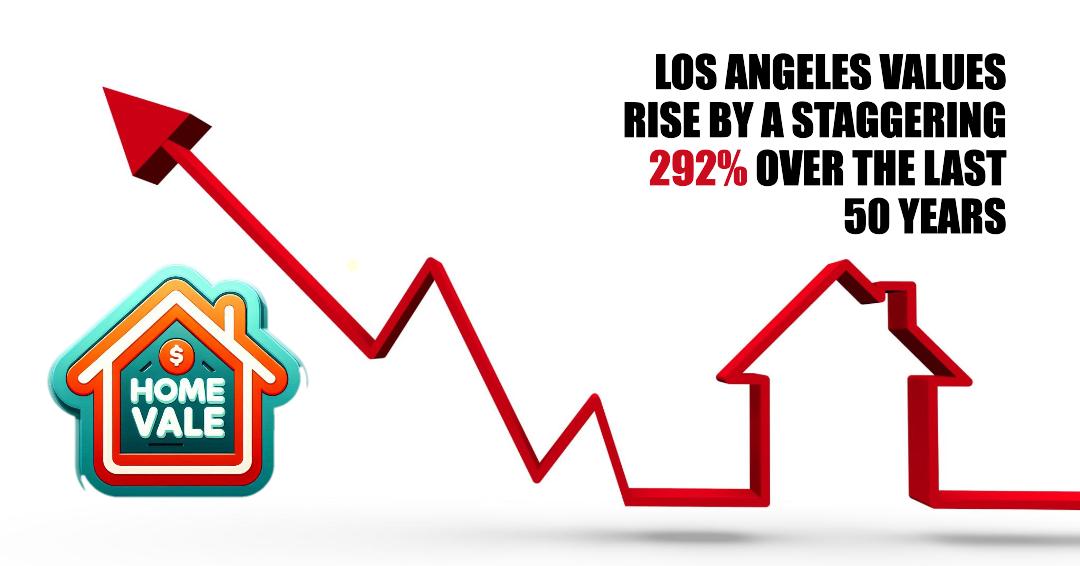
If you've been thinking about buying a home in Los Angeles, the numbers don't lie: Los Angeles values have risen by a remarkable 292% over the last 50 years, making it one of the nation's hottest housing markets. This incredible surge from 1975 to 2024, as detailed in a report by Realtor.com using data from the Federal Housing Finance Agency (FHFA), tells a compelling story about the city's transformation and its enduring appeal. It’s not just about numbers; it’s about how a city has reshaped itself and why people continue to flock here.
Los Angeles Housing Market Sees 292% Growth in Home Prices Since 1975
The Big Picture: A Shifting American Economy and Its Impact on Real Estate
It might seem like a long time ago, but 50 years ago, in 1975, the United States was a very different place. Think bell-bottoms, disco music, and a manufacturing-heavy economy. Fast forward to today, and we're living in a world driven by technology and services. This massive economic shift has had a profound effect on where people choose to live and, crucially, how much homes are worth.
According to Jake Krimmel, a senior economist at Realtor.com, this evolution is the key to understanding the dramatic differences in home value growth across the country. “In short,” he explains, “the U.S. moved from a manufacturing to a service and information economy, and that evolution impacted different places through their labor and housing markets. Some areas were huge winners from that shift, while some got the short end of the stick.”
The data lays this out clearly: the biggest winners were on the coasts, especially in areas that became hubs for technology and finance. On the flip side, many cities that once thrived on manufacturing saw much slower growth, or even stagnation.
California Dreamin': The West Coast Dominates Home Value Gains
When you look at the cities with the biggest home value increases over the past five decades, California cities absolutely shine. It’s no surprise to me, having witnessed the consistent pull of the Golden State for decades.
Here’s how the top contenders stacked up:
- San Jose, CA: A stunning 396% increase. Nestled in the heart of Silicon Valley, its rise is directly tied to the tech revolution.
- San Francisco, CA: A remarkable 300% increase. This iconic city has always been a magnet for innovation and culture.
- Los Angeles, CA: Right behind at a strong 292% increase. My hometown continues to be a global center for entertainment, creativity, and now, so much more.
- Seattle, WA: Coming in at 280%. Home to tech giants, its growth mirrors the booming information age.
- San Diego, CA: With a 271% increase, this sunny city has also seen substantial property appreciation.
It's fascinating to see that half of the top 10 metros showing the largest home value increases are in California. This region has clearly been a consistent engine of economic growth and desirability.
Why the West Coast, and Los Angeles in Particular, Saw Such Explosive Growth
The success of West Coast markets like the Bay Area and my beloved Los Angeles isn't just luck. As Krimmel pointed out, these areas became massive tech hubs. Think about the ripple effect:
- Innovation Hotbeds: Universities, cutting-edge research and development, and key companies that started shaping the digital world back in the 1980s created an environment ripe for growth.
- Talent Magnet: These industries attracted highly skilled and well-paid professionals, leading to increased demand for housing.
- Limited Supply: Especially in desirable coastal areas, space is limited. When you have a lot of people wanting to live in a place with finite room, prices naturally go up.
- The “L.A. Factor”: Beyond tech, Los Angeles has always been a global center for entertainment, media, and fashion. These industries, while different from tech, also create high-paying jobs and draw people from all over the world. The lifestyle, the weather, and the sheer opportunities have cemented its status as a place many aspire to call home. I’ve seen firsthand how people are drawn to the diverse communities, the vibrant arts scene, and the constant buzz of creativity that you can only find here.
🏠 US Home Value Transformation
Top Metropolitan Areas with the Greatest Home Value Increases Above Inflation (1974-2024)
Top 10 Markets by Growth Above Inflation
San Jose, CA
Growth Above Inflation
San Francisco, CA
Growth Above Inflation
Los Angeles, CA
Growth Above Inflation
Seattle, WA
Growth Above Inflation
San Diego, CA
Growth Above Inflation
Boston, MA
Growth Above Inflation
Riverside, CA
Growth Above Inflation
New York, NY
Growth Above Inflation
Denver, CO
Growth Above Inflation
Portland, OR
Growth Above Inflation
Key Insights
in Top 10
(San Jose)
Top 10 Markets
East Coast Powerhouses: Finance and Tradition Drive Value
While the West Coast steals the spotlight for tech-driven booms, some traditional East Coast hubs also saw impressive gains, particularly those anchored by finance and a strong historical presence.
- Boston, MA: Racked up a 196% increase. This historic city, a powerhouse of education and finance, has maintained its strong value.
- New York, NY: Appreciated by 161%. As a global financial capital, the demand for housing remained incredibly high.
- Denver, CO: Also saw a 161% increase. While not on the coast, Denver’s growth reflects its emergence as a significant economic center.
These cities benefited from similar economic shifts, with the rise of finance and service industries contributing to job growth and, consequently, higher real estate values. Krimmel also highlighted a crucial factor for these urban centers: “Highly productive and profitable industries grew local job markets and increased real estate values as a result.” He added that what further pushed prices up in places like Boston and New York was the combination of surging demand and limited supply, often due to strict zoning laws that restricted new construction.
The Tale of Two Economies: Where Home Values Lagged
On the other end of the spectrum are cities that continue to grapple with the transition away from manufacturing. These areas, which once powered the American economy with factories, haven't always had the easiest time reinventing themselves as tech or information-driven hubs.
Here are a few examples of cities with the smallest value gains:
- Memphis, TN: A mere 2% increase. This city has faced challenges in transitioning to newer industries.
- Cleveland, OH: Also saw a 2% increase. A former giant in steel and iron, its path to economic reinvention has been slow.
- Birmingham, AL: Posted a 9% increase. Another city with deep manufacturing roots, it shows a more modest turnaround.
- Pittsburgh, PA: With a 26% increase, this “Steel City” is seeing some recovery, but its growth pales in comparison to the tech giants.
As Krimmel put it, “Not only were manufacturing jobs offshored, resulting in job losses and economic plight, but many of these places did not have the capital—financial or human—to reinvent themselves as tech and finance forward hubs.” This stark difference in economic trajectory clearly shows up in home value appreciation.
Looking Ahead: What Does This Mean for Buyers and Sellers?
The data over these 50 years paints a clear picture: location, location, location has always mattered, and the economic forces shaping our nation dramatically influence real estate values. For Los Angeles, the 292% rise is a testament to its enduring appeal and adaptability. It's a city that has reinvented itself time and again, attracting talent and investment.
For anyone considering buying or selling in Los Angeles today, understanding this historical context is vital. The demand is strong, fueled by a dynamic economy and a lifestyle that continues to attract people globally. While prices are undoubtedly higher than they were decades ago, the continued growth suggests that Los Angeles remains a significant investment. From my own experience living and working here, I can tell you that the energy and opportunity that drive these value increases are palpable.
“Turnkey Rentals Outside California Offer Better Returns & Cash Flow “
Turnkey properties let you start earning rental income from day one—no renovations, no tenant hunts, no management headaches.
Work with Norada Real Estate to find vetted, cash-flowing markets tailored to your goals—so you can build steady returns without the stress.
HOT NEW LISTINGS JUST ADDED!
Speak with a seasoned Norada investment counselor today (No Obligation):
(800) 611-3060
Recommended Read:
- Los Angeles Housing Market Booms With Double-Digit Sales Growth
- Los Angeles Housing Market: Forecast and Trends 2025-2026
- Los Angeles Housing Market Cools as Buyers Pullback in 2025
- Impact of Wildfires on the Los Angeles Housing Market in 2025
- Minimum Qualifying Income to Buy a House in Los Angeles is $219,200
- Top 5 Richest Cities in the Los Angeles County
- 20 Wealthy Neighborhoods in Los Angeles
- Average Home Price in Los Angeles
- Unveiled: The Top 5 Richest Cities in Los Angeles County You Need to Know About
- Minimum Qualifying Income to Buy a House in Los Angeles is $219,200