
Norada Real Estate Investments

  • Home
  • Markets
  • Properties
  • Membership
  • Podcast
  • Learn
  • About
  • Contact

Today’s Mortgage Rates November 8: 30-Year Fixed at 6.15%, 15-Year FRM at 5.57%

November 8, 2025 by Marco Santarelli

Today's Mortgage Rates - October 9, 2025: 30-Year FRM Nudges Up to 6.48%

Today's average rate for a 30-year fixed mortgage is currently sitting at 6.15%, and for a 15-year fixed, it's 5.57%. These figures, according to Zillow's latest data, tell us that while we're not seeing wild swings, things are definitely keeping us on our toes. It’s important to remember that these are national averages, and your personal rate might look a little different based on your credit score, down payment, and other factors.

Today's Mortgage Rates November 8: 30-Year Fixed at 6.15%, 15-Year FRM at 5.57%

Let's break down what Zillow is reporting for today's mortgage rates across different loan types. This gives us a solid picture of where things stand right now.

Loan Type Average Rate Description
30-year fixed 6.15% The most popular, offering steady payments for 30 years.
20-year fixed 5.97% A good middle ground, paying off your loan faster than 30-year.
15-year fixed 5.57% Builds equity faster, with lower interest over time.
5/1 ARM 6.38% Adjustable-Rate Mortgage, fixed for 5 years, then adjusts.
7/1 ARM 6.45% Adjustable-Rate Mortgage, fixed for 7 years, then adjusts.
30-year VA 5.69% For eligible veterans, often with great rates.
15-year VA 5.25% A shorter-term option for veterans.
5/1 VA 5.70% Adjustable-Rate Mortgage for veterans.

It's fascinating to see the differences between fixed-rate mortgages and ARMs (Adjustable-Rate Mortgages). ARMs typically start with a lower rate, but that rate will change later on, which can be a gamble. For those who have served our country, the VA loan rates are particularly attractive, reflecting a national appreciation for their service.

Thinking About Refinancing? Here’s What You Need to Know

If your current mortgage has a higher interest rate, you might be wondering about refinancing. Zillow also provides rates for those looking to refinance, and the numbers here are slightly different, as expected.

Today's Mortgage Refinance Rates (Nov 8th):

Loan Type Average Rate Description
30-year fixed 6.27% Refinancing into a new 30-year loan.
20-year fixed 6.29% Refinancing into a 20-year loan.
15-year fixed 5.75% Refinancing into a 15-year loan.
5/1 ARM 6.46% Refinancing into a 5/1 ARM.
7/1 ARM 6.87% Refinancing into a 7/1 ARM.
30-year VA 5.75% Refinancing a VA loan.
15-year VA 5.62% Refinancing into a shorter-term VA loan.
5/1 VA 5.48% Refinancing into a 5/1 VA ARM.

As you can see, the refinance rates are generally a bit higher than the purchase rates. This isn't unusual. Lenders price in various factors, and the refinance market can sometimes reflect different risk assessments or be influenced by the overall rate environment differently than new purchases. When I'm advising people on refinancing, I always stress the importance of looking at the total cost of the refinance, including closing costs, versus the savings on your monthly payment and the overall interest. It’s not always a clear win.

What's Driving Today's Mortgage Rates? A Deeper Dive

So, what's causing these numbers to hover where they are? It’s not just one thing; it's a combination of factors that make the mortgage market behave the way it does.

  • The Federal Reserve's Dance: The Federal Reserve has been making moves, cutting its benchmark federal funds rate several times this year. You might think this would automatically send mortgage rates plummeting, but it's not that simple. Mortgage rates are more directly linked to longer-term Treasury yields. Even though the Fed has been lowering its short-term rates, investors had already anticipated these cuts. When the Fed makes announcements, if they're more cautious than expected, it can create a bit of a ripple effect, causing slight increases or just general uncertainty. I've seen this play out many times – the market is always trying to guess the Fed's next move.
  • The 10-Year Treasury Yield: The Real Boss? This is where I often tell people to focus their attention. The 10-year Treasury yield is a much closer indicator of where mortgage rates are headed. When there’s a sense of economic unease, like during the recent government shutdown, investors tend to move their money into safer assets, like Treasury bonds. This increased demand pushes bond prices up and, consequently, yields down. However, once the dust settles, or if other economic factors emerge, those yields can quickly climb back up, and mortgage rates tend to follow suit. This is exactly what we've seen recently, with the 10-year yield wavering and then starting to rise in November.
  • The Government Shutdown's Ripples: A government shutdown, even a brief one, injects a dose of uncertainty into the economy. It can delay the release of important economic data, which is what the Fed relies on to make its decisions about interest rates. While past shutdowns have sometimes led to lower mortgage rates because money flowed into safe havens, this time the lack of clear data makes predicting trends harder. I recall times when data gaps made lenders hesitant, leading to wider rate spreads or just more cautious lending. Also, crucial services for government-backed loans, like FHA and VA mortgages, can face processing delays, which adds another layer of complexity for borrowers.
  • The Bigger Economic Picture: We can't forget about inflation and the overall health of the economy. Lenders are always watching these metrics. If inflation is ticking up or the economy seems poised for growth, lenders might adjust their rates upwards to account for the changing economic conditions and the increased cost of funds. Important economic reports, like the monthly jobs report or inflation figures, are critical pieces of the puzzle that can sway rates in one direction or another.


Related Topics:

Mortgage Rates Trends as of November 7, 2025

Mortgage Rates Predictions for the Next 12 Months: Nov 2025 to Nov 2026

Mortgage Rates Predictions for Next 90 Days: October to December 2025

What's Next? My Take on the Short-Term Outlook

Looking ahead, predicting today’s mortgage rates for the immediate future is like trying to catch smoke. Experts are divided. Some see rates stabilizing in this current narrow range, while others expect minor shifts up or down. It really hinges on what new economic data comes out and how the market continues to digest the recent government shutdown.

However, when I compare where we are today with the beginning of the year, there's a definite sense of relief. Rates have come down significantly from their peaks, offering a more accessible borrowing environment for many. This is progress, even if the market feels a bit undecided right now. For those looking to buy, this stabilization provides a bit more certainty, and for refinancers, it might mean continuing to watch for that perfect opportunity to lower their monthly payments.

Beat Inflation & Retire Early with Turnkey Rentals

Turnkey real estate offers powerful tax benefits, monthly cash flow, and long-term equity growth—ideal for early retirement planning.

Norada Real Estate helps you invest in inflation-resistant markets with strong rental demand and built-in tax advantages like depreciation and 1031 exchanges.

🔥 HOT NEW LISTINGS JUST ADDED! 🔥

Talk to a Norada investment counselor today (No Obligation):

(800) 611-3060

Get Started Now

Also Read:

  • Mortgage Rates Predictions Backed by 7 Leading Experts: 2025–2026
  • Mortgage Rate Predictions for the Next 3 Years: 2026, 2027, 2028
  • 30-Year Fixed Mortgage Rate Forecast for the Next 5 Years
  • 15-Year Fixed Mortgage Rate Predictions for Next 5 Years: 2025-2029
  • Will Mortgage Rates Ever Be 3% Again in the Future?
  • Mortgage Rates Predictions for Next 2 Years
  • Mortgage Rate Predictions for Next 5 Years
  • Mortgage Rate Predictions: Why 2% and 3% Rates are Out of Reach
  • How Lower Mortgage Rates Can Save You Thousands?
  • How to Get a Low Mortgage Interest Rate?
  • Will Mortgage Rates Ever Be 4% Again?
Filed Under: Financing, Mortgage Tagged With: Interest Rate, mortgage, Mortgage Rate Trends, mortgage rates, Mortgage Rates Today

30-Year Mortgage Rate Drops by 57 Basis Points Hovering Around 6.22%

November 8, 2025 by Marco Santarelli

Will the 30-Year Mortgage Rate Drop Below 6% Before 2026?

The good news for anyone eyeing a new home is that the 30-year mortgage rate has dropped by a significant 57 basis points year-over-year, currently hovering around 6.22%. This substantial decrease means potential homebuyers could be saving thousands of dollars annually, suggesting that the dream of homeownership is inching closer to reality for many.

A 57 basis point drop might sound technical, but on a mortgage of, say, $300,000, it can mean a difference of hundreds of dollars in your monthly payment. That’s money that can go towards furniture, renovations, or simply building a stronger financial cushion.

This recent dip in mortgage rates, reported by Freddie Mac as part of their always-insightful Primary Mortgage Market Survey®, is putting us in a position where rates are nearing their lowest points seen in 2025. This shift is a breath of fresh air in what has felt like a continually rising cost environment for housing.

30-Year Mortgage Rate Drops by 57 Basis Points Hovering Around 6.22%

What Does That 57 Basis Point Drop Actually Mean for Your Wallet?

Let’s break down the impact of this 57 basis point decrease. Imagine you’re looking to buy a home and your loan amount is $300,000.

  • At a rate of 6.79% (which would be roughly 57 basis points higher than the current 6.22%):
    • Your estimated monthly principal and interest payment would be around $1,974.
  • At the current rate of 6.22%:
    • Your estimated monthly principal and interest payment drops to approximately $1,841.

That's a saving of about $133 per month, or almost $1,600 per year in interest alone! Over the life of a 30-year mortgage, that adds up to a staggering amount, easily tens of thousands of dollars. This impact is even more pronounced on larger loan amounts. It’s this kind of tangible benefit that makes these rate movements so important for prospective buyers.

Mortgage Rate Trends: A Deeper Dive from Freddie Mac Data

Freddie Mac’s latest survey, dated November 6, 2025, provides a clear snapshot of where we stand.

Primary Mortgage Market Survey® – U.S. Weekly Averages as of 11/06/2025

Mortgage Type Current Rate 1-Wk Change 1-Yr Change Monthly Avg. 52-Wk Avg. 52 Week Range
30-Yr FRM 6.22% +0.05% -0.57% 6.21% 6.68% 6.17% – 7.04%
15-Yr FRM 5.5% +0.09% -0.50% 5.47% 5.85% 5.41% – 6.27%

Looking at the table, the 57 basis point decrease year-over-year for the 30-year fixed-rate mortgage (FRM) is the star of the show. It’s the most significant change and directly impacts the largest segment of homebuyers. While the 15-year fixed-rate mortgage has also seen a drop of 50 basis points year-over-year, the 30-year still offers a lower barrier to entry in terms of monthly payments.

The 52-week range for the 30-year FRM, from 6.17% to 7.04%, shows that the current rate is very close to the lowest it's been in the past year. This suggests a stable, perhaps even slightly favorable, borrowing environment.

Decoding the Federal Reserve's Recent Moves

Now, why are these rates dropping? A major factor is the Federal Reserve's monetary policy. On October 29, 2025, the Fed made its second consecutive cut to its benchmark interest rate, lowering it by 0.25 percentage points. This isn't just a random act; it's a deliberate response to economic signals.

My take on this is that the Fed is trying to navigate a tricky economic path. They see signs of the economy slowing down, especially when it comes to jobs. Cutting interest rates is one of their key tools to try and keep things moving and prevent a sharper downturn.

Here are some of the key takeaways from their recent decision:

  • A Divided Decision: While the majority supported the rate cut, it wasn’t unanimous. Some felt no cut was needed, while others thought a bigger cut was warranted. This indicates the complexities and differing views on the economic outlook within the Fed itself.
  • Cautious Outlook: Fed Chair Powell made it clear that another rate cut in December isn't guaranteed. Mixed economic signals and issues like the government shutdown that affect data availability are making it hard to predict the future with certainty.
  • Quantitative Tightening (QT) Ending: A significant policy shift is the planned end to the reduction of the Fed's asset holdings starting December 1, 2025. This means they’ll stop shrinking their balance sheet, which can indirectly influence longer-term interest rates.

The Economic Puzzle: Conflicting Signals and Their Impact on Rates

The Federal Reserve's actions are a direct reflection of the mixed economic signals they’re receiving.

  • Labor Market Worries: The weakening employment picture is a primary driver for the rate cuts. When people are less likely to find jobs, demand can soften, and businesses might pull back.
  • Sticky Inflation: On the flip side, prices are still higher than the Federal Reserve’s 2% target. This “sticky inflation” makes it difficult for them to cut rates too aggressively without risking further price increases. They have to balance stimulating the economy with keeping inflation in check.
  • Data Gaps: The federal government shutdown has created significant challenges. When economic data becomes unreliable or unavailable, it makes it much harder for the Fed to make informed decisions about interest rates. This uncertainty naturally leads to a more cautious approach.

Read This:

Will the 30-Year Mortgage Rate Drop Below 6% Before 2026?

30-Year Fixed vs. 15-Year Fixed: Weighing Your Options

The current environment presents an interesting choice between 30-year and 15-year fixed-rate mortgages.

  • 30-Year Fixed-Rate Mortgage:
    • Pros: Lower monthly payments, making it more affordable for many buyers. Offers more flexibility with cash flow.
    • Cons: You’ll pay more interest over the life of the loan.
  • 15-Year Fixed-Rate Mortgage:
    • Pros: Lower interest rate overall and you pay off your home much faster, saving significantly on total interest paid.
    • Cons: Higher monthly payments, requiring a stronger income or more substantial down payment.

With the 30-year rate at 6.22% and the 15-year at 5.5%, the spread is noticeable. While the 15-year offers a better long-term deal, the current 30-year rate is incredibly competitive, especially when you consider the affordability boost it provides to monthly budgets. For many, grabbing a 30-year at this rate and then making extra principal payments when financially able can be a smart strategy.

My Two Cents: What This Means for Buyers and the Market

From my perspective, this sustained drop in 30-year mortgage rates is incredibly encouraging. It signals a potential shift towards a more balanced housing market. For years, affordability has been a major hurdle for many aspiring homeowners. This decrease in borrowing costs directly addresses that.

I believe this trend could:

  • Boost Buyer Confidence: Seeing lower rates can encourage hesitant buyers to enter the market.
  • Increase Home Sales: More buyers should naturally lead to more transactions.
  • Stabilize or Slightly Increase Home Prices: While not a guarantee of dramatic price drops, improved affordability can help stabilize price growth that has been outpacing wage increases.

However, it’s crucial to remember that the Federal Reserve’s guidance is cautious. Mixed economic signals mean that these favorable rates aren’t necessarily guaranteed to last indefinitely. My advice to anyone considering a home purchase is to act thoughtfully but decisively. Get pre-approved, understand your budget, and if you find a home you love at a rate that works for you, don't let indecision hold you back.

The market is dynamic, and while this 57 basis point year-over-year drop is a significant positive development, keeping an eye on economic indicators and Fed policy will be key for anyone navigating the housing market in the coming months.

Passive Income Starts Here—Explore Cash-Flowing Properties

As mortgage rates remain high, savvy investors are locking in properties that deliver consistent rental income and long-term appreciation.

Work with Norada Real Estate to find turnkey, cash-flowing homes in stable markets—helping you grow wealth no matter which way rates move.

HOT NEW INVESTMENT PROPERTIES JUST LISTED!

Speak with a seasoned Norada investment counselor today (No Obligation):

(800) 611-3060

Get Started Now

Also Read:

  • Will Mortgage Rates Go Down in 2025: Morgan Stanley's Forecast
  • Mortgage Rate Predictions 2025 from 4 Leading Housing Experts
  • Mortgage Rate Predictions for the Next 3 Years: 2026, 2027, 2028
  • 30-Year Fixed Mortgage Rate Forecast for the Next 5 Years
  • 15-Year Fixed Mortgage Rate Predictions for Next 5 Years: 2025-2029
  • Will Mortgage Rates Ever Be 3% Again in the Future?
  • Mortgage Rates Predictions for Next 2 Years
  • Mortgage Rate Predictions for Next 5 Years
  • Mortgage Rate Predictions: Why 2% and 3% Rates are Out of Reach
  • How Lower Mortgage Rates Can Save You Thousands?
  • How to Get a Low Mortgage Interest Rate?
  • Will Mortgage Rates Ever Be 4% Again?
Filed Under: Financing, Mortgage Tagged With: Interest Rate, mortgage, Mortgage Rate Trends, mortgage rates, Mortgage Rates Today

Today’s Mortgage Rates November 7: 30-Year Fixed Rate Sees a Big Yearly Drop

November 7, 2025 by Marco Santarelli

Today's Mortgage Rates - October 9, 2025: 30-Year FRM Nudges Up to 6.48%

As we look at today's mortgage rates on November 7th, it's clear the housing market is in an interesting spot. The good news is that for many of us, mortgage rates are notably lower than they were a year ago. Specifically, the national average for a 30-year fixed mortgage has settled around 6.22%, according to Freddie Mac's latest report. That's a significant drop from this time last year!

This shift can translate into substantial savings for homebuyers, making homeownership a more attainable goal for many. Now, let's dive a bit deeper than just the headline figures and unpack what’s really influencing current mortgage rates. We'll look at the latest data and, more importantly, what it means for you.

Today's Mortgage Rates November 7: 30-Year Fixed Rate Sees a Big Yearly Drop

What the Numbers Show: A Snapshot of Current Mortgage Rates

Let's get right down to the specifics. We've got some fresh data from Zillow that gives us a clearer picture of where things stand right now. It's important to remember these are national averages, and your specific rate might be a little different based on your credit, loan type, and other factors.

Here’s a look at the current mortgage rates as of today, November 7th:

Loan Type Interest Rate
30-year fixed 6.11%
20-year fixed 6.00%
15-year fixed 5.62%
5/1 ARM 6.47%
7/1 ARM 6.36%
30-year VA 5.82%
15-year VA 5.35%
5/1 VA 5.70%

Now, if you’re thinking about refinancing your current mortgage, those numbers look a bit different. Refinancing rates can sometimes be slightly higher than purchase rates because lenders are looking at the existing loan and property differently.

Here are the current mortgage refinance rates from Zillow:

Loan Type Interest Rate
30-year fixed 6.27%
20-year fixed 6.19%
15-year fixed 5.77%
5/1 ARM 6.70%
7/1 ARM 6.85%
30-year VA 5.97%
15-year VA 5.88%
5/1 VA 5.64%

As you can see, there's a slight difference between buying a new home and refinancing, which is completely normal. The core rates we're seeing for a 30-year fixed mortgage, hovering around 6.11% for purchases, are certainly more encouraging than what we saw a year ago. Sam Khater, Freddie Mac's chief economist, hit the nail on the head when he mentioned that this improvement in affordability could save homebuyers thousands annually.

Is This the Right Time for You to Lock In? Understanding the Influences

This is the million-dollar question, isn't it? After looking at the numbers, the next natural step is to figure out if it's your time. The truth is, mortgage rates are like a complex recipe with many ingredients. Several factors are currently stirring the pot, and it's crucial to understand them to make an informed decision.

The Federal Reserve's Moves and How They Ripple

The Federal Reserve plays a significant role in the economy, and their decisions, particularly regarding interest rates, have a big impact. We've seen the Fed cut its benchmark federal funds rate twice recently, in September and October, with the goal of stimulating the economy.

However, and this often surprises people, mortgage rates don't directly mirror these Fed rate cuts. Instead, they often move based on expectations. Sometimes, we see mortgage rates increase shortly after a Fed rate cut announcement. Why? Because the market might have already priced in that cut. If the Fed's message afterward is more cautious (like Fed Chair Jerome Powell stating a December cut isn't a “foregone conclusion”), investors might start to reprice bonds, which in turn can push mortgage rates up. It’s a bit of a dance between anticipated moves and actual pronouncements.

The Pulse of Treasury Yields

When I think about mortgage rates, my mind immediately goes to the 10-year Treasury bond yield. This is a much stronger indicator of where mortgage rates are headed. For the past few weeks, we've seen the yield on these bonds ticking upwards in November, and mortgage rates have generally followed suit.

What's also interesting is the “spread” – that's the difference between the 10-year Treasury yield and mortgage rates. Right now, this spread seems to be a bit wider than what we typically see historically. This wider spread can contribute to those slightly elevated mortgage rates we're observing.

The Shadow of the Government Shutdown

The current government shutdown is another layer of complexity. Historically, government shutdowns can make investors a bit nervous. They often seek out “safer” investments during uncertain times, like Treasury bonds. This increased demand for Treasuries can drive their yields down, which could theoretically lead to lower mortgage rates.

However, the shutdown creates its own set of problems. It's causing delays in the release of important economic data, like employment reports, which the Federal Reserve relies on to make its decisions. This lack of clear data can lead to more market choppiness and make it harder to predict exactly where rates will go. On top of that, a shutdown can sometimes slow down the processing of mortgages, especially for government-backed loans like FHA and VA loans, which can add to the waiting game for some borrowers.


Related Topics:

Mortgage Rates Trends as of November 6, 2025

Mortgage Rates Predictions for the Next 12 Months: Nov 2025 to Nov 2026

Mortgage Rates Predictions for Next 90 Days: October to December 2025

My Take: What Does This All Mean for You?

From my perspective, the current situation is a mixed bag, but with some definite positives. First, the fact that rates are a half-point lower than a year ago is a significant win for affordability. If you're a first-time homebuyer or looking to upgrade, that difference can make a substantial dent in your monthly payments over the life of the loan.

However, the recent uptick in rates, driven by those rising Treasury yields and the Fed's cautious signals, means that you can't necessarily wait too long for rates to plummet. Mortgage rates have been pretty volatile lately. What I tell people is to focus on their personal financial situation.

  • Is your credit score in good shape? A higher credit score generally gets you a lower interest rate.
  • Do you have a solid down payment? This not only reduces your loan amount but can also improve your loan-to-value (LTV) ratio, potentially leading to better terms.
  • What are your long-term plans? If you plan to stay in your home for many years, locking in a fixed rate now, even if it's slightly higher than the absolute lowest point of the week, might offer more long-term stability than constantly hunting for a mythical “perfect” moment.

For those considering refinancing, the numbers suggest it's worth a serious look, especially if you've been paying a higher rate for a while. The savings could be considerable, but it's essential to weigh the closing costs against the monthly savings to ensure it makes financial sense for your situation.

The influence of the Federal Reserve and Treasury yields is a constant reminder that the economic environment is dynamic. While a government shutdown adds uncertainty, it also highlights the interconnectedness of our financial systems. It’s not just about the numbers themselves, but the story behind them and how they can impact your biggest financial decision – your home.

Stable Income, Zero Headaches—Invest in Turnkey Real Estate

Savvy investors are locking in properties that deliver consistent passive rental income and long-term appreciation.

Work with Norada Real Estate to find turnkey, cash-flowing homes in stable markets—helping you grow wealth no matter which way rates move.

HOT NEW INVESTMENT PROPERTIES JUST LISTED!

Speak with a seasoned Norada investment counselor today (No Obligation):

(800) 611-3060

Get Started Now

Also Read:

  • Mortgage Rates Predictions Backed by 7 Leading Experts: 2025–2026
  • Mortgage Rate Predictions for the Next 3 Years: 2026, 2027, 2028
  • 30-Year Fixed Mortgage Rate Forecast for the Next 5 Years
  • 15-Year Fixed Mortgage Rate Predictions for Next 5 Years: 2025-2029
  • Will Mortgage Rates Ever Be 3% Again in the Future?
  • Mortgage Rates Predictions for Next 2 Years
  • Mortgage Rate Predictions for Next 5 Years
  • Mortgage Rate Predictions: Why 2% and 3% Rates are Out of Reach
  • How Lower Mortgage Rates Can Save You Thousands?
  • How to Get a Low Mortgage Interest Rate?
  • Will Mortgage Rates Ever Be 4% Again?

Filed Under: Financing, Mortgage Tagged With: Interest Rate, mortgage, Mortgage Rate Trends, mortgage rates, Mortgage Rates Today

Will the 30-Year Fixed Mortgage Rate Drop Below 6% by End of 2025?

November 7, 2025 by Marco Santarelli

Will the 30-Year Mortgage Rate Drop Below 6% Before 2026?

It's the question on everyone's mind in the housing market: will 30-year fixed mortgage rates slide below the psychologically significant 6% mark by the end of 2025? My read of the current economic currents and expert forecasts suggests that while rates are certainly heading in a hopeful direction, a definitive drop below 6% by that specific date in December 2025 is unlikely. We're more likely to see rates hovering in the mid-6% range, with a more solid chance of dipping below 6% sometime in early to mid-2026.

Will the 30-Year Fixed Mortgage Rate Drop Below 6% by End of 2025?

The Current Pulse: Where Rates Stand Today

As I'm writing this, the news is actually pretty good. The average 30-year fixed-rate mortgage is currently at 6.22% and remains near 2025 lows. This is a welcome trend. This is largely thanks to the Federal Reserve's recent decision to cut the federal funds rate by 25 basis points, bringing it to a range of 4.0%-4.25%.

For those looking to refinance or perhaps buy a slightly smaller home, the 15-year fixed rate is even more appealing, currently at about 5.44%. However, for the majority of homebuyers seeking that long-term stability of a 30-year fixed mortgage, rates are still sitting just above our magic number.

It's important to remember that these are averages. Your actual rate will depend on factors like your credit score, loan-to-value ratio, and the specific lender you choose. Borrowers with excellent credit scores (think 760 and above) might shave off another quarter-percent or so from these averages, which can make a significant difference over the life of a loan.

A Journey Through Time: What the Past Tells Us

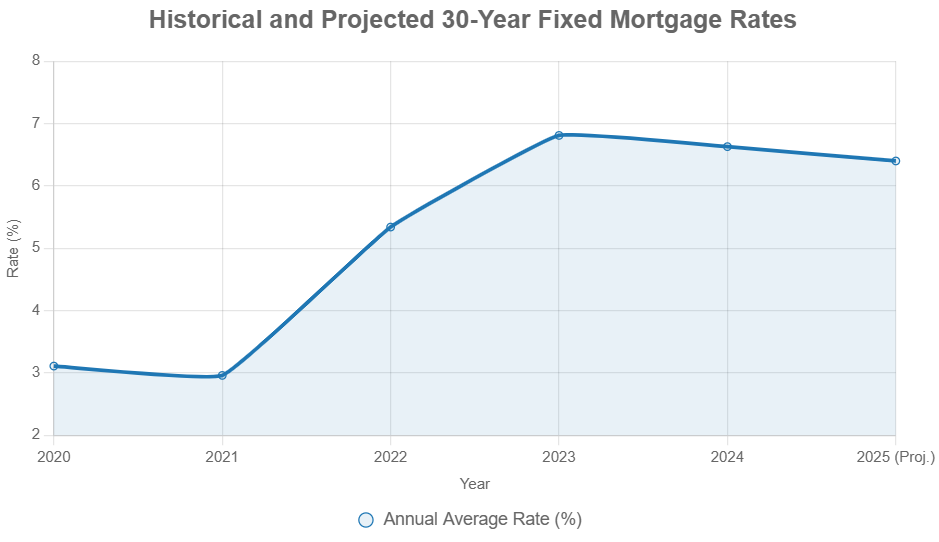
To understand where we might be going, it's crucial to look at where we've been. The last few years have been a wild ride for mortgage rates. We saw them plummet to historic lows, below 3%, during the height of the COVID-19 pandemic in 2020 and 2021. This fueled an incredible buying spree, with many people jumping into the market, often making offers well above asking price.

Then, as inflation surged unexpectedly, the Federal Reserve began aggressively hiking interest rates to try and cool things down. This sent mortgage rates soaring, climbing above 7% in 2022 and 2023. It was a tough period for homebuyers, as monthly payments became much more expensive, and many potential buyers were priced out of the market altogether.

Here’s a look at how average annual rates have played out:

Year Average 30-Year Fixed Rate (%) Key Events
2020 3.11 Pandemic starts, Fed slashes rates to near zero to support the economy.
2021 2.96 Record low rates, housing market frenzy, inventory shortages begin.
2022 5.34 Inflation spikes, Fed begins rapid rate hikes.
2023 6.81 Rates reach over 7% at their peak, affordability crisis deepens.
2024 * 6.63 (estimated) Rates begin to stabilize in the mid-6% range.
2025 * 6.40 (projected) Fed rate cuts resume, but inflation remains slightly above target.
  • (Estimates and projections based on current trends and forecasts)

The record lows of 2020-2021 made it difficult for many homeowners to sell, as they didn't want to give up their incredibly low interest rates – a phenomenon often called “rate lock-in.” This has significantly contributed to the low inventory we've seen in many areas. While rates in 2025 are trending downwards from the peaks of 2023, we're not quite at the levels that would unlock the market for everyone.

will mortgage rates drop below 6 by end the of december 2025

The Economic Engine: What Really Drives Mortgage Rates?

It's easy to think of mortgage rates as just a number, but they're deeply connected to the much larger economic picture. The 10-year U.S. Treasury yield is a major benchmark that mortgage rates tend to follow, with a typical spread of about 1.5% to 2% added on top for things like lender risk and profit. So, what influences the Treasury yield and that spread?

  1. The Federal Reserve's Game Plan: The Fed's main job is to keep prices stable (control inflation) and help as many people as possible have jobs. They do this by adjusting short-term interest rates. Right now, the Fed is projecting its federal funds rate to be around 3.6% by the end of 2025, down from where it started the year. This indicates they plan to make more cuts if inflation behaves. However, they've stressed repeatedly that they'll only act based on what the economic data shows, so we can't assume these cuts are guaranteed.
  2. The Inflation Challenge: Even with recent cooling, inflation is still a concern. The Fed's target is 2%, and forecasts for 2025 often put it around 3.0%. Things like lingering supply chain issues and potential new tariffs being put in place could keep prices rising faster than we'd like. This persistent inflation makes the Fed hesitant to cut rates too aggressively, which in turn keeps mortgage rates from dropping dramatically.
  3. Jobs and Economic Growth: We're seeing some signs of cooling in the job market, with unemployment ticking up to around 4.5%. This can be a good sign for the Fed, as it means the economy isn't overheating, and they might feel more comfortable cutting rates. However, if economic growth slows down too much, heading towards a recession, that could also lead to lower rates, but it would be a more concerning reason.
  4. Global and Government Factors: Things happening around the world, like conflicts in the Middle East, can create uncertainty and cause investors to seek safer havens, which can sometimes push longer-term Treasury yields up. Domestically, the government's debt levels and spending plans can also influence interest rates.
  5. Lender and Buyer Specifics: It's not just the big picture. Your own financial situation matters a lot. How good is your credit score? How much income do you have compared to your debts (your debt-to-income ratio)? These factors determine the specific rate you'll be offered by a lender. We're also seeing more people opt for Adjustable-Rate Mortgages (ARMs) because their initial rates are lower, but these come with the risk that your payments could go up significantly later.

Expert Crystal Ball: What the Forecasters Are Saying

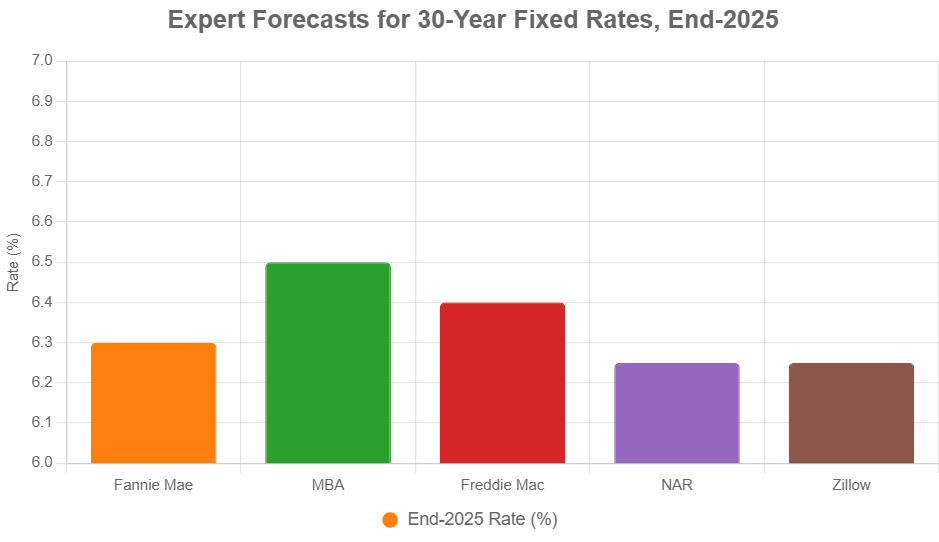
When I look at the major housing and economic institutions – like Fannie Mae, the Mortgage Bankers Association (MBA), Freddie Mac, and the National Association of Realtors (NAR) – they all seem to be in agreement, albeit with slight variations. The general consensus is that rates will likely continue to trend downwards in 2025, but not quite dip below 6% by the end of December. Most projections place the average 30-year fixed rate somewhere between 6.3% and 6.5% by the close of 2025.

Here’s a snapshot of what some key players are predicting:

Forecaster Predicted End-2025 Rate (%) Main Reason for Prediction
Fannie Mae 6.3 Inflation continues to cool, leading to more Fed cuts.
Mortgage Bankers Assoc. (MBA) 6.5 Potential tariffs and government debt may limit rate drops.
Freddie Mac 6.4 Modest Fed easing, with housing supply improvements helping.
NAR Mid-6% (6.25 avg.) Steady market recovery, increase in available homes.
Zillow Mid-6% Regional differences will be key, some areas may soften more.

This forecast cluster comfortably above 6% tells me that a significant majority expect rates to tease that 6% mark but ultimately stay a bit higher by year-end 2025. While a few optimistic voices might see it dipping lower if inflation falls dramatically and the Fed makes more aggressive cuts, the risks of inflation sticking around or new economic headwinds emerging keep most forecasts tempered.

Here's a visual representation of those end-of-year 2025 rate predictions:

mortgage rate predictions end of year 2025

Broader Ramifications: Who Wins, Who Waits?

So, what does this mean for people looking to buy or sell?

  • First-Time Buyers: If rates hover around 6.5%, the affordability challenge remains. For example, on a $400,000 loan, your monthly payment (principal and interest) would be roughly $2,528 at 6.5%. Compare that to $1,760 at 4% back in 2021 – that’s a huge difference. This means many buyers will continue to need larger down payments or will look for more affordable housing options. First-time buyer programs and FHA/VA loans, which often offer slightly lower rates, become even more critical.
  • Refinancers: For those who managed to lock in rates below 4% a few years ago, there's likely not much incentive to refinance right now. However, as rates come down into the 5% and low 6% range, we could see a more significant wave of refinancing activity, especially for those looking to convert from an ARM to a fixed rate or tap into some home equity.
  • Sellers: The market is still a bit tricky for sellers. While there's more demand than supply in many areas, the higher interest rates mean buyers often have less purchasing power. In some regions, especially where prices rose dramatically, we might see modest price drops or homes sitting on the market longer.

The Road Ahead: Scenarios and Strategies

Based on my understanding of the markets and expert opinions, I see a few potential paths forward:

  • The Most Likely Scenario (Around 70% Probability): Rates end 2025 in the 6.3% to 6.5% range. We'll see continued volatility, with weekly economic reports causing small ups and downs, but the overall trend will be downward but not quite breaking the 6% barrier by year-end. If this is the case, I'd advise buyers to get pre-approved now, understand their budget, and be ready to lock in a rate when it moves into their target range.
  • The Optimistic Scenario (Around 20% Probability): Inflation takes a sharper turn downwards, hitting the Fed’s 2.5% target or lower, and the Fed decides to cut rates more aggressively in the latter half of 2025. This could realistically push 30-year fixed rates below 6% before December 31, 2025. In this scenario, we might see a surge in homebuying activity in early to mid-2026.
  • The Less Likely, But Possible, Scenario (Around 10% Probability): Unexpected economic shocks, like ongoing geopolitical issues or a significant increase in tariffs, could re-ignite inflation fears. This would force the Fed to pause or even reverse course on rate cuts, pushing mortgage rates back up towards the 6.8% to 7.0% range. If this happens, those planning to buy might need to delay their plans or significantly adjust their expectations.

Ultimately, the housing market is a complex entity. While the desire for sub-6% mortgage rates by the end of 2025 is strong, the data and expert opinions suggest a more gradual descent. We're definitely moving in the right direction, and a dip below 6% is highly probable in the not-too-distant future, likely in 2026. For now, patience, preparation, and smart shopping are key for anyone navigating the mortgage market.

Grab the Deals—Turnkey Properties That Deliver Monthly Returns

As mortgage rates remain high, savvy investors are locking in properties that deliver consistent rental income and long-term appreciation.

Work with Norada Real Estate to find turnkey, cash-flowing homes in stable markets—helping you grow wealth no matter which way rates move.

HOT NEW INVESTMENT PROPERTIES JUST LISTED!

Speak with a seasoned Norada investment counselor today (No Obligation):

(800) 611-3060

Get Started Now

Also Read:

  • Will Mortgage Rates Go Down in 2025: Morgan Stanley's Forecast
  • Mortgage Rate Predictions 2025 from 4 Leading Housing Experts
  • Mortgage Rate Predictions for the Next 3 Years: 2026, 2027, 2028
  • 30-Year Fixed Mortgage Rate Forecast for the Next 5 Years
  • 15-Year Fixed Mortgage Rate Predictions for Next 5 Years: 2025-2029
  • Will Mortgage Rates Ever Be 3% Again in the Future?
  • Mortgage Rates Predictions for Next 2 Years
  • Mortgage Rate Predictions for Next 5 Years
  • Mortgage Rate Predictions: Why 2% and 3% Rates are Out of Reach
  • How Lower Mortgage Rates Can Save You Thousands?
  • How to Get a Low Mortgage Interest Rate?
  • Will Mortgage Rates Ever Be 4% Again?

Filed Under: Financing, Mortgage Tagged With: Interest Rate, mortgage, Mortgage Rate Trends, mortgage rates, Mortgage Rates Today

Mortgage Rates Drop Offering Thousands in Savings for Borrowers

November 6, 2025 by Marco Santarelli

Mortgage Rates Drop Offering Thousands in Savings for Borrowers

If you've been dreaming of buying a home or refinancing your current mortgage, the news is definitely encouraging. Mortgage rates remain near their 2025 lows, with the average 30-year fixed-rate mortgage standing at 6.22% as of November 6, 2025, according to Freddie Mac. This is a significant development that can translate into thousands of dollars saved annually for homebuyers, signaling a welcome improvement in housing affordability.

This stability is a breath of fresh air compared to some of the more turbulent times we’ve seen. The current rate environment isn't just a random occurrence; it's a direct reflection of broader economic policy and market sentiment. Let's dive into what's really driving these favorable mortgage rates and what it could mean for you.

Mortgage Rates Drop, Offering Thousands in Savings for Borrowers

Understanding the Numbers: A Snapshot from Freddie Mac

Freddie Mac's Primary Mortgage Market Survey® is the go-to source for weekly mortgage rate averages, and the latest data paints a clear picture.

Mortgage Type U.S. Weekly Average (11/06/2025) 1-Week Change 1-Year Change Monthly Average 52-Week Average 52-Week Range (Low – High)
30-Yr Fixed FRM 6.22% +0.05% -0.57% 6.21% 6.68% 6.17% – 7.04%
15-Yr Fixed FRM 5.5% +0.09% -0.50% 5.47% 5.85% 5.41% – 6.27%

Looking at these figures, two things really stand out to me. First, the 30-year fixed-rate mortgage (FRM) at 6.22% is indeed quite competitive when you compare it to the 1-year average of 6.68%. That’s a noticeable difference! Second, the 52-week range for the 30-year FRM shows we've recently touched lows around 6.17%. This indicates that while rates have ticked up slightly week-over-week, they are still very much in the lower end of what we've seen over the past year.

It’s also worth noting the 15-year fixed-rate mortgage is even more attractive, averaging 5.5%. This option can save you a significant amount in interest payments over the life of the loan, though it will mean higher monthly payments compared to a 30-year loan.

So, how much could a buyer save? The savings depend heavily on the size of the loan, but we can illustrate it with an example.

Let's consider a buyer purchasing a home with a loan amount of $300,000.

  • Scenario 1: Last Year's Average Rate (Illustrative based on 52-week average trend)
    If we approximate a rate from a year ago to be around 6.7% (a bit higher than the 52-week average of 6.68% to show a clear comparison point and reflecting a slightly less favorable time within that year, just for illustrative clarity), the monthly principal and interest (P&I) payment on a $300,000 loan would be approximately $1,946.01.
  • Scenario 2: Current Rate (November 6, 2025)
    With the current average rate of 6.22%, the monthly P&I payment on the same $300,000 loan would be approximately $1,846.63.

The Savings:

By securing a mortgage at the current rate of 6.22% compared to a hypothetical rate of 6.7% from around last year, this buyer would save approximately $99.38 per month ($1,946.01 – $1,846.63).

Now, let's look at the long-term impact of those monthly savings:

  • Annual Savings: $99.38/month * 12 months = $1,192.56 per year
  • Total Savings over 30 Years: $1,192.56/year * 30 years = $35,776.80 over the life of the loan!

This is a significant amount of money – over $35,000! It's enough for a substantial down payment on a future property, a fantastic renovation project, or simply to provide a greater sense of financial security.

The Federal Reserve's Role: More Than Just a Cut

The fact that mortgage rates are hovering near these lower levels is undeniably linked to actions taken by the Federal Reserve. On October 29, 2025, the Fed made its second consecutive cut to its benchmark interest rate, lowering it by 0.25 percentage points. This move brought the target range down to 3.75% to 4.00%.

Why is this important? When the Fed cuts its benchmark rate, it directly impacts the cost of borrowing for banks. This, in turn, tends to trickle down to consumers in the form of lower interest rates on various loans, including mortgages. The Fed’s decision clearly signals a growing concern about the economy possibly cooling down too much, and they’re attempting to provide a boost.

However, it’s not quite as simple as a direct one-to-one correlation. Mortgage rates are influenced by a multitude of factors, and the Fed’s actions are just one piece of a much larger puzzle.

Key Details from the Fed's Decision:

  • A Divided Vote: The decision wasn't unanimous. Seven of the ten members voted for the cut, but there were differing opinions. Some, like Kansas City Fed President Jeffrey Schmid, felt no cut was necessary, while others, like Fed Governor Stephen Miran, believed a larger, half-point cut was warranted. This division highlights the uncertainty the Fed faces in navigating the current economic climate.
  • Cautious Forward Guidance: Fed Chair Powell was careful not to promise any future rate cuts. He stated that another cut in December was “not a foregone conclusion.” This cautious language is crucial. It suggests that while the Fed is willing to cut rates to support the economy, they are also watching economic data very closely and are ready to pause if necessary. This can create some market volatility as traders try to decipher future intentions.
  • Ending Quantitative Tightening (QT): A major policy shift is coming on December 1, 2025, when the Fed will stop reducing the size of its asset holdings. This means they'll stop letting bonds they own mature without buying new ones. Ending QT injects liquidity into the financial system, which can also put downward pressure on longer-term interest rates, including mortgage rates.

Conflicting Economic Signals: A Balancing Act

The Fed's actions are a response to a complex economic picture filled with mixed signals. As I see it, they are trying to balance several competing forces.

  • Labor Market Concerns: There are undeniable signs that the job market is showing some weakness. When unemployment ticks up or job growth slows, it’s a clear indicator that the economy might be heading for a slowdown, prompting the Fed to lower rates to make borrowing cheaper and encourage spending and investment.
  • Inflation Persistence: On the flip side, inflation is still a persistent issue. Prices for goods and services haven't fully returned to the Fed's target of 2%. This is a big constraint on the Fed. If they cut rates too aggressively while inflation is still high, they risk making the inflation problem even worse. It's a delicate balancing act.
  • Data Challenges from Government Shutdown: The recent federal government shutdown has unfortunately cast a shadow over economic data. With key reports delayed or unavailable, it's much harder for economists and the Fed to get a clear, up-to-the-minute read on the economy. This lack of clarity adds to market uncertainty and can make forecasting and decision-making more challenging.

Market Reaction: Yields and Forecasts

The Fed's cautious approach and the ongoing economic uncertainties have led to some interesting market reactions, particularly with bond yields. Mortgage rates, especially the 30-year fixed, tend to follow the yields on 10-year Treasury bonds. When those yields go up, so do mortgage rates, and vice versa.

Latest Mortgage Rate Forecasts (Q4 2025):

Most housing authorities are painting a consistent picture for the remainder of 2025. They generally predict that 30-year fixed mortgage rates will stay in the low- to mid-6% range. Some even anticipate a slight dip by the year's end.

Here’s a look at some more specific predictions:

Housing Authority Q4 2025 Forecast
Fannie Mae 6.3%
Mortgage Bankers Association (MBA) 6.4%
Wells Fargo 6.3%
Realtor.com 6.4% (year-end)

It’s important to remember that these are averages and predictions. Actual mortgage rates you see will depend on much more than just these broad forecasts.


Related Topics:

Mortgage Rates Predictions for Next 90 Days Ending January 2026

Mortgage Rates Predictions for the Next 12 Months: Nov 2025 to Nov 2026

What Truly Drives Mortgage Rates?

While the Fed's policy rate is a significant influence, it's not the only factor. Think of it as the conductor of an orchestra – setting the tempo, but the individual musicians (other economic factors) play crucial roles in the final sound.

Here are the key drivers I always consider:

  • Federal Reserve Policy: As we’ve discussed, the Fed's decisions on its benchmark rate and its balance sheet (QT) are foundational. The outlook for future Fed actions is often more impactful than the current cut itself. The uncertainty surrounding a December cut is a prime example.
  • Inflation and Economic Data: This is a big one.
    • If inflation continues to be stubborn, pushing rates higher, it can put upward pressure on mortgage rates.
    • Conversely, if we see strong job growth and a robust economy, it could signal that the Fed might not need to cut rates further, potentially keeping them stable or even nudging them up.
    • Weaker economic data, like a rise in unemployment or a slowdown in consumer spending, is more likely to push rates down.
  • Bond Market Movement: The 10-year Treasury yield is a critical benchmark. When investors are confident in the economy, they often sell their safer Treasury bonds, driving yields up. When they are worried, they buy bonds, pushing yields down. Since many mortgages are packaged and sold as mortgage-backed securities, which often compete with Treasury bonds for investor dollars, there’s a natural correlation.
  • Government Shutdown Impact: The shutdown's effect on data reliability is like trying to navigate with a damaged compass. It introduces an extra layer of unpredictability, making it harder for markets to price in events accurately. This uncertainty can sometimes lead to more volatile swings in yields and, consequently, mortgage rates.

Personal Insights: What This Means for You

From my perspective, the current environment is a golden opportunity for those looking to enter the housing market or refinance. The mortgage rates near 2025 lows mean a lower monthly payment and less money paid in interest over the life of your loan.

Let’s say you’re buying a $400,000 home with 20% down ($320,000 loan).

  • At 7.0%, your principal and interest payment would be roughly $2,129.
  • At 6.22%, that payment drops to approximately $1,971.

That's a savings of about $158 per month, or nearly $1,900 per year. Over 30 years, that adds up to over $57,000 in saved interest! This is a tangible difference that can significantly improve your financial well-being and affordability.

For those considering refinancing, if you secured a mortgage at a rate well above 6.22% even a year or two ago, now could be the time to explore lowering your monthly housing costs. It’s always wise to compare offers and understand the closing costs involved, but the potential savings are substantial.

The cautious stance from the Fed, while creating some day-to-day market chatter, suggests a commitment to economic stability. The conclusion of QT also suggests a supportive financial environment. While future rate cuts are not guaranteed, the current stability offers a promising window for those looking to leverage these lower borrowing costs.

My advice? Don't wait too long to explore your options. Market conditions can change, and locking in a favorable rate now could be a decision you're very happy with years down the road.

Stable Income, Zero Headaches—Invest in Turnkey Real Estate

Savvy investors are locking in properties that deliver consistent passive rental income and long-term appreciation.

Work with Norada Real Estate to find turnkey, cash-flowing homes in stable markets—helping you grow wealth no matter which way rates move.

HOT NEW INVESTMENT PROPERTIES JUST LISTED!

Speak with a seasoned Norada investment counselor today (No Obligation):

(800) 611-3060

Get Started Now

Also Read:

  • Mortgage Rates Predictions Backed by 7 Leading Experts: 2025–2026
  • Mortgage Rate Predictions for the Next 3 Years: 2026, 2027, 2028
  • 30-Year Fixed Mortgage Rate Forecast for the Next 5 Years
  • 15-Year Fixed Mortgage Rate Predictions for Next 5 Years: 2025-2029
  • Will Mortgage Rates Ever Be 3% Again in the Future?
  • Mortgage Rates Predictions for Next 2 Years
  • Mortgage Rate Predictions for Next 5 Years
  • Mortgage Rate Predictions: Why 2% and 3% Rates are Out of Reach
  • How Lower Mortgage Rates Can Save You Thousands?
  • How to Get a Low Mortgage Interest Rate?
  • Will Mortgage Rates Ever Be 4% Again?

Filed Under: Financing, Mortgage Tagged With: Interest Rate, mortgage, Mortgage Rate Trends, mortgage rates, Mortgage Rates Today

Today’s Mortgage Rates Nov 6: 30-Year FRM Jumps to 6.15% as Treasury Yield Gains

November 6, 2025 by Marco Santarelli

Today's Mortgage Rates - October 9, 2025: 30-Year FRM Nudges Up to 6.48%

If you're looking to buy a home or refinance an existing mortgage, you'll want to know that today's mortgage rates have nudged upwards, showing a modest but clear upward trend. This means borrowing a bit more might cost slightly more than it did very recently. It’s not a dramatic jump, but it’s a shift worth paying attention to.

Today's Mortgage Rates Nov 6: 30-Year FRM Jumps to 6.15% as Treasury Yield Gains

What the Numbers Are Saying

Let's get straight to the point, using the latest data from Zillow, a reliable source in the housing market.

For Homebuyers:

When you're looking to purchase a new home, these are the average rates being advertised:

Loan Type Average Rate
30-year fixed 6.15%
20-year fixed 6.11%
15-year fixed 5.69%
5/1 ARM 6.47%
7/1 ARM 6.60%
30-year VA 5.83%
15-year VA 5.46%
5/1 VA 5.75%

It's important to remember that these are national averages. Your personal rate could be different based on your credit score, the lender you choose, and other factors.

For Homeowners Looking to Refinance:

If you're thinking about refinancing to potentially lower your monthly payments or tap into home equity, here's what the picture looks like for refinance rates today:

Loan Type Average Rate
30-year fixed 6.30%
20-year fixed 6.25%
15-year fixed 5.75%
5/1 ARM 6.58%
7/1 ARM 6.91%
30-year VA 5.94%
15-year VA 5.79%
5/1 VA 5.98%

Notice how the refinance rates are generally a bit higher than the purchase rates. This is common because lenders often price in slightly more risk for refinancing.

Why Are Rates Moving Today?

The immediate driver behind these slight increases is the rising yield on 10-year Treasury bonds. Think of the 10-year Treasury as a sort of bellwether for long-term borrowing costs in the economy. When investors demand higher returns on these government bonds, it makes it more expensive for lenders to borrow money, and that increase in cost gets passed on to consumers in the form of higher mortgage rates.

However, pinning it just on Treasury yields is like looking at one piece of a puzzle. There are several powerful forces at play that shape where mortgage rates are headed:

The Federal Reserve's Tightrope Walk

The Federal Reserve (often called “the Fed”) has been actively trying to steer the economy. They've recently cut their benchmark interest rate twice this year. This is meant to make borrowing cheaper and encourage spending and investment.

  • Recent Cuts: The Fed lowered its benchmark rate in both September and October 2025. This shows they are concerned about the economy slowing down, especially in the job market.
  • December's Big Question: What happens in December? Fed Chair Powell has been cautious, saying a December rate cut is “not a foregone conclusion.” This uncertainty is a major reason for market jitters. Mixed economic signals and disruptions from the recent government shutdown are making their job, and ours in predicting rates, much harder.
  • Quantitative Tightening (QT) Ending: A significant shift is happening on December 1, 2025, when the Fed will stop reducing its asset holdings. This is a move that should, in theory, provide some underlying support to financial markets, potentially capping rapid rate increases.

Inflation: The Stubborn Guest

Inflation is still a concern. While the Fed aims for a 2% inflation rate, prices have been above that target. Persistent inflation can prevent the Fed from cutting rates aggressively, keeping borrowing costs higher than we might otherwise expect.

Economic Data: A Jumbled Puzzle

The economy is sending mixed signals.

  • Labor Market Worries: There are definite signs that the job market is weakening. This was a big push for the Fed to make those rate cuts.
  • But Jobs Are Still Being Added: Despite some concerns, the economy has continued to add jobs, which can put upward pressure on rates. It’s a delicate balance.
  • Government Shutdown's Shadow: The recent government shutdown has caused delays in important economic data releases. This lack of clear information makes it harder for the Fed, and for us, to get a solid read on the economy's true health, leading to more volatility.

The Bond Market's Pulse

As I mentioned, the 10-year Treasury yield is a key influencer. When yields go up, mortgage rates tend to follow. The market has reacted to Fed comments, with yields ticking back up after signs that further rate cuts might not be immediate.

What Does This Mean for You?

If you're buying a home:

The environment is still much better than the peaks of last year. However, the period of rapidly falling rates might be pausing for a bit. It's crucial to lock in a rate when you find one that works for you, rather than waiting too long for an uncertain dip.

If you're a seller:

Demand for housing is likely to remain steady. People still need places to live and invest. However, the frenzied pace of rapid price increases might moderate a bit as mortgage rates stabilize.

If you're considering refinancing:

If your current mortgage rate is above 6.75%, you’re still in a good position to explore refinancing. You might have missed the absolute best rates of the cycle, but there are still solid opportunities to save money.


Related Topics:

Mortgage Rates Trends as of November 5, 2025

Mortgage Rates Predictions for the Next 12 Months: Nov 2025 to Nov 2026

Mortgage Rates Predictions for Next 90 Days: October to December 2025

Looking Ahead: What to Watch in the Coming Months

The rest of 2025 is shaping up to be interesting. Most housing experts predict that 30-year fixed mortgage rates will likely stay in the low- to mid-6% range. There’s a possibility of a slight dip towards the end of the year, but it’s far from guaranteed.

Here’s a quick look at some forecast predictions for the end of 2025:

Housing Authority Q4 2025 Forecast
Fannie Mae 6.3%
Mortgage Bankers Association (MBA) 6.4%
Wells Fargo 6.3%
Realtor.com 6.4% (year-end)

These are just averages, mind you. The actual rates will dance to the tune of the market.

Key things I'll be watching personally:

  1. Post-Shutdown Economic Data: As soon as those delayed reports start coming out in November, they will be critical. They'll give us a clearer picture of the economy's direction and heavily influence the December Fed meeting.
  2. Labor Market Trends: If we see continued weakening in jobs, it will increase the pressure on the Fed to cut rates further.
  3. Inflation Readings: Any sign that inflation is picking up again could completely halt the rate-cutting cycle.
  4. Market Technicals: The impact of the Fed ending its asset sales reduction will be important to gauge. It could help put a ceiling on how high rates can climb, even if they don't fall significantly.

My Take

In my experience, trying to time the mortgage market perfectly is a fool's errand. What I advise people is to understand their own financial goals and circumstances. If you have a solid financial plan, a good credit score, and the current rates align with your budget and long-term goals, then today is a good day to act. Don't get too caught up in trying to catch that perfect, lowest-ever rate that might or might not appear. Focus on what makes sense for your financial well-being.

The key takeaway today is that while rates have edged up, the overall environment for homebuyers and refinancers remains more favorable than in recent years. Keep an eye on the economic news, but more importantly, keep your own financial picture front and center.

Stable Income, Zero Headaches—Invest in Turnkey Real Estate

Savvy investors are locking in properties that deliver consistent passive rental income and long-term appreciation.

Work with Norada Real Estate to find turnkey, cash-flowing homes in stable markets—helping you grow wealth no matter which way rates move.

HOT NEW INVESTMENT PROPERTIES JUST LISTED!

Speak with a seasoned Norada investment counselor today (No Obligation):

(800) 611-3060

Get Started Now

Also Read:

  • Mortgage Rates Predictions Backed by 7 Leading Experts: 2025–2026
  • Mortgage Rate Predictions for the Next 3 Years: 2026, 2027, 2028
  • 30-Year Fixed Mortgage Rate Forecast for the Next 5 Years
  • 15-Year Fixed Mortgage Rate Predictions for Next 5 Years: 2025-2029
  • Will Mortgage Rates Ever Be 3% Again in the Future?
  • Mortgage Rates Predictions for Next 2 Years
  • Mortgage Rate Predictions for Next 5 Years
  • Mortgage Rate Predictions: Why 2% and 3% Rates are Out of Reach
  • How Lower Mortgage Rates Can Save You Thousands?
  • How to Get a Low Mortgage Interest Rate?
  • Will Mortgage Rates Ever Be 4% Again?

Filed Under: Financing, Mortgage Tagged With: Interest Rate, mortgage, Mortgage Rate Trends, mortgage rates, Mortgage Rates Today

Today’s Mortgage Rates – November 5: Rates Drop Offering Borrowers Relief

November 5, 2025 by Marco Santarelli

Today's Mortgage Rates - October 9, 2025: 30-Year FRM Nudges Up to 6.48%

If you’re checking in on Today's Mortgage Rates on November 5, here’s the headline: they’ve nudged down just a hair, offering a glimmer of relief in what’s been a bit of a rollercoaster for homebuyers and homeowners alike. According to Zillow, the average rate for a 30-year fixed mortgage has eased to 6.08%, a four-basis-point dip, while the popular 15-year fixed rate is now at 5.62%.

While these movements might seem small, for anyone navigating the housing market, these subtle shifts can make a real difference in your monthly payments and long-term savings. It’s not a dramatic drop, but it's a movement in the right direction, and that’s worth paying attention to.

Today's Mortgage Rates – November 5: Rates Drop Offering Borrowers Relief

Breaking Down Today's Numbers

Let's get down to the specifics. It's always smart to see where things stand with the major loan types. Zillow provides a clear snapshot of the national averages:

Loan Type Average Rate
30-year fixed 6.08%
20-year fixed 5.89%
15-year fixed 5.62%
5/1 ARM 6.41%
7/1 ARM 6.48%
30-year VA 5.67%
15-year VA 5.19%
5/1 VA 5.53%

It’s important to remember that these are national averages. Your personalized rate will depend on many factors, including your credit score, the size of your down payment, and the specific lender you choose.

What a Basis Point Really Means for Your Wallet

The term “basis point” is tossed around a lot. Think of it this way: one basis point is equal to 0.01% of a loan amount. So, when a rate dips by four basis points, that's a 0.04% decrease. On a large mortgage, say $300,000, a 0.04% difference might not sound huge. But over the 30 years of a mortgage, it can add up to thousands of dollars in savings.

For example, a principal and interest payment on a $300,000 30-year loan at 6.08% is roughly $1,818 monthly. If the rate were just 0.04% higher, at 6.12%, your payment would be around $1,830. That's an extra $12 a month, or almost $144 a year. Over 30 years, that's $4,320 in extra interest paid. Tiny dips can indeed have a big impact over time.

Refinancing: Is Today a Good Day?

If you're a homeowner looking to refinance, the story is slightly different but still warrants attention. Refinance rates tend to be a bit higher as they reflect current market conditions for new loans. According to Zillow's data for refinancing today, November 5:

Loan Type (Refinance) Average Rate
30-year fixed 6.31%
20-year fixed 6.08%
15-year fixed 5.76%
5/1 ARM 6.49%
7/1 ARM 6.44%
30-year VA 5.87%
15-year VA 5.69%
5/1 VA 5.51%

If your current mortgage rate is significantly higher than these refinance rates, and you plan to stay in your home for a while, it might be worth exploring the possibility. The key is to run the numbers carefully and factor in closing costs to ensure the savings are substantial enough to justify the move. I always advise people to look at the “break-even point”—how long it will take for the monthly savings to recoup the upfront costs.

Why Treasury Yields Are the Unseen Hand

You might wonder why mortgage rates seem to move with the stock market or economic news. A big part of the answer lies in Treasury yields, particularly the yields on the 10-year Treasury note. This is because mortgage-backed securities, which are essentially bundles of mortgages sold to investors, are often compared to—and compete with—Treasury bonds for investor dollars. When Treasury yields go up, investors demand higher returns from mortgage-backed securities, which translates to higher mortgage rates. Conversely, when Treasury yields fall, mortgage rates tend to follow suit.

So, when you hear about economic data releases or the Federal Reserve's actions, understand that they often influence Treasury yields, which in turn influence the rates we see for our mortgages. It's an interconnected financial ecosystem.

What the Experts Are Saying for the Rest of 2025

Looking ahead, it’s clear that we're not likely to see a dramatic plunge back to the historic lows we witnessed a couple of years ago. Many housing authorities and economic forecasters are painting a picture of continued modest fluctuation in the low-to-mid 6% range for 30-year fixed mortgage rates through the end of 2025.

For instance, both the Mortgage Bankers Association (MBA) and Fannie Mae project an average rate of 6.4% for the fourth quarter of 2025. The National Association of Realtors (NAR) is a bit more conservative, anticipating an average of 6.7% for the year, while Wells Fargo offers a forecast of 6.54%.

Key Drivers Shaping the Future of Mortgage Rates

Several factors will be pulling and pushing these rates:

  • Federal Reserve's Stance: While the Fed doesn't set mortgage rates directly, its decisions on the federal funds rate ripple through the entire economy. If the Fed continues its path of rate adjustments, or if its future commentary suggests a particular direction, it will influence borrowing costs. We’ve seen the Fed implement cuts recently, but the path forward for further reductions is still a subject of much debate and economic interpretation.
  • Economic Indicators: Inflation and employment data are king here. If inflation remains stubbornly high or employment figures show unexpected strength, it could put upward pressure on rates. On the other hand, signs of a cooling economy or a softening job market could lead to lower borrowing costs.
  • Government Shutdowns & Data Delays: Believe it or not, even government shutdowns can impact rates! When agencies responsible for releasing crucial economic data are stalled, it creates uncertainty. This uncertainty can make it harder for the Fed and markets to gauge the true health of the economy, leading to more cautious rate movements.
  • Housing Market Strength: If the housing market continues to show surprising resilience and demand, it could keep mortgage rates elevated longer than expected. Conversely, a weaker housing market might prompt lenders to offer more competitive rates to attract buyers.


Related Topics:

Mortgage Rates Trends as of November 4, 2025

Mortgage Rates Predictions for the Next 12 Months: Nov 2025 to Nov 2026

Mortgage Rates Predictions for Next 90 Days: October to December 2025

The Balancing Act: Downside vs. Upside Pressure

There's a constant tug-of-war happening.

  • Downside Pressure: If new economic reports consistently show signs of slowing growth, weakening employment, and falling inflation, we could see rates gradually ease back towards the lower end of the 6% range by year-end.
  • Upside Pressure: Conversely, if inflation proves “sticky” (meaning it doesn't come down easily) or the economy shows more robust growth than anticipated, rates might remain stubbornly higher or even tick up slightly.

My Two Cents for Homebuyers and Refinancers

From my perspective, after tracking these markets for what feels like ages, I'd say this: waiting for a dramatic drop in mortgage rates is a risky strategy. The days of 3% mortgages are very likely behind us for the foreseeable future. While we might see some minor dips, locking in a 6.08% rate today, if it works for your budget and financial goals, might be a far better move than hoping for a miracle that may never arrive.

For those of you considering a home purchase, my best advice remains consistent: shop around. Don't just go with the first lender you speak to. Get quotes from multiple banks, credit unions, and mortgage brokers. Even a quarter-percent difference can save you tens of thousands of dollars.

And for homeowners thinking about refinancing, do your homework. Crunch the numbers, understand all the fees, and make sure the long-term savings truly outweigh the upfront costs. Patience is often rewarded, but so is decisive action when the numbers make sense.

Stable Income, Zero Headaches—Invest in Turnkey Real Estate

Savvy investors are locking in properties that deliver consistent passive rental income and long-term appreciation.

Work with Norada Real Estate to find turnkey, cash-flowing homes in stable markets—helping you grow wealth no matter which way rates move.

HOT NEW INVESTMENT PROPERTIES JUST LISTED!

Speak with a seasoned Norada investment counselor today (No Obligation):

(800) 611-3060

Get Started Now

Also Read:

  • Mortgage Rates Predictions Backed by 7 Leading Experts: 2025–2026
  • Mortgage Rate Predictions for the Next 3 Years: 2026, 2027, 2028
  • 30-Year Fixed Mortgage Rate Forecast for the Next 5 Years
  • 15-Year Fixed Mortgage Rate Predictions for Next 5 Years: 2025-2029
  • Will Mortgage Rates Ever Be 3% Again in the Future?
  • Mortgage Rates Predictions for Next 2 Years
  • Mortgage Rate Predictions for Next 5 Years
  • Mortgage Rate Predictions: Why 2% and 3% Rates are Out of Reach
  • How Lower Mortgage Rates Can Save You Thousands?
  • How to Get a Low Mortgage Interest Rate?
  • Will Mortgage Rates Ever Be 4% Again?

Filed Under: Financing, Mortgage Tagged With: Interest Rate, mortgage, Mortgage Rate Trends, mortgage rates, Mortgage Rates Today

Today’s Mortgage Rates – November 4: Rates Edge Higher, 30-Year FRM Now at 6.12%

November 4, 2025 by Marco Santarelli

Today's Mortgage Rates - October 9, 2025: 30-Year FRM Nudges Up to 6.48%

As November 4th dawns, I'm seeing a slight upward tick in mortgage rates, a trend that might make some potential homebuyers pause. According to Zillow's latest figures, the average rate for a 30-year fixed mortgage has nudged up to 6.12%, a modest increase of one basis point. The 15-year fixed mortgage saw a slightly bigger jump, rising by five basis points to 5.63%. While these numbers might seem small, they signal a continuing shift in the market that's worth understanding.

Today's Mortgage Rates – November 4: Rates Edge Higher, 30-Year FRM Now at 6.12%

Breaking Down Today's Mortgage Rates

To give you a clearer picture, here's a breakdown of today's national average mortgage rates, based on Zillow's data. Remember, these are averages, and your specific rate can depend on many factors like your credit score and the lender.

Loan Type Average Rate
30-year fixed 6.12%
20-year fixed 5.91%
15-year fixed 5.63%
5/1 ARM 6.50%
7/1 ARM 6.47%
30-year VA 5.64%
15-year VA 5.26%
5/1 VA 5.60%

Refinancing: A Slightly Different Story

If you're thinking about refinancing your current mortgage, the rates are also reflecting this upward pressure. Here's how they look today:

Loan Type Average Refinance Rate
30-year fixed 6.24%
20-year fixed 6.00%
15-year fixed 5.69%
5/1 ARM 6.45%
7/1 ARM 6.50%
30-year VA 5.85%
15-year VA 5.63%
5/1 VA 5.65%

Notice that refinance rates are generally a bit higher than purchase rates. This is common, as lenders often price in different risk factors for new loans versus those being paid off.

Why the Gentle Upward Trend? It’s All About Bonds.

You might be wondering what’s behind these small but steady increases. The primary driver right now is the bond market, specifically the yield on 10-year Treasury notes. These yields have seen a roughly 3% rise over the past week. Why does this matter? Because mortgage rates, especially fixed-rate mortgages, tend to follow the movement of long-term Treasury yields. When those yields go up, the cost of borrowing for mortgages usually follows suit.

My experience tells me that while day-to-day changes can seem insignificant, they paint a picture of market uncertainty. Lenders are constantly evaluating risk, and when economic forecasts become a bit hazy, they tend to adjust their pricing accordingly.

The Federal Reserve's Balancing Act and Its Ripple Effect

The Federal Reserve is playing a crucial role in this economic environment, and their recent actions have certainly added to the conversation around interest rates. You might have heard that the Fed recently made its second consecutive rate cut, lowering its benchmark interest rate by 0.25 percentage points. This move, from a range of 3.75% to 4.00%, signals their concern about the economy potentially slowing down, especially in the job market.

However, here's where things get interesting – and a bit complex. Fed Chair Powell has been sending mixed signals, stating that another rate cut in December is “not a foregone conclusion.” This cautious stance is due to a variety of economic indicators that aren't all pointing in the same direction.

Key Points from the Fed's Recent Decisions and Guidance:

  • A Divided Decision: The vote to cut rates wasn't unanimous, with some members preferring to hold steady and others wanting a larger cut. This suggests internal debate about the best path forward.
  • Uncertainty Ahead: The federal government shutdown has created gaps in economic data, making it harder for the Fed to predict future trends.
  • Ending Quantitative Tightening (QT): A significant policy shift is coming on December 1, 2025, when the Fed will stop reducing its asset holdings. This is expected to provide some support to the mortgage markets.

How Inflation and Market Trends Shape Your Mortgage Rate

I’ve seen firsthand how inflation can put pressure on interest rates. When prices are generally rising, the value of money decreases. To combat this, central banks often raise interest rates to make borrowing more expensive, which can help cool down demand and slow price increases. While the Fed is trying to balance concerns about economic softening with persistent inflation, it creates a delicate situation for mortgage rates.

The market's reaction to the Fed's cautiousness has already been felt in the bond market. The 10-year Treasury yield has bounced back up to around 4.08%. This demonstrates how sensitive the markets are to any hints about future interest rate policy.


Related Topics:

Mortgage Rates Trends as of November 3, 2025

Mortgage Rates Predictions for the Next 12 Months: Nov 2025 to Nov 2026

Mortgage Rates Predictions for Next 90 Days: October to December 2025

What This Means for You, Today

So, what does all this complex economic talk translate to for you, whether you're a buyer or looking to refinance?

  • Near-Term Stability, Not Declines: Based on the recent uptick in Treasury yields and the Fed's cautious outlook, it's likely that mortgage rates will stabilize in the mid-6% range rather than continuing a steep downward trend.
  • Increased Volatility: Be prepared for some ups and downs. Economic data releases will now be closely watched, and they could cause mortgage rates to fluctuate more than they have been.
  • November is Key: The economic reports coming out this month will be crucial for influencing the Fed's decision in December.
  • Timing is Important: If you've been waiting for the absolute best rates, my advice is to be realistic. While we might not be at the absolute peak of rates, the window of rapidly falling rates may have temporarily closed.

For Homebuyers: The current environment is still more favorable than it was in the peaks of 2024, but it’s a good time to lock in a rate if you find one that works for you. Don't let the prospect of minor fluctuations deter you if you've found the right home.

For Sellers: Housing demand should remain reasonably strong, but the market might not be moving at the lightning pace we've seen at times.

For Refinancers: If your current mortgage rate is significantly higher than today's refinance rates (say, above 6.75%), you still have a good opportunity to save money. However, if you were hoping for rates to drop substantially further, you might want to re-evaluate your strategy.

My Personal Take: Be Prepared, Not Panicked

From where I stand, there's no need to panic. The mortgage market is fluid, and we often see these periods of adjustment. What I encourage everyone to do is be prepared. The end of quantitative tightening is a positive signal for the mortgage market, and it should help prevent dramatic rate hikes. However, the Fed's data-dependent approach means we'll be on a bit of a rollercoaster. My advice remains consistent: stay informed, act strategically, and don't let market noise distract you from your ultimate goal of homeownership or financial well-being.

Monthly Income, Zero Headaches—Invest in Turnkey Real Estate

Savvy investors are locking in properties that deliver consistent passive rental income and long-term appreciation.

Work with Norada Real Estate to find turnkey, cash-flowing homes in stable markets—helping you grow wealth no matter which way rates move.

HOT NEW INVESTMENT PROPERTIES JUST LISTED!

Speak with a seasoned Norada investment counselor today (No Obligation):

(800) 611-3060

Get Started Now

Also Read:

  • Mortgage Rates Predictions Backed by 7 Leading Experts: 2025–2026
  • Mortgage Rate Predictions for the Next 3 Years: 2026, 2027, 2028
  • 30-Year Fixed Mortgage Rate Forecast for the Next 5 Years
  • 15-Year Fixed Mortgage Rate Predictions for Next 5 Years: 2025-2029
  • Will Mortgage Rates Ever Be 3% Again in the Future?
  • Mortgage Rates Predictions for Next 2 Years
  • Mortgage Rate Predictions for Next 5 Years
  • Mortgage Rate Predictions: Why 2% and 3% Rates are Out of Reach
  • How Lower Mortgage Rates Can Save You Thousands?
  • How to Get a Low Mortgage Interest Rate?
  • Will Mortgage Rates Ever Be 4% Again?

Filed Under: Financing, Mortgage Tagged With: Interest Rate, mortgage, Mortgage Rate Trends, mortgage rates, Mortgage Rates Today

30-Year Mortgage Rate Drops by 55 Basis Points Year-Over-Year

November 3, 2025 by Marco Santarelli

Will the 30-Year Mortgage Rate Drop Below 6% Before 2026?

If you've been dreaming of owning a home or looking to refinance, there's a significant piece of good news: the average rate for a 30-year fixed-rate mortgage has dropped by a notable 55 basis points over the course of the last year. This is a real, tangible benefit that makes a difference for countless aspiring and current homeowners. As reported by Freddie Mac Primary Mortgage Market Survey®, this downward trend is making homes more accessible and is increasingly bringing buyers back into the market.

30-Year Mortgage Rate Drops by 55 Basis Points Year-Over-Year

Metric Value
30-Year FRM 6.17%
1-Week Change -0.02%
1-Year Change -0.55%
Monthly Average 6.23%
52-Week Average 6.69%

A Welcome Shift in the Housing Market

For anyone watching the mortgage market, the last few months have felt like a welcome exhale. Rates have been trending downwards for a good stretch, and it's refreshing to see. This isn't just a small blip; it's a substantial shift that can impact the affordability of a home significantly. Think about it: a 55 basis point drop means paying roughly $20 to $30 less per month for every $100,000 borrowed, depending on the exact purchase price. Over the life of a 30-year loan, that adds up to thousands of dollars saved.

As someone who follows these trends closely, I can tell you that when rates fall this much, the phone starts ringing more. People who were on the sidelines, waiting for a better opportunity, start to seriously consider making their move. This is exactly what we're seeing now.

What's Driving This Rate Drop? A Closer Look at the Federal Reserve's Moves

To truly understand why our 30-year mortgage rate is down by 55 basis points, we need to look at the bigger economic picture, particularly the actions of the Federal Reserve. The Fed has recently made a significant move: they've accelerated their easing cycle by cutting their benchmark interest rate for the second time in a row. This is a big deal.

Here's a breakdown of what happened and what it means:

  • The Second Rate Cut: On October 29, 2025, the Federal Reserve decided to lower its benchmark interest rate by 0.25 percentage points. This brought their target range down to between 3.75% and 4.00%. This move signals that the Fed is paying attention to signs of slowing economic activity, especially in how people are finding jobs.
  • Mixed Signals from the Top: While the Fed is acting to stimulate the economy, Fed Chair Powell has also been cautious. He's mentioned that another rate cut in December isn't a sure thing. This is because the economic data is giving mixed signals—some areas look strong, while others are showing weakness. Plus, disruptions from the federal government shutdown have made it harder to get a clear picture. This back-and-forth creates a bit of uncertainty in the financial markets.
  • Ending Quantitative Tightening (QT): Another very important policy shift coming up is that the Fed will stop reducing its holdings of assets starting December 1, 2025. This is known as ending quantitative tightening (QT). When the Fed buys or sells assets, it can influence interest rates, so this is a significant change in their approach.

The Economic Puzzle: Why the Fed is Acting Cautiously

The Fed's actions are a response to a complex economic puzzle. It's not as simple as just one factor.

  • Worry about Jobs: There are clear signs that the job market is starting to cool down. This is a major reason why the Fed decided to cut rates. When people are worried about their jobs, they tend to spend less, which can slow down the economy.
  • Prices Still High: Even with the economic slowdown, prices for goods and services are still higher than the Fed's target of 2%. This is called inflation, and it's a tricky thing for the Fed to manage. They want to lower interest rates to help the economy, but they also don't want to make inflation worse.
  • Data Gaps: The federal government shutdown has made it harder for the Fed and economists to get reliable, up-to-date information about the economy. This makes it more difficult to make smart decisions about future policy.

Market Reaction: A Bumpy Ride for Yields

When the Fed makes these kinds of moves, the financial markets react quickly. The cautious tone from Fed Chair Powell, in particular, caused an immediate ripple.

  • Treasury Yields Wobble: The yield on the 10-Year Treasury, which is a key indicator for mortgage rates, actually rose a bit after Powell's comments. Before his remarks, it had been heading lower. This shows how much the markets listen to what the Fed says and how they interpret it.
  • Sensitivity to News: Basically, the markets are now very sensitive to any new economic data that comes out. Because of the government shutdown, there's been a gap in information, and as that information starts to flow again, the markets will be watching closely.

What Does This Mean for Your Mortgage Rate Right Now?

So, let's bring it back to you and your mortgage. The 55 basis point drop in the average 30-year mortgage rate over the past year is real savings. However, the recent cautious signals from the Fed mean that we might see mortgage rates stabilize for a little while, perhaps in the mid-6% range, rather than continuing to fall rapidly.

Here's what I'm seeing and what it means for you:

  • Near-Term Stability: Don't expect rates to plummet dramatically overnight. The recent uptick in Treasury yields suggests a bit of a pause.
  • More Volatility to Come: As new economic data is released, especially after the government shutdown is fully resolved, we could see some ups and downs in mortgage rates.
  • December is Key: The Fed's decision for December will be heavily influenced by the economic reports that come out in November.
  • Support for the Market: The end of quantitative tightening is a supportive factor for the mortgage market and could help prevent rates from climbing too high.

Impact on the Housing Market: What Buyers and Sellers Should Know

This changing environment has implications for everyone involved in the housing market.

For Homebuyers:

  • Still Favorable: Compared to where we were at the peak in 2024, the current situation is still very favorable for buyers. The 55 basis point drop has made a real difference.
  • Window May Be Closing for Rapid Improvements: While it's a good time to buy, the period of rapidly falling rates might be taking a brief pause. This means that locking in a rate when you find a good one is a smart move.

Read This:

Will the 30-Year Mortgage Rate Drop Below 6% Before 2026?

For Home Sellers:

  • Steady Demand: We should continue to see a steady demand for homes. People are still looking to buy, and the lower rates make it more affordable for them.
  • Pace Might Moderate: The frantic pace of the market might slow down a little as we move through the end of the year, but demand should remain solid.

For Refinancers:

  • Opportunity Knocks: If you have a mortgage with a rate above 6.75%, refinancing is still a very attractive option. You could potentially lower your monthly payments significantly.
  • Best Rates May Have Passed: While there are still great refinancing opportunities, the absolute lowest rates of this easing cycle might have already been seen.

What to Watch Next? Key Factors on the Horizon

As we look ahead, several things will be crucial in shaping mortgage rates and the housing market.

  • November Economic Reports: The data that comes out in November, especially after the government shutdown is behind us, will be super important for the Fed's December decision.
  • Job Market Trends: If we see more signs of weakness in the job market, it will put more pressure on the Fed to consider further rate cuts.
  • Inflation Numbers: If inflation starts to pick up again, it could put the brakes on any further rate cuts.
  • Market Momentum: The end of QT could provide ongoing support for the mortgage market, helping to keep rates from rising too quickly.

My Take: Strategic Moves in a Shifting Market

From my perspective, the key takeaway is that while the market is giving us a welcome break with lower rates, it's becoming a bit more complex. The path to even lower rates might not be as smooth as we hoped.

  • Borrowers: If you're looking to buy or refinance, and you find a rate that feels right for your budget, consider locking it in. The window for rapidly improving conditions might be temporarily narrowing.
  • Investors: The Fed seems to be aiming for a gradual approach to easing rates, not a sudden aggressive one.
  • Watchers: Keep an eye on economic news. The divided vote within the Fed and their cautious guidance show that there's a lot of debate and thought going into their decisions.

The 55 basis point drop in 30-year mortgage rates is a significant win for homeowners and buyers. It's a testament to the dynamic nature of the economy and the Fed's efforts to navigate it. By understanding these forces, you can make more informed decisions for your homeownership journey.

Passive Income Starts Here—Explore Cash-Flowing Properties

As mortgage rates remain high, savvy investors are locking in properties that deliver consistent rental income and long-term appreciation.

Work with Norada Real Estate to find turnkey, cash-flowing homes in stable markets—helping you grow wealth no matter which way rates move.

HOT NEW INVESTMENT PROPERTIES JUST LISTED!

Speak with a seasoned Norada investment counselor today (No Obligation):

(800) 611-3060

Get Started Now

Also Read:

  • Will Mortgage Rates Go Down in 2025: Morgan Stanley's Forecast
  • Mortgage Rate Predictions 2025 from 4 Leading Housing Experts
  • Mortgage Rate Predictions for the Next 3 Years: 2026, 2027, 2028
  • 30-Year Fixed Mortgage Rate Forecast for the Next 5 Years
  • 15-Year Fixed Mortgage Rate Predictions for Next 5 Years: 2025-2029
  • Will Mortgage Rates Ever Be 3% Again in the Future?
  • Mortgage Rates Predictions for Next 2 Years
  • Mortgage Rate Predictions for Next 5 Years
  • Mortgage Rate Predictions: Why 2% and 3% Rates are Out of Reach
  • How Lower Mortgage Rates Can Save You Thousands?
  • How to Get a Low Mortgage Interest Rate?
  • Will Mortgage Rates Ever Be 4% Again?

Filed Under: Financing, Mortgage Tagged With: Interest Rate, mortgage, Mortgage Rate Trends, mortgage rates, Mortgage Rates Today

Today’s Mortgage Rates – November 3: 30-Year Fixed Rate Stabilizes Around 6.11%

November 3, 2025 by Marco Santarelli

Today's Mortgage Rates - October 9, 2025: 30-Year FRM Nudges Up to 6.48%

Mortgage rates are still considerably more agreeable than they were just a year ago, presenting a real chance for folks to either buy their dream home or refinance their existing mortgage to save some money. According to the latest data from Zillow, the average rate for a 30-year fixed mortgage is currently sitting at 6.11%, and the 15-year fixed mortgage has dipped to 5.58%.

Now, these figures are definitely a welcome sight after the peaks we saw in the latter half of last year, and while they're still a bit higher than what we were used to before the pandemic, they’re a far cry from the highest points many of us were bracing for.

This up-and-down environment might feel a bit unsettling, but for smart borrowers, it’s an opportunity. It’s a chance to potentially lock in a more manageable monthly payment before the next inevitable market shift. Whether you’re taking your first big step into homeownership or looking to rework your current loan, being prepared and understanding the timing can make all the difference.

Today's Mortgage Rates – November 3: 30-Year Fixed Rate Stabilizes Around 6.11%

Current Mortgage Rates:

To give you a clearer picture, here's what the national average mortgage rates look like right now, based on Zillow’s data. Keep in mind, these are national averages and are rounded, so your personal rate might be a little different based on your credit score, down payment, and the lender you choose.

Loan Type Average Rate
30-year fixed 6.11%
20-year fixed 5.98%
15-year fixed 5.58%
5/1 ARM 6.58%
7/1 ARM 6.69%
30-year VA 5.61%
15-year VA 5.13%
5/1 VA 5.69%

Today's Mortgage Refinance Rates: Saving Money Where You Can

For those of you already owning a home, checking out refinance rates is just as important. It could be the key to unlocking significant savings. Think about it – shaving even a quarter or half a percent off your mortgage can add up to thousands of dollars saved over the life of your loan.

Here’s a look at the current refinance rates, again, courtesy of Zillow:

Loan Type Average Rate
30-year fixed 6.29%
20-year fixed 6.11%
15-year fixed 5.70%
5/1 ARM 6.83%
7/1 ARM 7.26%
30-year VA 5.97%
15-year VA 5.80%
5/1 VA 5.55%

My two cents on this: When I see these refinance numbers, I always urge people to compare them not just to today's purchase rates, but more importantly, to the rate on their current mortgage. If your current rate is significantly higher than what’s available for a refinance, it’s absolutely worth exploring. Don't get caught paying more than you have to!

What’s Driving These Shifts? The Federal Reserve’s Balancing Act

Now, to understand why rates are doing what they’re doing, we need to look at the bigger economic picture, particularly the actions of the Federal Reserve. They’ve been busy trying to steer the economy, and their recent decisions have sent ripples through the financial markets, including the mortgage world.

Most recently, the Fed decided to cut its benchmark interest rate for the second time in a row. This move, by 0.25 percentage points, brought the target range to between 3.75% and 4.00%. This signals that the Fed sees some softening in the economy, particularly in how people are getting hired.

However, it wasn't a unanimous decision, and the words from Federal Reserve Chair Jerome Powell were cautious. He mentioned that another rate cut in December isn't a sure thing, mainly because the economic signals are a bit mixed, and a previous government shutdown caused some data disruptions. This kind of uncertainty is exactly what makes markets jittery.

Key factors from this recent Fed decision:

  • Split Vote: Not everyone on the Fed committee agreed. Some wanted to hold steady, while others thought a bigger rate cut was needed. This kind of internal debate can create uncertainty.
  • Measured Outlook: Powell’s cautious words about future cuts mean lenders and investors are not expecting a guaranteed downward march for interest rates.
  • End of Quantitative Tightening (QT): On a related note, the Fed is planning to end its program of reducing its holdings of assets starting December 1, 2025. This is a significant policy shift that could offer some underlying support to mortgage markets.

The Economic Maze and Market Reactions

The Fed’s actions are a direct response to a complicated economic environment. We’re seeing some signs of weakness in jobs, but at the same time, prices are still a bit higher than the Fed's target of 2%. This creates a tough balancing act for policymakers. Add to that the confusion from the government shutdown affecting economic data, and you have a recipe for market volatility.

When Powell made his remarks, which hinted at a more measured approach to future rate cuts, we saw an immediate reaction. The yield on the 10-year Treasury note, which is closely watched by mortgage lenders, ticked up to around 4.08%. This shows that when the Fed signals caution, bond markets react, and since mortgage rates often follow these movements, we see a similar effect.

What Does This Mean for Mortgage Rates Right Now?

Based on these developments, my take is that we might see mortgage rates stabilize in the mid-6% range for a bit, rather than continuing their recent rapid decline. The market is now going to be heavily focused on upcoming economic reports, especially on jobs and inflation.

  • Short-Term Stability: Expect rates to likely hold steady for a while, with any significant drops being less likely in the immediate future.
  • Increased Watchfulness: Be prepared for more movement in rates as new economic data comes out.
  • December Uncertainty: The Fed’s “data-dependent” approach means we really won’t know what they’ll do at their December meeting until we see the latest economic numbers.


Related Topics:

Mortgage Rates Trends as of November 2, 2025

Mortgage Rates Predictions for the Next 12 Months: Nov 2025 to Nov 2026

Mortgage Rates Predictions for Next 90 Days: October to December 2025

Impact on the Housing Market: What Buyers and Sellers Should Know

For those looking to buy, the current rates are still a much better deal than they were a year ago. This is a crucial point. While the dream of rapidly falling interest rates might be on pause for a moment, today’s rates still make homeownership accessible for many. The window of opportunity for significantly better deals might be temporarily narrowing, but it's far from closed.

For sellers, this environment suggests that demand for homes should remain pretty solid. The pace of sales might not be breakneck, but people are still looking to buy.

Homeowners considering a refinance: if your current mortgage rate is above 6.75%, you’re likely in a good position to save money with a refinance. However, the absolute best rates of this entire cycle might have already passed. That doesn't mean you can't get a great deal, but it’s worth considering sooner rather than later.

Looking Ahead: What to Keep Your Eyes On

As we move through November and head towards December, several factors will be key:

  • Economic Reports: Job numbers and inflation data released after the government shutdown will be critical.
  • Labor Market: Continued signs of a weaker job market would increase the pressure on the Fed to cut rates.
  • Inflation: If inflation starts climbing again, it could put the brakes on the Fed’s easing cycle.
  • Market Technicals: The end of QT will be something to watch; it might help put a ceiling on how high rates can go.

From my experience working with people in this market, the best strategy right now is to be prepared and strategic. If you see a rate that looks good to you and fits your budget, don't hesitate to lock it in. The path to lower rates might be a bit bumpier than we hoped. The Fed seems to be leaning towards a gradual approach to interest rate changes, not an aggressive one. It’s a dynamic market, and staying informed is your best tool. Today's mortgage rates on November 3rd offer a reasonable opportunity, but the key is to act thoughtfully and strategically.

Monthly Income, Zero Headaches—Discover Turnkey Real Estate

Savvy investors are locking in properties that deliver consistent passive rental income and long-term appreciation.

Work with Norada Real Estate to find turnkey, cash-flowing homes in stable markets—helping you grow wealth no matter which way rates move.

HOT NEW INVESTMENT PROPERTIES JUST LISTED!

Speak with a seasoned Norada investment counselor today (No Obligation):

(800) 611-3060

Get Started Now

Also Read:

  • Mortgage Rates Predictions Backed by 7 Leading Experts: 2025–2026
  • Mortgage Rate Predictions for the Next 3 Years: 2026, 2027, 2028
  • 30-Year Fixed Mortgage Rate Forecast for the Next 5 Years
  • 15-Year Fixed Mortgage Rate Predictions for Next 5 Years: 2025-2029
  • Will Mortgage Rates Ever Be 3% Again in the Future?
  • Mortgage Rates Predictions for Next 2 Years
  • Mortgage Rate Predictions for Next 5 Years
  • Mortgage Rate Predictions: Why 2% and 3% Rates are Out of Reach
  • How Lower Mortgage Rates Can Save You Thousands?
  • How to Get a Low Mortgage Interest Rate?
  • Will Mortgage Rates Ever Be 4% Again?

Filed Under: Financing, Mortgage Tagged With: Interest Rate, mortgage, Mortgage Rate Trends, mortgage rates, Mortgage Rates Today

  • « Previous Page
  • 1
  • …
  • 9
  • 10
  • 11
  • 12
  • 13
  • …
  • 64
  • Next Page »

Real Estate

  • Birmingham
  • Cape Coral
  • Charlotte
  • Chicago

Quick Links

  • Markets
  • Membership
  • Notes
  • Contact Us

Blog Posts

  • Today’s Mortgage Rates, June 17: Rates Edge Down But Market Still Tight
    June 17, 2026Marco Santarelli
  • Best Cities to Invest in Turnkey Real Estate for Rental Income in 2026
    June 17, 2026Marco Santarelli
  • Mortgage Rates Dip Fueling a Surge in Refinancing Activity in June 2026
    June 17, 2026Marco Santarelli

Contact

Norada Real Estate Investments 30251 Golden Lantern, Suite E-261 Laguna Niguel, CA 92677

(949) 218-6668
(800) 611-3060
BBB
  • Terms of Use
  • |
  • Privacy Policy
  • |
  • Testimonials
  • |
  • Suggestions?
  • |
  • Home

Copyright 2018 Norada Real Estate Investments

Loading...