Norada Real Estate Investments

  • Home
  • Markets
  • Properties
  • Membership
  • Podcast
  • Learn
  • About
  • Contact

Today’s Mortgage Rates November 13: 30-Year FRM Holds at 6.13%, 15-Year FRM Drops to 5.59%

November 13, 2025 by Marco Santarelli

Today's Mortgage Rates - October 9, 2025: 30-Year FRM Nudges Up to 6.48%

For Today’s Mortgage Rates, November 13, the answer is pretty straightforward: No—we’re sitting still. According to data compiled by Zillow, the overall market is in a holding pattern. The average 30-year fixed mortgage rate is pegged at 6.13%, sticking tightly to the spot it has occupied for the past week. We are seeing stability, though perhaps stability at a higher price than most buyers would like.

I’ve been watching these numbers for a long time, and what I see right now is a market desperately waiting for a clear sign, a definite signal from the economy that isn’t coming yet. Rates are steady because the forces pulling them up and pushing them down are perfectly balanced—a tough place to be if you’re trying to make a big financial decision.

Today's Mortgage Rates November 13: 30-Year FRM Holds at 6.13%, 15-Year FRM Drops to 5.59%

What’s Happening Today?

When we look beneath the headline number, we see minor movements, but nothing that signals a major shift. The core reason for this recent stagnation is that the 10-year Treasury yield, which is the actual boss of mortgage pricing, has been drifting sideways.

If the 10-year Treasury yield doesn't move, neither do mortgage rates. It’s that simple. There hasn't been a big economic report lately, no major change in inflation expectations, and no surprise moves from global markets. When the economy hits the pause button, mortgage markets usually follow suit.

The slightly good news is seen in the shorter terms. The 15-year fixed rate has dropped just a bit to 5.59%. While this is a subtle edge, for anyone who can swing the higher monthly payment of a 15-year loan, this rate offers a meaningful discount compared to the 30-year option.

Let's break down where the rates are sitting right now, based on the latest data from Zillow. Remember, these are national averages. When you talk to a lender, your rate will likely be different depending on your credit score, location, and down payment.

Breaking Down the Numbers: Today's Mortgage Rates

Loan Type Average Interest Rate Commentary
30-year Fixed 6.13% The baseline rate, remaining stable this week.
20-year Fixed 6.04% A small efficiency gain for those who want to pay off faster.
15-year Fixed 5.59% The most attractive fixed rate for many buyers today.
30-year VA 5.77% Generally reserved for eligible military borrowers.
15-year VA 5.39% The lowest fixed rate option available today.
5/1 ARM 6.47% Starting rate higher than 30-year fixed, signaling caution.
7/1 ARM 6.52% Slightly higher than the 5/1 ARM start rate.
5/1 VA 5.56% A competitive starting rate for VA borrowers looking for flexibility.

Refinancing Reality Check

For current homeowners, the thought of refinancing remains tempting, but frankly, the numbers are still discouraging for most people. If you locked in a rate any time before 2022, chances are your current rate is better than what the market offers today.

Refinance rates are typically a little higher than purchase rates because lenders account for the risk and effort involved in structuring a new loan for an existing debt.

Here's the outlook on refinance rates today, also sourced from Zillow:

Refinance Loan Type Average Interest Rate (Zillow)
30-year Fixed Refi 6.27%
20-year Fixed Refi 6.11%
15-year Fixed Refi 5.75%
30-year VA Refi 5.83%
15-year VA Refi 5.79%
5/1 ARM Refi 6.59%
7/1 ARM Refi 7.01%
5/1 VA Refi 5.51%

I find the 7/1 ARM Refi rate particularly interesting—it’s jumped all the way up to ***7.01%***. This high rate shows that lenders are either nervous about locking in rates for seven years without adjusting, or they simply aren’t interested in taking on a lot of new ARM refinancing business right now. If rates are already stable, why risk an ARM that starts this high? It’s a good example of the caution in the current lending environment.

Diving Deeper: Why Are Rates Stuck Here?

We have to face a harsh truth: The days of 3% or 4% mortgages are likely gone forever, or at least for a very long time.

My personal expertise tells me that borrowers need to stop comparing today's rates to the unique, pandemic-era low points. Those low rates required unprecedented central bank intervention and zero inflation—conditions we will not see again soon.

Even though the Federal Reserve has already executed some rate cuts earlier in 2025, those cuts affect short-term bank borrowing—not long-term mortgages. Mortgage rates are firmly tied to the 10-year Treasury yield, and that bond yield is terrified of one thing: Inflation.

When investors look at the economy and think inflation might rear its head, they demand a higher rate of return to compensate for the risk that their money won't buy as much in ten years. This demand drives the Treasury yield up, which drags the mortgage rate up with it.

Right now, the consensus is that inflation is calming down, but it’s still persistent. It’s sticky. Until we see solid, monthly evidence that inflation is truly tamed and locked down, the 10-year Treasury will likely sit where it is, keeping Today’s Mortgage Rates November 13 in this mid-6% territory.

My Take: What This Means for Buyers

If you are waiting for rates to drop below 5% before you buy, you might be waiting for two or three more years, or perhaps longer. My advice is often the same: focus on affordability and re-evaluation.

  1. Marry the House, Date the Rate: If you find the right house, don't let a quarter-point scare you off. You plan to live in the house for ten years, but you might only keep this particular mortgage rate for two or three years. With rates stable in the 6% range, the time to buy might be now, with the plan to refinance if rates dip significantly in 2027 or 2028.
  2. Focus on the Payment, Not Just the Rate: At 6.13%, you should be absolutely crunching the budget. Can you comfortably afford this monthly payment? If the answer is yes, then worrying about where rates might go next month is just unnecessary stress.

Decoding the Forecasts: What 2026 Looks Like

Based on the overall stability we are seeing right now, most housing economists are in strong agreement: the mid-to-low 6% range is the new normal for the time being. No major authority predicts a return to the pandemic lows.

The question now is how far those predictions diverge as we look ahead to 2026. The key discrepancy revolves around how quickly various experts think inflation will subside entirely.

Here is a look at what major housing organizations project for the 30-year fixed mortgage rate average by the end of 2026:

Authority Projected 30-Year Fixed Rate (End of 2026) Interpretation
Fannie Mae 5.9% The most optimistic large-scale forecast, relying on a mild economic slowdown and continued Fed cuts.
National Association of Realtors (NAR) 6.0% Predicts slow, steady relief, bringing rates right to the 6% mark.
National Association of Home Builders (NAHB) 6.19% A very bearish forecast, anticipating rates will hold near today’s average.
Mortgage Bankers Association (MBA) 6.4% The most pessimistic forecast, suggesting rates might actually creep higher than today's number.
Zillow Home Loans 6% to 7% Range Keeps expectations broad, acknowledging volatility but setting a high floor.

It is clear from this table that the most aggressive downside prediction is only 5.9%. To me, this confirms that anything below 6% will be seen as a victory for borrowers in the near future. The market has priced in the current risk, and it’s very reluctant to lower that price tag.


Related Topics:

Mortgage Rates Trends as of November 12, 2025

Mortgage Rate Predictions for the Next 30 Days: Nov 10 to Dec 10, 2025

Mortgage Rates Predictions for the Next 12 Months: Nov 2025 to Nov 2026

Mortgage Rates Predictions for Next 90 Days: October to December 2025

Key Factors Holding Rates Steady

If we’re going to understand why the forecasts look this way, we have to grasp the three main levers that are preventing a rate drop:

  1. Federal Reserve Actions (Indirect Impact): Yes, the Fed has cut short-term rates in 2025 (in a move to stimulate the economy), but this doesn't directly shift mortgage rates. Mortgage rates are driven by the long-term bond market, which is focused on future inflation, not immediate short-term bank policy.
  2. Inflation Concerns (The Big Worry): This is the root problem. Despite some cooling, if service costs, labor costs, or energy prices spike unexpectedly, those long-term bond investors will get nervous instantly, driving the 10-year Treasury—and thus your mortgage rate—back toward the 7% mark.
  3. Housing Supply and Demand (The Buyer Problem): The moment rates tick down toward 5.8%, what do you think happens? Every buyer who has been sitting on the sidelines jumps back into the market. This surge in demand creates competition, drives up home prices, and basically negates the benefit of the slightly lower rate. This cycle creates a soft ceiling for rate decreases.

Final Thoughts on Moving Forward

As we close out 2025, the stability in rates should be viewed as a sign of maturity in the market, not a sign of failure. The volatility of the past years seems to have subsided, and we are now working with a steady target.

If you are planning to purchase a home or refinance a debt, use the current stability to secure a strong rate lock—a process where the lender promises you the current rate for a specific period of time. Shop around, be prepared, and secure the best rate you can within this predictable mid-6% range. The worst thing you can do now is wait for a miracle that isn't coming.

Secure Your Retirement with Cash-Flowing Rental Properties

Turnkey real estate offers a low-hassle way to generate passive income and build long-term financial security—perfect for retirement-focused investors.

Norada Real Estate helps you invest in stable, high-demand markets that deliver consistent monthly cash flow and equity growth over time.

🔥 HOT NEW LISTINGS JUST ADDED! 🔥

Talk to a Norada investment counselor today (No Obligation):

(800) 611-3060

Get Started Now

Also Read:

  • Mortgage Rates Predictions Backed by 7 Leading Experts: 2025–2026
  • Mortgage Rate Predictions for the Next 3 Years: 2026, 2027, 2028
  • 30-Year Fixed Mortgage Rate Forecast for the Next 5 Years
  • 15-Year Fixed Mortgage Rate Predictions for Next 5 Years: 2025-2029
  • Will Mortgage Rates Ever Be 3% Again in the Future?
  • Mortgage Rates Predictions for Next 2 Years
  • Mortgage Rate Predictions for Next 5 Years
  • Mortgage Rate Predictions: Why 2% and 3% Rates are Out of Reach
  • How Lower Mortgage Rates Can Save You Thousands?
  • How to Get a Low Mortgage Interest Rate?
  • Will Mortgage Rates Ever Be 4% Again?
Filed Under: Financing, Mortgage Tagged With: Interest Rate, mortgage, Mortgage Rate Trends, mortgage rates, Mortgage Rates Today

Today’s Mortgage Rates November 12: 30-Year FRM Holds at 6.16% as Market Stays Steady

November 12, 2025 by Marco Santarelli

Today's Mortgage Rates - October 9, 2025: 30-Year FRM Nudges Up to 6.48%

You're likely wondering about today's mortgage rates for November 12th, and the short answer is that they're holding steady, sitting near some of the lowest points we’ve seen all year. According to Zillow, the average 30-year fixed mortgage rate is 6.16%, and the 15-year fixed rate is at 5.61%. While this offers a bit of breathing room for potential homebuyers and homeowners looking to refinance, there isn't a strong push for rates to drop much further right now. It feels like a moment of stability, a calm before what might be the next economic breeze.

This current period reminds me of when things feel predictable, but you just know there’s an underlying hum of activity. We’re not seeing the dramatic swings of the super-low pandemic rates, but we're also not on the cusp of them rocketing back up. It’s a balanced environment, which can actually be a good thing for making grounded financial decisions.

Today's Mortgage Rates November 12: 30-Year FRM Holds at 6.16% as Market Stays Steady

What the Numbers Tell Us for November 12th

Let's break down what's happening with mortgage rates today. These figures from Zillow give us a clear picture of where things stand for both buying a new home and refinancing an existing mortgage.

Current Mortgage Rates (as of November 12, 2025):

Loan Type Average Rate
30-year fixed 6.16%
20-year fixed 6.04%
15-year fixed 5.61%
5/1 ARM 6.54%
7/1 ARM 6.51%
30-year VA 5.61%
15-year VA 5.35%
5/1 VA 5.57%

It’s important to remember that these are national averages. Your actual rate could be a bit higher or lower depending on your specific situation, where you live, and the lender you choose.

Refinance Rates for November 12, 2025:

If you’re looking to refinance, the rates are slightly different:

Loan Type Average Rate
30-year fixed 6.33%
20-year fixed 6.30%
15-year fixed 5.82%
5/1 ARM 6.63%
7/1 ARM 6.95%
30-year VA 5.97%
15-year VA 5.77%
5/1 VA 5.42%

You might notice that refinance rates are generally a tick higher than purchase rates. This is pretty standard because lenders often see refinancing as a slightly different risk profile.

Why Are Rates This Way? The Driving Forces Behind Today's Numbers

So, what’s keeping these rates relatively stable near their yearly lows? It’s a combination of factors, and understanding them can give you a better sense of what to expect.

The Federal Reserve has been quite active, with recent cuts to the federal funds rate in September and October of 2025. This action is a major reason why we've seen a general downward trend in mortgage rates. However, don't get your hopes up for the ultra-low rates from the pandemic days; economists widely believe those are behind us.

My own take on this is that the market is absorbing these rate cuts, and without new significant economic news or another Fed move, things settle into a rhythm. Think of it like a pond after you throw a stone – there are ripples, but eventually, it becomes still again. Many experts predict that rates will stick around the 6% mark or higher through the rest of 2025. This is a crucial piece of information for anyone planning their homeownership journey.

There’s also been chatter about unconventional mortgage products, like the proposed 50-year mortgage. While an interesting idea, it seems to be fading away due to a lot of criticism and regulatory hurdles. For now, the traditional loan types remain the most practical options.

One interesting social dynamic I’ve observed is what people call the “golden handcuffs.” Many homeowners who secured mortgages at the incredibly low rates during the pandemic are hesitant to sell their homes. Why? Because moving would mean taking on a new, higher mortgage. This is creating a bit of a logjam in the market, as fewer people are listing their homes, which can indirectly affect demand and, consequently, rates.


Related Topics:

Mortgage Rates Trends as of November 11, 2025

Mortgage Rate Predictions for the Next 30 Days: Nov 10 to Dec 10, 2025

Mortgage Rates Predictions for the Next 12 Months: Nov 2025 to Nov 2026

Mortgage Rates Predictions for Next 90 Days: October to December 2025

Making the Most of Today's Market: Strategies for a Better Rate

Even though rates are stable, that doesn't mean you're powerless. There are concrete steps you can take to potentially secure a lower mortgage rate — or at least the best possible rate for you. I always advise my clients to treat this process like a strategic game; knowledge and preparation are your best assets.

1. Boost Your Financial Profile:

  • Improve Your Credit Score: This is probably the single most important factor. Lenders love high credit scores, especially those at 740 and above. Paying all your bills on time is the foundation. Beyond that, keeping your credit card balances low (below 30% of your limit, ideally under 10%) and regularly checking your credit report for any errors can make a big difference.
  • Increase Your Down Payment: A larger down payment means you're borrowing less money relative to the home's value. This is known as a lower loan-to-value (LTV) ratio, which signals less risk to lenders. Putting down 20% or more is often a sweet spot, as it also allows you to avoid paying Private Mortgage Insurance (PMI).
  • Reduce Your Debt-to-Income (DTI) Ratio: This is what lenders use to see how much of your monthly income goes towards paying off debt. A lower DTI shows you're financially responsible, and this can directly translate into a better interest rate.

2. Smart Mortgage Options:

  • Shop Around, Really Shop Around: This is non-negotiable. Don't just go to your bank. Compare offers from different banks, credit unions, and online lenders. The rates and fees can vary significantly. Having multiple quotes gives you leverage to negotiate.
  • Consider Shorter Loan Terms: While the 30-year mortgage is the standard for a reason (lower monthly payments), a 15-year or 20-year loan typically comes with a lower interest rate. If your budget can handle the higher monthly payments, the amount of interest you pay over the life of the loan can be substantially less.
  • Explore Adjustable-Rate Mortgages (ARMs): ARMs can be a clever choice if you know you'll be selling your home or refinancing in a few years. They offer a lower interest rate for an initial fixed period (like 5, 7, or 10 years). But be warned: after that period, the rate can go up, so you need to be comfortable with that potential change.

3. Negotiate and Buy Down the Rate:

  • Pay for Discount Points: This is a way to pay an upfront fee at closing to permanently lower your interest rate. Typically, one point costs about 1% of your loan amount and might reduce your rate by about 0.25%. I always recommend doing a “breakeven analysis” to see if paying for points makes financial sense for how long you expect to have the mortgage.
  • Ask for Seller Concessions: In markets that are a bit cooler or where sellers are eager to move their property, you might be able to negotiate for them to contribute to your closing costs or even pay for a temporary rate buydown.
  • Lock In Your Rate: Once you find a rate you're happy with, don't delay! Secure it by locking it in. This protects you if rates happen to climb while your loan is being processed. Some lenders even offer a “float-down” option, which means if rates drop after you lock, you might still be able to get that lower rate.

My Personal Take on Today's Mortgage Market

From my vantage point, today, November 12, 2025, represents a moment of thoughtful opportunity in the mortgage market. We're not in a frantic chase for the absolute lowest rate, but rather a period where careful planning and smart financial moves can reap significant rewards. The rates, while not hitting historic lows, are accessible and stable enough for serious homebuyers and those looking to optimize their current homeownership costs.

The fact that rates have held near yearly lows for a sustained period is a testament to a market that's finding its balance. It means that while immediate, dramatic drops aren't on the horizon, the conditions are favorable for those who are prepared. My advice is always to focus on what you can control: your credit score, your savings for a down payment, and your knowledge of the available loan products.

The “golden handcuffs” effect is real, and it does mean that inventory might be a bit tighter for buyers. However, for those looking to refinance, this stable rate environment is actually a good time to evaluate if it makes sense to lower your monthly payments or shorten your loan term. It's not about chasing a hype, but about making a sound financial decision that aligns with your long-term goals.

Secure Your Retirement with Cash-Flowing Rental Properties

Turnkey real estate offers a low-hassle way to generate passive income and build long-term financial security—perfect for retirement-focused investors.

Norada Real Estate helps you invest in stable, high-demand markets that deliver consistent monthly cash flow and equity growth over time.

🔥 HOT NEW LISTINGS JUST ADDED! 🔥

Talk to a Norada investment counselor today (No Obligation):

(800) 611-3060

Get Started Now

Also Read:

  • Mortgage Rates Predictions Backed by 7 Leading Experts: 2025–2026
  • Mortgage Rate Predictions for the Next 3 Years: 2026, 2027, 2028
  • 30-Year Fixed Mortgage Rate Forecast for the Next 5 Years
  • 15-Year Fixed Mortgage Rate Predictions for Next 5 Years: 2025-2029
  • Will Mortgage Rates Ever Be 3% Again in the Future?
  • Mortgage Rates Predictions for Next 2 Years
  • Mortgage Rate Predictions for Next 5 Years
  • Mortgage Rate Predictions: Why 2% and 3% Rates are Out of Reach
  • How Lower Mortgage Rates Can Save You Thousands?
  • How to Get a Low Mortgage Interest Rate?
  • Will Mortgage Rates Ever Be 4% Again?

Filed Under: Financing, Mortgage Tagged With: Interest Rate, mortgage, Mortgage Rate Trends, mortgage rates, Mortgage Rates Today

Today’s Mortgage Rates November 11: 30-Year FRM Remains Steady at 6.16%

November 11, 2025 by Marco Santarelli

Today's Mortgage Rates - October 9, 2025: 30-Year FRM Nudges Up to 6.48%

Well, it’s November 11th, and if you're wondering about today's mortgage rates, here’s the immediate takeaway: things are pretty much holding steady. We’re not seeing any dramatic plunges or sky-high spikes, which, honestly, has become the theme for much of November so far. According to my review of the latest data from Zillow, the average 30-year fixed mortgage rate nudged up just a hair, reaching 6.16%. Similarly, the 15-year fixed rate saw a slight increase, ticking up to 5.61%.

This kind of quiet is a clear signal that the market is still trying to figure itself out. Without big news from the economy or a strong directive from the Federal Reserve, mortgage rates are likely to stay in this familiar range for a while. It feels like we’re in a holding pattern, waiting for that piece of information that will finally tip the scales one way or the other.

Today's Mortgage Rates November 11: 30-Year FRM Remains Steady at 6.16%

Let's break down the numbers for you. It’s always helpful to see the specifics, and remember, these are national averages, so your local lender might have slightly different offers.

Today's Average Mortgage Rates (November 11)

Loan Type Average Rate
30-year fixed 6.16%
20-year fixed 6.04%
15-year fixed 5.61%
5/1 ARM 6.54%
7/1 ARM 6.51%
30-year VA 5.61%
15-year VA 5.35%
5/1 VA 5.57%

(Data Source: Zillow)

As you can see, the 30-year fixed mortgage, which is the most popular choice for homebuyers, is currently sitting at 6.16%. The 15-year fixed offers a slightly lower rate, but comes with a higher monthly payment since you’re paying off the loan faster. For those considering adjustable-rate mortgages (ARMs), the initial rates are a bit higher than the 20-year fixed, but they offer a lower starting payment for the first five or seven years.

VA loan rates, which are a fantastic benefit for our veterans and active-duty military, are looking quite competitive, especially the 30-year and 15-year options.

Refinancing: Is It Still Worth It?

Now, let’s talk about refinancing. If you’re a homeowner looking to potentially lower your monthly payment or tap into your home’s equity, the picture for refinancing is also mostly unchanged today.

Today's Average Refinance Rates (November 11)

Loan Type Average Rate
30-year fixed 6.33%
20-year fixed 6.30%
15-year fixed 5.82%
5/1 ARM 6.63%
7/1 ARM 6.95%
30-year VA 5.97%
15-year VA 5.77%
5/1 VA 5.42%

You’ll notice that refinance rates are generally a bit higher than the purchase rates. This is typical, as lenders have different pricing models for each. For many homeowners who locked in rates below 5% during the pandemic boom, refinancing today might not make financial sense. It’s like having a treasure chest of low-interest debt; why would you exchange it for something more expensive?

The Bigger Picture: What’s Driving These Rates?

Understanding why mortgage rates are where they are today involves looking at a few key players and trends.

The Federal Reserve's Role:

The Federal Reserve has been in the spotlight a lot this year. They’ve made a couple of moves to lower their benchmark interest rate, a quarter-point cut at the end of October being the most recent. This has certainly helped bring mortgage rates down from their peak earlier in the year, but as you can see, the impact hasn't been earth-shattering.

Looking ahead, there's a decent chance – about 64% according to Zillow’s analysis of the CME FedWatch tool – that we could see another quarter-point cut at the December meeting. However, I’ve heard some chatter from economists who aren’t entirely convinced this will happen. The Fed is navigating a tricky path, trying to balance inflation concerns with the need to support economic growth. Their decisions are, without a doubt, a major influence on mortgage rates.

Market Sentiment and Economic Data:

The market is like a nervous spectator right now, constantly looking for clues. We’ve seen mortgage rates dip to their lowest points in over a year recently, but they’ve firmed up a bit in November. Even with the Fed’s rate cuts, the general consensus among experts is that we shouldn’t expect massive rate drops by the end of next year. This suggests rates will likely stay within a certain band, a “range-bound” market as the analysts say.

The lack of significant, new economic data that would clearly point towards a stronger or weaker economy means lenders and investors are hesitant to make big bets. This caution translates into the steady, uneventful rate environment we’re experiencing.

The Affordability Squeeze:

This is a big one, and it’s something I discuss with clients regularly. For many people who bought homes a few years ago, they’re sitting on some incredibly favorable mortgage rates, often below 5%. These are often referred to as “golden handcuffs” because the prospect of selling and buying a new home with current, higher rates is financially daunting.

Think about someone who bought a home in 2021 with a 3% mortgage. If they bought a similar home today at, say, 6.2%, their monthly payment would jump significantly for the same house. Couple this with the fact that home prices themselves have continued to climb in many areas, and you’ve got a real affordability challenge many Americans are facing. Trying to buy a home today with these rates and prices requires a much larger portion of your income than it did just a couple of years ago.

I’ve heard some analysts suggest we might not see those ultra-low 2-3% rates again anytime soon, if ever. The economics of the housing market have shifted.

Exploring Alternative Mortgage Options:

Because of these affordability hurdles, people are starting to look at different ways to make homeownership work. I’ve heard whispers about unconventional ideas, like the proposed 50-year mortgage plan that was floated. While the intention is to make housing more accessible by lowering monthly payments, many experts are understandably skeptical about whether this would be a truly beneficial long-term solution for homeowners. Stretching payments over 50 years could mean paying significantly more in interest over the life of the loan.

The Federal Housing Finance Agency (FHFA) is also exploring other avenues, such as assumable mortgages (where a buyer can take over the seller's existing mortgage, including its rate) or portable mortgages. These are interesting concepts that could offer some relief, but they come with their own complexities and aren’t mainstream solutions yet.


Related Topics:

Mortgage Rates Trends as of November 10, 2025

Mortgage Rate Predictions for the Next 30 Days: Nov 10 to Dec 10, 2025

Mortgage Rates Predictions for the Next 12 Months: Nov 2025 to Nov 2026

Mortgage Rates Predictions for Next 90 Days: October to December 2025

Regional Differences and Seller Concessions:

It’s crucial to remember that national averages don’t tell the whole story. Mortgage rates can and do vary by location. For instance, I’ve seen reports of buyers in certain areas, like Colorado, managing to secure rates in the 4% range recently. This often happens when there are specific local market conditions at play.

Another strategy that's become more prevalent is seller-assisted buy-downs. This is where the seller offers to pay a portion of your closing costs, often to buy down your interest rate for the first few years of the loan. This can be a fantastic way for buyers to get their foot in the door with a more manageable initial payment. It's a win-win: buyers get a lower monthly cost, and sellers can make their home more attractive to potential buyers.

Refinancing Activity is Slowing:

Given the analysis above, it’s no surprise that the number of people applying to refinance their mortgages has decreased. Many of the homeowners who stand to benefit the most from refinancing are already holding those low, pandemic-era rates. For those who don't have a compellingly low rate to refinance into, they are increasingly looking for other ways to access their home's equity.

This is why we’re seeing a rise in applications for home equity lines of credit (HELOCs) or home equity loans. These allow homeowners to borrow against the equity they've built up in their homes without necessarily refinancing their primary mortgage.

For me, observing today's mortgage rates on November 11 reinforces the idea that the housing market is in a period of adjustment. Interest rates are a significant factor, but they’re just one piece of the puzzle. Home prices, economic stability, and individual financial situations all play equally important roles in the decision to buy or refinance. It’s a complex environment, and staying informed is key.

Secure Your Retirement with Cash-Flowing Rental Properties

Turnkey real estate offers a low-hassle way to generate passive income and build long-term financial security—perfect for retirement-focused investors.

Norada Real Estate helps you invest in stable, high-demand markets that deliver consistent monthly cash flow and equity growth over time.

🔥 HOT NEW LISTINGS JUST ADDED! 🔥

Talk to a Norada investment counselor today (No Obligation):

(800) 611-3060

Get Started Now

Also Read:

  • Mortgage Rates Predictions Backed by 7 Leading Experts: 2025–2026
  • Mortgage Rate Predictions for the Next 3 Years: 2026, 2027, 2028
  • 30-Year Fixed Mortgage Rate Forecast for the Next 5 Years
  • 15-Year Fixed Mortgage Rate Predictions for Next 5 Years: 2025-2029
  • Will Mortgage Rates Ever Be 3% Again in the Future?
  • Mortgage Rates Predictions for Next 2 Years
  • Mortgage Rate Predictions for Next 5 Years
  • Mortgage Rate Predictions: Why 2% and 3% Rates are Out of Reach
  • How Lower Mortgage Rates Can Save You Thousands?
  • How to Get a Low Mortgage Interest Rate?
  • Will Mortgage Rates Ever Be 4% Again?
Filed Under: Financing, Mortgage Tagged With: Interest Rate, mortgage, Mortgage Rate Trends, mortgage rates, Mortgage Rates Today

Mortgage Rate Predictions for the Next 30 Days: Nov 10 to Dec 10, 2025

November 11, 2025 by Marco Santarelli

Mortgage Rate Predictions for the Next 30 Days: Nov 10 to Dec 10, 2025

The holiday season is just around the corner, and for many of us, that means thinking about big life events – and buying a home is certainly one of them. So, what's the deal with mortgage rates over the next month, from November 10th to December 10th, 2025? Based on the most informed guesswork out there, I expect we'll see rates mostly holding steady in the low- to mid-6% range, likely nudging up slightly to around 6.3% to 6.4% by early December. It's not a time for drastic changes, but a few key factors could push things a bit higher or keep them from falling much further.

Mortgage Rate Predictions for the Next 30 Days: Nov 10 to Dec 10, 2025

Right now, as I write this in early November 2025, the average 30-year fixed mortgage rate is sitting at a pretty solid 6.22%, according to Freddie Mac's weekly survey. This is a far cry from the rock-bottom rates we saw during the pandemic, where dipping below 3% was possible. Today's rates mean a significant jump in monthly payments for buyers compared to just a few years ago.

For instance, that $1,300 payment on a $300,000 loan is about 50% more than it was then, making affordability a real concern for many, especially first-time homebuyers. While there isn't a huge controversy or surprise looming, the general feeling among experts is that we're in for a period of relative calm, with just a hint of upward pressure.

A Quick Look Back: How We Got Here

Diving into the numbers would be a lot less useful without understanding the journey. Mortgage rates have been on a rollercoaster for the past few years. After hitting historic lows around 2.65% in 2021, fueled by pandemic-era stimulus and historically low interest rates, they began a steady climb as inflation concerns grew and the Federal Reserve started its rate-hiking campaign. By late 2023, we saw rates peak near 7.8%.

Thankfully, the Federal Reserve started to pivot, implementing two rate cuts in September and October of 2025. This easing has brought average rates down from those scary mid-7% highs to the 6.22% we’re seeing now. It's a significant drop, almost 1.8 percentage points year-to-date. Still, when you look at the historical average of 7.71% since 1971, our current rates, while challenging, aren't completely out of the ordinary in the grand scheme of things. It just feels that way because we got so spoiled with those ultra-low numbers.

Here’s a quick snapshot of how rates have moved:

Period Average 30-Year Fixed Rate Key Event
2021 Annual ~3.0% Pandemic lows, stimulus boost
2023 Peak ~7.8% Fed hikes for inflation
October 2025 ~6.3% After second Fed rate cut
November 6, 2025 6.22% Freddie Mac survey

This table really shows how much things can change quickly. It sets the stage for why we’re approaching the next few weeks with cautious optimism.

What’s Driving the Numbers for the Next 30 Days?

Mortgage rates are like a thermostat for the housing market, and they’re influenced by a lot of different factors. For the next 30 days, I'm keeping my eye on a few key players:

The Federal Reserve's Next Move

The biggest question mark is the Fed's upcoming meeting on December 9-10. After cutting rates in September and October, markets are pricing in about a 60% chance of another 25-basis-point cut. Fed Chair Jerome Powell has been clear that their decisions are data-dependent, and he’s mentioned there are “differing views” on the committee about how fast to proceed.

If they do cut rates again, it could put a little downward pressure on mortgage rates, potentially keeping them closer to 6.2%. However, if they hold rates steady, especially if inflation worries resurface, we could see yields jump, pushing mortgage rates higher, perhaps even towards 6.5%.

Treasury Yields: The Mortgage Rate's Best Friend (or Foe)

The yield on the 10-year Treasury note is a super important benchmark for mortgage rates. Think of it as the foundation upon which mortgage rates are built. When the 10-year Treasury yield goes up, mortgage rates tend to follow, and vice-versa. It usually sits about 2% to 2.5% above the 10-year yield.

Right now, the 10-year yield is hovering around 4.0%. We’ve seen it tick up recently, partly due to worries about tariffs and their potential impact on inflation. If tariffs do start pushing up the cost of imported goods, that could add a bit of upward pressure on yields, and consequently, on mortgage rates. If the yield stays around 4.0% or dips, rates should stay relatively stable. But if it climbs to, say, 4.2%, we could easily see mortgage rates add another tenth or two of a percent by early December.

Inflation and Jobs: The Economic Pulse

Inflation is still a hot topic. While the overall inflation rate has cooled to about 2.4%, the “core” inflation rate (which excludes volatile food and energy prices) is still a bit stickier, especially with housing costs continuing their upward trend.

Upcoming jobs reports are crucial. If the unemployment rate, currently at 4.1%, continues to tick up, it signals a cooling economy and strengthens the case for more Fed rate cuts. This would be good news for mortgage rates. But if job growth remains strong, it could give the Fed pause and make them less likely to cut rates, keeping mortgage rates elevated. The wild card here is definitely tariffs; economists are warning they could add as much as 0.5% to 1% to inflation in early 2026, which could impact Fed thinking and market sentiment heading into year-end.

The Housing Market's Own Rhythm

The persistently high mortgage rates, even with the recent Fed cuts, have created a “lock-in effect.” This means a huge chunk of homeowners – about 83% – have mortgages with rates well below 6%. They’re naturally hesitant to sell and buy a new home with a much higher rate. This lack of inventory continues to prop up home prices, meaning that even small increases in mortgage rates have a really noticeable impact on monthly payments. A 0.25% rate increase can add around $50 to $60 per month to the payment on a typical-sized loan.

What the Experts Are Saying: A Nod to Stability with a Slight Upswing

When I look across what various housing market experts and organizations are predicting for the next 30 days, a pretty consistent picture emerges. They’re generally forecasting a period of stability, but with a slight leaning towards rates inching up rather than falling significantly.

Here’s a breakdown of some common predictions I've been seeing:

Source November 2025 Prediction December 2025 Prediction (End/Q4 Avg) Key Reason for Outlook
Fannie Mae ~6.2–6.3% 6.3% (end-year) Fed cuts expected, but inflation caps steep drops
Mortgage Bankers Assoc. Low-mid 6% 6.4% (Q4 avg) Tariffs and yields keeping rates higher
National Assoc. Realtors Mid-6% range Mid-6% (through Q4) Strong labor market balances things
LendingTree/Zillow 6.17% (early Nov) 6.3–6.5% Policy uncertainty, lock-in effect
NerdWallet/Freddie Mac 6.22–6.3% Slight rise to 6.3% 60% chance of December Fed cut

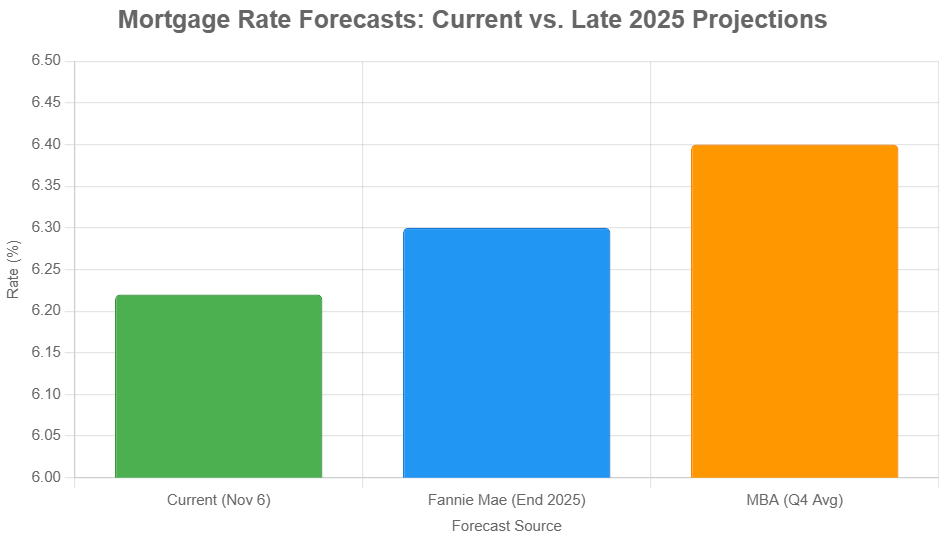
As you can see, most forecasts hover within a tight band, suggesting that big swings aren't likely. The MBA's Q4 average prediction sits at the higher end, reflecting concerns about tariffs and yields.

To help visualize this, here's a look at how these forecasts compare:

Mortgage Rate Predictions for the Next 30 Days: November 10 to December 10, 2025

This chart visually confirms the expectation of a modest upward trend in average rates by the end of the year.

What Does This Mean for You? Smart Moves for the Next Month

So, with all this information, what should you do? My advice is always to be proactive and prepared.

  • If You're a Homebuyer:
    • Shop Around: Seriously, don't just go with the first lender you talk to. Rates can vary by a significant amount – often 0.25% or more – between lenders for the same borrower. I’ve seen it myself.
    • Get Pre-Approved: Know exactly how much you can borrow and what your estimated payments will be.
    • Stress-Test Your Budget: Use online affordability calculators that let you plug in slightly higher rates (like 6.5%) to see if you’re still comfortable.
    • Consider Different Loan Types: If you qualify, FHA or VA loans often come with lower rates, currently in the 5.9% to 6.1% range.
  • If You're Thinking About Refinancing:
    • Compare Your Rate: If your current mortgage rate is higher than 6.5%, it might be worth exploring a refinance.
    • Calculate Break-Even: Remember to factor in closing costs, which can be anywhere from 2% to 5% of your loan amount. You’ll want to make sure the savings from a lower rate allow you to recoup those costs within a reasonable time, typically 1.5 to 2 years.
    • Most Existing Owners are Locked In: Given that so many homeowners have rates below 6%, refinancing opportunities are more limited now. It's really about chasing those significantly lower rates.
  • For Everyone: Stay Informed and Be Flexible:
    • Watch the News: Keep an eye on weekly Freddie Mac rate surveys and read the minutes from the Federal Reserve meetings. These give you the pulse of the market.
    • Consider ARMs (Carefully): For some buyers who plan to move or refinance within a few years, an Adjustable-Rate Mortgage (ARM) might offer a lower initial rate. However, they come with the risk of rates increasing later. In times of uncertainty, a traditional fixed-rate mortgage often provides more peace of mind.
    • Look Beyond the Rate: Don't forget about the other costs of homeownership. Property taxes, homeowner's insurance, and even closing costs have seen increases (up to 10% year-over-year). Factor these into your total housing budget.

A Glimpse into 2026

While we’re focused on the next 30 days, it’s helpful to know what the longer-term picture might look like. Most experts, including Fannie Mae, are predicting that rates could head below 6% by mid-2026 as inflation continues to moderate and the Fed completes its easing cycle. However, unexpected global events or changes in U.S. fiscal policy could always throw a wrench in those predictions and keep rates in this mid-6% range for longer.

Wrapping It Up

From November 10th to December 10th, 2025, I don’t anticipate any earth-shattering news in the mortgage rate world. Expect things to be relatively stable, probably hovering between 6.2% and 6.4%. It’s a market that’s still finding its footing after a period of significant change. While it presents challenges, especially for affordability, it’s also a period where informed decisions and careful planning can still lead you to the right homeownership opportunity. Stay vigilant, stay informed, and you’ll be well-positioned for whatever comes next, whether it's finding your dream home this holiday season or setting yourself up for potentially better rates in 2026.

Want Better Cash Flow? Invest in High-Demand Housing Markets

Turnkey rental properties in fast-growing housing markets offer a powerful way to generate passive income with minimal hassle.

Work with Norada Real Estate to find stable, cash-flowing markets beyond the bubble zones—so you can build wealth without the risks of ultra-competitive areas.

🔥 HOT NEW LISTINGS JUST ADDED! 🔥

Talk to a Norada investment counselor today (No Obligation):

(800) 611-3060

Get Started Now

Also Read:

  • Will Mortgage Rates Go Down in 2025: Morgan Stanley's Forecast
  • Mortgage Rate Predictions 2025 from 4 Leading Housing Experts
  • Mortgage Rate Predictions for the Next 3 Years: 2026, 2027, 2028
  • 30-Year Fixed Mortgage Rate Forecast for the Next 5 Years
  • 15-Year Fixed Mortgage Rate Predictions for Next 5 Years: 2025-2029
  • Will Mortgage Rates Ever Be 3% Again in the Future?
  • Mortgage Rates Predictions for Next 2 Years
  • Mortgage Rate Predictions for Next 5 Years
  • Mortgage Rate Predictions: Why 2% and 3% Rates are Out of Reach
  • How Lower Mortgage Rates Can Save You Thousands?
  • How to Get a Low Mortgage Interest Rate?
  • Will Mortgage Rates Ever Be 4% Again?

Filed Under: Financing, Mortgage Tagged With: Interest Rate, mortgage, Mortgage Rate Trends, mortgage rates, Mortgage Rates Predictions

Today’s Mortgage Rates November 10: Rates Hover Near Yearly Lows, Fueling Refinancing

November 10, 2025 by Marco Santarelli

Today's Mortgage Rates - October 9, 2025: 30-Year FRM Nudges Up to 6.48%

As of November 10th, today's mortgage rates are giving many of us reason to take a closer look at our homeownership dreams. The good news is that borrowing costs continue to hold steady near some of the lowest points we've seen in over a year. According to Zillow, the average rate for a 30-year fixed mortgage is sitting at a comfortable 6.15%, and the 15-year fixed rate is even lower at 5.57%.

This sustained dip is sparking interest for both new buyers and those looking to refinance, especially with speculation about potential market shifts on the horizon. Personally, I feel like we're in a much more approachable lending environment now compared to where we were perhaps a year ago.

Today's Mortgage Rates November 10: Rates Hover Near Yearly Lows, Fueling Refinancing

The Current Snapshot: What the Numbers Tell Us

It's always helpful to see the numbers laid out clearly, so here's a quick look at the national averages for mortgage rates, based on the latest data from Zillow. Remember, these are averages, and your specific rate might differ based on your credit score, down payment, and lender.

Current Mortgage Rates (National Averages – November 10th)

Loan Type Average Rate
30-year fixed 6.15%
20-year fixed 5.97%
15-year fixed 5.57%
5/1 ARM 6.38%
7/1 ARM 6.45%
30-year VA 5.69%
15-year VA 5.25%
5/1 VA 5.70%

Source: Zillow

Thinking About Refinancing? Let's Check Those Rates

If you're a homeowner with an existing mortgage, the idea of refinancing might be on your mind. You could potentially save a good chunk of money each month. Here's a look at the refinance rates, again for national averages from Zillow.

Current Mortgage Refinance Rates (National Averages – November 10th)

Loan Type Average Rate
30-year fixed 6.27%
20-year fixed 6.29%
15-year fixed 5.75%
5/1 ARM 6.46%
7/1 ARM 6.87%
30-year VA 5.75%
15-year VA 5.62%
5/1 VA 5.48%

As you can see, refinance rates are generally very close to purchase rates. For homeowners with significantly higher rates locked in from previous years, this could absolutely be the time to explore saving money. However, my advice is to always factor in those closing costs. Sometimes, the savings might not outweigh the upfront expenses, so it's a careful calculation.

Where Are Rates Headed? A Look at the Forecasts

The big question on everyone's mind is: what's next for mortgage rates? While we saw a slight uptick in rates at the very beginning of November, the overall trend has been a welcome decline throughout the year. The Federal Reserve has been making some moves, and that's definitely influencing the market.

Looking ahead, predictions from various financial experts and organizations offer a mixed but generally stable picture.

  • Fannie Mae is feeling more optimistic, suggesting rates could dip to around 5.9% by the end of 2026. I personally find their outlook a bit more hopeful than what I'm seeing elsewhere.
  • The Mortgage Bankers Association (MBA) tends to be a bit more conservative, anticipating rates to stay relatively stable, hovering around 6.4% throughout 2026. This suggests a holding pattern rather than a significant drop.
  • Many analysts from well-known sites like LendingTree and Bankrate are also pointing towards rates likely staying in the 6% to 6.5% range for the remainder of the year. Stability seems to be the word of the day.

What everyone seems to agree on? Don't expect a return to those crazy-low 2-3% pandemic rates anytime soon. The economic conditions that allowed for those historic lows just aren't present anymore.


Related Topics:

Mortgage Rates Trends as of November 9, 2025

Mortgage Rate Predictions for the Next 30 Days: Nov 10 to Dec 10, 2025

Mortgage Rates Predictions for the Next 12 Months: Nov 2025 to Nov 2026

Mortgage Rates Predictions for Next 90 Days: October to December 2025

The Economic Engine Driving Mortgage Rates

So, what exactly is making these rates move? It's a complex interplay of factors, but here are the main drivers I'm watching:

  • Federal Reserve Actions: While the Fed doesn't directly set mortgage rates, their decisions on interest rates and their public statements have a huge impact. When the Fed talks about being cautious or hints at future moves, the markets react, and this volatility can influence mortgage rates.
  • The 10-Year Treasury Yield: This might sound technical, but it's a big one. The yield on the 10-year Treasury bond is often considered the benchmark for long-term borrowing costs, and it has a strong correlation with mortgage rates. When this yield goes up, as it did in early November, mortgage rates tend to follow suit.
  • Inflation and Jobs Data: Think of these as thermometers for the economy. The Federal Reserve and investors are constantly looking at readings like inflation rates and employment numbers. If the economy is showing signs of being too hot (like strong job growth or rising inflation), rates might go up to help cool things down. Conversely, weaker data could lead to lower rates.
  • Market Volatility: We live in a world that can be unpredictable. Things like political events, international trade issues, or even just general economic uncertainty can cause the markets to swing. These swings can, in turn, affect mortgage rates. It’s like a domino effect.

What This Means for You: Homebuyers and Homeowners

Let's boil this down to practical advice for you.

For Those Looking to Buy:

  • Consider Acting Now: Waiting for a dramatic drop in mortgage rates might not be the best strategy. Given that rates are unlikely to plummet and home prices are still climbing in many areas, you might find yourself paying more for a home later, even with a slightly lower rate. It’s about finding that sweet spot where your monthly payment is manageable.
  • Shop Around! Seriously: I can't stress this enough. Mortgage rates aren't uniform across lenders. Even a small difference in the interest rate can add up to thousands of dollars over the life of your loan. Get quotes from at least three to five different lenders – banks, credit unions, and mortgage brokers. Don't be afraid to negotiate!

For Homeowners Considering Refinancing:

  • Evaluate Your Savings Carefully: If your current mortgage rate is significantly higher than today's rates, refinancing could be a smart move. However, do your homework on closing costs. Make sure the savings you'll achieve over time will genuinely make it worthwhile. A mortgage calculator can be your best friend here.
  • Look at ARMs (Adjustable-Rate Mortgages): While fixed-rate mortgages offer stability, ARMs can provide a lower introductory interest rate. This could be beneficial if you plan to sell your home or refinance again before the fixed period ends. Just be sure you understand how the rate might change later on.

It's an exciting time to be in the housing market, with rates offering a breathing room that many haven't seen in a while. By staying informed and doing your due diligence, you can make the most of today's mortgage rates.

Secure Your Retirement with Cash-Flowing Rental Properties

Turnkey real estate offers a low-hassle way to generate passive income and build long-term financial security—perfect for retirement-focused investors.

Norada Real Estate helps you invest in stable, high-demand markets that deliver consistent monthly cash flow and equity growth over time.

🔥 HOT NEW LISTINGS JUST ADDED! 🔥

Talk to a Norada investment counselor today (No Obligation):

(800) 611-3060

Get Started Now

Also Read:

  • Mortgage Rates Predictions Backed by 7 Leading Experts: 2025–2026
  • Mortgage Rate Predictions for the Next 3 Years: 2026, 2027, 2028
  • 30-Year Fixed Mortgage Rate Forecast for the Next 5 Years
  • 15-Year Fixed Mortgage Rate Predictions for Next 5 Years: 2025-2029
  • Will Mortgage Rates Ever Be 3% Again in the Future?
  • Mortgage Rates Predictions for Next 2 Years
  • Mortgage Rate Predictions for Next 5 Years
  • Mortgage Rate Predictions: Why 2% and 3% Rates are Out of Reach
  • How Lower Mortgage Rates Can Save You Thousands?
  • How to Get a Low Mortgage Interest Rate?
  • Will Mortgage Rates Ever Be 4% Again?

Filed Under: Financing, Mortgage Tagged With: Interest Rate, mortgage, Mortgage Rate Trends, mortgage rates, Mortgage Rates Today

Why More Buyers Are Betting on Adjustable-Rate Mortgages in 2025?

November 10, 2025 by Marco Santarelli

Today's 5-Year Adjustable Rate Mortgage Drops from 7.56% to 7.54% - June 28, 2025

Buying a home is a huge step, and one of the biggest hurdles is figuring out how to afford it. With today's market, many folks are finding that an adjustable-rate mortgage, or ARM, is becoming a seriously attractive option. Adjustable-rate mortgages are gaining popularity as buyers look for ways to lower their initial mortgage costs, and for good reason. They can offer a lower starting payment, which can make getting into a new home feel a little more within reach.

Why More Buyers Are Betting on Adjustable-Rate Mortgages in 2025?

For a while there, fixed-rate mortgages have been the go-to. You know, where your interest rate stays the same for the entire life of the loan – usually 15 or 30 years. This gives you predictable monthly payments, and that peace of mind is priceless for many. However, as interest rates fluctuate, sometimes the initial sting of a higher fixed rate can really make you pause. That's where ARMs come in, offering a different path. They typically start with a lower, fixed interest rate for a set number of years, like five, seven, or even ten. After that introductory period, the rate “adjusts” based on what's happening in the wider market.

I've seen firsthand how confusing mortgage options can be. When I was looking to buy my first place, the sheer number of choices felt overwhelming. But by talking to lenders and doing my homework, I learned that understanding the different types of mortgages is key to making a smart financial decision. ARMs, while they might seem a bit riskier because the payments can go up, can actually be a fantastic tool if you're strategic about it.

Why All the Buzz About ARMs Right Now?

It's no secret that the Federal Reserve making moves on interest rates can shake things up. Recently, they've cut their benchmark interest rates a couple of times. Now, this doesn't mean your mortgage rate instantly drops, but it does influence broader market rates. Freddie Mac reported that the average 30-year fixed-rate mortgage dipped to about 6.17% recently, which is great news if you're looking for a fixed rate. But here's where ARMs really start to shine: loans like ARMs might see a more direct impact from these Fed adjustments.

The experts at the Mortgage Bankers Association (MBA) have noticed this shift. In September, ARMs made up about 10% of all mortgage applications, which was the highest it's been in nearly two years. That's a pretty significant jump and tells us a lot of people are seriously considering them.

The Savings: A Closer Look at ARMs

Let's talk numbers, because that's what really matters when you're trying to buy a house. Typically, an ARM offers a lower interest rate during its initial fixed period compared to a 30-year fixed mortgage. For example, a 5/1 ARM (meaning the rate is fixed for the first five years and then adjusts annually) averaged around 5.66% in September. That's almost a full percentage point lower than the average 30-year fixed rate at the time.

What does that mean in real dollars? If we're talking about a $400,000 loan, that difference could save you about $200 per month during those first five years. Multiply that by 60 months (five years), and you're looking at around $12,000 in savings, just on monthly payments. That's real money that can help with moving costs, furniture, or just gives you a bit more breathing room in your budget.

Understanding the “Adjustable” Part: What to Watch Out For

Now, as much as I love a good money-saving opportunity, it's crucial to be realistic. The “adjustable” part of an ARM is where the potential risk lies. After that initial low-rate period ends, your interest rate will change based on market conditions. This means your monthly payment could go up, or, if the market is favorable, it could even go down.

Joel Kan, the deputy chief economist at the MBA, wisely pointed out that while ARMs offer opportunities, you need to understand the potential risks. If interest rates climb significantly after your fixed period, your mortgage payment could become much harder to manage. This is where my own experience kicks in: I always advise talking to a lender and really getting a clear picture of what the worst-case scenario looks like for your payment. Don't just dive in without fully understanding it.

Who Benefits Most from an ARM?

ARMs aren't for everyone, but they can be a smart move for certain buyers:

  • First-time homebuyers: The lower initial payment can make getting into your first home more achievable.
  • People who plan to sell or refinance: If you anticipate selling your home or refinancing your mortgage before the initial fixed period ends, you can take advantage of the lower rate without facing the adjustment.
  • Buyers who can afford higher payments: If your budget can comfortably accommodate a higher payment if rates rise, an ARM can be a calculated risk for initial savings.
  • Those who expect interest rates to fall: If you believe that overall interest rates will decline in the future, you might benefit from the rate adjusting downward after the initial period.

Recommended Read:

Fixed vs. Adjustable Rate Mortgage in 2025: Which is Best for You

Fixed-Rate Mortgages Still Offer Value

Even with the rise in ARM popularity, 30-year fixed-rate mortgages are still a great option for many. As I mentioned, rates have been dropping. Freddie Mac's data shows that the 30-year fixed-rate mortgage averaged 6.17% recently. For some, the security of a predictable payment for decades outweighs the potential for short-term savings with an ARM.

The National Association of REALTORS® (NAR) actually reported a 4.1% annual increase in existing-home sales for September, which signals renewed buyer activity. This shows that even with rates hovering in the mid-6% range, people are still finding ways to make homeownership happen. A LendingTree analysis found that buyers already saved an average of $40,000 over the life of a 30-year loan just from rate drops earlier in the year.

My Take on the Current Mortgage Market

As someone who's navigated the home-buying process and kept a close eye on the market, I think the current environment presents some really interesting choices. The fact that both fixed-rate mortgages and ARMs are becoming more attractive shows a market that's trying to balance affordability with stability.

My advice? Don't pick a mortgage type based on what everyone else is doing or what sounds cheapest at first glance. Instead, take a deep breath, crunch your numbers, and have honest conversations with mortgage professionals. Understand the terms, the potential upsides, and the possible downsides of each option.

For adjustable-rate mortgages, the key is to do your due diligence on the initial fixed period, the rate adjustment formula, and what your potential maximum payment could be. For fixed rates, it's about finding the best rate and term that fits your long-term financial plan. Both have their place, and sometimes the “best” mortgage is the one that best fits your unique situation and goals.

Here's a quick peek at how mortgage rates have been looking:

Mortgage Type Average Rate (Week Ending Oct. 30) Year Ago Rate
30-Year Fixed-Rate 6.17% 6.72%
15-Year Fixed-Rate 5.41% 5.99%

(Data from Freddie Mac)

Ultimately, the goal is to find a home you love and a mortgage that you can comfortably manage. ARMs are definitely a tool worth exploring in today's market to potentially lower those upfront costs.

Earn Passive Income Through Smart Real Estate Investments

With fluctuating mortgage rates, savvy investors are exploring flexible financing options to maximize returns.

Norada offers a curated selection of ready-to-rent properties in top markets, helping you capitalize on current mortgage trends and build long-term wealth.

HOT NEW LISTINGS JUST ADDED!

Connect with an investment counselor today (No Obligation):

(800) 611-3060

Get Started Now

Also Read:

  • Will Mortgage Rates Go Down in 2025: Morgan Stanley's Forecast
  • Expect High Mortgage Rates Until 2026: Fannie Mae's 2-Year Forecast
  • Mortgage Rate Predictions 2025 from 4 Leading Housing Experts
  • Mortgage Rates Forecast for the Next 3 Years: 2025 to 2027
  • Will Mortgage Rates Ever Be 3% Again in the Future?
  • Mortgage Rates Predictions for Next 2 Years
  • Mortgage Rate Predictions for Next 5 Years
  • Mortgage Rate Predictions: Why 2% and 3% Rates are Out of Reach
  • How Lower Mortgage Rates Can Save You Thousands?
  • How to Get a Low Mortgage Interest Rate?
  • Will Mortgage Rates Ever Be 4% Again?

Filed Under: Financing, Mortgage Tagged With: Adjustable Rate Mortgage, Interest Rate, mortgage, Mortgage Rate Trends, mortgage rates

How to Qualify for a 1% Mortgage Rate in 2025

November 10, 2025 by Marco Santarelli

How Buyers Can Lock In a Sub-1% Mortgage Rate in 2025

Let's cut to the chase: getting a mortgage rate under 1% in 2025 is not just possible, it's already happening for some lucky buyers. However, it's crucial to understand that these rock-bottom rates are not your typical, long-term, everyday mortgage deals. They're special offers, often tied to purchasing new construction from specific builders who are motivated to move their inventory.

As someone who dives deep into the real estate market, I see these incredible offers as a lifeline for many who feel priced out of homeownership. The dream of a super low mortgage payment can be a reality, but it requires a strategic approach. Forget waiting for magic to happen; this is about knowing where to look and being ready to act.

How to Qualify for a 1% Mortgage Rate in 2025

The Big Question: Why Are Builders Offering Such Low Rates?

You might be wondering why a builder would offer such an insane discount on mortgage rates. It boils down to the current housing market. As Realtor.com reported, even though there are more homes for sale than in recent years, sales haven't picked up much. Buyers are hesitant, mainly because of high mortgage interest rates.

Think about it: the average rate is way higher than the sub-6% rates many homeowners enjoy. When rates are high, people get spooked. They can't afford the monthly payments, so they put their homebuying dreams on hold.

Builders are smart. They know that mortgage rates are a huge factor for buyers. Instead of slashing the price of their homes, which can devalue their entire development, they're saying, “Let's make the financing part of the deal incredibly attractive.” It's a way to offer a significant benefit without directly lowering the sticker price of the house. Joel Berner, a senior economist at Realtor.com, pointed out that this is a way to “break down the barrier of the 6%-plus rate.”

My Take: It's a Smart Marketing Move, But a Win for Buyers Too

From my perspective, this is a brilliant strategy for builders. They have stock to sell, and they need to get creative. Offering a temporary rate buydown is a way to entice buyers who might otherwise walk away. It’s essentially a discount on the home, just packaged differently.

For buyers, it's a golden opportunity, especially for those who are buying their first home. The typical age of a first-time homebuyer has been creeping up, and these kinds of incentives can help bring that number back down. It makes homeownership accessible again.

How These Sub-1% Rates Actually Work: The Temporary Rate Buydown

So, how does this magic happen? It’s called a temporary rate buydown. This isn't a rate that stays low for the entire 30 years of your loan. Instead, the builder chips in to cover a portion of your interest payments for the first few years. This means your monthly payment is much lower at the beginning.

Here’s a common example, as seen with D.R. Horton's program:

  • Year 1: A super low rate, like 0.99%.
  • Year 2: Slightly higher, maybe 1.99%.
  • Year 3: Increasing again, perhaps 2.99%.
  • Year 4: Another bump, say 3.99%.
  • Year 5 onwards: The loan then switches to the actual market rate for the rest of its term.

Let's crunch some numbers to see the impact. Imagine a $400,000 home with a 10% down payment, using D.R. Horton's example from Realtor.com.

Year Interest Rate Estimated Monthly Payment
1 0.99% ~$1,700
2 1.99% ~$2,037
3 2.99% ~$2,224
4 3.99% ~$2,425
5+ Market Rate ~$2,933 (approx.)

That's a huge difference in your pocket for the first four years – potentially around $40,000 in savings over those four years, according to the data. That money can go towards furniture, renovations, or just building up your savings.

My Experience: The Power of Early Equity

As a seasoned observer of the market, I can tell you that these lower initial payments offer a fantastic chance to get ahead. You can do a few things with that extra cash:

  • Aggressive Principal Payments: While your rate is low, you can choose to pay more than the minimum payment each month. This extra money goes directly towards your principal balance, helping you build equity much faster.
  • Save for the Future: You can tuck that extra money away for future home improvements or to create a stronger financial cushion.
  • Refinance Opportunity: If mortgage rates continue to fall after the buydown period, you might be able to refinance your loan into a new, permanent rate that’s even lower than the market rate you'd transition to. This is like getting a second discount!

Other Builders Are Playing the Game Too

D.R. Horton isn't the only one trying to make homeownership more affordable. Other big builders, like Lennar Corp., are also offering incentives. They've had sales with adjustable rates as low as 3.99% for the first seven years, plus thousands of dollars towards closing costs. It's a competitive market, and that's good news for us buyers.

What You Need to Be Super Careful About (My Honest Advice)

As exciting as a sub-1% rate sounds, you absolutely must read the fine print. I can't stress this enough.

  1. The Buydown is Temporary: This is the biggest thing to remember. That 0.99% rate will not last. You must be able to comfortably afford the full market rate payment once the buydown period is over. If your budget is tight now, it might be impossible later. Do your homework and see if you can afford that ~ $2,933 payment (using the example above) or even higher if rates go up.
  2. Refinancing Isn't Guaranteed: Yes, refinancing can be a great way to save more, but it's not a sure thing. If interest rates don't drop significantly, or if your personal financial situation changes (job loss, increased debt), you might not qualify for a lower rate later.
  3. Is the Price Right? Builders are using these buydowns to avoid lowering their home prices. You need to ask yourself: “Is this home really worth this price, even with the low initial rate?” Sometimes, a straightforward price reduction on an existing home might be a better deal in the long run than a fancy financing package on a new build. Do your research on comparable homes in the area.

The Bottom Line: Is It the Right Move for You?

Getting a sub-1% mortgage rate in 2025 is absolutely achievable, but it generally means buying a new construction home from a builder offering a temporary rate buydown. It’s a pathway to homeownership for many who have been shut out of the market due to high rates.

My advice? Do your research. Understand the terms completely. Can you afford the payments when the introductory period ends? Are you comfortable with the overall price of the home? If you can answer “yes” to these questions, then a sub-1% rate could be your ticket to unlocking the dream of homeownership sooner than you thought possible.

 Turnkey Rentals Help You Retire Early and Hedge Against Inflation

Turnkey real estate offers powerful tax benefits, monthly cash flow, and long-term equity growth—ideal for early retirement planning.

Norada Real Estate helps you invest in inflation-resistant markets with strong rental demand and built-in tax advantages like depreciation and 1031 exchanges.

🔥 HOT NEW LISTINGS JUST ADDED! 🔥

Talk to a Norada investment counselor today (No Obligation):

(800) 611-3060

Get Started Now

Also Read:

  • Mortgage Rates Predictions for 2025 and 2026 by Fannie Mae
  • Mortgage Rates Predictions for the Latter Half of 2025 by Norada Real Estate
  • Will Mortgage Rates Go Down in 2025: Morgan Stanley's Forecast
  • Mortgage Rates Predictions by Top Industry Experts 2025-2026
  • Mortgage Rate Predictions for the Next 3 Years: 2026, 2027, 2028
  • 30-Year Fixed Mortgage Rate Forecast for the Next 5 Years
  • 15-Year Fixed Mortgage Rate Predictions for Next 5 Years: 2025-2029
  • Will Mortgage Rates Ever Be 3% Again in the Future?
  • Mortgage Rates Predictions for Next 2 Years
  • Mortgage Rate Predictions for Next 5 Years
  • Mortgage Rate Predictions: Why 2% and 3% Rates are Out of Reach
  • How Lower Mortgage Rates Can Save You Thousands?
  • How to Get a Low Mortgage Interest Rate?
  • Will Mortgage Rates Ever Be 4% Again?

Filed Under: Financing, Mortgage Tagged With: mortgage, Mortgage Rate Trends, mortgage rates

Mortgage Rates Today: The States Offering Lowest Rates to Borrowers

November 9, 2025 by Marco Santarelli

U.S. States With Lowest Mortgage Rates Today – July 1, 2025

Thinking about buying a home? If so, you're likely wondering, “What are mortgage rates today?” It’s a big question, and thankfully, I can tell you that today, the states offering the lowest mortgage rates are Kentucky, New York, North Carolina, Louisiana, California, and New Jersey, with averages generally falling between 6.36% and 6.41%. While national averages are hovering around 6.48%, these states are currently showing a slight edge for potential buyers.

Mortgage Rates Today: The States Offering Lowest Rates to Borrowers

What’s Driving Today's Mortgage Rates?

You might have heard that the Federal Reserve has been making some moves with interest rates. It’s true, they’ve been cutting their benchmark rates. However, and this is a crucial point that often confuses people, these short-term rate cuts by the Fed don't directly control the long-term mortgage rates you see when you apply for a home loan.

Think of it this way: the rate the Fed sets is like a pilot light for the economy. It influences things, but it’s not setting the main thermostat temperature for mortgages. Instead, mortgage rates are much more influenced by things like the 10-year Treasury yield, which is a global market indicator, along with overall inflation trends and other broad economic forces.

Investopedia, a reputable source for financial information, recently highlighted this dynamic, noting that even after anticipated Fed rate cuts, mortgage rates actually nudged higher. This happened because the market had already “priced in” those expected cuts, and slightly more cautious statements from the Fed created a ripple of uncertainty.

Recent Economic Ripples Affecting Rates

Besides the Fed's actions, there have been a couple of other significant factors impacting mortgage rates recently:

  • The 10-Year Treasury Yield: This is the real workhorse that mortgage rates tend to follow. When things get uncertain in the economy, investors often flock to the safety of Treasury bonds, which can push their yields down. However, recently, we’ve seen the opposite. The 10-year Treasury yield has been on the rise in November, and naturally, mortgage rates have followed suit.
  • Government Shutdown Uncertainty: You might recall the recent government shutdown. These events can create a bit of a stir. Historically, shutdowns have sometimes led to lower mortgage rates because investors seek safety. But in this current environment, the lack of consistent economic data coming out due to the shutdown adds a layer of unpredictability. Plus, during the shutdown, there were even delays in processing government-backed loans like FHA and VA mortgages, which is something buyers should be aware of.

Comparing Rates: Where the Deals Are Today

While the national average for a 30-year fixed mortgage is currently around 6.48%, which is just a little higher than a recent 13-month low of 6.35%, we do see some variations by state. It's interesting to see how these national trends play out on a more local level.

According to the latest data I've seen, compiled by sources like Investopedia, the states that are currently offering some of the lowest average 30-year fixed mortgage rates are:

  • Kentucky
  • New York
  • North Carolina
  • Louisiana
  • California
  • New Jersey

These states are clustered together, with rates ranging from approximately 6.36% to 6.41%. This might seem like a small difference, but when you're talking about a home loan, those fractions of a percent can add up significantly over the life of the loan.

On the flip side, some states are experiencing higher average mortgage rates. As of the latest information:

  • Hawaii
  • Nevada
  • Massachusetts
  • Utah
  • New Mexico

These states are seeing averages between 6.57% and 6.60%.

Why Do Rates Vary by State?

You might wonder why there's this geographical difference. It’s not usually one single reason, but a combination of factors. Local economic conditions, the demand for housing in that area, the presence of specific lenders and their local offerings, and even state-specific economic policies can all play a role. For instance, a state with a very robust economy and high housing demand might see slightly different rate trends compared to a state with lower demand and a more moderate economy.

My Take on Rate Shopping

As someone deeply involved in this field, I always emphasize that shopping around for your mortgage is non-negotiable. Even within a state, different lenders can offer slightly different rates and fees. Don’t be afraid to get quotes from several lenders – banks, credit unions, and online mortgage companies. Look at the Loan Estimate form they provide; it details all the costs involved.

Furthermore, remember that your own financial situation is a huge factor. Your credit score, down payment amount, debt-to-income ratio, and employment history will all influence the specific rate you are offered. So, while knowing which states have the lowest averages is helpful for a general understanding, your personal financial profile is paramount.

The housing market is always dynamic. While it's smart to be aware of trends like the mortgage rates today, it’s even smarter to focus on your personal readiness and find a home that fits your needs. Keep an eye on these numbers, do your research, and you'll be well on your way to securing a great mortgage.

Build Wealth with Turnkey Real Estate — Even in a High-Rate Market

High interest rates don’t have to hold you back. Turnkey rental properties still deliver steady cash flow and long-term appreciation—especially in markets with strong rental demand and job growth.

Work with Norada Real Estate to identify profitable, cash-flowing markets that thrive even when borrowing costs rise—so your investments stay strong and stress-free.

NEW TURNKEY DEALS JUST ADDED!

Talk to a Norada investment counselor today (No Obligation):

(800) 611-3060

Get Started Now

Also Read:

  • Expect High Mortgage Rates Until 2026: Fannie Mae's 2-Year Forecast
  • Mortgage Rate Predictions 2025 from 4 Leading Housing Experts
  • Mortgage Rates Forecast for the Next 3 Years: 2025 to 2027
  • 30-Year Mortgage Rate Forecast for the Next 5 Years
  • 15-Year Mortgage Rate Forecast for the Next 5 Years
  • Why Are Mortgage Rates Going Up in 2025: Will Rates Drop?
  • Why Are Mortgage Rates So High and Predictions for 2025
  • Will Mortgage Rates Ever Be 3% Again in the Future?
  • Mortgage Rates Predictions for Next 2 Years
  • Mortgage Rate Predictions for Next 5 Years
  • Mortgage Rate Predictions: Why 2% and 3% Rates are Out of Reach
  • How Lower Mortgage Rates Can Save You Thousands?
  • How to Get a Low Mortgage Interest Rate?
  • Will Mortgage Rates Ever Be 4% Again?

Filed Under: Financing, Mortgage Tagged With: Interest Rate, mortgage, Mortgage Rate Trends, mortgage rates, Mortgage Rates Predictions, Mortgage Rates Today

Today’s Mortgage Rates November 9: Rates Hit Yearly Low, Refinance Momentum Builds

November 9, 2025 by Marco Santarelli

Today's Mortgage Rates - October 9, 2025: 30-Year FRM Nudges Up to 6.48%

Here's some insight on today's mortgage rates, November 9, 2025. The average rate for a 30-year fixed mortgage is currently sitting at 6.15%, which is the lowest it's been in the past year, according to Zillow. This is a pretty significant development and means a lot of homeowners are starting to explore refinancing to potentially lower their monthly payments and save money in the long run.

What's interesting right now is that while rates did tick up slightly at the very beginning of November, they're still hovering near their yearly low. This comes after a general downward trend, partly influenced by actions from the Federal Reserve. It’s a good time to pay attention to these numbers, especially if you’ve been on the fence.

Today's Mortgage Rates November 9: Rates Hit Yearly Low, Refinance Momentum Builds

What Are Today's Mortgage Rates Like?

To give you a clearer picture, let's break down some of the current average rates based on Zillow's latest data for November 9:

Mortgage Type Average Rate
30-year fixed 6.15%
20-year fixed 5.97%
15-year fixed 5.57%
5/1 ARM 6.38%
7/1 ARM 6.45%
30-year VA 5.69%
15-year VA 5.25%
5/1 VA 5.70%

It's important to remember that these are national averages, and the rates you might get can vary based on your specific financial situation, credit score, down payment, and the lender you choose.

Refinancing: Is Today the Day?

Along with rates for new purchases, it's also worth noting the current rates for those looking to refinance. If you have a mortgage from a few years ago, chances are your rate is higher than these current offerings.

Here’s a look at refinance rates, again from Zillow data:

Mortgage Type Average Refinance Rate
30-year fixed 6.27%
20-year fixed 6.29%
15-year fixed 5.75%
5/1 ARM 6.46%
7/1 ARM 6.87%
30-year VA 5.75%
15-year VA 5.62%
5/1 VA 5.48%

You'll notice that refinance rates are slightly higher than purchase rates. This is common, as lenders have different pricing models for these transactions. However, if your current mortgage rate is significantly higher than these numbers, it might still be worth exploring a refinance. You’ll want to factor in closing costs to see if the monthly savings over the life of the loan make sense for you.

What's Driving Today's Mortgage Rates?

Understanding why rates are where they are can be really helpful. It's not just random; a few key economic factors are always at play.

The Federal Reserve plays a big role, though not as directly as some people think. The Fed sets the federal funds rate, which is a short-term interest rate. While this doesn't directly set your mortgage rate, market expectations about the Fed's future actions and commentary can definitely influence it. Comments from Fed officials about inflation or economic growth can cause ripples.

Another major influencer is the 10-year Treasury yield. Think of this as the benchmark for longer-term borrowing. When the yields on these Treasury bonds go up, mortgage rates typically follow suit, and vice versa. We saw this happen in early November when the yield nudged upwards.

Inflation and jobs data are also critical. The Fed and investors closely watch how much prices are rising (inflation) and how many people are employed. Strong job reports can sometimes signal a robust economy, which might lead to concerns about inflation. In response, interest rates can sometimes rise to cool things down.

Finally, market volatility – things like global events, political uncertainty, or even unexpected news – can cause temporary swings in rates as investors react and adjust their strategies.


Related Topics:

Mortgage Rates Trends as of November 8, 2025

Mortgage Rates Predictions for the Next 12 Months: Nov 2025 to Nov 2026

Mortgage Rates Predictions for Next 90 Days: October to December 2025

A Look at Recent Trends and Future Forecasts

To put today's rates in perspective, let's consider what’s happened recently. For the week ending November 6, 2025, the average 30-year fixed rate did tick up to 6.22%, according to Freddie Mac. Other reputable sources like Zillow and Bankrate also noted this slight increase.

However, and this is a crucial point, these rates are still considerably lower than they were a year ago. In early November 2024, the 30-year fixed rate was about 57 basis points (or 0.57%) higher than it is now. That’s a noticeable difference when you're talking about a 30-year loan.

Looking ahead, forecasting mortgage rates is always a bit of a guessing game, as economists and financial institutions often have different predictions.

  • Fannie Mae is on the more optimistic side, suggesting rates could dip down to 5.9% by the end of 2026.
  • The Mortgage Bankers Association (MBA) anticipates a more stable period, with rates likely staying around 6.4% throughout 2026.
  • Many other experts and analysts from places like LendingTree and Bankrate believe we'll see rates staying in that 6% to 6.5% range for the remainder of 2025.

One thing most experts do agree on is that we're unlikely to see a return to the incredibly low 2-3% rates that were common during the pandemic anytime soon. The economic conditions that fueled those rates have changed.

What Does This Mean for You?

So, given all this information, what are the key takeaways for homebuyers and homeowners?

  • Consider Buying Now: If you've been waiting for a dramatic drop in mortgage rates, it might be a good idea to adjust your expectations. Rates aren't predicted to plummet. Meanwhile, home prices are still increasing in many areas. Holding off indefinitely for significantly lower rates might mean missing out on your ideal home or facing higher prices later.
  • Refinancing Potential: As I mentioned, if you have a mortgage with a rate substantially higher than today's offerings, it's definitely worth investigating a refinance. Do your homework to calculate the closing costs against potential savings. Even a small reduction in your interest rate can lead to significant savings over many years.
  • Always Shop Around: This is probably the single most important piece of advice I can give. Mortgage rates are not one-size-fits-all. Different lenders will offer different rates and terms, even for the same loan product. Take the time to get quotes from several lenders – banks, credit unions, and online mortgage companies. Comparing offers can save you thousands of dollars.

Beat Inflation & Retire Early with Turnkey Rentals

Turnkey real estate offers powerful tax benefits, monthly cash flow, and long-term equity growth—ideal for early retirement planning.

Norada Real Estate helps you invest in inflation-resistant markets with strong rental demand and built-in tax advantages like depreciation and 1031 exchanges.

🔥 HOT NEW LISTINGS JUST ADDED! 🔥

Talk to a Norada investment counselor today (No Obligation):

(800) 611-3060

Get Started Now

Also Read:

  • Mortgage Rates Predictions Backed by 7 Leading Experts: 2025–2026
  • Mortgage Rate Predictions for the Next 3 Years: 2026, 2027, 2028
  • 30-Year Fixed Mortgage Rate Forecast for the Next 5 Years
  • 15-Year Fixed Mortgage Rate Predictions for Next 5 Years: 2025-2029
  • Will Mortgage Rates Ever Be 3% Again in the Future?
  • Mortgage Rates Predictions for Next 2 Years
  • Mortgage Rate Predictions for Next 5 Years
  • Mortgage Rate Predictions: Why 2% and 3% Rates are Out of Reach
  • How Lower Mortgage Rates Can Save You Thousands?
  • How to Get a Low Mortgage Interest Rate?
  • Will Mortgage Rates Ever Be 4% Again?

Filed Under: Financing, Mortgage Tagged With: Interest Rate, mortgage, Mortgage Rate Trends, mortgage rates, Mortgage Rates Today

Mortgage Rates Rise With 30-Year FRM Climbing to 6.22%: Freddie Mac

November 9, 2025 by Marco Santarelli

U.S. Mortgage Rates Rise Again, Freddie Mac Reports 30-Year Fixed at 6.22%

This is a big week for anyone looking to buy a home or refinance an existing mortgage, as Freddie Mac reported mortgage rates increased to 6.22% for a 30-year fixed loan. This news comes as a bit of a shift after a few weeks of steady declines, and it’s important for homebuyers to understand what this means for their budgets and their search.

Mortgage Rates Rise With 30-Year FRM Climbing to 6.22%

As of the week ending November 6, 2025, the average rate for a 30-year fixed-rate mortgage hit 6.22%, a jump of 0.05 percentage points from the 6.17% recorded the week before. This marks an end to a four-week streak where rates had been inching downward. For context, while this is a slight uptick, it's still notably lower than the 6.79% we saw around this time last year in November 2024.

What’s Pushing Rates Up (and What It Means)

It might seem a bit confusing that mortgage rates are ticking up even after the Federal Reserve recently cut its main interest rate. The reality is, mortgage rates are influenced by a complex web of factors, and the Federal Reserve’s actions are just one piece of the puzzle.

Based on my experience observing these trends, I believe the key driver here, as highlighted by Freddie Mac's report, is the cautious language coming from Federal Reserve Chair Jerome Powell regarding future rate cuts. When the Fed signals that it might not be as aggressive with future rate reductions as the market initially hoped, investors often reprice their bonds. This repricing can lead directly to a rise in mortgage rates. Bond yields and mortgage rates often move in similar directions because mortgage-backed securities (think of them as bundles of mortgages that investors buy) are essentially bonds.

Another critical factor is the yield on the 10-year Treasury note. This is often considered the bellwether for long-term borrowing costs, including mortgages. When Treasury yields go up, mortgage rates typically follow suit. The economic climate, including recent uncertainties like government shutdowns, can also cause market volatility. This uncertainty can lead investors to seek safer investments, like Treasury bonds, which can indirectly influence mortgage rates.

Digging Deeper: The 10-Year Treasury Note’s Role

I often explain to people that while the Federal Reserve controls the short-term federal funds rate, mortgage rates are much more closely tied to long-term interest rates. The most important of these is the 10-year Treasury note yield.

Why is this one so important? Think about how long most people stay in their homes before moving or refinancing. It’s usually in the 7- to 10-year range. So, for lenders and investors who buy mortgages, the yield on a 10-year Treasury note offers a good benchmark for what borrowers might pay over a similar, extended period.

When the economy feels shaky, investors tend to flock to the 10-year Treasury because it's considered a very safe place to put their money. This increased demand drives the price of the bond up and, in turn, its yield down. Conversely, if investors are feeling more confident, they might move their money out of these safe havens, pushing Treasury prices down and yields up.

Lenders don't just offer you the Treasury yield; they add a bit extra, called a “spread.” This spread covers their costs, the risk involved, and their profit. So, a rising 10-year Treasury yield, combined with the lender's spread, directly translates to a higher mortgage rate for you.

What This Means for Borrowers Right Now

While the 6.22% rate is a slight increase, Freddie Mac's Chief Economist, Sam Khater, offers a perspective that’s worth noting. He mentioned that rates are still near their 2025 lows. This is crucial because even a small increase doesn't completely erase the affordability improvements we've seen this year compared to earlier in 2025.

For homebuyers, this means:

  • Increased Monthly Payments: If you were eyeing a specific home price, a jump from 6.17% to 6.22% will mean your principal and interest payment will be slightly higher each month.
  • Revisiting Budgets: It’s a good time to re-evaluate your budget. You might need to adjust your price range or look for homes with fewer amenities to stay within your comfort zone.
  • Shopping Around: This is always critical, but especially now. While the average is 6.22%, different lenders will offer different rates based on your credit score, down payment, and other factors. Don't settle for the first offer you get.

The 15-Year Fixed-Rate Mortgage:

It’s not just the 30-year rate that moved. The 15-year fixed-rate mortgage also saw an increase, now averaging 5.50% with 0.0 points. This is up from 5.41% the previous week. A year ago, this rate was at 6.00%. While still lower than the 30-year option, it reflects the same upward pressure in the market.

Looking Ahead: What’s Next for Mortgage Rates?

The crystal ball for mortgage rates is always a bit cloudy, but most of the experts I follow, including those at Freddie Mac, Fannie Mae, and the Mortgage Bankers Association (MBA), anticipate that we'll likely see rates hover in the low to mid-6% range for the next few months. A significant drop below 6% in the immediate future doesn’t seem to be in the cards for most forecasts.

Here’s a quick look at some of the thinking:

  • Economy Slowing Down: The general consensus is that as the U.S. economy continues to cool down and inflation moderates towards the Fed's goals, there's a chance for rates to ease slightly.
  • Fed's Cautious Approach: Even with rate cuts, the Fed is still focused on making sure inflation is truly licked. This means they're likely to remain cautious, which prevents dramatic plunges in mortgage rates.
  • Continued Volatility: Unexpected economic news or global events can still create bumps in the road, leading to day-to-day or week-to-week fluctuations.

Diverging Forecasts for 2026:

Institution Forecasted Rate (End of 2026) Notes
Fannie Mae Around 5.9% More optimistic about rate decreases.
Mortgage Bankers Association (MBA) Around 6.4% Expects rates to remain higher.
Freddie Mac (Current) Low to mid-6% range Anticipates some potential for slight declines.

The “Buy Now, Refinance Later” Strategy

With these forecasts in mind, many professionals are suggesting a strategy that makes a lot of sense in the current market: “buy now and refinance later.”

Here’s the logic behind it: Home prices are still expected to increase over the coming years. If you lock in a home purchase now, even at a slightly higher interest rate, the appreciation in your home's value could end up offsetting the extra interest you pay, especially if you can refinance to a lower rate in a year or two when rates might eventually fall further. This strategy is a way to get into the market sooner rather than waiting for that perfect, low rate, which may not materialize for quite some time.

This recent update from Freddie Mac is a reminder that the housing market is dynamic. Staying informed and understanding the forces at play, like the average 30-year fixed mortgage rate reaching 6.22%, empowers you to make the best decisions for your financial future.

 Turnkey Rentals Help You Retire Early and Hedge Against Inflation

Turnkey real estate offers powerful tax benefits, monthly cash flow, and long-term equity growth—ideal for early retirement planning.

Norada Real Estate helps you invest in inflation-resistant markets with strong rental demand and built-in tax advantages like depreciation and 1031 exchanges.

🔥 HOT NEW LISTINGS JUST ADDED! 🔥

Talk to a Norada investment counselor today (No Obligation):

(800) 611-3060

Get Started Now

Also Read:

  • How Buyers Can Lock In a Sub-1% Mortgage Rate in 2025
  • Mortgage Rates Predictions for 2025 and 2026 by Fannie Mae
  • Mortgage Rates Predictions for the Latter Half of 2025 by Norada Real Estate
  • Will Mortgage Rates Go Down in 2025: Morgan Stanley's Forecast
  • Mortgage Rates Predictions by Top Industry Experts 2025-2026
  • Mortgage Rate Predictions for the Next 3 Years: 2026, 2027, 2028
  • 30-Year Fixed Mortgage Rate Forecast for the Next 5 Years
  • 15-Year Fixed Mortgage Rate Predictions for Next 5 Years: 2025-2029
  • Will Mortgage Rates Ever Be 3% Again in the Future?
  • Mortgage Rates Predictions for Next 2 Years
  • Mortgage Rate Predictions for Next 5 Years
  • Mortgage Rate Predictions: Why 2% and 3% Rates are Out of Reach
  • How Lower Mortgage Rates Can Save You Thousands?
  • How to Get a Low Mortgage Interest Rate?
  • Will Mortgage Rates Ever Be 4% Again?

Filed Under: Financing, Mortgage Tagged With: mortgage, Mortgage Rate Trends, mortgage rates

  • « Previous Page
  • 1
  • …
  • 8
  • 9
  • 10
  • 11
  • 12
  • …
  • 64
  • Next Page »

Real Estate

  • Birmingham
  • Cape Coral
  • Charlotte
  • Chicago

Quick Links

  • Markets
  • Membership
  • Notes
  • Contact Us

Blog Posts

  • Cape Coral Housing Market 2026: Where Investors Are Finding the Best Deals
    June 19, 2026Marco Santarelli
  • Florida Housing Market Maintains Growth Streak Heading Into Summer 2026
    June 19, 2026Marco Santarelli
  • Best Florida Housing Markets Set to Deliver the Highest ROI in 2026
    June 19, 2026Marco Santarelli

Contact

Norada Real Estate Investments 30251 Golden Lantern, Suite E-261 Laguna Niguel, CA 92677

(949) 218-6668
(800) 611-3060
BBB
  • Terms of Use
  • |
  • Privacy Policy
  • |
  • Testimonials
  • |
  • Suggestions?
  • |
  • Home

Copyright 2018 Norada Real Estate Investments

Loading...