Norada Real Estate Investments

  • Home
  • Markets
  • Properties
  • Membership
  • Podcast
  • Learn
  • About
  • Contact

Mortgage Rates May Rise as Powell Signals December Cut Is Unlikely

November 3, 2025 by Marco Santarelli

Jerome Powell's Comments Hint at Rising Mortgage Rates Ahead

Mortgage rates are set to rise, and it's all thanks to some surprising comments from Federal Reserve Chair Jerome Powell. After the Fed decided to trim its benchmark interest rate this week, which many of us were expecting, Powell dropped a bit of a bombshell. He suggested that another rate cut in December is far from a sure thing. This unexpected statement has sent ripples through the financial markets, and it's likely to mean higher borrowing costs for anyone looking to buy a home or refinance an existing mortgage.

Mortgage Rates May Rise as Powell Signals December Cut Is Unlikely

As I see it, this is a pretty significant twist in the story of mortgage rates. For months, we've seen a general downward trend. Homebuyers and homeowners alike have been hoping for lower borrowing costs. However, Powell's recent remarks have thrown a bit of a wrench into those plans. The bond market, which is sort of a crystal ball for mortgage rates, reacted immediately.

The yield on the 10-year Treasury note, a key indicator, jumped back above 4% right after Powell finished speaking. Right now, daily tracking shows mortgage rates have already edged above 6.3%, which is a notable increase from the recent dip to 6.17% reported by Freddie Mac just a few days ago.

Why Powell's Words Matter So Much

Now, you might be wondering why the Fed Chair's words have such a direct impact on your mortgage. It's important to understand that the Federal Reserve doesn't directly set mortgage rates. Instead, investors who buy and sell bonds have a big say in what those rates end up being. They make bets on the future value of long-term debt, and these bets are heavily influenced by what they believe the Federal Reserve will do with interest rates.

When Powell signaled that further rate cuts weren't guaranteed and that there were “deep divisions” among the Fed's decision-makers, investors got spooked. They had been pretty confident that another rate cut was coming in December, with market watchers giving it around a 90% chance before Powell's press conference. Now, that number has dropped significantly to about 73% according to CME FedWatch. This uncertainty is making investors a bit more cautious, and that caution translates into higher yields on bonds, which in turn pushes mortgage rates up.

The “Surprise” Factor: What Really Happened?

What was so surprising about Powell's comments? It wasn't just that he questioned the December cut. It was how he talked about it. He explicitly stated that the decision for December was “not a foregone conclusion, far from it. Policy is not on a preset course.” This is a departure from the usual tone of calm certainty that the Fed often projects.

As James Egelhof, Chief U.S. Economist at BNP Paribas, pointed out, Powell seemed to highlight economic factors that would normally support keeping rates steady in December, almost as if he were arguing against the very idea of a cut he was discussing. It's a bit like he was summarizing different viewpoints within the committee, and those viewpoints are clearly all over the map.

“Powell is very deliberate with not only what he says but how he says it,” says Realtor.com® senior economist Jake Krimmel. “Reading between the lines, it's possible he was telling the market ‘you're getting ahead of yourselves by trying to predict our next move, and making it more difficult for us to do our jobs as a result.'”

The proof of these deep disagreements was evident in the actual vote on interest rates. For the first time in over six years, two members of the powerful Federal Open Market Committee (FOMC) dissented, and they dissented in opposite directions! Federal Governor Stephen Miran voted for a larger half-point cut, while Kansas City Federal Reserve Bank President Jeffrey Schmid voted to keep rates exactly where they were. This kind of division is unusual and underscores the complexity of the economic decisions the Fed faces right now.

My Take: Is This a Blip or a Trend?

From my perspective as someone who follows these markets closely, Powell's comments seem to be a deliberate attempt to manage expectations. He might have been saying to the markets, “Hold on a minute, you're getting a little too far ahead of yourselves in predicting our next moves, and that's making our job harder.”

The immediate reaction in the bond market was definitely a jolt. We had been enjoying a period of declining mortgage rates since May, when they peaked at around 6.89%. Seeing them climb again, even if it's a slight increase from the recent low, can be disheartening for prospective buyers and those looking to refinance.

So, the big question is: will this uptick in mortgage rates last, or is it just a temporary reaction? It's hard to say for sure. As some smart folks are suggesting, it's possible that investors simply got a bit too optimistic about future rate cuts. If this is just a “recalibration of expectations” because investors were jumping the gun, then my hunch is that this might be more of a one-time jump rather than a sustained return to the higher rates we saw earlier in the year.

However, we also need to consider the underlying economic data. Inflation, while cooling, is still a concern, and the job market remains relatively strong. These are factors that the Fed watches very closely. If the economy continues to show signs of resilience, the Fed might indeed be hesitant to cut rates aggressively.

What This Means for You

For anyone in the market for a home right now, this means vigilance is key.

  • Get Pre-Approved: If you're thinking of buying, make sure you have your mortgage pre-approval in hand. The rate you lock in will be crucial.
  • Shop Around: Don't settle for the first rate you're offered. Compare offers from different lenders.
  • Understand the Numbers: Even a small increase in mortgage rates can add up to thousands of dollars in interest over the life of a loan. Know what you can comfortably afford.
  • Watch the News: Keep an eye on economic reports and Federal Reserve statements. Staying informed can help you make better decisions.

For those looking to refinance, the window for potentially lower rates might be closing a bit. It’s a good time to re-evaluate your current mortgage and see if refinancing still makes financial sense, even with slightly higher rates in the short term. While Powell's comments have introduced some uncertainty, it's important to remember that the trend has been downward for a while. We'll have to wait and see how things shake out leading up to that December FOMC meeting. But for now, be prepared for the possibility of slightly higher borrowing costs.

No Fixes, Just Returns—Get Turnkey Deals with Built-In Cash Flow

Despite high rates, seasoned investors are locking in assets that generate reliable cash flow and appreciate over time.

Work with Norada Real Estate to find turnkey, cash-flowing homes in stable markets—helping you grow wealth no matter which way rates move.

HOT NEW INVESTMENT PROPERTIES JUST LISTED!

Speak with a seasoned Norada investment counselor today (No Obligation):

(800) 611-3060

Get Started Now

Want to Know More?

Explore these related articles for even more insights:

  • Fed Cuts Interest Rate Today for the Second Time in 2025
  • Fed Interest Rate Decision Today: Markets Prepare for Quarter-Point Rate Cut
  • Fed Interest Rate Forecast Q4 2025: Target Range Could Hit 3.50%–3.75%
  • Fed Interest Rate Forecast for the Next 12 Months
  • Federal Reserve Cuts Interest Rate by 0.25%: Two More Cuts Expected in 2025
  • Interest Rate Predictions for the Next 3 Years: 2025, 2026, 2027
  • When is Fed's Next Meeting on Interest Rate Decision in 2025?
  • Interest Rate Predictions for the Next 10 Years: 2025-2035
  • Interest Rate Predictions for 2025 by JP Morgan Strategists
  • Interest Rate Predictions for Next 2 Years: Expert Forecast
  • Market Reactions: How Investors Should Prepare for Interest Rate Cut
  • Impact of Interest Rate Cut on Mortgages, Car Loans, and Your Wallet

Filed Under: Financing, Mortgage Tagged With: Fed, Interest Rate, mortgage, Mortgage Rate Trends, mortgage rates

Today’s Mortgage Rates – November 2: 30-Year Fixed Drops, Refinancing Gains Momentum

November 2, 2025 by Marco Santarelli

Today's Mortgage Rates - October 9, 2025: 30-Year FRM Nudges Up to 6.48%

If you're thinking about buying a home or refinancing your current mortgage, today’s mortgage rates offer a glimmer of positive news. According to Zillow, the average rate for a 30-year fixed mortgage has dipped to 6.11%, signaling a welcome but modest downward trend.

This easing of rates is prompting many homeowners to consider refinancing, aiming to lock in potential savings and improve their monthly budgets. But as I see it, this isn't just about the numbers; it's about understanding the subtle shifts happening in the market and how they might impact your financial future.

Today's Mortgage Rates – November 2: 30-Year Fixed Drops, Refinancing Gains Momentum

From my experience analyzing housing trends and mortgage products, these slight rate movements are often the first ripples before bigger waves hit. The Federal Reserve's recent actions and their careful communications are key to understanding where things might be heading. It’s not just about what the rate is today, but what it might become tomorrow, and that’s where it gets really interesting.

A Snapshot of Today's Mortgage Rates (November 2)

Let's break down what the current rates look like. These are national averages as reported by Zillow, rounded for clarity. It's important to remember that your individual rate will depend on your credit score, loan type, and lender.

Here’s a look at some of the most common mortgage options:

Loan Type Average Rate
30-year fixed 6.11%
20-year fixed 5.98%
15-year fixed 5.58%
5/1 ARM 6.58%
7/1 ARM 6.69%
30-year VA 5.61%
15-year VA 5.13%
5/1 VA 5.69%

It's great to see the 15-year fixed rate is notably lower than the 30-year option. This often translates to significant savings over the life of the loan, though it does mean higher monthly payments. For veterans, the VA loan rates are particularly attractive, offering excellent opportunities.

Refinancing: Is It Time to Lock In Savings?

With rates inching downwards, the question of refinancing is on many homeowners' minds. Zillow's data shows slightly higher rates for refinancing, which is common as lenders factor in closing costs and current market conditions.

Here's a quick look at the refinance rates:

Loan Type Average Refinance Rate
30-year fixed 6.29%
20-year fixed 6.11%
15-year fixed 5.70%
5/1 ARM 6.83%
7/1 ARM 7.26%
30-year VA 5.97%
15-year VA 5.80%
5/1 VA 5.55%

If your current mortgage rate is significantly higher than these refinance options, it’s definitely worth exploring. The goal is to see if the savings from a lower monthly payment, or the ability to pay down your loan faster, outweigh the costs of refinancing. I often advise clients to look at the “break-even point” – how long it will take to recoup your refinancing costs through monthly savings.

Beyond the Numbers: Why the Fed Matters

The underlying reason for these shifts in mortgage rates is often tied to the Federal Reserve's monetary policy. The Fed recently made its second consecutive rate cut, lowering its benchmark interest rate by 0.25 percentage points. This move signals their concern about the economy slowing down, particularly in the job market.

However, Fed Chair Powell's comments have introduced a bit of uncertainty. He suggested that another rate cut in December is ***”not a foregone conclusion”***. This kind of careful language is important because future rate cuts are heavily dependent on economic data. Things like inflation numbers and job growth reports will play a huge role.

Conflicting Economic Signals

The Fed is navigating a complex economic environment. While they see signs of weakening employment, inflation is still proving to be a bit sticky, remaining above their target of 2%. Add to that the disruption caused by a recent government shutdown, which has made it harder to get clear data, and you can see why their decisions are so carefully weighed.

Market Reactions and What They Mean for You

When the Fed speaks, financial markets listen very closely. In this case, Powell's cautious tone led to a slight uptick in the 10-Year Treasury Yield, which often influences mortgage rates. This suggests that while rates might not be climbing rapidly, they are unlikely to continue their sharp decline right now. We're likely looking at some stability in the mid-6% range for now.

The end of the Fed's “quantitative tightening” (QT) – reducing its asset holdings – starting December 1st is also a significant move. This should provide some underlying support to mortgage markets, meaning rates might not shoot up dramatically.

Who Benefits Most from Today’s Lower Rates?

  • Homeowners with High Existing Rates: If you secured a mortgage when rates were significantly higher, even a small drop can make refinancing a financially smart move. Aiming to get below, say, 6.75% can offer substantial long-term savings.
  • First-Time Homebuyers: While rates aren't at rock bottom, they are more manageable than they were recently. This can make the dream of homeownership more attainable, especially when combined with any potential lender incentives.
  • Those Seeking to Improve Cash Flow: Even a modest reduction in your monthly mortgage payment can free up funds for other financial goals, like saving, investing, or paying down other debts.

The Housing Market Picture

For buyers, this environment is still more favorable than it was at the peak of mortgage rates. The window for rapidly improving conditions might be temporarily pausing, but it doesn't mean the market is shutting down. Smart buyers will continue to look for opportunities.

For sellers, demand should remain steady. While the frantic pace we saw earlier might moderate slightly, a well-priced home in a desirable location will still attract attention.


Related Topics:

Mortgage Rates Trends as of November 1, 2025

Mortgage Rates Predictions for the Next 12 Months: Nov 2025 to Nov 2026

Mortgage Rates Predictions for Next 90 Days: October to December 2025

My Take: Navigating the Current Mortgage Environment

As someone who has watched the mortgage market closely, these current rates represent a bit of a balancing act. The Fed is trying to stimulate the economy without reigniting inflation, and mortgage rates are a direct reflection of that delicate dance.

  • Don't Chase the Absolute Lowest: While it's tempting to wait for the rock-bottom rate, they can be elusive. If you find a rate that meets your financial goals and offers clear savings today, it’s often wise to consider locking it in. The path to lower rates may be bumpier than we'd like.
  • Focus on Your Personal Financial Picture: Compare the current mortgage rates not just to the national average, but to your current mortgage rate if you're refinancing. Calculate what a lower payment would mean for your budget.
  • Understand ARM vs. Fixed: Adjustable-rate mortgages (ARMs) like the 5/1 or 7/1 ARM can offer a lower initial rate, but they come with the risk of your payment increasing later. Fixed-rate mortgages offer predictability. Your comfort level with risk will guide this decision.
  • VA Loans are Still a Superb Option: For eligible veterans, the consistently lower VA loan rates offer incredible value and are definitely worth exploring if you qualify.

The Federal Reserve’s decision-making process, with its divided votes and cautious forward guidance, tells us that they are paying very close attention to economic data. This means that the coming weeks, particularly the economic reports in November, will be crucial. We’ll be watching labor trends and inflation numbers very closely. What happens next with mortgage rates will depend heavily on this incoming data.

Ultimately, today's mortgage rates offer a stable, slightly improved environment for borrowers. It’s a good time to reassess your homeownership and financial goals, and to consult with a trusted mortgage professional to see how these rates can work for you.

Monthly Income, Zero Headaches—Discover Turnkey Real Estate

Savvy investors are locking in properties that deliver consistent passive rental income and long-term appreciation.

Work with Norada Real Estate to find turnkey, cash-flowing homes in stable markets—helping you grow wealth no matter which way rates move.

HOT NEW INVESTMENT PROPERTIES JUST LISTED!

Speak with a seasoned Norada investment counselor today (No Obligation):

(800) 611-3060

Get Started Now

Also Read:

  • Mortgage Rates Predictions Backed by 7 Leading Experts: 2025–2026
  • Mortgage Rate Predictions for the Next 3 Years: 2026, 2027, 2028
  • 30-Year Fixed Mortgage Rate Forecast for the Next 5 Years
  • 15-Year Fixed Mortgage Rate Predictions for Next 5 Years: 2025-2029
  • Will Mortgage Rates Ever Be 3% Again in the Future?
  • Mortgage Rates Predictions for Next 2 Years
  • Mortgage Rate Predictions for Next 5 Years
  • Mortgage Rate Predictions: Why 2% and 3% Rates are Out of Reach
  • How Lower Mortgage Rates Can Save You Thousands?
  • How to Get a Low Mortgage Interest Rate?
  • Will Mortgage Rates Ever Be 4% Again?

Filed Under: Financing, Mortgage Tagged With: Interest Rate, mortgage, Mortgage Rate Trends, mortgage rates, Mortgage Rates Today

Mortgage Rates Drop Fueling a Palpable Sense of Optimism in the Market

November 2, 2025 by Marco Santarelli

Mortgage Rates Drop for Fourth Consecutive Week Fueling Buyer Optimism

After what felt like an eternity of watching mortgage rates climb, my inbox has been buzzing with good news: mortgage rates have dropped for the fourth consecutive week. This consistent downward trend is a breath of fresh air for potential homebuyers, and frankly, it’s fueling a palpable sense of optimism in the market. For anyone dreaming of homeownership, this is a significant development that demands attention.

Mortgage Rates Drop Fueling a Palpable Sense of Optimism in the Market

As of October 30, 2025, Freddie Mac's Primary Mortgage Market Survey® shows the average for a 30-year fixed-rate mortgage stood at 6.17%. This is a notable drop from an average of 6.23% just last month and significantly lower than the 6.69% recorded a year ago. For a 15-year fixed-rate mortgage, the average is now 5.41%, down from 5.48% monthly and 5.86% annually.

My Take on the Drop: It’s More Than Just a Number

From my perspective, working with people navigating the homebuying process, I’ve seen firsthand how much mortgage rates affect dreams. When rates were soaring, I saw good buyers pause their search, feeling priced out. Now, with these consistent drops, I’m seeing that spark of hope reignited. It’s not just about shaving a few percentage points off your payment; it's about unlocking the door to affordability and flexibility that many thought was out of reach.

Think about it: even a small drop in interest rates can translate into substantial savings over the life of a loan. Let’s look at a real-world example.

The Power of Lower Mortgage Rates: A Savings Snapshot

Let’s say you’re looking to buy a home priced at $400,000 and you plan to finance $300,000 with a 30-year mortgage.

  • Scenario 1: Rates at 7.04% (a recent high from Freddie Mac's 52-week range)
    • Your estimated monthly principal and interest payment would be approximately $1,995.
    • Over 30 years, the total interest paid would be around $418,150.
  • Scenario 2: Rates at 6.17% (current rate as of October 30, 2025)
    • Your estimated monthly principal and interest payment drops to approximately $1,845.
    • This is a monthly saving of $150!
    • Over 30 years, your total interest paid would be around $373,980.
    • That’s a total savings of $44,170 on that one loan!

The difference is huge. It’s the difference between affording a starter home and potentially buying a little more house, or having more money left over for furnishing, renovations, or simply building that emergency fund. It’s not just abstract numbers; it’s tangible financial breathing room.

What’s Driving These Lower Mortgage Rates?

So, what’s causing this welcome trend? A significant factor is the Federal Reserve’s recent decision. On October 29, 2025, the Fed cut its benchmark interest rate by 0.25 percentage points, bringing the target range to 3.75% to 4.00%. This is their second consecutive cut, signaling a shift in their economic outlook.

Here’s a breakdown of what that means, based on Freddie Mac's reporting:

  • The Fed’s Decision: The vote to lower rates was predominantly in favor (10-2), showing a general consensus among policymakers.
  • Mixed Signals: While the cut eases financial conditions, Fed Chair Jerome Powell cautioned that another reduction in December isn't guaranteed. This suggests the Fed is monitoring economic data very closely.
  • Quantitative Tightening Ends: In another important announcement, the Fed plans to stop reducing its asset holdings (ending quantitative tightening) starting December 1, 2025. This will inject more liquidity into the financial system, which can also put downward pressure on longer-term interest rates, including mortgages.


Related Topics:

Mortgage Rates Predictions November 2025: Post Fed Cut Outlook

Mortgage Rates Predictions for the Next 6 Months: October 2025 to March 2026

Mortgage Rates Predictions for Next 90 Days: October to December 2025

Looking Ahead: What Does the Fed’s Move Imply?

The Fed’s actions are often a response to perceived signs of economic cooling. Despite inflation being a bit stubborn, the central bank is clearly paying attention to data suggesting a weakening labor market. When the economy shows signs of slowing down, the Fed often adjusts interest rates to stimulate activity.

For the housing market, this is generally good news. Lower interest rates make borrowing cheaper for mortgages, directly impacting what buyers can afford and, consequently, increasing demand.

Here’s what I’m observing:

  • Increased Buyer Activity: We're already seeing more buyers confidently stepping back into the market. Open houses are busier, and bidding wars, while still present in some hot areas, feel less frantic than they did a few months ago.
  • Builder Confidence: This trickle-down effect often boosts confidence for home builders too. As demand picks up, they may be more inclined to start new construction projects, which is vital for increasing housing supply.
  • Refinancing Opportunities: It's not just new buyers! Homeowners with existing mortgages might find this a good time to explore refinancing. If your current rate is significantly higher than the new averages, you could potentially lower your monthly payments.

Is Now the Time to Lock In?

This is the million-dollar question, isn’t it? Based on the current trend and the Fed’s actions, it certainly seems like a favorable time to consider locking in a lower rate. However, I always advise my clients that the decision to lock in is personal and depends on their unique financial situation and risk tolerance.

  • If you're in the market to buy: The current rates offer better affordability than we’ve seen in a while. Acting now means you could secure a loan with a lower monthly payment that will benefit you for decades.
  • If you're considering refinancing: If you have a higher interest rate on your current mortgage, it's definitely worth getting quotes to see if you can significantly reduce your monthly payments or the total interest you'll pay over time. (Remember the savings example above!)

What’s Next for Mortgage Rates?

Predicting the future of interest rates is a tricky business, even for the experts. While the trend is currently downward, remember Fed Chair Powell’s comment that a December rate cut isn't a “foregone conclusion.” Several factors could influence future movements:

  • Inflation Data: If inflation continues to be sticky, the Fed might hold off on further cuts.
  • Labor Market Strength: Signs of a stronger-than-expected labor market could also influence the Fed's decisions.
  • Global Economic Events: Geopolitical events and global economic health can also have an impact on U.S. interest rates.

However, the overall direction and the end of quantitative tightening suggest that the market is moving towards a period of lower borrowing costs. For now, the optimism fueling the housing market is well-deserved.

I'm cautiously optimistic about what these lower mortgage rates mean. It feels like the market is recalibrating, becoming more accessible, and offering a much-needed break to those looking to make their homeownership dreams a reality.

Want Income Stability in Uncertain Times? Go Turnkey

Savvy investors are locking in properties that deliver consistent passive rental income and long-term appreciation.

Work with Norada Real Estate to find turnkey, cash-flowing homes in stable markets—helping you grow wealth no matter which way rates move.

HOT NEW INVESTMENT PROPERTIES JUST LISTED!

Speak with a seasoned Norada investment counselor today (No Obligation):

(800) 611-3060

Get Started Now

Also Read:

  • Mortgage Rates Predictions Backed by 7 Leading Experts: 2025–2026
  • Mortgage Rate Predictions for the Next 3 Years: 2026, 2027, 2028
  • 30-Year Fixed Mortgage Rate Forecast for the Next 5 Years
  • 15-Year Fixed Mortgage Rate Predictions for Next 5 Years: 2025-2029
  • Will Mortgage Rates Ever Be 3% Again in the Future?
  • Mortgage Rates Predictions for Next 2 Years
  • Mortgage Rate Predictions for Next 5 Years
  • Mortgage Rate Predictions: Why 2% and 3% Rates are Out of Reach
  • How Lower Mortgage Rates Can Save You Thousands?
  • How to Get a Low Mortgage Interest Rate?
  • Will Mortgage Rates Ever Be 4% Again?

Filed Under: Financing, Mortgage Tagged With: Interest Rate, mortgage, Mortgage Rate Trends, mortgage rates

Today’s Mortgage Rates – November 1: Rates Inch Lower, 30-Year FRM Sits Around 6.11%

November 1, 2025 by Marco Santarelli

Today's Mortgage Rates - October 9, 2025: 30-Year FRM Nudges Up to 6.48%

If you're wondering about today’s mortgage rates on November 1, 2025, here’s the scoop: the average 30-year fixed mortgage rate is sitting around 6.11%, and for a 15-year fixed, it's 5.58%. This is according to the latest figures from Zillow. But, as you've probably noticed, it's not that simple as just looking at a single number. Mortgage rates have been doing a bit of a dance lately, up one day, down the next. It’s like trying to catch a greased piglet – exciting, but not always predictable!

Today's Mortgage Rates – November 1: Rates Inch Lower, 30-Year FRM Sits Around 6.11%

So, what are the numbers telling us right now? Zillow’s latest data gives us a snapshot of the national averages for different loan types:

Loan Type Current Rate
30-year fixed 6.11%
20-year fixed 5.98%
15-year fixed 5.58%
5/1 ARM 6.58%
7/1 ARM 6.69%
30-year VA 5.61%
15-year VA 5.13%
5/1 VA 5.69%

It’s important to remember that these are averages. Your actual rate could be different based on your credit score, the size of your down payment, and other factors. Think of these as the starting point in a much bigger conversation.

Refinance Rates: The Refresher Course

For those of you already homeowners with a mortgage, you might be eyeing a refinance. It’s a great way to potentially lower your monthly payments or tap into your home's equity. Here’s how the refinance rates are looking, again, from Zillow:

Loan Type Refinance Rate
30-year fixed 6.29%
20-year fixed 6.11%
15-year fixed 5.70%
5/1 ARM 6.83%
7/1 ARM 7.26%
30-year VA 5.97%
15-year VA 5.80%
5/1 VA 5.55%

Looking at these numbers, homeowners with rates significantly above 6.75% might still find refinancing a smart move. However, the absolute best rates of this cycle might have already sailed past us, so it’s a matter of finding the best available and best for your situation.

The Fed's Big Moves: What's Happening and Why It Matters

Now, let's get into the real engine driving these rates: the Federal Reserve. On October 29, 2025, they made another move, cutting their benchmark interest rate by 0.25 percentage points. This is the second time in a row they've done this. This tells me they’re getting increasingly concerned about the economy slowing down, especially when it comes to jobs.

But here’s where it gets a bit complex. Federal Reserve Chair Powell sounded a bit cautious, saying that another rate cut in December isn't a “sure thing.” Why? Well, the economy is sending mixed signals, and there have been some disruptions in how we get our economic data because of the federal government shutdown. This uncertainty is precisely why we see those daily rate fluctuations. Markets are trying to figure out what the Fed will do next, and it creates a bit of a rollercoaster ride.

One significant shift? Starting December 1, 2025, the Fed will stop reducing its holdings of assets. This is called Quantitative Tightening (QT), and when they stop it, it can provide some underlying support for financial markets, including mortgages.

Economic Crosscurrents: The Data Dance

The Fed's decision to cut rates isn't made in a vacuum. They’re looking at a bunch of things, and it’s a tricky balancing act:

  • Jobs: We’re seeing clear signs that the job market isn't as strong as it used to be. This was a big push for the Fed to lower rates.
  • Inflation: Prices are still a bit high, staying above the 2% target the Fed aims for. This is like a handbrake on how much they can cut rates.
  • Data Gaps: The government shutdown has made it hard to get a clear picture of what’s happening. It’s like trying to drive with patches instead of a clear windshield.

Market Reactions: The Yield Rollercoaster

When the Fed signals caution, the markets pay attention. Right now, the 10-Year Treasury Yield is hovering around 4.08%. This is important because mortgage rates tend to follow Treasury yields. Powell's comments about future cuts not being guaranteed caused these yields to tick up. This tells me that instead of rates continuing to drop rapidly, we're likely to see them stabilize in the mid-6% range for a bit.

The coming weeks will be crucial. Every economic report released in November will be like a clue for the Fed’s December meeting.


Related Topics:

Mortgage Rates Trends as of October 31, 2025

Mortgage Rates Predictions for Next Month: November 2025

Mortgage Rates Predictions for the Next 6 Months: October 2025 to March 2026

Mortgage Rates Predictions for Next 90 Days: October to December 2025

What Does This Mean for You and Your Home Dreams?

Let's bring it back to what matters most: your home plans.

  • For Buyers: The good news is that buying a home now is much more manageable than it was a year ago when rates were higher. However, that period of rapidly improving conditions might be pausing for a moment. It’s less about chasing falling rates and more about securing a good rate when you find the right home.
  • For Sellers: With interest rates stabilizing and the economy showing some mixed signals, demand for homes should stay pretty solid. However, the super-fast pace of sales we've seen might cool off a little. It's still a good time to sell, but perhaps not the frantic race it was.
  • Refinance Opportunity: As I mentioned, if your current rate is much higher than what’s available today (say, above 6.75%), it's worth exploring a refinance. You could save a good chunk of money each month. Just remember, the clock on the absolute best refi rates this cycle might be ticking.

Final Thoughts

From my experience, the key here is strategy, not just reacting to headlines.

  • For Borrowers: Don't wait too long to lock in a rate if you find one that works for you. While the overall trend might be towards lower rates eventually, the path is likely to be a bit bumpy with ups and downs. Being prepared is better than being caught off guard.
  • For Market Watchers: Keep an eye on those November economic reports. They are going to be the main indicators for what the Fed does next. Also, watch the labor market closely. If jobs continue to soften, it'll pressure the Fed to cut rates. If inflation starts creeping up again, that could halt the easing cycle altogether.
  • The End of QT: This is a subtle but important factor. When the Fed stops shrinking its balance sheet, it can act as a cushion, potentially preventing mortgage rates from spiking too high.

This period is a perfect example of why staying informed is so vital. Today’s mortgage rates are influenced by global economic forces and the decisions of policymakers. By understanding these undercurrents, you can make more confident and informed decisions about your homeownership journey.

Want Income Stability in Uncertain Times? Go Turnkey

Savvy investors are locking in properties that deliver consistent passive rental income and long-term appreciation.

Work with Norada Real Estate to find turnkey, cash-flowing homes in stable markets—helping you grow wealth no matter which way rates move.

HOT NEW INVESTMENT PROPERTIES JUST LISTED!

Speak with a seasoned Norada investment counselor today (No Obligation):

(800) 611-3060

Get Started Now

Also Read:

  • Mortgage Rates Predictions Backed by 7 Leading Experts: 2025–2026
  • Mortgage Rate Predictions for the Next 3 Years: 2026, 2027, 2028
  • 30-Year Fixed Mortgage Rate Forecast for the Next 5 Years
  • 15-Year Fixed Mortgage Rate Predictions for Next 5 Years: 2025-2029
  • Will Mortgage Rates Ever Be 3% Again in the Future?
  • Mortgage Rates Predictions for Next 2 Years
  • Mortgage Rate Predictions for Next 5 Years
  • Mortgage Rate Predictions: Why 2% and 3% Rates are Out of Reach
  • How Lower Mortgage Rates Can Save You Thousands?
  • How to Get a Low Mortgage Interest Rate?
  • Will Mortgage Rates Ever Be 4% Again?

Filed Under: Financing, Mortgage Tagged With: Interest Rate, mortgage, Mortgage Rate Trends, mortgage rates, Mortgage Rates Today

Mortgage Rates Drop Fueling Refinancing Surge and Buyer Confidence

November 1, 2025 by Marco Santarelli

Mortgage Rates Drop Fueling Refinance Surge and Buyer Confidence

For months, the housing market has been a story of high mortgage rates and hesitant buyers. But it seems a collective sigh of relief is rippling through the country. The recent and steady drop in mortgage rates is fueling a significant refinance surge and a much-needed boost in buyer confidence. This isn't just a minor blip on the radar; for the first time in a while, we're seeing a clear, positive trend that is motivating both current homeowners and aspiring ones to jump back into the market.

I can tell you that this kind of momentum is what homebuyers have been waiting for. It signals a potential turning point, offering a window of opportunity for many buyers who felt locked out or locked in by higher interest rates. Let's break down what's happening, why it matters, and what it could mean for you.

Mortgage Rates Drop Fueling Refinance Surge and Buyer Confidence

The Big Picture: A Surge in Activity

According to the latest data from the Mortgage Bankers Association (MBA) for the week ending October 24, 2025, the market is buzzing. Overall mortgage applications shot up by 7.1 percent in just one week. That's a substantial jump that shows people are not just noticing the lower rates—they're acting on them.

But the real story is found when we look at the two main drivers of this activity: refinancing and purchasing.

  • The Refinance Boom is Back: The Refinance Index soared by 9 percent from the previous week. This is the second week in a row we've seen a strong increase. Even more impressively, refinance activity is now 111 percent higher than it was this same time last year. That’s not a typo. It means more than double the number of homeowners are refinancing compared to a year ago.
  • Buyers are Returning: The Purchase Index, which tracks applications for new home purchases, also rose by a healthy 5 percent for the week. Year-over-year, purchase applications are up 20 percent. This tells me that the lower rates are making homes more affordable, pulling buyers off the sidelines.

Here’s a quick look at the key numbers:

Metric Weekly Change Year-Over-Year Change
Total Mortgage Applications +7.1% N/A
Refinance Applications +9.0% +111%
Purchase Applications +5.0% +20%

Why Is This Happening Now? The Power of a Lower Rate

The simple answer is that money is getting cheaper to borrow. The average contract interest rate for a 30-year fixed-rate mortgage fell to 6.30 percent. This is the fourth week in a row that rates have decreased, hitting their lowest point since September of last year.

In my experience, consecutive weeks of falling rates have a powerful psychological effect. One week might be a fluke. Two weeks is interesting. But four weeks in a row? That feels like a real trend, and it gives people the confidence to make a move.

For Homeowners: An Opportunity to Save

Think about all the people who bought or refinanced a home in the last 12-18 months when rates were hovering in the high 6s or even 7s. For them, a drop to 6.30% is a golden opportunity. Refinancing now could lower their monthly payment by hundreds of dollars, freeing up cash for other expenses, savings, or investments.

Joel Kan, MBA's Vice President and Deputy Chief Economist, pointed out that the average loan size for a refinance application remains high at $393,900. This suggests that homeowners with larger mortgages, who are often the most sensitive to rate changes, are leading this charge. They stand to save the most, so they are logically the first ones to act.

This activity is also shifting the overall market. The share of refinance applications grew to 57.1 percent of all mortgage activity, meaning refis are now the dominant force in the market.

A Closer Look at Loan Types and Borrower Behavior

The data gives us even more insight into how people are reacting to these lower rates. It’s not just that they’re borrowing, but how they’re borrowing that tells a story.

The Shift Back to Fixed-Rate Mortgages

For much of the past year, we saw a rise in Adjustable-Rate Mortgages (ARMs). Borrowers, desperate for a lower monthly payment, were willing to take on the risk of an adjustable rate down the line.

Now, that's changing. With 30-year fixed rates becoming more attractive, the appeal of an ARM is fading. The ARM share of applications dropped to 8.9 percent last week. In my opinion, this is a fantastic sign of a healthier market. Borrowers are choosing the stability and predictability of a fixed rate for the long haul. When you can lock in a good rate for 30 years, the gamble of an ARM just isn't as compelling.

Government-Backed Loans: A Mixed Bag

The breakdown of government-backed loans also reveals some interesting, real-world impacts on the market.

  • FHA and VA Loans: The share of FHA loans (popular with first-time buyers) and VA loans (for veterans) saw slight decreases. This could be due to a variety of factors, but one is that the surge in conventional refinances is simply making them a larger piece of the overall pie.
  • USDA Loans: This is where we see a direct external impact. USDA applications, which support homebuyers in rural areas, fell by a steep 26 percent. The MBA directly attributes this to the ongoing government shutdown, which can disrupt the processing and funding of these specific loans. It's a stark reminder that the housing market doesn't exist in a vacuum; it's connected to everything else happening in the economy.


Related Topics:

Mortgage Rate Predictions for Next 12 Months: November 2025 to November 2026

Mortgage Rates Predictions for the Next 6 Months: October 2025 to March 2026

Mortgage Rates Predictions for Next 90 Days: October to December 2025

The Nitty-Gritty: A Breakdown of Current Rates

For those of you who love the details, here’s exactly where the average rates landed last week. I’ve put them in a simple table so you can see the changes at a glance.

Loan Type Current Avg. Rate Previous Week's Rate Change
30-Year Fixed (Conforming) 6.30% 6.37% -0.07%
30-Year Fixed (Jumbo) 6.38% 6.39% -0.01%
15-Year Fixed 5.67% 5.74% -0.07%
5/1 ARM 5.66% 5.55% +0.11%
30-Year FHA 6.12% 6.12% No Change

You'll notice that while most fixed rates went down, the 5/1 ARM rate actually went up. This further explains why borrowers are flocking to the security of fixed-rate products.

You also see mentions of “points” in the data. Think of points as an upfront fee you can pay to the lender to lower your interest rate. One point typically costs 1% of your loan amount. The fact that points also decreased on most fixed-rate loans means the total cost of borrowing went down, making these deals even sweeter.

My Take: What Should You Do Now?

So, is this the moment we've all been waiting for? It certainly could be a pivotal one.

If you're a homeowner with a mortgage rate above 7%: I believe it's time to stop waiting and start acting. Contact a trusted mortgage professional and run the numbers on a refinance. Don't just focus on the interest rate; look at the closing costs and calculate your break-even point. For many, the long-term savings will be well worth it.

If you're a potential homebuyer: This is your green light to re-engage with the market. A drop from 7% to 6.30% on a $400,000 loan can save you over $200 per month, significantly increasing your purchasing power. Get your pre-approval updated now. With more buyers entering the market, competition could heat up again. Being prepared will give you a major advantage.

While this news is overwhelmingly positive, it's wise to remain grounded. The market is still subject to economic shifts and inflation reports. This window of opportunity might not stay open forever. But for now, the sun is shining. The data is clear: falling rates are breathing new life into the housing market, and both homeowners and homebuyers are seizing the moment.

Turn Rate Volatility Into Opportunity—Invest in Reliable Rental Income

Savvy investors are locking in properties that deliver consistent passive rental income and long-term appreciation.

Work with Norada Real Estate to find turnkey, cash-flowing homes in stable markets—helping you grow wealth no matter which way rates move.

HOT NEW INVESTMENT PROPERTIES JUST LISTED!

Speak with a seasoned Norada investment counselor today (No Obligation):

(800) 611-3060

Get Started Now

Also Read:

  • Mortgage Rates Predictions Backed by 7 Leading Experts: 2025–2026
  • Mortgage Rate Predictions for the Next 3 Years: 2026, 2027, 2028
  • 30-Year Fixed Mortgage Rate Forecast for the Next 5 Years
  • 15-Year Fixed Mortgage Rate Predictions for Next 5 Years: 2025-2029
  • Will Mortgage Rates Ever Be 3% Again in the Future?
  • Mortgage Rates Predictions for Next 2 Years
  • Mortgage Rate Predictions for Next 5 Years
  • Mortgage Rate Predictions: Why 2% and 3% Rates are Out of Reach
  • How Lower Mortgage Rates Can Save You Thousands?
  • How to Get a Low Mortgage Interest Rate?
  • Will Mortgage Rates Ever Be 4% Again?

Filed Under: Financing, Mortgage Tagged With: Interest Rate, mortgage, Mortgage Rate Trends, mortgage rates, Mortgage Rates Today

Today’s Mortgage Rates – October 31: 30-Year FRM Goes Down to 6.17%

October 31, 2025 by Marco Santarelli

Today's Mortgage Rates - October 9, 2025: 30-Year FRM Nudges Up to 6.48%

If you're looking to buy a home or refinance, the news is pretty good right now! Mortgage rates have actually dipped a bit this week, offering a welcome break from the higher numbers we saw just a year ago. This is a great time to be exploring your options. According to Freddie Mac, a trusted source for mortgage data, the average rate for a 30-year fixed mortgage has eased to 6.17%. That’s two basis points lower than last week and, importantly, a solid 55 basis points below where we were at this time last year.

It’s not just the longer-term loans that are seeing improvement. The 15-year fixed mortgage rate has also dropped by three basis points, now sitting at 5.41%. This is also more than half a point lower than last October. These numbers are significant because even small shifts in mortgage rates can translate into hundreds, or even thousands, of dollars saved on your monthly payments over the life of your loan.

Sam Khater, Freddie Mac’s chief economist, noted, “The last few months have brought lower rates, and homebuyers are increasingly entering the market.” I completely agree with this observation. When rates become more approachable, it definitely encourages more people to take the plunge and buy a home. It’s a positive feedback loop for the housing market.

Today's Mortgage Rates – October 31: Lower Rates Signal a Smart Time to Buy a Home

A Deeper Look at Current Rates

While Freddie Mac gives us a weekly snapshot, Zillow often provides daily updates. For October 31st, 2025, their data paints a clear picture of current national averages. It’s important to remember these are averages, and your individual rate will depend on many factors, including your credit score, down payment, and the specific lender.

Here’s a breakdown of the current mortgage rates according to Zillow:

Loan Type Rate
30-year fixed 6.29%
20-year fixed 5.99%
15-year fixed 5.51%
5/1 ARM 6.68%
7/1 ARM 6.72%
30-year VA 5.68%
15-year VA 5.30%
5/1 VA 5.71%

As you can see, the 30-year fixed rate from Zillow is marginally higher than Freddie Mac’s weekly average, sitting at 6.29%. This slight difference isn't unusual; different data aggregators can have slightly different methodologies. What’s most important is the general trend, which is toward lower rates compared to last year.

Refinancing Today: Is It Still a Good Idea?

Let’s not forget about homeowners looking to refinance. Refinancing can be a powerful tool to lower your monthly payments, shorten your loan term, or tap into your home's equity. Zillow also provides current mortgage refinance rates:

Loan Type Rate
30-year fixed 6.41%
20-year fixed 5.96%
15-year fixed 5.68%
5/1 ARM 6.89%
7/1 ARM 6.97%
30-year VA 5.90%
15-year VA 5.73%
5/1 VA 5.71%

Notice that refinance rates are generally a little higher than purchase rates. This is common due to various lender products and pricing strategies. If you're considering refinancing, it's crucial to compare offers from multiple lenders. You want to ensure the savings you achieve from a lower rate outweigh any closing costs associated with the refinance. Generally, if you can get a rate at least 0.5% to 1% lower than your current rate, it's often worth exploring, especially if you plan to stay in your home for several more years.

What's Driving These Rates? The Federal Reserve's Latest Moves

The mortgage rate environment doesn't exist in a vacuum. It's heavily influenced by broader economic policies, particularly those from the Federal Reserve. I've been following the Fed's actions closely, and their recent decisions are quite telling.

On October 29, 2025, the Federal Reserve made its second consecutive interest rate cut, lowering its benchmark rate by 0.25 percentage points. This brings the target range down to 3.75% to 4.00%. This move signals that the Fed is growing concerned about economic softening, especially in jobs.

However, there's a bit of a twist. Fed Chair Powell's commentary has been cautious. He indicated that another rate cut in December is “not a foregone conclusion.” Why the mixed signals?

  • Conflicting Economic Data: The labor market shows signs of weakening, which usually prompts the Fed to cut rates. But at the same time, inflation is still a bit higher than their 2% target, which makes them hesitant to cut too aggressively.
  • Government Shutdown: Unfortunately, the federal government shutdown has disrupted the flow of economic data. This lack of timely information makes it harder for the Fed to make confident decisions about the future.
  • Ending Quantitative Tightening (QT): A significant policy shift occurring is the end of the Fed's reduction of its asset holdings. This will begin on December 1, 2025. Ending QT can provide a bit of a supporting hand to financial markets, including mortgages.

Market Reactions and What It Means for You

The Fed's cautious tone after the rate cut caused a bit of volatility in the markets. The 10-year Treasury yield, which mortgage rates often track, ticked up to around 4.08%. This happened because Powell’s words suggested that more rate cuts might not be immediately on the horizon.

So, what does this mean for you right now, especially concerning mortgage rates?

  • Near-Term Stability: The slight increase in Treasury yields suggests that mortgage rates might settle in the mid-6% range for now, rather than continuing their rapid descent.
  • Increased Sensitivity: The market will be paying very close attention to economic reports in November. Any data that shows the economy strengthening or inflation picking up could cause rates to move higher, while data showing continued weakness would likely keep them steady or push them down.
  • December Uncertainty: Because the Fed is so focused on the incoming data, the December meeting outcome is still very much up in the air.


Related Topics:

Mortgage Rates Trends as of October 30, 2025

Mortgage Rates Predictions for Next Month: November 2025

Mortgage Rates Predictions for the Next 6 Months: October 2025 to March 2026

Mortgage Rates Predictions for Next 90 Days: October to December 2025

Impact on the Housing Market

These rate movements have ripple effects on the housing market itself:

  • For Buyers: While the window of rock-bottom rates might be momentarily closed, the current environment is still much more favorable than the peaks we saw in 2024. If you can afford the payments at today's rates, and you find a home you love, it's still a good time to buy, but perhaps be prepared for slightly less dramatic rate drops in the immediate future.
  • For Sellers: Housing demand should remain pretty solid. While things might not be moving at a sky-high pace, steady demand is good news for sellers.
  • Refinance Opportunities: If your current mortgage rate is above 6.75%, you likely still have a good opportunity to refinance. However, the absolute best rates of this cycle might have already passed. It's always about finding the best rate for your specific situation.

Key Factors to Keep an Eye On

As we move through November and into December, here are the crucial things I'll be watching:

  1. Post-Shutdown Economic Data: How the economy performs in November, once data reporting returns to normal, will be critical.
  2. Labor Market Trends: Continued job losses or a significant slowdown would put more pressure on the Fed to cut rates.
  3. Inflation Readings: If inflation starts to creep up again, it could put the brakes on any further rate cuts.
  4. Market Technicals: The end of quantitative tightening could provide some support and help cap any significant rate increases.

Strategic Considerations for Borrowers

My personal advice?

  • Lock When You Can: If you find a rate that works for your budget and makes your purchase or refinance financially sound, don't be afraid to lock it in. The path to significantly lower rates looks a bit less certain for now.
  • Shop Around: This is non-negotiable. Get quotes from at least three different lenders. Even a small difference in percentage points can save you a lot of money.
  • Understand Your Options: Whether it’s a fixed-rate mortgage or an adjustable-rate mortgage (ARM), understand the pros and cons of each and what fits your long-term financial plan.

Bottom Line: The Fed is signaling a move to support the economy, but they're doing it cautiously. Mortgage rates are significantly better than they were a year ago, offering buyers and refinancers a much-needed reprieve. However, expect things to be a bit more stable with potential for some volatility as we await more economic data. It's a nuanced market, but one that still presents good opportunities.

Want Income Stability in Uncertain Times? Go Turnkey

Savvy investors are locking in properties that deliver consistent passive rental income and long-term appreciation.

Work with Norada Real Estate to find turnkey, cash-flowing homes in stable markets—helping you grow wealth no matter which way rates move.

HOT NEW INVESTMENT PROPERTIES JUST LISTED!

Speak with a seasoned Norada investment counselor today (No Obligation):

(800) 611-3060

Get Started Now

Also Read:

  • Mortgage Rates Predictions Backed by 7 Leading Experts: 2025–2026
  • Mortgage Rate Predictions for the Next 3 Years: 2026, 2027, 2028
  • 30-Year Fixed Mortgage Rate Forecast for the Next 5 Years
  • 15-Year Fixed Mortgage Rate Predictions for Next 5 Years: 2025-2029
  • Will Mortgage Rates Ever Be 3% Again in the Future?
  • Mortgage Rates Predictions for Next 2 Years
  • Mortgage Rate Predictions for Next 5 Years
  • Mortgage Rate Predictions: Why 2% and 3% Rates are Out of Reach
  • How Lower Mortgage Rates Can Save You Thousands?
  • How to Get a Low Mortgage Interest Rate?
  • Will Mortgage Rates Ever Be 4% Again?

Filed Under: Financing, Mortgage Tagged With: Interest Rate, mortgage, Mortgage Rate Trends, mortgage rates, Mortgage Rates Today

Mortgage Rates Predictions for Next Month: November 2025

October 31, 2025 by Marco Santarelli

Mortgage Rates Predictions November 2025: Post Fed Cut Outlook

If you're thinking about buying a home or refinancing an existing mortgage, you're likely wondering what November 2025 will bring. Well, I've got some insights for you. Based on the latest economic signals and expert forecasts, it looks like mortgage rates for 30-year fixed loans are likely to settle in the 6.0% to 6.2% range in November 2025. This comes after the Federal Reserve's decision to lower interest rates, a move that's sending ripples through the financial world. It's a small bit of relief, but it's important to understand all the pieces that make up this complex puzzle.

Mortgage Rates Predictions for Next Month: November 2025

The Fed's Latest Move and Why It Matters

You may have heard the news: the Federal Reserve made a move on October 29, 2025. They trimmed their benchmark federal funds rate by 25 basis points, bringing it down to a range of 3.75% to 4.00%. This is the second time they've done this this year. Why do they do this? Think of the Fed as the economy's thermostat. When things are getting a little too hot (inflation is high), they turn up the heat (raise rates) to cool things down. When the economy feels a bit sluggish, like the job market is slowing down, they turn down the heat (lower rates) to give it a boost.

This latest cut is a signal that they're keeping an eye on employment and trying to keep inflation from getting too out of hand. While inflation is still a bit higher than their 2% target, it's showing signs of cooling down. Now, here's the key thing: mortgage rates don't always follow the Fed's moves one-for-one. They are influenced by a lot of other factors, but the Fed's actions definitely set the stage.

What the Experts Are Saying: Predictions for November 2025

So, with the Fed's cut out of the way, what does this mean for actual mortgage rates next month? I've been digging into what the big players in the housing and economic world are predicting.

  • Fannie Mae, a major player in the mortgage market, recently updated its outlook. They expect rates to continue a gentle downward trend, suggesting that November could see averages around 6.1% to 6.2% for a 30-year fixed loan. They believe the Fed's action will help, but they also point out that inflation can be “sticky,” meaning it's hard to get rid of completely, which might stop rates from falling much lower.
  • The Mortgage Bankers Association (MBA) is also weighing in. They're forecasting the average rate for the fourth quarter of 2025 to be around 6.2%. For November specifically, they're putting it right around 6.15%. They also mentioned that they don't expect rates to drop significantly below 6% for the rest of the year.
  • Freddie Mac, another key institution, often publishes data on mortgage rates. Their latest thoughts suggest rates will likely hover between 6.0% and 6.3% as we move through the end of the year. They see the recent bond market shifts as supportive of slightly lower rates.

Looking at all these forecasts, there seems to be a pretty strong consensus. The most likely scenario for a 30-year fixed mortgage in November 2025 is somewhere between 6.05% and 6.20%. This means we could see a small dip, maybe 10 to 30 basis points (that's just fancy talk for a small percentage point drop) from where we are now.

Key Factors Shaping Mortgage Rates: It's More Than Just the Fed!

While the Federal Reserve's rate cuts are a big deal, they are just one piece of a much larger economic puzzle. Here are the other major forces at play that will influence mortgage rates in November 2025 and beyond:

  1. Treasury Yields: When you borrow money, there's always a cost attached. For mortgages, a really important benchmark is the yield on U.S. Treasury bonds, especially the 10-year Treasury. Think of it this way: investors lend money to the government by buying Treasury bonds. The interest rate the government pays on these bonds gives us clues about borrowing costs for everyone else. After the Fed's cut, the 10-year Treasury yield did dip, which you'd expect to help lower mortgage rates. However, the bond market can be a bit jumpy. Things like election results, which could signal changes in government spending or taxes, can make these yields go up or down pretty quickly.
  2. Inflation and Jobs: We've talked about inflation. Even though it's cooling, it's still above that 2% target the Fed is aiming for. This is especially true for things like housing costs, which are a big part of the inflation picture. On the job front, the economy still added a good number of jobs in October (around 254,000, according to some reports). This shows the economy isn't in a recession, which is good news, but it also means the Fed might not feel the need to slash rates too aggressively. If inflation unexpectedly jumps up again, or if the job market shows surprising strength, rates could actually go back up.
  3. Housing Supply and Demand: Even if mortgage rates drop a bit, the price of homes still plays a huge role in how affordable buying is. We've seen housing inventory increase by about 15% compared to last year. That's a good sign for buyers because it means there are more homes on the market, which can help ease some of the price pressure. However, the median home price is still hovering around $420,000. This is still a big number for many families, and it means that even with slightly lower rates, buying a home might still feel out of reach for some.

Visualizing the Trends: Historical Context

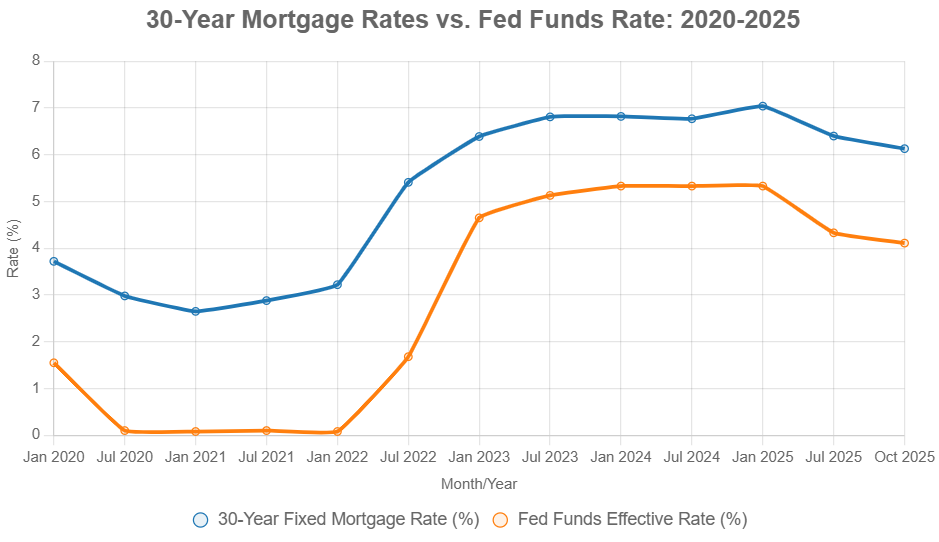
To illustrate the relationship between Fed policy and mortgage rates, consider this line chart tracking monthly averages from January 2020 to October 2025. Data sourced from FRED (St. Louis Fed) shows how pandemic-era lows gave way to 2022-2023 hikes, with recent cuts beginning to unwind the climb—yet mortgage rates lag the fed funds rate by 150-200 basis points.

line chart tracking monthly mortgage rate averages

Opportunities and Risks for Homebuyers and Refinancers

So, what does this potential shift in mortgage rates mean for you?

For Homebuyers:

  • Improved Affordability (Slightly): A mortgage rate of 6.1% on a $400,000 loan means about a $2,430 monthly payment (principal and interest only). If rates were at 6.5%, that payment would be around $2,530. That's a savings of $1,200 per year without even considering taxes and insurance! This small decrease in rates could make a big difference, especially for first-time homebuyers who often have tighter budgets.
  • Potential for More Sales: With rates nudging lower, we might see a small bump in home sales, possibly between 5% to 8% in the last quarter of the year.

For Refinancers:

  • Savings Potential: If you have a mortgage with a rate significantly higher than what's predicted for November, now might be a good time to look into refinancing. Many homeowners who locked in rates above 7% could potentially see monthly savings of $100 to $200 on a $300,000 loan by refinancing into a lower rate.
  • “Last Chance” Window?: Some experts believe that while rates might continue to ease into 2026, they might not drop drastically below 6% for quite some time. This makes November a potentially good window to lock in a rate if it works for your financial situation.

The Risks to Watch Out For:

  • Unexpected Economic Shocks: The economy is a fluid thing. If there's a sudden spike in inflation or a major shift in the job market that catches everyone off guard, mortgage rates could climb back up. For instance, if the Fed decides against another rate cut in December (which some market indicators are currently showing a decent chance of happening), it could put upward pressure on rates.
  • Regional Differences: It's important to remember that mortgage rates aren't always the same everywhere. Areas with higher costs of living or different market dynamics might see rates move differently than the national average.

A Peek at the Numbers: What You Might See

To give you a clearer picture, let's look at some projected numbers. Keep in mind these are averages and your actual rate will depend on your credit score, loan type, and lender.

Loan Type Current Rate (as of Oct 30, 2025) Predicted Nov Avg Range (2025) Potential Monthly Savings on a $300K Loan*
30-Year Fixed 6.13% 6.05% – 6.15% $50 – $100
15-Year Fixed 5.39% 5.25% – 5.35% $30 – $60
5/1 ARM (Intro) 5.75% 5.60% – 5.80% Variable post-introductory period

Note: These savings are estimated compared to average October rates on a $300,000 loan, excluding taxes and insurance.

As you can see, the savings might not be huge, but every bit counts when you're talking about decades of mortgage payments.


Related Topics:

Mortgage Rates Predictions for the Next 6 Months: October 2025 to March 2026

Mortgage Rates Predictions for Next 90 Days: October to December 2025

Making Your Move: What I'd Do

From where I stand, monitoring the mortgage market isn't just about watching the Fed's announcements. It's about understanding the symphony of economic forces playing out.

If you're looking to buy or refinance, my advice is to be proactive. Don't wait until the last minute.

  • Shop Around: I can't stress this enough. The difference in rates between lenders can be significant. Get quotes from at least three to five different lenders. This simple step can save you thousands over the life of your loan.
  • Consider a Rate Lock: If you find a rate you're happy with in November, and it's within the predicted range you're comfortable with, consider locking it in. A rate lock, typically good for 30 to 60 days, protects you if rates suddenly decide to go up. It gives you peace of mind.
  • Boost Your Credit Score: Even a small improvement in your credit score can qualify you for a better interest rate. If you have a few months before you plan to lock in, see if you can pay down some debt or address any lingering issues on your credit report.
  • Understand the Long Game: Mortgage rates aren't going to dramatically drop to the 3% levels we saw a few years ago anytime soon, according to most experts. They might not even get consistently below 6% until maybe 2026 or later. So, focus on what's achievable and smart for your financial situation right now.

November 2025 is shaping up to be a period where a modest downward trend in mortgage rates could offer a bit of breathing room for borrowers. It's not a cliffhanger, but a gradual shift that requires informed decisions. By staying on top of the economic news and understanding these influencing factors, you can make the best choices for your homeownership dreams.

Want Income Stability in Uncertain Times? Go Turnkey

Savvy investors are locking in properties that deliver consistent passive rental income and long-term appreciation.

Work with Norada Real Estate to find turnkey, cash-flowing homes in stable markets—helping you grow wealth no matter which way rates move.

HOT NEW INVESTMENT PROPERTIES JUST LISTED!

Speak with a seasoned Norada investment counselor today (No Obligation):

(800) 611-3060

Get Started Now

Also Read:

  • Mortgage Rates Predictions Backed by 7 Leading Experts: 2025–2026
  • Mortgage Rate Predictions for the Next 3 Years: 2026, 2027, 2028
  • 30-Year Fixed Mortgage Rate Forecast for the Next 5 Years
  • 15-Year Fixed Mortgage Rate Predictions for Next 5 Years: 2025-2029
  • Will Mortgage Rates Ever Be 3% Again in the Future?
  • Mortgage Rates Predictions for Next 2 Years
  • Mortgage Rate Predictions for Next 5 Years
  • Mortgage Rate Predictions: Why 2% and 3% Rates are Out of Reach
  • How Lower Mortgage Rates Can Save You Thousands?
  • How to Get a Low Mortgage Interest Rate?
  • Will Mortgage Rates Ever Be 4% Again?

Filed Under: Financing, Mortgage Tagged With: Interest Rate, mortgage, Mortgage Rate Trends, mortgage rates

Today’s Mortgage Rates – October 30: Rates Edge Lower in Wake of Fed’s Decision

October 30, 2025 by Marco Santarelli

Today's Mortgage Rates - October 9, 2025: 30-Year FRM Nudges Up to 6.48%

If you're thinking about buying a home or refinancing an existing mortgage, you're probably zeroing in on today's mortgage rates – October 30. The good news is that rates have shown a slight dip, offering a breath of fresh air in a market that's been seeing its share of ups and downs. As of today, the average rate for a 30-year fixed mortgage has nudged down to 6.13%, and the 15-year fixed rate is now at 5.39%, according to the latest figures from Zillow. While these numbers might not be historically low, they are still an improvement from a few weeks back.

Today's Mortgage Rates – October 30: Rates Edge Lower in Wake of Fed’s Decision

Key Takeaways for Today

  • Rates are down slightly: Today's rates for both purchases and refinances have moved in a positive direction.
  • Fed actions matter: The Federal Reserve's recent rate cut influences borrowing costs.
  • Future is uncertain: Don't expect dramatic drops; the Fed is gauging economic signals.
  • Focus on your circumstances: Your personal financial profile is key to getting the best rate.

Where Do We Stand Today? The Numbers You Need to Know

Let's get straight to the figures from Zillow. These are the national averages, so your personal rate might vary based on your credit score, down payment, and the lender you choose. But these give us a solid baseline for what's happening right now.

Mortgage Type Average Rate (October 30)
30-year fixed 6.13%
20-year fixed 5.78%
15-year fixed 5.39%
5/1 ARM 6.34%
7/1 ARM 6.48%
30-year VA 5.54%
15-year VA 5.29%
5/1 VA 5.61%

It's worth noting that these are purchase rates. If you're looking to refinance, the rates can be slightly different.

Refinancing Your Mortgage: What Rates Look Like Now

For those considering refinancing, the picture is similar, with rates also showing a downward tick.

Mortgage Type Average Refinance Rate (October 30)
30-year fixed 6.28%
20-year fixed 5.84%
15-year fixed 5.69%
5/1 ARM 6.74%
7/1 ARM 6.72%
30-year VA 5.74%
15-year VA 5.53%
5/1 VA 5.68%

You'll notice the refinance rates are generally a touch higher than the purchase rates. This is common because lenders often price the risk of originating a new loan differently from a refinance.

What's Driving These Numbers? Looking at Yesterday's Big News

To really understand why mortgage rates are behaving the way they are on October 30, we need to look at the bigger economic players. The Federal Reserve is always a key figure in this story. Yesterday, October 29, marked a significant event: the Fed announced another quarter-point cut to its benchmark interest rate, bringing the new target range to 3.75% to 4.00%. This was their second cut in a row.

Now, here's where it gets interesting and why it affects your mortgage: When the Fed lowers its key interest rate, it generally makes borrowing money cheaper across the economy. This includes mortgages. Think of it like this: the Fed sets the pace for borrowing costs.

However, if you're thinking this means rates will plummet overnight, Fed Chair Jerome Powell gave a bit of a reality check. He indicated that further rate reductions in December aren't a sure thing. Why? Mixed economic signals and the lingering effects of a federal government shutdown, which has, unfortunately, held up the release of some crucial economic data. This lack of concrete information makes it harder for the Fed to make definitive decisions.

Adding to the economic shifts, the Fed also announced it would stop reducing its asset holdings, a process known as quantitative tightening, starting December 1. This can also have an impact on longer-term interest rates, including mortgages.

My Take: Why These Rates Matter to You

From my perspective, seeing these slight dips is encouraging. It signals a move away from the higher peaks we've experienced. For buyers, this means a little more purchasing power, and for homeowners, it might make refinancing a more attractive option to potentially lower monthly payments.

However, it’s crucial to remember that mortgage rates are not set in stone. They are incredibly sensitive to a multitude of factors. They don't exist in a vacuum. They are intrinsically linked to the health and direction of the broader economy and global financial markets.


Related Topics:

Mortgage Rates Trends as of October 29, 2025

Mortgage Rate Predictions for the Next 12 Months: Oct 2025 to Oct 2026

Mortgage Rates Predictions for the Next 6 Months: October 2025 to March 2026

Mortgage Rates Predictions for Next 90 Days: October to December 2025

What Influences Mortgage Rates? It's More Than Just the Fed

You might be wondering what else plays a role. A big one is U.S. Treasury bond yields. Generally, when the yields on these government bonds go down, mortgage rates tend to follow. Bonds are seen as a safer investment than stocks, and when investors are worried about the economy, they often pour money into bonds, driving up their prices and pushing down their yields.

The Federal Reserve's actions, as we just discussed, are central. Their decisions on interest rates and their balance sheet are the most direct influences. But global events can also send ripple effects. Geopolitical tensions, major economic shifts in other countries, or even significant natural disasters can create uncertainty that impacts financial markets and, consequently, mortgage rates.

And let's talk about inflation. When inflation is high, the Federal Reserve often raises interest rates to cool down the economy. Conversely, if inflation starts to ease or the economy shows signs of weakening, the Fed might lower rates. We saw this during the COVID-19 pandemic when the Fed slashed rates to record lows to stimulate economic activity.

Looking Ahead: What Can We Expect for Mortgage Rates?

Predicting mortgage rates with certainty is like trying to catch lightning in a bottle. It's incredibly difficult. Based on the current economic signals and the Fed's cautious stance, a significant drop in mortgage rates in the immediate future seems unlikely.

However, if we see a sustained easing of inflation or further confirmation of an economic slowdown, the conditions could become more favorable for rates to decline. It's a delicate balance. The economy needs to show clear signs of cooling enough for the Fed to feel comfortable lowering its benchmark rate, which would then filter down to mortgage rates.

For now, the trend is modestly downward, which is positive. But it’s essential to stay informed and work with your lender to understand how current rates affect your specific situation. Don't forget to factor in your personal financial health – your credit score, income stability, and savings – as these are equally important when securing a mortgage.

Want Income Stability in Uncertain Times? Go Turnkey

Savvy investors are locking in properties that deliver consistent passive rental income and long-term appreciation.

Work with Norada Real Estate to find turnkey, cash-flowing homes in stable markets—helping you grow wealth no matter which way rates move.

HOT NEW INVESTMENT PROPERTIES JUST LISTED!

Speak with a seasoned Norada investment counselor today (No Obligation):

(800) 611-3060

Get Started Now

Also Read:

  • Mortgage Rates Predictions Backed by 7 Leading Experts: 2025–2026
  • Mortgage Rate Predictions for the Next 3 Years: 2026, 2027, 2028
  • 30-Year Fixed Mortgage Rate Forecast for the Next 5 Years
  • 15-Year Fixed Mortgage Rate Predictions for Next 5 Years: 2025-2029
  • Will Mortgage Rates Ever Be 3% Again in the Future?
  • Mortgage Rates Predictions for Next 2 Years
  • Mortgage Rate Predictions for Next 5 Years
  • Mortgage Rate Predictions: Why 2% and 3% Rates are Out of Reach
  • How Lower Mortgage Rates Can Save You Thousands?
  • How to Get a Low Mortgage Interest Rate?
  • Will Mortgage Rates Ever Be 4% Again?

Filed Under: Financing, Mortgage Tagged With: Interest Rate, mortgage, Mortgage Rate Trends, mortgage rates, Mortgage Rates Today

Today’s Mortgage Rates – October 29: Rates Remain Volatile as Fed Decision Looms

October 29, 2025 by Marco Santarelli

Today's Mortgage Rates - October 9, 2025: 30-Year FRM Nudges Up to 6.48%

Mortgage rates continued their choppy trajectory today, reflecting uncertainty in the broader financial landscape. According to Zillow, the average rate for a 30-year fixed mortgage fell by five basis points to 6.16%, while the 15-year fixed rate rose three basis points to 5.43%. This split movement mirrors the day-to-day fluctuations in 10-year Treasury yields, which often serve as a benchmark for mortgage pricing.

With no clear directional trend, mortgage rates remain volatile heading into the final stretch of 2025. Let's dive in and see what these shifts could mean for you.

Today's Mortgage Rates – October 29: Rates Remain Volatile as Fed Decision Looms

Where Do Mortgage Rates Stand?

According to Zillow's latest numbers for today's mortgage rates, here's what we're seeing:

Loan Type Average Rate
30-year fixed 6.16%
20-year fixed 5.72%
15-year fixed 5.43%
5/1 ARM 6.44%
7/1 ARM 6.57%
30-year VA 5.62%
15-year VA 5.18%
5/1 VA 5.68%

It's important to remember that these are national averages. Your own rate could be higher or lower depending on your credit score, the size of your down payment, and the specific lender you choose. Think of these as the general tide, but your personal boat might ride a little differently.

Refinance Rates Today

If you're already a homeowner and thinking about refinancing, the rates you'll see might be slightly different. Lenders often have different pricing for refinances compared to new purchases. Here's a look at Zillow's data for today's mortgage refinance rates:

Loan Type Average Rate
30-year fixed 6.21%
20-year fixed 5.87%
15-year fixed 5.73%
5/1 ARM 6.77%
7/1 ARM 6.84%
30-year VA 5.74%
15-year VA 5.57%
5/1 VA 5.45%

Notice how the refinance rates are generally a touch higher than the purchase rates. This is common as lenders assess different risk factors for existing mortgages versus new ones.

What's Driving These Fluctuations? All Eyes on the Fed

You can't talk about today's mortgage rates without mentioning what the big players are up to. The biggest event casting a shadow – or perhaps a ray of hope – over the market today is the Federal Reserve's policy meeting. This two-day meeting began yesterday, October 28th, and wraps up today, October 29th.

The Federal Open Market Committee (FOMC), the part of the Fed that sets interest rate policy, is releasing its decision today at 2 p.m. EDT. Following that, Fed Chair Jerome Powell will hold a press conference to explain their thinking.

Here’s what you should be aware of regarding the Fed meeting:

  • The Big Announcement: Look for the interest rate decision to drop at 2 p.m. EDT.
  • Powell Speaks: At 2:30 p.m. EDT, Fed Chair Powell will offer more insights.
  • The Expected Move: The market is pretty much expecting a 25-basis-point rate cut. If this happens, it would bring the Fed's target interest rate range down to 3.75%–4%.

Why does this matter so much for mortgage rates? The Fed's actions don't directly set your mortgage rate, but they strongly influence it. When the Fed cuts its benchmark interest rate, it generally becomes cheaper for banks to borrow money. This, in turn, often leads to lower interest rates on other types of loans, including mortgages.

A Quick Look Back: The Fed's Recent Moves

To understand where we might be going, it's helpful to remember where we've been. The central bank has been making adjustments to try and manage the economy. Just back on September 17, 2025, the Fed made its first rate cut of the year. They lowered their benchmark interest rate by a quarter percentage point, moving the target range from 4.25%-4.5% down to 4.0%-4.25%.

This was a significant move because it followed a period of five meetings where they had held rates steady. Before that pause, in the latter part of 2024, there had been three cuts. So, seeing the Fed start cutting again signals they might be looking to stimulate the economy.

The Split: Why Aren't All Rates Moving Together?

You might be wondering why the 30-year fixed is going down while the 15-year fixed is inching up. This is a common phenomenon. Mortgage rates, especially the 30-year fixed, are heavily influenced by the 10-year Treasury yield. When the 10-year yield goes down, mortgage rates often follow. Think of the 10-year Treasury as a kind of general indicator for the cost of borrowing money over a longer period.

However, shorter-term products, like some ARMs, or even how lenders price different loan terms, can be affected by other factors, including the specific bank's own funding costs and their outlook on future interest rate movements. It's like having several different weather systems at play – they can all influence the day, but not always in the same direction.


Related Topics:

Mortgage Rates Trends as of October 28, 2025

Mortgage Rate Predictions for the Next 12 Months: Oct 2025 to Oct 2026

Mortgage Rates Predictions for the Next 6 Months: October 2025 to March 2026

Mortgage Rates Predictions for Next 90 Days: October to December 2025

My Take: What This Means for You

From my perspective, the fact that rates are still somewhat choppy and not locked into a clear downward trend means patience can be a virtue, but preparedness is key.

If you're looking to buy, especially if you're a first-time homebuyer, understanding these fluctuations is crucial. A small change in interest rate can really impact your monthly payment over the life of a 30-year loan. For example, a difference of just 0.25% on a $300,000 mortgage can mean paying thousands of dollars more over 30 years.

  • For Buyers: If the Fed cutting rates makes you hopeful, that's understandable. However, don't assume rates will plummet overnight. Lock in a rate when you feel comfortable, rather than trying to time the market perfectly. That's a game even the experts struggle with!
  • For Refinancers: If you're thinking about refinancing, now might be a good time to get quotes. Even if the national average is slightly up, your individual situation and lender might offer a better deal than you think. Compare offers carefully.

The current environment suggests that lenders are still a bit cautious. They're watching economic data closely and reacting to news. This means a significant shift in rates might not happen until we see more consistent positive or negative economic signals.

Looking Ahead: What to Watch For

As we move into the final stretch of 2025, the volatility in mortgage rates is likely to continue. Here's what I'll be keeping an eye on:

  • Economic Data: Reports on inflation, jobs, and consumer spending will be huge factors. Stronger economic news might push rates up, while weaker news could push them down.
  • Fed Commentary: Beyond today's announcement, listen to what Fed officials say in their speeches and public appearances. Their words can provide clues about future policy.
  • Geopolitical Events: Global events can also unexpectedly influence financial markets and, consequently, mortgage rates.

In conclusion, today's mortgage rates are a reflection of ongoing economic adjustments. While the 30-year fixed rate has seen a minor dip, the market remains sensitive to developments like the Fed's policy decisions. Staying informed and working with a trusted lender are your best bets for navigating these waters successfully.

Turnkey Rentals: A Safe Bet for Income in Turbulent Times

Savvy investors are locking in properties that deliver consistent passive rental income and long-term appreciation.

Work with Norada Real Estate to find turnkey, cash-flowing homes in stable markets—helping you grow wealth no matter which way rates move.

HOT NEW INVESTMENT PROPERTIES JUST LISTED!

Speak with a seasoned Norada investment counselor today (No Obligation):

(800) 611-3060

Get Started Now

Also Read:

  • Mortgage Rates Predictions Backed by 7 Leading Experts: 2025–2026
  • Mortgage Rate Predictions for the Next 3 Years: 2026, 2027, 2028
  • 30-Year Fixed Mortgage Rate Forecast for the Next 5 Years
  • 15-Year Fixed Mortgage Rate Predictions for Next 5 Years: 2025-2029
  • Will Mortgage Rates Ever Be 3% Again in the Future?
  • Mortgage Rates Predictions for Next 2 Years
  • Mortgage Rate Predictions for Next 5 Years
  • Mortgage Rate Predictions: Why 2% and 3% Rates are Out of Reach
  • How Lower Mortgage Rates Can Save You Thousands?
  • How to Get a Low Mortgage Interest Rate?
  • Will Mortgage Rates Ever Be 4% Again?

Filed Under: Financing, Mortgage Tagged With: Interest Rate, mortgage, Mortgage Rate Trends, mortgage rates, Mortgage Rates Today

Today’s Mortgage Rates – October 28: Rate Volatility Returns Ahead of Fed Decision

October 28, 2025 by Marco Santarelli

Today's Mortgage Rates - October 9, 2025: 30-Year FRM Nudges Up to 6.48%

Today, on October 28, the picture for mortgage rates offers a bit of clarity amidst ongoing market shifts. We're seeing some mixed signals, with the popular 30-year fixed mortgage rate ticking up slightly, while its 15-year counterpart is moving in the opposite direction. This dance of numbers reflects the broader economic winds, and understanding these movements is key to making smart decisions about your homeownership journey. Let's break down what these latest figures mean for you.

Today's Mortgage Rates – October 28: Rate Volatility Returns Ahead of Fed Decision

Let's get right to what you're likely here for – the actual numbers. According to the latest data from Zillow, here's how the mortgage rates are looking on October 28:

Mortgage Type Rate
30-year fixed 6.21%
20-year fixed 5.81%
15-year fixed 5.40%
5/1 ARM 6.37%
7/1 ARM 6.29%
30-year VA 5.61%
15-year VA 5.08%
5/1 VA 5.52%

Refinancing Your Home? Here's What Rates Look Like

If you're considering refinancing your mortgage, the rates you'll see might be slightly different. Refinance rates often take into account different market factors and lender policies.

Here's a look at the refinance rates, also from Zillow:

Mortgage Type Refi Rate
30-year fixed 6.35%
20-year fixed 5.92%
15-year fixed 5.74%
5/1 ARM 6.67%
7/1 ARM 6.98%
30-year VA 5.78%
15-year VA 5.62%
5/1 VA 5.47%

Comparing these to the purchase rates gives you a good idea of how the market is treating homeowners looking to adjust their current loans.

The Federal Reserve: What's Happening Behind the Scenes?

A big piece of the puzzle, and something I always keep a close eye on, is the Federal Reserve. Their meetings are crucial because, while they don't directly set your mortgage rate, their decisions ripple through the economy and influence everything from Treasury yields to, you guessed it, mortgage rates.

Today, October 28, marks the start of a two-day meeting for the Federal Open Market Committee (FOMC). The buzz among analysts is strong, with many predicting a quarter-point cut to the federal funds rate. This anticipated cut is a direct response to economic signals like a moderating economy, persistent inflation (which is a tricky beast to tame!), and a softening labor market.

The official announcement from the Fed is expected tomorrow, October 29, at 2 p.m. ET. This will be followed by a press conference with Fed Chair Jerome Powell, where we'll get more insight into their thinking. While a Fed rate cut doesn't instantly translate to lower mortgage rates, it often signals a shift toward more accommodative monetary policy, which can put downward pressure on longer-term rates.

Mortgage Rate Trends: A Journey Downward (Mostly)

Looking back, we've seen mortgage rates peak in 2024. Since then, there’s been a noticeable trend downwards throughout 2025, bringing them to their lowest points in over a year. This downward movement is a welcome sight for many.

Experts are suggesting that if the economy continues to slow and the job market shows weakness, we could see further decreases in mortgage rates. It’s a delicate balance; the Fed wants to cool inflation without pushing the economy into a deep recession.

However, it's worth putting today's rates into historical context. While they’ve come down from their recent highs, they are still elevated compared to the record lows we witnessed during the pandemic. This phenomenon has created what many call “golden handcuffs” for homeowners who locked in incredibly low rates back then. They may be hesitant to sell and buy again if it means taking on a much higher mortgage payment, contributing to the currently low housing inventory.


Related Topics:

Mortgage Rates Trends as of October 27, 2025

Mortgage Rate Predictions for the Next 12 Months: Oct 2025 to Oct 2026

Mortgage Rates Predictions for the Next 6 Months: October 2025 to March 2026

Mortgage Rates Predictions for Next 90 Days: October to December 2025

Impact on Housing: Buyers and Refinancers React

So, how do these fluctuating rates affect the housing market?

  • A Surge in Refinancing: The recent dip in mortgage rates has definitely lit a fire under the refinancing market. For several weeks straight in October, refinancing applications have made up over half of all mortgage applications. This tells me that a lot of homeowners are actively looking to lower their monthly payments or tap into their home equity.
  • A More Subdued Impact on Homebuyers: For those looking to buy a new home, the effect has been more of a gentle nudge than a shove. Some potential buyers are still playing it safe, perhaps due to lingering worries about affordability, high home prices, or an uncertain job market. Others, however, feel more confident stepping into the market now.
  • Boosting Housing Confidence: The combination of falling rates and moderating home prices has certainly helped affordability and given a boost to overall confidence in the housing market. This is leading to a modest rise in home sales, a positive sign for the industry.

Looking Ahead: Forecasts and Predictions

What does the future hold for mortgage rates? It’s always a bit of an educated guess, but experts offer valuable insights.

Fannie Mae's October 2025 forecast is projecting a gradual decline in mortgage rates. They anticipate rates to end 2025 at around 6.3% and then continue to fall to about 5.9% in 2026.

On a longer-term horizon, many analyses suggest that we won't be returning to the super-low rates that defined the pandemic era. The increasing national debt and the fiscal pressures it brings are expected to keep long-term interest rates higher in the coming years.

The “golden handcuffs” effect I mentioned earlier isn't going away anytime soon either. This will likely continue to contribute to a limited housing inventory, which will remain a significant factor influencing the housing market's dynamics.

As we wrap up October, the mortgage rate environment remains dynamic. Keeping an eye on these trends and understanding the forces at play is your best bet for navigating the housing market effectively. Whether you're a buyer, a seller, or a homeowner considering a refinance, informed decisions lead to better outcomes.

Choose Turnkey For Stable Income in Unstable Times

Savvy investors are locking in properties that deliver consistent passive rental income and long-term appreciation.

Work with Norada Real Estate to find turnkey, cash-flowing homes in stable markets—helping you grow wealth no matter which way rates move.

HOT NEW INVESTMENT PROPERTIES JUST LISTED!

Speak with a seasoned Norada investment counselor today (No Obligation):

(800) 611-3060

Get Started Now

Also Read:

  • Mortgage Rates Predictions Backed by 7 Leading Experts: 2025–2026
  • Mortgage Rate Predictions for the Next 3 Years: 2026, 2027, 2028
  • 30-Year Fixed Mortgage Rate Forecast for the Next 5 Years
  • 15-Year Fixed Mortgage Rate Predictions for Next 5 Years: 2025-2029
  • Will Mortgage Rates Ever Be 3% Again in the Future?
  • Mortgage Rates Predictions for Next 2 Years
  • Mortgage Rate Predictions for Next 5 Years
  • Mortgage Rate Predictions: Why 2% and 3% Rates are Out of Reach
  • How Lower Mortgage Rates Can Save You Thousands?
  • How to Get a Low Mortgage Interest Rate?
  • Will Mortgage Rates Ever Be 4% Again?

Filed Under: Financing, Mortgage Tagged With: Interest Rate, mortgage, Mortgage Rate Trends, mortgage rates, Mortgage Rates Today

  • « Previous Page
  • 1
  • …
  • 10
  • 11
  • 12
  • 13
  • 14
  • …
  • 64
  • Next Page »

Real Estate

  • Birmingham
  • Cape Coral
  • Charlotte
  • Chicago

Quick Links

  • Markets
  • Membership
  • Notes
  • Contact Us

Blog Posts

  • Today’s Mortgage Rates, June 17: Rates Edge Down But Market Still Tight
    June 17, 2026Marco Santarelli
  • Best Cities to Invest in Turnkey Real Estate for Rental Income in 2026
    June 17, 2026Marco Santarelli
  • Mortgage Rates Dip Fueling a Surge in Refinancing Activity in June 2026
    June 17, 2026Marco Santarelli

Contact

Norada Real Estate Investments 30251 Golden Lantern, Suite E-261 Laguna Niguel, CA 92677

(949) 218-6668
(800) 611-3060
BBB
  • Terms of Use
  • |
  • Privacy Policy
  • |
  • Testimonials
  • |
  • Suggestions?
  • |
  • Home

Copyright 2018 Norada Real Estate Investments

Loading...