
Norada Real Estate Investments

  • Home
  • Markets
  • Properties
  • Membership
  • Podcast
  • Learn
  • About
  • Contact

Today’s Mortgage Rates – October 20: Time to Buy as Rates Drop to Lowest Levels

October 20, 2025 by Marco Santarelli

Today's Mortgage Rates - October 9, 2025: 30-Year FRM Nudges Up to 6.48%

If you've been eyeing a new home or thinking about refinancing your current mortgage, today's mortgage rates – October 20 might just offer that small window of opportunity you've been waiting for. We're seeing some encouraging trends that could make a real difference for borrowers. According to Zillow's latest data, mortgage rates have taken another dip this week.

The average 30-year fixed rate has fallen by 10 basis points to 6.18%, and the 15-year fixed has dropped seven basis points to 5.51%. This downward trend, coupled with a bit of a breather in buyer competition after the summer rush and the upcoming holiday season still a little ways off, makes now a potentially ideal time to seriously consider making your move.

Today's Mortgage Rates – October 20: Time to Buy as Rates Drop to Lowest Levels

Understanding Today's Mortgage Rates: A Breakdown

It's always wise to get a clear picture of where things stand. These national averages give us a solid baseline, but remember, your specific rate will depend on your credit score, loan type, and the lender you choose.

Here's a look at the current average mortgage rates, according to Zillow:

Loan Type Interest Rate (%)
30-year fixed 6.18
20-year fixed 5.62
15-year fixed 5.51
5/1 ARM 6.38
7/1 ARM 6.35
30-year VA 5.62
15-year VA 5.09
5/1 VA 5.31

(Data as of October 20, based on approximate Zillow averages)

These numbers are rounded to the nearest hundredth, and it’s important to remember they are averages. Your personal situation might lead to slightly different rates.

Refinancing Your Mortgage: Is Now the Right Time?

For homeowners looking to refinance, the picture is also getting more interesting. While the rates are slightly higher than what new buyers are seeing on average, the recent dip provides a more favorable environment for potentially lowering your monthly payments or paying down your loan faster.

Here's a look at the current average mortgage refinance rates, also from Zillow:

Loan Type Interest Rate (%)
30-year fixed 6.29
20-year fixed 5.83
15-year fixed 5.77
5/1 ARM 6.56
7/1 ARM 6.80
30-year VA 5.61
15-year VA 5.49
5/1 VA 5.29

(Data as of October 20, based on approximate Zillow averages)

Comparing 30-Year Fixed vs. 15-Year Refinance Options: This is a perennial question for many. If your goal is to save the most money over the life of the loan and you can afford the higher monthly payments, a 15-year fixed refinance is often the way to go. You'll pay less interest overall and build equity much faster. However, if stretching your monthly budget is a concern, a 30-year fixed refinance provides a more manageable payment. The recent slight dip in rates makes either option more appealing now than it was just a few weeks ago.

Refinance Timing: Locking in Rates Before Potential Shifts

While rates have dipped, it's crucial to remember that the market can be unpredictable. Federal Reserve policy, economic indicators, and global events all play a significant role. If you see a rate that significantly improves your financial situation, it's often a good idea to consider locking it in. Waiting for rates to drop further is a gamble, and holding out too long could mean missing a good opportunity if they were to then tick back up.

The Impact of Inflation and the Federal Reserve on Today's Mortgage Rates

To truly understand why rates are moving the way they are, we need to look beyond just the weekly numbers. Inflation and the Federal Reserve's actions are the big players here.

The Federal Reserve has been navigating a tricky economic situation. They cut their benchmark interest rate by a quarter percentage point on September 17, 2025, bringing the target range down to 4.0% to 4.25%. This was the first cut after a five-meeting pause in 2025.

Recently, on October 14, 2025, Federal Reserve Chair Jerome Powell gave a speech that really shed some light on their thinking. He indicated that if the labor market continues to show weakness, we might see further interest rate reductions. It's a delicate balancing act for them: trying to support the economy without letting inflation run wild. Inflation, as measured by the core PCE price index, is still a bit higher than their 2% target. At the same time, the economy has shown resilience, with strong GDP growth. However, the job market has been showing signs of cooling, with rising unemployment.

The Critical Link: Treasury Yields and Your Mortgage Rate

How does what the Federal Reserve does translate to your mortgage rate? It's all about the 10-year U.S. Treasury yield. This is the benchmark that lenders heavily rely on when deciding what to charge for a 30-year fixed-rate mortgage.

Think of it this way: when the Fed adjusts its benchmark rate, it influences borrowing costs across the economy, including the yields on government bonds like the 10-year Treasury. Currently, the 10-year Treasury yield is hovering around 4.12%.

It’s not a direct 1:1 relationship, though. There's what's called a “spread” – typically 1-2 percentage points – added to the Treasury yield to account for the risks involved in mortgage lending. This spread has been a bit wider than usual lately, which means that even when the 10-year Treasury yield dips, mortgage rates don't always fall by the same amount.

What This Means for Mortgage Rates and the Housing Market Now

Chair Powell's recent comments are significant. By explicitly mentioning labor market concerns, he's signaling that the Fed is more inclined to cut rates if needed. This adds a layer of certainty that additional cuts, possibly in November or December, are on the table.

The 10-year Treasury yield has seemed to stabilize after the September Fed cut, suggesting that the market has absorbed that initial change. While mortgage rates have retreated from their recent highs, that wider spread is still tempering how much of those gains are passed on to borrowers.

Looking ahead, if the Fed continues on a more dovish path – meaning they are more inclined to lower rates – we could see Treasury yields, and consequently mortgage rates, inching closer to the low 6% range.

Outlook for Buyers and Sellers

For Buyers: The current rates offer a noticeable improvement in affordability compared to the peak rates we saw earlier. When you combine this with Powell's suggestions of potentially better financing conditions ahead, it’s a good time to at least explore your options. However, high home prices remain a significant hurdle, especially for those looking for their first home.

For Sellers: The prospect of further rate declines might encourage some homeowners who have been “rate-locked” (meaning their current mortgage rate is significantly lower than today's rates) to list their properties. This could, in turn, help ease the tight inventory we've seen in many markets.

Market Dynamics: We're likely to see an increase in real estate transactions activity. However, in many desirable areas, the fundamental imbalance between the number of available homes and the number of people wanting to buy them could continue to put upward pressure on prices.


Related Topics:

Mortgage Rates Trends as of October 19, 2025

Mortgage Rate Predictions for the Next 12 Months: Oct 2025 to Oct 2026

Mortgage Rates Predictions for the Next 6 Months: October 2025 to March 2026

Mortgage Rates Predictions for Next 90 Days: October to December 2025

Key Factors to Monitor in the Coming Weeks

As we move forward, there are a few big things I’ll be watching closely:

  • Labor Market Data: Any further signs of softening in job growth and rising unemployment will be a strong indicator for more Fed rate cuts.
  • Inflation Readings: We need to see how persistent inflation remains, particularly any pressures that might be tied to tariffs.
  • Economic Data Reliability: With some lingering gaps due to recent government shutdowns, the clarity and reliability of upcoming data will be crucial for the Fed's decisions.
  • The Spread: If the gap between mortgage rates and Treasury yields narrows, it would mean that any future Fed rate cuts will have a more direct and larger impact on mortgage rates.

Why This Matters for You

Current Buyers: Powell's recent comments strongly suggest that the cycle of interest rate easing is likely to continue. Think about how you can best position yourself to potentially benefit from these future rate declines. Even small improvements can add up to significant savings over time.

Refinance Candidates: If your current mortgage rate is significantly higher than what's available today (say, above 6.5%), it's definitely worth getting your paperwork in order and keeping a close eye on the Fed's upcoming meetings. This is prime territory for potential savings.

Market Observers: It's clear the Fed is increasingly prioritizing labor market stability. They seem to be adopting a more proactive stance on rate cuts, even with lingering inflation concerns. This proactive approach could have very positive implications for anyone looking to finance a home in the near future.

The Bottom Line

As we navigate the end of October, Chair Powell's recent remarks have definitely upped the ante for continued rate cuts throughout 2025. While there are still uncertainties to be ironed out with economic data, the Fed's clear signals about their concern for the labor market suggest a more aggressive approach to easing might be on the horizon. For anyone out there dreaming of homeownership or looking to improve their current mortgage situation, this is a developing situation worth paying close attention to.

Use Rate Uncertainty to Your Advantage—Invest in Steady Rental Income

Savvy investors are locking in properties that deliver consistent passive rental income and long-term appreciation.

Work with Norada Real Estate to find turnkey, cash-flowing homes in stable markets—helping you grow wealth no matter which way rates move.

HOT NEW INVESTMENT PROPERTIES JUST LISTED!

Speak with a seasoned Norada investment counselor today (No Obligation):

(800) 611-3060

Get Started Now

Also Read:

  • Mortgage Rates Predictions Backed by 7 Leading Experts: 2025–2026
  • Mortgage Rate Predictions for the Next 3 Years: 2026, 2027, 2028
  • 30-Year Fixed Mortgage Rate Forecast for the Next 5 Years
  • 15-Year Fixed Mortgage Rate Predictions for Next 5 Years: 2025-2029
  • Will Mortgage Rates Ever Be 3% Again in the Future?
  • Mortgage Rates Predictions for Next 2 Years
  • Mortgage Rate Predictions for Next 5 Years
  • Mortgage Rate Predictions: Why 2% and 3% Rates are Out of Reach
  • How Lower Mortgage Rates Can Save You Thousands?
  • How to Get a Low Mortgage Interest Rate?
  • Will Mortgage Rates Ever Be 4% Again?
Filed Under: Financing, Mortgage Tagged With: Interest Rate, mortgage, Mortgage Rate Trends, mortgage rates, Mortgage Rates Today

Today’s Mortgage Rates – October 19: Rates Slide to New Low, Unlocking Big Savings

October 19, 2025 by Marco Santarelli

Today's Mortgage Rates - October 9, 2025: 30-Year FRM Nudges Up to 6.48%

As of October 19, the mortgage market is showing a welcome trend: rates are ticking downward. The widely watched 30-year fixed mortgage rate has dipped to 6.18%, marking its lowest point since the beginning of October 2024. This is great news for anyone considering buying a home or looking to refinance. While the overall direction is positive, there are a few nuances that are worth diving into.

Today's Mortgage Rates – October 19: Rates Slide to New Low, Unlocking Big Savings

The Latest Mortgage Rates: A Snapshot on October 19th

Let's break down the numbers as of today, based on data from Zillow. Keep in mind, these are national averages, and your specific rate might vary depending on your credit score, down payment, and the lender.

Loan Type Current Rate
30-year fixed 6.18%
20-year fixed 5.62%
15-year fixed 5.51%
5/1 ARM 6.38%
7/1 ARM 6.35%
30-year VA 5.62%
15-year VA 5.09%
5/1 VA 5.31%

Today's Refinance Rates: Could Now Be the Time?

If you're a homeowner thinking about refinancing to potentially lower your monthly payments or tap into your home's equity, here's what the rates look like today:

Loan Type Current Refinance Rate
30-year fixed 6.29%
20-year fixed 5.83%
15-year fixed 5.77%
5/1 ARM 6.56%
7/1 ARM 6.80%
30-year VA 5.61%
15-year VA 5.49%
5/1 VA 5.29%

A quick note on ARMs: These are Adjustable-Rate Mortgages. The first number (e.g., 5/1) indicates how many years the rate is fixed, and the second number (e.g., 5/1) indicates how often the rate can adjust after that initial period.

The Bigger Picture: Why Are Rates Moving?

It's crucial to understand what's driving these mortgage rate movements. It's not just random fluctuation; there are specific economic forces at play.

One major factor influencing current mortgage rates is the ongoing government shutdown. While this creates some headaches, particularly with processing FHA and VA loans, it's also pushing interest rates lower. When there's uncertainty in the government, investors often flock to safer assets, like Treasury bonds. This increased demand for Treasuries drives their yields down, and since the 10-year U.S. Treasury yield is a primary benchmark for 30-year fixed mortgages, mortgage rates tend to follow suit.

Furthermore, the Federal Reserve's stance is a significant player. Recently, Fed Chair Jerome Powell has signaled a more dovish approach, suggesting the possibility of further interest rate cuts in the future. This is a direct response to what they're seeing in the economy, such as a softening labor market.

On September 17, 2025, the Federal Reserve made its first cut of the year, lowering its benchmark interest rate. This action, combined with Powell's recent comments about potential future easing, has created an environment where lenders are being more competitive.

Comparing 30-Year Fixed vs. 15-Year Refinance Options

Let's look at the difference for those considering a refinance of their existing mortgage. A 15-year fixed mortgage typically comes with a lower interest rate than a 30-year fixed mortgage. This means you'll pay less interest over the life of the loan. However, your monthly payments will be higher because you're paying off the loan in half the time.

For instance, today a 30-year fixed refinance rate is around 6.29%, while a 15-year fixed refinance rate is 5.77%. That's a difference of over half a percentage point on the interest rate. Over many years, this can add up to significant savings. However, the monthly cost will undoubtedly be higher on the 15-year option. It's a trade-off between lower overall interest paid and a more manageable monthly payment.

The Federal Reserve's Role: A Late-October 2025 Outlook

The Federal Reserve's actions are like the conductor of an orchestra for the economy, and their decisions have a profound impact on mortgage rates. Chair Powell's recent comments are particularly noteworthy as he's indicated that if the labor market continues to weaken, more interest rate reductions might be necessary. He described this situation as having “no risk-free path,” highlighting the delicate balance the Fed is trying to strike.

Here's why this is so important:

  • Data Delays: The government shutdown is making it difficult for the Fed (and everyone else) to get a clear picture of the economy's health.
  • Inflation: We're still seeing some persistent inflation pressures, partly due to things like tariffs on imported goods. The Fed's target is 2%, and we're currently at 2.9% for the core PCE price index, which is their preferred measure.
  • Labor Market: Job growth is cooling, and unemployment has risen to 4.3%. This is a key signal that the Fed is watching closely.

The Fed's decision to cut rates on September 17, 2025, was a significant move. It followed a period where they had paused rate hikes. This first cut sends a clear signal that they are prepared to act to support the economy.

The Critical Link: Treasury Yields and Mortgage Rates

How does the Fed's rate cut translate to your mortgage? The main pathway is through the 10-year U.S. Treasury yield. Think of this as a bellwether. When Treasury yields go down, mortgage rates often follow. As of mid-October 2025, the 10-year Treasury yield is hovering around 4.12%, which is below its long-term average.

Here's how it works:

  • Direct Benchmark: Lenders use the 10-year Treasury yield as a starting point for setting your mortgage rate. It reflects expectations for future interest rates over a similar timeframe.
  • Investor Competition: Investors who buy mortgage-backed securities are looking for a return that's competitive with the safety of Treasury bonds. If Treasuries are paying less, mortgage-backed securities can also afford to offer slightly lower rates, and vice versa.
  • The “Spread”: The difference between the 10-year Treasury yield and the mortgage rate is called the “spread.” Currently, this spread is a bit wider than usual. This is one reason why we haven't seen mortgage rates drop as dramatically as Treasury yields have. It means there's an extra layer of cost or risk being priced in for mortgages.

What This Means for Mortgage Rates Now

The Fed's more dovish tone increases the odds of further rate cuts in November or December. This should continue to put downward pressure on Treasury yields. While rates have already pulled back from their recent highs, the wider spread means that the decline in mortgage rates might not be as steep as some might hope. However, the trend is still positive for borrowers.

If the Fed continues its easing cycle, we could see 10-year Treasury yields move even lower, potentially pushing 30-year fixed mortgage rates closer to the 6% mark.


Related Topics:

Mortgage Rates Trends as of October 18, 2025

Mortgage Rates Predictions for the Next 12 Months: Oct 2025 to Oct 2026

Mortgage Rates Predictions for the Next 6 Months: October 2025 to March 2026

Mortgage Rates Predictions for Next 90 Days: October to December 2025

The Outlook for the Housing Market

For Buyers: With rates easing from their peak and the possibility of further declines, affordability is improving. This could make it easier for some to enter the market. However, the overarching challenge of high home prices in many areas remains a significant hurdle, especially for first-time buyers.

For Sellers: The prospect of even lower rates might encourage some homeowners who have been “rate-locked” (meaning they have a much lower rate on their current mortgage) to finally list their homes for sale. This could, in turn, help alleviate some of the current low inventory issues we're seeing in many markets.

Market Dynamics: We're likely to see more buyer and seller activity. However, in desirable areas, the demand often outstrips supply, which can keep price appreciation from completely cooling off.

Why This Matters for You

  • Homebuyers: Powell's words suggest that the period of falling rates might have more room to run. If you're looking to buy, it's worth considering your timeline. Could waiting a few months potentially land you a better rate? Definitely something to ponder.
  • Refinance Candidates: If your mortgage rate is significantly higher than today's rates (say, above 6.5%), it’s a good idea to start gathering your documentation and stay glued to the economic news.
  • Those Keeping an Eye on the Economy: The Fed appears genuinely concerned about the labor market. This suggests they might be more proactive with rate cuts, even if inflation hasn't fully returned to their target yet.

The bottom line is that the Federal Reserve is signaling a clear intention to support the economy through potential rate cuts. While there are still economic uncertainties, the overall direction points towards more favorable borrowing conditions for mortgages in the coming months. It's a good time to stay informed and ready to act when the opportunity is right for you.

Use Rate Uncertainty to Your Advantage—Invest in Steady Rental Income

Savvy investors are locking in properties that deliver consistent passive rental income and long-term appreciation.

Work with Norada Real Estate to find turnkey, cash-flowing homes in stable markets—helping you grow wealth no matter which way rates move.

HOT NEW INVESTMENT PROPERTIES JUST LISTED!

Speak with a seasoned Norada investment counselor today (No Obligation):

(800) 611-3060

Get Started Now

Also Read:

  • Mortgage Rates Predictions Backed by 7 Leading Experts: 2025–2026
  • Mortgage Rate Predictions for the Next 3 Years: 2026, 2027, 2028
  • 30-Year Fixed Mortgage Rate Forecast for the Next 5 Years
  • 15-Year Fixed Mortgage Rate Predictions for Next 5 Years: 2025-2029
  • Will Mortgage Rates Ever Be 3% Again in the Future?
  • Mortgage Rates Predictions for Next 2 Years
  • Mortgage Rate Predictions for Next 5 Years
  • Mortgage Rate Predictions: Why 2% and 3% Rates are Out of Reach
  • How Lower Mortgage Rates Can Save You Thousands?
  • How to Get a Low Mortgage Interest Rate?
  • Will Mortgage Rates Ever Be 4% Again?

Filed Under: Financing, Mortgage Tagged With: Interest Rate, mortgage, Mortgage Rate Trends, mortgage rates, Mortgage Rates Today

Today’s Mortgage Rates – October 18: 30-Year Fixed Rate Drops to Lowest Point in 2025

October 18, 2025 by Marco Santarelli

Today's Mortgage Rates - October 9, 2025: 30-Year FRM Nudges Up to 6.48%

Today's mortgage rates have seen a slight but significant dip, pushing the average 30-year fixed rate to its lowest point of the year. According to data from Zillow, the average 30-year fixed mortgage rate has moved down two basis points to 6.18%. While two basis points might sound like a tiny shift, in the world of mortgages, even small movements can translate into real savings over the life of a loan. This dip offers a breath of fresh air in what has been a dynamic and sometimes challenging interest rate environment for much of 2025.

For anyone considering buying a new home or looking to refinance their current mortgage, these lower rates are a welcome development. It suggests that the efforts by the Federal Reserve to stimulate the economy are starting to show through in the numbers that directly affect your wallet.

Today's Mortgage Rates – October 18: 30-Year Fixed Rate Drops to Lowest Point in 2025

What the Numbers Tell Us: A Snapshot of Today’s Rates

Let’s break down the current national average mortgage rates, as reported by Zillow, on October 18, 2025:

Loan Type Average Interest Rate
30-year fixed 6.18%
20-year fixed 5.62%
15-year fixed 5.51%
5/1 ARM 6.38%
7/1 ARM 6.35%
30-year VA 5.62%
15-year VA 5.09%
5/1 VA 5.31%

It's important to remember that these are national averages. Your actual rate will depend on many factors, including your credit score, the size of your down payment, and the specific lender you choose.

Refinancing: A Smart Move for Many

If you're a homeowner who secured a mortgage at a higher rate in previous years, today might be a great day to revisit your refinancing options. The refinance rates today are also showing a slight improvement:

Loan Type Average Refinance Rate
30-year fixed 6.29%
20-year fixed 5.83%
15-year fixed 5.77%
5/1 ARM 6.56%
7/1 ARM 6.80%
30-year VA 5.61%
15-year VA 5.49%
5/1 VA 5.29%

Even a small drop in your interest rate can lead to significant savings over the long term. For example, refinancing from a 6.5% rate to 6.18% on a $300,000 mortgage could save you tens of thousands of dollars over 30 years. So, if your current rate is higher than these averages, it's definitely worth exploring what refinancing could do for your monthly payments and overall debt.

The Fed Factor: Why Rates Are Moving

To truly understand today's mortgage rates, we need to look at the bigger economic picture, particularly the actions and signals from the Federal Reserve. The most significant event shaping the current rate environment was the Fed's first rate cut of 2025, which occurred on September 17th. This quarter-percentage-point cut brought the benchmark federal funds rate down to a range of 4.0%-4.25%.

This move wasn't made in a vacuum. It followed a period of stable rates and came after three cuts in late 2024. The Fed's decision was driven by a careful assessment of the economy, which, as Federal Reserve Chair Jerome Powell recently highlighted, presents a complex balancing act.

Powell's “Dovish Signals” are Key

In a significant speech on October 14th, Fed Chair Powell indicated that ongoing labor market weakness might necessitate further interest rate reductions. He spoke of facing a situation with “no risk-free path,” acknowledging several economic challenges:

  • Data Hurdles: A recent government shutdown has made it difficult to get a clear, up-to-the-minute picture of the economy.
  • Inflation Worries: While inflation is showing signs of cooling, lingering pressures, partly due to tariffs, mean the Fed can't completely relax its vigilance.
  • Softening Job Market: Signs of cooling job growth and a rise in unemployment to 4.3% are concerning the Fed, suggesting that more policy support might be needed to keep the economy on a healthy track.

The Fed's primary goal is to maintain price stability (keeping inflation in check) while also promoting maximum employment. Powell's recent comments suggest the emphasis is increasingly shifting towards supporting the labor market, even if it means accepting a slightly longer path to reaching their 2% inflation target.

The Treasury Yield Connection: How the Fed Influences Your Mortgage

It’s crucial to understand how the Fed’s actions trickle down to the mortgage rates we see every day. The most direct link is through the 10-year U.S. Treasury yield. This yield serves as the primary benchmark for pricing 30-year fixed-rate mortgages.

As of mid-October 2025, the 10-year Treasury yield is hovering around 4.12%, which is slightly below its long-term average. Here’s why this matters:

  1. Direct Benchmark: Lenders look at the 10-year Treasury yield as a baseline for the cost of borrowing over a similar time horizon.
  2. Investor Competition: Mortgage-backed securities (which are essentially bundles of mortgages sold to investors) compete with safer investments like Treasury bonds. To attract investors, mortgage rates need to offer a competitive return.
  3. The “Spread”: Mortgage rates typically sit about 1 to 2 percentage points higher than the 10-year Treasury yield. This difference, known as the “spread,” accounts for the added risk involved in mortgage lending. Currently, this spread remains a bit wider than usual, meaning that even when Treasury yields fall, mortgage rates don't always drop by the same amount.

What Today's Rates and Fed Signals Mean for You

The combination of the recent Fed rate cut and Powell's dovish outlook creates a more optimistic scenario for mortgage borrowers.

  • Increased Likelihood of More Cuts: Powell’s explicit mention of labor market concerns significantly increases the probability that the Fed will cut rates again, perhaps in November or December. This would likely push Treasury yields down further.
  • Stabilizing Yields: The 10-year Treasury yield has found some stability around the 4.12% mark. This suggests that markets have largely absorbed the news of the September rate cut.
  • Gradual Improvement: While mortgage rates have retreated from their peaks earlier in the year, the wider-than-usual spread means that borrowers might not see the full benefit of lower Treasury yields translate directly into lower mortgage rates just yet. However, the trend is positive.

Looking Ahead: Scenarios for the Housing Market

The current environment, with its slightly lower mortgage rates and the prospect of more cuts, has several implications for the housing market:

For Potential Homebuyers:

  • Improved Affordability: Today's rates are certainly more approachable than the peaks seen in 2024. While high home prices remain a hurdle for many, especially first-time buyers, better financing conditions are a definite plus.
  • Future Opportunities: Powell's comments suggest that even lower rates could be on the horizon. This might encourage some buyers to wait for a bit longer to see if rates dip further, while others might feel comfortable moving forward now to lock in today's improved rates before they potentially change again.

For Homeowners Considering Selling:

  • Potential “Rate-Lock” Release: Many homeowners who locked in very low rates in previous years have been hesitant to sell, fearing they'd have to refinance at a higher rate. As rates show a downward trend and the prospect of further cuts, some of these homeowners might feel more comfortable listing their properties. This could potentially lead to an increase in available inventory in some markets.

Overall Market Dynamics:

  • Increased Activity: The combination of slightly lower rates and potentially more available homes could lead to an increase in real estate transactions.
  • Sustained Price Pressure: Despite potential inventory increases, strong demand in many desirable areas, combined with ongoing supply-chain or construction cost issues, might continue to put upward pressure on home prices in certain markets.

What to Watch Next

The Federal Reserve's future decisions will be highly dependent on incoming economic data. Here are the key factors I'll be watching:

  • Labor Market Data: Any further signs of significant weakening in job growth or a continued rise in unemployment will likely reinforce the Fed's inclination to cut rates.
  • Inflation Reports: How quickly inflation, particularly any price pressures from tariffs, moderates will be critical. If inflation cools faster than expected, the Fed might be able to cut rates more aggressively.
  • Economic Data Quality: As the government shutdown's impact on data resolution fades, clearer economic readings will allow the Fed to make more informed decisions.
  • Spread Dynamics: Watching if the spread between mortgage rates and Treasury yields narrows will tell us if lenders are starting to pass on more of the benefits of lower benchmark rates to borrowers.


Related Topics:

Mortgage Rates Trends as of October 17, 2025

Mortgage Rates Predictions for the Next 12 Months: Oct 2025 to Oct 2026

Mortgage Rates Predictions for the Next 6 Months: October 2025 to March 2026

Mortgage Rates Predictions for Next 90 Days: October to December 2025

Why This Information Matters to You

Understanding today's mortgage rates isn't just about looking at a number. It’s about making informed financial decisions.

  • If You're a Buyer: Chair Powell's recent remarks are a clear signal that the Federal Reserve is committed to supporting the economy. This suggests that the current easing cycle has more room to run. Consider the timing of your purchase – could waiting a few months potentially lead to even better financing? Or is locking in today's rate the right move for your immediate needs?
  • If You're Looking to Refinance: Homeowners with rates significantly higher than today's averages, especially those above 6.5%, should be actively preparing. Gather your financial documents and keep a close eye on the upcoming Fed meetings. Even a small reduction can make a big difference.
  • If You're Just Observing: The Fed's current focus on labor market health, despite lingering inflation concerns, points towards a more proactive approach to monetary policy. This shift is generally positive for borrowers and suggests a continued effort to ensure economic stability.

The bottom line is that the Federal Reserve's current trajectory, driven by concerns about the labor market, makes continued rate cuts in the near future quite likely. While there are always uncertainties, the Fed's apparent willingness to prioritize economic support has positive implications for mortgage borrowers looking ahead. Today's slightly lower rates are a good indication of this trend, and there may be even better opportunities to come.

Use Rate Uncertainty to Your Advantage—Invest in Steady Rental Income

Savvy investors are locking in properties that deliver consistent passive rental income and long-term appreciation.

Work with Norada Real Estate to find turnkey, cash-flowing homes in stable markets—helping you grow wealth no matter which way rates move.

HOT NEW INVESTMENT PROPERTIES JUST LISTED!

Speak with a seasoned Norada investment counselor today (No Obligation):

(800) 611-3060

Get Started Now

Also Read:

  • Mortgage Rates Predictions Backed by 7 Leading Experts: 2025–2026
  • Mortgage Rate Predictions for the Next 3 Years: 2026, 2027, 2028
  • 30-Year Fixed Mortgage Rate Forecast for the Next 5 Years
  • 15-Year Fixed Mortgage Rate Predictions for Next 5 Years: 2025-2029
  • Will Mortgage Rates Ever Be 3% Again in the Future?
  • Mortgage Rates Predictions for Next 2 Years
  • Mortgage Rate Predictions for Next 5 Years
  • Mortgage Rate Predictions: Why 2% and 3% Rates are Out of Reach
  • How Lower Mortgage Rates Can Save You Thousands?
  • How to Get a Low Mortgage Interest Rate?
  • Will Mortgage Rates Ever Be 4% Again?

Filed Under: Financing, Mortgage Tagged With: Interest Rate, mortgage, Mortgage Rate Trends, mortgage rates, Mortgage Rates Today

Today’s Mortgage Rates – October 17, 2025: Rates Decline Boosting Homebuyer Sentiment

October 17, 2025 by Marco Santarelli

Today's Mortgage Rates - October 9, 2025: 30-Year FRM Nudges Up to 6.48%

Today, October 17, 2025, brings a welcome bit of good news for anyone looking to buy a home or refinance their existing mortgage: mortgage rates have continued their gentle descent. According to Freddie Mac's latest report, the national average for a 30-year fixed-rate mortgage has dipped to 6.27%, a full 17 basis points lower than this time last year. This downward tick offers a promising sign for potential homebuyers who have been navigating a challenging market. It's this kind of movement that makes me, as someone who's followed housing finance for years, feel optimistic about the possibilities ahead.

Today's Mortgage Rates – October 17, 2025: Rates Decline Boosting Homebuyer Sentiment

What the Numbers Tell Us Today

It's always important to look at the most up-to-date information to get a clear picture, and Zillow home loans data for today, October 17, 2025, gives us an even more detailed snapshot. We're seeing a national average 30-year fixed rate sitting at 6.20%. For those considering shorter loan terms, the 15-year fixed rate is at 5.50%, and a 20-year fixed rate is currently at 5.91%. For those who might be looking at adjustable-rate mortgages, the 5/1 ARM is averaging 6.28%, and the 7/1 ARM at 6.50%.

Here's a breakdown of today's mortgage rates for purchasing a home:

Loan Type Interest Rate (October 17, 2025)
30-year fixed 6.20%
20-year fixed 5.91%
15-year fixed 5.50%
5/1 ARM 6.28%
7/1 ARM 6.50%
30-year VA 5.60%
15-year VA 5.17%
5/1 VA 5.61%

Remember, these are national averages. Your specific rate will depend on your credit score, loan-to-value ratio, and other personal financial factors.

Refinancing Made Easier? Let's Dive In.

Beyond just buying, the ability to refinance is crucial for many homeowners looking to save money. Zillow's data also sheds light on current refinance rates as of October 17, 2025. We're seeing a national average 30-year fixed refinance rate of 6.30%. This is an encouraging sign, down from an average of 6.75% on Friday. Specifically, the 30-year fixed refinance rate has dropped by a notable 19 basis points from the previous week's average of 6.94%.

However, it's not all going in the same direction. The 15-year fixed refinance rate has seen a slight increase, moving up 17 basis points to 5.89%. Similarly, the 5-year ARM refinance rate is also up, now at 7.41%.

Let's compare these refinance rates:

Loan Type Interest Rate (October 17, 2025 – Refinance)
30-year fixed 6.30%
20-year fixed 6.78%
15-year fixed 5.70%
5/1 ARM 6.59%
7/1 ARM 6.95%
30-year VA 5.75%
15-year VA 5.66%
5/1 VA 5.44%

What a 19 Basis Point Drop Means for Monthly Payments

A 19 basis point drop might sound small, but for homeowners, it can translate into tangible savings over the life of a loan. Let’s consider a hypothetical $300,000 mortgage. A rate of 6.94% would have resulted in a monthly principal and interest payment of roughly $1,993. With the rate dropping to 6.75%, that payment comes down to about $1,951. That's a difference of $42 per month, or over $500 per year in savings. Over a 30-year term, this adds up to a significant amount – savings that can go towards other financial goals or simply improve your monthly budget.

The Federal Reserve’s Role in Mortgage Rates: A Late-October 2025 Outlook

To truly understand what's happening with today's mortgage rates, we need to look at the bigger economic picture, and that means paying close attention to the Federal Reserve. The Fed's recent actions and statements are the driving force behind many of the economic trends we're seeing.

Recent Developments: Powell's Dovish Signals

Federal Reserve Chair Jerome Powell's speech on October 14, 2025, was particularly telling. He signaled a willingness to consider further interest rate reductions if the labor market continues to weaken. He acknowledged the difficult balancing act the Fed faces, describing the economic situation as having “no risk-free path.” Powell pointed to a few key challenges:

  • Data Assessment Difficulties: The recent government shutdown has made it harder to get a clear read on the economy.
  • Ongoing Inflation Pressures: Tariffs are still contributing to price increases.
  • Labor Market Softening: This is a major concern for the Fed, possibly requiring more policy support.

The Decision: First Cut of 2025

This cautious optimism about potential rate cuts is bolstered by the Fed's decision on September 17, 2025, to cut its benchmark interest rate by a quarter percentage point. This brought the target range down to 4.0% to 4.25%, marking the first rate cut of 2025. This followed a pause in rate hikes and three cuts in late 2024.

Economic Context: Navigating Multiple Challenges

The Fed's proactive approach comes at a time when the economy is facing a complex mix of factors. While robust, the economy isn't without its headwinds:

  • Inflation: The core PCE price index, the Fed’s preferred measure, is still hovering at 2.9% year-over-year. While down from previous highs, it’s still above the Fed’s target of 2%.
  • Economic Growth: Real GDP saw a strong 3.8% annualized growth in the second quarter of 2025, showing underlying resilience.
  • Labor Market: We're seeing signs of the job market cooling, with job growth moderating and unemployment rising to 4.3%.

Chair Powell’s recent comments highlight that the Fed is keenly aware of the need to support jobs without reigniting inflation, especially with those lingering tariff-related price pressures.

The Critical Link: Treasury Yields and Mortgage Rates

How does the Fed's action translate directly to your mortgage rate? It's all about the 10-year U.S. Treasury yield. This is the main benchmark that lenders use to price 30-year fixed-rate mortgages.

Current Market Snapshot:

As of mid-October 2025, the 10-year Treasury yield is hovering around 4.12%, which is below its long-term average of 4.25%.

Here’s why this matters:

  • Direct Benchmark: Mortgage lenders use the 10-year Treasury yield as a baseline. It represents the expected return on a comparable duration investment.
  • Investor Competition: When investors can get a good return on safe Treasury bonds, mortgage lenders need to offer competitive returns on mortgage-backed securities to attract capital.
  • The “Spread”: Mortgage rates are typically higher than Treasury yields to account for the additional risks involved. This difference is called the “spread.” Right now, the spread is still a bit wider than ideal, meaning that even if Treasury yields drop, mortgage rates don't always fall by the full amount.

What This Means for Mortgage Rates Now

Chair Powell's hints about labor market weakness significantly increase the likelihood of additional rate cuts by the Fed in November or December. This should help stabilize the 10-year Treasury yield and, in turn, start pressing mortgage rates down further. While rates haven't plummeted from recent highs, they are showing a welcome trend of moderation. The current situation suggests that we might see mortgage rates inching closer to the 6% range in the coming months.

Outlook for the Housing Market

For Buyers: The current rates are certainly more appealing than those seen earlier this year. Powell's comments offer a glimpse of potentially even better financing conditions ahead. However, it’s still important to remember that high home prices remain a significant hurdle, especially for first-time buyers.

For Sellers: The prospect of further rate declines could encourage some homeowners who have been hesitant due to their current low rates to put their homes on the market. This could help increase the supply of homes, which has been a bottleneck in many areas.

Market Dynamics: We're likely to see more transaction activity. However, in many desirable areas, the fundamental issue of supply and demand imbalance is still strong enough to keep price increases sustained.


Related Topics:

Mortgage Rates Trends as of October 16, 2025

Mortgage Rates Predictions for the Next 12 Months: Oct 2025 to Oct 2026

Mortgage Rates Predictions for the Next 6 Months: October 2025 to March 2026

Mortgage Rates Predictions for Next 90 Days: October to December 2025

What's Next? Key Factors to Watch

The Fed's future decisions will be heavily influenced by incoming economic data. Here's what I'll be keeping a close eye on:

  • Labor Market Conditions: Any further cooling will likely trigger the additional cuts Powell discussed.
  • Inflation Trajectory: We need to see how quickly these tariff-related price pressures ease.
  • Economic Data Quality: Clearing up the data gaps caused by the government shutdown will be crucial for the Fed's November meeting.
  • Spread Dynamics: A narrowing of the mortgage-Treasury spread would mean that any drops in Treasury yields are more effectively passed on to borrowers.

Why This Matters for You

Current Buyers: Powell's recent remarks strongly suggest that the Fed's easing cycle is just getting started. It might be worth carefully considering your timing if you're looking to buy, and always keep an eye on future rate movements.

Refinance Candidates: If your current mortgage rate is above 6.5%, you should be actively gathering your financial documents and watching the Fed's November meeting. There’s a real opportunity to potentially lower your monthly payments.

Market Observers: The Fed's evident concern for the labor market points towards a more proactive approach to potential rate cuts, even with inflation still a consideration. This suggests a potentially more favorable environment for borrowers in the months ahead.

Bottom Line: October 17, 2025, finds us in a market where mortgage rate reductions are a tangible reality, driven by the Fed's increasing focus on economic support. While uncertainties remain, the signs point towards continued easing, which is excellent news for anyone looking to enter or re-enter the housing market.

Use Rate Uncertainty to Your Advantage—Invest in Steady Rental Income

Savvy investors are locking in properties that deliver consistent passive rental income and long-term appreciation.

Work with Norada Real Estate to find turnkey, cash-flowing homes in stable markets—helping you grow wealth no matter which way rates move.

HOT NEW INVESTMENT PROPERTIES JUST LISTED!

Speak with a seasoned Norada investment counselor today (No Obligation):

(800) 611-3060

Get Started Now

Also Read:

  • Mortgage Rates Predictions Backed by 7 Leading Experts: 2025–2026
  • Mortgage Rate Predictions for the Next 3 Years: 2026, 2027, 2028
  • 30-Year Fixed Mortgage Rate Forecast for the Next 5 Years
  • 15-Year Fixed Mortgage Rate Predictions for Next 5 Years: 2025-2029
  • Will Mortgage Rates Ever Be 3% Again in the Future?
  • Mortgage Rates Predictions for Next 2 Years
  • Mortgage Rate Predictions for Next 5 Years
  • Mortgage Rate Predictions: Why 2% and 3% Rates are Out of Reach
  • How Lower Mortgage Rates Can Save You Thousands?
  • How to Get a Low Mortgage Interest Rate?
  • Will Mortgage Rates Ever Be 4% Again?

Filed Under: Financing, Mortgage Tagged With: Interest Rate, mortgage, Mortgage Rate Trends, mortgage rates, Mortgage Rates Today

Today’s Mortgage Rates – October 16, 2025: 30-Year Fixed Rate Stands at 6.23%

October 16, 2025 by Marco Santarelli

Today's Mortgage Rates - October 9, 2025: 30-Year FRM Nudges Up to 6.48%

As of Today, October 16, the average rate for a 30-year fixed mortgage is 6.23% for home purchases, and the refinance rate is 6.33%. We've been seeing this back-and-forth with mortgage rates for a few weeks now, and it's anyone's guess how long it'll last, especially with the government shutdown still hanging in the air. My take? These little bumps aren't enough to throw a wrench in your homeownership plans if you're financially ready.

The good news is that even though rates are nudging up a bit for purchases, they've actually dipped slightly for refinances. So, whether you're looking to buy your dream home or lock in a better rate on your existing mortgage, there's still movement and opportunity.

Today's Mortgage Rates – October 16, 2025: 30-Year Fixed Rate Stands at 6.23%

Mortgage Rates: Looking at the Numbers

To give you a clearer picture, here's a breakdown of the national average mortgage rates as of October 16, according to Zillow. Keep in mind these are averages, and your individual rate will depend on many factors.

Loan Type Interest Rate
30-year fixed 6.23%
20-year fixed 5.87%
15-year fixed 5.47%
5/1 ARM 6.28%
7/1 ARM 6.37%
30-year VA 5.67%
15-year VA 5.32%
5/1 VA 5.58%

What does this mean for you? A 30-year fixed-rate mortgage is still the most popular choice for a reason. It offers predictable monthly payments for the life of the loan, which can be incredibly helpful for budgeting family finances. The 15-year fixed, while having a higher monthly payment, can save you a significant amount in interest over time. And for those who plan to move or refinance within a few years, an Adjustable-Rate Mortgage (ARM) might offer a lower initial rate, but comes with the risk of payments increasing later.

Today's Mortgage Refinance Rates: Catching a Break?

If you're looking to refinance your current home loan, the rates have actually seen a slight dip, which is welcome news for many homeowners. Here’s what Zillow reported for refinance rates:

Loan Type Interest Rate
30-year fixed 6.33%
20-year fixed 6.06%
15-year fixed 5.73%
5/1 ARM 6.50%
7/1 ARM 6.56%
30-year VA 5.81%
15-year VA 5.48%
5/1 VA 5.48%

This small drop in refinance rates is interesting. It suggests lenders are a tiny bit more eager to take on new business through refinancing. If your current rate is higher than these numbers, it's definitely worth exploring if refinancing makes sense for your situation. However, remember to factor in closing costs when deciding if a refinance is financially beneficial. Sometimes, the savings from a lower rate are wiped out by the upfront expenses.

The Federal Reserve's Role: More Than Just the Headlines

We often hear about the Federal Reserve (the Fed) setting interest rates, and it's precisely that action that influences mortgage rates. While the Fed doesn't directly set mortgage rates, their decisions on the federal funds rate have a ripple effect. Think of it like dropping a pebble in a pond – the ripples reach far and wide.

In fact, recent actions and statements from Fed Chair Jerome Powell are painting a picture of what we might expect moving forward. While the data I have is a bit of a look into the past (October 16, 2025), the principles behind these decisions are crucial for understanding today's market. Powell has suggested that persistent labor market weakness could mean more interest rate reductions are on the horizon. This is a significant signal.

Let's break down what has been happening and why it matters for your mortgage:

Recent Developments: Powell's Cues

Back on October 14, 2025, Chair Powell spoke about the economic situation. He mentioned challenges like:

  • Data Difficulties: The government shutdown can make it tough to get a clear picture of what's really going on in the economy.
  • Inflation Pressures: Things like tariffs can keep prices from coming down as much as we'd like.
  • Labor Market Softening: When fewer people are getting hired, it signals the economy might need a boost.

The Decision: A Rate Cut's Impact

Before all this, on September 17, 2025, the Fed did cut its main interest rate. This was the first cut in a while, and it showed the Fed was ready to make a move to try and stimulate things.

Economic Context: A Balancing Act

The Fed is always trying to find that sweet spot. They like inflation to be around 2%, but it's been sitting a bit higher. At the same time, the economy has been growing, but job growth has started to cool down, and unemployment has ticked up slightly. It's a delicate dance for the Fed – they want to keep inflation in check without slowing down the economy too much.

The Critical Link: Treasury Yields and Your Mortgage

This is where things get really interesting for your mortgage. The Fed's actions directly influence the 10-year U.S. Treasury yield. This yield is the main benchmark for mortgage lenders when they set the rates for a 30-year fixed mortgage.

Here's how it generally works:

  1. Direct Benchmark: The 10-year Treasury yield is like a base price. Lenders look at what they can get from safe investments like Treasuries and then price mortgages to be competitive.
  2. Investor Competition: If Treasury yields go down, investors might look for other places to get better returns, like buying mortgage-backed securities. This demand can help keep mortgage rates lower.
  3. The “Spread”: However, mortgages are seen as riskier than Treasuries. So, mortgage rates are usually 1-2 percentage points higher than the 10-year Treasury yield. This difference is called the “spread.” If this spread is wide, it can mean that even if Treasury yields drop, mortgage rates might not fall as much.

Right now, the 10-year Treasury yield is sitting around 4.12%. While this is lower than its average, the spread between that and mortgage rates is still a bit wider than usual. This is one of the reasons why even when the Fed makes a move, we don't always see mortgage rates drop dramatically overnight.

What This Means for Mortgage Rates Today

Chair Powell's comments are a strong signal that more rate cuts could be coming. If the labor market continues to soften, the Fed might feel compelled to lower rates further in November or December. This would likely push Treasury yields down, and could bring mortgage rates closer to the 6% range.

How Your Credit Score Impacts Your Rate

I can't stress this enough: your credit score is a powerhouse when it comes to mortgage rates. Even with all the national trends, your personal financial health plays a huge role. If you have a strong credit score (think 700 and above), you're more likely to get approved for a mortgage and qualify for the best available interest rates. If your credit score isn't quite where you want it, focusing on improving it before you apply can lead to significant savings over the life of your loan.

Looking Ahead: What's Next for Homebuyers and Sellers?

  • For Buyers: The prospect of potentially lower rates in the future is good news. It suggests that the market might be becoming more affordable. However, high home prices are still a hurdle for many, especially first-time buyers.
  • For Sellers: If rates continue to trend downwards, some homeowners who have been holding off on selling because they don't want to lose their current low mortgage rate (this is called being “rate-locked”) might decide it's time to list. This could lead to more homes available for sale, which can help balance the market.


Related Topics:

Mortgage Rates Trends as of October 15, 2025

Mortgage Rates Predictions for the Next 12 Months: Oct 2025 to Oct 2026

Mortgage Rates Predictions for the Next 6 Months: October 2025 to March 2026

Mortgage Rates Predictions for Next 90 Days: October to December 2025

Key Factors to Watch

The Fed's next moves will depend on a few things:

  • Jobs Report: How many new jobs are created and what the unemployment rate does will be a big indicator for the Fed.
  • Inflation Numbers: They'll keep a close eye on whether inflation continues to decrease.
  • Government Shutdown Resolution: Getting clear data will help the Fed make informed decisions.

Why This Matters for You

My ultimate advice is this: stay informed, but don't let minor rate fluctuations be the sole decider of your homeownership journey. Your personal financial situation is paramount.

  • If you're thinking of buying: Keep an eye on rates, but also focus on getting your finances in order. Strengthening your credit, saving for a down payment, and understanding your budget are always smart moves.
  • If you're considering a refinance: Now might be a good time to compare offers, especially if your current rate is higher than the refinance rates listed above.

Ultimately, the trend shows the Fed is keen on supporting the economy, and that usually means lower borrowing costs down the line. It's about finding the right time for you, not just the market.

Use Rate Uncertainty to Your Advantage—Invest in Steady Rental Income

Savvy investors are locking in properties that deliver consistent passive rental income and long-term appreciation.

Work with Norada Real Estate to find turnkey, cash-flowing homes in stable markets—helping you grow wealth no matter which way rates move.

HOT NEW INVESTMENT PROPERTIES JUST LISTED!

Speak with a seasoned Norada investment counselor today (No Obligation):

(800) 611-3060

Get Started Now

Also Read:

  • Mortgage Rates Predictions Backed by 7 Leading Experts: 2025–2026
  • Mortgage Rate Predictions for the Next 3 Years: 2026, 2027, 2028
  • 30-Year Fixed Mortgage Rate Forecast for the Next 5 Years
  • 15-Year Fixed Mortgage Rate Predictions for Next 5 Years: 2025-2029
  • Will Mortgage Rates Ever Be 3% Again in the Future?
  • Mortgage Rates Predictions for Next 2 Years
  • Mortgage Rate Predictions for Next 5 Years
  • Mortgage Rate Predictions: Why 2% and 3% Rates are Out of Reach
  • How Lower Mortgage Rates Can Save You Thousands?
  • How to Get a Low Mortgage Interest Rate?
  • Will Mortgage Rates Ever Be 4% Again?

Filed Under: Financing, Mortgage Tagged With: Interest Rate, mortgage, Mortgage Rate Trends, mortgage rates, Mortgage Rates Today

Today’s Mortgage Rates – October 15: 30-Year FRM Hits Lowest Point in Over a Month

October 15, 2025 by Marco Santarelli

Today's Mortgage Rates - October 9, 2025: 30-Year FRM Nudges Up to 6.48%

Are you eyeing a new home or thinking about refinancing? Today's mortgage rates have seen a bit of a dip, particularly on that ever-popular 30-year fixed-rate mortgage. Zillow is reporting that the average rate for a 30-year fixed mortgage has actually moved down four basis points, landing at a cool 6.20%. This is the lowest we've seen it in over a month, and honestly, it feels like a breath of fresh air after a period of some bumpy movement.

Today's Mortgage Rates – October 15: 30-Year FRM Hits Lowest Point in Over a Month

For context, let's quickly look at the national averages being reported by Zillow today:

Mortgage Type Average Rate
30-Year Fixed 6.20%
20-Year Fixed 5.83%
15-Year Fixed 5.52%
5/1 ARM 6.29%
7/1 ARM 6.36%
30-Year VA 5.65%
15-Year VA 5.21%
5/1 VA 5.60%

Now, these are the rates for new purchases. If you're thinking about refinancing your current home loan, the numbers are just slightly different, generally a hair higher as lenders factor in different considerations. Here's what Zillow is showing for refinance rates today:

Mortgage Type Average Rate
30-Year Fixed 6.38%
20-Year Fixed 5.97%
15-Year Fixed 5.81%
5/1 ARM 6.60%
7/1 ARM 6.84%
30-Year VA 5.97%
15-Year VA 5.97%
5/1 VA 5.40%

So, a modest improvement today, and one that's definitely worth paying attention to. But to truly understand what's going on and where things might be headed, we need to dig a little deeper than just the headline numbers.

The Federal Reserve's Gentle Nudge: Why Today's Rates Are Moving

It’s impossible to talk about mortgage rates without talking about the Federal Reserve. Think of them as the conductor of the economic orchestra, and their decisions send ripples through everything, including the cost of borrowing money for your home.

Just recently, on September 17th of this year, the Fed made its first rate cut of 2025. They lowered their benchmark interest rate by a quarter of a percentage point. This was a big deal because it broke a pause that had lasted for five meetings. Before that, we saw three cuts at the tail end of 2024.

What’s really got people talking right now are the recent comments from Fed Chair Jerome Powell. In a speech on October 14th, he hinted that more easing could be on the horizon. He sounded quite concerned about the job market showing signs of weakness. Powell mentioned that there’s “no risk-free path” forward, and this acknowledges some tricky situations the Fed is up against:

  • Data Headaches: The recent government shutdown has made it tough to get a clear picture of just how the economy is doing.
  • Inflation Hangover: Thanks in part to tariffs, prices are still a bit higher than we’d like, putting some pressure on inflation.
  • Cooling Jobs: The labor market isn't as hot as it used to be, and the Fed might need to step in with more support.

For us on the ground, especially those of us looking to buy or refinance, Powell's words are a signal. They suggest the Fed is leaning towards keeping borrowing costs down to help strengthen the economy, particularly the job market.

Connecting the Dots: Treasury Yields and Your Mortgage

So, how does the Fed’s decision about the federal funds rate actually affect your mortgage rate? The main way is through the 10-year U.S. Treasury yield. This is basically the benchmark that lenders use when setting the price for a 30-year fixed-rate mortgage.

Right now, as of mid-October 2025, the 10-year Treasury yield is hovering around 4.12%. This is actually a bit lower than its long-term average of about 4.25%.

Here’s how it works:

  • The Direct Link: When the 10-year Treasury yield goes down, it generally means lenders can borrow money more cheaply. This, in turn, usually allows them to offer lower mortgage rates.
  • Investor Appetites: Think of it this way: investors have choices. They can invest in safe U.S. Treasury bonds or in something called mortgage-backed securities (which are basically bundles of mortgages). For mortgage-backed securities to be attractive, they need to offer a return that’s competitive with Treasuries.
  • The “Spread”: Mortgage rates don't just track the Treasury yield perfectly. There’s usually a gap, or a “spread,” between the two. This spread accounts for the extra risk lenders take when issuing mortgages compared to just buying a Treasury bond. Right now, this spread is a bit wider than usual, sitting above 2 percentage points. This is why even when Treasury yields drop, mortgage rates don't always fall as dramatically. It's like a buffer that moderates how quickly falling Treasury rates translate into lower mortgage rates for you.

What This All Means for You Today (October 15, 2025)

Given all this information, here’s my take on what today’s mortgage rates and the Fed's signals mean for you:

  • Increased Confidence in Future Cuts: Powell’s leaning towards supporting the labor market really ups the chances of more rate cuts from the Fed, possibly as soon as November or December. This is a significant development that could continue to push borrowing costs lower.
  • Stability and Gradual Improvement: The 10-year Treasury yield has been pretty stable around that 4.12% mark since the Fed's September cut. This suggests the market has absorbed the initial policy change. While mortgage rates have come down from their recent highs, that wider spread means the full benefit of lower Treasury yields isn’t quite reaching borrowers yet. It’s a gradual improvement, not a sudden plunge.
  • A Glimmer of Hope for Buyers: If you're looking to buy, the current rates are definitely more manageable than they were at their peak in 2024. Powell's comments really suggest that better financing conditions could be on the way. However, I can’t ignore that home prices are still a big hurdle for many people trying to get into the market for the first time.

The Housing Market Outlook: What Buyers and Sellers Can Expect

This shift in mortgage rates and Fed sentiment has real implications for both those looking to buy and those looking to sell:

  • For Buyers: With rates showing a downward trend and the Fed likely to continue easing, it’s worth considering the timing of your purchase. You might be able to snag an even better rate in the coming months. However, it’s a delicate balance. If you find a home you love and a rate that works for your budget, don’t wait too long and risk missing out.
  • For Sellers: The prospect of even lower interest rates down the line could encourage more homeowners to finally list their properties. Many homeowners have been “rate-locked” into their current, lower mortgages. As rates dip further, some of them might feel more comfortable selling and moving, which could help ease the tight inventory we’ve seen in many areas.
  • Market Activity: I'm expecting to see more people actively buying and selling. However, in many popular housing markets, the simple fact is that there still aren’t enough homes for sale to meet demand. This imbalance means that, even with more activity, we might not see home prices crash – they could continue to hold their value or inch up in competitive areas.


Related Topics:

Mortgage Rates Trends as of October 14, 2025

Mortgage Rates Predictions for the Next 12 Months: Oct 2025 to Oct 2026

Mortgage Rates Predictions for the Next 6 Months: October 2025 to March 2026

Mortgage Rates Predictions for Next 90 Days: October to December 2025

What to Watch Next

To get a clearer picture of where things are going, I'll be keeping a close eye on these key factors:

  • Labor Market Data: How job growth and unemployment numbers evolve will be critical. If the job market weakens further, it's almost a guarantee the Fed will cut rates again.
  • Inflation Numbers: Will those tariff-related price bumps start to fade? How quickly inflation continues to move towards the Fed's 2% target will influence their pace of rate cuts.
  • Economic Data Clarity: As the government shutdown’s effects on data reporting clear up, we'll get a more solid understanding of the economy’s true health.
  • The Mortgage-Treasury Spread: If that spread starts to narrow, it means that more of the savings from lower Treasury yields will actually make it to your mortgage rate, potentially leading to bigger rate drops.

My Personal Takeaway

As someone who has followed the housing and finance markets for a while, I’m cautiously optimistic about today's October 15, 2025 mortgage rates. The Fed's shift in tone, with a clear focus on the labor market, signals a proactive approach to managing the economy. For potential buyers, this means the opportunity to secure a home with potentially better financing conditions in the near future. For those looking to refinance, if your current rate is substantially higher than today's offerings, it's a good time to start preparing your paperwork and keeping a close watch on those upcoming Fed meetings.

While there are still economic uncertainties, the willingness of the Fed to cut rates to support employment is a significant positive for anyone looking to enter or re-enter the housing market. These slightly lower rates today, combined with the promise of more potential easing, offer a more encouraging outlook for homeownership than we've seen in quite some time.

Use Rate Uncertainty to Your Advantage—Invest in Steady Rental Income

Savvy investors are locking in properties that deliver consistent passive rental income and long-term appreciation.

Work with Norada Real Estate to find turnkey, cash-flowing homes in stable markets—helping you grow wealth no matter which way rates move.

HOT NEW INVESTMENT PROPERTIES JUST LISTED!

Speak with a seasoned Norada investment counselor today (No Obligation):

(800) 611-3060

Get Started Now

Also Read:

  • Mortgage Rates Predictions Backed by 7 Leading Experts: 2025–2026
  • Mortgage Rate Predictions for the Next 3 Years: 2026, 2027, 2028
  • 30-Year Fixed Mortgage Rate Forecast for the Next 5 Years
  • 15-Year Fixed Mortgage Rate Predictions for Next 5 Years: 2025-2029
  • Will Mortgage Rates Ever Be 3% Again in the Future?
  • Mortgage Rates Predictions for Next 2 Years
  • Mortgage Rate Predictions for Next 5 Years
  • Mortgage Rate Predictions: Why 2% and 3% Rates are Out of Reach
  • How Lower Mortgage Rates Can Save You Thousands?
  • How to Get a Low Mortgage Interest Rate?
  • Will Mortgage Rates Ever Be 4% Again?

Filed Under: Financing, Mortgage Tagged With: Interest Rate, mortgage, Mortgage Rate Trends, mortgage rates, Mortgage Rates Today

Mortgage Rates Forecast for Next 6 Months: October 2025 to March 2026

October 15, 2025 by Marco Santarelli

Mortgage Rates Predictions for the Next 6 Months

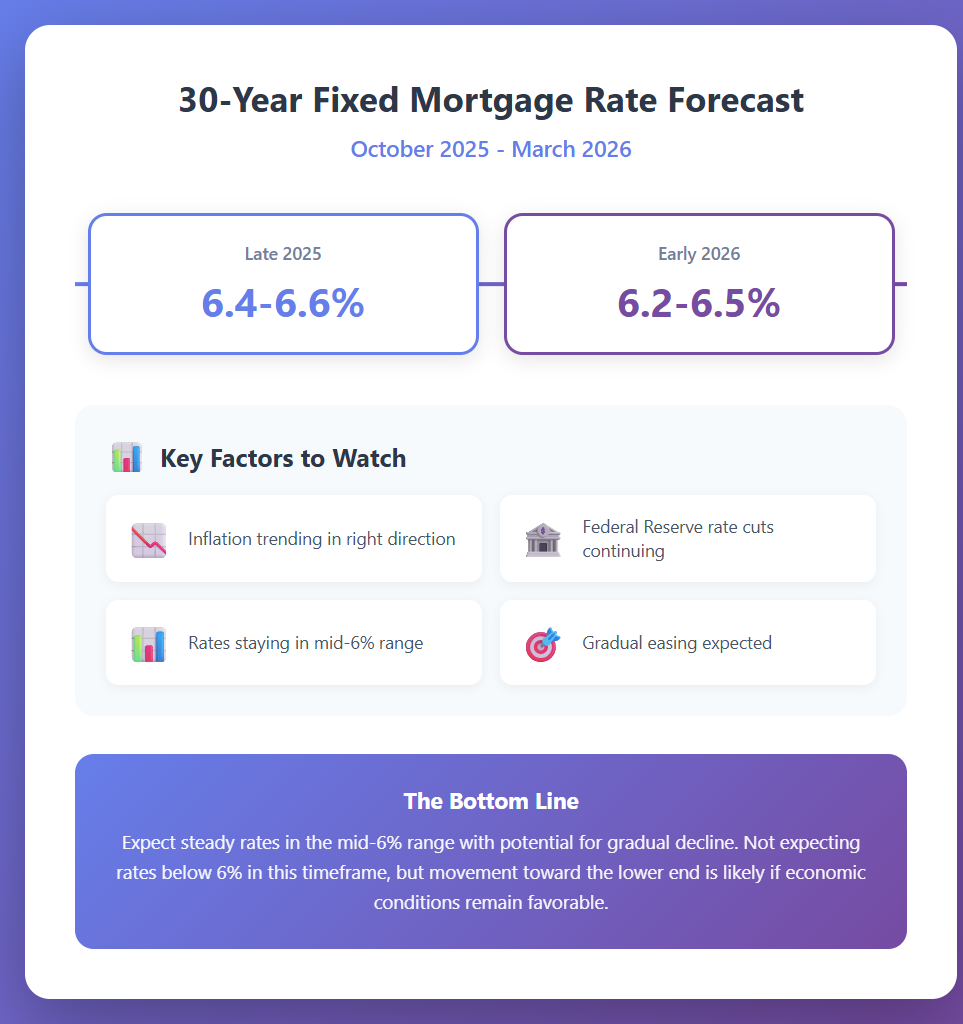
Thinking about buying a home or perhaps refinancing your current one? If so, you're probably wondering what's going to happen with mortgage rates over the next six months. My best guess, looking at all the expert chatter and economic signs, is that we'll see 30-year fixed mortgage rates generally stay in the mid-6% range through October 2025 to March 2026. There's a good chance they could ease a little bit further if inflation keeps heading in the right direction and the Federal Reserve continues to cut interest rates.

Mortgage Rates Forecast for Next 6 Months: October 2025 to March 2026

It’s a delicate dance, isn't it? We’ve all lived through the roller coaster ride of mortgage rates over the past few years. It feels like just yesterday we were talking about rates below 3%, and then suddenly, they shot up. Now, we're in a more stable, albeit higher, range. My take is that for the period from October 2025 through March 2026, things are likely to be pretty steady, with a possible, gradual dip.

We're not talking about rates suddenly plummeting below 6% within this timeframe, but a move towards the lower end of the mid-6% range, say from around 6.4% to 6.6% towards the end of 2025, possibly easing to 6.2% to 6.5% as 2026 begins, is what I’m seeing. Of course, the economy is a living, breathing thing, and unexpected events could certainly shake things up.

Mortgage Rates Predictions for the Next 6 Months: October 2025 to March 2026

Where We Stand Today: October 2025 Snapshot

To get a handle on where we're going, it helps to know where we are. As I write this in late September 2025, the average rate for a 30-year fixed-rate mortgage is hovering around 6.3%, according to Freddie Mac's reliable surveys. This figure follows a year that saw quite a bit of movement, with rates bouncing between 6.26% and a higher 7.04%. A big reason for the recent dip has been the Federal Reserve's move to cut rates by a quarter-point in September. They've also given signals that more cuts might be on the way.

Looking ahead to the next six months, the general feeling is one of stability with a slight softening. This optimism is largely tied to the expectation that the Fed will make two to three more rate cuts by mid-2026. However, it’s never that simple. Things like how trade policies evolve and pressures from the global economy can introduce a lot of uncertainty, making crystal-clear predictions tough.

What Really Moves the Mortgage Rate Needle?

It’s not magic; mortgage rates are deeply connected to bigger economic forces. The 10-year Treasury yield is a key indicator, and it moves based on all sorts of economic news. For our predictions, a few big players stand out:

  • Inflation: This is probably the biggest one. If prices are rising too fast, the Fed typically raises interest rates to cool things down. Some estimates suggest inflation might peak around 3.1% in mid-2026. If it cools off faster, that's good news for lower mortgage rates.
  • Unemployment: When more people have jobs, the economy is usually strong. If unemployment starts to climb, it can signal a slowdown, which might lead the Fed to lower rates. We’re looking at unemployment possibly ticking up to about 4.5%-4.8% in the coming months.
  • GDP Growth: This is the overall measure of how well the economy is doing. The forecast is for annual GDP growth to be somewhere between 1.7% and 2.3%. Slower growth might encourage lower rates.

If inflation shows us a faster downward trend than expected, we could see mortgage rates dip more significantly. On the flip side, if inflation stays stubbornly high, or if the job market starts to weaken considerably, those hoped-for rate decreases might be put on hold.

What This Means for You: Buyers and Homeowners

So, how does all this affect you?

For prospective homebuyers, these rates still mean a significant chunk of change. On a $400,000 loan, a 6.4% rate translates to about $2,500 a month just for the principal and interest, not even counting taxes and insurance. Affordability remains a challenge, but it's definitely better than where we were when rates were higher.

If you're a homeowner with a mortgage from a year or two ago, you might have been caught with a higher rate. The good news is that refinancing activity has really picked up – up 42% year-over-year. As rates edge lower, this is a prime opportunity for many to potentially lower their monthly payments and save money over the life of their loan.

And what about sellers? If rates dip below that 6.5% mark, we might see more homeowners who’ve been hesitant to sell (because they don't want to give up their super-low old rate) finally decide to list their homes. This could mean more homes hitting the market, which is good for buyers who’ve been facing tight inventory.

Overall, it paints a picture of a housing market that's slowly thawing, not a sudden explosion. Patience and planning are still key.

A Bit of History to Set the Scene

To truly appreciate the predictions, let's glance back. For years after the 2008 financial crisis, mortgage rates were incredibly low, even dipping below 3% at times during the pandemic. It was a great time to buy. But then, to fight rising inflation, the Federal Reserve started hiking interest rates aggressively in 2022 and 2023. We saw peaks of nearly 7.8% in 2023! This surge is what caused the “lock-in effect” where so many homeowners who had rates under 4% decided to stay put, which, in turn, made it harder for buyers to find homes.

In 2024, rates eased a bit, fluctuating between roughly 6.08% and 7.22%. This trend of moderating rates continued into 2025, with the average for a 30-year fixed staying between 6.26% and 7.04%. The Fed's September 2025 rate cut, plus signals of more to come, have really shaped this path. As of late September 2025, the 30-year fixed is around 6.30%, and the 15-year fixed is at 5.49%. This downward path is encouraging, but experts caution we're unlikely to see rates jump back to those sub-3% levels anytime soon. The economy has changed, and there are new baseline expectations for inflation.

The “lock-in effect” is loosening its grip a bit this year. Refinance applications are up a healthy 42%, and purchase applications have risen 18% compared to last year. This is a good sign of growing confidence. Still, the number of homes for sale isn't quite where it used to be. We expect home sales to gradually recover, from about 4.85 million units in 2025 to 5.35 million in 2026.

The Big Players in Rate Setting

We’ve talked about the Fed’s rate cuts. But what else is a big deal?

  • The Federal Reserve's Federal Funds Rate: This is the rate banks charge each other for overnight borrowing. While it’s a short-term rate, it has a ripple effect on longer-term rates like mortgages, mainly by influencing the 10-year Treasury yield. In September 2025, the Fed trimmed its rate to a range of 5.00%-5.25%. Markets are guessing they'll cut rates by another 0.75% to 1.00% by March 2026. This all hinges on inflation getting closer to the Fed's 2% target. Current outlooks put core PCE inflation (a measure the Fed watches closely) at 2.5%-3.1% in late 2025.
  • Unemployment Figures: As I mentioned, a rising unemployment rate can make the Fed more inclined to cut rates. If the labor market softens a bit, moving towards that 4.5%-4.8% range by early 2026, it could push the Fed to act more decisively on rate cuts.
  • Gross Domestic Product (GDP) Growth: The economy's expansion rate is crucial. For 2025, GDP is projected at 1.7%, and for 2026, it's expected to be around 2.1%-2.3%. If there are concerns about this growth slowing down more than expected, the Fed might consider lowering rates. Things like trade policy and consumer spending can influence this.
  • Global Events: It’s not just U.S. news that matters. Geopolitical issues or supply chain problems anywhere in the world can sometimes lead to rising inflation, which, in turn, can push interest rates higher.
  • Housing Specifics: Home price growth is also a factor. If prices cool down significantly, it can affect buyer demand and have an indirect impact on mortgage rates. We're currently seeing forecasts for home price growth to slow to about 2.8% in 2025 and just 1.1% in 2026.

What the Experts Are Saying: A Summary

When you look at what major organizations like Fannie Mae, the Mortgage Bankers Association (MBA), and others are predicting, it's clear there's a general agreement that rates will likely stay in the mid-6% range.

Here's a simplified look at some of their forecasts, keeping in mind these are educated guesses:

Forecast Source Q4 2025 (Oct-Dec) Average Q1 2026 (Jan-Mar) Average Key Assumptions
Fannie Mae (September 2025) Roughly 6.4% Around 6.2% Inflation moderating, Fed cuts, GDP around 1.7%
Mortgage Bankers Assoc. (MBA) Around 6.4% Around 6.4% Higher inflation forecast (3.6%), slower GDP growth (1.3%), 10-Year Treasury at 4.2%
Freddie Mac (Interpretation) Around 6.4% Around 6.2% Focus on market trends and resilience reflecting moderate easing
National Association of REALTORS® Around 6.5% Closer to 6.0% More optimistic about early 2026 declines
Wells Fargo (General Tone) Potentially 6.3% N/A Lower-end forecast tied to faster Fed cuts and weakening labor market

Looking at this, you can see a consensus forming around the mid-6% mark. Fannie Mae seems a bit more optimistic about rates trending downwards more significantly by early 2026. If you were to plot these on a graph, you'd probably see a gentle slope downwards from about 6.45% in October 2025 to around 6.20% by March 2026. Different groups will have slightly different numbers because they're working with slightly different assumptions about how fast inflation will fall or how active the Fed will be.

Expert Splits and Nuances

Even among the pros, there’s a bit of divergence. Lawrence Yun, the Chief Economist for the National Association of REALTORS®, is quite optimistic, suggesting rates could flirt with 6% by early 2026. On the other hand, analysts from institutions like Wells Fargo might lean towards a more conservative view, perhaps seeing rates dip a bit faster if economic data supports it, but still within the general trend.

The core of these differing opinions often comes down to how quickly inflation will fall and how many times the Federal Reserve will cut rates. Some anticipate a more aggressive Fed response to signs of economic slowing, while others believe inflation might prove more stubborn, requiring the Fed to tread more carefully.

Thinking About Scenarios: What Could Happen?

It’s always smart to consider different possibilities. Here’s how I see things playing out:

  • The Most Likely Scenario (Base Case): We’ll see rates average around 6.4% in the last quarter of 2025 and ease to about 6.3% in the first quarter of 2026. This assumes inflation continues to cool to around 2.5%, unemployment stays manageable at about 4.6%, and the Fed makes two rate cuts. This would support a modest but steady increase in home sales.
  • The Good News Scenario (Best Case): What if inflation drops faster than expected, maybe to 2.2%? In this scenario, rates could potentially dip below 6.0% by March 2026. This would be fantastic news, likely leading to a surge in mortgage applications and making it significantly easier for people to afford homes.
  • The Worrying Scenario (Worst Case): On the flip side, what if inflation stubbornly sticks around 3.5%, or some major global event causes economic disruption? This could shock the system and push rates back up, maybe to around 6.8%. This would likely slow down the housing market considerably, with fewer sales and a potential rise in unemployment.

How Does This Impact You Personally?

  • For Buyers: If rates stay in the mid-6% range, those monthly payments will still be substantial. Affordability is still a key word. First-time buyers might find programs like FHA loans helpful, as they often have rates that are a bit lower than conventional loans (sometimes by 0.5% or more).
  • For Sellers: If rates soften, especially below 6.5%, you might see more homes coming onto the market. This could mean a bit more competition for you, but potentially also a modest increase in home prices in early 2026, maybe 1%-2%.
  • For Refinancers: This is probably where the biggest wins will be. If you've got a mortgage with a rate significantly higher than what's predicted for the coming months, refinancing could save you hundreds of dollars each month.
  • For the Economy: Stable rates that support a gradual housing market recovery are good for overall economic growth, helping to keep that GDP growth around the projected 2% mark. However, if rates stay stubbornly high for too long, it could dampen consumer spending.

A Look Back to Inform the Future

When we compare the October 2025 to March 2026 outlook with the same period a year ago (October 2024 to March 2025), we were looking at higher rates, generally in the 6.5% to 7.0% range. That meant fewer home sales. The current predictions suggest a 5%-10% improvement in housing activity compared to that period. It’s definitely a much more favorable picture, though still quite different from the ultra-low rates we saw before 2022. Compared to international markets, U.S. mortgage rates are still on the higher side, reflecting different economic policies in places like the UK or Europe where rates might be 3%-4%.


Related Topics:

Mortgage Rates Predictions for Next 90 Days: October to December 2025

Mortgage Rate Predictions October 2025: Will Rates Go Down?

Mortgage Rates Predictions for the Next 12 Months: Sept 2025 to Sept 2026

Mortgage Rate Predictions for the Next 3 Years

Your Questions on Mortgage Rates Answered & What to Do Next

Let’s tackle some common questions:

  • Will mortgage rates drop below 6% soon? It's unlikely within the next six months (October 2025 to March 2026). We might see it happen by later in 2026 if economic trends continue positively.
  • Should I buy a home now, or wait? This is the million-dollar question! If the current predicted rates fit your budget and you’ve found the right home, buying now means securing your place and potentially avoiding future price increases. Waiting could mean missing out on a dip in rates, but it could also mean catching a better rate if things play out optimistically. It’s a personal decision based on your financial situation and risk tolerance.
  • What about Adjustable-Rate Mortgages (ARMs)? ARMs are currently offering lower introductory rates, often in the 5.5%-6.0% range. They can save you money in the short term, but you need to be comfortable with the risk that your rate could go up when it resets.
  • Practical Tips:
    • Stay Informed: Keep an eye on the weekly Freddie Mac mortgage rate survey.
    • Lock Your Rate: When you find a rate you’re happy with, talk to your lender about locking it in.
    • Consider Points: You can sometimes pay “points” (a percentage of the loan amount) upfront to lower your interest rate. Figure out if this makes sense for you long-term.
    • Talk to Lenders: Get quotes from multiple lenders and discuss your personal financial situation to understand your options.

In the end, navigating the mortgage market from October 2025 to March 2026 is about being informed and prepared. While the signs point to a generally favorable, stable environment with a slight downward trend, the economy always has a few surprises up its sleeve. By staying in tune with the data and expert forecasts, you'll be well-equipped to make the best decisions for your financial future.

Invest Smarter in a High-Rate Environment

With mortgage rates remaining elevated, it's more important than ever to focus on cash-flowing investment properties in strong rental markets.

Norada helps investors like you identify turnkey real estate deals that deliver predictable returns—even when borrowing costs are high.

HOT NEW LISTINGS JUST ADDED!

Connect with a Norada investment counselor today (No Obligation):

(800) 611-3060

Get Started Now 

Also Read:

  • Will Mortgage Rates Go Down in 2025: Morgan Stanley's Forecast
  • Mortgage Rate Predictions 2025 from 4 Leading Housing Experts
  • 30-Year Fixed Mortgage Rate Forecast for the Next 5 Years
  • 15-Year Fixed Mortgage Rate Predictions for Next 5 Years: 2025-2029
  • Will Mortgage Rates Ever Be 3% Again in the Future?
  • Mortgage Rates Predictions for Next 2 Years
  • Mortgage Rate Predictions for Next 5 Years
  • Mortgage Rate Predictions: Why 2% and 3% Rates are Out of Reach
  • How Lower Mortgage Rates Can Save You Thousands?
  • How to Get a Low Mortgage Interest Rate?
  • Will Mortgage Rates Ever Be 4% Again?

Filed Under: Financing, Mortgage Tagged With: Interest Rate, mortgage, Mortgage Rate Trends, mortgage rates, Mortgage Rates Predictions

Today’s Mortgage Rates – October 14, 2025: Rates Fluctuate Offering Mixed Signals for Buyers

October 14, 2025 by Marco Santarelli

Today's Mortgage Rates - October 9, 2025: 30-Year FRM Nudges Up to 6.48%

Thinking about buying a home or refinancing your current mortgage? You're probably wondering what the deal is with today's mortgage rates on October 14, 2025. As of today, the 30-Year Fixed mortgage rate from Zillow Home Loans is sitting at 6.125%. While this is a concrete number, it's only part of the story. Understanding why rates are where they are, and what might happen next, is what truly helps you make smart financial decisions.

It's easy to get lost in the daily fluctuations of mortgage rates, but as someone who’s followed this market for a while, I know that what really impacts you is the bigger picture. We've had a significant event recently: the Federal Reserve made its first rate cut of 2025 back in September. This move has definitely put things in motion, and I want to explore exactly what that means for you and your homeownership dreams.

Today's Mortgage Rates – October 14, 2025: Rates Fluctuate Offering Mixed Signals for Buyers

Let’s start with the numbers for today, directly from Zillow Home Loans, as they offer a good picture of what’s available.

  • 30-Year Fixed Rate: This is the most common choice for homebuyers, offering predictable monthly payments for the entire life of the loan. Today's rate is 6.125% (with an APR of 6.265%). The points, which are essentially upfront fees, are 1.469%.
  • 15-Year Fixed Rate: If you want to pay off your mortgage faster and build equity quicker, this is a great option. The rate today is 5.375% (with an APR of 5.671%), and the points are 1.902%. You'll notice the interest rate is lower, but the monthly payments will be higher.
  • 30-Year FHA Loans: These are designed for borrowers who might have a lower credit score or a smaller down payment. Today's rate is 5.875% (with an APR of 6.542%), with points at 1.537%.
  • 30-Year VA Loans: For our veterans and eligible military members, these loans offer fantastic benefits. The rate today is 6.000% (with an APR of 6.296%), and points are 1.862%.
  • 30-Year Jumbo Loans: If you need to borrow a larger amount, these are for you. Today's rate is 6.000% (with an APR of 6.183%), with a higher point cost of 1.932%.

It's crucial to remember that “rate” and “APR” (Annual Percentage Rate) are different. The APR includes not just the interest rate but also other fees and costs associated with the loan, giving you a more accurate picture of your total borrowing cost.

Refinancing: What's Happening for Existing Homeowners?

For those of you who already own a home and are thinking about refinancing, the news is also encouraging. According to Zillow, the national average for a 30-year fixed refinance rate has dipped to 6.89%. This is a small but positive shift down from 6.91% recently. Over the past week, it’s come down by about 5 basis points (0.05%), which adds up over time.

The 15-year fixed refinance rate has also seen a decrease, now at 5.77%. However, it’s interesting to note that the 5-year Adjustable-Rate Mortgage (ARM) refinance rate has actually gone up slightly to 7.54%. This highlights how different loan types can behave differently based on market conditions.

The Fed's Influence: Why Rates Are Moving

Now, let’s dive into the bigger reason these numbers are what they are. The Federal Reserve's decision to cut its benchmark interest rate back on September 17, 2025, is a major factor. This was a quarter percentage point cut, bringing their target range down to 4.0%-4.25%. This marked the first cut after a period of holding steady.

Why does this matter for your mortgage? The Fed's benchmark rate influences what banks charge each other for borrowing money, and this ripples out to all sorts of loans, including mortgages.

The Economic Balancing Act:

The Fed is trying to navigate a tricky economic situation.

  • Inflation: While it’s been a big concern, the core PCE price index (which the Fed watches closely) is at 2.9% year-over-year. It's still above their 2% target, but it's moving in the right direction.
  • Economy: The U.S. economy is still showing strength. Real GDP grew at a strong 3.8% annualized rate in the second quarter of 2025, showing resilience.
  • Jobs: We're seeing some signs of the job market cooling down. Unemployment has risen to 4.3%, and job growth is slowing.

The Fed has to carefully balance supporting the job market while also making sure inflation doesn't get out of control.

Treasury Yields: The Direct Link to Your Mortgage

The most direct way the Fed's actions impact mortgage rates is through the 10-year U.S. Treasury yield. Think of this as the benchmark for 30-year fixed-rate mortgages.

  • Current 10-Year Treasury Yield: As of mid-October 2025, this is hovering around 4.12%. This is actually a bit lower than its long-term average of 4.25%.
  • The Spread: Here's where it gets a little technical but really important. Mortgage rates aren't just the same as the Treasury yield. Lenders add a “spread” on top to cover their costs and the risk involved. This spread is typically between 1% and 2%. Right now, the spread is more than 2 percentage points, which is why mortgage rates haven't fallen as much as Treasury yields might suggest. Many lenders are still being cautious.

What Today's Rates Mean for You

The Fed's cut is a positive sign, and we've seen mortgage rates move down from their highest points. However, that wider-than-usual spread means borrowers aren't seeing the full benefit of lower Treasury yields yet.

For Homebuyers:

The good news is that today's mortgage rates are more affordable than they were at their peak in 2024. This means your money can potentially go further. However, home prices in many areas are still high, which can still be a hurdle, especially for first-time buyers.

For Sellers:

With rates heading in a more favorable direction, some homeowners who've been “rate-locked” into lower mortgages might feel more comfortable listing their homes for sale. This could potentially increase the availability of houses on the market, which would be a relief for buyers.


Related Topics:

Mortgage Rates Trends as of October 13, 2025

Mortgage Rates Predictions for the Next 12 Months: Oct 2025 to Oct 2026

Mortgage Rates Predictions for the Next 6 Months: October 2025 to March 2026

Mortgage Rates Predictions for Next 90 Days: October to December 2025

Watching the Future: What to Keep an Eye On

The Fed hasn't finished its work, and they're watching the economic data very closely. Here’s what I’ll be looking at:

  • Inflation: Will it continue to move closer to the 2% target? If so, the Fed might feel more confident making more rate cuts.
  • Jobs: If the labor market continues to cool, that could also lead to more Fed easing.
  • Economic Growth: The “sweet spot” is for the economy to keep growing steadily without sparking more inflation.
  • The Spread: Whether that gap between Treasury yields and mortgage rates narrows will be key to seeing significant drops in mortgage rates.

My Take on Today's Mortgage Rates

From my perspective, today's mortgage rates – October 14, 2025 – represent a market that's stabilizing. The Fed's move has provided a tailwind, but it's not a runaway express train to super-low rates just yet. If you're looking to buy, this is a good time to explore your options. Get pre-approved, understand your budget, and be ready to act.

If you're thinking about refinancing, especially if your current rate is above 6.5%, it's worth keeping a close eye on the market. Those small dips can save you a significant amount over the life of your loan.

The message from the Fed seems to be one of gradual change. They're moving cautiously, and further shifts will depend on what the economic data tells them. This means we'll likely see more gradual improvements rather than sudden, dramatic drops. But for now, the direction is positive for borrowers.

Turn Rate Fluctuations Into Opportunity — Invest in Cash-Flowing Real Estate

Savvy investors are locking in properties that deliver consistent passive rental income and long-term appreciation.

Work with Norada Real Estate to find turnkey, cash-flowing homes in stable markets—helping you grow wealth no matter which way rates move.

HOT NEW INVESTMENT PROPERTIES JUST LISTED!

Speak with a seasoned Norada investment counselor today (No Obligation):

(800) 611-3060

Get Started Now

Also Read:

  • Mortgage Rates Predictions Backed by 7 Leading Experts: 2025–2026
  • Mortgage Rate Predictions for the Next 3 Years: 2026, 2027, 2028
  • 30-Year Fixed Mortgage Rate Forecast for the Next 5 Years
  • 15-Year Fixed Mortgage Rate Predictions for Next 5 Years: 2025-2029
  • Will Mortgage Rates Ever Be 3% Again in the Future?
  • Mortgage Rates Predictions for Next 2 Years
  • Mortgage Rate Predictions for Next 5 Years
  • Mortgage Rate Predictions: Why 2% and 3% Rates are Out of Reach
  • How Lower Mortgage Rates Can Save You Thousands?
  • How to Get a Low Mortgage Interest Rate?
  • Will Mortgage Rates Ever Be 4% Again?

Filed Under: Financing, Mortgage Tagged With: Interest Rate, mortgage, Mortgage Rate Trends, mortgage rates, Mortgage Rates Today

Mortgage Rates Today: 5-year ARM Goes Down 9 Basis Points to 6.94%

October 13, 2025 by Marco Santarelli

Today's 5-Year Adjustable Rate Mortgage Drops from 7.56% to 7.54% - June 28, 2025

Today's mortgage rates show a welcome dip in one popular loan type: the 5-year Adjustable-Rate Mortgage (ARM). According to Zillow's latest figures from Monday, October 13, 2025, the national average 5-year ARM rate has decreased by 9 basis points, settling at 6.94%. This move down from last week's 7.03% provides a glimmer of relief as we navigate the home buying and refinancing market. While the 30-year fixed-rate mortgage saw a slight uptick, this ARM rate drop could be a signal for many to reconsider their mortgage strategy.

It’s not just about a number; it’s about how that number impacts your ability to afford a home, how much you'll pay over the life of the loan, and your overall financial peace of mind. Today’s news on the 5-year ARM specifically catches my eye because ARMs can offer a powerful advantage when rates are trending downwards, or when you anticipate moving or refinancing before the rate adjusts.

Mortgage Rates Today: 5-year ARM Goes Down 9 Basis Points to 6.94%

Digging Deeper: Why the 5-year ARM is Turning Heads

Let's break down what this 9-basis point drop actually means and who it could benefit. A basis point, remember, is just one-hundredth of a percent. So, a 9-basis point decrease is a solid move of 0.09%.

  • For New Buyers: This lower rate on a 5-year ARM can translate to a more affordable initial monthly payment compared to a fixed-rate mortgage. If you’re looking at a $300,000 loan, a 0.09% difference might seem small, but over a year or two, it adds up to real savings that can help with other moving costs or initial home expenses.
  • For Refinancers: If you have an existing ARM that's about to reset, or if you're considering refinancing a fixed-rate loan, this lower ARM rate might present an attractive option, especially if you plan to sell your home within the next five years.

Fixed vs. Adjustable: A Strategic Choice

The biggest question for most people looking at mortgages is always: should I choose a fixed-rate loan or an Adjustable-Rate Mortgage (ARM)? Zillow’s data shows the current national average for a 30-year fixed-rate mortgage is 6.43%, just a hair above yesterday’s rate. Meanwhile, the 15-year fixed rate is at 5.65%.

Here’s how today’s rates stack up:

Loan Type Current Average Rate 1-Week Change
30-Year Fixed 6.43% Up 0.02%
15-Year Fixed 5.65% Down 0.01%
5-Year ARM 6.94% Down 0.09%
7-Year ARM 7.66% Up 0.24%

As you can see, the 5-year ARM, at 6.94%, is higher than the 30-year fixed rate of 6.43%. This is typical. The initial rate on an ARM is usually lower than a 30-year fixed rate, but today, the fixed rate is actually lower than the ARM. This is the critical insight. This anomaly suggests that the market anticipates rates to potentially fall more in the future, making the initial lower rate of a fixed mortgage more attractive than the ARM's starting point. However, the drop in the ARM rate is significant. It means that if you were looking at ARMs, the entry point has just gotten better.

How a 5-year ARM Works (and Why It Matters Now)

A 5-year ARM works like this: for the first five years, your interest rate is fixed. Then, it adjusts periodically (usually once a year) based on market conditions. This means your monthly payment could go up or down after that initial five-year period.

Why it’s interesting today:

  • Lower Initial Payment Potential: While the rate is 6.94% compared to the 30-year fixed at 6.43%, many prospective buyers seek out ARMs expecting rates to eventually fall. If you believe rates will be lower in five years, you're essentially betting on that future decrease. The most recent drop makes this bet more appealing if you're considering an ARM.
  • Anticipation of Future Drops: The fact that the 5-year ARM rate has dropped by a notable 9 basis points, while the 30-year fixed rate inched up, might suggest a shift in how lenders are perceiving future rate movements for shorter-term products versus longer-term ones. Lenders might be more willing to offer better rates on ARMs if they foresee a more stable or decreasing rate environment in the medium term.
  • Strategic Exit Plan: If you're someone who plans to move, sell, or refinance within the first five to seven years of buying your home, an ARM can be a smart move. You benefit from a potentially lower initial payment and avoid the risk of being locked into a higher fixed rate if market rates decline.

Recommended Read:

Fixed vs. Adjustable Rate Mortgage in 2025: Which is Best for You

The Impact of Today’s Rate Drop on Monthly Payments

Let's put this 9-basis point drop into perspective. Imagine borrowing $400,000.

  • At 7.03% (previous rate): Your principal and interest payment would be roughly $2,675 per month.
  • At 6.94% (today's rate): Your principal and interest payment drops to approximately $2,652 per month.

That's a saving of about $23 per month. While seemingly modest, over five years, this adds up to nearly $1,400 in savings. This kind of “found money” can be reinvested, used for home improvements, or simply put into savings.

However, it’s crucial to remember the flip side. The 7-year ARM has actually gone up by 0.24% to 7.66%. This highlights that not all ARMs are moving in the same direction, and the term of the ARM is a significant factor. The longer fixed period of a 5-year ARM offers more stability than a 7-year ARM as it approaches its adjustment period.

Opinion: What This Really Means for You

From my perspective, this movement in 5-year ARM rates is a sign that the market is still trying to find its equilibrium. We're seeing slight nudges up in some fixed rates and noticeable drops in certain ARMs. This is precisely why staying informed and consulting with a trusted mortgage professional is so important.

When I speak with clients, I always emphasize that there's no one-size-fits-all answer. A 30-year fixed mortgage offers unparalleled predictability. You know exactly what your principal and interest payment will be for the entire30 years. This peace of mind is invaluable for many.

However, for those with specific financial plans or a more aggressive approach to managing interest costs, the 5-year ARM, especially with this recent rate decrease, becomes a more compelling discussion point. You’re getting an initial rate that, while higher than the current 30-year fixed, is becoming more attractive due to the drop. If you are confident you'll sell the home or refinance before the rate adjusts, or if you believe interest rates will fall significantly by the time your ARM resets, this could be a strategic play.

The key is to understand your own financial situation, your risk tolerance, and your long-term plans for the property. Don't just look at the headline rate; look at the APR (Annual Percentage Rate), which includes fees and provides a more accurate comparison on the true cost of the loan. Today, the 5-year ARM has an APR of 7.52%.

At the end of the day, these rate movements are not just numbers on a screen. They are opportunities and decisions that can impact your financial future significantly. The 9-basis point drop in the 5-year ARM rate today is good news, and it's worth exploring if it aligns with your homeownership goals.

Earn Passive Income Through Smart Real Estate Investments

With fluctuating adjustable-rate mortgages (ARMs), savvy investors are exploring flexible financing options to maximize returns.

Norada offers a curated selection of ready-to-rent properties in top markets, helping you capitalize on current mortgage trends and build long-term wealth.

HOT NEW LISTINGS JUST ADDED!

Connect with an investment counselor today (No Obligation):

(800) 611-3060

Get Started Now

Also Read:

  • Will Mortgage Rates Go Down in 2025: Morgan Stanley's Forecast
  • Expect High Mortgage Rates Until 2026: Fannie Mae's 2-Year Forecast
  • Mortgage Rate Predictions 2025 from 4 Leading Housing Experts
  • Mortgage Rates Forecast for the Next 3 Years: 2025 to 2027
  • Will Mortgage Rates Ever Be 3% Again in the Future?
  • Mortgage Rates Predictions for Next 2 Years
  • Mortgage Rate Predictions for Next 5 Years
  • Mortgage Rate Predictions: Why 2% and 3% Rates are Out of Reach
  • How Lower Mortgage Rates Can Save You Thousands?
  • How to Get a Low Mortgage Interest Rate?
  • Will Mortgage Rates Ever Be 4% Again?

Filed Under: Financing, Mortgage Tagged With: Adjustable Rate Mortgage, Interest Rate, mortgage, Mortgage Rate Trends, mortgage rates

Today’s Mortgage Rates – October 13, 2025: 30-Yr FRM Ticks Up to 6.55%, Refi Rates Drop

October 13, 2025 by Marco Santarelli

Today's Mortgage Rates - October 9, 2025: 30-Year FRM Nudges Up to 6.48%

As of today, October 13, 2025, national 30-year fixed mortgage rates have nudged upward to 6.55%, a slight increase from yesterday’s 6.41%, according to Zillow’s latest report. This movement signifies a subtle but important shift in the cost of borrowing for aspiring homeowners and those looking to refinance. While rates haven’t dramatically spiked, this upward tick is a reminder that mortgage rates are influenced by a complex interplay of economic factors, and now is the time to understand what’s driving them.

Today's Mortgage Rates – October 13, 2025: 30-Yr FRM Ticks Up to 6.55%, Refi Rates Drop

Key Takeaways

  • 30-Year Fixed Rates Rising: The average 30-year fixed mortgage rate is now at 6.55%, up from 6.41% on October 12th.
  • Weekly Trend: This rate is also higher than the previous week’s average of 6.46%.
  • 15-Year Fixed Rates Also Up: The 15-year fixed mortgage rate saw a smaller increase, moving to 5.71% from 5.66%.
  • Jumbo Loans and ARMs: Adjustable-Rate Mortgages (ARMs), especially the 5-year option, are seeing more significant jumps, with the 5-year ARM now at 7.23%.
  • Refinance Rates Soaring Downwards: In a stark contrast, refinance rates have seen a dramatic drop. The 30-year fixed refinance rate is down to 6.43%.

Understanding Today's Mortgage Rate Movements

It’s easy to get caught up in the daily fluctuations of mortgage rates. I’ve been following this market for a while, and what I see today is a market reacting to several key economic signals. We’re not just looking at one number; it’s a dynamic situation.

The 30-year fixed mortgage rate climbing to 6.55% from 6.41% might seem small, but it’s a noticeable change, especially when you’re talking about the largest loan most people will ever take out. This increase, while modest week-over-week, shows that the market is a bit sensitive right now.

On the flip side, the news for those looking to refinance is quite different. Zillow’s data shows a significant plunge in 30-year fixed refinance rates, down to 6.43%. This is a substantial drop of 53 basis points and highlights a divergence in rates for new purchases versus those looking to improve their existing loan terms. It appears lenders are more eager to capture refinance business with more attractive terms.

Dissecting the Data: Purchase vs. Refinance

Let's break down the numbers from Zillow as of October 13, 2025:

For New Home Purchases:

Program Rate 1W Change APR 1W Change
30-Year Fixed 6.55% Up 0.09% 7.07% Up 0.17%
20-Year Fixed 6.55% 0.00% 6.95% 0.00%
15-Year Fixed 5.71% Up 0.06% 6.06% Up 0.12%
10-Year Fixed 5.84% 0.00% 6.23% 0.00%
5-Year ARM 7.23% Up 0.19% 7.93% Up 0.27%
7-Year ARM 7.66% Up 0.24% 8.32% Up 0.53%

Note: Data from Zillow as of October 13, 2025. 1W Change refers to the change from the previous week.

For Refinancing:

Program Rate 1W Change APR 1W Change
30-Year Fixed 6.43% Down 0.53% — —
15-Year Fixed 5.34% Down 0.55% — —
5-Year ARM 6.53% Down 1.04% — —

Note: Data from Zillow as of October 13, 2025. APR data not provided for all refinance options in the source.

The difference in the 30-year fixed refinance rate at 6.43% compared to the purchase rate of 6.55% is significant. This gap suggests that lenders are actively trying to attract homeowners looking to lower their monthly payments. If you’ve been thinking about refinancing, now might be a very opportune time to explore those options.

Government Loans: A Different Story

Government-backed loans, like FHA and VA loans, often have different rate structures. For those who qualify, these can offer more favorable terms, especially for borrowers with less-than-perfect credit or those seeking reduced down payments.

Government Loans Snapshot:

Program Rate 1W Change APR 1W Change
30-Year Fixed FHA 5.63% Down 0.58% 6.63% Down 0.59%
30-Year Fixed VA 6.08% Up 0.04% 6.30% Up 0.05%
15-Year Fixed FHA 5.25% Down 0.16% 6.21% Down 0.17%
15-Year Fixed VA 5.80% Up 0.07% 6.16% Up 0.07%

It's interesting to see the FHA rates actually decreasing significantly, with the 30-year fixed FHA falling by 0.58%. This could be due to specific market dynamics or adjustments in how these loans are priced. However, VA loans, while still competitive, saw minor increases.

The Federal Reserve's Influence: A Mid-October Outlook

To truly understand today’s mortgage rates, we need to look at the bigger picture, and that inevitably leads us to the Federal Reserve. As the provided information notes, the Fed made its first rate cut of 2025 back on September 17th, bringing the benchmark rate down by a quarter percentage point. This was a significant move, especially coming after a pause.

The Fed is in a delicate balancing act. They’re trying to bring inflation, currently at 2.9% year-over-year for the core PCE price index, down to their 2% target. At the same time, the economy has shown resilience with strong GDP growth in Q2, but the labor market is softening, with unemployment ticking up to 4.3%. It's a classic mixed bag, and their decisions reflect this uncertainty.

The Treasury Yield Connection:

The Fed’s actions directly impact mortgage rates, primarily through the 10-year U.S. Treasury yield. This yield acts as a benchmark for 30-year fixed mortgages. When the Fed cuts rates, it typically puts downward pressure on Treasury yields. As of mid-October 2025, the 10-year Treasury yield is hovering around 4.12%, which is below its long-term average.

Here’s how it works:

  1. Benchmark: Lenders use the 10-year Treasury yield as a starting point because both have similar durations.
  2. Investor Demand: Mortgage-backed securities need to offer competitive returns to attract investors, who also have safer options like Treasury bonds.
  3. The Spread: Mortgage rates usually sit about 1% to 2% higher than the 10-year yield. This difference, or “spread,” covers the added risk of mortgages. Currently, this spread is still a bit wider than usual, meaning that even though Treasury yields have come down, mortgage rates haven't fallen as much as they could have.

What This Means: The stabilization of the 10-year Treasury yield around 4.12% following the Fed cut suggests that markets have absorbed the initial news. While mortgage rates are down from their absolute peaks, that wider spread is still holding them back from falling more dramatically. The Fed has signaled potential for two more cuts by the end of 2025. If those happen and the spread narrows, we could see more significant relief for borrowers.

The Housing Market Outlook

For buyers, the current rate environment is certainly more favorable than it was at the height of 2024's interest rates. However, the persistent challenge of high home prices is still a hurdle, especially for those trying to get into the market for the first time. The slight increase in purchase rates today, while not drastic, emphasizes the need for buyers to be ready to act decisively.

For sellers, the situation is also evolving. More homeowners who might have been “rate-locked” into lower mortgages in previous years might feel more inclined to explore selling now, potentially increasing inventory. This could be good news for buyers looking for more choices.

In my opinion, the market is moving towards increased transaction activity. However, in many desirable areas, the fundamental imbalance between supply and demand means that price increases might persist, even with higher rates.


Related Topics:

Mortgage Rates Trends as of October 12, 2025

Mortgage Rates Predictions for the Next 12 Months: Oct 2025 to Oct 2026

Mortgage Rates Predictions for the Next 6 Months: October 2025 to March 2026

Mortgage Rates Predictions for Next 90 Days: October to December 2025

What's Next on the Horizon?

The future direction of mortgage rates will depend heavily on upcoming economic data. Here are the key factors I'll be watching:

  • Inflation Data: Is it consistently moving towards that 2% target?
  • Labor Market Trends: Is unemployment continuing to rise, or is it stabilizing?
  • Economic Growth: Can the economy continue to grow without reigniting inflation?
  • Spread Normalization: Will the gap between Treasury yields and mortgage rates begin to shrink?

The Fed’s stance is cautious, and my sense is that we’ll see gradual adjustments rather than sudden, dramatic shifts. They’re being deliberate, and their decisions at the upcoming November and December meetings will be critical.

Why This Matters to You

  • Current Buyers: While today's purchase rates are slightly up, the overall environment has improved from the peaks of last year. The potential for more inventory could be a significant factor. It’s about finding the right home and securing a competitive rate.
  • Refinancing Candidates: If your current mortgage rate is above 6.5%, I strongly advise you to explore refinancing options. The dramatic drop in refinance rates presents a real opportunity to save money. Don't miss out on these current opportunities.
  • Market Observers: The message from the Fed is clear: changes will be data-dependent. This emphasizes stability with cautious optimism, rather than rapid swings in either direction that we saw last year.

The Bottom Line

As of October 13, 2025, the mortgage market is navigating a new course set by the Federal Reserve’s recent rate cut. While today’s purchase rates have nudged up to 6.55%, the significant drop in refinance rates to 6.43% presents a compelling opportunity for homeowners. The path forward for all mortgage rates will be shaped by incoming economic data, and my expert opinion is that while we've seen improvement, substantial further declines are contingent on both continued Fed action and a narrowing of the mortgage-Treasury spread. Stay informed, and be ready to act when the numbers align with your goals.

Turn Rate Fluctuations Into Opportunity — Invest in Cash-Flowing Real Estate

Savvy investors are locking in properties that deliver consistent passive rental income and long-term appreciation.

Work with Norada Real Estate to find turnkey, cash-flowing homes in stable markets—helping you grow wealth no matter which way rates move.

HOT NEW INVESTMENT PROPERTIES JUST LISTED!

Speak with a seasoned Norada investment counselor today (No Obligation):

(800) 611-3060

Get Started Now

Also Read:

  • Mortgage Rates Predictions Backed by 7 Leading Experts: 2025–2026
  • Mortgage Rate Predictions for the Next 3 Years: 2026, 2027, 2028
  • 30-Year Fixed Mortgage Rate Forecast for the Next 5 Years
  • 15-Year Fixed Mortgage Rate Predictions for Next 5 Years: 2025-2029
  • Will Mortgage Rates Ever Be 3% Again in the Future?
  • Mortgage Rates Predictions for Next 2 Years
  • Mortgage Rate Predictions for Next 5 Years
  • Mortgage Rate Predictions: Why 2% and 3% Rates are Out of Reach
  • How Lower Mortgage Rates Can Save You Thousands?
  • How to Get a Low Mortgage Interest Rate?
  • Will Mortgage Rates Ever Be 4% Again?

Filed Under: Financing, Mortgage Tagged With: Interest Rate, mortgage, Mortgage Rate Trends, mortgage rates, Mortgage Rates Today

  • « Previous Page
  • 1
  • …
  • 12
  • 13
  • 14
  • 15
  • 16
  • …
  • 64
  • Next Page »

Real Estate

  • Birmingham
  • Cape Coral
  • Charlotte
  • Chicago

Quick Links

  • Markets
  • Membership
  • Notes
  • Contact Us

Blog Posts

  • Cape Coral Housing Market 2026: Where Investors Are Finding the Best Deals
    June 19, 2026Marco Santarelli
  • Florida Housing Market Maintains Growth Streak Heading Into Summer 2026
    June 19, 2026Marco Santarelli
  • Best Florida Housing Markets Set to Deliver the Highest ROI in 2026
    June 19, 2026Marco Santarelli

Contact

Norada Real Estate Investments 30251 Golden Lantern, Suite E-261 Laguna Niguel, CA 92677

(949) 218-6668
(800) 611-3060
BBB
  • Terms of Use
  • |
  • Privacy Policy
  • |
  • Testimonials
  • |
  • Suggestions?
  • |
  • Home

Copyright 2018 Norada Real Estate Investments

Loading...