Norada Real Estate Investments

  • Home
  • Markets
  • Properties
  • Membership
  • Podcast
  • Learn
  • About
  • Contact

Will Mortgage Rates Go Down in June 2025: Expert Forecast

June 15, 2025 by Marco Santarelli

Mortgage Rate Predictions for June 2025: Will Rates Go Down?

If you're wondering where things stand with borrowing money to buy a house, especially looking ahead to June 2025, here's the straight scoop: Mortgage rates in June 2025 are expected to be fairly steady, likely hovering in the range of 6.8% to 7.1% for a 30-year fixed loan. While we might see a little wiggle room, don't expect any dramatic drops or spikes. This stability is a result of a bunch of interconnected factors that I've been keeping a close eye on.

Will Mortgage Rates Go Down in June 2025: Expert Forecast

Where Are Mortgage Rates Sitting Right Now?

As we move into June 2025, the average rate for a 30-year fixed mortgage is around 6.91%. To put that in perspective, it's a bit lower than some of the higher points we saw back in 2023, but still quite a bit higher than the super low rates some folks locked in a few years ago. The rate for a 15-year fixed mortgage is currently around 6.03%. These numbers give us a good starting point for understanding what the experts are predicting for the rest of the month.

Diving Deep into the Predictions for June 2025

Now, let's get into what the experts who study this stuff are saying. It's always good to look at a few different sources to get a well-rounded picture. Here’s a snapshot of what some reputable sources are forecasting for the 30-year fixed mortgage rate in June 2025:

  • Long Forecast: They're thinking rates will likely be between 6.81% and 7.23%, with an average around 6.98% and potentially closing out June at 7.02%.
  • Forbes Advisor: Their prediction leans towards an average of around 6.62% by the end of 2025.
  • U.S. News: They anticipate a gradual slide in rates throughout 2025 due to a cooler economy and easing inflation, but still expect them to stay within the 6% to 7% range for the year.
  • Bankrate: As of late May 2025, they reported an average of 6.94%, with a mix of experts predicting rates could go up, down, or stay the same in the near term.
  • Fannie Mae: They are forecasting rates to edge down to around 6.1% by the close of 2025.
  • Mortgage Bankers Association: Their outlook is a bit more conservative, predicting a decrease to about 6.6% by the end of the year.

From my perspective, looking at all these different forecasts, it seems like the most likely scenario for June 2025 is a continuation of the current stability, with the 30-year fixed rate generally hanging out somewhere between 6.8% and 7.1%.

What's Driving These Mortgage Rate Predictions?

It's not just guesswork that goes into these predictions. Several key economic factors play a big role in where mortgage rates are headed. Let's break down some of the main ones:

  • The Federal Reserve's Decisions: The Fed has a significant impact on interest rates through its federal funds rate. Back in May 2025, they decided to keep their rate steady, citing some uncertainty in the economy. Their next meeting in mid-June 2025 is widely expected to result in another pause. Since mortgage rates often follow the direction of Treasury yields, which are influenced by the Fed's actions, this stability at the Fed level supports the idea of stable mortgage rates in June.
  • Inflation Trends: Inflation is a biggie because it influences what the Fed decides to do. The latest data from April 2025 showed inflation at 2.3%, which is a little above the Fed's 2% target. While it's come down from higher levels, this still might keep some pressure on interest rates. The next inflation report in June 2025 will be important to watch for any shifts in this trend.
  • Economic Growth and Global Events: How the overall economy is doing matters. While the U.S. economy is showing moderate growth, things like international trade can create some uncertainty. For instance, some tariffs that were in place could potentially raise inflation, although a recent trade agreement might ease some of that pressure. Slower, but steady, economic growth generally helps to keep mortgage rates from rising too quickly.
  • The State of the Housing Market: What's happening with buying and selling houses also plays a role. Right now, we're seeing a mix of things:
    • High Home Prices: The median price of a home is up a bit compared to last year.
    • Low Inventory: There still aren't enough homes on the market to meet demand in many areas.
    • Slower Sales: Because of higher prices and mortgage rates, fewer people are buying existing homes.
    • Affordability Challenges: It's still tough for many, especially first-time buyers, to afford a home.
    • Construction: Builders are being a bit cautious, with single-family home construction expected to grow modestly, while multi-family construction might see a slight dip.

    These housing market conditions suggest that while affordability is a concern, the fundamental supply and demand dynamics are still at play, which can indirectly influence mortgage rates.

My Take on the Situation

In my opinion, the predictions for relatively stable mortgage rates in June 2025 feel pretty accurate given the current economic climate. The Federal Reserve seems to be in a holding pattern, waiting to see more concrete evidence on inflation before making any big moves on interest rates. While inflation is still a bit elevated, it's not running rampant. The housing market, while facing affordability challenges, isn't in a freefall.

I think the slight upward trend that some are predicting towards the end of June is also plausible. If the economic data that comes out in the next few weeks shows stronger-than-expected growth or sticky inflation, that could put some upward pressure on Treasury yields and, consequently, mortgage rates.

Read More:

Dave Ramsey Predicts Mortgage Rates Will Probably Drop Soon in 2025

Mortgage Rate Forecast 2025: When Will Rates Go Below 6%?

What Does This Mean for You?

If you're thinking about buying a home in June 2025, here's what I'd keep in mind:

  • Expect Stability: The good news is that you probably won't see any huge swings in mortgage rates this month, which can make budgeting a bit easier.
  • Affordability Remains a Challenge: However, with rates still in the high 6% to low 7% range and home prices still elevated, affordability will likely continue to be a hurdle for many.
  • Shop Around for the Best Rate: It always pays to compare offers from different lenders. Even a small difference in interest rate can save you a significant amount of money over the life of your loan.
  • Keep an Eye on the Future: While June might be stable, many experts predict a gradual decline in rates later in 2025. If you can afford to wait, you might see slightly better rates down the road.

If you already own a home, you're likely experiencing the “lock-in effect.” Many homeowners who secured much lower rates in the past are hesitant to sell and take on a higher mortgage rate now. However, if your life circumstances change, don't let that lock you in completely. It's still worth exploring your options.

Key Things to Watch in June 2025

To stay informed, here are a few key events and data releases to keep an eye on in June 2025:

  • Federal Reserve Meeting (June 17-18, 2025): Pay attention to their statements and any hints they give about future interest rate plans.
  • Inflation Update (around June 11, 2025): The Consumer Price Index (CPI) report for May 2025 will give us a clearer picture of where inflation is heading.
  • Housing Market Data: Keep an eye out for reports on home sales, the number of homes available, and how confident builders are feeling.

Bottom Line:

For June 2025, the crystal ball suggests that mortgage rates are likely to remain in a fairly consistent range, probably between 6.8% and 7.1% for a 30-year fixed loan. While this provides some predictability, the overall cost of buying a home will continue to be influenced by elevated home prices. It's crucial for both potential homebuyers and current homeowners to stay informed about economic developments and to seek personalized advice from financial professionals to navigate this dynamic housing market effectively.

Invest Smarter in a High-Rate Environment

With mortgage rates remaining elevated this year, it's more important than ever to focus on cash-flowing investment properties in strong rental markets.

Norada helps investors like you identify turnkey real estate deals that deliver predictable returns—even when borrowing costs are high.

HOT NEW LISTINGS JUST ADDED!

Connect with a Norada investment counselor today (No Obligation):

(800) 611-3060

Get Started Now 

Also Read:

  • Will Mortgage Rates Go Down in 2025: Morgan Stanley's Forecast
  • Expect High Mortgage Rates Until 2026: Fannie Mae's 2-Year Forecast
  • Mortgage Rate Predictions 2025 from 4 Leading Housing Experts
  • Mortgage Rates Forecast for the Next 3 Years: 2025 to 2027
  • 30-Year Mortgage Rate Forecast for the Next 5 Years
  • 15-Year Mortgage Rate Forecast for the Next 5 Years
  • Why Are Mortgage Rates Going Up in 2025: Will Rates Drop?
  • Why Are Mortgage Rates So High and Predictions for 2025
  • Will Mortgage Rates Ever Be 3% Again in the Future?
  • Mortgage Rates Predictions for Next 2 Years
  • Mortgage Rate Predictions for Next 5 Years
  • Mortgage Rate Predictions: Why 2% and 3% Rates are Out of Reach
  • How Lower Mortgage Rates Can Save You Thousands?
  • How to Get a Low Mortgage Interest Rate?
  • Will Mortgage Rates Ever Be 4% Again?

Filed Under: Financing, Mortgage Tagged With: Interest Rate, mortgage, Mortgage Rate Trends, mortgage rates, Mortgage Rates Predictions, Mortgage Rates Today

Are Mortgage Rates Expected to Go Down Soon in 2025?

June 15, 2025 by Marco Santarelli

Are Mortgage Rates Expected to Go Down Soon: A Realistic Outlook

If you're like many folks I talk to, you're probably wondering the same thing: Are mortgage rates expected to come down soon? Well, based on the current economic climate and expert analysis, the definitive answer, unfortunately, is likely not dramatically in the immediate future, but we could see some gradual easing later in the year.

As of early June 2025, the 30-year fixed-rate mortgage (FRM) is hovering around 6.85%. While this is a slight dip from the previous week, it's important to understand the factors at play to get a realistic picture of what the future might hold. Let's dive into the details and explore what could influence the direction of these crucial rates.

Are Mortgage Rates Expected to Come Down Soon? A Realistic Outlook for Homebuyers

Understanding the Forces Steering Mortgage Rates

Mortgage rates aren't pulled out of thin air. They're influenced by a complex interplay of economic factors, and understanding these is key to gauging where they might be headed. Here are some of the main drivers I keep a close eye on:

  • Inflation: This is arguably the biggest elephant in the room. When the cost of goods and services rises too quickly, the Federal Reserve (the Fed) often steps in to cool things down. Higher inflation generally leads to higher mortgage rates.
  • Federal Reserve Policy: The Fed uses various tools to manage the economy, including setting the federal funds rate. While the Fed doesn't directly set mortgage rates, its actions have a significant influence. When the Fed raises rates, borrowing costs across the board tend to increase, including for mortgages.
  • Treasury Yields: Think of Treasury bonds as a benchmark for fixed-income investments. The yield on the 10-year Treasury bond, in particular, has a strong correlation with long-term mortgage rates. When Treasury yields go up, mortgage rates often follow suit.
  • The Housing Market: The overall health and demand within the housing market can also play a role. Factors like housing inventory, home prices, and buyer demand can influence lender behavior and, consequently, mortgage rates.
  • Global Economic Factors: Events happening around the world, such as geopolitical instability or changes in global supply chains, can also create ripples that affect interest rates in the U.S.

What the Recent Data Tells Us

Looking at the latest information, there are some interesting signals.

  • We did see a slight decrease in the 30-year FRM, averaging around 6.85% for the week ending June 5, 2025, and the 15-year FRM at about 5.99%. This small drop is certainly welcome news for prospective homebuyers who've been facing rates near 7%.
  • Inflation appears to be moderating. The Fed's preferred measure, Core PCE, came in at around 2.1% year-over-year in April 2025, which is encouraging. Surveys also suggest that consumers expect inflation to ease. However, it's crucial to remember that inflation is still above the Fed's 2% target, and everyday expenses like food and rent continue to exert upward pressure.
  • The Federal Reserve has maintained its tight monetary policy, keeping the federal funds target in the 4.25–4.50% range. The general consensus from Fed officials and recent projections is that they are likely to keep rates steady for a while longer, with any potential rate cuts likely pushed into late 2025 at the earliest. As Lawrence Yun, the chief economist at the National Association of Realtors (NAR), pointed out, the Fed seems to be in a “pause for a longer period.”
  • Treasury yields have been somewhat volatile. For instance, the 10-year Treasury yield briefly dipped to around 4.36% following a weaker-than-expected jobs report in early June 2025 but then rebounded to around 4.49% shortly after. This volatility highlights the market's sensitivity to economic news.

Expert Opinions and Forecasts

It's always a good idea to see what the experts are saying. Here's a snapshot of what some major housing agencies and analysts are predicting:

  • Fannie Mae: Their spring 2025 forecast anticipates the 30-year FRM finishing 2025 in the low to mid-6% range. Their May 2025 revision projects around 6.1% by the end of this year and 5.8% by the end of 2026. On average, they see the rate at about 6.4% for 2025.
  • Mortgage Bankers Association (MBA): The MBA's forecast commentary suggests the 30-year FRM will average roughly 6.5% throughout 2025. They also believe that dips below this level could spur more activity in the housing market.
  • National Association of Realtors (NAR): Chief Economist Lawrence Yun expects mortgage rates to average 6.4% in the second half of 2025 and potentially dip to 6.1% in 2026.

Overall, the prevailing sentiment among experts is that we're likely to see a gradual decline in mortgage rates rather than a sharp drop. Most forecasts point towards rates in the low-6% range by the end of 2025 and into 2026.

Read More:

Dave Ramsey Predicts Mortgage Rates Will Probably Drop Soon in 2025

Will Mortgage Rates Go Down in June 2025: Expert Forecast

Mortgage Rate Forecast 2025: When Will Rates Go Below 6%?

My Personal Take and What It Means for You

From my perspective, the data and expert opinions align on a cautious outlook. While the recent slight dip in mortgage rates is encouraging, the stubbornness of inflation and the Federal Reserve's current stance suggest that a significant decrease in rates in the immediate future is unlikely.

Here's how I see things breaking down:

  • Short Term (Next 3-6 Months): Given the Fed's commitment to holding rates steady and the mixed economic signals (cooling inflation but still strong job market), I anticipate mortgage rates will likely remain in a similar range as they are now – the mid-to-high 6% range for the 30-year fixed. We might see some minor fluctuations based on incoming economic data, particularly inflation reports and jobs numbers. If inflation continues to cool more than expected or the labor market shows signs of weakening, we could see a slight downward drift. However, I wouldn't hold my breath for any dramatic drops.
  • Medium Term (Next 6-18 Months): As we move into late 2025 and into 2026, the picture becomes a bit clearer for potential easing. If inflation continues its moderating trend toward the Fed's 2% target, and if the Fed eventually starts to cut interest rates, then mortgage rates should follow that downward path. The forecasts from Fannie Mae, the MBA, and the NAR all point to the 30-year FRM potentially falling into the low-6% range by late 2025 and approaching 6% in 2026. However, the timing of these declines is heavily dependent on how the economy unfolds. Any resurgence of inflation or a change in the Fed's cautious approach could certainly delay these anticipated drops.

What Should Homebuyers Do?

If you're in the market to buy a home, this is a crucial time to be informed and realistic. Here are a few thoughts based on the current outlook:

  • Don't wait for a magic number: Trying to time the market perfectly is often a losing game. While waiting for rates to drop further might seem appealing, remember that home prices could also increase if demand picks up significantly with lower rates.
  • Focus on affordability: Instead of solely focusing on the interest rate, concentrate on what monthly payment fits comfortably within your budget. Explore different loan options and consider factors beyond just the interest rate, such as closing costs and loan terms.
  • Be prepared to act: If rates do start to edge down, even slightly, it could bring more buyers into the market, potentially increasing competition. Being pre-approved for a mortgage can give you an edge.
  • Consider the long term: Buying a home is a long-term investment. While current rates might be higher than what we've seen in recent history, consider your long-term financial goals and housing needs.
  • Stay informed: Keep an eye on economic news, inflation reports, and Federal Reserve announcements. These will provide valuable insights into the potential direction of mortgage rates.

In Conclusion

While the dream of significantly lower mortgage rates might not materialize overnight, the current data and expert forecasts suggest a gradual easing could be on the horizon in the latter part of 2025 and into 2026, provided inflation continues to moderate. For now, it seems likely that mortgage rates will remain relatively high in the near term. My advice is to stay informed, focus on your individual financial situation, and make decisions that align with your long-term housing goals rather than solely trying to predict the market's next move.

Invest Smarter in a High-Rate Environment

With mortgage rates remaining elevated this year, it's more important than ever to focus on cash-flowing investment properties in strong rental markets.

Norada helps investors like you identify turnkey real estate deals that deliver predictable returns—even when borrowing costs are high.

HOT NEW LISTINGS JUST ADDED!

Connect with a Norada investment counselor today (No Obligation):

(800) 611-3060

Get Started Now 

Also Read:

  • Will Mortgage Rates Go Down in 2025: Morgan Stanley's Forecast
  • Expect High Mortgage Rates Until 2026: Fannie Mae's 2-Year Forecast
  • Mortgage Rate Predictions 2025 from 4 Leading Housing Experts
  • Mortgage Rates Forecast for the Next 3 Years: 2025 to 2027
  • 30-Year Mortgage Rate Forecast for the Next 5 Years
  • 15-Year Mortgage Rate Forecast for the Next 5 Years
  • Why Are Mortgage Rates Going Up in 2025: Will Rates Drop?
  • Why Are Mortgage Rates So High and Predictions for 2025
  • Will Mortgage Rates Ever Be 3% Again in the Future?
  • Mortgage Rates Predictions for Next 2 Years
  • Mortgage Rate Predictions for Next 5 Years
  • Mortgage Rate Predictions: Why 2% and 3% Rates are Out of Reach
  • How Lower Mortgage Rates Can Save You Thousands?
  • How to Get a Low Mortgage Interest Rate?
  • Will Mortgage Rates Ever Be 4% Again?
Filed Under: Financing, Mortgage Tagged With: Interest Rate, mortgage, Mortgage Rate Trends, mortgage rates, Mortgage Rates Predictions

Why Are Mortgage Rates Currently Experiencing Low Volatility?

June 14, 2025 by Marco Santarelli

Why Are Mortgage Rates Currently Experiencing Low Volatility?

Wondering why your dreams of homeownership might actually be within reach? You're not alone! Many are keeping a close eye on mortgage rates, and the big question is: Why are mortgage rates currently experiencing low volatility? As of June 2025, the U.S. mortgage market shows surprising stability, with rates barely budging. This relative calm is largely due to a blend of steady economic conditions, improvements in the housing market, and a calmer pace of home price increases.

Why Are Mortgage Rates Currently Experiencing Low Volatility?

Right now, it's a refreshing change from the roller-coaster we've seen in recent years! Let's dive into the factors contributing to this period of stability and what it means for you, whether you're a first-time buyer or looking to refinance.

Current Mortgage Rate Snapshot

Let's take a look at where mortgage rates stand as of June 12, 2025, according to the Primary Mortgage Market Survey. Seeing the numbers helps put things in perspective.

Mortgage Type Current Rate 1-Week Change 1-Year Change Monthly Average 52-Week Average 52-Week Range
30-Year Fixed Rate Mortgage 6.84% -0.01 -0.11 6.86% 6.69% 6.08% – 7.04%
15-Year Fixed Rate Mortgage 5.97% -0.02 -0.20 6.00% 5.88% 5.15% – 6.27%

As you can see, the changes are minimal. We're talking fractions of a percentage point! This lack of dramatic movement is what we mean by “low volatility.”

The Foundation: A Strong Labor Market

One of the biggest drivers of mortgage rates, and the overall economy, is the health of the labor market. After all, people need jobs to buy houses! Here's what the recent data tells us:

  • Unemployment Rate: The unemployment rate stood at 4.1% in May 2025. That's not just a number; it represents a steady environment where more people are working and earning money. It's also down 0.1% from the previous month and 0.6% compared to a year ago. This suggests a consistent and positive trend.
  • Job Growth: The economy added around 250,000 jobs in the last quarter. That's a significant boost, giving people greater confidence in their financial future.
  • Wage Growth: Wages have increased by about 3.2% year-over-year. This means people have more disposable income, which can translate into a greater ability to afford a home.

A strong labor market creates a domino effect. When people are employed and wages are rising, consumer confidence goes up, and they're more likely to make big purchases like homes. This also assures lenders that borrowers are more likely to repay their loans, reducing risk, and helping to keep rates steady.

More Borrowers Are Emerging: Mortgage Applications Are Rebounding

Numbers from the Mortgage Bankers Association (MBA) tell an interesting story. People are actively pursuing mortgages:

  • Overall Increase: Mortgage applications rose by 1.1% for the week ending May 9, 2025. This indicates growing interest in the housing market.
  • Purchase Power: The seasonally adjusted Purchase Index, which tracks applications for buying homes, jumped by 2%. Unadjusted, it was a whopping 18% higher than the same week last year. This is a significant indicator that more people are planning to buy homes.
  • Refinancing Considerations: Refinance applications dipped slightly by 0.4%, but they're still 44% higher than last year. Homeowners are clearly watching rates and looking for opportunities to save money.
  • Government-Backed Loans: Government purchase applications showed a surge, up almost 5% from the previous week and a dramatic 40% year-over-year. This suggests greater access to homeownership for those who might otherwise struggle to qualify.

More mortgage applications, especially for purchases, suggest a healthier housing market where buyers feel more secure about their financial futures.

Recommended Read:

Mortgage Rates This Week Remain Stable With 30-Year FRM at 6.84%

The Takeawa

Key Factors Behind the Low Volatility

So, summing up:

1. Stable Economic Conditions

Stable economic conditions are crucial in fostering a predictable mortgage rate environment. Key considerations:

  • Continuous job growth and steady employment rates enhance consumer confidence and stability, leading to a consistent interest in the housing market.
  • Managed inflation and consistent economic policies reduce the need for drastic monetary adjustments, contributing to stable mortgage rates.

2. Improving Housing Inventory

An uptick in housing availability is leveling the playing field for buyers.

  • The number of homes for sale has risen by about 15% year-over-year. More supply means less upward pressure on prices. This gives buyers more choices and time to make decisions.
  • An increase in housing inventory provides a broader range of options, potentially lowering the demand for each property and contributing to stable pricing. Increased market depth allows prospective buyers more time to review options and make informed decisions.

3. Slower Home Price Growth

The rate at which home prices are increasing has slowed down.

  • Home prices increased by only 3.4% annually, as per the latest reports. This is a more manageable pace compared to the rapid growth we saw in previous years. This makes homeownership more accessible and reduces the urgency for buyers to rush into decisions.

4. External Market Factors

External factors such as geopolitical stability can significantly influence buyer and lender sentiments.

  • No significant economic crises or global events occurred that impacted market stability
  • Stable international relations limit investor uncertainty and support secure lending practices.

Why it matters: Implications For Potential Borrowers and Homebuyers

For those navigating the market, here is what you need to know:

  • Greater Affordability: Consistent rates give buyers confidence. You can budget and plan without worrying about a sudden jump in your monthly payments.
  • More Encouraging Purchase Activity: The current trend indicates an opportune climate to consider first-time purchases or upgrades.
  • Government Support: Increased accessibility to government-backed loans is opening doors, providing more financial support to those who need it.

My Final Thoughts

Overall, the combination of a strong labor market, increasing housing inventory, a slowdown in home price growth, and wider economic stability is creating a more predictable and buyer-friendly environment.

I think we're headed for a sustained period of relative stability in the mortgage market. The economic signals are generally positive, and the housing market is gradually finding a better balance. But, as always, it's important to stay informed, do your research, and consult with a mortgage professional to find the best options for your individual circumstances.

Invest in Real Estate in the Top U.S. Markets

Investing in turnkey real estate can help you secure consistent returns with fluctuating mortgage rates.

Expand your portfolio confidently, even in a shifting interest rate environment.

Speak with our expert investment counselors (No Obligation):

(800) 611-3060

Get Started Now

Also Read:

  • Will Mortgage Rates Go Down in 2025: Morgan Stanley's Forecast
  • Expect High Mortgage Rates Until 2026: Fannie Mae's 2-Year Forecast
  • Mortgage Rate Predictions 2025 from 4 Leading Housing Experts
  • Mortgage Rates Forecast for the Next 3 Years: 2025 to 2027
  • 30-Year Mortgage Rate Forecast for the Next 5 Years
  • 15-Year Mortgage Rate Forecast for the Next 5 Years
  • Why Are Mortgage Rates Going Up in 2025: Will Rates Drop?
  • Why Are Mortgage Rates So High and Predictions for 2025
  • Will Mortgage Rates Ever Be 3% Again in the Future?
  • Mortgage Rates Predictions for Next 2 Years
  • Mortgage Rate Predictions for Next 5 Years
  • Mortgage Rate Predictions: Why 2% and 3% Rates are Out of Reach
  • How Lower Mortgage Rates Can Save You Thousands?
  • How to Get a Low Mortgage Interest Rate?
  • Will Mortgage Rates Ever Be 4% Again?

Filed Under: Financing, Mortgage Tagged With: Interest Rate, mortgage, Mortgage Rate Trends, mortgage rates

Today’s Mortgage Rates – June 14, 2025: Rates Drop Slightly Across the Board

June 14, 2025 by Marco Santarelli

Today’s Mortgage Rates - June 14, 2025: Rates Drop Slightly Across the Board

As of June 14, 2025, mortgage rates have seen a slight upward movement. According to Zillow, the average 30-year fixed mortgage rate is currently at 6.94%, which is an increase of 2 basis points from the previous day's rate of 6.92%. Remarkably, this rate is down 5 basis points from the previous week's average of 6.99%. The average 30-year fixed refinance rate stands at 7.18%, reflecting a modest 6 basis point increase from last week. These fluctuations are essential for anyone considering home purchasing or refinancing.

Today’s Mortgage Rates – June 14, 2025: Rates Drop Slightly

Key Takeaways

  • Current 30-Year Fixed Rate: 6.94%
  • Current 30-Year Fixed Refinance Rate: 7.18%
  • Comparison: Rates have slightly increased this week.
  • 15-Year Fixed Mortgages: 6.02%, up by 2 basis points.
  • Market Outlook: Predictions suggest rates may stabilize in the mid-to-upper 6% range.

Mortgage rates are pivotal in determining your monthly payments when purchasing a home or refinancing an existing mortgage. On June 14, 2025, the 30-year fixed mortgage rate specifically drew attention because it marks a crucial point for potential homeowners. While there is a noticeable increase from the previous day, it's important to contextualize these figures against the backdrop of fluctuating economic conditions and governmental policies.

Current Mortgage Rates Overview

The following table summarizes the recent mortgage rates across different loan types:

Loan Type Rate 1W Change APR 1W Change
30-Year Fixed Rate 6.94% down 0.04% 7.39% down 0.05%
20-Year Fixed Rate 6.53% down 0.30% 6.96% down 0.28%
15-Year Fixed Rate 6.02% down 0.05% 6.31% down 0.06%
10-Year Fixed Rate 6.03% up 0.10% 6.13% down 0.04%
7-Year ARM 7.58% down 0.24% 8.08% down 0.15%
5-Year ARM 7.29% down 0.33% 7.67% down 0.33%

Source: Zillow

Government Loan Rates

Additionally, when discussing government loans such as FHA and VA loans, here's an insightful summary based on recent data:

Loan Type Rate 1W Change APR 1W Change
30-Year Fixed Rate FHA 7.00% up 0.08% 8.02% up 0.08%
30-Year Fixed Rate VA 6.40% down 0.05% 6.56% down 0.10%
15-Year Fixed Rate FHA 5.75% up 0.06% 6.72% up 0.04%
15-Year Fixed Rate VA 5.97% down 0.01% 6.32% 0.00%

Current Refinance Rates

For homeowners looking to refinance, the situation is as follows:

Loan Type Rate 1W Change APR 1W Change
30-Year Fixed Refinance Rate 7.18% up 0.06% 7.39% down 0.05%
20-Year Fixed Refinance Rate 6.53% down 0.30% 6.96% down 0.28%
15-Year Fixed Refinance Rate 6.12% up 0.12% 6.31% down 0.06%
10-Year Fixed Refinance Rate 6.03% up 0.10% 6.13% down 0.04%
5-Year ARM Refinance Rate 5.97% 0.00% 6.45% 0.00%

What Influences Mortgage Rates?

The fluctuations in mortgage rates aren't random; various factors play a critical role:

  • Federal Reserve Policy: The actions of the Federal Reserve often have a ripple effect on mortgage rates. When the Fed adjusts its benchmark rate, it can influence mortgage rates but not always in a direct manner. For instance, if the Fed raises rates to combat inflation, mortgage rates typically follow suit, although the correlation may vary.
  • Inflation: Typically, higher inflation correlates with increased mortgage rates. When inflation is high, lenders demand higher rates to compensate for the diminishing purchasing power of future payments. This correlation means that if inflation persists or accelerates, we may see mortgage rates push upwards.
  • Economic Growth: A thriving economy often leads to higher mortgage rates as demand surges. When people feel financially secure, they're more likely to buy homes, increasing demand for loans. Conversely, a sluggish economy can push rates downward due to decreased demand for home loans.
  • Investor Sentiment: The health of the mortgage-backed securities market can also shape mortgage rates. If investors feel optimistic about the economy's direction, they buy mortgage-backed securities, driving rates down. On the flip side, if uncertainty looms, rates might increase as investors pull back.
  • Supply and Demand: Ultimately, the basic economic principle of supply and demand applies to mortgage rates. If more people want to buy homes (high demand), lenders can increase rates. If fewer people are looking to buy (lower demand), lenders may offer lower rates to stimulate the market.

Future Predictions on Mortgage Rates

Looking forward, experts have divided opinions about the trajectory of mortgage rates. While current trends show a slight uptick, several forecasts suggest that rates may stabilize in the near future.

  • According to Freddie Mac, rates are expected to hover around 6.08% to 7.04% throughout 2025, implying a very modest downward trend towards the year-end. This range suggests a stabilization, meaning buyers could experience fewer shocks in their mortgage costs as the year progresses.
  • Notably, J.P. Morgan forecasts a slight easing, with rates projected to settle around 6.7% by the year’s end, while the National Association of Realtors suggests an average of 6.4% for the year. These projections offer a glimmer of hope for potential homeowners who are wary of rising rates.
  • The insights from the Mortgage Reports indicate that the anticipated trajectory for June 2025 shows mortgage rates stabilizing, with analysts believing the 30-year rate may hover around 6.8% to 6.9%. This represents a potential for borrowers to find consistent terms, albeit at a level that's still considered high relative to years prior.

Considering these forecasts, it becomes clear that while rates may fluctuate slightly, there is an overarching trend towards stabilization. However, borrowers should remain vigilant and consult with mortgage professionals to understand the most current conditions affecting their specific situations.

Read More:

Mortgage Rates Trends as of June 13, 2025

Will Mortgage Rates Go Down in June 2025: Expert Forecast

Mortgage Rate Forecast 2025: When Will Rates Go Below 6%?

Refinancing Scenarios for Homeowners in 2025

With the current landscape of mortgage rates, homeowners might wonder if it's the right time to refinance. Like purchasing a home, refinancing comes with its own set of calculations. It's always wise to weigh the costs of refinancing against potential savings.

Suppose you currently have a 30-year fixed mortgage at a rate of 7.5% and you're considering refinancing to the current rate of 7.18%. Here's how you can evaluate whether refinancing is beneficial:

  1. Calculate Your Savings: Use the interest savings to inform your decision. For instance, on a loan amount of $300,000, the difference in monthly payment can be calculated.
    • Current Monthly Payment:
      • Using a 7.5% rate results in approximately $2,096.55 monthly.
    • New Monthly Payment:
      • At 7.18%, this decreases to around $2,056.24 monthly.
    • Monthly Savings:
      • $2,096.55 – $2,056.24 = $40.31 saved each month.
  2. Evaluate Closing Costs: Keep in mind that refinancing typically incurs closing costs ranging from 2% to 5% of the loan amount. In this case, if your closing costs are about $6,000, it would take approximately 149 months (a little over 12 years) to break even on those costs by saving $40.31 a month.
  3. Adjust for Future Market Changes: If forecasts suggest rates will dip further, you might also factor that into whether you should wait to refinance. Ultimately, this will depend on your personal financial circumstances and future plans regarding homeownership.
  4. Consult with a Financial Advisor: Given the intricacies involved, it's essential to rise above the numbers and seek professional insight, as they can offer personalized advice compensating for fluctuating market conditions.

Summary:

As an observer of the mortgage market, it is evident that understanding how today's mortgage rates impact your financial decisions is crucial. The data reveals a nuanced picture: while certain rates have increased this week, the overall trend suggests a steady landscape where informed decisions can lead to optimal financial outcomes.

It's imperative to remain vigilant about the changing rates and consult reliable sources as you consider your next steps in homeownership or refinancing.

Invest Smarter in a High-Rate Environment

With mortgage rates remaining elevated this year, it's more important than ever to focus on cash-flowing investment properties in strong rental markets.

Norada helps investors like you identify turnkey real estate deals that deliver predictable returns—even when borrowing costs are high.

HOT NEW LISTINGS JUST ADDED!

Connect with a Norada investment counselor today (No Obligation):

(800) 611-3060

Get Started Now 

Also Read:

  • Will Mortgage Rates Go Down in 2025: Morgan Stanley's Forecast
  • Expect High Mortgage Rates Until 2026: Fannie Mae's 2-Year Forecast
  • Mortgage Rate Predictions 2025 from 4 Leading Housing Experts
  • Mortgage Rates Forecast for the Next 3 Years: 2025 to 2027
  • 30-Year Mortgage Rate Forecast for the Next 5 Years
  • 15-Year Mortgage Rate Forecast for the Next 5 Years
  • Why Are Mortgage Rates Going Up in 2025: Will Rates Drop?
  • Why Are Mortgage Rates So High and Predictions for 2025
  • Will Mortgage Rates Ever Be 3% Again in the Future?
  • Mortgage Rates Predictions for Next 2 Years
  • Mortgage Rate Predictions for Next 5 Years
  • Mortgage Rate Predictions: Why 2% and 3% Rates are Out of Reach
  • How Lower Mortgage Rates Can Save You Thousands?
  • How to Get a Low Mortgage Interest Rate?
  • Will Mortgage Rates Ever Be 4% Again?
Filed Under: Financing, Mortgage Tagged With: Interest Rate, mortgage, Mortgage Rate Trends, mortgage rates, Mortgage Rates Predictions, Mortgage Rates Today

Mortgage Rates This Week Remain Stable With 30-Year FRM at 6.84%

June 13, 2025 by Marco Santarelli

Mortgage Rates This Week Remain Stable With 30-Year FRM at 6.84%

Are you thinking about buying a home or refinancing your current mortgage? Then you're probably glued to your screen, constantly checking the mortgage rates this week ending to see where things stand. Well, here's the bottom line: For the week ending June 12, 2025, mortgage rates remained essentially flat, with only slight fluctuations. Let's dive into the details and what this means for you.

Mortgage Rates This Week Ending: U.S. Weekly Averages

Well, I can tell you that stability can be just as important as a big drop. We are in National Homeownership Month, and this stability with an improving inventory is good news. According to the Primary Mortgage Market Survey from Freddie Mac, here's a look at the U.S. weekly averages as of June 12, 2025:

  • 30-Year Fixed-Rate Mortgage (FRM): 6.84%
  • 15-Year Fixed-Rate Mortgage (FRM): 5.97%

Let's break that down further.

Understanding the 30-Year Fixed-Rate Mortgage

The 30-year FRM is the workhorse of the mortgage world. It's the most popular choice for homebuyers, thanks to its predictable monthly payments amortized over three decades. Here's a closer look at where it stands this week:

  • Current Rate: 6.84%
  • One-Week Change: Down 0.01 percentage points
  • One-Year Change: Down 0.11 percentage points
  • Monthly Average: 6.86%
  • 52-Week Average: 6.69%
  • 52-Week Range: 6.08% – 7.04%

Even though there was a tiny dip of just 0.01%, the bigger picture shows that rates are hovering within a tight range. In fact, this almost negligible change indicates a steady hold. The fluctuations are minimal when we compare it with the 52-week range showing us the consistency of the mortgage rates.

The 15-Year Fixed-Rate Mortgage: A Faster Path to Ownership

The 15-year FRM is a less common choice. This is because there is a high premium to pay monthly, however, it can be a smart move if you can afford the higher monthly payments. You build equity faster and save significantly on interest over the life of the loan. Here's what you need to know:

  • Current Rate: 5.97%
  • One-Week Change: Down 0.02 percentage points
  • One-Year Change: Down 0.2 percentage points
  • Monthly Average: 6%
  • 52-Week Average: 5.88%
  • 52-Week Range: 5.15% – 6.27%

Again, just as with the 30-year, we see rates remaining steady. And in my opinion, if you're financially secure and want to pay off your mortgage faster, the 15-year FRM is definitely worth considering.

So, What Does “Essentially Flat” Really Mean?

When economists say mortgage rates are “essentially flat,” it means they haven't moved significantly enough to cause a major shift in the housing market. In real terms, this stability is a relief. It gives buyers and lenders some breathing room to assess things without the added pressure of constantly rising rates.

National Homeownership Month: An Encouraging Sign

As we noted earlier, we're currently in National Homeownership Month. Alongside stable rates and a consistent mortgage marketplace, this offers an encouraging outlook given the combination of the following factors:

  • Rate stability
  • Improving inventory
  • Slower house price growth

Why are Mortgage Rates Important?

This might seem obvious, but it's worth reiterating: mortgage rates have a huge impact on affordability. Even a slight increase can significantly increase your monthly payments and the total amount you pay over the life of the loan. Here's how rates affect you:

  • Monthly Payments: Higher rates mean higher monthly payments.
  • Purchasing Power: When rates go up, your purchasing power goes down, meaning you might qualify for a smaller loan or need to adjust your budget.
  • Refinancing: Rates influence whether it makes sense to refinance your existing mortgage.

My Two Cents: What to Consider in Today's Market

As someone who's watched the market for years, here's my advice:

  1. Don't Wait for the “Perfect” Rate: Trying to time the market is a fool's errand. Rates fluctuate, and waiting for the absolute bottom can mean missing out on a great home.
  2. Focus on Affordability: Before you fall in love with a house, figure out what you can comfortably afford each month.
  3. Shop Around: Don't settle for the first rate you're offered. Get quotes from multiple lenders to ensure you're getting the best deal.
  4. Consider Your Long-Term Goals: Think about how long you plan to stay in the home and whether a 15-year or 30-year mortgage makes more sense for your financial situation.
  5. Work with a Professional: A good mortgage broker or financial advisor can guide you through the process and help you make informed decisions.

Looking Ahead:

While it's impossible to predict the future, most experts believe that mortgage rates will probably continue to fluctuate within a relatively narrow range in the coming months. Economic data, inflation reports, and Federal Reserve policies will all play a role in determining where rates ultimately land.

The Takeaway:

Mortgage rates this week ending remained pretty much where they were. It's crucial to stay informed, consult with professionals, and make decisions that align with your financial goals.

Invest in Real Estate in the Top U.S. Markets

Investing in turnkey real estate can help you secure consistent returns with fluctuating mortgage rates.

Expand your portfolio confidently, even in a shifting interest rate environment.

Speak with our expert investment counselors (No Obligation):

(800) 611-3060

Get Started Now

Also Read:

  • Will Mortgage Rates Go Down in 2025: Morgan Stanley's Forecast
  • Expect High Mortgage Rates Until 2026: Fannie Mae's 2-Year Forecast
  • Mortgage Rate Predictions 2025 from 4 Leading Housing Experts
  • Mortgage Rates Forecast for the Next 3 Years: 2025 to 2027
  • 30-Year Mortgage Rate Forecast for the Next 5 Years
  • 15-Year Mortgage Rate Forecast for the Next 5 Years
  • Why Are Mortgage Rates Going Up in 2025: Will Rates Drop?
  • Why Are Mortgage Rates So High and Predictions for 2025
  • Will Mortgage Rates Ever Be 3% Again in the Future?
  • Mortgage Rates Predictions for Next 2 Years
  • Mortgage Rate Predictions for Next 5 Years
  • Mortgage Rate Predictions: Why 2% and 3% Rates are Out of Reach
  • How Lower Mortgage Rates Can Save You Thousands?
  • How to Get a Low Mortgage Interest Rate?
  • Will Mortgage Rates Ever Be 4% Again?
Filed Under: Financing, Mortgage Tagged With: Interest Rate, mortgage, Mortgage Rate Trends, mortgage rates, Mortgage Rates This Week

U.S. States With Lowest Mortgage Rates Today – June 13, 2025

June 13, 2025 by Marco Santarelli

States With Lowest Mortgage Rates Today – June 13, 2025

Looking to snag the best mortgage rate possible? As of today, June 13, 2025, the states with the cheapest 30-year new purchase mortgage rates are New York, Colorado, California, Connecticut, Washington, D.C., Massachusetts, and Washington, where average rates range from 6.73% to 6.80%. But remember, this is just a snapshot, and securing the best rate for you requires a bit more digging.

States With Lowest Mortgage Rates Today – June 13, 2025

The world of mortgages can seem like a maze of numbers, terms, and fine print. As someone who's spent years navigating this field, I understand how overwhelming it can be. That's why I'm here to break down today's mortgage rate situation, state by state, and give you the insights you need to make smart decisions. This analysis is based on the latest data from Investopedia, offering a clear understanding of the current mortgage rates.

Why Do Mortgage Rates Vary By State?

You might be wondering, “Why doesn't everyone just get the same rate?” It's a fair question! Several factors contribute to the variation we see across different states:

  • Lender Presence and Competition: Not all lenders operate in every state. Where there's less competition, rates may be higher.
  • State-Level Regulations: State laws governing mortgages can differ, impacting lender costs and, consequently, rates.
  • Credit Score Averages: States with higher average credit scores might see slightly better rates overall, as lenders perceive less risk.
  • Average Loan Sizes: If the average loan size in a state is larger, lenders might adjust rates accordingly to manage their portfolios.
  • Risk Management Strategies: Each lender has its own approach to risk. Some might be more aggressive in offering lower rates to attract business, while others might prioritize profitability.

The Highs and Lows: A State-by-State Breakdown

Let's dive into the specifics. Earlier, I mentioned the states with the lowest rates. Here's a quick recap and comparison of the highest too.

States with the Lowest 30-Year Fixed Mortgage Rates (New Purchase) – June 13, 2025

  • New York: 6.73%
  • Colorado: 6.75%
  • California: 6.76%
  • Connecticut: 6.77%
  • Washington, D.C.: 6.78%
  • Massachusetts: 6.79%
  • Washington: 6.80%

States with the Highestr 30-Year Fixed Mortgage Rates (New Purchase) – June 13, 2025

  • West Virginia: 6.95%
  • Alaska: 6.97%
  • North Dakota: 6.98%
  • Mississippi: 6.99%
  • Wyoming: 7.00%
  • Rhode Island: 7.01%

It's crucial to remember that these are just averages. Your individual rate will depend on your unique financial situation.

National Mortgage Rate Trends: Where Are We Heading?

It's not just about individual states; the national picture matters too. Here's a look at where national average mortgage rates stand right now, according to Zillow:

  • 30-Year Fixed (New Purchase): 6.87%
  • FHA 30-Year Fixed: 6.95%
  • 15-Year Fixed: 5.91%
  • Jumbo 30-Year Fixed: 6.84%
  • 5/6 ARM: 7.13%

Rates on 30-year new purchase mortgages have been incrementally dropping for the past week, recovering from a surge, and are down from a high of 7.15% in May. While rates dipped to 6.50% in March, their lowest average of 2025, and 5.89% in September of the past year, we need to keep a close watch on the market.

Understanding the Fine Print: “Teaser Rates” vs. Actual Rates

You've probably seen those super-low mortgage rates advertised online. They can be tempting, but it's important to understand what you're really getting. These “teaser rates” often come with strings attached:

  • Points: You might have to pay points (an upfront fee) to get that low rate.
  • Ultra-High Credit Scores: The rate might only be available to borrowers with near-perfect credit.
  • Small Loan Amounts: Some lenders offer lower rates on smaller loans.

The rate you actually secure will be based on your credit score, income, down payment, and other factors. Don't be afraid to ask lenders for a Loan Estimate to see the full picture.

Read More:

States With the Lowest Mortgage Rates on June 11, 2025

Are Mortgage Rates Expected to Go Down Soon: A Realistic Outlook

What Drives Mortgage Rate Fluctuations?

Understanding the factors that influence mortgage rates is like understanding the financial weather forecast. Several key elements are at play.

  • The Bond Market: Look into the 10-year treasury yields in the bond market and watch for changes there.
  • The Federal Reserve (The Fed): The Fed is still purchasing bonds to a degree but at a tapered volume. The Fed has been incrementally cutting rates – starting with a cut of 0.50 percentage points and following with two more cuts of 0.25 points each. Keep in mind that the Fed has eight scheduled rate-setting meetings per year that could result in a hold announcement.
  • Competition: This is true across all types of loan offerings, more competition will drive costs down.
  • Inflation: Higher inflation will cause mortgage rates to increase.

What Can You Do to Get the Best Rate?

Okay, so you know where rates are and why they change. Now, let's talk about what you can do to land the best possible rate.

  • Shop Around. Shop Around. Shop Around! I can't stress this enough. Get quotes from multiple lenders – banks, credit unions, online lenders – and compare them carefully.
  • Boost Your Credit Score: Even a small improvement in your credit score can make a big difference in your interest rate. Pay bills on time, reduce your credit card balances, and correct any errors on your credit report.
  • Save for a Larger Down Payment: A bigger down payment means less risk for the lender, which can translate to a lower rate.
  • Consider a Shorter Loan Term: 15-year mortgages typically have lower interest rates than 30-year mortgages, although your monthly payments will be higher.
  • Be Prepared to Negotiate: Don't be afraid to ask lenders if they can match or beat a competitor's offer. You might be surprised at their willingness to work with you.

The Bottom Line:

The mortgage market is constantly evolving. What's true today might not be true tomorrow. Stay informed, do your research, and work with trusted professionals who can guide you through the process. Buying a home is one of the biggest financial decisions you'll ever make. Take your time, and make sure you're making the right choice for you.

Invest in Real Estate in the Top U.S. Markets

Investing in turnkey real estate can help you secure consistent returns with fluctuating mortgage rates.

Expand your portfolio confidently, even in a shifting interest rate environment.

Speak with our expert investment counselors (No Obligation):

(800) 611-3060

Get Started Now

Also Read:

  • Will Mortgage Rates Go Down in 2025: Morgan Stanley's Forecast
  • Expect High Mortgage Rates Until 2026: Fannie Mae's 2-Year Forecast
  • Mortgage Rate Predictions 2025 from 4 Leading Housing Experts
  • Mortgage Rates Forecast for the Next 3 Years: 2025 to 2027
  • 30-Year Mortgage Rate Forecast for the Next 5 Years
  • 15-Year Mortgage Rate Forecast for the Next 5 Years
  • Why Are Mortgage Rates Going Up in 2025: Will Rates Drop?
  • Why Are Mortgage Rates So High and Predictions for 2025
  • Will Mortgage Rates Ever Be 3% Again in the Future?
  • Mortgage Rates Predictions for Next 2 Years
  • Mortgage Rate Predictions for Next 5 Years
  • Mortgage Rate Predictions: Why 2% and 3% Rates are Out of Reach
  • How Lower Mortgage Rates Can Save You Thousands?
  • How to Get a Low Mortgage Interest Rate?
  • Will Mortgage Rates Ever Be 4% Again?
Filed Under: Financing, Mortgage Tagged With: Interest Rate, mortgage, Mortgage Rate Trends, mortgage rates, Mortgage Rates Predictions, Mortgage Rates Today

Today’s Mortgage Rates – June 13, 2025: A Big Drop in Rates From Last Week

June 13, 2025 by Marco Santarelli

Today’s Mortgage Rates - June 13, 2025: A Big Drop in Rates From Last Week

As of June 13, 2025, mortgage rates have shown fluctuations, with the average 30-year fixed mortgage rate currently remaining at 6.88%, which marks a substantial decrease of 11 basis points from last week's average of 6.99%. The national average for the 15-year fixed mortgage has risen slightly to 5.96%, while the 5-year adjustable-rate mortgage (ARM) rate has decreased to 7.17%. Here are more details about the current mortgage rate trends across various loan types.

Today’s Mortgage Rates – June 13, 2025: A Big Drop in Rates From Last Week

Key Takeaways

  • 30-Year Fixed Mortgage Rate: 6.88%, down from 6.99%
  • 15-Year Fixed Mortgage Rate: 5.96%, up from 5.94%
  • 5-Year ARM Rate: 7.17%, down from 7.21%
  • Current Refinance Rates: 30-Year fixed refinance at 7.08%, down from 7.09%
  • Market Outlook: Rates expected to remain stable or slightly decrease through 2025

Current Mortgage Rates

Mortgage Rates fluctuate regularly based on various economic indicators, market conditions, and lender strategies. The following table outlines the average rates for various types of home loans as of June 13, 2025:

Loan Type Rate (%) 1W Change (%) APR (%) 1W Change (%)
30-Year Fixed Rate 6.88 -0.11 7.32 -0.13
20-Year Fixed Rate 6.55 -0.27 6.79 -0.45
15-Year Fixed Rate 5.96 +0.02 6.25 -0.11
10-Year Fixed Rate 6.03 +0.10 6.13 -0.04
7-Year ARM 6.64 -1.17 7.51 -0.72
5-Year ARM 7.17 -0.45 7.84 -0.16

Source: Zillow

A fixed-rate means your interest rate remains constant throughout the loan's duration, making it simpler to plan payments. On the other hand, ARMs might start lower, but they can increase after an introductory period, leading to unexpected fluctuations in monthly payments.

What Are Current Refinance Rates?

For those looking to refinance, the rates have also seen some changes. The current refinance rates are as follows:

Refinance Loan Type Rate (%) 1W Change (%) APR (%) 1W Change (%)
30-Year Fixed Refinance 7.08 -0.01 7.32 -0.13
15-Year Fixed Refinance 5.99 +0.07 6.25 -0.11
5-Year ARM Refinance 7.69 0.00 – –

Source: Zillow

The 30-year fixed refinance rate has decreased by 1 basis point, now resting at 7.08%, down from last week's 7.09%. This decline can be beneficial for homeowners wishing to reduce their current mortgage payments, tap into equity for home improvements, or consolidate debt.

Understanding Mortgage Refinancing Costs

When refinancing, it’s essential to consider not only the rate change but also the costs involved. Refinancing entails several expenses which may offset any potential savings from a lower rate:

  • Origination Fees: This is a fee charged by the lender for evaluating and preparing your mortgage. It can range from 0.5% to 1% of the total loan amount.
  • Appraisal Fees: Typically costing between $300 to $700, these fees assess the property's value to ensure it meets the loan amount criteria.
  • Closing Costs: Generally ranging from 2% to 5% of the loan amount, closing costs include various fees, such as title insurance and attorney fees.
  • Prepayment Penalties: If your original mortgage has a prepayment penalty for paying off the loan early, this could significantly impact your refinancing decision.

For example, if you're refinancing a $300,000 loan, the closing costs could range from $6,000 to $15,000, which you need to weigh against the savings of a lower interest rate. An astute borrower would aim to evaluate the break-even point, which is the time it takes for the savings from lower monthly payments to surpass the costs associated with refinancing.

How to Find the Best Mortgage Rates in 2025?

Finding the ideal mortgage rate requires diligence. Here are several strategies to ensure you secure the best possible rate in 2025:

  1. Research Multiple Lenders: Different lenders offer various rates and terms, so it’s necessary to shop around. Websites like Bankrate and Zillow provide comprehensive comparisons of rates from various lenders.
  2. Check Your Credit Score: Your credit score plays an essential role in determining your mortgage rate. A higher credit score typically translates to lower rates. Before applying, check your credit report and work to enhance your score as needed.
  3. Stay Informed on Market Trends: Pay attention to economic news and market trends, as these factors can influence mortgage rates. Understanding cycles in inflation, employment rates, and economic growth can gauge when to lock in a favorable rate.
  4. Consider Loan Types: Review different loan types such as FHA, VA, conventional, and ARMs. Each loan type has its requirements, benefits, and potential risks.
  5. Consult a Mortgage Broker: Mortgage brokers have access to a wide array of lenders and can often negotiate better rates on your behalf. They can filter through numerous options to find a mortgage that aligns with your financial situation.

Read More:

Mortgage Rates Trends as of June 12, 2025

Will Mortgage Rates Go Down in June 2025: Expert Forecast

Mortgage Rate Forecast 2025: When Will Rates Go Below 6%?

Mortgage Rates Outlook for the Rest of 2025

Looking ahead, mortgage rates are expected to remain steady with varying forecasts predicting slight fluctuations. According to the National Association of REALTORS®:

  • Forecast for 2025:
    • Existing Home Sales: Expected to see an increase of 6%
    • New Home Sales: Anticipated to rise by 10%
    • Median Home Prices: Projected to increase by 3%
    • Expected Mortgage Rate: Anticipated to settle at around 6.4%

Fannie Mae’s forecast also supports a softening of rates, predicting an end-of-year rate of 6.1%, down from 6.2% previously. Meanwhile, the Mortgage Bankers Association projects 30-year rates to stabilize near 6.7% through the summer months.

Freddie Mac, on the other hand, notes that while buyers may hope for a decrease in rates, it is more probable that they will remain elevated throughout 2025. High rates might deter some potential buyers, yet they might prompt others to act earlier due to the ongoing uncertainty in the market.

This current high-rate environment could encourage homeowners wishing to sell to enter the housing market sooner rather than later, leading to increased activity in home sales despite the overall level of sales still remaining below historical averages. According to Freddie Mac, the “rate lock-in” phenomenon—where homeowners feel stuck with their low-rate mortgages—may gradually decrease, allowing more inventory to hit the market.

Prices are also anticipated to appreciate, although at a more moderate pace compared to recent years. The home price growth, coupled with a projected increase in home sales, is likely to drive purchase volumes higher than in 2024. Slightly lower rates in 2025 should translate to increased refinancing activity as well, which is good news for lenders and potential borrowers alike.

In summary, today's mortgage rates reflect a complex web of economic factors and market strategies. Understanding these dynamics is crucial for anyone considering buying or refinancing a home in June 2025, as small changes in rates can have significant long-term financial impacts.

Invest Smarter in a High-Rate Environment

With mortgage rates remaining elevated this year, it's more important than ever to focus on cash-flowing investment properties in strong rental markets.

Norada helps investors like you identify turnkey real estate deals that deliver predictable returns—even when borrowing costs are high.

HOT NEW LISTINGS JUST ADDED!

Connect with a Norada investment counselor today (No Obligation):

(800) 611-3060

Get Started Now 

Also Read:

  • Will Mortgage Rates Go Down in 2025: Morgan Stanley's Forecast
  • Expect High Mortgage Rates Until 2026: Fannie Mae's 2-Year Forecast
  • Mortgage Rate Predictions 2025 from 4 Leading Housing Experts
  • Mortgage Rates Forecast for the Next 3 Years: 2025 to 2027
  • 30-Year Mortgage Rate Forecast for the Next 5 Years
  • 15-Year Mortgage Rate Forecast for the Next 5 Years
  • Why Are Mortgage Rates Going Up in 2025: Will Rates Drop?
  • Why Are Mortgage Rates So High and Predictions for 2025
  • Will Mortgage Rates Ever Be 3% Again in the Future?
  • Mortgage Rates Predictions for Next 2 Years
  • Mortgage Rate Predictions for Next 5 Years
  • Mortgage Rate Predictions: Why 2% and 3% Rates are Out of Reach
  • How Lower Mortgage Rates Can Save You Thousands?
  • How to Get a Low Mortgage Interest Rate?
  • Will Mortgage Rates Ever Be 4% Again?
Filed Under: Financing, Mortgage Tagged With: Interest Rate, mortgage, Mortgage Rate Trends, mortgage rates, Mortgage Rates Predictions, Mortgage Rates Today

Mortgage Interest Rates Graph Over the Past One Year

June 12, 2025 by Marco Santarelli

Mortgage Interest Rates Graph Over the Past One Year

Have you ever wondered how much the cost of borrowing money to buy a house has changed over the last year? It's a big question, and if you're thinking about buying a home – or even just keeping an eye on the economy – understanding the trends in mortgage interest rates is super important. Over the past year, as shown in the mortgage interest rates graph over the past year, we've seen some interesting movements that can really impact what you pay each month for your mortgage.

Let's dive into what the data tells us and what it might mean for you.

Mortgage Interest Rates Graph Over the Past One Year

What the Latest Data Shows

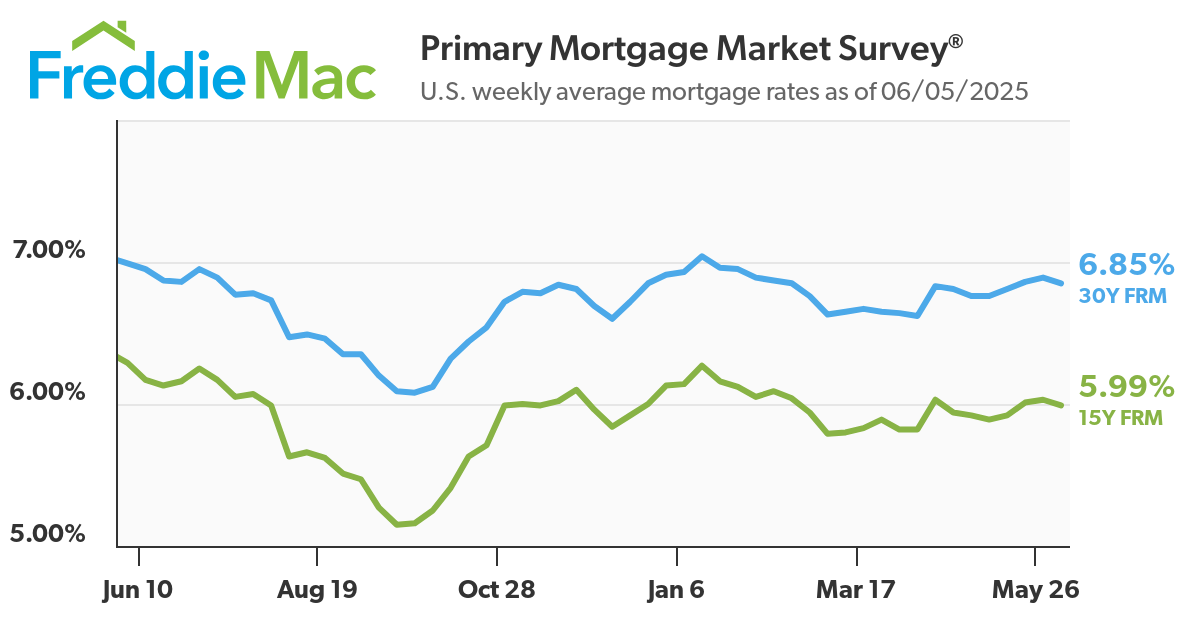
As of June 5, 2025, the average interest rate for a 30-year fixed-rate mortgage (also known as a 30-Yr FRM) stood at 6.85%. Looking back, according to Freddie Mac's data, this is a slight decrease from the previous week (-0.04%) and also a bit lower than where we were a year ago (-0.14%).

mortgage interest rates graph
Source: Freddie Mac

For those considering a shorter loan term, the 15-year fixed-rate mortgage (15-Yr FRM) averaged 5.99%. This also saw a decrease of 0.04% from the week before and a more significant drop of 0.3% compared to this time last year.

Here's a quick summary:

Loan Type Current Rate (06/05/2025) Weekly Change Yearly Change
30-Yr FRM 6.85% -0.04% -0.14%
15-Yr FRM 5.99% -0.04% -0.30%

It's encouraging to see that rates have come down a little recently. For anyone looking to buy a home, this can make a real difference in their monthly payments and overall affordability. The fact that inventory is reportedly improving and house price growth is slowing down adds to this positive news for potential homebuyers.

A Deeper Dive into the Past Year's Trends

Looking at the mortgage interest rates graph since past one year (from June 5, 2024, to June 5, 2025), we can see the journey these rates have taken. The blue line represents the 30-year fixed rate, and the green line shows the 15-year fixed rate.

  • Fluctuations are Normal: What stands out immediately is that mortgage rates don't stay still. They go up and down based on a whole bunch of economic factors. You can see periods where both the 30-year and 15-year rates were climbing, and other times where they were on a downward trend.
  • Peak and Valley: The 30-year fixed rate touched a high of 7.04% within the past 52 weeks and a low of 6.08%. For the 15-year fixed rate, the range was between 6.27% and 5.15%. These are significant swings that could change your mortgage payment by a noticeable amount.
  • Impact of Economic Events: While the graph itself doesn't tell us why the rates moved the way they did, I know from my experience in following the market that things like inflation reports, decisions by the Federal Reserve (the Fed) about interest rates, and the overall health of the economy play a big role. When the economy is strong, and inflation is a concern, mortgage rates tend to rise. When the economy slows down, or there are worries about a recession, rates often fall.

Thinking About the Bigger Picture

It's easy to get caught up in the week-to-week changes, but it's important to think about the broader context. Over the past year, the housing market has been navigating a period of adjustment. After the very low interest rates we saw a few years ago, rates climbed quite sharply. This naturally had an impact on home affordability and the number of people looking to buy.

Now that rates seem to be stabilizing and even coming down a bit, it could signal a more balanced market. Sellers might need to be more realistic with their prices, and buyers might find more opportunities.

My Thoughts

Having followed the housing market for a while, I can tell you that trying to perfectly time when to buy based solely on interest rates is incredibly difficult – almost like trying to catch a falling knife! There are so many factors at play.

However, understanding the trends, like the ones we see in Freddie Mac's mortgage interest rates chart, can help you make more informed decisions. For example:

  • If rates are trending downward and you're in a stable financial position, it might be a good time to consider locking in a rate. Even a small decrease in the interest rate can save you thousands of dollars over the life of a 30-year loan.
  • If rates are high, it might be worth exploring adjustable-rate mortgages (ARMs) or focusing on improving your credit score to qualify for a better rate. Of course, ARMs come with their own set of risks, so it's crucial to understand how they work.

It's also worth remembering that your personal financial situation – your income, debts, and credit score – will significantly influence the mortgage rate you actually qualify for.

Read More:

Dave Ramsey Predicts Mortgage Rates Will Probably Drop Soon in 2025

Mortgage Rates Rise Back to 7% Once Again in June 2025

Mortgage Rate Forecast 2025: When Will Rates Go Below 6%?

Looking Ahead

Predicting where mortgage rates will go next is always a challenge. Economic forecasts can change, and unexpected events can happen. However, by keeping an eye on the mortgage interest rates graph since past one year and staying informed about economic news, you can get a sense of the general direction things might be heading.

The recent decrease in rates, combined with potentially improving inventory, could create a more favorable environment for homebuyers in the coming months. Of course, this is just my take based on the current data and my understanding of the market. It's always a good idea to talk to a financial advisor or a mortgage professional for personalized advice.

Summary:

The mortgage interest rates graph over the past year provides a valuable snapshot of how the cost of borrowing for a home has fluctuated. While we've seen some decreases recently, it's a reminder that rates are dynamic and influenced by a variety of economic factors. For anyone involved in the housing market, whether as a buyer, seller, or homeowner, staying informed about these trends is key to making sound financial decisions.

Invest Smarter in a High-Rate Environment

With mortgage rates remaining elevated this year, it's more important than ever to focus on cash-flowing investment properties in strong rental markets.

Norada helps investors like you identify turnkey real estate deals that deliver predictable returns—even when borrowing costs are high.

HOT NEW LISTINGS JUST ADDED!

Connect with a Norada investment counselor today (No Obligation):

(800) 611-3060

Get Started Now 

Also Read:

  • Will Mortgage Rates Go Down in 2025: Morgan Stanley's Forecast
  • Expect High Mortgage Rates Until 2026: Fannie Mae's 2-Year Forecast
  • Mortgage Rate Predictions 2025 from 4 Leading Housing Experts
  • Mortgage Rates Forecast for the Next 3 Years: 2025 to 2027
  • 30-Year Mortgage Rate Forecast for the Next 5 Years
  • 15-Year Mortgage Rate Forecast for the Next 5 Years
  • Why Are Mortgage Rates Going Up in 2025: Will Rates Drop?
  • Why Are Mortgage Rates So High and Predictions for 2025
  • Will Mortgage Rates Ever Be 3% Again in the Future?
  • Mortgage Rates Predictions for Next 2 Years
  • Mortgage Rate Predictions for Next 5 Years
  • Mortgage Rate Predictions: Why 2% and 3% Rates are Out of Reach
  • How Lower Mortgage Rates Can Save You Thousands?
  • How to Get a Low Mortgage Interest Rate?
  • Will Mortgage Rates Ever Be 4% Again?
Filed Under: Financing, Mortgage Tagged With: Interest Rate, mortgage, Mortgage Interest Rates Graph, Mortgage Rate Trends, mortgage rates

States With Lowest Mortgage Rates Today – June 12, 2025

June 12, 2025 by Marco Santarelli

States With Lowest Mortgage Rates Today – June 12, 2025

Looking for the best mortgage rates? As of today, June 12, 2025, the states boasting the lowest 30-year new purchase mortgage rates are New York, Massachusetts, Colorado, California, New Jersey, Washington, Texas, Florida, and Virginia. These states currently register average rates between 6.79% and 6.89%. Figuring out where to buy a home is tough enough; finding the lowest mortgage rate shouldn't be!

States With Lowest Mortgage Rates Today – June 12, 2025

I know what you're thinking: “Why do rates even change from state to state?” Well, let's dive in and see what impacts the mortgage rates and which states have the best deals right now.

Why Mortgage Rates Differ by State

Mortgage rates aren't uniform across the United States. Several factors play a role in these geographic variations. Here are a couple of main reasons that could affect the rate:

  • Lender Presence: Not all lenders operate in every state. The competitive landscape can change based on which lenders are actively trying to gain market share in a specific region. More competition often leads to lower rates.
  • State-Level Regulations: Mortgage regulations can vary significantly from state to state. These regulations can affect the cost of doing business for lenders and, consequently, the rates they offer.
  • Credit Score Averages: States with higher average credit scores might see slightly better rates, as lenders perceive borrowers as less risky.*
  • Average Loan Size: The average size of mortgages can impact rates since bigger the amount more the risk involved. If a state has a trend for taking bigger loans, there could be a rise in rate of interest.
  • Risk Management Strategies: Different lenders have varying approaches to risk. Some might be more aggressive in offering lower rates to attract borrowers, while others might be more conservative.

These variations can significantly impact what you will ultimately pay for your mortgage. It always pays to be informed!

The Best Bang for Your Buck: States With the Lowest Mortgage Rates

Alright, let's get down to brass tacks. According to Investopedia, as of today, here's the breakdown of the states offering the most attractive 30-year new purchase mortgage rates:

  • New York: The Empire State is starting to look enticing.
  • Massachusetts: Chowda' and low rates? Sounds like a good deal.
  • Colorado: The Rocky Mountain High is in Mortgage rate here
  • California: Surprisingly, the Golden State makes the cut.
  • New Jersey: The Garden State is home to big savings on mortgages.
  • Washington: Escape to the great Northwest.. and save some money doing so.
  • Texas: Everything's bigger in Texas. Including savings, apparently.
  • Florida: The Sunshine State continues to get brighter.
  • Virginia: The Old Dominion lives up to its nickname.

These states are currently offering average rates between 6.79% and 6.89%. Now, keep in mind this is just a snapshot in time and factors such as market volatility impact on rate of interest, but it gives you a solid starting point for your research.

The Other Side of the Coin: States With Higher Mortgage Rates

On the flip side, some states are seeing less favorable mortgage rates today. These states might have a combination of the factors mentioned above, leading to higher borrowing costs. For June 12, 2025, the states with the highest 30-year new purchase mortgage rates include:

  • Alaska: Maybe the cost of living up north is just higher in general.
  • West Virginia: Rates are among the highest in the nation.
  • Mississippi: Buyers should be aware of these high rates.
  • North Dakota: High rates are hitting this wheat-growing region.
  • Maine: Rates are less than ideal in this coastal state.
  • Kansas: Mortgage rates are pretty expensive here.
  • New Mexico: Rates are not favorable for new home purchases.
  • South Dakota: Home buyers may want to think twice.
  • Wyoming: Rates are sky high during this period.

These states are registering refinance averages between 6.99% and 7.08%. If you're in one of these states, don't despair! Shopping around and improving your credit score can still help you secure a better rate.

Decoding National Mortgage Rate Trends

It's not just about state-specific rates. The national mortgage rate scene plays a big role. As of today, June 12, 2025, the national average for a 30-year new purchase mortgage is around 6.91%.

We've seen some movement in recent months. 30-year rates had dropped every day this week, fully erasing last week's two-day surge. The rates also witnessed an all time high mid-May, when the flagship average climbed to a one-year high of 7.15%. However, things can change quickly!

Here's a quick look at how rates have fluctuated this year:

  • March: 30-year rates hit their lowest average of 2025 at 6.50%.
  • September (Previous Year): Rates plunged to a two-year low of 5.89%.

Understanding these trends can help you time your mortgage application strategically, but remember that trying to time the market perfectly is almost impossible.

To get a better picture, here are the national averages for different loan types, as provided by the Zillow:

Loan Type New Purchase Rate
30-Year Fixed 6.91%
FHA 30-Year Fixed 7.03%
15-Year Fixed 5.98%
Jumbo 30-Year Fixed 6.90%
5/6 ARM 7.15%

What's Driving These Fluctuations?

So, what's behind these ups and downs in mortgage rates? It's a complex mix of factors, including:

  • Bond Market: Mortgage rates often follow the trajectory of the bond market, especially the 10-year Treasury yield.
  • Federal Reserve (The Fed): The Fed's monetary policy, particularly its bond-buying programs and decisions about the federal funds rate, can significantly impact mortgage rates.
  • Lender Competition: Competition among lenders can drive rates down as they try to attract borrowers and stay more competitive.

Remember the period between November 2021 and July 2023 and the aggressive measure taken by the Fed to combat the inflation? The Fed decided to raise the interest rate upto 5.25 percentage points over the period of sixteen months.

Read More:

States With the Lowest Mortgage Rates on June 11, 2025

Are Mortgage Rates Expected to Go Down Soon: A Realistic Outlook

Calculating Your Potential Mortgage Payment

Okay, enough with the macroeconomics. Let's get practical. How do you figure out what your monthly mortgage payment might look like? Check out this example:

  • Home Price: $440,000
  • Down Payment: $88,000 (20%)
  • Loan Term: 30 years
  • APR (Interest Rate): 6.67%

Based on these figures, your estimated monthly payment would be around $2,649.04. Keep in mind this includes principal, interest, property taxes, and homeowners insurance. You will also need to consider things like Private Mortgage Insurance (PMI) if your down payment is less than 20%.

Don't forget that rates, insurance, and taxes are subject to change. Make sure you get the most updated information before making any decisions.

Shopping Around is Key

No matter what state you're in, shopping around for the best mortgage rate is an absolute must. Don't just take the first offer you get. Get quotes from multiple lenders and compare them carefully.

Here are a few tips for getting the best mortgage rate:

  • Improve Your Credit Score: A higher credit score can qualify you for a lower rate.
  • Save for a Larger Down Payment: Putting more money down can reduce the lender's risk and potentially lower your rate.
  • Consider Different Loan Types: Explore options like adjustable-rate mortgages (ARMs) or government-backed loans (FHA, VA) to see if they offer better terms.
  • Negotiate Fees: Don't be afraid to negotiate with lenders on fees like origination fees or points.

The Bottom Line

Mortgage rates are a moving target. While certain states currently offer lower rates, the overall market is constantly changing. By understanding the factors that influence rates and shopping around for the best deal, you can position yourself to save money on your home purchase. Staying informed is the key tool to crack the best mortgage options.

Invest in Real Estate in the Top U.S. Markets

Investing in turnkey real estate can help you secure consistent returns with fluctuating mortgage rates.

Expand your portfolio confidently, even in a shifting interest rate environment.

Speak with our expert investment counselors (No Obligation):

(800) 611-3060

Get Started Now

Also Read:

  • Will Mortgage Rates Go Down in 2025: Morgan Stanley's Forecast
  • Expect High Mortgage Rates Until 2026: Fannie Mae's 2-Year Forecast
  • Mortgage Rate Predictions 2025 from 4 Leading Housing Experts
  • Mortgage Rates Forecast for the Next 3 Years: 2025 to 2027
  • 30-Year Mortgage Rate Forecast for the Next 5 Years
  • 15-Year Mortgage Rate Forecast for the Next 5 Years
  • Why Are Mortgage Rates Going Up in 2025: Will Rates Drop?
  • Why Are Mortgage Rates So High and Predictions for 2025
  • Will Mortgage Rates Ever Be 3% Again in the Future?
  • Mortgage Rates Predictions for Next 2 Years
  • Mortgage Rate Predictions for Next 5 Years
  • Mortgage Rate Predictions: Why 2% and 3% Rates are Out of Reach
  • How Lower Mortgage Rates Can Save You Thousands?
  • How to Get a Low Mortgage Interest Rate?
  • Will Mortgage Rates Ever Be 4% Again?
Filed Under: Financing, Mortgage Tagged With: Interest Rate, mortgage, Mortgage Rate Trends, mortgage rates, Mortgage Rates Predictions, Mortgage Rates Today

Today’s Mortgage Rates – June 12, 2025: Rates Are Notably Down Amid Economic Shifts

June 12, 2025 by Marco Santarelli

Today’s Mortgage Rates - June 12, 2025: Rates Are Down Amid Economic Shifts

Mortgage rates are a vital indicator of the health of the housing market and have a profound impact on consumer purchasing power, refinancing decisions, and overall economic confidence. As of June 12, 2025, mortgage rates have shown signs of slight decline, sparking cautious optimism among prospective homebuyers and current homeowners.

Today’s Mortgage Rates – June 12, 2025: Rates Are Notably Down Amid Economic Shifts

The latest data from Zillow shows a subtle but noteworthy dip in mortgage rates compared to prior weeks. After months of relatively elevated rates, even small decreases can make a substantial difference in affordability for many homebuyers.

National Average Mortgage Rates

Loan Type Current Rate Change from Last Week APR APR Change
30-Year Fixed 6.91% -0.08% 7.34% -0.11%
15-Year Fixed 5.97% -0.03% 6.25% -0.11%
5-Year ARM 7.30% No change 7.83% -0.17%

Key Observations:

  • The national average for 30-year fixed-rate mortgages fell slightly from 6.99% last week to 6.91%.
  • The 15-year fixed mortgage rate slipped below 6% for the first time in weeks.
  • The 5-year ARM rate remains steady, but its APR slightly improved, reflecting marginally better borrowing costs.

This slight decline could stem from a mix of market reactions to economic data releases, inflation trends, and investor expectations for Federal Reserve monetary policy.

Detailed Mortgage Rates by Loan Type

Mortgage rates are not uniform; they differ by loan program, loan term, and borrower qualifications. Below is a breakdown of rates across the major loan categories:

Conforming Loan Rates

Program Rate Weekly Change APR Weekly APR Change
30-Year Fixed 6.91% -0.08% 7.34% -0.11%
20-Year Fixed 6.31% -0.51% 6.73% -0.51%
15-Year Fixed 5.97% -0.09% 6.25% -0.11%
10-Year Fixed 5.93% No Change 6.26% +0.09%
7-Year ARM 6.64% -1.17% 7.51% -0.72%
5-Year ARM 7.30% -0.32% 7.83% -0.17%

The 7-year ARM and 20-year fixed loans show the steepest weekly decline, signaling lender competition in these niches.

Government-Backed Loans

Program Rate Weekly Change APR Weekly APR Change
30-Year Fixed FHA 6.81% -0.11% 7.83% -0.11%
30-Year Fixed VA 6.36% -0.09% 6.57% -0.09%
15-Year Fixed FHA 5.70% +0.01% 6.67% 0.00%
15-Year Fixed VA 5.89% -0.08% 6.24% -0.09%

Government loans consistently offer slightly better rates for qualified borrowers due to backing by federal agencies, which reduces lender risk.

Jumbo Loans

Program Rate Weekly Change APR Weekly APR Change
30-Year Fixed Jumbo 7.30% -0.12% 7.76% -0.04%
15-Year Fixed Jumbo 6.54% -0.23% 6.82% -0.19%
7-Year ARM Jumbo 7.53% No Change 8.06% No Change
5-Year ARM Jumbo 7.16% -0.51% 7.77% -0.28%

Insights:

  • Jumbo loan rates remain higher than conforming loans, reflecting greater lender risk due to larger loan amounts.
  • Adjustable-rate jumbo loans have also shown downward movement, which could appeal to high-income borrowers seeking smaller payments in early years.

Factors Influencing Current Mortgage Rates

Understanding what drives mortgage rates helps borrowers anticipate trends and make better decisions.

Federal Reserve Monetary Policy

While mortgage rates do not directly track the Fed’s federal funds target rate, Fed policy heavily influences long-term interest rates through bond markets. Currently, the Federal Reserve is in a holding pattern, waiting on further economic data to determine if rate cuts are warranted. If the Fed cuts rates later this year, mortgage rates could fall in response.

Inflation and Economic Data

Mortgage rates generally rise with inflation since lenders demand higher yields to offset declining purchasing power. Recent inflation trends showing moderating price increases have contributed to downward pressure on mortgage rates.

Bond Market Movements

Mortgage rates closely correlate to yields on 10-year Treasury notes. Increased demand for safe-haven Treasuries can drive yields lower, leading to better mortgage rate offers.

Housing Market Conditions

A slowdown in home sales and price appreciation can indirectly influence rates by altering lender risk appetite and competition.

How To Get The Best Mortgage Rates Today

Securing the lowest possible rate requires more than timing the market. Here are actionable tips to optimize your mortgage application:

1. Strengthen Your Credit Profile

Your credit score is one of the most significant factors affecting your mortgage rate. Steps include:

  • Paying down credit card balances.
  • Avoiding new credit inquiries.
  • Correcting errors on your credit report.
    Lenders reward higher credit scores with lower interest rates because those borrowers are statistically less risky.

2. Maintain Stable Income and Employment

Verifiable and steady income reassures lenders, sometimes resulting in better loan offers.

3. Save for a Larger Down Payment

Higher down payments reduce loan-to-value ratios, decreasing lender risk and unlocking better rates and loan programs.

4. Shop and Negotiate with Multiple Lenders

Don’t settle for the first offer — get rate quotes from banks, credit unions, mortgage brokers, and online lenders. Compare not only interest rates but also APRs and closing costs to understand the total cost.

5. Consider Points and Loan Terms

Paying mortgage points upfront can reduce the interest rate. Additionally, choosing a shorter loan term (e.g., 15 years) usually yields lower rates, though monthly payments increase.

6. Lock Your Rate at the Right Time

Once you find a favorable rate, lock it to protect against upward volatility during the underwriting process. Rate lock durations vary, so ask your lender about options.

Will Mortgage Rates Go Down?

Predicting future mortgage rates remains inherently uncertain but analysis from expert organizations provides insight:

Expert Forecasts for 2025 and Beyond

  • Fannie Mae expects the 30-year fixed mortgage rate to average near 6.1% by the end of 2025.
  • Freddie Mac reports rates have ranged from 6.08% to 7.04% during early 2025.
  • The National Association of Realtors projects an average 6.4% in 2025, gradually falling to 6.1% in 2026.
  • Realtor.com anticipates rates dropping slightly to 6.2% toward year-end.

Factors That Could Lower Rates:

  • Federal Reserve rate cuts if economic growth slows.
  • Continued moderation in inflation, easing bond yields.
  • Increased demand for mortgage-backed securities (MBS) supporting loan pricing.

Risks That Could Keep Rates Elevated:

  • Persistent inflation pressures.
  • Robust economic growth driving bond yields higher.
  • Global economic instability increasing market volatility.

Read More:

Mortgage Rates Trends as of June 11, 2025

Will Mortgage Rates Go Down in June 2025: Expert Forecast

Mortgage Rate Forecast 2025: When Will Rates Go Below 6%?

Understanding Current Refinance Rates

Refinancing remains an important strategy for many homeowners seeking to capitalize on falling rates or adjust loan terms.

Refinance Rates Snapshot as of June 12, 2025

Loan Type Refinance Rate Weekly Change APR Weekly APR Change
30-Year Fixed 7.09% -0.06% 7.40% -0.10%
15-Year Fixed 6.00% -0.01% 6.26% -0.03%
5-Year ARM 7.81% +0.87% 8.10% +0.15%
30-Year Fixed FHA 6.53% -0.16% 7.55% -0.17%
30-Year Fixed VA 6.71% +0.13% 6.93% +0.16%

Refinance rates tend to be slightly higher than purchase mortgage rates due to underwriting risk and fees. The 5-year ARM refinance rate saw a notable increase, reflecting possible changes in adjustable rate market demand.

Should You Refinance Your Mortgage in 2025?

Refinancing is not a one-size-fits-all solution. Consider your individual financial situation:

When to Refinance:

  • Lower Interest Rates: Refinancing makes sense when current rates are at least 0.5% to 1% lower than your original mortgage. This gap helps offset closing costs and makes monthly payments more affordable.
  • Shortening Loan Term: Refinancing to a shorter-term loan can save thousands in interest over the life of the mortgage, though monthly payments increase.
  • Switching from ARM to Fixed: Homeowners concerned about future rate hikes may refinance from an adjustable-rate mortgage to a fixed-rate loan for payment stability.
  • Cash-Out Refinancing: Accessing equity through refinancing can fund home improvements, college tuition, or debt consolidation but increases loan balance and monthly payments.

Important Considerations:

  • Calculate the break-even point to determine how long it will take for the savings to cover refinancing costs.
  • Evaluate the impact on your credit score, which may dip temporarily after refinancing.
  • Assess your plans for staying in the home; refinancing is more beneficial if you plan to keep the property long term.

Meeting with a mortgage advisor for a personalized analysis is highly recommended.

Key Takeaways

  • Mortgage rates across the board are trending slightly downward as of June 12, 2025, providing opportunities for buyers and refinancers.
  • Rates vary considerably by loan type, with government-backed loans generally offering more favorable terms.
  • Economic factors, Federal Reserve policy, and inflation continue to be primary drivers of mortgage rate fluctuations.
  • Borrowers can secure better rates through strong credit, diligent lender shopping, and prudent financial planning.
  • Expert forecasts suggest modest rate declines in the latter half of 2025 but expect some ongoing volatility.
  • Refinancing remains a powerful tool if rates are favorable and long-term savings surpass refinancing costs.

Summary

As of mid-2025, mortgage rates demonstrate a modest easing, with the 30-year fixed rate averaging 6.91%. This environment offers a cautiously optimistic outlook for homebuyers and homeowners seeking to refinance. Understanding the numerous factors that influence rates, from Federal Reserve decisions to inflation data, empowers consumers to navigate the housing finance landscape more effectively.

Securing the best mortgage rate requires preparation, credit strength, and market insight, while the decision to refinance hinges on individual financial goals and current rate comparisons. Although uncertainty remains regarding the pace of future rate declines, staying informed and proactive will enable borrowers to capitalize on opportunities as the year progresses.

Invest Smarter in a High-Rate Environment

With mortgage rates remaining elevated this year, it's more important than ever to focus on cash-flowing investment properties in strong rental markets.

Norada helps investors like you identify turnkey real estate deals that deliver predictable returns—even when borrowing costs are high.

HOT NEW LISTINGS JUST ADDED!

Connect with a Norada investment counselor today (No Obligation):

(800) 611-3060

Get Started Now 

Also Read:

  • Will Mortgage Rates Go Down in 2025: Morgan Stanley's Forecast
  • Expect High Mortgage Rates Until 2026: Fannie Mae's 2-Year Forecast
  • Mortgage Rate Predictions 2025 from 4 Leading Housing Experts
  • Mortgage Rates Forecast for the Next 3 Years: 2025 to 2027
  • 30-Year Mortgage Rate Forecast for the Next 5 Years
  • 15-Year Mortgage Rate Forecast for the Next 5 Years
  • Why Are Mortgage Rates Going Up in 2025: Will Rates Drop?
  • Why Are Mortgage Rates So High and Predictions for 2025
  • Will Mortgage Rates Ever Be 3% Again in the Future?
  • Mortgage Rates Predictions for Next 2 Years
  • Mortgage Rate Predictions for Next 5 Years
  • Mortgage Rate Predictions: Why 2% and 3% Rates are Out of Reach
  • How Lower Mortgage Rates Can Save You Thousands?
  • How to Get a Low Mortgage Interest Rate?
  • Will Mortgage Rates Ever Be 4% Again?

Filed Under: Financing, Mortgage Tagged With: Interest Rate, mortgage, Mortgage Rate Trends, mortgage rates, Mortgage Rates Predictions, Mortgage Rates Today

  • « Previous Page
  • 1
  • …
  • 37
  • 38
  • 39
  • 40
  • 41
  • …
  • 64
  • Next Page »

Real Estate

  • Birmingham
  • Cape Coral
  • Charlotte
  • Chicago

Quick Links

  • Markets
  • Membership
  • Notes
  • Contact Us

Blog Posts

  • Mortgage Rates Today, June 20, 2026: 30‑Year Refinance Rate Rises by 3 Basis Points
    June 20, 2026Marco Santarelli
  • Cape Coral Housing Market 2026: Where Investors Are Finding the Best Deals
    June 19, 2026Marco Santarelli
  • Florida Housing Market Maintains Growth Streak Heading Into Summer 2026
    June 19, 2026Marco Santarelli

Contact

Norada Real Estate Investments 30251 Golden Lantern, Suite E-261 Laguna Niguel, CA 92677

(949) 218-6668
(800) 611-3060
BBB
  • Terms of Use
  • |
  • Privacy Policy
  • |
  • Testimonials
  • |
  • Suggestions?
  • |
  • Home

Copyright 2018 Norada Real Estate Investments

Loading...