Norada Real Estate Investments

  • Home
  • Markets
  • Properties
  • Membership
  • Podcast
  • Learn
  • About
  • Contact

Economic Forecast for 2026 and 2027: GDP, Inflation, Jobs & Key Risks

May 14, 2026 by Marco Santarelli

Economic Forecast for 2026 and 2027: GDP, Inflation, Jobs & Key Risks

Let's talk about the future of the U.S. economy. It's a topic that touches all of us, from the prices at the grocery store to the job market and our retirement savings. As I look ahead to 2026 and 2027, the picture is one of steady, albeit measured, growth, with inflation gradually calming down and a strong job market holding steady. It’s not a crystal-clear path, mind you, but the overall trend appears to be heading towards a “soft landing” – a way for the economy to cool down without crashing.

Economic Forecast for 2026 and 2027: GDP, Inflation, Jobs & Key Risks

The Big Picture: Growth on the Horizon

Right now, in mid-2026, the U.S. economy is showing a surprising amount of toughness. Sure, we've had some bumps, like that temporary government shutdown that slowed things down at the end of 2025. But overall, real GDP is chugging along at a healthy pace. Many smart folks – from the Federal Reserve and the Congressional Budget Office to big financial institutions like Deloitte and S&P Global Ratings – are all pointing towards continued, steady growth through 2027.

What's driving this optimism? A few key things.

  • AI Power: Businesses are investing heavily in Artificial Intelligence. Think about how companies are using AI to become more efficient, develop new products, and improve services. This “AI-driven business investment” is a big tailwind.
  • Government Support: Some tax and spending measures passed in 2025 are still giving the economy a boost. These acts, sometimes called the “One Big Beautiful Bill Act” or similar, are helping to put more money into people's pockets and encourage businesses to spend.
  • You and Me: Consumer spending remains strong. Even with some economic pressures, people are still buying goods and services, which is the engine of our economy.

However, it's not all smooth sailing. We're still dealing with:

  • Trade Hurdles: Persistent tariffs (taxes on imported goods) can make things more expensive.
  • Energy Woes: Elevated energy costs, especially with tensions in the Middle East, can impact everything from gas prices to shipping costs.
  • Immigration Shifts: Changes in immigration can affect the size of our workforce.
  • Big Budgets: Large government deficits mean more debt, which can have long-term consequences.

So, while most experts predict growth around 2.2% to 2.5% for 2026, and a slight moderation to 1.8% to 2.3% in 2027, it's important to remember these are averages. The journey might have its ups and downs.

Inflation: Cooling Down, But Still a Watcher

Inflation has been a hot topic, and for good reason. It’s the reason why your grocery bill seems to creep up faster each week. While recent energy price spikes, likely due to global events, have pushed inflation up a bit recently, the trend is expected to be downwards.

  • The Federal Reserve is projecting PCE inflation around 2.7% in 2026, moving towards 2.2% in 2027.
  • Many other forecasters see a similar pattern, with temporary bumps from energy and tariffs fading as we move through 2026 and into 2027.

The big hope is that inflation will eventually settle down close to the Fed's target of 2%. This will make our money go further and provide more predictability for everyone.

The Job Market: Steady as She Goes

One of the most reassuring signs is the strength of the labor market. The unemployment rate is expected to stay relatively low, hovering around 4.3% to 4.4% in 2026 and possibly dipping slightly to 4.2% to 4.3% in 2027.

What does this mean in plain English?

  • Jobs are still being created: While the pace of job creation might slow down a bit from the frenzy of earlier years, companies are still hiring. We're looking at monthly payroll gains that are positive but moderating.
  • Finding a job is still possible: For most people looking for work, the odds are still in their favor.
  • Wages are growing: We're seeing wage growth that generally keeps pace with how much we produce as a country. This helps your paycheck keep up with the cost of living, without necessarily pushing inflation higher.

It seems we're entering a phase where companies are hiring and firing less, creating a more stable job market.

Monetary Policy: The Fed's Watchful Eye

The Federal Reserve plays a crucial role in managing the economy. They have tools, like interest rates, to either cool things down or stimulate growth. Given the current forecast of moderating growth and cooling inflation, the Fed is expected to be patient.

  • Most forecasts suggest the federal funds rate (the benchmark interest rate) will likely stay put for much of 2026, with any potential rate cuts possibly delayed until 2027.
  • This means that things like mortgage rates might stay around 6.0% to 6.3% for a while. While this can make buying a home a bit more challenging, it's a far cry from the rapid rate hikes we saw previously.

It's like the Fed is carefully watching the economic thermostat, making small adjustments rather than big, drastic moves.

Consumer Spending and Housing: Holding Steady

As I mentioned, consumer spending is a rock for the economy. We expect real consumer spending growth to slow to around 1.8% to 2.8% in 2026, which is a bit slower than in 2025, but still healthy. Those tax cuts and a strong stock market (partly fueled by AI enthusiasm) are providing a cushion, especially for those with higher incomes.

The housing market is also showing signs of stability.

  • Home prices are expected to rise modestly, perhaps between 0% and 3.2% in 2026.
  • Home sales might pick up slightly as more houses become available.
  • With mortgage rates still a bit elevated, affordability remains a key challenge, but we're not anticipating a housing crash. It looks more like a balanced market than a boom or bust scenario.

Business Investment: The AI Effect

This is where things get really interesting. The buzz around AI isn't just talk; it's translating into real investment. Businesses, especially big tech companies (hyperscalers), are pouring money into AI-related infrastructure. This is expected to be a major driver of business investment, potentially leading to growth of 3.4% to 6% in 2026. Sectors like manufacturing and technology are poised to benefit.

Risks to Watch Out For

No economic forecast is complete without talking about what could go wrong. The risks are definitely leaning towards the downside:

  • Geopolitical Tensions: Any escalation in conflicts, particularly in the Middle East, could send energy prices soaring again and reignite inflation.
  • Trade Wars: Increased tariffs or new trade disputes could further disrupt supply chains and raise costs.
  • AI Bust: While AI is a huge driver now, a sudden slowdown in investment or a failure to deliver on promised productivity gains could have a negative impact. Some scenarios even predict a recession if this happens.
  • Debt Pile-Up: The growing national debt and rising interest payments are a long-term concern that could put pressure on future spending.

On the flip side, there are also potential upsides:

  • Faster AI Progress: If AI delivers even bigger productivity boosts than expected, it could accelerate growth.
  • Peaceful Resolution of Conflicts: A quick end to global tensions could lower energy prices and boost confidence.
  • More Immigration: An increase in immigration could help expand the labor force.

A Look Ahead: A “Soft Landing” Seems Likely

Overall, my read on the U.S. economic forecast for 2026 and 2027 is one of cautious optimism. The economy seems to be on track for a “soft landing,” meaning it will slow down enough to bring inflation under control without tipping into a full-blown recession. However, it's crucial to remember that the path ahead is not perfectly predictable. Global events and policy decisions will play a significant role in shaping the actual outcome. For all of us, it means preparing for a world where interest rates might stay higher for longer and being ready for the occasional economic turbulence.

Position Your Portfolio for 2026–2027

With GDP growth forecasts, inflation trends, and job market shifts shaping the economy, investors who act now can safeguard wealth and capture opportunities before risks intensify.

Norada Real Estate helps investors align with turnkey rental properties—delivering steady cash flow, appreciation, and long‑term ROI even in uncertain economic cycles.

🔥 new INVESTMENT properties JUST ADDED! 🔥
Speak with an Investment Counselor Today (No Obligation):
(800) 611-3060
Or Request a Callback / Fill Out the Form Online

Contact Us

Read More:

  • Rising US-Venezuela Tensions Add Uncertainty to the 2026 Economic Outlook
  • US-Iran War: A New Threat to America's Shaky Economy
  • Bond Market Today and Outlook for 2025 by Morgan Stanley
  • Goldman Sachs Significantly Raises Recession Probability by 35%
  • 2008 Crash Forecaster Warns of DOGE Triggering Economic Downturn
  • Stock Market Predictions 2025: Will the Bull Run Continue?
  • Echoes of 1987: Is Today’s Stock Market Crash Leading to a Recession?
  • Is the Bull Market Over? What History Says About the Stock Market Crash
  • Wall Street Bear Predicts a Historic Stock Market Crash Like 1929
  • Economist Predicts Stock Market Crash Worse Than 2008 Crisis
  • Next Stock Market Crash Prediction: Is a Crash Coming Soon?
  • Stock Market Crash: 30% Correction Predicted by Top Forecaster

Filed Under: Economy Tagged With: Economic Crisis, Economic Forecast, economic outlook, Economy

Wage Growth Beats Inflation for 32 Straight Months Boosting Purchasing Power

February 26, 2026 by Marco Santarelli

Wage Growth Beats Inflation for 32 Straight Months Boosting Purchasing Power

Great news for your wallet! For the past 32 months – dating all the way back to June 2023 – wages in the United States have been growing faster than the rate of inflation. This means that as of February 2026, the money you're earning is buying you more than it did before, effectively boosting your purchasing power and giving you a little extra room to breathe. This positive trend, where your paycheck stretches further, is a welcome shift after a period where prices often seemed to climb faster than we could keep up.

Wage Growth Beats Inflation for 32 Straight Months, Boosting Purchasing Power

It's been a bit of a rollercoaster, hasn't it? For a while there, it felt like every trip to the grocery store or the gas pump was a stark reminder that prices were going up, and fast. But looking at the numbers now, something has shifted.

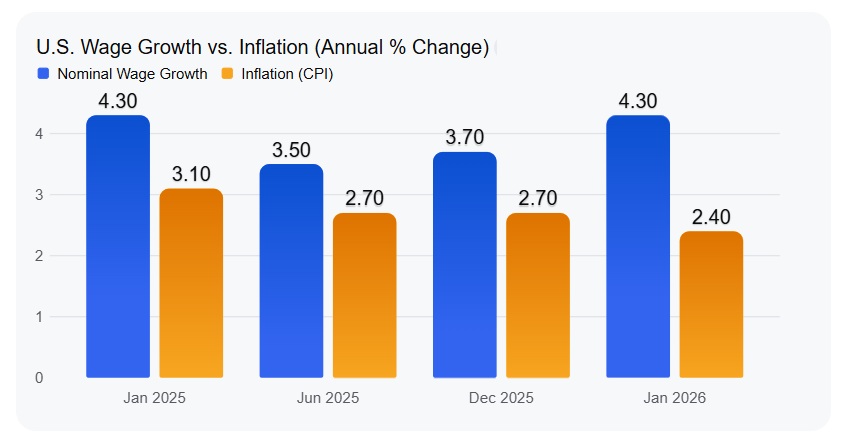
The data from sources like USAFacts shows that by January 2026, nominal wages (that's the actual dollar amount you earn) had climbed by a respectable 4.3%, while the annual inflation rate had cooled to a much more manageable 2.4%.

This gap, my friends, is what we call real wage growth, and it’s been hovering between 1.1% and 1.9% over the past year. This isn't just a small uptick; it represents a tangible increase in what your hard-earned money can actually buy.

U.S. Wage Growth vs. Inflation (Annual % Change)

Why Your Paycheck Feels Heftier Now

So, what's behind this positive turn of events? It’s not just one thing, but a combination of factors that are making our paychecks work harder for us.

A Tight Labor Market: The Power of Scarcity

One of the biggest drivers is the ongoing shortage of workers. Think about it: when there aren't enough people to fill available jobs, companies have to compete for talent. They do this by offering more attractive pay and benefits. This scarcity is driven by a few things: some workers retired early during the pandemic, immigration patterns have shifted, and many people are still juggling caregiving responsibilities. As a result, employers are digging deeper into their pockets to attract and keep good people.

Inflation Calms Down

Another significant piece of the puzzle is that inflation has started to ease up. Remember when gas prices and grocery bills seemed to be skyrocketing? Well, those sharp price increases have moderated. When prices aren't climbing as quickly, even steady wage increases start to feel much more impactful. It’s like the brakes have been applied to the runaway train of rising costs, allowing our wages to finally catch up and then some.

The Advantage of Switching Jobs

From my experience, and what the data appears to support, changing jobs often leads to bigger pay bumps. As the Atlanta Fed's Wage Growth Tracker shows, individuals who switch jobs as of January 2026 saw higher gains (around 4.7%) compared to those who stayed in their current roles (about 3.5%). This is a clear sign that the labor market is dynamic, and being willing to explore new opportunities can significantly boost your earnings. It puts a little more pressure on companies to keep their existing employees happy with competitive wages, too.

New Rules, New Leverage

There are also some structural changes happening. We're seeing more states and cities implement salary transparency laws, which means employers are more upfront about pay ranges. This can give employees more leverage in negotiations. Plus, some of the economic policies put in place after the pandemic are still creating incentives for people to work and giving them more say in their compensation.

Who is Benefiting Most?

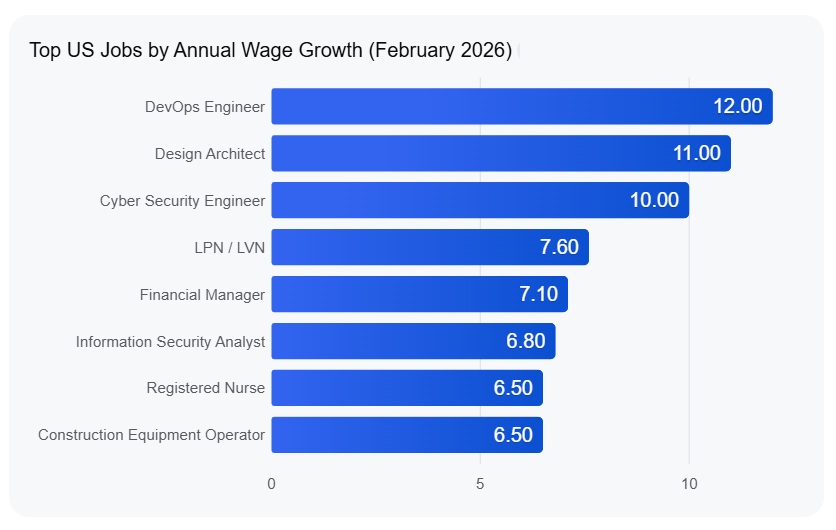
Top US Jobs by Annual Wage Growth (February 2026)

While this trend is good news for many, it's important to acknowledge that the benefits aren’t always spread evenly. It's what some economists call a “K-shaped recovery.”

  • Blue-Collar Boost: I've been particularly struck by how well some blue-collar workers are doing. The data shows significant real wage gains for them over the past year. For instance, mining workers saw their real earnings increase by roughly $2,400, construction workers by about $2,100, and manufacturing workers by around $1,700. This is a really positive development for these vital sectors of our economy.
  • The Tech and Healthcare Boom: As you might expect, certain high-demand fields are seeing exceptional wage growth.
    • Tech & AI: The relentless pursuit of digital transformation means roles like DevOps Engineers, AI Engineers, and Cybersecurity Analysts are commanding significant raises, often between 10% and 12% year-over-year.
    • Healthcare: With an aging population and persistent staffing shortages, Registered Nurses and Licensed Practical Nurses are seeing annual gains in the range of 6.5% to 7.6%.
    • Skilled Trades: The boost from federal infrastructure funding is also evident, with Electrical Power-Line Installers and Construction Equipment Operators seeing raises in the 5.7% to 6.5% range.
    • Finance: Specialized expertise in areas like compliance and digital finance is also leading to healthy salary growth, with Financial Managers seeing about 7.1% annual increases.
  • The “K-Shape” Concern: However, we also need to be mindful of the “K-shaped” divergence. While higher-income households might feel the full benefit of these real wage gains, lower-income households might still be grappling with the lingering effects of higher prices from previous years. The cumulative impact can be harder to overcome, even with current wage growth.

Looking Ahead: What About 2026?

What does the rest of 2026 look like? Most employers are planning to keep their salary increase budgets pretty steady, around 3.5%. This is still good news, as it’s projected to comfortably outpace the expected inflation rate of around 2.4%. So, it seems this trend of wages growing faster than prices is likely to continue, albeit at a more moderate pace.

Category Projection for Remainder of 2026
Salary Increase Budget ~3.5%
Projected Inflation Rate ~2.4%
Real Wage Growth Modest Positive Growth

It's important to remember that these are averages. Individual experiences can vary widely depending on your industry, your specific role, and whether you're looking to switch jobs. But overall, the economic picture for your paycheck is looking brighter than it has in quite some time. It's a reward for hard work and a sign that the economic gears are turning in a way that benefits the average worker.

Wage Growth Outpaces Inflation: Stronger Purchasing Power in 2026

Wage growth has beaten inflation—boosting household purchasing power and fueling confidence in the economy. This rare streak is creating stronger demand for housing and investment opportunities across U.S. markets.

Norada Real Estate helps investors capitalize on this trend with turnkey properties—delivering immediate cash flow and long‑term ROI as rising wages expand affordability and rental demand.

🔥 HOT 2026 INVESTMENT LISTINGS JUST ADDED! 🔥
Speak with an Investment Counselor Today (No Obligation):
(800) 611-3060
Or Request a Callback / Fill Out the Form Online

Contact Us

Read More:

  • Rising US-Venezuela Tensions Add Uncertainty to the 2026 Economic Outlook
  • US-Iran War: A New Threat to America's Shaky Economy
  • Bond Market Today and Outlook for 2025 by Morgan Stanley
  • Goldman Sachs Significantly Raises Recession Probability by 35%
  • 2008 Crash Forecaster Warns of DOGE Triggering Economic Downturn
  • Stock Market Predictions 2025: Will the Bull Run Continue?
  • Echoes of 1987: Is Today’s Stock Market Crash Leading to a Recession?
  • Is the Bull Market Over? What History Says About the Stock Market Crash
  • Wall Street Bear Predicts a Historic Stock Market Crash Like 1929
  • Economist Predicts Stock Market Crash Worse Than 2008 Crisis
  • Next Stock Market Crash Prediction: Is a Crash Coming Soon?
  • Stock Market Crash: 30% Correction Predicted by Top Forecaster
Filed Under: Economy Tagged With: economic outlook, inflation, Wage growth

Rising US-Venezuela Tensions Add Uncertainty to the 2026 Economic Outlook

January 5, 2026 by Marco Santarelli

Rising US-Venezuela Tensions Add Uncertainty to the 2026 Economic Outlook

The recent military action by the U.S. in Venezuela, specifically the capture of President Nicolás Maduro on January 3, 2026, has thrown a big question mark over what the economy will look like in 2026. While the long-term possibility of tapping into Venezuela's massive oil reserves is tempting, the immediate aftermath is a messy mix of fears about instability and financial jitters. It's not a simple picture, and frankly, it’s something I’ve been watching closely.

I remember reading about Venezuela’s oil potential for years, with its immense reserves often talked about as a game-changer. Yet, mismanagement and political turmoil meant that potential remained largely untapped. Now, with this dramatic intervention, the gears are turning in a new, and frankly, unpredictable direction.

Rising US-Venezuela Tensions Add Uncertainty to the 2026 Economic Outlook

When the Unexpected Happens: Geopolitical Ripples and Market Jitters

You know how sometimes a sudden storm can make everything feel a bit shaky? That’s kind of what’s happening in the global economy right now because of what went down in Venezuela.

  • Investors Running for Cover: The moment news broke about the U.S. action, you saw people scrambling to protect their money. Gold prices shot up by over 2.5%, hitting more than $4,430 an ounce. Silver followed suit with a nearly 5% jump. This is a classic reaction – when things get uncertain, investors tend to dump riskier assets and pile into things like gold, which are seen as a safer bet. I’ve seen this play out before, and it signals that folks are worried.
  • A “Wait and See” Approach: President Trump has said the U.S. intends to “run” Venezuela until it’s stable. This is a huge statement. It raises concerns that this isn't going to be a quick fix. A drawn-out, messy transition could easily spill over, causing headaches for other countries in our hemisphere. It’s like a domino effect, and nobody wants to be the one the domino falls on.

I think about how interconnected everything is. What happens in one corner of the world, especially when it involves a major power like the U.S. and a country with significant resources like Venezuela, inevitably sends tremors everywhere else.

The Oil Factor: More Questions Than Answers for 2026

Venezuela’s oil is a big piece of this puzzle, even if they aren’t currently producing a massive chunk of the world’s supply (around 800,000 to 900,000 barrels a day).

  • Potential for Hiccups: The worry isn't so much about a current shortage, but about what happens during this transition. If things get chaotic, you could see a significant drop in production – maybe up to half – because of operational issues or resistance from those who were in charge. This is what keeps energy traders up at night.
  • The Long Road to Rebuilding: President Trump has talked about bringing in U.S. energy companies to fix Venezuela’s broken-down oil infrastructure. That sounds good on paper, but from my understanding of how these things work, it’s a monumental task. It will take years and billions upon billions of dollars. So, don’t expect it to suddenly solve any oil supply shortages in 2026. It’s more of a long-term bet.
  • U.S. Tightening the Grip: The U.S. has essentially put an “oil blockade” on tankers carrying Venezuelan oil. This is a clear signal that they’re using this to ensure the outcome benefits them. For now, this means Venezuela’s oil exports are still going to be limited, keeping prices from dropping significantly based on their potential output.

It’s a bit of a Catch-22. The potential is there, but the execution and the time it takes to realize that potential are the big unknowns.

Global Trade and Money Matters: What It Means for Your Wallet

This situation isn't just about Venezuela and the U.S.; it reaches across the globe.

  • China's Watchful Eye: China is a major buyer of Venezuelan oil, so they're obviously keeping a close watch on these developments. Any supply chain disruption for them is a big deal. You saw Chinese oil companies' stocks take a dip after the U.S. intervention.
  • The Dollar's Strength and Inflation Fears: As geopolitical tensions ramped up, the U.S. dollar got stronger. While some folks hope that a stabilized Venezuela could eventually lead to more oil and lower global prices, the immediate effect is a higher “risk premium.” This makes it harder for the Federal Reserve to manage interest rates and complicates forecasts for economic growth worldwide in 2026. It’s like adding an extra layer of complexity to an already tricky economic equation.

From my perspective, this is exactly why understanding these geopolitical moves is crucial for anyone trying to make sense of the economy. It's not just about numbers; it’s about decisions that have far-reaching consequences.

Looking at 2026: A Summary of What We Might Expect

So, where does this leave us for the 2026 economic outlook?

  • Oil Prices: Most experts are still predicting that oil prices will stay relatively steady in 2026, with Brent crude averaging between $55 and $60 a barrel. This is largely due to a record global surplus of oil, meaning there’s plenty of supply from other sources even with the Venezuela situation. The Venezuela event is like a splash in a very large pond right now.
  • Investor Mood: Right now, markets are in a “wait and see” mode. The real upside for the global economy hinges on whether a stable, legitimate government can be established in Venezuela that can secure massive energy deals. That's the long-term hope, but it’s still very much up in the air.

It’s clear that the events in Venezuela are more than just a regional issue. They are a significant factor adding doubt to an already complex global economic forecast for 2026. The path forward is uncertain, and I’ll be watching closely to see how these tensions continue to shape our economic future.

Secure Your Investments Amid Global Geopolitical Uncertainty

Rising US‑Venezuela tensions add volatility to the 2026 economic outlook, creating uncertainty in energy markets, inflation, and interest rates. For investors, these geopolitical shifts highlight the importance of stable, income‑producing assets.

Norada Real Estate helps you hedge against global risks with turnkey rental properties designed for consistent cash flow and appreciation—providing passive income and long‑term wealth even when the broader economy faces turbulence.

🔥 HOT 2026 INVESTMENT LISTINGS JUST ADDED! 🔥
Talk to a Norada investment counselor today (No Obligation):
(800) 611-3060

Get Started Now

Read More:

  • US-Iran War: A New Threat to America's Shaky Economy
  • Bond Market Today and Outlook for 2025 by Morgan Stanley
  • Goldman Sachs Significantly Raises Recession Probability by 35%
  • 2008 Crash Forecaster Warns of DOGE Triggering Economic Downturn
  • Stock Market Predictions 2025: Will the Bull Run Continue?
  • Echoes of 1987: Is Today’s Stock Market Crash Leading to a Recession?
  • Is the Bull Market Over? What History Says About the Stock Market Crash
  • Wall Street Bear Predicts a Historic Stock Market Crash Like 1929
  • Economist Predicts Stock Market Crash Worse Than 2008 Crisis
  • Next Stock Market Crash Prediction: Is a Crash Coming Soon?
  • Stock Market Crash: 30% Correction Predicted by Top Forecaster
Filed Under: Economy Tagged With: Economic Crisis, Economic Forecast, economic outlook, Economy

What Will be Mortgage Rates in 2025: Predictions & Outlook

January 13, 2025 by Marco Santarelli

What Will be Mortgage Rates in 2025: Predictions & Outlook

As we step into 2025, the question on the minds of homebuyers, homeowners, and real estate enthusiasts alike is: What will mortgage rates look like this year? While the mortgage rates are expected to gradually decline compared to previous highs, they will still hover around 6% to 6.8% throughout the year. This article explores the forecasts, economic factors, and expert insights that shape the outlook for mortgage rates in 2025.

What Will be Mortgage Rates in 2025: Predictions & Outlook

Key Takeaways

  • Current Average Mortgage Rate: The average 30-year fixed mortgage rate is around 6.8% as of January 2025.
  • Gradual Decline: Experts expect rates to gradually decrease but stay above 6%.
  • Influencing Factors: Key components such as Federal Reserve policy, inflation, and geopolitical events will significantly affect mortgage rates.
  • Expert Predictions: Organizations like Fannie Mae and the Mortgage Bankers Association (MBA) forecast rates stabilizing around 6.2% to 6.4% by the end of 2025.

Understanding how these factors interplay can help navigate mortgage decisions in the coming year.

Current State of Mortgage Rates

As 2025 commences, mortgage rates remain elevated when compared to the historic lows experienced in 2020 and 2021. Presently, the average 30-year fixed mortgage rate sits at 6.8%, reflecting a slight increase from the 6.08% low observed in September 2024. This rise can be attributed to the Federal Reserve's cautious approach regarding interest rate reductions amidst ongoing inflationary concerns.

Key Factors Influencing Mortgage Rates in 2025

1. Federal Reserve Policy

A primary player in determining mortgage rates is the Federal Reserve, which has cut rates three times throughout 2024, bringing the federal funds rate to a range of 4.25% to 4.50%. Future changes in these rates will be closely tied to ongoing inflation and unemployment data. Should inflation persist around 3%, the Fed is likely to take a conservative stance on further cuts, resulting in sustained higher mortgage rates. Any increase in the federal funds rate directly influences mortgage loan costs.

2. Inflation and Economic Data

Maintaining a keen eye on inflation, currently lingering near 3%, is crucial. Although it has seen a reduction from previous peaks, it remains above the Fed's target of 2%. If inflation experiences another surge, mortgage rates could follow suit. Conversely, a cooling economy might encourage the Fed to implement more aggressive rate decreases, which could benefit mortgage rates.

3. Labor Market Trends

While a robust labor market can indicate a stable economy, it can also drive wage inflation, which keeps mortgage rates elevated. A strong employment rate can lead to rising income levels, contributing to greater demand for housing and, consequently, higher mortgage rates. In contrast, should unemployment rates shift upward significantly, the Fed may react by reducing rates more drastically, potentially lowering mortgage expenses.

4. Geopolitical Events

Global uncertainties, such as ongoing tensions in Ukraine and potential conflicts in the Middle East, can disrupt oil supplies and trade, exacerbating inflation and influencing mortgage rates. Such geopolitical events create unpredictability in economic forecasts, making it essential for both buyers and homeowners to stay informed.

5. Government Policies and Deficits

The moves made by the incoming U.S. administration could influence mortgage rates as well. Potential tax cuts and shifts in government borrowing policy could impact inflation rates, which would, in turn, affect mortgage rates. Higher national deficits often lead to elevated Treasury yields, forming a basis for increased mortgage rates.

Expert Predictions for 2025

Multiple organizations have weighed in on their projections for mortgage rates in 2025. Here's a summary of their forecasts:

  • Fannie Mae anticipates the 30-year fixed rate to average 6.6% in the first quarter of 2025, before gradually declining to 6.2% by year's end (Fannie Mae).
  • The Mortgage Bankers Association (MBA) predicts rates will fluctuate between 6.4% and 6.6%, solidifying in the mid-6% range throughout the year (MBA).
  • The National Association of Realtors (NAR) forecasts stabilization around 6%, shifting towards 5.8% by the close of 2025.
  • Realtor.com suggests a projected average rate of 6.3% for the year with a year-end target of 6.2%.

Overall, these expert opinions suggest that while there may be minor declines in mortgage rates, significant fluctuations could continue.

What This Means for Homebuyers and Homeowners

For Homebuyers

Buyers entering the market in 2025 may find some relief as rates decline slightly. However, affordability remains a considerable challenge, requiring careful financial planning. Buyers should concentrate on ensuring their financial readiness rather than solely attempting to time the market. Options such as rate buydowns or adjustable-rate mortgages (ARMs) may add flexibility during a period of high rates.

For Homeowners Considering Refinancing

Refinancing becomes a more attractive option if mortgage rates settle in the mid-6% range. However, homeowners currently enjoying rates below 6% may find limited advantages in seeking new financing options this year. It’s vital for homeowners to assess their specific circumstances when contemplating refinancing.

Market Dynamics

An environment of lowered mortgage rates might encourage additional housing inventory, as current homeowners could feel more confident in putting their properties on the market. However, this influx can interact with heightened buyer demand, potentially leading to rising home prices that counteract some benefits of reduced rates.

Conclusion: A Year of Gradual Declines and Volatility

The forecast for mortgage rates in 2025 indicates a gradual decline; however, the journey promises to be filled with volatility. The interplay of inflation rates, Federal Reserve policies, and international events creates a complex tapestry of factors that will influence mortgage costs. For prospective buyers and existing homeowners, it's essential to remain informed and mindful of personal financial goals.

While we may be far from the historic lows of under 3%, the moderately easing rates in 2025 present new opportunities for those navigating the real estate market.

Work with Norada in 2025, Your Trusted Source for

Real Estate Investing

With mortgage rates fluctuating, investing in turnkey real estate

can help you secure consistent returns.

Expand your portfolio confidently, even in a shifting interest rate environment.

Speak with our expert investment counselors (No Obligation):

(800) 611-3060

Get Started Now 

Read More:

  • When Will Mortgage Rates Go Down to 3%: Predictions Reveal!
  • Mortgage Rates Predictions for Next 2 Years
  • Mortgage Rate Predictions for Next 5 Years
  • Mortgage Rate Predictions for 2025: Expert Forecast
  • Revised Mortgage Rate Predictions Signal HIGHER Rates
  • Predictions: Can Porting Your Mortgage Get You a Lower Interest Rate?

Filed Under: Financing, Mortgage Tagged With: economic outlook, homebuying, housing market predictions, mortgage rates, Real Estate Trends

Real Estate

  • Birmingham
  • Cape Coral
  • Charlotte
  • Chicago

Quick Links

  • Markets
  • Membership
  • Notes
  • Contact Us

Blog Posts

  • Best Cities to Invest in Real Estate in 2026 for Strong ROI Potential
    June 10, 2026Marco Santarelli
  • Today’s Mortgage Rates, June 10: Buyer Costs Ease Slightly as 30‑Year Fixed Drops to 6.33%
    June 10, 2026Marco Santarelli
  • 20 Best U.S. Cities to Invest in Real Estate in 2026
    June 10, 2026Marco Santarelli

Contact

Norada Real Estate Investments 30251 Golden Lantern, Suite E-261 Laguna Niguel, CA 92677

(949) 218-6668
(800) 611-3060
BBB
  • Terms of Use
  • |
  • Privacy Policy
  • |
  • Testimonials
  • |
  • Suggestions?
  • |
  • Home

Copyright 2018 Norada Real Estate Investments

Loading...