Norada Real Estate Investments

  • Home
  • Markets
  • Properties
  • Membership
  • Podcast
  • Learn
  • About
  • Contact

December 9–10 Fed Meeting is Shaping Up to Deliver the Third Rate Cut of 2025

December 8, 2025 by Marco Santarelli

Dec 9–10 Fed Meeting is Shaping Up to Deliver the Third Rate Cut of 2025

As December rolls around, all eyes are on the Federal Open Market Committee (FOMC) meeting scheduled for the 9th and 10th. The general consensus, and indeed what the market is heavily leaning towards, is that this gathering will mark the third consecutive interest rate cut of 2025. My own reading of the economic signals suggests this is indeed the path most likely to be taken, as the Fed seems to be prioritizing shoring up a job market that's showing definite signs of strain and trying to steer us away from the choppy waters of a recession. While inflation isn't quite where we want it, the urgency to support employment seems to be the prevailing sentiment.

Dec 9–10 FOMC Meeting is Shaping Up to Deliver the Third Rate Cut of 2025

It feels like just yesterday we were talking about inflation being the main headache, and now the conversation has shifted so dramatically to the labor market. This isn't just a minor tweak in thinking; it's a significant pivot. As an observer who's been tracking these economic cycles for a while now, I've seen how quickly sentiment can change based on incoming data.

The sheer volume of signs pointing towards a softening job market is hard to ignore. We’re looking at a situation where job growth is slowing, unemployment is ticking up, and private payrolls have seen their steepest drop in a considerable time. These aren't abstract figures; they represent real people and real businesses, and the Fed is keenly aware of the ripple effects.

Why the Urgency for Rate Cuts?

The upcoming FOMC meeting is shaping up to be very telling, and the expectation of a third rate cut isn't just a shot in the dark. Several key economic pieces are falling into place that strongly suggest this move.

  • A Labor Market Losing Steam: This is, without a doubt, the primary driver behind the expectation of a rate cut. Recent reports have painted a less rosy picture of U.S. employment. We've seen a noticeable slowdown in how many new jobs are being created monthly. Adding to this concern, the unemployment rate has been on the rise, and the recent figures for private payrolls have shown the sharpest decline we’ve witnessed in over two and a half years. When you see these kinds of numbers, it strongly suggests that the current level of interest rates might be a bit too restrictive, making it harder for businesses to hire and grow.
  • A “Risk Management” Mindset: Fed officials have been increasingly talking about a “risk management” approach to their policy decisions. What this means in plain English is that they are actively weighing the potential downsides. In recent months, they've identified that the downside risks to employment – meaning the chances of job losses and a weakening labor market – have gone up. From their perspective, it's better to ease monetary policy now, making it cheaper for businesses to borrow and invest, than to wait and risk a more severe economic downturn. It’s like bracing for a storm; you batten down the hatches before the worst hits.
  • The Inflation Puzzle: Now, I know what you're thinking: “What about inflation?” And you're right to ask. Inflation, while it has come down from its peak, is still above the Fed's 2% target. Latest figures put it somewhere around 2.8%. This is where the internal debate within the FOMC really heats up. However, many of the policymakers who are leaning towards cuts argue that a weaker labor market will naturally help cool down price pressures. They believe the immediate risk to jobs and economic growth outweighs the lingering inflation concerns, especially if they can bring inflation back down by simply letting the economy cool naturally.
  • Whispers from Officials: The public comments from key Fed officials have also been instrumental in shaping market expectations. Leaders like New York Fed President John Williams and Fed Governor Christopher Waller have made statements that can be interpreted as leaning towards supporting a rate cut in December. These aren't just casual remarks; they are carefully crafted messages intended to guide markets and signal the likely direction of policy. When leaders speak, the market listens.
  • A Pattern of Behavior: Looking back at past easing cycles, it's not uncommon for the Fed to make a series of adjustments. The rate cuts we've already seen in September and October 2025 are consistent with this historical pattern. Often, after a couple of cuts, there's a third one to really solidify the policy shift before the Fed takes a pause to assess the impact.

The Internal Tug-of-War: Hawks vs. Doves

While the majority of market watchers are banking on another rate cut, it's crucial to understand that this decision isn't going to be unanimous. Inside the FOMC, there's a palpable division of opinion.

We have the “hawks,” who are typically more concerned about inflation. They firmly believe that keeping interest rates higher for longer is essential to ensure inflation is truly on its way back to the 2% target. They worry that cutting rates too soon could reignite price pressures.

On the other side are the “doves,” who are more focused on supporting the job market and minimizing the risk of a recession. They see the current economic conditions as a clear signal that the Fed needs to provide more stimulus.

  • The Core Conflict: The fundamental disagreement boils down to which part of their dual mandate – maximum employment or stable prices – presents the greater risk to the economy right now. It's a classic economic tightrope walk.
Group Primary Concern Stance on Rates Rationale
Doves Job Market, Recession Risk Favor Cuts Sees rising job market risks; views cuts as “insurance” and expects weaker labor market to cool inflation.
Hawks Inflation Above Target Favor Pause/Higher Concerned inflation remains above 2%; fear cuts could re‑accelerate price pressures and be harder to control.

Factors Fueling the Labor Market Slowdown

The softening of the U.S. labor market isn't occurring in a vacuum. Several significant factors are contributing to this cooling trend:

  • The Shadow of Tariffs: Honestly, the ongoing uncertainty around trade policies and tariffs has cast a long shadow over businesses. This has made many companies hesitant to expand or even maintain their current hiring levels. We're seeing companies freeze hiring and, in some cases, cut jobs. Smaller businesses, in particular, are struggling with fluctuating costs and supply chain disruptions.
  • The Echo of Past High Rates: While the Fed has started cutting rates, the previously high interest rates that were put in place to combat inflation still have an effect. These higher borrowing costs can make businesses think twice before taking on new debt for expansion or investment, which naturally slows down the pace of hiring.
  • The Impact of Government Shutdowns: We've unfortunately seen periods of government shutdown in 2025. These events, even if temporary, can disrupt economic activity. Sectors like retail and food service, which rely on consumer spending, can be particularly hit as those on lower incomes might see their financial support programs paused, affecting demand.
  • Hiring Freezes and Job Cuts Hit Highs: The data is quite stark here. Many companies have put hiring freezes into effect, and job cut announcements have surged, reaching levels not seen since the pandemic. The number of available job openings has also dwindled, reaching its lowest point since early 2021. This paints a clear picture of a labor market that's transitioning from red-hot to more subdued.

The Complexity of Policy Decisions

The internal debates within the FOMC are understandable when you consider just how complex the current economic picture is. Deciding what's best for the economy when inflation is still a concern, but jobs are clearly at risk, is incredibly difficult.

  • The Neutral Rate Conundrum: Adding another layer of complexity is the disagreement among FOMC members about the neutral interest rate. This is the theoretical rate that neither speeds up nor slows down the economy. When officials can't even agree on this baseline, it's natural that they would have different ideas about whether policy should be more restrictive or more accommodative.
  • External Pressures: Beyond the internal economic data, the Fed also has to consider external pressures. The effects of trade policies and the fallout from government shutdowns add layers of uncertainty that make their decision-making process even more challenging.

My Take

From where I stand, the evidence pointing towards a third rate cut in December is strong. The Fed's mandate includes fostering maximum employment, and when the jobs market shows clear signs of distress, they typically act. While the inflation numbers lingering above target are a concern, the immediate risk to economic growth and employment seems to be the primary driver in their current thinking.

I expect the meeting will involve some heated discussions, likely resulting in a few dissenting votes. This isn't necessarily a bad thing; it reflects the genuine uncertainty and different perspectives on how to navigate these complex economic conditions. However, the prevailing sentiment, supported by the data and the rhetoric from key officials, strongly suggests that the Fed will err on the side of caution and provide a bit more of a boost to the economy by lowering interest rates. It's a delicate balancing act, and we'll be watching closely to see how this plays out in the coming months.

Invest in Real Estate While Rates Are Dropping — Build Wealth

If the Federal Reserve moves forward with another rate cut in December, investors could gain a valuable window to secure more favorable financing terms and scale their portfolios ahead of renewed buyer demand.

Lower borrowing costs would boost cash flow and enhance overall returns, especially for those positioned to act quickly

Work with Norada Real Estate to find turnkey, income-generating properties in stable markets—so you can capitalize on this easing cycle and grow your wealth confidently.

NEW TURNKEY DEALS JUST ADDED!

Talk to a Norada investment counselor today (No Obligation):

(800) 611-3060

Get Started Now

Want to Know More?

Explore these related articles for even more insights:

  • Fed Interest Rate Predictions Signal 70% Chance of December 2025 Cut
  • Fed Meeting Minutes Expose Divide: Why December Rate Cut Odds Are Fading Fast
  • Fed Interest Rate Predictions for the December 2025 Policy Meeting
  • Fed Signals Growing Reluctance to Interest Rate Cut in December 2025
  • Fed Cuts Interest Rate Today for the Second Time in 2025
  • Fed Interest Rate Forecast Q4 2025: Target Range Could Hit 3.50%–3.75%
  • Fed Interest Rate Forecast for the Next 12 Months
  • Interest Rate Predictions for the Next 3 Years: 2025, 2026, 2027
  • When is Fed's Next Meeting on Interest Rate Decision in 2025?
  • Interest Rate Predictions for the Next 10 Years: 2025-2035
  • Interest Rate Predictions for 2025 by JP Morgan Strategists
  • Interest Rate Predictions for Next 2 Years: Expert Forecast
  • Market Reactions: How Investors Should Prepare for Interest Rate Cut
  • Impact of Interest Rate Cut on Mortgages, Car Loans, and Your Wallet
Filed Under: Economy, Financing Tagged With: Economy, Fed, Federal Reserve, FOMC Meeting, interest rates

Interest Rate Predictions This Week Lean Towards a Third Fed Rate Cut

December 8, 2025 by Marco Santarelli

Interest Rate Predictions This Week Lean Towards a Third Fed Rate Cut

The Federal Reserve's upcoming meeting on December 9–10, 2025, is shaping up to be a significant event, and the consensus is leaning strongly towards an interest rate cut. My read of the latest market data suggests there's a very high probability, around 87%, of the Fed lowering its benchmark federal funds rate by 25 basis points (bp). If this happens, the target range will shift to 3.50%–3.75%. This would be the third such reduction in 2025, signalling a deliberate step by the central bank to ease monetary policy as the economy shows signs of cooling.

Interest Rate Predictions This Week Lean Towards a Third Fed Rate Cut

I've been tracking these developments closely. From my perspective, this decision isn't just about one meeting; it's a reflection of the Fed's ongoing effort to achieve its dual mandate of maximum employment and stable prices in a shifting economic environment. The current federal funds rate, sitting at 3.75%–4.00% as of early December 2025, is already a significant comedown from the peaks seen in mid-2024. The question on everyone's mind is what comes next, and the data strongly points towards further easing.

line chart of the effective federal funds rate

The Economic Tapestry: Weaving Together the Data

To understand why a rate cut is on the table, we need to look at the economic factors the Federal Reserve is carefully considering. The U.S. economy has been navigating a delicate path throughout 2025. We've seen growth moderate, with Gross Domestic Product (GDP) projected to grow between 1.8% and 2.0% for the year. This is a noticeable slowdown from the more robust pace seen previously.

Crucially, the labor market has also shown signs of softening. The unemployment rate has edged up to 4.4%, a figure that, while still historically low, signals some cooling in job creation and hiring. The Fed watches this metric like a hawk, as a strong labor market is a cornerstone of economic health. When it shows signs of weakness, it often prompts policy adjustments.

Inflation, another key piece of the puzzle, has also eased but remains a point of attention. While the overall Personal Consumption Expenditures (PCE) price index is hovering around 2.7%, it's still a bit above the Fed's 2% target. Core PCE, which excludes volatile food and energy prices, is showing a similar trend, sitting around 2.8%–2.9%. This near-target inflation level provides the Fed with the breathing room to consider easing policy without triggering fears of resurgence in price pressures.

Here's a quick breakdown of the key economic indicators influencing the Fed's decision:

Economic Indicator Latest Value (Late 2025) Trend & Fed Relevance
GDP Growth 1.8%–2.0% (annualized) Moderating growth supports rationale for easing to prevent a sharper slowdown.
Unemployment Rate 4.4% Rising slightly, indicating a cooling labor market, which is a strong signal for potential rate cuts.
PCE Inflation (Headline) ~2.7% Approaching 2% target, reducing pressure for hawkish policy, but still requires monitoring for stability.
Core PCE Inflation ~2.8%–2.9% Stable but elevated, closely watched by the Fed to gauge underlying price pressures.
Consumer Sentiment Lowered from previous months Reflects cautious consumer behavior, potentially impacting future spending and economic momentum.

These numbers, drawn from credible sources like the Bureau of Economic Analysis and the Bureau of Labor Statistics, paint a picture of an economy that is still growing but at a slower pace, with some softness in the labor market and inflation moving in the right direction. This is precisely the kind of environment where a central bank might decide to nudge rates lower to support continued expansion.

Market Expectations: The FedWatch Snapshot

Expert Fed Interest Rate Predictions

When I look at how financial markets are interpreting the economic data and the Fed's past actions, one tool stands out: the CME Group's FedWatch Tool. This tool, which uses fed funds futures to gauge market sentiment, is currently showing an overwhelming 87.2% probability of a 25 bp rate cut at the December meeting. That's a really high level of conviction from market participants, suggesting that this move is largely priced in.

The Fed's own communication also provides clues. Chair Jerome Powell has been careful to emphasize that no decision is guaranteed and that policy remains data-dependent. However, his remarks often acknowledge the downward trends in inflation and the softening in the labor market. Back at the October FOMC meeting, the Summary of Economic Projections (SEP) indicated a median expectation for three rate cuts in 2025. With the current trajectory, the December cut would fulfill that expectation.

Looking beyond December, economists and market analysts are already forecasting the path for 2026. A widely cited survey by Reuters suggests that most economists anticipate two further rate cuts in 2026, likely occurring in the spring and summer, bringing the target rate down to the 3.00%–3.25% range by mid-year. This suggests a gradual easing cycle rather than an aggressive pivot.

Consider this snapshot of market expectations for the December 10 decision:

  • 25 bp Rate Cut to 3.50%–3.75%: Probability of ~87%
  • No Change (Rate remains at 3.75%–4.00%): Probability of ~13%
  • 50 bp Rate Cut (Rate to 3.25%–3.50%): Probability is negligible.

This strong market consensus means that a rate cut isn't likely to cause a massive market shock. Instead, the focus will quickly shift to any forward guidance the Fed provides about its plans for 2026 and beyond.

Understanding the Fed's Perspective: A Balancing Act

From my experience, the Fed operates like a skilled tightrope walker. On one side is inflation, which they need to keep in check. On the other is economic growth and employment, which they need to support. In 2025, they’ve been carefully lowering rates to achieve a “soft landing”—growing the economy without tipping it into recession, while also bringing inflation back to target.

Several factors are at play:

  • Labor Market Signals: The rise in unemployment, though modest, is a clear signal that the economy isn't firing on all cylinders. Companies might be slowing hiring or even implementing some layoffs, a trend that calls for monetary policy support.
  • Inflation Trajectory: While inflation isn't fully tamed, its downward trend has been consistent enough to reduce the immediate urgency for aggressive rate hikes or even holding rates steady at restrictive levels.
  • Internal Fed Debates: Even within the Federal Open Market Committee (FOMC), there are differing views. So-called “doves” might be more inclined to cut rates sooner to ensure full employment, while “hawks” might urge more patience to absolutely guarantee inflation is defeated. The current consensus suggests that the arguments for easing are winning out. Fed Chair Powell himself has acknowledged the need to balance progress on inflation with labor market vulnerabilities.

It's this delicate balance that makes my analysis of the Fed's decisions so fascinating. They aren't just reacting to numbers; they are interpreting them within a broader economic context and considering the potential domino effects of their actions.

Beyond the Numbers: Potential Impacts on Your Wallet and Investments

A 25 bp rate cut by the Fed, even if anticipated, will have ripple effects. Let’s break down what this might mean for you and the broader economy:

  • Mortgage Rates: When the Fed cuts rates, it doesn't directly set mortgage rates, but it influences them. Lowering the federal funds rate generally pushes down other borrowing costs. Currently, average 30-year mortgage rates are around 6.28%, down from highs of 7% or more earlier in the year. A December cut could push these rates closer to 6% or even slightly below, making home buying a bit more affordable. However, with home prices still at historically high levels (the median home price is around $420,000), this affordability improvement might be tempered. I anticipate a modest increase in housing demand, perhaps 5%-7%, during the spring buying season next year, with lower rates helping to some extent.
  • Stock Markets: Markets tend to react positively to rate cuts, as lower borrowing costs can boost corporate profits and consumer spending. Equities have already seen a solid year, with major indexes up considerably. A cut could provide another tailwind, perhaps a 1%-2% lift in the short term. Sectors that are particularly sensitive to interest rates, like technology (which has already outperformed significantly) and real estate investment trusts (REITs), might see continued strength.
  • Consumer Spending and Business Investment: Lower interest rates make it cheaper for businesses to borrow money for expansion and for consumers to finance large purchases on credit. While this can be a stimulus, the impact might be somewhat limited by the current levels of consumer debt and ongoing concerns about the cost of living. Still, it's expected to provide a small boost to overall economic activity in 2026.
  • Global Markets: A Fed cut can also influence the U.S. dollar's exchange rate. A generally weaker dollar can make U.S. exports cheaper and more competitive abroad, but it can also put pressure on emerging market economies that hold dollar-denominated debt.

It’s important to remember that markets are forward-looking. Much of the expected benefit of this cut is likely already factored into current prices. The real excitement will come from any “forward guidance”—hints about whether this cut is a one-off or the start of a longer easing cycle.

Looking Ahead: What’s Next for Interest Rates?

The December 2025 meeting isn't an endpoint; it's a mile marker. The Fed's communication following the meeting, particularly any updated projections or statements from Chair Powell, will be crucial for understanding the outlook for 2026.

My expectation, shared by many economists, is that the Fed will proceed cautiously with further rate cuts in 2026, contingent on inflation continuing its descent and the labor market remaining stable. The key will be watching:

  1. The “Dot Plot”: The FOMC's updated projections in early 2026 will reveal individual policymakers' expectations for future rates.
  2. Inflation Data: Any surprises on the inflation front, perhaps from renewed supply chain issues or geopolitical events affecting energy prices, could derail the easing path.
  3. Labor Market Trends: Persistent job growth weakness would likely accelerate the pace of cuts, while a rapid re-acceleration could put them on hold.

In my reading of the situation, the Fed is navigating a complex period. The latest predictions for December 2025 point to a measured step toward a more accommodative monetary policy, balancing the need to support growth with the imperative to keep inflation under control. It's a pivotal moment, and the decisions made now will certainly echo throughout the coming year.

Invest in Real Estate While Rates Are Dropping — Build Wealth

If the Federal Reserve moves forward with another rate cut in December, investors could gain a valuable window to secure more favorable financing terms and scale their portfolios ahead of renewed buyer demand.

Lower borrowing costs would boost cash flow and enhance overall returns, especially for those positioned to act quickly

Work with Norada Real Estate to find turnkey, income-generating properties in stable markets—so you can capitalize on this easing cycle and grow your wealth confidently.

NEW TURNKEY DEALS JUST ADDED!

Talk to a Norada investment counselor today (No Obligation):

(800) 611-3060

Get Started Now

Want to Know More?

Explore these related articles for even more insights:

  • Fed Interest Rate Predictions Signal 70% Chance of December 2025 Cut
  • Fed Meeting Minutes Expose Divide: Why December Rate Cut Odds Are Fading Fast
  • Fed Interest Rate Predictions for the December 2025 Policy Meeting
  • Fed Signals Growing Reluctance to Interest Rate Cut in December 2025
  • Fed Cuts Interest Rate Today for the Second Time in 2025
  • Fed Interest Rate Forecast Q4 2025: Target Range Could Hit 3.50%–3.75%
  • Fed Interest Rate Forecast for the Next 12 Months
  • Interest Rate Predictions for the Next 3 Years: 2025, 2026, 2027
  • When is Fed's Next Meeting on Interest Rate Decision in 2025?
  • Interest Rate Predictions for the Next 10 Years: 2025-2035
  • Interest Rate Predictions for 2025 by JP Morgan Strategists
  • Interest Rate Predictions for Next 2 Years: Expert Forecast
  • Market Reactions: How Investors Should Prepare for Interest Rate Cut
  • Impact of Interest Rate Cut on Mortgages, Car Loans, and Your Wallet

Filed Under: Economy, Financing Tagged With: Economy, Fed, Federal Reserve, FOMC Meeting, interest rates

Fed Interest Rate Predictions Signal 70% Chance of December 2025 Cut

December 1, 2025 by Marco Santarelli

Fed Interest Rate Predictions Signal 70% Chance of December 2025 Cut

Everyone’s talking about it: whether the Federal Reserve will cut interest rates in December 2025. It's a question that hangs heavy in the air for anyone with a mortgage, a credit card, or a 401(k). Right now, the smart money is betting on a 25 basis point rate cut. But here's the kicker – it's far from a sure thing, with some experts saying there's a roughly 70% chance it happens. This huge decision for our economy is happening on December 9-10, and it’s a real nail-biter.

Fed Interest Rate Predictions Signal 70% Chance of December 2025 Cut

For months, we've seen the Fed navigate choppy economic waters, trying to steer us toward stable prices and maximum employment without causing a crash. After cutting rates twice this year, first in September and then again in October, the federal funds rate is now sitting between 3.75% and 4%. The big question is: will another cut be on the menu, or will the Fed decide to hold steady and see what happens? This decision is like walking a tightrope, with strong opinions pulling in opposite directions among the people who make these calls at the Fed.

The December Dilemma: Why It’s So Tricky

Think of the Federal Reserve, or the “Fed” as we often call it, as the captain of a massive economic ship. Their job is to keep things running smoothly – not too fast, not too slow. For a long time, the biggest worry was inflation, that sneaky price creep that makes everything cost more. The Fed fought it hard by raising interest rates way up. Now, inflation is cooling down, which is good news, but the economy is showing some mixed signals.

On one hand, the job market, which is super important, has a few cracks. The unemployment rate has been ticking up, reaching 4.4% recently. That's a sign that maybe things are cooling off a bit too much. On the other hand, job growth is still happening, and inflation, while getting better, is still a bit stubborn in certain areas, especially housing.

This creates a real tug-of-war within the Fed’s main policy-making group, called the Federal Open Market Committee (FOMC). Some officials are worried about people losing their jobs and want to lower rates to keep the economy going. Others are still concerned that if they lower rates too soon, we might see inflation start to rise again, which would undo all the hard work they've done. It's this internal debate that makes the December decision so hard to predict.

What the Recent Buzz Means for Rates

This shift in thinking didn't happen overnight. Fed Chair Jerome Powell has always said they look at the data – what the numbers are telling them. But sometimes, what Fed officials say in speeches can really move the markets and change people's expectations.

Just recently, on November 21st, New York Fed President John Williams made some remarks that really got people talking. He suggested that the Fed's current policies are still “modestly restrictive” and that there's “room for further adjustment.” Basically, he was hinting that a rate cut was on the table. After his comments, the odds of a December cut jumped from about 50% to over 70% in just a few hours! It's amazing how much impact a few carefully chosen words can have.

But not everyone is on the same page. Boston Fed President Susan Collins urged people not to “rush” into a decision, pointing out that inflation isn't completely beaten yet. The notes from their last meeting in October also showed this division: 10 officials voted for the rate cut, but two wanted to hold steady, worried about keeping prices in check. This tells me that the debate is real and the decision isn't a slam dunk.

The Economic Picture: What the Numbers Say

To understand where the Fed might go, we have to look at the key economic indicators they use.

  • Growth: The U.S. economy has been pretty steady, growing at an annual rate of about 2.5% in the last quarter. This is a decent pace, suggesting the economy can handle maybe a slight easing without overheating.
  • Jobs: This is where it gets complicated. Nonfarm payrolls, which count the number of jobs added, came in at 128,000 in October. That's okay, but it was fewer jobs than many expected. And as I mentioned, the unemployment rate has been climbing, reaching 4.4%. This is definitely a point in favor of cutting rates to support job growth.
  • Inflation: This is the Fed's main battleground. The good news is that inflation is cooling down. The “core PCE” price index, which is a measure the Fed really watches, slowed to 2.6% year-over-year. That's getting closer to their target of 2%. However, costs for things like housing are still rising by more than 5%, and services are also seeing higher prices. This “stickiness” in certain areas is what gives the inflation hawks pause.
  • Wages: Average hourly earnings grew by 0.3% in October. While not a runaway increase, consistent wage growth can contribute to inflation if it outpaces productivity. The Fed wants to see this trend moderably cooling.

So, you can see why there isn't a clear-cut answer. The jobs numbers are giving the Fed a reason to cut, while the inflation numbers are giving them a reason to wait. It's a genuine puzzle.

Market Reactions: What to Expect

The financial markets are always reacting to what the Fed might do. When John Williams made his comments hinting at a cut, the stock market, as measured by the S&P 500, jumped up by about 1%. Mortgage rates also tend to move with Fed policy. If the Fed cuts rates, borrowing costs for things like mortgages usually go down. This could bring mortgage rates closer to 6%, which would be a big help for people looking to buy a home.

On the flip side, if the Fed decides to hold rates steady, it might signal that they are still more worried about inflation than a potential slowdown. This could put some pressure on stocks, and the U.S. dollar might get stronger. A stronger dollar makes U.S. exports more expensive for other countries and can make imported goods cheaper, which can help fight inflation a bit.

Here’s a look at how market expectations for a December cut have changed recently. It’s like a roller coaster!

Date Probability of 25bp December Cut (%)
Oct 1, 2025 90%
Nov 1, 2025 80%
Nov 14, 2025 50%
Nov 21, 2025 70%
Nov 23, 2025 71%

(Data from CME FedWatch Tool, reflecting market expectations)

As you can see, the odds have fluctuated quite a bit based on comments and data.

 CME FedWatch: December 2025 Rate Cut Odds Over Time

The Fed's Internal Debate: Hawks vs. Doves

Inside the Fed, there are generally two main schools of thought when it comes to setting interest rates:

  • Doves: These officials tend to prioritize economic growth and employment. They worry that keeping rates too high for too long could hurt businesses and lead to job losses. They often advocate for cutting rates sooner rather than later if there are signs of a slowdown. Think of New York Fed President John Williams as leaning this way recently.
  • Hawks: These officials tend to prioritize fighting inflation. They are more concerned about prices rising too quickly and might argue for keeping rates higher for longer to ensure inflation is truly defeated. They might point to sticky inflation numbers as a reason to be cautious. Boston Fed President Susan Collins, for example, has expressed a need for patience.

Fed Chair Powell has the tough job of bringing these different viewpoints together. The minutes from their last meeting showed that a significant minority (two out of 12 voting members) disagreed with the rate cut, signaling that this debate is far from settled.

Putting it All Together: What Could Happen?

Based on the current information and market sentiment, here are a few scenarios for the December meeting:

  1. The Most Likely Scenario: A 25 Basis Point Cut
    • Odds: Around 71%
    • What Happens: The Fed lowers the federal funds rate to the 3.5%-3.75% range. They'll likely justify it by pointing to the cooling job market and reassuring people that they are managing risks.
    • Market Reaction: Stocks would likely see a nice bump, maybe 2-3%. Bond yields could tick down. For homeowners, mortgage rates might ease slightly, perhaps saving a little on monthly payments. Businesses might feel more confident about investing and hiring.
    • The Catch: If inflation data comes in hotter than expected in the new year, the Fed might have to backtrack, causing market jitters.
  2. The Cautious Scenario: Rates Hold Steady
    • Odds: Around 29%
    • What Happens: The Fed decides not to cut rates. Their message would be one of increased caution, emphasizing that they need more data to be sure inflation is under control and the labor market is stable.
    • Market Reaction: This could cause a bit of a dip in the stock market, as investors might worry about a Fed that seems less accommodative. The dollar might strengthen. On the plus side, savers might benefit from slightly higher yields on savings accounts and CDs.
    • The Catch: Holding rates steady when the job market is showing weakness could lead to further job losses and potentially slow the economy more than desired.
  3. The Unexpected Leap: A 50 Basis Point Cut
    • Odds: Very low (a tail risk scenario)
    • What Happens: This would only likely happen if there's truly shocking news, like a massive drop in job creation or a sudden economic downturn. It would signal a strong shift toward prioritizing growth over inflation concerns.
    • Market Reaction: A big cut like this would likely send stocks soaring in the short term but could also raise concerns about future inflation.

Impact on You and Me

These Fed decisions aren't just numbers on a screen; they affect our everyday lives.

  • For Borrowers: Lower interest rates mean cheaper loans for cars, credit cards, and mortgages. This frees up more money in people's pockets to spend or save.
  • For Savers: Higher interest rates mean better returns on savings accounts, money market funds, and Certificates of Deposit (CDs).
  • For Investors: Stock markets tend to react positively to rate cuts because lower borrowing costs can boost company profits and make investing more attractive. However, if cuts signal economic weakness, that can hurt stocks.
  • For Businesses: Lower rates make it cheaper for companies to borrow money to expand, buy new equipment, or hire more staff. This can stimulate economic activity.

Looking Beyond December

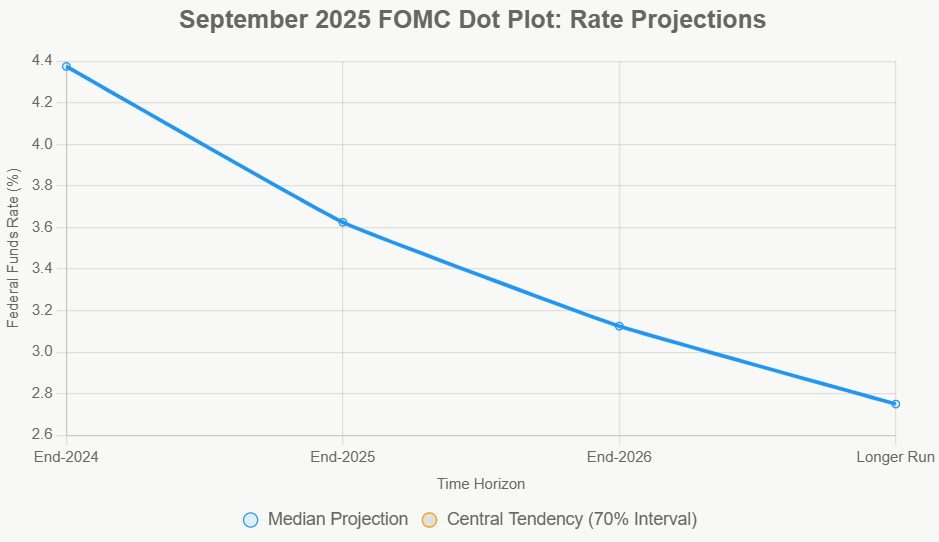
FOMC Dot Plot: Rate Projections

Whatever happens in December, the Fed's job isn't done. Their forecasts, often shown in something called the “dot plot,” suggest they expect to continue lowering rates gradually through 2026. The median projection from September indicated rates could be around 3.125% by the end of next year. However, these are just projections, and they can change based on new economic data.

The Fed has a dual mandate: to keep prices stable and to ensure maximum employment. Right now, they're being pulled in two directions. The December meeting is a crucial test of their ability to navigate these conflicting goals. We’ll all be watching closely to see which way they lean.

Ultimately, the path of Fed interest rates is all about balancing risks. Cut too soon, and inflation could rebound. Wait too long, and the economy could suffer a more painful slowdown. It's a delicate dance, and the performance in December will tell us a lot about the future direction of our economy.

Invest in Real Estate While Rates Are Dropping — Build Wealth

If the Federal Reserve moves forward with another rate cut in December, investors could gain a valuable window to secure more favorable financing terms and scale their portfolios ahead of renewed buyer demand.

Lower borrowing costs would boost cash flow and enhance overall returns, especially for those positioned to act quickly

Work with Norada Real Estate to find turnkey, income-generating properties in stable markets—so you can capitalize on this easing cycle and grow your wealth confidently.

NEW TURNKEY DEALS JUST ADDED!

Talk to a Norada investment counselor today (No Obligation):

(800) 611-3060

Get Started Now

Want to Know More?

Explore these related articles for even more insights:

  • Fed Meeting Minutes Expose Divide: Why December Rate Cut Odds Are Fading Fast
  • Fed Interest Rate Predictions for the December 2025 Policy Meeting
  • Fed Signals Growing Reluctance to Interest Rate Cut in December 2025
  • Fed Cuts Interest Rate Today for the Second Time in 2025
  • Fed Interest Rate Forecast Q4 2025: Target Range Could Hit 3.50%–3.75%
  • Fed Interest Rate Forecast for the Next 12 Months
  • Interest Rate Predictions for the Next 3 Years: 2025, 2026, 2027
  • When is Fed's Next Meeting on Interest Rate Decision in 2025?
  • Interest Rate Predictions for the Next 10 Years: 2025-2035
  • Interest Rate Predictions for 2025 by JP Morgan Strategists
  • Interest Rate Predictions for Next 2 Years: Expert Forecast
  • Market Reactions: How Investors Should Prepare for Interest Rate Cut
  • Impact of Interest Rate Cut on Mortgages, Car Loans, and Your Wallet
Filed Under: Economy, Financing Tagged With: Economy, Fed, Federal Reserve, FOMC Meeting, interest rates

Fed Signals Growing Reluctance to Interest Rate Cut in December 2025

November 28, 2025 by Marco Santarelli

Fed Signals Growing Reluctance to Interest Rate Cut in December 2025

The Federal Reserve's recent signals are making it clearer than ever: a December 2025 interest rate cut is looking less and less likely. While the Federal Open Market Committee (FOMC) did reduce the federal funds rate by 25 basis points in October 2025, the freshly released minutes from their November 19 meeting reveal a palpable hesitation among policymakers about cutting rates again in December.

Fed Signals Growing Reluctance to Interest Rate Cut in December 2025

This caution stems from a difficult balancing act between wanting to support employment and the persistent need to bring inflation fully back down to their 2% target. As things stand now, the path forward for interest rates is far from certain, and a pause in December seems to be the leading scenario.

For months, the big question on everyone's mind has been: when will the Fed start lowering interest rates? After a series of hikes to combat soaring inflation, the economy has shown signs of cooling, leading many to anticipate rate cuts. Yet, the latest insights from the Fed suggest that while they've eased policy a bit, they're not quite ready to keep pushing rates down. This is a critical moment, and understanding why the Fed is hesitant is key to grasping what might happen next in our economy, from borrowing costs to job markets.

The October Meeting: A Step Back, Not a Leap Forward

The meeting on October 28–29, 2025, resulted in the Fed's second rate cut of the year, bringing the target federal funds rate down to a range of 3.75%–4.00%. This move was intended to help bolster employment as economic growth showed signs of slowing. However, the vote was closer than expected, with a 10–2 split.

This wasn't just a minor disagreement; it highlighted genuinely different views within the committee. One policymaker voted for a more substantial 50 basis point cut, believing it was needed to more aggressively tackle rising unemployment risks. On the other hand, another dissenter felt it was better to hold rates steady, emphasizing the need for more solid proof that inflation was truly under control.

In my opinion, this split vote is a significant clue. It tells us that even when the Fed does decide to ease, there are substantial concerns about doing too much, too soon. The Fed's main goal is to achieve both maximum employment and price stability (keeping inflation at 2%). Right now, these goals seem to be pulling in slightly different directions, making their decisions incredibly complex.

Additionally, the Fed also announced it would end its balance sheet runoff by December 1, 2025. This is essentially a way to inject more liquidity into the financial system. It’s like them saying, “We're easing on one front with rates, but we're also preparing to ease liquidity, giving us more flexibility for future decisions.” They are trying to carefully manage the system without creating new problems.

Digging into the Minutes: What Policymakers Are Really Thinking

The minutes from the November 19 release are where we get the real meat of the discussion. They revealed that many FOMC participants expressed reservations about cutting rates again in December. Why? The minutes pointed to a couple of main reasons:

  • Inflation is Still Sticky: While inflation has come down considerably from its peaks, it's currently hovering around 2.8% (for core PCE), which is still above the Fed's 2% target. Some policymakers worried that further rate cuts could risk inflation becoming entrenched, meaning it gets stuck at a higher level than desired. They specifically noted that “further policy rate reductions could add to the risk of higher inflation becoming entrenched or could be misinterpreted as implying a lack of policymaker commitment to the 2 percent inflation objective.” That's a direct quote from the minutes, folks, and it’s pretty telling.
  • Uncertainty from Economic Data: The recent U.S. government shutdown caused disruptions in data collection, making it harder for the Fed to get a clear picture of the economy's true health. This lack of solid, up-to-date information makes making big policy decisions, like cutting rates, a much riskier proposition.

Key Concerns Highlighted in the Minutes:

  • Inflation Risks: Upside risks to inflation were described as “elevated.”
  • Data Gaps: The government shutdown led to a high degree of uncertainty about the economic outlook.
  • Policy Commitment: A desire to signal unwavering commitment to the 2% inflation goal.

The minutes suggest that while the overall economy is still expanding at a “moderate pace,” fueled by consumer spending and exports, these underlying concerns about prices are weighing heavily on the minds of Fed officials.

The Employment Picture: Cooling, But Not Collapsing

On the flip side, the labor market has shown clear signs of cooling. Job gains have slowed, and the unemployment rate has edged up slightly, now around 4.2%. This is still historically low, and layoff rates remain subdued. The Fed acknowledges this softening and sees it as one of the main reasons for the October rate cut. However, the minutes also indicate that this employment picture, while weakening, isn't yet dire enough to override the inflation concerns for many.

The Fed's dual mandate is crucial here: they need to keep prices stable and support maximum employment. When inflation is stubbornly above target, and the job market is cooling but not alarming, the tendency is to prioritize getting inflation back to 2% before aggressively cutting rates to boost jobs. This is a delicate dance, and right now, inflation seems to be the heavier foot.

December Rate Cut Scenarios: What's Likely and Why

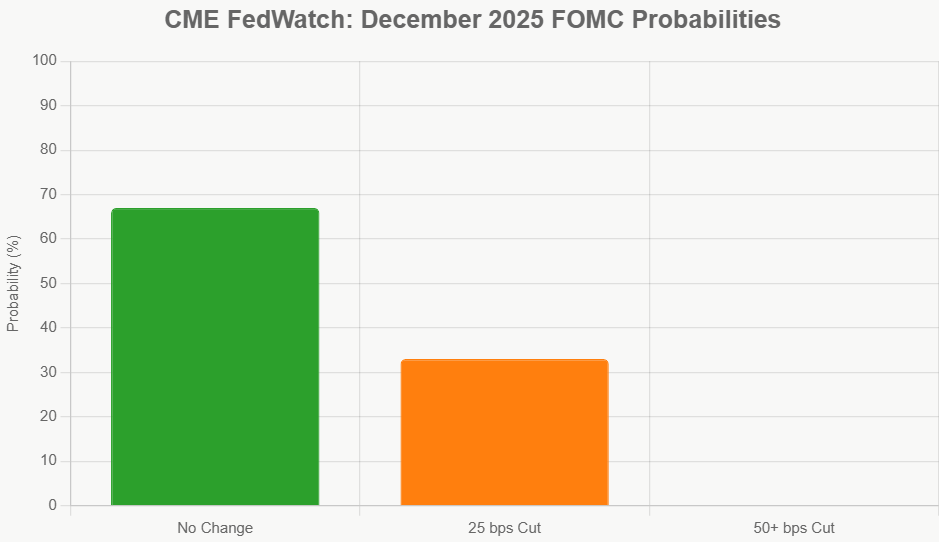
December Rate Cut Predictions: Scenarios and Probabilities

Based on the minutes and recent market reactions, here's how I see the potential scenarios for the December 16–17 FOMC meeting:

1. The Hawkish Hold (Most Probable)

  • What it means: The Fed keeps interest rates unchanged at the current 3.75%–4.00% range.
  • Why it's likely: This scenario aligns with the growing reluctance expressed in the minutes. If incoming data in November (like jobs reports and inflation figures) shows continued evidence of inflation staying above target or a strong labor market, the Fed will likely hold. This sends a signal that they need more convincing evidence that inflation is on a sustainable path back to 2%.
  • Market Implication: This would likely temper expectations for rapid rate cuts in early 2026, potentially leading to slightly higher bond yields and a steadier stock market. As of my last check, market odds favored this outcome at around 67%.

2. The Dovish Cut (Still Possible, but Less Likely Now)

  • What it means: The Fed cuts rates by 25 basis points, bringing the target range down to 3.50%–3.75%.
  • Why it could happen: This would align more closely with the September “dot plot” projections, which suggested two rate cuts by year-end 2025. If November's jobs report shows a significant weakening (e.g., fewer than 150,000 new jobs) or inflation data unexpectedly cools sharply, the Fed might opt for a cut to support employment.
  • Market Implication: A cut would likely boost stock markets and lower borrowing costs, but it could also reignite fears of inflation returning. This scenario's probability, which had briefly surged earlier in the week, has now fallen to around 33%.

3. Aggressive Easing (Very Unlikely)

  • What it means: A cut of 50 basis points or more.
  • Why it's unlikely: This would require a truly alarming economic shock, like a rapid surge in unemployment or a sudden deflationary scare, neither of which appears imminent based on current data. This scenario would echo the more aggressive dissent seen in the October meeting but doesn't fit the Fed's current measured approach.

Looking Beyond December: The 2026 Outlook

The September 2025 “dot plot” (which is the Fed's projection of where it sees interest rates going) is still a key reference point. It indicated a median federal funds rate of 3.4% by the end of 2025, implying one more cut from the current level. For 2026, the projection was for rates to move lower, toward a neutral rate of around 3%. While the October minutes introduce ambiguity about December, the longer-term trend still points toward eventual easing. However, how quickly and how smoothly that easing occurs is the big question.

Historical Context: A Turnaround in Progress

It's helpful to remember where we've come from. After aggressively hiking rates from near zero in 2022 to combat runaway inflation, the Fed began its pivot to easing in late 2024.

Event Change (bps) Target Range (%)
July 2023 (Peak) +25 5.25–5.50
Sep 2024 -50 4.75–5.00
Nov 2024 -25 4.50–4.75
Dec 2024 -25 4.25–4.50
Sep 2025 -25 4.00–4.25
Oct 2025 -25 3.75–4.00

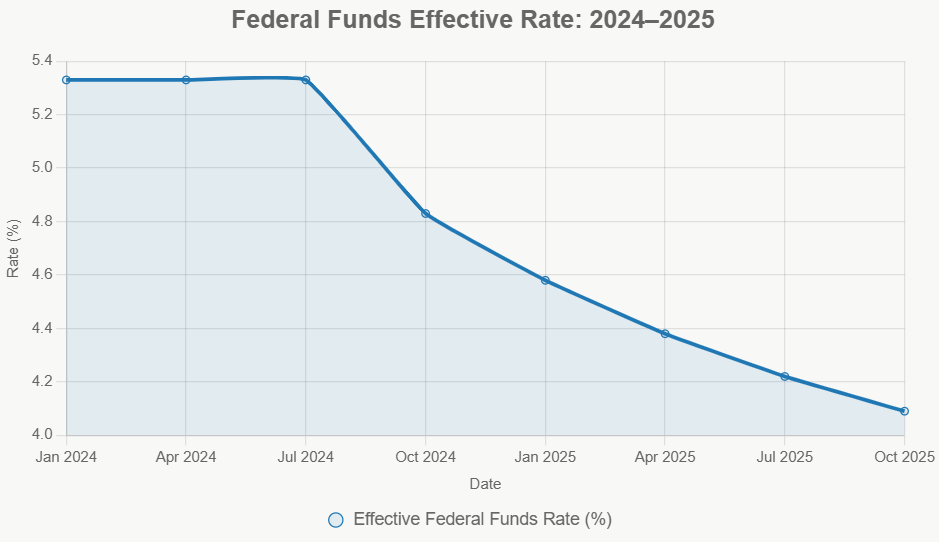
This table shows a cumulative easing of 150 basis points since September 2024. The effective federal funds rate has followed a similar downward trend, currently sitting around the 4.09% mark for October 2025. This easing cycle is happening as inflation has calmed but not yet fully settled at the 2% target.

chart illustrates the federal funds effective rate's evolution from 2024 onward:

Implications for You: What This Means for Your Wallet

So, what does this growing Fed reluctance mean for everyday people and investors?

  • For Borrowers: If the Fed pauses in December, it means that borrowing costs might not fall as quickly as some had hoped. Mortgage rates, currently around 6.5%, might stabilize or even tick up slightly if inflation fears resurface. Auto loans (around 7%) and credit card rates (around 20%) won't see any immediate relief from further Fed cuts in December.
  • For Savers: This is good news for savers. If rates stay higher for longer, you'll continue to earn decent interest on your savings accounts, CDs, and money market funds, which are currently offering yields around 4%.
  • For Investors: A December pause might temper the immediate optimism for a strong market rally driven by easy money. However, it could also reinforce the narrative of a “soft landing”—an economy that cools without plunging into recession. Investors will be watching closely for any signs of economic distress that might force the Fed's hand later. Strong November jobs data, for example, could be seen as positive for the economy but negative for immediate rate cut hopes.
  • For Businesses: Businesses will likely face continued higher borrowing costs, which could influence investment decisions. However, stable inflation expectations might provide some predictability. The end of QT could also provide some liquidity benefits.

My Take: A Measured Approach is Likely

From my perspective, the Fed is in a tough spot, and their caution is warranted. The economy has been surprisingly resilient, but the battle against inflation isn't completely won. The minutes from the October meeting strongly suggest that the Committee wants to be very sure before embarking on another round of rate cuts.

I believe the most likely scenario is a hawkish hold in December. This allows the Fed to gather more data, assess the impact of the October cut, and see if inflation truly continues on its downward path. They've learned from history that prematurely cutting rates when inflation is still a concern can be a costly mistake, potentially leading to the inflationary spirals of the 1970s.

However, I also believe they are keenly aware of employment risks. If the job market shows signs of significant weakness in the coming weeks, they won't hesitate to cut rates to fulfill their mandate. The key takeaway is that the Fed is truly data-dependent, and their decisions will be guided by the incoming economic reports.

The Fed's signals of growing reluctance to cut interest rates in December 2025 reflect a delicate balancing act against persistent inflation. Explore the FOMC minutes, economic backdrop, and expert outlooks to understand the evolving monetary policy outlook.

Invest in Real Estate While Rates Are Dropping — Build Wealth

If the Federal Reserve moves forward with another rate cut in December, investors could gain a valuable window to secure more favorable financing terms and scale their portfolios ahead of renewed buyer demand.

Lower borrowing costs would boost cash flow and enhance overall returns, especially for those positioned to act quickly

Work with Norada Real Estate to find turnkey, income-generating properties in stable markets—so you can capitalize on this easing cycle and grow your wealth confidently.

NEW TURNKEY DEALS JUST ADDED!

Talk to a Norada investment counselor today (No Obligation):

(800) 611-3060

Get Started Now

Want to Know More?

Explore these related articles for even more insights:

  • Fed Cuts Interest Rate Today for the Second Time in 2025
  • Fed Interest Rate Decision Today: Markets Prepare for Quarter-Point Rate Cut
  • Fed Interest Rate Forecast Q4 2025: Target Range Could Hit 3.50%–3.75%
  • Fed Interest Rate Forecast for the Next 12 Months
  • Federal Reserve Cuts Interest Rate by 0.25%: Two More Cuts Expected in 2025
  • Interest Rate Predictions for the Next 3 Years: 2025, 2026, 2027
  • When is Fed's Next Meeting on Interest Rate Decision in 2025?
  • Interest Rate Predictions for the Next 10 Years: 2025-2035
  • Interest Rate Predictions for 2025 by JP Morgan Strategists
  • Interest Rate Predictions for Next 2 Years: Expert Forecast
  • Market Reactions: How Investors Should Prepare for Interest Rate Cut
  • Impact of Interest Rate Cut on Mortgages, Car Loans, and Your Wallet
Filed Under: Economy, Financing Tagged With: Economy, Fed, Federal Reserve, FOMC Meeting, interest rates

Fed Meeting Minutes Expose Divide: Why December Rate Cut Odds Are Fading Fast

November 23, 2025 by Marco Santarelli

Fed Meeting Minutes Expose Divide: Why December Rate Cut Odds Are Fading Fast

The Federal Reserve's latest meeting minutes have thrown a spotlight on a significant internal disagreement among policymakers, making a December interest rate cut look increasingly unlikely. Released on November 19, 2025, these minutes reveal a 10-2 vote for a 25 basis point rate cut at the October meeting, but crucially, they highlight that “many” officials felt further easing in December was not warranted. Why?

Because the persistent worries about inflation are starting to outweigh the signs of a cooling job market. This internal clash has sent markets into a frenzy, dramatically shifting expectations for the Fed's year-end moves.

Fed Meeting Minutes Expose Divide: Why December Rate Cut Odds Are Fading Fast

It feels like just yesterday that the market was practically guaranteeing a December rate cut. We were looking at probabilities hovering around 97% in mid-October. But these minutes, well, they've put a serious dent in that certainty. Now, those odds have bounced all over the place, dipping to as low as 35% after the minutes dropped, and even lower briefly following a surprisingly strong jobs report.

While they've clawed their way back up a bit thanks to some dovish comments from Fed officials, the air of inevitability has vanished. I've been following Fed policy for a long time, and what strikes me here is how a single document can so dramatically reshape expectations when there's this much underlying division within the central bank itself.

The Fed's Balancing Act: Inflation vs. Employment

To really get why this is happening, we need to understand the tightrope the Federal Reserve is walking. On one side, there's the job market, which has been showing signs of gradually cooling. We saw nonfarm payrolls add 128,000 jobs in October, which was less than what many expected. The unemployment rate also nudged up to 4.3%. These are the kinds of signals that typically make the Fed consider easing monetary policy – meaning, cutting interest rates – to support employment and keep the economy humming without causing a recession.

But on the other side of the coin is inflation. While it's come down a lot from its peaks, it's still sitting above the Fed's target of 2%. The latest figures show core PCE inflation at 2.8%, and crucially, it ticked up from 2.5% in June. What's adding fuel to the fire are concerns about upside risks to inflation. Think about potential trade tariffs, which could make imported goods more expensive and push prices higher. This is a big consideration. If inflation starts to creep back up, the Fed’s job of bringing it back to 2% – a task they worked so hard to achieve – becomes much harder.

This tension between wanting to support jobs and needing to keep inflation in check is the heart of the Fed's dilemma. It's not a simple “cut” or “don't cut” scenario; it's a complex calculation based on data that’s constantly evolving.

Recent Fed Actions: A Pivot, But Not a Promise

Let's zoom out for a second. The Fed didn't just suddenly decide to consider cuts. They actually did cut interest rates twice in 2025 – by 25 basis points in September and again in October. This brought the target federal funds rate down to a range of 3.75%-4.00%. This pivot from hiking rates to cutting them signaled a shift in their thinking, acknowledging that the economy was slowing and that the risks to employment were growing.

However, these minutes make it clear that the decision to cut wasn't unanimous, and the feeling is that many officials are now hesitant to continue this easing trend in December. The vote of 10-2 in October, while indicating a majority favored a cut, still had two dissenting voices. But the sentiment expressed in the text goes deeper than that single vote. It reveals that even among those who voted for the cut, there isn't overwhelming confidence about further easing.

Inside the FOMC Minutes: A Tale of Two Minds

Reading between the lines of the FOMC minutes is where the real insight lies. The document, dense with economic jargon and careful phrasing, lays bare the “strongly differing views” on the direction of monetary policy.

On one hand, you have the inflation hawks. These officials are clearly worried that inflation isn't falling fast enough and that the recent cuts might be premature. They point to continued strength in core services inflation and, importantly, the potential impact of new tariffs. These tariffs could add a significant chunk to consumer price increases, essentially undoing some of the progress made. For this camp, keeping rates steady signals a strong commitment to price stability and avoids the risk of reigniting inflation.

On the other side are the employment doves. Their focus is on the risks to the labor market. They see the gradual softening—the slower job gains, the modest rise in unemployment, and the dropping number of job openings—as indications that the economy could weaken further. They believe that further rate cuts are necessary to prevent a significant rise in unemployment and ensure a smooth “soft landing.” They might view the current level of interest rates as too restrictive and potentially stifling economic activity more than necessary.

The minutes explicitly state: “Many participants judged that the economic outlook did not warrant a further reduction in the target range at the December meeting.” This is a pivotal sentence. It suggests that the “hold steady” camp might now have the upper hand heading into the December meeting. The “many” here is key – it implies a significant portion of the committee, perhaps even a majority, is leaning towards pausing further rate cuts for now.

There was also a brief mention of financial stability concerns, something the Fed always keeps an eye on. Things like hedge funds holding a lot of Treasuries and banks dealing with unrealized losses on their holdings were noted. To address this, the Fed unanimously agreed to stop reducing its balance sheet runoff by December 1. This is a technical move aimed at ensuring there's enough liquidity in the financial system, but it also signals a cautious approach to monetary policy.

Market Mayhem: The Rollercoaster of Rate Cut Odds

The market's reaction to these minutes has been nothing short of a wild ride. As I mentioned, the probability of a December rate cut, which was once almost a sure thing, has plummeted. When the minutes were released, the CME FedWatch Tool, which tracks market expectations based on futures contracts, showed the odds of a 25 basis point cut dropping from around 60-70% to a mere 35%.

CME FedWatch: December 2025 Rate Cut Probabilities Over Time

This uncertainty sent ripples through the bond market. We saw yields on Treasury bonds jump. The 10-year Treasury yield, a key benchmark for borrowing costs across the economy, climbed to about 4.2%. This rise in yields, especially with short-term rates still high relative to long-term rates, further inverted the yield curve. An inverted yield curve, as I understand it, has historically been a fairly reliable predictor of recessions, so this movement certainly made investors nervous.

The drama didn’t stop there. Adding to the confusion was a surprisingly strong November jobs report released just two days later. Nonfarm payrolls surged by 215,000, significantly beating expectations. This report could be interpreted in two ways: on one hand, it shows a resilient labor market, which is good. On the other hand, it reduces the urgency for the Fed to cut rates to support employment. Consequently, Fed Funds futures briefly pushed the odds of a December cut even lower, sometimes below 35%. Major financial institutions shifted their forecasts, with J.P. Morgan, for instance, revising its outlook to no December cut.

However, the market's fickle nature soon kicked in. Comments from New York Fed President John Williams on November 21 offered a more dovish tone, suggesting there was “room for cuts” if inflation continued to ease. This sparked a quick rebound in cut probabilities, pushing them back up above 70% again. This constant back-and-forth illustrates just how sensitive markets are to every piece of data and every word from Fed officials. It's a constant recalibration.

Here’s a snapshot of how those probabilities have been dancing:

Date Range Probability of December Cut (%) Key Driver
Mid-October 2025 ~97% Strong market consensus, prior Fed signals
November 20, 2025 ~35% FOMC Minutes release (hawkish lean)
Morning, Nov 21, 2025 ~30-40% Strong November jobs report, J.P. Morgan revision
Late, Nov 21, 2025 ~71% Dovish comments from NY Fed President Williams

This table shows how quickly sentiment can shift. It’s a stark reminder that the Fed’s path isn’t set in stone, and market expectations are constantly being revised.

Economist Forecasts: A Divided Field

It's not just the markets; economists are also deeply divided. Before the jobs report, a Reuters poll indicated that a solid 80% of economists still expected a December rate cut. They were likely factoring in the ongoing slowdown in employment and the committee's previous pivot. Firms like Goldman Sachs were also in this camp, projecting a cut to support the anticipated moderate growth.

But the strong jobs report and the hawkish undertones in the Fed minutes have shaken this consensus. As mentioned, J.P. Morgan changed its tune. Bank of America Global Research, on the other hand, noted the minutes' emphasis on rising inflation risks and revised their forecast to no December cut, predicting fewer total cuts in 2026 than previously thought.

This divergence among economists reflects the fundamental uncertainty about the economic outlook. Some see a resilient economy that doesn't need more rate cuts, while others see growing risks of a slowdown that the Fed needs to address.

What Happens Next? Potential Scenarios for December

So, what does this all mean for the Federal Open Market Committee's (FOMC) meeting on December 16-17? Based on current market pricing, the most likely scenario is a 25 basis point rate cut. This is what the majority are still betting on, implying that they believe the incoming data between now and then will likely confirm the need for further easing, perhaps with softer inflation figures or more pronounced labor market cooling.

However, the minutes have significantly boosted the odds of the Fed choosing to hold rates steady. If inflation proves to be more stubborn than expected, or if other economic indicators show unexpected strength, the hawks might win out. This would signal that the Fed is prioritizing its inflation fight above all else, even at the risk of slowing the economy further.

There are always outlier possibilities too. A 50 basis point cut seems highly unlikely unless there's a dramatic deterioration in the labor market – a sudden surge in unemployment, for example. Conversely, a rate hike is virtually off the table given the current economic trajectory.

Each scenario carries its own set of implications:

  • If the Fed Cuts Rates: We could see a positive reaction in equity markets, a further dip in mortgage rates providing a boost to housing, and a generally more optimistic consumer sentiment.
  • If the Fed Holds Steady: Financial markets might react with a bit of nervousness. Bond yields could tick higher, potentially putting pressure on stocks, especially growth-oriented tech companies. This would signal the Fed's strong focus on inflation and might lead to a period of further economic caution.

The Bigger Picture: What This Means for You

The internal debates within the Fed aren't just abstract economic discussions; they have real-world consequences. For individuals and businesses, the path of interest rates affects everything from the cost of borrowing for a mortgage or a car loan to the returns on savings accounts and the performance of investments.

If rates stay higher for longer, it means borrowing will remain more expensive. This could slow down big purchases like homes and cars, impacting industries that rely on consumer spending. For savers, it's generally good news, as they earn more interest on their deposits. For investors, higher rates can make bonds look more attractive relative to stocks, potentially leading to more volatility in the stock market.

The “fading fast” narrative around the December rate cut, even with the market's rebound, suggests a period of continued uncertainty. It means that the Fed is going to be extremely vigilant, watching every economic report closely. As we head into the end of 2025, the focus will be squarely on inflation data and employment figures.

The Fed’s decision, whatever it may be, will be heavily data-dependent, and the minutes have made it clear that there's no consensus just yet. It’s a reminder that in the world of monetary policy, certainty is a luxury rarely afforded.

Invest in Real Estate While Rates Are Dropping — Build Wealth

If the Federal Reserve moves forward with another rate cut in December, investors could gain a valuable window to secure more favorable financing terms and scale their portfolios ahead of renewed buyer demand.

Lower borrowing costs would boost cash flow and enhance overall returns, especially for those positioned to act quickly

Work with Norada Real Estate to find turnkey, income-generating properties in stable markets—so you can capitalize on this easing cycle and grow your wealth confidently.

NEW TURNKEY DEALS JUST ADDED!

Talk to a Norada investment counselor today (No Obligation):

(800) 611-3060

Get Started Now

Want to Know More?

Explore these related articles for even more insights:

  • Fed Interest Rate Predictions for the December 2025 Policy Meeting
  • Fed Signals Growing Reluctance to Interest Rate Cut in December 2025
  • Fed Cuts Interest Rate Today for the Second Time in 2025
  • Fed Interest Rate Forecast Q4 2025: Target Range Could Hit 3.50%–3.75%
  • Fed Interest Rate Forecast for the Next 12 Months
  • Interest Rate Predictions for the Next 3 Years: 2025, 2026, 2027
  • When is Fed's Next Meeting on Interest Rate Decision in 2025?
  • Interest Rate Predictions for the Next 10 Years: 2025-2035
  • Interest Rate Predictions for 2025 by JP Morgan Strategists
  • Interest Rate Predictions for Next 2 Years: Expert Forecast
  • Market Reactions: How Investors Should Prepare for Interest Rate Cut
  • Impact of Interest Rate Cut on Mortgages, Car Loans, and Your Wallet
Filed Under: Economy, Financing Tagged With: Economy, Fed, Federal Reserve, FOMC Meeting, interest rates

Fed Interest Rate Predictions for the December 2025 Policy Meeting

November 18, 2025 by Marco Santarelli

Fed Interest Rate Predictions for the December 2025 Policy Meeting

As we look toward the end of 2025, the Federal Reserve's upcoming December meeting is a major point of focus for nearly everyone involved in the economy. Will the Fed cut interest rates again? My best prediction, looking at the current signals and expert opinions, is that the Fed will likely implement another rate cut in December 2025, though it's not a sure thing. The Federal Reserve is expected to consider another rate cut in December 2025, but uncertainty remains as policymakers weigh cooling inflation against persistent economic risks.

Fed Interest Rate Predictions for the December 2025 Policy Meeting

It’s a complex puzzle, and I find myself constantly sifting through the economic data, listening to what Fed officials are saying, and trying to piece together what might happen. It feels less like a guaranteed outcome and more like a carefully calibrated decision on a tightrope. As a seasoned observer of these markets, I’ve seen how small pieces of data can swing major decisions, and December 2025 looks to be no different.

What's on the Fed's Mind for December?

The Federal Reserve's policy meeting on December 9–10, 2025, is the one everyone's got circled on their calendar. Just coming off a 25 basis point rate cut in October, which landed the federal funds target range at 3.75%–4.00%, the big question is what comes next. Will they keep the momentum going with another decrease, or will they hit the pause button to see how things are shaking out?

My take is that the October cut was a clear signal that the Fed is paying attention to the economy's signals. Inflation has been coming down, the job market is showing signs of cooling (which isn't necessarily bad news, depending on how you look at it), and credit isn't as easy to get as it used to be. However, Fed Chair Jerome Powell himself has cautioned that further cuts are “far from guaranteed.” This isn't just Fed speak; I believe it reflects genuine caution. They don't want to accidentally overstimulate the economy and send inflation roaring back.

current fed funds rate

A Peek Inside the Fed: Diverging Views

What makes these meetings so fascinating, and frankly, so hard to predict, is that there isn't always a single, unified voice within the Fed. Take, for example, Governor Stephen Miran. He actually dissented in October, pushing for a more aggressive 50 basis point cut. In a recent conversation, he mentioned that another cut in December would be “a reasonable action.” His reasoning? He sees inflation coming down nicely and employment data that suggests the economy can handle a bit more easing.

This kind of disagreement isn’t a sign of weakness; it’s a sign of a healthy debate. Some policymakers are clearly more focused on the risks of inflation, while others are more concerned about the economy slowing down too much. It’s like a tug-of-war between wanting to keep prices stable and wanting to keep people employed and businesses growing. December’s decision will depend on which side of that rope has more pull.

The Economic Signposts We're Watching

For me, and I imagine for the Fed too, it all comes down to the numbers. Here are the key economic indicators that I’ll be scrutinizing closely as we head into December:

  • Inflation Trends: We've seen core inflation nearing the Fed’s 2% target, and that's a huge factor. We need to be sure this cooling isn't just a temporary blip.
  • Labor Market Health: Job growth has definitely slowed down. Wage increases are also starting to moderate. These are cues that the economy is cooling, which gives the Fed room to maneuver.
  • Consumer Spending Habits: People are still spending, but it’s not as robust as it was. We’re seeing softness, especially in areas where people can choose whether or not to buy something, like new gadgets or pricey dinners out.
  • Global Concerns: Things happening around the world can’t be ignored. Geopolitical tensions or ongoing trade disputes, like those between the U.S. and China, can create unpredictability. The Fed has to consider these external risks when setting policy.

What the Experts Are Saying (and What We Should Expect)

The smart folks at Goldman Sachs Research are still leaning towards the Fed cutting rates in December. They point to real signs of weakness in the job market and steady inflation as reasons for their forecast. This aligns with what a lot of people in the financial world are thinking, though Powell’s cautious words have certainly made some investors sit up and take notice.

Beyond the big banks, independent analysts are also weighing in. Their projections suggest that the federal funds rate could end up around 3.50% by the end of December. However, they often throw out a range, like 3.25% to 4.00%, because, as I’ve said, those incoming economic numbers can really change things at the last minute. This illustrates the inherent uncertainty.

Putting the Data in Context: Is This a Real Trend?

Looking back, this isn't the first time the Fed has cut rates after raising them. They went through a significant period of hiking rates from 2022 to 2023 to fight off the high inflation we saw post-pandemic. Those hikes brought the federal funds rate all the way up to between 5.25% and 5.50%. Now, they are in an easing cycle.

The table below shows how previous rate cut cycles have played out historically. Notice how the market's reaction can vary widely depending on the economic environment.

Cycle Start Total Easing (Basis Points) Duration (Months) S&P 500 12-Month Return Post-First Cut Recession Occurred? Key Driver
Jul 1990 275 15 +12.5% Yes (1990–1991) Gulf War, S&L Crisis
Jul 1995 75 11 +28.4% No Pre-Asian Financial Crisis Softness
Sep 1998 75 5 +21.0% No LTCM Collapse, Emerging Markets
Jan 2001 475 13 -15.2% Yes (2001) Dot-Com Bust
Sep 2007 525 17 -38.5% Yes (2007–2009) Housing Bubble Burst
Jul 2019 75 3 +17.1% No Trade Wars, Inverted Yield Curve
Mar 2020 1500 (To Zero) 1 +47.2% (Post-QE) Yes (Brief COVID) Pandemic Shutdowns
Sep 2024* 50 (Ongoing) 14 (To Date) +18.2% (As of Oct 2025) No (Projected) Post-Inflation Soft Landing

*2024–2025 cycle; returns through October 30, 2025. Sources: Federal Reserve, S&P Dow Jones Indices.

What this table suggests is that when the Fed cuts rates during a period of economic growth (like what we are seeing now), the stock market often performs well. The current S&P 500 performance, continuing to hover around record highs, echoes some of these positive historical precedents.

So, What Does This Mean for You?

The Fed’s decision has ripple effects, and I want to break down what it might mean for different people:

  • For Bond Investors: If the Fed does cut rates, we could see bond prices go up and yields go down. This is especially true for shorter-term bonds. It’s a classic response to lower interest rates.
  • For Homebuyers: Lower interest rates generally mean lower mortgage rates. However, it’s not always a direct one-to-one translation. Lenders sometimes add extra charges (spreads) to account for their own risks, which can keep rates from falling as much as you might expect. But, continued easing could offer some relief.
  • For Stock Market Enthusiasts: Typically, rate cuts are good for stocks because borrowing becomes cheaper, and economic activity tends to pick up. But, as we’re seeing with the mixed signals from the Fed, there could be more ups and downs (volatility) in the market than usual.
  • For the U.S. Dollar: If the Fed decides to hold steady or makes a smaller cut, it could help stabilize the dollar. A larger cut, however, might weaken it. The dollar’s strength affects everything from vacation costs to the price of imported goods.

My Final Thoughts

The Federal Reserve’s December 2025 rate decision is shaping up to be a really critical moment for the economy. While another rate cut is definitely on the table and seems likely based on current trends and expert opinions, it’s far from a done deal. The Fed is walking a fine line, and their decision will be heavily influenced by the economic data that comes out between now and then.

My advice? Keep a close eye on those economic reports. For borrowers, especially those thinking about big loans like a mortgage, it might be wise to consider locking in current rates soon. For investors, be prepared for the possibility of data-driven volatility as the market reacts to every new piece of information and, ultimately, to the Fed’s final pronouncement. It’s a fascinating time to be watching the economy, and December’s meeting will give us plenty to talk about.

Invest in Real Estate While Rates Are Dropping — Build Wealth

With the Federal Reserve cutting rates again in 2025, investors have a window of opportunity to lock in better financing and expand their portfolios before demand accelerates. Lower rates mean improved cash flow and stronger returns.

Work with Norada Real Estate to find turnkey, income-generating properties in stable markets—so you can capitalize on this easing cycle and grow your wealth confidently.

NEW TURNKEY DEALS JUST ADDED!

Talk to a Norada investment counselor today (No Obligation):

(800) 611-3060

Get Started Now

Want to Know More?

Explore these related articles for even more insights:

  • Fed Cuts Interest Rate Today for the Second Time in 2025
  • Fed Interest Rate Decision Today: Markets Prepare for Quarter-Point Rate Cut
  • Fed Interest Rate Forecast Q4 2025: Target Range Could Hit 3.50%–3.75%
  • Fed Interest Rate Forecast for the Next 12 Months
  • Federal Reserve Cuts Interest Rate by 0.25%: Two More Cuts Expected in 2025
  • Interest Rate Predictions for the Next 3 Years: 2025, 2026, 2027
  • When is Fed's Next Meeting on Interest Rate Decision in 2025?
  • Interest Rate Predictions for the Next 10 Years: 2025-2035
  • Interest Rate Predictions for 2025 by JP Morgan Strategists
  • Interest Rate Predictions for Next 2 Years: Expert Forecast
  • Market Reactions: How Investors Should Prepare for Interest Rate Cut
  • Impact of Interest Rate Cut on Mortgages, Car Loans, and Your Wallet
Filed Under: Economy, Financing Tagged With: Economy, Fed, Federal Reserve, FOMC Meeting, interest rates

Fed Cuts Interest Rate Today for the Second Time in 2025

October 29, 2025 by Marco Santarelli

Fed Cuts Interest Rate Today for the Second Time in 2025

The U.S. Federal Reserve has cut its key interest rate for the second time in 2025, lowering the federal funds rate by 25 basis points to a range of 3.75%–4.00% on October 29th. This action signals a continued effort by the central bank to support the economy, particularly the job market, while still keeping a close eye on inflation. As I see it, this move is more than just a number; it's a carefully calibrated response to a complex economic picture that’s evolving by the day.

This second reduction shows a clear intention from the Fed to proactively manage economic conditions rather than waiting for a serious problem to develop. For anyone trying to make sense of what this means for their money, their job, or the future, this is a pretty big deal.

Federal Reserve Cuts Key Interest Rate for Second Time in 2025

Key Takeaways

  • The U.S. Federal Reserve lowered its benchmark federal funds rate by 25 basis points to a range of 3.75%–4.00% on October 29, 2025, marking the second rate reduction this year following a similar cut in September.
  • This move reflects growing concerns over a softening labor market, with job growth slowing and unemployment edging up to 4.2%, though inflation remains “somewhat elevated” at around 2.7% core PCE.
  • While the decision was widely expected, it revealed internal divisions: one official favored a larger 50 basis-point cut, and another preferred no change, highlighting the Fed's delicate balancing act between supporting jobs and curbing price pressures.
  • Markets responded with mild optimism, as the S&P 500 rose about 0.2% immediately after the announcement, though gains moderated during Chair Jerome Powell's press conference amid cautious forward guidance.

Understanding the Fed's Latest Move: October 29th, 2025

So, why did the Federal Reserve decide to lower rates again? The official word is that they're seeing signs of softness in the labor market. We've seen job growth slow down a bit, and the unemployment rate has edged up to 4.2%. While that number might sound low to some, for the Fed, it’s a signal that things are cooling off enough to warrant some proactive easing.

current fed funds rate

At the same time, inflation is still a concern. The Fed’s favorite measure, the core PCE price index, is sitting “somewhat elevated” at around 2.7%. They're trying to walk a tightrope: push down unemployment without letting prices get away from them. It’s a classic balancing act that central bankers perform, and it’s never easy.

This decision didn't happen in a vacuum. The Federal Open Market Committee (FOMC), the group within the Fed that makes these rate decisions, held its regular meeting, and as is often the case, there were different viewpoints. While the majority agreed on the 25 basis point cut, one member wanted an even bigger cut of 50 basis points, suggesting they felt the economy needed a stronger boost. On the other side, another member thought it was best to hold rates steady, showing that there are definitely differing opinions on just how much intervention is needed. This internal debate highlights the tricky road the Fed is navigating.

What This Means for You, Me, and Everyone Else

Let’s break down what this rate cut can mean for everyday people and businesses:

  • Borrowing Costs: When the Fed cuts rates, it often becomes cheaper to borrow money.
    • Credit Cards & Auto Loans: You might start seeing slightly lower interest rates on your credit cards and car loans, especially those with variable rates. This could mean saving a bit of money each month on your payments.
    • Mortgages: For those looking to buy a home or refinance, fixed-rate mortgages (like the popular 30-year ones) might see a gradual decline. However, these rates are more tied to longer-term economic outlook and bond yields, so the drops might be slower and smaller than with shorter-term loans. Right now, average 30-year rates are around 6.5%, a bit down but still higher than they were a couple of years ago. Adjustable-rate mortgages (ARMs) will likely see a more immediate decrease in their rates following this Fed move.
  • Savings: On the flip side, if you're a saver, this isn't the best news. Interest rates on savings accounts, money market accounts, and Certificates of Deposit (CDs) tend to fall when the Fed cuts rates. So, those higher yields you might have been enjoying on your cash could start to shrink. Many savers are now looking toward investments that offer a better return, even if they come with more risk.
  • Businesses: For businesses, lower interest rates can mean cheaper borrowing for expansion, investment, or managing day-to-day operations. This can encourage job creation and economic growth. However, if inflation remains sticky, businesses might face higher input costs that offset some of the benefits of cheaper borrowing.

The Bigger Picture: Economic Ripples and Future Possibilities

Beyond our personal finances, this move by the Fed has broader implications for the economy. The decision to cut rates, combined with the Fed’s plan to end “quantitative tightening” (QT) on December 1st, is designed to inject more cash, or liquidity, into the financial system. Ending QT means the Fed will stop letting its bond holdings mature and simply disappear from its balance sheet. Instead, they'll reinvest some of those funds, which essentially puts more money back into the economy. Think of it like turning off a tap that was draining money and now turning it on just a little to let some flow back in.

The Fed's statement explicitly mentioned that the risks to employment have risen. I find this wording significant. It tells me they're not just looking at current numbers but also anticipating potential future challenges in the job market. However, they also remain committed to their goal of keeping inflation at 2%. This delicate dance is crucial for long-term economic stability.

One factor that could make things complicated is the possibility of new tariffs under the incoming administration. If new tariffs are put in place, they could make imported goods more expensive, which might in turn push prices up for consumers on things like clothes and furniture. This could make it harder for the Fed to get inflation back down to their target level.

Analyzing the Market's Reaction

How did Wall Street react to this news? Generally, markets responded with mild positivity. The S&P 500 saw a small bump of about 0.2% right after the announcement. Bond yields, like the 10-year Treasury, held steady around 4.1%, which suggests that investors, for the moment, seem to believe the economy can avoid a sharp downturn or recession. This concept is often referred to as a “soft landing.”

Even cryptocurrencies like Bitcoin saw a slight uptick, as increased liquidity from the Fed’s actions can sometimes make riskier assets more attractive.

Historical Context: Is This a Trend?

Looking back, this isn't the first time the Fed has cut rates after raising them. They went through a significant period of hiking rates from 2022 to 2023 to fight off the high inflation we saw post-pandemic. Those hikes brought the federal funds rate all the way up to between 5.25% and 5.50%. Now, they are in an easing cycle.

The table below shows how previous rate cut cycles have played out historically. Notice how the market's reaction can vary widely depending on the economic environment.

Cycle Start Total Easing (Basis Points) Duration (Months) S&P 500 12-Month Return Post-First Cut Recession Occurred? Key Driver
Jul 1990 275 15 +12.5% Yes (1990–1991) Gulf War, S&L Crisis
Jul 1995 75 11 +28.4% No Pre-Asian Financial Crisis Softness
Sep 1998 75 5 +21.0% No LTCM Collapse, Emerging Markets
Jan 2001 475 13 -15.2% Yes (2001) Dot-Com Bust
Sep 2007 525 17 -38.5% Yes (2007–2009) Housing Bubble Burst
Jul 2019 75 3 +17.1% No Trade Wars, Inverted Yield Curve
Mar 2020 1500 (To Zero) 1 +47.2% (Post-QE) Yes (Brief COVID) Pandemic Shutdowns
Sep 2024* 50 (Ongoing) 14 (To Date) +18.2% (As of Oct 2025) No (Projected) Post-Inflation Soft Landing

*2024–2025 cycle; returns through October 30, 2025. Sources: Federal Reserve, S&P Dow Jones Indices.

What this table suggests is that when the Fed cuts rates during a period of economic growth (like what we are seeing now), the stock market often performs well. The current S&P 500 performance, continuing to hover around record highs, echoes some of these positive historical precedents.

Divergent Views Within the Fed

It's really interesting to see the different opinions within the FOMC. As I mentioned, one official wanted a larger cut. They likely looked at the slowing job growth and thought, “We need to act more decisively to keep things on track.” On the other hand, the official who voted against a cut likely focused on the inflation numbers and worried that cutting rates too much could reignite price pressures.

This disagreement reminds me of past debates within the Fed. It shows that economic forecasting isn't an exact science. The Chair, Jerome Powell, really emphasized the data-dependent nature of their policy. He said things like “patience remains our policy,” which tells me they're not going to rush into further aggressive cuts. They are watching all the incoming economic reports very closely.

What's Next?

Looking ahead, the market is still trying to figure out what the Fed will do in December. The odds of another rate cut were high, but some of the cautious language from Powell might have tempered those expectations a bit. The Fed's own projections, known as the “dot plot,” suggest they might make a total of 75 basis points in cuts for the year, which means perhaps two more 25 basis-point cuts by the end of 2025.

For all of us, the key is to stay informed. The economic picture is constantly changing, and the Fed's actions are a crucial part of that. Whether you're a saver, a borrower, a business owner, or just trying to navigate the economic news, understanding these moves can help you make better financial decisions. The Fed's latest move is a signal that they are actively trying to guide the economy toward a stable future, and it will be fascinating to watch just how successful they are.

Invest in Real Estate While Rates Are Dropping — Build Wealth

With the Federal Reserve cutting rates again in 2025, investors have a window of opportunity to lock in better financing and expand their portfolios before demand accelerates. Lower rates mean improved cash flow and stronger returns.

Work with Norada Real Estate to find turnkey, income-generating properties in stable markets—so you can capitalize on this easing cycle and grow your wealth confidently.

NEW TURNKEY DEALS JUST ADDED!

Talk to a Norada investment counselor today (No Obligation):

(800) 611-3060

Get Started Now

Want to Know More?

Explore these related articles for even more insights:

  • Interest Rate Predictions for October 29, 2025: Fed Rate Cut Odds Soar to 99%
  • Fed Interest Rate Decision Today: Markets Prepare for Quarter-Point Rate Cut
  • Next Federal Reserve Meeting Just 4 Days Away: What to Expect?
  • Fed Interest Rate Forecast Q4 2025: Target Range Could Hit 3.50%–3.75%
  • Fed Interest Rate Forecast for the Next 12 Months
  • Federal Reserve Cuts Interest Rate by 0.25%: Two More Cuts Expected in 2025
  • Interest Rate Predictions for the Next 3 Years: 2025, 2026, 2027
  • When is Fed's Next Meeting on Interest Rate Decision in 2025?
  • Interest Rate Predictions for the Next 10 Years: 2025-2035
  • Interest Rate Predictions for 2025 by JP Morgan Strategists
  • Interest Rate Predictions for Next 2 Years: Expert Forecast
  • Market Reactions: How Investors Should Prepare for Interest Rate Cut
  • Impact of Interest Rate Cut on Mortgages, Car Loans, and Your Wallet
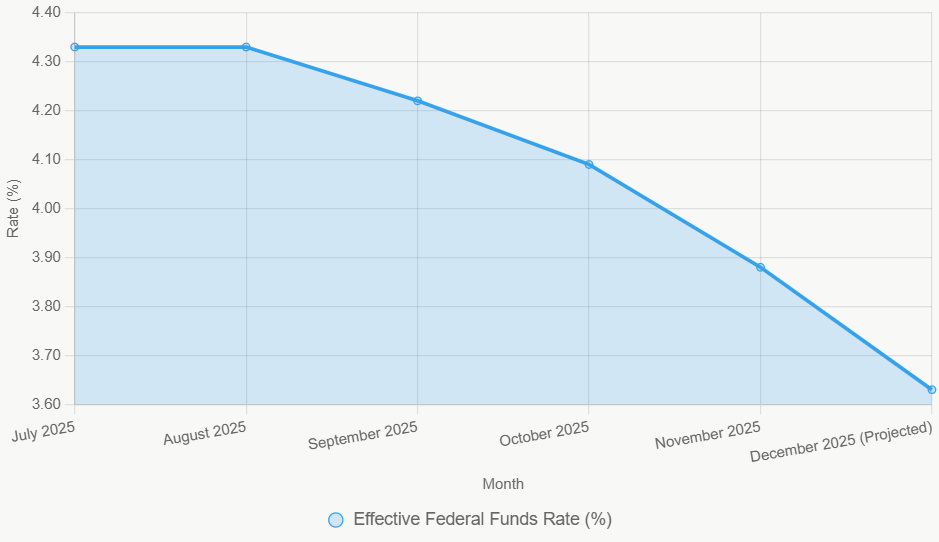
Filed Under: Economy, Financing Tagged With: Economy, Fed, Federal Reserve, FOMC Meeting, interest rates

Fed Interest Rate Decision Today: Markets Prepare for Quarter-Point Rate Cut

October 29, 2025 by Marco Santarelli

Fed Interest Rate Decision Today: Markets Prepare for Quarter-Point Rate Cut

When it comes to the Federal Reserve's upcoming decision on interest rates, it's more like looking at a crowd of people all pointing in the same direction. Today, October 29, 2025, the Federal Open Market Committee (FOMC) concludes its meeting, and the overwhelming consensus is that it will indeed lower the federal funds rate by a quarter point (25 basis points).

Markets are pricing in over a 95% chance of this move, which would nudge the key interest rate down to a range of 3.75%–4.00%. This would follow a similar cut in September and signals a cautious optimism from the Fed that inflation is cooling without completely stomping out economic growth.

Fed Interest Rate Decision Today: Markets Prepare for Quarter-Point Rate Cut

Now, I'm not one to just parrot what the talking heads on TV say. I've spent a good amount of time digging into the numbers, listening to the whispers from economists, and thinking about what this all means for us everyday folks. The Fed has two big jobs: keeping prices stable (that's controlling inflation) and making sure as many people as possible have jobs. These two goals can sometimes pull in opposite directions, and this meeting is a prime example of that tug-of-war.

Understanding the Fed's Big Decision-Making Day

So, what exactly happens today? The FOMC, a group of 12 smart people who seriously know their economics, is meeting for two days. Their main tool is the “federal funds rate.” This is like the highway toll for banks lending money to each other overnight. When the Fed tinkers with this rate, it sends ripples throughout the entire economy, affecting everything from your mortgage to your credit card bill.

Right now, that target rate is between 4.00% and 4.25%. If they do the expected quarter-point cut, it’ll drop to 3.75%–4.00%. This would be the second time they've eased up on rates in just a couple of months, following a period of aggressive hikes that pushed rates all the way up to 5.25%–5.50% to fight off the inflation that flared up after the pandemic.

probabilities for october 29, 2025 fed rate cut

Crucially, at 2 p.m. Eastern Time, we'll get the official announcement. Then, at 2:30 p.m., Chair Jerome Powell will hold a press conference. This is where he'll give us his take on the economy and what the Fed might do next. He'll likely share their updated economic forecasts, sometimes called the “dot plot,” which gives us a peek at where they see rates heading in the future.

What's Driving the Chop? The Economic Signals

Why is everyone so sure about a rate cut? Well, the latest economic numbers give us a pretty strong hint.

  • Inflation is Cooling: The pace at which prices are rising has slowed down. In September, the Consumer Price Index (CPI), a big measure of inflation, came in at 3% year-over-year. While that's still higher than the Fed's target of 2%, it's a welcome sign of cooling, especially compared to earlier in the year. The Fed wants to see those price increases come down.
  • The Job Market is Softening: This is a bit trickier. On the one hand, job growth has slowed. In August, employers added only 22,000 jobs, which is much lower than in previous months. The unemployment rate also nudged up to 4.3%. This softening in the labor market is exactly the kind of thing the Fed looks for when it considers cutting rates. They want to avoid the economy overheating, but they also don't want to see too many people lose their jobs. It’s a delicate balance.
  • Manufacturing Woes: We've also seen manufacturing contract for seven straight months. Tariffs and trade disputes are definitely playing a role here, creating uncertainty and making it harder for businesses in that sector.

us unemployment rate trends which impact fed rate cut decision

The CME FedWatch Tool, which tracks what traders are betting on in the futures markets, is all but screaming a 25 basis point cut. As of yesterday, the odds were at 96.7% for this specific move. It's pretty rare to see such widespread agreement.

Here's a breakdown of what the market is heavily leaning towards:

Decision Target Fed Funds Rate Range Probability (as of Oct 28, 2025)
25 bps Cut 3.75%–4.00% ~96.7%
No Change 4.00%–4.25% ~2.5%
50 bps Cut (More Aggressive) 3.50%–3.75% ~0.8%

Here's a graph showing how fed funds rate has evolved:

Here's how the effective federal funds rate has evolved

This historical context is crucial. It shows that the Fed’s actions are part of a process, and the October meeting is another step in that ongoing journey.

What This Means for Your Wallet

Okay, let's get down to what this actual rate cut might mean for you and me.

  • Borrowing Gets Cheaper: This is the big one. When the Fed cuts rates, banks often follow suit. This means you might see lower interest rates on things like:
    • Mortgages: If you're looking to buy a house or refinance, your mortgage rate could tick down. Just last month, 30-year fixed mortgages were around 6.27%. A Fed cut could push that even lower.
    • Car Loans: The interest you pay on a new or used car could decrease.
    • Credit Cards: While credit card rates are typically higher and stickier, you could see some relief over time.
  • Saving Might Fetch Less: The flip side for savers is that the interest rates on your savings accounts, certificates of deposit (CDs), and money market accounts might also dip. Those high-yield savings accounts that have been paying out nicely might start to offer a bit less.
  • The Stock Market Could Get a Boost: Cheaper borrowing costs can make it more attractive for companies to invest and expand. This often leads to a more optimistic stock market. We've already seen the S&P 500 rally this year on the hope of rate cuts.

However, there's a catch. Sometimes, even if the Fed cuts rates, other factors can keep borrowing costs elevated. For example, if the government keeps borrowing a lot of money (which increases the supply of Treasury bonds), those yields might stay high, keeping pressure on other interest rates.

The Skeptics: Is a Cut Really the Right Move?

Now, not everyone agrees that cutting rates is the absolute best move right now. This is where the “hawks” on the Fed (who tend to worry more about inflation) and the “doves” (who tend to prioritize employment and growth) have their debates.

  • Inflation Worries: A minority of economists and even some Fed voters are concerned that cutting rates too soon could reignite inflation. They point out that inflation is still above that 2% target. If tariffs or government spending increase unexpectedly, prices could start ticking up again faster than the Fed expects. They don't want to end up having to hike rates all over again, which is a painful process known as a “policy mistake.”
  • Data Gaps: We're also dealing with some uncertainty because of the ongoing government shutdown. This can create gaps in important economic data, making it harder for the Fed to get a crystal-clear picture of what's really going on. It's like trying to drive with a foggy windshield – you might be able to see a bit, but your vision is limited.

There are some who argue that the recent progress on inflation is more due to less government spending than anything the Fed has done. They believe the Fed should be cautious.

My Take: A Calculated Step, But Watch Closely

From where I stand, the evidence strongly points towards a quarter-point cut. The Fed's dual mandate gives them reason to ease when inflation is coming down and the labor market shows signs of weakness. The strong market pricing also suggests this is the most anticipated outcome by a mile.

However, I also appreciate the concerns of the hawks. The last few years have been anything but typical. We've had a pandemic, massive government stimulus, and supply chain disruptions, followed by a surprising surge in inflation and now signs of it cooling down while the job market softens. This isn't your grandpa's economic cycle.

I believe the Fed is trying to navigate a “soft landing” – bringing inflation down without causing a recession. A small rate cut is often seen as a way to give the economy a gentle nudge, supporting employment without going overboard and sparking renewed inflation. They’ve signaled this is a data-dependent process, and the data they've seen lately, even with the few bumps, leans towards easing.

The key, as always, will be watching what Chair Powell says today. Does he sound more confident about the inflation fight? Or does he express more concern about jobs? And what will their future projections – that “dot plot” – tell us about their plans for the rest of the year and into next?

It’s a fascinating time to be watching the economy. The Fed's decision today is a crucial step, but it's just one piece of a very complex puzzle.

“Build Wealth Through Turnkey Real Estate”

The Federal Reserve’s decisions on interest rates impact everything—from your mortgage payments to your savings yields. Market analysts now anticipate additional rate cuts over the coming months—potentially lowering the rate to around 3.50%–3.75% by the end of 2025.

This shift could open new opportunities for homebuyers and real estate investors looking to secure better financing terms.

🔥 Lower Rates Mean Smarter Investment Opportunities! 🔥

Talk to a Norada investment counselor today (No Obligation):

(800) 611-3060

Get Started Now

Want to Know More?

Explore these related articles for even more insights:

  • Next Federal Reserve Meeting Just 4 Days Away: What to Expect?
  • Fed Interest Rate Forecast Q4 2025: Target Range Could Hit 3.50%–3.75%
  • Fed Interest Rate Forecast for the Next 12 Months
  • Federal Reserve Cuts Interest Rate by 0.25%: Two More Cuts Expected in 2025
  • Interest Rate Predictions for the Next 3 Years: 2025, 2026, 2027
  • When is Fed's Next Meeting on Interest Rate Decision in 2025?
  • Interest Rate Predictions for the Next 10 Years: 2025-2035
  • Interest Rate Predictions for 2025 by JP Morgan Strategists
  • Interest Rate Predictions for Next 2 Years: Expert Forecast
  • Market Reactions: How Investors Should Prepare for Interest Rate Cut
  • Impact of Interest Rate Cut on Mortgages, Car Loans, and Your Wallet
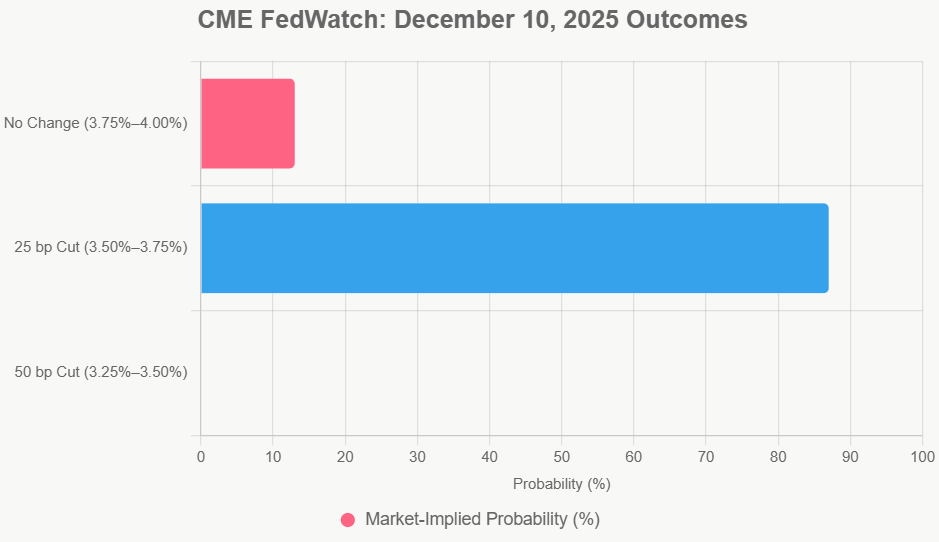
Filed Under: Economy, Financing Tagged With: Economy, Fed, Federal Reserve, FOMC Meeting, interest rates

Interest Rate Predictions for October 29, 2025: Fed Rate Cut Odds Soar to 99%

October 29, 2025 by Marco Santarelli

Interest Rate Predictions for October 29, 2025: Fed Rate Cut Odds Soar to 99%

As the Federal Reserve's Open Market Committee (FOMC) deliberates during its meeting that concludes today, October 29, 2025, the financial world is practically holding its breath in anticipation. The consensus among Wall Street and the broader economic community is overwhelmingly focused on a 25 basis point reduction in the federal funds rate, bringing the target range down to 3.75%-4.00%.

This anticipated move, expected to be announced after the meeting, would represent the second consecutive cut this year and signal a proactive stance against potential weakening in the job market. It’s been a wild ride with interest rates over the past few years. We went from near-zero after the pandemic to sky-high levels to fight inflation, and now we seem to be shifting back toward easier money. This October meeting feels like a crucial step in that ongoing journey.

Interest Rate Predictions for October 29, 2025: Fed Rate Cut Odds Soar to 99%

The Driving Forces Behind the Expected Cut

So, why is everyone so sure a cut is coming as the FOMC deliberates? It boils down to a few key economic ingredients that are shaping their discussions.

1. A Cooling Job Market: This is the big one that's undoubtedly on the Fed's minds. We're seeing signs that the hiring spree might be slowing down. Private sector reports for September showed only modest job gains, and unemployment claims have been on the rise. This isn't just a hunch; it’s a trend that the Federal Reserve closely monitors. They have a dual mandate: maximum employment and stable prices. When the employment side shows cracks, they tend to act.

2. Inflation is Still a Friend, But a Wary One: Inflation, while not completely vanquished, has shown signs of easing. September's Consumer Price Index (CPI) reported a 3.0% year-over-year increase, a slight tick up from August but still a far cry from the peak. Core inflation, which strips out volatile food and energy prices, also eased a bit. While it's still above the Fed's target of 2%, the trend is moving in the right direction, giving policymakers room to breathe and consider cuts as they finalize their decisions.

3. The Fog of the Government Shutdown: A significant wildcard for this particular meeting has been the ongoing government shutdown. This has unfortunately put many key government reports, especially those from the Bureau of Labor Statistics (BLS), on hold. This means the Fed is working with less complete information than usual as they conclude their deliberations. Imagine trying to navigate a road with patches of fog – you have to rely on your best judgment and the information you do have. That's essentially what the Fed is doing right now, and the available data points toward needing to ease policy.

What the Markets Are Saying: A Roaring Consensus

When we talk about “market predictions,” we're often looking at tools like the CME FedWatch Tool. This nifty gadget uses futures contracts to show the probability of different Fed actions. For the imminent announcement at the conclusion of the meeting on October 29, 2025, the odds are astonishingly high: 99% probability for a 25 basis point cut. This means that for all intents and purposes, the market believes it's a done deal. The remaining 1% is likely for a hold or, even more improbably, a larger cut. This level of certainty is rare and speaks volumes about how confident the market is in the Fed's direction as they finalizetheir statement.

The sentiment doesn't stop there. Markets are also assigning a high likelihood – 94% probability – for another rate cut at the December 2025 meeting. This suggests that the Fed isn't just looking at a one-and-done situation but sees a path toward further easing by the end of the year, potentially bringing the federal funds rate down to the 3.50%-3.75% range.

interest rate predictions 99% probability for a 25 basis point cut

A Look Back: The Fed's Journey to This Point

To truly understand today's predictions as the FOMC meeting concludes, we need a little historical context. The Fed's journey in 2025 has been about carefully unwinding the aggressive rate hikes of previous years. After peaking around 5.25%-5.50% in mid-2024 to combat post-pandemic inflation, the Fed began a series of moves aimed at bringing borrowing costs down.

  • September 2024: A significant 50 basis point cut kicked off the easing cycle.
  • November & December 2024: Two more 25 basis point reductions followed, bringing rates to 4.25%-4.50% by the start of 2025.
  • Early to Mid-2025: The Fed held rates steady through several meetings, carefully watching inflation and economic growth as they prepared for this current discussion.
  • September 17, 2025: The most recent move was a 25 basis point cut, bringing the target range to its current 4.00%-4.25%. This decision was driven by those early signs of labor market softness that are now central to their current deliberations.
Date Target Range Change (bps) Key Notes
Sep 17, 2025 4.00%-4.25% -25 Miran dissents for -50 bps; labor cooling cited.
Jul 30, 2025 4.25%-4.50% 0 Bowman, Waller prefer -25 bps.
Jun 18, 2025 4.25%-4.50% 0 Unanimous hold amid stable growth.
May 7, 2025 4.25%-4.50% 0 Focus on inflation monitoring.
Mar 19, 2025 4.25%-4.50% 0 Waller notes QT pace; unanimous.
Jan 29, 2025 4.25%-4.50% 0 Labor strong, activity moderate.
Dec 18, 2024 4.25%-4.50% -25 Hammack prefers hold.
Nov 7, 2024 4.50%-4.75% -25 Unanimous easing.
Sep 18, 2024 4.75%-5.00% -50 Bowman prefers -25 bps.
Jul 31, 2024 5.25%-5.50% 0 Peak rate maintained.

This pattern of easing from a higher peak mirrors historical cycles, but each one has its own unique characteristics shaped by the economic environment, all coming to a head in today's crucial meeting.

Here's a graph showing how the fed funds rate has evolved:

Here's how the effective federal funds rate has evolved

This historical context is crucial. It shows that the Fed’s actions are part of a process, and the October meeting is another step in that ongoing journey.

The Impact of a Rate Cut: What It Means for You

When the Fed is expected to cut interest rates, it's like turning a faucet for the cost of borrowing money. Here's how it can affect different parts of your financial life once the decision is announced:

  • Borrowers Rejoice (Potentially):
    • Mortgages: Mortgage rates are closely tied to the Fed's actions. With current 30-year mortgage rates hovering around 6.5%, a cut could push them slightly lower, perhaps to mid-6% range. This can make buying a home more affordable or lead to savings for those looking to refinance.
    • Car Loans and Credit Cards: The cost of borrowing for other big purchases might also decrease over time.
  • Savers Face a Squeeze:
    • Savings Accounts and CDs: On the flip side, the interest you earn on your savings accounts, money market accounts, and Certificates of Deposit (CDs) will likely decline. If rates drop by 0.25%, you might see a similar reduction in your yields. This is something retirees and those relying on interest income should be aware of.
  • The Stock Market's Reaction:
    • Potential Boost: Cheaper borrowing costs can make it more attractive for companies to invest and expand, potentially leading to higher stock prices. A rate cut often provides a positive sentiment boost to the market.
    • Bond Volatility: Bond prices can be a bit more complex. If the Fed signals more aggressive cuts in the future, bond yields (which move inversely to prices) might decline.
  • The Broader Economy:
    • Stimulus Effect: Easier monetary policy generally encourages spending and investment, which can help keep the economy growing.
    • Asset Bubbles: However, if rates stay low for too long without economic justification, there's a risk of inflating asset bubbles in things like stocks or real estate.

Navigating the Shutdown's Shadow

The government shutdown presents a unique challenge for the Fed as they finalize their discussions. With core economic data delayed or unavailable, they’re relying more heavily on alternative indicators and anecdotal evidence. Think of it like trying to play a game of chess with some of the pieces hidden – you have to anticipate your opponent's moves based on what you can see. This lack of definitive data might make future decisions a bit more uncertain, but for this October meeting's announcement, the evidence for a cut is just too strong to ignore.

Expert Opinions: A Mix of Caution and Consensus

While the market is almost unanimous in its prediction, experts offer more nuanced views as the Fed reaches its conclusion. Some, like former Federal Reserve officials, acknowledge that the available alternative data supports the rationale for a cut. Others express caution, pointing out that while inflation is easing, it’s still above the target, and the labor market's full potential weakness might take time to fully reveal itself. There's also the ongoing debate about how quickly the Fed should cut rates in the coming months, a discussion likely happening right now behind closed doors.

The Path Ahead: What to Expect Beyond Today's Announcement

The October cut is largely baked in, but the announcement itself is still the key event. The real question now shifts to what happens next. Will the Fed continue cutting at a steady pace? Will there be a pause? What will inflation and the job market do in the coming months, especially as more data becomes available after the shutdown ends?

Here's what I'm keeping an eye on after the FOMC statement is released:

  • December Meeting: As mentioned, the probability of another cut in December is very high. Policymakers will be closely watching how the economy responds to today's cut and any new data that emerges.
  • Inflation Data: The path of inflation, particularly core inflation and shelter costs, will remain paramount. Any unexpected reacceleration could put a halt to the cutting cycle.
  • Labor Market Trends: We need to see the official September jobs report and subsequent data to get a clearer picture of employment trends. Signs of a sustained slowdown will likely prompt further action.
  • Fed Communication: Fed Chair Jerome Powell's press conference, which follows the announcement, will be crucial for deciphering the Fed's future intentions. He'll likely emphasize “data dependence,” meaning their decisions will be guided by incoming economic information.

My Take on It All

From where I stand, this expected October 29, 2025 rate cut feels like a necessary step to support an economy that's showing some signs of strain as the FOMC concludes its deliberations. The Fed has done a remarkable job in trying to thread the needle between fighting inflation and ensuring maximum employment.

While there are always risks and uncertainties, especially with incomplete data due to the shutdown, the overwhelming market sentiment and the available economic indicators point toward a move towards lower interest rates as the announcement imminently approaches. For consumers, this means potentially cheaper borrowing costs but also lower returns on savings. It’s a complex balance, and as always, I’ll be watching closely to see how these decisions unfold and what they mean for our bottom lines.

“Build Wealth Faster Through Turnkey Real Estate”

The Federal Reserve’s decisions on interest rates impact everything—from your mortgage payments to your savings yields. Market analysts now anticipate additional rate cuts over the coming months—potentially lowering the rate to around 3.50%–3.75% by the end of 2025.

This shift could open new opportunities for homebuyers and real estate investors looking to secure better financing terms.

🔥 Lower Rates Mean Smarter Investment Opportunities! 🔥

Talk to a Norada investment counselor today (No Obligation):

(800) 611-3060

Get Started Now

Want to Know More?

Explore these related articles for even more insights:

  • Next Federal Reserve Meeting Just 4 Days Away: What to Expect?
  • Fed Interest Rate Forecast Q4 2025: Target Range Could Hit 3.50%–3.75%
  • Fed Interest Rate Forecast for the Next 12 Months
  • Federal Reserve Cuts Interest Rate by 0.25%: Two More Cuts Expected in 2025
  • Interest Rate Predictions for the Next 3 Years: 2025, 2026, 2027
  • When is Fed's Next Meeting on Interest Rate Decision in 2025?
  • Interest Rate Predictions for the Next 10 Years: 2025-2035
  • Interest Rate Predictions for 2025 by JP Morgan Strategists
  • Interest Rate Predictions for Next 2 Years: Expert Forecast
  • Market Reactions: How Investors Should Prepare for Interest Rate Cut
  • Impact of Interest Rate Cut on Mortgages, Car Loans, and Your Wallet

Filed Under: Economy, Financing Tagged With: Economy, Fed, Federal Reserve, FOMC Meeting, interest rates

Next Federal Reserve Meeting Just 4 Days Away: What to Expect?

October 24, 2025 by Marco Santarelli

The Next Federal Reserve Meeting Preview: October 28-29, 2025

The Federal Reserve's next pivotal meeting, scheduled for October 28-29, 2025, is almost certainly going to result in a quarter-point interest rate cut, lowering the federal funds rate target to between 3.75% and 4.00%. After a period of aggressive tightening, the central bank is now signaling a shift towards easing, driven by cooling inflation and a softening job market.

While the market is largely anticipating this move, I'll be watching the Fed's official statement very closely for any nuances that might hint at their future plans or signal concerns about lingering economic uncertainties.

This upcoming October meeting feels particularly significant because the Fed is trying to thread a very fine needle: slowing down an economy that was overheating without pushing it into a recession. It's a delicate dance, and the music they play in their policy statement will be listened to by everyone from Wall Street traders to everyday families planning their finances.

Next Federal Reserve Meeting Just 4 Days Away: What to Expect?

Understanding the FOMC Meeting: What's on the Docket?

For those who don't follow the Fed's every move, the Federal Open Market Committee (FOMC) is the group within the Federal Reserve system that actually decides on interest rates and other monetary policy tools. They get together eight times a year to hash things out. The October meeting is one of the “standard” ones, meaning it won't involve the release of their fancy economic projections (like the “dot plot”) or a press conference with Chair Jerome Powell. Those are usually reserved for the March, June, September, and December meetings.

This means the real substance will be in the policy statement released on October 29th at 2:00 p.m. Eastern Time. This statement is where they’ll lay out their reasoning for any decision and give us clues about what they’re thinking for the future. The minutes from this meeting, which will offer a more detailed look at the discussions, won't come out until November 19th, about three weeks later. So, for immediate takeaways, the statement is our primary source.

The Economic Picture: Why the Fed is Leaning Towards Easing

Several key economic indicators are painting a picture that supports a move to lower interest rates. For starters, inflation, which was a major worry for the Fed in the past couple of years, has been coming down. The latest readings show it hovering around 2.9% year-over-year. While this is still above the Fed's target of 2%, it's a significant improvement from the peaks we saw.

On the employment front, the job market is showing signs of cooling. The unemployment rate has nudged up to 4.3%, and more importantly, the pace of job creation has slowed considerably. In September, we saw only about 22,000 new jobs added, which is well below what was expected. This suggests that the labor market is no longer as red-hot as it was, which is exactly what the Fed wants to see to help control inflation.

However, it’s not all smooth sailing. Gross Domestic Product (GDP), which measures the overall health of the economy, is still showing solid growth. The most recent figures indicated an annualized growth rate of 3.8% in the second quarter. This “soft landing” scenario, where inflation cools without a major economic downturn, is what the Fed aims for, but it's a tough balancing act. Fed officials, including Chair Powell and Governor Waller, have been vocal about the need to carefully weigh the risks. They’re concerned about a potential rebound in inflation due to things like new tariffs or supply chain disruptions, but also about pushing the job market too far.

Here's a quick look at some of the key numbers:

Indicator Latest Value (Sept/Oct 2025) Trend vs. Prior Month Fed Target/Context
Inflation (YoY) 2.9% Down from 2.7% 2% long-run goal
Unemployment Rate 4.3% Up from 4.2% Maximum employment
Nonfarm Payrolls +22K Significantly Lower Sustainable growth
GDP Growth (Annual) 2.1% Steady Avoid recession

This dashboard of economic data is what the FOMC members will be poring over. The progression of inflation downwards, coupled with a cooling labor market, provides a strong justification for a measured rate cut.

What the Market Thinks: A Near-Certainty

When it comes to what the financial markets expect, there’s very little guesswork. The CME FedWatch Tool, which tracks futures contracts related to the federal funds rate, shows an overwhelming probability – around 98.9% – of a 25 basis point (bps) cut. This means the market is virtually certain that the Fed will lower its target rate from the current 4.00%-4.25% range to 3.75%-4.00%. The odds of no change are barely 1.1%, and a larger 50 bps cut is, for all intents and purposes, off the table.

fed rate cut possibilty in october 2025 by cme fedwatch tool

This high level of certainty reflects the consensus among economists and investors that the Fed is in an easing cycle. This would be the second consecutive quarterly cut, following the reduction made in September. It’s important to remember that markets are forward-looking, so much of this expected move has already been “priced in” to asset values. This means the actual announcement might not cause huge immediate market swings unless the Fed says something unexpected in its statement.

A Look Back: The Fed's Rate Journey

To understand the current situation, it’s helpful to recall the Fed’s recent actions. After keeping rates near zero for a long time, the Fed embarked on an aggressive hiking campaign starting in early 2022 to combat soaring inflation. Rates climbed rapidly, reaching a peak of 5.33% in mid-2023. Since then, we’ve seen a reversal, with the Fed starting to cut rates in 2024 and continuing into 2025.

This trajectory shows how the Fed has been reactive to economic conditions. First, it fought inflation with higher rates, and now, as inflation recedes and the economy shows signs of slowing, it’s shifting to support growth. The proposed cut in October continues this easing trend.

Here's how the effective federal funds rate has evolved:

Here's how the effective federal funds rate has evolved

This historical context is crucial. It shows that the Fed’s actions are part of a process, and the October meeting is another step in that ongoing journey.

What to Watch For in the Statement

Since there won't be a press conference or new projections, the policy statement issued on October 29th will be the main guide. I'll be looking for several things:

  • The specific language used to describe inflation and employment: Does it suggest they are truly comfortable with current trends, or are there lingering concerns about upside inflation risks or deeper labor market weakening?
  • Forward-looking guidance: Even without the dot plot, the statement might offer clues about the pace and extent of future rate cuts. Phrases like “gradual” or “measured” will be important to note.
  • Any mentions of specific risks: Will they highlight potential issues like geopolitical events, trade policy changes, or financial stability concerns? These could provide insight into potential future actions.
  • The balance between the dual mandate: How are they weighing the need to keep prices stable against ensuring maximum employment?

The difference between a hawkish statement (suggesting a more cautious, slowing approach to cuts) and a dovish statement (indicating a quicker pace of easing) can significantly influence market sentiment.

Potential Impacts: Who Benefits and Who Worries?

A 25 bps rate cut could have several effects:

  • Stock Markets: Historically, rate cuts, especially when initiated during a period of economic expansion, can be positive for stocks. The thinking is that lower borrowing costs can boost corporate profits and consumer spending. However, the reaction can depend on the reason for the cut. If it's seen as purely precautionary to stave off a recession, it might be met with more caution.
  • Borrowing Costs: Consumers and businesses could see slightly lower interest rates on things like mortgages, car loans, and business loans. This can stimulate demand and investment. However, the impact on mortgages might be muted if rates have already fallen in anticipation.
  • Cryptocurrency Markets: These markets tend to be sensitive to liquidity and the cost of capital. A dovish Fed generally supports higher prices for assets like Bitcoin, as investors seek higher returns and liquidity increases. Analysts suggest that a cut could see Bitcoin testing new highs.
  • Businesses: For companies with significant debt, lower interest rates mean lower borrowing costs, which is a positive for their bottom line. However, they'll also be watching consumer demand, which is influenced by the overall health of the economy.
  • Households: Those with variable-rate debt will see their payments decrease. However, if inflation begins to tick back up, the benefit from lower rates could be eroded.

It’s a mixed bag, and the actual outcome depends on how the Fed's actions are interpreted and how the economic data continues to unfold in the coming weeks and months.

Expert Opinions and The Road Ahead

Economists and analysts I follow are largely in agreement with the market’s expectation of a rate cut. However, many also echo the Fed’s caution. The uncertainty surrounding government data releases due to potential disruptions adds a layer of complexity. This means the Fed might be relying on older data points or alternative indicators, which could lead to surprises.

The discussions among Fed officials themselves highlight this balancing act. Governor Waller has indicated support for a 25 bps cut due to job market concerns, but has also flagged potential inflationary pressures from tariffs. Chair Powell’s recent remarks have emphasized a “no risk-free path,” underscoring the difficult choices the Fed faces.

Looking beyond October, the big question is: what’s next? Will this be the start of a steady path of rate cuts, or a pause before potentially more aggressive action? The economic forecast for 2026 by institutions like the IMF suggests continued growth, but with potential headwinds. How the Fed navigates these challenges in the coming months will shape not just the economy but also influence broader trends like trade policies and even the upcoming elections.

Ultimately, this October FOMC meeting is about the Fed’s assessment of whether its aggressive fight against inflation has succeeded enough to begin supporting growth without reigniting price pressures. It’s a critical juncture, and while the rate cut itself might be largely predictable, the nuances within the Fed’s statement will be key to understanding the path forward.

“Build Wealth Through Turnkey Real Estate”

The Federal Reserve’s decisions on interest rates impact everything—from your mortgage payments to your savings yields. As of October 2025, the Fed’s target range stands at 4.00%–4.25% following a recent 25 basis point cut, with the effective rate hovering near 4.09%.

Market analysts now anticipate additional rate cuts over the coming months—potentially lowering the rate to around 3.50%–3.75% by the end of 2025. This shift could open new opportunities for homebuyers and real estate investors looking to secure better financing terms.

🔥 Lower Rates Mean Smarter Investment Opportunities! 🔥

Talk to a Norada investment counselor today (No Obligation):

(800) 611-3060

Get Started Now

Want to Know More?

Explore these related articles for even more insights:

  • Fed Interest Rate Forecast Q4 2025: Target Range Could Hit 3.50%–3.75%
  • Fed Interest Rate Forecast for the Next 12 Months
  • Federal Reserve Cuts Interest Rate by 0.25%: Two More Cuts Expected in 2025
  • Fed Projects Two Interest Rate Cuts Later in 2025
  • Interest Rate Predictions for the Next 3 Years: 2025, 2026, 2027
  • When is Fed's Next Meeting on Interest Rate Decision in 2025?
  • Interest Rate Predictions for the Next 10 Years: 2025-2035
  • Interest Rate Predictions for 2025 by JP Morgan Strategists
  • Interest Rate Predictions for Next 2 Years: Expert Forecast
  • Fed Funds Rate Forecast 2025-2026: What to Expect?
  • Interest Rate Predictions for 2025 and 2026 by NAR Chief
  • Market Reactions: How Investors Should Prepare for Interest Rate Cut
  • Impact of Interest Rate Cut on Mortgages, Car Loans, and Your Wallet
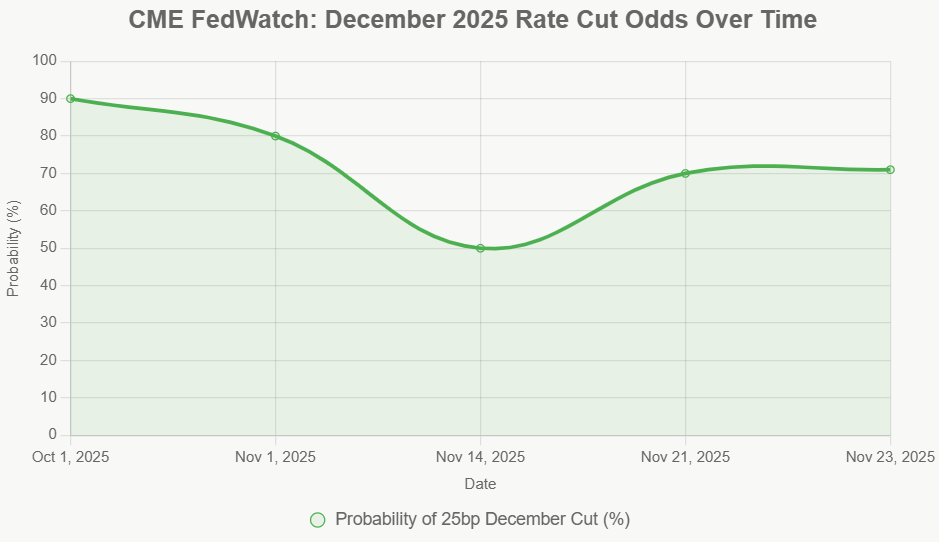
Filed Under: Economy, Financing Tagged With: Economy, Fed, Federal Reserve, FOMC Meeting, interest rates

Real Estate

  • Birmingham
  • Cape Coral
  • Charlotte
  • Chicago

Quick Links

  • Markets
  • Membership
  • Notes
  • Contact Us

Blog Posts

  • Today’s Mortgage Rates, December 8: Rates Rise Ahead of Crucial Fed Decision
    December 8, 2025Marco Santarelli
  • December 9–10 Fed Meeting is Shaping Up to Deliver the Third Rate Cut of 2025
    December 8, 2025Marco Santarelli
  • 5 Predictions That Will Define the NYC Housing Market in 2026
    December 8, 2025Marco Santarelli

Contact

Norada Real Estate Investments 30251 Golden Lantern, Suite E-261 Laguna Niguel, CA 92677

(949) 218-6668
(800) 611-3060
BBB
  • Terms of Use
  • |
  • Privacy Policy
  • |
  • Testimonials
  • |
  • Suggestions?
  • |
  • Home

Copyright 2018 Norada Real Estate Investments

Loading...