Norada Real Estate Investments

  • Home
  • Markets
  • Properties
  • Membership
  • Podcast
  • Learn
  • About
  • Contact

Housing Market Crisis: Colorado Makes BOLD Move to Fix Affordability

May 25, 2024 by Marco Santarelli

Housing Crisis: Colorado Makes BOLD Move to Fix Affordability

Colorado has recently taken significant steps to address its housing crisis, a challenge that has escalated over the past three decades. The state, once known for its relative affordability, has seen home prices soar, outpacing even those in traditionally expensive states like Florida and California.

This surge in housing costs has led to a myriad of issues, including declining population growth, increased homelessness, and difficulties for employers in hiring due to the lack of affordable housing options for workers.

Colorado Makes BOLD Move to Fix Crippling Housing Crisis

Legislative Measures

In response to these challenges, Colorado's General Assembly has passed several groundbreaking laws aimed at increasing housing affordability and availability. On May 13, 2024, Governor Jared Polis signed a bill that mandates local governments to plan and zone for more apartments and condominiums near transit stations.

This legislation is expected to boost the availability of affordable housing options in proximity to public transportation, thereby reducing the reliance on personal vehicles and promoting sustainable urban development.

Furthermore, the state has introduced a law that permits the construction of accessory dwelling units (ADUs) in larger cities and towns. ADUs are small apartments that can be located on the same lot as a single-family house, providing an innovative solution to increase housing density without compromising the character of neighborhoods.

Other legislative measures include the elimination of minimum vehicle parking requirements for new apartments and the preemption of local rules that restrict individuals from living with roommates. These changes are designed to lower the barriers for developers to build more diverse housing options at reduced costs, ultimately making housing more affordable for Coloradans.

Additionally, Colorado is considering even more legislation, such as a bill that would grant local governments the right to purchase existing homes to preserve affordability. This proactive approach reflects a broader strategy to hold down housing costs for both developers and home seekers.

Impact and Implications

The impact of restrictive zoning laws on housing affordability has been well-documented by economists. By limiting the supply of new homes, these laws have contributed to the increase in housing prices, not just in affluent areas but across the nation.

Colorado's recent legislative actions represent a significant shift in policy, aiming to remove barriers that prevent the development of new homes and, in turn, address the housing crisis head-on.

These efforts by Colorado to reform its housing policies could position the state as a national leader in expanding housing affordability. The comprehensive approach taken by the state government demonstrates a commitment to finding effective solutions to one of the most pressing issues facing its residents today.

Comprehensive Strategy

Building on the foundation of recent legislative changes, Colorado is not only focusing on the creation of new housing but also on the preservation and improvement of existing structures. The state has allocated funds for the renovation of older buildings, transforming them into affordable housing units. This not only helps to maintain the architectural heritage of the state but also provides immediate housing solutions.

Moreover, Colorado has launched financial assistance programs for first-time homebuyers and low-income families. These programs offer down payment assistance and low-interest loans, making homeownership more accessible to a broader segment of the population. By supporting residents in their pursuit of homeownership, Colorado is investing in the stability and growth of its communities.

In addition to state-led initiatives, Colorado is encouraging private-public partnerships to tackle the housing crisis. These collaborations aim to leverage the resources and expertise of both sectors to create innovative housing solutions. For example, some projects involve converting unused commercial properties into residential units, which not only addresses the housing shortage but also revitalizes underutilized urban spaces.

The state is also implementing smart growth policies to manage urban sprawl and protect natural resources. These policies promote the development of compact, walkable communities with a mix of housing, commercial, and recreational spaces. By doing so, Colorado is ensuring that its growth is sustainable and beneficial for all residents.

Summary

Colorado's comprehensive approach to the housing crisis serves as a model for other states grappling with similar issues. By prioritizing affordability, sustainability, and community, Colorado is paving the way for a future where everyone has access to a place they can call home. The success of these measures will be closely watched by policymakers and housing advocates across the country, as they offer valuable lessons for national housing strategies.

As the situation evolves, it will be crucial to monitor the effectiveness of these policies and make adjustments as needed. The goal is clear: to create a housing market that is inclusive, affordable, and responsive to the needs of all Coloradans. With continued commitment and innovation, Colorado's housing crisis may soon be a thing of the past.


ALSO READ:

Colorado Housing Market 2024: Trends and Predictions

Top 10 States Facing a HOUSING CRISIS: Severe Underproduction

Arizona's Housing Crisis: Young Adults Struggling to Find Home

10 Affordable Places to Live in Colorado

Denver Housing Market 2024: Trends and Predictions

Long Island's Housing Crisis: Can New York Fix This Market

Is the Housing Crisis Over in America?

Filed Under: Housing Market, Real Estate Market Tagged With: Colorado, Housing Affordability, Housing Crisis, Housing Market

Will Housing Affordability Make Real Estate Market Hot in 2023?

May 23, 2022 by Marco Santarelli

Housing affordability crisis

While high mortgage rates have had a cooling effect on the spring real estate market in the United States, there are still specific markets that continue to thrive. The driving force behind their success lies in the pursuit of affordable housing by homebuyers. In this blog post, we will explore the critical factor known as the “affordability advantage” and its role in making certain markets hotter than ever. We will examine the key elements contributing to the success of these markets, showcase examples of top-performing cities, and discuss the future outlook for home prices in these areas.

What Makes Today's Real Estate Market Hot: A Study for April 2023

In this analysis, Realtor.com® uncovers the key elements that contribute to the market's heat, driving high demand and quick sales. From affordability and location advantages to inventory scarcity and intense buyer competition, these dynamics shape the landscape of the real estate market, making it one of the hottest sectors to watch.

1. Analyzing Demand and Pace: Identifying the Hottest Markets

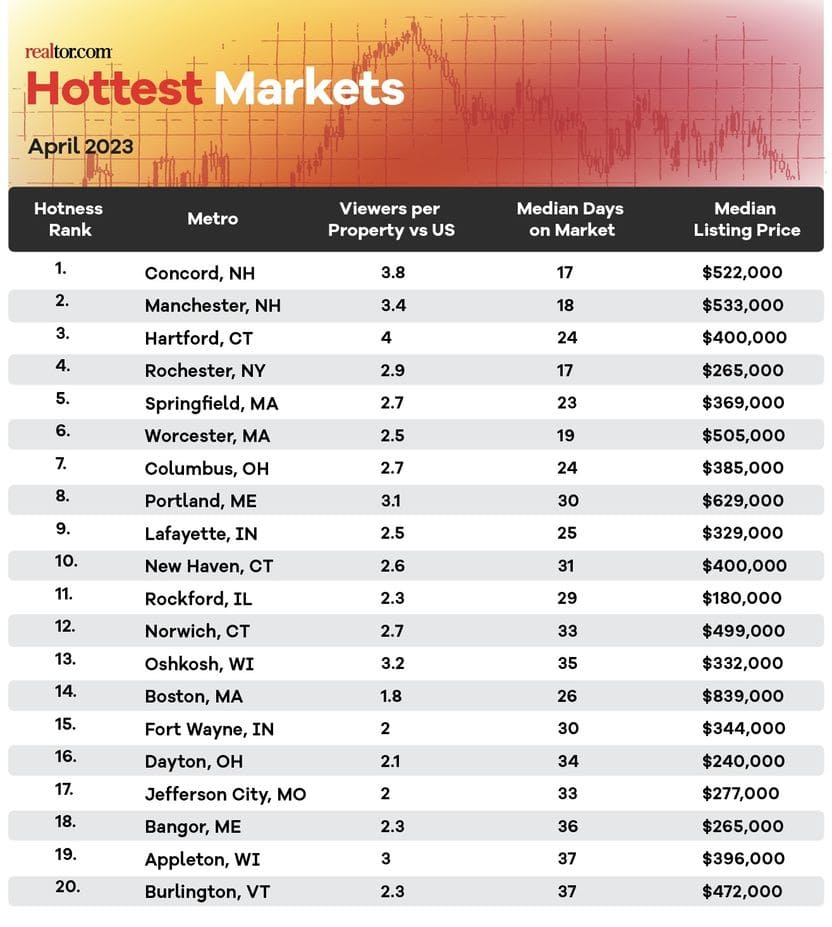
To determine the hottest markets, the Realtor.com® Hottest Markets List assesses two important variables: demand, measured by the number of views per listing, and pace, measured by the time listings spend on the market before being sold. Despite the sluggish national housing market, there are markets that continue to experience high demand and rapid sales. In April, Concord, NH claimed the top spot for the second time, with homes receiving 3.8 times more views than the national average and an average time on the market of just 17 days.

2. The Advantage of Affordability in the Northeast

One of the primary reasons for the success of many top markets on the Hottest Markets List is the “affordability advantage.” While the median home prices in Concord and Manchester, NH, surpass the national median, they are still considerably more affordable compared to neighboring Boston, which tops the list as the most expensive city. The proximity to high-cost cities, along with tax-friendly environments, makes these markets highly desirable.

3. Concentration of Thriving Northeastern Markets

The top five hottest markets in April, including Hartford, CT; Rochester, NY; and Springfield, MA, are all located in the Northeastern region. According to economist Hannah Jones, out of the 12 Northeast markets on the list, nine are clustered around the Boston area. This region showcases strong employment data and has outperformed the national employment growth rate. The combination of high housing demand and limited inventory continues to drive prices upward, compelling buyers to seek affordability in surrounding areas.

4. The Ascendancy of Midwest Real Estate

While the West and South regions failed to secure positions in the top 20 hottest markets, the Midwest has emerged as a promising area. Eight Midwestern cities made the list, attracting buyers with lower home prices that help counterbalance the impact of high mortgage rates. These Midwest markets received above-average views and experienced shorter durations on the market. Buyers are particularly drawn to the region's lower taxes and appealing home prices, resulting in a migration from neighboring areas.

5. Striking a Balance: Affordability and Inventory Challenges

Despite the affordability advantage in these hot markets, the demand from homebuyers is surpassing the available inventory. Although the national inventory has increased compared to the previous year, many of the hottest markets are facing slower inventory growth or even declines. Low inventory levels fuel intense competition among buyers, leading to bidding wars and subsequent increases in home prices. Even in markets with initially low prices, there have been significant year-over-year price increases.

Summary

The current real estate landscape underscores the significance of the affordability advantage in driving the hottest markets. Homebuyers are increasingly drawn to markets with lower home prices compared to neighboring expensive cities. The Northeast and Midwest regions have emerged as strong contenders, but finding the right balance between affordability and inventory remains a challenge. As prices continue to rise and inventory remains limited, buyers must act swiftly to secure favorable deals in these thriving markets.

Today's Hottest Real Estate Markets
Source: Realtor.com

Source:

  • https://www.realtor.com/news/trends/what-makes-a-real-estate-market-hot-right-now-it-all-boils-down-to-the-affordability-advantage/

Filed Under: Housing Market Tagged With: Hot Housing Markets, Hot Real Estate Markets, Housing Affordability, Housing affordability crisis

Just How Cheap is US Housing?

September 5, 2012 by Marco Santarelli

Consider Minneapolis, Minn.  You could’ve bought, out of foreclosure, a three-bedroom, two-bath house of 1,356 square feet on a quarter acre lot for about $29,000. It needed a lot of work, but houses in the neighborhood recently sold for $75,000.


Your mortgage would be under $100 per month and about the same in taxes. You could’ve got $1,000 in rent. Even if you had to put $40,000 in the house, your gross yield (cap rate) would’ve been 17.4% on the property.

This is one example sleuthed by my friend Gary Gibson. “The house had mold damage and needed a lot of work,” he wrote. “Beautiful yard, however.”

[Read more…]

Filed Under: Economy, Growth Markets, Housing Market, Real Estate Investing Tagged With: Cheap Housing, Economy, Housing Affordability, Housing Market, National Housing, Real Estate Investing, Rental Housing, rental property, US Housing, USA Housing Market

  • « Previous Page
  • 1
  • 2

Real Estate

  • Birmingham
  • Cape Coral
  • Charlotte
  • Chicago

Quick Links

  • Markets
  • Membership
  • Notes
  • Contact Us

Blog Posts

  • Mortgage Rates Today, June 7, 2026: 30‑Year Refinance Rate Rises by 10 Basis Points
    June 7, 2026Marco Santarelli
  • Best Cities to Invest in Real Estate in Summer 2026
    June 7, 2026Marco Santarelli
  • Today’s Mortgage Rates, June 7: 30‑Year Fixed at 6.38%, Monthly Payments Rising
    June 7, 2026Marco Santarelli

Contact

Norada Real Estate Investments 30251 Golden Lantern, Suite E-261 Laguna Niguel, CA 92677

(949) 218-6668
(800) 611-3060
BBB
  • Terms of Use
  • |
  • Privacy Policy
  • |
  • Testimonials
  • |
  • Suggestions?
  • |
  • Home

Copyright 2018 Norada Real Estate Investments

Loading...