Norada Real Estate Investments

  • Home
  • Markets
  • Properties
  • Membership
  • Podcast
  • Learn
  • About
  • Contact

Housing Market Report Reveals 48.3% Equity-Rich Homes in Q3 2024

October 25, 2024 by Marco Santarelli

Housing Market Report Reveals 48.3% Equity-Rich Homes in Q3 2024

Let's talk about something pretty important if you own a home or are thinking about buying one: home equity. Understanding home equity in the current U.S. housing market is key to making smart financial decisions. So, let's dive in!

Home Equity in the U.S. Housing Market: A Deep Dive

What is Home Equity?

Simply put, your home equity is the difference between what your home is worth and how much you still owe on your mortgage. If your house is worth $300,000 and you owe $200,000, you have $100,000 in equity. It's essentially your ownership stake in your property. Building significant home equity is a major financial goal for many homeowners, because it's a valuable asset.

48.3% Equity-Rich Homes in the U.S. as of Q3 2024

According to ATTOM Data Solutions' Q3 2024 report, 48.3 percent of mortgaged homes in the U.S. were considered “equity-rich” – meaning the loan balance was less than half their estimated market value. That’s a pretty significant number, especially considering that this percentage was down only slightly from the record 49.2% in Q2 2024.

While this is a slightly decreased percentage from recent quarters, it's still considerably higher than levels seen just a few years ago, reflecting the sustained strength of the housing market over the past decade or so. This data clearly shows that many homeowners have built up substantial equity in their properties. However, it’s important to note that the market is dynamic, and fluctuations are to be expected.

This is great news for many homeowners, as it shows a strong housing market and significant wealth building for a large percentage of the population. However, it’s also a reminder that markets can change and even a relatively small decrease in home values could affect the amount of equity homeowners have built up.

Factors Affecting Home Equity

Several factors influence your home equity:

  • Home Prices: This is the biggest driver. Rising home prices increase equity, while falling prices decrease it.
  • Mortgage Payments: Consistent on-time payments reduce your loan balance, directly increasing your equity.
  • Interest Rates: Higher interest rates can slow down equity growth as a larger portion of your monthly payment goes toward interest.
  • Market Conditions: Local economic conditions, inventory levels, and buyer demand all play a significant role in home prices and, consequently, equity.

The “Underwater” Problem: When Equity Turns Negative

The ATTOM report also highlighted the percentage of homes that are “seriously underwater.” This happens when you owe more on your mortgage than your home is worth. In the third quarter of 2024, only 2.5% of mortgaged homes were in this situation. While a slight uptick from the previous quarter, this remains near a five-year low and a significant improvement from the post-2008 financial crisis levels. This is positive news, suggesting the housing market is far more stable than during that period.

However, it's crucial to remember that the percentage of underwater mortgages is still not zero. Areas with weaker local economies or markets that have experienced more significant price corrections might see a higher concentration of underwater mortgages.

Regional Variations in Home Equity

ATTOM's report also revealed significant regional differences in home equity.

States with highest equity-rich levels (Q3 2024):

  • Vermont (86.4%)
  • Maine (62.2%)
  • New Hampshire (61.1%)
  • Rhode Island (60.6%)
  • Montana (60.5%)

States with lowest equity-rich levels (Q3 2024):

  • Louisiana (21.1%)
  • Alaska (31.9%)
  • North Dakota (33.2%)
  • Maryland (33.2%)
  • Illinois (34%)

These variations highlight how local market dynamics significantly impact home equity. Areas with strong economies and high demand generally exhibit greater equity levels, while areas with slower economic growth and lower demand may see lower equity.

Metropolitan Statistical Areas (MSAs):

The same pattern held true for MSAs. High-end markets in the Northeast and West consistently displayed the highest equity-rich rates, while lower-priced markets in the South and Midwest had the lowest.

MSA Equity-Rich (%) Median Home Price
San Jose, CA 68.7 $1.5 million
Portland, ME 64.6 $520,000
Baton Rouge, LA 15.8 $223,564
New Orleans, LA 26.9 $242,900

This difference is partially explained by price appreciation in higher cost markets over the past decade and the overall housing market dynamic.

Counties and Zip Codes: A Granular View

The data was also broken down to the county and zip code levels. High percentages of equity-rich properties were concentrated in Midwest counties, while the lowest were predominantly in Southern counties. Similar trends were observed at the zip code level.

The Impact of Home Equity on the Economy

The elevated levels of home equity have significant implications for the overall U.S. economy. Homeowners with substantial equity have more financial leverage, enabling them to make large purchases, invest, or even refinance their mortgages to reduce monthly payments. This financial flexibility helps stimulate economic activity.

Looking Ahead: Predictions and Considerations

While the current data paints a positive picture, it’s essential to remember that the housing market is dynamic. Several factors could impact home equity in the coming months and years:

  • Interest Rate Changes: Further increases in interest rates could put upward pressure on mortgage payments, potentially slowing equity growth.
  • Inflation: Persistent inflation could lead to decreased purchasing power and potentially affect home prices.
  • Economic Slowdown: A broader economic downturn could impact home prices, potentially leading to equity erosion.

My Opinion and Expertise:

As someone who has been closely following the housing market for years, I believe that while the current levels of home equity are encouraging, it’s vital to approach the future with caution. While the market has shown remarkable resilience, external economic factors could cause shifts. Homeowners should monitor their individual equity positions and adjust their financial strategies accordingly. Diversifying investments and having a solid financial plan are key to weathering any potential market fluctuations.

It’s important to consult with a financial advisor for personalized guidance based on your unique situation. They can help you make informed decisions regarding your home equity and broader financial goals.

To sum up, home equity plays a vital role in the financial well-being of homeowners and the overall U.S. economy. While the current data suggests strong equity positions for many, understanding the underlying factors and regional variations is crucial for informed decision-making. Staying informed and actively managing your financial situation will ensure you're prepared for whatever the future holds.

Recommended Read:

  • Blackstone's Housing Empire: A Giant in the US Rental Market?
  • Billionaire Landlords Are Worsening the Housing Crisis in America
  • Will Federal Cap on Rent Hikes Solve or Worsen Housing Affordability?
  • Will Housing Affordability Improve in 2024?
  • Biden's 5% Rent Cap Plan Will Provide Relief for Renters Amid Housing Crisis
  • Best Time to Buy a Home in 2024 is From Sept 29 to Oct 5
  • Best Time to Buy a House in the US: Timing Your Purchase
  • Should I Buy A House Now Or Wait Until Later 2024? It a Good Time?
  • Is Now a Good Time to Buy a House with Cash
  • Is It a Bad Time to Buy a House?
  • Is it a Good Time to Buy a House in California in 2024?
  • Is It a Good Time to Sell a House or Should I Wait in 2024?
  • Is Now a Good Time to Invest in Rental Property (2024)?
  • Is 2024 a Good Time to Buy an Investment Property?

Filed Under: Housing Market, Real Estate Market Tagged With: Home Equity, Homeownership, Housing Affordabilty, Housing Crisis, Housing Market, Renting

Housing Crisis Explained: Will Gen Z Ever Afford to Move Out?

October 23, 2024 by Marco Santarelli

Housing Crisis Explained: Will Gen Z Ever Afford to Move Out?

The question, “Will Gen Z ever afford to move out?” hovers in the minds of many young adults today. As members of Generation Z step into adulthood, they're facing a rental market that feels almost inaccessible. With rising rents, scarce affordable housing, and a surge in new household formations, many wonder if they can afford to live independently without breaking the bank. Let’s explore this complicated situation in detail.

Housing Crisis Explained: Will Gen Z Ever Afford to Move Out?

Key Takeaways

  • Generation Z represents about 68 million individuals in the United States.
  • Rising rents have created a record number of cost-burdened households, with 22.4 million renters spending over 30% of their income on housing.
  • While housing stock has increased recently, it remains below pre-pandemic levels, limiting options for those seeking homes.
  • The slowdown of new construction is posing a challenge for first-time homebuyers and renters alike.
  • Collaboration among stakeholders is essential to address the affordability crisis and related housing issues.

Understanding the Housing Crisis for Gen Z

As of 2024, Generation Z, also known as Gen Z, consists of individuals born between 1995 and 2009. Many of them are now entering the rental market, eager to find spaces of their own. However, the challenge of affording to move out has never been greater.

The recent report from the Center for Housing Studies at Harvard University highlights that Gen Z is rapidly forming new households, marking a significant lifestyle shift. Unfortunately, this change is not happening in isolation; it is occurring amid a housing crisis that shows no signs of letting up.

Recent statistics paint a stark picture. Approximately 22.4 million renter households now allocate more than 30% of their income toward housing expenses (Realtor.com®).

This classification of being “cost-burdened” is indicative of a broader trend affecting many young adults. The situation becomes even grimmer when we look at the 12.1 million households paying more than 50% of their income in rent, illustrating the extreme financial stress many renters are under.

The median rent nationally for a two-bedroom apartment has soared to $1,933, creating a significant barrier to entry for new renters. Many individuals in Gen Z, loaded with student debt and limited job opportunities, simply cannot keep up with these rising prices. It begs the question: how can a generation poised for independence manage to break free from parental homes when their financial circumstances make it so daunting?

Recommended Read:

Housing Affordability: Nearly 80% of Americans Face This Crisis

The Demand vs. Supply Challenge

Despite the disheartening circumstances many face, there exists a glimmer of hope as the overall housing stock has increased recently. The current supply of homes is now around a four-month level, meaning that if no new homes come on the market, it would take that long to sell through current inventory. While this might signal a slight improvement, it's essential to bear in mind that it's still below pre-pandemic levels, which adds complexity to the market.

One complicating factor is that even though we see more homes available, the tight inventory continues to strain prices, creating fewer choices for those who desperately need affordable housing.

Much of the issue lies in the slowdown of new construction. Last year, we saw some positive momentum in building new homes, which usually helps alleviate some of the pressure on the rental market. However, the recent report indicates that this has come to a near halt. Single-family housing starts are dwindling, leading to a distressing scenario where first-time homebuyers and renters face an increasingly competitive market with fewer options.

Many people might assume that new homes could offer relief, especially since builders are known to create incentives like mortgage rate buy-downs to attract buyers. Yet, that isn’t the whole picture. The current lack of new construction is especially challenging for Generation Z as they are more likely to be looking for affordable, entry-level housing. Coupled with increasing rents, this leaves many young adults stuck living at home longer than anticipated.

Recommended Read:

Trump Claims Explosive Housing Crisis Under Biden: Is It Exaggeration?

The Broader Implications of the Housing Crisis

The implications of the housing crisis stretch far beyond just a lack of affordable rentals for Gen Z. As the report notes, a growing percentage of people are experiencing homelessness or living in precarious situations due to housing instability, which is most severe for marginalized communities. The impact of rising costs has made it incredibly difficult for young people to achieve traditional milestones, such as buying a home, starting a family, and securing stable employment.

Housing inequality has deep-seated causes that need to be addressed collectively. The burden of unaffordable rent falls disproportionately on younger generations, creating a discrepancy between them and prior generations who, in many cases, benefitted from more favorable market conditions. Such disparities highlight issues of social equity, as Gen Z must combat obstacles that previous generations did not face to the same degree.

Moreover, the housing crisis runs parallel to various social issues, including rising student loan debt. Many younger individuals are already burdened with significant debt, making it even harder to save for a down payment or meet monthly rent payments. Therefore, as Gen Z strives to establish independence, they find themselves caught between the urgency to earn, save, and finally break free from the nest.

The Call for Urgent Action

In their report, the researchers underline the need for an urgent and collaborative approach to tackle the affordability crisis. Multiple stakeholders must unite to find solutions that can alleviate the financial pressures young adults face. Working together, policy makers, real estate developers, non-profits, and community leaders could help establish a more robust safety net for housing, ultimately setting the groundwork for sustainable solutions.

Investing in affordable housing is critical; creating incentives for new construction focused on lower-income brackets could foster a more inclusive market for all generations. Additionally, regulatory reforms might help facilitate easier pathways for renters and buyers, ensuring that their voices are heard.

Addressing the housing crisis requires a comprehensive understanding that overlooks simplistic answers. Housing is not just a commodity; it is a fundamental need. The growing urgency of this issue calls for innovative methods, such as incorporating sustainable housing practices that consider climate change while maintaining affordability.

Also Read:

  • Will Federal Cap on Rent Hikes Solve or Worsen Housing Affordability?
  • Will Housing Affordability Improve in 2024?
  • Biden's 5% Rent Cap Plan Will Provide Relief for Renters Amid Housing Crisis
  • Best Time to Buy a Home in 2024 is From Sept 29 to Oct 5
  • Best Time to Buy a House in the US: Timing Your Purchase
  • Should I Buy A House Now Or Wait Until Later 2024? It a Good Time?
  • Is Now a Good Time to Buy a House with Cash
  • Is It a Bad Time to Buy a House?
  • Is it a Good Time to Buy a House in California in 2024?
  • Is It a Good Time to Sell a House or Should I Wait in 2024?
  • Is Now a Good Time to Invest in Rental Property (2024)?
  • Is 2024 a Good Time to Buy an Investment Property?

Filed Under: Housing Market, Real Estate Market Tagged With: Gen Z, Homeownership, Housing Affordabilty, Housing Crisis, Housing Market, Renting

Housing Market Crisis: Colorado Makes BOLD Move to Fix Affordability

May 25, 2024 by Marco Santarelli

Housing Crisis: Colorado Makes BOLD Move to Fix Affordability

Colorado has recently taken significant steps to address its housing crisis, a challenge that has escalated over the past three decades. The state, once known for its relative affordability, has seen home prices soar, outpacing even those in traditionally expensive states like Florida and California.

This surge in housing costs has led to a myriad of issues, including declining population growth, increased homelessness, and difficulties for employers in hiring due to the lack of affordable housing options for workers.

Colorado Makes BOLD Move to Fix Crippling Housing Crisis

Legislative Measures

In response to these challenges, Colorado's General Assembly has passed several groundbreaking laws aimed at increasing housing affordability and availability. On May 13, 2024, Governor Jared Polis signed a bill that mandates local governments to plan and zone for more apartments and condominiums near transit stations.

This legislation is expected to boost the availability of affordable housing options in proximity to public transportation, thereby reducing the reliance on personal vehicles and promoting sustainable urban development.

Furthermore, the state has introduced a law that permits the construction of accessory dwelling units (ADUs) in larger cities and towns. ADUs are small apartments that can be located on the same lot as a single-family house, providing an innovative solution to increase housing density without compromising the character of neighborhoods.

Other legislative measures include the elimination of minimum vehicle parking requirements for new apartments and the preemption of local rules that restrict individuals from living with roommates. These changes are designed to lower the barriers for developers to build more diverse housing options at reduced costs, ultimately making housing more affordable for Coloradans.

Additionally, Colorado is considering even more legislation, such as a bill that would grant local governments the right to purchase existing homes to preserve affordability. This proactive approach reflects a broader strategy to hold down housing costs for both developers and home seekers.

Impact and Implications

The impact of restrictive zoning laws on housing affordability has been well-documented by economists. By limiting the supply of new homes, these laws have contributed to the increase in housing prices, not just in affluent areas but across the nation.

Colorado's recent legislative actions represent a significant shift in policy, aiming to remove barriers that prevent the development of new homes and, in turn, address the housing crisis head-on.

These efforts by Colorado to reform its housing policies could position the state as a national leader in expanding housing affordability. The comprehensive approach taken by the state government demonstrates a commitment to finding effective solutions to one of the most pressing issues facing its residents today.

Comprehensive Strategy

Building on the foundation of recent legislative changes, Colorado is not only focusing on the creation of new housing but also on the preservation and improvement of existing structures. The state has allocated funds for the renovation of older buildings, transforming them into affordable housing units. This not only helps to maintain the architectural heritage of the state but also provides immediate housing solutions.

Moreover, Colorado has launched financial assistance programs for first-time homebuyers and low-income families. These programs offer down payment assistance and low-interest loans, making homeownership more accessible to a broader segment of the population. By supporting residents in their pursuit of homeownership, Colorado is investing in the stability and growth of its communities.

In addition to state-led initiatives, Colorado is encouraging private-public partnerships to tackle the housing crisis. These collaborations aim to leverage the resources and expertise of both sectors to create innovative housing solutions. For example, some projects involve converting unused commercial properties into residential units, which not only addresses the housing shortage but also revitalizes underutilized urban spaces.

The state is also implementing smart growth policies to manage urban sprawl and protect natural resources. These policies promote the development of compact, walkable communities with a mix of housing, commercial, and recreational spaces. By doing so, Colorado is ensuring that its growth is sustainable and beneficial for all residents.

Summary

Colorado's comprehensive approach to the housing crisis serves as a model for other states grappling with similar issues. By prioritizing affordability, sustainability, and community, Colorado is paving the way for a future where everyone has access to a place they can call home. The success of these measures will be closely watched by policymakers and housing advocates across the country, as they offer valuable lessons for national housing strategies.

As the situation evolves, it will be crucial to monitor the effectiveness of these policies and make adjustments as needed. The goal is clear: to create a housing market that is inclusive, affordable, and responsive to the needs of all Coloradans. With continued commitment and innovation, Colorado's housing crisis may soon be a thing of the past.


ALSO READ:

Colorado Housing Market 2024: Trends and Predictions

Top 10 States Facing a HOUSING CRISIS: Severe Underproduction

Arizona's Housing Crisis: Young Adults Struggling to Find Home

10 Affordable Places to Live in Colorado

Denver Housing Market 2024: Trends and Predictions

Long Island's Housing Crisis: Can New York Fix This Market

Is the Housing Crisis Over in America?

Filed Under: Housing Market, Real Estate Market Tagged With: Colorado, Housing Affordability, Housing Crisis, Housing Market

Is the Housing Crisis Over in America?

May 11, 2023 by Marco Santarelli

Is the Housing Crisis Over in America?

The housing crisis is not over in the U.S. There is a shortage, or housing underproduction, in all corners of the country. The major coastal cities are known for their exorbitant real estate prices, which are driven by zoning restrictions and a scarcity of available housing. According to a new study, these issues are increasingly plaguing once-affordable towns and cities across the United States.

According to an analysis by the housing policy group Up For Growth, more than half of the nation's metropolitan regions had a housing shortage in 2019, a significant increase from one-third of cities in 2012. The country is short 3.8 million homes to meet its housing needs, which is double the number from 2012.

In recent years, rising raw material costs have exacerbated builders' woes, particularly during the pandemic, when lumber prices increased by more than 150%. But, given the large cohort of Millennials entering the housing market, one of the most significant reasons for this shortfall has been the severe underbuilding of entry-level homes, where the majority of the demand exists. Given the significance of this factor, we go into more detail about the entry-level labor shortage below.

According to an analysis published by Freddie Mac, long-term single-family home development declines have caused the housing shortage. Starter homes have decreased much further, exacerbating that trend. Between 1976 and 1979, 418,000 entry-level single-family homes were built annually, accounting for 34% of all new homes built. Mortgage rates rose from 8.9% to 12.7% in the 1980s.

As mortgage rates rose, housing became less affordable, decreasing demand and supply. In the 1980s, the entry-level housing supply dropped by nearly 100,000 units to 314,000 per year. The entry-level percentage of new single-family homes remained at 33%, similar to the late 1970s, showing that entry-level supply fell by the same amount as the entire new construction market.

According to another report published on the housing shortage by Fannie Mae, every city in the country has a housing supply problem, but each city's housing supply problem is quite unique. The research conducted by the firm found out that while the US has a nationwide affordable housing deficit, each state and city's approach to solving it is different, and the tools and techniques utilized to build needed new housing supply must be adjusted.

Tools to increase housing supply are accessible, although less so. Many towns oppose hard choices and reforms to increase housing for low- and moderate-income homeowners and renters. However, without those choices, the economic and social benefits of adequate housing supply will be wasted and the issues caused by its scarcity will deepen.

The housing supply shortage has well-known causes. After the Great Recession, housing development plummeted. The last decade saw the fewest new residences created since the 1960s. 3.8 million housing units were needed in 2019. The pandemic-induced materials and labor scarcity worsened the tendency, as shown by the 2021 rent and home price increases.

Rising mortgage interest rates have already dampened housing demand, particularly for new homes, and an economic recession could reduce demand further. Prices and rentals may stabilize or fall in some markets. The supply crisis will persist, hurting low- and moderate-income families. Fannie Mae ensures affordable housing for low- and moderate-income families by providing mortgage funding.

From 2019 through 2021, Fannie Mae sponsored almost 575,000 affordable units, according to their analysis. Their loans on newly built single-family houses bought by moderate-to-low-income households, funding to preserve affordable multifamily rental housing, and investments in low-income housing tax credits make up the majority of that amount.

If the housing supply is there, we can finance more. Nope. Families everywhere will continue to suffer with high housing costs until communities take concrete action to construct and preserve affordable housing stock where and how it is needed most. Fannie Mae economists Kim Betancourt, Stephen Gardner, and Mark Palim have issued a study report.

The authors compared the housing supply of the 75 largest U.S. urban markets to the housing needs of their residents. The housing supply problem is national, but solving it is local. Most housing-cost-burdened households are not just in coastal metros with high housing expenses. Fresno, Charlotte, and Las Vegas have high housing-cost-burdened household rates. Even smaller cities like El Paso and McAllen, TX, lack affordable housing.

Housing shortages necessitate localized solutions. According to the research paper, affordable multifamily rental units in Dallas and Atlanta could boost housing affordability. Some markets need new single-family houses, while others need to preserve multifamily housing. This analysis, based on 2019 data (the last pre-pandemic year with accessible housing cost burden data), shows that supply and affordability issues have worsened.

Even if home price growth has slowed and inflation and rising interest rates have reduced demand, working people have suffered from the rise in rents and housing prices since 2019. The supply dilemma can only be solved by building more housing and preserving affordable housing. While the economic drivers of housing costs—materials and labor inflation, supply chain disruptions, etc.—may take years to fix, states and municipalities may work with investors, builders, and lenders to make more homes available.

In several of the most cost-burdened states, zoning reform to encourage higher density and multifamily housing near transit and job hubs are working. Another option is to reduce or streamline regulatory barriers that hinder new development, particularly for manufactured houses and smaller starter homes that have all but gone in many large metro areas and made it hard for millions to buy their first home.

Federal low-income housing tax credits have been one of the most successful capital-generating mechanisms for affordable housing production and maintenance for over three decades and should be expanded and reinforced. Helping first-time homeowners and low-income renters could encourage the construction of additional affordable housing in areas of high demand.

Fannie Mae and the thousands of mortgage lenders and investors they work with daily are ready to finance affordable homes. The US has a world-class housing finance system. It's time to equal the housing supply.

Will the Housing Crisis Worsen in 2023?

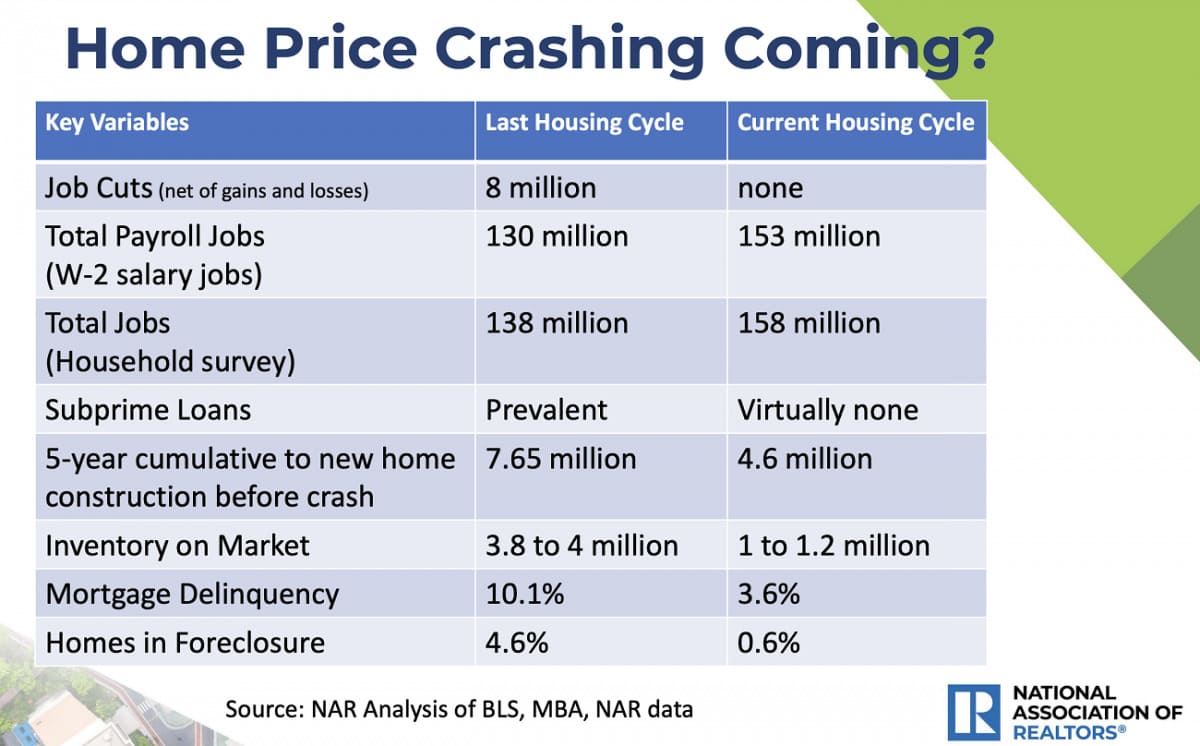
Many homeowners are still haunted by the 2008 housing market crash when property values plummeted and foreclosures increased dramatically. According to a new LendingTree survey, 41% of Americans now fear a housing crash in the next year, owing to the memory of a sudden disaster at a time when the real estate market was riding high. But NAR Chief Economist Lawrence Yun draws the distinctions between today’s real estate market and that of more than a decade ago.

“It’s a valid question,” Lawrence Yun, chief economist for the National Association of REALTORS®, said Tuesday at NAR’s Real Estate Forecast Summit. “People are remembering the crushing and painful foreclosure crisis. So, it has become a key question: Will home prices crash after the strong run-up in prices across the country over recent years?”

  1. The labor market remains strong.

  2. Less risky loans.

  3. Underbuilding and inventory shortages.

  4. Delinquency lows.

  5. Ultra-low foreclosure rates.

At the virtual conference, where leading housing economists offered their 2023 forecast for the real estate market, Yun offered assurance that current dynamics are nothing like during the Great Recession. He pointed to several key indicators of how this market differs.

Homes in foreclosure reached a rate of 4.6% during the last housing crash as homeowners who saw their property values plunge walked away from their loans. Today, the percentage of homes in foreclosure is 0.6%—also at historical lows, Yun said. He predicted foreclosures to remain at historical lows in 2023.

housing crisis or crash coming
Source: REALTOR® Magazine

Danushka Nanayakkara-Skillington, assistant vice president of forecasting and analysis at the National Association of Home Builders, said she expects housing starts to drop by double digits in 2023. Then, “as the economy improves in 2024, the housing market will gradually come out of this slump that is expected from the next year,” she added.

Builder confidence has fallen over the last 11 months as mortgage rates rose and buyer traffic slowed dramatically. Fifty-nine percent of builders have reported using incentives, like mortgage rate buydowns and price cuts, to try to win buyers back, Nanayakkara-Skillington said. Labor shortages combined with lot shortages, higher material costs, and lending issues for builders are all compounding factors preventing more construction.

And while lumber prices have eased from record highs, construction costs remain 14% higher due to shortages in other supplies, like gypsum and steel. “All of these issues will keep homebuilding down,” Nanayakkara-Skillington said. “We don’t see these issues being resolved in the near future either.”


Sources:

  • https://www.freddiemac.com/research/insight/20210507-housing-supply
  • https://www.cbsnews.com/news/real-estate-housing-shortage-crisis/
  • https://www.fanniemae.com/research-and-insights/perspectives/us-housing-shortage
  • https://www.nar.realtor/magazine/real-estate-news/2023-real-estate-forecast-market-to-regain-normalcy

Filed Under: Economy, Housing Market Tagged With: Foreclosure Forecast, Housing Crisis, Housing Crisis in America, Property Foreclosure, Real Estate Foreclosures, Real Estate Investing

  • « Previous Page
  • 1
  • 2

Real Estate

  • Birmingham
  • Cape Coral
  • Charlotte
  • Chicago

Quick Links

  • Markets
  • Membership
  • Notes
  • Contact Us

Blog Posts

  • Best Cities for Turnkey Real Estate Investment in 2026
    April 19, 2026Marco Santarelli
  • Top Markets for Out-of-State Real Estate Investing in 2026
    April 19, 2026Marco Santarelli
  • Today’s Mortgage Rates, April 19: Rates Go Down, 30-Year Fixed Drops to 6.02%
    April 19, 2026Marco Santarelli

Contact

Norada Real Estate Investments 30251 Golden Lantern, Suite E-261 Laguna Niguel, CA 92677

(949) 218-6668
(800) 611-3060
BBB
  • Terms of Use
  • |
  • Privacy Policy
  • |
  • Testimonials
  • |
  • Suggestions?
  • |
  • Home

Copyright 2018 Norada Real Estate Investments

Loading...