Norada Real Estate Investments

  • Home
  • Markets
  • Properties
  • Membership
  • Podcast
  • Learn
  • About
  • Contact

Housing Market 2025 Splits Between Wealthy Buyers and First-Timers

November 10, 2025 by Marco Santarelli

Housing Market Polarizes Between Wealthy Buyers and First-Timers

The homeownership dream feels increasingly out of reach for many newcomers to the housing market, even as a surge of wealthy, cash-rich buyers snaps up properties. This stark division, painting a picture of a market split between two distinct groups, is the defining characteristic of real estate right now.

Housing Market 2025 Splits Between Wealthy Buyers and First-Timers

The National Association of REALTORS®’ (NAR) newly released 2025 Profile of Home Buyers and Sellers report lays bare these extremes, highlighting how affordability challenges are sidelining aspiring owners while those with substantial equity and cash reserves are calling the shots.

It’s a situation that feels personal to me, having spent years working in this industry. I see firsthand the frustration of young couples or individuals trying to save that elusive down payment, their hopes dashed by rising prices and interest rates.

Then, I see the seasoned buyers, often older and with significant equity from previous sales, swooping in with all-cash offers that are nearly impossible to compete with. This isn't just a statistic; it's a reality that's reshaping who can afford to own a home and for how long.

Key Takeaways from the NAR 2025 Profile of Home Buyers and Sellers

Category Trend Significance
First-Time Buyers At an all-time low (21% of market); median age is a record 40. Indicates significant barriers to entry, impacting wealth building for younger generations.
All-Cash Buyers At an all-time high (26% of market). Demonstrates financial strength of some buyers, allowing them to bypass mortgages and gain a competitive edge.
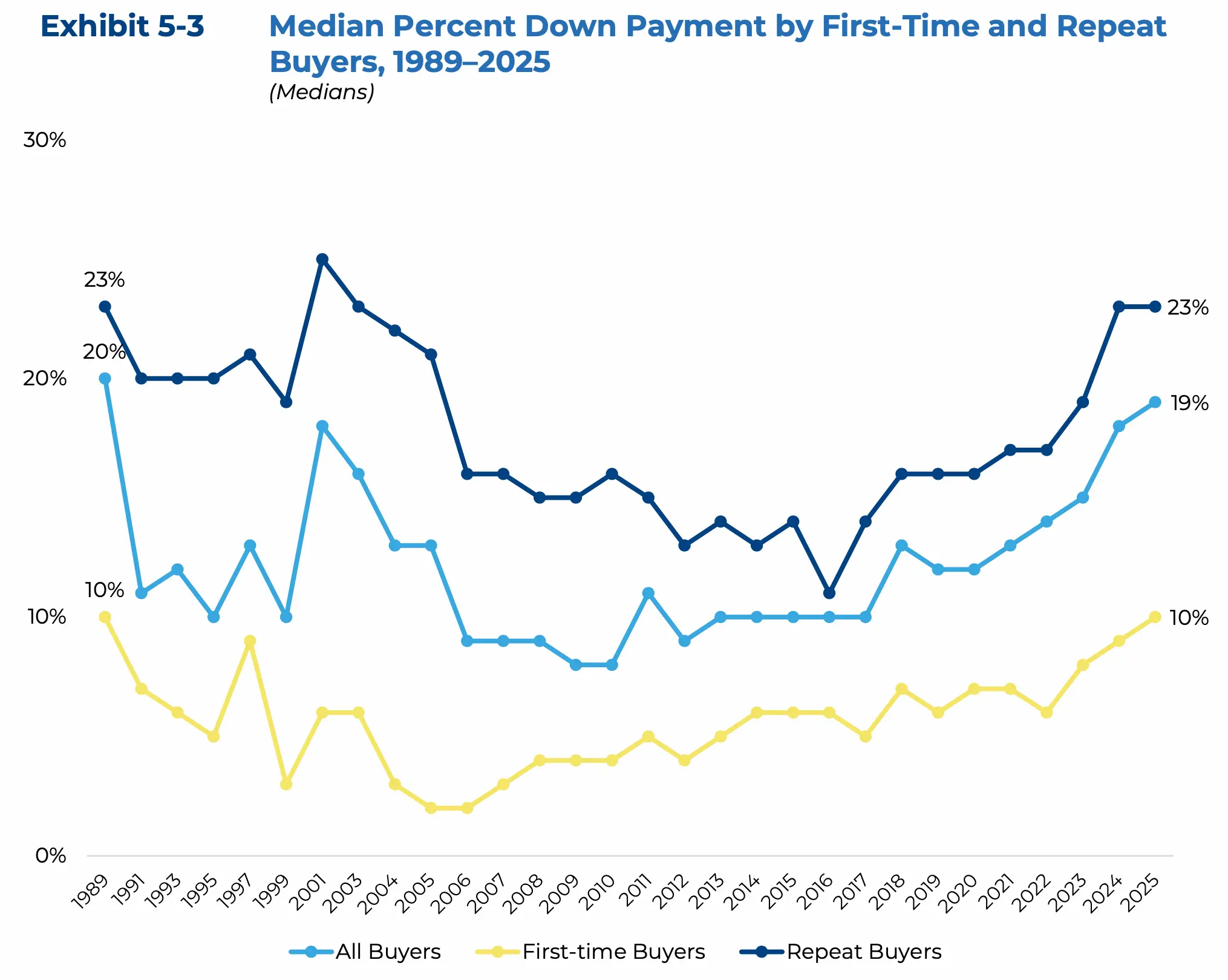
Down Payments Median down payment is 19% (10% for first-timers, 23% for repeat buyers)—record highs. Requires larger initial capital, further straining affordability for newcomers.
Age of Buyers/Sellers Median age of first-time buyers is 40; repeat buyers 62; sellers 64. Reflects an aging population increasingly dominating the market, often with greater financial resources.
Agent Importance 88% of buyers and 91% of sellers used agents; deemed essential for navigation. Shows that professional guidance is highly valued in a complex market.
Homeownership Tenure Median expected tenure is 15 years; sellers held homes for a record 11 years. Indicates a shift towards longer-term investment and stability rather than frequent moving.

First-Time Buyers Facing Historically Low Numbers

One of the most alarming trends from the NAR report is the record low percentage of first-time buyers—a mere 21% of the market. Think about that for a moment: since NAR started tracking this back in 1981, we’ve never seen so few people entering the market for the first time. Before 2008, that number was hovering around 40%.

“The historically low share of first-time buyers underscores the real-world consequences of a housing market starved for affordable inventory,” states Jessica Lautz, NAR’s deputy chief economist.

It's not just that fewer people are buying for the first time; those who are buying are older. The median age for a first-time buyer has climbed to a record 40 years old. Growing up, I always heard about people buying their first homes in their late twenties or early thirties. Now, that feels like ancient history.

Saving for a down payment is incredibly difficult with high rents and the persistent burden of student loan debt. Shannon McGahn, NAR’s executive vice president and chief advocacy officer, rightly points out, “For generations, access to homeownership has been the primary way Americans build wealth and the cornerstone of the American dream.” She adds that delaying this by a decade could mean missing out on approximately $150,000 in equity from a typical starter home.

Key Factors for First-Time Buyers:

  • High rents making saving difficult.
  • Significant student loan debt.
  • Difficulty qualifying for mortgages.
  • Intense competition from cash buyers.

While government-backed loans like FHA and VA, which often require lower or no down payments, have been vital for millions, their usage has decreased. The report shows FHA loan usage dropping significantly since 2009. NAR is advocating for policy changes to increase housing supply, streamline building regulations, and modernize construction to make homes more affordable. Without more homes at accessible price points, this generation of potential first-time buyers will continue to face an uphill battle.

The Rise of the All-Cash Buyer

On the flip side, we're witnessing an unprecedented surge in all-cash home purchases. Averaging 26% of all transactions over the past year, this is a huge jump from the less than 10% seen between 2003 and 2010. These buyers aren't just using equity from selling another home; they are often bypassing the mortgage process altogether. With interest rates being higher and lending conditions tight, an all-cash offer is incredibly powerful. It’s a sign of financial strength and a way to avoid the complexities and potential rejections that come with mortgage pre-approvals.

Down Payments Are Getting Bigger for Everyone

Housing Market: Down Payments Are Getting Bigger for Everyone
Source: National Association of REALTORS®

Regardless of whether you're a first-timer or a seasoned homeowner, the amount of money needed for a down payment is climbing. This is true for both groups, hitting levels not seen in decades. In 2025, the median down payment jumped to 19% for all buyers. For first-time buyers, it was 10%, and for repeat buyers, it was a hefty 23%. For first-time buyers, this is the highest median down payment since 1989, and for repeat buyers, it's the highest since 2003.

So, where is this money coming from?

  • Personal Savings: Remain the top source for first-time buyers (59%).
  • Financial Assets: Tapping into 401(k)s, IRAs, or stocks (26% for first-timers).
  • Gifts/Loans from Family & Friends: A significant boost for 22% of first-timers.
  • Equity from Previous Home Sale: The primary source for over half of repeat buyers (54%).

This directly ties back to the growing equity and wealth accumulated by long-term homeowners.

Why Real Estate Agents Are More Crucial Than Ever

Despite the rise of online tools, real estate agents remain essential. The NAR report shows that a staggering 88% of buyers worked with an agent, making them the most trusted source of information, outranking online listings. Buyers lean on agents for help finding the right home, negotiating terms, and navigating the mountain of paperwork. It’s particularly reassuring for first-time buyers, with 76% crediting their agent with helping them understand the complex process.

Sellers, too, are overwhelmingly relying on agents, with 91% using one. Their priorities are clear: getting help marketing their home effectively, pricing it competitively, and securing a sale within their desired timeframe. As Lautz says, “Real estate agents remain indispensable in today’s complex housing market.” They provide not just expertise and negotiation skills but also crucial emotional support during what is often the biggest financial decision someone makes.

I’ve seen it myself. An agent’s ability to spot potential issues in a home, their knowledge of the local market, and their skill at negotiating can make or break a deal, especially when you're up against tough competition.

FSBOs Hit an All-Time Low: A Sign of the Times

Following on the heels of the agent's importance, the report highlights that For Sale By Owner (FSBO) sales have hit an all-time low of just 5%. Homes sold with agent assistance fetched a median price of $425,000, significantly higher than the $360,000 for FSBO homes. While some owners might try to save on commission fees or sell to someone they know, the data suggests that the expertise and market reach of an agent lead to better outcomes.

Repeat Buyers: Exercising Their Financial Muscle

Repeat buyers are truly flexing their financial power. With a median down payment of 23% and nearly one in three paying all cash, they are in a strong position to compete. Years of rising home values have built substantial wealth for these homeowners. The average seller has now owned their home for a record 11 years, accumulating significant equity—an average of $140,900 gained in the last five years alone, according to NAR’s research. This allows them to make larger down payments, avoid financing contingencies, and often secure their next home with less stress than a first-time buyer.

Fewer Families with Children Entering the Market

A noticeable shift in the profile of home buyers is the decline in households with children under 18. This group now makes up just 24% of recent buyers, a stark contrast to 58% in 1985. This trend is likely a result of declining birth rates and the increasing age of repeat buyers. Additionally, the high cost of childcare presents yet another hurdle for families trying to save for a down payment.

This demographic shift also means there's a move away from the traditional family household. The share of married couples buying homes has also decreased, while single buyers, particularly single women, are gaining ground. This points to a more diverse range of individuals and household structures becoming homeowners.

The Aging of Home Buyers and Sellers

It's not just first-time buyers getting older; the entire cohort of buyers and sellers is aging. We’ve already seen the median age for first-time buyers hit 40, but repeat buyers are now a median age of 62, and the typical home seller is 64 years old—both record highs. This coincides with other NAR research indicating that Baby Boomers, now in their late 60s and 70s, are the largest group of both buyers and sellers. Their financial stability often allows them to navigate the market more easily than younger generations.

Buying for the “Forever Home” Mentality

The idea of a “starter home” seems to be fading. Home buyers today are planning to stay put for much longer. The median expected tenure in a purchased home is now 15 years, with many (28%) considering it their “forever home” and having no intention of moving. This is a dramatic shift from the early 2000s when homeowners typically stayed in their homes for just six years. The median time a homeowner has been in their current home before selling is now a record 11 years. This longer-term outlook applies to both first-time and repeat buyers, suggesting a desire for stability and a less transient approach to homeownership.

New Construction Sees a Slight Uptick

While existing homes still dominate sales, there's been a slight increase in new home purchases, reaching 16%—a level not seen since 2006. Builders have been offering incentives like price reductions and mortgage rate buydowns to attract buyers. Those opting for new construction often cite the desire to avoid renovations and repairs and the ability to customize their living space. On the other hand, buyers who prefer existing homes often point to perceived better value, lower prices, and the unique charm and character of older properties.

This polarization of the housing market is a complex issue with no easy answers. The gap between those who can afford to buy and those who are priced out is widening, creating significant challenges for economic mobility and the fulfillment of the American dream for a new generation.

Want Stronger Returns? Invest Where the Housing Market’s Growing

Turnkey rental properties in fast-growing housing markets offer a powerful way to generate passive income with minimal hassle.

Work with Norada Real Estate to find stable, cash-flowing markets beyond the bubble zones—so you can build wealth without the risks of ultra-competitive areas.

🔥 HOT NEW LISTINGS JUST ADDED! 🔥

Talk to a Norada investment counselor today (No Obligation):

(800) 611-3060

Get Started Now

Want to Know More About the Housing Market Trends?

Explore these related articles for even more insights:

  • Housing Market Predictions for the Next 4 Years: 2025 to 2029
  • Housing Markets at Risk of Double-Digit Price Decline Over the Next 12 Months
  • Housing Market Trends: Nearly 1 in 3 Buyers Still Opt for All-Cash Deals in 2025
  • Will the Housing Market Shift to a Buyer’s Market in 2026?
  • Housing Market 2025: Booming vs. Shrinking Inventory Across America
  • Housing Market Gains Supply But Buyers Hit Pause in 2025
  • Mid-Atlantic Housing Market Heats Up as Mortgage Rates Go Down
  • NAR Chief's Bold Predictions for the 2025 Housing Market
  • Housing Market Update 2025: NAR Report Indicates Sluggish Trends
  • 7 Buyer-Friendly Housing Markets in 2025 With Abundant Homes for Sale
  • The $1 Trillion Club: America's Richest Housing Markets Revealed
  • 4 States Dominate as the Riskiest Housing Markets in 2025
  • Housing Market Predictions 2025 by Norada Real Estate

Filed Under: Housing Market, Real Estate Market Tagged With: Housing Market, Housing Market Trends

Is the Housing Market in Recession in Because of Fed’s Decisions?

November 9, 2025 by Marco Santarelli

Is the Housing Market Already in Recession? Fed’s Decisions Under Fire

Right now, the big question on everyone's mind is whether our housing market has unofficially dipped into recession. Treasury Secretary Scott Bessent certainly thinks so, suggesting that the Federal Reserve's cautious approach to lowering interest rates is partly to blame. He voiced this opinion on CNN's “State of the Union,” and it’s a sentiment that’s stirring up a lot of debate. I believe that while parts of the economy are definitely feeling the pinch, calling the entire housing market a full-blown recession might be jumping the gun, but the warning signs are certainly there. A lot of folks are feeling the squeeze, and the Fed’s policies are definitely playing a role.

Is the Housing Market in Recession in Because of Fed’s Decisions?

What’s Causing the Housing Market Headache?

Secretary Bessent pointed directly at high mortgage rates as the culprit hindering the housing market. He believes that if the Federal Reserve were to lower interest rates, it would directly bring down those daunting mortgage rates. This, in turn, could help lift us out of what he's calling a “housing recession.” He also made an important point: it's often the low-income consumers who are hit the hardest. These individuals tend to have more debt and fewer assets, making them more vulnerable when economic conditions tighten.

Now, it’s important to understand that the Fed doesn't directly set mortgage rates. What they do control is the federal funds rate, which is a short-term rate banks use to borrow from each other. Mortgage rates, on the other hand, tend to follow the yields of longer-term bonds. These bond yields are influenced by what investors expect the Fed to do in the future and the general state of financial conditions. So, while the Fed's actions are a major factor, it's a bit more indirect than simply flipping a switch.

Fed’s Latest Move and Mixed Signals

Recently, the Federal Open Market Committee (FOMC) decided to lower their benchmark interest rate by a quarter of a point, bringing it down to a range of 3.75%-4%. Following this news, the average rate for a 30-year fixed mortgage did dip to a low of 6.17%, the lowest it's been in over a year. This sounds like good news, right?

However, Fed Chair Jerome Powell quickly tempered any excitement about further cuts. He made it clear that another reduction in December is “not a foregone conclusion,” emphasizing that the Fed's policy isn't on a fixed, predetermined path. This caution is drawing criticism.

Under Fire: The Fed's Tightrope Walk

The Treasury Secretary isn’t the only one questioning the Fed's approach. Fed Governor Stephen Miran, who voted for a larger half-point rate cut at the last meeting, warned in an interview with The New York Times that keeping interest rates too high for too long could actually push the economy into a recession. He basically said, “Why run that risk if inflation isn't a major concern?” This is a valid point.

Bessent echoed this sentiment, arguing that with the Trump administration focusing on reducing government spending, inflation should naturally be coming down. His logic is simple: if inflation is dropping, the Fed should be cutting rates to stimulate the economy, especially for sectors like housing.

The Fed’s Balancing Act: Dual Mandate

It’s crucial to remember the Fed's job is a balancing act. They have a “dual mandate” from Congress: to promote maximum employment and keep inflation close to 2%. They raise interest rates to cool down an overheating economy and fight inflation, and they lower rates to encourage job growth and boost economic activity. It’s a tough job, and sometimes when they're trying to tame inflation, they inevitably slow down other parts of the economy.

Realtor.com® senior economist Joel Berner also chimed in, noting that while a Fed rate cut can help mortgage rates fall, it doesn't always mean a direct, one-to-one drop in those long-term home loans. He mentioned that there’s a lot of uncertainty in the economy right now, which adds to the difference between the Fed’s target rate and what homebuyers actually pay.

When Data Becomes Scarce: The Government Shutdown’s Impact

Adding another layer of complexity, the recent government shutdown meant the Fed had to make crucial policy decisions without access to important economic data, like September’s employment numbers. This lack of timely information makes their job even harder and can lead to decisions that feel disconnected from the real-time economic situation.

We did get some inflation data, though. The Consumer Price Index (CPI) increased by 3% in September compared to the previous year. This was the sixth straight month of rising annual inflation. While 3% isn't sky-high, the trend of increasing inflation over several months gives the Fed pause, even if some critics feel they should be more aggressive in cutting rates.

Is the Housing Market Really in Recession?

So, let’s get back to that million-dollar question: is the housing market already in a recession? Joel Berner, from Realtor.com®, wouldn't go as far as to definitively say “yes” yet. However, he agrees that the market is showing signs of distress and could be heading that way.

Here’s what he pointed out:

  • Home sales are slumping: Sales are on track to be the slowest full year since 1995! And even with mortgage rates falling recently, the number of sales hasn't picked up enough to make a significant difference.
  • Builders are pulling back: Homebuilders, who were busy constructing a lot of lower-priced homes after the pandemic, are now seeming to slow down their output.
  • Demand is weak: Buyers are struggling with affordability, and at the same time, the supply of homes is decreasing. It’s a double whammy.

What’s the Real Engine of the Housing Market?

Ultimately, the health of the housing market is directly tied to the job market. Berner highlighted that the job market has indeed softened recently. Things like tariffs and a general slowdown in business cycles are leading companies to hire less and lay off more workers. When people don't feel secure in their jobs, they're naturally hesitant to make a huge commitment like buying a new home. This lack of confidence in employment is a major driver of the current slowdown.

My take on this is that the Fed is caught in a difficult spot. They're trying to fight inflation without causing too much damage to the broader economy. But with the housing market showing such clear signs of weakness – falling sales, cautious builders, and affordability issues – it does feel like we’re in a precarious situation.

The debate over whether we're officially in a recession might be semantics for many homeowners and aspiring buyers who are already feeling the pinch. The Fed’s caution, while perhaps well-intentioned, is certainly under fire because many believe it’s prolonging the pain for key sectors like housing. We need to see more concrete signs of economic recovery, and a stronger labor market, for the housing market to truly bounce back.

Invest in Real Estate That Performs—Even in a Recession

With growing debate over whether the housing market is already in a recession, now’s the time to focus on stable, income-generating investments that thrive regardless of Fed policy shifts.

Work with Norada Real Estate to find cash-flowing turnkey rental properties in recession-resilient markets—so your portfolio keeps growing while others panic.

HOT TURNKEY DEALS JUST LISTED!

Talk to a Norada investment counselor today (No Obligation):

(800) 611-3060

Get Started Now

Want to Know More About the Housing Market Trends?

Explore these related articles for even more insights:

  • Housing Market Update: Home Sales Rise Fueled by Lower Mortgage Rates
  • 7 Housing Markets Facing Double-Digit Price Drops Over the Next 1 Year
  • Housing Market Trends: Nearly 1 in 3 Buyers Still Opt for All-Cash Deals in 2025
  • Will the Housing Market Shift to a Buyer’s Market in 2026?
  • Housing Market 2025: Booming vs. Shrinking Inventory Across America
  • Housing Market Gains Supply But Buyers Hit Pause in 2025
  • Mid-Atlantic Housing Market Heats Up as Mortgage Rates Go Down
  • NAR Chief's Bold Predictions for the 2025 Housing Market
  • Housing Market Update 2025: NAR Report Indicates Sluggish Trends
  • 7 Buyer-Friendly Housing Markets in 2025 With Abundant Homes for Sale
  • The $1 Trillion Club: America's Richest Housing Markets Revealed
  • 4 States Dominate as the Riskiest Housing Markets in 2025
  • Housing Market Predictions 2025 by Norada Real Estate
  • Housing Market Predictions 2026: Will it Crash or Boom?

Filed Under: Housing Market, Real Estate Market Tagged With: Housing Market, Housing Market Trends

Louisiana Housing Market: Trends and Forecast 2025-2026

November 6, 2025 by Marco Santarelli

Louisiana Housing Market: Trends and Forecast

The Louisiana housing market, a fascinating blend of rich culture and evolving economic tides, is currently experiencing a period of significant adjustment. As of late 2025, the average Louisiana home value hovers around $209,930, a figure that has seen a slight dip of 0.7% over the past year. This isn't to say the market is frozen; homes are typically going under contract in about 40 days, indicating a steady, albeit not scorching, pace of activity.

My take? While some might see a dip as a sign of trouble, I view it more as a recalibration, a chance for the market to find a more stable footing after a period of rapid growth.

Louisiana Housing Market Trends in 2025

Current Snapshot: Louisiana Housing Market Stats for 2025

To truly get a grasp on where things stand, let's dive into the numbers for October 2025, pulling insights from sources like Zillow, which provide a valuable pulse on the housing industry.

  • Homes for Sale: As of September 30, 2025, there were approximately 19,515 homes available across Louisiana. This inventory level gives buyers more options than in recent years, which can be a welcome change.
  • New Listings: In September 2025 alone, just over 3,800 new homes entered the market. This number hints at the rate at which new opportunities are being created for potential buyers.
  • Sale-to-List Ratio: In August 2025, the median sale to list ratio was 0.982. This means that, on average, homes were selling for about 98.2% of their asking price. From my perspective, this signifies a market moving towards equilibrium, where sellers are still receptive to offers but are less likely to get multiple bids significantly over their asking price.
  • Median Sale Price: The median sale price in August 2025 was $234,917. This is a crucial figure for understanding what buyers are actually paying for homes.
  • Median List Price: For September 30, 2025, the median list price stood at $269,000. The gap between the median sale price and the median list price (around $34,000) suggests that negotiation is still very much a part of the process.
  • Sales Over/Under List Price:
    • 13.8% of sales in August 2025 occurred over the list price. This indicates that while competition isn't as fierce as it once was, desirable properties in good locations can still command multiple offers.
    • Conversely, a significant 61.6% of sales were under the list price. This is a strong signal that buyers have room to negotiate, especially on properties that might have been priced optimistically by sellers.

Looking at these figures, I don't see a market in freefall. Instead, I see a market that's becoming more balanced. Buyers have more leverage, allowing for more thoughtful decision-making. Sellers, on the other hand, need to be realistic with their pricing to attract a solid offer.

Louisiana Housing Market Forecast for 2025 and 2026

Predicting the future of any housing market is a tricky business, influenced by economic indicators, local job markets, and even broader global events. However, by looking at projections, we can get a sense of potential trends. Zillow's data provides some interesting insights into how different parts of Louisiana are expected to perform.

Here's a breakdown of projected home value changes:

Region Name Projected Home Value Change (End of 2025) Projected Home Value Change (End of 2026)
National Average +0.2% +1.9%
New Orleans, LA +0.2% -4.0%
Baton Rouge, LA +0.3% -0.2%
Lafayette, LA -0.1% -4.3%
Shreveport, LA 0.0% -3.8%
Lake Charles, LA -0.1% -6.9%
Houma, LA -0.5% -7.4%
Monroe, LA 0.0% -2.1%
Alexandria, LA +0.1% -3.4%
Hammond, LA +0.1% -2.9%
Opelousas, LA -0.5% -7.6%
Morgan City, LA -0.9% -7.1%
Fort Polk South, LA -0.2% -4.4%
Natchez, MS -0.8% -6.4%
Ruston, LA 0.0% -1.8%
Bogalusa, LA -0.2% -5.7%
Natchitoches, LA -0.2% -5.9%
DeRidder, LA -0.8% -8.4%

As you can see, the national trend suggests a slight positive growth in home values. However, Louisiana presents a more varied picture. Many of the metropolitan statistical areas (MSAs) within Louisiana are projected to experience modest declines in home values throughout 2025 and into 2026. Some areas, like Houma, Opelousas, Morgan City, and DeRidder, are bracing for more significant drops.

My interpretation of these projections is that Louisiana's housing market might be diverging from the national average. Several factors could contribute to this. For instance, areas heavily reliant on specific industries that might be facing global challenges could see a greater impact. Hurricanes and other weather events always play a role in property values and insurance costs in coastal regions. Also, the general economic climate and interest rate environment will continue to be major drivers.

Will the Louisiana Housing Market Crash in 2025 or 2026?

This is the million-dollar question, isn't it? Based on the data and my understanding of market dynamics, I can tell you this: a widespread, catastrophic crash across the entire Louisiana housing market in 2025 or 2026 seems unlikely.

What we are observing is more of a cooling-off period and a correction in certain segments and regions. The days of bidding wars on every listing are largely behind us. Buyers have more breathing room, and home prices are beginning to stabilize, with some areas seeing slight decreases. This isn't the same as a crash. A crash typically involves a rapid and significant drop in prices across the board, often triggered by severe economic downturns or a glut of foreclosures.

However, it's crucial to differentiate between the state as a whole and specific local markets. As the projection table shows, some smaller cities and towns, particularly those in more vulnerable geographical areas or with less diverse economic bases, might experience more pronounced price adjustments. Zillow's data, which forecasts declines for places like Lake Charles, Houma, and DeRidder, underscores this point. These areas may be more sensitive to regional economic shifts or the ongoing costs associated with weather preparedness and recovery.

On the other hand, larger metropolitan areas like Baton Rouge are projected for more stable, or even slightly positive, growth. This is often due to more diversified economies, stronger job markets, and consistent demand. New Orleans, despite its tourist allure, is also showing a projected modest dip, which could reflect a variety of factors including the cost of living and competition.

My personal take on this is that while sensational headlines about a “crash” might grab attention, the reality is much more nuanced. It’s going to be about local economies, job growth, and demographic shifts. For example, if a major employer in a particular area announces layoffs, that can have a localized impact. Conversely, if a new industry booms in another Louisiana city, that could bolster its housing market.

Key Factors to Watch:

  • Interest Rates: While the Federal Reserve has signaled potential rate cuts, the speed and extent of these will significantly influence affordability and demand. Higher rates tend to cool a market, while lower rates can spur activity.
  • Job Market: Strong job growth is the bedrock of any healthy housing market. Areas with diverse and growing employment sectors will fare better.
  • Inventory Levels: While inventory is currently at reasonable levels, any major shift in the number of homes for sale can impact prices.
  • Economic Health of Specific Industries: Louisiana's economy is tied to several key sectors. Performance in sectors like energy, manufacturing, and agriculture will have ripple effects.
  • Insurance Costs and Natural Disaster Preparedness: For coastal communities and areas prone to hurricanes, the cost and availability of homeowner's insurance are significant factors that can affect property values and desirability.

Instead of anticipating a crash, I'd advise focusing on understanding the specific market conditions in the areas you are interested in. Each city and town in Louisiana has its own unique story.

What This Means for Buyers in Louisiana?

For Buyers, this current market dynamic presents an opportunity for buyers. With a more balanced supply and demand, you're less likely to face the extreme competition of recent years. The median sale-to-list ratio being below 1.00 means you can likely negotiate on price. Don't be afraid to make reasonable offers. With more homes on the market, you have a better chance of finding a property that truly meets your needs and budget.

Louisiana's Diverse Regional Markets: A Deeper Dive

It’s not enough to just look at Louisiana as a whole. The state's housing market is a mosaic of distinct regional economies and cultural influences. What impacts New Orleans might have a different effect on Shreveport, for instance.

  • New Orleans and Surrounding Areas: Known for its vibrant culture, tourism, and growing healthcare sector, New Orleans usually maintains a strong appeal. However, it can also be sensitive to economic fluctuations and the ongoing challenges of coastal resilience. Projections here suggest a slight dip, implying a market that is stabilizing rather than booming.
  • Baton Rouge: As the state capital and a hub for several universities and government jobs, Baton Rouge tends to be more economically stable. The projected stability or slight growth here reflects its diversified economic base.
  • North Louisiana (Shreveport, Monroe, Alexandria): These areas often have economies tied to industries like manufacturing, agriculture, and regional services. Projections here are mixed to negative, suggesting these markets might be more susceptible to broader economic headwinds or specific local industry trends.
  • Acadiana Region (Lafayette, Houma, Lake Charles): This part of Louisiana is known for its unique Cajun culture and is diverse in industry, from energy and petrochemicals to agriculture. Lake Charles, in particular, has seen significant investment in recent years, but also faces environmental and economic boom-and-bust cycles. The projected declines in these areas could be linked to sectors undergoing adjustments. Houma and Morgan City, with their proximity to the Gulf Coast and reliance on industries like oil and gas and fishing, may also be more sensitive to global energy prices and environmental concerns.

Understanding these regional nuances is critical for anyone looking to buy or sell. A property in Baton Rouge might behave very differently from a property in Lake Charles, even if both are within Louisiana.

Final Thoughts:

Having spent time observing and engaging with the Louisiana housing market, I can tell you it’s more than just numbers on a spreadsheet. It’s about communities, dreams, and the distinctive spirit of the state. I've seen firsthand how natural disasters can temporarily stall or even displace housing markets, and I've also witnessed incredible resilience and recovery.

From my perspective, what Zillow's data reveals is a market that is maturing. After a period of intense activity driven by low interest rates and a desire for more space, we're settling into a phase where affordability, local job markets, and long-term economic stability are once again the primary drivers of home values. This isn't a bad thing; it's a healthy return to fundamentals.

I firmly believe that Louisiana's unique cultural appeal and its strategic position in some key industries will continue to attract residents and investment. The key is not to panic about projected modest declines but to understand the underlying reasons and to make informed decisions. For buyers, this might mean a chance to get into a desirable neighborhood they might have been priced out of during the peak. For sellers, it means being smart about pricing and presentation.

The housing market will always have its cycles, and Louisiana is no exception. The forecast, while showing some dips, doesn't paint a picture of a widespread collapse. Instead, it points to a market that is recalibrating, offering different opportunities and challenges depending on where you are in the state.

Build Wealth with Turnkey Real Estate Investments

High interest rates don’t have to hold you back. Turnkey rental properties still deliver steady cash flow and long-term appreciation—especially in markets with strong rental demand and job growth.

Work with Norada Real Estate to identify profitable, cash-flowing markets that thrive even when borrowing costs rise—so your investments stay strong and stress-free.

NEW TURNKEY DEALS JUST ADDED!

Talk to a Norada investment counselor today (No Obligation):

(800) 611-3060

Get Started Now

Recommended Read:

  • New Orleans Housing Market Trends and Forecast
  • Baton Rouge Housing Market Trends and Forecast

Filed Under: Housing Market, Real Estate Market Tagged With: home prices, Housing Market Forecast, Housing Market Trends, Louisiana

Home Prices Drop in 9 of the Top 20 Metros Signaling a Significant Shift

November 4, 2025 by Marco Santarelli

Home Prices Drop in 9 of the Top 20 Metros Signaling a Significant Shift

The housing market is definitely doing a bit of a tightrope walk right now, and the latest numbers are showing us that for home prices dropping in 9 of the top 20 metros across the country, it's no longer just a blip but a noticeable trend. This isn't the frantic seller's market we saw a couple of years ago; instead, we're seeing a more complex picture emerge, where affordability is starting to whisper sweet nothings to buyers, even as some homeowners nervously watch their equity take a breather.

Home Prices Drop in 9 of the Top 20 Metros Signaling a Significant Shift

I've been following this market for a while, and what we're seeing now is a much-needed return to normalcy after a period of truly head-spinning appreciation. It's important to understand that home prices don't always go straight up; they have their cycles, and right now, we're in a significant cooling-off phase in key areas.

The National Pulse: A Slowing Beat

Let's get down to brass tacks. The S&P CoreLogic Case-Shiller Home Price Index, which is a really solid way to track how home values are changing because it looks at the same houses over time, told us something important recently. In August, the national growth in single-family home values only rose by a modest 1.5% compared to the year before. This is down from July's 1.7% and marks the slowest pace of growth we've seen since way back in 2012, when prices were actually going down.

But here's where it gets really interesting: when you look at the major metropolitan areas, the story really unpacks. Of the 20 major metros they track, nine are now seeing their home values fall on an annual basis. These aren't just any cities; they're some of the most talked-about places in the U.S. – think Tampa, Phoenix, Miami, San Francisco, Dallas, Denver, San Diego, Seattle, and Los Angeles.

Two big names, Seattle and Los Angeles, just joined the list this month, while the other seven cities had already been on the downward trend for a bit. This tells me the slowdown we're observing isn't confined to one or two isolated spots; it's spread across significant portions of the West and South.

Why the Chill? A Look Under the Hood

So, what’s behind this cooling? Several factors are at play, and it's not just a simple case of “prices are falling.”

  • Inflation vs. Home Values: Nicholas Godec, who works with the Case-Shiller data, pointed out that for the fourth month in a row, home values are actually losing ground to inflation. This means that even though the sticker price of a home might be a little higher than last year, your real wealth as a homeowner is shrinking because other costs of living are rising faster. The 1.5% national home price gain is significantly lower than the 2.9% inflation rate for the same period. That's a real wealth erosion, even if the numbers on paper look okay at first glance.
  • Affordability's Comeback Tour: For those of us who have been priced out of the market or are looking to upgrade, this might be the silver lining. As home prices cool and, importantly, mortgage rates have dipped to their lowest in over a year (around 6.19% recently, according to Freddie Mac), the barrier to entry is slowly lowering. Lisa Sturtevant, Chief Economist at Bright MLS, notes that shoppers are finding more breathing room. However, she wisely adds that growing economic uncertainty is keeping some people on the fence, which is completely understandable. Nobody wants to buy a home if they're worried about their job.
  • The Post-Pandemic Rebalancing: Remember the stampede to the suburbs and Sun Belt cities during the pandemic? Many of those areas saw incredibly sharp price increases. Now, those same markets are experiencing some of the largest corrections. Conversely, cities like New York and Chicago, which felt a bit stalled during that exodus, are actually seeing some of the greatest appreciation right now. It’s a natural rebalancing, where the areas that got the hottest are now cooling off the most.

Regional Divergence: A Tale of Two Americas

The national story, as always, masks some really important regional differences.

Metro Area Annual Home Value Change (August) Notes
New York +6.1% Highest annual gain
Chicago +5.9% Strong growth, only monthly gainer
Cleveland +4.7% Steady appreciation
Tampa -3.3% Largest annual decline, 10 consecutive months
Phoenix Declining Significant slowdown
Miami Declining Part of the Sun Belt cooling
San Francisco Declining Tech hub facing challenges
Dallas Declining Once-hot Texas market cooling
Denver Declining Mountain West seeing price dips
San Diego Declining California market showing weakness
Seattle Declining New entrant to falling prices
Los Angeles Declining New entrant to falling prices
  • Northeast and Midwest Resilience: Markets in the Northeast and Midwest are generally holding up better. Anthony Smith from Realtor.com® attributes this to tighter resale supply and more steadier demand. These areas didn't see the same explosive pandemic growth, so they don't have as far to fall, and local economies tend to be more stable.
  • Sun Belt and West Softening: On the flip side, places in the Sun Belt and the West are showing more clear signs of softening. Inventory is coming back more quickly, homes are staying on the market longer, and we're seeing more price cuts and delistings. Tampa, for instance, has seen prices drop year-over-year for 10 straight months, with August’s decline at 3.3%.

Beyond Annual: Monthly Trends Hint at Broader Weakness

While the annual numbers are important for long-term trends, the monthly data can sometimes give us a more immediate snapshot of what's happening. And the August monthly figures were pretty telling: 19 out of the top 20 metros saw home prices fall on a monthly basis.

The only exception? Chicago, which actually saw a small gain of 0.26% from July to August. On the other end of the spectrum, Portland, Oregon, and Los Angeles experienced the biggest monthly drops, both falling by more than 1%.

This widespread monthly decline suggests that the weakness isn't just a seasonal lull in some of these hotter markets; it's a more pervasive cooling that could potentially spread even further.

Godec’s statement again hits the nail on the head: “With price growth running at half the rate of inflation and several major markets in decline, the rapid appreciation of recent years has clearly ended.”

What Does This Mean for You?

This cooling market isn't necessarily good or bad; it's just different.

  • For Homeowners: If you're looking to sell, you might not get the sky-high offers you would have a year or two ago. It’s crucial to price your home realistically and be prepared for a bit more negotiation. Your real equity might be decreasing due to inflation, so understanding your net worth requires looking beyond just the sale price.
  • For Buyers: This is a moment of opportunity. With cooling prices and lower mortgage rates, affordability is improving. However, that economic uncertainty means it's still wise to be cautious, have a solid financial plan, and not stretch yourself too thin.
  • Looking Ahead: The housing market appears to be finding a “new equilibrium” after the pandemic's boom. This adjustment, while potentially painful for some homeowners in the short term, could lead to a more sustainable market in the long run, where prices are better aligned with incomes and inflation.

The data from the Case-Shiller Index, though it has a few months' delay, is considered a gold standard because it tracks the same properties over time. This August data reflects purchase decisions made in late spring and early summer, so we might see these trends continue to play out.

Ultimately, the idea that home prices will always skyrocket is being challenged. We're entering a phase where a sound financial footing, realistic expectations, and understanding local market dynamics will be more important than ever.

Want Stronger Returns? Invest Where the Housing Market’s Growing

Turnkey rental properties in fast-growing housing markets offer a powerful way to generate passive income with minimal hassle.

Work with Norada Real Estate to find stable, cash-flowing markets beyond the bubble zones—so you can build wealth without the risks of ultra-competitive areas.

🔥 HOT NEW LISTINGS JUST ADDED! 🔥

Talk to a Norada investment counselor today (No Obligation):

(800) 611-3060

Get Started Now

Want to Know More About the Housing Market Trends?

Explore these related articles for even more insights:

  • 7 Housing Markets Facing Double-Digit Price Drops Over the Next 1 Year
  • Housing Market Trends: Nearly 1 in 3 Buyers Still Opt for All-Cash Deals in 2025
  • Will the Housing Market Shift to a Buyer’s Market in 2026?
  • Housing Market 2025: Booming vs. Shrinking Inventory Across America
  • Housing Market Gains Supply But Buyers Hit Pause in 2025
  • Mid-Atlantic Housing Market Heats Up as Mortgage Rates Go Down
  • NAR Chief's Bold Predictions for the 2025 Housing Market
  • Housing Market Update 2025: NAR Report Indicates Sluggish Trends
  • 7 Buyer-Friendly Housing Markets in 2025 With Abundant Homes for Sale
  • The $1 Trillion Club: America's Richest Housing Markets Revealed
  • 4 States Dominate as the Riskiest Housing Markets in 2025
  • Housing Market Predictions 2025 by Norada Real Estate
  • Housing Market Predictions 2026: Will it Crash or Boom?
  • Housing Market Predictions for the Next 4 Years: 2025 to 2029
  • Real Estate Forecast: Will Home Prices Bottom Out in 2025?
  • Real Estate Forecast Next 5 Years: Top 5 Predictions for Future
  • Will Real Estate Rebound in 2025: Top Predictions by Experts

Filed Under: Housing Market, Real Estate Market Tagged With: home prices, Housing Market, Housing Market Trends

Housing Market Update: Home Sales Rise Fueled by Lower Mortgage Rates

October 23, 2025 by Marco Santarelli

Housing Market Update: Home Sales Rise Fueled by Lower Mortgage Rates

It’s been a pretty solid September for the housing market, and I'm feeling optimistic. The latest report from the National Association of REALTORS® (NAR) shows that existing-home sales jumped by 1.5% last month, hitting a seasonally adjusted annual rate of 4.06 million. This is exactly what we’ve been hoping for: as mortgage rates started to dip, more buyers felt comfortable making a move. So, yes, lower mortgage rates are indeed lifting home sales.

Housing Market Update: Home Sales Rise Fueled by Lower Mortgage Rates

This uptick is a welcome sign, especially after a period where affordability has been a major hurdle for many. For those of us who live and breathe real estate, seeing more transactions happen means a healthier market overall. It signals that buyers are back, and sellers are finding their homes moving faster. It's a complex dance, but right now, the music is playing a bit more cheerfully.

What's Driving This Positive Shift?

Honestly, it boils down to a few key factors, and the biggest one is definitely mortgage rates. In September, the average 30-year fixed-rate mortgage dipped to 6.35%, down from 6.59% in August. Even a small decrease like this can make a big difference in monthly payments, making homeownership feel achievable again for a lot of people. It's like finally seeing a clear path after a period of foggy uncertainty.

Dr. Lawrence Yun, NAR's Chief Economist, put it perfectly: “As anticipated, falling mortgage rates are lifting home sales. Improving housing affordability is also contributing to the increase in sales.” I couldn't agree more. When the cost of borrowing money for a home goes down, it directly impacts how much house people can afford. This affordability boost is a crucial piece of the puzzle.

Inventory Levels: A Mixed Bag, But Still Improving

One of the big concerns in recent years has been the lack of homes on the market. While we're not quite back to pre-pandemic levels, the inventory situation saw a slight improvement in September. Total housing inventory rose by 1.3% month-over-month to 1.55 million units. This gives us a supply of 4.6 months of unsold inventory.

This increase, while not massive, is significant. It means buyers have a bit more choice, and competition, while still present, might not be as cutthroat as it was. Dr. Yun also pointed out that inventory is matching a five-year high, which is encouraging. However, he also made a really insightful point: “Many homeowners are financially comfortable, resulting in very few distressed properties and forced sales.” This is important because it means the homes hitting the market are generally well-maintained and not part of a fire sale, which helps keep prices stable.

Home Prices: Still Climbing, But at a Slower Pace

Despite the increase in sales and inventory, home prices are still on the rise. The median existing-home price for all housing types reached $415,200 in September. This marks the 27th consecutive month of year-over-year price increases.

It's important to note that while prices are up, the rate of increase is more moderate than we've seen in some of the hotter periods. Personally, I see this as a good thing. When prices climb too quickly, it can price out a whole generation of buyers. A more steady, sustainable increase is healthier for the long-term market.

Breakdown by Housing Type and Region:

Let's dive a bit deeper into what's happening:

Single-Family Homes:

  • Sales of single-family homes increased by 1.7% month-over-month to an annual rate of 3.69 million.
  • Year-over-year, single-family home sales are up 4.5%.
  • The median price for single-family homes climbed to $420,700, a 2.3% increase from the previous year.

Condominiums and Co-ops:

  • For condos and co-ops, the sales picture was a bit different. There was no change month-over-month or year-over-year, with sales holding steady at 370,000 units annually.
  • The median price for these properties saw a slight dip of 0.6% year-over-year, landing at $360,300. This could be due to a variety of factors, including buyer preferences or specific market conditions in cities where these types of homes are more prevalent.

Regional Trends:

The housing market is never a one-size-fits-all story, and the regional data for September really highlights this:

Region Month-over-Month Sales Change Year-over-Year Sales Change Median Price (September) Year-over-Year Price Change
Northeast +2.1% +4.3% $500,300 +4.1%
Midwest -2.1% +2.2% $320,800 +4.7%
South +1.6% +6.9% $364,500 +1.2%
West +5.5% 0% $619,100 +0.4%
  • The West saw a significant 5.5% surge in sales month-over-month, indicating strong demand in that region, even though year-over-year sales were flat. The median price here is the highest at $619,100.
  • The South showed consistent growth with a 1.6% increase in sales month-over-month and a healthy 6.9% jump year-over-year.
  • The Northeast also experienced positive growth, with a 2.1% rise in sales month-over-month and a 4.3% increase year-over-year, along with the second-highest median price at $500,300.
  • The Midwest was the only region to see a slight decrease in sales month-over-month (-2.1%), but still managed to achieve a 2.2% year-over-year increase. Interestingly, it has the lowest median price at $320,800, making it potentially a more affordable option for many buyers.

Who's Buying and How Are They Doing It?

Some interesting insights come from the REALTORS® Confidence Index for September:

  • Homes are taking a little longer to sell: The median time on market was 33 days, up from 31 days last month and 28 days a year ago. This isn't necessarily a bad thing; it could mean buyers are taking their time to find the right home and aren't feeling pressured by frantic bidding wars.
  • First-time homebuyers are making a comeback: 30% of sales were to first-time homebuyers, which is up from 28% in July and 26% in September 2024. This is fantastic news for the future of homeownership.
  • Cash is still king for some: 30% of transactions were cash sales, showing that some buyers have the financial flexibility to bypass mortgages entirely.
  • Investors are stepping back a bit: 15% of transactions were by individual investors or second-home buyers, down from 21% last month. This suggests that perhaps individual buyers, with less investment capital, are re-entering the market now that rates have softened.
  • Distressed sales remain very low: Only 2% of sales were distressed properties (foreclosures and short sales), which is a testament to the generally healthy financial state of homeowners and the market.

As a real estate professional, I see these numbers as a sign of a maturing market. We're moving away from the extreme frenzy and into a more balanced environment where both buyers and sellers can find success. The decrease in mortgage rates has unlocked a lot of pent-up demand, and it’s particularly encouraging to see more first-time buyers getting a foot in the door.

My Takeaway: A Path Towards Stability

The September housing market update paints a picture of progress. The return of slightly lower mortgage rates has clearly energized the market, leading to increased sales. While prices are still climbing, the pace seems more sustainable, and the growing inventory, though still needing more volume, offers buyers more choices.

For anyone looking to buy or sell, this is a crucial time to pay attention. The market is dynamic, and understanding these trends can give you a real advantage. I believe we're on a path towards greater stability, which is good for everyone involved. It’s about finding that sweet spot where affordability meets opportunity.

Capitalize on Rising Home Sales and Lower Mortgage Rates

As mortgage rates ease and home sales climb, now is an ideal time for smart investors to lock in strong real estate deals. Lower borrowing costs mean better cash flow and long-term returns.

Work with Norada Real Estate to identify turnkey rental properties in high-demand markets—so you can build wealth through stable, income-producing investments that thrive even as the market shifts.

NEW TURNKEY OPPORTUNITIES JUST LISTED!

Speak with a seasoned Norada investment counselor today (No Obligation):

(800) 611-3060

Get Started Now 

Want to Know More About the Housing Market Trends?

Explore these related articles for even more insights:

  • Housing Market Trends: Nearly 1 in 3 Buyers Still Opt for All-Cash Deals in 2025
  • Will the Housing Market Shift to a Buyer’s Market in 2026?
  • Housing Market 2025: Booming vs. Shrinking Inventory Across America
  • Housing Market Gains Supply But Buyers Hit Pause in 2025
  • Mid-Atlantic Housing Market Heats Up as Mortgage Rates Go Down
  • NAR Chief's Bold Predictions for the 2025 Housing Market
  • Housing Market Update 2025: NAR Report Indicates Sluggish Trends
  • 7 Buyer-Friendly Housing Markets in 2025 With Abundant Homes for Sale
  • The $1 Trillion Club: America's Richest Housing Markets Revealed
  • 4 States Dominate as the Riskiest Housing Markets in 2025
  • Housing Market Predictions 2025 by Norada Real Estate

  • Housing Market Predictions 2026: Will it Crash or Boom?
  • Housing Market Predictions for the Next 4 Years: 2025 to 2029
  • Real Estate Forecast: Will Home Prices Bottom Out in 2025?
  • Real Estate Forecast Next 5 Years: Top 5 Predictions for Future
  • Will Real Estate Rebound in 2025: Top Predictions by Experts

Filed Under: Housing Market, Real Estate Market Tagged With: Housing Market, Housing Market Trends

Housing Market Trends: Nearly 1 in 3 Buyers Still Opt for All-Cash Deals in 2025

October 22, 2025 by Marco Santarelli

Housing Market Trends: Nearly 1 in 3 Buyers Still Opt for All-Cash Deals in 2025

The housing market can feel like a constantly shifting puzzle, and understanding the current housing market trends is crucial whether you're dreaming of buying your first home, selling your place, or just curious about your neighborhood's value. Right now, nearly 29% of U.S. homebuyers are still opting to pay with cash, a figure that has remained remarkably steady compared to last year, suggesting a resilient segment of the market even as other factors begin to shift.

This might sound like a lot of cash, and honestly, it is. But digging a little deeper reveals a more nuanced picture. I've spent years immersed in the world of real estate, watching cycles ebb and flow, and I can tell you that while cash is still king for a significant portion of buyers, it's not the whole story. In fact, if you're someone who relies on a mortgage, there's actually some encouraging news brewing.

Housing Market Trends: Nearly 1 in 3 Buyers Still Opt for All-Cash Deals in 2025

Why is Cash Still So Prevalent?

Before I dive into the reasons, let me share a thought. For a long time, we saw a surge in cash purchases. This was largely because mortgage rates skyrocketed, making borrowing money incredibly expensive. When you can avoid those hefty monthly interest payments, especially on the kind of money buying a home takes, paying cash just makes sense if you have it. Redfin's data from October 2025 shows that the peak for all-cash offers was in late 2023 and early 2024 when mortgage rates were hovering in the high 7% range.

Think about it: if you have the funds, why wouldn't you skip the interest and potentially secure a deal faster in a competitive market? It's a strategic move for many. However, as mortgage rates have started to dip – currently averaging around 6.27% – the allure of paying cash has lessened for some. Lower rates mean lower borrowing costs, which can make taking out a mortgage more attractive again.

Furthermore, the market has become a bit less frantic. We saw a significant cooling from its “red hot” phase. When there are fewer bidding wars and less pressure to “win” at all costs, buyers who need mortgages don't feel as compelled to fork over cash just to beat out someone else.

The Rising Tide of Down Payments

While the share of all-cash buyers is holding steady, another significant trend is the record-breaking median down payment. In August 2025, the typical U.S. homebuyer put down a whopping $70,000. That's a 6.1% increase from the previous year. In percentage terms, the median down payment now sits at 18.6% of the purchase price, the highest it's been in August since 2013.

Why the jump? Well, home prices have been climbing, so naturally, you need to put down more money when the overall cost is higher. However, Redfin's analysis shows that down-payment growth has actually outpaced home-price growth. This tells me something interesting is happening.

One key reason, in my experience, is that affluent buyers are playing a bigger role in the market. When housing costs are high, those with substantial financial resources are more likely to enter the market and make larger down payments. They can absorb a higher price point and still make a significant down payment. It's also possible some wealthier individuals are choosing to make large down payments rather than paying cash as mortgage rates have eased slightly.

Beyond the wealthy, I'm seeing a trend with “move-up” buyers. These are homeowners who are selling their current property and leveraging the equity they've built up to put a substantial down payment on their next home. This strategy can significantly lower their mortgage amount and monthly payments. Also, lenders themselves might be encouraging larger down payments to mitigate their risk in a market that still has some uncertainties.

A Welcome Shift for First-Time Buyers

This rise in larger down payments, combined with slightly lower mortgage rates and a less competitive market, is actually a breath of fresh air for many first-time homebuyers. Kathy Scott, a Redfin Premier agent in Phoenix, shared something I hear often: “First-time buyers have more opportunities than they did when the market was hot; they’re no longer competing against 10 other offers from people who are either paying in cash or shelling out a 50% down payment.”

This means buyers who are stretching to afford a home can breathe a little easier. They're not necessarily facing instant rejection if they can't compete with all-cash offers or massive down payments. They can take their time, find a home that truly fits their needs, and potentially even negotiate on price. Kathy's advice is spot-on: “Now is a great time to start building equity if you’re planning to stay in your new home for five to 10 years.”

However, I need to acknowledge that not everyone has significant cash reserves. Andrew Vallejo, another Redfin Premier agent in Austin, TX, highlights the other side of the coin: “the people who are buying are those who are financially comfortable, secure in their jobs, and have money ready and waiting in the bank for a down payment.” He shared an example of a buyer who liquidated stocks to make a $400,000 down payment on an $800,000 home. That's certainly a different reality for many.

But even with this trend, the flip side is also true. For some first-time buyers with more modest savings, perhaps $10,000 or $15,000, finding a home with a small down payment used to be nearly impossible. Now, in some areas, with less competition, these buyers are finding that their smaller down payments are more feasible.

Where the Trends Play Out: Metro-Level Snapshot

It's important to remember that the housing market isn't a one-size-fits-all phenomenon. Trends can vary wildly from city to city. Here’s a quick glimpse from the August 2025 data covering 40 major metro areas:

All-Cash Purchases:

  • Highest Prevalence: West Palm Beach, FL (43.4%), Cleveland, OH (42.1%), Miami, FL (39.2%). These areas often see a strong presence of investors and buyers with significant liquid assets.
  • Lowest Prevalence: Oakland, CA (18.8%), San Jose, CA (19.1%), Seattle, WA (20.5%). These are typically high-cost-of-living areas where even buyers with strong finances might opt for mortgages to spread the cost.
  • Biggest Increases in Share: Baltimore, MD; Riverside, CA; Providence, RI. This suggests a growing segment of cash buyers in these particular metros.
  • Biggest Declines in Share: Milwaukee, WI; New York, NY; Cincinnati, OH. This implies a shift towards more mortgage-dependent buyers in these locations.

Down Payments (in Dollars):

  • Largest: San Jose, CA ($408,000), San Francisco, CA ($400,000), Anaheim, CA ($300,000). These are some of the priciest housing markets in the nation, demonstrating the sheer scale of investment required.
  • Smallest: Virginia Beach, VA ($9,000), Pittsburgh, PA ($23,000), Cleveland, OH ($27,000). These areas represent more affordable markets where a smaller down payment can go a long way.
  • Biggest Increases: Providence, RI; Chicago, IL; Washington, D.C. Markets where demand is strong and home prices are rising could be seeing larger down payments.
  • Biggest Declines: Riverside, CA; Seattle, WA; Denver, CO. This could indicate a cooling market in these areas, or perhaps a shift towards smaller homes or first-time buyers.

Down Payments (in Percentage):

  • Highest: Anaheim, CA (25%), San Francisco, CA (25%), San Jose, CA (25%). Again, in very expensive areas, buyers often need to put down a larger percentage to make the numbers work.
  • Lowest: Virginia Beach, VA (3%), Las Vegas, NV (9.4%), Tampa, FL (9.8%). These markets often have more lenient down payment requirements for certain loan types.
  • Biggest Increases in Percentage: Providence, RI; Orlando, FL; Columbus, OH. This points to buyers actively trying to reduce their loan principal, perhaps due to higher interest rates or a desire for lower monthly payments.
  • Biggest Declines in Percentage: Miami, FL; Denver, CO; Warren, MI. This reversal could suggest a relaxation of down payment requirements or a shift in buyer demographics.

My Take: Navigating the Current Climate

From where I stand, the current housing market trends present a fascinating duality. On one hand, the persistence of cash purchases shows a deep pool of financially secure buyers still actively participating. On the other, the slight easing of mortgage rates and a less cutthroat environment offer renewed hope and opportunity for those who rely on financing.

For potential buyers, my advice has always been to get pre-approved for a mortgage and understand your budget thoroughly. Don't get discouraged by headlines. Focus on your local market. Talk to an experienced real estate agent who understands the nuances of your area. They can offer invaluable insights and guide you through the process, whether you're bringing cash to the table or seeking a mortgage.

For sellers, understanding these trends is equally important. If you're in a market where cash offers are common and robust, you might be able to expect a quicker sale. If your market is seeing more mortgage-dependent buyers, presentation, price, and flexibility might be key to attracting offers.

Invest Strategically in Real Estate Markets Dominated by Cash Buyers

With nearly 1 in 3 buyers purchasing homes with all cash in 2025, the housing market is showing clear signs of investor confidence. These all-cash trends highlight the stability and profit potential of well-chosen rental markets.

Work with Norada Real Estate to discover turnkey rental opportunities in markets where investor activity remains strong—helping you generate consistent monthly cash flow and long-term wealth without the hassle.

NEW TURNKEY DEALS AVAILABLE NOW!

Speak with a seasoned Norada investment counselor today (No Obligation):

(800) 611-3060

Get Started Now

Want to Know More About the Housing Market Trends?

Explore these related articles for even more insights:

  • Will the Housing Market Shift to a Buyer’s Market in 2026?
  • Housing Market 2025: Booming vs. Shrinking Inventory Across America
  • Housing Market Gains Supply But Buyers Hit Pause in 2025
  • Mid-Atlantic Housing Market Heats Up as Mortgage Rates Go Down
  • NAR Chief's Bold Predictions for the 2025 Housing Market
  • Housing Market Update 2025: NAR Report Indicates Sluggish Trends
  • 7 Buyer-Friendly Housing Markets in 2025 With Abundant Homes for Sale
  • The $1 Trillion Club: America's Richest Housing Markets Revealed
  • 4 States Dominate as the Riskiest Housing Markets in 2025
  • Housing Market Predictions 2025 by Norada Real Estate

  • Housing Market Predictions 2026: Will it Crash or Boom?
  • Housing Market Predictions for the Next 4 Years: 2025 to 2029
  • Real Estate Forecast: Will Home Prices Bottom Out in 2025?
  • Real Estate Forecast Next 5 Years: Top 5 Predictions for Future
  • Will Real Estate Rebound in 2025: Top Predictions by Experts

Filed Under: Housing Market, Real Estate Market Tagged With: Housing Market, Housing Market Trends

Will the Housing Market Shift to a Buyer’s Market in 2026?

October 22, 2025 by Marco Santarelli

Will 2026 Be the Year of the Buyer's Housing Market?

Let's cut to the chase: based on what I'm seeing from countless economic reports and talking to folks who know the real estate world inside and out, 2026 does indeed look like it has the potential to be a buyer's housing market, or at least a much more balanced one, than we've seen in years. This doesn't mean a crash is coming, or that sellers will be left holding the bag, but the scales could be tipping back towards those looking to purchase a home. A combination of slightly lower mortgage rates and a slow but steady increase in available homes for sale is creating a scenario where buyers might find themselves with a bit more breathing room and negotiation power.

Will the Housing Market Shift to a Buyer’s Market in 2026?

It's been a wild ride in the housing market. For a good while there, if you were selling a home, things seemed almost too easy. Homes were snatched up almost as soon as they were listed, often with multiple offers above the asking price. If you were a buyer, well, it felt like trying to grab a winning lottery ticket – stressful and often disappointing. But as I look ahead to 2026, the picture appears to be changing. We're not talking about a sudden free-for-all for buyers, but rather a gradual shift towards a market where you might actually have a comfortable seat at the table. Let me walk you through why I think this is the case.

The Big Picture: A Market Finding Its Footing

After years of scorching hot sales, where homes felt like they were disappearing from listings as fast as they appeared, we're starting to see some tell-tale signs of change. Reports from major players like Fannie Mae, the National Association of Realtors (NAR), and data analysts at Zillow are all pointing towards a significant pivot by 2026. They suggest that the total number of homes sold in the U.S. could see a healthy jump. Think around a nearly 10% increase from the year before.

What's driving this belief? Two main things: mortgage rates that are predicted to ease up a bit, and the inventory of homes for sale slowly but surely growing. Now, I want to be clear – this isn't expected to be a sudden free-fall in prices or a market where sellers are desperate. Instead, economists are forecasting a more balanced market. This balance is exactly what buyers have been hoping for. They'll likely have more options to choose from and a better chance to negotiate terms that work for them.

It's a stark contrast to just a couple of years ago. We saw mortgage rates that were incredibly low, which, combined with a severe lack of homes, supercharged the seller's advantage. Now, as rates are a bit higher but expected to dip slightly in the coming years, the dynamic starts to shift.

Will Mortgage Rates Finally Become Our Friend Again?

This is the million-dollar question, or maybe I should say, the hundreds-of-thousands-of-dollars-less-per-monthly-payment question! Mortgage rates have been the stubborn roadblock for many aspiring homeowners. When rates hover in the mid-6% range, as they have been, it significantly impacts how much house you can afford.

However, the projections for 2026 are looking more encouraging. Leading housing finance agencies are predicting that the average 30-year fixed mortgage rate could dip back down to around 5.9% by the end of 2026. Imagine what that means for your monthly payment on a $400,000 loan. A drop from, say, 6.8% to 5.9% could save you hundreds of dollars every single month.

To give you a clearer picture, look at this chart. It shows how mortgage rates have swung over the years and where they might be headed.

Will Mortgage Rates Finally Drop in 2026?

This gradual cooling of rates is key. It’s not going to happen overnight, and it's tied to broader economic trends, like inflation cooling down. If inflation stays stubbornly high, we might not see rates drop as much as predicted. But the current trajectory suggests a much more favorable borrowing environment for buyers in 2026. This improvement in affordability could unlock demand from people who have been waiting on the sidelines, but it’s not expected to be so dramatic that it sends sellers into a frenzy to list their homes.

Inventory and Sales: More Homes, More Choices

Another crucial piece of the puzzle is the number of homes available for sale – what we call inventory. For a long time, inventory has been critically low, which is why sellers had so much power. But things are starting to change here, too. The supply of homes for sale is beginning to rebound.

  • Months' Supply: We often talk about “months' supply of inventory.” This means if no new homes were built or listed, how long would it take to sell all the homes currently on the market? For a balanced market, experts typically look for around 6 months of supply. We've been well below that for a while. By mid-2025, we're seeing predictions that the national average will be closer to 4.7 months' supply. By 2026, many areas are expected to reach or even exceed the 5-month mark. While still not a buyer's absolute dream scenario in every location, this is a very significant improvement and gives buyers more breathing room.
  • Sales Volume: As inventory grows and mortgage rates become more manageable, we can expect more homes to sell. Forecasters are predicting a noticeable rebound in existing home sales. We could see an addition of hundreds of thousands of transactions annually compared to the last few years. This increase in activity means more homes are changing hands, which is generally a sign of a healthier, more accessible market.

This table gives a snapshot of how inventory has looked and where it might go, helping you visualize the shift:

Year Months' Supply of Inventory (Approximate) Market Tendency
2015 4.7 Balanced
2019 4.2 Balanced
2022 2.3 Seller's Market
2025 (Mid-Year) 4.7 Shifting
2026 (Forecast) 5.2+ Buyer's Tilt

(Data from FRED and aggregated forecasts; balanced market generally considered around 6 months.)

housing supply forecast 2026

The key takeaway here is that while inventory is growing, it's not expected to flood the market. This gradual increase is what helps foster that buyer leverage without causing a dramatic price collapse.

Home Prices: Steady Growth, Not Soaring Heights

Now, let's talk about prices. Will 2026 be the year we see home prices plummet? My professional opinion, based on the data and economic forecasts I've reviewed, is no. We are not looking at a housing market crash. Instead, we're anticipating much more modest price growth.

Think along the lines of 1% to 4% appreciation nationally over the course of the year. This is a far cry from the double-digit, sometimes even 15%-20% surges we witnessed in the peak of the pandemic market. This slower, more sustainable price appreciation is actually a sign of a healthier market. It means that the market is stabilizing rather than overheating.

For example, national median home prices might sit somewhere in the $420,000 to $430,000 range by 2026. This is still an increase, but at a pace that is more in line with historical norms and wage growth for many people. Builders are also offering more incentives, and while demand is still present, it's tempered by affordability concerns, which helps keep price growth in check.

I've seen historical data that really drives this point home. This table shows the trend:

Year Median Sales Price ($) Year-over-Year Change (%)
2015 289,200 +6.9%
2019 309,800 +4.0%
2020 336,900 +8.8%
2022 389,800 +9.2%
2024 (End of Q4) 419,300 +7.1%
2025 (Mid-Year) 410,800 -2.0% (Seasonal)
2026 (Forecast) 428,000 +3.0%

(Source: FRED St. Louis Fed; forecasts averaged from NAR/Zillow.)

As you can see, after a period of rapid growth, the pace is expected to moderate significantly. This means if you're buying, you won't feel like you're constantly trying to catch a runaway train.

Regional Differences: It's Not the Same Everywhere

It’s crucial to understand that the U.S. housing market is not a single, uniform entity. What happens in one state, or even one city, can be quite different from what's happening across the country. This is especially true when we talk about 2026 potentially being a buyer's market.

  • Sun Belt Softening: Areas that saw immense price growth during the pandemic, particularly in states like Florida, Texas, and parts of the Southwest (often referred to as the “Sun Belt”), might see more softening. Some forecasts suggest these regions could experience modest price declines or flat growth. This is often due to a combination of increased new construction and a slight cooling of demand as the allure of remote work shifts for some. For buyers in these locales, 2026 could offer genuine opportunities.
  • Midwest Stability: Conversely, many areas in the Midwest might continue to see steady, albeit slower, price appreciation. These markets often have more stable economies and a better balance between supply and demand, making them less prone to dramatic swings.
  • Hot Spots Exist: Don't assume all “hot” markets will suddenly become buyer paradises. Major hubs with strong economies and limited land for new development, like parts of the Northeast or certain California cities, may continue to experience price growth, though likely at a more controlled pace than in recent years.

So, if you're looking to buy, doing your homework on specific local markets will be more important than ever. Don't rely solely on national headlines.

What This Means for You: Advice for Buyers and Sellers

So, with all this information, what should you do?

For Buyers:

  • Get Pre-Approved and Stay Informed: Knowing your budget is crucial. As rates move, your pre-approval amount might adjust, but having that foundation is key. Keep an eye on local inventory. Apps and local real estate agent insights are invaluable here.
  • Negotiate Smartly: In areas where inventory is higher or prices are softening, don't be afraid to negotiate. You might be able to ask for seller concessions, like help with closing costs or even a rate buy-down, which can save you money upfront and over the life of the loan.
  • Credit Score is King: Continue to focus on maintaining a good credit score. Even small improvements can lead to better loan terms, especially as rates fluctuate.

For Sellers:

  • Price Realistically: The days of wildly overpricing and expecting multiple offers might be behind us in many areas. Work with your agent to price your home competitively based on current market conditions. A home that sits on the market too long can become “stale.”
  • Consider Incentives: If your home isn't moving as quickly, think about offering incentives. This could be anything from covering appraisal fees to contributing to a buyer's mortgage rate buydown. It shows you're serious about making a deal.
  • Stage for Success: Presentation still matters. A well-staged, move-in ready home will always attract more serious buyers, especially in a market with more options.

For Investors:

  • Focus on Rental Demand: In areas where homeownership remains a challenge due to affordability, rental markets can be strong. Look for locations with jobs and a growing population.
  • Value Plays: Some regions, particularly in the Midwest, might offer properties at a more attractive price point, potentially leading to better returns on investment properties.

The Bottom Line: A Tentative Yes for Buyers

All signs point to 2026 being a more favorable year for housing market buyers. We're likely stepping into a period where the market feels more balanced, with more homes available and slightly more manageable mortgage rates. This shift should provide more opportunities and better negotiation power for those looking to purchase a home.

However, it's not a guaranteed free-for-all. Affordability is still a significant hurdle for many, and regional differences will remain pronounced. The key will be for buyers to be informed, patient, and strategic. Don't expect a market crash, but do expect a market that offers more choices and a fairer playing field than we've seen in recent years. As always in real estate, understanding your local market and working with knowledgeable professionals will be your greatest assets.

Position Yourself  Ahead With Smart Real Estate Investments

If 2026 truly becomes the year of the buyer's market, now’s the time to get ahead—before prices stabilize and competition heats up again. Strategic investors will use this window to build long-term cash flow and equity.

Work with Norada Real Estate to identify emerging markets and turnkey rental properties that offer stability, income, and growth potential—no matter how the market shifts.

THE BEST TIME TO INVEST IS BEFORE THE CROWD!

Speak with a seasoned Norada investment counselor today (No Obligation):

(800) 611-3060

Get Started Now

Want to Know More About the Housing Market Trends?

Explore these related articles for even more insights:

  • Housing Market 2025: Booming vs. Shrinking Inventory Across America
  • Housing Market Gains Supply But Buyers Hit Pause in 2025
  • Mid-Atlantic Housing Market Heats Up as Mortgage Rates Go Down
  • NAR Chief's Bold Predictions for the 2025 Housing Market
  • Housing Market Update 2025: NAR Report Indicates Sluggish Trends
  • 7 Buyer-Friendly Housing Markets in 2025 With Abundant Homes for Sale
  • The $1 Trillion Club: America's Richest Housing Markets Revealed
  • 4 States Dominate as the Riskiest Housing Markets in 2025
  • Housing Market Predictions 2025 by Norada Real Estate

  • Housing Market Predictions 2026: Will it Crash or Boom?
  • Housing Market Predictions for the Next 4 Years: 2025 to 2029
  • Real Estate Forecast: Will Home Prices Bottom Out in 2025?
  • Real Estate Forecast Next 5 Years: Top 5 Predictions for Future
  • Will Real Estate Rebound in 2025: Top Predictions by Experts

Filed Under: Housing Market, Real Estate Market Tagged With: Housing Market, Housing Market Trends

Housing Market Gains Supply But Buyers Hit Pause in 2025

October 18, 2025 by Marco Santarelli

Housing Market Inventory Climbs—Yet Momentum Remains Elusive

It’s a bit of a head-scratcher out there right now. You’d think that with more homes hitting the market, things would be buzzing. But that’s not exactly what’s happening. The housing market gets more supply of homes, but buyers hit pause, creating a bit of a standstill. While there are more choices for potential homeowners, the actual buying and selling isn’t picking up speed as you might expect.

From my perspective, looking at how things are playing out, this slowdown isn't a surprise. We've seen this dance before. Homeowners are hesitant to sell because they might have locking in a low mortgage rate a few years back, and buying a new place means taking on a new loan at a higher rate. Plus, for buyers, even with a bit more inventory, affordability is still a big hurdle. So, while the shelves are getting a little fuller, people are mostly window shopping for now.

Housing Market Gains Supply But Buyers Hit Pause in 2025

More Listings, But Where's the Rush?

Looking at the numbers, especially from Realtor.com®, it’s clear that sellers are starting to come back around. The first week of October actually saw more new homes pop up for sale compared to the weeks right before it. This is a good sign, reversing a short dip we saw. However, the overall energy of the market hasn't really changed much.

Hannah Jones, a senior economic research analyst at Realtor.com®, points out something important: “Homes continue to spend more time on the market than last year, and prices remain flat, signaling higher inventory and lower competition.” This tells me that even though there are more homes available, there aren’t as many folks rushing to grab them. It’s like a store putting more items out, but nobody’s lining up to buy them.

It’s also worth noting this isn't a one-size-fits-all situation. While the national scene is pretty mellow, some spots in the Midwest and Northeast are still pretty hot. These areas often have fewer homes to begin with, and when demand is high, buyers have to be super ready and quick to make an offer.

Inventory is Growing, But Slower Than It Used To Be

The big story is that the total number of homes you can choose from across the country has gone up quite a bit – about 15.1% compared to this time last year. That’s a significant increase, no doubt.

But here’s where it gets interesting: the pace at which this inventory is growing has actually started to slow down. It’s been happening for 17 weeks straight. Think of it like a bathtub filling up. The water level is rising, but the faucet isn't gushing as much as it was. As of October 4th, we had about 1.1 million homes on the market nationwide.

Hannah Jones explains this dynamic: “Active inventory is growing significantly faster than new listings, an indication that more homes are sitting on the market for longer and homeowners aren’t eager to sell.” This is a crucial point. It means the homes that are already listed are just… staying there longer. This isn't because of a flood of new sellers, but because homes aren't selling quickly.

Prices are Stable, But Maybe Not as Strong as They Seem

When we look at prices, the median list price hasn’t budged a whole lot when you compare it to the same week in 2024. It’s flat. However, if you adjust for the size of the home, the price per square foot has actually dipped by about 0.5% year-over-year. This is the fifth week in a row that this has happened.

My take on this is that while sellers might not be slashing prices dramatically, the underlying value of homes might be feeling some pressure. Hannah Jones puts it well: “Price per square foot grew steadily for almost two years, but the weak sales activity has finally caught up and shaken underlying home values despite stable prices.” Essentially, even if the sticker price looks the same, the home’s true worth, based on what buyers are willing to pay now, might be a little less.

Homes are Taking Their Time

Another big signal from the market is how long homes are hanging around before they sell. The typical home is now taking about 63 days on the market. For reference, this is pretty similar to what we saw before the pandemic really kicked into high gear.

This longer time on the market is a double-edged sword for sellers. On one hand, it means they have less pressure to sell immediately. On the other hand, as homes sit longer and longer, sellers often get more motivated to make a deal. Jones notes, “As homes spend longer on the market, sellers are more likely to reduce their asking price, eager to close a sale before the end of the year.” So, while prices might be flat overall, we might see more price reductions as the year winds down and sellers want to get rid of their properties.

What This Means for You

For buyers, this current situation presents a bit of a silver lining. You have:

  • More Choices: With more inventory, you aren't as likely to be in a bidding war.
  • More Time: You can take your time looking at properties without the intense pressure of just a few weeks ago.
  • Potential for Negotiation: Homes staying on the market longer can give you more room to negotiate on price or terms.

However, it's still tough:

  • Affordability Concerns: Higher mortgage rates are still a major barrier for many.
  • Competition in Hot Areas: Don’t forget that some markets are still very competitive.

For sellers, it means:

  • Patience is Key: Your home might take longer to sell than it did a year or two ago.
  • Realistic Pricing: It's crucial to price your home competitively from the start.
  • Be Prepared for Offers: You might need to be open to negotiation.

Ultimately, the housing market gets more supply of homes but buyers hit pause because the economic currents are complex. While more homes are available, the affordability challenges and the lingering uncertainty mean that many are waiting on the sidelines. It will be interesting to see how this plays out as we move into the new year.

Invest in Rental Properties for Reliable Cash Flow

While new listings are up in several key metros, buyer hesitation continues amid higher mortgage rates and economic uncertainty. Sellers, on the other hand, remain cautious about listing as they sit on ultra-low-rate mortgages from prior years.

The result? A market that’s loosening, but not yet moving. Buyers now have more leverage, but deals are still taking time to close as affordability remains a major hurdle.

🏡 Build Wealth Where Renters Stay Long-Term 🏡

Explore high-demand rental markets with Norada Real Estate — turnkey, cash-flowing, and fully managed.

Contact Us Now

Want to Know More?

Explore these related articles for even more insights:

    • Mid-Atlantic Housing Market Heats Up as Mortgage Rates Go Down
    • NAR Chief's Bold Predictions for the 2025 Housing Market
    • Housing Market Update 2025: NAR Report Indicates Sluggish Trends
    • 7 Buyer-Friendly Housing Markets in 2025 With Abundant Homes for Sale
    • The $1 Trillion Club: America's Richest Housing Markets Revealed
    • 4 States Dominate as the Riskiest Housing Markets in 2025
    • Housing Market Predictions 2025 by Norada Real Estate

    • Housing Market Predictions 2026: Will it Crash or Boom?
    • Housing Market Predictions for the Next 4 Years: 2025 to 2029
    • Real Estate Forecast: Will Home Prices Bottom Out in 2025?
    • Real Estate Forecast Next 5 Years: Top 5 Predictions for Future
    • Will Real Estate Rebound in 2025: Top Predictions by Experts

Filed Under: Housing Market, Real Estate Market Tagged With: Housing Market, Housing Market Trends

Housing Market 2025: Booming vs. Shrinking Inventory Across America

October 15, 2025 by Marco Santarelli

Housing Market Inventory Climbs—Yet Momentum Remains Elusive

It’s a tale of two housing markets in 2025. While overall inventory is climbing, the story isn't the same everywhere. Some areas are seeing a flood of homes for sale, while others remain bone-dry, creating a significant divide that buyers and sellers alike need to understand.

If you’re looking to buy or sell a home this year, pay close attention, because where you are matters more than ever.

For a while now, I've been watching the housing market closely, and it feels like we’ve entered a new phase. Gone are the days of bidding wars on every street and homes selling in a blink of an eye. Instead, we're seeing a more nuanced market, and the biggest story of 2025 has to be this growing inventory divide. It’s not just about more houses being available; it’s about where those houses are, and what that means for prices and competition.

Housing Market 2025: Booming vs. Shrinking Inventory Across America

According to the September 2025 Monthly Housing Market Trends Report from Realtor.com®, actively listed homes across the country have jumped by a healthy 17.0% compared to last year. That's a good sign for buyers, meaning more choices on the table. However, the speed at which this inventory is growing has actually slowed down since May. Think of it like this: the tide is still coming in, but it’s not rushing in quite as fast. Even with this increase, we're still 13.9% below where we were before the pandemic hit, which keeps things from feeling too, too easy.

But here’s where it gets really interesting and a bit complicated: this inventory growth is not happening evenly. The Realtor.com® report highlights a widening gap between regions. Places in the South and West are actually seeing more homes for sale than before the pandemic, and they're still adding to that supply. On the flip side, the Northeast and Midwest are still struggling with serious inventory shortages.

This isn't just a small difference; it's a major shift that’s changing the game for people looking to buy or sell.

The Regional Story: Oceans Apart in Inventory

Let's break down this regional divide. It’s the biggest story in housing right now, and it’s fundamentally changing what it means to be a buyer or seller depending on where you live.

Where Inventory is Booming (or at least Recovering Well):

The South and West are leading the pack in inventory recovery. According to Realtor.com® data from September 2025, these regions have not only surpassed their pre-pandemic inventory levels but are still seeing that supply grow. Metros like Denver and Austin, which were once incredibly tight markets, now have significantly more homes available than they did in the 2017-2019 period. Denver, for example, is 59.6% above its pre-pandemic inventory norm! Austin isn't far behind, at 46.9%. This is a huge shift from just a few years ago.

We're seeing year-over-year inventory growth in all four major regions, but the West is seeing the fastest pace at +21.1%, followed closely by the South at +17.9%. Even within these booming areas, some cities are really standing out. Washington, D.C. saw active listings jump by a massive 48.7% year-over-year, and Las Vegas is up 40.8%.

What's behind this surge? A combination of factors could be at play. In some of these faster-growing areas, there might have been more new construction built during the boom years that is now coming onto the market. Also, sellers in these markets might be more motivated to list as prices have held strong or are even increasing on a per-square-foot basis, especially in the Northeast.

Where Inventory Remains Scarce (The Supply Crunch Continues):

In stark contrast, the Northeast and Midwest are still deeply undersupplied. These regions are the ones grappling with the aftermath of years of limited building and a sustained demand. Realtor.com® data shows that the Northeast is still 48.6% below pre-pandemic inventory levels, and the Midwest is 36.4% below.

The pace of inventory growth in these areas is much slower. The Midwest saw an increase of 13.2% year-over-year, while the Northeast lagged behind at 10.1%. This means that while there are more homes than last year, there still aren't nearly enough to go around for the number of people who want to buy.

Cities like Hartford, CT, are experiencing the most severe shortages, sitting a staggering 74.8% below their pre-pandemic inventory. Chicago isn't doing much better, at 56.9% below, and Providence is 55.1% below. These are areas where finding a home is still a significant challenge for buyers, and competition remains fierce.

My Take: This regional divergence makes perfect sense when you think about population shifts and building trends. The South and West have been magnets for people moving from more expensive states, and while building might have lagged temporarily, it often picked up more steam there. The Northeast and Midwest, particularly older industrial areas, have faced demographic challenges and less robust new construction over decades, exacerbating the current supply crunch.

The Flow of Homes: New Listings and Pending Sales

It’s not just about the total homes on the market; the flow of new listings and how quickly homes go under contract tells us a lot about the momentum of the market.

New Listings: A Mixed Bag

Nationally, Realtor.com® reported a slight dip in newly listed homes by 1.2% year-over-year in September 2025. This follows a strong September in 2024, making the year-over-year comparison a bit tricky. New listings are also down 1.8% since last month and are significantly below their April peak for the year.

However, the trend is different by region. The Northeast and Midwest actually saw an increase in new listings (+1.3% and +2.4%, respectively). This might be contributing to the relative inventory gains in those areas. On the other hand, the South saw a decrease of 3.5%, and the West was flat at -0.1%.

Cities that saw the strongest growth in new listings include Indianapolis (+10.6%), Charlotte (+9.7%), and Detroit (+8.0%).

Pending Sales: Slowing Down

While inventory is up, buyer enthusiasm, as measured by pending sales, is more subdued. Nationally, pending sales—homes that are under contract and waiting to close—were flat year-over-year. This is the first time we haven't seen a year-over-year decrease in pending sales in 2025, which is a slight positive, but it’s a far cry from the rapid sales we saw a few years ago.

This slowness in pending sales, combined with the increasing inventory, is what's giving buyers a bit more breathing room.

Momentum: How Long Homes Are Sitting and What They're Selling For

The pace of the market is a crucial indicator. Data from Realtor.com® in September 2025 shows that the typical home spent 62 days on the market. That's a full week longer than last September. This marks the 18th consecutive month where homes have taken longer to sell compared to the previous year. This extended time on market is a key reason why inventory is climbing.

Time on Market: The Slow Clock Ticks Louder

  • West: Homes are taking 10 days longer to sell compared to last year.
  • South: An 8-day increase in days on market.
  • Midwest: A modest 3-day increase.
  • Northeast: The slowest change at just 1 day longer.

Interestingly, when we look at this compared to pre-pandemic times, only the West is experiencing slower sales. The South, Midwest, and especially the Northeast are actually selling homes faster than they did before COVID-19. This again underlines the severe supply constraints in the Northeast.

Metros like Miami (+16 days), Orlando (+14 days), and Las Vegas (+13 days) are seeing homes sit the longest, reinforcing the broader cooling trend in those areas.

My Observation: This slowdown in market speed is significant. It gives buyers more time to see homes, consider their options, and negotiate. Sellers can't just list a home and expect it to fly off the shelves anymore. It requires more strategic pricing and marketing.

List Prices: Flat Nationally, But Regional Declines and Nuances

The national median list price held steady at $425,000 in September 2025, unchanged from last year. However, when you dig deeper, the story shifts dramatically. The West saw prices dip by 3.6% year-over-year.

On a price per square foot basis – a better measure of value that accounts for home size – the differences are even starker:

  • Northeast: Prices are rising (+3.1%).
  • Midwest: Prices are also seeing modest increases (+1.2%).
  • South: Prices are falling (-1.2%).
  • West: Prices are also falling (-1.6%).

This means that while the national average might look stable, homes in the Northeast are becoming more expensive on a per-square-foot basis, while those in the West and South are becoming relatively cheaper, even if the overall median list price hasn't moved much.

Price Cuts: A Buyer’s Best Friend (Especially in Certain Areas)

Price cuts are still a defining feature of the 2025 market. Nearly 20% of listings nationwide saw a price reduction in September. This is up slightly from last year, and it signals that sellers are adjusting their expectations.

Where Sellers Are Cutting Prices:

The Realtor.com® data reveals that price cuts are more common at the lower end of the market. Sellers listing homes under $350,000 are the most likely to cut their prices. In contrast, sellers of luxury homes (over $1 million) are much more patient, with fewer price reductions on their listings. This makes sense; typically, sellers of more affordable homes need to sell to purchase their next property, making them more sensitive to market conditions. Luxury sellers often have more flexibility.

Regional Differences in Price Cuts:

The Northeast stands out with fewer price cuts (14.0% of listings), again highlighting its strength as a seller's market due to low inventory. The Midwest (19.2%), South (21.1%), and West (20.9%) all saw a higher percentage of listings with price reductions.

Let's Look at Specifics from the Realtor.com® Report:

Imagine Portland, OR, a city with a lot of price cuts. Here, nearly 34.2% of homes under $350k got a price cut, while only 23.6% of homes over $1 million did.

Now, contrast that with Hartford, CT, a much hotter market. In Hartford, price cuts are much less common overall (only 11.0% of listings), and they don't vary as much by price tier. In fact, they are slightly more common at the top of the market, which is the opposite of the national trend. This is a telling sign of just how tight inventory is in places like Hartford.

Putting It All Together: My Expert Take

As someone who has navigated countless real estate transactions, I see this housing market divide as the most critical trend of 2025.

  • For Buyers: If you are in a Southern or Western market where inventory is booming, you are in a much stronger position. You have more choices, more time to decide, and more leverage to negotiate. You might even find sellers more willing to offer concessions. However, if you're looking in the Northeast or Midwest, be prepared for a much tougher competition. You'll need to act quickly, have your finances in order, and be ready for potential bidding wars, even if they aren't as intense as a couple of years ago.
  • For Sellers: The old golden rule applies here more than ever: location, location, location. If you're in a high-inventory market (South/West), you'll likely need to be more competitive with your pricing and be open to negotiations. If you're in a low-inventory market (Northeast/Midwest), you're in a much better position to command a good price. However, even in hot markets, beware of overpricing. Even the best markets can see homes sit if the price isn't right. My advice for sellers is to focus on presenting your home immaculately and pricing it strategically based on recent comparable sales, not just wishful thinking. Even a slightly “hotter” market can cool rapidly if inventory suddenly increases or buyer demand wanes.

This divergence also means that national real estate news can be misleading. What’s happening in New York City is very different from what’s happening in Phoenix. Understanding your local market's specific inventory levels, days on market, and price trends is paramount for making smart decisions.

The housing market is always a moving target, but in 2025, the direction your target is in, geographically speaking, is making all the difference.

Invest in Cash-Flowing Real Estate Before the Next Boom

As the 2025 housing market shows sharp divides between booming and shrinking inventories, investors who act now can secure prime properties before prices surge again.

Norada Real Estate helps you identify markets with the highest potential for appreciation and cash flow — turning today’s volatility into tomorrow’s opportunity.

TOP MARKETS WITH RISING INVENTORY — READY FOR INVESTORS!

Speak with a trusted Norada investment counselor today (No Obligation):

(800) 611-3060

Get Started Now 

Want to Know More About the Housing Market Trends?

Explore these related articles for even more insights:

    • Housing Market Inventory Climbs—Yet Momentum Remains Elusive
    • Mid-Atlantic Housing Market Heats Up as Mortgage Rates Go Down
    • NAR Chief's Bold Predictions for the 2025 Housing Market
    • Housing Market Update 2025: NAR Report Indicates Sluggish Trends
    • 7 Buyer-Friendly Housing Markets in 2025 With Abundant Homes for Sale
    • The $1 Trillion Club: America's Richest Housing Markets Revealed
    • 4 States Dominate as the Riskiest Housing Markets in 2025
    • Housing Market Predictions 2025 by Norada Real Estate

    • Housing Market Predictions 2026: Will it Crash or Boom?
    • Housing Market Predictions for the Next 4 Years: 2025 to 2029
    • Real Estate Forecast: Will Home Prices Bottom Out in 2025?
    • Real Estate Forecast Next 5 Years: Top 5 Predictions for Future
    • Will Real Estate Rebound in 2025: Top Predictions by Experts

Filed Under: Housing Market, Real Estate Market Tagged With: Housing Market, Housing Market Trends

Mid-Atlantic Housing Market Heats Up as Mortgage Rates Go Down

October 11, 2025 by Marco Santarelli

Mid-Atlantic Housing Market Heats Up as Mortgage Rates Go Down

Good news for anyone dreaming of homeownership in the mid-Atlantic! Falling mortgage rates are indeed giving a much-needed push to home sales across many parts of the region, with more properties finding buyers. While the Washington D.C. market is facing some unique headwinds, the overall picture for Delaware, Maryland, New Jersey, Pennsylvania, Virginia, and West Virginia is looking brighter thanks to this shift in borrowing costs.

As a long-time observer of the real estate world, I've learned that these interest rate fluctuations can dramatically shift the mood of both buyers and sellers. When rates dip, it's like a signal going out to the market: “Hey, it might be time to make that move!” It makes those monthly mortgage payments more manageable, freeing up budgets for more people who have been on the sidelines, waiting for a more opportune moment. And that moment, it seems, has arrived for many in our region.

Mid-Atlantic Housing Market Heats Up as Mortgage Rates Go Down

A Region Revitalized by Lower Rates

Let's break down what this means more precisely, drawing on the insights from Bright MLS, a leading source for regional housing data. In September, we saw a solid increase in completed home sales across the mid-Atlantic, with over 18,600 properties sold. That's a jump of 6.2% compared to the same time last year. This kind of growth is encouraging and signals a healthy demand, especially when you consider the challenges many have faced with affordability in recent years.

While the total number of homes changing hands is up, the pace at which new deals are being initiated – measured by new pending sales – saw a more modest rise of just 0.5%. This suggests that while more buyers are actively looking and closing on homes, the pipeline for future sales is growing a bit more slowly. Simultaneously, the median sale price continued its upward trend, experiencing a 2.4% annual increase and settling at $419,000 last month. This indicates that while the market is gaining momentum, price growth isn't as rapid as it has been in some hotter market periods.

Inventory Surges: A Boon for Buyers?

One of the most significant developments fueling this sales boost is the noticeable increase in available homes. Active listings – the total number of homes for sale at any given time – jumped by nearly 27% compared to last year. On top of that, new listings – homes newly hitting the market – were up about 10% year-over-year.

What does this surge in inventory mean for you, whether you're looking to buy or sell? For buyers, it's a breath of fresh air. More choices mean you have more time to find the right home and potentially a bit more room to negotiate. We're seeing this play out in the median days on market, which has risen to 18 days, an increase of five days from the previous year. This gives buyers a little more breathing room, allowing them to make more informed decisions without the intense pressure of bidding wars that characterized some earlier periods.

For sellers, a larger inventory means a more competitive environment. Dr. Lisa Sturtevant, chief economist at Bright MLS, put it succinctly: “Sellers are adjusting to a new market reality. Buyers now have more options and more negotiating power, and price trends are starting to reflect that shift.” This is a natural evolution of the market, moving from a seller's advantage to a more balanced playing field.

Major Metro Areas Feel the Impact

Let's zoom in on some of the key metropolitan players in the mid-Atlantic and see how they're performing:

  • Baltimore: This vibrant city saw the largest year-over-year spike in closings among the major metros, with a 6.5% increase. The typical home in Baltimore sold for $400,000, representing a modest 0.5% increase from last year. This marks the slowest annual growth we've seen in quite some time. Interestingly, pending sales in Baltimore actually decreased by 3.1%, and showings were also down. The report suggests that as new homes come onto the market at a faster rate than deals are being made, inventory will continue to grow, keeping price appreciation in check.
  • Philadelphia: The City of Brotherly Love also experienced a healthy bump in activity, with closed sales up by 6.1% compared to last year. New pending sales also showed an increase of 2%. Home prices in Philadelphia continued to climb, with the median sale price reaching $390,000, a 2.7% jump from the previous year. However, homes are lingering on the market a bit longer, with listings taking an extra three days on average to sell. This cautious approach from buyers is understandable as they navigate the current market.

Washington D.C. Market Faces Unique Challenges

Now, let's turn our attention to Washington D.C. This market, heavily influenced by federal government activity, is experiencing a different narrative. While the broader mid-Atlantic region is benefiting from falling mortgage rates, D.C. is grappling with uncertainty related to federal job cuts and a government shutdown.

The impact of these federal decisions is palpable. With significant furloughs affecting hundreds of thousands of federal workers, and the threat of further job reductions, potential buyers in the D.C. area are understandably hesitant. Historically, D.C. has a high concentration of federal employees, making its housing market particularly sensitive to changes in government employment and budget.

In September, D.C. saw closings increase by 4.4%, which is still a positive sign. However, the number of new pending sales dropped by 3.3%. Bright MLS speculates that “concerns about a federal government shutdown” are the primary drivers behind this decline for prospective buyers.

The median sale price in the D.C. area was $600,500, showing a very slight increase of just 0.3% year-over-year. The time it’s taking for homes to sell has also increased significantly, with properties now waiting for a buyer for an average of 21 days, a noticeable jump of 10 days from last September.

Dr. Sturtevant, commenting on the D.C. situation, highlighted the market's sensitivity: “The Washington, D.C. area is showing us how sensitive the market is to broader economic and political uncertainty. In places where the federal government has a strong presence, such as D.C., we’re already seeing the impact of the shutdown and job insecurity.” The expectation is that the D.C. market's sales pace will likely remain slower throughout the fall due to these ongoing economic and political concerns.

What the Future Holds

The current trend of falling mortgage rates has undoubtedly injected energy into many mid-Atlantic housing markets, leading to increased home sales and a more balanced environment for buyers. The surge in inventory provides much-needed options, taming rapid price escalations and giving buyers more leverage.

However, the situation in Washington D.C. serves as a crucial reminder that national economic and political factors can create localized challenges. For the rest of the mid-Atlantic, while the boost from lower rates is welcome, experts at Bright MLS caution that this uplift driven by interest rates in the low-6% range might not last forever. As always, staying informed about market trends and seeking professional advice is key for anyone navigating the real estate journey.

Invest in Mid-Atlantic Rental Properties for Reliable Cash Flow

The Mid-Atlantic housing market offers a powerful balance of affordable entry prices and strong rental demand — ideal for investors seeking steady monthly cash flow and long-term growth.

Norada Real Estate helps you invest stress-free with turnkey properties that are already renovated, rented, and managed — so you start earning cash flow from day one.

💼 Build Wealth Where Renters Stay Long-Term 💼

Schedule your free consultation today — limited inventory available!

(800) 611-3060

Contact Us Now

Want to Know More?

Explore these related articles for even more insights:

  • Housing Market Update 2025: NAR Report Indicates Sluggish Trends
  • 7 Buyer-Friendly Housing Markets in 2025 With Abundant Homes for Sale
  • The $1 Trillion Club: America's Richest Housing Markets Revealed
  • 4 States Dominate as the Riskiest Housing Markets in 2025
  • Housing Market Predictions: Home Prices to Drop by 0.9% in 2025
  • Housing Market Predictions 2025 by Norada Real Estate
  • Housing Market Predictions 2025 by Warren Buffett's Berkshire Hathaway
  • Will the Housing Market Crash in 2025: What Experts Predict?
  • Housing Market Predictions 2026: Will it Crash or Boom?
  • Housing Market Predictions for the Next 4 Years: 2025 to 2029
  • Real Estate Forecast: Will Home Prices Bottom Out in 2025?
  • Real Estate Forecast Next 5 Years: Top 5 Predictions for Future
  • Will Real Estate Rebound in 2025: Top Predictions by Experts
  • Real Estate Forecast Next 10 Years: Will Prices Skyrocket? 

Filed Under: Housing Market, Real Estate Market Tagged With: Housing Market, Housing Market Trends, Mid-Atlantic

  • « Previous Page
  • 1
  • 2
  • 3
  • 4
  • 5
  • …
  • 20
  • Next Page »

Real Estate

  • Birmingham
  • Cape Coral
  • Charlotte
  • Chicago

Quick Links

  • Markets
  • Membership
  • Notes
  • Contact Us

Blog Posts

  • Today’s Mortgage Rates, Jan 22: Long Term Loan Rates Hold Close to 6% Benchmark
    January 22, 2026Marco Santarelli
  • Mortgage Rates Today, Jan 22: 30-Year Refinance Rate Rises by 7 Basis Points
    January 22, 2026Marco Santarelli
  • 30-Year Fixed Mortgage Rate Drops Sharply by 98 Basis Points
    January 21, 2026Marco Santarelli

Contact

Norada Real Estate Investments 30251 Golden Lantern, Suite E-261 Laguna Niguel, CA 92677

(949) 218-6668
(800) 611-3060
BBB
  • Terms of Use
  • |
  • Privacy Policy
  • |
  • Testimonials
  • |
  • Suggestions?
  • |
  • Home

Copyright 2018 Norada Real Estate Investments

Loading...