Norada Real Estate Investments

  • Home
  • Markets
  • Properties
  • Membership
  • Podcast
  • Learn
  • About
  • Contact

Canadian Housing Market Forecast for 2025 and 2026

November 13, 2025 by Marco Santarelli

Canada Housing Market Forecast for 2025 and 2026

When it comes to Canadian real estate, predicting where the market is headed can feel like trying to catch smoke. Will prices continue their upward climb, or are we looking at a cooling period? I’ve been following these trends closely, and based on the latest insights from The Canadian Real Estate Association (CREA), I can tell you this: expect a mixed bag for the Canadian housing market in 2025, with a noticeable rebound anticipated for 2026. While 2025 might see a slight dip in sales and a modest price adjustment, the underlying strength suggests a strong comeback is on the horizon.

Canadian Housing Market Forecast for 2025 and 2026

It's easy to get caught up in the headlines, but digging into the actual data from organizations like CREA gives us a clearer picture. They provide crucial forecasts that help buyers, sellers, and investors make more informed decisions. My own experience tells me that these seasoned forecasts, grounded in real-time data, are far more reliable than gut feelings or speculative trends.

Let's unpack what CREA is projecting for the next couple of years and what it could mean for you.

The 2025 Outlook: A Slight Pause Before the Push

Looking at 2025, CREA anticipates a slight softening in the resale housing market. The projected number of residential properties expected to trade hands across Canada is around 473,090. This represents a modest decrease of 1.1% compared to what's expected for 2024.

Why this dip? CREA points to a couple of factors. Firstly, in the early part of 2025, there was some “tariff chaos and economic uncertainty” that caused many potential buyers to pause and wait on the sidelines. This hesitancy particularly impacted markets like British Columbia and Ontario, which are known for their higher price points. When sales activity slows in these major provinces, it can have a ripple effect across the entire country, even if other regions are seeing growth.

On the price front, the national average home price is forecasted to see a slight decline of 1.4%, bringing it to an estimated $676,705. Again, this is largely influenced by price adjustments in British Columbia and Ontario. However, it's important to note that many other provinces are expected to see price gains ranging from 4% to 8% in 2025. This means that while some expensive markets might cool down a bit, affordability challenges and price growth could still be a concern in other areas.

My take on this: While a dip in sales and prices might sound alarming, it's a relatively small shift. The fact that sales activity has been on a “steady upward climb” since March 2025, as CREA noted, is a very positive sign. It suggests that the initial hesitation wasn't a rejection of the market, but rather a delay. Buyers who were planning to enter the market likely just pushed their plans back, and their return is bolstering activity. This means 2025 might be a year where the market takes a breath, allowing for a more sustainable growth trajectory.

Regional Snapshot: Where the Action Might Be

While the national picture is one of slight moderation, regional variations are key. Here’s how some provinces are expected to fare:

Province/Territory 2025 Sales Forecast 2025 % Change (vs 2024) 2025 Average Price Forecast 2025 % Change (vs 2024)
Canada 473,090 -1.1% $676,705 -1.4%
British Columbia 71,361 -4.1% $951,154 -3.1%
Alberta 77,830 -6.8% $511,287 3.5%
Saskatchewan 16,540 1.6% $349,195 8.8%
Manitoba 16,269 3.2% $396,250 7.3%
Ontario 163,074 -3.7% $838,993 -3.4%
Quebec 98,328 9.1% $547,058 4.6%
New Brunswick 9,657 1.9% $348,026 6.7%
Nova Scotia 11,046 -0.3% $467,954 4.5%
Prince Edward Island 2,142 5.8% $398,013 2.3%
Newfoundland 5,994 5.4% $344,329 7.7%

Key observations from the table for 2025:

  • Declines in B.C. and Ontario: These provinces show anticipated drops in both sales activity and average prices, heavily influencing the national figures.
  • Strong Gains Elsewhere: Provinces like Saskatchewan, Manitoba, Quebec, and Newfoundland are projected to see healthy increases in both sales and prices. This indicates regional economic strengths and varying demand-supply dynamics.
  • Alberta's Mixed Picture: While Alberta's sales are forecast to decrease, prices are expected to see a moderate rise, suggesting a potentially tighter market or increased demand for higher-priced homes within the province.

The 2026 Forecast: Rebound and Resilience

Now, let's look ahead to 2026, where CREA’s projections paint a much rosier picture. This is where that delayed demand truly seems to kick in.

National home sales are forecast to rebound significantly, with an estimated 509,479 properties trading hands. This represents a robust increase of 7.7% from 2025. CREA notes that this level of activity is the highest seen since 2021, though still below the absolute peak reached historically. It’s a welcome return to a more dynamic market, moving past the half-million mark in sales.

On the price front, the national average home price is expected to climb by 3.2% from its 2025 level, reaching an estimated $698,622. This would mark the sixth consecutive year where the average price hovers around the $700,000 mark, indicating a period of relative stability for the national average, punctuated by moderate growth.

My perspective on this: This projected rebound in 2026 is exactly what I look for to confirm the underlying health of our housing market. Periods of slight correction or stabilization are often followed by renewed growth, especially when driven by factors like pent-up demand and potentially stabilizing interest rates (though interest rates are notoriously hard to predict definitively). The fact that 2026 sales are expected to surpass 2024 levels, despite the mid-2025 dip, is a strong indicator of long-term market resilience.

Regional Roundup for 2026

Let's see how the regions are expected to perform in 2026:

Province/Territory 2026 Sales Forecast 2026 % Change (vs 2025) 2026 Average Price Forecast 2026 % Change (vs 2025)
Canada 509,479 7.7% $698,622 3.2%
British Columbia 80,342 12.6% $968,141 1.8%
Alberta 81,792 5.1% $517,129 1.1%
Saskatchewan 16,786 1.5% $360,839 3.3%
Manitoba 17,079 5.0% $407,629 2.9%
Ontario 180,080 10.4% $861,112 2.6%
Quebec 102,300 4.0% $561,287 2.6%
New Brunswick 10,016 3.7% $356,356 2.4%
Nova Scotia 11,720 6.1% $475,402 1.6%
Prince Edward Island 2,311 7.9% $403,983 1.5%
Newfoundland 6,154 2.7% $354,740 3.0%

Key takeaways for 2026:

  • Strong Rebound Across the Board: Most provinces are expected to see significant increases in sales activity. The 12.6% jump in British Columbia and 10.4% in Ontario are particularly noteworthy, indicating a strong return to these previously dampened markets.
  • Continued Price Growth: While the pace of price increases might be more moderate than during peak years, most regions are projected to see steady growth. Saskatchewan leads with a 3.3% price increase, alongside other provinces showing gains of 1.1% to 3.2%.
  • Balanced Growth: The 2026 forecast suggests a more balanced growth across the country, with strong sales figures and modest price appreciation, pointing towards a more sustainable market.

What Does This Mean for You?

For potential buyers, the 2025 forecast might offer a slight reprieve in some pricier markets, potentially creating windows of opportunity. However, with competition expected to heat up by 2026, it’s wise to be prepared. Saving for a down payment and getting pre-approved for a mortgage will be crucial steps.

For sellers, understanding these trends is vital. If you're considering selling in 2025, be realistic about pricing, especially in markets like B.C. and Ontario. However, the strong rebound anticipated for 2026 suggests that holding on might lead to a better return if you’re not in a rush. The forecast is a good reminder that timing is everything.

For investors, the regional variations are key. Provinces showing consistent growth in both sales and prices, like Quebec and Manitoba, might present attractive opportunities. Diversification is always a smart strategy.

It's crucial to remember that these are forecasts, based on current data and trends. Unexpected economic shifts, changes in government policy, or global events can always influence the market. My best advice, honed by years of seeing how markets ebb and flow, is to stay informed, consult with local real estate professionals, and make decisions that align with your personal financial goals. The Canadian housing market is dynamic, and understanding these projections from CREA is a great starting point for your real estate journey in 2025 and 2026.

Work With Norada – Invest in Real Estate in the U.S.

Uncertainty in the Canadian housing market makes planning hard. Whether it crashes or stabilizes, smart investors protect portfolios with income-producing real estate.

Norada connects you to turnkey, cash-flowing properties—a practical diversification path for investors worried about market swings.

🔥 HOT NEW LISTINGS JUST ADDED! 🔥

Talk to a Norada investment counselor today (No Obligation):

(800) 611-3060

Get Started Now

Read More:

  • Will the Canada Housing Market Crash or Stabilize in 2025?
  • Canada Housing Market Forecast for 2025 and 2026 by CREA
  • Canadian Housing Market Predictions 2025: Rebound Ahead?
  • Bank of Canada Cuts Interest Rates Due to Softening Economic Indicators
  • Will the Canada Housing Market Crash?
  • Canada Housing Market Outlook: A Shift Toward Healthier Territory
  • Canada Real Estate Predictions for Next 5 Years
  • Canada Interest Rate Forecast for Next 10 Years

Filed Under: Housing Market, Real Estate Market Tagged With: Canada, Housing Market

Rhode Island Housing Market Forecast 2025-2026: What Buyers Must Know

November 12, 2025 by Marco Santarelli

Rhode Island Housing Market

As someone who watches the local real estate market constantly, I get asked the same question almost every day: “Is the Rhode Island housing situation finally going to crash?”

It’s easy to feel anxious when you see articles about high interest rates or hear about shifting trends across the country. But here in the Ocean State, our market often marches to the beat of its own drum. We have unique pressures—like limited land and high demand—that keep things competitive.

Let’s dive deep into the numbers and trends to cut through the confusion. The Current Rhode Island Housing Market Trends and Forecast show that while the rapid, chaotic price gains of the pandemic era have definitely slowed down, Rhode Island remains a strong, competitive Seller’s Housing Market through 2025, driven almost entirely by persistent lows in housing inventory. We aren't seeing a crash or major correction, but we are seeing a return to more normal (though still high) rates of home price growth.

Think of it this way: the market has gone from running a 100-yard dash to settling into a long, steady marathon.

Current Rhode Island Housing Market Trends in 2025

To understand where we are going, we need to look at where we’ve been. Rhode Island—especially around the Providence area—is still experiencing incredible upward pressure on prices because we simply don't have enough homes for everyone who wants to live here.

Here is a breakdown of what the current metrics are telling us about competition, supply, and home prices:

The Price is Still Right (for Sellers)

If you own a home, chances are its value has continued to climb, even as mortgage rates have hovered high. The growth isn't 20% a year anymore (thank goodness), but it's solid.

  • According to Zillow, the average Rhode Island home value currently sits at $487,363.
  • This value is up 2.9% over just the past year. This shows healthy, sustainable appreciation.
  • The Median sale price (the middle price of all homes sold) is $475,667.
  • The Median list price (what sellers are asking for) is higher at $521,317. This difference tells me that the most desirable homes are consistently asking for—and often getting—high prices.

A Tight Squeeze: Housing Inventory or Supply

This is the single most critical factor in keeping Rhode Island a Seller’s Housing Market. When you have fewer homes available than people who want to buy, prices don't drop—they go up.

As of the latest reports, this is what our supply looks like:

  • Total “For Sale” housing inventory (October 31, 2025): 2,449 homes.
  • New listings added in the month: 929.

My Analysis: Less than 2,500 homes for an entire state? That is incredibly low. To put that into perspective, a “balanced market” (not favoring buyers or sellers) usually has enough supply to last 5 to 6 months. Rhode Island is currently sitting at less than 2 months of supply. Until we see a massive boom in new construction, housing supply will continue to drive up home prices, even if demand softens due to high rates.

Still a Seller's Game: Home Sales Speed and Competition

How do we know who has the upper hand? We look at how fast homes sell and how much people are willing to pay over the asking price.

Current Market Metric Data (September/October 2025) What This Means for You
Median days to pending 14 days (2 weeks) Homes are moving off the market incredibly fast. If you're a buyer, you must be prepared to act quickly.
Median sale to list ratio 1.000 On average, homes are selling exactly at the asking price.
Percent of sales over list price 47.4% Almost half of homes sold are getting bid up above the asking price.
Percent of sales under list price 39.2% A significant chunk are selling under list, but the intense bidding wars are clearly more common.

The low inventory creates intense bidding wars on the best-located or best-priced homes. So while some properties may sit longer or see a slight price drop, most desirable homes are still going fast and over asking. This defines a classic Seller’s Housing Market.

The Rhode Island Housing Market Forecast 2026

The big question now is what happens next. Will the high mortgage rates finally break the market, or will limited supply win out?

Based on data provided by reliable sources like Zillow, the outlook for Rhode Island is one of continued, moderate growth through the end of 2026.

Is a Rhode Island Home Price Crash Coming? (Spoiler: No)

I know many potential buyers are holding off, praying for a crash that will slash prices. However, when I look at the supply numbers and the forecasted demand, I see no evidence suggesting a dramatic crash in Rhode Island.

Why? A crash usually requires three things:

  1. A flood of housing inventory (We have the opposite).
  2. Massive job losses (Rhode Island's economy is relatively stable).
  3. Widespread foreclosures (Lending rules are much stricter than they were in the 2008 crisis).

Instead of a crash, analysts predict steady, modest growth in the value of our homes.

Rhode Island (Providence MSA) Home Price Forecast

The Providence Metropolitan Statistical Area (MSA)—which includes much of the high-demand area of Rhode Island—is expected to see stable growth, particularly as we move into the end of 2025 and 2026.

Here is the projected annual percentage change in home prices:

Forecast Timeframe Expected Home Price Growth
October 31, 2025 0.4%
December 31, 2025 1.0%
1-Year Forecast (Sept 2025 to Sept 2026) 3.5%

My Interpretation: We are currently in a very slow patch (0.4% growth), likely due to seasonal slowdowns and high short-term mortgage rates. However, analysts predict that this slowdown will quickly pass, and we can expect a healthy 3.5% appreciation rate over the next year.

For homeowners, this 3.5% growth is excellent news because it means your equity is continuing to build. For buyers, it means waiting for a crash is a risky strategy; you are likely just waiting to pay more.

The National View: Why Mortgage Rates Matter

To understand Rhode Island’s forecast, we need to look at what's happening with mortgage rates nationally, as this impacts affordability and, therefore, demand.

Economists agree that the “magic bullet” for unlocking the market is lower interest rates.

Key Predictions from Zillow (Nationwide):

  • Home value growth is expected to recover in 2026 after a flat 2025. It's expected to peak at nearly 1.9% annual growth nationally by August 2026. (Note: Rhode Island’s forecast of 3.5% is significantly stronger than the national 1.9%, reinforcing our local strength).
  • Home sales are forecast to end the year slightly above the previous year, showing that transactions are beginning to pick up.

Key Predictions from NAR Chief Economist Lawrence Yun:

Lawrence Yun of the National Association of Realtors (NAR) has optimism for the future, largely centered on rates easing.

NAR Forecast Category 2025 Projected Change 2026 Projected Change
Existing Home Sales Rise 6% Accelerate 11%
New Home Sales Climb 10% Additional 5%
Median Home Prices Rise 3% Rise 4%
Mortgage Rates (Average) 6.4% (2nd half) 6.1%

The most important takeaway here is the anticipated drop in mortgage rates to the low 6% range by 2026. When rates drop, buyer affordability improves, and many existing homeowners who have been locked into low rates will finally feel comfortable selling their homes. This will boost home sales and bring some much-needed supply to the market.

Rhode Island’s forecast of 3.5% growth fits right in line with NAR’s prediction of 3% to 4% growth nationally for median home prices.

What Does This Mean for the End of 2026 and Early 2027?

Looking further out, I predict a continuation of these moderate trends, perhaps with an acceleration in home sales volume.

If mortgage rates truly fall into the low 6s or high 5s by late 2026, we will see two things happen:

  1. Demand will surge: Buyers who have been sidelined over the last two years will flood back into the market, increasing competition.
  2. Supply will improve slightly: Existing homeowners will be less hesitant to move, boosting the overall housing inventory.

Because Rhode Island is geographically small and extremely desirable, any lowering of rates will increase demand faster than supply can be built. Therefore, expect continued, steady appreciation—likely in the 3.5% to 5% range—and a competitive environment for the best homes well into 2027.

Final Takeaway

The Current Rhode Island Housing Market Trends and Forecast point toward stability, not volatility.

For Buyers: The market is tough and will remain competitive. Focus on getting pre-approved and being ready to act fast. Don't wait for a crash; instead, focus on how lowering mortgage rates might improve your monthly payment in the future through refinancing.

For Sellers: Now is still a fantastic time to sell, especially with the scarcity of housing supply. While you might not see 20 offers like in 2021, you are still likely to get asking price—or more—and sell extremely quickly given the current 14-day median timeline. Be realistic about pricing, but trust that demand for quality housing in Rhode Island is not going away.

Want Better Cash Flow? Invest in High-Demand Housing Markets

Turnkey rental properties in fast-growing housing markets offer a powerful way to generate passive income with minimal hassle.

Work with Norada Real Estate to find stable, cash-flowing markets beyond the bubble zones—so you can build wealth without the risks of ultra-competitive areas.

🔥 HOT NEW LISTINGS JUST ADDED! 🔥

Talk to a Norada investment counselor today (No Obligation):

(800) 611-3060

Get Started Now

Recommended Read:

  • Providence RI Housing Market Trends and Predictions
  • Housing Market Predictions for Next Year: Prices to Rise by 4.4%
  • Housing Market Forecast for the Next 2 Years
  • Housing Market Predictions 2027 by Moodys and Goldman Sachs
  • Housing Market Predictions for the Next 4 Years

Filed Under: Housing Market, Real Estate Market Tagged With: Housing Market, Rhode Island

Providence Housing Market Forecast 2025-2026: Will Home Prices Crash?

November 12, 2025 by Marco Santarelli

Providence RI Housing Market Trends and Predictions for 2024

This is a challenging time for anyone trying to buy or sell a home, and I know how confusing all the real estate news can be. If you’re looking at the housing market in Rhode Island, specifically in Providence, you’re probably asking, “What’s really going on?” Well, let's dive deep into the Current Providence Housing Market Trends and Forecast.

The short answer is this: Providence is currently a tight Seller’s Market characterized by high prices and low inventory, but growth is slowing down. Looking ahead to 2025, the market is expected to cool slightly but remain stable, with home values forecast to increase by a modest 3.5% over the next year.

I’ve been watching the movement in and around the Providence area closely, and while the national headlines can be scary, the local story is always a bit different. Let’s break down the data to see where we stand right now and where we might be heading.

Current Providence Housing Market Trends in 2025

The market here has been stubborn. Despite higher mortgage rates, demand seems to be holding up, which keeps home prices elevated. Why? Because we simply don't have enough houses for sale. This lack of housing inventory or supply is the biggest driver of the current market conditions.

Home Prices and Values: Where Are We Now?

If you look at the big picture for the entire Providence Metropolitan Statistical Area (MSA), the numbers tell a clear story of modest appreciation mixed with high transaction prices.

According to recent data from Zillow, the Average Home Value in the MSA is $419,889. This is up 1.1% over the past year. Now, 1.1% isn't the crazy growth we saw a few years ago, but it shows that values are still inching up—they aren't falling.

When we look at actual sales, the numbers are even higher, reflecting the fierce competition for move-in-ready homes:

  • Median Sale Price (September 30, 2025): $486,667
  • Median List Price (October 31, 2025): $539,650

Notice the gap there? The price people are asking (List Price) is higher than the price things are actually selling for (Sale Price), suggesting some negotiation is happening, especially at the higher end.

The Pressure Cooker: Sales Ratios and Speed

This is where you really see that Providence is a strong Seller's Housing Market. When there’s strong demand and low supply, houses don't sit around, and they often sell for asking price or more.

  • Time to Pending: Homes are going under contract in around 15 days. That is incredibly fast. If you’re a buyer, you need to be ready to move quickly and decisively.
  • Median Sale to List Ratio (September 30, 2025): 1.000. This key metric means that, on average, homes are selling for exactly their asking price. This is a crucial indicator of a tight market.
  • Bidding Wars are Still Happening:
    • 48.8% Percent of Sales Over List Price. That’s almost half of all transactions!
    • 38.7% Percent of Sales Under List Price. These are likely properties that needed major repairs or were overpriced to begin with.

My take? If a home is priced right and shows well, it is absolutely still getting multiple offers and selling above asking. If it doesn't, sellers are finding they need to adjust quickly.

Housing Inventory: The Supply Problem

The biggest constraint on the Providence housing market is the lack of homes for sale. Low housing inventory prevents prices from correcting significantly.

Here’s the recent supply data:

Metric Date Number Notes
Total For Sale Inventory October 31, 2025 3,496 Very low for an MSA of this size.
New Listings October 31, 2025 1,359 New inventory isn't keeping up with demand.

When fewer homes come onto the market, buyers have to fight harder for what is available, which keeps those home prices sticky and high. Many current homeowners have low mortgage rates from the last few years and are hesitant to sell because they don't want to buy a new house with today’s higher rates. This creates a supply lock.

Providence Housing Market Forecast 2025 and 2026

So, if we know where we are, the next big question is: where are we going?

We have some very specific projections for the Providence Housing Market Forecast provided by Zillow, which give us a clear view of the near future and beyond.

The Short-Term View (Next Few Months)

The forecast suggests that the relatively flat growth we’ve seen will continue through the end of the year, followed by a slight uptick.

  • October 2025 Forecast: Home values are expected to see a 0.4% increase.
  • December 2025 Forecast: Home values are expected to see a 1.0% increase (cumulative).

This small, steady growth means no major shocks are expected. Buyers waiting for a sudden, massive drop in home prices will likely be disappointed.

The 1-Year Outlook: Stability, Not Explosion

The most critical data point for the Current Providence Housing Market Trends and Forecast is the year-long prediction.

Region (Providence, RI MSA) Base Date (September 2025) 1-Year Value Growth Forecast (Sept 2026) Meaning for Providence Homeowners
Providence, RI 30-09-2025 3.5% Steady, sustainable appreciation.

A 3.5% growth rate over the next 12 months is healthy. It's not the unsustainable double-digit growth of the pandemic era, but it ensures that home values will continue to rise moderately. This forecast suggests that the market will remain stable—a relief for both sellers who want security and buyers who want to avoid panic buying.

Will Home Prices Drop in Providence? Can it Crash?

Based on the Zillow data and current housing inventory levels, no, I do not believe home prices in Providence will drop significantly, nor will the market crash.

A market crash requires either a massive oversupply of homes (which we don't have) or a sudden, severe economic shock that forces mass selling (which is not currently forecast). With the expected 3.5% appreciation, Providence is positioned for a soft landing and a return to more typical, steady growth patterns. The supply/demand imbalance in Rhode Island is simply too severe to allow a major price correction.

Comparing Providence to the National Housing Market Forecast

To truly understand the Providence forecast, it helps to see how it compares to the bigger picture.

Key Predictions from Zillow (Nationwide)

  • Home Value Growth: The national market is expected to be flat through much of 2025, recovering to a peak growth of nearly 1.9% by August 2026.
  • Providence Comparison: Providence is forecast to outperform the national average. Our 3.5% expected growth shows greater resilience and stronger underlying demand than the US as a whole.

Key Predictions from NAR Chief Economist Lawrence Yun (Nationwide)

Lawrence Yun's forecast centers around the power of easing mortgage rates to unlock activity:

  • Mortgage Rates: Anticipated to average 6.4% in late 2025 and dip to 6.1% in 2026. Lower rates are the “magic bullet” that makes housing affordable again.
  • Sales Volume: Existing home sales are expected to rise 6% in 2025 and another 11% in 2026.
  • Median Home Prices (Nationwide): Forecasted to increase modestly by 3% in 2025 and 4% in 2026.

My Interpretation: If national home sales volume rises significantly due to better rates, Providence will see a similar jump in transactions. The national home price increase of 3%-4% aligns perfectly with the 3.5% forecast for Providence, reinforcing the idea of stable, healthy growth.

Looking Ahead: The Forecast for Late 2026 and Early 2027

If the national trends hold, and mortgage rates continue to tick down into the low 6% or even high 5% range, we will see a substantial shift.

Possible Forecast for 2026 End and Early 2027:

  1. Increased Transactions: Lower mortgage rates will bring more buyers back into the market, especially first-time buyers and those who have been on the sidelines. We could see a significant rise in home sales volume, likely returning to pre-2022 levels.
  2. Inventory Thaw: Current homeowners who have been locked into low rates will feel more comfortable moving if the new rate is closer to 6% than 7.5%. This will slowly increase housing inventory or supply.
  3. Appreciation Continues: While inventory improves, it won't solve the long-term structural shortage in Providence overnight. Therefore, home prices are likely to continue appreciating in the 4% to 5% range in late 2026 and early 2027, driven by strong underlying demand for housing near major employment centers and universities. The market will gradually shift from a fierce Seller’s Market toward a more balanced one, but sellers will still maintain the advantage.

Final Thoughts: Advice for Buyers and Sellers in Providence

For Buyers: The Current Providence Housing Market Trends and Forecast suggests that waiting for a crash is a bad strategy. Prices aren't going to fall. If you can afford the monthly payment at current mortgage rates, buying now gets you ahead of the wave of competition expected when rates eventually drop. Focus on affordability and stability.

For Sellers: You still hold the cards, but the market is becoming smarter. Overpricing your home will lead to it sitting longer and potentially selling for less than a well-priced listing. Be realistic, and rely on the fact that demand for high-quality, well-located homes in Providence remains exceptionally high.

The Providence market is resilient, marked by steady demand and limited supply. It's not the frantic market of 2021, but it is certainly not a buyer's paradise either. By keeping an eye on mortgage rates and local inventory levels, you can make informed decisions in the months ahead.

Want Better Cash Flow? Invest in High-Demand Housing Markets

Turnkey rental properties in fast-growing housing markets offer a powerful way to generate passive income with minimal hassle.

Work with Norada Real Estate to find stable, cash-flowing markets beyond the bubble zones—so you can build wealth without the risks of ultra-competitive areas.

🔥 HOT NEW LISTINGS JUST ADDED! 🔥

Talk to a Norada investment counselor today (No Obligation):

(800) 611-3060

Get Started Now

Recommended Read:

  • 10 Fastest Growing Housing Markets of the Previous Year
  • Rhode Island Housing Market: Trends and Forecast
  • The 2025 Housing Market Forecast for Buyers and Sellers
  • Housing Market Forecast for the Next 2 Years

Filed Under: Housing Market, Real Estate Market Tagged With: Housing Market, Providence

Should You Buy a House Now or Wait Until 2026?

November 11, 2025 by Marco Santarelli

Should You Buy a House in 2025 or 2026: Experts Weign In

The burning question on everyone's mind: should you buy a house in 2025 or 2026? Here's the short answer: It's complicated, but generally, 2025 might offer some advantages, while a late 2026 purchase could also prove fruitful. The housing market is a bit like a rollercoaster, with ups and downs influenced by a whole bunch of factors. It's not a simple yes or no, and the “right” time depends on your specific situation. Let's break down what's going on and help you figure out the best move for you.

Should You Buy a House Now or Wait Until 2026?

First things first, we've all been through a wild ride with the housing market these last few years. The pandemic created some major ripples. Remember those super-low mortgage rates? It felt like everyone was trying to buy a house, and prices skyrocketed. Now, things have changed. Mortgage rates are still high, and that has understandably made people hesitant. But here's the thing – that doesn't mean buying a house is off the table, it just means we have to be smarter about it.

This table highlights key trends from late 2025 through 2026 to help readers weigh timing decisions.

Mortgage Rate Trends: Late 2025 vs. 2026 Forecast

Time Period Average 30-Year Fixed Rate Trend Direction Commentary
November 2025 ~6.17% Slight decline Rates have eased from earlier highs near 7%, but remain elevated compared to pre-2022.
Q1 2026 (Forecast) 6.00%–6.25% Stabilizing Fed rate cuts may help, but inflation and job market uncertainty could limit declines.
Mid-2026 (Forecast) 5.90%–6.10% Gradual easing No dramatic drop expected; rates may hover just below 6% if economic conditions improve.
Late 2026 (Forecast) 5.75%–6.00% Potential softening Inventory growth and slower price increases may support modest rate relief.

Key Takeaways for Buyers

  • Buying now may lock in rates before potential volatility in early 2026.
  • Waiting until 2026 could offer slightly lower rates—but not dramatic savings.
  • Market normalization is expected, but regional differences (e.g., Florida vs. the Northeast) will matter.

The Current Housing Market: What to Expect

For the final quarter of 2025, we're looking at a market that's still adjusting. Here's a rundown of what I'm seeing, keeping in mind that things can always change:

  • Moderating Price Increases: The crazy price hikes of the recent past are slowing down. Experts predict that home prices will increase modestly, roughly a percentage point or so above the rate of inflation, which is a far cry from the double-digit increases we were seeing. This is good news for buyers, as it creates less pressure and more room for negotiation. I think the rate is expected to be somewhere around 2-3% annually.
  • Slightly Increasing Inventory: For the past couple of years, there haven't been enough houses to go around, leading to bidding wars and inflated prices. However, more and more homeowners are considering selling, partially driven by factors like job changes, family needs, or simply wanting to move on. This increased inventory could mean more choices for you and a better chance at finding the right fit. Plus, Redfin's Homebuyer Demand Index shows signs of increased buyer activity, pointing to a more balanced, though still competitive, market.
  • Mortgage Rates: Still High, but with a Potential Decline: Mortgage rates are the big elephant in the room. While they've gone down a bit, there's a consensus that they'll likely remain above 6% by the end of 2025. However, I think we need to temper those expectations; we're probably not going back to the ultra-low rates of the recent past anytime soon. The Fed's moves are a big factor here, and I feel like we need to pay attention to long-term bond rates. If the bond yields go high to compensate for risk, that’s bad news for us.
  • New Homes: New construction will continue to be a strong player, with builders offering incentives like mortgage rate buy-downs. This can be a really attractive option if you're okay with a new build rather than a resale, and often a better choice than old homes needing renovations, in my personal opinion.
  • Real Estate Commission Changes: Big changes are coming regarding how real estate agents are paid, and that could impact how you engage with agents. In my opinion, it's a good change since everything will be more transparent.

The 2026 Housing Market: The Long View

Looking ahead to 2026, things become a little less clear, but here's what my opinion and research suggest:

  • Potential for More Stable Rates: By 2026, we should have a better handle on where interest rates are headed. The Federal Reserve’s target is to bring inflation down to 2%, which could stabilize interest rates and potentially bring them down to more comfortable levels, depending on the state of the economy.
  • Continued Inventory Growth: I think we can reasonably expect an increase in inventory as people make life changes. This might mean even more choices and potentially even softer prices.
  • Impact of External Factors: Political and economic factors will play a huge role. Things like immigration, tariffs, and even the impact of AI on the workforce could shake things up. I've always felt that external factors that go beyond the market can have a huge effect, and this time it’s no different.
  • Long-term outlook: My personal belief is that we will see a slow but steady rise in home prices as the housing shortage will most likely persist for the rest of the 2020s.

Key Factors to Consider When Deciding Between 2025 and 2026

Okay, so with all that in mind, how do you decide when to buy? Here are some key points to consider:

  • Your Personal Finances: This is the big one. Are you financially ready? Do you have a solid down payment saved up, and are you comfortable with a mortgage payment at current rates? This is honestly where I always start my decision-making. What can I realistically afford?
  • Mortgage Rates: While rates may decrease a bit more by the end of 2025 and perhaps even more in 2026, I think you need to make a realistic calculation, and not rely too much on them coming down significantly or fast. Don't try to time the market – focus on your finances.
  • Your Needs: Why are you buying? Is it for a job change, a growing family, or just a change of scenery? Your motivation will affect how flexible you can be about the timing.
  • The Local Market: Real estate is local. What's happening nationally might not reflect what's happening in your area. Do your research and talk to local real estate experts. This point cannot be stressed enough.
  • Patience vs. Urgency: I think you have to ask yourself, Do you need to buy a home right now? If you can wait a bit, you might get a better deal in late 2025 or 2026. But, if you need to buy, now is as good a time as any, given the circumstances.

Pros and Cons: Buying in 2025 vs. 2026

Let's make this clearer with a good old-fashioned pros and cons list:

Factor Buying in 2025 Buying in 2026
Home Prices Prices are predicted to continue to increase moderately. A good time to get in if you think prices will rise faster later. Might see a more moderate increase in price, if at all. Waiting might mean lower prices, but that's not a guarantee.
Mortgage Rates Mortgage rates may again decline towards the end of 2025. You should not expect a big drop, and you might be stuck with higher rates. Mortgage rates may be lower and more stable. However, the potential for lower rates should be counterbalanced with the potential price increase.
Inventory Inventory might be higher than in recent years, but the competition may still be significant Inventory will probably continue to increase, potentially giving you more options and more leverage when buying.
Market Conditions Still a somewhat tricky market, where you need to stay well informed, especially with new regulatory changes. A more balanced market with better conditions for buyers, provided the long-term economic and political outlook is stable.
Financial Stability Your finances need to be in very good shape to buy in 2025, since you are expected to pay more interest and still may face stiff competition. Buying in 2026 may mean your finances are even stronger, and you can make a more informed decision after you have seen how the market behaves in 2025.
Long-term Cost If prices keep increasing you might lock in your costs now, making it cheaper in the long run. However, there is no guarantee prices will rise that fast in the future. You might see lower prices and better rates, but if prices rise dramatically in 2025, it may be more expensive in the long run.

My Personal Thoughts and Opinions

I'm not a fortune teller, and I don't have a crystal ball. But having kept a close eye on real estate trends for years, I can share what I think. I personally believe that waiting for mortgage rates to fall significantly is a risky game to play. The housing market is driven by a lot more than just interest rates, and other factors like demand, inventory, and the overall economy also play a significant role. My feeling is that a gradual approach may be best.

If your finances are strong, and you find the right house in 2025, don’t delay for too long. Waiting for an ideal scenario may never happen, and you may miss out on a place that is perfect for you. I think that the best thing you can do right now is focus on solidifying your finances and start doing your research. Also, be prepared for possible disruptions, like changes in government policies or external factors. I would definitely advise not overstretching yourself, and focus on your own comfortable monthly payment range. If you want a new build, then 2025 or 2026 may offer good opportunities to take advantage of builder incentives.

The Bottom Line: What Should You Do?

Ultimately, the decision of whether to buy a house in 2025 or 2026 is yours alone, and no one else can make that decision for you. Here's my advice:

  1. Get Your Finances in Order: This is not just about having a down payment but also about having good credit and a stable income.
  2. Do Your Homework: Research your local market, understand what’s happening in your neighborhood, and speak to professionals.
  3. Don't Rush: Don't feel pressured to buy. Be patient and take your time finding a place that fits your needs and budget.
  4. Be Realistic: Understand that the housing market is unpredictable, and there are no guarantees. Don't make decisions based on speculation.
  5. Make a Plan: Think about your goals and make a timeline that is appropriate for your circumstances.
  6. Consider both new builds and resales – each has its own advantages and disadvantages. Don’t discount either option.
  7. Focus on your overall affordability and not just mortgage rates. You have to account for insurance, taxes, HOA fees, potential repair costs, and other unexpected expenses.
  8. Prepare for the total cost of homeownership – it's not just about mortgage payments.
  9. Be aware of the changing landscape of real estate commissions.
  10. Be ready for competition and don't get emotional – keep a cool head and focus on the practical aspects of the purchase.

The best time to buy a house is when you are ready, not necessarily when the market is “perfect.” There will always be ups and downs, and there's no guarantee of finding the perfect time. I would rather focus on the things that you can control, like your savings, financial position, and needs, and not try to time the market.

Buying a home is a huge decision, and I hope this article has provided you with some insights and points for you to consider. Good luck with your home-buying journey, and let me know what your plans are!

Buy Now or Wait? Turnkey Investors Are Acting Before 2026

Waiting until 2026 might mean missing out on today’s price stability, builder incentives, and rental demand. Turnkey investors are locking in cash flow now while conditions still favor buyers.

Norada Real Estate helps you find high-performing rental properties in markets where prices are steady and demand is rising—so you can build wealth without waiting for the perfect moment.

🔥 HOT NEW LISTINGS JUST ADDED! 🔥

Talk to a Norada investment counselor today (No Obligation):

(800) 611-3060

Get Started Now

Recommended Read:

  • Is Now a Good Time to Buy a House? Should You Wait?
  • Is It a Good Time to Sell a House or Should I Wait for 2025?
  • Is it a Good Time to Buy a House in California in 2024?
  • The 2025 Housing Market Forecast for Buyers and Sellers
  • 5 High Risk Housing Markets Buyers Should Avoid in 2025
  • Should I Buy a House Now or Wait for Recession?
  • Why Investors Should Continue Buying Real Estate in 2024?
  • 10 Best States to Buy a House in 2024 and 2025
  • 21 Cheapest States to Buy a House: Most Affordable States
  • What Happens to Kamala Harris' Proposal of $25,000 Homebuyer Assistance Now?

Filed Under: Housing Market, Real Estate Market Tagged With: Housing Market, Should You Buy a House in 2025, Should You Buy a House in 2026

Housing Market 2025 Splits Between Wealthy Buyers and First-Timers

November 10, 2025 by Marco Santarelli

Housing Market Polarizes Between Wealthy Buyers and First-Timers

The homeownership dream feels increasingly out of reach for many newcomers to the housing market, even as a surge of wealthy, cash-rich buyers snaps up properties. This stark division, painting a picture of a market split between two distinct groups, is the defining characteristic of real estate right now.

Housing Market 2025 Splits Between Wealthy Buyers and First-Timers

The National Association of REALTORS®’ (NAR) newly released 2025 Profile of Home Buyers and Sellers report lays bare these extremes, highlighting how affordability challenges are sidelining aspiring owners while those with substantial equity and cash reserves are calling the shots.

It’s a situation that feels personal to me, having spent years working in this industry. I see firsthand the frustration of young couples or individuals trying to save that elusive down payment, their hopes dashed by rising prices and interest rates.

Then, I see the seasoned buyers, often older and with significant equity from previous sales, swooping in with all-cash offers that are nearly impossible to compete with. This isn't just a statistic; it's a reality that's reshaping who can afford to own a home and for how long.

Key Takeaways from the NAR 2025 Profile of Home Buyers and Sellers

Category Trend Significance
First-Time Buyers At an all-time low (21% of market); median age is a record 40. Indicates significant barriers to entry, impacting wealth building for younger generations.
All-Cash Buyers At an all-time high (26% of market). Demonstrates financial strength of some buyers, allowing them to bypass mortgages and gain a competitive edge.
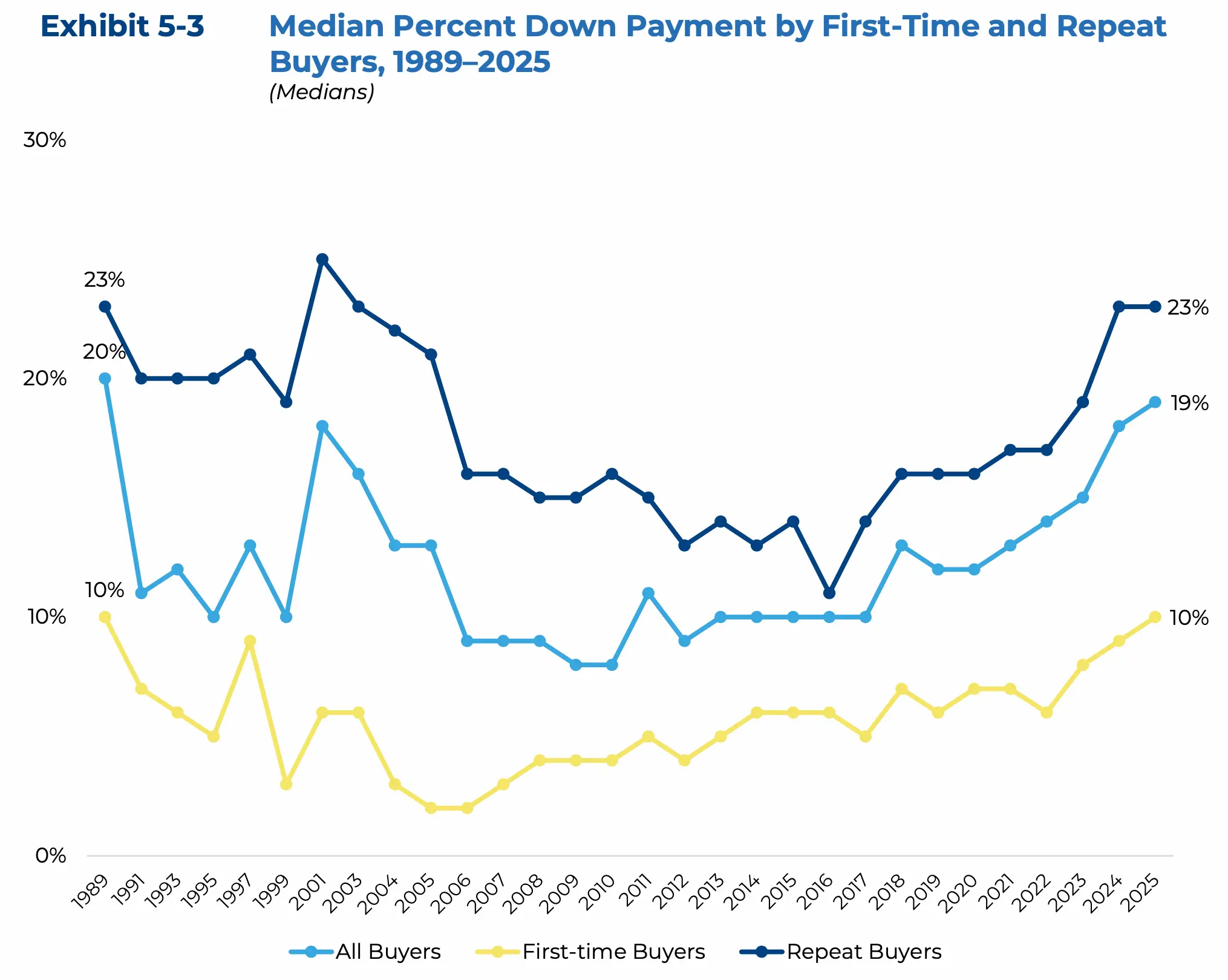
Down Payments Median down payment is 19% (10% for first-timers, 23% for repeat buyers)—record highs. Requires larger initial capital, further straining affordability for newcomers.
Age of Buyers/Sellers Median age of first-time buyers is 40; repeat buyers 62; sellers 64. Reflects an aging population increasingly dominating the market, often with greater financial resources.
Agent Importance 88% of buyers and 91% of sellers used agents; deemed essential for navigation. Shows that professional guidance is highly valued in a complex market.
Homeownership Tenure Median expected tenure is 15 years; sellers held homes for a record 11 years. Indicates a shift towards longer-term investment and stability rather than frequent moving.

First-Time Buyers Facing Historically Low Numbers

One of the most alarming trends from the NAR report is the record low percentage of first-time buyers—a mere 21% of the market. Think about that for a moment: since NAR started tracking this back in 1981, we’ve never seen so few people entering the market for the first time. Before 2008, that number was hovering around 40%.

“The historically low share of first-time buyers underscores the real-world consequences of a housing market starved for affordable inventory,” states Jessica Lautz, NAR’s deputy chief economist.

It's not just that fewer people are buying for the first time; those who are buying are older. The median age for a first-time buyer has climbed to a record 40 years old. Growing up, I always heard about people buying their first homes in their late twenties or early thirties. Now, that feels like ancient history.

Saving for a down payment is incredibly difficult with high rents and the persistent burden of student loan debt. Shannon McGahn, NAR’s executive vice president and chief advocacy officer, rightly points out, “For generations, access to homeownership has been the primary way Americans build wealth and the cornerstone of the American dream.” She adds that delaying this by a decade could mean missing out on approximately $150,000 in equity from a typical starter home.

Key Factors for First-Time Buyers:

  • High rents making saving difficult.
  • Significant student loan debt.
  • Difficulty qualifying for mortgages.
  • Intense competition from cash buyers.

While government-backed loans like FHA and VA, which often require lower or no down payments, have been vital for millions, their usage has decreased. The report shows FHA loan usage dropping significantly since 2009. NAR is advocating for policy changes to increase housing supply, streamline building regulations, and modernize construction to make homes more affordable. Without more homes at accessible price points, this generation of potential first-time buyers will continue to face an uphill battle.

The Rise of the All-Cash Buyer

On the flip side, we're witnessing an unprecedented surge in all-cash home purchases. Averaging 26% of all transactions over the past year, this is a huge jump from the less than 10% seen between 2003 and 2010. These buyers aren't just using equity from selling another home; they are often bypassing the mortgage process altogether. With interest rates being higher and lending conditions tight, an all-cash offer is incredibly powerful. It’s a sign of financial strength and a way to avoid the complexities and potential rejections that come with mortgage pre-approvals.

Down Payments Are Getting Bigger for Everyone

Housing Market: Down Payments Are Getting Bigger for Everyone
Source: National Association of REALTORS®

Regardless of whether you're a first-timer or a seasoned homeowner, the amount of money needed for a down payment is climbing. This is true for both groups, hitting levels not seen in decades. In 2025, the median down payment jumped to 19% for all buyers. For first-time buyers, it was 10%, and for repeat buyers, it was a hefty 23%. For first-time buyers, this is the highest median down payment since 1989, and for repeat buyers, it's the highest since 2003.

So, where is this money coming from?

  • Personal Savings: Remain the top source for first-time buyers (59%).
  • Financial Assets: Tapping into 401(k)s, IRAs, or stocks (26% for first-timers).
  • Gifts/Loans from Family & Friends: A significant boost for 22% of first-timers.
  • Equity from Previous Home Sale: The primary source for over half of repeat buyers (54%).

This directly ties back to the growing equity and wealth accumulated by long-term homeowners.

Why Real Estate Agents Are More Crucial Than Ever

Despite the rise of online tools, real estate agents remain essential. The NAR report shows that a staggering 88% of buyers worked with an agent, making them the most trusted source of information, outranking online listings. Buyers lean on agents for help finding the right home, negotiating terms, and navigating the mountain of paperwork. It’s particularly reassuring for first-time buyers, with 76% crediting their agent with helping them understand the complex process.

Sellers, too, are overwhelmingly relying on agents, with 91% using one. Their priorities are clear: getting help marketing their home effectively, pricing it competitively, and securing a sale within their desired timeframe. As Lautz says, “Real estate agents remain indispensable in today’s complex housing market.” They provide not just expertise and negotiation skills but also crucial emotional support during what is often the biggest financial decision someone makes.

I’ve seen it myself. An agent’s ability to spot potential issues in a home, their knowledge of the local market, and their skill at negotiating can make or break a deal, especially when you're up against tough competition.

FSBOs Hit an All-Time Low: A Sign of the Times

Following on the heels of the agent's importance, the report highlights that For Sale By Owner (FSBO) sales have hit an all-time low of just 5%. Homes sold with agent assistance fetched a median price of $425,000, significantly higher than the $360,000 for FSBO homes. While some owners might try to save on commission fees or sell to someone they know, the data suggests that the expertise and market reach of an agent lead to better outcomes.

Repeat Buyers: Exercising Their Financial Muscle

Repeat buyers are truly flexing their financial power. With a median down payment of 23% and nearly one in three paying all cash, they are in a strong position to compete. Years of rising home values have built substantial wealth for these homeowners. The average seller has now owned their home for a record 11 years, accumulating significant equity—an average of $140,900 gained in the last five years alone, according to NAR’s research. This allows them to make larger down payments, avoid financing contingencies, and often secure their next home with less stress than a first-time buyer.

Fewer Families with Children Entering the Market

A noticeable shift in the profile of home buyers is the decline in households with children under 18. This group now makes up just 24% of recent buyers, a stark contrast to 58% in 1985. This trend is likely a result of declining birth rates and the increasing age of repeat buyers. Additionally, the high cost of childcare presents yet another hurdle for families trying to save for a down payment.

This demographic shift also means there's a move away from the traditional family household. The share of married couples buying homes has also decreased, while single buyers, particularly single women, are gaining ground. This points to a more diverse range of individuals and household structures becoming homeowners.

The Aging of Home Buyers and Sellers

It's not just first-time buyers getting older; the entire cohort of buyers and sellers is aging. We’ve already seen the median age for first-time buyers hit 40, but repeat buyers are now a median age of 62, and the typical home seller is 64 years old—both record highs. This coincides with other NAR research indicating that Baby Boomers, now in their late 60s and 70s, are the largest group of both buyers and sellers. Their financial stability often allows them to navigate the market more easily than younger generations.

Buying for the “Forever Home” Mentality

The idea of a “starter home” seems to be fading. Home buyers today are planning to stay put for much longer. The median expected tenure in a purchased home is now 15 years, with many (28%) considering it their “forever home” and having no intention of moving. This is a dramatic shift from the early 2000s when homeowners typically stayed in their homes for just six years. The median time a homeowner has been in their current home before selling is now a record 11 years. This longer-term outlook applies to both first-time and repeat buyers, suggesting a desire for stability and a less transient approach to homeownership.

New Construction Sees a Slight Uptick

While existing homes still dominate sales, there's been a slight increase in new home purchases, reaching 16%—a level not seen since 2006. Builders have been offering incentives like price reductions and mortgage rate buydowns to attract buyers. Those opting for new construction often cite the desire to avoid renovations and repairs and the ability to customize their living space. On the other hand, buyers who prefer existing homes often point to perceived better value, lower prices, and the unique charm and character of older properties.

This polarization of the housing market is a complex issue with no easy answers. The gap between those who can afford to buy and those who are priced out is widening, creating significant challenges for economic mobility and the fulfillment of the American dream for a new generation.

Want Stronger Returns? Invest Where the Housing Market’s Growing

Turnkey rental properties in fast-growing housing markets offer a powerful way to generate passive income with minimal hassle.

Work with Norada Real Estate to find stable, cash-flowing markets beyond the bubble zones—so you can build wealth without the risks of ultra-competitive areas.

🔥 HOT NEW LISTINGS JUST ADDED! 🔥

Talk to a Norada investment counselor today (No Obligation):

(800) 611-3060

Get Started Now

Want to Know More About the Housing Market Trends?

Explore these related articles for even more insights:

  • Housing Market Predictions for the Next 4 Years: 2025 to 2029
  • Housing Markets at Risk of Double-Digit Price Decline Over the Next 12 Months
  • Housing Market Trends: Nearly 1 in 3 Buyers Still Opt for All-Cash Deals in 2025
  • Will the Housing Market Shift to a Buyer’s Market in 2026?
  • Housing Market 2025: Booming vs. Shrinking Inventory Across America
  • Housing Market Gains Supply But Buyers Hit Pause in 2025
  • Mid-Atlantic Housing Market Heats Up as Mortgage Rates Go Down
  • NAR Chief's Bold Predictions for the 2025 Housing Market
  • Housing Market Update 2025: NAR Report Indicates Sluggish Trends
  • 7 Buyer-Friendly Housing Markets in 2025 With Abundant Homes for Sale
  • The $1 Trillion Club: America's Richest Housing Markets Revealed
  • 4 States Dominate as the Riskiest Housing Markets in 2025
  • Housing Market Predictions 2025 by Norada Real Estate

Filed Under: Housing Market, Real Estate Market Tagged With: Housing Market, Housing Market Trends

Is the Housing Market in Recession in Because of Fed’s Decisions?

November 9, 2025 by Marco Santarelli

Is the Housing Market Already in Recession? Fed’s Decisions Under Fire

Right now, the big question on everyone's mind is whether our housing market has unofficially dipped into recession. Treasury Secretary Scott Bessent certainly thinks so, suggesting that the Federal Reserve's cautious approach to lowering interest rates is partly to blame. He voiced this opinion on CNN's “State of the Union,” and it’s a sentiment that’s stirring up a lot of debate. I believe that while parts of the economy are definitely feeling the pinch, calling the entire housing market a full-blown recession might be jumping the gun, but the warning signs are certainly there. A lot of folks are feeling the squeeze, and the Fed’s policies are definitely playing a role.

Is the Housing Market in Recession in Because of Fed’s Decisions?

What’s Causing the Housing Market Headache?

Secretary Bessent pointed directly at high mortgage rates as the culprit hindering the housing market. He believes that if the Federal Reserve were to lower interest rates, it would directly bring down those daunting mortgage rates. This, in turn, could help lift us out of what he's calling a “housing recession.” He also made an important point: it's often the low-income consumers who are hit the hardest. These individuals tend to have more debt and fewer assets, making them more vulnerable when economic conditions tighten.

Now, it’s important to understand that the Fed doesn't directly set mortgage rates. What they do control is the federal funds rate, which is a short-term rate banks use to borrow from each other. Mortgage rates, on the other hand, tend to follow the yields of longer-term bonds. These bond yields are influenced by what investors expect the Fed to do in the future and the general state of financial conditions. So, while the Fed's actions are a major factor, it's a bit more indirect than simply flipping a switch.

Fed’s Latest Move and Mixed Signals

Recently, the Federal Open Market Committee (FOMC) decided to lower their benchmark interest rate by a quarter of a point, bringing it down to a range of 3.75%-4%. Following this news, the average rate for a 30-year fixed mortgage did dip to a low of 6.17%, the lowest it's been in over a year. This sounds like good news, right?

However, Fed Chair Jerome Powell quickly tempered any excitement about further cuts. He made it clear that another reduction in December is “not a foregone conclusion,” emphasizing that the Fed's policy isn't on a fixed, predetermined path. This caution is drawing criticism.

Under Fire: The Fed's Tightrope Walk

The Treasury Secretary isn’t the only one questioning the Fed's approach. Fed Governor Stephen Miran, who voted for a larger half-point rate cut at the last meeting, warned in an interview with The New York Times that keeping interest rates too high for too long could actually push the economy into a recession. He basically said, “Why run that risk if inflation isn't a major concern?” This is a valid point.

Bessent echoed this sentiment, arguing that with the Trump administration focusing on reducing government spending, inflation should naturally be coming down. His logic is simple: if inflation is dropping, the Fed should be cutting rates to stimulate the economy, especially for sectors like housing.

The Fed’s Balancing Act: Dual Mandate

It’s crucial to remember the Fed's job is a balancing act. They have a “dual mandate” from Congress: to promote maximum employment and keep inflation close to 2%. They raise interest rates to cool down an overheating economy and fight inflation, and they lower rates to encourage job growth and boost economic activity. It’s a tough job, and sometimes when they're trying to tame inflation, they inevitably slow down other parts of the economy.

Realtor.com® senior economist Joel Berner also chimed in, noting that while a Fed rate cut can help mortgage rates fall, it doesn't always mean a direct, one-to-one drop in those long-term home loans. He mentioned that there’s a lot of uncertainty in the economy right now, which adds to the difference between the Fed’s target rate and what homebuyers actually pay.

When Data Becomes Scarce: The Government Shutdown’s Impact

Adding another layer of complexity, the recent government shutdown meant the Fed had to make crucial policy decisions without access to important economic data, like September’s employment numbers. This lack of timely information makes their job even harder and can lead to decisions that feel disconnected from the real-time economic situation.

We did get some inflation data, though. The Consumer Price Index (CPI) increased by 3% in September compared to the previous year. This was the sixth straight month of rising annual inflation. While 3% isn't sky-high, the trend of increasing inflation over several months gives the Fed pause, even if some critics feel they should be more aggressive in cutting rates.

Is the Housing Market Really in Recession?

So, let’s get back to that million-dollar question: is the housing market already in a recession? Joel Berner, from Realtor.com®, wouldn't go as far as to definitively say “yes” yet. However, he agrees that the market is showing signs of distress and could be heading that way.

Here’s what he pointed out:

  • Home sales are slumping: Sales are on track to be the slowest full year since 1995! And even with mortgage rates falling recently, the number of sales hasn't picked up enough to make a significant difference.
  • Builders are pulling back: Homebuilders, who were busy constructing a lot of lower-priced homes after the pandemic, are now seeming to slow down their output.
  • Demand is weak: Buyers are struggling with affordability, and at the same time, the supply of homes is decreasing. It’s a double whammy.

What’s the Real Engine of the Housing Market?

Ultimately, the health of the housing market is directly tied to the job market. Berner highlighted that the job market has indeed softened recently. Things like tariffs and a general slowdown in business cycles are leading companies to hire less and lay off more workers. When people don't feel secure in their jobs, they're naturally hesitant to make a huge commitment like buying a new home. This lack of confidence in employment is a major driver of the current slowdown.

My take on this is that the Fed is caught in a difficult spot. They're trying to fight inflation without causing too much damage to the broader economy. But with the housing market showing such clear signs of weakness – falling sales, cautious builders, and affordability issues – it does feel like we’re in a precarious situation.

The debate over whether we're officially in a recession might be semantics for many homeowners and aspiring buyers who are already feeling the pinch. The Fed’s caution, while perhaps well-intentioned, is certainly under fire because many believe it’s prolonging the pain for key sectors like housing. We need to see more concrete signs of economic recovery, and a stronger labor market, for the housing market to truly bounce back.

Invest in Real Estate That Performs—Even in a Recession

With growing debate over whether the housing market is already in a recession, now’s the time to focus on stable, income-generating investments that thrive regardless of Fed policy shifts.

Work with Norada Real Estate to find cash-flowing turnkey rental properties in recession-resilient markets—so your portfolio keeps growing while others panic.

HOT TURNKEY DEALS JUST LISTED!

Talk to a Norada investment counselor today (No Obligation):

(800) 611-3060

Get Started Now

Want to Know More About the Housing Market Trends?

Explore these related articles for even more insights:

  • Housing Market Update: Home Sales Rise Fueled by Lower Mortgage Rates
  • 7 Housing Markets Facing Double-Digit Price Drops Over the Next 1 Year
  • Housing Market Trends: Nearly 1 in 3 Buyers Still Opt for All-Cash Deals in 2025
  • Will the Housing Market Shift to a Buyer’s Market in 2026?
  • Housing Market 2025: Booming vs. Shrinking Inventory Across America
  • Housing Market Gains Supply But Buyers Hit Pause in 2025
  • Mid-Atlantic Housing Market Heats Up as Mortgage Rates Go Down
  • NAR Chief's Bold Predictions for the 2025 Housing Market
  • Housing Market Update 2025: NAR Report Indicates Sluggish Trends
  • 7 Buyer-Friendly Housing Markets in 2025 With Abundant Homes for Sale
  • The $1 Trillion Club: America's Richest Housing Markets Revealed
  • 4 States Dominate as the Riskiest Housing Markets in 2025
  • Housing Market Predictions 2025 by Norada Real Estate
  • Housing Market Predictions 2026: Will it Crash or Boom?

Filed Under: Housing Market, Real Estate Market Tagged With: Housing Market, Housing Market Trends

Zombie Foreclosures Decline Nationwide Amidst Peak Housing Demand

November 8, 2025 by Marco Santarelli

Zombie Foreclosures Decline Nationwide Amidst Peak Housing Demand

The number of “zombie foreclosures” – homes abandoned by owners in the midst of foreclosure proceedings – has edged down, and with the U.S. residential vacancy rate hovering near a four-year low, it paints a picture of a real estate market that's largely moving in the right direction. This welcome decline in vacant, distressed properties suggests improved housing demand and potentially fewer homeowners falling through the cracks.

Zombie Foreclosures Decline Nationwide Amidst Peak Housing Demand

As ATTOM's latest Q4 2025 Vacant Property and Zombie Foreclosure Report reveals, the national zombie foreclosure rate has dropped to 3.25 percent, down from 3.38 percent in the previous quarter. This translates to roughly 7,448 homes currently sitting in this unsettling state. Simultaneously, the overall U.S. residential vacancy rate has dipped slightly to 1.3 percent, impacting about 1.4 million homes. This sustained low vacancy rate, holding steady around 1.4 percent for nearly four years, is a significant indicator that the high prices we've seen haven't extinguished people's drive to find a home. From my perspective, this is a genuinely positive sign for the stability and health of our housing markets.

What Exactly Are Zombie Foreclosures, and Why Do They Matter?

Before I dive deeper into the numbers, it's crucial to understand what a “zombie foreclosure” truly is. Imagine a homeowner struggling to keep up with their mortgage payments. They enter the foreclosure process, but before the bank can officially take ownership, life throws them a curveball, and they have to move out. They abandon the property, leaving it in a sort of limbo. It's still legally in foreclosure, but no one is living in it, no one is maintaining it, and it can fall into disrepair, becoming an eyesore and a potential magnet for crime in the neighborhood. These are our zombie properties.

Why is their decline important? It signifies that fewer people are abandoning their homes before the foreclosure process is finalized. This can be attributed to several factors, which I'll explore. Primarily, it suggests that either homeowners are finding ways to navigate their financial difficulties, or the demand for housing is so strong that even distressed properties are being snapped up faster.

The National Picture: A Slow but Steady Improvement

ATTOM's comprehensive report, which meticulously analyzes publicly available real estate data including foreclosure status, equity, and owner-occupancy, alongside monthly vacancy updates, provides a clear snapshot of the current market. The slight dip in both vacancy and zombie foreclosure rates, while seemingly small, contributes to a larger narrative of housing market resilience.

Rob Barber, CEO of ATTOM, aptly points out, “These continuously low vacancy rates that the nation has held steady at around 1.4 percent for nearly four years, show that record high prices haven’t dampened the demand for homes.” I couldn't agree more. When demand is high, it often means properties are selling quicker. This can include properties that might otherwise have lingered in pre-foreclosure status for extended periods. A faster sales cycle, even for troubled properties, reduces the likelihood of them becoming truly abandoned “zombies.”

State-by-State Variations: Where the Trends Differ

While the national trend is encouraging, it's never a uniform story across the country. My experience working with diverse real estate markets has taught me that local conditions always play a significant role.

States Seeing More “Zombie” Activity:

ATTOM's data highlights that the number of zombie properties did increase quarter-over-quarter in 21 states and the District of Columbia. However, these increases were often by very small numbers. Among states with a notable number of zombie properties, Oregon saw a significant jump of 37.8 percent, reaching 51 zombie properties. Nevada followed with a 31.1 percent increase, totaling 59 zombie properties. Georgia, Ohio, and Arizona also reported modest rises.

It's essential to look at these numbers in context. A percentage increase can sound alarming, but if the starting number is very small, a few additional properties can skew the percentage. For instance, if a state only had 10 zombie properties and it rose to 15, that's a 50% increase, but it's a manageable number overall.

States Slashing Their Zombie Loads:

On the flip side, several states have made notable progress in reducing their zombie foreclosure numbers. Oklahoma led the pack with a 23 percent drop, now having 57 zombie properties. Indiana saw a 12.7 percent decrease, with 219 zombie properties remaining. California, Michigan, and Iowa also reported significant declines. This suggests proactive measures or underlying market strengths in these particular areas.

Vacancy Hotspots and Snow Globes: Where Homes Sit Empty

When we look at overall vacancy rates, another interesting picture emerges.

States with Higher Vacancy Rates:

The states with the highest percentages of vacant homes in the fourth quarter were generally concentrated in the heartland and some southern regions:

  • Oklahoma: 2.4 percent
  • Kansas: 2.3 percent
  • Alabama: 2.2 percent
  • Missouri: 2.1 percent
  • West Virginia: 2.1 percent

These states might face unique economic challenges or have a higher inventory of older homes that take longer to sell.

States with Very Low Vacancy Rates:

In stark contrast, the New England states consistently show remarkably low vacancy rates, acting like little real estate snow globes where every home seems to be occupied:

  • New Hampshire: 0.3 percent
  • Vermont: 0.4 percent
  • New Jersey: 0.5 percent
  • Idaho: 0.5 percent
  • Connecticut: 0.5 percent

These low figures underscore intense demand and very tight housing supply in these desirable areas.

Metropolitan Areas: Pockets of Concern and Areas of Strength

The report also zooms in on metropolitan statistical areas (MSAs) with at least 100,000 properties. Here, we see that the majority of these larger metro areas have zombie property rates below the national average of 3.25 percent. This is reassuring, as it means widespread blight isn't the norm.

Midwestern Cities Leading in Zombie Rates:

However, certain Midwestern cities stand out with higher concentrations of abandoned pre-foreclosure homes:

  • Cedar Rapids, IA: 14 percent of pre-foreclosure homes abandoned
  • Peoria, IL: 11.9 percent
  • Wichita, KS: 11.8 percent
  • Cleveland, OH: 10.8 percent
  • Youngstown, OH: 10.6 percent

These areas might be experiencing specific economic downturns or have older housing stock that is harder to revitalize.

Metro Areas with Zero Zombies:

On the other end of the spectrum, it's incredibly encouraging to note that some of the largest metro areas reported no zombie properties at all in the fourth quarter. These include Grand Rapids, MI, Nashville, TN, and Raleigh, NC. This indicates very robust housing markets in these regions, where properties move quickly and distress is minimized.

Investor-Owned Properties: A Slight Difference in Vacancy

ATTOM also looked at properties owned by institutional investors. My professional opinion here is that it's critical to differentiate between various types of investors. Flippers might leave a property vacant for renovation, while buy-and-hold investors often aim for long-term occupancy.

The data shows that investor-owned homes were slightly more likely to be vacant than typical homes nationwide. Of the 880,347 investor-owned properties, 3.5 percent were unoccupied, compared to the overall national rate of 3.3 percent. This isn't a massive difference, but it does suggest that some investment strategies might involve properties sitting empty for periods, whether for renovation, sale, or waiting for the right tenant.

The states with the highest vacancy rates for investor-owned homes were generally those already showing higher overall vacancy rates, like Indiana, Illinois, Alabama, Oklahoma, and Kansas.

The Takeaway: Demand Pulling the Market Forward

Looking at the full scope of ATTOM's Q4 2025 report, the overarching message is one of a housing market characterized by strong demand. The consistent vacancy rate hovering near a four-year low, combined with the shrinking number of zombie foreclosures, points to a market that is absorbing properties relatively well.

For homeowners, this generally means a more stable market. For potential buyers, it means intense competition. For those in foreclosure, it implies that while difficult, the situation might not inevitably lead to an abandoned property thanks to the robust demand and potentially more streamlined processes for selling or taking over distressed assets.

While localized issues and specific metro areas still require attention, the national data provides a reassuring glimpse into a housing economy that, despite its challenges, is demonstrating resilience and a capacity to move forward. It’s a complex picture, but one that leans towards positive progress.

Secure Your Retirement with Cash-Flowing Rental Properties

Turnkey real estate offers a low-hassle way to generate passive income and build long-term financial security—perfect for retirement-focused investors.

Norada Real Estate helps you invest in stable, high-demand markets that deliver consistent monthly cash flow and equity growth over time.

🔥 HOT NEW LISTINGS JUST ADDED! 🔥

Talk to a Norada investment counselor today (No Obligation):

(800) 611-3060

Get Started Now

Want to Know More About Foreclosure Trends?

Explore these related articles for even more insights:

  • 5 States Facing the Highest Foreclosure Rates in 2025
  • Housing Market Alert: Rising Foreclosures in 2025 Signal Deeper Trouble Ahead
  • Housing Markets With the Highest Zombie Foreclosure Rates in 2025
  • US Foreclosure Activity Drops by 10% in 2024: A Sign of Stability?
  • New Jersey Stands Out With Highest Foreclosure Rate Last Month
  • Is the Housing Market Recovering? A Look at Recent Trends
  • US Housing Market Sees Worst Year for Sales Since 1995
  • Nearly 100,000 U.S. Properties Faced Foreclosure Filings in Q1 2024

Filed Under: Foreclosures, Housing Market Tagged With: foreclosure, foreclosure rate, Housing Market, REO, Zombie Foreclosures

New York City Housing Market Poised for Rent Freeze and Affordable Homes

November 7, 2025 by Marco Santarelli

NYC Housing Market: Mamdani Proposes Rent Freeze and 200K Affordable Units

New York City just elected its 110th mayor, Zohran Kwame Mamdani, and his win is a major turning point. On November 4, 2025, this 34-year-old Democratic Socialist, formerly a state assemblyman, beat out big names like former Governor Andrew Cuomo and Curtis Sliwa, becoming not only the youngest mayor in over a century but the city's first Muslim and South Asian leader.

His victory signifies a powerful shift, especially concerning his ambitious plans for tackling the city's housing crisis. Mamdani's core promise is Housing By and For New York, a plan that aims to create 200,000 new affordable homes and implement an immediate rent freeze on stabilized apartments. This bold agenda is already sparking debate about whether it’s the solution the city desperately needs or a risky experiment.

New York City Housing Market Poised for Rent Freeze and Affordable Homes

Who is Zohran Mamdani? More Than Just a Young Politician

I've been following New York politics for a while, and Zohran Mamdani's rise is something special. He arrived in the city from Kampala, Uganda, as a child with his filmmaker mother, Mira Nair, and his academic father, Mahmood Mamdani. Growing up in Manhattan, he attended schools like the Bank Street School and the Bronx High School of Science, mixing with a creative crowd while developing a strong sense of social justice. After graduating from Bowdoin College, he worked to help people facing foreclosure. In 2020, he won a seat in the state assembly, making a name for himself by fighting for rent control and police reform.

His campaign for mayor really took off by using social media, especially TikTok, where he’d share short videos about everyday NYC problems like subway delays and evictions. This connected with a lot of younger voters and working-class families. He got the backing of big names like Bernie Sanders and Alexandria Ocasio-Cortez, and really positioned himself as the voice of the people against the old political guard. His message of “a dignified life for all New Yorkers” resonated deeply, especially in a city where finding an affordable place to live feels like a constant battle. Of course, his past comments have drawn criticism, but his supporters see his immigrant background and focus on fairness as strengths that will unite the city.

The NYC Housing Crisis: A Problem That's Getting Worse

Let's be real, New York City's housing situation is a mess. It's like everyone wants to live here, but there just aren't enough places to go around. The numbers don't lie: the city needs about 500,000 new housing units by 2030, but only built around 40,000 in 2024. This shortage means prices keep going up. Median asking rents hit $3,491 in mid-2025, squeezing the wallets of most New Yorkers. It’s estimated that over half of NYC households are spending more than 30% of their income on rent, which is the standard definition of being rent-burdened.

This has a ripple effect, pushing more people into homelessness. In 2024, over 630,000 households applied for limited rental assistance, showing just how desperate things have become. Things like the high cost of building (over $400,000 per unit), zoning rules that require parking spaces (taking up valuable building space), and the continuation of old, disconnected policies mean we haven't built enough homes for decades, especially affordable ones. The 2019 Housing Stability and Tenant Protection Act helped tenants, but it didn't stop rents from climbing.

Here’s a look at how rents have been climbing:

Year Median Gross Rent (NYC) Year-Over-Year Change Key Challenge Highlighted
2019 $1,500 +3.4% Pre-pandemic stability.
2021 $1,620 +4.5% Remote work increases demand.
2023 $1,850 +10.1% Evictions rise significantly.
2025 (Q1-Q2) $3,397-$3,491 +3.7-5.6% Operating costs rise; tight market.

As you can see, rents have almost doubled since 2019, way faster than most people's salaries are increasing. Families earning less than $70,000 a year are hit the hardest.

Mamdani's “Housing By and For New York” Plan: A Deep Dive

Mamdani's housing plan, called “Housing By and For New York,” is built on the idea that government should be the primary driver of creating affordable housing, not private developers who he believes prioritize profits. It’s a huge commitment: $100 billion over 10 years. This money will come from a mix of municipal bonds and existing funds. The goal is ambitious: to triple the production of rent-stabilized, union-built units to 200,000. This plan is targeted at families, seniors, and homeless individuals.

Let's break down the key pieces:

  • Rent Freeze and Tenant Power: A major promise is to immediately freeze rents on rent-stabilized apartments. This would protect about 2 million tenants from potential rent hikes of 3-7.75% that the Rent Guidelines Board might allow. Mamdani also wants to work with Albany to make all new buildings rent-stabilized, closing loopholes that developers use. The idea is that while landlords' costs are going up, the city can step in with subsidies to cover the difference, preventing tenants from facing steep increases. He’s also committed to cracking down on landlords who discriminate against tenants using housing vouchers, making sure that all assistance programs are used effectively.
  • Massive Public Investment: Mamdani is looking to double the capital investment in NYCHA (New York City Housing Authority) to $10 billion annually. This is crucial to fix the thousands of units falling into disrepair due to years of underfunding. He also plans to:
    • Expand programs like ELLA (for families earning under $72,000) and SARA (for senior housing) to create 100% affordable developments.
    • Speed up approvals for projects like the redevelopment of Greenpoint Hospital.
    • Use underused NYCHA land, like empty parking lots, to build new housing, ensuring these are union-built and environmentally friendly.
      This massive building spree will be funded through bonds, public land, and a slight increase in the corporate tax rate, which he believes can raise $2 billion a year without taxing residents more.
  • Smarter City Planning: Mamdani is calling for a comprehensive citywide plan that connects housing with transportation, schools, and climate goals. He wants to reform the zoning code, which he argues is biased and prevents development in many neighborhoods. Key changes include getting rid of parking minimums (those rules that force new buildings to have a certain number of parking spots, which takes up valuable space) and encouraging development near transit hubs. This is about creating more housing where people need it and where they can access jobs and services easily.

Could This Actually Work? The Challenges and Criticisms

Mamdani's plan is inspiring to many, especially those who feel left behind by the current housing market. Supporters believe it could create tens of thousands of jobs and help hundreds of thousands of lower-income residents find safe, affordable homes. They point to his deep ties with community groups as a strength that can help push through bureaucratic hurdles.

However, there are serious questions and concerns. Some economists worry that a strict rent freeze, like ones seen in other cities such as San Francisco in the past, could actually discourage new construction and lead to a decline in the quality of existing housing because landlords have less incentive to invest. They also warn that it could create a black market for housing or lead to longer waiting lists for apartments, similar to what happened in cities that implemented similar policies decades ago.

Here are some of the big hurdles Mamdani will face:

  • Getting Approval from Albany: The state government, specifically Governor Hochul, has resisted expanding rent control measures. Mamdani will need to do a lot of convincing and negotiating to get state-level support for his housing agenda.
  • Federal Funding: His plans for NYCHA, which desperately needs billions in repairs, rely heavily on federal funding. If national politics shift in a way that cuts federal aid, his ability to fix public housing could be severely impacted.
  • Landlord Pushback: While the plan aims to help tenants, it could put a significant strain on smaller landlords who own many rent-stabilized units. They might face financial difficulties, potentially leading to more evictions or a reluctance to maintain their properties.
  • The Sheer Cost: A $100 billion price tag is enormous, even for a city like New York. Funding this will require careful financial planning and could be jeopardized by economic downturns or changes in tax revenue.

The NYU Furman Center’s research suggests that simply freezing rents isn't enough; you need to build more housing to truly solve affordability. Mamdani’s approach tries to do both, but the success will depend on how well these two parts work together and how quickly they can show results, like getting those first new affordable units built and occupied.

What Does This All Mean for New York City?

If Zohran Mamdani can pull off his housing agenda, it could fundamentally change what it means to live in New York City. It could become a more inclusive place where people can afford to stay and raise their families, potentially slowing down the exodus of residents who are leaving because of high living costs. We might see a city where housing is seen more as a fundamental right, like access to clean water or parks, rather than just a commodity. This could help reduce the racial and economic inequalities that have plagued the city for so long.

But there's also a risk. If the plans aren't executed well, or if the economic challenges are too great, New York could face serious financial trouble, similar to the crisis it experienced in the 1970s. The success of his agenda will likely depend not just on his vision, but on his ability to build strong coalitions with different political groups, including more moderate voices in city government.

For tenants, this promises much-needed relief. For property owners, it means a mix of potential support through subsidies and increased regulation. For the city’s economy, there’s the promise of construction jobs and stimulus, but also the uncertainty of how these new policies will affect the broader real estate market.

As Mayor-elect Mamdani prepares to take office on January 1, 2026, everyone in New York City will be watching closely. His election is a clear signal that voters are tired of the housing crisis and ready for bold solutions. The next few years will show whether his ambitious vision can truly create a more affordable and equitable New York for everyone. The real work, the implementation, is what matters most now.

Invest in Real Estate That Grows Beyond Rent-Freeze Zones

With proposals like NYC’s rent freeze and new affordable housing plans on the horizon, now’s the time to diversify your portfolio into growth-oriented rental markets where cash flow and property values remain strong.

Work with Norada Real Estate to find profitable turnkey rentals in stable, landlord-friendly regions—so you can build wealth without being limited by local housing policy shifts.

NEW TURNKEY OPPORTUNITIES AVAILABLE NOW!

Talk to a Norada investment counselor today (No Obligation):

(800) 611-3060

Get Started Now

Read More:

  • NYC Housing Market: Prices, Trends, Forecast 2025-2026
  • How Much Do Real Estate Agents Make in New York?
  • 5 Predictions That Will Define the NYC Housing Market in 2025
  • Albany Housing Market Trends and Forecast for 2025
  • Syracuse Housing Market Trends and Forecast for 2025
  • NYC Housing Market Report: Rent Prices Are Skyrocketting
  • Rent-to-Own Homes in NYC: A Pathway to Homeownership
  • Long Island's Housing Crisis: Can New York Fix This Market
  • New York Housing Market: These 3 Cities Are Hottest in the Nation
  • New York Real Estate Market: Should You Invest Here?
  • Worst Places to Live in the New York State

Filed Under: Housing Market, Real Estate Market Tagged With: Housing Market, New York, New York City, NYC

Home Prices Drop in 9 of the Top 20 Metros Signaling a Significant Shift

November 4, 2025 by Marco Santarelli

Home Prices Drop in 9 of the Top 20 Metros Signaling a Significant Shift

The housing market is definitely doing a bit of a tightrope walk right now, and the latest numbers are showing us that for home prices dropping in 9 of the top 20 metros across the country, it's no longer just a blip but a noticeable trend. This isn't the frantic seller's market we saw a couple of years ago; instead, we're seeing a more complex picture emerge, where affordability is starting to whisper sweet nothings to buyers, even as some homeowners nervously watch their equity take a breather.

Home Prices Drop in 9 of the Top 20 Metros Signaling a Significant Shift

I've been following this market for a while, and what we're seeing now is a much-needed return to normalcy after a period of truly head-spinning appreciation. It's important to understand that home prices don't always go straight up; they have their cycles, and right now, we're in a significant cooling-off phase in key areas.

The National Pulse: A Slowing Beat

Let's get down to brass tacks. The S&P CoreLogic Case-Shiller Home Price Index, which is a really solid way to track how home values are changing because it looks at the same houses over time, told us something important recently. In August, the national growth in single-family home values only rose by a modest 1.5% compared to the year before. This is down from July's 1.7% and marks the slowest pace of growth we've seen since way back in 2012, when prices were actually going down.

But here's where it gets really interesting: when you look at the major metropolitan areas, the story really unpacks. Of the 20 major metros they track, nine are now seeing their home values fall on an annual basis. These aren't just any cities; they're some of the most talked-about places in the U.S. – think Tampa, Phoenix, Miami, San Francisco, Dallas, Denver, San Diego, Seattle, and Los Angeles.

Two big names, Seattle and Los Angeles, just joined the list this month, while the other seven cities had already been on the downward trend for a bit. This tells me the slowdown we're observing isn't confined to one or two isolated spots; it's spread across significant portions of the West and South.

Why the Chill? A Look Under the Hood

So, what’s behind this cooling? Several factors are at play, and it's not just a simple case of “prices are falling.”

  • Inflation vs. Home Values: Nicholas Godec, who works with the Case-Shiller data, pointed out that for the fourth month in a row, home values are actually losing ground to inflation. This means that even though the sticker price of a home might be a little higher than last year, your real wealth as a homeowner is shrinking because other costs of living are rising faster. The 1.5% national home price gain is significantly lower than the 2.9% inflation rate for the same period. That's a real wealth erosion, even if the numbers on paper look okay at first glance.
  • Affordability's Comeback Tour: For those of us who have been priced out of the market or are looking to upgrade, this might be the silver lining. As home prices cool and, importantly, mortgage rates have dipped to their lowest in over a year (around 6.19% recently, according to Freddie Mac), the barrier to entry is slowly lowering. Lisa Sturtevant, Chief Economist at Bright MLS, notes that shoppers are finding more breathing room. However, she wisely adds that growing economic uncertainty is keeping some people on the fence, which is completely understandable. Nobody wants to buy a home if they're worried about their job.
  • The Post-Pandemic Rebalancing: Remember the stampede to the suburbs and Sun Belt cities during the pandemic? Many of those areas saw incredibly sharp price increases. Now, those same markets are experiencing some of the largest corrections. Conversely, cities like New York and Chicago, which felt a bit stalled during that exodus, are actually seeing some of the greatest appreciation right now. It’s a natural rebalancing, where the areas that got the hottest are now cooling off the most.

Regional Divergence: A Tale of Two Americas

The national story, as always, masks some really important regional differences.

Metro Area Annual Home Value Change (August) Notes
New York +6.1% Highest annual gain
Chicago +5.9% Strong growth, only monthly gainer
Cleveland +4.7% Steady appreciation
Tampa -3.3% Largest annual decline, 10 consecutive months
Phoenix Declining Significant slowdown
Miami Declining Part of the Sun Belt cooling
San Francisco Declining Tech hub facing challenges
Dallas Declining Once-hot Texas market cooling
Denver Declining Mountain West seeing price dips
San Diego Declining California market showing weakness
Seattle Declining New entrant to falling prices
Los Angeles Declining New entrant to falling prices
  • Northeast and Midwest Resilience: Markets in the Northeast and Midwest are generally holding up better. Anthony Smith from Realtor.com® attributes this to tighter resale supply and more steadier demand. These areas didn't see the same explosive pandemic growth, so they don't have as far to fall, and local economies tend to be more stable.
  • Sun Belt and West Softening: On the flip side, places in the Sun Belt and the West are showing more clear signs of softening. Inventory is coming back more quickly, homes are staying on the market longer, and we're seeing more price cuts and delistings. Tampa, for instance, has seen prices drop year-over-year for 10 straight months, with August’s decline at 3.3%.

Beyond Annual: Monthly Trends Hint at Broader Weakness

While the annual numbers are important for long-term trends, the monthly data can sometimes give us a more immediate snapshot of what's happening. And the August monthly figures were pretty telling: 19 out of the top 20 metros saw home prices fall on a monthly basis.

The only exception? Chicago, which actually saw a small gain of 0.26% from July to August. On the other end of the spectrum, Portland, Oregon, and Los Angeles experienced the biggest monthly drops, both falling by more than 1%.

This widespread monthly decline suggests that the weakness isn't just a seasonal lull in some of these hotter markets; it's a more pervasive cooling that could potentially spread even further.

Godec’s statement again hits the nail on the head: “With price growth running at half the rate of inflation and several major markets in decline, the rapid appreciation of recent years has clearly ended.”

What Does This Mean for You?

This cooling market isn't necessarily good or bad; it's just different.

  • For Homeowners: If you're looking to sell, you might not get the sky-high offers you would have a year or two ago. It’s crucial to price your home realistically and be prepared for a bit more negotiation. Your real equity might be decreasing due to inflation, so understanding your net worth requires looking beyond just the sale price.
  • For Buyers: This is a moment of opportunity. With cooling prices and lower mortgage rates, affordability is improving. However, that economic uncertainty means it's still wise to be cautious, have a solid financial plan, and not stretch yourself too thin.
  • Looking Ahead: The housing market appears to be finding a “new equilibrium” after the pandemic's boom. This adjustment, while potentially painful for some homeowners in the short term, could lead to a more sustainable market in the long run, where prices are better aligned with incomes and inflation.

The data from the Case-Shiller Index, though it has a few months' delay, is considered a gold standard because it tracks the same properties over time. This August data reflects purchase decisions made in late spring and early summer, so we might see these trends continue to play out.

Ultimately, the idea that home prices will always skyrocket is being challenged. We're entering a phase where a sound financial footing, realistic expectations, and understanding local market dynamics will be more important than ever.

Want Stronger Returns? Invest Where the Housing Market’s Growing

Turnkey rental properties in fast-growing housing markets offer a powerful way to generate passive income with minimal hassle.

Work with Norada Real Estate to find stable, cash-flowing markets beyond the bubble zones—so you can build wealth without the risks of ultra-competitive areas.

🔥 HOT NEW LISTINGS JUST ADDED! 🔥

Talk to a Norada investment counselor today (No Obligation):

(800) 611-3060

Get Started Now

Want to Know More About the Housing Market Trends?

Explore these related articles for even more insights:

  • 7 Housing Markets Facing Double-Digit Price Drops Over the Next 1 Year
  • Housing Market Trends: Nearly 1 in 3 Buyers Still Opt for All-Cash Deals in 2025
  • Will the Housing Market Shift to a Buyer’s Market in 2026?
  • Housing Market 2025: Booming vs. Shrinking Inventory Across America
  • Housing Market Gains Supply But Buyers Hit Pause in 2025
  • Mid-Atlantic Housing Market Heats Up as Mortgage Rates Go Down
  • NAR Chief's Bold Predictions for the 2025 Housing Market
  • Housing Market Update 2025: NAR Report Indicates Sluggish Trends
  • 7 Buyer-Friendly Housing Markets in 2025 With Abundant Homes for Sale
  • The $1 Trillion Club: America's Richest Housing Markets Revealed
  • 4 States Dominate as the Riskiest Housing Markets in 2025
  • Housing Market Predictions 2025 by Norada Real Estate
  • Housing Market Predictions 2026: Will it Crash or Boom?
  • Housing Market Predictions for the Next 4 Years: 2025 to 2029
  • Real Estate Forecast: Will Home Prices Bottom Out in 2025?
  • Real Estate Forecast Next 5 Years: Top 5 Predictions for Future
  • Will Real Estate Rebound in 2025: Top Predictions by Experts

Filed Under: Housing Market, Real Estate Market Tagged With: home prices, Housing Market, Housing Market Trends

Kentucky Housing Market: Trends and Forecast 2025-2026

November 4, 2025 by Marco Santarelli

Kentucky Housing Market: Trends and Forecast

Thinking about buying or selling a home in the Bluegrass State? You've come to the right place! The Kentucky housing market is a popular topic, and for good reason. It’s a place many folks call home, and understanding its ins and outs can make a big difference. Right now, the average Kentucky home value stands at $226,606, showing a healthy 4.5% increase over the past year, often finding buyers within 18 days of hitting the market. This tells me that demand is still present, and homes are moving at a decent clip. Let's dive deeper into what this means for you.

Kentucky Housing Market: What's Happening Now and What's Next

Kentucky, with its unique blend of charming rural areas and growing urban centers, presents a fascinating real estate picture. It’s not just about big cities; there’s a charm to its smaller towns that attracts people looking for a different pace of life.

Current Snapshot of the Kentucky Housing Market (2025)

To give you the clearest picture, let's break down where things stand as of late 2025, based on data from Zillow.

Here’s a look at the supply and demand dynamics:

  • Homes for Sale: As of September 30, 2025, there were 16,894 homes on the market. This gives potential buyers a decent selection to choose from.
  • New Listings: In September 2025, 5,148 new homes hit the market. This is a healthy flow, suggesting that sellers are still finding opportunities to list their properties.

Now, let's talk about pricing and how quickly homes are selling:

  • Median Sale to List Ratio: On August 31, 2025, this was at 0.988. This means that, on average, homes were selling for just a little under their asking price. It’s a sign of a balanced market, not overly favoring buyers or sellers with extreme bidding wars, but definitely not a buyer's market either.
  • Median Sale Price: As of August 31, 2025, the median sale price was $260,367. This is the middle point – half of the homes sold for more, and half sold for less.
  • Median List Price: By September 30, 2025, the median list price was $295,000. The gap between the list price and the sale price tells us a bit about negotiation and what buyers are ultimately willing to pay.
  • Sales Over List Price: A notable 22.6% of sales on August 31, 2025, went for more than their asking price. This indicates that in some segments or desirable areas, competition is still driving prices up.
  • Sales Under List Price: Conversely, 56.9% of sales were below the list price. This is the larger chunk, supporting the median sale-to-list ratio and showing that many deals are being struck through negotiation.

From my perspective, what these numbers reveal is a market that's stable with a gentle upward trend. The significant difference between list and sale prices for the majority of homes suggests that while some properties are fetching premiums, there's still room for negotiation in many instances. This is excellent news for buyers who are looking for value and don't want to get caught in a frenzy. It also means sellers need to be strategic with their pricing to attract the right buyers.

The Kentucky Housing Market Forecast for 2025 and 2026

Looking ahead is crucial if you're making a long-term decision about real estate. The forecast from Zillow offers some interesting insights into potential future trends across different areas of Kentucky. It's important to remember that these are predictions, and real estate can be influenced by many unexpected factors.

Here’s a look at projected home value changes for selected areas, indicating a general trend of modest growth:

Region Name Projected Change by 31-10-2025 Projected Change by 31-12-2025 Projected Change by 30-09-2026
Louisville, KY 0.2% 0.7% 1.6%
Lexington, KY 0.4% 1.0% 3.3%
Bowling Green, KY 0.1% 0.3% 2.1%
Frankfort, KY 0.4% 1.1% 4.3%
Richmond, KY 0.3% 0.8% 2.9%
Elizabethtown, KY -0.3% (slight dip) -0.2% (slight dip) 1.9%
Owensboro, KY -0.1% (slight dip) 0.1% 1.5%
Paducah, KY -0.1% (slight dip) 0.1% 1.6%
Campbellsville, KY -0.1% (slight dip) 0.4% 4.2%
Mayfield, KY 0.2% 0.9% 4.1%

Note: Some regions show slight dips in projections for late 2025, but generally recover and show positive growth into late 2026. This can be typical market fluctuation.

Looking at these regional forecasts, I see a pattern of generally positive, albeit modest, appreciation. Cities like Frankfort, Lexington, and Campbellsville are showing some of the strongest projected growth by late 2026. This often indicates areas with strong job markets, good amenities, or perhaps a more limited supply of housing that's meeting demand.

On the other hand, areas like Murray and Middlesborough show significant negative projections. This is a crucial piece of information for anyone considering property in those specific locations. A steep decline forecast can signal underlying economic challenges, population shifts, or an oversupply of housing. It’s a reminder that real estate is hyper-local, and national or even statewide trends don't always apply uniformly.

Will The Kentucky Housing Market Crash in 2025 or 2026?

This is the million-dollar question, isn't it? Based on the data and my interpretation, I don't see evidence pointing to a crash in the Kentucky housing market in 2025 or 2026. A market crash typically involves a rapid, significant drop in home values across the board, often driven by widespread economic distress, a surplus of homes with no buyers, and a breakdown in lending.

What I'm observing in Kentucky is a market that is:

  • Appreciating: Home values are going up, albeit at a sustainable pace of 4.5% year-over-year. This isn't the frenzied, unsustainable growth that often precedes a fall.
  • Moving: Homes are selling within a reasonable timeframe, with a healthy inventory.
  • Negotiated: While some homes sell above asking, the majority are selling below, indicating that buyers still have some negotiating power.
  • Forecasting Growth: The regional forecasts, aside from a few specific outliers, predict continued, modest appreciation.

Instead of a “crash,” I anticipate a continuation of what I've described as a stable, balanced market, with nuanced variations across different regions. Some areas might cool slightly, especially if they experienced rapid growth in previous years, while others with strong underlying economic fundamentals will likely continue to see steady gains.

Think of it like this: the market has matured. It’s not experiencing the boom-and-bust cycles of some other times and places. This stability is actually a good thing for long-term homeowners and careful investors. It suggests that the current home values are more reflective of sustainable demand and economic conditions rather than speculative bubbles.

Factors Influencing the Kentucky Housing Market

Several key factors consistently shape the Kentucky real estate scene, and understanding these will give you even more insight:

  • Economic Development and Job Growth: When new businesses come to Kentucky, or existing ones expand, it brings people to the state who need housing. Major employers and industries (like manufacturing, healthcare, and agriculture) have a direct impact on demand in their surrounding areas.
  • Interest Rates: The cost of borrowing money significantly impacts affordability. When interest rates rise, monthly mortgage payments go up, which can cool demand. Conversely, lower rates can stimulate the market.
  • Population Trends: Are people moving to Kentucky or leaving? In-migration generally increases housing demand, while out-migration can decrease it. Kentucky has a mix of areas attracting new residents and those seeing a decline.
  • Housing Supply: The number of homes available for sale is a huge factor. If there aren't enough homes to meet demand, prices tend to go up. If there are too many, prices can stagnate or fall.
  • Affordability: Kentucky, in general, has historically offered more affordable housing compared to many other parts of the country. This affordability is a significant draw for people relocating from more expensive states.
  • Local Amenities and Quality of Life: Access to good schools, parks, cultural attractions, and a lower cost of living all contribute to making an area desirable, which in turn affects its housing market.

My personal take is that Kentucky's enduring appeal lies in its quality of life and relative affordability. Even as national economic winds shift, these fundamental strengths tend to provide a bedrock of stability for its housing market. I’ve seen firsthand how a promising job announcement in one county can ripple outwards, boosting demand for housing in neighboring towns.

Regional Spotlight: Areas to Watch

While the overall picture is positive, it's essential to zone in on specific regions.

  • Louisville and Lexington: As the state's largest metro areas, these will naturally see the most activity and investment. They typically have stronger job markets and attract a diverse range of buyers, from first-time homeowners to affluent investors. The forecasts show steady growth here.
  • Bowling Green: This city has been experiencing significant growth due to its manufacturing sector and university. We can expect continued interest and potential for appreciation.
  • Emerging Areas: Keep an eye on smaller cities and towns that are benefiting from investment, infrastructure improvements, or the ripple effect from larger metros. Areas like Frankfort and Campbellsville, with their strong forecast growth, are worth noting. They may offer more affordable entry points with good potential for future gains.
  • Areas with Caution: As highlighted by the negative forecasts, regions like Murray and Middlesborough require a more cautious approach. Understanding the specific economic drivers (or lack thereof) in these areas is paramount before making any decisions. Sometimes, a lower price point can be attractive, but not if the long-term value is projected to decline significantly.

What Does This Mean for You?

For buyers, the current market conditions suggest that while it's competitive, it's not prohibitively so. You still have the opportunity to negotiate on many properties.

For sellers, this is a good time to sell, provided you price your home correctly. The median list price is higher than the median sale price, so there is a bit of a gap.

For investors, Kentucky can offer attractive investment opportunities due to its affordability. However, it's vital to do your homework. Focus on areas with strong economic fundamentals and growth potential. Rental demand in certain areas might be higher than others, impacting potential returns.

My Final Thoughts

I believe the Kentucky housing market is in a healthy groove. It’s a market that offers real value and a good quality of life, which are fundamental drivers of housing demand. The projected trends suggest continued, sustainable growth rather than a speculative bubble. For individuals looking to put down roots or make a sound investment, Kentucky remains a compelling state.

Cash Flow Starts with Location—Invest in High-Demand Areas

Turnkey rental properties in fast-growing housing markets offer a powerful way to generate passive income with minimal hassle.

Work with Norada Real Estate to find stable, cash-flowing markets beyond the bubble zones—so you can build wealth without the risks of ultra-competitive areas.

🔥 HOT NEW LISTINGS JUST ADDED! 🔥

Talk to a Norada investment counselor today (No Obligation):

(800) 611-3060

Get Started Now

Recommended Read:

  • Trending: Louisville Ranks Among Top Ten Housing Markets Globally
  • Louisville Housing Market: Trends and Forecast
  • Lexington, KY Housing Market Trends and Forecast

Filed Under: Growth Markets, Housing Market, Real Estate Market Tagged With: Forecast, Housing Market, Kentucky, Trends

  • « Previous Page
  • 1
  • …
  • 10
  • 11
  • 12
  • 13
  • 14
  • …
  • 92
  • Next Page »

Real Estate

  • Birmingham
  • Cape Coral
  • Charlotte
  • Chicago

Quick Links

  • Markets
  • Membership
  • Notes
  • Contact Us

Blog Posts

  • Top Real Estate Investment Markets to Watch in 2026
    March 13, 2026Marco Santarelli
  • Best Midwest Real Estate Markets for Investors in 2026
    March 13, 2026Marco Santarelli
  • Best U.S. Markets for Turnkey Rentals Under $200K in 2026
    March 13, 2026Marco Santarelli

Contact

Norada Real Estate Investments 30251 Golden Lantern, Suite E-261 Laguna Niguel, CA 92677

(949) 218-6668
(800) 611-3060
BBB
  • Terms of Use
  • |
  • Privacy Policy
  • |
  • Testimonials
  • |
  • Suggestions?
  • |
  • Home

Copyright 2018 Norada Real Estate Investments

Loading...