Norada Real Estate Investments

  • Home
  • Markets
  • Properties
  • Membership
  • Podcast
  • Learn
  • About
  • Contact

Is the Housing Bubble Bursting: Home Prices Rise Just 0.2%

April 24, 2025 by Marco Santarelli

Is the Housing Bubble Bursting: Home Prices Rise Just 0.2%

Are you feeling the pinch when looking at homes these days? Well, here's the lowdown: U.S. home prices saw a slight increase of just 0.2% in March, marking the slowest climb we've witnessed since December 2022, according to Redfin. While prices are still up 4.6% compared to last year, this slowdown could signal some much-needed breathing room for potential homebuyers. Let's dive into what's driving this shift and what it means for you.

Is the Housing Bubble Bursting: Home Prices Rise Just 0.2%

Why the Slowdown in Home Price Growth?

As someone who's been following the real estate market for years, I can tell you that the forces at play are complex. This isn't a simple case of prices suddenly dropping; it's more like a gentle easing of pressure. Several factors are contributing to this trend:

  • Cooling Demand: The initial frenzy of the pandemic-era housing market has faded. Potential buyers are becoming more cautious due to overall economic uncertainty, particularly fear of a broader slowdown. This is a natural reaction when headlines are filled with talks of recessions and job market jitters.
  • Rising Inventory: There are simply more homes available for sale. This increased supply is giving buyers more options and reducing the sense of urgency that drove prices sky-high over the past few years. More homes on the market translate to less competition and, theoretically, lower prices.
  • Mortgage Rate Volatility: While mortgage rates have stabilized somewhat, they are still significantly higher than they were a few years ago. This makes homeownership less affordable for many, leading to a decrease in demand.
  • Economic Uncertainty: As Redfin's Senior Economist Sheharyar Bokhari rightly points out, “New tariffs are adding to the economic uncertainty and prices may slow even further in coming months.” Trade policies and other global economic factors can have a ripple effect on the housing market.

A Look at the Numbers: The Redfin Home Price Index (RHPI)

Redfin's Home Price Index (RHPI) is a key indicator of housing market trends, and its latest findings paint a clear picture. Here's what you need to know:

  • The RHPI uses a “repeat-sales pricing method,” meaning it tracks the price changes of the same homes over time. This provides a more accurate measure of price appreciation than simply looking at average home prices, which can be skewed by the types of homes being sold in a given period.
  • The index is seasonally adjusted to account for the typical fluctuations in home prices throughout the year. This allows for a more accurate comparison of month-over-month and year-over-year changes.
  • Prior to the current slowdown, the RHPI only recorded month-over-month price declines in mid-2022 when mortgage rates were rapidly climbing.

Regional Differences: Where are Prices Falling (and Rising)?

While the national average shows a slight increase, the real estate market is incredibly local. Some areas are seeing price declines, while others are still experiencing robust growth. According to Redfin, in March 2025:

  • 20 of the 50 most populous U.S. metro areas recorded a drop in home prices month over month. This underscores that the national trend isn't universally experienced.
  • The biggest declines were in Columbus, OH (-0.7%), Denver (-0.6%), and San Jose, CA (-0.6%). These markets might present opportunities for buyers seeking more affordable options.
  • Prices increased the most in San Francisco (2.7% month over month), Nassau County, NY (2.6%), and Milwaukee (1.7%). These areas continue to see strong demand, likely driven by factors like job growth, quality of life, and limited housing supply.

To illustrate, here's a table summarizing the top gainers and losers in home prices for March 2025:

Metro Area Month-over-Month Price Change
Top Gainers
San Francisco 2.7%
Nassau County, NY 2.6%
Milwaukee 1.7%
Top Losers
Columbus, OH -0.7%
Denver -0.6%
San Jose, CA -0.6%

What Does This Mean for Buyers?

If you're a prospective homebuyer, this slowdown could be good news. Here's why:

  • More Negotiation Power: With homes taking longer to sell, you have more leverage to negotiate a lower price or better terms. Don't be afraid to make an offer that's below the asking price, especially in areas where prices are declining.
  • More Time to Decide: The urgency to buy has subsided, giving you more time to shop around, do your research, and find the right home for your needs.
  • Less Competition: Fewer buyers competing for the same properties means less pressure to make quick decisions or overpay for a home.
  • Potential for Future Gains: If you buy now, you could potentially benefit from future price appreciation when the market eventually rebounds.

What Does This Mean for Sellers?

If you're a homeowner looking to sell, you'll need to adjust your expectations and strategies:

  • Price Competitively: Don't overprice your home, as buyers are more price-sensitive than they were a year or two ago. Work with your real estate agent to determine a fair market value based on recent comparable sales.
  • Be Patient: Homes are taking longer to sell, so be prepared to wait a little longer to find the right buyer.
  • Consider Making Improvements: Investing in minor repairs or upgrades can make your home more attractive to buyers and help it stand out from the competition.
  • Highlight the Positives: Focus on the unique features and benefits of your home and neighborhood.

My Take: A Balanced Perspective

In my opinion, this market shift is a welcome sign of stabilization. The rapid price increases of the past few years were unsustainable and created affordability challenges for many. A more balanced market, where buyers have more options and sellers have to price competitively, is ultimately healthier for the long term.

However, it's important to remember that the real estate market is dynamic and can change quickly. Factors like interest rate movements, economic growth, and population shifts can all influence home prices. So stay informed, work with a trusted real estate professional, and make decisions that are right for your individual circumstances.

The Future: What to Expect?

Predicting the future of the housing market is always a challenge, but here are a few things I'm watching closely:

  • Interest Rates: The direction of interest rates will have a significant impact on affordability and demand.
  • Economic Growth: A strong economy typically leads to higher home prices, while a weak economy can put downward pressure on prices.
  • Inventory Levels: The balance between supply and demand will continue to be a key factor in determining price trends.
  • Government Policies: Changes in tax laws, housing regulations, or mortgage lending standards can also affect the market.

In Summary

The fact that home prices ticked up 0.2% in March, the slowest pace since 2022, indicates a shift towards a more balanced market. While this may be welcome news for buyers, sellers will need to adjust their strategies to compete in the current environment. By staying informed and working with experienced professionals, both buyers and sellers can navigate the market successfully.

Work with Norada, Your Trusted Source for

Real Estate Investment in the Top U.S. Markets

Discover high-quality, ready-to-rent properties designed to deliver consistent returns.

Contact us today to expand your real estate portfolio with confidence.

Contact our investment counselors (No Obligation):

(800) 611-3060

Get Started Now 

Also Read:

  • 5 Housing Markets Most Vulnerable to a Price Crash: CoreLogic Report
  • Housing Markets Predicted to Crash by Double Digits by Q1 2026
  • Real Estate Forecast: Will Home Prices Bottom Out in 2025?
  • Housing Markets With the Biggest Decline in Home Prices Since 2024
  • Why Real Estate Can Thrive During Tariffs Led Economic Uncertainty
  • Rise of AI-Powered Hyperlocal Real Estate Marketing in 2025
  • Real Estate Forecast Next 5 Years: Top 5 Predictions for Future
  • 5 Hottest Real Estate Markets for Buyers & Investors in 2025
  • Will Real Estate Rebound in 2025: Top Predictions by Experts
  • Recession in Real Estate: Smart Ways to Profit in a Down Market
  • Will There Be a Real Estate Recession in 2025: A Forecast
  • Will the Housing Market Crash Due to Looming Recession in 2025?
  • 4 States Facing the Major Housing Market Crash or Correction
  • New Tariffs Could Trigger Housing Market Slowdown in 2025
  • Real Estate Forecast Next 10 Years: Will Prices Skyrocket?
Filed Under: Housing Market, Real Estate Market Tagged With: Home Price Drop, home prices, Housing Market, real estate, Real Estate Market

Housing Market Forecast for Spring 2025 for Buyers and Sellers

April 24, 2025 by Marco Santarelli

Housing Market Forecast for Spring 2025 for Buyers and Sellers

If you're trying to figure out what's going to happen with the housing market in Spring 2025, here's the quick answer: expect a mixed bag. Buyers will likely have more choices and a bit more power to negotiate, especially in some areas. But they'll also face high prices and high monthly mortgage costs. Sellers in certain markets might have a tougher time finding buyers, while those in hotter regions could still see multiple offers. It's a strange time, not quite a buyer's market, and not quite a seller's market – think of it as a “meh” market. Let's dive into what's driving this, and what it means for you.

Housing Market Forecast for Spring 2025 for Buyers and Sellers

A Market in Limbo: The Spring 2025 Housing Story

The spring homebuying season is usually a time of increased activity, with more homes hitting the market and more buyers eager to pounce. But Spring 2025 feels different. It's like everyone's waiting for something to happen. This situation isn't uniform; some parts of the country are seeing very different conditions.

I think this hesitation stems from a few key factors:

  • High Mortgage Rates: These have been stubbornly high, hovering around the 7% mark for a 30-year fixed loan. That's a big jump from the rock-bottom rates we saw during the pandemic.
  • Stubbornly High Prices: While we haven't seen massive price drops everywhere, prices aren't exactly skyrocketing either. They're just… there.
  • Sellers Holding On: Many homeowners are locked into those super-low mortgage rates from a few years back. They're reluctant to sell because they don't want to give up that sweet deal. Why would they?

This combination has created a situation where potential buyers are feeling priced out, and potential sellers are happy to stay put.

Understanding the Regional Differences

Here’s the thing to keep in mind: the housing market isn't the same everywhere. What's happening in one part of the country might be totally different from what's happening in another.

Redfin's data breaks it down pretty well:

  • The South: In many Southern markets, there's been a surge in new construction and investor activity. This means more homes on the market, leading to increased competition among sellers and more negotiating power for buyers. In places like Houston, sellers need to be extra careful about pricing their homes competitively.
  • The Midwest: The story in the Midwest is different. In cities like Chicago, demand is still outpacing supply, and bidding wars are relatively common, especially for homes that are well-priced and move-in-ready.

What Buyers Can Expect in Spring 2025

If you're a buyer looking to get into the market in Spring 2025, here's what you should keep in mind:

  • More Options (Maybe): Especially in Southern cities, you're likely to see more homes available. This increased inventory could give you more leverage when negotiating.
  • Motivated Sellers: With homes sitting on the market longer, some sellers are becoming more willing to offer price reductions, credits, or help with closing costs. Don't be afraid to ask!
  • Affordability Challenges: High mortgage rates and prices are still a major hurdle. You'll need to carefully consider your budget and what you can realistically afford each month.

What Sellers Can Expect in Spring 2025

If you're thinking of selling your home in Spring 2025, here's what you need to know:

  • Buyers Are Picky: Buyers are taking their time and waiting for the right deal. Overpriced or outdated homes are likely to sit on the market for longer.
  • Pricing is Key: Especially in slower markets, pricing your home competitively is crucial. Be prepared to negotiate.
  • Some Markets Are Still Hot: In the Midwest and Northeast, well-priced homes are still selling quickly, especially those with desirable features.

Here's a quick summary table:

Expectation Buyers Sellers
Inventory More options (in some areas) More competition (in some areas)
Negotiation More negotiating power Must be willing to negotiate
Affordability Major challenge Dependent on market
Pricing Shop around for deals Price competitively; be realistic

My Personal Thoughts and Advice

Based on what I'm seeing, the housing market in Spring 2025 is going to require a lot of patience and careful planning. Here's my advice, whether you're buying or selling:

  • For Buyers: Don't rush into anything. Take your time to find a home that truly meets your needs and fits your budget. Get pre-approved for a mortgage so you know exactly what you can afford. Consider markets where you might have more negotiating power.
  • For Sellers: Be realistic about pricing. Look at comparable sales in your area and price your home competitively. Be prepared to negotiate with buyers. Consider making some upgrades or repairs to make your home more appealing.

The Importance of Local Expertise

Remember that the housing market is highly localized. What's happening nationally or even regionally might not be what's happening in your specific neighborhood. That's why it's so important to work with a local real estate agent who knows your area inside and out. They can provide valuable insights and guidance to help you make the best decisions.

The housing market is always subject to change, and there's always some level of uncertainty. But by staying informed, doing your research, and working with qualified professionals, you can navigate the Spring 2025 market with confidence.

Final Thoughts

Spring 2025's housing market presents a mixed bag of opportunities and challenges for both buyers and sellers. High mortgage rates continue to loom large, affecting affordability and overall market dynamics. Regional variations are significant, with the South experiencing increased inventory and negotiating power for buyers, while the Midwest remains competitive with bidding wars.

Success in this market hinges on realistic pricing, careful budgeting, and expert local knowledge. Buyers should focus on finding homes that genuinely meet their needs and budgets, while sellers need to price competitively and be prepared to negotiate. With patience, diligent research, and professional guidance, you can navigate this complex market with confidence.

Work with Norada, Your Trusted Source for

Real Estate Investment in the Top U.S. Markets

Discover high-quality, ready-to-rent properties designed to deliver consistent returns.

Contact us today to expand your real estate portfolio with confidence.

Contact our investment counselors (No Obligation):

(800) 611-3060

Get Started Now 

Also Read:

  • 12 Housing Markets Set for Double-Digit Price Decline by Early 2026
  • Housing Market Predictions for 2025 by Real Estate Agents
  • Real Estate Forecast: Will Home Prices Bottom Out in 2025?
  • Housing Markets With the Biggest Decline in Home Prices Since 2024
  • Why Real Estate Can Thrive During Tariffs Led Economic Uncertainty
  • Rise of AI-Powered Hyperlocal Real Estate Marketing in 2025
  • Real Estate Forecast Next 5 Years: Top 5 Predictions for Future
  • 5 Hottest Real Estate Markets for Buyers & Investors in 2025
  • Will Real Estate Rebound in 2025: Top Predictions by Experts
  • Recession in Real Estate: Smart Ways to Profit in a Down Market
  • Will There Be a Real Estate Recession in 2025: A Forecast
  • Will the Housing Market Crash Due to Looming Recession in 2025?
  • 4 States Facing the Major Housing Market Crash or Correction
  • New Tariffs Could Trigger Housing Market Slowdown in 2025
  • Real Estate Forecast Next 10 Years: Will Prices Skyrocket?

Filed Under: Housing Market, Real Estate Market Tagged With: Home Price Drop, home prices, Housing Market, real estate, Real Estate Market

Housing Market Crash Alert? Zillow Turns Negative on Home Prices

April 23, 2025 by Marco Santarelli

Housing Market Crash Alert? Zillow Turns Negative on Home Prices

Is the housing market about to take a tumble? According to Zillow's latest forecast, the answer is a resounding yes. Zillow now predicts that U.S. home prices will fall by 1.7% between March 2025 and March 2026. It is a dramatic shift that signals the company is growing increasingly bearish on the housing market's near future.

Housing Market Crash Alert? Zillow Turns Negative on Home Prices

Let's be honest, it's not every day that a major player like Zillow makes such a stark prediction. For months, they've been gradually revising their outlook, and this latest drop is significant. To put it in perspective, here's a look at how Zillow's 12-month forecast for national home prices has changed recently:

  • January: +2.9%
  • February: +1.1%
  • March: +0.8%
  • Now: -1.7%

I believe, the consistent downward trend paints a clear picture: Zillow sees trouble on the horizon. Why should we care? Because Zillow has access to a massive amount of housing data. Their models are closely watched by investors, real estate professionals, and anyone considering buying or selling a home. Their forecasts, while not infallible, carry weight.

The “Why” Behind the Worry: Affordability and the Sun Belt

So, what's driving Zillow's pessimism? According to their economists, two main factors are at play:

  • Strained Housing Affordability: This is the big one. The pandemic-era housing boom sent prices soaring by over 40%, and then mortgage rates doubled in 2022. This combination has made it incredibly difficult for many people to afford a home. The average person is either unable or unwilling to pay such huge premiums.
  • Weakening Sun Belt Markets: The Sun Belt has been a hotspot for housing growth in recent years, but Zillow believes that the party is ending. Softening and weakening markets in this region will drag down national home prices.

Digging Deeper: Affordability and Its Grip on the Market

Think about it: even with mortgage rates leveling off somewhat recently, they're still significantly higher than they were just a few years ago. This means higher monthly payments, even for the same priced house. The result? Potential buyers are staying on the sidelines, opting to rent for longer. This decrease in demand puts downward pressure on prices. I strongly believe, housing affordability is a very concerning problem right now.

Sun Belt's Sunset: Why the Boom is Cooling Down

The Sun Belt's rapid growth was fueled by factors like lower taxes, warmer weather, and more affordable housing (compared to coastal cities). However, as more people moved in, prices increased, and the appeal began to fade. Now, with more inventory coming onto the market, buyers have more choices, and prices are adjusting accordingly. Also, the insurance rates in some parts of the Sun Belt has gone sky high which has forced many people to move out, creating downward pressure.

Winners and Losers: Where Zillow Sees the Biggest Changes

Zillow's forecast isn't uniform across the country. They expect some markets to perform better than others.

  • Strongest Home Price Appreciation (March 2025 – March 2026):
    • Atlantic City, NJ: 2.4%
    • Kingston, NY: 1.9%
    • Rochester, NY: 1.8%
    • Knoxville, TN: 1.7%
    • Torrington, CT : 1.6%
    • Bangor, ME: 1.5%
    • Syracuse, NY: 1.4%
    • Vineland, NJ: 1.4%
    • Concord, NH: 1.3%
    • Norwich, CT: 1.2%
  • Weakest Home Price Appreciation (March 2025 – March 2026):
    • Houma, LA: -10.1%
    • Lake Charles, LA: -8.9%
    • New Orleans, LA: -7.6%
    • Lafayette, LA: -7.5%
    • Shreveport, LA: -7.0%
    • Alexandria, LA -7.0%
    • Beaumont, TX : -6.6%
    • Odessa, TX: -6.3%
    • Midland, TX: -5.7%
    • Monroe, LA: -5.5

Recommended Read:

Can China Crash the US Housing Market in 2025?

Warning of a Weak Housing Market: Are We Headed for Another Crisis?

Fannie Mae Lowers Housing Market Forecast and Projections for 2025

Housing Market Forecast 2025 by JP Morgan Research

Housing Predictions 2025 by Warren Buffett's Berkshire Hathaway

What Does This Mean for You? A Buyer's or Seller's Market?

If Zillow's forecast proves accurate, we could be heading toward a more buyer-friendly market. Here's how it might impact different groups:

  • Potential Homebuyers: This could be good news! You might have more negotiating power and be able to find a home at a more reasonable price. Be patient, do your research, and don't rush into anything.
  • Current Homeowners: Don't panic! A slight price drop doesn't necessarily mean you'll lose money. However, if you're planning to sell in the next year or two, it might be wise to adjust your expectations and be prepared to negotiate.
  • Real Estate Investors: This could be an opportunity to scoop up properties at lower prices, especially in markets that are expected to decline. However, do your due diligence and be aware of the risks.

My Take: Navigating the Uncertainty

I've been following the housing market for years, and one thing I've learned is that it's impossible to predict the future with certainty. Zillow's forecast is just one piece of the puzzle. It's important to consider other factors, such as interest rates, economic growth, and local market conditions.

However, Zillow's downward revision is a signal that the housing market is facing some serious headwinds. If you're thinking about buying or selling a home, now is the time to educate yourself, consult with a real estate professional, and make informed decisions.

Conclusion: Proceed with Caution

Zillow turns full-blown housing market bear – this is a headline that should grab your attention. While a market correction could create opportunities for some, it also carries risks. Stay informed, stay cautious, and remember that real estate is a long-term game. I would personally wait and see what happens with inflation.

Work with Norada, Your Trusted Source for Investment

In the Top U.S. Housing Markets

Discover high-quality, ready-to-rent properties designed to deliver consistent returns.

Contact us today to expand your real estate portfolio with confidence.

Contact our investment counselors (No Obligation):

(800) 611-3060

Get Started Now 

Also Read:

  • Majority of Americans Fear Housing Market Will Crash in 2025
  • Housing Market Price Forecast for 2025 and 2026 Increased by NAR
  • Will the Housing Market Crash Due to Looming Recession in 2025?
  • 4 States Facing the Major Housing Market Crash or Correction
  • 5 Cities Where Home Prices Are Predicted To Crash in 2025
  • New Tariffs Could Trigger Housing Market Slowdown in 2025
  • Housing Market Forecast 2025: Affordability Crisis Will Continue
  • Lower Mortgage Rates Will Reignite the Housing Demand in 2025
  • NAR Predicts 6% Mortgage Rates in 2025 Will Boost Housing Market
  • Housing Market Forecast for the Next 2 Years: 2024-2026
  • Housing Market Predictions for the Next 4 Years: 2025 to 2028
  • Housing Market Predictions for Next Year: Prices to Rise by 4.4%
  • Housing Market Predictions for 2025 and 2026 by NAR Chief
  • Real Estate Forecast Next 5 Years: Top 5 Predictions for Future
  • Real Estate Forecast Next 10 Years: Will Prices Skyrocket?
Filed Under: Housing Market, Real Estate Market Tagged With: home prices, Housing Market, Housing Market 2025, housing market crash, Housing Market Forecast, housing market predictions, Housing Market Trends, Real Estate Market

5 Housing Markets Most Vulnerable to a Price Crash: CoreLogic Report

April 23, 2025 by Marco Santarelli

5 Housing Markets Most Vulnerable to a Price Crash: CoreLogic Report

Before we zoom in on the high-risk zones, let's get a feel for the bigger picture. Nationally, the housing market is in a weird spot. After years of absolutely breakneck growth fueled by historically low interest rates and pandemic-driven demand, things have certainly slowed down.

According to recent data, the national median home price actually hit a new high in February, reaching $385,000. That might sound bullish, but as Cotality's Chief Economist Selma Hepp pointed out, this rise was more of a seasonal bump and felt “subdued compared to pre-pandemic levels.” The annual appreciation rate is cooling.

Why the slowdown? Several factors are at play:

  • Affordability is Stretched Thin: This is a big one. The income needed to comfortably afford that median-priced home is now around $85,600. That's a whopping 22% higher than the average national wage! When people simply can't afford homes, demand naturally weakens. I see this constantly – buyers are qualified for less, or they're priced out entirely.
  • Economic Uncertainty: People are worried. Concerns about potential inflation (maybe driven by things like tariffs), whispers of job losses, and general unease about personal finances make big commitments like buying a house feel riskier. This “wait and see” attitude definitely dampens homebuying demand.
  • Interest Rates: While not explicitly detailed in the latest snippet, we all know mortgage rates have bounced around, staying significantly higher than the rock-bottom rates of 2020-2021. Higher rates directly impact monthly payments and buying power.
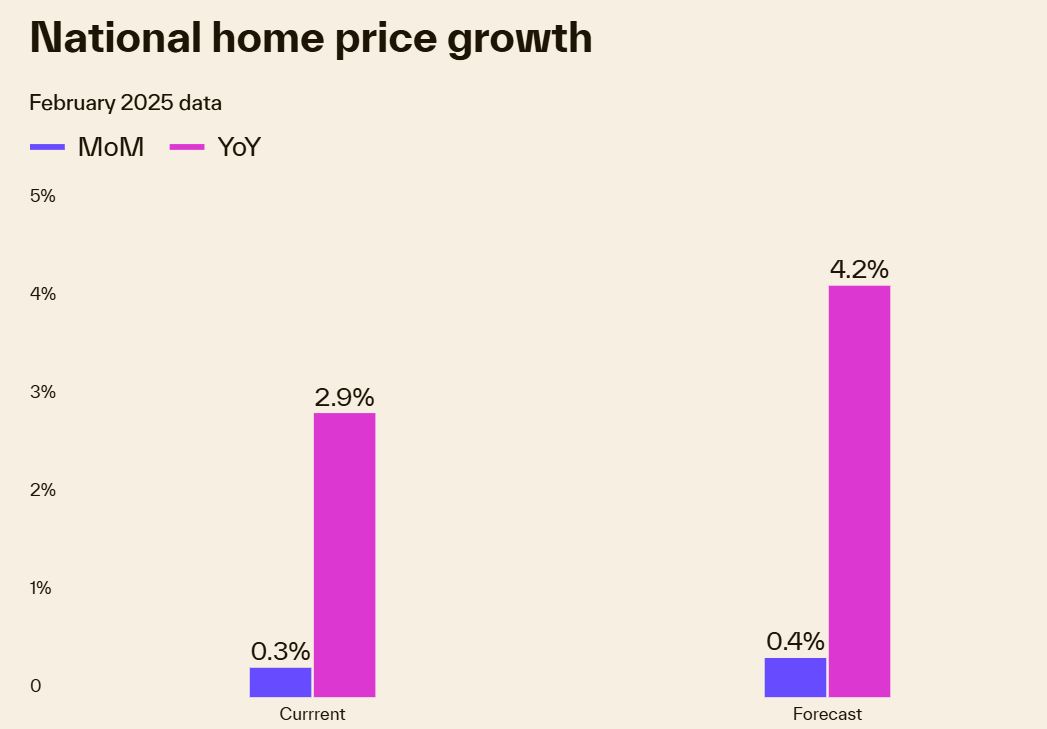
National home price growth
Source: Cotality

Despite these headwinds, the market isn't collapsing nationwide. The forecast still predicts year-over-year price growth, albeit at a more moderate pace (around +4.2% forecast from Feb 2025 to Feb 2026, compared to the current +2.9% YoY). This suggests a return to more normal, long-term average growth rather than a widespread crash.

However, real estate is intensely local. National averages smooth out the dramatic differences we see from state to state, and even city to city.

Why Some Markets Heat Up While Others Cool Down

It's fascinating to see the regional differences right now. Selma Hepp highlighted a key trend: the Northeast is still seeing strong price gains. Why? Primarily due to stronger income growth in that region combined with a severe, ongoing shortage of homes for sale. Basic supply and demand – lots of buyers competing for very few homes keeps prices high. Markets like Bridgeport, CT (+10.93%), Syracuse, NY (+9.33%), and New Haven, CT (+8.8%) are topping the “hottest markets” list.

On the flip side, areas in the Southeast and West are showing more signs of cooling. These regions often saw explosive growth during the pandemic boom. Now, they're experiencing more inventory growth (more homes hitting the market) and weakening demand. This leads to more sellers having to offer price discounts.

Florida is a prime example of this cooling trend. Several Florida cities dominate the “coolest markets” list, showing actual year-over-year price declines:

  • Cape Coral, FL: -4.5%
  • Sarasota, FL: -4.2%
  • Daytona, FL: -1.8%
  • Winter Haven, FL: -1%
  • Palm Bay, FL: -0.6%
  • Tampa, FL: -0.6%

Selma Hepp specifically mentioned that condominium prices have slowed, particularly as condo inventory in Florida continues to increase rapidly. This glut of supply, especially in certain segments, puts downward pressure on prices. From my perspective, this signals that the pandemic-era rush to sunshine states might be normalizing, and supply is finally starting to catch up, or even overshoot demand in some places.

Another interesting observation is the rise of places like Tennessee and South Carolina as retirement destinations. With median home prices around $335k and $332k respectively (still below the national median), they're attracting retirees looking for affordability, particularly those priced out of Florida. This influx, as noted, could change the character and affordability of these historically less expensive markets. It's a reminder that demographic shifts play a huge role in local housing trends.

Deep Dive: 5 Housing Markets with a Very High Risk of Price Crash

5 Housing Markets with a Very High Risk of Price Crash
Source: Cotality

Now, let's focus on the specific markets flagged by CoreLogic/Cotality as having a “very high risk” of price decline. It's important to understand what “high risk” means in this context. It doesn't automatically guarantee a massive crash like 2008. Instead, it indicates a significantly higher probability of seeing prices fall compared to the national average or lower-risk areas. This could manifest as a mild correction (say, 5-10% drop) or potentially something more substantial, depending on local economic factors and how significantly the market overheated.

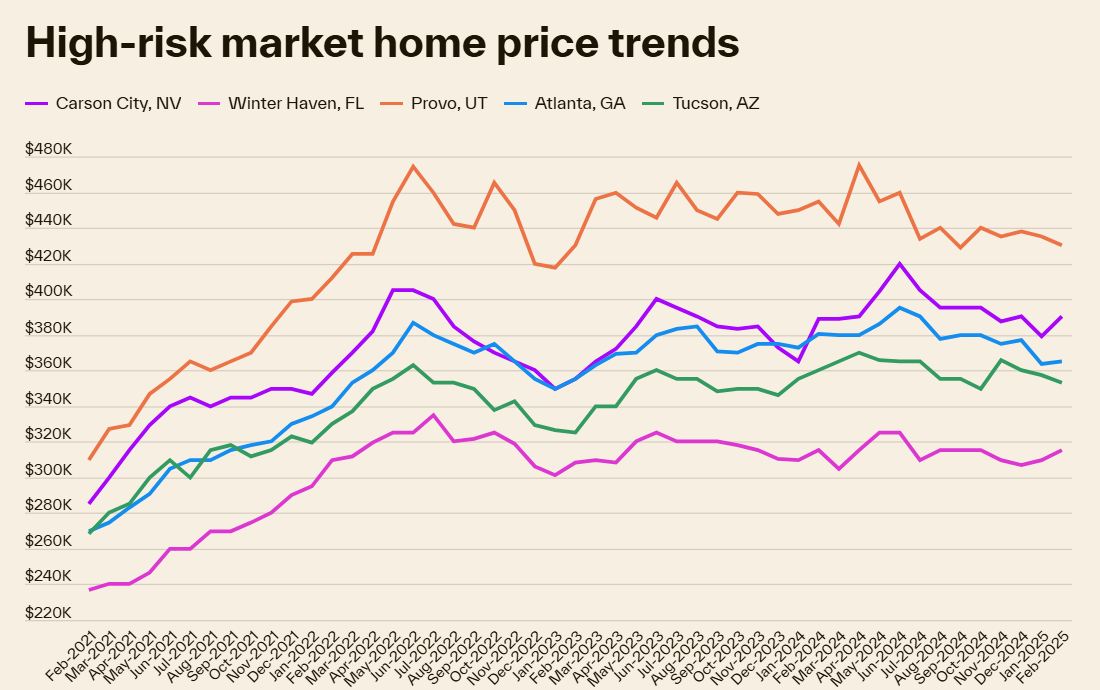
Looking at the price trend graph provided for these five markets, a common pattern emerges: a sharp run-up in prices peaking sometime between early 2022 and mid-2024, followed by a noticeable plateau or downward drift. This visual story often points towards markets that experienced rapid appreciation, potentially becoming overvalued relative to local incomes, and are now facing a correction as demand cools and affordability bites.

Let's examine each one:

1. Carson City, NV

  • The Situation: Nevada's state capital saw significant price increases, likely benefiting from spillover demand from more expensive West Coast markets and its own appeal.
  • Price Trend Graph: The graph shows Carson City prices peaking around mid-2022 near the $400k mark, dipping, recovering somewhat through 2023, but then showing a distinct downward trend starting in mid-to-late 2024 and continuing into early 2025, settling below $380k.
  • My Take: Carson City's trajectory looks like a classic case of a smaller market getting caught up in a regional boom. Its peak coincided with the broader market frenzy. The subsequent decline suggests that the fundamentals (local wages, sustainable demand) might not fully support those peak prices, especially as higher interest rates impact affordability. Its proximity to California means it's sensitive to economic shifts there as well. The risk here seems tied to the potential unsustainability of its rapid price climb.

2. Winter Haven, FL

  • The Situation: Located in Central Florida between Tampa and Orlando, Winter Haven likely benefited from the massive influx into Florida seeking affordability relative to the coastal areas.
  • Price Trend Graph: Winter Haven's price journey shows a steady climb from early 2021, peaking later than Carson City, around early 2024 above $320k. However, a noticeable decline started shortly after, bringing prices down towards the $310k mark by early 2025. It's also already listed on the “coolest markets” with a -1% YoY change.
  • My Take: This aligns perfectly with the broader Florida cooling trend mentioned earlier, especially regarding rising inventory. Winter Haven was likely a destination for those priced out of larger Florida metros. As demand statewide cools and inventory (perhaps including those condos Selma Hepp mentioned) builds, markets like Winter Haven, which saw rapid appreciation, become vulnerable. The fact it's already showing negative year-over-year growth reinforces its position on this high-risk list. I suspect rising insurance costs in Florida might also be starting to weigh on buyer sentiment and affordability here.

3. Provo, UT

  • The Situation: The Provo-Orem area is known for its strong tech presence (“Silicon Slopes”) and younger demographic, factors that fueled incredible housing demand and price growth.
  • Price Trend Graph: Provo shows one of the most dramatic peaks on the graph, soaring well above $460k in early-to-mid 2022. The correction was equally sharp initially, followed by some volatility, but the overall trend since the peak has been downward, sitting closer to $420k by early 2025.
  • Price Trend Analysis: Provo's boom was intense. Such rapid growth often outpaces wage growth, creating an affordability crunch even with a strong local economy. The tech sector has also seen some volatility nationally, which could indirectly impact sentiment and high-end demand in Provo. The significant drop from its peak suggests the market was clearly overvalued, and the ongoing downward drift indicates the correction might not be over. This looks like a market needing to find a more sustainable price level.

4. Atlanta, GA

  • The Situation: Atlanta has been a major hub for growth, attracting businesses and residents alike, leading to substantial housing demand.
  • Price Trend Graph: Atlanta's price trend shows strong growth through 2021 and 2022, peaking around $380k-$390k in mid-2022. Since then, it's been more of a bumpy plateau with a slight downward tilt, particularly noticeable from late 2023 into early 2025, ending near the $360k mark.
  • Price Trend Analysis: Atlanta's risk profile might be slightly different. While it saw strong growth, its peak wasn't quite as sharp or its immediate drop as dramatic as Provo's. However, the persistent inability to regain its peak and the recent downward drift suggest weakening demand relative to supply. Factors could include affordability challenges creeping into this major metro and potentially slowing in-migration compared to the peak pandemic years. It feels like a market transitioning from hot growth to a cooling phase, making it vulnerable to price dips if economic headwinds pick up. My feeling is that affordability constraints are really starting to bite here.

5. Tucson, AZ

  • The Situation: Like many Sun Belt cities, Tucson experienced a surge in popularity and home prices, attracting buyers seeking sunshine and relatively lower costs compared to California or even Phoenix.
  • Price Trend Graph: Tucson's graph shows a steady climb, peaking later than some others, around early 2024, near $370k. Similar to Winter Haven, the decline started relatively recently but appears consistent, bringing prices down towards $350k by early 2025.
  • Price Trend Analysis: Tucson's recent peak and subsequent decline suggest the tail end of the boom might have pushed prices beyond what the local market can sustain long-term. As affordability pressures mount nationally and migration patterns potentially shift again, markets like Tucson that saw rapid, recent appreciation become prime candidates for a correction. The risk here feels tied to the possibility that the recent price levels were driven more by temporary pandemic-era demand shifts than by underlying long-term economic fundamentals. It’s a market to watch closely to see if this downward trend accelerates.

What Does “High Risk” Really Mean for You?

Hearing “high risk of price crash” can be scary, especially if you own a home in one of these areas or are considering buying there. Let's put it in perspective:

  • Correction vs. Crash: A correction typically involves a price decline of around 10%, maybe up to 20% in some cases. It's a market resetting after a period of being overvalued. A crash, like we saw after 2007, involves much steeper, faster declines (20%+) often accompanied by widespread foreclosures and economic distress. While these 5 markets have a higher risk of decline, most economists aren't forecasting a 2008-style crash across the board. The lending standards today are much stricter than they were back then.
  • It's About Probability: This list identifies markets where the chances of prices falling are higher than elsewhere. It's not a guarantee. Local economic developments, shifts in inventory, or changes in interest rates could alter the trajectory.
  • Focus on the Long Term: If you bought a home recently at peak prices in one of these areas, seeing values dip isn't fun. But if you plan to live there for many years (say, 7-10+), housing markets tend to recover and appreciate over the long haul. Short-term fluctuations matter most if you need to sell soon.
  • Opportunity for Buyers? For potential buyers, falling prices can be an opportunity if you have stable finances and plan to stay put. However, trying to perfectly “time the bottom” is notoriously difficult and risky. Buying a home you can comfortably afford in a location you love is always the best strategy.

Factors I'm Watching Closely (Beyond These 5 Markets)

Whether you're in a high-risk zone or not, here are the key indicators I always keep an eye on to gauge market health:

  • Inventory Levels: Are more homes hitting the market (rising inventory)? Are they selling quickly, or sitting longer? A sustained rise in inventory, especially if sales slow, points to potential price drops. The data showing rising condo inventory in Florida is a perfect example.
  • Days on Market (DOM): How long does it take for a home to go under contract? If DOM starts stretching out significantly, it means buyers are becoming more hesitant or have more options.
  • Price Reductions: Are sellers increasingly having to lower their asking price to attract offers? Tracking the percentage of listings with price cuts is a great real-time indicator of market softness. The data mentioned more price discounts in the Southeast and West – a clear sign of cooling.
  • Mortgage Rates: Even small changes impact affordability. Keep an eye on the general trend. Sustained higher rates will continue to pressure demand.
  • Local Job Market: A strong local economy supports housing demand. Conversely, significant local layoffs can quickly cool a housing market.

Looking at the “Coolest Markets” list again – Cape Coral, Sarasota, San Francisco, Daytona, Winter Haven, Austin, Dallas, Palm Bay, Tampa, Oakland – it reinforces that the cooling isn't isolated to just the 5 “highest risk” areas. Many markets, particularly former pandemic boomtowns in Florida and Texas, along with expensive coastal areas like California, are already experiencing mild price declines.

My Final Thoughts

The US housing market is definitely navigating a complex transition. The days of easy double-digit annual gains are likely behind us for most areas. While a nationwide crash seems unlikely due to stricter lending and ongoing supply shortages in many regions, the risk of price declines is very real in specific, overheated markets.

The identification of Carson City, Winter Haven, Provo, Atlanta, and Tucson as the 5 housing markets with a very high risk of price crash serves as a crucial warning sign. These markets appear to share common threads: rapid price appreciation during the boom, potential overvaluation relative to local incomes, and now signs of cooling demand or rising inventory as affordability bites and pandemic-era trends normalize.

My advice? If you're in one of these markets, or frankly anywhere, stay informed about your local conditions. National headlines provide context, but real estate is hyperlocal. Pay attention to inventory, days on market, and price reductions in your specific neighborhood. If you're buying, ensure you're purchasing a home you can truly afford for the long haul, not speculating on short-term gains. If you're selling, be realistic about pricing based on current market conditions.

The housing market requires a more cautious and informed approach today than it did two years ago. Understanding the risks, especially in identified hotspots, is the first step toward making smart decisions.

Work with Norada, Your Trusted Source for

Real Estate Investment in the Top U.S. Markets

Discover high-quality, ready-to-rent properties designed to deliver consistent returns.

Contact us today to expand your real estate portfolio with confidence.

Contact our investment counselors (No Obligation):

(800) 611-3060

Get Started Now 

Also Read:

  • Housing Markets Predicted to Crash by Double Digits by Q1 2026
  • Real Estate Forecast: Will Home Prices Bottom Out in 2025?
  • Housing Markets With the Biggest Decline in Home Prices Since 2024
  • Why Real Estate Can Thrive During Tariffs Led Economic Uncertainty
  • Rise of AI-Powered Hyperlocal Real Estate Marketing in 2025
  • Real Estate Forecast Next 5 Years: Top 5 Predictions for Future
  • 5 Hottest Real Estate Markets for Buyers & Investors in 2025
  • Will Real Estate Rebound in 2025: Top Predictions by Experts
  • Recession in Real Estate: Smart Ways to Profit in a Down Market
  • Will There Be a Real Estate Recession in 2025: A Forecast
  • Will the Housing Market Crash Due to Looming Recession in 2025?
  • 4 States Facing the Major Housing Market Crash or Correction
  • New Tariffs Could Trigger Housing Market Slowdown in 2025
  • Real Estate Forecast Next 10 Years: Will Prices Skyrocket?

Filed Under: Housing Market, Real Estate Market Tagged With: Home Price Drop, home prices, Housing Market, real estate, Real Estate Market

Housing Markets With the Biggest Decline in Home Prices

April 21, 2025 by Marco Santarelli

10 Cities Where Home Prices Have Fallen the Most Since Last Year

Want to know where home prices are dropping the fastest? Well, the top 10 cities where home prices have crashed or fallen the most since last year are spread across the US, from New Jersey to California, with some areas seeing price decreases as steep as 25%. These areas are experiencing a correction after a period of rapid price increases or due to an increase in inventory as the sellers try to capture buyer attention.

The real estate market is always moving, like the tides. Sometimes prices surge, other times they dip. It's a natural cycle, but lately, I've been getting a lot of questions about where prices are actually falling. For potential homebuyers, this kind of news is exciting because it means affordability might be improving. But for current homeowners, it can bring about some worry. So, let's dive into the areas where home prices have seen the most significant drops recently.

Realtor.com recently released some interesting data pinpointing the ZIP codes where prices have decreased the most between the first quarter of 2024 and the first quarter of 2025. It's a diverse list, showing that price corrections aren't limited to one region. Let's break down the top 10:

Housing Markets With the Biggest Decline in Home Prices Since 2024

Top 10 ZIP Codes with the Biggest Home Price Drops

Here's a rundown of the areas where you'll find the most significant year-over-year decreases in median home list prices:

  1. Spotswood, NJ (08884)
    • Median home list price: $449,000
    • Year-over-year decrease: -25%
    • About: A small New Jersey town about 38 miles outside of New York City. It's located along a train line, making it convenient to get to the Big Apple without driving.
  2. South Elgin, IL (60177)
    • Median home list price: $384,900
    • Year-over-year decrease: -25%
    • About: South Elgin is a village along the Fox River. It's known for its close-knit community and affordable cost of living.
  3. Carlsbad, CA (92009)
    • Median home list price: $1,199,000
    • Year-over-year decrease: -25%
    • About: Carlsbad is located along the beach just north of San Diego. It's known for its 55-acre Flower Fields garden and the Legoland theme park. Though prices have decreased year over year, it still has a median list price that's over $1 million.
  4. Raleigh, NC (27615)
    • Median home list price: $465,000
    • Year-over-year decrease: -25%
    • About: Raleigh is the capital of North Carolina, which boasts a professional hockey team, Southern fried chicken, and barbecue.
  5. Tomah, WI (54660)
    • Median home list price: $225,000
    • Year-over-year decrease: -25%
    • About: Tomah, located in Central Wisconsin, has a population just below 10,000. The area is known for its rides, valley, and winding roads.
  6. DeQuincy, LA (70633)
    • Median home list price: $210,000
    • Year-over-year decrease: -25%
    • About: DeQuincy is north of Lake Charles and has a history as a railroad town. There's even the DeQuincy Railroad Museum for visitors. The area is surrounded by pine and hardwood forests.
  7. North Miami Beach, FL (33179)
    • Median home list price: $975,000
    • Year-over-year decrease: -25%
    • About: North Miami Beach was originally named Fulford, but in 1931 the name was changed to align more with the popularity of Miami Beach.
  8. San Jose, CA (95110)
    • Median home list price: $788,000
    • Year-over-year decrease: -25%
    • About: San Jose is right in the heart of Silicon Valley. It's the headquarters of major companies such as eBay and Adobe.
  9. York, ME (03909)
    • Median home list price: $1,047,000
    • Year-over-year decrease: -24.9%
    • About: York is located near the southern tip of the state and is a popular summer destination. For the residents who live there year-round, it's rich in New England history.
  10. Schenectady, NY (12309)
    • Median home list price: $354,450
    • Year-over-year decrease: -24.9%
    • About: Schenectady is located in the eastern part of New York. It's the city where Thomas Edison founded what became the General Electric Company.

What I find particularly striking is the geographical diversity here. We're not just talking about one region struggling; this is a nationwide phenomenon. It suggests that local factors are heavily influencing these price drops.

Why Are Prices Falling in These Areas?

According to Realtor.com senior economic research analyst Hannah Jones, several factors could be at play. Here are a few potential drivers:

  • Increased Inventory: A surge in the number of homes for sale can create more competition among sellers. To attract buyers, they might need to lower their prices.
  • Market Correction: Some areas experienced rapid price growth during the pandemic. What goes up must come down, and these price drops could simply be a correction to more sustainable levels.
  • Shifting Buyer Demand: Changing demographics, economic conditions, or even lifestyle preferences can influence where people want to live. If demand decreases in a particular area, prices will likely follow.

I think there are also some other underlying factors to consider:

  • Interest Rates: While rates have stabilized somewhat, they are still significantly higher than they were a few years ago. This impacts affordability and can cool down buyer enthusiasm, especially in markets that are already expensive.
  • Inflation: The rising cost of everything from groceries to gas can put a strain on household budgets, leaving less money for a down payment or mortgage payments.
  • Remote Work Trends: The shift to remote work has given people more flexibility in where they live. This could be leading to an exodus from traditionally expensive urban areas to more affordable smaller towns or even different states.

The Luxury Market is Feeling the Pinch Too

It's not just your average home seeing price cuts; the high-end market is also experiencing some adjustments. Here are some of the ZIP codes where luxury home prices (over $1 million) have fallen the most:

  1. Atlanta, GA (30327)
    • Median home list price: $1,300,000
    • Year-over-year decrease: -48.8%
  2. Miami, FL (33143)
    • Median home list price: $1,200,000
    • Year-over-year decrease: -46.7%
  3. Dallas, TX (75205)
    • Median home list price: $2,250,800
    • Year-over-year decrease: -46.4%
  4. San Diego, CA (92127)
    • Median home list price: $1,670,000
    • Year-over-year decrease: -43.9%
  5. Edwards, CO (81632)
    • Median home list price: $3,500,000
    • Year-over-year decrease: -41.4%
  6. Westhampton Beach, NY (11978)
    • Median home list price: $1,825,000
    • Year-over-year decrease: -40.7%
  7. Los Gatos, CA (95030)
    • Median home list price: $2,998,000
    • Year-over-year decrease: -38.8%
  8. Foster City, CA (94404)
    • Median home list price: $1,188,000
    • Year-over-year decrease: -37.4%
  9. Boston, MA (02115)
    • Median home list price: $3,245,000
    • Year-over-year decrease: -34.4%
  10. Calabasas, CA (91302)
    • Median home list price: $2,370,000
    • Year-over-year decrease: -34.1%

Even luxury markets are experiencing price corrections. This could be due to an influx of lower-priced properties or a decrease in buyer demand for ultra-expensive homes. It’s interesting to note that the South has seen a significant increase in smaller, low-priced listings over the last couple of years, which changes the mix of homes for sale and can result in falling prices.

What Does This Mean for You?

If you're a buyer, this news is generally positive. It means you might have more negotiating power and a better chance of finding a home within your budget. However, it's important to do your research and understand why prices are falling in a particular area. Is it a temporary blip, or is there a more fundamental shift happening?

If you're a seller, this is a wake-up call. It's crucial to be realistic about your asking price and to make sure your home is in top condition to attract buyers. Working with a knowledgeable real estate agent who understands the local market is more important than ever.

Here is a small table summarizing this information:

Area Price Decrease (%) Median Home List Price
Spotswood, NJ -25% $449,000
South Elgin, IL -25% $384,900
Carlsbad, CA -25% $1,199,000
Raleigh, NC -25% $465,000
Tomah, WI -25% $225,000
DeQuincy, LA -25% $210,000
North Miami Beach, FL -25% $975,000
San Jose, CA -25% $788,000
York, ME -24.9% $1,047,000
Schenectady, NY -24.9% $354,450

Summary:

The real estate market is dynamic. What's happening in one ZIP code might not be happening in the next. It's crucial to stay informed, do your research, and work with professionals who can help you navigate the complexities of the market. While these price drops might seem alarming, they could also present opportunities for those who are prepared to act.

Work with Norada, Your Trusted Source for

Real Estate Investment in the Top U.S. Markets

Discover high-quality, ready-to-rent properties designed to deliver consistent returns.

Contact us today to expand your real estate portfolio with confidence.

Contact our investment counselors (No Obligation):

(800) 611-3060

Get Started Now 

Also Read:

  • Why Real Estate Can Thrive During Tariffs Led Economic Uncertainty
  • Rise of AI-Powered Hyperlocal Real Estate Marketing in 2025
  • Real Estate Forecast Next 5 Years: Top 5 Predictions for Future
  • 5 Hottest Real Estate Markets for Buyers & Investors in 2025
  • Will Real Estate Rebound in 2025: Top Predictions by Experts
  • Recession in Real Estate: Smart Ways to Profit in a Down Market
  • Will There Be a Real Estate Recession in 2025: A Forecast
  • Will the Housing Market Crash Due to Looming Recession in 2025?
  • 4 States Facing the Major Housing Market Crash or Correction
  • New Tariffs Could Trigger Housing Market Slowdown in 2025
  • Real Estate Forecast Next 10 Years: Will Prices Skyrocket?
Filed Under: Housing Market, Real Estate Market Tagged With: Home Price Drop, home prices, Housing Market, real estate, Real Estate Market

Can China Crash the US Housing Market in 2025?

April 19, 2025 by Marco Santarelli

How Can China Crash US Housing Market in 2025?

Is the American dream of homeownership about to get a rude awakening, courtesy of China? The question of can China crash the US housing market in 2025 and how is a complex one that's been keeping economists and homeowners alike up at night. The short answer? It's unlikely that China alone can cause a full-blown crash.

While China’s economic actions, especially in response to tariffs, could make things tougher, a true crash would likely need a perfect storm of other economic disasters. Let's dig a little deeper to see exactly what's at stake.

Can China Crash the US Housing Market in 2025?

A New Trade War: Echoes of the Past?

Remember those trade wars from a few years back? Well, they are back and with a vengeance! During his second term, President Trump has slapped some seriously high tariffs on Chinese goods, some hitting a whopping 145%. The goal? To bring down trade deficits and tackle issues like illegal fentanyl entering the country. But China isn't backing down. They've fired back with their own tariffs, reaching up to 125% on certain U.S. products. Think of it like a game of economic chess where each move can have big consequences.

Now, this trade war isn't just about bragging rights. It can directly affect the US housing market, and here's how.

The Direct Hit: Higher Construction Costs

One of the most straightforward ways tariffs impact housing is through the cost of materials. Think about it – how much do you use materials in building a house? A lot!

  • Imported Building Materials: A significant chunk of the materials used to build houses in the US come from China.
  • Rising Prices: Tariffs drive up the prices of these materials, like steel, aluminum, and even appliances.
  • NAHB Estimates: The National Association of Home Builders (NAHB) estimates that these tariffs can add thousands of dollars (between $7,500 and $10,000!) to the cost of building a single home.

This can create a ripple effect:

  • Higher Home Prices: Builders may pass those costs on to buyers, making homes more expensive.
  • Reduced Supply: Some builders might decide to build fewer homes altogether, tightening the housing supply.

Here’s a table illustrating how these tariffs are affecting the construction industry:

Aspect Details
China's Tariff on US Goods 34% tariff on all US goods imports, effective April 10
US Tariff on Chinese Goods Trump threatened an additional 50% levy if China does not rescind its tariffs
Impact on Construction 22% of imported building materials for residential construction come from China.
Total Construction Goods $204 billion worth of goods used in new multifamily and single-family housing last year.
Imported Goods in Construction $14 billion (7% of total) imported from outside the US.
Cost of Imported Materials per New Single-Family Home $12,713 out of $174,155 total building materials
Expected Cost Increase Tariffs could raise costs by over $3 billion for imported materials from China, Canada, and Mexico. Builders expect a $9,200 increase per home.

Beyond the Bricks: Indirect Economic Impacts

It is not just the price of bricks and mortar that are affected. These trade disputes create economic uncertainty.

  • Consumer Confidence: A shaky economy can make people less confident about buying a home.
  • Recession Fears: If the trade war drags on, some experts worry it could trigger a recession.

Think of it this way: if people are worried about losing their jobs or if the economy looks uncertain, they're less likely to make a big purchase like a house.

Recommended Read:

Warning of a Weak Housing Market: Are We Headed for Another Crisis?

Fannie Mae Lowers Housing Market Forecast and Projections for 2025

Housing Market Forecast 2025 by JP Morgan Research

Housing Predictions 2025 by Warren Buffett's Berkshire Hathaway

China's Big Weapon: Mortgage-Backed Securities

Here's where things get a bit more complicated and where China could exert more influence. China holds a massive amount of US mortgage-backed securities (MBS), which are basically investments tied to home loans.

  • What are MBS? These are bundles of home loans that are sold as investments.
  • China's Holdings: China is one of the largest foreign holders of US MBS.
  • The Threat: China could sell off these securities, flooding the market and driving up mortgage rates.

Why does this matter? Higher mortgage rates make it more expensive to borrow money for a home, which means fewer people can afford to buy.

Has China Already Started?

There is some evidence suggesting that China has been quietly reducing its holdings of US MBS. While this might not cause an immediate crash, it could signal a long-term strategy to put pressure on the US economy. I believe we should be aware of this.

However, it's not a Simple ‘Crash' Button

It's important to understand that even if China sold off a large chunk of its MBS, it wouldn't necessarily trigger a catastrophic crash on its own.

  • Self-Inflicted Wound: Selling off those securities would also hurt China financially.
  • Market Interventions: The US Federal Reserve or other big investors could step in to buy up those securities and stabilize the market.

So, Can China REALLY Crash the Market?

The bottom line is that China alone probably can’t trigger a full-blown housing market collapse just through tariffs or selling off MBS. A true crash usually requires a perfect combination of factors, such as:

  • Severe Economic Downturn: A recession with widespread job losses.
  • Collapse in Consumer Confidence: People losing faith in the economy.
  • Other Unexpected Events: I cannot really predict this.

My Take and Final Thoughts

While I don’t think China can single-handedly crash the US housing market in 2025, I do think its actions can certainly make things tougher. Higher construction costs, rising mortgage rates, and increased economic uncertainty can all put a damper on the market.

The US housing market is a complex beast, influenced by a mix of domestic policies, global economic conditions, and plain old supply and demand. It's unlikely that China can simply press a button and make the whole thing fall apart. However, we should not underestimate the potential for economic disruptions and be prepared for challenges ahead. After all, being informed is the best defense!

Work with Norada, Your Trusted Source for Investment

in the Top U.S. Housing Markets

Discover high-quality, ready-to-rent properties designed to deliver consistent returns.

Contact us today to expand your real estate portfolio with confidence.

Contact our investment counselors (No Obligation):

(800) 611-3060

Get Started Now 

Also Read:

  • Majority of Americans Fear Housing Market Will Crash in 2025
  • Housing Market Price Forecast for 2025 and 2026 Increased by NAR
  • Will the Housing Market Crash Due to Looming Recession in 2025?
  • 4 States Facing the Major Housing Market Crash or Correction
  • 5 Cities Where Home Prices Are Predicted To Crash in 2025
  • New Tariffs Could Trigger Housing Market Slowdown in 2025
  • Housing Market Forecast 2025: Affordability Crisis Will Continue
  • Lower Mortgage Rates Will Reignite the Housing Demand in 2025
  • NAR Predicts 6% Mortgage Rates in 2025 Will Boost Housing Market
  • Housing Market Forecast for the Next 2 Years: 2024-2026
  • Housing Market Predictions for the Next 4 Years: 2025 to 2028
  • Housing Market Predictions for Next Year: Prices to Rise by 4.4%
  • Housing Market Predictions for 2025 and 2026 by NAR Chief
  • Real Estate Forecast Next 5 Years: Top 5 Predictions for Future
  • Real Estate Forecast Next 10 Years: Will Prices Skyrocket?
Filed Under: Housing Market, Real Estate Market Tagged With: home prices, Housing Market, Housing Market 2025, housing market crash, Housing Market Forecast, housing market predictions, Housing Market Trends, Real Estate Market

Why Americans Fear a Major Housing Market Crash in 2025

April 11, 2025 by Marco Santarelli

Majority of Americans Fear Housing Market Will Crash in 2025

Is a housing market crash on the horizon in 2025? If you're like most folks, you've probably been feeling a knot of anxiety about the economy lately. Well, you're not alone. A recent survey from Clever Real Estate reveals that a significant 70% of Americans are indeed worried about a housing market crash in 2025.

That's a pretty big number, and it definitely got my attention. This widespread concern isn't just some fleeting feeling – it’s rooted in real economic anxieties that many of us are grappling with every day. Let’s unpack what’s behind this fear and what it might mean for you, whether you're a homeowner, a renter, or dreaming of buying your first place.

70% Americans Worry About Housing Market Crash in 2025: Should You Be Concerned Too?

Why the Housing Market Crash Fear is Real – And Why It Matters

When I first saw that 70% figure, it really made me pause and think. That's not just a slight unease; that’s a significant majority of people feeling genuinely concerned. It tells me that there's something more than just media hype fueling this worry. And digging into the survey, it becomes clear that these fears are tied to a broader sense of economic uncertainty hanging over us as we head into 2025.

Let’s break down some of the key factors contributing to this widespread anxiety:

  • Inflation is Still a Top Worry: A whopping 94% of Americans are worried about inflation, and 74% believe it will actually get worse in the next year. This is huge! When everyday things like groceries, gas, and utilities keep getting more expensive, people naturally start to worry about big-ticket items like housing. Inflation eats away at your buying power, and it makes everyone feel less secure.
  • Economic Outlook is Fuzzy: Only 26% of Americans feel economically better off now than they did six months ago, and just 34% expect to be better off in another six months. These numbers paint a picture of widespread economic pessimism. If people don't feel confident about their financial future, it's natural to worry about big investments like homes.
  • Government Action – Or Inaction?: A majority, 63% of Americans, don't think the current government is taking the right steps to address economic concerns. This lack of confidence in leadership adds another layer of unease. People want to feel like someone's in control and working to steer the economy in the right direction, and right now, many Americans just aren't feeling it.
  • Rising Costs of Homeownership – Beyond Just the Mortgage: It's not just about affording a house these days. 89% are worried about rising home maintenance and repair costs, and 88% are stressed about increasing property taxes. Being a homeowner is becoming more expensive across the board, adding to the pressure and making people wonder if it’s all sustainable.

It's like a perfect storm of economic pressures is brewing, and the housing market, being such a significant part of our financial lives, is right in the center of it.

Echoes of 2008? Why Housing Crashes Stick in Our Minds

For many of us, the memory of the 2008 housing market crash is still pretty vivid – or at least, we've heard enough stories to know how devastating it was. I remember friends and family losing their homes, and the overall economic fallout was something that impacted everyone, whether you owned a house or not. That kind of event leaves a mark on our collective consciousness.

So, when we hear whispers of another potential housing market downturn, it's understandable that alarm bells start ringing. We don't want to repeat that experience. And while no two economic situations are exactly the same, some of the underlying anxieties feel familiar. Are we heading for a repeat? That’s the question on a lot of people's minds, including mine.

Tariffs, Trade Wars, and the Domino Effect on Housing

Another big worry highlighted in the survey is the fear of tariffs and trade wars. A staggering 81% of Americans are concerned about this, and 72% believe tariffs will hurt the US economy. Now, how does this tie into housing? Well, tariffs can increase the cost of imported goods, which can lead to higher prices for building materials, appliances, and all sorts of things that go into building and maintaining a home.

When the cost of construction goes up, it can push up the prices of new homes. And if people are worried about trade wars impacting the broader economy, they might become more hesitant to make big financial decisions like buying a house. It’s all interconnected. The global economic climate definitely casts a shadow over the housing market.

Cutting Back and Bracing for Impact: How People Are Reacting

It’s fascinating and a bit concerning to see how these economic worries are actually changing people's behavior right now. The survey reveals that 58% of Americans are already cutting back on non-essential spending in anticipation of economic troubles in 2025. That’s a significant chunk of the population tightening their belts.

And it’s not just about cutting back on lattes or entertainment. 32% of those who planned a major purchase this year are now delaying it, and that includes 22% who were planning to buy a home and 13% who were planning to sell. People are putting their housing plans on hold, waiting to see what happens. This hesitation itself can have a chilling effect on the housing market. If buyers pull back, it can slow down sales and potentially contribute to price drops.

Interestingly, a smaller percentage, around 32%, say they've even started stockpiling resources like canned food and first aid supplies. This suggests that for some, the worry goes beyond just finances and into a deeper sense of preparing for potential disruptions. It’s a sign of real unease in the population.

Here's a quick look at how economic worries are impacting consumer behavior:

Action Taken in Anticipation of 2025 Economy Percentage of Americans
Cutting non-essential spending 58%
Delaying major purchases 32%
Delaying home purchase 22%
Delaying home sale 13%
Stockpiling resources 32%

Generational and Gender Divides in Housing Market Fears

It’s also interesting to see how these worries break down across different groups. The survey highlights some notable differences:

  • Millennials vs. Boomers: Younger generations are feeling the housing payment squeeze more acutely. 41% of millennials are worried about affording housing payments in 2025, compared to only 26% of boomers. This makes sense – millennials are often earlier in their careers, may have less savings, and are facing higher housing costs relative to their income than boomers did at the same age.
  • Women vs. Men: Women seem to be more worried about a housing crash than men. 77% of women are concerned about a potential crash, compared to 60% of men. There’s a similar gap when it comes to rising mortgage rates, with 72% of women worried versus 56% of men. This gender difference is intriguing and could reflect varying levels of financial security or risk perception.

These demographic differences tell us that the anxiety around the housing market isn't uniform. It’s hitting different groups in different ways, and it’s important to understand these nuances.

Government Policies and Public Trust – Or Lack Thereof

The survey also touches on public opinion about government policies and their effectiveness in addressing economic concerns. As mentioned earlier, a significant 63% of Americans don’t believe the government is taking the right actions. This lack of trust extends to specific proposals and policies.

For example, while 78% of Americans generally favor cutting government spending, only 46% support the current administration’s approach. Even Elon Musk’s Department of Government Efficiency (DOGE) task force only garners 44% support. And ongoing mass layoffs at federal agencies are supported by only 35%, with 82% worried about spending cuts in general.

What this tells me is that people are skeptical. They might agree with the idea of fiscal responsibility in principle, but they are not convinced that the current strategies are the right ones, or that they are being implemented in a way that will actually benefit average Americans. This lack of confidence in government can further amplify economic anxieties, including worries about the housing market.

Beyond Housing: Broader Worries About Social Safety Nets

The economic anxieties aren’t just about housing prices and mortgages. People are also deeply concerned about the potential erosion of social safety nets. A striking 85% are worried about Social Security benefit changes, making it the top concern among government programs. And 75% believe that cuts to government assistance programs would directly impact them or their families. Alarmingly, 11% even fear becoming homeless as a result of these cuts.

Recommended Read:

Warning of a Weak Housing Market: Are We Headed for Another Crisis?

Fannie Mae Lowers Housing Market Forecast and Projections for 2025

Housing Market Forecast 2025 by JP Morgan Research

Housing Predictions 2025 by Warren Buffett's Berkshire Hathaway

These figures highlight a broader sense of vulnerability and insecurity. It's not just about the value of your home; it’s about basic security and the feeling that the systems meant to protect us might be weakening. This kind of deep-seated worry can definitely contribute to overall economic pessimism and fuel fears about a housing market crash as part of a larger economic downturn.

Navigating the Uncertainty: What Does This Mean For You?

So, with all this worry swirling around, what should you actually do? Here’s my take, based on the data and my own observations:

  • Don't Panic, But Be Prepared: While 70% worry about a crash, it doesn't mean a crash is guaranteed. Economic forecasts are always uncertain. However, it’s wise to be prepared for potential economic headwinds. Review your finances, build up some savings if you can, and consider stress-testing your budget to see how you’d fare if things get tighter.
  • For Homeowners: Review Your Mortgage and Expenses: If you're a homeowner, now is a good time to look closely at your mortgage terms and your overall housing expenses. Are you comfortable with your monthly payments, even if interest rates were to nudge up further? Could you handle unexpected repair costs? Being proactive about your finances can give you peace of mind.
  • For Potential Buyers: Patience Might Be a Virtue: If you're looking to buy a home, this might be a time to exercise a bit of patience. With so much uncertainty in the market, waiting a bit might give you a clearer picture of where things are headed. Keep an eye on interest rates, housing inventory, and overall economic indicators.
  • For Renters: Stay Informed About Local Market Trends: Renters aren't immune to housing market shifts. If a housing market cools down, it could eventually impact rental prices too. Stay informed about what's happening in your local rental market.
  • Engage in the Conversation: Talk to your friends, family, and financial advisor about these concerns. Sharing information and perspectives can help you feel more informed and less alone in your worries. And consider making your voice heard to policymakers about the economic issues that matter to you.

Ultimately, the fact that 70% of Americans worry about a housing market crash in 2025 is a significant signal. It reflects real economic anxieties and a widespread sense of uncertainty. While we can’t predict the future with certainty, understanding these concerns and taking prudent steps to prepare is always a smart move. Staying informed, being financially responsible, and engaging in constructive conversations are the best ways to navigate these uncertain times.

Work with Norada in 2025, Your Trusted Source for Investment

in the Top Housing Markets of the U.S.

Discover high-quality, ready-to-rent properties designed to deliver consistent returns.

Contact us today to expand your real estate portfolio with confidence.

Contact our investment counselors (No Obligation):

(800) 611-3060

Get Started Now 

Also Read:

  • Housing Market Price Forecast for 2025 and 2026 Increased by NAR
  • Will the Housing Market Crash Due to Looming Recession in 2025?
  • 4 States Facing the Major Housing Market Crash or Correction
  • 5 Cities Where Home Prices Are Predicted To Crash in 2025
  • New Tariffs Could Trigger Housing Market Slowdown in 2025
  • Housing Market Forecast 2025: Affordability Crisis Will Continue
  • Lower Mortgage Rates Will Reignite the Housing Demand in 2025
  • NAR Predicts 6% Mortgage Rates in 2025 Will Boost Housing Market
  • Housing Market Forecast for the Next 2 Years: 2024-2026
  • Housing Market Predictions for the Next 4 Years: 2025 to 2028
  • Housing Market Predictions for Next Year: Prices to Rise by 4.4%
  • Housing Market Predictions for 2025 and 2026 by NAR Chief
  • Real Estate Forecast Next 5 Years: Top 5 Predictions for Future
  • Real Estate Forecast Next 10 Years: Will Prices Skyrocket?

Filed Under: Housing Market, Real Estate Market Tagged With: home prices, Housing Market, Housing Market 2025, housing market crash, Housing Market Forecast, housing market predictions, Housing Market Trends, Real Estate Market

Housing Market Price Forecast for 2025 and 2026 Increased by NAR

April 11, 2025 by Marco Santarelli

Home Price Predictions Upwardly Revised by NAR for 2025 and 2026

Are you glued to housing market news, trying to figure out what's next? Are prices going up, down, sideways? Well, the latest word from the National Association of Realtors (NAR) is in, and it's a bit of a mixed bag, but with a clear upward nudge on prices. The home price forecast jumps for 2025 and 2026, according to NAR's revised projections, meaning we're likely to see home prices grow faster than initially expected in the coming years.

While they've slightly tempered expectations for home sales volume, the anticipated price increases are now more pronounced. Let’s break down what this means for everyone from first-time homebuyers to seasoned sellers.

Housing Price Forecast for 2025 and 2026 Increased by NAR

For months, I’ve been digging into market data, chatting with real estate pros in my area, and trying to make sense of all the conflicting signals. Initially, there was a lot of buzz about a potential boom in 2025. Now, that excitement is a little more grounded in reality. NAR's recent update gives us a clearer picture, even if it's not exactly what everyone was hoping for – especially those dreaming of drastically cheaper homes.

Key Takeaways: What You Need to Know

Here are the essential points to keep in mind about NAR's revised home price forecast jumps for 2025 and 2026:

  • NAR has adjusted its housing market forecast downwards for 2025 in terms of sales volume, now projecting 4.3 million existing-home sales.
  • However, they’ve increased their home price growth expectations for both 2025 (to 3%) and 2026 (to 4%).
  • The primary reasons for these revisions are persistent affordability challenges and a more realistic outlook on market dynamics.
  • Despite the tempered sales forecast, NAR and other experts remain cautiously optimistic about the overall housing market, citing a strong job market, potential for lower mortgage rates, and slowly improving inventory.
  • The revised forecast is more in line with other industry predictions, suggesting a consensus view of moderate growth with continued price appreciation.

Now Expect Stronger Home Price Growth

Remember those earlier forecasts that hinted at a moderate 2% bump in home prices for both 2025 and 2026? Well, NAR has tweaked those numbers. In their latest Real Estate Forecast Summit Update, they’ve dialed up their home price growth projections to 3% for 2025 and a more significant 4% for 2026. This adjustment, while seemingly small on the surface, signals a notable shift in expectations.

What caused this change of heart, you might wonder? It boils down to a few key factors that are shaping today’s housing landscape.

Why the Forecast Shift? Affordability and Reality Check

If you've been house hunting recently, you already know the biggest hurdle: affordability. Even though we’ve seen some fluctuations in mortgage rates, they haven't dipped enough to truly make a significant dent in how much house the average person can afford. Prices have also remained quite sticky, not falling as much as some might have hoped.

  • Stubbornly High Prices: Home prices haven’t plummeted. In many areas, they are still elevated compared to pre-pandemic levels. This baseline of higher prices means any percentage increase translates to a larger dollar amount.
  • Mortgage Rate Reality: While we all keep wishing for those super-low rates of the past, the reality is that rates are likely to stay higher for longer than initially anticipated. This directly impacts buyer purchasing power.
  • A Dose of Realism: I think NAR, like many of us who follow the market closely, is simply being realistic. The initial optimism for a massive housing boom in 2025 was perhaps a bit overzealous. The market is resilient, yes, but the factors needed for a truly explosive surge just aren't fully in place right now.

Essentially, the revised home price forecast jumps are a reflection of these persistent affordability challenges and a more tempered view of how quickly things will change. It’s not that the market is going to crash – far from it. It’s just that the pace of improvement, especially for buyers hoping for price relief, might be slower than previously thought.

Decoding the Revised Numbers: Sales and Prices in 2025 and 2026

Let's get into the specifics. Here’s a side-by-side look at NAR’s previous and revised forecasts, making it easy to see where the changes are:

Forecast Previous Estimate Revised Estimate Change
Existing Home Sales 2025 4.9 million 4.3 million -0.6 million
New Home Sales 2025 Up 11% Up 10% -1%
Home Price Growth 2025 2% 3% +1%
Home Price Growth 2026 2% 4% +2%
Existing Home Sales 2026 10%-15% Up Up 11% Within Range
New Home Sales 2026 Up 8% Up 5% -3%

The table clearly shows the adjustments. While existing-home sales for 2025 are now expected to be lower than previously forecasted (4.3 million versus 4.9 million), the home price forecast jumps are the real story here. The anticipated price growth is now higher for both 2025 and 2026. This suggests that even with slightly fewer sales, demand and limited inventory are still likely to put upward pressure on prices.

Is It All Bad News? Reasons for Optimism Remain

Now, before you start feeling discouraged, especially if you're trying to buy a home, it's important to remember that this isn't a doomsday scenario. Despite the revised forecast, there are still plenty of reasons to be optimistic about the housing market's overall health.

As NAR Chief Economist Lawrence Yun pointed out, “The worst is over [for home sales]. The worst for inventory is over.” That’s a pretty strong statement coming from a leading expert. He also highlighted that the probability of a recession is still low, and key factors like job growth and the potential for lower mortgage rates are moving in a positive direction.

I echo this sentiment. From what I’m seeing and hearing, the market is showing resilience. Here’s why I believe there’s still room for optimism:

  • Solid Job Market: A strong job market is the bedrock of a healthy housing market. People need to feel secure in their jobs to make big purchases like homes. The current job market, while having some shifts, is still generally robust.
  • Mortgage Rates – Potential for Gradual Decline: While rates haven't plummeted, the consensus is that they are likely to drift downwards over time, even if slowly. Any decrease in rates will improve affordability and bring more buyers back into the market.
  • Inventory – Slowly but Surely Improving: Inventory levels are still below historical norms in many areas, but they are starting to inch up in some markets. More homes on the market give buyers more choices and can help moderate price increases.

Recommended Read:

Warning of a Weak Housing Market: Are We Headed for Another Crisis?

Fannie Mae Lowers Housing Market Forecast and Projections for 2025

Housing Market Forecast 2025 by JP Morgan Research

Housing Predictions 2025 by Warren Buffett's Berkshire Hathaway

How Does NAR's Revised Forecast Stack Up?

It's always wise to look at different sources when making big decisions. Interestingly, NAR's revised forecast of 4.3 million existing-home sales for 2025 actually aligns more closely with predictions from other housing market experts.

Consider these figures:

  • NAR (Revised): 4.3 million existing-home sales
  • HousingWire (Mohtashami/Simonsen): 4.2 million existing-home sales
  • Realtor.com: 4 million existing-home sales

This convergence of forecasts suggests that the revised NAR numbers aren't outliers but rather reflect a more widely held view of where the market is headed. It strengthens the credibility of the updated home price forecast jumps, as it’s not just one organization’s isolated opinion.

What does this mean for you?

  • For Buyers: Focus on affordability above all else. Be patient but realistic. Don’t expect dramatic price drops. Budget carefully and be prepared for competition, especially for well-priced homes in desirable areas.
  • For Sellers: The forecast suggests continued price appreciation, but don’t get overconfident. Price your home competitively based on current market conditions in your area. Work with a knowledgeable agent who understands local market nuances.

The housing market is always evolving, and staying informed is key. While the home price forecast jumps might not be thrilling news for buyers hoping for bargains, it does signal continued stability and moderate growth in the real estate sector. For both buyers and sellers, navigating this market successfully will require informed decisions and a realistic understanding of the current landscape.

Work with Norada in 2025, Your Trusted Source for Investment

in the Top Housing Markets of the U.S.

Discover high-quality, ready-to-rent properties designed to deliver consistent returns.

Contact us today to expand your real estate portfolio with confidence.

Contact our investment counselors (No Obligation):

(800) 611-3060

Get Started Now 

Also Read:

  • Will the Housing Market Crash Due to Looming Recession in 2025?
  • 4 States Facing the Major Housing Market Crash or Correction
  • 5 Cities Where Home Prices Are Predicted To Crash in 2025
  • New Tariffs Could Trigger Housing Market Slowdown in 2025
  • Housing Market Forecast 2025: Affordability Crisis Will Continue
  • Lower Mortgage Rates Will Reignite the Housing Demand in 2025
  • NAR Predicts 6% Mortgage Rates in 2025 Will Boost Housing Market
  • Housing Market Forecast for the Next 2 Years: 2024-2026
  • Housing Market Predictions for the Next 4 Years: 2025 to 2028
  • Housing Market Predictions for Next Year: Prices to Rise by 4.4%
  • Housing Market Predictions for 2025 and 2026 by NAR Chief
  • Real Estate Forecast Next 5 Years: Top 5 Predictions for Future
  • Real Estate Forecast Next 10 Years: Will Prices Skyrocket?

Filed Under: Housing Market, Real Estate Market Tagged With: home prices, Housing Market, Housing Market 2025, housing market crash, Housing Market Forecast, housing market predictions, Housing Market Trends, Real Estate Market

Home Price Growth in 2025 is Forecast to Lag Behind 2024’s Pace

March 29, 2025 by Marco Santarelli

Home Price Growth in 2025 is Forecast to Lag Behind 2024's Pace

Thinking about the value of your home or planning to buy one? Well, buckle up, because the housing market is looking a bit different for 2025. Experts are saying that home price appreciation for 2025 is forecast to remain lower than in 2024. This doesn't mean prices will suddenly crash, but the big increases we might have seen in the recent past are likely to slow down. Let's dive into why this is happening and what it could mean for you.

Home Price Growth in 2025 is Forecast to Lag Behind 2024's Pace

What the Numbers Are Telling Us

Based on the latest data from CoreLogic, a company that really knows its stuff when it comes to housing, the pace at which home prices are going up is expected to ease in 2025. While we saw some pretty strong gains earlier in 2024, reaching a peak of 6.5% annual price growth in February and March, the forecast for 2025 suggests an average appreciation of around 2.8% nationwide. To put it plainly, the rocket ship of home price increases is starting to gently glide back down.

Home Price Growth
Source: CoreLogic

Even towards the end of 2024, we saw some interesting shifts. December actually marked the second month where the annual price growth ticked upwards slightly, reaching 3.9%. This might seem like things are speeding up again, but it's more of a small bump in the road. Looking closer at the monthly changes, home prices actually declined for five months straight before this little December rise. This shows an underlying cooling trend.

Why the Slowdown? Let's Break It Down

So, what's causing this anticipated slowdown in home price growth? It's not just one thing, but a combination of different factors that are influencing both buyers and sellers.

  • The Shadow of High Mortgage Rates: Let's be honest, mortgage rates have been higher than what many of us have gotten used to. This directly impacts how much house people can afford. When it costs more to borrow money, the pool of potential buyers shrinks, and those who are still in the market tend to be more cautious about how much they're willing to pay. This increased cost of borrowing acts like a brake on rapid price increases.
  • Buyer Fatigue and Caution: After a period of intense competition and rapidly rising prices, many potential homebuyers have simply become more hesitant. They're seeing more homes on the market, giving them more choices and less pressure to jump into a deal at any cost. Economic worries and uncertainty about the future are also making people think twice before making such a big financial commitment. I've talked to many people who are taking a “wait and see” approach, hoping for more favorable conditions.
  • More Homes on the Market: Remember when it felt like there were barely any houses for sale? That's been changing. As we moved through 2024, the number of available homes started to increase in many areas. More inventory gives buyers more power. When there are more options, sellers can't always command the sky-high prices they might have gotten before. The end of 2024 even saw a significant rise in de-listings, meaning some sellers decided to take their homes off the market, perhaps sensing a shift in buyer demand.
  • Comparing to a Hot 2024: It's also important to remember what happened in 2024. We saw some really strong price gains, especially in the spring. When we look at the year-over-year numbers for 2025, we're comparing them to those relatively high points from the previous year. This makes the growth rate in 2025 naturally appear lower, even if prices aren't actually falling dramatically.

Regional Differences: Not All Markets Are the Same

One thing I've learned over the years is that the housing market isn't a single, unified entity. What's happening in one part of the country can be very different from what's going on somewhere else. The CoreLogic data highlights this quite clearly.

  • Cooling in the Southeast: Some areas, particularly in the Southeast like Tampa and Atlanta, experienced a more significant slowdown in annual price gains towards the end of 2024. Tampa even saw an annual price decline of 1.1% in the 20-city index. This suggests that some markets that were hot may be seeing a correction.
  • Continued Strength in the Northeast: On the other hand, cities like Boston, New York, and Chicago showed more resilience, leading the 20-city index with strong annual gains. These areas might have factors like limited inventory or strong local economies that are helping to support prices. I've noticed that in these areas, demand often outstrips supply, which keeps prices firmer.
  • The Midwest Story: Markets in the Midwest, like Cleveland and Detroit, saw some cooling after a strong start to 2024. This shows that even areas that initially had an advantage can be influenced by broader market trends.

Here's a quick look at how some key metros were performing at the end of 2024:

Metro Area Annual Price Growth (December 2024)
New York 7.2%
Chicago 6.6%
Boston 6.3%
National Average 3.9%
Denver (Lower than national average)
Dallas (Lower than national average)
Tampa -1.1%

Looking Ahead to the Spring Buying Season

The spring is usually a busy time for the housing market, and everyone's watching to see what 2025 will bring. Early signs suggest it might look a lot like 2024. While there will likely be more homes available for sale, which is good news for buyers, those buyers are still expected to be cautious due to the economic climate and those persistent higher mortgage rates.

One interesting point is the level of inventory in different markets. Cities like Boston and Chicago, which are still seeing price pressure, have inventories that are significantly below pre-pandemic levels. This lack of supply can help keep prices elevated. In contrast, Western markets like Denver, San Diego, and Las Vegas had more inventory but still showed relatively steady pricing, particularly for mid-tier and high-tier homes. This suggests that even in markets with more choices, demand might still be strong for certain types of properties.

Recommended Read:

Warning of a Weak Housing Market: Are We Headed for Another Crisis?

Fannie Mae Lowers Housing Market Forecast and Projections for 2025

Housing Market Forecast 2025 by JP Morgan Research

Housing Predictions 2025 by Warren Buffett's Berkshire Hathaway

The Wild Cards: Uncertainty and Policy

As someone who follows the housing market closely, I know that there are always factors that can throw a wrench in even the most careful predictions. Right now, there's a fair amount of uncertainty floating around.

  • Economic Policies: Potential policy changes can have a big impact on the economy, and by extension, the housing market. For example, talk of government layoffs could affect specific regions, particularly those with a large government presence like the Washington D.C. metro area. Job losses can definitely put downward pressure on housing demand and prices.
  • Non-Fixed Homeownership Costs: It's not just the mortgage payment that homeowners have to worry about. Costs like insurance and property taxes are also on the rise in many areas. These increasing costs can make homeownership less affordable and could further dampen demand in some markets, like Tampa, which has already seen some weakening.

My Two Cents: A More Balanced Market Ahead?

If you ask me, the forecast for slower home price appreciation in 2025 isn't necessarily a bad thing. After the rapid increases of the past few years, a more balanced market could be healthier in the long run. It might mean that buyers have more time to make decisions, there's less intense bidding, and prices become more aligned with underlying economic fundamentals.

For sellers, it might mean adjusting expectations. While you might not see the same quick and substantial profits as in recent times, well-maintained and properly priced homes should still attract buyers.

For potential homebuyers, this slowdown could create more opportunities. While mortgage rates remain a factor, the increased inventory and potentially less frantic competition could make finding the right home more manageable.

Of course, the housing market is complex and influenced by a multitude of local and national factors. It's always a good idea to keep a close eye on what's happening in your specific area and consult with local real estate professionals for personalized advice.

In Conclusion:

While home prices are still expected to rise in 2025, the rate of appreciation is forecast to be lower than what we experienced in 2024. This is due to a combination of factors, including higher mortgage rates, increased inventory, buyer caution, and comparisons to a strong prior year. However, remember that real estate is local, and different markets will experience different trends. Staying informed and understanding the dynamics at play will be key for both buyers and sellers in the year ahead.

Work with Norada in 2025, Your Trusted Source for Investment

in the Top Housing Markets of the U.S.

Discover high-quality, ready-to-rent properties designed to deliver consistent returns.

Contact us today to expand your real estate portfolio with confidence.

Contact our investment counselors (No Obligation):

(800) 611-3060

Get Started Now 

Also Read:

  • Housing Market Price Forecast for 2025 and 2026 Increased by NAR
  • Will the Housing Market Crash Due to Looming Recession in 2025?
  • 4 States Facing the Major Housing Market Crash or Correction
  • 5 Cities Where Home Prices Are Predicted To Crash in 2025
  • New Tariffs Could Trigger Housing Market Slowdown in 2025
  • Housing Market Forecast 2025: Affordability Crisis Will Continue
  • Lower Mortgage Rates Will Reignite the Housing Demand in 2025
  • NAR Predicts 6% Mortgage Rates in 2025 Will Boost Housing Market
  • Housing Market Forecast for the Next 2 Years: 2024-2026
  • Housing Market Predictions for the Next 4 Years: 2025 to 2028
  • Housing Market Predictions for Next Year: Prices to Rise by 4.4%
  • Housing Market Predictions for 2025 and 2026 by NAR Chief
  • Real Estate Forecast Next 5 Years: Top 5 Predictions for Future
  • Real Estate Forecast Next 10 Years: Will Prices Skyrocket?

Filed Under: Housing Market, Real Estate Market Tagged With: home prices, Housing Market, Housing Market 2025, housing market crash, Housing Market Forecast, housing market predictions, Housing Market Trends, Real Estate Market

NAR Predicts Mortgage Rates to Remain Above 6% in 2025 and 2026

March 27, 2025 by Marco Santarelli

NAR Predicts Mortgage Rates to Remain Above 6% in 2025 and 2026

Thinking about buying a house in the next few years? Well, here's something important you need to know straight away: NAR (National Association of Realtors) predicts mortgage rates will likely stay above 6% through 2025 and 2026. This isn't exactly the news homebuyers were hoping for, especially after seeing those super low rates not too long ago. But let's break down what this quarterly economic forecast really means for you, the housing market, and your homeownership dreams.

NAR Predicts Mortgage Rates to Remain Above 6% in 2025 and 2026

Mortgage Rates: Easing Down, But Don't Expect a Plunge

One of the biggest questions on everyone's mind is, “What's going to happen with mortgage rates?” We've seen them bouncing around quite a bit lately, and it definitely impacts what you can afford and what you might consider doing in the market. The NAR's latest forecast offers a bit of good news here. They're predicting that mortgage rates will gradually come down. Specifically, they anticipate an average of 6.4% in 2025 and then a further dip to 6.1% in 2026.

Now, before you start celebrating and dreaming of those super-low rates we saw a few years back, it's important to manage expectations. NAR Chief Economist Lawrence Yun rightly pointed out that while the Federal Reserve is anticipating slower economic growth – which usually puts downward pressure on rates – our high national debt will likely prevent mortgage rates from falling too dramatically. He specifically mentioned that we shouldn't expect to see rates return to the 4%-to-5% range we experienced during the Trump administration's first term.

In my opinion, this is a realistic outlook. We're not going back to ultra-low rates anytime soon. However, a gradual decline to the 6% range is still a positive step. It can make homeownership more attainable for some buyers and potentially ease some of the pressure in the market. It's a moderate improvement, not a game-changer, but definitely welcome.

Home Sales: Brighter Days Ahead for Both Existing and New Homes

If you've been following the housing market, you know that sales of existing homes have been a bit sluggish. High mortgage rates have definitely played a role in this. But the NAR forecast paints a more optimistic picture for the coming years. They predict a 6% increase in existing-home sales in 2025 and a more substantial 11% jump in 2026. That's a significant acceleration!

What's driving this optimism? Lower mortgage rates, even slightly lower, can bring more buyers back into the market. As affordability improves, even incrementally, more people will be able to qualify for a mortgage and pursue their homeownership dreams. This pent-up demand, combined with potentially more inventory as homeowners become more comfortable listing their properties, could fuel this sales growth.

The forecast is also positive for new-home sales. NAR anticipates a 10% rise in 2025 and another 5% increase in 2026. Interestingly, the report mentions that the new-home sales market has plentiful inventory. This is a key differentiator from the existing home market, which has often struggled with low inventory in recent years. Builders seem to be in a good position to meet demand as rates moderate, offering buyers more options and potentially contributing to overall market stability.

From my experience, a healthy mix of both existing and new home sales is crucial for a balanced market. It gives buyers more choices and helps to keep prices in check. This forecast suggests we're moving in a direction that should support a more balanced and active market.

Home Prices: Steady Growth, But Not Skyrocketing

Let's talk about home prices – another hot topic! The NAR forecast suggests that we can expect continued price growth, but at a more moderate pace. They are predicting a 3% increase in the national median home price in 2025 and 4% in 2026.

This is a far cry from the double-digit price appreciation we saw during the pandemic boom. In my view, this moderation is a good thing. Sustained, but slower, price growth is healthier for the long-term stability of the housing market. It prevents bubbles and makes homeownership more sustainable over time.

Recommended Read:

Will Tariffs and Economic Policies Crash the Housing Market in 2025?

Warning of a Weak Housing Market: Are We Headed for Another Crisis?

Fannie Mae Lowers Housing Market Forecast and Projections for 2025

Housing Market Forecast 2025 by JP Morgan Research

Housing Predictions 2025 by Warren Buffett's Berkshire Hathaway

Lawrence Yun highlights that this moderation in price growth is expected due to more supply coming onto the market. As mentioned earlier, both new construction and potentially more existing homeowners listing their properties will contribute to increased inventory. When there are more homes available, it naturally takes some pressure off prices.

Yun also points out a very important factor: “Having income and wages rise faster than home prices is welcome to improve affordability.” This is the key to long-term housing affordability. If incomes grow at a faster rate than home prices, it gradually becomes easier for people to afford homes. This is a positive trend that the NAR forecast seems to anticipate.

Personally, I believe this forecast is pointing towards a more sustainable and balanced housing market. We're moving away from the extremes of rapid price growth and ultra-low rates. Instead, we're looking at a market where rates are easing slightly, sales are increasing, and prices are growing at a more manageable pace. This isn't a boom market, but it's certainly not a bust either. It's a market of opportunity for both buyers and sellers who are realistic and well-informed.

Here's a quick summary of the NAR Quarterly Forecast:

Forecast Category 2025 2026
Existing Home Sales +6% +11%
New Home Sales +10% +5%
Median Home Price +3% +4%
Mortgage Rate (Average) 6.4% 6.1%
Job Gains 1.6 million 2.4 million

Nationwide Forecast

Keep in mind, this is a nationwide forecast. Local markets can and will vary. It's always crucial to consult with a local real estate expert to understand what's happening in your specific area. But overall, the NAR Quarterly Forecast provides a valuable glimpse into the likely direction of the housing market, suggesting a path towards greater stability and opportunity in the years ahead.

Work with Norada in 2025, Your Trusted Source for Investment

in the Top Housing Markets of the U.S.

Discover high-quality, ready-to-rent properties designed to deliver consistent returns.

Contact us today to expand your real estate portfolio with confidence.

Contact our investment counselors (No Obligation):

(800) 611-3060

Get Started Now 

Also Read:

  • Housing Market Price Forecast for 2025 and 2026 Increased by NAR
  • Will the Housing Market Crash Due to Looming Recession in 2025?
  • 4 States Facing the Major Housing Market Crash or Correction
  • 5 Cities Where Home Prices Are Predicted To Crash in 2025
  • New Tariffs Could Trigger Housing Market Slowdown in 2025
  • Housing Market Forecast 2025: Affordability Crisis Will Continue
  • Lower Mortgage Rates Will Reignite the Housing Demand in 2025
  • NAR Predicts 6% Mortgage Rates in 2025 Will Boost Housing Market
  • Housing Market Forecast for the Next 2 Years: 2024-2026
  • Housing Market Predictions for the Next 4 Years: 2025 to 2028
  • Housing Market Predictions for Next Year: Prices to Rise by 4.4%
  • Housing Market Predictions for 2025 and 2026 by NAR Chief
  • Real Estate Forecast Next 5 Years: Top 5 Predictions for Future
  • Real Estate Forecast Next 10 Years: Will Prices Skyrocket?
Filed Under: Housing Market, Real Estate Market Tagged With: home prices, Housing Market, Housing Market 2025, housing market crash, Housing Market Forecast, housing market predictions, Housing Market Trends, Real Estate Market

  • « Previous Page
  • 1
  • 2
  • 3
  • 4
  • 5
  • 6
  • Next Page »

Real Estate

  • Birmingham
  • Cape Coral
  • Charlotte
  • Chicago

Quick Links

  • Markets
  • Membership
  • Notes
  • Contact Us

Blog Posts

  • How to Smartly Invest in Real Estate to Afford a Porsche 911 GT3
    July 17, 2026Marco Santarelli
  • Best Places to Buy Rental Properties for High Cash Flow in 2026
    July 17, 2026Marco Santarelli
  • Mortgage Rates Forecast for Next 90 Days: July to September 2026
    July 17, 2026Marco Santarelli

Contact

Norada Real Estate Investments 30251 Golden Lantern, Suite E-261 Laguna Niguel, CA 92677

(949) 218-6668
(800) 611-3060
BBB
  • Terms of Use
  • |
  • Privacy Policy
  • |
  • Testimonials
  • |
  • Suggestions?
  • |
  • Home

Copyright 2018 Norada Real Estate Investments

Loading...