Norada Real Estate Investments

  • Home
  • Markets
  • Properties
  • Membership
  • Podcast
  • Learn
  • About
  • Contact

24 Florida Housing Markets Could See Home Prices Drop by Mid 2026

August 27, 2025 by Marco Santarelli

24 Florida Housing Markets Could See Home Prices Drop by Mid 2026

According to recent data and forecasts, around 24 Florida housing markets may experience a drop in home prices by mid-2026. This isn't a cause for widespread panic, but it does signal a shift from the red-hot market we've seen in recent years towards a more balanced, and in some areas, a slightly cooler environment.

As someone who's been following Florida real estate for a while, this kind of adjustment is actually healthy for the long-term stability of the market. It means we're moving away from unsustainable price growth and towards a reality where affordability might become a bit more attainable for more people.

24 Florida Housing Markets Could See Home Prices Drop by Mid-2026

First, let's clear the air: “price drop” doesn't necessarily mean a crash. It means moderation, a cooling off after a period of intense appreciation. Think of it less as a nosedive and more as a gentle descent back to earth after a rocket launch. The data from Florida Realtors® for June and the second quarter of 2025 actually shows some interesting trends that support this, even as we look ahead to potential price moderation.

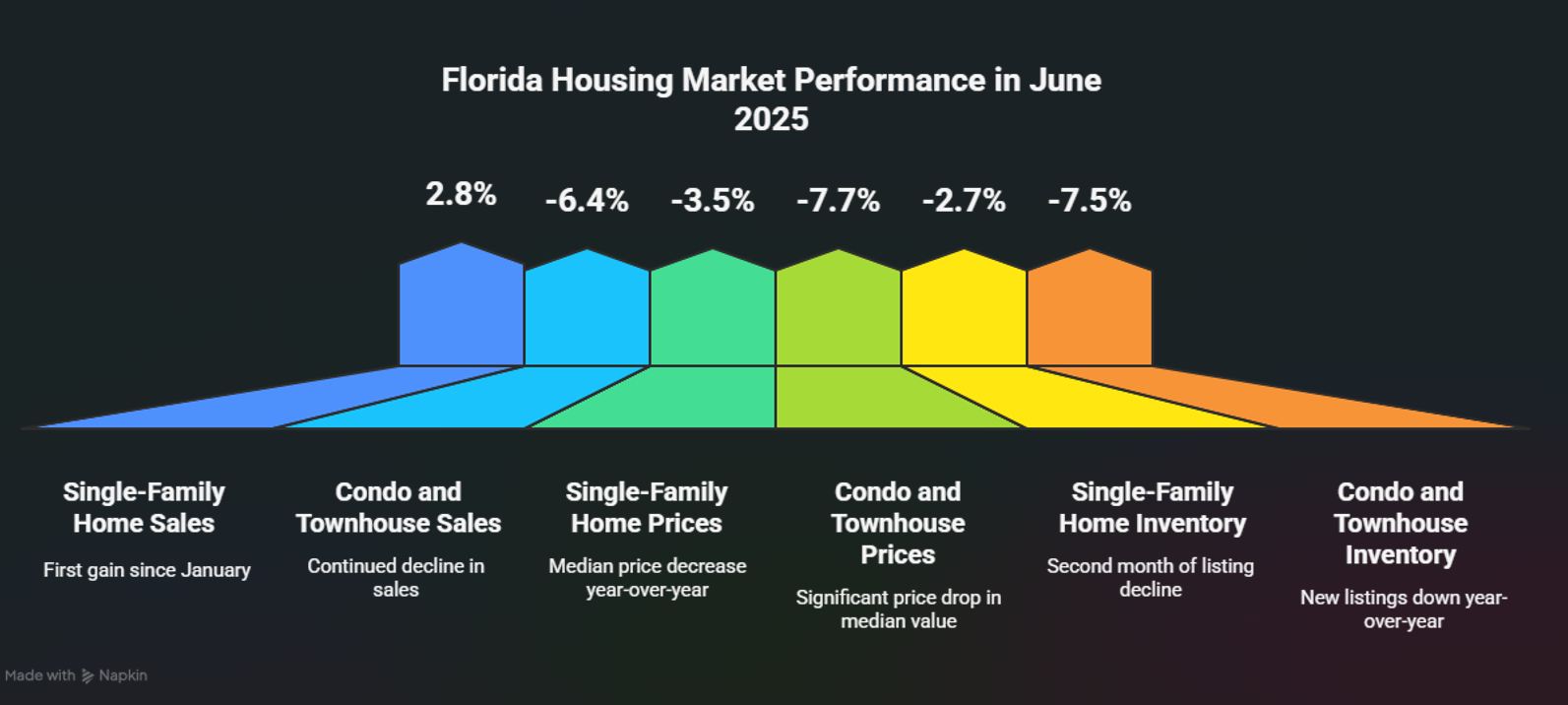
What's happening on the ground? In June, Florida saw its first year-over-year gain in closed single-family home sales since January, with a 2.8% increase. That's a positive sign, indicating more activity. However, when you dig into the second quarter numbers, sales were down 2.6%. It's a mixed bag, but the overall story is one of transition.

Dr. Brad O’Connor, the Chief Economist at Florida Realtors®, pointed out that this June rebound helped soften what would have been a tougher second quarter. For condos and townhouses, sales were down 6.4% in June, which, while still a decline, was significantly less severe than the 20% drop seen in May. This suggests that while the market is cooling, it's not collapsing.

The median sales price for single-family homes in June was $412,000, down 3.5% from June 2024. Condo prices saw a sharper drop of 7.7%, with the median price at $300,000. This is crucial information: prices are moderating. For the second quarter, the single-family median price was $414,900 (down 3.1%), and the condo median was $310,000 (down 6.1%). This moderation is a key indicator of the market shifting from a seller's advantage to a more balanced playing field.

What's Driving the Shift in Florida's Housing Market?

Several factors are contributing to this evolving market. One major player is inventory. Dr. O’Connor noted that active listings for single-family homes were down 2.7% in June compared to the previous year. This follows a period of growth in new listings earlier in the year. For condos and townhouses, new listings were down even more, 7.5% year-over-year in June.

What does this mean? While the number of homes for sale might be slightly down compared to last year, the months' supply is still healthy. We're looking at 5.6 months' supply for single-family homes and a robust 10 months' supply for condos and townhouses. A “months' supply” tells us how long it would take to sell all the homes currently on the market at the current sales pace. Anything over 4-6 months is generally considered a balanced market, and 10 months definitely favors buyers. This increased supply gives buyers more choices and more negotiating power, which naturally puts downward pressure on prices that were previously being bid up aggressively.

Another significant factor is interest rates. While not explicitly detailed in the provided data, we all know that higher mortgage rates make buying a home more expensive, even if the list price hasn't changed. For many potential buyers, this increased cost can price them out of the market or force them to look for more affordable options, thus slowing down demand and eventually impacting prices.

Tim Weisheyer, the 2025 Florida Realtors® President, hit the nail on the head when he said the market is “transitioning toward balance.” He also highlighted that “motivated sellers who understand today’s market dynamics are attracting qualified buyers.” This is the human element of the market. Sellers who overprice their homes or are unwilling to negotiate are going to be left waiting. Those who are realistic about current conditions and are working with skilled Realtors® are the ones who are seeing success.

Spotlight on the 24: Which Florida Markets Could See Price Declines?

Now, let's get to the specifics. Zillow's data offers a projection of potential price changes in various Florida metropolitan areas (MSAs) through mid-2026. It's important to remember that these are forecasts, not guarantees, and they are based on sophisticated modeling. However, they do give us a strong indication of where more significant price moderation might occur.

The table below outlines some of these markets, showing the projected percentage change in home prices from June 2025 through July 2025, September 2025, and finally, June 2026.

Florida Market Projected Price Change (July 2025) Projected Price Change (Sept 2025) Projected Price Change (June 2026)
Punta Gorda, FL -1.4% -3.3% -4.0%
North Port, FL -1.1% -3.2% -3.2%
Cape Coral, FL -1.2% -2.9% -2.9%
Crestview, FL -0.7% -2.0% -2.6%
The Villages, FL -0.4% -1.3% -2.4%
Tallahassee, FL -0.4% -1.4% -2.1%
Panama City, FL -0.6% -2.0% -2.1%
Deltona, FL -0.7% -1.9% -1.9%
Gainesville, FL -0.5% -1.7% -1.8%
Jacksonville, FL -0.6% -1.7% -1.7%
Palm Bay, FL -0.6% -1.7% -1.6%
Sebastian, FL -0.8% -1.9% -1.6%
Tampa, FL -0.7% -2.0% -1.5%
Orlando, FL -0.7% -1.8% -1.5%
Lakeland, FL -0.6% -1.6% -1.3%
Pensacola, FL -0.4% -1.3% -1.3%
Palatka, FL -0.3% -1.4% -1.3%
Naples, FL -0.9% -2.4% -1.2%
Homosassa Springs, FL -0.7% -1.9% -0.9%
Miami, FL -0.7% -1.8% -0.7%
Port St. Lucie, FL -0.7% -1.7% -0.7%
Arcadia, FL -0.5% -1.6% -0.7%
Key West, FL -0.7% -1.7% -0.5%
Ocala, FL -0.5% -1.3% -0.2%

Looking at this table, you can see that markets like Punta Gorda, North Port, and Cape Coral are projected to see the most significant price moderation by mid-2026, with percentages in the negative territory. These are areas that, like much of Florida, experienced substantial price growth over the past few years. As the market normalizes, it's natural that some of the more rapid appreciation will be reined in.

Why These Specific Markets? Insights and Nuances

It's not a coincidence that many of the markets showing potential price moderation are in Southwest Florida and along the Gulf Coast. These regions, including Punta Gorda, North Port, Venice (part of the North Port-Sarasota-Bradenton MSA), Fort Myers, and Cape Coral, saw some of the most dramatic price increases during the boom years. This was fueled by a combination of factors, including robust demand from out-of-state buyers, limited inventory, and relatively lower price points compared to some other popular coastal areas which made them attractive.

As the market cools, these areas are likely to experience a more pronounced correction because the feverish demand that drove prices sky-high may also be the first to temper. When inventory levels rise, as they have been, and demand softens slightly due to economic conditions and higher interest rates, prices can begin to adjust downwards.

The Villages, known for its unique demographic and active adult community, also appears on this list. While it has its own distinct market dynamics, it's not immune to broader economic trends. The projected slight dip here might reflect a normalization of demand after a period of intense interest.

Other areas like Crestview, Tallahassee, and Panama City in the Panhandle are also showing projected declines. These markets might be more sensitive to shifts in local economic drivers, perhaps related to military presence or specific industry employment.

Jacksonville, Tampa, and Orlando – the major metropolitan hubs – are also included, though with more modest projected declines. These are larger, more diverse economies, which can sometimes buffer the impact of market shifts compared to smaller, more specialized areas. However, even in these larger markets, the overall trend of softening prices is evident in the data.

I’ve lived and worked in various parts of Florida, and in my experience, these markets often lead the way in price adjustments, both up and down. When growth was rapid, these were the places seeing the biggest jumps. Now, as things settle, they are showing the most significant moderation.

What Does This Mean for Buyers and Sellers?

For buyers, this is potentially good news. If you've been priced out of the market or struggling to compete, softer prices and increased inventory could mean more opportunities to find a home that fits your budget. It might be the time to be patient, get pre-approved for a mortgage, and work with a local expert to understand the nuances of specific neighborhoods. Don't rush into a purchase, but be ready to act when the right opportunity arises. This period of moderation can help you avoid overpaying, which is a smart long-term strategy.

For sellers, it means adjusting expectations. The days of multiple offers significantly over asking price might be fewer and farther between. It's crucial to price your home accurately based on current market conditions and be prepared to negotiate. Working with a Realtor® who has their finger on the pulse of your local market is more important than ever. They can help you stage your home effectively, market it strategically, and guide you through negotiations to ensure the best possible outcome.

The Bigger Picture: A Healthy Market Adjustment?

From my perspective, this isn't a sign of impending doom for Florida real estate. Instead, it looks like a natural correction after an unsustainable period of growth. The rapid price increases we saw were driven by a confluence of factors: low interest rates, a surge in demand from people relocating, and a lack of available housing. As interest rates have climbed and inventory has started to improve (even with some recent dips in new listings), the market is recalibrating.

The fact that closed sales are starting to tick up is encouraging. It suggests that demand hasn't disappeared; it's just becoming more selective and price-sensitive. A market with steady demand and more balanced prices is often healthier and more sustainable in the long run than one that experiences wild, unpredictable swings.

The expert consensus, as echoed by Tim Weisheyer, points to a market that's moving toward “balance.” This means that we'll likely see more predictable price trends, more reasonable negotiation periods, and a more stable environment for both buyers and sellers. It's about restoring a sense of normalcy after an unusual period.

Looking Ahead: Key Takeaways

  • Price Moderation is Expected: Approximately 24 Florida housing markets are projected to see home prices decline by mid-2026.
  • Southwest Florida Impact: Areas like Punta Gorda, North Port, and Cape Coral may experience more notable price adjustments.
  • Data Supports a Shift: Recent Florida Realtors® data shows moderating prices and a mixed bag for sales, indicating a market in transition.
  • Inventory and Interest Rates are Key: Increased supply and higher borrowing costs are influencing demand and price trends.
  • Opportunity for Buyers: Potential buyers may find more favorable conditions and greater affordability.
  • Sellers Need Realistic Expectations: Pricing and negotiation strategies are critical for sellers in this evolving market.

It's an exciting time in Florida real estate, not because of sky-high price appreciation, but because we're moving towards a more stable and predictable market. For anyone involved in buying or selling a home in Florida, staying informed and working with experienced professionals are your best tools. The market is always changing, and understanding these shifts is key to making smart decisions.

Stay Ahead of the Florida Housing Market Shifts

With reports suggesting that multiple Florida housing markets could face price declines by mid-2026, smart investors are preparing now.

Norada helps you identify stable, cash-flowing rental properties in resilient markets—so you can protect your portfolio and grow long-term wealth.

STRATEGIC OPPORTUNITIES AVAILABLE NOW!

Talk to a Norada investment counselor today (No Obligation):

(800) 611-3060

Get Started Now

Read More:

  • Key Trends Shaping the Florida Housing Market in 2025
  • This Florida Housing Market Bucks National Trend With Declining Prices
  • Florida Housing Market Crash 2.0? Analyst Warns of 2008 Echoes
  • Tax Relief Proposed as Florida Housing Market Faces Deepening Crisis
  • Is the Florida Housing Market on the Verge of Collapse or a Crash?
  • 3 Florida Cities at High Risk of a Housing Market Crash or Decline
  • Florida Housing Market: Record Supply Expected to Favor Buyers in 2025
  • Florida Housing Market Forecast for Next 2 Years: 2025-2026
  • Florida Housing Market: Predictions for Next 5 Years (2025-2030)
  • Hottest Florida Housing Markets in 2025: Miami and Orlando
  • Florida Real Estate: 9 Housing Markets Predicted to Rise in 2025
  • 3 Florida Housing Markets Are Again on the Brink of a Crash
  • Florida Housing Market Predictions 2025: Insights Across All Cities
  • When Will the Housing Market Crash in Florida?
  • South Florida Housing Market: Will it Crash?
Filed Under: Housing Market, Real Estate Market Tagged With: Florida, Housing Market, housing market crash, Housing Market Trends

Will the Housing Market Crash in 2025: Expert Forecast

August 22, 2025 by Marco Santarelli

Will the Housing Market Crash in 2025: What Experts Predict?

I constantly hear the question that weighs heavily on the minds of so many: Will the housing market crash in 2025? It’s a valid concern, especially after the roller-coaster ride we've all been on. My definitive answer is no, I do not believe the housing market will crash in 2025.

Instead, I see a market rebalancing, becoming more accessible for certain buyers, but ultimately not succumbing to a dramatic collapse. We're looking at a continued, slow shift rather than a sudden plunge. Let me explain why I feel this way, pulling back the curtain on what the pros are predicting and adding my own two cents from years of observation and practical experience.

Will the Housing Market Crash in 2025: Expert Forecast

For many years now, the idea of a housing market “crash” has become almost mythical, often conjuring images of the 2008 financial crisis. I understand why people are so sensitive to this term. That period left deep scars, altering how an entire generation views homeownership and financial stability.

But what I've learned, and what I constantly remind people, is that this isn't 2008. Today's market is built on different foundations, with stronger lending standards, significant homeowner equity, and a persistent supply shortage that acts as a fundamental floor for prices. When I look at the data and consider the real people I work with every day, I see resilience, not fragility.

So, while the headlines might still try to sensationalize every dip, I encourage you to look deeper with me. Let's break down what the major players in the real estate world are expecting for 2025 and why their nuanced predictions paint a picture far removed from a “crash.”

The Forecasters Weigh In: A Look at the Leading Predictions

Different organizations approach market forecasting with slightly different lenses, but when you put their insights together, a clearer picture emerges. I always find it fascinating to see where they converge and where they diverge, because those differences often highlight the specific factors they prioritize.

NAR's Optimistic View: Brighter Days Ahead, Says Lawrence Yun

Lawrence Yun, the Chief Economist for the National Association of REALTORS® (NAR), has a consistently optimistic outlook, and his recent comments at the 2025 REALTORS Legislative Meetings echoed this sentiment. He talks about “brighter days on the horizon,” and from my perspective, this optimism stems largely from the anticipated movement in mortgage rates. He views lower rates as a “magic bullet,” and I can absolutely see why. Even small dips in rates can unlock affordability for many, bringing dormant buyers back into the fold.

Here’s a snapshot of what NAR is predicting for 2025 and beyond:

  • Existing Home Sales: Yun expects a 6% rise in 2025, which he sees accelerating to an 11% climb in 2026. This is a significant recovery in activity after quieter years, and it suggests people will start feeling more comfortable making moves.
  • New Home Sales: He projects a 10% increase in 2025, followed by another 5% in 2026. New construction is so important right now, as it’s the primary way to chip away at our long-standing housing shortage. I truly believe we need more homes built, plain and simple.
  • Median Home Prices: NAR forecasts continued modest growth, with prices rising 3% in 2025 and 4% in 2026. This isn't the double-digit appreciation we saw during the pandemic boom, but it's growth, indicating a healthy market, not a crashing one.
  • Mortgage Rates: This is the big one for NAR. Yun anticipates rates averaging around 6.4% in the second half of 2025, dipping further to 6.1% in 2026. If this holds true, it would be a huge sigh of relief for many first-time buyers I talk to.

Zillow's Cautious Outlook: A Gentle Drift Downward

Zillow, with its deep dive into home values and rental data, offers a slightly more subdued, almost lukewarm forecast. While they don't predict a crash, their outlook suggests a small downward adjustment in home values and a continued, but slow, recovery in inventory. I see Zillow's perspective as one that truly highlights the continued affordability challenges and the ongoing shifts within the market.

Key points from Zillow’s latest forecast:

  • Home Values: Zillow expects typical home values to drift down slightly, ending 2025 about 2% below where they started the year. This is a larger decline than their previous forecast, which tells me they’re seeing some continued market softening.
  • Inventory Recovery: This is a big theme for Zillow. They predict inventory will continue to grow significantly, potentially approaching pre-pandemic levels by the end of 2025. This is fueled by new listings outpacing sales. I’ve seen this personally in some areas; more homes on the market means more choices for buyers.
  • Existing Home Sales: They anticipate 4.16 million existing home sales by the end of 2025, a modest 2.5% improvement over the previous year. This suggests a very slow uptick in transaction volume.
  • Rent Growth: Zillow notes a softening in rent growth for both single-family and multifamily units. This is interesting because rising for-sale inventory gives more options, which takes pressure off rents. They project single-family rents to rise 2.75% in 2025 (down from 4.5% in 2024) and multifamily rents to increase by just 1.3% in 2025 (down from 2.4% in 2024). This tells me that people are finding more negotiating power on the rental front.

Realtor.com's Rebalancing Act: A Shift Towards Buyers

Realtor.com’s 2025 forecast focuses heavily on the idea of the market “rebalancing,” with market power shifting towards buyers. This aligns with what I'm seeing on the ground as well: an easing of the frantic competition that characterized the last few years. While their numbers might seem a bit conservative compared to NAR, I think their emphasis on the buyer's increasing leverage is spot on.

Here’s a detailed look at Realtor.com’s projections for 2025:

Key Housing Indicators (Realtor.com) 2025 Forecast REVISED 2024 Historical Data 2013-2019 Historical Average
Mortgage Rates (avg) 6.7% 6.7% 4.0%
Mortgage Rates (year-end) 6.4% 6.7% N/A
Existing Home Median Price App. (Y/Y) +2.5% +4.5% +6.5%
Existing Home Sales (Y/Y) -1.5% -0.6% +2.1%
Annual Total Existing Home Sales 4.00 million 4.06 million 5.28 million
Existing Home For-Sale Inventory (Y/Y) +16.9% +15.2% -3.6%
Single-Family Housing Starts (Y/Y) -3.7% +6.9% N/A
Single-Family Housing Starts (Annual) 0.98 million 1.0 million 0.8 million
Homeownership Rate 65.2% 65.6% 64.2%
Rent Growth -0.1% -0.2% +5.2%

Realtor.com highlights several key trends for 2025:

  • Home Sales Steady: They expect sales to land at 4 million in 2025, just slightly behind 2024. This suggests a continued slow pace, not a sudden drop.
  • Price Growth Softens: Home prices will still climb, but their report forecasts a softer growth of +2.5%. This is a noticeable slowdown from previous years, and what I see as a healthy correction in many areas.
  • Mortgage Rates Ease Slowly: While the annual average for mortgage rates is expected to match 2024 at 6.7%, they anticipate a dip to 6.4% by year-end. This slow, gradual dip is crucial. As Realtor.com points out, even a quarter-percentage point drop on a $350,000 loan can mean nearly $70 in monthly savings – that's real money for a family.
  • Rental Market Attractiveness: Renting continues to be an attractive option, with rent growth softening and easing for 23 straight months. This creates a fascinating dynamic where, in many markets, renting is significantly more affordable than buying a starter home. I’ve heard countless stories from potential buyers who are simply opting to rent longer to stay on budget.

Synthesizing the Data: What I See on the Ground

When I look at these forecasts together, a common thread emerges, despite some numerical differences: none of them predict a crash. What they do predict is something far more nuanced and, in my opinion, healthier: a market that is slowly but surely finding its balance.

Here’s my take:

  • No Crash, Just a Rebalancing: The consensus is clear: we won't see a collapse in home values like in 2008. Instead, what NAR calls “brighter days,” Zillow calls a “drift down,” and Realtor.com calls a “rebalancing” all point to a market where the frantic bidding wars are less common, and buyers have a bit more breathing room. From what I’m observing, this means offers with contingencies are more accepted, and sellers are more open to negotiation.
  • Mortgage Rates are the Linchpin: All three outlooks emphasize how critical mortgage rates are. NAR sees them as the “magic bullet,” while Zillow and Realtor.com anticipate a slow easing. I agree with Yun: if rates move sustainably lower, it will significantly boost sales. The psychological impact of rates, coupled with the actual financial burden, cannot be overstated. I've seen so many hopeful buyers on the sidelines, just waiting for that affordability threshold to be met by a lower rate.
  • Inventory is Key, but Regional Differences Persist: Zillow and Realtor.com both stress the continued recovery of inventory. More homes for sale means less competition and more buyer choice, which helps put downward pressure on prices or at least slows their growth. However, based on my local market observations, this inventory rebound isn't happening uniformly across the country. Markets in the Northeast and Midwest, for instance, still feel incredibly tight, making them consistently “hotter” than some areas in the South and West where supply has recovered more robustly. This is why it’s critical to remember that “the national market” is really a mosaic of hundreds of local markets. What applies in Dallas might not apply in Boston.
  • Affordability Remains a Challenge: Even with softening prices or slower growth, the underlying issue of affordability is still a huge hurdle for many. Realtor.com’s data showing renting still overwhelmingly cheaper than buying a starter home in almost every metro area (except Pittsburgh, interestingly!) speaks volumes. I worry about the long-term implications for younger generations and first-time buyers who are finding it harder and harder to break into homeownership. This isn't a market on the verge of collapse, but it is one that's struggling with access for a significant portion of the population.

Deep Dive into Key Market Influencers

Understanding the big picture means digging into the details that shape it. The housing market isn't a single switch; it's a complex machine with many moving parts.

Mortgage Rates: The “Magic Bullet” or Persistent Hurdle?

I truly believe mortgage rates are the most impactful factor in today's housing market. During the pandemic, ultralow rates fueled a frenzy. When rates shot up, the market effectively froze for many. The idea that rates could be a “magic bullet,” as NAR's Yun suggests, rings true because even small dips can create significant monthly savings. For example, Realtor.com illustrated that a quarter-percentage point drop can save roughly $70 a month on a $350,000 loan. That $830 a year might not sound like a fortune, but for a family on a tight budget, it can mean the difference between qualifying for a mortgage and staying on the sidelines.

The Federal Reserve plays a huge role here. Their policy decisions on interest rates, while not directly controlling mortgage rates, heavily influence them. Realtor.com notes that the Fed has kept its policy rate steady after dropping it in late 2024, providing some stability. My take is that while the economy's resilience helps, concerns about potential inflation (like from tariffs) and a growing national debt create a floor under how low mortgage rates can really go in the short term. We're looking at slow, gradual declines, not a sudden plummet to 3%.

Inventory: The Supply Shortage Saga

For years, I’ve been talking about the chronic undersupply of homes in the U.S. It’s a structural issue that has plagued our market for over a decade. Zillow and Realtor.com both predict continued inventory recovery, with listing activity outpacing sales. This increased supply is good news for buyers, as it means more options and less intense competition. We saw too many buyers chasing too few homes for too long, leading to stretched prices.

However, there's an interesting counter-trend highlighted by Realtor.com: “delistings.” These are homes taken off the market without a sale. Some sellers are choosing to wait rather than lower their prices to meet the current market reality. This is a fascinating human element – the emotional attachment to a home's perceived value. If this trend of delistings continues or accelerates, it could slow down the inventory recovery, dampening the buyer-friendly momentum we're starting to see. It's a reminder that market dynamics are also driven by individual choices.

Affordability: The Real Pain Point

This is where the rubber meets the road for most people. High prices combined with high interest rates have made homeownership feel out of reach for a significant portion of potential buyers. While price growth is expected to slow, affordability metrics remain stubbornly high.

Consider the data from Realtor.com:

  • In June 2025, Pittsburgh, PA, was the only metro where buying a starter home was more affordable than renting. That statistic alone speaks volumes about the challenge.
  • Rent growth is expected to stay muted or even decline slightly, making renting an increasingly attractive and budget-friendly option in the short term. This makes sense: if you can save $50 a month by renting compared to buying, and interest rates are still intimidating, why jump in?

This ongoing affordability crisis, for me, is the true challenge of the current housing market. It's not about a crash, but about access. If homeownership rates continue to slip, especially among younger households, it has profound long-term implications for financial well-being and wealth building.

The Job Market and Economy: A Resilient Foundation

One fundamental difference between today and 2008 is the strength of the job market. Both Zillow and Realtor.com acknowledge that a relatively plentiful job market and steady inflation have created a solid foundation for housing activity. The unemployment rate has remained low (even dipping to 4.1% in June data, according to Realtor.com), and inflation has largely stayed within the Fed's target range. This economic stability, while not exciting, is crucial. People need steady jobs and predictable costs to feel secure enough to consider a major purchase like a home. If people are employed, they can pay their mortgages. It’s a simple but powerful truth.

Policy Changes: Navigating the “One Big Beautiful Bill Act”

Policy can absolutely influence the housing market, sometimes in unexpected ways. Realtor.com touched on the “One Big Beautiful Bill Act” and its impact on the State and Local Tax (SALT) deduction. This change, allowing homeowners in high-tax states to deduct up to $40,000 from their income (up from $10,000), is a welcome relief for some.

I've worked with clients who've been directly impacted by the previous SALT cap, so I know this will make a difference for them, easing some of the tax burden that adds to housing costs.

However, it's not a silver bullet for the entire housing market's challenges. As Realtor.com aptly notes, it doesn't address everything, like the outdated capital gains tax exclusion for housing. In my opinion, real legislative focus needs to be on incentivizing more home building, simplifying regulations, and addressing the core affordability crisis.

Industry Distractions: Maintaining Focus on Core Issues

The real estate industry has seen its share of internal shifts lately, from the NAR settlement discussions to ongoing debates about multiple listing options and clear cooperation rules. While these are important for the industry itself, Realtor.com points out that these “distractions” can pull focus away from the more fundamental goal: building more homes.

And I wholeheartedly agree. As an agent, navigating these changes is part of my job. But as someone looking at the market's health, I believe the industry and policymakers need to keep their eyes on the prize: increasing supply and making homeownership more attainable for everyone. Without that, we’re just rearranging the deck chairs while the underlying challenges persist.

Regional Differences: It's Not One Market

I cannot stress this enough: the housing market is not a monolithic entity. What you read in a national forecast is an average, and averages can hide vastly different local realities.

  • Hotter Markets: As Realtor.com highlights, areas in the Northeast and Midwest, where inventory recovery has lagged, continue to see homes sell quickly and remain “hotter.” If you're buying there, you might still face competition.
  • Cooler Markets: Conversely, some areas in the South and West that saw massive population booms and rapid new construction are now seeing larger inventory increases and more significant price adjustments. Zillow's prediction of a 2% national value decline is likely driven by these more rebalancing markets.

My advice? Don’t let a national headline dictate your local strategy. Work with a knowledgeable local agent who lives and breathes your specific market. They'll tell you what’s really happening on your block, not just across the country.

Final Thoughts:

So, will the housing market crash in 2025? Based on all the data, my personal experience, and how I read the tea leaves, the answer is a resounding no. What we're witnessing is a market undergoing a necessary and, frankly, healthy correction. The unsustainable boom years are behind us, and we're moving towards a more balanced, albeit still challenging, environment.

I acknowledge the lingering frustrations – high prices, high rates, and the feeling that the dream of homeownership is slipping away for some. But I also see a glimmer of hope: more inventory, stabilizing prices, and the very slow, almost imperceptible softening of mortgage rates. These small shifts add up.

For potential buyers, it means that while the market won't suddenly become easy, opportunities are slowly emerging. For sellers, it means being realistic and strategic in a market that demands a little more thought and effort.

Ultimately, the housing market in 2025 will be defined by its resilience and adaptation. It’s not about a dramatic crash, but about a gradual calibration. And in my view, that's a far better outcome for everyone involved. I remain optimistic about the long-term health of housing in America, even as we navigate these choppy but manageable waters.

Invest in Real Estate in the Top U.S. Markets

Discover high-quality, ready-to-rent properties designed to deliver consistent returns.

Contact Norada today to expand your real estate portfolio with confidence.

Contact our investment counselors (No Obligation):

(800) 611-3060

Get Started Now 

Also Read:

  • Housing Market Predictions 2026: Will it Crash or Boom?
  • Housing Market Predictions for the Next 4 Years: 2025 to 2029
  • 12 Housing Markets Set for Double-Digit Price Decline by Early 2026
  • Real Estate Forecast: Will Home Prices Bottom Out in 2025?
  • Real Estate Forecast Next 5 Years: Top 5 Predictions for Future
  • 5 Hottest Real Estate Markets for Buyers & Investors in 2025
  • Will Real Estate Rebound in 2025: Top Predictions by Experts
  • Will the Housing Market Crash Due to Looming Recession in 2025?
  • 4 States Facing the Major Housing Market Crash or Correction
  • New Tariffs Could Trigger Housing Market Slowdown in 2025
  • Real Estate Forecast Next 10 Years: Will Prices Skyrocket?

Filed Under: Housing Market, Real Estate Market Tagged With: Housing Market, housing market crash, Housing Price Forecast, Housing Prices, Real Estate Market

Florida Housing Market Forecast: 5 Cities at High Risk of Price Crash

August 16, 2025 by Marco Santarelli

Florida Housing Market Forecast: 5 Cities at High Risk of Price Crash

If you're thinking about buying or selling a home in Florida, it’s wise to pay close attention to recent housing market reports. Based on the latest insights, several Florida housing markets are showing signs of a high risk of price decline.

Florida Housing Market Forecast: 5 Cities at High Risk of Price Crash

According to Cotality's August 2025 US Home Price Insights report, the national housing market is experiencing a slowdown in price growth. While the spring homebuyer season ended softly, with price growth decelerating and prices becoming slightly more affordable, this trend isn't uniform across the country.

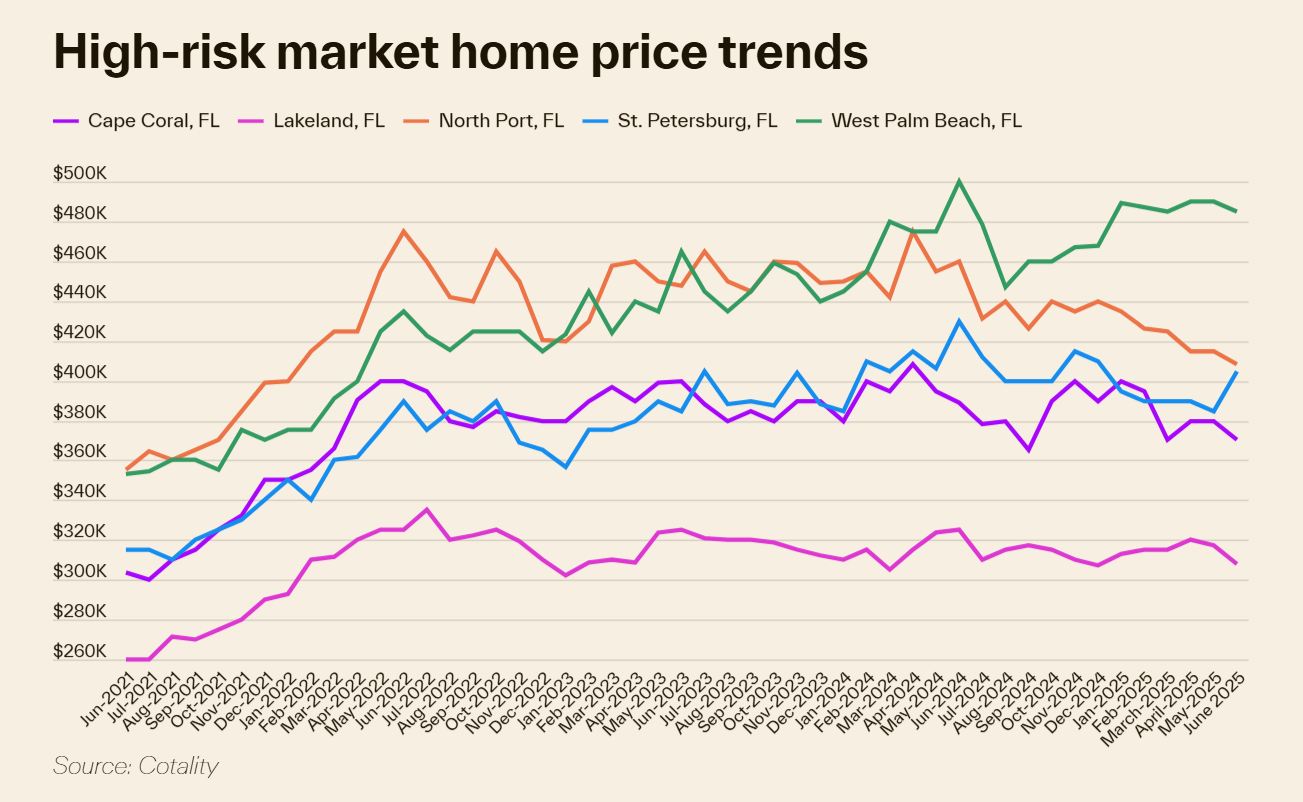
In fact, Florida, Texas, Montana, and Washington D.C. reported negative home price growth. For Florida, this signals a continued adjustment in home values in certain areas. Specifically, Cape Coral, Lakeland, North Port, St. Petersburg, and West Palm Beach are highlighted as markets to watch, indicating a high risk of price decline.

As someone who follows the real estate world closely, I’ve seen these patterns before. When a market heats up too quickly, it can often lead to an eventual cooling-off period. Florida, with its strong appeal for many buyers, has certainly experienced periods of rapid appreciation. However, the current economic climate and rising costs, like insurance premiums, are starting to put pressure on home values in some of its most popular areas.

Understanding the National Picture

Before we dive deeper into Florida, let's understand the broader economic context. In June 2025, the year-over-year home price growth across the U.S. dipped to 1.7%. This is a significant slowdown compared to previous periods and is now below the rate of inflation. This is good news for buyers, as it suggests real prices may be becoming slightly more affordable. The monthly increase was also minimal, just 0.1% in June, the slowest in over a decade.

Dr. Selma Hepp, the Chief Economist at Cotality, notes that the housing market is in a “period of transition.” She points out that 20% of metropolitan areas recorded price reductions in June 2025, the highest percentage since 2012. This softness, she says, is “primarily concentrated in southern and southeastern markets, including major metropolitan areas in Florida, Texas, and the San Francisco Bay Area.”

Florida's Housing Market at Risk: A Closer Look

While the national trend is a slowdown, Florida's situation is particularly noteworthy because of how swiftly some of its markets have grown. The state has always been a magnet for buyers, especially those seeking a warmer climate or a vacation home. However, the recent data from Cotality indicates that several Florida cities are now on a list of markets with a very high risk of price decline.

The specific markets flagged are:

  • Cape Coral, FL
  • Lakeland, FL
  • North Port, FL
  • St. Petersburg, FL
  • West Palm Beach, FL

This is a critical piece of information for anyone who owns property in these areas or is considering buying there. It's not about predicting a housing crash, but rather a realistic expectation of potential price adjustments.

Why Are These Florida Markets at Risk?

Several factors contribute to this outlook. One major concern is the increase in insurance premiums which has been steadily eroding the promise of long-term affordability. Dr. Hepp highlights that rising variable costs, such as insurance and property taxes, have jumped 70% since 2020. Florida, with its susceptibility to weather events, is particularly feeling this squeeze. When insurance becomes prohibitively expensive, it can deter buyers and put downward pressure on home prices.

Another factor is the overall affordability crisis. While the national market is seeing some improvement in affordability due to slower price growth, for many years, home prices in Florida have outpaced income growth. The data shows the national median home price at $403,000, with an income of $89,600 required to afford a median-priced home. In markets where prices have already climbed significantly, even a slight economic shift can lead to larger price corrections.

Furthermore, the report mentions that markets demonstrating strong fundamentals, like those with attractive affordability and in-migration, are likely to see continued growth. Conversely, markets that don’t have these strong fundamentals, or where prices have risen significantly, may be more vulnerable.

What Does “High Risk of Price Decline” Mean?

It’s important to clarify what this designation implies. It doesn’t necessarily mean that home prices will plummet overnight. Instead, it suggests that these markets are more likely to experience a reduction in home values over the next year or so compared to other areas. This could manifest as:

  • Slower appreciation: Prices might not increase as much as they have historically.
  • Price stagnation: Values could remain relatively flat.
  • Moderate price decreases: A gradual downward trend in prices.

The Cotality report is based on sophisticated modeling that considers a range of economic indicators, local market conditions, and historical data. It’s informed by expertise in forecasting and understanding market dynamics.

Florida's Affordability Challenges

Looking at the affordability meter, the report shows that while some areas are becoming more affordable nationally, Florida's specific markets are in a different category. The data highlights that some Florida markets, like Cape Coral, FL, have seen a significant negative home price growth (-7.4%). Similarly, North Port, FL (-5.3%), Naples, FL (-4.7%), and Punta Gorda, FL (-3.8%) are also on the list of markets with negative price trends, even if not explicitly called out as “high risk.” This provides additional context to the outlook for these areas.

The contrast between the “Most Affordable” and “Least Affordable” lists in the report is also telling. While places like Parkersburg, WV, and Charleston, WV, show very high affordability, many of the Florida markets flagged for potential price decline are also areas that have experienced rapid price growth, pushing them further up the “Least Affordable” spectrum. This rapid run-up often creates a greater risk of correction.

Impact on Buyers and Sellers

For potential buyers in these Florida markets, this situation could present opportunities. If prices do adjust downwards, it might become more feasible to enter the market with a lower initial investment. However, it's crucial to remain cautious. With the current economic uncertainty and the rising cost of ownership (especially insurance), it’s vital to ensure a purchase is affordable for the long term, not just based on a temporary dip in price. Building a solid financial cushion and understanding the true cost of ownership, including insurance and potential maintenance, is more important than ever.

For homeowners in these areas, this information is a call to reassess their financial strategies. If you’re planning to sell, you might want to consider doing so sooner rather than later to capitalize on current home values, especially if you’ve seen significant appreciation. However, if you plan to stay in your home for the long term, these price fluctuations might be less of an immediate concern, though the increasing cost of insurance remains a factor to manage.

Looking Beyond the Numbers: My Perspective

As someone who has observed market cycles for years, I believe the current situation in some Florida markets is a natural consequence of sustained demand and rapid price increases. The factors driving this shift are not just economic but also tied to the increasing cost of living, particularly insurance. Insurance premiums in flood-prone or hurricane-prone areas, like many parts of Florida, have always been a concern, but the recent sharp increases are a significant disruptor.

The data from Cotality is a valuable tool, but it’s also important to remember that real estate is local. While these five cities are flagged, there could be variations within those metropolitan areas. Some neighborhoods might hold their value better than others depending on local amenities, school districts, and demand drivers.

My advice to anyone involved in these markets is to stay informed, conduct thorough due diligence, and make decisions based on a long-term financial plan rather than short-term market predictions alone. Understand your personal financial situation, the ongoing costs of homeownership, and your long-term goals in the property.

Markets to Watch: A Deeper Dive

Let's take a quick look at what the data says about these specific Florida markets:

  • Cape Coral, FL: This Southwest Florida city has seen substantial growth in recent years. However, it’s also been impacted by insurance cost increases and potential oversupply of new construction in the past. The report flags it with a very high risk of price decline.
  • Lakeland, FL: Located between Tampa and Orlando, Lakeland has benefited from its central position and relative affordability compared to its larger neighbors. However, it's not immune to broader market trends that could affect its housing values.
  • North Port, FL: Also in Southwest Florida, North Port has experienced rapid development. Like Cape Coral, it’s susceptible to factors affecting regional housing markets, including insurance costs.
  • St. Petersburg, FL: Part of the Tampa Bay metropolitan area, St. Pete has seen significant appreciation. As a more established market, it may be more resilient, but it also faces the same affordability pressures and insurance concerns as its neighbors.
  • West Palm Beach, FL: This South Florida market has attracted a lot of attention and investment. However, its high cost of entry and susceptibility to the broader economic shifts impacting Florida could lead to price adjustments.

The grouping of these cities highlights a regional trend within Florida. The state’s appeal is undeniable, but sustainability is key. When affordability becomes a major hurdle and external costs like insurance continue to rise sharply, markets tend to recalibrate.

The Future Outlook

The Cotality report forecasts that U.S. home price growth could reach 3.7% from June 2025 to June 2026. This is a national average, and as we’ve seen, specific markets will diverge from this trend. Dr. Hepp’s comment about “subdued demand and downward pressure on home prices is expected to persist, particularly in regions where prices have already decelerated or where recent appreciation has significantly limited local affordability” perfectly encapsulates why these Florida markets are being watched.

For those who are not selling and are comfortable with their current housing situation, these potential price declines might not be a major worry. However, for those looking to buy in these areas, or who are considering selling, it’s a clear signal to exercise caution and due diligence.

Conclusion

The August 2025 Cotality report makes it clear: these Florida housing markets rank again for high risk of price decline. Cape Coral, Lakeland, North Port, St. Petersburg, and West Palm Beach are areas where careful consideration is needed due to factors like rising insurance costs and previous rapid appreciation that have impacted affordability.

It is my sincere belief that a clear understanding of these market dynamics, coupled with personal financial prudence, will help navigate the evolving real estate environment. Staying informed through reliable sources like Cotality is the first step towards making smart decisions in today's complex housing market.

Invest in Real Estate in the “Top Florida Markets”

Discover high-quality, ready-to-rent properties designed to deliver consistent returns.

Contact Norada today to expand your real estate portfolio with confidence.

Contact our investment counselors (No Obligation):

(800) 611-3060

Get Started Now 

Read More:

  • 24 Florida Housing Markets Could See Home Prices Drop by Early 2026
  • Is the Florida Housing Market Headed for Another Crash Like 2008?
  • Key Trends Shaping the Florida Housing Market in 2025
  • This Florida Housing Market Bucks National Trend With Declining Prices
  • Florida Housing Market Crash 2.0? Analyst Warns of 2008 Echoes
  • Tax Relief Proposed as Florida Housing Market Faces Deepening Crisis
  • Florida Housing Market: Record Supply Expected to Favor Buyers in 2025
  • Florida Housing Market Forecast for Next 2 Years: 2025-2026
  • Florida Housing Market: Predictions for Next 5 Years (2025-2030)
  • When Will the Housing Market Crash in Florida?
  • South Florida Housing Market: Will it Crash?

Filed Under: Housing Market, Real Estate Market Tagged With: Florida, Housing Market, housing market crash

Lakeland, Florida is Second Most Risky Housing Market Poised for a Crash

August 15, 2025 by Marco Santarelli

Lakeland, Florida is Second Most Risky Housing Market Poised for a Crash

Hold on to your hats, Lakeland homeowners! According to a recent report, Lakeland, Florida, ranks as the second most risky housing market in the US. This means that a significant price correction or even a market downturn is possible. Don’t panic just yet, but it is time to pay attention and understand why this is happening, what it means for you, and what you can do about it.

Lakeland, Florida is Second Most Risky Housing Market Poised for a Crash

Why is Lakeland on This List?

You might be asking yourself, “How did this happen?” Lakeland is a growing city with a great quality of life, so why is it vulnerable? Several factors combine to place Lakeland in this position:

  • Rapid Price Appreciation: Like many areas in Florida, Lakeland saw huge home price increases during the pandemic. Prices went up fast and far, which can lead to overvaluation.
  • Increased Inventory: More homes are hitting the market in Lakeland. This increased supply can put downward pressure on prices. When there are more houses for sale than people buying, prices tend to fall.
  • Affordability Concerns: Florida has seen significant increases in insurance premiums, making the dream of owning a home a financial burden. This impacts affordability, squeezing potential buyers and reducing demand. It went up by as much as 70% since 2020.
  • Shifting Market Dynamics According to Cotality's Chief Economist, Dr. Selma Hepp, housing markets are undergoing transition with an increasing proportion of market experiencing annual decline in prices. The softness is primarily concentrated in southern and southeastern markets, including major metropolitan areas in Florida, Texas, and the San Fransisco Bay Area.

The Data Doesn't Lie: What the Numbers Say

According to Cotality (formerly CoreLogic), as of August 5, 2025, the housing market is showing signs of cooling:

  • Year-over-year price growth has slowed to 1.7% in June 2025.
  • Monthly price increases are minimal (0.1% compared to the previous month).

While not as alarming as a full-blown crash, these numbers suggest a softening market. For example, consider some of the key markets they are watching:

  • Cape Coral, FL
  • Lakeland, FL
  • North Port, FL
  • St. Petersburg, FL
  • West Palm Beach, FL

This is an important area to keep an eye on.

Understanding the Key Indicators of a Risky Market

So, what specifically makes a housing market “risky”? Here’s a breakdown:

  • Overvalued Homes: When homes are priced significantly above what their fundamental value suggests (based on income levels, rent prices, etc.), it indicates a bubble.
  • High Debt-to-Income Ratios: If people are borrowing too much money relative to their income to buy homes, it makes them vulnerable to economic shocks.
  • Increased Foreclosures: A rise in foreclosures signals that people are struggling to make their mortgage payments, which can flood the market with supply and depress prices.
  • Rising Interest Rates: As interest rates increase, mortgage payments become more expensive, potentially cooling down the market.

What this Means for Lakeland Homeowners

Okay, so Lakeland is risky. What does that actually mean for you if you live here?

  • If You're Thinking of Selling: Now might be a good time to seriously consider listing your property. While you might not get the peak prices seen a year or two ago, you could still capitalize on the existing equity in your home before prices potentially decline further. Don't be greedy. Understand your local market conditions and price competitively.
  • If You're Planning to Buy: Patience could be your friend. If you can hold off on buying for a bit, you might see more options become available and potentially negotiate a better price. However, remember that timing the market perfectly is nearly impossible. And with that being said, I would also recommend not waiting too long. I feel the crash could very well set you back.
  • If You're Staying Put: Don't panic! Housing markets go in cycles. Even if prices soften, your home is still your home. Focus on paying down your mortgage, maintaining your property, and enjoying your life in Lakeland.

Think Local: What's Happening on the Ground in Lakeland

Data can offer a broad overview, but I find that you need to really dig into what's happening locally to get the full picture.

  • Talk to Local Realtors: Real estate agents working in Lakeland every day can give you insights that national reports might miss.
  • Attend City Council Meetings: Keep an eye on local zoning and development plans. New construction can impact property values and market dynamics.
  • Monitor Local News: Stay informed about economic developments and trends specific to Lakeland.

Speaking from experiences I have learned over time, these are the areas that I would consider keeping my eyes on.

Lessons from the Past: What Housing Crashes Teach Us

Housing market downturns aren’t new. History is filled with examples. The most recent crash in 2008 taught us several lessons:

  • Irrational Exuberance is Dangerous: Getting caught up in the hype and believing that prices will only go up is a recipe for disaster.
  • Due Diligence Matters: Understand what you're buying and don't overextend yourself financially.
  • Diversification is Key: Don't put all your eggs in one basket. A diversified investment portfolio can help you weather economic storms.

The Importance of Financial Preparedness

Regardless of what the housing market does, being prepared financially is always a smart move. Here are a few tips:

  • Build an Emergency Fund: Having 3-6 months' worth of living expenses saved can provide a cushion if you lose your job or face unexpected expenses.
  • Pay Down Debt: Reducing your debt makes you less vulnerable to interest rate increases and economic downturns.
  • Review Your Budget: Take a close look at your income and expenses to identify areas where you can save money and reduce financial stress.

Will it Really Crash? My Take and Expert Opinions

No one has a crystal ball, and while the data suggests a possible price correction in Lakeland, Florida, a full-blown crash is not a certainty. There are factors that could mitigate the risk:

  • Continued Population Growth: Florida is still attracting new residents, which could support demand for housing.
  • Strong Local Economy: A healthy job market can help homeowners stay current on their mortgage payments.
  • Limited New Construction: If the supply of new homes remains constrained, it could prevent prices from falling too far.

However, caution is warranted. As Cotality's Chief Economist, Dr. Selma Hepp, pointed out, markets with notable inventory increases, such as the Washington D.C. metro area and Denver, Colorado, are facing greater price pressures.

My bottom line: be informed, be prepared, and make sound financial decisions for your individual circumstances.

In Conclusion

The news that Lakeland, Florida, ranks as the second most risky housing market poised for a crash is concerning, but it's important to approach it with a balanced perspective. By understanding the factors that contribute to this risk, monitoring local market conditions, and preparing financially, you can navigate this period with confidence and protect your financial future. Remember that markets are always moving and it's critical to review them every so often.

Invest in Real Estate in the “Top Florida Markets”

Discover high-quality, ready-to-rent properties designed to deliver consistent returns.

Contact Norada today to expand your real estate portfolio with confidence.

Contact our investment counselors (No Obligation):

(800) 611-3060

Get Started Now 

Read More:

  • 24 Florida Housing Markets Could See Home Prices Drop by Early 2026
  • Is the Florida Housing Market Headed for Another Crash Like 2008?
  • Key Trends Shaping the Florida Housing Market in 2025
  • This Florida Housing Market Bucks National Trend With Declining Prices
  • Florida Housing Market Crash 2.0? Analyst Warns of 2008 Echoes
  • Tax Relief Proposed as Florida Housing Market Faces Deepening Crisis
  • Florida Housing Market: Record Supply Expected to Favor Buyers in 2025
  • Florida Housing Market Forecast for Next 2 Years: 2025-2026
  • Florida Housing Market: Predictions for Next 5 Years (2025-2030)
  • When Will the Housing Market Crash in Florida?
  • South Florida Housing Market: Will it Crash?

Filed Under: Housing Market, Real Estate Market Tagged With: Florida, Housing Market, housing market crash, Lakeland

Is the West Palm Beach, Florida Housing Market on the Brink of a Crash?

August 15, 2025 by Marco Santarelli

Is the West Palm Beach, Florida Housing Market on the Brink of a Crash?

The question echoing through many living rooms and whispered in real estate offices is whether the West Palm Beach, Florida housing market is headed for a serious downturn, or as some fear, a crash. Based on the latest insights, it appears that while there are signs of a cooling market, a full-blown crash isn't on the immediate horizon for the West Palm Beach area. Instead, we're seeing a shift towards a more balanced market, which could present opportunities for both buyers and sellers, albeit with a more cautious approach.

Florida, and South Florida in particular, has experienced a red-hot housing market for years. Driven by desirable weather, a growing population, and a favorable tax environment, prices have soared. However, as any seasoned observer of the real estate world knows, real estate cycles are inevitable. Understanding the current indicators is key to making sense of where we stand and what might lie ahead.

Is the West Palm Beach, Florida Housing Market on the Brink of a Crash?

Understanding the National Picture: A Slowdown, Not a Freefall

Before we dive specifically into West Palm Beach, it's important to look at the national trends. According to recent data from Cotality (formerly CoreLogic) released in August 2025, the US experienced a slowdown in home price growth. The spring homebuyer season ended on a softer note, with yearly price growth dipping to a mere 1.7% in June 2025. This is a significant drop from previous years and is now even below the rate of inflation. This is a good sign for affordability, suggesting that real home prices might be becoming a little more manageable.

The monthly increases also show a deceleration. June saw a weak seasonal increase of just 0.1% compared to the previous month, marking the slowest June monthly rise since 2008. This pace indicates a market that is certainly cooling down.

The national median home price in June 2025 stood at $403,000. While this figure is still substantial, the fact that price growth is now under inflation means that in real terms, buying a home is becoming slightly more accessible. The income required to afford a median-priced home is also a crucial metric. While we don't have specific West Palm Beach income data here, the national data shows the general economic picture.

Florida's Unique Position: What the Data Suggests

Florida as a whole has been experiencing varied conditions. While some areas in the state, like Cape Coral, Lakeland, North Port, and St. Petersburg, are highlighted as “markets to watch” with a “very high risk of price decline,” West Palm Beach itself is listed as a “market to watch” in a slightly different context, implying it warrants attention for its market dynamics, not necessarily immediate decline.

The Cotality report notes that 20% of metropolitan areas recorded price reductions in June 2025, the highest percentage seen since 2012. Crucially, the report specifies that “this softness is primarily concentrated in southern and southeastern markets, including major metropolitan areas in Florida, Texas, and the San Francisco Bay Area.” This suggests that the broader South Florida region is indeed part of this cooling trend.

However, it’s vital to differentiate between a cooling market and a crashing market. A crash implies a rapid and significant drop in prices, often driven by economic collapse, widespread foreclosures, and a severe lack of demand. A cooling market, on the other hand, is characterized by slower price appreciation, increased inventory, and a more balanced negotiation environment between buyers and sellers.

Why West Palm Beach Might Not Be Facing an Imminent Crash

While the broad strokes of the South Florida market might show a slowdown, there are reasons to believe West Palm Beach might weather the storm better than some neighboring areas. My experience in the real estate world has taught me that location and local economic drivers play a massive role. West Palm Beach has certain advantages:

  • Strong In-Migration: Florida continues to attract people, and West Palm Beach is a desirable destination. The influx of new residents, particularly those seeking a lower tax burden and a pleasant climate, provides a steady stream of demand.
  • Economic Diversification: While tourism is a major driver, West Palm Beach is also seeing growth in other sectors like finance, healthcare, and technology. This diversification can make the housing market more resilient to downturns in any single industry.
  • Affordability Factors: While South Florida generally has high housing costs, West Palm Beach might still offer relatively better affordability compared to its more saturated neighbors like Miami. Regions with historically strong fundamentals, where affordability remains attractive and in-migration continues, are likely to see more stable home price growth, as noted by Dr. Selma Hepp, Cotality's Chief Economist.
  • Rising Costs: It's not just home prices that are up. Insurance premiums in Florida have been a growing concern, jumping 70% since 2020. Property taxes also add to the cost of homeownership. These rising variable costs can dampen demand, but they also mean that sellers might be less willing to significantly drop their asking prices if their holding costs are increasing.

The Role of Interest Rates and Affordability

One of the biggest factors influencing any housing market is mortgage interest rates. Elevated rates, which have been a reality for some time, tend to cool demand by making borrowing more expensive. This effect is compounded when combined with already high home prices. As Dr. Hepp mentions, “with mortgage rates remaining elevated and concerns about a slowing U.S. economy, subdued demand and downward pressure on home prices is expected to persist, particularly in regions where prices have already decelerated or where recent appreciation has significantly limited local affordability.”

The national affordability meter from Cotality shows that while overall price growth has slowed, the required income to afford a median-priced home is still a significant factor. Affordability is a delicate balance, and any further increases in interest rates or property taxes could put more pressure on buyers.

What Does “Markets to Watch” Really Mean for West Palm Beach?

The inclusion of West Palm Beach on the list of “markets to watch” alongside areas like Cape Coral, Lakeland, St. Petersburg, and North Port, which are noted as having a high risk of price decline, raises a flag. However, it's important to understand the nuances. My interpretation is that West Palm Beach is a market that, like much of South Florida, is experiencing a normalization after a period of extreme growth.

The data points to a market where:

  • Inventory might increase: As the market cools and more homes come onto the market, buyers may have more choices.
  • Negotiations become more common: Instead of bidding wars, we might see more back-and-forth on price and terms.
  • Sellers may need to adjust expectations: The days of expecting multiple offers significantly over asking price might be limited.

The distinction between West Palm Beach being a “market to watch” and places like Cape Coral being at “very high risk of price decline” is crucial. It suggests that while West Palm Beach is not immune to the general market slowdown, its underlying demand drivers might offer more stability.

Let's look at some comparative data points based on the provided information to understand the differing trends:

Region Year-Over-Year Price Growth (June 2025) Notes
National Average 1.7% Slowing growth, below inflation.
Florida (General) Varies Some areas show negative growth, others are cooling.
West Palm Beach Listed as “Market to Watch” Implies attention needed for market dynamics, not immediate crash risk.
Cape Coral, FL Listed as “Market to Watch” / High risk High risk of price decline.
North Port, FL Listed as “Market to Watch” / High risk High risk of price decline.
St. Petersburg, FL Listed as “Market to Watch” Market dynamics require attention.
West Virginia 5.5% Top state for home price growth, strong fundamentals.
Northeast (e.g., CT, NJ) > Triple National Rate Significant and sustained price growth.

This table highlights the regional disparities. While Florida, as a whole, has areas experiencing price declines, the specific reasons for West Palm Beach being a “market to watch” could relate to balancing demand and supply rather than fundamental weaknesses.

Personal Insights and Expert Opinions

From my perspective, the current market conditions are a natural correction after an overheated period. The frenzy of 2021-2023, where homes sold almost instantly for significantly over asking, was simply not sustainable. What we're seeing now is a return to a more rational market. Buyers are more discerning, and sellers are starting to understand that their property's value is tied to current market realities, not just past appreciation.

Dr. Selma Hepp’s comments are particularly insightful: “Slowing price growth and increased for-sale inventories are gradually improving affordability, which has recently been at its lowest levels in more than 30 years. These changes are creating new opportunities for potential homebuyers who were previously unable to enter the market due to high prices.” This optimistic outlook suggests that the current slowdown is, in part, a necessary step towards a healthier, more accessible market.

However, she also cautions about the impact of rising insurance premiums and the stability of the labor market. These are critical factors to monitor, especially in a state like Florida, which is more susceptible to weather-related events that can impact insurance costs and availability.

The Verdict: Cooling, Not Crashing

So, to circle back to the main question: Is the West Palm Beach Florida housing market on the brink of a crash? My assessment, supported by the available data and market sentiment, is no, it is not on the brink of a crash. It is, however, undergoing a significant cooling and normalization process.

We are likely to see:

  • Slower appreciation: Prices will probably continue to rise, but at a much more modest pace.
  • Increased inventory: More homes on the market will give buyers more options.
  • A more balanced negotiation environment: Bidding wars will be less common.
  • Price adjustments: Sellers may need to be more realistic with their pricing to attract buyers.

The inclusion of areas like Cape Coral and North Port on the “high-risk” list serves as a reminder that not all parts of South Florida are created equal. West Palm Beach, with its strong fundamental demand and a degree of economic resilience, is better positioned to navigate this transition.

For those looking to buy, this cooling period could present a welcome opportunity to enter the West Palm Beach market with less competition and more room for negotiation. For sellers, it means adjusting expectations and understanding the current market value, rather than relying on the peak prices of the recent past.

Ultimately, the West Palm Beach housing market is maturing. It's moving from a seller's market super-charged by low interest rates and high demand to a more balanced environment where fundamental value and economic stability play a more prominent role. This shift, while potentially concerning to some, is a healthy sign for the long-term sustainability of the market.

Position Yourself for Stability Amid Market Uncertainty

With growing speculation about a potential Florida housing market crash, the smartest investors are diversifying into markets with proven resilience.

Norada provides turnkey rental properties in high-demand, economically stable areas—helping you secure passive income and safeguard against market downturns.

NEW CASH-FLOWING PROPERTIES JUST LISTED!

Speak with an experienced Norada investment counselor today (No Obligation):

(800) 611-3060

Get Started Now

Read More:

  • Is a Major Florida Housing Market Crash Coming in 2026?
  • Is the Florida Housing Market Headed for Another Crash Like 2008?
  • Key Trends Shaping the Florida Housing Market in 2025
  • This Florida Housing Market Bucks National Trend With Declining Prices
  • Florida Housing Market Crash 2.0? Analyst Warns of 2008 Echoes
  • Tax Relief Proposed as Florida Housing Market Faces Deepening Crisis
  • Florida Housing Market: Record Supply Expected to Favor Buyers in 2025
  • Florida Housing Market Forecast for Next 2 Years: 2025-2026
  • Florida Housing Market: Predictions for Next 5 Years (2025-2030)
  • When Will the Housing Market Crash in Florida?
  • South Florida Housing Market: Will it Crash?

Filed Under: Housing Market, Real Estate Market Tagged With: Florida, Housing Market, housing market crash, West Palm Beach

13 Highly Vulnerable Housing Markets in 2025: Will They Crash?

August 11, 2025 by Marco Santarelli

Most Vulnerable Housing Markets With BIG Price Declines on the Horizon

For many of us, owning a home isn't just about having a roof over our heads; it's a significant investment and a cornerstone of our financial future. That's why the question on everyone's mind, especially in today's shifting economic climate, is: Where are housing prices most vulnerable to significant drops? 

Based on recent data and expert analysis, several housing markets are showing signs of potential double-digit price declines in the coming year, presenting both challenges and opportunities for buyers, sellers, and investors alike. Zillow's latest forecasts, looking out through July 2025, paint a picture of a national housing market that's expected to see a subtle overall dip in values by the end of 2025, around 2% lower than where it started.

While this might sound modest, it's important to dig deeper because national averages can mask stark regional differences. My experience tells me that the real story lies in the specific areas that are poised for more dramatic shifts, and this is where we need to focus our attention.

The broader trend Zillow points to is a continued inventory recovery, meaning more homes are coming onto the market. This increased supply, relative to demand, is a key ingredient for moderating price growth and, in some cases, price reductions. We've been in a prolonged period of historically low inventory since the pandemic, which fueled rapid price appreciation.

Now, as more homes are listed and sales activity, while expected to rise slightly over 2024 levels to reach about 4.16 million by the end of 2025, still hasn't fully recovered, this shift in supply dynamics is becoming more pronounced.

What's particularly interesting, and what I believe is a critical insight often missed by surface-level analysis, is how this rebalancing affects not just the for-sale market but rentals too. Slower rent growth for both single-family and multi-family units mirrors the cooling of the buying market.

As potential buyers find themselves with more options and less pressure to compete fiercely, they gain negotiating power, which in turn loosens the grip on rental rates. This cascading effect is a sign of a market finding a new equilibrium, but for some areas, that equilibrium might involve a steeper adjustment.

So, the big question remains: which markets are most susceptible to those double-digit declines? While Zillow's overall forecast is for a modest national dip, its detailed data highlights specific metropolitan areas (MSAs) where projections point to much more significant drops. Let's dive into these particularly vulnerable markets.

13 Highly Vulnerable Housing Markets in 2025: Will They Crash?

When we look at the provided data, a clear pattern emerges of certain regions experiencing a more pronounced projected downturn. These are the markets where the intricate balance of supply, demand, economic stability, and local factors is creating a more volatile environment. It’s not just about national trends; it’s about the specific economic engines and demographic forces at play in these individual areas.

Here's a breakdown of markets where projections indicate potential price drops of 10% or more by mid 2026:

Region Name Region Type State Name Base Date Projected Price Change (Jul 2025) Projected Price Change (Sep 2025) Projected Price Change (Jun 2026)
Greenville, MS msa MS 30-06-2025 -3.2% -6.9% -16.7%
Clarksdale, MS msa MS 30-06-2025 -4.3% -8.5% -14.8%
Pecos, TX msa TX 30-06-2025 -0.7% -3.2% -13.7%
Cleveland, MS msa MS 30-06-2025 -2.6% -5.6% -13.6%
Bennettsville, SC msa SC 30-06-2025 -1.6% -4.9% -11.9%
Opelousas, LA msa LA 30-06-2025 -1.6% -4.6% -11.5%
Raymondville, TX msa TX 30-06-2025 -1.5% -4.2% -11.5%
Hobbs, NM msa NM 30-06-2025 -0.9% -3.0% -11.4%
Morgan City, LA msa LA 30-06-2025 -3.0% -6.5% -11.3%
Indianola, MS msa MS 30-06-2025 -2.7% -5.8% -10.8%
Big Spring, TX msa TX 30-06-2025 -0.6% -2.5% -10.7%
Natchez, MS msa LA 30-06-2025 -2.2% -5.3% -10.2%
Helena, AR msa AR 30-06-2025 -0.5% -2.1% -10.2%

Note: Projected price changes are estimates and can fluctuate based on evolving economic conditions.

Deep Dive into the Data: What Lies Beneath the Projections?

Looking at this list, a few states and regions immediately stand out: Mississippi, Texas, Louisiana, South Carolina, New Mexico, and Arkansas. These areas are collectively showing the most significant predicted downturns. What could be driving this? It’s rarely just one factor.

From my perspective, a common thread among many of these regions is their reliance on specific industries, often tied to commodity prices or cyclical economic patterns. For example, some areas in Texas and New Mexico have economies that are significantly influenced by the oil and gas sector. When oil prices are volatile or demand shifts, these economies can feel the ripple effect quite strongly, impacting job markets and, consequently, housing demand and affordability.

Let's consider Mississippi. The markets listed there – Greenville, Clarksdale, Cleveland, Indianola, Natchez – are heavily influenced by factors like agricultural cycles and manufacturing shifts. Older industrial areas can struggle as companies downsize or relocate, leading to reduced local employment. When a significant employer leaves or scales back, the local housing market can quickly become unbalanced. Supply then outstrips demand, and prices begin to fall. This isn’t a new phenomenon, but in a more sensitive national economic climate, these effects are amplified.

Similarly, parts of Louisiana, like Opelousas and Morgan City, have economies tied to resource extraction and logistics. Fluctuations in global energy markets or changes in shipping patterns can have a disproportionate impact on these communities. When these key industries face headwinds, the local job market can shrink, directly translating into less demand for housing.

What's particularly insightful here is looking at the timeline of the projected declines. The data shows a progression, with larger drops predicted later in the forecast period (June 2026). This suggests that any existing market weakness is expected to compound over time, rather than being an immediate shock. This gradual, yet significant, decline for some areas points to more structural issues rather than short-term blips.

It’s also worth noting that these are metropolitan statistical areas (MSAs). This means they represent a core city and its surrounding economically integrated communities. A decline projected for an MSA suggests that the economic pressures are not isolated to the urban core but are affecting the broader region.

The Underlying Economic Forces at Play

Understanding why these markets are vulnerable requires looking beyond the raw numbers and into the economic realities on the ground.

  • Industry Concentration and Diversification: As I mentioned, markets that are heavily reliant on a single industry—especially one that's cyclical or facing global pressures—are inherently more vulnerable. A lack of economic diversification means that when that dominant industry falters, there are few other sectors to absorb the impact. This leads to job losses, reduced disposable income, and consequently, a weaker housing market. My observations often highlight that communities with a wider range of employment opportunities tend to be more resilient.
  • Job Growth and Loss Trends: The correlation between job growth and housing demand is undeniable. If an area is experiencing net job losses or stagnant employment growth, it's a red flag for the housing market. Fewer jobs mean fewer people looking to buy homes, leading to an excess of supply and downward pressure on prices. Conversely, areas with robust job growth tend to see sustained demand, even in a cooling national market.
  • Affordability and Demand Elasticity: While some of these might be more affordable markets compared to coastal or major metropolitan hubs, the source of demand matters. If demand is primarily driven by local employment and migration, a downturn in those drivers can be devastating. In areas with less robust economies, even a slight economic hiccup can disproportionately affect home values. The elasticity of demand – how much demand changes in response to price changes – is also key. In areas with weaker economic foundations, demand is likely more elastic, meaning price drops can trigger more significant sell-offs.
  • Inventory Levels: While national inventory is recovering, it's important to remember that some of these specific MSAs might have had lower inventory before the current trends began, or a rapid inflow of new listings might be overwhelming absorption rates. When more homes are listed than can be sold at prevailing prices, sellers will eventually have to reduce their asking prices to attract buyers.
  • Population Trends: Are people moving to or away from these areas? Net out-migration can significantly dampen housing demand. If younger populations or skilled workers are leaving for better opportunities elsewhere, the local housing market will feel the pinch.

Beyond the Projections: What Does This Mean for You?

For homeowners in these vulnerable markets, the projections suggest a need for realistic expectations. If you're planning to sell, understanding these trends is crucial for pricing your home competitively. Overpricing your home in a declining market is a recipe for it sitting on the market for extended periods, eventually requiring price reductions that may be less favorable than an upfront, realistic asking price. It’s about knowing your local market’s current momentum.

For potential buyers, these markets could present opportunities. If you’re looking to buy and have stable employment, a market with projected price declines means you might be able to negotiate a better deal. However, it’s vital to conduct thorough due diligence. Ensure the local economy has some underlying stability or potential for recovery, and don't just buy solely based on a perceived short-term price dip. Understanding the long-term prospects of the area is paramount.

For investors, these areas could signal a chance to acquire properties at a discount. However, it’s essential to approach with caution, performing deep dives into market fundamentals, rental demand, and the economic drivers of the MSA. Investing in a market with projected declines requires a long-term strategy and a strong understanding of potential risks.

The National Picture: A Gentle Rebalancing

While we’ve focused on the most vulnerable, it’s important to reiterate Zillow’s broader national forecast. The expected 2% dip in home values by the end of 2025 isn’t a crash. It’s a moderation following years of unprecedented growth.

  • Inventory is key: The increase in new listings is a healthy sign for the market. It means we’re moving away from the frenzied bidding wars of the past. As inventory approaches pre-pandemic levels, buyers regain some control, and the market can operate more normally.
  • Sales are picking up slightly: An increase in existing home sales, even a modest one, indicates that demand is still present. People are still buying homes, but they are doing so with perhaps more caution and more options than before.
  • Rent growth is softening: This is a direct consequence of increased housing supply and reduced demand pressure. It signifies a market rebalancing, offering relief to renters.

My own experience as someone who has watched these economic cycles closely suggests that while a national cooling is happening, the intensity of that cooling varies greatly. The markets highlighted in the data are simply experiencing the other side of the coin from the areas that saw extreme appreciation. They might be markets that didn't experience the pandemic boom in the same way, or they might have underlying economic structures that are more sensitive to broader economic shifts.

Factors to Watch Moving Forward

As we navigate this evolving housing market, several factors warrant continued attention:

  • Interest Rate Stability: While interest rates have stabilized somewhat, any significant shifts could impact affordability and buyer demand, potentially exacerbating declines in vulnerable markets.
  • Economic Growth: The overall health of the U.S. economy will continue to be a major driver. Strong economic growth supports job markets and housing demand.
  • Local Economic Development: Initiatives aimed at diversifying local economies or attracting new industries in these vulnerable areas could potentially mitigate some of the projected declines.
  • Demographic Shifts: Long-term population trends and migration patterns will play a significant role in the housing health of specific regions.

In conclusion, while the national housing market is expected to see a gentle adjustment, it’s the specific vulnerable housing markets where prices are predicted to decline in double-digits that require the most careful observation. These areas, often characterized by industry concentration and potential employment shifts, are undergoing a more challenging period.

Invest in Real Estate in the Booming Markets of the U.S.

Discover high-quality, ready-to-rent properties designed to deliver consistent returns.

Contact us today to expand your real estate portfolio with confidence.

Contact our investment counselors (No Obligation):

(800) 611-3060

Get Started Now 

Recommended Read:

  • 10 Housing Markets Predicted to Boom Amid Economic Uncertainty in 2025
  • Top 10 Housing Markets Seeing Incredible Double-Digit Growth in 2025
  • Top 10 Housing Markets Attracting Foreign Homebuyers in 2025
  • 20 Worst Housing Markets Facing Biggest Price Crash or Correction by 2026
  • Top 15 Real Estate Markets to Buy Investment Properties in 2025
  • 20 Best Places to Buy a House in the US
  • Best Places to Invest in Single-Family Rental Properties
  • 5 Best Places to Buy and Sell a House in Spring 2025
  • 10 Best States to Buy a House in 2025
  • Top 10 Least Expensive Places to Buy a House in 2025
  • Top 10 Housing Markets Where Gen Zs Are Buying Homes
  • Top 20 Hottest Housing Markets Predicted for 2025
  • 10 Hottest Housing Markets Predicted for 2025: Sun Belt Boom
  • 5 Hottest Real Estate Markets for Buyers & Investors in 2025

Filed Under: Housing Market, Real Estate Market Tagged With: Housing Market, housing market crash, housing market predictions, Worst Housing Markets

Cape Coral Stands Out as the Riskiest Housing Market Poised for a Crash

August 9, 2025 by Marco Santarelli

Cape Coral Stands Out as the Riskiest Housing Market Poised for a Crash

Let's be upfront: Cape Coral, Florida, is once again in the spotlight, not for its sunshine and canals, but for its designation as the riskiest housing market with a real potential for a significant downturn. This isn't just the whisper of local chatter; this is a trend flagged by serious market analysis, and it's crucial for anyone thinking about buying or selling in the area, or even just keeping an eye on the broader economic picture, to understand why.

Cape Coral Stands Out as the Riskiest Housing Market Poised for a Crash

Looking at the August 2025 Insights from Cotality, the housing market as a whole is showing signs of slowing. The spring homebuyer season in 2025 wrapped up with a noticeable taper in price growth. Nationally, year-over-year home price growth dipped to 1.7% in June 2025. This is a significant shift from the boom times, and it's even below the current rate of inflation.

What does this signal? It suggests that, in real terms, homes are actually becoming a bit more affordable, which is a welcome change for many. However, this national trend doesn't paint the full picture, and some markets are faring much worse than others.

My own experience in the real estate world has taught me that markets don't move in unison. While some areas are seeing steady, predictable growth, others are teetering on the edge.

Cape Coral has consistently popped up on my radar as a market that is particularly vulnerable. The data from sources like Cotality, which tracks these trends closely, confirms this concern. They've identified Cape Coral as one of the top 5 markets to watch due to its very high risk of price decline. This isn't a diagnosis I take lightly, and it’s important to dive into the ‘why' behind this designation.

Understanding the National Slowdown

Before we zero in on Cape Coral, let's get a grip on what's happening across the country. The national median home price is hovering around $403,000. To afford a typical home, the income required is around $89,600. While these numbers might seem high, the fact that price growth has slowed and is below inflation is a positive sign for affordability. The forecast for home price increases between June 2025 and June 2026 is a more modest 3.7%. This indicates a market that is, by and large, stabilizing rather than overheating.

Selma Hepp, Chief Economist at Cotality, noted that June 2025 saw home price growth remain below 2%. This suggests a general market slowdown. She pointed out that while Sun Belt markets are experiencing noticeable declines, areas in the Midwest and Northeast are seeing typical seasonal price gains. This creates a really interesting divide in the national market.

Why Cape Coral Stands Out as a High-Risk Market

Now, let's bring it back to Cape Coral. It's not just a little bit at risk; it's explicitly identified as a market with a very high risk of price decline. What sets it apart from other markets that are also seeing slowdowns?

1. Negative Home Price Growth: The data shows that Florida, Texas, Montana, and Washington D.C. have all reported negative home price growth. This means prices are actively falling, not just growing slower. Within this group, Cape Coral's specific position on various “watch lists” and its history of rapid appreciation make its current downward trend a cause for alarm.

2. Affordability Gone Wild: One of the biggest red flags for any housing market is when prices become completely detached from local incomes. The data analysis highlights that some areas are experiencing significant price drops, with Cape Coral listed among those with -7.4% change in median sales price. This is a stark contrast to affordable markets where prices are still on the rise or stable. When prices have risen dramatically and then start to fall, it often signals an unsustainable run-up has ended.

3. Insurance and Property Tax Squeeze: As I've witnessed firsthand, the cost of homeownership goes beyond the mortgage. In Florida, and particularly in coastal areas like Cape Coral, insurance premiums are a massive concern. The data points out that areas like Florida are “particularly feeling the squeeze” from rising variable costs like insurance and property taxes, which have jumped 70% since 2020. This increased cost of ownership directly impacts what buyers can afford and puts downward pressure on prices when demand falters. Imagine wanting to buy, but the monthly cost of insurance alone is sky-high and still going up – that's a major deterrent.

4. Previous Overvaluation: Markets that experience rapid, speculative growth are often the ones that are most vulnerable to a correction. Cape Coral, like many other Florida markets, saw an incredible surge in home prices in recent years. When prices rise too fast, they can become overvalued, meaning they are worth more than what the underlying economic fundamentals (like incomes and job growth) logically support. This overvaluation is a key ingredient for a potential crash. When the speculative demand dries up, or external economic factors change, these overvalued markets are the first to feel the pain.

5. Economic Fundamentals and In-Migration: Chief Economist Dr. Selma Hepp from Cotality mentions that strong fundamentals, like affordability and domestic in-migration, are what drive continued home price growth. Conversely, markets that don't have these are at greater risk. While Florida historically benefited from strong in-migration, the rising costs of living, including housing and insurance, can slow that down. If people stop moving into an area, or even start moving out, it reduces the demand that typically supports rising prices.

Cape Coral's Specific Data Snapshot

Looking at the “Which areas are affordable?” section, Cape Coral stands out with a =-7.4% change in median sales price. This is a significant figure, especially when compared to the most affordable areas like Parkersburg, WV, which saw prices rise. The “Markets to watch” list puts Cape Coral at number one, clearly indicating it's their top concern for high-risk market home price trends. The graph showing high-risk market home price trends for various Florida cities, including Cape Coral, Lakeland, North Port, St. Petersburg, and West Palm Beach, visually reinforces this concern, with Cape Coral showing the most dramatic recent shift.

What Does a Market “Crash” Actually Mean?

When we talk about a housing market “crash,” it's important to understand what that entails. It doesn't necessarily mean every house will be worth nothing overnight. Usually, it refers to a significant and rapid decline in home values across a substantial portion of the market. This can be driven by a combination of factors:

  • Increased Inventory (More Homes for Sale): When more people decide to sell their homes, especially if demand is low, it creates a surplus of homes on the market.
  • Decreased Demand (Fewer Buyers): This can happen due to economic downturns, job losses, rising interest rates, or simply a loss of buyer confidence.
  • Foreclosures: If homeowners can't afford their mortgage payments, they may face foreclosure, leading to more homes being sold in distress at lower prices.
  • Loss of Investor Confidence: Investors who might have been driving up prices may pull back if they see the market weakening.

In the case of a market like Cape Coral, the rapid appreciation we saw likely attracted a lot of speculative buyers, including investors. If those speculative buyers start to exit the market, or if the economic conditions that fueled the initial growth change, the decline can accelerate quickly.

My Perspective: The Ripple Effects

From my vantage point, the situation in Cape Coral isn't just about homeowners losing equity. A market downturn has wider implications.

  • Local Economy: A widespread drop in home values can negatively impact the local economy. Property taxes, which fund local services, could decrease, leading to budget cuts. Small businesses that rely on homeowner spending might also suffer.
  • Builder Sentiment: Home builders will likely halt new construction if they foresee falling prices and a lack of demand, which impacts jobs in the construction sector.
  • Psychology of the Market: Once a market starts to decline significantly, fear can set in. This fear can lead to panic selling, further driving down prices and creating a vicious cycle. People who might have held on might decide to sell before prices drop further, adding to the inventory and downward pressure.

I recall during past market corrections, particularly in 2008, areas that experienced the most extreme price run-ups were often the hardest hit. It’s a pattern I’ve learned to watch for. The rapid escalation of prices in places like Cape Coral, fueled by factors like low interest rates and a desirable climate, can create an artificial sense of stability that is easily shattered when those underlying conditions change.

What Are the Contributing Factors to Cape Coral's Risk?

Let's try to break down the specific elements that contribute to Cape Coral being labeled a high-risk market.

  • Rapid Price Appreciation Preceded Decline: Markets that have seen explosive price growth are inherently more susceptible to significant corrections. If prices rose by, say, 50% in two years due to rapid demand, a subsequent decline of 10-20% isn't necessarily a “crash” but a market adjustment back towards sustainable levels. However, if that initial growth was fueled by speculation, the correction could be deeper.
  • Affordability Erosion: As prices skyrocketed, the gap between incomes and home prices widened considerably. This makes the market vulnerable to even small shifts in interest rates or employment. When a market becomes unaffordable, demand naturally cools, and sellers may have to lower their prices to find buyers.
  • Insurance Costs: This cannot be overstated for Florida. Rising insurance costs, especially in a coastal region prone to hurricanes, directly impact the monthly total cost of homeownership. If insurance becomes prohibitively expensive, it can price out potential buyers or force existing homeowners to sell. This is a critical factor that distinguishes markets like Cape Coral from those in less exposed regions.
  • Interest Rate Sensitivity: While national price growth is slowing, mortgage rates remaining elevated is a significant factor. Higher interest rates mean higher monthly payments for buyers, reducing their purchasing power and overall demand. Markets where prices have already been pushed to their limits, like Cape Coral might have been, are particularly sensitive to these higher borrowing costs.

Comparing to Other Florida Markets

It's important to note that Cape Coral isn't alone in being highlighted. Lakeland, North Port, St. Petersburg, and West Palm Beach are also on the “Markets to watch” list for high-risk home price trends. This suggests a broader trend affecting parts of Florida. However, Cape Coral's specific listing as number one, and the stark -7.4% figure attached to it, implies it's seen as particularly vulnerable right now.

The difference between these markets might lie in their specific local economic drivers, the severity of insurance cost increases, or the extent of previous price run-ups. For instance, a market with a more diversified economy might weather a storm better than one heavily reliant on tourism or real estate itself.

The Forecast for Cape Coral

Based on the data, the immediate outlook for Cape Coral's housing market suggests continued downward pressure on prices. The combination of increased inventory, potentially cooling demand due to affordability issues (inflated by insurance costs), and a general national slowdown makes it a market where buyers have more leverage.

It’s important to remember that market forecasts are just that – forecasts. Unexpected economic events can always shift the trajectory. However, the consistent flagging of Cape Coral as a high-risk market, supported by specific data points like negative price growth and its listing on “markets to watch,” paints a clear picture of caution.

In Conclusion: A Time for Prudence

Cape Coral's leadership as the most riskiest housing market that can crash is a serious indicator that the days of runaway price gains are over for this particular locale. The factors at play – from soaring insurance costs to the natural correction after rapid growth – create a challenging environment. While the national market seeks stability, Cape Coral appears to be navigating a more significant adjustment. My advice, based on years of observing these cycles, is to approach this market with a healthy dose of skepticism and thorough due diligence.

Invest in Real Estate in the “Hottest Florida Markets”

Discover high-quality, ready-to-rent properties designed to deliver consistent returns.

Contact Norada today to expand your real estate portfolio with confidence.

Contact our investment counselors (No Obligation):

(800) 611-3060

Get Started Now 

Read More:

  • Cape Coral Housing Market Crash: Boom, Bust, and Echoes in 2025
  • Why is Cape Coral Housing Market in Florida Doomed to Crash in 2025?
  • Will the Cape Coral Housing Market Repeat the Crash of 2008?
  • Is Cape Coral the Next Florida Housing Market to Crash?
  • 5 Popular Florida Housing Markets Are at High Risk of Price Crash
  • 2 Florida Housing Markets Flagged for a Major Price Decline Risk
  • 24 Florida Housing Markets Could See Home Prices Drop by Early 2026
  • Is the Florida Housing Market Headed for Another Crash Like 2008?
  • Key Trends Shaping the Florida Housing Market in 2025
  • This Florida Housing Market Bucks National Trend With Declining Prices
  • Florida Housing Market Crash 2.0? Analyst Warns of 2008 Echoes
  • Tax Relief Proposed as Florida Housing Market Faces Deepening Crisis

Filed Under: Housing Market, Real Estate Market Tagged With: Cape Coral, Florida, Housing Market, housing market crash, Housing Market Trends

Housing Market Crash: How Often Does It Happen?

August 5, 2025 by Marco Santarelli

Housing Market Crash: How Often Does It Happen?

The question of how often the housing market crashes is one that weighs on the minds of many homeowners, aspiring buyers, and investors. The simple, yet often unhelpful, answer is that major housing market crashes aren't a regular, predictable event like the changing of seasons.

Instead, significant downturns are triggered by a complex interplay of economic forces, sometimes separated by many years, and importantly, not all downturns are necessarily “crashes.” Understanding the nuances of these cycles is crucial for making informed decisions, and frankly, for sleeping better at night.

How Often Does the Housing Market Crash? A Realistic Look at Cycles and Stability

I've spent a lot of time pondering this very question, especially after living through the significant anxieties of 2008 and observing the more recent shifts in the market. It’s easy to get caught up in the sensationalism of news headlines that scream about impending doom, but the reality is far more intricate.

My experience and research suggest that while the housing market has its ups and downs, the term “crash” implies a rapid, widespread collapse of prices, often fueled by a buildup of unsustainable practices. These events, while devastating when they occur, are not a frequent, scheduled appointment on the economic calendar.

Understanding What Constitutes a “Crash”

Before we dive into frequency, it's vital to clarify what we mean by a housing market “crash.” It's not just a slight dip or a period of stagnation. A true crash typically involves:

  • Rapid and Severe Price Declines: Think double-digit percentage drops in home values over a relatively short period.
  • High Foreclosure Rates: A significant increase in the number of homeowners unable to make their mortgage payments and losing their homes.
  • Tightened Credit Conditions: Banks become much more reluctant to lend money for mortgages, making it harder for people to buy homes.
  • Widespread Economic Fallout: These factors often contribute to broader economic problems, such as job losses and reduced consumer spending.

A more common occurrence, and something homeowners are more likely to experience, is a housing market correction or a slowdown. These are periods where price growth moderates or even sees a slight decline, but they lack the extreme volatility and systemic distress associated with a crash. It’s important not to confuse a healthy cooling-off period with an impending Armageddon.

Historical Perspectives on Housing Market Cycles

Looking back at history can provide some perspective, though it’s crucial to remember that past performance is never a guarantee of future results. During my own journey as a homeowner and observer, I've noticed that major downward shifts in the real estate market are often preceded by periods of intense speculation and rapid price appreciation financed by easier-than-usual lending.

Let's consider some notable periods:

  • The Great Depression (1929 onwards): While not solely a housing market event, the widespread economic collapse led to massive declines in property values and foreclosures. This was a systemic failure with deep roots.
  • The 1970s Recession: Inflation was high, and the housing market saw fluctuations, but it didn't experience a nationwide “crash” in the same sense as later events.
  • The Savings and Loan Crisis (late 1980s/early 1990s): This was more of a financial sector crisis that eventually impacted real estate, leading to localized downturns.
  • The Dot-Com Bubble Burst (early 2000s): While real estate remained relatively stable during this tech-driven downturn, it's an example of a sector-specific boom and bust.
  • The Subprime Mortgage Crisis (2007-2009): This is the most recent and prominent example of a housing market crash in many of our lifetimes. The excessive issuance of subprime mortgages, combined with complex financial instruments and a housing bubble, led to widespread foreclosures and a severe recession.

If we look at this timeline, the significant, nationwide crashes are relatively infrequent. The period between the S&L crisis and the 2008 crisis was about 15-20 years. The period before that is also measured in decades. However, it's important to note that regional markets can experience significant downturns more frequently due to local economic factors, such as a major employer leaving a town or a natural disaster.

Factors That Contribute to Housing Market Crashes

Several ingredients generally need to come together for a housing market to truly crash:

  • Asset Bubbles: This is perhaps the most critical factor. A bubble forms when asset prices rise significantly faster than their intrinsic value, fueled by speculation and easy money. People buy houses not because they need them or can comfortably afford them, but because they expect prices to keep rising.
  • Easy Credit/Loose Lending Standards: When it becomes too easy for almost anyone to get a mortgage, often with little to no down payment and for properties they can't truly afford, this fuels demand for housing beyond sustainable levels. Think of the “subprime mortgages” that were a hallmark of the 2008 crisis.
  • Overbuilding and Supply Imbalance: If developers build far more homes than the market actually needs, this can lead to an oversupply that weighs down prices, especially if demand falters.
  • Economic Shocks: A sudden recession, high unemployment, a major financial crisis, or even significant geopolitical events can trigger a decline in housing demand and, if the market is already stretched, can lead to a crash.
  • Investor Speculation: When a large number of people start buying properties solely to flip them or rent them out for profit, hoping for rapid price appreciation, this can inflate prices and create an unstable environment upon any slowdown.

Are We Headed for a Crash Now? My Perspective

This is the million-dollar question, isn't it? As someone who watches the market closely, I can tell you there's a lot of chatter about a potential downturn right now. Factors like rising interest rates and lingering inflation have certainly put the brakes on the rapid price growth we saw a few years ago. We're seeing some markets cool off, and home prices might stagnate or even dip slightly in certain areas.

However, what I'm not seeing are the same levels of reckless lending and rampant, irrational speculation that characterized the lead-up to 2008. Lenders today are generally much more cautious about who they approve for mortgages. Many homeowners also have significant equity in their homes thanks to the appreciation of the past decade, meaning they're less likely to be caught in a negative equity situation akin to foreclosing immediately. The supply of homes also remains a significant issue in many areas; there still aren't enough homes for everyone who wants one.

My personal take is that we're more likely to see a healthy market correction or a period of slowdown rather than a full-blown crash. This means slower price growth, potentially some price declines in overvalued markets, and a more challenging environment for buyers as interest rates remain elevated. This cooling phase, while potentially uncomfortable for those who bought at the peak, is often a necessary part of a sustainable market cycle, allowing supply to catch up with demand and prices to align more closely with economic fundamentals.

What Differences Matter: Crash vs. Correction

It's crucial for everyone, from first-time buyers to seasoned investors, to grasp the distinction between a housing market crash and a correction.

Feature Housing Market Crash Housing Market Correction
Price Change Rapid, steep, and widespread declines (often >10% nationally) Gradual moderation or modest declines (-5% to -10% in some areas)
Lending Loosened to extremely loose; leads to defaults and foreclosures Generally tighter, more responsible lending; fewer widespread defaults
Foreclosures High and widespread Moderate, generally tied to individual financial distress, not systemic issues
Economic Impact Severe recession, job losses, banking crisis Mild economic slowdown, potential job market cooling
Duration Can be prolonged and have wide-ranging effects Shorter and more localized in impact
Cause Asset bubble, toxic debt, systemic financial issues, economic shocks Overvaluation, interest rate hikes, supply/demand imbalances, general market cooling

How Often Do Housing Markets Slow Down?

While a crash might happen every few decades, housing market slowdowns or corrections are considerably more frequent. You might see a market slow down every 5-10 years to some extent, depending on local economic conditions, interest rate policy, and demographic shifts.

For instance, after a period of rapid price growth, it's natural for the market to cool off. Buyers might become more cautious due to higher prices or rising interest rates. Sellers might have to adjust their expectations. This can lead to:

  • Longer time on market for homes.
  • Fewer bidding wars.
  • Slightly lower sale prices compared to the peak.

These periods are a sign of a healthy market recalibrating, not collapsing. They allow for rebalancing and affordability to improve over time.

What This Means for You: Navigating the Market

So, how do we make sense of all this? My advice is always to focus on what you can control and to approach real estate with a long-term perspective.

  1. Focus on Affordability: Never buy more house than you can comfortably afford, even if lenders approve you for more. Factor in unexpected expenses, potential job loss, and rising costs.
  2. Long-Term Investment: I've always viewed real estate as a long-term investment. If your timeframe is 7-10 years or more, short-term market fluctuations become less concerning. You're buying a place to live, and hopefully, appreciate in value over time.
  3. Understand Your Local Market: National trends are important, but local conditions dictate your specific experience. Research the employment situation, population growth, and local development plans in the area you're interested in.
  4. Maintain an Emergency Fund: A robust emergency fund is your best defense against unexpected financial downturns, whether they affect the housing market or your personal finances.
  5. Stay Informed, Not Panicked: Keep up with economic news and housing market reports from reputable sources, but avoid succumbing to fear-mongering. Distinguish between genuine warning signs and speculative predictions.

Ultimately, how often does the housing market crash is a question with an answer that varies depending on how you define “crash.” While devastating, widespread collapses are relatively infrequent, characterized by systemic issues and extreme price drops, the market does experience natural cycles of growth, slowdown, and correction. By understanding these cycles, focusing on long-term affordability, and staying informed, you can navigate the real estate world with greater confidence, ride out any inevitable dips, and hopefully, build lasting wealth.

Invest in Real Estate in the Booming Markets of the U.S.

Discover high-quality, ready-to-rent properties designed to deliver consistent returns.

Contact us today to expand your real estate portfolio with confidence.

Contact our investment counselors (No Obligation):

(800) 611-3060

Get Started Now 

Recommended Read:

  • Housing Market Turmoil: Prices Hit an All-Time High, But Sales Drop
  • 20 Worst Housing Markets Facing Biggest Price Crash or Correction by 2026
  • Housing Market Faces a Major Long-Term Crisis: Jerome Powell
  • Housing Market Forecast 2026: Will Prices Rise or Fall Next Year?
  • Housing Market Predictions: Home Prices to Drop 1.4% in 2025
  • Housing Market Alert: Over 600 Metros Will See Prices Decline by 2026
  • 12 Housing Markets Set for Double-Digit Price Decline by Early 2026
  • Real Estate Forecast: Will Home Prices Bottom Out in 2025?
  • Why Real Estate Can Thrive During Tariffs Led Economic Uncertainty
  • Will There Be a Real Estate Recession in 2025: A Forecast
  • Will the Housing Market Crash Due to Looming Recession in 2025?
  • 4 States Facing the Major Housing Market Crash or Correction

Filed Under: Housing Market, Real Estate Market Tagged With: Housing Market, housing market crash, housing market predictions, Worst Housing Markets

5 Florida Housing Markets At Risk of a Major Price Decline or Crash

August 4, 2025 by Marco Santarelli

5 Popular Florida Housing Markets Are at High Risk of Price Crash

If you've been anywhere near the Florida housing market, you know things have been wild for the last few years. Prices shot up faster than a rocket from Cape Canaveral! But lately, the tune is changing. According to the July 2025 Insights from Cotality (formerly CoreLogic), while the national housing market is slowing its growth pace, five specific Florida housing markets have been flagged with a very high risk of experiencing a major price decline. These aren't just minor dips; the data suggests a significant vulnerability in Cape Coral, Lakeland, North Port, St. Petersburg, and West Palm Beach.

5 Florida Housing Markets At Risk of a Major Price Decline or Crash

For a long time, Florida felt like the place everyone wanted to be. People were moving here in droves, fueling incredible demand for homes. Whether it was folks looking for sunshine and retirement, or remote workers fleeing expensive northern cities, the influx was massive. This led to bidding wars, homes selling for well over asking price, and property values climbing at an unsustainable rate.

But real estate markets, just like everything else, go through cycles. What goes up this fast often faces pressure to come down, or at least cool off significantly. Based on the  data from Cotality, that rapid run-up in Florida seems to be entering a correction phase.

Nationally, home price growth has definitely pumped the brakes. The report highlights that the year-over-year price growth across the U.S. slowed to 2.0% in April 2025. That's a big drop from nearly 3% just two months prior, and it's the slowest pace since Spring 2012! Single-family detached homes are still seeing some growth (around 2.46% annually), but single-family attached homes (think condos and townhouses) actually posted their first annual decline since 2012, dropping by 0.08%.

While some parts of the country, particularly more affordable areas in the Northeast and Midwest, are still seeing solid price gains, states that saw massive booms are now starting to show cracks. The report specifically names Florida, Texas, Hawaii, and Washington D.C. as states reporting negative home price growth in April 2025. Florida's statewide average appreciation dipped to -0.8%.

Dr. Selma Hepp, Cotality's Chief Economist, points out that while the number of markets seeing declines hasn't exploded nationwide (only about 14 of the top 100 largest markets reported annual declines, up slightly from 12), the majority of these are concentrated in just two states: Florida and Texas. This tells me it's not just a random scattering of price drops; there are specific, regional factors at play in these boom states.

And guess what? Florida's median sales price, which had soared, actually dipped below the national median ($395,000) to $390,000 in April 2025. This caused Florida to drop out of the top 20 most expensive markets list. That's a significant shift and tells us the market is clearly reacting to pressures.

Why Florida is Feeling the Heat (or lack thereof)

I've watched the Florida market closely for years. It's always had unique dynamics – tied to tourism, seasonal residents, retirement flows, and more recently, the remote work trend. The speed of the price increases during the peak of the boom felt unsustainable to many of us who understand market cycles. When prices go up 30%, 40%, or even more in just a couple of years in many areas, you build in a significant amount of risk if the underlying demand drivers change or affordability gets stretched too thin.

Here's what I believe is contributing to Florida feeling this correction more acutely than many other places right now:

  1. Affordability Breaking Point: Even though Florida's median price dipped, remember that prices are still drastically higher than they were pre-pandemic. Combined with higher interest rates on mortgages (which make monthly payments much larger even if the price is the same), many potential buyers are simply priced out. The data shows that nationally, an income of $87,800 is required to afford the median-priced home. In Florida, even at $390,000, that income requirement is likely similar or higher in many desirable areas.
  2. Increased Inventory: As the market slows, homes sit longer. This means more houses are available for buyers to choose from – what we call increased inventory. When there are fewer buyers chasing more homes, sellers lose leverage and often have to lower their prices or offer concessions.
  3. Cooling Migration/Demand: While people are still moving to Florida, the frantic pace of the last few years seems to have slowed somewhat. The remote work trend might be stabilizing, and the sheer cost of living, including rapidly rising property taxes and especially skyrocketing homeowner's insurance costs, is making some people reconsider or look elsewhere. Insurance costs, in particular, are a major factor unique to Florida that adds a significant burden to homeownership.
  4. Investor Pullback: A significant portion of the Florida market involves investors, whether buying rental properties, flips, or second homes. Higher interest rates and the prospect of prices falling make these investments less attractive, potentially reducing a key source of demand.

These factors create a challenging environment, leading to the statewide negative growth seen in April 2025. But the risk isn't uniform across the state. This brings us to the markets Cotality has specifically flagged.

The Florida Housing Markets Flashing Major Price Decline Warnings

What's particularly striking about the Cotality report is their “Markets to Watch” list. Using their analysis of the top 100 largest CBSAs (Core Based Statistical Areas, which are basically major metro areas or combinations of counties), they've identified the five markets with the highest risk of price decline. And every single one of them is in Florida.

Here are the five markets Cotality flagged as having a very high risk of price decline, in order of risk level according to their data:

Risk Rank Market Name State
1. Cape Coral, FL Florida
2. Lakeland, FL Florida
3. North Port, FL Florida
4. St. Petersburg, FL Florida
5. West Palm Beach, FL Florida

Let's take a closer look at what the data tells us about these specific areas and why they might be considered high risk.

1. Cape Coral, FL

This market takes the top spot on the risk list, and it's not hard to see why when you look at the other data points. Cape Coral also appears prominently on Cotality's list of “Coolest Markets,” showing a year-over-year price decline of -6.5% in April 2025 based on their top 10 list (though the text mentions a -7% decline). The report specifically notes that prices in Cape Coral are back down to levels seen in the spring of 2022.

Looking at the price trend chart provided by Cotality, the line for Cape Coral shows a steep climb through 2021 and early 2022, peaking around mid-2022 near the $400k mark. Since then, it's shown a noticeable downward trend, fluctuating but consistently lower than its peak. By April 2025, it's hovering around the mid-$300k range.

From my perspective, Cape Coral saw explosive growth fueled by people seeking relative affordability compared to other Florida coastal areas, coupled with migration trends. This kind of rapid appreciation is often the most vulnerable when the market shifts. Add to that potential impacts from things like hurricane damage recovery (depending on the specific timing relative to the data) and soaring insurance, and you have a recipe for price pressure.

2. Lakeland, FL

Lakeland, located roughly between Tampa and Orlando in Central Florida, comes in as the second-highest risk market. The price trend line for Lakeland in the chart shows a steady, less volatile climb than some coastal areas, peaking later, around early 2024, just below the $400k mark. Since then, its line has shown a clear downward slope heading into April 2025, though it's still significantly higher than its starting point in 2021.

Lakeland also benefited greatly from the migration trend, attracting buyers looking for more affordable options within commuting distance (or remote working distance) of major hubs. It's a different profile than the coastal markets, less reliant on seasonal swings or beach appeal, but perhaps more susceptible to shifts in the general Florida economy and affordability constraints for typical homebuyers. A cooling in overall buyer demand hitting a market that saw strong, steady growth makes sense as a high-risk scenario.

3. North Port, FL

Another Southwest Florida market, North Port, ranks third for price decline risk. Like Cape Coral, North Port also appears on the “Coolest Markets” list with a -4.3% year-over-year decline in April 2025.

The price trend line for North Port in the chart shows one of the steepest ascents, particularly through 2021 and 2022, hitting a peak near the $480k mark in early 2023. It then experienced a sharp decline through mid-2023 before stabilizing and even showing a slight recovery attempt, but it still finished April 2025 well off its peak, around the $420k range.

North Port, encompassing areas like Port Charlotte and Venice, experienced tremendous demand and price surges. It's a popular spot for retirees and those seeking a slightly lower price point than Sarasota. Markets that surge this fast and then show volatility, as North Port's chart does, indicate significant price discovery is happening – sellers are having to figure out where the floor is as demand wanes. The fact that it's still considered very high risk despite some stabilization suggests ongoing headwinds.

4. St. Petersburg, FL

Moving over to the Gulf Coast across from Tampa, St. Petersburg is flagged as the fourth highest risk market. The price trend line for St. Petersburg shows a strong, consistent upward trajectory through late 2023, peaking just shy of $450k. Unlike Cape Coral or North Port, its decline appears more gradual and less steep, though still noticeable, settling around the low $400k range by April 2025.

St. Pete has been incredibly popular, transforming significantly over the past decade. Its appeal lies in its vibrant downtown, cultural scene, and proximity to beaches. While it might have a more diverse economy than some of the other flagged markets, it also saw substantial price increases, pushing affordability limits for many. Being a larger metro area, it might be more sensitive to employment trends and shifts in the buyer pool that flocked there during the boom. The risk here could stem from prices having simply gotten too high relative to local incomes and the broader market slowdown finally catching up.

5. West Palm Beach, FL

Rounding out the list at number five is West Palm Beach, on Florida's Atlantic Coast. The price trend line for West Palm Beach is perhaps the most volatile of the five, showing sharp increases, dips, a strong recovery into 2024 (peaking near $480k), and then a noticeable decline into April 2025, finishing near the $420k mark. This kind of up-and-down movement can indicate a market trying to find stable ground.

Palm Beach County is known for being relatively expensive, but West Palm Beach proper and surrounding areas saw increased interest from buyers seeking alternatives to even pricier locations further south in Broward and Miami-Dade. Like St. Pete, its appeal is broad, but the price surge was significant. The volatility in its price chart suggests a market where buyers and sellers have very different ideas about value right now, increasing the likelihood of prices having to adjust downward to meet the current reality of reduced demand and higher costs of ownership (mortgage, insurance, taxes).

Connecting the Dots: Why THESE Florida Markets?

While the Cotality report flags these five specifically, it doesn't detail why each one made the list beyond the data showing their price trends and risk factors. But based on my understanding of the Florida market and general real estate principles, it makes sense that areas which experienced the most rapid, perhaps speculative, price appreciation are now the most vulnerable.

Think of it like stretching a rubber band. The further you stretch it, the more force is pulling it back. These markets likely saw that rubber band stretched further than others. Factors like:

  • An exceptionally high influx of out-of-state buyers or investors.
  • Prices reaching levels that are far beyond what typical local wages can support.
  • Increased inventory hitting the market as demand cools.
  • Unique local pressures, such as insurance costs in coastal areas, becoming prohibitive.

These combined factors create a situation where sellers who need to sell are forced to lower prices significantly to find a buyer, dragging down the overall market value in that area.

It's important to remember that a “very high risk” of price decline doesn't guarantee a crash, but it certainly means conditions are ripe for prices to fall noticeably from their peaks. It indicates significant headwinds for price stability in these specific locations.

What Does This Mean for You?

If you are a buyer, seller, or homeowner in one of these five markets (or even just in Florida), this data is crucial.

  • For Buyers: This could present opportunities, but caution is key. Don't assume prices will simply drop to pre-pandemic levels overnight. Do your homework on specific neighborhoods, understand local inventory, and factor in the total cost of ownership (including those high insurance premiums!). Being patient and negotiating is likely smart strategy.
  • For Sellers: If you're in one of these high-risk markets, you absolutely must price your home correctly from the start based on current market conditions, not based on what your neighbor's house sold for a year or two ago. Be prepared for fewer offers, longer time on the market, and potentially needing to negotiate on price or offer concessions. The days of putting a sign in the yard and picking among multiple cash offers seem to be firmly in the rearview mirror in these areas.
  • For Homeowners (not selling): This data highlights a potential decrease in your home's market value from its peak. This is often called a “paper loss” if you don't plan to sell, but it's still something to be aware of, especially if you have a variable-rate mortgage or HELOC tied to your home's value. It also reinforces the point about needing to budget for rising expenses like insurance and taxes, which can make staying in your home more expensive even if its market value softens.

It's worth noting that Cotality's national forecast for the year ahead (April 2025 – April 2026) actually projects a 4.3% increase in home prices nationally. This might seem contradictory to the Florida risk, but it reinforces the idea that real estate is incredibly local. The national average is boosted by markets that didn't see the same kind of extreme run-up as Florida, or where supply/demand dynamics are different. These five Florida markets are outliers facing unique challenges.

Dr. Hepp's comment about potentially improved optimism nationally due to factors like tariffs, recession fears lessening, and more supply is a positive sign overall, but it doesn't erase the specific vulnerabilities created by the rapid boom-and-cool cycle happening in parts of Florida.

Looking Ahead

The path forward for these five Florida markets will depend on a mix of factors. Will migration continue at a pace that absorbs the available inventory? Will insurance costs stabilize or continue to rise? What happens with interest rates? Will local job markets remain strong?

My personal take is that a period of price correction, or at least stagnation, is likely necessary and even healthy for markets that appreciated so dramatically. It helps bring prices back closer to alignment with what local residents can afford over the long term. The key is whether these corrections are gradual adjustments or more rapid declines. Cotality flagging these markets as “very high risk” suggests they lean towards the latter possibility.

Keeping an eye on future data releases from sources like Cotality will be essential to see how these markets perform in the coming months. For now, the warning flags are up, pointing squarely at Cape Coral, Lakeland, North Port, St. Petersburg, and West Palm Beach as areas facing significant headwinds in the Florida housing market.

Invest in Real Estate in the “Top Florida Markets”

Discover high-quality, ready-to-rent properties designed to deliver consistent returns.

Contact Norada today to expand your real estate portfolio with confidence.

Contact our investment counselors (No Obligation):

(800) 611-3060

Get Started Now 

Read More:

  • 2 Florida Housing Markets Flagged for a Major Price Decline Risk
  • 24 Florida Housing Markets Could See Home Prices Drop by Early 2026
  • Is the Florida Housing Market Headed for Another Crash Like 2008?
  • Key Trends Shaping the Florida Housing Market in 2025
  • This Florida Housing Market Bucks National Trend With Declining Prices
  • Florida Housing Market Crash 2.0? Analyst Warns of 2008 Echoes
  • Tax Relief Proposed as Florida Housing Market Faces Deepening Crisis
  • Is the Florida Housing Market on the Verge of Collapse or a Crash?
  • 3 Florida Cities at High Risk of a Housing Market Crash or Decline
  • Florida Housing Market: Record Supply Expected to Favor Buyers in 2025
  • Florida Housing Market Forecast for Next 2 Years: 2025-2026
  • Florida Housing Market: Predictions for Next 5 Years (2025-2030)
  • Hottest Florida Housing Markets in 2025: Miami and Orlando
  • Florida Real Estate: 9 Housing Markets Predicted to Rise in 2025
  • 3 Florida Housing Markets Are Again on the Brink of a Crash
  • Florida Housing Market Predictions 2025: Insights Across All Cities
  • When Will the Housing Market Crash in Florida?
  • South Florida Housing Market: Will it Crash?

Filed Under: Housing Market, Real Estate Market Tagged With: Florida, Housing Market, housing market crash, Housing Market Trends

20 Worst Housing Markets Facing Biggest Price Crash or Correction by 2026

August 2, 2025 by Marco Santarelli

20 Worst Housing Markets Bracing for the Biggest Price Crash by 2026

Worried about where the housing market might tank next? You’re in the right spot. The numbers don’t lie – home values in the United States are forecast to dip 1.4% nationwide, and some cities? They’re staring down steeper drops. While the national average shows a modest cooling, these 20 regions are flashing red flags. We dug into the latest forecasts to spotlight the 20 riskiest or worst housing markets where prices could tumble or crash between now and May 2026.

20 Worst Housing Markets Facing Biggest Price Crash or Correction by 2026 🏠💸

📉 What’s Going Down (and Why) Between Now and 2026

Before we jump into the list, let's talk about why some housing markets might be heading for a correction. Several factors are at play:

  • Rising Inventory: More homes on the market mean buyers have more choices, giving them leverage to negotiate lower prices. I’ve seen this firsthand in my own neighborhood – when several similar homes hit the market, prices softened quickly.
  • Elevated Mortgage Rates: High mortgage rates in 2025 are primarily driven by the Federal Reserve's efforts to combat inflation, which has led to higher borrowing costs across the board, alongside factors like ongoing economic uncertainty influenced by potential trade measures and government spending, and strong demand in the housing market coupled with limited supply. Higher rates make buying a home more expensive, sidelining some potential buyers. This reduced demand can lead to price drops, especially in areas where affordability is already stretched thin.
  • Labor Market Concerns: Economic uncertainty and potential job losses can make people hesitant to make big purchases like homes. Factors like trade policy changes, reciprocal tariffs, fluctuating interest rates, and evolving immigration policies are creating uncertainty for businesses, potentially impacting hiring and investment decisions
  • Rental Market Shifts: New construction is impacting the rental market, driving up vacancy rates and slowing rent growth. This can indirectly affect the housing market, as some potential buyers may opt to rent for longer.

Understanding the Data

The following analysis is based on Zillow's projections and focuses on Metropolitan Statistical Areas (MSAs). These are regions consisting of at least one urbanized area with a population of 50,000 or more, plus adjacent counties that have a high degree of social and economic integration with the core.

Here's a breakdown of the data used in this analysis:

  • Market: The specific Metropolitan Statistical Area (MSA).
  • Area Type: Metropolitan Statistical Area.
  • State: The state where the MSA is located.
  • Base Date: Represents the starting month for price level change.
  • Price Change Projection as of June 30, 2025: Projected price change.
  • Price Change Projection as of August 31, 2025: Projected price change.
  • Price Change Projection as of May 31, 2026: Projected price change.

Now, let's dive into the list. Remember, these are projections, and things can change. However, these areas are currently identified as being at higher risk of price declines.

Here is the list of the 20 Worst Housing Markets on the Verge of a Big Price Decline in one year from now:

Housing Markets Facing Price Declines

The 20 Housing Markets Facing the Biggest Price Declines

Price projections from May 2025 to May 2026

Rank Market State Jun 30, 2025 Aug 31, 2025 May 31, 2026
1 Greenville, MS MS -2.6% -5.5% -15.0%
2 Pecos, TX TX -1.5% -3.8% -14.2%
3 Clarksdale, MS MS -3.1% -7.3% -13.6%
4 Cleveland, MS MS -2.0% -5.1% -13.4%
5 Bennettsville, SC SC -3.0% -6.0% -12.9%
6 Raymondville, TX TX -2.1% -4.9% -12.1%
7 Opelousas, LA LA -1.9% -4.6% -11.6%
8 Morgan City, LA LA -2.6% -5.7% -10.6%
9 Big Spring, TX TX -0.4% -2.2% -10.5%
10 Natchez, MS LA -2.6% -5.3% -10.3%
11 Zapata, TX TX -1.8% -3.5% -10.3%
12 Helena, AR AR -1.0% -2.1% -10.2%
13 Indianola, MS MS -2.6% -4.9% -10.1%
14 Johnstown, PA PA -1.6% -4.5% -10.0%
15 Hobbs, NM NM -0.5% -1.7% -10.0%
16 Alice, TX TX -0.5% -2.0% -9.6%
17 Beeville, TX TX -1.3% -3.2% -9.6%
18 DeRidder, LA LA -0.6% -2.0% -9.5%
19 Houma, LA LA -0.9% -2.7% -9.4%
20 Bogalusa, LA LA -1.5% -3.6% -9.4%

A Closer Look at Some of These Markets

Let's take a moment to examine some of these markets more closely and understand some of the factors that might be contributing to the projected declines.

  • Greenville, MS: Located in the Mississippi Delta, Greenville's economy has historically been tied to agriculture. Declining agricultural opportunities and population shifts could be contributing to housing market weakness.
  • Pecos, TX: Pecos has seen significant growth due to the oil and gas industry. However, fluctuations in energy prices can lead to booms and busts, impacting housing demand. A sustained downturn in the energy sector could explain the projected decline.
  • Clarksdale, MS: Famous for its blues music heritage, Clarksdale faces economic challenges similar to other parts of the Mississippi Delta. Limited job opportunities and population loss are likely factors.
  • Johnstown, PA: Once a major steel production center, Johnstown has struggled with economic diversification. The decline of the steel industry has had a lasting impact on the area's economic prospects and housing market.

Why Are These Markets Particularly Vulnerable?

Several factors might make these markets more susceptible to housing price declines:

  • Economic Dependence on a Single Industry: Many of these areas rely heavily on one or two industries (like agriculture, oil and gas, or manufacturing). If those industries suffer, the entire local economy can take a hit.
  • Population Decline: Some of these areas have been losing population for years. Fewer residents mean less demand for housing.
  • Limited Job Opportunities: Lack of diverse job opportunities can make it difficult to attract and retain residents, impacting the housing market.
  • Affordability Issues: While prices might be lower compared to national averages, affordability can still be a problem for many residents in these areas, especially if wages are stagnant.

What Does This Mean for Buyers and Sellers?

If you're thinking of buying or selling in one of these markets, here's what you should keep in mind:

  • For Sellers: Be realistic about pricing. Overpricing your home could mean it sits on the market for longer, and you might eventually have to lower the price anyway. Consider making improvements to make your home more attractive to buyers.
  • For Buyers: You might have more negotiating power. Take your time, do your research, and don't be afraid to make a lower offer. However, be mindful of the risks involved in buying in a declining market.

National Trends in Home Values and Sales

Even though some markets are expected to decline, it's important to look at the bigger picture. Here's what Zillow projects for the national housing market:

  • Home Values: A nationwide decline of 1.4% is projected. However, this varies significantly by region.
  • Existing Home Sales: The projection is around 4.14 million sales, a 1.9% increase from 2024. Increased inventory is expected to drive sales.

The Rental Market Outlook

The rental market is also seeing some changes:

  • Single-Family Rents: Expected to rise by 2.8% in 2025.
  • Multi-Family Rents: Expected to increase by 1.6% in 2025.

These forecasts have been revised downward due to increased construction and higher vacancy rates. This suggests that renters might have more options and less pressure from rising rents in some areas.

Final Thoughts

The housing market is always changing. While these projections offer valuable insights, it's important to remember that they are not guarantees. Economic conditions, local developments, and other unforeseen events can all impact housing prices.

If you're considering making a move, do your homework, consult with real estate professionals, and make informed decisions based on your individual circumstances.

Invest in Real Estate in the Booming Markets of the U.S.

Discover high-quality, ready-to-rent properties designed to deliver consistent returns.

Contact us today to expand your real estate portfolio with confidence.

Contact our investment counselors (No Obligation):

(800) 611-3060

Get Started Now 

Recommended Read:

  • 10 Housing Markets Predicted to Boom Amid Economic Uncertainty in 2025
  • Top 10 Housing Markets Seeing Incredible Double-Digit Growth in 2025
  • Top 10 Housing Markets Attracting Foreign Homebuyers in 2025
  • Top 15 Real Estate Markets to Buy Investment Properties in 2025
  • 20 Best Places to Buy a House in the US
  • Best Places to Invest in Single-Family Rental Properties
  • 5 Best Places to Buy and Sell a House in Spring 2025
  • 10 Best States to Buy a House in 2025
  • Top 10 Least Expensive Places to Buy a House in 2025
  • Top 10 Housing Markets Where Gen Zs Are Buying Homes
  • Top 20 Hottest Housing Markets Predicted for 2025
  • 10 Hottest Housing Markets Predicted for 2025: Sun Belt Boom
  • 5 Hottest Real Estate Markets for Buyers & Investors in 2025

Filed Under: Housing Market, Real Estate Market Tagged With: Housing Market, housing market crash, housing market predictions, Worst Housing Markets

  • « Previous Page
  • 1
  • 2
  • 3
  • 4
  • …
  • 9
  • Next Page »

Real Estate

  • Birmingham
  • Cape Coral
  • Charlotte
  • Chicago

Quick Links

  • Markets
  • Membership
  • Notes
  • Contact Us

Blog Posts

  • Today’s Mortgage Rates, June 9: Rates Are in Mid‑6% Range, Buyer Power Shrinks
    June 9, 2026Marco Santarelli
  • San Diego Housing Market Graph 50 Years: Analysis and Trends
    June 9, 2026Marco Santarelli
  • Bay Area Housing Market Forecast for the Next 2 Years: 2026-2027
    June 9, 2026Marco Santarelli

Contact

Norada Real Estate Investments 30251 Golden Lantern, Suite E-261 Laguna Niguel, CA 92677

(949) 218-6668
(800) 611-3060
BBB
  • Terms of Use
  • |
  • Privacy Policy
  • |
  • Testimonials
  • |
  • Suggestions?
  • |
  • Home

Copyright 2018 Norada Real Estate Investments

Loading...