Norada Real Estate Investments

  • Home
  • Markets
  • Properties
  • Membership
  • Podcast
  • Learn
  • About
  • Contact

Top 10 Hottest Housing Markets Where Home Prices Are Soaring

June 15, 2025 by Marco Santarelli

Top 10 Hottest Housing Markets Where Home Prices Are Soaring

Looking to invest in real estate or just curious about where home prices are skyrocketing? The top 10 housing markets with the largest home price growth at the end of 2024 saw gains ranging from 14.9% to a staggering 28.7%. These metros offer a glimpse into where demand is hottest and affordability is shifting. Let's dive into the details of these booming markets.

Top 10 Hottest Housing Markets Where Home Prices Are Soaring

Have you ever felt like the housing market is a rollercoaster? One minute prices are soaring, and the next they seem to be dipping. As someone who has been watching market trends closely for quite some time, I can tell you that understanding these fluctuations is key, whether you're a seasoned investor or a first-time homebuyer.

Recently, the National Association of Realtors® (NAR) released a report that highlighted some interesting shifts in the market. While many areas across the U.S. have seen home prices increase, a select few have experienced truly significant growth. So, where are these hotspots, and what's driving this surge? Let's explore the top 10 metros where home prices are climbing the fastest.

Why This Matters to You

Whether you're looking to buy, sell, or simply understand the market dynamics, knowing where prices are rising rapidly can provide valuable insights. For buyers, it highlights areas where competition may be fierce. For sellers, it pinpoints locations where you might get a higher return. And for investors, it can reveal promising opportunities.

The Landscape of Home Price Growth

According to the NAR report, a whopping 89% of the 226 U.S. metro markets saw home prices go up in the fourth quarter of 2024. Overall, the national median single-family existing-home price rose by 4.8% year-over-year, reaching $410,000. It's worth noting that between 2019 and last year, the median price skyrocketed by almost 50%!

This growth isn't uniform across the country. The South accounted for the largest share of single-family home sales in Q4 (45.1%), with prices increasing by 2.1%. The Northeast (10.6%), the Midwest (8%), and the West (4%) also saw price increases.

Interestingly, the priciest markets tend to be concentrated in California. San Jose, for example, experienced a surge of close to 10%, pushing the median home price to a staggering $1.9 million.

A Word of Caution

Before you pack your bags and head to these booming markets, it's important to remember that rapid price growth can also mean increased competition and potential affordability challenges. It's crucial to do your research and understand the local market conditions before making any major decisions.

The Top 10: Markets Leading the Charge

Now, let's get to the heart of the matter: the top 10 metros with the largest home price increases. Half of these markets are located in the Midwest, while the rest are scattered across the South and the Northeast. This geographical diversity suggests that different factors are at play in each region.

Here's the list, ranked by year-over-year median price increase:

Rank Metro Area Median Home Price Increase (Year-over-Year) Median Home Price
1 Jackson, MS 28.7% $251,600
2 Peoria, IL 19.6% $172,500
3 Chattanooga, TN 18.2% $346,700
4 Elmira, NY 17.6% $167,800
5 Fond du Lac, WI 17.6% $263,800
6 Cleveland, OH 16.4% $221,900
7 Bismarck, ND 15.8% $312,200
8 Akron, OH 15.5% $209,600
9 Blacksburg, VA 15.0% $311,900
10 Canton, OH 14.9% $207,000

Let's take a closer look at each of these markets:

1. Jackson, MS

  • Median Home Price Increase Year-over-Year: 28.7%
  • Median Home Price: $251,600

Jackson, Mississippi, takes the top spot with a remarkable 28.7% increase in median home prices. This surge indicates a strong demand in the area, likely driven by its relative affordability compared to other markets. I believe that Jackson's growth is a testament to the fact that affordable housing is still a major draw for many Americans.

2. Peoria, IL

  • Median Home Price Increase Year-over-Year: 19.6%
  • Median Home Price: $172,500

Peoria, Illinois, comes in second with a 19.6% increase. This Midwestern city offers a lower cost of living and could be attracting buyers looking for more bang for their buck. With a median home price of just $172,500, Peoria stands out as an affordable option for many.

3. Chattanooga, TN

  • Median Home Price Increase Year-over-Year: 18.2%
  • Median Home Price: $346,700

Chattanooga, Tennessee, shows an 18.2% increase. Nestled in the scenic Appalachian Mountains, Chattanooga combines natural beauty with urban amenities, making it an attractive destination for those seeking a balanced lifestyle.

4. Elmira, NY

  • Median Home Price Increase Year-over-Year: 17.6%
  • Median Home Price: $167,800

Elmira, New York, is the only Northeastern metro on the list, with a 17.6% increase. Elmira's affordability and small-town charm may be drawing buyers seeking a more relaxed pace of life.

5. Fond du Lac, WI

  • Median Home Price Increase Year-over-Year: 17.6%
  • Median Home Price: $263,800

Fond du Lac, Wisconsin, also experienced a 17.6% increase. Located on the shores of Lake Winnebago, Fond du Lac offers a mix of outdoor recreation and community spirit, potentially appealing to families and outdoor enthusiasts.

6. Cleveland, OH

  • Median Home Price Increase Year-over-Year: 16.4%
  • Median Home Price: $221,900

Cleveland, Ohio, saw a 16.4% increase. As a major Midwestern city with a rich cultural scene and diverse economy, Cleveland's growth might be fueled by revitalization efforts and increasing job opportunities.

7. Bismarck, ND

  • Median Home Price Increase Year-over-Year: 15.8%
  • Median Home Price: $312,200

Bismarck, North Dakota, experienced a 15.8% increase. As the state capital and a hub for agriculture and energy, Bismarck's growth could be linked to the stability of its local economy.

8. Akron, OH

  • Median Home Price Increase Year-over-Year: 15.5%
  • Median Home Price: $209,600

Akron, Ohio, showed a 15.5% increase. Known for its history in the tire industry, Akron's resurgence may be driven by diversification and a renewed focus on innovation.

9. Blacksburg, VA

  • Median Home Price Increase Year-over-Year: 15.0%
  • Median Home Price: $311,900

Blacksburg, Virginia, saw a 15% increase. Home to Virginia Tech University, Blacksburg's growth could be attributed to the presence of a major educational institution and its associated economic impact.

10. Canton, OH

  • Median Home Price Increase Year-over-Year: 14.9%
  • Median Home Price: $207,000

Canton, Ohio, rounds out the list with a 14.9% increase. As the home of the Pro Football Hall of Fame, Canton's appeal might extend beyond its local economy, drawing in tourists and new residents alike.

Recommended Read:

Weekly Housing Market Trends: What's Happening in 2025?

Housing Market Forecast: CoreLogic Sees 4.1% Jump in Home Prices in 2025

Will Trump Lower Mortgage Interest Rates in 2025?

US Housing Market Sees Worst Year for Sales Since 1995

Driving Forces Behind the Growth

What's causing these price surges? According to Realtor.com® senior economic research analyst Hannah Jones, high demand and low inventory are major factors. These markets have seen demand stay strong while the number of homes for sale remains below pre-pandemic levels. This combination creates a competitive environment, driving prices up as buyers compete for limited options.

Additionally, Jones points out that the Midwest, in particular, is seeing significant growth because it's the most affordable region in the country. Despite affordability challenges nationwide, the Midwest continues to attract buyers seeking value for their money.

As NAR Chief Economist Lawrence Yun notes, “Record-high home prices and the accompanying housing wealth gains are definitely good news for property owners. However, renters who are looking to transition into homeownership face significant hurdles.”

What Does This Mean for Homebuyers and Sellers?

For homebuyers, these trends mean that competition in these markets is likely to be fierce. Be prepared to act quickly, have your financing in order, and consider making a strong offer. It may also be wise to explore alternative strategies, such as expanding your search area or considering fixer-uppers.

For sellers, these are prime opportunities to get top dollar for your property. However, it's essential to price your home strategically and work with an experienced real estate agent who understands the local market dynamics.

The Silver Lining: Affordability Improvements

While rising home prices can be daunting, there's a silver lining. According to the NAR report, housing affordability has seen a slight improvement. The monthly mortgage payment on a typical home with a 20% down payment has decreased by 1.7%, or $37, to $2,124 from the same time last year.

Additionally, 11% of the metros saw price declines during the same period. As Yun suggests, “While recognizing many workers may not have the option to relocate, those who can or are willing to move may find more affordable conditions, especially given the wide variance in home prices nationwide.”

Final Thoughts

The top 10 housing markets with the largest home price growth offer a fascinating snapshot of the current real estate landscape. While these markets may present challenges for buyers, they also represent opportunities for sellers and investors. As the market continues to evolve, staying informed and adaptable is key to making smart real estate decisions.

Work with Norada in 2025, Your Trusted Source for Investment

in the Top Housing Markets of the U.S.

Discover high-quality, ready-to-rent properties designed to deliver consistent returns.

Contact us today to expand your real estate portfolio with confidence.

Contact our investment counselors (No Obligation):

(800) 611-3060

Get Started Now 

Recommended Read:

  • Housing Predictions 2025 by Warren Buffett's Berkshire Hathaway
  • New Tariffs Could Trigger Housing Market Slowdown in 2025
  • Housing Market Forecast 2025: Affordability Crisis Will Continue
  • Lower Mortgage Rates Will Reignite the Housing Demand in 2025
  • NAR Predicts 6% Mortgage Rates in 2025 Will Boost Housing Market
  • Housing Market Forecast for the Next 2 Years: 2024-2026
  • Housing Market Predictions for the Next 4 Years: 2025 to 2028
  • Housing Market Predictions for Next Year: Prices to Rise by 4.4%
  • Housing Market Predictions for 2025 and 2026 by NAR Chief
  • Real Estate Forecast Next 5 Years: Top 5 Predictions for Future
  • 2008 Forecaster Warns: Housing Market 2024 Needs This to Survive
  • Real Estate Forecast Next 10 Years: Will Prices Skyrocket?

Filed Under: Housing Market, Real Estate Market Tagged With: Housing Market, Housing Market 2025, housing market crash, Housing Market Forecast, housing market predictions, Housing Market Trends, Real Estate Market

3 Big US Cities on the Brink of a Housing Bubble: Crash Alert

June 8, 2025 by Marco Santarelli

3 Big Cities Facing High Housing Bubble Risk: Crash Alert?

Are some US cities about to pop? 3 US Cities on the Brink of a Housing Bubble are a real concern, and we're going to dive deep into which ones might be in trouble. According to the UBS Global Real Estate Bubble Index, the overall risk of housing bubbles is down, but some cities are still flashing warning signs. Let's take a closer look.

Are Housing Bubbles a Real Threat?

The UBS Global Real Estate Bubble Index recently pointed out some potential issues. While overall global bubble risk has lessened, certain cities remain high on the danger list. What's a housing bubble, you ask? Simply put, it’s when house prices rise way faster than what's actually sustainable. This often leads to a rapid and painful correction—a housing market crash. Think of it like a balloon blown up too big; eventually, it pops.

The index looks at things like price-to-income ratios (how much a house costs compared to how much people earn), rental growth, and mortgage rates. They don't just pull numbers out of thin air; they gather data from reliable sources all over the globe.

Several cities worldwide are showing warning signs, and a few in the US are showing some concerning signs. We're going to focus on three key areas. But first, let’s look at the big picture.

Understanding the Current Housing Market

The overall US housing market has experienced some serious changes lately. Interest rates have been fluctuating, impacting affordability. While rising interest rates typically cool down a hot market, other factors are playing a significant role. The key factors to consider are:

  • Affordability: It's becoming seriously tough for many people to afford a home. Mortgage payments are a bigger chunk of people's income than during the 2006-2007 housing bubble, even if home prices aren't as high as they were back then.
  • Supply and Demand: The supply of available homes is still seriously low in many areas. This limited supply fuels demand, keeping prices high despite other economic pressures. This shortage is a major factor, even with slower sales.
  • Interest Rates: Changes in interest rates are a major driver of the market. Lower interest rates make it easier and cheaper to borrow money for a mortgage, increasing demand. Higher rates do the opposite.

The good news is that in many places, the fierce competition for homes seems to be easing. This means prices aren't skyrocketing as fast as they once were.

3 Big US Cities on the Brink of a Housing Bubble?

Now, let’s pinpoint three US cities that are showing some worryingly high signs of a potential future problem:

1. Miami: The Luxury Market's Risky Bet

Miami is a stunning city, attracting a lot of international attention. But its luxury housing market is expanding at a rapid rate. The UBS Global Real Estate Bubble Index consistently ranks Miami as having high bubble risk. Real housing prices increased by almost 50% in real terms since the end of 2019. Even with recent slowdowns elsewhere, Miami shows no signs of slowing down.

While the luxury market driving much of Miami's growth is not the same as the market for average homes, it's still a key indicator. The increased investor activity and the constant stream of affluent people looking for a second or third home have driven prices exceptionally high. It's a city where affordability is already a significant problem, and if the market corrects significantly, it could cause a ripple effect.

Miami's Housing Market: Key Factors

  • High-End Demand: A huge factor is the persistent influx of wealthy buyers, many from international markets, fueling demand for luxury properties.
  • Limited Supply: There's not enough inventory of available homes to meet this high demand, further escalating prices.
  • Speculative Buying: There is significant concern that some purchases are driven by speculation, which creates vulnerability if the market cools.

2. Boston: A Historically Strong Market Faces Challenges

Boston is known for its strong economy and historical significance. Yet, housing prices in Boston are significantly above the national average. While the local economy has faced some recent difficulties, it has historically shown exceptional strength, but even it is not immune to market pressure. The housing market in Boston shows concerning signs of a potential bubble, especially in specific neighborhoods.

Boston's Housing Market: Key Factors

  • High Price-to-Income Ratio: The cost of housing compared to residents' incomes is extremely high, making it challenging for many to afford a home.
  • Strong Economic History (But Recent Slowdown): While Boston typically has a robust economy, recent slower growth could negatively impact housing demand, potentially causing prices to fall.
  • Limited Housing Supply: The persistent lack of available homes continues to constrain the market.

3. Los Angeles: A Divided Market

Los Angeles is incredibly diverse, with various housing markets within its boundaries. The luxury market is robust, but more affordable areas reflect a very different picture. While the city has experienced challenges like population decline in certain areas, other parts of the city are booming. This makes forecasting exceptionally complex.

Los Angeles's Housing Market: Key Factors

  • Uneven Growth: The housing market is extremely fragmented, with luxury markets doing better than more affordable areas. This makes it hard to make broad statements about the whole city.
  • Declining Population in Some Areas: This has led to a decrease in demand and pressure on prices in certain neighborhoods, while other areas still show strong growth.
  • High Cost of Living: The overall high cost of living in LA puts downward pressure on the overall housing market in general.

What Does the Future Hold?

Predicting the future of the housing market is tricky. However, it’s clear these three cities are facing significant affordability challenges. The continuing increase in interest rates and the overall weakening economy could significantly impact housing prices.

My Personal Opinion

My Opinion on the Housing Bubble

I've spent years studying housing markets, and my gut tells me we are not facing a repeat of 2008. That crisis had many unique factors, including widespread subprime mortgages, that aren't as prevalent today. However, the current affordability issues are serious and could lead to significant price corrections in these cities, if not a full-blown housing bubble burst. It is essential to stay informed and monitor the situation closely.

While a significant crash like 2008 may not happen, a substantial correction in some of these cities is certainly a realistic possibility.

Conclusion:

So, are we staring down the barrel of a major housing market crash in these three US cities? It's a complicated question, but the risks are certainly high in some areas within these three cities. While I don't believe we are facing a crisis as widespread as 2008, it is likely that a market correction is ahead, particularly in Miami. Paying close attention to changes in interest rates, affordability, and supply is crucial for navigating the US housing market.

“Invest in Real Estate With Norada”

With major metros showing signs of a potential housing bubble, now is the time to consider stable, cash-flowing markets for your investments.

Norada helps you avoid high-risk cities and instead provides access to affordable, high-demand properties in resilient markets.

HOT NEW LISTINGS JUST ADDED!

Talk to a Norada investment counselor today (No Obligation):

(800) 611-3060

Get Started Now 

Related Articles:

  • Housing Market Predictions for Next Year: Prices to Rise by 4.4%
  • Housing Market Crash: Expert Says Market is Ready to Pop
  • Housing Market Crash 2008 Explained: Causes and Effects
  • Will the Housing Market Crash in 2025?
  • Housing Market Crash: When Will it Crash Again?
  • Here's Why Housing Market Crash Predictions Are Overblown!
  • Will the Housing Market Crash: Top Cities Where Prices Are Soaring
  • If The Housing Market Crashes What Happens To Interest Rates?

Filed Under: Housing Market, Real Estate, Real Estate Market Tagged With: Housing Bubble, Housing Market, housing market crash, Real Estate Market

Housing Market Predictions 2025 by Real Estate Agents

May 16, 2025 by Marco Santarelli

Real Estate Agents Predict Strong Housing Market in 2025

If you're wondering what to expect in the real estate world next year, you're not alone. The good news is, most agents are optimistic about the 2025 housing market. A recent survey revealed that a significant majority of real estate professionals anticipate rising home prices and increased transaction volumes throughout the year. Let's dive into what's driving this positive outlook and what it could mean for you, whether you're buying, selling, or just keeping an eye on things.

Housing Market Predictions for 2025 by Real Estate Agents

Why Are Agents Feeling So Good About 2025?

It's easy to feel overwhelmed by the constant chatter about economic ups and downs, interest rates, and housing inventory. These things can make even seasoned real estate folks a little uneasy. However, digging deeper, it seems there's a good reason for the optimism I'm seeing among my colleagues.

Zillow's recent survey of over 300 agents across the U.S. in late 2024 provides some solid insights. Let's break down the key findings:

  • Rising Home Prices: A whopping 67% of agents believe home prices will continue to climb over the next 12 months. Even more interesting, 20% of those foresee a large increase. This is a significant jump from mid-2024 when only 44% expected prices to keep rising.
  • Increased Transactions: Despite economic uncertainties, a strong 72% of agents predict that the number of home sales will increase. Almost a quarter of that percentage, 22%, are expecting to see a large increase in transactions. Only a mere 10% think transactions will go down.
  • A Shift to a Neutral Market: The market is becoming more balanced. 45% of agents believe we're in a buyer's market, while 41% think it's a seller's market. This near-even split suggests a more stable and predictable environment for both buyers and sellers.

But how can we reconcile these optimistic predictions with the realities of affordability and recent sales figures?

The Balancing Act: Prices, Sales, and Affordability

There's a bit of a puzzle here. The National Association of Realtors (NAR) reported that home sales in 2024 hit their lowest annual level since 1995, with just 4.06 million homes sold. So, how can agents simultaneously expect rising prices and increased transaction volume?

Here's my take:

  • Pent-Up Demand: After a period of caution and lower sales, there's likely a significant amount of pent-up demand in the market. People put their plans on hold in the face of uncertainty, but life events – marriages, growing families, job changes – don't stop. This can lead to more people looking to move.
  • Adaptation to Higher Rates: While interest rates have been a concern, buyers and sellers are starting to adjust. People are adapting by considering smaller homes, different locations, or waiting a bit longer to save more for a down payment. Sellers are more willing to negotiate.
  • The “Neutral” Sweet Spot: A neutral market means neither buyers nor sellers have a significant advantage. This can encourage more transactions as both sides feel like they have a fair shot at getting a good deal.

Personal Thoughts and Expertise

As a real estate investor, I've seen firsthand how market sentiment can shift quickly. The optimism I'm hearing from colleagues isn't just based on numbers. It's driven by a sense that the market is finding its footing after a period of volatility.

Important Note: It's really important to note that the national level data can sometimes be a bit too broad to be relied upon fully. I would highly suggest you consider the market conditions of your specific area.

Where Are We Seeing the Biggest Shifts?

The housing market is highly localized. What's happening in one city or state might be completely different elsewhere. According to the Zillow survey, we're seeing:

  • Buyer's Markets: Emerging in parts of the Southeast. This might be good news for first-time homebuyers or those looking for more negotiating power.
  • Seller's Markets: Still strong in major cities on both coasts. If you're selling in these areas, you might be able to command a higher price.
  • Neutral Markets: Predominantly in the Midwest and parts of the Southwest. These areas offer a more balanced environment for both buyers and sellers.

Table: Regional Market Trends

Region Market Type
Southeast Buyer's Market
Coastal Cities Seller's Market
Midwest/Southwest Neutral Market

What Does This Mean for You?

Whether you're buying, selling, or investing, understanding these trends is essential. Here's a quick breakdown:

  • For Buyers: Don't panic! Even with rising prices, there are still opportunities. Work closely with your agent to find properties that fit your budget and needs. Consider exploring markets where buyers have more leverage.
  • For Sellers: While the market might be shifting towards neutral, you can still get a good price for your home. Work with your agent to stage your home effectively and price it competitively.
  • For Investors: Keep a close eye on local market conditions. Look for areas with strong growth potential and consider both short-term and long-term investment strategies.

Recommended Read:

Can China Crash the US Housing Market in 2025?

Warning of a Weak Housing Market: Are We Headed for Another Crisis?

Fannie Mae Lowers Housing Market Forecast and Projections for 2025

Housing Market Forecast 2025 by JP Morgan Research

Housing Predictions 2025 by Warren Buffett's Berkshire Hathaway

Why Trust These Predictions?

It's natural to be skeptical about predictions, especially when it comes to something as important as the housing market. However, surveys like Zillow's provide valuable insights because they:

  • Capture Real-Time Sentiment: They reflect the actual experiences and expectations of agents who are on the front lines of the market.
  • Combine Data and Experience: They blend statistical data with the practical knowledge of professionals who work with buyers and sellers every day.
  • Offer a Broad Perspective: By surveying agents across the country, they provide a more comprehensive view of the national market.

Summary:

While uncertainty will always be a factor in the real estate world, the general sentiment among agents is undeniably optimistic. The predicted rise in home prices and transaction volumes, combined with a shift towards a more balanced market, suggests a more stable and predictable environment for buyers and sellers alike. If the market is on the upswing or not, the key to success in the 2025 housing market will be staying informed, working with a knowledgeable agent, and making informed decisions based on your specific needs and goals.

Work with Norada, Your Trusted Source for Investment

in the Top U.S. Housing Markets

Discover high-quality, ready-to-rent properties designed to deliver consistent returns.

Contact us today to expand your real estate portfolio with confidence.

Contact our investment counselors (No Obligation):

(800) 611-3060

Get Started Now 

Also Read:

  • Majority of Americans Fear Housing Market Will Crash in 2025
  • Housing Market Price Forecast for 2025 and 2026 Increased by NAR
  • Will the Housing Market Crash Due to Looming Recession in 2025?
  • 4 States Facing the Major Housing Market Crash or Correction
  • 5 Cities Where Home Prices Are Predicted To Crash in 2025
  • New Tariffs Could Trigger Housing Market Slowdown in 2025
  • Housing Market Forecast 2025: Affordability Crisis Will Continue
  • Lower Mortgage Rates Will Reignite the Housing Demand in 2025
  • NAR Predicts 6% Mortgage Rates in 2025 Will Boost Housing Market
  • Housing Market Forecast for the Next 2 Years: 2024-2026
  • Housing Market Predictions for the Next 4 Years: 2025 to 2028
  • Housing Market Predictions for Next Year: Prices to Rise by 4.4%
  • Housing Market Predictions for 2025 and 2026 by NAR Chief
  • Real Estate Forecast Next 5 Years: Top 5 Predictions for Future
  • Real Estate Forecast Next 10 Years: Will Prices Skyrocket?
Filed Under: Housing Market, Real Estate Market Tagged With: home prices, Housing Market, Housing Market 2025, housing market crash, Housing Market Forecast, housing market predictions, Housing Market Trends, Real Estate Market

Key Trends Shaping the Florida Housing Market in 2025

May 10, 2025 by Marco Santarelli

Key Trends Shaping the Florida Housing Market in 2025

If you're considering buying or selling property in Florida, you need to understand the current state of the Florida Housing Market. Good news is on the horizon for potential homebuyers. After a period of intense competition and soaring prices, the Florida Housing Market is showing signs of normalizing in 2025, with increased inventory and a slight easing of median prices creating more opportunities.

For years, it felt like finding an affordable home in Florida was like searching for a seashell on an endless beach – possible, but increasingly challenging. We saw historically low inventory, leading to bidding wars and prices that seemed to climb endlessly.

However, the latest data from Florida Realtors® for March and the first quarter of 2025 indicates a shift. We're seeing more new listings hitting the market, giving buyers more options to choose from. This increase in for-sale inventory, coupled with a slight dip in median prices compared to last year, suggests a welcome change for those looking to make Florida their home.

Key Trends Shaping the Florida Housing Market in 2025

Let's dive deeper into some of the crucial factors influencing the Florida Housing Market right now:

  • Increased New Listings: In March 2025, new listings for existing single-family homes saw a significant jump of 10.8% compared to March 2024. This trend continued into the first quarter, with a 9.6% increase year-over-year. The condo-townhouse sector also saw growth in new listings, with a 5.8% increase in March and a 4.1% rise in the first quarter. This influx of new properties provides buyers with more choices and can ease some of the competitive pressure.
  • Rising Inventory: The number of active listings, or for-sale inventory, has also increased for both single-family homes and condo-townhouses in March and the first quarter of 2025. This is a significant development, as higher inventory levels typically give buyers more negotiating power and can contribute to a more balanced market.
    • For single-family homes, the supply reached 5.5 months in both March and the first quarter of 2025.
    • The condo-townhouse market saw a more substantial increase in supply, reaching 10.1 months for both periods. This suggests that buyers may have even more leverage in the condo and townhouse segment.
  • Easing Median Prices: After years of consistent price increases, we're finally seeing some downward pressure on median sales prices.
    • The statewide median sales price for existing single-family homes in March 2025 was $412,500, a 1.9% decrease compared to the previous year. For the first quarter, the median price was $414,555, a slight decrease of 0.1% year-over-year.
    • The condo-townhouse market experienced a more significant price easing, with a median sales price of $315,000 in March, down 4.5% from the year before. The first quarter also saw a 3.2% decrease in the median price, remaining at $315,000.
  • Slight Dip in Closed Sales: While the market is normalizing, closed sales have seen a slight decline.
    • In March 2025, closed sales of existing single-family homes were down 1.3% year-over-year, and first-quarter sales were down 1.9%.
    • The condo-townhouse sector experienced a more significant drop, with March sales down 9.8% and first-quarter sales down 9.2% compared to the previous year.

    However, it's important to note, as Florida Realtors Chief Economist Dr. Brad O'Connor pointed out, that the number of single-family homes going under contract in March actually increased by over half a percent year-over-year. This suggests that we might see an uptick in closed sales in the near future.

The Role of Mortgage Rates

Interest rates play a huge role in the housing market, and Florida is no exception. Dr. O'Connor highlighted the impact of fluctuating mortgage rates. The fact that the average 30-year fixed mortgage rate hovered around 6.75% for most of March 2025, compared to the higher rates in January and February (above 7%), likely contributed to the increased number of pending sales in March. However, with rates climbing back up, this positive momentum might be temporary. Keep a close eye on mortgage rate trends if you're planning to buy.

Why This Normalization is Good News

For prospective homebuyers who've felt priced out or discouraged by the intense competition, this shift in the Florida Housing Market offers a glimmer of hope. More inventory means more options, less frantic bidding wars, and potentially more room for negotiation. The easing of median prices can also make homeownership more attainable for a wider range of buyers.

Navigating the Market: The Importance of Expert Guidance

Even with these positive changes, buying or selling a home is a significant financial decision. As 2025 Florida Realtors President Tim Weisheyer wisely stated, it “requires expert guidance to navigate the process and understand the nuances of local market dynamics.” This is where a knowledgeable and experienced Realtor® becomes your invaluable partner. They possess in-depth knowledge of local market conditions, can help you identify the best opportunities, and guide you through every step of the transaction. Their expertise can be the key to achieving your real estate goals, whether it's finding your dream home or securing the best possible price for your property.

My Perspective as an Observer of the Florida Housing Scene

Having followed the ups and downs of the Florida Housing Market for some time now, the current normalization feels like a breath of fresh air. While the rapid price appreciation of the past few years was beneficial for sellers, it created significant challenges for those trying to enter the market. A more balanced market, with a healthy supply of homes and more stable prices, is ultimately more sustainable in the long run. It allows more people to achieve the dream of homeownership in this desirable state.

However, it's crucial to remember that real estate is inherently local. What's happening in Miami might be different from what's occurring in Jacksonville or the Panhandle. Therefore, relying on broad statewide trends alone isn't enough. Working with a local real estate professional who understands the specific dynamics of your target area is more important than ever.

Looking Ahead

While the data suggests a cooling trend, the fundamental appeal of Florida remains strong. Its favorable climate, diverse economy, and attractive lifestyle continue to draw people from all over the country. This sustained demand will likely prevent a drastic downturn in prices. Instead, we might be entering a period of more moderate price growth or even price stability in some areas.

For sellers, this means it's crucial to be realistic about pricing and to work with your agent to develop a strategic marketing plan to attract qualified buyers. For buyers, it's an opportunity to take a more measured approach, explore different neighborhoods, and potentially find a home that fits both their needs and their budget.

In Conclusion

The Florida Housing Market in 2025 is showing clear signs of normalization. Increased new listings, rising inventory, and an easing of median prices offer a more favorable environment for homebuyers. While closed sales have seen a slight dip, the increase in pending sales suggests potential positive momentum ahead. Navigating this evolving market requires a keen understanding of local dynamics and the expert guidance of a qualified Realtor®. Whether you're looking to buy or sell, staying informed and working with a professional will be key to success in the Sunshine State's real estate landscape.

Work with Norada, Your Trusted Source for

Real Estate Investment in “Top Florida Markets”

Discover high-quality, ready-to-rent properties designed to deliver consistent returns.

Contact us today to expand your real estate portfolio with confidence.

Contact our investment counselors (No Obligation):

(800) 611-3060

Get Started Now 

Read More:

  • This Florida Housing Market Bucks National Trend With Declining Prices
  • Florida Housing Market Crash 2.0? Analyst Warns of 2008 Echoes
  • Tax Relief Proposed as Florida Housing Market Faces Deepening Crisis
  • Is the Florida Housing Market on the Verge of Collapse or a Crash?
  • 3 Florida Cities at High Risk of a Housing Market Crash or Decline
  • Florida Housing Market: Record Supply Expected to Favor Buyers in 2025
  • Florida Housing Market Forecast for Next 2 Years: 2025-2026
  • Florida Housing Market: Predictions for Next 5 Years (2025-2030)
  • Hottest Florida Housing Markets in 2025: Miami and Orlando
  • Florida Real Estate: 9 Housing Markets Predicted to Rise in 2025
  • 3 Florida Housing Markets Are Again on the Brink of a Crash
  • Florida Housing Market Predictions 2025: Insights Across All Cities
  • When Will the Housing Market Crash in Florida?
  • South Florida Housing Market: Will it Crash?

Filed Under: Housing Market, Real Estate Market Tagged With: Florida, Housing Market, housing market crash, Housing Market Trends, Tampa

This Florida Housing Market Bucks National Trend With Declining Prices

May 5, 2025 by Marco Santarelli

Tampa Home Prices Decline: Florida City Bucks National Trend

Ever feel like the ground beneath the housing market is shifting? Well, in at least one Florida city, that feeling is becoming reality. You might be scratching your head, especially after years of seemingly relentless price hikes across much of the nation. So, let's get straight to it: housing prices are indeed falling in Tampa, Florida, marking it as a notable exception in a recent national snapshot of the real estate scene.

According to the S&P CoreLogic Case-Shiller Index data from February 2025, while most major U.S. metros saw continued price growth, Tampa experienced a 1.5% year-over-year decline. This news might bring a mix of emotions, depending on whether you're looking to buy, sell, or simply understand the dynamics at play. As someone who's followed housing trends for a while now, this development in Tampa definitely warrants a closer look.

A National Slowdown with a Local Twist

The broader context is important here. The same report highlighting Tampa's dip also indicated a general slowing of home price momentum nationwide. The annual increase in national home prices eased to 3.9% in February, down from 4.1% the previous month. Similarly, the 20 major U.S. metros tracked by the index saw a slightly smaller average gain. This suggests that the feverish pace of price appreciation we witnessed in the recent past is cooling off.

However, Tampa stands out because it's not just experiencing slower growth; it's seeing an actual decrease. This makes me think about the specific factors at play in this vibrant Gulf Coast city. What's unique about Tampa's market that sets it apart from places like New York City, which saw a robust 7.7% annual increase, or even other Florida markets that are still appreciating?

Tampa: This Florida Housing Market Bucks National Trend With Declining Prices

I believe several interconnected factors are contributing to this shift in Tampa's housing market. It's not likely to be one single cause, but rather a combination of market corrections and evolving economic realities.

  • The Pandemic Boom and the Subsequent Correction: Like many Sunbelt cities, Tampa experienced a significant surge in housing demand and prices during the COVID-19 pandemic. The allure of Florida's climate, coupled with remote work trends, drew an influx of new residents. This rapid appreciation, in my opinion, was often unsustainable in the long run. What we might be seeing now is a natural market correction as demand normalizes and affordability becomes a greater concern.
  • Affordability Challenges Catching Up: The Realtor.com analysis accompanying the Case-Shiller Index points to a crucial factor: affordability. Markets that saw the largest price increases during the pandemic boom are now struggling with slower growth, or even declines, because prices simply outpaced local incomes. I suspect this is a significant element in Tampa's situation. While it's still a desirable place to live, the rapid price escalation might have priced out a segment of potential buyers, leading to less competition and downward pressure on prices.
  • Increased Housing Supply: While national inventory remains below pre-pandemic averages, the Realtor.com March inventory report noted a 28% year-over-year increase in active listings. If Tampa is experiencing a similar or even more pronounced increase in supply, this would naturally give buyers more options and potentially lead sellers to lower their prices to attract offers. It’s basic economics: more supply generally leads to lower prices, assuming demand remains constant or decreases.
  • Cooling Buyer Demand: The report also touched on a broader trend of cooling buyer demand compared to the frenzy of previous years. This is likely influenced by factors like elevated mortgage rates, persistent inflation impacting household budgets, and increasing economic uncertainty. Nationally, consumer sentiment data in April showed a significant plunge in expectations about the future economy, and rising concerns about job security could be making both buyers and sellers more hesitant. If this sentiment is particularly strong in the Tampa area, it could further dampen demand and contribute to price declines.
  • Regional Market Dynamics: Hannah Jones, Senior Economic Research Analyst at Realtor.com, highlighted that “the housing market varies significantly by region.” She noted that the “well-supplied South and West regions show signs of cooling,” while the “affordable Midwest and the less affordable Northeast housing markets continue to thrive.” Tampa, being in the South, aligns with this broader trend of cooling in regions that saw significant supply increases.

Personal Insights and My Take on the Tampa Situation

Having observed housing markets for some time now, I'm not entirely surprised by this development in Tampa. While the initial pandemic-fueled boom seemed like it would never end, fundamental economic principles always tend to reassert themselves. Unsustainable price growth, especially when it outstrips wage growth, is usually followed by a period of moderation or even correction.

I believe Tampa's situation serves as a cautionary tale for other markets that experienced similar rapid appreciation. It highlights the importance of a balanced housing market where price growth is more closely aligned with local economic conditions.

For potential homebuyers in Tampa, this could be welcome news. It might present an opportunity to enter the market at a more reasonable price point than in recent years. However, they should still be mindful of factors like mortgage rates and their own financial situation.

For sellers, the situation requires a more strategic approach. Gone are the days of simply listing a property and expecting multiple over-asking offers. Sellers in Tampa might need to adjust their price expectations and focus on presenting their properties in the best possible light to attract buyers in a more competitive environment.

The Broader Implications for the Florida Housing Market

Tampa's price decline raises questions about the health of the broader Florida housing market. While one city's experience doesn't necessarily dictate the trend for the entire state, it could be an early indicator of a broader cooling, particularly in other areas that saw similar pandemic-era booms.

It will be crucial to monitor price trends in other Florida cities in the coming months to see if Tampa's experience is an isolated case or the beginning of a more widespread moderation. Factors like inventory levels, buyer demand, and local economic conditions will be key indicators to watch.

Looking Ahead: What Does This Mean for Tampa?

Predicting the future of any housing market is always a tricky business, but based on the current trends and my understanding of market dynamics, here's what I think we might see in Tampa:

  • Continued Price Moderation: I anticipate that the downward pressure on prices in Tampa could continue in the short to medium term, especially if inventory levels remain elevated and buyer demand remains subdued. However, I don't necessarily foresee a dramatic crash in prices, as underlying demand for living in the Tampa area still exists.
  • A More Balanced Market: This price correction could ultimately lead to a more balanced housing market in Tampa, where prices are more in line with local incomes, making homeownership more accessible for a wider range of people.
  • Increased Negotiation Power for Buyers: With more inventory and less intense competition, buyers will likely have more leverage in negotiations, potentially leading to better deals and more favorable terms.
  • Importance of Local Economic Factors: The future trajectory of Tampa's housing market will heavily depend on the strength of the local economy, job growth, and overall consumer confidence in the region.

In Conclusion

The fact that housing prices are falling in Tampa, Florida, while most other major metros are still seeing gains, is a significant development. It underscores the regional variations within the national housing market and highlights the impact of affordability challenges following a period of rapid price growth.

While this may present opportunities for buyers, sellers will need to adapt to a more competitive environment. As an observer of these trends, I believe Tampa's situation offers valuable insights into the cyclical nature of housing markets and the importance of sustainable price growth. It will be fascinating to watch how this unfolds in the months to come and whether other previously booming markets follow a similar path.

Work with Norada, Your Trusted Source for

Real Estate Investment in “Top Florida Markets”

Discover high-quality, ready-to-rent properties designed to deliver consistent returns.

Contact us today to expand your real estate portfolio with confidence.

Contact our investment counselors (No Obligation):

(800) 611-3060

Get Started Now 

Read More:

  • Florida Housing Market Crash 2.0? Analyst Warns of 2008 Echoes
  • Tax Relief Proposed as Florida Housing Market Faces Deepening Crisis
  • Is the Florida Housing Market on the Verge of Collapse or a Crash?
  • 3 Florida Cities at High Risk of a Housing Market Crash or Decline
  • Florida Housing Market: Record Supply Expected to Favor Buyers in 2025
  • Florida Housing Market Forecast for Next 2 Years: 2025-2026
  • Florida Housing Market: Predictions for Next 5 Years (2025-2030)
  • Hottest Florida Housing Markets in 2025: Miami and Orlando
  • Florida Real Estate: 9 Housing Markets Predicted to Rise in 2025
  • 3 Florida Housing Markets Are Again on the Brink of a Crash
  • Florida Housing Market Predictions 2025: Insights Across All Cities
  • When Will the Housing Market Crash in Florida?
  • South Florida Housing Market: Will it Crash?

Filed Under: Housing Market, Real Estate Market Tagged With: Florida, Housing Market, housing market crash, Housing Market Trends, Tampa

What Would Cause the Housing Market to Crash Again in 2025?

May 1, 2025 by Marco Santarelli

What Would Cause Housing Market to Crash?

Thinking back to 2008, the memory of the housing market collapsing still sends a chill down the spines of many. We saw firsthand how intertwined this sector is with the broader economy and the devastating impact a crash can have on families and financial institutions. So, it's natural to wonder: what could make the housing market crash again? The short answer is a perfect storm of factors, but specifically, a sharp and sustained increase in interest rates coupled with an inability of homeowners to meet their mortgage obligations due to economic hardship could certainly trigger a significant downturn.

I remember talking to friends and family back then, the uncertainty was palpable. People were losing their homes, and the ripple effects were felt everywhere. It wasn't just about the houses; it was about jobs, savings, and a general sense of security vanishing. That experience has made me very attuned to the subtle shifts and potential dangers lurking in the current housing climate.

Today, while the underlying issues aren't exactly the same as in the lead-up to 2008, there are definitely areas that warrant close attention. We've seen a period of rapid price appreciation in recent years, fueled by low interest rates and high demand. This has led some to question the sustainability of these prices and whether we're potentially building another bubble.

Let's dive into some of the key factors that could contribute to another housing market downturn:

What Would Cause the Housing Market to Crash Again in 2025?

The Double-Edged Sword of Interest Rates

For years, historically low interest rates acted like rocket fuel for the housing market. Borrowing money for a mortgage was relatively cheap, allowing more people to enter the market and driving up prices. I remember when mortgage rates dipped below 3% – it felt almost unreal. People who had been on the fence about buying suddenly found themselves with more purchasing power.

However, the fight against inflation has led to a significant shift. The Federal Reserve has been aggressively raising interest rates to cool down the economy, and mortgage rates have followed suit. This has a direct and significant impact on housing affordability.

  • Increased borrowing costs: Higher mortgage rates mean larger monthly payments for new homebuyers. This can disqualify some potential buyers and reduce the amount others are willing or able to borrow.
  • Reduced demand: As affordability decreases, the pool of potential buyers shrinks, leading to less competition for available homes.
  • Potential for price corrections: If demand falls significantly, sellers may be forced to lower their prices to attract buyers, leading to a market correction.

Think of it like this: when the price of gas goes up, people might drive less. Similarly, when the cost of borrowing money to buy a house increases, fewer people will be able or willing to take out a mortgage at the previous price points.

The Looming Shadow of Foreclosures

The pandemic brought about widespread economic disruption, and many homeowners faced job losses or reduced income. Government intervention, such as mortgage forbearance programs, provided a crucial lifeline, allowing many to temporarily pause or reduce their mortgage payments.

However, these programs were always intended to be temporary. As they expire and the economic landscape remains uncertain for some, there's a potential for a surge in foreclosures.

  • End of forbearance: Homeowners who are still struggling financially when their forbearance periods end may face difficulties resuming their regular mortgage payments.
  • Economic hardship: Lingering unemployment, underemployment, or unexpected expenses can make it impossible for some homeowners to keep up with their mortgage obligations.
  • Increased housing supply: A significant increase in foreclosures would put more properties on the market, increasing the supply of available homes. This increased supply, coupled with potentially weakened demand, could drive down prices.

I recall the aftermath of the 2008 crisis, the sheer number of “for sale” signs was staggering in some neighborhoods. It created a downward spiral where more foreclosures led to lower prices, which in turn put more homeowners underwater (owing more on their mortgage than their home was worth). We need to be vigilant about preventing a similar scenario.

Shifting Demographics and Migration Patterns

Where people choose to live and work has a profound impact on housing demand. Changes in population growth and migration patterns can significantly influence local and regional housing markets.

  • Slower population growth: If the overall population growth in the country slows down, the fundamental demand for housing could be affected over the long term.
  • Out-migration from expensive areas: The rise of remote work has given many people more flexibility in where they live. We've seen a trend of people moving away from high-cost urban centers to more affordable areas. This shift in demand could put downward pressure on prices in the previously booming markets.
  • Impact of climate change: While a longer-term factor, the increasing impact of climate change could lead to shifts in population as people move away from areas prone to natural disasters, potentially affecting housing demand and prices in those regions.

Personally, I've noticed friends and colleagues moving to different states in search of a better cost of living and a different lifestyle. This isn't just anecdotal; data is starting to reflect these migration trends, and they can have a tangible impact on local housing markets.

The Perils of Speculative Bubbles

Human psychology plays a significant role in asset markets, including housing. When prices rise rapidly, it can create a sense of FOMO (fear of missing out), leading to increased speculative buying. Investors might purchase properties not necessarily for their intrinsic value or rental income but with the expectation of quickly flipping them for a profit.

  • Disconnect from fundamentals: In a speculative bubble, housing prices can become detached from underlying economic factors like income growth and affordability.
  • Market instability: Bubbles are inherently unsustainable. They rely on the expectation of continued price increases. Once that expectation changes or negative news hits the market, a rapid sell-off can occur, leading to a sharp price decline.
  • Investor behavior: If investors start to believe that prices have peaked or are about to fall, they may rush to sell their properties, further accelerating the downturn.

I've seen this happen in various markets throughout my life. The rapid ascent is often followed by an equally swift descent. Recognizing the signs of excessive speculation is crucial to avoiding getting caught in a potential housing bubble.

Economic Shocks and Their Ripple Effects

The housing market doesn't operate in a vacuum. It's closely tied to the overall health of the economy. Significant economic shocks can have a cascading effect on the housing sector.

  • Recession: A recession, characterized by widespread job losses and economic contraction, can severely impact people's ability to afford housing and make mortgage payments. This can lead to increased defaults and foreclosures.
  • Job losses: Rising unemployment directly reduces the number of people who can qualify for a mortgage and maintain homeownership.
  • Decreased consumer confidence: Economic uncertainty can make both buyers and sellers hesitant to engage in the housing market, leading to lower transaction volumes and potentially price declines.

The news headlines we've been seeing about potential economic slowdowns and job market concerns are definitely something to keep an eye on. A weakening economy can quickly translate into a weaker housing market.

Regulatory Changes and Unforeseen Events

Government regulations and unexpected events can also have a significant impact on the housing market.

  • Changes in lending standards: If regulations were to loosen significantly, allowing for riskier lending practices (similar to the lead-up to 2008), it could create vulnerabilities in the market. Conversely, stricter regulations could dampen demand.
  • Unforeseen global events: Geopolitical instability, pandemics, or other unexpected global events can create economic uncertainty and impact financial markets, including the housing market.

While we can't predict the future with certainty, understanding the potential impact of these broader factors is important.

Current Market Signals: A Closer Look

Looking at the data available today, we see a mixed bag of signals. The Case-Shiller Home Price Index showed continued price gains, albeit at a slightly slower pace in February. This suggests that while the rapid price appreciation of the recent past may be moderating, prices are still generally trending upwards.

However, the Realtor.com report from April 2025 paints a somewhat different picture. It highlights a significant increase in the supply of homes for sale, reaching a post-pandemic high. At the same time, pending home sales were down compared to the previous year, indicating a cooling in buyer demand. The fact that the share of listings with price reductions also hit a multi-year high suggests that sellers are starting to feel the pressure to adjust their prices.

The report also points to rising economic uncertainty and concerns about the job market as factors weighing on buyer sentiment. The estimate that a household now needs to earn $114,000 annually to afford a median-priced home, a 70% increase from just five years prior, underscores the significant affordability challenges many potential buyers face.

Regionally, the data shows interesting variations. The Midwest and Northeast continue to see strong price growth, driven by affordability in the Midwest and limited inventory in the Northeast. Meanwhile, the South and West are showing signs of cooling, likely due to higher inventory levels.

Key Takeaways from the Data:

  • Inventory is rising: Buyers in many areas have more choices than they've had in recent years.
  • Buyer demand is softening: Pending sales are down, suggesting fewer people are entering into contracts to buy homes.
  • Price reductions are increasing: Sellers are becoming more willing to lower their prices to attract buyers.
  • Affordability remains a major challenge: The income required to purchase a median-priced home has increased dramatically.
  • Economic uncertainty is weighing on the market: Concerns about the economy and job security are making buyers hesitant.

My Perspective and What I'm Watching For

Based on my observations and understanding of market dynamics, I believe the likelihood of another full-scale housing market crash similar to 2008 in the immediate future is relatively low. The lending standards today are generally much tighter than they were in the run-up to the subprime mortgage crisis. Borrowers are typically more qualified, and there isn't the same level of complex and risky financial instruments tied to mortgages.

However, I do believe we are in a period of significant market adjustment. The rapid price growth we've seen was unsustainable, and the increase in interest rates is acting as a natural cooling mechanism. I expect to see moderating price growth, potentially even price declines in some overvalued markets.

The key factors I'll be watching closely are:

  • The trajectory of interest rates: Further significant and rapid increases could put more pressure on affordability and demand.
  • The health of the labor market: A significant rise in unemployment would be a major red flag, increasing the risk of foreclosures.
  • Consumer confidence: A sustained decline in consumer sentiment could further dampen buyer demand and lead to a more pronounced market slowdown.
  • Inventory levels: While rising inventory is generally a good thing for buyers, a sudden and dramatic surge could indicate distress in the market.

I think it's crucial for both potential homebuyers and current homeowners to be realistic about the market. We're likely not going back to the ultra-low interest rates of the pandemic era, and the days of double-digit annual price appreciation are probably over, at least for now.

For buyers, this could mean more negotiating power and more time to make a decision. For sellers, it might mean adjusting price expectations and being prepared for a longer selling process.

Ultimately, the housing market is complex and influenced by a multitude of interconnected factors. While a crash isn't my base case scenario, vigilance and a realistic understanding of the potential risks are always prudent. Learning from the past and staying informed about current market trends will be key to navigating the months and years ahead.

“Turnkey Real Estate Investing With NORADA”

Worried about what might cause the housing market to crash again? Diversify smartly with income-generating rental properties in stable, high-demand markets.

Norada Real Estate helps investors like you navigate uncertainty with properties built for long-term cash flow and appreciation.

HOT NEW LISTINGS JUST ADDED!

Call our investment counselors today (No Obligation):

(800) 611-3060

Get Started Now

Read More:

  • Housing Market Predictions for the Next 4 Years: 2025 to 2029
  • Housing Market Forecast for the Next 2 Years
  • Housing Market Predictions for Next Year: Prices to Rise by 4.4%
  • Housing Market Predictions for 2025 and 2026 by NAR Chief
  • Real Estate Forecast Next 5 Years: Top 5 Predictions for Future
  • Is the Housing Market on the Brink in 2024: Crash or Boom?
  • 2008 Forecaster Warns: Housing Market 2024 Needs This to Survive
  • Real Estate Forecast Next 10 Years: Will Prices Skyrocket?

  • Housing Market Predictions for Next 5 Years (2024-2028)
  • Housing Market Predictions 2024: Will Real Estate Crash?
  • Housing Market Predictions: 8 of Next 10 Years Poised for Gains
  • Trump vs Harris: Which Candidate Holds the Key to the Housing Market (Prediction)

Filed Under: Housing Market, Real Estate, Real Estate Market Tagged With: housing market crash, What Causes the Housing Market to Crash

Is the Florida Housing Market on the Verge of Collapse or a Crash?

April 28, 2025 by Marco Santarelli

Is the Florida Housing Market on the Verge of Collapse or a Crash?

Is the dream of Florida living fading? The short answer, and what you need to know right away, is: yes, the Florida housing market is indeed on the brink. After years of explosive growth and soaring prices, the Sunshine State is facing a complex mix of affordability crises, a shaky insurance market, and infrastructure strains that are making many wonder if paradise is becoming unaffordable, unsustainable, and even uninsurable. The allure of low taxes and warm weather that once drew millions is now being tested by a harsh reality: the Florida dream might be slipping out of reach for many.

Is the Florida Housing Market on the Verge of Collapse or a Crash?

For years, I've watched Florida blossom, transforming from a sleepy retirement haven into a bustling hub attracting people from all walks of life. Snowbirds escaping winter's chill, families seeking opportunity, and younger professionals priced out of other markets – Florida seemed to have it all.

Between 2021 and 2023, nearly 2.76 million people flocked here, turning Florida into the third most populous state in the nation. It was a boomtown, pure and simple. But recently, the vibe has shifted. The sunny optimism has been tempered by a growing unease, a feeling that the rapid growth is starting to crack under its own weight.

The whispers are getting louder. Are home prices too high? Is insurance cripplingly expensive? Are the roads and schools becoming overwhelmed? And are the very hurricanes that define Florida now posing an existential threat to its housing market?

These aren't just casual concerns anymore; they're the questions echoing across kitchen tables and community forums throughout the state. And honestly, based on what I’m seeing, they're not just whispers – they're warning signs blinking red.

Has Paradise Lost its Price Point?

Florida's rise has been nothing short of meteoric. Think back just a few decades. It was the place you went to escape high taxes and the crazy costs of states up north. It was the land of sunshine, beaches, and relatively affordable living. That image fueled a massive influx of people, and it worked incredibly well for a long time. But somewhere along the way, the script flipped.

As Cotality Chief Economist Selma Hepp aptly points out, “The last 25 years have seen home prices, homeowners’ insurance, and property taxes surge in Florida.” She’s not wrong. It’s a triple whammy that’s hitting Floridians hard.

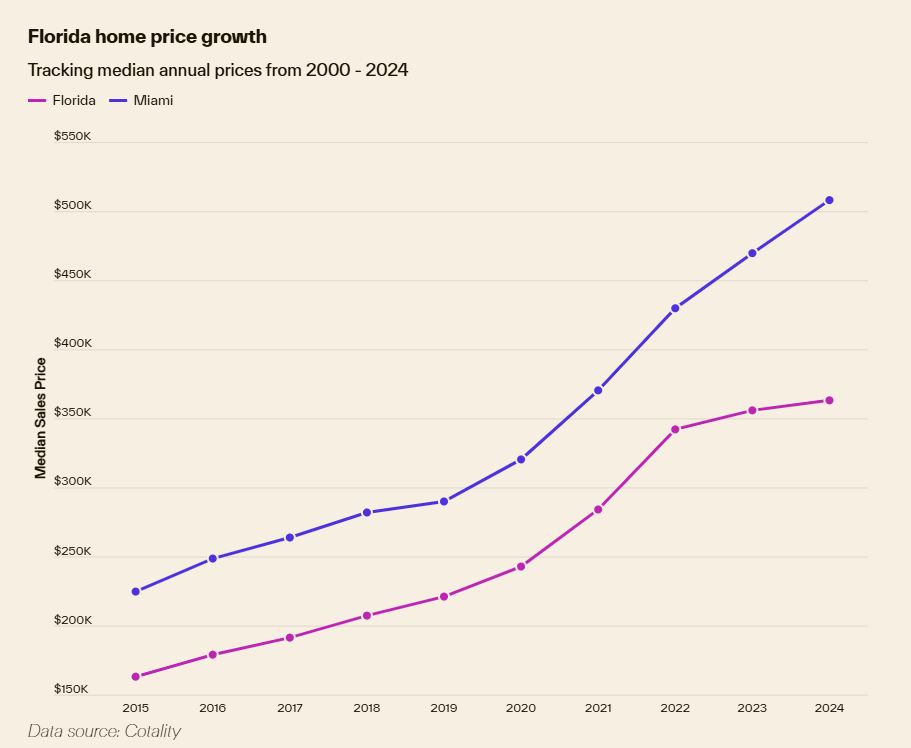
It's not just the raw numbers; it's the speed at which things have changed. Looking back at the data, it's almost dizzying. Florida home prices have not just crept up; they've galloped ahead, outpacing the national average. And Miami? Miami is in a league of its own, with home prices a staggering 60% above the Florida average. Let that sink in for a moment. Sixty percent! It’s like we’re talking about two different states entirely.

Metric Florida Median Home Price (Oct 2024) Miami Median Listing Price (Oct 2024)
Median Home Price $393,500 $629,575
Difference from State Avg – +60%

And it's not just buying; renting is becoming just as painful. In Miami, the median rent for a single-family home hit nearly $3,000 in August 2024. Combine that with general inflation and the fact that housing is still scarce, and you have a perfect storm for affordability issues. Nearly a third of Floridians are renters, and they are feeling this squeeze intensely.

Florida home price growth
Source: Cotality

The Migration Magnet – But For How Long?

Despite the rising costs, people are still coming. In 2023, nearly a million people moved to Florida. Why? Well, the low-tax, pro-growth policies are still a powerful draw. Florida, especially under the recent political climate, has become a magnet for businesses and individuals seeking a different economic and political environment. Miami, in particular, has transformed into a “Magic City” – flush with tech investments, billionaires, and global icons like Lionel Messi and Jeff Bezos. Miami-Dade County alone accounted for over 15% of the state's GDP in 2022. That's serious economic power.

But here’s the rub: this influx of wealth is a double-edged sword. These newcomers bring innovation and jobs, but they also bring deeper pockets, further distorting the housing market. Baby boomers with retirement savings and high-income earners from other states are competing for the same homes as younger, middle-income Floridians. The result? Affordability is becoming a distant memory for many.

Consider this: between 2018 and 2022, Florida’s housing market was on fire. Sales volume exceeded even the peak of the 2005 housing boom. Demand was insatiable, pushing prices to levels that are now simply out of reach for many long-term residents. It’s a classic case of too much demand chasing too little supply, amplified by the allure of the Florida lifestyle.

Miami's Magic – Fading Fast for Locals?

Miami is the poster child for this boom and bust cycle. It's become an economic engine for the state, no doubt. But living in Miami now requires serious cash. Basic goods are 20% more expensive than they were in early 2020, and housing costs have skyrocketed by 29%. Meanwhile, wages in Miami haven't kept pace, increasing by only 21% during the same period. This math just doesn’t add up for many people.

There’s a growing divide in Miami. Newcomers are often high-income earners, making 59% more on average than the city's median income. They can absorb these higher prices. But for long-term residents, the squeeze is unbearable. They are getting priced out of the very city they helped build. Pete Carroll from Cotality puts it perfectly: “The influx of high-income residents to Miami… has fueled economic growth, real estate development, and infrastructure investments, but it has also driven up housing costs and deepened income gaps, making it harder for long-time residents to afford living in the city.”

This is driving a secondary migration within Florida itself. Between 2019 and 2023, over 500,000 people moved within Florida to cheaper markets like Tampa, Jacksonville, and Orlando. People are desperately searching for affordability, even if it means staying in the same state.

City 2019-2020 Growth 2020-2021 Growth 2021-2022 Growth 2022-2023 Growth
Jacksonville 51,175 28,760 34,588 36,911
Orlando 72,218 18,469 64,057 54,916
Tampa -12,292 42,246 61,267 51,622

However, even these “cheaper” cities are feeling the pressure. Prices in Tampa and Jacksonville have jumped by 50% or more in just the last five years. Orlando, despite its huge employment base driven by Disney, has seen prices rise by 50% between 2020 and 2024. The search for affordable havens within Florida is becoming a game of whack-a-mole; as soon as one area becomes attractive, prices skyrocket, pushing affordability further out of reach.

The Construction Conundrum and Infrastructure Inadequacy

New construction was once seen as the solution to Florida's housing woes. Build more homes, and prices will stabilize, right? Unfortunately, it's not that simple anymore. Permitting activity actually fell in both 2022 and 2023. Why? A cocktail of factors: labor shortages, rising material costs, and regulatory delays are all conspiring to slow down construction. Tariffs on imported materials are just adding fuel to the fire, making developers hesitant to start new projects.

This lack of new construction is exacerbating the price problem. It’s basic economics: limited supply and high demand will always lead to higher prices. And it’s not just homes that are lagging; Florida’s infrastructure is also struggling to keep pace. Every year, Florida adds the population equivalent of a city the size of Tampa. But the roads, schools, and utilities are not expanding at the same rate.

Think about your daily commute. Roads are more congested than ever. Commute times in Florida have increased by over 11% in the last decade, despite massive investments in road expansions. In Miami and Orlando, traffic congestion costs commuters an extra $1,000 per driver every year – just to sit in traffic!

Schools are also showing their age. The average school building in Florida is now 31 years old. Funding for renovations is scarce, leading to a rise in private school enrollment, which further drains resources from the public system. Families are faced with a tough choice: accept aging public schools or pay extra for private education, further straining already tight budgets.

And let’s not forget water. Drinking water infrastructure is aging and inadequate. Unlike traffic jams and crowded schools, failing water systems pose a direct threat to public health. The cost of upgrading these systems is enormous, and cities are struggling to balance these critical needs with other budget demands.

These infrastructure strains aren't evenly distributed across the state, but with Tampa, Orlando, and Jacksonville all booming, the pressure is mounting. Overburdened infrastructure is not just an inconvenience; it's a quality of life issue, and it's becoming a major deterrent for people considering Florida as a long-term home.

Hurricane Hazard and Insurance Havoc

And then there's the elephant in the room – hurricanes. Florida is hurricane alley. And with climate change intensifying these storms, they are becoming a more frequent and severe threat. Hurricane Milton's near miss in Tampa in 2024 was a stark reminder of just how vulnerable even the less-storm-prone west coast of Florida is.

As Selma Hepp explains, “While Florida’s metros have topped the list of hottest appreciating housing markets in recent years, the increasing costs of persistent natural disasters and consequent pressure on insurance expenses and rebuilding costs are starting to weigh on home prices in west Florida.” She points to Cape Coral as an example, where home prices actually declined last year due to these issues.

Hurricane damage is devastating, and the financial fallout is immense. Many homeowners are underinsured, especially lower-income families. Policies often don’t cover the full replacement value of a home, or extras like pools and fences. And if you have to evacuate, flood insurance often doesn't cover additional living expenses. This can push families into foreclosure, leaving neighborhoods vulnerable to wealthier buyers looking for bargain properties – albeit risky ones.

The insurance market in Florida is in crisis. Premiums have skyrocketed – up 60% on average between 2019 and 2023. It’s not just homeowners feeling the pain; insurance companies are also under immense pressure. The frequency and severity of storms have led to a surge in claims, just as material and labor costs for repairs have also soared post-pandemic.

Florida has seen 18 billion-dollar hurricane disasters since the start of this decade. And the future looks even riskier. Cotality analysis shows that Monroe County in the Florida Keys will be the fourth-riskiest place to live in the US for natural disasters in the next 30 years, primarily due to hurricane risk. Miami and Naples are among the top cities with the most homes facing a “triple threat” – flood, wind, and hurricane risk combined.

This escalating risk is causing insurance companies to flee. Farmers Insurance, Bankers Insurance, and Lexington Insurance (AIG subsidiary) have all pulled back or withdrawn from Florida in recent years. AAA is also non-renewing some policies. They cite the rising costs of reinsurance, increased claims due to inflation, and excessive litigation as reasons for their retreat.

Where does this leave homeowners? Many are forced to rely on state and federal programs like the National Flood Insurance Program (NFIP). But even these programs are facing questions about their long-term sustainability given the rising costs of disasters. Florida alone received over $15 billion in FEMA aid between 2017 and 2019, and over $1 billion for recent hurricanes.

Building Codes: A Partial Shield, Not a Silver Bullet

While there's no magic wand to fix the insurance crisis, stronger building codes are helping. Florida has some of the best building codes in the country, and they have undoubtedly saved homes and billions of dollars. However, these codes aren't retroactive. Millions of older homes remain vulnerable. Retrofitting older homes to meet modern codes is expensive, further adding to the cost burden in an already pricey market.

Jay Thies from Cotality highlights the balancing act: “Building codes require a balancing act between costs and resilience… In some cases… the extra costs are unquestionably worth it… In other cases, ambiguity exists between the high costs and measurable benefits. In these instances, favoring affordable construction can be a beneficial choice to keep housing accessible to a wider range of buyers.”

The question becomes: Do we prioritize affordability today, potentially at the cost of future resilience? It’s a tough choice, but mitigating future hurricane losses is critical to stabilizing the insurance market and the long-term viability of Florida living.

The Great Florida Migration – Coming Undone?

Is Florida losing its shine? It’s no longer just the place people are flocking to; it’s starting to become a place people are looking to leave. While Florida still sees more arrivals than departures, the balance is shifting. Mortgage applications from both inside and outside the state are declining. More Floridians are applying for loans to buy homes outside of Florida, particularly in neighboring states.

Cotality analysis reveals that 48% of mortgage applications from outbound Floridians are for properties in Georgia, North Carolina, South Carolina, Tennessee, and Texas. These states offer relative affordability and less exposure to natural hazards compared to Florida.

State Share of FL Residents Applying for Loans
Georgia 15%
North Carolina 10%
Texas 8%
Tennessee 8%
South Carolina 7%

As Selma Hepp notes, “Florida’s rapid price appreciation combined with soaring home insurance prices and the threat of hurricanes has led people to start looking at other nearby states… they are seeking the ingredients that made Florida so prosperous in the first place.”

These neighboring states are starting to see the influx. Housing prices in most of them are already outpacing the national average. Texas, after a pandemic-era boom, is recalibrating, but it and the other southern states are attracting major businesses and job growth, further fueling their housing markets.

Miami's cautionary tale should be a wake-up call. If Florida doesn't address affordability, infrastructure, and insurance, the trickle of outbound movers could become a flood. The state risks following California's path – a slow-boil exodus driven by unsustainable costs and quality of life issues.

California saw 6.5 million people leave in the decade leading up to 2023. Insurance premiums there rose by almost 90%, and housing prices skyrocketed. The median home price in California jumped from $380,501 in the mid-2000s to $621,501 by 2023. Natural disasters and soaring insurance costs pushed many over the edge.

Florida is showing similar trends. People are already moving to more affordable parts of Florida, like Port St. Lucie, Palm Bay, Jacksonville, and Orlando, seeking refuge from Miami's insane prices. But even these areas are becoming less affordable by the day.

Is There Still Time to Turn the Tide?

Florida's story isn't over yet. But the state is at a critical juncture. State lawmakers and businesses need to take these warning signs seriously. They need to find solutions to the affordability crisis, address the insurance market meltdown, and invest in infrastructure to support sustainable growth. Time is running out. People seeking a better quality of life, affordable homes, and reliable insurance can’t wait years for solutions.

The question isn't just whether Florida's housing market is on the brink, but whether the Florida dream itself is on the brink. Can the Sunshine State adapt and address these challenges, or will it become a cautionary tale of boom and bust, of paradise lost to its own success? The answer to that question will determine Florida’s future, and frankly, the future looks uncertain right now.

Work with Norada, Your Trusted Source for

Real Estate Investment in “Florida Markets”

Discover high-quality, ready-to-rent properties designed to deliver consistent returns.

Contact us today to expand your real estate portfolio with confidence.

Contact our investment counselors (No Obligation):

(800) 611-3060

Get Started Now 

Read More:

  • 3 Florida Cities at High Risk of a Housing Market Crash or Decline
  • 4 States Facing the Major Housing Market Crash or Correction
  • Florida Housing Market: Record Supply Expected to Favor Buyers in 2025
  • Florida Housing Market Forecast for Next 2 Years: 2025-2026
  • Florida Real Estate Market Saw a Post-Hurricane Rebound Last Month
  • Florida Housing Market: Predictions for Next 5 Years (2025-2030)
  • Hottest Florida Housing Markets in 2025: Miami and Orlando
  • Florida Real Estate: 9 Housing Markets Predicted to Rise in 2025
  • Housing Markets at Risk: California, New Jersey, Illinois, Florida
  • 3 Florida Housing Markets Are Again on the Brink of a Crash
  • Florida Housing Market Predictions 2025: Insights Across All Cities
  • Florida Housing Market Trends: Rent Growth Falls Behind Nation
  • When Will the Housing Market Crash in Florida?
  • South Florida Housing Market: Will it Crash?
  • South Florida Housing Market: A Crossroads for Homebuyers

Filed Under: Housing Market, Real Estate Market Tagged With: Housing Market, Housing Market 2025, housing market crash, Housing Market Forecast, housing market predictions, Housing Market Trends, Real Estate Market

Tax Relief Proposed as Florida Housing Market Faces Deepening Crisis

April 28, 2025 by Marco Santarelli

Tax Relief Proposed as Florida Housing Market Faces Deepening Crisis

Florida. The name conjures images of sunshine, beaches, and maybe even a theme park or two. For years, it's been a magnet for retirees, families, and young professionals seeking a vibrant lifestyle and, historically, relatively affordable living. But lately, that picture-perfect image is getting blurry for many residents. The reality on the ground is stark: the Florida housing market is in crisis, squeezed by skyrocketing costs, crippling insurance premiums, and a growing sense of unease among homeowners and potential buyers alike. It's a complex storm, and many Floridians are struggling to stay afloat.

What I'm seeing now feels different. It's not just a typical market correction; it's a multi-faceted pressure cooker hitting everyday people hard, especially middle-class families just trying to achieve or maintain the dream of homeownership.

Tax Relief Proposed as Florida Housing Market Faces Deepening Crisis

The Affordability Squeeze: More Than Just High Prices

Let's be real: housing prices everywhere have felt inflated lately. But Florida's situation has some unique, painful twists.

  • Skyrocketing Home Values: While prices might be cooling slightly now compared to the frenzy of the past couple of years, they are still significantly higher than they were pre-pandemic. Look at major metro areas:
    • Miami's median list price sits around $512,000.
    • Jacksonville, while lower, is still hefty at $399,000. For many working families, these numbers are simply out of reach, especially when wages haven't kept pace.
  • The Insurance Nightmare: This is arguably the biggest monster under the bed for Florida homeowners right now. Insurance costs have exploded. We're talking about premiums doubling, tripling, or even quadrupling in just a few years. Some homeowners are seeing their annual insurance bills jump by thousands of dollars overnight.
    • Why? A combination of factors is at play:
      • Increased Hurricane Risk: More frequent and intense storms mean higher potential payouts for insurers.
      • Litigation: Florida has historically had a high rate of property insurance lawsuits, driving up costs for everyone.
      • Reinsurance Costs: The cost for insurance companies to insure themselves has gone up globally, and they pass that cost on. This isn't just an inconvenience; it's making homeownership untenable for some. I know people who are seriously considering selling just because they can no longer afford the insurance, even if their mortgage payment itself is manageable. It also spooks potential buyers, adding another layer of hesitation to the market.
  • Rising Interest Rates: While a national issue, higher mortgage rates compound Florida's affordability problem. A rate increase that might be manageable elsewhere feels crushing when layered on top of already high prices and insane insurance costs.

Market Slowdown: The Numbers Don't Lie

The heat is definitely coming off the market, but it's less of a gentle cool-down and more of a response to the intense cost pressures.

  • Sales Taking a Hit: Look at the data from Realtor.com® for March:
    • Pending home sales (homes under contract but not yet closed) dropped -15.1% year-over-year in Jacksonville.
    • Miami saw a similar drop of -13.7%. Homes are sitting on the market longer. The bidding wars are largely gone.
  • Out-of-State Interest Waning: Remember when everyone seemed to be moving to Florida? That's changing. Realtor.com® Senior Economist Joel Berner noted that “home shopping for properties in Florida by shoppers outside the Sunshine State has dwindled.” Why? Affordability. Florida's reputation as a cheaper alternative is fading fast.

From my perspective, this slowdown isn't necessarily a “crash” in the traditional sense, but rather a market straining under the weight of unsustainable costs. Buyers are hitting a wall, and sellers are having to adjust their expectations.

The Condo Conundrum: A Crisis Within a Crisis

Condominiums have long been a popular and often more affordable entry point into Florida homeownership, especially for retirees and first-time buyers. But the condo market is facing its own specific set of challenges, creating intense anxiety for owners.

  • The Surfside Effect and New Regulations: The tragic collapse of the Champlain Towers South in Surfside in June 2021 sent shockwaves through the state and led to much-needed safety legislation. The law now mandates:
    • “Milestone Inspections” for condo buildings three stories or higher and over 30 years old (25 years near the coast).
    • Mandatory Reserve Funds: Condo associations can no longer waive collecting funds for essential future repairs (like roofs, structural elements, etc.). They must have enough money set aside to perform necessary maintenance identified in structural integrity reserve studies.
  • The Financial Fallout: While crucial for safety, these regulations have created a perfect storm of financial pressure for condo owners:
    • Special Assessments: Many associations, discovering the true cost of needed repairs through inspections, are levying huge special assessments on owners – sometimes tens of thousands of dollars per unit, payable over a short period.
    • Skyrocketing HOA Fees: To build up those mandatory reserves, regular monthly Homeowner Association (HOA) fees are climbing dramatically.
    • Insurance Hikes (Again): Condo buildings are facing the same massive insurance premium increases as single-family homes, costs which are passed directly to owners via HOA fees.

I've heard heartbreaking stories from condo owners, particularly seniors on fixed incomes, who are terrified of losing their homes. They're facing fee increases that exceed their monthly mortgage payments. One state lawmaker even warned this condo fee crisis “could trigger the next wave of homeless people.” That's not hyperbole; it's a reflection of the desperation some residents feel. Many are forced to sell, sometimes at a loss, just to escape the mounting costs.

Looking for Solutions: Can Tax Relief Help?

Amidst this crisis, lawmakers are exploring ways to provide some relief. One prominent effort comes from Florida Congressman Vern Buchanan.

  • The Middle Class Mortgage Insurance Premium Act: Rep. Buchanan is pushing to bring back and make permanent a tax deduction for mortgage insurance premiums.
    • What is Mortgage Insurance? Typically required if you buy a home with less than a 20% down payment. It protects the lender, not the borrower.
    • The Old Deduction: This deduction existed from 2007 to 2021 but expired.
    • The Proposal: Restore the deduction permanently and increase the income limit for eligibility from $100,000 to $200,000 per family.
    • The Goal: As Buchanan stated, “provide tax relief for middle-class families seeking to own a home.” According to an Urban Institute study, over 361,000 Florida homebuyers needed mortgage insurance back in 2020 alone. This could put a little bit of money back into the pockets of those struggling with affordability, particularly first-time buyers who often can't scrape together a 20% down payment.
  • My Take on This: Offering tax relief is certainly a welcome gesture. Every little bit helps, especially for families on the edge. Restoring the mortgage insurance deduction could ease the burden slightly for a specific group of homeowners. However, in my opinion, while helpful, this feels more like treating a symptom than curing the disease. It doesn't directly address the core drivers of the crisis: the astronomical cost of property insurance and the fundamental lack of affordable housing supply relative to demand. It helps people after they've managed to buy, but the biggest hurdle for many is getting into a home in the first place.

Helping Builders, Helping Supply? Another Legislative Angle

Rep. Buchanan is also involved in another legislative effort aimed at the supply side of the equation, specifically for condos:

  • The Fair Accounting for Condominiums Act: This bill tackles a specific tax issue faced by condo developers.
    • The Problem: Currently, developers often have to pay income taxes on buyer deposits received during construction, even though they don't get the full purchase price (and profit) until the unit actually closes, sometimes years later. This creates a cash-flow strain.
    • The Proposal: Exempt high-rise condo projects under construction from this immediate tax burden on deposits, aligning their tax treatment more closely with single-family home builders.
    • The Goal: Make it financially easier for developers to build multi-unit condos, thereby potentially increasing the housing supply. Buchanan argues this could help those “most impacted by the nationwide housing crisis.”
  • My Thoughts: Addressing hurdles for developers could eventually help with supply, which is a critical piece of the puzzle. More supply generally leads to more stable (or even lower) prices over the long term. However, this is a long-term play. It doesn't provide immediate relief to homeowners struggling today. Furthermore, we need to ensure that any new development includes a significant component of truly affordable housing, not just luxury condos that cater to the higher end of the market. Boosting overall supply is good, but targeted efforts for workforce and middle-income housing are desperately needed.

Where Do We Go From Here? The Path Forward is Murky

So, yes, the Florida housing market is in crisis. It's a complex web of high prices, crippling insurance costs, post-Surfside condo regulations leading to massive fee hikes, and a general affordability crunch exacerbated by interest rates.

Legislative efforts like tax deductions and accounting changes for developers might offer some marginal relief or help slightly on the supply side over time. But they don't feel like the comprehensive solution Florida needs.

What truly needs to happen, in my view?

  1. Tackling the Insurance Beast: This is paramount. Meaningful reform is needed to stabilize the property insurance market. This could involve tort reform, encouraging more insurers to enter the Florida market, and exploring innovative solutions to manage catastrophic risk. Without addressing insurance, homeownership will remain precarious for many.
  2. Boosting Affordable Housing Supply: We need more homes, period. But specifically, we need more homes targeted at middle-income and workforce families. This requires zoning reforms, incentives for developers, and potentially exploring different housing models.
  3. Supporting Condo Owners: Finding ways to help long-time condo residents, especially seniors on fixed incomes, manage the costs associated with the new safety regulations is crucial. This might involve state-backed low-interest loans or grants for critical repairs and reserve funding.

The Florida dream of affordable homeownership in the sun is under serious threat. While the market might be slowing down in terms of sales, the financial pressure on existing homeowners, particularly in condos, is intensifying. It's a crisis that demands more than just temporary fixes; it requires bold, comprehensive action to restore stability and affordability for the long haul.

Work with Norada, Your Trusted Source for

Real Estate Investment in “Florida Markets”

Discover high-quality, ready-to-rent properties designed to deliver consistent returns.

Contact us today to expand your real estate portfolio with confidence.

Contact our investment counselors (No Obligation):

(800) 611-3060

Get Started Now 

Read More:

  • Is the Florida Housing Market on the Verge of Collapse or a Crash?
  • 3 Florida Cities at High Risk of a Housing Market Crash or Decline
  • 4 States Facing the Major Housing Market Crash or Correction
  • Florida Housing Market: Record Supply Expected to Favor Buyers in 2025
  • Florida Housing Market Forecast for Next 2 Years: 2025-2026
  • Florida Real Estate Market Saw a Post-Hurricane Rebound Last Month
  • Florida Housing Market: Predictions for Next 5 Years (2025-2030)
  • Hottest Florida Housing Markets in 2025: Miami and Orlando
  • Florida Real Estate: 9 Housing Markets Predicted to Rise in 2025
  • Housing Markets at Risk: California, New Jersey, Illinois, Florida
  • 3 Florida Housing Markets Are Again on the Brink of a Crash
  • Florida Housing Market Predictions 2025: Insights Across All Cities
  • Florida Housing Market Trends: Rent Growth Falls Behind Nation
  • When Will the Housing Market Crash in Florida?
  • South Florida Housing Market: Will it Crash?
  • South Florida Housing Market: A Crossroads for Homebuyers

Filed Under: Housing Market, Real Estate Market Tagged With: Florida, Housing Market, Housing Market 2025, housing market crash, Housing Market Trends

Is the Housing Market on the Brink of Bubble Burst?

April 24, 2025 by Marco Santarelli

Is the Housing Market on the Brink of Bubble Burst?

So, you're wondering if buying a home in 2025 is like stepping onto thin ice? Are we headed for another housing market crash? Well, the short answer is likely no, a nationwide bubble burst doesn't seem to be looming. But, and this is a big but, that doesn't mean everything's sunshine and roses. The housing market in 2025 is more about an affordability crisis than a classic bubble ready to pop. While some regions might see corrections, the overall picture points towards a stable, albeit expensive, market.

Is the Housing Market on the Brink of a Bubble Burst in 2025?

Why I'm Not Sweating a Nationwide Crash (Yet)

Look, I've been following the housing market for a while now, and I remember the chaos of 2008 all too well. But the situation today is different. Back then, we had shady lending practices, tons of risky mortgages, and overbuilding like crazy. Now? We're facing a severe shortage of homes. That's a crucial difference.

The real issue is that homes are becoming increasingly unaffordable for many people. High prices combined with elevated mortgage rates are squeezing buyers, especially first-timers. This isn't necessarily a sign of a bubble, but it's a serious problem that needs attention.

Digging Into the Data: Where Are We Now?

Let's look at what the numbers are telling us. As of March 2025, the median existing-home price hovers around $396,900. That's up about 4.8% compared to last year, which isn't as crazy as the double-digit increases we saw during the pandemic, but it's still a climb.

Here's a snapshot of the current market:

  • Median Home Price: $396,900 (Up 4.8% year-over-year)
  • 30-Year Fixed Mortgage Rate: Around 6.51%
  • Housing Supply Shortage: Estimated at 2.3 to 6.5 million units

Experts are forecasting continued price growth throughout 2025, but at a slower pace. Fannie Mae predicts a 3.5% rise, while the Mortgage Bankers Association expects a more modest 1.3%. So, the overall vibe is one of moderate growth rather than explosive gains.

It's Not All Sunshine: The Regional Divide

Now, here's where things get interesting. While the national picture is relatively stable, some regions are showing signs of weakness. Think of it like this: the housing market isn't a single entity, but a collection of local markets with their own unique dynamics.

Certain cities that saw massive price increases during the pandemic are now experiencing corrections. Some prime examples are:

  • Austin, Texas: Down -23.4% from its 2022 peak
  • Phoenix, Arizona: Down -10.1% from its 2022 peak
  • Tampa, Florida: Down -3.6% year-over-year

These declines are raising eyebrows and sparking concerns about localized bubbles. On the flip side, cities like New York, Chicago, and Boston are still seeing price increases, driven by strong demand and limited inventory.

This regional divide means that your experience in the housing market will vary greatly depending on where you live. What's happening in Austin is very different from what's happening in Boston, so it's crucial to pay attention to your local market conditions.

Is the South a Bubble Zone?

One area that's particularly raising eyebrows is the Southern region. Some analysts are warning of a potential “massive housing bubble” about to burst in states like Florida, Georgia, Tennessee, and Texas.

The main concern is oversupply. There are currently almost 300,000 new homes for sale in the South, which is the highest level ever, even surpassing the peak of the 2006 bubble. This oversupply, combined with cooling demand, could put downward pressure on prices.

However, it's important to note that other experts believe that these Southern markets are simply normalizing after the rapid growth they experienced during the pandemic. They argue that while inventory may be higher than usual, the region remains attractive to buyers due to its relative affordability.

Key Factors to Consider: More Than Just Numbers

So, what's really driving the market right now? Here are a few key factors to keep in mind:

  • Mortgage Rates: These are higher than they've been in years, making it more expensive to buy a home. However, they're still within historical norms.
  • Inventory: The severe housing shortage is a major factor supporting prices. There simply aren't enough homes to meet demand.
  • Demographics: Millennials and Gen Z are entering the market, driving demand and shaping housing preferences.
  • Homeowner Equity: Most homeowners have significant equity in their homes, which provides a cushion against price declines. This is a stark contrast to 2008, when many homeowners were underwater on their mortgages.
  • Foreclosure Rates: Foreclosure rates are historically low, indicating that most homeowners are able to keep up with their mortgage payments.

Bubble or Affordability Crisis? My Verdict

After weighing all the evidence, I'm convinced that we're facing an affordability crisis more than a classic bubble. The main problem isn't rampant speculation or risky lending; it's simply that homes are too expensive for many people.

The lack of affordable housing is a long-term issue that needs to be addressed. We need to build more homes, especially those targeted towards first-time buyers and lower-income households.

What This Means for You: Buyers and Sellers

So, what does all this mean for you, whether you're a buyer or a seller?

  • Buyers: Don't panic, but be realistic. Don't expect prices to crash, but be prepared to shop around and negotiate. Focus on finding a home you can afford in the long term.
  • Sellers: Don't get greedy. The days of easy profits are over. Price your home competitively and be prepared to negotiate.

Looking Ahead: What to Watch For

The housing market is constantly evolving, so it's important to stay informed. Here are a few key things to watch for in the coming months:

  • Interest Rate Changes: Keep an eye on the Federal Reserve and their decisions about interest rates. Changes in interest rates can have a big impact on mortgage rates and affordability.
  • Inventory Levels: Monitor the number of homes for sale in your local market. An increase in inventory could put downward pressure on prices.
  • Economic Growth: The overall health of the economy is crucial. A recession could lead to job losses and a decline in housing demand.

The Bottom Line

While the housing market in 2025 may not be on the verge of a bubble burst, it's still a challenging environment for many people. By understanding the underlying dynamics and staying informed about local market conditions, you can make smart decisions and navigate the market successfully.

Recommended Read:

  • 2008 Forecaster Warns: Housing Market Needs This to Survive
  • Housing Market Forecast for the Next 2 Years
  • Housing Market Predictions for Next 5 Years
  • Housing Market Predictions: Will Real Estate Crash?
  • Housing Market Predictions: 8 of Next 10 Years Poised for Gains
  • Don't Panic Sell: Here's What Current Housing Market Trends Predict
  • 2025 Housing Market vs. 2008 Crash: Key Differences
  • Economist Predicts Stock Market Crash Worse Than 2008 Crisis
  • How Much Did Housing Prices Drop in 2008?

Filed Under: Housing Market, Real Estate Market Tagged With: Housing Bubble, Housing Market, housing market crash, Housing Market Forecast, housing market predictions

Housing Market Crash Alert? Zillow Turns Negative on Home Prices

April 23, 2025 by Marco Santarelli

Housing Market Crash Alert? Zillow Turns Negative on Home Prices

Is the housing market about to take a tumble? According to Zillow's latest forecast, the answer is a resounding yes. Zillow now predicts that U.S. home prices will fall by 1.7% between March 2025 and March 2026. It is a dramatic shift that signals the company is growing increasingly bearish on the housing market's near future.

Housing Market Crash Alert? Zillow Turns Negative on Home Prices

Let's be honest, it's not every day that a major player like Zillow makes such a stark prediction. For months, they've been gradually revising their outlook, and this latest drop is significant. To put it in perspective, here's a look at how Zillow's 12-month forecast for national home prices has changed recently:

  • January: +2.9%
  • February: +1.1%
  • March: +0.8%
  • Now: -1.7%

I believe, the consistent downward trend paints a clear picture: Zillow sees trouble on the horizon. Why should we care? Because Zillow has access to a massive amount of housing data. Their models are closely watched by investors, real estate professionals, and anyone considering buying or selling a home. Their forecasts, while not infallible, carry weight.

The “Why” Behind the Worry: Affordability and the Sun Belt

So, what's driving Zillow's pessimism? According to their economists, two main factors are at play:

  • Strained Housing Affordability: This is the big one. The pandemic-era housing boom sent prices soaring by over 40%, and then mortgage rates doubled in 2022. This combination has made it incredibly difficult for many people to afford a home. The average person is either unable or unwilling to pay such huge premiums.
  • Weakening Sun Belt Markets: The Sun Belt has been a hotspot for housing growth in recent years, but Zillow believes that the party is ending. Softening and weakening markets in this region will drag down national home prices.

Digging Deeper: Affordability and Its Grip on the Market

Think about it: even with mortgage rates leveling off somewhat recently, they're still significantly higher than they were just a few years ago. This means higher monthly payments, even for the same priced house. The result? Potential buyers are staying on the sidelines, opting to rent for longer. This decrease in demand puts downward pressure on prices. I strongly believe, housing affordability is a very concerning problem right now.

Sun Belt's Sunset: Why the Boom is Cooling Down

The Sun Belt's rapid growth was fueled by factors like lower taxes, warmer weather, and more affordable housing (compared to coastal cities). However, as more people moved in, prices increased, and the appeal began to fade. Now, with more inventory coming onto the market, buyers have more choices, and prices are adjusting accordingly. Also, the insurance rates in some parts of the Sun Belt has gone sky high which has forced many people to move out, creating downward pressure.

Winners and Losers: Where Zillow Sees the Biggest Changes

Zillow's forecast isn't uniform across the country. They expect some markets to perform better than others.

  • Strongest Home Price Appreciation (March 2025 – March 2026):
    • Atlantic City, NJ: 2.4%
    • Kingston, NY: 1.9%
    • Rochester, NY: 1.8%
    • Knoxville, TN: 1.7%
    • Torrington, CT : 1.6%
    • Bangor, ME: 1.5%
    • Syracuse, NY: 1.4%
    • Vineland, NJ: 1.4%
    • Concord, NH: 1.3%
    • Norwich, CT: 1.2%
  • Weakest Home Price Appreciation (March 2025 – March 2026):
    • Houma, LA: -10.1%
    • Lake Charles, LA: -8.9%
    • New Orleans, LA: -7.6%
    • Lafayette, LA: -7.5%
    • Shreveport, LA: -7.0%
    • Alexandria, LA -7.0%
    • Beaumont, TX : -6.6%
    • Odessa, TX: -6.3%
    • Midland, TX: -5.7%
    • Monroe, LA: -5.5

Recommended Read:

Can China Crash the US Housing Market in 2025?

Warning of a Weak Housing Market: Are We Headed for Another Crisis?

Fannie Mae Lowers Housing Market Forecast and Projections for 2025

Housing Market Forecast 2025 by JP Morgan Research

Housing Predictions 2025 by Warren Buffett's Berkshire Hathaway

What Does This Mean for You? A Buyer's or Seller's Market?

If Zillow's forecast proves accurate, we could be heading toward a more buyer-friendly market. Here's how it might impact different groups:

  • Potential Homebuyers: This could be good news! You might have more negotiating power and be able to find a home at a more reasonable price. Be patient, do your research, and don't rush into anything.
  • Current Homeowners: Don't panic! A slight price drop doesn't necessarily mean you'll lose money. However, if you're planning to sell in the next year or two, it might be wise to adjust your expectations and be prepared to negotiate.
  • Real Estate Investors: This could be an opportunity to scoop up properties at lower prices, especially in markets that are expected to decline. However, do your due diligence and be aware of the risks.

My Take: Navigating the Uncertainty

I've been following the housing market for years, and one thing I've learned is that it's impossible to predict the future with certainty. Zillow's forecast is just one piece of the puzzle. It's important to consider other factors, such as interest rates, economic growth, and local market conditions.

However, Zillow's downward revision is a signal that the housing market is facing some serious headwinds. If you're thinking about buying or selling a home, now is the time to educate yourself, consult with a real estate professional, and make informed decisions.

Conclusion: Proceed with Caution

Zillow turns full-blown housing market bear – this is a headline that should grab your attention. While a market correction could create opportunities for some, it also carries risks. Stay informed, stay cautious, and remember that real estate is a long-term game. I would personally wait and see what happens with inflation.

Work with Norada, Your Trusted Source for Investment

In the Top U.S. Housing Markets

Discover high-quality, ready-to-rent properties designed to deliver consistent returns.

Contact us today to expand your real estate portfolio with confidence.

Contact our investment counselors (No Obligation):

(800) 611-3060

Get Started Now 

Also Read:

  • Majority of Americans Fear Housing Market Will Crash in 2025
  • Housing Market Price Forecast for 2025 and 2026 Increased by NAR
  • Will the Housing Market Crash Due to Looming Recession in 2025?
  • 4 States Facing the Major Housing Market Crash or Correction
  • 5 Cities Where Home Prices Are Predicted To Crash in 2025
  • New Tariffs Could Trigger Housing Market Slowdown in 2025
  • Housing Market Forecast 2025: Affordability Crisis Will Continue
  • Lower Mortgage Rates Will Reignite the Housing Demand in 2025
  • NAR Predicts 6% Mortgage Rates in 2025 Will Boost Housing Market
  • Housing Market Forecast for the Next 2 Years: 2024-2026
  • Housing Market Predictions for the Next 4 Years: 2025 to 2028
  • Housing Market Predictions for Next Year: Prices to Rise by 4.4%
  • Housing Market Predictions for 2025 and 2026 by NAR Chief
  • Real Estate Forecast Next 5 Years: Top 5 Predictions for Future
  • Real Estate Forecast Next 10 Years: Will Prices Skyrocket?

Filed Under: Housing Market, Real Estate Market Tagged With: home prices, Housing Market, Housing Market 2025, housing market crash, Housing Market Forecast, housing market predictions, Housing Market Trends, Real Estate Market

  • « Previous Page
  • 1
  • 2
  • 3
  • 4
  • 5
  • 6
  • …
  • 9
  • Next Page »

Real Estate

  • Birmingham
  • Cape Coral
  • Charlotte
  • Chicago

Quick Links

  • Markets
  • Membership
  • Notes
  • Contact Us

Blog Posts

  • Bay Area Housing Market Forecast for the Next 2 Years: 2026-2027
    June 24, 2026Marco Santarelli
  • Today’s Mortgage Rates, June 24: Fed Policy and Inflation Push Rates Higher Across Loan Types
    June 24, 2026Marco Santarelli
  • Best Places to Invest in Real Estate in 2026
    June 24, 2026Marco Santarelli

Contact

Norada Real Estate Investments 30251 Golden Lantern, Suite E-261 Laguna Niguel, CA 92677

(949) 218-6668
(800) 611-3060
BBB
  • Terms of Use
  • |
  • Privacy Policy
  • |
  • Testimonials
  • |
  • Suggestions?
  • |
  • Home

Copyright 2018 Norada Real Estate Investments

Loading...