Norada Real Estate Investments

  • Home
  • Markets
  • Properties
  • Membership
  • Podcast
  • Learn
  • About
  • Contact

Fed Interest Rate Predictions by Goldman Sachs: 2026 Forecast

December 1, 2025 by Marco Santarelli

Fed Interest Rate Predictions by Goldman Sachs: 2026 Forecast

Many folks are wondering what's on the horizon for interest rates in the coming years, and there's a lot of buzz surrounding the predictions from big financial players. One of the most closely watched is Goldman Sachs, and their outlook for 2025 and 2026 offers some intriguing insights. Based on my read of their analysis, Goldman Sachs anticipates the Federal Reserve will likely cut interest rates by the end of 2025, and continue with further adjustments in 2026, aiming for a more sustainable economic balance.

Fed Interest Rate Predictions by Goldman Sachs: 2026 Forecast

It's no secret that the Federal Reserve (often called “the Fed”) has been in a delicate balancing act. After a period of raising rates to combat inflation, the talk has shifted towards when and how much they might start to ease them back. Fed Chair Jerome Powell has been careful with his words, emphasizing that decisions aren't set in stone and that different opinions exist within the Federal Open Market Committee (FOMC). Yet, despite some hawkish undertones, Goldman Sachs Research maintains its forecast. They believe the data points towards a December 2025 rate cut, even if Powell himself suggested it's “far from” a done deal.

Understanding the Fed's Thinking: Inflation Close, Jobs Cooling

So, what's driving Goldman Sachs' prediction? It boils down to two key areas: inflation and the job market. Powell himself has hinted that inflation, when you strip out certain effects like tariffs, is getting pretty close to the Fed's 2% target. This is crucial because keeping inflation in check is the Fed’s primary mission.

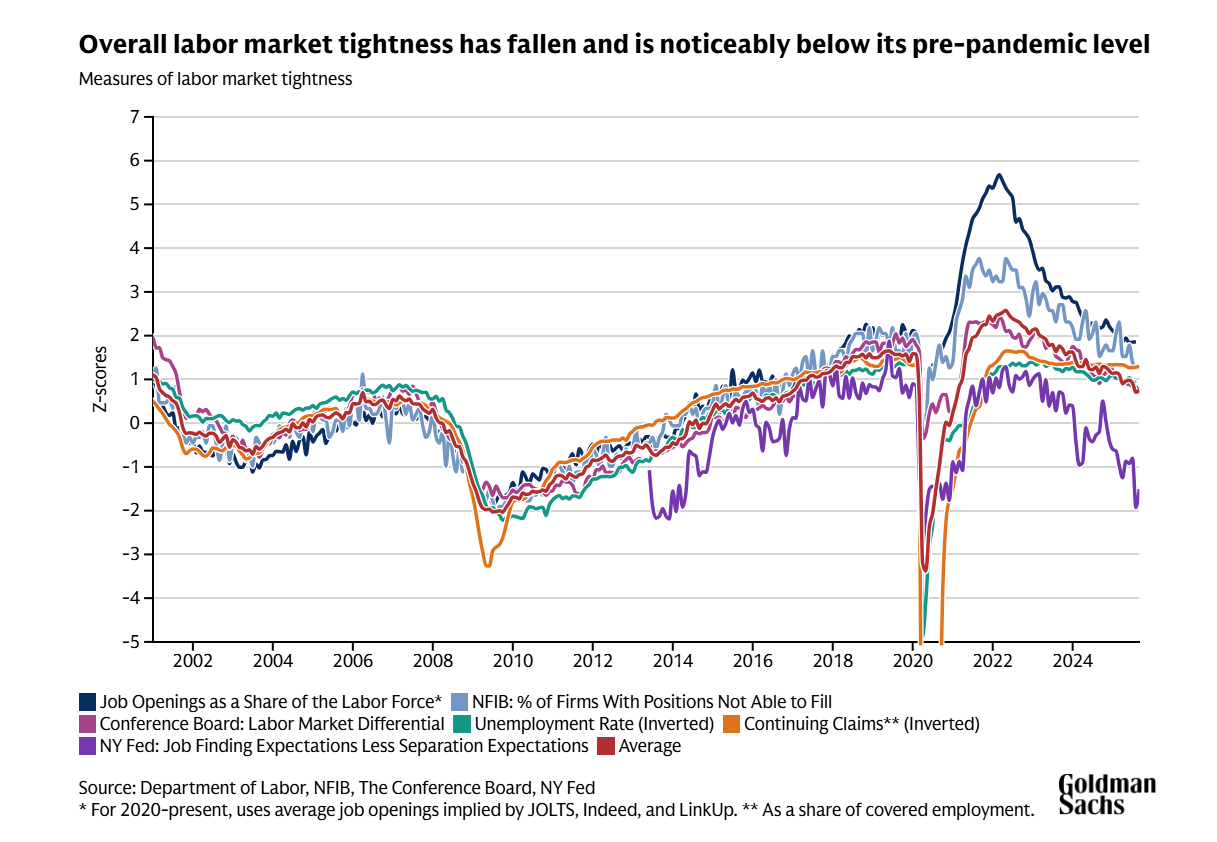
On the flip side, the labor market, which has been super tight for a while, is finally showing signs of gradual cooling. This cooling is precisely what the Fed wants to see. As the chart below illustrates, various measures of labor market tightness have fallen below their pre-pandemic levels. This suggests that the intense competition for workers is easing, which can help put less upward pressure on wages and, by extension, inflation.

Measures of Labor Market Tightness (2002-2024)

Goldman Sachs Research forecasts that the Fed will cut interest rates again in December
Source: Goldman Sachs

(This chart shows several indicators all trending downwards, indicating a less strained job market compared to recent years.)

  • Job Openings as a Share of the Labor Force: Decreasing.
  • NFIB: % of Firms With Positions Not Able to Fill: Falling.
  • Conference Board: Labor Market Differential: Lower.
  • Unemployment Rate (Inverted): While inverted charts can be tricky, the trend indicates a normalization. The actual unemployment rate has been rising slightly.
  • NY Fed: Job Finding Expectations Less Separation Expectations: Narrowing.
  • Continuing Claims (Inverted): Similar to the unemployment rate, the trend suggests a return to more normal levels.

Goldman Sachs Research looks at this data and sees that the weakness in the job market isn't just a temporary blip; they believe it's genuine. They don't expect the employment picture to change dramatically enough by the December 2025 meeting to make the FOMC decide against cutting rates.

Why a December 2025 Cut is Still On the Table

Even though Fed Chair Powell's recent press conference had a slightly more cautious tone than some expected, Goldman Sachs Chief US Economist David Mericle stands firm. He acknowledges that the conference played out a bit differently than their team anticipated, but their core forecast hasn't wavered. They still see that December rate cut as quite likely.

Mericle points out something interesting: there seems to be significant opposition within the FOMC to what they call “risk management cuts.” These are essentially proactive rate cuts meant to stave off potential economic trouble. Mericle suggests that Powell might have felt it was important to voice these internal concerns during his press conference, perhaps to manage expectations or show that the committee is considering all viewpoints.

Here's my take on it: Powell's careful wording is typical. He's like a skilled chess player, thinking several moves ahead and aware of all the different player strategies (or committee member opinions). While he might acknowledge the “wait-a-cycle” crowd, the underlying economic data—especially the cooling job market and inflation nearing the target—still supports a move to ease policy. Goldman Sachs seems to be reading the tea leaves, focusing on the data trends that point towards an easing cycle.

Looking Ahead: 2026 and Beyond

But what about 2026? Goldman Sachs isn't stopping at just one cut. They're projecting two more quarter-percentage-point (25-basis-point) cuts in March and June of 2026. This would bring their estimated terminal rate—the peak or trough of the interest rate cycle—down to a range of 3% to 3.25%.

This projection suggests that the Fed, in Goldman Sachs' view, won't just cut rates once and then pause indefinitely. They foresee a continued, albeit measured, easing path throughout the first half of 2026. This implies that the economic forces guiding the Fed's hand will likely continue to push towards lower rates for a sustained period.

Key Factors for Future Rate Decisions:

  • Inflation Trajectory: Will it stay near the 2% target, or are there risks of it ticking up again?
  • Labor Market Health: Will the cooling continue steadily, or will there be unexpected shifts?
  • Global Economic Conditions: International events can always influence the Fed's decisions.
  • Fiscal Policy: Government spending and tax policies can also impact the economy and interest rates.

The Role of Data (and Lack Thereof)

It's worth noting that the economic data landscape can be choppy. Government shutdowns, for example, can temporarily halt the release of official statistics. Powell acknowledged that some FOMC participants might see this lack of data and increased uncertainty as a reason to pause. It's a valid point: making significant policy changes without the clearest picture can be risky. However, Goldman Sachs believes the existing trends are strong enough. They expect that labor market data by December 2025 simply won't provide a “convincingly reassuring message” for those who want to hold off on cuts.

Furthermore, Mericle highlights that the Fed's own monetary policy is currently considered modestly restrictive. This restriction is helping to cool the labor market. Since the FOMC doesn't necessarily want further significant cooling to the point of widespread job losses, maintaining or even slightly reducing that restrictive stance via a rate cut makes logical sense. It's a way to achieve their goal of a balanced economy without tipping it into a downturn.

My Perspective: A Calculated Approach

From where I stand, Goldman Sachs' predictions paint a picture of a deliberate and data-driven Federal Reserve, guided by the strong desire to achieve its dual mandate (maximum employment and stable prices). While Fed officials like Powell will always hedge their bets and acknowledge dissenting views, the underlying economic momentum often dictates the path.

The cooling labor market is a significant signal. It means the Fed has more room to maneuver on interest rates without risking overheating the economy or causing a sharp rise in unemployment. The gradual approach to cuts—first in late 2025 and then into 2026—suggests they are not looking for a dramatic policy reversal, but rather a careful recalibration of monetary policy.

For anyone trying to make sense of financial markets, keeping an eye on Goldman Sachs' interest rate predictions for 2025 and 2026 is a smart move. They are known for their in-depth research and analytical prowess. While no one has a crystal ball, their forecasts provide a valuable framework for understanding the potential direction of interest rates and the economic forces at play.

Plan Smart Around Rate Forecasts – 2025 & 2026

With Goldman Sachs projecting interest rate shifts through 2025–2026, now is the time to lock in investment-grade real estate.

Norada offers high-yield turnkey properties designed to deliver stable cash flow and long-term equity growth—regardless of rate movements.

HOT NEW LISTINGS JUST ADDED!

Talk to a Norada investment counselor today (No Obligation):

(800) 611-3060

Get Started Now 

Recommended Read:

  • Interest Rate Predictions for the Next 2 Years Ending 2027
  • Interest Rate Predictions for 2025 and 2026 by Morgan Stanley
  • Interest Rates Predictions for the Next 3 Years
  • Market Reactions: How Investors Should Prepare for Interest Rate Cut
  • Interest Rate Predictions for the Next 10 Years: 2025-2035
  • Interest Rate Predictions for the Next 12 Months
  • Interest Rate Forecast for Next 5 Years: Mortgages and Savings
  • When is the Next Fed Meeting on Interest Rates?
  • Interest Rate Cuts: Citi vs. JP Morgan – Who is Right on Predictions?
  • More Predictions Point Towards Higher for Longer Interest Rates

Filed Under: Economy, Financing Tagged With: Economy, Interest Rate Forecast, Interest Rate Predictions, interest rates

Fed Interest Rate Predictions for the Next 3 Years: 2025-2027

October 20, 2025 by Marco Santarelli

Interest Rate Predictions for the Next 3 Years: 2025, 2026, 2027

As of late 2025, with the Federal Reserve having already dialed back its benchmark interest rate and bracing for another cut at its upcoming meeting, the real question on everyone's mind is: what's next for interest rates over the coming three years? We're looking at a gradual easing path, with the Fed's own projections pointing towards the federal funds rate settling around 3.1% by the end of 2027. This isn't a sudden drop, but a measured unwind as the economy continues to cool and inflation inches closer to the Fed's 2% target.

Fed Interest Rate Predictions for the Next 3 Years: 2025-2027

Stepping back from the data for a moment, I've been watching the economic tea leaves for a long time, and this current period feels like a significant pivot. We've moved beyond the aggressive hiking cycle that was designed to slam the brakes on rampant inflation. Now, the challenge is to guide the economy back to a stable, sustainable growth path without tipping it into a full-blown recession. It's a delicate dance, and the Fed’s “dot plot” – those anonymous projections from Fed officials – offers a valuable, albeit evolving, glimpse into their strategy.

The Fed's Game Plan: What the “Dots” Are Telling Us

The Federal Open Market Committee (FOMC), the Fed's main policy-setting group, releases its economic projections four times a year. The most recent update in September 2025 painted a picture of continued, but slow, rate reductions.

The median expectation, which is essentially an average of what each Fed official predicts, suggests the federal funds rate will move from its current mid-4% range down to about 3.6% by the close of 2025. Looking further out, they see it dipping to 3.4% in 2026 and then 3.1% in 2027.

What's interesting is that they also predict a “longer-run neutral rate” of 3.0%. This is the rate they believe neither stimulates nor slows down the economy. So, the projections suggest they'll end up settling near that 3% mark by 2027, a level that should support steady, non-inflationary growth.

Even when you take out the most optimistic and pessimistic predictions (the top and bottom three projections), the range for 2025 still hovers around 3.6%-4.1%. This tells me there's a general agreement on moving rates lower, but some FOMC members are definitely more cautious than others, keeping a close eye on any signs of inflation picking back up.

Wall Street's Whispers: Market Rates and What They Mean

The financial markets are always trying to get ahead of the Fed's moves, and you can see this clearly in tools like the CME FedWatch Tool. As of mid-October 2025, this tool shows an overwhelming 99.3% chance of a 25-basis-point rate cut at the upcoming FOMC meeting.

That would bring the federal funds rate to 3.75%-4.00%. Looking ahead to December 2025, there's an 89.9% probability that rates will be between 3.50% and 3.75%. This means the markets are largely in sync with the Fed's expectation of roughly two more rate cuts by the end of the year.

As we look into 2026 and 2027, market-implied probabilities suggest a continued downward trend. By the end of 2026, the market is essentially pricing in rates around 3.25%-3.50%, and by 2027, it’s nudging closer to the 3.0% mark.

These expectations are built on the assumption that inflation will continue to ease, with core PCE (a key inflation gauge) projected to be around 2.6% in 2026. Of course, if economic data takes an unexpected turn – say, the October jobs report is surprisingly strong or weak – these market probabilities can shift quite rapidly.

Beyond the Fed: What Other Experts Are Saying

It's not just the Fed and the markets. A wide range of economists and financial institutions also weigh in with their forecasts. Generally, there's a consensus that rates will come down, but the pace of those cuts is where opinions diverge.

  • Trading Economics aggregates various forecasts and suggests a similar path to the Fed, with rates potentially reaching 3.50% by the end of 2026 and 3.25% in 2027. Their view seems to be supported by the idea that consumer spending will remain relatively robust.
  • However, some, like Morningstar, are predicting a more aggressive easing cycle. They envision cuts that could bring rates down to around 2.25%-2.50% by 2027. This more dovish stance is contingent on economic growth slowing down significantly, potentially even dipping below 1.5% if the job market weakens more than expected.
  • Others, like Deloitte, in their Q3 2025 forecast, highlight the influence of government spending and deficits. They anticipate only about 50 basis points of total cuts by the end of 2025 and see longer-term rates remaining elevated due to these fiscal factors.
  • Even institutions like BlackRock tend to echo the Fed’s projections closely, emphasizing a gradual unwind and advising on portfolio adjustments in anticipation of falling yields.

Here’s a quick look at how these different perspectives stack up for the end of 2025:

Source Projected End-2025 Rate (Midpoint Midpoint %) Key Factor Driving Their View
FOMC Median 3.6 Maturing inflation, sustainable growth, balanced risks
CME FedWatch Implied ~3.625 Market pricing based on futures contracts
Trading Economics ~4.0 Consensus aggregation, stable consumer spending
Morningstar ~3.0 Deeper cuts if economic growth falters significantly
Deloitte (Q3 2025) ~3.625 Influence of fiscal policy and deficits, slower initial easing
WSJ Survey (Oct 2025) ~3.75 Anticipates faster easing with two additional 2025 cuts

You can clearly see that while everyone agrees on some easing, there's a debate about how much and how fast. This range of views highlights the inherent uncertainty in any economic forecast.

The Economic Engine Room: Growth, Inflation, and Jobs

The Fed’s decisions are fundamentally tied to its dual mandate: keeping inflation in check and maximizing employment. The projections for the next three years are based on a specific economic outlook:

  • Economic Growth: The FOMC expects GDP growth to moderate. After a certain pace in 2025, they see it picking up slightly to around 1.8% in 2026 and 1.9% in 2027. This is generally considered a healthy, sustainable rate of growth that doesn't overheat the economy. This assumes consumer spending and business investment will continue, but perhaps at a more measured pace than we saw post-pandemic.
  • Inflation: This is the big one. The projections show inflation continuing its downward trend. From around 3.0% for PCE in 2025, they expect it to ease to 2.6% in 2026 and finally reach their 2% target in 2027. Core inflation (which strips out volatile food and energy prices) is expected to follow a similar path. This cooling of inflation is crucial for justifying rate cuts. Even with supply chains normalizing, wage growth, projected at around 3.5%, remains a factor the Fed watches closely.
  • Unemployment: The job market is expected to remain relatively strong, but perhaps with a slight tick up. The FOMC projects unemployment to rise modestly to around 4.5% in 2025, before settling at a long-run rate of about 4.2%. This is often referred to as a “soft landing” scenario – where inflation is cooled without causing a significant spike in job losses.

What This Means for You, Me, and the Markets

These Fed rate predictions aren’t just abstract numbers. They have real-world consequences for all of us:

  • Borrowing Costs: Lower interest rates generally mean it becomes cheaper to borrow money. Think mortgages, car loans, and credit card interest rates. If rates fall as predicted, 30-year mortgage rates could potentially dip back below the 6% mark by mid-2026, making homeownership more accessible for some. Businesses might also find it cheaper to take out loans for expansion.
  • Savings and Investments: On the flip side, for those who rely on interest income, lower rates mean lower returns on savings accounts, certificates of deposit (CDs), and even short-term government bonds. Investors in the stock market might see a boost, as lower borrowing costs can sometimes translate into higher corporate profits and increased investor appetite for riskier assets like stocks. We've already seen the S&P 500 rally on expectations of these cuts.
  • The Dollar: A Fed that is cutting rates while other countries might not be could lead to a weaker U.S. dollar. This can make American exports cheaper for foreign buyers but make imports more expensive for us.
  • The Global Picture: For international markets, a weaker dollar can be a boon for emerging economies, making their debts easier to repay. However, it can create challenges for countries with their own currencies, impacting their trade balances.

The Unknowns: Risks That Could Change Everything

Predicting the future is always a gamble, and economic forecasting is no different. There are several potential curveballs that could derail the Fed’s projected path for interest rates:

  • Inflation Surprises: The biggest risk is that inflation proves stickier than expected. If new tariffs are imposed (perhaps due to shifts in global trade policy), or if oil prices spike due to geopolitical events, inflation could re-accelerate. In such a scenario, the Fed might have to pause its rate cuts or, in a worst-case scenario, even consider raising rates again – a prospect few are currently pricing in.
  • Economic Slowdown or Recession: On the other hand, the economy might falter more than anticipated. While the Fed aims for a soft landing, there's always a chance that higher rates for longer – or other economic shocks – could push the economy into a recession. If recession odds increase, the Fed might feel compelled to cut rates more aggressively, perhaps by larger increments than the current 25 basis points.
  • Geopolitical Instability: Events in regions like the Middle East, or any number of other global flashpoints, can have ripple effects on energy prices, supply chains, and overall economic sentiment. A significant disruption could easily impact the Fed's decisions.
  • Fiscal Policy: Government spending and debt levels also play a role. Large fiscal deficits can sometimes put upward pressure on interest rates, creating a tug-of-war with the Fed's policy.

The Fed itself acknowledges these uncertainties. In the FOMC’s September meeting minutes, for example, discussions revealed a split on the vote for the last rate cut, indicating that some participants were more concerned about inflation risks than others.

Visualizing the Interest Rate Journey

To put these predictions into context, let's visualize it. To contextualize, the following chart traces annual average federal funds rates from 2020 onward, blending historical data with FOMC median projections. Note the sharp 2022-2023 ascent and anticipated glide path. We can see the dramatic rise in rates to combat inflation, followed by the expected gradual decline.


trends of the federal funds rate and its predictions for next 3 years

And here’s a quick comparison of where different forecasters see us ending 2025:

Interest Rate Predictions for the Next 3 Years

Putting It All Together

For the next three years, the most likely scenario is a measured descent in interest rates. The Fed seems committed to a path of gradual cuts, aiming to bring inflation down without derailing economic growth. This means we'll likely see rates move from their current mid-4% range down towards the 3% mark by 2027.

However, it's crucial to remember that this is a forecast, not a guarantee. Economic data is constantly changing, and unforeseen events can quickly alter the trajectory. Staying informed about inflation reports, employment numbers, and Fed statements will be key for anyone trying to navigate these evolving interest rate predictions.

Capitalize on Easing Fed Rates with Strategic Real Estate Investments

As the Federal Reserve signals a gradual path toward lower rates—projected to reach around 3.1% by 2027—now is the time to position yourself for long-term real estate gains.

Work with Norada Real Estate to lock in opportunities in high-performing markets that thrive as borrowing costs ease—boosting your cash flow and wealth-building potential.

HOT PROPERTIES LISTED NOW!

Speak with a seasoned Norada investment counselor today (No Obligation):

(800) 611-3060

Get Started Now

Want to Know More About Interest Rates?

Explore these related articles for even more insights:

  • Fed Interest Rate Predictions Over the Next 12 Months
  • Fed Interest Rate Predictions for Q4 2025: October to December
  • Fed Interest Rate Predictions from JP Morgan for 2025 and 2026
  • Federal Reserve Cuts Interest Rate by 0.25%: Two More Cuts Expected in 2025
  • Market Reactions: How Investors Should Prepare for Interest Rate Cut
  • Interest Rate Predictions for the Next 10 Years: 2025-2035
  • When is Fed's Next Meeting on Interest Rate Decision in 2025?
  • Interest Rate Predictions for the Next 10 Years: 2025-2035
  • Interest Rate Predictions for Next 2 Years: Expert Forecast
  • Interest Rate Predictions for 2025 and 2026 by NAR Chief
  • Market Reactions: How Investors Should Prepare for Interest Rate Cut
  • Impact of Interest Rate Cut on Mortgages, Car Loans, and Your Wallet
  • Interest Rate Forecast for Next 5 Years: Mortgages and Savings
Filed Under: Economy, Financing Tagged With: Economy, Interest Rate Forecast, Interest Rate Predictions, interest rates

Interest Rate Predictions for 2025 and 2026 by Morgan Stanley

July 8, 2025 by Marco Santarelli

Interest Rate Predictions for 2025 and 2026 by Morgan Stanley

If you're wondering what the future holds for interest rates, especially in the next couple of years, you're not alone. According to insights from Morgan Stanley, as discussed in a recent “Thoughts on the Market” podcast, interest rate predictions point towards the Federal Reserve cutting rates, but potentially later and more aggressively than the market currently anticipates.

While the market prices in roughly 100 basis points of cuts by the end of 2026, Morgan Stanley's economists foresee up to 175 basis points, beginning in early 2026. This article will break down their reasoning, explore the key economic factors at play, and discuss the potential implications for investors.

Interest Rate Predictions 2025-2026 by Morgan Stanley: A Deep Dive

The Fed's Tightrope Walk: Inflation vs. Economic Growth

The Federal Reserve's primary job is to manage inflation and promote maximum employment. These two goals often pull in opposite directions. Right now, they're trying to figure out where to strike that balance.

The recent Federal Open Market Committee (FOMC) meeting highlighted this balancing act. While the Fed decided to hold the federal funds rate steady (remaining within its target range of 4.25 to 4.5 percent), their projections suggest two rate cuts by the end of 2025, followed by fewer cuts in 2026 and 2027. Think of it like driving a car – you want to keep it steady, but sometimes you need to tap the brakes or the gas to avoid a crash.

Why Morgan Stanley Expects the Fed to Cut “Late, but More”

Morgan Stanley's perspective, particularly that of U.S. Economist Michael Gapen, is that the Fed will be patient before easing monetary policy, but when they do move, they'll do so with more force than some are anticipating. Here's a breakdown of their reasoning:

  • Tariffs: Tariffs, the taxes on goods imported from other countries, introduce some tricky timing issues. They can initially push inflation higher because businesses often pass those costs onto consumers. This increase in prices can curb consumer spending. Gapen believes the Fed will first observe the inflationary effects before feeling the impact of slowing consumer activity.
  • Immigration: Changes in immigration policy also play a role. Reduced immigration means lower growth in the labor force. So, even if the overall economy slows down, The unemployment rate might not increase as much as expected. This is because there are fewer people entering the job market. The Fed will likely see inflation now, followed by a weaker labor market later, according to Morgan Stanley.
  • Fiscal Policy: Don't expect a huge boost to the economy from government spending. Current fiscal policies are not expected to lead to a big boost to growth, so the Fed can’t rely on that.

Putting it all together, Morgan Stanley believes the Fed will see inflation first and then a weaker economy. Therefore, the Fed will want to be sure that any increase in inflation is under control.

Tariffs: The Elephant in the Room

Tariffs were mentioned almost 30 times during the FOMC press conference, signaling their significant impact on the Fed's thinking. The Fed seems to be operating under the assumption of about a 14 percent effective tariff rate. According to Gapen, you can see the impact of tariffs on the Fed's forecast in three ways:

  • Higher Inflation: The Fed expects inflation to move higher, especially during the summer months. As a result, they've revised their inflation forecasts upward to about 3.0% for headline PCE (Personal Consumption Expenditures) and 3.1% for core PCE.
  • Transitory Inflation: The Fed seems to believe that the inflationary effects of tariffs will be temporary, expecting inflation to fall back toward their 2% target in 2026 and 2027.
  • Slower Economic Growth: The Fed acknowledges that tariffs will likely slow down economic growth, leading them to revise their outlook for real GDP growth downward.

Geopolitics and Oil Prices: Throwing a Wrench into the Works?

The Middle East conflict, while mentioned only a few times in the FOMC press conference, adds another layer of complexity. A spike in oil prices due to geopolitical tensions could further complicate the Fed's job.

Historically, a 10% rise in oil prices (another $10 increase) can lead to a 30 to 40 basis point increase in the year-on-year rate of headline inflation. However, the evidence suggests limited second-round effects and almost no change in core inflation.

In other words, you might see a short-term jump in gas prices, which contributes to overall inflation, but it's unlikely to create a sustained inflationary cycle. Higher gas prices do eat into consumer purchasing power, reinforcing the likelihood of slower economic growth.

Market Pricing vs. Morgan Stanley's Predictions: A Disconnect

It must be remembered that market prices are merely an average across the different paths various investors believe are most likely. The fact that market prices reflect about 100 basis points of cuts by the end of 2026, contrasting with Morgan Stanley's forecast of 175 basis points, highlights a significant difference in expectations. The market is also pricing in some rate cuts for the current year, while Morgan Stanley anticipates the first cuts in early 2026.

This disconnect creates opportunities for investors who align with Morgan Stanley's view.

Yield Curve Implications: Lower Treasury Yields Ahead?

Morgan Stanley projects Treasury yields to move lower, starting in the fourth quarter of this year, aligning with their expected timing of the Fed's first rate cuts in early 2026. They anticipate the 10-year Treasury yield to end this year around 4% and end 2026 closer to 3%.

While the timing of this decline is subject to change, their conviction lies in the direction—lower yields are likely ahead. This suggests investors should start preparing for lower Treasury yields now.

The U.S. Dollar: Heading South?

Morgan Stanley expects the U.S. dollar to depreciate another 10% over the next 12 to 18 months, building on the roughly 10% decline it experienced in the first six months of the current year.

Geopolitical events, particularly those impacting energy prices, could influence this outlook. A significant rise in crude oil prices could benefit countries that are net exporters of oil and hurt those that are net importers. While the U.S. is somewhat neutral in this regard, a surge in energy prices could lead to a temporary pause in the dollar's depreciation.

My Take: Navigating Uncertainty with Informed Decisions

Predicting the future is a fool's errand, especially when it comes to something as complex as interest rates. However, analyzing the viewpoints of economic experts like those at Morgan Stanley can give us a valuable perspective. Here's what I would focus on when investing:

  • Inflation Data: Closely monitor inflation reports, particularly the PCE index, to confirm whether inflation is indeed proving to be transient, as economists are expecting. Any deviation from this path may lead to significant revision in these predictions.
  • Employment Figures: Pay attention to revisions and trends related to employment rates. If there's contraction, the Fed’s hand might be forced to cut rates more than anticipated.
  • Global Factors: Stay informed about potential international developments. Since they impact the dollar, they indirectly also influence rates, inflation, and eventually growth.

Prepare for Interest Rate Shifts with Smart Real Estate Investments

As forecast by experts predict up to 175 basis points in interest rate cuts by 2026, the window for locking in profitable real estate investments is now.

Norada offers turnkey rental properties in stable, cash-flowing markets—helping you capitalize on today’s rates before they potentially drop further.

HOT NEW LISTINGS JUST ADDED!

Speak with a Norada investment counselor today (No Obligation):

(800) 611-3060

Get Started Now 

Recommended Read:

  • Interest Rates Predictions for the Next 3 Years: 2025-2027
  • Fed Projects Two Interest Rate Cuts Later in 2025
  • Market Reactions: How Investors Should Prepare for Interest Rate Cut
  • Interest Rate Predictions for the Next 10 Years: 2025-2035
  • Will Mortgage Rates Go Down in 2025: Morgan Stanley's Forecast
  • Interest Rate Predictions for Next 2 Years: Expert Forecast
  • Interest Rate Predictions for the Next 12 Months
  • Interest Rate Forecast for Next 5 Years: Mortgages and Savings
  • When is the Next Fed Meeting on Interest Rates?
  • Interest Rate Cuts: Citi vs. JP Morgan – Who is Right on Predictions?
  • More Predictions Point Towards Higher for Longer Interest Rates

Filed Under: Economy, Financing Tagged With: Economy, Interest Rate Forecast, Interest Rate Predictions, interest rates

Interest Rate Forecast for Next 10 Years: 2025-2035

February 18, 2025 by Marco Santarelli

Interest Rate Predictions for Next 10 Years: Expert Weigh In!

If you're looking for a quick answer, here it is: The Interest Rate Forecast for the Next 10 Years suggests a gradual decline in interest rates initially, followed by a period of stabilization and then a slow climb back up. Experts believe the Federal Reserve will begin cutting rates in 2025, aiming for a long-term target of around 2% by 2027, but rates may rise again in the early 2030s. That said, let's dig into the details, because the economic road ahead is rarely a straight line.

Interest Rate Forecast for Next 10 Years: Are Lower Rates on the Horizon?

Ever wondered how much those little numbers – interest rates – can impact your life? From the mortgage on your home to the savings account you're diligently contributing to, interest rates are the silent influencers of our financial well-being. The Federal Reserve (the Fed), the central bank of the United States, has a significant role to play in deciding the direction of the interest rates, and it's therefore crucial to stay updated with the changes. So, let's buckle up and explore the projected path of interest rates over the next decade and what it all means for you.

Where Are Interest Rates Right Now? A Quick Snapshot

As of February 2025, the Fed's target federal funds rate sits between 4.25% and 4.5%. This is a key rate because it influences what banks charge each other for overnight lending, and that, in turn, affects a whole host of other interest rates that we see every day.

Now, there's a general expectation that the Fed will start lowering rates sometime in 2025. The reason? Inflation seems to be cooling down, and economic growth isn't quite as hot as it used to be. Think of it like this: the Fed is trying to find the sweet spot where the economy is growing at a healthy pace, but prices aren't rising too quickly.

A Year-by-Year Look: Projecting Interest Rates from 2025 to 2035

Okay, time for the meat and potatoes! I've put together a table showing the projected interest rates for the next decade, along with the likelihood of the Fed cutting rates in each of those years:

Year Projected Federal Funds Rate Probability of Rate Cut (%)
2025 3.75% – 4.00% 70
2026 3.00% – 3.25% 80
2027 2.00% – 2.25% 90
2028 2.00% – 2.25% 85
2029 2.25% – 2.50% 60
2030 2.50% – 2.75% 55
2031 2.75% – 3.00% 50
2032 3.00% – 3.25% 45
2033 3.25% – 3.50% 40
2034 3.50% – 4.00% 30
2035 4.00% – 4.25% 20

Let's break down what this table is telling us:

  • 2025: We're likely to see the start of rate cuts, bringing the federal funds rate down a bit. This is the Fed reacting to inflation cooling off.
  • 2026: The cuts continue, potentially bringing the rate down further. The Fed is probably trying to encourage more economic activity.
  • 2027: The Fed might be close to its long-term target for interest rates. This is the level where they believe the economy can grow steadily without inflation getting out of hand.
  • 2028-2029: A period of stability might be on the horizon. The Fed could take a “wait and see” approach to assess the impact of the earlier rate cuts. It is also possible that a slight upward movement may begin as growth pressures emerge.
  • 2030-2031: The forecasts indicate a gradual upward adjustment. As the economic expansion gains traction, the federal funds rate could edge higher.
  • 2032-2033: To combat potential inflation or overheating of the economy, the Fed may increase interest rates again.
  • 2034-2035: As the economy matures, projections suggest rates could stabilize closer to historical norms. The probability of cuts is reduced.

Keep in mind: These are just projections! The future is never set in stone. There are many factors that could change these numbers.

A Decade of Change: How Fed Interest Rates Evolved (2014-2024)

The decade from 2014 to 2023 witnessed a dynamic shift in Federal Reserve (Fed) interest rate policy, moving away from the unprecedented low rates implemented in the wake of the 2008 financial crisis. Here's a detailed overview:

  • 2014-2015: Tapering and Initial Hike: This period signified the end of the zero-interest-rate policy (ZIRP) era. After years of maintaining near-zero rates to support the economic recovery, the Fed began signaling its intention to normalize monetary policy. In December 2015, the Fed cautiously initiated its rate-hiking cycle, raising the target federal funds rate from a range of 0% to 0.25% to a range of 0.25% to 0.50%. This move reflected growing confidence in the strength of the labor market and the overall economy.
  • 2016-2018: Gradual Normalization: The Fed continued its gradual approach to raising interest rates throughout this period, implementing measured increases at several Federal Open Market Committee (FOMC) meetings. By December 2018, the target range had reached 2.25% to 2.50%. These increases were driven by sustained economic growth, a declining unemployment rate, and the Fed's efforts to manage inflation and prevent the economy from overheating.
  • 2019: A Pivot to Accommodation: As economic growth slowed and global uncertainties increased, the Fed adopted a more dovish stance in 2019. After multiple rate hikes in prior years, the central bank paused its tightening cycle and subsequently lowered interest rates three times during the year. By year-end, the target range had been reduced to 1.50% to 1.75%. The Fed cited concerns about global economic developments, trade tensions, and muted inflation as reasons for its policy shift.
  • 2020-2023: Crisis Response and Extended Accommodation: The onset of the COVID-19 pandemic in early 2020 triggered a sharp economic contraction. In response, the Fed aggressively slashed interest rates back to near zero (0% to 0.25%) to cushion the economic blow, support financial markets, and encourage borrowing and investment. This ultra-low rate environment persisted for several years as the Fed focused on fostering a strong and inclusive recovery. In 2022 and 2023, the Fed aggressively raised rates to combat rising inflation.

The Crystal Ball: What Influences Interest Rate Decisions?

So, what makes the Fed tick? What factors do they consider when deciding whether to raise, lower, or hold steady on interest rates? Here are a few of the big ones:

  • Inflation: This is the big kahuna. If prices are rising too quickly, the Fed will often raise interest rates to slow things down. They want to keep inflation around 2%.
  • Economic Growth: The Fed also wants the economy to grow at a healthy pace. If growth is too slow, they might lower rates to encourage borrowing and spending.
  • Labor Market Conditions: A strong job market with lots of hiring and rising wages can put upward pressure on inflation. The Fed will keep a close eye on unemployment rates, job growth, and wage trends.
  • Global Economic Factors: The world is interconnected. What happens in other countries can affect the U.S. economy. Geopolitical instability, trade wars, or economic slowdowns in major economies can all influence the Fed's decisions.
  • Financial Stability: The Fed also wants to make sure the financial system is stable. Big market crashes or banking crises can prompt them to lower rates to provide support.

My Two Cents: Some Personal Thoughts on the Road Ahead

Now, I'm not an economist with a fancy degree. But I've been following the economy for a while, and here are a few of my personal thoughts on what might happen:

  • Inflation Will Be Key: I think whether the Fed can successfully bring inflation down to its 2% target will be the biggest driver of interest rate decisions over the next few years. If inflation proves stubborn, we could see interest rates stay higher for longer than expected.
  • The Global Economy is a Wildcard: There's a lot of uncertainty in the world right now, from geopolitical tensions to potential trade disruptions. These factors could easily throw a wrench into the Fed's plans.
  • Don't Expect a Quick Return to “Normal”: After a period of historically low interest rates, I think it's unlikely that we'll see rates return to those levels anytime soon. The economy has changed, and the Fed's approach may need to change with it.

What Does This Mean for You?

Okay, enough with the economic jargon! Let's talk about how these potential interest rate changes could affect your life:

  • Mortgages: Lower interest rates mean lower mortgage payments. If you're thinking about buying a home or refinancing your existing mortgage, keep an eye on interest rate trends.
  • Savings Accounts: Higher interest rates on savings accounts are good news for savers. You'll earn more money on your deposits.
  • Loans: Interest rates on car loans, personal loans, and credit cards are also affected by the Fed's decisions. Lower rates can make it cheaper to borrow money.
  • Investments: Interest rates can also influence the stock market and other investments. Lower rates can sometimes boost stock prices, while higher rates can have the opposite effect.

Staying Informed: Resources for Further Reading

If you want to dig deeper into this topic, here are a few resources I recommend:

  • CBO Budget and Economic Outlook
  • Federal Reserve Economic Projections

These websites provide a wealth of information on the economy and the Fed's policies.

The Bottom Line

The Interest Rate Forecast for the Next 10 Years points towards a period of gradual adjustments as the Fed tries to navigate the complex economic landscape. It's not a simple situation, but understanding the key factors and following the trends can help you make smarter financial decisions.

Remember, I'm just a regular person sharing my thoughts. This is not financial advice. Always do your own research and consult with a qualified financial advisor before making any major decisions.

Navigate a Decade of Shifting Interest Rates with Norada

As the Interest Rate Forecast for the Next 10 Years signals market changes, turnkey real estate investments provide a stable income source.

Capitalize on high-quality, ready-to-rent properties designed to deliver consistent returns even amid economic fluctuations.

Speak with our expert investment counselors (No Obligation):

(800) 611-3060

Get Started Now 

Recommended Read:

  • Fed Cuts Interest Rates by 25 Basis Points: What It Means for You
  • Interest Rates Predictions for 5 Years: Where Are Rates Headed?
  • Projected Interest Rates in 5 Years: A Look at the Forecasts
  • Fed's Powell Hints of Slow Interest Rate Cuts Amid Stubborn Inflation
  • Fed Funds Rate Forecast 2025-2026: What to Expect?
  • Interest Rate Predictions for 2025 and 2026 by NAR Chief
  • Market Reactions: How Investors Should Prepare for Interest Rate Cut
  • Interest Rate Predictions for the Next 3 Years: (2024-2026)
  • Interest Rate Predictions for Next 2 Years: Expert Forecast
  • Impact of Interest Rate Cut on Mortgages, Car Loans, and Your Wallet

Filed Under: Economy, Financing Tagged With: Economic Forecast, Fed, Fed Fund Rate, Federal Reserve, inflation, Interest Rate, Interest Rate Forecast, Interest Rate Predictions

Real Estate

  • Birmingham
  • Cape Coral
  • Charlotte
  • Chicago

Quick Links

  • Markets
  • Membership
  • Notes
  • Contact Us

Blog Posts

  • Recession in Real Estate: Smart Ways to Profit in a Down Market
    December 13, 2025Marco Santarelli
  • Today’s Mortgage Rates, December 13: Rates Remain Steady Across the Board
    December 13, 2025Marco Santarelli
  • Falling Mortgage Rates Fuel Momentum in Rental Property Investment
    December 13, 2025Marco Santarelli

Contact

Norada Real Estate Investments 30251 Golden Lantern, Suite E-261 Laguna Niguel, CA 92677

(949) 218-6668
(800) 611-3060
BBB
  • Terms of Use
  • |
  • Privacy Policy
  • |
  • Testimonials
  • |
  • Suggestions?
  • |
  • Home

Copyright 2018 Norada Real Estate Investments

Loading...

