Norada Real Estate Investments

  • Home
  • Markets
  • Properties
  • Membership
  • Podcast
  • Learn
  • About
  • Contact

How a 1% Drop in Mortgage Rates Could Unlock 5.5 Million Buyers

January 7, 2026 by Marco Santarelli

How a 1% Drop in Mortgage Rates Could Unlock 5.5 Million Buyers

Imagine finally finding that perfect house, picturing your life there, only to realize the monthly payments are just out of reach. It’s a story many potential homebuyers know all too well these days. But what if things could change? Well, it turns out that even a seemingly small shift, like a 1% drop in mortgage rates, could make a huge difference, potentially opening the door for millions of people to buy a home.

Yes, according to research from the National Association of REALTORS® (NAR), a 1% decrease in mortgage rates could add about 5.5 million households to the pool of potential buyers, including 1.6 million renters who might finally be able to make the leap into homeownership. This is exciting news for anyone feeling priced out of the market right now.

How a 1% Drop in Mortgage Rates Could Unlock 5.5 Million Buyers

Why All the Fuss About Mortgage Rates?

You’ve probably heard a lot about mortgage rates lately. They've been a major topic because they directly impact how much house you can afford. Think of it like this: the mortgage rate is the price you pay to borrow the money needed to buy your home. When that price goes up, your monthly payments go up significantly.

For a while now, we've been dealing with a double whammy: home prices shot up, and then mortgage rates followed suit. The National Association of REALTORS® pointed out that between mid-2022 and the end of 2023, average rates jumped from around 3% to over 7%. What does that mean in real dollars? For many people, it meant their monthly mortgage payment jumped by more than $1,000 compared to what they might have paid before the pandemic. Ouch.

From my perspective, this surge in costs effectively put many potential buyers on pause. They were ready and willing, but the numbers just didn't work anymore. It created what experts call an affordability crunch, freezing many buyers in their tracks.

Breaking Down the Numbers: What's a 1% Drop Worth?

Okay, let's talk specifics. How much difference does that 1% really make? It’s more than you might think.

Let’s look at an example cited by Matt Schulz, LendingTree’s chief consumer finance analyst. Suppose you're buying a $500,000 home and manage a 10% down payment ($50,000), leaving you needing a $450,000 mortgage.

  • At a 7% interest rate: Your estimated monthly payment for principal and interest would be around $3,895.
  • If rates dropped to 6.25%: That same loan would mean a monthly payment of about $3,672.

That's a saving of $223 per month. Now, imagine if rates dropped even further, say, to 6%. Based on calculations, the principal and interest payment on that same $450,000 loan could fall closer to $2,700 per month. That’s a potential saving of nearly $1,200 per month compared to the 7% rate!

While the ultra-low rates of 2020-2021 are likely behind us, a drop of 1% from current levels is a pretty big deal. NAR's research highlights that this kind of change could make homeownership achievable for millions more households. They estimate that 5.5 million households could be added to the potential buyer pool. Out of that group, a significant portion – 1.6 million – are renters who might finally see a path to owning their own place.

My take on this? It’s not just about saving a few bucks. It's about shifting the dream of homeownership from “maybe someday” to “maybe next year.” It changes the whole affordability equation for a massive number of people.

Who Gets the Biggest Boost?

When mortgage rates decrease, certain groups benefit more than others:

  • First-Time Home Buyers: This group often has less equity built up and may be stretching their budget to afford a home. They are often the most sensitive to monthly payment changes. Rising rents have made saving for a down payment even harder, so a lower rate that reduces the monthly mortgage payment can be the key factor in making a purchase possible.
  • Current Homeowners Looking to Move: Many homeowners refinanced or bought homes when rates were historically low. They might be hesitant to sell now because moving would mean taking out a new, much higher-rate mortgage. However, if rates drop significantly (like by 1%), it could lessen the “lock-in effect.” This might encourage them to sell their current homes, which in turn adds more properties to the market – increasing housing inventory for everyone. NAR economist Nadia Evangelou notes that lower rates help “both first-time buyers and current homeowners take the next step.”

It seems like a potential drop in rates could be a catalyst for activity across the board, helping people move up, move down, or buy for the very first time.

Are People Already Responding to Lower Rates?

It’s not just theoretical. Real estate professionals are already seeing signs that buyers are sensitive to rate changes.

Brad O’Connor, chief economist at Florida REALTORS®, shared during a recent NAR event that Florida saw a roughly 10% year-over-year increase in home sales this past fall. This uptick happened right when mortgage rates were starting to come down, hovering around 6.25%. Pending home sales in Florida were even up by 23% in October compared to the previous year. “We’re encouraged by how we see people are responding to lower interest rates already,” O’Connor mentioned.

Similarly, Ryan Price, chief economist at Virginia REALTORS®, noted a similar trend in his state. He observed an increase in sales in the fall that coincided with improved mortgage rates in September. He called these “early glimmers of hope” for what might come next year.

Personally, I’ve been hearing similar stories from agents and buyers in my area. When there’s even a hint of better affordability, the phones start ringing, and showings pick up. It really shows that pent-up demand is just waiting for the right conditions.

What’s the Crystal Ball Saying About Mortgage Rates?

So, will rates actually drop significantly? The National Association of REALTORS® has a forecast suggesting that mortgage rates could fall to around 6% in 2026.

This prediction takes into account several economic factors, including:

  • Potential cuts to the Federal Reserve's short-term interest rates.
  • Ongoing trends in inflation.
  • Government spending and national debt levels.
  • Global trade impacts (like tariffs).
  • The Federal Reserve’s management of its balance sheet (quantitative tightening).
  • The performance of the 10-year Treasury yield, which is a key indicator for mortgage rates.

While predicting the future is tricky, this forecast offers a hopeful outlook for potential homebuyers.

Deep Dive: How a 1% Drop in Mortgage Rates Could Unlock 5.5 Million Buyers in Your Area

NAR’s analysis digs deeper, looking at how specific metro areas could be impacted if rates were to drop from, say, 7% down to 6%. It's not just about the national numbers; the effect can be felt differently from place to place.

Generally, a rate decrease means more households can afford the monthly payments associated with the median-priced home in that area. Here are some of the areas predicted to see the biggest jump in qualifying households from a 1% rate drop:

  • Kalamazoo-Portage, Mich.: Potential for an 8% increase in households qualifying to buy.
  • Yuma, Ariz.: 7.5% increase.
  • Racine, Wis.: 7.5% increase.
  • Hilton Head Island-Bluffton, S.C.: 7.4% increase.
  • Rochester, Minn.: 7.4% increase.

Let's look at some specific examples provided by NAR to see the potential impact:

New York-Newark-Jersey City, NY-NJ-PA

  • A 1% drop (from 7% to 6%) could increase the share of households qualifying to buy by 3.8%.
  • This means roughly 285,972 more households could afford the median-priced home.
  • If just 10% of these newly qualified households buy, that could lead to approximately 28,597 additional home sales in the next year or two.

Atlanta-Sandy Springs-Alpharetta, GA

  • A 1% rate drop could boost the number of qualifying households by 5.4%.
  • An estimated 126,038 more households would gain affordability.
  • This could translate to about 12,604 additional home sales.

Dallas-Fort Worth-Arlington, TX

  • This area might see a 4.9% increase in qualifying households with a 1% rate drop.
  • Around 144,734 more households could afford the median home.
  • An estimated 14,473 additional sales could result.

Los Angeles-Long Beach-Anaheim, CA

  • Here, a 1% drop could mean 2.7% more households qualifying.
  • That's about 122,864 additional households affording the median home.
  • Projected additional sales could be around 12,286.

San Jose-Sunnyvale-Santa Clara, CA

  • A similar rate drop could add 2.9% to the qualifying household share.
  • This translates to about 19,835 more households qualifying.
  • Potentially leading to 1,984 additional home sales.

(Note: These figures are based on NAR's analysis and projections. Actual impacts can vary.)

These examples illustrate the significant ripple effect lower rates can have, not just on individual buyers but on the overall market activity in major metropolitan areas.

My Thoughts: A Welcome Shift for Homeownership

As someone who follows the housing market closely, the potential impact of a 1% drop in mortgage rates is genuinely significant. While 6% is still higher than the rock-bottom rates we saw a few years ago, it represents a substantial improvement in affordability compared to the 7%+ rates.

This research from NAR gives me confidence that the market is dynamic. It shows that when affordability improves, people respond. Bringing 5.5 million potential buyers back into consideration could lead to a more balanced market, provide much-needed opportunities for aspiring homeowners, and help existing owners make their next move. It’s a crucial step towards making the dream of homeownership accessible again for a much larger slice of the population. If rates continue on the predicted downward trend, 2026 could indeed be a pivotal year for the housing market.

🏡 Which Rental Property Would YOU Invest In?

Lebanon, TN
🏠 Property: Baltusrol Lane #852
🛏️ Beds/Baths: 4 Bed • 2.5 Bath • 2011 sqft
💰 Price: $369,990 | Rent: $2,400
📊 Cap Rate: 5.8% | NOI: $1,789
📅 Year Built: 2024
📐 Price/Sq Ft: $184
🏙️ Neighborhood: B

VS

San Antonio, TX
🏠 Property: Salz Way
🛏️ Beds/Baths: 3 Bed • 2 Bath • 2330 sqft
💰 Price: $384,999 | Rent: $2,375
📊 Cap Rate: 4.1% | NOI: $1,324
📅 Year Built: 2019
📐 Price/Sq Ft: $166
🏙️ Neighborhood: A

Tennessee’s balanced rental vs Texas’s larger home with lower cap rate. Which fits YOUR investment strategy?

We have much more inventory available than what you see on our website – Let us know about your requirement.

📈 Choose Your Winner & Contact Us Today!

Talk to a Norada investment counselor (No Obligation):

(800) 611-3060

Contact Us Now

Also Read:

  • Mortgage Rates Predictions Backed by 7 Leading Experts: 2025–2026
  • Mortgage Rate Predictions for the Next 3 Years: 2026, 2027, 2028
  • 30-Year Fixed Mortgage Rate Forecast for the Next 5 Years
  • 15-Year Fixed Mortgage Rate Predictions for Next 5 Years: 2025-2029
  • Will Mortgage Rates Ever Be 3% Again in the Future?
  • Mortgage Rates Predictions for Next 2 Years
  • Mortgage Rate Predictions for Next 5 Years
  • Mortgage Rate Predictions: Why 2% and 3% Rates are Out of Reach
  • How Lower Mortgage Rates Can Save You Thousands?
  • How to Get a Low Mortgage Interest Rate?
  • Will Mortgage Rates Ever Be 4% Again?

Filed Under: Financing, Mortgage Tagged With: mortgage, mortgage rates

Experts Predict Little Chance of Mortgage Rates Dropping Below 6% in 2026

January 7, 2026 by Marco Santarelli

Experts Predict Little Chance of Mortgage Rates Dropping Below 6% in 2026

If so, you're probably wondering what's going to happen with mortgage rates. It's the million-dollar question, right? Well, I've been looking closely at the latest forecasts, especially the 30‑year mortgage rate predictions for 2026 by Zillow, Redfin, and Realtor.com. And here's the headline takeaway I'm getting: most experts think the average 30-year fixed mortgage rate will likely settle around 6.3% in 2026. It’s not a huge drop, but it might be just enough to make things a bit easier for buyers.

As we wrap up 2025, the housing market feels like it's finally catching its breath after a few wild years. Remember when rates shot up past 7%? Ouch. Thankfully, the Federal Reserve's moves this year have brought rates down into the mid-6% range. But that dream of getting back to those super-low rates we saw a few years ago? That still seems unlikely for now.

This 6.3% prediction from Zillow, Redfin, and Realtor.com suggests a gradual cooling off, more of a steady adjustment than a sudden boom or bust. I'll be sharing my own thoughts and insights based on what I'm seeing in the market data and hearing from these major real estate players.

Experts Predict Little Chance of Mortgage Rates Dropping Below 6% in 2026

What the Experts Are Saying About 2026 Mortgage Rates

It’s interesting how closely Zillow, Redfin, and Realtor.com seem to agree on the main point: rates are expected to ease slightly, but probably not dramatically drop below 6% for any extended period in 2026. Think of it as a gentle nudge towards better affordability rather than a wide-open door.

Here’s a quick look at their general outlook:

Platform Projected 2026 Average Rate Key Rate Range/Scenarios Impact on Payments (Estimated)
Zillow Around 6.3% (unlikely below 6%) Lingers in the low- to mid-6% range Modest improvement
Redfin 6.3% Mostly low-6% range, brief dips <6% Slight affordability boost
Realtor.com 6.3% Stays in the low-6% range ~1.3% payment reduction

What strikes me is this consistent forecast. It tells me that the underlying economic forces are pointing in a similar direction for all these groups. They're all looking at factors like inflation, the Federal Reserve's actions, and the overall health of the economy.

Historical and Projected 30-Year Fixed Mortgage Rates (2010-2026)

Zillow's team, who pay close attention to things like rent prices (a big part of inflation), are really emphasizing that inflation isn't going away completely. This is a major reason they don't see rates diving below 6%. They believe the bond market, which heavily influences mortgage rates, will keep rates somewhat anchored above that psychological threshold.

Redfin talks about a “Great Housing Reset,” and their prediction fits right into that. They see rates averaging 6.3%, maybe dipping slightly below 6% here and there, but not staying there. It suggests a market finding a more stable footing.

Realtor.com's forecast is right on the money at 6.3% too. They highlight that this could mean a noticeable drop in monthly payments—around 1.3% less for the typical homebuyer compared to 2025. That might not sound huge, but trust me, when you're talking about mortgage payments, every little bit helps!

Why Are Rates Predicted to Be Around 6.3%?

It's easy to just throw out a number, but why do these experts think this? Several big economic factors are at play. Based on my reading and experience, here are the main ones shaping the 2026 mortgage rate predictions:

  • The Federal Reserve's Balancing Act: The Fed has been raising interest rates to fight inflation. Now, they've started cutting them, which helps lower mortgage rates. But they're being cautious. They've signaled they'll likely cut rates more in 2025, maybe 50 to 75 basis points total. However, they don't want to cut too fast or too deep, especially if inflation starts ticking up again. By late 2025, they might reach a “neutral” rate – not actively trying to slow the economy down, but not stimulating it either. This neutrality means less downward pressure on mortgage rates.
  • Inflation Still Lingers: Even with rate cuts, inflation hasn't completely vanished. Costs for things like rent and housing services are still a bit stubborn. Since mortgage rates are closely tied to the yields on government bonds (like the 10-year Treasury), and those yields are sensitive to inflation fears, rates are likely to stay higher than they were a few years ago. Think of it like this: if investors think inflation will eat away at their returns, they'll demand higher interest rates on bonds, and that pushes mortgage rates up.
  • The Economy is Okay, But Not Amazing: We're seeing slowing economic growth and unemployment ticking up slightly (maybe around 4.5%). This is actually one reason the Fed can cut rates. But the job market is still pretty solid, with decent job creation each month. This resilience prevents a sharp economic downturn that might force rates much lower. It’s a Goldilocks scenario – not too hot, not too cold – which often leads to moderate rate environments.
  • Worries About Debt and Global Stability: The U.S. has a lot of government debt, and that can sometimes put upward pressure on interest rates. Plus, global issues – like trade tensions or conflicts – can create uncertainty. When the world feels shaky, investors often move money to safer assets, which can affect bond yields and, consequently, mortgage rates. These factors act as a brake, preventing rates from falling too drastically.
  • What's Happening in Housing Itself: Even though rates are higher, there still aren't enough homes for sale in many areas. This shortage keeps demand relatively strong, which can indirectly support mortgage rates by preventing a steep drop in home prices.

From my perspective, it’s this mix of factors – the Fed trying to be careful, inflation not totally gone, a steady economy, and some lingering global/debt concerns – that creates the consensus for rates hovering in that low-to-mid-6% range.

What Does This Mean for the Housing Market? A “Reset,” Not a “Boom”

So, what’s the practical impact of these 30‑year mortgage rate predictions? The word I keep hearing from these experts is “reset.” It suggests a market that's becoming more balanced, not one that's suddenly going to take off like a rocket.

Here’s what I expect we might see:

  • More Homes Selling: With rates slightly lower, some buyers who were priced out or waiting on the sidelines might jump back in. Zillow predicts around 4.26 million existing-home sales, Redfin is looking at about 4.2 million, and Realtor.com forecasts 4.13 million. This is a modest increase, maybe 1-4% higher than in 2025. It’s driven by the fact that buyers could potentially save tens of thousands of dollars over the life of their loan compared to earlier peaks.
  • Home Prices Stabilize: Forget huge price jumps. Experts are predicting price growth to slow down to about 1-2.2% nationally. Realtor.com sees prices going up maybe 2.2%, Redfin forecasts just 1%, and Zillow is around 1.2%. This is good news because it means incomes might start keeping pace with, or even slightly outpacing, home price increases for the first time in a while.
  • Refinancing Picks Up: Many homeowners refinanced when rates were at historic lows a few years back. Now, with rates expected to be in the mid-6% range, some of those folks might find a reason to refinance again if rates dip into the high 5% or very low 6% range. Redfin, for instance, sees refinancing activity jumping significantly. This could help homeowners lower their monthly payments.
  • A Better Balance for Buyers and Sellers: We might see a slight increase in the number of homes available for sale (maybe 15-20% more). This could ease the intense competition buyers have faced. However, I suspect a significant chunk of potential buyers, especially younger ones like millennials, might still struggle with affordability, even with slightly lower rates. Builders might continue offering incentives like mortgage rate buydowns to attract buyers.

I personally feel this gradual adjustment is healthier for the market long-term. It helps prevent another bubble and allows things to stabilize after the craziness of the pandemic and the subsequent rate hikes.

Not All Areas Are the Same: Regional Differences Matter

It’s crucial to remember that these national averages don't tell the whole story. My experience shows that real estate is always local.

  • Midwest vs. Sun Belt: You might find better affordability and more stable rates in Midwestern cities, where home prices are generally lower. Places like Indianapolis could see rates around 6.2% with payments dropping. On the flip side, popular Sun Belt areas like Phoenix might continue to see rates slightly higher, maybe closer to 6.5%, and still experience some price growth.
  • Value Opportunities: Zillow points out cities like Buffalo, NY, that might see home values increase despite higher rates, maybe by 3.5%. These are often places where prices haven’t skyrocketed as much. Conversely, areas like Austin, TX, might see prices soften slightly (-0.5%).
  • Coastal Hubs: Expect sticker shock to remain a challenge in major coastal cities where demand is high and prices are already expensive. Even with a 6.3% rate, monthly payments could easily be $3,000 or more.

Conclusion: A Steady Path Forward

Looking at the 30‑year mortgage rate predictions for 2026, I feel cautiously optimistic. The consensus points towards a gradual cooling, settling around 6.3%. This isn't the super-low rate environment of the past, but it’s a step towards better balance and affordability after a period of intense fluctuation.

This forecast suggests a housing market focused on sustainable growth rather than speculative frenzy. While unexpected economic events can always shake things up, 2026 appears poised to be a year of steady progress for those looking to make a move in real estate. It’s a good time to be informed, do your homework, and make strategic decisions based on the best data available.

From Cash to Cash Flow: Build Hassle‑Free Passive Income

Invest once, collect monthly — a simple way to turn your capital into steady, hassle‑free passive income.

Norada Real Estate helps you seize this rare opportunity with turnkey rental properties in strong markets—so you can build passive income while borrowing costs remain historically low.

🔥 HOT NEW Properties JUST ADDED! 🔥

Talk to a Norada investment counselor today (No Obligation):

(800) 611-3060

Get Started Now

Also Read:

  • Mortgage Rates Predictions for 2026: Insights from Leading Forecasters
  • Mortgage Rates Predictions Backed by 7 Leading Experts: 2025–2026
  • Mortgage Rate Predictions for the Next 3 Years: 2026, 2027, 2028
  • 30-Year Fixed Mortgage Rate Forecast for the Next 5 Years
  • 15-Year Fixed Mortgage Rate Predictions for Next 5 Years: 2025-2029
  • Will Mortgage Rates Ever Be 3% Again in the Future?
  • Mortgage Rates Predictions for Next 2 Years
  • Mortgage Rate Predictions for Next 5 Years
  • Mortgage Rate Predictions: Why 2% and 3% Rates are Out of Reach
  • How Lower Mortgage Rates Can Save You Thousands?
  • How to Get a Low Mortgage Interest Rate?
  • Will Mortgage Rates Ever Be 4% Again?
Filed Under: Financing, Mortgage Tagged With: Interest Rate, mortgage, Mortgage Rate Trends, mortgage rates, Mortgage Rates Today

Mortgage Rate Predictions for 2026: What Leading Forecasters Expect

January 7, 2026 by Marco Santarelli

Mortgage Rate Predictions for 2026: What Leading Forecasters Expect

The question on everyone’s mind, especially if you're dreaming of homeownership or looking to refinance: what will mortgage rates do by 2026? Based on current economic indicators and expert analysis, mortgage rates in 2026 are expected to see a modest decline, likely hovering between 5.9% and 6.5% for a 30-year fixed loan. While a significant drop below 6% isn't a certainty, this anticipated easing offers a glimmer of hope for a more accessible housing market.

Mortgage Rate Predictions for 2026: What Leading Forecasters Expect

As I look at the data and speak with folks who follow this stuff closely, it feels like we're moving from a period of significant upward pressure on rates to a more stable, slowly descending path. It’s not a freefall, mind you, but it’s definitely a move in the right direction after the highs we’ve seen. This isn't just about numbers; it's about how people can afford their homes, build equity, and participate in the American dream.

The Road Behind Us: From Pandemic Perks to Pricey Mortgages

To understand where we're headed, we have to look back at how we got here. Remember those unbelievably low mortgage rates around 2021? A 30-year fixed-rate mortgage averaged a stunning 3.15%. It was a golden age for home buyers and refinancers!

Then, as we all know, the economy started to heat up fast. Inflation, which had been pretty quiet, suddenly surged. To try and tame it, the Federal Reserve started raising interest rates pretty aggressively. This “interest rate hike” cycle meant mortgage rates shot up, hitting a peak near 7% in 2023. Ouch. For anyone trying to buy a house, that meant much higher monthly payments. It also created a “lock-in effect” where homeowners with super-low rates weren't selling their homes, leading to less inventory.

Now, as we stand in late 2025, rates have stabilized a bit, mostly hovering in the 6.2% to 6.7% range. This is still high compared to a few years ago, but it’s a welcome pause after the rapid increases.

Here's a quick look at how rates have moved:

Year Average 30-Year Fixed Rate (%) Key Reason
2020 3.38 Pandemic stimulus, low inflation
2021 3.15 Continued Fed support, record-low yields
2022 5.53 Inflation starts to rise, Fed hikes begin
2023 7.00 Aggressive Fed action to curb inflation
2024 (Estimate) 6.90 Inflation slows, Fed begins cuts
2025 (Estimate) 6.73 More rate cuts, mortgage rates stabilize
2026 (Projection) ~5.9% – 6.5% Further easing, economic moderation

This table shows just how much rates can swing based on what the economy is doing.

chart showing mortgage rate predictions for 2026

What's Driving the 2026 Forecasts? It's All About Balance

The predictions for 2026 mortgage rates aren't pulled out of thin air. They're based on careful analysis of what drives these costs. Think of it like a delicate balancing act between a few key economic forces:

  • Fighting Inflation: The Federal Reserve's main goal has been to get inflation back down to their target of around 2%. If they succeed, and inflation stays down, it gives the Fed room to lower its own key interest rates. Lower short-term rates from the Fed generally lead to lower long-term rates, including mortgage rates.
  • The Economy's Health: Is the economy humming along nicely without overheating? Or is it slowing down too much, perhaps heading towards a recession? Forecasters are hoping for a “soft landing”—where the economy cools down just enough to curb inflation without crashing. If the economy weakens significantly, the Fed might cut rates more, pushing mortgage rates down faster. But if it stays surprisingly strong and inflation proves stubborn, rates might stay higher for longer.
  • Treasury Yields: Mortgage rates are closely tied to the yields on U.S. Treasury bonds, particularly the 10-year Treasury. When investors demand higher yields on these safe investments (meaning they can get more for their money), mortgage lenders also have to charge more. Factors like government spending, international demand for U.S. debt, and general economic sentiment all influence Treasury yields.
  • Job Market Stability: A strong job market usually means people have money to spend and borrow, which can sometimes fuel inflation. If job growth slows down considerably, it might signal a weaker economy, which again could lead to lower interest rates.

My take on this? From what I’ve seen, the Fed has made real progress on inflation. Core inflation (which strips out volatile food and energy prices) is still a bit sticky, but I'm optimistic it will continue its downward trend. This should give the Fed the confidence to continue cutting rates, which should translate to lower mortgage rates in 2026. However, I don't see us returning to the sub-4% rates of the early 2020s anytime soon. Those were truly extraordinary times.

What the Experts Are Saying: A Range of Views

You'll find a spectrum of opinions when you look at mortgage rate predictions for 2026. This isn't a bad thing; it actually highlights the uncertainties involved.

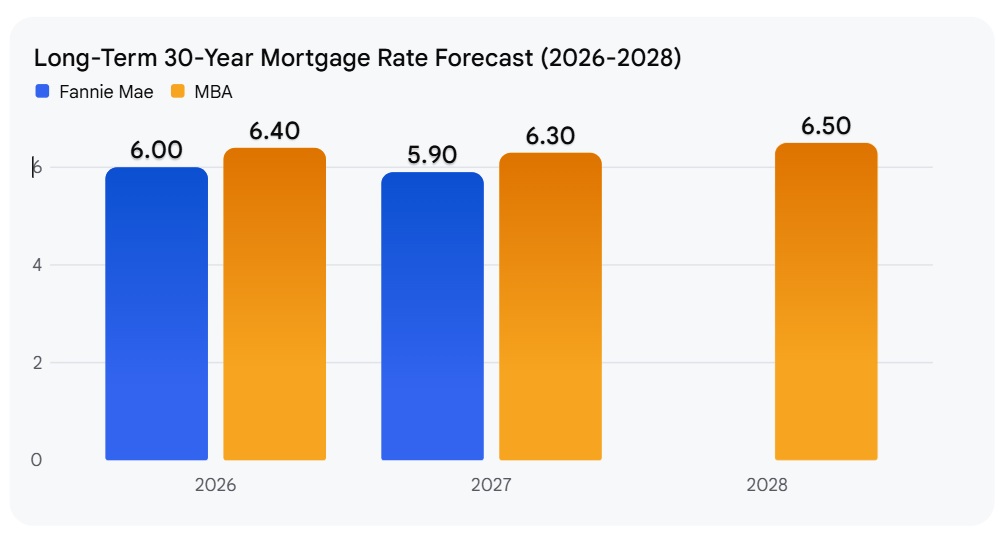
  • Fannie Mae, a big player in the mortgage market, expects rates to end 2026 around 5.9%. They're betting on the Fed making a couple more moves to lower rates.
  • The Mortgage Bankers Association (MBA), on the other hand, sees things as a bit more stable. They predict rates to be around 6.4% for the year. They seem to think things like wage growth might keep some pressure on yields.
  • The National Association of Realtors (NAR) has a slightly more optimistic outlook, anticipating an average rate around 6.0%. They believe better affordability will boost home sales.
  • Other institutions like Wells Fargo and the National Association of Home Builders (NAHB) are looking at rates in the 6.2% to 6.25% range. They often point to ongoing costs in building homes and labor market tightness as factors that could keep rates from falling too much.

Here's a visual of those different predictions:

Mortgage Rate Predictions for 2026

While the exact numbers vary, the general trend points towards lower rates than we have right now, but likely not dramatically lower.

How Will This Affect You? Breaking Down the Impact

So, what does a potential drop in mortgage rates mean for different people?

  • For Homebuyers: Even a half-percentage-point drop can make a big difference. On a $400,000 mortgage, a rate of 6.0% instead of 6.5% could save you roughly $120 per month and nearly $43,000 over the life of the loan. For first-time buyers struggling with affordability, this easing can be crucial. However, home prices are also expected to continue rising, albeit at a slower pace (around 1.3%–2.5%). So, while rates might improve, the overall cost of buying could still be a challenge.
  • For Refinancers: If you have a mortgage with a rate above 6.5% or 7%, a move down towards 6% could finally make refinancing worthwhile. Many homeowners have been stuck with their existing low-rate mortgages (the “lock-in effect”). A decrease could prompt a wave of refinancing, allowing people to lower their monthly payments by a couple of hundred dollars.
  • For Sellers: With potentially more buyers able to afford homes, the housing market could become more active. This could lead to quicker home sales and a modest increase in prices. However, more inventory might also mean less intense bidding wars compared to the frenzied market of a few years ago.
  • For the Economy: Increased home sales and refinancing activity generally give the economy a boost. More construction means more jobs, and people who can lower their monthly payments have more money to spend elsewhere.

Here's a simple table summarizing the potential benefits:

Group Benefit of ~0.5% Rate Drop Potential Hurdle
Homebuyers Lower monthly payments, improved affordability Still-rising home prices, down payment challenges
Refinancers Reduced mortgage payments, cash savings Need to qualify for new loan, appraisal values
Sellers Faster sales, potentially higher prices Increased competition, property taxes
Overall Economy Stimulus via construction and consumer spending Inflation risks, global economic shifts

The Wildcards: What Could Throw a Wrench in the Works?

No prediction is foolproof. There are always risks that could push mortgage rates in unexpected directions:

  • Stubborn Inflation: What if inflation doesn't cool down as expected? If it stays stubbornly above 2%, the Fed might have to hold off on rate cuts for longer, or even consider raising them again. This would likely keep mortgage rates higher than predicted, possibly edging back towards 6.8% or 7%.
  • Economic Shocks: A sudden recession, a major geopolitical event (like a new conflict impacting oil prices), or unexpected supply chain issues could send shockwaves through the economy. A severe downturn might force the Fed to cut rates aggressively, dropping mortgage rates significantly, perhaps to the 5.5% range. On the flip side, surprisingly strong economic growth could keep rates elevated.
  • Government Spending/Debt: High levels of government borrowing can sometimes put upward pressure on interest rates as the government competes for funds in the bond market.

Given these uncertainties, I always advise people to prepare for a range of possibilities. Don't bet your entire financial plan on rates dropping dramatically. Consider your own timeline and financial situation when making housing decisions.

My Own Thoughts: Patience and Preparedness

From my perspective, the 2026 mortgage rate predictions suggest a market that is gradually becoming more accessible. The days of 3% rates are likely behind us for the foreseeable future, but the peak of 7%+ seems to be receding. This middle ground, the mid-6% range, offers a more balanced environment.

For those looking to buy, my advice is to focus on what you can control:

  1. Improve your credit score: A higher score gets you better rates.
  2. Save for a solid down payment: This reduces your loan amount and can sometimes open up better loan options.
  3. Get pre-approved for a mortgage: This gives you a clear picture of what you can afford and shows sellers you're a serious buyer.
  4. Shop around for lenders: Don't just go with the first one you talk to. Rates and fees can vary.

For those looking to refinance, keep a close eye on rates. If we see a sustained drop of 0.5% or more from your current rate, it might be time to explore your options.

The housing market is a complex beast, influenced by so many factors. While we can analyze trends and listen to expert opinions, life often throws curveballs. The key is to stay informed, be prepared, and make decisions that align with your personal financial goals, not just chase the latest rate prediction.

In essence, 2026 looks set to be a year of cautious optimism for the housing market, driven by a slow and steady easing of mortgage rates. It won't be a return to the wild lows of the pandemic era, but it should be a welcome improvement for many aiming to achieve homeownership or financial flexibility through refinancing.

Want Stronger Returns? Invest Where the Housing Market’s Growing

Turnkey rental properties in fast-growing housing markets offer a powerful way to generate passive income with minimal hassle.

Work with Norada Real Estate to find stable, cash-flowing markets beyond the bubble zones—so you can build wealth without the risks of ultra-competitive areas.

🔥 HOT NEW LISTINGS JUST ADDED! 🔥

Talk to a Norada investment counselor today (No Obligation):

(800) 611-3060

Get Started Now

Also Read:

  • Will Mortgage Rates Go Down Below 6% in the Next 60 Days?
  • Who Benefits Most from Today's Lower Mortgage Rates?
  • Mortgage Rates Predictions Backed by 7 Leading Experts: 2025–2026
  • Mortgage Rate Predictions for the Next 3 Years: 2026, 2027, 2028
  • 30-Year Fixed Mortgage Rate Forecast for the Next 5 Years
  • 15-Year Fixed Mortgage Rate Predictions for Next 5 Years: 2025-2029
  • Will Mortgage Rates Ever Be 3% Again in the Future?
  • Mortgage Rates Predictions for Next 2 Years
  • Mortgage Rate Predictions for Next 5 Years
  • Mortgage Rate Predictions: Why 2% and 3% Rates are Out of Reach
  • How Lower Mortgage Rates Can Save You Thousands?
  • How to Get a Low Mortgage Interest Rate?
  • Will Mortgage Rates Ever Be 4% Again?

Filed Under: Financing, Mortgage Tagged With: Interest Rate, mortgage, Mortgage Rate Trends, mortgage rates, Mortgage Rates Today

Mortgage Demand Drops by 10% Even With Lower Interest Rates

January 7, 2026 by Marco Santarelli

Mortgage Demand Drops by 10% Even With Lower Interest Rates

It seems counterintuitive, doesn't it? Mortgage rates are dipping to their lowest point since September of last year, yet people are actually applying for fewer home loans. That’s right, according to the Mortgage Bankers Association (MBA), mortgage application volume has taken a 9.7% nosedive heading into 2026. This trend, even with more attractive borrowing costs, points to deeper issues at play in the housing market that we need to unpack.

This current situation feels like a puzzle where the obvious pieces don't quite fit. Normally, when the cost of borrowing money for a home decreases, we’d expect a flurry of activity – buyers rushing in to lock in those lower rates, and homeowners considering refinancing. But that’s just not what’s happening. This disconnect tells us that simply lowering mortgage rates isn't a magic wand that automatically fixes everything.

Mortgage Demand Drops by 10% Even With Lower Interest Rates

What’s Really Going On?

Let's break down the numbers from the MBA. For the two-week holiday period wrapping up January 2, 2026, the average interest rate for a 30-year fixed-rate mortgage dipped to 6.25%, down from 6.32%. This is the lowest we’ve seen it since September 2024. Even the points associated with these loans, which are basically upfront fees, went down slightly. You'd think this would be the green light for more people to jump into the market.

However, the opposite occurred.

  • Overall Application Volume: Down 9.7% (seasonally adjusted).
  • Purchase Applications: Fell 6% compared to the previous two-week period.
  • Refinance Applications: Dropped a significant 14%.

Now, when we look at refinances, it's important to note that while they fell over this specific two-week window, they are still massively up, by 133%, compared to the same time last year. This tells me that the people who could refinance and see a clear benefit already did so. The remaining pool of potential refinancers might be seeing less of a compelling reason to move.

Beyond Just the Rate: The Hidden Hurdles

So, if the rates are good, why the decline in demand? I believe there are several deeper factors at play that the headline numbers might not fully capture.

1. Affordability Remains a Sticking Point

Even with lower interest rates, home prices haven't exactly plummeted. For most buyers, the monthly payment is the biggest hurdle. When home prices are high and incomes haven’t kept pace, even a slightly lower interest rate might not bring the monthly cost down enough to be truly affordable for a broad segment of the population.

Consider this: the MBA noted that the average loan size was $408,700, which is the smallest in a year. This is driven by lower average loan sizes across both conventional and government loan types. This is an interesting point. It suggests that perhaps buyers are either being more conservative with their purchase price or are able to put down larger down payments. However, if prices are still high, a smaller loan size could simply mean people are finding homes at a lower price point, but the overall affordability squeeze persists.

2. Economic Uncertainty Lingers

The economy is a complex beast, and while things might look okay on the surface, there’s often underlying uncertainty that impacts major financial decisions like buying a home. Concerns about future job security, inflation that hasn't fully disappeared, or a general feeling that the economy might slow down can make people hesitant to take on a large, long-term commitment like a mortgage. People are essentially saying, “Maybe it's better to wait and see what happens,” even if rates are a bit lower now.

3. The “Refinance Exhaustion” Factor

As I mentioned, refinance applications are still way up year-over-year. This indicates that many homeowners who stood to gain significantly from lower rates already took advantage of them. The pool of homeowners who can still benefit substantially from refinancing might be shrinking, or they might be waiting for rates to fall even further before they consider it. Joel Kan, an MBA economist, touched on this, noting that “MBA continues to expect mortgage rates to stay around current levels, with spells of refinance opportunities in the weeks when rates move lower.” This suggests the MBA is also anticipating a fairly stable rate environment, making dramatic refinance waves less likely.

4. The FHA Niche: A Small Rebound

It was interesting to see that FHA refinance applications saw a 19% increase, though it was noted as a partial rebound from a dip the week before. This suggests that borrowers who rely on FHA loans, often first-time homebuyers or those with lower down payments, might be finding more opportunities. However, this is a specific segment, and it wasn’t enough to offset the overall decline in demand.

What About Adjustable-Rate Mortgages (ARMs)?

When fixed mortgage rates are attractive, the appeal of adjustable-rate mortgages (ARMs) naturally diminishes. ARMs typically start with lower interest rates than fixed-rate mortgages, but those rates can increase over time. With fixed rates hovering around 6.25%, the perceived benefit of an ARM is lessened. This is reflected in the data, as the ARM share of total applications decreased to 6.3%. People are opting for the certainty of a fixed payment when the upfront cost isn't significantly higher.

Looking Ahead: Will Rates Be Enough?

The MBA anticipates mortgage rates will stay around current levels. This means that the primary driver for increased mortgage demand will likely need to come from factors beyond just a slight dip in rates. We need to see significant improvements in:

  • Home Affordability: This means either a notable decrease in home prices or a substantial increase in incomes.
  • Economic Confidence: Clearer signs of sustained economic growth and stability would encourage buyers to make bigger commitments.
  • Inventory: While not directly reflected in application numbers, a lack of desirable homes on the market can also dampen demand.

My Take on It

From my perspective, this trend is a sign that the housing market is maturing after a period of intense activity. Simply lowering rates is like trying to jumpstart a car with a nearly dead battery – it might help a little, but if the battery itself is fundamentally weak, it won't get you far. We're seeing a more cautious buyer, one who is increasingly focused on the long-term affordability and stability of a home purchase. The days of just snagging a low rate and expecting the market to boom might be over for now. It's a more nuanced environment, and understanding these underlying pressures is key for anyone involved in buying, selling, or investing in real estate. The market is telling us a complex story, and it's not all about interest rates.

🏡 Which Rental Property Would YOU Invest In?

Lebanon, TN
🏠 Property: Baltusrol Lane #852
🛏️ Beds/Baths: 4 Bed • 2.5 Bath • 2011 sqft
💰 Price: $369,990 | Rent: $2,400
📊 Cap Rate: 5.8% | NOI: $1,789
📅 Year Built: 2024
📐 Price/Sq Ft: $184
🏙️ Neighborhood: B

VS

San Antonio, TX
🏠 Property: Salz Way
🛏️ Beds/Baths: 3 Bed • 2 Bath • 2330 sqft
💰 Price: $384,999 | Rent: $2,375
📊 Cap Rate: 4.1% | NOI: $1,324
📅 Year Built: 2019
📐 Price/Sq Ft: $166
🏙️ Neighborhood: A

Tennessee’s balanced rental vs Texas’s larger home with lower cap rate. Which fits YOUR investment strategy?

We have much more inventory available than what you see on our website – Let us know about your requirement.

📈 Choose Your Winner & Contact Us Today!

Talk to a Norada investment counselor (No Obligation):

(800) 611-3060

Contact Us Now

Also Read:

  • Mortgage Rates Predictions Backed by 7 Leading Experts: 2025–2026
  • Mortgage Rate Predictions for the Next 3 Years: 2026, 2027, 2028
  • 30-Year Fixed Mortgage Rate Forecast for the Next 5 Years
  • 15-Year Fixed Mortgage Rate Predictions for Next 5 Years: 2025-2029
  • Will Mortgage Rates Ever Be 3% Again in the Future?
  • Mortgage Rates Predictions for Next 2 Years
  • Mortgage Rate Predictions for Next 5 Years
  • Mortgage Rate Predictions: Why 2% and 3% Rates are Out of Reach
  • How Lower Mortgage Rates Can Save You Thousands?
  • How to Get a Low Mortgage Interest Rate?
  • Will Mortgage Rates Ever Be 4% Again?
Filed Under: Financing, Mortgage Tagged With: mortgage, mortgage rates

Is a 50-Year Mortgage Term a Risky Bet for Homebuyers?

January 7, 2026 by Marco Santarelli

Is a 50-Year Mortgage Term a Risky Bet for Homebuyers?

Thinking about a 50-year mortgage? While the idea of lower monthly payments might sound like a dream come true, especially in today's housing market, I've got to tell you, it's a path paved with potential pitfalls. In 2026, these ultra-long loans are still a hot topic, and while they offer a temporary breather on your bank statement, the long-term consequences can be pretty significant. Let's dive deep into why I approach these with a healthy dose of caution.

Is a 50-Year Mortgage Term a Risky Bet for Homebuyers?

The Staggering Cost of Time: Money You'll Never See Again

This is the big one, folks. When you stretch a mortgage out over 50 years instead of the more traditional 30, the interest you pay skyrockets. Think of it like this: every dollar you borrow costs you a little extra each month just to have it. The longer you keep that dollar, the more those little extras add up.

Let's crunch some numbers, and please remember these are just examples to show the difference. If you borrow $400,000 and the interest rate is 7%, over 30 years, you'll end up paying back around $958,000 total. That's a lot of money, right? But now, imagine that same loan, but at 7.5% for 50 years. Suddenly, you're looking at paying back a mind-boggling $1.54 million. That's almost $578,000 more just because you added 20 years to the loan term! That extra half a percent interest rate, which lenders often slap on for longer loans, truly bites. It's like paying for a whole second house in interest over the life of the loan. In my experience, homeowners who get locked into these ultra-long terms often don't realize the true cost until much later, when they're looking back and wishing they'd found another way.

Glaciers Move Faster: The Painfully Slow Climb to Ownership

Another huge concern is how painfully slow you build equity with a 50-year mortgage. Equity is the part of your home that you actually own. With most mortgages, especially in the early years, your monthly payment is mostly going towards interest, not the actual price of the house.

Imagine this: after 10 years of making payments on a 30-year mortgage, you've likely paid off around 18% of the principal (the original loan amount). That's pretty decent progress! Now, with a 50-year mortgage, after the same 10 years, you might have only chipped away at about 4% of the principal. That means you're still owing almost as much as you borrowed, even after a decade of payments. This slow growth makes it incredibly tough to build real wealth from your home.

The Underwater Trap: When Your House is Worth Less Than You Owe

Because the principal paid down so slowly, it’s incredibly easy to get into a situation where you owe more on your mortgage than your home is actually worth. This is what we call being “underwater,” or in a state of negative equity. If you bought a home with a 50-year mortgage and suddenly the housing market takes a dip, even a small one, you could find yourself owing $300,000 on a home that's now only worth $280,000. This makes it nearly impossible to sell your home without bringing a significant amount of cash to the table, or to refinance into a better loan.

From what I've seen, people who aren't building equity feel stuck. They can't move for a better job, can't downsize if their family situation changes, and often just feel trapped in their homes because of the financial entanglement.

Debt That Doesn't Quit: Your Retirement Might Get Complicated

This is a reality check that I think many people gloss over. The average age of a first-time homebuyer is creeping up. By 2025 and 2026, it’s projected to be around 40. If you take out a 50-year mortgage at that age, you could still be making payments when you’re 90! For most people, retirement means living on a fixed income, and having a massive mortgage payment hanging over your head in your golden years is a recipe for significant stress and financial strain. I've heard stories from older clients who deeply regret not having their mortgages paid off before they stopped working.

Stuck in Place: The Mobility Straitjacket

That slow equity growth we talked about? It directly impacts your ability to move. If you need to sell your house, and you haven't built up much equity, the money you get from the sale might not even be enough to cover the remaining mortgage balance, let alone any closing costs or moving expenses. This means you’d have to pull money from savings to pay off the loan, which defeats the purpose of buying a home for financial security. It’s a real catch-22.

Passing the Buck: Generational Debt Concerns

Some financial experts worry that 50-year mortgages could end up creating “generational debt.” Instead of a home being a stepping stone to building wealth that you can pass down or enjoy in your lifetime, it could become a financial burden that your heirs inherit if you can't pay it off. This is a far cry from the traditional idea of homeownership as a pathway to financial freedom.

A Niche Market with Few Safety Nets

It’s important to know that 50-year mortgages aren't exactly mainstream right now, especially in early 2026. They're often considered “non-qualified” mortgages. This means they usually don't have the same backing from government-sponsored entities like Fannie Mae or Freddie Mac, which typically stick to 30-year limits. This lack of federal backing can sometimes mean less consumer protection and more risk for both the borrower and the lender.

Fueling the Fire? The Inflation Question

There's also a concern among many economists that if 50-year mortgages become widely popular, the increased borrowing power they offer could actually push home prices even higher. This could worsen the very affordability crisis they're supposedly trying to solve. It’s like trying to put out a fire with gasoline – it might seem like a good idea at first, but it can make things much worse in the long run.

Beyond the 50-Year Horizon: Smarter Choices for Homeownership

So, if a 50-year mortgage isn't the best route, what are your options for making homeownership more affordable? Thankfully, there are many other roads to take that don't saddle you with such a long-term debt.

Low Down Payment Loans: Getting Your Foot in the Door

Several programs are designed to help people buy a home with less money upfront.

  • FHA Loans: These are great for folks who don't have a huge down payment saved. You can get in with as little as 3.5% down and they're more flexible with credit scores.
  • VA and USDA Loans: If you're a veteran or looking to buy in certain rural or suburban areas, these loans can be amazing. They often require zero down payment!
  • HomeReady & Home Possible: Backed by Fannie Mae and Freddie Mac, these programs let you put down as little as 3% and are aimed at those with good credit and moderate incomes.

Playing with Interest Rates: Smart Short-Term Savings

Sometimes, you just need a little relief in the beginning.

  • Adjustable-Rate Mortgages (ARMs): These usually have a lower interest rate for the first few years (often 5-10 years) compared to a fixed-rate mortgage. This can give you that monthly payment savings you might be seeking from a 50-year loan, but with a clear end in sight for the lower rate.
  • Temporary Buydowns: This is where a seller or builder helps lower your interest rate for the first 1 to 3 years. It’s a fantastic way to ease into your mortgage payments while you get settled in your new home.
  • Assumable Mortgages: This is a bit more niche, but if a seller has an existing mortgage with a really good interest rate, you might be able to “assume” it. This means you take over their loan terms, potentially saving you a ton on interest.

Down Payment Assistance and Grants: Free Money for Your Home

Don't forget about all the help out there! Many organizations offer grants and assistance to help with your upfront costs.

  • National Programs: Some funds like the National Homebuyers Fund (NHF) can provide grants that might not even need to be repaid.
  • State & Local Agencies: Your state or local housing authority (think CalHFA in California, for example) can offer incredible programs. Some might provide a chunk of money for your down payment in exchange for a small share of your home’s future value increase.
  • Lender Grants: Even big banks sometimes have grants for homebuyers in specific areas. It's always worth asking your lender!

Sharing the Ownership: Creative Ways to Buy

  • Shared Ownership: In some places, you can buy a portion of the home and rent the rest from a housing association. This lowers your initial purchase price significantly.
  • Rent-to-Own: This lets you rent a place with the option to buy it later. The price is often locked in, and a portion of your rent might go towards your down payment. It’s a great way to save up while living in the home you want to buy.

When I look at the mortgage market, I always try to think about the whole picture. A 50-year mortgage might seem like a quick fix for affordability, but the long-term costs and risks are just too high for most people. It’s always better to explore other options that build your financial health over time, rather than just kicking the can down a very, very long road.

🏡 Which Rental Property Would YOU Invest In?

Lebanon, TN
🏠 Property: Baltusrol Lane #852
🛏️ Beds/Baths: 4 Bed • 2.5 Bath • 2011 sqft
💰 Price: $369,990 | Rent: $2,400
📊 Cap Rate: 5.8% | NOI: $1,789
📅 Year Built: 2024
📐 Price/Sq Ft: $184
🏙️ Neighborhood: B

VS

San Antonio, TX
🏠 Property: Salz Way
🛏️ Beds/Baths: 3 Bed • 2 Bath • 2330 sqft
💰 Price: $384,999 | Rent: $2,375
📊 Cap Rate: 4.1% | NOI: $1,324
📅 Year Built: 2019
📐 Price/Sq Ft: $166
🏙️ Neighborhood: A

Tennessee’s balanced rental vs Texas’s larger home with lower cap rate. Which fits YOUR investment strategy?

We have much more inventory available than what you see on our website – Let us know about your requirement.

📈 Choose Your Winner & Contact Us Today!

Talk to a Norada investment counselor (No Obligation):

(800) 611-3060

Contact Us Now

Also Read:

  • Mortgage Rates Predictions Backed by 7 Leading Experts: 2025–2026
  • Mortgage Rate Predictions for the Next 3 Years: 2026, 2027, 2028
  • 30-Year Fixed Mortgage Rate Forecast for the Next 5 Years
  • 15-Year Fixed Mortgage Rate Predictions for Next 5 Years: 2025-2029
  • Will Mortgage Rates Ever Be 3% Again in the Future?
  • Mortgage Rates Predictions for Next 2 Years
  • Mortgage Rate Predictions for Next 5 Years
  • Mortgage Rate Predictions: Why 2% and 3% Rates are Out of Reach
  • How Lower Mortgage Rates Can Save You Thousands?
  • How to Get a Low Mortgage Interest Rate?
  • Will Mortgage Rates Ever Be 4% Again?

Filed Under: Financing, Mortgage Tagged With: 50-Year Mortgage, mortgage, mortgage rates

Today’s Mortgage Rates, Jan 7: Stable Rates Continue for Buyers and Refinancers

January 7, 2026 by Marco Santarelli

Today's Mortgage Rates, June 24: Fed Policy and Inflation Push Rates Higher Across Loan Types

As of January 7, 2026, the news is good: mortgage and refinance rates are holding steady, creating a remarkably predictable environment for anyone looking to buy a home or refinance an existing mortgage. This stability, with minimal movement for weeks, is a welcome change for many.

Today's Mortgage Rates, Jan 7: Stable Rates Continue for Buyers and Refinancers

It feels like we've been talking about fluctuating interest rates for a long time, doesn't it? Well, as we kick off 2026, the mortgage market seems to be taking a collective breath. According to Zillow’s latest figures, the most common loan, the 30-year fixed mortgage rate, is hanging out at 6.01%. That's actually a tiny dip of three basis points from yesterday.

On the other hand, the 15-year fixed mortgage rate has seen a slight nudge upwards to 5.45%, a four-basis-point increase. Honestly, these small shifts have become the norm, and it’s created a really calm atmosphere for anyone in the market.

For me, this long stretch of stability is truly noteworthy. I’ve seen markets swing wildly, and to have this kind of predictability, especially for buyers who are trying to budget for one of the biggest purchases of their lives, is a real gift. It means you can often plan your finances with a much clearer picture than you could a year or two ago.

Understanding Today's Mortgage Rates

Let’s break it down with the latest national averages, rounded to make things easy:

Loan Type Rate Notes
30-Year Fixed 6.01% The go-to for predictable monthly payments.
20-Year Fixed 5.97% A middle ground, paying it off faster than 30 years.
15-Year Fixed 5.45% Lower total interest paid, but higher monthly costs.
5/1 ARM 6.08% Initial lower rate, but it adjusts after 5 years.
7/1 ARM 6.04% A bit more time before the first rate adjustment.
30-Year VA 5.60% Excellent rates for our veterans and service members.
15-Year VA 5.09% Faster payoff with competitive rates for VA borrowers.
5/1 VA 5.25% Adjustable VA loan with a good initial rate.

A Closer Look at the Popular Choices

  • 30-Year Fixed (6.01%): This is the workhorse of the mortgage world for a reason. You get that peace of mind knowing your principal and interest payment stays the same for 30 years. Even a small percentage point difference here can impact your monthly budget significantly, so this current stability is a real plus for buyers.
  • 15-Year Fixed (5.45%): For those who want to be mortgage-free sooner and don’t mind a higher monthly payment, this is a fantastic option. You pay way less interest over the life of the loan. That slight increase we're seeing this week isn't enough to scare off folks who are focused on long-term savings.
  • Adjustable-Rate Mortgages (ARMs): With the 5/1 ARM at 6.08% and the 7/1 ARM at 6.04%, these loans are currently slightly lower than the traditional 30-year fixed, but that comes with a caveat. After the initial fixed period (5 or 7 years), your rate can go up or down with market conditions. For me, the risk of future rate hikes often outweighs the initial savings, making fixed-rate loans a safer bet for many.
  • VA Loans: I always love highlighting VA loans because they offer such fantastic value. The 30-year VA rate at 5.60% and the 15-year VA rate at 5.09% are incredibly competitive. If you're a veteran or active-duty service member, you’re in a great position right now.

Current Mortgage Refinance Rates

Refinancing is also looking pretty stable, though sometimes refinance rates are a tad higher than purchase rates. Here’s the breakdown:

Loan Type Rate Notes
30-Year Fixed 6.09% Steady option for homeowners looking to adjust payments.
20-Year Fixed 5.82% Good for those wanting quicker payoff than 30-year.
15-Year Fixed 5.54% Less total interest, but expectedly higher monthly payment.
5/1 ARM 6.15% Rate will adjust after 5 years.
7/1 ARM 6.16% Longer initial fixed period before adjustment.
30-Year VA 5.62% Still attractive for veterans refinancing.
15-Year VA 5.31% Competitive refinance option for VA borrowers.
5/1 VA 5.55% Adjustable VA refinance with an initial rate.

Refinancing: What the Rates Mean

  • 30-Year Fixed Refinance (6.09%): If your goal is to lower your monthly payments or tap into some home equity without drastically changing your long-term financial plan, this is the way to go. The slight premium over purchase rates is often worth it for the benefits of refinancing.
  • 15-Year Fixed Refinance (5.54%): This is for the homeowners who are ready to aggressively pay down their mortgage. The slightly higher rate compared to purchase loans is usually a small price to pay for shaving years off your mortgage.
  • ARMs in Refinancing: The 5/1 ARM at 6.15% and 7/1 ARM at 6.16% are pretty comparable to the 30-year fixed, making them less appealing for most people looking to refinance for savings. The potential for future rate hikes just doesn’t seem worth it when fixed options are so accessible.
  • VA Refinance Loans: Again, our veterans are in a strong position. The 30-year VA at 5.62% and 15-year VA at 5.31% offer excellent value for those looking to refinance their existing homes.

What This Means for You, the Borrower

So, what's the takeaway from all this stability?

  • Planning is Easier: The biggest advantage is predictability. You can lock in a rate and know what your payments will be for years to come. This is huge for budgeting and financial planning.
  • Don't Skip Shopping Around: Even with national averages around 6%, some lenders are offering rates closer to 5.5%. This is where my personal expertise comes in – I always tell people to get quotes from multiple lenders. Even a quarter-percent difference can save you tens of thousands of dollars over the life of your loan.
  • VA Loans Are Still a Champion: If you're a veteran or active-duty military member, the current rates are exceptionally good. Seriously, explore your VA loan options.
  • ARMs: Know the Risk: While ARMs can seem attractive with their lower initial rates, I strongly advise caution. The housing market has been volatile in recent years, and betting on rates going down can be a risky game. Fixed rates offer a much more secure path for most.

Looking Ahead: Early 2026 Outlook

Right now, the mortgage and refinance market feels like it’s in a holding pattern. The minor fluctuations we're seeing are a sign of a relatively stable economy and a Federal Reserve that isn't making drastic moves. This provides a rare window for borrowers to act.

My professional opinion is that this period of stability won't last forever. Economic conditions, inflation, and housing demand are always shifting. Eventually, rates will likely move out of this narrow range. So, if you're thinking about buying or refinancing, now is a great time to take advantage of the current predictable rates before any potential shifts occur. The key, as always, is to do your homework, compare lenders, and lock in the best deal you can find.

🏡 Which Rental Property Would YOU Invest In?

Lebanon, TN
🏠 Property: Baltusrol Lane #852
🛏️ Beds/Baths: 4 Bed • 2.5 Bath • 2011 sqft
💰 Price: $369,990 | Rent: $2,400
📊 Cap Rate: 5.8% | NOI: $1,789
📅 Year Built: 2024
📐 Price/Sq Ft: $184
🏙️ Neighborhood: B

VS

San Antonio, TX
🏠 Property: Salz Way
🛏️ Beds/Baths: 3 Bed • 2 Bath • 2330 sqft
💰 Price: $384,999 | Rent: $2,375
📊 Cap Rate: 4.1% | NOI: $1,324
📅 Year Built: 2019
📐 Price/Sq Ft: $166
🏙️ Neighborhood: A

Tennessee’s balanced rental vs Texas’s larger home with lower cap rate. Which fits YOUR investment strategy?

We have much more inventory available than what you see on our website – Let us know about your requirement.

📈 Choose Your Winner & Contact Us Today!

Talk to a Norada investment counselor (No Obligation):

(800) 611-3060

Contact Us Now

Also Read:

  • Mortgage Rates Predictions Backed by 7 Leading Experts: 2025–2026
  • Mortgage Rate Predictions for the Next 3 Years: 2026, 2027, 2028
  • 30-Year Fixed Mortgage Rate Forecast for the Next 5 Years
  • 15-Year Fixed Mortgage Rate Predictions for Next 5 Years: 2025-2029
  • Will Mortgage Rates Ever Be 3% Again in the Future?
  • Mortgage Rates Predictions for Next 2 Years
  • Mortgage Rate Predictions for Next 5 Years
  • Mortgage Rate Predictions: Why 2% and 3% Rates are Out of Reach
  • How Lower Mortgage Rates Can Save You Thousands?
  • How to Get a Low Mortgage Interest Rate?
  • Will Mortgage Rates Ever Be 4% Again?

Filed Under: Financing, Mortgage Tagged With: Current Mortgage Rates, mortgage, mortgage rates, Today’s Mortgage Rates

Today’s Mortgage Rates, Jan 6: Buyers Find Calm as 30-Year Fixed Rate Sticks Near 6%

January 6, 2026 by Marco Santarelli

Today's Mortgage Rates, Jan 7: Stable Rates Continue for Buyers and Refinancers

If you're looking to buy a home or refinance your existing mortgage, you'll be pleased to know that today, January 6, 2026, mortgage rates are holding steady, beautifully balanced just above and below the 6% mark. This consistent rhythm offers a rare pocket of predictability in the often-turbulent housing market.

As of today, Zillow reports that the national average for a 30-year fixed mortgage rate is 6.04%, while the popular 15-year fixed rate is currently at 5.41%. This stability, which has been a welcome guest for a few weeks now, is a significant development for anyone navigating the path to homeownership or looking to improve their current loan terms.

This period of steadiness is both a relief and a signal. The dramatic peaks and valleys we saw last year are thankfully behind us, and while these rates aren't the historic lows of a few years ago, they represent a significantly more manageable environment for many.

Today's Mortgage Rates, Jan 6: Buyers Find Calm as 30-Year Fixed Rate Sticks Near 6%

The Current Numbers: What the Rates Tell Us

Let’s break down the numbers you need to know right now. These are the national averages, rounded for clarity, as reported by Zillow.

Loan Type Rate
30-Year Fixed 6.04%
20-Year Fixed 5.91%
15-Year Fixed 5.41%
5/1 ARM 6.12%
7/1 ARM 6.10%
30-Year VA 5.54%
15-Year VA 5.11%
5/1 VA 5.24%

As you can see, the 30-year fixed mortgage rate is holding firm at 6.04%. For many, this is the benchmark for long-term financial planning as it offers predictable monthly payments for the life of the loan. The 15-year fixed rate at 5.41% remains a compelling option for those who can swing higher monthly payments in exchange for paying off their homes much faster and saving a significant amount on interest over time.

It’s also worth noting the Adjustable-Rate Mortgages (ARMs), like the 5/1 ARM at 6.12% and the 7/1 ARM at 6.10%. These can offer a lower initial interest rate for the first five or seven years, but borrowers must be prepared for potential increases down the line. With rates currently in the low 6s, the initial appeal of an ARM is a bit muted compared to when rates were higher, but they can still be a smart move for people who plan to sell or refinance before the adjustment period begins.

And for our deserving veterans and active service members, the VA loan rates continue to shine. The 30-year VA loan at 5.54% and the 15-year VA loan at 5.11% are notably lower than conventional loan options, showcasing the incredible benefits available to those who have served.

Refinancing Your Home: Is Now the Right Time?

When it comes to refinancing, the rates are generally a hair higher than for purchase loans, which is typical. However, the difference is small enough that it's absolutely worth exploring if you're looking to lower your monthly payment, shorten your loan term, or tap into your home's equity.

Loan Type Rate
30-Year Fixed 6.09%
20-Year Fixed 5.97%
15-Year Fixed 5.53%
5/1 ARM 6.17%
7/1 ARM 6.40%
30-Year VA 5.53%
15-Year VA 5.11%
5/1 VA 5.38%

Notice how the 30-year fixed refinance rate is just 6.09%, a minuscule jump from the purchase rate. For those with a 15-year fixed, the refinance rate is 5.53%, still a very attractive number. The VA loans remain incredibly competitive for refinancing as well, with the 30-year VA at 5.53% and the 15-year VA at 5.11%.

My professional opinion here is to be diligent. Even a quarter-point difference can add up to thousands over the life of a loan. If you haven't looked at refinancing in a year or two, and your credit score has improved, or if your income has increased, it's a prime time to see if you can get a better deal. However, always consider the closing costs associated with refinancing. You need to make sure the savings outweigh these upfront expenses.

What This Means for You in Early 2026

This steady rate environment breaks down into clear advantages for different types of borrowers:

  • For the Long-Term Planner (30-Year Fixed): With the 30-year fixed rate around 6.04%, the stability is fantastic for budgeting. But remember that offer for 5.5%? That’s a potential monthly savings of hundreds of dollars. Never settle for the first offer; shop around!
  • For the Fast-Payoff Enthusiast (15-Year Fixed): The 15-year fixed rate at 5.41% is a dream for those who want to be mortgage-free sooner. Refinancing at 5.53% is also a strong contender if you're looking to shave a bit more off your existing loan.
  • For the Rate-Sensitive Borrower (ARMs): The ARMs are holding in the low 6s. While the initial payment might be appealing, always do the math for the worst-case scenario if rates climb. This makes them a tool for those with a clear exit strategy.
  • For Our Service Members (VA Loans): The consistently lower rates for VA loans are a game-changer. They are a testament to the gratitude we owe our veterans and continue to be among the most affordable financing options.

Looking Ahead: The First Half of 2026

The mortgage market is a complex interplay of economic factors. As we move through the first half of 2026, several indicators are shaping the outlook.

Economic Pulse: Inflation and Employment
The Federal Reserve's decisions regarding interest rates are heavily influenced by inflation and the labor market. While inflation has cooled from its recent highs, its trajectory will continue to be a key driver. A strong job market generally supports economic growth but can also put upward pressure on wages and, consequently, inflation. Experts are keeping a close eye on these figures, as they can lead to shifts in bond yields, which directly impact mortgage rates.

Bond Yields: The Underlying Current
Mortgage rates tend to move in tandem with the yields on U.S. Treasury bonds, particularly the 10-year Treasury note. When bond yields rise, mortgage rates typically follow suit, and vice-versa. While the current rates are stable, any significant movement in bond markets related to economic news or Fed policy could cause rates to tick up or down.

Housing Market Activity: Buyers Gain Traction
The good news for potential buyers is that the housing market is gradually shifting towards a more balanced state.

  • Home Sales: We’re seeing predictions suggesting a modest increase in existing-home sales for 2026, climbing around 1.7%. While this is still below pre-pandemic levels, it indicates a growing willingness to buy. Mortgage application activity has already shown a healthy uptick in late 2025, reflecting renewed buyer interest.
  • Home Prices: Forget the astronomical surges of recent years. Home values are now expected to see more modest growth, in the range of 1.2% to 2.2% nationally. This slower pace, combined with steady income growth, is a positive sign for affordability.
  • Inventory Levels: The number of homes for sale is improving, which is great news. However, it's important to remember that inventory is still below what we considered normal before the pandemic. This continued scarcity in many areas is a primary reason we aren’t seeing dramatic price drops.
  • Affordability: This is where things are looking up. With incomes rising faster than inflation and mortgage rates stabilizing, the portion of your income going towards your mortgage payment is expected to dip below that crucial 30% threshold for the first time since 2022. A significant drop in rates could open the doors for millions more households to become qualified buyers.

My advice based on this outlook? Don't get caught up in trying to perfectly time the market. Homeownership is a big personal decision. Your financial situation, your family's needs, and your long-term goals should always be the most important factors. The current rate environment, however, offers a more forgiving stage for making those decisions.

The Takeaway for Today

Mortgage rates on January 6, 2026, are wonderfully balanced just above and below the 6% mark. This stability is a welcome development. My perspective is that shopping around is no longer just a good idea – it’s essential. The difference between lenders can represent tens of thousands of dollars over the life of your loan. If predictability brings you peace of mind, locking in a rate now might be a wise move, especially given the ongoing economic conversations. And for those looking to refinance, remember to compare offers meticulously; slight differences can translate to significant savings.

With the economic winds of inflation, Federal Reserve policies, and ongoing housing demand shaping the future, staying informed is key. But for now, this period of steady rates, coupled with diverse and competitive lender offers, presents a truly opportune moment for both new homebuyers and those looking to refinance.

🏡 Which Rental Property Would YOU Invest In?

Lebanon, TN
🏠 Property: Baltusrol Lane #852
🛏️ Beds/Baths: 4 Bed • 2.5 Bath • 2011 sqft
💰 Price: $369,990 | Rent: $2,400
📊 Cap Rate: 5.8% | NOI: $1,789
📅 Year Built: 2024
📐 Price/Sq Ft: $184
🏙️ Neighborhood: B

VS

San Antonio, TX
🏠 Property: Salz Way
🛏️ Beds/Baths: 3 Bed • 2 Bath • 2330 sqft
💰 Price: $384,999 | Rent: $2,375
📊 Cap Rate: 4.1% | NOI: $1,324
📅 Year Built: 2019
📐 Price/Sq Ft: $166
🏙️ Neighborhood: A

Tennessee’s balanced rental vs Texas’s larger home with lower cap rate. Which fits YOUR investment strategy?

We have much more inventory available than what you see on our website – Let us know about your requirement.

📈 Choose Your Winner & Contact Us Today!

Talk to a Norada investment counselor (No Obligation):

(800) 611-3060

Contact Us Now

Also Read:

  • Mortgage Rates Predictions Backed by 7 Leading Experts: 2025–2026
  • Mortgage Rate Predictions for the Next 3 Years: 2026, 2027, 2028
  • 30-Year Fixed Mortgage Rate Forecast for the Next 5 Years
  • 15-Year Fixed Mortgage Rate Predictions for Next 5 Years: 2025-2029
  • Will Mortgage Rates Ever Be 3% Again in the Future?
  • Mortgage Rates Predictions for Next 2 Years
  • Mortgage Rate Predictions for Next 5 Years
  • Mortgage Rate Predictions: Why 2% and 3% Rates are Out of Reach
  • How Lower Mortgage Rates Can Save You Thousands?
  • How to Get a Low Mortgage Interest Rate?
  • Will Mortgage Rates Ever Be 4% Again?

Filed Under: Financing, Mortgage Tagged With: Current Mortgage Rates, mortgage, mortgage rates, Today’s Mortgage Rates

Today’s Mortgage Rates, January 5: Steady 6% Rates Offer Room for Smarter Savings

January 5, 2026 by Marco Santarelli

Today's Mortgage Rates, Jan 7: Stable Rates Continue for Buyers and Refinancers

The news you've been waiting for this January 5th: mortgage rates are holding steady, hovering just above the 6% mark. While the national averages presented by Zillow are clear, my experience tells me there's real opportunity here, with some lenders discreetly offering rates dipping into the mid-5% range. This means that even if you're just looking at the headline numbers, there's potential to save more than you might think if you're willing to shop around.

Today's Mortgage Rates, January 5: Steady 6% Rates Offer Room for Smarter Savings

What's Happening with Mortgage Rates Right Now?

Let’s break down the numbers from Zillow for today, January 5, 2026. These are national averages, so your own rate might be a bit different depending on your credit score, down payment, and the lender you choose.

Here's a look at the typical rates you'll see:

Loan Type Rate
30-Year Fixed 6.01%
20-Year Fixed 5.95%
15-Year Fixed 5.44%
5/1 ARM 6.23%
7/1 ARM 6.51%
30-Year VA 5.52%
15-Year VA 5.14%
5/1 VA 5.22%

And How About Refinancing Your Home?

If you’re looking to refinance your current mortgage, the rates are just a touch higher on average, but the story is pretty similar. For many homeowners still holding onto those higher rates from a couple of years ago, this is a moment to pay close attention.

Here are the refinance rate averages:

Loan Type Rate
30-Year Fixed 6.16%
20-Year Fixed 5.97%
15-Year Fixed 5.61%
5/1 ARM 6.32%
7/1 ARM 6.56%
30-Year VA 5.74%
15-Year VA 5.44%
5/1 VA 5.40%

What This Means for You (My Take)

Okay, so the numbers are what they are, but what does this really mean for the average person trying to buy a home or refinance?

  • For the Long Haul Buyers (30-Year Fixed): That 6.01% average means you’re not paying the sky-high rates we saw in the past. But here’s the insider tip: many lenders are actively seeking business and you can likely find rates closer to the mid-5% range. This could save you hundreds on your monthly payment over the life of the loan. Don't just take the first offer you get!
  • For the Fast Payoff Fanatics (15-Year Fixed): A 5.44% rate on a 15-year fixed mortgage is really attractive if you want to build equity faster and be mortgage-free sooner. For refinancing, that 5.61% is still a good move if your current rate is significantly higher.
  • For the Flexible Thinkers (ARMs): Adjustable-Rate Mortgages (ARMs) are coming in around the low 6% range. These can offer a lower initial payment, which is nice. But as someone who’s seen the market move, you must be aware of the future. Rates can go up, so make sure you understand the potential risks and have a plan for when that adjustment period hits.
  • For Our Veterans (VA Loans): I always make it a point to highlight these. VA loans continue to offer some of the best rates available, with the 30-year fixed at 5.52% and the 15-year at 5.14%. If you're a veteran or active service member, this is a huge advantage you should absolutely be looking into.

Digging Deeper: Beyond the Daily Numbers

While these daily rates are important, understanding the bigger picture helps you make smarter decisions.

The Recent Past & Expert Guesses for 2026:

We've seen rates come down significantly from their peaks in late 2023, which were hovering around 8%. Today's rates are much more manageable. Looking ahead, experts are mostly predicting that the 30-year fixed rate will likely stay in that 6% to 6.5% range throughout 2026.

  • Fannie Mae: Thinks rates might sneak down to around 5.9% by the end of the year.
  • Mortgage Bankers Association (MBA): Is a bit more cautious, seeing rates staying closer to 6.4%.
  • National Association of Realtors (NAR): Believes rates will average around 6.0%, which they think will encourage more buyers.

What's Driving Mortgage Rates?

It’s not just what the Federal Reserve is doing, although their actions definitely set a tone. Mortgage rates are more directly linked to the yields on 10-year Treasury notes. Think of it like this: when investors demand more for lending their money (higher Treasury yields), mortgage lenders have to charge more too. Things like inflation, the general health of the economy, and even global events can all play a role.

The Housing Market: Still a Challenge, But Shifting

Even with these better rates, buying a home isn't always easy. High home prices and limited homes for sale are still big issues in many places. However, there are signs that things might be slowly improving.

  • Inventory is Expected to Grow: We’re looking at about a 9% increase in homes available for sale compared to last year.
  • Home Prices are Rising Slowly: Expect modest home price increases, maybe 1-2.2% nationwide. The good news? Wages are projected to grow faster than home prices, which could make things a little more affordable for some.

Refinancing: A Big Opportunity

If you bought a home in 2023 or 2024 when rates were really high (7%+), now is definitely the time to seriously consider refinancing. The volume of refinances is expected to jump by over 30% this year because so many people can now save money by lowering their monthly payments.

The “Rate Lock-In” Effect:

One interesting thing is that about 80% of current homeowners have mortgage rates below 6%. This makes many people hesitant to sell their homes because they'd have to take out a new mortgage at a higher rate. This is one reason why inventory can still be tight.

Looking Ahead: A Stable Start to 2026

Today, January 5, 2026, we're seeing a mortgage market that feels pretty stable, with rates sitting just above 6%. While the national averages are a guide, my advice is always to look for those lenders advertising rates in the mid-5% range. This requires a bit of effort to compare offers, but the savings can be significant.

The economic factors I mentioned – like what the Federal Reserve does, inflation, and how many people want to buy homes – will continue to shape the market. But for now, this period of relative stability, combined with competitive lender offers, presents a great chance for both first-time buyers and those looking to refinance. Don't miss out on the potential to lock in a rate that works for your budget.

🏡 Which Rental Property Would YOU Invest In?

Lebanon, TN
🏠 Property: Baltusrol Lane #852
🛏️ Beds/Baths: 4 Bed • 2.5 Bath • 2011 sqft
💰 Price: $369,990 | Rent: $2,400
📊 Cap Rate: 5.8% | NOI: $1,789
📅 Year Built: 2024
📐 Price/Sq Ft: $184
🏙️ Neighborhood: B

VS

San Antonio, TX
🏠 Property: Salz Way
🛏️ Beds/Baths: 3 Bed • 2 Bath • 2330 sqft
💰 Price: $384,999 | Rent: $2,375
📊 Cap Rate: 4.1% | NOI: $1,324
📅 Year Built: 2019
📐 Price/Sq Ft: $166
🏙️ Neighborhood: A

Tennessee’s balanced rental vs Texas’s larger home with lower cap rate. Which fits YOUR investment strategy?

We have much more inventory available than what you see on our website – Let us know about your requirement.

📈 Choose Your Winner & Contact Us Today!

Talk to a Norada investment counselor (No Obligation):

(800) 611-3060

Contact Us Now

Also Read:

  • Mortgage Rates Predictions Backed by 7 Leading Experts: 2025–2026
  • Mortgage Rate Predictions for the Next 3 Years: 2026, 2027, 2028
  • 30-Year Fixed Mortgage Rate Forecast for the Next 5 Years
  • 15-Year Fixed Mortgage Rate Predictions for Next 5 Years: 2025-2029
  • Will Mortgage Rates Ever Be 3% Again in the Future?
  • Mortgage Rates Predictions for Next 2 Years
  • Mortgage Rate Predictions for Next 5 Years
  • Mortgage Rate Predictions: Why 2% and 3% Rates are Out of Reach
  • How Lower Mortgage Rates Can Save You Thousands?
  • How to Get a Low Mortgage Interest Rate?
  • Will Mortgage Rates Ever Be 4% Again?

Filed Under: Financing, Mortgage Tagged With: Current Mortgage Rates, mortgage, mortgage rates, Today’s Mortgage Rates

Mortgage Rates Predictions for the Quarter Ending March 2026

January 5, 2026 by Marco Santarelli

Mortgage Rates Predictions for the First Quarter of 2026

If you’re waiting on the sidelines, hoping for a return to the “free money” mortgage rates of the early 2020s, I have to be blunt: that ship has sailed. However, the anxiety about rates spiraling toward 8% has cooled down significantly. For the first quarter of 2026, I forecast that the average 30-year fixed mortgage rate will settle into a relatively stable band between 6.0% and 6.4%, likely averaging around ***6.15%***.

This level reflects a cautious equilibrium in the economy—enough inflation stabilization to prevent spikes, but not enough weakening to force the Federal Reserve into the aggressive rate cuts everyone is hoping for.

The start of 2026 feels less like a crisis and more like a stubborn waiting game. We are entering a period where rates are elevated but predictable, which, frankly, is a welcome change for everyone who spent 2023 watching the market swing wildly week after week.

Mortgage Rates Predictions for the Quarter Ending March 2026

Where We Stand Right Now: A Tentative Breather

As we flipped the calendar into January 2026, the mortgage market offered a small gift: the 30-year fixed rate settled at 6.15%, according to the latest Freddie Mac data. This slight dip from December’s close (6.18%) might seem minor, but it matters. It confirms a stabilization trend that began toward the end of 2025.

What I observe is that the market tried hard to push rates higher in the latter half of 2025, but signs of cooling inflation and a softening job market prevented a major breakout. This 6.15% starting point means that the psychological barrier we have been dealing with—the high 6s and low 7s—is currently behind us.

The real question isn't whether rates will return to 3%; they won't. The real question for the first three months of 2026 is whether we can see sustained downward pressure that pushes the bulk of activity below 6.0%. In my expert opinion, while possible, it is not the most likely outcome for Q1.

The Rollercoaster Ride: Why History Matters So Much

To understand where we are going, we need to remember where we’ve been. I’ve watched this market swing dramatically over the past few years, and I can tell you these historical patterns offer invaluable clues.

  • 2020–2021: The era of rock-bottom rates. Thanks to the Federal Reserve trying to insulate the economy from the COVID-19 pandemic, we saw rates plummet below 3%. This created a massive wave of refinancing and allowed millions of people to buy homes they otherwise couldn't afford.
  • 2022–2023: The Inflation Shock. As the economy roared back and inflation soared, the Fed aggressively hiked its benchmark rate, pulling long-term mortgage rates with it. This was a brutal adjustment, leading to rates creeping toward 7% and housing sales freezing up.
  • 2025: Volatility stabilized, but rates stayed elevated, hovering near an annual average of about 6.60%.

The market needs stability now. And the fact that we ended 2025 around 6.15% tells me that the majority of the sharp corrections are behind us. But remember, the quick drop many experts hoped for in Q4 2025 didn't materialize entirely. Why? Because the underlying economic pressures (namely sticky services inflation and a still-robust labor market) didn't give the Fed the green light to cut aggressively. This reluctance dictates our forecast for early 2026.

The Core Mortgage Rate Forecast: Q1 2026 Numbers and Expert Consensus

When I look at the predictions coming from major players like Fannie Mae and the Mortgage Bankers Association (MBA), I see a narrow band of agreement that gives me confidence in the 6.0% to 6.4% range.

No one is calling for rates to plunge to 5% instantly, but almost no one is predicting a catastrophic return to 7% either.

Here is a summary of the consensus forecasts for the 30-year fixed rate during the first quarter of 2026:

Source Q1 2026 Forecast (30-Year Fixed)
National Association of Realtors (NAR) 6.00%
Wells Fargo 6.15%
National Association of Home Builders (NAHB) 6.17%
Fannie Mae 6.20%
Mortgage Bankers Association (MBA) 6.40%
Consensus Average 6.18%

The most interesting difference here is between the optimistic outlooks (like NAR's belief that cooling demand will yield 6.00%) and the more conservative stances, like the MBA holding steady at 6.4%. The MBA tends to be slightly more conservative because they closely track lending activity and understand the financial institution’s reluctance to lower rates too quickly until they see sustained economic data shifts.

My personal take aligns closely with the 6.15% midpoint. I feel that the market has largely priced in the expected economic weakening. A rate below 6.0% would require some surprise negative economic news—like a sudden spike in unemployment—which would be good news for borrowers, but bad news for the overall economy.

Digging Deeper: The Forces Driving Rates in Early 2026

Mortgage rates don’t just happen—they are a complex reflection of the bond market, specifically the 10-year Treasury yield, combined with what we call the “spread” (the risk premium lenders charge). Here are the primary drivers I am watching closely through Q1 2026:

1. The Federal Reserve’s Steady Hand

The largest influence remains the Fed. While the Fed doesn't directly set mortgage rates, they control the short-term Federal Funds Rate, which anchors the entire yield curve.

  • The Constraint: The market is only anticipating one 0.25% cut in 2026. If the Fed announces that they are delaying this cut until mid-year, or signal they might cut more, it sends massive signals to the bond market.
  • Expert Insight: Because inflation (particularly in housing and services) has proven so difficult to suppress completely, the Fed will likely remain deliberately cautious. Their priority is price stability, even if it means keeping borrowing costs “sticky high.” This conservative approach is the single biggest reason why we likely won't break 5.8% to the downside in Q1.

2. Sticky Inflation and Treasury Yields

The 10-year Treasury yield is the engine of the 30-year mortgage rate. Typically, the mortgage rate sits about 1.5% to 2.0% above the 10-year yield. If the 10-year yield is holding around 4.2%, it logically pushes mortgage rates into the 6.0% to 6.2% range.

The underlying concern here is inflation. If the Consumer Price Index (CPI) cools nicely toward the Fed's 2% target, the 10-year yield may drop below 4.0%. However, if inflation bounces back—perhaps due to rising energy costs or global instability—the yield will climb, pushing rates toward the 6.4% prediction from the MBA.

3. The Labor Market Dynamic

The health of the job market is our double-edged sword.

Factor Bullish for Lower Rates (Q1 Impact) Bearish for Higher Rates (Q1 Impact)
Fed Cuts One cut early in the year Delayed or none until mid-year
Inflation Cools to 2% target Stays above 2.5% on services
Treasury Yields Falls below 4% Rises on growth optimism
Labor Market Unemployment climbs above 4.5% Job gains exceed 200K/month

Right now, unemployment is holding around 4.2%. As long as the job market remains this strong, it signals economic resilience, which in turn reinforces the Fed’s patient stance. We need persistent signs of weakness—like unemployment hitting 4.5% or above—to truly convince the bond market that lower rates are necessary.

Buyer and Homeowner Strategy: Making the 6% Range Work

So, what does this predictable, yet elevated, rate environment mean for you?

For most prospective buyers, a 6.15% rate still presents an affordability challenge, especially combined with high home prices. On a $400,000 loan, a 6.15% rate means a principal and interest payment of roughly $2,437 per month. This is substantially higher than the payments seen just three years ago.

For Homebuyers:

  1. Lock Strategically: If you are buying in Q1, be prepared to lock in a rate in the 6.0% to 6.4% range. Don't gamble on a sudden drop below 6.0%. If you wait, the risk of rates climbing back toward 6.5% due to a strong jobs report is very real.
  2. Explore Options: If affordability is tight, look into options like the FHA or VA loans, which may offer a slight edge (potentially around ***5.75%***) due to government backing.
  3. Consider the ARM: If you are certain you will move or refinance within 5 to 7 years, an Adjustable-Rate Mortgage (ARM) might offer an appealing initial rate below the fixed rate, perhaps around 5.75%.

For Homeowners (Refinancers):

The Q1 2026 forecast doesn't suggest a boom in refinancing. Most people who bought or refinanced before 2022 already have rates well below 5%. The only borrowers who truly stand to benefit are those who purchased in late 2023 or mid-2024 when rates peaked above 7%. If rates dip below 5.9% later in 2026, we could see a small wave of refinancing activity, but Q1 is likely just too early for that.

Final Thoughts on the Q1 2026 Outlook

We are likely to see stability in the mortgage market through March 2026. The extreme uncertainty is gone, replaced by a moderate level of frustration over “stuck” rates.

My closing piece of advice is to stay grounded. While I believe the rate will average around 6.15%, market fluctuations mean we could easily see weekly averages touching 5.9% or 6.5%. Buyers need to focus less on timing the lowest rate and more on finding the right home at the right price with a payment you can comfortably afford—even at the top of the 6.4% projected range. The 6% zone is not perfect, but it is proving to be sustainable for the housing market.

Invest in Fully Managed Rentals for Smarter Wealth Building

With mortgage rates dipping to their lowest levels in months, savvy investors are seizing the opportunity to lock in financing.

By securing favorable terms now, you can also maximize immediate cash flow while positioning yourself for stronger long‑term returns.

Norada Real Estate helps you seize this rare opportunity with turnkey rental properties in strong markets—so you can build passive income while borrowing costs remain historically low.

🔥 HOT NEW LISTINGS JUST ADDED! 🔥

Talk to a Norada investment counselor today (No Obligation):

(800) 611-3060

Get Started Now

Also Read:

  • No Return to Cheap Mortgages in 2026: Rates Predicted to Stay Near 6%
  • Mortgage Rates Predictions for 2026 Backed by Top Housing Experts
  • Mortgage Rate Predictions for the Next 3 Years: 2026, 2027, 2028
  • 30-Year Fixed Mortgage Rate Forecast for the Next 5 Years
  • 15-Year Fixed Mortgage Rate Predictions for Next 5 Years: 2025-2029
  • Will Mortgage Rates Ever Be 3% Again in the Future?
  • Mortgage Rates Predictions for Next 2 Years
  • Mortgage Rate Predictions for Next 5 Years
  • Mortgage Rate Predictions: Why 2% and 3% Rates are Out of Reach
  • How Lower Mortgage Rates Can Save You Thousands?
  • How to Get a Low Mortgage Interest Rate?
  • Will Mortgage Rates Ever Be 4% Again?

Filed Under: Financing, Mortgage Tagged With: Interest Rate, mortgage, Mortgage Rate Trends, mortgage rates, Mortgage Rates Today

Smart Ways to Secure a Lower Mortgage Rate in 2026

January 4, 2026 by Marco Santarelli

Smart Ways to Secure a Lower Mortgage Rate in 2026

Getting the best deal on your mortgage rate isn't just about good luck; it's about smart planning and proactive steps you start taking today. To get a lower mortgage rate in 2026, you absolutely must focus on building a strong financial foundation now and becoming a savvy shopper for the best loan terms, because lenders reward preparedness and smart comparison with significantly better rates.

I’ve had a front-row seat to the ever-shifting world of mortgages for years, and one thing remains consistently true: the power lies with the borrower who prepares. While no one has a crystal ball for interest rates, the factors that qualify you for the best rates are largely within your control. Think of it like training for a marathon: you don't just show up on race day. You train, you prepare, and you build strength. Getting a killer mortgage rate in 2026 demands the same dedication. Let's dig into the strategies that can put more money in your pocket over the life of your loan.

Smart Ways to Secure a Lower Mortgage Rate in 2026

Building Your Financial Fort Knox: The Credit Score Command Center

This is, without a doubt, your starting point. Your credit score is essentially your financial report card, and lenders rely on it heavily to gauge how risky you are to lend money to. A higher score tells them you're responsible and likely to pay back your loan.

From my experience, many homebuyers underestimate just how much impact those three little digits have. We’re talking about potentially hundreds of dollars saved each month, which adds up to tens of thousands over the life of a loan. My friends often ask me, “What's the magic number?” While there's no single perfect score, aiming for a FICO score of 760 to 780 or higher is your golden ticket for securing the best conventional mortgage rates out there. I've personally seen clients with scores in this range consistently get more favorable terms than those even a few points lower.

So, how do you get there?

  • Pay Your Bills on Time, Every Time: This is the most crucial factor. Even one late payment can ding your score. Set up automatic payments if you need to, or use reminders. Consistency is key.
  • Keep Your Credit Utilization Low: This fancy term just means don't max out your credit cards. Lenders like to see you using less than 30% of your available credit, but even lower – like under 10% – is even better. If you have a credit card with a $10,000 limit, try to keep your balance below $1,000.
  • Don't Open (Or Close) Too Many Accounts Too Quickly: A long credit history is a good credit history. Avoid opening a bunch of new accounts just before applying for a mortgage, as this can make you look risky. Similarly, closing old accounts can actually hurt your score by reducing your overall available credit and shortening your credit history.
  • Check Your Credit Report Regularly: Mistakes happen! Get your free credit report from AnnualCreditReport.com at least once a year. Dispute any errors you find – I've seen simple errors corrected that have jumped a score by 20 points almost overnight. This small step can make a huge difference.

The Power of the Down Payment: Show Them the Money

If your credit score is about trust, your down payment is about commitment. A larger down payment significantly reduces the lender's risk. Why? Because you have more “skin in the game.” If you had to walk away from the loan, the lender would lose less money because of the equity you already have in the home.

My personal belief is that, if possible, striving for a 20% down payment or more is one of the smartest financial moves you can make when buying a home. Not only does it often secure you a lower interest rate, but it also helps you avoid private mortgage insurance (PMI). PMI is an extra monthly fee added to your mortgage payment that protects the lender, not you, if you default. Avoiding PMI can save you hundreds of dollars each month, which is money you can use for other things, like home improvements or just building up your savings.

Think about it:

  • Less Risk for Lenders = Better Rates for You: It's that simple.
  • Avoid PMI: This is a huge win. That 20% mark is your magic number to sidestep this extra cost.
  • Lower Monthly Payments: A larger down payment means you're borrowing less money, which directly translates to a smaller monthly mortgage payment.

Even if 20% feels out of reach, every extra dollar you put down helps. Don't underestimate the power of going from, say, 5% to 10% down. It still makes a difference to lenders and to your borrowing costs.

The Debt-to-Income (DTI) Ratio: Your Financial Balancing Act

This is another huge one that lenders scrutinize. Your debt-to-income (DTI) ratio tells lenders how much of your monthly gross income goes towards paying off debts each month. It’s a snapshot of your financial health and your ability to take on new debt.

Lenders prefer to see a DTI of 36% or less, with the lowest rates often reserved for borrowers who can keep their DTI at 25% or less. I often tell clients this is like looking at your monthly budget from the lender's perspective. They want to see that you have plenty of room to comfortably make your mortgage payments.

How can you improve your DTI?

  • Pay Down Existing Debts: Focus on credit cards, car loans, student loans, or any other recurring monthly payments. Even paying off a small personal loan can make a difference. Prioritize high-interest debts first.
  • Increase Your Verifiable Income: This could mean picking up a side gig, getting a raise, or increasing hours at your current job. Just make sure it’s income you can prove with pay stubs and tax returns. Lenders want to see consistent income.
  • Avoid Taking on New Debt: This goes hand-in-hand with improving your DTI. Applying for new credit cards or financing a new car right before applying for a mortgage will inflate your DTI and could jeopardize your chances of getting the best rate.

The Savvy Shopper's Secret: Shop Around and Negotiate

Once you've polished up your financial profile, this is where you become the astute consumer. Mortgage rates can vary significantly between lenders, even on the same day. Think of it like comparing prices for a big-ticket item; you wouldn't just buy the first one you see, right? The same applies to one of the biggest purchases of your life.

My firm belief, backed by years of watching this market, is that you must obtain quotes from at least three to five lenders on the same day. Why the same day? Because rates can fluctuate daily, and comparing quotes from different days wouldn't give you an accurate picture. This allows for a true “apples-to-apples” comparison.

Once you have these competing offers, use them! Don't be shy about negotiating. If Lender A offers you 6.5% and Lender B offers 6.3%, go back to Lender A (or C, or D) and ask if they can beat or match Lender B's offer. You'd be surprised how often they'll adjust their rate or fees to earn your business. This isn't being pushy; it's being smart with your money.

Consider different types of lenders as well:

  • Big banks: Often have competitive rates but can be slower.
  • Credit unions: Known for personalized service and sometimes better rates if you're a member.
  • Online lenders: Can offer very competitive rates due to lower overhead but may lack personal touch.
  • Mortgage brokers: They work with multiple lenders to find you the best deal.

Strategic Loan Options: Tailoring Your Mortgage

Not all mortgages are created equal, and choosing the right structure can significantly impact your rate.

Consider a Shorter Loan Term

This is a strategy often overlooked but can lead to substantial savings. Mortgages with shorter terms, such as 15-year or 20-year fixed-rate loans, generally offer lower interest rates than a standard 30-year term. While your monthly payments will be higher because you're paying off the loan quicker, the total interest you pay over the life of the loan can be dramatically lower.

For example, a 15-year mortgage rate could be a full percentage point lower than a 30-year mortgage. If you can comfortably afford the higher monthly payment, this option is worth serious consideration. It's not for everyone, but if your budget allows, it's a powerful way to accelerate equity building and save a lot on interest.

Buy Discount Points

This strategy involves paying a bit extra upfront to reduce your interest rate for the entire life of the loan. You can prepay interest at closing in exchange for a permanently lower interest rate. Typically, one “point” costs 1% of the total loan amount and usually reduces the interest rate by about a quarter of a percentage point (0.25%).

For a $300,000 loan, one point would cost $3,000 at closing. In return, your interest rate might drop from, say, 6.5% to 6.25%. This is a math problem you need to solve based on how long you plan to stay in the home. If you plan to live in the house for many years, paying points can definitely save you money in the long run. If you think you might move in a few years, it might not be worth the upfront cost. I always advise doing the break-even calculation before going this route.

Explore Different Loan Types

Don't assume a conventional loan is your only option. Depending on your situation, government-backed loans can offer more favorable terms, especially if you have a lower down payment or specific circumstances.

  • FHA Loans: Great for first-time homebuyers or those with lower credit scores and smaller down payments (as low as 3.5%).
  • VA Loans: An incredible benefit for eligible veterans, active-duty service members, and some surviving spouses. These often require no down payment and have very competitive rates.
  • USDA Loans: Designed for low-to-moderate-income borrowers in eligible rural areas. These also often require no down payment.

It’s crucial to research these options because they might open doors to homeownership with terms you didn't think were possible, potentially including lower rates.

The Future-Proofing Strategy: Refinance Later

Getting a great rate in 2026 is the goal, but the housing market is always in motion. What if rates drop further down the road? If you buy a home now and mortgage rates drop significantly in the future, you may be able to refinance your loan to secure an even lower rate.

Think of refinancing as a chance to hit the reset button on your mortgage. This is a smart contingency plan. I've guided many clients through refinancing when market conditions shifted in their favor, allowing them to significantly reduce their monthly payments and total interest paid. Keep an eye on economic indicators and be prepared to act if a golden opportunity arises.

In Conclusion: Your Journey to a Lower Rate

Getting a lower mortgage rate in 2026 isn't just a wish; it's a plan you can execute. It requires discipline, research, and a willingness to negotiate. By focusing on boosting your credit score, maximizing your down payment, optimizing your DTI, shopping around fiercely, considering different loan types and terms, and keeping an eye on future refinance opportunities, you'll be well-positioned to unlock the best possible rate. Start today, and you'll thank yourself for years to come.

Unlock Cash Flow & Passive Income with Turnkey Rentals

Smart ways to secure a lower mortgage rate in 2026 aren’t just about saving on financing—they’re about maximizing returns. As rates fluctuate, investors who lock in favorable terms can amplify cash flow and long‑term wealth through rental property investing.

Norada Real Estate helps you take advantage of these opportunities with turnkey rental properties designed to deliver passive income and appreciation—positioning you to thrive even as mortgage markets shift.

🔥 HOT 2026 INVESTMENT LISTINGS JUST ADDED! 🔥
Talk to a Norada investment counselor today (No Obligation):
(800) 611-3060

Get Started Now

Also Read:

  • Mortgage Rates Predictions for 2026 Backed by Top Housing Experts
  • Mortgage Rate Predictions for the Next 5 Years: What’s Ahead 2026–2030
  • Mortgage Rate Predictions for the Next 3 Years: 2026, 2027, 2028
  • 30-Year Fixed Mortgage Rate Forecast for the Next 5 Years
  • 15-Year Fixed Mortgage Rate Predictions for Next 5 Years: 2025-2029
  • Will Mortgage Rates Ever Be 3% Again in the Future?
  • Mortgage Rates Predictions for Next 2 Years
  • Mortgage Rate Predictions for Next 5 Years
  • Mortgage Rate Predictions: Why 2% and 3% Rates are Out of Reach
  • How Lower Mortgage Rates Can Save You Thousands?
  • How to Get a Low Mortgage Interest Rate?
  • Will Mortgage Rates Ever Be 4% Again?

Filed Under: Financing, Mortgage Tagged With: credit score, home loan, mortgage, mortgage rates

  • « Previous Page
  • 1
  • …
  • 24
  • 25
  • 26
  • 27
  • 28
  • …
  • 124
  • Next Page »

Real Estate

  • Birmingham
  • Cape Coral
  • Charlotte
  • Chicago

Quick Links

  • Markets
  • Membership
  • Notes
  • Contact Us

Blog Posts

  • Today’s Mortgage Rates, June 24: Fed Policy and Inflation Push Rates Higher Across Loan Types
    June 24, 2026Marco Santarelli
  • Best Places to Invest in Real Estate in 2026
    June 24, 2026Marco Santarelli
  • Best Florida Housing Markets Set to Deliver the High ROI in 2026
    June 24, 2026Marco Santarelli

Contact

Norada Real Estate Investments 30251 Golden Lantern, Suite E-261 Laguna Niguel, CA 92677

(949) 218-6668
(800) 611-3060
BBB
  • Terms of Use
  • |
  • Privacy Policy
  • |
  • Testimonials
  • |
  • Suggestions?
  • |
  • Home

Copyright 2018 Norada Real Estate Investments

Loading...