Norada Real Estate Investments

  • Home
  • Markets
  • Properties
  • Membership
  • Podcast
  • Learn
  • About
  • Contact

Will There Be a Real Estate Recession in 2025: A Forecast

March 9, 2025 by Marco Santarelli

Will There Be a Real Estate Recession in 2025: A Forecast

Are you glued to the news, wondering if the housing market is about to take a nosedive? You're not alone. Everyone’s asking: Will there be a real estate recession in 2025? Well, if you're looking for a simple answer right upfront, here it is: Probably not a full-blown recession, but expect a noticeable slowdown in the real estate market in 2025.

Think of it more like tapping the brakes rather than slamming into a wall. The market is likely to cool off, with home prices possibly inching up slightly and sales seeing a small bump, but don't expect the wild ride of the past few years to continue. Now, let's dive into the details because, as with anything related to money and homes, it's a bit more complicated than a simple yes or no.

Will There Be a Real Estate Recession in 2025: A Forecast

The 2025 Real Estate Picture: Not a Crash, But a Change of Pace

Let's get real, the real estate market has been a rollercoaster. Remember those days when homes were selling for way over asking price in hours? While that frenzy seems to be calming down, the big question on everyone’s mind is if we're heading for another housing crash like we saw back in 2008. From what I'm seeing, and based on a lot of research, 2025 isn't shaping up to be a disaster scenario. Instead, we're likely looking at a market that’s just taking a breather.

Think of it like this: the economy is still chugging along. In the last quarter of 2024, our GDP grew by a healthy 2.3%. And unemployment? It's sitting pretty low at around 4%. Those numbers, on their own, don't scream “recession.” People are still working, and the economy is still growing, even if it's not at the breakneck speed we’ve seen before.

However, there are definitely headwinds. Mortgage rates are still on the higher side, around 6.63% (Freddie Mac), as we enter March 2025. That’s a lot more than the super-low rates we got used to. Plus, there aren't a ton of houses for sale. This combo of higher borrowing costs and limited choices can definitely put a damper on things, especially for folks trying to buy their first home.

Residential Real Estate: Slow and Steady Wins the Race?

For those of us interested in buying or selling our homes, the residential market is the one we watch most closely. Here's what the experts are saying about 2025: home prices might still go up, but at a much slower pace. Realtor.com, for example, is predicting a roughly 3.7% increase. That's not nothing, but it’s nowhere near the double-digit jumps we saw in recent years. Sales might even tick up a bit, maybe around 9% according to the National Association of Realtors.

But here’s a thing to remember: real estate is local. What’s happening in one city might be totally different from another. Cities like Austin and Phoenix, which got super hot during the pandemic, might see prices cool down a bit as demand softens. They went up so fast, they might need to take a little breather, you know?

I've been keeping an eye on my local market, and what I'm seeing lines up with this. Homes aren't flying off the shelves like they used to. Buyers are taking their time, and price reductions are becoming more common. It’s definitely a shift from the crazy seller's market we experienced not too long ago.

Commercial Real Estate: A Tale of Two Sectors

Now, let’s talk about the other side of the coin – commercial real estate. This is where things get a bit more interesting, and honestly, a bit more uncertain. Commercial real estate isn’t just one big thing; it's made up of different parts, like office buildings, stores, warehouses, and more. And these different parts are facing different realities.

Office spaces are where the biggest challenges are right now. Think about it: how many companies have switched to remote or hybrid work? A lot, right? That means there’s less need for big office buildings. And that’s showing up in rising vacancy rates. Many experts believe that commercial real estate, especially offices, is still in a recession right now.

However, it’s not all doom and gloom in commercial real estate. Retail and industrial sectors are actually holding up pretty well. Believe it or not, retail vacancy rates are at a record low! People are still shopping, and businesses still need warehouses to store and move goods. The industrial sector is also seeing solid growth. So, it's really a mixed bag.

Susan Wachter, a real estate expert from Wharton, makes a good point: while commercial real estate is facing headwinds, we are starting to see signs of recovery. Banks are starting to lend again in this sector, which is a positive signal.

The Wildcard: Politics and Global Events

Here's something that often gets overlooked in these forecasts but is incredibly important: unexpected events, especially political changes. For instance, new tariff policies from a new administration could really shake things up. Tariffs can make building materials more expensive, which can drive up the cost of new homes and impact housing supply.

And it's not just domestic politics. Global events, like potential trade wars or economic slowdowns in other parts of the world, can also ripple through our real estate market. We live in a connected world, after all. These are the kinds of “unknown unknowns” that can throw even the best forecasts off track.

Recession or No Recession? Weighing the Arguments

So, back to the big question: are we heading for a real estate recession in 2025? Let's look at the arguments on both sides.

Reasons why a recession could happen:

  • High Mortgage Rates: If rates stay high or even go higher, it could seriously cool buyer demand, pushing prices down.
  • Limited Inventory: While low inventory has supported prices, if the economy weakens significantly, it might not be enough to prevent price drops.
  • Commercial Real Estate Troubles: The ongoing struggles in the office sector could spill over and affect the broader economy and lending markets.
  • Economic Uncertainty: Things like inflation, potential policy changes, and global instability can make people and businesses hesitant, impacting investment and spending in real estate.

Reasons why a recession is unlikely, or at least less severe than some fear:

  • Resilient Economy: As mentioned, the economy is still showing signs of growth, and consumer spending is holding up. People are still employed, which is crucial for housing demand.
  • Limited New Supply: We still haven’t built enough homes to meet demand in many areas. This supply shortage can act as a floor under prices, preventing a massive crash.
  • Potential Fed Action: If the economy does start to weaken, the Federal Reserve might step in and lower interest rates to stimulate growth, which could help the housing market.
  • Regional Differences: Even if some markets slow down, others might remain stable or even grow, balancing out the national picture.

What Does This Mean for You? Practical Advice for 2025

So, what should you do with all this information? Here’s my take, broken down for different folks:

  • For Buyers: If you’re thinking of buying a home and you're financially ready, 2025 might actually be a decent time. Mortgage rates might stabilize, and you won't face the crazy competition we saw a couple of years ago. Take your time, shop around, and don’t feel rushed. Focus on areas where prices are stable and make sense for your budget.
  • For Sellers: If you’re planning to sell, be realistic about pricing. The days of overbidding wars are likely gone, at least for now. Make sure your home is in good condition and priced competitively for your local market. You might need to be a bit more patient than sellers were just a short while ago. Waiting until later in 2025 might be beneficial if mortgage rates start to ease, potentially bringing more buyers into the market.
  • For Investors: If you're investing in real estate, think carefully about your strategy. Rental properties in areas with strong job growth could still be a good bet. Industrial real estate also looks promising. However, be cautious about office spaces unless you really know what you’re doing.

The Bottom Line: Stay Informed and Be Ready to Adapt

Overall, from where I'm standing, and based on all the data and expert opinions out there, a major real estate recession in 2025 seems unlikely. Instead, we’re looking at a market that’s adjusting, slowing down, and becoming more balanced. There might be some bumps in the road, and certain areas or sectors could face more challenges than others.

The key takeaway for all of us is to stay informed, pay attention to what’s happening in your local market, and be ready to adapt. The real estate market is always changing, and 2025 will be no different. By keeping your finger on the pulse and making smart, informed decisions, you can navigate whatever the market throws our way.

Work with Norada, Your Trusted Source for

Turnkey Real Estate Investing in the U.S.

Discover high-quality, ready-to-rent properties designed to deliver consistent returns.

Contact us today to expand your real estate portfolio with confidence.

Contact our investment counselors (No Obligation):

(800) 611-3060

Get Started Now 

Read More:

  • How To Invest in Real Estate During a Recession?
  • Do Mobile Home Parks Offer the Highest Yields in Real Estate?
  • Are We in a Recession or Inflation: Forecast for 2025
  • Commercial Real Estate Forecast for the Next 5 Years
  • Will Real Estate Rebound in 2025: Top Predictions by Experts
  • It’s a Great Time to Invest in Real Estate in 2025

Filed Under: Housing Market, Real Estate Tagged With: real estate, Recession

Robert Kiyosaki’s Path to Riches: Debt, Real Estate, and Gold

February 26, 2025 by Marco Santarelli

Robert Kiyosaki's Path to Riches: Debt, Real Estate, and Gold

Ever wonder how Robert Kiyosaki, author of the Rich Dad Poor Dad series, built his fortune? It wasn't by playing it safe. His path to wealth, centered around how debt, real estate, and gold contributed to Robert Kiyosaki's financial freedom, is a fascinating study in unconventional financial thinking. He challenges traditional wisdom, encouraging us to see these assets not as burdens or mere commodities, but as powerful tools for building wealth. Let's dive deep into the strategies that made him a financial icon.

Robert Kiyosaki's Path to Riches: How He Used Debt, Real Estate, and Gold to Achieve Financial Independence

Robert Kiyosaki often emphasizes the importance of financial literacy. He believes understanding how money works is the key to breaking free from the “rat race.” He argues that most people are trapped in a cycle of working for money, paying bills, and accumulating debt, never truly achieving financial independence. Kiyosaki's own journey reflects this philosophy, showcasing how strategic use of debt, real estate, and gold can lead to significant wealth.

The Power of Good Debt: Kiyosaki's Unconventional Approach

Most people view debt as a scary monster lurking under the bed. Kiyosaki sees it differently. He distinguishes between “good debt” and “bad debt.” Bad debt, like credit card debt, drains your resources with high interest and doesn't build wealth. Good debt, on the other hand, is used to acquire assets that generate income or appreciate in value. This is crucial to understanding how Robert Kiyosaki used debt, real estate, and gold to his advantage.

  • Real Estate as a Foundation: Kiyosaki strongly advocates for using debt to invest in real estate. He sees property as a powerful wealth-building tool, generating passive income through rent and appreciating in value over time. He often talks about using borrowed money to purchase rental properties, allowing the tenants' rent payments to cover the mortgage and expenses, ultimately building equity and creating positive cash flow.
  • Leveraging for Growth: This is where the “good debt” comes in. By using leverage (borrowed money), Kiyosaki could control a larger asset with a smaller initial investment. This accelerates the wealth-building process, allowing him to acquire more properties and generate more income.

Real Estate: The Cornerstone of Kiyosaki's Empire

Real estate is at the heart of Kiyosaki's financial strategy. He emphasizes the importance of acquiring income-generating properties. He isn't talking about flipping houses for quick profits. He focuses on building a portfolio of rental properties that provide consistent cash flow.

  • Long-Term Vision: Kiyosaki advocates for a long-term approach to real estate investing. He believes in holding properties for the long haul, allowing them to appreciate in value and generate passive income for years to come. This patient approach is central to how debt, real estate, and gold contributed to Robert Kiyosaki’s financial freedom.
  • Building a Portfolio: He encourages building a diverse real estate portfolio. This could include residential properties, commercial properties, or even land. Diversification helps mitigate risk and maximize potential returns.

Gold: A Hedge Against Uncertainty

While real estate forms the bedrock of Kiyosaki's strategy, gold plays a distinct role. He sees it as a hedge against inflation and economic downturns. He doesn't view gold as a primary wealth-building tool like real estate, but rather as a safeguard against market volatility.

  • Protecting Purchasing Power: Kiyosaki argues that gold retains its value during times of economic uncertainty, while paper currencies can lose their purchasing power due to inflation.
  • Diversification and Stability: Gold acts as a diversifier within his overall investment portfolio, offering a measure of stability during market fluctuations.

Beyond the Assets: Kiyosaki's Mindset

Kiyosaki's success isn't just about how debt, real estate, and gold made Robert Kiyosaki rich. It's also about his mindset. He constantly emphasizes the importance of financial education, taking control of your finances, and breaking free from the traditional 9-to-5 mindset.

  • Lifelong Learning: He stresses continuous learning and self-improvement. He encourages people to read books, attend seminars, and seek mentorship to expand their financial knowledge.
  • Taking Calculated Risks: Kiyosaki isn't afraid to take risks. He believes that calculated risks are essential for building wealth, but these risks should be informed by education and careful analysis.

Kiyosaki's Legacy: Inspiring Financial Independence

Robert Kiyosaki’s philosophy, centered on how debt, real estate, and gold can be leveraged for wealth, has inspired millions to rethink their relationship with money. He challenges conventional wisdom and encourages individuals to take control of their financial future.

Key Takeaways from Robert Kiyosaki's Success:

  • Differentiate between good and bad debt. Good debt builds wealth, while bad debt drains your resources.
  • Focus on building a diverse real estate portfolio for long-term growth. Rental properties generate passive income and appreciate over time.
  • Consider gold as a hedge against economic uncertainty and inflation.
  • Prioritize financial education and continuous learning. Knowledge is power when it comes to managing your finances.
  • Embrace calculated risks and challenge the status quo. Don't be afraid to think outside the box.

It’s important to remember that Kiyosaki's strategies are not a guaranteed path to riches. They require careful planning, research, and a willingness to take on calculated risks. His approach emphasizes understanding the fundamentals of finance and developing a long-term vision for your financial future. By understanding how debt, real estate, and gold made Robert Kiyosaki rich, we can gain valuable insights into building our own financial independence.

Partner with Norada, Your Trusted Source for Turnkey Investment Properties

Discover high-quality, ready-to-rent properties designed to deliver consistent returns. Contact us today to expand your real estate portfolio with confidence.

Contact Us Today

Recommended Read:

  • Can Robert Kiyosak's Real Estate Investing Make You Rich in 2025?
  • How Much Debt is Normal: Robert Kiyosaki's Perspective
  • Cash Flow Will NOT Make You Rich
  • How to Profit or Get Rich From Rising Interest Rates?
  • The Rich vs Poor Mindset: Which Mindset Do You Have in 2025?
  • Live Where You Want. Invest in Where It Makes Sense!
  • 18 Best Real Estate Investing Books For Beginners
  • 12 Best Personal Finance Books That Can Make You a Millionaire

Filed Under: Passive Income, Real Estate, Real Estate Investing Tagged With: Debt, Financial Freedom, real estate, Real Estate Investing

Manchester, NH is Currently America’s Hottest Housing Market

February 17, 2025 by Marco Santarelli

Manchester, NH is Currently America's Hottest Housing Market

Yes, you read that right! Manchester, New Hampshire, has claimed the top spot as the hottest housing market in the United States, according to the latest Realtor.com® report. This isn't just a flash in the pan; it's a testament to the city's unique appeal and the enduring qualities that are drawing homebuyers in droves. I've been watching the trends in New England real estate for years, and this surge in Manchester is something special.

Manchester, NH, is No. 1 Among America's Hottest Housing Markets

What's Making Manchester So Hot?

So, what exactly is making Manchester so attractive to buyers? It's a perfect storm of factors:

  • Low Taxes: New Hampshire is known for its no income tax and no sales tax policy, which is a huge draw.
  • Affordable Living (Relatively Speaking): While the median list price in Manchester was $579,000 in January, it still offers a competitive price point when compared to nearby metropolitan hubs like Boston.
  • Strategic Location: A 55-mile drive will get you to Boston, meaning residents can access big city amenities without paying big city prices.
  • Strong Economy: Manchester boasts a thriving local economy with opportunities in various sectors.
  • Quality of Life: The area offers good schools, a strong sense of community, and plenty of options for outdoor recreation, from hiking and skiing to lakes and parks.
  • Fast Sales: Homes in Manchester are selling very quickly, indicating high demand. The median time on the market was just 46 days, much faster than the national average of 73 days.
  • High Buyer Interest: Listings in Manchester are getting a lot of attention online, suggesting a strong level of interest from potential buyers.

The Numbers Don't Lie: A Deeper Dive into the Data

Let's break down some of the key data points that highlight Manchester's hot market status:

  • Median List Price: $579,000 in January (a nearly 4% increase from the previous month). While this is a significant price, it's important to consider the overall value proposition that Manchester offers.
  • Days on Market: 46 days, significantly lower than the national median. This indicates a fast-paced market where buyers need to be ready to act quickly.
  • Listing Views: Listings are getting close to four times the average views compared to the rest of the country. This is a clear indicator of high buyer interest.
  • Poverty Level: New Hampshire had the lowest poverty level in the U.S. in 2023, at 7.2%, according to the U.S. Census Bureau. This speaks to the state's overall economic health and stability.

Recommended Read:

10 Best Places to Live in New Hampshire

New Hampshire Housing Market Trends and Forecast 2025

New Hampshire Home Prices Hit Record-Breaking $500,000

Northeast and Midwest Still Dominate

It's interesting to note that the Northeast and Midwest continue to dominate the list of hottest housing markets. This trend has been going on for quite some time and can be attributed to several factors, including:

  • Relatively Affordable Housing: Compared to coastal markets like California, housing in the Northeast and Midwest can be more affordable, especially when considering the size and quality of homes.
  • Strong Local Economies: Many cities in these regions have diversified economies with opportunities in various sectors, attracting both employers and employees.
  • Quality of Life: These regions often offer a good balance of urban amenities and access to nature, making them appealing to a wide range of homebuyers.

The Inventory Challenge: Why Demand Remains High

While the national inventory of homes for sale is improving, Manchester faces a unique challenge:

  • Low Inventory: The area is experiencing high demand with limited availability, which is driving up prices and creating a competitive market.
  • Limited Recovery: The ongoing demand has prevented inventory from recovering to pre-pandemic levels.

The Impact of Rising Interest Rates

Even with rising interest rates, the demand for homes in Manchester remains strong. While affordability is a concern for many buyers, the city's unique advantages continue to attract those who are looking for a place to call home. As Realtor.com® senior economic research analyst Hannah Jones stated, “Housing affordability continues to be a challenge for home shoppers as home prices and mortgage rates refuse to budge significantly.”

Other Cities Making Waves

Manchester isn't the only city experiencing a surge in demand. Other markets that are performing well include:

  • Hartford, CT: Ranked number two, boasting a high number of listing views.
  • Concord, NH: Another New Hampshire city making the list, indicating a broader trend in the state.
  • Rochester, NY: Showing increased popularity.
  • Boston, MA: Demonstrating resilience despite its high price point.
  • Bloomington, IL: Entering the top 20 for the first time.

Why I Think Manchester's Hot Streak Will Continue

I believe Manchester's popularity will endure for several reasons:

  • The Tax Advantage is a Game-Changer: The lack of income and sales tax in New Hampshire will always be a significant draw, especially for those looking to maximize their earnings.
  • Location, Location, Location: Its proximity to Boston provides access to a major metropolitan area without the steep price tag.
  • A Growing Sense of Community: Manchester has a unique charm and a strong sense of community that appeals to many buyers.
  • The Outdoor Lifestyle: New Hampshire offers endless opportunities for outdoor recreation, attracting those who value an active lifestyle.
  • Continued Economic Growth: The city's diverse economy and growing job market will continue to attract new residents.

Of course, no market is immune to fluctuations, and it's important to stay informed and consult with real estate professionals for the latest information. But based on the current trends and the underlying strengths of the city, I'm confident that Manchester will remain a highly desirable place to live for years to come.

What This Means for Buyers and Sellers

For Buyers:

  • Be Prepared to Act Fast: In a market like Manchester, you need to be ready to make a decision quickly. Have your financing in place and be prepared to put in a competitive offer.
  • Work with a Local Expert: A real estate agent who knows the Manchester market inside and out can be invaluable.
  • Don't Be Afraid to Negotiate: While the market is hot, it's still important to negotiate and try to get the best possible price.
  • Consider New Construction: With new construction offering potential incentives, this could be a viable option.

For Sellers:

  • Price Your Home Strategically: Work with your agent to determine the right price for your home.
  • Prepare Your Home for Sale: Make sure your home is clean, well-maintained, and staged to appeal to buyers.
  • Be Ready for Multiple Offers: In a hot market, it's not uncommon to receive multiple offers.
  • Consider All Offers Carefully: Don't just focus on the highest price. Consider the terms and conditions of each offer as well.

Conclusion

Manchester, NH, is No. 1 among America's Hottest Housing Markets for a reason. Its low taxes, strategic location, strong economy, and high quality of life make it an attractive destination for homebuyers from all over the country. While the market is competitive, the rewards of living in this vibrant city are well worth the effort. As someone who has been involved in real estate for a long time, I'm excited to see what the future holds for Manchester.

Work with Norada in 2025, Your Trusted Source for

Real Estate Investment in the Country

Discover high-quality, ready-to-rent properties designed to deliver consistent returns.

Contact us today to expand your real estate portfolio with confidence.

Contact our investment counselors (No Obligation):

(800) 611-3060

Get Started Now

Recommended Read:

  • Top 20 Hottest Housing Markets Predicted for 2025
  • Top 10 Hottest Housing Markets Where Home Prices Are Soaring
  • 5 Hottest Real Estate Markets for Buyers & Investors in 2025
  • Hottest Real Estate Markets in Maine: Top Locations
  • The Hottest Housing Markets in Seattle Area
  • Top 10 Hottest Real Estate Markets in the World
  • Hottest Housing Markets Predicted for 2024
  • 68 Housing Markets Where Prices Have Doubled the Fastest

Filed Under: Growth Markets, Housing Market Tagged With: 2025 Forecast, Hottest Housing Markets, Housing Market, Manchester, New Hampshire, real estate, Top Housing Markets

20 Hottest Housing Markets in America – January 2025

February 13, 2025 by Marco Santarelli

20 Hottest Housing Markets in America - January 2025

Ready to dive into the real estate scene of the new year? Based on a recent Realtor.com report, Manchester, New Hampshire, claims the top spot as America's Hottest Housing Market in January 2025. This means the demand for homes is incredibly high there while the number of available properties is low. Keep reading to learn more about what's driving this trend and which other cities made the top 20!

America's Hottest Housing Markets – January 2025

The Heat is On: Understanding the Hottest Markets

So, what exactly makes a housing market “hot”? It boils down to a few key factors:

  • High Demand: Lots of people are looking to buy in these areas.
  • Low Inventory: There aren't many homes available.
  • Quick Sales: Homes don't stay on the market for long.
  • Rising Prices: The combination of high demand and low supply usually pushes prices up.

When these elements come together, you've got a market that's sizzling! And right now, the Northeast and Midwest are where most of the action is.

Manchester, NH: The Reigning Champ

Manchester, New Hampshire, has clinched the No. 1 position, showcasing its appeal to homebuyers. According to Realtor.com's senior economic research analyst, Hannah Jones, Manchester's appeal is attributed to high demand meeting a scarce supply of available homes. This sustained demand has prevented the replenishment of inventory, keeping interest in properties high.

Here's a quick look at what makes Manchester so attractive:

  • Median List Price: $579,000 in January 2025, an increase of almost 4% from the previous month.
  • Days on Market: A speedy 46 days, much faster than the national median of 73 days.
  • High Interest: Listings in Manchester received close to four times the typical views on Realtor.com compared to the national average.
  • Location, Location, Location: Situated just 55 miles from Boston, it offers a blend of city access and smaller-town charm.
  • Tax Benefits: New Hampshire residents enjoy no sales or income tax.
  • Low Poverty: In 2023, the poverty level in the state was a low 7.2%, according to the U.S. Census Bureau.

The “Live Free or Die” state definitely offers something special! In my experience, the tax benefits alone can be a huge draw for people looking to relocate. Add in the proximity to Boston and the quality of life, and it's easy to see why Manchester is so popular.

The Top 20 Hottest Housing Markets: January 2025

Here's a rundown of the top 20 markets, according to Realtor.com:

Rank Metro Hotness Rank YoY Median List Price
1 Manchester, NH 0 $579,000
2 Hartford, CT -6 $408,000
3 Kenosha, WI -4 $335,000
4 Norwich, CT -2 $384,000
4 Worcester, MA 1 $527,000
6 Concord, NH -13 $541,000
7 Rockford, IL -11 $235,000
8 Lancaster, PA -2 $409,000
9 Providence, RI -8 $521,000
10 Rochester, NY 9 $258,000
11 Milwaukee, WI -10 $363,000
12 Racine, WI -13 $335,000
13 Springfield, MA 9 $328,000
14 Reading, PA -13 $330,000
15 Boston, MA 0 $799,000
16 Peoria, IL -28 $143,000
17 Bloomington, IL -172 $291,000
18 Toledo, OH -4 $220,000
19 Oshkosh, WI 14 $305,000
20 Canton, OH -9 $237,000

Data: Realtor.com

Several cities on this list also deserve a closer look:

  • Hartford, CT: Ranking second, Hartford saw particularly high listing views per property, exceeding the national median by over four times.
  • Bloomington, IL: This city made its debut in the top 20, showing significant growth in popularity from within the top 50 markets.
  • Boston, MA: Boston is a major metropolitan city with top educational institutions

What strikes me about this list is the strong presence of smaller to mid-sized cities in the Northeast and Midwest. This suggests that people are increasingly drawn to areas offering a balance of affordability, opportunity, and quality of life outside of major urban centers.

Regional Trends: Northeast and Midwest Dominate

For 16 months straight, the Northeast and Midwest have held the most spots on the Hottest Housing Markets list. Hannah Jones explains that this trend started around mid-2022 when mortgage rates began to rise. This suggests that buyers may be prioritizing affordability and value, which these regions often offer.

The real estate market is always influenced by economic factors like mortgage rates. When rates go up, people often look to areas where their money can go further.

Price Trends: Hot Markets See Slight Increases

Nationally, home prices fell by 2.2% year-over-year in January. However, the hottest markets saw a slight price increase of 1.5%. Demand in these hot markets was almost three times the national level, proving that high demand can still drive up prices even in a softening market.

In Manchester, for instance, the median list price rose by nearly 2.5% year-over-year. This shows that even though the national trend is downward, these high-demand areas are resisting that trend to some extent.

Inventory Challenges Persist

While the national increase in active listings was around 24.6% year-over-year, the hottest markets only saw an average increase of 12.7%. This indicates that inventory remains a significant challenge in these areas.

Even with the increase, the hottest markets had only about half the number of homes for sale in January compared to pre-pandemic levels. This is a much steeper decline than the national average, which is just under 25%.

These low inventory levels are a major factor in driving up competition and keeping homes selling quickly in these markets. It’s a tough situation for buyers, as there are fewer options and more people vying for the same properties.

Cooling Markets: Where's the Shift?

While the Northeast and Midwest are heating up, some Southern and Western markets are cooling down. Cities like Spokane, WA; Savannah, GA; and Rocky Mount, NC have seen the most significant declines in popularity.

This shift could be due to a variety of factors, including changing economic conditions, shifting demographics, and perhaps even a return to normalcy after the pandemic-fueled boom in certain areas. It's important to remember that real estate is local, and what's happening in one region may not be reflected in another.

Large Markets Showing Improvement

The 40 largest U.S. markets cooled by an average of seven spots in the hotness ranking compared to last year. However, they still drew 13.3% more views per listing than typical. Homes in these areas also spent nine fewer days on the market, despite list prices shrinking by 1.4%.

Cities like Philadelphia, New York City, and Kansas City, MO saw the biggest improvements in their hotness rankings among large cities. This suggests that these markets are starting to adjust to subdued buyer demand by lowering prices and offering more affordable options.

This is good news for buyers in these larger markets, as it indicates that they may have more negotiating power and a wider selection of homes to choose from.

Navigating the Hottest Markets: Tips for Buyers

If you're looking to buy in one of these hot markets, here are a few tips to keep in mind:

  • Get Pre-Approved: This shows sellers you're a serious buyer and can move quickly.
  • Work with a Local Agent: An agent who knows the market inside and out can be invaluable.
  • Be Prepared to Act Fast: Homes in these markets don't stay on the market for long, so be ready to make a quick decision.
  • Consider New Construction: As Hannah Jones mentioned, new construction can offer attractive prices and incentives.
  • Be Flexible: You may need to compromise on some of your wish-list items to find a home that fits your budget and needs.

Looking Ahead: What's Next for the Housing Market?

Predicting the future of the housing market is always tricky, but a few trends seem likely to continue:

  • Affordability will remain a key concern: As long as interest rates remain elevated, affordability will be a major factor for buyers.
  • Inventory will continue to be a challenge: The lack of available homes is likely to persist in many markets, particularly the hottest ones.
  • Regional differences will continue: The housing market is not a monolith, and different regions will experience different trends.

The housing market in 2025 is dynamic, with certain areas experiencing robust demand and others cooling off. It's crucial for both buyers and sellers to stay informed and work with experienced professionals who can help them navigate the complexities of their local market. I believe that understanding these trends and adapting to the changing conditions is key to making smart real estate decisions.

Work with Norada in 2025, Your Trusted Source for

Real Estate Investment in the Country

Discover high-quality, ready-to-rent properties designed to deliver consistent returns.

Contact us today to expand your real estate portfolio with confidence.

Contact our investment counselors (No Obligation):

(800) 611-3060

Get Started Now

Recommended Read:

  • Top 20 Hottest Housing Markets Predicted for 2025
  • Top 10 Hottest Housing Markets Where Home Prices Are Soaring
  • 5 Hottest Real Estate Markets for Buyers & Investors in 2025
  • Hottest Real Estate Markets in Maine: Top Locations
  • The Hottest Housing Markets in Seattle Area
  • Top 10 Hottest Real Estate Markets in the World
  • Hottest Housing Markets Predicted for 2024
  • 68 Housing Markets Where Prices Have Doubled the Fastest

Filed Under: Growth Markets, Housing Market Tagged With: 2025 Forecast, Hottest Housing Markets, Housing Market, real estate, Top Housing Markets

Top 10 Housing Markets for 2025: Zillow’s Predictions

January 20, 2025 by Marco Santarelli

Top 10 Housing Markets for 2025: Zillow's Predictions

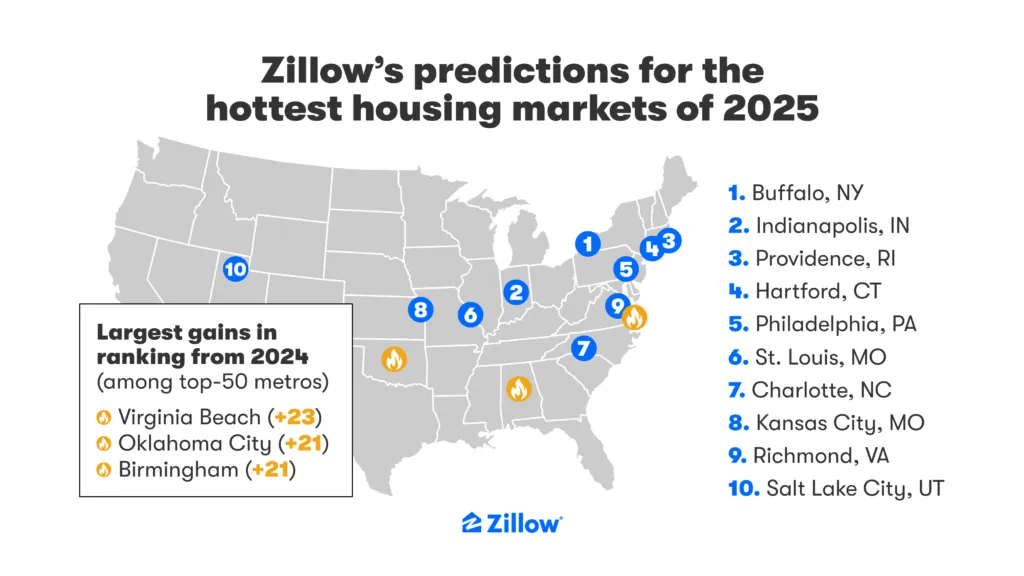
If you're trying to pinpoint where the real estate action will be in 2025, look no further! According to Zillow’s analysis, the hottest housing markets for 2025 will be largely concentrated in the Northeast and Midwest, with Buffalo, NY topping the list again. These markets stand out due to their mix of relative affordability, job growth, and a fast pace of sales. In some cases, homes are selling within a week, far outpacing the national average. Let’s break down why these particular areas are poised for continued strength.

Top 10 Housing Markets for 2025: Zillow's Predictions

Why These Markets Are Heating Up

When Zillow crunched the numbers for its 2025 list, they looked at more than just prices. The analysis centered on several key factors:

  • Home Value Growth: This measures how much home values are projected to increase. It's not always about the biggest jump, but rather sustainable, steady growth.
  • Projected Change in Owner-Occupied Households: This gives a glimpse into future demand. More households means more people looking for homes.
  • Job Growth vs. New Construction: A vibrant job market attracts new residents, but if there aren't enough new homes being built, competition will surge, which can put upward pressure on home prices.
  • Speed of Sales: This looks at how quickly homes are going from listed to pending sale. Fast sales are a sign of high demand.

These factors working in combination reveal areas that not only are desirable now, but are predicted to maintain that momentum. The fact that only four cities from last year's list have remained shows a clear shift in market dynamics, further highlighting the importance of staying on top of these changes.

The Top 10: A Closer Look

Here are the 10 metros Zillow has identified as the hottest for 2025:

Rank Metro Area Expected Home Value Growth (2025) Typical Home Value (2025) Days to Pending Sale
1 Buffalo, NY 2.8% $267,878 12 days
2 Indianapolis, IN N/A $285,086 14 days
3 Providence, RI 3.7% N/A 12 days
4 Hartford, CT 4.2% $378,693 7 days
5 Philadelphia, PA 2.6% N/A 11 days
6 St. Louis, MO 1.9% $254,847 8 days
7 Charlotte, NC 3.2% $389,383 20 days
8 Kansas City, MO 2.7% $307,334 9 days
9 Richmond, VA 2.9% N/A 9 days
10 Salt Lake City, UT 2.3% $555,858 19 days
10 Hottest Housing Markets in 2025: Latest Predictions
Source: Zillow

Let's Go Through Each City:

1. Buffalo, NY: Buffalo is a repeat champion. The city's resilience, its unique blend of urban living and natural wonders like nearby Niagara Falls, and its relatively affordable homes, continue to attract people. While growth is expected to slow slightly, the market is still competitive with homes going off the market in just 12 days. I’ve always been intrigued by Buffalo. It has a very appealing ‘comeback’ feel to it, like it is really figuring things out as a city, and people want to be a part of that.

2. Indianapolis, IN: I am surprised to see this area on the list, to be honest. But a waterfront city, with its central location and a strong job market, particularly in the pharmaceutical sector with Eli Lilly's presence, are likely the contributing factors to the city’s increasing popularity. Homes in Indianapolis move pretty fast, averaging two weeks to pending sale. While this is slightly tilting towards buyers’ side, it still is a very fast pace.

3. Providence, RI: This city beautifully blends history, arts, and education. It seems the charm of its waterfront parks, and the presence of Brown University and the Rhode Island School of Design, are a huge draw. 12 days is all that it takes for homes here to get sold.

4. Hartford, CT: The city’s home values are forecasted to have the highest growth on this list, at 4.2%, although this is actually slower than last year's whopping 7.4% jump. With homes flying off the market in an average of just 7 days, potential buyers need to have their financing squared away ahead of time. I think the fact that it is close to other major cities in the region is also a factor.

5. Philadelphia, PA: Philly is a city with a deep historical presence and walkability. While the market isn’t quite as blazing hot as last year, a 2.6% growth forecast and homes going pending in 11 days means buyers still need to be ready to act quickly. Philly is a cool place; I can totally see why people want to live there.

6. St. Louis, MO: Affordability remains a key draw for St. Louis, especially for first-time buyers. With the lowest typical home value on the list at $254,847, its 1.9% growth forecast is a modest jump, while homes get sold in about 8 days. It also feels like a great city to live in.

7. Charlotte, NC: Charlotte, known as the “Queen City,” has a lot going for it: warm weather, lots of sports teams, and a growing population. A projected 3.2% increase in home values combined with a 20-day average to sale shows a pretty competitive market. Personally, I have always thought Charlotte was an underrated city.

8. Kansas City, MO: A place of culture, known for its barbecue, musical history, and stunning fountains, Kansas City is projected to see a 2.7% home value increase and an average sale time of just 9 days. Kansas City's historic vibe, combined with affordability, can definitely make it a hotspot for many people.

9. Richmond, VA: The historic capital of Virginia offers a rich social scene, dining, and arts. Buyers will need to be on their toes, as homes are selling quickly in an average of 9 days. The city’s market is forecast to grow by 2.9%. I think there is a certain charm to Richmond that can be very appealing.

10. Salt Lake City, UT: Salt Lake City makes it on the list due to its proximity to outdoor activities, especially skiing. With an average home value of $555,858, it is the most expensive market on the list. 19 days is the average sale time in this area, and home values are expected to jump by 2.3%. The surrounding mountains make for an amazing view from anywhere in the city.

Recommended Read:

10 Cities Where Home Prices Were Rising Fast in 2024: Buffalo Topped List!

What This Means for Buyers and Sellers

If you’re looking to buy in one of these hot markets, here are a few tips:

  • Get Pre-Approved: In a competitive market, knowing your budget and having pre-approval for a mortgage is critical. Be ready to make offers as soon as you find a house you love.
  • Don't Wait: If you are a buyer, you have to be ready to make your move fast in these locations.
  • Work With a Local Expert: A real estate agent who knows the local market can help you navigate the fast-paced market.
  • Be Prepared for Bidding Wars: In many of these markets, homes sell faster, so do expect a bidding war.

If you're a seller in one of these areas, consider:

  • Price Strategically: Don't overprice your home, but do price competitively. Look at comps and have your realtor advise you.
  • Get Your Home Ready: Make sure your home is clean, tidy, and shows well. First impressions count, and you might only get one shot with the fast turnaround times.
  • Be Patient: Even in hot markets, it is important to have patience and work with a trusted agent.

My Thoughts

As someone who has followed housing trends for a while now, what strikes me is that the hottest markets are changing, and it's not just about the big coastal hubs anymore. There's a lot of appeal in mid-sized cities in the Northeast and Midwest, offering a blend of affordability, good career opportunities, and a high quality of life. What I am seeing is that the appeal of these cities stems from their history, charm, and affordability, not just being a good financial deal.

It is hard to say what the future holds, but, one thing is clear, staying informed is key in this ever-changing real estate market. Whether you are a buyer or a seller, these cities are definitely places to keep on your radar for 2025.

Work with Norada in 2025, Your Trusted Source for

Turnkey Real Estate Investing

Discover high-quality, ready-to-rent properties designed to deliver consistent returns.

Contact us today to expand your real estate portfolio with confidence.

Contact our investment counselors (No Obligation):

(800) 611-3060

Get Started Now

Recommended Read:

  • 5 Hottest Real Estate Markets for Buyers & Investors in 2025
  • 10 Hottest Housing Markets Predicted for 2025: Sun Belt Boom
  • Top 20 Hottest Housing Markets Predicted for 2025
  • 68 Housing Markets Where Prices Have Doubled the Fastest
  • Hottest Real Estate Markets in Maine: Top Locations
  • The Hottest Housing Markets in Seattle Area
  • Top 10 Hottest Real Estate Markets in the World
  • Zillow’s Predictions for the Hottest Housing Markets of 2024

Filed Under: Growth Markets, Housing Market, Real Estate Market Tagged With: Hottest Housing Markets, Hottest Real Estate Markets, Housing Market, real estate, Top 10 Housing Markets for 2025

How To Invest In Real Estate With No or Little Money?

January 16, 2025 by Marco Santarelli

How To Invest In Real Estate With No or Little Money?

Invest in Real Estate With No or Little Money

In this article, we'll go over the 10 best strategies for investing in real estate without a lot of money or experience. You will gain some insight into how to begin investing in real estate without spending hundreds of thousands of dollars. Investing in real estate refers to any property owned solely to generate profit, either through rental income or through market value appreciation. There is no such thing as no money down in real estate because the money has to come from some source. If you want to invest in real estate with little or no money, you need to develop the ability to recognize, understand, and even take advantage of other people’s money.

You will still need a little money to make a down payment when opting for financing real estate through conventional loans. Real estate is an asset form with limited liquidity relative to other investments. Any type of real estate investment requires some amount of capital and is also highly cash flow dependent to call it a profitable investment. Investing in real estate by using others' money is the stamp of authenticity for some of the most successful people in the real estate investing business.

Why? Mainly because these successful investors have grasped the art of investing in real estate with no financial input at all. For financially strapped investors and new investors, investing in real estate with no money is an attractive way of testing the waters. Moreover, all this can be done without necessarily having the credit or financial capabilities to do so. Experienced real estate investors, on the other hand, have realized that making use of other people’s money frees their cash for other investment opportunities and also clears up their available funds.

Investing in real estate is a great step towards achieving that much-desired financial freedom. If you want to start earning a consistent & reliable passive income, you need to start investing in real estate. I know many people struggle with these trite questions – how do I start investing in real estate or where to get that “cash” to buy a property? This is the question that haunts many people who want to invest in real estate but have never invested before. Investing in real estate is a tried and tested way of building wealth. Forget the infomercials on tax liens or books talking about how you get a house free from the government.

10 Best Ways to Invest in Real Estate With Little or No Money

how to invest in real estate
Image: Pixabay

1. Purchase Money Mortgage/Seller Financing

The first proven way to invest in real estate with no money is through seller financing. When buyers are unable to secure a loan from financial institutions, they may opt to seek real estate financing from the sellers. With conventional real estate transactions, the buyers will provide the sellers with the cash, to gain ownership of the property. However, with a purchase money mortgage, the seller extends finances to the buyer. The buyers will then repay the sellers, for the agreed terms.

2. Investing In Real Estate Through Lease Option

The second proven way to invest in real estate with no money is through the lease option. Under the lease option, the property owner charges the buyer a monthly or yearly premium, in the form of higher rental payments. The excess rental fee will then be channeled toward the purchase price. With this type of agreement, the investor can purchase an investment in real estate using a slightly higher rental fee.

Investing In Real Estate Through Lease Option
Image by Andreas Breitling from Pixabay

3. Hard Money Lenders

If you have no money to invest in real estate you can opt for hard money lending as a viable funding option. Instead of coming from a bank, the funds used in real estate investment will come from groups or private individuals. Since these types of loans do not necessarily need to go through corporate procedures, they tend to have fewer qualification requirements. This, in turn, means that they can be secured fast. Moreover, private lenders might be more than willing to back up risky projects.

hard money lending in real estate
Image by Niek Verlaan from Pixabay

Therefore, the interest charged on hard money loans is higher since lenders are taking greater risks and the terms are normally 12 months or less. Hard money loans require the borrower to cover closing costs, application fees, appraisal fees, and any other costs associated with the purchase of a property. Real estate investing is an ever-evolving industry. Real estate is said to be one of the best investments that an individual can make. Click on the link for the ten best real estate books that will get you started in 2020.

4. Microloans

There are a variety of new financing options that have opened up the market for new real estate businesses to profit. As the name suggests, microloans are normally geared towards startups or newer businesses, which require resources to generate further growth. Microloans are much smaller than what traditional financial institutions offer. The lower balances will, in turn, mean these programs are less strict in their qualification requirements i.e. credit score. A microloan is a good funding option to invest in real estate with no money.

investing in real estate with micro loans

5. Forming Partnerships to Invest in Real Estate With Little Money

Real estate partnerships are common for investing in real estate with little or no money. If you want to invest in a property, but the price tag is out of range, then an equity partnership may be what you need. An equity partner is an individual whom you bring into a transaction, to help finance a property. There are different ways that partnerships may be structured, and thus it is up to the buyer and the partner to agree on a more viable structure.

real estate partnerships
Image by Gerd Altmann from Pixabay

6. Home Equity Loans

If you have no money for your second investment in real estate, you can go for Home Equity Loans. The majority of investors tend to capitalize on the equity of their primary home, and then use it to finance the new property. Banks and several other financial institutions offer different products such as Home Equity Line-of-Credit and Home Equity Installment Loans, which allow buyers to capitalize on the equity that they already have. If you have just started real estate investing, you can click on the link and read our blog “All About Real Estate Investing For Beginners.” It will teach you the most important guidelines that are inevitable if you wish to succeed in residential real estate investing.

7. Trade Houses

Trading houses is another viable way of acquiring new property. By trading an old property with a new property, you will not only be able to acquire a new property but also avoid the capital gains associated with the selling of a property. This is another proven way to invest in real estate with no money. With that said, buying an investment property for sale with no money down is not a new phenomenon.

Also, it is clear to us that there is no such thing as no money down in real estate investment because the money is going to come from somewhere. Apart from the ways discussed above, there are several other ways to buy an investment property with no money down. Invest in real estate today, by choosing any of the approaches discussed above. You may also like to read our blog on “Buying Rental Properties With No Money Down.”

8. Special US Govt. Schemes Like USDA Loans

With an end goal to fill underpopulated zones of the U.S., the U.S. Department of Agriculture's Rural Development office gives mortgages with down payments as low as 0%. These loans are offered only in towns with populations of 10,000 or less. All things considered, 10,000 is very sizable for most towns, so 97% of the U.S. is secured.

USDA Home Loans For Real Estate
Image Credit: rd.usda.gov

USDA loans are zero-down-payment mortgages for rural and suburban homebuyers. These loans go to those who qualify as having a low or moderate income. They’re mainly for borrowers who aren't wealthy and can’t get a traditional mortgage. To check whether your area qualifies for this loan, you can visit USDA.gov and read its terms and conditions.

9. SBA Loans For Investing in Commercial Real Estate

The SBA works with lenders to provide loans to small businesses. If you’re looking to purchase commercial real estate, the SBA 504 loan is the best choice. An SBA 504 loan is commercial real estate financing for owner-occupied properties. Business Administration or SBA loans require only a 10 percent down payment by the small business owner and funding amounts range from $125,000 to $20 million. With an SBA 504 loan, money can be used to buy a building, finance ground-up construction, or build improvements.

10. By Owning Shares of Real Estate Investment Trusts

A REIT is a real estate investment trust. REITs have several advantages, the foremost being liquidity. If you own 20% of an apartment building, you cannot get your money out unless someone else buys your share or the property is sold. When you own shares in a real estate trust, it is generally as easily sold as shares of stock. You can buy targeted real estate investment trusts such as those in firms that build medical buildings, nursing homes, malls, and industrial parks. It is easier to diversify your holdings by owning a variety of REITs, and you never have to manage anything.

The modest downside is that they take a chunk of the profits in administrative overhead before distributing the remainder to shareholders. A related financial product is the real estate mutual fund. These mutual funds are more liquid than REIT shares. They are more diversified, too. They may invest in REITs, the publicly traded shares of homebuilders, and companies that sell building supplies. Real estate ETFs are simply ETFs that invest in the same sorts of businesses. A REIT ETF is an E TF that invests in REITs. You'll have lower returns, but there is less risk than investing in a REIT. In every case, you don't have to invest in real estate directly, much less manage it.

Conclusion

Real estate investing is the purchase, ownership, management, rental, and/or sale of any type of real estate for profit. It is a good idea because real estate offers a unique combination of safety, steady cash flow, and strong odds of high capital gains. You may earn less than investing in the stock market at its peak, but neither can you lose everything. A well-planned and executed real estate investment can generate an ongoing passive income, and it can prove to be a good long-term investment if the property value increases exponentially over time.

You may even incorporate it into your entire wealth-building strategy. If you're new to real estate investing, it's critical to read good real estate books and learn from experienced investors who have made millions by investing in some of the country's best real estate markets. Following the housing market decline in 2007, single-family rental properties became favorable options for investors, saving in construction or refurbishment prices.

The quick turnaround for an owner to rent out their property means cash flow is almost immediate. For a majority of investors, it is one of the most important decisions they will make. Therefore, choosing a real estate professional/counselor continues to be a vital part of this process. They are well-informed about critical factors that affect your specific market areas, such as changes in market conditions, market forecasts, consumer attitudes, best locations, timing, and interest rates.

NORADA REAL ESTATE INVESTMENTS strives to set the standard for our industry and inspire others by raising the bar on providing exceptional real estate investment opportunities in the U.S. growth markets. We can help you succeed by minimizing risk and maximizing profitability.

This article aimed to educate investors who are keen to invest in real estate with little or no money. Purchasing an investment property requires a lot of studies, planning, and budgeting. Not all deals are solid investments. We always recommend doing your research and taking the help of a real estate investment counselor. Keep your expectations realistic, and do your homework and research before making any decisions, just like you would with any other investment.


References:

  • https://www.biggerpockets.com/forums/50/topics/77768-10-ways-to-buy-an-investment-property-with-no-money-down
  • http://www.4smartmoney.com/benefits-real-estate-financing

Filed Under: Real Estate, Real Estate Investing, Real Estate Investments Tagged With: real estate, Real Estate Investing

The Role of Technology in Modern Real Estate Transactions

January 16, 2025 by Marco Santarelli

The Role of Technology in Modern Real Estate Transactions

Have you ever imagined walking through your dream home without setting foot inside? Or receiving instant updates on property values at the touch of a button? In the vast and often overwhelming world of real estate, technology is acting as a beacon, illuminating the path forward. The role of technology in modern real estate transactions is not just a buzzword; it’s a dynamic force reshaping how we buy, sell, and manage properties, making real estate more interactive, transparent, and user-friendly than ever before.

Imagine sifting through a sea of properties—some appealing, some not—even before you step foot inside a home. What if you could have an AI assistant guiding you to options that fit your vision and budget perfectly? Or consider the implications of closing a property deal in mere minutes, thanks to blockchain technology. As technology continues to penetrate the real estate industry, these futuristic scenarios are becoming reality.

The Role of Technology in Modern Real Estate Transactions

The fusion of technology and real estate isn’t merely about making transactions faster; it’s about fundamentally transforming the real estate ecosystem for buyers, sellers, and agents alike.

Artificial Intelligence (AI) in Real Estate Transactions

Artificial Intelligence (AI) is at the forefront of this revolution. It’s more than just a tech trend; it’s a game changer that modifies the landscape of how real estate professionals operate and interact with clients.

Smart Market Analysis

Imagine a world where predictive analytics can spot market trends before they even surface. Advanced AI algorithms analyze mountains of data—neighborhood statistics, market histories, and consumer behavior—to predict future property values and identify the best investment opportunities. This predictive capability saves millions for investors who can make informed decisions based on data rather than intuition, shortening the time to market significantly.

Enhanced Customer Interaction

Gone are the days when prospective buyers had to wait for office hours to address their queries. Enter AI-powered chatbots: your virtual real estate assistants available 24/7. These smart bots guide users through the home-buying process, providing property recommendations, answering common questions, and scheduling showings, all while learning from each interaction to improve future ones.

Precision in Property Valuation

AI’s impact also extends to property valuations where machine learning models can analyze factors such as location, square footage, and market conditions in real-time. By providing more accurate valuations, AI helps mitigate the biases prevalent in human appraisals, creating a fairer market environment.

A report by McKinsey estimates that integrating AI can maximize productivity in real estate by up to 10%, showcasing its role as a catalyst for operational efficiency.

Blockchain Technology in Real Estate Transactions

Next on the technological frontier is blockchain, a term often associated with cryptocurrencies but truly adept at addressing long-standing issues within real estate.

Revolutionizing Contracts with Smart Technology

Imagine signing a contract that executes itself when all conditions are met—with smart contracts on the blockchain, that vision is a reality. These digital contracts automate executions, reducing the need for intermediaries and significantly slashing transaction times. Buyers and sellers can experience a smoother process with fewer delays and lower costs.

Irrefutable Transparency and Security

Every transaction recorded on a blockchain is immutable and visible to all participants, ensuring transparency like never before. This security layer not only fosters trust between parties but also drastically reduces cases of fraud—a notorious problem in real estate transactions.

Democratizing Ownership Through Tokenization

Another groundbreaking aspect of blockchain is tokenization, which allows properties to be divided into digital tokens. This innovation democratizes real estate investing, enabling smaller investors to enter the market with minimal capital. Instead of needing hundreds of thousands, investors can now buy a fraction of a high-value property, broadening the investment landscape.

The potential cost reductions through blockchain implementation in real estate transactions are estimated at up to 50%, providing a compelling case for its adoption.

Emerging Technologies Shaping Real Estate Transactions

Beyond AI and blockchain, other technologies are also instrumental in modernizing real estate.

Virtual Reality (VR) and Augmented Reality (AR)

Step inside your potential new home from your couch! Virtual and augmented reality technologies allow clients to take immersive virtual tours of properties that pique their interest. This not only enhances the buyer experience but also broadens the reach for sellers, showing properties to a global audience without physical limitations.

Unmanned Aerial Vehicles (Drones)

Imagine getting stunning aerial views of properties and neighborhoods before making your decision. Drones can capture high-quality images and videos, providing potential buyers with a comprehensive visual presentation. This aerial perspective often highlights the surrounding areas, showcasing features that might not be evident at street level.

Big Data Analytics

The real estate sector also leverages big data to offer insights into consumer behavior and market preferences. By analyzing trends, real estate firms can tailor their marketing strategies, ensuring they reach the right audience with the right message at the right time. This data-driven approach enhances decision-making and fosters greater customer engagement.

Navigating the Changes: Challenges and Considerations

While the advances in technology hold incredible promise, they also come with challenges that must be navigated.

  • Regulatory Compliance: As technology evolves, regulatory bodies struggle to keep pace, creating uncertainty. Stakeholders must remain vigilant and adaptable.
  • Data Security Concerns: With reliance on digital systems comes the need for robust cybersecurity measures to protect sensitive consumer data.
  • Skill Gaps among Professionals: As new technologies emerge, there is a pressing need for real estate professionals to upskill, ensuring they can adeptly navigate and leverage these innovations.

Despite these challenges, the upside of adopting technology in the real estate sector far outweighs the issues, with numerous benefits to be realized.

Future of Real Estate Transactions: A Tech-Driven Outlook

As we peer into the future, it’s unmistakable that technology will continue driving unprecedented change in real estate transactions. Here are some key trends to anticipate:

  • Increased AI Integration: As machine learning and AI technologies advance, we can expect enhanced personalization in property recommendations and smarter marketing strategies.
  • Broader Blockchain Adoption: More real estate companies are set to embrace blockchain for its security benefits, further streamlining transaction processes.
  • Growth of All-in-One Digital Platforms: Future platforms will likely combine multiple technologies into one cohesive solution, providing seamless experiences for users.

Ultimately, the role of technology in modern real estate transactions transcends mere efficiency; it presents an opportunity to foster a more transparent, inclusive, and accessible real estate market. As we embrace these innovations, we open the door to a world where buying and selling property is not only simpler but also smarter.

In conclusion, as we stand at the intersection of technology and real estate, understanding and leveraging these transformations will be crucial for success. The journey ahead is filled with possibilities, and the tools at our disposal are only getting more advanced. Are you ready to embrace the future of real estate?

Read More:

  • How Much Does a Real Estate Agent Make Per Sale?
  • The Golden Rules of Real Estate Investing in Today's Market
  • Real Estate Investing: Why Smart Investors Are Buying Now
  • Housing Market Predictions for the Next 2 Years
  • Housing Market Predictions for Next 5 Years (2025-2029)
  • Don't Panic Sell: Here's What Current Housing Market Trends Predict

Filed Under: Real Estate, Real Estate Market Tagged With: real estate

Commercial Real Estate Crash Could Trigger Economic Tsunami

January 14, 2025 by Marco Santarelli

Commercial Real Estate Crash Could Trigger Economic Tsunami

For decades, commercial real estate has been the bedrock of the American economy. A steady, reliable giant. But now, cracks are appearing in this foundation. A chorus of financial experts is sounding alarms, warning of an impending crisis that could reverberate far beyond the property market.

With over a trillion dollars in commercial real estate loans maturing in the next two years, the perfect storm is brewing, Harvard Business Review reports. Rising interest rates, coupled with plummeting property values, have created a treacherous landscape for lenders and investors alike. And the implications for the broader economy are profound.

Is this the beginning of a domino effect that could topple even the most stable financial institutions? The evidence is mounting.

U.S. Commercial Real Estate Is Headed Toward a Crisis

The alarm bells in the commercial real estate market echo louder as it grapples with a unique trifecta of challenges. These include the aftermath of the COVID-19 pandemic, rising operational costs, and deteriorating property valuations. A key revelation highlighted by Harvard Business Review is a distinct pattern of overexposure of U.S. commercial banks to the CRE sector, particularly among community and regional banks, which have become increasingly vulnerable to market fluctuations.

The Financial Tightrope: $1 Trillion in Commercial Real Estate Loans

According to an analysis from The Conference Board, a staggering over $1 trillion in CRE loans will be due over the next two years, significantly impacting small- and midsize banks. Many of these financial institutions lack sufficient capital cushions, placing them at heightened risk for considerable losses. As the Federal Reserve maintains elevated interest rates, property valuations are expected to decline, creating a perfect storm for banks to face delinquencies and default risks.

How Did We Get Here?

So, what precipitated this precarious situation? The roots can be traced back to several significant economic shifts post-pandemic. The pandemic fundamentally altered work patterns, resulting in an accelerated move towards remote and hybrid working models, leading to increasing office space vacancies. Heightened operational costs, largely driven by surging insurance premiums, labor shortages, and energy prices, further stoke the crisis. An aging population seeking more skilled labor compounds the issue, forcing companies to increase wages. This economic strain is particularly acute in sectors most reliant on physical property, such as retail and office spaces.

The Rise of Delinquency Rates: A Worrisome Trend

The ripple effects of rising operational costs and falling property values are evident in the alarming increase in delinquency rates on CRE loans. Over the last six quarters, the percentage of nonperforming CRE loans doubled, climbing from 0.54% to 1.25%. This statistic showcases a concerning trend that mirrors previous financial downturns, specifically the lead-up to the 2008 recession when loan delinquencies significantly increased.

Analyzing Bank Exposure to CRE Loans

One of the most unsettling aspects is the disproportionate exposure smaller banks have to CRE loans. Data show that small banks (with assets between $100 million and $1 billion) have CRE loan values exceeding 158% of their risk-based capital, while midsize banks are even more exposed, with a ratio of 228%. In stark contrast, large banks (assets over $10 billion) exhibit significantly lower ratios of 142%, and the largest banks are at 56%.

This disparity indicates that while larger institutions have more robust capital buffers and regulatory requirements, smaller banks may resort to “extend and pretend” strategies—delaying the recognition of losses in hopes of a market recovery. Such approaches may be dangerously misguided and could exacerbate economic instability.

Potential Triggers of a Crisis

What could push the commercial real estate sector over the edge? Several factors loom large on the horizon:

  1. Simultaneous Bank Failures: Should multiple community and regional banks attempt to raise equity capital concurrently, it could lead to instabilities in the banking system—akin to the panic witnessed in March 2023 when only a few banks faced severe pressure.
  2. Financial Market Volatility: The repercussions of the current volatile economic environment could trigger greater demand for credit risk compensation, increasing yield requirements for investors.
  3. Economic Recession: A new recession could accelerate concerns in an already precarious market, creating a domino effect leading to widespread asset devaluation.

The Potential Fallout for the Economy

Should these triggers materialize, the fallout could be catastrophic, with potential losses rippling through the financial system. If CRE loans experience a 10% loss, it would leave more than 100 small and midsize banks undercapitalized. A 20% loss could push over 900 banks, including some larger institutions, into a similar predicament.

Furthermore, properties categorized as Class A—those enjoying consistent demand—may fare better than Class C properties situated in distressed areas amidst the ongoing shift in tenant preferences towards newer facilities. Continuous valuation challenges will only complicate banks’ ability to assess and mitigate potential losses adequately.

The Road Ahead: Strategies for Navigating a CRE Crisis

As corporate leaders monitor these unfolding events, they must adapt proactively to mitigate potential risks. Here are a few strategies that firms should consider:

  • Examine Banking Relationships: Companies should evaluate their long-term banking partners’ balance sheets, particularly focusing on institutions heavily exposed to CRE loans.
  • Extend Debt Maturities: Extended loan terms may provide the necessary breathing room as market conditions evolve.
  • Maintain Adequate Liquidity: Companies should ensure they possess sufficient cash reserves and diversifications across various financial instruments to weather potential financial shocks.

Closing Thoughts

The forecast regarding the future of U.S. commercial real estate brings an air of urgency. The combination of escalating risk factors—from the impending maturity of significant CRE loans to rising interest rates—raises fundamental questions about the longevity of the sector. As we look towards the future, it becomes clear: businesses cannot afford complacency. Proactive measures will be vital in navigating what could very well be a historic reckoning for the commercial real estate market. The time to pivot, adapt, and prepare is now—before the crisis becomes a reality.

Work with Norada in 2025, Your Trusted Source for

Turnkey Real Estate Investing

Discover high-quality, ready-to-rent properties designed to deliver consistent returns.

Contact us today to expand your real estate portfolio with confidence.

Contact our investment counselors (No Obligation):

(800) 611-3060

Get Started Now 

Read More:

  • Commercial Real Estate Forecast for the Next 5 Years
  • Will the Commercial Real Estate Rebound or Crash?
  • Will the Commercial Real Estate Market Crash in 2025?
  • Commercial Real Estate: Office Vacancy Soars to 14% in the First Quarter 2024

Filed Under: Real Estate, Real Estate Market Tagged With: commercial real estate, real estate

Commercial Real Estate Forecast for the Next 5 Years

January 14, 2025 by Marco Santarelli

Commercial Real Estate Forecast for the Next 5 Years

As we look ahead, the commercial real estate forecast for the next 5 years raises important questions for investors, businesses, and stakeholders in the industry. The market is at a pivotal point, influenced by shifting economic factors, technological innovations, and evolving consumer preferences.

With a variety of opinions swirling around, understanding where the market is headed is crucial for strategic decision-making. The commercial real estate (CRE) sector has experienced considerable shifts in recent years, driven by the post-pandemic recovery, remote work adoption, and rising interest rates.

According to a recent report by Deloitte, the outlook for 2024 and beyond appears cautious, emphasizing that the recovery process will not be uniform across all property types.

The Future of Commercial Real Estate: Insights for the Next 5 Years

Remote Work and Office Spaces

The traditional office space has seen a dramatic transformation. With companies opting for flexible work arrangements, the demand for office space is expected to decline. The 2024 Commercial Real Estate Trends report by JPMorgan Chase highlights that office properties in prime locations will likely outperform their peers, but overall demand will remain subdued.

  • Reduction in Footprint: Many companies are reducing their office footprint as hybrid working models become the norm. This shift is expected to continue, impacting long-term leases and new office construction.
  • Repurposing Spaces: There is an increasing trend towards repurposing excess office space into residential units or mixed-use developments.

Retail Real Estate Adaptations

Retail spaces are undergoing a significant reinvention to accommodate e-commerce growth. Adaptive reuse of existing properties to create mixed-use environments is becoming increasingly common. Retailers are focusing on enhancing customer experiences, driving a reevaluation of physical spaces.

  • Experience Over Transactions: Physical retail is pivoting towards providing immersive experiences to attract customers, integrating more entertainment and dining options.
  • Omnichannel Strategies: Retailers are focusing on omnichannel strategies, blending online and offline experiences to cater to consumer preferences.

Industrial Growth Continues

As e-commerce continues its upward trajectory, the demand for industrial real estate—particularly warehouses and distribution centers—shows no signs of slowing.

  • Expanding Logistics Hubs: Companies are expanding logistics hubs to meet same-day or next-day delivery expectations, increasing the demand for well-located industrial properties.
  • Investment in Automation: Investments in automation and advanced warehousing technologies are becoming critical to streamline operations and enhance efficiency.

According to Statista, the United States commercial real estate market is experiencing a surge in demand for flexible office spaces due to the rise of remote work and the need for adaptability.

  • Projected US Commercial Real Estate Market Value: US$25.28tn by 2024
  • Anticipated CAGR (2024-2029): 2.18%
  • Estimated Market Volume by 2029: US$28.16tn
  • US Dominance: Expected to be the world's largest Real Estate market by value in 2024

Sustainability Trends

Sustainability is no longer a trend—it's an expectation. Investors are gravitating towards properties that meet environmental standards, shown by a surge in green building certifications. Companies are increasingly recognizing that sustainable practices can lead to cost savings and a positive brand image.

  • Green Building Certifications: Certifications like LEED and BREEAM are becoming standard requirements for new developments.
  • Energy Efficiency: Implementing energy-efficient systems and sustainable materials reduces long-term operational costs and appeals to environmentally conscious tenants.

Economic Factors and Market Dynamics

One cannot overlook the influence of macroeconomic factors such as interest rates, inflation, and economic growth on the commercial real estate forecast.

  • Interest Rates: With the Federal Reserve's monetary policies aimed at controlling inflation, fluctuations in interest rates will significantly impact CRE financing and investment dynamics.
  • Inflation: Rising construction costs and material shortages due to inflationary pressures will affect the feasibility and profitability of new development projects.
  • Economic Growth: Economic recovery and growth rates influence demand across CRE sectors. Strong economic indicators are likely to enhance tenant confidence and drive leasing activities.

Technological Innovations

Technological advancements are playing an increasingly vital role in shaping the future of commercial real estate. From property management to tenant experience, technology is influencing every facet of the industry.

  • PropTech Integration: The integration of property technology (PropTech) solutions is streamlining operations, from automated leasing processes to enhanced property management systems.
  • Smart Buildings: Smart building technologies incorporating IoT (Internet of Things) for energy management, security, and occupant comfort are becoming more prevalent, enhancing property values and tenant satisfaction.

Risks and Challenges

While numerous opportunities lie ahead, the commercial real estate market also faces several risks and challenges.

  • Market Volatility: Economic uncertainties and potential recessions can lead to market volatility, impacting property values and investment returns.
  • Regulatory Changes: Changes in zoning laws, building codes, and environmental regulations can pose challenges to CRE developments and operations.
  • Workforce Dynamics: The evolving workforce preferences, particularly among younger generations prioritizing work-life balance and remote work options, can shape demand patterns across CRE sectors.

Preparing for the Future

The commercial real estate forecast for the next 5 years indicates a transformative phase driven by unprecedented changes in work patterns, consumer behavior, and societal expectations. Investors and businesses must remain agile, ready to pivot their strategies in response to evolving conditions. Keeping an eye on key trends, such as sustainability and technological integration, will be essential for thriving in this new environment.

Forecasted Market Dynamics (2024-2029)

Year Office Demand Retail Demand Industrial Demand Market Growth Rate
2024 Decreasing Stabilizing Increasing Moderate (Approx. 2%)
2025 Stabilizing Adaptive Use High Growth 2.5%
2026 Stabilizing Optimizing High Growth 2.8%
2027 Slight Increase Adaptation Continued Growth 3%
2028 Increase in Demand Rebuilding Peak Growth 3.2%

The table above outlines the anticipated shifts across various segments of commercial real estate. As seen, while office demand may stabilize, industrial demand is set to see significant growth. This data underscores the necessity for investors to adapt their strategies to meet market realities.

Conclusion:

As the landscape evolves, those who harness these insights and prepare for change will not only survive but potentially thrive in the new commercial real estate paradigm. Strategic foresight, adaptability, and a keen understanding of emerging trends will be the key differentiators for success.

Commercial real estate is more than just buildings—it’s about people, experiences, and how we interact with our environments. By staying informed and responsive to the changes on the horizon, stakeholders can confidently navigate the complexities of the commercial real estate market over the next five years.

Work with Norada in 2025, Your Trusted Source for

Turnkey Real Estate Investing

Discover high-quality, ready-to-rent properties designed to deliver consistent returns.

Contact us today to expand your real estate portfolio with confidence.

Contact our investment counselors (No Obligation):

(800) 611-3060

Get Started Now 

Read More:

  • Will the Commercial Real Estate Rebound or Crash in 2025?
  • Will the Commercial Real Estate Market Crash?
  • Commercial Real Estate Crash Could Trigger Economic Tsunami
  • Commercial Real Estate: Office Vacancy Soars to 14% in the First Quarter 2024

Filed Under: Real Estate, Real Estate Market Tagged With: commercial real estate, real estate

Impact of Wildfires on the Los Angeles Housing Market in 2025

January 11, 2025 by Marco Santarelli

Impact of Wildfires on the Los Angeles Housing Market in 2025

Wildfires have devastating effects not only on the environment but also on local economies, particularly the housing market. In Los Angeles, the ongoing wildfires are shaping a turbulent landscape for property owners and renters alike. The impact of wildfires in the Los Angeles housing market involves increased rental prices, housing shortages, and heightened insurance costs, all of which pose serious challenges for residents.

Impact of Wildfires on the Los Angeles Housing Market in 2025

Key Takeaways

  • Wildfires lead to increased rental prices by as much as 8% or more.
  • There is a growing housing shortage due to damaged properties and increased competition.
  • The insurance market is strained, affecting coverage and premiums for homeowners.
  • Many residents are experiencing forced relocations, leading to a surge in demand for available housing.

The wildfires that have recently swept through Los Angeles have created an urgent, pressing situation. People are not only losing their homes, but the entire community’s housing landscape is shifting dramatically. Recent reports indicate that wildfires are expected to exacerbate an already tight housing market, driving rental prices upward and causing a further squeeze on available inventory (Reuters).

How Wildfires Are Shaping Housing Demand

The immediate effects of wildfires are alarming. In the wake of destruction, many residents face the harsh reality of losing their homes. According to reports, the number of available homes on the market in Los Angeles was already down by 26 percent, and with the latest fires, this situation is projected to worsen. This supply crisis brings about pronounced shifts in the housing demand landscape.

The surge in housing demand is primarily caused by:

  • Families needing temporary or permanent relocations.
  • Increased competition among renters as displaced individuals flood the market.
  • Reduced inventory as properties become nonviable due to fire damage.

Here’s a table demonstrating the rental price projections post-wildfires:

Timeframe Predicted Rent Increase Notes
0-3 Months 8% – 10% Direct impact from displacement due to wildfires.
3-6 Months 6% – 8% Continuing influx of displaced residents.
6-12 Months 4% – 6% Stabilization of rental rates as market adjusts.

Understanding the Housing Shortage

The housing shortage in Los Angeles is intensifying due to the wildfires, compounding an existing issue where housing is already scarce. With fewer homes available, the competition among renters will heat up, further driving prices skyward. The loss of homes means that those planning to rebuild will face intense competition for contractors and materials, leading to delays and higher costs.

Many experts argue that this situation is a ticking time bomb for many factors surrounding the housing market. People are scrambling for available locations, and this demand surge can lead to inflated prices as landlords leverage the urgency of finding housing.

Insurance Market Strain

One of the often-overlooked implications of wildfires on the housing market is their impact on the insurance industry. The recent fires have caused a significant strain on California's insurance market, as property owners report increasing difficulty in obtaining coverage for homes located in high-risk wildfire areas (CalMatters).

Insurance claims filed as a result of property destruction are projected to reach incredibly high numbers, prompting insurance companies to reevaluate risk assessments for properties. This results in:

  • Higher premiums for homeowners, making it increasingly unaffordable for many.
  • A limited number of policies available in high-risk areas, causing further financial strain.
  • Potential loss of insurance for existing homeowners as companies reassess their risk portfolios.

Historical Context and Comparisons

Historically, wildfires have played a significant role in altering housing markets, not just in Los Angeles but across the state of California. After major fire events, housing prices typically spike, leading to long-term changes in the local economy. A comparable instance occurred post-2018 Camp Fire, where areas like Paradise, California experienced abrupt changes in both property values and rent.

Lessons learned from past wildfire events indicate that sustained housing shortages could lead to urban sprawl as people search for affordable living spaces further away from urban centers. The long-term urban planning implications for Los Angeles cannot be understated, and while the state has enacted policies to mitigate these issues, the effectiveness of these efforts remains uncertain.

Residents' Perspectives

Many residents express their concerns about the current state of housing following the recent wildfires. With commuters often already strained under existing traffic and housing demands, the prospect of longer distances to work positions significant pressure on families. Displacement can lead to social fragmentation, with established communities being forced to scatter.

Table: Resident Sentiment on Housing Post-Wildfires

Concern Percentage of Respondents
Increased Rent 75%
Lack of Available Housing 82%
Difficulty in Reconstructing Homes 68%

This table reflects the immediate thoughts of residents and points toward a broader discontent with the housing market evolving after the wildfires.

Future Outlook

As Los Angeles continues to grapple with these wildfires and their residual effects, it’s clear that immediate actions will shape the housing market for years to come. With discussions surrounding urban planning and disaster preparedness taking center stage, stakeholders must work collaboratively to ensure more resilient housing frameworks are established.

The prospect of higher rents, fewer available homes, and rising insurance costs can create a perfect storm for families already struggling with financial burdens. As the wildfires smoke clears and residents begin to ponder their future, one thing remains clear—long-lasting changes to the Los Angeles housing market are imminent.

To sum up, when we really look at what's going on, we can get a better idea of how big disasters like wildfires mess up housing markets and the people who live there. As more people deal with the mess from wildfires, it's not just about the money problems right now. It's about what this all means for how stable communities in Los Angeles will be down the road.

Read More:

  • Minimum Qualifying Income to Buy a House in Los Angeles is $219,200
  • Top 5 Richest Cities in the Los Angeles County
  • Los Angeles Housing Market: Prices, Trends, Forecast 2025
  • 20 Wealthy Neighborhoods in Los Angeles
  • Homebuyers Are Leaving San Francisco, New York, and Los Angeles
  • California Dominates Housing With 7 of Top 10 Priciest Markets
  • California Housing Market: Nearly $174,000 Needed to Buy a Home
  • Most Expensive Housing Markets in California
  • Abandoned Houses for Free California: Can You Own Them?

Filed Under: Housing Market, Real Estate Market Tagged With: california, Housing Market, Insurance Market, Los Angeles, real estate

  • « Previous Page
  • 1
  • …
  • 5
  • 6
  • 7
  • 8
  • 9
  • Next Page »

Real Estate

  • Birmingham
  • Cape Coral
  • Charlotte
  • Chicago

Quick Links

  • Markets
  • Membership
  • Notes
  • Contact Us

Blog Posts

  • Mortgage Rates Today, August 24, 2026: 30-Year Refinance Rate Drops by 2 Basis Points
    August 24, 2026Marco Santarelli
  • Today’s Mortgage Rates, August 23: Bond Market Volatility Keeps Rates Climbing
    August 23, 2026Marco Santarelli
  • Los Angeles Housing Market: Trends and Forecast 2026
    August 23, 2026Marco Santarelli

Contact

Norada Real Estate Investments 30251 Golden Lantern, Suite E-261 Laguna Niguel, CA 92677

(949) 218-6668
(800) 611-3060
BBB
  • Terms of Use
  • |
  • Privacy Policy
  • |
  • Testimonials
  • |
  • Suggestions?
  • |
  • Home

Copyright 2018 Norada Real Estate Investments

Loading...