Norada Real Estate Investments

  • Home
  • Markets
  • Properties
  • Membership
  • Podcast
  • Learn
  • About
  • Contact

4 Florida Housing Markets Facing Worse Potential Crash Than Cape Coral

July 25, 2025 by Marco Santarelli

4 Florida Housing Markets Currently Worse Than Cape Coral

The Florida sun might be shining, but beneath that warm glow, the housing market tells a complex story. If you've been watching the news, you might have heard whispers of a slowdown, a “balancing act,” or even some price drops. As someone deeply invested in understanding these market shifts, I've spent a lot of time poring over the latest data, looking for the real pulse of Florida's communities.

And when we talk about the housing markets in Florida, which are currently much worse than Cape Coral, let me tell you, it's not as simple as it seems, but yes, for single-family homes in May 2025, some specific metropolitan areas are indeed showing more significant signs of market cooling or price depreciation than Cape Coral.

What do I mean by “worse”? I'm looking at where median home prices are falling faster, or closed sales are declining more sharply, signaling a softer market for sellers and perhaps more opportunities for buyers. It's about spotting the areas where the market correction is hitting harder.

Florida Housing Markets Facing Worse Potential Crash Than Cape Coral

The Big Picture: Florida's Real Estate in Flow

Florida's real estate market is always buzzing, a hot spot for relocation, investment, and retirement. But even the Sunshine State isn't immune to national trends like higher interest rates and a general cooldown after years of dizzying growth. Tim Weisheyer, the 2025 Florida Realtors President, hit it right on the head when he said, “Florida's housing market is finding its balance, and that's good for buyers and sellers alike.” This isn't a crash, but a shift.

From what I've observed, and the data backs this up, we're seeing more homes for sale, which is great news for buyers who felt like they were in a fierce bidding war just a year or two ago. This increase in inventory, coupled with buyers adjusting to higher borrowing costs, means sellers need to be more strategic with their pricing.

Looking at the statewide figures for single-family homes in May 2025:

  • Closed Sales: Down 5.7% from last year, totaling 24,756.
  • Median Sale Price: $415,000, a 2.7% drop from a year ago.

Dr. Brad O'Connor, the Chief Economist for Florida Realtors, pointed out that this is the third month in a row of year-over-year price drops statewide for single-family homes. However, he's quick to remind us that prices are still a hefty 54% above where they were in 2020. This context is vital – it's a recalibration, not a collapse. It's a return to something more “normal” after a period that was anything but.

Understanding Cape Coral's Market – A Benchmark

Let's zoom in on Cape Coral-Fort Myers MSA, which serves as our benchmark for this discussion. This area, particularly Lee County, saw immense growth and certainly its share of challenges, especially after Hurricane Ian. When I look at the numbers for single-family homes in Cape Coral-Fort Myers MSA for May 2025, here's what stands out:

  • Closed Sales: 1,443, a slight 1.6% decrease from the previous year. This is a pretty moderate dip, suggesting demand is still present.
  • Median Sale Price: $375,000, a more notable 9.6% decline year-over-year.

From my perspective, this price correction in Cape Coral makes sense. It experienced a massive surge in prices post-pandemic and then dealt with the complexities of hurricane recovery. While recovery brings investment, it also brings unique challenges that can temporarily cool the market. A nearly 10% price drop sounds significant, but remember, this area's median price was likely inflated in recent years, making this more of a return to reality than a deep plunge. Buyers now have a bit more room to negotiate, and sellers are adapting.

So, the question remains: are there other areas in Florida where the single-family home market is feeling an even greater squeeze than Cape Coral's notable 9.6% price correction? The answer is yes, and let's explore which ones and why.

The 4 Housing Markets in Florida Currently Worse Than Cape Coral

When I analyzed the statewide data for May 2025, focusing on single-family homes, I looked for metropolitan areas that showed more aggressive year-over-year declines in median sale prices or a combination of significant price and sales drops compared to Cape Coral-Fort Myers MSA's -9.6% price change and -1.6% sales change.

Here's what I found, with four specific MSAs standing out:

1. Naples-Immokalee-Marco Island MSA

  • May 2025 Single-Family Home Data:
    • Closed Sales: Down 15.3% year-over-year.
    • Median Sale Price: $767,800, a sharp 19.2% decrease year-over-year.

In my view, Naples stands out as a prime example of a market currently experiencing a greater downturn than Cape Coral. Why is this median price drop so much more severe here? Naples is known for its luxury and high-end properties. These segments of the market can be more sensitive to economic shifts, particularly rising interest rates and stock market volatility, which impact wealthier buyers. When the cost of borrowing goes up, or investments dip, ultra-luxury buyers might pause, leading to fewer sales and more pressure on sellers to lower prices. The sheer value of these homes means even a percentage drop translates to a large dollar amount, which can feel more impactful.

2. Punta Gorda MSA

  • May 2025 Single-Family Home Data:
    • Closed Sales: Up 1.7% year-over-year.
    • Median Sale Price: $325,000, a significant 14.5% decrease year-over-year.

Punta Gorda's numbers present an interesting puzzle. While closed sales actually increased – suggesting continued buyer interest – the median sale price dropped by a substantial 14.5%. This is a larger price erosion than Cape Coral's. My take on this is twofold: First, like Cape Coral, Punta Gorda was heavily impacted by Hurricane Ian, and the post-hurricane market dynamics, including insurance costs and recovery efforts, are likely influencing buyer behavior and valuations. Second, it's possible that a higher proportion of sales at lower price points or properties needing more work are driving down the median, or sellers who held on to highly appreciated properties are now more motivated to adjust to current market conditions. It's a signal that while homes are selling, the perceived value of those homes has softened considerably.

3. Sebastian-Vero Beach MSA

  • May 2025 Single-Family Home Data:
    • Closed Sales: Down 6.8% year-over-year.
    • Median Sale Price: $386,190, a 10.2% decrease year-over-year.

Sebastian-Vero Beach, a coastal region, also shows a steeper decline in median price than Cape Coral, alongside a larger drop in sales. This combination suggests a more pervasive cooling. Areas along the coast often attract second-home buyers and retirees, who might be more discretionary in their purchases. Higher insurance premiums, a concern across all of Florida, could be particularly impactful in coastal areas like this, adding to the overall cost of homeownership and potentially dampening buyer enthusiasm, leading to price concessions. The 10.2% price drop indicates sellers are adapting to a clearer buyer's market here.

4. North Port-Sarasota-Bradenton MSA

  • May 2025 Single-Family Home Data:
    • Closed Sales: Down 4.7% year-over-year.
    • Median Sale Price: $475,000, a 9.9% decrease year-over-year.

While the price drop here is only slightly worse than Cape Coral's (-9.9% vs. -9.6%), the sales decline is significantly greater (-4.7% vs. -1.6%). The North Port-Sarasota-Bradenton area has been a magnet for new residents, especially during the pandemic boom. Such rapid growth often leads to prices that outpace fundamental value, creating conditions ripe for a correction when demand cools. This area saw massive appreciation, and now, with higher interest rates and increased inventory, the market is finding its new equilibrium. The combined effect of dropping sales and prices signifies a more challenging environment for sellers compared to Cape Coral.

Here’s a quick comparison highlighting the May 2025 single-family home performance:

MSA Median Sale Price (May 2025) Y/Y % Chg Price Closed Sales (May 2025) Y/Y % Chg Sales
Cape Coral-Fort Myers MSA (Benchmark) $375,000 -9.6% 1,443 -1.6%
Naples-Immokalee-Marco Island MSA $767,800 -19.2% 431 -15.3%
Punta Gorda MSA $325,000 -14.5% 536 +1.7%
Sebastian-Vero Beach MSA $386,190 -10.2% 273 -6.8%
North Port-Sarasota-Bradenton MSA $475,000 -9.9% 1,574 -4.7%

Data from Florida Realtors®, May 2025 Single-Family Home Market Activity.

Market Nuances: Why Some Areas Experience Sharper Shifts

Beyond the specific numbers, I think it's crucial to understand the underlying currents affecting these markets. Why are some areas seeing sharper adjustments than others?

  • Luxury Market Sensitivity: Areas with a higher concentration of luxury homes (like Naples) are often the first to feel the effects of economic shifts. When interest rates rise, even wealthy buyers feel it or choose to invest their capital elsewhere temporarily.
  • Post-Hurricane Recovery Paths: While all of Florida contends with hurricane season, areas hit directly by formidable storms can see diverse recovery patterns. Insurance costs rise, availability of skilled labor for repairs can be tight, and buyer perceptions can shift. The markets recovering from Hurricane Ian are still finding their footing. From my experience, some areas bounce back quicker due to strong local economies or higher investment, while others might lag.
  • Prior Price Appreciation: Markets that saw the most aggressive price increases during the peak of the boom are often facing a more significant correction. It's simply mathematics; the higher the run-up, the more room there is for prices to come down without necessarily reflecting a “crash” but rather a return to a more sustainable level.
  • Inventory Ratios: Dr. O'Connor mentioned that Florida's inventory levels for both single-family homes (5.6 months' supply) and condo-townhouses (10.3 months' supply) are back to pre-2020 levels. A higher supply, especially when combined with lower demand, puts downward pressure on prices. If an area has a particularly high number of homes for sale relative to buyer interest, that market will soften more quickly.

It's also worth noting that the condo and townhouse market statewide is experiencing even more pronounced price erosion, with average median prices for these units being down 6.1% year-over-year. This has been a longer trend, starting in July of last year. While my focus here is single-family homes, it's a good reminder that different property types react differently to market pressures.

“Worse” Doesn't Always Mean “Bad”

For current homeowners, seeing price declines can be concerning. But as a professional in this field, I always emphasize perspective. A market correction isn't a disaster, especially in Florida, which remains a highly desirable place to live. Today's market is nothing like the Great Financial Crisis; inventory levels are still well below 2008 figures.

For potential buyers, especially those who were priced out during the frenzied years, these shifts represent opportunity. More inventory means more choices, less competition, and hopefully, more reasonable prices. This “balancing act” is exactly what a healthy market needs to prevent unsustainable bubbles.

My advice to anyone navigating these markets is simple: local expertise matters more now than ever. A good Realtor isn't just about unlocking doors; they're about explaining the hyper-local nuances of your specific neighborhood, the current insurance climate, and effective pricing strategies. In these evolving times, preparation and expert guidance truly make all the difference.

The Road Ahead

Florida's housing market is resilient. It's adjusting, not collapsing. While some areas, like those we've discussed – Naples, Punta Gorda, Sebastian-Vero Beach, and North Port-Sarasota-Bradenton – are experiencing greater price and sales adjustments than Cape Coral, these are generally healthy corrections after a period of intense growth. They reflect a market maturing and finding a new, more sustainable pace. Whether you're buying or selling, understanding these localized trends is key to making informed decisions in Florida's dynamic real estate world.

“Invest in Real Estate in the “Hottest Florida Markets”

Discover high-quality, ready-to-rent properties designed to deliver consistent returns.

Contact Norada today to expand your real estate portfolio with confidence.

Contact our investment counselors (No Obligation):

(800) 611-3060

Get Started Now 

Read More:

  • Worst Florida Housing Markets Facing Steepest Price Declines in 2025
  • Cape Coral Housing Market Crash: Boom, Bust, and Echoes in 2025
  • Why is Cape Coral Housing Market in Florida Doomed to Crash in 2025?
  • 5 Popular Florida Housing Markets Are at High Risk of Price Crash
  • 2 Florida Housing Markets Flagged for a Major Price Decline Risk
  • 24 Florida Housing Markets Could See Home Prices Drop by Early 2026
  • Is the Florida Housing Market Headed for Another Crash Like 2008?
  • Key Trends Shaping the Florida Housing Market in 2025
  • This Florida Housing Market Bucks National Trend With Declining Prices
  • Florida Housing Market Crash 2.0? Analyst Warns of 2008 Echoes
  • Tax Relief Proposed as Florida Housing Market Faces Deepening Crisis

Filed Under: Housing Market, Real Estate Market Tagged With: Florida, Housing Market, housing market crash, Housing Market Trends

Will Cape Coral Be the Next Florida Housing Market to Crash?

July 24, 2025 by Marco Santarelli

Florida's Cape Coral Housing Market is the Most Susceptible to a Crash

If you're thinking about buying or selling a home in Cape Coral, Florida, you need to be aware that the Cape Coral housing market is currently facing a high risk of price decline. Recent data from Cotality (formerly CoreLogic) shows that Cape Coral has experienced the largest year-over-year decline in home prices among the top 100 markets, with prices falling by a significant -6.5%. This isn't just a small blip; it signals a real shift, and prices are now back to levels we saw in the spring of 2022. While some parts of the country are still seeing home prices go up, Florida, and specifically Cape Coral, is in a cooling-off period.

Will Cape Coral Be the Next Florida Housing Market to Crash?

What's Driving This Downturn in Cape Coral?

It's easy to look at the numbers and feel a bit uneasy, but understanding why this is happening can give us a clearer picture. For a long time, Florida, and many of its popular cities like Cape Coral, saw incredible home price growth. People flocked there for the sunshine, beaches, and a generally more affordable lifestyle compared to other parts of the country. But as Dr. Selma Hepp, Chief Economist at Cotality, points out, “housing market headwinds continue to challenge homebuying demand.”

Think of it like this: imagine a popular toy that everyone wants. The price goes up because so many people are trying to buy it. But eventually, either fewer people want it, or more of that toy becomes available. In Cape Coral's case, after years of really strong growth, the market is starting to catch its breath.

One of the biggest factors affecting home prices nationwide, and certainly in places like Florida, is affordability. According to Cotality's data, the national median home price is around $395,000, and to afford that, you'd need an income of about $87,800. While these are national figures, they help paint a broader economic picture. When people worry about their finances, job prospects, or even potential tariff impacts, they tend to be more cautious about making big purchases like a home. This caution can lead to less demand, and when demand softens, prices can start to fall.

Florida's Broader Market Trends

Cape Coral isn't alone in seeing its housing market cool down. Florida as a whole reported negative home price growth of -0.8% in April 2025. This means that, on average, homes across the state are not increasing in value, and in many cases, they are losing value.

Dr. Hepp specifically noted that “several markets in the state are seeing price declines.” In fact, Cotality's data identified that all five of the U.S. markets with the highest risk of price decline are located in Florida. This reinforces the idea that the Sunshine State is undergoing a significant market adjustment.

It's interesting to see that Florida's median sales price has dipped below the national median, which is a notable shift. This suggests that the rapid price increases the state experienced previously might have pushed prices beyond what many buyers can comfortably afford, especially when you factor in current economic uncertainties.

Cape Coral's Specific Situation: A Deeper Dive

Let's bring it back to Cape Coral. The data is quite stark: a -6.5% year-over-year decline is a substantial drop. For context, the national year-over-year price growth was only 2.0% in April 2025, with single-family detached homes growing at 2.46%. However, single-family attached homes actually saw a decline of 0.08% nationally – the first annual drop since 2012.

Here's what this means for Cape Coral:

  • Prices are back where they were: The -6.5% decline means that the average home price in Cape Coral is now similar to what it was in the spring of 2022. If you bought a home in late 2022 or early 2023 at the peak of the market, you might be looking at a loss in equity right now.
  • More “Cool” Markets: Cape Coral is listed as the “coolest” housing market in the country in Cotality's April 2025 data, with Punta Gorda, Florida close behind at -6.2%. This “coolness” is a direct indicator of declining prices.

Why is Cape Coral Hit So Hard?

It's worth digging into why Cape Coral might be experiencing a more pronounced downturn than some other areas.

  1. Rapid Appreciation: Cape Coral, like much of Florida, saw very rapid price increases in the years leading up to this current slowdown. Markets that experience such quick growth are often more susceptible to price corrections when conditions change. It’s like a rubber band being stretched too far – it can snap back.
  2. Affordability Concerns: While Florida might have been more affordable than places like California or New York in the past, the surge in prices has made it less so. As incomes haven't kept pace with the soaring home values, more buyers are priced out or become hesitant.
  3. Economic Headwinds: The broader economic concerns mentioned earlier, such as worries about job security and inflation, can hit markets like Cape Coral harder if they are more reliant on certain industries or if they attract a significant number of buyers who are sensitive to economic shifts.
  4. Supply vs. Demand: While the data mentions that “improved for-sale supply is providing buyers with more options,” if demand in a specific market like Cape Coral softens significantly, even a normal supply can feel like too much, leading to price pressure.

What Does This Mean for Buyers and Sellers?

For Sellers:

If you're looking to sell your home in Cape Coral, it's crucial to have realistic expectations.

  • Price Appropriately: Overpricing your home in this market could mean it sits on the market for a long time, potentially leading to price reductions later. Working with a local real estate agent who understands current market conditions is key. They can help you price your home competitively based on recent sales.
  • Be Prepared for Negotiations: Buyers might have more leverage than they did a year or two ago. Be prepared for offers that may be below your asking price and be open to negotiations.
  • Highlight Your Home's Strengths: Focus on what makes your home unique and appealing. Is it beautifully renovated? Does it have a great canal view? Emphasize these features to attract buyers.

For Buyers:

This market shift might present some opportunities for buyers.

  • More Negotiating Power: With prices softening and more homes on the market, you may find it easier to negotiate on price and terms.
  • Wider Selection: You might have a better chance of finding the home that truly fits your needs and budget, rather than feeling rushed into a purchase.
  • Don't Wait Too Long: While prices are declining, there's also a forecast for potential future growth. Waiting indefinitely might mean missing out on current favorable conditions. It’s important to buy when it makes sense for your personal financial situation and long-term goals.

Other Florida Housing Markets to Watch: The “High-Risk” List

Cotality's data highlights a “Markets to Watch” list featuring areas with a “very high risk of price decline.” The fact that Cape Coral tops this list at number 1 is a significant warning sign. Other Florida markets on this list include:

  • Lakeland, FL (2nd)
  • North Port, FL (3rd)
  • St. Petersburg, FL (4th)
  • West Palm Beach, FL (5th)

The accompanying chart showing “High-risk market home price trends” visually illustrates this. For Cape Coral, the purple line representing its home price trend shows a clear peak and subsequent decline, now leveling off but still significantly lower than its high point.

Looking Ahead: What's the Forecast?

The national picture is one of slowing growth, but not necessarily a nationwide crash. Dr. Hepp notes that “annual home price growth has slowed considerably, but home prices this spring have held up, and gains have mostly mirrored trends seen pre-pandemic.” This is somewhat encouraging, suggesting that the current slowdown might be more of a correction after an overheated period rather than a full-blown recession in housing prices across the board.

However, for markets like Cape Coral that experienced very high growth and are now seeing significant declines, the path forward could be different. The factors influencing the national market – economic uncertainty, interest rates, and affordability – will continue to play a role.

The fact that Florida, and specifically Cape Coral, is overrepresented in the markets most at risk suggests that local economic conditions, coupled with the broader national trends, are creating a more challenging environment for home values in this region.

It's my professional opinion, based on this data and my understanding of real estate cycles, that sellers in Cape Coral should prepare for a market where they might not achieve the prices seen at the peak. Buyers, on the other hand, could find more favorable conditions, but should still be diligent in their research and financing.

As Dr. Hepp mentions, “With more visibility around tariffs, diminishing concerns about an economic recession, and more homes for sale, the homebuying market could see some improved optimism and more activity going forward.” This suggests that while there are risks, there are also potential catalysts for improvement. However, for Cape Coral, the immediate outlook remains cautious, with a continued high risk of price decline.

It’s crucial for anyone involved in the Cape Coral real estate market to stay informed and make decisions based on the most current data and local expert advice.

Invest in Real Estate in the “Hottest Florida Markets”

Discover high-quality, ready-to-rent properties designed to deliver consistent returns.

Contact Norada today to expand your real estate portfolio with confidence.

Contact our investment counselors (No Obligation):

(800) 611-3060

Get Started Now 

Read More:

  • 5 Popular Florida Housing Markets Are at High Risk of Price Crash
  • 2 Florida Housing Markets Flagged for a Major Price Decline Risk
  • 24 Florida Housing Markets Could See Home Prices Drop by Early 2026
  • Is the Florida Housing Market Headed for Another Crash Like 2008?
  • Key Trends Shaping the Florida Housing Market in 2025
  • This Florida Housing Market Bucks National Trend With Declining Prices
  • Florida Housing Market Crash 2.0? Analyst Warns of 2008 Echoes
  • Tax Relief Proposed as Florida Housing Market Faces Deepening Crisis
  • Is the Florida Housing Market on the Verge of Collapse or a Crash?
  • 3 Florida Cities at High Risk of a Housing Market Crash or Decline
  • Florida Housing Market: Record Supply Expected to Favor Buyers in 2025
  • Florida Housing Market Forecast for Next 2 Years: 2025-2026
  • Florida Housing Market: Predictions for Next 5 Years (2025-2030)
  • Hottest Florida Housing Markets in 2025: Miami and Orlando
  • Florida Real Estate: 9 Housing Markets Predicted to Rise in 2025
  • 3 Florida Housing Markets Are Again on the Brink of a Crash
  • Florida Housing Market Predictions 2025: Insights Across All Cities
  • When Will the Housing Market Crash in Florida?
  • South Florida Housing Market: Will it Crash?

Filed Under: Housing Market, Real Estate Market Tagged With: Cape Coral, Florida, Housing Market, housing market crash, Housing Market Trends

Housing Market Turmoil: Prices Hit an All-Time High, But Sales Drop

July 23, 2025 by Marco Santarelli

Housing Market Turmoil: Prices Hit an All-Time High, But Sales Drop

Home prices hit an all-time high, but sales go down simultaneously. This simply means houses are more expensive than ever, but fewer people are buying them. This situation creates a tricky housing market for everyone involved. Let dive deep into the reasons.

Housing Market Turmoil: Prices Hit an All-Time High, But Sales Drop

The Numbers Don't Lie: A Snapshot of Today's Housing Market

Let's start with the latest information from the National Association of REALTORS® (NAR) and Realtor.com. These experts keep a close watch on the housing market, and here's what their reports are telling us:

  • Home Sales Are Slipping: In the latest NAR Existing-Home Sales Report, existing home sales decreased by 2.7% in June. We’re seeing fewer homes changing hands. According to Realtor.com, sales volume for existing homes is expected to fall 1.5% annually, to just 4 million transactions. That would mark the slowest year for existing-home sales since 1995!
  • Prices Are Sky-High: Despite the drop in sales, the median existing-home price reached a record high of $435,300 in June, a 2% increase from last year. In some areas, the prices are even higher.
  • Inventory Is Up (Slightly): There are more homes available for sale than there were a year ago. The total housing inventory in June was 1.53 million units, up 15.9% from June 2024. This gives buyers more options.
  • Mortgage Rates Remain Elevated: Those seemingly ever-present high mortgage rates are definitely playing a huge role. Freddie Mac reported that the average 30-year fixed-rate mortgage was 6.75% as of July 17th.
  • Homes Are Staying on the Market Longer: The median time a property stays on the market before being sold is now 27 days. This is up from 22 days last year, suggesting homes aren't selling as fast as they used to.

To present this in an easier to read manner, please refer this table.

Metric Change Details
Existing-Home Sales Decrease 2.7% Month-over-month; No change year-over-year
Median Home Price Increase 2% Record high of $435,300
Housing Inventory Up 15.9% 1.53 million units
Mortgage Rate (30-Year) 6.75% As of July 17
Days on Market 27 days Up from 22 days last year; Shows homes are staying longer in the market before getting sold confirming the reduction in sale activity

The Million-Dollar Question: Why This Disconnect?

So, why are these two things – high prices and low sales – happening at the same time? It boils down to a few key factors:

  1. High Mortgage Rates: These rates are the biggest buzzkill for potential buyers right now. When rates are high, it costs more to borrow money, making homes less affordable. A slight increase in the morgage rate will affect the affordability by a wide margin.
  2. Affordability Crisis: Home prices have been climbing for years, outpacing wage growth. Even with slightly more inventory, many people simply can't afford to buy a home, especially with those high mortgage rates.
  3. Inventory Issues: While inventory is up compared to last year, we are still in short supply. The construction of new homes isn't keeping up with the population increase. More homes need to be built to bring prices down and meet the demand.
  4. Sellers Are Hesitant: Some potential sellers are choosing not to list their homes, possibly hoping that the market will improve. We call this the “lock-in effect,” where existing homeowners with low mortgage rates are reluctant to sell and give up those favorable rates.
  5. Economic Uncertainty: People’s confidence has taken a bit of a hit with all the news about inflation, economic downturns, and job security. This situation makes people think twice before spending a fortune on a home.
  6. Homeownership Rate Decline: Due to lack of affordability, and rising prices the homeownership rate is expected to decline to 65.2% this year.

Regional Differences: Where You Live Matters

Here’s the thing – the housing market isn’t the same everywhere. What’s happening in one part of the country might be totally different from what’s happening somewhere else. The NAR report breaks down the numbers by region:

  • Northeast: Sales decreased and prices increased. This area remains a tighter market with steady buyer activity.
  • Midwest: Sales decreased, but prices increased.
  • South: Sales decreased, and prices saw a slight increase. The Southern region has seen the most substantial inventory gains.
  • West: Sales increased slightly, but prices increased. The West is also seeing increased inventory, but affordability is still an issue.

The First-Time Homebuyer Struggle

For those trying to buy their first home, this market is brutal. The median home price is so high, and the down payment needed just keeps getting bigger. Add to that high mortgage rates, and it's easy to see why many first-timers are stuck renting or living with family longer. Remember first-time home buyers accounted for 30% of sales.

The Impact on Renters

Interestingly, while buying a home is getting pricier, the rental market is softening a bit. Asking rents are even expected to decline slightly this year. This could offer some relief for renters who are saving up for a down payment or waiting for the housing market to cool down. Its a small positive change that renters can hang on to.

My Take on What's Next: A Glimmer of Hope?

Okay, so here's where I share my own thoughts on all of this. I think the housing market is at a turning point. While prices are currently high, I don't believe this is sustainable in the long run.

Here's why:

  • Mortgage Rates Can't Stay This High Forever: Eventually, I expect mortgage rates to come down a bit. When that happens, it will give buyers more breathing room and could spur more sales.
  • Increased Inventory Will Eventually Ease Prices: As more homes come onto the market, it will give buyers more negotiating power and, hopefully, put downward pressure on prices.
  • The Economy Will Stabilize: As the economy becomes more predictable, people will feel more confident about making big purchases like homes.

Now, I'm not saying home prices will suddenly crash. But I do think we'll see a more balanced market in the coming years, where buyers have more options and homes are more affordable.

Dr. Lawrence Yun, the chief economist at NAR, believes that if mortgage rates were to decline to 6%, an additional 160,000 renters could become first-time homeowners.

What Should You Do?

So, what does all of this mean for you? Here's my advice, depending on your situation:

  • If You're a Buyer: Don't panic! Take your time, shop around for the best mortgage rates, and don't feel pressured to overpay. It might be worth waiting a bit to see if the market cools down.
  • If You're a Seller: Be realistic about pricing your home. Buyers are more cautious these days, so you might not get as much as you would have a year ago.
  • If You're a Renter: Keep saving! Take advantage of the slightly softer rental market to build up your down payment.

A Balanced Market Will Benefit Everyone

In the end, a healthy housing market is good for everyone. It's not just about high prices benefiting sellers or low prices benefiting buyers. We need a market where people can afford to buy homes, where sellers can get a fair price, and where the housing market contributes to a strong economy. This balance will take years to achieve, which is why the younger generation is finding it difficult to get into the housing market.

Invest in Real Estate in the Booming Markets of the U.S.

Discover high-quality, ready-to-rent properties designed to deliver consistent returns.

Contact us today to expand your real estate portfolio with confidence.

Contact our investment counselors (No Obligation):

(800) 611-3060

Get Started Now 

Recommended Read:

  • 20 Worst Housing Markets Facing Biggest Price Crash or Correction by 2026
  • Housing Market Faces a Major Long-Term Crisis: Jerome Powell
  • Housing Market Forecast 2026: Will Prices Rise or Fall Next Year?
  • Housing Market Predictions: Home Prices to Drop 1.4% in 2025
  • Housing Market Alert: Over 600 Metros Will See Prices Decline by 2026
  • 12 Housing Markets Set for Double-Digit Price Decline by Early 2026
  • Real Estate Forecast: Will Home Prices Bottom Out in 2025?
  • Why Real Estate Can Thrive During Tariffs Led Economic Uncertainty
  • Will There Be a Real Estate Recession in 2025: A Forecast
  • Will the Housing Market Crash Due to Looming Recession in 2025?
  • 4 States Facing the Major Housing Market Crash or Correction

Filed Under: Housing Market, Real Estate Market Tagged With: Housing Market, housing market crash, housing market predictions, Worst Housing Markets

Florida Real Estate: The Hidden Opportunity Amid Market Crash Concerns

July 21, 2025 by Marco Santarelli

Florida Real Estate: The Hidden Opportunity Amid Market Crash Concerns

In 2025, the savvy investor is looking at Florida real estate not just for its sunshine and beaches, but for a unique opportunity that many are overlooking: the chance to acquire high-quality, newly constructed investment properties at favorable prices with strong rental demand. Forget the doomsayers and outdated headlines; Florida is poised for continued long-term growth, and the current market conditions present a golden moment for those who understand where to look and what to build.

I've been following the Florida real estate market closely for years, observing its cycles and shifts. What strikes me now, as we move through 2025, is that the noise surrounding past market fluctuations has created a perception gap. Many are still reacting to news from 2022 or even earlier, missing the critical developments that are making this the ideal time to enter or expand their portfolio in the Sunshine State.

Florida Real Estate: The Hidden Opportunity Amid Market Crash Concerns

Understanding the Florida Real Estate Shift: Beyond the Headlines

It’s easy to get caught up in the sensationalism of real estate news. Just recently, I saw an article painting a bleak picture of Florida’s housing market, echoing sentiments that have been around for a while. But in my experience, this narrative is outdated. Florida has always been a dynamic market, experiencing booms and corrections, but its underlying fundamentals – population growth, a favorable business climate, and a desirable lifestyle – remain incredibly strong.

The days of irrational exuberance and rapid price hikes seen during the pandemic are behind us. Interest rates have adjusted, and the market has naturally recalibrated. While some segments of the market, particularly single-family homes, may have seen a dip in prices (estimates suggest around 10-20% from their peak for certain types of investor-grade properties), this correction is precisely what savvy investors are looking for. It’s a chance to buy into a market with proven long-term appreciation potential.

Key Market Dynamics to Consider:

  • Population Growth: Florida continues to attract new residents, consistently ranking as one of the fastest-growing states in the U.S. This ongoing influx of people directly translates to sustained rental demand.
  • Economic Climate: The state’s business-friendly policies and lack of state income tax remain significant draws for both individuals and companies, reinforcing its economic stability.
  • Correction, Not Collapse: The market has indeed corrected from its overheated highs. However, this is a sign of a healthier, more sustainable market, not a collapse. For those building a long-term portfolio, these moments are opportunities.

The Undervalued Asset: New Construction Built for Investors

This is where the real opportunity lies for 2025 – new construction built with an investor’s mindset. I’ve seen firsthand the difference between properties built for quick resale and those designed for long-term holding. My own investment philosophy, and that of the successful firms I connect with, centers on building assets that will appreciate, generate consistent rental income, and require minimal hassle.

This is precisely what’s happening in the Southwest Florida region, stretching from Naples up to Sarasota. The focus here is on creating something that lasts, something that attracts quality tenants, and something that withstands the elements.

Why New Construction is Key:

  • Durability and Low Maintenance: Properties are being built with materials and techniques designed to last. Think concrete block construction, hurricane impact windows (a game-changer for absent owners), and Luxury Vinyl Plank (LVP) flooring. These features significantly reduce maintenance costs and tenant headaches.
  • Strategic Design: Innovations like placing HVAC air handlers inside the conditioned space, rather than in hot garages, extend the life of these critical systems. Details like ensuring a rain and ice underlayment beneath roofs mean that even if shingles are compromised during a storm, water ingress is minimized. These are the kinds of thoughtful touches that matter when holding property for decades.
  • Modern Appeal: Features like shaker cabinets and quartz countertops provide a modern, desirable aesthetic that appeals to renters, translating to better occupancy rates and potentially higher rental income.

The Rental Demand: Stronger Than You Think, Especially for Quality

The narrative that rental demand in Florida has evaporated is simply not true. While there might have been a period where some property managers pushed rents too high, leading to longer vacancy periods, the market is rebalancing. What I’m seeing is a flight to quality. Tenants, when given the choice, gravitate towards newer, well-maintained properties.

Furthermore, there’s an innovative approach in some parts of Florida that’s significantly boosting returns: renting by the room. This strategy takes a standard duplex or even a single-family home and maximizes its income potential. Instead of collecting one lump sum for the entire property, units are rented to multiple individuals, each on an annual lease.

The Power of Rent by the Room:

  • Enhanced Cash Flow: For a typical duplex, market rent might be around $1,900 per month. With a rent-by-the-room strategy, where each room rents for approximately $900, a duplex can generate upwards of $5,400 per month. After accounting for utilities and some property management, this is a substantial increase in net cash flow, potentially boosting returns by 10-13% or more annually.
  • Guaranteed Income: Often, these programs are backed by agencies that guarantee full rental income and handle the complexities of managing multiple tenants. This translates to a more passive investment experience for the owner.
  • Resilience: Even if the rent-by-the-room programs were to scale back, the property still commands strong market rents. This provides a built-in safety net, ensuring that the investment remains profitable under standard rental agreements. A duplex still fetches around $1,900-$2,100 in market rents in key areas, providing a solid 8% return before considering appreciation.

Tackling a Major Hurdle: Insurance Costs Demystified

One of the most talked-about concerns in Florida real estate is insurance. Many assume it’s prohibitively expensive, driving investors away. However, this is another area where the perception is often misaligned with reality, especially for new construction.

In my interactions with industry professionals, a common point of confusion exists. For new, well-built properties, insurance has arguably never been cheaper relative to rental income. While the absolute dollar amount might seem higher than in other states, when you compare it to the rental income and the robust building codes in Florida, the cost-effectiveness becomes clear.

  • Replacement Cost Estimates: Builders who focus on investor product often have precise replacement cost estimates for their properties. This data is crucial for negotiating with insurance companies. In Florida, the cost of rebuilding has actually decreased on average over the past year due to efficiency and builder expertise.
  • Reduced Premiums for New Construction: Properties built to current Florida building codes, including impact windows and enhanced roofing, are often rewarded with lower insurance premiums. This is a stark contrast to older properties that may require costly retrofitting or face higher risk assessments.
  • Avoiding Flood Zones: A critical strategy is to focus on properties outside of flood zones. Flood insurance can be a significant expense, and by selecting higher ground or working with builders who navigate the process of getting properties out of flood zones, investors can avoid this cost entirely.

The Financial Opportunity: Rates, Returns, and Long-Term Wealth

The current financial climate presents a compelling case for Florida real estate. We're seeing lenders offering attractive rates, with 30-year fixed DSCR loans available in the mid-6% range. When combined with the strong rental income potential, both through traditional leases and innovative rent-by-the-room models, the returns are highly attractive.

  • Attractive Interest Rates: Access to 30-year fixed-rate financing at competitive rates significantly enhances cash flow and predictability for investors.
  • High ROI Potential: The rent-by-the-room strategy, in particular, can yield annual returns in the 13-14% range, a figure that is hard to match in other markets or asset classes, especially with the added benefit of new construction. Even traditional leases on quality new builds offer robust returns, often in the 8% range, which is a strong performance in today's market.
  • Long-Term Appreciation: Beyond immediate cash flow, Florida’s consistent population growth and economic development trajectory suggest strong potential for long-term property appreciation. This is not about quick flips; it's about building generational wealth.

Comparing Florida to Other Markets:

I’ve looked at markets across the country, including Texas. While Texas also has strong growth, its high property taxes (often around 2% annually) can significantly eat into rental income, making it difficult to achieve the same level of cash-on-cash return that Florida offers, particularly when comparing a new duplex in Florida to a similar property in Texas. Florida’s lack of state income tax, coupled with more manageable property taxes (especially when spread across higher rental income), creates a far more lucrative environment for long-term buy-and-hold investors.

Why This Opportunity is Being Missed

The reason this Florida real estate opportunity is overlooked in 2025 boils down to a few key factors:

  1. Outdated Information: Media cycles are fast, but the real estate market’s recovery and evolution can outpace headlines. Those still focused on past downturns are missing the current reality.
  2. Fear of Florida’s Risks: Concerns about hurricanes or past builder issues deter some. However, focusing on new construction built to withstand these risks, and working with reputable, vertically integrated firms, mitigates these concerns significantly.
  3. Complacency or Lack of Due Diligence: Many investors stick to what they know or fail to perform the deep due diligence required to identify the quality opportunities within a seemingly complex market.

My Personal Take and Call to Action

As someone who has invested in real estate for years, and who believes in creating assets that stand the test of time, I find the current Florida market incredibly compelling. The combination of strong fundamentals, a correction that has made prices more accessible, and innovative approaches to maximizing rental income through quality new construction creates a powerful synergy.

This isn’t about chasing a trend; it’s about understanding the fundamental drivers of a market and capitalizing on them during opportune moments. The people who built their wealth in real estate often did so by being contrarian, by buying when others were fearful, and by focusing on long-term value. That’s precisely what Southwest Florida offers right now.

If you’re looking to build real, sustainable wealth through real estate, 2025 is the year to seriously consider Florida. Don’t let outdated information or fear hold you back from an opportunity that is largely being missed. Connect with reputable teams that understand the market, focus on quality new construction, and can guide you through the process. This is how you position yourself for success in the long run.

Florida Real Estate: Hidden Opportunities in 2025

As headlines warn of market crashes, savvy investors see what others don't—Florida’s fundamentals remain strong, especially in the new construction and build-to-rent sectors.

While others react to outdated fears, Norada clients are leveraging today’s soft pricing, surging rental demand, and demographic momentum to build long-term equity in Florida’s most promising metro areas.

DON'T LET OLD NEWS COST YOU NEW GAINS

Contact our investment counselors (No Obligation):

(800) 611-3060

Start Building Wealth in Florida

Read More:

  • 4 Florida Housing Markets Facing Worse Potential Crash Than Cape Coral
  • Worst Florida Housing Markets Facing Steepest Price Declines in 2025
  • Cape Coral Housing Market Crash: Boom, Bust, and Echoes in 2025
  • Why is Cape Coral Housing Market in Florida Doomed to Crash in 2025?
  • 5 Popular Florida Housing Markets Are at High Risk of Price Crash
  • 2 Florida Housing Markets Flagged for a Major Price Decline Risk
  • 24 Florida Housing Markets Could See Home Prices Drop by Early 2026
  • Is the Florida Housing Market Headed for Another Crash Like 2008?
  • Key Trends Shaping the Florida Housing Market in 2025
  • This Florida Housing Market Bucks National Trend With Declining Prices
  • Florida Housing Market Crash 2.0? Analyst Warns of 2008 Echoes
  • Tax Relief Proposed as Florida Housing Market Faces Deepening Crisis

Filed Under: Housing Market, Real Estate Market Tagged With: Florida, Housing Market, housing market crash, Housing Market Trends

Cape Coral Housing Market Crash: Boom, Bust, and Echoes in 2025

July 14, 2025 by Marco Santarelli

Cape Coral Housing Market Crash: Boom, Bust, and Echoes in 2025

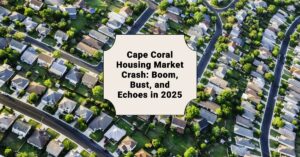
Cape Coral, Florida, experienced a severe housing market crash as part of the 2008 Subprime Mortgage Crisis and subsequent Great Recession. Renowned for its extensive canal system and waterfront properties, the city's boom turned to bust, leaving a lasting scar on the community.

Ever driven down a street lined with for-sale signs, each one whispering a story of financial hardship? I have. And while the real estate market always has its ups and downs, certain places have experienced truly dramatic cycles. Cape Coral fits this description.

Let's dive into the story of how Cape Coral went from a real estate paradise to its collapse, and what lessons we can learn from its experience. I'll also evaluate the housing market as of 2025.

Cape Coral Housing Market Crash: Boom, Bust, and Echoes in 2025

The Boom Before the Bust (2000-2007)

Imagine a place where the sun shines almost every day, the canals sparkle, and the promise of an affordable waterfront home is on the horizon. That was Cape Coral in the early 2000s. Like many parts of Florida, Cape Coral experienced a huge surge in popularity. It was like everyone wanted a piece of the Florida dream.

  • Affordable homes: Compared to other coastal areas the price was so low that people could believe it. Cape Coral was a good option if people wanted to settle down.
  • Warm climate: It's Florida; sunshine is basically guaranteed, making it perfect for retirees and snowbirds escaping colder climates.
  • Relaxed lifestyle: Imagine spending your days boating, fishing, or simply enjoying the beautiful scenery. That was the appealing promise of Cape Coral.

This combination brought in a wave of buyers. Florida saw a whopping 96% increase in home prices between 2000 and 2007, a Duke University study points out. And I'd wager Cape Coral, with its rapid growth, experienced even higher increases.

New construction was everywhere. Builders couldn't keep up with the demand. Everyone seemed to believe prices could only go up. It was a frenzy, no doubt. This chart illustrates a little bit of the boom years in Florida:

Metric Details
Home Price Increase (Florida) 96% from 2000 to 2007 (HPI from 100 to 196)
Investor Loans Peak 20% of all mortgage loans in 2005
Homeownership Peak 72% in 2006, fell to 65% by 2014

Investor loans, like a sugar rush for the market, peaked at 20% of all mortgages in Florida in 2005. This was fuelled by the false belief that home values would always increase. It created a dangerous recipe for disaster.

The Crash (2008): “Ground Zero”

The music stopped in 2008. The subprime mortgage crisis hit, and Cape Coral, sadly, became known as “ground zero” for the housing market collapse. It was as if someone pulled the plug on the party, and the hangover was brutal.

The root cause? Risky lending practices. Banks were handing out subprime mortgages to people with poor credit. Adjustable rates that reset to much higher payments trapped them. The crisis was as a snowball rolling down hill.

In Lee County, where Cape Coral is located, over 40,000 foreclosures were filed in 2008 alone, according to The News-Press. These figures reflect the devastation the crisis had on people's lives.

Out-of-state credit unions adding fuel to the fire. Norlarco Credit Union, for example, handed out overly risky loans. A review found that a ridiculous 97% of the construction loans were overvalued about 35%. When Norlarco collapsed in 2008, it cost the National Credit Union Share Insurance Fund over $10 million.

These numbers were pretty crazy. Here is a chart that describes the state of the market at that time.

Impact Area Details Numbers
Foreclosures (Lee) Over 40,000 filed in 2008 40,000+
Mortgage Over-Value 97% of construction mortgages overvalued by 35% 97%, 35%
Credit Union Losses Norlarco Credit Union, liquidation led to losses over $10M $10M+

Features like balloon notes and interest-only loans further exacerbated the issue because they were based on the false idea that the market would continue to strengthen forever.

I remember thinking at the time, “This can't last.” But nobody wanted to listen. The allure of easy money and quick profits was far too strong.

The Aftermath (2008-2013): Years of Distress

The years following the crash were bleak. From 2008 to 2013, Cape Coral’s housing market was on life support. Real estate sales mainly involved cash buyers who were jumping on the chance to scoop up distressed properties at dirt-cheap prices. Cape Coral and Fort Myers often topped lists of cash-only closings, confirming the volume of distressed sales.

Properties decayed. Many sat abandoned. Some were invaded by squatters or stripped for scrap metal. Lee County's Neighborhood Stability Program did try its best to buy, fix up, and resell some of the properties. But the damage was extensive, and the city struggled to shake off its image as a foreclosure hotspot.

The broader economy also took a hit. Businesses closed. Unemployment rose. The delinquency rate in Florida jumped from 1.1% in 2006 to 20% in the first quarter of 2010.

Metric Details Numbers
Delinquency rate (Florida) Rose from 1.1% in 2006 to 20% in Q1 2010 1.1% (2006)
Real Estate Sales Mostly opportunistic cash buyers, distressed properties at low prices N/A
Foreclosure Inventory High, with properties sitting available on the market for long periods of time N/A

I recall driving through neighborhoods where every other house seemed to be vacant. It was incredibly quiet and depressing, and a visible sign of a city struggling.

The Recovery (2013-Present): A Gradual Climb

Around 2013, things started to look up. First-time home buyers slowly re-entered the market. Home sales began inching upward. By 2017, the median house price in Lee County reached $243,500, showing a 7.1% rise from the previous year.

Foreclosure rates also declined. In 2016, a RealtyTrac report showed that Cape Coral's rates were down about 93% down from their peak.

Metric Details Numbers
Median Home Price (2017) $243,500 in Lee County, up 7.1% from the previous year $243,500, 7.1%
Foreclosure Levels (2016) 93% below peak in Cape Coral and other metro areas 93%
Home Sales (2015) Nearly 2600 in the first 6 months, 9% increase over the previous year 2600, 9%

Although the market had recovered, recovering your credit and financial stability needed time. The recovery was slow.

Cape Coral's Housing Market in 2025: Déjà Vu?

Now, let's fast forward to today. Are we seeing history repeat itself? I'm starting to sense some concerning parallels.

Here's a snapshot of the current situation:

  • Dramatically Falling Home Prices: Redfin says that Cape Coral home rates were down 7.7% in May of 2025 compared to last year. The median home price is around $361,000.
  • Stagnant Sales: Buyers are being increasingly hesitant. Redfin claims that 608 homes were sold in May this year, down about 5.7% from the 645 last year.
  • Shift to a Buyer's Market: Buyers have a lot more leverage now in negotiations with sellers.
  • Surge in Time on Market: The time has dramatically increased. Homes remain available for 76 days compared to 59 last year.
  • Bottom Ranked: Fox 4 Now reported Cape Coral was last among 123 midsize cities in the U.S. in their July 2025 hotness ratings chart.

To summarize, here's a table breaking down the important numbers:

Key Metric Value (May 2025) Change from Previous Year Source
Median Home Price $361,000 Down 7.7% Redfin
Homes Sold 608 Down 5.7% Redfin
Days on Market 76 days Up from 59 days Redfin

Decoding the Signs

  • Falling Prices: This is the beginning of a shift in supply and demand.
  • Elevated Mortgage Rates: Rates are around 6.94% for a 30-year fixed mortgage, so many buyers are priced out of the market.
  • Economic Cloudiness: Inflation worries, global uncertanties and recession fears, make people cautious in investing.
  • Excess Inventory: Hurricane Ian has resulted in new constructions hitting the market after it.
  • The Perils of Nature: Cape Coral’s vulnerability to insurance costs goes up due to sea levels that impact property values.

2008 vs. 2025: Parallels and Divergences

The similarities between the current picture and the 2008 disaster are a bit scary. The 2008 crisis was driven by fraudulency on mortgages, speculative buying, and lax regulations, whereas now, supply glut, mortgage rates, and uncertainty make it different.

Expert Insights and Predictions

“Housing market headwinds,” Dr. Selma Hepp says. She says Cape Coral has negative growth vs the USA. One can see 2.0% vs Cape Coral's -6.5%.

Realtors I have spoken to say that sellers be realistic about the prices.

Conclusion: Lessons Learned and the Path Forward

The 2008 crash left a mark on Cape Coral, Florida. The city symbolizes the subprime mortgage crisis with all the rising foreclosure rates.

Cape Coral’s experience serves as a reminder to prevent lending practices in the future. Hopefully, the city is evolving its real estate. But this is a good reminder of how important it is to be careful with money.

Invest in Real Estate in the “Hottest Florida Markets”

Discover high-quality, ready-to-rent properties designed to deliver consistent returns.

Contact Norada today to expand your real estate portfolio with confidence.

Contact our investment counselors (No Obligation):

(800) 611-3060

Get Started Now 

Read More:

  • Why is Cape Coral Housing Market in Florida Doomed to Crash in 2025?
  • Will the Cape Coral Housing Market Repeat the Crash of 2008?
  • Is Cape Coral the Next Florida Housing Market to Crash?
  • 5 Popular Florida Housing Markets Are at High Risk of Price Crash
  • 2 Florida Housing Markets Flagged for a Major Price Decline Risk
  • 24 Florida Housing Markets Could See Home Prices Drop by Early 2026
  • Is the Florida Housing Market Headed for Another Crash Like 2008?
  • Key Trends Shaping the Florida Housing Market in 2025
  • This Florida Housing Market Bucks National Trend With Declining Prices
  • Florida Housing Market Crash 2.0? Analyst Warns of 2008 Echoes
  • Tax Relief Proposed as Florida Housing Market Faces Deepening Crisis
Filed Under: Housing Market, Real Estate Market Tagged With: Cape Coral, Florida, Housing Market, housing market crash, Housing Market Trends

Will the Cape Coral Housing Market Repeat the Crash of 2008?

July 10, 2025 by Marco Santarelli

Will the Cape Coral Housing Market Repeat the Crash of 2008?

Is Cape Coral heading for another housing market disaster? The short answer is: quite possibly. While it's not a certainty, several warning signs – dropping prices, a glut of homes for sale, and economic uncertainty – suggest that Cape Coral is teetering on the edge. Having been at the heart of the 2008 subprime mortgage crisis, could history be repeating itself? Let's dive deep into what's happening in this Florida city.

Will the Cape Coral Housing Market Repeat the Crash of 2008?

I remember watching the news in 2008, seeing the stories of families losing their homes. Places like Cape Coral were mentioned repeatedly, becoming synonymous with the housing market collapse. Now, seeing similar trends emerge, I am concerned about the potential impact on homeowners and the wider community.

A Ghost from the Past: The 2008 Subprime Mortgage Crisis

Cape Coral wasn't just affected by the 2008 crisis; it was arguably at the epicenter. How did this happen? A perfect storm of factors brewed:

  • Speculative buying frenzy: People were buying homes, not necessarily to live in, but as investments, hoping to flip them for a quick profit.
  • Risky lending practices: Banks were handing out subprime mortgages – loans to people with poor credit histories – with little regard for their ability to repay. Many of these loans had adjustable interest rates or balloon payments, which meant payments could suddenly skyrocket.
  • Ignorance and Greed: People and Businesses were getting rich doing the wrong things.

When the housing bubble burst, the bottom fell out. Speculators walked away from their mortgages, leading to a wave of foreclosures. Cape Coral suffered immensely, and it took years for the market to recover. A 2016 report highlighted that foreclosure levels in Cape Coral were 93% below their peak by that year. So, it recovered eventually.

Cape Coral's Housing Market in 2025: Are We Reliving History?

Fast forward to 2025, and the situation in Cape Coral is, frankly, worrying. Let's look at some key indicators:

  • Falling Home Prices: According to Redfin, in May 2025, Cape Coral home prices were down 7.7% compared to last year, selling for a median price of $361,000. This price drop is a clear sign of a cooling market.
  • Sluggish Home Sales: Buyers are pulling back. Redfin reported that there were 608 homes sold in May this year, down by 5.7% from 645 last year. This indicates decreasing buyer confidence and demand.
  • A Buyer's Market: The power has shifted from sellers to buyers, making it easier for buyers to negotiate better deals.
  • Rising Days on Market: Redfin claims that on average, homes in Cape Coral sell after 76 days on the market compared to 59 days last year.

To put it bluntly, Cape Coral was ranked last among 123 midsize U.S. cities in a 2025 report on the hottest real estate markets, according to Fox 4 Now. That should make anyone in the area sit up and pay attention.

Here's a concise look at the market based on the latest data:

Key Market Indicators Details
Median Home Price (May 2025) $361,000, down 7.7% from previous year (Redfin)
Home Sales (May 2025) 608 homes sold, down 5.7% from May 2024 (Redfin)
Days on Market (May 2025) 76 days on average, compared to 59 days from May 2024 (Redfin)

Why Is Cape Coral Facing This Predicament?

What is behind Cape Coral's current housing woes? Several factors are at play:

  • Declining Home Prices: As mentioned earlier, the steady drop in home prices is a major concern, indicating a market correction. This trend is fueled by reduced demand and an oversupply of homes.
  • High Mortgage Interest Rates: Nobody likes higher interest rate. Currently hovering around 6.94% for a 30-year fixed mortgage, interest rates make buying a home more expensive, pricing many potential buyers out of the market. Experts believe these high rates will persist, adding continued pressure.
  • Economic Uncertainties: When the economy is shaky, people tend to hold back on big purchases like homes. Concerns about job security, inflation, and global issues all contribute to reduced demand.
  • Oversupply of Homes: The combination of post-hurricane listings and new construction has flooded the market with homes, creating fierce competition among sellers.
  • Natural Hazards: Cape Coral is vulnerable to storms, floods, and other natural disasters. These risks lead to higher insurance costs and can negatively impact property values. Knowing that nearly every home in Cape Coral is at risk presents real issues for people trying to sell their House there .
  • Supply Chain Disruptions: Global supply chain issues continue to make building materials more expensive and harder to get. This can delay construction projects and increase costs for developers.
  • Post-Hurricane Ian Impact: The aftermath of Hurricane Ian, which caused massive damage, has contributed to the problem. Many damaged homes have been put on the market, adding to the oversupply.

These factors, combined with Cape Coral’s history, create a fragile situation.

A Comparison: 2008 vs. 2025

While there are similarities between the current situation and the 2008 crisis, there are also crucial differences. In 2008, predatory lending and unsustainable mortgages were the primary drivers. Today, high mortgage rates, economic uncertainty, and an oversupply of homes are the main culprits. While foreclosures are a concern now, the scale is still smaller than what we saw in 2008.

What the Experts Are Saying

Real estate experts are sounding the alarm.

“Housing market headwinds continue to challenge homebuying demand,” warns Dr. Selma Hepp, Chief Economist at Cotality. She identified that Cape Coral’s -6.5% year-over-year price decline in April 2025 stands out against the national growth of 2.0%.

Experts and realtors advise sellers to be realistic about prices and buyers to do their homework.

However, it's not all doom and gloom. A report from Realtor.com predicts a combined 22.8% growth in home sales and prices in the Cape Coral-Fort Myers area for 2025, hinting at a possible turnaround later in the year.

What's Next for Cape Coral's Housing Market?

The future of Cape Coral's housing market is uncertain. While there are signs that the market may be nearing its bottom, high mortgage rates, rising insurance costs, and environmental risks continue to loom.

If you're a potential buyer: This could be an opportunity to find a good deal, but be aware of flood risks and insurance costs.

If you're a seller: Be prepared to adjust your pricing expectations and consider consulting with a local real estate agent.

In Conclusion, Proceed with Caution

Cape Coral's housing market is walking a tightrope in 2025. The risk of a crash is real, and its history as a crisis epicenter only amplifies the concerns. Whether you're a buyer, seller, or investor, proceed with caution, seek expert advice, and stay informed about the latest market trends. While a modest recovery is possible, the path ahead is full of challenges.

Invest in Real Estate in the “Hottest Florida Markets”

Discover high-quality, ready-to-rent properties designed to deliver consistent returns.

Contact Norada today to expand your real estate portfolio with confidence.

Contact our investment counselors (No Obligation):

(800) 611-3060

Get Started Now 

Read More:

  • Is Cape Coral the Next Florida Housing Market to Crash?
  • 5 Popular Florida Housing Markets Are at High Risk of Price Crash
  • 2 Florida Housing Markets Flagged for a Major Price Decline Risk
  • 24 Florida Housing Markets Could See Home Prices Drop by Early 2026
  • Is the Florida Housing Market Headed for Another Crash Like 2008?
  • Key Trends Shaping the Florida Housing Market in 2025
  • This Florida Housing Market Bucks National Trend With Declining Prices
  • Florida Housing Market Crash 2.0? Analyst Warns of 2008 Echoes
  • Tax Relief Proposed as Florida Housing Market Faces Deepening Crisis
  • Is the Florida Housing Market on the Verge of Collapse or a Crash?
  • 3 Florida Cities at High Risk of a Housing Market Crash or Decline
  • Florida Housing Market: Record Supply Expected to Favor Buyers in 2025
  • Florida Housing Market Forecast for Next 2 Years: 2025-2026
  • Florida Housing Market: Predictions for Next 5 Years (2025-2030)
  • Hottest Florida Housing Markets in 2025: Miami and Orlando
  • Florida Real Estate: 9 Housing Markets Predicted to Rise in 2025
  • 3 Florida Housing Markets Are Again on the Brink of a Crash
  • Florida Housing Market Predictions 2025: Insights Across All Cities
  • When Will the Housing Market Crash in Florida?
  • South Florida Housing Market: Will it Crash?

Filed Under: Housing Market, Real Estate Market Tagged With: Cape Coral, Florida, Housing Market, housing market crash, Housing Market Trends

2 Florida Housing Markets Flagged for a Major Price Decline Risk

July 1, 2025 by Marco Santarelli

2 Florida Housing Markets Flagged for a Major Price Decline Risk

Thinking of buying a slice of paradise in Florida? While the Sunshine State has been a magnet for new residents and investors, pushing home prices to dizzying heights, the music might be slowing down in some popular spots. If you've been watching the Florida property scene, you might be wondering if the party's over for some areas.

Well, May 2025 insights by Cotality suggest that at least 2 Florida Housing markets are bracing for a high risk of a price crash: Winter Haven and Tampa. These aren't just minor dips we're talking about, but significant warning signs that potential buyers and current homeowners need to understand.

Now, when I say “price crash,” I know it sounds dramatic. But the information we're looking at, including a report from Cotality with data insights looking at trends through March 2025, points to some serious vulnerabilities. So, let's dive into what's going on.

2 Florida Housing Markets Flagged for a Major Price Decline Risk

The Bigger Picture: What's Happening with US Home Prices?

Before we zoom into Florida, it's helpful to get a feel for the national housing scene. It’s been a bit of a rollercoaster, right? We saw a brief spark of hope in spring (around March of the previous year from the report's perspective, so March 2024) when lower mortgage rates led to a jump in pending sales – about 12% more than the year before. But that burst of energy didn't last long.

According to the figures (up to March 2025), year-over-year national home price growth has cooled a bit, down to 2.5%. That's a slowdown from 2.9% the month before. The national median home price is still a hefty $389,000, and you'd need an income of around $86,500 to comfortably afford it. So, affordability is still a big hurdle for many folks across the country.

Interestingly, while some areas are cooling, others are still hot. The Northeast, for example, is seeing strong price growth in places like Rhode Island, Connecticut, and New Jersey (all up 7% or more year-over-year). This, as Cotality's Chief Economist Selma Hepp points out, is partly due to a severe lack of homes for sale in those regions, which helps keep prices up, especially since homes there are often more affordable to begin with, around $230,000.

However, the national forecast does predict a 4.9% increase in home prices from March 2025 to March 2026. This tells me that while the overall market might still grow, some specific areas, particularly those that saw massive run-ups, could be in for a rude awakening. And Florida seems to be one of those places.

Why Florida? The Sunshine State's Shaky Ground

Florida has been the golden child of the housing market for a few years. People flocked there for the sun, the lifestyle, and, during the pandemic, for more space and fewer restrictions. This demand sent prices soaring. The Cotality report highlights that cumulative price increases in Florida (and Texas) since the pandemic have averaged a staggering 70% to 90%!

Think about that for a second. If a house was $300,000 before the pandemic, it could have shot up to $510,000 or even $570,000. That kind of rapid growth is often unsustainable. And now, we're seeing the consequences:

  • Affordability Crisis: With the median home price in Florida at $395,000 (making it the 12th most expensive state), many everyday Floridians and potential newcomers are simply priced out.
  • Rising Inventory: The report mentions “rapidly rising inventories” in Florida. When there are more homes for sale than buyers, prices tend to drop. This is a classic supply and demand situation.
  • Negative Price Changes: Florida as a whole actually saw a slight price decrease of -0.3% in March 2025. Even more telling, eight out of eleven major markets in Florida recorded negative annual price changes. This isn't just a blip; it's a trend.
  • Insurance Woes: While not detailed in this specific dataset, as someone who follows the Florida market closely, I can tell you that the escalating cost of homeowners insurance (and in some cases, the inability to get it at all) is a massive factor. This adds a huge, unpredictable cost to owning a home, making Florida less attractive for some.

It seems the very things that made Florida hot – its popularity and rapid growth – might be the seeds of its current correction.

Zooming In: Winter Haven, FL – A Closer Look at the Risk

The Cotality report specifically flags Winter Haven, FL as one of the top five most at-risk markets in the country for price declines. Located in Central Florida between Tampa and Orlando, Winter Haven was attractive for its relative affordability compared to the bigger cities. But it seems prices there got ahead of themselves.

Looking at the “High-risk market home price trends” graph provided in the report (which tracks prices up to March 2025), Winter Haven's price journey has been bumpy:

  • It saw a peak around $330,000 in mid-2022.
  • Then, prices fell back to around $300,000.
  • There was another, smaller peak near $320,000 in mid-2023.
  • Since then, the trend has been mostly downwards, with prices hovering around $310,000 by March 2025.

What this tells me is that after the initial boom, Winter Haven's market has struggled to maintain those peak prices and is showing signs of weakening. While a $310,000 median price might still seem reasonable to some, if it represents a significant overvaluation based on local incomes and fundamentals, further drops are likely. The risk here is that those who bought at the peak could find themselves owing more than their home is worth if prices continue to fall sharply.

Zooming In: Tampa, FL – Big City, Big Concerns?

Next up on the high-risk list is Tampa, FL. This one might surprise some folks, as Tampa has been a very popular destination, known for its job growth, vibrant culture, and beautiful Gulf Coast beaches. It's currently ranked as the #4 most at-risk market by Cotality.

Let's look at Tampa's price trend from the same graph:

  • Tampa's prices peaked higher than Winter Haven, hitting around $385,000 in mid-2022.
  • It then saw a noticeable dip to about $345,000 in early 2023.
  • Prices did recover, climbing back up to $380,000 by mid-2023.
  • After that, there was a general softening, with prices around $360,000 in early 2024.
  • The data leading up to March 2025 shows a slight uptick, with Tampa's median price around $371,000.

Now, that slight uptick at the very end of the graph for Tampa might make you wonder why it's on the “high-risk” list. This is where I believe we need to look beyond just the line on the graph. The Cotality report's risk assessment likely includes other critical factors like:

  • Pace of inventory increase: Is supply rapidly outpacing demand in Tampa?
  • Valuation metrics: How do current prices compare to historical norms or local incomes? It could be severely overvalued despite the recent small bump.
  • Affordability stress: Even at $371,000, if wages haven't kept pace, the market is on thin ice.

Tampa's story is a reminder that even a slight price increase in one month doesn't negate underlying risks, especially after such a massive run-up (remember that 70-90% statewide figure!). The concern is that the foundations supporting these prices might be weaker than they appear.

What's Driving the Risk in These Florida Markets?

So, we have Winter Haven and Tampa in the spotlight, but other Florida markets are also cooling. The “Top 10 Coolest Markets” list from the report includes:

  • Fort Myers, FL: Down -5.3%
  • Punta Gorda, FL: Down -4.1%
  • Sarasota, FL: Down -3.6%

These are not insignificant drops. It shows a broader trend of softening in parts of Florida. The key drivers, in my opinion, boil down to a few things:

  1. The Affordability Squeeze: This is the big one. When home prices rise much faster than wages, something has to give. Florida’s median home price of $395,000 is a tough pill to swallow for many.
  2. Mortgage Rates: While rates dipped briefly, they've remained relatively high. This directly impacts how much house someone can afford. The report notes that consumer concerns about finances are putting a damper on things.
  3. Skyrocketing Ownership Costs: It's not just the mortgage. As I mentioned, insurance costs in Florida have become a huge burden. Add property taxes and HOA fees, and the total cost of owning a home can be eye-watering.
  4. Inventory Rebound: For a long time, there just weren't enough homes for sale. That's changing. “Rapidly rising inventories,” as the report states, mean buyers have more choices and less pressure to bid prices up. Sellers might have to compete more on price.
  5. The “Good Times” Rolled Back: The unique conditions of the pandemic (remote work, stimulus money, a desire for more space) fueled a buying frenzy. As life returns to a new normal, that artificial boost is fading. The 70-90% price gains were an anomaly, not a new standard.

My Take: Is It a Crash or a Correction? And What Does It Mean?

As someone who's been watching housing markets for years, I tend to be cautious with the word “crash.” It implies a sudden, catastrophic drop like we saw in 2008. What I believe is more likely for markets like Winter Haven and Tampa is a significant price correction. This means prices could fall noticeably, perhaps by 10%, 15%, or even more in some localized pockets, to better align with local incomes and historical trends.

Here’s what I think this means:

  • For Buyers: If you're looking to buy in these areas, this could be good news in the medium term. Lower prices and more inventory could bring opportunities. However, don't try to catch a falling knife. Be patient, do your homework, and make sure the numbers truly work for your budget, factoring in all costs. A pre-approval for a mortgage is a must.
  • For Sellers: If you're thinking of selling in Winter Haven or Tampa, you need to be realistic. The days of naming your price and getting multiple offers in a weekend are likely over. Price your home competitively from the start, make sure it’s in top condition, and be prepared for it to sit on the market longer.
  • For Homeowners: If you bought recently at a peak price and don't plan to move, the best advice is usually to ride it out. Markets are cyclical. As long as you can afford your payments, a drop in paper value isn't ideal, but it's not a realized loss unless you sell.
  • For Investors: Speculators who bought hoping for quick appreciation might get burned. Long-term investors who focus on cash flow might still find opportunities, but due diligence is more critical than ever.

It's crucial to remember that real estate is hyper-local. Even within Tampa or Winter Haven, some neighborhoods might hold up better than others. That's why getting advice from a trusted, local real estate professional who understands the specific dynamics of your target area is invaluable.

Navigating a High-Risk Market: What Can You Do?

If you're in one of these potentially risky Florida markets, or considering entering one, here's my straightforward advice:

  • Buyers, Be Cautious:
    • Don't rush: The fear of missing out (FOMO) is a dangerous motivator. Take your time.
    • Research, research, research: Understand local price trends, inventory levels, and average days on market.
    • Get pre-approved: Know exactly what you can afford before you start looking.
    • Negotiate: With more inventory, sellers might be more willing to negotiate on price or offer concessions.
    • Think long-term: If you're not planning to stay in the home for at least 5-7 years, buying in a correcting market could be risky.
  • Sellers, Be Realistic:
    • Price it right: Overpricing your home in a cooling market is a recipe for frustration. Look at recent comparable sales (comps).
    • Presentation matters: Make your home shine. First impressions are critical when buyers have more choices.
    • Be patient and flexible: Sales might take longer, and you might not get your dream price.

The Sun May Still Shine, But with a Few More Clouds

Florida's allure isn't going away. People will still want to live and retire there. However, the housing market, particularly in places like Winter Haven and Tampa, appears to be entering a necessary correction phase after years of unsustainable growth. The risk of a significant price decline in these 2 Florida Housing markets is real, according to the latest analyses.

This isn't a reason to panic, but it is a reason to be informed, cautious, and strategic. Whether you're buying, selling, or just watching from the sidelines, understanding these dynamics is key to making smart decisions in a changing market.

Work with Norada, Your Trusted Source for

Real Estate Investment in “Top Florida Markets”

Discover high-quality, ready-to-rent properties designed to deliver consistent returns.

Contact us today to expand your real estate portfolio with confidence.

Contact our investment counselors (No Obligation):

(800) 611-3060

Get Started Now 

Read More:

  • 24 Florida Housing Markets Could See Home Prices Drop by Early 2026
  • Is the Florida Housing Market Headed for Another Crash Like 2008?
  • Key Trends Shaping the Florida Housing Market in 2025
  • This Florida Housing Market Bucks National Trend With Declining Prices
  • Florida Housing Market Crash 2.0? Analyst Warns of 2008 Echoes
  • Tax Relief Proposed as Florida Housing Market Faces Deepening Crisis
  • Is the Florida Housing Market on the Verge of Collapse or a Crash?
  • 3 Florida Cities at High Risk of a Housing Market Crash or Decline
  • Florida Housing Market: Record Supply Expected to Favor Buyers in 2025
  • Florida Housing Market Forecast for Next 2 Years: 2025-2026
  • Florida Housing Market: Predictions for Next 5 Years (2025-2030)
  • Hottest Florida Housing Markets in 2025: Miami and Orlando
  • Florida Real Estate: 9 Housing Markets Predicted to Rise in 2025
  • 3 Florida Housing Markets Are Again on the Brink of a Crash
  • Florida Housing Market Predictions 2025: Insights Across All Cities
  • When Will the Housing Market Crash in Florida?
  • South Florida Housing Market: Will it Crash?

Filed Under: Housing Market, Real Estate Market Tagged With: Florida, Housing Market, housing market crash, Housing Market Trends

Florida Housing Market Forecast for Next 2 Years: 2025-2026

June 25, 2025 by Marco Santarelli

Florida Housing Market Forecast for Next 2 Years: 2025-2026

The Florida housing market has always been a topic of interest for buyers, sellers, and investors alike. With its sunny beaches, vibrant cities, and booming tourism industry, the real estate market in the Sunshine State has seen significant growth over the years. However, with any market experiencing rapid growth, there comes the question of sustainability and the potential for a downturn.

Is Florida's housing market predicted to crash in the next two years? Experts say no. While growth may slow due to rising interest rates, Florida's demographics and rebound predictions suggest a market with staying power. Here are the latest trends in Florida's housing market.

Florida Housing Market Forecast for Next 2 Years: 2025-2026

Looking at the Florida Housing Market Forecast for Next 2 Years, I believe we're stepping into a period where the frantic energy cools down, inventory levels become much healthier, and while widespread massive price drops aren't necessarily on the horizon for the entire state, many areas will see prices stabilize or even dip slightly before finding a new equilibrium, heavily influenced by how interest rates behave.

Having watched the Florida market through multiple cycles – the booms, the corrections, and the quiet times – I've learned that few things are certain, but trends give us clues. And the trends I'm seeing right now point towards a market that's finally taking a breather after running a marathon at a sprinter's pace.

Feeling the Shift: What's Happening Right Now (Early-Mid 2025)

You don't need to be a real estate guru to sense that the market isn't quite as red-hot as it was a year or two ago. The official numbers back that up, painting a picture of a market that's definitely cooling its heels.

Based on the latest housing data released by the Florida Realtors®, Florida's housing market showed some clear signs of this slowdown:

  • Inventory is Building: This is a big one! For what feels like ages, buyers were fighting over crumbs. Now, there are actually more homes to choose from. We saw active listings increasing. For single-family homes, supply reached about a 5.6-month level in April. This is a much healthier number than the super-low levels we saw during the peak frenzy. For condos and townhouses, the build-up is even more significant, hitting a 10.3-month supply. More choices mean buyers aren't under as much pressure to bid way over asking or waive inspections just to get a foot in the door.
  • Prices are Easing (In Some Places): This is perhaps the most talked-about change. While prices are still way up from where they were before the pandemic hit, they aren't climbing like they used to. In fact, the statewide median sale price for single-family homes in April 2025 was $412,734, which was down 4% compared to April 2024. That 4% drop is actually the largest year-over-year decline we've seen since 2011! Condo and townhouse prices also saw a dip, with the median price at $315,000, down 6% year-over-year. This doesn't mean homes are suddenly “cheap,” but the relentless upward march has definitely paused, and in many areas, it's reversed slightly.
  • Sales Volume is Slower: With higher prices (even if slightly easing) and, more importantly, higher mortgage rates, fewer people are able or willing to buy right now. Closed sales for single-family homes were down 4.5% in April 2025 compared to the year before. Condo and townhouse sales took an even bigger hit, down 14.8%. This tells us that while there might be more homes available, the pool of active buyers has shrunk.

Think about what happened over the last few years. Millions of people flocked to Florida, driving demand through the roof. Builders scrambled, but couldn't keep up initially. Then, ultra-low mortgage rates made homes seem more affordable on a monthly basis, even as prices soared. It was the perfect storm for a massive price surge. Now, those dynamics have changed. Migration might be slowing slightly, building has caught up in many areas, and mortgage rates? Well, they've been the biggest game-changer.

As Dr. Brad O'Connor, the Chief Economist for Florida Realtors, put it, affordability is the “No. 1 issue impeding sales growth.” And he's absolutely right. Even if prices dip a bit, the monthly payment on a loan at 7% or 8% is dramatically higher than one at 3% or 4%. That monthly cost is what most buyers care about most.

Why Florida Might Feel the Cool Down More Than Others

The national housing market picture looks a little different than Florida's specific situation right now. According to the latest insights from Cotality (Formerly CoreLogic), nationally, home price growth has slowed, but it was still positive overall – around 2.0% year-over-year in April 2025. So, why is Florida showing negative growth (-0.8% in April 2025) while the U.S. is still positive?

This is where my personal experience observing market extremes comes in. Florida wasn't just hot; it was exceptionally hot. Many areas saw prices double or more in just a couple of years. That kind of meteoric rise is often followed by a more pronounced correction or period of stagnation compared to areas that saw more modest growth. It's like a rubber band – the further you stretch it, the harder it snaps back.

Furthermore, Florida faces unique headwinds that some other states don't, or at least not to the same degree:

  • Skyrocketing Insurance Costs: This is a major factor I hear about constantly. Homeowners insurance premiums in Florida have gone through the roof due to hurricane risks and issues within the insurance market. This adds hundreds, sometimes thousands, of dollars to the monthly cost of homeownership, making affordability even worse beyond just the mortgage payment. This burden disproportionately affects Florida homeowners compared to many other states.
  • Property Taxes: As home values soared, so did property taxes (often with a delay due to caps like the Save Our Homes amendment, but they still rise significantly over time, especially on newly purchased properties). This is another significant ongoing cost.
  • Investor Activity: Florida attracted a huge amount of investor money during the boom, both domestic and international. As the market cools and short-term rental income becomes less certain (due to increased competition and potential regulations), some investors might look to exit, adding more inventory to the market and putting downward pressure on prices, especially in popular investment areas.

Look at the list of the “coolest” markets in the U.S. right now, the places seeing the biggest price declines. According to Cotality, four out of the top five are in Florida: Cape Coral (-6.5%), Punta Gorda (-6.2%), North Port (-4.3%), and Naples (-3.7%). These are areas that experienced incredible growth, driven in part by migration and investor interest, and are now course-correcting sharply.

Even the list of the top 5 most at-risk markets in the entire U.S. are all in Florida: Cape Coral, Lakeland, North Port, St. Petersburg, and West Palm Beach. This isn't a coincidence; it reflects the severity of the preceding boom in these specific areas and the unique pressures Florida is facing.

Dr. Selma Hepp, Chief Economist at Cotality, noted that the majority of markets with annual price declines are concentrated in Florida and Texas, two states that saw massive inward migration and price run-ups. Florida's median price even dipped below the national median recently, falling out of the top 20 most expensive states – another sign of this course correction.

The Big Question: Florida Housing Market Forecast for Next 2 Years

Forecasting is always tricky, especially in a market with so many moving parts. However, based on the current data, expert opinions, and the underlying dynamics, here's how I see the Florida housing market potentially playing out over 2025 and into 2026:

Scenario 1: Mortgage Rates Stay “Higher for Longer” (Most Likely Path, at Least Initially)

If mortgage rates hover in the high 6% or 7%+ range, the trends we see now are likely to continue for the first part of this two-year window:

  • Continued Inventory Growth: More homeowners who held off selling will eventually list their properties due to life changes. New construction, while perhaps slowing slightly from its peak pace, will continue to add supply. Buyers will remain cautious due to financing costs. This means inventory levels should continue to rise, putting buyers in a stronger negotiating position.
  • Further Price Stabilization or Modest Declines: With more supply and limited demand (at current rates), competition among sellers will increase. This doesn't mean a crash, but it suggests prices will likely remain flat or see further small declines in many areas. The areas currently seeing the biggest drops (like Cape Coral, North Port, etc.) might continue to fall until they reach a level buyers find more palatable, especially considering insurance costs. Markets with less oversupply or stronger underlying local economies might fare better, seeing prices merely plateau.
  • Slow Sales Volume: Transactions will likely remain subdued compared to the boom years. Buyers who do purchase will likely be those with urgent needs, those paying cash (Florida has a high percentage of cash buyers), or those accepting the current cost of borrowing.
  • Condo Market Struggles Continue: The challenges facing the condo market – high insurance, rising association fees driven by new reserve requirements, and financing hurdles – are significant structural issues. I expect these will continue to weigh heavily on condo prices and sales volume throughout this period, potentially underperforming single-family homes statewide.

Scenario 2: Mortgage Rates Fall Towards 6% or Below (Potential for Mid- to Late-2026)

This is the wildcard, but one mentioned by both Dr. O'Connor and Dr. Hepp as a potential game-changer. If inflation comes under control and the Federal Reserve begins to cut rates, mortgage rates could drift lower. If they move towards the 6% mark or even slightly below:

  • Latent Demand Awakens: There are many potential buyers sitting on the sidelines right now, either priced out by monthly payments or simply waiting for conditions to improve. A drop in rates would significantly lower the monthly cost of homeownership, suddenly making purchasing feasible for a larger group.
  • Increased Buyer Competition: As demand picks up, the pressure on sellers would ease. While inventory might still be higher than the boom, a surge in buyer activity could start to absorb that supply.
  • Price Stabilization and Potential Modest Growth: If demand increases significantly due to lower rates, the downward pressure on prices would likely reverse. Instead of declines, we could see prices stabilize and then begin to tick upwards again, though likely at a much more sustainable pace than the 2020-2022 period. The national forecast from Cotality suggested a 4.3% national price increase between April 2025 and April 2026. If Florida's unique headwinds (insurance, taxes) don't worsen dramatically, a drop in rates could potentially help Florida start to catch up to or participate in that national trend later in the forecast window.
  • Increased Sales Volume: More buyers being able to afford homes means more transactions happening.

My Assessment for 2025-2026:

Based on the information and my own observations, my forecast leans towards a continuation of the current cooling trend through much of 2025, followed by a period of stabilization or very modest recovery in 2026, assuming interest rates either plateau or begin a gradual decline.

  • 2025: Expect more of what we're seeing now. Inventory continues to build gradually. Prices statewide likely remain flat or experience small, single-digit percentage declines, especially in the most overheated markets. Sales volume stays muted. Affordability remains the primary challenge, heavily impacted by both mortgage rates and rising insurance costs.
  • 2026: This year holds more potential variability depending on the interest rate environment.
    • If rates stay high: Continuation of 2025 trends, perhaps with slower declines as the market finds a floor.
    • If rates ease: We could see demand pick up, inventory growth slow, and prices begin to stabilize or show slight positive growth, maybe in the low single digits by the end of the year. Sales volume would increase.

I don't anticipate a market “crash” like 2008, primarily because lending standards have been much stricter this time around, and there isn't a massive overhang of distressed properties (at least not yet). This feels more like a necessary market correction and normalization after an unsustainable boom. The key difference from the national picture is that Florida's adjustment is starting from a much higher peak and is influenced by those unique Florida-specific costs like insurance.

What to Watch For

Keeping an eye on these key factors will be crucial in understanding how the forecast might shift:

  • Interest Rates: This is the single biggest lever. Watch the Federal Reserve and economic data. Any significant move down will likely inject life back into the market.
  • Inventory Levels: Is supply continuing to pile up, or are more buyers starting to absorb it? Different areas will show different trends.
  • Insurance Market Stability: If insurance costs continue to rise unchecked, it will act as a major drag on affordability and demand, even if mortgage rates fall. Reforms or stabilization here could provide unexpected support.
  • Migration Patterns: Is Florida still attracting lots of new residents, or is the pace slowing down, perhaps even seeing some outflow due to costs?
  • Job Market: A strong economy and job market support housing demand. Any weakening here could negatively impact the forecast.

Takeaway: In my opinion, this cooling period is a healthy adjustment for the Florida market. It's creating a more balanced environment after years of extreme conditions. While it might feel less exciting than the boom, it's setting the stage for potentially more sustainable growth down the road, once affordability improves, whether through lower rates, higher wages, or some combination. The next two years will be fascinating to watch unfold.

Work with Norada in 2025, Your Trusted Source for

Real Estate Investing in “Florida”

Discover high-quality, ready-to-rent properties designed to deliver consistent returns.

Contact us today to expand your real estate portfolio with confidence.

Contact our investment counselors (No Obligation):

(800) 611-3060

Get Started Now 

Recommended Read:

  • 3 Florida Housing Markets Are Again on the Brink of a Crash
  • Florida Housing Market Predictions 2025: Insights Across All Cities
  • Florida Housing Market 2024 & Predictions for Next 5 Years
  • Florida Housing Market Trends: Rent Growth Falls Behind Nation
  • When Will the Housing Market Crash in Florida?
  • South Florida Housing Market: Will it Crash in 2024?
  • South Florida Housing Market: A Crossroads for Homebuyers

Filed Under: Housing Market, Real Estate Market Tagged With: Florida, Housing Market, housing market crash, Housing Market Forecast, housing market predictions

15 Housing Markets Facing the Steepest Decline in Home Prices

June 24, 2025 by Marco Santarelli

15 Housing Markets Facing the Steepest Decline in Home Prices

Thinking about buying or selling a home? The housing market is always a hot topic, and right now, it's even more interesting. Several factors are at play, from mortgage rates to the availability of homes, and these are all impacting where prices are headed. According to the latest projections, while some markets are expected to remain stable or even increase in value, others are facing potential price declines. So, where are home values expected to drop the most?

Based on current forecasts, the 15 housing markets set for the biggest price decline over the next year are primarily concentrated in the South, with Mississippi and Texas leading the way. These markets could see significant drops in home values, presenting both challenges and opportunities for buyers and sellers. Let’s explore these markets and what the future might hold.

Why the Housing Market is Shifting

Before we get into the specific markets, it's important to understand the bigger picture. Several factors are contributing to the anticipated price declines in certain areas. The two key factors seem to be rising inventory and high-interest rates.

  • Rising Housing Inventory: More homes on the market mean more options for buyers, and that naturally puts downward pressure on prices. As sellers return to the market, they may need to lower their prices to attract buyers.
  • Elevated Mortgage Rates: High mortgage rates make buying a home more expensive. When borrowing money costs more, fewer people can afford to buy. This decreases demand, which can lead to price drops.
  • Labor Market Concerns: Uncertainty about jobs and the overall economy can also impact the housing market. If people are worried about losing their jobs, they're less likely to make big purchases like homes. This reduced confidence further cools the market.

Zillow's latest forecast predicts a 1.4% dip in home values this year, mainly due to the increase in available homes. This forecast is in line with what they projected last month, indicating a consistent trend. While sales are expected to rise by 1.9% compared to 2024, this increase isn't enough to offset the impact of higher inventory on prices.

15 Housing Markets Facing the Steepest Decline in Home Prices

Okay, let's break down the 15 metropolitan statistical areas (MSAs) predicted to see the biggest home price drops, according to the latest data from Zillow:

Region Name Region Type State Name Price Change (June 30, 2025) Price Change (August 31, 2025) Price Change (May 31, 2026)
Greenville, MS msa MS -2.6% -5.5% -15%
Pecos, TX msa TX -1.5% -3.8% -14.2%
Clarksdale, MS msa MS -3.1% -7.3% -13.6%
Cleveland, MS msa MS -2% -5.1% -13.4%
Bennettsville, SC msa SC -3% -6% -12.9%
Raymondville, TX msa TX -2.1% -4.9% -12.1%
Opelousas, LA msa LA -1.9% -4.6% -11.6%
Morgan City, LA msa LA -2.6% -5.7% -10.6%
Big Spring, TX msa TX -0.4% -2.2% -10.5%
Natchez, MS msa LA -2.6% -5.3% -10.3%
Zapata, TX msa TX -1.8% -3.5% -10.3%
Helena, AR msa AR -1% -2.1% -10.2%
Indianola, MS msa MS -2.6% -4.9% -10.1%
Johnstown, PA msa PA -1.6% -4.5% -10%
Hobbs, NM msa NM -0.5% -1.7% -10%

Let's take a closer look at each of these areas.

Deep Dive into the Declining Housing Markets

Here’s a closer look at what might be causing the downturn in these particular regions:

  1. Greenville, MS: Located in the Mississippi Delta, Greenville's economy is heavily reliant on agriculture. Fluctuations in commodity prices and agricultural yields can significantly impact the housing market. The projected 15% decline by May 2026 suggests deeper economic challenges in the area.
  2. Pecos, TX: Pecos has seen rapid growth due to the energy sector, particularly oil and gas. However, this growth is volatile and directly tied to commodity prices. A 14.2% decline indicates cooling in the energy sector may be impacting housing demand.
  3. Clarksdale, MS: Clarksdale, known as the “Home of the Blues,” faces similar economic challenges as other Mississippi Delta regions. A high poverty rate and limited job opportunities may be driving the projected 13.6% price decline.
  4. Cleveland, MS: Like its neighboring cities in Mississippi, Cleveland's economy is also challenged. Limited economic opportunities and slow population growth result in a predicted drop of 13.4%.
  5. Bennettsville, SC: Bennettsville is a smaller market facing economic headwinds related to declining manufacturing and limited diversification in employment opportunities that could be causing a 12.9% drop.
  6. Raymondville, TX: Located near the Texas-Mexico border, Raymondville's economy is tied to international trade and agriculture. Economic uncertainties related to trade policies and weather-related agriculture risks could explain the 12.1% decline.
  7. Opelousas, LA: Opelousas, a small city in Louisiana, faces challenges common to rural areas, including limited job growth and aging infrastructure. The 11.6% decrease reflects these underlying economic issues.
  8. Morgan City, LA: Reliant on the oil and gas industry, Morgan City faces volatility with energy market fluctuations. A 10.6% drop would suggest the oil market is softening here.
  9. Big Spring, TX: Another Texas city dependent on the energy industry, Big Spring's housing market is susceptible to the ups and downs of oil prices. The 10.5% decline may stem from reduced activity in the oil fields.
  10. Natchez, MS: Natchez, known for its historic homes and tourism, is still a smaller market in a state with broader economic challenges. A 10.3% decline may signify deeper problems than just high-interest rates.
  11. Zapata, TX: Zapata's proximity to the border makes it vulnerable to trade fluctuations and economic policies impacting cross-border activities. A 10.3% drop in housing could reflect these vulnerabilities.
  12. Helena, AR: Helena faces significant economic hardships, including high unemployment and poverty rates, which have had a profound effect on the value of the housing market leading to projected losses of 10.2%.
  13. Indianola, MS: Indianola, like other Mississippi Delta cities, struggles with limited economic diversification and a shrinking population. A 10.1% decline illustrates the broader economic struggles of the region.
  14. Johnstown, PA: Johnstown, located in southwestern Pennsylvania, has been grappling with a shrinking population and a shift away from its historical industrial base. With a projected dip of 10% there could be opportunities for new growth in other markets.
  15. Hobbs, NM: Hobbs, located in southeastern New Mexico, is part of the Permian Basin, a significant oil and gas production region. A 10% decline would imply that this is not a market where growth is expected in the near future.

What Does This Mean for You?

The potential price declines in these markets present both opportunities and risks, depending on your situation:

  • For Buyers: If you're looking to buy in these areas, you might be able to negotiate a better price or find more affordable options. However, be aware that these markets may face economic challenges. Do your research!
  • For Sellers: If you're selling, it's important to be realistic about pricing. You might need to lower your expectations and be prepared to wait longer to sell your home.
  • For Investors: These markets could offer investment opportunities if you're willing to take on the risk. Buying low and holding for the long term could pay off if these areas experience an economic turnaround. But thorough due diligence is crucial.

Final Thoughts

While these forecasts give us a glimpse into what might happen over the next year, the real estate market is complex and can change quickly. Various factors that go into prices of real estate change more frequently than any one can predict. Staying informed, doing your own research, and consulting with real estate professionals can help you to navigate these trends and make smart decisions!

Invest in Top Real Estate Markets in the U.S.

Looking to tap into the top real estate markets of 2025? Norada connects you with the best investment properties in the most promising cities across the U.S.

Secure high-demand, cash-flowing rental properties in the hottest growth markets before competition heats up even more!

HOT NEW LISTINGS JUST ADDED!

Speak with our expert investment counselors today (No Obligation):

(800) 611-3060

Get Started Now 

Read More:

  • Top 10 Places With Worst Housing Crisis Outlook in 2025
  • Top 10 Housing Markets Seeing Incredible Double-Digit Growth in 2025
  • Top 10 Housing Markets Attracting Foreign Homebuyers in 2025
  • Top 15 Real Estate Markets to Buy Investment Properties in 2025
  • 20 Best Places to Buy a House in the US
  • Best Places to Invest in Single-Family Rental Properties
  • 5 Best Places to Buy and Sell a House in Spring 2025
  • 10 Best States to Buy a House in 2025
  • Top 10 Least Expensive Places to Buy a House in 2025
  • Top 10 Housing Markets Where Gen Zs Are Buying Homes
  • Top 20 Hottest Housing Markets Predicted for 2025
  • 10 Hottest Housing Markets Predicted for 2025: Sun Belt Boom
  • 5 Hottest Real Estate Markets for Buyers & Investors in 2025

Filed Under: Real Estate Investing, Real Estate Market Tagged With: Housing Crisis, Housing Market, housing market crash, Housing Market Forecast

4 States Facing the Major Housing Market Crash or Correction

June 22, 2025 by Marco Santarelli

4 States Facing the Major Housing Market Crash or Correction

Are you feeling a bit uneasy about the housing market lately? You're not alone. For years, it felt like home prices could only go up, up, up! But whispers of a potential slowdown, or even a downturn, are getting louder. If you're a homeowner or hoping to become one, understanding where the risks are highest is crucial. So, which areas should you be watching closely?

The latest data points to California, Illinois, and pockets of Florida and the New York City metropolitan area as the regions facing the most significant risk of a major housing market downturn. Let's dive into why these states are particularly vulnerable and what it could mean for you.

4 States Facing the Major Housing Market Correction Risk

Now, before you panic and start picturing tumbleweeds rolling down your street, it's important to understand what “housing market downturn or correction risk” actually means. It's not necessarily about prices crashing overnight everywhere. It's more nuanced than that. Think of it like this: certain areas have built up imbalances in their housing markets, making them more susceptible to shifts in the economic winds. These imbalances can show up in a few key ways:

  • Unaffordable Homes: When house prices rise much faster than wages, it becomes harder and harder for people to afford to buy. This strains the market, as fewer buyers can enter, leading to potential price stagnation or declines.
  • Underwater Mortgages: This happens when homeowners owe more on their mortgage than their house is actually worth. If prices drop, more people can find themselves in this situation, which can trigger foreclosures as people walk away from homes they can no longer afford and are worth less than their debt.
  • Foreclosures on the Rise: An increase in foreclosures is a sign of distress in the housing market. It can indicate that people are struggling to make payments, often due to job losses, high housing costs, or other financial pressures. Foreclosures add supply to the market, which can further push prices down.
  • Unemployment Spikes: Job losses directly impact housing. When people lose their jobs, they may struggle to pay their mortgages, leading to more foreclosures and less demand for housing overall.

Looking at these factors, recent data from ATTOM, a property data and analytics firm, sheds light on which areas are showing these warning signs most prominently. And honestly, as someone who's been observing real estate trends for a while, these findings aren't entirely surprising, but they are definitely concerning for specific regions.

California: The Golden State's Housing Market Facing a Reality Check?

California, the land of sunshine and dreams, has long been synonymous with sky-high housing costs. For years, it seemed like prices could defy gravity. However, the latest data suggests that the Golden State might be losing some of its luster, at least in certain housing markets. A significant chunk of the counties deemed most at-risk nationwide are located in California – 14 out of the top 50, to be exact! And it's not just limited to one area; the risk is spread across different parts of the state:

  • Inland California Hotspots: Places like Butte County (Chico), El Dorado County (outside Sacramento), Shasta County (Redding), and counties in the Central Valley like Fresno, Kern, Kings, Madera, San Joaquin, and Stanislaus are raising red flags. These are areas that have seen price growth, but perhaps without the underlying economic strength to sustain it.
  • Why Inland California is Vulnerable: Think about it – coastal California has always been expensive, but the pandemic boom sent prices soaring in more affordable inland areas too. People fled crowded cities seeking space and cheaper living. But have wages in these inland areas kept pace with these massive housing price increases? Not really. This has led to a serious affordability crunch. Add to that the potential for job losses in certain sectors, and you have a recipe for a potential downturn. Furthermore, some of these inland markets saw rapid price appreciation during the boom, making them potentially more susceptible to a correction as the market cools.
  • Southern California Concerns: Even Southern California isn't immune. Riverside and San Bernardino counties, often considered relatively more affordable compared to coastal LA or San Diego, are also on the high-risk list. This shows that affordability is becoming a statewide issue.

Let's look at some hard numbers from the report to understand why California is in this position:

Risk Factor California High-Risk Counties (Examples) National Average
Unaffordability Extremely High (e.g., Riverside County 70.4% of wages for homeownership costs) 34%
Foreclosure Rates Elevated (e.g., Madera County 1 in 631 properties) 1 in 1,671
Unemployment Rates Higher than Average (e.g., Kern County 7.9%) 4.2%

These numbers paint a clear picture. California's high-risk markets are struggling with affordability, facing higher foreclosure rates and unemployment compared to the national average. This combination makes them particularly vulnerable if economic conditions worsen or if buyer demand cools off.

Illinois: Chicago and Its Suburbs Under Pressure

Illinois, and specifically the Chicago metropolitan area, is another region flashing warning signs. The report highlights five counties in and around Chicago as being at high risk: Cook, Kane, Kendall, McHenry, and Will counties. This isn't just about the city itself, but also the surrounding suburban areas.

  • Chicago's Challenges: Chicago has faced a complex set of economic and demographic challenges in recent years. Population decline, high property taxes, and concerns about the state's financial health have weighed on the housing market. While there are still desirable neighborhoods and strong economic sectors, the overall picture is more mixed than in some other major metros.
  • Suburban Strain: The inclusion of suburban counties like Kane, Kendall, McHenry, and Will suggests that the affordability issues and economic headwinds are spreading beyond the city limits. These areas, while once considered more affordable alternatives to Chicago, may now be feeling the pinch as well.

Here's a glimpse at how Illinois' high-risk counties compare:

Risk Factor Illinois High-Risk Counties (Examples) National Average
Unaffordability Elevated (Though not as extreme as California) 34%
Foreclosure Rates Elevated (Though not as extreme as some other areas) 1 in 1,671
Unemployment Rates Around National Average or Slightly Higher 4.2%

While Illinois might not have the same extreme unaffordability as California, the combination of economic uncertainty, high property taxes, and potentially softening demand makes the Chicago area a region to watch closely.

Recommended Read:

Housing Market Predictions for the Next 4 Years Under Trump

Fannie Mae Lowers Housing Market Forecast and Projections for 2025

Housing Market Forecast 2025 by JP Morgan Research

Housing Predictions 2025 by Warren Buffett's Berkshire Hathaway

Florida and the New York City Metro Area: Two Coasts, Shared Vulnerabilities

Florida and the New York City metropolitan area might seem worlds apart, but the report flags them both as having concentrations of high-risk housing markets. This underscores that housing market vulnerabilities are not geographically limited.

  • Florida's Mixed Bag: Seven counties in Florida are identified as high-risk, including Charlotte, Hernando, Lake, Marion, Pasco, Polk, and St. Lucie counties. These are spread across different parts of the state, suggesting the risks are not isolated to one particular area.
  • Florida's Rapid Growth and Potential Overbuilding: Florida has been a magnet for people relocating from other states, drawn by warmer weather, lower taxes, and a perceived lower cost of living (compared to some Northeastern states, at least). This influx of people fueled a massive housing boom. However, rapid growth can sometimes lead to overbuilding. If demand cools off, areas that have seen a surge in new construction could face increased competition and potential price adjustments. Furthermore, certain parts of Florida are more exposed to risks like rising insurance costs due to climate change, which could also impact housing affordability and demand.
  • New York City Metro Area's Persistent Unaffordability: The New York City metro area, including Kings (Brooklyn) and Richmond (Staten Island) counties in NYC itself, and Essex and Passaic counties in northern New Jersey, remains one of the most expensive housing markets in the country. While demand is typically strong in this region, the extreme level of unaffordability is a major concern.
  • NYC Metro Affordability Crisis: Consider this: in Kings County (Brooklyn), a staggering 106.5% of average local wages is needed to cover major homeownership costs! In Richmond County (Staten Island), it's still a hefty 67.6%. This is simply unsustainable for many people. Even slight economic headwinds or interest rate increases could push this already stretched market to its limits.

Here's how Florida and NYC Metro compare on key risk factors:

Risk Factor Florida/NYC Metro High-Risk Counties (Examples) National Average
Unaffordability Extreme in NYC, Elevated in Florida (e.g., Kings County 106.5%, Riverside 70.4%) 34%
Underwater Mortgages Elevated in Florida (e.g., Pasco County 15.8%) 5.7%
Foreclosure Rates Elevated in Florida (e.g., Charlotte County 1 in 198) 1 in 1,671
Unemployment Rates Around National Average or Slightly Higher 4.2%

Florida's vulnerability seems to stem more from potential overbuilding and elevated underwater mortgages and foreclosures in certain areas, while the NYC metro's risk is primarily driven by extreme unaffordability. Both represent different types of pressure on the housing market.

It's Not All Doom and Gloom: Where the Housing Market is Holding Strong

Now, before you get too worried, it's essential to remember that the housing market is incredibly localized. While some areas are facing higher risks, many parts of the country are considered much less vulnerable. The report highlights counties in the Midwest, Northeast, and South as being relatively stable. States like Wisconsin, Virginia, Tennessee, and Pennsylvania are even pinpointed as having a significant concentration of the least at-risk markets.

  • Midwest Stability: Wisconsin, in particular, stands out with eight counties on the least-at-risk list. This suggests that the Midwest, often characterized by more moderate price appreciation and steadier economies, is proving to be a bedrock of stability in the current housing market.
  • Southern Strength: States like Tennessee and Virginia, especially around areas like Nashville and Richmond, are also showing resilience. These regions often benefit from growing economies, in-migration, and more balanced housing markets.

These less vulnerable areas generally exhibit healthier market metrics:

Risk Factor Least At-Risk Counties (Examples – Wisconsin, Virginia, Tennessee, Pennsylvania) National Average
Unaffordability Lower (e.g., Monongalia County, WV 23.8% of wages) 34%
Underwater Mortgages Very Low (e.g., Chittenden County, VT 0.9%) 5.7%
Foreclosure Rates Extremely Low (e.g., Cumberland County, PA 1 in 36,385 properties) 1 in 1,671
Unemployment Rates Below National Average (e.g., Chittenden County, VT 2.1%) 4.2%

These figures demonstrate the stark contrast between the high-risk and low-risk areas. The less vulnerable markets are characterized by better affordability, fewer underwater mortgages, lower foreclosure rates, and lower unemployment – all signs of a healthier and more sustainable housing market.

What Does This Mean for You? Navigating the Uncertain Housing Landscape

So, what should you take away from all this?

  • Location, Location, Location Matters More Than Ever: The housing market is not a monolith. These findings reinforce that your local market conditions are paramount. If you live in or are considering moving to California, Illinois, Florida, or the NYC metro area, especially in the counties highlighted, you need to be extra cautious and do your homework.
  • Don't Panic, But Be Prepared: A “high-risk” designation doesn't guarantee a crash. It simply means these areas are more susceptible to a downturn if broader economic conditions weaken or if buyer demand pulls back. If you're in a high-risk area:
    • Sellers: Be realistic about pricing your home. The days of easy bidding wars might be fading in these markets.
    • Buyers: Don't rush into anything. Take your time, shop around, and make sure you're comfortable with your finances, especially if interest rates remain elevated. You might have more negotiating power than you think.
    • Homeowners: Review your finances. If you have an adjustable-rate mortgage, understand how rate changes could impact your payments. Consider building up your emergency savings.
  • Focus on Fundamentals: Whether you're in a high-risk or low-risk market, the fundamentals still matter. Affordability, job security, and responsible borrowing are always key to navigating the housing market, regardless of the current trends.
  • Keep an Eye on Local Data: National reports provide a broad overview, but for your specific area, keep track of local housing market data, news, and expert analysis. Real estate is intensely local, and trends can vary significantly even within the same state.

The housing market is always evolving, and predicting the future with certainty is impossible. However, by understanding the areas facing the greatest risks and the factors driving those risks, we can all make more informed decisions, whether we're buying, selling, or simply watching from the sidelines. For now, keeping a close eye on these 4 states – California, Illinois, and Florida (along with the NYC metro region) – seems like a smart move as we navigate this potentially shifting housing landscape.

Work with Norada in 2025, Your Trusted Source for Investment

in the Top Housing Markets of the U.S.

Discover high-quality, ready-to-rent properties designed to deliver consistent returns.

Contact us today to expand your real estate portfolio with confidence.

Contact our investment counselors (No Obligation):

(800) 611-3060

Get Started Now 

Read More:

  • 3 Big US Cities on the Brink of a Housing Bubble: Crash Alert
  • Housing Market Predictions for the Next 4 Years: Steady Growth
  • 5 Cities Where Home Prices Are Predicted To Crash in 2025
  • New Tariffs Could Trigger Housing Market Slowdown in 2025
  • NAR Predicts 6% Mortgage Rates in 2025 Will Boost Housing Market
  • Housing Market Forecast for the Next 2 Years: 2024-2026
  • Housing Market Predictions for Next Year: Prices to Rise by 4.4%
  • Housing Market Predictions for 2025 and 2026 by NAR Chief
  • Real Estate Forecast Next 5 Years: Top 5 Predictions for Future
  • 2008 Forecaster Warns: Housing Market 2024 Needs This to Survive
  • Real Estate Forecast Next 10 Years: Will Prices Skyrocket?

Filed Under: Housing Market, Real Estate Market Tagged With: Housing Market, Housing Market 2025, housing market crash, Housing Market Forecast, housing market predictions, Housing Market Trends, Real Estate Market

  • « Previous Page
  • 1
  • 2
  • 3
  • 4
  • 5
  • …
  • 9
  • Next Page »

Real Estate

  • Birmingham
  • Cape Coral
  • Charlotte
  • Chicago

Quick Links

  • Markets
  • Membership
  • Notes
  • Contact Us

Blog Posts

  • How to Get a 4% Interest Rate on a Mortgage in 2026?
    February 14, 2026Marco Santarelli
  • Today’s Mortgage Rates, Feb 14: Rates Drop Near Three-Year Lows, Boosting Borrower Hopes
    February 14, 2026Marco Santarelli
  • Where to Invest $100,000 in Real Estate for the Highest Returns in 2026
    February 14, 2026Marco Santarelli

Contact

Norada Real Estate Investments 30251 Golden Lantern, Suite E-261 Laguna Niguel, CA 92677

(949) 218-6668
(800) 611-3060
BBB
  • Terms of Use
  • |
  • Privacy Policy
  • |
  • Testimonials
  • |
  • Suggestions?
  • |
  • Home

Copyright 2018 Norada Real Estate Investments

Loading...