Norada Real Estate Investments

  • Home
  • Markets
  • Properties
  • Membership
  • Podcast
  • Learn
  • About
  • Contact

5 High Risk Housing Markets for 2025 Buyers Should Avoid

December 18, 2024 by Marco Santarelli

5 High Risk Housing Markets Facing Crash: Avoid These Markets

Are you thinking about buying a home in 2025, or maybe you're looking to invest in real estate? If so, you're probably aware that the housing market has been going through a period of change. Some experts believe a housing market crash is looming in certain areas of the country.

This article aims to help you navigate these uncertain times by providing you with information about the 5 riskiest markets that could potentially face a major drop in home prices in 2025. Being prepared and understanding the potential risks associated with the housing market, even in specific areas can help you make sound decisions and protect your financial well-being. So, let's dive in and examine these markets in greater detail.

Housing Market Crash: 5 Riskiest Markets to Avoid in 2025

Understanding the Current Housing Market

As of November 2024, the national housing market has shown signs of slowing down. Home prices increased by 3.4% year-over-year in September 2024. However, month-over-month growth has been rather flat since late summer. In fact, home price growth is projected to decline slightly from September 2024 to October 2024 before seeing a modest year-over-year increase by 2.3% from September 2024 to September 2025. Several factors contribute to this relatively flat market.

  • Mortgage Rate Volatility: Mortgage rates have been fluctuating, causing some buyers to hesitate before making a purchase. The potential impact of the upcoming election is adding uncertainty to the overall market.
  • Economic Uncertainty: The U.S. economy showed a weak job growth number of just 12,000 jobs in October 2024, the fewest in nearly four years. This kind of news can make people nervous about the economy's future and their ability to afford a home.
  • Buyer Hesitation: Many homebuyers have decided to wait and see what happens with mortgage rates and the overall economy before they commit to buying a home. They believe that there might be a better opportunity in the future.

These factors are contributing to a cautious outlook on the housing market. Now, let's see which areas are most vulnerable to a housing market crash in 2025.

CoreLogic's Market Risk Indicator (MRI)

I always like to use the resources that provide the most reliable and up-to-date information on the housing market crash. CoreLogic is a leading provider of property information and analytics. They have a very useful tool called the Market Risk Indicator (MRI). This tool provides insights into the overall health of the housing market across the country and, in my opinion, it is one of the best resources to utilize for assessing potential housing market crash risk in various locations.

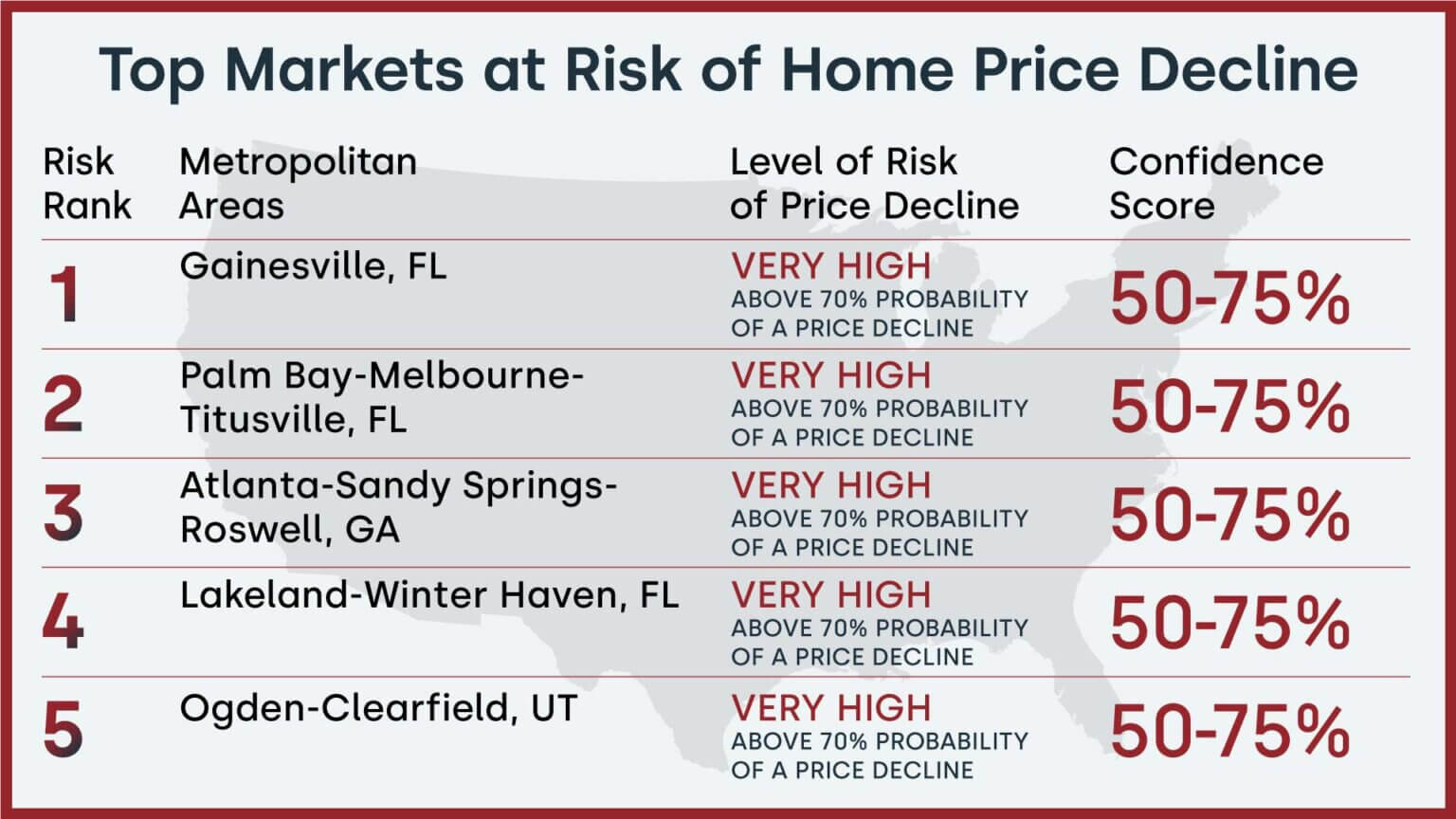
The MRI considers various factors to determine the probability of a home price decline in a particular area. This includes things like job growth, affordability, inventory levels, and the overall state of the local economy. Based on the CoreLogic MRI, five metropolitan areas are at a very high risk of a home price decline over the next 12 months.

5 Riskiest Housing Markets to Avoid in
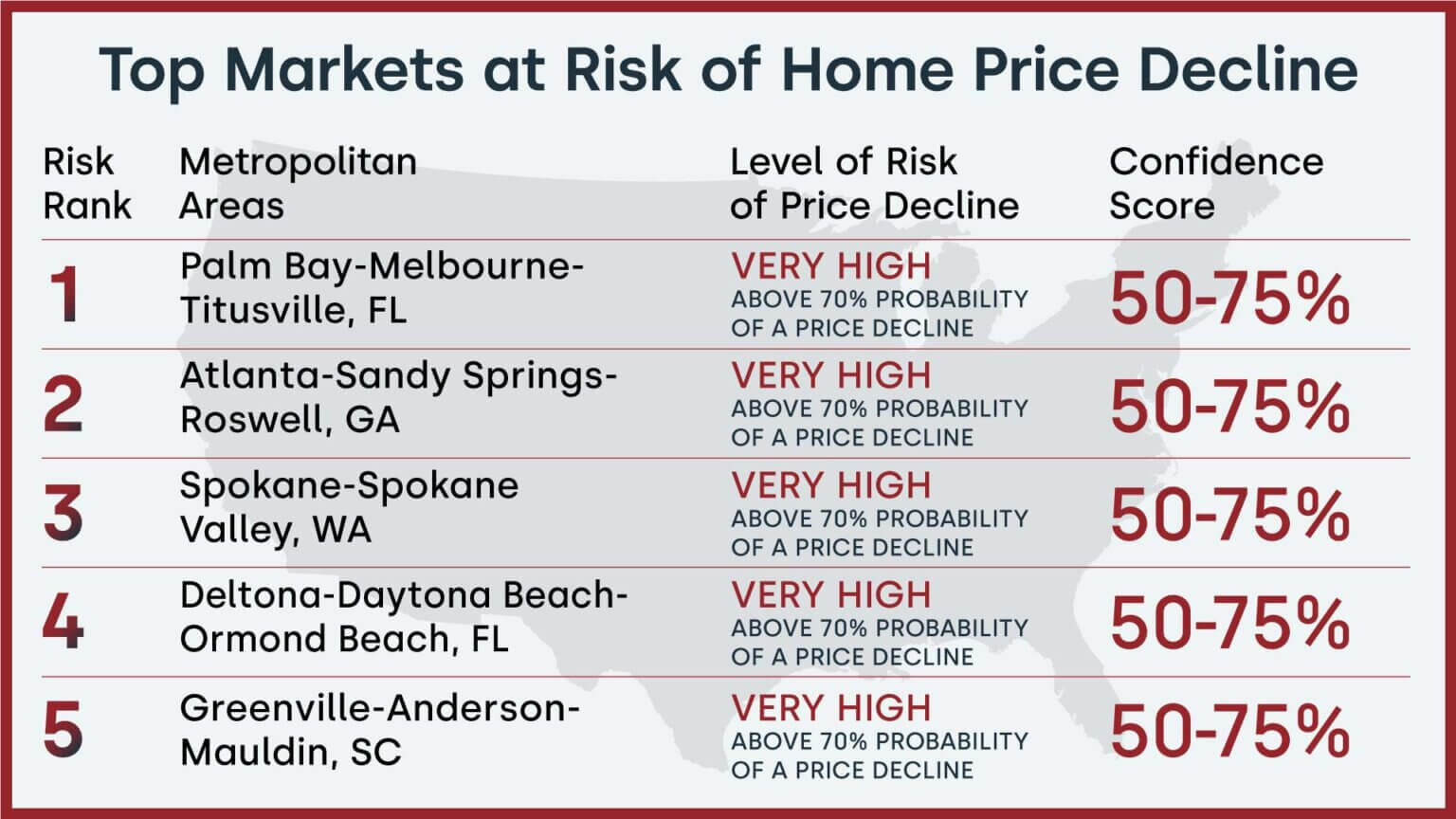
5 Riskiest Housing Markets to Avoid in
Source: CoreLogic

Now let's dive deeper into the five metropolitan areas that are facing the highest risk of a home price decline based on CoreLogic's MRI. It's important to remember that these are predictions, and actual results may vary.

1. Provo-Orem, UT

  • Risk Level: Very High
  • Probability of Price Decline: Above 70%
  • Confidence Score: 50-75%

Provo-Orem, located in the heart of Utah, experienced explosive growth during the pandemic and it is still a very popular location. This growth fueled a surge in home prices, but now the market appears to be cooling down, potentially leading to a price decline.

My thoughts: I believe that the market in Provo-Orem was simply too hot too fast. The prices were out of sync with fundamentals like local wages, which were not keeping up with price appreciation. Now, with interest rate uncertainty and the cooling economy, this market is becoming vulnerable.

2. Atlanta-Sandy Springs-Roswell, GA

  • Risk Level: Very High
  • Probability of Price Decline: Above 70%
  • Confidence Score: 50-75%

Atlanta, like many other Southern metropolitan areas, has experienced a strong housing market in recent years. However, it has become more vulnerable to a downturn due to rising interest rates, supply chain disruptions, and overall economic uncertainty.

My thoughts: Atlanta has a strong history as a major business hub. While the metro area might experience a pullback, I think a decline in prices would be relatively short-lived. The economy will eventually rebound, and homebuyers will return to the market. But in the short-term, I would be cautious about buying a home in Atlanta.

3. Salt Lake City, UT

  • Risk Level: Very High
  • Probability of Price Decline: Above 70%
  • Confidence Score: 50-75%

Salt Lake City was one of the fastest-growing housing markets in the United States, and during that time the median home price increased by a significant amount. However, like Provo-Orem, a rapid rise in prices and cooling economy could lead to a price correction.

My thoughts: The Salt Lake City metro area has lots of economic drivers and is a beautiful location. The concerns here are very similar to those of Provo-Orem. The market heated up too quickly and might be in for a decline over the next year.

4. Gainesville, FL

  • Risk Level: Very High
  • Probability of Price Decline: Above 70%
  • Confidence Score: 50-75%

Gainesville is a college town with a large student population. This can sometimes make housing markets more volatile. The Gainesville market is at risk due to several factors like affordability concerns and a potential slowdown in student enrollment.

My thoughts: Gainesville has historically been a reliable housing market, and the presence of the University of Florida adds stability. But, the market is still vulnerable to interest rate hikes and economic uncertainty.

5. Palm Bay-Melbourne-Titusville, FL

  • Risk Level: Very High
  • Probability of Price Decline: Above 70%
  • Confidence Score: 50-75%

Palm Bay-Melbourne-Titusville is a region that is reliant on the aerospace and defense industries. While the local economy is strong, it also makes the area subject to changes in federal spending. With a large supply of homes and a cooling economy, the market is vulnerable to price declines.

My thoughts: Palm Bay-Melbourne-Titusville has a strong economy, but the high concentration of employment within a few industries means that it's vulnerable to changes in defense spending and other factors. The risks are certainly present in this area.

Understanding the Risks and Mitigating Them

While these five areas are identified as high-risk, it's crucial to remember that not all homes in these markets will necessarily experience the same level of price decline. Homes that are in excellent condition, well-located, and offer desirable features will likely hold their value better during a downturn.

Here are some tips to consider if you're looking to buy a home in these high-risk markets:

  • Do your homework: Research the local market and understand the factors that contribute to the risk of a housing market crash. Look at recent sales data, inventory levels, and economic indicators.
  • Don't overpay: Avoid getting caught up in bidding wars or paying top dollar for a home. Try to negotiate the best price possible to protect your investment.
  • Get pre-approved for a mortgage: Knowing how much you can afford will help you avoid overspending on a home.
  • Consider your personal financial situation: Make sure you can afford your mortgage payments even if home prices decline.
  • Be prepared for a possible price drop: If you are in the high-risk areas, have a strategy for how you will deal with a potential decrease in home value.
  • Be realistic about your expectations: Don't expect to get rich quick by investing in real estate, especially in a potentially volatile market.

Factors to Consider Beyond the MRI

While the CoreLogic MRI is a valuable tool, it is important to consider other factors that could influence the housing market in these areas. For example:

  • Local job market: Strong local job growth can help support home values.
  • New construction: An increase in new homes can put downward pressure on prices.
  • Interest rates: Rising interest rates will likely reduce affordability and slow down the market.
  • Inventory levels: If the number of homes for sale increases, it could lead to a price decline.

The Bottom Line

The housing market is dynamic, and prices can fluctuate based on various economic and local factors. The five markets highlighted above are at a high risk of experiencing home price declines in the next 12 months, according to CoreLogic's MRI.

It is my belief that you should proceed with caution in these markets. If you are considering buying a home, it is essential to do your research, understand the risks, and make informed decisions.

I hope this article has helped you better understand the potential risks and provided valuable information to help you make informed decisions about your real estate goals in 2025.

Recommended Read:

  • 3 BIG Cities Facing High Housing BUBBLE Risk: Crash Alert?
  • Is the Housing Market on the Brink in 2024: Crash or Boom?
  • Will Fed's Policy Lead to a Crash in the Housing Market?
  • San Francisco Housing Market Crash 2025: Will it Happen?
  • 3 Florida Housing Markets Are Again on the Brink of a Crash
  • Will Housing Be Cheaper if the Market Crashes in 2025?
  • UK Housing Market Forecast 2025: Crash or Correction?
  • When Will the Housing Market Crash Again in California?
  • AZ Housing Market Forecast 2025-2026: Will it Crash?

Filed Under: Housing Market, Trending News Tagged With: Home Price Crash, Housing Decline, Housing Market, housing market crash, Housing Market Forecast, housing market predictions, Housing Market Slowdown

Housing Market Crisis: Only 25% of Homes Sold to First-Time Buyers

December 9, 2024 by Marco Santarelli

Housing Market Crisis: Only 25% of Homes Sold to First-Time Buyers

Things have changed a lot in the housing market lately, with an alarming statistic emerging from the voice of Barbara Corcoran: less than 25% of all homes sold are going to first-time buyers. This startling revelation from the Shark Tank star highlights a pressing concern in real estate as many young people find themselves sidelined in the quest for homeownership.

With rising prices and fluctuating interest rates, achieving the American dream of owning a home is becoming increasingly challenging for new buyers. Corcoran, a real estate mogul and television personality, spotlights this critical issue, emphasizing its implications for future generations.

Housing Market Crisis: Only 25% of Homes Sold to First-Time Buyers

Key Takeaways

  • Less than 25% of homes sold are going to first-time buyers, marking an all-time low.
  • The average sale price of homes reached a staggering $501,000 in Q3 2024.
  • Interest rates remain between 6% and 7%, creating confusion and hesitation among potential buyers.
  • The current average age of a homebuyer is 56 years old, skewing the demographics of homeownership in America.
  • Many older homeowners wish to age in place, reducing available listings for first-time buyers.

Understanding the Current Housing Market

As the housing market is assessed today, the profound transformation of home buying dynamics becomes evident. The 30-year mortgage, once hailed as a simple pathway to homeownership, now feels more like a mirage for first-time buyers. Barbara Corcoran's insights during her appearance on Fox's Cavuto: Coast to Coast encapsulate the current crises that young buyers face. With less than 25% of home sales going to new buyers, it's clear that crucial hurdles are present in the market.

According to a recent article on Benzinga, this statistic is especially alarming given that it marks a historical low for first-time buyers. The St. Louis Federal Reserve reports that the average sale price for a home has skyrocketed to $501,000 as of the third quarter of 2024. This significant increase means that many potential first-time buyers are facing a daunting financial slope. While a modest home might have been attainable a few years ago, today’s market sees starter homes priced at $1,000,000 or more in major coastal urban centers like Los Angeles, Seattle, and New York City.

This pricing structure changes the narrative around homeownership. For many families and young individuals, the dream of owning a home is slipping away, replaced by an unfortunate reality of renting or living with family.

The Impact of Interest Rates

In addition to high home prices, interest rates have created an unsettling atmosphere for homebuyers. These rates currently fluctuate between 6% and 7%, a range that contributes to the confusion and anxiety prospective buyers experience. Corcoran notes that potential homebuyers are lacking optimism regarding future rate drops. Instead, many have resigned themselves to the idea that purchasing a home at this price and rate might not be within their reach.

When homeowners see rates hovering around this range, they often feel hesitant about putting their homes on the market—adding to an already tight inventory, which limits options for first-time buyers. The lack of buyers means sellers can hold out for better offers, leaving those who are new to the market feeling hopeless and frustrated.

Corcoran explains, “What we're losing right now, (what) we desperately need is more first-time buyers. Less than 24% of people buying now are first-time buyers, which is an all-time low.” This trend has not only changed who can buy homes but has also led to a drastic transformation in the average profile of a homebuyer in America.

The Shift in Buyer Demographics

The ramifications of this situation stretch beyond finances. The average age of today’s homebuyer is now 56 years old, creating a stark contrast with previous generations who were often younger when they purchased their first homes. This demographic shift signifies that many more seasoned homeowners are now making up the majority of buyers in the current market. As many of these older homeowners choose to stay in their houses longer due to high market prices and current interest rates, the result is reduced inventory, leaving younger buyers stuck in a quandary.

A recent survey by Clever Real Estate adds clarity to this predicament; nearly half of Americans over 56 report plans to age in place, a statement indicating a reluctance to move despite the possibility of profiting from selling their homes. For prospective buyers, the implications of this trend are severe as they navigate an already challenging market.

The Ripple Effect of the Inventory Crunch

The diminishing availability of homes for sale creates a ripple effect that impacts more than just first-time buyers. When fewer homes are sold, fewer transactions occur, and this consequently leads to a slowdown in the entire housing market. Something has to give, and if demand stays high while supply diminishes, prices are likely to rise further.

Moreover, the increased competition for existing housing stock tends to favor those who can afford to enter the market again—usually seasoned buyers who have equity to cash in on. For those aiming to purchase their very first home, the competition is daunting. Real estate investors show interest in properties typical for first-time buyers, further squeezing the options available to newcomers.

The Potential for Market Recovery

Despite the sobering statistics cited by Corcoran, a glimmer of hope exists for first-time buyers. Should interest rates decline significantly—especially on mortgages—there’s a chance for increased activity and movement in the housing market. Corcoran expresses optimism that a return to 5% rates could trigger a “ballistic” market surge, reviving opportunities for first-time buyers and encouraging sellers to list their homes.

On the other hand, she warns that a return to interest rates above 7% could paralyze the market. Such a situation might lead to reduced economic growth overall, creating a detrimental cycle that impacts not only homebuyers but also those engaged in related support services like renovations, landscaping, and home improvement sectors.

Why This Matters for Future Generations

This discussion isn’t merely about numbers; it's about what homeownership represents in American culture. Across generations, owning a home has been a keystone of building wealth. However, when barriers arise that block access for first-time buyers, the prospect of homeownership begins to fade, raising serious questions about economic mobility and future opportunities.

If the current trend continues, we may witness a future where homeownership is not just out of reach for many but instead becomes an exclusive privilege of the wealthiest segments of society. The ability to secure loans, pay down debts, and save enough for a down payment requires a kind of economic resilience that young people today struggle to attain. With the dual challenges of high prices and fluctuating interest rates, the path to homeownership grows more uncertain.

Looking Ahead: The Future of Homeownership

As we consider the trajectory of the housing market, it’s imperative to question what measures can be taken to improve the situation for first-time buyers. Initiatives to foster affordable housing and loan programs that cater to younger buyers could be pivotal in reversing the current trend. Legislation that creates incentives for building more affordable homes could also address the supply issue impacting the market today.

Moreover, education plays a crucial role in preparing young buyers for the realities of homeownership—understanding financial management, mortgages, and the investment value of real estate can equip them to navigate these challenging waters more effectively.

In conclusion, Barbara Corcoran's alarm about the housing market—specifically regarding first-time buyers—rings loud and clear. As we embrace the complexity of these trends, it serves as a reminder that our approach to housing must adapt. The need for accessible homeownership opportunities for younger generations must be prioritized, or we risk creating a significant economic divide that could take generations to address.

Partner with Norada, Your Trusted Source for Turnkey Investment Properties

Discover high-quality, ready-to-rent properties designed to deliver consistent returns. Contact us today to expand your real estate portfolio with confidence.

Reach out to our investment counselors:

(949) 218-6668 | (800) 611-3060

Contact Us Today


Related Articles:

  • Housing Markets at Risk: California, New Jersey, Illinois, Florida
  • Housing Market Alert: Top 10 Most Vulnerable Counties Q3 2024
  • 3 BIG Cities Facing High Housing BUBBLE Risk: Crash Alert?
  • Why a 2008-Style Housing Market Crash is Unlikely in 2025?
  • Housing Market Predictions for Next Year: Prices to Rise by 4.4%
  • Housing Market Crash: Expert Says Market is Ready to Pop
  • Housing Market Crash 2008 Explained: Causes and Effects
  • Will the Housing Market Crash in 2025?
  • Housing Market Crash 2024: When Will it Crash Again?
  • Here's Why Housing Market Crash Predictions Are Overblown!
  • Will the Housing Market Crash: Top Cities Where Prices Are Soaring
  • If The Housing Market Crashes What Happens To Interest Rates?

Filed Under: Housing Market, Real Estate, Real Estate Market Tagged With: First Time Buyers, Home Ownership, Housing Bubble, Housing Market, housing market crash, Real Estate Market

Housing Markets at Risk: California, New Jersey, Illinois, Florida

December 9, 2024 by Marco Santarelli

Housing Markets at Risk: California, New Jersey, Illinois, Florida

Are you curious about which US housing markets are most vulnerable to a potential decline? Based on a recent report by ATTOM, a leading provider of property data, California, New Jersey, Illinois, and Florida are facing a higher risk of housing market declines due to factors like affordability, underwater mortgages, and unemployment.

While the overall national housing market remains robust, these areas exhibit specific characteristics that might make them more susceptible to downturns in the near future. Let's dive deeper into the specifics of this report and explore the factors contributing to these vulnerabilities.

US Housing Markets at Risk of Decline: Where Are the Most Vulnerable Areas?

In the third quarter of 2024, ATTOM released its Special Housing Market Impact Risk Report, providing a county-level analysis of housing market vulnerabilities across the US. This report uses a combination of key indicators, such as home affordability, equity, and foreclosure rates, to determine which areas are more or less prone to potential declines.

I found it really interesting how the report highlighted that the picture of which areas are most at risk has shifted somewhat compared to previous quarters. While California, New Jersey, and Illinois have consistently been flagged as areas of concern, Florida's inclusion in the ‘at-risk' category is more recent.

The methodology used in the report is quite comprehensive. They considered several factors including the percentage of homes with potential foreclosure actions, the number of homeowners with mortgage balances higher than the estimated value of their properties, the proportion of local wages needed for major homeownership expenses, and local unemployment rates.

Recommended Read:

When Will the Housing Market Crash in Florida?

The Most Vulnerable Housing Markets

Based on the report, certain metropolitan areas and specific counties are facing greater challenges. Let's take a closer look:

  • Vulnerable Housing Markets Clustered Around Chicago, New York City, and Inland California: The report identified that 24 out of the 50 counties considered most vulnerable to housing market issues were located in or around New York City, Chicago, and inland California.
    • Illinois: Counties like Cook, Kane, Kendall, McHenry, and Will around Chicago showed increased vulnerability.
    • New York: Both Kings County (Brooklyn) and New York County (Manhattan) were among the most at-risk, along with suburban areas like Essex, Passaic, and Sussex in Northern New Jersey.
    • California: Inland counties like Butte, Contra Costa, El Dorado, Humboldt, and Solano in northern California were flagged as vulnerable, along with Kern, Kings, Madera, Merced, San Joaquin, Stanislaus, Riverside, and San Bernardino counties in the central and southern parts of the state.

It was surprising to me how the report demonstrated that specific areas within these states are facing the most difficulty. For instance, certain inland counties in California have been more affected than the coastal areas.

Factors Contributing to Vulnerability

The ATTOM report identifies several underlying factors contributing to increased vulnerability in these housing markets. Let's examine them in detail:

1. Worsening Affordability:

  • The report noted that in many of the most at-risk counties, homeownership costs (including mortgage payments, property taxes, and insurance) for a typical home were consuming a large portion of average wages.
  • In 30 out of the 50 most vulnerable counties, these costs were exceeding 43% of average local wages, which is considered significantly unaffordable.
  • Some of the highest percentages were found in areas like Kings County (Brooklyn) where homeowners needed over 100% of their average local wages to cover those costs, followed by Riverside County, CA at 70.2%, El Dorado County, CA at 66.3%, and Passaic County, NJ at 65.9%.

It makes sense that affordability issues would have a big impact on the housing market. If people can't afford to buy or maintain a home, it can lead to foreclosures and a decrease in demand.

2. Underwater Mortgages:

  • Underwater mortgages occur when homeowners owe more on their mortgage than their property is currently worth.
  • A concerning trend revealed in the report is that at least 6% of residential mortgages were underwater in 23 of the 50 most-at-risk counties in the third quarter of 2024.
  • The national average for underwater mortgages was 5.5%.
  • The counties with the highest underwater mortgage rates among the most vulnerable included St. Clair County, IL at 15%, Tangipahoa Parish, LA at 13.7%, Pinal County, AZ at 12.4%, Philadelphia County, PA at 11.9%, and Marion County, FL at 11%.

I've always seen underwater mortgages as a significant risk factor for housing markets. If a large number of homeowners are underwater, they might be more likely to default on their mortgages, leading to foreclosures and downward pressure on home prices.

3. Foreclosure Activity:

  • In 35 of the 50 most vulnerable counties, more than one in every 1,000 residential properties faced a foreclosure action in the third quarter of 2024.
  • The nationwide average was one in 1,618 homes.
  • Some counties experienced significantly higher foreclosure rates, including Charlotte County, FL (one in 449), Osceola County, FL (one in 473), Dorchester County, SC (one in 509), Cumberland County, NJ (one in 571), and Warren County, NJ (one in 574).

4. Unemployment Rates:

  • Unemployment played a role in the vulnerability of many areas as well.
  • 34 of the 50 most at-risk counties had unemployment rates of at least 5% in August 2024, compared to the national average of 4.2%.
  • Merced County, CA had the highest unemployment rate at 9.1%, followed by Kern County, CA (8.7%), Kings County, CA (8.2%), Cumberland County, NJ (7.7%), and Madera County, CA (7.4%).

I think it's pretty clear that unemployment has a significant negative impact on the housing market. When people lose their jobs, they often struggle to keep up with mortgage payments, which can lead to foreclosure and a decline in home values.

The Least Vulnerable Housing Markets

In contrast to the vulnerable areas, the report identified several regions that are less likely to experience significant housing market declines. These areas are mainly concentrated in the South and the Midwest.

  • South: Twenty-two of the 50 least vulnerable counties were in the South. Tennessee had the largest concentration of these counties, including those in the Nashville, Knoxville, and Chattanooga metro areas.
  • Midwest: Thirteen of the 50 least-vulnerable counties were in the Midwest, with Wisconsin having seven, including those in the Green Bay, Madison, and Oshkosh areas.
  • Northeast: Eleven of the 50 counties were located in the Northeast.
  • West: Only four of the 50 counties were located in the West.

Factors Contributing to Resilience

The report also sheds light on the factors contributing to the resilience of the least vulnerable housing markets.

1. Better Affordability:

  • In contrast to the most vulnerable markets, homeownership costs in the least vulnerable markets were considered seriously unaffordable in only 17 of the 50 counties.
  • Potter County, TX, had the lowest percentage of wages needed for homeownership at 19.1%, followed by Oswego County, NY at 21.8%, Sullivan County, TN at 25.9%, Shawnee County, KS at 26.5%, and Madison County, AL at 26.9%.

2. Lower Underwater Mortgages:

  • Only one of the 50 least-at-risk counties had more than 6% of residential mortgages underwater.
  • The counties with the lowest underwater mortgage rates included Chittenden County, VT (0.8%), Loudoun County, VA (1.6%), Rockingham County, NH (1.9%), Henrico County, VA (2%), and Hillsborough County, NH (2%).

3. Low Foreclosure Rates:

  • None of the least-vulnerable counties had more than one foreclosure action per 1,000 residential properties.
  • Yellowstone County, MT, had the lowest foreclosure rate, with only one in 72,252 homes facing foreclosure. Other counties with very low rates included Missoula County, MT, Berkeley County, WV, Medina County, OH, and Chittenden County, VT.

4. Low Unemployment:

  • 48 of the 50 least-vulnerable counties had unemployment rates lower than the national average of 4.2%.
  • Dane County, WI, had the lowest unemployment rate at 2.1%, followed by Chittenden County, VT (2.1%), La Crosse County, WI (2.2%), Outagamie County, WI (2.3%), and Cumberland County, ME (2.3%).

Implications for Homebuyers and Investors

The ATTOM report provides valuable insights for both homebuyers and investors looking to navigate the current housing market.

  • Homebuyers in the most vulnerable areas might want to consider the affordability challenges and potential for future market declines before making a major purchase.
  • Investors might want to focus on markets with stronger fundamentals and lower risk profiles, particularly those in the South and Midwest.

Furthermore, it's crucial to remember that this report spotlights areas that appear to be more or less vulnerable to changes in market conditions. It's not a prediction that any specific area is guaranteed to experience a downturn or remain immune from problems.

I've always emphasized the importance of doing your due diligence when making any real estate decisions. This report can serve as a valuable starting point for your research, but it's vital to consider local market conditions, economic trends, and other factors before making any major investment decisions.

Conclusion

The US housing market is currently in a dynamic phase, with varying degrees of vulnerability across different regions. Based on the ATTOM report, housing markets in California, New Jersey, Illinois, and Florida appear to be facing higher risks due to factors like affordability, underwater mortgages, foreclosures, and unemployment.

Conversely, areas in the South and Midwest seem to be exhibiting greater resilience. While the report offers a helpful snapshot of current trends, it's essential for both homebuyers and investors to conduct thorough research and consider the specific circumstances of individual markets before making significant real estate decisions.

Related Articles:

  • 3 BIG Cities Facing High Housing BUBBLE Risk: Crash Alert?
  • Why a 2008-Style Housing Market Crash is Unlikely in 2025?
  • Housing Market Predictions for Next Year: Prices to Rise by 4.4%
  • Housing Market Crash: Expert Says Market is Ready to Pop
  • Housing Market Crash 2008 Explained: Causes and Effects
  • Will the Housing Market Crash in 2025?
  • Housing Market Crash 2024: When Will it Crash Again?
  • Here's Why Housing Market Crash Predictions Are Overblown!
  • Will the Housing Market Crash: Top Cities Where Prices Are Soaring
  • If The Housing Market Crashes What Happens To Interest Rates?

Filed Under: Housing Market, Real Estate, Real Estate Market Tagged With: Housing Bubble, Housing Market, housing market crash, Real Estate Market

3 Florida Housing Markets Are Again on the Brink of a Crash

November 6, 2024 by Marco Santarelli

3 Florida Housing Markets Are Again on the Brink of a Crash

As the U.S. housing market continues its precarious dance with economic forces, Florida finds itself at the epicenter of a potential real estate upheaval. Recent data from CoreLogic's Market Risk Indicator (MRI) has shed light on an alarming trend: three major Florida metropolitan areas are at a very high risk of experiencing significant home price declines over the next 12 months. This article explores the factors contributing to this looming crisis and what it means for homeowners, buyers, and investors in these vulnerable markets.

3 Florida Housing Markets on the Brink of a Crash

  1. Gainesville, FL
  2. Palm Bay-Melbourne-Titusville, FL
  3. Lakeland-Winter Haven, FL

These three metropolitan areas have been identified as having a “very high” risk of price decline, with a probability exceeding 70%. Let's examine each market in detail:

1. Gainesville: The Educational Hub on Shaky Ground

Gainesville, home to the University of Florida, has long been considered a stable real estate market due to its consistent influx of students and faculty. However, it now sits atop the list of markets at risk of price decline. Several factors contribute to this precarious position:

  • Overreliance on the student housing market
  • Potential shifts in remote learning affecting local demand
  • Overvaluation of properties in recent years

The combination of these factors has created a perfect storm for Gainesville's housing market, making it vulnerable to a significant correction.

2. Palm Bay-Melbourne-Titusville: Space Coast's Economic Uncertainty

Known as the Space Coast due to its proximity to Cape Canaveral, this area has seen substantial growth in recent years, driven by the resurgence of the space industry and technology sector. However, the market now faces challenges:

  • Potential cutbacks in aerospace and defense spending
  • Overheated market due to speculative buying
  • Vulnerability to climate change and rising insurance costs

These factors have placed the Palm Bay-Melbourne-Titusville area in a high-risk category for price declines, threatening the equity of recent buyers and long-term residents alike.

3. Lakeland-Winter Haven: Central Florida's Overextended Market

Situated between Tampa and Orlando, Lakeland-Winter Haven has benefited from its strategic location and relatively affordable housing compared to its larger neighbors. However, this market is now facing its own set of challenges:

  • Rapid price appreciation outpacing local wage growth
  • Dependence on tourism and service industries affected by economic fluctuations
  • Increased inventory as investors begin to sell off properties

The combination of these factors has put Lakeland-Winter Haven at risk of a significant market correction.

three major Florida metropolitan areas are at a very high risk of experiencing significant home price declines
Source: CoreLogic 

Understanding the Broader Context

To fully grasp the situation in these Florida markets, it's crucial to consider the national housing market trends:

  • National home prices increased by 4.3% year-over-year in July 2024
  • Monthly home price growth is slowing, with prices decreasing by 0.01% from June to July 2024
  • CoreLogic forecasts a modest 2.2% price increase nationally from July 2024 to July 2025

Dr. Selma Hepp, Chief Economist for CoreLogic, notes that “Housing demand continued to buckle under the pressure of high mortgage rates and unaffordable home prices, leading to a considerable slowing of home price gains during the summer.”

The Florida Paradox

Interestingly, while these three Florida markets are at high risk of decline, Miami stands out as an anomaly. With a 9.1% year-over-year price increase as of July 2024, Miami demonstrates the diverse and complex nature of Florida's real estate landscape.

Factors Contributing to Florida's Vulnerable Housing Markets

  1. Interest Rate Sensitivity: Florida's real estate market is particularly sensitive to interest rate fluctuations, affecting both local buyers and out-of-state investors.
  2. Climate Change Concerns: Increasing awareness of climate risks, including hurricanes and flooding, is impacting long-term property values and insurance costs.
  3. Demographic Shifts: Changes in migration patterns, both domestic and international, are reshaping demand in various Florida markets.
  4. Economic Diversity: Markets heavily reliant on specific industries (e.g., tourism, education) are more vulnerable to economic shocks.
  5. Investor Activity: The high level of investor ownership in Florida makes certain markets more susceptible to rapid selling in a downturn.

Implications for Stakeholders

  • Homeowners: Those in high-risk areas should be prepared for potential loss of equity and consider their long-term housing plans.
  • Buyers: While price declines may present opportunities, buyers should be cautious and consider the long-term stability of their chosen market.
  • Investors: Diversification and thorough market research are crucial in navigating Florida's varied real estate landscape.
  • Local Governments: Policymakers may need to prepare for potential decreases in property tax revenues and implement strategies to maintain community stability.

Looking Ahead

While the risk of price declines in these Florida markets is significant, it's important to note that real estate is inherently local and cyclical. The potential for Federal Reserve rate cuts and the natural resilience of Florida's economy could mitigate some of these risks.

Dr. Hepp suggests that the key question is “whether the upcoming rate cut from the Fed and the expected continuation of falling mortgage rates will be sufficient to motivate potential homebuyers” in the face of economic uncertainties and the upcoming presidential election.

As Florida's housing markets navigate these turbulent waters, stakeholders must stay informed, adaptable, and prepared for a range of potential outcomes. The Sunshine State's real estate market has shown resilience in the past, but the current confluence of factors presents a unique and challenging landscape for the months ahead.

Related Articles:

  • Miami, Florida Housing Market Faces BIG Crash Risk
  • Florida Housing Market Predictions for Next 2 Years: 2025-2026
  • Florida Housing Market 2024: Predictions for Next 5 Years
  • Florida Housing Market Predictions 2025: Insights Across All Cities
  • How Much Do Real Estate Agents Make in Florida?
  • Florida's Housing Market Sets a New Record With $70 Million Teardown

Filed Under: Housing Market, Real Estate, Real Estate Market Tagged With: Florida, Housing Market, housing market crash, Real Estate Market

Will Housing Be Cheaper if the Market Crashes in 2025?

November 4, 2024 by Marco Santarelli

Will Housing Be Cheaper if the Market Crashes in 2024?

The question of whether housing will become more affordable if the market crashes in 2025 is a complex one, with various factors influencing the potential outcome. A market crash can indeed lead to a decrease in housing prices, as seen historically, but the extent and duration of such a decrease depend on the underlying economic conditions, the reasons for the market downturn, and the response from policymakers.

Here’s a detailed analysis based on current trends and expert predictions.

Economic Context and Predictions

Current Housing Market Trends

  • Housing prices have been elevated due to limited supply and high demand, exacerbated by rising mortgage rates over the past few years. However, recent trends indicate that mortgage rates are beginning to decline, which may improve affordability for potential buyers.
  • Predictions for 2025 suggest that while home prices may continue to rise, the rate of increase is expected to slow down significantly. For instance, estimates indicate growth rates could be around 2% to 3.9% year over year by the end of 2025.

Impact of a Market Crash

  • Historically, a stock market crash can lead to decreased consumer confidence and spending, which can indirectly affect the housing market. A significant drop in the stock market (e.g., a 20% decline) often results in higher unemployment rates, which can reduce the number of potential homebuyers.
  • However, it’s important to note that a stock market crash does not automatically equate to a housing market crash. In some cases, investors may turn to real estate as a safer investment during stock market downturns, potentially keeping demand stable or even increasing it.

Key Factors Influencing Housing Prices in 2025

  • Mortgage Rates: As the Federal Reserve continues to cut interest rates, mortgage rates are expected to fall further. This could stimulate demand for housing, even if prices are predicted to rise at a slower pace[4].
  • Supply and Demand Dynamics: The availability of homes for sale plays a critical role in determining prices. If more homeowners decide to sell due to falling mortgage rates, this could increase supply and potentially stabilize or lower prices. Conversely, if demand outstrips supply due to lower rates attracting more buyers, prices could continue to rise[3][4].
  • Economic Sentiment: The overall economic climate will influence buyer behavior. If a crash leads to widespread job losses and economic uncertainty, consumer confidence may plummet, leading to reduced demand for homes and potentially lower prices[1][2].

Factors That Could Influence Housing Affordability if the Market Crashes

Government Intervention

One of the key elements to consider is the role of government intervention. In past economic crises, government programs have been instrumental in stabilizing the housing market. For example, during the 2008 financial crisis, the federal government introduced measures such as the Home Affordable Modification Program (HAMP) and the Home Affordable Refinance Program (HARP), which helped many homeowners avoid foreclosure and stay in their homes. If a market crash were to occur in 2024, the government's response would likely play a significant role in determining the extent to which housing prices are affected.

Demographic Trends

Another factor to consider is the demographic trends driving housing demand. The Millennial generation, which has been entering the housing market in large numbers, is expected to continue to drive demand for the next several years. This sustained demand could help cushion the impact of a market crash on housing prices.

Shift in Work and Lifestyle Patterns

Additionally, the shift towards remote work, accelerated by the COVID-19 pandemic, has led to changes in housing preferences and demand patterns. Many people are seeking larger homes with dedicated office spaces, often in suburban or rural areas rather than urban centers. This trend could influence the housing market's resilience in the face of a downturn, as the demand for certain types of properties may remain strong.

Investor Activity

Investor activity is another variable that could affect housing prices during a market crash. Investors who purchase properties to rent out or flip have been a significant force in the housing market. Their actions in response to a crash—whether they decide to sell off properties or buy up more in anticipation of a recovery—could have a significant impact on housing prices.

Economic Environment

Finally, the state of the broader economy and the job market will be crucial in determining housing affordability. High levels of employment and income growth can support housing demand and prices, even during economic downturns. Conversely, if a market crash leads to widespread job losses and reduced consumer confidence, the demand for housing could decrease, leading to lower prices.

Summary: While a market crash could theoretically make housing cheaper, current trends and expert analyses suggest that a significant crash is not expected in 2025. Experts predict a cooling down rather than a dramatic crash. Instead, the market may experience a rebalancing, with slower price growth or minor adjustments. Therefore, you should keep a close eye on economic indicators and market forecasts, as these can offer valuable insights into future trends and potential shifts in affordability.

Filed Under: Housing Market, Real Estate Market Tagged With: Housing Market, housing market crash, Housing Market Forecast

Is the Housing Market Headed for a Crash Again?

October 1, 2024 by Marco Santarelli

Another Sign of a Housing Market Crash Coming?

Is the housing market headed for a crash again? Many experts believe that, unlike the disastrous downturn of 2008, the current housing market is more resilient and less likely to crash significantly. While prices have risen dramatically and affordability issues persist, factors such as low inventory and strong demand indicate stability in the market for the foreseeable future.

Is the Housing Market Headed for a Crash Again?

Key Takeaways

  • Current Market Trends: Home prices remain high but may stabilize or increase slightly.
  • Demand vs. Supply: Low inventory continues to push demand upwards.
  • Economic Factors: Inflation and high mortgage rates create challenges but are not expected to lead to a crash.
  • Expert Opinions: Most believe a significant downturn is unlikely due to various market dynamics.

The State of the Housing Market in 2024

In navigating whether the housing market is headed for a crash again, it's essential to consider the current state of affairs. The market has witnessed a dramatic increase in home prices over the past few years. As of 2024, reports indicate that home values have risen approximately 5.4% year-over-year, per the latest S&P CoreLogic Case-Shiller Index. Such growth, while impressive, raises eyebrows; many wonder if these prices are sustainable or if they are propped up by speculation and financial manipulation.

What’s Causing the Price Surge?

Several factors contribute to the increasing home prices:

  • Low Inventory: The number of homes available on the market remains lower than needed to meet demand. Homebuilders have struggled to keep pace following the COVID-19 pandemic.
  • High Demand: Despite elevated mortgage rates, many buyers are unwilling to wait, driven by the belief that not buying now could lead to even higher prices later. This has kept competition for homes fierce.
  • Record Low Mortgages: Homeowners who secured lower mortgage rates in the past are reluctant to sell and lose their favorable rates, thereby decreasing available inventory.

Comparative Analysis with Past Crashes

Unlike the catastrophic housing crash of 2008, which was fueled by subprime mortgages and rampant speculation, the current market does not appear to have the same vulnerabilities. According to a Forbes article from December 2023, the general consensus aligns with the view that a similar crash is unlikely due to more stringent lending practices and better overall financial conditions among homeowners (Forbes). Most homeowners now possess significant equity, contrasting sharply with the situation before the 2008 crisis.

However, discussions around housing market stability also surface. Some critics argue that the market is experiencing a bubble, stating that “the U.S. is in a massive housing bubble,” with prices artificially inflated. They suggest that political decisions and economic factors could lead to significant corrections down the line (Strong Towns).

Economic Challenges on the Horizon

While the consensus leans toward optimism, it is crucial to highlight the economic challenges ahead. High inflation rates continue to influence the economy, causing uncertainty among consumers and potential homebuyers. Additionally, mortgage rates have recently soared above 6%, creating a more challenging lending environment. Homebuyers now face increased monthly payments, further constraining affordability for many.

Impact of Interest Rates on the Market

The Federal Reserve's policies around interest rates can significantly impact housing demand. If rates remain high or continue to rise, it could suppress home sales and cool the market. However, forecasts suggest a potential decline in rates as inflation stabilizes, which could revitalize buyer interest (Bankrate). The overall feeling among experts is mixed yet controlled: housing will likely face challenges, but a crash akin to 2008 remains improbable.

The Take From Experts

Expert insights paint a comprehensive picture of the housing market's future. In a recent analysis, it was stated that the ongoing competition and multiple offers for homes will likely drive prices upward, contrary to fears of a downturn (Business Insider). This sentiment is echoed in multiple reports, including surveys from U.S. News, which forecast a continued demand for housing amidst increasing prices, stating there is “no imminent collapse” for the housing market in 2024.

It’s also worth noting the emotional side of home buying. Many families view homeownership as an essential part of their future, which drives commitment despite rising prices. This mindset can act as a stabilizer in the market, even amid economic turbulence.

Local vs. National Market Trends

While national trends give us an overall view, local markets present unique dynamics. Certain areas may experience corrections due to economic downturns, job losses, or an influx of new housing developments. This contrasting scenario highlights that, while the national outlook seems positive, some regions might still struggle. For instance, some analysts predict that specific markets may not enjoy the same level of stability due to local economic conditions and shifts in industry.

Conclusion to the Discussion

As we dive deeper into 2024, the question remains: is the housing market destined for a crash again? The evidence suggests that while there may be challenges, a crash similar to that of 2008 is unlikely. With continued demand, historic low inventory, and more resilient economic fundamentals, many experts remain hopeful that the housing market will continue to evolve without the tumultuous setbacks we've seen in the past.

As individuals and families contemplate home purchases amidst rising prices, it’s crucial to stay informed about market dynamics. Understanding the intricacies of supply and demand, interest rates, and local economic conditions can provide insight into making sound decisions in today’s housing market.

Recommended Read:

  • Is the Housing Market Crash Coming? Experts Weigh In
  • Housing Market Predictions for Next 5 Years: 2025 to 2029
  • Housing Market Predictions for the Next 4 Years: 2024 to 2028

Filed Under: Housing Market Tagged With: Housing Market, housing market crash, Real Estate Market

10 Most Vulnerable Housing Markets in 2024: Crash or Correction?

September 7, 2024 by Marco Santarelli

10 Most Vulnerable Housing Markets in 2024: Crash or Correction?

Are you worried about the future of the U.S. housing market? You're not alone. With whispers of a potential crash echoing around, it's only natural to wonder which markets might be most vulnerable. This article takes a deep dive into the most vulnerable housing markets in 2024, examining the factors at play and analyzing whether a crash is imminent.

The latest data from ATTOM's Q2 2024 Special Housing Risk Report paints a telling picture. The report, which assesses counties based on factors like foreclosure activity, underwater mortgages, affordability, and unemployment rates, highlights some worrying trends. Let's break down what's happening.

California, New Jersey, and Illinois Housing Markets: A Concentration of Risk

💸
Most Vulnerable Housing Markets in 2024
  • 💵 Heavily Concentrated: The most vulnerable housing markets in 2024 are concentrated in California, New Jersey, and Illinois.
  • 🏠 High Living Costs: Why these states? It's a cocktail of factors. High living costs, driven in part by soaring property prices, have pushed affordability to the brink. Soaring property prices have pushed affordability to the brink, especially in major metro areas like New York City and Chicago.
  • 📈 Rising Interest Rates: Adding to the pressure are rising interest rates. As borrowing becomes more expensive, homeowners who locked in low rates during the pandemic boom might struggle to keep up with payments if their financial situations change.


Unveiling the Top 10 Most Vulnerable Housing Markets

ATTOM's Q2 2024 report identifies the top 10 most vulnerable U.S. housing markets. Let's delve into each one:

  1. Madera, CA: With a high percentage of properties underwater and a significant proportion of income needed to buy, Madera faces a challenging environment.
    • 71% of income needed to buy
    • 1% of properties underwater
    • 1 in every 756 properties with foreclosure filings
    • 5% June 2024 unemployment rate
  2. San Joaquin, CA: Another Californian county, San Joaquin, grapples with high underwater mortgage rates and foreclosure filings.
    • 71% of income needed to buy
    • 7% of properties underwater
    • 1 in every 864 properties with foreclosure filings
    • 4% June 2024 unemployment rate
  3. Butte, CA: Rounding out the top three is Butte, California, facing a trifecta of challenges: high affordability hurdles, a large share of underwater properties, and a concerning foreclosure activity.
    • 69% of income needed to buy
    • 8% of properties underwater
    • 1 in every 969 properties with foreclosure filings
    • 9% June 2024 unemployment rate
  4. Henry, GA: Moving east, Henry County in Georgia presents a mixed picture. While affordability appears relatively better, a high percentage of underwater properties raises a red flag.
    • 54% of income needed to buy
    • 9% of properties underwater
    • 1 in every 726 properties with foreclosure filings
    • 4% June 2024 unemployment rate
  5. Kaufman, TX: Located in Texas, Kaufman County stands out with a significant portion of income needed for homeownership, indicating a potential affordability crunch.
    • 46% of income needed to buy
    • 1% of properties underwater
    • 1 in every 930 properties with foreclosure filings
    • 8% June 2024 unemployment rate
  6. Humboldt, CA: Back in California, Humboldt County experiences a concerning level of foreclosure activity, highlighting the pressure on some homeowners.
    • 71% of income needed to buy
    • 1% of properties underwater
    • 1 in every 623 properties with foreclosure filings
    • 7% June 2024 unemployment rate
  7. Solano, CA: Solano County reflects the broader trend in California, with a high percentage of income required for housing, emphasizing affordability concerns.
    • 72% of income needed to buy
    • 0% of properties underwater
    • 1 in every 735 properties with foreclosure filings
    • 7% June 2024 unemployment rate
  8. Passaic, NJ: Representing New Jersey, Passaic County contends with a combination of affordability issues and a notable share of underwater mortgages.
    • 73% of income needed to buy
    • 3% of properties underwater
    • 1 in every 840 properties with foreclosure filings
    • 8% June 2024 unemployment rate
  9. Merced, CA: Merced County in California faces a significant affordability barrier, with a large percentage of income dedicated to housing expenses.
    • 74% of income needed to buy
    • 0% of properties underwater
    • 1 in every 977 properties with foreclosure filings
    • 4% June 2024 unemployment rate
  10. Shasta, CA: Completing the top 10, Shasta County grapples with a mix of affordability challenges and foreclosure activity, further underscoring California's vulnerability.
  • 72% of income needed to buy
  • 1% of properties underwater
  • 1 in every 658 properties with foreclosure filings
  • 4% June 2024 unemployment rate

Will These Housing Markets Crash?

The big question on everyone's mind: are these vulnerable markets headed for a crash? While it's impossible to predict the future with certainty, a few factors suggest that a full-blown crash might be unlikely, at least in the immediate term.

  • Strong Demand: Despite affordability challenges, demand for housing remains relatively strong in many areas. This is particularly true in markets with robust job markets and population growth.
  • Tight Inventory: Low inventory levels continue to prop up prices in many regions. Until supply significantly outpaces demand, a drastic price correction is less probable.
  • Lessons Learned: The 2008 housing crisis taught both lenders and borrowers valuable lessons. Lending practices are stricter now, and borrowers are generally more cautious.

However, it's important to acknowledge that these markets are walking a tightrope. Continued interest rate hikes, a significant economic downturn, or a sudden surge in unemployment could tip the scales and lead to more severe corrections.

Factors to Watch in the Coming Months

  • Interest Rate Trajectory: The Federal Reserve's decisions on interest rates will significantly impact the affordability and attractiveness of mortgages.
  • Inflation: Persistent inflation could continue to erode purchasing power and put pressure on household budgets.
  • Economic Growth: A strong economy generally supports a healthy housing market. Conversely, a recession or significant slowdown could negatively impact demand and prices.

Navigating Uncertainty: Advice for Homebuyers and Sellers

  • Homebuyers: Proceed with caution. Get pre-approved for a mortgage, factor in potential interest rate increases, and don't overextend your budget. Focus on affordability and long-term value.
  • Home Sellers: Be realistic about pricing. While the market might not be as hot as it once was, a well-maintained and strategically priced home can still attract buyers.

The Bottom Line

While the most vulnerable housing markets in 2024 face real challenges, a catastrophic crash is not a foregone conclusion. However, vigilance and careful analysis are crucial. Keep a close eye on economic indicators, interest rates, and local market conditions to make informed decisions about your real estate investments.


Also Read:

  • Housing Market Predictions for the Next 4 Years: 2024 to 2028
  • Real Estate Forecast Next 5 Years: Top 5 Predictions for Future
  • Is the Housing Market on the Brink in 2024: Crash or Boom?
  • 2008 Forecaster Warns: Housing Market 2024 Needs This to Survive
  • Housing Market Predictions for the Next 2 Years
  • Real Estate Forecast Next 10 Years: Will Prices Skyrocket?
  • Housing Market Predictions for Next 5 Years (2024-2028)
  • Housing Market Predictions 2024: Will Real Estate Crash?
  • Housing Market Predictions: 8 of Next 10 Years Poised for Gains
  • Trump vs Harris: Which Candidate Holds the Key to the Housing Market (Prediction)

Filed Under: Housing Market, Real Estate Market Tagged With: Home Price Forecast, Housing Market, housing market crash, housing market predictions, Housing Market Trends

Florida Housing Markets Face Steep Risk: CoreLogic Prediction

August 20, 2024 by Marco Santarelli

Florida Housing Markets Face Steep Risk: CoreLogic Prediction

The housing markets in Palm Bay-Titusville-Melbourne, FL, and two other Florida areas are at very high risk for price crashes in the coming year. As these markets face critical financial turbulence, it's essential for current homeowners, prospective buyers, and investors to navigate the landscape with caution.

Florida Housing Markets at Very High Risk for Price Crash

Key Takeaways

  • High Risk of Price Decline: Palm Bay-Titusville-Melbourne, FL, along with Gainesville, and North Port-Sarasota-Bradenton, FL, are noted by CoreLogic as having a 70%-plus probability of experiencing a sharp decline in home prices over the next 12 months.
  • Market Risk Indicator: The CoreLogic Market Risk Indicator (MRI) is a valuable resource that assesses the health of housing markets, highlighting areas with potential price corrections.
  • Expectations of Rate Cuts May Fall Short: Although the Federal Reserve is anticipated to cut rates, these adjustments might not be sufficient to stimulate growth in Florida’s cooling housing market.
  • National Trends Contrast with Local Dangers: Despite the national average of home prices increasing 4.7% year-over-year, Florida markets are becoming outliers, showing signs of distress.

CoreLogic's MRI Identifies At-Risk Florida Markets

The CoreLogic Market Risk Indicator (MRI) has placed significant emphasis on the state of Florida’s housing markets, singling out areas like Palm Bay-Titusville-Melbourne and Gainesville as particularly vulnerable Source: CoreLogic.

Why Are These Markets Vulnerable?

To comprehend why these markets are pegged as high risk, it’s crucial to explore the underlying factors influencing these predictions.

Factors Contributing to High Risk in Florida Markets

1. High Mortgage Rates Compressing Affordability

High mortgage rates have become a defining feature of the current housing market, particularly affecting buyers in Florida. As interest rates soar, the cost of borrowing becomes more expensive, shrinking the pool of qualified homebuyers. This decline in affordability is especially poignant in fast-growing areas like Palm Bay and North Port, which saw significant price increases over recent years.

The Real Cost of Borrowing

Back in the pandemic years, aggressive lending and low-rate environments led to soaring prices in Florida. Now that the market has shifted, many potential buyers find themselves priced out. In Palm Bay, for example, the sharp rise in interest rates means that monthly payments for new mortgages are more stressful, leading to fewer people entering the market. This can ultimately result in price declines due to a lack of demand.

2. Consumer Sentiment in Flux

Consumer sentiment impacts real estate as much as hard data. Dr. Selma Hepp, Chief Economist for CoreLogic, highlights that diminished confidence in the economy and housing market can trigger a wait-and-see strategy among potential buyers. As consumers anticipate price drops, they may be less inclined to commit to purchases.

Fear of Missing Out vs. Market Realities

In a state like Florida, where owning a home is often seen as a key milestone, the fear of missing out can clash with stark market realities. When people perceive potential declines, however, they may choose to delay homebuying decisions. This leads to pent-up demand, but when sentiment swings too far in the direction of caution, it creates downward pressure on home prices.

3. Economic Backdrop and Job Market Pressures

In Florida, the traditional economic engines—such as tourism and agriculture—play a significant role in the real estate market. However, economic uncertainties or slowdowns in key sectors can disrupt consumer confidence and lead to decreased housing demand.

Recent shifts in the job market, influenced by global economic trends, could spell trouble for Florida’s housing markets. If layoffs or reduced hiring become prominent in sectors that sustain Florida’s economy, it will impact housing demand substantially, leading to further price adjustments.

4. Accumulating Inventory

Another critical aspect to monitor is the increasing inventory of homes on the market in Florida. In fast-paced housing markets, inventory levels are a telltale sign of market health. Economic shifts and increasing mortgage rates have led many sellers to list their properties, resulting in overcrowded listings.

Areas like North Port and Sarasota have experienced such surges in inventory, causing sellers to become more competitive on pricing in order to attract buyers. This trend can create a seller's market flipping into a buyer’s market, subsequently pushing home values down.

National Trends and Local Concerns

While the nationwide outlook presents a modest year-over-year increase of 4.7% in home prices as of June 2024, many Florida markets are starting to diverge dramatically from these trends.

Comparative Analysis with Other States

Some areas in the Midwest and Northeast have shown robust growth and steady demand. In contrast, places like Palm Bay and Gainesville are wrestling with different realities. While other markets are thriving, Florida’s economic peculiarities render its housing market vulnerable—especially with factors unique to the state such as high insurance costs and dependency on a few key industries.

What Can You Expect?

With the current environment presenting challenges, what should stakeholders in Florida's housing markets be considering?

For Homeowners

If you own a home in one of the at-risk markets, expect that you may need to adjust your expectations regarding your home’s value. Understanding the dynamics of the current market—especially the potential for price declines—will be crucial if you decide to sell. Working with a knowledgeable realtor who understands local market conditions will be beneficial.

For Prospective Buyers

Prospective homebuyers might find opportunities during this volatile market phase. Even though immediate price declines can be concerning, purchasing at a lower price may allow for long-term gains, especially if you are prepared to hold your investment through potential rough patches.

As you consider your options, make sure to secure financing and investigate grants or programs tailored to first-time homebuyers, especially in states that now face a precarious housing situation.

For Investors

For investors, Florida presents both risk and opportunity. A careful analysis of local dynamics will be essential when considering properties. Investors should focus on identifying distressed properties or markets that are likely to recover more quickly. Buying low and holding through cycles can be advantageous, but be sure to assess the local economy’s fundamentals before making any decisions.

Conclusion

The latest CoreLogic report brings to light the high-risk status of several Florida housing markets, highlighting a pivotal moment for anyone involved in real estate across the state.

By focusing on the local factors underlying these shifts in market dynamics, individuals can better position themselves to either capitalise on opportunities or safeguard their investments against potential downturns.

In a landscape where “location, location, location” still reigns supreme, Florida’s unique housing challenges illustrate the importance of localized knowledge and proactive planning.

As the market evolves, buyers, sellers, and investors alike must pay close attention to regional economic signals and adjust their strategies to navigate the landscape effectively.


Also Read:

  • 5 Worst Cities in Florida to Buy Real Estate
  • Florida Housing Market: Coastal Crisis vs Inland Opportunity
  • Worst Places to Live in Florida for Families & Retirees
  • Florida Housing Market Predictions for Next 2 Years
  • Florida Housing Market Warning: Insights from a Proven Predictor
  • Florida's Priciest Places: Top 35 Most Expensive Cities
  • Florida Housing Market: Will These 2 Metros Crash in 2025?
  • When Will the Housing Market Crash in Florida?
  • South Florida Housing Market: Will it Crash in 2024?
  • South Florida Housing Market: A Crossroads for Homebuyers
  • Florida Housing Market Trends: Rent Growth Falls Behind Nation

Filed Under: Housing Market, Real Estate, Real Estate Market Tagged With: Florida, Housing Market, housing market crash, Melbourne, Palm Bay

2024 Housing Market Crash: Is History Repeating Itself?

May 11, 2024 by Marco Santarelli

Housing Market Crash: Wells Fargo's 1980s Recession Warning

The specter of a housing market crash in 2024 hangs heavy in the air, shrouding the industry in a cloak of uncertainty. Mortgage interest rates hovering near 8% have become a cause for alarm, echoing concerns not heard since the economic turmoil of the 1980s. Financial giants like Wells Fargo are sounding the alarm, drawing chilling comparisons to that era's housing market collapse.

These warnings serve as a stark reminder of the potential dangers lurking beneath the surface of the current market. As anxieties escalate, both potential homebuyers and seasoned investors alike are urged to tread cautiously and keep a watchful eye on the market's unpredictable gyrations. Navigating this uncertain landscape requires a keen understanding of economic forces and a dose of healthy skepticism towards the market's current buoyancy.

A Blast from the Past: The 1980s and High-Interest Rates

Those who lived through the early 1980s recall the devastating impact of soaring interest rates on the U.S. economy and the real estate market. With a series of interest rate hikes in the early part of this year, questions arise: Is a housing market crash and a recession on the horizon? Experts suggest that it's more than just a possibility.

The Wake-Up Call to the Federal Reserve

In a significant development, three influential organizations, the Mortgage Bankers Association (MBA), National Association of Realtors (NAR), and National Association of Home Builders (NAHB), jointly penned a letter to Federal Reserve Chairman Jerome Powell. Their message highlighted a concerning fact – mortgage interest rates have surged to a 23-year high, dragging down application activity to levels last witnessed in 1996.

The Federal Reserve's aggressive stance on interest rate hikes has raised concerns that a housing market recession akin to the 1980s could be in the making. The central bank has indicated that it will maintain elevated borrowing costs well into 2024 to combat inflation. However, this move is expected to lead to declines in construction and overall housing market activity.

Wells Fargo's economists, Charlie Dougherty and Patrick Barley, expressed their apprehensions in a recent research note. They noted that, “After generally improving in the first half of 2023, the residential sector now appears to be contracting alongside the recent move higher in mortgage rates.”

Impact on Demand and Supply

The rise in mortgage rates could gradually ease once the Federal Reserve begins to ease its monetary policy. However, financing costs are likely to remain elevated compared to recent norms. This “higher for longer” interest rate environment is expected to not only affect demand but also constrain supply. New construction may dwindle, and prospective sellers may be discouraged from listing their homes for sale due to rising mortgage rates.

The average 30-year fixed-rate mortgage has surged from under 4% to nearly 8% since the Federal Reserve initiated its tightening measures in March 2022, according to data from Freddie Mac.

Higher borrowing costs have led to a decline in the construction of new houses in the United States. This has exacerbated the shortage of available homes, incentivizing existing homeowners to hold onto their properties to maintain historically low-interest rates they secured earlier. Data from Redfin indicates that only 1% of Americans sold their houses in the first half of 2023.

Comparing Past and Present: The 1980s and Now

In the 1980s, the Federal Reserve waged a fierce battle against inflation, driving 30-year mortgage rates as high as 19%. The desperate pleas from homebuilders, symbolized by a memorable letter to the Federal Reserve Chair Paul Volcker, highlighted the dire consequences of high-interest rates on the housing sector.

Wells Fargo's economists have drawn a striking parallel between that era and the recent actions of housing industry participants. In a letter to the Fed's board of governors, the National Association of Realtors, Mortgage Bankers Association, and National Association of Homebuilders implored Chair Jerome Powell to reconsider the central bank's ongoing rate-hiking campaign.

Dougherty and Barley noted, “The plea for assistance from housing industry participants, both in the early 1980s and more recently, illustrates the severe impact higher interest rates can have on the residential sector.

Signs of a Housing Market Relapse

As the Federal Reserve maintains its restrictive policy stance and mortgage rates breach the 7% mark, various facets of housing activity have exhibited signs of regression. Home sales, mortgage applications, and indices tracking homebuilder confidence have all experienced declines in recent months.

What Actions Should Home Buyers Take Now?

In these uncertain times, prospective home buyers must be vigilant and well-informed. It's crucial to consider the following steps:

1. Monitor Mortgage Rates Closely

Stay updated on mortgage interest rates as they play a pivotal role in determining the affordability of your potential home purchase.

2. Consult Financial Advisors

Seek advice from financial experts who can guide you through the intricacies of the current market conditions.

3. Be Prepared for Market Fluctuations

Prepare yourself for possible fluctuations in the housing market and have a well-thought-out strategy for different scenarios.

The warning from Wells Fargo regarding a potential 1980s-style housing market crash is a stark reminder of the vulnerability of the real estate sector to rising interest rates. Home buyers and investors should remain cautious and stay informed as they navigate through these challenging times.

Filed Under: Economy, Foreclosures, Housing Market, Real Estate Tagged With: housing market crash, Recession

44% of Americans Think Housing Market Will Crash in 2024

February 15, 2024 by Marco Santarelli

44% of Americans Think Housing Market Will Crash in 2024

The current sentiments and concerns surrounding the housing market crash in the United States have been brought to light by a recent survey conducted by LendingTree. The findings indicate a significant level of apprehension among Americans, with a considerable percentage anticipating a potential housing market crash in the next year.

Americans Think Housing Market Will Crash in 2024

A Pessimistic Perspective:

44% of Americans Fear Imminent Housing Market Crash

Recent findings from a LendingTree survey of over 2,000 U.S. consumers paint a grim picture of the housing market's future. An alarming 44% of Americans believe that the housing market is at risk of crashing in the next year. What's even more surprising is that 35% of Americans actually hope for a market crash, with some nonhomeowners viewing it as their only chance to afford a home.

Key Findings:

  • 44% of Americans anticipate a housing market crash, with another 31% uncertain about the future.
  • 36% of homeowners and 35% of Americans overall express a desire for the market to crash, driven by various motivations such as lowering property taxes and believing it could lead to future stability.
  • Nearly a third of nonhomeowners (32%) see a market crash as their only pathway to homeownership, a sentiment particularly pronounced among Gen Zers (39%) and millennials (38%).
  • Concerns about mortgage interest rates loom large, with 53% of Americans worrying about them remaining high. Additionally, 79% expect rates to rise for at least another year, and 27% believe mortgage rates will soar to 8.00% or higher in the next year.
  • Homeownership challenges persist, with 50% of homeowners feeling stuck due to their current low mortgage rates. Furthermore, 75% of Americans are unsure if they'll ever see rates as low as in 2020 and 2021, and 11% of homeowners doubt their ability to buy a home again.

The Divergence of Concerns:

Whether one owns or rents, the issue of home prices and values dominates thoughts, albeit for different reasons. Nonhomeowners are troubled by high home prices (48%), while homeowners are anxious about decreasing home values (38%). Despite these worries, a majority (62%) of Americans believe that home prices will increase in the next year, with two-thirds (66%) expecting a rise of 5% or more.

The Intersection of Anxiety and Aspiration:

Americans' Belief in an Impending Housing Crash

As of October 2023, the housing market has been tumultuous, marked by 30-year mortgage rates reaching nearly 8.00%—the highest since November 2000. This has significantly influenced public opinion, with a substantial 44% of Americans foreseeing a housing market crash in the next year. Millennials, in particular, express the highest concern, with 52% anticipating a crash. Other age groups, such as Gen Zers (48%), Gen Xers (42%), and Baby Boomers (30%), also share varying degrees of apprehension.

Hope Amidst Uncertainty:

While the majority harbors concerns, there is a notable segment (36%) of homeowners who actually wish for a market crash. Motivations behind this desire include a desire to lower property taxes and a belief that a crash could bring about future stability. Surprisingly, 35% of Americans overall share this sentiment, especially prevalent among Gen Zers (53%), millennials (46%), and those with children under 18 (46%). However, baby boomers (18%) and those with children over 18 (22%) are less inclined towards this perspective.

The Economist's Caution:

LendingTree senior economist Jacob Channel cautions against the optimism associated with a housing market crash. While acknowledging the current challenges of high home prices and mortgage rates, Channel points out the potential negative repercussions of a market crash on the broader economy. Drawing parallels to the 2008 housing crisis, he highlights that a crash might not make homeownership more accessible; instead, it could lead to tightened lending standards and widespread job losses.

“It's not impossible for home prices to fall and make a given housing market more affordable,” Channel notes. “It's also not necessarily impossible for the housing market to outright crash next year while the rest of the economy remains relatively okay (though it's very unlikely). But if you're hoping that the housing market will crash and make it easier for you to buy a house, you'll probably be disappointed.

Despite the uncertainties, Channel provides a glimmer of hope for potential homebuyers, emphasizing the importance of considering historical data that indicates the slim likelihood of a housing crash in the next few years. He concludes by underscoring that historical trends show that when the market crashes, it tends to hurt more people than it helps.

The Dilemma of Aspiring Homeowners:

While the specter of a housing market crash looms, for some nonhomeowners, it represents a paradoxical glimmer of hope. Despite the potential consequences, 32% of nonhomeowners believe that a market downturn is their only viable path to homeownership. This sentiment is particularly pronounced among the younger demographic, with 39% of Gen Zers and 38% of millennials without homes expressing this view. Interestingly, it extends beyond age, encompassing those earning $50,000 to $79,999 (41%) and those with children younger than 18 (39%) as the most likely to share this perspective.

Mortgage Rates: A Pervasive Concern

The pervasive concern surrounding mortgage interest rates is palpable, affecting both homeowners and nonhomeowners alike. As of the week of Nov. 9, the average rate for a 30-year fixed mortgage stood at 7.50%, contributing to the unease. 53% of Americans express apprehension that these rates will remain high, reflecting a widespread worry that has varying degrees of intensity across different demographics.

Demographic Dynamics of Concern:

  • Those with children younger than 18 (61%), individuals earning $75,000 to $99,999 (60%), and millennials (59%) emerge as the groups most troubled by the prospect of persistently high interest rates.
  • Women (56%) demonstrate a higher level of concern compared to men (49%) when it comes to the impact of interest rates on the housing market.

Projections and Expectations:

Looking into the future, 79% of respondents anticipate rates to rise for at least another year, with 53% of this group believing that rates will rise for over a year or longer. Among these expectations, 27% of Americans foresee mortgage rates reaching 8.00% or higher a year from now. Additionally:

  • 19% believe rates will be between 5.00% and 5.99%
  • 15% anticipate rates between 6.00% and 6.99%
  • 13% expect rates between 7.00% and 7.99%

Notably, Gen Zers are the most optimistic age group, with 21% thinking rates will be between 5.00% and 5.99%. In contrast, 21% of baby boomers anticipate rates between 7.00% and 7.99%.

The Economist's Optimistic Outlook:

Despite the prevailing concerns, LendingTree senior economist Jacob Channel provides a glimmer of optimism regarding future mortgage rates. He points out that while rates have risen significantly since the start of 2022, historical trends suggest that this trend may not necessarily continue into 2024. Factors such as cooling inflation and potential rate cuts by the Federal Reserve in 2024 could contribute to a decline in rates. Channel cautiously predicts that rates might end up closer to 6.00% or 7.00% rather than the feared 8.00% or higher.

However, Channel underscores the unpredictability of mortgage rates, acknowledging that various factors, such as a resurgence of inflation or elevated bond yields, could keep rates high. In conclusion, he emphasizes that while rates are in constant flux, there are indications that they might start to decrease, albeit gradually, over the next year.

Expert Tips for Navigating the Uncertain Housing Market:

Preparing for Market Changes:

As the housing market remains dynamic and unpredictable, expert advice becomes invaluable for individuals contemplating buying or selling in the upcoming year. Jacob Channel provides insightful tips to help individuals navigate potential market fluctuations:

1. Don't Rely on a Crash as a Savior:

Channel cautions against banking on a market crash as a solution to high prices. While acknowledging the challenges of the current housing market, he emphasizes that waiting for a crash is not a reliable strategy. According to Channel, the housing market is unlikely to outright crash next year. Instead, he anticipates that prices may adjust in certain regions, and interest rates might also experience fluctuations. To overcome affordability challenges, he advises prospective buyers to focus on practical steps like saving and strengthening finances rather than relying on unpredictable market shifts.

2. Plan Wisely, But Seize Present Opportunities:

Planning is crucial, but not at the expense of the present. Channel suggests that giving oneself ample time to save money, improve credit scores, and pay down debts can facilitate the mortgage approval process. However, he warns against becoming overly fixated on future possibilities, as there might never be an “ideal” time to buy. Channel encourages individuals in a favorable position to buy now, reminding them that great opportunities may be missed if paralyzed by concerns about an uncertain future.

3. Stay Informed About Market Dynamics:

Keeping abreast of market changes is crucial, according to Channel. The housing market is in constant flux, and conditions can vary significantly from one location to another. While not advocating obsessive monitoring, Channel suggests having a general awareness of current mortgage rates and home prices in your area. Recognizing that the market's appearance today may differ tomorrow, staying informed allows individuals to make well-informed decisions, whether buying or selling a house.

This information is based on a survey of over 2,000 U.S. consumers conducted by LendingTree, a leading online lending marketplace. Predicting market trends, including the possibility of a housing market crash, involves uncertainties. Therefore, it is recommended to supplement these insights with additional research and expert opinions for a comprehensive understanding of the real estate landscape in the United States for 2024 and beyond.

Filed Under: Housing Market Tagged With: Housing Market, housing market crash

  • « Previous Page
  • 1
  • …
  • 7
  • 8
  • 9
  • 10
  • Next Page »

Real Estate

  • Birmingham
  • Cape Coral
  • Charlotte
  • Chicago

Quick Links

  • Markets
  • Membership
  • Notes
  • Contact Us

Blog Posts

  • 20 Best U.S. Cities to Invest in Real Estate in 2026
    August 16, 2026Marco Santarelli
  • Mortgage Rates Today, August 16, 2026: 30-Year Refinance Rate Drops by 7 Basis Points
    August 16, 2026Marco Santarelli
  • Today’s Mortgage Rates, August 15: Middle East Calm Helps Bring Mortgage Rates Down
    August 15, 2026Marco Santarelli

Contact

Norada Real Estate Investments 30251 Golden Lantern, Suite E-261 Laguna Niguel, CA 92677

(949) 218-6668
(800) 611-3060
BBB
  • Terms of Use
  • |
  • Privacy Policy
  • |
  • Testimonials
  • |
  • Suggestions?
  • |
  • Home

Copyright 2018 Norada Real Estate Investments

Loading...