Norada Real Estate Investments

  • Home
  • Markets
  • Properties
  • Membership
  • Podcast
  • Learn
  • About
  • Contact

Why Mortgage Rates Near 6% in 2026 Matter for Real Estate Investors

January 12, 2026 by Marco Santarelli

Why Mortgage Rates Near 6% in 2026 Matter for Real Estate Investors

Let's talk about something that's on a lot of real estate investors' minds: mortgage rates. Specifically, what happens when they settle around 6% by 2026. It matters, a lot. Essentially, mortgage rates hovering near 6% in 2026 signal a significant shift from the ultra-low rates we’ve seen, fundamentally altering affordability, investment strategies, and the very dynamics of the real estate market for anyone looking to make a profit through property. This isn't just a number; it's a new economic reality that demands our attention.

For years, we’ve been riding a wave of incredibly low borrowing costs. It felt like a golden ticket, making it easier to acquire properties and see quick appreciation. But that tide is turning. As rates climb closer to that 6% mark, it’s like the music is starting to slow down, and we all need to be prepared to change our dance steps.

Why Mortgage Rates Near 6% in 2026 Matter for Real Estate Investors

The Affordability Squeeze: A Smaller Pool of Buyers

Here’s the biggest, most immediate impact: affordability. Imagine you’re a first-time homebuyer, just starting out. You’ve been saving, dreaming of owning your own place. Now, combine that 6% mortgage rate with home prices that are still pretty high from the recent boom. Suddenly, that dream becomes a lot more expensive. That higher monthly payment can push homeownership out of reach for a lot of people.

As an investor, this directly affects you. If fewer people can afford to buy, it means there's a smaller pool of potential buyers when you decide it's time to sell. This can lead to longer selling times or, worse, having to accept lower offers than you anticipated. I've seen it happen – when the affordability window closes, the frenzy cools off, and the market becomes a lot more discerning.

The Sticky “Lock-in” Effect: Supply Woes Continue

Now, let’s talk about the “lock-in” effect. This is a major player in the housing market right now, and it’s not going away anytime soon. What it means is that a huge chunk of existing homeowners – over 80% – have mortgage rates far, far below that 6% we’re projecting. They’re sitting on incredibly low payments.

Why does this matter to us investors? Simple: Supply. These homeowners are essentially stapled to their current homes. They’re not going to sell and then buy a new place with a mortgage rate that’s double or triple what they're paying now. This reluctance to move dramatically shrinks the number of homes available on the market. For us, that means fewer properties to choose from, and increased competition when a good deal does pop up. It’s like trying to find a needle in a haystack, but the haystack is also getting smaller.

The Rental Boom: A Silver Lining for Some

But it’s not all gloom and doom. For those of us who focus on rental properties, this affordability challenge can actually be a good thing. When buying a home becomes too expensive, more people will choose to rent. They might also opt for renting because they need flexibility, especially with the uncertainty in the market.

This sustained or even increased demand for rentals can be a huge benefit. It can lead to more stable rental income streams for investors. I’ve always believed that a strong rental market is the bedrock of a smart real estate investment strategy, and this trend certainly reinforces that. As long as people need a roof over their heads, there's an opportunity.

Shifting Buyer Mentality: A New “Normal”

Here’s something we need to adjust our thinking around: buyer psychology. Forecasters are saying that a 6% rate is becoming the “new normal.” We can't keep waiting for rates to magically drop back to 3%. Eventually, buyers will accept that this is the going rate and adapt.

When this happens, we might actually see more buyers re-enter the market. They'll get past the sticker shock and realize they need to act. This could, in turn, lead to more competition for properties. National forecasts suggest modest price growth between 0.5% and 4% in 2026, which is a far cry from the double-digit jumps we’ve seen, but it’s still growth. It means the market won't necessarily crash, but it will demand a more strategic approach.

Refinancing: A Lifeline for Some Investors

For those of us who might have bought properties when rates were at their peak, say above 7% in late 2023, a move towards 6% in 2026 could be a welcome opportunity. This is where refinancing becomes a powerful tool. Locking in a lower rate can significantly reduce monthly principal and interest payments.

Think about the impact on your cash flow. Lowering those payments instantly boosts your profitability. It’s like getting a discount on your biggest expense. This is a key strategy for improving returns on existing investments and freeing up capital for future deals.

Key Takeaways for Savvy Investors

So, what does this all boil down to for us on the ground?

  • Cash Flow is King (More Than Ever): With borrowing costs higher, every dollar of expense matters. You have to do your homework. We need to meticulously analyze potential rental yields and operating costs to ensure our properties are generating positive cash flow from day one. There’s less room for error, and relying on rapid appreciation alone is a risky game.
  • Leverage Strategies Need Reinvention: Leverage is using borrowed money to make money, and it's a core part of real estate investing. But at 6% rates, we need to be smarter about how we use it. This is where specialized loans like DSCR (Debt Service Coverage Ratio) loans become incredibly important. These loans are based on the property's ability to generate enough income to cover its debt, which is perfect for investors.
  • Market Dynamics are Shifting: The wild west days of bidding wars and frantic offers are likely behind us. The market in 2026 is expected to be more balanced. This means sellers will need to be more realistic with their pricing. For us, this could mean more negotiating power and fewer situations where we’re forced to overpay. It’s a return to more traditional real estate deal-making.

In conclusion, mortgage rates near 6% in 2026 are not just a statistic; they’re a call to action for us as real estate investors. They demand careful financial planning, a deep understanding of how affordability and supply interact, and a willingness to explore innovative financing. The era of easy money and sky-high appreciation is giving way to a more deliberate, data-driven approach. By adapting our strategies now, we can continue to find success and build wealth in this evolving market.

🏡 Two Amazing Properties Available for Investors

Port Charlotte, FL
🏠 Property: Aldridge Ave
🛏️ Beds/Baths: 3 Bed • 2 Bath • 1548 sqft
💰 Price: $339,900 | Rent: $2,195
📊 Cap Rate: 5.8% | NOI: $1,643
📅 Year Built: 2025
📐 Price/Sq Ft: $220
🏙️ Neighborhood: A+

VS

Punta Gorda, FL
🏠 Property: Oceanic Rd
🛏️ Beds/Baths: 6 Bed • 4 Bath • 3032 sqft
💰 Price: $639,900 | Rent: $4,895
📊 Cap Rate: 6.9% | NOI: $3,685
📅 Year Built: 2025
📐 Price/Sq Ft: $212
🏙️ Neighborhood: B+

Florida’s A+ affordable rental vs Punta Gorda’s larger high‑yield property. Which fits YOUR investment strategy?

We have much more inventory available than what you see on our website – Let us know about your requirement.

📈 Choose Your Winner & Contact Us Today!

Talk to a Norada investment counselor (No Obligation):

(800) 611-3060


View All Properties

Also Read:

  • Mortgage Rates Forecast for the Next 90 Days: January-April 2026
  • Mortgage Rates Predictions for 2026 Backed by Top Housing Experts
  • Mortgage Rate Predictions for the Next 3 Years: 2026, 2027, 2028
  • 30-Year Fixed Mortgage Rate Forecast for the Next 5 Years
  • 15-Year Fixed Mortgage Rate Predictions for Next 5 Years: 2025-2029
  • Will Mortgage Rates Ever Be 3% Again in the Future?
  • Mortgage Rates Predictions for Next 2 Years
  • Mortgage Rate Predictions for Next 5 Years
  • Mortgage Rate Predictions: Why 2% and 3% Rates are Out of Reach
  • How Lower Mortgage Rates Can Save You Thousands?
  • How to Get a Low Mortgage Interest Rate?
  • Will Mortgage Rates Ever Be 4% Again?
Filed Under: Financing, Mortgage, Real Estate, Real Estate Investing Tagged With: mortgage, mortgage rates, real estate, Real Estate Investing

Real Estate Forecast: Will Home Prices Bottom Out in 2026?

January 12, 2026 by Marco Santarelli

Real Estate Forecast: Will Home Prices Bottom Out in 2026?

Many homeowners and hopeful buyers are wondering if 2026 will be the year home prices, which have felt stubbornly high for some time, finally hit their lowest point and start to rebound. Based on the insights from leading housing economists, the answer is a definitive yes, we can expect home prices to moderate and for the market to find a healthier balance in 2026, rather than a dramatic “bottoming out” followed by a crash. While dramatic price drops are not anticipated, a period of minimal price growth, coupled with improved affordability, signals a turning point.

Real Estate Forecast: Will Home Prices Bottom Out in 2026?

It feels like just yesterday that the housing market was a frantic race. Bidding wars were the norm, and making an offer felt like stepping into a battlefield. Many of us watched from the sidelines, hoping for a chance to finally own a piece of the dream. Now, as we look ahead to 2026, a sense of cautious optimism is starting to bloom.

The experts are suggesting that the market is not only showing signs of catching its breath but is also preparing for a gentle ascent. This isn't about a sudden freefall of prices; it's more about a recalibration, creating a more sensible environment for both buyers and sellers. From my perspective, having navigated the real estate world for a while, this shift is more about sustainable growth than a jarring peak and valley.

A Reawakening in Home Sales

Lawrence Yun, NAR Chief Economist, offers a hopeful outlook for home sales in 2026. He anticipates an increase of about 14% nationwide. This boost is largely attributed to improving conditions: more homes becoming available for sale and the “lock-in effect” gradually fading. You know, that phenomenon where homeowners with super-low mortgage rates from years past are hesitant to sell because their new mortgage would be much higher? That’s starting to ease as life events prompt people to move.

Key Takeaways for Home Sales in 2026:

  • Increased Inventory: More homes on the market mean more choices for buyers and less pressure to make rushed decisions.
  • Lower Mortgage Rates: As rates become more favorable, more buyers will qualify for mortgages, unlocking demand.
  • “Lock-in Effect” Easing: Life changes will encourage more people to list their homes, adding to available inventory.

Home Prices: Moderation, Not Meltdown

One of the biggest questions on everyone's mind is: will home prices crash? The consensus among economists is a resounding no. Instead, expect home price growth to be minimal, around 2% to 3%. Why is this good news? Because it's projected to be in line with overall consumer price inflation, and importantly, wage growth is expected to outpace it.

What does this mean for you? It means your income will likely grow faster than the cost of living and home prices. This translates to increased purchasing power, a truly “welcoming development” for people trying to achieve homeownership. As Yun puts it, “Home prices are in no danger of any major decline, and even a 3% gain will bring smiles to many homeowners.” From my experience, this kind of steady, modest appreciation is far healthier for the market in the long run than rapid, unsustainable spikes.

Less Pressure on Buyers, More Choices

Remember those days of 20% above asking price offers and waived contingencies? That intense pressure cooker environment is subsiding. Inventory levels, according to Yun, are already about 20% higher than a year ago. While we're not quite back to the “normal” levels seen before the pandemic, the situation is far less dire.

This inventory increase means buyers have more choices and less prevalence of multiple offers. You won't have to rush into a decision like you might have in recent years. This is a significant shift; it means buyers can take their time, conduct thorough inspections, and negotiate more effectively. For me, seeing the market move towards this balance is incredibly encouraging for first-time buyers who have been priced out or overwhelmed.

The American Dream is Still Within Reach

Despite the frustrations of the past few years, the fundamental desire for homeownership remains strong. Many renters are still expressing their wish to become homeowners when conditions are right. With more inventory choices and the prospect of falling mortgage rates in 2026, achieving that American dream will become much more attainable. It’s about creating an environment where aspiring homeowners can realistically plan and execute their purchase.

Supply-Side Signals: Building for the Future

The construction industry is also showing signs of improvement, which is crucial for long-term affordability. Robert Dietz, chief economist at the National Association of Home Builders, highlights that the easing of the Federal Reserve's stance is a significant factor. While the Fed doesn't directly set mortgage rates, lowering the Fed Funds Rate influences the cost of construction and development loans for builders. This is good news for inventory and, consequently, for home buyers and renters.

New Homes vs. Resale Homes: An Unexpected Dynamic

One interesting trend Dietz points out is that the median resale home price is currently more expensive than the median price of a newly built home. This is a rare occurrence that has happened only a few times in recent decades. The combination of builder incentives, like price cuts, and the geographic distribution of new construction has created this peculiar situation. This can offer some interesting opportunities for buyers looking for value.

The Persistent Housing Deficit

Despite inventory improvements, Dietz warns that a structural housing deficit remains a major headwind. The sheer number of homes available is still not enough to meet the needs of the growing population. This deficit is a primary driver of affordability challenges. The only way to truly solve this, he argues, is to build our way out of it. This means increasing the construction of single-family homes, multi-family units, and homes for both sale and rent.

Barriers to Building:

  • Zoning and Land-Use Policies: Often, restrictive zoning laws limit the density needed to build more affordable housing options like townhomes. Updating these policies is essential for increasing supply.

Geographic Shifts in the Housing Market

Keep an eye on geography in 2026. While some previously hot markets like Texas and Florida are seeing a slowdown due to factors like limited overbuilding and sustained mortgage rates, pockets of strength are emerging in the Midwest. Cities like Columbus, Ohio; Indianapolis; and Kansas City, which have historically been more affordable and are near major universities, are showing outsized growth. This suggests a potential rebalancing of market demand.

Housing Affordability Sees a Bright Spot

Danielle Hale, chief economist at realtor.com®, is particularly excited about the improvement in housing affordability expected in 2026. This is a critical factor for driving home sales, helping to move away from the recent “4 million home sales floor.”

What's Driving Affordability Improvements:

  • Lower Mortgage Rates: Expected decreases in mortgage rates will help offset modest home price growth.
  • Growing Incomes: The anticipation is that incomes will grow faster than inflation and home prices.
  • Monthly Payments Declining: For the first time since 2020, we might see a decline in monthly mortgage payments.

In essence, while sticker prices might not drop dramatically, the real cost of homeownership, relative to income, is expected to decrease. This means homes will genuinely become more affordable.

Pricing Sensitivity and Market Balance

Hale notes a subtle but important shift: an increase in the share of sellers pulling their homes off the market. While this is still a small percentage (around 6%), it signifies a more balanced market. Unlike the seller's market of the pandemic, where sellers had almost all the leverage, now buyers have a bit more leeway, and sellers need to be more flexible. This balance is a significant departure from the frenzied market of a few years ago. The market is the most balanced it's been in almost a decade.

Demographic Trends Reshaping the Market

Jessica Lautz, NAR deputy chief economist, points to evolving demographics that are influencing who is buying homes. We're seeing a growing share of single female buyers, which reflects changing societal trends like lower marriage and birth rates. This means the profile of the typical homebuyer is shifting.

Key Demographic Shifts:

  • First-Time Buyers: With improving affordability and more inventory, first-time buyers have a better opportunity to enter the market. Their participation is essential for healthy market growth, as homeownership is a powerful tool for wealth building.
  • Baby Boomers: This generation continues to be a dominant force, leveraging their housing wealth to move closer to family or to preferred retirement locations. They are not making many concessions and have the funds to make informed choices.
  • Smaller Households: The trend towards smaller household sizes and a focus on shorter homes is likely to continue, influenced by the increasing presence of retirees and a decline in buyers with young children.
  • All-Cash Buyers: While more buyers are using mortgages, all-cash buyers remain a significant segment due to the substantial wealth within the housing market.

All Eyes on Mortgage Rates

Nadia Evangelou, NAR senior economist, emphasizes the profound impact of mortgage rates. We've moved from historically low rates of around 3% in 2021 to above 7% in recent years, significantly increasing monthly payments. However, a shift from 7% down to 6% could have a dramatic effect.

The Power of Lower Rates:

A one percentage-point drop in mortgage rates is estimated to expand the pool of eligible buyers by about 5.5 million households, including roughly 1.6 million renters. If even a portion of these households purchase a home, it could lead to about 500,000 additional home sales in 2026.

The Need for More Inventory:

While lower rates are a major catalyst, they aren't the sole solution. Inventory must keep pace with the incoming demand. Although inventory is rising, more homes will be needed to meet the increased pool of potential buyers.

Middle-Income Buyers Still Face Hurdles

Even with improvements in affordability, middle-income buyers still have a challenging road ahead. They can currently afford only about 21% of the homes for sale, a stark contrast to the roughly 50% they could afford before the pandemic. This highlights the ongoing need for targeted approaches and the development of homes that align with the incomes of this crucial segment of the market.

In conclusion, while there isn't a single “bottom” point to pinpoint for 2026, the consensus among economists is that the housing market is moving towards a more balanced and affordable state. Expect modest price appreciation, healthier inventory levels, and a more favorable environment for both buyers and sellers.

Want Stronger Returns? Invest Where the Housing Market’s Growing

Want stronger returns? Invest where the housing market’s growing. In 2026, select U.S. cities are projected to see surging demand, rising rents, and appreciation—creating prime opportunities for investors seeking passive income and long‑term wealth.

Work with Norada Real Estate to find stable, cash-flowing markets beyond the bubble zones—so you can build wealth without the risks of ultra-competitive areas.

🔥 HOT 2026 INVESTMENT LISTINGS JUST ADDED! 🔥
Talk to a Norada investment counselor today (No Obligation):
(800) 611-3060

Get Started Now

Also Read:

  • Housing Markets With the Biggest Decline in Home Prices Since 2024
  • Why Real Estate Can Thrive During Tariffs Led Economic Uncertainty
  • Rise of AI-Powered Hyperlocal Real Estate Marketing in 2025
  • Real Estate Forecast Next 5 Years: Top 5 Predictions for Future
  • 5 Hottest Real Estate Markets for Buyers & Investors in 2025
  • Will Real Estate Rebound in 2025: Top Predictions by Experts
  • Recession in Real Estate: Smart Ways to Profit in a Down Market
  • Will There Be a Real Estate Recession in 2025: A Forecast
  • Will the Housing Market Crash Due to Looming Recession in 2025?
  • 4 States Facing the Major Housing Market Crash or Correction
  • New Tariffs Could Trigger Housing Market Slowdown in 2025
  • Real Estate Forecast Next 10 Years: Will Prices Skyrocket?

Filed Under: Housing Market, Real Estate, Real Estate Market Tagged With: home prices, Housing Market, real estate, Real Estate Market

Housing Market Predictions 2026: No Crash, No Boom, Just Rebalancing

December 28, 2025 by Marco Santarelli

Housing Market Predictions 2026: No Crash, No Boom, Just Rebalancing

The U.S. housing market in 2026 isn't heading for a dramatic crash or a wild boom. Instead, expect a period of modest growth and gradual rebalancing. Think of it less like a rollercoaster and more like a steady climb, with some bumps along the way. This is good news for many of you who have been waiting on the sidelines, feeling that sense of uncertainty about where things are headed.

Housing Market Predictions 2026: No Crash, No Boom, Just Rebalancing

As we stand on the cusp of 2026, I've been looking at all the reports and talking to people who live and breathe real estate. It seems like the feverish pace of a few years ago has definitely cooled off. We aren't seeing the insane bidding wars or homes flying off the market in a day that we did during the pandemic. On the flip side, the fears of a massive drop in prices also seem overblown.

This is my take, based on what the experts are saying and what I've seen myself: the market is getting back to a more normal rhythm. Prices will likely inch up, and more homes will be sold, but it won't be a story of explosive gains or devastating losses.

What's Driving This Predictable Path?

So, what makes me confident in saying things will be relatively stable? It’s a combination of economic factors, availability of homes, and, of course, the cost of borrowing money.

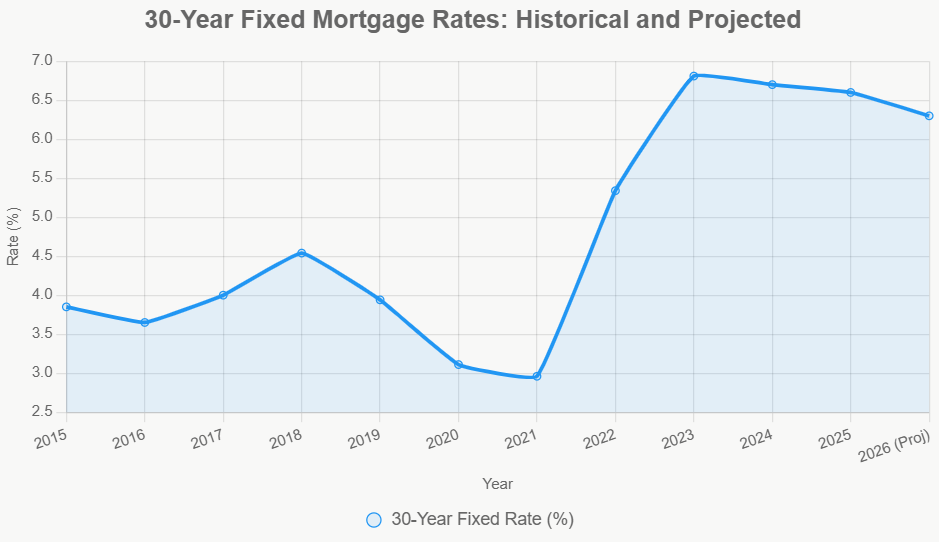
  • Interest Rates: Still a Big Deal, but Getting BetterThe days of getting a mortgage for practically free are long gone, and honestly, they probably won't be back anytime soon. The experts are saying that the average 30-year fixed mortgage rate will hover around 6.3% in 2026. That’s down a bit from where we've been, which is something to celebrate. However, it's still significantly higher than the super-low rates we saw a few years ago. This higher cost of borrowing is a major reason why we won't see a boom. It makes buying a home more expensive, which naturally puts a brake on how high prices can go.I remember when getting a mortgage was practically like getting free money. Now, everyone has to factor in that monthly payment difference, and it adds up quickly. It's a big hurdle for many potential buyers.
  • More Homes for Sale, But Not Exactly OverflowingOne of the biggest headaches for buyers in recent years has been the lack of homes to choose from. Thankfully, that picture is improving. By 2026, we're expected to see the supply of homes for sale rise to about 4.6 months. This is a much healthier number than the 3-4 months we've been dealing with lately. Think of it this way: if no new homes were listed, it would take about 4.6 months to sell the ones that are currently available.With more homes on the market, sellers might have to be a little more patient and perhaps a bit more willing to negotiate. This extra supply is the main reason why sales numbers are expected to go up, possibly reaching around 4.2 million homes sold.
  • The Economy: Steady As She GoesThe overall health of the economy plays a huge role. For 2026, we're looking at pretty steady economic growth, with the Gross Domestic Product (GDP) expected to grow between 2% and 2.25%. The unemployment rate is predicted to be around 4.7%, which isn't bad at all. And inflation, while still a concern, is expected to settle down to somewhere between 2.3% and 3%.These numbers paint a picture of an economy that's not overheating, but also not collapsing. This kind of environment supports a stable housing market – no sudden shocks that would send prices soaring or crashing.

A Look at the Numbers: What the Experts Are Saying

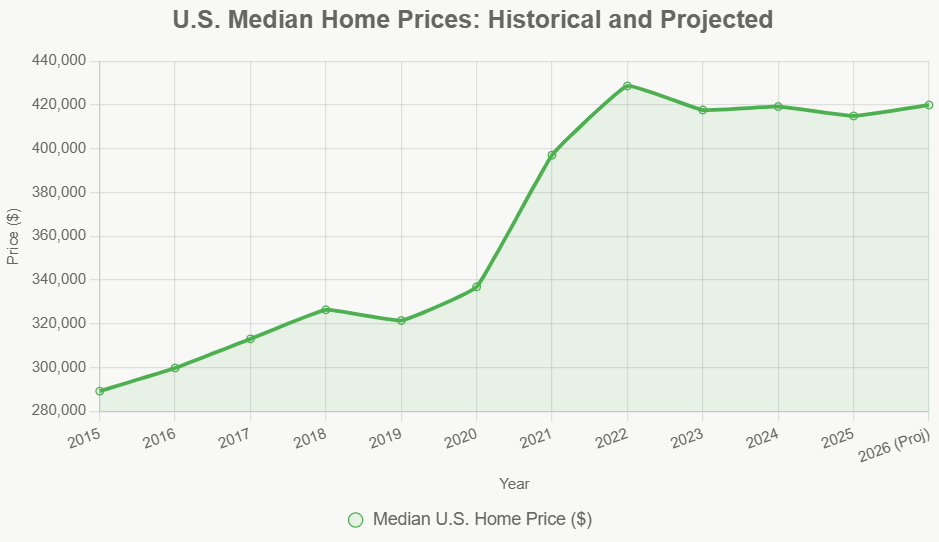
U.S. Median Home Prices: Historical and Projected for 2026

To give you a clearer picture, let's break down some of the key predictions.

Factor Current (Late 2025 Estimate) Projected (2026) Key Takeaway
Home Price Change Slight Dip/Plateau +1% to +2.2% Modest, controlled growth, not a boom.
Home Sales Volume ~4.08 million 4.13-4.26 million Gradual increase, but still below pre-pandemic.
30-Year Mortgage Rate ~6.6% – 6.7% ~6.3% Still elevated, impacting affordability.
Inventory (Months) 3-4 months ~4.6 months Improving supply, easing buyer pressure.
GDP Growth – 2% – 2.25% Steady economic expansion.
Unemployment Rate – ~4.7% Healthy job market.
Inflation – 2.3% – 3% Cooling down, but still a factor.

As you can see, the numbers themselves tell a story of moderation. We're not entering a period of dramatic price drops like the 2006-2008 crash, nor are we looking at the double-digit percentage gains we saw from 2020-2022.

30-Year Fixed Mortgage Rates: Historical and Projected for 2026

Regional Differences: It's Not the Same Everywhere!

One of the most important things to remember is that the U.S. housing market is not one big, uniform blob. Where you are matters a lot.

  • Sun Belt Cooling Down: Places like Florida and Texas, which saw massive growth, might actually cool off a bit. Things like rising insurance costs (especially in Florida) and the fact that some areas might have built a bit too much could lead to slightly lower prices or slower growth.
  • Rust Belt Rising (Slowly): On the other hand, cities in the Rust Belt, areas like Cleveland and parts of the Midwest, could see steadier, more reliable gains. Why? Because they are more affordable and are seeing people move there for jobs and a lower cost of living.

Let's look at this in a table to make it super clear:

Region/Metro Projected Price Change (2026) Key Driver
Cleveland, OH +3% to +4% Affordability, job stability
Chicago, IL +2.5% Tight supply, urban revival
Miami, FL -2% to -3% Insurance hikes, hurricane risks
Austin, TX -1.5% Overbuilding, office returns
NYC Suburbs +2% Hybrid work migration
Los Angeles, CA Flat High costs, intra-metro shifts

This really shows that you can't just look at national numbers and expect them to apply to your backyard. The local economy, job market, and even things like climate and insurance costs play a huge role.

What About Potential Crashes or Booms?

While the general outlook is for stability, it's always wise to consider the “what ifs.”

  • When a Crash Could Happen (But Probably Won't Be Big):Honestly, a nationwide crash where prices drop by 10-20% seems pretty unlikely. We have much stronger protections in place now than we did back in 2008. For example, most homeowners have built up a lot of equity, which means they have a financial cushion. Also, the limited supply of homes helps keep prices from falling too low.However, there are a few things that could cause problems:
    • Job Losses: If the economy suddenly takes a nosedive and a lot of people lose their jobs, especially in high-paying sectors, demand for homes could drop fast.
    • Surprise Economic Shocks: Imagine if new trade disputes caused inflation to spike, forcing the Federal Reserve to raise interest rates even higher. That could really hurt the market.
    • Disasters: While more localized, things like a major hurricane or severe weather events that cause widespread damage and make insurance unaffordable could force some people to sell their homes at a loss.
  • When a Boom Might Happen (But It Will Be Gentle):A boom, meaning prices shooting up by 5% or more nationwide, also seems out of reach for 2026. The main reason for this is affordability. Even with slightly lower interest rates, buying a home is still a big financial jump for many people, especially younger generations.What could give the market a little extra boost?
    • Millennials and Gen Z Buying: As younger generations move into their prime home-buying years, there will naturally be more demand.
    • More Homes Being Built: If builders can find ways to offer incentives, like helping with mortgage rates, they might pick up the pace of construction, adding more homes to the market.
    • Investors: People and companies who buy homes to rent out are still active in the market, and their steady buying helps support prices.

The Big Picture: A Reset, Not a Revolution

To wrap things up, I don't see a housing market crash in 2026, and I don't see a wild boom either. What I do foresee is a reset. The market is moving towards a more balanced and sustainable path.

Affordability is slowly getting better, more homes are becoming available, and the economy is expected to chug along nicely. There will always be unexpected events, so it's wise to stay informed. But for now, the evidence points towards a housing market that is healing and moving forward at a steady pace.

For anyone who's been waiting to buy, patience might be rewarded with more choices and stable prices. For homeowners, your investment is likely to continue to hold its value, with modest growth expected. It's a market that's evolving, not exploding, and that's okay.

Want Stronger Returns? Invest Where the Housing Market’s Growing

Turnkey rental properties in fast-growing housing markets offer a powerful way to generate passive income with minimal hassle.

Work with Norada Real Estate to find stable, cash-flowing markets beyond the bubble zones—so you can build wealth without the risks of ultra-competitive areas.

🔥 HOT NEW LISTINGS JUST ADDED! 🔥

Talk to a Norada investment counselor today (No Obligation):

(800) 611-3060

Get Started Now

Also Read:

  • Will Real Estate Rebound in 2026: Top Predictions by Experts
  • Housing Market Predictions for the Next 4 Years: 2026, 2027, 2028, 2029
  • Housing Market Predictions for 2026 Show a Modest Price Rise of 1.2%
  • Housing Market Predictions 2026 for Buyers, Sellers, and Renters
  • 12 Housing Markets Set for Double-Digit Price Decline by Early 2026
  • Real Estate Forecast: Will Home Prices Bottom Out in 2025?
  • Housing Markets With the Biggest Decline in Home Prices Since 2024
  • Why Real Estate Can Thrive During Tariffs Led Economic Uncertainty
  • Rise of AI-Powered Hyperlocal Real Estate Marketing in 2025
  • Real Estate Forecast Next 5 Years: Top 5 Predictions for Future
  • 5 Hottest Real Estate Markets for Buyers & Investors in 2025

Filed Under: Housing Market, Real Estate Market Tagged With: home prices, Housing Market, Housing Price Forecast, Housing Prices, real estate, Real Estate Market

How to Start Earning Cash Flow from Day One in Real Estate?

October 8, 2025 by Marco Santarelli

How to Start Earning Cash Flow from Day One in Real Estate?

Imagine this: you've just closed on an investment property, and instead of a pile of repair bills and a vacant unit, you're already collecting rent. That's the powerful promise of turnkey real estate investing, and it's absolutely possible to earn cash flow from day one. This isn't about some get-rich-quick scheme; it's a carefully structured approach to real estate that leverages professionals to put money in your pocket from the moment you own the property. If you're looking for a way to build wealth without being glued to your phone fixing leaky faucets or chasing down tenants, you've come to the right place.

How to Start Earning Cash Flow from Day One in Real Estate?

For years, I've been watching and participating in the real estate game, and I've seen firsthand how traditional investing can be a massive time sink. You might buy a property with good intentions, only to get bogged down in renovations, unexpected problems, and the sheer effort of finding reliable tenants.

Turnkey real estate flips that script. It's built on the idea that you can acquire a property that's already renovated, already rented out, and already being managed by a competent team. This means the income stream can begin almost instantly, potentially covering your mortgage, taxes, insurance, and management fees, leaving you with positive cash flow from the get-go. It's the closest thing to “passive” real estate income I've encountered, and it opens doors for so many people who thought real estate investing was out of reach.

What Exactly Is Turnkey Real Estate?

Let's break down what we mean by “turnkey real estate.” Think of it like buying a brand-new car. You don't have to assemble it, paint it, or install the engine yourself. You just get in, turn the key, and drive. Turnkey real estate is similar. You're buying a property that's been fully prepared for rental. This means it's either newly built or has been thoroughly renovated to be in excellent condition. Often, these properties come already leased to a tenant, meaning rent is already coming in.

But the “turnkey” aspect goes beyond just the physical condition of the property. It also includes the management. Reputable turnkey providers handle all the day-to-day operations. This includes finding and screening tenants, collecting rent, handling maintenance requests, and even dealing with potential evictions if necessary.

You, as the investor, are largely removed from the day-to-day grind. This makes it incredibly attractive for people who are busy with their careers, live far from the investment property, or simply prefer a more hands-off approach to real estate investing. For instance, I've worked with professionals whose primary focus is their high-paying job, and turnkey allows them to benefit from real estate without sacrificing their existing career.

Key features you can expect with turnkey properties generally include:

  • Fully Renovated or New Construction: The property is up-to-date, meets current building codes, and is appealing to renters.
  • Tenant-Ready: Many properties are already occupied by pre-vetted tenants, minimizing vacancy periods.
  • Professional Property Management: A dedicated company handles all operational aspects.
  • Sourced in Specific Markets: Providers typically focus on areas with strong rental demand and growth potential.

The Magic of Day-One Cash Flow: How It Works

The core appeal of turnkey real estate is the potential for immediate positive cash flow. This means the rental income you receive, from the moment you own the property, is more than your total expenses. How is this possible? It’s because the properties are delivered in a rent-ready state, usually already leased.

Let’s look at a simplified example. Suppose you purchase a turnkey property for $150,000. With a 20% down payment ($30,000), your mortgage principal is $120,000. Let's say your monthly mortgage payment, property taxes, insurance, and a conservative estimate for maintenance add up to $900. If the property is already rented for $1,200 per month, and you pay a property manager 10% of the rent ($120), your total monthly expenses are $900 + $120 = $1,020. Your net cash flow for that month would be $1,200 (rent) – $1,020 (expenses) = $180. That's positive cash flow from day one.

This calculation highlights the importance of your expenses, particularly the mortgage payment, property taxes, and insurance. The rental income needs to be robust enough to cover these, plus management fees, and still leave a surplus.

Cash Flow = Gross Rental Income – (Mortgage Payment + Property Taxes + Insurance + Maintenance + Property Management Fees)

In strong markets, it's common to aim for cash-on-cash returns (CoC) of 8-12%. This is a crucial metric that measures the annual pre-tax cash flow generated by the property relative to the total cash you invested (down payment, closing costs, and initial repair buffer). So, on that $30,000 investment, an 8% CoC return would mean generating at least $2,400 in positive cash flow per year, or an average of $200 per month.

Here's a look at how some markets are performing, giving you an idea of potential yields:

City Average Gross Rental Yield (Est. 2025) Median Home Price (Approx.) Potential Monthly Rent (Approx.) Key Economic Drivers
Birmingham, AL ~8-10% $220,000 $1,400+ Healthcare, low cost of living, growing job market
Memphis, TN ~9-11% $190,000 $1,250+ Logistics hub, affordable housing, strong rental demand
Indianapolis, IN ~8-10% $200,000 $1,300+ Diverse economy, manufacturing, affordable prices
Cleveland, OH ~8-10% $180,000 $1,200+ Revitalization, medical industry, low entry cost

These figures are estimates and can vary, but they illustrate the principle: in more affordable areas with steady job growth, rental income can significantly outpace property values, leading to healthy yields.

Why I'm a Fan: The Deeper Benefits of Turnkey Investing

As someone who values efficiency and tangible assets, certain benefits of turnkey real estate really stand out to me:

  • True Passive Income for Busy Lives: This is the big one. If you have a demanding career, family obligations, or simply aren't interested in being a landlord, turnkey is a game-changer. You're outsourcing the headaches. The property management company handles the tenant screening, rent collection, and maintenance calls. You receive a monthly statement and, ideally, a deposit into your bank account. It allows you to benefit from real estate appreciation and cash flow without the constant demands.
  • Geographic Freedom: You're not limited to investing in your local market. If your hometown has sky-high prices and low rental yields, you can explore opportunities in more investor-friendly states. This also allows for diversification – owning properties in different cities or even states can spread risk. I've seen investors build portfolios across several states, isolating risks and capitalizing on varied economic cycles.
  • Minimized Renovation Headaches: One of the biggest pitfalls of traditional real estate investing is unexpected renovation costs and delays. Turnkey properties are meant to be in excellent condition, meaning you're less likely to face thousands in unexpected repair bills right after closing. This predictability makes budgeting and financial planning much simpler.
  • Potentially Lower Vacancy Rates: Turnkey providers often have effective tenant placement strategies, and since the properties are well-maintained, they're more attractive to reliable renters. This can lead to lower vacancy periods, which directly impacts your bottom line.
  • Tax Advantages: Like any real estate investment, turnkey properties offer significant tax benefits. You can deduct mortgage interest, property taxes, insurance premiums, maintenance costs, and depreciation (which is a non-cash expense that reduces your taxable income). For those who qualify as “real estate professionals” (a specific IRS definition), there can be even more powerful advantages, like offsetting active income with passive losses.

Think of it this way: Turnkey real estate allows you to buy a fully operational income-generating business asset without needing to be the CEO, the operations manager, and the customer service representative all at once.

The Practical Steps to Earning Cash Flow from Day One

Getting started with turnkey investing requires a structured approach. It’s not just about picking the first property you see.

  1. Deep Market Research: This is non-negotiable. I always start by looking for markets with strong economic fundamentals. This means looking for:
    • Job Growth: Are new companies moving in? Are existing ones expanding? This creates demand for housing.
    • Population Growth: Are people moving to the area? This is a direct driver of rental demand.
    • Affordability: Can people afford to buy and rent in the area? A good balance is key.
    • Landlord-Tenant Laws: While you won’t be managing day-to-day, understanding the legal environment is important. Popular regions often cited for these factors include parts of the Southeast (like Alabama and Georgia) and the Midwest (like Ohio and Indiana). Cities like Birmingham, AL, or Indianapolis, IN, frequently appear on lists for their combination of affordability and rental demand.
  2. Financial Readiness: You’ll need capital. Typically, turnkey providers expect around a 20-25% down payment, plus closing costs and some reserves for unexpected expenses. I’d also advise having 3-6 months’ worth of mortgage payments and expenses set aside as reserves for each property you acquire. Knowing your budget upfront will filter your choices effectively.
  3. Partner with a Reputable Turnkey Provider: This is critical. Your success hinges on the quality of the provider you choose. Look for companies with:
    • A proven track record: How long have they been in business? What are their investor success stories?
    • Transparency: Are they open about their fees, renovation processes, and market analysis?
    • In-house or Vetted Management: Do they manage the properties themselves, or do they work with a trusted third-party manager?
    • Strong Reviews and References: Check online reviews and ask for references from existing investors.
  4. Thorough Due Diligence: Even with the best providers, you need to do your homework.
    • Property Inspection: Hire an independent inspector to review the property's condition. Understand that “renovated” can mean different things.
    • Review Pro Forma Statements: This is the provider's projection of income and expenses. Scrutinize these numbers. Are the rent estimates realistic for the area? Are expense estimates conservative?
    • Verify Leases: If the property comes with a tenant, review the lease agreement and the tenant's history.
  5. Secure Financing: You'll likely use conventional mortgages for turnkey properties. Ensure you have a good credit score and a solid financial history to qualify. Some providers may also work with specialized lenders or accept cash. Self-directed IRAs can also be a viable option for tax-advantaged investing.
  6. Monitor Your Investment: Once you own the property, stay engaged. Review your monthly statements from the property manager. Understand your property's performance, occupancy rates, and any maintenance trends. This allows you to make informed decisions about future investments.

Navigating the Risks: What to Watch Out For

While turnkey investing offers significant advantages, it's not without its potential pitfalls. Being aware of these allows you to mitigate them effectively:

  • Higher Purchase Prices: Because the properties are renovated and ready to go, the upfront cost is usually higher than buying a fixer-upper. This can sometimes mean a lower initial cash-on-cash return if the rent isn't sufficiently high.
  • Reliance on the Provider: Your entire investment rests on the competence and integrity of your turnkey provider and their property management team. If they are not proactive, honest, or efficient, your investment can suffer. This is why thorough vetting is paramount.
  • Quality of Renovations: Sometimes, renovations might be cosmetic rather than structural. A poorly done renovation can lead to expensive repairs down the line. Independent inspections are your best defense here.
  • Market Fluctuations: While you're investing in markets with growth potential, no market is immune to economic downturns. Rents can decrease, and occupancy rates can fall. Diversifying your investments across multiple properties and potentially multiple markets can help cushion the impact.
  • Hidden Fees or Markups: Some providers might mark up the cost of renovations or charge various fees that aren't immediately obvious. Always ask for a clear breakdown of all costs involved.

My approach to mitigating these risks has always been to:

  • Over-communicate: Don’t be afraid to ask questions, no matter how small they seem. Clear communication prevents costly misunderstandings.
  • Have a “Plan B”: Be prepared for unexpected changes—whether it's a property management company failing or a sudden market shift. Know your backup strategy.
  • Build Sufficient Reserves: A solid financial cushion is essential for weathering surprises like repairs, vacancies, or economic downturns.

Building Wealth Long-Term with Turnkey Real Estate

Turnkey real estate isn't just about getting a little bit of cash flow from day one; it's a powerful tool for building long-term wealth when used strategi­cally.

  • Scaling Your Portfolio: Once you've successfully acquired your first turnkey property and experienced the cash flow and management process, you can use that income and experience to acquire more. Many investors aim to build a portfolio of 5-10 cash-flowing properties, which can provide a significant passive income stream and contribute to financial freedom.
  • Leveraging Equity: As properties appreciate over time and you pay down the mortgage, you build equity. This equity can be tapped through refinancing to acquire additional properties, further accelerating your wealth-building journey.
  • Diversification: Turnkey real estate can be a component of a broader investment strategy that also includes stocks, bonds, or other real estate ventures like syndications or REITs. This diversification can create a more resilient financial future.

The key is to approach it as a business. Treat each property as a revenue-generating asset, consistently monitor its performance, and make informed decisions for growth. The ability to generate cash flow from day one with turnkey properties removes a significant barrier to entry and allows you to start building that robust, income-producing portfolio sooner. It’s a strategy that has the potential to provide consistent, tangible returns in a world that often feels unpredictable.

In conclusion, earning cash flow from day one through turnkey real estate is not only possible but a well-trodden path for many successful investors. By understanding the model, carefully selecting your partners and markets, performing diligent research, and managing your investments wisely, you can unlock a powerful and more passive stream of income.

Work With Norada – Start Earning Cash Flow from Day One

Want instant rental income without the stress of managing properties? Norada’s turnkey real estate investments come fully renovated, tenanted, and managed — so you can start earning cash flow immediately while building long-term wealth.

🔥 Begin Your Passive Income Journey Today! 🔥

Talk to a Norada investment counselor today (No Obligation):

(800) 611-3060

Get Cash Flow Now

Also Read:

  • 10 Steps for Picking a Hot Real Estate Market for Investment
  • Best Places to Invest in Single-Family Rental Properties
  • Why Real Estate Can Thrive During Tariffs Led Economic Uncertainty
  • Rise of AI-Powered Hyperlocal Real Estate Marketing
  • Real Estate Forecast Next 5 Years: Top 5 Predictions for Future
  • 5 Hottest Real Estate Markets for Buyers & Investors
  • Will Real Estate Rebound in 2025: Top Predictions by Experts
  • Recession in Real Estate: Smart Ways to Profit in a Down Market
  • Will There Be a Real Estate Recession in 2025: A Forecast

Filed Under: Real Estate Investing, Real Estate Investments, Real Estate Market Tagged With: real estate, Real Estate Investing, Turnkey

Will Real Estate Crash or Rebound in 2026?

September 29, 2025 by Marco Santarelli

Will the Real Estate Market Boom or Crash in 2026: Expert Predictions

Entering 2026, the big question on everyone’s mind when it comes to real estate is whether we’re headed for a dramatic upturn, a sharp downturn, or something in between. Based on the latest expert analyses, I can tell you right now: the real estate market in 2026 is not likely to boom or crash. Instead, we're looking at a period of modest stability and gradual recovery, with home prices expected to inch up slightly. This isn't the stuff of sensational headlines, but for anyone involved in buying, selling, or investing, understanding this nuanced outlook is crucial.

Will Real Estate Crash or Rebound in 2026?

My Take on the Market's Path to 2026

From where I sit, having followed real estate trends and spoken with industry professionals for years, the current situation feels like a deep breath before a measured exhale. The wild swings we saw during the pandemic – the frantic bidding wars, the unprecedented price hikes – have subsided. Now, as we move closer to 2026, the market is finding its footing, influenced by a complex mix of economic forces and demographic shifts. It's not a red alert for a crash, nor is it a green light for unchecked booming prices. It's more like Goldilocks for real estate: just right, for now.

Looking Back: What Got Us Here? Lessons from Recent Cycles

To truly grasp where we're going, we need to look at where we've been. The housing market has been on a rollercoaster. Remember the early 2020s? Fueled by super-low interest rates and the shift to remote work, home prices shot up. It felt like a gold rush, with national prices climbing over 40% in just a couple of years.

Then, reality hit. To fight inflation, the Federal Reserve started raising interest rates. Suddenly, those comfy 3% mortgages became a distant memory, and buying a home became much harder. Many homeowners who had locked in low rates found themselves “locked in” too, unwilling to sell their current homes and buy new ones at much higher rates. This created a bit of a standstill, leaving the market feeling “stuck.”

As of late 2025, this “stuck” feeling is still present. Mortgage rates are hovering around 6.5% to 6.7%, which is a lot higher than many people are used to. This, combined with affordability issues, has put a damper on sales. Home prices have been pretty flat, maybe creeping up a little year-over-year. Inventory – the number of homes available for sale – is still on the low side, with a shortage of about 4.5 million homes nationwide. However, builders are picking up the pace, adding new homes. This sets the stage for 2026, where experts believe a thaw is coming, mainly due to interest rates starting to ease.

Crucially, unlike the 2008 crisis, today's market is on much firmer ground. Lending standards are stricter, and there aren't as many people about to lose their homes. This makes a widespread crash significantly less likely.

Home Price Predictions: A Gentle Rise, Not a Wild Ride

So, what about home prices in 2026? The national outlook points to modest growth, not a boom or a bust. Zillow, a major player in real estate data, predicts home values nationally will increase by a rather small 0.4% from mid-2025 to mid-2026. This is a slight upgrade from some earlier, more cautious predictions, but it still signals that prices aren't going to skyrocket. Fannie Mae, another respected institution, is a bit more optimistic, forecasting around 3.6% growth. The National Association of Realtors (NAR) also expects a bump, with median prices hitting about $420,000, a 2% increase.

These numbers suggest that as interest rates come down, more buyers will be able to afford homes, which will nudge prices up. However, the ongoing shortage of homes available for sale will prevent prices from soaring.

Regional Differences are Key:

It's vital to remember that real estate is local. What happens in one part of the country can be very different from another.

  • Stronger Growth Areas: Markets in the Northeast and Midwest might see better price appreciation. For example, Atlantic City, New Jersey, is projected to see an increase of up to 4.3%, and Saginaw, Michigan, around 3.8%. These areas often benefit from greater affordability and job growth.
  • Areas Facing Declines: On the flip side, some areas might actually see prices drop. Louisiana, for instance, faces challenges. Cities like Houma could experience declines of 5-8%, and New Orleans around 5.8%. This is often tied to local economic issues and specific supply dynamics.
  • California and Florida: These typically hot markets are expected to see growth, with California’s median price climbing about 3.6% and Florida continuing its attractive growth rate of 3-5% due to population influx and investor interest.

Here’s a look at some regional forecasts from Zillow:

Metro Area Projected Price Change (July 2025-July 2026)
Atlantic City, NJ +4.3%
Saginaw, MI +3.8%
Houma, LA -8.6%
New Orleans, LA -5.8%

(Source: Zillow via ResiClub Analytics)

Sales Volume and Inventory: A Shift Toward Balance

Get ready for more homes to be bought and sold in 2026. Experts are forecasting a noticeable increase in sales activity. NAR expects existing-home sales to jump by 11-13%, and new-home sales to rise by 5-8%. Fannie Mae also predicts an overall surge of nearly 10% if mortgage rates dip below 6%. This increase in sales is directly linked to the expected drop in interest rates.

And what about the homes available? Inventory, which has been tight for so long, might finally see some improvement. A huge demographic shift is on the horizon: Baby Boomers, many of whom own homes, are starting to think about downsizing. Experts suggest this could potentially release up to 14.6 million homes into the market by 2036, with a significant portion of that starting around 2026. This could lead to more choices for buyers and might even tip the scales towards a buyer's market by mid-2026, meaning there are more homes available than buyers, giving shoppers more negotiating power. New home construction is also expected to chip in, with around 1.05 million single-family homes being built.

Here's a quick look at sales forecasts:

Source Existing-Home Sales Growth (2026) Notes
NAR +11-13% Driven by lower rates and economy
Fannie Mae +10% (overall surge) Rates below 6% key driver
CAR (California) +2% (to 274,400 units) Affordability improvement expected

Interest Rates and Affordability: The Key to Everything

The biggest factor influencing housing in 2026 will undoubtedly be interest rates. Right now, in late 2025, they're a major hurdle. But the good news is, predictions point towards a cooling trend. Fannie Mae is forecasting that the average 30-year fixed mortgage rate could drop to around 5.9% by the end of 2026. This is a significant drop from where we are now and would make a big difference in monthly payments for buyers.

When rates go down, affordability goes up. While monthly payments might still be higher than pre-pandemic levels, the slight improvement in affordability could encourage more people to enter the market, either as buyers or by moving from renting to owning. Rents are also expected to climb, which could push more people to consider buying.

Economic and External Factors: What Else Matters?

The health of the overall economy plays a huge role in real estate. For 2026, forecasts suggest the U.S. economy will grow at a steady pace, around 2.0-2.2%. Unemployment is expected to remain relatively low, holding steady at about 4.3-4.6%. This kind of stable, if not spectacular, economic environment is generally good for the housing market. It means people have jobs and are more likely to be confident about making big purchases like a home.

However, there are a few things that could throw a wrench in the works:

  • Inflation: If inflation picks up again, the Federal Reserve might have to keep interest rates higher for longer, slowing down any market recovery.
  • Insurance Costs: In areas prone to climate events (like Florida and California), rising home insurance costs could cool down demand and property values.
  • Global Issues: Trade tensions or other international events could increase the cost of building materials, impacting new construction.
  • Stock Market Volatility: If the stock market takes a big hit, it could make people feel more cautious about their finances and less inclined to invest in real state.

Some voices express concern about the market overheating due to high valuations, reminiscent of past bubbles. But the general consensus among most experts is that the underlying economic strength makes a major crash in 2026 highly unlikely.

Here's a summary of key economic projections for 2026:

Economic Indicator Projection Range Key Sources
GDP Growth 2.0-2.2% Deloitte, CBO, Univ. of Michigan
Unemployment Rate 4.3-4.6% Federal Reserve, S&P Global, Philadelphia Fed

Risks and Opportunities: Navigating 2026

Will there be a Boom? A national housing boom seems unlikely because prices are already relatively high, and while demand is increasing, it's not at the peak levels seen during the pandemic. However, we could see localized booms in certain high-demand cities driven by job growth and limited supply.

Will there be a Crash? The risk of a widespread crash is considered low. The economy is stable, unemployment is low, and lending standards are much tighter than in the past. However, specific markets that have seen rapid price increases or face economic challenges could experience corrections – a softening or decline in prices.

Opportunities for Buyers:

  • Wait for Mid-2026: If you can, waiting until mid-2026 might mean more homes to choose from as inventory rises.
  • Focus on Affordability: Look at metros that offer better value and potential for growth.
  • Use Tools: Utilize online tools and calculators to understand your borrowing power and potential monthly payments.

Opportunities for Sellers:

  • Price Competitively: In a market balancing out, pricing your home correctly from the start is crucial.
  • Emphasize Strengths: Use staging and marketing to highlight your home's best features, especially if you're in a competitive area.
  • Timing: The spring market often sees higher demand, so strategic timing can pay off.

Opportunities for Investors:

  • Targeted Markets: Consider areas with strong rental demand, like Florida or certain Midwest cities, for rental property yields.
  • Long-Term Strategy: Focus on long-term appreciation and rental income potential, rather than quick flips.

Final Thoughts: A Balanced Outlook for 2026

In my opinion, the real estate market in 2026 is shaping up to be a much more balanced and navigable environment than we've seen in recent years. It won't be a thrilling rollercoaster of booms and crashes. Instead, expect a period of steady, modest growth as interest rates ease and more homes come onto the market.

The key for everyone involved will be staying informed, doing your homework, and understanding the specific dynamics of your local market. Keep an eye on interest rate movements and economic indicators, but don't get caught up in the hype of sensational predictions. The data points towards a more stable, predictable path forward.

Invest in Real Estate in the Top U.S. Markets

Discover high-quality, ready-to-rent properties designed to deliver consistent returns.

Contact us today to expand your real estate portfolio with confidence.

Contact our investment counselors (No Obligation):

(800) 611-3060

Get Started Now 

Also Read:

  • Housing Markets With the Biggest Decline in Home Prices Since 2024
  • Real Estate Forecast: Will Home Prices Bottom Out in 2025?
  • Why Real Estate Can Thrive During Tariffs Led Economic Uncertainty
  • Rise of AI-Powered Hyperlocal Real Estate Marketing in 2025
  • Real Estate Forecast Next 5 Years: Top 5 Predictions for Future
  • 5 Hottest Real Estate Markets for Buyers & Investors in 2025
  • Will Real Estate Rebound in 2025: Top Predictions by Experts
  • Recession in Real Estate: Smart Ways to Profit in a Down Market
  • Will There Be a Real Estate Recession in 2025: A Forecast
  • Will the Housing Market Crash Due to Looming Recession in 2025?
  • 4 States Facing the Major Housing Market Crash or Correction
  • New Tariffs Could Trigger Housing Market Slowdown in 2025
  • Real Estate Forecast Next 10 Years: Will Prices Skyrocket?

Filed Under: Housing Market, Real Estate Market Tagged With: Home Price Drop, home prices, Housing Market, real estate, Real Estate Market

Real Estate Forecast Next 10 Years: Future of Housing Market

September 27, 2025 by Marco Santarelli

Real Estate Forecast Next 10 Years: The Future of Housing

Thinking about the future can feel like trying to catch smoke – especially when it comes to something as big and important as where we live. Over the last few years, the housing market has been a wild ride, with prices shooting up and leaving many people wondering if owning a home is still even possible.

This surge, fueled by everything from a global pandemic that made us rethink city living to historically low interest rates that made borrowing cheaper, has created a truly unique moment. So, what's the real estate forecast for the next 10 years? I believe the market is poised for continued growth, but at a more moderate and sustainable pace than the recent frenzied peaks, shaped profoundly by technology, evolving demographics, and a growing emphasis on sustainability.

It's the multi-million-dollar question on everyone's mind: Will home prices keep climbing, or will they finally drop? Will it become easier or harder to afford a place of our own? As someone who has watched the market closely for years, I understand these concerns deeply. While no one has a magic crystal ball, looking at the big trends and listening to what experts say can give us a pretty good idea of what's coming.

Real Estate Forecast for the Next 10 Years

The Recent Rollercoaster: A Look Back

Let's face it, the past few years felt like we were all on a real estate rollercoaster. From 2020 onwards, we saw an unprecedented jump in home values. I remember talking to countless people who felt like they were constantly outbid or couldn't even get their offer considered. It was a time of immense frustration for many prospective homebuyers.

What pushed prices so high?

  • The Pandemic Shift: Suddenly, our homes became our offices, schools, and entertainment hubs. Many city dwellers craved more space and outdoor areas, leading to a migration to suburbs and smaller towns. This created a rush on homes in these areas.
  • Super Low-Interest Rates: The Federal Reserve kept interest rates incredibly low to stimulate the economy. This meant borrowing money for a mortgage was cheaper than ever, making higher home prices seem more manageable. It fueled demand, putting even more pressure on prices.
  • Limited Homes for Sale: Even with all the demand, there simply weren't enough homes being built or coming onto the market to keep up. It was a classic case of demand far outstripping supply.

This combination created a perfect storm, pushing prices to levels that many found truly disheartening. But now, as the dust begins to settle and interest rates have climbed, we're entering a new chapter.

Unpacking the Forces Shaping the Next Decade

The market ahead isn't just going to continue what we've seen; it's going to be a dynamic, ever-changing environment. From my perspective, there are three major forces that will truly steer the ship over the next decade.

  • Evolving Demographics: New Generations, New Demands The biggest groups entering the housing market right now are Millennials and Gen Z. These aren't just names for age groups; they represent new ways of thinking about work, life, and home.
    • Millennials, many of whom are now in their prime home-buying years, are looking for family homes, often with space for hybrid work. They prioritize community and often seek homes that align with their values around sustainability.
    • Gen Z, just starting to enter the market, is even more tech-savvy and environmentally conscious. They might be more open to flexible living arrangements, smaller spaces, or urban co-living options if it means affordability and convenience. These generations aren't just buying houses; they're influencing what kinds of houses get built and where they're located.
  • Interest Rate Fluctuations: The Cost of Borrowing Ah, interest rates. These are perhaps the most immediate and impactful factor for anyone thinking of buying a home. We've seen them soar from historic lows in recent years, making monthly mortgage payments much higher even for the same house price.
    • My take: I've seen firsthand how even a small percentage point shift in rates can add hundreds, sometimes thousands, to a monthly mortgage payment, effectively pricing many people out of the market overnight. While predicting exact rates is impossible, their movement will continue to be a dominant factor, influencing how much people can borrow, how many homes sell, and ultimately, how prices behave. If rates stabilize or even dip slightly, it could bring a new wave of buyers back into the market.
  • Technological Advancements: Reshaping How We Buy, Sell, and Live Technology isn't just a side player anymore; it's a game-changer. From the way we search for homes to how we manage them, innovation is making real estate smarter and more efficient. This goes beyond simple online listings; we're talking about AI predicting market trends, virtual reality tours that feel real, and even blockchain making transactions faster and safer. This isn't just about convenience; it's about fundamentally altering the industry.

5 Key Housing Market Trends to Watch: A Deeper Dive into the Future

The next ten years aren't just about price tags; they're about fundamental changes in how we live, what we value in a home, and how we build our communities. Based on the major forces we just discussed, here are five key trends I believe will truly shape the market.

1. The Rise of the Hybrid Home: Beyond Just an Office

The idea of a “home office” used to be a bonus, maybe a spare bedroom. Now, with more people working from home at least part-time, the hybrid home is becoming the standard. But it's more than just a dedicated workspace; it's about making your home work for you in every way.

  • Flexible Spaces: Forget rigid rooms. I anticipate seeing more homes with walls that can move, furniture that transforms, and layouts that adapt. A dining room might become a meeting space during the day, then easily convert back for family dinner. Think about it: a room that serves as a gym in the morning, a quiet study in the afternoon, and a guest room in the evening.
  • Increased Emphasis on Well-Being: Our homes need to be sanctuaries. Expect to see designs that maximize natural light, promote indoor-outdoor flow with large windows and accessible patios, and include dedicated spaces for fitness, meditation, or simply quiet relaxation. People are realizing the direct link between their living environment and their mental and physical health.
  • Smart Home Features: This isn't just about turning lights on with your phone. It’s about seamlessly integrated automation for lighting, temperature control, security, and even air quality management. These systems will enhance comfort, save energy, and make life easier, becoming standard rather than luxury.
  • Location Matters (Again): While the initial pandemic rush saw people moving further out, the hybrid model often means commuting a few days a week. This puts a new emphasis on being close to green spaces, parks, and local amenities. It’s about finding a better work-life balance where daily needs are met easily, fostering a sense of community. I believe the days of buying a house just for square footage are fading; people are now truly buying a lifestyle.

Here's a quick look at what we'll likely see in a hybrid home:

Feature Description Benefit
Multifunctional Rooms Spaces easily transformed for work, play, or relaxation. Adaptability, efficient use of space
Abundant Natural Light Large windows, open layouts. Improved mood, reduced energy costs
Indoor-Outdoor Flow Patios, decks, large sliding doors connecting living areas to nature. Enhanced well-being, increased living space
Integrated Smart Tech Automated lighting, climate, security, and air quality controls. Comfort, energy efficiency, peace of mind
Dedicated Wellness Zones Space for fitness, meditation, or quiet reflection. Health and relaxation

2. Tech-Powered Real Estate: Beyond Virtual Tours

Technology is going to do more than just make things convenient; it's going to fundamentally change how we interact with the real estate market.

  • Virtual Reality & Augmented Reality (VR/AR): Virtual tours are already common, but they're about to get a major upgrade. Imagine truly immersive experiences where you can “walk through” a property that hasn't even been built yet, change the paint colors with a swipe of your hand, or see how your existing furniture would look in a new space. AR could allow you to hold up your phone and see market data overlaid on actual buildings.
  • AI-driven Insights: Data analytics and Artificial Intelligence will move beyond simple property valuations. AI will provide personalized recommendations for buyers (matching not just budget and size, but lifestyle and future needs), offer deep market insights for sellers, and even predict future price fluctuations based on a vast array of economic and social indicators. Imagine an AI telling you not just current values, but predicting the best time to sell based on hyper-local trends, interest rate forecasts, and even community development plans. This empowers everyone to make smarter, more informed decisions.
  • Blockchain Technology: This could revolutionize the back-end of real estate. By creating secure, transparent, and unchangeable records, blockchain can streamline property transactions, eliminate mountains of paperwork, ensure secure data storage, and drastically reduce the potential for fraud. Smart contracts, enabled by blockchain, could even automate parts of the transaction process, making closing a deal quicker and more efficient.

3. The Evolving Urban Fabric: Reimagining Our Cities

Cities aren't going away; they're just getting smarter and more integrated. The urban core will see a transformation driven by a desire for convenience, community, and sustainability.

  • Reimagining Downtown: We're moving away from strictly commercial downtowns. Instead, urban areas will increasingly feature mixed-use developments that seamlessly combine residential, commercial (shops, restaurants), and recreational spaces. This fosters truly vibrant, walkable communities where people can live, work, and play without needing a car. Think about having your favorite coffee shop, a grocery store, and a park all within a few blocks of your apartment.
  • The “15-Minute City” Concept: This idea, gaining traction globally, aims for cities where residents can access essential services (work, school, shopping, healthcare, parks) within a 15-minute walk or bike ride from their homes. This isn't just about convenience; it's a powerful driver for sustainability by reducing car reliance, promotes community engagement by bringing people together locally, and supports local businesses. This isn't just about efficiency; it's about reclaiming a sense of neighborhood, of belonging, that many felt was lost in sprawling suburbs.

4. Climate Considerations Take Center Stage: Building a Greener Future

Climate change isn't a distant threat; it's a present reality shaping our decisions, including how and where we build homes. Over the next decade, green building will shift from a niche market to a fundamental expectation.

  • Sustainable Construction: The use of eco-friendly materials (like recycled content or rapidly renewable resources), renewable energy sources (solar panels becoming standard), and energy-efficient design (passive solar, superior insulation) will become standard practice. Builders won't just be aiming for basic codes; they'll be striving for net-zero homes that produce as much energy as they consume.
  • Water Conservation: As water resources become more strained, innovative solutions will be key. Expect widespread adoption of rainwater harvesting systems, greywater recycling for irrigation, and highly water-efficient appliances and landscaping (xeriscaping) to manage this precious resource.
  • Resilient Homes: Buildings will be designed not just for aesthetics, but to withstand extreme weather events (like stronger storms, heatwaves, or wildfires) and adapt to climate change. This means everything from elevated foundations in flood-prone areas to fire-resistant materials in regions prone to wildfires, ensuring long-term livability and safety. Ignoring climate in construction isn't just irresponsible; it's financially shortsighted.

5. The Enduring Affordability Challenge: Seeking Solutions

Despite all the innovation, the fundamental challenge of affordability will persist. As we saw, home prices have often far outpaced wage increases, making homeownership a distant dream for many.

  • Government Intervention: Addressing this issue will require serious policy efforts. Expect to see increased pressure on governments to implement zoning reforms that allow for more diverse and dense housing types, offer tax incentives for affordable housing developments, and expand social housing programs. These are crucial steps to create a more equitable market.
  • Innovative Housing Models: To provide more accessible options, we'll see a rise in new housing concepts:
    • Co-living: Shared communal spaces with private bedrooms, fostering community and reducing individual costs.
    • Micro-units: Small, efficient apartments in urban centers, designed for single occupants or couples prioritizing location over space.
    • Modular housing: Factory-built homes that are assembled on-site, offering a faster, more cost-effective, and often more sustainable construction method.
  • Shift in Mindset: Ultimately, tackling affordability will require a societal shift. We need to move towards a focus on building more starter homes and creating a more inclusive real estate market rather than prioritizing ever-larger luxury properties. My opinion is that we need a societal conversation about what ‘enough' looks like when it comes to housing, balancing individual desire with collective need.

Here are some strategies for tackling the affordability challenge:

  • Relaxed Zoning Laws: Allowing for multi-family homes in areas traditionally zoned for single-family.
  • Public-Private Partnerships: Government and private developers collaborating on affordable projects.
  • Rent-to-Own Programs: Providing pathways to ownership for those who can't afford a large down payment.
  • Community Land Trusts: Separating land ownership from home ownership to keep housing costs lower.

Real Estate Forecast: What to Expect by 2030?

Now for the big numbers. While specific predictions are tough, studies give us a strong indication. According to a study by RenoFi, the average price of a single-family home in the United States could reach $382,000 by 2030. This might seem like a manageable number, but it's important to remember that averages can be deceiving. The actual cost will vary significantly by location. For instance, in February 2023, the median price of a home in New York City was $760,000, while in Albany, Upstate New York, it averaged $219,000. That's a huge difference!

RenoFi's study also peered into the future for specific cities, using past growth rates to project 2030 values. Over the past decade, housing prices in the U.S. increased by a staggering 48.55%. Assuming a similar rate of increase for the next ten years, some cities are in for truly astonishing price tags.

Let's look at some notable predictions for 2030 average home values:

  • San Francisco: An astonishing $2,612,484
  • San Jose: $2,251,703
  • Oakland: $1,713,554
  • New York City: $964,101
  • Nashville: $539,292
  • Houston: $309,806

It’s no surprise that six of the top ten most expensive cities by 2030 are predicted to be in California if current growth rates continue. San Francisco and San Jose could indeed see average home prices exceeding $2 million. Furthermore, six additional major cities, including Oakland, Seattle, Los Angeles, San Diego, Boston, and Long Beach, may also experience house prices rising above the $1 million threshold.

While these numbers can feel overwhelming, especially for those in high-cost areas, it's crucial to remember they are forecasts based on past trends. They assume a consistent trajectory, which, as we know, the real estate market rarely maintains perfectly.

Projected 2030 Home Values for Select US Cities

City Current Median Price (Approx. 2023) Projected Average Value by 2030
San Francisco ~$1.4 Million $2,612,484
San Jose ~$1.2 Million $2,251,703
Oakland ~$900,000 $1,713,554
New York City ~$760,000 $964,101
Seattle ~$800,000 > $1 Million
Los Angeles ~$900,000 > $1 Million
Boston ~$750,000 > $1 Million
Nashville ~$400,000 $539,292
Houston ~$300,000 $309,806

Note: “Current Median Price” is approximate for illustrative comparison, based on recent data. Projected values from RenoFi study.

The Engine Behind the Numbers: Factors Driving Home Price Increases

Understanding why prices go up helps us prepare. Remember, home value doesn't always equal the exact purchase price, but it's a strong indicator of what a home is likely to sell for based on market conditions. Buyers might pay more or less, but the value is the benchmark.

Several factors continuously drive up home values:

  • Supply and Demand: This is economics 101. If there are more people who want to buy homes than there are homes available, prices will naturally rise. Conversely, if supply outstrips demand, prices stabilize or fall.
  • Interest Rates: As we discussed, lower interest rates make mortgages more affordable, increasing buyer demand and pushing prices up. Higher rates have the opposite effect.
  • Wage Increases: Ideally, home prices would rise in step with wages, keeping homeownership attainable. However, this has not been the case. While average wages have indeed increased from around $24,859 in 1996 to $51,916 in 2019, the impact of inflation and the rising cost of living means that homeownership still feels more distant for many. I remember looking at starter homes years ago that now cost three times as much, while my salary, thankfully, hasn't tripled. This widening gap between earning power and home prices is a critical issue.

Preparing for the Future: Your Path to Homeownership

The future of the housing market might seem daunting, but it's not hopeless. With smart planning and a proactive approach, aspiring homeowners can significantly improve their chances of affording a home in the coming years.

  • Start Saving Early and Consistently: This might sound obvious, but it's the most crucial step. The sooner you start, the more time your money has to grow, thanks to the magic of compound interest. Even small, regular contributions to a dedicated savings account can add up to a substantial down payment over five to ten years. Consistency is vital.
  • Invest Your Savings Wisely: For those with a five-to-ten-year timeframe before buying a home, simply letting your money sit in a regular savings account might not be enough to beat inflation. Consider investing a portion of your savings in low-cost options like index funds or using robo-advisors (like those offered by platforms such as Acorns or Betterment). These can help your money grow faster, but remember, investments carry risk.
    • Longer Time Horizon: Investments perform best when given a long time to ride out market ups and downs.
    • Tax Implications: Be aware of potential taxes on investment gains when you eventually sell to use for your down payment. Consulting a financial advisor is always a smart move, but even simple steps can make a huge difference.
  • Improve Your Credit Score: A strong credit score is essential for securing favorable mortgage rates, which can save you tens of thousands of dollars over the life of a loan. Pay bills on time, keep credit card balances low, and regularly check your credit report for errors.
  • Reduce Debt: High levels of consumer debt (credit cards, personal loans) can limit your borrowing capacity for a mortgage. Focus on paying down high-interest debt.
  • Explore First-Time Homebuyer Programs: Many government and local programs offer assistance with down payments, closing costs, or provide lower interest rates for first-time buyers. Do your research!

Predicting 2030 Home Prices and Mortgage Rates: A Nuanced View

While forecasting the exact numbers for 2030 is incredibly challenging – so many economic and global factors can shift – experts generally anticipate a more stable, albeit continued, growth trajectory compared to the recent boom.

  • Home Prices: After the recent surge, many experts predict that home price growth will align more closely with historical norms, with annual increases settling into the 3 to 5 percent range. This is a healthier, more sustainable pace than the double-digit percentage increases we've seen. From my experience watching market cycles, extreme highs and lows rarely last; the market tends to find its equilibrium. It means prices will likely still go up, but not at the frantic speed that priced out so many buyers.
  • Mortgage Rates: The future of mortgage rates remains a big question mark. The Federal Reserve has been actively raising rates to control inflation. While we might not return to the ultra-low rates of a few years ago, some experts believe that as inflation comes under control, mortgage rates could become more favorable in the coming years, potentially offering opportunities for homebuyers to lock in lower rates. It's a delicate balance, and staying informed about economic indicators will be key. If you're planning to buy, pre-approval and understanding rate lock options will be more important than ever.

Navigating the Next Decade

The future of the housing market will be dynamic, influenced by powerful technological advancements, changing demographics, and a pressing need for more sustainable and affordable solutions. While the path to homeownership may seem daunting, it's certainly not impossible. By understanding these trends, preparing financially, and adapting to new opportunities, individuals can navigate this evolving market. The future of housing isn't just about bricks and mortar; it's about how we choose to live, work, and build communities. With thoughtful planning, your dream of owning a home in the next decade can absolutely become a reality.

Work with Norada – Invest in Turnkey Properties

Discover high-quality, ready-to-rent properties designed to deliver consistent returns.

Contact us today to expand your real estate portfolio with confidence.

Contact our investment counselors (No Obligation):

(800) 611-3060

Get Started Now 

Also Read:

  • Housing Market Predictions for the Next 4 Years: 2025 to 2028
  • Housing Market Predictions for 2025 by Bank of America
  • Housing Market Forecast for the Next 2 Years: 2024-2026
  • Real Estate Forecast Next 5 Years: Top 5 Predictions for Future
  • 2008 Forecaster Warns: Housing Market 2024 Needs This to Survive
  • Housing Market Predictions for Next 5 Years (2024-2028)
  • Housing Market Predictions: 8 of Next 10 Years Poised for Gains
  • Trump vs Harris: Which Candidate Holds the Key to the Housing Market (Prediction)

Filed Under: Housing Market, Real Estate, Real Estate Market Tagged With: Housing Market, real estate

Housing Market Predictions 2026: Will it Crash or Boom?

August 8, 2025 by Marco Santarelli

Housing Market Predictions 2026: Will it Crash or Boom?

Are you dreaming of owning a home? You're probably wondering what the future holds. So, let's cut to the chase: The housing market in 2026 is expected to be more balanced than it has been in recent years, with moderate price growth, stabilizing interest rates, and increased sales activity. While it won't be a complete walk in the park, there's a good chance it'll be a bit easier for buyers than it has been. Let’s dive deeper into what you can expect.

Housing Market Predictions 2026: Will it Crash or Boom?

Home Prices: Are We Finally Seeing Some Relief?

Remember those crazy bidding wars and prices going through the roof? Well, experts think things will cool down a bit.

  • The National Association of Realtors (NAR) thinks the median home price will hit $420,000 in 2026, which is about a 2% jump from 2025.
  • Fannie Mae surveyed over 100 housing experts, and they're predicting home price growth will slow to 3.6% in 2026, which is less than the 5.2% we saw in 2024.
  • Zillow economists are projecting that U.S. home prices, as measured by the Zillow Home Value Index, will fall -1.7% between March 2025 and March 2026.
  • The U.S. News Housing Market Index thinks prices will go up a total of 17% from 2024 to 2029, which means prices will go up slowly each year starting in 2026.

This means that the big price jumps we saw a few years ago are probably over. Prices will still go up, but not as fast. That's good news for buyers, but remember that in some areas with lots of demand, houses will still be expensive.

Mortgage Rates: Will They Ever Go Down?

Mortgage rates are a big deal. They decide how much it costs to borrow money to buy a house. In 2025, rates have been pretty high, around 6-7%. Let's see what the experts think will happen in 2026:

  • NAR says mortgage rates will stay around 6% through 2026.
  • Fannie Mae thinks rates will be around 6% by the end of 2026.
  • J.P. Morgan is a bit more cautious, predicting rates will only drop to 6.7% by the end of 2025.

The important thing to remember is that mortgage rates depend on things like inflation and what the Federal Reserve does. If inflation goes down, rates could go down too. But, as Bankrate points out, anything can happen with the economy and government policies, so rates could change quickly.

Home Sales: Will More People Be Buying and Selling?

High mortgage rates have made it harder for people to buy houses, so sales have been down. But, experts think things will pick up in 2026:

  • NAR‘s chief economist, Lawrence Yun, thinks sales of existing homes will go up 13% in 2026.
  • Sales of new homes are predicted to go up 8% in 2026.
  • Bankrate says sales of existing homes could go up 10-15% in 2026.

This increase in sales will happen because mortgage rates will become more stable, there will be more houses available, and the economy will hopefully be doing well. All of these things will encourage people to buy homes.

Are There Enough Houses to Buy? The Supply and Demand Puzzle

For a while now, there haven't been enough houses for sale. This has made prices go up and made it hard for buyers. Let's see if this will change in 2026:

  • The National Association of Home Builders (NAHB) says builders will start building more single-family homes, about 1.05 million in 2026.
  • But, fewer apartment buildings will be built. This could make it harder to find a place to rent and could push rent prices up.
  • The U.S. News Housing Market Index estimates that there are still not enough houses, about 4.5 million short. They think this problem will slowly get better between 2025 and 2030.

So, more houses are being built, but it will take time to catch up with the demand. More houses for sale will help balance the market and make it easier to find a home.

What Else Could Affect the Housing Market?

Lots of things outside of just prices and rates can have a big impact:

  • The Economy: If the economy is doing well and people have jobs, more people will be able to buy houses.
  • Government Policies: New laws about housing and taxes can change the market.
  • Climate Change: The cost of insurance and building materials is going up because of climate change. This will make it more expensive to own a home, especially in areas that are prone to floods or fires.
  • Where People Want to Live: More people are moving to cities, which will make it harder to find housing in those areas. Also, as older people downsize, more homes could become available in some markets.

Where You Live Matters: Regional Differences

The housing market is different depending on where you are. Some areas will do better than others:

  • Areas with lots of jobs, growing populations, and not enough houses, like parts of the Midwest, might see prices go up more.
  • Expensive cities on the coasts might not grow as fast because they are already so expensive.
  • Bankrate says some areas in the South, like Texas and Florida, might not do as well because there are too many houses for sale and climate change is making it more expensive to live there.

If you're thinking of buying or selling, it's important to look at what's happening in your local market.

Opportunities for Investors

For investors, 2026 could bring some interesting chances. Some people who have adjustable-rate mortgages (ARMs) might see their rates go up, which could create opportunities for investors to buy properties. Also, managing properties efficiently is becoming more important as costs go up, so investors who use technology and smart management strategies could do well.

My Final Thoughts

Overall, the housing market in 2026 looks like it will be more stable than it has been in the past few years. Prices will probably go up slowly, mortgage rates will hopefully stay around 6%, and there will be more houses for sale.

If you're a buyer, 2026 could be a good year to start looking, as there will be more choices and less competition. If you're a seller, you might not get as much money as you would have a few years ago, but there will still be buyers out there.

Remember, things can change, and it's always a good idea to talk to a real estate professional in your area before making any big decisions. Good luck with your home-buying or selling journey!

Invest in Real Estate in the Top U.S. Markets

Discover high-quality, ready-to-rent properties designed to deliver consistent returns.

Contact Norada today to expand your real estate portfolio with confidence.

Contact our investment counselors (No Obligation):

(800) 611-3060

Get Started Now 

Also Read:

  • Housing Prices Are Set to Rise by 4.1% by the End of 2025
  • Housing Market Predictions for the Next 4 Years: 2025 to 2029
  • 12 Housing Markets Set for Double-Digit Price Decline by Early 2026
  • Real Estate Forecast: Will Home Prices Bottom Out in 2025?
  • Housing Markets With the Biggest Decline in Home Prices Since 2024
  • Why Real Estate Can Thrive During Tariffs Led Economic Uncertainty
  • Rise of AI-Powered Hyperlocal Real Estate Marketing in 2025
  • Real Estate Forecast Next 5 Years: Top 5 Predictions for Future
  • 5 Hottest Real Estate Markets for Buyers & Investors in 2025
  • Will Real Estate Rebound in 2025: Top Predictions by Experts
  • Recession in Real Estate: Smart Ways to Profit in a Down Market
  • Will There Be a Real Estate Recession in 2025: A Forecast
  • Will the Housing Market Crash Due to Looming Recession in 2025?
  • 4 States Facing the Major Housing Market Crash or Correction
  • New Tariffs Could Trigger Housing Market Slowdown in 2025
  • Real Estate Forecast Next 10 Years: Will Prices Skyrocket?

Filed Under: Housing Market, Real Estate Market Tagged With: home prices, Housing Market, Housing Price Forecast, Housing Prices, real estate, Real Estate Market

Atlanta Housing Market Flagged for a Major Home Price Decline

July 17, 2025 by Marco Santarelli

Atlanta Ranks Among High-Risk Housing Markets: Will it Crash?

Let's talk about something that might make your stomach drop a little if you own a home in Atlanta, or maybe perk up your ears if you're hoping to buy one. You might have seen headlines or heard whispers about certain housing markets being “at risk.” Well, according to recent insights by Cotality (Formerly CoreLogic), the buzz is true: Atlanta ranks among the high risk housing markets that may see significant price drops. Yes, a new report specifically flags the Atlanta area as the second-highest risk market in the entire country for home price decline.

That's a pretty bold statement, right? Especially for a city like Atlanta that's felt like a non-stop growth machine for years. People have been flocking here, jobs have been growing, and it felt like home prices were just destined to keep climbing forever. So, hearing that Atlanta is now considered “high risk” for a potential price crash – or at least a serious downward correction – is definitely news that grabs your attention.

Let me dive into what this data really means, why Atlanta is on this list, and what it could mean for you if you live here, are looking to buy, or thinking about selling.

Atlanta Housing Market Flagged for a Major Price Decline: Will it Crash?

What Does “High Risk” Even Mean in Real Estate?

When we talk about a “high risk” housing market in this context, it doesn't necessarily mean that tomorrow the bottom is going to fall out completely, like something out of a disaster movie. What it signals is that the market has a higher probability than others of seeing a significant decrease in home values.

Think of it like a weather forecast. A “high risk” of thunderstorms means you should probably make indoor plans, but it doesn't guarantee lightning will strike your house. In housing, high risk means the conditions are ripe for prices to decline notably, potentially by 10%, 15%, or even more in a relatively short period. A true “crash” is often associated with drops exceeding 20% or even 30%, like we saw in some areas during the 2008 financial crisis. The current data suggests the risk of such a scenario is elevated for places like Atlanta.

Atlanta's Spot on the High-Risk List

So, where does this “high risk” ranking come from? It's based on analysis of various factors, including recent price trends, affordability levels, changes in inventory, and broader economic conditions. According to the specific report I'm looking at (from Cotality, providing May 2025 insights), Atlanta isn't just on the list; it's near the very top. Atlanta, GA, is ranked #2 out of the top 5 markets identified with a very high risk of price decline among the top 100 largest metro areas.

That puts us right behind Albuquerque, New Mexico (#1), and ahead of other notable areas flagged for risk:

    1. Albuquerque, NM
    1. Atlanta, GA
    1. Winter Haven, FL
    1. Tampa, FL
    1. Tucson, AZ

It's interesting to see the company Atlanta is keeping here. We have a mix of Sunbelt cities that saw huge population influxes and price surges during the pandemic boom (Atlanta, the Florida cities, Tucson) and Albuquerque. This list points towards markets that might have gotten a little overheated or are facing specific challenges now.

Looking at the price trend chart provided, you can see that Atlanta's home prices, represented by the pink line, saw a massive surge starting in 2021, peaked sharply around mid-2022, dipped, recovered somewhat into early 2024, and then seem to be softening again slightly entering 2025. This kind of volatility and recent softening after a rapid run-up is one of the tell-tale signs that a market might be vulnerable. Atlanta's price peak was also notably higher than most of the other cities on this particular high-risk list before any potential correction.

Is an Atlanta Housing Crash Coming? New Report Says High Risk
Source: Cotality

Why is Atlanta Considered High Risk? Connecting the Dots from the Data

This is where we dig deeper than just the ranking. Why Atlanta? Let's look at some of the factors suggested by the data and add some local perspective.

  1. Rapid, Unsustainable Price Growth: Atlanta experienced phenomenal price appreciation over the last few years. While the provided data doesn't give Atlanta's specific percentage growth since the pandemic, it notes that states like Florida and Texas saw cumulative increases averaging 70% to 90%. Given Atlanta's popularity and growth during the same period, its increase was undoubtedly substantial, likely putting it in a similar league or at least pushing price levels far beyond historical norms relative to local incomes. My experience watching markets tells me that when prices climb too far, too fast, gravity eventually becomes a concern.
  2. Affordability Reached Breaking Point: When home prices double in a few years, but local incomes don't keep pace, homes become severely unaffordable for a large chunk of the population. The national data shows the median home price is $389,000 and requires an income of $86,500. Atlanta's median price likely isn't far off, and while median incomes in Atlanta are decent, the rate at which prices grew far outstripped wage growth. This forces buyers out of the market, shrinks the pool of potential buyers, and reduces demand. When demand drops but supply doesn't disappear, prices have to adjust downwards to meet buyers where they are (or where they can afford to be).
  3. Rising Inventory (Likely): While the report specifically mentions rapidly rising inventories contributing to weakened markets like Florida and Texas, this is a common factor in areas where demand is cooling. As homes become less affordable due to high prices and elevated mortgage rates (which, while dipping slightly in March 2025 according to the data, are still a significant factor compared to the rock-bottom rates of 2020-2021), homes sit on the market longer. This increases the overall supply of homes for sale, putting downward pressure on prices. I've seen inventory tick up in many formerly scorching markets, and it's reasonable to assume Atlanta is experiencing this trend to some degree as well, moving from a severe seller's market towards more balance, and eventually, potentially, a buyer's market in some segments.
  4. Shifting State-Level Trends: The data point that Georgia overall saw a negative price appreciation of -0.3% in March is telling. While Atlanta might have hit “new records” at some point recently, that negative state-level number suggests a cooling trend was already underway statewide entering spring 2025. As the major economic engine of Georgia, a negative trend statewide is highly likely to impact Atlanta, if it hasn't already pulled Atlanta into negative territory after the specific data snapshot.
  5. Broader Economic Headwinds: The report mentions consumer concerns about personal finances, job prospects, and potential tariff impacts. These national and international worries trickle down to local markets. If people are worried about their jobs or how much money they have left after inflation and high interest payments, they're less likely to make a huge purchase like a home, or they have less flexibility in their budget, further impacting affordability.

From my perspective, the combination of these factors creates a perfect storm of vulnerability for the Atlanta market. It had massive, rapid appreciation. That appreciation severely strained affordability. Now, with higher borrowing costs (even if slightly lower than peak), consumer caution, and potentially rising inventory, the air is getting thinner for prices at their current altitude.

Atlanta vs. Other Markets: A Quick Look

It's useful to compare Atlanta's situation to other market types mentioned in the data:

  • The Resilient Northeast/Midwest: Markets like Rhode Island, Connecticut, and New Jersey saw strong 7%+ year-over-year growth. Why? The report suggests a “severe lack of inventory” combined with “more affordable” price ranges (~$230,000 median). Atlanta's inventory might be increasing (unlike the Northeast), and its price point is significantly higher, making it less resilient to affordability pressures.
  • The Already Declining West: Utah and Idaho saw prices drop 2.1% and 2.2%. These were also pandemic boomtowns that got very expensive, very fast. Atlanta seems to be following a similar trajectory towards potential decline, just perhaps a bit behind or distinct in its specific timing and triggers.
  • The Weakened Florida/Texas Markets: Florida and Texas, like Atlanta, had massive cumulative price increases (70-90%). The report explicitly links this rapid growth to “significant affordability challenges” and notes rising inventory. This is exactly the path Atlanta seems to be on, just now being officially flagged as high risk. Winter Haven, Tampa, and other Florida markets already seeing negative annual changes might be slightly ahead of Atlanta in the correction cycle.

This comparison helps illustrate that Atlanta's high-risk status isn't an anomaly; it fits a pattern seen in markets that experienced hyper-growth and affordability stretching during the low-rate era.

What Does This Mean for You?

This is the critical question. If you're connected to the Atlanta real estate market, this ranking should definitely be part of your thinking.

  • If You're a Potential Buyer in Atlanta: This information could feel like a ray of hope. A “high risk” market with potential price declines means that the insane bidding wars and feeling of missing out could become less common. Prices might become more reasonable, or at least stop their upward march. However, buying in a high-risk market also comes with its own risk: you could buy today, and the value of your home could drop significantly in the short to medium term. This is less concerning if you plan to stay in the home for many years (5-10+), as markets tend to recover over time. But if you might need to sell in a few years, buying in a high-risk, potentially declining market is riskier. My advice? Do your homework, don't overpay, ensure the home meets your long-term needs, and be financially prepared for the possibility that the home's value might go down before it goes back up.
  • If You're a Current Atlanta Homeowner: Hearing your market is high risk for a crash is understandably worrying. The most important thing is not to panic. Real estate is often a long-term investment. If you bought your home years ago, before the recent run-up, you likely have significant equity, and a 10-20% correction might only erase some of your recent gains, not your entire investment. If you bought very recently at the peak (or close to it), you are at higher risk of being “underwater” (owing more than the home is worth) if prices fall substantially. Think about your personal situation:
    • Are you planning to sell soon? If so, be prepared for the market to be tougher. Homes may take longer to sell, and you might need to price more competitively or accept offers below what neighbors got a year ago.
    • Is this your long-term home? If you plan to stay put for 5-10 years or more, short-term price fluctuations are less critical. Focus on enjoying your home and its long-term value potential.
    • How is your financial situation? Are you comfortable with your mortgage payments? Having a stable job and finances is key, regardless of market ups and downs.
  • If You're a Potential Seller in Atlanta: The party might be over, or at least winding down. You're likely not going to get 15 offers above asking price within hours of listing anymore. You need to be realistic about pricing. Look at recent sales data, not sales from 6-12 months ago. Condition matters more in a cooling market. Be prepared for your home to sit longer and potentially need price adjustments. From my experience, sellers who are stubborn about peak pricing in a declining market often end up selling for less than they would have if they had priced appropriately from the start.

Is a “Crash” Guaranteed?

No, the word “risk” is key here. Atlanta is at risk of a significant decline, but it's not a guaranteed outcome. Markets are complex and influenced by many factors that can change.

What could prevent a full-blown crash (say, 20%+ drops)?

  • Continued Population Growth: Atlanta is still a desirable city for many, attracting new residents and businesses. Continued strong migration could help cushion falling demand from existing residents.
  • Strong Local Economy: If Atlanta's job market remains robust despite national concerns, it provides underlying support for the housing market.
  • Limited Supply Eventually: While inventory may be rising, it's possible that over the next few years, new construction slows down significantly due of market uncertainty, which could limit supply in the longer term and help prices stabilize after a correction.
  • Interest Rate Changes: While the data shows rates were still a factor in March 2025, a significant drop in mortgage rates (unforeseen in this report's context) could potentially re-ignite some buyer demand.

My professional opinion is that a significant correction (a drop of maybe 10-15% from the recent peak) in the Atlanta market seems highly probable given the factors identified in this report – rapid appreciation, stretched affordability, and cooling demand. Whether it escalates into a full-blown “crash” depends on how deep and prolonged the economic headwinds are and how much inventory ultimately comes onto the market. Atlanta's underlying fundamentals might prevent the absolute worst-case scenario, but the data is a clear warning sign that a significant price adjustment is much more likely than continued robust growth.

In Conclusion

The analysis ranking Atlanta as the second-highest risk housing market in the U.S. for price decline is a serious signal. It highlights that the rapid growth seen in recent years has made the market vulnerable due to affordability constraints and cooling demand driven by higher costs and economic uncertainty.

For anyone involved in the Atlanta housing market – whether buying, selling, or just owning – understanding this risk is crucial. It means being realistic, making informed decisions based on current market conditions, and preparing for the possibility that the value of homes in Atlanta may decrease before they eventually start to climb again. It's a shift from the euphoric seller's market we saw, and while it presents challenges, it could also open doors for those who were previously priced out. Stay informed, watch the local inventory levels and sales volumes closely, and factor this risk into your real estate plans.

“Invest in Turnkey Real Estate: Simple & Profitable”

With growing fears of a real estate crash in Atlanta, it’s more important than ever to choose low-risk, high-cash-flow markets with long-term fundamentals.

Norada helps investors navigate turbulent times by identifying strong markets backed by job growth, population gains, and affordability.

HOT NEW LISTINGS JUST ADDED!

Talk to a Norada investment counselor today (No Obligation):

(800) 611-3060

Get Started Now

Recommended Read:

  • Is the U.S. Heading Toward a Real Estate Crash and Debt Bubble?
  • 5 Riskiest Housing Markets to Avoid in 2025 That May Crash
  • Housing Market Predictions for the Next 4 Years: 2025-2029
  • Top 22 Housing Markets Where Prices Are Predicted to Rise the Most by 2026
  • Housing Market Predictions 2026: Will it Crash or Boom?
  • 12 Housing Markets Set for Double-Digit Price Decline by Early 2026
  • 4 States Facing the Major Housing Market Crash or Correction
  • Housing Prices Are Set to Rise by 4.1% by the End of 2025
  • Housing Market Predictions for the Next 4 Years: 2025 to 2029
  • Real Estate Forecast: Will Home Prices Bottom Out in 2025?
  • Housing Markets With the Biggest Decline in Home Prices Since 2024
  • Why Real Estate Can Thrive During Tariffs Led Economic Uncertainty
  • 5 Hottest Real Estate Markets for Buyers & Investors in 2025
  • Will Real Estate Rebound in 2025: Top Predictions by Experts
  • Will the Housing Market Crash Due to Looming Recession in 2025?

Filed Under: Housing Market, Real Estate Market Tagged With: Debt Bubble, Housing Market, real estate, Real Estate Crash

Is the U.S. Heading Toward a Real Estate Crash and Debt Bubble?

July 7, 2025 by Marco Santarelli

Is the U.S. Heading Toward a Real Estate Crash and Debt Bubble?

It seems like every other conversation I have, whether with friends, family, or even casual acquaintances, eventually drifts towards the big, looming question: Is the U.S. heading to a real estate crash? Given the rollercoaster of the past few years and the echoes of 2008 still lingering in our collective memory, it's a valid concern. Let me put your mind at ease, at least somewhat: while there are definitely pressures and strains in the system, the data and expert consensus as of mid-2025 suggest we are not on the brink of a 2008-style real estate crash or an imminent debt bubble collapse. However, that doesn't mean it's all smooth sailing, and understanding the nuances is key.

Unpacking the “Crash” Fears: What's Really Happening with Home Prices?

That chilling word, “crash,” brings back some pretty vivid memories for many of us. We remember the foreclosures, the plummeting values, and the sheer panic of the Great Recession. So, when 70% of Americans voice worry about a housing crash, as reported by Keeping Current Matters, I completely get it. But is history repeating itself? Let's dig into what the 2025 housing market actually looks like.

The 2025 Home Price Picture: Growth, But Not Everywhere

If you're looking for a nationwide, dramatic drop in home prices, you're likely to be disappointed (or relieved, depending on your perspective!). The S&P CoreLogic Case-Shiller Home Price Index showed a 3.9% annual gain in February 2025. That’s a bit slower than the 4.1% from January, but it’s still growth. Looking ahead, the National Association of Realtors (NAR) is even predicting a 3% rise in median home prices for 2025, with an expectation of 4% in 2026.

Now, it's not all uniform. Zillow, for instance, has a slightly different take, forecasting a modest national decline of 1.9% in home values. This tells me that the market is complex and definitely not a one-size-fits-all situation. Regional differences are playing a huge role:

Region Price Trend Key Factors My Two Cents
Northeast Stronger price gains Income growth, severe shortage of homes (Forbes) This region has older housing stock and less new construction, making any available home highly contested.
Southeast & West Weaker gains, possible discounts Increased inventory, softening demand (Forbes) These areas saw huge run-ups post-pandemic. A bit of a cool-down isn't surprising; some markets might have gotten a little ahead of themselves.

What I see here is a market that's normalizing rather than collapsing. Some areas might see slight dips, especially those that got overheated, while others will continue to see steady, if unspectacular, growth.

The Elephant in the Room: Why Isn't Supply Catching Up?

The number one reason most experts, myself included, don't foresee a crash is simple: there just aren't enough homes to go around. Mark Fleming, Chief Economist at First American, put it perfectly: “There’s just generally not enough supply. There are more people than housing inventory. It’s Econ 101.” And Lawrence Yun from NAR echoes this, stating, “…if there’s a shortage, prices simply cannot crash.”

Data from Realtor.com confirms this. While single-family homes for sale are up 20% year-over-year, inventory is still near record lows historically. This isn't a new problem; we've been underbuilding for over a decade.

Then there's what I call the “golden handcuffs” phenomenon, or the “lock-in issue” as JPMorgan calls it. Think about it: over 80% of current homeowners with mortgages are sitting on rates significantly below today's levels (which are hovering around 6.7%). Would you want to sell your home and trade your 3% mortgage for a nearly 7% one if you didn't absolutely have to? Probably not. This keeps a huge chunk of potential inventory off the market. I believe this lock-in effect is one of the most powerful, yet sometimes underestimated, forces shaping today's market. It's not just an economic statistic; it's a deeply personal financial decision for millions.

Mortgage Rates: The Squeeze on Buyers

Let's talk about those mortgage rates. They're the gatekeepers of affordability. Experts are generally predicting rates to stabilize somewhere between 6.5% and 6.7% through 2025. Don't hold your breath for a significant drop below 6%.

What does this mean for buyers? Well, for a $361,000 home with a 20% down payment at a 6.65% rate, the monthly principal and interest payment is around $1,853. Forbes notes this is only $9 more than in 2024, but let's be real – housing was already expensive in 2024 for many. Affordability is a genuine challenge, especially for first-time homebuyers. I'm seeing more and more young people and families priced out, turning to the rental market instead, which, in turn, puts upward pressure on rents. It's a tough cycle.

The New York Times reported that 2024 was the slowest housing market in decades. While 2025 might not be a barn burner either, the underlying conditions – low supply and persistent, albeit somewhat suppressed, demand – just don't scream “crash.” Selma Hepp, Chief Economist at CoreLogic (misattributed as Cotality in the source, but CoreLogic is her firm), reinforces this: “Unless there is a significant surge in the rate of unemployment… the housing market is expected to continue to rebound from 2023 lows.”

So, Are We Drowning in Debt? A Look at the U.S. Debt Mountain

The other side of this coin is debt. If real estate isn't crashing, is a “debt bubble” about to pop and take everything down with it? It's a fair question, especially when you hear the headline numbers.

Just How Big is Our Collective Tab?

U.S. household debt did indeed hit a record $18.2 trillion in the first quarter of 2025. That's a big, scary number. Let's break it down:

  • Mortgage Debt: $12.8 trillion (up $190 billion from Q4 2024) – This is the lion's share, about 70%.
  • Student Loans: $1.631 trillion (up $16 billion)
  • Auto Loans: $1.642 trillion (actually down $13 billion)
  • Credit Card Debt: $1.182 trillion (also down $29 billion)
  • Home Equity Lines of Credit (HELOCs): $402 billion (up $6 billion)

Seeing those mortgage numbers climb alongside rising home prices makes sense. But here's a crucial piece of context: the debt-to-GDP ratio was 73% in early 2023. While I'd love to see that lower, it's actually less than in some previous years. This tells me that, relative to the size of our economy, the debt load, while high, isn't necessarily at an immediate breaking point on a macro level.

Can We Actually Afford This Debt? The Delinquency Story

The total amount of debt is one thing; our ability to pay it back is another. The debt service burden – that's the fancy term for debt payments relative to our disposable income – is currently around 11.3%. Historically speaking, this is lower than it was for much of the 2000s, which suggests households, on average, are managing.

However, there are definitely some warning signs I'm keeping a close eye on. Delinquency rates for credit card and auto loans are rising, reaching levels that do bring back uncomfortable memories of the lead-up to 2008. This is where I see the most immediate stress. It tells me that some households are struggling with inflation and higher interest rates on these types of variable or shorter-term debts.

Now, for the big one: mortgage delinquencies. They did tick up to 4.04% in Q1 2025. That's an increase, yes, but it's still below the historical average of 5.25% (from 1979–2023). Foreclosure starts also rose slightly to 0.20%, but here's the kicker: homeowners are sitting on a mountain of equity – an estimated $34.7 trillion in Q4 2024. This equity acts as a massive cushion. Unlike 2008, when many were underwater, today's homeowners, even if they face hardship, often have the option to sell and walk away with cash, rather than defaulting. This is a fundamental difference.

Is a “Debt Bubble” About to Pop? My Analysis

So, are we in a debt bubble ready to burst? My take is no, not in the catastrophic, systemic way we saw before. Here's why:

  1. Stricter Lending Standards: The “liar loans” and no-doc mortgages of the pre-2008 era are largely gone. Today's mortgage borrowers are generally more qualified.
  2. Massive Home Equity: As mentioned, that $34.7 trillion in equity is a game-changer. It prevents a cascade of foreclosures.
  3. Debt Composition: While overall debt is high, the riskiest parts of it (like subprime mortgages from the past) are a much smaller component of the overall picture.

However, this doesn't mean there are no risks. A significant spike in unemployment (the Federal Reserve projects 4.4% in 2025, which is an increase but not calamitous) could absolutely strain household finances further. If people lose their jobs, those credit card and auto loan delinquencies could worsen, and mortgage stress could follow. The key here is the severity of any economic downturn.

What I'm more concerned about isn't a “bubble pop” that craters the financial system, but rather a prolonged period where an increasing number of families feel financially squeezed by the combination of high housing costs and persistent debt service, especially on non-mortgage items.

The X-Factors: Politics, Policies, and Other Wildcards

Economics doesn't happen in a vacuum. Politics and policy decisions can throw curveballs, and it's worth considering some of these.

Potential Policy Shifts and Their Ripple Effects

With elections always on the horizon, we have to consider how different administrations might approach things. For example, a potential Trump administration has floated ideas like:

  • Streamlining zoning approvals: This could, in theory, help with housing supply, which would be a positive.
  • Reducing immigration: This could have a mixed impact. While it might reduce some demand, it could also shrink the construction labor force (around 30% of which is immigrant labor, according to JPMorgan). This could exacerbate shortages and drive up costs.
  • Tariffs: Forbes estimates that tariffs could increase construction costs by as much as $10,900 per home. In a market already struggling with affordability, that's not helpful.

Eswar Prasad, an economist at Cornell University, rightly points out that such policy shifts can create economic uncertainty. When businesses and consumers are uncertain, they tend to pull back on spending and investment, which can slow the economy.

The Global Economic Climate: Are We an Island?

While we've focused on the U.S., it's important to remember we're part of a global economy. International events, global inflation trends, supply chain disruptions (as we saw during the pandemic), or geopolitical instability can all send ripples our way. For instance, if global energy prices spike, that affects everything from transportation costs to the price of goods, further squeezing household budgets here. I don't see an immediate global threat that derails the U.S. specifically right now, but it's a factor that always needs monitoring.

Navigating the Uncertainty: My Advice for You

Okay, so what does all this mean for you, personally? Whether you're looking to buy, already own, or invest, here's how I see it.

For Hopeful Homebuyers

My strongest piece of advice is don't wait for a crash that's highly unlikely to materialize in the way some might imagine. The fundamentals of low supply and steady (even if somewhat muted) demand just don't support a dramatic price collapse.

  • Focus on long-term affordability: Don't just look at the monthly mortgage payment. Consider property taxes, insurance, potential HOA fees, and maintenance. Can you comfortably afford the total cost of ownership, even if interest rates tick up a bit more or your income plateaus for a while?
  • Get pre-approved before you shop: Seriously, this is crucial. Know your budget. It saves heartache and helps you make realistic offers.
  • Be patient and persistent: The market is competitive, especially for good homes in desirable areas. It might take time to find the right place at a price you can manage. Don't get discouraged.
  • Consider your timeline: If you plan to stay in the home for 5-7 years or more, you're more likely to ride out any short-term market fluctuations and build equity.

For Current Homeowners

If you're already a homeowner, particularly one with a low-rate mortgage, you're generally in a good position.

  • Appreciate your equity: You've likely seen significant gains in home value. That's a powerful financial asset.
  • Think carefully before moving: If you have a sub-4% mortgage, giving that up for a 6.5%+ rate is a big financial leap. Only move if there's a compelling life reason (job, family, etc.). The “golden handcuffs” are real.
  • Be cautious with HELOCs: Tapping into your home equity can be a useful tool, but do it wisely. Have a clear plan for the funds and ensure you can comfortably manage the repayments, especially if rates on HELOCs rise.

For Investors

The days of easy, double-digit annual returns in real estate are likely on pause for a bit.

  • Expect modest returns: With slower price growth and higher interest rates, cap rates are compressed.
  • Look for specific opportunities: Instead of broad market bets, you might need to dig deeper for undervalued properties, niche markets, or value-add opportunities.
  • Cash flow is king: In this higher-rate environment, properties that generate positive cash flow from day one are more attractive and resilient than speculative appreciation plays. I always tell my investor clients that hoping for appreciation is gambling; planning for cash flow is business.

My Final Thoughts: Caution, Not Catastrophe

So, back to that big question: Is the U.S. heading to a real estate crash and debt bubble? My analysis, based on the current data and expert insights for 2025, is no, not in the dramatic, 2008-esque way that many fear.

The housing market is supported by a fundamental undersupply of homes and the “lock-in” effect of low existing mortgage rates, which should prevent a sharp, widespread crash in prices. We're more likely to see continued modest growth in many areas, with some potential softening or slight declines in previously overheated markets – a correction, not a collapse.

On the debt side, while total household debt is at a record high, the crucial mortgage sector is generally stable due to stricter lending and significant homeowner equity. The rising delinquencies in credit card and auto loans are certainly a concern and point to stress in parts of the consumer economy, but they don't currently appear to pose a systemic threat to the financial system in the same way mortgage-backed securities did in 2008.

This doesn't mean we can all relax and ignore the warning signs. Affordability will remain a major challenge. Certain households will face significant financial strain. Economic uncertainties, whether from domestic policy or global events, could shift the outlook. Vigilance and smart financial planning are more important than ever.

What I see is a period requiring more caution, more careful decision-making, and a realistic understanding of the economic pressures at play. It’s a time for resilience, not panic. The U.S. economy has weathered storms before, and while the current conditions are complex, they don't spell imminent doom for the housing market or a full-blown debt catastrophe.

“Invest in Turnkey Real Estate: Simple & Profitable”

With growing fears of a real estate crash and a looming debt bubble, it’s more important than ever to choose low-risk, high-cash-flow markets with long-term fundamentals.

Norada helps investors navigate turbulent times by identifying strong markets backed by job growth, population gains, and affordability.

HOT NEW LISTINGS JUST ADDED!

Talk to a Norada investment counselor today (No Obligation):

(800) 611-3060

Get Started Now

Recommended Read:

  • 5 Riskiest Housing Markets to Avoid in 2025 That May Crash
  • Housing Market Predictions for the Next 4 Years: 2025-2029
  • Top 22 Housing Markets Where Prices Are Predicted to Rise the Most by 2026
  • Housing Market Predictions 2026: Will it Crash or Boom?
  • 12 Housing Markets Set for Double-Digit Price Decline by Early 2026
  • 4 States Facing the Major Housing Market Crash or Correction
  • Housing Prices Are Set to Rise by 4.1% by the End of 2025
  • Housing Market Predictions for the Next 4 Years: 2025 to 2029
  • Real Estate Forecast: Will Home Prices Bottom Out in 2025?
  • Housing Markets With the Biggest Decline in Home Prices Since 2024
  • Why Real Estate Can Thrive During Tariffs Led Economic Uncertainty
  • 5 Hottest Real Estate Markets for Buyers & Investors in 2025
  • Will Real Estate Rebound in 2025: Top Predictions by Experts
  • Will the Housing Market Crash Due to Looming Recession in 2025?

Filed Under: Housing Market, Real Estate Market Tagged With: Debt Bubble, Housing Market, real estate, Real Estate Crash

Impact of the “One Big Beautiful Bill” on the Housing Market

June 20, 2025 by Marco Santarelli

Impact of the "One Big Beautiful Bill" on the Housing Market

The “One Big Beautiful Bill,” having cleared the U.S. House of Representatives on May 22, 2025, is setting the stage for a dramatic reshaping of the American economy, and the real estate market is squarely in its crosshairs. My definitive take, right off the bat, is yes, this bill has the strong potential to significantly transform the real estate market, though the exact nature and extent of that transformation will heavily depend on its journey through the Senate.

Impact of the “One Big Beautiful Bill” on the Housing Market

This isn't just another piece of legislation; it's a comprehensive overhaul touching nearly every corner of the tax code, and its real estate-specific provisions, alongside its broader economic implications, could trigger substantial changes for investors, developers, and homeowners alike.

Now, I know what you might be thinking: another bill, another promise. But this one feels different. It's not just tinkering around the edges; it's a bold attempt to inject new life into the economy by extending key provisions of the 2017 Tax Cuts and Jobs Act (TCJA) and layering in fresh incentives. As someone who's been keeping a close eye on the ebb and flow of the real estate world for years, I see several key areas where this bill could really move the needle.

The Pillars of Potential Transformation

Let's dive into some of the specific parts of the “One Big Beautiful Bill” that I believe could have the most profound impact on the real estate market:

  • Keeping the Tax Cuts Rolling: The extension of the TCJA's individual income tax cuts is a big one. If people and businesses have more money in their pockets, it stands to reason that we'll see increased demand across the board, including for housing and commercial spaces. Lower tax rates can fuel economic activity, and a stronger economy is generally good news for real estate values.
  • Boosting Business with the QBI Deduction: For those involved in real estate as pass-through entities (think LLCs and partnerships, which are very common in this industry), the proposed increase in the Qualified Business Income (QBI) deduction from 20% to 23% is a significant sweetener. This could lead to considerable tax savings, making real estate investments and businesses even more attractive. I've always believed that incentivizing small businesses is crucial for a healthy real estate market, and this provision seems to be a step in that direction.
  • Supercharged Depreciation: The extension of 100% bonus depreciation is another potential game-changer, particularly for commercial real estate. Allowing businesses to deduct the full cost of qualifying property in the year it's placed in service can be a powerful motivator for investment in property improvements and new construction. Imagine the impact on developers if they can immediately write off the full cost of certain new commercial buildings! Plus, the specific 100% depreciation allowance for certain commercial real property through 2030 is a clear signal to encourage development in that sector.
  • Protecting Like-Kind Exchanges: The preservation of Section 1031 like-kind exchanges is something I was particularly pleased to see. This provision allows investors to defer capital gains taxes when they exchange one investment property for another “like-kind” property. It's a vital tool for maintaining fluidity in the real estate investment market, allowing investors to reinvest and upgrade their portfolios without immediate tax consequences. Eliminating or restricting this could have really stifled investment activity.
  • More Support for Affordable Housing: The modifications to the Low-Income Housing Tax Credit (LIHTC) are a much-needed boost to affordable housing development. Increasing credit allocation, restoring the “9% LIHTC” to previous levels with an added increase, and lowering the bond-financing threshold for the “4% LIHTC” could make a real difference in increasing the supply of affordable housing. Designating Tribal and rural areas as difficult development areas is also a smart move to target underserved communities. As someone who believes everyone deserves access to decent housing, these changes are a positive sign.
  • Revitalizing Distressed Areas: The renewal and modification of Qualified Opportunity Zones (QOZ) presents another interesting avenue for transformation. By offering tax benefits for investments in economically distressed areas, the program has the potential to spur revitalization and development in communities that need it most. The second round, with a focus on rural areas and simplified incentives, could attract even more investment and, hopefully, lead to real improvements in local real estate markets.
  • Easing the Burden in High-Tax States: The proposed increase in the State and Local Tax (SALT) deduction cap is a significant point, especially for homeowners in states with high property taxes and income taxes. Raising the cap to $30,000 for those earning under $400,000 could ease the financial burden for many and potentially make homeownership more affordable in these areas. However, this provision has been a subject of much debate, and its final form in the Senate could differ.
  • Estate Planning and Real Estate: The increase in the lifetime estate and gift tax exemption is primarily aimed at high-net-worth individuals, but it could indirectly influence the high-end real estate market. With a higher exemption, individuals might be more inclined to invest in real estate as part of their estate planning strategies.
  • Supporting Rural Communities: The partial tax exclusion for interest income on rural/agricultural real property loans is a welcome provision for those involved in agricultural real estate. By potentially lowering borrowing costs, it could encourage investment and development in rural areas, which are often overlooked.
  • Maintaining Mortgage Interest Deduction Limits: The permanent extension of the TCJA limits on the mortgage interest deduction provides continued support for homeownership. While the deduction remains a key benefit, the limits for higher earners might have a slight cooling effect on the luxury housing market.

Beyond the Bricks: Broader Economic Ripples

It's crucial to remember that the real estate market doesn't operate in a vacuum. The “One Big Beautiful Bill's” broader economic implications could have just as significant an impact as the specific real estate provisions. If the bill succeeds in stimulating economic growth, as proponents hope, we could see increased job creation and consumer confidence, which would naturally translate to higher demand for both residential and commercial properties.

Furthermore, the claim of significant deficit reduction could lead to more stable long-term economic conditions, which are generally favorable for real estate investment. However, it's important to acknowledge the concerns raised by organizations like the Tax Foundation regarding certain provisions and their potential impact on fiscal outcomes. Any instability in the broader economy could certainly cast a shadow over the real estate market.

The Road Ahead: Navigating Uncertainty

While the House passage is a major step, the “One Big Beautiful Bill” still faces a potentially challenging journey through the Senate. Significant changes and compromises are entirely possible. Provisions could be altered, new ones could be added, or the bill could even face significant opposition.

As someone deeply invested in the real estate landscape, I'll be watching the Senate deliberations very closely. The final version of this bill could look quite different from what has currently been passed by the House. Real estate professionals, investors, and homeowners need to stay informed and be prepared to adapt to any changes that may come.

My Final Thoughts

The “One Big Beautiful Bill” presents a fascinating and potentially transformative moment for the real estate market. The combination of extended tax cuts, new incentives for businesses and affordable housing, and the preservation of key investment tools like Section 1031 exchanges holds significant promise. However, the uncertainties surrounding its passage through the Senate mean that we need to approach predictions with a degree of caution.

Ultimately, whether this bill truly lives up to its name and delivers a “beautiful” transformation for the real estate market remains to be seen. But one thing is for sure: the coming months will be crucial, and the decisions made in Washington will have a lasting impact on the places we live, work, and invest.

Invest in Real Estate in the Top U.S. Markets

Discover high-quality, ready-to-rent properties designed to deliver consistent returns.

Contact us today to expand your real estate portfolio with confidence.

Contact our investment counselors (No Obligation):

(800) 611-3060

Get Started Now 

Also Read:

  • Real Estate Forecast: Will Home Prices Bottom Out in 2025?
  • Housing Markets With the Biggest Decline in Home Prices Since 2024
  • Why Real Estate Can Thrive During Tariffs Led Economic Uncertainty
  • Rise of AI-Powered Hyperlocal Real Estate Marketing in 2025
  • Real Estate Forecast Next 5 Years: Top 5 Predictions for Future
  • 5 Hottest Real Estate Markets for Buyers & Investors in 2025
  • Will Real Estate Rebound in 2025: Top Predictions by Experts
  • Recession in Real Estate: Smart Ways to Profit in a Down Market
  • Will There Be a Real Estate Recession in 2025: A Forecast
  • Will the Housing Market Crash Due to Looming Recession in 2025?
  • 4 States Facing the Major Housing Market Crash or Correction
  • New Tariffs Could Trigger Housing Market Slowdown in 2025
  • Real Estate Forecast Next 10 Years: Will Prices Skyrocket?

Filed Under: Housing Market, Real Estate Market Tagged With: Housing Market, One Big Beautiful Bill, real estate, Real Estate Market

  • « Previous Page
  • 1
  • 2
  • 3
  • 4
  • …
  • 7
  • Next Page »

Real Estate

  • Birmingham
  • Cape Coral
  • Charlotte
  • Chicago

Quick Links

  • Markets
  • Membership
  • Notes
  • Contact Us

Blog Posts

  • 30-Year Fixed Mortgage Rate Drops Steeply by 54 Basis Points
    March 14, 2026Marco Santarelli
  • Mortgage Rates Today, March 14, 2026: 30-Year Refinance Rate Rises by 12 Basis Points
    March 14, 2026Marco Santarelli
  • Top Real Estate Investment Markets to Watch in 2026
    March 13, 2026Marco Santarelli

Contact

Norada Real Estate Investments 30251 Golden Lantern, Suite E-261 Laguna Niguel, CA 92677

(949) 218-6668
(800) 611-3060
BBB
  • Terms of Use
  • |
  • Privacy Policy
  • |
  • Testimonials
  • |
  • Suggestions?
  • |
  • Home

Copyright 2018 Norada Real Estate Investments

Loading...