Norada Real Estate Investments

  • Home
  • Markets
  • Properties
  • Membership
  • Podcast
  • Learn
  • About
  • Contact

Should Fed Raise Interest Rates in December 2023?

November 27, 2023 by Marco Santarelli

Should the Fed Raise Interest Rates in December 2023?

Should the Fed Raise Interest Rates in December 2023?

The Federal Reserve, or the Fed, is the central bank of the United States. It has the power to influence the economy by setting the target range for the federal funds rate, which is the interest rate that banks charge each other for overnight loans. The Fed also controls the supply of money in the economy by buying and selling government securities, such as Treasury bonds.

Inflation Concerns

However, as the economy has rebounded from the pandemic, inflation has also risen sharply. The Consumer Price Index (CPI), which measures the changes in the prices of a basket of goods and services, increased by 6.2% in October 2023 compared to a year ago. This is the highest annual inflation rate since November 1990. The Fed's preferred measure of inflation, the Personal Consumption Expenditures (PCE) price index, rose by 4.9% in September 2023 compared to a year ago. This is well above the Fed's target of 2%.

The main drivers of inflation are supply chain disruptions, labor shortages, higher energy costs, and strong consumer demand. Some of these factors are expected to be transitory, meaning that they will fade over time as the economy adjusts to the post-pandemic environment. However, some of these factors may persist or worsen, leading to more persistent inflation.

The Fed's Response

The Fed has acknowledged that inflation is higher than expected and that it poses a risk to its goals. The Fed has also announced that it will start tapering its asset purchases in November 2023, reducing them by $15 billion per month until they end in mid-2024. This is a sign that the Fed is preparing to tighten its monetary policy stance and eventually raise interest rates.

Should Fed Raise Interest Rates in December 2023?

The answer is: it depends.

It depends on how inflation evolves in the coming months and how it affects the public's expectations of future inflation. If inflation remains high or accelerates further, and if people start to expect higher inflation in the long run, then the Fed may have to raise interest rates sooner and faster than anticipated. This would help to anchor inflation expectations and prevent inflation from becoming unmoored.

However, if inflation moderates or decelerates, and if people continue to expect low inflation in the long run, then the Fed may have more time and flexibility to raise interest rates gradually and cautiously. This would avoid choking off the economic recovery and hurting vulnerable groups such as low-income workers and borrowers.

Fed's Projections

The Fed's projections, released in September 2023, show that most Fed officials expect to raise interest rates once in 2023, three times in 2024, and three times in 2025. This would bring the federal funds rate to 1.8% by the end of 2025, still below its pre-pandemic level of 1.75%. However, these projections are based on assumptions and uncertainties that may change over time.

Market Expectations

The market's expectations, as reflected in futures contracts, are more hawkish than the Fed's projections. The market expects the Fed to raise interest rates twice in 2023, four times in 2024, and four times in 2025. This would bring the federal funds rate to 2.5% by the end of 2025, above its pre-pandemic level.

The gap between the Fed's and the market's expectations creates uncertainty and volatility for investors and businesses. It also creates communication challenges for the Fed, which has to balance clarity and flexibility in conveying its policy intentions.

Upcoming FOMC Meeting

The next meeting of the Federal Open Market Committee (FOMC), which sets the monetary policy of the Fed, will take place on December 14-15, 2023. The FOMC will review the latest economic data and update its projections and guidance. The FOMC will also announce its decision on whether to raise interest rates or keep them unchanged.

The Fed's main goals are to promote maximum employment, stable prices, and moderate long-term interest rates. To achieve these goals, the Fed adjusts the federal funds rate in response to changes in economic conditions and inflation expectations. A higher federal funds rate makes borrowing more expensive and reduces the demand for goods and services. A lower federal funds rate makes borrowing cheaper and stimulates the demand for goods and services.

Personal Opinion on the Question – Should the Fed Raise Interest Rates in December 2023?

My opinion is: no.

I think that raising interest rates again in December 2023 would be not the best decision given the looming recession concerns. The current inflation is largely driven by temporary factors that will subside over time. I think that the economy is still recovering from the pandemic and that some sectors and groups are still struggling.

I think that the Fed should wait for more evidence of sustained inflation and broad-based growth before tightening its policy. I think that the Fed should maintain its credibility and flexibility by following the data and not the market.

In response to rising inflation concerns, the Federal Reserve raised interest rates, but now faces the challenge of navigating a potential “hard landing.” While inflation is expected to ease, the Fed must decide whether to pause or reduce rates.

I think the Fed should maintain a cautious, data-driven approach to ensure economic stability and avert a recession. Flexibility in response to evolving conditions remains crucial.

Of course, I could be wrong. And the Fed may have a different view. And the situation may change. And the Fed may change its mind.

That's why we should pay attention to what the Fed says and does in the coming weeks and months.

And that's why we should keep asking: should the Fed raise interest rates?
Filed Under: Economy, Financing Tagged With: Interest Rate Predictions, Should the Fed Raise Interest Rates

How 8% Mortgage Rates are Impacting the US Housing Market in 2023

November 24, 2023 by Marco Santarelli

How 8% Mortgage Rates are Impacting the US Housing Market in 2023

How 8% Mortgage Rates are Impacting the US Housing Market in 2023

The housing market in 2023 is facing a perfect storm of challenges that is sending shockwaves throughout the industry. Housing prices have been soaring, supply is painfully tight, and to add to the chaos, the 30-year fixed mortgage rate has surged to a staggering 8%. According to a report by CNBC, this rate is the highest in decades, and it's causing distress among both buyers and sellers.

During the first two years of the pandemic, the Federal Reserve kept its benchmark rate at zero and poured money into mortgage-backed securities. This resulted in record-low mortgage rates for a sustained period, driving a buying frenzy and causing home prices to skyrocket by 40% from pre-pandemic levels. However, as inflation surged, the Fed raised interest rates, making the housing market even more expensive.

What makes the current situation unique is the severe lack of supply. Homebuilders, still recovering from the Great Recession of 2008, have struggled to meet the demand, and this imbalance in supply and demand is exacerbating the challenges posed by high mortgage rates.

Who's Suffering in this Housing Market?

Would-be sellers are caught in a dilemma. They are hesitant to give up their existing 3% mortgage rates for new purchases at the 8% rate, leading to a standstill in the housing market. Matthew Graham, the Chief Operating Officer at Mortgage News Daily, described the situation as “worse than the great financial crisis in terms of volume and activity.”

Sales of previously owned homes in September dropped to the slowest pace since October 2010, as reported by the National Association of Realtors. This downturn is unprecedented in recent history. Unlike the foreclosure crisis era, today's housing market is marked by extremely low foreclosures and high home equity among existing homeowners. Additionally, many homeowners refinanced at record-low interest rates between 2020 and 2022, making their housing costs relatively affordable.

Potential buyers are equally affected. Anxious about the market's uncertainty, many are adopting a wait-and-see approach, further contributing to the market's stagnation.

Projections for Housing Prices

While the current situation is bleak, there is some hope for specific markets with faster job growth and affordable prices. Markets in Florida, such as Tampa, Jacksonville, and Orlando, as well as Houston, Texas, and Memphis, Tennessee, may experience an upswing in sales. Notably, large production builders like Lennar and D.R. Horton are helping buyers by offering below-market-rate loans, a practice not commonly seen in previous housing cycles.

The Housing Supply Challenge

Although construction of single-family homes is slowly increasing, it still lags far behind demand. The builder sentiment has taken a hit due to higher rates, but the new home market remains more active than the market for existing homes.

In some good news for renters, apartment rents are cooling off due to a surge in new supply. This gives renters less incentive to jump into buying, although demand for rentals is on the rise.

The Conundrum for Home Buyers

For those looking to upgrade to a larger home or downsize to a smaller one, the situation is challenging. Prices continue to rise due to the supply and demand imbalance, but sellers are becoming more flexible. Buyers face a decision: purchase now at higher rates and hope for a price reduction or wait for rates to drop, potentially leading to bidding wars in the future.

In summary, the 2023 housing market is a battleground of high mortgage rates, limited supply, and hesitant buyers and sellers. While some markets show promise, the overall picture is one of uncertainty and anxiety. The housing market is experiencing an unprecedented set of challenges that will likely shape its future in ways we can't yet predict.

Filed Under: Housing Market, Trending News Tagged With: Housing Market News, Real Estate News

Houston’s Homes Sales Show Resilience with Minor Dip in October 2023

November 21, 2023 by Marco Santarelli

Houston's Homes Sales Show Resilience with Minor Dip in October 2023

Houston's Homes Sales Show Resilience with Minor Dip in October 2023

Despite facing its 19th consecutive month of year-over-year declines in home sales, Houston's housing market exhibited resilience in October 2023, marking the smallest dip of the year. The Houston Association of Realtors reported that single-family home sales, totaling 6,377, experienced a modest 3.4% decrease from the previous October, surpassing the year's earlier record drop in August.

The market witnessed varying trends in different pricing segments. Homes priced between $150,000 and $999,999 saw declines ranging from 4.3% to 8.5%, while the luxury segment, homes priced at or above $1 million, recorded a remarkable 21.3% surge in sales. Interestingly, the lower-priced segments below $150,000 also saw sales increase between 3.1% and 12.7%, showcasing a diverse market response.

Despite the dip in sales, the prices of single-family homes remained relatively stable. The average price edged up by a marginal 0.4% to $403,556, while the median price dipped by 0.9% to $327,000. Compared to pre-pandemic levels in October 2019, these figures still reflect a significant increase of 35.3% and 36.3%, respectively.

Housing Inventory and Future Outlook

The decline in sales contributed to an increase in inventory, reaching a 3.6-month supply, a level last observed in November 2019. Nationally, the inventory stands at a 3.4-month supply, indicating a balanced market. Looking ahead, single-family pending sales showed promise with an 11% increase, and total active listings rose by 12.5% compared to the previous year.

Townhouse and Condominium Market

The townhouse and condominium market mirrored the trends of single-family homes. Experiencing its 17th straight month of decreases, sales fell by 16.4%. The inventory reached a 3.7-month supply, the highest since November 2020. Average prices inched up by 1.2% to $272,597, and the median price increased by 6.6% to $239,900.

Rental Market and Economic Factors

Despite the slowdown in home sales, the rental market for single-family homes and townhomes/condominiums remained robust. Analysts suggest that the highest mortgage rates in two decades might be a key factor influencing consumers to delay home purchases.

According to HAR Chair Cathy Treviño with LPT Realty, “The Houston real estate market had an encore performance of slower home sales and solid rental activity in October, and we can probably expect those trends to prevail for the rest of the year.

While the housing market in Houston faced challenges with declining sales, the minor dip in October 2023 and the positive indicators in pending sales and active listings hint at a potential turnaround. As the market navigates economic factors like mortgage rates, the coming months will be crucial in determining the trajectory of Houston's real estate landscape.

Filed Under: Housing Market, Trending News Tagged With: Houston, Houston Housing Market

Mortgage Demand Climbs to Five-Week High As Interest Rates Drop

November 20, 2023 by Marco Santarelli

Mortgage Demand Climbs to Five-Week High As Interest Rates Drop

Mortgage Demand Climbs to Five-Week High As Interest Rates Drop

Mortgage demand experienced a notable surge, reaching the highest level in five weeks, following a decline in interest rates. The Mortgage Bankers Association's seasonally adjusted index reported a 2.8% increase in demand, marking the second consecutive week of gains.

After a significant drop in the preceding week, the average contract interest rate for 30-year fixed-rate mortgages remained steady at 7.61%, with conforming loan balances of $726,200 or less. Points decreased slightly to 0.67 from 0.69, including the origination fee, for loans with a 20% down payment.

Applications for refinancing a home loan saw a 2% increase for the week, standing 7% higher than the same week last year. However, the motivation for refinancing might be limited, as current mortgage rates do not differ significantly from those in November of the previous year when many borrowers secured historically low rates during the early stages of the COVID-19 pandemic.

On the other hand, applications for a mortgage to purchase a home experienced a 3% uptick from the previous week. Despite this increase, they remained 12% lower than the same week a year ago. Lower interest rates provided some relief, but challenges persist due to continually rising home prices and a limited housing supply.

Challenges for Homebuyers

According to Joel Kan, MBA's Vice President and Deputy Chief Economist, both purchase and refinance applications reached their highest weekly pace in five weeks but still linger at notably low levels. The current mortgage rates, although slightly down, pose challenges for prospective homebuyers and existing homeowners.

While mortgage rates moved lower in the reported week, triggered by a bond market rally following a lower-than-expected monthly inflation report, the impact on overall affordability remains a concern.

The recent uptick in mortgage demand reflects a response to lower interest rates, yet challenges persist in the housing market. Affordability concerns, coupled with rising home prices and limited inventory, continue to shape the landscape for both potential homebuyers and those looking to refinance.

Filed Under: Housing Market, Mortgage

Mortgage Rates Take a Dip for the Third Consecutive Week

November 16, 2023 by Marco Santarelli

Mortgage Rates Take a Dip for the Third Consecutive Week

Mortgage Rates Take a Dip for the Third Consecutive Week

The mortgage market is witnessing a significant shift as rates continue their descent for the third straight week, according to data released by Freddie Mac. The average rate on the benchmark 30-year fixed mortgage dropped to 7.44%, down from 7.5% the previous week. While this marks a notable decline, it remains higher than the 6.61% average recorded during the same week last year.

With the average rate on the 15-year note also decreasing to 6.76%, down from 6.81% the previous week, the market is experiencing a notable shift compared to a year ago when the rate stood at 6.38%.

Sam Khater, Chief Economist at Freddie Mac, attributes the continued decline in mortgage rates to receding inflationary pressures. For the third straight week, mortgage rates trended down, as new data indicates that inflationary pressures are receding,” stated Khater. “The combination of continued economic strength, lower inflation, and lower mortgage rates should likely bring more potential homebuyers into the market.”

The Mortgage Bankers Association reported a 2.8% increase in mortgage applications last week, marking the second consecutive week of gains and the highest level in five weeks. Despite this positive trend, application volume remains 12% lower than the same period last year. Demand for refinancing also saw a modest increase, rising 2% from the previous week, and experiencing a 7% surge compared to the same time last year.

Lawrence Yun, Chief Economist at the National Association of Realtors, weighed in on the situation, stating, “Mortgage rates are plunging with the news of inflation calming.” Yun expressed confidence that interest rate hikes are likely over, and the Federal Reserve may consider cutting interest rates seriously. He added, “Mortgage rates look to head towards 7% in a few months and into the 6% range by the spring of 2024.”

The mortgage market is undergoing a transformative period with rates experiencing a notable decline. As economists predict a continuing downward trend, potential homebuyers may find this to be an opportune moment to enter the market. The interplay of economic strength, inflation dynamics, and mortgage rates will undoubtedly shape the real estate landscape in the coming months.

Filed Under: Mortgage

California Housing Affordability Drops in the Third Quarter 2023

November 16, 2023 by Marco Santarelli

California Housing Affordability Drops in the Third Quarter 2023

California Housing Affordability Drops in the Third Quarter 2023

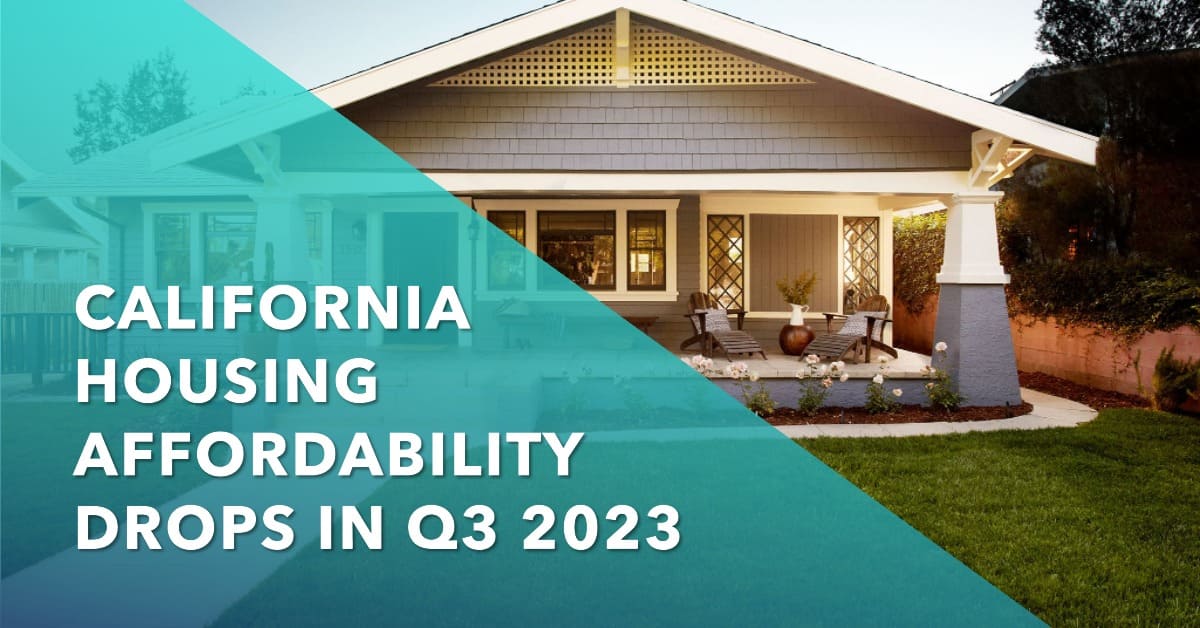
The California housing market is facing a significant challenge as housing affordability hits a 16-year low in the third quarter of 2023. This decline is attributed to soaring interest rates, reaching a two-decade high, and a continuous rise in home prices, according to the CALIFORNIA ASSOCIATION OF REALTORS® (C.A.R.).

Statistics and Figures:

In Q3 2023, only 15 percent of California households could afford the median-priced home of $843,600, down from 16 percent in the previous quarter and 18 percent a year ago. To afford this home, a minimum annual income of $221,200 was required, with monthly payments of $5,530 on a 30-year fixed-rate mortgage at a 7.14 percent interest rate.

For condos and townhomes with a median price of $650,000, 23 percent of home buyers could afford them. The minimum annual income needed for this purchase was $170,400, resulting in monthly payments of $4,260.

Interest Rates and Impact:

The effective interest rate surpassed 7 percent for the first time in over two decades, standing at 7.14 percent in Q3 2023. This surge in interest rates is a critical factor contributing to the decline in housing affordability.

However, there is optimism that interest rates may decrease if there is a further economic slowdown, which could potentially alleviate pressure on both the supply and demand sides of the housing market, leading to improved affordability in the upcoming quarters.

Regional Affordability:

When examining housing affordability on a regional level:

  • 36 counties experienced a decline in affordability compared to the previous quarter, with only 5 counties showing improvement.
  • On a year-over-year basis, 6 counties witnessed improved affordability, while 42 counties recorded a decline.

County-specific Insights:

Notable findings from specific counties include:

  • Lassen (58 percent) remained the most affordable county in California, requiring a minimum qualifying income of $55,600 to purchase a median-priced home.
  • Mono (5 percent), Monterey (9 percent), San Luis Obispo (10 percent), and Santa Barbara (10 percent) were the least affordable counties, each demanding a minimum income of at least $226,800 to buy a median-priced home.
  • San Mateo topped the list with the highest minimum qualifying income of $516,000, followed by Santa Clara ($484,800) and Marin ($416,400).

Year-over-Year Affordability Changes:

Notable year-over-year changes include:

  • Kings experienced the most significant drop in affordability, falling 13 points from Q3 2022 to Q3 2023.
  • Amador registered the second-largest decline, moving eight points below the previous year.
  • Kern, Sacramento, and Stanislaus each dropped six points from a year ago.

Despite higher household incomes, elevated home prices, and increased mortgage rates remain primary factors contributing to the challenges in housing affordability across most counties in California.

For a visual representation of the data, refer to the infographic provided by C.A.R.

Filed Under: Housing Market Tagged With: california, California Housing Affordability, California housing market

Fifth Bank Failure in 2023: Closure of Citizens Bank

November 10, 2023 by Marco Santarelli

Fifth Bank Failure in 2023: Closure of Citizens Bank

Fifth Bank Failure in 2023: Closure of Citizens Bank

If you are a customer of Citizens Bank in Sac City, Iowa, you may have been surprised to find out that your bank was closed by the regulators on November 3, 2023. This marked the fifth bank failure in the US this year and the first one in Iowa since 2011.

Citizens Bank was established in 1929 and had two branches in Sac City, a small town of about 2,000 people. According to the FDIC (Federal Deposit Insurance Corporation), the bank had about $66 million in total assets and $59 million in total deposits as of September 2023. The bank was mainly focused on agricultural lending, but also had significant exposure to commercial trucking loans.

Cause of Citizens Bank Failure

During a joint examination by the Iowa Division of Banking and the FDIC, examiners discovered that the bank had incurred heavy losses on some of its out-of-territory and out-of-state loans to one industry. The regulators did not specify which industry was involved, but some sources suggest that it was related to oil and gas exploration. The bank had not properly reported these losses to its management or shareholders, leading to insolvency.

Resolution and Impact on Customers

The FDIC was appointed as the receiver of the bank and entered into a purchase and assumption agreement with Iowa Trust & Savings Bank, based in Emmetsburg. Iowa Trust & Savings Bank agreed to assume all deposits of Citizens Bank, including personal, commercial, and government accounts. The two branches of Citizens Bank reopened as branches of Iowa Trust & Savings Bank on November 6. Customers can access their money through existing checks, debit cards, and online banking services. The FDIC assured that no depositor lost any money as a result of the bank failure.

The FDIC provided a toll-free number (1-800-523-8089) and a website (FDIC Citizens Bank Closure) for customers to get more information about the bank closure and their accounts. Customers are advised to review their deposit insurance coverage using the online Electronic Deposit Insurance Estimator (EDIE) tool to calculate their coverage.

Financial Implications and FDIC's Role

The FDIC reported that as of June 30, 2023, there were some banks on its “problem list,” indicating banks at risk of failure. The estimated cost of resolving Citizens Bank is $14.8 million, to be paid by the Deposit Insurance Fund (DIF). The DIF, with a balance of $117.9 billion as of June 30, 2023, represents 1.35% of insured deposits. The FDIC aims to maintain the fund at a minimum level of 1.35% and can adjust premiums accordingly.

The bank failure of Citizens Bank is not expected to have a significant impact on the overall banking system or the economy of Iowa. However, it is a sad event for the community of Sac City and the employees and shareholders of Citizens Bank. We hope that this information has helped you understand what happened to Citizens Bank and what you can do if you are affected by it.

Filed Under: Banking, Economy, Financing Tagged With: Citizens Bank Collapse, Fifth Bank Failure in 2023

Powell Issues Caution: Fed ‘Not Confident’ in Inflation Battle

November 9, 2023 by Marco Santarelli

Powell Issues Caution: Fed 'Not Confident' in Inflation Battle

Powell Issues Caution: Fed 'Not Confident' in Inflation Battle

Federal Reserve Chair Jerome Powell expressed uncertainty about the central bank's success in tackling inflation, emphasizing the ongoing challenges. Powell, addressing an International Monetary Fund audience, revealed the Federal Open Market Committee's commitment to a restrictive monetary policy but admitted, “We are not confident that we have achieved such a stance.”

Despite acknowledging a slowdown in inflation, Powell highlighted that it remains “well above” the desired 2% target. The series of rate hikes implemented earlier faced interruption from climate protesters during Powell's recent public speeches.

Following Powell's speech, the Dow Jones Industrial Average dipped, and Treasury yields rose. Analysts, including Jeffrey Roach, Chief Economist at LPL Financial, warned investors not to be too optimistic about future rate cuts, suggesting that the Fed may continue hiking rates if inflation accelerates.

Market sentiment, however, leans towards the belief that the Fed is done with rate hikes. According to CME Group, futures pricing indicates a less than 10% probability of a final rate hike in the upcoming FOMC meeting. Traders anticipate potential rate cuts in the next year, possibly around June.

Economic Landscape and Policy Challenges

Powell acknowledged the economy's strong 4.9% annualized growth in the third quarter but anticipated a moderation in the coming quarters. Unemployment, while still low, has seen a modest increase this year. Powell stressed the Fed's vigilance, indicating that unexpected economic growth could warrant a response from monetary policy.

Improvements in supply chains have contributed to easing inflation pressures, but Powell questioned the extent of further progress through supply-side enhancements. He hinted that a significant portion of the battle against inflation might depend on tight monetary policy restraining aggregate demand growth.

Zero-Rate Challenges and Future Outlook

As part of a broader presentation at the Jacques Polak Annual Research Conference, Powell addressed challenges in keeping rates anchored near zero. He expressed caution, stating it is “too soon” to declare whether zero-rate challenges are a thing of the past.

Powell's remarks reflect the Fed's commitment to addressing inflation concerns, yet uncertainty persists, influencing market dynamics and future expectations.

Filed Under: Economy, Financing

US Bank Stocks Hit an All-Time Low Amid Bond Market Turmoil

November 9, 2023 by Marco Santarelli

US Bank Stocks Hit an All-Time Low Amid Bond Market Turmoil

US Bank Stocks Hit an All-Time Low Amid Bond Market Turmoil

In a startling turn of events, US bank stocks have plummeted to an unprecedented low, sending shockwaves through the financial markets. According to financial experts, this drastic downturn is not a standalone occurrence but rather the result of a perfect storm brewing in the banking sector.

US bank stocks hit an all-time low relative to the S&P 500, marking a historic moment in the financial landscape. Renowned financial analyst Michael Hartnett from Bank of America sheds light on the underlying factors contributing to this dire situation.

One of the primary catalysts is a recent bond market crash, which unfolded within the last 18 months, causing a ripple effect across the banking industry. This crash has exposed vulnerabilities in balance sheets, leading to widespread weakness and liquidity issues.

Adding to the woes are historical debt crises that have haunted the banking sector, creating a challenging environment. Stringent banking regulations and a prolonged period of near-zero interest rates have further exacerbated the situation, creating a confluence of challenges for banks.

The Fallout and Unraveling Realities

The repercussions of the bond market crash are profound, with regional banks, including Silicon Valley Bank, bearing the brunt. Forced to sell bond securities at a loss, these institutions find themselves grappling with financial difficulties that are reverberating through the industry.

Moody's, a reputable financial agency, estimates that US banks are facing a staggering $650 billion in unrealized losses from these securities. Notably, Bank of America alone is contending with an eye-watering $130 billion in unrealized losses, representing a colossal missed opportunity for potential yields exceeding 5%.

Compounding the current situation are echoes from the past, as periodic debt crises in the 1980s, 1990s, and 2000s cast a long shadow over the industry. The combination of these historical events, stringent regulations, and a prolonged period of near-zero interest rates has pushed US bank stocks to an all-time low relative to the S&P 500.

Looking Ahead: Challenges and Financial Stability

This alarming trend underscores the severe impact on bank profitability and balance sheet strength. The banking sector now finds itself navigating significant challenges in the aftermath of the bond market crash, with far-reaching implications for financial stability.

As interest rates surged in the past 18 months, bond prices plunged, leading to the unwinding of regional banks like Silicon Valley Bank. With banks holding onto bonds with unrealized losses, the opportunity cost remains high, hindering their ability to capitalize on higher yields.

This unprecedented situation demands a careful examination of the structural issues within the banking sector. Analysts are closely monitoring how financial institutions will respond to these challenges and the broader implications for the economy.

Filed Under: Banking, Economy, Financing

30-Year Mortgage Rate Takes a Steep Dive in Nearly 16 Months

November 8, 2023 by Marco Santarelli

30-Year Mortgage Rate Takes a Steep Dive in Nearly 16 Months

30-Year Mortgage Rate Takes a Steep Dive in Nearly 16 Months

In a significant turn of events, the 30-year mortgage rate in the United States has experienced its most substantial drop in nearly 16 months. This surprising development comes on the heels of a Treasury market rally, which led to a remarkable decline in the benchmark yields responsible for determining home loan costs.

According to the Mortgage Bankers Association (MBA), the average contract rate for a 30-year fixed-rate mortgage plummeted by a quarter percentage point to 7.61% during the week ending on November 3. This marks the lowest rate observed in approximately a month and stands as the most significant weekly rate drop since late July 2022.

The consecutive weekly decline has effectively lowered the borrowing costs associated with home purchases. This comes after a period where rates had surged to two-decade highs, hovering around 8% in October. These soaring rates were a direct result of increasing yields on the 10-year Treasury note, serving as the benchmark for U.S. home loan rates.

However, the scenario took a dramatic turn last week when the U.S. Treasury announced that upcoming debt issuance would be less than initially expected. Simultaneously, the Federal Reserve decided to keep its key overnight policy rate unchanged for the second consecutive meeting. These factors triggered a notable reversal in the yields, leading to the drop in mortgage rates.

Joel Kan, the MBA's vice president and deputy chief economist, commented on these developments, stating, “Last week's decrease in rates was driven by the U.S. Treasury's issuance update, the Fed striking a dovish tone in the November FOMC (Federal Open Market Committee) statement, and data indicating a slower job market.”

The MBA's mortgage market composite index, which measures the volume of mortgage applications for both home purchases and refinancing of existing loans, rose by 2.5% compared to the previous week, reaching a level of 165.9.

While purchase applications increased by 3% during the week, they are still lagging significantly behind figures from a year ago, currently standing 20% lower. This suggests that potential homebuyers are remaining cautious and waiting on the sidelines, despite the decline in rates. Meanwhile, sellers who have locked in lower mortgage rates continue to hold onto their properties, which is contributing to the ongoing shortage of available homes in the housing market.

The sudden and substantial drop in the 30-year mortgage rate, driven by various economic factors, has created new opportunities for potential homebuyers. However, despite this significant rate reduction, buyers remain cautious, leading to a noticeable disparity between purchase applications and the previous year's figures. This situation has also contributed to a shortage of homes in the market.

Filed Under: Financing, Housing Market, Mortgage, Real Estate Tagged With: 30-Year Mortgage Rate, Mortgage Rate

  • « Previous Page
  • 1
  • …
  • 289
  • 290
  • 291
  • 292
  • 293
  • …
  • 341
  • Next Page »

Real Estate

  • Birmingham
  • Cape Coral
  • Charlotte
  • Chicago

Quick Links

  • Markets
  • Membership
  • Notes
  • Contact Us

Blog Posts

  • Today’s Mortgage Rates, March 11: 30‑Year Fixed Dips Below 6%, Inflation Concerns Persist
    March 11, 2026Marco Santarelli
  • Mortgage Rates Drop Unlocking 5.5 Million More Households in 2026
    March 11, 2026Marco Santarelli
  • How to Get a 4% Mortgage Rate in 2026?
    March 11, 2026Marco Santarelli

Contact

Norada Real Estate Investments 30251 Golden Lantern, Suite E-261 Laguna Niguel, CA 92677

(949) 218-6668
(800) 611-3060
BBB
  • Terms of Use
  • |
  • Privacy Policy
  • |
  • Testimonials
  • |
  • Suggestions?
  • |
  • Home

Copyright 2018 Norada Real Estate Investments

Loading...