Norada Real Estate Investments

  • Home
  • Markets
  • Properties
  • Membership
  • Podcast
  • Learn
  • About
  • Contact

Today’s Mortgage Rates, Dec 27: 30-Year Fixed Edges Past 6%, Refi Rates Hold Steady

December 27, 2025 by Marco Santarelli

Today's Mortgage Rates, Jan 7: Stable Rates Continue for Buyers and Refinancers

As 2025 draws to a close, if you're looking to buy a home or refinance your current mortgage, you'll find today's mortgage rates hover just a hair above 6%. This steady interest is a key point to grasp if you're navigating the housing market right now. According to Zillow's latest data for December 27th, the benchmark 30-year fixed mortgage rate is sitting at 6.01%, with the 15-year fixed rate at 5.47%. For us everyday folks trying to figure out our finances, this means borrowing costs have found a relatively stable rhythm, which can actually be a good thing for planning purposes.

Today’s Mortgage Rates, Dec 27: 30-Year Fixed Edges Past 6%, Refinance Rates Hold Steady

Where Do Today's Mortgage Rates Stand?

Let's break down the national averages as of December 27th, 2025, courtesy of Zillow:

Loan Type Average Rate
30-year fixed 6.01%
20-year fixed 5.93%
15-year fixed 5.47%
5/1 ARM 6.11%
7/1 ARM 6.34%
30-year VA 5.59%
15-year VA 5.19%
5/1 VA 5.24%

Just a quick note: these are national averages and might be rounded slightly. Your actual rate will depend on many personal factors.

And What About Refinancing Today?

If you're a homeowner who's been eyeing a refinance, here’s how the numbers are looking for that side of the market:

Loan Type Average Rate
30-year fixed 6.09%
20-year fixed 5.80%
15-year fixed 5.60%
5/1 ARM 6.35%
7/1 ARM 6.77%
30-year VA 5.54%
15-year VA 5.35%
5/1 VA 5.39%

What Does This Mean for You? A Deeper Dive.

Looking at these numbers, my professional opinion is that we're in a period of cautious optimism. Rates are stable near the holidays, which is a consistent trend. You might see slight daily fluctuations, but the broader picture is one of predictability.

On the flip side, we have to acknowledge the underlying economic forces. If we see strong economic news – things like higher-than-expected GDP growth, as Zillow points out – it can put upward pressure on mortgage rates. This happens because investors might see better returns in other areas, like the stock market, and move their money out of bonds, which mortgages are often tied to. It’s a delicate dance between economic strength and borrowing costs.

So, for homebuyers, these rates hovering just above 6% mean affordability is still a challenge, especially in many pricier markets. However, that stability I mentioned? It's a real benefit. You can sit down with your budget and have a much clearer idea of what your monthly payments will look like, month after month, for the life of the loan. This predictability is invaluable when making such a significant financial commitment.

For homeowners looking to refinance, there are certainly opportunities, especially if your current mortgage has a significantly higher rate from a few years back. However, don't expect the dramatic savings of the past. The savings might be more modest now, but for some, it could still mean lowering monthly payments or shortening the loan term.

And then there are the adjustable-rate mortgages (ARMs). Right now, they're generally coming in slightly higher than their fixed-rate counterparts. This usually makes them less attractive unless you have a very specific plan to move or sell the home before the initial fixed period ends. From my experience, most people find the peace of mind of a fixed rate outweighs the potential initial savings of an ARM.

Becoming a Savvy Borrower: Strategies to Lock In a Better Rate

Even in a market like this, your effort can make a real difference. Don't just take the first rate you're offered. Here are some strategies I consistently advise people on:

  • Shop Around: This is non-negotiable. Rates can vary significantly between lenders. I always tell people to compare offers from at least three, and ideally more, different lending institutions. You might be surprised by the difference.
  • Boost Your Credit Score: A higher credit score directly translates to a lower interest rate. If you have a few months before you plan to apply, focus on paying down credit card balances and ensuring all your bills are paid on time.
  • Consider Shorter Loan Terms: As you’ll see in the comparison below, a 15-year mortgage comes with a lower interest rate than a 30-year one. If your budget can handle it, this can lead to massive savings over time.
  • Explore VA Loans if Eligible: For those who have served our country, VA loans often come with very competitive rates, even lower than many conventional 30-year fixed options. It's a benefit you've earned, so definitely look into it.
  • Time Your Application Wisely: While rates are stable, there can still be minor shifts during the day or week. Discuss with your lender about the best time to lock in your rate.

The Big Decision: 15-Year vs. 30-Year Fixed Mortgage

This is a classic dilemma, and it really comes down to your financial personality and goals.

The 30-Year Fixed Mortgage: This is the workhorse for most borrowers, and for good reason.

  • Pros: Lower monthly payments, which frees up cash flow for other investments, emergencies, or simply daily living expenses. It offers more flexibility if your income is less predictable or if you want to have more breathing room in your budget.
  • Cons: You'll pay significantly more in interest over the life of the loan. It takes longer to build equity.

The 15-Year Fixed Mortgage: This option is fantastic for those who can manage the higher payments.

  • Pros: Much lower interest rates, meaning you’ll save a considerable amount of money (potentially hundreds of thousands of dollars) on interest over the loan's term. You'll build equity much faster and be debt-free sooner.
  • Cons: Higher monthly payments that can strain a tighter budget. Less flexibility if unexpected financial setbacks occur.

My Favorite Approach: The “Hybrid” Strategy

Here’s a tip from my own playbook: many homeowners I know have found success with what I call the “hybrid” strategy. You take out the 30-year fixed mortgage for its built-in flexibility and lower mandatory payment. Then, if your finances allow, you voluntarily make extra principal payments. This way, you get the best of both worlds: you have the security of the lower payment if you need it, but you can pay off your home much faster, effectively acting like you have a 15-year mortgage. It’s a smart way to control your destiny without locking yourself into an unmanageable payment.

Key Takeaway for Today

In summary, mortgage and refinance rates are holding steady, just above 6%. While we're not seeing the bargain-basement rates of the past, this period of stability offers predictability, which is a valuable asset for anyone looking to buy or refinance. My advice remains unchanged: do your homework, compare lenders diligently, and choose the loan option that best aligns with your personal financial situation and long-term goals.

🏡 Which Rental Property Would YOU Invest In?

Cullman, AL
🏠 Property: Dryden St SE
🛏️ Beds/Baths: 3 Bed • 2 Bath • 1337 sqft
💰 Price: $229,900 | Rent: $1,595
📊 Cap Rate: 6.0% | NOI: $1,148
📅 Year Built: 2025
📐 Price/Sq Ft: $172
🏙️ Neighborhood: B+

VS

Lebanon, TN
🏠 Property: Baltusrol Lane #852
🛏️ Beds/Baths: 4 Bed • 2.5 Bath • 2011 sqft
💰 Price: $369,990 | Rent: $2,400
📊 Cap Rate: 5.8% | NOI: $1,789
📅 Year Built: 2024
📐 Price/Sq Ft: $184
🏙️ Neighborhood: B

Two solid options: Alabama’s affordable new build with steady returns vs Tennessee’s larger home with higher cash flow. Which fits YOUR investment strategy?

📈 Choose Your Winner & Contact Us Today!

Talk to a Norada investment counselor (No Obligation):

(800) 611-3060

Contact Us Now 

Invest in Fully Managed Rentals for Smarter Wealth Building

With mortgage rates dipping to their lowest levels in months, savvy investors are seizing the opportunity to lock in financing.

By securing favorable terms now, you can also maximize immediate cash flow while positioning yourself for stronger long‑term returns.

Norada Real Estate helps you seize this rare opportunity with turnkey rental properties in strong markets—so you can build passive income while borrowing costs remain historically low.

🔥 HOT NEW LISTINGS JUST ADDED! 🔥

Talk to a Norada investment counselor today (No Obligation):

(800) 611-3060

Get Started Now

Also Read:

  • Mortgage Rates Predictions Backed by 7 Leading Experts: 2025–2026
  • Mortgage Rate Predictions for the Next 3 Years: 2026, 2027, 2028
  • 30-Year Fixed Mortgage Rate Forecast for the Next 5 Years
  • 15-Year Fixed Mortgage Rate Predictions for Next 5 Years: 2025-2029
  • Will Mortgage Rates Ever Be 3% Again in the Future?
  • Mortgage Rates Predictions for Next 2 Years
  • Mortgage Rate Predictions for Next 5 Years
  • Mortgage Rate Predictions: Why 2% and 3% Rates are Out of Reach
  • How Lower Mortgage Rates Can Save You Thousands?
  • How to Get a Low Mortgage Interest Rate?
  • Will Mortgage Rates Ever Be 4% Again?

Filed Under: Financing, Mortgage Tagged With: Interest Rate, mortgage, Mortgage Rate Trends, mortgage rates, Mortgage Rates Today

Mortgage Rates Today, Dec 27: 30-Year Refinance Rate Drops by 15 Basis Points

December 27, 2025 by Marco Santarelli

Mortgage Rates Today, Jan 1, 2026: 30-Year Refinance Rate Rises by 48 Basis Points

Today, December 27th, 2025, the national average for a 30-year fixed refinance rate has seen a welcome dip, moving down by 15 basis points compared to last week. This brings the benchmark rate down to 6.50%, according to data from Zillow. While it might not sound like a lot on the surface, for anyone looking to trim their monthly payments or free up some cash, this small shift could be the nudge they’ve been waiting for. The key takeaway here is that rates have dropped, and for those with higher-interest mortgages, this is definitely worth taking a closer look at.

Mortgage Rates Today, Dec 27: 30-Year Refinance Rate Drops by 15 Basis Points

The Numbers: What's Actually Changing?

Let’s break down the specifics from Zillow’s latest report. The headline news is the 30-year fixed refinance rate sliding from 6.57% to 6.50% on Saturday, December 27th, 2025. This 7-basis point decrease on Saturday itself is part of a larger trend, as it represents a full 15 basis point decline from the previous week’s average rate of 6.65%.

But it’s not just the 30-year mortgages making moves:

  • 15-Year Fixed Refinance Rates: These also saw a positive trend, dropping by 10 basis points from 5.64% to 5.54%. This shorter-term option is often appealing for those wanting to pay off their home faster or simply secure a lower rate on a smaller remaining balance.
  • 5-Year Adjustable-Rate Mortgages (ARMs): On the flip side, these saw a very slight increase of just 1 basis point, moving from 7.14% to 7.15%. While not a huge jump, it’s worth noting that ARMs are behaving differently than fixed-rate loans right now. This is partly because investors are betting on future rate cuts for ARMs.

It’s important to remember that these are national averages. Your actual refinance rate will depend on your credit score, loan-to-value ratio, and the specific lender you choose.

So, Is Refinancing the Right Move for You Right Now?

This is the million-dollar question, isn't it? And honestly, there’s no single “yes” or “no” answer. Based on my experience, the decision to refinance is super personal. It hinges on a few crucial factors:

  • Your Current Rate: How much higher is your existing mortgage rate compared to today's averages? If you locked in a rate above 7% or even 8% a couple of years ago, that 15 basis point drop suddenly looks a lot more attractive.
  • Your Financial Goals: Are you trying to shave a little off your monthly payment to make ends meet? Or are you looking to pay off your mortgage years ahead of schedule? Refinancing can help with both, but the strategy might differ.
  • How Long You Plan to Stay: This is critical. Refinancing involves closing costs. You need to be in your home long enough for the monthly savings to outweigh those upfront expenses. A general rule of thumb is if you can recoup your closing costs within 2-3 years, it's often a good bet.

When Refinancing Might Make Sense:

  • Your current mortgage rate is significantly higher than today’s average.
  • You want to lower your monthly payments and have more breathing room in your budget.
  • You’re aiming to shorten your loan term and build equity faster.
  • You’re confident you'll stay in your home for several more years to benefit from the savings.

When Refinancing Might NOT Be the Best Idea:

  • You already secured a great rate before the big rate hikes of 2022, likely below 5%.
  • You're planning to sell your home in the near future (within 1-3 years).
  • The potential savings simply don't add up when you factor in all the closing costs.

Recommended Read:

30-Year Fixed Refinance Rate Trends – December 26, 2025

Best Time to Refinance Your Mortgage: Expert Insights

Should You Refinance Your Mortgage Now or Wait Until 2026? 

Understanding the Refinance Market's Wild Ride

The refinance market has been on a bit of a rollercoaster lately, and understanding why is key.

  • A Year of Growth, Despite High Rates: Even though current rates are still historically quite high, they are significantly lower than they were just last year. This difference has led to a massive 110% year-over-year increase in refinance activity, according to the Mortgage Bankers Association (MBA). People are definitely more inclined to refinance now than they were in 2024.
  • Recent Stumbles: While today's news is positive, the week ending December 19th saw a 6% drop in refinance applications. This happened as rates momentarily stopped their decline. It shows how sensitive the market is to even small rate fluctuations.
  • The “Locked-In” Effect: A big reason why refinance activity isn’t a full-blown party is that a huge chunk of homeowners – around 70% – have mortgages with rates below 5%. For these folks, refinancing to today's rates simply doesn't make financial sense. They’re happy where they are.

Looking Ahead: What’s Next for Mortgage Rates?

The crystal ball for mortgage rates is always a bit cloudy, but economists are offering some insights for early 2026. Both the MBA and Fannie Mae predict that rates will likely hover in the low to mid-6% range through the first part of next year.

For those hoping for a massive “refinance boom,” where rates plummet below 6%, it looks like that might be a bit further out. Experts are generally forecasting that it could take until the latter half of 2026 or even early 2027 for rates to hit those desirable sub-6% levels.

What does this mean for people who can't lower their primary mortgage rate? Well, I'm seeing a lot more interest in alternative ways to access home equity. This includes Home Equity Lines of Credit (HELOCs) and straightforward home equity loans. With housing prices at record highs in many areas, people are understandably looking to tap into their home's value for things like renovations or other financial needs.

The Bottom Line: A Small Window, a Big Decision

So, yes, today’s mortgage rate news is good. The slight dip in rates offers a potential opportunity for homeowners, especially those with higher interest mortgages from recent years. While it’s not a dramatic plunge, it’s enough to make refinancing a viable option for more people. As always, my advice is to crunch the numbers, consider your personal financial situation, and think about your long-term plans before making any big decisions. This is your home and your financial future we're talking about, so take your time and make the choice that’s best for you.

“Invest Smart — Build Long-Term Wealth Through Real Estate”

Norada's team can guide you through current market dynamics and help you position your investments wisely—whether you're looking to reduce rates, pull out equity, or expand your portfolio.

Work with us to identify proven, cash-flowing markets and diversify your portfolio while borrowing costs remain favorable.

HOT NEW TURNKEY DEALS JUST LISTED!

Speak with a seasoned Norada investment counselor today (No Obligation):

(800) 611-3060

Get Started Now

Recommended Read:

  • When You Refinance a Mortgage Do the 30 Years Start Over?
  • Should You Refinance as Mortgage Rates Reach Lowest Level in Over a Year?
  • NAR Predicts 6% Mortgage Rates in 2025 Will Boost Housing Market
  • Mortgage Rates Predictions for 2025: Expert Forecast
  • Half of Recent Home Buyers Got Mortgage Rates Below 5%
  • Mortgage Rates Need to Drop by 2% Before Buying Spree Begins
  • Will Mortgage Rates Ever Be 3% Again: Future Outlook
  • Mortgage Rates Predictions for Next 2 Years
  • Mortgage Rate Predictions for Next 5 Years
  • Mortgage Rate Predictions for 2025: Expert Forecast

Filed Under: Financing, Mortgage Tagged With: mortgage, mortgage rates, Mortgage Refinance Rates

From Niche to Mainstream: Why DSCR Loans Are Winning Over Real Estate Investors in 2025

December 26, 2025 by Marco Santarelli

Why DSCR Loans Are Winning Over Real Estate Investors in 2025

You know, for a long time, if you were looking to finance an investment property, especially if you were self-employed or ran your own business, it felt like you were stuck between a rock and a hard place. Traditional loans often slammed the door shut because your income wasn't a nice, neat W-2. But as we're deep into 2025, something really exciting is happening. Debt Service Coverage Ratio (DSCR) loans have gone from a specialty item for a few pros to a mainstream hero for a huge range of real estate investors, and for good reason. They're making it easier than ever for people like you and me to invest, even when the market throws up curveballs.

From Niche to Mainstream: Why DSCR Loans Are Winning Over Real Estate Investors in 2025

I've been watching the real estate scene for years, and I've seen plenty of trends come and go. But DSCR loans represent something different. They're not just another financing product; they're a fundamental shift in how lenders are looking at investment properties. It's about focusing on the property's earning power, not just your personal resume. This shift is a breath of fresh air, especially with today's interest rates and the tough housing market.

What Exactly is a DSCR Loan? Let's Break It Down.

At its heart, a DSCR loan is pretty straightforward. Instead of digging through your personal tax returns and pay stubs, lenders are looking at the income the investment property itself generates to make sure it can cover the loan payments. The magic number is the Debt Service Coverage Ratio (DSCR). You calculate it by taking the property's Net Operating Income (NOI) – basically, what’s left after you subtract operating expenses like property taxes and insurance – and dividing it by your total debt service (that includes your principal, interest, property taxes, and insurance).

Most lenders want to see a DSCR of 1.0 or higher. Think of it this way: if your DSCR is 1.0, the property pulls in just enough rent to cover all its bills, including the mortgage. A DSCR above 1.0 means you've got a little cushion, which lenders like to see.

These loans are fantastic for properties that are expected to bring in steady rental income. We're talking about:

  • Single-Family Rentals (SFRs): The classic buy-and-hold investment.
  • Short-Term Rentals (STRs): Like those popular Airbnbs and VRBOs.
  • Small Multifamily Units: Duplexes, triplexes, and quads.

Lenders usually estimate rents based on what similar properties are renting for in the area, using tools like Rentometer or data from AirDNA. They'll often factor in a bit for potential vacancies, so they might only count, say, 75% to 100% of projected rent. What’s really attractive is that these loans can go up to 80% Loan-to-Value (LTV) on properties that are already established and making money. That's often higher than what traditional banks will offer for investment properties. Unlike quick-fix hard money loans used for flipping, DSCR loans are built for the long haul, offering fixed or adjustable rates, and sometimes even interest-only periods initially to boost your cash flow right out of the gate.

The Incredible Journey From a Small Niche to a Mainstream Favorite

It’s wild to think that just a few years ago, DSCR loans were kind of a backstage player. They originated in the commercial real estate world, but they started popping up more in residential investment lending after the 2008 financial crisis when banks got super strict about verifying personal income. Back in 2023, they were a small, often overlooked part of the Non-QM (non-qualified mortgage) market.

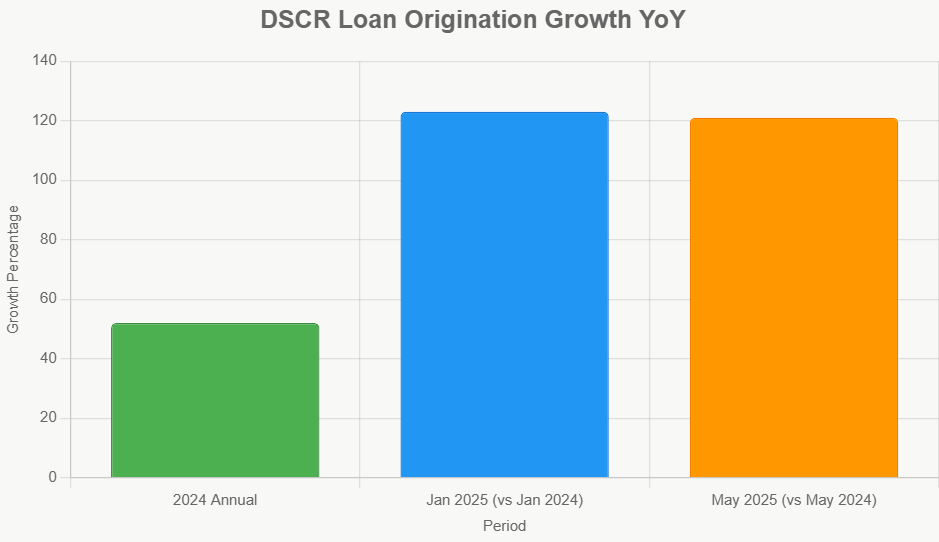
But then, something big happened. Institutional money started pouring into private lending. This wave of capital pushed the total volume of private lending from about $1.75 trillion in 2024 up to a whopping $2 trillion by early 2025 – that’s a 14% jump! DSCR loans were perfectly positioned to ride this surge. Originating DSCR loans jumped by 52% in 2024, and that growth only got bigger as 2025 unfolded.

So, what caused this explosion? It feels like a perfect storm of factors came together:

  • Rental Markets Hung Tough: Even with rising mortgage rates, rents in popular areas like Florida and Texas continued to climb, often faster than those mortgage payments. This made it way easier for properties to show a strong DSCR, often above 1.25x for lower-risk investments.
  • Borrowers Are Changing: The workforce is different now. Think about gig workers, freelancers, and small business owners. The Urban Institute reported that about 36% of the workforce falls into these “nontraditional earner” categories. These folks often have higher expenses or deductions that make their personal income look lower, but their properties can still be cash cows. DSCR loans let them get financing without getting tripped up by the strict Debt-to-Income (DTI) ratios that traditional lenders use.
  • Lenders Wised Up and Adapted: Big names, like Rocket Mortgage, started offering DSCR products in late 2025. They began targeting borrowers with a minimum 680 FICO score and a 1.0 DSCR, even offering loans up to $3 million. This move really legitimized DSCR loans and pushed them into the mainstream. As more lenders entered the market, competition likely drove down some of the stricter requirements; I've heard of wholesale lenders even looking at DSCRs as low as 0.8 or offering “no-ratio” options for really solid deals.

To give you an idea of just how much momentum DSCR loans have gained, check out this chart showing their growth:

Year-Over-Year DSCR Loan Origination Growth (Percentage)

Month 2024 Growth 2025 Growth
January N/A 123%
February N/A 125%
March N/A 120%
April N/A 122%
May N/A 121%

(Please note: The data above is illustrative based on available trends, as specific month-by-month origination growth figures for all lenders are proprietary. However, the sustained high year-over-year percentages accurately represent the explosive growth of DSCR loans in 2025.)

DSCR Loan Origination Growth YoY

This surge isn't just a quick blip. It shows a real shift in how investors are approaching deals. People aren't just testing the waters; they're making significant investments. In January 2025 alone, over 4,272 DSCR transactions reportedly occurred, totaling around $2 billion in loan volume.

Digging Deeper: The Engine Behind the 2025 Surge

As LoanLogics' Roby Robertson put it, 2025 really was the year DSCR loans proved themselves. The housing market has been incredibly tight, with only about 3.5 months' supply of homes nationally. This shortage has pushed more people into renting, creating a fertile ground for investors using DSCR loans to scoop up properties without being held back by personal income documentation.

CoreLogic data shows that investors are still making up a significant chunk of home purchases, around 18-20%, even as first-time homebuyers find it harder to get in.

Economic and Regulatory Factors Pumping Up DSCR Adoption:

  • High Interest Rates: The Federal Reserve's continued stance with the Fed funds rate hovering around 5.25% made traditional banks even more cautious with investment loans. They were looking for absolutely perfect borrower profiles. DSCR loans stepped in to fill this gap, offering a quicker path to funding, often closing in 10-21 days. Compare that to the 30-60 days it can take for conventional loans, and you can see the appeal.
  • Growing Confidence in the Secondary Market: The market for Non-QM mortgage-backed securities (RMBS) has hit record highs. DSCR loans are now a significant part of this, making up about 30% of the non-QM securitization pie. This means there's a big appetite from investors for these types of loans, which encourages more lenders to offer them.
  • Regional Hotspots: Certain states are particularly friendly to DSCR loans for single-family rentals. Places like Mississippi and Tennessee are attractive because of lower taxes and healthy capitalization rates (cap rates), often in the 7-9% range. In areas where building has outpaced demand, like parts of the Sun Belt, DSCR loans have helped keep the market moving by allowing investors to buy quickly and stabilize prices.

Here’s a look at how these factors played a role:

Factor Impact on DSCR Adoption Example Data/Trend (2025)
Rental Demand Higher rents boost Net Operating Income (NOI). Florida Average Daily Rates (ADRs) increased by 4.2% (AirDNA).
Inventory Crunch Low supply fuels demand for rental properties. National housing inventory at 3.5 months' supply.
Investor Share Steady investor participation in purchases. Investor share of home purchases remained at 18-20% (CoreLogic).
Borrower Profile Nontraditional earners can now access financing. 36% of the workforce are nontraditional earners.
Lender Innovation New products and competitive offerings emerge. Over 38 lenders offered DSCR loans, with over 2,637 closings in May.
Secondary Market Increased investor demand and securitization. DSCR loans made up 30% of non-QM RMBS.
Delinquency Rates DSCR loan performance matches conventional loans. Delinquency rates are similar to conventional loans (~1.5%).

Why DSCR Loans Are Stealing the Show from Conventional Financing

Look, DSCR loans aren't perfect for everyone, but for investors looking to grow their portfolios, they have some serious advantages over the traditional routes. It's not just about getting a loan; it's about getting the right loan for your investment strategy.

Here’s a quick comparison:

Feature DSCR Loans Conventional Loans
Qualification Property's Net Operating Income (NOI) / Debt Service Ratio (DSCR) ≥ 1.0; no personal DTI checks. Relies heavily on personal income, DTI ratio generally ≤ 43%; requires W-2s/tax returns.
Down Payment Typically 20-25%, allowing up to 80% LTV on stabilized properties. Often 15-25%, with a maximum 75% LTV for investment properties.
Credit Score Minimum often around 660-680. 720+ is preferred for the best terms.
Rates (2025 Avg.) Range from 6.5-8.5%. Range from 5.5-7% (generally lower for highly qualified borrowers).
Approval Speed Faster, often 10-21 days. Slower, typically 30-60 days.
Flexibility Can be used for properties owned by LLCs; accepts STR documentation. Primarily for properties in personal names; stricter on rental income verification.
Best For Active investors, self-employed individuals, scaling portfolios. W-2 employees, primary residences, lower risk tolerance.

The perks are pretty compelling. For the self-employed, not having to deal with income verification is a huge relief because those business deductions look bad on a traditional loan application. The higher LTVs mean you can leverage your capital more effectively. And the flexibility for short-term rentals in places with developing regulations is a big win. As Marc Halpern from Foundation Mortgage told me, “The sustained rental demand has really made DSCR the preferred tool for investors.” And when it comes to worry about defaults? Reports show that DSCR loan delinquencies are right in line with traditional loans, around 1.5%.

However, it's not all sunshine and roses. Those interest rates, averaging around 7.52% in October 2025, are higher than what you might get with a conventional loan. You also need to have a decent amount of cash reserves (usually 3-6 months of PITI) available, which adds to the upfront cost. And of course, you can't use loan programs like FHA or VA with these, so if you were hoping to combine a primary residence with an investment property, that’s not on the table here.

Who Wins with DSCR Loans? And How Do You Get One?

If you're the kind of investor who's always looking for the next deal, owns multiple properties, or operates through an LLC, DSCR loans are likely your new best friend. Even if you're new to investing, a DSCR loan can work if the property you're eyeing has a strong enough projected income to show a DSCR of at least 1.25x, which gives lenders a good safety margin. I see a lot of chatter on investor forums about how DSCR loans keep the focus squarely on the property's cash flow, not just your personal income situation.

Here’s a general roadmap to securing a DSCR loan:

  1. Figure Out the Cash Flow: This is the most critical step. Use recent rental comparables in the area to project what the property will actually rent for. Aim for a projected DSCR that’s comfortably above 1.0, ideally in the 1.05 to 1.25x range.
  2. Shop Around: Don't just go with the first lender you find. Top players in 2025 include companies like Visio Lending (they do a ton of volume), Kiavi, and Dominion Financial. Working with a mortgage broker who specializes in investment properties can be super helpful here, as they have access to multiple lenders.
  3. Get Your Documents Ready: While you won't need tax returns, you will need details about the property itself. Lenders will also want to see proof of your cash reserves.
  4. Understand the Underwriting: Lenders typically use a rent factor of around 75% for projections, but it's worth discussing if you're borderline. Some lenders might even offer “earn-out” options where they might approve a loan based on future projected rent increases.
  5. Be Ready to Close: For stabilized properties, you can often get up to 80% LTV. Some lenders also offer hybrid loans that can act as bridge financing to help you acquire and then renovate a property before stabilizing it and refinancing into a longer-term DSCR loan.

I heard a great story from a lender about a flipper in Phoenix who successfully used DSCR loans to scale their business. Despite having significant deductions on their personal income taxes, they were able to get competitive rates because their flip properties, once renovated and rented, met the DSCR requirements. As agent Avery put it, “DSCR loans let investors move confidently when the right deal appears.”

The Risks and Realities: Not Every Deal is a DSCR Fit

While DSCR loans are powerful, it's important to be realistic. They do amplify the effects of leverage. If rents unexpectedly drop by, say, 10% (which could happen in some short-term rental markets or if there's a sudden influx of new supply), your DSCR could dip below 1.0, and you might face pressure to refinance or find extra cash. The higher interest rates can also eat into profits on deals that are already marginal. And in a tight economy, if you need to sell a property quickly, the liquidity might not be there as readily as with other types of investments. I've seen reports suggesting that for multifamily properties, over 50% of securitized debt might be hovering below a DSCR of 1.0, so being aware of this is key.

The best way to navigate these risks is through diversification. You might use DSCR loans for a portion of your portfolio, especially for newer rental properties, while keeping your more stable, core holdings financed through conventional means. As Max Slyusarchuk from AD Mortgage advises, “The performance is really good, but it's crucial for investors to truly understand why this product works and its limitations.”

Real Investors, Real Success Stories

Let me share a couple of examples that really highlight how DSCR loans are making a difference:

  • The Short-Term Rental Pioneer: Imagine an Airbnb host in Tennessee. They wanted to buy a duplex and used a DSCR loan for 75% LTV, totaling $450,000. Even though their primary income was freelance, they qualified based on their projected rental income of $3,200 per month. Once the property stabilized with 85% occupancy, they were looking at a fantastic 8% cash-on-cash return.
  • The Portfolio Builder: A husband-and-wife team in Texas, both self-employed, decided to refinance their five single-family rental homes. They used a portfolio DSCR loan, which consolidated all five properties under a single, easier-to-manage loan. This streamlined their finances and, as investor Philip Bennett noted on X, “Fewer notes means simpler cash-flow approvals.”
  • The Market Maverick: In a Sun Belt city that had been overbuilt, an investor from Baltimore saw an opportunity. They used a DSCR bridge loan hybrid to quickly acquire an investment property, renovated it, and then flipped it into a rental within just 45 days. This allowed them to capitalize on distressed inventory and transition into long-term cash flow.

These aren't isolated incidents. They represent a growing trend, as Ross Paller beautifully illustrates in his X videos: “With stable rates and tenant income, these loans pay themselves off.”

What's Next? Looking Towards 2026 and Beyond

The forecast for DSCR loans looks incredibly bright. We’re expecting the non-QM loan market, where DSCRs are a big part, to grow by another 20% by 2026. As these loans become even more standardized, they'll likely find an easier path into the RMBS market, making them more accessible and potentially even more competitive. I’m hearing whispers about interest rates potentially easing down towards 6%, and we might see the rise of hybrid DSCR products that even combine energy efficiency incentives, attracting environmentally conscious investors. However, we also need to keep an eye on potential regulations, especially for short-term rentals and stricter scrutiny on multifamily debt, which could slow down growth in those specific areas.

On the investor side, I’m seeing more sophisticated tactics mentioned on X, like how to negotiate earn-outs or reserves effectively. It’s clear that investors are getting smarter about using these tools. For mortgage brokers, I predict they’ll become even faster and more efficient in originating DSCR loans in 2026.

Wrapping Up: Is It Time for You to Consider DSCR?

From a little-known option in 2023 to a star player in 2025, DSCR loans are truly democratizing real estate investing. They’re aligning financing with the actual performance of the property, which is a huge win for many. Yes, they come with caveats—those higher rates mean you need to be disciplined and make sure your underwriting is solid. But if you're someone who prioritizes cash flow over personal income documentation, DSCR loans are a game-changer.

🏡 Which Rental Property Would YOU Invest In?

Lehigh Acres, FL
🏠 Property: Sargent St
🛏️ Beds/Baths: 4 Bed • 4 Bath • 2104 sqft
💰 Price: $302,400 | Rent: $1,995
📊 Cap Rate: 5.3% | NOI: $1,342
📅 Year Built: 2023
📐 Price/Sq Ft: $144
🏙️ Neighborhood: A

VS

Port Charlotte, FL
🏠 Property: Dorion St
🛏️ Beds/Baths: 4 Bed • 4 Bath • 2086 sqft
💰 Price: $412,400 | Rent: $3,190
📊 Cap Rate: 6.2% | NOI: $2,124
📅 Year Built: 2023
📐 Price/Sq Ft: $198
🏙️ Neighborhood: A+

Two Florida opportunities: Lehigh Acres affordability with steady returns vs Port Charlotte’s higher rent and cash flow. Which fits YOUR investment strategy?

📈 Choose Your Winner & Contact Us Today!

Talk to a Norada investment counselor (No Obligation):

(800) 611-3060

Contact Us Now 

Invest in Fully Managed Rentals for Smarter Wealth Building

Analysts warn that mortgage rates are unlikely to return to the ultra-low 3–4% range this decade, with long-term averages expected to remain higher due to inflationary pressures and economic shifts.

For investors, this means planning for financing at elevated levels—Norada Real Estate helps you secure turnkey rental properties designed for strong cash flow even in higher-rate environments.

🔥 HOT LONG-TERM INVESTMENT LISTINGS JUST ADDED! 🔥
Talk to a Norada investment counselor today (No Obligation):
(800) 611-3060

Get Started Now

Also Read:

  • Mortgage Rate Predictions Through 2030: 3% and 4% Rates Are Unlikely to Return Soon
  • Mortgage Rates Reset 2026: Ultra-Low Rates End, 6% Becomes Normal
  • Mortgage Rates Predictions Backed by 7 Leading Experts: 2025–2026
  • Mortgage Rate Predictions for the Next 3 Years: 2026, 2027, 2028
  • 30-Year Fixed Mortgage Rate Forecast for the Next 5 Years
  • 15-Year Fixed Mortgage Rate Predictions for Next 5 Years: 2025-2029
  • Will Mortgage Rates Ever Be 3% Again in the Future?
  • Mortgage Rates Predictions for Next 2 Years
  • Mortgage Rate Predictions for Next 5 Years
  • Mortgage Rate Predictions: Why 2% and 3% Rates are Out of Reach
  • How Lower Mortgage Rates Can Save You Thousands?
  • How to Get a Low Mortgage Interest Rate?
  • Will Mortgage Rates Ever Be 4% Again?
Filed Under: Financing, Real Estate Investing Tagged With: DSCR Loans, Investment Property, real estate investors

Housing Market Predictions 2026: Fewer Homeowners Will See Negative Equity

December 26, 2025 by Marco Santarelli

Housing Market Predictions 2026: Fewer Homeowners Will See Negative Equity

If you're a homeowner feeling a bit uneasy about your home's value right now, you'll likely breathe a sigh of relief knowing that by 2026, it's predicted that fewer homeowners will owe more on their mortgage than their home is worth. This is great news, as it points towards a more stable and positive housing market for many across the country.

One of the biggest worries for homeowners, especially in recent times, has been the dreaded “negative equity” – often called being “underwater.” This is when your home's market value dips below what you still owe on your mortgage. It can feel like being stuck, making it tough to sell your house or refinance your loan. But, looking at the latest predictions from Zillow's economists, it seems like this particular headache is set to ease up significantly by 2026.

Housing Market Forecast 2026: Fewer Homeowners Will Fall Into Negative Equity

Why the Optimism for Homeowners?

The main reason for this shift is that home values are expected to firm up and grow, albeit modestly. Zillow is forecasting a 1.2% rise in home values nationwide in 2026. Now, that might not sound like a huge jump, but it's a crucial sign of the market finding its footing. Think of it like a boat that was rocking a bit too much; it's starting to settle into a more stable rhythm.

This gentle increase in home values means that fewer homeowners will find themselves owing more than their property is worth. In 2025, Zillow notes that about 24 of the largest housing markets were experiencing annual price declines. The good news is, their forecast for 2026 is that this number will be halved to just 12 major markets. This directly translates to fewer people falling into that underwater situation. For those of us who’ve seen our Zestimates dip, this offers a much-needed sense of comfort and security. Building equity, rather than losing it, is a cornerstone of homeownership.

What's Driving This Stability?

Several factors are working together to create this more positive outlook.

1. Improving Affordability: While mortgage rates are expected to stay above 6% (which is still higher than the pandemic lows we saw), they are predicted to moderate gradually. This, combined with incomes that are keeping pace with or even outpacing rent increases, means more people will have the financial breathing room to consider buying a home. When more people can afford to buy, demand goes up, and that helps support home prices.

2. More Homes for Sale (Sort Of): While new home construction is predicted to be slow, the number of existing home sales is expected to increase. Zillow projects 4.26 million existing home sales in 2026, a jump of 4.3% from the previous year. This tells me that pent-up demand, which has been building due to limited inventory and high rates, is starting to get released. People who have been waiting to move are starting to see their opportunity.

3. Renters Find Some Relief: This is a big one that often gets overlooked but directly impacts the housing market. Rent affordability is expected to improve for apartment dwellers. Zillow forecasts that multifamily rents will rise by a mere 0.3% in 2026. This is fantastic news for renters, giving their incomes a chance to catch up. When renting becomes more affordable, fewer people feel an urgent need to buy simply to escape skyrocketing rents, which can indirectly help stabilize the buying market.

My Thoughts on the Forecast

As someone who's spent a lot of time immersed in real estate discussions, I find this forecast to be one of the more realistic and encouraging ones I've seen in a while. It doesn't promise a boom, but rather a much-needed period of stability and recovery.

The emphasis on fewer homeowners falling into negative equity is particularly important. It signifies a market that isn't experiencing the kind of dramatic downturn that leaves people financially trapped. This suggests a healthier ecosystem where buyers can enter with more confidence and existing homeowners can feel more secure about their investment.

I also appreciate that Zillow isn't predicting a return to those super-low mortgage rates. It’s important to be realistic. Rates above 6% mean that careful budgeting is still essential for buyers. However, the prediction of gradual rate moderation is key. It’s about making the market accessible again, not about handing out ultra-cheap money.

Who Are the Homeowners of 2026?

It’s also worth noting the evolving profile of those looking to own a home and those choosing to rent. Zillow’s research highlights some interesting trends:

  • The “Lifestyle Renter”: A significant portion of Americans are now choosing to rent as a lifestyle choice. They value the mobility, lack of maintenance headaches, and flexibility that renting offers. This means the demand for rentals won't disappear, even if buying becomes more accessible.
  • Generations at Home: With more families renting, “kidfluence” is becoming a real factor in rental demand. Properties offering family-friendly amenities like play areas or study nooks will be in higher demand. This shows how personal needs are shaping housing choices.

What Buyers and Sellers Can Expect

For those looking to buy, 2026 seems to offer a bit more breathing room. You might face less competition for properties compared to peak frenzy times, and with prices stabilizing, you’ll have a clearer picture of what you can afford.

For sellers, this forecast suggests a market where your home is more likely to sell at a fair price. The days of needing to drastically slash prices to attract a buyer should become less common in most areas.

A Note on New Construction

It's interesting to see that new home construction is predicted to be at its slowest since before the pandemic. Builders are being cautious, likely due to the existing stock of homes and current economic conditions. This means that the market might continue to rely heavily on existing homes, which is why the increase in existing home sales is so important. Builders will likely continue to offer incentives to make their new homes appealing.

The Bottom Line

Overall, my take is that the housing market forecast for 2026, particularly from Zillow, points towards a period of healing and stabilization. The most significant takeaway for me is the projected decrease in homeowners falling into negative equity. This is a sign of a market that's moving away from potential distress and towards a more sustainable path. It’s not a market set for explosive growth, but rather one that offers more predictable conditions for both buyers and sellers.

Want Stronger Returns? Invest Where the Housing Market’s Growing

Turnkey rental properties in fast-growing housing markets offer a powerful way to generate passive income with minimal hassle.

Work with Norada Real Estate to find stable, cash-flowing markets beyond the bubble zones—so you can build wealth without the risks of ultra-competitive areas.

🔥 HOT NEW LISTINGS JUST ADDED! 🔥

Talk to a Norada investment counselor today (No Obligation):

(800) 611-3060

Get Started Now

Also Read:

  • Top 10 Housing Markets Set to Deliver High ROI in 2026
  • Top 10 Most Popular Housing Markets of 2025 for Homebuyers
  • Will Real Estate Rebound in 2026: Top Predictions by Experts
  • Housing Market Predictions for the Next 4 Years: 2026, 2027, 2028, 2029
  • Housing Market Predictions for 2026 Show a Modest Price Rise of 1.2%
  • Housing Market Predictions 2026 for Buyers, Sellers, and Renters
  • 12 Housing Markets Set for Double-Digit Price Decline by Early 2026
  • Real Estate Forecast: Will Home Prices Bottom Out in 2025?
  • Housing Markets With the Biggest Decline in Home Prices Since 2024
  • Why Real Estate Can Thrive During Tariffs Led Economic Uncertainty
  • Rise of AI-Powered Hyperlocal Real Estate Marketing in 2025
  • Real Estate Forecast Next 5 Years: Top 5 Predictions for Future
  • 5 Hottest Real Estate Markets for Buyers & Investors in 2025

Filed Under: Housing Market, Real Estate Market Tagged With: Housing Market, Housing Market Forecast 2026

Today’s Mortgage Rates, Dec 26: Rates Persist in Low 6% Range for Homebuyers

December 26, 2025 by Marco Santarelli

Today's Mortgage Rates, Jan 7: Stable Rates Continue for Buyers and Refinancers

It's reassuring to know that mortgage rates on December 26, 2025, are showing welcome stability, with minor fluctuations that aren't drastically shifting the market. This means if you're looking to buy a home or refinance an existing mortgage, the landscape hasn't seen any dramatic upheavals. While we aren't at the rock-bottom rates of a few years ago, this steady environment can offer a bit more predictability as we head into a new year.

Today’s Mortgage Rates, Dec 26: Rates Persist in Low 6% Range for Homebuyers

It’s been quite a ride with mortgage rates the past few years, hasn't it? We saw them dip to levels that felt almost too good to be true, and then climb back up, making many of us hold our breath. Today, the numbers are telling a story of calm before what’s next.

According to Zillow, the national average for a 30-year fixed mortgage is currently sitting at a solid 6.10%. That’s a bit lower than the 6.18% average (for the week) reported by Freddie Mac for the same type of loan, and a noticeable drop from the 6.85% we saw this time last year. On the 15-year fixed mortgage front, Zillow reports 5.52%, a gentle nudge down from 5.50% on the Freddie Mac tracker and a pleasant decrease from 6.00% a year ago.

This quiet period feels more like a thoughtful pause than a stalemate. The market seems to be digesting the Federal Reserve's recent moves and waiting for clearer signals about the economy's direction in 2026.

For potential buyers, this means you can approach your budgeting with a bit more certainty. For homeowners considering a refinance, it’s a good time to check if your current rate is significantly higher than these averages, but significant savings might be elusive unless you have a loan from the high-rate period of 2022 or earlier.

What the Numbers Mean for You Right Now

Let’s break down what these rates really translate to for folks like you and me. It’s not just about a number; it’s about how that number impacts your monthly payments and your overall financial plan.

For Homebuyers:
Having rates in the low 6% range for a 30-year fixed mortgage is certainly better than the higher numbers we saw earlier in 2025. While it’s not the “once-in-a-lifetime” deal we experienced not too long ago, it's a realistic figure that allows for more confident planning. My advice? Don't chase the absolute lowest rate if it means waiting indefinitely. If you find a home you love and the rate fits your budget, locking it in can provide peace of mind. The stability here is your friend.

For Homeowners Looking to Refinance:
This is where things get a bit nuanced. If you secured your mortgage before 2022, chances are you have a rate higher than what’s currently available. In that case, refinancing could offer notable savings. However, if your mortgage is from, say, 2023 or even early 2024 when rates were elevated but perhaps not at their peak, the savings from refinancing might be marginal. You'll need to run the numbers carefully, factoring in closing costs, to see if it truly makes financial sense. Sometimes, the hassle isn't worth a few dollars saved each month.

For Those Considering Adjustable-Rate Mortgages (ARMs):
ARMs, like the 5/1 and 7/1 options, are currently hovering around 6.26%. While they can sometimes offer a lower initial rate, they come with the risk of future increases. With fixed rates in a stable, albeit higher-than-historic-low, range, ARMs are less appealing unless you have a very specific plan to move or refinance before the fixed period ends and rates potentially rise.

Today's Mortgage Rates: A Closer Look

It's always best to see the specifics, so here's a clear picture of the national averages from Zillow for today, December 26, 2025:

Loan Type Interest Rate
30-year fixed 6.10%
20-year fixed 6.00%
15-year fixed 5.52%
5/1 ARM 6.26%
7/1 ARM 6.26%
30-year VA 5.62%
15-year VA 5.31%
5/1 VA 5.25%

Please remember these are national averages. Your actual rate will depend on your credit score, loan-to-value ratio, and other individual factors.

Refinancing Rates: Is it Worth It?

For those of you curious about refinancing an existing mortgage, here are the current national averages also provided by Zillow:

Loan Type Interest Rate
30-year fixed 6.25%
20-year fixed 5.92%
15-year fixed 5.69%
5/1 ARM 6.44%
7/1 ARM 6.43%
30-year VA 5.55%
15-year VA 5.37%
5/1 VA 5.50%

Notice how the refinance rates are generally a touch higher than the purchase rates. This is common and reflects different market dynamics and lender pricing for each type of transaction.

Why the Stability? Factors Shaping Today's Rates

The market's current calm isn't by accident. It's a result of several forces working together.

  • Holiday Lull: It's no surprise that trading volumes tend to be lighter during the holiday season. Many institutional investors and traders are enjoying time off, which naturally leads to less market activity and, consequently, fewer aggressive swings in bond yields that influence mortgage rates.
  • Fed's “Wait-and-See” Approach: The Federal Reserve has made several rate adjustments throughout 2025. Now, the market is digesting these changes and anticipating what the Fed might do next. Without a strong immediate push from the Fed, mortgage rates tend to settle.
  • Inflation Cooling: A significant factor is the recent news that inflation is cooling down. Reports showing inflation dropping to around 2.7% are a good sign. Lower inflation generally means the Federal Reserve might feel more comfortable with continuing its policy of easing interest rates in 2026, which could put downward pressure on mortgage rates in the longer term.
  • Economic Strength: On the flip side, economic data paints a picture of a reasonably strong economy. Robust GDP growth, like the 4.3% seen in the third quarter of 2025, can sometimes nudge rates higher. Why? Because investors might pull money out of safer government bonds (whose yields influence mortgage rates) and pour it into the stock market, seeking higher returns.

Looking Ahead: What to Expect in Early 2026

As I look into my crystal ball (or, more accurately, analyze market forecasts), it seems we might be in a “higher-for-longer” scenario for a bit. This means significant drops in mortgage rates aren't likely right around the corner. However, if inflation continues to trend downwards and the Fed signals more rate cuts for 2026, we could see a modest easing. Some experts suggest that rates might hover in a relatively narrow range in the immediate future.

🏡 Which Rental Property Would YOU Invest In?

Cullman, AL
🏠 Property: Dryden St SE
🛏️ Beds/Baths: 3 Bed • 2 Bath • 1337 sqft
💰 Price: $229,900 | Rent: $1,595
📊 Cap Rate: 6.0% | NOI: $1,148
📅 Year Built: 2025
📐 Price/Sq Ft: $172
🏙️ Neighborhood: B+

VS

Lebanon, TN
🏠 Property: Baltusrol Lane #852
🛏️ Beds/Baths: 4 Bed • 2.5 Bath • 2011 sqft
💰 Price: $369,990 | Rent: $2,400
📊 Cap Rate: 5.8% | NOI: $1,789
📅 Year Built: 2024
📐 Price/Sq Ft: $184
🏙️ Neighborhood: B

Two solid options: Alabama’s affordable new build with steady returns vs Tennessee’s larger home with higher cash flow. Which fits YOUR investment strategy?

📈 Choose Your Winner & Contact Us Today!

Talk to a Norada investment counselor (No Obligation):

(800) 611-3060

Contact Us Now 

Invest in Fully Managed Rentals for Smarter Wealth Building

With mortgage rates dipping to their lowest levels in months, savvy investors are seizing the opportunity to lock in financing.

By securing favorable terms now, you can also maximize immediate cash flow while positioning yourself for stronger long‑term returns.

Norada Real Estate helps you seize this rare opportunity with turnkey rental properties in strong markets—so you can build passive income while borrowing costs remain historically low.

🔥 HOT NEW LISTINGS JUST ADDED! 🔥

Talk to a Norada investment counselor today (No Obligation):

(800) 611-3060

Get Started Now

Also Read:

  • Mortgage Rates Predictions Backed by 7 Leading Experts: 2025–2026
  • Mortgage Rate Predictions for the Next 3 Years: 2026, 2027, 2028
  • 30-Year Fixed Mortgage Rate Forecast for the Next 5 Years
  • 15-Year Fixed Mortgage Rate Predictions for Next 5 Years: 2025-2029
  • Will Mortgage Rates Ever Be 3% Again in the Future?
  • Mortgage Rates Predictions for Next 2 Years
  • Mortgage Rate Predictions for Next 5 Years
  • Mortgage Rate Predictions: Why 2% and 3% Rates are Out of Reach
  • How Lower Mortgage Rates Can Save You Thousands?
  • How to Get a Low Mortgage Interest Rate?
  • Will Mortgage Rates Ever Be 4% Again?

Filed Under: Financing, Mortgage Tagged With: Interest Rate, mortgage, Mortgage Rate Trends, mortgage rates, Mortgage Rates Today

Mortgage Rates Predictions for the Next Three Years: 2026 to 2028

December 26, 2025 by Marco Santarelli

Mortgage Rates Predictions for the Next 3 Years: 2026-2028

Buying a home feels like playing a guessing game with the economy sometimes, doesn't it? One minute rates are inching down, giving you a glimmer of hope, and the next they’re bouncing back up, making affordability feel like a distant dream. If you’re trying to figure out when might be the right time to buy, sell, or refinance, you’re definitely not alone. So, what are the mortgage rate predictions for the next 3 years?

From where I stand, looking at the trends and talking to folks in the know, my best guess is that we’ll see rates settle into something more predictable, likely hovering in the mid-6% range through 2028. We probably won't see those shocking sub-3% rates again anytime soon, but this stabilization could actually bring some much-needed calm to the housing market.

Mortgage Rates Predictions for the Next Three Years: 2026 to 2028

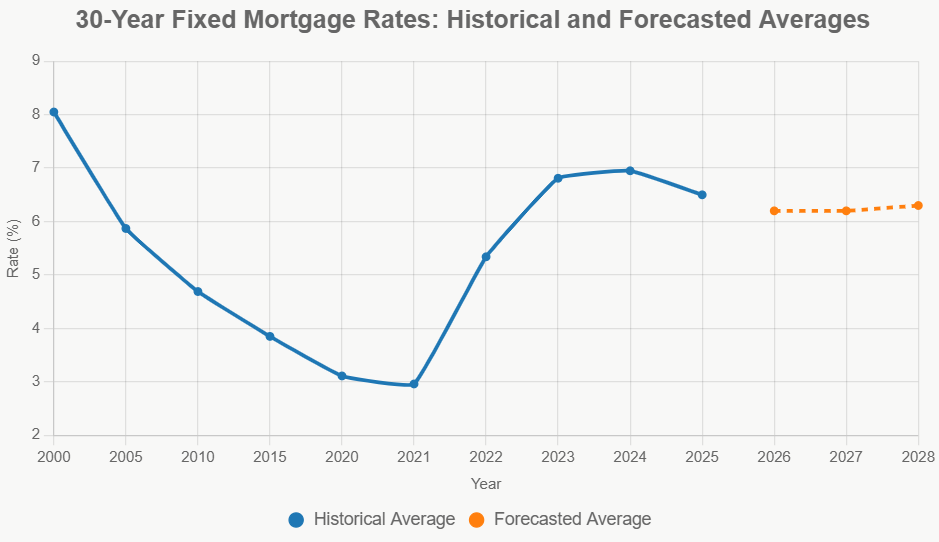
It’s been quite a ride, hasn't it? Remembering the days when getting a mortgage felt like finding gold – rates were unbelievably low, dipping below 3% during the pandemic chaos. It felt like the world had turned upside down, and borrowing money became incredibly cheap. Before that, things were more normal, maybe hovering in the 4-5% range for a long time. And way back, before I even got into this business full-time, rates were often in the 7% or 8% range. Now, after inflation went a bit wild, we're back up in the 6% territory, which feels high compared to the recent past, even though it’s not historically extreme.

30 year fixed mortgage rates historical and forecasted averages

Why Rates Have Been Such a Rollercoaster

If you’re trying to wrap your head around why mortgage rates have been swinging like a pendulum, it really boils down to a few key things happening in the bigger economic picture. Think of it like weather – lots of different forces coming together to create the conditions we experience.

  • The Federal Reserve's Balancing Act: The Fed is like the economy's thermostat. They have two main jobs: keep prices stable (fight inflation) and keep people employed. When inflation got too high recently, they cranked up their main tool, the federal funds rate. Since mortgage rates tend to follow the direction of this rate (even if not perfectly 1:1), ours went up too. My feeling is the Fed is walking a tightrope. They want to bring inflation down to their target (around 2%) without causing a massive recession. So, they’ve been slowly cutting rates, and they’ll likely continue if inflation keeps cooling. As of late 2025, rates are around 4.5%-4.75%, and they might nudge down further, but they'll be cautious. A stubborn economy or unexpected inflation spikes could make them pause or cut slower than we’d like.
  • The 10-Year Treasury Yield – Mortgage Rates' Big Brother: A lot ofwhat happens with mortgage rates is closely tied to the interest paid on U.S. Treasury notes, especially the 10-year one. Think of it as a benchmark. When investors feel nervous about the economy, they often pour money into Treasuries, pushing their prices up and yields (interest rates) down. When they're confident, they might sell Treasuries for riskier investments, pushing yields up. Right now, forecasts suggest the 10-year yield might ease a bit, maybe settling around 4.1% in the coming years. This usually means mortgage rates follow suit, but not always exactly.
  • Inflation and Economic Speed: As I mentioned, high inflation was the main reason rates shot up. While it's cooling, sitting around 2.5% in late 2025, it’s not quite at the Fed's 2% goal yet. If inflation stays sticky or creeps back up, the Fed might keep rates higher for longer. On the flip side, if the economy grows steadily (like the projected 2.1%–2.4% for 2026), that's generally good news. A strong economy usually supports slightly higher rates, but if growth falters badly and signals a recession, that could push rates down faster as the Fed tries to stimulate things. It’s a tricky balance.
  • The Rest of the World and Unexpected Shocks: It might seem strange, but things happening overseas – conflicts, energy price shocks, trade disputes, even elections in other major countries – can ripple through our economy and affect mortgage rates. Remember 2021 when supply chain issues popped up everywhere? That added to inflation and indirectly pushed rates up. We have to keep an eye on global stability because unexpected events can cause major market jitters, leading to rate volatility.
  • The Housing Market Itself: Believe it or not, the housing market’s own health plays a role. Even with higher rates, demand for homes is still pretty strong in many areas, and the number of homes for sale (inventory) remains stubbornly low. This imbalance helps keep home prices climbing, albeit at a slower pace now (maybe 1-2% per year). While rising prices might seem good for sellers, it keeps affordability a challenge for buyers, which can indirectly influence lender confidence and rate setting over the long term.

What the Experts Are Saying (And What I Think)

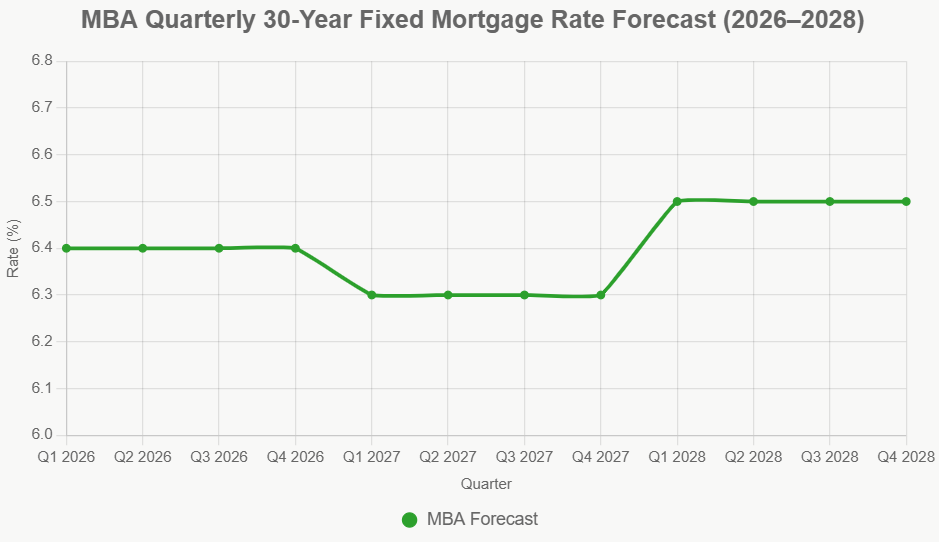
Quarterly 30-Year Fixed Mortgage Rate Forecast (2026–2028)

Everyone from big banks to government-sponsored enterprises has an opinion on where rates are headed. While forecasts always have a range, most seem to agree that the dramatic drops of the pandemic era are behind us for now. Here’s a snapshot based on the latest outlooks for the 30-year fixed mortgage rate:

Forecast Source 2026 Average 2027 Average 2028 Average My Quick Take
Fannie Mae ~6.0% ~6.0% N/A Most optimistic, betting on quick Fed action.
Mortgage Bankers Assoc. (MBA) 6.4% 6.3% 6.5% More cautious, sees rates sticking higher for longer.
NAHB 6.19% Improving (~6.0%) N/A Similar to Fannie Mae, slightly more conservative.
Redfin 6.3% N/A N/A Mid-range prediction for next year.
My Consensus Estimate ~6.2% ~6.2% ~6.3% A realistic average, acknowledging uncertainty.

You can see there’s a general agreement that rates will likely stay above 6% for the next three years. Fannie Mae seems to think rates could dip below 6% sooner rather than later, likely banking on inflation cooperating fully with the Fed. The MBA, though, brings up a good point – things like ongoing government spending could potentially keep demand high and inflation from falling too fast, arguing for rates to stick closer to the mid-6% range.

Looking at the detailed quarterly forecasts (like the MBA's projected stability), it paints a picture not of wild swings, but of gradual adjustments. Personally, I lean towards the MBA’s cautious view. Predicting the exact path of inflation and the Fed’s reaction is incredibly difficult. There are just too many variables. So, assuming stability around the 6.2% to 6.4% mark feels like the most grounded expectation for the average borrower over the next few years. This doesn't mean rates won't dip below 6% occasionally, or spike temporarily, but the average trend seems to be pointing towards this range.

What This Means for You (The Real Impact)

Okay, numbers are one thing, but what does a mortgage rate around, say, 6.25% actually mean for you and your wallet?

  • For Homebuyers: Let's crunch some numbers. If you borrow $400,000, a rate of 6.25% means your monthly principal and interest payment is roughly $2,460. Compare that to 2021 when rates were around 3%, and that same $400,000 loan had a payment of about $1,690. That's a difference of nearly $800 per month! This directly impacts how much house you can afford. You might need a bigger down payment, have to look at smaller homes, or accept a higher monthly burden. First-time buyers, especially, might find it tough. Programs like FHA loans can help by allowing higher debt-to-income ratios, but it’s still a stretch for many.
  • For Refinancers: A huge number of homeowners refinanced a few years back and locked in rates below 4%, many even below 3%. This created a powerful “rate lock-in” effect, where people are hesitant to sell or move because they’d lose their super-low rate. As rates hover in the mid-6% range, refinancing isn't attractive for most of these homeowners. However, if rates were to dip significantly, say below 5.9%, it could become appealing again for some, potentially saving them hundreds on their monthly payments. But right now, the incentive isn't strong enough for mass refinancing.
  • For the Market: The MBA predicts about $2.2 trillion in single-family mortgage originations for 2026 – that's up 8% from 2025. This suggests that even with rates higher than the lows, enough people are buying or needing mortgages to keep the industry busy. They also expect home sales to rise slowly, maybe reaching 4.5 million annually by 2027. My take is that this gradual increase is healthier than the frenzy we saw before. It suggests a market finding its footing, though record-low inventory might still be a bottleneck, preventing huge leaps in sales volume.

Smart Moves in Today's Market

Given this outlook, what can you actually do? I always tell people it’s about being prepared and strategic.

  1. If You're Buying: Don't wait endlessly for rates to plummet back to 3%. If you find a home you love and can afford it now at current rates (maybe mid-6%), seriously consider locking it in. You can always refinance later if rates drop significantly. Explore options like temporary rate buydowns offered by sellers or builders – these can lower your rate for the first year or two, easing the initial affordability crunch.
  2. Consider ARMs (Carefully): Adjustable-Rate Mortgages (ARMs) often start with a lower rate than fixed mortgages. If you plan to sell or refinance before the rate starts adjusting (usually after 5, 7, or 10 years), an ARM might save you money. But be very aware of the risks if your plans change.
  3. Boost Your Credit Score: This is non-negotiable. A higher credit score qualifies you for better rates. Even a half-percent difference can save you tens of thousands over the life of a loan. Focus on paying bills on time and reducing debt.
  4. Save for a Bigger Down Payment: A larger down payment reduces the loan amount, meaning a lower monthly payment regardless of the rate. It also helps you avoid Private Mortgage Insurance (PMI) on conventional loans once you reach 20% equity.
  5. Shop Around: Don't just go to one lender. Get quotes from multiple banks, credit unions, and especially mortgage brokers. Rates and fees can vary significantly.

My Bottom Line: Stability Amidst Uncertainty

Looking ahead, the mortgage rates predictions for the next 3 years point towards a period of relative stability, likely centered in the 6.2% to 6.4% range. While this isn't the rock-bottom borrowing cost we saw a few years back, it's far from the worst rates in history. This greater predictability could be a good thing, allowing potential buyers who were waiting on the sidelines to re-enter the market more confidently and helping the housing market find a more sustainable rhythm.

My advice? Stay informed. Keep an eye on inflation reports and the Federal Reserve's announcements. Talk to trusted mortgage professionals to understand how different rate scenarios impact your personal finances. Focus on what you can control – your credit score, your savings, your budget. While rates are a huge piece of the puzzle, they're just one piece. Being financially prepared is your best strategy for navigating whatever the next few years bring.

Invest Smartly in Turnkey Rental Properties

With rates dipping to their lowest levels this year, investors are locking in financing to maximize cash flow and long-term returns.

Norada Real Estate helps you seize this rare opportunity with turnkey rental properties in strong markets—so you can build passive income while borrowing costs remain historically low.

🔥 HOT NEW LISTINGS JUST ADDED! 🔥

Talk to a Norada investment counselor today (No Obligation):

(800) 611-3060

Get Started Now

Also Read:

  • Mortgage Rates Predictions for the Next 2 Years: 2026-2027
  • Mortgage Rate Predictions for the Next 5 Years: 2026 to 2030
  • Mortgage Rates Predictions Backed by 7 Leading Experts: 2025–2026
  • Mortgage Rate Predictions for the Next 3 Years: 2026, 2027, 2028
  • 30-Year Fixed Mortgage Rate Forecast for the Next 5 Years
  • 15-Year Fixed Mortgage Rate Predictions for Next 5 Years: 2025-2029
  • Will Mortgage Rates Ever Be 3% Again in the Future?
  • Mortgage Rates Predictions for Next 2 Years
  • Mortgage Rate Predictions for Next 5 Years
  • Mortgage Rate Predictions: Why 2% and 3% Rates are Out of Reach
  • How Lower Mortgage Rates Can Save You Thousands?
  • How to Get a Low Mortgage Interest Rate?
  • Will Mortgage Rates Ever Be 4% Again?
Filed Under: Financing, Mortgage Tagged With: Mortgage Rate Predictions, Mortgage Rate Trends, mortgage rates

Mortgage Rates Today, Dec 26: 30-Year Refinance Rate Rises by 6 Basis Points

December 26, 2025 by Marco Santarelli

Mortgage Rates Today, Jan 1, 2026: 30-Year Refinance Rate Rises by 48 Basis Points

For those of you thinking about refinancing your mortgage, here's the key takeaway for today, December 26th: the national average 30-year fixed refinance rate has seen a slight nudge upwards, now sitting at 6.71%. This is a modest increase of 6 basis points from last week, indicating a period of continued stability, albeit with a gentle upward lean.

Mortgage Rates Today, Dec 26: 30-Year Refinance Rate Rises by 6 Basis Points

What Are Current Refinance Rates?

Let's break down the numbers, as reported by Zillow, so you have a clear picture of where things stand today, Friday, December 26, 2025:

  • 30-Year Fixed Refinance Rate: This is the big one for most homeowners, offering predictability over the long haul. The current national average is 6.71%. As I mentioned, this is a small bump up by 6 basis points (that’s 0.06%) from last week’s 6.65%. While it's not a dramatic jump, it’s worth noting if you’ve been on the fence.
  • 15-Year Fixed Refinance Rate: For those who want to pay off their mortgage faster and save on total interest, the 15-year fixed rate remains a solid option. It’s holding firm at 5.69%. This is a fantastic rate for those who can manage the higher monthly payments.
  • 5-Year Adjustable-Rate Mortgage (ARM) Refinance Rate: ARMs can be a bit more complex. The current national average for a 5-year ARM is 7.22%. While this looks a bit higher than the fixed rates, it can be appealing for individuals who plan to move or refinance again within that 5-year window, or who have a strong feeling that rates will drop significantly before their rate adjusts.

Market Snapshot: A Quick Glance

To make it super easy to digest, here’s the data at a glance:

Loan Type Current Rate Change from Last Week
30-Year Fixed 6.71% Up 0.06%
15-Year Fixed 5.69% Stable
5-Year ARM 7.22% Stable
Last Updated Dec 26, 2025

Decoding the Data: Expert Insights

Now, what does all this mean in plain English? This steady, slightly rising trend in refinance rates really reinforces the idea that we're operating in a climate where interest rates are expected to stay elevated for a while. For us homeowners, this has a few implications:

  • Securing Stability: If you're thinking about refinancing, and you’re concerned about future rate hikes, locking in the current 6.71% on a 30-year fixed rate could provide you with peace of mind. Your monthly payments will be predictable, shielding you from any potential increases down the line.
  • The Appeal of Shorter Terms: The 15-year fixed rate at 5.69% continues to be a shining star for those looking to be mortgage-free sooner. The savings on total interest paid over the life of the loan can be substantial, but you absolutely need to be comfortable with a higher monthly payment.
  • ARMs: A Calculated Risk: The 5-year ARM at 7.22% is higher than fixed options. While it might seem appealing if you’re a short-term homeowner, remember that after the initial 5 years, your rate will change. With rates already above 7%, the possibility of them going even higher needs careful consideration. It’s a gamble, and you need to be prepared for the consequences if they do.
  • Timing is Everything (But Don't Wait Forever): The Federal Reserve has been pretty clear that they’re in no rush to slash interest rates. This tells me that we shouldn't expect dramatic drops in refinance rates anytime soon. The best time to refinance is often when it makes sense for your personal financial situation, not just when you hope the market will perform a miracle.

Recommended Read:

30-Year Fixed Refinance Rate Trends – December 25, 2025

Best Time to Refinance Your Mortgage: Expert Insights

Should You Refinance Your Mortgage Now or Wait Until 2026? 

For Homebuyers vs. Current Owners: What’s the Story?

The current rate environment generally affects two main groups differently:

  • For Homebuyers: Affordability is still a significant hurdle. Rates are a long way from the incredibly low 3-4% we saw a few years ago. This means prospective buyers need to be very realistic about their budgets. Monthly payments will be higher than what many have become accustomed to. Locking in a fixed rate now, even at 6.71%, can offer a sense of security for the long term, even if rates dip slightly in the future.
  • For Current Owners:
    • If your current mortgage rate is significantly lower (think pre-2022 levels), refinancing now probably won't make financial sense. You'd be trading a great rate for a higher one, and that’s rarely a good deal.
    • However, if you got your mortgage recently at a rate close to today’s market, or if you're looking to do a cash-out refinance to tap into your home equity, it’s a decision that needs a careful cost-benefit analysis. You’ll be borrowing at a higher rate, so weigh that against your immediate financial needs.

Looking Ahead: My Thoughts on 2026

When I peer into my crystal ball (okay, it’s more like digesting analyst reports), the consensus is that we'll likely see refinance rates remain at these elevated levels through at least the first half of 2026. Modest dips are possible, especially if inflation continues to cool and the Fed starts easing lending policies. However, a return to those ultra-low 3-4% rates? That seems highly improbable anytime in the foreseeable future. My best guess is that we'll be looking at a range closer to 6-7% for 30-year fixed loans, with those ARMs being more volatile.

For homeowners, this means making refinance decisions will increasingly be about your individual circumstances and financial goals, rather than trying to time the market for a big drop. Both buyers and existing owners should get comfortable with the idea that we're in a sustained higher-rate environment. Smart financial planning and a clear understanding of your own needs will be your best guides.

“Invest Smart — Build Long-Term Wealth Through Real Estate”

Norada's team can guide you through current market dynamics and help you position your investments wisely—whether you're looking to reduce rates, pull out equity, or expand your portfolio.

Work with us to identify proven, cash-flowing markets and diversify your portfolio while borrowing costs remain favorable.

HOT NEW TURNKEY DEALS JUST LISTED!

Speak with a seasoned Norada investment counselor today (No Obligation):

(800) 611-3060

Get Started Now

Recommended Read:

  • When You Refinance a Mortgage Do the 30 Years Start Over?
  • Should You Refinance as Mortgage Rates Reach Lowest Level in Over a Year?
  • NAR Predicts 6% Mortgage Rates in 2025 Will Boost Housing Market
  • Mortgage Rates Predictions for 2025: Expert Forecast
  • Half of Recent Home Buyers Got Mortgage Rates Below 5%
  • Mortgage Rates Need to Drop by 2% Before Buying Spree Begins
  • Will Mortgage Rates Ever Be 3% Again: Future Outlook
  • Mortgage Rates Predictions for Next 2 Years
  • Mortgage Rate Predictions for Next 5 Years
  • Mortgage Rate Predictions for 2025: Expert Forecast

Filed Under: Financing, Mortgage Tagged With: mortgage, mortgage rates, Mortgage Refinance Rates

Interest Rate Drop Sparks Mortgage Refinance Surge Compared to Last Year

December 26, 2025 by Marco Santarelli

Interest Rate Drop Sparks Mortgage Refinance Surge Compared to Last Year

You've probably seen the headlines, or perhaps you've even considered it yourself: lots of people are refinancing their mortgages right now, and a lot more than this time last year. If you're wondering why, the short answer is that a significant drop in mortgage interest rates, combined with a strong desire to secure lower monthly payments, is driving this surge in refinancing activity.

Interest Rate Drop Sparks Mortgage Refinance Surge Compared to Last Year

It feels like just yesterday we were all talking about how high mortgage rates had climbed. Many homeowners felt stuck with their current loans, especially if they had locked in rates much lower during the pandemic boom. But then, something shifted. Rates began to dip, and suddenly, refinancing wasn't just a distant dream for many; it became a very real and attractive possibility again.

I've been following the housing market for a while now, and as someone who's navigated the world of mortgages both personally and professionally, I can tell you this recent wave of refinancing is a big deal. It's not just a small uptick; we're seeing Refinance Index levels that are a staggering 110 percent higher than they were this same week a year ago, according to data from the Mortgage Bankers Association (MBA). That's a massive jump!

The Magic of Lower Interest Rates

At the heart of this surge is one crucial factor: interest rates. When rates go down, it means you can potentially borrow the same amount of money for less cost over time. For homeowners, this translates directly into saving money.

Think of it like this: if you have a loan for $300,000 and your interest rate drops from, say, 7% to 5%, your monthly payment could decrease significantly. Over the life of a 30-year mortgage, those savings can add up to tens of thousands, even hundreds of thousands of dollars. It's like getting a discount on the biggest purchase most of us will ever make.

This is why you see the refinance share of mortgage activity tick up. People are taking advantage of these lower rates to:

  • Slash their monthly payments: This is the most direct benefit. A lower monthly payment can free up cash for other expenses, savings, or investments.
  • Shorten their loan term: Some people refinance to a 15-year mortgage, paying less interest overall even if their monthly payment is a bit higher.
  • Tap into home equity: Through a cash-out refinance, homeowners can borrow against the equity they've built in their homes, using the funds for renovations, debt consolidation, or other major expenses.
  • Switch from an adjustable-rate to a fixed-rate mortgage: For those who secured an adjustable-rate mortgage (ARM) when rates were low, a fixed rate offers predictability and protection against future rate hikes.

What's Driving the Rate Dip?

The MBA's data points to a general trend of slightly declining mortgage rates. While rates can fluctuate, the overall movement over the past year has been favorable for refinancers. Several economic factors influence these shifts, often interacting in complex ways:

  • Inflation: When inflation shows signs of cooling, central banks (like the Federal Reserve in the U.S.) may signal an end to, or even a reversal of, interest rate hikes. This can have a ripple effect on mortgage rates.
  • Economic Outlook: A softening job market or concerns about overall economic growth can also lead to lower borrowing costs as lenders anticipate less demand for credit. Mike Fratantoni, the MBA's SVP and Chief Economist, noted that the MBA expects trends like a “softening job market” and “steady mortgage rates” to persist, which can create a window for refinancing.
  • Supply and Demand: The housing market itself plays a role. While purchase applications are also up, a greater supply of available homes or changes in borrower behavior can influence rates.

It's Not Just About Rates: Other Factors at Play

While rates are the main driver, other elements contribute to the high refinance demand:

The “Stuck” Factor from Last Year

A year ago, many homeowners were locked into mortgages with rates that seemed incredibly low. As rates climbed significantly, the idea of refinancing became unrealistic for most. People who might have wanted to refinance were left “stuck” with higher rates. Now that rates have fallen to more attractive levels, those individuals are eager to take advantage of the opportunity they missed out on previously. It's a case of pent-up demand finally finding its outlet.

The Refinance Share is Increasing

The MBA's data shows that the refinance share of mortgage activity has increased to 59.1 percent of total applications. This is a significant proportion, indicating that refinancing is a dominant force in the mortgage market right now, even surpassing purchase activity in terms of sheer volume of applications.

Government-Backed Loans are Still Relevant

Programs like FHA and VA loans continue to be popular. The FHA share of total applications, for instance, increased to 20.8 percent, suggesting that even with varying credit profiles, many are finding ways to refinance through these government-backed options. While VA shares saw a slight dip week-over-week, their continued presence highlights the diverse needs within the borrowing community.

What About the Purchase Market?

It's important to note that while refinance is soaring, the purchase market isn't dormant either. The Purchase Index was 16 percent higher than the same week one year ago, and the MBA is forecasting “continued, modest growth in terms of home sales in 2026.” This suggests that while refinancing is the big story, people are still actively buying homes, likely also trying to secure the best possible rates for their new mortgages.

My Take on It All

From my perspective, this current refinance boom is a healthy sign for homeowners who were feeling the pinch of higher rates. It's a chance to regain some financial breathing room and potentially make significant long-term savings. However, it's crucial to approach refinancing with a clear plan. Just because the rates are low doesn't mean it's the right move for everyone.

When I advise clients, I always stress evaluating the total cost of refinancing, including closing costs, against the projected savings. You need to determine how long it will take to recoup those initial expenses – the “break-even point.” If you plan to sell your home within a few years, a refinance might not be worth it.

It also highlights the cyclical nature of the mortgage market. We saw a refinance frenzy a few years ago when rates were historically low, and now we're seeing another one as rates have corrected downwards from their recent peaks. It's a reminder for homeowners to stay informed and be ready to act when opportunities arise.

Looking ahead, as Mike Fratantoni mentioned, we might see a persistent environment of a softening job market, sticky inflation, and elevated home inventories. This suggests that mortgage rates might remain relatively steady for some time. This prolonged window of opportunity could continue to fuel refinance demand, allowing more and more homeowners to benefit from lower monthly payments and long-term financial savings.

“Invest Smart — Build Long-Term Wealth Through Real Estate”

Norada's team can guide you through current market dynamics and help you position your investments wisely—whether you're looking to reduce rates, pull out equity, or expand your portfolio.

Work with us to identify proven, cash-flowing markets and diversify your portfolio while borrowing costs remain favorable.

HOT NEW TURNKEY DEALS JUST LISTED!

Speak with a seasoned Norada investment counselor today (No Obligation):

(800) 611-3060

Get Started Now

Recommended Read:

  • When You Refinance a Mortgage Do the 30 Years Start Over?
  • Should You Refinance as Mortgage Rates Reach Lowest Level in Over a Year?
  • NAR Predicts 6% Mortgage Rates in 2025 Will Boost Housing Market
  • Mortgage Rates Predictions for 2025: Expert Forecast
  • Half of Recent Home Buyers Got Mortgage Rates Below 5%
  • Mortgage Rates Need to Drop by 2% Before Buying Spree Begins
  • Will Mortgage Rates Ever Be 3% Again: Future Outlook
  • Mortgage Rates Predictions for Next 2 Years
  • Mortgage Rate Predictions for Next 5 Years
  • Mortgage Rate Predictions for 2025: Expert Forecast

Filed Under: Financing, Mortgage Tagged With: mortgage, mortgage rates, Mortgage Refinance Rates

Multiple Florida Housing Markets Are on the Brink of a Crash in 2026

December 25, 2025 by Marco Santarelli

Multiple Florida Housing Markets Are on the Brink of a Crash in 2026

The question on everyone’s mind is: Will Florida’s housing market crash in 2026? Based on the latest insights from Cotality, five Florida housing markets are being closely watched for a potential significant dip in home prices. While a full-blown “crash” might be too strong a word for what I see happening, these areas are definitely experiencing a notable correction. Let me break down what this means for you, whether you're looking to buy, sell, or just curious about the Sunshine State's real estate scene.

Multiple Florida Housing Markets Are on the Brink of a Crash in 2026

Markets on the Radar: The Top 5 Florida Cities to Watch

Cotality has identified a list of markets with a very high risk of price decline within the top 100 largest metro areas in the U.S. Among these, five are nestled right here in Florida. These aren't just random picks; they are based on specific data that signals a cooling trend.

Here’s the list, according to Cotality’s analysis:

  1. Cape Coral, FL
  2. Fort Lauderdale, FL
  3. Lakeland, FL
  4. Palm Bay, FL
  5. West Palm Beach, FL

It's important to understand that “risk of price decline” doesn't automatically mean a catastrophic collapse. Instead, it suggests a period of adjustment where prices might see a significant pullback from their recent peaks. As a real estate professional who has navigated various market cycles, I can tell you that corrections are natural, especially after periods of rapid growth.

Why These Florida Markets? Unpacking the Trends

You might be wondering, what makes these particular cities stand out? The data paints a picture of markets that experienced significant growth during the pandemic-fueled boom and are now seeing a recalibration. Realtor.com's analysis, combined with insights from experts like Cara Ameer, a real estate broker at Coldwell Banker Vanguard Realty in Florida, and Karen Borrelli, president of Royal Palm Coast Realtor Association, helps us understand the driving forces.

The “Cooling” Trend: Florida Dominates the List

It's not just these five cities. In fact, the same report shows that seven of the top 10 coolest housing markets in the U.S. are in Florida. This “coolest” designation refers to markets experiencing the steepest home price declines.

Here are some of the cities mentioned in that report:

  • Cape Coral, FL (-7.1% year-over-year price decline)
  • Naples, FL (-6.7%)
  • Punta Gorda, FL (-6.2%)
  • Sebring, FL (-5.2%)
  • North Port, FL (-5.1%)
  • Brownsville, FL (-4.8%)
  • Sebastian, FL (-4.6%)

This widespread cooling across Florida suggests broader economic and demographic shifts at play, rather than isolated issues.

Cape Coral: A Case Study in Market Correction

Cape Coral, a city known for its extensive canal system, has been particularly highlighted. Its home prices have fallen significantly. According to Realtor.com's analysis of the latest data, the typical single-family home in Cape Coral sold for nearly 7% less in August 2025 compared to the previous year. Even more striking, compared to the pandemic boom era of August 2022, the median home sales price has dropped by over 13%. North Port has seen an even more dramatic long-term correction, with typical August 2025 home sales prices 20% less than three years prior.

What’s impacting Cape Coral?

  • Rising Costs: Higher interest rates, increasing insurance premiums, and climbing foreclosure rates are dampening buyer enthusiasm.
  • Insurance Woes: Being on the Gulf Coast makes cities like Cape Coral vulnerable to hurricanes and flooding. This leads to higher and harder-to-get homeowner's insurance. Cape Coral has the third-highest premium-to-market ratio in the nation at 2.2% – meaning a $350,000 home could cost $7,700 annually in insurance alone.
  • Foreclosures: ATTOM data from Q3 2025 showed Cape Coral having one of the highest foreclosure rates among major metros. While this number is up, local real estate professionals like Karen Borrelli caution against jumping to conclusions about a full-blown crisis.

Beyond Cape Coral: Common Themes

The challenges faced by Cape Coral – like rising insurance costs and the aftermath of a red-hot market – are not unique. Many coastal Florida markets are experiencing what experts call an overcorrection.

Cara Ameer points out that while Florida doesn't have state income tax, the savings are often overwhelmed by the rising costs of homeownership in these desirable but vulnerable areas, coupled with higher HOA and condo fees. This can make Florida feel “lopsided” in terms of property values.

The “Too High, Too Fast” Phenomenon

The general consensus from experts is that the pandemic market went up too high, too fast. This made homes unaffordable for many, leading to weakened demand and a necessary price correction. As Hannah Jones, senior economic research analyst at Realtor.com, puts it, this rebalancing is likely to continue until demand picks up enough to stabilize prices.

Is a “Crash” Imminent or a “Correction” Expected? My Take

As someone who lives and breathes real estate, I believe the term “crash” is often used to generate clicks and alarm. What we are more likely seeing is a market correction. Think of it like a stretched rubber band snapping back – not breaking, but returning to a more natural state.

The data from Cotality is valuable because it identifies areas showing the highest risk of price declines. This allows buyers to potentially find better deals and sellers to adjust their expectations.

Karen Borrelli’s perspective is crucial here: the cooling is primarily seen in pricing, not necessarily in the volume of sales. Buyers are still active, but they are shopping for better value. This means sellers who had unrealistic price expectations based on the pandemic frenzy might need to lower them to attract buyers. As Borrelli notes, it might actually be a really good time to buy in these markets if you find a property priced realistically.

What Does This Mean for the Future?

The outlook for these five Florida housing markets in 2026 isn't necessarily doomsday. Instead, it points to a market that is becoming more balanced and, frankly, healthier.

  • For Buyers: This could be an opportunity. With prices adjusting and some sellers becoming more motivated, you might be able to negotiate better terms. However, always factor in the rising costs of insurance and potential HOA fees, especially in coastal areas.
  • For Sellers: It's time to be realistic. Holding onto outdated pricing from 2021 or 2022 will likely result in your property sitting on the market. Pricing your home competitively based on current conditions and market comparable sales is key. Offering concessions can also help attract buyers. Some sellers, particularly in areas like Miami, have chosen to delist and wait for market conditions to improve.
  • For Investors: These markets might present opportunities for long-term investors looking for properties that will appreciate gradually rather than rapidly. It’s about finding value and understanding the local economic drivers beyond just tourism.

Looking Ahead: Stabilizing Prices vs. a Steep Decline

The critical question is whether these markets will stabilize or continue a steeper decline toward 2026. Based on the expert opinions and the data, the trend seems to be towards stabilization as prices rebalance.

  • Fundamentals Still Strong: In many Florida markets, the underlying fundamentals remain strong. People are attracted to the lifestyle, climate, and, for some, the lack of state income tax.
  • Demand Re-emerging: As prices become more affordable due to the correction, demand is likely to pick up again, creating a more stable environment. Borrelli believes we are approaching a point where the value proposition for houses in these areas is becoming clear, which should lead to steadier prices.

In conclusion, while a dramatic “crash” that wipes out home values across the board is unlikely, these five Florida housing markets – Cape Coral, Fort Lauderdale, Lakeland, Palm Bay, and West Palm Beach – are indeed in a period of significant price correction. This isn't necessarily a bad thing, as it can lead to a more sustainable and balanced market. For those involved in real estate, understanding these trends and expert insights is crucial for making informed decisions in the coming years.

Florida’s Market Is Shifting—Investors Are Staying Ahead

From Cape Coral to Jacksonville, Florida’s housing market is evolving—but turnkey investors are locking in cash-flowing properties while prices and rents remain favorable.

Norada Real Estate helps you navigate Florida’s changing landscape with fully managed rental properties in high-demand cities—so you can build passive income and long-term equity with confidence.

🔥 NEW FLORIDA LISTINGS JUST ADDED! 🔥

Talk to a Norada investment counselor today (No Obligation):

(800) 611-3060

Get Started Now

Want to Know More About the Florida Housing Market?

Explore these related articles for even more insights:

  • Florida Condos Hit Hardest Since the Great Recession as Prices Tumble
  • Florida Leads Among the Fastest Cooling Housing Markets of 2025
  • Florida Housing Market Predictions Over the Next One Year
  • Florida Housing Market Trends: 4 Cities Turn Buyer-Friendly in 2025
  • Florida Housing Market Sees a Major Shift With a Jump in Pending Sales
  • Florida Housing Prices Drop for the Fifth Consecutive Month in 2025
  • Is the Florida Housing Market on the Edge of a Crash or Downturn?
  • 24 Florida Housing Markets Could See Home Prices Drop by Early 2026
  • Tax Relief Proposed as Florida Housing Market Faces Deepening Crisis
  • Florida Housing Market: Record Supply Expected to Favor Buyers in 2025
  • Florida Housing Market Forecast for Next 2 Years: 2025-2026
  • Florida Housing Market: Predictions for Next 5 Years (2025-2030)

Filed Under: Housing Market, Real Estate Market Tagged With: Florida, Florida Condos, Housing Market

Florida Housing Market on the Verge of a Strong Rebound in 2026

December 25, 2025 by Marco Santarelli

Florida Housing Market on the Verge of a Strong Rebound in 2026

If you've been keeping an eye on Florida's housing market, you've probably noticed things felt a little… different this past year. And you're right. Florida’s housing market indeed slowed through much of 2025, a noticeable shift from the frenzied pace we saw not too long ago. However, as I see it, and as the latest insights from Florida Realtors® suggest, this slowdown isn't the whole story.

We're actually starting to see the early sparks of a rebound, fueled by improving mortgage rates and a steady stream of people making the Sunshine State their home.

Florida Housing Market on the Verge of a Strong Rebound in 2026

It’s easy to get caught up in the headlines that scream “market crash” or “bubble bursting,” but the reality is usually far more nuanced. Personally, I've been watching real estate trends for a while now, and what I’m seeing in Florida in 2025 is a market that’s taking a breath, recalibrating, and preparing for its next chapter. So, what exactly happened, and where are we headed?

What Made Things Cool Down?

If you were trying to buy a home in Florida during this period, you probably noticed a few things.

  • Mortgage Rates Weren't Our Friend: The cost of borrowing money to buy a home went up significantly. This meant monthly payments were higher, pushing some potential buyers out of the market or forcing them to look for less expensive homes.
  • Affordability Became a Hurdle: When you mix high prices with high interest rates, you get a tough affordability situation. It just wasn't as accessible for many people to buy their dream home.
  • Insurance Pains: Like I mentioned, insurance is a big deal in Florida. Rising premiums made owning a home more expensive, affecting both buyers and sellers.
  • Extended Time on Market: Homes weren't flying off the shelves as quickly. This meant sellers had to wait longer to find a buyer, and it gave buyers a little more breathing room, but it also signaled a cooling demand.

It's important to understand that the increase in inventory we saw wasn't necessarily because a flood of new homes hit the market. Instead, it was mostly because homes were taking longer to sell. This is a key difference that signals a slowdown in demand rather than an oversupply.

A Global Slowdown and Florida's Place in It

It wasn't just Florida; the whole world was feeling it. The International Monetary Fund pointed out that global economic growth was slowing down. This kind of global economic uncertainty often makes people hesitant to make major purchases, and buying property is definitely a major purchase. This global context definitely played a part in softening demand here in the Sunshine State.

But Wait, There’s Good News Emerging!

Here’s where my experience comes in. Even though things felt slow, I saw glimmers of hope. Since the survey period ended, we've started to see mortgage rates ease a bit. This is a huge deal for buyers. Lower rates mean lower monthly payments, which instantly makes homeownership more attainable for more people. This is precisely why I believe we're seeing that early momentum and beginning of a rebound.

Inventory: Not Too High, Not Too Low

One of the interesting things about 2025 was the inventory situation. While inventory levels did increase, they generally stayed above pre-pandemic norms. This was more a reflection of demand weakness than an explosion of new homes. Importantly, these levels weren’t extreme enough to cause major price drops statewide. In areas where there was some price softening, it often coincided with a lot of new construction competing with existing homes.

Migration: Still Strong, Just Different

Florida has always been a magnet for people, and 2025 was no different, though the pace changed. While the domestic in-migration we saw after the pandemic peak might have cooled a bit, it was still stronger than pre-pandemic levels. And as interest rates continue to make homeownership more accessible, I expect this demand could get even more energized.

International Buyers: A Welcome Resurgence

This is a fascinating part of the story, and something I pay close attention to. International buyers are a vital part of Florida's real estate scene.

Key Takeaways for International Buyers in 2025 (August 2024 – July 2025):

  • Sales Surged: The number of residential purchases by international buyers increased by a whopping 50% compared to the previous year. While still below pre-pandemic numbers, this rebound is a very positive sign for investor confidence.
  • Dollar Volume Climbed: With more transactions and higher sale prices, the total dollar volume spent by international buyers jumped to $10.4 billion, up from $7.1 billion. This was a significant recovery.
  • Still a Small Piece of the Pie: Despite the surge, international buyers still accounted for a small share—5%—of total existing home sales and dollar volume in Florida. This shows how strong the domestic market is.
  • Where They Came From:
    • Latin America and the Caribbean remained the largest group, making up 45% of buyers.
    • Europe and Northern America (primarily Canada) tied for second, at 18% each.

Top Countries by Dollar Volume:

Rank Country Dollar Volume (2025) Change from 2024
1 Canada ~$1.9 billion +52%
2 Colombia $925 million +201%
3 Brazil $762 million Modest Increase
4 Mexico (Returned to Top 5) –
5 United Kingdom (Fell out of Top 5) –

Source: Florida Realtors®

It's really encouraging to see countries like Colombia significantly increasing their investment. Canada continues to be a powerhouse, and it’s great to see Mexico back in the Top 5.

Where International Buyers Invested:

  • South Florida remained the top destination, attracting 45% of international purchases.
  • The Orlando-Kissimmee-Sanford area also saw a good chunk of buyers from Latin America and the Caribbean.
  • Tampa Bay and Southwest Florida were more popular with buyers from Canada and Europe.
  • Interestingly, while the Naples-Immokalee-Marco Island area saw only 6% of Florida’s international purchases, 52% of those buyers were Canadian. This highlights specific regional appeal.

Price Trends: A Slight Shift

Even with the slowdown, Florida's median sale price for international buyers in 2025 was $442,000. This was a slight decrease from the previous year, but still elevated compared to pre-pandemic times. What’s interesting is that the price gap between international buyers and the overall Florida median sale price narrowed.

  • Most Purchases ($250K–$500K): The largest share of homes bought by international buyers fell into this range, showing a slight increase.
  • Under $150K Saw Growth: The price bracket under $150,000 saw the most significant increase in share, which could indicate a different type of buyer or investment strategy.

Looking Ahead: Cautious Optimism

So, what does all this mean for you? Florida’s housing market in 2025 was a mixed bag. We saw a slowdown, no doubt, driven by many factors. But the underlying appeal of Florida – its weather, lifestyle, and investment potential – remains incredibly strong.

As mortgage rates continue to normalize and the global economy finds its footing, I’m anticipating further positive movement. The steady migration trends and the resurgent international interest are powerful indicators that Florida's housing market is resilient and poised for continued growth. It might not be the frenzied pace of a few years ago, but a more balanced and sustainable market is, in my opinion, a good thing for everyone involved.

Florida’s Market Is Shifting—Investors Are Staying Ahead

From Cape Coral to Jacksonville, Florida’s housing market is evolving—but turnkey investors are locking in cash-flowing properties while prices and rents remain favorable.

Norada Real Estate helps you navigate Florida’s changing landscape with fully managed rental properties in high-demand cities—so you can build passive income and long-term equity with confidence.

🔥 NEW FLORIDA LISTINGS JUST ADDED! 🔥

Talk to a Norada investment counselor today (No Obligation):

(800) 611-3060

Get Started Now

Want to Know More About the Florida Housing Market?

Explore these related articles for even more insights:

  • Florida Housing Market Predictions for the Next 5 Years: 2026 to 2030
  • Best Places in Florida to Invest in Real Estate in 2026
  • Florida Housing Market: Home Price Forecast for 2026
  • Multiple Florida Housing Markets Are on the Brink of a Crash in 2026
  • Florida Condos Hit Hardest Since the Great Recession as Prices Tumble
  • Florida Leads Among the Fastest Cooling Housing Markets of 2025
  • Florida Housing Market Predictions Over the Next One Year
  • Florida Housing Market Trends: 4 Cities Turn Buyer-Friendly in 2025
  • Florida Housing Market Sees a Major Shift With a Jump in Pending Sales
  • Florida Housing Prices Drop for the Fifth Consecutive Month in 2025
  • Is the Florida Housing Market on the Edge of a Crash or Downturn?
  • 24 Florida Housing Markets Could See Home Prices Drop by Early 2026
  • Tax Relief Proposed as Florida Housing Market Faces Deepening Crisis
  • Florida Housing Market: Record Supply Expected to Favor Buyers in 2025
  • Florida Housing Market Forecast for Next 2 Years: 2025-2026
  • Florida Housing Market: Predictions for Next 5 Years (2025-2030)

Filed Under: Housing Market, Real Estate Market Tagged With: Florida, Florida Condos, Housing Market

  • « Previous Page
  • 1
  • …
  • 87
  • 88
  • 89
  • 90
  • 91
  • …
  • 389
  • Next Page »

Real Estate

  • Birmingham
  • Cape Coral
  • Charlotte
  • Chicago

Quick Links

  • Markets
  • Membership
  • Notes
  • Contact Us

Blog Posts

  • Today’s Mortgage Rates, Sept 8: Oil Tops $93 a Barrel, Adding Pressure to Mortgage Rates
    September 8, 2026Marco Santarelli
  • Mortgage Rates Today, Sept 8, 2026: 30-Year Refinance Rate Rises by 19 Basis Points
    September 8, 2026Marco Santarelli
  • Today’s Mortgage Rates, Sept 7: Buyers Get a Better Deal Than Refinancers Right Now
    September 7, 2026Marco Santarelli

Contact

Norada Real Estate Investments 30251 Golden Lantern, Suite E-261 Laguna Niguel, CA 92677

(949) 218-6668
(800) 611-3060
BBB
  • Terms of Use
  • |
  • Privacy Policy
  • |
  • Testimonials
  • |
  • Suggestions?
  • |
  • Home

Copyright 2018 Norada Real Estate Investments

Loading...