Norada Real Estate Investments

  • Home
  • Markets
  • Properties
  • Membership
  • Podcast
  • Learn
  • About
  • Contact

Mortgage Rates Today, Dec 22: 30-Year Refinance Rate Rises by 9 Basis Points

December 22, 2025 by Marco Santarelli

Mortgage Rates Today, Jan 1, 2026: 30-Year Refinance Rate Rises by 48 Basis Points

The mortgage refinance market is showing a slight uptick today, December 22, 2025, with the popular 30-year fixed refinance rate climbing by 9 basis points to 6.74%, up from last week's average of 6.65%. This modest increase suggests that homeowners looking to refinance should carefully consider their options, as rates are showing a subtle upward trend.

Mortgage Rates Today, Dec 22: 30-Year Refinance Rate Rises by 9 Basis Points

It’s that time of year again, when we all start to think about year-end finances, and for many of us, that includes our homes. Refinancing your mortgage is a big decision, and when rates start to move, it definitely gets your attention. Today, I'm looking at the latest numbers from Zillow, and they show a small but significant shift in refinance rates. While it’s not a dramatic jump, it’s enough to make you pause and think about what it means for your own financial picture.

What Are the Current Refinance Rates?

Let's get straight to it. According to Zillow's latest update for Monday, December 22, 2025, here are the national average rates for different types of refinance loans:

  • 30‑year fixed refinance: 6.74% (this is up 8 basis points from yesterday and 9 basis points from the previous week)
  • 15‑year fixed refinance: 5.69% (this rate has also seen a small increase)
  • 5‑year ARM refinance: 7.22% (this adjustable-rate mortgage option has seen a more noticeable jump)

These figures are national averages, and it's important to remember that your actual rate could be different. Things like your credit score, the type of loan you choose, and even which lender you pick can all affect the final rate you get.

Digging Deeper: What Do These Numbers Really Mean?

I find it’s helpful to break down what these percentages actually mean for us homeowners.

  • The 30‑year fixed refinance at 6.74% is still the go-to choice for most people. Why? Because it offers predictable monthly payments, which makes budgeting much easier. While that slight increase might feel like a minor annoyance, it does mean borrowing a bit more money costs just a touch more than it did a week ago. Over the life of a 30-year loan, even small changes can add up.
  • The 15‑year fixed refinance at 5.69% is where you typically find better rates and a faster way to pay off your home. The trade-off is a higher monthly payment. This particular rate has also inched up by about 6 basis points. Even with this small bump, the long-term savings on interest compared to a 30-year loan are usually quite significant, making it an attractive option for those who can afford the higher payments.
  • The 5‑year ARM refinance at 7.22% is a different beast. These loans start with a fixed rate for five years, and then the rate can change every year after that. The jump of 12 basis points here makes ARMs a bit less appealing right now, especially if you're someone who prefers knowing exactly what your housing payment will be without any surprises. Given the increase, the stability of a fixed-rate loan looks more attractive.

Why the Slight Increase in Rates? A Look Under the Hood

So, what's causing these rates to nudge upwards? It’s rarely just one thing, but a few key factors are likely at play:

  • Economic Data: We've been seeing economic reports that suggest inflation isn’t quite gone yet. When the economy is showing signs of heating up, investors tend to get a little nervous about how that might affect the value of their money in the future, and that can push up interest rates.
  • Federal Reserve Signals: The Federal Reserve, our central bank, plays a huge role in setting the tone for interest rates. They've been cautious about cutting rates too quickly. Their signals often indicate they want to see more proof that inflation is under control before they make big moves, and this caution can keep mortgage rates from dropping.
  • Bond Market Fluctuations: Mortgage rates are closely tied to the bond market, specifically mortgage-backed securities. When demand for these bonds changes, or when their yields (the return investors get) go up, mortgage lenders usually have to charge higher interest rates to make their loans competitive.

Even a move of just a few basis points might sound small, but trust me, over a 15 or 30-year mortgage, that can translate into thousands of dollars more paid in interest. It's the compounding effect that makes even these small shifts so important to track.

What This Means for You: Should You Refinance Now?

This is the million-dollar question, isn't it? For homeowners thinking about refinancing, this current rate environment presents a bit of a mixed bag: a chance to lock in a rate before it potentially goes up further, but also the possibility of waiting for a dip if economic conditions improve.

I’ve been observing these markets for a while, and my gut feeling is that we’re in a period of watchful waiting. While rates have ticked up slightly, they’re not at the heights we saw just a year or two ago. It’s a delicate balance.

Here’s how I see it:

  • Consider Locking In Sooner Rather Than Later: If you've been on the fence about refinancing and are nervous that rates might continue to climb, locking in your rate now can provide peace of mind and guard against higher future costs.
  • Don't Underestimate Shopping Around: This is always my biggest piece of advice. Even a quarter-point difference in your rate, or lower fees, can save you a significant amount of money over the life of your loan. Get quotes from at least three different lenders.
  • Think About Shorter Loan Terms: If you can swing it financially, a 15-year mortgage will save you a ton on interest compared to a 30-year loan, and you'll own your home free and clear much faster.
  • Re-evaluate Those ARMs: With the 5-year ARM rate showing a bigger jump, it's crucial to run the numbers carefully. The initial savings might not be as compelling as they were when rates were lower, and the risk of future payment increases is more pronounced.

Recommended Read:

30-Year Fixed Refinance Rate Trends – December 21, 2025

Best Time to Refinance Your Mortgage: Expert Insights

Should You Refinance Your Mortgage Now or Wait Until 2026? 

The Big Question: Refinance Now or Wait for a Potential Dip?

This is where personal finance meets market analysis. Rates are currently creeping upward, but they are still relatively stable when you compare them to the super-volatile times we’ve experienced in recent years.

Reasons to Consider Refinancing Right Now

  • Securing Stability: If you're worried about rates continuing to climb, locking in today’s rate gives you certainty. You know what your new payment will be, and you can plan your finances accordingly.
  • Meeting Cash Flow Needs: Perhaps your primary goal is to lower your monthly payment to free up cash for other expenses, or to consolidate debt. If refinancing achieves that, it might be worth doing now, even if rates tick up a little more.
  • Accessing Home Equity: Do you need to tap into your home's equity for a renovation, an investment, or an unexpected expense? Refinancing can be a way to do that, and acting now ensures you get it done at a predictable cost.

Reasons to Hold Off and Potentially Wait

  • Hoping for Rate Relief: Inflation has shown signs of cooling in recent months, and some financial experts are predicting that rates could gradually come down at some point in 2025. If you don't have an urgent need to refinance, waiting could potentially lead to better savings down the line.
  • Short-Term Financial Flexibility: If your current financial situation is comfortable and you don't desperately need to lower your monthly payments, waiting gives you flexibility. You can continue to monitor the market, and if rates do dip, you could benefit.
  • Considering Closing Costs: Refinancing isn't free; there are closing costs involved. If you wait for rates to drop more significantly, the math might work out better for you, making the decision to refinance more advantageous after factoring in all the expenses.

A Quick Comparison

To help you visualize, here’s a little chart:

Factor Refinance Now (at 6.74%) Wait for Possible Dip
Rate Certainty ✅ Locked in ❌ Uncertain
Monthly Payment ✅ Immediate Savings ❌ Delayed
Risk of Higher Rates ❌ If rates climb more ✅ Could benefit
Closing Costs ✅ Paid Now ✅ Paid Later (maybe lower)
Equity Access ✅ Immediate ❌ Delayed

My Key Takeaway

Ultimately, the best strategy hinges on your personal financial situation and comfort level with risk.

  • Refinance now if you highly value certainty, desperately need to improve your cash flow, or want to lock in a rate before any further increases.
  • Wait if your finances are stable, and you’re willing to gamble on the possibility of rates easing later in 2025.

My best advice? Shop around with multiple lenders right now. Even if you don't plan to refinance immediately, seeing what offers are available can give you a concrete picture. If the current offers don't meet your goals, then continue to monitor the rates closely, especially as we head into the early part of 2026.

The Bottom Line

As of December 22, 2025, refinance rates are nudging higher, with the key figures being:

  • 30‑year fixed refinance: 6.74%
  • 15‑year fixed refinance: 5.69%
  • 5‑year ARM refinance: 7.22%

While these increases are small, they serve as a good reminder that the mortgage market is always moving. Timing and diligence in comparing lenders are key to getting the best deal for your homeownership journey. Acting now can still secure you relatively stable rates before any potential further shifts.

“Invest Smart — Build Long-Term Wealth Through Real Estate”

Norada's team can guide you through current market dynamics and help you position your investments wisely—whether you're looking to reduce rates, pull out equity, or expand your portfolio.

Work with us to identify proven, cash-flowing markets and diversify your portfolio while borrowing costs remain favorable.

HOT NEW TURNKEY DEALS JUST LISTED!

Speak with a seasoned Norada investment counselor today (No Obligation):

(800) 611-3060

Get Started Now

Recommended Read:

  • When You Refinance a Mortgage Do the 30 Years Start Over?
  • Should You Refinance as Mortgage Rates Reach Lowest Level in Over a Year?
  • NAR Predicts 6% Mortgage Rates in 2025 Will Boost Housing Market
  • Mortgage Rates Predictions for 2025: Expert Forecast
  • Half of Recent Home Buyers Got Mortgage Rates Below 5%
  • Mortgage Rates Need to Drop by 2% Before Buying Spree Begins
  • Will Mortgage Rates Ever Be 3% Again: Future Outlook
  • Mortgage Rates Predictions for Next 2 Years
  • Mortgage Rate Predictions for Next 5 Years
  • Mortgage Rate Predictions for 2025: Expert Forecast
Filed Under: Financing, Mortgage Tagged With: mortgage, mortgage rates, Mortgage Refinance Rates

24 Counties in the California Housing Market Post Annual Price Declines

December 22, 2025 by Marco Santarelli

24 Counties in the California Housing Market Post Annual Price Declines

While the overall numbers from the CALIFORNIA ASSOCIATION OF REALTORS® (C.A.R.) might show a general uptick in California home sales for November, digging a little deeper reveals a more complex picture. It turns out that 24 counties across the state experienced annual price declines in their median home prices. This challenges the idea of a simple, universal market surge and suggests that the California housing market is anything but a monolith.

24 Counties in the California Housing Market Post Annual Price Declines

Let's get straight to it: even as statewide sales reached a three-year high, the reality on the ground in many local areas points to a cooling or at least a plateauing of home values. The median price for an existing single-family home statewide was $852,680 in November. This is technically flat compared to November of last year, but that small difference hides a lot of local variation.

Where Prices Are Dropping

The C.A.R. data clearly shows that not all parts of California are seeing their home prices rise. In fact, a significant number of counties have seen their median prices dip when compared to November 2024. For instance, in the Central Valley, the median home price saw a 1.0 percent decrease year-over-year, settling at $490,000. Similarly, the San Francisco Bay Area, a region typically known for its soaring property values, experienced a 3.2 percent decline in its median home price, now standing at $1,275,000.

Even within these broader regions, specific counties showcase these downward trends more dramatically:

  • San Benito County: Saw a significant 11.3 percent drop in its median home price, falling to $732,500.
  • Lassen County: Experienced one of the steepest declines at 26.6 percent, with its median price now at $185,000.
  • Amador County: Reported an 11.9 percent decrease in median price, now at $470,000.
  • Lake County: Noticed a 4.3 percent decrease, with the median price at $335,000.
  • Humboldt County: Saw a 9.9 percent decline, bringing its median price to $410,000.
  • Mono County: Though its price increased slightly year-over-year by 2.0%, it saw a substantial 19.0% drop month-over-month, indicating volatility.

This data is crucial because it highlights that buyers looking for more affordable options might find opportunities in these specific areas, while sellers need to be aware of the local pricing trends.

The Bigger Picture: Sales vs. Price Growth

It's important to reconcile the reported increase in sales with these price declines. While the statewide sales increased by 2.6 percent year-over-year to 287,940 homes, this surge doesn't automatically translate to price hikes everywhere. Several factors might be at play:

  • Inventory Levels: In many areas with declining prices, the unsold inventory might have increased, giving buyers more leverage. For example, many counties saw their Unsold Inventory Index rise year-over-year.
  • Buyer Demand Shifts: Buyers might be prioritizing affordability, especially with ongoing economic uncertainties, leading them to areas where prices are more accessible or declining.
  • Affordability Constraints: Even with slightly lower mortgage rates, the sticker price of homes, especially in once-hot markets, remains a significant barrier for many. When prices dip in certain counties, it can attract buyers who were previously priced out.
  • The Nature of Median Price: It's important to remember that the median price is simply the middle point of all sales. A few high-value sales in one month compared to another can skew this number. However, when 24 counties show year-over-year declines, it’s a strong signal of a broader trend in those areas.

Regional Dynamics: A Mixed Bag

Let's look at how these price declines are distributed across California's regions, according to C.A.R.'s November 2025 report:

  • San Francisco Bay Area: As mentioned, this region saw a collective 3.2 percent drop in its median home price. Individual counties within this region also showed significant declines:
    • Alameda: -7.2%
    • Marin: -9.5%
    • San Mateo: -8.8%
    • Solano: -2.8%
    • Sonoma: -0.5% However, a few counties like Napa (+4.1%) and San Francisco (+12.6%) bucked this trend, showing price appreciation. This highlights the continued disparity even within the Bay Area.
  • Central Valley: This region saw a 1.0 percent decrease in its median home price. Here are some notable county figures:
    • Kern: -2.5%
    • Sacramento: -2.8%
    • San Benito: -11.3%
    • Stanislaus: -1.0%
    • Tulare: -3.1% Counties like Glenn (+3.1%) and Merced (+6.0%) showed price gains, illustrating the diverse economic forces at play in the Central Valley.
  • Central Coast: This region experienced a slight 0.2 percent increase overall, but some counties saw declines:
    • Monterey: -3.1%
    • San Luis Obispo: -1.6% Conversely, Santa Barbara saw a healthy 9.6% increase.
  • Southern California: This large region saw a 1.2 percent increase in its median home price. However, several counties within Southern California actually reported annual price declines:
    • San Bernardino: -2.5%
    • Imperial: Despite an 11.6% monthly increase, the year-over-year price saw a 0.0% change.
    • Los Angeles saw a slight 0.6% annual increase, but monthly figures indicate a downward trend.

It's also worth noting the Far North, which actually saw a 2.7 percent gain in its median home price. This region, along with parts of Southern California and the Central Coast, were the only major regions to record year-over-year increases.

My Perspective: A Market Authenticating Itself

From my years working in real estate in California, I've learned that the market rarely behaves uniformly across such a vast and diverse state. What the C.A.R. November report shows, with over half the counties experiencing price declines, is less of a “roaring back” and more of a market reality check.

The overall sales increase is indeed encouraging, suggesting renewed buyer activity. However, price appreciation is not a given in every single market. This is actually a sign of a healthier, more realistic market. The era of automatically expected price hikes everywhere has likely cooled. Instead, we're seeing value emerge in areas that offer better affordability or where demand is genuinely strong and sustained, not just a broad, state-wide surge.

The fact that 24 counties are showing annual price declines means that buyers have more negotiation power in those specific local markets. For sellers in these areas, it's essential to be realistic about pricing. The days of listing a home and expecting multiple offers significantly above asking might be over for them. Instead, a well-priced, well-presented home in a desirable location is still key, but the “easy money” of rapid appreciation has tempered.

What Does This Mean for You?

  • For Buyers: If you're looking in one of the 24 counties experiencing price drops, this could be a prime opportunity. You might be able to find a home for less than you would have a year ago, especially if you're patient and do your homework on local market conditions. However, remember that sales are still up statewide, so desirable properties in appreciating markets may still move quickly.
  • For Sellers: Understand your specific local market. If you're in a county with declining prices, be prepared for a potentially longer selling process and price your home competitively from day one. If you're in an appreciating market, you're in a stronger position, but still need to be strategic.
  • For Investors: This data suggests opportunities for strategic investment. Areas with declining prices might represent a chance to buy at a lower entry point, with the potential for future appreciation as the market continues to balance out.

Looking Ahead

While the statewide sales figures paint a picture of recovery, the price declines in nearly half of California's counties suggest that the market's “roar” is far from uniform. It's a testament to the diverse economic realities within California, where local conditions often dictate the real estate experience. As we move forward, paying close attention to county-level data will be more critical than ever for anyone involved in the California housing market.

Think Like a Smart Investor—Build Wealth Through Real Estate

Norada helps you navigate volatility by connecting you with turnkey, cash-flowing rental properties in resilient markets—so you can protect purchasing power and pursue steady income regardless of short-term rate moves.

🔥 HOT NEW LISTINGS JUST ADDED! 🔥

Talk to a Norada investment counselor today (No Obligation):

(800) 611-3060

Get Started Now

Related Articles:

  • California Housing Market Rebounds With Sales Growth in 40+ Counties
  • Best Time to Buy a House in California's Largest Metros in 2025
  • California Housing Market Forecast 2026: Will it Crash or Recover?
  • California Leads With Most At Risk Housing Market Counties in 2025
  • Is the California Housing Market Heading for a Crash or Correction?
  • California Housing Market: Forecast and Trends 2025-2026
  • California Housing Market Graph 50 Years
  • The Great Recession and California's Housing Market Crash: A Retrospective
  • California Dominates Housing With 7 of Top 10 Priciest Markets
  • Real Estate Forecast Next 5 Years California: Boom or Crash?
  • Anaheim, California Joins Trillion-Dollar Club of Housing Markets
  • California Housing Market: Nearly $174,000 Needed to Buy a Home
  • Most Expensive Housing Markets in California
  • Abandoned Houses for Free California: Can You Own Them?
  • Homes Under 50k in California: Where to Find Them?

Filed Under: Growth Markets, Housing Market, Real Estate Market Tagged With: california, Housing Market

Today’s Mortgage Rates, Dec 22: Stability Offers a Breathing Room for Homebuyers

December 22, 2025 by Marco Santarelli

Today's Mortgage Rates, Jan 7: Stable Rates Continue for Buyers and Refinancers

As of December 22, 2025, the mortgage market is offering a welcome period of stability, with the 30-year fixed mortgage rate holding steady at 6.03% and the 15-year fixed rate at 5.42%. This predictability, according to the latest Zillow data, is a significant advantage for anyone looking to buy a home or refinance their existing mortgage.

Today's Mortgage Rates: Stability Offers a Breathing Room for Homebuyers

It feels like for a while there, it was impossible to keep up with mortgage rates. They were bouncing around like a hyperactive teenager, making it tough for anyone to plan beyond a week or two. But now, things have settled down, and honestly, it's a breath of fresh air. This calm is giving people the space they need to actually compare offers, understand their options, and make a smart financial decision without feeling like they're in a race against time.

When rates are this stable, my advice is always to take advantage of it. It means you can really dig into what different lenders are offering and, more importantly, what works best for your budget and your long-term goals.

Current National Average Mortgage Rates

Here’s a snapshot of what borrowers are seeing nationwide, with figures rounded to the nearest hundredth for clarity:

Loan Type Interest Rate
30-year fixed 6.03%
20-year fixed 5.95%
15-year fixed 5.42%
5/1 ARM 6.03%
7/1 ARM 6.18%
30-year VA 5.46%
15-year VA 5.05%
5/1 VA 5.16%

It’s crucial to remember that these are national averages. Your actual rate will depend on a few key things: who your lender is, your personal credit score (or that of any co-borrower), and where you’re buying your home. Think of these numbers as a good starting point for your research.

Rates for Refinancing: Making Your Money Work Harder

If you’re already a homeowner and thinking about refinancing, the current stability is also excellent news for you. Refinancing can be a fantastic way to lower your monthly payments or tap into your home’s equity.

Loan Type Interest Rate
30-year fixed refinance 6.17%
20-year fixed refinance 5.99%
15-year fixed refinance 5.63%
5/1 ARM refinance 6.44%
7/1 ARM refinance 6.36%
30-year VA refinance 5.63%
15-year VA refinance 5.31%
5/1 VA refinance 5.44%

As you can see, refinance rates are typically just a hair higher than purchase rates. This is pretty standard. Lenders often see refinancing as a slightly different risk profile. But even with that small difference, if you locked in a higher rate years ago, exploring a refinance now could still save you a considerable amount of money over the life of your loan.

Why This Stability Matters for You

So, what does this period of calm really mean for someone like you, who’s either dreaming of homeownership or looking to improve your current mortgage situation?

  • Less Stress, More Planning: When rates are all over the place, you feel this constant pressure to act now. This stability removes that urgency. You can take a deep breath, do your homework, and make sure you’re comfortable with your decision.
  • Better Comparison Shopping: This is the key benefit! With rates relatively fixed, you have the time to actually call 3-5 different lenders. Ask for quotes from each, compare fees, understand the terms, and find the lender that truly offers you the best deal. Don’t settle for the first offer you get!
  • Confidence in Your Choice: Knowing that rates aren't going to drastically change overnight gives you the confidence that the rate you secure today will likely still be a good one next week. This peace of mind is invaluable.

In my years of working with people on their home loans, I've seen how much anxiety fluctuating rates can cause. But when you get a steady environment like this, it’s the perfect opportunity to be methodical and smart about your borrowing.

Choosing Your Mortgage Options

Choosing the right loan product is just as important as finding the right rate. Each type has its pros and cons, and what’s best depends entirely on your personal financial situation and future plans.

  • The 30-Year Fixed Mortgage: This is the classic choice for a reason. Your monthly principal and interest payment stays the same for the entire 30 years. This predictability is great for budgeting, and the lower monthly payments are often more manageable. The trade-off? You’ll pay more in interest over the life of the loan compared to shorter terms.
  • The 15-Year Fixed Mortgage: If you’re looking to build equity faster and save significantly on total interest, the 15-year is a winner. Your monthly payments will be higher than a 30-year, but you’ll own your home free and clear much sooner. It’s a great option if you have the financial bandwidth to handle the larger payments.
  • Adjustable-Rate Mortgages (ARMs): These loans typically start with a lower interest rate for an initial period (like 5 or 7 years) before the rate adjusts periodically based on market conditions. While they can seem attractive upfront, the current situation shows that the introductory rates for ARMs aren't significantly lower than fixed rates, and the risk of future rate increases can be daunting for many. Unless you plan to move or refinance before the adjustment period, I’d proceed with caution.
  • VA Loans: For our brave veterans and active-duty service members, VA loans are an incredible benefit. They often come with no down payment requirement and highly competitive interest rates, like the 30-year VA at 5.46% and 15-year VA at 5.05%. It’s a testament to their service, and I always encourage eligible individuals to explore this option.

What’s Shaping the Mortgage Market?

Beyond the daily rate fluctuations, several bigger economic factors are at play, and understanding them can give you an edge.

Federal Reserve Actions: The Federal Reserve is always a major player in the interest rate game. By December 2025, they had made a few rate cuts to help boost the economy and keep employment strong, especially as inflation started to cool down. It’s important to know that while the Fed’s actions influence the overall cost of borrowing money, mortgage rates don’t always jump up or down perfectly in sync with the federal funds rate. There are other powerful forces at work, like the bond market and lender demand.

The “Rate Lock-In” Effect: One of the most interesting things I'm seeing right now is how many existing homeowners are hesitant to sell. Why? Because they secured mortgage rates well below 6% during the pandemic, with many even snagging rates at or below 4%. Imagine being one of those millions of homeowners – you have a super low monthly payment. It makes putting your house on the market and then needing a new mortgage at current rates a tough pill to swallow. This reluctance is a big reason why we're seeing low housing inventory. When there are fewer homes for sale, it can create more competition for buyers, even with stable rates.

Looking Ahead: What’s the crystal ball telling us about future rates? Experts aren't predicting a dramatic drop anytime soon. The general consensus is that rates will likely stay in the mid-6% range through the rest of 2025 and into early 2026. A move closer to 6% might be possible by the end of 2026, but that's still a ways off. This outlook reinforces the idea that now is the time to act if you’ve been waiting for the “perfect” moment – given the current conditions, it’s about finding the right moment for your finances.

The Big Picture: Steady Rates Mean Opportunity

To sum it up, today’s mortgage rates, as of December 22, 2025, offer a refreshing dose of stability. The 30-year fixed rate stands at 6.03%, and the 15-year fixed rate is at 5.42%. For those looking to refinance, the 30-year fixed refinance is at 6.17%. This steadiness is more than just a number; it’s an invitation. It’s an opportunity to shop around without pressure, to compare lenders thoroughly, and to finally lock in a loan that truly supports your financial journey, whether that's buying your dream home or securing better terms on your current one. Don't let this calm period pass you by without taking advantage of it.

🏡 Which Rental Property Would YOU Invest In?

Cullman, AL
🏠 Property: Dryden St SE
🛏️ Beds/Baths: 3 Bed • 2 Bath • 1337 sqft
💰 Price: $229,900 | Rent: $1,595
📊 Cap Rate: 6.0% | NOI: $1,148
📅 Year Built: 2025
📐 Price/Sq Ft: $172
🏙️ Neighborhood: B+

VS

Lebanon, TN
🏠 Property: Baltusrol Lane #852
🛏️ Beds/Baths: 4 Bed • 2.5 Bath • 2011 sqft
💰 Price: $369,990 | Rent: $2,400
📊 Cap Rate: 5.8% | NOI: $1,789
📅 Year Built: 2024
📐 Price/Sq Ft: $184
🏙️ Neighborhood: B

Two solid options: Alabama’s affordable new build with steady returns vs Tennessee’s larger home with higher cash flow. Which fits YOUR investment strategy?

📈 Choose Your Winner & Contact Us Today!

Talk to a Norada investment counselor (No Obligation):

(800) 611-3060

Contact Us Now 

Invest in Fully Managed Rentals for Smarter Wealth Building

With mortgage rates dipping to their lowest levels in months, savvy investors are seizing the opportunity to lock in financing.

By securing favorable terms now, you can also maximize immediate cash flow while positioning yourself for stronger long‑term returns.

Norada Real Estate helps you seize this rare opportunity with turnkey rental properties in strong markets—so you can build passive income while borrowing costs remain historically low.

🔥 HOT NEW LISTINGS JUST ADDED! 🔥

Talk to a Norada investment counselor today (No Obligation):

(800) 611-3060

Get Started Now

Also Read:

  • Mortgage Rates Predictions Backed by 7 Leading Experts: 2025–2026
  • Mortgage Rate Predictions for the Next 3 Years: 2026, 2027, 2028
  • 30-Year Fixed Mortgage Rate Forecast for the Next 5 Years
  • 15-Year Fixed Mortgage Rate Predictions for Next 5 Years: 2025-2029
  • Will Mortgage Rates Ever Be 3% Again in the Future?
  • Mortgage Rates Predictions for Next 2 Years
  • Mortgage Rate Predictions for Next 5 Years
  • Mortgage Rate Predictions: Why 2% and 3% Rates are Out of Reach
  • How Lower Mortgage Rates Can Save You Thousands?
  • How to Get a Low Mortgage Interest Rate?
  • Will Mortgage Rates Ever Be 4% Again?

Filed Under: Financing, Mortgage Tagged With: Interest Rate, mortgage, Mortgage Rate Trends, mortgage rates, Mortgage Rates Today

Proposed FY2026 HUD Budget Cuts Could Reduce Housing Assistance for Millions

December 21, 2025 by Marco Santarelli

Proposed FY2026 HUD Budget Cuts Could Reduce Housing Assistance for Millions

Get ready, because the numbers being tossed around for the Fiscal Year 2026 Department of Housing and Urban Development (HUD) budget are, frankly, eye-opening and a little bit scary. At a glance, we're talking about a proposed cut of around $33 billion, which is a massive 44% reduction from what we’re looking at for FY2025.

Proposed FY2026 HUD Budget Cuts Could Reduce Housing Assistance for Millions

This isn’t just trimming around the edges; it signals a potential fundamental shift in how the federal government helps people find and keep a safe place to live. For anyone who relies on or works within housing assistance programs, this is a conversation we absolutely need to have, and the initial proposals suggest a move away from our current federal “Housing First” model towards a system where states would have more control through block grants.

This isn't just about numbers on a ledger. It’s about real people, families struggling to make ends meet, seniors on fixed incomes, individuals with disabilities, and those battling homelessness. The proposed changes, if enacted as presented by some in Congress, could reshape the entire landscape of federal housing aid, and not necessarily for the better.

The Sharp End of the Stick: Rental Assistance

Perhaps the most significant and immediate impact will be felt in rental assistance programs. The proposals are looking to slash funding for these vital services by a staggering $26.7 billion. This isn't just about reducing the number of vouchers; it's about a complete overhaul. Major programs like Section 8 (the Housing Choice Voucher program), Public Housing, and assistance for the elderly (Section 202) and disabled (Section 811) could be bundled into something new: a State Rental Assistance Block Grant.

What does this mean in plain English? Well, if we look at estimates from the House version of the proposal, it could mean 181,900 fewer households getting the help they need to pay rent. The Senate’s version, while less severe, still projects 107,800 fewer households served. This is a huge number of people who could lose their housing altogether.

And it’s not just about the sheer number of people affected. The proposals suggest introducing a two-year cap on assistance for non-elderly, able-bodied adults. Right now, many people rely on this assistance long-term to stabilize their lives, find jobs, or get an education. Imagine having that lifeline cut off after just two years. It could force people back into unstable situations, making it even harder to get ahead.

For those already on waiting lists for housing assistance, this spells more bad news. With reduced funding, these lists are expected to get even longer, and it’s not out of the realm of possibility that many housing agencies could simply stop issuing new vouchers altogether. The dream of affordable housing, already a struggle for many, could become an even more distant reality.

Rethinking Homelessness Services: A Shift in Priorities?

The proposals also aim to restructure how we address homelessness. Programs like the Continuum of Care (CoC) and HOPWA (Housing Opportunities for Persons with AIDS) are being looked at to be combined into the Emergency Solutions Grants (ESG) program.

This is where things get particularly concerning for those in permanent supportive housing. The proposal includes a new cap, limiting spending on permanent housing to just 30%. Right now, programs are often spending much more on permanent housing solutions, typically averaging around 87-88%. This means a significant shift in resources, pushing more money towards shorter-term emergency shelters and transitional housing.

The warning from advocates is stark: this change could potentially force over 170,000 people currently living in permanent supportive housing back onto the streets or into crowded shelters. This feels like a step backward from a “Housing First” philosophy, which prioritizes getting people into stable housing as quickly as possible, recognizing that it’s the foundation from which they can address other challenges like employment, health, and recovery. Moving away from permanent housing solutions and towards temporary measures could create a revolving door for homelessness, rather than breaking the cycle.

Cutting the Foundations: Community Development Programs

Beyond direct rental and homelessness assistance, the proposed budget also targets essential community development programs for elimination. These aren't just abstract government programs; they are concrete tools that communities use to build and maintain affordable housing and revitalize neighborhoods.

  • HOME Investment Partnerships: This has been a crucial source of funding for building new affordable housing units and preserving existing ones. Its elimination would leave a significant gap for developers and non-profits working to create more affordable options.
  • Community Development Block Grants (CDBG): These grants are incredibly versatile and vital for local communities. They fund everything from fixing up public spaces and infrastructure to supporting local businesses and providing essential public services. Losing CDBG funding would mean towns and cities have less flexibility to address their unique needs, which often includes housing initiatives.
  • Self-Help Homeownership (SHOP) & Native Hawaiian Housing: The proposal aims to completely zero out funding for these programs, which help specific populations achieve homeownership through dedicated support and resources.

Losing these programs means losing the tools communities need to build a stronger, more affordable future. It’s like taking away the bricks and mortar that house development.

Protecting Rights and Ensuring Compliance: Fair Housing and Staffing

The proposals also cast a shadow over our nation's commitment to fair housing. Funding for initiatives designed to combat housing discrimination would be slashed by more than half. Specifically, the Fair Housing Initiatives Program (FHIP), which plays a critical role in handling about 75% of housing discrimination complaints, is slated for complete elimination.

This is deeply troubling. FHIP funds local organizations that actively investigate discrimination and conduct testing to uncover illegal housing practices. Without them, where will people go when they face discrimination? The budget also proposes zeroing out funding for the National Fair Housing Training Academy, which provides vital education for fair housing professionals. Furthermore, the Limited English Proficiency (LEP) Initiative, ensuring equal access for those with language barriers, is also marked for elimination.

This signals a potential shift in enforcement, moving away from proactive efforts to prevent discrimination towards a more reactive approach. The Office of Fair Housing and Equal Opportunity (FHEO) itself would see significant cuts, leading to a reduction in federal staff dedicated to enforcing civil rights laws. This could mean slower investigations and less accountability for those who violate fair housing laws.

On top of all this, the proposal includes a substantial 26% reduction in HUD staff. From around 8,600 full-time employees down to approximately 6,340. This would likely slow down everything from processing applications and distributing funds to carrying out necessary inspections, impacting the overall efficiency of critical housing programs.

The Path Forward: Negotiations and Uncertainty

It’s important to remember that these are proposed budgets. The final outcome will depend on intense negotiations between the House and the Senate. As of late 2025, the House version leans towards deeper cuts, while the Senate’s approach is more moderate, suggesting an increase to keep pace with inflation rather than the deep reductions proposed elsewhere. Congress will ultimately vote on these measures.

From my perspective, these proposed cuts represent a significant threat to the progress we’ve made in addressing housing insecurity and homelessness. They seem to prioritize austerity over the fundamental human need for safe and affordable housing. While fiscal responsibility is important, especially in these economic times, gutting programs that serve our most vulnerable populations feels short-sighted and potentially more costly in the long run, both in human suffering and in increased demand on other social services.

The shift towards state-run block grants could lead to a patchwork of support across the country, with some states potentially offering more robust assistance than others, creating new inequities. The potential reversal of gains in permanent supportive housing for the homeless is particularly alarming, representing a step away from proven solutions.

I truly hope that our lawmakers will consider the real-world consequences of these proposals and seek a more balanced approach that protects and strengthens our vital housing assistance programs. Affordable housing isn't a luxury; it's a foundation for individual well-being and community stability.

Want Stronger Returns? Invest Where the Housing Market’s Growing

Turnkey rental properties in fast-growing housing markets offer a powerful way to generate passive income with minimal hassle.

Work with Norada Real Estate to find stable, cash-flowing markets beyond the bubble zones—so you can build wealth without the risks of ultra-competitive areas.

🔥 HOT NEW LISTINGS JUST ADDED! 🔥

Talk to a Norada investment counselor today (No Obligation):

(800) 611-3060

Get Started Now

Also Read:

  • Housing Market Predictions 2026: No Crash, No Boom, Just Rebalancing
  • Will Real Estate Rebound in 2026: Top Predictions by Experts
  • Housing Market Predictions for the Next 4 Years: 2026, 2027, 2028, 2029
  • Housing Market Predictions for 2026 Show a Modest Price Rise of 1.2%
  • Housing Market Predictions 2026 for Buyers, Sellers, and Renters
  • 12 Housing Markets Set for Double-Digit Price Decline by Early 2026
  • Real Estate Forecast: Will Home Prices Bottom Out in 2025?
  • Housing Markets With the Biggest Decline in Home Prices Since 2024
  • Why Real Estate Can Thrive During Tariffs Led Economic Uncertainty
  • Rise of AI-Powered Hyperlocal Real Estate Marketing in 2025
  • Real Estate Forecast Next 5 Years: Top 5 Predictions for Future
  • 5 Hottest Real Estate Markets for Buyers & Investors in 2025

Filed Under: Housing Market, Real Estate Market Tagged With: Housing Assistance, Housing Market, HUD

Today’s Mortgage Rates, Dec 21: Rates Hold Stead Benefitting Buyers and Refinancers

December 21, 2025 by Marco Santarelli

Today's Mortgage Rates, Jan 7: Stable Rates Continue for Buyers and Refinancers

As of December 21, 2025, mortgage rates are holding relatively steady, a comforting sign for many looking to buy or refinance a home. The 30-year fixed mortgage rate currently sits at 6.03%, while the rate for refinancing a 30-year fixed mortgage is a touch higher at 6.17%. While these numbers might not be historical lows, their stability within a narrow band suggests a predictable market for now, making it a good time to explore your options.

Today’s Mortgage Rates, Dec 21: Rates Hold Stead Benefitting Buyers and Refinancers

Why the Stability in Rates?

You might wonder what's keeping these rates from making wild swings. It's not as simple as the Federal Reserve deciding what to do. While the Fed's actions on its benchmark rate do send ripples, the mortgage market is more directly influenced by other major economic indicators. Think of it as a complex recipe where several ingredients play a crucial role:

  • The 10-Year Treasury Yield: This is a big one. When investors feel confident about the economy, they tend to invest in longer-term bonds, like the 10-year Treasury. As demand for these bonds goes up, their yields go down, and since mortgage rates often track this movement, lower Treasury yields can translate to lower mortgage rates.
  • Inflation Expectations: If people expect prices to keep rising (inflation), lenders will want to charge more interest to protect the future value of their money. Conversely, if inflation is expected to cool down, mortgage rates can also temper.
  • Economic Growth: A strong, growing economy generally signals a healthy demand for borrowing, which can put upward pressure on rates. A sluggish economy, however, might lead lenders to offer more competitive rates to encourage borrowing.

The Federal Reserve recently did shave off a bit from its short-term rate, which is good news, but they've also hinted at a potential pause. This mixed signaling is precisely what contributes to the mortgage market's current “bouncing within a narrow lane” behavior. It’s like a tightrope walker – trying to maintain balance amidst differing forces.

What the Numbers Tell Us: Today's Rates at a Glance

Let's get down to the specifics. These are the national averages as of December 21, 2025, according to Zillow:

Current Mortgage Purchase Rates

Loan Type Interest Rate
30‑year fixed 6.03%
20‑year fixed 5.95%
15‑year fixed 5.42%
5/1 ARM 6.03%
7/1 ARM 6.18%
30‑year VA 5.46%
15‑year VA 5.05%
5/1 VA 5.16%

Note: These figures are rounded. Your actual rate will depend on your credit score, down payment, and other factors.

Current Mortgage Refinance Rates

Loan Type Interest Rate
30‑year fixed 6.17%
20‑year fixed 5.99%
15‑year fixed 5.63%
5/1 ARM 6.44%
7/1 ARM 6.36%
30‑year VA 5.63%
15‑year VA 5.31%
5/1 VA 5.44%

What Does This Mean for You, the Borrower?

This current rate environment presents both opportunities and considerations:

  • Steady but Not Exactly “Low”: As I mentioned, the rates are stable, which is a relief. However, they're still hovering above 6% for most longer-term loans. This means affordability, while better than last year, still requires careful budgeting.
  • Refinancing Costs a Tad More: Notice how the refinance rates are generally a tick higher than the purchase rates? This is a common trend. It often costs a bit more to refinance because lenders might apply different pricing models to existing loans. If you're thinking about refinancing, that small difference can add up, especially over the life of a 30-year loan.
  • Location, Location, Location: I can't stress this enough: national averages are just a benchmark. The rates you'll be offered locally can vary significantly. Factors like regional economic health, lender competition, and even your specific neighborhood can influence the final numbers. Always shop around.

Fixed-Rate vs. Adjustable-Rate: Understanding Your Options

A quick dive into the table above shows a few different loan types. For most people, the choice boils down to a fixed-rate mortgage or an adjustable-rate mortgage (ARM).

Fixed-Rate Mortgages offer the comfort of knowing your interest rate and thus your principal and interest payment will never change for the life of the loan. This predictability can be invaluable for budgeting.

  • 30-Year Fixed: This is the classic. It gives you the lowest monthly payment because you're spreading the cost over three decades. This is often the go-to for first-time homebuyers or those who prioritize cash flow and want flexibility for other financial goals like investments or retirement savings. However, the trade-off is that you'll pay significantly more in total interest over the life of the loan, and your equity builds more slowly.
  • 15-Year Fixed: This option comes with a higher monthly payment because you're paying off your loan in half the time. The upside? You'll get a lower interest rate and save a huge amount on total interest paid. You'll also build equity much faster, which can be a great advantage if you plan to sell or refinance down the line. This is ideal for those who can comfortably handle the higher payments and want to be debt-free sooner.

Adjustable-Rate Mortgages (ARMs), like the 5/1 and 7/1 options, start with a fixed rate for a set number of years (the “5” or “7”) and then adjust periodically based on market conditions (the “1”).

  • 5/1 ARM: The rate is fixed for the first 5 years, then adjusts annually.
  • 7/1 ARM: The rate is fixed for the first 7 years, then adjusts annually.

ARMs can sometimes offer a lower initial rate than their fixed-rate counterparts, which might be appealing if you plan to sell or refinance before the adjustment period begins. However, there's a risk: if rates rise, your monthly payments could increase significantly. It's a gamble that requires a good understanding of your risk tolerance.

The Housing Market Paradox

It's fascinating to observe how these rates impact the broader housing market. Zillow's data points to a positive trend: purchase applications have actually increased by 10% compared to last year, likely due to these more manageable rates.

However, there's a flip side to this coin. Many homeowners who secured mortgages when rates were at their absolute lowest (think under 4%) are understandably hesitant to sell. Why would they trade their super-low rate for a significantly higher one on a new home? This reluctance to move contributes to a shortage of homes for sale. When inventory is low and demand is steady or growing, it unfortunately keeps home prices from falling and can even push them higher in desirable areas. It’s a bit of a Catch-22 situation for buyers.

Looking Ahead: What to Expect

While I always caution against trying to perfectly time the market, understanding the general outlook can be helpful. If inflation continues its downward trend, or if the job market shows some signs of weakening (which can sometimes prompt rate cuts), we could see rates drift a little lower.

However, the consensus among many experts is that we're unlikely to see rates plummet back to the sub-4% levels anytime soon. Most forecasts suggest that rates will likely stay above 6% for the foreseeable future, possibly settling somewhere around 6.25% to 6.50% as we move into early 2026. This reinforces the idea that the current “narrow lane” is the new normal for the immediate future.

My Take: Patience and Diligence

As someone who’s watched the mortgage market ebb and flow for years, my advice is this: don't get caught up in chasing historical lows that may not return for a while. Instead, focus on what’s within your control.

  1. Improve Your Credit Score: Even a small bump in your credit score can translate into a noticeably better interest rate.
  2. Shop Around Extensively: I cannot emphasize this enough. Get quotes from at least 3-5 different lenders. A small difference in rate can save you thousands of dollars over the loan term.
  3. Understand All Fees: Beyond the interest rate, look at the annual percentage rate (APR), which includes lender fees and other costs, and compare the breakdown of all closing costs.
  4. Consider the Long-Term: Think about your financial goals. Does a 15-year mortgage make sense for your budget and your desire to pay off debt faster? Or is the 30-year's lower monthly payment crucial for your current lifestyle and other financial priorities?

The mortgage market today, December 21, 2025, offers a degree of predictability. While the rates aren't the rock-bottom deals of the past, they are stable. By being informed, diligent, and patient, you can still secure a home loan that fits your financial picture and helps you achieve your homeownership dreams.

🏡 Which Rental Property Would YOU Invest In?

Birmingham, AL
🏠 Property: 7th Ave S
🛏️ Beds/Baths: 3 Bed • 2 Bath • 1150 sqft
💰 Price: $155,000 | Rent: $1,210
📊 Cap Rate: 7.4% | NOI: $953
📅 Year Built: 1947
📐 Price/Sq Ft: $135
🏙️ Neighborhood: C+

VS

Saint Louis, MO
🏠 Property: Elbring Dr
🛏️ Beds/Baths: 3 Bed • 1 Bath • 864 sqft
💰 Price: $135,000 | Rent: $1,300
📊 Cap Rate: 9.1% | NOI: $1,022
📅 Year Built: 1959
📐 Price/Sq Ft: $157
🏙️ Neighborhood: B+

Two affordable rentals with solid returns: Birmingham’s steady performer vs St. Louis’s higher cap rate. Which fits YOUR investment strategy?

📈 Choose Your Winner & Contact Us Today!

Talk to a Norada investment counselor (No Obligation):

(800) 611-3060

Contact Us Now 

Invest in Fully Managed Rentals for Smarter Wealth Building

With mortgage rates dipping to their lowest levels in months, savvy investors are seizing the opportunity to lock in financing.

By securing favorable terms now, you can also maximize immediate cash flow while positioning yourself for stronger long‑term returns.

Norada Real Estate helps you seize this rare opportunity with turnkey rental properties in strong markets—so you can build passive income while borrowing costs remain historically low.

🔥 HOT NEW LISTINGS JUST ADDED! 🔥

Talk to a Norada investment counselor today (No Obligation):

(800) 611-3060

Get Started Now

Also Read:

  • Mortgage Rates Predictions Backed by 7 Leading Experts: 2025–2026
  • Mortgage Rate Predictions for the Next 3 Years: 2026, 2027, 2028
  • 30-Year Fixed Mortgage Rate Forecast for the Next 5 Years
  • 15-Year Fixed Mortgage Rate Predictions for Next 5 Years: 2025-2029
  • Will Mortgage Rates Ever Be 3% Again in the Future?
  • Mortgage Rates Predictions for Next 2 Years
  • Mortgage Rate Predictions for Next 5 Years
  • Mortgage Rate Predictions: Why 2% and 3% Rates are Out of Reach
  • How Lower Mortgage Rates Can Save You Thousands?
  • How to Get a Low Mortgage Interest Rate?
  • Will Mortgage Rates Ever Be 4% Again?

Filed Under: Financing, Mortgage Tagged With: Interest Rate, mortgage, Mortgage Rate Trends, mortgage rates, Mortgage Rates Today

Mortgage Rates Set to Drop to the High 5% Range by Late 2026

December 21, 2025 by Marco Santarelli

Mortgage Rates Set to Drop to the High 5% Range by Late 2026

The good news for anyone hoping to buy a home or refinance their existing mortgage is that mortgage rates are predicted to drop to the high 5% range by the end of 2026. This anticipated decline, supported by a consensus of expert forecasts, offers a much-needed glimmer of hope in a housing market that has felt increasingly out of reach for many. While the exact path remains subject to economic winds, the general direction appears headed toward more affordable borrowing.

Mortgage Rates Set to Drop to the High 5% Range by Late 2026

As we wrap up 2025, the average 30-year fixed mortgage rate is sitting around a more manageable 6.21%, a welcome step down from the 6.72% we saw just a year ago. This feels like a breath of fresh air after the volatility of recent years, where rates averaged roughly 6.5% in 2025, down from 6.8% in 2024.

For years, soaring home prices combined with high interest rates have made owning a home feel like a distant dream for many families. The thought of monthly payments on a median-priced home exceeding $2,200—a shocking 50% jump from pre-pandemic levels—has been a source of major stress. But this prediction of rates in the high 5s by the end of 2026 suggests relief may be on the horizon. It's not just about getting a better deal; it's about re-opening the doors to homeownership for a significant portion of the population.

A Look Back: The Rollercoaster of Recent Rates

To understand where we're going, it pays to look at how we got here. The last five years have been a wild ride for mortgage rates, influenced by everything from the global pandemic to surges in inflation and shifts in Federal Reserve policy.

Remember those incredible, near-zero rates during the pandemic? They fueled a buying spree that was, frankly, unsustainable. Then came the rapid rate hikes aimed at taming inflation, which definitely cooled things down but also created significant affordability challenges.

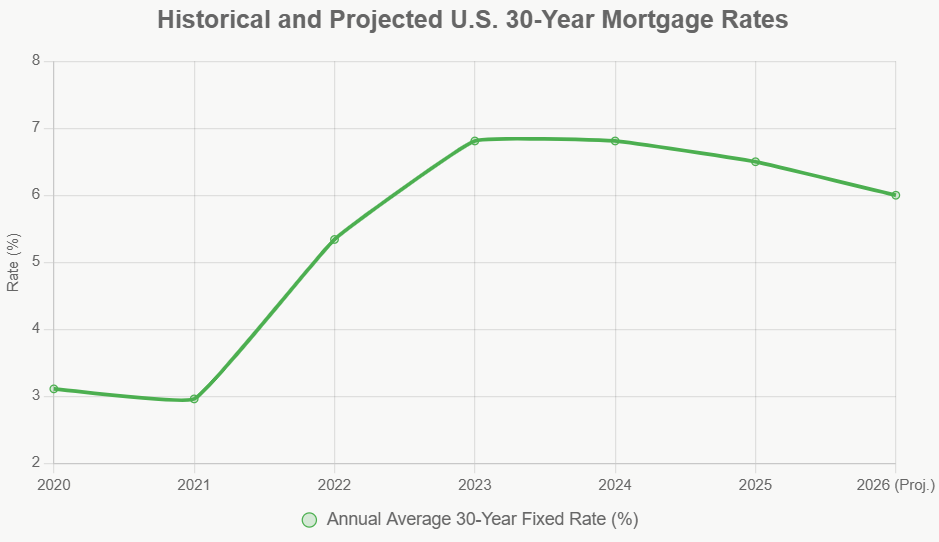
Here's a quick recap of the annual average rates for a 30-year fixed mortgage:

Year Annual Average 30-Year Fixed Rate Key Events
2020 3.11% Pandemic stimulus; rates hit historic lows.
2021 2.96% Continued easy money; home sales boomed.
2022 5.34% Fed hikes to combat inflation; rates doubled.
2023 6.81% Peak inflation; affordability crisis deepened.
2024 6.81% Stubborn inflation kept rates elevated.
2025 ~6.50% (estimated) Modest Fed cuts; rates begin easing.

Data sourced from Freddie Mac and Fannie Mae reports for historical periods; estimates for recent years.

Projected 30-Year Mortgage Rate for 2026

This history shows just how sensitive mortgage rates are to what's happening in the broader economy. The current dip from the peak isn't the end of the story; it's more like the beginning of a slow, steady descent that experts believe will continue into 2026.

What's Driving the Predicted Drop?

So, what's behind this optimistic forecast for lower rates? It's a confluence of several key economic factors that are expected to play out over the next year and a half. If these trends hold, we should see mortgage rates moving into that desirable high 5% range.

  1. Federal Reserve Rate Cuts: The Federal Reserve has been using interest rates as its main tool to control inflation. As inflation shows signs of cooling, the Fed is expected to start cutting its benchmark interest rate. We’ve already seen some cuts, and the consensus is that there will be more in 2025 and into 2026. When the Fed cuts rates, it usually makes borrowing money cheaper across the board, including for mortgages. Expert projections suggest the federal funds rate could be around 2.9% by 2026, which is a significant shift from where it has been. This typically translates into lower mortgage rates, as they tend to follow the yields on longer-term government bonds, like the 10-year Treasury note.
  2. Moderating Inflation: This is arguably the biggest driver. Inflation has been a concern for a while, pushing rates up to combat rising prices. However, forecasts from institutions like Fannie Mae project inflation to cool down to around 2.7% by the end of 2026. When inflation is under control, there's less pressure on the Fed to keep interest rates high, and creditors become more willing to lend money at lower rates over longer periods.
  3. Stable Economic Growth: The ideal scenario for lower rates is a “soft landing”—where the economy slows down just enough to curb inflation without tipping into a full-blown recession. Projections for GDP growth in 2026 are around 1.9%, which is robust enough to keep things humming but not so strong that it fuels runaway price increases. Unemployment is expected to rise slightly to around 4.2%, which could further encourage the Fed to lower rates.
  4. Housing Supply Increasing (Slowly): While home prices have been a major hurdle, there's a hopeful sign that housing inventory might increase. Projections suggest a 10%–15% rise in available homes. This could help ease some of the intense price pressure we've seen, making affordability a bit better even if rates don't drop dramatically.

Expert Forecasts: A Consensus with Nuances

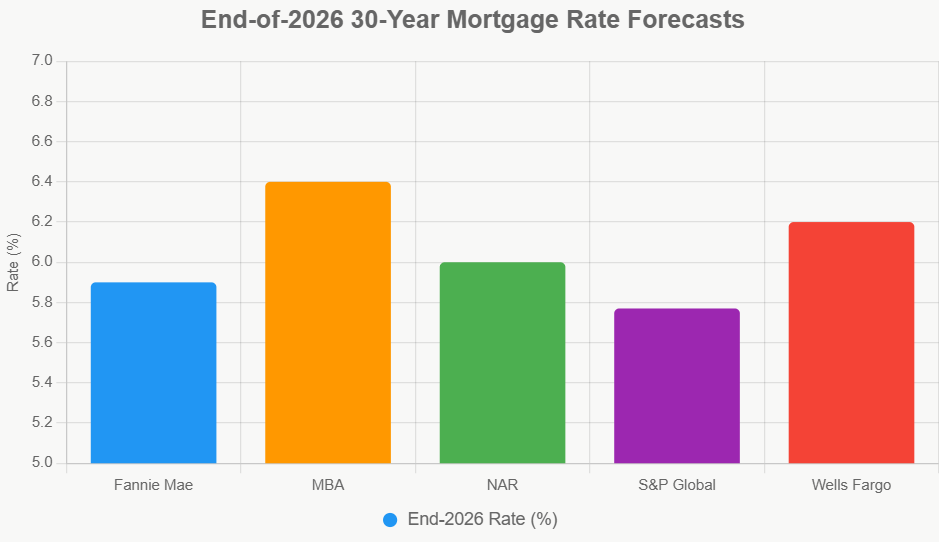
End-of-2026 30-Year Mortgage Rate Forecasts

While the general trend is optimistic, it's always wise to look at what different experts are saying. There's a good amount of agreement that we'll see rates ease, but the exact number and the speed of the decline can vary.

Here’s a snapshot of some forecasts for the 30-year fixed mortgage rate:

Forecaster Q1 2026 Q2 2026 Q3 2026 Q4 2026 Annual Avg. (2026)
Fannie Mae 6.2% 6.1% 6.0% 5.9% 6.0%
Mortgage Bankers Assoc. (MBA) 6.4% 6.4% 6.4% 6.4% 6.4%
National Assoc. of Realtors (NAR) 6.0% 6.0% 6.0% 6.0% 6.0%
S&P Global —- —- —- —- ~5.77%
Wells Fargo 6.15% 6.15% 6.20% 6.20% 6.2%

Note: Freddie Mac has indicated a general expectation for rates to be below 6% for the year, but specific quarterly predictions are not as granular.

As you can see, Fannie Mae and NAR are quite optimistic, predicting rates to touch the high 5% range by the end of 2026. The MBA is a bit more cautious, holding steady at 6.4%, and Wells Fargo falls in the middle. S&P Global's annual average prediction is the most aggressive, suggesting rates could dip into the mid-5% range.

What causes these differences? It often comes down to how quickly different economists believe inflation will fall, how aggressively the Fed will cut rates, and how resilient the overall economy remains. For instance, the MBA might be factoring in stronger economic growth or stickier inflation than Fannie Mae.

What This Means for You: Buyers and Refinancers

This projected drop in mortgage rates isn't just an abstract economic indicator; it has real, tangible impacts on people looking to buy a home or refinance their existing mortgage.

For Homebuyers:

  • Increased Affordability: A rate dip to, say, 5.9% could make a significant difference. The National Association of Realtors estimates this could add over 1.5 million households who now qualify for a mortgage that they couldn't before. This means more people can enter the market.
  • Boost in Home Sales: With improved affordability, sales could see a noticeable bump. NAR predicts existing home sales could rise by 14% to about 4.3 million units by late 2026. Imagine more homes changing hands as buyers take advantage of better borrowing costs.
  • Offsetting High Home Prices: While lower rates are great, home prices have been stubbornly high. While the pace of price increases is expected to slow (perhaps to 2%–3% annually), they might still climb, meaning the savings from lower rates might not completely negate the cost of the home itself. Even so, lower monthly payments on a larger loan amount still offer significant relief.
  • First-Time Buyers: Lower rates are particularly crucial for first-time homebuyers who often have tighter budgets. Programs like FHA and VA loans, which track conventional mortgage rates, could become even more attractive.

For Refinancers:

  • Significant Savings: If you have a mortgage with a rate above, say, 6.5%, dropping to 5.9% could lead to substantial monthly savings. For a $300,000 loan, that could mean saving around $110 per month, adding up to over $39,000 across the life of the loan.
  • Refinance Boom: Fannie Mae projects a 37% surge in refinance volume, reaching approximately $724 billion. This indicates that a lot of people will likely look to lock in these lower rates and reduce their monthly housing costs.
  • Breaking Even: It's important for those considering refinancing to look at the closing costs involved. While the monthly savings are enticing, you'll want to make sure you plan to stay in your home long enough for the savings to outweigh the upfront expenses.

Navigating the Road Ahead: What Should You Do?

Knowing that rates are predicted to drop is one thing; acting on it is another. Here are a few thoughts from my experience:

  • If You're Buying Soon: If you're already in the market and have found a home you love, don't necessarily wait indefinitely for rates to hit rock bottom, especially if your current rate options are much higher. You might consider locking in a rate now if you find a deal that works for you. Mortgages are long-term commitments, and securing a good rate now, even if it's a bit higher than the projected future low, could still be better than waiting and risking rising rates or missing out on a home. Sometimes, the best time to buy is when you find the right home and it fits your budget today.
  • If You're Planning to Refinance: Keep a close eye on rate movements. As rates fall into the high 5% range, it might be the perfect time to evaluate your current loan. Reach out to a lender, get quotes, and do the math to see if refinancing makes sense for your financial situation. Even a small drop can be significant over time.
  • Stay Informed: This isn't a static situation. Follow economic news, particularly reports on inflation and Federal Reserve announcements. Resources like Freddie Mac's Primary Mortgage Market Survey and reports from Fannie Mae and NAR are excellent for staying up-to-date.

While the prediction of mortgage rates falling to the high 5% range by the end of 2026 is cause for optimism, it's essential to remember that these are forecasts. Economic conditions can change, and unforeseen events can impact rate movements. However, the current data and expert opinions provide a strong indication of a more favorable lending environment in the not-too-distant future. This could be the break many have been waiting for to achieve their homeownership dreams or improve their financial situation through refinancing.

🏡 Which Rental Property Would YOU Invest In?

Birmingham, AL
🏠 Property: 7th Ave S
🛏️ Beds/Baths: 3 Bed • 2 Bath • 1150 sqft
💰 Price: $155,000 | Rent: $1,210
📊 Cap Rate: 7.4% | NOI: $953
📅 Year Built: 1947
📐 Price/Sq Ft: $135
🏙️ Neighborhood: C+

VS

Saint Louis, MO
🏠 Property: Elbring Dr
🛏️ Beds/Baths: 3 Bed • 1 Bath • 864 sqft
💰 Price: $135,000 | Rent: $1,300
📊 Cap Rate: 9.1% | NOI: $1,022
📅 Year Built: 1959
📐 Price/Sq Ft: $157
🏙️ Neighborhood: B+

Two affordable rentals with solid returns: Birmingham’s steady performer vs St. Louis’s higher cap rate. Which fits YOUR investment strategy?

📈 Choose Your Winner & Contact Us Today!

Talk to a Norada investment counselor (No Obligation):

(800) 611-3060

Contact Us Now 

Invest in Fully Managed Rentals for Smarter Wealth Building

With mortgage rates dipping to their lowest levels in months, savvy investors are seizing the opportunity to lock in financing.

By securing favorable terms now, you can also maximize immediate cash flow while positioning yourself for stronger long‑term returns.

Norada Real Estate helps you seize this rare opportunity with turnkey rental properties in strong markets—so you can build passive income while borrowing costs remain historically low.

🔥 HOT NEW LISTINGS JUST ADDED! 🔥

Talk to a Norada investment counselor today (No Obligation):

(800) 611-3060

Get Started Now

Also Read:

  • Mortgage Rates Predictions Backed by 7 Leading Experts: 2025–2026
  • Mortgage Rate Predictions for the Next 3 Years: 2026, 2027, 2028
  • 30-Year Fixed Mortgage Rate Forecast for the Next 5 Years
  • 15-Year Fixed Mortgage Rate Predictions for Next 5 Years: 2025-2029
  • Will Mortgage Rates Ever Be 3% Again in the Future?
  • Mortgage Rates Predictions for Next 2 Years
  • Mortgage Rate Predictions for Next 5 Years
  • Mortgage Rate Predictions: Why 2% and 3% Rates are Out of Reach
  • How Lower Mortgage Rates Can Save You Thousands?
  • How to Get a Low Mortgage Interest Rate?
  • Will Mortgage Rates Ever Be 4% Again?

Filed Under: Financing, Mortgage Tagged With: Interest Rate, mortgage, Mortgage Rate Trends, mortgage rates, Mortgage Rates Today

30-Year Fixed Mortgage Rate Drops to 6.03% Making it a Good Time for Buyers

December 21, 2025 by Marco Santarelli

30-Year Fixed Mortgage Rate Drops to 6.03% Making it a Good Time for Buyers

If you're dreaming of owning a home, or perhaps looking to refinance your current one, you'll want to pay attention to this: the 30-year fixed mortgage rate has dipped to a promising 6.03%. This isn't just a number; it's a signal that could make the idea of homeownership, or securing a better deal on your existing mortgage, much more achievable right now.

30-Year Fixed Mortgage Rate Drops to 6.03% Making it a Good Time for Buyers

As of December 21, 2025, according to Zillow's latest data, mortgage rates are not making huge jumps up or down, which actually creates a pretty stable environment for buyers and those looking to refinance. This general stability, especially with the key 30-year fixed rate settling at 6.03%, means that many folks who were on the fence might find this a really opportune time to act.

For months, we’ve been watching these rates. They’ve been influenced by a lot of things going on in the wider economy – like how the 10-year Treasury yield is doing, what people think inflation will do, and how strong our economy is overall. Even though the Federal Reserve recently made a move to cut its short-term rate, its message about a possible pause created some mixed signals for the mortgage market. But one thing is clear: rates are holding steady enough to be attractive.

Why the 6.03% 30-Year Fixed Mortgage Rate Matters for You

Think about it. When mortgage rates are higher, every dollar you borrow costs you more in interest over the life of your loan. A lower rate, like this 6.03% for a 30-year fixed mortgage, directly translates to more affordable monthly payments. This affordability can be the difference between being able to buy the home you want, or needing to settle for something less, or even putting off your buying plans altogether.

This current rate is a noticeable drop from what we saw in previous years. This improvement has already led to a 10% increase in purchase applications, as reported by Zillow. People are responding to this more favorable environment.

On the flip side, this lower rate environment has also created a bit of a housing market puzzle. Many homeowners who locked in really low rates (think under 4%) are understandably hesitant to sell. Why would they trade a super cheap mortgage for a new one at a higher rate? This reluctance is contributing to a shortage of homes for sale, which, in turn, is keeping home prices higher than some might expect. It’s a bit of a double-edged sword for the market, but for a buyer today, the lower rate is a definite plus.

Understanding Your Mortgage Options: A Quick Look

When you're thinking about a mortgage, you'll hear about different loan terms. The two big ones are the 30-year fixed and the 15-year fixed. I've helped countless people navigate these choices, and understanding the core differences is key to making the right decision for your financial life.

Here’s a simple breakdown:

Feature 30-Year Fixed 15-Year Fixed
Loan Term 30 years 15 years
Monthly Payment Lower (spread out over a longer time) Higher (shorter repayment window)
Interest Rate Typically a little higher Typically lower
Total Interest Much higher over the life of the loan Much lower over the life of the loan
Equity Build-Up Slower Faster
Affordability Easier for managing monthly cash flow, more budget-friendly Requires stronger income or strict budget discipline
Best For Buyers needing lower payments, more financial flexibility Buyers focused on long-term savings, quick debt payoff

Why a 30-Year Fixed Might Be Your Best Bet Right Now

From my experience, the 30-year fixed mortgage remains the most popular choice for a reason. At 6.03%, it offers incredible advantages:

  • Lower Monthly Payments: This is the big one. A lower monthly payment makes affording a home much more realistic, especially for first-time buyers or those who want to keep more cash on hand for other expenses or investments.
  • Financial Flexibility: Having that lower payment frees you up financially. You might have more room to save for retirement, pay down other debts, invest, or handle unexpected costs.
  • Accessibility: For many, the lower barrier to entry in terms of monthly cost makes homeownership attainable when higher payments just wouldn't work with their budget.

A Word on the 15-Year Fixed

Honestly, the 15-year fixed mortgage, currently at 5.42%, is a fantastic option if your financial situation allows. You'll pay significantly less in total interest over the life of the loan and build equity a lot faster. This is great if your goal is to be mortgage-free as soon as possible and you can comfortably manage the higher monthly payments. However, for a lot of people, the jump in monthly cost from a 30-year to a 15-year can be too much, even with the lower interest rate.

Navigating the Risks and Trade-Offs

It's always wise to look at both sides of the coin.

  • With a 30-Year Fixed: The main drawback is that you'll end up paying more in total interest over the 30 years. Also, because you're spreading your payments out, your home equity will build up at a slower pace.
  • With a 15-Year Fixed: The higher monthly payments, while good for savings long-term, can put a strain on your budget in the short term. This might limit your flexibility for other important financial goals or needs.

The Rate Environment and What Experts Are Saying

While the 30-year fixed mortgage rate at 6.03% is certainly encouraging, it's important to know that this stability isn't expected to last forever in the super-low 5% range. Most experts, including those at Zillow, anticipate that rates will likely stay above 6% for the foreseeable future. They’re predicting moderation around 6.25% to 6.50% as we move into early 2026.

This forecast suggests that while we might see small dips and rises, the extremely low rates of the past are unlikely to return soon. This makes the current moment a potentially significant window for buyers.

My Take: If You're Ready, Now Is a Great Time to Explore

As someone who's seen the housing market through various cycles, I can tell you that a 6.03% 30-year fixed mortgage rate is a compelling offer. It strikes a good balance between affordability and long-term stability.

Remember, these national averages are just that – averages. Your actual rate will depend on your credit score, the type of loan, the lender, and even your location. So, my strongest advice is always this: shop around. Talk to at least three different lenders. Compare their Good Faith Estimates. Don't just look at the advertised rate; look at the Annual Percentage Rate (APR), which includes fees, and understand all the terms.

If you've been waiting for the stars to align for homeownership, or for a more favorable refinancing option, the current mortgage rate environment is definitely worth your serious consideration. The market is offering a solid opportunity, and acting thoughtfully now could put you in a much better financial position for years to come.

🏡 Which Rental Property Would YOU Invest In?

Birmingham, AL
🏠 Property: 7th Ave S
🛏️ Beds/Baths: 3 Bed • 2 Bath • 1150 sqft
💰 Price: $155,000 | Rent: $1,210
📊 Cap Rate: 7.4% | NOI: $953
📅 Year Built: 1947
📐 Price/Sq Ft: $135
🏙️ Neighborhood: C+

VS

Saint Louis, MO
🏠 Property: Elbring Dr
🛏️ Beds/Baths: 3 Bed • 1 Bath • 864 sqft
💰 Price: $135,000 | Rent: $1,300
📊 Cap Rate: 9.1% | NOI: $1,022
📅 Year Built: 1959
📐 Price/Sq Ft: $157
🏙️ Neighborhood: B+

Two affordable rentals with solid returns: Birmingham’s steady performer vs St. Louis’s higher cap rate. Which fits YOUR investment strategy?

📈 Choose Your Winner & Contact Us Today!

Talk to a Norada investment counselor (No Obligation):

(800) 611-3060

Contact Us Now 

Invest in Fully Managed Rentals for Smarter Wealth Building

With mortgage rates dipping to their lowest levels in months, savvy investors are seizing the opportunity to lock in financing.

By securing favorable terms now, you can also maximize immediate cash flow while positioning yourself for stronger long‑term returns.

Norada Real Estate helps you seize this rare opportunity with turnkey rental properties in strong markets—so you can build passive income while borrowing costs remain historically low.

🔥 HOT NEW LISTINGS JUST ADDED! 🔥

Talk to a Norada investment counselor today (No Obligation):

(800) 611-3060

Get Started Now

Also Read:

  • Mortgage Rates Predictions Backed by 7 Leading Experts: 2025–2026
  • Mortgage Rate Predictions for the Next 3 Years: 2026, 2027, 2028
  • 30-Year Fixed Mortgage Rate Forecast for the Next 5 Years
  • 15-Year Fixed Mortgage Rate Predictions for Next 5 Years: 2025-2029
  • Will Mortgage Rates Ever Be 3% Again in the Future?
  • Mortgage Rates Predictions for Next 2 Years
  • Mortgage Rate Predictions for Next 5 Years
  • Mortgage Rate Predictions: Why 2% and 3% Rates are Out of Reach
  • How Lower Mortgage Rates Can Save You Thousands?
  • How to Get a Low Mortgage Interest Rate?
  • Will Mortgage Rates Ever Be 4% Again?

Filed Under: Financing, Mortgage Tagged With: Interest Rate, mortgage, Mortgage Rate Trends, mortgage rates, Mortgage Rates Today

Mortgage Rates Today, Dec 21: 30-Year Refinance Rate Rises by 21 Basis Points

December 21, 2025 by Marco Santarelli

Mortgage Rates Today, Jan 1, 2026: 30-Year Refinance Rate Rises by 48 Basis Points

If you're a homeowner thinking about refinancing your mortgage, it's important to know that rates are on the move. As of December 21, 2025, the average rate for a 30-year fixed refinance loan has gone up by 21 basis points to 6.88%, according to Zillow. This uptick means that if you're looking to refinance, acting quickly and comparing offers from different lenders could save you more money in the long run.

Mortgage Rates Today, Dec 21: 30-Year Refinance Rate Rises by 21 Basis Points

Understanding the Rate Hike: What Exactly is a Basis Point?

I know when I see terms like “basis points,” it can sound a little confusing. Let's break it down. A basis point is just a tiny unit of measurement used for interest rates and other financial percentages. Specifically, 1 basis point equals 0.01%. So, when we say the 30-year fixed refinance rate rose by 21 basis points, it means it went up by 0.21%. This might not seem like much, but believe me, in the world of mortgages, even small changes can add up over time, and that's why we pay close attention.

The Real Impact: How a 21 Basis Point Rise Affects Your Wallet

To put it plainly, that small jump from last week's average of 6.67% to today's 6.88% makes a difference you can see on your monthly statement. Let's imagine you have a $300,000 loan.

Interest Rate Estimated Monthly Payment (Principal & Interest) Monthly Increase
6.67% $1,939 —
6.88% $1,963 +$24/month

So, that increase of 0.21% means your monthly payment for that $300,000 loan goes up by about $24. Now, $24 might not sound like a huge deal on its own. But let's think about it over the life of a mortgage.

  • Yearly Impact: That $24 extra per month adds up to an additional $288 per year.
  • 30-Year Impact: Over the full 30 years of your loan, that seemingly small amount translates to an extra $8,640 in interest payments.

This is precisely why I always tell people to take these numbers seriously. Refinancing is a big decision, and understanding these cost differences is crucial for making the best choice for your financial future.

Why This Matters to You Right Now

The current trend shows that mortgage rates are generally trending upward for fixed-rate loans. This suggests that the window for securing a lower refinance rate might be closing, at least for now. Being aware of these movements helps you make more informed decisions. It underscores the importance of:

  • Timing is Key: If you've been on the fence about refinancing, seeing rates tick up is a good reminder to explore your options sooner rather than later.
  • Shop Around: National averages are a good benchmark, but they're just averages. The rate you'll actually get depends on many factors, including your credit score, the type of loan you choose, and most importantly, the lender you pick. I've seen firsthand how much variance there can be between lenders for the exact same loan.

Looking at Other Refinance Options

While the 30-year fixed is the most popular for its predictable monthly payments, it's always wise to see what else is out there.

  • 15-Year Fixed Refinance Rates: Currently averaging around 5.78%, this option is up 16 basis points from its recent average. Although your monthly payments will be higher for a 15-year loan, you'll pay off your mortgage much faster and save a significant amount on interest over the loan's life. It's a trade-off between immediate monthly cost and long-term savings.
  • 5-Year Adjustable-Rate Mortgage (ARM) Refinance Rates: These are holding steady at 7.11%. ARMs can sometimes offer lower introductory rates to start, but the risk is that they can increase after the initial period. With rates already above 7%, anyone considering an ARM should think carefully about how much their payments could rise in the future and if they can comfortably afford that.

Recommended Read:

30-Year Fixed Refinance Rate Trends – December 20, 2025

Best Time to Refinance Your Mortgage: Expert Insights

Should You Refinance Your Mortgage Now or Wait Until 2026? 

Recent Market Trends and What They Mean

It’s helpful to understand the bigger picture. The Federal Reserve has made some interest rate adjustments, but it's important to remember that mortgage rates don't directly follow the Fed's changes. They're influenced by a lot of factors, including, as we're seeing, lingering inflation worries.

Interestingly, despite the recent rise, refinance activity has actually seen a big jump compared to last year. This is likely driven by homeowners who bought when rates were much higher, perhaps near the peak in 2023, and are now looking to lower their payments.

However, a significant portion of homeowners – roughly 70% – still have mortgage rates below 5%. For these folks, there's not much incentive to refinance right now, as their current rates are still quite attractive.

What Can We Expect in 2026?

Forecasting interest rates is always tricky, but the general consensus among economists is that refinance rates are likely to remain relatively stable or see only slight decreases in the coming year. Some projections suggest the 30-year fixed rate might dip closer to 5.9% by the end of 2026, while others anticipate an average around 6.4% throughout the year. It seems unlikely we'll see a dramatic drop unless there's a major shake-up in the economy, like a recession.

My Take on Today's Rates

As someone who has followed the housing market for a while, I see these rate movements as a signal that we're in a period of adjustment. The days of the ultra-low 3% rates are likely behind us for the foreseeable future. This means that for homeowners wanting to refinance, being strategic is more important than ever.

  • Don't delay if you see a rate you like.
  • Get pre-approved to understand your buying power.
  • Speak with multiple lenders. Seriously, I can't stress this enough. Even a slightly better rate from another bank could save you thousands.
  • Consider your long-term financial goals. Is paying off your mortgage faster more important than a slightly lower monthly payment today?

We are currently seeing the average rate for a 30-year fixed refinance at 6.88%, a 15-year fixed at 5.78%, and a 5-year ARM at 7.11%, as of December 21, 2025. These figures from Zillow are a snapshot, and your personal situation will dictate the best path forward.

“Invest Smart — Build Long-Term Wealth Through Real Estate”

Norada's team can guide you through current market dynamics and help you position your investments wisely—whether you're looking to reduce rates, pull out equity, or expand your portfolio.

Work with us to identify proven, cash-flowing markets and diversify your portfolio while borrowing costs remain favorable.

HOT NEW TURNKEY DEALS JUST LISTED!

Speak with a seasoned Norada investment counselor today (No Obligation):

(800) 611-3060

Get Started Now

Recommended Read:

  • When You Refinance a Mortgage Do the 30 Years Start Over?
  • Should You Refinance as Mortgage Rates Reach Lowest Level in Over a Year?
  • NAR Predicts 6% Mortgage Rates in 2025 Will Boost Housing Market
  • Mortgage Rates Predictions for 2025: Expert Forecast
  • Half of Recent Home Buyers Got Mortgage Rates Below 5%
  • Mortgage Rates Need to Drop by 2% Before Buying Spree Begins
  • Will Mortgage Rates Ever Be 3% Again: Future Outlook
  • Mortgage Rates Predictions for Next 2 Years
  • Mortgage Rate Predictions for Next 5 Years
  • Mortgage Rate Predictions for 2025: Expert Forecast

Filed Under: Financing, Mortgage Tagged With: mortgage, mortgage rates, Mortgage Refinance Rates

Today’s Mortgage Rates, Dec 20: Steady Rates Signal Strong Buying and Refinance Demand

December 20, 2025 by Marco Santarelli

Today's Mortgage Rates, Jan 7: Stable Rates Continue for Buyers and Refinancers

As of December 20th, 2025, today's mortgage rates are holding steady, with the average 30-year fixed mortgage rate at 6.03% and the 15-year fixed rate at 5.42%, according to Zillow. While these figures provide a snapshot of the market, understanding what they truly mean for your homeownership journey requires digging a little deeper. It's not just about the numbers; it's about how those numbers can either open doors or create hurdles for you when buying or refinancing.

Today’s Mortgage Rates, Dec 20: Steady Rates Signal Strong Buying and Refinance Demand

Current Mortgage Rates 

Here's a clean look at the rates Zillow reported for today, December 20th, 2025. These are average figures, meaning your actual rate might be a bit different based on your credit score, loan amount, and other factors.

Loan Type Interest Rate
30‑year fixed 6.03%
20‑year fixed 5.95%
15‑year fixed 5.42%
5/1 ARM 6.03%
7/1 ARM 6.18%
30‑year VA 5.46%
15‑year VA 5.05%
5/1 VA 5.16%

Remember, these are national averages, so always shop around with different lenders.

Current Mortgage Refinance Rates

If you're a current homeowner thinking about refinancing, the rates are slightly different. Refinancing can be a smart move to lower your monthly payments or shorten your loan term, but it's crucial to compare these rates to your current loan and the purchase rates.

Loan Type Interest Rate
30‑year fixed 6.17%
20‑year fixed 5.99%
15‑year fixed 5.63%
5/1 ARM 6.44%
7/1 ARM 6.36%
30‑year VA 5.63%
15‑year VA 5.31%
5/1 VA 5.44%

What Does This Mean for You, the Borrower?

Seeing these numbers is one thing, but understanding their impact is another. Let’s break down what these rates tell us and what you should be thinking about:

  • Stability is the Name of the Game: The fact that major rates are hovering around the 6% mark means things are relatively predictable right now. This stability can be good for planning, whether you're buying your first home or looking to buy a bigger one. Gone are the days of the super low rates, but we're also not seeing wild spikes.
  • Refinancing: Still Worth a Look?: While refinance rates are a hair higher than purchase rates (which is pretty common), they aren't drastically out of reach. If you secured a loan a few years ago when rates were higher, a refinance today could still save you money, especially if you plan to stay in your home a good while.
  • The Power of Comparison: This is my golden rule for anyone looking for a mortgage. Don't just go with the first lender you talk to. Different lenders have different offers, fees, and ways of assessing risk. Spending a little time comparing quotes can easily save you thousands. I've seen firsthand how borrowers who shop around end up with significantly better deals.
  • Fixed vs. Adjustable: Your Personal Choice: The big decision is often between a fixed-rate loan and an adjustable-rate mortgage (ARM). Fixed rates give you peace of mind knowing your payment won't change, ever. ARMs can offer a lower rate at first, but that rate can go up later, making your payments unpredictable. Your choice depends heavily on your financial situation and how long you plan to keep the home.

A Deeper Dive into Loan Types

Let's get into the specifics of the most common loan types so you can see which might be your best fit.

30-Year Fixed Mortgage: The Steadfast Choice

  • Rate Stability: This is the big draw. Your interest rate is locked in for the entire 30 years you have to pay back the loan. No surprises!
  • Monthly Payments: Because you're spreading the repayment over a long time, your monthly payments will be lower than with shorter loan terms. This makes it easier for many people to afford a home.
  • Best For: If you like predictable monthly bills, plan to stay in your home for many years, and want to keep your housing costs consistent, this is likely your best bet.
  • Trade-Off: You'll typically pay more in total interest over the life of the loan compared to a shorter-term mortgage, simply because you're borrowing for so long.

15-Year Fixed Mortgage: The Faster Track

  • Rate Stability: Just like the 30-year, your rate is locked in, but for half the time.
  • Monthly Payments: Be prepared for higher monthly payments. You're paying back the same amount of money in half the time, so each payment needs to be larger.
  • Best For: If you're looking to build equity in your home faster and want to save a significant amount on interest over the life of the loan, this is a powerful option. It's great if you have a stable income and can comfortably manage the higher payments.
  • Trade-Off: The higher monthly payments mean less flexibility in your budget. You need to be sure you can handle those larger payments consistently.

5/1 ARM (Adjustable-Rate Mortgage): The Short-Term Strategy

  • Rate Stability: This loan is fixed for the first five years. After that, the interest rate can change every year, usually based on market conditions.
  • Monthly Payments: During those initial five years, your payments are typically lower than a comparable fixed-rate loan. This can be a nice perk.
  • Best For: This loan is best for people who know they won't be in the house for a full 30 years. If you're planning to sell, move, or refinance within, say, five to seven years, an ARM can help you save money initially.
  • Trade-Off: The big risk comes after the fixed period. If interest rates go up, your monthly payments will increase, and they could become quite a bit higher than you're used to. It's a gamble if you're not prepared for market ups and downs.

Quick Snapshot: Comparing Your Options

Here’s a quick way to visualize the main differences:

Loan Type Initial Rate Payment Size Long-Term Cost (Interest) Best For
30‑Year Fixed Moderate Lower Higher interest overall Long-term stability, predictable budget
15‑Year Fixed Lower Higher Much less interest Faster payoff, significant interest savings
5/1 ARM Lowest (initial) Lowest (initial) Can rise sharply Short-term owners or those planning to refinance

In simple terms:

  • 30-year fixed: Focuses on keeping your monthly costs down and providing a steady payment for decades.
  • 15-year fixed: Aims for quicker debt freedom and substantial savings on interest, but demands higher monthly payments.
  • 5/1 ARM: Offers the lowest initial payments, ideal if you're a short-term resident or have a clear refinance plan, but comes with the uncertainty of future rate hikes.

Payment Breakdown: A $300,000 Loan Example

To really drive home the difference, let’s look at how a $300,000 loan would play out with these different rates and terms.

Loan Type Interest Rate Term (Years) Monthly Payment Total Interest Paid
30‑Year Fixed 6.03% 30 $1,805.62 $349,623.34
15‑Year Fixed 5.42% 15 $2,449.17 $139,850.56
5/1 ARM (initial rate) 6.03% 30 $1,805.62 $349,623.34 (initial estimate)

Key Takeaways: What the Numbers Truly Reveal

  • Monthly Budget Priority: If keeping your monthly payment as low as possible is your main goal, the 30-year fixed is your safest bet. That $1,806 payment offers a lot of breathing room.
  • Long-Term Savings Champion: If you want to be mortgage-free sooner and save boatloads on interest, the 15-year fixed is the way to go. It costs you about $644 more per month than the 30-year, but you save a staggering over $209,000 in interest! That’s a huge sum that could be used for other investments or life goals.
  • Short-Term Strategy with a Twist: The 5/1 ARM starts with the same attractive payment as the 30-year fixed. However, the key difference is what happens after year five. If rates climb, your $1,806 payment could jump significantly. This is only a good strategy if you have a solid plan to exit the loan before rate adjustments become painful.

The Bottom Line for December 20th

Today, December 20th, 2025, offers a mortgage market that’s relatively stable around the 6% mark for fixed-rate loans. Whether you're looking to buy or refinance, these numbers are a solid foundation for making informed decisions. My advice remains the same: always compare offers from multiple lenders. Even a quarter-point difference can add up to tens of thousands of dollars over the life of your loan. Your home is a massive investment, and securing the best possible mortgage rate is a critical step in making that investment work for you.

🏡 Which Rental Property Would YOU Invest In?

Birmingham, AL
🏠 Property: 7th Ave S
🛏️ Beds/Baths: 3 Bed • 2 Bath • 1150 sqft
💰 Price: $155,000 | Rent: $1,210
📊 Cap Rate: 7.4% | NOI: $953
📅 Year Built: 1947
📐 Price/Sq Ft: $135
🏙️ Neighborhood: C+

VS

Saint Louis, MO
🏠 Property: Elbring Dr
🛏️ Beds/Baths: 3 Bed • 1 Bath • 864 sqft
💰 Price: $135,000 | Rent: $1,300
📊 Cap Rate: 9.1% | NOI: $1,022
📅 Year Built: 1959
📐 Price/Sq Ft: $157
🏙️ Neighborhood: B+

Two affordable rentals with solid returns: Birmingham’s steady performer vs St. Louis’s higher cap rate. Which fits YOUR investment strategy?

📈 Choose Your Winner & Contact Us Today!

Talk to a Norada investment counselor (No Obligation):

(800) 611-3060

Contact Us Now 

Invest in Fully Managed Rentals for Smarter Wealth Building

With mortgage rates dipping to their lowest levels in months, savvy investors are seizing the opportunity to lock in financing.

By securing favorable terms now, you can also maximize immediate cash flow while positioning yourself for stronger long‑term returns.

Norada Real Estate helps you seize this rare opportunity with turnkey rental properties in strong markets—so you can build passive income while borrowing costs remain historically low.

🔥 HOT NEW LISTINGS JUST ADDED! 🔥

Talk to a Norada investment counselor today (No Obligation):

(800) 611-3060

Get Started Now

Also Read:

  • Mortgage Rates Predictions Backed by 7 Leading Experts: 2025–2026
  • Mortgage Rate Predictions for the Next 3 Years: 2026, 2027, 2028
  • 30-Year Fixed Mortgage Rate Forecast for the Next 5 Years
  • 15-Year Fixed Mortgage Rate Predictions for Next 5 Years: 2025-2029
  • Will Mortgage Rates Ever Be 3% Again in the Future?
  • Mortgage Rates Predictions for Next 2 Years
  • Mortgage Rate Predictions for Next 5 Years
  • Mortgage Rate Predictions: Why 2% and 3% Rates are Out of Reach
  • How Lower Mortgage Rates Can Save You Thousands?
  • How to Get a Low Mortgage Interest Rate?
  • Will Mortgage Rates Ever Be 4% Again?

Filed Under: Financing, Mortgage Tagged With: Interest Rate, mortgage, Mortgage Rate Trends, mortgage rates, Mortgage Rates Today

Housing Market Distress Mounts as Foreclosure Activity Rises for Ninth Month in a Row

December 20, 2025 by Marco Santarelli

Housing Market Distress Mounts as Foreclosure Activity Rises for Ninth Month in a Row

The U.S. housing market is showing clear signs of strain, with foreclosure filings increasing year-over-year for the ninth consecutive month, signaling a troubling shift for many homeowners and a potential inflection point for the real estate sector. This persistent rise in foreclosure activity, as reported by ATTOM, suggests that the economic pressures faced by a growing number of households are translating into tangible distress.

It’s hard not to feel a sense of unease when you see the numbers, and this latest report from ATTOM paints a picture that’s hard to ignore. For the ninth month straight, we’re seeing more homes going into some stage of the foreclosure process compared to the same time last year. This isn't just a blip; it's a trend. In November 2025, a total of 35,651 U.S. properties had foreclosure filings.

While this is a slight dip from October, it's a significant 21 percent jump from November of the previous year. When I look at this data, I see more than just numbers; I see families facing difficult decisions and a market that’s clearly under pressure.

Housing Market Distress Mounts as Foreclosure Activity Rises for Ninth Month in a Row

Why the Climb? Unpacking the Foreclosure Trend

As Rob Barber, CEO at ATTOM, points out, “Foreclosure starts were up 17 percent from last year and completed foreclosures rose 26 percent.” This indicates that more homeowners are falling behind on their payments and lenders are taking action. While these numbers are still lower than what we saw during the Great Recession, the consistent upward movement is a clear signal that the market is “normalizing,” as Barber puts it. But let’s be honest, for those directly affected, it feels more like a significant struggle against higher housing costs and shifting economic pressures.

From my perspective, several factors are likely contributing to this escalating trend:

  • Elevated Interest Rates: Many homeowners who bought or refinanced when interest rates were at historic lows are now facing much higher payments if they need to move or if their adjustable-rate mortgages reset. This can put a severe strain on household budgets.
  • Inflationary Pressures: The cost of everyday goods and services remains high, squeezing disposable income. When there's less money left after covering essential expenses, mortgage payments can become harder to manage.
  • Job Market Uncertainty: While the job market has shown resilience, there are pockets of instability. Layoffs and reduced hours can quickly lead to homeowners being unable to meet their financial obligations.
  • Stagnant or Declining Home Equity in Some Areas: In some regions, home price appreciation has slowed or even reversed. This can leave homeowners with little to no equity to tap into if they need cash, making it harder to stave off foreclosure.

Where is the Distress Most Pronounced?

The ATTOM report highlights specific states and metropolitan areas that are seeing the brunt of this foreclosure surge. It's important to look at these areas to understand the localized impacts.

States with the Worst Foreclosure Rates (November 2025):

State Foreclosure Rate (1 in X housing units)
Delaware 1,924
South Carolina 1,973
Nevada 2,373
New Jersey 2,511
Florida 2,565

Nationwide, one in every 3,992 housing units had a foreclosure filing. Seeing states like Delaware and South Carolina with rates more than double the national average is a serious concern. These aren't just statistics; they represent communities where people are struggling.

Among larger cities (metro areas with over 1 million people), Philadelphia, PA, recorded the highest foreclosure rate, with one filing for every 1,511 housing units. ATTOM notes this was partly due to a temporary spike from resumed data collection, which is expected to correct itself. However, other major metros also show significant distress:

  • Las Vegas, NV: 1 filing for every 2,013 housing units
  • Cleveland, OH: 1 filing for every 2,114 housing units
  • Orlando, FL: 1 filing for every 2,282 housing units
  • Tampa, FL: 1 filing for every 2,362 housing units

It’s interesting to note that even in these troubled areas, the overall volume of foreclosures remains historically lower than peak crisis times. This offers a sliver of hope, suggesting that perhaps more homeowners have built up equity or have better financial cushions than in the past.

Foreclosure Starts vs. Completed Foreclosures: What's the Difference?

It's crucial to understand the different stages of foreclosure.

  1. Foreclosure Starts: This is when lenders initiate the formal process, often with a notice of default or lis pendens. In November 2025, lenders started the foreclosure process on 23,720 U.S. properties. This is a 17 percent increase year-over-year.
  2. Completed Foreclosures (REOs – Real Estate Owned): This is when the lender repossesses the home. There were 3,884 completed foreclosures in November 2025, an increase of 26 percent from the previous year.

The fact that both starts and completions are rising indicates that the issue is widespread and moving through the pipeline at an accelerated pace.

States Leading in Foreclosure Starts (November 2025):

  1. Florida (2,819)
  2. Texas (2,612)
  3. California (2,090)
  4. New York (1,146)
  5. Illinois (1,075)

Interestingly, some major metropolitan areas, which typically see high numbers, actually experienced decreases in foreclosure starts compared to last year. For example, Boston, Miami, and Sacramento showed declines. This could suggest localized economic recovery in those specific urban centers, or perhaps more effective loss mitigation strategies being implemented there.

Looking Ahead: What Does This Mean for the Housing Market?

The steady rise in foreclosure activity is a strong indicator that the housing market is facing significant headwinds. As an observer of the real estate world, I see this as a natural, albeit painful, correction after years of rapid price growth and low interest rates.

  • Potential Increase in Available Inventory: As more homes enter the foreclosure process and are eventually repossessed, the supply of homes for sale could increase. This might help to stabilize or even slightly decrease home prices in some areas, which could be a welcome development for potential buyers struggling with affordability.
  • Impact on Home Prices: A sustained increase in supply, particularly of distressed properties, could put downward pressure on home prices. However, the extent of this impact will vary greatly by region, depending on local demand, economic conditions, and the sheer volume of foreclosures.
  • Opportunities for Investors: For those with the capital and expertise, rising foreclosures can present opportunities to acquire properties at a discount. However, this market requires careful due diligence and a solid understanding of the risks involved.
  • Challenge for Homeowners: For homeowners facing foreclosure, this is a deeply stressful time. It underscores the importance of proactive financial planning and seeking help from housing counselors or legal aid if needed.

While the situation is concerning, it’s important to remember that we are not in a widespread housing crisis on the scale of 2008. The market has more equity, and lending standards are generally tighter. However, the ongoing rise in foreclosure activity is a clear warning sign that we need to pay close attention to the economic well-being of homeowners and the stability of the housing market.

Secure Your Retirement with Cash-Flowing Rental Properties

Turnkey real estate offers a low-hassle way to generate passive income and build long-term financial security—perfect for retirement-focused investors.

Norada Real Estate helps you invest in stable, high-demand markets that deliver consistent monthly cash flow and equity growth over time.

🔥 HOT NEW LISTINGS JUST ADDED! 🔥

Talk to a Norada investment counselor today (No Obligation):

(800) 611-3060

Get Started Now

Want to Know More About Foreclosure Trends?

Explore these related articles for even more insights:

  • Zombie Foreclosures Decline Nationwide Amidst Peak Housing Demand
  • Housing Markets With the Highest Zombie Foreclosure Rates in 2025
  • 5 States Facing the Highest Foreclosure Rates in 2025
  • Housing Market Alert: Rising Foreclosures in 2025 Signal Deeper Trouble Ahead
  • Housing Markets With the Highest Zombie Foreclosure Rates in 2025
  • US Foreclosure Activity Drops by 10% in 2024: A Sign of Stability?
  • New Jersey Stands Out With Highest Foreclosure Rate Last Month
  • Is the Housing Market Recovering? A Look at Recent Trends
  • US Housing Market Sees Worst Year for Sales Since 1995
  • Nearly 100,000 U.S. Properties Faced Foreclosure Filings in Q1 2024

Filed Under: Foreclosures, Housing Market Tagged With: foreclosure, foreclosure rate, Housing Market, REO

  • « Previous Page
  • 1
  • …
  • 89
  • 90
  • 91
  • 92
  • 93
  • …
  • 389
  • Next Page »

Real Estate

  • Birmingham
  • Cape Coral
  • Charlotte
  • Chicago

Quick Links

  • Markets
  • Membership
  • Notes
  • Contact Us

Blog Posts

  • Today’s Mortgage Rates, Sept 8: Oil Tops $93 a Barrel, Adding Pressure to Mortgage Rates
    September 8, 2026Marco Santarelli
  • Mortgage Rates Today, Sept 8, 2026: 30-Year Refinance Rate Rises by 19 Basis Points
    September 8, 2026Marco Santarelli
  • Today’s Mortgage Rates, Sept 7: Buyers Get a Better Deal Than Refinancers Right Now
    September 7, 2026Marco Santarelli

Contact

Norada Real Estate Investments 30251 Golden Lantern, Suite E-261 Laguna Niguel, CA 92677

(949) 218-6668
(800) 611-3060
BBB
  • Terms of Use
  • |
  • Privacy Policy
  • |
  • Testimonials
  • |
  • Suggestions?
  • |
  • Home

Copyright 2018 Norada Real Estate Investments

Loading...