Norada Real Estate Investments

  • Home
  • Markets
  • Properties
  • Membership
  • Podcast
  • Learn
  • About
  • Contact

Federal Reserve Interest Rate Predictions for the Next 2 Years

August 21, 2025 by Marco Santarelli

Federal Reserve Interest Rate Predictions for the Next 2 Years

Are you wondering where interest rates are heading? You're not alone! The Federal Reserve's (the Fed's) interest rate decisions affect everything from your mortgage payments to the growth of your investments. So, what's the scoop for the next two years? Expert predictions suggest a gradual decrease in interest rates.

As of August 2025, the federal funds rate sits at 4.25%-4.50%. Experts at the Federal Reserve and major financial institutions anticipate rates moving downward, although the pace and extent of these cuts remain uncertain, driven by factors like inflation, economic growth, and global events. Let's dive deep into what's influencing these predictions and what they mean for you.

Federal Reserve Interest Rate Predictions for the Next 2 Years

Before we get into the nitty-gritty, let's remember why paying attention to interest rates is so important. Think of them as the price of borrowing money.

  • For You: They affect how much you pay for mortgages, car loans, credit cards, and how much you earn on your savings. Lower rates mean cheaper loans but smaller returns on your savings.
  • For Businesses: They influence how much it costs companies to borrow money to invest and expand.
  • For the Economy: They help control inflation (rising prices) and support economic growth.

Basically, they are a big deal for all.

August 2025: Where Interest Rates Stand Right Now

As I write this in August 2025, the Federal Reserve (the Fed, for short) has kept the federal funds rate steady at a range of 4.25% to 4.50% in its July meeting. The Fed kept the rate unchanged for the fifth time in 2025. This federal funds rate is the benchmark interest rate for the US economy. It's what banks charge each other for overnight lending. It affects things like mortgages, credit cards, and savings accounts. The Fed put a hold on hiking interest rates after raising it many times in the recent past to try to curb inflation.

The Fed’s trying to balance controlling inflation, while making sure the economy keeps growing. It's a tough balancing act! The Fed's aiming for 2% inflation over the long term, and it's watching the data like a hawk before making any more moves.

Decoding the Fed's Crystal Ball: The SEP Projections

To get a sense of where the central bankers think rates are headed, you look at the Fed's Summary of Economic Projections (SEP). This report, updated every few months, gives us clues on what the Fed thinks will happen with interest rates, inflation, the economy, and jobs. I like to think of it as the Fed's way of saying, “Here's what we think will happen if we do what we think we should do.” It’s not a guarantee, but it's the best insight we've got.

Interest Rate Projections (according to the Summary of Economic Projections):

Here’s what the Fed's Summary of Economic Projections says it expects:

Year Median Projection Central Tendency Range Implication
2025 3.9% 3.9%–4.4% 3.6%–4.4% Two 0.25% cuts from current levels (4.25%–4.50%)
2026 3.4% 3.1%–3.9% 2.9%–4.1% One additional 0.25% cut
2027 3.1% 2.9%–3.6% 2.6%–3.9% Another 0.25% cut

In plain English, the Fed thinks it will be able to cut rates slowly over the next few years as inflation cools down and the economy stays steady.

Inflation Forecasts:

Since controlling inflation is job number one for the Fed, let's look at what they think will happen with prices. The Fed focuses on something called PCE inflation, which is a way of measuring how much prices are changing.

PCE Inflation:

Year Median Central Tendency Range
2025 2.7% 2.6%–2.9% 2.5%–3.4%
2026 2.2% 2.1%–2.3% 2.0%–3.1%
2027 2.0% 2.0%–2.1% 1.9%–2.8%

Core PCE Inflation:

Year Median Central Tendency Range
2025 2.8% 2.7%–3.0% 2.5%–3.5%
2026 2.2% 2.1%–2.4% 2.1%–3.2%
2027 2.0% 2.0%–2.1% 2.0%–2.9%

These forecasts paint a picture of inflation gradually falling back to the Fed's 2% target by 2027. It is predicted they will begin cutting rates as inflationary pressures ease

Economic Growth and Unemployment:

The Fed is looking at these factors:

Real GDP Growth:

Year Median Central Tendency Range
2025 1.7% 1.5%–1.9% 1.0%–2.4%
2026 1.8% 1.6%–1.9% 0.6%–2.5%
2027 1.8% 1.6%–2.0% 0.6%–2.5%

Unemployment Rate:

Year Median Central Tendency Range
2025 4.4% 4.3%–4.4% 4.1%–4.6%
2026 4.3% 4.2%–4.5% 4.1%–4.7%
2027 4.3% 4.1%–4.4% 3.9%–4.7%

It looks pretty stable. The Fed sees the economy growing a bit each year, and they think the job market will stay pretty tight.

What the Big Banks Are Saying

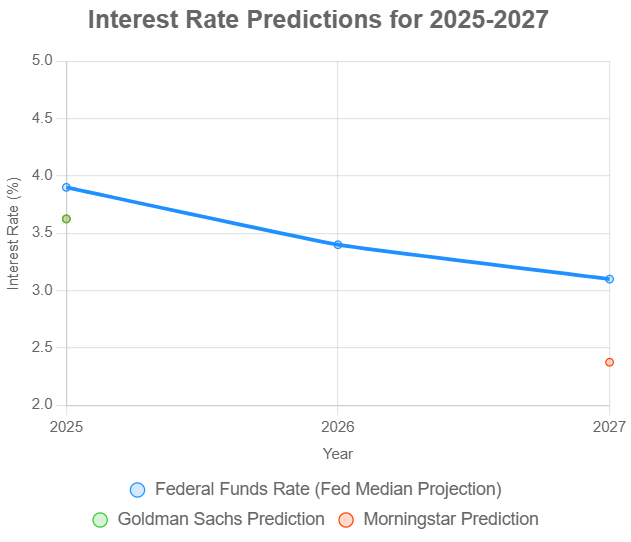
Graph Showing Interest Rate Predictions for the Next 2 Years

The Fed projections are only one piece of the puzzle. It’s always good to check out what other big players in the financial world are thinking. Here's a snapshot of interest rate predictions from some major institutions:

Institution 2025 Prediction 2026 Prediction 2027 Prediction
Federal Reserve 3.9% 3.4% 3.1%
BlackRock ~4% – –
Goldman Sachs 3.5%–3.75% – –
Morningstar 3.5%–3.75% – 2.25%–2.5%
Fannie Mae (30-yr) 6.3%–6.8% (mortgage) – –
Mortgage Bankers Association 6.8% (early) (mortgage) 6.4% –

A few things stand out to me here:

  • The Consensus: Most experts agree that interest rates will come down over the next two years, but they have a difference on how fast and how far.
  • The Cautious View: BlackRock seems a bit more reserved. They mention things like possible trade wars and other global issues, which could make the Fed think twice about slashing rates too quickly.
  • The Optimists: Morningstar is a bit more bullish, thinking rates could fall more dramatically if inflation cools off faster than most people expect.

Mortgage Rate Predictions:

If you're keeping an eye on mortgage rates:

  • Fannie Mae sees the 30-year fixed rate starting at 6.8% in early 2025 and then dropping to 6.3% later in the year.
  • The Mortgage Bankers Association predicts a drop from 6.8% to 6.4% throughout 2026.

What Could Throw a Wrench in the Works? The Global and Policy Wildcards

Making interest rate predictions is more than just crunching numbers. You need to think about the bigger picture like global events and government policies. Here are a few things that could shake things up:

  • Global Economic Conditions: What's happening in Europe, China, and other parts of the world matters too. If other countries are struggling, it could pull down the U.S. economy.
  • Trade and Tariffs: If the government starts slapping tariffs on goods from other countries, prices could go up!
  • Fiscal Policy: Tax cuts or big government spending could fire up the economy. If the economy grows too quickly, inflation could come roaring back.
  • Geopolitical Events: Wars, political instability, or unexpected crises can send shock waves through the economy, making it harder for the Fed to predict what's going to happen.

What It All Means for You: Consumers and Investors

So, how do these interest rate predictions impact your wallet?

For Consumers:

  • Borrowing Costs: Lower rates mean you'll pay less for mortgages, car loans, and anything else you borrow money for. This could make it easier to buy a home or a new car.
  • Savings Returns: The downside? You'll probably earn less on your savings accounts and CDs.

For Investors:

  • Bonds: When rates fall, bond prices tend to rise. So, if you already own bonds, you could see some gains. But remember, new bonds will pay lower interest rates.
  • Stocks: Lower rates can be good for stocks because they make it cheaper for companies to borrow money and grow. But if the Fed is cutting rates because the economy is faltering, that could temper the optimism.
  • Real Estate: Lower mortgage rates could fire up the housing market, potentially pushing home prices up.

Here’s a quick cheat sheet:

Financial Decision Impact of Lower Rates (2025-2027)
Buying a Home Cheaper mortgages, increased affordability
Savings Accounts Lower returns, reduced interest earnings
Stock Investments Potential gains, but risks remain
Bond Investments Higher prices for existing bonds, lower new yields

The Bottom Line and My Two Cents

The interest rate predictions for 2025-2027 point to a gradual easing, but the road ahead is anything but smooth. The Fed, along with financial institutions, anticipates rates declining from the current 4.25%–4.50% range to around 3.1% by 2027. I believe this path is reasonable because inflation is very hot now. But the Fed might cut more or less.

As I watch this situation of rate cuts unfold, there is a risk of some external factors blowing it all off course.

So, what should you do? Stay informed, be realistic, and remember that nobody has a crystal ball.

Recommended Read:

  • Fed Projects Two Interest Rate Cuts Later in 2025
  • Federal Reserve Holds Interest Rates Steady in June 2025
  • When is Fed's Next Meeting on Interest Rate Decision in 2025?
  • Fed Indicates No Rush to Cut Interest Rates as Policy Shifts Loom in 2025
  • Fed's Powell Hints of Slow Interest Rate Cuts Amid Stubborn Inflation
  • Fed Funds Rate Forecast 2025-2026: What to Expect?
  • Interest Rate Predictions for 2025 and 2026 by NAR Chief
  • Market Reactions: How Investors Should Prepare for Interest Rate Cut
  • Interest Rate Predictions for the Next 3 Years
  • Impact of Interest Rate Cut on Mortgages, Car Loans, and Your Wallet
  • Interest Rate Predictions for Next 10 Years: Long-Term Outlook
  • When is the Next Fed Meeting on Interest Rates?
  • Interest Rate Cuts: Citi vs. JP Morgan – Who is Right on Predictions?
  • More Predictions Point Towards Higher for Longer Interest Rates

Filed Under: Economy, Financing Tagged With: Fed, Interest Rate, Interest Rate Predictions, mortgage

Fed Holds Interest Rates Steady for the Fifth Time in 2025

July 30, 2025 by Marco Santarelli

Fed Holds Interest Rates Steady for the Fifth Time in 2025

The Fed holds key interest rate steady, maintaining the federal funds rate in a range between 4.25%-4.5%. This decision, announced recently, comes amidst pressure from various sides, including calls for rate cuts and internal disagreements within the Federal Open Market Committee (FOMC). Let's dive into what this means and what we can expect next.

Fed Holds Interest Rates Steady Amidst Internal Dissent

Why This Decision Matters

The Fed's actions (or in this case, inaction) have massive implications for us all. The federal funds rate influences everything from the interest rates on your credit card and mortgage to the overall health of the economy. Imagine it like this: the Fed is the central bank, but they influence all local banks and this decision has an effect nationwide. When rates are lower, borrowing becomes cheaper, which can stimulate economic growth. When rates are higher, borrowing becomes more expensive, which can help to control inflation.

A House Divided

The decision to hold steady wasn't unanimous. Two FOMC governors, Michelle Bowman and Christopher Waller, dissented, favoring a rate cut. This is significant because it highlights the internal debate within the Fed about the current state of the economy. The last time we saw this level of dissent was way back in 1993! Which shows that there is a real divide and struggle to reach this decision. It is also important for people that do not realize these roles make very important decisions that affect us all.

  • Those in favor of easing: Argue that inflation is under control and that the labor market could start to weaken soon.
  • Those in favor of holding steady: May believe that the economy is still relatively strong and that cutting rates prematurely could lead to a re-acceleration of inflation.

Decoding the Fed's Statement

The Fed's official statement after the meeting offered some insights into their thinking. They noted that “growth of economic activity moderated in the first half of the year,” which is slightly less optimistic than their assessment back in June. They also acknowledged that uncertainty about economic conditions “remains elevated.”

Here are the key takeaways from the statement:

  • Economic growth is slowing down.
  • The labor market is still solid, but inflation remains somewhat elevated.
  • Uncertainty is still a major factor.

The Influence of External Views

It's impossible to ignore the external voices weighing in on the Fed's decisions. There have been calls for the Fed to aggressively cut rates, with claims that this would boost the economy. We should note that the Fed is intended to operate independently of the short-term political wins, so this might influence the public's perception of the Fed more than the actual decision making.

What's Next?

All eyes are on the future. What could a rate cut in September look like? The question of whether the FOMC is leaning towards a rate cut at their next meeting in September. Economists have been saying that a rate cut in September may be unlikely.

Looking Ahead: Jackson Hole Symposium

The Fed's annual retreat in Jackson Hole, Wyoming, in late August is another key event to watch. It is here that the Fed chair historically gives a major speech on policy direction. This year's symposium could provide valuable clues about the Fed's future plans.

Navigating Economic Uncertainty

Even for seasoned observers, the future is far from certain. Factors such as global economic slowdowns, geopolitical tensions, and changes in consumer behavior can all throw a wrench into the works. As consumers and investors, we need to stay informed, adapt to changing conditions, and make decisions that align with our own long-term goals.

My Thoughts

Here's my take on all of this:

  • Complexity: The Fed's decision is clearly the result of complex considerations and differing opinions. It shows that the world is never black and white.
  • Independence: The Fed's ability to hold steady despite external pressure is a testament to its commitment to independence.
  • Communication: The Fed needs to do a better job of communicating its thinking to the public. Clearer communication can help to reduce uncertainty and build confidence in the Fed's decision-making.
  • Economic Indicators: It is important to monitor key economic indicators. These include GDP, employment and inflation. These will give you insight into the direction of the economy and potential future actions.

In Conclusion

The Fed's decision to hold interest rates steady reflects a delicate balancing act of many important economic factors. With internal divisions and external pressures weighing on the committee, the Fed is navigating a tricky path forward. It's crucial for us to stay informed and understand the factors that shape this.

Comparison of Fed Statements:

Aspect June Meeting July Meeting
Economic Growth “Continued to expand at a solid pace” “Growth of economic activity moderated in the first half of the year”
Uncertainty “Diminished but remains elevated” “Remains elevated”


Position Your Portfolio Ahead of the Fed’s Next Move

The Federal Reserve’s next rate decision could shape real estate returns through the rest of 2025. Whether or not a rate cut happens, smart investors are acting now.

Norada Real Estate helps you secure cash-flowing properties in stable markets—shielding your investments from volatility and interest rate swings.

HOT NEW LISTINGS JUST ADDED!

Talk to a Norada investment counselor today (No Obligation):

(800) 611-3060

Get Started Now

Recommended Read:

  • Fed Interest Rate Predictions: No Cut Expected Today, July 30, 2025
  • Will the Fed Cut Interest Rates by 25 Basis Points This Week?
  • Fed Projects Two Interest Rate Cuts Later in 2025
  • Federal Reserve Holds Interest Rates Steady on June 18, 2025
  • What are the Odds of a Fed Rate Cut Today, June 18, 2025?
  • Interest Rate Predictions for the Next 3 Years: 2025, 2026, 2027
  • When is Fed's Next Meeting on Interest Rate Decision in 2025?
  • Interest Rate Predictions for the Next 10 Years: 2025-2035
  • Will the Bond Market Panic Keep Interest Rates High in 2025?
  • Interest Rate Predictions for 2025 by JP Morgan Strategists
  • Interest Rate Predictions for Next 2 Years: Expert Forecast
  • Fed Holds Interest Rates But Lowers Economic Forecast for 2025
  • Fed Indicates No Rush to Cut Interest Rates as Policy Shifts Loom in 2025
  • Fed Funds Rate Forecast 2025-2026: What to Expect?
  • Interest Rate Predictions for 2025 and 2026 by NAR Chief
  • Market Reactions: How Investors Should Prepare for Interest Rate Cut
  • Impact of Interest Rate Cut on Mortgages, Car Loans, and Your Wallet
Filed Under: Economy, Financing Tagged With: Economy, Fed, Fed Rate Cut, Federal Reserve, inflation, Interest Rate

Fed Interest Rate Predictions: No Cut Expected Today, July 30, 2025

July 30, 2025 by Marco Santarelli

Fed Interest Rate Decision: No Cut Expected Tomorrow, July 30, 2025

Will the Fed cut interest rates on July 30, 2025? Based on current economic conditions and market sentiment, it's highly unlikely. Most signs point towards the Federal Reserve holding steady, keeping the federal funds rate right where it is. But why is that, and what could this mean for you? Let's break it down.

Fed Interest Rate Predictions: No Cut Expected Today, July 30, 2025

Understanding the Fed's Role

The Federal Reserve, or the Fed as most people call it, is like the doctor for the US economy. They have a big job: to keep things stable. One of their main tools is setting the federal funds rate. This rate is what banks charge each other for lending money overnight. By adjusting this rate, the Fed can influence borrowing costs across the whole economy.

Think of it like this: if the Fed lowers the rate, it's cheaper for banks to borrow money, which means they can offer lower interest rates to you for things like mortgages and car loans. This encourages people to spend and boosts the economy. But lowering rates also has a downside: it can increase inflation if not controlled.

The Fed's primary goals are two:

  • Maximize employment: They want as many people as possible to have jobs.
  • Maintain price stability: They want to keep inflation around 2%. Too much inflation means things get more expensive too quickly. Too little inflation (or even deflation) is bad, too, as it stifles growth.

What's the Economy Saying Right Now (July 2025)?

Honestly, things are a bit mixed. It's not all sunshine and roses, but it's not doom and gloom either. Let's look at some important indicators:

  • Leading Economic Index (LEI): This is like a sneak peek at what the economy might do in the future. It's been going down, suggesting things might slow down.
  • Coincident Economic Index (CEI): This shows how the economy is doing right now. It's been going up, which suggests solid stability in the present. That's a big positive.
  • Personal Income: People aren't making as much money. This decrease in income could lead to less spending.
  • Real GDP: This is the total value of everything produced in the country, adjusted for inflation. It shrunk in the first part of the year. Which is not a great sign.
  • Inflation: This is where things get tricky. Inflation is at 2.7%, which is above the Fed's ideal target of 2%.

So, we have a slowing economy with inflation that's still a bit high. It’s like trying to bake a cake with a wonky oven.

Here's a quick table to summarize it:

Indicator Details
Leading Economic Index (LEI) Declined, suggesting a potential slowdown
Coincident Economic Index (CEI) Rose, indicating current economic stability
Personal Income Decreased, potentially impacting consumer spending
Real GDP Contracted, reflecting economic deceleration
Inflation Core inflation above the Fed’s 2% target, with a near-term rise likely

What's the Scoop from the Fed Itself?

The Fed is playing it cool, taking a “wait-and-see” approach. The current rate is between 4.25% and 4.5%, and hasn't changed since December 2024.

Fed Chair Jerome Powell has been talking about balancing economic growth with keeping inflation under control. It's a tightrope walk, and he doesn't want to fall off. The FOMC (Federal Open Market Committee), which brings together the Board of Governors and Reserve Bank presidents, is likely to tread cautiously.

Now, not everyone at the Fed agrees. There might be a couple of voices who want to cut rates, but it looks like the majority will want to hold steady. Also there has been public pressure from President Trump to decrease the rates. However, the Fed is likely to make its decision independently.

What Do the Markets Think?

Financial markets are obsessed with the Fed's moves. They try to predict what the Fed will do because it can significantly impact stock prices, bond yields, and the value of the dollar.

There's a tool called the CME FedWatch Tool. It uses data from the market to estimate the probability of different rate decisions. As of now and close to the July 30, 2025, meeting, it shows an incredibly high probability that the Fed will leave rates unchanged. Like, over 95%.

Most investors seem to agree. They think the Fed will hold steady, but perhaps consider cutting rates later in the year if the economy weakens further.

What Happens If… Scenarios

Okay, so what could happen if the Fed did cut rates on July 30, 2025? Or if they stay put?

If Rates Are Cut:

  • Good news for borrowers: Mortgages, credit cards, and car loans could get cheaper.
  • Businesses might invest more: Lower borrowing costs make it easier to expand and grow.
  • Stock market could get a boost: Investors might get excited about the prospect of cheaper money.
  • But…inflation could get worse: Remember, inflation is already a bit high. Cutting rates could add fuel to the fire.

If Rates Remain Steady:

  • A sign of confidence…or caution: It could mean the Fed thinks the economy is doing okay, or that they're worried about inflation.
  • Borrowing costs stay the same: This might slow down growth in areas like housing.
  • Markets might be muted: Investors might wait to see what the Fed says next.

My Two Cents

I think the Fed is in a really tough spot. They have to balance supporting the economy with fighting inflation. Based on everything I'm seeing, I think they'll choose to hold rates steady on July 30, 2025. The inflation numbers are simply too high to justify a cut, and the Fed doesn't want to risk losing credibility.

The biggest wild card is inflation. If inflation starts to come down significantly in the coming months, then the Fed might consider cutting rates later in the year. But for now, I think they'll stay the course.

It all comes down to data. The Fed will be watching the economic numbers closely between now and the July meeting and will make its decision based on what they see. So keep an eye on those reports!

Conclusion

The Fed's decision on July 30, 2025, is a big deal for everyone, from homeowners to business owners to investors. While there's always a chance of a surprise, the current signs point to the Fed holding steady. The real question is what they'll do after that. Hang tight—the Fed's probably going to tell us the plan on July 30, 2025, around 2 pm Eastern Time, where we can then listen to the remarks from Fed Chair Jerome Powell around 2:30 pm on what the next steps are.

Position Your Portfolio Ahead of the Fed’s Next Move

The Federal Reserve’s next rate decision could shape real estate returns through the rest of 2025. Whether or not a rate cut happens, smart investors are acting now.

Norada Real Estate helps you secure cash-flowing properties in stable markets—shielding your investments from volatility and interest rate swings.

HOT NEW LISTINGS JUST ADDED!

Talk to a Norada investment counselor today (No Obligation):

(800) 611-3060

Get Started Now

Recommended Read:

  • Will the Fed Cut Interest Rates by 25 Basis Points This Week?
  • What to Expect from the Fed's Meeting Next Week: July 29-30, 2025
  • Fed Projects Two Interest Rate Cuts Later in 2025
  • Federal Reserve Holds Interest Rates Steady on June 18, 2025
  • What are the Odds of a Fed Rate Cut Today, June 18, 2025?
  • Interest Rate Predictions for the Next 3 Years: 2025, 2026, 2027
  • When is Fed's Next Meeting on Interest Rate Decision in 2025?
  • Interest Rate Predictions for the Next 10 Years: 2025-2035
  • Will the Bond Market Panic Keep Interest Rates High in 2025?
  • Interest Rate Predictions for 2025 by JP Morgan Strategists
  • Interest Rate Predictions for Next 2 Years: Expert Forecast
  • Fed Holds Interest Rates But Lowers Economic Forecast for 2025
  • Fed Indicates No Rush to Cut Interest Rates as Policy Shifts Loom in 2025
  • Fed Funds Rate Forecast 2025-2026: What to Expect?
  • Interest Rate Predictions for 2025 and 2026 by NAR Chief
  • Market Reactions: How Investors Should Prepare for Interest Rate Cut
  • Impact of Interest Rate Cut on Mortgages, Car Loans, and Your Wallet
Filed Under: Economy, Financing Tagged With: Economy, Fed, Fed Rate Cut, Federal Reserve, inflation, Interest Rate

Will the Fed Cut Interest Rates by 25 Basis Points This Week?

July 29, 2025 by Marco Santarelli

Will the Fed Cut Interest Rates by 25 Basis Points Next Week?

The big question on everyone's mind: Will the Fed cut interest rates this week at least by 25 basis points? With the Federal Open Market Committee (FOMC) clocking in for their meeting July 29-30, 2025, anticipation is high. The most probable outcome, in my view, is no rate cut. Everything points toward the Federal Reserve holding firm and maintaining the existing federal funds rate within the 4.25% to 4.5% range. However, monetary policy is never as cut and dry as headlines make it out to be, so let’s break down the forces at play, what signals to expect, and how this decision might affect your wallet and more.

Will the Fed Cut Interest Rates by 25 Basis Points This Week?

Getting into the nitty-gritty requires first understanding the current economic picture. The U.S. economy as of mid-2025 presents a set of challenges, with both high points and lingering issues.

Here's the general picture from the Fed:

  • Gross Domestic Product: The American economy showcases good growth figures. The Atlanta Fed estimates a Q2 2025 GDP growth of 2.4%.
  • Job Market: On the job front, the unemployment rate sits at 4.2%. However, things might be starting to soften slowly. Layoffs appearing around different companies makes things questionable.
  • Inflation: Inflation, as measured by the Personal Consumption Expenditures (PCE) price index, is currently at 2.6%. Although above the Fed's ideal 2% figure, this is still notably better than the 2022 peak of 7.2%. Core inflation estimates at 3.1% by the end of 2025, due to trade-related issues.

Regardless of the positive figures, there are several underlying problems that affects the nation's economy. Policy making is hard with several issues such as trade policy uncertainties influencing decision making processes. As these factors add up, consumer spending can weaken easily.

Since December 2024, the Fed took some time off from cutting those rates, which can lead to them avoiding such serious decisions at any time.

Understanding the Interest Rate Landscape

So, the million-dollar question (that can affect your money): Will the Fed cut interest rates or not? Based on information given, I don't think they will.

The major consensus is that the rate stays the same. The Fed has made it possible they will “wait-and-see” before doing anything so they can observe the whole picture, supporting their strategy.

Regardless, there are those who are thinking otherwise. Fed Governor Christopher Waller thinks that the rate cut makes total sense to avoid further decline. He argues that the current tax laws could hurt demand than the price.

What to keep an eye on

  1. Interest Rate Stability:
    • No changes at 4.25-4.5% are estimated. *Don't disregard the possible dissenting vote from Fed Governer Christopher Waller.
  2. Economic View:
    • Real GDP Rate: Estimates at 1.4% in 2025. (Down from 1.7% since March)
    • Job Stats: At 4.5% (A slight increase of 4.4% since March)
    • Core PCE Inflation: Estimated at 3.1% (An increase of 2.8% in March)
    • Federal funds rate: 3.9% by the end of 2025
  3. Policy Observations. Pay Attention to the tone used by the FOMC! Market experts will be paying very close attention whenever market experts drop words regarding economic activity.
  4. Quantitative Tightening and Balance Sheet Updates: Be ready for incoming updates regarding focus on interest rate policy.

Dots and Projections: A Close Look

A revised dot plot will not be available yet. The previous version released in June 2025 are good enough, though.

Here are the Projections they made:

GDP Growth: 1.4% for 2025 A slight decrease from 1.7% in March Job Stats: 4.5%, a slight increase of 4.4 from last March Core PCE Inflation: Estimates around 3.1, slightly higher than the 2.8% from March Feds Fund Rate: Estiamtes around 3.9% by the end of the year. (Potentially implies 0.25% decrease in rate)

Remember that all FOMC projections will be followed to the end. Powell also made it clear, so pay attention.

Upcoming financial data and reports everyone should look forward to include:

Main Things to Remember

PCE Inflation – Watch to see how low (or high) the data goes Employment Stats – A slow-down in jobs could lead to a rush to cutback on everything.

  • Sentiments to trade in – An uncertain policy can ruin the chances of recovery

What happens at the meeting and what messages are presented can lead to a host of changes.

  • Stocks: The market may see a decrease if the Feds go for a hawk-like tone (higher interest, inflation watch).
  • Bonds: Rates may rise with a lot of worries with inflation and yields.
  • Currencies and Commodities: If the rates go down, look for more expensive commodities.

Final Thoughts: While managing economic growth, the Feds still need to balance external pressures like those from political groups. And, in my view, the FOMC meeting this week should see stable interest rates with close observation of all economic and monetary signs.

Position Your Portfolio Ahead of the Fed’s Next Move

The Federal Reserve’s next rate decision could shape real estate returns through the rest of 2025. Whether or not a rate cut happens, smart investors are acting now.

Norada Real Estate helps you secure cash-flowing properties in stable markets—shielding your investments from volatility and interest rate swings.

HOT NEW LISTINGS JUST ADDED!

Talk to a Norada investment counselor today (No Obligation):

(800) 611-3060

Get Started Now

Recommended Read:

  • What to Expect from the Fed's Meeting Next Week: July 29-30, 2025
  • Fed Projects Two Interest Rate Cuts Later in 2025
  • Federal Reserve Holds Interest Rates Steady on June 18, 2025
  • What are the Odds of a Fed Rate Cut Today, June 18, 2025?
  • Interest Rate Predictions for the Next 3 Years: 2025, 2026, 2027
  • When is Fed's Next Meeting on Interest Rate Decision in 2025?
  • Interest Rate Predictions for the Next 10 Years: 2025-2035
  • Will the Bond Market Panic Keep Interest Rates High in 2025?
  • Interest Rate Predictions for 2025 by JP Morgan Strategists
  • Interest Rate Predictions for Next 2 Years: Expert Forecast
  • Fed Holds Interest Rates But Lowers Economic Forecast for 2025
  • Fed Indicates No Rush to Cut Interest Rates as Policy Shifts Loom in 2025
  • Fed Funds Rate Forecast 2025-2026: What to Expect?
  • Interest Rate Predictions for 2025 and 2026 by NAR Chief
  • Market Reactions: How Investors Should Prepare for Interest Rate Cut
  • Impact of Interest Rate Cut on Mortgages, Car Loans, and Your Wallet
Filed Under: Economy, Financing Tagged With: Economy, Fed, Fed Rate Cut, Federal Reserve, inflation, Interest Rate

What to Expect from the Fed’s Meeting This Week: July 29-30, 2025

July 29, 2025 by Marco Santarelli

What to Expect from the Fed's Meeting Next Week: July 29-30, 2025

Get ready, folks! All eyes are on the Federal Reserve as the Federal Open Market Committee (FOMC) gears up for its meeting on July 29-30, 2025. So, what to expect from the Fed meeting this week? I believe the most likely outcome is that the Fed will hold steady, maintaining the federal funds rate in its current range of 4.25% to 4.5%. But, as always, the devil's in the details, and a lot can happen. Let's dig into what’s driving this expectation and what clues we should be watching for in the Fed's statement and Chairman Powell's press conference.

What to Expect from the Fed's Meeting This Week: July 29-30, 2025

The Current Economic Picture

Before we dive into predictions, we need to understand the backdrop. The U.S. economy in mid-2025 is a bit of a mixed bag. You've got some strong points, but also clouds on the horizon.

According to the Fed's recent statements, here's the general vibe:

  • GDP: The economy's been growing at a decent clip. The Atlanta Fed estimated a 2.4% growth rate for the second quarter of 2025. Not bad at all!
  • Unemployment: The unemployment rate islow at 4.2%. People are working, which is always a good sign. But, and this is a big ‘but', there have been some early signs of things slowing down with layoffs starting to creep higher. This needs to be watched closely.
  • Inflation: Ah, inflation. The PCE price index (that's the Fed's favorite way to measure inflation) is at 2.6%. That's still above the Fed's 2% target, but way better than the bad old days of 2022, when it hit 7.2%. The tricky thing? Core inflation, which takes out food and energy prices, is projected to hit 3.1% by the end of 2025, due in part to tariffs.

Thing is, several factors are making things uncertain. Trade policy is a big one. Then, add in the ongoing debates about fiscal policy. I feel things could easily go south if consumer spending starts weakening.

Since December 2024, the Fed decided to hit the brakes on any interest rate cuts, holding the federal funds rate steady. This shows how they try avoiding any drastic actions, especially knowing that things could change any moment.

The Big Question: Will the Federal Reserve Cut Interest Rates?

Okay, here's what everyone wants to know: will the Fed cut interest rates at this meeting? The simple answer is: probably not.

Most economists and market watchers believe the Fed will keep rates where they are, in the 4.25% to 4.5% range. This is the general consensus. This view is supported by the Fed’s earlier statements to take a “wait-and-see” approach.

Why the hesitation? Well, Fed officials have said, in not so many words, that the current policy is “in a good place.” They want to see how things play out before making any big moves.

However, behind this united front, there are always some dissenting opinions. Fed Governor Christopher Waller, for example, has hinted that he's open to a rate cut. Why? He's worried that all those tariffs might hit demand harder than prices.

What to really lookout for at the July 2025 FOMC Meeting

  1. Interest Rate Decision:
    • Expected: to remain same at 4.25-4.5% *Note: Fed Governer Christopher Waller is open to a rate cut. Be ready for possible dissenting vote.
  2. Economic Projections and the Dot Plot:
    • Real GDP growth: 1.4% for 2025 (down from1.7% from march)
    • Unemployment rate: 4.5% for 2025 (up slightly from 4.4% in March)
    • Core PCE inflation: 3.1% for 2025 (up from 2.8% in March)
    • Federal funds rate:3.9% by year-end 2025
  3. Policy Statement and Press Conference The tone of the FOMC should change with the current economic activities. Investors will be observing at his tone and vocabularies if there is any sign for data dependence, economic activities, inflation or labor market.
  4. Quantitative Tightening and Balance Sheet Policy: Be ready for any updates, given the Fed's focus on interest rate policy.

The Policy Statement and Powell's Press Conference

The official statement released after the meeting is always carefully worded and a sign of what's to come. People are expecting the statement to say that the economy is growing at a “solid pace,” unemployment is “low,” and inflation is “somewhat elevated.”

I would pay attention to what language is used, especially when they talk about inflation and the labor market. Any subtle changes from the previous statement could signal a shift in the Fed's thinking.

But the real show? That's Fed Chair Powell's press conference. His body language, his tone of voice, the specific words he chooses…it all matters. The market will dissect everything that he says.

He'll probably emphasize that the Fed is “data-dependent,” meaning they'll make decisions based on what the economic numbers are telling them. If the next round of inflation data is surprisingly soft, he might hint at a possible rate cut in September. On the other hand, if he sounds more hawkish and emphasizes concerns about inflation, that could put a damper on things.

The Dot Plot and Economic Projections: A Peek into the Fed's Mind

Unfortunately, we won't get an updated “dot plot” at this meeting. (The dot plot is a chart showing where each Fed member thinks interest rates will be in the future.) But the last one, released in June 2025, is still important.

Here were the median projections from June:

  • GDP Growth: 1.4% for 2025. (That's down from 1.7% in March)
  • Unemployment Rate: 4.5% for 2025. (Up slightly from 4.4% in March)
  • Core PCE Inflation: 3.1% for 2025. (Up from 2.8% in March)
  • Federal Funds Rate: 3.9% by the end of 2025. (That implies two 0.25% rate cuts)

The most interesting part of the dot plot was how spread out the projections were. Some members thought there would be no rate cuts this year, while others were calling for one or two. Any hints from Powell about how these projections might be shifting will be closely watched.

Following the Breadcrumbs: Upcoming Economic Data

A few key economic reports will come out before the September meeting, and they'll be crucial in shaping the Fed's decisions:

  • July PCE Inflation (July 31, 2025): I f this report shows that inflation is cooling off faster than expected, it could strengthen the case for a rate cut.
  • August Employment Report (September 5, 2025): A weak jobs report would potentially push the Fed towards cutting rates sooner rather than later.
  • Consumer Sentiment and Spending: If consumer spending starts to tank, that could also push the Fed to act.
  • Tariff Developments: What happens with trade policy will influence things as well.

What It All Means for the Markets

The Fed's decisions and communication will send ripples through the financial markets:

  • Stocks: If the Fed sounds neutral or even a little dovish (meaning they're leaning towards cutting rates), that could steady the stock markets. But if they sound hawkish (worried about inflation), stocks could take a hit.
  • Bonds: I think some experts are anticipating that bond yields will increase, and returns from money market funds may decline if rates are cut.
  • Currencies and Commodities: A dovish signal could weaken the U.S. dollar and give a boost to commodities like gold. Concerns about inflation, on the other hand, could strengthen the dollar.

Looking Deeper: Broader Implications

The Fed is walking a tightrope. They need to keep inflation under control, but they also don't want to push the economy into a recession. All while dealing with outside pressure from politicians and global events.

In Conclusion, Expect the Status Quo

I come to the conclusion that the July 2025 FOMC meeting will see the Fed holding steady on interest rates. But as always, that's not the whole story. Keep an eye on the policy statement, listen carefully to what Powell says, and watch those upcoming economic reports. Things could change quickly, and investors need to be prepared to adapt.

Position Your Portfolio Ahead of the Fed’s Next Move

The Federal Reserve’s next rate decision could shape real estate returns through the rest of 2025. Whether or not a rate cut happens, smart investors are acting now.

Norada Real Estate helps you secure cash-flowing properties in stable markets—shielding your investments from volatility and interest rate swings.

HOT NEW LISTINGS JUST ADDED!

Talk to a Norada investment counselor today (No Obligation):

(800) 611-3060

Get Started Now

Recommended Read:

  • Fed Projects Two Interest Rate Cuts Later in 2025
  • Federal Reserve Holds Interest Rates Steady on June 18, 2025
  • What are the Odds of a Fed Rate Cut Today, June 18, 2025?
  • Interest Rate Predictions for the Next 3 Years: 2025, 2026, 2027
  • When is Fed's Next Meeting on Interest Rate Decision in 2025?
  • Interest Rate Predictions for the Next 10 Years: 2025-2035
  • Will the Bond Market Panic Keep Interest Rates High in 2025?
  • Interest Rate Predictions for 2025 by JP Morgan Strategists
  • Interest Rate Predictions for Next 2 Years: Expert Forecast
  • Fed Holds Interest Rates But Lowers Economic Forecast for 2025
  • Fed Indicates No Rush to Cut Interest Rates as Policy Shifts Loom in 2025
  • Fed Funds Rate Forecast 2025-2026: What to Expect?
  • Interest Rate Predictions for 2025 and 2026 by NAR Chief
  • Market Reactions: How Investors Should Prepare for Interest Rate Cut
  • Impact of Interest Rate Cut on Mortgages, Car Loans, and Your Wallet
Filed Under: Economy, Financing Tagged With: Economy, Fed, Fed Rate Cut, Federal Reserve, inflation, Interest Rate

Will Interest Rates Drop in the Second Half of 2025?

July 5, 2025 by Marco Santarelli

Will Interest Rates Drop in the Second Half of 2025?

Are you wondering if you'll be paying less on your mortgage, car loan, or credit card bills soon? The big question on everyone's mind is: Will interest rates drop in the second half of 2025? Good news: the current expectation is yes, the Federal Reserve is likely to cut interest rates in 2025. However, the exact timing and how much they'll be cut is still very uncertain and dependent on upcoming economic data. Let’s dive in and unpack all the factors at play.

Will Interest Rates Drop in the Second Half of 2025? Here's What the Fed Thinks

Predicting the future is never easy, especially when it comes to something as complex as interest rates. It’s like trying to forecast the weather – a bunch of different things influence the outcome, and the forecast can change quickly. The Federal Reserve (the Fed) is tasked with keeping the US economy stable, mainly by controlling inflation and promoting full employment. They use interest rates as one of their main tools to achieve this.

The Fed's Mixed Messages: What's the “Dot Plot” Saying?

The Fed gives us clues about its future intentions mainly through their statements and a tool called the “dot plot.” The dot plot is a chart that shows where each member of the Federal Open Market Committee (FOMC) – the group that sets interest rates – expects interest rates to be in the coming years.

The good news is, the latest dot plot from June 2025 suggests that the median projection is for two 25 basis point rate cuts by the end of 2025. A basis point is 1/100th of a percent, so two 25 basis point cuts would equal a 0.50% decrease in the federal funds rate. We even heard one Fed official suggest the first cut could come as early as September.

However, it's not all sunshine and roses. There's a significant division within the FOMC. Seven out of 19 members projected no rate cuts in 2025, while others saw the potential for more than two cuts. This difference of opinion highlights just how uncertain things are.

Why Haven't They Cut Rates Yet? The Inflation Elephant in the Room

You might be wondering, “If they're planning to cut rates, why haven't they done it already?” The main reason is inflation. While headline inflation has cooled down quite a bit from its peak in 2022, core inflation, which excludes volatile food and energy prices, is still above the Fed's 2% target.

The Fed wants to be confident that inflation is truly under control before they start cutting rates. Cutting rates too soon could risk reigniting inflation, which would be a major setback. It's like driving a car – you don’t want to slam on the gas (cutting rates) until you're sure the road ahead is clear (inflation is under control).

Here's a quick breakdown of what the Fed is watching:

Factor What the Fed Wants to See What It Means for Rate Cuts
Inflation Moving consistently ≈ 2% Lower –> More Likely Rate Cuts
Economic Growth Moderate growth Slower –> More Likely Rate Cuts
Unemployment Stable or Slightly Rising Higher –> More Likely Rate Cuts

Trump's Tariff Wildcard: A Potential Inflation Booster

And now, another factor enters the chat… potential new tariffs imposed by President Trump. Tariffs essentially increase the cost of imported goods, which can lead to higher prices for consumers and businesses. If these tariffs are implemented, they could fuel inflation and make the Fed even more cautious about cutting rates. It's like adding fuel to a fire – tariffs could make the inflation problem worse.

What the Market Thinks: Expecting Cuts, but Uncertainty Remains

The financial markets are also expecting the Fed to cut rates in 2025. Tools like the CME FedWatch, which tracks market expectations for Fed rate moves, show a significant probability of rate cuts happening this year. Specifically, as of June 2025, the market expects cuts in the September, October, and December meetings. Keep in mind, expectations in the market are not always right and the market is often wrong.

What It All Means for You: Mortgage Rates, Savings Accounts, and More

If the Fed does cut interest rates, it will have an impact on various aspects of your financial life:

  • Mortgage Rates: Lower interest rates could make it more affordable to buy a home, as mortgage rates would likely decrease.
  • Savings Accounts: Interest rates on savings accounts and certificates of deposit (CDs) could fall, meaning you'd earn less on your savings.
  • Borrowing Costs: Loans for cars, personal expenses, and businesses would likely become cheaper, as interest rates would decline.

My Take: Patience is a Virtue

Based on my understanding of the situation, I believe we're likely to see some rate cuts in the second half of 2025, but I wouldn't expect a dramatic shift. The Fed is going to be very cautious and data-dependent, meaning they'll wait to see more evidence that inflation is truly under control before making any significant moves.

I think the dot plot projection of two 25 basis point rate cuts is a reasonable expectation, but it's certainly not a guarantee. Depending on what happens with the economy and with inflation, they could easily hold steady for longer, or they could even cut rates more aggressively.

The truth is that we all need to be patient and watch the economic data closely. The Fed's decisions will have a significant impact on our financial lives, so it's important to stay informed and be prepared for whatever comes our way.

The Bottom Line: Prepare for Anything

  • Expected but not Guaranteed: Rate cuts are expected in the second half of 2025, but not assured.
  • Inflation is Key: The Fed’s decisions hinge on inflation data.
  • Be Ready: Stay informed and prepared for various economic scenarios.
  • Stay Adaptable: Being adaptable to changes is going to be useful.

Ultimately, the future for interest rates in 2025 looks promising for rate cuts, but very uncertain.

Get Ahead of Potential Rate Cuts in 2025

If interest rates drop in the second half of 2025, real estate price appreciation could follow. Now is the ideal time to lock in properties before the market reacts.

Norada offers turnkey, cash-flowing investment properties in resilient markets—positioning you to benefit from future rate shifts.

HOT NEW LISTINGS JUST ADDED!

Speak with a Norada investment counselor today (No Obligation):

(800) 611-3060

Get Started Now 

Recommended Read:

  • Interest Rate Predictions for the Next 2 Years Ending 2027
  • Fed Projects Two Interest Rate Cuts Later in 2025
  • Federal Reserve Holds Interest Rates Steady in June 2025
  • When is Fed's Next Meeting on Interest Rate Decision in 2025?
  • Fed Indicates No Rush to Cut Interest Rates as Policy Shifts Loom in 2025
  • Fed's Powell Hints of Slow Interest Rate Cuts Amid Stubborn Inflation
  • Fed Funds Rate Forecast 2025-2026: What to Expect?
  • Interest Rate Predictions for 2025 and 2026 by NAR Chief
  • Market Reactions: How Investors Should Prepare for Interest Rate Cut
  • Interest Rate Predictions for the Next 3 Years
  • Impact of Interest Rate Cut on Mortgages, Car Loans, and Your Wallet
  • Interest Rate Predictions for Next 10 Years: Long-Term Outlook
  • When is the Next Fed Meeting on Interest Rates?
  • Interest Rate Cuts: Citi vs. JP Morgan – Who is Right on Predictions?
  • More Predictions Point Towards Higher for Longer Interest Rates

Filed Under: Economy, Financing Tagged With: Fed, Interest Rate, Interest Rate Predictions, mortgage

Fed Projects Two Interest Rate Cuts Later in 2025

June 29, 2025 by Marco Santarelli

Fed Projects Two Interest Rate Cuts Later in 2025

Today's news from the Federal Reserve (also known as the Fed) might sound a little complicated, but let's break it down. On June 18, 2025, the Fed did not cut interest rates. They left them where they were, in the range of 4.25% to 4.5%. However, the central bank's updated forecast, or their projections, is the real headline-grabber. They're expecting to cut rates twice by the end of 2025. This means that while things seem status quo right now, the Fed is hinting strongly that relief for consumers and businesses is on the horizon.

As someone who's been following economic trends for quite some time now, I can tell you that this is a delicate balancing act. The Fed wants to keep inflation under control while also encouraging economic growth. This is always a tightrope walk, and these projections show they're trying to find the right balance.

Fed Projects Two Interest Rate Cuts Later in 2025

A Steady Hand Today, A Cautious Hope for Tomorrow

The decision to hold rates steady wasn't exactly a surprise. It's the fourth meeting in a row they've kept things the same, following a series of cuts in late 2024 that knocked rates down by 1%. The Fed is all about following the data, and this time, it's telling them to hold steady. The big news, though, is what they think will happen later. They're estimating the benchmark rate could drop to about 3.75%–4% by the end of 2025, which pencils out to two quarter-point cuts.

Now, it's not like everyone on the Fed board is singing the same tune. Here's a quick look at how the Fed's policymakers are leaning:

  • 7 officials: Think there won't be any cuts in 2025.
  • 2 officials: Expect only one cut.
  • 8 officials: Are looking for two cuts.
  • 2 officials: Envision three cuts.

As you can see, there's some disagreement. This shows the complexity of the situation and how the Fed is trying to gauge the future. The majority are playing it safe, signaling they'll ease up gradually in 2025.

What's Driving These Projections? The Economic Outlook

The Fed's forecasts give us some clues as to why they're leaning towards rate cuts. Here’s a brief rundown:

  • Core PCE Inflation: The Fed thinks this will hit 3.1% by the end of 2025 (up from 2.8% in March) before cooling to 2.4% in 2026. This means inflation is still a worry.
  • GDP Growth: They're forecasting 1.4% growth for 2025, slightly lower than their previous prediction of 1.7%. The economy might be slowing down a bit.
  • Unemployment Rate: The Fed projects that it will rise to 4.5% by the end of 2025, from the current 4.2%. This suggests that the labor market might cool off.

These numbers paint a picture. The Fed sees inflation sticking around for a while, which means holding rates steady now. However, with slower growth and a slight uptick in unemployment, they think they can afford to lower rates later without letting inflation get out of control.

Why the Wait? Unpacking the Fed's Reasoning

Why the delay in cutting rates? Several factors are influencing the Fed's patience:

  1. Persistent Inflation: There are ongoing price pressures. Tariffs, especially from measures such as the ones implemented by President Trump on goods from China, drive up the cost of things like electronics. Although the Fed expects this to peak over the summer, additional pressure is possible as a tariff pause expires.
  2. Geopolitical Tensions: The ongoing tensions in the Middle East, and the war between Russia and Ukraine, continue to impact commodities markets, especially oil. They push up prices and complicate the situation regarding inflation regulation.
  3. Balanced Labor Market: According to Fed Chair Jerome Powell, the labor market generally is stable. It isn’t particularly adding to inflation at the moment, which reduces the urgent need to lower rates.

Essentially, the Fed is trying to be proactive. By projecting cuts for later in 2025, they acknowledge that the underlying inflationary pressures are likely to ease, allowing them to shift to a more accommodating stance without triggering a fresh wave of inflation.

When Might the Cuts Actually Happen?

The Fed didn't give specific dates, but markets are offering some predictions. Experts believe a cut is unlikely at the late-July meeting, with a better chance at the September meeting, around September 17. A second cut could arrive in November or December.

The fact that the Fed is being so cautious is crucial. They’re showing they want to be sure before making any major moves.

Two Cuts: What It Means for You

The expectation of two interest rate cuts is a big deal for people like you and me. Here's what it could mean:

  • Borrowers: High borrowing costs mean more pain for now. Credit cards might still have APRs around 20%, new car loans about 7.3%, and 30-year mortgages around 6.91%. If cuts happen, these figures may drop by 0.5% or more.
  • Savers: High-yield savings accounts are still looking good. If you’re getting over 4% on your savings, it’ll stay attractive for a while.
  • Businesses: If businesses are dealing with high loan costs and uncertainty over tariffs, they might hold off on investing. Lower rates could be just what they need.

In other words, if you are currently struggling with costs, two anticipated cuts mean you can be hopeful.

Market Reactions and Broader Context

The markets' reaction to the Fed's combined message of “no cut now, two later” was more or less neutral. Stocks saw some interesting changes: the S&P 500 increased, while the Dow dipped slightly, and so did the Nasdaq.

The broader context includes factors like the potential impact of the tariff policies and political pressures on the Fed. The Middle East situation is also an important factor that can potentially upset energy markets.

Looking Ahead

The Federal Reserve's projections give us a cautious sense of hope after today's decision. The focus remains on keeping inflation under control while keeping an eye on risks. As the Fed navigates these challenges, keep in mind that any real shift will probably occur later in 2025.

So, what's my take? As someone in the business of keeping tabs on the market, I think the Fed is doing what it needs to do. They're signaling that they're aware of the challenges facing both consumers and businesses. It’s a balancing act, but the potential for two rate cuts later this year shows they're thinking long-term. It’s a matter of being patient until we see the economy improving.

Position Your Portfolio Ahead of the Fed’s Next Move

The Federal Reserve’s next rate decision could shape real estate returns through the rest of 2025. Whether or not a rate cut happens tomorrow, smart investors are acting now.

Norada Real Estate helps you secure cash-flowing properties in stable markets—shielding your investments from volatility and interest rate swings.

HOT NEW LISTINGS JUST ADDED!

Talk to a Norada investment counselor today (No Obligation):

(800) 611-3060

Get Started Now

Recommended Read:

  • Federal Reserve Holds Interest Rates Steady on June 18, 2025
  • What are the Odds of a Fed Rate Cut Today, June 18, 2025?
  • Interest Rate Predictions for the Next 3 Years: 2025, 2026, 2027
  • When is Fed's Next Meeting on Interest Rate Decision in 2025?
  • Interest Rate Predictions for the Next 10 Years: 2025-2035
  • Will the Bond Market Panic Keep Interest Rates High in 2025?
  • Interest Rate Predictions for 2025 by JP Morgan Strategists
  • Interest Rate Predictions for Next 2 Years: Expert Forecast
  • Fed Holds Interest Rates But Lowers Economic Forecast for 2025
  • Fed Indicates No Rush to Cut Interest Rates as Policy Shifts Loom in 2025
  • Fed Funds Rate Forecast 2025-2026: What to Expect?
  • Interest Rate Predictions for 2025 and 2026 by NAR Chief
  • Market Reactions: How Investors Should Prepare for Interest Rate Cut
  • Impact of Interest Rate Cut on Mortgages, Car Loans, and Your Wallet

Filed Under: Economy, Financing Tagged With: Economy, Fed, Fed Rate Cut, Federal Reserve, inflation, Interest Rate

Federal Reserve Holds Interest Rates Steady on June 18, 2025

June 18, 2025 by Marco Santarelli

Federal Reserve Holds Interest Rates Steady on June 18, 2025

The Federal Reserve, in its meeting on June 18, 2025, decided to maintain its benchmark interest rate within the range of 4.25% to 4.5%. This marks the fourth consecutive meeting where the central bank has chosen to keep rates unchanged. In my opinion, this decision reflects a delicate balancing act, as the Fed grapples with persistent inflation forecasts, a projected slowdown in economic growth, and significant uncertainties stemming from global events and domestic policy.

Federal Reserve Holds Interest Rates Steady on June 18, 2025: A Detailed Analysis

The decision to keep the federal funds rate steady, a level it has occupied since January 2025 following a series of rate reductions in late 2024, was not unexpected. Personally, I felt this cautious approach was almost a certainty given the current economic climate. What's particularly noteworthy is the unanimous nature of this decision, signaling a broad consensus among policymakers.

Despite this pause, the Fed's projections still indicate an expectation of two rate cuts before the end of 2025. However, digging deeper into the individual forecasts reveals a considerable divergence of opinion among Federal Reserve officials:

  • 0 rate cuts: 7 officials
  • 1 rate cut: 2 officials
  • 2 rate cuts: 8 officials
  • 3 rate cuts: 2 officials

Looking further down the line, the Fed anticipates the interest rate to settle in the range of 3.5%–3.75% by the close of 2026. This is a more conservative reduction compared to their projections in March 2025, suggesting a potentially slower pace of easing monetary policy. By 2027, the range could be anywhere from 2.6% to 3.9%, with the long-term neutral rate holding steady at 3% (according to the Federal Reserve Projections). To me, this wider range for 2027 highlights the inherent uncertainty in long-term economic forecasting.

Revised Economic Projections: A More Cautious Outlook

The updated economic projections released alongside the interest rate decision paint a picture of a more cautious Fed, which, frankly, aligns with my own observations of the current economic headwinds. Here’s a breakdown of the key revisions:

Indicator 2025 Forecast Previous (March 2025) 2026 Forecast
Core PCE Inflation 3.1% 2.8% 2.4%
GDP Growth 1.4% 1.7% N/A
Unemployment Rate 4.5% 4.4% N/A

Inflation: The Fed’s preferred inflation measure, the core Personal Consumption Expenditures (PCE) price index, is now projected to reach 3.1% by the end of 2025, a notable increase from the 2.8% forecast in March. While inflation is expected to moderate to 2.4% in 2026 and 2.1% in 2027, the upward revision for this year signals that the fight against rising prices is proving to be more persistent than initially anticipated. This is something I've been watching closely, and it reinforces my belief that getting inflation back to the 2% target will be a marathon, not a sprint.

Economic Growth: The forecast for GDP growth in 2025 has been lowered to 1.4%, down from 1.7% in March. This downward revision reflects growing concerns about a potential softening of economic activity. It's a delicate situation – the Fed needs to cool down inflation without triggering a significant recession.

Unemployment: The unemployment rate is now expected to climb to 4.5% by the end of 2025, a slight increase from the current 4.2% and the 4.4% projected earlier. While still relatively low by historical standards, this uptick suggests that the anticipated economic slowdown could lead to some job losses.

These revised projections, in my opinion, clearly illustrate the tightrope the Federal Reserve is walking. They are acknowledging the stickiness of inflation while also bracing for a potential deceleration in economic momentum.

The Reasoning Behind Maintaining the Status Quo

Several factors likely contributed to the Fed’s decision to keep interest rates steady:

  • Impact of Tariff Policies: The current administration’s tariff agenda, particularly the reciprocal tariffs on goods from China and other countries, has already started to push up prices on various consumer goods, including personal computers and audio-visual equipment. The Fed anticipates further inflationary pressures in the coming months as a result of these policies. A 90-day pause on some tariffs is set to expire soon, which could exacerbate these price increases. From my perspective, these tariffs add a layer of complexity to the Fed's job, as they are dealing with price pressures that aren't solely driven by traditional monetary factors.
  • Geopolitical Uncertainties: The ongoing tensions in the Middle East, especially concerning the Strait of Hormuz, introduce significant risks to global energy markets. Higher oil prices would undoubtedly fuel inflation and could force the Fed to maintain a more hawkish stance. These geopolitical factors are wild cards that are difficult for any central bank to predict or control. Personally, I always keep a close eye on these global developments, as they can have a swift and significant impact on our domestic economy.
  • Lingering Economic Uncertainty: While the Fed noted that economic uncertainty has “diminished” somewhat since earlier in 2025, it still remains at an “elevated” level. Interestingly, the central bank removed previous language about risks of higher unemployment and rising inflation, perhaps signaling a slightly improved, though still cautious, outlook. I interpret this as the Fed wanting to see more data before making any significant moves.
  • Labor Market Balance: Fed Chair Jerome Powell himself highlighted that the labor market is currently “in balance” and not a primary driver of inflationary pressures. This assessment likely reduces the immediate pressure on the Fed to hike rates further to cool down the economy. It’s a welcome sign that the strong labor market hasn’t translated into runaway wage growth fueling inflation.

Market Reactions: A Measured Response

The financial markets responded with a degree of calm to the Fed’s announcement and updated projections:

  • Stock Markets: Major stock indexes ended the day with minimal changes. The S&P 500 edged up by 0.2% to 5,980.85, the Dow Jones Industrial Average saw a slight dip to 42,171.66, and the Nasdaq Composite gained marginally to 19,546.27. Initially, investors seemed to react positively to the unchanged interest rate, but these gains were tempered as the implications of slower growth and higher inflation forecasts began to sink in. This muted reaction, in my view, suggests that the market had largely priced in the Fed’s decision.
  • Other Assets: Oil prices remained stable, holding onto recent gains driven by Middle East concerns. Treasury yields saw a slight increase, while the WSJ Dollar Index experienced a minor decline. Bitcoin prices dipped below $105,000. This mixed bag of reactions across different asset classes reflects the underlying uncertainty and the various factors at play. The fact that the S&P 500 remains just over 2% from its record high, despite all the current challenges, indicates a certain level of underlying resilience in the market.

Real-World Implications for Consumers and Businesses

The Fed’s decision to maintain elevated interest rates continues to have tangible effects on everyday individuals and businesses:

Category Impact Key Rates
Credit Cards High variable rates (average 20% APR) put a strain on borrowers; relief is likely delayed. 20%
Auto Loans New car loans at 7.3%, used cars at 11%; tariffs add to car prices, impacting affordability. 7.3%, 11%
Mortgages 30-year fixed at 6.91%, 15-year at 6.17%; high rates continue to challenge the housing market. 6.91%, 6.17%
Student Loans Federal rates fixed at 6.53% (until June 30), then 6.39%; limited loan forgiveness options. 6.53%, 6.39%
Savings High-yield savings accounts offer >4%, outpacing inflation, providing a benefit for savers. >4%

Borrowing Costs: High interest rates translate directly into higher borrowing costs for consumers. Credit card interest rates hovering around 20% APR make it more expensive to carry a balance. Auto loan rates remain elevated, and when coupled with tariff-induced increases in car prices, affordability becomes a significant issue. Similarly, high mortgage rates continue to be a major hurdle for prospective homebuyers, cooling down the housing market. Student loan borrowers face fixed rates, and the landscape for widespread loan forgiveness remains limited. For me personally, these high borrowing costs are a constant reminder of the impact of monetary policy on household budgets.

Savings Benefits: On a brighter note, those with savings in high-yield online accounts are currently enjoying returns above 4%, which is finally outpacing inflation for many. This provides a welcome benefit for individuals looking to grow their savings.

Business Challenges: Businesses, particularly small and medium-sized enterprises, face higher costs for borrowing, which can constrain investment in expansion, new equipment, and hiring. The uncertainty surrounding tariffs and the overall economic outlook further complicates their decision-making processes. As someone who follows business trends, I know these are challenging times for many companies navigating these higher costs and uncertainties.

The Fed's Communication and What Lies Ahead

Fed Chair Jerome Powell’s commentary following the meeting provided crucial insights into the central bank’s thinking:

  • Inflation Expectations: Powell acknowledged that the Fed anticipates “a meaningful amount of inflation to arrive in the coming months” primarily due to the impact of tariffs and other contributing factors. This clearly signals that the Fed remains vigilant about the risk of persistent price pressures and underscores the rationale for their cautious approach.
  • Rate Cut Timing: The consensus among economists currently points towards a low probability of a rate cut at the upcoming July meeting (July 29–30). However, the likelihood of a rate cut at the September 17 meeting is estimated to be around 60%, according to FactSet. This suggests that the Fed is likely to wait for more data on the inflation front and the overall economic trajectory before considering any easing of monetary policy.
  • Policy Stance: Powell emphasized that the current monetary policy stance is “well-positioned” to support a strong economy with stable prices and a healthy labor market, despite the external political pressures. This statement reinforces the Fed's commitment to its dual mandate, independent of political considerations.

The Fed’s official statement described the economy as growing at a “solid pace” with a strong labor market but acknowledged “elevated” uncertainty, indicating a “wait-and-see” approach to assess the incoming economic data. This cautious stance, in my opinion, is prudent given the complex interplay of domestic and global factors currently influencing the economy.

The Broader Economic and Political Context

The Fed’s decisions are never made in a vacuum. They occur within a dynamic economic and political environment:

  • Tariff Impacts: President Trump’s tariffs, even with a temporary easing on some Chinese goods until August, have already contributed to higher prices for electronics and other imported goods. The Fed anticipates these inflationary effects to be most pronounced over the summer, potentially raising concerns about stagflation. While some analysts believe the impact might be temporary, others warn of more lasting price pressures. It's a debate with significant implications for the Fed's next moves.
  • Geopolitical Risks: The ongoing instability in the Middle East, particularly around the Strait of Hormuz, continues to pose a threat to global energy supplies. Any significant disruption could lead to a sharp increase in oil prices, further complicating the inflation outlook and potentially limiting the Fed’s flexibility to cut rates.
  • Political Pressure: The Federal Reserve has faced public criticism from President Trump, who has advocated for substantial interest rate cuts. He has even suggested the possibility of appointing himself to the Fed. Despite this pressure, Fed Chair Powell has consistently reiterated the central bank’s commitment to its dual mandate and its independence in setting monetary policy. This independence is crucial for maintaining the credibility and effectiveness of the Federal Reserve.

In Summary

The Federal Reserve’s decision on June 18, 2025, to maintain the federal funds rate in the 4.25%–4.5% range underscores a cautious and data-dependent approach in the face of a complex economic landscape. With inflation expected to edge higher, economic growth projected to slow, and unemployment anticipated to rise slightly, the Fed is prioritizing the battle against inflation while carefully monitoring potential risks to economic activity.

The projected two interest rate cuts later in 2025 offer a glimmer of hope for lower borrowing costs, but the exact timing will hinge on incoming economic data, particularly concerning the impact of tariffs and geopolitical developments.

For consumers, the persistence of high interest rates will continue to strain budgets on credit cards, auto loans, and mortgages, although savers will benefit from higher yields on savings accounts. Businesses will likely face ongoing challenges related to borrowing costs and economic uncertainty, potentially impacting their investment and hiring decisions.

Position Your Portfolio Ahead of the Fed’s Next Move

The Federal Reserve’s next rate decision could shape real estate returns through the rest of 2025. Whether or not a rate cut happens tomorrow, smart investors are acting now.

Norada Real Estate helps you secure cash-flowing properties in stable markets—shielding your investments from volatility and interest rate swings.

HOT NEW LISTINGS JUST ADDED!

Talk to a Norada investment counselor today (No Obligation):

(800) 611-3060

Get Started Now

Recommended Read:

  • Key Interest Rates Predictions for Today – June 18, 2025
  • Inflation is the Biggest Concern for Fed's Rate Cut Decision Today – June 18, 2025
  • What are the Odds of a Fed Rate Cut Today, June 18, 2025?
  • Interest Rate Predictions for the Next 3 Years: 2025, 2026, 2027
  • When is Fed's Next Meeting on Interest Rate Decision in 2025?
  • Interest Rate Predictions for the Next 10 Years: 2025-2035
  • Will the Bond Market Panic Keep Interest Rates High in 2025?
  • Interest Rate Predictions for 2025 by JP Morgan Strategists
  • Interest Rate Predictions for Next 2 Years: Expert Forecast
  • Fed Holds Interest Rates But Lowers Economic Forecast for 2025
  • Fed Indicates No Rush to Cut Interest Rates as Policy Shifts Loom in 2025
  • Fed Funds Rate Forecast 2025-2026: What to Expect?
  • Interest Rate Predictions for 2025 and 2026 by NAR Chief
  • Market Reactions: How Investors Should Prepare for Interest Rate Cut
  • Impact of Interest Rate Cut on Mortgages, Car Loans, and Your Wallet
Filed Under: Economy, Financing Tagged With: Economy, Fed, Fed Rate Cut, Federal Reserve, inflation, Interest Rate

Inflation is the Biggest Concern for Fed’s Rate Cut Decision Today – June 18, 2025

June 18, 2025 by Marco Santarelli

Inflation is the Biggest Concern for Fed's Rate Cut Decision Today - June 18, 2025

On June 18, 2025, the weight of the inflation rate is the single most significant factor shaping the Federal Reserve's (the Fed's) monetary policy. The Federal Reserve's current federal funds rate of 4.5% reflects the serious challenge of maintaining price stability in the face of potentially persistent inflation, which is impacting not just consumer spending but the health of the overall economy.

From my experience and expertise in watching the markets for over a decade, I can tell you that this is a critical moment for the US economy and, indeed, the global economy. The Fed's decisions that day – and those that follow – will influence everything from mortgage rates to your grocery bill. The outcome of their meeting will impact not just investors but also every single American that consumes goods and services.

This is not just a matter of economics, but also of psychology. People lose trust in a system when it feels like their money is worth less tomorrow than it is today. And, unfortunately, that erosion of trust can lead to uncertainty and even economic downturns.

Given the current state of affairs, let's dig deep into the topic.

Inflation is the Biggest Concern Influencing the Fed's Decision Today on June 18, 2025

The Tightrope Walk: The Fed's Position

The Federal Reserve, as you probably know, is the central bank of the United States. One of its main jobs is to manage inflation, which effectively means keeping it under control, so we are not caught in the vicious cycle where prices rise faster than wages.

Think of the Fed as an orchestra conductor: they have a few key instruments at their disposal, such as interest rates, to orchestrate the symphony of the American economy. Right now, that symphony is battling the discordant notes of stubborn inflation. When inflation is high, the Fed's goal is to cool down the economy. They do this primarily by raising interest rates, making it more expensive for businesses and individuals to borrow money.

  • Raise Interest Rates: It becomes more expensive to borrow money
  • Reduce Spending: Businesses and consumers spend less
  • Cool Inflation: Inflation slows down.

But there's a tightrope to walk. Raising rates too quickly can slow down economic activity too much, perhaps even tipping the economy into a recession. Lowering rates can help spur economic activity, but if inflation is already running hot, that can make the problem worse. As I see it, and judging by the Fed's recent communications, they are very aware of this trade-off.

Looking at the Data: A Quick Dive

Before we talk about the Fed's decision, let us run our eyes through some of the figures to see how things stand. We can use some information about the last few months to understand the trends.

Month Inflation Rate (CPI) Core CPI Federal Funds Rate (%)
January 5.4% 2.6% 4.5
February 5.2% 2.6% 4.5
March 5.0% 2.7% 4.5
April 4.9% 2.7% 4.5
May 4.8% 2.8% 4.5
June 4.6% 2.8% 4.5
  • Inflation Rate: The Consumer Price Index (CPI), which measures the average change over time in the prices paid by urban consumers for a basket of consumer goods and services, has seen a slight decrease, falling from 5.4% in January to 4.6% in June.
  • Core CPI: The figures for Core CPI from January to May have been very impressive with a gradual decline, and it now stands at 2.8%.
  • Federal Funds Rate: The Federal Reserve has held the federal funds rate steady at 4.5% for the period.

While the general trend indicates a gradual decrease in inflation, it is worth noting that many economists worry about “sticky” inflation, which may not come down as quickly as hoped.

The Fed's Toolbox: What Options Are Available?

Now, let's look at the range of options available to the Fed. They're not limited to just raising or lowering interest rates; they have various tools available:

  • Interest Rate Adjustment: The main tool. Raising rates to cool the economy, or lowering rates to stimulate it.
  • Quantitative Tightening (QT): Reducing the amount of bonds or securities that they hold, thus taking money out of the system.
  • Forward Guidance: This involves communicating to the markets what the Fed intends to do, influencing expectations.

Given the inflation data, and, importantly, the Fed's dual mandate from Congress – to promote maximum employment and stable prices – I believe its primary focus will be to maintain its current stance. The decision to hold steady might well be their most significant one. They are very unlikely to lower rates at this stage.

Market Reactions and Consumer Behavior

The Fed's decisions trigger a domino effect across the economy. Financial markets react immediately. Stocks, bonds, and currencies all become subject to speculation. For some, the news might be good, opening up an opportunity to invest in particular industries; for others, it may create uncertainty, causing them to hold back.

The average consumer feels this too. If interest rates remain high, we all may:

  • Delay Major Purchases: Like buying a house or a car.
  • Focus on Saving: Making sure there is enough money put away as a precaution.
  • Be Cautious with Credit: This makes borrowing more expensive.

So, it's not just about abstract economic indicators; it's about how we all live and make financial decisions.

Looking Ahead: Trends on the Horizon

Predicting economic trends is always a tricky business. And anyone trying to tell you they know exactly what's in stock is probably not being honest. However, we can analyze the information available. Several data points are crucial to follow:

  • Wage Growth: This will be a significant factor. If wages are rising too quickly, it can fuel inflation.
  • Commodity Prices: The cost of raw materials, like oil and metals, will continue to influence production costs, which impacts prices.
  • Geopolitics: Global events, like conflicts and trade disputes, can still introduce uncertainty and influence prices.

Keeping an eye on these factors will give us a better idea of what to expect in the next few months.

Final Thoughts: Navigating the Road Ahead

For the Federal Reserve, June 18, 2025, is a crossroads of multiple challenges, complexities and possible opportunities. Their decisions that day reflect not only the economic realities of the moment, but the challenges of trying to make the best decisions for the American people.

As I see it, the importance of understanding inflation cannot be overstated. Economic education is very important if we are to empower ourselves to make better financial decisions. By understanding what's happening, we become more resilient to the ups and downs of the economy. After all, the economy affects all of us.

Position Your Portfolio Ahead of the Fed’s Next Move

The Federal Reserve’s next rate decision could shape real estate returns through the rest of 2025. Whether or not a rate cut happens tomorrow, smart investors are acting now.

Norada Real Estate helps you secure cash-flowing properties in stable markets—shielding your investments from volatility and interest rate swings.

HOT NEW LISTINGS JUST ADDED!

Talk to a Norada investment counselor today (No Obligation):

(800) 611-3060

Get Started Now

Recommended Read:

  • What are the Odds of a Fed Rate Cut Today, June 18, 2025?
  • Interest Rate Predictions for the Next 3 Years: 2025, 2026, 2027
  • When is Fed's Next Meeting on Interest Rate Decision in 2025?
  • Interest Rate Predictions for the Next 10 Years: 2025-2035
  • Will the Bond Market Panic Keep Interest Rates High in 2025?
  • Interest Rate Predictions for 2025 by JP Morgan Strategists
  • Interest Rate Predictions for Next 2 Years: Expert Forecast
  • Fed Holds Interest Rates But Lowers Economic Forecast for 2025
  • Fed Indicates No Rush to Cut Interest Rates as Policy Shifts Loom in 2025
  • Fed Funds Rate Forecast 2025-2026: What to Expect?
  • Interest Rate Predictions for 2025 and 2026 by NAR Chief
  • Market Reactions: How Investors Should Prepare for Interest Rate Cut
  • Impact of Interest Rate Cut on Mortgages, Car Loans, and Your Wallet

Filed Under: Economy, Financing Tagged With: Economy, Fed, Fed Rate Cut, Federal Reserve, inflation, Interest Rate

What are the Odds of a Fed Rate Cut Today, June 18, 2025?

June 18, 2025 by Marco Santarelli

What are the Odds of a Fed Rate Cut Tomorrow, June 18, 2025?

So, you're wondering what the odds are of a Fed rate cut today, June 18, 2025? The overwhelming consensus points to the Federal Reserve holding steady on interest rates. The CME Group's FedWatch Tool, a reliable gauge of market expectations, shows an incredibly high 99.9% probability that the Fed will maintain the federal funds rate within its current range of 4.25% to 4.5%.

But beneath the surface, there's a lot more to unpack than just a simple “no cut” prediction. Let's dive into the factors at play and consider what might shift the odds moving forward.

What are the Odds of a Fed Rate Cut Today, June 18, 2025?

For a while now, the Fed has adopted a wait-and-see approach. They've been keeping a close eye on a bunch of things before making any sudden moves. The main reason is uncertainty about the economy. President Trump's tariffs complicate things, and the Fed wants to see how they'll impact prices and growth. The most recent job numbers also played a crucial role. May's report showed a slowdown in job creation, which added more pressure on the Fed to consider a rate cut.

Holding steady sends a clear message: the Fed isn't panicking, but they're also not ignoring the potential risks. As an economist, I believe this is a sensible approach. It gives the Fed breathing room to assess how things unfold before making any decisions.

Why No Cut? Key Factors in Play

Here's a breakdown of the elements influencing the Fed's expected decision:

  • Tariff Uncertainty: President Trump's trade policies have injected a significant dose of uncertainty into the economic outlook. Tariffs can impact both inflation (by raising import costs) and economic growth (by disrupting supply chains and trade flows). Investors are unsure about the future of tariff policies and believe that uncertainty over tariff policy remains high.
  • Mixed Economic Signals: While certain economic indicators might suggest a need for lower rates (like the aforementioned jobs report), others are more positive. This mixed bag makes it difficult for the Fed to justify a rate cut at this point.
  • Historical Data: The benchmark interest rate has been at its current range since December. In recent times, the FED has been very cautious in reducing the rates and has always taken a measured approach.

Beyond the Headline: What Experts are Saying

It is important to not only read news headlines but also understand what industry experts are saying.

  • Economists and Analysts' Predictions: The CNBC Fed Survey shows that most experts believe the Fed will hold rates steady at the current meeting and then cut rates once (a 25 basis point rate cut) next year to bring the funds rate down to 3.9% by year-end.

The Stagflation Scenario: A Potential Game-Changer

One of the biggest concerns looming over the economy is the possibility of stagflation – a nasty mix of high inflation and slow economic growth. So what if this really happens?

  • Expert Opinions on Stagflation Response: According to the CNBC Fed Survey, more than half of respondents believe the FED will cut rates in a stagflationary environment.

Recession on the Horizon?: Evaluating the Risk

Another critical factor the Fed constantly monitors is the probability of a recession.

  • Recession Probability: The CNBC Fed Survey also reveals that the risk of a recession in the next year has decreased. However, it remains higher than it was before President Donald Trump's tariff policy was implemented.

The Road Ahead: What to Watch For

So, what could change the Fed's mind and increase the odds of a rate cut sooner rather than later? Here are a few key things to watch:

  • Changes in Tariff Policy: A significant easing of trade tensions or a rollback of tariffs would remove a major headwind for the economy and could open the door for a rate cut.
  • Worsening Economic Data: A string of disappointing economic reports (e.g., weak GDP growth, declining consumer spending, rising unemployment) would put pressure on the Fed to act.
  • Inflation Trends: If inflation starts to fall more rapidly than expected, the Fed might have more leeway to lower rates without fear of overheating the economy and this could change investor sentiments.

My Take on the Situation

Based on the available data and expert analysis, I think the Fed is right to stay the course for now. We have to wait and analyze Trump's Tariff policies further and see how they are implemented. I believe the Fed needs to see more definitive evidence that the economy is faltering before pulling the trigger on a rate cut. Patience is key when monetary policy is involved. As Constance Hunter, chief economist at the Economist Intelligence Unit, aptly put it, “The see-saw between slower growth and adverse supply shocks is difficult to forecast; however, we expect slower growth will ultimately be what causes the Fed to move closer to a neutral stance.”

The Bottom Line

Don't expect a rate cut today. That's the simple answer. As an investor, I have learned that the key to thriving is to be aware of the possible market changes and know how to implement your strategies in these scenarios. Understanding the factors influencing the Fed's decisions and remaining vigilant about changes in the economy is the key to thriving in today's markets. The Fed's decision-making process is complex and data-dependent. It's possible the Fed may take a different course than expected if the economy changes unexpectedly.

Position Your Portfolio Ahead of the Fed’s Next Move

The Federal Reserve’s next rate decision could shape real estate returns through the rest of 2025. Whether or not a rate cut happens tomorrow, smart investors are acting now.

Norada Real Estate helps you secure cash-flowing properties in stable markets—shielding your investments from volatility and interest rate swings.

HOT NEW LISTINGS JUST ADDED!

Talk to a Norada investment counselor today (No Obligation):

(800) 611-3060

Get Started Now

Recommended Read:

  • Interest Rate Predictions for the Next 3 Years: 2025, 2026, 2027
  • When is Fed's Next Meeting on Interest Rate Decision in 2025?
  • Interest Rate Predictions for the Next 10 Years: 2025-2035
  • Will the Bond Market Panic Keep Interest Rates High in 2025?
  • Interest Rate Predictions for 2025 by JP Morgan Strategists
  • Interest Rate Predictions for Next 2 Years: Expert Forecast
  • Fed Holds Interest Rates But Lowers Economic Forecast for 2025
  • Fed Indicates No Rush to Cut Interest Rates as Policy Shifts Loom in 2025
  • Fed Funds Rate Forecast 2025-2026: What to Expect?
  • Interest Rate Predictions for 2025 and 2026 by NAR Chief
  • Market Reactions: How Investors Should Prepare for Interest Rate Cut
  • Impact of Interest Rate Cut on Mortgages, Car Loans, and Your Wallet
Filed Under: Economy, Financing Tagged With: Economy, Fed, Fed Rate Cut, Federal Reserve, Interest Rate

  • « Previous Page
  • 1
  • …
  • 3
  • 4
  • 5
  • 6
  • 7
  • …
  • 10
  • Next Page »

Real Estate

  • Birmingham
  • Cape Coral
  • Charlotte
  • Chicago

Quick Links

  • Markets
  • Membership
  • Notes
  • Contact Us

Blog Posts

  • Mortgage Rates Hit 6.55%: Buyer Demand Cools Amid Rising Costs
    July 16, 2026Marco Santarelli
  • Mortgage Rates Forecast for Next 90 Days: July to September 2026
    July 16, 2026Marco Santarelli
  • 30-Year Fixed Mortgage Rate Rises Suppressing Buyer Demand
    July 16, 2026Marco Santarelli

Contact

Norada Real Estate Investments 30251 Golden Lantern, Suite E-261 Laguna Niguel, CA 92677

(949) 218-6668
(800) 611-3060
BBB
  • Terms of Use
  • |
  • Privacy Policy
  • |
  • Testimonials
  • |
  • Suggestions?
  • |
  • Home

Copyright 2018 Norada Real Estate Investments

Loading...

