Norada Real Estate Investments

  • Home
  • Markets
  • Properties
  • Membership
  • Podcast
  • Learn
  • About
  • Contact

Mortgage Rates Predictions for 2025 and 2026 by Fannie Mae

September 13, 2025 by Marco Santarelli

Fannie Mae's Latest Mortgage Rate Predictions for 2025 and 2026

If you're like me, you've probably been refreshing your screen for months, waiting for that magical headline announcing that mortgage rates are finally coming down in a big way. Well, the latest Fannie Mae mortgage rate predictions for 2025 and 2026 give us a clearer picture, and while it’s not the dramatic drop we all hoped for, it signals a slow and steady path toward relief.

Based on their August 2025 outlook, Fannie Mae forecasts that the 30-year fixed mortgage rate will end 2025 at 6.5% and continue its gradual decline to 6.1% by the end of 2026. This is a slight upward revision from their previous forecast, telling us the journey back to normalcy might take a little longer than expected.

Mortgage Rates Predictions 2025 and 2026 by Fannie Mae

The Official Numbers: What Fannie Mae is Forecasting

Let's get right to the heart of it. Fannie Mae’s Economic and Strategic Research (ESR) Group is one of the most respected voices in the housing industry. When they speak, I listen. Their forecasts help shape how lenders, builders, and homebuyers think about the future.

Here's a breakdown of their latest predictions compared to their previous ones. I find that looking at the change is often more telling than just looking at the new number itself.

Metric New Forecast (August) Old Forecast (July) What This Tells Us
Mortgage Rate (End of 2025) 6.5% 6.4% The path down is a bit stickier than we thought.
Mortgage Rate (End of 2026) 6.1% 6.0% The trend is still downward, just at a slower pace.
Total Home Sales (2025) 4.74 million 4.85 million Higher rates continue to put a damper on sales activity.
Total Home Sales (2026) 5.23 million 5.35 million A recovery is still expected, but it's been pushed out slightly.

Seeing these numbers in a table makes one thing clear: the overall direction is positive, but the optimism has been tempered with a dose of reality. The theme here is “higher for longer.”

But Why the Change? Digging Into the “Why”

A forecast is only as good as the economic data behind it. So, why did Fannie Mae nudge their rate predictions up? It really boils down to two key factors that I watch like a hawk: inflation and economic growth.

The Stubborn Inflation Problem

You've felt it at the grocery store and the gas pump. Inflation has been the main villain in our economic story for the past couple of years. The Federal Reserve's primary weapon against it is raising interest rates.

  • Fannie Mae's CPI Forecast: They now expect the Consumer Price Index (CPI), a key measure of inflation, to be at 3.3% at the end of 2025.
  • Why it Matters: As long as inflation remains “sticky” and above the Fed's 2% target, the Fed has little reason to aggressively cut its own rates. And the Fed's rate is a major driver of mortgage rates. In my experience, you can't have truly low mortgage rates without having inflation firmly under control. This new CPI forecast suggests the fight isn't over yet.

A Slower-Growing Economy

The other piece of the puzzle is Gross Domestic Product (GDP), which is the scorecard for our entire economy. Fannie Mae slightly lowered its GDP growth forecast for 2025 to 1.1%. A slowing economy can sometimes lead to lower rates, but when paired with persistent inflation, it creates a tricky situation. It means the economy isn't growing fast enough to shake off inflation, forcing the Fed to keep its foot on the brake just a little longer.

What This Forecast Means for You

Numbers on a page are one thing, but what does a 6.5% mortgage rate in 2025 actually mean for your wallet and your plans?

For Hopeful Homebuyers

If you're waiting to buy a home, this news might feel a bit frustrating. The dream of a 5% rate in 2025 seems to be fading. However, let's add some perspective. A rate of 6.5% is still significantly better than the 7-8% peaks we've seen.

My advice? Don't just focus on the rate you can't control. Focus on what you can control:

  1. Your Credit Score: A higher score can get you a better rate, even in a high-rate environment.
  2. Your Down Payment: A larger down payment reduces the size of your loan and can help you avoid Private Mortgage Insurance (PMI).
  3. Your Debt-to-Income Ratio: Paying down other debts makes you a more attractive borrower.

The strategy of “marry the house, date the rate” still holds true. Buying a home you can afford now and refinancing later when rates eventually drop further (perhaps in 2026 or beyond) is a valid path forward.

For Homeowners Thinking of Refinancing

If you're one of the millions of homeowners sitting on a mortgage rate of 3-4%, this forecast confirms what you probably already knew: it doesn't make sense to refinance anytime soon. This phenomenon, often called the “golden handcuffs,” is a major reason why the housing market has felt so stuck. People don't want to sell and give up their fantastic rate, which keeps the supply of existing homes for sale incredibly low.


Related Topics:

Mortgage Rates Predictions Next 90 Days: August to October 2025

Mortgage Rates Predictions Next 60 Days: August to October 2025

Mortgage Rate Predictions for the Next 3 Years: 2026, 2027, 2028

The Ripple Effect on the Housing Market

Fannie Mae's predictions for mortgage rates don't exist in a vacuum. They have a direct impact on the number of homes sold and the total volume of mortgages being written.

  • Home Sales Outlook: With higher rates sticking around, Fannie Mae now projects fewer home sales in both 2025 (down to 4.74 million) and 2026. This isn't a crash; it's a market that is slowly thawing, not boiling over.
  • Mortgage Originations: Fewer sales and fewer refinances mean fewer new mortgages. The forecast for mortgage originations was also revised down for both years.

From my perspective, this points to a housing market that will continue to favor sellers due to low inventory, but one where buyers will have slightly more breathing room than in the frenzied years of 2021-2022. Bidding wars will be less common, and homes may sit on the market for a few weeks instead of a few hours.

My Final Take: Adjusting Our Expectations

After analyzing Fannie Mae's report, my biggest takeaway is the need for a collective adjustment of our expectations. The era of ultra-low 3% mortgage rates was a historical anomaly, fueled by a global pandemic. It was not the norm.

The “new normal” for the next couple of years looks like it will be in the 6% range. While that's a tough pill to swallow for those who remember the rock-bottom rates, it's a far more historically average place to be. This forecast doesn't point to a housing market collapse. Instead, it points to stabilization. It suggests a market where prices grow more slowly, buyers have to be more disciplined, and the wild swings of the past few years finally start to calm down.

The road ahead is one of gradual improvement. The light at the end of the tunnel is there, but it seems we'll be in that tunnel for a little while longer.

Invest Smarter in a High-Rate Environment

With mortgage rates remaining elevated this year, it's more important than ever to focus on cash-flowing investment properties in strong rental markets.

Norada helps investors like you identify turnkey real estate deals that deliver predictable returns—even when borrowing costs are high.

HOT NEW LISTINGS JUST ADDED!

Connect with a Norada investment counselor today (No Obligation):

(800) 611-3060

Get Started Now 

Also Read:

  • Mortgage Rates Predictions 2026 by Warren Buffett’s Berkshire Hathaway
  • Will Mortgage Rates Go Down in 2025: Morgan Stanley's Forecast
  • Mortgage Rate Predictions 2025 from 4 Leading Housing Experts
  • 30-Year Fixed Mortgage Rate Forecast for the Next 5 Years
  • 15-Year Fixed Mortgage Rate Predictions for Next 5 Years: 2025-2029
  • Will Mortgage Rates Ever Be 3% Again in the Future?
  • Mortgage Rates Predictions for Next 2 Years
  • Mortgage Rate Predictions for Next 5 Years
  • Mortgage Rate Predictions: Why 2% and 3% Rates are Out of Reach
  • How Lower Mortgage Rates Can Save You Thousands?
  • How to Get a Low Mortgage Interest Rate?
  • Will Mortgage Rates Ever Be 4% Again?

Filed Under: Financing, Mortgage Tagged With: Interest Rate, mortgage, Mortgage Rate Trends, mortgage rates, Mortgage Rates Predictions

Today’s Mortgage Rates – September 12, 2025: 30-Year FRM Goes Down by 5 Basis Points

September 12, 2025 by Marco Santarelli

Today's Mortgage Rates - September 12, 2025: Lowest Rates in a Year Boost Housing Demand

Mortgage rates today, September 12, 2025, show a slight decrease in the 30-year fixed mortgage rate, now at 6.49%, down 1 basis point from last week, while refinance rates have dropped more significantly with the 30-year fixed refinance rate at 6.46%, down 29 basis points. This marks a welcome shift for borrowers seeking new home loans or refinance options, as rates have been trending downward amid market hopes of a Federal Reserve rate cut in the upcoming September meeting. The cooling labor market and falling Treasury yields have driven this decrease, offering a more favorable borrowing environment compared to earlier in the year.

Today's Mortgage Rates – September 12, 2025: 30-Year FRM Goes Down by 5 Basis Points

Key Takeaways

  • 30-year fixed mortgage rate: 6.49% (down 1 bps from last week)
  • 30-year fixed refinance rate: 6.46% (down 29 bps from last week)
  • Mortgage rates are falling due to anticipated Federal Reserve rate cuts and softer economic data.
  • The cooling job market and lower Treasury yields are major contributing factors.
  • Refinancing activity increases as more homeowners seek to capitalize on lower rates.
  • Market experts expect rates to stay above 6% through 2025 but drop slightly in 2026.
  • Home loan affordability improves, potentially boosting home buying demand.

Current Mortgage Rates Overview

Mortgage rates can vary by loan type and term length. Here is a breakdown of the national average mortgage rates as of September 12, 2025, according to Zillow:

Loan Type Mortgage Rate 1-Week Change APR 1-Week APR Change
30-Year Fixed 6.49% +0.02% 6.85% -0.09%
20-Year Fixed 6.22% +0.10% 6.54% +0.04%
15-Year Fixed 5.33% -0.18% 5.55% -0.29%
10-Year Fixed 5.79% 0.00% 6.09% 0.00%
7-Year ARM 6.38% -0.55% 7.43% -0.23%
5-Year ARM 6.94% +0.18% 7.56% +0.01%

Government-backed loans (FHA and VA) offer slightly different rates:

Loan Type Mortgage Rate 1-Week Change APR 1-Week APR Change
30-Year Fixed FHA 5.67% -0.20% 6.68% -0.21%
30-Year Fixed VA 6.10% +0.15% 6.31% +0.17%
15-Year Fixed FHA 5.18% -0.19% 6.15% -0.19%
15-Year Fixed VA 5.75% +0.18% 6.10% +0.20%

Source: Zillow

Refinance Rates Decline Significantly

Refinancing rates have seen a more substantial dip, which benefits current homeowners looking to lower their monthly payments or shorten loan terms. The latest data from September 12, 2025:

Refinance Loan Type Rate 1-Week Change APR 1-Week APR Change
30-Year Fixed Refinance 6.46% -0.20% — —
15-Year Fixed Refinance 5.39% 0.00% — —
5-Year ARM Refinance 6.88% -0.25% — —

This decline—a fall of nearly 30 basis points for the 30-year fixed refinance rate—has opened up renewed opportunities for homeowners to refinance their mortgages, especially those who locked in rates above 7% earlier this year.

Why Are Mortgage Rates Falling?

Mortgage rates are influenced by many forces, but three main factors are leading to the current downward trend:

  • Anticipated Federal Reserve Rate Cut: There’s a strong market expectation that the Fed will reduce rates by 25 basis points at the upcoming September 16–17 meeting. Mortgage lenders often preemptively lower their rates in anticipation of such policy changes.
  • Cooling Economic Indicators: Notably, the U.S. labor market has shown signs of slowing, with unemployment rising to 4.3% in August (up from 4.2% in July) and a mere 22,000 jobs added, a significant slowdown (Zillow “Mortgage Rates Drop to Lowest Level in a Year”). When growth slows, inflation pressure eases, allowing the Fed more room to cut rates.
  • Falling Treasury Yields: Mortgage rates are closely linked to the 10-year Treasury yield, which recently dropped to around 4.08%, down 0.21 points from a month ago as investors seek safety (Zillow). This decline directly pushes mortgage rates lower.

The Federal Reserve’s Influence on Mortgage Rates

The Federal Reserve’s monetary policy drives much of the movement in mortgage rates. Here is a brief review of the Fed’s impact leading to September 2025:

  • Pandemic Low to Inflation Fight: Early in the pandemic, the Fed’s bond-buying kept mortgage rates exceptionally low. Then, during 2022 and 2023, aggressive rate hikes to control inflation pushed mortgage rates to highs unseen in two decades.
  • Rate Cuts in Late 2024: After a long pause, the Fed began cutting rates in late 2024, prompting mortgage rates to moderate.
  • 2025 Stability and Anticipation: The Fed held rates stable for five meetings in 2025 amid internal debate, but recent weak job data has increased pressure for cuts.
  • Upcoming September Decision: The Fed is expected to cut rates by 0.25% this month, which likely will bring mortgage rates down further.

Economic Context Behind Rate Trends

Although mortgage rates have fallen in recent weeks, they remain historically elevated compared to the ultralow rates during the pandemic era. Still, this decline:

  • Encourages refinance activity, with refinance applications reaching their highest share since October of the previous year (Freddie Mac).
  • Helps overcome affordability challenges, supporting housing demand despite ongoing price pressures.
  • Suggests a potentially slow but steady improvement in housing market activity if rates stay near or below 6.5%.

Forecasts for Mortgage Rates

Leading economists and organizations offer the following outlooks for mortgage rates over the next 12-18 months:

Source 2025 Forecast 2026 Forecast
National Association of REALTORS® Average 6.4% in H2 2025 Dip to 6.1%
Fannie Mae End of 2025: 6.5% 6.1%
Realtor.com Slow easing, ~6.4% by year's end —
Mortgage Bankers Association 6.7% end of 2025 6.5%

Forecasts indicate that mortgage rates will likely remain above 6% for the foreseeable future but could slowly ease into 2026. This suggests buyers and refinancers will face moderately high rates, though more affordable than early 2025.


Related Topics:

Mortgage Rates Trends as of September 11, 2025

Mortgage Rates Predictions Next 90 Days: August to October 2025

Mortgage Rates Predictions for the Next 60 Days

Mortgage Rates Predictions for Next 90 Days: July-Sept 2025

Examples of Impact: Calculation on a $350,000 Loan

To illustrate the effect of recent mortgage rate changes, consider a $350,000 loan:

Rate (%) Monthly Principal & Interest* Difference from 6.75% Rate
6.75% (previous week's average) $2,268 Baseline
6.49% (current 30-year fixed) $2,215 Saves $53 per month
6.46% (refinance rate) $2,211 Saves $57 per month

*Estimated principal and interest payment on a 30-year fixed rate mortgage, excluding taxes and insurance.

The $57 monthly savings through refinancing at today’s rate can add up to nearly $700 annually and over $20,000 across the life of the loan, underscoring the significance of even small rate changes for borrowers.

In Summary

Recent data demonstrates a trend of slightly lower mortgage and refinance rates on September 12, 2025, delivering some relief to homebuyers and homeowners. These declines are primarily driven by market expectations of a near-term Federal Reserve rate cut, a cooling labor market, and falling Treasury yields. While mortgage rates remain higher than in recent pandemic years, this shift could spark increased activity in both home buying and refinancing in the coming months.

Capitalize Amid Rising Mortgage Rates

With mortgage rates expected to remain high in 2025, it’s more important than ever to focus on strategic real estate investments that offer stability and passive income.

Norada delivers turnkey rental properties in resilient markets—helping you build steady cash flow and protect your wealth from borrowing cost volatility.

HOT NEW LISTINGS JUST ADDED!

Speak with a seasoned Norada investment counselor today (No Obligation):

(800) 611‑3060

Get Started Now

Also Read:

  • Will Mortgage Rates Go Down in 2025: Morgan Stanley's Forecast
  • Mortgage Rate Predictions 2025 from 4 Leading Housing Experts
  • Mortgage Rate Predictions for the Next 3 Years: 2026, 2027, 2028
  • 30-Year Fixed Mortgage Rate Forecast for the Next 5 Years
  • 15-Year Fixed Mortgage Rate Predictions for Next 5 Years: 2025-2029
  • Will Mortgage Rates Ever Be 3% Again in the Future?
  • Mortgage Rates Predictions for Next 2 Years
  • Mortgage Rate Predictions for Next 5 Years
  • Mortgage Rate Predictions: Why 2% and 3% Rates are Out of Reach
  • How Lower Mortgage Rates Can Save You Thousands?
  • How to Get a Low Mortgage Interest Rate?
  • Will Mortgage Rates Ever Be 4% Again?

Filed Under: Financing, Mortgage Tagged With: Interest Rate, mortgage, Mortgage Rate Trends, mortgage rates, Mortgage Rates Today

Mortgage Rates Drop to Lowest Level in a Year With 30-FRM at 6.35%

September 12, 2025 by Marco Santarelli

Mortgage Rates Drop to Lowest in 11 Months: Buyer Applications Surge

Mortgage rates have taken a significant tumble, and it’s sending a jolt of energy through the housing market, resulting in the highest growth rate for purchase applications seen in more than four years. This is the news many potential homebuyers have been waiting for, and it’s a welcome change after a period of steadily climbing rates.

Mortgage Rates Drop to Lowest Level in a Year With 30-FRM at 6.35%

As someone who’s been following the housing market closely for years, I can tell you this shift is more than just a small blip. It signals a real opportunity for people looking to buy a home and a potential rebound for the housing sector. The numbers from Freddie Mac are quite telling: the 30-year fixed-rate mortgage has dropped by 15 basis points from the previous week, which, believe it or not, is the largest weekly drop we’ve seen in the past year. This isn't just moving in the right direction; it's a noticeable step down that homebuyers are clearly responding to.

Understanding the Numbers: A Closer Look

Let’s break down what these numbers actually mean for you. Freddie Mac’s latest report shows a snapshot of the market as of September 11, 2025:

Mortgage Type Average Rate (09/11/2025) 1-Week Change 1-Year Change
30-Yr Fixed-Rate Mortgage 6.35% -0.15% +0.15%
15-Yr Fixed-Rate Mortgage 5.5% -0.10% +0.23%
  • 30-Year Fixed-Rate Mortgage: This is the one most people think of when they talk about mortgages. Even a drop of 0.15% can make a substantial difference over the life of a loan, potentially saving borrowers thousands of dollars. The fact that this is the biggest weekly drop in a year is a big deal.
  • 15-Year Fixed-Rate Mortgage: This shorter-term option also saw a decrease, down by 0.10%. While often carrying a slightly lower rate than the 30-year, the reduced term means lower overall interest paid.

It’s also important to see where these rates stand in relation to longer-term averages:

  • The 52-week average for the 30-year fixed-rate mortgage is 6.7%. The current rate of 6.35% is comfortably below this, offering some breathing room.
  • The 52-week range for the 30-year fixed-rate mortgage has been between 6.08% and 7.04%. We're currently closer to the lower end of that spectrum, which is great news for buyers.

The Federal Reserve: The Maestro of Mortgage Rates

You can’t talk about mortgage rates without talking about the Federal Reserve (the Fed). They are the primary conductor, influencing these rates through their monetary policy. Understanding their recent actions gives us a much clearer picture of why these rates are falling.

From Pandemic Lows to Highs (2021-2023): Remember when mortgage rates were practically free? The Fed’s bond-buying programs during the pandemic kept them historically low until late 2021. Then, to fight rising inflation, the Fed went on a rate-hiking spree. From March 2022 to July 2023, they boosted the federal funds rate by a hefty 5.25 percentage points. This aggressive move indirectly pushed mortgage rates to two-decade highs, making it tough for many to afford a home.

The Pivot to Cuts (Late 2024): After holding steady for a good 14 months, the Fed finally started to ease up. Between September and December of 2024, they managed three rate cuts, bringing down the federal funds rate by 1 percentage point to a range of 4.25%-4.5%. This was a clear signal that the Fed was shifting its focus.

2025: A Year of Pauses and Anticipation: So far in 2025, the Fed has kept rates on hold for five consecutive meetings, with the last decision on July 30. Interestingly, there were some internal disagreements. Governors Bowman and Waller felt it was time for immediate cuts due to signs of slowing growth. This internal debate often gives us clues about future policy.

The Cooling Labor Market: The Real Catalyst

The economic data has been pretty clear lately, and it’s pointing towards a need for Fed action. The August 2025 jobs report really stood out for its weakness:

  • Unemployment Rate: It edged up to 4.3%, a slight increase from 4.2% in July.
  • Job Growth: The economy only added 22,000 jobs that month. This is a significant slowdown and definitely caught my attention.

This softer employment picture, combined with inflation that’s cooling but still a bit higher than desired (around 2.7% for Core PCE), provides the exact kind of stimulus the Fed needed to consider lowering rates.

Why Mortgage Rates Are Falling Now: A Three-Pronged Attack

It’s not just one thing causing mortgage rates to drop. It’s a combination of three key factors, and they're all working together, even before the Fed officially makes its next move:

  1. Anticipation of a Fed Rate Cut: The market is virtually certain that the Fed will cut rates by 25 basis points at their upcoming meeting on September 16-17. Lenders are smart; they often adjust their rates before the Fed’s official announcement, which is exactly what we’re seeing now.
  2. Signs of a Cooler Economy: As we’ve discussed, the recent data points to a moderation in economic activity. When the economy slows down, it typically means lower borrowing costs, and therefore, lower rates. The cooling job market and softer inflation trends definitely support a more cautious (or dovish) approach from the Fed.
  3. Falling Treasury Yields: This is arguably the most direct link. Mortgage rates are very closely tied to the yield on the 10-year U.S. Treasury note. As of September 8, 2025, this yield was at 4.08%. This represents a notable 0.21% drop over the past month. Why is this happening? Investors are moving their money into safer assets like bonds due to economic uncertainty. When this benchmark yield goes down, mortgage rates tend to follow.

This confluence of events has pushed the average 30-year fixed mortgage rate to an 11-month low.

The Impact on Homebuyers and Refinancers: Real Relief

The good news is that this anticipated Fed action is already creating opportunities in the housing market.

  • Lower Borrowing Costs: The recent dip in Treasury yields has directly translated into lower mortgage and refinancing rates.
  • Further Declines Expected: If the Fed follows through with a rate cut this month, this downward trend is likely to continue. A bigger-than-expected cut could even push mortgage rates closer to the 6% mark, which would be fantastic for buyers.
  • Refinancing Opportunity: Homeowners who have been stuck with rates above 7% can now finally see a real refinancing window opening up – the first significant one in quite some time.

It's crucial to remember, though, that while rates are dropping, they are still higher than the record lows we saw in 2020-2021. And, as always, the specific rate you qualify for still depends heavily on your credit score, how much you put down, and your debt-to-income ratio.


Related Topics:

Mortgage Rates Trends as of September 11, 2025

Mortgage Rates Predictions Next 90 Days: August to October 2025

Mortgage Rates Predictions for the Next 60 Days

Mortgage Rates Predictions for Next 90 Days: July-Sept 2025

What Happens Next? The September Decision and Beyond

The upcoming Fed meeting on September 16-17 is the next big event. While a rate cut is all but guaranteed, the real focus will be on what the Fed says about its economic projections. This includes the “dot plot,” which gives us insights into how many more rate cuts they anticipate for the rest of 2025 and into 2026.

My personal take is that the Fed will be very data-dependent. If inflation continues to cool and the labor market shows further weakness, we could see another cut by the December meeting.

Why This Matters to You

  • For Current Buyers: This rate dip is an immediate opportunity. Locking in a rate now could be a smart move before any potential market fluctuations following the Fed's announcement. Don't miss out on this window!
  • For Refinancers: Get your paperwork in order! The current environment is arguably the most favorable it’s been in nearly a year to explore refinancing. It could save you a significant amount of money.
  • For Investors: The market has already priced in the first rate cut. The real key to future market movements will be the Fed's forward guidance and their willingness to continue cutting rates if the economy keeps showing signs of slowing down.

This is an exciting time for anyone involved in the housing market. The falling mortgage rates are creating a ripple effect, and it’s definitely a trend worth watching.

Capitalize Amid Rising Mortgage Rates

With mortgage rates expected to remain high in 2025, it’s more important than ever to focus on strategic real estate investments that offer stability and passive income.

Norada delivers turnkey rental properties in resilient markets—helping you build steady cash flow and protect your wealth from borrowing cost volatility.

HOT NEW LISTINGS JUST ADDED!

Speak with a seasoned Norada investment counselor today (No Obligation):

(800) 611‑3060

Get Started Now

Also Read:

  • Will Mortgage Rates Go Down in 2025: Morgan Stanley's Forecast
  • Mortgage Rate Predictions 2025 from 4 Leading Housing Experts
  • Mortgage Rate Predictions for the Next 3 Years: 2026, 2027, 2028
  • 30-Year Fixed Mortgage Rate Forecast for the Next 5 Years
  • 15-Year Fixed Mortgage Rate Predictions for Next 5 Years: 2025-2029
  • Will Mortgage Rates Ever Be 3% Again in the Future?
  • Mortgage Rates Predictions for Next 2 Years
  • Mortgage Rate Predictions for Next 5 Years
  • Mortgage Rate Predictions: Why 2% and 3% Rates are Out of Reach
  • How Lower Mortgage Rates Can Save You Thousands?
  • How to Get a Low Mortgage Interest Rate?
  • Will Mortgage Rates Ever Be 4% Again?
Filed Under: Financing, Mortgage Tagged With: Interest Rate, mortgage, Mortgage Rate Trends, mortgage rates, Mortgage Rates Today

Why Are Mortgage Rates Going Down in September 2025?

September 11, 2025 by Marco Santarelli

Why Are Mortgage Rates Going Down in September 2025?

If you've been keeping an eye on the housing market lately, you've probably noticed a welcome sigh of relief: mortgage rates are moving downwards in September 2025. It's true, and this isn't just a small blip. We're seeing a noticeable dip from the higher rates we experienced earlier in the year, a trend that's sparking hope for many who are looking to buy a home or refinance their existing mortgage. As someone who's been following these trends closely, I can tell you this shift is driven by a few key economic signals we need to understand to really get where we're headed.

Why Are Mortgage Rates Going Down in September 2025?

The Big Picture: What's Causing the Dip?

Let's cut right to it. The primary reason mortgage rates are falling this month is the evidence pointing towards a U.S. economy that's starting to cool off. Think of it like a car: when it's running too fast, you ease off the gas. That's sort of what the economy is doing, and it's making borrowing money cheaper.

One of the biggest sparks for this trend was the August 2025 jobs report. It showed that job growth, while still positive, wasn't as strong as many economists expected. When fewer jobs are being created, it sends a signal to the market that the economy might not be firing on all cylinders. This can make investors a bit nervous about where their money is safest, so they often flock to more secure investments, like U.S. Treasury bonds.

When more people buy Treasury bonds, their yields tend to go down. And here’s the crucial connection: mortgage rates are closely tied to the yields on these long-term bonds, especially the 10-year Treasury note. So, as those yields drop, it pulls mortgage rates down with them.

On top of that, we've seen some encouraging signs that inflation, while still a concern, might be easing a bit. This is important because it increases the likelihood that the Federal Reserve, our nation's central bank, will decide to lower its own key interest rate. Many market watchers are betting on a quarter-percentage-point cut at their upcoming meeting in mid-September. While the Fed doesn't directly set mortgage rates, its actions send ripples through the financial system, influencing everything from what banks charge each other to what they charge you for a mortgage.

So, in a nutshell: a slightly slower economy and the hope of a Fed rate cut are the main drivers behind the falling mortgage rates in September 2025.

Digging Deeper: How Mortgage Rates Are Really Set

It's a common misconception that the Federal Reserve directly dictates mortgage rates. While the Fed's actions do influence them, mortgage rates are more directly tied to long-term bond yields. Imagine these bonds as I.O.U.s from the government. When investors are confident about the economy, they might demand higher interest (higher yields) for lending their money over long periods. Conversely, when they're more cautious, they accept lower interest.

The 10-year U.S. Treasury note is a big one we watch. In September 2025, these yields have been on a downward path. Why? Because, as I mentioned, investors are seeking safety due to those signs of a slowing economy. They're willing to accept a lower return now for the peace of mind of knowing their investment is secure.

Lenders then take these bond yields and add a little extra – a “spread” – to cover their costs, the risk of lending money, and to make a profit. This spread can change based on market conditions and how much a lender thinks you might default on your loan.

It's also worth remembering that your individual mortgage rate isn’t just about what’s happening in the broader market. Your credit score plays a huge role. A higher score generally means a lower rate because lenders see you as less of a risk. The type of mortgage you choose matters too. A fixed-rate mortgage, where your interest rate stays the same for the life of the loan, will often have a slightly different rate than an adjustable-rate mortgage, where the rate can change over time.

A Quick History Lesson on Mortgage Rates

To really appreciate the current trends, it helps to look back. Mortgage rates have been on a wild ride over the decades. Back in the 1970s, people were looking at rates above 16%! Fast forward to more recent times, and we saw rates hit lows near 3% in 2021.

In 2024, average rates were hovering around 6.7%. We saw some dips earlier in the year when the Fed made some cuts, but persistent inflation pushed them back up a bit. Entering 2025, we were often seeing rates around 7% or even higher. So, this drop in September 2025 to mid-6% levels is a significant shift from the recent past and a welcome relief after those higher figures.

Economic Signals Fueling the September 2025 Drop: A Closer Look

Let's unpack those economic indicators a bit more. That August jobs report, which showed modest job additions below expectations, was a real turning point. It painted a picture of an economy that might be losing steam. When people are worried about job security, they tend to spend less, which can slow down economic activity. The market reacted by pushing Treasury yields down, and that directly translates to lower mortgage rates.

Inflation data has also been helpful. While it’s not perfectly at the Federal Reserve’s target of 2% yet, the recent readings have been cooler than before. This gives the Fed more room to consider cutting rates without worrying as much about overheating the economy.

It’s not just what’s happening here in the U.S., either. Global economic whispers also matter. Sometimes, international tensions or supply chain hiccups can make prices go up, which can put upward pressure on interest rates. But, as those global issues have calmed down a bit, the pressure on rates to rise has lessened.

While consumers are still spending, and that’s a good sign for the economy, the softening in the labor market, shown by things like rising unemployment claims, is a clearer signal that the economy isn't as robust as it was. On social media, you can see people talking about these trends, with many users on platforms like X noticing rates dropping, with some reporting numbers as low as 6.34% or 6.50%. It’s a sign that these changes are being noticed in real-time.

The Federal Reserve's Dance with Interest Rates

The Federal Reserve has a massive impact on interest rates, even if it’s not a direct one-to-one relationship with mortgages. The Fed’s main tool is the federal funds rate, which is the target rate banks charge each other for overnight loans. When the Fed raises this rate, it makes borrowing more expensive across the board, and that’s what we saw happening to combat inflation.

Now, with inflation cooling and signs of economic slowing, the Fed is in a position where it might lower its key interest rate. Markets are heavily leaning towards a 25-basis-point cut this month, meaning they expect the Fed to reduce its target rate by 0.25%.

Here’s how it works into mortgages: When the Fed signals it’s going to ease monetary policy (like cutting rates), it usually makes investors more comfortable taking on riskier assets, but it also encourages them to buy bonds. This increase in demand for bonds pushes their prices up and their yields down. As we’ve discussed, lower bond yields typically mean lower mortgage rates.

However, it’s not an automatic outcome. Remember when the Fed cut rates back in 2024? Mortgage rates only dipped temporarily before climbing back up because inflation was still a big concern. Some financial experts, like those at Morgan Stanley, caution that if the economy proves to be stronger than expected, the Fed might not cut rates as much, or it might delay the cuts.

On the flip side, if upcoming economic data surprises on the downside – say, another weak jobs report or a drop in consumer spending – that could encourage even more aggressive rate cuts from the Fed, potentially pushing mortgage rates even lower. It's a delicate balancing act.

Seeing the Trends: Data and Visuals

To really get a feel for this downward trend, let's look at some numbers. The following table shows the average 30-year fixed mortgage rate for recent weeks, as reported by Freddie Mac, a major player in the housing finance market. You can see a clear dip happening from early August into September 2025.

Date Average 30-Year Fixed Rate (%)
September 4, 2025 6.50
August 28, 2025 6.56
August 21, 2025 6.58
August 14, 2025 6.58
August 7, 2025 6.63

Source: Freddie Mac (via FRED)

If we look at annual averages, it helps put things in perspective:

Year Average 30-Year Fixed Rate (%)
2024 6.70
2025 (through Aug) 6.80

As you can see, while the average for the year so far is higher than last year, the recent trend shows a clear downward movement. If you were to plot these weekly numbers on a graph, you’d see a line starting the year around 7.05% and gradually sloping downwards, with a more noticeable drop happening in late summer as these economic signals hit.

Some sources, like Mortgage News Daily, often report even lower daily figures. As of September 10, 2025, for instance, they were showing rates as low as 6.29%. This shows that different surveys can capture slightly different snapshots of the market.

Who Benefits from Lower Mortgage Rates?

This drop in mortgage rates isn't just abstract economic news; it has real-world effects on people and the economy.

  • Homebuyers: For those looking to buy a home, lower rates mean a lower monthly payment. On a $400,000 loan, a drop from 7% to 6.5% could save you several hundred dollars per month. This increased affordability can make the dream of homeownership more attainable for more people. However, it’s important to remember that home prices are still high, and inventory of homes for sale remains low. So, while borrowing is cheaper, the overall cost of buying a home is still a major consideration.
  • Refinancers: Many homeowners who have mortgages with rates above 7% are now looking to refinance. We’ve already seen a surge in refinance applications, hitting levels not seen in close to a year. If you can lower your interest rate, even by a half a percent or so, it can lead to significant savings over the life of your loan, as long as the savings outweigh the costs of refinancing.
  • The Broader Economy: When borrowing becomes cheaper, it can encourage spending and investment. People might be more willing to take out loans for cars or home improvements, which can boost economic activity. The construction industry, in particular, can benefit from a more active housing market. However, the risk is that if rates fall too sharply or too quickly, it could potentially reignite inflation fears.
  • Regional Differences: The impact can also vary by region. In areas with strong housing demand, like parts of Florida, these lower rates might amplify buying activity even further.


Related Topics:

Mortgage Rates Predictions Next 90 Days: August to October 2025

Mortgage Rates Predictions Next 60 Days: August to October 2025

Mortgage Rate Predictions for the Next 3 Years: 2026, 2027, 2028

What's Next? Forecasts and Smart Strategies

So, what can we expect for the rest of 2025? Predicting the future is always tricky, especially with economic data that can change daily.

Most forecasts suggest we’ll see rates hovering in the mid-6% range through the end of the year. If the labor market continues to soften and inflation stays in check, we might even see some further modest declines, especially if the Fed follows through with more rate cuts. A scenario where we see rates dip below 6% by the end of 2025 isn't out of the question, especially if the Fed becomes more aggressive with its easing policies.

However, not everyone agrees on this optimistic outlook. Some analysts believe the underlying strength of the U.S. economy is still quite good, and that the Fed might be more cautious. If inflation data surprises us on the upside, or if the jobs market suddenly strengthens, the expectation of Fed rate cuts could diminish, and mortgage rates could level off or even start to creep back up.

What does this mean for you?

  • If you're buying: This is a good time to explore your options. Don’t just go with the first lender you talk to. Shop around to compare rates and fees. Use online tools like mortgage calculators from sites like Bankrate or NerdWallet to see how different rates and loan terms will affect your monthly payments. If you find a rate you like, and you're confident it's a good deal for your situation, consider locking it in to protect yourself if rates rise again.
  • If you're refinancing: Make sure the savings from a lower rate will outweigh the closing costs associated with refinancing. It’s a good idea to talk to a mortgage professional who can help you crunch the numbers for your specific situation.
  • Stay informed: Keep an eye on economic news from reliable sources like Freddie Mac’s Primary Mortgage Market Survey, which is updated weekly, or financial news outlets. Understanding the factors driving these changes will help you make better decisions.

Ultimately, the decrease in mortgage rates in September 2025 is a positive development, driven by a complex interplay of economic signals. While it offers welcome relief and new opportunities for buyers and refinancers, staying informed and prepared is key to navigating this evolving market.

Invest Smarter in a High-Rate Environment

With mortgage rates remaining elevated this year, it's more important than ever to focus on cash-flowing investment properties in strong rental markets.

Norada helps investors like you identify turnkey real estate deals that deliver predictable returns—even when borrowing costs are high.

HOT NEW LISTINGS JUST ADDED!

Connect with a Norada investment counselor today (No Obligation):

(800) 611-3060

Get Started Now 

Also Read:

  • Mortgage Rate Predictions 2025 and 2026 by Fannie Mae
  • Mortgage Rates Predictions 2026 by Warren Buffett’s Berkshire Hathaway
  • Will Mortgage Rates Go Down in 2025: Morgan Stanley's Forecast
  • Mortgage Rate Predictions 2025 from 4 Leading Housing Experts
  • 30-Year Fixed Mortgage Rate Forecast for the Next 5 Years
  • 15-Year Fixed Mortgage Rate Predictions for Next 5 Years: 2025-2029
  • Will Mortgage Rates Ever Be 3% Again in the Future?
  • Mortgage Rates Predictions for Next 2 Years
  • Mortgage Rate Predictions for Next 5 Years
  • Mortgage Rate Predictions: Why 2% and 3% Rates are Out of Reach
  • How Lower Mortgage Rates Can Save You Thousands?
  • How to Get a Low Mortgage Interest Rate?
  • Will Mortgage Rates Ever Be 4% Again?
Filed Under: Financing, Mortgage Tagged With: Interest Rate, mortgage, Mortgage Rate Trends, mortgage rates, Mortgage Rates Predictions

Today’s Mortgage Rates – September 11, 2025: 30-Year and 15 Year Fixed Rates Rise

September 11, 2025 by Marco Santarelli

Today's Mortgage Rates - September 11, 2025: 30-Year and 15 Year Fixed Rates Rise

As of September 11, 2025, mortgage rates have shown a mixed trend but are generally stabilizing with some declines in refinance rates. The average 30-year fixed mortgage rate edged up slightly to 6.52%—a subtle increase from 6.50% last week, according to Zillow. Meanwhile, refinance rates for the same 30-year fixed loans dropped, now averaging 6.62%, down from 6.75% the week before. The 15-year fixed mortgage rates increased to 5.58%, and ARM (Adjustable Rate Mortgage) rates mostly rose or stayed steady. Experts anticipate that, despite these small fluctuations, mortgage rates could further ease in the coming months due to expected Federal Reserve rate cuts and recent signs of a slowing economy.

Today's Mortgage Rates – September 11, 2025: 30-Year and 15 Year Fixed Rates Rise

Key Takeaways

  • 30-year fixed mortgage rates slightly increased to 6.52%.
  • 30-year fixed refinance rates decreased to 6.62%.
  • 15-year fixed mortgage rate rose to 5.58%.
  • 5-year ARM rates increased to 7.15%, while 7-year ARMs decreased slightly.
  • Market expects a Federal Reserve rate cut soon, with potential for mortgage rates to fall further.
  • Weak August employment data (only 22,000 new jobs) triggered optimism for lower rates.
  • Mortgage rates are still historically higher than pandemic lows but show signs of easing.
  • Forecasts from Realtor.com, Fannie Mae, and MBA expect rates to hover above 6% through 2025, dipping slightly in 2026.

Current Mortgage Rates: An Overview on September 11, 2025

Mortgage rates historically have a strong link to economic indicators, Federal Reserve policy decisions, and Treasury yields. Today’s rates reflect the delicate balance between inflation concerns, a cooling labor market, and Federal Reserve’s cautious approach.

Conforming Loan Mortgage Rates

Loan Type Rate (Sept 11, 2025) Change from 1 Week Ago APR APR Change
30-Year Fixed 6.52% +0.03% 6.96% +0.02%
20-Year Fixed 6.25% +0.13% 6.69% +0.19%
15-Year Fixed 5.58% +0.03% 5.87% +0.03%
10-Year Fixed 5.79% 0.00% 6.09% 0.00%
7-Year ARM 6.38% -0.55% 7.43% -0.23%
5-Year ARM 7.15% +0.39% 7.79% +0.25%

Government Loan Mortgage Rates

Loan Type Rate (Sept 11, 2025) Change from 1 Week Ago APR APR Change
30-Year Fixed FHA 5.65% -0.23% 6.65% -0.24%
30-Year Fixed VA 5.85% -0.10% 6.06% -0.09%
15-Year Fixed FHA 5.24% -0.13% 6.20% -0.13%
15-Year Fixed VA 5.50% -0.07% 5.85% -0.05%

Refinance Rates Today

The refinancing market is showing a somewhat different story: refinance rates are slipping, especially for the popular 30-year fixed refinance product.

Loan Type Rate (Sept 11, 2025) Change from 1 Week Ago APR APR Change
30-Year Fixed Refinance 6.62% -0.04% N/A N/A
15-Year Fixed Refinance 5.45% +0.04% N/A N/A
5-Year ARM Refinance 7.12% -0.04% N/A N/A

What this tells us: Those looking to refinance might find more attractive rates now than a week ago, especially on 30-year loans, which can offer significant savings compared to rates above 7% seen earlier this year. This could open refinancing doors to many homeowners who had been hesitating to refinance previously.

Why Are Mortgage Rates Changing Now?

Mortgage rates mirror long-term Treasury yields and respond to Federal Reserve policies. Here’s a deep dive into what’s pushing rates up or down this month.

The Federal Reserve’s Influence

The Federal Reserve’s monetary policy is the biggest mover here. After aggressive interest rate hikes between 2022 and 2023 to fight inflation, the Federal Reserve hit a pause in early 2025, holding rates steady through at least July.

The latest data indicate internal Fed debate, with some officials calling for rate cuts in light of economic slowdown evidence. The August 2025 jobs report showed an unemployment rise to 4.3% and only 22,000 new jobs—much weaker than expected. This cooling labor market is prompting the market to price in a likely 25 basis point cut in mid-September.

Treasury Yields and Market Sentiment

Mortgage rates are closely tied to the 10-year Treasury yield, which recently fell to 4.08%—down 0.21 points over the past month. Investors are seeking safety amid economic uncertainty, pushing Treasury yields lower and thus mortgage rates too.

Economic Indicators and Inflation

Inflation remains above the Fed’s target but is moderating, making a rate cut plausible despite ongoing concerns. The cooling economy, slower job growth, and moderate inflation all suggest mortgage rates could drop modestly soon.

Impact of Today’s Mortgage Rates on Buyers and Homeowners

For Homebuyers

The slight uptick in 30-year fixed rates to 6.52% might feel disappointing, but rates are still near the lowest point seen in almost a year. Buyers can watch this space closely as anticipated Federal Reserve cuts may lower rates further, improving affordability over the coming months.

For Homeowners Considering Refinancing

Refinancing 30-year fixed loans offers a window of opportunity today, with average refinance rates dropping to 6.62% from 6.75% a week ago. Homeowners with loans locked in above 7% can find significant monthly savings by refinancing now.

Mortgage Rates Forecast

Here’s what leading forecasting agencies expect for mortgage rates in the near future:

Source End 2025 Forecast End 2026 Forecast Notes
National Association of REALTORS® ~6.4% ~6.1% Declining rates may boost demand
Realtor.com ~6.4% N/A Slow easing but steady
Fannie Mae 6.5% 6.1% Slight upward revision
Mortgage Bankers Association 6.7% 6.5% Volatile rates but trending down

Despite the expected rate cuts, the consensus is that mortgage rates will remain above 6% for the rest of 2025, with modest declines into 2026.

Example Calculation: Monthly Payments on a 30-Year Fixed Mortgage

Let's examine how the change in mortgage rates impacts your monthly mortgage payments using a loan amount of $300,000.

Rate Monthly Principal & Interest (Approx.)
7.00% $1,995
6.75% $1,945
6.52% $1,899
6.25% $1,847
6.00% $1,799

Impact: A drop from 7.0% to 6.52% reduces monthly payments by nearly $100, which can be meaningful over the life of a loan.

The Role of Adjustable Rate Mortgages (ARMs) in Today’s Market

ARMs are often overlooked but can be a strategic choice in certain economic climates.

  • The 5-year ARM fixed rate rose slightly to 7.15%.
  • The 7-year ARM dropped 0.55% to 6.38%.

Given expectations of rate cuts, some borrowers might consider ARMs to benefit from lower initial rates before potential increases later. However, risk tolerance is key.


Related Topics:

Mortgage Rates Trends as of September 10, 2025

Mortgage Rates Predictions Next 90 Days: August to October 2025

Mortgage Rates Predictions for the Next 60 Days

Mortgage Rates Predictions for Next 90 Days: July-Sept 2025

The Federal Reserve Meeting to Watch in September

The looming Fed meeting is critical for mortgage rates. With 91% market certainty of a 25 basis point cut, mortgage rates could drop even more immediately after the announcement.

Key points to watch:

  • Fed’s updated economic projections.
  • Any signals of future rate cuts or pauses.
  • Inflation and labor market updates.

Personal Thoughts on the Current Mortgage Climate

Having watched mortgage rate trends for years, what stands out to me is how quickly market sentiment can shift based on economic data. The cooling labor market isn't just numbers; it’s real people struggling to find jobs or maintain steady income, which reflects in the broader demand for housing.

While rates are still elevated from historic lows, we are seeing a beneficial convergence of factors—Fed signaling, inflation cooling, and Treasury yields falling—that may finally ease the burden on borrowers. However, buyers and borrowers should base their decisions on personal financial readiness, not just chasing rate dips.

Refinancing has become an important option again. I would encourage homeowners with high rates to evaluate their options carefully, especially with the refinance window reopening.

Capitalize Amid Rising Mortgage Rates

With mortgage rates expected to remain high in 2025, it’s more important than ever to focus on strategic real estate investments that offer stability and passive income.

Norada delivers turnkey rental properties in resilient markets—helping you build steady cash flow and protect your wealth from borrowing cost volatility.

HOT NEW LISTINGS JUST ADDED!

Speak with a seasoned Norada investment counselor today (No Obligation):

(800) 611‑3060

Get Started Now

Also Read:

  • Will Mortgage Rates Go Down in 2025: Morgan Stanley's Forecast
  • Mortgage Rate Predictions 2025 from 4 Leading Housing Experts
  • Mortgage Rate Predictions for the Next 3 Years: 2026, 2027, 2028
  • 30-Year Fixed Mortgage Rate Forecast for the Next 5 Years
  • 15-Year Fixed Mortgage Rate Predictions for Next 5 Years: 2025-2029
  • Will Mortgage Rates Ever Be 3% Again in the Future?
  • Mortgage Rates Predictions for Next 2 Years
  • Mortgage Rate Predictions for Next 5 Years
  • Mortgage Rate Predictions: Why 2% and 3% Rates are Out of Reach
  • How Lower Mortgage Rates Can Save You Thousands?
  • How to Get a Low Mortgage Interest Rate?
  • Will Mortgage Rates Ever Be 4% Again?
Filed Under: Financing, Mortgage Tagged With: Interest Rate, mortgage, Mortgage Rate Trends, mortgage rates, Mortgage Rates Today

Interest Rate Predictions for September 2025: Will Fed Cut Interest Rates?

September 11, 2025 by Marco Santarelli

Interest Rates Predictions for September 2025: Will the Fed Cut Rates?

As we look ahead to the Federal Reserve's meeting on September 16-17, 2025, everyone's asking the same question: Will the Fed cut interest rates? Considering the fluctuating economic data, I believe it's likely the Fed will cut rates by 0.25% at the September meeting. However, the final decision will depend on key data points released before the meeting. Let's dive deep into the factors influencing this pivotal decision.

Interest Rate Predictions for September 2025: Will Fed Cut Interest Rates?

Where We Stand Right Now

The Federal Reserve has kept the interest rate between 4.25%-4.50% since December 2024. At their July 30, 2025, meeting, they decided to hold steady. At that time, five consecutive meetings had passed without any rate changes. Then, some fresh data came out that made everyone rethink their expectations.

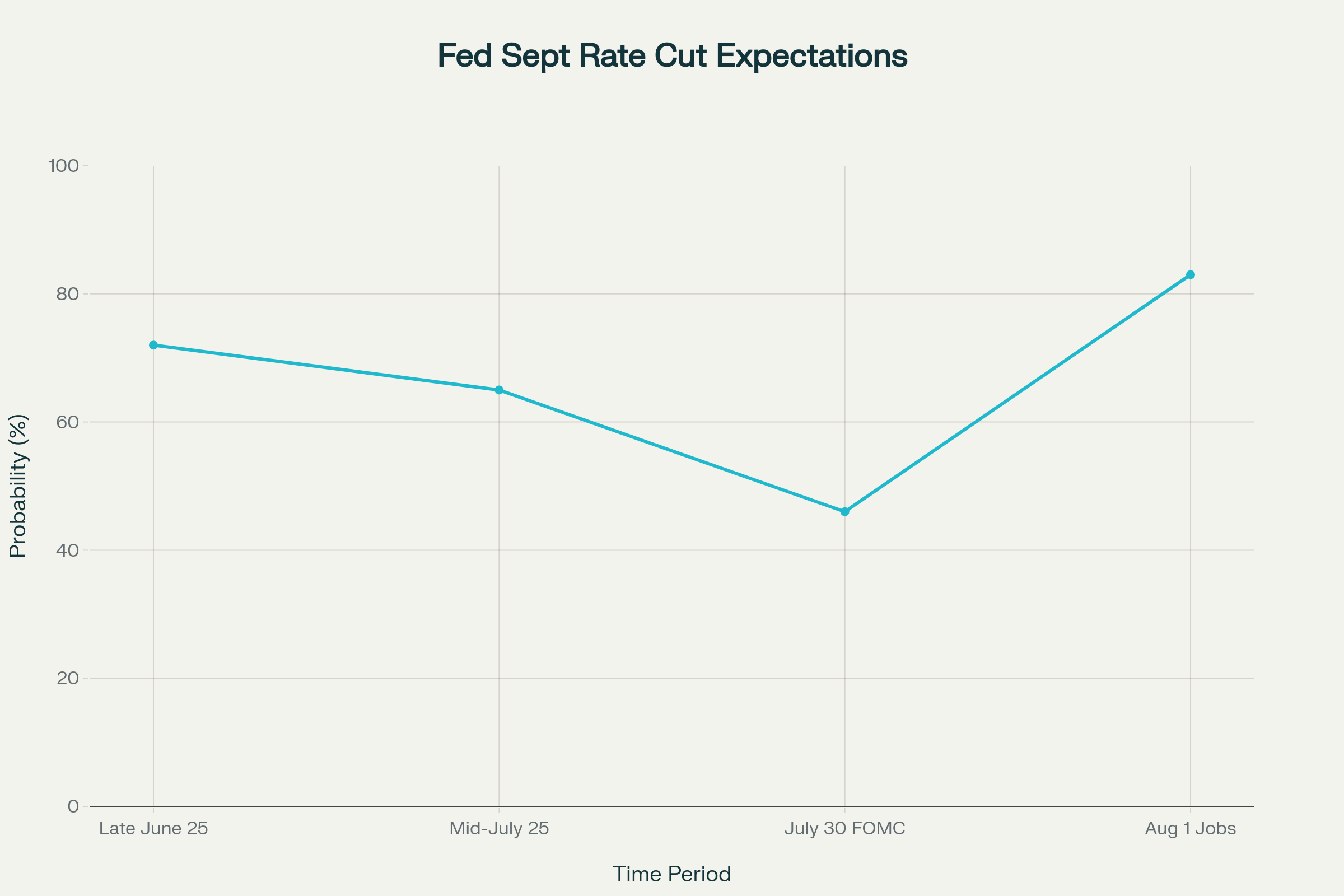
After a disappointing jobs report in July 2025, the chances of a rate cut in September shot up. Before the report, the market predicted only a 37% chance of a cut, but after the report the prediction went up to over 80% according to the CME FedWatch tool. That's a big jump which shows how sensitive the market is to new data.

What's Driving the Fed's Decision?

The economy is sending mixed signals, making the Fed's job much harder. Let's break them down:

  • Inflation: Inflation is still above the Fed's target of 2%. In June 2025, it was at 2.7%, up from 2.4% in May. Core inflation, which excludes food and energy, was at 2.9%. The increased tariffs, with average U.S. tariff rates at about 18.4% in July 2025, are contributing to these higher prices.
  • Labor Market: The labor market seems to be cooling off. The unemployment rate went up to 4.2% in July, up from 4.1% in June. Also, job growth has slowed. More concerning is that past months' job numbers have been adjusted downwards. May and June job gains were revised down by 258,000 jobs!

Here’s a quick summary:

Indicator June 2025 July 2025
Inflation (YoY) 2.4% 2.7%
Core Inflation N/A 2.9%
Unemployment Rate 4.1% 4.2%

Tensions Within the Fed

At the Federal Reserve's July 30th meeting, there was some disagreement. Two governors, Michelle Bowman and Christopher Waller, voted for a rate cut of 0.25%. It had been since 1993 that multiple Fed governors have voted againt the majority position, which shows how much pressure there is to start lowering rates.

Jerome Powell, the Fed Chair, played it cool and mentioned that no decision was made about September. He stressed that the Fed wanted to see more data before making any move. He also said the Fed has to balance two things: Cutting rates too soon, which could cause inflation to rise again, versus waiting too long, which could hurt the job market.

The Tariff Situation

It's undeniable that tariffs are causing some serious headaches. Chair Powell admitted that they have made some goods more expensive. The full effect is still unclear. It's a delicate balancing act for the Fed. They see some tariff-related price increases as temporary.

However, the uncertainty around future tariff policy can hurt business confidence and investment decisions. This high level of doubt is one of the factors the Fed is considering.

Economic Growth and Consumer Spending

Even though the job market is shaky, the U.S. economy grew at a 3.0% rate in the second quarter of 2025. However, this growth was mostly due to trade and lower imports, not strong demand in the U.S.

Domestic final sales only grew by 1.2% in the second quarter, which is the slowest since late 2022. This gives a clearer sense of the economy's momentum: things are slowing down.

Consumer spending, which is a significant factor for economic growth, has also slowed, growing by just 1.4% in the second quarter. This is due to higher interest rates and ongoing inflation affecting people's spending power.

What Wall Street Thinks

Financial markets haven't been able to make up their minds. After Powell's cautious comments in July, the dollar became stronger, and Treasury yields increased. People thought the Fed would not be cutting rates soon, but the weak jobs report changed everything. Market participants now expect more aggressive rate cuts.

Big Wall Street firms have changed their forecasts accordingly. Goldman Sachs now predicts three rate cuts in 2025 like what I've indicated, and expects the federal funds rate to be between 3.0%-3.25% by the end of the year. This is pretty substantial.

BlackRock's Rick Rieder even wondered if the Fed might make a big move and cut rates by 0.50% in September if the job market continues to weaken.

The Global View

What the Fed decides greatly influences global markets and other central banks. Many foreign central banks have already started cutting rates. The Fed's actions will likely affect how quickly other central banks make their own changes.

If the Fed starts slashing interest rates, the U.S. dollar, which has been strong, may weaken. This could affect emerging market economies and trade around the world.

Uncertainty Makes Decisions Tough

The Economic Policy Uncertainty Index hit a high of 243.7 in July 2025. This shows how difficult it is for businesses and policymakers to plan for the future.

Fed officials have said that their forecasts are dispersed. The June 2025 Summary of Economic Projections showed that FOMC participants have different ideas about where interest rates should go.

What About Jobs and Inflation?

The job situation is crucial for the Fed's decision, and the Job Openings and Labor Turnover Survey (JOLTS) has shown fewer jobs and lower hiring rates.

Although inflation has come down from its peak, core inflation remains a concern. Models from the Federal Reserve Bank of Cleveland predict that prices will continue to rise in the near future, potentially reaching 2.9% by August 2025.

The Fed needs to figure out whether price increases are temporary due to tariffs or if they are more permanent.

My Interest Rate Predictions for Sept 2025: A Balancing Act

The Federal Reserve is approaching a crossroads. Based on all the evidence, I believe the Fed will likely cut rates in September. Right now, markets estimate around an 80% chance of a 0.25% reduction.

Will the Fed Cut Rates in September 2025
Evolution of market expectations for Federal Reserve rate cuts in September 2025 based on CME FedWatch tool data

The Fed's next steps will depend on how the economy performs, especially concerning the job market and inflation. I think the challenge will be to figure out recent labor market problems are just a short-term glitch or a sign of something more serious. Though the Fed has some wiggle room to maneuver, the margin for error is small. Given that current unprecedented economic conditions, the September 2025 FOMC meeting could set the tone for monetary policy.

Position Your Portfolio Ahead of the Fed’s Next Move

The Federal Reserve’s next rate decision could shape real estate returns through the rest of 2025. Whether or not a rate cut happens, smart investors are acting now.

Norada Real Estate helps you secure cash-flowing properties in stable markets—shielding your investments from volatility and interest rate swings.

HOT NEW LISTINGS JUST ADDED!

Talk to a Norada investment counselor today (No Obligation):

(800) 611-3060

Get Started Now

Recommended Read:

  • Fed Holds Interest Rates Steady for the Fifth Time in 2025
  • Fed Projects Two Interest Rate Cuts Later in 2025
  • Interest Rate Predictions for the Next 3 Years: 2025, 2026, 2027
  • When is Fed's Next Meeting on Interest Rate Decision in 2025?
  • Interest Rate Predictions for the Next 10 Years: 2025-2035
  • Will the Bond Market Panic Keep Interest Rates High in 2025?
  • Interest Rate Predictions for 2025 by JP Morgan Strategists
  • Interest Rate Predictions for Next 2 Years: Expert Forecast
  • Fed Holds Interest Rates But Lowers Economic Forecast for 2025
  • Fed Indicates No Rush to Cut Interest Rates as Policy Shifts Loom in 2025
  • Fed Funds Rate Forecast 2025-2026: What to Expect?
  • Interest Rate Predictions for 2025 and 2026 by NAR Chief
  • Market Reactions: How Investors Should Prepare for Interest Rate Cut
  • Impact of Interest Rate Cut on Mortgages, Car Loans, and Your Wallet

Filed Under: Economy, Financing Tagged With: Economy, Fed, Fed Rate Cut, Federal Reserve, inflation, Interest Rate

Jerome Powell and Federal Reserve: 80%+ Chance of Interest Rate Cut in September 2025

September 11, 2025 by Marco Santarelli

Jerome Powell and the Fed: 80%+ Chance of Interest Rate Cut in September

The financial world is buzzing with anticipation. Is the Federal Reserve, under the watchful eye of Chair Jerome Powell, gearing up for an interest rate cut next month? Based on the latest market signals, it seems incredibly likely, with odds pointing to a strong 80%+ chance of a rate cut in September. This isn't just a small possibility; it's a strong possibility that could ripple through your wallet and the economy in big ways.

As we head into the crucial September 16-17 meeting of the Federal Open Market Committee (FOMC), every economic report, every speech from Fed officials, and every tick on financial markets futures is being dissected. The original question about an 80% chance is actually a bit conservative now.

Looking at the data as of mid-August 2025, the probabilities are even higher, often landing between a solid 83% and a very convincing 94% for at least a quarter-percentage-point (0.25%) reduction. Powell, while influential, doesn't call the shots alone; the FOMC makes the decision as a group. But his words and the Fed's direction heavily influence these outcomes.

Let's break down what's really going on with these interest rates, the economic signs pointing towards a cut, how we can actually measure these probabilities, what Powell has been saying, and what this all means for you. I’ll share some of my own thoughts and experiences to give you a deeper understanding of this complex but important topic.

Jerome Powell and the Fed: 80%+ Chance of Interest Rate Cut in September


Federal Reserve Data Visualization Dashboard

Historical Federal Funds Rate (2020-2025)

 
Key Events: 🔴 First Hike (Mar 2022) | 🔴 Peak Rate (Jul 2023) | 🔴 First Cut (Sep 2024)

Inflation and Unemployment Trends (2025)

 
Shows the Fed's balancing act: Inflation declining to 2.7%, Unemployment rising to 4.2%

September 2025 Rate Cut Probabilities by Source

 
High consensus (80%+) across all major financial institutions for September rate cut
4.33%
Current Fed Rate
August 2025
2.7%
Latest Inflation
July 2025
84%
Rate Cut Consensus
September 2025

Key Insights

  • The Fed raised rates aggressively from near-zero to 5.5% between March 2022 and July 2023
  • Rate cuts began in September 2024, bringing rates down to current 4.33% level
  • Inflation has steadily declined to 2.7%, approaching the Fed's 2% target
  • Unemployment has risen moderately to 4.2%, signaling some labor market softening
  • Strong market consensus (80%+) expects another rate cut in September 2025
Created by Norada Real Estate Investments

The Fed's Balancing Act: Understanding Interest Rates

First off, what exactly is the Fed doing with interest rates? Think of the federal funds rate as the main thermostat for the economy. It's the rate banks charge each other for overnight loans. When the Fed adjusts this rate, it affects borrowing costs everywhere – from the mortgage on your house and the interest on your car loan to how much it costs businesses to borrow money to expand.

The FOMC, the Fed's decision-making body, meets eight times a year to look at all the economic information and decide whether to raise, lower, or keep rates the same. For a long time, after the COVID-19 pandemic, rates were pretty much at zero to help the economy bounce back. But then, inflation started to climb really high.

To fight that, the Fed started raising rates aggressively in March 2022. They kept going until they hit a peak of 5.25%-5.50% in July 2023. Since then, they’ve been gradually bringing rates down, and as of mid-August 2025, the target range is 4.25%-4.50%. This slow cooling reflects progress on inflation but also a careful watch for any signs of the economy slowing down too much.

Generally, the Fed cuts rates when inflation is under control and they worry about people losing jobs or businesses struggling. They raise rates to cool down an economy that's getting too hot, which can lead to inflation.

Historically, when the Fed starts cutting rates, they often make bigger moves, maybe 50 to 75 basis points at a time. But today, the talk is mostly about a smaller 25-basis-point cut to bring the rate down to 4.00%-4.25%. Some analysts are even talking about the possibility of a larger 50-basis-point cut if the economic data shows a significant slowdown.

The Economic Clues: Why a Cut Looks Likely

So, what's an economy analyst like me seeing that makes a September cut seem so probable? The U.S. economy in mid-2025 presents a bit of a mixed bag, which is exactly the kind of situation where the Fed might decide to lower rates.

  • Inflation is Cooling, But Not Gone: The Consumer Price Index (CPI), which is how we measure inflation, rose by 2.7% year-over-year in July 2025. That’s the same as June, but it's still higher than it was earlier in the year, and notably above the Fed's target of 2%. Core inflation, which strips out food and energy prices, was 3.1%. While this is much lower than the highs we saw in 2022 (over 6%), it's still a bit persistent. This moderate inflation, however, shows that the Fed's previous rate hikes are working, and keeping rates too high might slow things down more than necessary.
  • Jobs Market Shows Some Weakness: The unemployment rate nudged up to 4.2% in July from 4.1% in June. It’s been hovering in that 4.0%-4.2% range for a while. More importantly, job growth, which is how many new jobs are created each month, slowed down significantly. We only saw 114,000 nonfarm payrolls added in July, which was less than many people expected. This slight cooling in the job market is something the Fed watches very closely because one of its main goals is to have as many people employed as possible. If unemployment starts to tick up more consistently, it’s a strong signal for the Fed to ease up on rates.
  • Economic Growth is Slowing Down: The overall economy, measured by Gross Domestic Product (GDP), grew at a rate of 3.0% in the second quarter of 2025. That’s actually pretty good and better than the first quarter. However, when you look at forecasts for the rest of 2025 and into 2026, most experts predict growth will slow down to around 1.5%. This anticipated slowdown is another reason why the Fed might consider cutting rates now, to help keep the economy moving along smoothly – what they call a “soft landing.”

Taken together, these economic signs suggest a scenario where inflation is getting closer to the target, and the economy is slowing without necessarily falling into a recession. But you can see how volatile these numbers can be; that weaker jobs report in July really boosted the chances of a rate cut.

Reading the Tea Leaves: Market Predictions and Probability Tools

That “80%” figure you might have heard is definitely in the ballpark, but as I mentioned, it’s actually on the lower end of what the markets are showing now. The best way to get a real-time look at what the markets expect is by using tools like the CME FedWatch Tool. This tool looks at futures contracts for the federal funds rate and basically shows how traders are betting on future rate decisions.

Here’s a snapshot of what the probabilities looked like around mid-August 2025:

Source/Date Probability of 25bp Cut Probability of 50bp Cut Probability of No Change
CME FedWatch (Aug 19) 82.9% 17.1% 0%
Bloomberg Analysts (Aug 18) 90%+ N/A <10%
Investing.com Fed Monitor (Aug 13) 91.8% 8.2% 0%
Barron's (Aug 13) 90.9% N/A 9.1%
Growbeansprout (Aug 17) 83.4% N/A 16.6%

(Note: Probabilities are aggregated and may not sum to exactly 100% across all outcomes in every single reporting instance due to how different sources round and present data.)

As you can see, many sources are putting the odds of a cut at 90% or higher. This consensus is a strong signal, but it’s crucial to remember that these are just probabilities. They can change day by day based on new economic reports.

You see these numbers reflected all over social media, too, with people discussing predictions and linking them to how other markets, like cryptocurrency or gold, might react.

What Jerome Powell is Saying (and What It Means)

Jerome Powell, as the head of the Fed, carefully chooses his words. He’s emphasized that the Fed is “data-dependent,” meaning they base their decisions on the latest economic information. In the Fed's July 30, 2025, statement, he shared that they were keeping rates at the current 4.25%-4.50% level while they “assess incoming data, the evolving outlook, and the balance of risks.”

He pointed out that while economic activity has been expanding at a solid pace, inflation is still “elevated,” and the job market has “shown signs of improving.” Crucially, he reiterated the Fed's commitment to getting inflation down to 2% and supporting maximum employment. He also made it clear that the Fed is “prepared to adjust” its policy if they see new risks.

Powell's upcoming appearance at the Jackson Hole Economic Symposium on August 22, 2025, will be closely watched for any hints about the Fed's thinking. There’s always speculation around these events, from thoughts on future rate cuts to even discussions about his own position at the Fed. While he hasn't said a cut is guaranteed, he's certainly not ruling it out. He’s been pushing back against expectations for very rapid interest rate cuts, suggesting a cautious approach.

Weighing the Risks and What Comes Next

Even with such high probabilities, there are always things that could change the Fed's mind. If inflation suddenly becomes “sticky” again – maybe because of things like new tariffs on imported goods driving prices up – the Fed might delay a cut. Or, if upcoming economic data surprises everyone by being much stronger than expected, they might hold off.

Some people still believe the odds are lower if the economy remains strong, citing times in the past when markets were overly optimistic about rate cuts.

So, what does a rate cut – or no cut – mean?

  • For Consumers: Lower interest rates mean it will be cheaper to borrow money. This could mean lower monthly payments on mortgages if you’re looking to refinance or buy a new home, and potentially lower interest rates on car loans and credit cards.
  • For Businesses: More affordable borrowing means businesses might find it easier to invest in new equipment, hire more people, or expand their operations.
  • For Investors: When interest rates go down, investments like stocks and other riskier assets often become more attractive, potentially leading to higher prices. On the flip side, a rate cut can make existing bonds worth less if their fixed interest rate is now lower than new bonds being issued. A cut can also make the U.S. dollar weaker against other currencies. If the Fed doesn't cut rates, it might mean they are more concerned about inflation or economic strength, which could make the stock market a bit nervous.

The Bottom Line

Based on what I'm seeing in the economic data and how the markets are reacting, the chance of the Federal Reserve cutting interest rates in September 2025 is very high, likely in the 85-95% range. This is driven by inflation that's moving in the right direction, a job market that's showing some signs of cooling, and a general expectation that economic growth will slow down.

However, the Fed’s core principle is to be “data-dependent,” so nothing is set in stone until the FOMC officially makes its decision. Always keep an eye on Jerome Powell's comments and any new economic reports that come out between now and the September meeting. These will be the key factors that could either confirm or change the current expectations.

Position Your Portfolio Ahead of the Fed’s Next Move

The Federal Reserve’s next rate decision could shape real estate returns through the rest of 2025. Whether or not a rate cut happens, smart investors are acting now.

Norada Real Estate helps you secure cash-flowing properties in stable markets—shielding your investments from volatility and interest rate swings.

HOT NEW LISTINGS JUST ADDED!

Talk to a Norada investment counselor today (No Obligation):

(800) 611-3060

Get Started Now

Recommended Read:

  • Interest Rate Forecast for September 2025: Will Fed Cut Rates?
  • Fed Holds Interest Rates Steady for the Fifth Time in 2025
  • Fed Projects Two Interest Rate Cuts Later in 2025
  • Interest Rate Predictions for the Next 3 Years: 2025, 2026, 2027
  • When is Fed's Next Meeting on Interest Rate Decision in 2025?
  • Interest Rate Predictions for the Next 10 Years: 2025-2035
  • Will the Bond Market Panic Keep Interest Rates High in 2025?
  • Interest Rate Predictions for 2025 by JP Morgan Strategists
  • Interest Rate Predictions for Next 2 Years: Expert Forecast
  • Fed Holds Interest Rates But Lowers Economic Forecast for 2025
  • Fed Indicates No Rush to Cut Interest Rates as Policy Shifts Loom in 2025
  • Fed Funds Rate Forecast 2025-2026: What to Expect?
  • Interest Rate Predictions for 2025 and 2026 by NAR Chief
  • Market Reactions: How Investors Should Prepare for Interest Rate Cut
  • Impact of Interest Rate Cut on Mortgages, Car Loans, and Your Wallet


Filed Under: Economy, Financing Tagged With: Economy, Fed, Fed Rate Cut, Federal Reserve, inflation, Interest Rate

30-Year Mortgage Rate Predictions: September to December 2025

September 11, 2025 by Marco Santarelli

30-Year Mortgage Rate Predictions for the Rest of 2025

Wondering where mortgage rates are headed? You're not alone. 30-year fixed mortgage rates are a hot topic, especially for anyone thinking about buying a home or refinancing. Right now, in late August 2025, these rates are around 6.5-6.6%. The good news is, experts think they might drop slightly by the end of this year. Averaging around 6.4% in Q4 and possibly landing near 6.3% by December, might be the definitive answer, if everything stays relatively stable and the Federal Reserve cuts rates. We'll dig into the details to give you a better idea of what to expect.

30-Year Mortgage Rate Predictions: September to December 2025

It can be stressful trying to figure out the best time to make a move in the real estate market. As an investor myself, I know that understanding the direction of mortgage rates is a key piece of the puzzle. I'm going to share my thoughts on what the rest of 2025 might hold for 30-year mortgage rates, look into what's influencing rate movements and break it all down so that you can make informed decisions.

How Did We Get Here? A Quick History Lesson

To guess where we are going, it’s helpful to know where we have been. Let's rewind a bit. Back in 2021 and 2022, mortgage rates were super low – hovering around 3%. This was during the pandemic, and the government was trying to boost the economy. But then, inflation went up, and the Federal Reserve (the Fed) started raising interest rates to try and cool things down. By late 2023, mortgage rates had jumped to almost 8%!

In 2025, rates started around 6.8% and have been slowly coming down. As of September 4, 2025, the average 30-year fixed mortgage rate is 6.5%, according to Freddie Mac. It's been a bit of a rollercoaster, but things seem to be stabilizing.

Here's a quick look at how rates have moved this year:

  • January: 6.81%
  • February: 6.64%
  • March: 6.88%
  • April: 6.82%
  • May: 6.74%
  • June: 6.65%
  • July: 6.73%
  • August: 6.59%
  • September: 6.50%

What's Driving Mortgage Rates Now?

A bunch of different things influence mortgage rates. Here are some of the most important ones:

  1. The Federal Reserve (The Fed): The Fed sets a key interest rate that affects all sorts of borrowing costs, including mortgages. The Fed has kept its rate at 4.25-4.5%, but there's talk of them cutting rates later this year if inflation keeps cooling down.
  2. Inflation: Inflation is how much prices are rising. Right now, inflation is around 2.7-3.1%. If inflation goes down, the Fed is more likely to cut rates, which could lead to lower mortgage rates.
  3. The Economy: The economy's health also plays a big role. Unemployment is around 4.3%, and the economy is growing slowly. If the economy weakens, rates might fall.
  4. The Housing Market: What's happening with home sales and prices matters, too. Home sales are up a bit, and prices are expected to be stable.

Expert Predictions

So, what do the experts think? Here's a quick summary:

  • Mortgage Bankers Association (MBA): They expect rates to be around 6.8% in the summer and fall, and then drop to 6.7% by the end of the year.
  • Fannie Mae: They're a bit more optimistic, predicting rates of 6.5% by the end of 2025 and even lower in 2026.
  • Freddie Mac: They say rates are at a 10-month low, but they also point out that the economy is still strong, which could prevent rates from falling too much.
  • Norada Real Estate Investments: We're leaning towards a modest decline, with rates averaging around 6.4% in the last three months of 2025, possibly ending the year around 6.3%. This is what we think will happen as long as inflation continues to decline and The Fed decreases rates.

It's important to remember that these are just predictions. No one knows for sure what will happen. Things can change quickly depending on what happens with the economy and the Fed.

My Take on the Future

I believe we'll see a gradual decrease in mortgage rates over the next few months. I think the Fed will likely cut rates at least once before the end of the year, which will help push mortgage rates down. However, I don't think we'll see rates fall back to the super-low levels we saw during the pandemic anytime soon. The economy is still pretty strong, and inflation is still a bit high.

Even if mortgage rates don't go down a lot, any decrease can help. A small drop in rates can make a big difference in how much you pay each month.


Related Topics:

Mortgage Rates Predictions Next 90 Days: August to October 2025

Mortgage Rates Predictions for the Latter Half of 2025 by Norada Real Estate

Mortgage Rates Predictions Next 60 Days: August to October 2025

Mortgage Rate Predictions for the Next 3 Years: 2026, 2027, 2028

How This Affects You

Here's how these potential rate changes could affect different people:

  • Homebuyers: Lower rates could make homes more affordable, which will definitely help, especially for first-time buyers.
  • People Refinancing: If you have a high-interest mortgage (say, 7% or higher) from 2023 or 2024, you might be able to save money by refinancing* if rates go down.
  • Investors: Stable or slightly lower rates are usually good for real estate investors. It can help keep rental income strong.

What You Can Do

If you're thinking about buying or refinancing, here's some advice:

  • Keep an Eye on Rates: Watch what's happening with mortgage rates and the economy.
  • Consider Locking in a Rate: If you find a rate you like, you might want to lock it in to protect yourself from future increases.
  • Talk to a Lender: Get advice from a mortgage lender. They can help you understand your options and find the best loan for you.
  • Consider Alternative Strategies: Look into options like adjustable-rate mortgages (ARMs) for flexibility. Look into rate buy downs to lock lower rates in.
  • Be Patient: Don't rush into anything. Take your time and make sure you're making the right decision for you.

Looking Ahead

Predicting the future is always a guessing game, but by paying attention to the economy and talking to experts, and staying informed, you can put yourself in a good position to make the best decisions for you!

Here's a rough estimate of what rates might look like in the coming months:

  • Q3 2025 (July-September): Around 6.5%
  • Q4 2025 (October-December): Around 6.4%
  • Q1 2026 (January-March): Around 6.2% (possibly lower if the economy weakens)

Remember, these are just estimates. The actual rates could be higher or lower depending on what happens in the economy.

Invest Smarter in a High-Rate Environment

With mortgage rates remaining elevated this year, it's more important than ever to focus on cash-flowing investment properties in strong rental markets.

Norada helps investors like you identify turnkey real estate deals that deliver predictable returns—even when borrowing costs are high.

HOT NEW LISTINGS JUST ADDED!

Connect with a Norada investment counselor today (No Obligation):

(800) 611-3060

Get Started Now 

Also Read:

  • Mortgage Rates Predictions 2025 and 2026 by Fannie Mae
  • Mortgage Rates Predictions 2026 by Warren Buffett’s Berkshire Hathaway
  • Will Mortgage Rates Go Down in 2025: Morgan Stanley's Forecast
  • Mortgage Rate Predictions 2025 from 4 Leading Housing Experts
  • 30-Year Fixed Mortgage Rate Forecast for the Next 5 Years
  • 15-Year Fixed Mortgage Rate Predictions for Next 5 Years: 2025-2029
  • Will Mortgage Rates Ever Be 3% Again in the Future?
  • Mortgage Rates Predictions for Next 2 Years
  • Mortgage Rate Predictions for Next 5 Years
  • Mortgage Rate Predictions: Why 2% and 3% Rates are Out of Reach
  • How Lower Mortgage Rates Can Save You Thousands?
  • How to Get a Low Mortgage Interest Rate?
  • Will Mortgage Rates Ever Be 4% Again?
Filed Under: Financing, Mortgage Tagged With: Interest Rate, mortgage, Mortgage Rate Trends, mortgage rates, Mortgage Rates Predictions

Today’s Mortgage Rates – September 10, 2025: Purchase Rates Drop, Refi Rates Slightly Up

September 10, 2025 by Marco Santarelli

Today's Mortgage Rates - September 10, 2025: 30-Year FRM Goes Down by 6 Basis Points

Mortgage rates today, September 10, 2025, have generally dropped compared to last week, with the national average 30-year fixed mortgage rate sitting at 6.44%, down from 6.50% the previous week, according to Zillow. Refinancing rates, however, show slight increases, with the 30-year fixed refinance rate rising from 6.63% to 6.71%.

This mixed movement is largely influenced by the market anticipation of a Federal Reserve rate cut later this month, cooling labor market indicators, and declining Treasury yields. Overall, the trend leans towards lower purchase mortgage rates, offering hopeful opportunities for homebuyers and some relief for potential refinancers.

Today's Mortgage Rates – September 10, 2025: Purchase Rates Drop, Refi Rates Slightly Up

Key Takeaways

  • 30-year fixed mortgage rates declined to 6.44%, down 6 basis points from last week.
  • 15-year fixed and 5-year ARM mortgage rates also decreased slightly.
  • Refinance rates showed modest increases, with the 30-year fixed refinance rate at 6.71%.
  • Market expects a Federal Reserve rate cut in mid-September 2025, influencing current rates.
  • Cooling job growth and rising unemployment contribute to rate declines.
  • Declining 10-year Treasury yields directly impact mortgage rates downward.
  • Experts forecast mortgage rates staying above 6% through 2025, with potential further dips in 2026.

Current Mortgage Rates Overview: Purchase Loans

Mortgage rates show slight but meaningful shifts depending on the loan type. Below is a summary of the key conforming and government loan purchase mortgage rates reported by Zillow as of September 10, 2025:

Loan Type Current Rate Weekly Change APR Weekly APR Change
30-Year Fixed 6.44% ↓0.05% 6.93% 0.00%
20-Year Fixed 6.25% ↑0.13% 6.69% ↑0.19%
15-Year Fixed 5.44% ↓0.12% 5.77% ↓0.07%
10-Year Fixed 5.79% 0.00% 6.09% 0.00%
7-Year ARM 6.38% ↓0.55% 7.43% ↓0.23%
5-Year ARM 6.88% ↑0.12% 7.69% ↑0.14%

Government Loans:

Loan Type Current Rate Weekly Change APR Weekly APR Change
30-Year FHA Fixed 5.70% ↓0.18% 6.71% ↓0.18%
30-Year VA Fixed 5.92% ↓0.03% 6.13% ↓0.02%
15-Year FHA Fixed 5.19% ↓0.18% 6.15% ↓0.19%
15-Year VA Fixed 5.82% ↑0.24% 6.17% ↑0.27%

Refinance Rates: Current Trends and Changes

While purchase mortgage rates are declining modestly, refinance rates tell a slightly different story. The most current data for refinance mortgage rates on September 10, 2025, shows slight upticks in most categories.

Refinance Program Current Rate Weekly Change
30-Year Fixed Refinance 6.71% ↑0.08% (up 8 bps)
15-Year Fixed Refinance 5.45% ↑0.07% (up 7 bps)
5-Year ARM Refinance 7.25% ↑0.22% (up 22 bps)

This divergence where purchase rates decrease while refinance rates rise may reflect tighter conditions or increased risk premiums in the refinance market, along with varying borrower profiles.

Why Are Mortgage Rates Falling and Refinances Increasing?

There are multiple factors in play affecting today's mortgage and refinance rates. Here is how they interconnect:

1. Federal Reserve's Anticipated Rate Cut

Markets currently expect the Federal Reserve to cut its benchmark interest rate by 25 basis points at the September 16-17 meeting. This expectation has resulted in:

  • Mortgage lenders lowering rates preemptively as rate cuts typically push mortgage rates down.
  • Increased buying activity as potential borrowers anticipate more affordable financing.

2. Signs of a Cooling Economy

Recent economic reports depict a slowing job market:

  • August 2025 unemployment rose slightly to 4.3% from 4.2% in July.
  • Only 22,000 new jobs were added, signaling softer economic growth.

A cooling labor market reduces inflationary pressures, allowing the Fed to consider easing monetary policy. This contributes to:

  • Lower mortgage rates as inflation expectations soften.
  • Increased refinancing activity as homeowners seek to capitalize on better rates.

3. Declining Treasury Yields

Mortgage rates closely follow the 10-year U.S. Treasury yield, which has dropped to about 4.08% as of early September 2025. This decline stems from:

  • Investors moving funds to safer assets amid economic uncertainty.
  • Lower Treasury yields pull mortgage rates down due to their bond-market linkage.

Combined, these factors have pushed the 30-year fixed mortgage rate to its lowest mark in nearly a year.

Detailed Rate Trends Over 2025

Mortgage rates have fluctuated significantly through 2025:

  • Rates hovered mostly between 6.6% and 6.8% in the first half of 2025.
  • Economic data weakening in mid-2025 triggered a gradual decline, seen in the recent 6.44% reading.
  • Refinancing share of mortgage applications hit nearly 47%—the highest since October 2024—indicating growing homeowner interest in locking lower rates.

Mortgage Rate Historical Snapshot in 2025 (Selected Dates)

Date 30-Year Fixed Rate 30-Year Refi Rate
January 2025 ~6.70% ~6.95%
March 2025 ~6.75% ~7.00%
July 2025 6.68% 6.75%
September 10 6.44% 6.71%

Expert Forecasts for Mortgage Rates

The future path of mortgage rates is carefully tracked by experts using economic data and Fed signals:

Source 2025 Forecast 2026 Forecast
National Association of REALTORS® Average 6.4%, dipping to 6.1% Further easing to 6.1% expected
Realtor.com Slow easing, settling around 6.4% by year-end Continuing slow decline
Fannie Mae Ends 2025 at 6.5%, drops to 6.1% in 2026 Same forecast with mild upward revision
Mortgage Bankers Association (MBA) 6.7% by end 2025, declining to 6.5% in 2026 Expects volatility but gradual decline

Their consensus shows mortgage rates likely to remain above 6% during 2025 but gradually trend lower in 2026 as economic conditions evolve.

Impact of the Federal Reserve’s Monetary Policy

The Federal Reserve’s influence on mortgage rates can’t be overstated:

  • After a cycle of rate hikes through 2022-2023, the Fed cut rates thrice in late 2024, followed by a pause in early and mid-2025.
  • The current September meeting is widely expected to cut rates again due to a softer economy.
  • The Fed's policy affects short-term rates directly, and mortgage rates indirectly, through market expectations and Treasury yields.

The possibility of further rate cuts in December 2025 and into 2026 creates a backdrop for mortgage rates to continue downward pressure, albeit slowly.

How Today’s Rates Affect Buyers and Refinancers

Here’s how these rate movements play out practically:

  • Homebuyers benefit as purchase rates drop toward more manageable levels, improving affordability slightly.
  • Current homeowners with older, higher-rate loans may find refinancing attractive, especially if their current rate exceeds 7%.
  • Although refinance rates have risen slightly this week, the general downward pressure on mortgage rates since summer 2025 creates a more supportive environment for refinancing compared to earlier months.

Example Monthly Payment Calculation Change

Consider a $300,000 mortgage on a 30-year fixed loan:

Interest Rate Monthly Principal & Interest Payment
6.50% (Last week) $1,896
6.44% (Today) $1,890

Difference: $6 less per month, which, while small, adds up over the life of a loan and signals a trend toward easing rates.


Related Topics:

Mortgage Rates Trends as of September 9, 2025

Mortgage Rates Predictions Next 90 Days: August to October 2025

Mortgage Rates Predictions for the Next 60 Days

Mortgage Rates Predictions for Next 90 Days: July-Sept 2025

Tables Summarizing Key Data — September 10, 2025

Loan Type Purchase Rate Weekly Change Refinance Rate Weekly Change
30-Year Fixed 6.44% ↓0.06% 6.71% ↑0.08%
15-Year Fixed 5.44% ↓0.05% 5.45% ↑0.07%
5-Year ARM 6.88% ↓0.04% 7.25% ↑0.22%

Final Thoughts on Mortgage Rates Today

Today's mortgage rates reflect a market adjusting to economic realities of slower job growth and inflation easing, alongside the strong likelihood of a Fed rate cut. Homebuyers can feel a bit more optimistic as purchase rates have edged lower, making homeownership slightly more attainable. Refinancers, meanwhile, see a mixed picture but are starting to find better windows to lower their borrowing costs.

This snapshot of September 10, 2025, indicates a turning point where market optimism meets cautious stabilization. While rates remain elevated compared to the ultra-low environment earlier in the decade, the pressing trend is toward moderate easing, which could gradually ease the housing market stresses many Americans face.

Capitalize Amid Rising Mortgage Rates

With mortgage rates expected to remain high in 2025, it’s more important than ever to focus on strategic real estate investments that offer stability and passive income.

Norada delivers turnkey rental properties in resilient markets—helping you build steady cash flow and protect your wealth from borrowing cost volatility.

HOT NEW LISTINGS JUST ADDED!

Speak with a seasoned Norada investment counselor today (No Obligation):

(800) 611‑3060

Get Started Now

Also Read:

  • Will Mortgage Rates Go Down in 2025: Morgan Stanley's Forecast
  • Mortgage Rate Predictions 2025 from 4 Leading Housing Experts
  • Mortgage Rate Predictions for the Next 3 Years: 2026, 2027, 2028
  • 30-Year Fixed Mortgage Rate Forecast for the Next 5 Years
  • 15-Year Fixed Mortgage Rate Predictions for Next 5 Years: 2025-2029
  • Will Mortgage Rates Ever Be 3% Again in the Future?
  • Mortgage Rates Predictions for Next 2 Years
  • Mortgage Rate Predictions for Next 5 Years
  • Mortgage Rate Predictions: Why 2% and 3% Rates are Out of Reach
  • How Lower Mortgage Rates Can Save You Thousands?
  • How to Get a Low Mortgage Interest Rate?
  • Will Mortgage Rates Ever Be 4% Again?

Filed Under: Financing, Mortgage Tagged With: Interest Rate, mortgage, Mortgage Rate Trends, mortgage rates, Mortgage Rates Today

Today’s Mortgage Rates – September 9, 2025: 30-Year FRM Goes Down by 15 Basis Points

September 9, 2025 by Marco Santarelli

Today's Mortgage Rates - September 9, 2025: Rates Go Down as Markets Anticipate Fed Rate Cut

Mortgage rates today on September 9, 2025, have dropped notably, with the national average 30-year fixed mortgage rate falling to 6.32%, down 18 basis points from last week’s 6.50%. This decline is part of a broader downward trend driven by market expectations of an imminent Federal Reserve rate cut, recent signs of a cooling labor market, and falling Treasury yields. Refinance rates have also softened, with the 30-year fixed refinance rate dropping to 6.58%, down 17 basis points from the prior week. These shifts are improving affordability for buyers and increasing opportunities for homeowners considering refinancing.

Today's Mortgage Rates – September 9, 2025: 30-Year FRM Goes Down by 15 Basis Points

Key Takeaways:

  • 30-year fixed mortgage rates fell to 6.32%, down from 6.50% last week.
  • 15-year fixed mortgage average declined slightly to 5.37%.
  • Refinance rates dipped with the 30-year fixed refinance rate at 6.58%.
  • Labor market cooling (4.3% unemployment) is influencing rate expectations.
  • Federal Reserve is expected to cut rates on September 16-17, 2025.
  • Mortgage rates are still above 6%, with forecasts predicting rates will stay elevated through 2025.

Current Mortgage and Refinance Rates Overview

The table below compares current mortgage rates by loan type alongside last week's changes:

Loan Type Current Rate 1-Week Change APR APR 1-Week Change
Conforming Loans
30-Year Fixed 6.32% -0.17% 6.74% -0.20%
20-Year Fixed 6.09% -0.03% 6.59% +0.09%
15-Year Fixed 5.37% -0.18% 5.65% -0.19%
10-Year Fixed 5.79% 0.00% 6.09% 0.00%
7-Year ARM 6.38% -0.55% 7.43% -0.23%
5-Year ARM 6.64% -0.12% 7.50% -0.05%
Loan Type Current Rate 1-Week Change APR APR 1-Week Change
Government Loans
30-Year Fixed FHA 5.63% -0.25% 6.63% -0.25%
30-Year Fixed VA 5.89% -0.05% 6.11% -0.04%
15-Year Fixed FHA 5.18% -0.19% 6.14% -0.19%
15-Year Fixed VA 5.57% -0.01% 5.92% +0.02%

Source: Zillow, September 9, 2025

Regarding refinance rates, there has been a small dip, with the national average for a 30-year fixed refinance rate decreasing to 6.58%, down 17 basis points week over week.

Why Are Mortgage Rates Trending Downward?

Mortgage rates often react to broader economic conditions and monetary policy outlooks. Several factors are at play now, pushing rates down temporarily:

  • Federal Reserve Anticipated Rate Cut: Markets are betting on a quarter-point interest rate cut by the Federal Reserve at the September 16-17 meeting, following slow economic indicators and rising unemployment. This expectation encourages lenders to lower mortgage rates proactively.
  • Cooling Labor Market: The August 2025 unemployment rate rose to 4.3%, a slight increase from 4.2% in July, and new job additions slowed drastically to 22,000, signaling softness in the economy.
  • Declining Treasury Yields: Mortgage rates are closely tied to the 10-year U.S. Treasury yield, which has decreased to about 4.08% as investors seek safer assets amid uncertainty, dragging mortgage rates lower.

Historical Context: From Tightening to Loosening

Mortgage rates have had a volatile journey since the pandemic. From historic lows during 2020-2021 when the Fed’s bond-buying program kept rates near record lows, rates surged between 2022 and 2023 as the Federal Reserve aggressively raised the federal funds rate to tackle inflation, pushing 30-year fixed rates to 20-year highs around 7% or more. The Fed paused hikes in 2025 but left rates elevated. However, recent economic data is compelling the Fed to consider cuts, marking a shift toward easing monetary policy.

Mortgage Rate Forecasts and Market Predictions

Organizations tracking mortgage rates offer varied but generally cautious outlooks:

Source Rate Forecast for End 2025 Notes
National Association of REALTORS® ~6.4% Anticipates rates dip to ~6.1% in 2026
Realtor.com ~6.4% Rates easing slowly, roughly even with 2024
Fannie Mae 6.5% to 6.1% End 2025 and 2026 respectively; upwards revision vs previous forecast
Mortgage Bankers Association 6.7% (2025), 6.5% (2026) Expects volatility and periods of limited refinance opportunities

These forecasts reflect the complex balance between inflation, economic growth, Federal Reserve actions, and market forces.

Example Calculation: Impact of Rate Change on Monthly Payments

Understanding how these rate changes impact actual monthly mortgage payments can help grasp their significance. Consider a $300,000 loan amount with a 30-year term:

Interest Rate Monthly Payment (Principal & Interest) Difference from 6.32% Rate
6.50% $1,896 +$40
6.32% $1,848 Base
6.00% $1,799 -$49

A 0.18% drop from 6.50% to 6.32% reduces monthly payments by approximately $48, which can be meaningful for homeowners budgeting tight finances.

What This Means for Homebuyers and Homeowners

  • Homebuyers are seeing slightly improved affordability amid still-high home prices. The lower rates may spark renewed buying interest, particularly among first-time buyers weighing the cost of borrowing.
  • Homeowners Considering Refinancing have more opportunities as rates fall. Those with older mortgages locked in above 7% can realize significant savings by refinancing now, albeit refinance rates remain elevated compared to purchase rates.
  • However, rates still remain relatively high by historical standards. Many economists agree that sub-6% rates are unlikely soon, reinforcing the need to weigh personal financial circumstances.

Federal Reserve’s Influence and the September 2025 Meeting

The Fed’s monetary policy remains the largest external factor influencing mortgage rates. After a period of steady rates in 2025, the weak jobs report and creeping inflation have stirred expectations of an imminent cut:

  • The Fed has held rates steady for five meetings but dissent within the board signals a divide on whether easing should occur sooner.
  • The expected 25 basis-point cut will lower the federal funds rate from current levels around 4.25%-4.5%.
  • Traders have priced in over a 90% chance of this cut at the upcoming meeting.
  • The Fed’s post-meeting “dot plot” showing future rate path will be closely watched by markets.

Lower federal funds rates often lead to lower Treasury yields and mortgage rates. However, mortgage rates don’t move one-for-one with the Fed rate, as broader economic risks and inflation expectations also play roles.


Related Topics:

Mortgage Rates Trends as of September 8, 2025

Mortgage Rates Predictions Next 90 Days: August to October 2025

Mortgage Rates Predictions for the Next 60 Days

Mortgage Rates Predictions for Next 90 Days: July-Sept 2025

Refinance Market Trends

Refinance activity has climbed. According to Freddie Mac data cited by Zillow, nearly 47% of mortgage applications were for refinancing—the highest level since October 2024. This uptick corresponds strongly with recent rate declines, reflecting homeowners’ eagerness to reduce borrowing costs.

Refinance Rate Type Current Rate 1-Week Change
30-Year Fixed Refinance 6.58% -0.17%
15-Year Fixed Refinance 5.38% +0.04%
5-Year ARM Refinance 7.12% +0.12%

While refinance rates have shown slight bouncing, the overall trend remains downward compared to mid-year highs, fostering better refinancing economic.

Final Thoughts on This Mortgage Rate Environment

It is encouraging to see mortgage rates soften after an extended period of relative equilibrium near 6.6-6.8% in 2025. The market’s positioning ahead of the Fed’s September meeting combined with the precarious economic signals—especially the labor market weakness—pull mortgage rates down to levels that could stimulate housing demand.

However, rates remain elevated by historical standards, and no rapid return to sub-6% levels is in sight for the short term. Buyers and homeowners alike must evaluate their choices carefully in light of their financial goals and broader market risks. The mortgage market is reacting dynamically to real-time economic data and policy expectations, making it more important than ever to stay informed.

Capitalize Amid Rising Mortgage Rates

With mortgage rates expected to remain high in 2025, it’s more important than ever to focus on strategic real estate investments that offer stability and passive income.

Norada delivers turnkey rental properties in resilient markets—helping you build steady cash flow and protect your wealth from borrowing cost volatility.

HOT NEW LISTINGS JUST ADDED!

Speak with a seasoned Norada investment counselor today (No Obligation):

(800) 611‑3060

Get Started Now

Also Read:

  • Will Mortgage Rates Go Down in 2025: Morgan Stanley's Forecast
  • Mortgage Rate Predictions 2025 from 4 Leading Housing Experts
  • Mortgage Rate Predictions for the Next 3 Years: 2026, 2027, 2028
  • 30-Year Fixed Mortgage Rate Forecast for the Next 5 Years
  • 15-Year Fixed Mortgage Rate Predictions for Next 5 Years: 2025-2029
  • Will Mortgage Rates Ever Be 3% Again in the Future?
  • Mortgage Rates Predictions for Next 2 Years
  • Mortgage Rate Predictions for Next 5 Years
  • Mortgage Rate Predictions: Why 2% and 3% Rates are Out of Reach
  • How Lower Mortgage Rates Can Save You Thousands?
  • How to Get a Low Mortgage Interest Rate?
  • Will Mortgage Rates Ever Be 4% Again?
Filed Under: Financing, Mortgage Tagged With: Interest Rate, mortgage, Mortgage Rate Trends, mortgage rates, Mortgage Rates Today

  • « Previous Page
  • 1
  • …
  • 18
  • 19
  • 20
  • 21
  • 22
  • …
  • 84
  • Next Page »

Real Estate

  • Birmingham
  • Cape Coral
  • Charlotte
  • Chicago

Quick Links

  • Markets
  • Membership
  • Notes
  • Contact Us

Blog Posts

  • Hottest and Fastest-Growing Housing Markets in 2026
    May 5, 2026Marco Santarelli
  • Today’s Mortgage Rates, May 5: Inflation Pushes 30‑Year FRM to One‑Month High
    May 5, 2026Marco Santarelli
  • When Will Mortgage Rates Go Down to 4%?
    May 5, 2026Marco Santarelli

Contact

Norada Real Estate Investments 30251 Golden Lantern, Suite E-261 Laguna Niguel, CA 92677

(949) 218-6668
(800) 611-3060
BBB
  • Terms of Use
  • |
  • Privacy Policy
  • |
  • Testimonials
  • |
  • Suggestions?
  • |
  • Home

Copyright 2018 Norada Real Estate Investments

Loading...