Norada Real Estate Investments

  • Home
  • Markets
  • Properties
  • Membership
  • Podcast
  • Learn
  • About
  • Contact

Archives for October 2025

30-Year Fixed Mortgage Rate Falls to 6.3% in the US

October 10, 2025 by Marco Santarelli

30-Year Fixed Mortgage Rate Falls to 6.3% in the US

Great news, everyone! If you've been dreaming of homeownership or considering a refinance, you'll be happy to hear that the 30-year fixed mortgage rate has fallen to 6.3% in the US. This is a significant drop and, frankly, a much-needed breath of fresh air for many looking to make a move in the housing market. We're seeing mortgage rates settle at their lowest point in about a year, and it seems like homebuyers are finally starting to take notice and feel a bit more confident about diving back into the market. This positive shift is already showing up in increased purchase activity.

30-Year Fixed Mortgage Rate Falls to 6.3% in the US, Bringing Hope to Homebuyers

What This Drop Means for Homebuyers

Let's break down what this 6.3% rate actually means for you, especially if you're in the market for a new home. Think of it this way: a lower interest rate directly translates to a lower monthly payment. It might not sound like a huge difference at first glance, but over the lifetime of a mortgage, those savings can add up to tens of thousands of dollars.

Let's do a quick, simplified example. Imagine a $300,000 mortgage.

  • At a 7% interest rate, your monthly principal and interest payment would be roughly $1,996.
  • At the new 6.3% rate, that payment drops to about $1,848.

That's a difference of nearly $148 per month. Over 30 years, that's over $53,000 saved! That kind of money can make a big difference, whether it means you can afford a slightly larger home, have more breathing room in your budget for other life expenses, or even have extra cash to put towards home improvements or savings.

For first-time homebuyers, this drop is particularly encouraging. The initial sticker shock of buying a home can be daunting, and every bit of affordability improvement helps. This lower rate can make that first step onto the property ladder feel a lot more achievable. It's about making the dream of owning a home feel less like a distant fantasy and more like a tangible reality.

Is Now the Right Time to Lock In a Mortgage?

This is the million-dollar question, isn't it? With rates at their lowest in a year, the natural instinct is to jump on it. And honestly, for many people, I believe now is a really good time to consider locking in a mortgage.

Here's my take: nobody has a crystal ball that can perfectly predict where interest rates will go. While they've been heading down, there's always a possibility they could tick back up. Freddie Mac's Primary Mortgage Market Survey® is a key indicator, and its latest report shows a decline.

Let's look at the recent numbers from our trustworthy source, Freddie Mac:

Mortgage Type Current Avg. Rate 1-Week Change 1-Year Change 52-Week Avg. 52-Week Range
30-Year Fixed 6.3% -0.04% -0.02% 6.3% 6.26% – 7.04%
15-Year Fixed 5.53% -0.02% +0.12% 5.5% 5.41% – 6.27%

See how the 30-year fixed rate is at 6.3%, which is right in the middle of its 52-week range? This suggests stability, but also room for potential fluctuations. My personal experience in this market tells me that securing a rate you're comfortable with, especially one that looks favorable compared to recent history (like the 52-week average of 6.71%), is often a wise move.

Here are some things to think about:

  • Rate Locks: Most lenders offer a rate lock, which guarantees you a specific interest rate for a set period (usually 30 to 60 days) while you finalize your purchase or refinance. This protects you if rates go up before your closing.
  • Refinancing Opportunities: If you currently have a mortgage with a rate significantly higher than 6.3%, now might be the perfect opportunity to refinance and lower your monthly payments. Even a small reduction can lead to substantial long-term savings.
  • Market Volatility: Economic news and Federal Reserve actions can cause rates to move. While currently trending down, a sudden shift in the economic outlook could cause them to rise again. Acting sooner rather than later can help you capitalize on the current favorable conditions.

Understanding the Forces at Play

Why are rates dropping? It's usually a combination of factors, but primarily driven by inflation and the Federal Reserve's monetary policy. When inflation is cooling down, the Fed might signal or implement policies that make borrowing money cheaper. Mortgage rates tend to follow these broader economic trends.

  • Inflation: When inflation is high, the cost of goods and services goes up, and the purchasing power of money goes down. Lenders factor this into interest rates. As inflation shows signs of cooling, lenders can afford to offer lower rates.
  • Federal Reserve: The Fed influences interest rates through its policy decisions, like adjusting the federal funds rate. While mortgage rates aren't directly set by the Fed, they are heavily influenced by its actions and statements about the economy.
  • Economic Health: A strong economy can sometimes lead to higher rates as demand for loans increases, while a weaker economy might see rates fall to encourage borrowing.

The fact that we're seeing a sustained period of lower rates, as indicated by Freddie Mac's survey, suggests that these underlying economic forces are currently in a place that favors borrowers. It's a delicate balance, and as an observer of this market, I find these trends are worth paying close attention to.


Related Topics:

Mortgage Rates Predictions Next 60 Days: October to November 2025

Mortgage Rates Predictions for the Next 12 Months: Oct 2025 to Oct 2026

Mortgage Rates Predictions for Next 6 Months: October 2025-March 2026

Mortgage Rates Predictions for Next 90 Days: October to December 2025

What About the 15-Year Fixed Rate?

While the headline grabbed us with the 30-year fixed mortgage rate at 6.3%, it's always good to look at other options. The 15-year fixed mortgage rate is also looking attractive at 5.53%.

Here's a quick comparison:

  • 15-Year Fixed: Typically comes with a lower interest rate than a 30-year fixed. You'll pay off your home faster and save a significant amount on interest over the life of the loan. However, your monthly payments will be higher.
  • 30-Year Fixed: Offers more flexibility with lower monthly payments, making it more affordable on a month-to-month basis. This gives you more breathing room in your budget.

Choosing between a 15-year and a 30-year mortgage often comes down to your financial goals and current budget. If you can comfortably afford the higher monthly payments of a 15-year mortgage, you'll build equity faster and save a lot on interest. If you need that lower monthly payment for affordability, the 6.3% 30-year fixed rate is an excellent option and a significant improvement from where rates have been.

In conclusion, this drop to 6.3% for the 30-year fixed mortgage rate is a welcome development. It's making homeownership more accessible and providing a valuable opportunity for those looking to refinance. Keep an eye on this trend, and if you’re considering a move, now is definitely the time to explore your options and talk to a lender.

Capitalize Amid Rising Mortgage Rates

With mortgage rates expected to remain high in 2025, it’s more important than ever to focus on strategic real estate investments that offer stability and passive income.

Norada delivers turnkey rental properties in resilient markets—helping you build steady cash flow and protect your wealth from borrowing cost volatility.

HOT NEW LISTINGS JUST ADDED!

Speak with a seasoned Norada investment counselor today (No Obligation):

(800) 611‑3060

Get Started Now

Also Read:

  • Will Mortgage Rates Go Down in 2025: Morgan Stanley's Forecast
  • Mortgage Rate Predictions 2025 from 4 Leading Housing Experts
  • Mortgage Rate Predictions for the Next 3 Years: 2026, 2027, 2028
  • 30-Year Fixed Mortgage Rate Forecast for the Next 5 Years
  • 15-Year Fixed Mortgage Rate Predictions for Next 5 Years: 2025-2029
  • Will Mortgage Rates Ever Be 3% Again in the Future?
  • Mortgage Rates Predictions for Next 2 Years
  • Mortgage Rate Predictions for Next 5 Years
  • Mortgage Rate Predictions: Why 2% and 3% Rates are Out of Reach
  • How Lower Mortgage Rates Can Save You Thousands?
  • How to Get a Low Mortgage Interest Rate?
  • Will Mortgage Rates Ever Be 4% Again?

Filed Under: Financing, Mortgage Tagged With: 30-Year Fixed Mortgage Rate, Interest Rate, mortgage, Mortgage Rate Trends, mortgage rates

Mortgage Rates Today: 30-Year Fixed Refinance Rate Rises by 14 Basis Points

October 10, 2025 by Marco Santarelli

Mortgage Rates Drop: Today's 30-Year Fixed Refinance Rate Goes Down by 23 Basis Points

Well, it’s official. If you were thinking about refinancing your home using a 30-year fixed mortgage, you might have noticed things got a little more expensive this past week. According to Zillow, as of October 10, 2025, the 30-year fixed refinance rate is up 14 basis points from 6.99%. For those keeping score at home, that means the average rate has nudged up to 7.13%. This isn’t a huge jump in the grand scheme of things, but it's a clear signal that the refinance market is shifting, and it’s probably a good idea to pay attention.

Mortgage Rates Today: 30-Year Fixed Refinance Rate Rises by 14 Basis Points, October 10, 2025

What Does a 14 Basis Point Hike Really Mean?

You might be wondering, “Okay, 14 basis points sounds small, does it really matter?” Let me tell you, even a small tick-up in interest rates can add up over time, especially with a 30-year mortgage. To give you a concrete example, if you were looking to refinance a $300,000 loan, that 0.14% increase means you’d be looking at paying roughly an extra $25 to $30 per month. Over the life of a 30-year loan, that can amount to thousands of dollars more in interest paid. It’s not a dramatic change overnight, but it’s a tangible one that can impact your monthly budget.

It's these small increments that, when they keep going up, make that initial rate of 6.99% look like a golden opportunity in hindsight.

Why is This Happening Now?

As someone who’s been following the mortgage market for a while, these movements aren't entirely surprising. Several factors are likely at play here. The Federal Reserve’s monetary policy, inflation concerns, and the general economic outlook all play a significant role in setting the benchmark for mortgage rates. While I don't have a crystal ball, I can tell you that when inflation shows stubborn signs, or when there's uncertainty in the broader economy, lenders tend to increase rates to compensate for the perceived risk. October is often a time when we see some adjustments as economic data from the preceding months starts to influence decisions about the future.

It’s always a balancing act for the Fed. They want to keep inflation in check without completely stifling economic growth. This dance between controlling prices and encouraging spending is what often leads to these subtle shifts in interest rates.

When is the Best Time to Refinance?

This is the million-dollar question, isn't it? Based on my experience, the “best” time to refinance is very personal. It depends on your financial goals, your current mortgage, and your outlook for future rates.

  • If you're looking to save on your monthly payments: You should lock in a rate when it's significantly lower than your current one, ideally by at least half a percentage point or more.
  • If you're looking to shorten your loan term: Even a small reduction in interest rate can save you a substantial amount of money on interest over time.
  • If you need cash out: A refinance can be a way to tap into your home’s equity, but you need to weigh the borrowing costs against the benefit.

The current uptick suggests that those who were on the fence about refinancing might want to act sooner rather than later if they can still secure a rate that offers them tangible benefits over their existing mortgage. Waiting too long could mean missing out on a good deal before rates potentially climb even higher.

Comparing 30-Year Fixed vs. 15-Year Refinance Options

It's also worth looking at other refinance options. While the 30-year fixed refinance rate is what many people focus on, the 15-year fixed refinance rate also saw an increase, climbing 19 basis points from 5.86% to 6.05%.

This is an important distinction. A 15-year mortgage typically comes with a lower interest rate than a 30-year mortgage, which is exactly what we're seeing here.

Here's a quick look at how they stack up (using the new rates):

Mortgage Type Average Rate (October 10, 2025) Previous Week's Average Rate Basis Point Change
30-Year Fixed Refinance 7.13% 6.99% +14
15-Year Fixed Refinance 6.05% 5.86% +19

While the 15-year has a higher basis point jump, its overall starting rate is significantly lower. This means:

  • Monthly Payments: A 15-year loan will have higher monthly payments, but you'll pay off your home much faster and save a lot on interest.
  • Total Interest Paid: Over the life of the loan, a 15-year mortgage will save you considerably more on interest compared to a 30-year mortgage, even with slightly higher monthly payments.

The choice between a 30-year and a 15-year refinance really comes down to your cash flow needs versus your long-term savings goals.

What About Adjustable-Rate Mortgages (ARMs)?

We also saw a slight increase in the 5-year ARM refinance rate, moving from 7.56% to 7.57%. This is a very small increment, just 1 basis point. ARMs can be attractive because they often start with lower interest rates than fixed-rate mortgages. However, that rate is only fixed for a set period (in this case, five years).

After that, the rate can adjust based on market conditions, meaning your monthly payments could go up. While the immediate impact on this specific ARM rate is minimal, the underlying trend for fixed rates climbing still makes ARMs something to consider very carefully. If you're planning to move or refinance again before the adjustment period, an ARM might be a good fit. If you plan to stay put for a long time, the stability of a fixed rate is usually more appealing.

Recommended Read:

30-Year Fixed Refinance Rate Trends – October 9, 2025

Best Time to Refinance Your Mortgage: Expert Insights

Should I Refinance My Mortgage Now or Wait Until 2026? 

How Your Credit Score Impacts Your Refinance Rate

It’s crucial to remember that these are national averages. The exact rate you’ll be offered can vary significantly based on your personal financial situation. The single biggest factor will be your credit score.

Think of it this way: Lenders see a good credit score as a sign that you're a reliable borrower who pays debts on time. Because of this, lenders are willing to offer lower interest rates to borrowers with excellent credit.

  • Excellent Credit (740+): You'll likely qualify for rates at or even below the national average.
  • Good Credit (670-739): You'll probably get rates close to the average, but perhaps slightly higher.
  • Fair Credit (580-669): Be prepared for higher rates, and you might need to meet stricter lending requirements.
  • Poor Credit (Below 580): Refinancing might be difficult, and if approved, rates will likely be quite high.

My advice? Before you even start looking at refinance rates, check your credit report. If you see any errors, dispute them immediately. If your score isn’t where you want it, focus on improving it — pay down credit card balances, make all your payments on time, and avoid opening new credit lines. It can make a significant difference in the savings you achieve through refinancing.

Looking Ahead

The fact that the 30-year fixed refinance rate on October 10, 2025 is up 14 basis points from the previous week's average rate of 6.99% is a reminder that the mortgage market is dynamic. While this specific week saw a slight increase, the overall economic climate will continue to dictate where rates go. For homeowners considering a refinance, it’s a good time to reassess your goals and see if acting now makes sense for your financial well-being.

Maximize Your Mortgage Decisions

Thinking about whether to refinance now? Timing is critical, and having the right strategy can save you thousands over the life of your loan.

Norada's team can guide you through current market dynamics and help you position your investments wisely—whether you're looking to reduce rates, pull out equity, or expand your portfolio.

HOT NEW LISTINGS JUST ADDED!

Talk to a Norada investment counselor today (No Obligation):

(800) 611-3060

Get Started Now

Recommended Read:

  • When You Refinance a Mortgage Do the 30 Years Start Over?
  • Should You Refinance as Mortgage Rates Reach Lowest Level in Over a Year?
  • NAR Predicts 6% Mortgage Rates in 2025 Will Boost Housing Market
  • Mortgage Rates Predictions for 2025: Expert Forecast
  • Half of Recent Home Buyers Got Mortgage Rates Below 5%
  • Mortgage Rates Need to Drop by 2% Before Buying Spree Begins
  • Will Mortgage Rates Ever Be 3% Again: Future Outlook
  • Mortgage Rates Predictions for Next 2 Years
  • Mortgage Rate Predictions for Next 5 Years
  • Mortgage Rate Predictions for 2025: Expert Forecast

Filed Under: Financing, Mortgage Tagged With: mortgage, mortgage rates, Mortgage Refinance Rates

Mortgage Rates Predictions Next 60 Days: October to November 2025

October 10, 2025 by Marco Santarelli

Mortgage Rates Predictions for the Next 60 Days

Well, if you're looking to buy a home or refinance, you're probably wondering what mortgage rates are going to do in the next couple of months. It's a question on everyone's mind in the housing market right now. As of mid-October 2025, we’re seeing the average 30-year fixed mortgage rate hovering around the 6.3% mark. My take? For the next 60 days, I don't expect any dramatic plunges, but a slight easing is definitely on the table, with rates likely sticking in the mid-6% range. This isn't a moment for wild swings, but rather a period of watchful waiting influenced by crucial economic data and the Federal Reserve's next moves.

Mortgage Rates Predictions Next 60 Days: October to November 2025

I’ve spent a good chunk of my career watching these markets, and trying to predict mortgage rates feels a bit like trying to predict the weather. There are so many factors at play! But based on what I'm seeing right now, the most probable scenario is stability with a slight downward drift, rather than a sudden drop or a sharp rise. Let's break down why I think that, and what it means for you.

Understanding the Heartbeat of Mortgage Rates

Before we get into the predictions, let's quickly touch on what makes mortgage rates tick. It's not just some number plucked out of thin air. The big driver is often the 10-year Treasury yield. Think of it as a bellwether for the broader economy and inflation expectations. When the 10-year yield goes up, mortgage rates tend to follow. When it goes down, we usually see mortgage rates ease.

Then there's the Federal Reserve. They don't set mortgage rates directly, but they heavily influence them by adjusting the federal funds rate – that's the rate banks charge each other for overnight loans. When the Fed raises this rate, borrowing becomes more expensive across the board, and mortgage rates tend to climb. Conversely, when they cut it, it signals a looser monetary policy, which typically brings mortgage rates down.

And of course, we can't forget inflation. If prices are rising too quickly, the Fed will likely keep rates higher (or raise them) to cool things down, which pushes mortgage rates up. If inflation is under control and heading towards their 2% target, the Fed might feel comfortable lowering rates, which usually benefits mortgage borrowers. Finally, the overall health of the economy, including job growth and consumer spending, plays a significant role.

Where We Stand Today: October 2025 Snapshot

As I mentioned, averages for the 30-year fixed mortgage are currently sitting around 6.3%. This is actually a bit of a relief compared to some of the higher peaks we saw earlier in 2025. For example, Freddie Mac reported an average of 6.3% on October 10, 2025, down slightly from the week prior. Other reputable sources like Forbes and NerdWallet have rates very close, in the 6.28% to 6.39% range. These are the lowest they've been in about a year, which is welcome news for many.

For context, other loan types are also moving:

  • 15-year fixed mortgages are currently around 5.58%.
  • Jumbo loans (for amounts exceeding conforming loan limits) are a touch higher, averaging about 6.44%.

It’s important to remember that these are averages. Your actual rate will depend on your credit score, down payment, loan type, and the specific lender you choose. Always shop around!

The Big Picture: Economic Signals and Fed Watch

What's driving this current stability? The economy is giving us mixed signals, which is exactly why rates aren't making wild moves.

  • Inflation Cooling: The Consumer Price Index (CPI) has moderated to around 2.5% year-over-year. This is good news, bringing it closer to the Fed's 2% target. This cooling inflation is a key reason we've seen rates ease from their highs.
  • Job Market Strength: The unemployment rate is sitting around 4.1%, and we're still seeing steady job growth. While this is good for the economy, very strong job growth can sometimes make the Fed hesitant to cut rates too quickly, for fear of reigniting inflation.
  • Federal Reserve Actions: The Fed made a move in September 2025, cutting its benchmark federal funds rate to the 4.00%–4.25% range. The market is now heavily anticipating another 0.25% cut at their meeting on October 28-29, with a high probability, and many are looking for another cut in December. These actions are the main reason for the hope of slightly lower rates.
  • Bond Market: The 10-year Treasury yield has recently dipped to around 3.8%. This drop has directly contributed to the easing we've seen in mortgage rates.

So, we have inflation moving in the right direction, a solid job market, and the Fed starting to ease monetary policy. This combination is creating a cautious optimism for a stable, perhaps slightly lower, rate environment in the short term.

Peering into the Next 60 Days: Expert Forecasts

When I look at what the big housing and economic bodies are saying about the next 60 days (roughly through mid-December 2025), the consensus leans towards stability with a potential for a slight dip.

Here’s a quick rundown from some major players:

  • Fannie Mae: Predicts rates will gradually decline to around 6.4% by the end of 2025. They see the Fed’s cuts easing borrowing costs, but don't expect dramatic drops due to ongoing economic strength.
  • Mortgage Bankers Association (MBA): Their outlook suggests rates might stay above 6.6% for much of 2025, dipping to 6.5% by mid-2026. They anticipate moderate easing but are cautious about inflation rebounds.
  • National Association of Realtors (NAR): They see rates staying in the mid-6% range for the rest of 2025, possibly dropping to 6.1% in 2026. Their focus is on how stability can slowly improve affordability.
  • Freddie Mac: Their general forecast points to a decline in 2025, aimed at supporting market recovery. This implies rates below 6.5%.

Based on these insights and my own reading of the tea leaves, the most likely outcome is that rates will dance between 6.2% and 6.5% over the next 60 days. The upcoming Fed meetings on October 28-29 and December 9-10 are the key events to watch. If they indeed cut rates by 0.25% at each meeting as widely expected, we could see mortgage rates nudge towards the lower end of that range. If there's a surprise and they hold off, rates might stay put or even tick up slightly.

A recent Bankrate poll for mid-October further supports this cautious outlook:

  • 33% expected rates to decrease.
  • 50% expected them to remain unchanged.
  • 17% anticipated an increase.

This leaning towards stability is important. It might encourage more people to enter the market, but it also means that waiting for a dramatic drop might be a gamble.

What Could Shake Things Up? Scenarios and Risks

While the neutral scenario (rates staying in the mid-6% range) seems most likely, we always need to consider other possibilities:

  • The Upside (Optimistic Scenario): Imagine if the economic data suddenly showed a significant slowdown – maybe inflation drops faster than expected, or unemployment starts to creep up. In this case, the Fed might feel compelled to cut rates more aggressively. This could push 30-year fixed mortgage rates closer to 6.0% by year-end. This would be a welcome boost for the housing market, potentially increasing sales activity.
  • The Downside (Pessimistic Scenario): On the flip side, what if inflation suddenly flares up again, or the job market stays incredibly hot? This could make the Fed pause its rate cuts, or even signal that higher rates might be here to stay for longer. In this situation, mortgage rates could easily get stuck at 6.5% or even nudge higher, which would put a damper on buyer activity and cool the housing market.
  • The Middle Ground (Neutral Scenario): As discussed, this involves rates fluctuating slightly around the current 6.3% level. Many sources, like LendingTree and Forbes, point to this as the most probable outcome. We'll see small ups and downs, driven by weekly economic reports and market sentiment, but no seismic shifts.

It's also crucial to remember that global events can impact our domestic markets. Things like geopolitical tensions, fluctuations in energy prices, or disruptions in global supply chains can add layers of unpredictability.

How This Affects You: Buyers, Sellers, and Refinancers

So, what does a stable-to-slightly-lower rate environment mean for people in the housing market?

  • For Buyers: If you're looking to buy, this period offers a decent, though not spectacular, borrowing cost. A slight dip could make a noticeable difference. On a $400,000 loan, dropping from 6.5% to 6.0% saves you about $100 per month in principal and interest. It's not life-changing for everyone, but it adds up. Given the uncertainty, if you find a home you love and a rate you can afford, locking it in might be a smart move. Don't gamble on waiting for a drastic drop that may not materialize.
  • For Sellers: A stable market can be good. It provides predictability. If rates do dip slightly after the Fed meetings, that could create a small window of improved buyer sentiment. Timing your listing around these economic events could be beneficial. However, the ongoing shortage of homes for sale remains a key factor supporting prices.
  • For Refinancers: If you managed to lock in a rate above 7% in the past couple of years, refinancing now into the mid-6% range could still offer significant savings. Calculate your break-even point carefully, but if you plan to stay in your home for a while, refinancing could lower your monthly payments or allow you to pay down your mortgage faster.

Table: Potential Monthly Payment Savings

Loan Amount Current Rate (6.5%) Future Rate (6.0%) Monthly Savings (P&I) Annual Savings
$300,000 $1,896 $1,799 $97 $1,164
$400,000 $2,528 $2,398 $130 $1,560
$500,000 $3,161 $2,998 $163 $1,956

(Note: P&I = Principal and Interest. These are estimates and do not include taxes, insurance, or fees.)


Related Topics:

Mortgage Rates Predictions for the Next 12 Months: Oct 2025 to Oct 2026

Mortgage Rates Predictions for Next 6 Months: October 2025-March 2026

Mortgage Rates Predictions for Next 90 Days: October to December 2025

My Personal Take and Advice

From where I sit, looking at the data and the underlying economic forces, the next 60 days are about managed expectations. We’re unlikely to see the sky-high rates of earlier this year, nor are we likely to see rates crash back to the lows of a few years ago. The Federal Reserve is carefully navigating a path between controlling inflation and supporting economic growth. Their actions, coupled with inflation and employment data, will be the main guides.

My advice?

  1. Stay Informed, But Don't Obsess: Keep an eye on major economic reports and Fed announcements, but avoid checking rates every hour. Use reliable sources like Freddie Mac's weekly survey, or sites like Bankrate, NerdWallet, and Mortgage News Daily for trending data.
  2. Buyers: Be Ready: If you’re pre-approved, be prepared to act if you find the right house. Understand your rate lock options. Consider if an Adjustable-Rate Mortgage (ARM) makes sense for your situation if you plan to move or refinance before the fixed period ends – they often offer a lower initial rate.
  3. Refinancers: Run the Numbers: If your current rate is significantly higher than today's market, a refinance could be beneficial. Factor in closing costs and how long you plan to stay in the home.
  4. Sellers: Patience Might Pay: If you can wait, timing your listing around periods of potential buyer optimism (like post-Fed announcements) could be wise.
  5. Everyone: Focus on the Big Picture: Mortgage rates are just one piece of the puzzle. Home prices, inventory levels, your personal finances, and the long-term value of the property are all critical elements.

The housing market is always evolving, and these next 60 days are likely to be a period of continued adjustment rather than outright revolution. By understanding the forces at play and staying grounded in realistic expectations, you can navigate this period with confidence.

Capitalize Amid Rising Mortgage Rates

With mortgage rates expected to remain high in 2025, it’s more important than ever to focus on strategic real estate investments that offer stability and passive income.

Norada delivers turnkey rental properties in resilient markets—helping you build steady cash flow and protect your wealth from borrowing cost volatility.

HOT NEW LISTINGS JUST ADDED!

Speak with a seasoned Norada investment counselor today (No Obligation):

(800) 611‑3060

Get Started Now

Also Read:

  • Will Mortgage Rates Go Down in 2025: Morgan Stanley's Forecast
  • Mortgage Rate Predictions 2025 from 4 Leading Housing Experts
  • Mortgage Rate Predictions for the Next 3 Years: 2026, 2027, 2028
  • 30-Year Fixed Mortgage Rate Forecast for the Next 5 Years
  • 15-Year Fixed Mortgage Rate Predictions for Next 5 Years: 2025-2029
  • Will Mortgage Rates Ever Be 3% Again in the Future?
  • Mortgage Rates Predictions for Next 2 Years
  • Mortgage Rate Predictions for Next 5 Years
  • Mortgage Rate Predictions: Why 2% and 3% Rates are Out of Reach
  • How Lower Mortgage Rates Can Save You Thousands?
  • How to Get a Low Mortgage Interest Rate?
  • Will Mortgage Rates Ever Be 4% Again?

Filed Under: Financing, Mortgage Tagged With: Interest Rate, mortgage, Mortgage Rate Trends, mortgage rates, Mortgage Rates Today

Mortgage Rates Hit Lowest Point in Almost a Year: It’s Time to Lock In

October 10, 2025 by Marco Santarelli

Mortgage Rates Drop to Their Lowest in a Year Reigniting Buyer Demand

Mortgage rates have moved down, settling at their lowest point in about a year! This is a breath of fresh air for anyone dreaming of owning a home, and it’s starting to make a real difference. We’re seeing more and more people taking the plunge and moving forward with buying a house, giving the market a much-needed boost.

When rates start to inch downwards, especially after a period of them being high, it’s like a switch flips for potential buyers. Suddenly, that dream home that felt out of reach starts to look a little more attainable again. It’s a psychological shift as much as a financial one. This current dip isn't just a small blip; it's a significant development that could shape the housing market for the rest of the year and into next.

Mortgage Rates Hit Lowest Point in Almost a Year: It's Time to Lock In

Why Lower Mortgage Rates Are Reigniting Buyer Demand

Think of it like this: when mortgage rates are high, your monthly payment for the same house is significantly higher. This can push a lot of people out of the market or force them to look at smaller, less expensive homes than they initially wanted. But when rates drop, suddenly that monthly payment becomes more manageable.

For example, let’s say you’re looking at a $400,000 home.

  • At a 7% interest rate, your principal and interest payment (without taxes or insurance) would be around $2,661 per month.
  • Now, at a 6.3% interest rate, that same payment drops to about $2,465 per month.

That's a difference of nearly $200 a month! Over the life of a 30-year mortgage, that adds up to tens of thousands of dollars saved. It's no wonder buyers are starting to get excited and are more willing to move forward. This also tends to get more people off the fence; those who were waiting for a better deal are now seeing that opportunity.

How Today’s Rates Compare to Last Year’s Highs

The data from Freddie Mac's Primary Mortgage Market Survey provides a clear picture. As of October 9, 2025, the average rate for a 30-year fixed-rate mortgage is 6.3%. This is a noticeable drop from the highs we saw last year.

Here’s a quick look at how things stack up:

Mortgage Type Avg. Rate (Oct 9, 2025) 52-Week Average 52-Week Range (Low to High)
30-Yr Fixed 6.3% 6.3% 6.26% – 7.04%
15-Yr Fixed 5.53% 5.5% 5.41% – 6.27%

What’s really striking is looking at the 52-week average for the 30-year mortgage, which is also 6.3%, and the fact that the current rate is hovering near the lower end of the 52-week range. This tells me that we’re not just in a temporary dip; we’re seeing rates settle into a more favorable zone compared to the past year. Last year, rates could easily climb above 7%, making homeownership a much tougher goal for many.

The Federal Reserve’s Role in Mortgage Rates: A Mid-October 2025 Outlook

It's impossible to talk about mortgage rates without mentioning the Federal Reserve. Their decisions on interest rates have a ripple effect throughout the economy, and the housing market is no exception.

The Fed made its first rate cut of 2025 on September 17th, lowering its benchmark interest rate by a quarter percentage point. This move was significant because it signaled a potential shift in economic policy, moving away from holding rates steady. This kind of action directly influences the cost of borrowing money across the board, including for mortgages.

The Fed's decision wasn't made in a vacuum. They're constantly weighing different economic signals:

  • Inflation: While it's been a hot topic, it's showing signs of cooling, though still a bit above the Fed's 2% target.
  • Economic Growth: The economy has been surprisingly resilient, showing good growth.
  • Labor Market: We're seeing a gentle cooling in job growth and a slight uptick in unemployment, which the Fed sees as a sign that things are balancing out.

This mixed economic picture means the Fed has to be super careful. They want to support the economy and the job market without reigniting inflation.

The Critical Link: Treasury Yields and Mortgage Rates

So, how does the Fed's decision actually impact your mortgage rate? The main channel is through the 10-year U.S. Treasury yield. This is basically the government’s borrowing cost for 10 years, and it's the benchmark that lenders use to price 30-year mortgages.

When the Fed cuts rates, it tends to push Treasury yields down. Right now, the 10-year Treasury yield is around 4.12%. This is lower than its long-term average and a good sign for mortgage borrowers.

However, it's not a one-to-one relationship. Lenders add a “spread” on top of the Treasury yield to cover risks and make a profit. This spread is currently a bit wider than usual, meaning not all of the drop in Treasury yields is making its way to the borrower's mortgage rate. We're seeing the spread above 2 percentage points, which moderates the benefit of lower Treasury yields.

What This Means for Mortgage Rates Now

The good news is that the 10-year Treasury yield has stabilized since the Fed's rate cut. This stability, combined with the Fed's actions, has helped to push average mortgage rates down. We’re seeing rates that are more attractive than they’ve been in a while, offering a better entry point for buyers.

But, as I mentioned, that spread is still a bit wide. So, while rates are down, they might not be as low as they could be if the spread had normalized. This means that for mortgage rates to drop significantly further, we'd need to see both lower Treasury yields and a narrowing of that spread.

Looking ahead, the Fed has signaled they might cut rates a couple more times by the end of the year. If that happens, it could push Treasury yields even lower, which would be great news for mortgage rates. But, as always, it’s going to depend on the economic data.

Smart Strategies for Locking in a Low Mortgage Rate

With rates at these more favorable levels, here are some things I’d recommend:

  • Get Pre-Approved: Before you even start house hunting seriously, get pre-approved for a mortgage. This will give you a clear picture of how much you can afford and strengthen your offer when you find the right home.
  • Lock It In: When you find a rate you like, talk to your lender about locking it in. This protects you if rates go up again before you close on your loan.
  • Shop Around: Don't just go with the first lender you talk to. Different lenders have different rates and fees. Comparing offers can save you thousands of dollars over the life of your loan.
  • Consider a 15-Year Mortgage: If you can afford the higher monthly payments, a 15-year fixed-rate mortgage will not only save you a lot of money on interest but also help you pay off your home faster. The rates for 15-year mortgages are also looking pretty good right now, at an average of 5.53%.


Related Topics:

Mortgage Rates Predictions for the Next 12 Months: Oct 2025 to Oct 2026

Mortgage Rates Predictions for the Next 6 Months: October 2025 to March 2026

Mortgage Rates Predictions for Next 90 Days: October to December 2025

What Falling Rates Mean for First-Time Homebuyers in 2025

For first-time homebuyers, this is a particularly exciting development. The challenge for many has been the combination of high prices and high interest rates. These lower rates make a significant dent in that affordability problem.

It means potentially:

  • A Lower Monthly Payment: Making that first mortgage payment feel less daunting.
  • More Buying Power: You might be able to afford a slightly larger home or a home in a more desirable neighborhood than you thought possible a few months ago.
  • Reduced Overall Cost: Over the 30 years of your mortgage, saving money on interest is a huge win.

However, it’s important to remember that home prices are still a factor. While rates are down, it’s crucial to ensure you’re not stretching your budget too thin. My advice? Focus on what you can comfortably afford each month, considering all housing costs, not just the mortgage principal and interest.

What's Next? Key Factors to Watch

The future of mortgage rates is tied to how the economy unfolds. I'll be keeping a close eye on:

  • Inflation data: Will it continue to head towards the Fed's 2% target?
  • Labor market trends: Is unemployment likely to rise significantly, or will job growth remain steady?
  • Overall economic growth: Can the economy keep expanding without overheating?
  • That mortgage-Treasury spread: Will lenders start to narrow the gap between Treasury yields and mortgage rates?

These are the pieces of the puzzle that will determine if this trend of lower mortgage rates continues or if we see rates start to creep back up.

The Bottom Line

I’m optimistic right now. The fact that mortgage rates have moved down and are sitting at their lowest in about a year is great news for the housing market and for anyone looking to buy. The Federal Reserve's actions have set the stage, and the market is starting to respond. While there are still economic factors to watch, this is a positive shift that could make homeownership more accessible for many. It’s a good time to explore your options and see if your dream home is now within reach.

Capitalize Amid Rising Mortgage Rates

With mortgage rates expected to remain high in 2025, it’s more important than ever to focus on strategic real estate investments that offer stability and passive income.

Norada delivers turnkey rental properties in resilient markets—helping you build steady cash flow and protect your wealth from borrowing cost volatility.

HOT NEW LISTINGS JUST ADDED!

Speak with a seasoned Norada investment counselor today (No Obligation):

(800) 611‑3060

Get Started Now

Also Read:

  • Will Mortgage Rates Go Down in 2025: Morgan Stanley's Forecast
  • Mortgage Rate Predictions 2025 from 4 Leading Housing Experts
  • Mortgage Rate Predictions for the Next 3 Years: 2026, 2027, 2028
  • 30-Year Fixed Mortgage Rate Forecast for the Next 5 Years
  • 15-Year Fixed Mortgage Rate Predictions for Next 5 Years: 2025-2029
  • Will Mortgage Rates Ever Be 3% Again in the Future?
  • Mortgage Rates Predictions for Next 2 Years
  • Mortgage Rate Predictions for Next 5 Years
  • Mortgage Rate Predictions: Why 2% and 3% Rates are Out of Reach
  • How Lower Mortgage Rates Can Save You Thousands?
  • How to Get a Low Mortgage Interest Rate?
  • Will Mortgage Rates Ever Be 4% Again?
Filed Under: Financing, Mortgage Tagged With: Interest Rate, mortgage, Mortgage Rate Trends, mortgage rates

Today’s Mortgage Rates – October 10, 2025: Rates Nudge Up Across the Board

October 10, 2025 by Marco Santarelli

Today's Mortgage Rates - October 9, 2025: 30-Year FRM Nudges Up to 6.48%

As of today, October 10, 2025, the average national rate for a 30-year fixed mortgage has nudged up to 6.48%. This might seem like a small bump, but it's important to understand what's driving these numbers and how they might affect your homebuying or refinancing dreams. The Federal Reserve's recent moves, combined with ongoing economic signals, are playing a significant role in shaping borrowing costs for all of us.

Today's Mortgage Rates – October 10, 2025: Rates Nudge Up Across the Board

The Latest on Mortgage Rates: A Quick Look

Let’s get straight to the numbers, as reported by Zillow. Here’s a snapshot of today’s rates and how they’ve shifted recently:

  • 30-Year Fixed Rate: Up to 6.48% (a 1 basis point increase from yesterday).
  • 15-Year Fixed Rate: Climbed to 5.73% (an 8 basis point increase).
  • 5-Year Arm Rate: Saw a significant jump to 7.28% (up 19 basis points).

It’s also worth noting how these rates compare to the previous week. The 30-year fixed rate is actually down 1 basis point from last week's average of 6.49%, which is a small bit of good news.

For those considering refinancing, the picture is a bit different:

  • 30-Year Fixed Refinance Rate: Increased to 7.13% (a 17 basis point jump from yesterday).
  • 15-Year Fixed Refinance Rate: Rose to 6.05% (up 19 basis points).

These figures highlight a market that's still finding its footing. While my experience tells me that minor daily fluctuations are common, the broader trend is what we really need to watch.

What's Behind the Numbers? The Federal Reserve's Influence

To truly understand today's mortgage rates, we have to talk about the Federal Reserve. Back on September 17, 2025, they made a move that had been anticipated: they cut their benchmark interest rate. This was the first cut of the year, coming after a pause that likely felt long to many. The target range is now between 4.0% and 4.25%.

Why does this matter so much? The Fed’s primary tool is the federal funds rate, which influences borrowing costs throughout the economy. When the Fed lowers its rate, it generally makes it cheaper for banks to borrow money, and they, in turn, should pass those savings onto consumers.

However, the connection between the Fed's rate and mortgage rates isn't always a straight line. The 10-year U.S. Treasury yield is the real benchmark that lenders use to price 30-year fixed mortgages. Think of it this way: investors who buy mortgage-backed securities want a return that's competitive with safer investments like Treasury bonds.

Data Snapshot:

Loan Type Current Rate (Oct 9, 2025) 1-Week Change
30-Year Fixed (Buy) 6.48% +0.01%
15-Year Fixed (Buy) 5.73% +0.08%
5-Year ARM (Buy) 7.28% +0.24%
30-Year Fixed (Refi) 7.13% +0.17%
15-Year Fixed (Refi) 6.05% +0.19%

As of mid-October 2025, the 10-year Treasury yield is hovering around 4.12%. While this is a bit lower than its long-term average, it's not drastically down. The Fed’s rate cut was expected by the market, meaning much of its impact was likely already priced in.

My professional opinion? The market is still digesting the Fed's move and trying to gauge future actions. We're in a period of careful observation, waiting for more economic data to guide the next steps.

The “Spread”: Why Your Mortgage Rate Isn't Exactly the Treasury Yield

This is where things get interesting and where my experience really comes into play. You might be asking, “Why isn't my 30-year mortgage rate just a bit higher than the 10-year Treasury yield?” The answer lies in the “spread.”

The spread is essentially the difference between the mortgage rate and the 10-year Treasury yield. Lenders need to factor in risks associated with mortgages – things like the possibility of borrowers defaulting or refinancing their loans early (which can reduce lender profits). To compensate for these risks, mortgage rates are typically higher than Treasury yields.

Crucially, this spread has been wider than usual lately, often sitting above 2 percentage points. This means that even if the 10-year Treasury yield drops, a significant portion of that decrease might not fully translate to lower mortgage rates because the spread remains elevated. This is a key reason why we haven't seen drastic drops in mortgage rates despite the Fed's rate cut.

Diving Deeper: Different Loan Types and What They Mean

It's vital to remember that “mortgage rates” isn't a one-size-fits-all term. Different loan types have different rates, reflecting their unique terms and risk profiles.

Conforming Loans (for loans meeting Fannie Mae and Freddie Mac limits):

  • 30-Year Fixed: 6.48% (a small daily increase, but down slightly from the prior week's average). This is the most popular choice for homebuyers, offering stability.
  • 20-Year Fixed: 6.55%. This is an interesting option. It’s slightly higher than the 30-year fixed now, which is unusual and suggests a market dynamic where shorter-term, higher-risk loans are temporarily commanding higher rates.
  • 15-Year Fixed: 5.72% (a slight increase). These offer lower interest rates and quicker payoff but come with higher monthly payments.
  • 5-Year ARM: 7.28% (a notable jump). Adjustable-rate mortgages (ARMs) start with a fixed rate for a set period (here, five years) and then the rate adjusts periodically based on market conditions. They are currently more expensive than fixed-rate loans for the initial period, which is a sign of market uncertainty or anticipation of future rate increases.

Government Loans (backed by agencies like FHA and VA):

  • 30-Year Fixed FHA: 6.03% (up). These are designed for borrowers with lower credit scores or smaller down payments.
  • 30-Year Fixed VA: 6.21% (up). These are for eligible veterans and active-duty military, often offering excellent terms with no down payment required.

My takeaway here? While headline rates grab attention, it’s essential to compare rates for the specific loan type that fits your financial situation. The current data shows some interesting shifts, like the 5-year ARM being pricier than the 30-year fixed, which is a signal to pay close attention to the details.

The Refinance Picture: An Opportunity for Some, a Challenge for Others

Refinancing is about replacing your current mortgage with a new one, ideally with better terms. Today's refinance rates are generally higher than purchase rates across the board.

  • The 30-year fixed refinance rate is at 7.13%, a significant climb.
  • The 15-year fixed refinance rate is at 6.05%.

This gap between purchase and refinance rates is widening. For homeowners who secured mortgages when rates were at their absolute lowest a couple of years ago (say, in the 2-3% range), refinancing now doesn't make financial sense. However, for those who bought or refinanced when rates were higher than today's purchase rates, but still lower than current refinance rates, there might be room for improvement.

It all depends on your individual rate and how much you can realistically lower it by refinancing, considering closing costs. My advice is always to run the numbers carefully.


Related Topics:

Mortgage Rates Trends as of October 9, 2025

Mortgage Rates Predictions for the Next 12 Months: Oct 2025 to Oct 2026

Mortgage Rates Predictions for the Next 6 Months: October 2025 to March 2026

Mortgage Rates Predictions for Next 90 Days: October to December 2025

Looking Ahead: What's Next for Mortgage Rates?

The economic outlook is a juggling act. The Fed is trying to cool inflation (currently at 2.9% year-over-year for core PCE) without tanking the economy or causing the unemployment rate (now at 4.3%) to spike too much.

Here’s what I'm watching closely:

  1. Inflation Data: If inflation continues to ease consistently towards the Fed's 2% target, the Fed will likely feel more comfortable cutting rates further.
  2. Labor Market: A significant cooling in job growth or a rise in unemployment could push the Fed to act more aggressively with rate cuts.
  3. Economic Growth: Strong GDP growth is good, but if it starts to fuel inflation again, it complicates the Fed's plans.
  4. The Spread: For mortgage rates to see substantial, sustained drops, that stubborn spread between Treasury yields and mortgage rates needs to narrow. This often happens when the market feels more confident about the economic outlook and the perceived risk of mortgage-backed securities decreases.

My personal take is that the Fed will continue its cautious, data-dependent approach. We’re likely to see more gradual shifts rather than sudden, dramatic changes. The projected two additional rate cuts for the rest of 2025 are on the table, but they are not guaranteed. Each depends on what the economic reports tell us.

What Today's Mortgage Rates Mean for You

  • For Buyers: While rates have ticked up slightly today, they are still more favorable than the highs we saw last year. If you're looking to buy, work with your lender to understand your options and lock in a rate when you feel comfortable. Home prices remain a challenge in many areas, but improving inventory might offer more choices soon.
  • For Sellers: A more stable, albeit slightly higher, rate environment might encourage some “rate-locked” homeowners to finally list their homes, which could help ease inventory shortages.
  • For Refinancers: If your current rate is significantly higher than today's purchase rates, it might be worth exploring, but do your homework. For many, the numbers may not quite add up yet.

Ultimately, today's mortgage rates on October 10, 2025, represent a market in transition. The Fed's September cut has set a new tone, but the path forward will be dictated by economic data. Be patient, stay informed, and focus on making the best decision for your personal financial goals.

Capitalize Amid Rising Mortgage Rates

With mortgage rates expected to remain high in 2025, it’s more important than ever to focus on strategic real estate investments that offer stability and passive income.

Norada delivers turnkey rental properties in resilient markets—helping you build steady cash flow and protect your wealth from borrowing cost volatility.

HOT NEW LISTINGS JUST ADDED!

Speak with a seasoned Norada investment counselor today (No Obligation):

(800) 611‑3060

Get Started Now

Also Read:

  • Will Mortgage Rates Go Down in 2025: Morgan Stanley's Forecast
  • Mortgage Rate Predictions 2025 from 4 Leading Housing Experts
  • Mortgage Rate Predictions for the Next 3 Years: 2026, 2027, 2028
  • 30-Year Fixed Mortgage Rate Forecast for the Next 5 Years
  • 15-Year Fixed Mortgage Rate Predictions for Next 5 Years: 2025-2029
  • Will Mortgage Rates Ever Be 3% Again in the Future?
  • Mortgage Rates Predictions for Next 2 Years
  • Mortgage Rate Predictions for Next 5 Years
  • Mortgage Rate Predictions: Why 2% and 3% Rates are Out of Reach
  • How Lower Mortgage Rates Can Save You Thousands?
  • How to Get a Low Mortgage Interest Rate?
  • Will Mortgage Rates Ever Be 4% Again?

Filed Under: Financing, Mortgage Tagged With: Interest Rate, mortgage, Mortgage Rate Trends, mortgage rates, Mortgage Rates Today

Today’s Mortgage Rates – October 9, 2025: 30-Year FRM Nudges Up to 6.48%

October 9, 2025 by Marco Santarelli

Today's Mortgage Rates - October 9, 2025: 30-Year FRM Nudges Up to 6.48%

As of October 9, 2025, the average 30-year fixed mortgage rate has nudged up to 6.48%. This might seem like a small change, but for anyone looking to buy a home or refinance, even a few tenths of a percent can make a big difference in your monthly payments and the overall cost of your loan. It's a complex picture out there, and understanding these rates is crucial for making smart financial decisions right now.

Today's Mortgage Rates – October 9, 2025: 30-Year FRM Nudges Up to 6.48%

It feels like just yesterday we were seeing rates dip a bit, and now we're experiencing a slight upward tick. On Thursday, Zillow reported that the national average for a 30-year fixed mortgage went from 6.45% to 6.48%. This represents a small climb, just 3 basis points, but it's part of a larger trend we need to pay attention to.

Breaking Down the Numbers: What the Data Tells Us

Let's get into the specifics. For the 30-year fixed-rate mortgage, the rate is now 6.48%. This is down just a tiny bit, 1 basis point, from where it was last week, hovering around 6.49%. It's like a game of Tetris, with numbers shifting and reforming.

But it's not just the big 30-year loans. Here's a quick rundown of other popular loan types as of October 9, 2025, according to Zillow:

Loan Type Current Rate Change from Last Week APR Change in APR (1W)
30-Year Fixed 6.48% down 0.01% 7.01% up 0.09%
20-Year Fixed 6.55% up 0.20% 6.95% up 0.25%
15-Year Fixed 5.61% down 0.07% 5.94% down 0.03%
10-Year Fixed 5.84% 0.00% 6.23% 0.00%
7-year ARM 7.66% up 0.24% 8.32% up 0.53%
5-year ARM 7.02% down 0.03% 7.64% down 0.07%

Note: APR (Annual Percentage Rate) reflects the total cost of borrowing, including fees, which is often higher than the interest rate alone.

What really stands out to me is the stability in the 15-year fixed rate, holding steady at 5.61%. This has been a sweet spot for those looking to pay off their homes faster. On the flip side, the 5-year Adjustable-Rate Mortgage (ARM) also saw a slight dip, now at 7.02%, which might be attractive to some buyers who plan to move or refinance before the rate adjusts.

The Fed's Shadow: What Just Happened and Why It Matters

To truly understand today's mortgage rates, we have to talk about the Federal Reserve. They've been making some big moves, and these ripple effects are what we're seeing in mortgage markets. Back on September 17, 2025, the Fed made its first move of the year, lowering its benchmark interest rate by a quarter of a percentage point. This brought their target range down to 4.0%-4.25%.

This wasn't a sudden, out-of-the-blue decision. It followed a pause in rate hikes and a series of cuts in late 2024. The Fed's job is a delicate balancing act. They're trying to cool down inflation, which is still a bit hotter than they'd like (the core PCE price index was up 2.9% year-over-year in August), while also supporting an economy that's showing resilience with solid growth (Real GDP increased at a strong 3.8% clip in the second quarter).

Connecting the Dots: Treasury Yields and Your Mortgage

So, how does the Fed's action impact the rate you see on your mortgage? It's not a direct link, but a strong indirect one. The Fed controls the short-term interest rates, but mortgage rates are more closely tied to the 10-year U.S. Treasury yield. Think of the 10-year Treasury yield as a benchmark. Lenders look at it when they decide what to charge for a 30-year fixed mortgage because, typically, people hold onto their mortgages for about that long.

Right now, the 10-year Treasury yield is around 4.12% (as of October 1, 2025). This is actually down from where it was a little over a week ago. On the surface, this sounds great for mortgage rates, right? Lower benchmark should mean lower mortgage rates.

However, there's a catch, and it's a big one: the spread. This is the difference between the 10-year Treasury yield and the mortgage rate. Normally, this spread is about 1% to 2%. But lately, it's been wider, stretching to over 2%. Lenders and investors add this spread to the Treasury yield to cover risks and make their investments worthwhile. When this spread widens, it acts like a lid, keeping mortgage rates from falling as much as the Treasury yields might suggest.

What This Means for You, Right Now

This wider spread is why we're seeing mortgage rates move up slightly, even though the benchmark Treasury yield has been trending down. The 6.48% rate for a 30-year fixed mortgage is a result of this dynamic. It's a moderating effect – the Fed's cut and lower Treasury yields are helping, but the spread is preventing a sharper drop.

For Home Buyers: While rates haven't plummeted, they are more favorable than they were a few months ago. This means better affordability, though not as much as we might hope due to that persistent spread. If you're in a competitive market with low inventory, competition can still drive prices up.

For Refinancers: If your current mortgage rate is above 6.5%, it's definitely worth shopping around. The refinance rates for a 30-year fixed have actually dipped to 6.88%, down from 6.90% recently. This suggests there's a window of opportunity opening up for some homeowners to potentially lower their monthly payments.

For Sellers and Inventory: A slight dip in rates might encourage some homeowners who were “rate-locked” into lower rates previously to consider selling. This could potentially add more homes to the market, which would be good news for buyers. However, if demand from buyers picks up faster than new listings, we could still see upward pressure on home prices.


Related Topics:

Mortgage Rates Trends as of October 8, 2025

Mortgage Rates Predictions for the Next 12 Months: Oct 2025 to Oct 2026

Mortgage Rates Predictions for the Next 6 Months: October 2025 to March 2026

Mortgage Rates Predictions for Next 90 Days: October to December 2025

Looking Ahead: What to Watch in the Coming Months

The Fed is playing a careful game, and their next moves will be dictated by incoming economic data. Here’s what I’ll be keeping an eye on:

  • Inflation Reports: The next Consumer Price Index (CPI) and Personal Consumption Expenditures (PCE) reports are super important. They'll tell us if inflation is truly cooling down on a steady path.
  • Labor Market: Signs of a cooling job market could give the Fed more room to consider further rate cuts.
  • The Spread: A key factor for lower mortgage rates will be the normalization of that spread between Treasury yields and mortgage rates. If market volatility calms down and the perceived risk decreases, this spread could narrow, leading to more significant rate drops.

My personal take? I think we’re in for a period of gradual change rather than a sudden dramatic shift. The Fed has signaled a move towards easier credit, which is positive. But the sticky inflation and the still-wide spread means we need to manage expectations. We might see rates slowly tick down towards the low 6% range, or even dip below 6% by 2026, but it won't be a straight line.

Why This Matters to You

Understanding today's mortgage rates on October 9, 2025, isn't just about numbers on a screen. It's about your ability to achieve the dream of homeownership or to improve your financial situation through refinancing.

  • Buyers: Focus on getting pre-approved and shopping for the best rate you can find. Understand that the spread is a significant factor influencing the rate you're offered.
  • Refinancers: If you're paying more than 6.5% on your mortgage, start exploring your options now. The market is looking more promising.
  • Anyone Watching the Market: Keep an eye on those key economic indicators. The journey to lower borrowing costs will likely be cautious, with lenders still pricing in a level of risk.

It's a dynamic environment, and staying informed is your best tool. Don't be afraid to talk to mortgage brokers and lenders to get personalized advice.

Capitalize Amid Rising Mortgage Rates

With mortgage rates expected to remain high in 2025, it’s more important than ever to focus on strategic real estate investments that offer stability and passive income.

Norada delivers turnkey rental properties in resilient markets—helping you build steady cash flow and protect your wealth from borrowing cost volatility.

HOT NEW LISTINGS JUST ADDED!

Speak with a seasoned Norada investment counselor today (No Obligation):

(800) 611‑3060

Get Started Now

Also Read:

  • Will Mortgage Rates Go Down in 2025: Morgan Stanley's Forecast
  • Mortgage Rate Predictions 2025 from 4 Leading Housing Experts
  • Mortgage Rate Predictions for the Next 3 Years: 2026, 2027, 2028
  • 30-Year Fixed Mortgage Rate Forecast for the Next 5 Years
  • 15-Year Fixed Mortgage Rate Predictions for Next 5 Years: 2025-2029
  • Will Mortgage Rates Ever Be 3% Again in the Future?
  • Mortgage Rates Predictions for Next 2 Years
  • Mortgage Rate Predictions for Next 5 Years
  • Mortgage Rate Predictions: Why 2% and 3% Rates are Out of Reach
  • How Lower Mortgage Rates Can Save You Thousands?
  • How to Get a Low Mortgage Interest Rate?
  • Will Mortgage Rates Ever Be 4% Again?
Filed Under: Financing, Mortgage Tagged With: Interest Rate, mortgage, Mortgage Rate Trends, mortgage rates, Mortgage Rates Today

Is it a Good Time to Buy a House in 2025: 73% Say Don’t Buy Yet

October 9, 2025 by Marco Santarelli

Is it a Good Time to Buy a House in 2025: 73% Say Don’t Buy Yet

If you're asking yourself “Is it a good time to buy a house in 2025?”, the answer, based on current trends and expert analysis, is it's complicated. While some factors are improving, hesitation among buyers and sellers remains, creating a mixed bag of opportunities and challenges. The decision to buy depends heavily on your individual circumstances and risk tolerance, but let's dive into the details so you can make an informed choice.

Is it a Good Time to Buy a House in 2025: 73% Say Don’t Buy Yet

First off I want to say that real estate is a very intimate decision, both financially and personally. I have bought and sold properties over the years so I can understand both sides of this.

Decoding the 2025 Housing Market: A Deep Dive

Let's unpack what's influencing the housing market as we head into 2025. Despite some positive movement in certain areas, the overall picture is still a bit fuzzy.

  • Mortgage Rate Volatility: Mortgage rates are always a hot topic because they have a big impact on payments. Following a long hiatus, the Federal Reserve slightly cut policy rates in December 2024, and by September 2025 mortgage rates edged towards the lower 6% range. However, consumers still see mortgage rates going up rather than down, and this has been affecting buying decisions.
  • Home Prices: Still Climbing, but Slower? The expectation is that prices continue to rise this year, but potentially at a slower pace than we’ve seen in the recent past. On average survey participants expect about 1.8% price appreciation vs close to 6% rental appreciation.
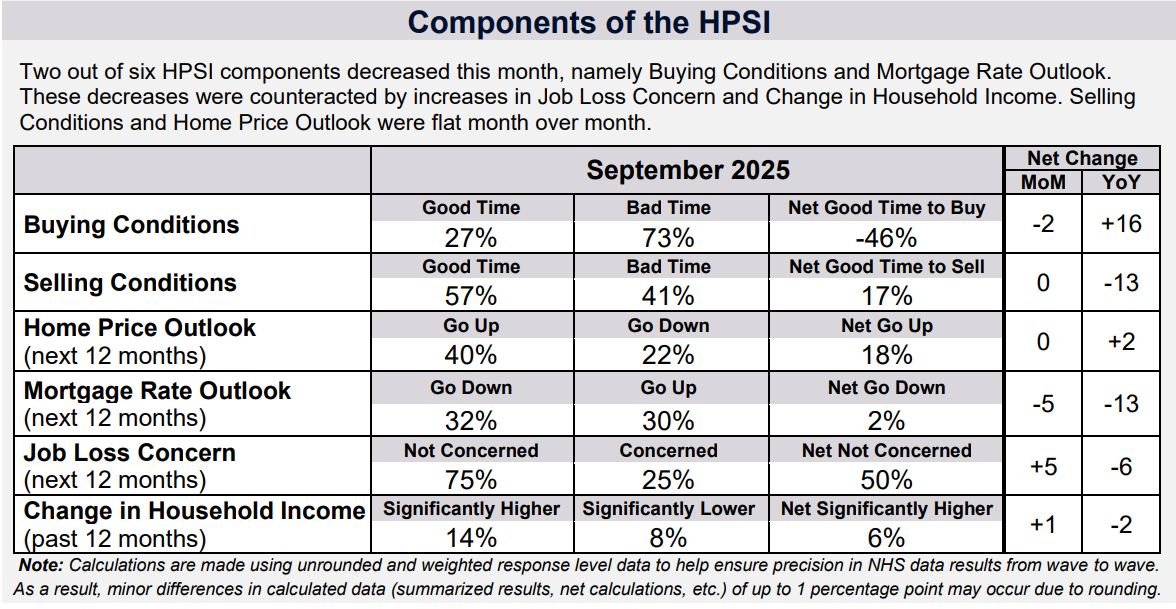
  • Buyer Sentiment: A Mixed Bag The Fannie Mae Home Purchase Sentiment Index (HPSI) is essentially flat. This means people's feelings about buying a home haven't really changed much. People feel better about keeping their jobs and the income side of the equation, but are still hesitant to take the plunge. According to the most recent data, only 27% think it's a good time to buy, while a whopping 73% think it's a bad time. This difference could be attributed to the interest rate environment.
  • Seller Hesitation: The “Locked-In” Effect: This is a big one that doesn’t get talked about enough. Many homeowners are locked in to really low mortgage rates (below 6%) from previous years. This makes them less inclined to sell, because upgrading to a new house would also mean paying a much higher rate. In fact over 80% of mortgage holders are locked in this position. This greatly impacts the number of houses on the market (inventory).
  • Financial Confidence: Still Shaky. While job security concerns have eased a bit recently, household income growth remains subdued. People don't see wage increases. Only 14% of folks report higher income than the previous year. Optimism about personal finances is also slightly down. Without stronger income and financial confidence, buyer sentiment simply won't climb.
Is it a Good Time to Buy a House in 2025: 73% Say Don’t Buy Yet
Source: Fannie Mae

Key Factors to Consider Before Taking the Plunge

Okay, enough with the high-level stuff. Let's get real about what you NEED to think about before you sign on the dotted line:

  1. Your Personal Finances: Can you comfortably afford a monthly mortgage payment, property taxes, insurance, AND ongoing maintenance? Don't stretch yourself too thin! Make sure you also consider future repair costs and unexpected events.
  2. Interest Rates and Affordability: Even a slight change in interest rates can drastically affect your borrowing power and monthly payment. Use online calculators like the one listed below to run different scenarios.
  3. Your Long-Term Goals: Buying a house is a major decision. Do you plan to stay in the area for at least 5-7 years? Is this the right type of property for your current AND future needs?
  4. Local Market Conditions: All real estate is local! What's happening nationally might not be what's happening in your specific city or neighborhood. Talk to a local real estate agent who understands the area. They can provide invaluable insights.

A general benchmark based on your income:

Income Bracket Home Affordability
Low Income ( < $50,000) Consider renting or smaller homes
Mid Income ($50k – $100k) Starter Homes, Townhouses
High Income (> $100,000) Luxury Homes, Investment Proprty

Potential Opportunities in 2025

Despite the challenges, there are potential advantages for buyers in 2025:

  • Less Competition: With buyer sentiment still low, you might face less competition, translating to more negotiating power.
  • Slight Rate Relief: If mortgage rates edge down further, affordability could improve slightly.
  • Motivated Sellers: Some sellers may be more willing to negotiate on price or offer concessions if their homes have been on the market for a while.

My Take: Proceed with Caution, But Don't Dismiss the Idea

Look, I'm not going to sugarcoat it. Buying a house is a big deal, and the market right now isn't exactly screaming “BUY NOW!”.

However, the “perfect” time to buy rarely exists. If you're financially ready, have a long-term plan, and find a property that truly meets your needs, 2025 could be your year. Just be cautious, do your research, and don't let FOMO (fear of missing out) drive your decisions.

Instead focus your decision on your personal situation.

Resources to Know!

  • Fannie Mae: Stay updated with their monthly Home Purchase Sentiment Index releases for ongoing data tracking.
  • Local Real Estate Agents: They are your eyes and ears on the ground.

Work With Norada – Buy Smart, Invest Smarter

Wondering if it’s the right time to buy a house in 2025? Don’t wait on perfect timing — focus on profitable markets and cash-flowing rentals. Norada helps you invest in high-demand, low-risk cities so you can build wealth confidently, regardless of market swings.

🔥 Exclusive Investment Deals Available Now! 🔥

Talk to a Norada investment counselor today (No Obligation):

(800) 611-3060

Explore Investment Homes

Recommended Read:

  • Top 10 Best and Worst Days to Sell Your Home in 2025
  • Is It Harder to Buy a House Now Than 50 Years Ago?
  • Is It a Good Time to Buy During a Housing Market Crash?
  • Is Now a Good Time to Buy a House with Cash in 2025?
  • Is It a Good Time to Sell a House in 2025?
  • Should I Sell My House Now or Wait Until 2026?
  • Best Time to Buy a House in the US: Timing Your Purchase
  • Is Now a Good Time to Buy a House? Should You Wait?
  • The 2025 Housing Market Forecast for Buyers & Sellers
  • Why Did More People Decide To Sell Their Homes in Fall?
  • When is the Best Time to Sell a House?
  • Is It a Buyers or Sellers Market?
  • Don't Panic Sell! Homeowners Hold Strong in Housing Market

Filed Under: Housing Market, Real Estate Market Tagged With: is it a good time to buy a house, Is Now a Good Time to Buy a House

Mortgage Rates Today Alert: 30-Year Refinance Rate Drops by 11 Points to 6.88%

October 9, 2025 by Marco Santarelli

Mortgage Rates Drop: Today's 30-Year Fixed Refinance Rate Goes Down by 23 Basis Points

Mortgage rates today show a promising trend with the 30-year fixed refinance rate dropping by a significant 11 basis points from the previous week, according to Zillow. This dip, bringing the average rate down to 6.88% as of October 9, 2025, could be the breathing room many homeowners have been waiting for. While it might seem like a small change, this decrease has a real impact on monthly payments and opens up new possibilities for those looking to save money on their home loans.

For a while now, it's felt like the housing market was in a bit of a holding pattern. Rates have been a bit all over the place, making it tough for people to decide if it’s the right time to buy, sell, or refinance. But this recent movement in the 30-year fixed refinance rate is a signal that things might be stabilizing, or at least shifting in a more favorable direction for borrowers.

Mortgage Rates Today: 30-Year Refinance Rate Drops by 11 Basis Points

Understanding the 11 Basis Point Drop: More Than Just Numbers

An 11 basis point drop might sound technical, but let's break down what it actually means. A basis point is just 0.01% of a percentage. So, an 11 basis point decrease means the rate has gone down by 0.11%.

Now, how does this affect your wallet? Let's consider a hypothetical $300,000 mortgage.

  • At 6.99% (previous week's average): Your principal and interest payment would be around $2,022 per month.
  • At 6.88% (current average): Your principal and interest payment drops to about $2,000 per month.

That’s a saving of $22 per month, or $264 per year. Over the life of a 30-year mortgage, this adds up! For someone looking to refinance, especially if they have a rate significantly higher than 6.88%, this drop makes a noticeable difference in their long-term savings. It’s not a massive fortune, but in today’s economy, every bit of savings counts.

The Federal Reserve's Influence: A Closer Look at the Decision

This recent drop in refinance rates is closely tied to what the Federal Reserve has been doing. On September 17, 2025, the Fed made its first move to lower borrowing costs for the year, cutting its benchmark interest rate by a quarter percentage point. This move was the first since a period of pausing rates, and it followed three cuts that happened at the end of 2024.

Why did they do it? It’s a balancing act. On one hand, inflation, as measured by the core PCE price index, is still a bit stubborn, registering at 2.9% year-over-year in August. This is above the Fed’s target of 2%. On the other hand, the economy is showing strength, with real GDP growing at a solid annualized rate of 3.8% in the second quarter of 2025. The Fed is trying to cool down inflation without putting the brakes on economic growth too hard. It’s like walking a tightrope!

Treasury Yields: The Real Driver Behind Mortgage Rates

Now, here's where it gets interesting. The Fed doesn't directly set mortgage rates. Instead, their actions influence what’s called the 10-year U.S. Treasury yield. This yield is like the benchmark, or the guiding light, for 30-year fixed mortgage rates.

As of October 1, 2025, the 10-year Treasury yield was sitting at 4.12%, continuing a downward trend. It’s even below its longer-term average of 4.25%. When this yield goes down, it usually means mortgage rates follow.

Think of it this way: Lenders use the 10-year Treasury yield as a base. Then, they add a little extra, called a “spread,” to account for the risks involved in lending money for mortgages. Typically, this spread is around 1% to 2% higher than the Treasury yield. However, lately, this spread has gotten wider, sometimes over 2%, which has acted like a drag on mortgage rates, preventing them from dropping as much as the Treasury yield might suggest.

This wider spread is a key factor explaining why mortgage rates haven't fallen dramatically even as Treasury yields have softened. Lenders and investors are still pricing in a bit more risk, perhaps due to the persistent inflation numbers or other economic uncertainties.

What This Means for Your Refinance Options

The current environment presents a mixed bag, but with a silver lining for some.

30-Year Fixed Refinance: The Sweet Spot

The 6.88% rate for a 30-year fixed refinance is certainly appealing. If you have a mortgage with a rate well above 7%, or even pushing 8% from a year or two ago, now is definitely the time to talk to your lender. The 11 basis point drop, combined with the Fed’s easing, suggests there’s an opportunity to lower your monthly payments and save money over the life of your loan. It might not be the lowest rate we’ve ever seen, but it’s a significant improvement from recent highs.

15-Year Fixed Refinance: A Slight Increase

On the flip side, the 15-year fixed refinance rate actually nudged up slightly to 5.79%. This means if you were thinking about shortening the term of your mortgage, the cost might be a bit higher than last week. However, it's still a very respectable rate, especially compared to the 30-year options. A 15-year mortgage means higher monthly payments but paying off your home much faster and saving a substantial amount on interest.

5-Year ARM Refinance: Caution Advised

The 5-year adjustable-rate mortgage (ARM) refinance rate saw a notable jump to 7.54%. This is a significant increase and suggests that lenders are becoming more cautious about ARMs, likely due to future interest rate uncertainties. For now, if you’re considering an ARM, it’s worth weighing the initial savings against the risk of future payment hikes.

Here’s a quick summary of how things look today:

Loan Type Current Average Rate Change from Previous Week
30-Year Fixed Refinance 6.88% Down 11 basis points
15-Year Fixed Refinance 5.79% Up 3 basis points
5-Year ARM Refinance 7.54% Up 20 basis points

How Your Credit Score Impacts Your Refinance Rate

It's crucial to remember that these are national averages. The actual rate you get will depend heavily on your individual financial situation. Your credit score is one of the biggest factors.

  • Excellent Credit (740+): You'll likely qualify for rates close to, or even better than, the advertised national averages.
  • Good Credit (670-739): You'll still get competitive rates, but they might be slightly higher than the best advertised rates.
  • Fair Credit (580-669): You may find it harder to qualify, and your rates will likely be significantly higher.

Beyond your credit score, lenders will look at your debt-to-income ratio, your employment history, and the equity you have in your home. So, before you even start shopping around, it's a smart move to check your credit report and address any issues you find.

Recommended Read:

30-Year Fixed Refinance Rate Trends – October 8, 2025

Best Time to Refinance Your Mortgage: Expert Insights

Should I Refinance My Mortgage Now or Wait Until 2026? 

The Outlook: Will Rates Continue to Fall?

Predicting mortgage rates is a bit like predicting the weather – it’s complicated and can change quickly. However, based on the current trends and the Fed’s signal of an easing cycle, there’s a good chance we’ll continue to see a gradual decline in borrowing costs. If that spread between Treasury yields and mortgage rates narrows back to more historical levels, we could even see rates dip below 6% in 2026.

However, we can't forget about inflation. If inflation starts to creep back up, the Fed might have to pause its rate cuts or even consider raising rates again, which would put upward pressure on mortgage rates.

What This Means for You Right Now:

  • If you're looking to refinance: If your current rate is above 6.5%, I highly recommend exploring your options. The window of opportunity has improved. Even a small rate reduction can lead to significant savings over time.
  • If you're a potential homebuyer: Lower rates, even by a little, improve affordability. While the market remains competitive, especially in areas with low inventory, a more favorable rate environment can make that dream home feel more attainable.
  • If you're just watching the market: Keep an eye on inflation reports and Fed statements. The journey to lower rates will likely be cautious, but the sustained lower Treasury yield is a positive sign. Just remember that the spread is still a key factor to watch.

Ultimately, the mortgage rate market is influenced by a complex web of economic factors. This recent drop in the 30-year refinance rate is a welcome development, offering a glimmer of relief and a chance for smart homeowners to take advantage of savings. It’s a good reminder to stay informed and act when the numbers make sense for your financial goals.

Maximize Your Mortgage Decisions

Thinking about whether to refinance now? Timing is critical, and having the right strategy can save you thousands over the life of your loan.

Norada's team can guide you through current market dynamics and help you position your investments wisely—whether you're looking to reduce rates, pull out equity, or expand your portfolio.

HOT NEW LISTINGS JUST ADDED!

Talk to a Norada investment counselor today (No Obligation):

(800) 611-3060

Get Started Now

Recommended Read:

  • When You Refinance a Mortgage Do the 30 Years Start Over?
  • Should You Refinance as Mortgage Rates Reach Lowest Level in Over a Year?
  • NAR Predicts 6% Mortgage Rates in 2025 Will Boost Housing Market
  • Mortgage Rates Predictions for 2025: Expert Forecast
  • Half of Recent Home Buyers Got Mortgage Rates Below 5%
  • Mortgage Rates Need to Drop by 2% Before Buying Spree Begins
  • Will Mortgage Rates Ever Be 3% Again: Future Outlook
  • Mortgage Rates Predictions for Next 2 Years
  • Mortgage Rate Predictions for Next 5 Years
  • Mortgage Rate Predictions for 2025: Expert Forecast

Filed Under: Financing, Mortgage Tagged With: mortgage, mortgage rates, Mortgage Refinance Rates

30-Year Fixed Rate Mortgage in 2025: Smart Choice or Risky Move?

October 8, 2025 by Marco Santarelli

Should You Get a 30-Year Fixed Rate Mortgage in 2025?

Buying a home is one of the biggest dreams for many of us, and how you finance that dream matters immensely. In 2025, if you're thinking about taking out a mortgage, the 30-year fixed-rate loan is likely to be on your radar. It's the most common choice for a reason: it offers steady payments and a predictable path to homeownership. I'll tell you upfront: for many, especially first-time buyers or those who value budget certainty above all else, a 30-year fixed-rate mortgage in 2025 could very well be the right choice. However, it’s far from a one-size-fits-all solution, and understanding its nuances is crucial.

My own experience in the mortgage world has shown me that what seems straightforward on the surface often has layers of complexity. People get drawn to the low monthly payments of a 30-year loan, which is totally understandable. But, as we’ll explore, that convenience often comes at a cost in the long run. Let’s dive deep into what a 30-year fixed-rate mortgage truly means in 2025, looking at today’s rates, what experts predict for the future, and exactly when this loan type shines, and when it might be better to explore other options.

30-Year Fixed Rate Mortgage in 2025: Smart Choice or Risky Move?

What Exactly Is a 30-Year Fixed-Rate Mortgage?

Think of a 30-year fixed-rate mortgage as your financial best friend for the long haul. The “fixed-rate” part means the interest rate stays the same for the entire three decades you're paying off your loan. No surprises, no sudden jumps in your payment. Every month, you'll pay the same amount for principal (the actual money you borrowed) and interest. This stability is a huge relief for many, as it makes budgeting so much easier.

This type of loan has been around for a long time, a cornerstone of making homeownership accessible. Lenders offer it, and then big companies like Fannie Mae and Freddie Mac often buy these mortgages, helping to keep the whole system running smoothly. For example, if you were to borrow $300,000 at an interest rate of 6.3%, your monthly payment for just the principal and interest would be around $1,860. It sounds manageable, right? But remember, this doesn't include property taxes and homeowners insurance, which can add a good chunk to your actual monthly housing bill. The big thing to realize with this loan is that you're spreading that repayment over a very, very long time.

Current Mortgage Rates in October 2025

Let's get down to the nitty-gritty: where are the rates currently? As of early October 2025, the average interest rate for a 30-year fixed mortgage is floating between 6.2% and 6.5% APR. This is a welcome sight compared to earlier in the year when rates were higher, often topping 7%. These dips are largely due to the Federal Reserve's efforts to bring down inflation.

However, it's important to note that even these lower rates are still higher than what we saw a few years ago. Things like the health of the U.S. economy, how inflation is behaving, and what the Federal Reserve decides to do all play a role. Even small things like the 10-year Treasury yield can nudge mortgage rates up or down. For people with excellent credit scores (think 760 and above), you might be able to snag a rate closer to 6.0-6.2%. If your credit isn't quite there yet, you might see rates closer to 6.5% or even a bit higher. It’s a reminder that your personal financial picture significantly impacts the rate you’ll be offered.

Rate Forecasts and Economic Outlook for 2025

So, what does the crystal ball say about mortgage rates for the rest of 2025? Most experts believe we'll see rates continue to ease, but likely at a slow and steady pace. Organizations like Fannie Mae predict the average rate for a 30-year fixed mortgage could end the year around 6.4%, and potentially drop below 6% by some point in 2026. The general consensus from numerous economic models points to rates hovering in the 6.2% to 6.5% range for the remainder of 2025.

But, and this is a big “but,” the economy is always a bit of a wild card. If inflation decides to creep back up, or if there are international events that shake things up, rates could stall or even go back up. On the flip side, if the economy grows stronger than expected, that could speed up rate drops.

For you, the homebuyer, this means 2025 might be a year where you can secure a decent rate now and potentially have the option to refinance later if rates drop significantly. It’s a balancing act between getting into a home now and hoping for better borrowing terms in the future.

Here’s a snapshot of what some major housing and economic groups are predicting for the end of 2025:

Forecast Source Projected End-2025 Rate Key Assumptions
Fannie Mae 6.4% Gradual Fed easing, stable inflation
Freddie Mac 6.4% Economic growth moderation
Mortgage Bankers Association (MBA) 5.9% Increased housing activity
National Association of Realtors (NAR) 6.0% Balanced market recovery
Average (14 Models) 6.34% Policy and inflation uncertainties

Pros of a 30-Year Fixed-Rate Mortgage

Let’s talk about why so many people love this loan type. It’s not just hype; there are some very real benefits:

  • Lower Monthly Payments: This is the big one. Because you’re spreading the loan over 30 years, your monthly payments are lower than with, say, a 15-year mortgage. This frees up cash in your budget, which you can use for other things like saving for retirement, building an emergency fund, or even investing.
  • Predictability and Stability: In my experience, peace of mind is priceless. Knowing your principal and interest payment won’t change for 30 years makes managing your finances much simpler. You're shielded from the stressful ups and downs of the market.
  • Easier Qualification: Lower monthly payments mean your debt-to-income ratio (the amount you owe compared to what you earn) looks better to lenders. This makes it easier for first-time buyers or people with moderate incomes to get approved for a mortgage and potentially buy a more substantial home than they might otherwise.
  • Tax Benefits: In the U.S., mortgage interest is often tax-deductible up to certain limits. While tax laws can change, this is a benefit that can potentially reduce your overall tax burden. (Always check with a tax professional for your specific situation).
  • Flexibility for Life Changes: Most 30-year fixed mortgages allow you to make extra payments towards the principal without penalty. This means if you suddenly get a bonus or want to pay off your home faster, you have that flexibility.

Cons of a 30-Year Fixed-Rate Mortgage

Now, for the other side of the coin. While the 30-year fixed is appealing, it’s important to be aware of its downsides:

  • Higher Total Interest Paid: This is the most significant drawback. Because you're paying interest for much longer, you'll end up paying a lot more in total interest over the life of the loan compared to a shorter-term mortgage. For a $300,000 loan, this could mean paying over $300,000 in interest alone by the end of 30 years – potentially hundreds of thousands more than with a 15-year loan.
  • Slower Equity Building: Since more of your early payments go towards interest, you build up equity (the portion of your home you actually own) much more slowly. This means you’ll have less of a cushion if you need to sell your home in the early years of the mortgage.
  • Opportunity Cost: If you're getting a loan in a period where rates are falling, or if you have the financial means to pay more, sticking with a 30-year term might mean missing out on potential savings from a shorter loan or waiting for even lower rates.
  • Potential for Higher Rates (If Locked In Wrong): If by chance you lock in a 30-year fixed rate right before rates start dropping significantly, you might be stuck with a higher rate unless you refinance. Refinancing has costs, too, so it’s not always an automatic win.
  • Long-Term Commitment: Thirty years is a very long time. Life happens! Your job might move you, your family situation could change, or you might simply desire more flexibility. Being tied to a mortgage for three decades is a big commitment.

Here’s a simple table to sum up the good and the not-so-good:

Aspect Pros Cons
Payments Lower monthly cost, easier budgeting Higher total interest paid over the loan's life
Stability Rate is locked for 30 years, protects against market increases You miss out on savings if rates drop significantly without refinancing
Equity Builds over time Builds much slower than with shorter loan terms
Qualification Easier to qualify due to lower payments Can sometimes encourage people to borrow more than they can comfortably afford

Comparing to Alternatives: 15-Year Fixed vs. ARM

To make the best choice, it’s helpful to see how the 30-year fixed stacks up against other popular options.

  • 15-Year Fixed-Rate Mortgage: As you might expect, this loan is paid off in half the time. In 2025, you'd likely find rates around 5.5% to 5.8%, which is lower than the 30-year. The trade-off? Your monthly payments will be significantly higher. For a $300,000 loan, you might be looking at around $2,460 per month instead of $1,860. But here’s the incredible part: you’ll pay less than half the total interest over the life of the loan – potentially saving over $200,000! This option is fantastic if you have a good income and want to save big on interest, or if you plan to pay off your mortgage entirely before retirement.
  • Adjustable-Rate Mortgage (ARM): ARMs are a bit more complex. They start with a lower interest rate for a set period (like the first 5 or 7 years, known as the “introductory” or “teaser” rate). After that period ends, the rate adjusts periodically based on market conditions. For instance, a 5/1 ARM might start around 5.8% in 2025. This lower initial payment can be very attractive. However, the risk is that if interest rates go up, your monthly payments will follow. While there are usually caps to limit how much the rate can increase, it can still lead to significant payment shocks down the road. ARMs are often best for people who don't plan to stay in their home for the long term or who are confident they can pay off the loan before the rate starts adjusting upwards.

Here’s a quick comparison to help visualize:

Mortgage Type Avg. Rate (Oct 2025) Monthly Payment ($300k Loan, Principal & Interest) Total Interest Paid ($300k Loan) Best Suited For
30-Year Fixed 6.3% ~$1,860 ~$370,000 Those prioritizing low monthly payments & long-term stability
15-Year Fixed 5.6% ~$2,460 ~$142,000 Those wanting to save on interest with higher income
5/1 ARM (Initial Rate) 5.8% ~$1,760 (initially) Varies (potentially $350,000+) Short-term homeowners or those expecting rates to fall

Note: These are illustrative examples and actual payments will vary based on lender, credit score, and loan terms.

Factors to Consider in Your Decision

Choosing the right mortgage isn't just about the numbers; it's about your life and your dreams. Here’s what I always encourage people to think about:

  • Your Financial Situation: How stable is your income? Do you have a solid emergency fund (ideally 3-6 months of living expenses)? What's your credit score? If you carry a lot of debt, the lower monthly payment of a 30-year loan can make a huge difference in your ability to qualify and manage your finances.
  • Your Homeownership Plans: How long do you realistically see yourself living in this home? If you plan to move every 5-7 years, an ARM might be more cost-effective. If this is your “forever home,” the long-term cost of a 30-year loan becomes a bigger factor.
  • Your Tolerance for Risk and Market Fluctuations: Are you someone who stresses about money every time you hear about interest rate changes? The predictability of a 30-year fixed mortgage is a huge stress reliever. On the other hand, are you comfortable with the idea of refinancing if rates drop considerably?
  • The “Hidden” Costs: Remember that while the interest rate is key, there are other costs involved: closing costs (which can be 2-5% of the loan amount), private mortgage insurance (PMI) if you put down less than 20%, and ongoing costs like property taxes and homeowners insurance. Don't let a great rate blind you to the overall expense of buying a home.
  • Creative Strategies: Don't forget there are ways to speed up payoff even with a 30-year mortgage. Making bi-weekly payments (effectively making one extra monthly payment per year) or voluntarily paying a bit extra when you can can significantly cut down the loan term and the total interest paid.

Tools and Next Steps

Knowing all this information is one thing, but putting it into practice is another. Here’s how to move forward:

  • Use Online Calculators: Websites from lenders and financial institutions like Zillow, NerdWallet, and Bankrate offer free mortgage calculators. These tools can help you compare loan scenarios side-by-side and see how different rates and terms affect your monthly payments and total interest.
  • Get Pre-Approved: Before you start seriously house hunting, get pre-approved for a mortgage. This gives you a clear picture of how much you can borrow and at what interest rate based on your financial profile.
  • Shop Around for Lenders: This is crucial! Don't just go with the first lender you talk to. Different lenders will offer different rates and fees. Even a 0.25% difference in interest rate can save you tens of thousands of dollars over 30 years. Talk to at least 3-4 lenders.
  • Consult a Financial Advisor or Mortgage Professional: While this article provides a comprehensive overview, your situation is unique. Discussing your options with a trusted financial advisor or an experienced mortgage loan officer can provide personalized guidance that takes into account all your financial goals and circumstances.

In conclusion, the 30-year fixed-rate mortgage remains a solid, dependable choice for many in 2025, particularly for those who prioritize stable, lower monthly payments and long-term predictability in their homeownership journey. However, understanding its trade-offs—especially the higher total interest paid—is essential. By carefully considering your personal finances, future plans, and comparing it with alternatives like the 15-year fixed or ARMs, you can make a truly informed decision that sets you up for financial success.

Work With Norada – Invest in Real Estate, Stress-Free

Why worry about high mortgage rates when you can build wealth effortlessly? With Norada’s turnkey properties, you can start earning cash flow from day one — no hassles, no guesswork, just smart investing in high-demand rental markets.

🔥 Stress-Free Investing Starts Here! 🔥

Talk to a Norada investment counselor today (No Obligation):

(800) 611-3060

Start Investing Smart

Also Read:

  • Will Mortgage Rates Go Down in 2025: Morgan Stanley's Forecast
  • Mortgage Rate Predictions 2025 from 4 Leading Housing Experts
  • Mortgage Rate Predictions for the Next 3 Years: 2026, 2027, 2028
  • 30-Year Fixed Mortgage Rate Forecast for the Next 5 Years
  • 15-Year Fixed Mortgage Rate Predictions for Next 5 Years: 2025-2029
  • Will Mortgage Rates Ever Be 3% Again in the Future?
  • Mortgage Rates Predictions for Next 2 Years
  • Mortgage Rate Predictions for Next 5 Years
  • Mortgage Rate Predictions: Why 2% and 3% Rates are Out of Reach
  • How Lower Mortgage Rates Can Save You Thousands?
  • How to Get a Low Mortgage Interest Rate?
  • Will Mortgage Rates Ever Be 4% Again?
Filed Under: Financing, Mortgage Tagged With: 30-Year Fixed Rate Mortgage, Interest Rate, mortgage, mortgage rates

How to Start Earning Cash Flow from Day One in Real Estate?

October 8, 2025 by Marco Santarelli

How to Start Earning Cash Flow from Day One in Real Estate?

Imagine this: you've just closed on an investment property, and instead of a pile of repair bills and a vacant unit, you're already collecting rent. That's the powerful promise of turnkey real estate investing, and it's absolutely possible to earn cash flow from day one. This isn't about some get-rich-quick scheme; it's a carefully structured approach to real estate that leverages professionals to put money in your pocket from the moment you own the property. If you're looking for a way to build wealth without being glued to your phone fixing leaky faucets or chasing down tenants, you've come to the right place.

How to Start Earning Cash Flow from Day One in Real Estate?

For years, I've been watching and participating in the real estate game, and I've seen firsthand how traditional investing can be a massive time sink. You might buy a property with good intentions, only to get bogged down in renovations, unexpected problems, and the sheer effort of finding reliable tenants.

Turnkey real estate flips that script. It's built on the idea that you can acquire a property that's already renovated, already rented out, and already being managed by a competent team. This means the income stream can begin almost instantly, potentially covering your mortgage, taxes, insurance, and management fees, leaving you with positive cash flow from the get-go. It's the closest thing to “passive” real estate income I've encountered, and it opens doors for so many people who thought real estate investing was out of reach.

What Exactly Is Turnkey Real Estate?

Let's break down what we mean by “turnkey real estate.” Think of it like buying a brand-new car. You don't have to assemble it, paint it, or install the engine yourself. You just get in, turn the key, and drive. Turnkey real estate is similar. You're buying a property that's been fully prepared for rental. This means it's either newly built or has been thoroughly renovated to be in excellent condition. Often, these properties come already leased to a tenant, meaning rent is already coming in.

But the “turnkey” aspect goes beyond just the physical condition of the property. It also includes the management. Reputable turnkey providers handle all the day-to-day operations. This includes finding and screening tenants, collecting rent, handling maintenance requests, and even dealing with potential evictions if necessary.

You, as the investor, are largely removed from the day-to-day grind. This makes it incredibly attractive for people who are busy with their careers, live far from the investment property, or simply prefer a more hands-off approach to real estate investing. For instance, I've worked with professionals whose primary focus is their high-paying job, and turnkey allows them to benefit from real estate without sacrificing their existing career.

Key features you can expect with turnkey properties generally include:

  • Fully Renovated or New Construction: The property is up-to-date, meets current building codes, and is appealing to renters.
  • Tenant-Ready: Many properties are already occupied by pre-vetted tenants, minimizing vacancy periods.
  • Professional Property Management: A dedicated company handles all operational aspects.
  • Sourced in Specific Markets: Providers typically focus on areas with strong rental demand and growth potential.

The Magic of Day-One Cash Flow: How It Works

The core appeal of turnkey real estate is the potential for immediate positive cash flow. This means the rental income you receive, from the moment you own the property, is more than your total expenses. How is this possible? It’s because the properties are delivered in a rent-ready state, usually already leased.

Let’s look at a simplified example. Suppose you purchase a turnkey property for $150,000. With a 20% down payment ($30,000), your mortgage principal is $120,000. Let's say your monthly mortgage payment, property taxes, insurance, and a conservative estimate for maintenance add up to $900. If the property is already rented for $1,200 per month, and you pay a property manager 10% of the rent ($120), your total monthly expenses are $900 + $120 = $1,020. Your net cash flow for that month would be $1,200 (rent) – $1,020 (expenses) = $180. That's positive cash flow from day one.

This calculation highlights the importance of your expenses, particularly the mortgage payment, property taxes, and insurance. The rental income needs to be robust enough to cover these, plus management fees, and still leave a surplus.

Cash Flow = Gross Rental Income – (Mortgage Payment + Property Taxes + Insurance + Maintenance + Property Management Fees)

In strong markets, it's common to aim for cash-on-cash returns (CoC) of 8-12%. This is a crucial metric that measures the annual pre-tax cash flow generated by the property relative to the total cash you invested (down payment, closing costs, and initial repair buffer). So, on that $30,000 investment, an 8% CoC return would mean generating at least $2,400 in positive cash flow per year, or an average of $200 per month.

Here's a look at how some markets are performing, giving you an idea of potential yields:

City Average Gross Rental Yield (Est. 2025) Median Home Price (Approx.) Potential Monthly Rent (Approx.) Key Economic Drivers
Birmingham, AL ~8-10% $220,000 $1,400+ Healthcare, low cost of living, growing job market
Memphis, TN ~9-11% $190,000 $1,250+ Logistics hub, affordable housing, strong rental demand
Indianapolis, IN ~8-10% $200,000 $1,300+ Diverse economy, manufacturing, affordable prices
Cleveland, OH ~8-10% $180,000 $1,200+ Revitalization, medical industry, low entry cost

These figures are estimates and can vary, but they illustrate the principle: in more affordable areas with steady job growth, rental income can significantly outpace property values, leading to healthy yields.

Why I'm a Fan: The Deeper Benefits of Turnkey Investing

As someone who values efficiency and tangible assets, certain benefits of turnkey real estate really stand out to me:

  • True Passive Income for Busy Lives: This is the big one. If you have a demanding career, family obligations, or simply aren't interested in being a landlord, turnkey is a game-changer. You're outsourcing the headaches. The property management company handles the tenant screening, rent collection, and maintenance calls. You receive a monthly statement and, ideally, a deposit into your bank account. It allows you to benefit from real estate appreciation and cash flow without the constant demands.
  • Geographic Freedom: You're not limited to investing in your local market. If your hometown has sky-high prices and low rental yields, you can explore opportunities in more investor-friendly states. This also allows for diversification – owning properties in different cities or even states can spread risk. I've seen investors build portfolios across several states, isolating risks and capitalizing on varied economic cycles.
  • Minimized Renovation Headaches: One of the biggest pitfalls of traditional real estate investing is unexpected renovation costs and delays. Turnkey properties are meant to be in excellent condition, meaning you're less likely to face thousands in unexpected repair bills right after closing. This predictability makes budgeting and financial planning much simpler.
  • Potentially Lower Vacancy Rates: Turnkey providers often have effective tenant placement strategies, and since the properties are well-maintained, they're more attractive to reliable renters. This can lead to lower vacancy periods, which directly impacts your bottom line.
  • Tax Advantages: Like any real estate investment, turnkey properties offer significant tax benefits. You can deduct mortgage interest, property taxes, insurance premiums, maintenance costs, and depreciation (which is a non-cash expense that reduces your taxable income). For those who qualify as “real estate professionals” (a specific IRS definition), there can be even more powerful advantages, like offsetting active income with passive losses.

Think of it this way: Turnkey real estate allows you to buy a fully operational income-generating business asset without needing to be the CEO, the operations manager, and the customer service representative all at once.

The Practical Steps to Earning Cash Flow from Day One

Getting started with turnkey investing requires a structured approach. It’s not just about picking the first property you see.

  1. Deep Market Research: This is non-negotiable. I always start by looking for markets with strong economic fundamentals. This means looking for:
    • Job Growth: Are new companies moving in? Are existing ones expanding? This creates demand for housing.
    • Population Growth: Are people moving to the area? This is a direct driver of rental demand.
    • Affordability: Can people afford to buy and rent in the area? A good balance is key.
    • Landlord-Tenant Laws: While you won’t be managing day-to-day, understanding the legal environment is important. Popular regions often cited for these factors include parts of the Southeast (like Alabama and Georgia) and the Midwest (like Ohio and Indiana). Cities like Birmingham, AL, or Indianapolis, IN, frequently appear on lists for their combination of affordability and rental demand.
  2. Financial Readiness: You’ll need capital. Typically, turnkey providers expect around a 20-25% down payment, plus closing costs and some reserves for unexpected expenses. I’d also advise having 3-6 months’ worth of mortgage payments and expenses set aside as reserves for each property you acquire. Knowing your budget upfront will filter your choices effectively.
  3. Partner with a Reputable Turnkey Provider: This is critical. Your success hinges on the quality of the provider you choose. Look for companies with:
    • A proven track record: How long have they been in business? What are their investor success stories?
    • Transparency: Are they open about their fees, renovation processes, and market analysis?
    • In-house or Vetted Management: Do they manage the properties themselves, or do they work with a trusted third-party manager?
    • Strong Reviews and References: Check online reviews and ask for references from existing investors.
  4. Thorough Due Diligence: Even with the best providers, you need to do your homework.
    • Property Inspection: Hire an independent inspector to review the property's condition. Understand that “renovated” can mean different things.
    • Review Pro Forma Statements: This is the provider's projection of income and expenses. Scrutinize these numbers. Are the rent estimates realistic for the area? Are expense estimates conservative?
    • Verify Leases: If the property comes with a tenant, review the lease agreement and the tenant's history.
  5. Secure Financing: You'll likely use conventional mortgages for turnkey properties. Ensure you have a good credit score and a solid financial history to qualify. Some providers may also work with specialized lenders or accept cash. Self-directed IRAs can also be a viable option for tax-advantaged investing.
  6. Monitor Your Investment: Once you own the property, stay engaged. Review your monthly statements from the property manager. Understand your property's performance, occupancy rates, and any maintenance trends. This allows you to make informed decisions about future investments.

Navigating the Risks: What to Watch Out For

While turnkey investing offers significant advantages, it's not without its potential pitfalls. Being aware of these allows you to mitigate them effectively:

  • Higher Purchase Prices: Because the properties are renovated and ready to go, the upfront cost is usually higher than buying a fixer-upper. This can sometimes mean a lower initial cash-on-cash return if the rent isn't sufficiently high.
  • Reliance on the Provider: Your entire investment rests on the competence and integrity of your turnkey provider and their property management team. If they are not proactive, honest, or efficient, your investment can suffer. This is why thorough vetting is paramount.
  • Quality of Renovations: Sometimes, renovations might be cosmetic rather than structural. A poorly done renovation can lead to expensive repairs down the line. Independent inspections are your best defense here.
  • Market Fluctuations: While you're investing in markets with growth potential, no market is immune to economic downturns. Rents can decrease, and occupancy rates can fall. Diversifying your investments across multiple properties and potentially multiple markets can help cushion the impact.
  • Hidden Fees or Markups: Some providers might mark up the cost of renovations or charge various fees that aren't immediately obvious. Always ask for a clear breakdown of all costs involved.

My approach to mitigating these risks has always been to:

  • Over-communicate: Don’t be afraid to ask questions, no matter how small they seem. Clear communication prevents costly misunderstandings.
  • Have a “Plan B”: Be prepared for unexpected changes—whether it's a property management company failing or a sudden market shift. Know your backup strategy.
  • Build Sufficient Reserves: A solid financial cushion is essential for weathering surprises like repairs, vacancies, or economic downturns.

Building Wealth Long-Term with Turnkey Real Estate

Turnkey real estate isn't just about getting a little bit of cash flow from day one; it's a powerful tool for building long-term wealth when used strategi­cally.

  • Scaling Your Portfolio: Once you've successfully acquired your first turnkey property and experienced the cash flow and management process, you can use that income and experience to acquire more. Many investors aim to build a portfolio of 5-10 cash-flowing properties, which can provide a significant passive income stream and contribute to financial freedom.
  • Leveraging Equity: As properties appreciate over time and you pay down the mortgage, you build equity. This equity can be tapped through refinancing to acquire additional properties, further accelerating your wealth-building journey.
  • Diversification: Turnkey real estate can be a component of a broader investment strategy that also includes stocks, bonds, or other real estate ventures like syndications or REITs. This diversification can create a more resilient financial future.

The key is to approach it as a business. Treat each property as a revenue-generating asset, consistently monitor its performance, and make informed decisions for growth. The ability to generate cash flow from day one with turnkey properties removes a significant barrier to entry and allows you to start building that robust, income-producing portfolio sooner. It’s a strategy that has the potential to provide consistent, tangible returns in a world that often feels unpredictable.

In conclusion, earning cash flow from day one through turnkey real estate is not only possible but a well-trodden path for many successful investors. By understanding the model, carefully selecting your partners and markets, performing diligent research, and managing your investments wisely, you can unlock a powerful and more passive stream of income.

Work With Norada – Start Earning Cash Flow from Day One

Want instant rental income without the stress of managing properties? Norada’s turnkey real estate investments come fully renovated, tenanted, and managed — so you can start earning cash flow immediately while building long-term wealth.

🔥 Begin Your Passive Income Journey Today! 🔥

Talk to a Norada investment counselor today (No Obligation):

(800) 611-3060

Get Cash Flow Now

Also Read:

  • 10 Steps for Picking a Hot Real Estate Market for Investment
  • Best Places to Invest in Single-Family Rental Properties
  • Why Real Estate Can Thrive During Tariffs Led Economic Uncertainty
  • Rise of AI-Powered Hyperlocal Real Estate Marketing
  • Real Estate Forecast Next 5 Years: Top 5 Predictions for Future
  • 5 Hottest Real Estate Markets for Buyers & Investors
  • Will Real Estate Rebound in 2025: Top Predictions by Experts
  • Recession in Real Estate: Smart Ways to Profit in a Down Market
  • Will There Be a Real Estate Recession in 2025: A Forecast

Filed Under: Real Estate Investing, Real Estate Investments, Real Estate Market Tagged With: real estate, Real Estate Investing, Turnkey

  • « Previous Page
  • 1
  • …
  • 9
  • 10
  • 11
  • 12
  • 13
  • 14
  • Next Page »

Real Estate

  • Birmingham
  • Cape Coral
  • Charlotte
  • Chicago

Quick Links

  • Markets
  • Membership
  • Notes
  • Contact Us

Blog Posts

  • Best Florida Housing Markets Set to Deliver the High ROI in 2026
    June 24, 2026Marco Santarelli
  • How to Get a 4% Mortgage Rate in 2026?
    June 24, 2026Marco Santarelli
  • Mortgage Rates Today, June 24, 2026: 30‑Year Refinance Rate Drops by 6 Basis Points
    June 24, 2026Marco Santarelli

Contact

Norada Real Estate Investments 30251 Golden Lantern, Suite E-261 Laguna Niguel, CA 92677

(949) 218-6668
(800) 611-3060
BBB
  • Terms of Use
  • |
  • Privacy Policy
  • |
  • Testimonials
  • |
  • Suggestions?
  • |
  • Home

Copyright 2018 Norada Real Estate Investments

Loading...