Norada Real Estate Investments

  • Home
  • Markets
  • Properties
  • Membership
  • Podcast
  • Learn
  • About
  • Contact

Archives for October 2025

Today’s Mortgage Rates – October 31: 30-Year FRM Goes Down to 6.17%

October 31, 2025 by Marco Santarelli

Today's Mortgage Rates - October 9, 2025: 30-Year FRM Nudges Up to 6.48%

If you're looking to buy a home or refinance, the news is pretty good right now! Mortgage rates have actually dipped a bit this week, offering a welcome break from the higher numbers we saw just a year ago. This is a great time to be exploring your options. According to Freddie Mac, a trusted source for mortgage data, the average rate for a 30-year fixed mortgage has eased to 6.17%. That’s two basis points lower than last week and, importantly, a solid 55 basis points below where we were at this time last year.

It’s not just the longer-term loans that are seeing improvement. The 15-year fixed mortgage rate has also dropped by three basis points, now sitting at 5.41%. This is also more than half a point lower than last October. These numbers are significant because even small shifts in mortgage rates can translate into hundreds, or even thousands, of dollars saved on your monthly payments over the life of your loan.

Sam Khater, Freddie Mac’s chief economist, noted, “The last few months have brought lower rates, and homebuyers are increasingly entering the market.” I completely agree with this observation. When rates become more approachable, it definitely encourages more people to take the plunge and buy a home. It’s a positive feedback loop for the housing market.

Today's Mortgage Rates – October 31: Lower Rates Signal a Smart Time to Buy a Home

A Deeper Look at Current Rates

While Freddie Mac gives us a weekly snapshot, Zillow often provides daily updates. For October 31st, 2025, their data paints a clear picture of current national averages. It’s important to remember these are averages, and your individual rate will depend on many factors, including your credit score, down payment, and the specific lender.

Here’s a breakdown of the current mortgage rates according to Zillow:

Loan Type Rate
30-year fixed 6.29%
20-year fixed 5.99%
15-year fixed 5.51%
5/1 ARM 6.68%
7/1 ARM 6.72%
30-year VA 5.68%
15-year VA 5.30%
5/1 VA 5.71%

As you can see, the 30-year fixed rate from Zillow is marginally higher than Freddie Mac’s weekly average, sitting at 6.29%. This slight difference isn't unusual; different data aggregators can have slightly different methodologies. What’s most important is the general trend, which is toward lower rates compared to last year.

Refinancing Today: Is It Still a Good Idea?

Let’s not forget about homeowners looking to refinance. Refinancing can be a powerful tool to lower your monthly payments, shorten your loan term, or tap into your home's equity. Zillow also provides current mortgage refinance rates:

Loan Type Rate
30-year fixed 6.41%
20-year fixed 5.96%
15-year fixed 5.68%
5/1 ARM 6.89%
7/1 ARM 6.97%
30-year VA 5.90%
15-year VA 5.73%
5/1 VA 5.71%

Notice that refinance rates are generally a little higher than purchase rates. This is common due to various lender products and pricing strategies. If you're considering refinancing, it's crucial to compare offers from multiple lenders. You want to ensure the savings you achieve from a lower rate outweigh any closing costs associated with the refinance. Generally, if you can get a rate at least 0.5% to 1% lower than your current rate, it's often worth exploring, especially if you plan to stay in your home for several more years.

What's Driving These Rates? The Federal Reserve's Latest Moves

The mortgage rate environment doesn't exist in a vacuum. It's heavily influenced by broader economic policies, particularly those from the Federal Reserve. I've been following the Fed's actions closely, and their recent decisions are quite telling.

On October 29, 2025, the Federal Reserve made its second consecutive interest rate cut, lowering its benchmark rate by 0.25 percentage points. This brings the target range down to 3.75% to 4.00%. This move signals that the Fed is growing concerned about economic softening, especially in jobs.

However, there's a bit of a twist. Fed Chair Powell's commentary has been cautious. He indicated that another rate cut in December is “not a foregone conclusion.” Why the mixed signals?

  • Conflicting Economic Data: The labor market shows signs of weakening, which usually prompts the Fed to cut rates. But at the same time, inflation is still a bit higher than their 2% target, which makes them hesitant to cut too aggressively.
  • Government Shutdown: Unfortunately, the federal government shutdown has disrupted the flow of economic data. This lack of timely information makes it harder for the Fed to make confident decisions about the future.
  • Ending Quantitative Tightening (QT): A significant policy shift occurring is the end of the Fed's reduction of its asset holdings. This will begin on December 1, 2025. Ending QT can provide a bit of a supporting hand to financial markets, including mortgages.

Market Reactions and What It Means for You

The Fed's cautious tone after the rate cut caused a bit of volatility in the markets. The 10-year Treasury yield, which mortgage rates often track, ticked up to around 4.08%. This happened because Powell’s words suggested that more rate cuts might not be immediately on the horizon.

So, what does this mean for you right now, especially concerning mortgage rates?

  • Near-Term Stability: The slight increase in Treasury yields suggests that mortgage rates might settle in the mid-6% range for now, rather than continuing their rapid descent.
  • Increased Sensitivity: The market will be paying very close attention to economic reports in November. Any data that shows the economy strengthening or inflation picking up could cause rates to move higher, while data showing continued weakness would likely keep them steady or push them down.
  • December Uncertainty: Because the Fed is so focused on the incoming data, the December meeting outcome is still very much up in the air.


Related Topics:

Mortgage Rates Trends as of October 30, 2025

Mortgage Rates Predictions for Next Month: November 2025

Mortgage Rates Predictions for the Next 6 Months: October 2025 to March 2026

Mortgage Rates Predictions for Next 90 Days: October to December 2025

Impact on the Housing Market

These rate movements have ripple effects on the housing market itself:

  • For Buyers: While the window of rock-bottom rates might be momentarily closed, the current environment is still much more favorable than the peaks we saw in 2024. If you can afford the payments at today's rates, and you find a home you love, it's still a good time to buy, but perhaps be prepared for slightly less dramatic rate drops in the immediate future.
  • For Sellers: Housing demand should remain pretty solid. While things might not be moving at a sky-high pace, steady demand is good news for sellers.
  • Refinance Opportunities: If your current mortgage rate is above 6.75%, you likely still have a good opportunity to refinance. However, the absolute best rates of this cycle might have already passed. It's always about finding the best rate for your specific situation.

Key Factors to Keep an Eye On

As we move through November and into December, here are the crucial things I'll be watching:

  1. Post-Shutdown Economic Data: How the economy performs in November, once data reporting returns to normal, will be critical.
  2. Labor Market Trends: Continued job losses or a significant slowdown would put more pressure on the Fed to cut rates.
  3. Inflation Readings: If inflation starts to creep up again, it could put the brakes on any further rate cuts.
  4. Market Technicals: The end of quantitative tightening could provide some support and help cap any significant rate increases.

Strategic Considerations for Borrowers

My personal advice?

  • Lock When You Can: If you find a rate that works for your budget and makes your purchase or refinance financially sound, don't be afraid to lock it in. The path to significantly lower rates looks a bit less certain for now.
  • Shop Around: This is non-negotiable. Get quotes from at least three different lenders. Even a small difference in percentage points can save you a lot of money.
  • Understand Your Options: Whether it’s a fixed-rate mortgage or an adjustable-rate mortgage (ARM), understand the pros and cons of each and what fits your long-term financial plan.

Bottom Line: The Fed is signaling a move to support the economy, but they're doing it cautiously. Mortgage rates are significantly better than they were a year ago, offering buyers and refinancers a much-needed reprieve. However, expect things to be a bit more stable with potential for some volatility as we await more economic data. It's a nuanced market, but one that still presents good opportunities.

Want Income Stability in Uncertain Times? Go Turnkey

Savvy investors are locking in properties that deliver consistent passive rental income and long-term appreciation.

Work with Norada Real Estate to find turnkey, cash-flowing homes in stable markets—helping you grow wealth no matter which way rates move.

HOT NEW INVESTMENT PROPERTIES JUST LISTED!

Speak with a seasoned Norada investment counselor today (No Obligation):

(800) 611-3060

Get Started Now

Also Read:

  • Mortgage Rates Predictions Backed by 7 Leading Experts: 2025–2026
  • Mortgage Rate Predictions for the Next 3 Years: 2026, 2027, 2028
  • 30-Year Fixed Mortgage Rate Forecast for the Next 5 Years
  • 15-Year Fixed Mortgage Rate Predictions for Next 5 Years: 2025-2029
  • Will Mortgage Rates Ever Be 3% Again in the Future?
  • Mortgage Rates Predictions for Next 2 Years
  • Mortgage Rate Predictions for Next 5 Years
  • Mortgage Rate Predictions: Why 2% and 3% Rates are Out of Reach
  • How Lower Mortgage Rates Can Save You Thousands?
  • How to Get a Low Mortgage Interest Rate?
  • Will Mortgage Rates Ever Be 4% Again?

Filed Under: Financing, Mortgage Tagged With: Interest Rate, mortgage, Mortgage Rate Trends, mortgage rates, Mortgage Rates Today

Is Turnkey Real Estate Profitable in a High-Interest Rate Environment?

October 31, 2025 by Marco Santarelli

Is Turnkey Real Estate Profitable in a High-Interest Rate Environment?

It’s a question I hear almost every day from new and even seasoned investors: With interest rates where they are, does real estate investing even make sense anymore? Specifically, is turnkey real estate investing in high-interest rate environments still profitable or worth it? The short answer is a resounding yes, but the game has changed. The strategies that worked when rates were at 3% are not the same ones that will lead to success today. The days of easy money and guaranteed appreciation are behind us, but for the smart, disciplined investor, this new era presents a unique and powerful opportunity.

Is Turnkey Real Estate Profitable in a High-Interest Rate Environment?

First, What Exactly Is Turnkey Investing? A Quick Refresher

Before we dive into the deep end, let's make sure we're on the same page. Turnkey real estate investing is a strategy where you buy a property that is ready to be rented out from day one. In many cases, it has already been renovated, has a tenant in place, and even comes with a property management company to handle the day-to-day operations.

The appeal is obvious: it's designed to be a relatively hands-off way to generate passive income from real estate without the headaches of swinging a hammer or screening tenants at midnight. You’re essentially buying a cash-flowing machine. But when the cost of the fuel for that machine—the mortgage—goes up, does the machine still run a profit?

The Elephant in the Room: Today's Interest Rate Reality

Let’s not sugarcoat it. Higher interest rates make investing harder. A higher rate means a higher monthly mortgage payment, which directly eats into your potential cash flow. It’s simple math.

To understand where we are, let's look at the real numbers. The data from late October 2025 shows a complex but cautiously optimistic picture.

Freddie Mac Primary Mortgage Market Survey® (as of 10/30/2025)

Loan Type Average Rate 52-Week Range
30-Year Fixed-Rate 6.17% 6.17% – 7.04%
15-Year Fixed-Rate 5.41% 5.41% – 6.27%

As you can see, rates have come down from their peaks of over 7%, which is a relief. However, a rate in the low 6% range is still significantly higher than the sub-3% rates we saw just a few years ago.

Adding to this, the Federal Reserve is sending mixed signals. In their last meeting, they cut the benchmark rate, which is good news for borrowing costs. However, Fed Chair Powell was cautious, suggesting that future cuts aren't guaranteed.

  • What this means for you: Don't expect a sudden crash back to 3% mortgage rates. We are likely in for a period of rate stability, or a slow, bumpy decline. This “new normal” of 5.5% to 6.5% rates is what we need to build our strategy around.

Why Turnkey Investing Shines in This Environment

This might sound counterintuitive, but the current market conditions can actually make turnkey a better strategy than traditional flipping or BRRRR (Buy, Rehab, Rent, Refinance, Repeat). Here’s my take on why.

1. Less Competition and More Negotiating Power High interest rates have scared a lot of people away. The casual, “get-rich-quick” investors have left the market. This is fantastic news for you. With fewer buyers competing for properties, sellers are more willing to negotiate on price. In my experience, a 2-3% price reduction can often completely offset the impact of a 1% increase in interest rates over the life of the loan. You couldn't get those discounts when 20 buyers were bidding on every house.

2. The “Date the Rate, Marry the Property” Mantra This has become a cliché for a reason—it’s true. You are buying a physical asset for the long term. The interest rate you lock in today is temporary. The Federal Reserve's recent actions signal that they are shifting towards an easing cycle. It may not be immediate, but rates are far more likely to be lower in 2-5 years than they are today.

You can buy a great property at a fair price today and then refinance into a lower rate down the road. This move alone can dramatically boost your monthly cash flow in the future.

Let’s look at a simple example on a $200,000 loan:

Interest Rate Monthly P&I Payment Potential Savings
6.25% (Today) $1,231 –
4.75% (Future Refi) $1,043 $188/month

That's an extra $2,256 in your pocket every year, just by refinancing when the time is right.

3. Cash Flow Is Still King, But It's Hiding In a high-rate environment, you can't just throw a dart at a map and expect to find a cash-flowing property. You have to be more selective. This is where a good turnkey provider earns its keep. They operate in markets where the rent-to-price ratio still makes sense. Think solid Midwest or Southern markets where you can buy a home for $180,000 that rents for $1,600/month, not coastal cities where a $700,000 condo rents for $3,000.

While your cash flow might be thinner initially—say $150-$250 a month instead of the $400-$500 you saw in 2021—it's still positive cash flow. And that cash flow is protected from inflation.

4. The Ultimate Inflation Hedge Inflation remains a concern, even as the Fed works to control it. Here's the magic of a fixed-rate mortgage: your largest expense—the principal and interest payment—is locked in for 30 years.

  • Your payment stays the same.
  • Meanwhile, inflation pushes everything else up: rent, wages, and the value of the property itself.

Every year, the rent goes up 3-5%, but your mortgage payment doesn't. Your cash flow grows organically over time, making it a powerful long-term wealth-building tool.

The New Playbook: How to Win with Turnkey Investing Today

To succeed now, you need to adjust your approach. Here’s the playbook I'm using and advising others to follow.

Stress-Test Your Numbers Ruthlessly

Hope is not a strategy. When you analyze a turnkey property, you need to be conservative—even borderline pessimistic.

  • Vacancy: Don't assume the property will be rented 12 months a year. Use an 8% vacancy rate (about one month per year) in your calculations.
  • Repairs & Maintenance: Budget at least 5-8% of the gross monthly rent for this. Things will break.
  • Capital Expenditures (CapEx): This is for the big stuff—roof, HVAC, water heater. Set aside another 5-8% for these future expenses.
  • Property Management: This is typically 8-10% of the gross rent.

If the property still cash flows after all these expenses, you have found a potential winner. If it's barely breaking even on paper, walk away. The margins are too thin.

Focus on Quality Markets and Neighborhoods

Now more than ever, where you invest matters. I'm focusing on markets with three key ingredients:

  1. Job Growth: A diverse and growing economy brings in new tenants.
  2. Population Growth: More people mean more demand for housing.
  3. Landlord-Friendly Laws: You need to be in a state that has a fair and efficient eviction process, just in case.

Within those markets, I look for solid B-class neighborhoods. These are not the fanciest areas, but they are full of well-maintained homes, good schools, and a strong base of working-class and middle-class tenants. They offer the perfect balance of affordability and rental demand.

Vet Your Turnkey Provider Like a Hawk

In a challenging market, your team is your most valuable asset. A great turnkey company is more than just a property seller; they are your long-term partner. Ask them the tough questions:

  • What is your track record? Can I speak to some of your past clients?
  • Who handles the property management? Is it in-house or outsourced?
  • What is your process for tenant screening?
  • Can I see the full scope of work for the renovation?
  • What are your fees and how are they structured?

A transparent, experienced provider will welcome these questions. If they get defensive or vague, that's a major red flag.

Final Thoughts: Is It Still Worth It?

Let's circle back to our main question: Turnkey investing in high-interest rate environments—still profitable or worth it?

Absolutely. But it requires a shift in mindset. This is no longer a market for speculators looking for rapid appreciation. This is a market for investors—people who are focused on buying solid assets in good locations that produce a steady, reliable, and growing stream of income over the long term.

The higher rates have cleared out the noise and created opportunities for those willing to do their homework. You can get better prices, you have more negotiating power, and you're buying an asset that will protect you from inflation and build generational wealth. It takes more work, more diligence, and a bit more courage, but the rewards are as real as they've ever been. Don't let the headlines scare you from building your future.

Build Wealth with Turnkey Real Estate — Even in a High-Rate Market

High interest rates don’t have to hold you back. Turnkey rental properties still deliver steady cash flow and long-term appreciation—especially in markets with strong rental demand and job growth.

Work with Norada Real Estate to identify profitable, cash-flowing markets that thrive even when borrowing costs rise—so your investments stay strong and stress-free.

NEW TURNKEY DEALS JUST ADDED!

Talk to a Norada investment counselor today (No Obligation):

(800) 611-3060

Get Started Now

Recommended Read:

  • Why Turnkey Real Estate Still Beats Today's High Mortgage Rate Climate
  • Best Places to Invest in Single-Family Rental Properties in 2025
  • Why Real Estate Can Thrive During Tariffs Led Economic Uncertainty
  • Rise of AI-Powered Hyperlocal Real Estate Marketing in 2025
  • Real Estate Forecast Next 5 Years: Top 5 Predictions for Future
  • 5 Hottest Real Estate Markets for Buyers & Investors in 2025
  • Will Real Estate Rebound in 2025: Top Predictions by Experts
  • Recession in Real Estate: Smart Ways to Profit in a Down Market
  • Will There Be a Real Estate Recession in 2025: A Forecast
  • Will the Housing Market Crash Due to Looming Recession in 2025?
  • 4 States Facing the Major Housing Market Crash or Correction
  • New Tariffs Could Trigger Housing Market Slowdown in 2025
  • Real Estate Forecast Next 10 Years: Will Prices Skyrocket?

Filed Under: Real Estate, Real Estate Investing, Real Estate Market Tagged With: Real Estate Investing, Rental Properties, Turnkey Real Estate

Kansas City Housing Market: Trends and Forecast 2025-2026

October 31, 2025 by Marco Santarelli

Kansas City Housing Market: Trends and Forecast 2025-2026

The current vibe in the Kansas City housing market is that home prices have dipped a bit recently, and while homes are taking a little longer to sell, there are more homes on the market than last year. Looking ahead, for 2025, we're anticipating a slow and steady growth in home prices, with a slight uptick in sales, and mortgage rates potentially getting a bit friendlier.

It feels like we're in a bit of a balancing act right now. Things aren't as crazy hot as they were a couple of years ago, but it's also not a complete buyer's free-for-all. It's a good time to dig into the numbers and see what they're telling us.

Kansas City Housing Market: What's Happening Now and What's Next?

Let's break down what's actually been happening in the Kansas City housing market, based on recent reports from Realtor.com.

Home Prices: A Little Cooler Than Before

In September, we saw a noticeable drop in home prices compared to the month before. The median listing price was $279,750. This might sound a bit concerning, but it's actually pretty normal for September. The price per square foot also went down by 1.4% from August.

To give you some perspective, this drop is a bit bigger than the national trend. Across the entire U.S., the price per square foot only decreased by 0.8%. So, here in Kansas City, prices pulled back a little more than the rest of the country.

Housing Inventory: More Homes to Choose From

One of the things buyers have been looking for is more housing inventory, and the good news is, we're seeing that! In September, there were 1,724 homes for sale in Kansas City. That's 2.9% more homes than the month before and a significant 20.4% increase compared to the same time last year.

This is great news for buyers because it means you have more options. It also helps to ease some of the intense competition that we've seen in the past. On the flip side, nationally, the increase in inventory was much smaller, just 0.2% from the previous month.

New Listings: A Slight Slowdown

While the total number of homes for sale is up, the number of new listings coming onto the market in September was actually a bit down. There were 794 new homes listed, which was 3.2% less than the month before and 1.0% less than the same month last year. Nationally, new listings also saw a decrease of 1.8%. This might be a sign that sellers are a bit more cautious or waiting for different market conditions.

Time on Market: Homes Taking a Little Longer to Sell

This is a big one for both buyers and sellers. In September, homes in Kansas City took an average of 52 days to sell. This is four days longer than the previous month and three days longer than September of last year.

Compared to the rest of the country, where homes spent an average of 62 days on the market in September, Kansas City homes are still selling relatively quickly. However, the trend of homes taking longer to sell indicates a shift away from the super-fast, multiple-offer situations we've seen recently. This usually points towards a more balanced market.

Here's a quick look at how these trends stack up:

Metric September 2023 (Kansas City) Change from Previous Month (KC) Change from Last Year (KC) National Trend (September 2023)
Median List Price $279,750 Down – N/A
Price/Sq Ft Change -1.4% Down – -0.8% (Down)
Active Inventory 1,724 +2.9% +20.4% +0.2% (Up)
New Listings 794 -3.2% -1.0% -1.8% (Down)
Days on Market 52 +4 days +3 days 62 days

Data Source: Realtor.com

Kansas City Housing Market Forecast 2025 and 2026

Now, let's talk about the crystal ball! What does the future hold for the Kansas City housing market? We'll look at some projections to get a clearer picture.

Short-Term Outlook (Late 2025)

Zillow provides some interesting insights into the immediate future. Looking at their forecasts for the Kansas City metro area (MSA), we see a pattern of gradual, positive growth.

  • October 2025: Zillow projects a 0.5% increase in home values. This suggests a continuation of the modest upward trend we might start to see.
  • December 2025: This is expected to see a slightly stronger growth of 1%. This indicates that as the year winds down, the market might gain a little more momentum.

Medium-Term Outlook (1-Year Forecast: September 2025 to September 2026)

The longer-term forecast from Zillow gives us a broader view of where things are headed.

  • September 2026: Zillow forecasts a 2.5% increase in home values over the next year. This is a healthy and sustainable growth rate that most people would be happy to see.

It's important to remember that these are projections, and real estate is always influenced by many factors. However, these numbers point towards a stabilizing and gradually appreciating market in Kansas City.

Comparing Kansas City to Other Missouri Cities

To understand how Kansas City stacks up within Missouri, let's look at Zillow's projections for other major MSAs in the state:

Region Name October 2025 Forecast December 2025 Forecast September 2026 Forecast (1-Year)
Kansas City, MO 0.5% 1% 2.5%
St. Louis, MO 0.3% 0.6% 1.7%
Springfield, MO 0.3% 0.6% 2.9%
Columbia, MO 0.4% 0.9% 3%
Joplin, MO 0.4% 0.8% 3.2%
Jefferson City, MO 0.5% 1.1% 2.7%
St. Joseph, MO 0.6% 1.3% 2.5%

Data Source: Zillow

As you can see, Kansas City's forecast is pretty much in line with many other parts of the state. Some cities like Springfield and Columbia are projected to see slightly stronger growth by September 2026, while others like St. Joseph are projected to be similar. This suggests a generally positive, yet varied, housing market across Missouri.

The National Picture: What Experts Are Saying

It's always helpful to see how our local market compares to the national trends. Both Zillow and the National Association of Realtors (NAR) have shared their outlooks, and there are some key takeaways:

Zillow's Key Predictions:

  • Home Value Growth: After a flat year in 2025, Zillow expects home values to start recovering and potentially reach a peak of nearly 1.9% annual growth by August 2026. This suggests that while 2025 might be a year of consolidation, the market is poised for renewed growth afterward.
  • Home Sales: The number of home sales is expected to finish 2025 at 4.07 million, which is a slight improvement over 2024. This indicates a gradual increase in activity.
  • Rents: Rents are predicted to continue cooling off, with lower growth rates than in recent years.

NAR Chief Economist Lawrence Yun's Optimistic Outlook:

Lawrence Yun, a highly respected voice in the real estate world, has a pretty bright outlook for the U.S. housing market. He believes “brighter days may be on the horizon.”

  • Existing Home Sales: These are expected to rise by 6% in 2025 and then accelerate by 11% in 2026. This is a significant jump and signals a strong recovery in the number of homes being bought and sold.
  • New Home Sales: New construction sales are projected to climb by 10% in 2025 and another 5% in 2026. This is crucial for helping to fix the ongoing shortage of homes.
  • Median Home Prices: Prices are expected to increase moderately, with a 3% rise predicted for 2025 and 4% for 2026. This points to a return to more normal and sustainable price appreciation.
  • Mortgage Rates: This is a big one! Mortgage rates are anticipated to average 6.4% in the second half of 2025 and drop to 6.1% in 2026. Yun calls mortgage rates the “magic bullet” because lower rates make homes more affordable and boost buyer demand.

So, what does this all mean for the Kansas City housing market? The national trends suggest that we're likely to follow a similar path of gradual recovery and stable growth.

So, Will Home Prices Drop in Kansas City? Can It Crash?

Based on the current data and forecasts, a major crash in the Kansas City housing market seems unlikely. While prices did dip a bit in September, this was a relatively normal seasonal adjustment. The overall trend, both locally and nationally, is towards stabilization and then modest appreciation.

The increase in housing inventory is a healthy sign, preventing the kind of bidding wars and unsustainable price hikes we saw before. Combined with potentially improving mortgage rates in the coming years, this creates a more balanced environment.

Instead of a crash, think more of a gentle recalibration. We're moving away from the frenzied market of the past and towards a more sustainable pace. This is generally good news for the long-term health of the market.

A Look Ahead: 2026 and Early 2027

Looking beyond the immediate forecasts, if current trends continue and mortgage rates indeed decline as predicted, we can expect the Kansas City housing market to see a bit more steam.

  • End of 2026: We could see sustained, modest home price growth, possibly in the range of 3% to 4% annually, aligning with national forecasts. Home sales volume should continue to increase as affordability improves.
  • Early 2027: This period might see continued positive momentum. If interest rates remain lower and the economy is stable, the market could experience even stronger buyer demand and steady appreciation. We might even see inventory levels start to tighten up again if sales pick up significantly.

It's important to stay updated as these forecasts can change. But for now, the outlook for the Kansas City housing market appears to be one of steady, healthy growth.

Remember, every market is different, and individual neighborhoods or even specific homes can behave differently. If you're thinking about making a move, talking to a local real estate agent is always your best bet for the most up-to-date and personalized advice. Happy house hunting!

Cash Flow Starts with Location—Invest in High-Demand Areas

Turnkey rental properties in fast-growing housing markets offer a powerful way to generate passive income with minimal hassle.

Work with Norada Real Estate to find stable, cash-flowing markets beyond the bubble zones—so you can build wealth without the risks of ultra-competitive areas.

🔥 HOT NEW LISTINGS JUST ADDED! 🔥

Talk to a Norada investment counselor today (No Obligation):

(800) 611-3060

Get Started Now

Want to Know More?

Explore these related articles for even more insights:

  • Kansas Housing Market Forecast 2025-2026: Insights for Buyers
  • Top Reasons to Invest in Kansas City, Missouri Real Estate Market?
  • St. Louis Housing Market: Trends and Forecast
  • Missouri Housing Market: Trends and Forecast

Filed Under: Growth Markets, Housing Market, Real Estate Market

Memphis Housing Market Prices and Forecast 2025-2026

October 31, 2025 by Marco Santarelli

Memphis Housing Market

If you're thinking about buying or selling a home in Memphis, you're probably wondering what's happening with our housing market right now and what the future holds. The current Memphis housing market trends show a slight cooling with home prices dipping a bit, but there's still more inventory than last year, and we can expect a slow but steady recovery in 2025. It's not a wild boom, but it's also not a crash.

Now, let's dive into what the numbers are telling us and what that means for you.

The Current Memphis Housing Market Trends and What to Expect in 2025

When we talk about the housing market, we're really looking at a few key things: how many homes are for sale (that's housing inventory or supply), how much they're selling for (home prices), how fast they're selling (time on market), and what it costs to borrow money (mortgage rates, though we'll touch on that more later).

Home Prices: A Slight Dip

According to Realtor.com, in September, the median listing price for a home in Memphis was $198,500. Now, that's a little bit lower than it was the month before. What's really interesting is that the price per square foot also went down by 5.8% compared to August. To put that in perspective, nationally, the price per square foot only decreased by 0.8%. So, our market here in the Bluff City saw a bigger dip in that specific area than the rest of the country.

For people thinking about selling, this might sound a little scary, but it's important to remember that this is a pretty normal fluctuation, especially as we move into the fall. It doesn't mean our homes are suddenly worth a lot less.

Housing Inventory: More Homes Available

One of the biggest headaches for buyers over the past few years has been the lack of homes for sale. It's like trying to find a needle in a haystack! But, the good news for Memphis buyers is that the housing inventory is looking better.

In September, there were 2,282 homes for sale in Memphis. That's 2.3% more than the month before and a significant 21.7% increase compared to this time last year. This increase in housing supply is a welcome change for those looking to buy, as it means more choices and potentially a little less competition. Nationally, active inventory also grew, but our increase in Memphis was quite a bit larger.

Time on Market: Homes Taking a Little Longer to Sell

When homes fly off the market in just a few days, it tells you it's a red-hot Seller's Housing Market. When they sit for longer, it can signal a shift. In September, homes in Memphis took an average of 66 days to sell. This is a bit longer than the previous month and a little longer than last year at the same time. Nationally, homes were selling a bit faster, averaging 62 days on the market.

This longer time on market suggests that while there are more homes available, buyers might be taking their time, perhaps due to economic uncertainty or higher mortgage rates. It could be that we're moving towards a more balanced market, where neither buyers nor sellers have a huge advantage.

What Does This Mean for You?

  • For Buyers: The good news is you have more options and a bit more breathing room. Prices have softened slightly, and with more homes available, you might find a place that truly fits your needs without having to enter a bidding war. However, don't wait too long – interest rates are still a factor, and while things have cooled, a good deal can still disappear quickly.
  • For Sellers: While prices aren't soaring like they were, the increased housing inventory means you need to be strategic. Pricing your home correctly and making sure it shows well are more important than ever. The days of just listing a fixer-upper and getting multiple offers are probably behind us for now. It's still a decent market, but you need to be prepared for your home to take a bit longer to sell.

Memphis Housing Market Forecast 2025 and 2026

Looking ahead is always the trickiest part, but by examining the data and expert opinions, we can get a pretty good idea of what's coming down the pike for the Memphis housing market.

A Look at the Next Year: Stability and Slow Growth

When we talk about the Memphis housing market forecast, we're looking at predictions for home values, sale prices, and how the market might perform compared to other areas. Zillow's data gives us some interesting insights.

As of late August 2025, the median sale price in Memphis is predicted to be around $247,261. By the end of September 2025, the median list price is projected to be $299,933. It's important to note that listing price is what sellers hope to get, while sale price is what buyers actually pay.

Now, let's get a bit more specific with Zillow's MSA (Metropolitan Statistical Area) Forecast:

Timeframe Memphis, TN Home Value Change
October 2025 0%
December 2025 0%
September 2026 0.9%

What this table tells me is that for the rest of 2025, the forecast is for pretty much flat home values in Memphis. This means we're not expecting a big jump up or a significant drop. It’s a period of stability. However, looking out to September 2026, there's a slight projected increase of 0.9%. This suggests a slow but positive recovery is on the horizon.

Memphis vs. The Rest of Tennessee

It's always helpful to see how our local market stacks up against other cities in our state. Here's a comparison based on Zillow's forecast for September 2026:

City September 2026 Home Value Change
Memphis, TN 0.9%
Nashville, TN 2.1%
Knoxville, TN 5%
Chattanooga, TN 2.6%
Clarksville, TN 2.9%
Kingsport, TN 3.6%
Johnson City, TN 3.5%
Jackson, TN 1.5%
Hagerstown, MD 2.9% (for comparison)

Looking at this, Memphis is predicted to see the slowest home value growth among the major Tennessee cities in this timeframe. Cities like Knoxville and Kingsport are expected to see much stronger appreciation. This doesn't mean Memphis is a bad market; it just highlights that different regions have different economic drivers and housing demands. Jackson, TN, is also predicted to grow slower than Memphis.

The National Picture: A Gradual Rebound

The National Association of Realtors (NAR) and Zillow also have predictions for the U.S. housing market, and they offer a broader context for what might happen in Memphis.

Key Predictions from Zillow:

  • Home Value Growth: After a flat 2025, Zillow expects home values nationally to start recovering in 2026, potentially reaching a peak of nearly 1.9% annual growth by August 2026.
  • Home Sales: The forecast is for home sales to end 2025 at around 4.07 million, which is slightly more than in 2024. This indicates more transactions happening.
  • Rents: Rent growth is expected to continue cooling down.

Key Predictions from NAR Chief Economist Lawrence Yun:

Lawrence Yun, a respected voice in real estate, is quite optimistic about the U.S. market. He believes “brighter days may be on the horizon.”

  • Existing Home Sales: Expected to rise 6% in 2025 and accelerate by 11% in 2026. This is a significant jump, showing confidence in the market's ability to bounce back.
  • New Home Sales: Projected to climb by 10% in 2025 and an additional 5% in 2026.
  • Median Home Prices: Forecasted to continue increasing at a more sustainable pace, with a projected rise of 3% in 2025 and 4% in 2026. This is a healthy, steady appreciation.
  • Mortgage Rates: These are a huge factor! Yun expects them to average 6.4% in the second half of 2025 and dip further to 6.1% in 2026. He calls them a “magic bullet” because lower rates make homes more affordable for buyers.

So, Will Home Prices Drop in Memphis? Can It Crash?

Based on the current trends and forecasts, a major crash in the Memphis housing market doesn't seem likely. The data points towards a stabilization period followed by slow, modest growth.

  • Home Prices: The predictions are for flat to slightly positive growth, not a sharp decline. The days of rapid, unsustainable price increases are likely over for now, but that's a good thing for long-term stability. The slight dip we saw in September is more of a correction than a collapse.
  • Buyer's vs. Seller's Market: We're likely in a more balanced market right now. There are more homes for sale, giving buyers more power, but the overall demand is still present. It's not a full-blown Seller's Housing Market where you have to offer above asking with no contingencies, nor is it a severe Buyer's Housing Market where sellers are desperate.
  • Factors to Watch:
    • Mortgage Rates: If rates drop significantly as predicted, it could boost demand and help prices rise more steadily.
    • Job Market: Memphis's job growth is crucial. A strong local economy will always support a healthy housing market.
    • New Construction: While not a huge factor in the immediate short-term trends, the pace of new home building can impact long-term supply and demand.

A Look Further Out: Early 2027

Predicting this far out is more of an educated guess, but based on the momentum from the 2025-2026 forecasts, I'd expect the Memphis housing market to continue its path of modest growth into early 2027.

  • Home Values: I anticipate seeing that 0.9% to perhaps 1.5% growth we see predicted for late 2026 continue into early 2027. It won't be a boom, but it will be steady appreciation.
  • Home Sales: With potentially lower mortgage rates and a recovering national economy, home sales volume should remain steady or see a slight increase.
  • Housing Inventory: I don't see a dramatic drop in housing inventory unless something unexpected happens. The current increase is likely to level off, providing a consistent supply for buyers.

In my professional opinion, the Memphis housing market is in a healthy transition phase. It's moving away from the frenzy of recent years and settling into a more sustainable rhythm. For anyone looking to buy, this is an excellent time to explore your options and potentially find a great home at a more reasonable price than a year or two ago. For sellers, patience and smart pricing are key, but there are definitely buyers out there ready to make a move.

Invest in High-Demand Rental Housing Markets

Turnkey properties in these markets provide a unique opportunity to earn passive income while capitalizing on rental demand.

Work with Norada Real Estate to find stable, cash-flowing markets beyond the bubble zones—so you can build wealth without the risks of ultra-competitive areas.

🔥 HOT NEW LISTINGS JUST ADDED! 🔥

Talk to a Norada investment counselor today (No Obligation):

(800) 611-3060

Get Started Now

Read More:

  • Tennessee Housing Market: Trends and Forecast 2025-2026
  • Nashville Housing Market Prices and Forecast 2025-2026
  • Knoxville Housing Market: Trends and Forecast
  • Clarksville Housing Market: Prices, Trends, Forecast 2025-2026

Filed Under: Growth Markets, Housing Market, Real Estate Investing

Baltimore Housing Market: Trends and Forecast 2025-2026

October 31, 2025 by Marco Santarelli

Baltimore Housing Market Prices and Forecast 2025-2026

Thinking about buying or selling a home in Baltimore? The Baltimore housing market is definitely doing its own thing right now, and looking ahead to 2025, it seems like things are shaping up to be pretty stable, with a slight uptick rather than a dramatic crash or boom.

Baltimore Housing Market Trends: What's Happening Now in 2025?

Let's dive into what's actually going on with homes in Baltimore right now. I've been keeping a close eye on this, and I've got some solid info from Realtor.com that really paints a picture of the current situation. It’s not always what you see on the news, so let’s break it down.

Home Prices: A Gentle Climb

Good news for sellers, and something for buyers to consider: home prices in Baltimore are nudging upwards. In September, the median listing price was around $247,000. This might not sound like a huge leap, but it's a step up from the month before. What’s really interesting is how this compares to the rest of the country. When we look at the price per square foot, Baltimore actually saw a 0.6% increase in September. This is pretty neat because nationally, the price per square foot decreased by 0.8%. So, while the whole country might be seeing a slight dip in that metric, Baltimore is holding its own and even growing a bit faster.

Housing Inventory: More Homes to Choose From

This is a big one for anyone in the market. Good news for buyers – there are more homes available! In September, the number of housing inventory or homes for sale in Baltimore jumped by 10.0% from the previous month. That’s a bigger bump than you’d normally see this time of year. Even better, compared to last year, there are a whopping 40.1% more homes on the market. This is a significant increase and means buyers have more choices and potentially less pressure to jump on the very first thing they see. Nationally, inventory is also up, but Baltimore’s growth is definitely standing out.

Here’s a quick look at how Baltimore’s inventory grew:

Month Homes for Sale (Baltimore) Change from Previous Month Change from Last Year
September 2,986 +10.0% +40.1%

Homes Selling Pace: Steady as She Goes

While there are more homes on the market, they are selling at a pretty similar pace to last year. Homes in Baltimore are taking an average of 44 days to sell. This is the same as the month before and even a bit quicker than last year, by two days. Nationally, homes are taking longer, with an average of 62 days on the market in September. This suggests that even with more homes available, the Baltimore housing market is still moving along at a decent clip. Buyers are finding what they want, and sellers are getting their homes sold.

Is it a Buyer's or Seller's Housing Market?

Right now, it feels like we're leaning more towards a balanced housing market in Baltimore, or maybe slightly favoring buyers due to the increased inventory. While prices are rising, the increased number of homes available gives buyers more negotiating power and less of that frantic feeling. Sellers still have an advantage because prices aren't falling, but they need to be realistic about pricing and prepare their homes well, as buyers have more options.

Baltimore Housing Market Forecast: What's Next for 2025 and 2026?

Okay, so we know what's happening now. But what about the future? Peeking into the crystal ball for the Baltimore housing market gives us some interesting insights, based on forecasts from experts.

Home Value Projections: Modest Growth Ahead

Looking at the average home value in the Baltimore-Columbia-Towson area, it’s been steadily increasing. Zillow reports it's currently around $396,874, which is up 2.1% over the past year. This tells us that even with some national fluctuations, the Baltimore region's home values have been on a positive, though not explosive, trajectory.

Now, let's break down Zillow's specific forecast for the Baltimore housing market:

Forecast Date Predicted Change (%)
October 2025 +0.1%
December 2025 +0.3%
September 2026 +0.5%

This forecast suggests a very slow and steady increase in home values for Baltimore. We're talking about small percentage gains, not the huge jumps we saw a couple of years ago. This indicates a healthy, sustainable growth pattern.

Comparing Baltimore's Forecast to Other Maryland Regions

It’s always helpful to see how Baltimore stacks up against its neighbors within Maryland. Here's what Zillow predicts for other areas:

RegionName BaseDate October 2025 December 2025 September 2026
Baltimore, MD 30-09-2025 0.1% 0.3% 0.5%
Hagerstown, MD 30-09-2025 0.4% 0.9% 2.9%
California, MD 30-09-2025 0.3% 0.5% 0.5%
Cumberland, MD 30-09-2025 0.3% 0.8% 2.0%
Easton, MD 30-09-2025 0.1% 0.3% 1.6%
Cambridge, MD 30-09-2025 0.2% 0.6% 1.6%

As you can see, Baltimore’s forecast for modest growth is quite different from places like Hagerstown or Cumberland, which are predicted to see more significant increases. This highlights that the Baltimore housing market is on its own path.

National Housing Market Outlook: A Brighter Horizon?

What's happening across the U.S. also plays a role. Zillow and NAR economists have some predictions that paint a generally optimistic picture for the nation, which can influence local markets like ours.

Zillow's Key Predictions for the US:

  • Home Value Growth: After a bit of a flat spell, home values are expected to recover in 2026. They predict annual growth to reach a peak of nearly 1.9% by August 2026.
  • Home Sales: The number of homes sold is expected to finish 2025 at 4.07 million, which is a bit better than 2024.
  • Rents: Rent growth is anticipated to continue cooling down, meaning it won't be rising as fast as in recent years.

NAR Chief Economist Lawrence Yun's Optimistic Forecast for the US:

Lawrence Yun from NAR sees “brighter days ahead.” His key points include:

  • Existing Home Sales: Expected to rise by 6% in 2025 and jump another 11% in 2026. This means more people are likely to be buying and selling existing homes.
  • New Home Sales: Projected to increase by 10% in 2025 and 5% more in 2026. This is great for increasing the overall supply of homes.
  • Median Home Prices: Prices are predicted to keep going up, but at a more manageable pace: 3% in 2025 and 4% in 2026.
  • Mortgage Rates: These are seen as a big deal! They're expected to average 6.4% in the second half of 2025 and then dip to 6.1% in 2026. Lower mortgage rates make it more affordable for people to buy homes.

So, Will Home Prices Drop in Baltimore? Can it Crash?

Based on everything I'm seeing and the forecasts from reputable sources like Realtor.com and Zillow, a significant crash in Baltimore home prices is highly unlikely. The current trends show stability and modest growth, not an overheated market that’s about to burst. The increased housing inventory is a healthy sign, helping to balance the market and prevent prices from going sky-high and then plummeting.

While a nationwide recovery is predicted for home values, Baltimore's own forecast from Zillow points to continued, albeit slow, appreciation. The rising home sales numbers nationally, combined with potentially lower mortgage rates in the future, will likely keep demand steady in Baltimore.

A Look Ahead: 2026 and Early 2027

If the national forecasts hold true, and given Baltimore's current stable trends, I anticipate the Baltimore housing market will continue its gentle upward trajectory through the end of 2026 and into early 2027.

  • End of 2026: We'll likely see continued, modest appreciation in home prices. Home sales volume should remain healthy, possibly seeing a slight boost as more buyers feel confident in the market and potentially lower mortgage rates become available. The housing inventory might stabilize or even decrease slightly if demand picks up more significantly.
  • Early 2027: The trend of steady appreciation is expected to continue. If mortgage rates have indeed dipped, we could see an increase in buyer activity, making it a slightly more competitive market for buyers. However, with the current increased housing inventory, it's unlikely to reach the intense seller's market conditions of a few years ago.

In my professional opinion, while no market is ever completely predictable, the Baltimore housing market is in a good place. It’s not experiencing the extreme highs or lows seen elsewhere, which is often a sign of a more sustainable and healthy market. For buyers, it means opportunities with more choice, and for sellers, it means a good chance to get a fair price for their home without the fear of the market collapsing.

Should You Invest in the Baltimore Real Estate Market?

Baltimore is a city with a rich history and culture, and it's also becoming an attractive location for real estate investors. With the rise of Baltimore's economy, population growth, and real estate market, it's no wonder that more and more investors are considering Baltimore for their next investment opportunity. If you're wondering whether Baltimore is a good place to invest in real estate, you've come to the right place. In this section, we'll take a look at the top eight reasons why investing in Baltimore could be a smart move for your real estate portfolio.

  • Affordable Real Estate Prices: Baltimore is known for its affordable real estate prices, especially when compared to other major cities in the U.S. Investors can purchase properties for a fraction of the price they would pay in cities like New York, Los Angeles, or San Francisco. Additionally, Baltimore's real estate market has been on an upward trend over the past few years, making it a great time to invest.
  • Strong Rental Market: Baltimore's rental market is thriving due to a combination of factors, including a growing population and a relatively low cost of living. Investors can take advantage of this by purchasing properties and renting them out to tenants. Additionally, many large companies are headquartered in Baltimore, which can provide a steady stream of potential renters.
  • Growing Population: Baltimore's population has been steadily increasing over the past few years, with projections indicating that this trend will continue. A growing population means more demand for housing, which can drive up property values and rental prices. This makes it an attractive option for real estate investors.
  • Diverse Economy: Baltimore's economy is diverse, with a variety of industries driving its growth. This includes healthcare, technology, finance, and education. A diverse economy can provide stability for real estate investors, as it is less likely to be affected by downturns in any one industry.
  • Proximity to Major Cities: Baltimore is located within a few hours' drive of several major cities, including Philadelphia, Washington D.C., and New York City. This makes it an attractive location for people who work in these cities but want to live in a more affordable area. As a result, the demand for housing in Baltimore is likely to remain strong.
  • Historic Charm: Baltimore is known for its historic architecture and charm. Many of its neighborhoods have a unique character and appeal to renters and buyers alike. This can make it easier to attract tenants and can also help drive up property values.
  • Access to Higher Education: Baltimore is home to several prestigious universities, including Johns Hopkins University and the University of Maryland. This can attract students and faculty members who need housing, as well as researchers and other professionals who work at these institutions.
  • Investment Incentives: The city of Baltimore offers a variety of incentives to real estate investors, including tax credits and exemptions. Additionally, there are several programs designed to encourage investment in certain areas of the city. These incentives can help investors maximize their returns and make Baltimore an even more attractive option for investment.

Invest in High-Demand Rental Markets Attracting Tenants

Turnkey properties provide a unique opportunity to earn passive income while capitalizing on rental demand.

Work with Norada Real Estate to find stable, cash-flowing markets beyond the bubble zones—so you can build wealth without the risks of ultra-competitive areas.

🔥 HOT NEW LISTINGS JUST ADDED! 🔥

Talk to a Norada investment counselor today (No Obligation):

(800) 611-3060

Get Started Now

Read More:

  • Maryland Housing Market Forecast
  • Housing Market Trends: 550 Places Now Over $1 Million: Is a Bubble Brewing?
  • Average Rent Prices in America: A State-by-State Breakdown

Filed Under: Growth Markets, Housing Market, Real Estate Investing, Real Estate Investments

Mortgage Rates Today: 30-Year Refinance Rate Rises by 25 Basis Points

October 31, 2025 by Marco Santarelli

Mortgage Rates Drop: Today's 30-Year Fixed Refinance Rate Goes Down by 23 Basis Points

Mortgage rates today show a significant jump, with the 30-year refinance rate surging by 25 basis points. This means if you were planning to refinance your home to lock in a better deal, now might be a crucial time to act.

As reported by Zillow, the national average for a 30-year fixed refinance rate has climbed to 7.07%. This is a noticeable increase from the previous week's average of 6.82%. It’s a move that directly impacts homeowners looking to leverage their current equity or simply reduce their monthly outflow. This isn’t just a small blip; it’s a re-evaluation of where borrowing costs are heading in the immediate future.

Mortgage Rates Today: 30-Year Refinance Rate Rises by 25 Basis Points

Understanding the 25 Basis Point Shift

Before we dive deeper, let's clarify what that “25 basis point” figure really means. A basis point is simply one-hundredth of a percent. So, a 25 basis point increase translates to a 0.25% jump in the interest rate. While this might sound minor, when you're talking about mortgages, which are typically borrowed over decades and involve large sums of money, even a quarter of a percent can make a substantial difference in your monthly payment and the total interest you pay over the life of the loan.

For example, if you were looking to refinance a $300,000 mortgage, a rate increase from 6.82% to 7.07% could mean your monthly principal and interest payment jumps by roughly $60. Over 30 years, that adds up to over $21,000 more in interest paid. It makes you really think about the timing of your refinance decisions.

Why the Sudden Surge? The Fed's Influence

So, what’s causing this upward tick in mortgage rates? To understand this, we need to look at the bigger picture, particularly what the Federal Reserve is doing. The Fed recently made its second consecutive cut to its benchmark interest rate, bringing the target range down to 3.75% to 4.00%. This is a clear signal that they're concerned about the economy slowing down, especially in the job market.

However, the Fed's Chair, Jerome Powell, also dropped hints that the expected rate cuts might not be as certain as some hoped. He mentioned that another cut in December is “not a foregone conclusion.” This caution stemmed from mixed economic signals and some data disruptions. This kind of talk from the Fed can make financial markets a bit jumpy, and that directly influences mortgage rates.

Think of it this way: when the Fed signals it might slow down its rate cuts, or that the economy isn't out of the woods yet, investors who buy mortgage-backed securities get a bit more hesitant. To compensate for that perceived risk, they demand a higher return, which translates into higher mortgage rates for us. It’s a complex dance between economic indicators, Fed policy, and market expectations.

Key Data Points to Consider

Let's break down some of the key figures and what they signify:

  • National 30-Year Fixed Refinance Rate: Currently 7.07% (up 13 basis points from Friday, up 25 basis points from the previous week).
  • Previous Week's Average (30-Year Fixed): 6.82%.
  • National 15-Year Fixed Refinance Rate: Increased to 6.02% (up 21 basis points).
  • 5-Year ARM Refinance Rate: Currently 7.42%.

The increase in the 15-year fixed rate also signals a broader trend of rising borrowing costs across different mortgage products. While ARMs (Adjustable-Rate Mortgages) sometimes offer a lower initial rate, their longer-term cost can be unpredictable, especially in a rising rate environment.

What a 25 Basis Point Increase Means for Monthly Payments

As I touched on earlier, that 0.25% difference isn't just a number on a screen; it shows up directly in your wallet.

Loan Amount Original Payment (6.82%) New Payment (7.07%) Monthly Difference
$200,000 $1,302 $1,336 $34
$300,000 $1,953 $2,004 $51
$400,000 $2,604 $2,671 $67

Note: Figures are approximate and for illustrative purposes. Actual payments will vary based on lender fees and other specifics.

It's clear that even modest increases can add up. This is why staying informed about mortgage rates is so important for any homeowner.

Refinance Timing: Locking in Rates Before Further Hikes

The recent uptick is a good reminder that the window for securing historically low refinance rates might be closing. The Fed is in a bit of a balancing act. They want to stimulate the economy without triggering runaway inflation. This means we could see more volatility, with rates potentially wavering.

My take on this is that if you've been on the fence about refinancing, and your current rate is significantly higher than the current offerings, it might be wise to seriously consider moving forward. Waiting for rates to potentially drop further introduces the risk of them climbing even higher. It's a calculated gamble, and right now, the odds seem to be shifting towards caution.

Comparing 30-Year Fixed vs. 15-Year Refinance Options

This recent surge also brings renewed attention to the trade-offs between different refinance terms.

30-Year Fixed Refinance:

  • Pros: Lower monthly payments, more flexibility in budgeting.
  • Cons: You'll pay more interest over the life of the loan.

15-Year Fixed Refinance:

  • Pros: Lower interest rate overall, pay off your mortgage much faster, build equity quicker.
  • Cons: Higher monthly payments, which might be a stretch for some budgets.

With the 15-year rate also climbing, the gap between the two might become less attractive for some homeowners. However, if you can comfortably afford the higher monthly payments of a 15-year loan, it can still be a financially sound decision in the long run, even with the slight increase.

Recommended Read:

30-Year Fixed Refinance Rate Trends – October 30, 2025

Best Time to Refinance Your Mortgage: Expert Insights

Should I Refinance My Mortgage Now or Wait Until 2026? 

How Credit Score Impacts Your Refinance Rate Today

It's vital to remember that these national averages are just that – averages. The actual rate you'll qualify for is highly personal and heavily influenced by your creditworthiness.

  • Excellent Credit (740+): You'll generally get the best rates available, often even better than the advertised national average.
  • Good Credit (670-739): You'll still secure competitive rates, but perhaps not the absolute lowest.
  • Fair Credit (580-669): Expect higher rates, and it might be harder to qualify for certain refinance options.
  • Poor Credit (Below 580): Refinancing may be challenging, and if approved, rates will likely be quite high.

My advice? Always check your credit report before starting the refinance process. Address any errors and work on improving your score if it's not where you want it. Even a few extra points can shave a significant amount off your mortgage interest.

The Role of Debt-to-Income Ratio in Refinancing

Beyond your credit score, lenders will meticulously examine your debt-to-income (DTI) ratio. This ratio compares your total monthly debt payments to your gross monthly income. Lenders use this to gauge your ability to repay a new loan.

  • Ideal: Lenders often prefer a DTI below 36%.
  • Acceptable: Some may go up to 43% or even 50% in certain FHA or VA loan scenarios, but this often comes with higher rates and stricter terms.

If your DTI is on the higher side, it might be worth looking at ways to reduce your existing debts (credit cards, car loans) before applying to refinance your mortgage. This would not only improve your mortgage eligibility but also your overall financial health.

What’s Next for Mortgage Rates?

The economic environment is certainly dynamic. While the Federal Reserve has signaled a shift towards supporting economic growth, the path forward for interest rates is anything but smooth. The end of the government shutdown means we'll start seeing more economic data, which will be crucial for the Fed's future decisions. Keep an eye on inflation reports and labor market trends; they will be the biggest drivers of where mortgage rates are headed.

For now, the slight surge in mortgage rates serves as a timely reminder: if you're considering a refinance, it's worth exploring your options now. The markets are reacting to mixed signals, and while improvement is the goal, the journey there might be a bumpy one.

“Invest Smart — Build Long-Term Wealth Through Real Estate”

Norada's team can guide you through current market dynamics and help you position your investments wisely—whether you're looking to reduce rates, pull out equity, or expand your portfolio.

Work with us to identify proven, cash-flowing markets and diversify your portfolio while borrowing costs remain favorable.

HOT NEW TURNKEY DEALS JUST LISTED!

Speak with a seasoned Norada investment counselor today (No Obligation):

(800) 611-3060

Get Started Now

Recommended Read:

  • When You Refinance a Mortgage Do the 30 Years Start Over?
  • Should You Refinance as Mortgage Rates Reach Lowest Level in Over a Year?
  • NAR Predicts 6% Mortgage Rates in 2025 Will Boost Housing Market
  • Mortgage Rates Predictions for 2025: Expert Forecast
  • Half of Recent Home Buyers Got Mortgage Rates Below 5%
  • Mortgage Rates Need to Drop by 2% Before Buying Spree Begins
  • Will Mortgage Rates Ever Be 3% Again: Future Outlook
  • Mortgage Rates Predictions for Next 2 Years
  • Mortgage Rate Predictions for Next 5 Years
  • Mortgage Rate Predictions for 2025: Expert Forecast

Filed Under: Financing, Mortgage Tagged With: mortgage, mortgage rates, Mortgage Refinance Rates

Mortgage Rates Predictions for Next Month: November 2025

October 31, 2025 by Marco Santarelli

Mortgage Rates Predictions November 2025: Post Fed Cut Outlook

If you're thinking about buying a home or refinancing an existing mortgage, you're likely wondering what November 2025 will bring. Well, I've got some insights for you. Based on the latest economic signals and expert forecasts, it looks like mortgage rates for 30-year fixed loans are likely to settle in the 6.0% to 6.2% range in November 2025. This comes after the Federal Reserve's decision to lower interest rates, a move that's sending ripples through the financial world. It's a small bit of relief, but it's important to understand all the pieces that make up this complex puzzle.

Mortgage Rates Predictions for Next Month: November 2025

The Fed's Latest Move and Why It Matters

You may have heard the news: the Federal Reserve made a move on October 29, 2025. They trimmed their benchmark federal funds rate by 25 basis points, bringing it down to a range of 3.75% to 4.00%. This is the second time they've done this this year. Why do they do this? Think of the Fed as the economy's thermostat. When things are getting a little too hot (inflation is high), they turn up the heat (raise rates) to cool things down. When the economy feels a bit sluggish, like the job market is slowing down, they turn down the heat (lower rates) to give it a boost.

This latest cut is a signal that they're keeping an eye on employment and trying to keep inflation from getting too out of hand. While inflation is still a bit higher than their 2% target, it's showing signs of cooling down. Now, here's the key thing: mortgage rates don't always follow the Fed's moves one-for-one. They are influenced by a lot of other factors, but the Fed's actions definitely set the stage.

What the Experts Are Saying: Predictions for November 2025

So, with the Fed's cut out of the way, what does this mean for actual mortgage rates next month? I've been digging into what the big players in the housing and economic world are predicting.

  • Fannie Mae, a major player in the mortgage market, recently updated its outlook. They expect rates to continue a gentle downward trend, suggesting that November could see averages around 6.1% to 6.2% for a 30-year fixed loan. They believe the Fed's action will help, but they also point out that inflation can be “sticky,” meaning it's hard to get rid of completely, which might stop rates from falling much lower.
  • The Mortgage Bankers Association (MBA) is also weighing in. They're forecasting the average rate for the fourth quarter of 2025 to be around 6.2%. For November specifically, they're putting it right around 6.15%. They also mentioned that they don't expect rates to drop significantly below 6% for the rest of the year.
  • Freddie Mac, another key institution, often publishes data on mortgage rates. Their latest thoughts suggest rates will likely hover between 6.0% and 6.3% as we move through the end of the year. They see the recent bond market shifts as supportive of slightly lower rates.

Looking at all these forecasts, there seems to be a pretty strong consensus. The most likely scenario for a 30-year fixed mortgage in November 2025 is somewhere between 6.05% and 6.20%. This means we could see a small dip, maybe 10 to 30 basis points (that's just fancy talk for a small percentage point drop) from where we are now.

Key Factors Shaping Mortgage Rates: It's More Than Just the Fed!

While the Federal Reserve's rate cuts are a big deal, they are just one piece of a much larger economic puzzle. Here are the other major forces at play that will influence mortgage rates in November 2025 and beyond:

  1. Treasury Yields: When you borrow money, there's always a cost attached. For mortgages, a really important benchmark is the yield on U.S. Treasury bonds, especially the 10-year Treasury. Think of it this way: investors lend money to the government by buying Treasury bonds. The interest rate the government pays on these bonds gives us clues about borrowing costs for everyone else. After the Fed's cut, the 10-year Treasury yield did dip, which you'd expect to help lower mortgage rates. However, the bond market can be a bit jumpy. Things like election results, which could signal changes in government spending or taxes, can make these yields go up or down pretty quickly.
  2. Inflation and Jobs: We've talked about inflation. Even though it's cooling, it's still above that 2% target the Fed is aiming for. This is especially true for things like housing costs, which are a big part of the inflation picture. On the job front, the economy still added a good number of jobs in October (around 254,000, according to some reports). This shows the economy isn't in a recession, which is good news, but it also means the Fed might not feel the need to slash rates too aggressively. If inflation unexpectedly jumps up again, or if the job market shows surprising strength, rates could actually go back up.
  3. Housing Supply and Demand: Even if mortgage rates drop a bit, the price of homes still plays a huge role in how affordable buying is. We've seen housing inventory increase by about 15% compared to last year. That's a good sign for buyers because it means there are more homes on the market, which can help ease some of the price pressure. However, the median home price is still hovering around $420,000. This is still a big number for many families, and it means that even with slightly lower rates, buying a home might still feel out of reach for some.

Visualizing the Trends: Historical Context

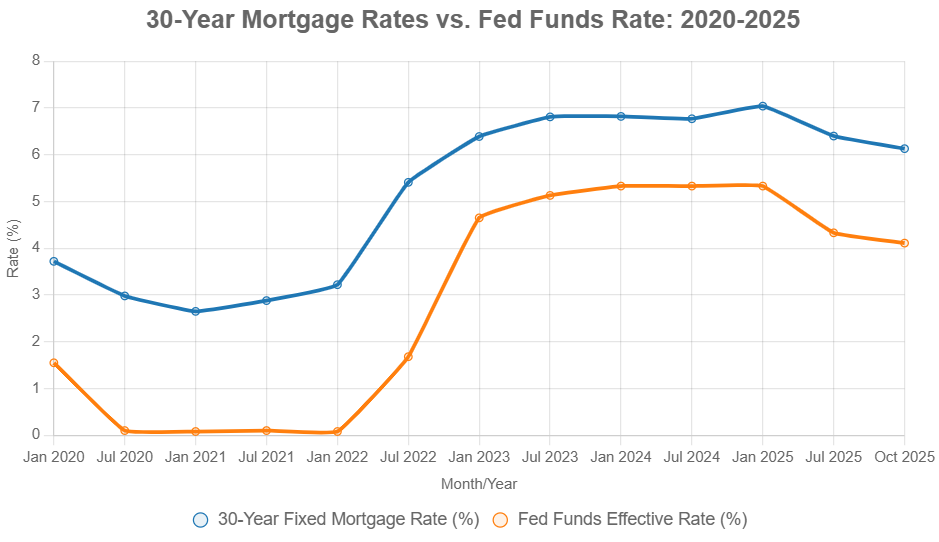
To illustrate the relationship between Fed policy and mortgage rates, consider this line chart tracking monthly averages from January 2020 to October 2025. Data sourced from FRED (St. Louis Fed) shows how pandemic-era lows gave way to 2022-2023 hikes, with recent cuts beginning to unwind the climb—yet mortgage rates lag the fed funds rate by 150-200 basis points.

line chart tracking monthly mortgage rate averages

Opportunities and Risks for Homebuyers and Refinancers

So, what does this potential shift in mortgage rates mean for you?

For Homebuyers:

  • Improved Affordability (Slightly): A mortgage rate of 6.1% on a $400,000 loan means about a $2,430 monthly payment (principal and interest only). If rates were at 6.5%, that payment would be around $2,530. That's a savings of $1,200 per year without even considering taxes and insurance! This small decrease in rates could make a big difference, especially for first-time homebuyers who often have tighter budgets.
  • Potential for More Sales: With rates nudging lower, we might see a small bump in home sales, possibly between 5% to 8% in the last quarter of the year.

For Refinancers:

  • Savings Potential: If you have a mortgage with a rate significantly higher than what's predicted for November, now might be a good time to look into refinancing. Many homeowners who locked in rates above 7% could potentially see monthly savings of $100 to $200 on a $300,000 loan by refinancing into a lower rate.
  • “Last Chance” Window?: Some experts believe that while rates might continue to ease into 2026, they might not drop drastically below 6% for quite some time. This makes November a potentially good window to lock in a rate if it works for your financial situation.

The Risks to Watch Out For:

  • Unexpected Economic Shocks: The economy is a fluid thing. If there's a sudden spike in inflation or a major shift in the job market that catches everyone off guard, mortgage rates could climb back up. For instance, if the Fed decides against another rate cut in December (which some market indicators are currently showing a decent chance of happening), it could put upward pressure on rates.
  • Regional Differences: It's important to remember that mortgage rates aren't always the same everywhere. Areas with higher costs of living or different market dynamics might see rates move differently than the national average.

A Peek at the Numbers: What You Might See

To give you a clearer picture, let's look at some projected numbers. Keep in mind these are averages and your actual rate will depend on your credit score, loan type, and lender.

Loan Type Current Rate (as of Oct 30, 2025) Predicted Nov Avg Range (2025) Potential Monthly Savings on a $300K Loan*
30-Year Fixed 6.13% 6.05% – 6.15% $50 – $100
15-Year Fixed 5.39% 5.25% – 5.35% $30 – $60
5/1 ARM (Intro) 5.75% 5.60% – 5.80% Variable post-introductory period

Note: These savings are estimated compared to average October rates on a $300,000 loan, excluding taxes and insurance.

As you can see, the savings might not be huge, but every bit counts when you're talking about decades of mortgage payments.


Related Topics:

Mortgage Rates Predictions for the Next 6 Months: October 2025 to March 2026

Mortgage Rates Predictions for Next 90 Days: October to December 2025

Making Your Move: What I'd Do

From where I stand, monitoring the mortgage market isn't just about watching the Fed's announcements. It's about understanding the symphony of economic forces playing out.

If you're looking to buy or refinance, my advice is to be proactive. Don't wait until the last minute.

  • Shop Around: I can't stress this enough. The difference in rates between lenders can be significant. Get quotes from at least three to five different lenders. This simple step can save you thousands over the life of your loan.
  • Consider a Rate Lock: If you find a rate you're happy with in November, and it's within the predicted range you're comfortable with, consider locking it in. A rate lock, typically good for 30 to 60 days, protects you if rates suddenly decide to go up. It gives you peace of mind.
  • Boost Your Credit Score: Even a small improvement in your credit score can qualify you for a better interest rate. If you have a few months before you plan to lock in, see if you can pay down some debt or address any lingering issues on your credit report.
  • Understand the Long Game: Mortgage rates aren't going to dramatically drop to the 3% levels we saw a few years ago anytime soon, according to most experts. They might not even get consistently below 6% until maybe 2026 or later. So, focus on what's achievable and smart for your financial situation right now.

November 2025 is shaping up to be a period where a modest downward trend in mortgage rates could offer a bit of breathing room for borrowers. It's not a cliffhanger, but a gradual shift that requires informed decisions. By staying on top of the economic news and understanding these influencing factors, you can make the best choices for your homeownership dreams.

Want Income Stability in Uncertain Times? Go Turnkey

Savvy investors are locking in properties that deliver consistent passive rental income and long-term appreciation.

Work with Norada Real Estate to find turnkey, cash-flowing homes in stable markets—helping you grow wealth no matter which way rates move.

HOT NEW INVESTMENT PROPERTIES JUST LISTED!

Speak with a seasoned Norada investment counselor today (No Obligation):

(800) 611-3060

Get Started Now

Also Read:

  • Mortgage Rates Predictions Backed by 7 Leading Experts: 2025–2026
  • Mortgage Rate Predictions for the Next 3 Years: 2026, 2027, 2028
  • 30-Year Fixed Mortgage Rate Forecast for the Next 5 Years
  • 15-Year Fixed Mortgage Rate Predictions for Next 5 Years: 2025-2029
  • Will Mortgage Rates Ever Be 3% Again in the Future?
  • Mortgage Rates Predictions for Next 2 Years
  • Mortgage Rate Predictions for Next 5 Years
  • Mortgage Rate Predictions: Why 2% and 3% Rates are Out of Reach
  • How Lower Mortgage Rates Can Save You Thousands?
  • How to Get a Low Mortgage Interest Rate?
  • Will Mortgage Rates Ever Be 4% Again?
Filed Under: Financing, Mortgage Tagged With: Interest Rate, mortgage, Mortgage Rate Trends, mortgage rates

Mortgage Rates Today: 30-Year Refinance Rate Rises by 14 Basis Points

October 30, 2025 by Marco Santarelli

Mortgage Rates Drop: Today's 30-Year Fixed Refinance Rate Goes Down by 23 Basis Points

If you're considering refinancing your mortgage, paying attention to the latest mortgage rates today is crucial, and the recent uptick is definitely something to note. Specifically, the national average for a 30-year fixed refinance rate has climbed up by 14 basis points over the past week, now sitting at 6.96%. This means if you were hoping to lock in a lower rate, the window might be narrowing a bit.

Mortgage Rates Today: 30-Year Refinance Rate Rises by 14 Basis Points

What's Driving the Change? Unpacking the Latest Data

Let's dive a little deeper into what's happening. According to Zillow's latest figures, the average 30-year fixed refinance rate nudged up by 5 basis points from 6.91% to 6.96% on Thursday, October 30, 2025. But when you look back at the previous week, the jump is more pronounced: a 14 basis point increase from an average rate of 6.82%. This weekly change is a more significant indicator for those planning their refinance strategy.

It’s not just the 30-year fixed rate that’s moving. The 15-year fixed refinance rate has actually seen a slight decrease, falling 4 basis points from 5.73% to 5.69%. On the other hand, the 5-year Adjustable-Rate Mortgage (ARM) refinance rate has inched up by 6 basis points, moving from 7.32% to 7.38%. This mixed movement highlights that different loan types are reacting to market forces in their own ways.

What a 14 Basis Point Increase Means for Monthly Payments

Okay, so 14 basis points sounds like a small number, right? But in the world of mortgages, it can make a noticeable difference in your monthly payment. Let's break it down. If we consider a hypothetical mortgage of $300,000, an increase from 6.82% to 6.96% means your estimated monthly principal and interest payment would go up by about $20 to $25.

While that might not sound like a fortune, over the life of a 30-year loan, those dollars add up. It translates to hundreds, potentially even thousands, of dollars more you’ll be paying in interest. This is precisely why timing can be everything when refinancing. If you’re on the fence, this recent rise might be a nudge to consider acting sooner rather than later, especially if you believe rates will continue to climb.

Refinance Timing: Locking in Rates Before Further Hikes

The current climate makes me think a lot about when to make a move. One of the key events that likely influenced these rate shifts was the Federal Reserve's decision on October 29, 2025. They cut their benchmark interest rate by 0.25 percentage points, bringing the target range down to 3.75% to 4.00%. This marked the second consecutive rate cut by the central bank, which usually signals a move towards lower borrowing costs.

However, the narrative from Fed Chair Jerome Powell offered a dose of caution. He indicated that another rate reduction in December wasn't guaranteed, citing mixed economic signals and delays in data due to a federal government shutdown. This uncertainty can create a bit of a tug-of-war in the markets. While the Fed actions might aim to lower rates, other economic factors and investor sentiment can push them in the opposite direction.

For homeowners, this means we can't simply assume that the Fed's actions will immediately translate into consistently lower mortgage rates. The market is complex, and many variables are at play. My advice? If you've found a rate that works for you and improves your financial situation, don't wait too long hoping for a dramatic drop. Sometimes, “good enough” today is better than a gamble for “perfect” tomorrow.

Comparing 30-Year Fixed vs. 15-Year Refinance Options

As I mentioned, not all refinance rates are moving in the same direction. The fact that the 15-year fixed refinance rate has dipped slightly is interesting. This often happens when lenders view the shorter loan term as less risky.

  • 30-Year Fixed Refinance: Offers lower monthly payments, which can be budget-friendly. However, you'll pay more interest over the life of the loan and build equity slower.
  • 15-Year Fixed Refinance: Comes with higher monthly payments but significantly less interest paid overall. You'll build equity much faster, potentially owning your home free and clear sooner.

For instance, if you're refinancing a $300,000 loan:

Loan Term Hypothetical Rate Monthly P&I Payment (Est.) Total Interest Paid (Est.)
30-Year Fixed 6.96% $1,991 $416,760
15-Year Fixed 5.69% $2,287 $111,660

Note: These are estimates for principal and interest only. Taxes, insurance, and fees are not included. Actual payments will vary.

As you can see, the 15-year option can save you hundreds of thousands in interest, but you need to be comfortable with that higher monthly outflow. The recent rise in the 30-year rate makes the 15-year option, with its lower interest rate, look even more attractive if you can swing the payments.

How Your Credit Score Impacts Your Refinance Rate Today

It’s impossible to talk about mortgage rates without bringing up credit scores. This is one area where you have direct control, and it directly impacts how much you'll pay. A higher credit score generally qualifies you for lower interest rates. Lenders see borrowers with excellent credit as less risky, and they reward that by offering better terms.

Generally speaking:

  • Excellent Credit (740+): You'll likely qualify for the best available rates.
  • Good Credit (670-739): You'll get competitive rates, but perhaps not the absolute lowest.
  • Fair Credit (580-669): You might face higher rates or need to meet other conditions.
  • Poor Credit (<580): Refinancing might be challenging without improving your score first.

Given that rates have been fluctuating, having a strong credit score is more important than ever. It's your leverage in negotiating the best possible refinance rate. If your score isn't where you want it to be, consider taking steps to improve it before applying. Even a small increase can translate to significant savings over time.

Recommended Read:

30-Year Fixed Refinance Rate Trends – October 29, 2025

Best Time to Refinance Your Mortgage: Expert Insights

Should I Refinance My Mortgage Now or Wait Until 2026? 

The Role of Debt-to-Income Ratio in Refinancing

Beyond your credit score, lenders also scrutinize your debt-to-income ratio (DTI). This is a measure of how much of your gross monthly income goes towards paying your debts. It’s a big indicator of your ability to manage new monthly payments, including a refinanced mortgage.

Lenders typically like to see a DTI of 43% or lower, though some may go up to 50% under certain circumstances. Your DTI is calculated by dividing your total monthly debt payments (including your potential new mortgage, car loans, credit card minimums, etc.) by your gross monthly income.

For example, if your gross monthly income is $7,000 and your total monthly debt payments would be $3,000 after refinancing, your DTI would be about 42.8%.

If your goal is to refinance, and you're seeing rates creep up, now might also be a good time to look at your existing debts. Paying down credit cards or other personal loans can lower your DTI, which not only makes you a more attractive borrower but can also help you qualify for better refinance terms.

Looking Ahead: What to Expect

The recent mortgage rate rises are a gentle reminder that the market is dynamic. While the Fed is trying to navigate economic uncertainties, various global factors and domestic data points will continue to sway interest rates. For homeowners, the key is to stay informed, understand how these changes affect your personal financial situation, and act when the timing aligns with your goals and risk tolerance.

Personally, I believe it's wise to have a plan. Know your credit score, understand your DTI, and have a general idea of the rate you're aiming for. When rates are on the rise, having this preparation can help you make a quicker, more informed decision to secure a favorable refinance loan before potential further increases.

“Invest Smart — Build Long-Term Wealth Through Real Estate”

Norada's team can guide you through current market dynamics and help you position your investments wisely—whether you're looking to reduce rates, pull out equity, or expand your portfolio.

Work with us to identify proven, cash-flowing markets and diversify your portfolio while borrowing costs remain favorable.

HOT NEW TURNKEY DEALS JUST LISTED!

Speak with a seasoned Norada investment counselor today (No Obligation):

(800) 611-3060

Get Started Now

Recommended Read:

  • When You Refinance a Mortgage Do the 30 Years Start Over?
  • Should You Refinance as Mortgage Rates Reach Lowest Level in Over a Year?
  • NAR Predicts 6% Mortgage Rates in 2025 Will Boost Housing Market
  • Mortgage Rates Predictions for 2025: Expert Forecast
  • Half of Recent Home Buyers Got Mortgage Rates Below 5%
  • Mortgage Rates Need to Drop by 2% Before Buying Spree Begins
  • Will Mortgage Rates Ever Be 3% Again: Future Outlook
  • Mortgage Rates Predictions for Next 2 Years
  • Mortgage Rate Predictions for Next 5 Years
  • Mortgage Rate Predictions for 2025: Expert Forecast

Filed Under: Financing, Mortgage Tagged With: mortgage, mortgage rates, Mortgage Refinance Rates

Columbus Housing Market: Trends and Forecast 2025-2026

October 30, 2025 by Marco Santarelli

Columbus Housing Market: Trends and Forecast

If you've been keeping an even half-eye on the Columbus housing market, you've probably noticed things have been a bit of a rollercoaster lately. Well, I've got some good news to start: the Columbus housing market isn't looking like it's about to crash. In fact, the latest trends show a market that's holding steady with a slight upward tick in home prices, and the forecast for 2025 suggests a continued, albeit measured growth, especially as we look towards the end of the year and into early 2026.

Let's dive into what's really happening and what we can expect.

Columbus Housing Market Trends in 2025

So, what's the scene like right now in Columbus? It's a mixed bag, but mostly leaning towards positive for sellers, though buyers are starting to see a tiny bit more breathing room.

Home Prices: Holding Their Own (and Then Some!)

According to data from Realtor.com, in September, we saw a nice little bump in Columbus home prices. The median listing price hit $282,450. What's interesting is that typically, home prices per square foot in Columbus tend to cool down a bit in September. But this year? Nope! The price per square foot actually increased by 0.3% compared to the month before.

Now, how does this compare to the rest of the country? Well, nationally, the price per square foot actually decreased by 0.8%. That means Columbus is outperforming the national trend, which is a pretty good sign for our local market. This tells me that even with some shifts happening, the desire for homes in Columbus is still strong.

Housing Inventory: A Little More Choice, But Not a Flood

One of the biggest factors in any housing market is how many homes are available – that's your housing inventory. In September, Columbus saw a 3.6% increase in the number of listings on the market compared to August. That sounds great, right? More homes means more options for buyers.

However, Realtor.com also points out that this increase is smaller than normal for this time of year in Columbus. On top of that, while inventory is up 21.1% compared to last year, the number of new listings was actually down 1.4% from the same time last year and 4.7% from the month before. This suggests that while some homes are staying on the market a bit longer (we'll get to that!), we're not exactly swimming in new properties hitting the market.

Nationally, the active inventory saw a small increase of 0.2%, but the number of new listings across the U.S. fell by 1.8%. So, again, Columbus is showing a slightly different, and in some ways stronger, picture than the national average.

Time on Market: Homes Are Sticking Around a Bit Longer

This is where buyers might see a small advantage. In September, homes in Columbus took an average of 45 days to sell. That's one day more than the month before and, more importantly, nine days more than the same month last year.

For comparison, nationally, homes spent an average of 62 days on the market in September. This means that while homes are still selling, they aren't flying off the shelves as quickly as they did last year. This is a pretty normal shift as we move from the peak of summer buying to the fall season, but it's something to keep an eye on. It suggests that buyers might have a little more time to consider their options and potentially negotiate a bit.

Buyer's vs. Seller's Market: Where Do We Stand?

Based on these trends, Columbus is currently leaning towards a balanced market, with some aspects favoring sellers and others offering a bit more leverage to buyers.

  • Seller Advantages:
    • Rising home prices, even on a per-square-foot basis, indicate continued demand.
    • The slight increase in inventory is not a flood, meaning there's still competition for desirable properties.
  • Buyer Advantages:
    • Homes are taking longer to sell compared to last year, offering more time for decisions.
    • The increase in inventory, even if slight and seasonal, provides more options.

It’s not a full-blown seller’s market where bidding wars are the norm on every property, nor is it a buyer’s market where you can name your price. It's a more nuanced situation.

Columbus Housing Market Forecast 2025-2026

Now, let's peer into the crystal ball and see what the experts are predicting for the Columbus housing market. Remember, forecasts are just that – predictions. But they're based on solid data and expert analysis, giving us a good idea of what to expect.

Short-Term Outlook (Late 2025)

Zillow provides some interesting insights into the near future. As of September 2025, the forecast for the Columbus MSA (Metropolitan Statistical Area) is looking quite steady.

Columbus Housing Market Forecast (Short-Term)

Timeframe Projected Home Value Change
October 2025 +0.3%
December 2025 +0.7%

This means that between now and the end of 2025, we can expect a continued, modest increase in home values. This isn't a huge surge, but rather a consistent, healthy growth.

Let's look at how Columbus stacks up against other major areas in Ohio, according to this forecast:

Ohio Housing Market Comparison (Short-Term Forecast)

Region October 2025 December 2025
Columbus, OH +0.3% +0.7%
Cleveland, OH +0.3% +0.7%
Cincinnati, OH +0.3% +0.8%
Akron, OH +0.3% +0.6%
Toledo, OH +0.3% +0.7%
Youngstown, OH +0.6% +1.3%
Canton, OH +0.4% +1.0%
Huntington, WV 0% +0.1%

As you can see, Columbus is pretty much in line with many of its Ohio counterparts for the immediate future, with Cincinnati showing a slightly stronger push towards year-end. Youngstown and Canton are showing a bit more robust growth projections in this timeframe.

Longer-Term Outlook (Up to September 2026)

Looking further ahead, Zillow predicts a slightly more significant upward trend for Columbus.

Columbus Housing Market Forecast (1-Year)

Timeframe Projected Home Value Change
September 2026 +2.4%

This suggests that the positive momentum we're seeing is expected to continue and even build slightly over the next year.

National Housing Market Forecast: A Broader View

To understand Columbus's place, it's helpful to see the bigger national picture.

  • Zillow's Key Predictions:
    • After a somewhat flat period in late 2025 and early 2026, Zillow expects home value growth to recover, potentially peaking at nearly 1.9% by August 2026.
    • They anticipate home sales to finish 2025 at around 4.07 million, which is a bit better than 2024.
    • Rents are expected to cool down, meaning rent growth will be slower than in recent years.
  • NAR Chief Economist Lawrence Yun's Optimistic Outlook:
    • Lawrence Yun, the Chief Economist for the National Association of Realtors (NAR), is feeling pretty good about the future. He thinks “brighter days may be on the horizon.”
    • Existing Home Sales: He expects them to rise 6% in 2025 and then jump another 11% in 2026. That's a big rebound!
    • New Home Sales: These are also predicted to increase, with a 10% rise in 2025 and a further 5% in 2026. This is great news for addressing the shortage of homes available.
    • Median Home Prices: Yun forecasts a modest increase of 3% in 2025 and 4% in 2026. This sounds like a much more sustainable pace than the crazy price hikes we saw a few years back.
    • Mortgage Rates: This is a big one! Yun predicts rates to average 6.4% in the second half of 2025 and then dip to 6.1% in 2026. He even called mortgage rates a “magic bullet” because they have such a huge impact on what people can afford and their demand for homes.

So, Will Home Prices Drop in Columbus? Can It Crash?

Based on all the data and forecasts, the answer is a resounding no, it's highly unlikely that home prices will crash in Columbus in the near future.

The trends show a market that is stable and growing at a reasonable pace. The Columbus housing market is outperforming the national average in some key areas, and the forecasts from both Zillow and NAR point towards continued, albeit modest, appreciation.

What we're seeing is more of a normalization of the market after the frenzy of the past few years. Homes might be staying on the market a little longer, and price growth is slowing down to more sustainable levels. This is actually a healthier situation for the long-term stability of the market.

A Peek Further Out: 2026 and Early 2027

If we extend the Zillow forecast of a 2.4% home value increase by September 2026, and combine it with NAR's prediction of 4% price growth in 2026, we can infer a positive trajectory.

For the end of 2026 and into early 2027, my expert opinion is that the Columbus housing market will likely continue this trend of steady appreciation. We might see:

  • Continued Home Value Growth: Expect modest increases, perhaps in the 3-5% range annually, driven by sustained demand and a slowly improving housing supply.
  • More Balanced Market Conditions: The shift towards slightly longer times on market might persist, giving buyers more choice and negotiation power, though this could tighten again if demand significantly outpaces supply.
  • Mortgage Rate Influence: If mortgage rates continue to decline as predicted, this will likely fuel buyer demand and support home price growth. Conversely, any unexpected spike in rates could temper the market.
  • Inventory Challenges Remain: While inventory has increased, the underlying issue of a long-term housing shortage is unlikely to be resolved in the next year or two. This will continue to provide a floor for home prices.

Essentially, the Columbus housing market is shaping up to be a resilient one. It's not immune to economic shifts, but the current trends and future forecasts suggest a market that is maturing into a more balanced and sustainable environment. For buyers, this means potentially better negotiation opportunities, and for sellers, it means continued value in their homes.

Invest Where Demand Is Strong—And Cash Flow Follows

Turnkey rental properties in fast-growing housing markets offer a powerful way to generate passive income with minimal hassle.

Work with Norada Real Estate to find stable, cash-flowing markets beyond the bubble zones—so you can build wealth without the risks of ultra-competitive areas.

🔥 HOT NEW LISTINGS JUST ADDED! 🔥

Talk to a Norada investment counselor today (No Obligation):

(800) 611-3060

Get Started Now

Read More:

  • 10 Best Cities in Ohio for Real Estate Investment
  • Ohio Housing Market: Trends and Forecast
  • 21 Cheapest States to Buy a House: Most Affordable States
  • Ohio Housing Market: Trends and Forecast
  • Cincinnati Housing Market: Trends and Forecast
  • Cleveland Housing Market: Prices, Trends, Forecast

Filed Under: Growth Markets, Housing Market, Real Estate Market

Cleveland Housing Market: Trends and Forecast 2025-2026

October 30, 2025 by Marco Santarelli

Cleveland Housing Market: Trends and Forecast

Thinking about buying or selling a home in Cleveland? The Cleveland housing market is currently showing signs of a steadier pace with moderate price growth and an increasing number of homes available, which is good news for buyers, while sellers can expect continued demand.

Let's dive into what's happening right now, looking at things like how many homes are for sale, how long they're taking to sell, and what's happening with home prices. Then, we'll look ahead and see what experts are predicting for the Cleveland housing market in the coming months and years. Ready to get informed? Let's go!

Cleveland Housing Market Trends in 2025

Right now, the Cleveland housing market is telling an interesting story. It's not a wild, super-fast market like we might have seen a year or two ago, but it’s definitely not sitting still either. Think of it as finding its rhythm.

Home Sales and What's Available (Housing Inventory)

Let's start with the number of homes you can actually see when you're out looking – this is what we call housing inventory, or supply. According to data from Realtor.com, in September, there were 868 homes for sale in Cleveland. That might sound like a lot, or maybe not, but here’s what's important: that’s 6.0% more homes than the month before and a significant 15.3% more homes than this time last year.

What does this mean for you? If you’re a buyer, this is generally good news. More homes on the market means you have more choices. It takes some of the pressure off and might give you a bit more room to negotiate. For sellers, it means you'll likely have more competition, so making your home stand out is key.

Nationally, the story is a little different. Active inventory across the U.S. only grew by 0.2% from last month. So, Cleveland is actually seeing a bigger jump in the number of homes available compared to the rest of the country.

Home Prices in Cleveland

Now, let’s talk about the big one: home prices. In September, the median listing price in Cleveland was $139,900. This means half the homes listed were above this price, and half were below.

It's interesting because, usually, home prices in Cleveland tend to go up in September. But the latest numbers show something different: the price per square foot actually decreased by 3.9% compared to the month before.

How does this stack up against the rest of the U.S.? Nationally, the price per square foot also went down, but only by 0.8%. This tells us that the price changes we're seeing in Cleveland are more noticeable than the national trend.

So, while the overall median listing price remained the same from the previous month, the price per square foot dipping is something to watch. It could indicate that while sellers are listing, they might be adjusting their expectations a bit, especially for larger homes or those needing updates, to keep them competitive.

How Long Homes Are Staying on the Market (Time on Market)

Another crucial piece of the puzzle is how quickly homes are selling. This tells us if it's a fast-paced market where homes fly off the shelves, or if things are moving at a more relaxed pace.

In September, homes in Cleveland took an average of 52 days to sell. That’s just one day less than the month before, so not a big change there. However, it's seven days longer than this time last year.

Compared to the national average, which was 62 days on the market in September, Cleveland homes are still selling faster than the rest of the U.S. This suggests that while homes might be taking a little longer to sell than last year, there's still a healthy demand here in Cleveland. For buyers, this extra time can be a blessing, allowing for more thoughtful decisions. For sellers, it’s a reminder to price your home correctly from the start and make sure it’s presented beautifully.

Buyer's or Seller's Housing Market?

Based on the trends we're seeing – more homes on the market than last year, homes taking a little longer to sell than last year, but still selling faster than the national average, and prices remaining steady with some per-square-foot adjustments – I'd say Cleveland is leaning towards a more balanced market. It's not a strong seller's market where sellers can ask for the moon and get it, nor is it a buyer's market where buyers have all the power. It’s more of a level playing field.

Buyers have more choices and a bit more time to make decisions. Sellers need to be competitive with pricing and presentation. It’s a good time to buy if you’re prepared, and a good time to sell if your home is priced and marketed effectively.

Cleveland Housing Market Forecast for 2025 and 2026

Looking ahead, predicting the future of any market can be tricky, but by looking at expert forecasts, we can get a pretty good idea of where things might be headed. This is where we put on our crystal ball hats, but with data to back us up!

What Experts Predict for Cleveland and the U.S.

Let’s start with Zillow's data, which gives us a glimpse into the near future.

Current Home Value in Cleveland-Elyria:

According to Zillow, the average home value in the Cleveland-Elyria area is $242,875. This is up 4.6% over the past year. Homes are also pending sale very quickly, in around 9 days on average. This suggests strong underlying demand for well-priced homes in the current market.

Zillow's MSA Forecast (Cleveland, OH):

Zillow provides forecasts for Metropolitan Statistical Areas (MSAs). Here’s what they’re predicting for the Cleveland area:

Timeframe Predicted Home Value Change
October 2025 0.3%
December 2025 0.7%
September 2026 2.8%

Source: Zillow's MSA Forecast

This table suggests a slow and steady appreciation for home values in Cleveland. We’re looking at modest growth of less than 1% by the end of 2025, picking up a bit more momentum to reach 2.8% by September of 2026. This forecast indicates that we're not expecting any dramatic price drops or crashes, but rather a return to more sustainable, long-term appreciation.

Cleveland vs. Other Ohio Cities:

Let's see how Cleveland stacks up against other major cities in Ohio based on Zillow's MSA forecast for September 2026:

Region Name Predicted Home Value Change (Sept 2026)
Cleveland, OH 2.8%
Cincinnati, OH 2.4%
Columbus, OH 2.4%
Akron, OH 2.3%
Toledo, OH 2.1%
Youngstown, OH 4.1%
Canton, OH 2.8%
Huntington, WV 0.5%

Looking at this, Cleveland and Canton are forecasted to see the same level of home value growth by September 2026. Youngstown is showing a higher potential for growth, while Cincinnati, Columbus, Akron, and Toledo are projected to grow at a slightly slower pace. Huntington, WV, shows much slower growth, which isn't surprising as it's a smaller market. This comparison shows Cleveland is right in the middle of the pack for Ohio cities, suggesting a stable and predictable market.

Cleveland vs. the U.S. Housing Market Forecast:

Now, let's zoom out and look at the nationwide predictions from Zillow and the National Association of Realtors (NAR) Chief Economist, Lawrence Yun.

Key Predictions from Zillow (Nationwide):

  • Home Value Growth: After a flat period in late 2025, Zillow expects home value growth to recover in 2026, reaching a peak of nearly 1.9% by August of that year. This reinforces the idea of a market that’s stabilizing and preparing for a modest rebound.
  • Home Sales: Zillow forecasts home sales to end 2025 at 4.07 million, which is slightly better than 2024. This means more people are expected to be buying and selling homes across the country.
  • Rents: Rents are expected to continue cooling, with lower growth than in previous years by the end of 2025.

Key Predictions from NAR Chief Economist Lawrence Yun (Nationwide):

Lawrence Yun offers a very optimistic view for the U.S. housing market. He sees “brighter days ahead.”

  • Existing Home Sales: Predicted to rise 6% in 2025 and accelerate by 11% in 2026. This is a significant jump, indicating a strong recovery in the number of homes changing hands.
  • New Home Sales: Projected to climb by 10% in 2025 and an additional 5% in 2026. This growth in new construction is vital for addressing the shortage of homes available.
  • Median Home Prices: Forecasted to continue increasing modestly, with a projected rise of 3% in 2025 and 4% in 2026. This signals a return to healthier, more sustainable appreciation rates.
  • Mortgage Rates: Anticipated to average 6.4% in the second half of 2025 and dip further to 6.1% in 2026. Yun calls these rates a “magic bullet” because they directly impact affordability. Lower rates make it easier for buyers to afford more house, boosting demand.

So, Will Home Prices Drop in Cleveland? Can it Crash?

Based on all this data and expert opinion, my professional assessment is that home prices in Cleveland are unlikely to drop significantly in the near future, and a crash is highly improbable.

The Zillow forecast for Cleveland shows a modest positive growth trend. The nationwide forecasts from Zillow and NAR also point towards stable to moderate appreciation, not a decline. The increase in housing inventory we saw in September, while a change from last year, is also a sign of a healthier, more balanced market, not a market in distress.

The fact that homes are still selling, and pending sales are happening quickly for good properties (like the 9 days mentioned by Zillow), shows there is consistent demand. Any slight dips in price per square foot might be more about specific property types or strategic pricing by sellers rather than a market-wide downturn.

A Possible Forecast for Late 2026 and Early 2027

Extending the trends we're seeing, for late 2026 and early 2027, I expect the Cleveland housing market to continue its trajectory of steady, sustainable growth.

  • Home Prices: Building on the projected 2.8% growth by September 2026, I wouldn't be surprised to see prices continue to climb at a similar pace, perhaps in the 3-4% range annually through early 2027. This is in line with the national predictions for modest appreciation.
  • Home Sales: With mortgage rates expected to remain relatively stable or even slightly decrease as predicted by NAR, and with more buyers able to afford homes, the number of home sales should remain strong. We could see continued or even slightly increased transaction volumes compared to the 2025 forecast.
  • Housing Inventory: The inventory is likely to remain at a healthy level. While we saw an increase in September, it’s unlikely to balloon into a glut of homes. A steady flow of new listings will probably balance out the number of homes selling, maintaining that balanced market feel.
  • Mortgage Rates: If mortgage rates continue to hover in the low 6% range as predicted, affordability will remain a key driver of demand. This would support continued price appreciation and robust home sales activity.

In my opinion, the Cleveland housing market is evolving into a more mature phase after some of the rapid price changes of previous years. It’s becoming a market where value and thoughtful homeownership are prioritized. For anyone considering entering this market, whether as a buyer or seller, understanding these trends and forecasts is your best tool for making smart decisions.

Want Better Cash Flow? Invest in High-Demand Housing Markets

Turnkey rental properties in fast-growing housing markets offer a powerful way to generate passive income with minimal hassle.

Work with Norada Real Estate to find stable, cash-flowing markets beyond the bubble zones—so you can build wealth without the risks of ultra-competitive areas.

🔥 HOT NEW LISTINGS JUST ADDED! 🔥

Talk to a Norada investment counselor today (No Obligation):

(800) 611-3060

Get Started Now

Want to Know More?

Explore these related articles for even more insights:

  • Why Smart Investors Are Buying Cleveland Turnkey Real Estate?
  • 7 Housing Markets Set for Major Correction Over the Next 12 Months
  • 10 Best Cities in Ohio for Real Estate Investment in 2025
  • Jacksonville Housing Market: Trends and Forecast 2025-2026
  • Florida Housing Market Trends: 4 Cities Turn Buyer-Friendly
  • Florida Housing Market: Jacksonville Emerges as a Hotspot for Turnkey Rentals

Filed Under: Growth Markets, Housing Market, Real Estate Market Tagged With: Cleveland, Housing Market

  • 1
  • 2
  • 3
  • …
  • 14
  • Next Page »

Real Estate

  • Birmingham
  • Cape Coral
  • Charlotte
  • Chicago

Quick Links

  • Markets
  • Membership
  • Notes
  • Contact Us

Blog Posts

  • 30-Year Fixed Mortgage Rate Drops Sharply by 98 Basis Points
    January 19, 2026Marco Santarelli
  • Why January is the Cheapest Month to Buy a Home in 2026
    January 19, 2026Marco Santarelli
  • Today’s Mortgage Rates, January 19: Rates Go Down, Easing Pressure on Buyers
    January 19, 2026Marco Santarelli

Contact

Norada Real Estate Investments 30251 Golden Lantern, Suite E-261 Laguna Niguel, CA 92677

(949) 218-6668
(800) 611-3060
BBB
  • Terms of Use
  • |
  • Privacy Policy
  • |
  • Testimonials
  • |
  • Suggestions?
  • |
  • Home

Copyright 2018 Norada Real Estate Investments

Loading...