Norada Real Estate Investments

  • Home
  • Markets
  • Properties
  • Membership
  • Podcast
  • Learn
  • About
  • Contact

Archives for October 2025

Best Time to Buy a House in 2025 is Between October 12 to 18

October 4, 2025 by Marco Santarelli

Best Time to Buy a House in 2025 is Between October 12 to 18

If you’re dreaming of homeownership in 2025, I know you’re probably wondering, “When is the absolute best time to buy a house?” My straightforward answer, based on the data by Realtor.com, is the week of October 12–18, 2025, and the weeks immediately surrounding it. This period offers a sweet spot where market conditions lean in your favor, giving you a better chance to find a great home at a good price without the intense pressure of a seller's market.

Best Time to Buy a House in 2025 is Between October 12 to 18

The housing market in 2025 has felt like a bit of a slow burn compared to the frenzy of the past few years. That’s actually good news for buyers! We've seen the number of homes for sale (what we in the business call inventory) inching up, getting closer to what we saw before the pandemic. This shift means more choices for you, less frantic competition, and a more relaxed pace for making one of the biggest decisions of your life.

Now, I know what you might be thinking: “October? Isn't spring the time for house hunting?” While spring and summer are certainly popular, that's often because families are trying to get settled before the school year starts. This means more buyers, more competition, and often, higher prices. As an observer and participant in this market, I’ve seen firsthand how the tides turn in the fall, creating a more advantageous situation for those who are patient and strategic.

A Buyer's Market is Brewing: What's Happening in 2025?

Let’s dive a bit deeper into what’s shaping the 2025 housing scene. For the first half of the year, things felt pretty stable. Home prices and mortgage rates were hanging around similar levels to 2024. This steadiness was a welcome relief from the wild bidding wars we experienced recently, giving buyers a chance to breathe and plan. However, affordability was still a significant hurdle, with prices and rates remaining on the higher side.

By the summer, we started seeing a real upswing in available homes. We're talking about the most homes on the market since 2019! This is a big deal. For years, the problem was simple: not enough houses and too many people wanting them. This drove prices through the roof. Now, the market is starting to find its balance.

But let’s be real, inventory is still a bit shy of pre-pandemic levels nationally. Realtor.com® noted that in July, we were still about 13% below those numbers. That said, some regions, particularly the West and the South, are actually seeing more homes for sale than before the pandemic. So, while the national picture shows improvement, your local market might be a little different.

What’s keeping vacancy rates low (meaning fewer empty homes sitting around) is that many homeowners, especially those with super low mortgage rates from years ago, are happy to stay put. They’re essentially locked into their low payments. Buyers, on the other hand, are still out there, looking for what they can afford. The overall supply gap – the difference between how many homes we need and how many are available – is still significant, which is why prices haven't crashed.

The economy has also been throwing us curveballs. Worries about inflation, global trade issues, and a potentially slowing job market have made both buyers and sellers a bit more cautious. This has led to fewer home sales, both existing and new construction. Builders are also taking a step back, considering all these economic uncertainties.

However, it’s not all cooling down. Some popular spots are still incredibly hot, with homes selling super fast and prices still climbing. The “hottest ZIP codes” identified by Realtor.com® show this trend clearly. So, while fall might be generally better for buyers nationally, your local market conditions are super important. Affordability continues to be the name of the game, dictating where and how people are making their moves.

Are We Officially in a Buyer's Market (or Close to It)?

While the market hasn't fully tipped us into a clear buyer's market everywhere, we are certainly closer to a balance than we've been in years. The national increase in inventory is the biggest sign of this shift. For a long time, it felt like a sprint to get an offer in, often without any conditions. Now, with more homes available and fewer buyers rushing in due to higher interest rates and affordability concerns, you have more breathing room.

This means you can:

  • Take your time: No need to feel pressured into making a snap decision.
  • Make offers with contingencies: This could include inspections and financing, which are crucial for protecting yourself.
  • Negotiate more effectively: Sellers are more likely to be open to discussions.

However, remember that regional differences are key. The Midwest and Northeast are still leaning more towards being seller-friendly markets, while the South and West are more balanced or buyer-friendly. Some specific cities that were once booming during the pandemic are now seeing more inventory and softer demand, putting buyers in the driver's seat.

For sellers, this changing dynamic means adjusting their strategy. They can't always expect multiple offers above asking price anymore. Competitive pricing and offering incentives are becoming more common. While they might not get those sky-high pandemic prices, motivated buyers are still out there if the home is presented well and priced realistically.

Why Mid-October is My Top Pick for Buying in 2025

So, why the week of October 12–18 specifically? It boils down to a perfect storm of favorable conditions that historically play out year after year.

1. A Plentiful Supply of Homes (Inventory Peaks)

Historically, the inventory of homes for sale tends to peak in early fall, right around this sweet spot. Realtor.com® data suggests that during this week, we could see 32.6% more active listings compared to the start of the year! This is a significant jump. While we might not hit pre-pandemic inventory levels nationally, this surge gives you more choices than you’ve had in a long time. The more homes you have to choose from, the better your chances of finding one that truly fits your needs and budget.

2. Less Competition: Catching Your Breath

Think about it: most people want to move when the weather is nice and the kids are out of school. This drives activity in the spring and summer. By the fall, many of those motivated sellers and buyers have already made their moves. The result? Less competition from other buyers.

This year, with overall buyer demand being a bit softer due to affordability challenges, this reduced competition is even more pronounced. Historically, demand during this peak buying week is 30.6% lower than the summer peak. This calmer environment means you’re less likely to get caught in a bidding war, giving you the space to think clearly and make a well-reasoned offer.

We do need to keep an eye on mortgage rates. If they happen to dip towards the end of the year, we might see an unexpected surge in buyer demand. Thankfully, the increased inventory should help absorb any such rushes, keeping conditions favorable for buyers.

3. A More Manageable Market Pace: More Time to Decide

One of the most frustrating aspects of recent years was the lightning-fast pace of the market. Homes were being snapped up in days, leaving little time for buyers to do their due diligence. In 2025, things have slowed down considerably. In fact, the time homes spend on the market—the market pace—has returned to pre-pandemic levels. By July, homes were taking about 58 days to sell, just slightly longer than the 2017–2019 average.

This slower pace is a godsend for buyers. It means you have more time to:

  • Explore different neighborhoods.
  • See multiple properties.
  • Carefully consider your options without feeling rushed.
  • Get that important offer accepted without feeling pressured.

The mid-October period typically sees market times slow down even further, by about 13 days compared to the spring peak. This gives you ample opportunity to really get to know a property and its surroundings before committing.

4. Potentially Lower Prices: Saving Your Hard-Earned Money

While home prices haven't seen dramatic drops nationally in recent years, there’s a definite seasonal dip in the fall. Buyers looking during the week of October 12–18 can expect prices to be lower than the year’s peak. Realtor.com® data suggests you could potentially save over $15,000 on a median-priced home compared to the summer high. Nationally, it's estimated that prices can dip around 3.4% from their usual seasonal high during this week.

This saving is magnified by the increase in price reductions. Historically, this week sees a higher percentage of homes with reduced prices – sometimes over 5.5% of listings. This trend has been growing in recent months, meaning those fall buyers might find even more opportunities for price adjustments. It’s a direct result of less demand and more inventory: sellers become more motivated to make a deal.

5. The Potential for More “Fresh” Listings

Beyond the homes already sitting on the market, new listings continue to come online. While sellers are generally more hesitant to list their homes in a market where inventory is climbing, the best week to buy typically sees a solid influx of new listings. This means even if you don't find your perfect match in the existing inventory, there's a good chance a desirable new option will pop up.

What About Your Local Market?

It’s crucial to remember that these are national trends. Your specific city or town might have its own rhythm. For instance, if you’re in a booming area, prices might be more resilient, and inventory might not rise as dramatically. If you’re in a more established or slower-growing market, you might see these favorable fall conditions play out even more strongly.

Here’s how to get a sense of your local situation:

  • Talk to a local real estate agent: They have their finger on the pulse of your specific area and can give you the most accurate, up-to-the-minute advice. This is where my personal experience comes in – understanding the local nuances is key to making the best move.
  • Watch local inventory levels: Are more homes coming on the market in your desired neighborhoods?
  • Observe market speed: Are homes still selling in under a week, or are they sitting for a month or more?
  • Keep an eye on list prices: Are sellers consistently dropping prices to get offers?

My Personal Take: Be Prepared, Be Patient

As someone who’s navigated countless real estate transactions, I can tell you that timing is important, but so is readiness. To make the absolute most of the best time to buy a house in 2025, you need to be prepared.

My Advice:

  1. Get Pre-Approved: Before you even start looking seriously, talk to a lender and get pre-approved for a mortgage. This tells you exactly how much you can afford and shows sellers you’re a serious buyer. It’s a non-negotiable first step for me.
  2. Define Your Priorities: What are your must-haves? What are your nice-to-haves? Knowing this will help you filter through listings efficiently and make quick decisions when the right home appears.
  3. Stay Informed: Keep an eye on mortgage rate trends and local market statistics. Knowledge is power in real estate.
  4. Be Patient, But Ready: The data points to mid-October, but the market is fluid. Be patient waiting for the right conditions, but when they arrive, be ready to act.

“Work With Norada to Invest in Turnkey Real Estate”

Norada helps investors and buyers take advantage of these timing opportunities by connecting you with turnkey rental properties in landlord-friendly markets—already renovated, managed, and producing rental income.

🔥 Don’t Miss the 2025 Buyer’s Sweet Spot! 🔥

Talk to a Norada investment counselor today (No Obligation):

(800) 611-3060

Get Started Now

Recommended Read:

  • Is It a Good Time to Sell a House in 2025?
  • Should I Sell My House Now or Wait Until 2026?
  • Should I Buy a House Now or Wait Until 2025?
  • Month of May is the Best Time to Sell Your House in 2025
  • Best Time to Buy a House in the US: Timing Your Purchase
  • Is Now a Good Time to Buy a House? Should You Wait?
  • The 2025 Housing Market Forecast for Buyers & Sellers
  • Why Did More People Decide To Sell Their Homes in Fall?
  • When is the Best Time to Sell a House?
  • Is It a Buyers or Sellers Market?
  • Don't Panic Sell! Homeowners Hold Strong in Housing Market

Filed Under: Housing Market Tagged With: Best Time to Buy a House, Buyer's Market, Housing Market

Today’s Mortgage Rates – October 4, 2025: 30-Year FRM Drops Significantly by 37 Basis Points

October 4, 2025 by Marco Santarelli

Today's Mortgage Rates - October 4, 2025: 30-Year FRM Drops Significantly by 37 Basis Points

On October 4, 2025, mortgage rates dropped notably, with the average 30-year fixed mortgage rate falling to 6.22%, down 37 basis points from last week’s 6.59%, according to Zillow. This marks a significant relief for new homebuyers seeking affordable financing. However, refinance rates have increased, with the 30-year fixed refinance rate climbing up to 7.13%, indicating that homeowners looking to refinance might face higher costs. This divergence presents an interesting dynamic in the mortgage market right now.

Today's Mortgage Rates – October 4, 2025: 30-Year FRM Drops Significantly by 37 Basis Points

Key Takeaways

  • 30-year fixed mortgage rate fell to 6.22%, down 0.37% from last week.
  • 15-year fixed mortgage rate dropped to 5.56%, a decrease of 9 basis points.
  • 5-year ARM mortgage rate holds steady at 7.10%.
  • Refinance rates increased: 30-year fixed refinance rate rose to 7.13%, up 15 basis points.
  • Federal Reserve's recent rate cut contributes to potential for gradual mortgage rate declines but refinance rates remain elevated.
  • Mortgage-Treasury spreads remain wide, limiting bigger drops in mortgage rates.
  • Forecasters expect mortgage rates to average around 6.4% through late 2025 with possible dips below 6% in 2026.

Current Mortgage Rates Snapshot – October 4, 2025

Loan Type Rate Week Change APR APR Change
30-Year Fixed 6.22% -0.37% 6.75% -0.31%
20-Year Fixed 6.34% -0.02% 6.46% -0.18%
15-Year Fixed 5.56% -0.09% 5.92% -0.15%
10-Year Fixed 5.84% 0.00% 6.23% 0.00%
7-Year ARM 7.27% -0.01% 7.44% -0.29%
5-Year ARM 7.10% -0.04% 7.72% -0.08%

Government-backed loans also show varied trends:

Loan Type Rate Week Change APR APR Change
30-Year Fixed FHA 7.63% +1.82% 8.68% +1.87%
30-Year Fixed VA 5.89% -0.18% 6.02% -0.20%
15-Year Fixed FHA 5.31% -0.01% 6.27% -0.01%
15-Year Fixed VA 5.69% -0.17% 6.05% -0.08%

Refinance Rates on October 4, 2025

While mortgage rates for home buyers showed encouraging declines, refinancing costs have climbed recently:

Loan Type Rate Week Change
30-Year Fixed Refinance 7.13% +0.15%
15-Year Fixed Refinance 6.10% +0.30%
5-Year ARM Refinance 7.41% +0.02%

This increase in refinance rates suggests that homeowners looking to lower their payments or shorten loan terms might face less favorable conditions compared to new homebuyers locking in fresh mortgages.

Understanding the Drop in Mortgage Rates Amid Rising Refinance Rates

The drop in standard mortgage rates to around 6.22% follows a notable cut by the Federal Reserve on September 17, 2025. The Fed lowered its benchmark interest rate for the first time in 2025, trimming it by 0.25% to a range of 4.0%–4.25%. This move was aimed at lowering borrowing costs to stimulate growth amid persistent inflation that still sits above the Fed’s 2% target.

Mortgage rates typically move in tandem with the 10-year U.S. Treasury yield, which dropped slightly to 4.12% by October 1, 2025. Since mortgage lenders price their loans partly off Treasury bonds, this drop helps reduce mortgage interest rates.

However, the spread between mortgage rates and Treasury yields has widened beyond the usual 1-2 percentage points, making mortgages more expensive than the Treasury yield alone would suggest. This spread represents risks lenders take, including loan defaults and market volatility, that haven't yet eased fully. Hence, the mortgage rate drop is somewhat moderated.

On the other hand, refinancing rates are higher because refinancing involves different risk profiles and the current market conditions have lenders pricing in risks more aggressively. The spread on refinance loans often reflects current economic uncertainty and changes in investor demand.

Mortgage Rate Forecasts: What Experts Say

Experts mostly agree that mortgage rates will stay somewhat elevated for the rest of 2025 but could ease gradually going into 2026.

  • The National Association of REALTORS® expects mortgage rates to average about 6.4% in the second half of 2025 and fall further to around 6.1% in 2026, which would ease affordability challenges somewhat.
  • Fannie Mae’s September 2025 forecast projects mortgage rates ending 2025 at 6.4%, easing to 5.9% in 2026. They also expect refinancing activity to increase as rates dip, with a greater share of mortgage originations being refinance loans in 2026 compared to 2025.
  • The Mortgage Bankers Association expects rates to decline slightly, forecasting 6.7% by the end of 2025 and dropping to 6.5% by the close of 2026 but also noted wide mortgage-Treasury spreads and volatility could keep borrowing costs elevated periodically.

Example Calculation of Monthly Payment Change

To see the impact of these rate changes, let's calculate the monthly principal and interest payment difference on a $300,000 loan amount at the old and new 30-year fixed mortgage rates.

Rate Monthly Principal & Interest Total Interest Paid Over 30 Years
6.59% (last week) $1,912.00 $388,512
6.22% (today) $1,835.00 $360,600

At 6.59%, the monthly payment is about $77 more per month compared to today's rate of 6.22%. Over 30 years, that difference adds up to about $27,912 saved in interest alone by locking in the lower rate.

Why Are Mortgage and Refinance Rates Moving in Opposite Directions?

This divergence signals different borrower profiles and market forces at play:

  • Purchasers locking in mortgage loans can benefit immediately from the Fed’s rate cut and treasury yield drop, leading to lower average mortgage rates now.
  • Refinancers, however, face market caution; lenders price in risk differently since refinancing often involves borrowers with varying credit quality or changed financial situations. Also, refinancing volume has increased somewhat in 2025 compared to 2024, but lenders remain cautious about further declines due to inflation concerns and economic uncertainty. This keeps refinance rates higher.


Related Topics:

Mortgage Rates Trends as of October 3, 2025

Mortgage Rates Predictions Next 90 Days: August to October 2025

Mortgage Rates Predictions for the Next 60 Days

What the Federal Reserve’s Rate Cut Means for Mortgage Markets

The Fed’s move to lower its benchmark rate is seen as an easing measure after a period of tightening monetary policy intended to curb inflation. While this helps lower borrowing costs indirectly, the full effect on mortgage rates depends heavily on investor sentiment and inflation trends.

  • The Fed’s preferred inflation measure, the core PCE price index, rose 2.9% year-over-year in August 2025, well above the ideal 2%, keeping inflation concerns alive.
  • Economic growth remains solid; real GDP grew at 3.8% annualized rate in Q2 2025.

Because of these mixed signals, mortgage rates aren’t dropping dramatically, as the Fed must balance supporting growth without letting inflation flare up.

Long-Term View: The Housing Market and Affordability

Lower mortgage rates improve affordability by reducing monthly payments and total interest costs. Yet, the sticky inflation and wide risk premiums prevent rates from returning to the historically low levels we saw earlier this decade. This means:

  • Buyers with strong credit might still find good opportunities to lock lower fixed rates compared to just weeks ago.
  • Sellers might see slightly more inventory as homeowners who were waiting for rates to drop start listing their homes.
  • Refinancing opportunities exist but come at a higher cost for many borrowers as refinance rates remain elevated.

Summary

Today's mortgage landscape on October 4, 2025, offers a mix of hope and caution. The big drop in 30-year fixed mortgage rates to 6.22% provides relief to homebuyers, signaling a better borrowing environment than recent weeks. In contrast, refinancing rates are rising, reflecting lenders' cautious stance amid inflation and market risk concerns.

The Federal Reserve's recent interest rate cut and falling Treasury yields contribute to these trends but with a widened spread preventing deeper declines in mortgage borrowing costs. Experts agree that mortgage rates will hover in the mid-6% range through 2025, possibly dipping below 6% by 2026, but with volatility likely to remain.

For borrowers, knowing these dynamics is crucial when shopping for a mortgage or refinancing. The current environment rewards quick action and careful rate comparison, with lower fixed rates available for new loans but more expensive refinancing options for some.

Capitalize Amid Rising Mortgage Rates

With mortgage rates expected to remain high in 2025, it’s more important than ever to focus on strategic real estate investments that offer stability and passive income.

Norada delivers turnkey rental properties in resilient markets—helping you build steady cash flow and protect your wealth from borrowing cost volatility.

HOT NEW LISTINGS JUST ADDED!

Speak with a seasoned Norada investment counselor today (No Obligation):

(800) 611‑3060

Get Started Now

Also Read:

  • Will Mortgage Rates Go Down in 2025: Morgan Stanley's Forecast
  • Mortgage Rate Predictions 2025 from 4 Leading Housing Experts
  • Mortgage Rate Predictions for the Next 3 Years: 2026, 2027, 2028
  • 30-Year Fixed Mortgage Rate Forecast for the Next 5 Years
  • 15-Year Fixed Mortgage Rate Predictions for Next 5 Years: 2025-2029
  • Will Mortgage Rates Ever Be 3% Again in the Future?
  • Mortgage Rates Predictions for Next 2 Years
  • Mortgage Rate Predictions for Next 5 Years
  • Mortgage Rate Predictions: Why 2% and 3% Rates are Out of Reach
  • How Lower Mortgage Rates Can Save You Thousands?
  • How to Get a Low Mortgage Interest Rate?
  • Will Mortgage Rates Ever Be 4% Again?

Filed Under: Financing, Mortgage Tagged With: Interest Rate, mortgage, Mortgage Rate Trends, mortgage rates, Mortgage Rates Today

Mortgage Rates Today: 30-Year Refinance Rate Rises by 10 Basis Points

October 4, 2025 by Marco Santarelli

Mortgage Rates Drop: Today's 30-Year Fixed Refinance Rate Goes Down by 23 Basis Points

If you're thinking about refinancing your mortgage, here's the quick news: as of today, October 4, 2025, the national average for a 30-year fixed refinance rate is 7.13%, according to Zillow. That's up 10 basis points from last week's average.

Mortgage rates are like the weather – they change all the time! And knowing what's happening with refinance rates is crucial, especially if you're considering making a move. Let's break down what's happening, why, and what it means for you, incorporating insights from a recent Federal Reserve decision.

Mortgage Rates Today: 30-Year Refinance Rate Rises by 10 Basis Points

Zillow reported that the 30-year fixed refinance rate is sitting at 7.13%. Also, the 15-year fixed refinance rate saw a steeper jump, climbing 30 basis points to 6.10%. The 5-year ARM (Adjustable Rate Mortgage) refinance rate also went up a bit, landing at 7.41%.

Here's a table summarizing the changes :

Loan Type Current Rate (Oct 4, 2025) Previous Rate Change (Basis Points)
30-Year Fixed Refinance 7.13% 7.03% 10
15-Year Fixed Refinance 6.10% 5.80% 30
5-Year ARM Refinance 7.41% 7.39% 2

A “basis point” is just one-hundredth of a percentage point (0.01%). So, when we say a rate increased by 10 basis points, it went up by 0.10%. While that might not sound like a lot, it can add up over the life of a loan!

Why Are Rates Moving? Decoding Market Influences

What makes mortgage rates go up and down? It's a complex dance with lots of players but here are a few major influences :

  • The Economy: If the economy is doing well, with lots of jobs and spending, rates tend to rise. If the economy is struggling, rates may fall to encourage borrowing and investment.
  • Inflation: Inflation is a big one. If prices are rising quickly, the Federal Reserve may raise interest rates to slow things down.
  • The Federal Reserve (The Fed): Speaking of the Fed, this central bank has a major influence on interest rates. They set the Federal Funds Rate, which is the rate banks charge each other for overnight lending. This, in turn, influences other interest rates, including mortgage rates.
  • Global Events: Major world events, like economic downturns in other countries, and global health scares, can also affect mortgage rates.
  • Investor Confidence: Ultimately, it comes down to what investors think. If they're confident about the future, they're more likely to invest in riskier assets, which can push mortgage rates down. If they're nervous, they'll flock to safer investments, which can push mortgage rates up.

The Fed's Recent Actions and Mortgage Rate Impact

The Federal Reserve plays a crucial role in shaping the mortgage market. On September 17, 2025, they made their first cut of the year, lowering the benchmark interest rate by a quarter percentage point (0.25%). This move shifted the target range from 4.25%-4.5% to 4.0% to 4.25%. This was the first cut after a pause in 2025, following three cuts in late 2024.

Now, you might be wondering why the 30-year refinance rate increased, despite the Fed cutting rates? The key is understanding how the Fed's actions impact mortgage rates. Ultimately, all of this is interconnected.

Here are some potential reasons:

  • The 10-Year Treasury Yield: The Fed's rate cut influences mortgage rates indirectly through the 10-year U.S. Treasury yield, which is like a benchmark for 30-year fixed-rate mortgages. Lenders use the 10-year yield as a baseline for pricing mortgages, but:
    • Mortgage rates are usually 1 to 2 percentage points higher than the 10-year yield to make up for the risk taken by the lenders.
    • Currently, this difference is more than 2 percentage points, keeping mortgage rates pretty high.
  • Inflation Persistance: The Fed is in a tricky situation. They want to help the economy, but they also need to manage inflation. If inflation stays high (Core PCE price index increased 2.9% year-over-year in August), the Fed might have to be cautious about cutting rates further.
  • Economic Growth: On the other hand, the economy grew at a solid pace in the second quarter of 2025 (Real GDP increased at an annualized rate of 3.8%). This might give the Fed some room to maneuver.
  • Market Expectations: Finally, what investors expect to happen in the future can also influence rates. A decline in rates may encourage some “rate-locked” homeowners to list their properties, potentially boosting inventory.

Navigating the Market: Strategies and Tips

So, what should you do with all this information? Here's my take depending on your needs:

  • If you're thinking about refinancing: The recent increase in rates is a reminder that rates can change quickly. If you're serious about refinancing, it's a good idea to shop around and compare offers from multiple lenders. Make sure to factor in all the costs involved, not just the interest rate.
  • If you're a homebuyer: Even small decreases in mortgage rates can make a difference in affordability.
  • If you're a seller: The decline in rates may encourage some “rate-locked” homeowners to list their properties, potentially boosting inventory.

How to Optimize Your Mortgage Strategy

Here are a few additional tips to keep in mind:

  • Check Your Credit Score: A good credit score can help you qualify for a lower interest rate.
  • Shop Around: Don't just go with the first lender you find. Get quotes from multiple lenders to see who can offer you the best deal.
  • Consider the Long Term: Think about how long you plan to stay in your home. If you plan to move in a few years, an adjustable-rate mortgage might be a good option. But if you plan to stay for the long haul, a fixed-rate mortgage might be a better choice.
  • Don't Time the Market: Trying to time the market is almost impossible. Focus on finding a rate and loan that you're comfortable with, and don't worry too much about what might happen in the future.

Recommended Read:

30-Year Fixed Refinance Rate Trends – October 3, 2025

Best Time to Refinance Your Mortgage: Expert Insights

Should I Refinance My Mortgage Now or Wait Until 2026? 

Looking Ahead

The Fed's path forward will depend on the data. Keep an eye on:

  • Inflation Reports: The next PCE (Personal Consumption Expenditures) and CPI (Consumer Price Index) readings will be crucial.
  • Labor Market Data: Keep up with job growth. Further softening in those numbers could push the Fed to take action.
  • The Spread: Pay attention to the difference between Treasury yields and mortgage rates. If it shrinks, that could mean good news for your pocket!

Bottom Line: The mortgage market can be confusing, but hopefully, this breakdown has helped you understand what's happening and what it means for you. Remember to do your research, shop around, and make a decision that's right for your individual circumstances.

Maximize Your Mortgage Decisions

Thinking about whether to refinance now? Timing is critical, and having the right strategy can save you thousands over the life of your loan.

Norada's team can guide you through current market dynamics and help you position your investments wisely—whether you're looking to reduce rates, pull out equity, or expand your portfolio.

HOT NEW LISTINGS JUST ADDED!

Talk to a Norada investment counselor today (No Obligation):

(800) 611-3060

Get Started Now

Recommended Read:

  • When You Refinance a Mortgage Do the 30 Years Start Over?
  • Should You Refinance as Mortgage Rates Reach Lowest Level in Over a Year?
  • NAR Predicts 6% Mortgage Rates in 2025 Will Boost Housing Market
  • Mortgage Rates Predictions for 2025: Expert Forecast
  • Half of Recent Home Buyers Got Mortgage Rates Below 5%
  • Mortgage Rates Need to Drop by 2% Before Buying Spree Begins
  • Will Mortgage Rates Ever Be 3% Again: Future Outlook
  • Mortgage Rates Predictions for Next 2 Years
  • Mortgage Rate Predictions for Next 5 Years
  • Mortgage Rate Predictions for 2025: Expert Forecast

Filed Under: Financing, Mortgage Tagged With: mortgage, mortgage rates, Mortgage Refinance Rates

Will Mortgage Rates Go Down in October 2025?

October 4, 2025 by Marco Santarelli

Will Mortgage Rates Go Down in October 2025?

The air in October is often filled with the crisp scent of changing leaves, but for many of us, it's also filled with the burning question: Will mortgage rates go down in October 2025? My honest take, based on everything I'm seeing and hearing from the financial experts, is that we might see some modest dips, but don't expect a dramatic plunge. Rates are currently hovering around 6.3%, a slight nudged-up figure from late September's three-year low of about 6.13%. This little bump is mostly due to recent jobs reports. While some experts are cautiously optimistic about a drop this month, others believe they'll stay pretty steady.

Will Mortgage Rates Go Down in October 2025? The Big Question for Homebuyers

It feels like we're in a holding pattern, with one eye on the economy and the other on what the Federal Reserve might do next. We're not talking about getting back to the incredibly low rates we saw a few years ago anytime soon. The general consensus for the rest of 2025 is a gradual downward trend, with most forecasts predicting rates to end the year somewhere between 5.7% and 6.4%. However, it's highly likely that rates will stay above the 6% mark for the majority of the year. It's a complex dance between inflation, economic growth, and the actions of very powerful financial institutions.

What's Happening with Rates Right Now?

Let's get down to brass tacks. As I'm writing this in early October 2025, the average 30-year fixed-rate mortgage is sitting around 6.3%. You'll see slight variations depending on where you look – Freddie Mac reported 6.34% for the week ending October 2nd, while NerdWallet noted 6.27% on October 3rd. This is just a little bit higher than the 6.13% we saw in late September, which was the lowest it had been in about three years. Why the slight increase? Well, recent economic news, like those jobs reports I mentioned, can cause these small shifts.

It’s not just the 30-year fixed rate that’s moving. Other popular loans are seeing similar things:

  • 15-year fixed-rate mortgages are around 5.55%.
  • Adjustable-rate mortgages, like the 5/1 ARM, are a bit higher, around 6.55%.

The good news is that these rates are still lower than the 52-week average of 6.71%. This means if you're looking to buy a home or refinance, things are more manageable now than they were during the peaks above 7% in previous years. However, for those who snagged a mortgage when rates were historically low (think 2020-2021), refinancing at these current levels might not make as much sense.

A Look Back: Riding the Mortgage Rate Rollercoaster

To understand where we might be going, it helps to look at where we've been. It feels like just yesterday, we were in a different world for mortgage rates. Back in 2020, during the wild ride of the COVID-19 pandemic, the Federal Reserve was doing everything it could to keep the economy afloat. This included slashing interest rates, and mortgage rates followed suit, hitting historic lows around 2.96%. This low-rate environment was a huge driver of the housing boom we saw, but it also played a part in the inflation that got a lot of us worried later on.

Fast forward to 2022, and the Federal Reserve had a new mission: tame inflation. They started hiking interest rates, and mortgage rates began their sharp ascent. By the end of 2023, rates had climbed all the way up to nearly 8%. That felt like a shock to the system after years of cheap money. Thankfully, since then, rates have been on a downward trend. By October 2025, we're seeing them settle back into the 6.3% range.

When you look at the broader picture, from 1971 all the way to now, mortgage rates have averaged around 7.7%. We saw a mind-boggling peak of 18.63% in 1981! So, while the 6-7% range we're in now might feel high compared to the pandemic lows, it’s actually not that out of the ordinary when you consider the long historical span. The rates we're experiencing now, after the huge fluctuations of the last few years, are perhaps a return to something more “normal” in the grand scheme of things.

Here’s a quick visual of how rates have danced over the decades:

Year Range Average 30-Year Fixed Rate (Approx.) Notes
1971-1980s 10-15% Period of high inflation and fluctuating rates
1990s 7-9% Rates began to stabilize and trend lower
2000-2019 4-6% A general downward trend with occasional bumps
2020-2021 2.5-3.5% Historic lows driven by pandemic stimulus
2022-2023 5.5-8% Rapid increase fueled by inflation fighting
Early Oct 2025 ~6.3% Current level, showing easing from recent peaks

What's Really Moving the Mortgage Rate Needle?

It's easy to just look at the numbers, but what actually causes mortgage rates to move up or down? It's a whole ecosystem of economic factors, and understanding them can give you a better sense of what might happen next.

  • The Federal Reserve's Moves: You hear a lot about the Federal Reserve (the “Fed”), and for good reason. Their main tool is the federal funds rate, which is like the baseline interest rate for banks. When the Fed raises or lowers this rate, it has a ripple effect. If the Fed starts cutting rates, it can eventually lead to lower mortgage rates. However, it’s not an instant switch. Often, the stock market and bond market anticipate these moves. So, if everyone expects the Fed to cut rates, mortgage rates might adjust before the Fed actually makes its move. A 0.25% cut by the Fed might only shave off about 0.10% to 0.15% from your mortgage rate.
  • Inflation and the Economy's Health: Inflation is a big driver. When prices are rising fast, the Fed tends to raise interest rates to cool things down. Right now, inflation has been cooling, which is helping mortgage rates trend downwards. But if inflation starts creeping up again, rates could hold steady or even rise. Other economic signs like how fast the country's economy is growing (GDP), how many people have jobs (unemployment), and how much people are spending all play a role. A really strong economy might push rates up, while a slower one could push them down.
  • The Bond Market: This might sound a bit technical, but mortgage rates are closely tied to the yields on certain U.S. Treasury bonds, especially the 10-year Treasury note. They also depend on the market for mortgage-backed securities (MBS). When demand for these bonds goes up, their prices rise, and their yields fall, which usually means lower mortgage rates. When yields rise, mortgage rates tend to follow. So, keeping an eye on the bond market can give you some clues.
  • The Housing Market Itself and Global News: Believe it or not, the demand for homes can also affect rates. If lots of people want to buy, it can keep rates from falling too much. And, of course, major global events – like political instability in other countries or unexpected economic crises – can create uncertainty and make rates jump around. Lenders also have their own factors, like how risky they perceive borrowers to be, which can influence the rates they offer you personally.

For October 2025, the pieces to watch are upcoming economic data. If the jobs report shows a slowdown or if inflation numbers come in lower than expected, that could give mortgage rates a reason to dip. If the economy stays surprisingly strong, rates might just stay put.

What are the Experts Saying for October and Beyond?

When I look at what the financial gurus are predicting, there's a general sense of cautious optimism for October itself. Many experts, like those surveyed by Bankrate, believe we'll see a slight decrease in rates this month. In fact, 55% of lenders polled expected rates to drop in the first week of October, with not a single one predicting a rise.

Looking further out, the broader picture for all of 2025 suggests a gradual slide in mortgage rates, rather than a dramatic freefall. It’s like watching a slow descent rather than a quick drop. Here’s what some major organizations are forecasting for the end of 2025:

Forecaster Projected 30-Year Fixed Rate (End of 2025) Key Reason/Assumption
Fannie Mae 6.4% Assumes continued moderation in economic growth
Mortgage Bankers Association (MBA) 5.8% Predicts rates staying over 6% for most of '25
National Association of Realtors (NAR) 6.0% Anticipates a slow, steady decline
Wells Fargo 5.9% Tied to expectations of an economic slowdown
Average of Projections ~5.95% A rough consensus based on all forecasts

These predictions are built on the idea that the economy will continue to grow moderately and that inflation will stay under control.

However, there's always a “but.” This is where the controversies and debates come in. Some economists feel the Fed should cut rates more aggressively right now to really boost the housing market. Others worry that cutting too soon could reignite that stubborn inflation we dealt with. Then you have those who look at the risk of a recession and think that might force the Fed to make deeper cuts, leading to faster rate drops.

It’s a juggling act. The future of mortgage rates in 2025 is a bit of a mixed bag, with predictions ranging from a low of 5.7% to a high of 6.4% by year-end.

How Will This Affect You?

So, what does all this mean for you if you're thinking about buying or selling a home, or even refinancing?

  • For Homebuyers: A small drop in rates can make a noticeable difference. Imagine a $400,000 loan. If the rate goes from 6.3% down to 6.0%, you could save around $100 per month on your mortgage payment. That adds up! More affordable monthly payments might encourage more people to jump into the market. This could lead to more competition, especially since the number of homes for sale is still pretty low in many areas. So, more buyers chasing fewer homes could potentially push prices up a bit, even with slightly lower rates.
  • For Home Sellers: If rates dip and more buyers can afford to purchase, that's generally good news for sellers. You might see more interest in your property. However, the overall affordability of homes – a mix of price and interest rates – will dictate the strength of the market.
  • For Refinancers: If you currently have a mortgage with a rate above 7%, current rates around 6.3% might offer a good opportunity to save money. But, if you were lucky enough to get a rate below 4% back in 2020 or 2021, you're probably best off waiting for rates to drop further before considering a refinance.


Related Topics:

Mortgage Rates Predictions for the Next 6 Months: October 2025 to March 2026

Mortgage Rates Predictions for the Next 12 Months: Oct 2025 to Oct 2026

Mortgage Rates Predictions for Next 90 Days: October to December 2025

My Personal Take: Advice for Navigating the Market

From where I stand, the key is to be prepared and flexible. Trying to perfectly time the market is a nearly impossible task. Here's what I'd suggest based on my experience:

  • Stay Informed and Be Ready to Act: Keep an eye on reliable sources for daily and weekly rate updates. If you see rates dip to a level that feels comfortable for your budget, be ready to lock it in. Don't wait for the absolute lowest possible rate, because it might never happen.
  • Improve Your Financial Standing: Before you even start looking for a mortgage, focus on what you can control.
    • Boost Your Credit Score: A higher credit score (aim for 740+) can unlock lower interest rates. Pay down credit card balances and ensure all payments are on time.
    • Reduce Debt: Lowering your debt-to-income ratio (DTI) is crucial. This means paying down loans and credit cards, and asking for raises or finding ways to increase income.
    • Consider Shorter Terms: While a 30-year mortgage is common, a 15-year mortgage often comes with a lower interest rate. If your budget allows, it can save you a ton of money over the life of the loan.
  • Shop Around, Really Shop Around: Don't just go with the first lender you talk to. Different lenders have different rates and fees. Getting quotes from at least three to five lenders can save you a significant amount, potentially 0.25% or more off your rate. That might not sound like much, but on a large loan, it's thousands of dollars over the years.
  • Explore All Mortgage Options: Don't rule out different types of loans just because you've heard of one. Adjustable-rate mortgages (ARMs) can offer a lower initial interest rate. If you plan to sell your home before the fixed-rate period ends, an ARM could be a smart money-saver.
  • Talk to Pros: A good mortgage broker or loan officer can be an incredible resource. They can explain your options, help you understand the current market, and find the best loan product for your specific situation. They’re the ones on the front lines, seeing the day-to-day shifts.

Ultimately, whether mortgage rates go down in October 2025 isn't a simple yes or no. It's a complex interplay of economic forces. My best advice is to focus on your personal financial health and be prepared to act when the conditions are right for you, rather than chasing the perfect market timing.

Capitalize Amid Rising Mortgage Rates

With mortgage rates expected to remain high, it’s more important than ever to focus on strategic real estate investments that offer stability and passive income.

Norada delivers turnkey rental properties in resilient markets—helping you build steady cash flow and protect your wealth from borrowing cost volatility.

HOT NEW LISTINGS JUST ADDED!

Speak with a seasoned Norada investment counselor today (No Obligation):

(800) 611‑3060

Get Started Now

Also Read:

  • Will Mortgage Rates Go Down in 2025: Morgan Stanley's Forecast
  • Mortgage Rate Predictions 2025 from 4 Leading Housing Experts
  • Mortgage Rate Predictions for the Next 3 Years: 2026, 2027, 2028
  • 30-Year Fixed Mortgage Rate Forecast for the Next 5 Years
  • 15-Year Fixed Mortgage Rate Predictions for Next 5 Years: 2025-2029
  • Will Mortgage Rates Ever Be 3% Again in the Future?
  • Mortgage Rates Predictions for Next 2 Years
  • Mortgage Rate Predictions for Next 5 Years
  • Mortgage Rate Predictions: Why 2% and 3% Rates are Out of Reach
  • How Lower Mortgage Rates Can Save You Thousands?
  • How to Get a Low Mortgage Interest Rate?
  • Will Mortgage Rates Ever Be 4% Again?

Filed Under: Financing, Mortgage Tagged With: Interest Rate, mortgage, Mortgage Rate Trends, mortgage rates, Mortgage Rates Today

How Long Will the 2025 U.S. Government Shutdown Last?

October 3, 2025 by Marco Santarelli

How Long Will the 2025 U.S. Government Shutdown Last?

Well, here we are again. On October 1, 2025, the U.S. federal government ground to a halt, and the big question on everyone's mind is: how long will this 2025 government shutdown last? Based on what we're seeing and what history tells us, I can give you a definitive answer right now: it’s not going to be quick, but it probably won’t break the record. We're likely looking at a situation that stretches for a while – possibly a couple of weeks – because the issues at play are pretty sticky.

How Long Will the 2025 U.S. Government Shutdown Last?

It feels like Groundhog Day, doesn't it? We’ve seen this movie before. Federal agencies stop non-essential services, workers are furloughed (meaning they’re sent home without pay, at least initially), and essential services continue running, albeit often with a skeleton crew. The uncertainty is what always gets me. People I know who work for the government, or who rely on government services, start to worry. Will their paychecks be delayed? Will that permit they’re waiting for ever come through? Will the national parks they love to visit be accessible?

Let’s be honest, this is more than just a bureaucratic hiccup. It’s a stark reminder of the deep divisions within our government and the tough realities of political negotiation. This isn't just about budgets; it's about priorities and who gets to decide what those priorities are.

The Nitty-Gritty: What's Causing This Shutdown?

So, the clock struck midnight and zilch. No agreement was reached on funding for the new fiscal year, which started on October 1st. Congress couldn’t agree on any of the 12 appropriations bills that fund the government, and crucially, no temporary measure – known as a continuing resolution (CR) – was passed to keep the lights on.

The main sticking point, and it’s a significant one, revolves around healthcare subsidies. Democrats are pushing hard to extend funding for the Affordable Care Act (ACA) subsidies. These subsidies are pretty vital because they help millions of Americans afford their health insurance. Without them, we're talking about premium spikes that could make healthcare unaffordable for many. We're talking potentially 15-20% increases in some areas, which, as you can imagine, is a massive deal for families.

On the other side, Republicans, who control Congress and the White House, are balking. They’re framing it as Democrats holding the government hostage for unrelated demands. They're also pushing back against funding for things like public media (think NPR) and protections for Medicaid, which they argue are not core to keeping the government running.

It's a bit of a role reversal from past shutdowns, where the roles of who was pushing for what were often flipped. Now, Republicans are the ones in charge and facing the pressure, while Democrats are using their leverage in the Senate to push their agenda. This isn't about party politics as usual; it's about leveraging a crisis to achieve specific policy goals.

It’s also worth noting the economic backdrop. Government spending has really ramped up in recent years. Some argue this spending is out of control and needs to be reined in, which is a valid concern. Others point to essential needs, like nutrition programs for families, that could be severely impacted by a prolonged shutdown. This tension between fiscal restraint and societal needs is always present, but it becomes amplified during these crises.

What Does This Mean for You and Me? The Immediate Impacts

When the government shuts down, it’s not just politicians debating. It's real people and real services being affected. We’re talking about roughly 750,000 federal workers being furloughed right off the bat. If this drags on, that number could climb. And while federal workers usually get back pay, that initial period of not receiving a paycheck can be incredibly stressful. I've heard from federal employees who have had to dip into savings, delay bill payments, or even take on extra work to make ends meet during past shutdowns.

The White House has even floated the idea of permanent layoffs, which is a much more serious and potentially damaging tactic than the temporary furloughs we've seen historically. This could have long-term consequences for government operations and employee morale.

Beyond federal workers, the impact ripples out:

  • Public Services: National parks, which are often a source of immense joy and recreation for families, can be closed or left unstaffed. This isn't just about aesthetics; it can lead to safety hazards and vandalism. Think about air travel: delays at the FAA, slower processing of passports, and much-needed food inspections grinding to a halt. These might seem like minor inconveniences, but they can have significant consequences, especially if prolonged. And important services like tax refunds from the IRS could be delayed.
  • Health and Nutrition: Programs like WIC (Women, Infants, and Children) and SNAP (Supplemental Nutrition Assistance Program) often have some reserves to keep benefits going for a short while. But if the shutdown stretches on, these crucial lifelines for vulnerable populations could be cut off, leading to real hardship. The funding for disease prevention grants also gets stalled, which is worrying, especially with those ACA subsidies in jeopardy.
  • The Economy: While the stock market might initially react, it often rebounds if a quick resolution is expected. But a prolonged shutdown can have a real drag on the economy. Think about delays in government data releases, which are critical for businesses and policymakers. The last shutdown cost the U.S. economy billions of dollars.

We're already seeing states step up to fill some gaps, but their resources are limited. This isn't a sustainable solution for a nationwide crisis.

So, When Will the Government Reopen? The Million-Dollar Question.

This is the million-dollar question, and honestly, there’s no crystal ball. Right now, no talks are officially scheduled. This is concerning because it suggests neither side is in a hurry to budge.

However, several factors will likely push for a resolution:

  • Public Pressure: Shutdowns tend to make the party perceived as responsible look bad. Democrats might face criticism for prioritizing health care programs that could impact premiums, while Republicans could be blamed if the disruptive effects of widespread furloughs and service delays become too much for the public to bear.
  • Economic Pain: As the economic impacts mount – lost wages for workers, delayed businesses, reduced consumer spending – the pressure to end the shutdown will intensify. The daily cost of a shutdown is significant, and that adds up quickly.
  • Political Calendar: With elections always on the horizon (even if they seem far off), neither party wants to be seen as the primary cause of government dysfunction for an extended period. However, intense pressure from their respective bases – some demanding fiscal responsibility, others demanding strong social programs – makes compromise difficult.

Prediction markets, like Kalshi, are offering some insights. They aggregate bets from traders, and right now, the average estimate is around 9.5 to 12 days. Some bets are even leaning towards 15 days or more. This suggests that while a quick fix is hoped for, many anticipate a prolonged stalemate. My own take? Based on the entrenched positions and the complexity of the issues, I'd lean towards the 10-to-14-day range, but I wouldn't be shocked if it crept longer, especially if the political incentives to hold firm outweigh the pressure to compromise.

What Exactly Ends a Government Shutdown?

Fundamentally, a government shutdown ends when Congress passes a funding bill and the President signs it into law. There are typically a few ways this happens:

  • Continuing Resolution (CR): This is the most common way shutdowns are resolved. A CR is essentially a temporary funding measure that allows government operations to continue at current levels for a set period. It's like hitting a pause button, giving them more time to work out the details of full appropriations. These can range from a few days to several months.
  • Full Appropriations Bills: This is the ideal scenario, where Congress passes all 12 individual spending bills for the year. This is rare, especially mid-shutdown, but it means a comprehensive agreement has been reached.
  • Omnibus Spending Package: Sometimes, all the appropriations bills are bundled together into one massive bill, known as an “omnibus.” This is often done to force a vote on a large package that includes provisions from both parties.
  • A Compromise Deal: This involves a specific agreement to address the core issues that caused the shutdown. In this case, it might involve some form of extension or negotiation around the ACA subsidies.

Historically, shutdowns often end when one side blinks or when the political or economic pain becomes too great to bear. Think about the 1995-1996 shutdown, which ended partly because of disruptions to air travel. The 2018-2019 shutdown also saw significant airport delays, contributing to the pressure for resolution.

Looking Back: The Last Government Shutdown and Others Before It

To understand where we might be going, we need to look at where we’ve been. The U.S. has a history of these funding lapses. The most recent one, from December 2018 to January 2019, was a brutal 35 days long – the longest in modern history. That one was all about funding for a border wall. It led to widespread furloughs and an estimated loss of $11 billion to the GDP.

Before that, we had the 16-day shutdown in 2013, which was heavily focused on the Affordable Care Act. And going back further, there were a couple of shorter ones under President Clinton in the mid-1990s.

What's interesting about these historical examples is that longer shutdowns often involve a core policy dispute, not just a simple budget disagreement. And in almost all cases, the economic pain and public outcry eventually force a resolution.

Here’s a quick look at some of the major ones:

Shutdown Period Duration (Days) Main Cause Key Impacts Resolution
2018-2019 35 Border wall funding 800,000 furloughed; $11B GDP loss CR without wall funds; Trump declared emergency
2013 16 Obamacare opposition Parks closed; $24B economic hit CR raising debt ceiling
1995-1996 (Phase 2) 21 Budget cuts 280,000 furloughed; tourism halted Balanced budget agreement
1995 (Phase 1) 5 Spending disagreements Minimal, as partial Short-term CR
2025 (Ongoing) 2+ ACA subsidies 750,000+ furloughed; potential layoffs; service delays TBD; possible health extension

As you can see, there's a trend of these shutdowns, while sometimes short, also having the potential to linger. The frequency of shutdowns has also been a topic of debate, with many arguing that the increased use of Continuing Resolutions instead of full appropriations means we're often just kicking the can down the road, only to face another shutdown crisis later.

What Could Happen If This Shutdown Lasts a Long Time?

If this 2025 government shutdown stretches into weeks, the consequences could become more severe. Beyond the immediate impacts on federal workers and services, we could see:

  • Erosion of Public Trust: Each shutdown chips away at public confidence in the government's ability to function.
  • Delayed Regulations: Critical regulatory actions, especially in areas like financial markets or environmental protection, could be stalled.
  • Increased Market Volatility: Prolonged uncertainty can spook investors and lead to more unpredictable swings in the stock market.
  • Damage to Government Operations: The repeated disruption can make it harder to recruit and retain talented federal employees, and can disrupt long-term planning and initiatives.

Some argue that shutdowns can force fiscal discipline, but the overwhelming consensus from groups like the Committee for a Responsible Federal Budget is that shutdowns are costly and inefficient. They disrupt government work, create uncertainty, and rarely lead to significant long-term deficit reduction on their own.

The Bottom Line: A Rocky Road Ahead

So, to circle back to the main question: How long will the 2025 government shutdown last? The best answer I can give you, based on my understanding of U.S. politics, historical patterns, and current predictions, is that it's likely to be a short-to-medium duration shutdown, probably lasting somewhere between one and three weeks. A resolution within days seems unlikely given the core disagreements over healthcare funding. Anything significantly longer than three weeks would be surprising but not entirely out of the realm of possibility if political pressures become extreme.

What's clear is that this shutdown, like so many before it, highlights a fundamental challenge in how our government funds itself and how political disagreements are negotiated. The reliance on Continuing Resolutions and the constant threat of shutdown have become unfortunate staples of the American political system. For those affected, the waiting game is tough, and for the rest of us, it's a reminder of the importance of our elected officials finding common ground to keep the government running smoothly.

“Work With Norada to Build Wealth”

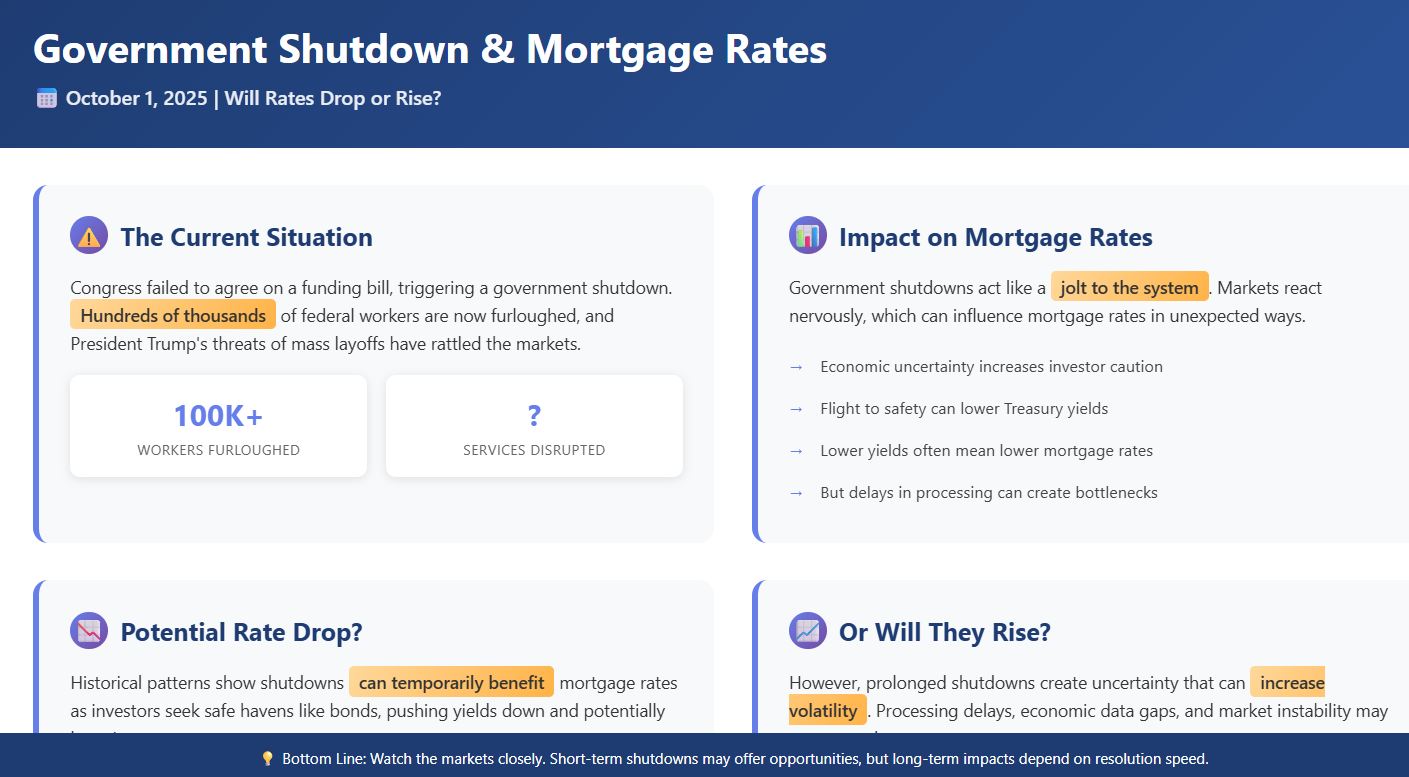
Government shutdowns create uncertainty for markets—and mortgage rates can react quickly to the headlines. Whether rates dip or spike, having a clear investment plan matters.

Norada helps you navigate volatility by connecting you with turnkey, cash-flowing rental properties in resilient markets—so you can protect purchasing power and pursue steady income regardless of short-term rate moves.

🔥 HOT NEW LISTINGS JUST ADDED! 🔥

Talk to a Norada investment counselor today (No Obligation):

(800) 611-3060

Get Started Now

Read More:

  • Bond Market Today and Outlook for 2025 by Morgan Stanley
  • The Risk of New Tariffs: Will They Crash the Stock Market and Economy?
  • Stagflation Alert: Economist Survey Predicts Weak Q1 GDP Due to Tariffs
  • Goldman Sachs Significantly Raises Recession Probability by 35%
  • 2008 Crash Forecaster Warns of DOGE Triggering Economic Downturn
  • Economist Predicts Stock Market Crash Worse Than 2008 Crisis

Filed Under: Economy Tagged With: Economic Forecast, Economy, Government Shutdown

Today’s Mortgage Rates – October 3, 2025: Rates Drop Across, Making Borrowing Cheaper

October 3, 2025 by Marco Santarelli

Today's Mortgage Rates - October 3, 2025: Rates Drop Across, Making Borrowing Cheaper

As of today, October 3, 2025, mortgage rates show a notable drop in average 30-year fixed mortgage rates to 6.44%, down from 6.59% the previous week, signaling a modest easing for homebuyers. However, refinance rates have increased, with the national average 30-year fixed refinance rate rising to 7.07% from 7.03%. These contrasting moves reflect the complex economic backdrop, including recent Federal Reserve interest rate cuts and persistent inflation. This post will explore the latest mortgage and refinance rates, explain their trends, and discuss what borrowers might expect going forward based on expert forecasts and market data from Zillow and other sources.

Today's Mortgage Rates – October 3, 2025: Rates Drop Across, Making Borrowing Cheaper

Key Takeaways

  • 30-year fixed mortgage rates dropped to 6.44% nationally, easing 15 basis points from last week, beneficial for new homebuyers.
  • Refinance 30-year fixed rates increased to 7.07%, up 4 basis points, making refinancing a bit more expensive than before.
  • 15-year fixed mortgage rates also fell to 5.59%, while 5-year ARM rates remain steady close to 7.00%.
  • The Federal Reserve cut its benchmark interest rate slightly in September 2025, indirectly influencing Treasury yields and mortgage rates.
  • Despite the Fed’s cut, mortgage rates remain elevated due to a wider-than-normal mortgage-Treasury spread.
  • Experts forecast mortgage rates to gradually decline toward 6.1% by the end of 2026 as inflation pressures ease.
  • Borrowers should watch inflation data, labor market trends, and spreads between Treasury yields and mortgage rates for the next rate moves.

Current National Mortgage Rate Summary

Zillow's latest data reveal a small but important decline in mortgage rates for new home purchase loans:

Loan Type Current Rate Weekly Change APR APR Weekly Change
30-Year Fixed 6.44% -0.15% 6.60% -0.45%
20-Year Fixed 6.34% -0.02% 6.46% -0.18%
15-Year Fixed 5.59% -0.06% 5.68% -0.39%
10-Year Fixed 5.84% 0.00% 6.23% 0.00%
5-Year ARM 7.00% 0.00% 7.66% -0.14%
7-Year ARM 7.27% -0.01% 7.44% -0.29%

The average 30-year fixed mortgage rate has dropped four basis points from Friday’s previous 6.48% to 6.44%, amounting to a 15 basis point decrease compared to last week’s 6.59%. This drop, though modest, helps improve monthly affordability for homebuyers locking in a long-term fixed rate.

Additionally, the 15-year fixed mortgage rate decreased from 5.65% to 5.59%, providing an attractive option for borrowers seeking faster loan payoff with lower interest expense.

Despite the decreases for purchase mortgage rates, adjustable-rate mortgages (ARMs) such as the 5-year and 7-year ARMs continue to hover around the 7.0% range, reflecting lender caution amid economic uncertainties.

Government-Backed Loan Rates

Government loans, such as FHA and VA loans, show more mixed movements:

Program Rate Change APR APR Change
30-Year FHA 7.25% +1.45% 8.29% +1.48%
30-Year VA 6.18% +0.12% 6.38% +0.17%
15-Year FHA 5.31% -0.01% 6.27% -0.01%
15-Year VA 5.84% -0.02% 6.20% +0.07%

FHA loans experienced a significant increase for 30-year fixed rates, jumping 1.45%, likely due to lender risk assessments and insurance premiums adjustments.

Current Refinance Rates – October 3, 2025

While purchase mortgage rates have eased, refinance rates have risen:

Program Rate Change APR APR Change
30-Year Fixed Refinance 7.07% +0.21% N/A N/A
15-Year Fixed Refinance 5.88% +0.17% N/A N/A
5-Year ARM Refinance 7.47% +0.27% N/A N/A

Rates for refinances have climbed slightly compared to last week.

A rise of 21 basis points in 30-year fixed refinance rates to 7.07% signals that refinancing enthusiasm may soften, especially for borrowers with newer or lower-rate loans. The 15-year fixed refinance rate also rose modestly to 5.88%, and ARM refinance rates increased similarly.

What These Rate Changes Mean for Borrowers

The decline in purchase mortgage rates suggests that new buyers who have been waiting might see better loan pricing now than even a week ago. However, the higher refinance rates mean homeowners considering a refinance need to calculate carefully whether the potential savings justify the costs.

The difference reflects the underlying bond market and lending environment—despite the Fed’s easing move, mortgage lenders face persistent risk and volatility, keeping refinance rates elevated for now. The spread between the 10-year Treasury yield (currently 4.12%) and mortgage rates remains wider than normal. Normally, mortgage rates sit about 1-2% above Treasury yields to cover risks, but in this market, the spread has stayed above 2%, meaning mortgage rates don’t drop as quickly when Treasury yields fall.

The Federal Reserve’s Influence and Economic Context

On September 17, 2025, the Federal Reserve cut its benchmark interest rate by 0.25%, from 4.25%-4.5% down to 4.0%-4.25%. This was the first cut after a long pause. The Fed aims to stimulate the economy and ease borrowing costs, but inflation remains stickily above target at 2.9% year-over-year based on the core PCE price index.

Economic growth, measured by real GDP, remains strong (3.8% annualized growth in Q2 2025), complicating the Fed’s balancing act.

Mortgage rates track bond yields, notably the 10-year Treasury yield, so this Fed move nudges those yields down—currently at about 4.12%. But the mortgage-Treasury spread has not normalized, which tempers the potential rate relief for borrowers.

Mortgage Rate and Refinance Rate Trends Table

Date 30-Year Fixed Mortgage Rate 30-Year Fixed Refinance Rate 10-Year Treasury Yield
September 26, 2025 6.59% 7.03% 4.16%
October 3, 2025 6.44% 7.07% 4.12%
Change -0.15% +0.04% -0.04%

Forecast: What Experts Predict for Mortgage Rates in Late 2025 and 2026

Several authoritative forecasts help us understand where mortgage rates might head next:

  • National Association of REALTORS® expects rates to average 6.4% in the second half of 2025 and fall to about 6.1% in 2026, potentially improving buyer affordability.
  • Fannie Mae forecasts a year-end 2025 mortgage rate around 6.4%, then dropping to 5.9% in 2026, with refinancing activity increasing alongside lower rates.
  • Mortgage Bankers Association predicts mortgage rates declining from 6.7% at the end of 2025 to 6.5% by the end of 2026, influenced by ongoing volatility in mortgage spreads.

These slightly differing projections share the view that rates are likely to drift lower, especially if inflation can be tamed and spreads normalize.

My Insights on Today’s Mortgage Rates

From my experience watching mortgage trends over many years, the subtle decline in purchase mortgage rates this week is a meaningful sign of easing borrowing costs, even if the decreases are smaller than many would hope. The bigger picture is that mortgage rates remain historically elevated compared to the pandemic-low levels of early 2020s but show encouraging signs of stabilization.

For homebuyers, a 0.15% drop can reduce monthly payments noticeably—potentially saving hundreds over a loan’s life—especially on a $300,000 loan. However, the increase in refinance rates means homeowners with recent mortgages should be cautious before refinancing, weighing the closing costs and the slight rate increases.

The incomplete pass-through of Treasury declines to mortgage rates reflects ongoing investor caution. A return to narrower mortgage-Treasury spreads would be a key game-changer in the months ahead.


Related Topics:

Mortgage Rates Trends as of October 2, 2025

Mortgage Rates Predictions Next 90 Days: August to October 2025

Mortgage Rates Predictions for the Next 60 Days

Example Calculation: Impact of Rate Change on Monthly Payments

Imagine a borrower takes a $350,000 mortgage loan:

  • At last week's rate (6.59%), monthly principal & interest payment = about $2,244
  • At today’s rate (6.44%), monthly payment = about $2,209

Monthly Savings: $35
Annual Savings: $420
Savings over 30 years: $12,600 (not accounting for principal paydown or other fees)

While seemingly small monthly, this adds up significantly over time, showing how even small rate drops assist affordability.

How Homebuyers and Refinancers Can Watch the Market

The key factors to monitor going forward include:

  • Inflation metrics such as upcoming PCE and CPI reports.
  • Labor market trends to gauge economic strength or cooling.
  • Mortgage-Treasury spread changes, which directly impact mortgage rate movement.
  • Federal Reserve meeting outcomes for potential future rate cuts or hikes.

For perspective, mortgage rates today comprise many moving parts — from Fed policy, bond yields, investor demand, to inflation worries. Borrowers aware of these dynamics will have an edge in navigating their loan decisions.

Capitalize Amid Rising Mortgage Rates

With mortgage rates expected to remain high in 2025, it’s more important than ever to focus on strategic real estate investments that offer stability and passive income.

Norada delivers turnkey rental properties in resilient markets—helping you build steady cash flow and protect your wealth from borrowing cost volatility.

HOT NEW LISTINGS JUST ADDED!

Speak with a seasoned Norada investment counselor today (No Obligation):

(800) 611‑3060

Get Started Now

Also Read:

  • Will Mortgage Rates Go Down in 2025: Morgan Stanley's Forecast
  • Mortgage Rate Predictions 2025 from 4 Leading Housing Experts
  • Mortgage Rate Predictions for the Next 3 Years: 2026, 2027, 2028
  • 30-Year Fixed Mortgage Rate Forecast for the Next 5 Years
  • 15-Year Fixed Mortgage Rate Predictions for Next 5 Years: 2025-2029
  • Will Mortgage Rates Ever Be 3% Again in the Future?
  • Mortgage Rates Predictions for Next 2 Years
  • Mortgage Rate Predictions for Next 5 Years
  • Mortgage Rate Predictions: Why 2% and 3% Rates are Out of Reach
  • How Lower Mortgage Rates Can Save You Thousands?
  • How to Get a Low Mortgage Interest Rate?
  • Will Mortgage Rates Ever Be 4% Again?

Filed Under: Financing, Mortgage Tagged With: Interest Rate, mortgage, Mortgage Rate Trends, mortgage rates, Mortgage Rates Today

Mortgage Rates Today: 30-Year Refinance Rate Jumps by 20 Basis Points

October 3, 2025 by Marco Santarelli

Mortgage Rates Drop: Today's 30-Year Fixed Refinance Rate Goes Down by 23 Basis Points

Are you thinking about refinancing your mortgage? Today's news might make you think twice. According to Zillow, the national average 30-year fixed refinance rate has jumped a significant 20 basis points, rising from 6.86% to 7.06% as of Friday, October 3, 2025 . This increase, along with jumps in 15-year fixed and 5-year ARM refinance rates, definitely warrants a closer look before you make any decisions.

Mortgage Rates Today: 30-Year Refinance Rate Jumps by 20 Basis Points

What's Behind This Sudden Increase?

Several factors influence mortgage rates. Economic data, Federal Reserve (the Fed) policy, and investor sentiment all play a role. To truly understand what’s happening, we need to look at the bigger picture. Remember that rates are affected by so many things and can never be predicted!

Breakdown of the Current Refinance Rates (October 3, 2025):

  • 30-Year Fixed Refinance Rate: 7.06% (Up 20 basis points)
  • 15-Year Fixed Refinance Rate: 5.88% (Up 17 basis points)
  • 5-Year ARM Refinance Rate: 7.48% (Up 28 basis points)

Should You Refinance Now?

Whether or not you should refinance depends entirely on your individual situation. Here are some things to consider:

  • Current Interest Rate: What's your current mortgage rate? If it's significantly higher than the current refinance rates, refinancing might still make sense, even with the recent increase.
  • Long-Term Financial Goals: How long do you plan to stay in your home? If you're planning to move in a year or two, the costs associated with refinancing might outweigh the benefits.
  • Refinancing Costs: Refinancing isn't free. You'll need to factor in appraisal fees, origination fees, and other closing costs. Make sure the potential savings outweigh these expenses.

The Fed's Recent Rate Cut and Its Impact

On September 17, 2025, the Federal Reserve took an important step by cutting its benchmark interest rate by a quarter percentage point, placing the target range between 4.0% and 4.25%. This was the first cut after a pause. But how does that impact your mortgage?

Understanding the Link: Fed Rate Cuts and Mortgage Rates

The Fed's rate cuts don't directly translate into lower mortgage rates. The connection is a bit more indirect. The Fed influences mortgage rates through the 10-year U.S. Treasury yield. This yield serves as a critical benchmark for 30-year fixed-rate mortgages.

Here's how it works:

  • Direct Benchmark: Lenders use the 10-year yield as a starting point for pricing 30-year mortgages because the average homeowner holds a loan for roughly that long.
  • Investor Competition: Mortgage-backed securities (basically groups of mortgages bundled together) have to offer competitive returns to attract investors, especially when compared to the safety of Treasury bonds.
  • The “Spread”: Mortgage rates are typically higher than the 10-year yield to compensate lenders for risk. Historically, this “spread” has been 1 to 2 percentage points. Recently, it's been wider, acting as a drag on how much mortgage rates fall, even when Treasury yields go down.

What the Rate Cut Means for Mortgage Rates (and You)

Even though the 10-year Treasury yield has dropped after the Fed's cut, the stubbornly wide spread has meant that the decrease in mortgage rates hasn't been as big as some might have hoped. This somewhat explains the recent jump that has been mentioned.

This means:

  • While the Fed is in easing mode, the spread is still keeping rates higher than they might otherwise be.
  • We could see a gradual decline in mortgage rates if the spread begins to narrow. I think there is still a possibility of dipping below 6% in early 2026.

The Caveats: Keep an Eye on Inflation

Here's the thing: inflation is still “sticky” (meaning it's not going down as quickly as the Fed would like). The core PCE price index (the Fed's preferred measurement) was still at 2.9% year-over-year in August 2025, above the bank's target of 2%.

What could happen if inflation rises? Well the Fed might have to change course, which would more than likely push Treasury yields and mortgage rates back up.

Recommended Read:

30-Year Fixed Refinance Rate Trends – October 2, 2025

Best Time to Refinance Your Mortgage: Expert Insights

Should I Refinance My Mortgage Now or Wait Until 2026? 

The Housing Market: What's the Outlook?

So, what all of this means for the housing market?

  • For Buyers: Even a small decrease in mortgage rates is helpful. Despite these increases, purchase power is a little better than it was 6 months ago. Be aware of the market and rates, to get the best rates possible.
  • For Sellers & Inventory: If rates fall enough, some homeowners who were “locked in” to low rates might decide to sell. Then, you could see increased inventory. Although, higher prices are likely to continue if new buyer demand goes above new listings.

Breaking it Down for Different Groups:

To better illustrate the potential impact, here's a table summarizing how these changes might affect different groups:

Group Impact Actionable Advice
Current Buyers Modestly improved affordability; competition remains high in areas with limited housing supply. Focus on securing the best possible rate; be aware of the spread between Treasury yields and mortgage rates.
Refinancers Improved opportunity window for those with rates above 6.5%. Actively explore refinancing options; compare offers from multiple lenders.
Market Watchers Journey toward lower rates will be cautious; wide spread suggests rates will remain elevated relative to Treasury yields for the foreseeable future. Monitor inflation reports, labor market data, and the spread between Treasury yields and mortgage rates.

What to Watch Moving Forward:

To keep an eye on rates, you should pay attention to a few things:

  • Inflation Reports: Keep a close eye on the PCE and CPI numbers.
  • Labor Market Data: This is an important indicator of the overall economy. Softening could make the Fed consider even more rate cuts.
  • The Spread: As I said before, a narrower spread will be necessary for larger relief to borrowers.

My Final Thoughts

As someone who's been following the markets for years, I will say that the combination of the Fed's actions and the current market conditions creates both opportunities and challenges. Understanding the factors influencing mortgage rates is important for navigating the housing market. The recent jump of 20 basis points in the 30-year refinance rate should serve as a reminder that things may not be going in a straight direction all the time. I suggest you be aware and watchful, and work with a trusted, qualified financial advisor to determine what is best for your individual situation.

Maximize Your Mortgage Decisions

Thinking about whether to refinance now? Timing is critical, and having the right strategy can save you thousands over the life of your loan.

Norada's team can guide you through current market dynamics and help you position your investments wisely—whether you're looking to reduce rates, pull out equity, or expand your portfolio.

HOT NEW LISTINGS JUST ADDED!

Talk to a Norada investment counselor today (No Obligation):

(800) 611-3060

Get Started Now

Recommended Read:

  • When You Refinance a Mortgage Do the 30 Years Start Over?
  • Should You Refinance as Mortgage Rates Reach Lowest Level in Over a Year?
  • NAR Predicts 6% Mortgage Rates in 2025 Will Boost Housing Market
  • Mortgage Rates Predictions for 2025: Expert Forecast
  • Half of Recent Home Buyers Got Mortgage Rates Below 5%
  • Mortgage Rates Need to Drop by 2% Before Buying Spree Begins
  • Will Mortgage Rates Ever Be 3% Again: Future Outlook
  • Mortgage Rates Predictions for Next 2 Years
  • Mortgage Rate Predictions for Next 5 Years
  • Mortgage Rate Predictions for 2025: Expert Forecast

Filed Under: Financing, Mortgage Tagged With: mortgage, mortgage rates, Mortgage Refinance Rates

Today’s Mortgage Rates – October 2, 2025: Rates Drop Slightly After Government Shutdown

October 2, 2025 by Marco Santarelli

Today's Mortgage Rates - October 2, 2025: Rates Drop Slightly After Government Shutdown

As of October 2, 2025, today's mortgage rates have shown a slight drop following the recent US government shutdown. Mortgage rates tend to loosely track the 10-year Treasury yield, which saw a decline on October 1st, 2025. During times of government shutdown and uncertainty, investors often move their money into safer assets like Treasury bonds, which can push Treasury yields lower and consequently affect mortgage rates.

Today's Mortgage Rates – October 2, 2025: Rates Drop Slightly After Government Shutdown

The national average 30-year fixed mortgage rate stands at 6.57%, down slightly by 2 basis points from the previous week’s 6.59%. Meanwhile, refinance rates for the same loan length are at 6.98%, a modest decrease from 7.03% the previous week. Shorter-term rates and adjustable-rate mortgages (ARMs) show small fluctuations this week, reflecting ongoing market uncertainty and inflation concerns.

The big picture: mortgage rates are still elevated but may gradually ease, influenced by the recent Federal Reserve rate cut, economic data, and Treasury yields. This means borrowing costs remain significant, but there could be opportunities for buyers and refinancers as the year progresses.

Key Takeaways

  • 30-year fixed mortgage rate is currently at 6.57%, slightly down from 6.59% last week.
  • 30-year fixed refinance rate is at 6.98%, showing a minor decline from 7.03%.
  • The 15-year fixed mortgage rate has dropped modestly to 5.64%.
  • Adjustable-rate mortgages like the 5-year ARM saw an uptick, now at 6.98%.
  • The Federal Reserve cut its benchmark rate recently, influencing Treasury yields and gradually easing mortgage borrowing costs.
  • Despite the easing trends, the spread between Treasury yields and mortgage rates remains wide, limiting the drop in mortgage rates.
  • Experts forecast rates to average around 6.4% in late 2025 and potentially dip near 6.1% in 2026.
  • Economic factors such as inflation at 2.9% (above target) and solid GDP growth (3.8% annualized) play a critical role in rate movements.

Current Mortgage Rates on October 2, 2025

To give a clearer picture, here’s a summary of the current mortgage rates by loan type, including their weekly change and APR (Annual Percentage Rate):

Loan Type Rate Weekly Change APR APR Weekly Change
30-Year Fixed 6.57% Down 0.02% 6.76% Down 0.29%
20-Year Fixed 6.43% Up 0.07% 6.94% Up 0.30%
15-Year Fixed 5.64% Down 0.12% 5.75% Down 0.32%
10-Year Fixed 5.84% No Change 6.23% No Change
7-Year ARM 7.28% No Change 7.72% Down 0.01%
5-Year ARM 6.98% Down 0.16% 7.25% Down 0.56%

Government-backed loan rates:

Loan Type Rate Weekly Change APR APR Weekly Change
30-Year Fixed FHA 5.66% Down 0.15% 6.67% Down 0.15%
30-Year Fixed VA 6.19% Up 0.12% 6.41% Up 0.19%
15-Year Fixed FHA 5.31% Down 0.01% 6.27% Down 0.01%
15-Year Fixed VA 5.86% No change 6.21% Up 0.09%

(Source: Zillow)

Current Refinance Rates: A Mixed Picture

Refinance rates tend to be slightly higher than purchase mortgage rates due to credit profiles and loan terms. Here's a snapshot of refinance rates as of October 2, 2025:

Loan Type Rate Weekly Change
30-Year Fixed 6.98% Down 0.05%
15-Year Fixed 5.84% Up 0.13%
5-Year ARM 7.35% Up 0.19%

While the 30-year fixed refinance rate has edged slightly lower (from 7.03% to 6.98%), the 15-year fixed and 5-year ARM refinance rates increased moderately. This behavior highlights lenders' cautiousness amid economic data and market volatility.

How Mortgage Rate Changes Affect Borrowers

Understanding what these rates mean in practical terms can help clarify their impact:

  • For a $300,000 loan on a 30-year fixed rate at 6.57%, the monthly principal and interest payment would be approximately $1,915.
  • If the rate drops to 6.50% (a slight reduction), that payment would decrease to around $1,896, saving about $19 per month or $228 annually.
  • Refinancing from an older rate of 7.5% to today’s 6.98% on a $300,000 loan would reduce monthly payments from about $2,096 to $1,995, a savings of roughly $101 per month.

Small rate shifts like these can add up over time but emphasize why watching even minor basis point changes is important for borrowers.

Factors Influencing Mortgage Rates Today

1. The Federal Reserve's Rate Cut in September 2025
On September 17, the Federal Reserve trimmed its benchmark interest rate to a range of 4.0% to 4.25%. This was the first rate cut after a long pause and signals a shift toward easing borrowing costs. The Fed remains cautious because:

  • Inflation, measured by the core PCE index, is at 2.9%, above the Fed's 2% target.
  • Economic growth remains solid at 3.8% annualized.

The Fed’s policy aims to strike a balance between cooling inflation and supporting growth.

2. Treasury Yields and Mortgage Rates
Mortgage rates generally follow the yield on the 10-year U.S. Treasury note, currently at 4.12% — slightly below its long-term average of 4.25%. Mortgages, however, trade at a spread of 1-2 percentage points above Treasury yields to compensate investors for higher risk, and lately, this spread has grown wider, keeping mortgage rates elevated.

3. Economic Indicators and Market Sentiment

  • Inflation staying above target keeps the Fed cautious with further rate cuts.
  • Strong GDP growth contrasts with a slightly cooling labor market.
  • Market volatility increases risk premiums, contributing to wider spreads.

Expert Forecasts for Mortgage Rates

Several leading organizations provide forecasts for the future movement of mortgage rates:

  • National Association of REALTORS® predicts average mortgage rates will be about 6.4% in late 2025, falling to approximately 6.1% in 2026. They highlight rates as a “magic bullet” influencing home affordability and market demand.
  • Fannie Mae forecasts year-end 2025 rates at 6.4%, dropping to 5.9% in 2026, projecting an increase in refinancing activity due to lower rates.
  • Mortgage Bankers Association anticipates rates could hover around 6.7% by the end of 2025, decreasing to 6.5% by the end of 2026 but warns of volatility and wider spreads affecting refinance volumes.

The Spread Between Treasury Yields and Mortgage Rates: Why It Matters

A key technical driver keeping mortgage rates relatively high despite falling Treasury yields is the persistent “spread” between these two. Historically, the spread was about 1 to 1.5 percentage points, but recently it has widened to over 2 points. This impacts the actual rate consumers pay because:

  • Investors demand higher yields on mortgage-backed securities for perceived risk.
  • Market uncertainty creates premiums that lenders pass on to borrowers.

If this spread narrows in the future, mortgage rates could decrease more sharply, improving affordability substantially.


Related Topics:

Mortgage Rates Trends as of October 1, 2025

Mortgage Rates Predictions Next 90 Days: August to October 2025

Mortgage Rates Predictions for the Next 60 Days

Impact on Homebuyers and Homeowners

  • Homebuyers face higher borrowing costs but can benefit from modest rate declines if they act at favorable times.
  • Homeowners contemplating refinancing have limited but improved opportunities if their current rates exceed 6.5%.
  • Sellers might see increased listings as current owners take advantage of slightly lowered rates to move.
  • The housing market might see more balanced supply-demand dynamics if falling mortgage rates encourage activity.

Summary Table: Mortgage vs. Refinance Rates (October 2, 2025)

Loan Program Mortgage Rate Change (Weekly) Refinance Rate Change (Weekly)
30-Year Fixed 6.57% -0.02% 6.98% -0.05%
15-Year Fixed 5.64% -0.12% 5.84% +0.13%
5-Year ARM 6.98% -0.16% 7.35% +0.19%

Mortgage rates as of October 2, 2025, are nuanced: though slightly lower than last week's figures, they remain higher than those seen just a few years ago. The interplay of Federal Reserve policy, inflation data, Treasury yields, and market risk premiums ensures that homeowners and buyers must stay informed of the subtle yet impactful fluctuations each week. The forecasts suggest a slow easing but no dramatic drops are imminent, meaning the cost of borrowing for the average American remains significant.

Capitalize Amid Rising Mortgage Rates

With mortgage rates expected to remain high in 2025, it’s more important than ever to focus on strategic real estate investments that offer stability and passive income.

Norada delivers turnkey rental properties in resilient markets—helping you build steady cash flow and protect your wealth from borrowing cost volatility.

HOT NEW LISTINGS JUST ADDED!

Speak with a seasoned Norada investment counselor today (No Obligation):

(800) 611‑3060

Get Started Now

Also Read:

  • Will Mortgage Rates Go Down in 2025: Morgan Stanley's Forecast
  • Mortgage Rate Predictions 2025 from 4 Leading Housing Experts
  • Mortgage Rate Predictions for the Next 3 Years: 2026, 2027, 2028
  • 30-Year Fixed Mortgage Rate Forecast for the Next 5 Years
  • 15-Year Fixed Mortgage Rate Predictions for Next 5 Years: 2025-2029
  • Will Mortgage Rates Ever Be 3% Again in the Future?
  • Mortgage Rates Predictions for Next 2 Years
  • Mortgage Rate Predictions for Next 5 Years
  • Mortgage Rate Predictions: Why 2% and 3% Rates are Out of Reach
  • How Lower Mortgage Rates Can Save You Thousands?
  • How to Get a Low Mortgage Interest Rate?
  • Will Mortgage Rates Ever Be 4% Again?

Filed Under: Financing, Mortgage Tagged With: Interest Rate, mortgage, Mortgage Rate Trends, mortgage rates, Mortgage Rates Today

Will Mortgage Rates Go Down After the US Government Shutdown?

October 2, 2025 by Marco Santarelli

Will Government Shutdown Affect Mortgage Rates: Drop or Rise Ahead?

So, the U.S. government is shut down. What does that mean for your dream of buying a home or refinancing your current one? It's a question many are asking right now. The short answer, and it’s a bit of a mixed bag: government shutdowns can lead to a drop in mortgage rates, but they can also create frustrating delays in the homebuying process. This isn't some abstract economic theory; it's about how fear and uncertainty in Washington ripple down to affect real people's finances and biggest purchases.

Will Mortgage Rates Go Down After the US Government Shutdown?

As of October 1, 2025, we find ourselves in this situation because Congress couldn't agree on a funding bill. This impasse, coupled with President Trump’s bold threats of mass federal layoffs, has sent a nervous tremor through the markets. Hundreds of thousands of federal workers are now furloughed, and essential services are facing disruptions. For us on the ground, especially those of us looking at homes or thinking about our mortgages, understanding these shifts is crucial.

In my years following these economic tides, I’ve observed that these shutdowns often act like a jolt to the system. Sometimes, that jolt can be a small benefit for mortgage rates, and sometimes it's just a headache. Let's break down exactly why this happens and what it means for you.

Government Shutdown Affect Mortgage Rates

What Triggered the 2025 Shutdown and Why Should We Care?

Think of a government shutdown like a pause button being hit on non-essential government operations. It happens when the people in charge of spending the country's money – Congress and the President – can't agree on how much money to give to different departments for the upcoming year. This time around, the disagreements seem particularly tough, involving spending levels and even things like health insurance costs for federal employees.

What makes this shutdown different and potentially more concerning is President Trump's talk of preparing “reduction in force” (RIF) notices. This isn't just about a temporary “see you next week” furlough; it sounds like they're gearing up for permanent job cuts. We’re talking about potentially hundreds of thousands of federal workers being directly affected, and that doesn't even count the ripple effect on the private companies that do work for the government.

From an economic standpoint, these shutdowns aren't ideal. When parts of the government aren't operating, certain economic activities slow down. Experts estimate that every week the government is shut down, it can shave about 0.1% to 0.2% off our nation’s overall economic growth (our Gross Domestic Product, or GDP). Now, if it's a short shutdown, like a week or two, the economy usually bounces back pretty quickly. But longer ones, like the marathon shutdown that lasted over a month back in 2018-2019, can really start to weigh on everyone’s confidence and slow things down.

And here’s a weird twist for 2025: the shutdown means we won't be getting some key economic reports, like the all-important jobs report that usually comes out in early October. When the Federal Reserve – the folks who set interest rates – are trying to figure out how strong or weak the economy is, these reports are like their eyes and ears. Without them, they’re basically flying blind, which adds another layer of uncertainty to their decisions about interest rates.

A Look Back: How Have Shutdowns Hit Mortgage Rates Before?

This isn't the first time we’ve seen a government shutdown, and looking at history often gives us clues about what might happen. The interesting thing is that government shutdowns can actually lower mortgage rates, at least for a while.

Here’s how it usually works: When there's political or economic uncertainty, investors tend to get nervous. They want to put their money somewhere safe. A lot of times, they’ll rush to buy U.S. Treasury bonds, which are considered one of the safest investments out there. When more people buy bonds, the price of those bonds goes up, and their yield (which is like the return an investor gets) goes down.

Mortgage rates are closely tied to the yields on these Treasury bonds, especially the 10-year Treasury note. So, when bond yields drop, mortgage lenders often follow suit, lowering their rates. It’s a bit of a strange phenomenon: bad news in Washington can sometimes be good news for people looking to borrow money for a house.

Let’s look at some past examples:

Shutdown Period Duration Approximate 30-Year Fixed Rate Change Key Observations
October 2013 16 days Drop of about 0.20% Mortgage applications dipped due to processing worries, but bond yields fell significantly.
December 2018 – Jan 2019 35 days Initial drop of about 0.25% The longest shutdown. Saw a temporary dip in rates, but they started to stabilize as the shutdown dragged on. Home sales also took a hit.
Overall Average (Past) Varies Drop of ~0.125% to 0.25% Generally, bond yields would soften by about 0.60% during periods of shutdown-induced uncertainty.

We can visualize this (imagine a graph here): Typically, right when a shutdown begins, mortgage rates might dip a bit, shown by a downward tick. But if the shutdown drags on, the effect might lessen, and rates could steady out or even creep back up depending on other economic news.

It's not always a slam dunk for lower rates, though. Some experts point out that if there isn't other bad economic news to go along with the shutdown (like a really weak jobs report), the drop in rates might be smaller. And in 2025, with the jobs report delayed, the market might not get the signal it expects about economic weakness, potentially limiting how much rates can fall.

The “How-To”: Why Shutdowns Affect Rates and Processing

So, we know rates might drop. But what else happens? It’s a bit like a coin with two sides.

  • The Good Side (Potentially Lower Rates): As I mentioned, the uncertainty often drives investors to the safety of Treasury bonds. This push down on bond yields is a direct signal for mortgage lenders to adjust their pricing. This is likely why, as of today, October 1, 2025, we're already seeing 30-year fixed rates tick down to around 6.125%, according to reports from sources like NerdWallet. This can be a welcome relief for borrowers, especially in a market that’s been sensitive to rate fluctuations.
  • The Not-So-Good Side (Processing Headaches): This is where things get tricky for many hopeful homebuyers. Not all loans are created equal when the government is operating on a skeleton crew.
    • Government-Backed Loans: Loans like FHA, VA, and USDA loans are directly tied to government agencies. While FHA loans are seeing some continuity with emergency staffing, the VA (for veterans) and USDA (for rural development) are pausing new commitments. This means if you were counting on one of these loans, you might face significant delays.
    • Conventional Loans: These are loans from private banks and lenders, like those backed by Fannie Mae and Freddie Mac. They are generally less affected. However, they still sometimes need verifications from government agencies, like checking your tax records with the IRS or verifying your Social Security information. These small delays can add up.
    • Flood Insurance: This is a big one for people buying homes in flood-prone areas. During a shutdown, the National Flood Insurance Program (NFIP) stops issuing new policies. Since most mortgages require flood insurance in designated zones, this can bring a home sale to a complete halt. Reports suggest this can affect about 10–15% of mortgages in areas like Florida.
  • The Bigger Housing Picture: The housing market has already been dealing with its own set of challenges, like limited housing inventory. Adding a government shutdown and loan processing delays on top of that can further slow down sales. And if those mass layoffs President Trump is talking about actually happen? That means fewer people have verifiable income, which makes it harder to get approved for a mortgage. It’s a cascade of potential slowdowns.

My feeling is that while the headline might be about potentially lower rates, the operational disruptions are what people are really going to feel day-to-day. I’ve heard from people who work in the mortgage industry, and they’re already bracing for longer closing times and chasing down missing pieces of information. It adds stress when you're already dealing with one of the biggest financial decisions of your life.

What Does This All Mean for You? Advice and What Experts Are Saying

Let's cut through the noise and get to what you might want to do.

For Potential Homebuyers and Refinancers:

  • Lock it Down? If you’re seeing a drop in rates and you’re ready to move forward, consider locking in your rate. This protects you if rates were to unexpectedly rise again later.
  • Build in Extra Time: Be prepared for delays. While conventional loans might be less affected, government-backed loans and especially flood insurance issues can add weeks to your closing timeline. Talk to your lender about potential bottlenecks now.
  • Federal Employees: If you’re a federal worker, your income verification might be tricky. Document your furlough status carefully. While back pay is usually arranged after the fact, lenders need to see current, verifiable income.

For Those Concerned About the Economy:

  • Short Shutdowns are Usually Okay: Most analyses, like those from the Brookings Institution, suggest that brief shutdowns (under two weeks) have pretty minor impacts on the overall economy.
  • Longer Shutdowns = Bigger Risks: If this shutdown drags on, the economists are more worried. The GDP growth could be noticeably impacted, consumer spending might fall (especially if federal workers and contractors have less money to spend), and it makes the Fed's job of setting interest rates even harder without crucial data.
  • The Layoff Factor: The talk of mass layoffs is the wild card. It’s different from past situations and could have a more significant chilling effect on consumer confidence and spending than a simple furlough.

The Debate and Different Perspectives:

It’s important to remember that not everyone agrees on the impact. Some see shutdowns as fiscal responsibility in action, while others view them as harmful political stunts that hurt everyday workers. Economists at places like Al Jazeera often point out that historically, the market often shrugs off short-term shutdowns. However, the unique circumstances of 2025 – the layoff threats and the data blackout – mean we can't just assume history will repeat exactly.

In my opinion, the most important takeaway is to stay informed and be proactive. Don’t just assume the news headlines tell the whole story. Talk to your lender, understand the specific requirements for your loan type, and keep an eye on reliable financial news sources.


Related Topics on Current Mortgage Rates:

Mortgage Rates Predictions for the Next 6 Months: October 2025 to March 2026

Mortgage Rates Predictions for the Next 12 Months: Oct 2025 to Oct 2026

Mortgage Rates Predictions for Next 90 Days: October to December 2025

Looking Ahead: Potential Economic Ripples

To give you a clearer picture of what longer shutdowns could mean, here’s a general idea of the economic drag we might see, based on analyses from various economic think tanks:

Estimated Shutdown Duration How Much GDP Growth Could Slow Weekly Total Impact on Late 2025 Growth What This Might Mean for You
1 Week Around -0.1% Very Small Mortgage rates might dip slightly; minimal disruption for most.
2 to 4 Weeks Around -0.15% per week Noticeable Slowdown Processing delays become more common; slight dip in home sales.
More Than 4 Weeks Around -0.2% per week Significant Slowdown Layoffs could hit hard; consumer confidence drops; increased market jitters.

(This is a simplified representation, as actual economic effects depend on many factors.)

Imagine this visually: a series of bars, each getting taller as the shutdown gets longer, representing the negative impact on the economy. The longer the shutdown, the higher the bar, signifying greater economic pain.

The key is that while a short shutdown might offer a fleeting benefit of lower mortgage rates, a prolonged one poses significant risks to the broader economy, which can indirectly affect housing demand and affordability in the longer run.

Final Thoughts: Navigating the Uncertainty

So, will a government shutdown affect mortgage rates? Yes. Will they drop? Likely, at least in the short term, due to the “flight to safety” in the bond market. Will this be a smooth ride for everyone trying to buy a home? Probably not. The processing delays, especially for government-backed loans and flood insurance, are real and can cause significant frustration.

As someone who has followed these markets for a while, I've learned that political events often have unintended consequences. The hope is that Congress and the President can find a resolution quickly. Until then, my best advice is to be prepared, stay calm, and communicate closely with your lender. This shutdown might offer a temporary mortgage rate discount for some, but it also serves as a stark reminder of how interconnected our financial lives are with the decisions made in Washington.

Do You Want to Invest in Real Estate Without Any Stress?

Government shutdowns create uncertainty for markets—and mortgage rates can react quickly to the headlines. Whether rates dip or spike, having a clear investment plan matters.

Norada helps you navigate volatility by connecting you with turnkey, cash-flowing rental properties in resilient markets—so you can protect purchasing power and pursue steady income regardless of short-term rate moves.

🔥 HOT NEW LISTINGS JUST ADDED! 🔥

Talk to a Norada investment counselor today (No Obligation):

(800) 611-3060

Get Started Now

Also Read:

  • Will Mortgage Rates Go Down in 2025: Morgan Stanley's Forecast
  • Mortgage Rate Predictions 2025 from 4 Leading Housing Experts
  • Mortgage Rate Predictions for the Next 3 Years: 2026, 2027, 2028
  • 30-Year Fixed Mortgage Rate Forecast for the Next 5 Years
  • 15-Year Fixed Mortgage Rate Predictions for Next 5 Years: 2025-2029
  • Will Mortgage Rates Ever Be 3% Again in the Future?
  • Mortgage Rates Predictions for Next 2 Years
  • Mortgage Rate Predictions for Next 5 Years
  • Mortgage Rate Predictions: Why 2% and 3% Rates are Out of Reach
  • How Lower Mortgage Rates Can Save You Thousands?
  • How to Get a Low Mortgage Interest Rate?
  • Will Mortgage Rates Ever Be 4% Again?

Filed Under: Financing, Mortgage Tagged With: Interest Rate, mortgage, Mortgage Rate Trends, mortgage rates

Mortgage Rates Today: 30-Year Refinance Rate Goes Down by 5 Basis Points

October 2, 2025 by Marco Santarelli

Mortgage Rates Drop: Today's 30-Year Fixed Refinance Rate Goes Down by 23 Basis Points

Are you thinking about refinancing your mortgage? Then you'll want to pay attention: Today's average 30-year fixed refinance rate has decreased slightly, dropping 5 basis points to an average of 7.03%, as of October 2, 2025, according to data from Zillow. While this might seem like a small change, it's part of a larger picture that could signal further shifts in the mortgage market. Let's dive into what this means for you.

Mortgage Rates Today: 30-Year Refinance Rate Goes Down by 5 Basis Points

A Quick Breakdown of Current Rates

Before we get too excited about that slight dip, let's get a clearer understanding of where mortgage rates stand right now. Here's a quick breakdown from Zillow's latest report:

  • 30-year fixed refinance rate: 6.98% (Up 3 basis points from yesterday)
  • The 30-year fixed refinance rate on October 2, 2025 is down 5 basis points from the previous week's average rate of 7.03%.
  • 15-year fixed refinance rate: 5.84% (Up 13 basis points)
  • 5-year ARM refinance rate: 7.35% (Up 19 basis points)
  • Data as of October 2, 2025

You'll notice that while the 30-year rate saw a small decrease compared to last week, the other rates have increased. This mixed bag highlights the volatility of the market and the many factors influencing mortgage rates.

The Fed's Role: A Recent Rate Cut

We need to understand the bigger economic picture, so lets talk about the Federal Reserve (the Fed). They play a huge role in setting the tone for interest rates. On September 17, 2025, the Fed took a significant step by cutting its benchmark interest rate by a quarter of a percentage point, moving the target range to 4.0% to 4.25%. This was the first cut after a pause.

How does the Fed affect Mortgage Rates?

I know, it can seem confusing, but here's the basic connection:

  1. The Fed controls short-term interest rates. When the Fed lowers its rate, it becomes less expensive for banks to borrow money.
  2. This impacts Treasury yields: The 10-year U.S. Treasury yield is a crucial benchmark for 30-year fixed-rate mortgages.
  3. Mortgage rates follow: Lenders base their mortgage rates on the 10-year Treasury yield, typically charging a premium (called a “spread”) to cover their risk and costs.

Treasury Yields and Mortgage Rates: A Closer Look

Currently the :

  • 10-Year Treasury Yield: 4.12% (as of October 1, 2025)

The Mechanics of the Relationship

Here is how it works

  • Direct Benchmark: Lenders use the 10-year yield as a baseline for pricing 30-year mortgages because the average homeowner holds a loan for a similar duration.
  • Investor Competition: To attract investors, mortgage-backed securities must offer a competitive return compared to ultra-safe Treasury bonds.

The “Spread” Problem: Why Rates Haven't Plunged

Here's where things get a little tricky. While the Fed's rate cut has pushed Treasury yields down, mortgage rates haven't fallen as dramatically. This is due to what's called the “spread” – the difference between the 10-year Treasury yield and mortgage rates.

Understanding the “Spread”

Historically, this spread has been around 1 to 2 percentage points. However, recently it has widened, exceeding 2 percentage points. This widening spread is keeping mortgage rates higher than they would otherwise be, even with lower Treasury yields.

Why is the Spread so Wide?

Several factors could contribute to this:

  • Uncertainty:
  • Market Volatility:
  • Demand and Capacity:

What Does This Mean for You?

So, let's boil it down what this all means based on your situation:

  • For prospective buyers: Even modestly decreased mortgage rates enhance affordability.
  • For sellers: The decline in rates may encourage some “rate-locked” homeowners to list their properties, potentially boosting inventory.

Recommended Read:

30-Year Fixed Refinance Rate Trends – October 1, 2025

Best Time to Refinance Your Mortgage: Expert Insights

Should I Refinance My Mortgage Now or Wait Until 2026? 

Looking Ahead: Will Rates Continue to Drop?

Predicting the future is always difficult, especially when dealing with the economy. However, here are a few things to watch:

  • Inflation Numbers: The next few inflation reports(PCE and CPI Readings) will be crucial.
  • Labor Market:
  • The Spread:

For now, the sustained lower Treasury yield is a welcome sign, but remember that the wide spread indicates that lenders and investors are still pricing in risk. Therefore, mortgage rates will likely remain high relative to where treasury yield is.

Bottom Line: If you're a fence-sitter, now might be the time to seriously explore your options. Being prepared will put you in a better position to act quickly if rates become more favorable.

Maximize Your Mortgage Decisions

Thinking about whether to refinance now? Timing is critical, and having the right strategy can save you thousands over the life of your loan.

Norada's team can guide you through current market dynamics and help you position your investments wisely—whether you're looking to reduce rates, pull out equity, or expand your portfolio.

HOT NEW LISTINGS JUST ADDED!

Talk to a Norada investment counselor today (No Obligation):

(800) 611-3060

Get Started Now

Recommended Read:

  • When You Refinance a Mortgage Do the 30 Years Start Over?
  • Should You Refinance as Mortgage Rates Reach Lowest Level in Over a Year?
  • NAR Predicts 6% Mortgage Rates in 2025 Will Boost Housing Market
  • Mortgage Rates Predictions for 2025: Expert Forecast
  • Half of Recent Home Buyers Got Mortgage Rates Below 5%
  • Mortgage Rates Need to Drop by 2% Before Buying Spree Begins
  • Will Mortgage Rates Ever Be 3% Again: Future Outlook
  • Mortgage Rates Predictions for Next 2 Years
  • Mortgage Rate Predictions for Next 5 Years
  • Mortgage Rate Predictions for 2025: Expert Forecast

Filed Under: Financing, Mortgage Tagged With: mortgage, mortgage rates, Mortgage Refinance Rates

  • « Previous Page
  • 1
  • …
  • 11
  • 12
  • 13
  • 14
  • Next Page »

Real Estate

  • Birmingham
  • Cape Coral
  • Charlotte
  • Chicago

Quick Links

  • Markets
  • Membership
  • Notes
  • Contact Us

Blog Posts

  • Bay Area Housing Market Forecast for the Next 2 Years: 2026-2027
    June 24, 2026Marco Santarelli
  • Today’s Mortgage Rates, June 24: Fed Policy and Inflation Push Rates Higher Across Loan Types
    June 24, 2026Marco Santarelli
  • Best Places to Invest in Real Estate in 2026
    June 24, 2026Marco Santarelli

Contact

Norada Real Estate Investments 30251 Golden Lantern, Suite E-261 Laguna Niguel, CA 92677

(949) 218-6668
(800) 611-3060
BBB
  • Terms of Use
  • |
  • Privacy Policy
  • |
  • Testimonials
  • |
  • Suggestions?
  • |
  • Home

Copyright 2018 Norada Real Estate Investments

Loading...